Pacific Ice See Saw Returns

b&o2019001to013

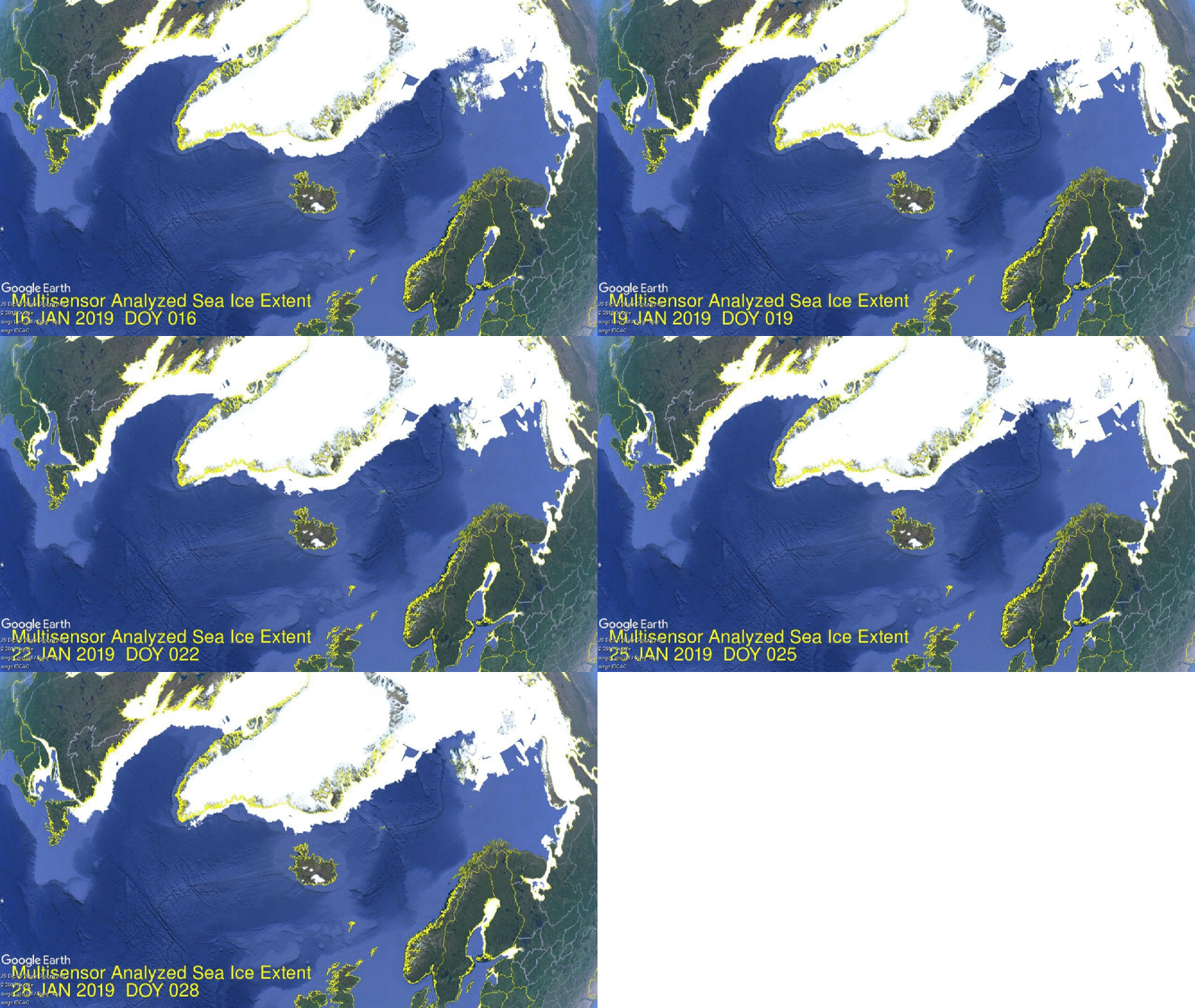
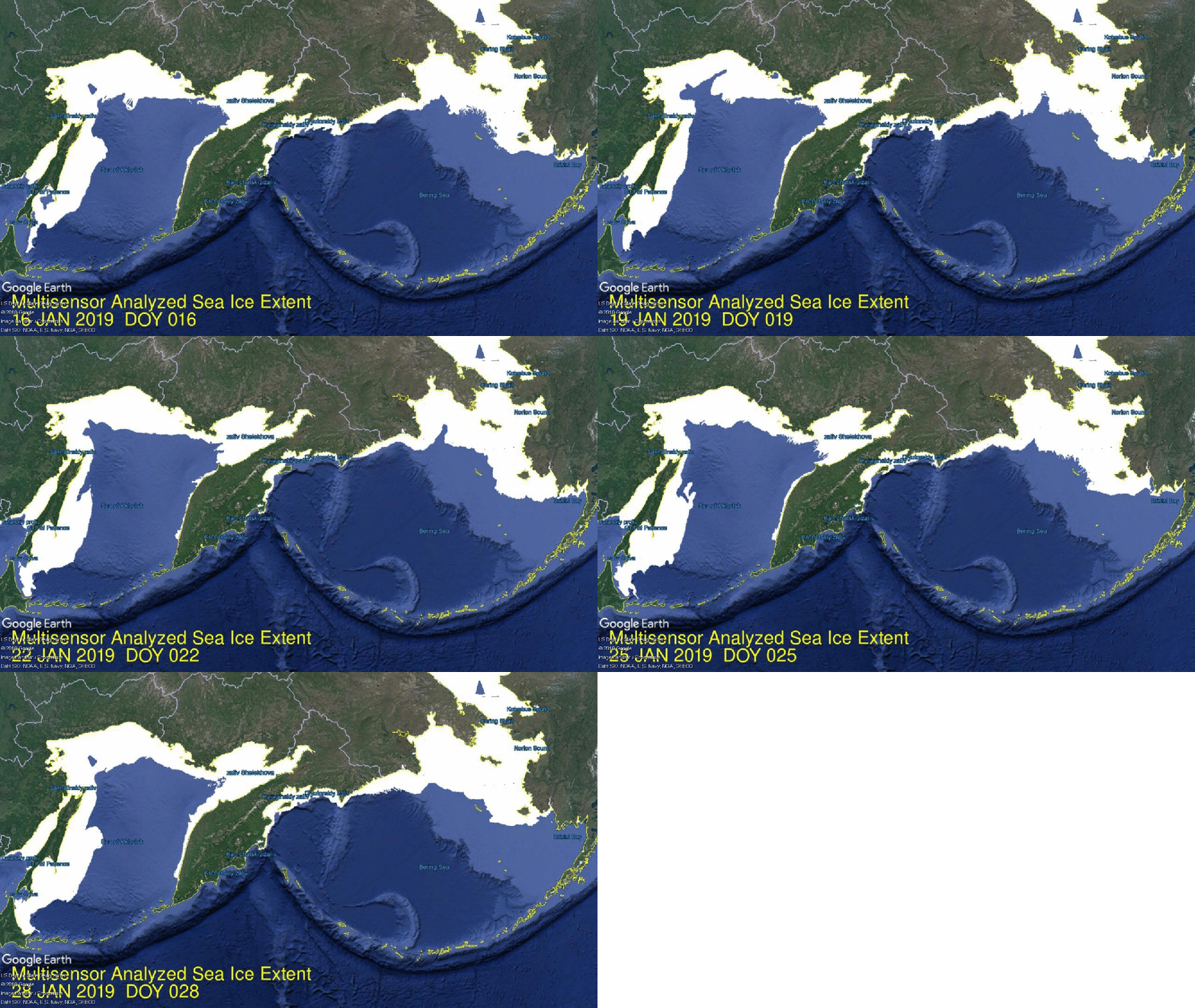
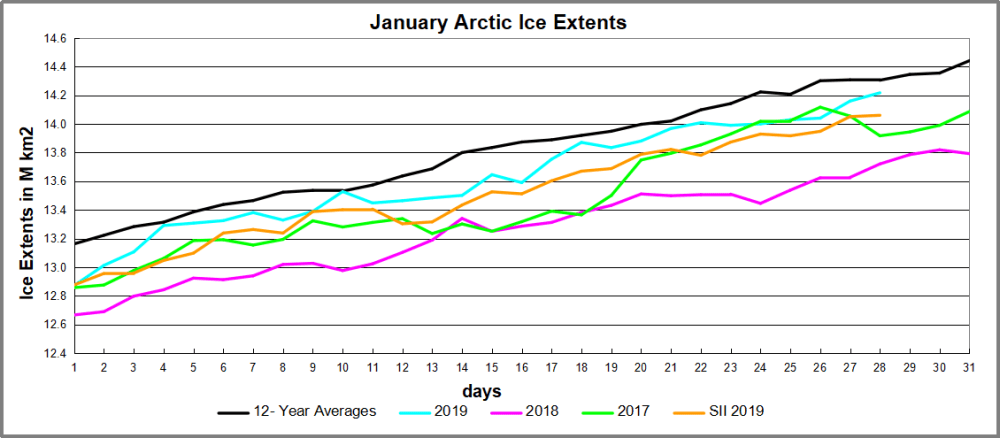
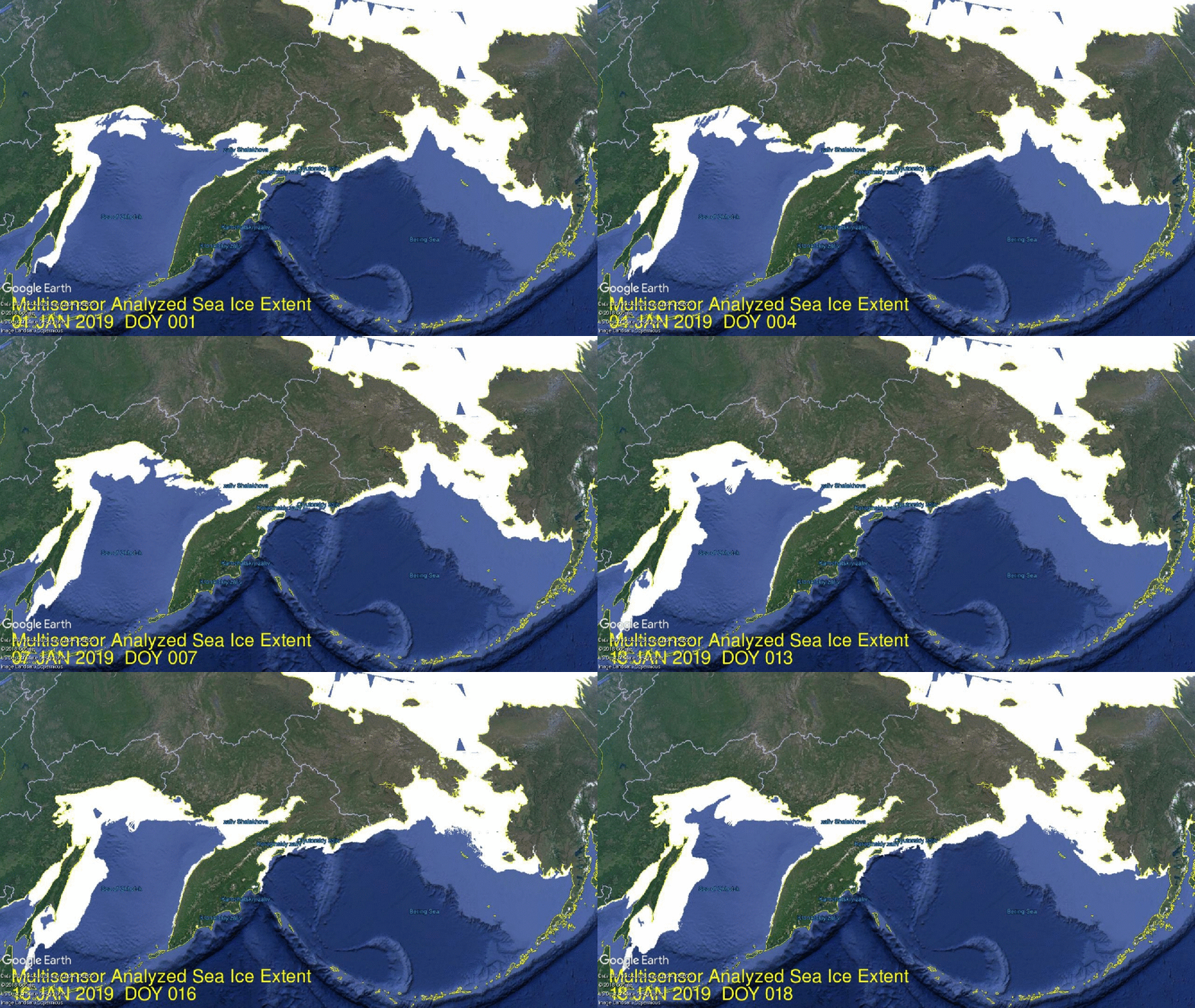
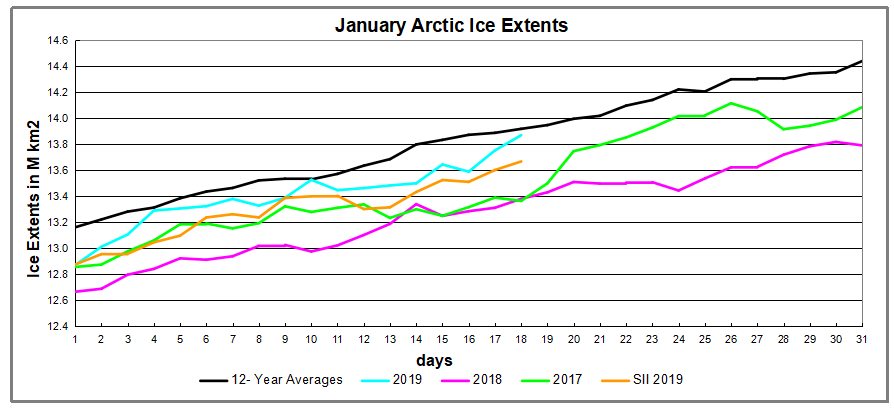
As we have seen in past winters, ice in the Pacific Arctic tends to grow in fits and spurts, often alternating between Bering and Okhotsk Seas.  This see saw began late December with Bering adding ice to surpass 2018 maximum in that basin, while Okhotsk paused.  The above image of the first two weeks of 2019 shows Okhotsk on the left growing ice while Bering pulled back a bit.  Then in the last two days both basins added extents to set new highs for the season.  Combined the two seas ice extents are slightly above the 12 year average at this time. With the disappearance of the Blob of warm water in the North Pacific, both basins appear to be in ice recovery mode.

cg524a47d218458

seesawSee Also:Snowing and Freezing in the Arctic


Pacific Arctic Ice Recovering

Open image in new tab to enlarge.

The image shows ice extents on January 7 for the last three years.  The two Pacific basins are Bering Sea on the right and Okhotsk on the left.  In recent years they had less ice coinciding with the warm Blob in the North Pacific, but it is obvious how strongly Bering is freezing this year. Together they are tracking the combined 12 year average, and Okhotsk is growing ice strongly along the Kamchatka peninsula dividing the two seas.

An updated outlook for the NH winter comes on January 7, 2019 from Dr. Judah Cohen of AER Arctic Oscillation and Polar Vortex Analysis and Forecasts  Excerpts with my bolds.

I have once again received some attention for a forecast of a PV (Polar Vortex) disruption to be followed by widespread severe winter weather. After the winter of 2005/06, I know that I cannot guarantee an outcome no matter how tantalizing close it seems to the finish line. That winter, all six steps in our model verified and yet the forecast busted, at least for the Eastern US. And I think the lessons from that winter are applicable to this winter. There has been a lot of discussion, at least on Twitter, will the stratospheric PV split couple to the surface. I don’t think the question is whether the stratosphere and troposphere will couple, there is already strong evidence that they are coupling. The stratospheric and troposphere PVs are vertically stacked as I showed in a tweet earlier today and can be seen from plots below. Furthermore, the most anomalous cold and snowfall across the NH are currently co-located with those PVs.

Looking forward it looks like the coupling will strengthen over time. The GFS is predicting the first “drip” of warm polar cap geopotential height anomalies from the stratosphere to the troposphere at the end of the week and this weekend which is reflected in a short term drop in the AO. The GFS is predicting more “dripping” for the following weekend though more uncertainty exists with any event beyond a week. But regardless how robust the stratosphere-troposphere coupling currently looks, the magnitude and duration on the NH weather is still highly uncertain. And in an attempt to troll me, Mother Nature has delivered a PV split that is very much reminiscent of the PV split in winter 2006 (see Figure iii).

Figure iii. a) Observed 10 mb geopotential heights (contours) and geopotential height anomalies (m; shading) for 1 – 3 February 2006 and b) Observed 500 mb geopotential heights (contours) and geopotential height anomalies (shading) for 1 – 28 February 2006.

I believe that for a robust tropospheric and weather response to the stratospheric PV split a warm Arctic in the lower to mid-troposphere is critical. If I were to make a winter forecast for winter 2005/06, I would still make the same forecast and I still don’t understand what went wrong with the forecast that winter. In Figure iii I also include the 500 mb geopotential height pattern from that winter and in contrast to the stratosphere the mid-troposphere remained cold in the Central Arctic with low pressure right over the North Pole. Surprisingly, to me at least, the Arctic in the low to mid-troposphere has been relatively cold this winter and for the most part, the forecasts are for that to continue. I think the warmer the Arctic relative to normal over the coming weeks the more likely severe winter weather including cold and snow to be widespread across the NH.

Troughing/negative geopotential height anomalies previously centered near Alaska and the Gulf of Alaska are predicted to continue to drift towards the Dateline supporting ridging/positive geopotential height anomalies downstream over western North America centered over Western Canada with more troughing/negative geopotential height anomalies across eastern North America (Figure 5b). This will favor normal to above normal temperatures across Western Canada and the Western US with normal to below normal temperatures for the Eastern US and especially Eastern Canada (Figure 8). The ECMWF model is predicting less amplified ridging in western North America with milder temperatures in the Eastern US.

Currently the stratospheric PV has broken into several pieces or daughter vortices. The major daughter vortex is centered near Scandinavia and a minor daughter vortex is centered over Quebec and New England with a possible third daughter vortex over the North Pacific with ridging and accompanying warming centered in the Beaufort Sea (Figure 12). The daughter vortex over Scandinavia is predicted to drift west and further split into two with one vortex over Northwest Russia and another over Western Europe with the other vortex over Quebec and New England drifting west into Central Canada.

Figure 12. (a) Analyzed 10 mb geopotential heights (dam; contours) and temperature anomalies (°C; shading) across the Northern Hemisphere for 7 January 2019. (b) Same as (a) except forecasted averaged from 13 – 17 January 2019. The forecasts are from the 00Z 7 January 2019 GFS operational model.

The predicted details of the stratospheric PV disruption are showing better consistency among the weather models. An MMW (Major Mid-winter Warming) has occurred as well as a PV split. Instead there still remains much uncertainty with the impacts of the stratospheric warming on the weather. Following the peak of the stratospheric warming, I would expect the warm/positive PCHS to “drip” down into the troposphere, which is now predicted by at least the GFS. A sudden stratospheric warming not only leads to a warm Arctic in the stratosphere but also at the surface as well. And a warmer Arctic favors more severe winter weather in the NH midlatitudes including the Eastern US. I do think there is uncertainty how warm much the Arctic warms in the lower troposphere and surface and could play a major role in the duration and magnitude of the weather impacts of the PV split.

Figure 9. Forecasted snowfall anomalies (mm/day; shading) from 18 – 22 January 2019. The forecasts are from the 00Z 7 January 2019 GFS ensemble.
Once again additional snowfall is possible across much of northern Eurasia including Siberia, Western Asia, Scandinavia, Central and even possibly Western Europe (Figure 9). Seasonable to cold temperatures across Eastern Canada and even the Northeastern US will also support potentially new snowfall (Figure 9). Mild temperatures could result in snowmelt across Southeastern Europe, Turkey, Alaska, Western Canada and the Western US (Figure 9).

See Also:Snowing and Freezing in the Arctic

Happy Arctic New Year 2019


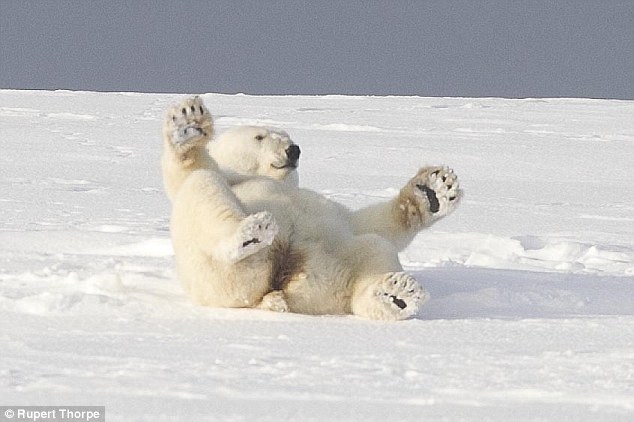
2019 with bears
With the end of December, Arctic ice is rebuilding in the dark up to its annual maximum before the beginning of dawn in March.  Since many of the seas are already at their maximum extents, the coming months will only add about 2M km2 to the approximately 13M km2 of ice in place.

BandO2018340to365

The map above shows the remarkable growth of Bering Sea ice in December.  The Bering ice extent grew from 57k km2 to 459k km2 yesterday, exceeding the March Bering maximum of 451k km2.  Okhotsk has grown ice more slowly, now at 347k km2 slightly below average.  Note Chukchi Sea north of Bering froze completely as of day 350.

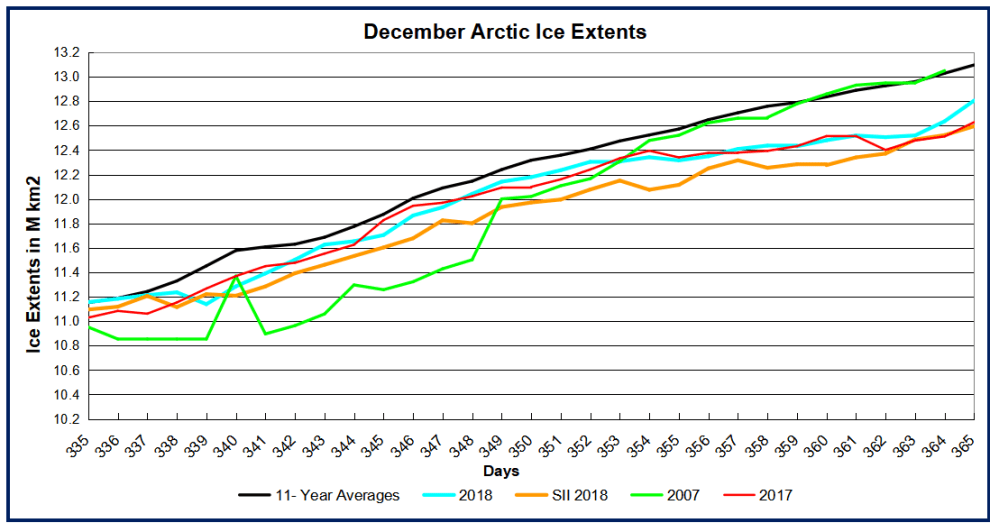
The regrowth of Arctic ice extent was slower than usual until recently. After showing resilience in September, ending higher than 2007, ice growth lagged in October, then recovered in November and kept pace with average through most of December.

Arctic2018365

In December, 2018 ice extent has grown by close to 11 year average until the last 10 days.  As of Dec. 31, 2018 ice extent is ~300k km2  (2%) less than average (2007 to 2017).  The chart also shows the variability of ice extent over the years during this month.  2007 ramped up to match average, while 2017 was almost 200k km2 lower than 2018 at year end.  SII is showing 2018 lower than MASIE 2018, closely matching MASIE 2017.

The table below shows this year compared to average and to 2017 for day 365.  Since several years in the dataset were missing day 365, I am making the comparison a day later.

Region 2018365 Day 365 
Average
2018-Ave. 2017365 2018-2017
 (0) Northern_Hemisphere 12805066 13107229 -302163 12628187 176880
 (1) Beaufort_Sea 1070498 1070245 253 1070445 53
 (2) Chukchi_Sea 966006 963990 2016 943883 22124
 (3) East_Siberian_Sea 1087137 1087133 5 1087120 18
 (4) Laptev_Sea 897845 897842 3 897845 0
 (5) Kara_Sea 773183 889865 -116682 892689 -119507
 (6) Barents_Sea 261190 437725 -176534 331819 -70629
 (7) Greenland_Sea 522009 582349 -60340 555757 -33748
 (8) Baffin_Bay_Gulf_of_St._Lawrence 1069626 1023935 45691 978074 91552
 (9) Canadian_Archipelago 853337 853059 279 853109 229
 (10) Hudson_Bay 1260903 1230818 30086 1260838 66
 (11) Central_Arctic 3194383 3206157 -11774 3191526 2858
 (12) Bering_Sea 458758 422870 35888 194350 264408
 (13) Baltic_Sea 20842 35624 -14782 13345 7497
 (14) Sea_of_Okhotsk 347016 375834 -28818 336595 10421

The main deficit to average is in Barents and Kara Seas on the Atlantic side, partly offset by surpluses in Hudson and Baffin Bays and in Bering Sea on the Pacific side.  Note the huge increase in Bering ice this year compared to 2017.  This coincides with the disappearing warm water Blob in the North Pacific, as reported by Cliff Mass.

No one knows what will happen to Arctic ice.

Except maybe the polar bears.

And they are not talking.

Except, of course, to the admen from Coca-Cola

Summary

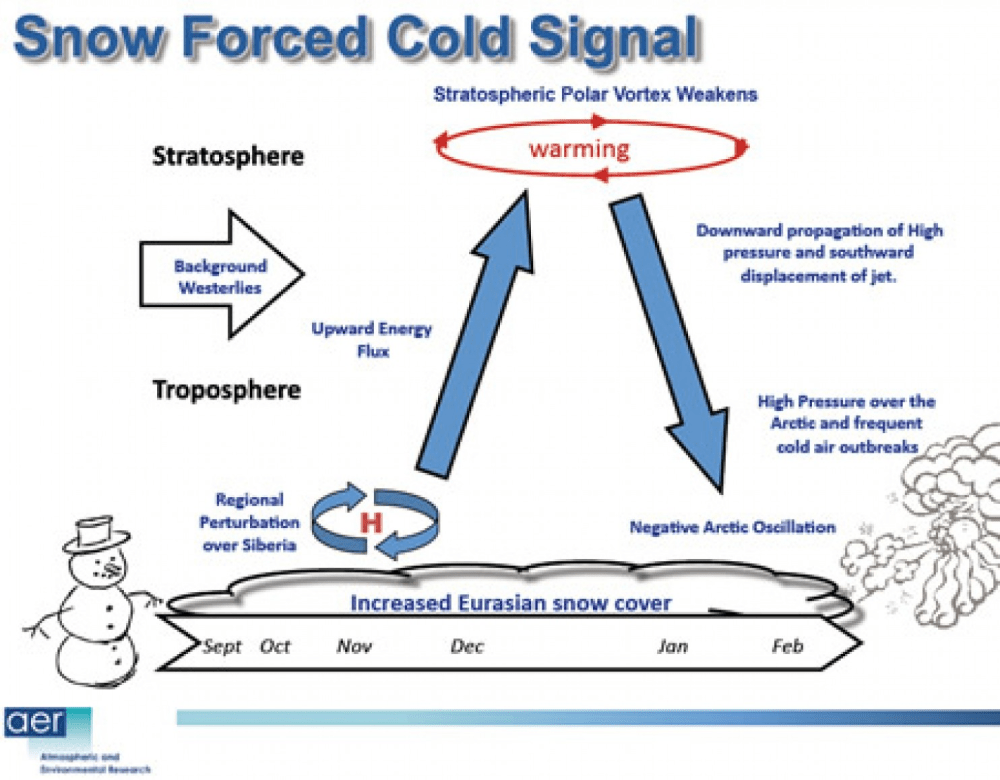
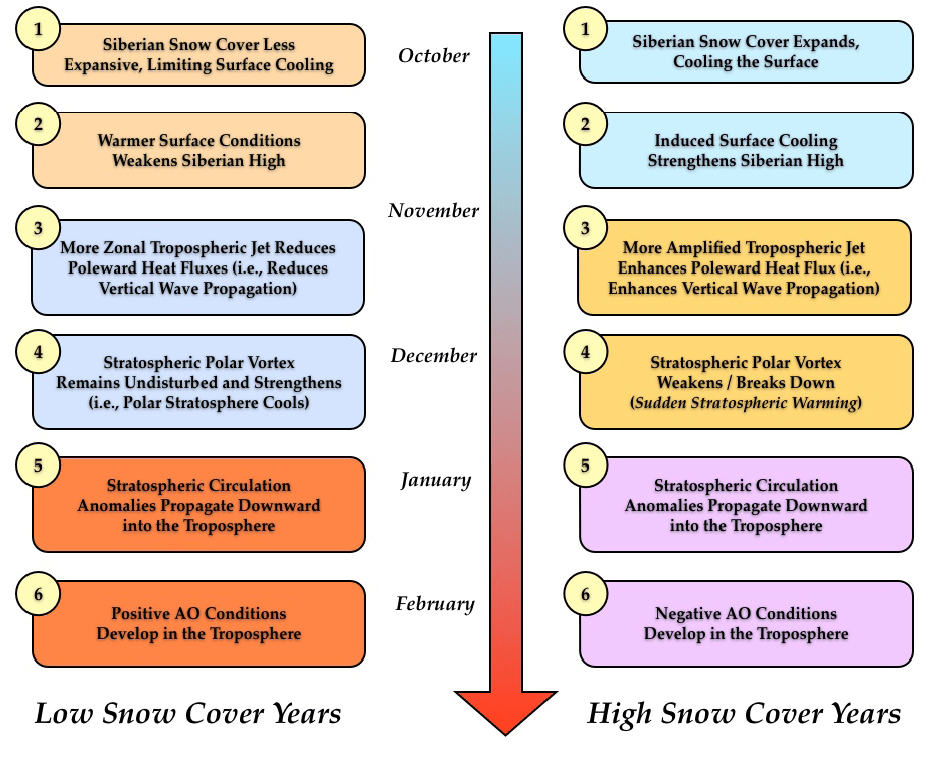
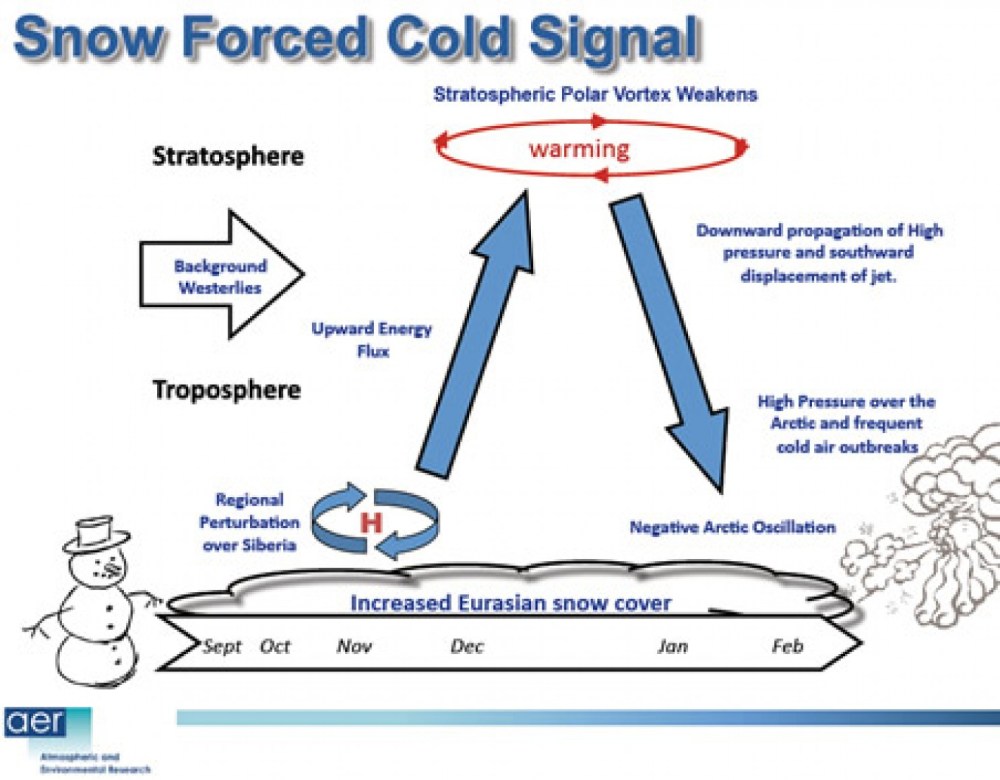
There is no need to panic over Arctic ice this year, or any year.  It fluctuates according to its own ocean-ice-atmospheric processes and we can only watch and be surprised since we know so little about how it all works.  Judah Cohen at AER thinks much greater snowfall in October and since will make for a very cold winter.  We shall see.  It is already adding more mass to the Greenland ice sheet than in previous years.

cohen-schematic

See Natural Climate Factors: Snow

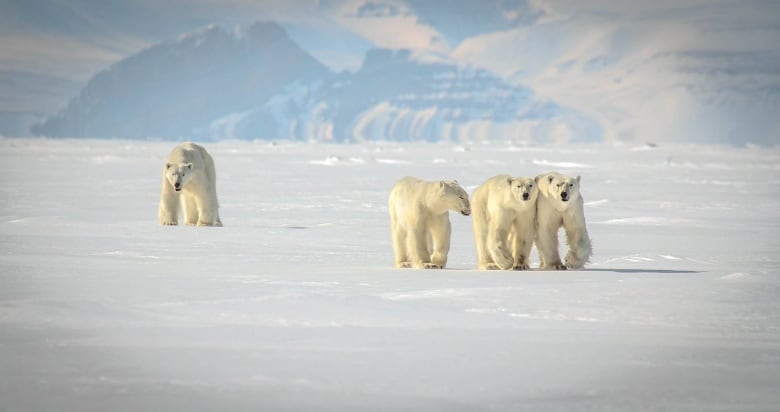
In any case, the early and extensive ice in the Canadian Arctic regions was well received by our polar bears.


Bering Ice is Back!

Remarkable growth of ice in Bering Sea has been observed over the last three weeks as shown above.  The extent went from 57k km2 to 424k km2 during that period, and is presently 94% of the maximum Bering ice extent in March 2018.  To put this event in context, note that Bering 2018 maximum was low and pulled down the overall Arctic extent in March.  For example, 2017 Bering maximum was 725k km2 compared to 2018 max of 451k km2, or a difference of 48%.  We will be watching to see how much will be added in the coming 3 months.

Note also that Chukchi north of Bering completed freezing over on day 352,  December 18, 2018.  We can also see that Okhotsk on the left was freezing at the same rate as Bering, but added no new ice in the last week.

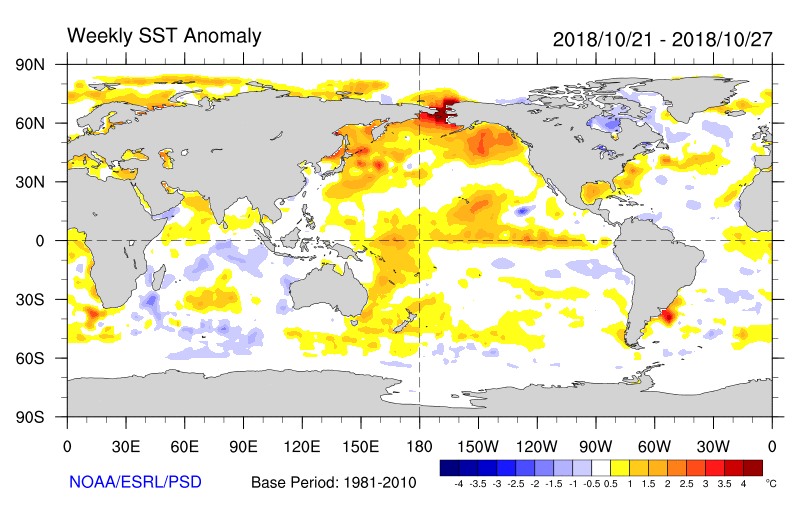
The Bering ice recovery coincides with the demise of the North Pacific “Warm Blob” as reported by Cliff Mass on Dec. 24 Sad News: No More BLOB Excerpts in italics with my bolds.

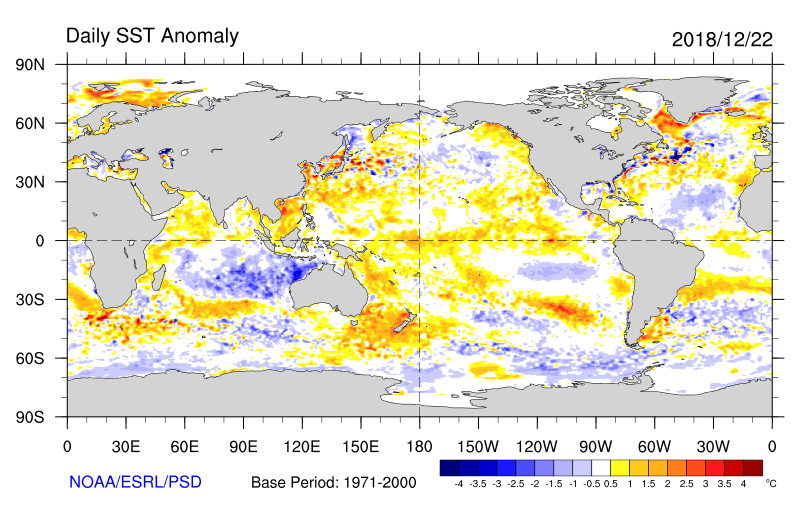
Starting the autumn, the BLOB was relatively weak.  To illustrate, here is the sea surface temperature anomaly (difference from normal) for the end of October–as much as 2-3C warmer than normal!  This was associated with an area of persistent high pressure over the northeast Pacific.

But compare that situation to two days ago.  The BLOB is essentially gone, with an area of cooler than normal water developing.  Only immediately along the coast is the water temperature slightly above normal.


What killed the BLOB?   Persistent storminess over the northeast Pacific, something that is no surprise to the storm-battered residents of the Pacific Northwest. 

Outlook from Dr. Judah Cohen Dec. 24, 2018 at Arctic Oscillation and Polar Vortex Analysis and Forecasts

In conclusion there is still much uncertainty with the predicted PV disruption and the longer it takes for the PV disruption to unfold the longer it will take for any impacts to reach the surface. And I would argue it makes very important differences on the sensible weather whether the PV splits, and if it splits the duration and the location of the sister vortices. But a robust PV split increases the likelihood of severe winter weather in the near term and more so long term for both the Eastern US and Europe. Also expect ongoing model forecast volatility until the circulation anomalies associated with the PV disruption reaches the tropopause as we argue in my most recent paper Cohen et al. 2018.

One last thing that I feel may play an important role on the NH circulation are sea ice anomalies. For months I have been anticipating that the greatest sea ice anomalies this winter will be in the Barents-Kara Seas. That is quite apparent in today’s Figure 15. Typically blocking is focused across Greenland following a PV disruption. But abundant sea ice near Greenland and the lack of sea ice in the Barents-Kara Seas may help focus future high latitude blocking closer to Europe this winter. Strong Scandinavian/Barents-Kara Seas blocking may favor an eastward shift of the cold air across Europe. Cold air may drain into Eastern Europe but be blocked from Western Europe.

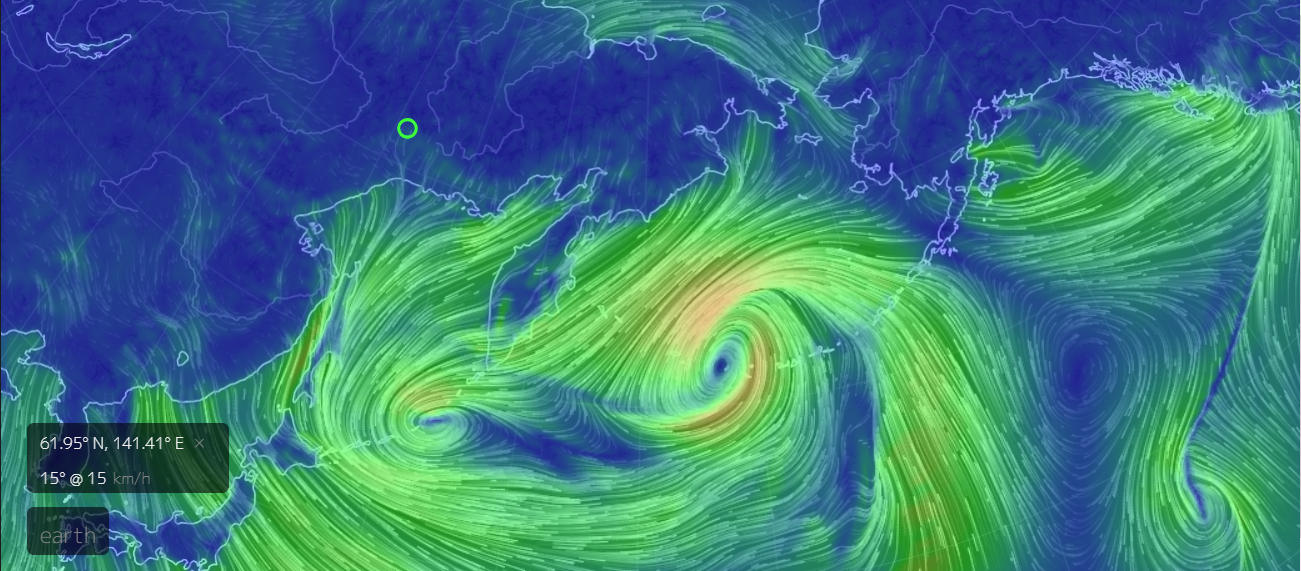
Finally, today from nullschool we can see the North Pacific twin gyres at work:

https://earth.nullschool.net/#current/wind/surface/level/orthographic=-188.36,56.12,853/loc=141.408,61.951

Summary

Several Alaskan kids are in the group suing the US government over fears of Arctic warming.  It’s looking like they may get relief from nature before it can come from the courts.


Arctic Pacific Flash Freezing in December

BO2018338to349Eleven Days in Pacific Arctic are shown in the above animation.  In the upper center, Chukchi finally froze completely, adding 260k km2 of ice to reach 99.8% of maximum.  (Disregard the blue jagged arc as a sensor artifact.)  Meanwhile, serious freezing began in the two Pacific basins.  Bering to the south of Chukchi went from 57k km2 to 195k, now 43% of maximum.  Okhotsk to the left went from 58k km2 to 223k, now 19% of maximum.
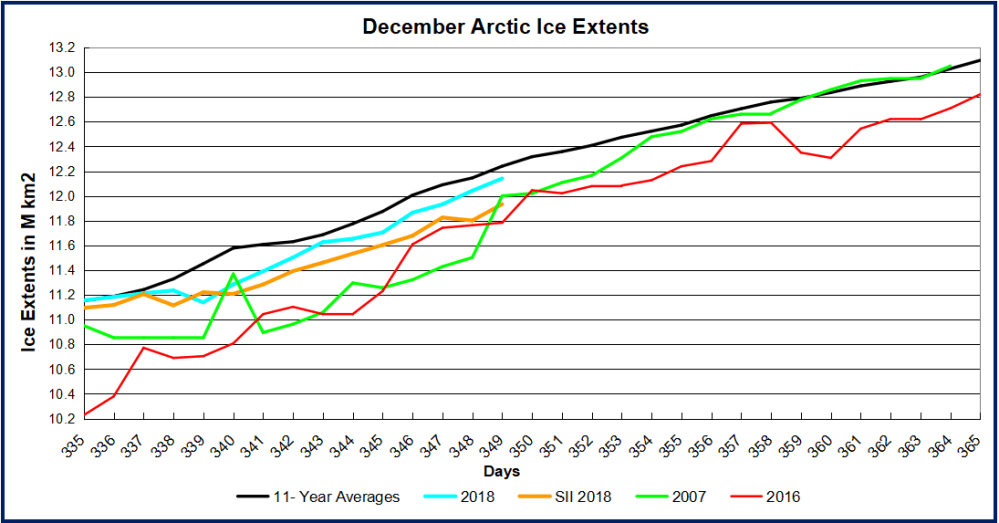
The graph below shows December progress in ice extent recovery.

Arctic2018349From days 335 to 339, 2018 extents were flat and went below average.  Now freezing has resumed as shown in the animation above and tracking close to average again in the graph.  At day 349 (Dec. 15) MASIE shows 2018 1 day behind average (100k km2),  200k km2 greater than SII 2018,  140k km2 greater than 2007 and 358k km2 more than 2016.


The central Arctic and Eurasian shelf seas are completely frozen, typical for this time of year.  The Pacific was a little slower than usual to start, but is now coming on strong.  The Canadian side froze early and is of course locked in for the winter.  The only remaining deficit of note is Barents Sea which hasn’t added ice in the last two weeks.

cg524a47d218458

Arctic Ice Machine Back on

Can2018325to342Seventeen Days in Hudson Bay are shown in the above animation.  In the lower center, Hudson Bay pushed its ice extent up to 1.24M km2, 98% of maximum.  Just to the northeast, Hudson Strait and Ungava Bay are completely frozen over, with Baffin Bay reaching down.  At the top left you can see Chukchi Sea growing ice toward Bering Strait.
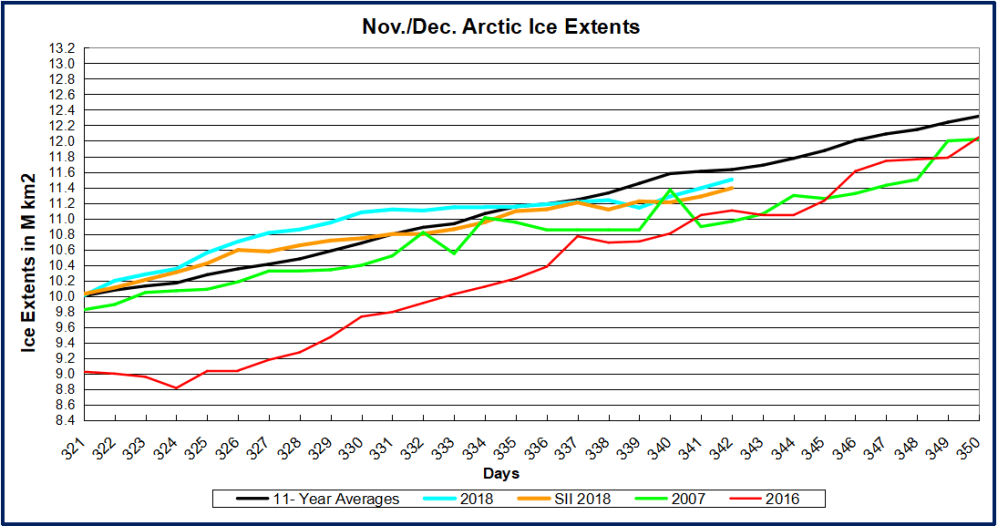
The graph below shows recent progress in ice extent recovery.

Arctic2018342From days 330 to 339, 2018 extents were flat and went below average.  Now freezing has resumed as shown in the animation above and nearing average again in the graph.  At day 342 (Dec. 8) 2018 is 540k km2 greater than 2007 and 400k km2 more than 2016.


The table below shows the distribution of ice in the various Arctic basins.

Region 2018342 Day 342 
Average
2018-Ave. 2007342 2018-2007
 (0) Northern_Hemisphere 11502523 11629820 -127297 10963264 539259
 (1) Beaufort_Sea 1070498 1069593 905 1062538 7960
 (2) Chukchi_Sea 790911 866476 -75565 649261 141650
 (3) East_Siberian_Sea 1087137 1082340 4798 1043563 43574
 (4) Laptev_Sea 897845 897834 11 897845 0
 (5) Kara_Sea 783104 815899 -32796 809723 -26620
 (6) Barents_Sea 109526 309994 -200468 215095 -105568
 (7) Greenland_Sea 499296 567272 -67976 479113 20183
 (8) Baffin_Bay_Gulf_of_St._Lawrence 868077 783249 84828 740590 127487
 (9) Canadian_Archipelago 853337 853057 280 852556 781
 (10) Hudson_Bay 1237622 844887 392735 948899 288723
 (11) Central_Arctic 3126752 3204662 -77910 3174734 -47982
 (12) Bering_Sea 82425 197632 -115207 39832 42593
 (13) Baltic_Sea 2859 7895 -5037 2898 -39
 (14) Sea_of_Okhotsk 90248 122364 -32116 45331 44917


The table shows how early is the freezing in Hudson Bay nearly offsetting slower ice buildup in Bering and Barents Seas.  It appears that the Pacific ice extents in Bering and Okhotsk Seas may again be slower than average this year.  The deficits there match the overall 2018 deficit to average.

cg524a47d218458

November Arctic Ice Recovery

HB2018320to338Eighteen Days in Hudson Bay are shown in the above animation.  In the lower center, Hudson Bay more than doubled its ice extent up to 1.07M km2, 85% of maximum.  Just to the northeast, Hudson Strait and Ungava Bay are almost frozen over, with Baffin Bay reaching down.  At the top right you can see Greenland Sea ice reaching out toward Iceland.

The remarkable growth of Arctic ice extent in November 2018 overcame the October deficit,  went 400k km2 over the 11 year average and exceeded all but one year in the last decade. The graph below compares the last 12 November ice extents.


Arctic Nov 2007 to 2018

The monthly average of all November days shows 2018 matching the 11 year average, slightly higher than 2007, and 1M km2 greater than 2016.  The graph below shows the daily growth of ice extents throughout November, on average and for some important years.
Arctic2018334

2018 ice growth slowed so that it only slightly exceeded the 11 year average at month end.  At 11.15M km2, it was higher than other recent years, 1M km2 greater than 2016.

Dr. Judah Cohen at AER  posted on Dec. 3 explaining the November dynamics.  Excerpts in italics with my bolds.

figurei_12032018

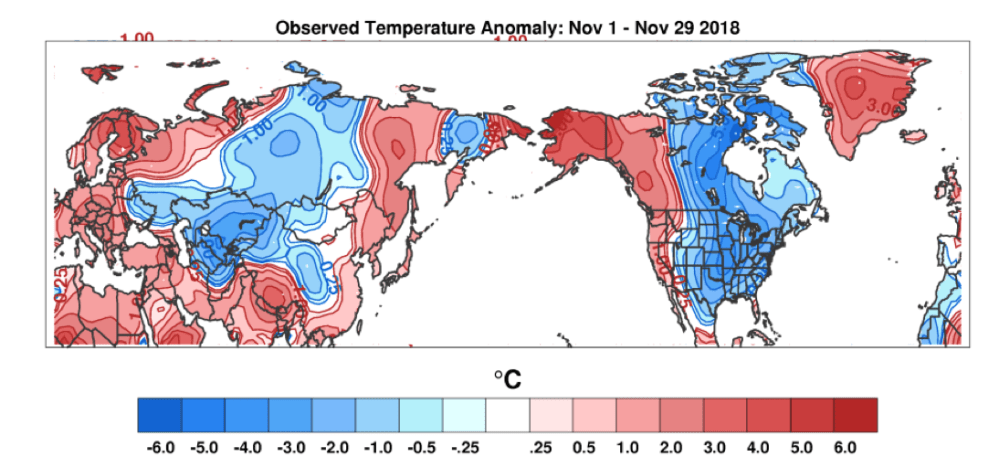
Figure i. Observed surface temperature anomalies 1-29 November 2019.

In the month of November there were two distinct pulses of vertical energy transfer from the troposphere to the stratosphere that resulted in a perturbation of the stratospheric PV and a displacement of the PV towards Eurasia with an elongation towards eastern North America and a warming centered near Alaska and Northwestern Canada. However, those pulses were not simply absorbed by the polar stratosphere but in large part ricocheted or reflected off the stratospheric PV and back into the troposphere. So that in large part forced a similar pattern in the troposphere that it did in the stratosphere. The vertical energy transfer and the subsequent boomerang back down creating a similar pattern in both the stratosphere in troposphere happens very quickly over a matter of days. The tropospheric pattern of ridging near Alaska and western Canada with troughing in eastern North America and the northerly flow between the two atmospheric features delivered a relatively cold November to Eastern Canada and the Eastern US (see Figure i).

But now we have a new month and still more active vertical energy transfer as indicated by the red shading in Figure 11. For the first half of December there are predicted two or three distinct vertical energy pulses. But what is missing so far for the month of December is any blue shading, these waves are not being reflected or ricocheting off the stratospheric PV but are almost completely being absorbed in the stratosphere. This wave energy should therefore have a bigger and more lasting impact on the stratospheric PV. From Figure 10 we can already see hints of this. For the first time this fall and now winter 2018/2019 the polar cap heights are predicted to be above normal in the middle stratosphere. But my expectation is that this latest perturbation of the stratospheric PV will be evolving for weeks and not days and the peak will likely occur either in late December or early January. Also the eventual impact on the troposphere will be weeks and not days.

But because there is no reflecting or returning signal from the stratosphere what is dominating the troposphere is the thermal advection or the migration of air masses across the NH. As I discussed last week and again today this transport of heat is usually characterized by a cold East Asia and western North America and a mild eastern North America and if you look at Figures 3, 6 and 8 this is generally the temperature pattern that is being predicted over the next two weeks with the focus of the cold across Siberia, East Asia and Alaska. Eastern North America is predicted to turn much milder starting next week. I am not as sure what is the impact for Europe during active vertical energy transfer and I thought maybe mild but the forecast for Europe is vacillating between mild and cold but turning milder across Northern Europe.

Meanwhile, in Nunavut, it is a great time to be a polar bear, even more of them than people want.


Arctic Breaks Ice Ceiling


slider-glassceiling

The remarkable growth of Arctic ice extent continues with a new development yesterday, as shown by the graph below.
Arctic2018330

Note that as of day 330, Nov. 26, 2018, Arctic ice extent exceeds the 11 year average reached at month end.  At 11.08M km2, it is 400k km2 above the average for day 330.  It also matches 2013 (not shown) with only 2014 slightly higher in the last decade.


Dr. Judah Cohen at AER posted yesterday on the difficulties forecasting this winter’s coming months.  Excerpts in italics with my bolds.

In my opinion troposphere-stratosphere coupling is now in full gear and is having a significant impact on the large-scale circulation of the atmosphere. The relatively active vertical transfer of energy from the troposphere to the stratosphere is repeatedly perturbing the stratospheric PV though it is not of sufficient magnitude to force a significant PV disruption but only minor disruptions. Still the stratospheric PV is predicted to be continuously displaced from the North Pole towards northwest Eurasia. The displacement of the stratospheric PV south of its normal position is allowing the stratospheric PV to grab milder temperatures from more southern latitudes and sling shot it from across Asia towards Eastern Siberia and Alaska, where the warming temperatures are building ridging/positive geopotential height anomalies in the stratosphere centered near Alaska. This is resulting in northerly flow between the Alaskan ridge and stratospheric PV on the North Atlantic side of the Arctic from central Siberia to eastern North America. We have seen the same flow already mimicked or repeated in the troposphere during the month of November contributing to an overall cold month of November in the Eastern US.

As far as the winter as a whole, I believe that the behavior of the stratospheric PV is critical. The vertical atmospheric energy transfer looks active to me for the foreseeable future. This could lead to a significant or major stratospheric PV as early as the second half of December and extending into early January. If a large stratospheric PV disruption were to occur in the late December and early January timeframe this would be almost ideal in contributing to an overall cold winter for the usual favored regions across the NH mid-latitudes, but each event is unique. Any delay in a significant stratospheric PV disruption would lead to an extended period of volatile weather and increase the odds for an overall mild winter especially if the stratospheric PV strengthens and becomes circular in shape. There is the scenario where the vertical energy transfer remains active, the stratospheric PV is perturbed but no significant disruptions occur and the Eastern US still experiences a cold winter ala winter 2013/14 and is described in our new paper: Kretschmer et al. 2018, but more on the paper in a future blog.


Meanwhile, in Nunavut, it is a great time to be a polar bear, even more of them than people want.


Arctic Update: Hell Freezing Over

The title of this post is over the top, but was provoked by the repeated claims last summer earth was going to hell right now.  For example,

The world’s summer of hell.  Hot, hot, hot: Summer of extremes setting heat records around the world, July 2018, CBC

Summer 2018: On the highway to hell? August 2018, Beyond Ratings

Earth at risk of becoming ‘hothouse’ if tipping point reached, if we can’t stop it we’re in a hell of a mess..August 2018, CNN

The Summer of Hell.  Climate change is here and we are living in its embers.  August 2018 The Week (US)

Meanwhile, back in reality, Arctic ice is spreading everywhere.  The image below shows the European side in the last two weeks:

Laptev and East Siberian in the middle are frozen solid. On the right Kara has added 400k km2 ice extent up to 700k km2, 75% of March maximum.  Below is the freezing proceeding on the Canadian side.

Baffin Bay in the center next to Greenland is extending south and added 300k km2.  Hudson Bay on the left added 400k km2, with the western coastline freezing all the way down into James Bay.  The graph below shows 2018 is matching the 11-year average after being down in October.

Both MASIE and SII have 9.9M km2 ice extents matching the average for day 320, Nov. 16.  2007, 2012 and 2017 all recovered from their September lows, while 2016 was much slower to refreeze.

Region 2018320 Day 320 
Average
2018-Ave. 2007320 2018-2007
 (0) Northern_Hemisphere 9937017 9942096 -5078 9824193 112824
 (1) Beaufort_Sea 1069588 1064590 4999 1059182 10406
 (2) Chukchi_Sea 615028 667249 -52222 519486 95541
 (3) East_Siberian_Sea 1085198 1077597 7601 1055581 29617
 (4) Laptev_Sea 897845 897648 197 897845 0
 (5) Kara_Sea 701192 655668 45524 774297 -73105
 (6) Barents_Sea 65798 167138 -101340 149482 -83684
 (7) Greenland_Sea 378273 482289 -104016 533946 -155672
 (8) Baffin_Bay_Gulf_of_St._Lawrence 711715 555346 156369 545899 165816
 (9) Canadian_Archipelago 853337 851902 1435 852539 798
 (10) Hudson_Bay 426092 261863 164228 244531 181560
 (11) Central_Arctic 3107467 3186378 -78911 3163043 -55576

Deficits in Chukchi, Greenland and Barents Seas are offset by surpluses in Kara Sea, Baffin and Hudson Bays.

Meanwhile, in Nunavut, it is a great time to be a polar bear, even more of them than people want.

When Hell Freezes Over (Eagles Reunion Tour)


November Arctic Ice Roaring Back

KL2018298to309

Russian Coastline Freezes in last Ten days

With the Canadian Arctic already frozen over, the action has moved to the Russian side.  The image above shows East Siberian and Laptev basins filling in completely.  Meanwhile on the right Kara Sea has gone from open water to nearly half of last March maximum.  Kara went from 114k km2 on day 298 to 435k km2 yesterday, 47% of March max.

Arctic2018309

The graph shows MASIE reporting ice extents totaling 9.0M km2 yesterday,  matching the 11 year average (2007 to 2017 inclusive).  Notice that 2018 lagged the average by 900k km2 on day 296 and overcame that gap in 13 days.  Presently, 2018 is tracking  300k km2 above 2007, 600k km2 more than 2012, and  1.3M km2 more than 2016. NOAA’s Sea Ice Index continutes to match MASIE through this period.

cursnow_asiaeurope20181105


The current IMS Snow and Ice Chart shows how snow is covering Siberia completely, and has spread over northern and eastern canada.  Snow cover is an important indicator for the coming Arctic and NH winter, as explained by Dr. Judah Cohen in his latest AER arctic oscillation update (here).  Excerpts in italics with my bolds.

What unfolds next with the stratospheric PV (Polar Vortex) and troposphere-stratosphere coupling could be critical for determining the average temperature for the winter (December-January-February). Currently the GFS is predicting that the vertical transfer of energy from the troposphere to the stratosphere will become relatively quiet after this week. This will allow the stratospheric PV to recover and strengthen the second half of November. If the stratospheric PV becomes relatively strong and circular in shape in early December and couples to the mid and lower troposphere, this will likely result in a mild to extremely mild pattern across much of the NH including the Eastern US and northern Eurasia. At least for the Eastern US, it will be very difficult to recover from a mild start to winter and the winter temperatures would likely average mild regardless of what transpired the remainder of winter. Across northern Eurasia including Europe I think the outcome is a little more in doubt, as we saw last winter, Northern Eurasia and Europe can still average below normal for winter even with a mild start.

However an alternate path is that the energy pulse predicted for this week is not unique but is followed by subsequent pulses that further perturb the stratospheric PV. I see no evidence of this from the latest GFS forecasts, however in my opinion the NH tropospheric circulation remains favorable for subsequent PV disruptions. I think the place to watch is Siberia. As long as Siberia remains cold further energy pulses are likely with disruption to the stratospheric PV. However if Siberia turns mild for an extended period then we should expect a relatively strong PV for at least several weeks.

I would also like to note several trends. Snow cover extent remains above normal across North America. I do believe that snow cover can foreshadow the weather and the early season cold air outbreak across Eastern North America was at least preconditioned by the extensive snow cover for the entire fall this year. As long as the snow cover remains extensive and resilient, eastern North America remains at risk for subsequent cold air or Arctic outbreaks. However in the near term snow cover advance has been most impressive across Asia and with the more extensive snow cover, cold air is building across Siberia and is predicted to become more widespread. And just as I discussed above how long the snow and cold persist across Asia could be critical for the character of the winter not just locally but even remotely including the Eastern US.


algore_ice_gone_by_2013