Arctic Gains Ice in October


Arc2018290to304Big Chill in last Two Weeks

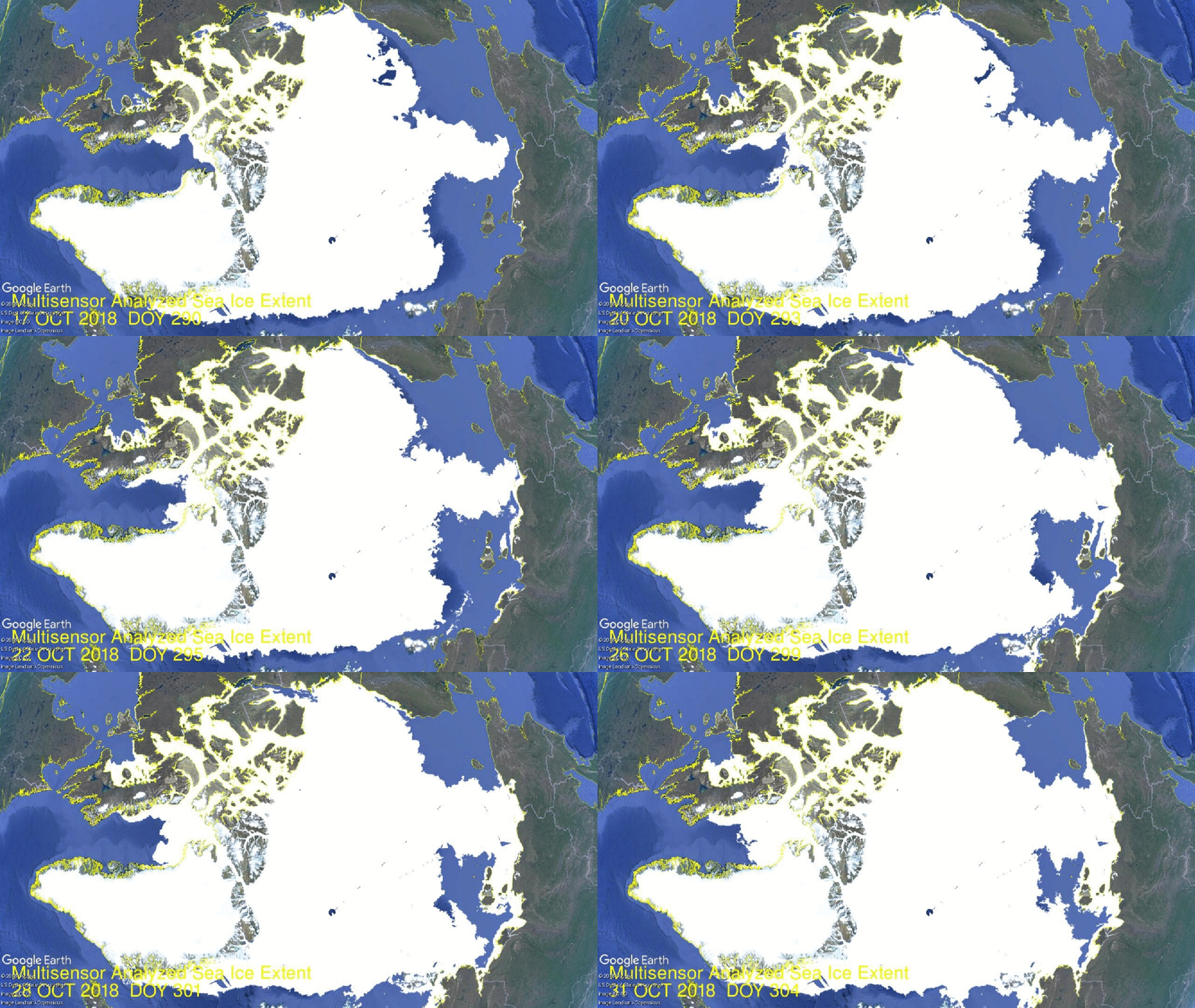
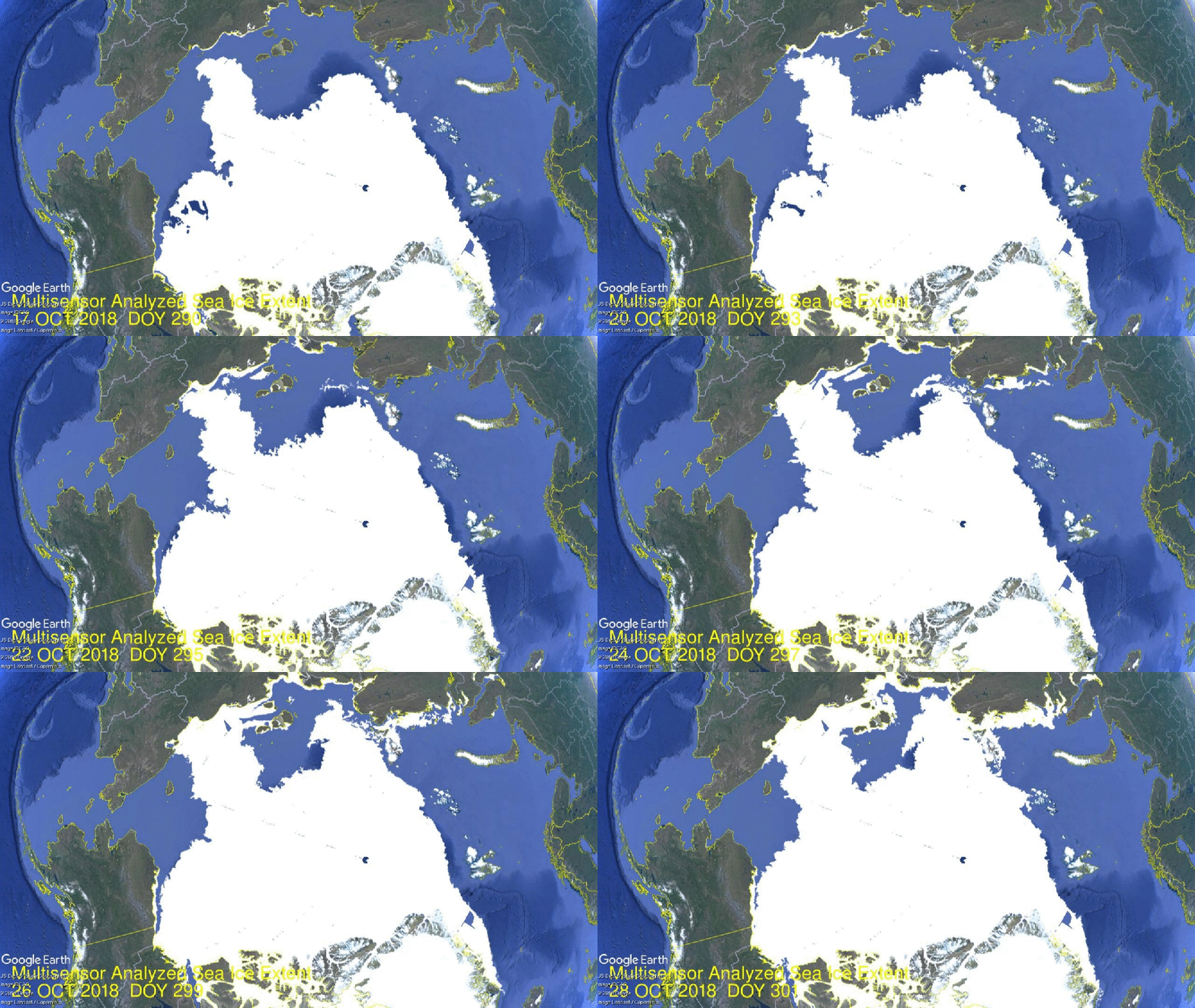
The major growth in ice extent came in the Russian basins (right side).  The image above shows massive gains in ice extent in East Siberian and Laptev seas. East Siberian added 460k km2 for a total of 895, or 82% of last March maximum.  Laptev was mostly open water in September, but added 600k km2 in the last two weeks for a total of 700k km2 or 78% of last March maximum. With the Canadian Arctic on the left already frozen over, the gains were smaller, limited to northern Hudson Bay (top left) and Baffin Bay filling in from the north.

Arctic2018304

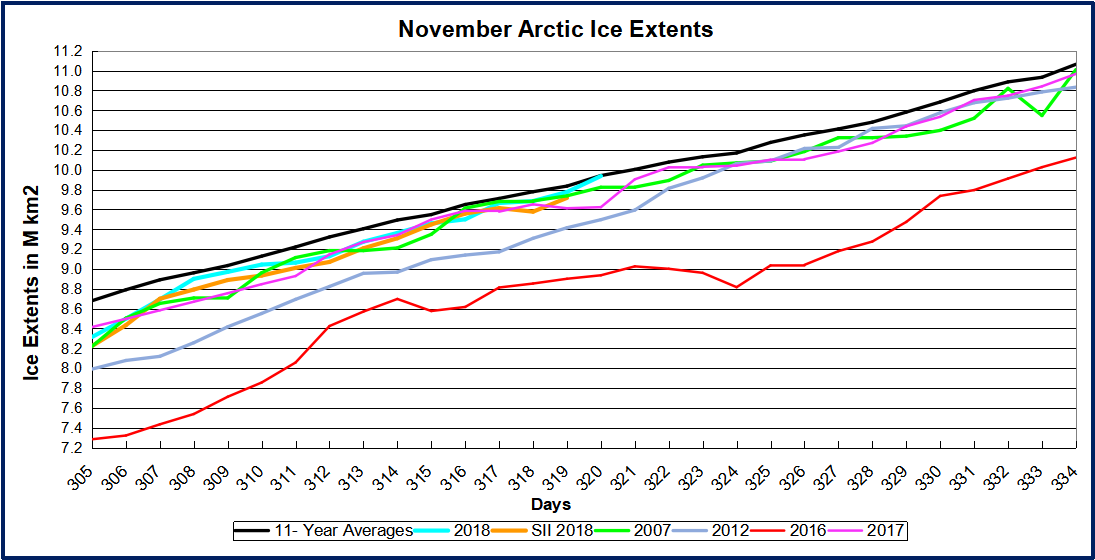
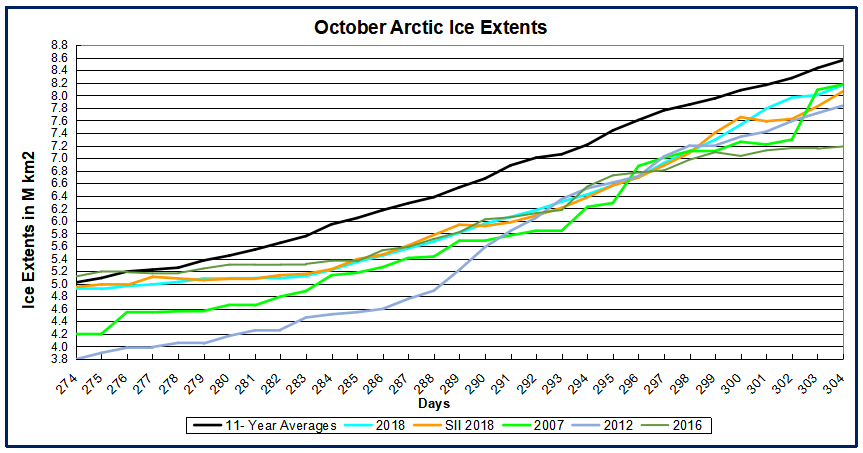
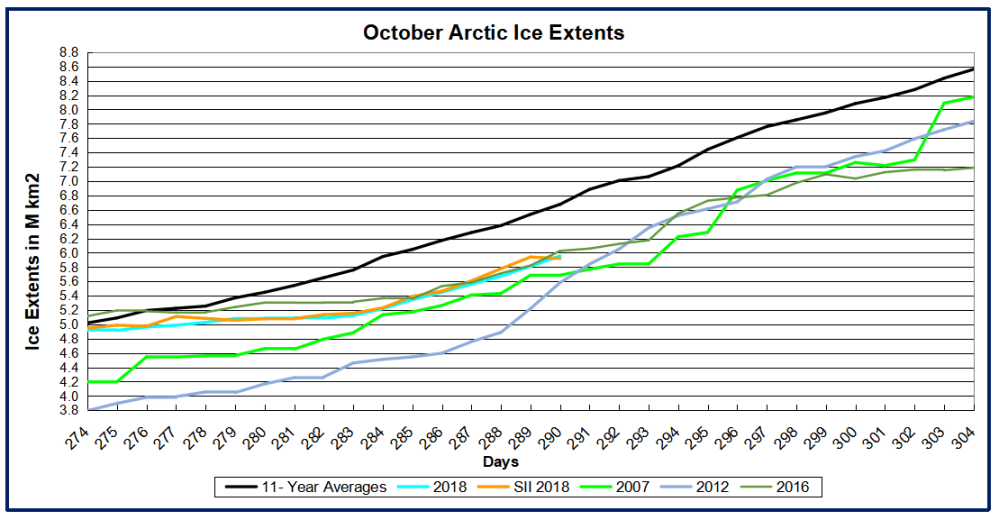
The graph shows MASIE reporting ice extents totaling 8.2M km2 yesterday,  400k km2 below the 11 year average (2007 to 2017 inclusive).  Note how 2018 started October on average, then went fairly flat the first week or so, falling 900k km2 below average.  Recent gains in ice extent exceed average gains, closing the gap.  Presently, 2018 is three days behind the average, matching 2007 and tracking above 2016 and 2012. NOAA’s Sea Ice Index matched MASIE throughout October.

ims2018304_alaska

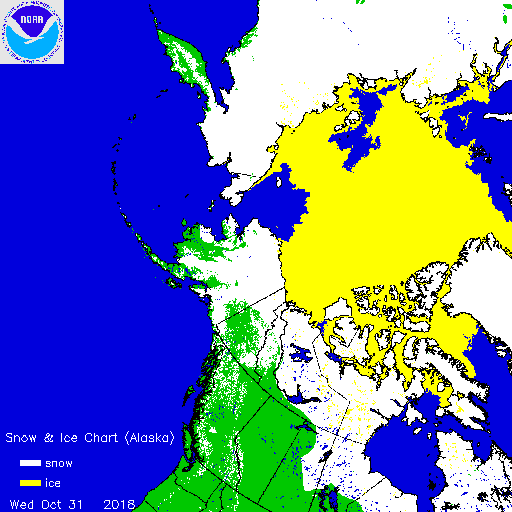
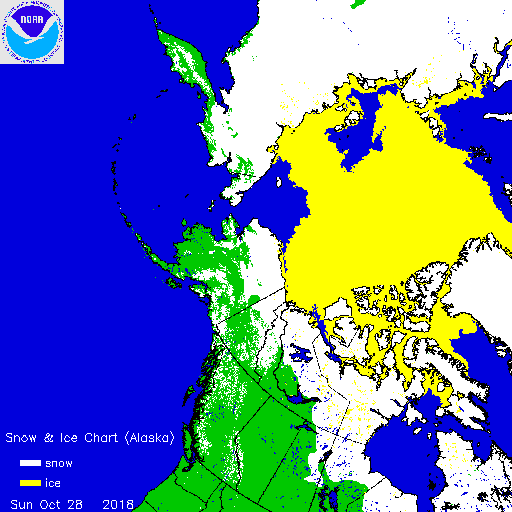
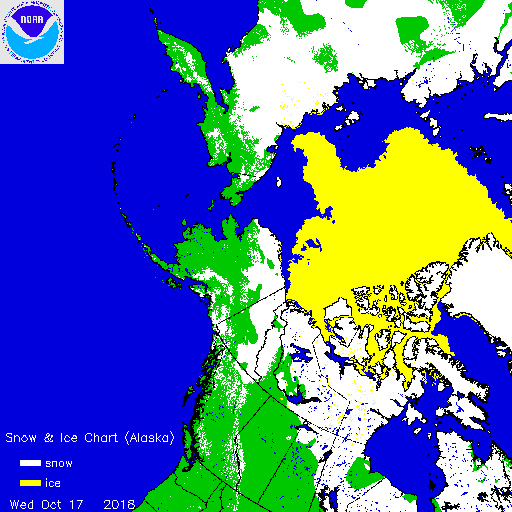
The current IMS Snow and Ice Chart shows how snow is covering Siberia completely, and has spread over northern and eastern canada.

The table below shows the regional distribution of Arctic ice extents.

Region 2018304 Day 304 
Average
2018-Ave. 2007304 2018-2007
 (0) Northern_Hemisphere 8167466 8561136 -393671 8175072 -7606
 (1) Beaufort_Sea 1069285 948751 120534 1038126 31159
 (2) Chukchi_Sea 412073 468794 -56721 242685 169389
 (3) East_Siberian_Sea 894863 954841 -59978 835071 59792
 (4) Laptev_Sea 698238 896167 -197929 887789 -189551
 (5) Kara_Sea 299264 462673 -163409 311960 -12695
 (6) Barents_Sea 4058 81432 -77375 52823 -48765
 (7) Greenland_Sea 341543 416633 -75090 443559 -102016
 (8) Baffin_Bay_Gulf_of_St._Lawrence 427557 271561 155996 289374 138184
 (9) Canadian_Archipelago 823551 789952 33599 817220 6331
 (10) Hudson_Bay 131284 85823 45461 48845 82439
 (11) Central_Arctic 3063891 3173126 -109235 3206345 -142454

The deficits are mainly on the Russian and European seas, only partly offset by surpluses in Beaufort, CAA, Baffin and Hudson Bays.

algore_ice_gone_by_2013


Big Chill in October Arctic


ESL2018290to301Siberian Big Chill in last Ten days
With the Canadian Arctic already frozen over, the action has moved to the Russian side.  The image above shows massive gains in ice extent in East Siberian and Laptev basins. East Siberian added 383k km2 for a total of 821, or 75% of last March maximum.  Laptev was mostly open water in September, but added 550k km2 in the last ten days for a total of 650k km2 or 72% of last March maximum.

Arctic2018301

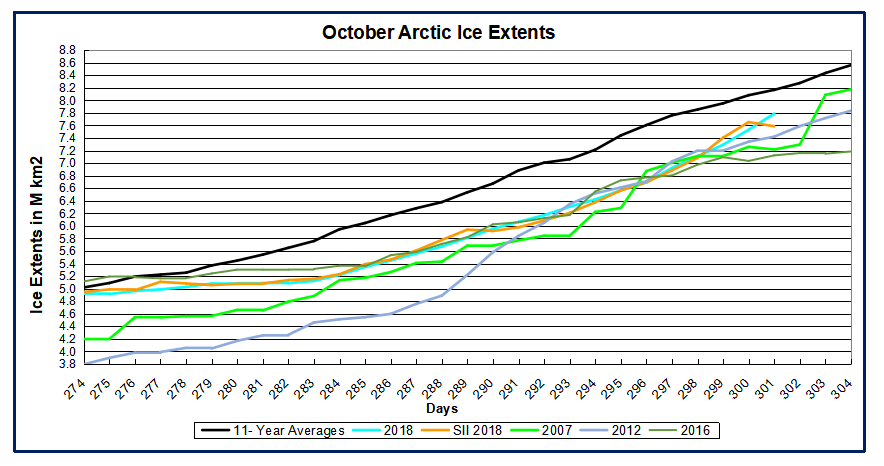
The graph shows MASIE reporting ice extents totaling 7.8M km2 yesterday,  400k km2 below the 11 year average (2007 to 2017 inclusive).  Note how 2018 started on average, then went fairly flat the first week or so, falling 900k km2 below average.  Recent gains in ice extent exceed average gains, closing the gap.  Presently, 2018 is about four days behind the average, tracking above 2016, 2012 and 2007. NOAA’s Sea Ice Index is matching MASIE through most of October.

ims2018301_alaska

The current IMS Snow and Ice Chart shows how snow is covering Siberia completely, and has spread over northern and eastern canada.


algore_ice_gone_by_2013


October Arctic Ice Catching Up

CA2018274to290.gif

October Days in Nunavut

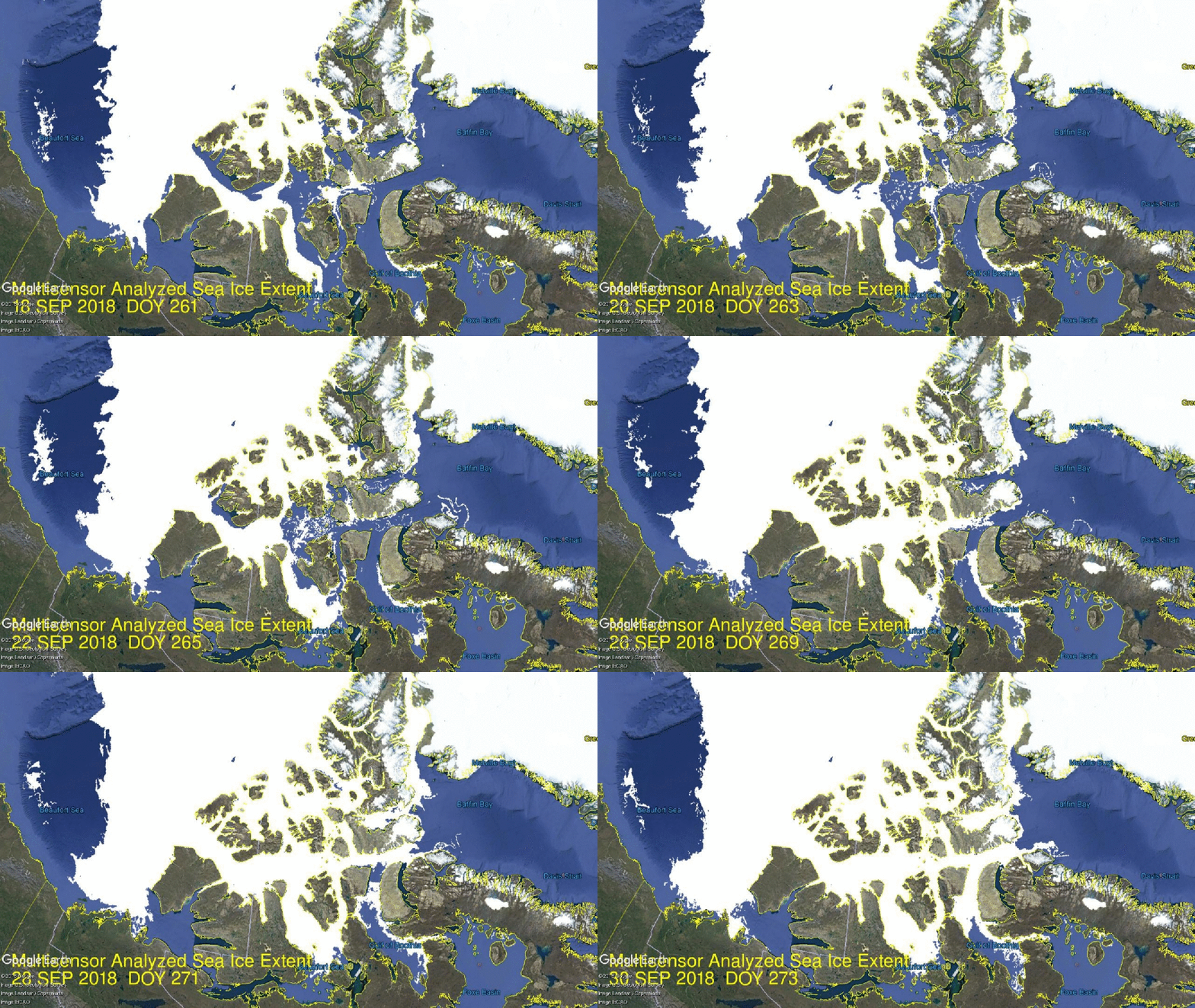
Previous posts described how the Northwest Passage was treacherously laden with ice this year.  The image above shows how the freezing proceeded in this region over the last 16 days.  Oct. 1 the CAA ice extent (Canadian Arctic Archipelago) was 609k km2, then waffled back and forth until growing sharply the last four days to 786k km2.  On the right, Baffin Bay also doubled in that period up to 150k km2.  On the left and bottom, Beaufort Sea added 324k km2 up to 943k km2, nearly 90% of the maximum last March.

Arctic2018290

The graph shows MASIE reporting ice extents totaling 5.96M km2 yesterday,  700k km2 below the 11 year average (2007 to 2017 inclusive).  Note how 2018 started on average, then went fairly flat the first week or so, and lately is adding extent at the same rate as the average.  Presently, 2018 is about five days behind the average, tracking closely the 2016 ice growth.  NOAA’s Sea Ice Index is matching MASIE,  while 2007 and 2012 are not far behind.

ims2018290_alaska

The current IMS Snow and Ice Chart shows how snow cover is spreading rapidly across both Canada and Siberia.  Dr. Judah Cohen comments on this aspect at his AER blog Arctic Oscillation and Polar Vortex Analysis and Forecasts  Excerpts in italics with my bolds.

I present what is I believe is the latest European Centre for Medium Range Weather Forecasts (ECMWF) winter forecast in Figure i taken from climate.copernicus.eu. The ECMWF model is generally considered the best forecast model on the planet. The first thing that jumps out at me is the predicted classic or text book positive Pacific North American (PNA) pattern with a deep Aleutian Low, ridging or elevated heights across northwestern North America including Alaska and troughing or low heights in the Southeastern US. The ECMWF model is also predicting a quasi-negative NAO with the southern pole or center of action more classically represented than the northern pole. But in regards to the US winter this represents a suppressed storm track along the Eastern Seaboard. A positive PNA should yield an overall cold winter to the Eastern US. The ECMWF model is most confident in a relatively cold winter in the Southeastern US with greater uncertainty in the Northeastern US while the suppressed storm track will bring elevated risks of East Coast snowstorms. And El Niño does tend to focus the greatest snow threat, at least relative to normal, in the Mid-Atlantic. If you are a winter weather enthusiast especially a snow lover living in the Mid-Atlantic this ECMWF winter forecast should have you very excited.

The other feature that jumps out at me is high latitude blocking. I already mentioned the blocking near Alaska but there is a second center near Scandinavia that extends eastward into the Barents-Kara Seas. If the ECMWF was predicting a textbook negative NAO this block would be closer to Greenland. I believe that if the ECMWF forecast is correct and the block sets up near Scandinavia this is not as cold for Europe as the classic negative NAO but would instead focus the cold more in Asia. However I do think some of that cold would likely be drawn eastward underneath the blocking high and could result in a cold, possibly snowy winter for Central and/or Southeastern Europe. The other thing to watch is that a blocking high near Scandinavia and the Barents-Kara Seas coupled with a deep Aleutian Low is ideal for transferring energy from the troposphere into the stratosphere forcing a PV disruption. Now I don’t believe the ECMWF forecast is a consequence of a polar vortex disruption but is strongly suggestive of one. And if one does occur, then I would expect an increased probability of a more classic negative NAO to follow.


algore_ice_gone_by_2013


Try to Remember: There’s Ice in September

Arctic Sept 2007 to 2018

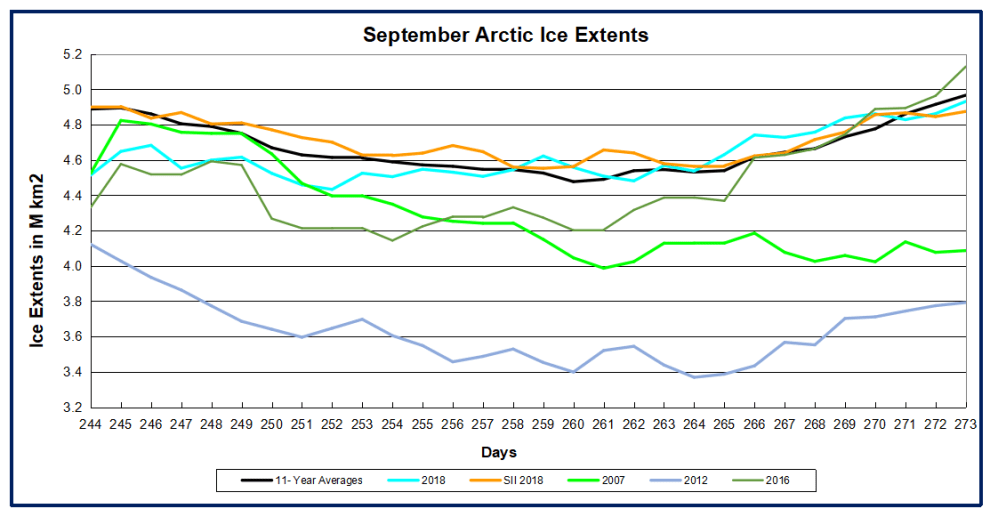
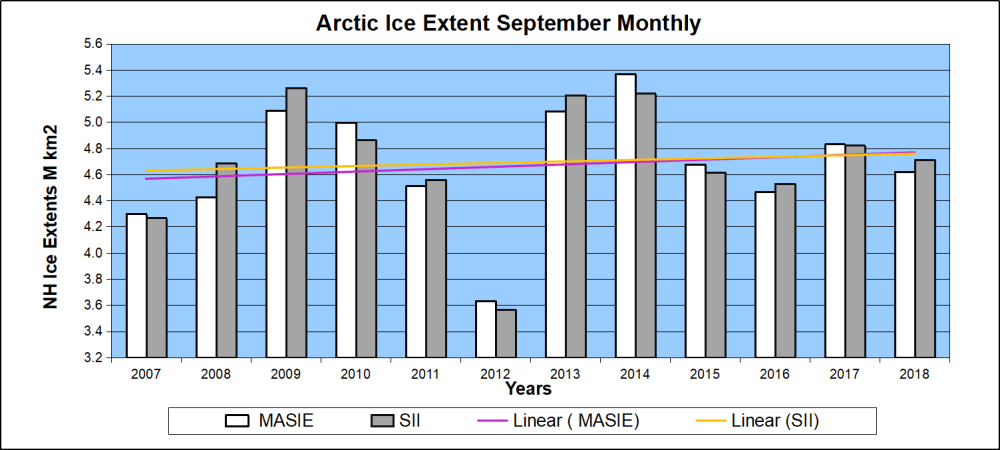
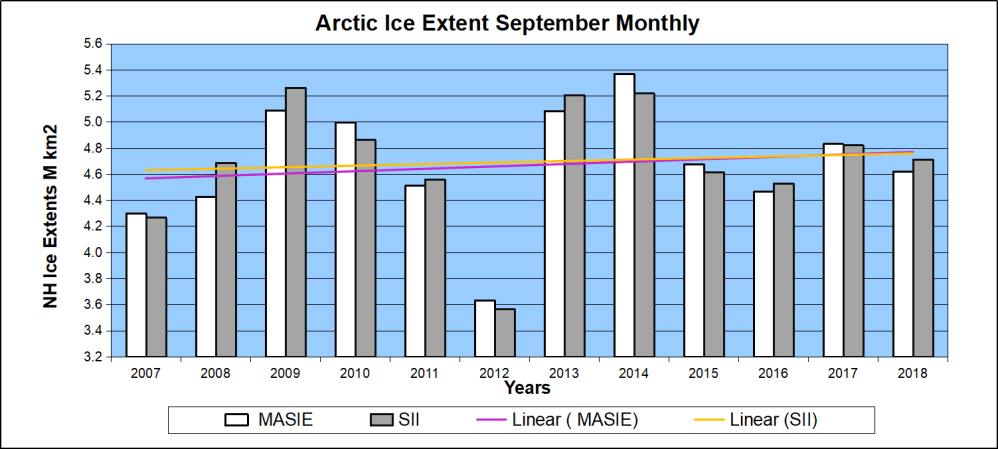
With ten years of hyped claims about Arctic sea ice declining, it takes effort to remember that ice in the Northern Hemisphere isn’t going away.  This year’s monthly average for September (the annual minimum) is slightly lower than 2017, but still well above 2007.  MASIE shows a surplus of 300k km2 and SII shows 450k km2.  As a result, both linear trends are slightly positive, though I would call it a “plateau, ” as opposed to a “death spiral.”

CA2018261to273

Twelve Days in Nunavut

Previous posts described how the Northwest Passage was treacherously laden with ice this year.  The image above shows the flash freezing in this region over the last twelve days.  Sept. 18 the CAA ice extent (Canadian Arctic Archipelago) was 321k km2, close to its annual minimum.  Yesterday MASIE showed 606k km2,  a increase of 90% in that region.

Arctic2018273

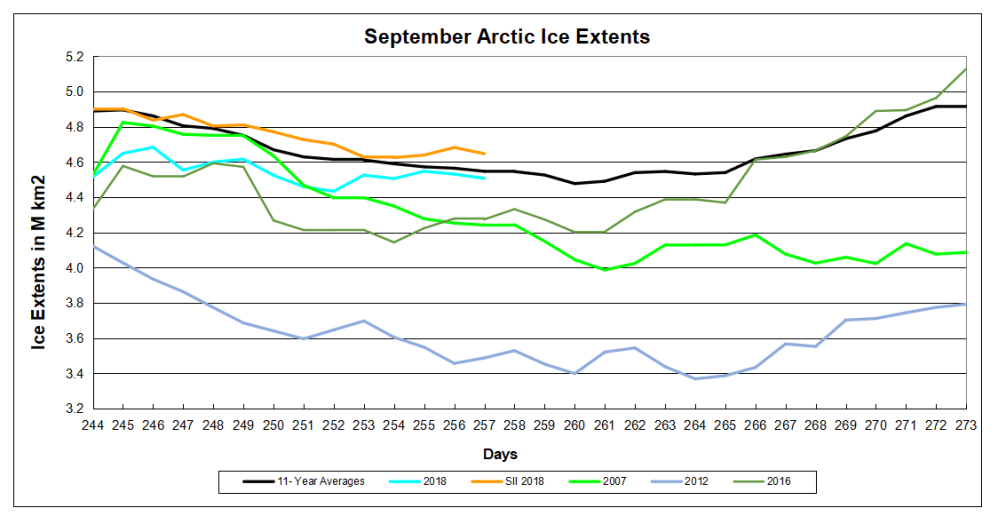
The graph shows MASIE reporting Arctic ice extents totalling 4.93M km2 yesterday,  35k km2 below the 11 year average (2007 to 2017 inclusive).  NOAA’s Sea Ice Index is the same as MASIE, 2007 was 845k km2 lower, and 2012 1.1M km2 less ice extent.  A dip on day 252 to  4.43M km2 was an early daily minimum for the year.  As shown in the first graph, the September monthly average exceeded 2007 by 300k in MASIE and  400k km2 in SII.

The table below shows ice extents in the regions comprising the Arctic in September.

Region 2018273 Day 273 
Average
2018-Ave. 2007273 2018-2007
 (0) Northern_Hemisphere 4931836 4966893 -35057 4086883 844953
 (1) Beaufort_Sea 622520 527098 95422 498743 123777
 (2) Chukchi_Sea 134120 210769 -76649 51 134069
 (3) East_Siberian_Sea 378263 329380 48884 311 377952
 (4) Laptev_Sea 19790 186004 -166214 235245 -215455
 (5) Kara_Sea 235 30387 -30152 15367 -15132
 (6) Barents_Sea 0 18890 -18890 4851 -4851
 (7) Greenland_Sea 242190 235559 6631 353210 -111020
 (8) Baffin_Bay_Gulf_of_St._Lawrence 70138 51991 18148 42247 27891
 (9) Canadian_Archipelago 606394 367879 238515 307135 299259
 (10) Hudson_Bay 4611 4458 153 1936 2674
 (11) Central_Arctic 2852432 3003376 -150944 2626511 225921

The total extent is down 35k km2 (less than 1%) below the 11 year average.  The deficit in Chuckchi is more than offset by surpluses in Beaufort and East Siberian.  On the European side are deficits in Laptev, Kara and Central Arctic, almost covered by the huge surplus in Canadian Arctic Archipelago (CAA).

It’s all good.  It’s natural.

Try To Remember lyrics by Tom Jones from “The Fantasticks”  1960

algore_ice_gone_by_2013


Arctic Ice Flash Freezing

CAA2018262to266

Four Days in Nunavut

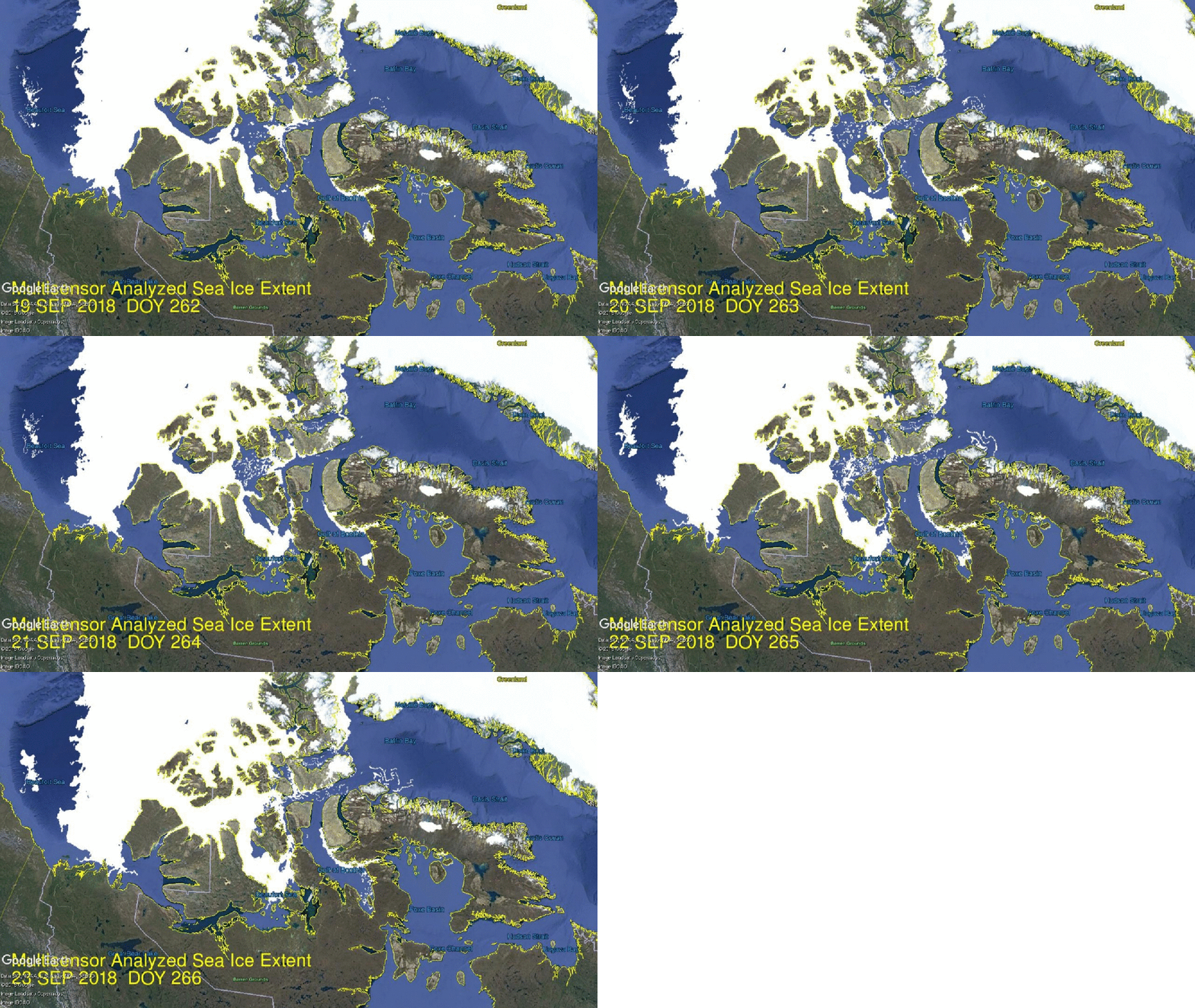
Previous posts described how the Northwest Passage was treacherously laden with ice this year.  The image above shows the flash freezing in this region over the last four days.  Sept. 19 the CAA ice extent (Canadian Arctic Archipelago) was 320k km2, close to its annual minimum.  Yesterday MASIE showed 450k km2,  a 40% increase.

ArcticIce20180923

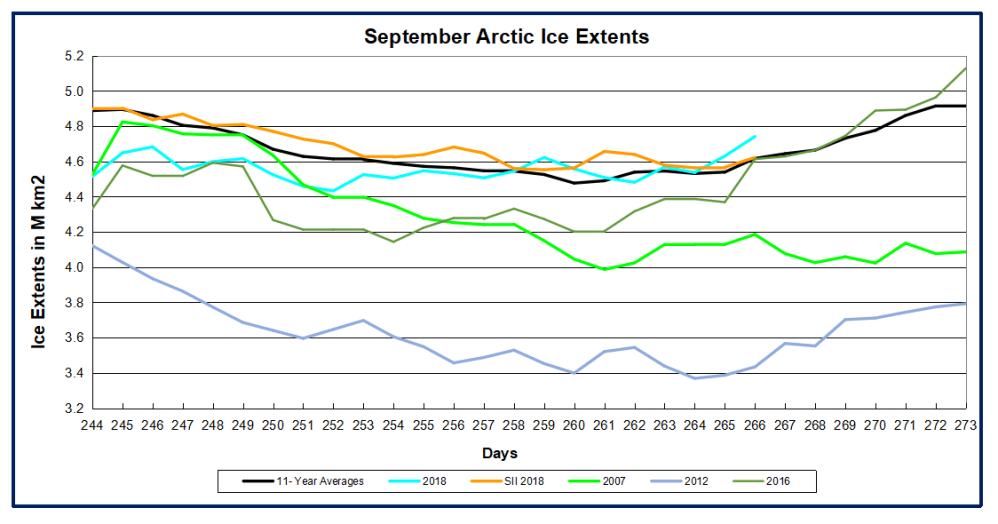
The graph shows MASIE reporting ice extents totalling 4.74M km2 yesterday,  124k km2 above the 11 year average (2007 to 2017 inclusive).  NOAA’s Sea Ice Index is 119 k km2 lower, 2007 was 462k km2 lower, and 2012 1.2M km2 less ice extent.  A dip on day 252 to  4.43M km2 will certainly be the daily minimum for the year.  With typical refreezing to month end, we can expect the September monthly average will exceed 2007 by at least 300k to 400k km2.


algore_ice_gone_by_2013


Arctic Ice Made Simple

People are overthinking and over-analyzing Arctic Ice extents, and getting wrapped around the axle (or should I say axis).  So let’s keep it simple and we can all readily understand what is happening up North.

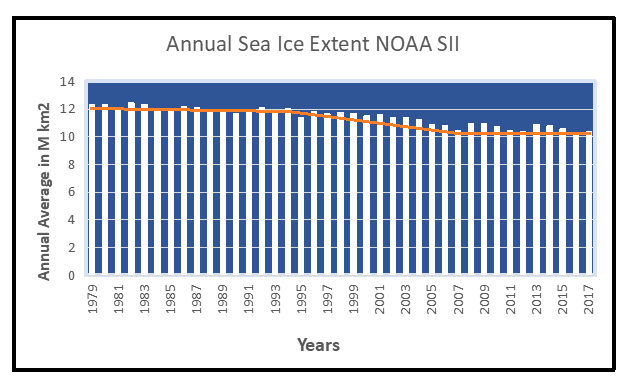
I will use the ever popular NOAA dataset derived from satellite passive microwave sensors.  It sometimes understates the ice extents, but everyone refers to it and it is complete from 1979 to 2017.  Here’s what NOAA reports (in M km2):

If I were adding this to the Ice House of Mirrors, the name would be The X-Ray Ice Mirror, because it looks into the structure of the time series.   For even more clarity and simplicity, here is the table:

NOAA NH Annual Average Ice Extents (in M km2).  Sea Ice Index v3.0 (here)

Year Average Change Rate of Change
1979 12.328
1994 12.011 -0.317 0.021 per year
2007 10.474 -1.537 0.118 per year
2017 10.393  -0.081 0.008 per year

The satellites involve rocket science, but this does not.  There was a small loss of ice extent over the first 15 years, then a dramatic downturn for 13 years, 6 times the rate as before. That was followed by the current plateau with virtually no further loss of ice extent.  All the fuss is over that middle period, and we know what caused it.  A lot of multi-year ice was flushed out through the Fram Strait, leaving behind more easily melted younger ice. The effects from that natural occurrence bottomed out in 2007.

Kwok et al say this about the Variability of Fram Strait ice flux:

The average winter area flux over the 18-year record (1978–1996) is 670,000 km2, ;7% of the area of the Arctic Ocean. The winter area flux ranges from a minimum of 450,000 km2 in 1984 to a maximum of 906,000 km2 in 1995. . .The average winter volume flux over the winters of October 1990 through May 1995 is 1745 km3 ranging from a low of 1375 km3 in the 1990 flux to a high of 2791 km3 in 1994.

https://www.researchgate.net/publication/261010602/download

Conclusion:

Some complain it is too soon to say Arctic Ice is recovering, or that 2007 is a true change point.  The same people were quick to jump on a declining period after 1994 as evidence of a “Death Spiral.”

Update September 25, 2018

Oh the irony!  Tamino accuses me of emulating Michael Mann and “hiding the decline” of sea ice, as opposed to temperatures.  In that case, where is my Nobel Prize?

But my humble efforts to tell the truth pale in comparison with Mann’s campaign to erase the medieval warm period.  His temperature trickery is described in Rise and Fall of the Modern Warming Spike

Footnote:

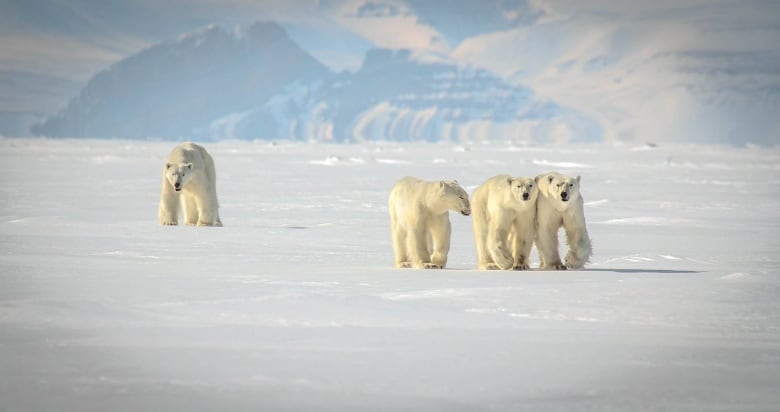
No one knows what will happen to Arctic ice.

Except maybe the polar bears.

And they are not talking.

Except, of course, to the admen from Coca-Cola

Arctic Ice Recovery Update Sept. 17

ims2018252to259

October Update:  Full September 2018 Results

arctic-sept-2007-to-2018

More details at Try to Remember: There’s Ice in September

One week ago on day 252 MASIE reported the lowest daily extent of the year at 4.43M km2.  One week later the image above shows how the ice edges have refrozen and extended.  Note also the significant snowfall both in Canada and Russia

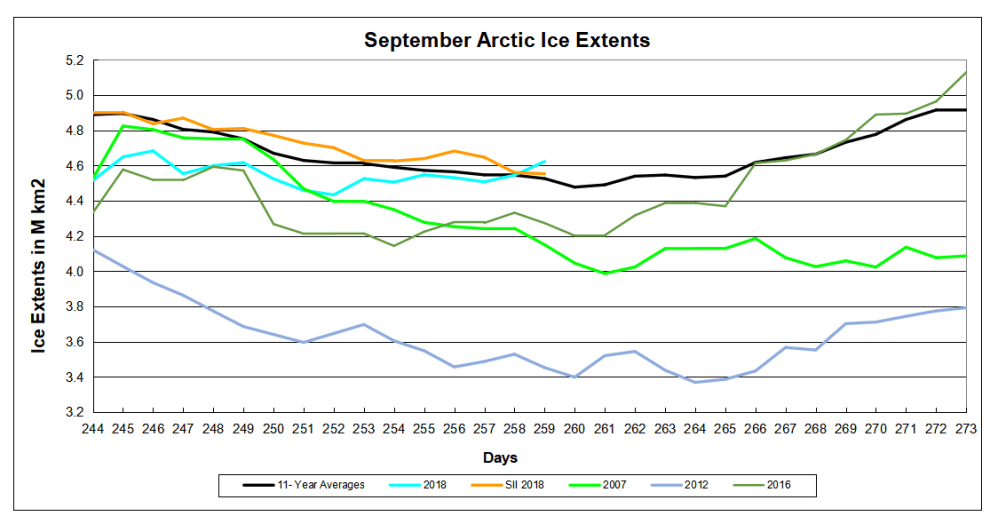
Mid September we can see the long predicted collapse of Arctic ice is postponed for yet another year.  The graph shows MASIE reporting ice extents above 4.5M km2 for the month of September.  A dip on day 252 to  4.43M km2 will likely be the daily minimum for the year, since 200k km2 of ice has been added in the last week.  The graph also shows that 2018 is presently 96k km2 above the 11 year average ice extent, 350k km2 more than 2016,  472k km2 more than 2007, and 1.2M km2 (a full Wadham!) more than the record setting 2012.

ArcticIce201809016

Interestingly, in September until yesterday NOAA’s officially referenced Sea Ice Index (SII) was showing more ice than MASIE, by about 200k km2.  That means the SII September monthly result will continue the plateau in Arctic ice since 2007.

The table below shows ice extents in the various basins comprising the Arctic Ocean for day 259 for 2018 and 2007 in comparison to the 11 year averages (2007 to 2017 inclusive).

Region 2018259 Day 259 
Average
2018-Ave. 2007259 2018-2007
 (0) Northern_Hemisphere 4622484 4526053 96431 4150314 472171
 (1) Beaufort_Sea 560233 471483 88750 515813 44420
 (2) Chukchi_Sea 163790 150187 13604 48053 115737
 (3) East_Siberian_Sea 467586 270891 196695 311 467275
 (4) Laptev_Sea 27262 140510 -113248 238846 -211584
 (5) Kara_Sea 235 23504 -23268 52498 -52263
 (6) Barents_Sea 0 23798 -23798 7420 -7420
 (7) Greenland_Sea 83223 203153 -119930 329643 -246420
 (8) Baffin_Bay_Gulf_of_St._Lawrence 40128 29596 10532 32287 7841
 (9) Canadian_Archipelago 346993 274872 72121 237669 109324
 (10) Hudson_Bay 6051 7085 -1034 4355 1697
 (11) Central_Arctic 2926584 2929894 -3309 2682144 244440

Presently, 2018 is about 100k km2  or 2% above average, and 472k km2 or 11% more than 2007.  The Eastern Arctic shows surpluses in East Siberian, Chukchi, Beaufort, and CAA.  The Western Arctic shows deficits in Laptev, Kara, Barents and Greenland seas.  The Central Arctic is matching average, while East Siberian sea ice is 73% above average.

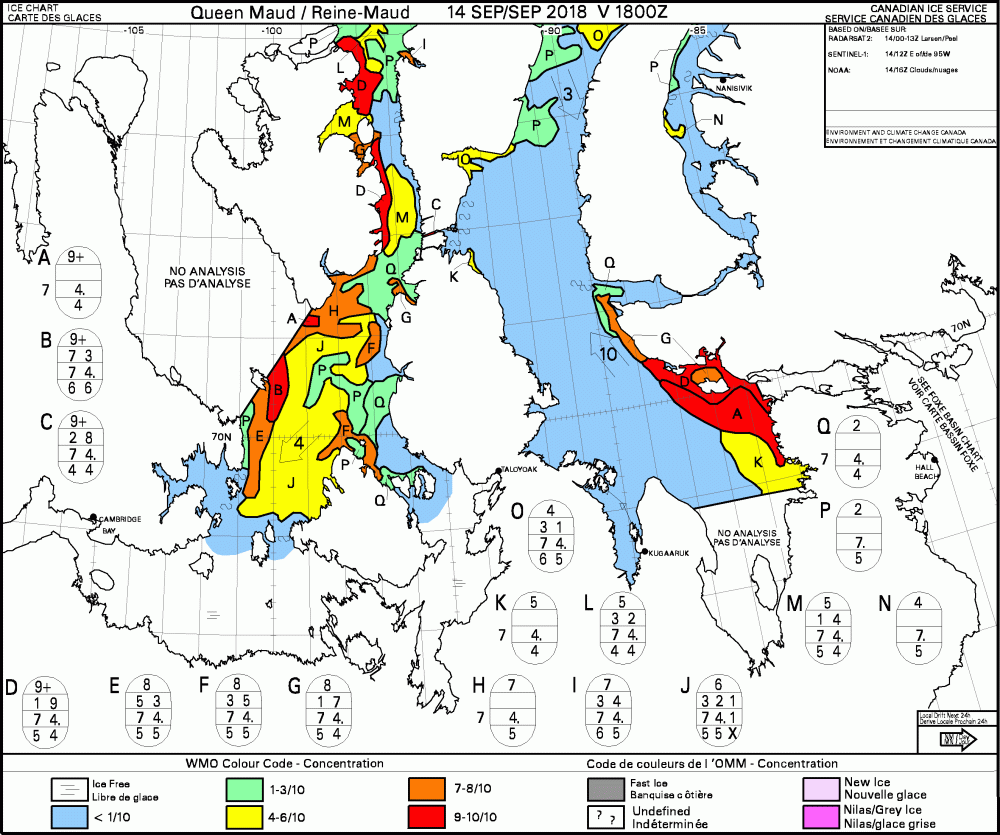
As reported previously, the Northwest Passage through Nunavut was closed this year due to excessive and thick multiyear ice blocking the way.  The chart below shows the conditions as of Sept. 14.
20180914180000_wis38ct_0010229536

It won’t get any better than this for yachts attempting the passage west, since more than 3/10 (green) ice conditions blocks their progress.  A post at the Northwest Passage blog S/V CRYSTAL Escape from Prince Regent Inlet  explains how the passage is closing.

przez-lc3b3d-w-stronc499-wolnej-wody-300x225

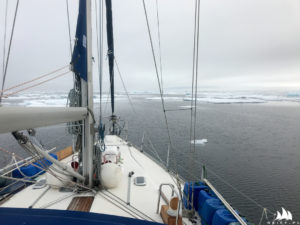
Breaking through the ice corridor, already close to the shore, we suddenly saw something unusual. Static ice so far began to flow very rapidly towards the shore! In this way he closed the road ahead of us and – which is much worse – cut off our retreat. We turned back and rushed to escape. It was the only option.

We drove the gas to the top, and the free water in front of the bow disappeared in her eyes . Giant ice floes moved towards the shore like in a river stream. We jumped out of some of the channels with maybe a meter of side wall, and the path behind us disappeared after a few dozen seconds.

After about thirty minutes of such a crazy slalom we got to the water so slow that the danger of being closed and pressed to the shore was averted . That was good news for us. The bad news was that this time we were unable to get out of Prince Regent Inlet. It was waiting for the next chance . (note: the log is translated from Polish)

Update September 19, 2018

Here is the latest ice chart showing that in Franklin strait, all the green conditions (<3/10) are now gone, while red and brown are taking over.

Bottom line: They succeeded to get out and are now docked on Greenland coast.

algore_ice_gone_by_2013


Arctic Ice Growing Again

ArcticIce201809014

Mid September we can see the long predicted collapse of Arctic ice is postponed for yet another year.  The graph shows MASIE reporting ice extents above 4.5M km2 for the last two weeks.  A dip on day 252 to  4.43M km2 will likely be the daily minimum for the year.  The graph also shows that 2018 is presently close to the 11 year average ice extent, 233k km2 more than 2016,  266k km2 more than 2007, and 1M km2 (a full Wadham!) more than the record setting 2012.

Update:  Full September Results at Try to Remember: There’s Ice in September

Interestingly, in September NOAA’s offcially referenced Sea Ice Index (SII) is showing more ice than MASIE, by about 200k km2.  That means the SII September monthly result will continue the plateau in Arctic ice since 2007.

As reported previously, the Northwest Passage through Nunavut was closed this year due to excessive and thick multiyear ice blocking the way.  The chart below shows the conditions as of yesterday.
20180914180000_wis38ct_0010229536

It won’t get any better than this for yachts attempting the passage west, since more than 3/10 (green) ice conditions blocks their progress.  A post at the Northwest Passage blog S/V CRYSTAL Escape from Prince Regent Inlet  explains how the passage is closing.

przez-lc3b3d-w-stronc499-wolnej-wody-300x225

Breaking through the ice corridor, already close to the shore, we suddenly saw something unusual. Static ice so far began to flow very rapidly towards the shore! In this way he closed the road ahead of us and – which is much worse – cut off our retreat. We turned back and rushed to escape. It was the only option.

We drove the gas to the top, and the free water in front of the bow disappeared in her eyes . Giant ice floes moved towards the shore like in a river stream. We jumped out of some of the channels with maybe a meter of side wall, and the path behind us disappeared after a few dozen seconds.

After about thirty minutes of such a crazy slalom we got to the water so slow that the danger of being closed and pressed to the shore was averted . That was good news for us. The bad news was that this time we were unable to get out of Prince Regent Inlet. It was waiting for the next chance . (note: the log is translated from Polish)

Bottom line: They succeeded to get out and are now docked on Greenland coast.

algore_ice_gone_by_2013

Arctic Ice Hockey Stick Reappears

ArcticIce20180906

No one knows if day 243 will turn out to be the annual minimum, but for now 2018 Arctic ice extent again resembles an hockey stick.  Presently the ice is 135k km2 below 2007 and the 11 year average (2007 to 2017 inclusive).  MASIE  shows increasing ice the first six days of September, while SII is hovering around 4.8 M km2, 200k km2 higher.

ims2492007to2018

The image above shows ice extents on day 249 (September 6) for years since 2007. Note this year ice is strong in both East Siberian basin and in Canadian Archipelago.  The exceptional 2012 low extent is also visible (Great Cyclone in August).

The Canadian ice chart below shows why the Northwest Passage is not passable this year.  Brown indicates old ice, and green first year ice.  In the last two days, Canadian Archipelago has added 38k km2 from its lowest extent on day 247.
20180903180000_wis56sd_0010215556

The bottle neck even for small yachts is Franklin strait where even first year ice is not going away.  Small vessels need less than 4/10 ice conditions indicated by the green spaces.
20180906180000_wis38ct_0010217357


Arctic NW Passage Not Passable

August 23, 2018 . At least 22 vessels are affected and several have turned back to Greenland.

Update September 3, 2018

News today from the Northwest Passage blog that S/V CRYSTAL has given up after hanging around Fort Ross hoping for a storm or melting to break the ice barrier blocking their way west.
20180902-1025_crystal

As the vessel tracker shows, they have been forced to Plan C, which is returning to Greenland and accept that the NW Passage is closed this year. The latest ice chart gave them no hope for getting through.
20180902180000_wis38ct_0010210949

The image below shows the ice with which they were coping.
DCIM100GOPROGOPR5778.

More details at NW Passage blog 20180902 S/V CRYSTAL and S/V ATKA give up and retreat back to Greenland – Score ICE 3 vs YACHTS 0

Update August 28, 2018

S/V CRYSTAL (Polish Crew) at Fort Ross Nunavut waiting Franklin ice and weather window to dash westward toward Nome Alaska.
QM20180827w Ft. Ross

Note yachts can sail through green (3/10), so the hope is for red to yellow to green.  But here are the last four days:
They are hoping for a storm Sept. 1-2 to open Franklin Strait where is the thick red ice.  Plan B is to wait another week for a wider weather window and more ice disintegration.  Plan C is to escape to the east.

From the Northwest Passage Blog (Aug. 22, 2018):
Good morning,
Due to heavier than normal ice concentrations in the Canadian arctic waters north of 70 degrees, the Canadian Coast Guard, recommends that pleasure craft do not navigate in the Beaufort Sea, Barrow, Peel Sound, Franklin Strait and Prince Regent. CCG icebreakers cannot safely escort pleasure craft. Operators of pleasure craft considering a northwest passage should also consider the risk of having to winter in a safe haven in the Arctic, or in the case of an emergency, be evacuated from beset vessels. Safety of mariners is our primary concern.
REGARDS,
NORDREG CANADA

August 26:  FRANKLIN continues to improve with less ice and could be open by the first full week of September.