Spring Outlook AER

Dr. Judah Cohen has posted his outlook on the spring in Arctic and NH at his AER blog.  Exerpts below with my bolds.

Summary

  • The Arctic Oscillation (AO) is currently slightly negative and is predicted to trend positive but never to stray too far from neutral . The bulk of the atmospheric response to the polar vortex (PV) disruption, which occurred in February seems to have already occurred though some lingering influences continue.
  • The current negative AO is reflective of positive pressure/geopotential height anomalies across the North Atlantic side of the Arctic and negative pressure/geopotential height anomalies across the mid-latitudes of the North Atlantic.
  • The North Atlantic Oscillation (NAO) is currently also negative with positive pressure/geopotential height anomalies across Greenland and negative pressure/geopotential height anomalies across the mid-latitudes of the North Atlantic. The forecasts are for the NAO to also trend positive and then straddle neutral the next two weeks.
  • The PV is predicted to linger across Western Siberia over the next two weeks. This will contribute to persistent troughing/negative geopotential height anomalies across northern Eurasia including Europe. This will allow cold temperatures now stretching from Northern Asia to Europe and the United Kingdom (UK) to mostly remain in place with some fluctuation in intensity over the next two weeks.
  • Currently ridging/positive geopotential height anomalies south of the Aleutians is contributing to troughing/negative geopotential height anomalies in the Gulf of Alaska and the West Coast of North America with additional ridging/positive geopotential height anomalies in central North America and more troughing/negative geopotential height anomalies downstream across the Eastern United States (US). This pattern in general favors normal to above normal temperatures for western North America and normal to below normal temperatures in the Eastern US.
  • However the pattern across North America is predicted to be slowly progressive with time and become much less amplified. This will lead to a general weakening of temperature anomalies for much of the continent, though warm temperature anomalies in the Western US are predicted to remain consistent in magnitude.
  • I continue to believe that the ongoing stratospheric PV displacement in Western Siberia favors overall cold temperatures for Siberia that extend into Europe as well as a cold bias in temperatures in the Northeastern US. These cold temperature anomalies are likely to persist as long as the stratospheric PV lingers across Siberia.

Arctic Methane

AWI sea-ice physicists have erected an ice camp to investigate melt ponds on Arctic sea ice. Credit: Photo : Alfred-Wegener-Institut / Mar Fernandez

Two recent papers enrich our understanding of interactions between oceans, ice and dissolved methane. The latest one is described in a Science Daily article Wandering greenhouse gas Climate models need to take into account the interaction between methane, the Arctic Ocean and ice by E. Damm et al. of Alfred Wegener Institute March 16, 2018. Excerpts with my bolds.

On the seafloor of the shallow coastal regions north of Siberia, microorganisms produce methane when they break down plant remains. If this greenhouse gas finds its way into the water, it can also become trapped in the sea ice that forms in these coastal waters. As a result, the gas can be transported thousands of kilometres across the Arctic Ocean and released in a completely different region months later.

AWI geochemist Dr Ellen Damm tested the waters of the High North for the greenhouse gas methane. In an expedition to the same region four years later, she had the chance to compare the measurements taken at different times, and found significantly less methane in the water samples.

Ellen Damm, together with Dr Dorothea Bauch from the GEOMAR Helmholtz Centre for Ocean Research in Kiel and other colleagues, analysed the samples to determine the regional levels of methane, and the sources. By measuring the oxygen isotopes in the sea ice, the scientists were able to deduce where and when the ice was formed. To do so, they had also taken sea-ice samples. Their findings: the ice transports the methane across the Arctic Ocean. And it appears to do so differently every year.

“As more seawater freezes it can expel the brine contained within, entraining large quantities of the methane locked in the ice,” explains AWI researcher Ellen Damm. As a result, a water-layer is formed beneath the ice that contains large amounts of both salt and methane. Yet the ice on the surface and the dense saltwater below, together with the greenhouse gas it contains, are all pushed on by the wind and currents. According to Thomas Krumpen, “It takes about two and a half years for the ice formed along the coast of the Laptev Sea to be carried across the Arctic Ocean and past the North Pole into the Fram Strait between the east cost of Greenland and Svalbard.” Needless to say, the methane trapped in the ice and the underlying saltwater is along for the ride.

The rising temperatures produced by climate change are increasingly melting this ice. Both the area of water covered by sea ice and the thickness of the ice have been decreasing in recent years, and thinner ice is blown farther and faster by the wind. “In the past few years, we’ve observed that ice is carried across the Arctic Ocean faster and faster,” confirms Thomas Krumpen. And this process naturally means major changes in the Arctic’s methane turnover. Accordingly, quantifying the sources, sinks and transport routes of methane in the Arctic continues to represent a considerable challenge for the scientific community.
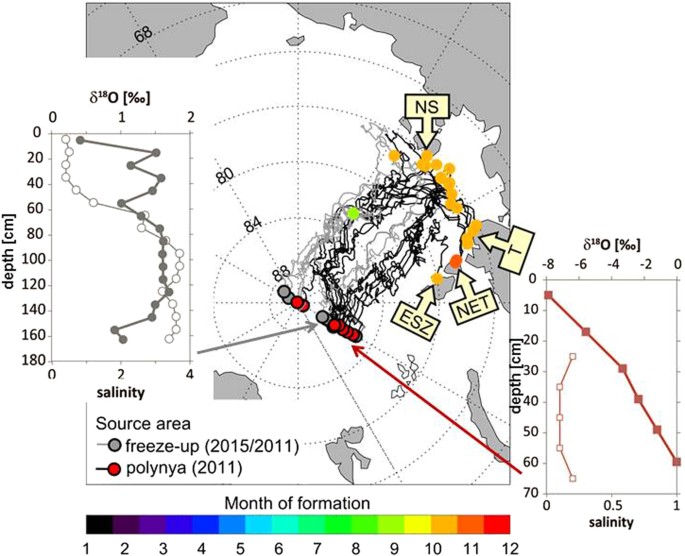
Sea ice drift trajectories leading to the 60°E section and δ18O isotopic composition (filled symbols) and salinity (open symbols) in sea ice at this section. Backward drift trajectories from the 60°E section show the sea ice formation areas, i.e. off shore within the Laptev Sea and in the coastal polynya areas. Trajectories were calculated based on a combination of sea ice motion and concentration products from passive microwave satellite data. The colour of the end node indicates the source area of sampled sea ice. Trajectories with red end nodes were formed in polynyas, namely the New Siberian (NS) Polynya, Taymyr (T) Polynya, Northeastern Taymyr (NET) Polynya and East Severnaya Zemlya (ESZ) Polynya. Grey end nodes refer to trajectories that were formed during freeze-up further offshore. The colour coding of the start node characterizes the month of formation (primarily October) of the individual trajectories. The δ18O ice isotopic composition reflects the δ18O composition of the water column from which each segment of the ice core was formed. Light values below about −4‰ indicate formation in coastal polynyas while values above −2‰ indicate freeze-up formation offshore. Salinity of the ice cores is in all cases below 4. The map is generated with IDL (Interactive Data Langue), software for analysis and visualization of data provided by Harris Geospatial Solutions (http://www.harrisgeospatial.com).

The paper itself is The Transpolar Drift conveys methane from the Siberian Shelf to the central Arctic Ocean

Abstract: Methane sources and sinks in the Arctic are poorly quantified. In particular, methane emissions from the Arctic Ocean and the potential sink capacity are still under debate. In this context sea ice impact on and the intense cycling of methane between sea ice and Polar surface water (PSW) becomes pivotal. We report on methane super- and under-saturation in PSW in the Eurasian Basin (EB), strongly linked to sea ice-ocean interactions.

In the southern EB under-saturation in PSW is caused by both inflow of warm Atlantic water and short-time contact with sea ice. By comparison in the northern EB long-time sea ice-PSW contact triggered by freezing and melting events induces a methane excess. We reveal the Transpolar Drift Stream as crucial for methane transport and show that inter-annual shifts in sea ice drift patterns generate inter-annually patchy methane excess in PSW.

Using backward trajectories combined with δ18O signatures of sea ice cores we determine the sea ice source regions to be in the Laptev Sea Polynyas and the off shelf regime in 2011 and 2015, respectively. We denote the Transpolar Drift regime as decisive for the fate of methane released on the Siberian shelves.

From the study conclusions: Our study is focused on sea ice-ocean interaction, while the role of sea ice–air fluxes and oxidation as pathways of methane in the Arctic need further investigation.

Our study confirms that methane release from sea ice is coupled to the ice freeze and melt cycle. Hence the intensity of freeze events in winter and the amount of summer sea ice retreat primarily triggers how much methane is released during transport within the TDS in the central Arctic.

To which extent the interior Arctic Ocean might act as a final or just a temporal sink, i.e. with final efflux to the atmosphere, is another open question. Furthermore, sea ice retreat, thinning, and decreasing multiyear and increasing first-year sea ice will have, yet, unconsidered consequences for the sea ice-air exchange and the source-sink balance of the greenhouse gas methane in the Arctic. In addition to the potential source capacity for efflux from the northern Eurasian Basin, the potential sink capacity of the southern EB for atmospheric methane might be enhanced if the volume of inflowing AW increases and the region becomes seasonally ice free in the future.

How the Ocean Processes Methane

Another study looks at ancient stored methane in the Arctic in relation to ongoing natural fluxes that were the focus of the above research. The paper is described in a Science Daily article Release of ancient methane due to changing climate kept in check by ocean waters by Katy J. Sparrow, John D. Kessler et al. 2018

Trapped in ocean sediments near continents lie ancient reservoirs of methane called methane hydrates. These ice-like water and methane structures encapsulate so much methane that many researchers view them as both a potential energy resource and an agent for environmental change. In response to warming ocean waters, hydrates can degrade, releasing the methane gas. Scientists have warned that release of even part of the giant reservoir could significantly exacerbate ongoing climate change.

However, methane only acts as a greenhouse gas if and when it reaches the atmosphere — a scenario that would occur only if the liberated methane travelled from the point of release at the seafloor to the surface waters and the atmosphere.

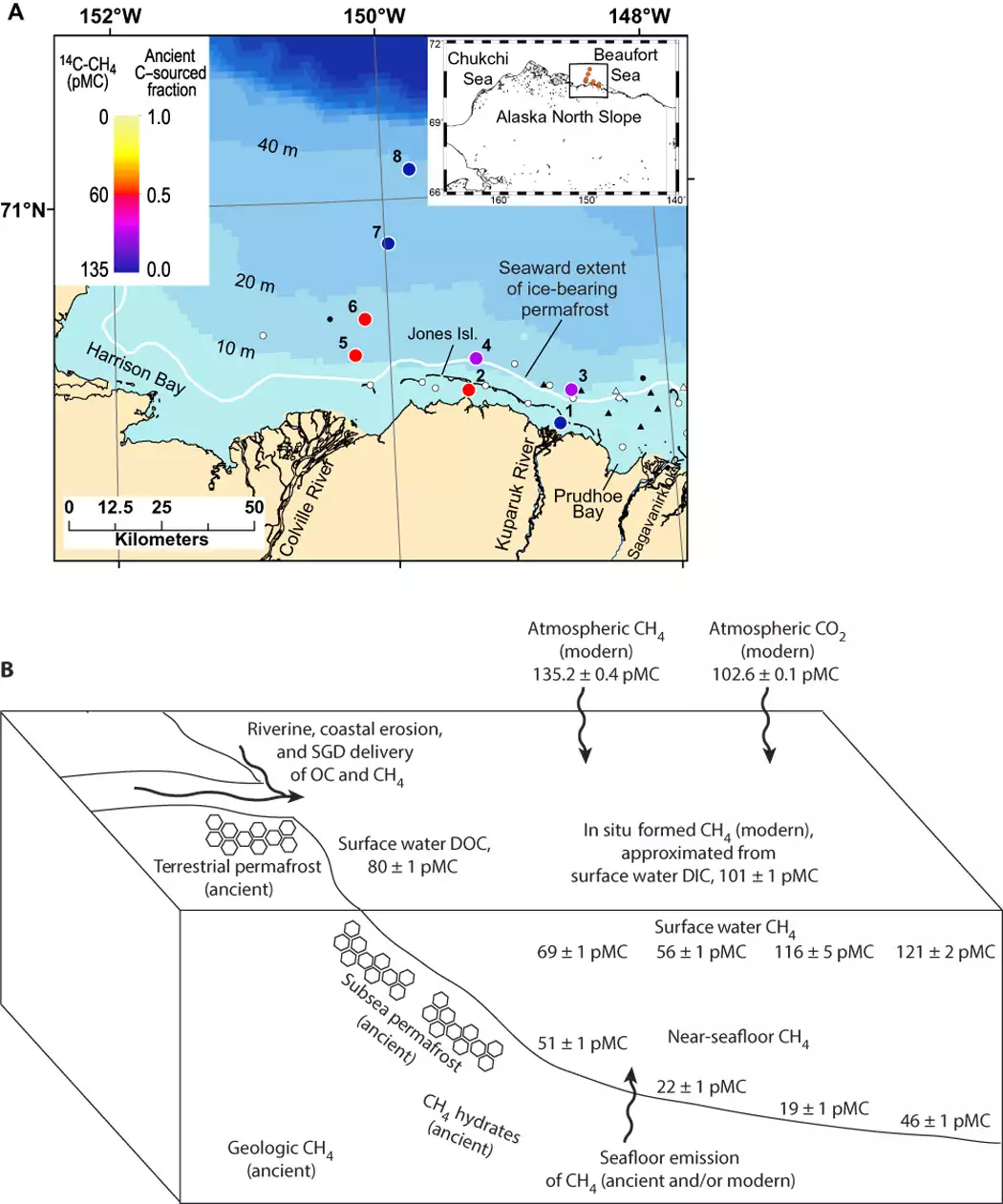
A team of scientists conducted fieldwork just offshore of the North Slope of Alaska, near Prudhoe Bay. Sparrow calls the spot “ground zero” for oceanic methane emissions resulting from ocean warming. In some parts of the Arctic Ocean, the shallow regions near continents may be one of the settings where methane hydrates are breaking down now due to warming processes over the past 15,000 years. In addition to methane hydrates, carbon-rich permafrost that is tens of thousands of years old — and found throughout the Arctic on land and in seafloor sediments — can produce methane once this material thaws in response to warming. With the combination of the aggressive warming occurring in the Arctic and the shallow water depths, any released methane has a short journey from emission at the seafloor to release into the atmosphere.

We do observe ancient methane being emitted from the seafloor to the overlying seawater, confirming past suspicions,” Kessler says. “But, we found that this ancient methane signal largely disappears and is replaced by a different methane source the closer you get to the surface waters.” The methane at the surface is instead from recently produced organic matter or from the atmosphere.

“We found that very little ancient methane reaches surface waters even in the relatively shallow depths of 100 feet. Exponentially less methane would be able to reach the atmosphere in waters that are thousands of feet deep at the very edge of the shallow seas near continents, which is the area of the ocean where the bulk of methane hydrates are,” Sparrow says. “Our data suggest that even if increasing amounts of methane are released from degrading hydrates as climate change proceeds, catastrophic emission to the atmosphere is not an inherent outcome.

Full text of study is Limited contribution of ancient methane to surface waters of the U.S. Beaufort Sea shelf

Summary

It seems our knowledge of Arctic methane is incomplete but growing. It is good news to understand how ancient methane released from sediment is neutralized by ocean processes before it can be released. And it is also good that methane captured by shelf sea ice is transported to the North Pole.

Footnote:

The news releases repeat the erroneous claim that methane (CH4) is 25 times more powerful GHG than CO2.  That exaggerated number comes from comparing the two gases on a mass basis. Because CH4 has a lesser atomic weight, a kilogram will have more molecules than the same mass of CO2.  But radiative activity depends on the volume, not the mass.

More background on CH4 as a GHG:  Much Ado About Methane
Arctic Freezing Week

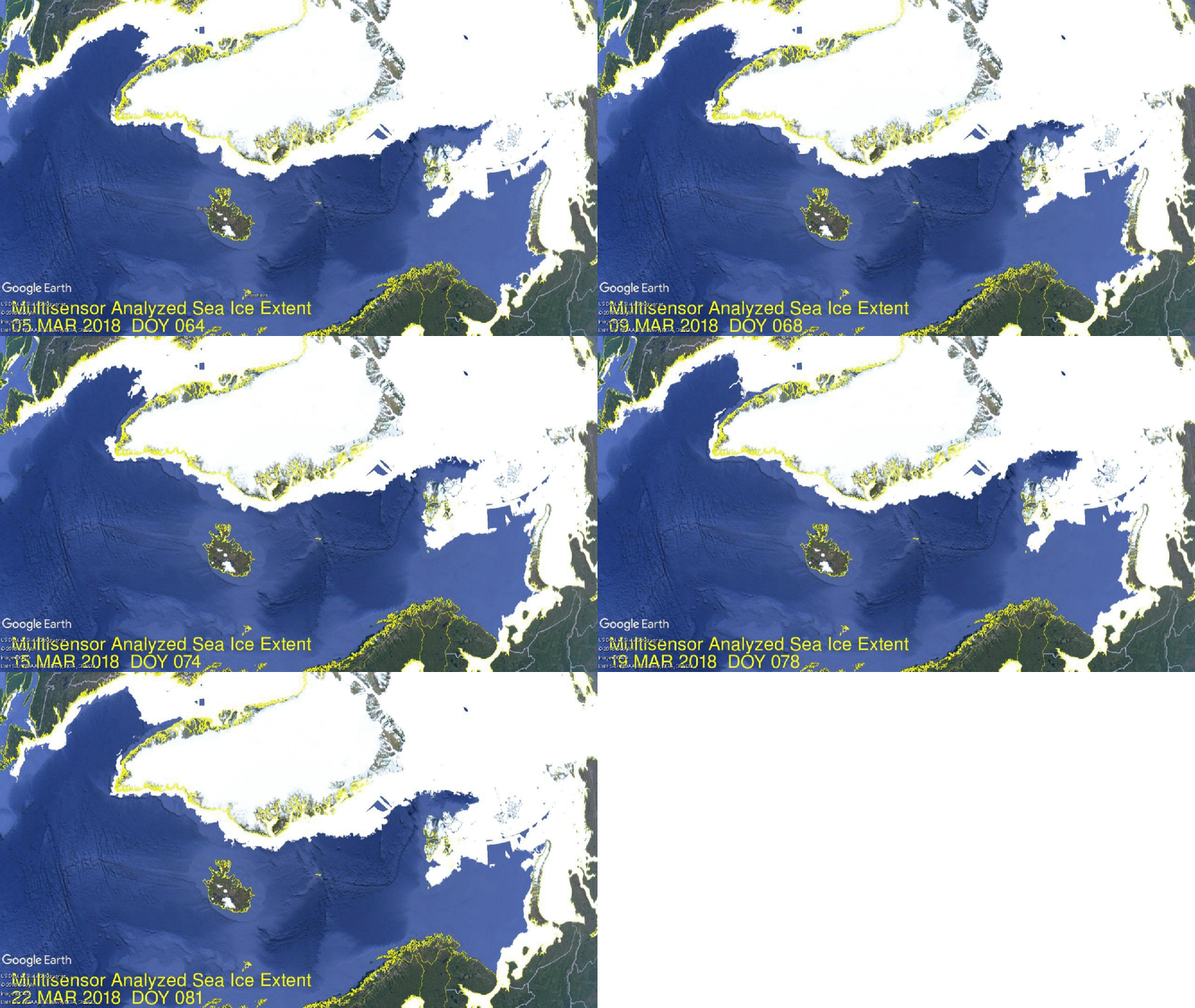
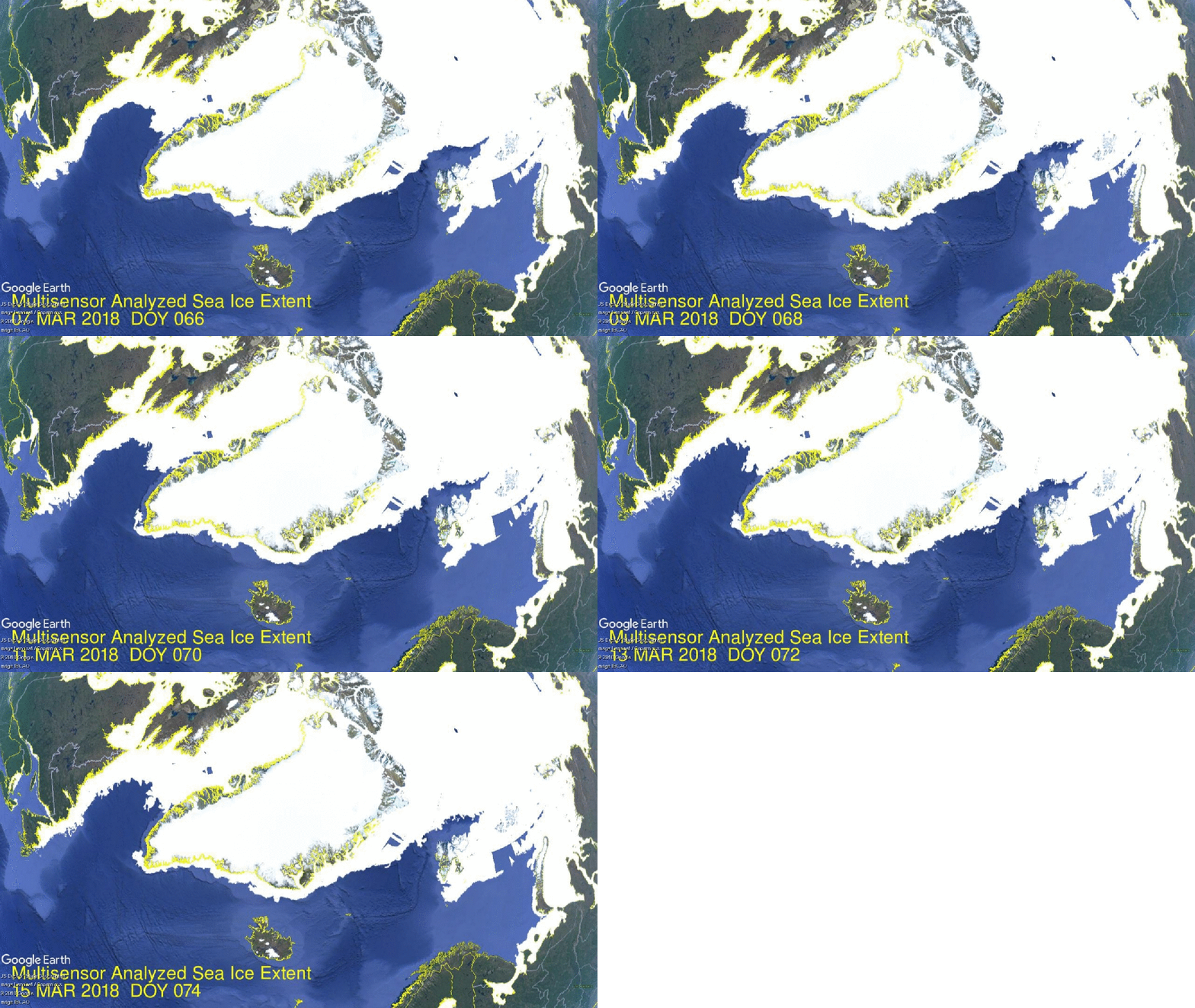
atl066to074.gif

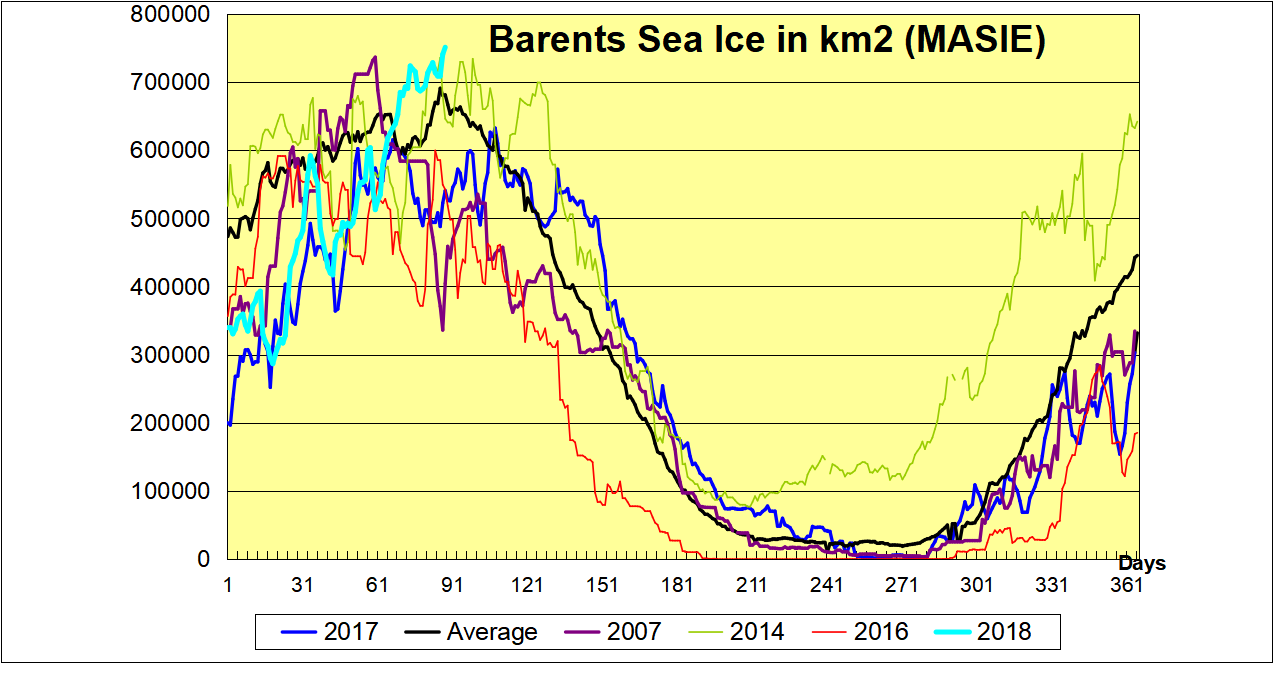
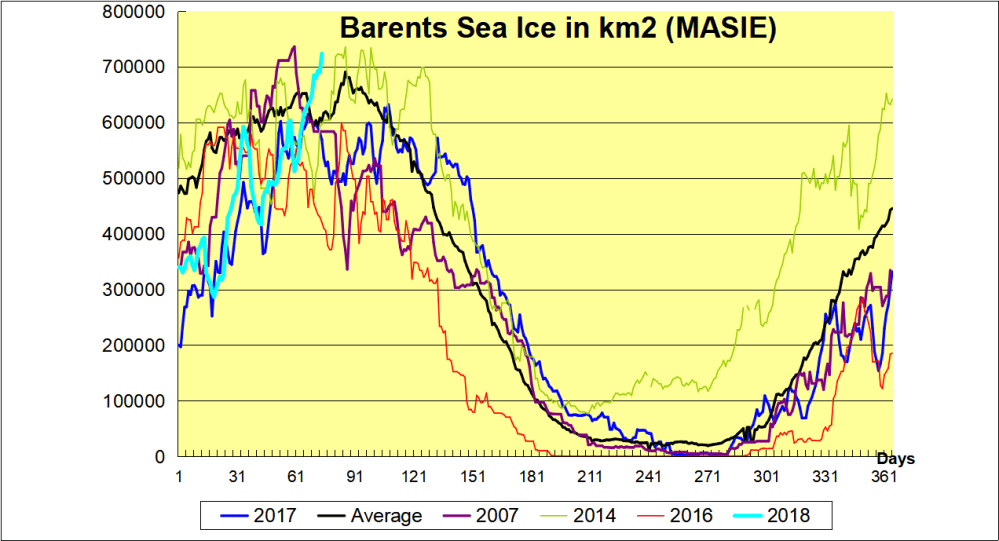
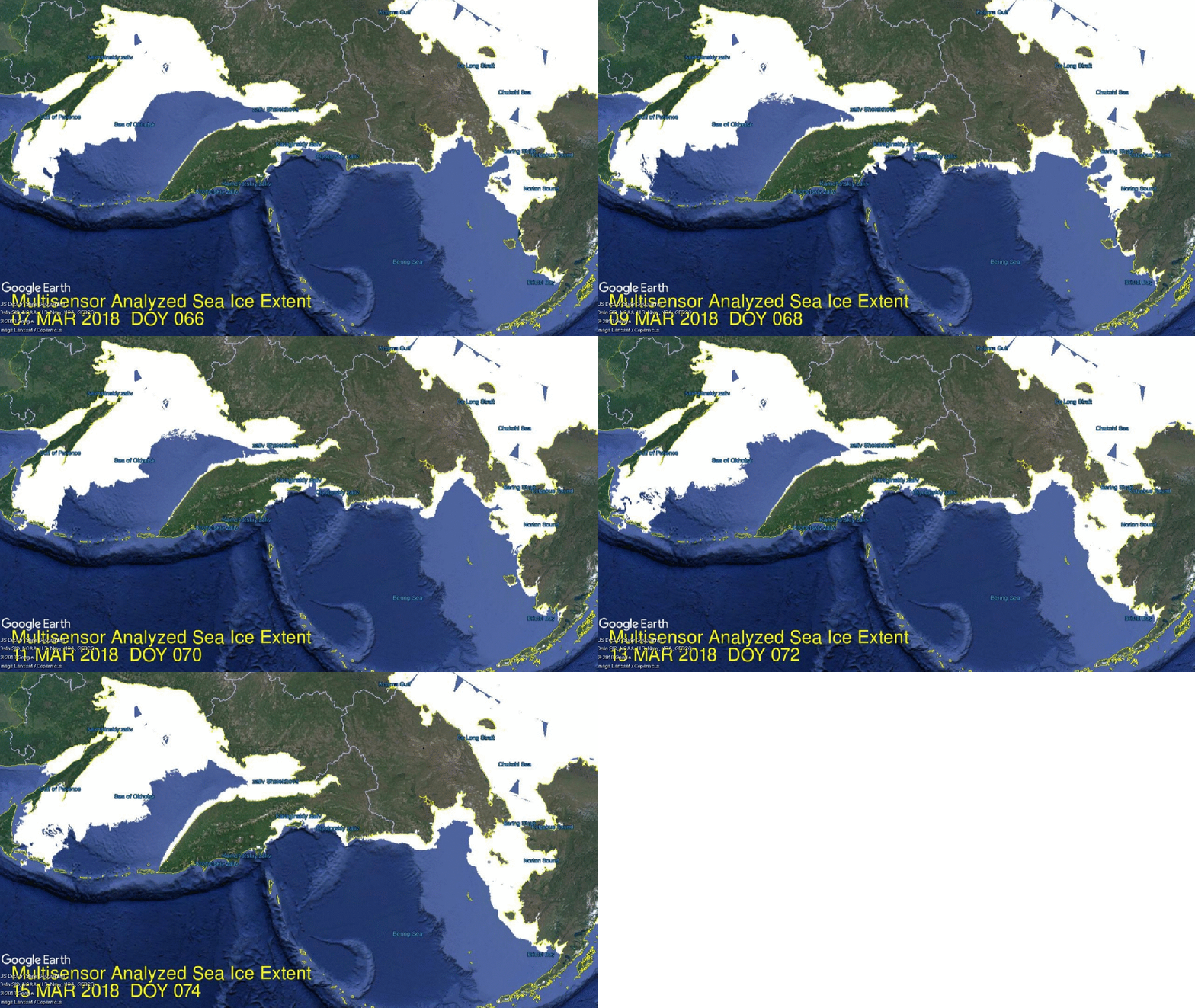
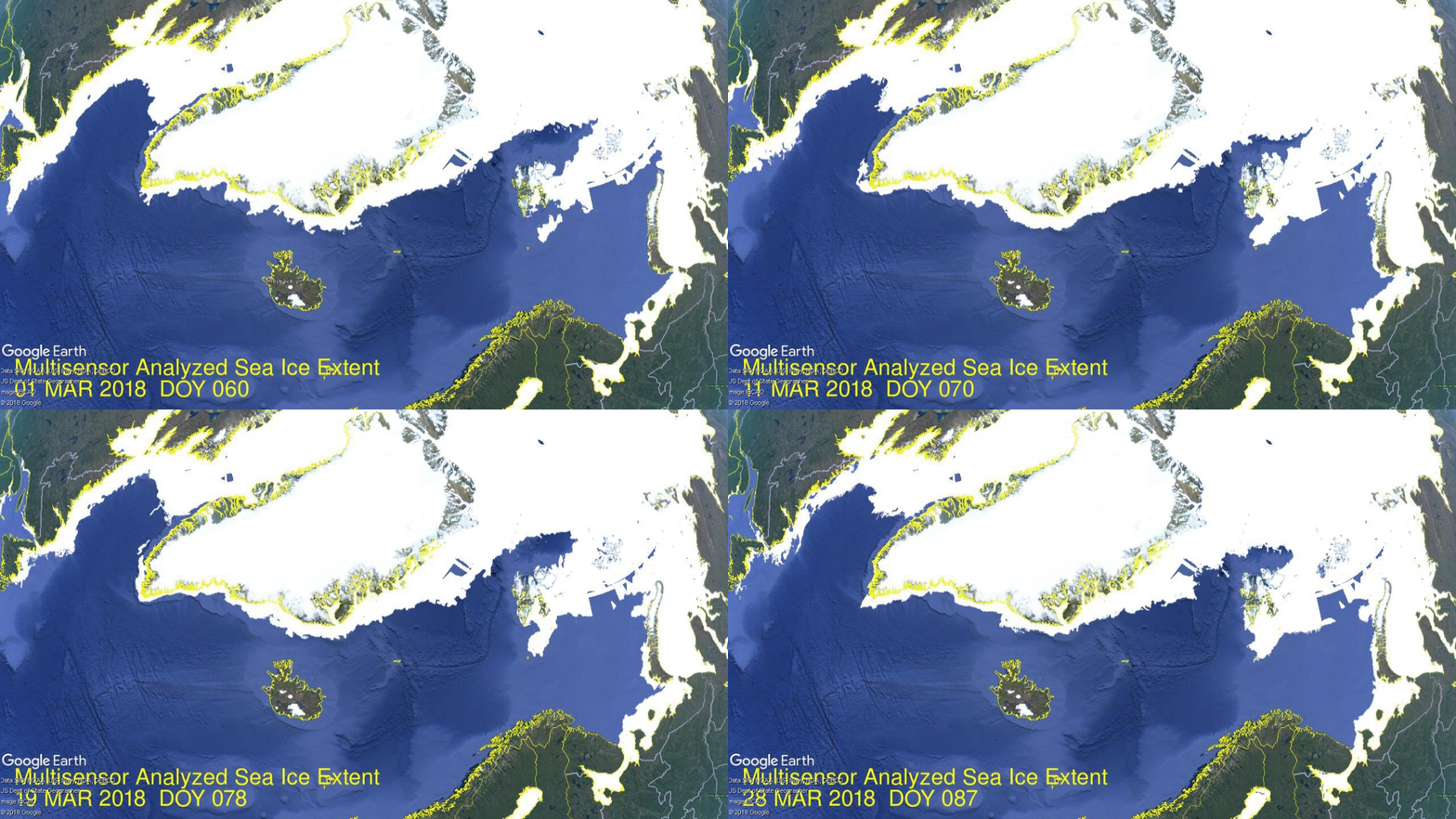
After stalling first week of March, Arctic ice is coming on strong now.  The image above shows the last week, setting new maximums for 2018 for NH overall, as well in Barents Sea.  The graph below shows that as of yesterday, Barents is well above the 11 year average, and even ahead of 2014 the highest year in the decade.
Barents day074

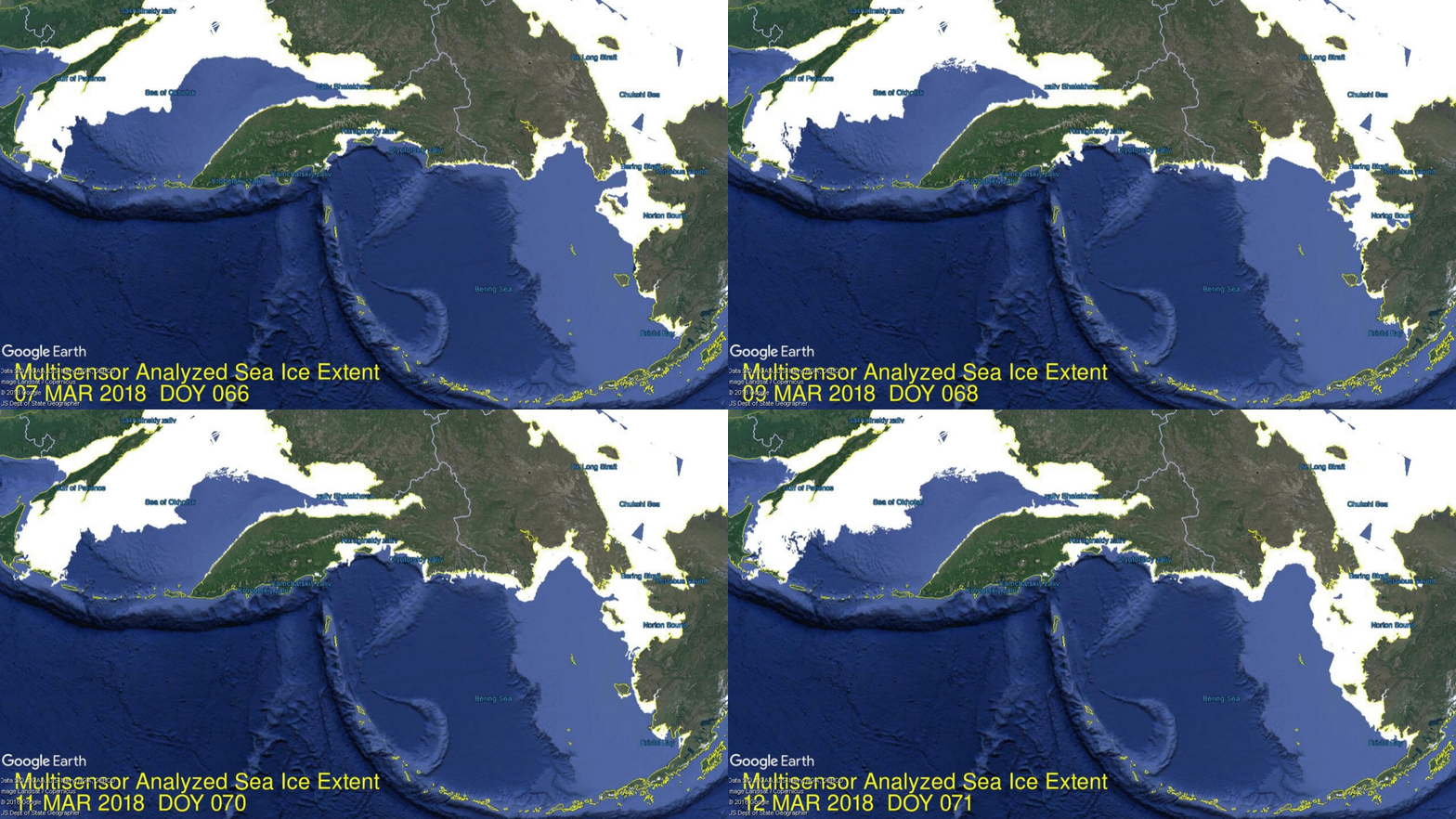
Meanwhile ice extent is increasing on the Pacific side as well.  Bering rapidly grew 200k km2 in a week, setting a new 2018 maximum, while Okhotsk added 110k km2 for a new max ice extent there.

pac066to074

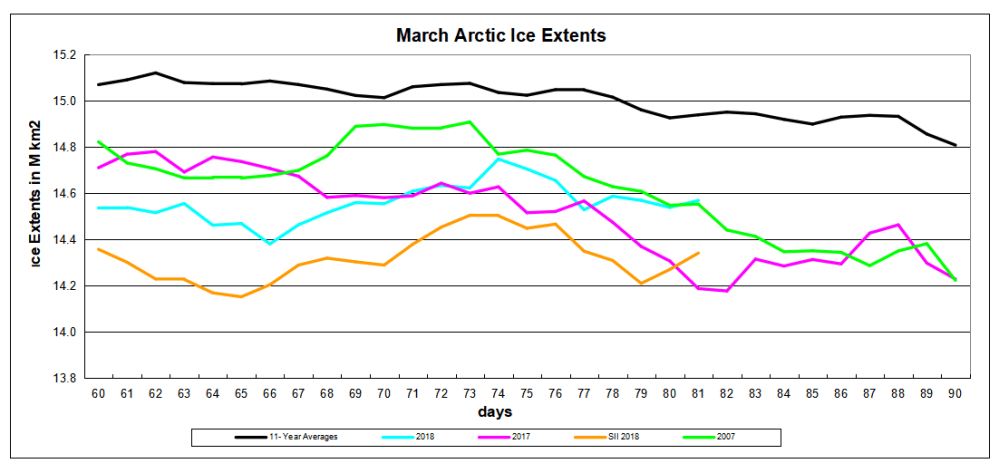
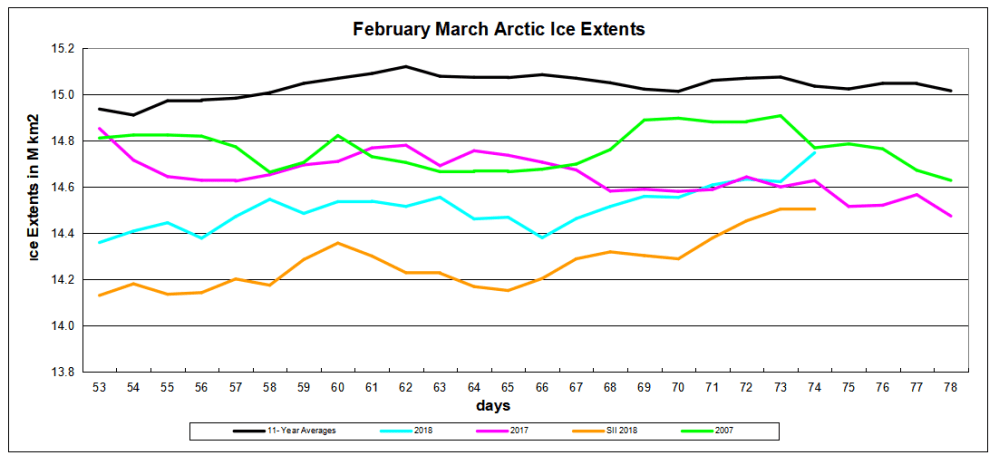
The graph below shows how strongly the Arctic is now freezing over.

NHday074

Note the average max on day 62 and 2018 max yesterday on day 74, now matching 2007 and 120k km2 above last year.  SII (NOAA) continues to show ~200k km2 less extent.

Drift ice in Okhotsk Sea at sunrise.

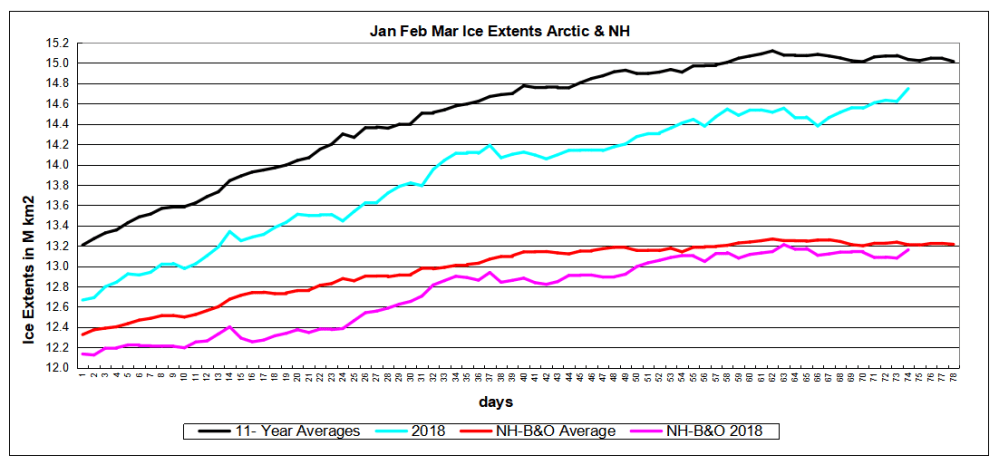
The graph below shows 2018 NH ice extents since day 1, with and without the Pacific basins Bering and Okhotsk, compared to 11 year averages (2007 to 2017 inclusive).
NHwBandO074
The deficit is almost entirely due to Bering, with the shortfall closing in the last week.

Bering Ice Deficit Gone in Five Days

An update to yesterdays post  Premature Arctic Ice Fears which discussed lop-sided media coverage of  a temporary ice shortfall in Bering Sea.  Now today, the image above shows that in just five days, that deficit has been obliterated.  Since day 66, Bering added 170k km2 to go over 400k km2, close to the previous Bering high in 2018 on day 34.  That was the last Arctic region where some alarm could be raised.  Overall, 2018 is now higher than 2017 at this date, having reached a new maximum of 14.6M km2.

Premature Arctic Ice Fears

Barents60to70

Click on image to enlarge.

The alarms are sounding about lack of ice extent in Bering Sea, studiously ignoring what else is happening in the Arctic.  For instance the above image shows the last 10 days on the European side, with Barents Sea on the right growing steadily to a new maximum. On the left, Gulf of St. Lawrence ice is retreating as usual while Baffin Bay holds steady.

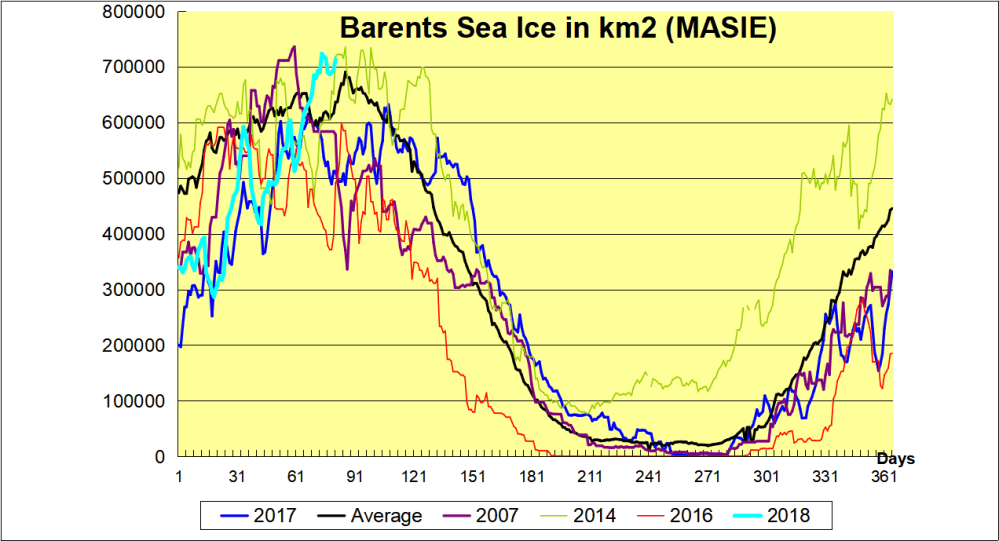
The Barents recovery is interesting and bears watching.  See how 2018 compares with other years in the Graph below.

Barents day070

Note the recent 2018 dramatic rise above average.  Meanwhile on the Pacific side the seesaw between Bering and Okhotsk continues:
BandO60to70

In the last ten days, Bering has gone up, then down, and back up to arrive at the same extent.  In the same period Okhotsk added 70k km2.

Ice extents for February and March appear in the graph below; 11 year average is 2007 to 2017 inclusive.

Note that ice growth slows down in February and March since the Arctic core is frozen and extent can only be added at the margins.  MASIE shows 2018 is now matching 2017, while SII is running about 200k km2 lower.  The 11 year average maxed on day 62 at 15.1M km2 while this year  max was on day 69, ~560k km2 lower . It remains to be seen what max will end up in 2018

It is natural for alarmists to focus on Bering Sea, since that is the only place where a sizable deficit appears (for the moment).  The graph below show NH ice extent from day 1, with and without B and O (Bering and Okhotsk, the Pacific basins that will melt out by September anyway.)


Here’s your Valentine’s Day Greeting:

And here’s your PC candy for Valentine’s Day.


Bering Sea Reduces Arctic Maximum

Bering035to047

Last month came breathless headlines from Inside Climate News:  Alaska’s Bering Sea Lost a Third of Its Ice in Just 8 Days

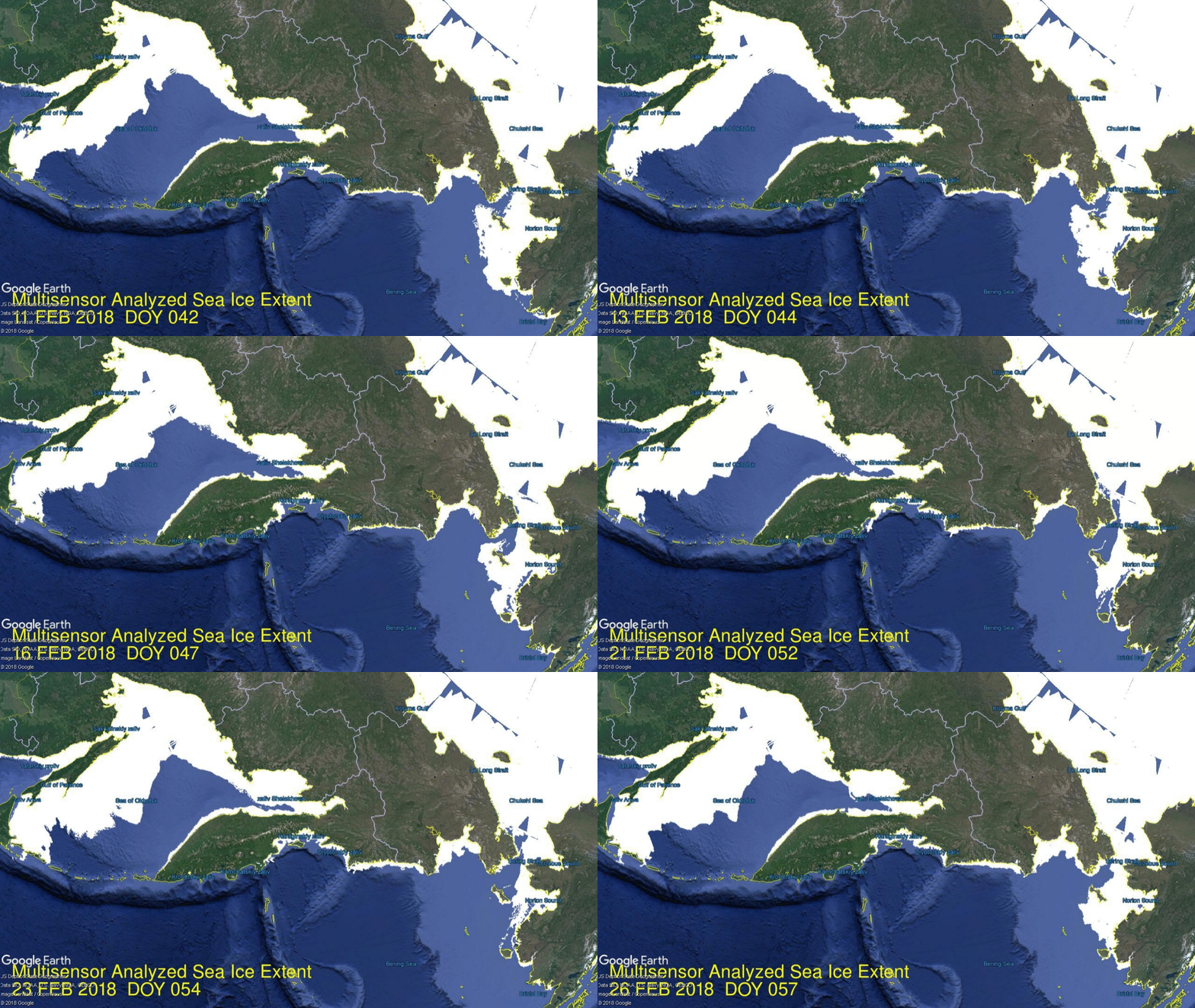
The good news was that the ice was found just next door in Okhotsk Sea.  As the image above showed, Bering did reduce its coverage, but Okhotsk was gaining at the same time. Over those 12 days, Bearing lost 173k km2 of ice extent while Okhotsk gained 185k km2.

Now we have perhaps already passed the annual maximum, which on average was 15.1M km2 on day 62.

NH arctic ice day 066r

2018 has reduced ice extent the last three days since peaking on day 63.  It came near to 2007 and 2016 before retreating.  And as in the past, SII is tracking about 200k km2 lower.  The regional extents are shown in the table below.

Region 2018066 Day 066 
Average
2018-Ave. 2017066 2018-2017
 (0) Northern_Hemisphere 14380231 15084354 -704123 14706492 -326261
 (1) Beaufort_Sea 1070445 1070178 267 1070445 0
 (2) Chukchi_Sea 965161 966001 -840 966006 -845
 (3) East_Siberian_Sea 1087120 1087134 -14 1087137 -18
 (4) Laptev_Sea 897845 897842 3 897845 0
 (5) Kara_Sea 934934 926489 8445 912664 22270
 (6) Barents_Sea 624841 647307 -22466 597521 27320
 (7) Greenland_Sea 537737 641220 -103484 615726 -77989
 (8) Baffin_Bay_Gulf_of_St._Lawrence 1557754 1560371 -2617 1545548 12206
 (9) Canadian_Archipelago 853109 852753 356 853214 -106
 (10) Hudson_Bay 1260838 1259900 938 1260903 -66
 (11) Central_Arctic 3152831 3219866 -67035 3223471 -70640
 (12) Bering_Sea 232461 757199 -524738 628542 -396081
 (13) Baltic_Sea 138089 94664 43425 69380 68708
 (14) Sea_of_Okhotsk 1041074 1070088 -29014 953551 87522

The 2018 deficit to average is almost entirely due to Bering Sea lack of refreezing, now 525k km2 below recent normal.  On the European side, Barents and Kara are nearly average, with Greenland Sea down about 20%.  It remains to be seen if this year’s maximum is past or if more extent is gained in the coming week.

Drift ice in Okhotsk Sea at sunrise.

The graph below shows 2018 NH ice extents since day 1, with and without the Pacific basins Bering and Okhotsk, compared to 11 year averages (2007 to 2017 inclusive).  Clearly 2018 is an average year except for the Pacific basins, especially Bering Sea.

Arctic Ice Swirls End of Feb.

Click on image to enlarge.

Under the influence of a split vortex in February, Arctic ice is also a bit bi-polar.  Above image shows the Atlantic side the last two weeks.  Barents on the right has grown back to reach the 11 year average, while on the upper left Baffin Bay is above average reaching down to Newfoundland and filling in the Gulf of St. Lawrence.

Click on image to enlarge.

Meanwhile, the ridge of high pressure over Alaska resulted in Bering on the right losing ice while Okhotsk on the left gained up to last year’s maximum.

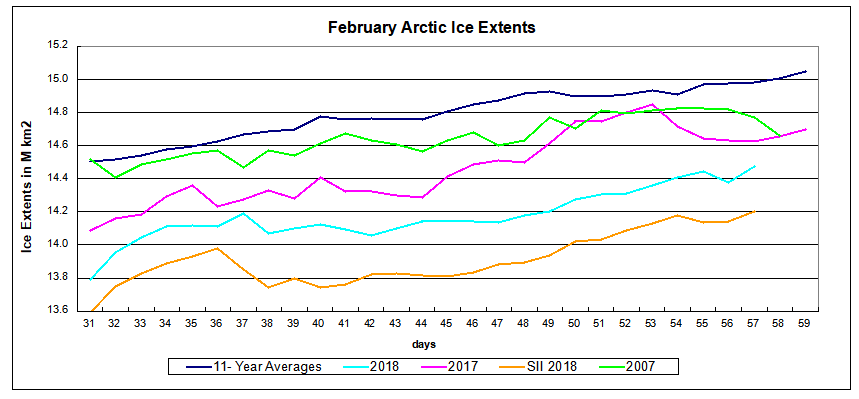
Ice extents for February appear in the graph below; 11 year average is 2007 to 2017 inclusive.
Note that ice growth slows down in February since the Arctic core is frozen and extent can only be added at the margins.  MASIE shows 2018 is drawing close to 2007 and 2017, while SII is running about 200k km2 less.  The 11 year average reached 15M km2 while this year is ~500k km2 lower at day 57.

Below is the analysis of regions on day 057.  Average is for 2007 to 2017 inclusive.

Region 2018057 Day 057 
Average
2018-Ave. 2017057 2018-2017
 (0) Northern_Hemisphere 14471633 14982823 -511189 14624988 -153354
 (1) Beaufort_Sea 1070445 1070178 267 1070445 0
 (2) Chukchi_Sea 962774 965725 -2951 966006 -3232
 (3) East_Siberian_Sea 1087120 1087134 -14 1087137 -18
 (4) Laptev_Sea 897845 897842 3 897845 0
 (5) Kara_Sea 928561 922491 6070 933003 -4442
 (6) Barents_Sea 599940 618000 -18061 535489 64451
 (7) Greenland_Sea 405456 639713 -234257 621708 -216252
 (8) Baffin_Bay_Gulf_of_St._Lawrence 1823426 1492225 331201 1490888 332538
 (9) Canadian_Archipelago 853109 852670 439 853214 -106
 (10) Hudson_Bay 1260838 1260663 175 1260903 -66
 (11) Central_Arctic 3076082 3222907 -146825 3217927 -141845
 (12) Bering_Sea 283579 737222 -453642 577660 -294081
 (13) Baltic_Sea 130666 116020 14646 64843 65822
 (14) Sea_of_Okhotsk 1063381 1049659 13722 991862 71519

The 2018 deficit to average is almost entirely due to the shortfall in Bering Sea.  Barents, Chukchi and Okhotsk are all about average.  A large surplus in Baffin Bay/Gulf of St. Lawrence offsets smaller deficits in Central Arctic and Greenland Sea.

The annual maximum usually occurs mid March.  2018 is now 2% below last year’s max and needs 3.5% more extent to reach 15M km2.

Here’s your Valentine’s Day Greeting:

And here’s your PC candy for Valentine’s Day.


Volatile Vortex


Dr. Judah Cohen covers the latest vortex shaninigans and implications for future weather at his always informative website Arctic Oscillation and Polar Vortex Analysis and Forecasts February 19, 2018. Excerpts below with my bolds.  Video above of nullschool wind patterns from October 2017 up to yesterday, showing the vortex splitting as described below.

The stratospheric PV remains split into two pieces with one dominant center over Western Canada and a second much weaker center over northwestern Europe (Figure 12). The Eurasian center is predicted to retrograde westward and dissipate while the North American center slowly drifts north towards the North Pole and even possibly into Eurasia. The most persistent legacy of the PV spit is above normal geopotential heights and warm temperatures in the polar stratosphere. This is reflected in the stratospheric AO, which is predicted to remain negative over the next two weeks, though slowly trend back to neutral (Figure 1).

As I have discussed in previous blogs there seems to me to be two responses to a significant PV disruption: an immediate response and a longer term response. When the PV split it created two sister vortices a dominant center over North America and a more minor center over Eurasia. In between the two PV centers high pressure filled the void but was shifted towards the Eurasian continent. Across Eurasia the immediate and longer term response seem to be consistent. The immediate tropospheric response or at least the tropospheric circulation related to the PV split has been high pressure/heights to the north, low pressure/heights to the south, predominant anomalous easterly flow and below normal temperatures across northern Eurasia.

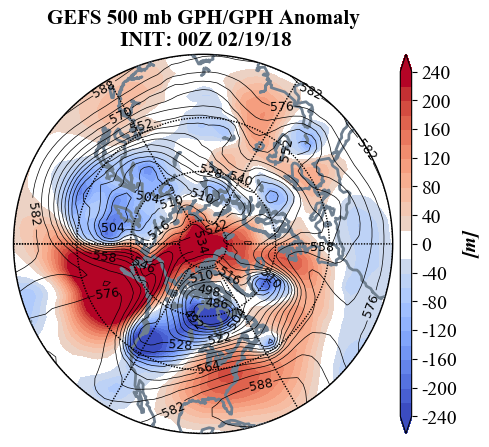
Figure 2. Observed 500 mb geopotential heights (dam; contours) and geopotential height anomalies (m; shading) for 00Z 19 February 2018.

In contrast the immediate and longer term response across North America do not seem to be the same. When the PV split into two pieces the dominant sister center formed over Western Canada and has been spinning in place in the polar stratosphere. It appears to me this has contributed or at least is related to troughing/negative geopotential height anomalies across Canada and then eventually into the Western US accompanied by colder temperatures. This in turn has forced further downstream across eastern North America ridging/positive geopotential height anomalies, southwesterly flow and mild even record warm temperatures.

Eventually however the Eurasian PV sister center is predicted to weaken and dissipate leaving just one PV center over Western Canada. That PV center is predicted to make its way back to the North Pole or alternatively there are some model forecasts of the PV center being further displaced towards Eurasia.

Longer term the tropospheric response seems to be less about the initial displacement and the associated circulation around the respective PV centers and more about the warming and high pressure/heights related to that warming. The corresponding tropospheric response is high pressure and relatively warm temperatures over the Arctic. With respect to the ongoing event the high pressure and warm temperatures in the polar stratosphere are centered over Greenland and therefore it seems likewise in the troposphere the high pressure/heights and warm temperatures will be centered over Greenland. This transfer of high pressure/heights and warm temperatures over the Arctic is seen in the apparent downward propagation of positive/warm polar cap geopotential heights and/or a negative AO from the mid-stratosphere eventually down to the surface. On average this downward propagation or transfer takes about two weeks.

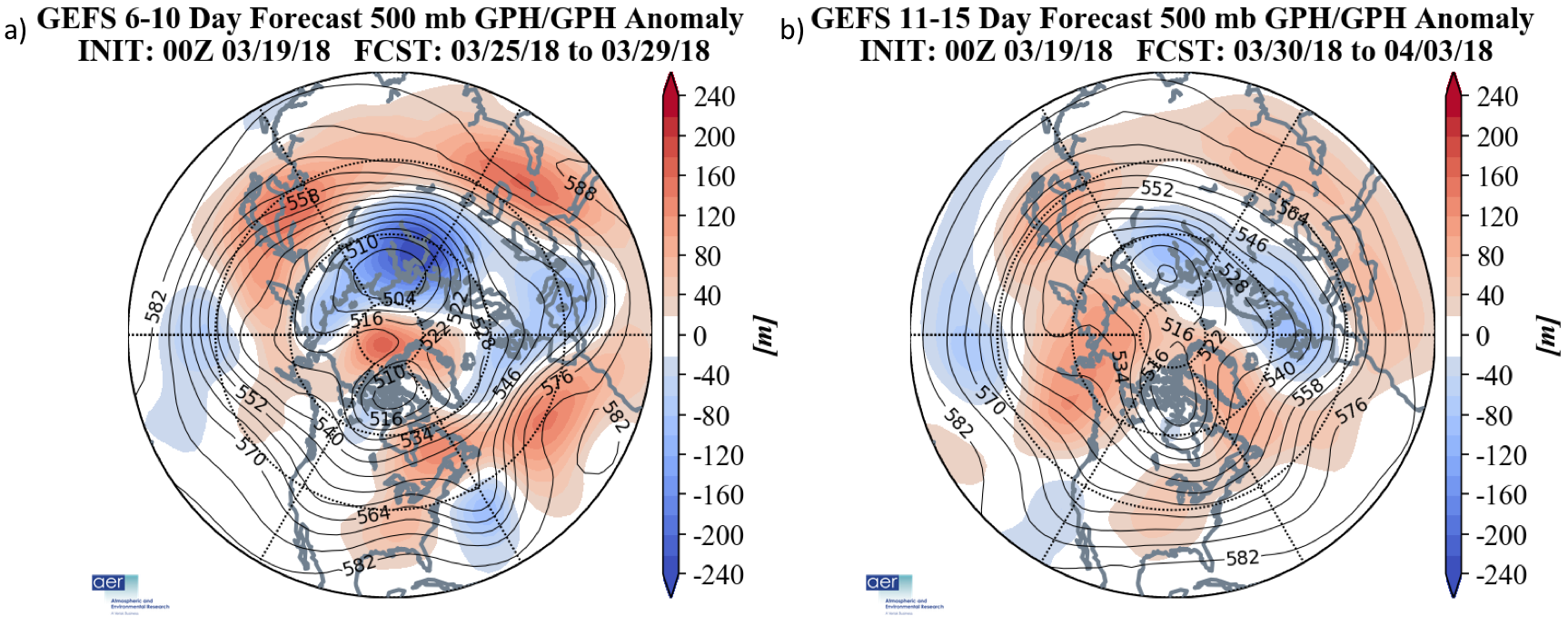
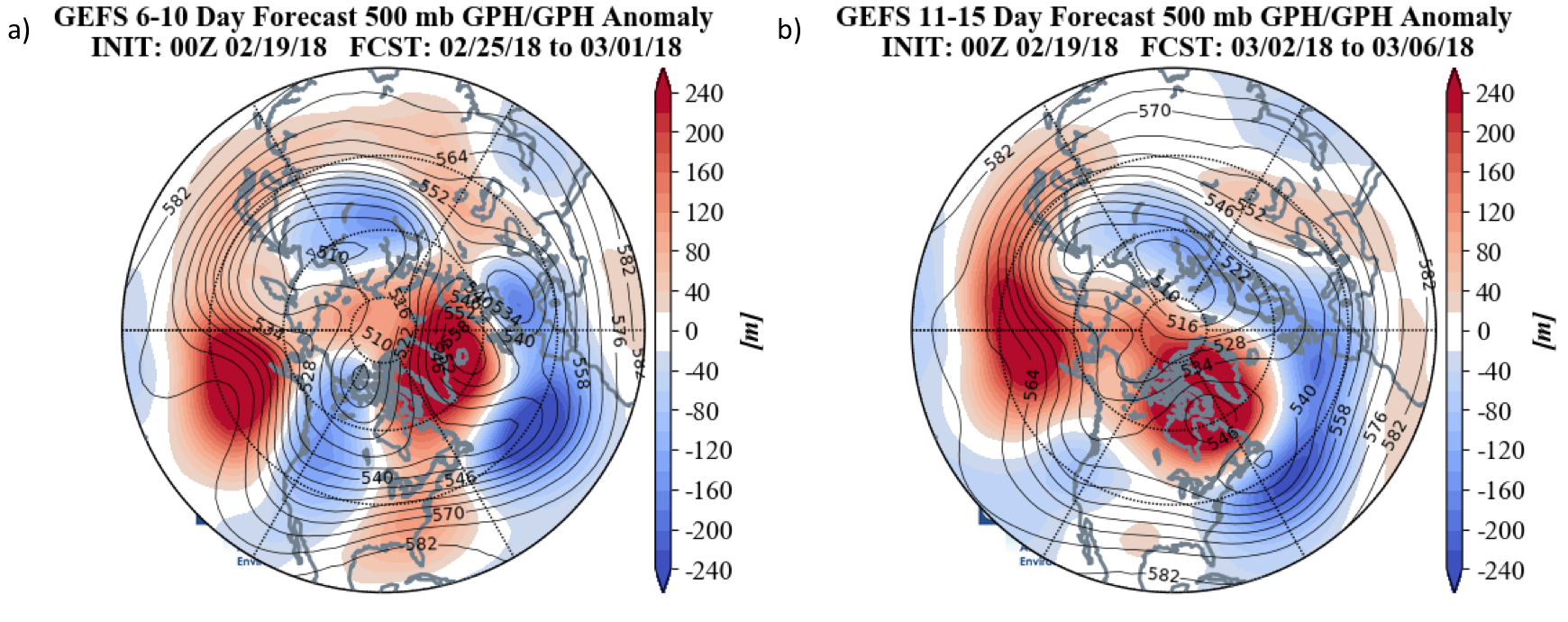
Figure 5. (a) Forecasted average 500 mb geopotental heights (dam; contours) and geopotential height anomalies (m; shading) across the Northern Hemisphere from 25 February – 1 March 2018. (b) Same as (a) except averaged from 2 – 6 March 2018. The forecasts are from the 19 February 2018 00z GFS ensemble.

Therefore in summary based on my reasoning, the immediate response to a PV disruption is somewhat random dependent on the displacement of the PV center(s) and the circulation around the PV center(s). For the current event the immediate tropospheric response related to the location and circulation of the North American sister vortex favors relatively cold temperatures in western North America and mild temperatures in eastern North America. However the tropospheric response could have just as likely been the opposite favoring relatively mild temperatures in western North America and cold temperatures in eastern North America. Across Eurasia the immediate response favors relatively cold across northern Eurasia and mild temperatures across southern Eurasia; though it does seem that the immediate response across Eurasia is less random than for North America for reasons that I don’t fully understand.

The longer term response or legacy however to a PV disruption is less random and is not as dependent on the location and circulation of the PV center(s) but rather on the warming and building of high pressure/heights across the Arctic which shows greater similarity across PV disruption events. High pressure/heights and warm temperatures favor colder temperatures in preferential locations: the Eastern US, Northern Europe and East Asia resulting in a warm Arctic/cold continents pattern. Therefore my expectations of the longer term response to the ongoing PV disruption is the same – a preference for relatively cold temperatures in the Eastern US, Northern Europe and East Asia over the coming four to six weeks starting the very end of February or the beginning of March.

Forecast for the next month from Environment Canada.


Bering Sea Ice Lost (& Found Next Door)

Bering035to047

Breathless headlines from Inside Climate News:  Alaska’s Bering Sea Lost a Third of Its Ice in Just 8 Days

Well, I have good news for them.  The ice was found just next door in Okhotsk Sea.  As the image above shows, Bering did reduce its coverage, but Okhotsk was gaining at the same time. Over the last 12 days, Bearing lost 173k km2 of ice extent while Okhotsk gained 185k km2. Bering is currently at 35% of last year’s max, while Okhotsk is at 88%, with a month of the freezing season yet to go.

Drift ice in Okhotsk Sea at sunrise.

The graph below shows 2018 NH ice extents since day 1, with and without the Pacific basins Bering and Okhotsk, compared to 11 year averages (2007 to 2017 inclusive).
The deficit comes mostly from Bering Sea, while Okhotsk is above average, and Barents has grown recently.  Greenland Sea and Central Arctic are down to a lesser extent, nearly offset by Baffin surpluses. A month remains to reach annual maximum with the standard this decade being about 15M km2. For perspective, 2018 has to gain about 6% by mid March to reach 15M and gain 4% to reach 14.78, last year’s maximum. It should also be remembered that all of these dancing basins will likely melt out by September as usual.

For a more comprehensive report see Feb. Arctic Ice Dance

Feb. Arctic Ice Dance

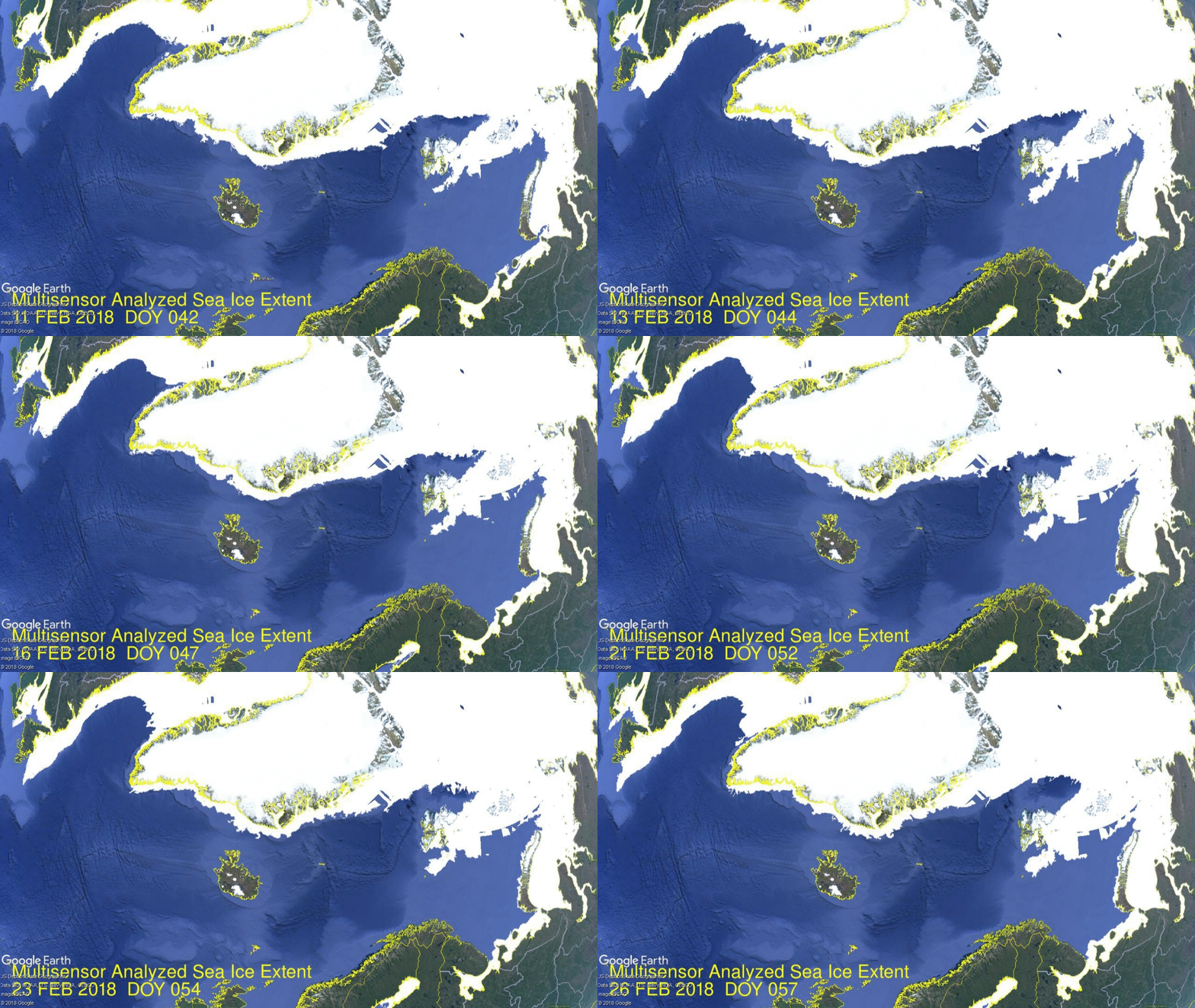
For much of February, NH has been overall slower than usual to add ice extent. But that does not mean nothing is happening.  For we can observe ice dances on opposite sides of the Arctic from January up to now. The image above shows how Pacific ice extents have shuffled back and forth between Okhotsk (left) and Bering (right), alternating waxing and waning so that both basins combined are below average. Lately Okhotsk has added ice to reach normal, so now Bering makes most of the difference. Bering is now only 45% of last years maximum, while Okhotsk has reached 81% of last year’s max extent.

Drift ice in Okhotsk Sea at sunrise.

On the Atlantic side, the two players are Barents and Baffin Bay/Gulf of St. Lawrence. On the left side  you can see Baffin Bay extending down to reach Newfoundland, and Gulf of St. Lawrence filling in.  Meanwhile Barents has waffled up and down, first growing to reach Svalbard and then receding along with Greenland Sea opening to the left of Svalbard.  Barents is presently at 75% of last years maximum, while BB/GSL extent is its highest this year and 96% of last year’s max.

Sea ice forming in Baffin Bay.

Overall 2018 Arctic ice has reached 14.1M km2, about 600k km2 or 5% below average.

MASIE shows this year catching up to 2017 while SII 2018 lags ~300k km2 behind.  The graph below shows 2018 NH ice extents since day 1, with and without the Pacific basins Bering and Okhotsk, compared to 11 year averages (2007 to 2017 inclusive).
Clearly the deficit to average is mostly due to B&O, and as the table below shows, mostly Bering at this point.

Region 2018044 Day 044 
Average
2018-Ave. 2017044 2018-2017
 (0) Northern_Hemisphere 14140166 14756619 -616453 14287848 -147682
 (1) Beaufort_Sea 1070445 1070178 267 1070445 0
 (2) Chukchi_Sea 965971 965614 357 966006 -35
 (3) East_Siberian_Sea 1087120 1087134 -14 1087137 -18
 (4) Laptev_Sea 897845 897842 3 897845 0
 (5) Kara_Sea 874714 906136 -31422 908380 -33666
 (6) Barents_Sea 465024 567976 -102952 363927 101097
 (7) Greenland_Sea 529094 630790 -101696 565090 -35996
 (8) Baffin_Bay_Gulf_of_St._Lawrence 1655681 1483847 171834 1564353 91328
 (9) Canadian_Archipelago 853109 853029 80 853214 -106
 (10) Hudson_Bay 1260838 1260792 46 1260903 -66
 (11) Central_Arctic 3117143 3218063 -100920 3209792 -92649
 (12) Bering_Sea 319927 730017 -410090 564241 -244314
 (13) Baltic_Sea 76404 105038 -28634 59994 16410
 (14) Sea_of_Okhotsk 911105 906055 5050 834828 76277

The large deficit comes from Bering Sea, while Okhotsk is matching average, and Barents has grown recently.  Greenland Sea and Central Arctic are down to a lesser extent, nearly offset by Baffin surpluses. A month remains to reach annual maximum with the standard this decade being about 15M km2. For perspective, 2018 has to gain about 6% by mid March to reach 15M and gain 4% to reach 14.78, last year’s maximum. It should also be remembered that all of these dancing basins will likely melt out by September as usual.