Arctic Ice Race Tied Oct. 25

Meltponds and leads in the Arctic ice cap show evidence of refreezing

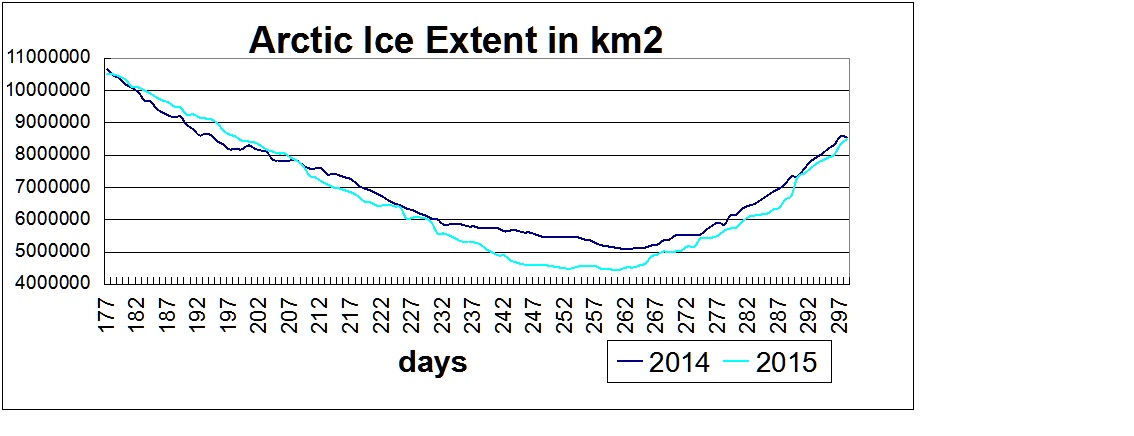
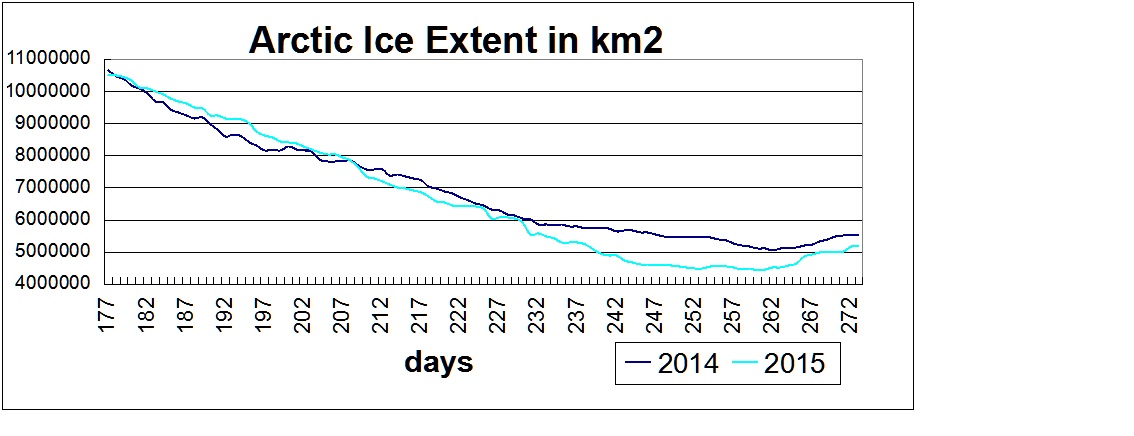
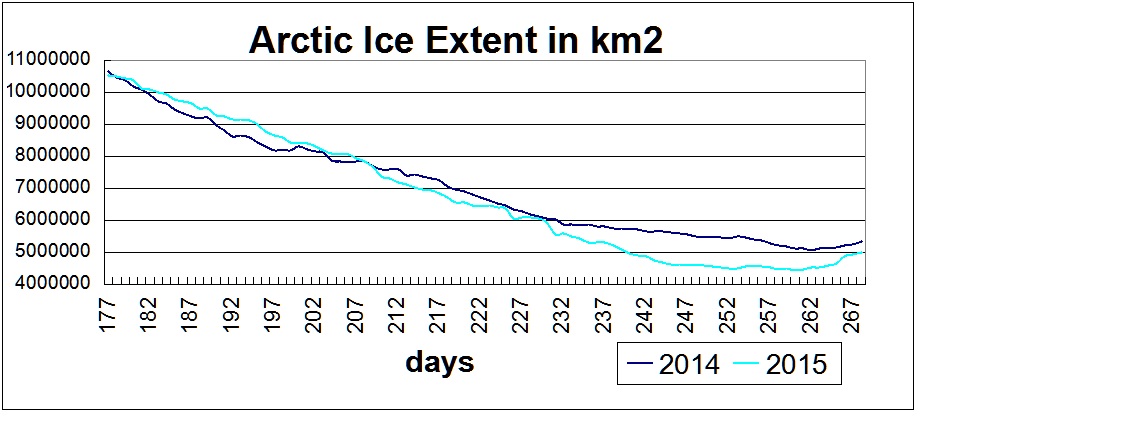
Day 298, October 25, 2015 Arctic ice extent virtually matched 2014 on the same day. For the first time in 100 days, July 17, ice extent is again 8.5M km2. MASIE shows 8.47M compared to NOAA at 8.11M.

2015 has gained steadily the last 10 days at a daily rate of 181k km2.  As a result, 2015 lhas reached a virtual tie, lagging behind only slightly.

masie day 298

The rate of ice recovery this year since minimum day 260 is 109k km2 per day, 11k greater than 2014, and the highest in the last decade, except for 2013 and 2008.

The BCE region (Beaufort, Chukchi, East Siberian) is now 105% of 2014 at this date. Most seas exceed 2014 at this date. The largest remaining differences are Barents and Kara, which melted early and have not yet recovered. CAA has recovered after the August 2015 storm and now exceeds last year, through the Central Arctic still lags behind.

From MASIE

Ice Extents 2014298 2015298 Ice Extent
Region km2 Diff.
 (0) Northern_Hemisphere 8531378 8470311 -61067
 (1) Beaufort_Sea 874812 1046413 171601
 (2) Chukchi_Sea 445204 436170 -9034
 (3) East_Siberian_Sea 746853 786087 39234
 (4) Laptev_Sea 817198 897757 80559
 (5) Kara_Sea 774019 567237 -206782
 (6) Barents_Sea 237519 13282 -224237
 (7) Greenland_Sea 390963 430467 39504
 (8) Baffin_Bay_Gulf_of_St._Lawrence 168991 257335 88344
 (9) Canadian_Archipelago 775255 823421 48166
 (10) Hudson_Bay 63494 73546 10052
 (11) Central_Arctic 3232620 3137455 -95165

Summary

The comparison with 2014 informs us whether this year will “bend the trend” of recovering ice extent since 2007, and by how much.  The pace of refreezing this year is impressive and the end result remains to be seen.  It seems unlikely that the previous two years can be overtaken this late in the calendar.

My guess: 2015 Average Annual extent will finish as the 3rd highest in the last 10 years, ahead of the years before 2013.

Still a Bronze Medal is not bad for a year that started with a lower March maximum, had the Pacific Blob melt out Bering Sea a month early, saw a negative AO most of the summer ensuring higher insolation and melting, and finally underwent a strong storm late August when ice edges were most fragile.

OLYMPUS DIGITAL CAMERA

Arctic Ice Great Leap Upward Oct. 17

Meltponds and leads in the Arctic ice cap show evidence of refreezing

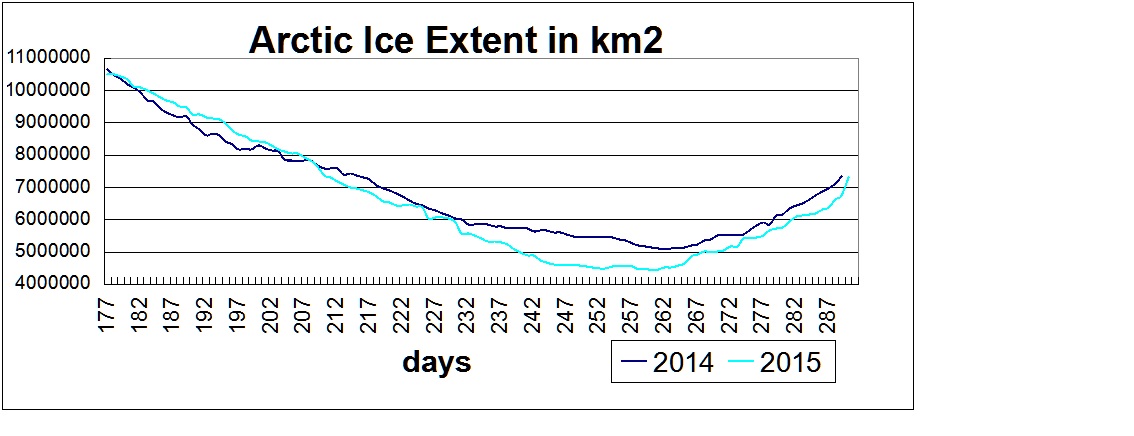
Day 290, October 17, 2015 was a day with several significant events regarding Arctic ice recovery. For the first time since day 218, August 6, ice extent is again over 7M km2. MASIE shows 7.32M compared to NOAA at 7.15M.

The gain yesterday was 557k km2, twice the largest previous increases.  As a result, 2015 lags behind 2014 by a single day.

masie day 290r

The rate of ice recovery this year since minimum day 260 is 100k km2 per day, 10k greater than 2014, and the highest in the last decade, except for 2013.

The BCE region (Beaufort, Chukchi, East Siberian) is now 105% of 2014 at this date. Hudson and Baffin Bays combined exceed 2014; Kara and Laptev combined are also larger; Greenland Sea is slightly higher. The largest remaining difference is Barents, which melted early and has not recovered. CAA is slowly recovering after the August 2015 storm, and the Central Arctic is down in recent days.

From MASIE (2014 dataset is missing day 290):

Ice Extents 2014289 2015290 Ice Extent
Region km2 Diff.
 (0) Northern_Hemisphere 7328164 7321971 -6193
 (1) Beaufort_Sea 834187 887355 53169
 (2) Chukchi_Sea 401082 447166 46084
 (3) East_Siberian_Sea 591126 720793 129667
 (4) Laptev_Sea 365434 697481 332047
 (5) Kara_Sea 454119 265291 -188828
 (6) Barents_Sea 266907 1589 -265318
 (7) Greenland_Sea 394133 404860 10727
 (8) Baffin_Bay_Gulf_of_St._Lawrence 69086 113255 44168
 (9) Canadian_Archipelago 731010 655865 -75145
 (10) Hudson_Bay 30471 17006 -13465
 (11) Central_Arctic 3188655 3110169 -78486

Summary

The comparison with 2014 informs us whether this year will “bend the trend” of recovering ice extent since 2007, and by how much.  The pace of refreezing this year is impressive and the end result remains to be seen.  My guess: 2015 Average Annual extent will finish as the 3rd highest in the last 10 years, ahead of every year before 2013.

OLYMPUS DIGITAL CAMERA

Auspicious Day for Arctic Ice

Meltponds and leads in the Arctic ice cap show evidence of refreezing

Day 282, October 9, 2015 was a day with several significant events regarding Arctic ice recovery. For the first time since day 229, August 26, ice extent is again over 6M km2. Also, the BCE region (Beaufort, Chukchi, East Siberian) is now the same as 2014 at this date. Another happening is NOAA and MASIE showing exactly the same number for NH ice extent.

The rate of ice recovery this year since minimum day 260 is 72k km2 per day, 12k greater than 2014, and the highest in the last decade, except for 2013.

Hudson and Baffin Bays combined are the same both years; Kara and Laptev combined are the same both years; Greenland Sea is the same. The remaining difference is mainly Barents, which melted early and has not recovered, and CAA, slowly recovering after the August 2015 storm. From MASIE:

Ice Extents 2014282 2015282 Ice Extent
Region km2 Diff.
 (0) Northern_Hemisphere 6433593 6101239 -332354
 (1) Beaufort_Sea 760258 768857 8598
 (2) Chukchi_Sea 342532 420027 77495
 (3) East_Siberian_Sea 524382 444172 -80210
 (4) Laptev_Sea 161386 302302 140916
 (5) Kara_Sea 160370 52762 -107608
 (6) Barents_Sea 170701 1589 -169112
 (7) Greenland_Sea 346102 346143 41
 (8) Baffin_Bay_Gulf_of_St._Lawrence 65565 98692 33128
 (9) Canadian_Archipelago 687420 497592 -189828
 (10) Hudson_Bay 35404 3423 -31981
 (11) Central_Arctic 3178330 3164538 -13792

Summary

The comparison with 2014 informs us whether this year will “bend the trend” of recovering ice extent since 2007, and by how much.  The pace of refreezing this year is impressive and the end result remains to be seen.  My guess: 2015 Average Annual extent will finish in 3rd place, ahead of every year before 2013 in the last decade.

OLYMPUS DIGITAL CAMERA

Arctic Ice Made Simple

People are overthinking and over-analyzing Arctic Ice extents, and getting wrapped around the axle (or should I say axis).  So let’s keep it simple and we can all readily understand what is happening up North.

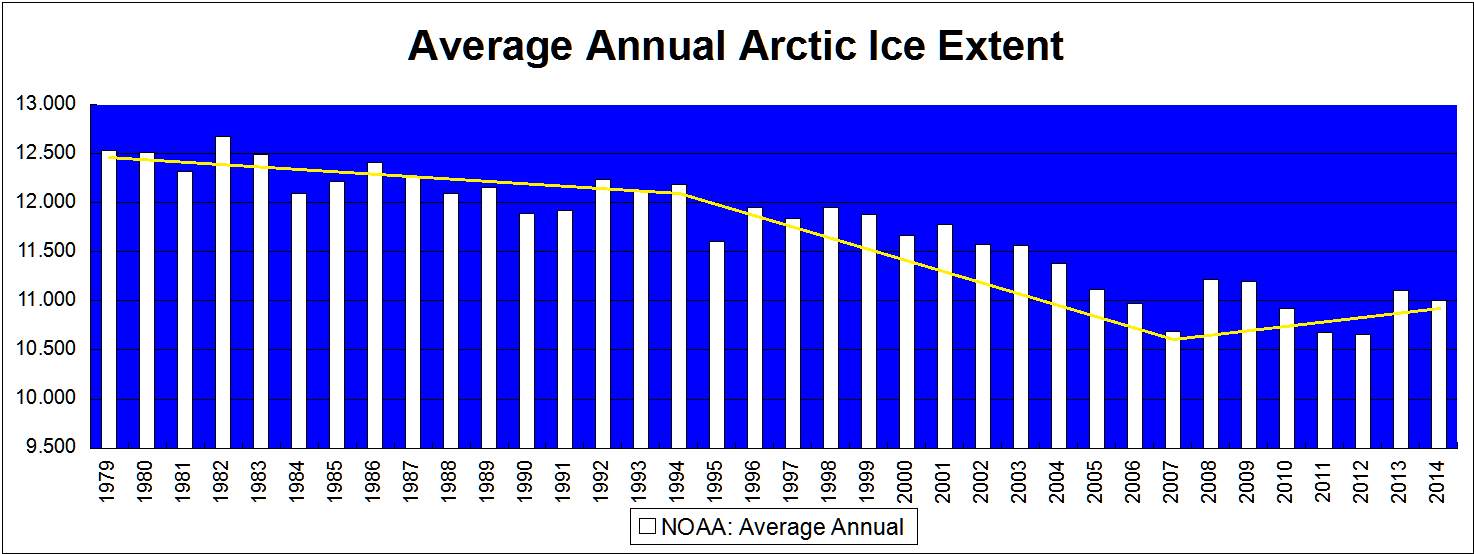
I will use the ever popular NOAA dataset derived from satellite passive microwave sensors.  It sometimes understates the ice extents, but everyone refers to it and it is complete from 1979 to 2014.  Here’s what NOAA reports (in M km2):

X-ray Ice Mirror5

If I were adding this to the Ice House of Mirrors, the name would be The X-Ray Ice Mirror, because it looks into the structure of the time series.   For even more clarity and simplicity, here is the table:

NOAA NH Annual Average Ice Extents (in M km2)

Year Average Change % Change
1979 12.532
1994 12.183 -0.348  -2.8%
2007 10.685 -1.498 -12.3%
2014 11.003   0.318    3.0%

The satellites involve rocket science, but this does not.  There was a small loss of ice extent over the first 15 years, then a dramatic downturn for 13 years, 4 times the rate as before. That was followed by a recovery almost offsetting the first period in half the time.  All the fuss is over that middle period, and we know what caused it.  A lot of multi-year ice was flushed out through the Fram Strait, leaving behind more easily melted younger ice. The effects from that natural occurrence bottomed out in 2007.

Kwok et al say this about the Variability of Fram Strait ice flux:

The average winter area flux over the 18-year record (1978–1996) is 670,000 km2, ;7% of the area of the Arctic Ocean. The winter area flux ranges from a minimum of 450,000 km2 in 1984 to a maximum of 906,000 km2 in 1995. . .The average winter volume flux over the winters of October 1990 through May 1995 is 1745 km3 ranging from a low of 1375 km3 in the 1990 flux to a high of 2791 km3 in 1994.

Click to access kwokJGR99.pdf

Conclusion:

Some complain it is too soon to say Arctic Ice is recovering, or that 2007 is a true change point.  The same people were quick to jump on a declining period after 1994 as evidence of a “Death Spiral.”

Footnote:

No one knows what will happen to Arctic ice.

Except maybe the polar bears.

And they are not talking.

Except, of course, to the admen from Coca-Cola

Ice House of Mirrors

In the fable of Snow White, the evil step-mother asked her hand mirror: “Who is the fairest in the land?” The mirror on the wall always flattered her, but this mirror did not. As we all know, the hand mirror told the truth, the queen was angry and people had to suffer.

We expect mirrors to tell the truth, to show us the objective reality. That is why it is amusing at the carnival sideshow to gaze into mirrors that make normal people look obese or like a beanpole, or otherwise distort one’s appearance.

This post is about what Arctic Ice Extent looks like in the mirrors available to the public.

Mirror #1

If you wonder what is happening with Arctic Ice, the first (and maybe only) depiction you encounter will look like this:

I call this The Incredibly Shrinking Ice Mirror, because it is certainly scary (Death Spiral comes to mind). Ice is obviously going to hell in a hand-basket. Once your fright abates, you might wonder about the scale or how much ice is measured. And you might notice this is about September; except for March other months of the year are excluded from view.

You wouldn’t know from this chart that scary looking 2012 had one of the higher March maximums and on average was not so far out. But that wouldn’t be as exciting.

Mirror #2

Just for fun, let’s make a mirror from the same dataset, just one month later. I call this The Incredibly Persisting Ice Mirror.

october extents lrg2

You won’t find this one on the Internet because it is politically incorrect and pretty boring. But it is just as valid as Mirror #1. It is showing a very slow, unalarming decline with something unusual in 2007, but recovering after that.

Is it a distortion? Absolutely, it is incomplete in the same way as Mirror #1, but gives the opposite impression, just by choosing a different month. But at least this one informs your impression with the actual monthly average extents in M km2 (no anomalies or %s).

Mirror #3

There are more informative pictures of Arctic Ice dynamics if you look for them. For example, there is this presentation of the complete dataset:

NOAA NH Ice Extent

I call this The Bird’s Eye Ice Mirror because you can see the big picture from the satellite passive microwave sensors: the full range of annual variation, the actual measured extents and averages. Note the trend line looks much more like October than September. Is there a reason September is preferred?

Mirror #4

As I have pointed out there are other views of ice extent patterns, such as this:

masie annuallarge273

Let’s call it the The Navigator’s Eye Ice Mirror because it is the accumulation of the ice extents you could expect to observe at sea level from buoys or from the deck of a ship operating in the Arctic region (source: MASIE ice charts).

Of course, there are other mirrors trying in their own ways to tell us about Arctic Ice.

Here’s two Magnifying Ice Mirrors, giving you closeups of what is happening with the ice:

JAXA 2006 to 2015

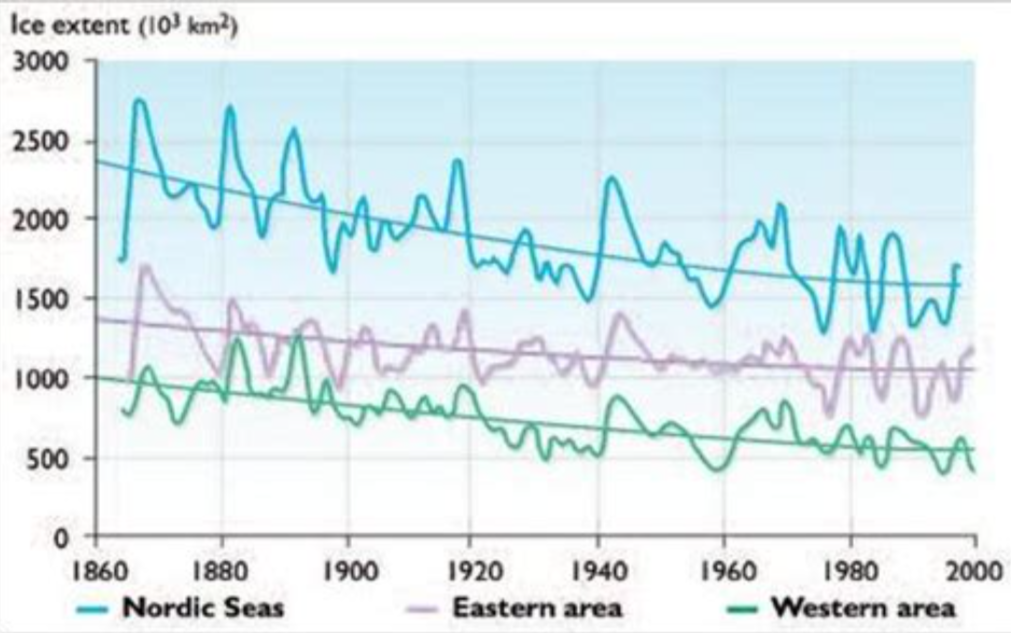
Let’s not forget The Rear-view Ice Mirrors showing that there were ice observations long before the satellite record started in 1979.

Figure 16-3: Time series of April sea-ice extent in Nordic Sea (1864-1998) given by 2-year running mean and second-order polynomial curves. Top: Nordic Sea; middle: eastern area; bottom: western area (after Vinje, 2000). IPCC Third Assessment Report

Conclusion:

We know as a fact of life that any mirror contains some distortion or bias, even those trying to tell the truth. So it is wise to look at several of them, and pay attention to the frames, before concluding what is happening. Be sure to have a chuckle when you pass by Mirror #1. Although setting energy policies and investing billions of research dollars based on that distortion is not amusing.

Footnote:

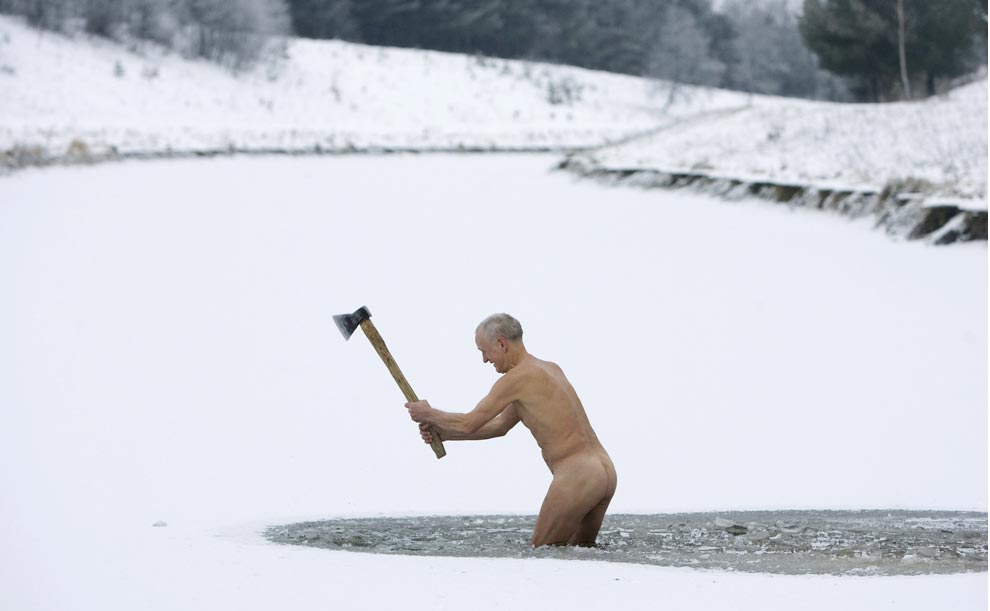
Some commentators wondered whether the statistics are affected by icebreakers.  I don’t know, but there is evidence of a Norwegian icebreaker in operation:


Facets of Ice and Climate

gallopingcamel commented recently on Flap over Arctic Ice Rebound

“Short term variations to Arctic ice were not a big deal for me, but you piqued my interest so your blog has been added to my favorites.

To date, my interest has been the long term record based on ice cores:
https://diggingintheclay.wordpress.com/2013/05/04/the-dog-that-did-not-bark/

Do you have any comments to share?”

His linked post is a tightly reasoned analysis regarding CO2, temperatures and ice cores. I appreciate greatly his summary showing that present warming is much too low if CO2 has been causing warming all along. I’d not seen the contradiction put so succinctly.

His comment causes me to reflect on several facets of ice in relation to climate, and this is the point of this post.

The immediate facet: What do Sea Ice Extents tell us about climate change?

As Peter says, my blogging on Arctic Ice extents is quite immediate and is motivated mainly by my concern to get some factual perspectives out there as a possible antidote to feverish claims the media will promote. In that sense, this facet of ice is an immediate and socio-political one. The issue: should Arctic ice extent cause us to be alarmed about the climate? My blogs on Arctic Ice Rebound provide my conclusions, but this battle for public opinion has not yet been joined in earnest. In my post on sea ice factors I make the point that among many things affecting ice extents, CO2 is the least likely. And Antarctic ice extent is another story which I have left to others.

The Longer View: The Ice Core Story of CO2 and Surface Temperatures

I am convinced as Peter is that in the ice core record, changes in CO2 follow temperature changes and are more effect than cause. The natural CO2 sources and sinks are estimated with large error bands and their behavior is likely to be dynamic, that is, changing with changing climate conditions.

This blog is like a personal journal where I try to articulate realizations that form from my engagement in climate topics. It is idiosyncratic in that I often have a new discovery, quite exciting to me, but long understood by others unknown to me. For example, John Holtquist just linked to a webpage by John Daly where he said years ago most of everything I’ve learned about Arctic ice and more.

My journey this year was marked by discovering we live on planet water, not planet earth, and it led me to read much more oceanographic material which is categorized here as Oceans Make Climate. That led me to ice, and to some theories regarding longer-term Arctic cycles summarized here.

The Big Picture: The Sun and the Earth, From Hot House to Ice House

Peter’s post has a comment thread that gets into the larger arena of climate shifts involving ice-covered ages (most of earth’s history) and the more hospitable inter-glacial periods such as we have enjoyed for the last 11,500 years. I wrote a post on how I believe the ocean’s thermal flywheel is responsible for keeping our climate so stable most of the time, until it is overwhelmed by external forces, primarily astronomical in nature.

I have not wandered far into the sun-climate controversy, and my present understanding is probably best expressed here:
https://rclutz.wordpress.com/2015/09/16/the-climates-they-are-a-changing/

Arctic Ice September Final


Meltponds and leads in the Arctic ice cap show evidence of refreezing

The daily ice extent minimums are behind us, and now the story is how fast will be this year’s recovery of ice compared to other years.

First the daily situation at the end of September:

September 30 day 273 results from MASIE. 2015 has overcome 2/3 of 2014 ice extent lead.

Since the annual minimum on day 262, 2015 recovery rate was 60k m2 per day compared to 41k per day in 2014.

2015 ice extent now trails 2014 by 6.1%, which is about 337k km2 difference.

Extent in BCE region is building ice now at 81% of last year. Largest recent increases were in Laptev 43k, Kara 33k, Beaufort 15k, CAA 23k, and most importantly, the Central Arctic is now 220k above its minimum 29 days ago.

masie day 273


The graph shows that a gap opened when 2015 ice dropped at the time of an Arctic cyclone late August.  The differential of almost 1M km2 has now been cut to 337k km2. and closing. 2015 ice extent was lower than 5M km2 for only 28 days.

2015 Recap:

The 30 days of September 2015 are in the books, so we now have the melt season conclusion beyond the daily minimums.

Sept. results for recent years from MASIE Plots   h/t to Andres Valencia

https://nsidc.org/data/masie/masie_plots.html

For most of the season, 2015 Arctic sea ice extent was tracking 2014. In fact the July average extent was slightly higher than 2014. Then weather intervened in the last week of August. A large and strong cyclone centered over Chukchi Sea began breaking up ice in the BCE Region and affecting CAA (Canadian Archipelago) and the Central Arctic.  In addition, most of the summer the Arctic Oscillation (AO) was in negative phase, meaning fewer clouds, more direct insolation and ice melting.  More discussion of these two factors is at the end of this post.

The effects of this storm are seen in the rapid increase in water extent ( 482k km2 in one week) so that August 31 2015 had less ice than did 2014 at minimum September 19. Water extent continued to grow, and then stabilized once the storm abated and the AO went from negative to neutral.  Now the ice is growing beyond the daily minimum.

Comparing MASIE and NOAA Ice Extents.

Month 2015 2015 2015 2014 2014 2014
Ave. MASIE NOAA MASIE-NOAA MASIE NOAA MASIE-NOAA
Feb 15.032 14.498 0.534
March 15.170 14.758 0.413
April 13.650 13.954 -0.304 14.318 14.088 0.230
May 12.646 12.485 0.161 12.916 12.701 0.215
June 10.841 10.889 -0.049 11.324 11.033 0.292
July 8.713 8.411 0.302 8.482 8.108 0.374
August 5.961 5.658 0.303 6.353 6.078 0.275
Sept 4.677 4.595 0.082 5.364 5.220 0.144
Oct 7.697 7.232 0.464

The table shows July 2015 was above 2014 but late August weather caused a drop in monthly averages.  The August average shows ice extent dropped ~2.7M km2 from July, compared to a 2014 loss of ~2.0M. That difference persisted until the minimum was reached. NOAA typically reports a lower extent than MASIE, a difference that averaged ~300k km2.  Then in one week MASIE dropped while NOAA plateaued, and until recently NOAA September extents were quite close to MASIE, some days showing a higher number.

With the September daily ice starting out lower than 2014 the monthly average ended up smaller.  The SIPN median forecasts for September (dated July and August) were 4.8M km2 and NOAA came in a 4.6M.

In any case, I am not alarmed over open water in the Arctic. Steadily increasing and above average September ice extents signify the coming of the next ice age, a genuine threat to human life and prosperity.  Fortunately, that is not the indication this year.

Current and Recent Weather in the Arctic

In addition to the storm, the negative AO has been conducive to accelerating ice melting by increased insolation.

September 30 Arctic Oscillation Forecast from AER:

Currently, the AO is neutral but is predicted in the short term to trend positive and peak at moderate to strong positive values this weekend (Figure 2). The positive AO trend is reflective of the below normal geopotential heights dominating the Arctic basin while positive geopotential heights dominate the mid-latitudes, especially the North Atlantic sector.   The AO value for this past July and August was the second lowest observed since 1950.


“The positive trend in the AO and the setting sun may have brought an early end to the Arctic sea ice melt season but not before sea ice extent achieved its fourth lowest value since observations began.  It is likely that the extremely low AO values observed in July and August are reflective of atmospheric conditions (sunny and warm) that were conducive to rapid sea ice melt.”

https://www.aer.com/science-research/climate-weather/arctic-oscillation

The Alaska Dispatch News reported August 27 on the storm effects at Barrow, Alaska:

“The service has issued a coastal flood warning for Barrow until Friday morning, along with a high surf advisory for the western part of the North Slope and a gale warning for much of the Beaufort and Chukchi Seas. Seas up to 14 feet were forecast for Thursday in the Chukchi. . .Thursday’s high waves and flooding are products of a large storm that’s being felt as far as Southcentral Alaska, where high winds are forecast, Metzger said. “It’s a pretty big low-pressure system that’s over the Arctic Ocean,” he said. ”

https://www.adn.com/article/20150827/high-winds-causing-big-waves-flooding-barrow

a quarter million square KM of arctic ice in the CAB, adjacent to the Beaufort and Chukchi. 20150829

This storm is reminiscent of the 2012 event that resulted in the lowest ice, greatest water extent this century. The high winds, waves and swells have several effects: Gales push ice floes, opening water between them and pushing them toward warmer waters; Ice pieces are churned and fractured increasing the melt rate; Wave action can flood ice packs or can cause compacting, further reducing extent.

Flap Over Arctic Ice Rebound

Update October 4

Fooling Around

Dosbat has commented on my Arctic Ice posts: http://dosbat.blogspot.co.uk/2015/10/a-fool-by-any-other-name.html

He sees clearly and correctly that I am “playing the fool.” That is, I am not taking the conventional view of Arctic Sea Ice. We call someone “foolish” for not saying and seeing things the same as the rest of us.

It’s a long, respected tradition. Monarchs valued highly their fools because they would speak to the king of things contrary to what everyone, including the king believed to be true. King Canute himself played the fool to show his court the truth. And it was an innocent child who broke the silence over a king’s nakedness.

It’s a risky business, because you could be right or wrong.  Who’s fooling whom?

More foolery coming soon.

And from the “Open Mind”

Tamino (Grant Foster) recently posted a hit piece against my Arctic Ice Rebound article.
https://tamino.wordpress.com/2015/09/28/epidemic-of-denial/

I went there, to the  “Open Mind”  blog to clarify some misunderstandings, but for my few comments I was ridiculed and insulted.  So I disengaged.

Some commentators thought I should be ashamed of my last name.  So let me introduce them to my extended family:

That’s right, we had a starring role in the Oscar-winning movie, The Grand Budapest Hotel.

Meet the Lutzes:

 

They take very seriously insults against the family name, and as the movie shows, they can be quite determined and extreme in their retaliations.  Just saying.

But Seriously, What is the Problem?

Grant Foster and friends are committed to a warmer future and expect Arctic Ice extent to decline.  They are unhappy with me pointing out the lack of decline recently. So my post is off-message, and they are attacking the messenger.  Same old, same old.

Foster was considerate to write a longish post against my work, and he included a number of graphs that confirm one of my main points: not much is happening with the Arctic ice cap, despite the seasonal fluctuations.  Tamino found an issue as an excuse to dismiss my entire analysis (and me and my blog along with it). I had included an annual average for 2015 which covers only the first 3/4 of this year.  I mentioned this figure would not be known for certain until year end.  Foster cleverly figured out that in the days (and weeks) ahead the figure will go down.  But come November and December it will rise again.  Not even Tamino knows what it will be until December 31.  It depends on the future rate of seasonal ice recovery.

My graph included only historical observations from MASIE, not projections or estimations.  The proper scientific thing would be to wait for the year to end.  But climate science, as we all know, is not only science, it is a movement and a media blitz ahead of a major (last ditch?) conference in Paris.  The story of Arctic ice will be written and sold to the public long before the year’s observations are complete.

Another Way to Get Perspective

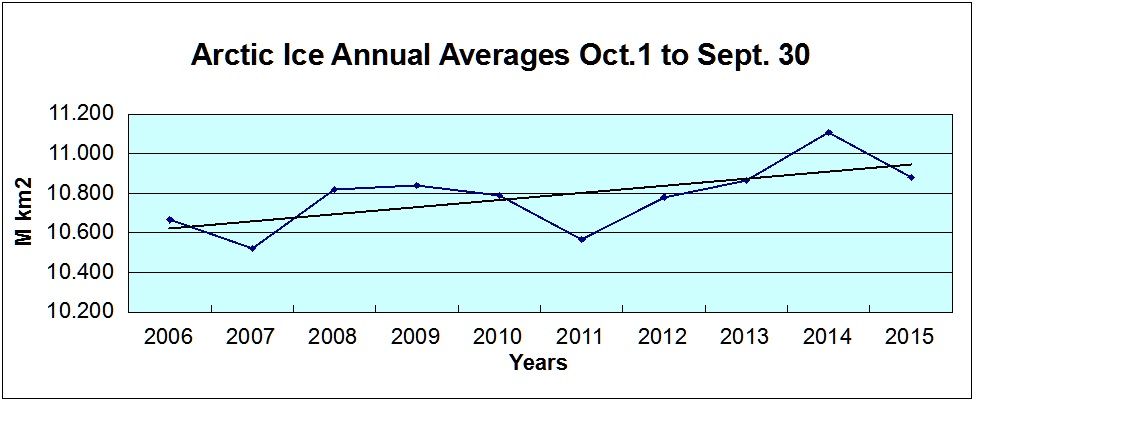
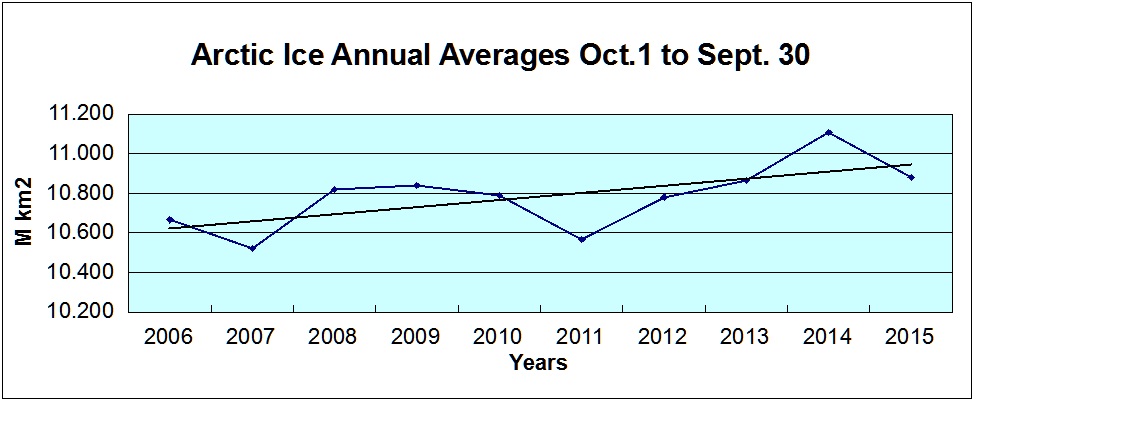
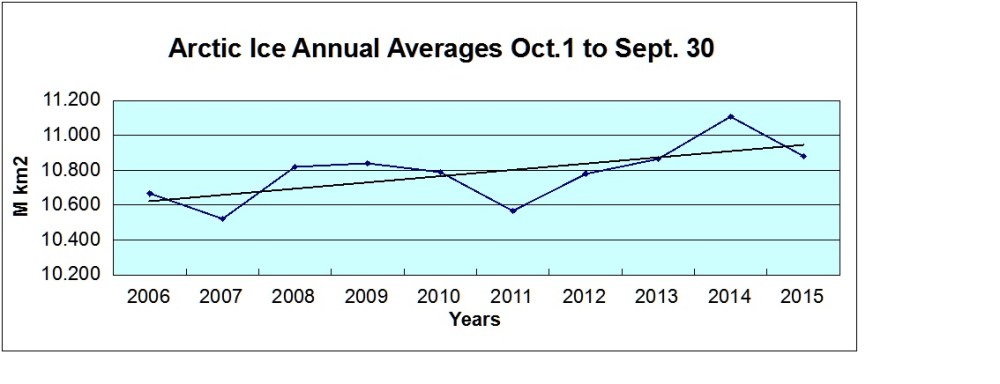
I prefer a calendar year frame for Arctic Ice not only for ease of understanding, but also because the break point in annual cycle is neutral, occurring mid-way between minimum and maximum.  In order to avoid using a provisional value, but still incorporate all the data, I have done an analysis taking 12 month averages from the end of September backwards; in effect combining the last quarter of the previous year with 3/4 of the current year, and so forth for preceding years.  For the first year, 2006, I present the average as reported; that is, rather than estimating the last quarter of 2005, I have included the actual 2006 data.
masie annuallarge273

The graph shows the annual averages Oct 1 through Sept. 30.  On this basis, the variability of ice extent is reduced, and  2014 has the highest extent, with 2015 in second place.  The decadal  trend is still an increasing one, though at a lower rate than when the calendar year is used.  The basic findings are the same.  This analysis substitutes the 2014 last quarter recovery rate for the actual  next 3 months yet to be observed.  Since the 2015 maximum was unusually low, the actual next quarter results may go higher.  We shall have to wait and see.

Note: I use the term “trend” in its dictionary definition: “the general direction of changes or developments” (Cambridge Dictionary).  In any time series, there is an overall trend or direction, and within are usually periods identifiable by change points where short-term trends deviate from the overall.  Evidence is mounting that 2007 may be such a change point.

Some say that trend can only be mentioned with the meaning of expected values, and the dataset is not long enough to say this surely. This is the same gambit made when surface temperatures stopped rising.  Whether it is the temperature or the ice plateau, the advice is the same: “You should ignore what is happening before your eyes because it is not real, statistically speaking, unless it continues for another decade or so.  Meanwhile let’s wrap up the emissions treaty.”

Summary

Those hoping for an Arctic ice collapse this year are disappointed.  Everything was in their favor: a low March maximum, the Blob melting out Bering Sea early, a negative AO (Arctic Oscillation) with higher insolation most of the summer, and a major cyclone last August when ice edges are most fragile. Despite all that working against the ice, the extent was lower than 5M km2 ( 2014 minimum) for a period of only 28 days. Furthermore, the 12 month averages show extent slightly rising over the last 10 years, with 2015 second only to 2014.

Note on datasets

MASIE is not the only dataset to show this lull in Arctic ice decline. It is also obvious in Foster’s final graph.  Some were upset that I used the MASIE data, despite NSIDC cautions against it.  For the record, the NSIDC Background cites as support a study by Partington et al (2003).  Reading that study, one finds that the authors preferred the MASIE data and said this:
“This analysis has been based on ice chart data rather than the more commonly analyzed passive microwave derived ice concentrations. Differences between the NIC ice chart sea ice record and the passive microwave sea ice record are highly significant despite the fact that the NIC charts are semi-dependent on the passive microwave data, and it is worth noting these differences. . .In summer, the difference between the two sources of data rises to a maximum of 23% peaking in early August, equivalent to ice coverage the size of Greenland.” (my bold)  For clarity: the ice chart data show higher extents than passive microwave data.

http://digitalcommons.unl.edu/cgi/viewcontent.cgi?article=1058&context=usdeptcommercepub

In any case, NSIDC’s last word was this:  “In June 2014, we decided to make the MASIE product available back to 2006. This was done in response to user requests, and because the IMS product output, upon which MASIE is based, appeared to be reasonably consistent.”  And thus, the data appeared this September.

Conclusion

Arctic ice extent is no longer declining and a slight increase was observed in the last decade.  People have a right to know about this as a context to evaluate claims that are coming.

Nothing alarming is happening to Arctic ice.

Arctic Ice Rebound

Update October 14, 2014 at the end of the post.

MASIE Proves Yearly Arctic Ice Recovering

You will be hearing a lot about 2015 having the fourth lowest minimum Arctic ice extent ever recorded.

Here is what they are not telling you:

masie annuallarge

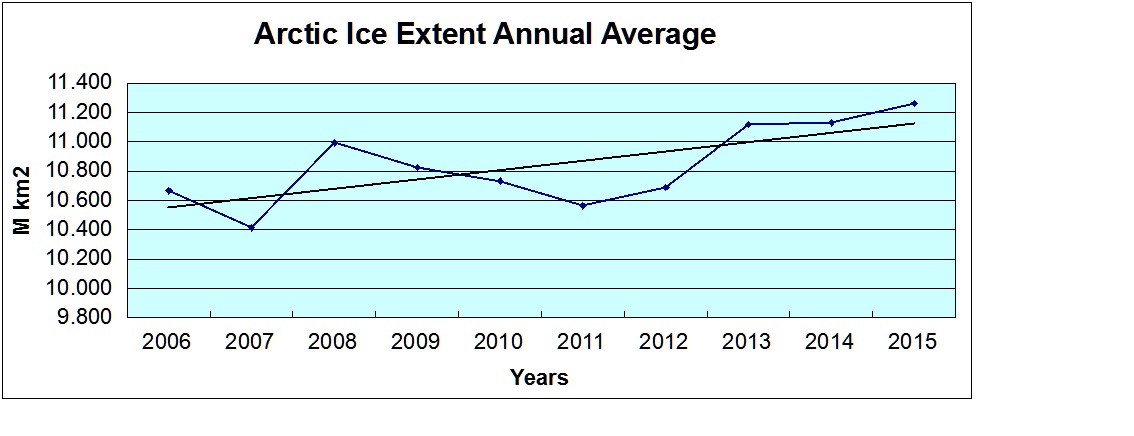
MASIE has very helpfully provided their records for the last ten years.  Since stormy weather can affect both maximum and minimum ice extents, emphasis on March and September averages can be misleading. From a climate change perspective, a better metric is the average ice extent over the entire year. By that measure we gain a realistic perspective on the last ten years of Arctic ice fluctuation.

While Arctic ice varies a lot seasonally, the graph shows that it is not that variable annually during this decade. Fluctuating about +/- 4%, there was a slightly increasing trend, particularly in the last five years.  Here are the ice extents in M km2:

Year Annual  Average March Average Sept Average Sept Minimum March Max
2006 10.667 14.260 5.831 5.641 14.663
2007 10.414 14.543 4.298 3.987 14.907
2008 10.995 15.372 4.427 4.223 15.662
2009 10.825 15.005 5.091 4.871 15.326
2010 10.732 15.221 4.997 4.717 15.397
2011 10.564 14.832 4.511 4.303 15.110
2012 10.688 15.533 3.633 3.369 15.822
2013 11.119 15.230 5.083 4.677 15.505
2014 11.130 15.133 5.368 5.066 15.523
2015 11.263 14.625 4.564 4.442 14.910

The value for 2015 is for the record so far; the final number will be known at year end.  As for minimum extents, 2015 September average will likely be the fifth lowest in the last ten years, so ranked in the middle of the years in this period. For it to be the fourth lowest ever would require ignoring earlier history, especially the 1930’s and the age of the Vikings.

MASIE dataset is here:
https://nsidc.org/data/masie/

Background on MASIE and NOAA:
https://rclutz.wordpress.com/2015/03/30/everything-you-wanted-to-know-about-measuring-arctic-ice-but-were-afraid-to-ask/

And Arctic Ice is Rebounding As We Speak

Now let’s put this year’s minimum in perspective.  2014 daily ice extent minimum was ~5M km2 on day 262.  2015 extent went below 5M on day 240 and has now regained back to 5M on day 268.  So the reduced ice extent this year lasted for exactly 28 days.  Why is this fact not mentioned in articles talking about the 4th lowest extent recorded?  How can a 28-day event (produced by a major storm) be called “climate change” when it is so temporary and natural?

masie day 268

For the current 2015 ice watch report see:

https://rclutz.wordpress.com/2015/09/25/arctic-ice-recovery-race/

Update October 14, 2015

There was some criticism of this article following publication.  I addressed the issues in subsequent posts:

Flap Over Arctic Ice Rebound

Ice House of Mirrors

Arctic Ice Made Simple

Arctic Ice Recovery Race Sept. 26

Update September 26:  2015 ice extent goes over 5M km2.

The daily ice extent minimums are behind us, and now the story is how fast is this year’s recovery of ice compared to last year.

In the MASIE estimates, the daily minimums were quite close in time: 2014 day 262 and 2015 day 260. NOAA showed 2015 minimum extent on day 251 with gains sufficient for NOAA to nearly synchronize with MASIE extent by day 262.

From last year’s MASIE records we know that ice recovered in 2014 at a rate of 41k km2 per day to the end of September, for a total addition of ice extent of 451k km2. NOAA showed a comparable gain in 2014 ice over the same period: 39k daily for a total gain of 429k km2.

As of day 268, Sept. 25, ice extent is recovering much faster this year than last, about twice the rate, and MASIE is again showing higher extent than NOAA.

First the daily situation:

September 25 day 268 results from MASIE. 2015 is back over 5M km2. Both years gain back considerable ice. 

While 2014 gained 105k of ice, 2015 gained 64k recovering back up to 34% of the spring maximum..

2015 ice extent now trails 2014 by 6.4%, which is about 344k km2 difference.

Extent in BCE region is building ice now at 75% of last year, with Chukchi and East Siberian seas adding 47k. Most seas increased ice and most importantly, the Central Arctic is now 193k above its minimum 24 days ago.

masie day 268

The graph shows that a gap opened when 2015 ice dropped at the time of an Arctic cyclone late August.  The differential of almost 1M km2 has now been cut to 350k km2. and closing. 2015 ice extent was lower than 5M km2 for only 27 days.

2015 Recap:

The first 25 days of September 2015 are in the books, so with 5 days to go this is an outlook on the melt season conclusion beyond the daily minimums.

For most of the season, 2015 Arctic sea ice extent was tracking 2014. In fact the July average extent was slightly higher than 2014. Then weather intervened in the last week of August. A large and strong cyclone centered over Chukchi Sea began breaking up ice in the BCE Region and affecting CAA (Canadian Archipelago) and the Central Arctic.  In addition, most of the summer the Arctic Oscillation (AO) was in negative phase, meaning fewer clouds, more direct insolation and ice melting.  More discussion of these two factors is at the end of this post.

The effects of this storm are seen in the rapid increase in water extent ( 482k km2 in one week) so that August 31 2015 had less ice than did 2014 at minimum September 19. Water extent continued to grow, and then stabilized once the storm abated and the AO went from negative to neutral.  Now the ice is growing beyond the daily minimum.

Comparing MASIE and NOAA Ice Extents.

Month 2015 2015 2015 2014 2014 2014
Ave. MASIE NOAA MASIE-NOAA MASIE NOAA MASIE-NOAA
Feb 15.032 14.498 0.534
March 15.170 14.758 0.413
April 13.650 13.954 -0.304 14.318 14.088 0.230
May 12.646 12.485 0.161 12.916 12.701 0.215
June 10.841 10.889 -0.049 11.324 11.033 0.292
July 8.713 8.411 0.302 8.482 8.108 0.374
August 5.961 5.658 0.303 6.353 6.078 0.275
Sept 4.596 4.521 0.075 5.364 5.220 0.144
Oct 7.697 7.232 0.464

The table shows July 2015 was above 2014 but late August weather caused a drop in monthly averages.  The August average shows ice extent dropped ~2.7M km2 from July, compared to a 2014 loss of ~2.0M. That difference persisted until the minimum was reached. NOAA typically reports a lower extent than MASIE, a difference that averaged ~300k km2.  Then in one week MASIE dropped while NOAA plateaued, and until recently NOAA September extents were quite close to MASIE, some days showing a higher number.

With the September daily ice starting out lower than 2014 the monthly average will end up smaller.  The September first 25 days average is shown, a figure that should rise and end the month over 4.6M km2. It is now evident the minimum has occurred, and the recovery is under way.

In any case, I am not alarmed over open water in the Arctic. Steadily increasing and above average September ice extents signify the coming of the next ice age, a genuine threat to human life and prosperity.  Fortunately, that is not the indication this year.

Current and Recent Weather in the Arctic

In addition to the storm, the negative AO has been conducive to accelerating ice melting by increased insolation.

September 16 Arctic Oscillation Forecast from AER:

The AO, which has remained almost consistently in negative territory since late June, has resulted in near record low AO values for July and August. The AO is predicted to first trend positive through the weekend and pop into positive territory early next week. However by midweek the AO is predicted to return back into negative territory and remain negative through early October.

“The positive trend in the AO and the setting sun may have brought an early end to the Arctic sea ice melt season but not before sea ice extent achieved its fourth lowest value since observations began.  It is likely that the extremely low AO values observed in July and August are reflective of atmospheric conditions (sunny and warm) that were conducive to rapid sea ice melt.”

https://www.aer.com/science-research/climate-weather/arctic-oscillation

The Alaska Dispatch News reported August 27 on the storm effects at Barrow, Alaska:

“The service has issued a coastal flood warning for Barrow until Friday morning, along with a high surf advisory for the western part of the North Slope and a gale warning for much of the Beaufort and Chukchi Seas. Seas up to 14 feet were forecast for Thursday in the Chukchi. . .Thursday’s high waves and flooding are products of a large storm that’s being felt as far as Southcentral Alaska, where high winds are forecast, Metzger said. “It’s a pretty big low-pressure system that’s over the Arctic Ocean,” he said. ”

https://www.adn.com/article/20150827/high-winds-causing-big-waves-flooding-barrow

a quarter million square KM of arctic ice in the CAB, adjacent to the Beaufort and Chukchi. 20150829

This storm is reminiscent of the 2012 event that resulted in the lowest ice, greatest water extent this century. The high winds, waves and swells have several effects: Gales push ice floes, opening water between them and pushing them toward warmer waters; Ice pieces are churned and fractured increasing the melt rate; Wave action can flood ice packs or can cause compacting, further reducing extent.