Yes, We Will Avoid a Climate Catastrophe.

At Quora someone posed this  question:  Will we avoid a climate catastrophe just in time (please be positive I need some hope)?

Paul Noel ,Former Research Scientist 6 Level 2 UAH (2008–2014) wrote this response.  Excerpts in italics with my bolds and added images.

I have researched this issue in depth. As a good scientist I have gone deeply and gotten the facts. I have gotten:

  • the Satellite data on the global profiles,
  • the weather data.
  • the storm data and disaster data
  • the polar ice data.
  • the historical data.

I have looked in deeply on this issue. I have studied the physics too! I have studied the history too! I have studied the archeology and even the paleo geology and even the ice core data.

This isn’t easy to get because lots of people are producing lies on the topic. So I have worked very hard to get down to the facts. Then the job becomes one which is very hard. If I just tell you the answers I got , it is a case of if you believe me or not. If I tell you the science data it is likely to get way in over your understanding and that is back to if you believe me or not. This is a job of explaining to you very carefully what the data is using things you can see and understand.

So taking this from the top there are 2 ways I can go.
One way is to go into the advocates of the topic that are so scaring you deeply
and the other is to go into the science.

The explanation of the science is pretty easy and such but explaining to you the motives of people and their actions and methods is much harder. But I am going to start with the people.

Why are they scaring you about the climate?

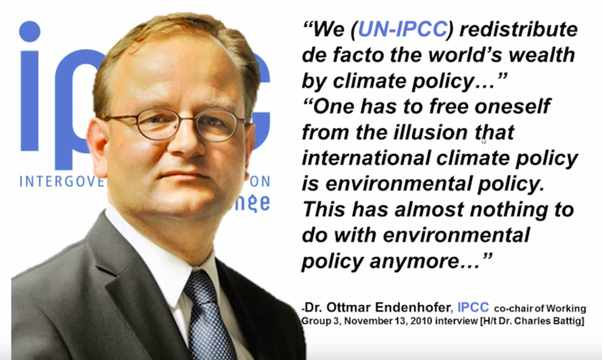
Climate policy has almost nothing to do anymore with environmental protection, says the German economist and IPCC official Ottmar Edenhofer.

This is what this is all about. There is no other motive. You may dispense with your worries here if you are worried for the world environment. But I will now switch to the facts and reality on the ground. Remember this alone should pretty much put an end to your worries. You are facing a very large deliberate well funded and most professionally constructed set of lies and propaganda designed to get you scared like you are. This is 5th generational warfare. It is not anything you are used to thinking about. That is why it is effective.

What are the climate facts on the ground?

The fact on the ground are that if the changes you are supposing to see are real they should be obvious. They should be something you can see, feel, hear and touch. That is where we are going right now!

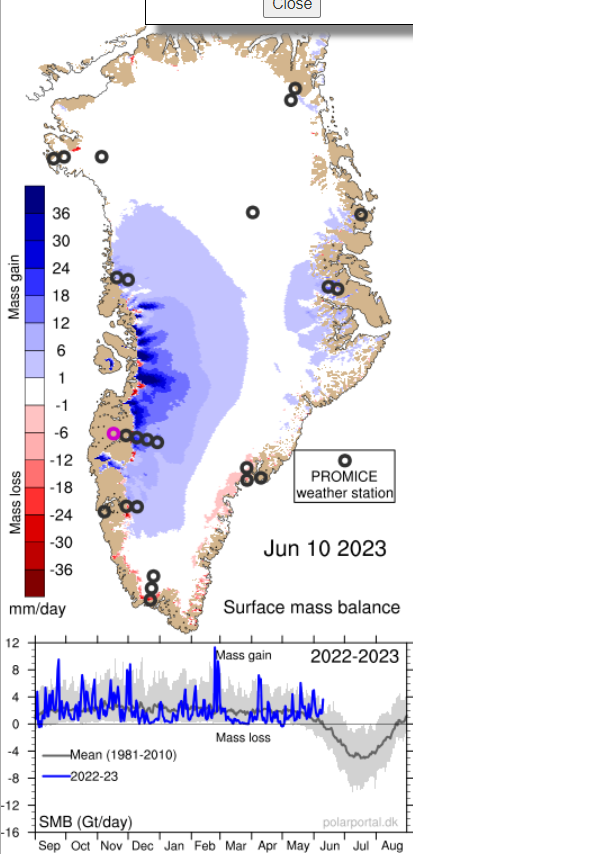
If the world is warming up the paleo-climate data says that the polar regions warm first. That is what you are being told about arctic ice melting and sea level raise. If you go to the Denmark Polar Portal on the web you can get the data.

Greenland Ice Sheet is not Melting Away

Because these people have to comply with the IPCC they put in all kinds of disclaimers trying to keep you scared of melt down etc.. The reality is we are solidly into the melt season and the ice is not melting down more than usual.

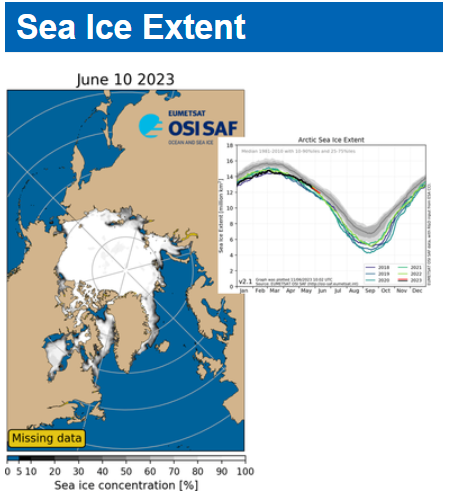
Arctic Sea Ice Is Not Going Away

The polar ice is at normal levels. I can go on and on here but the reality is that there is no emergency.

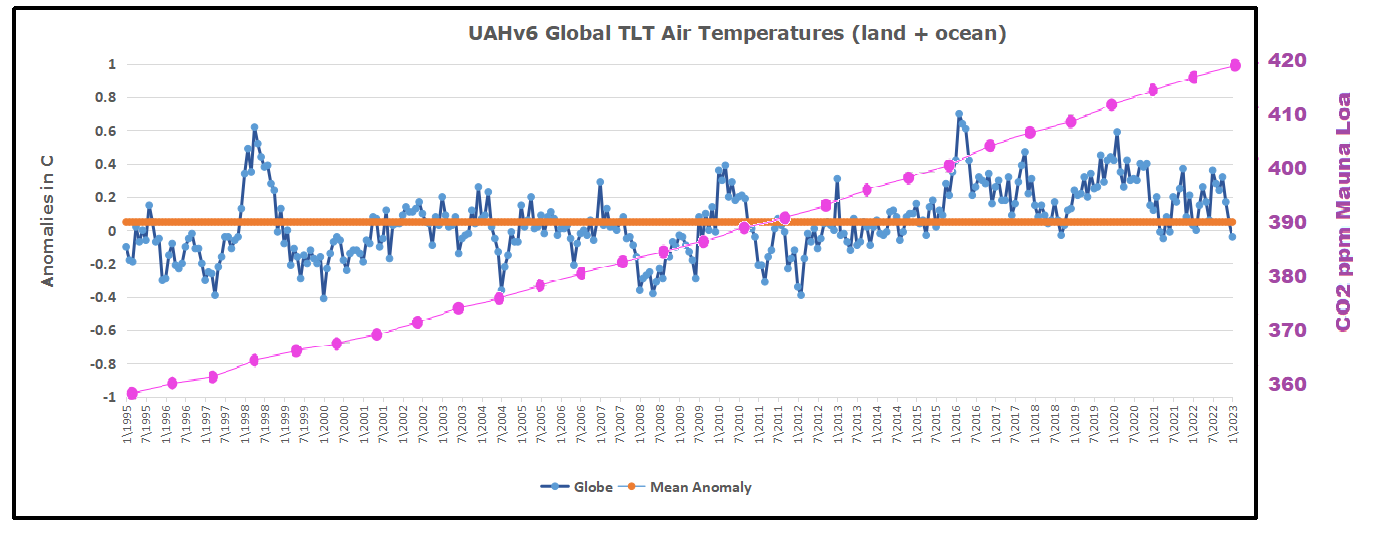
Global Warming is Not Accumulating

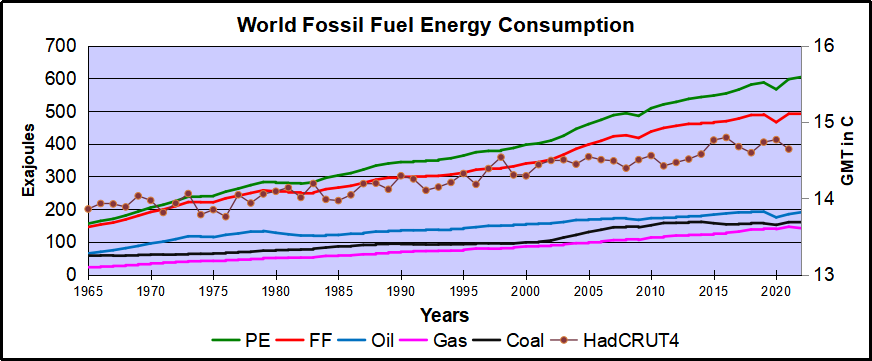
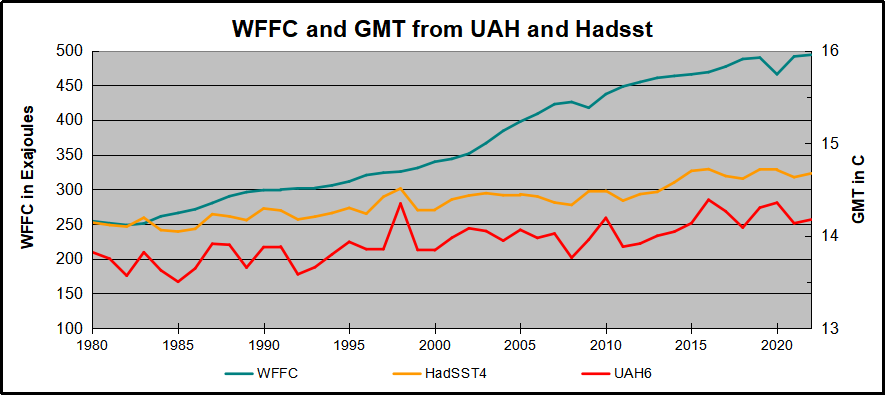
The data from UAH which is technical showed from January 1995 to January 2023 the global temperature did not increase at all.  And from 2016 actually went down (-0.7C) . That isn’t some melting or Global Warming or some Climate Catastrophe. It just is not.

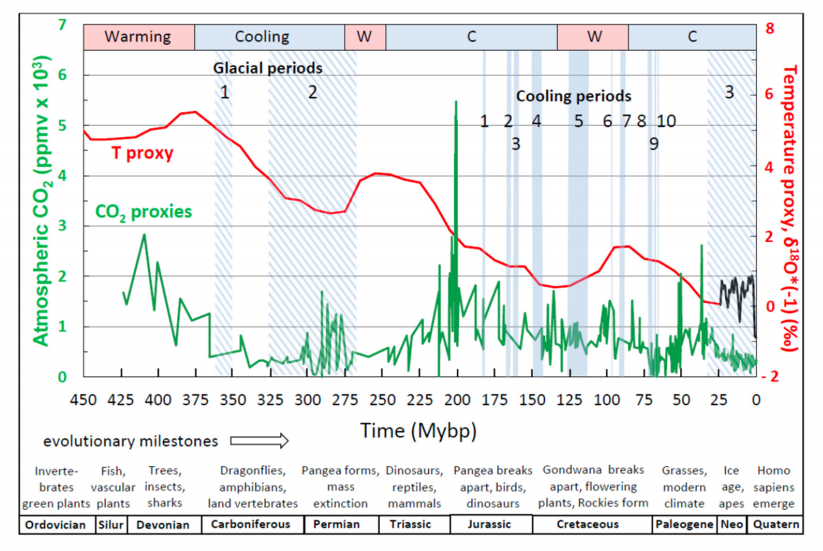
CO2 Is Rising But Far Below Its Optimum

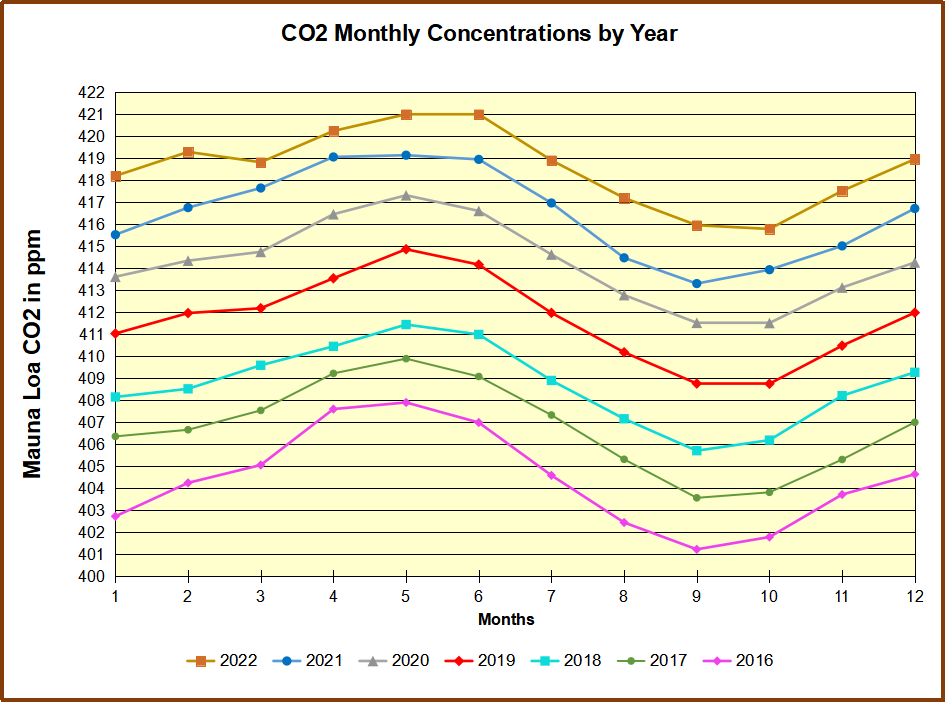
Is CO2 rising it sure is and it isn’t even to the maximum level that occurred in the last maximum in the last interglacial period of earth. CO2 is not 1% it is 0.042%. The earth has thrived with maximum life at 1% CO2 there are no melt down periods.

Is the climate variable, You bet it is. We have seen in the last 2000 years it go up and down in temperature and we are actually near the bottom of that period. The reality is that we have been up to 10C warmer and guess what that time mankind did his very best. We don’t thrive on cold.

Warming Has Been Beneficial and More Would be a Good Thing

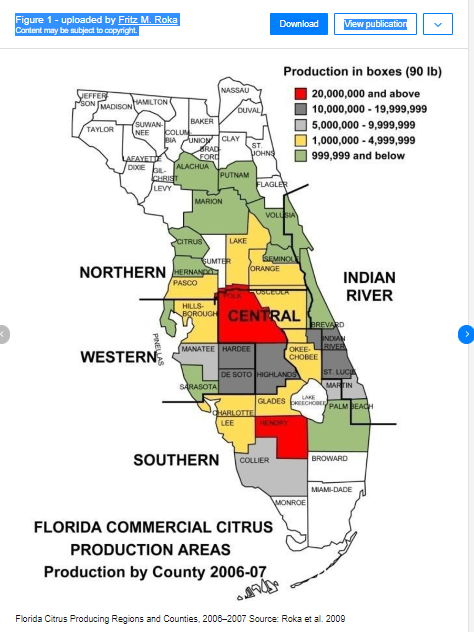
Now let’s look at the trends and in a way you never imagined. I have looked into this matter because Alabama where I live has a cute lovely vacation town called Orange Beach. I highly recommend Orange Beach for a vacation it is beautiful. Orange Beach was named in 1898 when the US Post Office (Now the USPS) opened a new post office there. The unincorporated town’s principal business was raising oranges commercially. Alabama used to raise oranges up to about Evergreen Alabama or almost to Montgomery Alabama the state capitol.

 Production of Oranges Limited by Freezing Temperatures in SE US

No commercial orange production exists in Alabama at this time. The reason is simple. The growing season in Orange Beach Alabama went from 365 days a year to 268 days a year. The orange trees froze out. Now they have new varieties that can grow in the colder weather but even they are severely limited in Alabama. The orange trees have frozen out almost to Orlando Florida now.

Orange beach would be right next to North Florida along the Gulf of Mexico. Literally Florida is just across the Perdido River from Orange Beach.

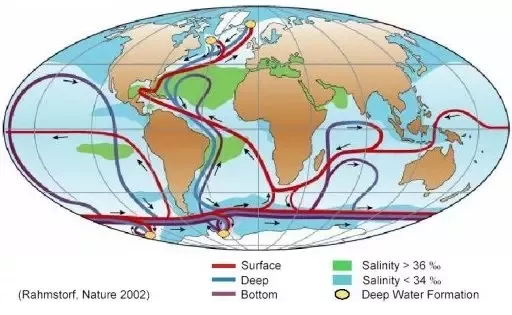
The Gulf Stream Makes Climate Change in the North Atlantic

The reality is the climate from 1898 to the present has gotten colder in the USA. This is significant to the whole earth for a very important reason.

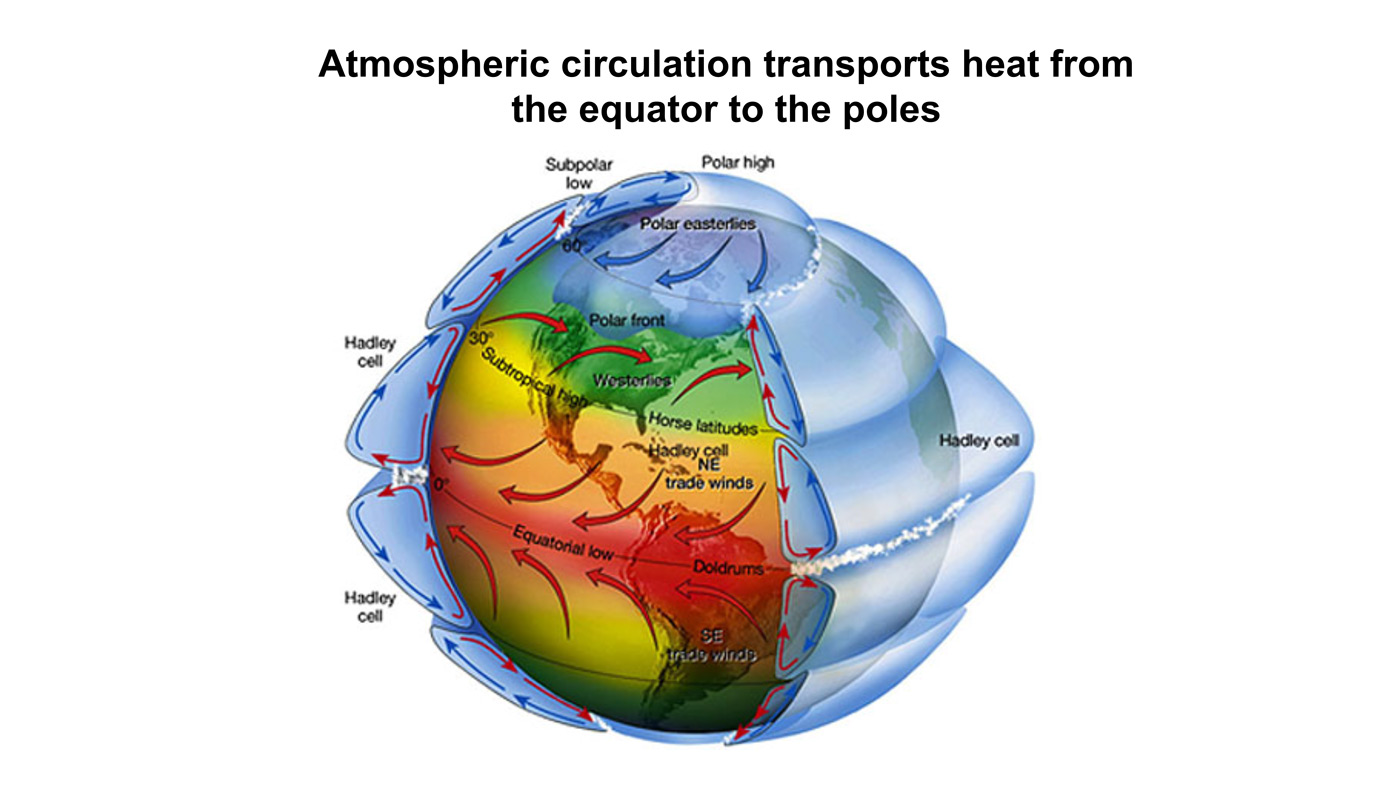
You see the heat from the whole earth gets aimed directly at Alabama! We cool down so is the rest of the world. The whole circulation for the whole earth focuses on the Gulf of Mexico and Alabama.

This by the way is why Greenland has so much ice. You see it is the warm water from the Gulf Stream that generates the steam that freezes and comes down as snow. You have to make the steam to make the ice.

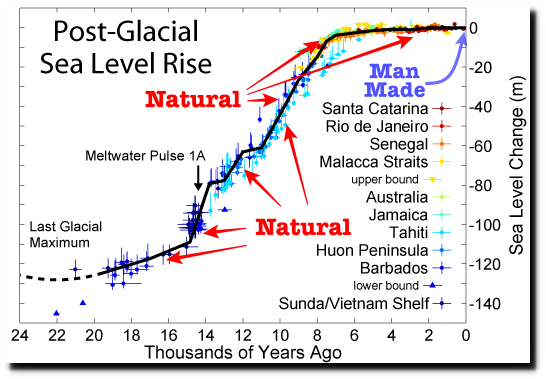
Sea Level Depends on Land Buoyancy, not CO2

Now on to sea level rise. First of all if you believe that the sea level is rising and such it is only reported to be rising in the order of the thickness of 2 US 5 Cent coins per year. So if you believe it is happening it is no emergency and no real problem. It isn’t worthy of losing sleep over. The stories of melting sea ice are silly. First of all even if they melt they will have absolutely no effect on the sea level because they are floating. But there is another thing these people don’t tell you about.

The sea level is not the product of the amount of water in the ocean. It is in fact the product of a large sum of buoyancy issues and the gravity of the earth. The continents are where they are because they have less gravity than the other areas. The seafloor is a zone of higher gravity. Because the continents are floating that means that their level above the sea is determined by the laws of buoyancy. If Greenland were to melt off, the resulting reality would cause the area to buoy up because it would weigh less. At the same time the water added to the oceans would simply sink the sea floor deeper.

Continents Can Sink to Form New Seas

But to illustrate this you must learn about the Great Rift Valley of Africa. That valley is a place where the base continental rocks have spread apart. The land is sinking there and has already sunk to form the Red Sea! A new ocean is forming in Africa. This is what has sunk the continental shelves of the continents. The edge of the continents tinned out and lost the thick granite below that floats on the magma and they sunk. So sea level is not in any way related to ice melting. Sea level is related to this continental buoyancy issue. So nothing in their story not melting ice nor rising seas is happening. But I will show you this in pictures because we have these now.

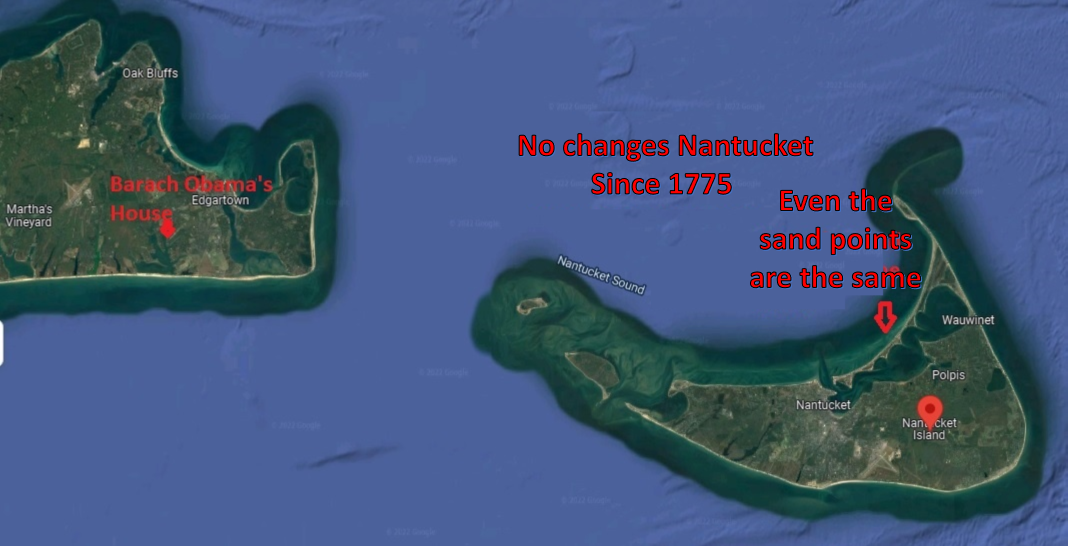
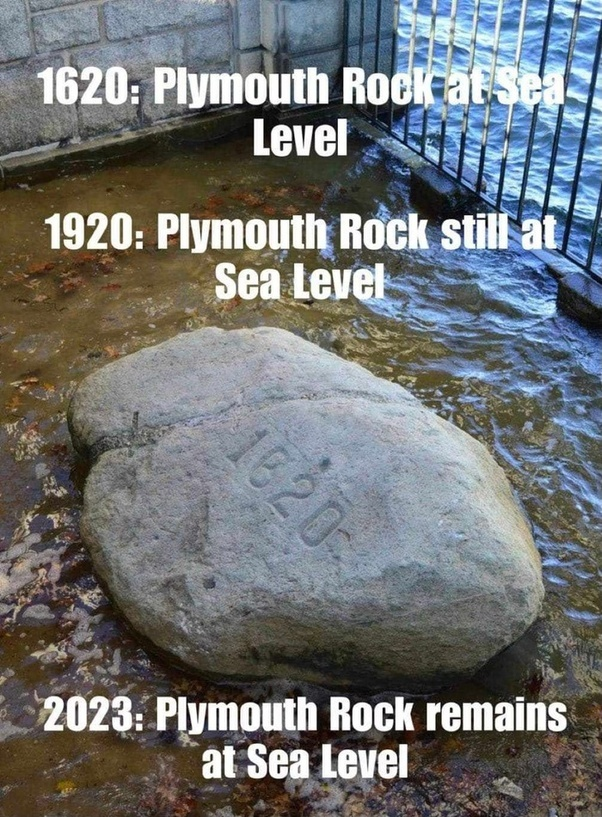
Many Coastlines Show Water Receding Rather than Rising

Tell me if you see any sea level rise in the past 246 years now. (None!)

[Since we are looking in New England:]

This is just about due south of London–Pevensey Castle.

It was started construction in about 203 AD. It was built right on the sea on a coastal island. Such a fort only has value as far as an archer can shoot an arrow. It guarded the entrance to Pevensey Bay. The bay doesn’t exist it is nearly 30 meters above sea level now. Lots of people just refuse to see them. The fort itself is 110 feet above sea level and 5/8 mile from the sea.

If it isn’t clear yet that you have been hoaxed into a panic I don’t know what I can do. I have shown you that it got colder not warmer. That the ice is not melting. That the seas are not rising. Shall I go on?

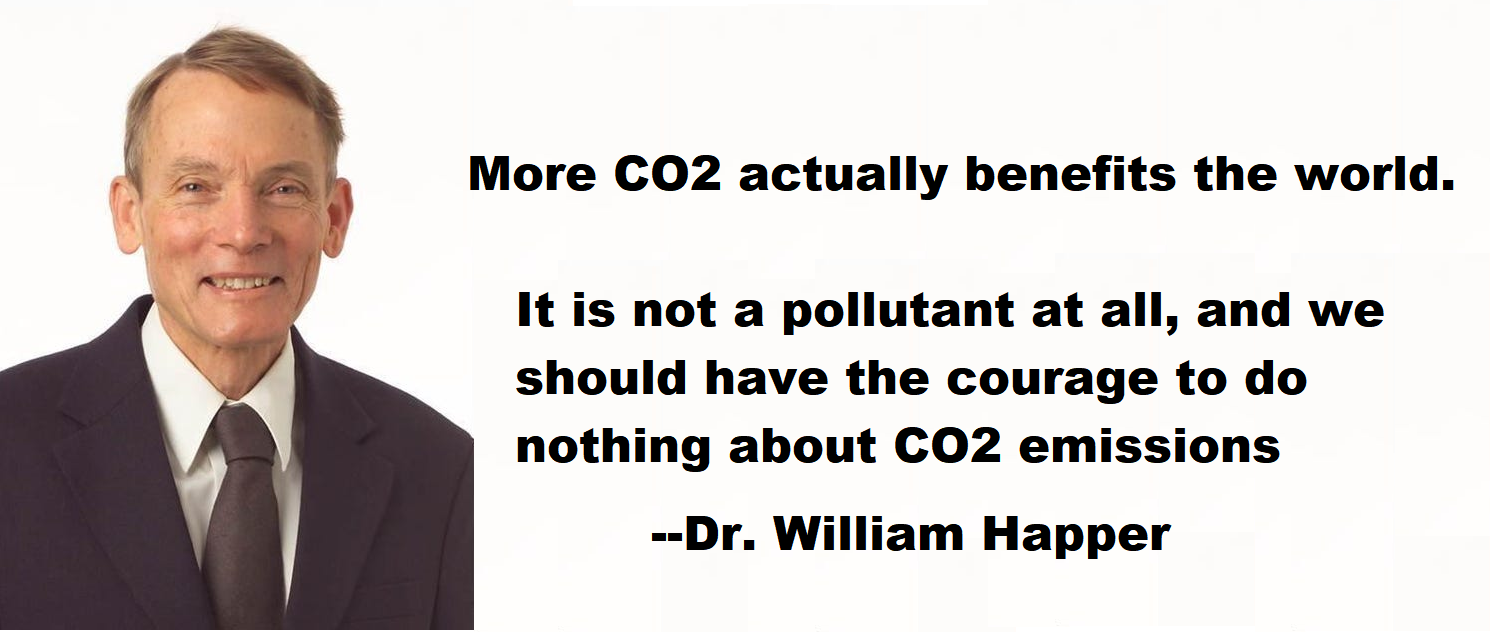
CO2 Is Plant Food not a Pollutant

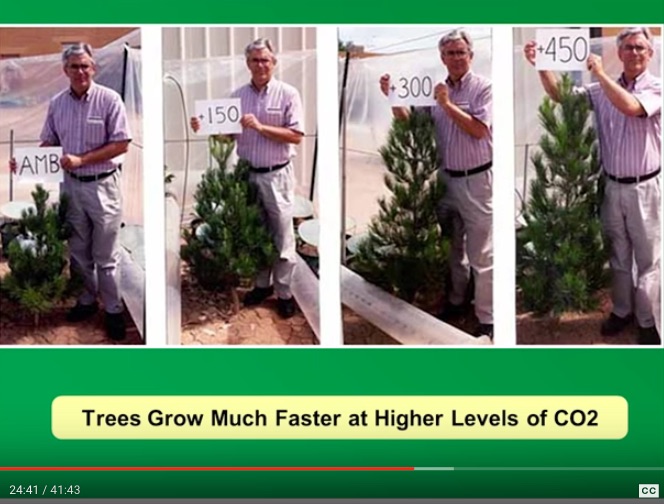
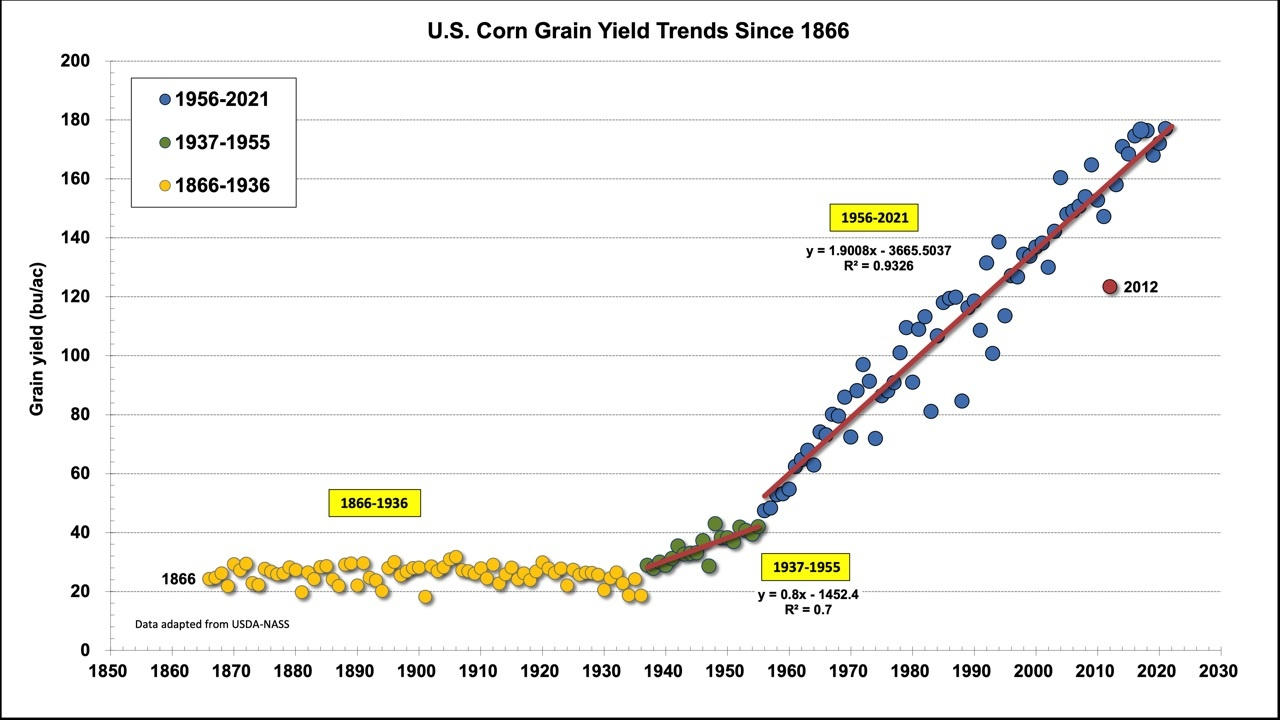
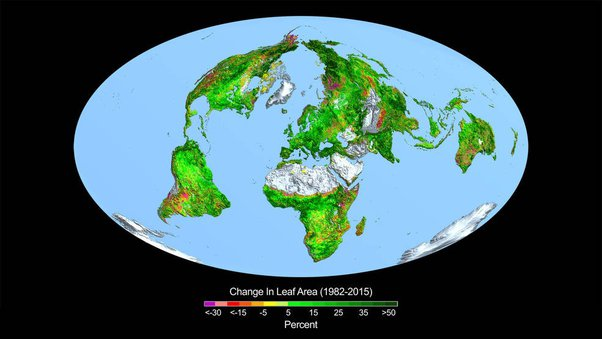
How about the real truth of CO2 and what it is doing on our earth. Look at these pictures carefully they tell the truth beyond any possible doubt.

C3 photosynthesis plants are growing 800% better than they were. Our C4 plants are doing 650% better.

The whole earth is growing better and the forests are growing because of CO2. Sorry this isn’t a “doom and gloom” story here.

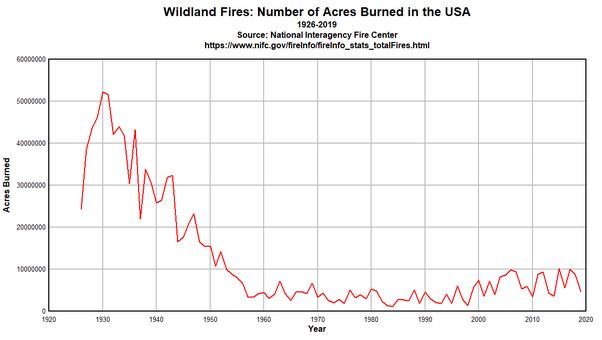
Wild fires are down too!

The fact is that in 1960 the world was running out of food because our plants and farms were at their limits. Today we are run over with food and 45% of our crop land has been turned back to the forests. We are not at the limits. This has led to an explosion of wildlife too!

Life is Thriving Not Facing Extinction

There literally is no mass extinction going on. We are in the largest bloom of life on earth that has been seen in the past 10,000 years.

The human race is on the edge of unlimited energy, unlimited food, unlimited technology and we are sitting here in terror of some imaginary doom and gloom hating the very system that is feeding mankind and building him up.

Everything is quite literally the opposite of what you are told!

In Sum;

The only catastrophe would be ill-advised climate policies willfully destroying
our energy platform and economic supply processes out of irrational CO2 hysteria.


Sabine’s Video Myopic on GHG Climate Role

E.M. Smith explains Curing Radiation Myopia Regarding Climate

E.M. Smith provides an helpful critique of a recent incomplete theory of earth’s climate functioning in his Chiefio blog post So Close–Missing Convection and Homeostasis. Excerpts in italics with my bolds and added images.  The reference is to a video by Sabine Hossenfelder you can view below in the post.

It is Soooo easy to get things just a little bit off and miss reality. Especially in complex systems and even more so when folks raking in $Millions are interested in misleading for profit. Sigh.

Sabine Hosenfelder does a wonderful series of videos ‘explaining’ all sorts of interesting things in and about actual science and how the universe works. She is quite smart and generally “knows her stuff”. But… It looks like she has gotten trapped into the Radiative Model of Globull Warming.

The whole mythology of Global Warming depends on having you NOT think about anything but radiative processes and physics. To trap you into the Radiative Model. But the Earth is more complex than that. Much more complex. Then there’s the fact that you DO have some essential Radiative Physics to deal with, so the bait is there.   However…

It is absolutely essential to pay attention to convection in the lower atmosphere
and to the “feedback loops” or homeostasis in the system.

The system acts to restore its original state. There is NO “runaway greenhouse” or we would have never evolved into being since the early earth had astoundingly high levels of CO2 and we would have baked to death before getting out of our slime beds as microbes.

Figure 16. The geological history of CO2 level and temperature proxy for the past 400 million years. CO2 levels now are ~ 400ppm. Source: Davis, W. J. (2017).

OK, I’ll show you her video. It is quite good even with the “swing and a miss” at the end. She does 3 levels of The Greenhouse Gas Mythology so you can see the process evolving from grammar school to high school to college level of mythology. But then she doesn’t quite make it to Post-Doc Reality.

Where’s she wrong? (Well, not really wrong, but lacking…)

I see 2 major issues. First off, she talks about the “lower atmosphere warming”. Well, yes and no. It doesn’t “warm” in the sense of getting hotter, but it does speed up convection to move the added heat flow.

In English “heating” has 2 different meanings. Increasing temperature.
Increasing heat flow at a temperature.

We see this in “warm up the TV dinner in the microwave” meaning to heat it up from frozen to edible; and in the part where the frozen dinner is defrosting at a constant temperature as it absorbs heat but turns it into the heat of fusion of water. So you can “warm it up” by melting at a constant temperature of frozen water (but adding a LOT of thermal energy – “heat”) then later as increasing temperature once the ice is melted. It is very important to keep in mind that there are 2 kinds of “heating”. NOT just “increasing temperature”.

In the lower atmosphere, the CO2 window / Infrared Window is already firmly slammed shut. Sabine “gets that”. Yay! One BIG point for her! No amount of “greenhouse gas” is going to shut that IR window any more. As she points out, you get about 20 meters of transmission and then it is back to molecular vibrations (aka “heat”).

So what’s an atmosphere to do? It has heat to move! Well, it convects. It evaporates water.

Those 2 things dominate by orders of magnitude any sort of Radiative Model Physics. Yes, you have radiation of light bringing energy in, but then it goes into the ocean and into the dirt and the plants and even warms your skin on a sunny day. And it sits there. It does NOT re-radiate to any significant degree. Once “warmed” by absorption, heat trying to leave as IR hits a slammed shut window.

The hydrological cycle. Estimates of the observed main water reservoirs (black numbers in 10^3 km3 ) and the flow of moisture through the system (red numbers, in 10^3 km3 yr À1 ). Adjusted from Trenberth et al. [2007a] for the period 2002-2008 as in Trenberth et al. [2011].

So what does happen? Look around, what do you see? Clouds. Rain. Snow. (sleet hail fog etc. etc.)

Our planet is a Water Planet. It moves that energy (vibrations of atoms, NOT radiation) by having water evaporate into the atmosphere. (Yes, there are a few very dry deserts where you get some radiative effects and can get quite cold at night via radiation through very dry air, but our planet is 70% or so oceans, so those areas are minor side bars on the dominant processes). This water vapor makes the IR window even more closed (less distance to absorption). It isn’t CO2 that matters, it is the global water vapor.

What happens next?

Well, water holds a LOT of heat (vibration of atoms and NOT “temperature”) as the heat of vaporization. About 540 calories per gram (compared to 80 for melting “heat of fusion” and 1 for specific heat of a gram of water). Compare those numbers again. 1 for a gram of water. 80 for melting a gram of ice. 540 for evaporating a gram of water. It’s dramatically the case that evaporation of water matters a lot more than melting ice, and both of them make “warming water” look like an irrelevant thing.

Warming water is 1/80 as important as melting ice, and it is 1/540 th as important as evaporation of the surface of the water. Warming air is another order of magnitude less important to heat content.

So to have clue, one MUST look at the evaporation of water from the oceans as everything else is in the small change.

Look at any photo of the Earth from space. The Blue Marble covered in clouds. Water and clouds. The product of evaporation, convection, and condensation. Physical flows carrying all that heat (“vibration of atoms” and NOT temperature, remember). IF you add more heat energy, you can speed up the flows, but it will not cause a huge increase in temperature (and mostly none at all). It is mass flow that changes. The number of vibrating molecules at a temperature, not the temperature of each.

In the end, a lot of mass flow happens, lofting all that water vapor with all that heat of vaporization way up toward the Stratosphere. This is why we have a troposphere, a tropopause (where it runs out of steam… literally…) and a stratosphere.

What happens when it gets to the stratosphere boundary? Well, along the way that water vapor turns into water liquid very tiny drops (clouds) and eventually condenses to big drops of water (rain) and some of it even freezes (hail, snow, etc.). Now think about that for a minute. That’s 540 calories per gram of heat (molecular vibration NOT temperature, remember) being “dumped” way up high in the top of the troposphere as it condenses, and another 80 / gram if if freezes. 620 total. That’s just huge.

This is WHY we have a globe covered with rain, snow, hail, etc. etc. THAT is all that heat moving. NOT any IR Radiation from the surface. Let that sink in a minute. Fix it in your mind. WATER and ICE and Water Vapor are what moves the heat, not radiation. We ski on it, swim in it, have it water our crops and flood the land. That’s huge and it is ALL evidence of heat flows via heat of vaporization and fusion of water.

It is all those giga-tons of water cycling to snow, ice and rain, then falling back to be lofted again as evaporation in the next cycle. That’s what moves the heat to the stratosphere where CO2 then radiates it to space (after all, radiation toward the surface hits that closed IR window and stops.) At most, more CO2 can let the Stratosphere radiate (and “cool”) better. It can not make the Troposphere any less convective and non-radiative.

Then any more energy “trapped” at the surface would just run the mass transport water cycle faster. It would not increase the temperature.

More molecules would move, but at a limit on temperature. Homeostasis wins. We can see this already in the Sub-Tropics. As the seasons move to fall and winter, water flows slow dramatically. I have to water my Florida lawn and garden. As the seasons move to spring and summer, the mass flow picks up dramatically. Eventually reaching hurricane size. Dumping up to FEET of condensed water (that all started as warm water vapor evaporating from the ocean). It is presently headed for about 72 F today (and no rain). At the peak of hurricane season, we get to about 84 or 85 F ocean surface temperature as the water vapor cycle is running full blast and we get “frog strangler” levels of rain. That’s the difference. Slow water cycle or fast.

IF (and it is only an “if”, not a when) you could manage to increase the heat at the surface of the planet in, say, Alaska: At most you would get a bit more rain in summer, a bit more snow in winter, and MAYBE only a slight possible, of one or two days that are rain which could have been snow or sleet.

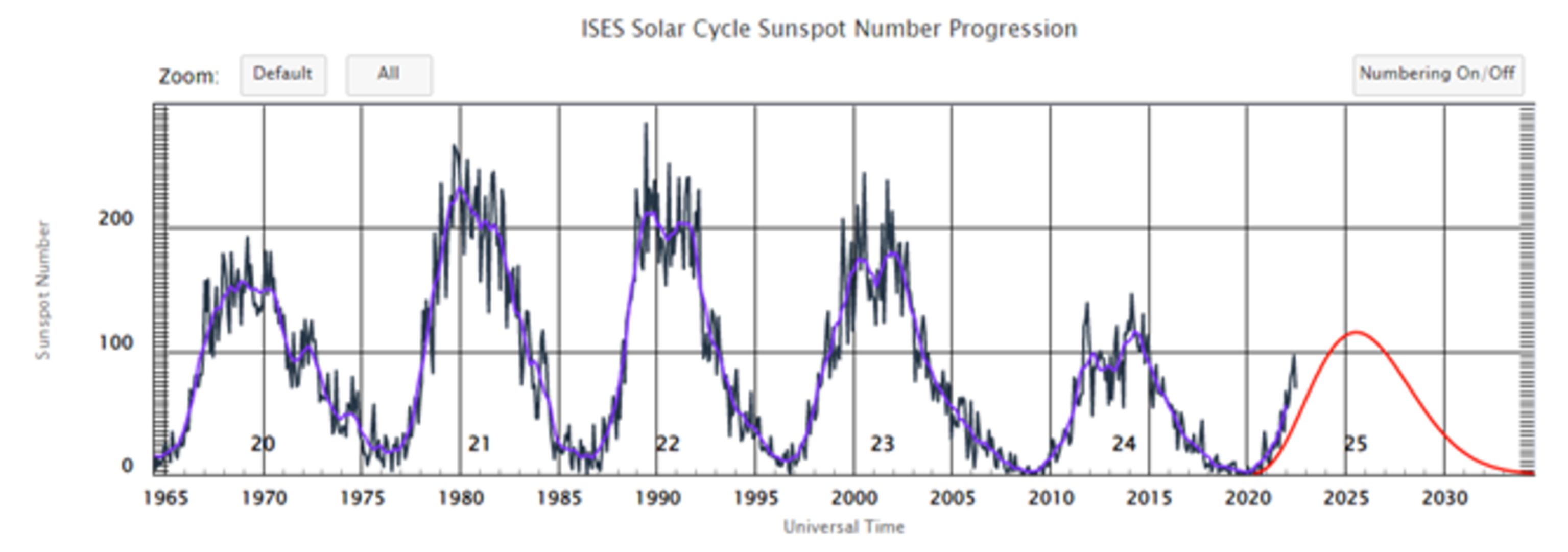
Then there’s the fact that natural cycles swamp all of that CO2 fantasy anyway. The Sun, as just one example, had a large change of IR / UV levels with both the Great Pacific Climate Shift (about 1975) and then back again in about 2000. Planetary tilt, wobble, eccentricity of the orbit and more put us in ice ages (as we ARE right now, but in an “interglacial” in this ice age… a nice period of warmth that WILL end) and pulls us out of them. Glacials and interglacials come and go on various cycles (100,000 years, 40,000 years, and 12,000 year interglacials – ours ending now, but slowly). The simple fact is that Nature Dominates, and we are just not relevant. To think we are is hubris of the highest order.

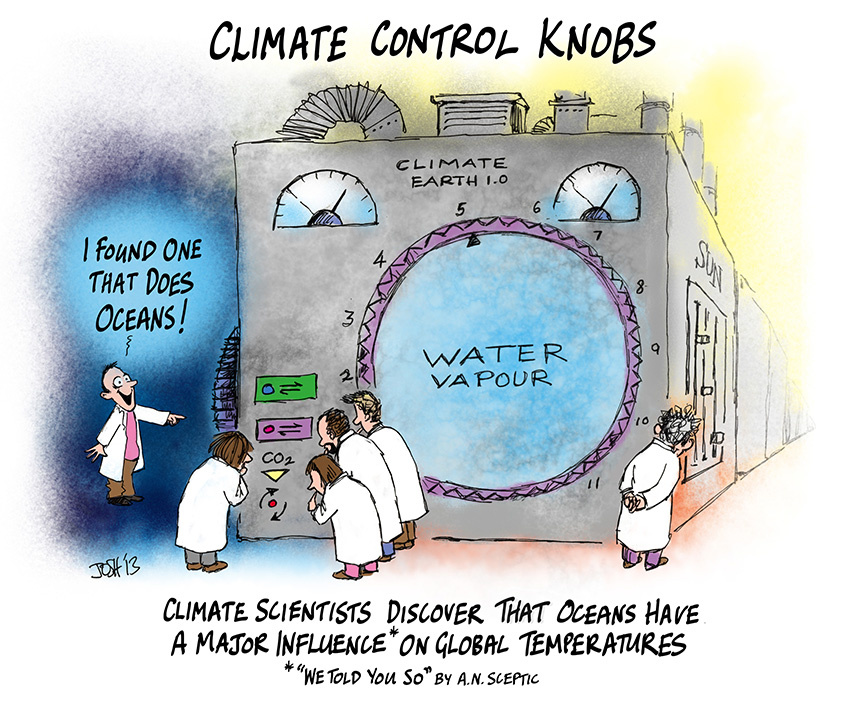
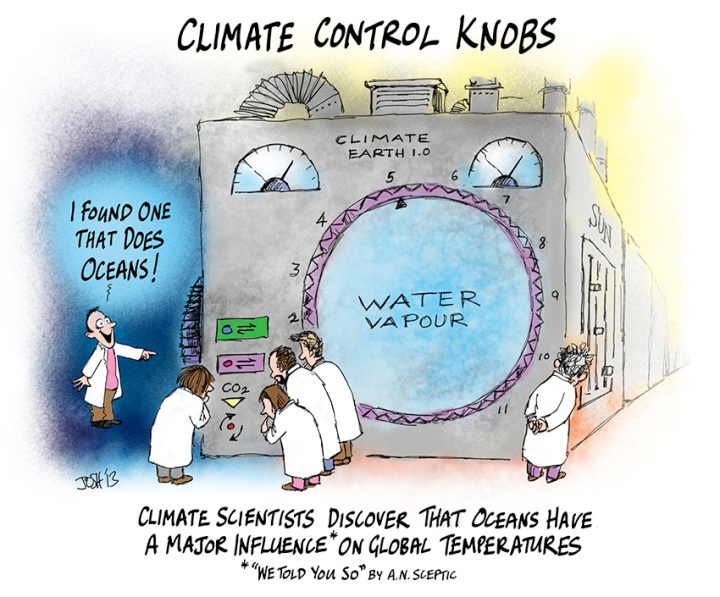
See Also  Bill Gray: H20 is Climate Control Knob, not CO2

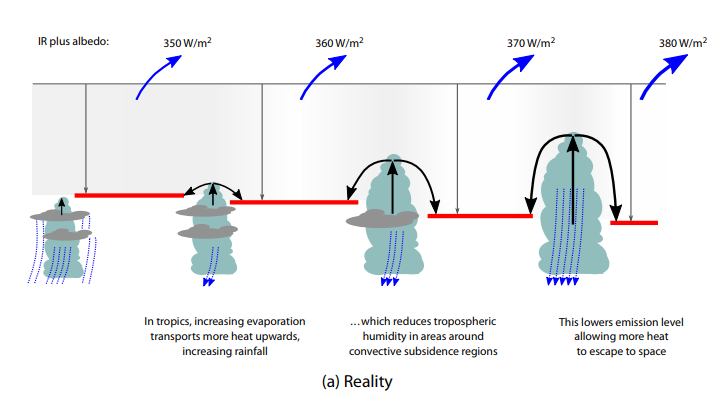
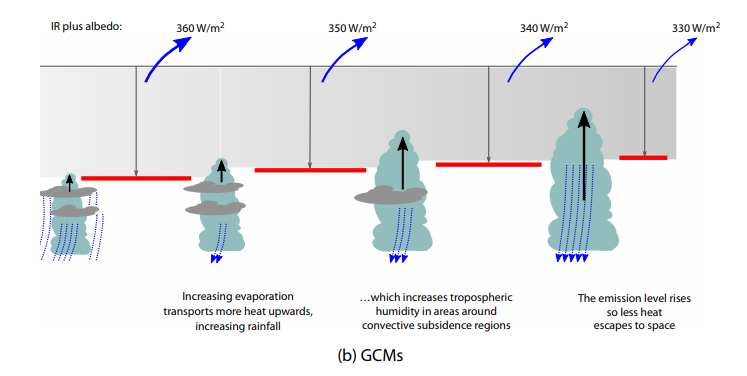
Figure 9: Two contrasting views of the effects of how the continuous intensification of deep cumulus convection would act to alter radiation flux to space. The top (bottom) diagram represents a net increase (decrease) in radiation to space

Footnote

There are two main reasons why investigators are skeptical of AGW (anthropogenic global warming) alarm. This post intends to be an antidote to myopic and lop-sided understandings of our climate system.

  1. CO2 Alarm is Myopic: Claiming CO2 causes dangerous global warming is too simplistic. CO2 is but one factor among many other forces and processes interacting to make weather and climate.

Myopia is a failure of perception by focusing on one near thing to the exclusion of the other realities present, thus missing the big picture. For example: “Not seeing the forest for the trees.”  AKA “tunnel vision.”

2. CO2 Alarm is Lopsided: CO2 forcing is too small to have the overblown effect claimed for it. Other factors are orders of magnitude larger than the potential of CO2 to influence the climate system.

Lopsided

Lop-sided refers to a failure in judging values, whereby someone lacking in sense of proportion, places great weight on a factor which actually has a minor influence compared to other forces. For example: “Making a mountain out of a mole hill.”

Hottest Year Coming Everywhere Elsewhere

In the past few years, the earth cooled after warming from the 2015-2016 El Nino, and with higher North Atlantic summer anomalies repeating in 2020.  The cooling was significant as shown in the chart below (from the UAH satellite temperature dataset.)

The Global anomaly dropped from +0.7C January 2016 to <0.0C January 2023.  And of course the media ignored that cooling since they are addicted to the global warming narrative: temperatures can only go up, since CO2 keeps rising.  On the contrary, the chart shows CO2 did rise steadily, while temps fluctuated up and down, ending this period of 27 years flat.

The calendar turning to June and the official start to summer triggers the usual alarms that this year will surely be the hottest ever.  Headlines recently:

♦  Is 2023 going to be the hottest year on record?  World Economic Forum

♦  Why 2023 is shaping up to be the hottest year on record New Scientist

♦  Global temperatures in 2023 set to be among hottest on record  The Guardian

♦  2023 will be ‘one of the hottest on record’ says Met Office BBC

And of course you can count on NYT to totally jump the shark:

♦  The Last 8 Years Were the Hottest on Record – The New York Times

Curiously, a lot of us have so far seen unseasonably cool temperatures this year, and wonder where this hottest year could be?  I mean, 60 cm of snow yesterday in Jasper Park Alberta?   Suspecting that we have again a weather/climate perception that exists everywhere elsewhere, I turned to NOAA’s Climate at a Glance website to see what their data shows.

Climate reporting is confusing because the scope of temperature averaging gives very different impressions, and at the mega scale rarely corresponds to anyone’s particular experience.  So generalizations are claimed extrapolating from statistics, contradicted by many persons’ direct experience.

NOAA State of the Climate is another site advocating for the IPCC agenda and illustrates how this works.  First the Global Climate Report:

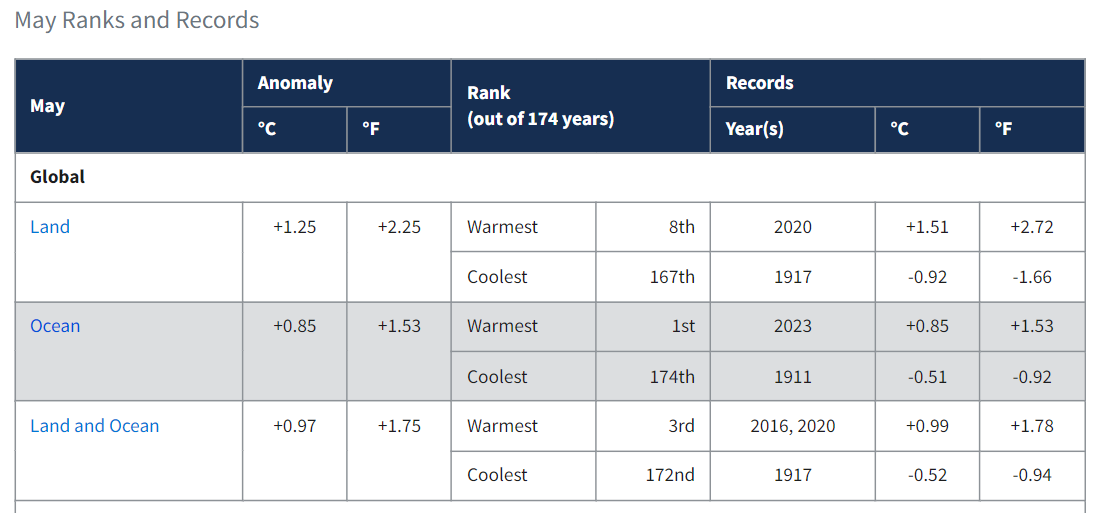
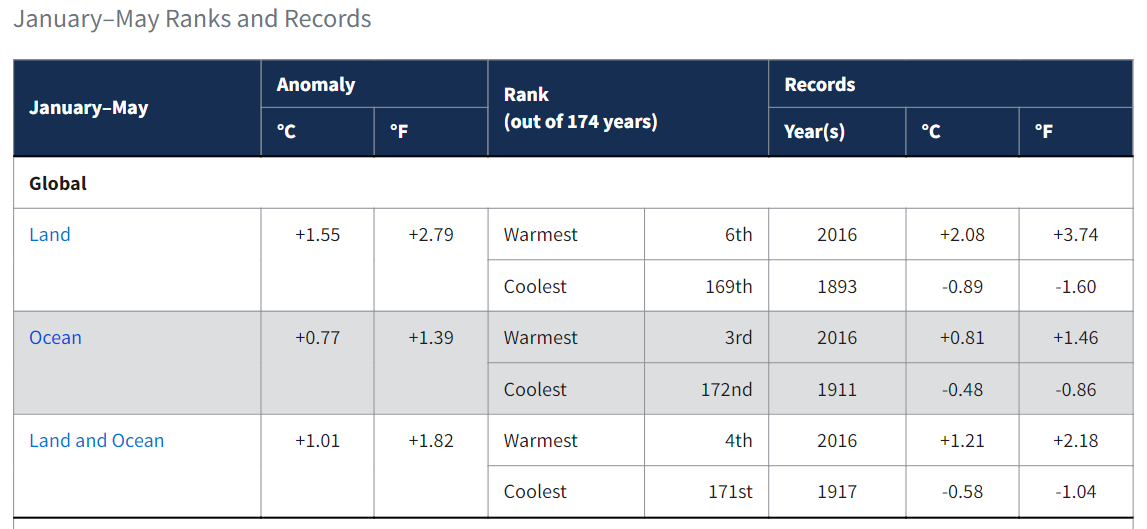
So there is the #1 warmest Ocean, but we now can see the Land was 8th and combined Global is 3rd, not 1st.  Now let’s look at the year to date (YTD):

Oh oh, that’s not as scary; the first 5/12ths of 2023 are not #1, but the ocean is #3, Land #6, and the Global start to the year is #4.  And the table shows that 2016 was the hottest, consistent with the UAH graph above.

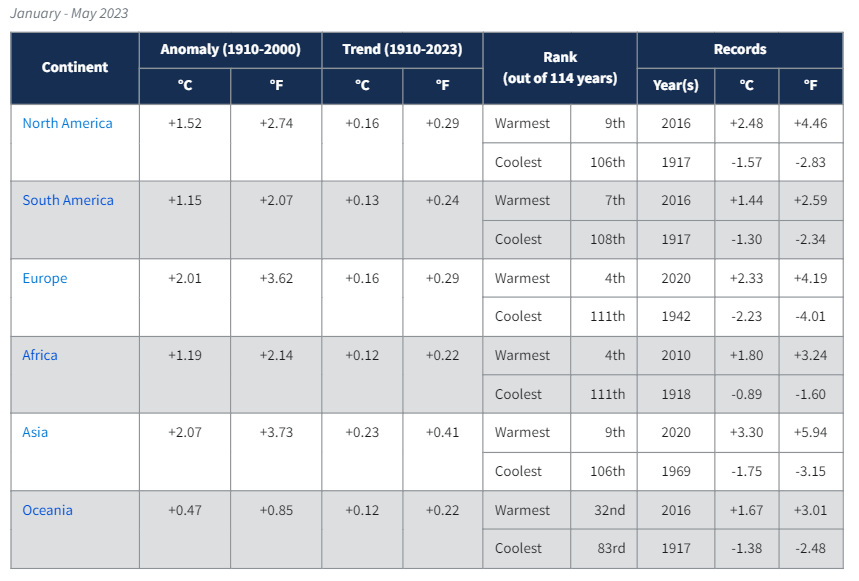
And to understand why most people will be put off by hottest year claims, we go to the Regional Analysis in order to see what the year has been like in various continents (land by definition).

It becomes obvious that no matter where I live, don’t tell me this is the hottest year ever. OK some Africans and Europeans may agree, but those in Oceania (mostly Australians) will boo you out of the room.

Footnote: Everyone has an agenda and packages data in support of their POV.  Those who joined the anti-hydrocarbon crusade are bound to find and amplify any bit of global warming they can find.  My agenda is for people to consider the full amount of relevant data and facts, and to reason accordingly rather than go along with the crowd or their feelings.  My approach is best expressed in this essay:

I Want You Not to Panic

Empirical Proof Sun Driving Climate (Scafetta 2023)

On June 14, 2023 Nicola Scafetta published at Science Direct Empirical assessment of the role of the Sun in climate change using balanced multi-proxy solar records.  Excerpts in italics with my bolds with exhibits from the study.

By design, climate models exclude solar forcing of earth’s climate,
and perform poorly without it.

Scafetta (2023) Highlights

•  The role of the Sun in climate change is hotly debated with diverse models.

•  The Earth’s climate is likely influenced by the Sun through a variety of physical mechanisms.

•  Balanced multi-proxy solar records were created and their climate effect assessed.

•  Factors other than direct TSI forcing account for around 80% of the solar influence on the climate.

•  Important solar-climate mechanisms must be investigated before developing reliable GCMs.

Abstract

The role of the Sun in climate change is hotly debated. Some studies suggest its impact is significant, while others suggest it is minimal. The Intergovernmental Panel on Climate Change (IPCC) supports the latter view and suggests that nearly 100% of the observed surface warming from 1850–1900 to 2020 is due to anthropogenic emissions.

However, the IPCC’s conclusions are based solely on computer simulations made with global climate models (GCMs) forced with a total solar irradiance (TSI) record showing a low multi-decadal and secular variability. The same models also assume that the Sun affects the climate system only through radiative forcing – such as TSI – even though the climate could also be affected by other solar processes.

In this paper I propose three “balanced” multi-proxy models of total solar activity (TSA) that consider all main solar proxies proposed in scientific literature. Their optimal signature on global and sea surface temperature records is assessed together with those produced by the anthropogenic and volcanic radiative forcing functions adopted by the CMIP6 GCMs. This is done by using a basic energy balance model calibrated with a differential multi-linear regression methodology, which allows the climate system to respond to the solar input differently than to radiative forcings alone, and to evaluate the climate’s characteristic time-response as well.

The proposed methodology reproduces the results of the CMIP6 GCMs when their original forcing functions are applied under similar physical conditions, indicating that, in such a scenario, the likely range of the equilibrium climate sensitivity (ECS) could be 1.4 °C to 2.8 °C, with a mean of 2.1 °C (using the HadCRUT5 temperature record), which is compatible with the low-ECS CMIP6 GCM group.

However, if the proposed solar records are used as TSA proxies and the climatic sensitivity to them is allowed to differ from the climatic sensitivity to radiative forcings, a much greater solar impact on climate change is found, along with a significantly reduced radiative effect. In this case, the ECS is found to be 0.9-1.8 °C, with a mean of around 1.3 °C. Lower ECS ranges (up to 20%) are found using HadSST4, HadCRUT4, and HadSST3.

The result also suggests that about 80% of the solar influence on the climate may not be induced by TSI forcing alone, but rather by other Sun-climate processes (e.g., by a solar magnetic modulation of cosmic ray and other particle fluxes, and/or others), which must be thoroughly investigated and physically understood before trustworthy GCMs can be created. This result explains why empirical studies often found that the solar contribution to climate changes throughout the Holocene has been significant, whereas GCM-based studies, which only adopt radiative forcings, suggest that the Sun plays a relatively modest role. The appendix includes the proposed TSA records.

Comparative Analysis
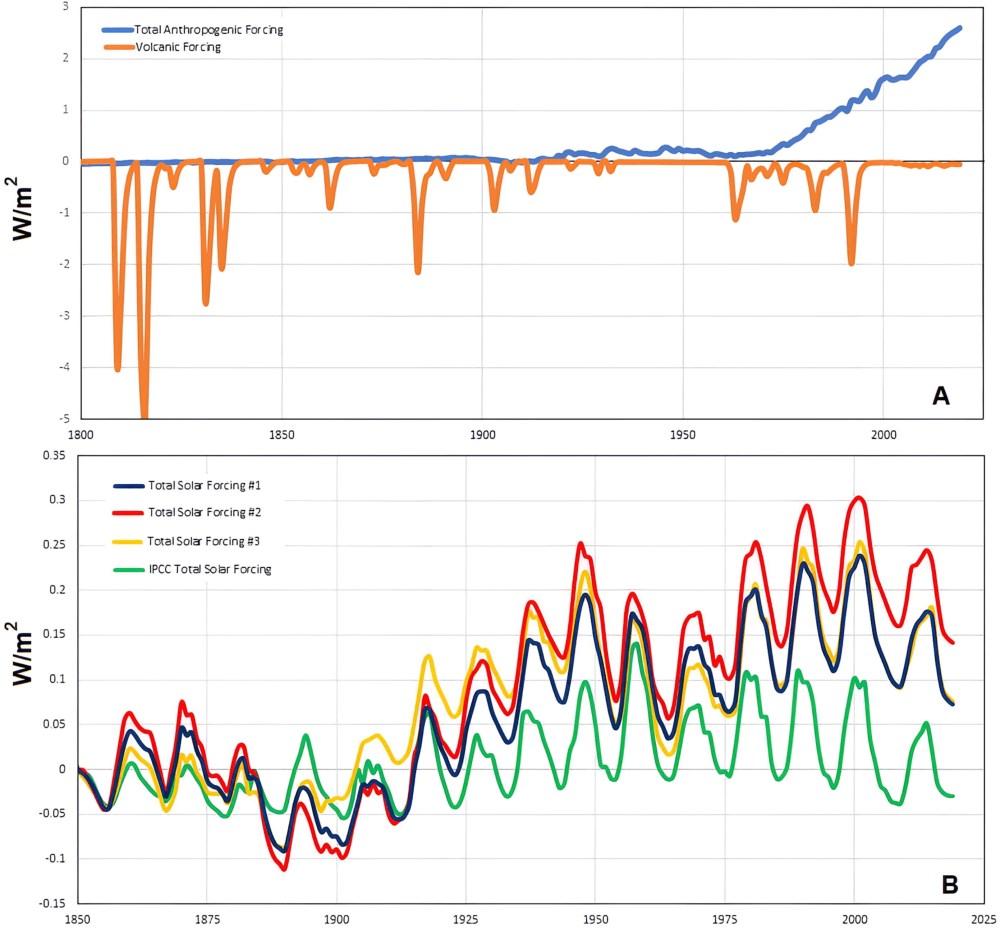
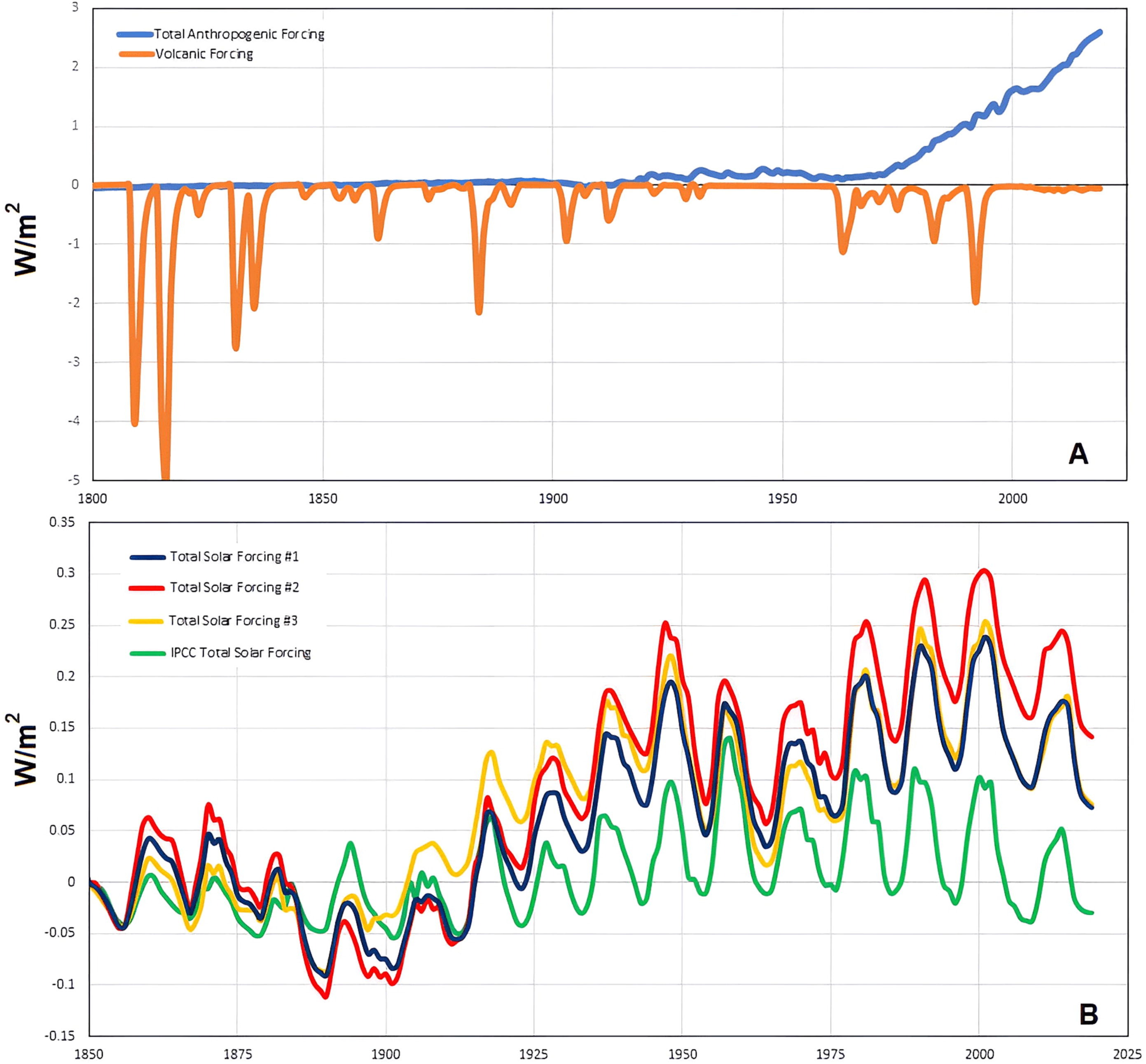
Figure 5. (A) Anthropogenic (blue) and volcanic (orange) effective radiative forcing functions adopted by the CMIP6 GCMs (Masson-Delmotte et al., 2021). (B) Comparison between the solar effective radiative forcing function from Table Annex III of the IPCC-AR6 (green) (after Masson-Delmotte et al., 2021) and the three TSI forcing functions deduced from the TSI records shown in Fig. 4. All records are anomalies relative to their values in 1850.

The solar forcing functions depicted in Fig. 5B differ in several respects. Just a very modest secular trend can be seen for the solar forcing function used by the CMIP6 GCMs, which has remained nearly constant for about 200 years. Although not depicted in Fig. 5B, the TSI forcing adopted by the CMIP6 GCMs is so flat that even the 1790–1830 Dalton grand solar minimum almost coincides with the 1890–1910 solar minimum and the 2019 solar cycle minimum (Supplementary Data Table S5). Furthermore, because this record is also based on SATIRE and the PMOD TSI satellite composite, its solar effective forcing function decreased progressively from 1970 to 2020. Thus, by using this TSI record, the CMIP6 GCMs could only conclude that solar forcing did not account for almost any of the warming observed after the pre-industrial period (1850–1900), and, particularly, from 1980 to 2020. (Masson-Delmotte et al., 2021).

On the contrary, the other three TSI records reveal a multidecadal oscillation as well as a clear increasing secular trend from the Dalton solar minimum to 2000. More specifically, the TSI forcing significantly increased from the Dalton minimum (1810–1815) to around 1870–1876, then declined until around 1890–1905; it increased rapidly between 1910 and the 1940s, and declined again between 1950 and 1975. The TSI forcing then increased again until 2000, when it began to gradually fall until 2022. This oscillating pattern is especially noteworthy because, as demonstrated below, it is closely correlated with the changes observed in total surface temperature records, which show a very similar increasing trend and multi-decadal modulation (cf.: Scafetta et al., 2004, Scafetta and West, 2006, Scafetta and West, 2008, Scafetta, 2009, Scafetta, 2010, Scafetta, 2012b, Scafetta, 2013a, Scafetta, 2021b).
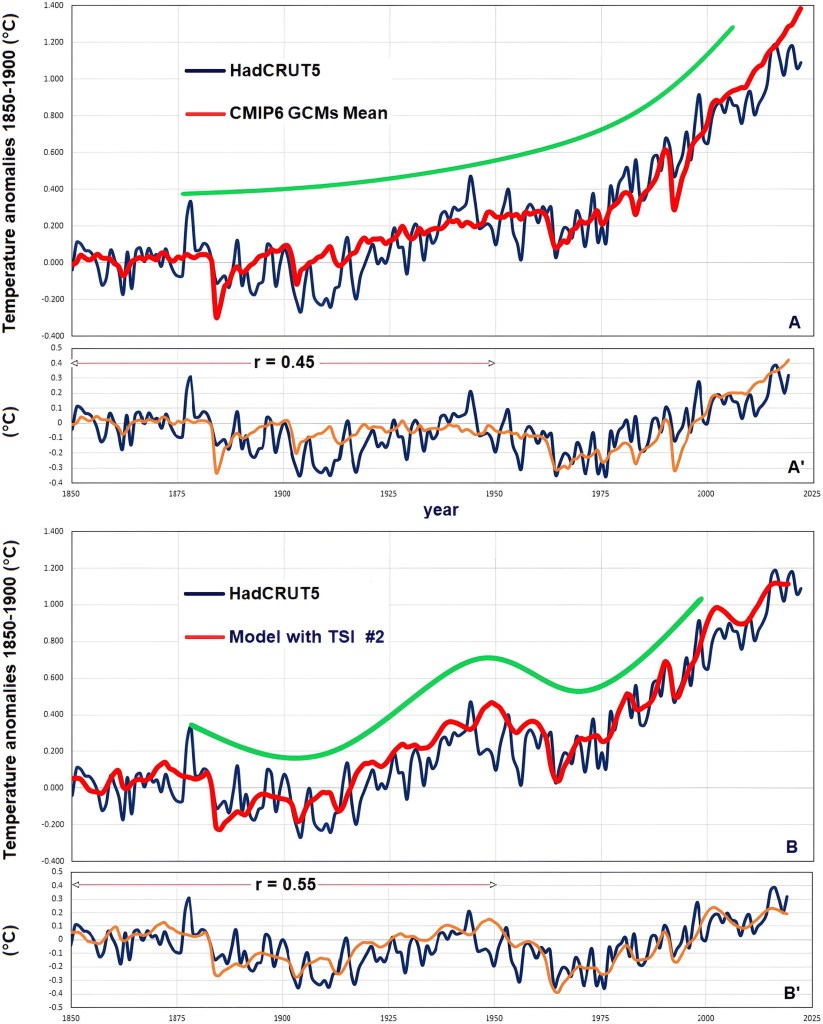
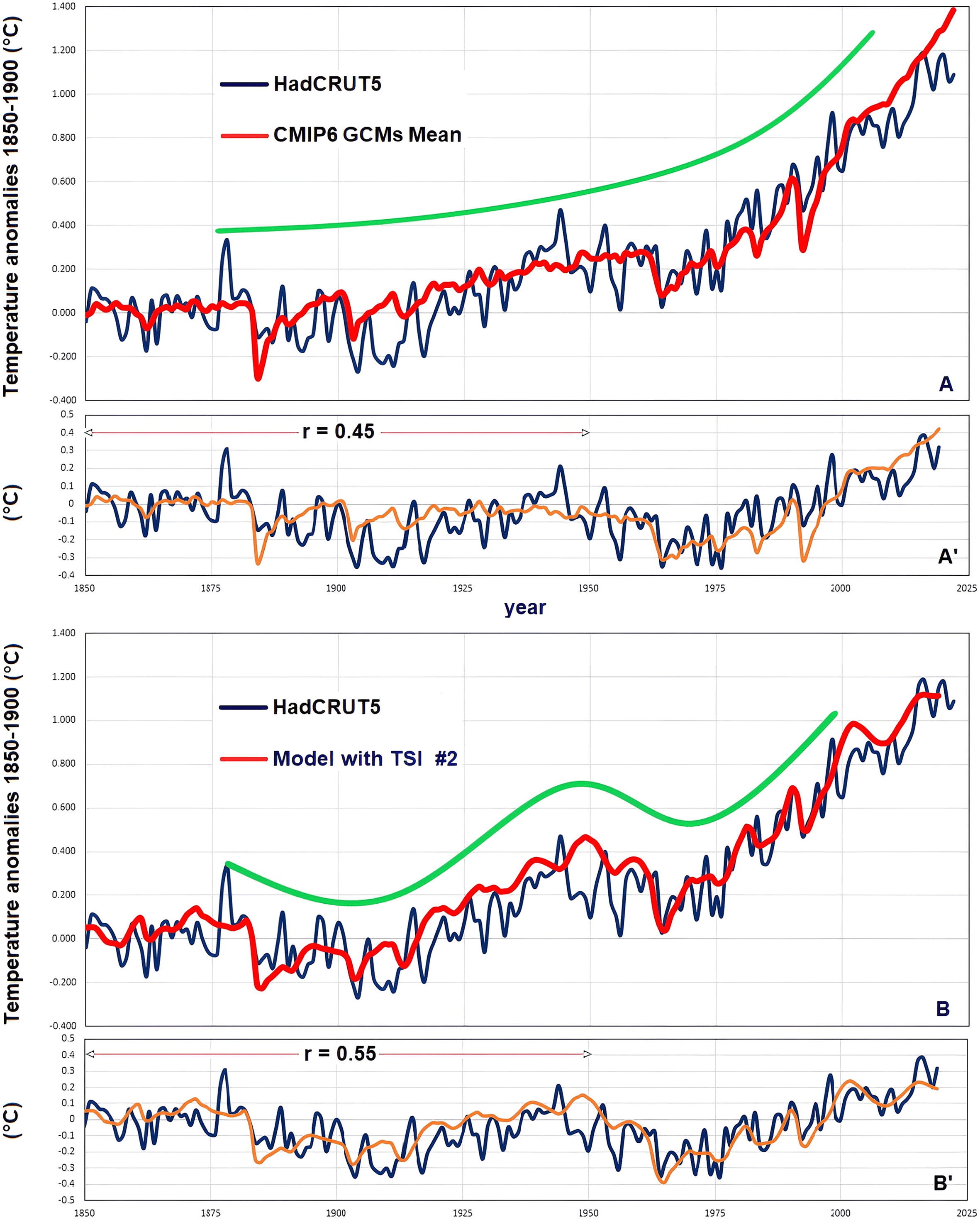
Figure 8. (A) HadCRUT5 global surface temperature versus the CMIP6 GCM ensemble average; (A’) the two records are detrended with the function f(t) = a (x-1850)2. (B) HadCRUT5 global surface temperature versus the energy balance model (Eq. (16)) using the TSI proxy model #2; (B’) the same as above. The green curves in Fig. 8A and B are sketches that highlight the different multi-decadal modulation of the red curves in Fig. 8A (monotonically increasing, like the anthropogenic forcing function) and in Fig. 8B (oscillating, like the temperature records).

Fig. 8 compares the HadCRUT5 global surface temperature record to (A) the CMIP6 GCM ensemble mean record and (B) the energy balance model (Eq. (16)) using the proposed TSI proxy model #2, which does not use the GCMs’ low secular-variability TSI record. The GCM simulation depicted in Fig.8A monotonically warms up, although occasional volcanic eruptions momentarily cause cold spikes; the monotonic warming trend produced by the model is simulated by the green curve. On the contrary, the model provided in Fig. 8B indicates an oscillating pattern developing around a warming trend. The global surface temperature record shows a similar growing trend, regulated by an approximately 60-year oscillation: the period 1880–1910 experienced a global cooling; the period 1910–1940 was characterized by considerable warming; and the period 1940–1970 experienced another global cooling. From 1880 to 1970, the model in Fig. 8B reproduces this oscillating pattern more precisely (corr. coeff. r = 0.79) than the CMIP6 GCM ensemble average simulation depicted in Fig. 8A (corr. coeff. r = 0.74). Thus, Fig. 8 illustrates that the suggested model (red curve, Fig. 8B) exhibits a multidecadal modulation that correlates significantly better with the temperature record (blue curve) than the GCM ensemble average simulation (red curve, Fig. 8A).

The different performance of the CMIP6 GCM ensemble average simulation and of the proposed regression model in reproducing the temperature pattern from 1850 to 1950 becomes more evident if a quadratic upward trend is detrended from the records. The correlation coefficient is r = 0.45 using the GCM ensemble average simulation (Fig. 8A’), and r = 0.55 using the proposed regression model (Fig. 8B’).

This result suggests that the observed multi-decadal modulation of the
temperature records could have been mostly determined by solar forcings,
and not by chaotic internal oscillations of the climate system.

Conclusion

The IPCC (Solomon and et al., 2007; Stocker and et al., 2014; Masson-Delmotte et al., 2021) conclusion that the Sun’s role in climate change has been negligible since the pre-industrial period (1850–1900) derives from the fact that this organization only consider the solar climatic signature produced by the present-day GCMs. These models, however, are computer programs that can only employ equations describing physical mechanisms that are already well known. Anything unknown or ambiguous cannot be included in the GCM software. If the climatic influence of neglected physical processes is significant, the reductionist approach employed in the GCMs for assessing climate change attributions may be completely inappropriate for the task.

The CMIP6 GCMs appear to greatly underestimate the Sun’s role in climate change because of two major limitations:

(i) erroneous solar forcings have likely been integrated into the models; and
(ii) TSI alone appears to likely be not the most important solar forcing.

Additional solar-magnetism related forcings and associated mechanisms are not included in the GCMs because they are currently poorly understood, despite the fact that there are several empirical indications that they might sufficiently modulate the cloud cover system (by 5% or less) to explain a significant component of the observed climatic changes (Svensmark and Friis-Christensen, 1997, Shaviv, 2002, Svensmark et al., 2016, Easterbrook, 2019, Svensmark, 2022; ). In fact, Table 1 shows that the actual climate sensitivity to TSA variations, which is expressed by kS, can be 4-7 times greater than the climate sensitivity to radiative forcing alone, which was denoted by kA.

Thus, about 80% of the solar influence on the climate could be generated

by processes other than direct TSI forcing. If this result is correct,

several solar-climate mechanisms must be thoroughly investigated

and fully understood before reliable GCMs can be developed.
The Sun Rules, and Warming from CO2 is Impossible

A complement to Scafetta’s study is a Quadrant article by Mark Imisides explaining the geophysical realities ruling out global warming from CO2.  DIY ocean heating  (Hint:  It’s the water, isn’t it?) Excerpts in italics with my bolds.

Scarcely a day goes by without us being warned of coastal inundation by rising seas due to global warming.

Carbon dioxide, we are told, traps heat that has been irradiated by the oceans,
and this warms the oceans and melts the polar ice caps.

While this seems a plausible proposition at first glance, when one actually examines it closely a major flaw emerges. In a nutshell, water takes a lot of energy to heat up, and air doesn’t contain much. In fact, on a volume/volume basis, the ratio of heat capacities is about 3300 to 1.

This means that to heat 1 litre of water by 1˚C it would take 3300 litres of air
that was 2˚C hotter, or 1 litre of air that was about 3300˚C hotter!

This shouldn’t surprise anyone. If you ran a cold bath and then tried to heat it by putting a dozen heaters in the room, does anyone believe that the water would ever get hot?

The problem gets even stickier when you consider the size of the ocean.
Basically, there is too much water and not enough air.

The ocean contains a colossal 1,500,000,000,000,000,000,000 litres of water!  To heat it, even by a small amount, takes a staggering amount of energy. To heat it by a mere 1˚C, for example, an astonishing 6,000,000,000,000,000,000,000,000 joules of energy are required.

Let’s put this amount of energy in perspective. If we all turned off all our appliances and went and lived in caves, and then devoted every coal, nuclear, gas, hydro, wind and solar power plant to just heating the ocean, it would take a breathtaking 32,000 years to heat the ocean by just this 1˚C!

In short, our influence on our climate, even if we really tried, is miniscule!

So it makes sense to ask the question – if the ocean were to be heated by greenhouse warming of the atmosphere, how hot would the air have to get? If the entire ocean is heated by 1˚C, how much would the air have to be heated by to contain enough heat to do the job?

Well, unfortunately for every ton of water there is only a kilogram of air. Taking into account the relative heat capacities and absolute masses, we arrive at the astonishing figure of 4,000˚C.

That is, if we wanted to heat the entire ocean by 1˚C,
and wanted to do it by heating the air above it,
we’d have to heat the air to about 4,000˚C hotter than the water.

And another problem is that air sits on top of water – how would hot air heat deep into the ocean? Even if the surface warmed, the warm water would just sit on top of the cold water.

Thus, if the ocean were being heated by greenhouse heating of the air, we would see a system with enormous thermal lag – for the ocean to be only slightly warmer, the land would have to be substantially warmer, and the air much, much warmer (to create the temperature gradient that would facilitate the transfer of heat from the air to the water).

Therefore any measurable warmth in the ocean would be accompanied by a huge and obvious anomaly in the air temperatures, and we would not have to bother looking at ocean temperatures at all.

So if the air doesn’t contain enough energy to heat
the oceans or melt the ice caps, what does?

The earth is tilted on its axis, and this gives us our seasons. When the southern hemisphere is tilted towards the sun, we have more direct sunlight and more of it (longer days). When it is tilted away from the sun, we have less direct sunlight and less of it (shorter days).

The direct result of this is that in summer it is hot and in winter it is cold. In winter we run the heaters in our cars, and in summer the air conditioners. In winter the polar caps freeze over and in summer 60-70% of them melt (about ten million square kilometres). In summer the water is warmer and winter it is cooler (ask any surfer).

All of these changes are directly determined
by the amount of sunlight that we get.

When the clouds clear and bathe us in sunlight, we don’t take off our jumper because of greenhouse heating of the atmosphere, but because of the direct heat caused by the sunlight on our body. The sun’s influence is direct, obvious, and instantaneous.

If the enormous influence of the sun on our climate is so obvious, then, by what act of madness do we look at a variation of a fraction of a percent in any of these variables, and not look to the sun as the cause?

Why on earth (pun intended) do we attribute any heating of the oceans to carbon dioxide, when there is a far more obvious culprit, and when such a straightforward examination of the thermodynamics render it impossible.
Enforcing Climate Correctness (Fact Checking)

Serfs attacking Climate Establishment

Phys.org sounds the alarm: Meteorologists targeted in climate misinfo surge.  Excerpts in italics with my bolds and added images.

Once trusted faces on the news, meteorologists now brave threats, insults and slander online from conspiracy theorists and climate change deniers who accuse them of faking or even fixing the weather.

Users on Twitter and other social media falsely accused Spain’s weather agency of engineering a drought, Australia’s of doctoring its thermometers and France’s of exaggerating global warming through misplaced weather stations.

“The coronavirus is no longer a trend. Conspiracy theorists and deniers who used to talk about that are now spreading disinformation about climate change,” Alexandre Lopez-Borrull, lecturer in Information and Communication Sciences at the Open University of Catalonia, told AFP.

“These scientific bodies are seen as part of the establishment, so anything they say may get disputed on social networks.

“They are providing evidence against what the climate deniers claim, so the latter try to discredit them.”

Maybe if they stuck to weather reporting? See Climate Evangelists Are Taking Over Your Local Weather Forecast

Australian thermometers

In a case investigated by AFP Fact Check, conservative media and Facebook users shared unfounded claims that Australia’s Bureau of Meteorology (BOM) doctored its temperature readings.

In an analysis of data obtained via a freedom of information request, prominent climate skeptic Jennifer Marohasy said BOM’s electronic probes returned readings up to 0.7 degrees Celsius warmer than those of its older mercury thermometers.

Experts who analyzed the data said the claims were inaccurate.

Monash University emeritus environment professor Neville Nicholls said the difference between most readings on the electronic probes and the mercury thermometers was negligible—between zero and 0.1C (0.18 degrees Fahrenheit).

The World Meteorological Organization told AFP that the BOM’s measurements were in line with its standards, contrary to Marohasy’s allegation.

Marohasy makes her case in video below.

Several examples in the article shows they are relying on fact checking by AFP (Agence France Presse).  So the AFP Fact Check follows the usual procedure:  get quotes from establishment supporters in order to isolate and cancel a finding contrary to “consensus” climate science.

More from AFP to See How the Enforcement Works

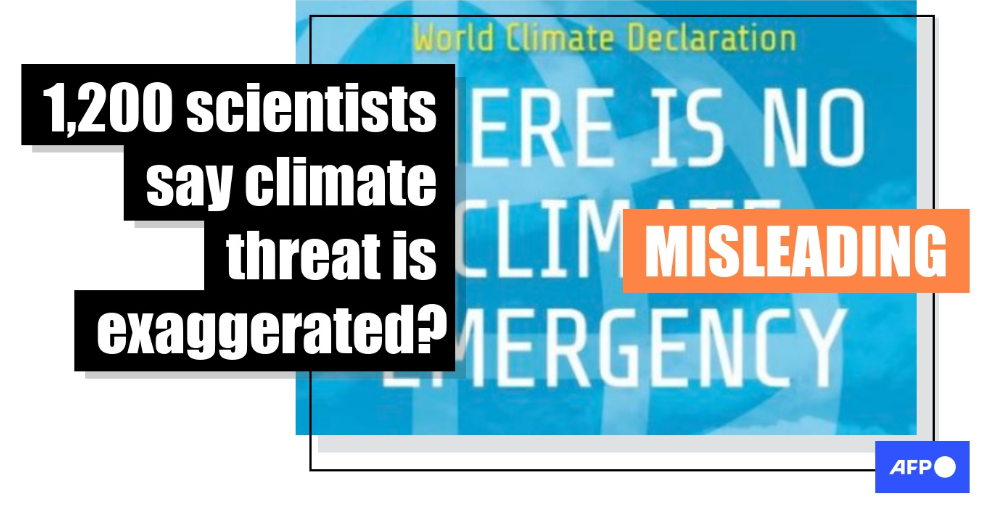
Climate ‘declaration’ recirculates debunked claims.Excerpt in italics with my bolds

First Attack:   Big Oil Funds Them, So They Lie

However seven of the signatories to the declaration were identified on the list as having worked for Shell and eight others as having worked in the oil industry. Crok confirmed to AFP that Berkhout himself worked for the firm “about 40 years ago.” Besides these, there were 13 petroleum engineers and petroleum geologists, plus several mining specialists.

Several signatories had links, either mentioned on the list or documented elsewhere, to US climate-skeptic free-market groups with ties to the oil industry: the Heartland Institute, the Competitive Enterprise Institute and the Cato Institute.

These groups each received money from oil giant ExxonMobil, according to donor and tax documents published by Greenpeace (here, here and here). The company has been accused of undermining science to protect its fossil fuel business — a charge it denies.

Second Attack:  Only Some Signatories are Climatologists

According to an AFP count of the declaration’s signatories, about 10 explicitly described themselves as climatologists or climate scientists, fewer than one percent of the total. A few others described themselves as specialists in paleoclimatology and atmospheric sciences.

There were approximately 40 geophysicists, 130 geologists and 200 engineers of various kinds, plus several mathematicians, medical doctors and agricultural scientists.

Thirdly:  IPCC is the Final Authority

Documents accrediting the mainstream scientific view on climate change are more comprehensive than the World Climate Declaration. The Intergovernmental Panel on Climate Change invited 721 experts from 90 countries to be authors and editors of its three-part Sixth Assessment Report, released between August 2021 and April 2022.

The report constitutes the most comprehensive assessment of scientific knowledge on climate change. Each part was some 3,000 pages long. The authors reviewed hundreds of studies that were listed in the reference sections. It says there is “unequivocal” evidence that humans are warming the climate by burning fossil fuels.

Finally, Refer to Insider Supporters to Refute Claims

Examples in the AFP fact check include Carbon Brief and World Weather Attribution.

Why Should We Believe A Bunch of Journalists like AFP?

Well, because they pass the media bias test;

Who is behind Media Bias Fact Checks and what is their POV?

From Climate Change Dispatch ‘Media Bias/Fact Check’ Site Served With Cease And Desist, Gets Fact-Checked.  Excerpts in italics with my bolds.

Today, PSI has issued Media Bias/Fact Check (MBFC) site owner, Dave Van Zandt with a pre-action legal notice to take down the defamatory and false smear.

Ironically, the self-styled ‘MEDIA BIAS/FACT CHECK‘ (MB/FC) which negatively fact-checked PSI admits it relies on the subjective bias to decide how biased others are. In other words, MB/FC is a pseudoscientific fact checker!

Apart from unlawfully smearing PSI, Mr. Van Zandt has smeared other websites that publish scientific articles critical of man-made global warming claims. Among the unfairly smeared are:

  • Climate Change Dispatch
  • CFACT
  • WUWT

Below we help readers to fact-check the pseudo-fact-checker. We put Dave Van Zandt the faceless fact-checker under the microscope and discovered the following:

♦  Van Zandt Cites No Scientific Qualifications At All
♦  Van Zandt Was Exposed By WND As A Fraud And A Liar
♦  Van Zandt’s Website (MBFC) Does Not Apply Any Objective Scientific Method
♦  MBFC Relies On Unverifiable Subjectivity (Own Bias) To Make Judgments

Climate Enforcers Appeal to Membership in IFCN

Both AFP and MBFC stake their credibility on belonging to the International Fact-Checking Network (IFCN).  Who’s behind that authority?  WND discussed them in their article The 9 fakest fake-news checkers.  Excerpts in italics with my bolds.

In the past Facebook announced it would use the International Fact-Checking Network, or IFCN, to check on the legitimacy of news articles posted to the social media site.

IFCN is hosted by the Poynter Institute for Media Studies and funded, in part, by Google and foundations of leftist billionaires George Soros and Bill Gates. Soros donated $25 million to Hillary Clinton’s presidential campaign. The Daily Mail reported that Clinton super-donor and eBay founder Pierre Omidyar is also backing the project.

The website reveals: “Poynter’s IFCN has received funding from the Arthur M. Blank Family Foundation, the Duke Reporters’ Lab, the Bill & Melinda Gates Foundation, Google, the National Endowment for Democracy, the Omidyar Network, the Open Society Foundations and the Park Foundation.”

Summary:  

There’s a well-funded industry dedicated to curating the news for the sake of “right-thinking” public opinion. It’s a closed loop of self-appointed authorities who validate each other, and excommunicate unbelievers.  Woe to those who outsource their critical intelligence to such.


Objection! Warming Alarm is Hearsay, Lacking Evidence.

C3 Headlines reports: The Real Climate Science Crisis: The Catastrophic Anthropogenic Global Warming (CAGW) Hypothesis Is Without Scientific Evidence.  Excerpts in italics with my bolds and added images.

For a hypothesis to reach the status of being a legit theory, it requires withstanding the onslaught of observed empirical evidence. The CAGW hypothesis is no such animal.

Known by its more contemporary aliases, such as ”climate crisis,” “climate emergency,” “climate collapse,” or “existential threat,” the CAGW has zero empirical evidence to support it.

Unlike the related hypothesis regarding greenhouse gases (GHG) and global warming, at least the GHG hypothesis has warming global temperature data that somewhat coincides with increasing atmospheric CO2 levels, putting aside the growing possibility that the purported cause-and-effect direction is probably the reverse. [Note:  See Temps Cause CO2 Changes, Not the Reverse. 2023 Update]

In order to reach a CAGW climate disaster, global warming temperatures must change rapidly in an accelerating manner that will initiate a ‘tipping point’ for the climate.

The rapid acceleration would present its occurrence in a continuous increasing of the slope, i.e., trend, of temperatures, such as monthly temperatures. Each subsequent month would represent a greater temperature magnitude increase than the month before, hypothetically.

To enlarge open image in new tab.

But those tipping point precursors are not occurring in the real-world climate.

For example, it is agreed by all climate scientists that oceans play a very major role in the world’s climate and its global temperatures due to their being both the world’s largest carbon sink and its largest heat content storage.

However, despite these characteristics, in totality, the global oceans HAVE NOT warmed since the year 2014. And certainly, there is no empirical evidence that oceans exhibit constant temperature increases of magnitude.

Quite the contrary, combined oceans exhibit a regular pattern of temperature decreases and increases, as the adjacent plot of NOAA’s monthly ocean data indicates.

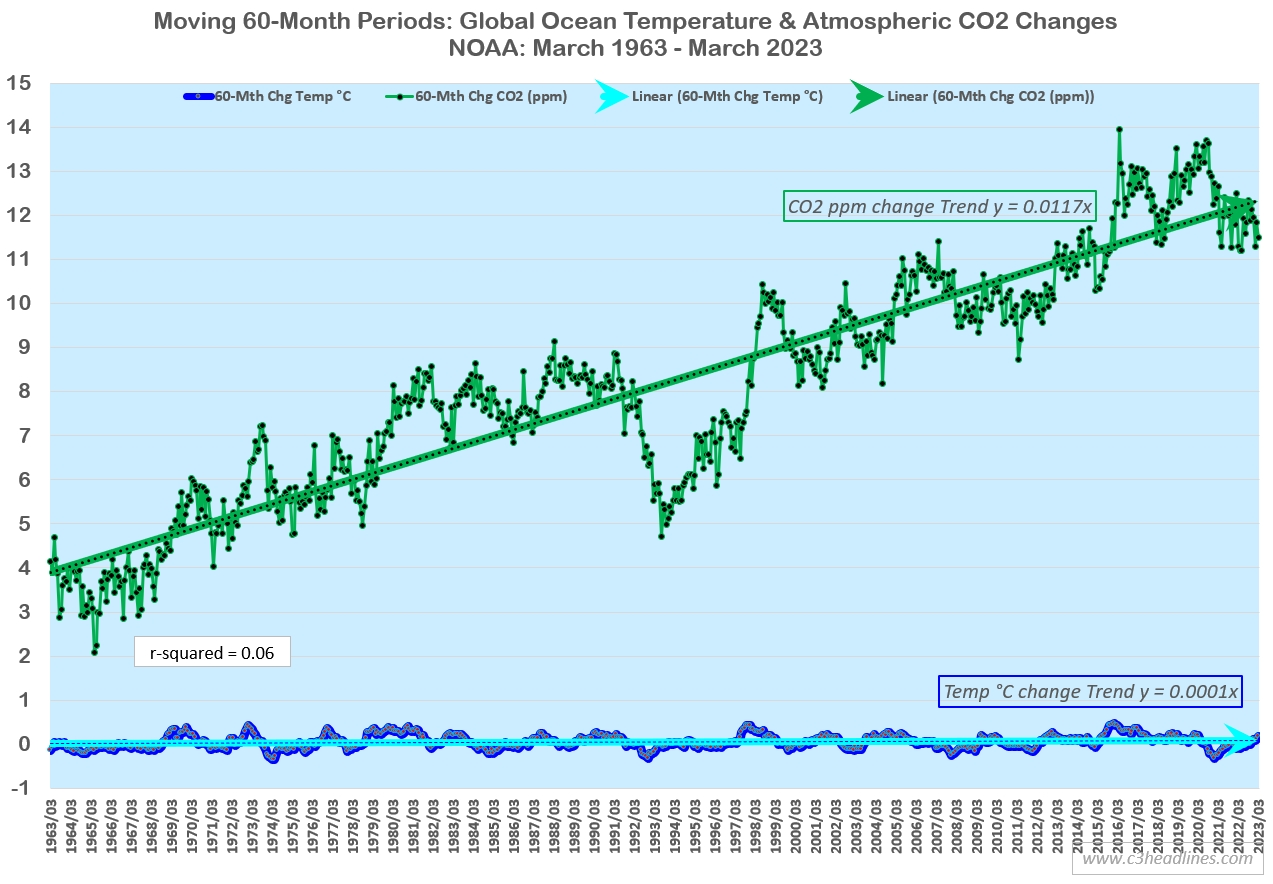
Specifically, this is a plot (dark blue) of moving 5-year temperature changes ending each month of the 60-year period from March 1963 through March 2023.

[Explanation: the first data point is the temperature change for the 60 months ending on March 30, 1963; and the chart’s last temperature change data point is for the five 5 years (i.e. 60 months) ending on March 2023.]

The chart also includes a plot (green) of the moving 60-month CO2 level changes over the same sixty year period, plus a linear trend for both CO2 changes and ocean temperature changes.

The trend of the 60-month CO2 changes significantly exceeds the
slight positive trend of ocean temperature changes by a factor of 117x.

This huge differential undercuts the belief that global warming is primarily the result of GHGs. Which is confirmed by the paltry R^2 of +0.06 – an almost non-existent relationship between 5-year atmospheric CO2 changes and 5-year changes in ocean temperature.

Not only are the large increases in CO2 levels not causing a concerning uptick of temperature change magnitude, it also has not lead to any type of acceleration, per the linear trend since 1963.

Specifically, with a trend of a tiny +0.0001°C, that would project out 20 years to be an increase of 5-year temperature changes to an insignificant amount of +0.024 – definitely not an existential threat of ‘runaway warming’ or a CAGW ‘climate crisis’ as portrayed by bureaucrats, politicians and Hollywood celebrities.

So, if 5 years of increasing amounts of CO2 in the atmosphere barely influence 5-year changes in temperature over a 60-year span, either in magnitude or acceleration rate, then it is highly unlikely that this trace gas would cause a catastrophic climate disaster or an extinction event.

Thus, it is fair to state that for all those scientists pushing a narrative of an imminent climate change catastrophe from CO2 without the requisite empirical evidence, this has become the real climate science crisis facing society.

Notes: Temperature and CO2 data sources.Excel used to calculate 60-mth (5-yr) temperature and CO2 changes; used to calculate the respective trends; used to calculate correlation and r-squared; used to plot the chart.

Away With Self-Fullfilling Climate Prophecy

Edward Ring explains the importance of dispelling CO2 hysteria in his American Greatness article Challenging the Premise of Our Destruction.  Excerpts in italics with my bolds and added images.

Claiming that anthropogenic CO2 will not cause catastrophic climate change is a
credible, necessary point of view backed up by scientific evidence.

The most powerful and destructive perception in the world today is that using fossil fuels will cause catastrophic climate change. This belief, marketed by every major government and corporate institution in the Western world, is the foundational premise underlying a policy agenda of stunning indifference to the aspirations of ordinary people.

The war on fossil fuel is a war on freedom, prosperity, pluralism, independence, national sovereignty, world peace, domestic tranquility, and, most ironically, the environment itself. It is a war of rich against poor, the privileged against the disadvantaged, corporate monopolies against competitive upstarts, Malthusians against optimists, regulators against innovators, and authoritarians against freedom-loving people everywhere.

But this war cannot be won unless the perception is maintained. If fossil fuel is allowed to compete against other energy alternatives for customers as a vital and growing part of an all-of-the-above energy strategy, this authoritarian political agenda falls apart.

It is reasonable to question the assertion that eliminating fossil fuels will inevitably result in an impoverished society subject to punitive restrictions on individual behavior. But the numbers are compelling and can be distilled to two indisputable facts: First, fossil fuel continues to provide over 80 percent of all energy consumed worldwide. Second, if every person living on planet Earth were to consume half as much energy per year as the average American currently consumes, global energy production would need to double.

Several inescapable conclusions derive from these two facts, if one assumes that energy is the driver of prosperity. Just in case that is not obvious, imagine Americans living with half as much energy as they use today. Where would the cuts occur? Would they drive their cars half as much? Heat their homes half as much? Operate manufacturing, farming, and mining equipment half as much? They would need to do all those things and more. The economy would collapse.

These consequences don’t escape the intelligentsia who promote “net zero” policies. These consequences explain the policies they advocate. The recent promotion of “15-minute cities” that will inform rezoning and redevelopment to put all essential services within a 15-minute walk of every residence. The rise of “congestion pricing” to charge automobiles special tolls if they drive into an expanding footprint of urban neighborhoods. “Smart growth.” “Infill.” “Urban Service Boundaries.” Bike lanes. “Smart buildings,” “smart meters,” and “smart cities.”

These innovations, all in progress, only begin to describe what is coming.

By restricting new development and systematically reducing the use of fossil fuels, the global middle class will shrink instead of grow. The wealthiest elites will buy their way out of the smart slums. Everyone else will be locked down. This is how energy poverty will play out in the modern era. It cannot be emphasized enough: If energy production is restricted, this will happen. It’s algebra. It is objective fact.

Hardly less speculative is the reaction outside the Western world. What are our elites thinking? Do they intend to start World War III? Perhaps they do. Because nothing short of war is going to stop the Chinese, Indians, Indonesians, Pakistanis, Brazilians, Nigerians, or Bangladeshis from developing every source of energy they possibly can. Just those seven nations account for half the world’s population. That’s 4 billion people. Will they stop developing energy until they at least achieve half the per capita energy consumption that Americans currently enjoy? Not a chance.
Will they get there by relying exclusively on wind and solar? Dream on.
Fossil Fuel Will Not Cause a Climate Catastrophe

If you only believe half of the preceding arguments, you must realize that Americans have been backed into a corner. If anyone calls for abundant energy—or abundant anything, since energy, and fossil fuel in particular, is the prerequisite for virtually all goods and services—they are shouted down as “climate deniers.” And the way to upset the entire edifice is not to merely argue that fossil fuel is essential to the survival of civilization. Because the counterargument is that eliminating fossil fuel is essential to the survival of the planet.

That is an unwinnable argument. It is not possible to reason with an opponent of fossil fuel if you concede their fundamental premise: that burning fossil fuel will cause catastrophic climate change. You either become a “denier,” or you submit to energy poverty.

This is the tough decision facing Americans.

And it’s accurate to also say it is a decision facing Republicans since literally every prominent, mainstream, housebroken, accommodating establishment Republican will not challenge the assertion that we’re experiencing a “climate crisis,” even though most of them know better. But this should be a bipartisan issue. For Republicans, this is an opportunity to show some backbone by rejecting the most destructive and fraudulent premise of our time. In so doing, they would unify their party, attract independent voters, and realign the nation.

The irony is stupefying. Without fossil fuel, America will enter a dark age, and the only way to control a restive population that’s seen its standard of living plummet will be through the establishment of a technology-driven police state. They are the fascists. The so-called climate deniers are fighting for prosperity and freedom.

If you want to save civilization, be a denier.

Say it loud and without reservations, and say it every chance you get. Demand that politicians publicly refute climate alarmism. It isn’t necessary to claim that the powers behind the climate cult want to enslave the world. We don’t know what motivates them. Some just want to get rich on renewables. Some want to use climate change to advance American global hegemony. But all of them rely on a fundamental moral justification: By eliminating fossil fuel, we are saving the planet from certain destruction. Focusing on the possible ulterior motives of climate alarmist leaders without first challenging their core moral argument is a fool’s errand.

There are plenty of environmental challenges. Being an environmentalist is a good thing. But there has to be balance, and there has to be debate. Claiming that anthropogenic CO2 will not cause catastrophic climate change is a credible, necessary point of view backed up by scientific evidence. If more people make that claim, the climate cult can be broken, and civilization can be rescued from oblivion.

See Also A Rational Climate Policy


1875 was coldest in 10,000 years, Warming A Good Thing

Jørgen Peder Steffensen, of Denmark’s Niels Bohr Institute, is one of the most experienced experts in ice core analysis, in both Greenland and Antarctica. In this video he explains a coincidence that has misled those alarmed about the warming recovery since the Little Ice Age.  And if you skip to 2:25, you will see the huge error we have made and the assumptions and extrapolations based on that error.  Transcript below is from closed captions with my bolds and added images. H/T Raymond

What do ice cores tell us about the history of climate change and the present trend? 

This ice is from the Viking age around the year one thousand, also called the medieval warm period. We believe that in Greenland the Medieval Warm Period was about one and a half degrees warmer on average than today

NorthGRIP the Greenland ice core project is being reopened to drill the last few meters through the ice sheet to the rock beneath the research station. The ice core over three kilometers in length has been hauled up to the surface piece by piece, and contains important data on the history of the climate of the earth. It bears the fingerprints of climatic conditions over more than 120 thousand years.

When we remove a drilled ice core we leave a hole, and we insert a thermometer in the hole. We are able to map out the temperature through the three kilometer ice sheet. Now that temperature, if we do it precisely enough with a thousandth of a degree accuracy, then the ice has not forgotten how cold or warm it was on the surface at the time the snow fell.

So using those temperatures we have been able to reconstruct the temperatures of the last ten thousand years. Here we have our picture of the temperature reconstructions that we have from Greenland in the graphical form. And if we go back along this axis it’s going back in time. This is the last 8 000 years we have plotted here. On this axis we have the temperatures at the site in Greenland, and we can see that if we go back from now about 4000 years ago, we would have temperatures up here for about 4 000 years in the past that on average were two and a half degrees warmer than today.

Reconstructed temperatures for Greenland ice cores Dye3 and GRIP. (A) The temperature from 8000 BP to present; (B) the temperature from AD 0-2000 (after Dahl-Jensen et al., 1998). The observed difference in amplitude between the two cores is a result of their different geographic location in relation to the variability in atmospheric circulation. Source: Reconstructed-temperatures-for-Greenland-ice-cores-Dye3-and-GRIP-A

Now as we go forward to approach our time, we can see that in the period after four thousand years ago and up to the two thousand years ago (which is actually the Roman Age) the temperatures have been decreasing in Greenland by two and a half degrees. Then temperatures increased gradually up to a maximum point around a thousand years ago, we call it the Medieval Warm Period. And then temperatures declined and go down to minimum around 1650 a.d., before coming back up a little in the 18th century.

And then around 1875 we have right here the lowest point in the last 10,000 years.
And that matches exactly the time when meteorological observations started
.

Other core samples from elsewhere in Greenland confirmed that the little ice age ended about 140 years ago at the coldest point in the last 10,000 years. The natural pronounced alteration of warm and cold periods back in time has also been confirmed elsewhere in the northern hemisphere. Carbon 14 dating of organic matter from peat bogs and tree rings confirms the pattern. Also the data from stalactite caves in China and measurements from North Africa.

The problem is that we can all agree completely that we have had a global temperature increase in the 20th century. Yes, but an increase from what? It was probably an increase from the lowest point we’ve had for the last 10,000 years. And this means it will be very hard indeed to prove whether the increase of temperature in the 20th century was man-made or it’s a natural variation. That would be very hard because we made ourselves an extremely poor experiment when we started to observe meteorology at the coldest time in the last ten thousand years.

Dr. Syun Akasofu 2009 diagram from his paper Two Natural Components of Recent Warming.


Confirmed: Climate Models Too Hot to Trust

Ross McKitrick reports on a new study confirming the chart above.  His Financial Post article is The important climate study you won’t hear about.  Excerpts in italics with my bolds and added images

The study is Mid-Tropospheric Layer Temperature Record Derived From Satellite Microwave Sounder Observations With Backward Merging Approach by Cheng-Zhi Zou at JGR Atmospheres.

The Significance

Ross McKitrick: 

In the end the two (satellite) series were similar but RSS has consistently exhibited more warming than UAH. Then a little more than a decade ago, the group at NOAA headed by Zou produced a new data product called STAR (Satellite Applications and Research). They used the same underlying microwave retrievals but produced a temperature record showing much more warming than either UAH or RSS, as well as all the weather balloon records. It came close to validating the climate models, although in my paper with Christy we included the STAR data in the satellite average and the models still ran too hot. Nonetheless it was possible to point to the coolest of the models and compare them to the STAR data and find a match, which was a lifeline for those arguing that climate models are within the uncertainty range of the data.

Until now. In their new paper Zou and his co-authors rebuilt the STAR series based on a new empirical method for removing time-of-day observation drift and a more stable method of merging satellite records. Now STAR agrees with the UAH series very closely — in fact it has a slightly smaller warming trend. The old STAR series had a mid-troposphere warming trend of 0.16 degrees Celsius per decade, but it’s now 0.09 degrees per decade, compared to 0.1 in UAH and 0.14 in RSS. For the troposphere as a whole they estimate a warming trend of 0.14 C/decade.

Figure 14 Global mean Temperature Total Troposphere (TTT, TMT adjusted by TLS) time series (blue lines) and its smoothed time series (red lines). The locally weighted regression method (Cleveland, 1979) is used for the smoothing. Both TMT and TLS for TTT generation are from STAR V5.0.