
Inside the Carbon Cult

In Glasgow, members of an activist troupe protest climate change.(Ben Stansall/AFP via Getty Images)

Kevin D. Williamson has written a study on this topic, subtitled:

Reports on the religious character of the environmental movement

Below in italics with my bolds is the excerpted Introduction and at the end a link to the entire pdf. H/T Competitive Enterprise Institute.

This is not a religious book in the sense of its being meant to convey a religious message or for people of a particular religion—it is a book containing three journalistic reports about a religion, or a sort of religion, that emerged from and then subsumed the environmental movement. Today, that movement is a kind of cult and not a political movement at all, if it ever was one. Those who profess one of the Abrahamic faiths have a religious interest in idolatry because it perverts religion and leads religion to inhuman ends—Norman Podhoretz, in his very interesting book The Prophets, describes the ancient Israelite “war on idolatry” as a matter that is not exclusively otherworldly but very much rooted in a campaign against the ghastly social practices associated with idolatry: cannibalism, child sacrifice, etc.

And if idolatry makes a hash of religion, it is, if anything, even more of a menace
to the practice of politics, which is my subject.

I suspect that some of you may object to the term idolatry here, or to the description of the environmental movement as a kind of cult—that some readers may regard these as rhetorical excesses. All that I have to say in my defense is that this is a factual and literal account of what I have seen and heard in reporting about the environmental movement, in the actual explicit religious ceremonies that were conducted in and around the United Nations climate conference in Glasgow in 2021, in my conversations with such figures as the “voluntary human extinction” activist who calls himself Les U. Knight, in my conversations with those who object to clean and economical nuclear power on grounds that are, even when not accompanied by pseudo- religious Gaia rhetoric, fundamentally metaphysical. What is at work is a kind of sophomoric, cartoon puritanism that regards modernity—and, in particular, the extent and pattern of consumption in the modern developed world— as sinful. One need not squint too much to recognize very old Christian (or even Stoic) aversion to “luxury” in these denunciations.

Indeed, we need only take the true believers at their word. As scientists have been searching for economic, abundant, and environmentally responsible sources of energy to support human flourishing, the environmentalists have resisted and abominated these efforts: Amory Lovins of Friends of the Earth declared that “it would be little short of disastrous for us to discover a source of clean, cheap, abundant energy”—and please note there the inclusion of clean—while Population Bomb author Paul Ehrlich famously opined that “giving society cheap, abundant energy at this point would be the equivalent of giving an idiot child a machine gun.” Professor Ehrlich gives up the game with “at this point”—meaning, of course, in our fallen, postlapsarian state.

It was, of course, inevitable that Professor Ehrlich— who has been spectacularly wrong about practically every prediction he has made in his lucrative career as a secular, Malthusian prophet—should be back in the news at the same time scientists were announcing a breakthrough in nuclear fusion research. Professor Ehrlich, recently seen on 60 Minutes (which still exists!) and elsewhere, downplays the recent advance in fusion on the grounds that current patterns of human living are “unsustainable.” Professor Ehrlich has been giving the same interview for decade and decades—advances in energy production will not matter because “the world will have long since succumbed to overpopulation, famine,” and other ills, as he insisted in an interview published by the Los Angeles Times—in 1989— not long after insisting that the United Kingdom would be ravished by famine no later than the year 2000. 

End-of- days stories have long been a staple of religions and cults of many different kinds and characters, of course, and the environmental movement is fundamentally eschatological in its orientation, by turns utopian and apocalyptic. It is at the moment more apocalyptic than utopian, but that is a reflection of a broader trend in our politics and our society. The Western world, in particular, the English-speaking Western world, has been fervently praying for its own demise for a generation. Future historians will note the prevalence of zombie-apocalypse stories in our time—The Walking Dead has recently concluded its main series but will be supplemented by numerous spinoffs, while one of the most intensely anticipated television series of 2023 is The Last of Us, an adaptation of a video game that is based on yet another variation of the zombie-apocalypse theme—but beyond zombie-apocalypse stories we have alien-invasion- apocalypse stories, and, precisely to our point here, eco-apocalypse stories by the dozen (The Day After Tomorrow, Snowpiercer, Waterworld, Interstellar, Wall-E).

What these stories have in common is not the particular source of anxiety, though environmental concerns are interlaced into many stories: The Last of Us is a zombie story, but the zombies are produced by global warming, which allows a particular fungus to colonize and control human brains. (One shared article of faith that is present not only in zombie movies but also from campy, anencephalic or macrocephalic aliens of Mars Attacks! and Independence Day—the enemy is the brain.) What they have in common, rather, is a two-sided fascination with social collapse, both the negative aspects—the inevitable suffering—and the positive—the possibility of a return to innocence and a shared born-against experience that retroactively sanctifies that suffering. 

Which is to say, what we have here is the old mythological cycle
of suffering, death,and rebirth told at the social level
rather than at the level of individual hero or martyr.

None of this is to say that there are not real environmental challenges in front of us. These are real, and they deserve serious attention. But here in the third decade of the benighted 21st century, the environmental movement is not about that. It is an apocalyptic-fantasy cult. Of course there are people who think of themselves as adherents of that movement who are doing real work in science and policy, in much the same way that the alchemists and magicians of the medieval period laid the foundations for much of modern science, including a great deal of chemistry and astronomy. The two phenomena are by no means mutually exclusive.

But if you want to understand why there has been so frustratingly little meaningful progress in environmental policy in the United States, the United Kingdom, and the European Union in the past 30 years or so, then understanding the cultic character of the environmental movement is essential. The real environmental-policy debate should be, not to put too fine a point on it, boring, though by no means simple—a largely technical matter of understanding tradeoffs and drawing up policies that attempt to balance competing goods (environmental, recreational, economic, social, etc.) and putting those policies to the test of democratic accountability. None of this is easy in a connected and global world—prohibit the use of coal in the United States and you might end up increasing worldwide coal-related greenhouse-gas emissions as relatively dirty power plants in China and India take up the slack in consumption—but none of it ought to present a Manichean conflict, either.

Demagoguery is an old and obvious factor in all political discourse, but there is at work here something deeper than mere political opportunism, and that is the invariable human need, sometimes subtly realized, to rewrite complex stories as simple stories, replacing real-world complexity with the anaesthetizing simplicity of heroes and villains. We have been here before, of course. Consider Robert Wiebe’s anthropology of bureaucracy in the Progressive Era in The Search for Order:

The sanguine followers of the bureaucratic way constructed their world on a comfortable set of assumptions. While they shaded many of the old moral absolutes, they still thought in terms of normal and abnormal. Rationality and peace, decent living conditions and equal opportunity, they considered “natural”; passion and violence, slums and deprivation, were “unnatural.” Knowledge, they were convinced, was power, specifically the power to guide men into the future. Consequently, these hopeful people also exposed themselves to the shock of bloody catastrophe. In contrast to the predetermined stages of the idealists, however, bureaucratic thought had made indeterminate process central to its approach. Presupposing the unexpected, its adherents were most resilient just where the idealists were most brittle.

Of course, the assumptions described by Wiebe are precisely backward:
It is deprivation and violence that are natural, peace and plenty that are unnatural.

As Thomas Sowell famously observed, poverty has no causes— prosperity has causes, while poverty is the natural state of human affairs, present and effective ex nihilo. But the conflation of the natural and the desirable is always with us: Like most Americans, I treasure our national parks and have spent many enjoyable days in them, but it is difficult to think of any environment anywhere on Earth that is less natural than Yellowstone, the highly artificial environment that is the product of planning and policy, for instance in the programmatic introduction of grey wolves and other species.

To subscribe to a genuinely natural view of the world and man’s place in it, as opposed to a quasi-religious environmental dualism, is to understand man as integral part of nature, in which case you might think of Midtown Manhattan as a less artificial and more organic environment than Yellowstone, its features and patterns considerably more spontaneous than what one finds in a diligently managed nature preserve. If, on the other hand, you understand the natural world and the wild places in it principally as a paradisiac spiritual counterpoint to the fallen state of man as represented in our urban and technological civilization, then you cannot make any kind of reasonable tradeoff calculation when it comes to, say, drilling for gas in the Arctic, which must be regarded not as a poor policy choice but as a profanation, a “violation” of that which is “pristine” and “sacred”—words that one commonly hears applied to the Arctic National Wildlife Refuge and to many less exalted swamps and swathes of tundra.

For myself, what I want is a boring environmental policy, one that is, in Wiebe’s terms, less brittle and more resilient, one that in “presupposing the unexpected” is able to account for developments that complicate our environmental policies by enmeshing them in other policies that they also complicate. For example, try putting yourself in the position of a responsible policy analyst in 1968, when Ehrlich’s Population Bomb hit the shelves. In 1968, it would have been very difficult to imagine the subsequent transformation of China into a modern economic power—and even more difficult to imagine that this development would be not entirely and unqualifiedly good for the world, given the resources it has put at the disposal of what today must be regarded as history’s most encompassing and sophisticated police state. (So far.)

But instead of a political discourse that can take such developments on their own terms
and put them into a context of competing goods and tradeoffs,
we end up instead with a parade of Great Satans.

For the environmental cultists, the Great Satan is Exxon; for certain self-described nationalists in the United States, the Great Satan is the Chinese Communist Party; the strangely durable Marxists and the neo-nationalists on the Right have, with utter predictability, converged on their choice of Great Satans, these being transnational “elites.” And so the religious appetite is satisfied through politics, including, in a particularly intense way, through environmental politics. To take one example that seems very obvious to me, the United States and much of the rest of the world, including the developing world, would be much better off on practically every applicable metric if there were wider and more sophisticated deployment of nuclear power, which is not a panacea by any means, but is a reliable, economical, and effectively zero-emissions way to produce electricity at utility scale. The case against nuclear power might be described, in generous terms, as “moral” or “pseudo-religious” but might be described more accurately as “superstitious.” But maybe that kind of metaphysical primitivism is to be expected from a political movement whose economic agenda includes a great deal of physical primitivism as well: In the neo-Neolithic future of their dreams, there won’t be much to do in the evenings except bark at the moon, so one may as well try to imbue it with some transcendent meaning.

The environment matters. So do property rights, trade, development, agriculture, medicine, energy, the rule of law, democracy, and the uncountable other constituent elements of human flourishing. A reasonable environmental policy can work with that, but a spiritualized and cultic environmental policy cannot. I hope these reports will help to make it clear just how real the choice between these two kinds of environmentalism is.

Kevin D. Williamson
Nine Elements Shared by Climate and Covid

Two Sides of the Same Coin

Ramesh Thakur writes at Brownstone Institute Beware Catastrophizing Climate Models and Activists.  Excerpts in italics with my bolds and added images.

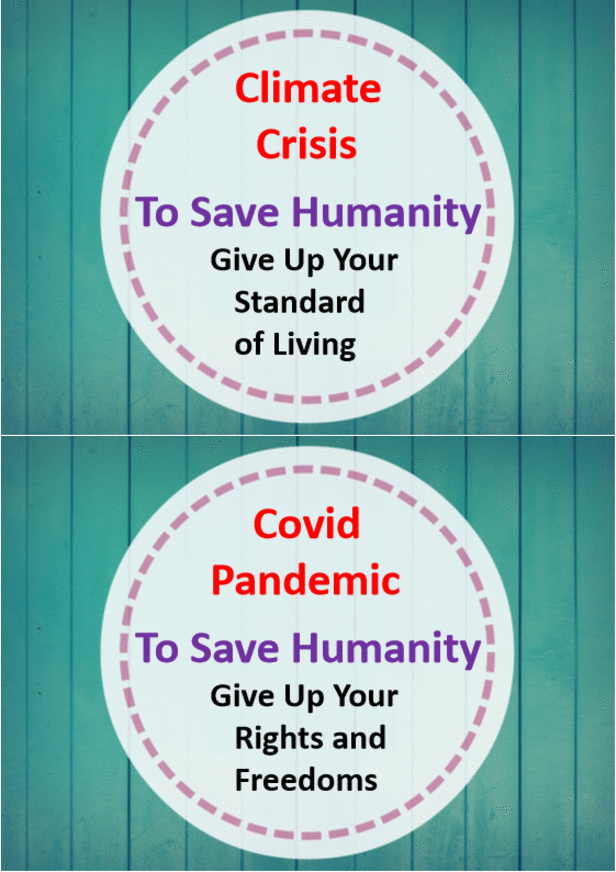
All true believers of The Science™ of climate change have taken careful note of the lessons offered by the coronavirus pandemic during 2020–22 for managing the ‘climate emergency.’ The two agendas share nine items in common that should leave us worried, very worried.

1. Elites’ Hypocrisy

The first is the revolting spectacle of the hypocrisy of the exalted elites who preach to the deplorables the proper etiquette of abstinence to deal with the emergency, and their own insouciant exemption from a restrictive lifestyle. Most recently we witnessed the surreal spectacle of Britain’s Parliament interrogating disgraced former Prime Minister Boris Johnson on allegations that he serially broke the lockdown rules he had imposed on everyone else—but not questioning the anti-scientific stupidity of the rules themselves. Possibly the most notorious American example was California Governor Gavin Newsom and his cronies dining maskless in the appropriately named French Laundry restaurant at a time when this was verboten, being served by fully masked staff.
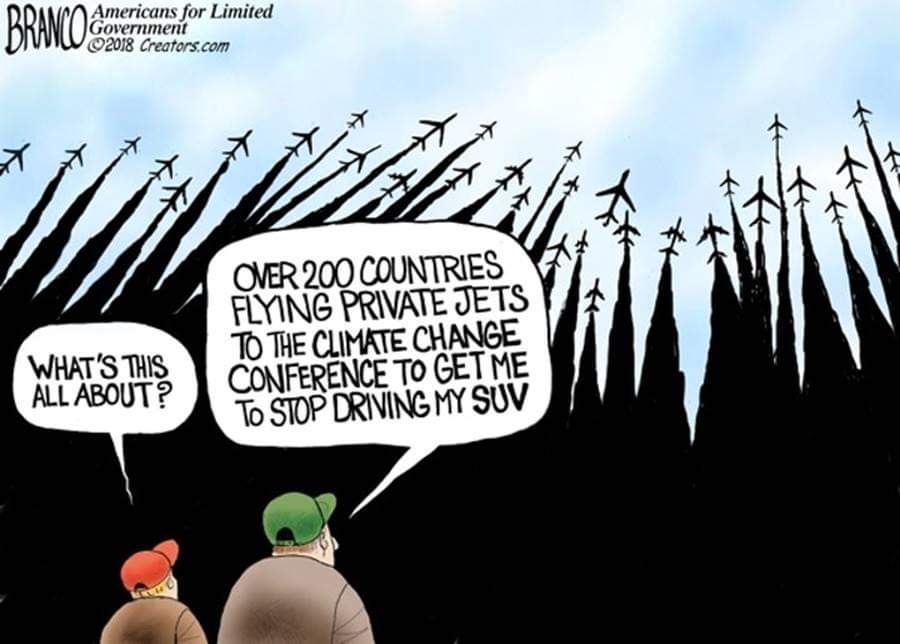
Similarly, Prince Harry, Meghan Markle, Al Gore, and John Kerry have all been widely mocked for jetting around the world to warn people about global warming. I wonder if anyone has done a calculation of the total carbon footprint of each annual Davos gathering where CEOs, prime ministers and presidents, and celebrities fly in on private jets, are driven around in gas-guzzling limousines and preach to us on the critical urgency of reducing emissions? I understand the hookers do quite well during that week, so perhaps there is a silver lining.

2. Data Challenged Models

A second common element between Covid and climate change is the mismatch between models that inform policy and data that contradict the models. The long track record of abysmally wrong catastrophist predictions on infectious diseases from the Pied Piper of Pandemic Porn, Professor Neil Ferguson, is if anything exceeded by the failures of climate change alarmist predictions. The most recent example of the drum roll of “The end is nigh and this is absolutely your last chance to avert the end of the world from climate collapse” is yet another Chicken Little Sixth Assessment Report from the indefatigable Intergovernmental Panel on Climate Change (IPCC).

At some point the IPCC morphed from a team of scientists into activists.

“There is a rapidly closing window of opportunity to secure a liveable and sustainable future for all,” the report warns us. UN Secretary-General Antonio Guterres called it a “survival guide for humanity.” But a one-time climate action journalist-turned-sceptic, Michael Shellenberger, described the UN as a “Climate Disinformation Threat Actor.”

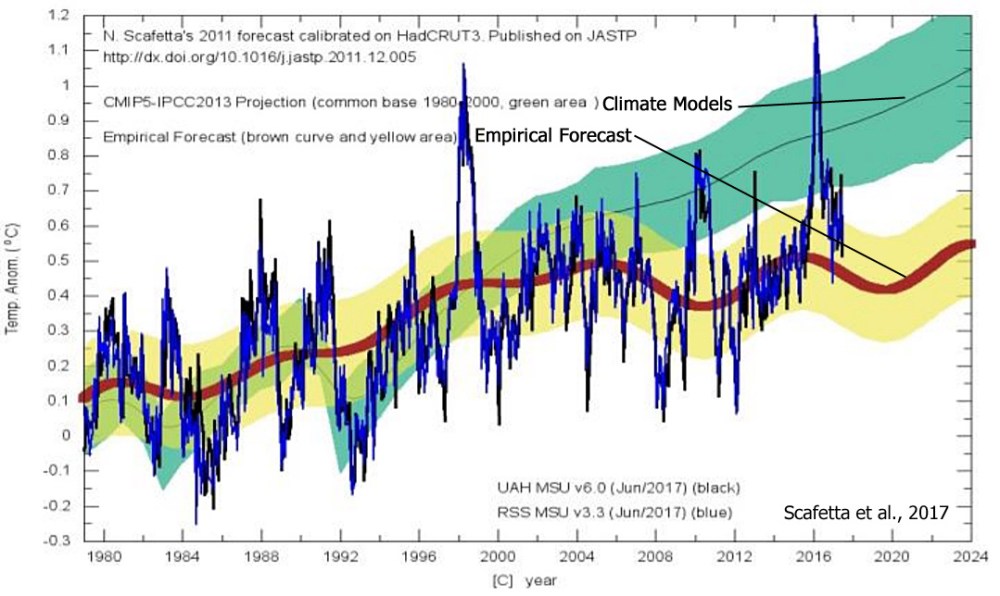
Calls for urgent climate action based on the language of “edging towards ‘tipping points” have been made over many years. Atmospheric scientists and former IPCC members Richard McNider and John Christy note that climate modeling forecasts have “always overstated the degree to which the Earth is warming compared with what we see in the real climate.” A few examples:

♦  In 1982, UNEP Executive Director Mostafa Tolba warned of an irreversible environmental catastrophe by 2000 without immediate urgent action.
♦  In 2004, a Pentagon report warned that by 2020, major European cities would be submerged by rising seas, Britain would be facing a Siberian climate and the world would be caught up in mega-droughts, famine and widespread rioting.
♦  In 2007, IPCC chair Rajendra Pachauri declared: “If there’s no action before 2012, that’s too late.”
♦  Most hilariously, in Montana the Glacier National Park installed “Goodbye to the glaciers” plaques, warning: “Computer models indicate the glaciers will all be gone by the year 2020.” Come 2020, all 29 glaciers were still there but the signs were gone, taken down by embarrassed park authorities.

3. No Dissent Allowed

Third, the rapidly consolidating Censorship Industrial Complex covered both agendas until Elon Musk began releasing the Twitter Files to expose what was happening. This refers to the extraordinary censorship and suppression of dissenting voices, with extensive and possibly illegal collusion between governments and Big Tech—and, in the case of the pandemic, also Big Pharma and academia.

Even truth was no defence, for example with accounts of vaccine injuries, if their effect was to promote narrative scepticism. The social media Big Tech censored, suppressed, shadow banned and slapped labels of “false,” “misleading,” “lacking context” etc. to content at variance with the single source ministries of truth. “Fact-checking” was weaponized using fresh young graduates—with no training, skills or capacity to sift between authentic and junk science—to put such judgmental stamps on pronouncements from world-leading experts in their field.

4. We Want You to Panic

Fourth, an important explanation for the spread of Covid and climate catastrophism is the promotion of fear and panic in the population as a means to spur drastic political action. Both agendas have been astonishingly successful.

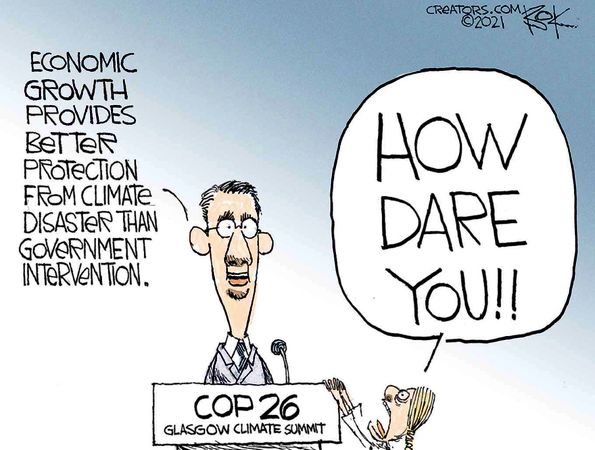
Polls have consistently shown the hugely exaggerated beliefs about the scale of the Covid threat. On climate change, the gap between the stringent actions required, the commitments made and the actual record thus far is used to create panic. The notion that we are already doomed promotes a culture of hopelessness and despair best epitomized by Greta Thunberg’s anguished cry: “How dare you” steal my dreams and childhood with empty words.”

5. Only Trust Science Authorities

A fifth common theme is the appeal to scientific authority. For this to work, scientific consensus is crucial. Yet, driven by intellectual curiosity, questioning existing knowledge is the very essence of the scientific enterprise. For the claim to scientific consensus to be broadly accepted, therefore, supporting evidence must be exaggerated, contrary evidence discredited, sceptical voices stilled and dissenters ridiculed and marginalized. This has happened in both agendas: just ask Jay Bhattacharya on one and Bjorn Lomborg on the other.

6. Government Empowers Itself

A sixth shared element is the enormous expansion of powers for the nanny state that bosses citizens and businesses because governments know best and can pick winners and losers. Growing state control over private activities is justified by being framed as minor and temporary inconveniences in the moral crusade to save Granny and the world.

Yet in both agendas, policy interventions have over-promised and under-delivered. The beneficial effects of interventions are exaggerated, optimistic forecasts are made and potential costs and downsides are discounted. Lockdowns were supposedly required for only 2-3 weeks to flatten the curve and vaccines, we were promised, would help us return to pre-Covid normalcy without being mandatory. Similarly, for decades we have been promised that renewables are getting less expensive and energy will get cheaper and more plentiful.

Yet increased subsidies are still needed, energy prices keep rising,
and energy supply gets less reliable and more intermittent.

7. Self-Inflicted Damage

Seventh, the moral framing has also been used to discount massive economic self-harm. Alongside the substantial and lasting economic damage caused by savage lockdowns to businesses and the long-term consequences of a massive printing of money, the obstinate persistence of excess deaths is painful proof of collective public health self-harm.

Similarly, the world has never been healthier, wealthier, better educated, and more connected than today. Energy intensity played a critical role in driving agricultural and industrial production that underpin the health infrastructure and comfortable living standards for large numbers of people worldwide. High income countries enjoy incomparably better health standards and outcomes because of their national wealth.

8. Elites Thrive at Others’ Expense

Eighth, government policies in both agendas have served to greatly widen economic inequalities within and among nations with fat profits for Big Pharma and rent-seeking Green Energy. A lot of money was said to be required to keep Mahatma Gandhi in the style of poverty he demanded. Similarly, a lot of money is required to support Covid and climate policy magical thinking where governments can solve all problems by throwing more money that must neither be earned nor repaid.

In the triumph of luxury politics, the costs of the rich suffused in the golden glow of virtue are borne by the poor. Should a billion more Chinese and Indians have stayed poor and destitute over the last four decades, so Westerners could feel virtuous-green? Alternatively, for post-industrial societies, climate action will require cutbacks to living standards as subsidies rise, power prices go up, reliability comes down and jobs are lost.

Attempts to assess the balance of costs and benefits of Covid and climate policies are shouted down as immoral and evil, putting profits before lives. But neither health nor climate policy can dictate economic, development, energy and other policies. All governments work to balance multiple competing policy priorities. What is the sweet spot that ensures reliable, affordable and clean energy security without big job losses? Or the sweet spot of affordable, accessible and efficient public health delivery that does not compromise the nation’s ability to educate its young, look after the elderly and vulnerable and ensure decent jobs and life opportunities for families?

9. Global Bureaucrats Gut National Sovereignty

The final common element is the subordination of state-based decision-making to international technocrats. This is best exemplified in the proliferation of the global climate change bureaucracies and the promise—threat?—of a new global pandemic treaty whose custodian will be a mighty World Health Organisation.

In both cases, the dedicated international bureaucracy will have a powerful
vested interest in ongoing climate crises and serially repeating pandemics.


CO2 Fluxes Not What IPCC Telling You

The latest rebuttal of IPCC CO2 hysteria comes from Peter Stallinga in his 2023 publication Residence Time vs. Adjustment Time of Carbon Dioxide in the Atmosphere.  Excerpts in italics with my bolds and added comments and images.

1. Introduction

One of the major points in discussion of the anthropogenic global warming (AGW) scenario is the time the added carbon dioxide (CO2) stays in the atmosphere. In an extensive study, Solomon concluded that the residence time of carbon atoms in the atmosphere is of the order of 10 years [1], see Table 1. Such a short time would undermine the prime tenet of AGW, since a molecule of CO2  will not have time to contribute to any greenhouse effect before it disappears to sinks where it cannot do any thermal harm.

However, some claim that the residence time (the amount of time a molecule on average spends in the atmosphere before it disappears from it) is not relevant for this discussion; what matters is the adjustment time (or relaxation time or (re)-equilibration time), the time it takes for a new equilibrium to establish, the time constant seen in the observed transient, and, allegedly, these two are different. In a recent work, Cawley explains it as [3]

natural fluxes into and out of the atmosphere are closely balanced and, hence, comparatively small anthropogenic fluxes can have a substantial effect on atmospheric concentrations.

In the current work, we use these exact two concepts, with turnover time called residence time. We also focus on first-order systems mentioned here by the IPCC. We discuss the difference between residence time on the one hand, and adjustment time on the other hand, and test the hypothesis that the adjustment time can be longer than the residence time by mathematical methods. After having addressed this core point, we perform a calculation based on the available data to see how they fit.

2. Residence Time and Adjustment Time (Methods, Data, Results and Analysis)

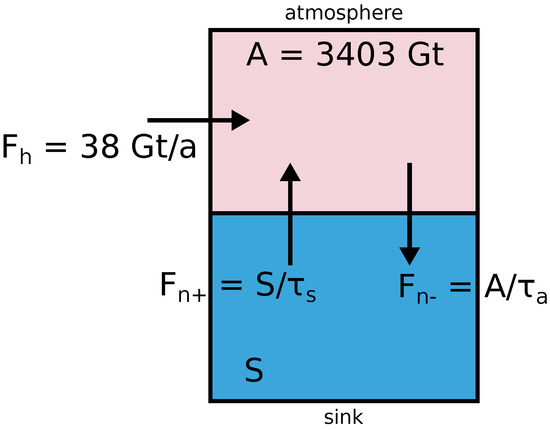
Figure 1. Two-box model of the carbon dioxide cycle. The top box represents the atmosphere, with a total carbon dioxide mass of 3403 Gt. Humans add 38 Gt per year to the system. Nature adds Fn+ and takes away Fn− to a sink represented by the bottom box. That sink has a total CO2 mass equal to S. The residence time in the atmosphere, τa is well known and estimated to be 5 years, the residence time in the sink τs is not well known.

In what follows, we will use a simple two-box first-order model, see Figure 1. The atmosphere has a mass of carbon dioxide equal to A. CO2 molecules can be captured into a sink and this occurs at a certain rate, a fraction of the molecules being trapped per time unit. Each individual molecule has a certain probability to be captured over time. In other words, a molecule has a residence time τa in the atmosphere (also sometimes called the ’turnover time’), which is the reciprocal of the rate, ka. Likewise, in the sink, there is a carbon dioxide mass equal to S, where molecules have a residence time τs; an individual molecule has a certain probability over time to be released by the sink into the atmosphere, or a rate ks.

Humans add an extra flux into the atmosphere labeled Fh. On the basis of this, we can determine the adjustment time τ of the atmosphere in terms of the residence times. This requires solving a simple mathematical differential equation; we do not have to worry at this moment about the thermodynamics and explain why the reaction constants are what they are. The questions we ask are, if we add an amount of carbon dioxide ΔA to it:

    • What are the new equilibrium values of A and S?
    • How long does it take to establish this new equilibrium?

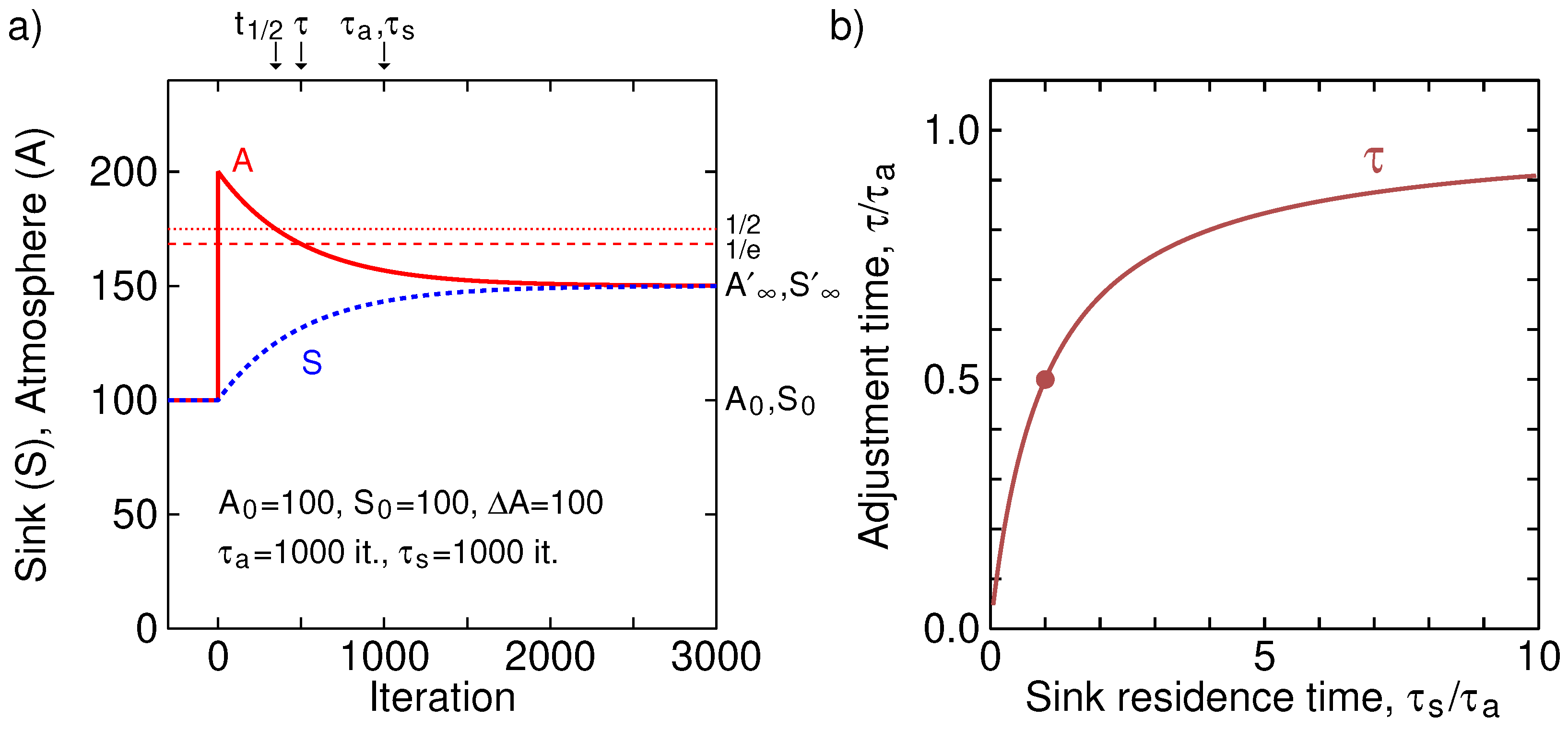
Figure 2. (a) A two-box simulation of atmosphere (A) and sink (S) of Figure 1.

Before injection of 100 into the atmosphere, the atmosphere-sink system was in equilibrium at 100 each, with the residence ‘times’ in both atmosphere and sink 1000 iterations. At each iteration A/τa is moved from atmosphere to sink and S/τs moved from sink to atmosphere. As can be seen, the observed adjustment time (relaxation time) of the system is 500 iterations, as predicted by Equation (9). After 500 iterations, the surplus quantity in the atmosphere relative to the new equilibrium has been reduced to 1/e, a level indicated by a horizontal dashed line. Further, a half-life can be defined, a time at which half of the transient amplitude has passed, t1/2=τln(2)= 347. This is indicated by a dotted line. (b) The adjustment time τ, as a function of the sink residence time τs, normalized by the atmospheric residence time τa. The dot indicates the value of the plot in (a), τs=τa, resulting in τ=τa/2 .

As can be seen, the adjustment time is shorter than the atmospheric residence time
for all values of the sink residence time, with, for large τs,
the adjustment time τ approaching the atmospheric residence time τa.

We, thus, refute the claim of the climate-skeptics-skeptics [skepticalscience.com] that:

“individual carbon dioxide molecules have a short life time of around 5 years in the atmosphere. However, when they leave the atmosphere, they are simply swapping places with carbon dioxide in the ocean. The final amount of extra CO2 that remains in the atmosphere stays there on a time scale of centuries.”

Their flawed reasoning is that the adjustment time (relaxation time) is the mass perturbation in the atmosphere divided by the flux balance, and, so goes the reasoning, while fluxes can be great (and the residence time short), the balance is close to zero and the relaxation time can then approach infinity.

3. Scenarios

We can now do a more detailed analysis based on the available data.

Table 2. Carbon dioxide facts, with the natural outflux Fn− derived from the mass in the atmosphere and the residence time. Other important parameters, influx Fn+, sink mass S, and sink residence time τs are less well known and should be considered adjustable.

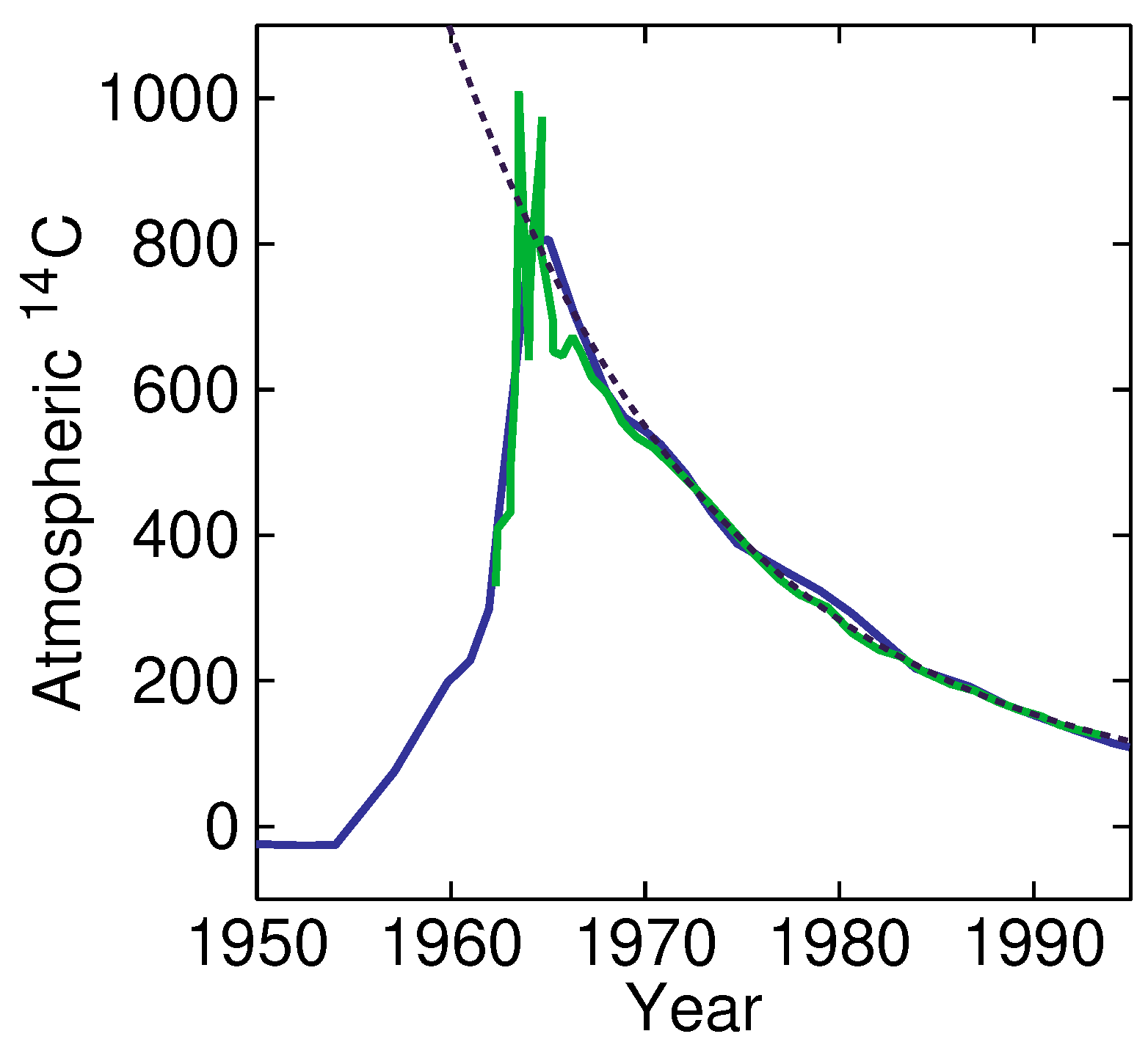
The residence time in the atmosphere can be estimated quite well from the above-ground atomic bomb tests [1], which makes us happy that these at least served the purpose of advancing atmospheric science, if nothing else. The best estimate is about τa= 5 years [9]. Other references mention different times, with the IPCC mentioning the shortest (4 years) in their 5th Assessment Report (p. 1457 of Ref. [4]), showing that this value is not settled yet; we will use 5 years in this work. The equilibrium amount of carbon dioxide in the atmosphere is open for debate, but, for this purpose, we might use the consensus value of 280 ppm (A∗= 2250 Gt). To estimate the amount of CO2 in the sink is very difficult. However, there seems to be a general view that it is fifty times more than in the atmosphere, S=50A=113,400 Gt (relatively unchanged since pre-industrial times). Using the combination of these values does not allow for consistent bookkeeping, as the reader can easily verify. Something has to yield. In what follows, we will try out some scenarios based on specific assumptions.

3.1. Scenario: Pre-Industrial Atmosphere Was at Equilibrium

First we assume that the pre-industrial level of 280 ppm was indeed an equilibrium value with influx equal to outflux in the absence of human flux, as we are wont to believe, but that the mass in the sink S and the residence time τs in the sink are unknown.

Figure 4. Above-ground atomic-bomb explosions produced a lot of 14 C that stopped in the 1960s. From a fit (dashed line) of data from 1965, we find an adjustment time of τ = 14.0 a, and an amplitude of ΔA = 740, with a final value of A′∞ = 30. This enables stating that the sink must be at least 24 times larger than the atmosphere. Data from Enting (blue) found in a work of Perruchoud [11] and Nydal et al. [10] (green), extracted with WebPlotDigitizer [12].

It seems that the idea of the pre-industrial level stable at 280 ppm (with Fn+=Fn−at 280 ppm) is untenable. It seems very likely that the sink was already off-balance and emitting amounts of carbon dioxide at the beginning of the industrial era and the increase in the atmospheric CO2 at any time in human history is not solely due to human activity. This would also explain the large pre-Mauna-Loa values found with chemical methods summarized by Beck [13] and Slocum [14]. For instance, values of 500 ppm have been observed around 1940. Ignoring these facts, on the other hand, would be equivalent to throwing entire generations of scientists under the bus.

[Comment:  CO2 higher concentrations prior to 20th century are also indicated by use of plant stomata as paleo proxies for CO2 estimations.]


3.2. Scenario: The Sink Is Fifty Times Larger Than the Atmosphere

Next, we adopt the assumption that the sink at this moment really has 50 times more carbon than the atmosphere, in other words, S=50A= 170,000 Gt, and release the restriction that the atmosphere was stable at 280 ppm; in pre-industrial times there can have been a flux imbalance.

We see indeed a tremendous outgassing from the sink in pre-industrial times. The system was far from equilibrium, with an imbalance being a net influx of F∗n+−F∗n−= 207 Gt/a. Where, at the moment, there is a net natural flux of 18 Gt/a out of the atmosphere, in pre-industrial times, in this two-box first-order model with a sink 50 times larger than the atmosphere, there was a net natural influx of 207 Gt/a.

Somewhere, we must have passed the equilibrium value and,
considering the above numbers,  this value must be
rather close to today’s concentration of 420 ppm.

3.3. Scenario: Residence Time in the Sink Is Much Larger Than in the Atmosphere

If we only assume that the residence time in the sink is much larger than in the atmosphere, τs≫τa, then we can get a good idea of what has happened to our anthropogenic contribution to the carbon in the atmosphere, Fh, based on the two-box model.

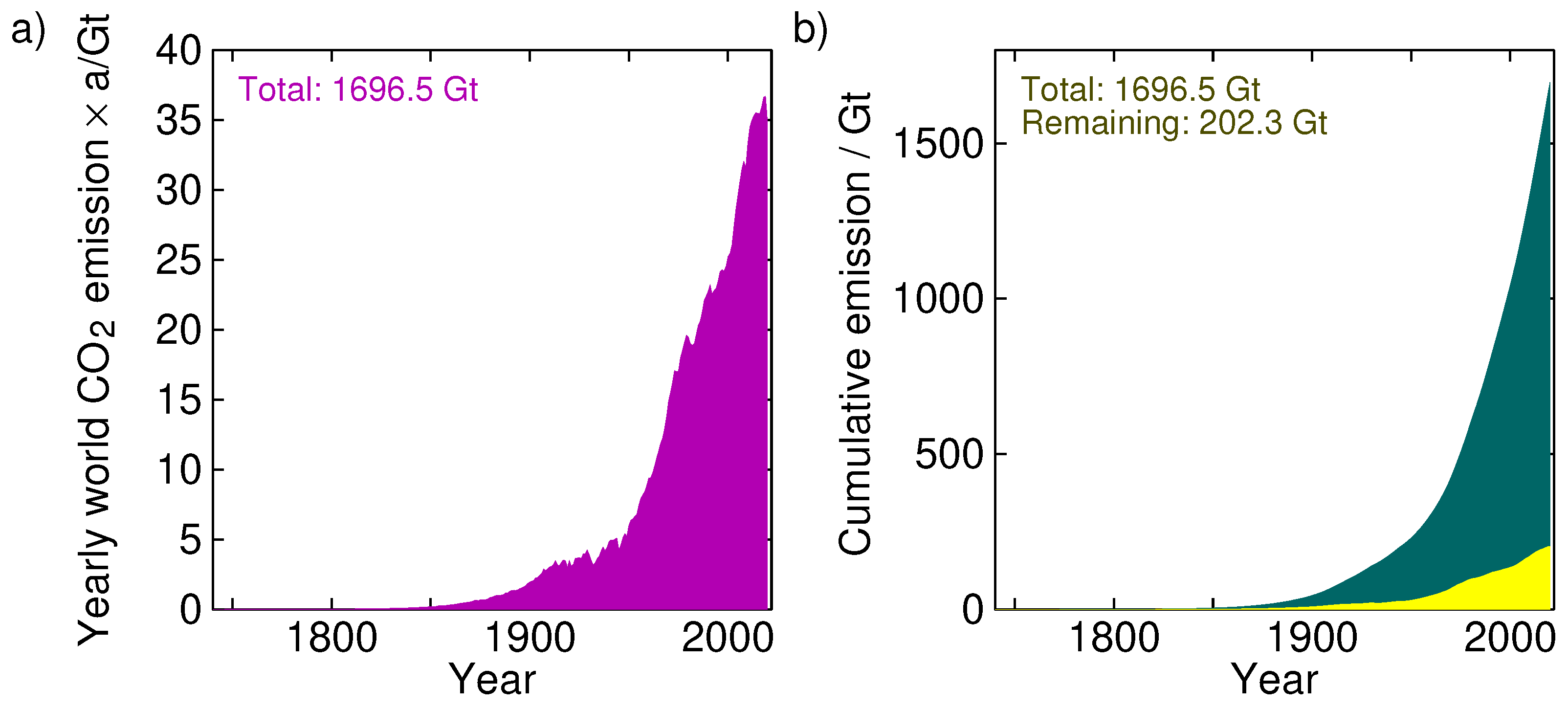
Figure 3. (a) Yearly global CO 2 emissions from fossil fuels. (b) Cumulative emissions (integral of left plot). The yellow curve is the remainder of the anthropogenic CO 2 in the atmosphere if we assume a residence time in the sink much longer than the 5-year residence time in the atmosphere; in this case τs=50τa was used. (Source of data: Our World In Data [8]).

Figure 3 shows the yearly carbon dioxide emissions into the atmosphere (left panel; data source: Our World In Data [8]). The total amount so far emitted is 1696.5 Gt. The right panel shows the cumulative emissions, ∑yeariFh(i). If at every year we apply the fluxes according to Equation (1), then we can see at each year how much of the anthropogenic CO2 is still in the atmosphere. The right panel of Figure 3 shows this for τs=50τa.

We see that only 202.3 Gt of the total injected 1696.5 Gt is still in the atmosphere.

In these years, the amount of CO2 in the atmosphere has risen from 280 ppm (2268 Gt) to 420 ppm (3403 Gt), an increment of 1135 Gt. Of these, 202.3 Gt (17.8%) would be attributable to humans and the rest, 932.7 Gt (82.2%), must be from natural sources.

In view of this, curbing carbon emissions seems rather fruitless;
even if we destroy the fossil-fuel-based economy (and human wealth with it),
we would only delay the inevitable natural scenario by a couple of years.

3.4. Scenario: Abandoning Constant Residence Times

We have seen here how the first-order-kinetics two-box model results in conclusions contrary to data. We could, of course, change our model. We could abandon the idea of first-order kinetics (where flux is proportional to mass), but that would be problematic to justify with physics.

We could also add more boxes to the system, distinguishing the sinks, or differentiating between deep ocean and shallow ocean, dissolved carbon dioxide gas, CO2 (aq), and dissolved organic carbon (sea-shells), or between CO2 disappearing in the oceans and being sequestered in biological matter on land, etc.

However, we expect the most likely improvement to the model to come from
abandoning the idea that the residence times τa and τs are constant.

They, in fact, are very much dependent on temperature. As an example, the ratio between the two that tells us the concentrations (and, thus, the masses) between carbon dioxide in the atmosphere and in the sink, if we assume this sink to be the oceans, is governed by Henry’s Law, and this concentration ratio is then dependent on temperature.

When including such effects, we might even conclude that the entire concentration of carbon dioxide in the atmosphere is fully governed by such environmental parameters and fully independent of human injections into the system. A is simply a function of many parameters, including the temperature T, but not Fh. It is as if the relaxation time is extremely short and any disturbances introduced by humans, or by other means, rapidly disappear, rapidly reaching the equilibrium determined by nature.

This fits very nicely with the recent finding that the stalling of the economy and the accompanying severe reduction in carbon emissions during the Covid pandemic had no visible impact on the dynamics of the atmosphere whatsoever [15]. The result of that research, the hypothesis that the carbon dioxide increments in the atmosphere were fully due to natural causes and not humans, fits the experimental data very well, and the hypothesis that humans are fully responsible for the increments can equally be rejected scientifically. This then also agrees with the conclusions of Segalstad that “The rising atmospheric CO2 is the outcome of rising temperature rather than vice versa” [16].

The pre-industrial atmosphere might indeed have been in equilibrium,
and we are currently also in, or close to, equilibrium.
That seems to us to be the most likely scenario.

Once we admit the possibility of non-anthropogenic sources of carbon dioxide, we can start finding out what they might be. Examples such as volcanic sources, planetary and solar cycles spring to mind. It might well be that the climate puzzle is solved in such areas as the link between solar activity and seismic activity and climate [17].

This is, however, not the focus of this work. We conclude here by summarizing the major findings of this analysis using a first-order-kinetics two-box model:

(1) The adjustment time is never larger than the residence time and is less than 5 years.

(2) The idea of the atmosphere being stable at 280 ppm in pre-industrial times is untenable.

(3) Nearly 90% of all anthropogenic carbon dioxide has already been removed from the atmosphere.

Footnote:  Human CO2 Emissions Flat Last Decade

Annual total global CO2 emissions – from fossil and land-use change – between 2000 and 2021 for both the 2020 and 2021 versions of the Global Carbon Project’s Global Carbon Budget. Shaded area shows the estimated one-sigma uncertainty for the 2021 budget. Data from the Global Carbon Project; chart by Carbon Brief using Highcharts.

Previously, the GCP data showed global CO2 emissions increasing by an average of 1.4 GtCO2 per year between 2011 and 2019 – prior to Covid-related emissions declines. The new revised dataset shows that global CO2 emissions were essentially flat – increasing by only 0.1GtCO2 per year from 2011 and 2019. When 2020 and 2021 are included, the new GCP data actually shows slightly declining global emissions over the past decade, though this should be treated with caution due to the temporary nature of Covid-related declines. Source: Global CO2 emissions have been flat for a decade, new data reveals

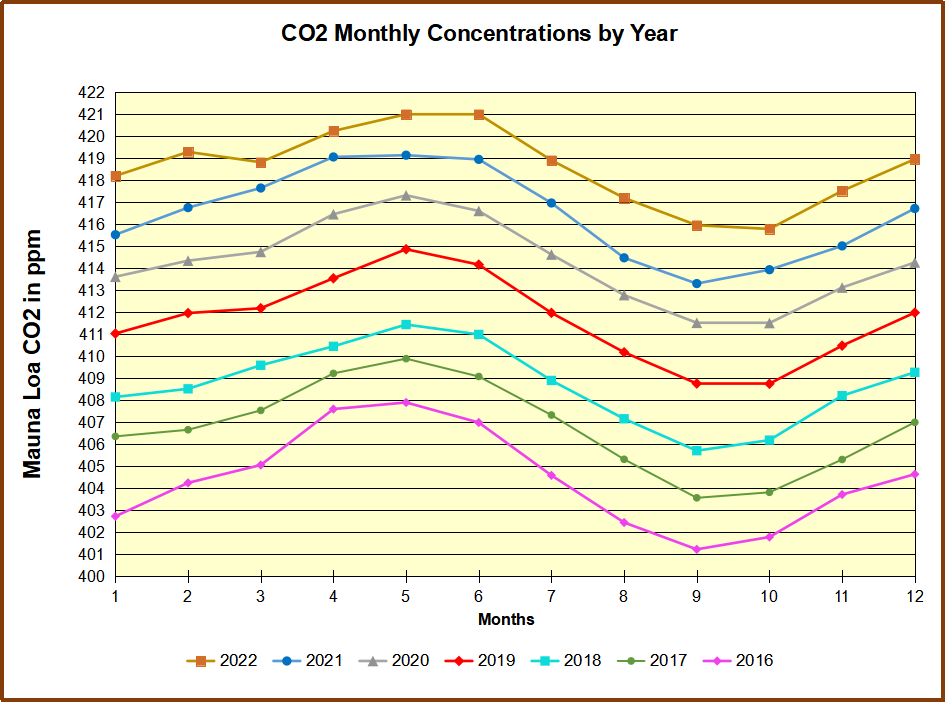
[Comment: Note the earlier chart above showing MLO atmospheric CO2 rising continuously while human emissions were flat.]

Great News! IPCC Final Warning Now!

OK, they’ve exaggerated before, so could be that “final” may not stick.  For anyone following climate science and politics, this is not their first rodeo (or circus, if you prefer.)  But we can hope for peace at last from the doomsters.  Chris Morrison goes into what’s unconvincing about this final warning in his Daily Sceptic article Latest UN Climate Doom Report Falsely Claims Global Temperatures Are “Highest for 125,000 Years”.  Excerpts in italics with my bolds and added images.

Doomsday had to be postponed for five months, but ‘pausing’ IPCC writers have finally delivered another ‘Net Zero or Else’ report highlighting increasingly improbable climate change scenarios. Every IPCC report ramps up the desperation, and this latest ‘Synthesis Report‘ known as SYR is long on opinions, attributions and modelled results, but somewhat shorter on actual scientific facts.

The latest document collates the IPCC’s sixth assessments reports (AR6) into a short format that was originally scheduled to ramp up fears ahead of last year’s COP27 meeting in Sharm el-Sheikh. But in May and June last year, the planet-saving authors seem to have gone on strike. A few details about the incident are referred to in recently published IPCC minutes, which record how attempts were made with the writers to “rebuild the trust required to have them end their pause in writing, and to engage in the SYR production process”. Not before time, since IPCC reports need to be agreed with large numbers of interested parties, including almost 200 member governments. ‘Settled’ science, it need hardly be added, demands a lot of happy and settled funders.

Disappearing Arctic Sea Ice

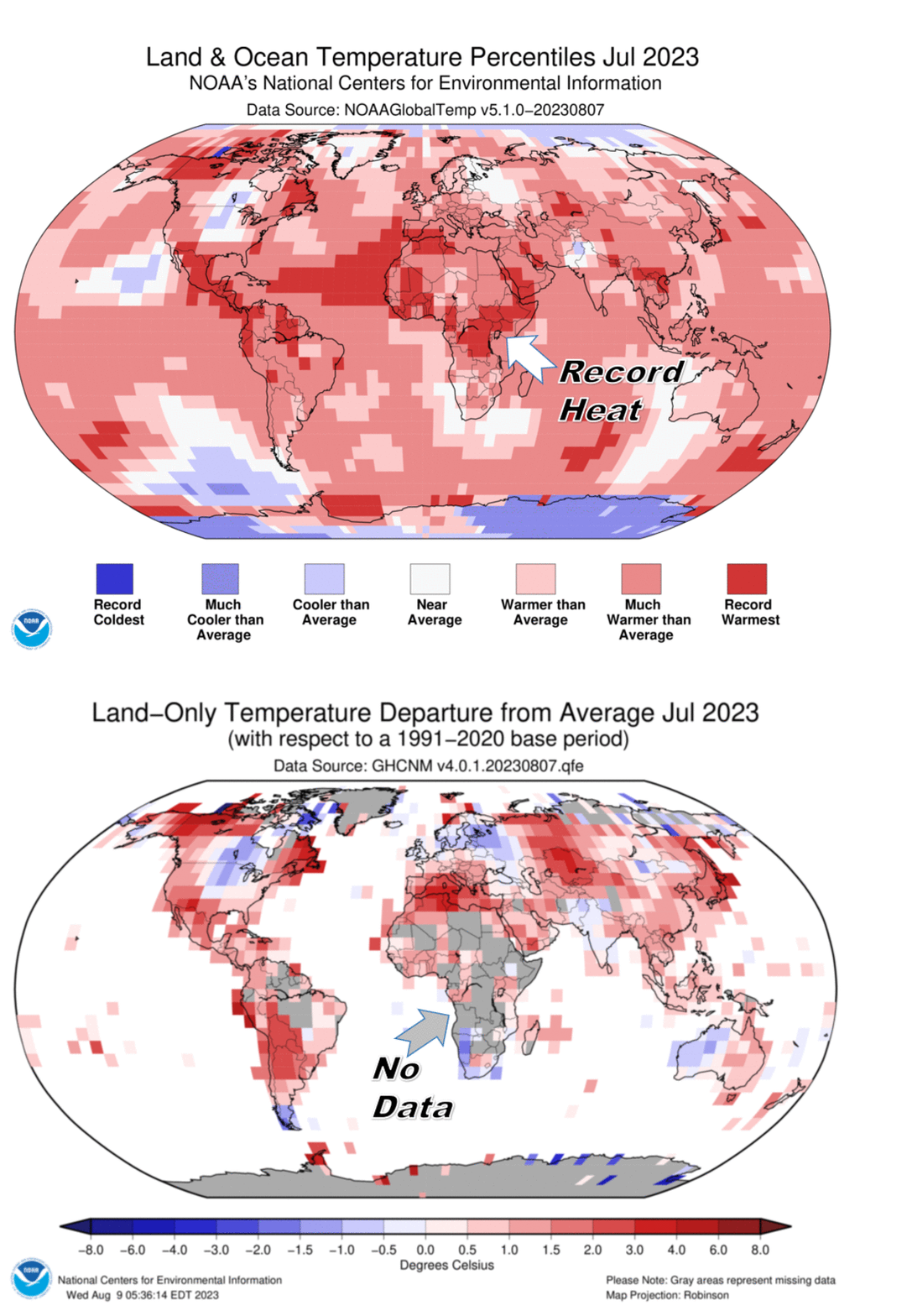
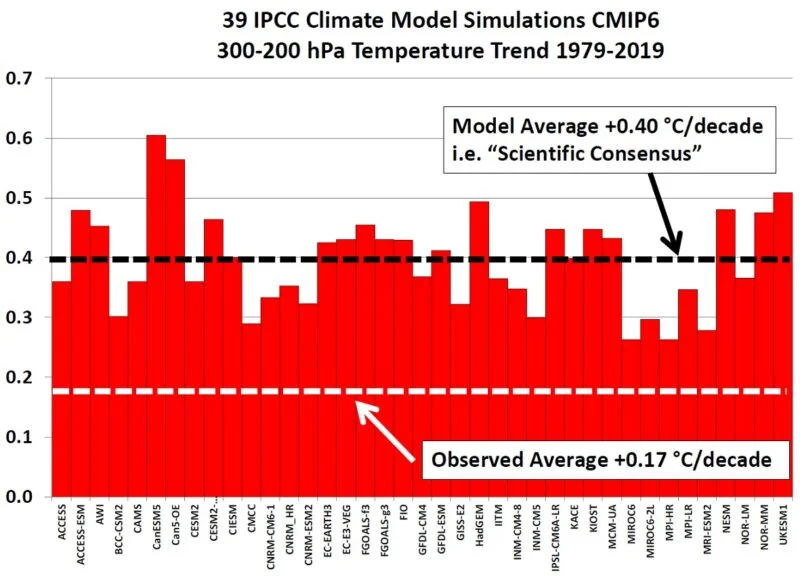
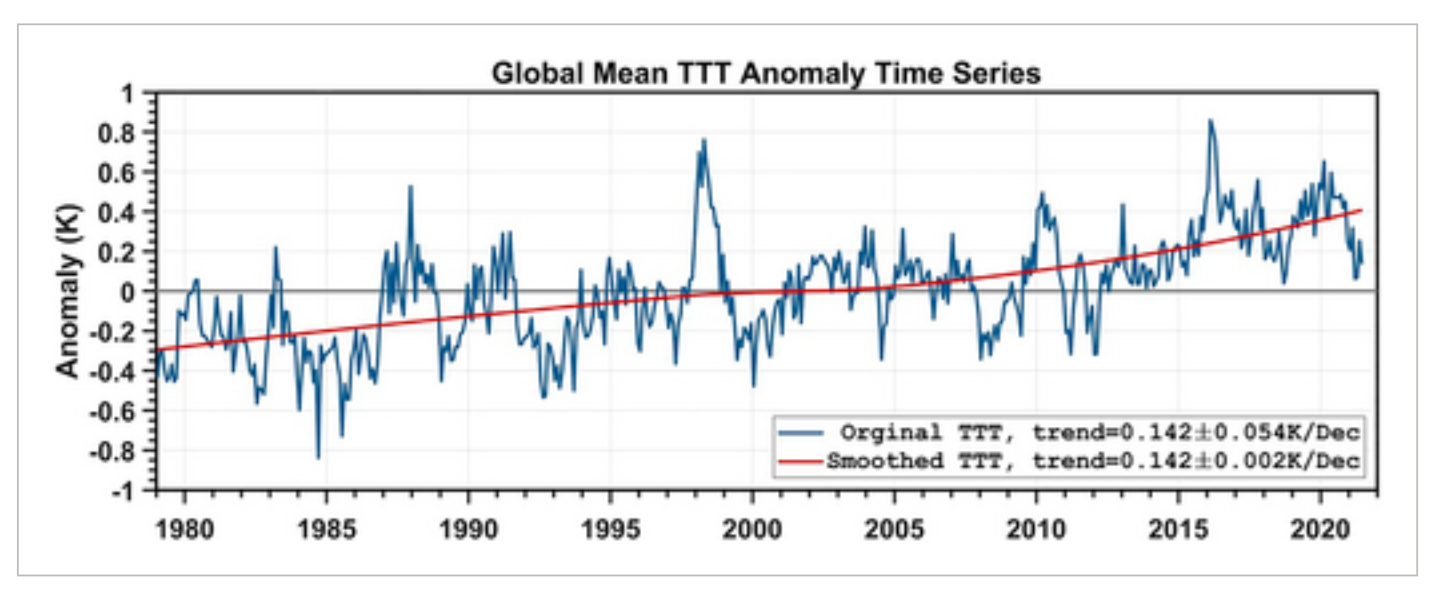
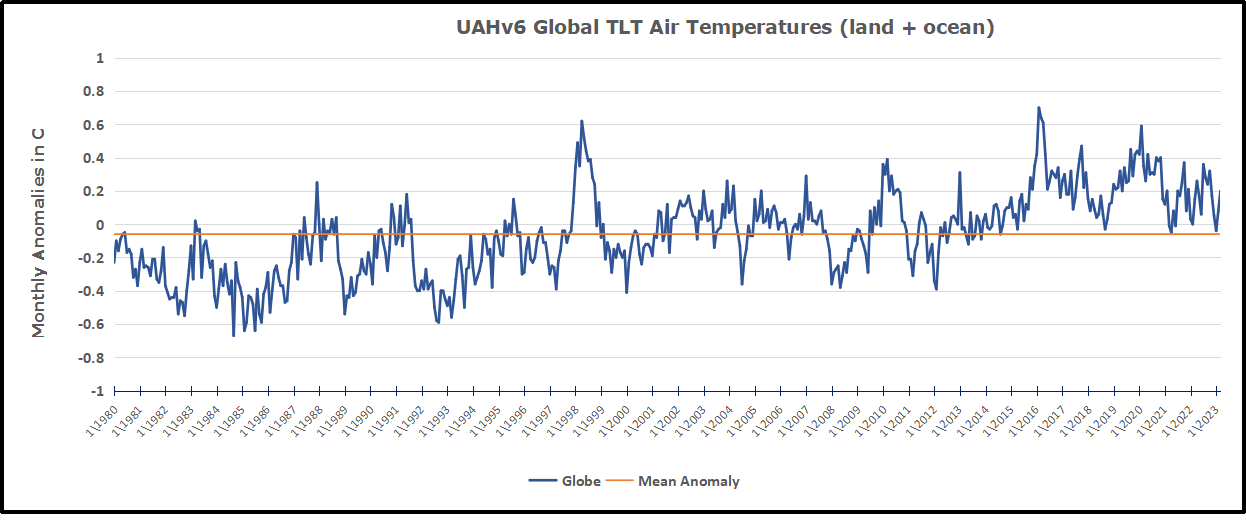
Current global temperatures are said by the IPCC to be the highest for 125,000 years, an astonishing claim given the many scientific surveys that show much higher temperatures in the recent past. It is also claimed that temperatures will rise by 0.4°C in around a decade, an interesting opinion, based presumably on surface records that can be retrospectively adjusted, but an unlikely scenario given global warming ran out of steam over two decades ago. By 2100, the IPCC says global warming could rise to 4.4°C, although things need to be moving on a bit smartish given barely 0.1°C warming in the first two decades of the century.

Satellite Global Warming Up and Down

There have been one or two concerns of late that the IPCC’s scare tactics have sent half the world doolally with climate fear, especially the impressionable young. These criticisms seem to have been taken on board. UN Secretary General Antonio ‘Code Red’ Guterres hailed SYR as a “survival guide to humanity”. All we need to do, continued the Left-wing Portuguese radical, is for all countries to bring forward their Net Zero plans by a decade. Dr. Friederike Otto from Imperial College specialises in so-called ‘attribution’ studies and the pseudoscience of claiming specific weather events are caused by the activities of humans. She helped write the latest report and was also in optimistic mood telling the BBC: “If we aim for 1.5°C and achieve 1.6°C, that is still much better than saying, it’s too late and we are doomed and I’m not even trying. And I think what this report shows very, very clearly is there is so much to win by trying.”

Extinctions Overblown

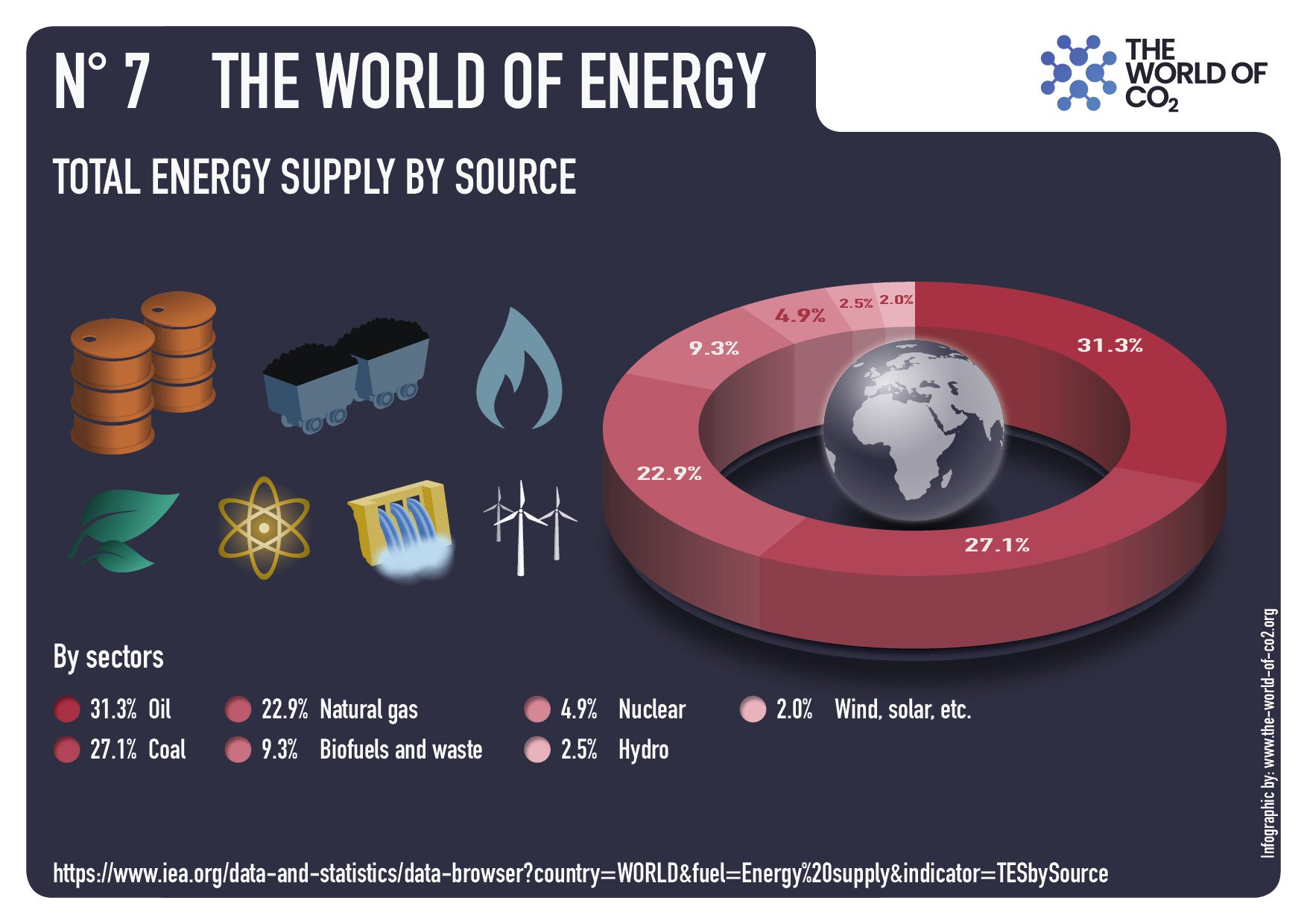
Back on Planet Reality, it might be noted that there are a number of possible disadvantages connected to removing fossil fuels, a reliable, inexpensive energy supply that powers 80% of global needs, within less than 17 years.

Starvation, death, widespread warfare, societal and economic breakdown and rampant disease being just a few that come immediately to mind.

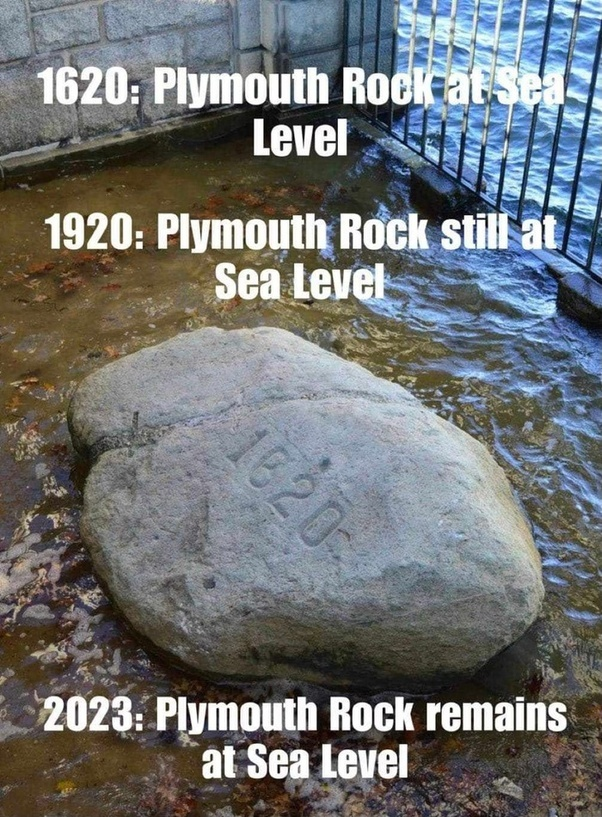
Coastal Flooding, Not

Traditional Landing Site of Mayflower Pilgrims.

It is not difficult to see why the IPCC continues to claim current global temperatures are the highest for 125,000 years, despite overwhelming scientific evidence that shows this is untrue. The rebound rise of about 1°C seen over the last 200 years is very small, and similar changes have obviously occurred countless times in the historical and paleo past, sometimes over even shorter time periods. It is difficult to worry too much about something that seems natural and in fact is beyond the control of humans. Placing the rise in the longer context of 125,000 years and adding all manner of invented weather event attribution and ‘tipping’ point stories adds some firepower to a political narrative ultimately designed to move society towards the collectivist Net Zero agenda.

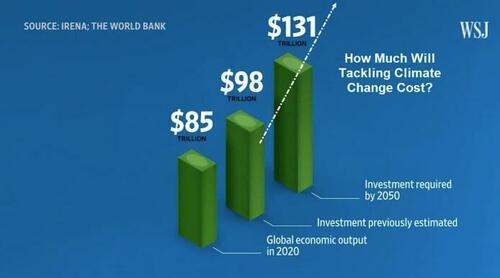
Net Zero:  Who Gains, Who Loses

The Daily Sceptic has reported on a number of science papers that track the higher temperatures in the past, in particular the period since the last ice age started to lift about 12,000 years ago. A sample can be read here, here and here.

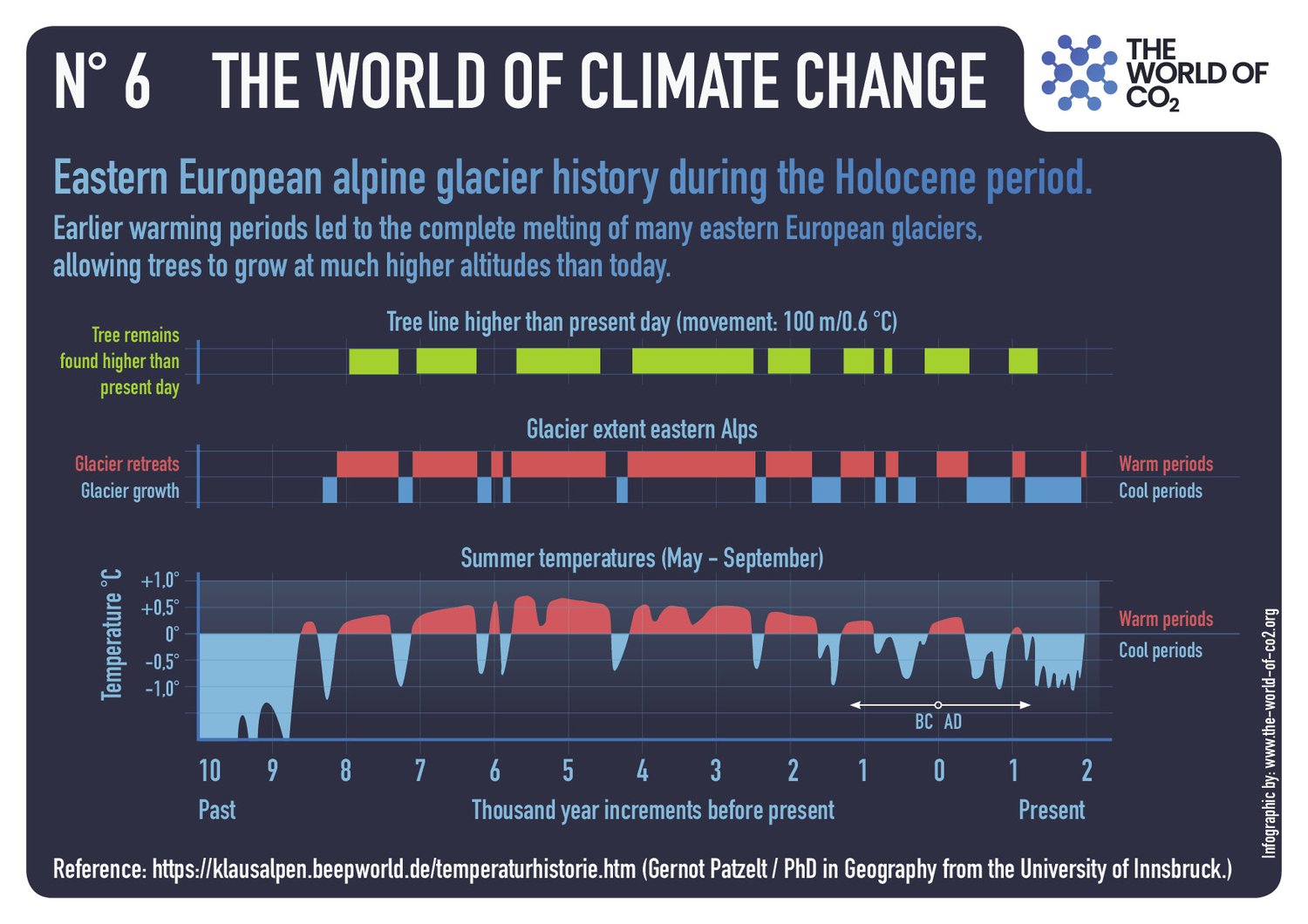
Earlier this year, a group of European scientists published a paper analysing tree remains that suggested there was a much warmer climate in the Alps during most of the last 10,000 years.

Adjusting Temperature Records.

‘Settled’ science, it might be observed, needs consensus from the world and his wife. The recent IPCC minutes, for instance, noted that the SYR team, “should ensure policy relevance and usefulness for policymakers”. Needless to say this is not to the taste of some independent-minded scientists, especially those retired with no need to hustle for state research or Left-wing foundation funds. In fact they can be quite disobliging about the entire IPCC process. In a recent paper titled ‘Challenging “Net Zero” with Science‘, Emeritus Professors William Happer and Richard Lindzen of Princeton and MIT respectively called Net Zero “scientifically invalid and a threat to the lives of billions of people”. In fact they have previously dismissed the peer review system around climate change as a “joke” – pal review, not peer review, they quipped. The IPCC is “government controlled and only issues government-dictated findings”.

Sketchy Warming Evidence

“Climate science is awash with manipulated data, which provides no reliable scientific evidence,” they added.

Footnote: So What Happens Next

As I said above, we’ve seen this show before.  Caleb Rossiter explains how it goes down:

For years I assigned statistics students to pick any apocalyptic climate claim in the media and trace it back through the UN reports to its genesis in a scientific study. I knew they would discover that these reports are not scientific documents based on the peer review process, but political documents “approved by governments” and intended to scare the public into supporting constraints on the production and use of energy.

A powerful publicity machine magnifies the alarm, bombarding citizens with exaggerations and claims of certainty that are proven wrong as you dig down to their underlying scientific studies:

  • Public figures, news editors, and commentators make claims that are more alarmist than what individual IPCC authors say at the release of the report.
  • Individual IPCC authors make claims at the release of the report that are more alarmist than what the official press release says.
  • The official press release makes claims that are more alarmist than what the report’s summary for policy-makers says.
  • The summary for policy-makers makes claims that are more alarmist than the various chapters of the reports.
  • The chapters of the report make claims that are more alarmist than the studies they reference in the footnotes.

More at

UN Horror Show

Why Are Climate Crisis Dissenters Labeled “Deniers”?

Renowned climate activist G. Thunberg: “People are suffering, people are dying. Entire ecosystems are collapsing. This is all wrong”.

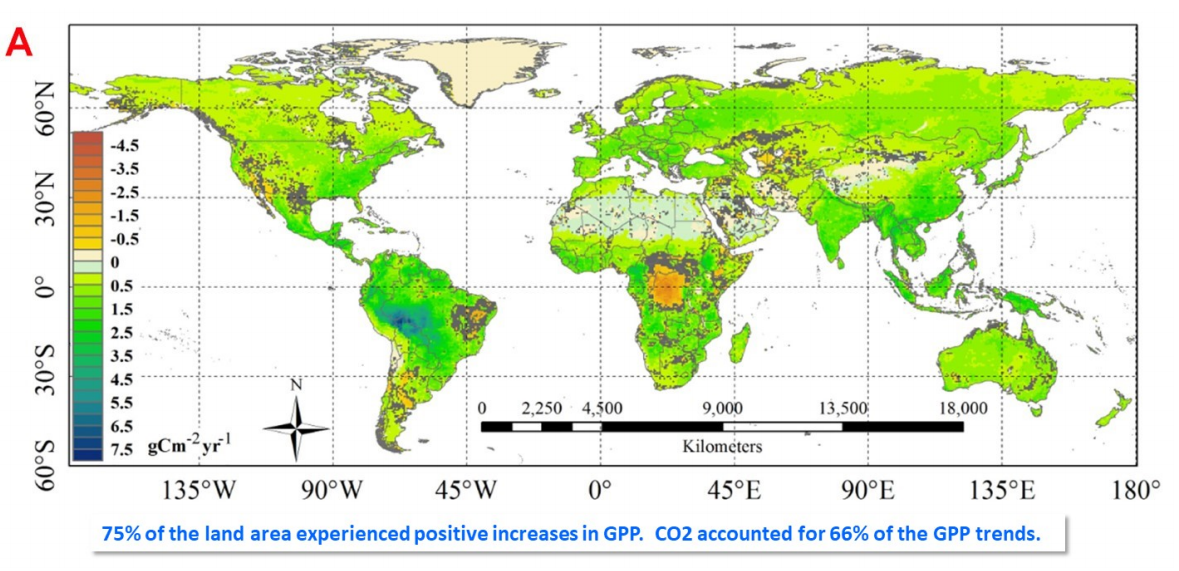
Accused climate denier J. Peterson: “One of the consequences of carbon dioxide overproduction is that paradoxically and contrary to all of the predictions of the environmentalists, the planet is now 15% greener than it was in the year 2000. That’s larger than the area of the United States, and it isn’t obvious to me that’s a bad thing… and it’s more than that, the most remarkable greening has occurred in semi-arid areas, and so the deserts are supposed to be expanding as the globalist globe warmed and the climate changed… yet the green has invaded semi-arid areas.”

Denier, denier, pants on fire? Call the phenomenon: Exaggeration for Action. Why? Because the political consensus is about action. It’s Consensus Fundamentalism that loves things black and white, and hates nuance. Because the lukewarmists and others like Peterson are upsetting the catastrophism that the mainstream Consensus Totalitarians need you to buy into. Because there are two kinds of modes: Thought and Action. They want action. I’d bet these Psychological Totalitarian Action Figures also need it personally, out of hidden fear of having their own suppressed doubts triggered.

So they fight back. They label challengers with something hugely ugly. The term Deniers lumps them together with Holocaust deniers. It doesn’t get uglier!

One prolific poster here calls these status quo name-callers Neoliberal Totalitarians. Whatever the name, totalitarian runs through. See if the following rings true.

The Totalitarians are of 2 categories. The first are run of the mill self-interested Monopolists, who know a good game when they see one. The second are the Ideologues, both Evil and the Misguided Do-Gooders. The evil ones seldom admit it, you have to read a lot and use your imagination. They love the sport of slavery and dominance, pure and simple. Call them Egoic Psychopaths. They live for the Power Pleasure of getting you to do unspeakable things to yourself, and the side-slapper is when you ask for more. Their curiosity is piqued by how wayward society will go. It’s perverse, it’s a tradition. Their methods are psychological and scientific. They do, because they can.

The Misguided Do-Gooders, which account for the vast majority,
actually believe they have the Solutions for the Greater Common Good.

But the Stupid People and the Democracy Delusion get in the way, even as they need to play Democracy, Transparency and Equity to win your trust. They thrive on fashionable buzzwords. Their gambit is to defer to the Experts for whom The Science Is Settled. Mostly it isn’t. Instead, the Science is weaponised. Their tactic is to get you to Trust while tweeking your Sensitivity and Guilt Buttons, resulting in Obedience and Compliance. They cannot admit their Infallibility. Ever. Because this reduces their Trust Quotient, which together with their Solemn Smiles they’ve staked everything on. So they double down. Into Tough Love and Pretzel Logic. They’ll eagerly jump through burning hoops of absurdity and hypocrisy forwards, backwards and sideways, even resort to Legalising Censorship and the Comeback of Shaming to keep up the Illusion.

If this last variant sounds like Justin Trudeau in Canada, the Dems in America,
and some Euro parliamentarians, you’re probably right.


How to Break the Climate Spell

Getty Images

Mark Imisides advises climate skeptics to reconsider how to dispute claims from climate believers in his Spectator Australia article Changing climate change: debunking the global colossus.  Excerpts in italics with my bolds and added images.

How is it that despite the scientific case for a climate apocalypse comprehensively collapsing some 20 years ago, we have seen a 16-year-old girl (at the time) being invited to address the United Nations, weeping children marching in our streets, and a federal election outcome in which this issue dominated the political landscape?

Where did we go wrong? And by ‘we’ I’m referring to those of us termed sceptics – people who understand the science, and the house of cards that comprises the notion of Anthropogenic Climate Change.

Put simply, we must learn the art of the polemic. The art of rhetoric. We must recognise that there’s no point in having evidence on our side if we don’t know how to use it.

We begin with this proposition. There is no case for reducing our carbon footprint unless all four of these statements are true:

  1. The world is warming.
  2. We are causing it.
  3. It’s a bad thing.
  4. We can do something about it.

No rational person can have any problem with this, and if they do, we need to find out why.

Here’s where we have to decide which of these points we want to contest. Remember, you only have to falsify one of them for the whole thing to collapse like a house of cards.

Most sceptics, in my view, pick the wrong fight. They do this by attempting to prosecute the case based on one of the first two points. This is a mistake.

Here’s why.

Arguments about whether the world is warming revolve around competing graphs: ‘My graph shows it’s warming. If your graph shows it isn’t, then it’s wrong – no it isn’t – yes it is – no it isn’t…’  This argument also looks at Urban Heat Island Effects, and examines manipulation of data by government agencies.  This is a poor approach to take because:

  • You’re never going to prove your graph is right.
  • You can be very easily and quickly discredited as a conspiracy theorist (Brian Cox did this to Malcolm Roberts on Q&A a few years ago). People just do not believe that government agencies would manipulate data.
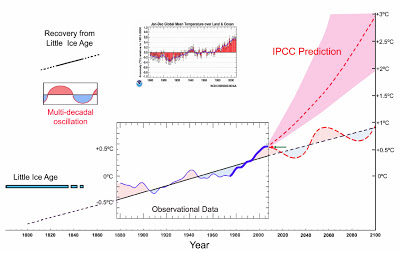
  • We should not fear a warming world. Records began at the end of the last ice age, so it’s only natural that the world is warming. And the current temperatures are well within historical averages.

Source: Syun-Ichi Akasofu, Two Natural Components of the Recent Climate Change: (1) The Recovery from the Little Ice Age (A Possible Cause of Global Warming) and (2) The Multi-decadal Oscillation (The Recent Halting of the Warming):

As for arguments about whether we are causing the warming, this is even more problematic. The various contributions to global temperatures are extremely complex, involving a deep understanding of atmospheric physics and thermodynamics. With a PhD in Chemistry, this is much closer to my area of expertise than Joe Public, but I am very quickly out of my depth. I recognise most of the terms and concepts involved, but know just enough to know how little I know.

Sadly, many people on both sides of the debate don’t understand how little they know, nor how complex the subject of atmospheric physics is, and it is nothing short of comical seeing two people debating about a subject of which both of them are blissfully ignorant.

The bottom line is this – they simply don’t change anyone’s minds – ever.

Having seen these arguments used for years, and having used them myself, I cannot point to a single person that has said, ‘Oh yes! I see it now…’ The whole point of arguing, or debating, is to change someone’s mind (including, at times, your own). If that isn’t happening, then it’s futile to continue with the same approach.

I think the reason both these approaches fail that most people do not believe that all these experts, and the government, can be wrong. You say the world isn’t warming? Oh, I’m sure you have the wrong graph. You say that CO2 is not responsible? Oh, I’m sure the government scientists know more than you do.

This then brings us to the third point. Why is a warmer world a bad thing?

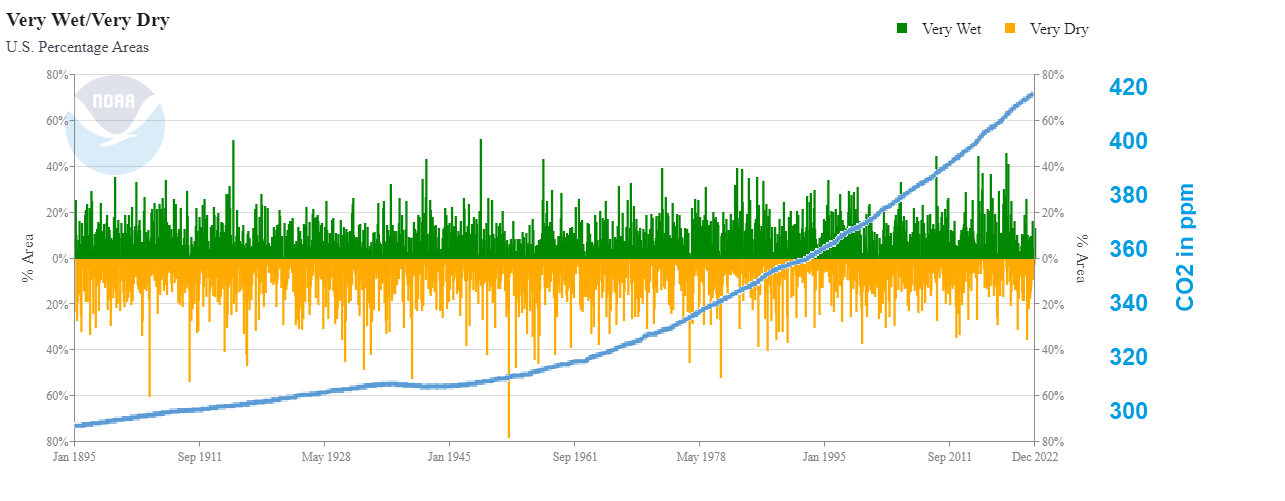
This is even more tempting than the first two points, as it’s so easy to prove that a warming world, so far from being a crisis, is actually a good thing. The reason for this is that, unlike with the first two points, they don’t have to look at a complex scientific argument. They just have to look at the weather. Are cyclones and hurricanes increasing? Are droughts increasing? Are flooding events increasing?

Regretfully, it is impossible to get people to even look at this. Even worse, they seem oblivious to the simple concept of cause and effect. We see this in that they simply can’t see that droughts and floods are opposites, and the same cause cannot produce exactly opposite effects. Astonishingly, they somehow think that charts that plot these extreme events are somehow manipulated, even when they come from a primary source such as the BOM, and that there really is a ‘climate crisis’.

Where does that leave us? Well, before we adopt Catweazle’s mantra of ‘nothing works’, there is one more point – point 4 (can we do anything about it?).

Most people will have seen the address of Konstantin Kisin at an Oxford Union debate, where he prosecuted this case to great effect. He pointed out, in simple terms, that as the UK only contributes 2 per cent to the global CO2 budget, anything they did will have negligible effect, and that global CO2 levels will be determined by people in Africa and Asia. He then pointed out that people in these countries ‘didn’t give a sh*t’ about climate change, as all they want to do is feed and clothe their children, and they don’t care how much CO2 that produces.

Finally, he pointed out that Xi Jinping knows that the way to ensure that he isn’t rolled in a revolution, as happened to so many other leaders in former communist regimes, is to ensure prosperity for the Chinese people. And indispensable to that goal is cheap, reliable, power, which is the reason that China is now building lots more coal-fired power plants – in 2021 alone they built 25 GW of capacity – equivalent to 25 x 1000MW plants.

By all accounts, his speech was well-received, with many people turning to his side. The beauty of prosecuting this case, as opposed to the other three, is that people don’t have to look at any evidence. They don’t even have to look at the weather.

The argument is at the same time simple, compelling, and irresistible. The question is this: will we see a major political party with the courage to take it on?

That part remains to be seen. But what is certain is this – the definition of insanity is doing the same thing and expecting different outcomes. If, for twenty years we’ve been telling people either that the world isn’t warming, or if it is we aren’t causing it, or if it is warmer but there’s no climate crisis, and not a single person has been persuaded by our arguments, then we have the brains of a tomato if we think anything is going to change.

Konstantin Kisin’s talk, and in particular the way it was received, fill me with hope that I haven’t had in years. It fills me with hope that if the case is prosecuted wisely, the climate change colossus can be brought to a grinding halt, politicians will unashamedly take on energy security as a political mantra, and the notion of climate change will at last be exposed as the unscientific, anti-human, regressive, apocalyptic cult that it is.


David Dilley: Signals of Global Cooling

Tom Nelson interviewed David Dilley last month and the video is above.  For those who prefer reading I provide below a transcript from the closed captions, along with the key exhibits from the presentation.

Synopsis: Between the two oceans cooling down and the natural global cooling cycle coming down we’re going to see a big dip in the temperatures worldwide during the next 10, 15 years. The cold cycle’s going to take about 20 years to bottom out. We’re going to be in an extremely cold period during that time, colder than the 1960s and 50s here in the United States. So it’s going to be very cold.

TN: I have David Dilly here, and David could you tell us a little bit about yourself?

DD: I’m a meteorologist, climatologist, for which I have about 52 years of experience, and I’m still trying to figure that out because I’m only 30 years old. But but I’ve been in the business a long time. I was a weather officer in the Air Force in the National Weather Service. Then I left to set up my own company called Global Weather Oscillations; the easiest way to remember it is global weather cycles.com.

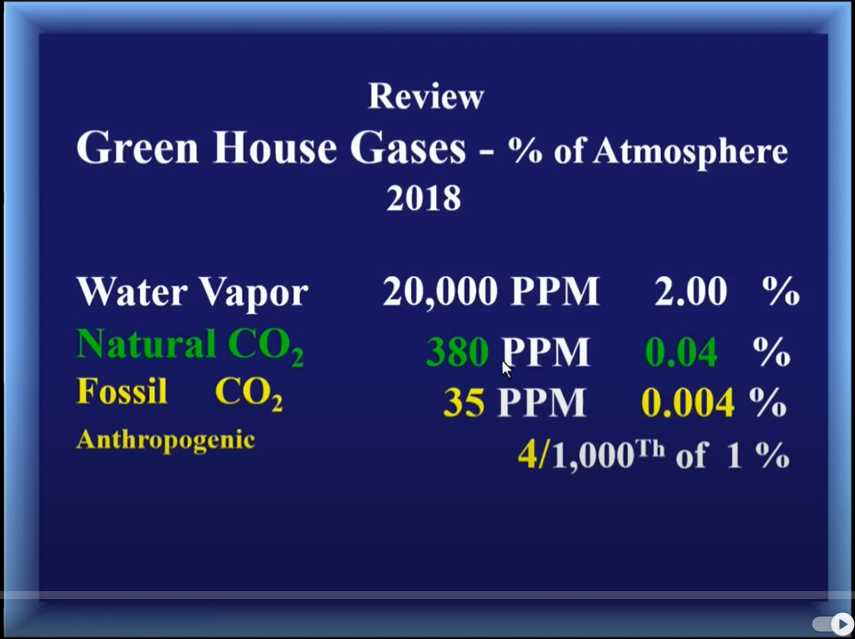
So we’re going to take a look today at something that NOAA is really talking about: the Carbon Dioxide and Climate Cycles. They’re just talking about today’s carbon dioxide values as far as the fossil fuel is concerned. You’re not going to see this out there anywhere on the web. It’s 78% of the atmospheric gases is nitrogen of all things, 21% is oxygen, 0.9 is argon that is 99.99 percent the atmospheric gases. That doesn’t leave much that’s just about all of what we call dry air. To be non-dry air includes the greenhouse gases. The greenhouse gases now are variable regarding how much of it is water vapor how much of it is carbon dioxide. Water vapor is anywhere from one to four percent of the atmospheric gases, that’s quite a bit. It can be zero percent of the Arctic and Antarctic because that’s a desert, but it can be all the way up to four percent. So one to four percent we’ll say.

Carbon dioxide of all things it’s a trace gas it’s less than .05%, a lot less than than water vapor. less than .05 now to put it in perspective, let’s just look at the greenhouse gases here and what we see is water vapor we’re gonna do the average of it two percent that’s 20 000 parts per million. Natural carbon dioxide what I’m going to show you later on in the presentation is 380 parts per million.

Now NOAA and the IPCC say it (natural CO2) is down around 285 parts per million,
we’re going to show you that’s false.

And so the natural is point zero four percent of the atmospheric gases, while fossil fuel I’m going to show you it’s only 35 parts per million; that’s point zero zero four percent or four one thousands of a one percent. And do you think that can cause climate change?

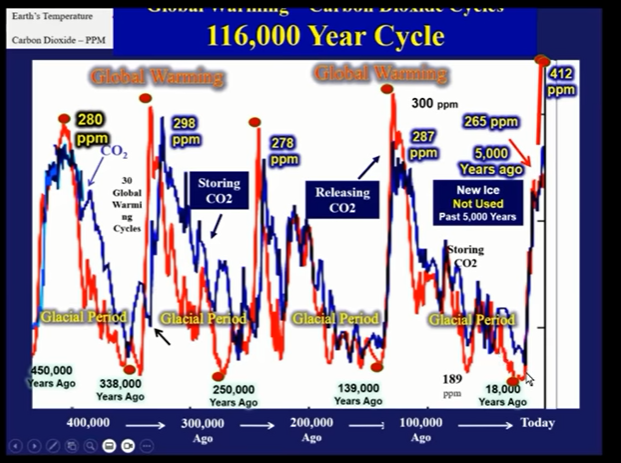
Of course not.  We go down to Vostok in the Antarctic and there is a very deep frozen lake where they drill down fifteen thousand eight five hundred and eighty eight feet down to the bottom. That’s a long ways down over 500 000 years. So I take core samples and with the core samples they figure out how how much it is carbon dioxide what the temperatures are. These are approximate, but what they they get from a core sample is a an estimate of the temperatures and carbon dioxide during the past 500 000 years.

If we go back say 450 000 years, the red line is temperature. So what happened, we came quickly just in a few thousand years out of a deep Ice Age into a interglacial warm period. You can see the temperatures really slid up and the ice cores estimate the carbon dioxide to be right around 280 parts per million. Then we slide down out of the warm period into a deep Ice Age and you can see that the carbon dioxide is actually staying up high there. If carbon dioxide caused global warming, why did the temperatures drop; it does not make sense.

Eventually the carbon dioxide goes down because it’s being absorbed by the oceans. The oceans keep absorbing it over the course of a hundred thousand years. Then when you come up on your next interglacial warm period 338 000 years ago, the temperature goes up and the carbon dioxide is released from the oceans back into the atmosphere. And you can see the carbon dioxide lags behind the temperature rise and actually when you hit the peak of the temperature back 338 000 years ago, the carbon dioxide does not Peak out until 7000 years later. It takes quite a while but carbon dioxide peaked out at 298 parts per million. But look at that temperature then dropping quickly into an ice age while carbon dioxide is at its peak.

That’s proof right there the carbon dioxide does not cause global warming.

As we come over on the right hand side of the graphic this is about 18 000 years ago. It’s 11 000 years ago we came out of the glacial period, we warmed up quickly, we got up to about to 190 parts per million.

Then we started to take records in Hawaii in the 1950s and the instruments there said: Wow, all of a sudden now we’re up to 412 parts per million. We’ve never been that high before.  This is what we’re going to investigate: what is going on with the glacial periods and also the core samples. This is a graphic of the carbon dioxide. The peak of The inter glacial warm periods is every 120 000 years ago we’re going back 800 000 years.

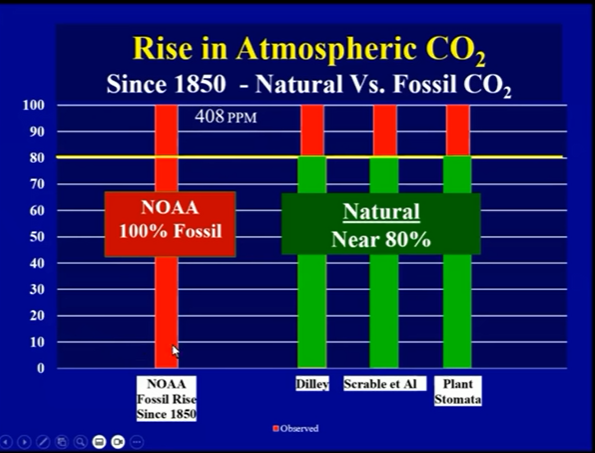
Now do we have other research that will confirm what I’m saying. This is about a year ago and they’ve been adding papers to it and this corrects NOAA’s calculations of the rise in carbon dioxide since 1850. It’s in a radiation safety Journal Health physics journal and this is the name of the paper itself. The authors are professors of radiological Sciences. They’re retired and that’s a big thing because if you’re not retired, if you’re at a university, you can’t do research like this because of federal grants and everything. You have to wait until you’re retired and then you can do real science when they were working they were at the department of physics at University of Massachusetts. It’s Kenneth Skrable, George Chabot, and Clayton French and here is what they found.

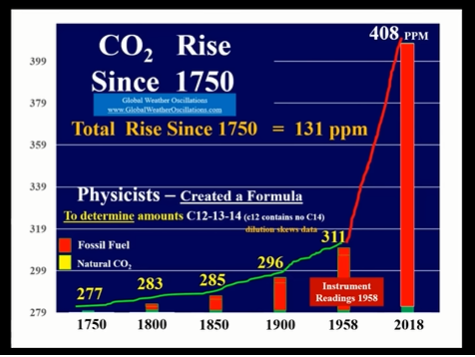
This is extremely important. Since 1850 the red here is saying the increase due to fossil fuel,  and they’re showing all of that is the increase due to fossil fuel. Now how do we determine that well up on a high mountain in Hawaii we have a infrared spectrometer since 1958 it’s been been taking measurements of atmospheric carbon dioxide. However three Isotopes of Carbon are 12, 13 and 14. and the spectrometer is taking the total of all three. It’s not separating what is natural from what is fossil fuel.

Because the ice core samples say we’ve never been above 300 parts per million
NOAA is assuming that the rise above 300 parts per million is all fossil fuel.

An assumption is all it is. It’s assumed by trying to take averages of how much CO2 is taken back in by the oceans how much of it is a given not from industry. Taking those assumptions some physicists made a formula to determine how much is fossil fuel and how much is natural going back all the way back to 1750. These red lines again are what NOAA says is the increase by fossil fuel.

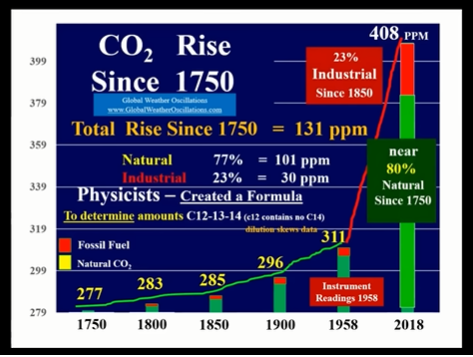
Well their formula separates the carbon 12, 13 and 14 to determine what is what and this is their findings as I switched everything over to green. Green is the natural increase in carbon dioxide all the way up to 1958. Now remember it’s a paper going back to 2018, but it says the increase has been from 280 parts per million up to 408 and NOAA says it is all from fossil fuel. This research paper says No, it is nearly 80% natural just like what I showed on my formulations, eighty percent natural, onlyabout 20% industrial. That’s not enough to cause climate change.

[Note: My synopsis of Skrable et al. is On CO2 Sources and Isotopes.]

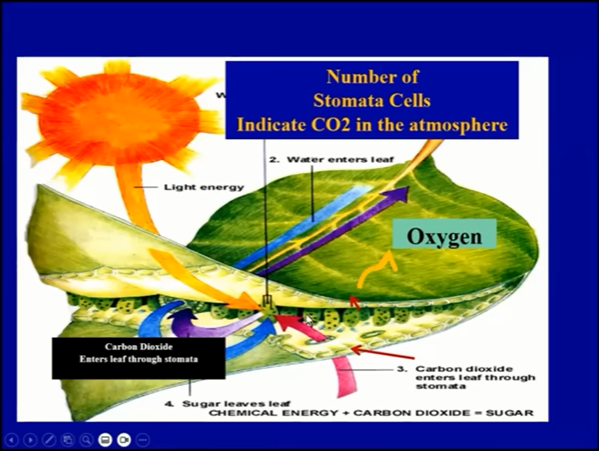
Now I’m going to show you one last paper that will also verify the findings and this is using a different method fossilized plant leaflets and as you can see in this picture there’s little cells in there they call these stomata cells which are like the lungs in a human being. So they look at the fossilized plant leaflets and unlike the ice core samples where you’re taking an average over one thousand or four thousand years, the fossilized plant leaflets can give you the exact year going back the past thousand years so you can determine each year what is going on.

So the stomata cells are like the lungs in a human being or in animals but he’d found that if the leaflet has a lot of stomata cells it means a lot less carbon dioxide in the air at that time. When CO2 is plentiful, plants don’t need more oxygen lung power to get the carbon dioxide; if it has fewer cells that means there was a lot of carbon dioxide in the air.

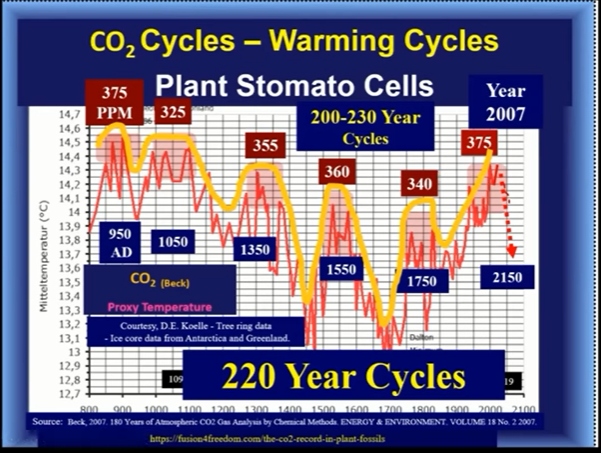
And the beautiful thing about plant life taking in carbon dioxide is the byproduct is oxygen which we drastically need. What the plant stomata cells show during the past 1200 years: back in 800 A.D it says we were way up to 375 parts per million natural carbon dioxide and then dipped way down to 325 in one thousand A.D. Then it dipped way down to 230 and it dipped up down, up down, up down up, down. In year 2010 it was up at 375 parts per million.

Let’s look at the plant stomata that could be pretty darn real and also if you take a mean value of the plant stomata over the course of a thousand years you come out 301 parts per million. The main value of ice cores over a thousand year period 297 parts per million really darn close to being the same as now. Let’s take the plant stomata readings of the atmospheric carbon dioxide and overlay it onto our global warming and cooling Cycles during the past 1200 years. We have had six global warming Cycles during the past 1200 years as noted here in the red. This is back around 850 A.D and then you can see it cools down then we warm up again, cool down warm up cool way down and so on for six global warming cycles. People don’t talk about that but we have had six of them.

When we overlay the plant stomata atmospheric carbon dioxide, guess what: We see a perfect fit. The high values in carbon dioxide peak on global warming cycles, so that brings a lot more credibility into the plants stomata cells for recording carbon dioxide.

So putting it all together we since 1850 NOAA and the IPCC say that the rise in atmospheric carbon dioxide is 100% due to fossil fuel and human activity. The three studies I just showed you and the corrections I made on the ice core samples all show it’s 80% natural rise. Far too little fossil fuel effects to cause climate change, it is almost all natural.

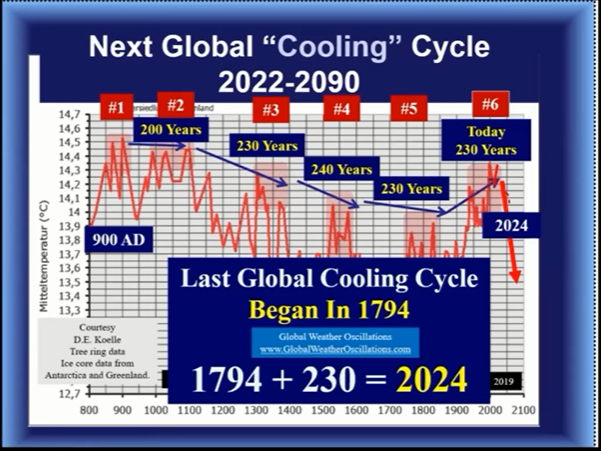
Here we are today over here on the right the average is a global cooling cycle comes about every 230 years and the global cooling cycles last for a good 100, 150 years. So here we are right now, average for the return of the global cooling cycle is 230 years and the last global cooling cycle began in 1794. Add 230 to that and you calculate the year 2024.

This is 2023. so we should be sliding into a global cooling cycle, a natural global cooling cycle.

And we have signals that it is beginning. Global warming Cycles begin in the Arctic and the Antarctic when they warm up over the course of 20, 30 years or so. And as the Arctic and Antarctic warm up there’s less cold air available through the mid-latitudes. So over time the mid-latitudes warm up so that’s where global warming spreads.

In the next phase, global cooling also begins at the Arctic and the Antarctic.

What has happened just this past year, the spring and summer in the Arctic was the coldest on record. You had that during a global warming period, so that’s a signal that the Arctic is drastically cooling down. In 2021 the Antarctic had the coldest winter on record. How you have two records like that if you’re not sliding into global cooling? There’s more cold air available and it’s going to cool down the mid-latitudes and that starts our global cooling cycle. And we’re coming into that right now. Winter 2020 was a third coldest January and February on record from Alaska through Central Northern Canada into Greenland.  Antarctica as I indicated winter of 2021 coldest on record. Arctic 2022 coldest spring and summer on record since 1958, and the most Arctic Ice extent in 8 to 16 years. 

The real main point is carbon dioxide increase is mainly natural, it is not causing a global warming cycle. It’s a natural global warming cycle and we’re sliding back into a natural global cooling cycle.

TN: If you had to make a prediction what would you think of the cooling between now and 2050. Do you think it will cool between now and 2050 are you fairly confident?

DD: Actually we’re going to see a pretty good cool down here into January. The whole atmospheric circulation is beginning to change the La Nina out in the Pacific is now fading it’s going to be gone here by mid to end of January, and we can see changes in the atmospheric circulation going on now.
The cold air in Canada is going to start making its way down more into the United States during late January.

For this year we do see the drastic change and what we’re going to see really well through 2050 or so. The IPCC and NOAA say that the oceans are going to rise anywhere from eight to 26 inches during that time period. I say it may rise an inch, maybe not even that much because we’re going into a global cooling cycle now. The poles are cooling down.

Pacific Ocean has phases going back to the year 1580. For past 500 years we’ve seen these warm phase and cold phase Cycles in the Pacific Ocean which last for anywhere from about 25 to 40 years. The Pacific has been in a 40-year warm cycle which ties the record going back uh 500 years. Pacific is sliding into a cold or a cool phase ocean water cycle, and that’s going to help to cool down ,especially up around Alaska. And the Atlantic Ocean will be going into a cool phase of its own right after 2030 or so.

Between the two oceans cooling down and the natural global cooling cycle coming in
we’re going to see a big dip in the temperatures worldwide during the next 10 to 15 years.

The global warming cycle took about a 20-year period to peek out warming from about the year 2000 up to about 2021 so it took 20 years to hit the peak; the cold cycle is going to take about 20 years to bottom out also at the coldest and that’s going to be around 2040 or so. Unitil the late 2030s so we’re going to be in an extremely cold period during that time, colder than the 1960s and 50s here in the United States.

TN: Is there any sort of a simple explanation as to what causes that 230 year cycle that you mentioned?

DD: The simple explanation is our glacial periods and interglatial periods become about every 120 000 years are due to the Earth path around the Sun; where the Earth swings out further away from the Sun and also the tilt of the earth also changes.

New data out is showing that we’ve actually been cooling down during the past five to six years. So this is all looking like we are already going gradually into a global cooling Cycle. But we’re going to see a more dramatic change in the cooling cycle.

What NOAA and IPCC are doing, their science is political science while we’re looking here today at real science. There’s a huge difference. Keep your eyes open the next few years and all of a sudden in a few years people are going to be saying: Wait a minute, what are we doing here? We’re down the wrong path we need to wake up.

Comment:

The underlying issue is the assumption that the future can only be warmer than the present. Once you accept the notion that CO2 makes the earth’s surface warmer (an unproven conjecture), then temperatures can only go higher since CO2 keeps rising. The present plateau in temperatures is inconvenient, but actual cooling would directly contradict the CO2 doctrine. Some excuses can be fabricated for a time, but an extended period of cooling undermines the whole global warming mantra.

It’s not a matter of fearing a new ice age. That will come eventually, according to our planet’s history, but the warning will come from increasing ice extent in the Northern Hemisphere. Presently infrastructures in many places are not ready to meet a return of 1950s weather, let alone something unprecedented.

Public policy must include preparations for cooling since that is the greater hazard. Cold harms the biosphere: plants, animals and humans. And it is expensive and energy intensive to protect life from the ravages of cold. Society can not afford to be in denial about the prospect of the current temperature plateau ending with cooling.

Background Post: By the Numbers: CO2 Mostly Natural

See Also: What If It’s Global Cooling, Not Warming?

Save the Children and Us All from Climate Grooming

Conclusion from Ben Pile’s Climate Resistance Video above:

Experts have used the authority of institutional science and medicine to convince people that a climate crisis is happening despite there being no scientific observational evidence for it. And this misuse of institutional authority has in turn been used to close down public democratic debate about far-reaching policy and to silence critics of the Green agenda. But computer simulations and hypothetical worlds are not reality and not evidence. They are science fiction and they are used to mislead people into believing that there is a climate crisis so that they may support radical climate policies.

(Question to then IPCC chairman Rajendra Pachauri) “What do you see as the next tools you could utilize to create change?
(Pachuri Response) “Children. I think we have to sensitize the young and tell them how their future is going to be affected if we don’t take action today. I think if we can get them to understand the seriousness of the problem they would probably shame adults into taking the right steps.”

Global warming and climate change are real, but climate policy is the far more real and more dangerous threat than climate change. The world has seen unprecedented progress in recent decades and much more needs to be done to eliminate problems such as poverty and disease. But by failing to confront green scare mongering, Global agencies, world leaders, politicians, scientists and the media have allowed a dark and dangerous ideology to fester. By causing a widespread ignorance of this progress which it now threatens to reverse, green scare mongering will turn the clock back for Humanity and civilization.

Ben Pile exposes how climate radicals are using media messaging to advance the climate crisis mass delusion in his substack article Behind the ‘climate crisis’ myth: green ideology.  Excerpts in italics with my bolds and added images.

The world is healthier, wealthier, and safer than it ever has been.
And most of this progress has been achieved in the era of global warming.
The green story does not add up.

In the eighties and nineties, Adherents of the precautionary principle argued that a hypothesis of a potentially civilisation-ending catastrophe merely needs to be plausible to be sufficient to compel action, and that the world cannot afford to wait for scientific knowledge to verify the threat with any certainty. This urgency was the basis of the Montreal Protocol on limiting ozone-depleting substances, and it was the hope of many greens that the same formulation could be used again to drive global agreements on climate change.

The problem for adherents of the precautionary principle is that, as is the case with all green ideologues’ prognostications, too much time passed without the events they were sure would befall us, undermining the original hypothesis. In the 1970s, before global warming had been invented, environmentalists proclaimed that civilisation stood on the brink of collapse. Limits to Growth and The Population Bomb were global best sellers, putting green politics at the top of the global political agenda, and cementing the end of post-war optimism with a terminally negative outlook that the West has not shaken off, despite the books’ manifest failures.

The precautionary principle (and many $billions of ersatz ‘philanthropic’ generosity) saved the greens and their ideological project the humiliation they deserved by adding an unending not-if-but-when caveat to their soothsaying. . . The precautionary principle is an article of faith, and work both ways when fully considered. Progress towards a global climate lockdown agreement has been slow in significant part because many countries have been unwilling to undermine the certain benefits of economic growth on the basis of uncertain speculation. The precautionary principle, has thus been of decreasing value towards advancing the climate agenda as time has passed.

There are only so many times even the most faithful are willing to climb the mountain
to wait for salvation from doom before doubt creeps in.

The new claim, intended to overcome the global climate policy agendas’ inertia, is that certainty has been achieved by science, and that scientists have shown that the world is in the grip of the very catastrophe that environmentalists had predicted: people are starving, diseases are rampant, storms, floods, wildfires and heatwaves kill thousands by the day, forcing millions from their homes and into poverty.

The problem, of course, is that it is not true. In every region of the world, and at every level of economic development, people are living healthier, wealthier, longer, and safer lives. In the few places where this trend of continued progress does not hold, other reasons better account for the failure than slightly different weather: failed states, corruption and conflict.

The problem for the green narrative then, as now, is that deaths from these diseases of poverty were falling, and have continued to fall, radically.

Between 2000 and 2019, the number of deaths from malaria in the world fell from 900 thousand to 560 thousand – given the world’s population increase, this is equivalent to a halving of the mortality rate. Over the same time, the number of deaths caused by diarrheal diseases fell from 2.4 million to 1.5 million. And deaths from malnutrition fell from 506 thousand to 212 thousand. What this means is not merely that there is no evidence of a climate crisis, there extremely good evidence of the opposite: humanity is thriving.

Many other metrics of human welfare bear out the same picture of reality. But try to explain this indubitable progress to the protestors who, on the words of UN chiefs, nonagenarian BBC voice-over artists and degenerate green ideologues of the Guardian and green blob, block roads and demand nothing less than the cancellation of industry and the economy and the immiseration of the entire world, to make certain that all of humanity’s development is undone. The good news provokes an angry and uncomprehending rage in green activists.

To compare the story of the climate crisis with the facts is
to betray one’s own children, country and world,
and to condemn future generations to an ‘unliveable planet’.

The facts and stats of the world are in contradiction to the ideological conception of nature held by the global green Great and Good and by the street-level environmentalists, but not the broader public. So what is this ideology, and how does it overwhelm its victims’ capacity for reason and facts?

As David Attenborough explains, it,

Our economies and political systems are unconsciously predicated on the belief that nature will continue to be a benign and regular provider of the conditions we need to thrive. […] Our stable and reliable planet no longer exists. The impacts of this destabilisation will profoundly impact every country on Earth.

We can know that this is a false belief, because it is a myth that nature has ever been anything but extremely hostile, rather than a benign ‘provider’. Hence, until the end of the 1880s, a quarter of all British children died before reaching their fifth birthday. In Germany, half of children did not survive that long. Globally, infant mortality was 22.4 per cent in 1950. In 2021, it was 3.7 per cent. The ‘planet’ is manifestly far less hostile to humanity than it was just a lifetime ago. And this is thanks to industries, to expanding access to markets, and to technological and scientific development – sheer artifice – not to Natural Providence. David Attenborough is as misled and misleading as he is a ‘national treasure’.

My Mind is Made Up, Don’t Confuse Me with the Facts. H/T Bjorn Lomborg, WUWT

“There’s only one world”, a girl explains to the interviewer. “If we destroy it all, then we have no other place to live”. “Right now, we are not acting”, adds her little friend. “We should act now.”

If the words of global climate technocrats, so earnestly spoken by such innocent faces
is not an abomination, then nothing is.

Tiny children’s view of the world and their own futures have been poisoned by an ideology that has no care for facts, much less the children and their prosperity. Their heads have been deliberately filled by the false idea of a ‘climate crisis’ in order to make them instruments of a political agenda, against their own interests, far before they are equipped to understand the claims they reproduce.

Society needs to confront green ideology urgently.
It is the greatest threat to our safety and prosperity.

Please watch and share our film: Why There Is No Climate Crisis (and why people believe that there is)

Reuters Editor Comes Clean About CO2 Hysteria

Neil Winton disavows his uncritically adopting global warming belief in his Daily Skeptic article:  Covering Climate Change for Reuters, I Thought CO2 to Blame for Rising Temperatures. I Was Wrong. Excerpts in italics with my bolds and added images.

If you wonder why much of the mainstream media seem united in accepting that the world will soon die unless humans don hair shirts, freeze in winter and walk instead of driving, you need to know about websites like Covering Climate Now (CCN).

Reuters and some of the biggest names in the news like Bloomberg, Agence France Presse, CBS News, and ABC News have signed up to support CCN, which brags that it is an unbiased seeker after the truth. But this claim won’t last long if you peer behind the façade. CCN may claim to be fair and balanced, but it not only won’t tolerate criticism, it brandishes the unethical ‘denier’ weapon with its nasty holocaust denier echoes. This seeks to demonise those who disagree with it by savaging personalities and denying a hearing, rather than using debate to establish its case.

CCN advises journalists to routinely add to stories about bad weather and flooding to suggest climate change is making these events more intense.

This is not an established fact, as a simple routine check would show.

I have a particular interest in Reuters’ attitude because I spent 32 years there as a reporter and editor. The global news agency’s traditional insistence on high standards in reporting makes this liaison with CCN seem questionable.

When Reuters announced its tie-up with CCN in 2019 it said this, among other things.

The (CCN) coalition, which includes more than 350 organisations [there are many more now] has no agenda beyond embracing science and fair coverage and publishing more climate change content.

That is clearly not true. It has a partisan agenda and encourages reporters
to dismiss those with contrary opinions as ‘deniers’.   

The involvement of Reuters in CCN seems to me to be in direct contradiction to three of its 10 Hallmarks of Reuters Journalism – Hold Accuracy Sacrosanct, Seek Fair Comment, Strive For Balance and Freedom From Bias.

When I became Reuters global Science and Technology Correspondent in the mid-1990s, the global warming story was top of my agenda. Already by then the BBC was scaring us saying we would all die unless humankind mended its selfish ways.

Carbon dioxide (CO2) was the culprit and had to be tamed, then eliminated.
I had no reason to think this wasn’t established fact. I was wrong.

My Reuters credentials meant that I had easy access to the world’s finest climate scientists. To my amazement, none of these would say categorically that the link between CO2 and global warming, now known as climate change, was a proven scientific fact. Some said human production of CO2 was a probable cause, others that it might make some contribution; some said CO2 had no role at all. Everybody agreed that the climate had warmed over the last 10,000 years as the ice age retreated, but most weren’t really sure why. The sun’s radiation, which changes over time, was a favoured culprit.

My reporting reflected the wide range of views, with Reuters typical “on the one hand this, on the other, that” style. But even then, the mainstream media seem to have run out of the energy required, and often lazily went along with the BBC’s faulty, opinionated thesis. It was too much trouble to make the point that the BBC’s conclusion was challenged by many impressive scientists.

Fast forward 20 years and firm proof CO2 was warming the climate still hasn’t been established, but politics has taken over. Sure, there are plenty of computer models with their hidden assumptions ‘proving’ man is guilty as charged, and the assumption that we had the power and knowledge to change the climate became embedded.

The Left had lost all of the economic arguments by the 1990s, and its activists eagerly grabbed the chance to say free markets and small government couldn’t save us from climate change; only government intervention could do that. Letting capitalism run free was a certain way to ensure the end of the planet; smart Lefties should take charge and save us from ourselves.

The debate about climate change is far from over. I’m not a scientist so I don’t know enough to say it’s all man-made or not. But politicians and lobbyists have decided that we are all guilty.

They are in the process of dismantling our way of life, ordering us to comply because it’s all for the future and our children. If we are going to give up our civilization, at the very least we ought to have an open debate. Journalists need to stand up and be counted. The trouble is that requires bravery and energy, and an urge to question conventional wisdom.

Reuters should be leading this movement. All it has to do is stand by its 10 Hallmarks. And maybe tell CCN thanks but no thanks; it needs to apply Reuters principles to its climate reporting.

See Also Global Warming Theory and the Tests It Fails

Politics Deep in the Thrall of Climate Change

Mark Imisides writes at Australia Spectator Politics deep in the thrall of climate change.  Excerpts in italics with my bolds and some added images.

The issue of Climate Change stormed across our TV screens at the recent federal election (Australia). Funded by a renewables investor, the Climate 200 candidates mopped up – taking eight seats from the major parties.

How did something that was considered a slightly oddball theory in the late 80s morph into a multiheaded monster that seems to have every world government, including ours, in its thrall?

By any measure, the Climate Change industry is huge. It’s quite common to hear people use the term ‘big oil’, but given that the Climate Change industry is now, at $1.5 trillion, rapidly catching up to the oil industry ($2.1 trillion), it’s entirely valid to use the term ‘big climate’. Andrew Urban recently pointed this out, with several cases of people that have cashed in big-time from Climate Change alarmism.

How did it get so big? How did it become the colossus that it now is? As it happens, there is a back story that few people outside of the scientific sector are aware of.

From Jo Nova in 2010 US$. In 2015 Climate Change Business Journal reported: “The $1.5 trillion global “climate change industry” grew at between 17 and 24 percent annually from 2005-2008” The $1.5-trillion price tag appears to exclude most of the Big Green environmentalism industry, a $13.4-billion-per-year business in the USA alone.

In simple terms, it was a perfect storm of four factors that all came together in the late 80s. As I was doing my PhD at the time, I got to see this firsthand. Very few people understand this process, largely because those outside the sector don’t know that science is just as prone as any other industry to the shifting sands of zeitgeist – trends that emerge that shape and mould how science is done, funded, and perceived.

These four factors were to revolutionise science, and although not all the changes were bad, their lasting legacy will be the entry of science into political discourse, the grubby touching of research funds by hands soiled by self-interest, greed, and corruption.

Revolutionary Factor 1:  Chernobyl Ended Science’s Golden Age

The first of these factors was the accident at Chernobyl in 1986. What? What on earth does Chernobyl have to do with climate change?

The answer is that there is no direct connection. It was, however, the final nail in the coffin of science’s golden age. Coming out of the second world war, science was seen as having the answers to all the world’s ills. It was seen as having won the war (largely due to the atomic bomb) and was the way of the future. This optimism is expressed beautifully in the film A Beautiful Mind where the incoming students at Princeton in 1948 are given a stirring lecture by the mathematician Hellinger of the future of science in the post-war world.

And so science flourished. Antibiotics became readily available, DNA was characterised, and the contraceptive pill introduced a new era of sexual freedom. The synthetic chemical industry also boomed, as did the nuclear power industry. We had wonder chemicals like DDT that eradicated malaria-carrying mosquitoes, aerosol fly sprays, and cheap reliable power thanks to the power of the atom.

But then, over time, mistakes happened, largely because environmental science, as a discipline, didn’t exist. Or, to put it another way, the world was seen as an infinitely-sized bucket into which chemicals could be poured, and the concept of man-made chemicals exerting any influence on the world in which we live just didn’t exist. It just never occurred to anyone.

But then reality began to impinge on this mindset. Amongst other things, the persistence of nonbiodegradable pesticides like DDT became a problem, CFC propellants threatened the ozone layer, and we had Sellafield and Three Mile Island. Neither of these two incidents actually killed anyone but they gave everyone an awful fright.

But Chernobyl was the last straw. Scientists, it seemed, couldn’t be trusted after all.
It was the China Syndrome for real.

Revolutionary Factor 2:  Global Recession Crashed Research Funding

This mistrust brought with it added scrutiny, and this coincided with the second factor in this list – the worldwide recession in the late 80s (as Paul Keating famously said, the recession we had to have).

The combination of the loss of trust in scientists with the fact that there wasn’t as much money to splash around as before, resulted in a massive change in the emphasis of scientific research. Before this time it was pretty easy to get funding for any pet project that you had, and you didn’t have to you justify it much in terms of its importance or relevance. But after this time, suddenly funds became much more difficult to get. To get funding, you had to prove the relevance of your research. You had to justify why it was important in terms practical outcomes.

In scientific terms, we could say that the emphasis switched
from pure research to applied research.

This change in emphasis had a dramatic effect on university faculties. Prior to this time if you went onto any campus you would find a science faculty that contained four departments – physics, chemistry, geology, and biology. When this change from pure to applied research happened, it hit the physics departments hardest. Of the four classic sciences, physics is the most fundamental, and the least applied. That is, it forms the basis on which knowledge in the other three disciplines are developed, but it is not as directly applicable to the real world.

And so, suddenly, people that were either physics academics or postgraduate students had very bleak career prospects. Consequently, from about this time physics departments began to disappear from university campuses, being subsumed into faculties with titles such as ‘Physical Sciences’ and so on. Suddenly, there were a lot of highly qualified physicists looking for work.

Revolutionary Factor 3:  Warming Replaced the Cooling Trend

The third factor that came into play at about this time was that the world had started warming again. It cooled from about 1940 until 1975, but by the late 80s a warming trend was emerging. And, as it happens, this fed right into Margaret Thatcher’s political agenda – the fourth and final factor in our list.

Revolutionary Factor 4:  Power Struggle Thatcher vs. Coal Unions

Thatcher had an awful problem with coal unions and wanted to break their power. She did this by approaching the Royal Society and essentially saying that she wanted to demonise coal and get people to use nuclear power, and there was money on the table if they could do that.

Thus, the IPCC was born, and every government department around the world
devoted to ‘climate science’ dates from about this time.

But who could they employ – the term ‘climate scientist’ didn’t exist. Well, as it happens, questions of heat transfer fall squarely into the lap of physicists, and, oh look, there are plenty of them looking for work. They had a precious job offer if they would just say the right things.

Thus, the discipline of ‘climate science’ was born, degrees were established, and people began selecting it as a career option from the undergraduate level.

Well, so far so good. When new scientific knowledge is revealed, new career paths, and even new language is established. For example, with the advent of electricity in the early 19th Century largely as a result of the efforts of Volta, the term ‘electrician’ was coined.

Climate Science Discredited Early On

But here is where the similarity between ‘climate science’ and other new technologies like electricity (or quantum mechanics or biogenetics) ends. In each of these latter cases, the science has developed from its infancy into a mature discipline, as research and enquiry revealed further information and deeper understandings.

With ‘climate science’, however, the very opposite happened. It was barely a decade old when it was comprehensively disproved, by two discrete mechanisms. That is, it was proven that the notion of CO2 warming the world had no scientific basis, and the computer models that predicted its influence were wrong.

The first of these was the absence of the ‘tropospheric hotspot’ that was predicted by the computer models. Anthony Watts has a very good, even-handed discussion of it on his website.

The second, and more significant study, resulted from a set of ice-core studies from Vladivostok in 1999, that showed that atmospheric CO2 concentration followed temperature changes, not the other way around.

As an Analytical Chemist, it was this second study that struck a chord with me. From the time I first saw Al Gore’s graph with overlaid temperature and CO2 charts, the first question I asked was, ‘How do they know which one is cause and which one is effect? Haven’t they ever heard of Henry’s Law?’

Henry’s Law, for the layman, relates the concentration of a compound in the aqueous phase to its concentration in the vapour phase above it. In simplest terms, the solubility of a gas in a liquid decreases with temperature. That is, the hotter a liquid gets, the less of the gas that can dissolve in it. So if the ocean was heating, it would release CO2 into the atmosphere, resulting in higher gaseous concentrations.

The question of which one is cause and which one is effect is determined simply by which one leads, and which one lags, and the Vladivostok ice cores showed that CO2 changes lagged behind temperature changes by about 10,000 years. Quod Erat Demonstrandum.

In other words, the Vladivostok ice core data comprehensively disproves the notion that man-made CO2 is heating the planet. A theory was advanced, accepted by many, but then disproven.

This has happened many times in science, and it is the very mechanism by which scientific knowledge is advanced.

Perhaps the most spectacular example of this is luminiferous ether theory. It was a theory that was spawned by a simple observation. It was observed that if an alarm clock was placed in a glass bell, and a vacuum was drawn, then when the alarm went off, no sound was evident, despite the fact that you could see the hammer striking the bells.

They concluded, correctly, that sound requires air to move through, but light didn’t. Why was the clock still visible in the vacuum? Why, the only explanation possible, it seemed, was that there was some other, as yet unknown, medium through which it moved. Thus, the luminiferous ether was proposed.

This was widely accepted, until Michelson and Morley sought to measure it, in 1887. They discovered, in simple terms, that it just wasn’t there. Thus, the theory was overturned, almost overnight. As it happens it took Michelson and Morley some time to realise the implication of their experiment, but when they did, the conclusion was inescapable – there was no luminiferous ether.

This led to further studies into the nature of light, and before long the photoelectric effect was discovered, and the passage of light through a vacuum was elegantly explained. Thus, the luminiferous ether theory has been consigned to the dustbin of history, along with phlogiston theory and a whole lot of other theories that seemed like a good idea at the time.

Anthropogenic Global Warming Escaped Scientific Death

Why hasn’t that happened to the notion of Anthropogenic Global Warming? Why, when it was discovered that CO2 concentration followed temperature, and not the other way around, didn’t people say ‘temperature is the dog, and CO2 is the tail’? Why, in 2023, is the tail wagging the dog?

The simple answer is that science is no longer driving the bus.

What is happening is the type of positive feedback loop that climate scientists talk about, despite the fact that these things are almost unheard of in the physical world. It is alive and well in politics.

It is always in a government’s interest to create a crisis. It is a well-known political phenomenon that people cling the incumbents in a crisis, and the governments go to great lengths to make people think that they are saving people from the crisis. Many people, for example, attribute John Howard’s success in the 2001 election to the Tampa Crisis, and George W Bush’s popularity shot up after 9/11.

The other side of this feedback loop is that if you are employed to investigate ‘climate change’, well, you’d jolly well better find it, or the government money will dry up.

So if the scientists say the right things, they get employment and ‘research’ funding. The greater the crisis they report on, the happier the government is, and the more money they get paid.

This is the reason that these ‘climate scientists’ avoid scrutiny. They don’t have to justify their research to an ARC or CRC committee. They don’t have to produce results for scrutiny, in order to justify their research. It’s already guaranteed, in perpetuity, with a blank cheque.

No scientist is going to say ‘there is no climate crisis’ or he will be out of a job, and no government is going to say ‘there is no climate crisis’ or they’ll be out on their ear.

Energy to be The Sacrificial Lamb Instead

The consequence of this is an energy crisis. People dying from the cold because they cannot pay their bills. Game shows in the UK now offer the payment of energy bills as a lucrative prize, and here in Australia we face the prospect of skyrocketing energy bills because of the comically inept Chris Bowen, and his massive uncosted plan to completely replace our electricity with renewables.

So what do we do about it? I think there is hope for sanity to return, but we have to prosecute the case in the right way.