Arctic Ice Usual June Swoon


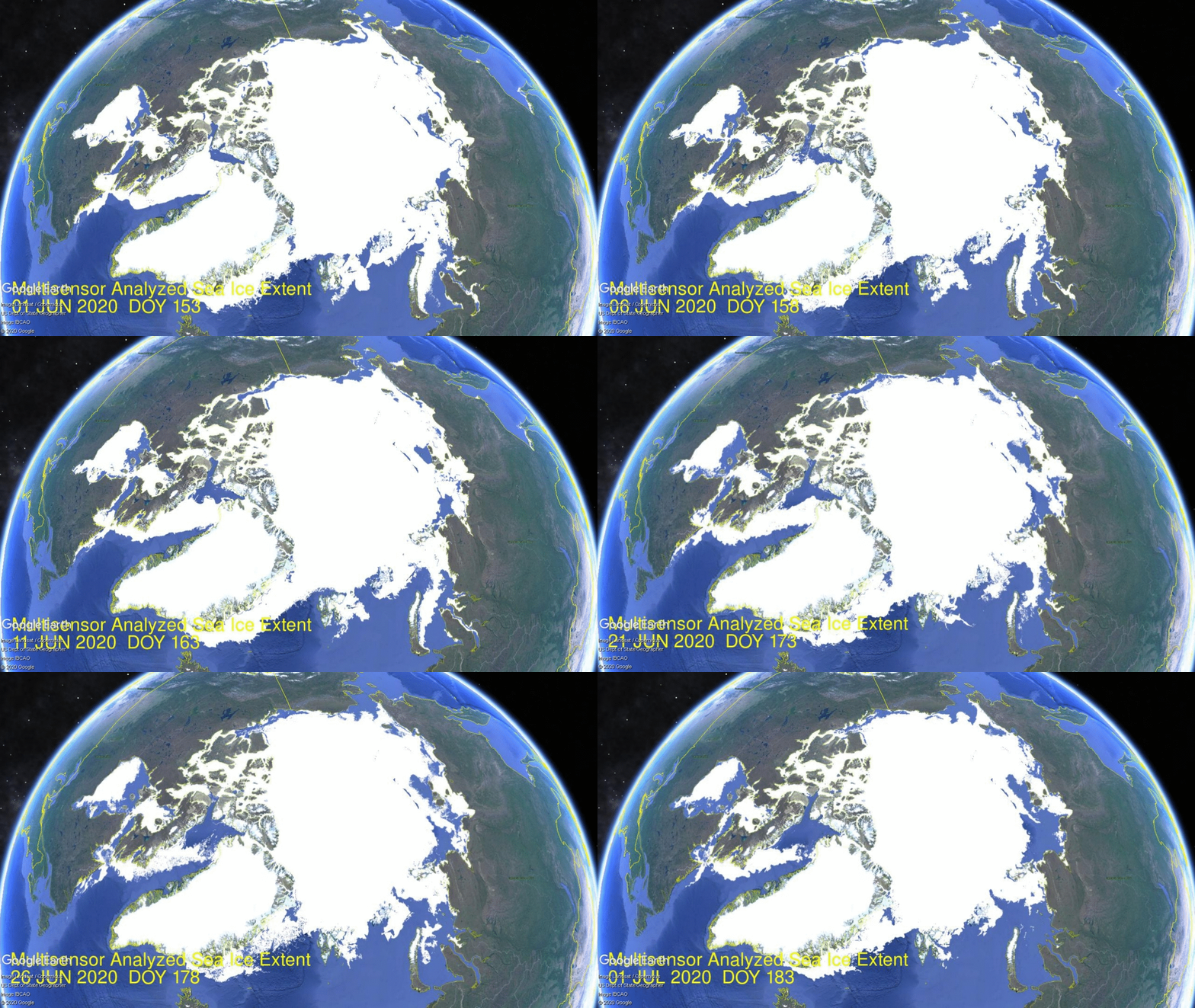
The image above shows melting of Arctic sea ice extent over the month of June 2020.  As usual the process of declining ice extent follows a LIFO pattern:  Last In First Out.  That is, the marginal seas are the last to freeze and the first to melt.  Thus at the top center and right of the image, the Pacific basins of Bering and Okohtsk seas lost what little ice they had.  Meanwhile at extreme left, Hudson Bay ice retreats 300k km2 from north to south.  Note center left Baffin Bay loses 320k km2 of ice during the month.  The most dramatic melting is in the Russian shelf seas at the center right.  Laptev and Kara Seas combined to lose 600k km2 of ice extent. The central mass of Arctic ice is intact with some fluctuations back and forth, and as well Greenland Sea and CAA (Canadian Arctic Archipelago) were slow to melt in June

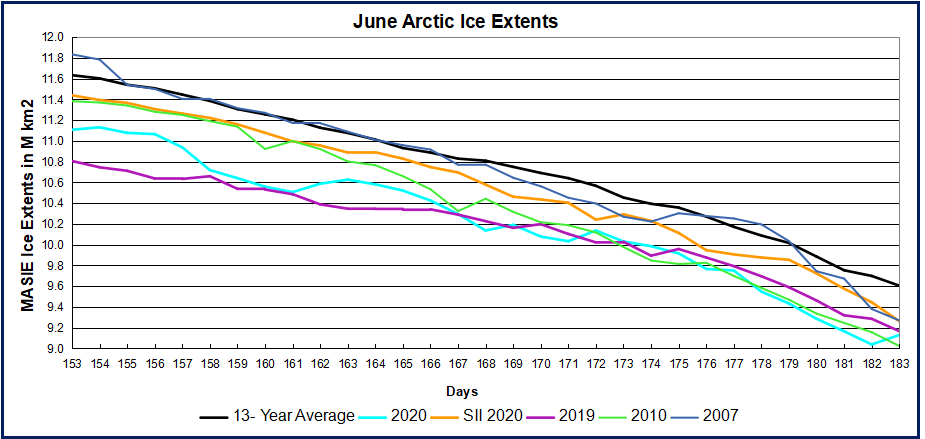
The graph below shows the ice extent retreating during June compared to some other years and the 13 year average (2007 to 2019 inclusive).

Note that the  MASIE NH ice extent 13 year average loses about 2M km2 during June, down to 9.6M km2. MASIE 2019 started nearly 500k km2 lower and lost ice at a similar rate, ending 476 km2 below average.  The most interesting thing was the wide divergence between SII and MASIE reports during June, SII starting the month about 500k km2 higher before narrowing at the end to exceed MASIE by 133k km2.  I inquired whether NIC had experienced any measurement issues, but their response indicated nothing remarkable.  It is unusual for MASIE to be the lower estimate of the two.

The table shows where the ice is distributed compared to average.  Bering and Okhotsk are open water at this point and will be dropped from future monthly updates. The deficit of 476k km2 represents 5% of the total, or an ice extent melting 5 days ahead of average.

Region 2020183 Day 183 Average 2020-Ave. 2007183 2020-2007
 (0) Northern_Hemisphere 9128615 9604642  -476028  9269301 -140686 
 (1) Beaufort_Sea 982475 882878  99597  891858 90617 
 (2) Chukchi_Sea 730000 703162  26838  637536 92464 
 (3) East_Siberian_Sea 885090 1014587  -129497  855267 29823 
 (4) Laptev_Sea 469839 704231  -234392  646683 -176844 
 (5) Kara_Sea 274007 535421  -261414  596916 -322909 
 (6) Barents_Sea 111016 106522  4494  97267 13749 
 (7) Greenland_Sea 474331 498794  -24463  548566 -74236 
 (8) Baffin_Bay_Gulf_of_St._Lawrence 438007 479675  -41668  414283 23724 
 (9) Canadian_Archipelago 780765 774360  6405  759177 21589 
 (10) Hudson_Bay 739422 686381  53041  613940 125482 
 (11) Central_Arctic 3235174 3202495  32679  3202330 32844 
 (12) Bering_Sea 315 3673  -3357  981 -665 
 (13) Baltic_Sea 0 -4  0
 (14) Sea_of_Okhotsk 7051 11237  -4185  2983 4068 

Note that all of the deficit to average is accounted for by the Russian shelf seas of East Siberian, Laptev and Kara. Beaufort and Hudson Bay are slightly surplus.

Illustration by Eleanor Lutz shows Earth’s seasonal climate changes. If played in full screen, the four corners present views from top, bottom and sides. It is a visual representation of scientific datasets measuring Arctic ice extents.

Climate Problem? Data say no.

An recent article is The Crucial Question That Requires Asking: Is There a Climate Problem?  As David Simon explains, so many take the “climate problem” as a given without looking at the evidence. Excerpts in italics with my bolds and images.

In “Coronavirus and the Climate,” Wall Street Journal columnist Walter Russell Mead swallows the big lie about global warming.

Mead’s column posted on June 15 begins by sharing a projection that draconian coronavirus lockdown measures will reduce 2020 global CO2 emissions by about the amount that the United Nations Environment Program has determined is supposedly needed annually “if the world is to have any chance of keeping the average temperature from rising more than 1.5 degrees Celsius.”

Mead then laments that most of these measures “aren’t economically sustainable.” Teleworking adopted during the lockdown may become the norm for many rather than the exception, but “[a] campaign to ‘cut the commute’ globally won’t solve the climate problem.”

But Mead never considers the key question: is there is a “climate problem”? He simply accepts as undeniable scientific truth that keeping the earth’s temperature from rising more than 1.5 degrees is necessary to prevent catastrophic harm.

The scientific evidence does not support this proposition. There are speculative, pseudo-scientific projections and models that purport to show that global warming will lead to climate doom. But actual scientific data instead show that global warming has not been harmful and presents no danger to future generations.

First, rather than imperiling human life, the data show that global warming saves lives.

A 2015 study by 22 scientists from around the world found that cold kills over 17 times more people than heat.

The scientists examined over 74 million deaths in Australia, Brazil, Canada, China, Italy, Japan, South Korea, Spain, Sweden, Taiwan, Thailand, the United Kingdom, and the United States in 1985-2012. The data they compiled show that cold caused 7.29 percent of these deaths, while heat caused only 0.42 percent. The data also show that “moderately hot and cold temperatures” caused 88.85 percent of the temperature-related deaths, while “extreme” temperatures caused only 11.15 percent. See Climate Medicine

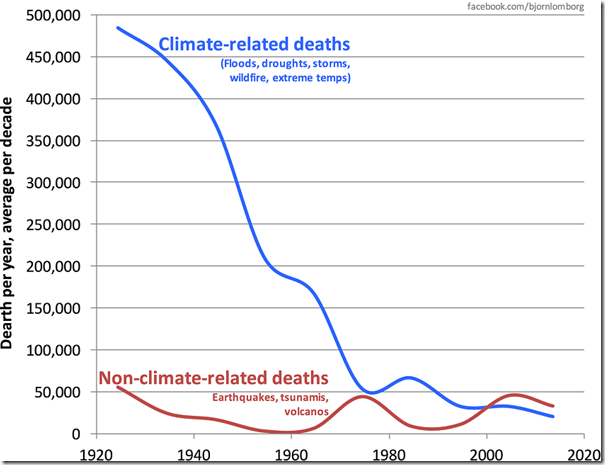
Second, the number of natural disaster deaths declined by over 80 percent as the earth’s temperature has been rising.

NASA data show that since 1920, the earth’s temperature has risen by 1.25 degrees Celsius. Since 1920, world population also has quadrupled from less than two billion to over seven and half billion. Yet during this period, EM-DAT (The International Disaster Database) data show that the number of people killed by natural disasters has declined from almost 55,000 per year to less than 10,000 per year. See Data vs. Models #3: Disasters
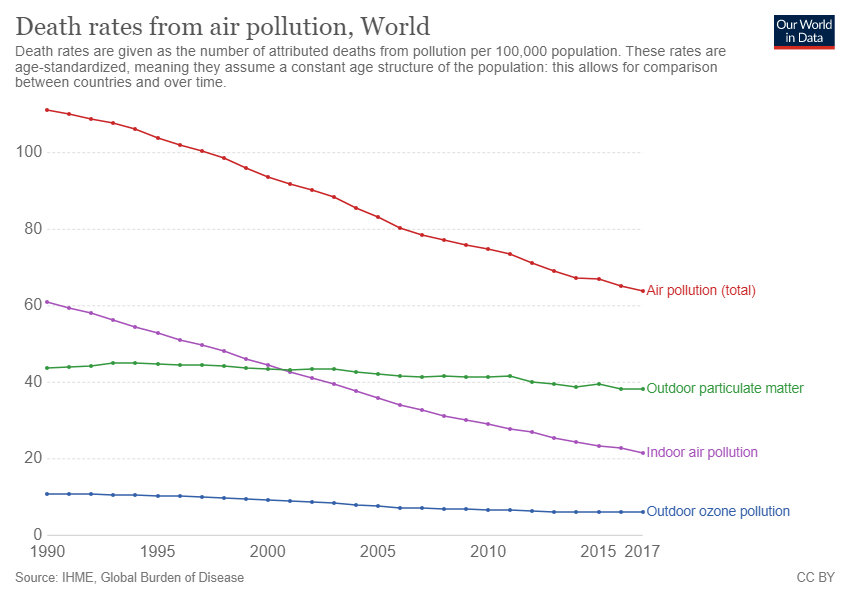
Third, the global air pollution death rate has fallen by almost 50 percent since 1990.

University of Oxford economist Max Roser and researcher Hannah Ritchie show in Our World in Data that “since 1990 the number of deaths per 100,000 people have nearly halved,” declining from 111.28 to 63.82.
Fourth, even the Cassandras acknowledge that any impact on the nation’s economy is likely to be minimal.

The National Bureau of Economic Research estimated in 2019 that if the earth’s temperature rises by 0.01 degrees Celsius per year through 2100, total U.S. GDP in 2100 will be 1.88 percent lower in 2100 than it would otherwise be.

Yet based on the Congressional Budget Office’s estimate of a 1.4 percent annual real long-term potential labor force productivity growth rate, the nation’s per person GDP will be about 204 percent higher by 2100. With the reduction that NBER estimates based on global warming, GDP per person would be an almost indistinguishable 200 percent higher.

The NBER’s extreme case projection that if the earth’s temperature rises by 0.04 degrees Celsius per year through 2100 (five times the actual rate of increase since 1880), total U.S. GDP will be 10.52 percent lower in 2100 than it would otherwise be, similarly would leave GDP per person about 172 percent higher.

In other words, after taking account of the supposedly harmful impact of global warming, U.S. income per person in 2100 will be about triple today’s level.

See Also Crunching Climate $$$

Don’t swallow the big lie. Check the data. Global warming has not been harmful and presents no danger to future generations.

More Data Against Claims of a Climate Problem: Eleven Empty Climate Claims

From a previous post, below are a series of rebuttals of the 11 most common climate alarmists’ claims such as those made in the recently released Fourth National Climate Assessment Report.[2] The authors of these rebuttals are all recognized experts in the relevant fields.  H/T Joseph D’Aleo for compiling work by many experts at his website ACRESEARCH Fact Checking Climate Claims.  Excerpts in italics with my bolds.

For each alarmist claim, a summary of the relevant rebuttal is provided below along with a link to the full text of the rebuttal, which includes the names and the credentials of the authors of each rebuttal.

Claim: Heat Waves are increasing at an alarming rate and heat kills.
Fact:  They have been decreasing since the 1930s in the U.S. and globally.

There has been no detectable long-term increase in heat waves in the United States or elsewhere in the world. Most all-time record highs here in the U.S. happened many years ago, long before mankind was using much fossil fuel. Thirty-eight states set their all-time record highs before 1960 (23 in the 1930s!). Here in the United States, the number of 100F, 95F and 90F days per year has been steadily declining since the 1930s. The Environmental Protection Agency Heat Wave Index confirms the 1930s as the hottest decade.
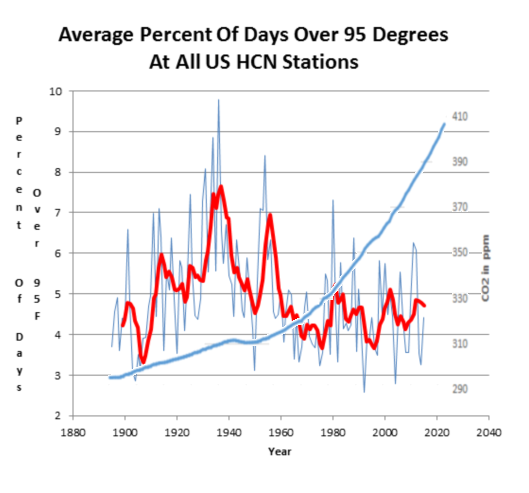
Days over 95F vs. CO2Detailed Rebuttal and Authors: Heat Waves (08/19/19)

Claim: Global warming is causing more hurricanes and stronger hurricanes.
Fact:  Hurricane activity is flat to down since 1900, landfalls in the US are declining

The long-term linear trend in the number and intensity of global hurricane activity has remained flat or down. Hurricane activity does vary year-to-year and over longer periods as short-term ocean cycles like El Nino/La Nina and multidecadal cycles in the Pacific (PDO) and Atlantic (AMO) ocean temperature regimes favor changes in activity levels and some basins over others.

Credible data show this is true despite much better open ocean detection than before the 1960s when many short-lived storms at sea would have been missed as there were no satellites, no aircraft reconnaissance, no radar, no buoys and no automated weather stations.
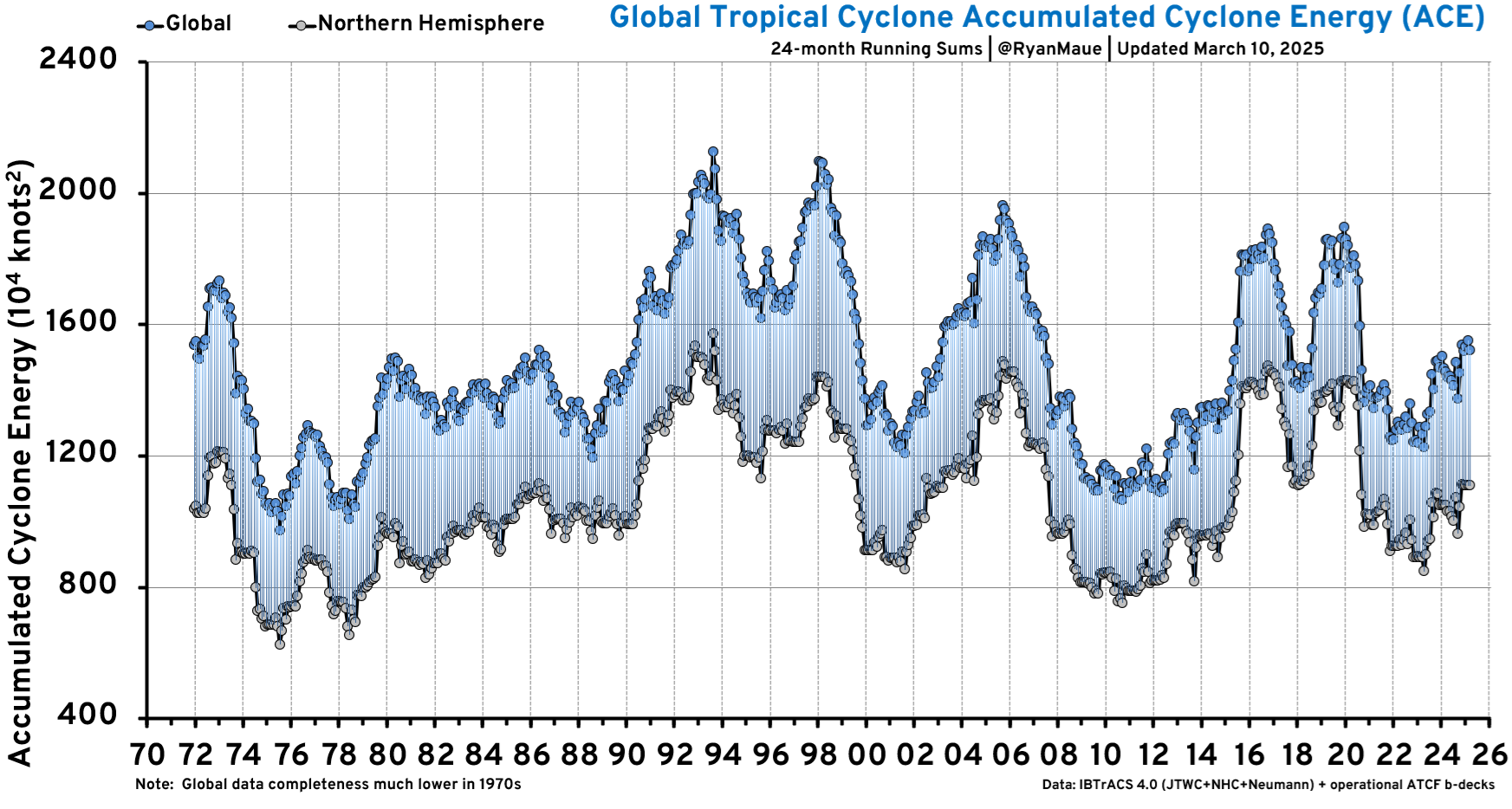
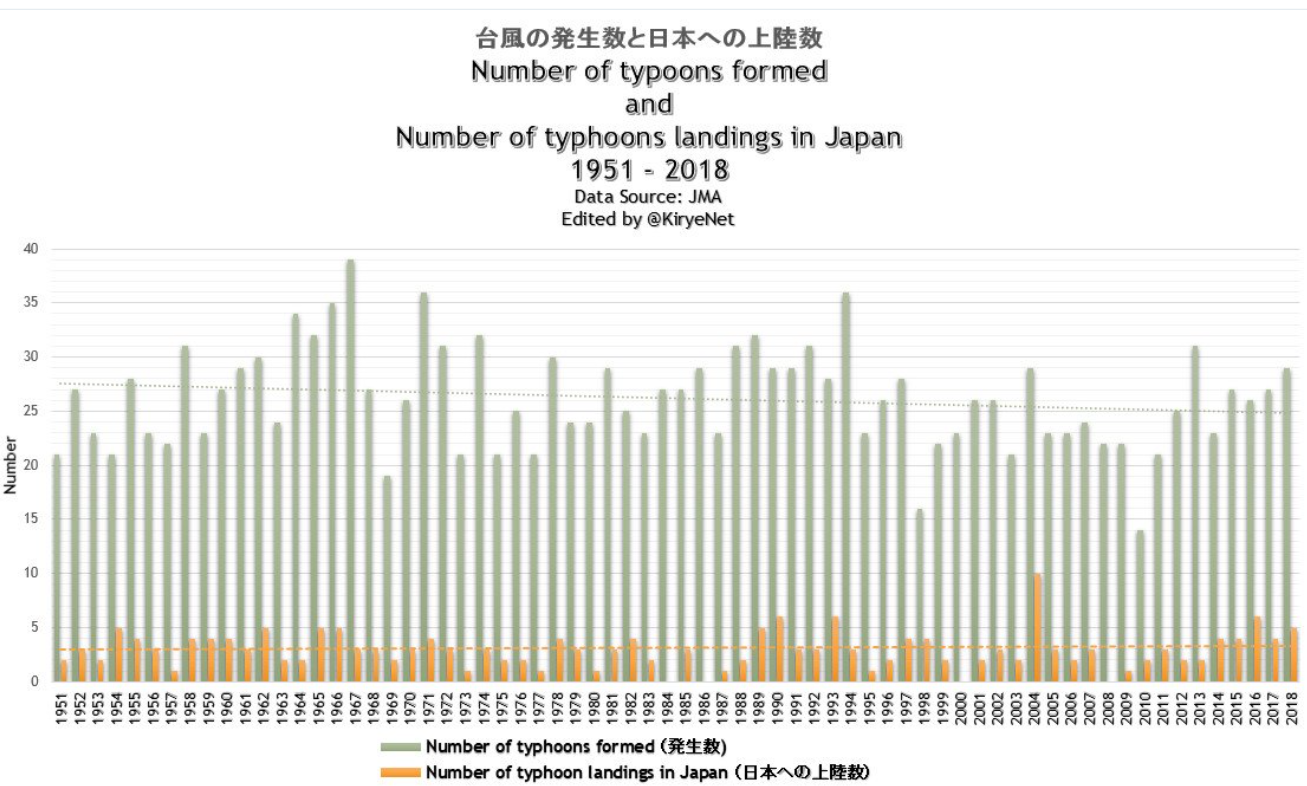
 

Detailed Rebuttal and Authors: AC Rebuttal Hurricanes (10/19/19).

Claim: Global warming is causing more and stronger tornadoes.
Fact:  The number of strong tornadoes have declined over the last half century

Tornadoes are failing to follow “global warming” predictions. Strong tornadoes have seen a decline in frequency since the 1950s. The years 2012, 2013, 2014, 2015 and 2016 all saw below average to near record low tornado counts in the U.S. since records began in 1954. 2017 rebounded only to the long-term mean. 2018 ranked well below the 25thpercentile. Tornadoes increased this spring as extreme cold and late snow clashed with southeast warmth to produce a series of strong storms with heavy rains and severe weather including tornadoes. May ranked among the biggest months and the season rebounded after 7 quiet years above the 50th percentile.

Detailed Rebuttal and Authors: AC Rebuttals Tornadoes (08/20/19)

Claim: Global warming is increasing the magnitude and frequency of droughts and floods.
Fact: Droughts and floods have not changed since we’ve been using fossil fuels

Our use of fossil fuels to power our civilization is not causing droughts or floods. NOAA found there is no evidence that floods and droughts are increasing because of climate change.

The number, extend or severity of these events does increase dramatically for a brief period of years at some locations from time to time but then conditions return to more normal. This is simply the long-established constant variation of weather resulting from a confluence of natural factors.
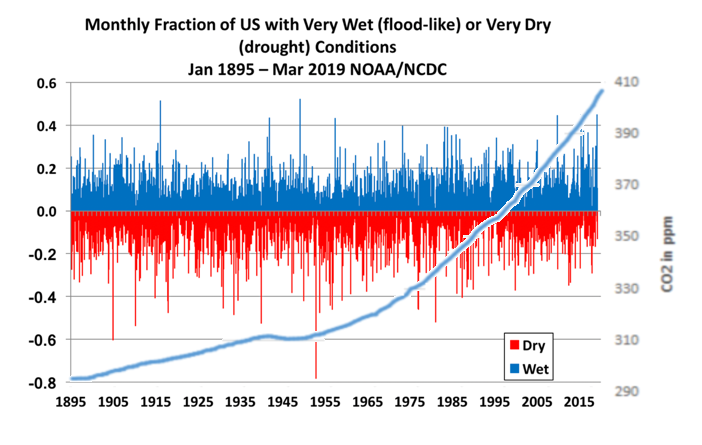
Detailed Rebuttal and Authors: AC Rebuttals Droughts and Floods (08/22/19

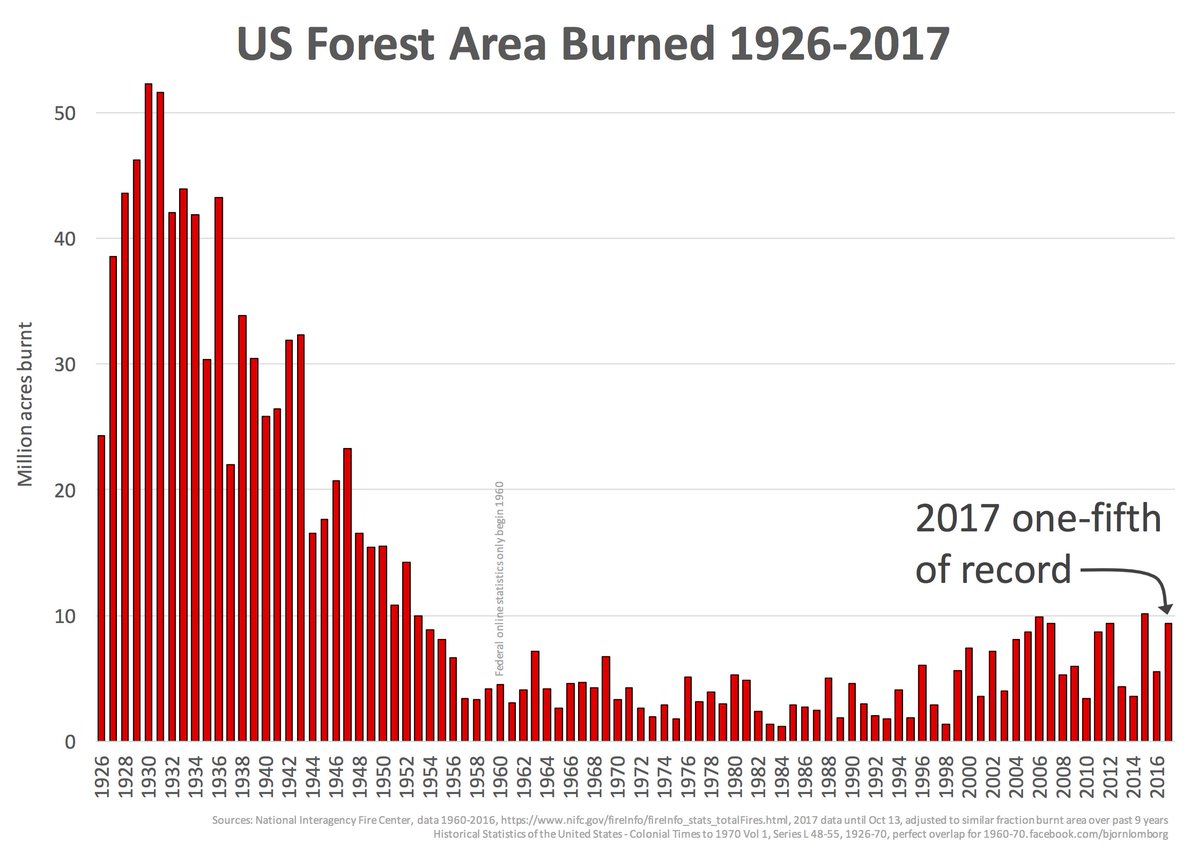
Claim: Global Warming has increased U.S. Wildfires.
Fact: Wildfires have been decreasing since 1800s. The increase in damage in recent years is due to population growth in vulnerable areas and poor forest management.

Wildfires are in the news almost every late summer and fall. The National Interagency Fire Center has recorded the number of fires and acreage affected since 1985. This data show the number of fires trending down slightly, though the acreage burned had increased before leveling off over the last 20 years.

The NWS tracks the number of days where conditions are conducive to wildfires when they issue red-flag warnings. It is little changed.
Detailed Rebuttal and Authors: AC Rebuttal Wildfires 080719

Claim: Global warming is causing snow to disappear.
Fact: Snowfall is increasing in the fall and winter in the Northern Hemisphere and North America with many records being set.

This is one claim that has been repeated for decades even as nature showed very much the opposite trend with unprecedented snows even in the big coastal cities. Every time they repeated the claim, it seems nature upped the ante more.

Alarmists have eventually evolved to crediting warming with producing greater snowfall, because of increased moisture but the snow events in recent years have usually occurred in colder winters with high snow water equivalent ratios in frigid arctic air.

Detailed Rebuttal and Authors: AC Rebuttal Snow (09/19/19)

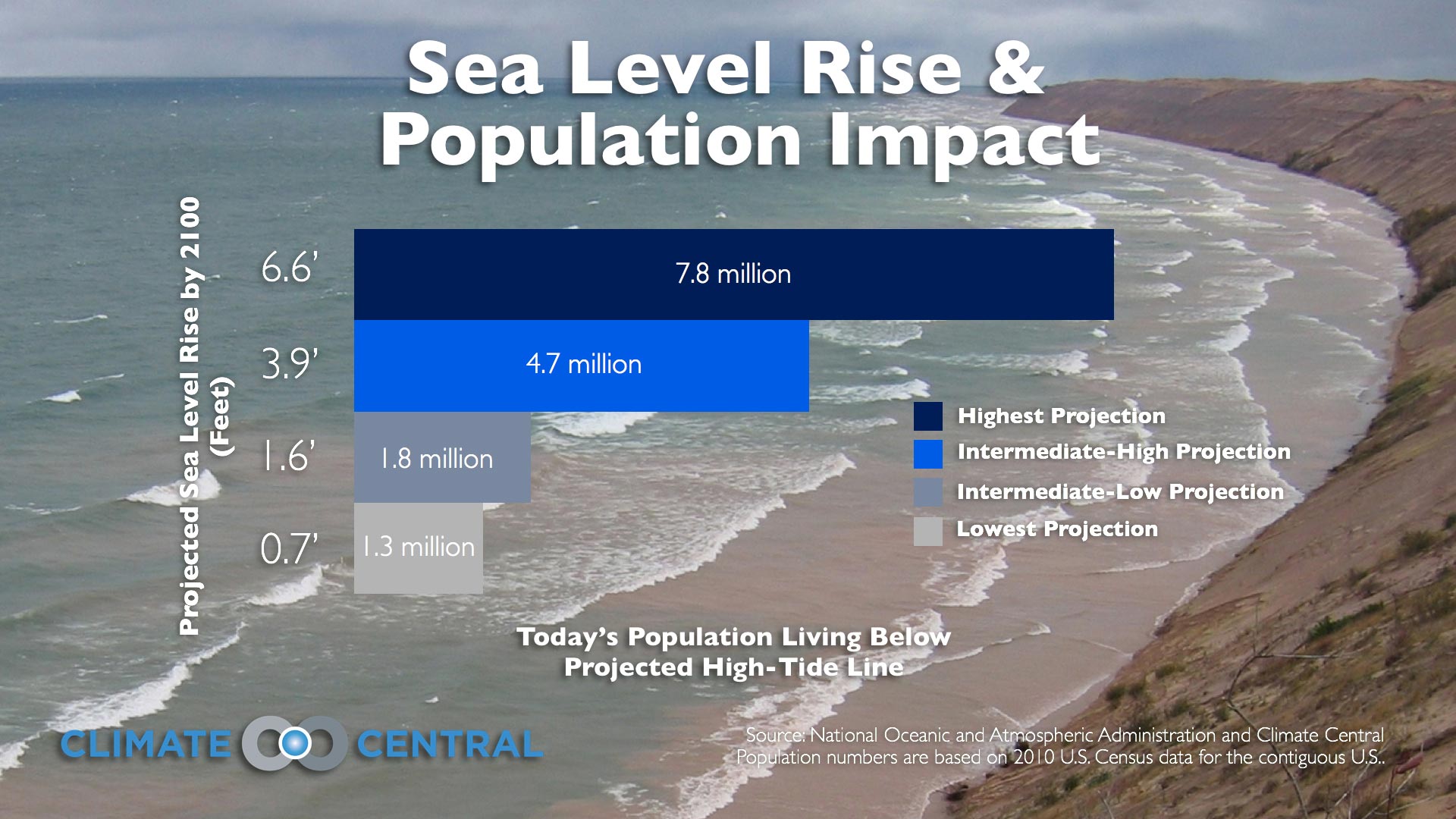
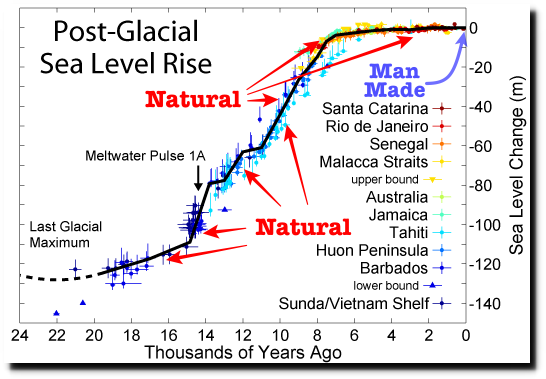
Claim: Global warming is resulting in rising sea levels as seen in both tide gauge and satellite technology.
Fact: The rate of global sea level rise on average has fallen by 40% the last century. Where it is increasing – local factors such as land subsidence are to blame.

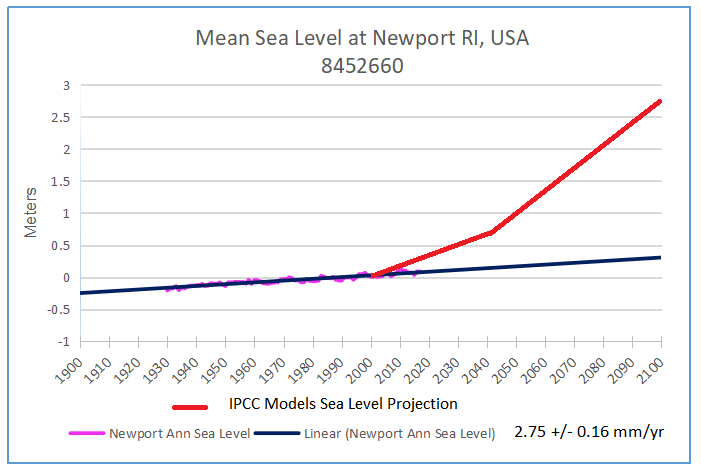
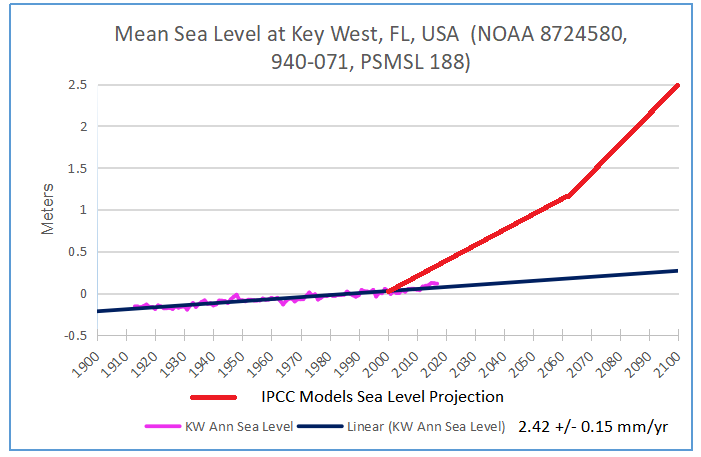
This claim is demonstrably false. It really hinges on this statement: “Tide gauges and satellites agree with the model projections.” The models project a rapid acceleration of sea level rise over the next 30 to 70 years. However, while the models may project acceleration, the tide gauges clearly do not.

All data from tide gauges in areas where land is not rising or sinking show instead a steady linear and unchanging sea level rate of rise from 4 up to 6 inches/century, with variations due to gravitational factors. It is true that where the land is sinking as it is in the Tidewater area of Virginia and the Mississippi Delta region, sea levels will appear to rise faster but no changes in CO2 emissions would change that.
Detailed Rebuttal and Authors: Rebuttal – Sea Level (01/18/19)

Claim: Arctic, Antarctic and Greenland ice loss is accelerating due to global warming.
Fact: The polar ice varies with multidecadal cycles in ocean temperatures. Current levels are comparable to or above historical low levels

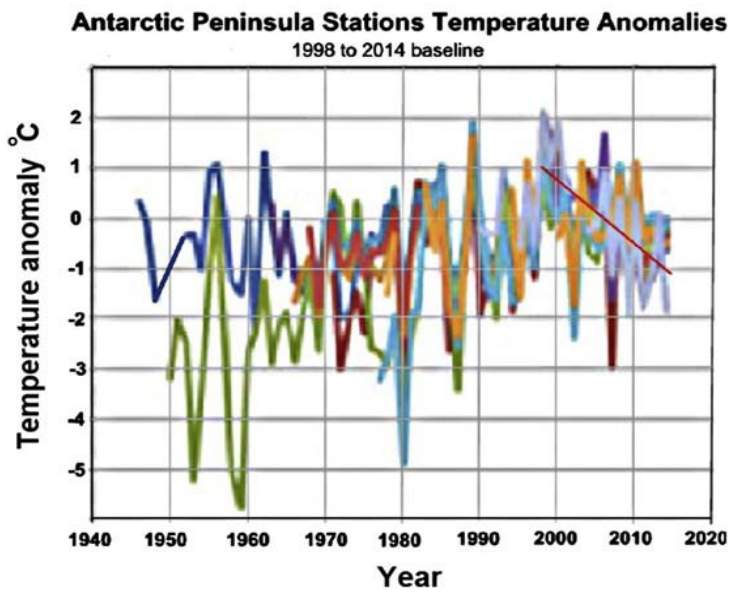
Satellite and land surface temperature records and sea surface temperatures show that both the East Antarctic Ice Sheet and the West Antarctic Ice Sheet are cooling, not warming and glacial ice is increasing, not melting. Satellite and land surface temperature measurements of the southern polar area show no warming over the past 37 years. Growth of the Antarctic ice sheets means the sea level rise is not being caused by melting of polar ice and, in fact, is slightly lowering the rate of rise. Satellite Antarctic temperature records show 0.02C/decade cooling since 1979. The Southern Ocean around Antarctica has been getting sharply colder since 2006. Antarctic sea ice is increasing, reaching all-time highs. Surface temperatures at 13 stations show the Antarctic Peninsula has been sharply cooling since 2000.
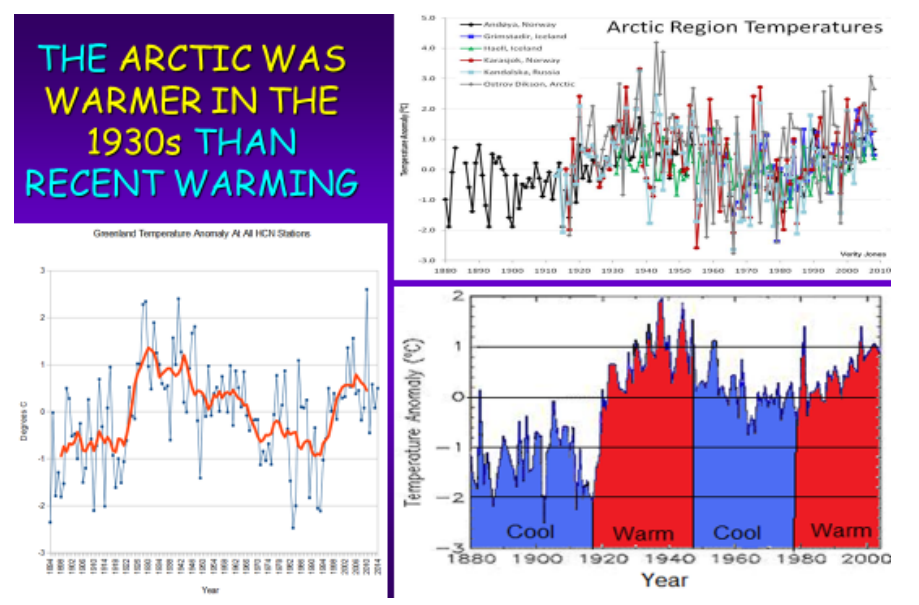
Arctic temperature records show that the 1920s and 1930s were warmer than in the 2000s. Official historical fluctuations of Arctic sea ice begin with the first satellite images in 1979. That happens to coincide with the end of the recent 1945–1977 global cold period and the resulting maximum extent of Arctic sea ice. During the warm period from 1978 until recently, the extent of sea ice has diminished, but increased in the past several years. The Greenland ice sheet has also grown with cooling after an anomalously warm 2012.
Detailed Rebuttal and Authors: AC Rebuttal Arctic, Antarctic and Greenland (05/19/19)

Claim: Global warming responsible for record July warmth in Alaska.
Fact:  Alaska July 2019 heat records resulted from a warm North Pacific and reduced ice in the Bering Sea late winter due to strong storms. The opposite occurred with record cold in 2012.

Alaska climate (averages and extremes) varies over time but the changes can be explained by natural variability in the North Pacific Ocean, which controls the climate regime in downstream land areas. These ocean temperature regimes (modes of the Pacific Decadal Oscillation or PDO) improves season-to-season and year-to-year climate forecasts for North America because of its strong tendency for multi-season and multi-year persistence. The PDO correlates well with tendencies for El Nino and La Nina, which have a major impact on Alaska and much of North America.
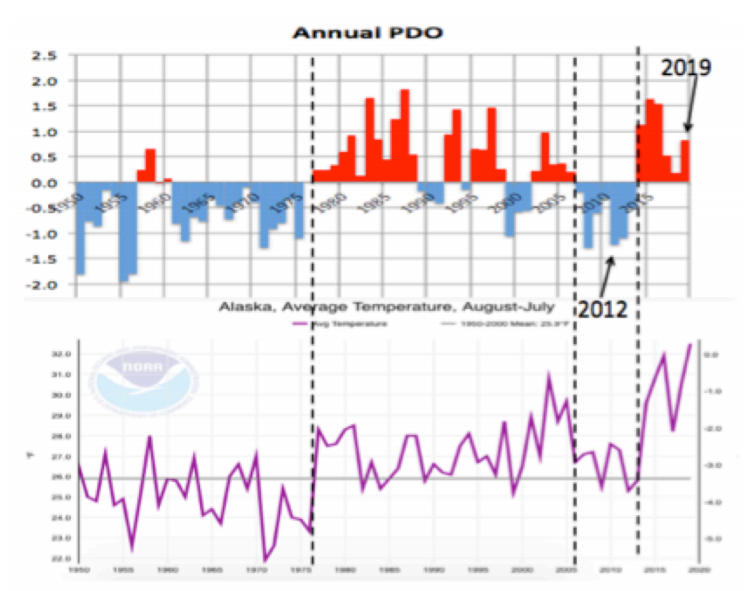
See Rebuttal: AC Rebuttal- Alaska’s hot July caused by global warming (08/21/19)

Claim: Rising atmospheric CO2 concentrations are causing ocean acidification, which is catastrophically harming marine life.
Fact: When life is considered, ocean acidification is often found to be a non-problem, or even a benefit.

The ocean chemistry aspect of the ocean acidification hypothesis is rather straightforward, but it is not as solid as it is often claimed to be. For one thing, the work of a number of respected scientists suggests that the drop in oceanic pH will not be nearly as great as the IPCC and others predict. And, as with all phenomena involving living organisms, the introduction of life into the analysis greatly complicates things. When a number of interrelated biological phenomena are considered, it becomes much more difficult, if not impossible, to draw such sweeping negative conclusions about the reaction of marine organisms to ocean acidification. Quite to the contrary, when life is considered, ocean acidification is often found to be a non-problem, or even a benefit. And in this regard, numerous scientific studies have demonstrated the robustness of multiple marine plant and animal species to ocean acidification—when they are properly performed under realistic experimental conditions.
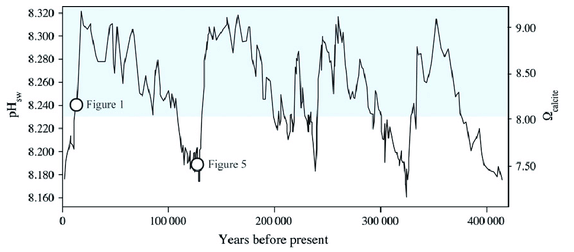
Detailed Rebuttal and Author: AC Rebuttal – Ocean Acidification (02/04/19)

Claim: Carbon pollution is a health hazard.
Fact: Carbon dioxide (CO2) is an odorless invisible trace gas that is plant food and it is essential to life on the planet. It is not a pollutant.

The term “carbon pollution” is a deliberate, ambiguous, disingenuous term, designed to mislead people into thinking carbon dioxide is pollution. It is used by the environmentalists to confuse the environmental impacts of CO2 emissions with the impact of the emissions of unwanted waste products of combustion. The burning of carbon-based fuels (fossil fuels – coal, oil, natural gas – and biofuels and biomass) converts the carbon in the fuels to carbon dioxide (CO2), which is an odorless invisible gas that is plant food and it is essential to life on the planet.
Detailed Rebuttal and Authors: AC Rebuttal Health Impacts (02/04/19)

Claim: CO2-induced climate change is threatening global food production and harming natural ecosystems.
Fact: The vitality of global vegetation in both managed and unmanaged ecosystems is better off now than it was a hundred years ago, 50 years ago, or even a mere two-to-three decades ago thanks in part to CO2.

Such claims are not justified; far from being in danger, the vitality of global vegetation in both managed and unmanaged ecosystems is better off now than it was a hundred years ago, 50 years ago, or even a mere two-to-three decades ago.

With respect to managed ecosystems (primarily the agricultural enterprise), yields of nearly all important food crops have been rising for decades (i.e., the Green Revolution). Reasons for these increases are manifold, but they have mainly occurred in response to continuing advancements in agricultural technology and scientific research that have expanded the knowledge or intelligence base of farming (e.g., fertilizers, pesticides, irrigation, crop selection and breeding, computers, machinery and other devices).
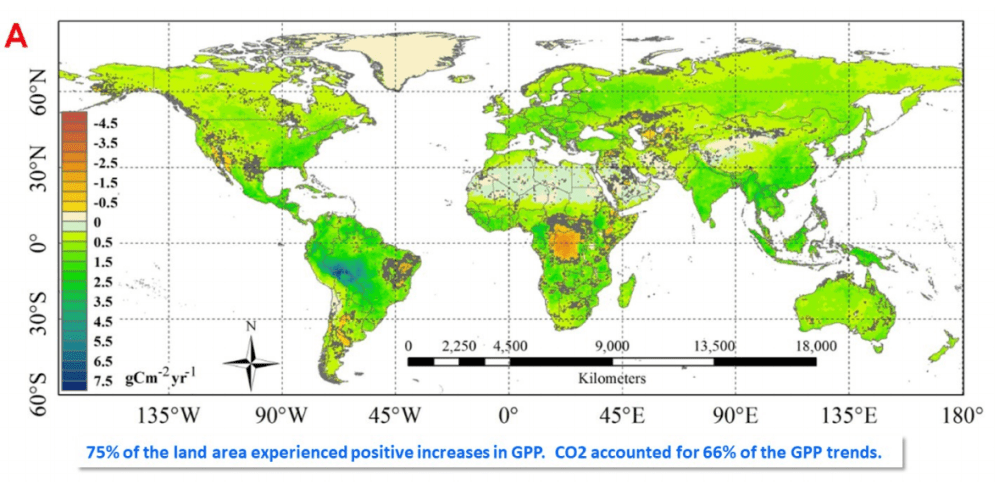
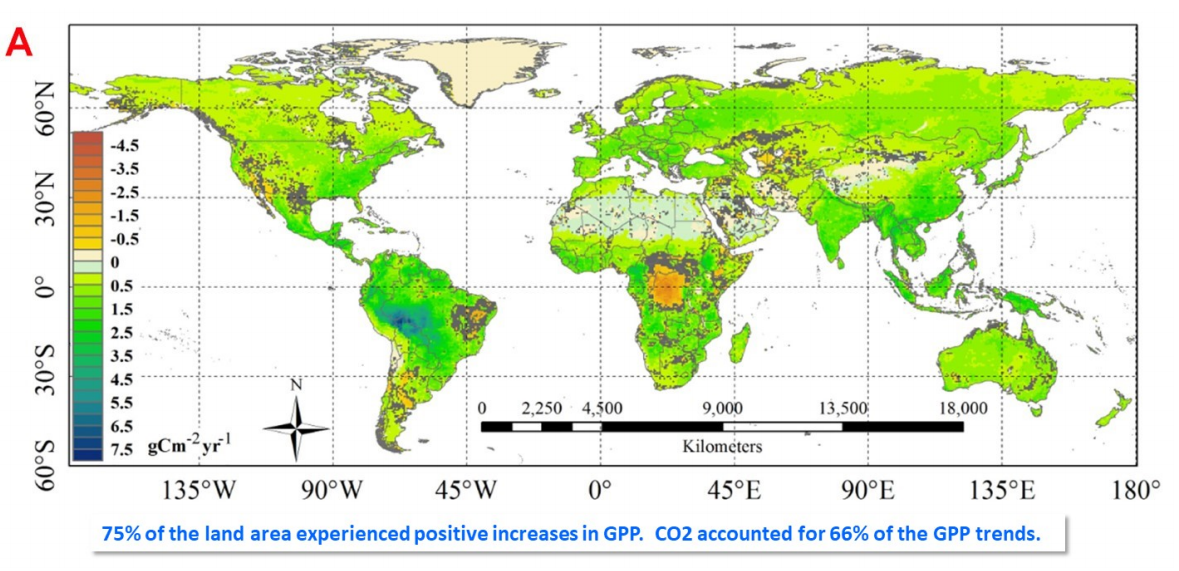
Spatial pattern of trends in Gross Primary Production (1982- 2015). Source: Sun et al. 2018.

Detailed Rebuttal and Authors: AC Rebuttal Agriculture and NaturalEcosystems_Idso020619 (1)

Conclusion:

The well-documented invalidation of the “three lines of evidence” upon which EPA attributes global warming to human -caused CO2 emissions breaks the causal link between such CO2 emissions and global warming.

This in turn necessarily breaks the causal chain between CO2 emissions and the alleged knock-on effects of global warming, such as loss of Arctic ice, increased sea level, and increased heat waves, floods, droughts, hurricanes, tornadoes, etc. These alleged downstream effects are constantly cited to whip up alarm and create demands for ever tighter CO2 regulation. EPA explicitly relied on predicted increases in such events to justify the Endangerment Finding supporting its Clean Power Plan. But as shown above, there is no evidence to support such claims, and copious empirical evidence that refutes them.

OMG! Ozone Extinction Event 360 M Years Ago!

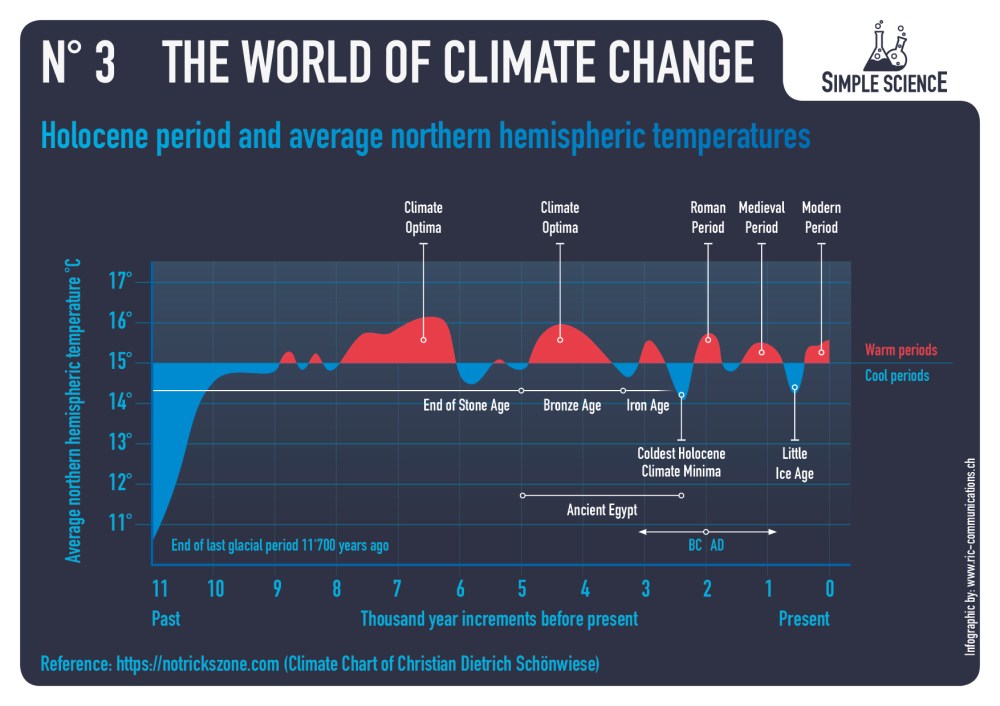
Check out the Devonian period in the chart above. See anything extraordinary?

The doomster cult strikes again, this time picking on O3 rather than CO2.  From researchers at University of Southhampton, Erosion of ozone layer responsible for mass extinction event published at ScienceDaily. Excerpts in italics with my bolds.

Researchers at the University of Southampton have shown that an extinction event 360 million years ago, that killed much of the Earth’s plant and freshwater aquatic life, was caused by a brief breakdown of the ozone layer that shields the Earth from damaging ultraviolet (UV) radiation.

This is a newly discovered extinction mechanism with profound implications for our warming world today.

Now, scientists have found evidence showing it was high levels of UV radiation which collapsed forest ecosystems and killed off many species of fish and tetrapods (our four limbed ancestors) at the end of the Devonian geological period, 359 million years ago. This damaging burst of UV radiation occurred as part of one of the Earth’s climate cycles, rather than being caused by a huge volcanic eruption.

The ozone collapse occurred as the climate rapidly warmed following an intense ice age and the researchers suggest that the Earth today could reach comparable temperatures, possibly triggering a similar event. Their findings are published in the journal Science Advances.

Remember when scientists discovered things that made life better and brought hope and possibilities for the future?  Remember when data was consulted before announcing an apocalypse?  Look at the chart below and ask yourself if the warming periods are getting longer and hotter in our Holocene period.

And if you are worried about the ozone layer, here’s some good news from NASA.

Personally, I find Extinction Rebellion really scary.

The Push for Climate Death Certificates

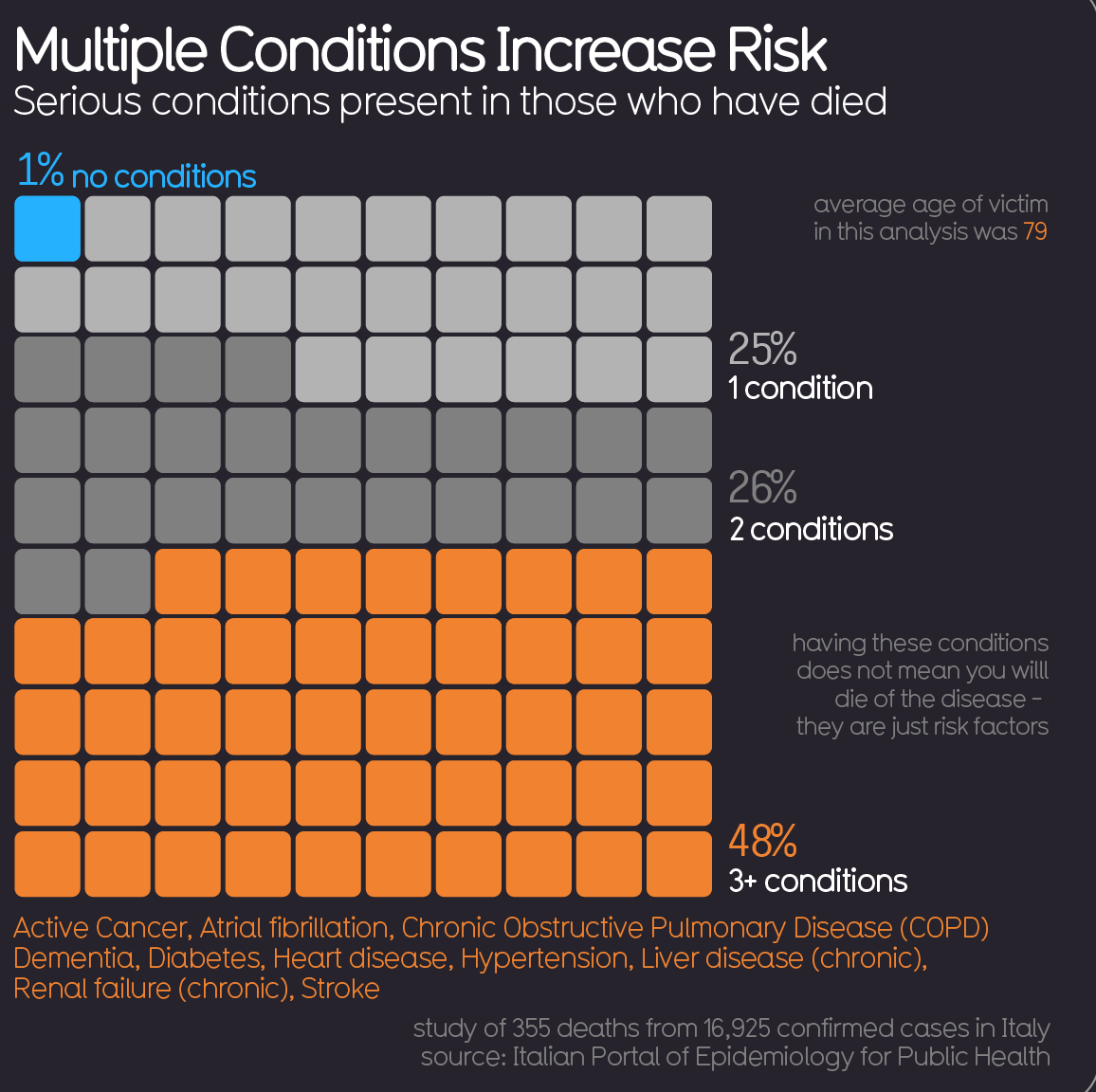
So now we have the climatists calling for attributing many more deaths to warmer temperatures in order to blame CO2 emissions. No doubt they noticed how powerful were the Covid19 death statistics in getting the public to comply with lockdown regulations. Their logic is clear: When people die with multiple diseases, pick the one that’s politically useful. (“Never let a crisis go to waste.”) Never mind that 90+% of Covid deaths were people with cancers, chronic lung disease, obesity, diabetes, and so on.

Ideological Perversion of Science

This push for climate death certificates demonstrates a recurring pattern: reducing life’s multitude of factors and values down to a single dimension as the be all and end all. Environmentalism puts nature first, ignoring that humans are a part of nature, and have a managerial role to play. Many naturalists have reduced further into climatists, who extrapolated the 1978 to 1998 warming into hellfire and brimstone for the planet. Anything bad that happens, from Acne to Zika virus, was caused by global warming/climate change.

These reductionists, or single-issue partisans, are upset that the public is not as concerned as they are. A recent Gallup pole of US voters reported that climate concerns ranked dead last among most important problems. Thus the interest in amping up the death tolls attributed to fossil fuels.

Where’s the Utility in Assigning Causes?

The fundamental flaw in all this advocacy is what to do about the threat. Currently there is much ado about a dam breaking in Michigan because of rainfall. Of course, it’s blamed on CO2 emissions, with concerns that more and more dams will fail because of higher precipitation. Buried in the details is the news that the dam operator was refused permission to release water from the reservoir to protect the fresh water mussels downstream. So we have not only single issue environmentalists, but also single-species advocates.

Even if there were evidence (generally there isn’t) to expect higher rainfall in a catchment area, what action would practically protect the dam? Sign up to an international Climate Treaty? Legislate quotas for electricity from renewables? Ban oil and gas pipeline? Divest from Big Energy companies? Sue somebody, everybody?

The only useful thing to do is reinforce the damsite to increase its capacity, which would likely involve heavy machinery powered by fossil fuels.

This is but one example of the upside-down thinking by all single-issue advocates, including climatists. If you claim hotter weather is coming (despite no statistical proof), what action would usefully protect against mortality? More and better air conditioning has worked so far, carbon offsets not so much.

Footnote:  For a discussion of how climate alarmists reduce reality down to their preconceived notion, see Climate Reductionism

Hurricane Hype (Again)

James Taylor explains at climaterealism Miami Herald Misleads Readers About Reassuring NOAA Hurricane Study.  A study finding calmer recent storm seasons was flipped into alarms about global warming/climate change.  Excerpts in italics with my bolds.

Among the top Google News search results this morning for “climate change,” the Miami Herald published an article asserting a new study shows global warming is causing more Atlantic hurricanes. In reality, the new study shows there is a declining trend in hurricanes in many parts of the world and concludes there will likely be a declining trend globally during the 21st century. Moreover, objective data show the number of Atlantic hurricanes is declining, just like the forecast global trend.

The National Oceanic and Atmospheric Administration (NOAA) study referenced by the Herald reports, “our climate models project decreases in the number of global TCs [tropical cyclones] toward the end of the 21st century due to the dominant effect of greenhouse gases on decreasing TC occurrence in most of the tropics, consistent with many previous studies.”

The NOAA study reported a trend of “substantial decreases” in Indian Ocean and North Pacific hurricanes is already detected in the record. The study asserts there has been an increase in Atlantic hurricanes since 1980, which “anthropogenic aerosols could have also influenced.”

The major takeaway from the NOAA study is there will be fewer hurricanes as the world continues its modest warming. That is good news. Rather than reporting good climate news, however, the Herald goes to great lengths to try to pull some bad news from a good-news study.

The only reason the authors of the NOAA study could report an increase in Atlantic hurricanes since 1980 is because the decade ending in 1980 was an abnormally low year, with the fewest number of Atlantic hurricanes on record. So, any trend line starting at the record-low point of 1980 will show more frequent hurricanes. However, a more complete and representative record shows a long-term and ongoing decline in Atlantic hurricanes. The graph below illustrates that point.

Located in Florida, the Miami Herald surprisingly did not mention two very important facts about hurricanes and Florida. As documented in Climate at a Glance: Hurricanes, Florida recently concluded an 11-year period (2005 through 2016) without a landfalling hurricane of any size—the longest such period in recorded history. The Gulf of Mexico also recently benefited from its longest hurricane-free period in recorded history (2013 through 2016).

For completely misleading its readers about the recent NOAA study, and for asserting the exact opposite of the truth regarding hurricane frequency and Atlantic hurricane frequency, the Miami Herald earns a gigantic Pinocchio award.

Footnote:  The 2020 consensus forecast for the coming hurricane season is for an active season (H/T trackthetropics)

GWO’s prediction calls for 16 named storms, 7 hurricanes and 3 to 4 major hurricanes. They note the United States can expect 5 named storms to make landfall, with 2 or 3 hurricane landfalls – one of which will likely be a major category 3 hurricane. Professor David Dilley – senior research scientist for GWO, says several favorable meteorological and climatological factors are in place to produce another above average hurricane season this year. Some of the factors include a 72-year ClimatePulse Hurricane Landfall Enhancement Cycle – coupled with the continuance of above normal warm Atlantic Ocean and Gulf of Mexico water temperatures – and the lack of either a moderate or strong El Niño to subdue the hurricane seasons. Entire forecast: https://www.globalweatheroscillations.com/

Of course, any storm making US landfall is big weather news, and the media is ready.

Don’t Blame Coastal Flooding on CO2

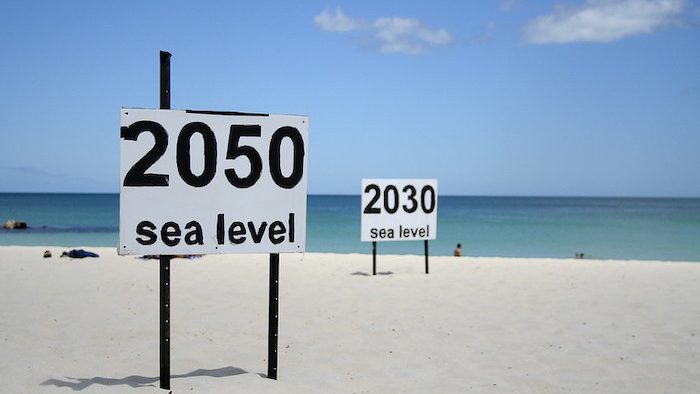
These signs mislead the public into believing burning fossil fuels will flood urban coastal settlements.

A special article at Climate Depot is Dr. Patrick Moore & Dr. Caleb Rossiter Rebut Wash Post: Oops! Climate Change Actually NOT the Cause of Coastal Flooding

Consumers of the climate religion media – which comprises pretty much every outlet from CNN leftward – should be forgiven for believing that a climate crisis requires that we ban the cheap, reliable energy that powers 80 percent of the world economy. After all, those outlets only run stories on one side of the question and brook no debate. The recent “Earth Day” issue of the Washington Post Sunday magazine is a case in point. It was devoted to finding evidence of climate changes caused by the warming gases that are emitted when fossil fuels are converted to energy. The most important of these emissions, by far, is carbon dioxide, a non-toxic plant, and plankton food. Unfortunately, the evidence started out weak and got weaker. And of course, the magazine refused to run letters pointing that out.

There was the requisite image of a polar bear clinging to a melting iceberg, and a story on lower counts of wood thrush in the DC region. But neither of those has anything to do with climate change. Polar bear counts, as all researchers have shown since the elegant animal became a favored fund-raiser for Green groups 20 years ago, are increasing. The wood thrush story itself pointed out that housing development and deer density are the primary problems.

The final insult to scientific fact, though, was the centerpiece story on flooding in communities around Norfolk, Virginia, which was presented with this subtitle: “Climate change is forcing many communities to imagine leaving the waterfront behind.” That claim mirrors the U.S. government’s 2018 summary National Climate Assessment, which includes Norfolk and its U.S. naval facilities as examples of places threatened by rising seas due to CO2-driven climate change.

However, according to the UN’s most recent report, the current global rate of sea-level rise – about an inch a decade, or 3.2 millimeters per year – is the same as it was 100 years ago. These estimates are uncertain, as sea-level is difficult to measure, but it is clear that the rise is related to the steady increase in global temperature since the Little Ice Age ended around 1800. All of this, of course, was long before 1950, which the UN reports were when industrial carbon dioxide was first emitted in sufficient quantities to cause measurable warming. Ironically, this UN information about sea-level rates being the same before and after CO2 warming was included in the scientifically-detailed version of the National Climate Assessment, contradicting the widely-publicized summary.

Sea-level rates include the fall, or “subsidence,” of land due to a variety of natural and human-caused processes that have nothing to do with temperature. The reason that sea-level rise is higher than average (about 3.9 mm per year, according to the U.S. Geological Service) at the mouth of the Chesapeake is that the land there is sinking at a rate that far exceeds the global subsidence rate. Who says so? Every scientist who studies it, as shown in the U.S. Geological Service’s 2013 report, Land Subsidence and Relative Sea-Level Rise in the Southern Chesapeake Bay Region: “Land subsidence has been observed since the 1940s in the southern Chesapeake Bay region at rates of 1.1 to 4.8 millimeters per year (mm/yr), and subsidence continues today. This land subsidence helps explain why the region has the highest rates of sea-level rise on the Atlantic Coast of the United States. Data indicate that land subsidence has been responsible for more than half the relative sea-level rise measured in the region.”

Why is land falling around Norfolk? As the USGS points out, “most land subsidence in the United States is caused by human activities.” The withdrawal of groundwater for human use and agriculture causes 80 percent of it nationally. In the Norfolk area, the USGS reports that water use compacts the clay layers in the aquifer system, permanently. That is why the USGS recommends moving Norfolk’s pumping activities far inland. Groundwater levels have already fallen by about 200 feet around Norfolk in the past century. But in Norfolk, there is yet another important source of land subsidence: what the USGS calls “glacial isostatic adjustment” and estimates at one mm per year. As land levels a few hundred miles north of Norfolk rebound from the melting of heavy, mile-high ice 18,000 to 12,000 years ago, Norfolk sinks in response.

For purposes of comparison, let’s use the data for the longest periods in the USGS report’s Chart 3: 3.9 mm annual rise in sea-level, but a long-term global average of 1.8 mm, both of which include land subsidence. But the local land subsidence is 2.8 mm, meaning that at least 72 percent of the change in flooding is due not to rising seas but sinking lands. Yet in the magazine article, there is no mention – not one word out of thousands – about land subsidence.

An additional possible factor in land subsidence is the geology around Norfolk, which is unique in America due to a remarkable event 35 million years ago: the impact of an asteroid that left a crater right at the opening of the Chesapeake 55 miles around and a mile deep. Some USGS scientists see the crater as a continuing factor in land subsidence, while others, as in the 2013 summary report, discount it. Like the rest of the possible factors in sea-level rise in Norfolk, the crater has nothing to do with CO2-driven “climate change.”

About the Authors

Ecologist Patrick Moore is the chair of the CO2 Coalition of 55 climate scientists and energy economists. Dr. Moore was a long-time leader of Greenpeace and leads the Allow Golden Rice Now campaign.

Climate statistician Caleb Stewart Rossiter is the Coalition’s executive director. Dr. Rossiter was formerly a professor of international affairs, mathematics, and statistics at American University.

See also USCS Warnings of Coastal Floodings and Urban Flooding: The Philadelphia Story

April Arctic Ice Melting as Usual

The image above shows springtime melting of Arctic sea ice extent over the month of April 2020.  As usual the process of declining ice extent follows a LIFO pattern:  Last In First Out.  That is, the marginal seas are the last to freeze and the first to melt.  Thus at the top of the image, the Pacific basins of Bering and Okohtsk seas show a steady decline in ice.  Meanwhile at bottom left, Baffin Bay ice retreats from south to north.  Note center left Hudson Bay loses very little ice during the month.  The central mass of Arctic ice is  intact with some fluctuations back and forth bottom right, as patches of water appear in Barents and Kara Seas.

The graph below shows the ice extent retreating during April compared to some other years and the 13 year average (2007 to 2019 inclusive).

Note that the  MASIE NH ice extent 13 year average loses about 1.2M km2 during April, down to 13.5M km2. MASIE 2019 started much lower and lost ice at a similar rate, ending nearly 800k km2 below average.  This year started in the middle of the other tracks, the most interesting thing being the wide divergence between SII and MASIE reports for April, with a sawtooth pattern alternating loses and gains.  The two indices were close in the beginning, but the gap grew to 600k km2 before narrowing at the end.  I inquired whether NIC had experienced any measurement issues, but their response indicated nothing remarkable.  It is notable that MASIE is the low estimate of the two.

Region 2020121 Day 121 Average 2020-Ave. 2019121 2020-2019
 (0) Northern_Hemisphere 13091644 13517638  -425994  12730893 360751 
 (1) Beaufort_Sea 1070307 1067944  2363  1070463 -156 
 (2) Chukchi_Sea 961124 952949  8175  909505 51619 
 (3) East_Siberian_Sea 1081646 1085858  -4212  1082230 -585 
 (4) Laptev_Sea 851288 891300  -40012  897845 -46557 
 (5) Kara_Sea 860722 909170  -48448  917303 -56581 
 (6) Barents_Sea 588361 546921  41440  557814 30547 
 (7) Greenland_Sea 769073 634171  134902  487626 281446 
 (8) Baffin_Bay_Gulf_of_St._Lawrence 1001748 1240703  -238955  1113262 -111514 
 (9) Canadian_Archipelago 849940 848790  1150  853337 -3397 
 (10) Hudson_Bay 1209082 1242060  -32978  1255410 -46328 
 (11) Central_Arctic 3245999 3236485  9514  3245152 846 
 (12) Bering_Sea 337849 466262  -128413  93641 244208 
 (13) Baltic_Sea 5973 20676  -14703  10318 -4345 
 (14) Sea_of_Okhotsk 257268 371173  -113905  235299 21969 

The table shows where the ice is distributed compared to average.  Baffin Bay has the largest deficit to average followed by Bering and Okhotsk. Greenland Sea and Barents Sea are in surplus, offsetting small deficits in Kara, Laptev and Hudson Bay.

Footnote:  Interesting comments recently by Dr. Judah Cohen at his blog regarding the Arctic fluctuations this winter and spring. Excerpts with my bolds.

As I sit here in home, enduring a second day of cloudy, wet, relatively cold and windy weather from a storm passing to our south and had this been winter would have brought a crippling snowstorm. And this storm or pattern isn’t unique. It seems that every few days here in the Northeastern US we get a rainstorm that had it been winter would have produced a snowstorm, though even these late season storms are bringing snow to the higher elevations of the Northeast. I find myself asking (and I realize that I am not unique asking this question) – where was this pattern in winter?

I reflexively look to the PV for answers. The winter was characterized by a stronger than normal stratospheric PV that was hostile to meridional (north to south), large amplitude flow and high latitude blocking that is so favorable for sustained cold air outbreaks and snowstorms. Instead the strong PV supported fast zonal flow of the Jet Stream that was displaced to the north that favored overall mild temperatures and rainfall across the US except for higher elevations and near the Canadian border. Similarly, an even milder and snowless pattern persisted across Europe all winter.

Then once winter was over, high pressure/blocking returned to the North Atlantic sector that excited the vertical transfer of energy from the troposphere to the stratosphere and has weakened the stratospheric PV. This increase in vertical energy transfer has decelerated a hyperactive PV and it does appear that the weakening of the PV will actually overshoot the typical weakening resulting in stronger easterly winds in the polar stratosphere than the climatological average (see Figure i). Easterly winds in the polar stratosphere are the telltale sign of the Final Warming (where the stratospheric PV disappears until the fall).

Illustration by Eleanor Lutz shows Earth’s seasonal climate changes. If played in full screen, the four corners present views from top, bottom and sides. It is a visual representation of scientific datasets measuring Arctic ice extents.

Meet Bering and Okhotsk Seas

Now that Arctic ice peak has passed, the Pacific basins of Bering and Okhotsk take center stage, providing most of the open water reducing ice extents.  The animation above shows in the last 3 weeks Bering on the right lost half of its ice, down from 820k km2 to 450k km2 yesterday.  Meanwhile Okhotsk on the left declined from 1080k km2 to 650k km2.  Those losses make up entirely the 530k km2 Arctic deficit to average at this time.

Background on Okhotsk Sea

NASA describes Okhotsk as a Sea and Ice Factory. Excerpts in italics with my bolds.

The Sea of Okhotsk is what oceanographers call a marginal sea: a region of a larger ocean basin that is partly enclosed by islands and peninsulas hugging a continental coast. With the Kamchatka Peninsula, the Kuril Islands, and Sakhalin Island partly sheltering the sea from the Pacific Ocean, and with prevailing, frigid northwesterly winds blowing out from Siberia, the sea is a winter ice factory and a year-round cloud factory.

The region is the lowest latitude (45 degrees at the southern end) where sea ice regularly forms. Ice cover varies from 50 to 90 percent each winter depending on the weather. Ice often persists for nearly six months, typically from October to March. Aside from the cold winds from the Russian interior, the prodigious flow of fresh water from the Amur River freshens the sea, making the surface less saline and more likely to freeze than other seas and bays.


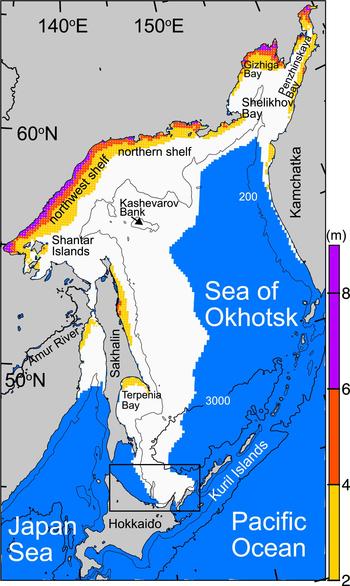
Map of the Sea of Okhotsk with bottom topography. The 200- and 3000-m isobars are indicated by thin and thick solid lines, respectively. A box denotes the enlarged portion in Figure 5. White shading indicates sea-ice area (ice concentration ⩾30%) in February averaged for 2003–11; blue shading indicates open ocean area. Ice concentration from AMSR-E is used. Color shadings indicate cumulative ice production in coastal polynyas during winter (December–March) averaged from the 2002/03 to 2009/10 seasons (modified from Nihashi and others, 2012, 2017). The amount is indicated by the bar scale. Source: Cambridge Core

Bering Sea Ice is Highly Variable

The animation above shows Bering Sea ice extents at April 2 from 2007 to 2020.  The large fluctuation is evident, much ice in 2012 -13 and almost none in 2018, other years in between.  Given the alarmist bias, it’s no surprise which two years are picked for comparison:

Source: Seattle Times ‘We’ve fallen off a cliff’: Scientists have never seen so little ice in the Bering Sea in spring.

Taking a boat trip from Hokkaido Island to see Okhotsk drift ice is a big tourist attraction, as seen in the short video below.  Al Gore had them worried back then, but not now.

Drift ice in Okhotsk Sea at sunrise.

March Arctic Ice Plentiful

Previous posts showed 2020 Arctic Ice breaking the 15M km2 ceiling mid March before starting the Spring melt as usual later in the month. The graph above shows that the March monthly average has varied little since 2007, typically around the SII average of 14.7 Mkm2 +/-  a few %.  Of course there are regional differences as described below.

The graph above shows ice extent through March comparing 2020 MASIE reports with the 13-year average, other recent years and with SII.  After exceeding the average the first half, extents fell off the last 10 days, principally due to melting in the Pacfic basins of Bering and Okhotsk.

The table below shows the distribution of sea ice across the Arctic regions.

Region 2020091 Day 091 Average 2020-Ave. 2007091 2020-2007
 (0) Northern_Hemisphere 14282630 14713851 -431221 14158467 124163
 (1) Beaufort_Sea 1070655 1070176 479 1069711 944
 (2) Chukchi_Sea 963163 963149 14 966006 -2844
 (3) East_Siberian_Sea 1086324 1086066 258 1074213 12111
 (4) Laptev_Sea 897668 895482 2186 867162 30506
 (5) Kara_Sea 928986 916178 12808 908181 20805
 (6) Barents_Sea 688659 648978 39681 469156 219503
 (7) Greenland_Sea 709503 656533 52970 670061 39442
 (8) Baffin_Bay_Gulf_of_St._Lawrence 1320493 439783 -119290 1232093 88399
 (9) Canadian_Archipelago 854282 852731 1552 849011 5271
 (10) Hudson_Bay 1260152 1254854 5298 1229963 30189
 (11) Central_Arctic 3248013 3235482 12531 3245424 2589
 (12) Bering_Sea 484084 744587 -260503 721969 -237885
 (13) Baltic_Sea 8975 65202 -56227 45656 -36682
 (14) Sea_of_Okhotsk 753705 874501 -120796 797516 -43812

Overall NH extent March 31 was below average by 431k km2, or 3%.  The bulk of the deficit is seen in Bering and Okhotsk seas, along with Baffin Bay.  Everywhere else is slightly surplus, with the exception of the Baltic, which never froze completely this year.

Beaches Not Disappearing

John Tamny writes at Real Clear Markets ‘Studies’ Indicate Disappearing Beaches. Markets Think Studies Idiotic. Excerpts in italics with my bolds and images.

As USA Today recently reported, a new study from the European Union’s Joint Research Center warns that a global catastrophe looms due to “the near-extinction of almost half of the world’s sandy beaches by the end of the century.” Hmmmm. Really?

It seems the only individuals who never get the message about the “near-extinction” of beaches are those who actually live at those beaches, along with those who yearn to live at beaches. Stop and think about it.

Presumably the desirability of Malibu, Laguna, La Jolla, the Hamptons, Martha’s Vineyard, Newport (RI), Ibiza, St. Tropez and other glamorous coastal locales has something to do with these destinations existing essentially on the beach. In other words, land and the housing that sits on said land is quite bit more valuable in Malibu than it is in the San Fernando Valley that is just over the hill from Malibu. Malibu is on or near the beach, while San Fernando Valley is, for lack of a better word, inland.

Though houses are expensive in parts of the San Fernando Valley, they don’t fetch anywhere near the amount that “shacks” in Malibu do. To the halfway awake, the previous sentence is a statement of the obvious.

Those of us in possession of passably sound mind understand that property on the beach or near the beach is quite a bit more desirable than cities and towns far from it.

Crucial is that what’s true in California is true around the world. Housing near the water is almost monolithically dear relative to what’s inland from the water. It’s almost a waste of words to write down what is so obvious.

Yet it’s worth writing down in consideration of all the alarmism on the part of climate scientists (and those who aim to mimic them), and who claim that so much of the world’s beaches are set to disappear thanks to the theory that is global warming, or the tautology that’s climate change. Don’t you get it readers, “studies” show us that the world’s beaches are set to disappear.

Ok, but if so, does anyone seriously think Meyer could have fetched so much for his Malibu compound, and does anyone think beach real estate globally would be so eye-wateringly expensive if the world’s beaches were set to disappear? Implicit in this dour, alarmist view is that markets are incredibly dense; that the world’s richest don’t see what climate scientists see all-too-clearly.

To the above, some will say the rich are too rich to care. On its face the previous assertion is doubtful, plus haven’t the perpetually alarmed and offended told us for decades that the rich are “greedy”? If so, why would they place so much of their wealth in harm’s way? And what about insurance companies. Why would they insure properties that are set to be washed away? And again, why did Meyer enjoy such an impressive return on his Malibu house; one whose transfer in the $5 million range was once the stuff of Hollywood legend?

More broadly, all the hand wringing by the climate alarmists must be considered in terms of what the world is enduring right now.

Getting into specifics, politicans around the world are overseeing the shutdown of the global economy based on a theory that millions will die if they get to close to one another. The economic agony these actions have brought about is and will be massively cruel in terms of jobs lost, businesses shuttered, and dreams dashed. Scary about all this is that the global warming true believers view economic growth as a major threat to the planet, and similarly seek economic shutdown by political force to save the planet.

Readers might keep this in mind in consideration of how they feel now, and how they might feel in the future if the warming alarmists get their way.

Ideally before these climate religionists get the chance to commit major damage, the market signals provided by people like Ron Meyer will gain needed attention. Indeed, just once it would be great for the climate alarmists in our midst to answer why, if beaches are allegedly disappearing, beach houses are so expensive.

John Tamny is editor of RealClearMarkets, Vice President at FreedomWorks, and a senior economic adviser to Toreador Research and Trading (www.trtadvisors.com). His new book is titled They’re Both Wrong: A Policy Guide for America’s Frustrated Independent Thinkers. Other books by Tamny include The End of Work, about the exciting growth of jobs more and more of us love, Who Needs the Fed? and Popular Economics. He can be reached at jtamny@realclearmarkets.com.

For an analysis comparing model projections with tidal guage observations see:
USCS Warnings of Coastal Floodings