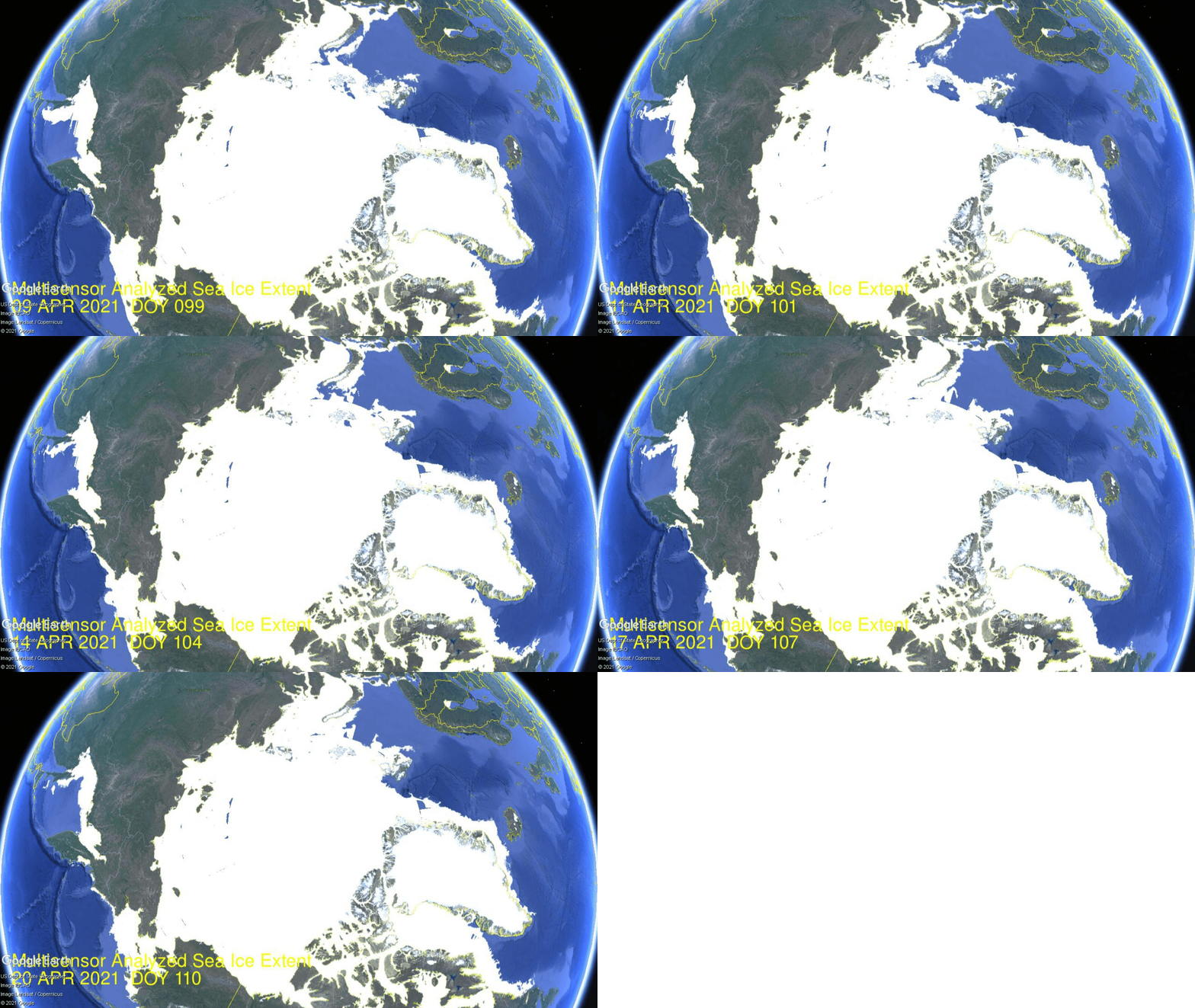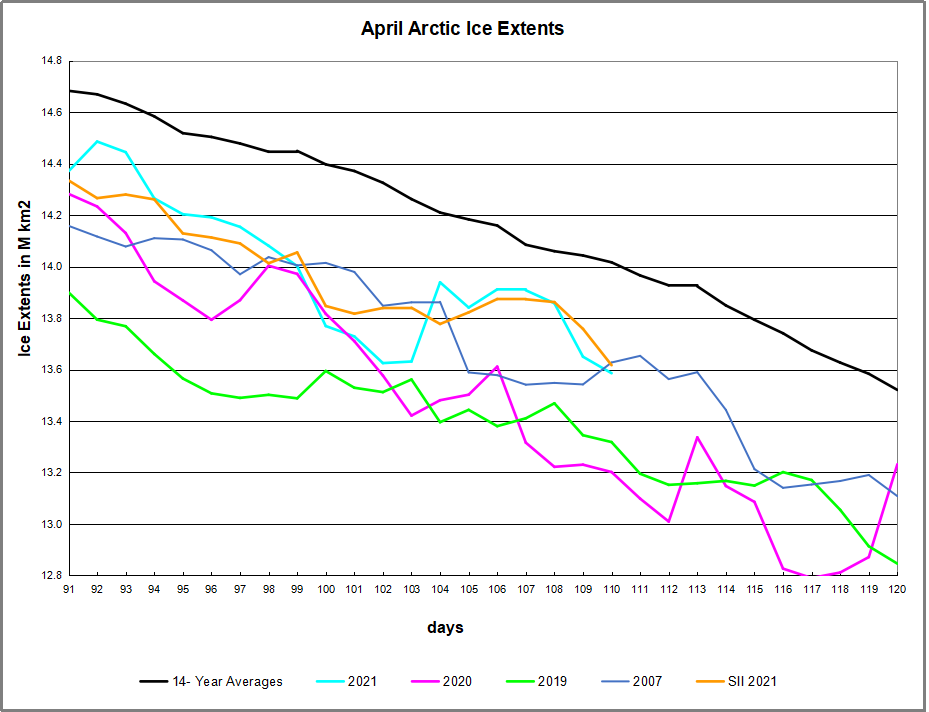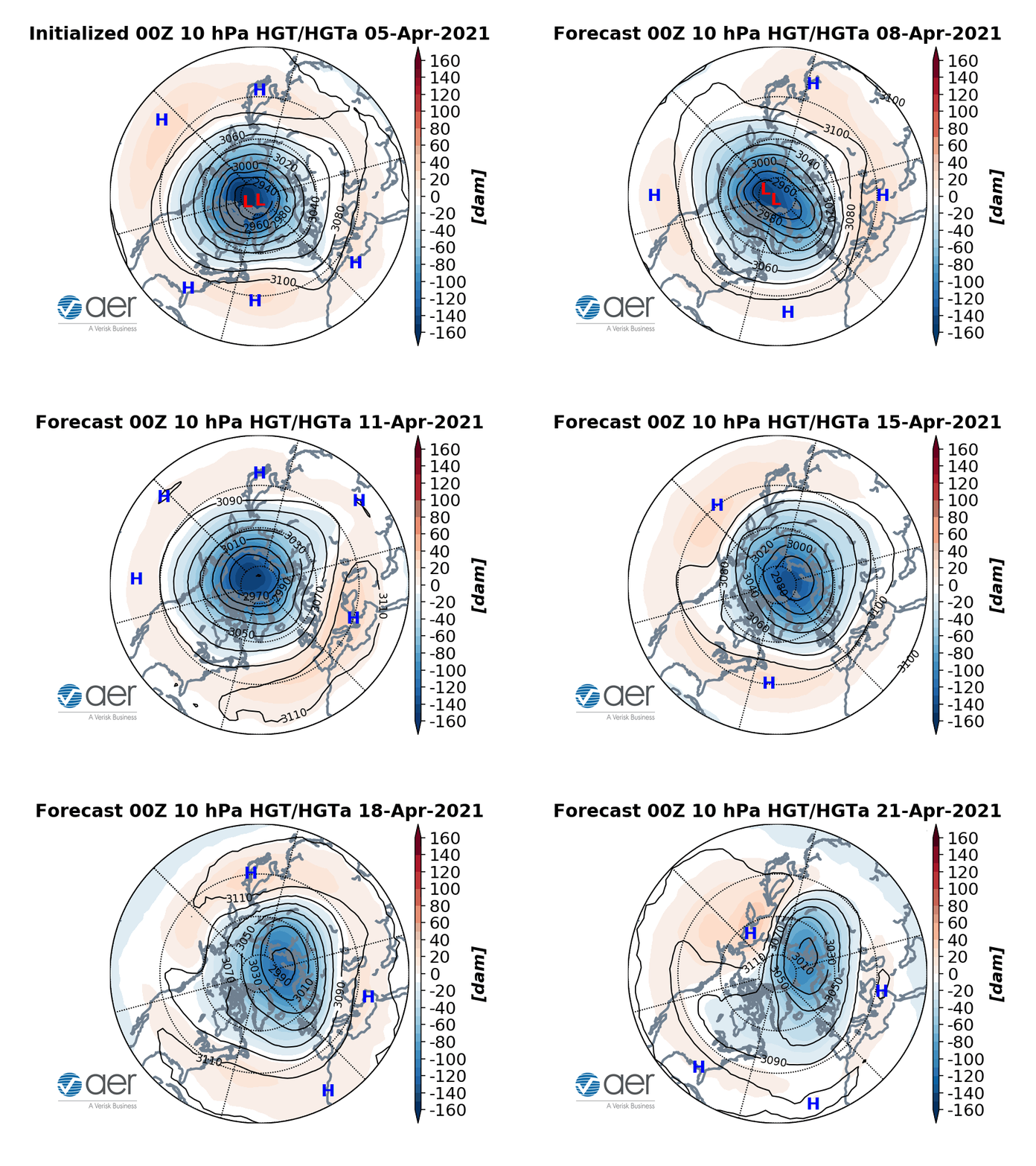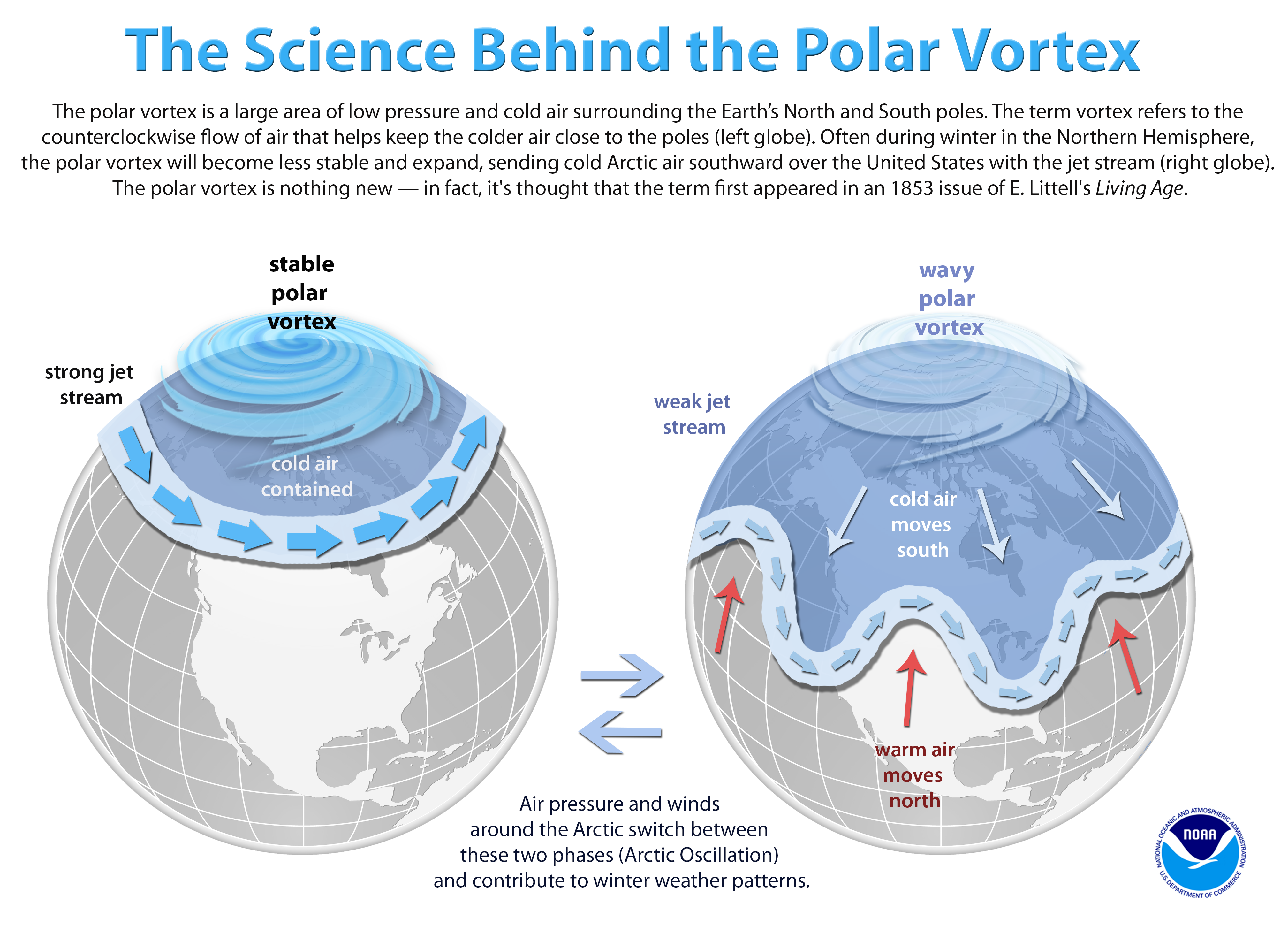
The World Since I Was Twelve

This is a reblog of  David Kreutzer’s article The World Since I Was Born at IER (Institute for Energy Research).  Excerpts in italics with my bolds.  My title change is due to me being a few years older than he.

Some climate Tweeters have taken to adorning their Twitter bios with the atmospheric CO2 concentration in the year of their birth. If there were room in my bio I would list that and some other stuff.

david-kreutzer-table

[Note: Superscript numbers refer to data sources linked in IER article.]

Since 1953, the increase in energy consumption may well be the primary driver of rising CO2 concentrations, but it has also been critical to the economic growth that drives phenomenally beneficial trends in virtually every metric of human wellbeing.

Rising energy consumption is almost certainly responsible for a portion of that 1.6 degree warming, but over the past century, the even greater warming has not been associated with any significant rising trends in world-wide hurricanes, tornadoes, floods, droughts, or wildfires.

My Comment:  As Alex Epstein and others have pointed out, the introduction of energy from fossil fuels made possible an extraordinary rise in human flourishing, shown in these graphs.

15-3.1

And in support of his concluding remark:

giss-gmt-to-2018-w-co2

us-wet-dry-co2rev-1

post-glacial_sea_level

Resource Document:  Advance Briefing for Glasgow COP 2021

March 25 Arctic Melt Season Ensues

As anticipated in a previous post, Arctic ice extent appears to have peaked under the 15M km2 threshold.  An earlier discussion noted that the wavy Polar Vortex that froze Texas with cold Arctic air in February, allowed warmer southern air into Arctic regions, reducing ice extent.  The ice recovered afterward ( see March 1, 2021 Arctic Ice Recovers from PV Hit ), but 2021 was no longer going to reach 15M km2.  As shown by the graph below, ice extents this year did persist and draw close to the 14 year average, before beginning the melt season this week.

Arctic2021083

Starting March MASIE 2021 shows Arctic extents were about 400k km2 below average, but for the first 20 days added 200k while the average lost about 100k, reducing the difference to 85k km2 on day 80.  Now in the last 3 days the melt season has erased the gains in 2021 and restored the deficit to nearly 300k km2, 2% of the 14-year average.  SII reported mostly lower extents than MASIE, but presently the two are similar.  The table shows the distribution of ice over the Arctic regions.

Region 2021083 Day 083 Average 2021-Ave. 2007083 2021-2007
 (0) Northern_Hemisphere 14565743 14844057 -278315 14412819 152924
 (1) Beaufort_Sea 1070689 1070239 450 1069711 978
 (2) Chukchi_Sea 966006 965879 127 966006 0
 (3) East_Siberian_Sea 1087137 1087066 72 1087137 0
 (4) Laptev_Sea 897827 897599 228 897845 -18
 (5) Kara_Sea 935023 918802 16221 904153 30870
 (6) Barents_Sea 689316 649153 40163 472230 217086
 (7) Greenland_Sea 657096 631454 25642 609918 47178
 (8) Baffin_Bay_Gulf_of_St._Lawrence 1284957 1509201 -224244 1323453 -38496
 (9) Canadian_Archipelago 854597 853068 1529 852767 1830
 (10) Hudson_Bay 1260903 1260717 186 1259717 1186
 (11) Central_Arctic 3203492 3230083 -26591 3234061 -30569
 (12) Bering_Sea 592244 746974 -154730 883221 -290977
 (13) Baltic_Sea 46648 70687.87 -24040 70484 -23836
 (14) Sea_of_Okhotsk 1010021 938704 71317 765577 244443

Interestingly, both Okhotsk and Barents Seas peaked well above average, and are still in surplus after starting to retreat.  The main deficits are in Bering and Baffin Bay.  The central Arctic, Siberian and Canadian regions remain solidly frozen.

Background previous post Arctic Ice Moment of Truth 2021

For ice extent in the Arctic, the bar is set at 15M km2. The average peak in the last 14 years occurs on day 62 at 15.04M km2 before descending, though the average can still be above 15M at late as day 73.  Nine of the last 14 years were able to clear 15M, but recently only 2016 and 2020 ice extents cleared the bar at 15M km2; the others came up short. The actual annual peak ice extent day varied between day 59 (2016) to day 82 (2012).

The animation shows in two weeks how this year’s ice extents contracted and then regrew greater than before, coincidental with the wavy Polar Vortex (PV) first admitting warmer southern air and then keeping the cold air in.

As reported previously, most of the action was firstly in the Pacific, especially Sea of Okhotsk upper left, ice shrinking one week by 200k km2 and rapidly growing back 210k km2 ice extent the next.  Okhotsk ice is now 1.1M km2, 96% of 2020 max.  On the Atlantic side, Barents sea upper right lost 100k km2 retreating from Svalbard, then gained 120k km2 back.  Greenland Sea ice middle right lost 100k km2, and then gained 150k km2.  Barents now has 3% more ice than 2020 max, while Greenland sea ice is 85% of last year’s max.

Drift ice in Okhotsk Sea at sunrise.

For more on the Pacific basins see post Meet Bering and Okhotsk Seas

Mid March Arctic Ice Update

As anticipated in the previous post reprinted below, Arctic ice extent appears to have peaked under the 15M km2 threshold.  An earlier discussion at 2020 year end noted that March actually ends up with less ice extent than end of February, so the rest of the month is not likely to add any more ice.  Here is the graph for March including yesterday.

Arctic2021073

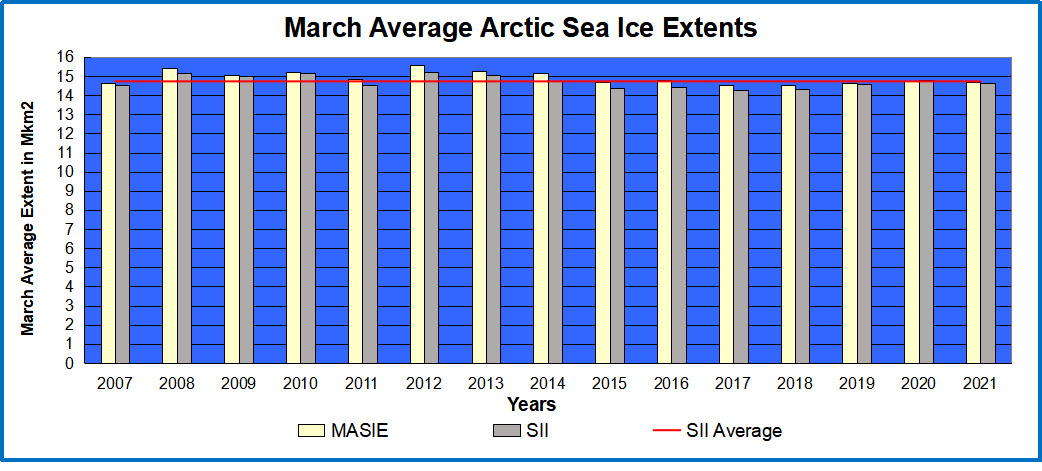
The graph shows this year did recover from a 400k km2 deficit to the 14-year average, to about 100k by day 70, and has now fallen back to almost 300k km2 down (2%).  It is also apparent that extent will likely decline in the next two weeks, by about 300k km2 on average, already matched by 2021.  Climatology uses SII March monthly average as the annual maximum, so that will come out lower as well.

Interestingly, both Okhotsk and Barents Seas peaked well above 2020, and are now starting to retreat, along with other marginal basins.  The central Arctic, Siberian and Canadian regions remain solidly frozen.

Background previous post Arctic Ice Moment of Truth 2021

For ice extent in the Arctic, the bar is set at 15M km2. The average peak in the last 14 years occurs on day 62 at 15.04M km2 before descending, though the average can still be above 15M at late as day 73.  Nine of the last 14 years were able to clear 15M, but recently only 2016 and 2020 ice extents cleared the bar at 15M km2; the others came up short. The actual annual peak ice extent day varied between day 59 (2016) to day 82 (2012).

The animation shows in two weeks how this year’s ice extents contracted and then regrew greater than before, coincidental with the wavy Polar Vortex (PV) first admitting warmer southern air and then keeping the cold air in.

As reported previously, most of the action was firstly in the Pacific, especially Sea of Okhotsk upper left, ice shrinking one week by 200k km2 and rapidly growing back 210k km2 ice extent the next.  Okhotsk ice is now 1.1M km2, 96% of 2020 max.  On the Atlantic side, Barents sea upper right lost 100k km2 retreating from Svalbard, then gained 120k km2 back.  Greenland Sea ice middle right lost 100k km2, and then gained 150k km2.  Barents now has 3% more ice than 2020 max, while Greenland sea ice is 85% of last year’s max.

All of this means that 2021 will be hard pressed to pass the 15M km2 threshold.  The graph below shows the situation evolving over the last two weeks anticipating the annual maximum to appear within the fortnight.

Note that Sea Ice Index (SII) went offline day 51 so the MASIE record alone shows the loss of ice extent ending day 56 and climbing up to the present.  The NH ice extent gap is at 244k km2, or 1.6%.  Since the 14 year average has already peaked, further growth will narrow the margin.  (Note that ice extent is affected also by winds piling up drift ice, as well as melting from intrusions of warmer air or water.)

Last year surpassed the average while other recent years were lower.  We shall see what this year does with only 10 days or so to make a difference.

Region 2021063 Day 063 Average 2021-Ave. 2007063 2021-2007
 (0) Northern_Hemisphere 14772617 15016830 -244214 14665491 107126
 (1) Beaufort_Sea 1070689 1070254 435 1069711 978
 (2) Chukchi_Sea 966006 964118 1888 966006 0
 (3) East_Siberian_Sea 1087120 1087134 -14 1087137 -17
 (4) Laptev_Sea 897827 897842 -15 897845 -18
 (5) Kara_Sea 935006 929650 5356 932067 2939
 (6) Barents_Sea 805710 649490 156220 626044 179666
 (7) Greenland_Sea 669651 625085 44566 616841 52809
 (8) Baffin_Bay_Gulf_of_St._Lawrence 1224508 1553901 -329393 1220513 3995
 (9) Canadian_Archipelago 854597 853148 1450 852767 1830
 (10) Hudson_Bay 1260471 1260567 -96 1256718 3753
 (11) Central_Arctic 3197627 3222365 -24738 3229824 -32197
 (12) Bering_Sea 631115 686765 -55650 660726 -29612
 (13) Baltic_Sea 65146 97873 -32727 104884 -39738
 (14) Sea_of_Okhotsk 1090295 1084593 5703 1129107 -38812

The main deficit to average is in Baffin Bay, partly offset by a surplus in Barents.  Smaller pluses and minuses are found in other regions.

Typically, Arctic ice extent loses 67 to 70% of the March maximum by mid September, before recovering the ice in building toward the next March.

What will the ice do this year?  Where will 2020 rank in the annual Arctic Ice High Jump competition?

Drift ice in Okhotsk Sea at sunrise.

For more on the Pacific basins see post Meet Bering and Okhotsk Seas

Arctic Ice Moment of Truth 2021

For ice extent in the Arctic, the bar is set at 15M km2. The average peak in the last 14 years occurs on day 62 at 15.04M km2 before descending, though the average can still be above 15M at late as day 73.  Nine of the last 14 years were able to clear 15M, but recently only 2016 and 2020 ice extents cleared the bar at 15M km2; the others came up short. The actual annual peak ice extent day varied between day 59 (2016) to day 82 (2012).

The animation shows in two weeks how this year’s ice extents contracted and then regrew greater than before, coincidental with the wavy Polar Vortex (PV) first admitting warmer southern air and then keeping the cold air in.

As reported previously, most of the action was firstly in the Pacific, especially Sea of Okhotsk upper left, ice shrinking one week by 200k km2 and rapidly growing back 210k km2 ice extent the next.  Okhotsk ice is now 1.1M km2, 96% of 2020 max.  On the Atlantic side, Barents sea upper right lost 100k km2 retreating from Svalbard, then gained 120k km2 back.  Greenland Sea ice middle right lost 100k km2, and then gained 150k km2.  Barents now has 3% more ice than 2020 max, while Greenland sea ice is 85% of last year’s max.

All of this means that 2021 will be hard pressed to pass the 15M km2 threshold.  The graph below shows the situation evolving over the last two weeks anticipating the annual maximum to appear within the fortnight.

Note that Sea Ice Index (SII) went offline day 51 so the MASIE record alone shows the loss of ice extent ending day 56 and climbing up to the present.  The NH ice extent gap is at 244k km2, or 1.6%.  Since the 14 year average has already peaked, further growth will narrow the margin.  (Note that ice extent is affected also by winds piling up drift ice, as well as melting from intrusions of warmer air or water.)

Last year surpassed the average while other recent years were lower.  We shall see what this year does with only 10 days or so to make a difference.

Region 2021063 Day 063 Average 2021-Ave. 2007063 2021-2007
 (0) Northern_Hemisphere 14772617 15016830 -244214 14665491 107126
 (1) Beaufort_Sea 1070689 1070254 435 1069711 978
 (2) Chukchi_Sea 966006 964118 1888 966006 0
 (3) East_Siberian_Sea 1087120 1087134 -14 1087137 -17
 (4) Laptev_Sea 897827 897842 -15 897845 -18
 (5) Kara_Sea 935006 929650 5356 932067 2939
 (6) Barents_Sea 805710 649490 156220 626044 179666
 (7) Greenland_Sea 669651 625085 44566 616841 52809
 (8) Baffin_Bay_Gulf_of_St._Lawrence 1224508 1553901 -329393 1220513 3995
 (9) Canadian_Archipelago 854597 853148 1450 852767 1830
 (10) Hudson_Bay 1260471 1260567 -96 1256718 3753
 (11) Central_Arctic 3197627 3222365 -24738 3229824 -32197
 (12) Bering_Sea 631115 686765 -55650 660726 -29612
 (13) Baltic_Sea 65146 97873 -32727 104884 -39738
 (14) Sea_of_Okhotsk 1090295 1084593 5703 1129107 -38812

The main deficit to average is in Baffin Bay, partly offset by a surplus in Barents.  Smaller pluses and minuses are found in other regions.

Typically, Arctic ice extent loses 67 to 70% of the March maximum by mid September, before recovering the ice in building toward the next March.

What will the ice do this year?  Where will 2020 rank in the annual Arctic Ice High Jump competition?

Drift ice in Okhotsk Sea at sunrise.

For more on the Pacific basins see post Meet Bering and Okhotsk Seas

Updated: Global Warming Ends 2021

The animation is an update of a previous analysis from Dr. Murry Salby.  These graphs use Hadcrut4 and include the 2016 El Nino warming event.  The exhibit shows since 1947 GMT warmed by 0.8 C, from 13.9 to 14.7, as estimated by Hadcrut4.  This resulted from three natural warming events involving ocean cycles. The most recent rise 2013-16 lifted temperatures by 0.2C.  Previously the 1997-98 El Nino produced a plateau increase of 0.4C.  Before that, a rise from 1977-81 added 0.2C to start the warming since 1947.

Importantly, the theory of human-caused global warming asserts that increasing CO2 in the atmosphere changes the baseline and causes systemic warming in our climate.  On the contrary, all of the warming since 1947 was episodic, coming from three brief events associated with oceanic cycles. Moreover, the UAH record shows that the effects of the last one are now gone as of January 2021. Updated to March 2021 (UAH baseline is now 1990-2020)

UAH Global 1995to202103

The 2016 El Nino persisted longer than 1998, and was followed by warming after effects in NH.  The monthly anomaly as 2021 begins is matching the 0.04C average since 1995, an ENSO neutral year prior to the second warming event discussed above. With a quiet sun and cooling oceans, the prospect is for cooler times ahead.

Postscript:  Article by Dr. Arnd Bernaerts regarding ENSO and Climate Models

At Oceans Govern Climate Arnd writes Instead of El Niño, La Niña 2020/21 came. 

12dwbvaornoc6gpwx7rm6ta

He summarizes in this way (in italics with my bolds):

Although ENSO is a long-known climate phenomenon, climatologists still follow the view of the meteorologists 100 years ago, according to which the atmosphere is at the center of all-weather events. They are generously willing to acknowledge that the oceans play an important role, but not that ocean temperatures and their contribution to atmospheric humidity are the most crucial factors. This can be seen in the example of ENSO. Although small in oceanic proportions, the weather above can have long distance effects. Once it happen, e.g. due to a lack of trade winds, the triggering cause remains the changes in equatorial water temperatures.

The attempt to use computer models and weather observation data, by atmosphere-ocean coupling, ENSO forecasts failed with the 2020/2021 forecast and will not achieve what would be necessary in the future either.

What is needed is twofold: (a) much more ocean data , and (b) acknowledging the supremacy of the oceans in climatic change matters. 

No ocean area is as intensive observed as the Equatorial Eastern Pacific (EEP), well over 40 years. Since recently the Tropical Pacific Observing System, TPOS 2020, sustained sampling network is the “backbone” of the system, (Details: WMO). Whether this system can even provide nearly enough oceanic data to make predictions about what is going on under the sea surface cannot be judged here, but it is unlikely and for a long time.

So the other problem remains, the climatologists’ narrow view on the atmosphere. The authors of the El Nino forecast for 2020/21 failed because they lacked the insight that without comprehensive marine data, their model calculations are at best speculations. At least this conclusion should be drawn from their dramatic false prognosis.

In conclusion climatology should realize, that any ocean space, whether in size of a few hundred square miles or as covered by ENSO, plays an important role in climate matters, and that the latter should be regarded as a gift, to understand the mechanism quicker, on who is driving the climate.

2020 Update: US Coasts Not Flooding as Predicted


Previous Post Updated with 2020 Statistics

In 2018 climatists applied their considerable PR skills and budgets swamping the media with warnings targeting major coastal cities, designed to strike terror in anyone holding real estate in those places. Example headlines included:

Sea level rise could put thousands of homes in this SC county at risk, study says The State, South Carolina

Taxpayers in the Hamptons among the most exposed to rising seas Crain’s New York Business

Adapting to Climate Change Will Take More Than Just Seawalls and Levees Scientific American

The Biggest Threat Facing the City of Miami Smithsonian Magazine

What Does Maryland’s Gubernatorial Race Mean For Flood Management? The Real News Network

Study: Thousands of Palm Beach County homes impacted by sea-level rise WPTV, Florida

Sinking Land and Climate Change Are Worsening Tidal Floods on the Texas Coast Texas Observer

Sea Level Rise Will Threaten Thousands of California Homes Scientific American

300,000 coastal homes in US, worth $120 billion, at risk of chronic floods from rising seas USA Today

That last gets the thrust of the UCS study Underwater: Rising Seas, Chronic Floods, and the Implications for US Coastal Real Estate (2018)

Sea levels are rising. Tides are inching higher. High-tide floods are becoming more frequent and reaching farther inland. And hundreds of US coastal communities will soon face chronic, disruptive flooding that directly affects people’s homes, lives, and properties.

Yet property values in most coastal real estate markets do not currently reflect this risk. And most homeowners, communities, and investors are not aware of the financial losses they may soon face.

This analysis looks at what’s at risk for US coastal real estate from sea level rise—and the challenges and choices we face now and in the decades to come.

The report and supporting documents gave detailed dire warnings state by state, and even down to counties and townships. As example of the damage projections is this table estimating 2030 impacts:

State  Homes at Risk  Value at Risk Property Tax at Risk  Population in 
at-risk homes 
AL  3,542 $1,230,676,217 $5,918,124  4,367
CA  13,554 $10,312,366,952 $128,270,417  33,430
CT  2,540 $1,921,428,017 $29,273,072  5,690
DC  – $0 $0  –
DE  2,539 $127,620,700 $2,180,222  3,328
FL  20,999 $7,861,230,791 $101,267,251  32,341
GA  4,028 $1,379,638,946 $13,736,791  7,563
LA  26,336 $2,528,283,022 $20,251,201  63,773
MA  3,303 $2,018,914,670 $17,887,931  6,500
MD  8,381 $1,965,882,200 $16,808,488  13,808
ME  788 $330,580,830 $3,933,806  1,047
MS  918 $100,859,844 $1,392,059  1,932
NC  6,376 $1,449,186,258 $9,531,481  10,234
NH  1,034 $376,087,216 $5,129,494  1,659
NJ  26,651 $10,440,814,375 $162,755,196  35,773
NY  6,175 $3,646,706,494 $74,353,809  16,881
OR  677 $110,461,140 $990,850  1,277
PA  138 $18,199,572 $204,111  310
RI  419 $299,462,350 $3,842,996  793
SC  5,779 $2,882,357,415 $22,921,550  8,715
TX  5,505 $1,172,865,533 $19,453,940  9,802
VA  3,849 $838,437,710 $8,296,637  6,086
WA  3,691 $1,392,047,121 $13,440,420  7,320

The methodology, of course is climate models all the way down. They explain:

Three sea level rise scenarios, developed by the National Oceanic and Atmospheric Administration (NOAA) and localized for this analysis, are included:

  • A high scenario that assumes a continued rise in global carbon emissions and an increasing loss of land ice; global average sea level is projected to rise about 2 feet by 2045 and about 6.5 feet by 2100.
  • An intermediate scenario that assumes global carbon emissions rise through the middle of the century then begin to decline, and ice sheets melt at rates in line with historical observations; global average sea level is projected to rise about 1 foot by 2035 and about 4 feet by 2100.
  • A low scenario that assumes nations successfully limit global warming to less than 2 degrees Celsius (the goal set by the Paris Climate Agreement) and ice loss is limited; global average sea level is projected to rise about 1.6 feet by 2100.

Oh, and they did not forget the disclaimer:

Disclaimer
This research is intended to help individuals and communities appreciate when sea level rise may place existing coastal properties (aggregated by community) at risk of tidal flooding. It captures the current value and tax base contribution of those properties (also aggregated by community) and is not intended to project changes in those values, nor in the value of any specific property.

The projections herein are made to the best of our scientific knowledge and comport with our scientific and peer review standards. They are limited by a range of factors, including but not limited to the quality of property-level data, the resolution of coastal elevation models, the potential installment of defensive measures not captured by those models, and uncertainty around the future pace of sea level rise. More information on caveats and limitations can be found at http://www.ucsusa.org/underwater.

Neither the authors nor the Union of Concerned Scientists are responsible or liable for financial or reputational implications or damages to homeowners, insurers, investors, mortgage holders, municipalities, or other any entities. The content of this analysis should not be relied on to make business, real estate or other real world decisions without independent consultation with professional experts with relevant experience. The views expressed by individuals in the quoted text of this report do not represent an endorsement of the analysis or its results.

The need for a disclaimer becomes evident when looking into the details. The NOAA reference is GLOBAL AND REGIONAL SEA LEVEL RISE SCENARIOS FOR THE UNITED STATES NOAA Technical Report NOS CO-OPS 083

Since the text emphasizes four examples of their scenarios, let’s consider them here. First there is San Francisco, a city that sued oil companies over sea level rise. From tidesandcurrents comes this tidal gauge record
It’s a solid, long-term record providing more than a century of measurements from 1900 through 2020.  The graph below compares the present observed trend with climate models projections out to 2100.

Since the record is set at zero in 2000, the difference in 21st century expectation is stark. Instead of  the existing trend out to around 20 cm, models project 2.5 meters rise by 2100.

New York City is represented by the Battery tidal gauge:


Again, a respectable record with a good 20th century coverage.  And the models say:


The red line projects 2500 mm rise vs. 287 mm, almost a factor of 10 more.  The divergence is evident even in the first 20 years.

Florida comes in for a lot of attention, especially the keys, so here is Key West:


A similar pattern to NYC Battery gauge, and here is the projection:


The pattern is established: Instead of a rise of about 25 cm, the models project 250 cm.

Finally, probably the worst case, and already well-known to all is Galveston, Texas:


The water has been rising there for a long time, so maybe the models got this one close.

The gap is less than the others since the rising trend is much higher, but the projection is still nearly four times the past.  Galveston is at risk, all right, but we didn’t need this analysis to tell us that.

A previous post Unbelievable Climate Models goes into why they are running so hot and so extreme, and why they can not be trusted.

Footnote Regarding Alarms in Other Places

Recently there was a flap over future sea levels at Rhode Island, so I took a look at Newport RI, the best tidal gauge record there.  Same Story: Observed sea levels already well below projections that are 10 times the tidal gauge trend.

Another city focused upon urban flooding is Philadelphia.  As with other coastal settlements, claims of sea level rise from global warming are unfounded.

Philadelphia is a great example where a real concern will not be addressed by reducing CO2 emissions.  See Urban Flooding: The Philadelphia Story

Arctic Building Ice Inventory Mid January

At this point in the Arctic refreezing phase, LIFO inventory accounting comes into play.  Last-In, First-out is one accepted way to price the value of a company’s inventory.  For Arctic ice, it means that basins that are last to freeze over in winter are the first to melt out in the summer.  For example, in Mid January 2021, total NH ice extent is 91% of last March maximum, so most basins have long been covered with ice.  The last 9% will be added in four places (present % of max is noted):

Bering Sea        62%
Okhotsk Sea     70%
Barents Sea      58%
Baffin Bay         66%

In the Pacific animation above, Bering on the right adds ice extent from 261k km2 to 513k km2 since Jan. 1, while Okhotsk goes from 500k km2 to 800k km2.  Together they will likely add ~650k km2 more by March maximum.  

On the Atlantic side, Barents Sea added only ~100k km2 so far in January.  More interesting on the right side is the Baltic Sea quadrupled from 9K km2 to 42k km2.  While the Baltic extent is not large by comparison, it is already 38% greater than last March maximum, so that is surprising.

Normally, ice in the Yellow Sea is insignificant, but this year is different.  Perhaps you saw reports like this one from gcaptain Sea Ice Slows Ships In North China Ports  Excerpts in italics with my bolds.

By Muyu Xu and Chen Aizhu (Reuters) – Chinese ports and marine safety authorities are on high alert as an expansion of sea ice makes it tougher for ships to berth and discharge at key energy product import terminals along the coast of northern Bohai Bay.

A cold wave sweeping the northern hemisphere has plunged temperatures across China to their lowest in decades, boosting demand for power and fuel to historic highs in the world’s largest energy consumer.

Bohai Bay appears in the upper right corner, with Beijing nearby. Yellow Sea extent doubled in January up to 28,000 km2, which is twice the maximum last March.

Background on Okhotsk Sea

NASA describes Okhotsk as a Sea and Ice Factory. Excerpts in italics with my bolds.

The Sea of Okhotsk is what oceanographers call a marginal sea: a region of a larger ocean basin that is partly enclosed by islands and peninsulas hugging a continental coast. With the Kamchatka Peninsula, the Kuril Islands, and Sakhalin Island partly sheltering the sea from the Pacific Ocean, and with prevailing, frigid northwesterly winds blowing out from Siberia, the sea is a winter ice factory and a year-round cloud factory.

The region is the lowest latitude (45 degrees at the southern end) where sea ice regularly forms. Ice cover varies from 50 to 90 percent each winter depending on the weather. Ice often persists for nearly six months, typically from October to March. Aside from the cold winds from the Russian interior, the prodigious flow of fresh water from the Amur River freshens the sea, making the surface less saline and more likely to freeze than other seas and bays.


Map of the Sea of Okhotsk with bottom topography. The 200- and 3000-m isobars are indicated by thin and thick solid lines, respectively. A box denotes the enlarged portion in Figure 5. White shading indicates sea-ice area (ice concentration ⩾30%) in February averaged for 2003–11; blue shading indicates open ocean area. Ice concentration from AMSR-E is used. Color shadings indicate cumulative ice production in coastal polynyas during winter (December–March) averaged from the 2002/03 to 2009/10 seasons (modified from Nihashi and others, 2012, 2017). The amount is indicated by the bar scale. Source: Cambridge Core

Bering Sea Ice is Highly Variable

The animation above shows Bering Sea ice extents at April 2 from 2007 to 2020.  The large fluctuation is evident, much ice in 2012 -13 and almost none in 2018, other years in between.  Given the alarmist bias, it’s no surprise which two years are picked for comparison:

Source: Seattle Times ‘We’ve fallen off a cliff’: Scientists have never seen so little ice in the Bering Sea in spring.

Taking a boat trip from Hokkaido Island to see Okhotsk drift ice is a big tourist attraction, as seen in the short video below.  Al Gore had them worried back then, but not now.

Drift ice in Okhotsk Sea at sunrise.

Global Warming Ends

The animation is an update of a previous analysis from Dr. Murry Salby.  These graphs use Hadcrut4 and include the 2016 El Nino warming event.  The exhibit shows since 1947 GMT warmed by 0.8 C, from 13.9 to 14.7, as estimated by Hadcrut4.  This resulted from three natural warming events involving ocean cycles. The most recent rise 2013-16 lifted temperatures by 0.2C.  Previously the 1994-98 El Nino produced a plateau increase of 0.4C.  Before that, a rise from 1977-81 added 0.2C to start the warming since 1947.

Importantly, the theory of human-caused global warming asserts that increasing CO2 in the atmosphere changes the baseline and causes systemic warming in our climate.  On the contrary, all of the warming since 1947 was episodic, coming from three brief events associated with oceanic cycles. Moreover, the UAH record shows that the effects of the last one are now gone.

The 2016 El Nino persisted longer than 1998, and was followed by warming after effects in NH.  The monthly anomaly at 2020 year end is nearly the 0.18C average since 1995, an ENSO neutral year prior to the second warming event discussed above. With a quiet sun and cooling oceans, the prospect is for cooler times ahead.

Arctic Ice Year-End 2020

At  the bottom is a discussion of statistics on year-end Arctic Sea Ice extents.  The values are averages of the last five days of each year.  End of December is a neutral point in the melting-freezing cycle, midway between September minimum and March maximum extents.

Background from Previous Post Updated to Year-End

Some years ago reading a thread on global warming at WUWT, I was struck by one person’s comment: “I’m an actuary with limited knowledge of climate metrics, but it seems to me if you want to understand temperature changes, you should analyze the changes, not the temperatures.” That rang bells for me, and I applied that insight in a series of Temperature Trend Analysis studies of surface station temperature records. Those posts are available under this heading. Climate Compilation Part I Temperatures

This post seeks to understand Arctic Sea Ice fluctuations using a similar approach: Focusing on the rates of extent changes rather than the usual study of the ice extents themselves. Fortunately, Sea Ice Index (SII) from NOAA provides a suitable dataset for this project. As many know, SII relies on satellite passive microwave sensors to produce charts of Arctic Ice extents going back to 1979.  The current Version 3 has become more closely aligned with MASIE, the modern form of Naval ice charting in support of Arctic navigation. The SII User Guide is here.

There are statistical analyses available, and the one of interest (table below) is called Sea Ice Index Rates of Change (here). As indicated by the title, this spreadsheet consists not of monthly extents, but changes of extents from the previous month. Specifically, a monthly value is calculated by subtracting the average of the last five days of the previous month from this month’s average of final five days. So the value presents the amount of ice gained or lost during the present month.

These monthly rates of change have been compiled into a baseline for the period 1980 to 2010, which shows the fluctuations of Arctic ice extents over the course of a calendar year. Below is a graph of those averages of monthly changes during the baseline period. Those familiar with Arctic Ice studies will not be surprised at the sine wave form. December end is a relatively neutral point in the cycle, midway between the September Minimum and March Maximum.

The graph makes evident the six spring/summer months of melting and the six autumn/winter months of freezing.  Note that June-August produce the bulk of losses, while October-December show the bulk of gains. Also the peak and valley months of March and September show very little change in extent from beginning to end.

The table of monthly data reveals the variability of ice extents over the last 4 decades.

The values in January show changes from the end of the previous December, and by summing twelve consecutive months we can calculate an annual rate of change for the years 1979 to 2019.

As many know, there has been a decline of Arctic ice extent over these 40 years, averaging 40k km2 per year. But year over year, the changes shift constantly between gains and losses.

Moreover, it seems random as to which months are determinative for a given year. For example, much ado has been printed about October 2020 being slower than expected to refreeze and add ice extents. As it happens in this dataset, October has the highest rate of adding ice. The table below shows the variety of monthly rates in the record as anomalies from the 1980-2010 baseline. In this exhibit a red cell is a negative anomaly (less than baseline for that month) and blue is positive (higher than baseline).

Note that the  +/ –  rate anomalies are distributed all across the grid, sequences of different months in different years, with gains and losses offsetting one another.  Yes, October 2020 recorded a lower than average gain, but higher than 2016. The loss in July 2020 was the largest of the year, during the hot Siberian summer.  Note November 2020 ice gain anomaly exceeded the October deficit anomaly by more than twice as much.  December added more surplus so that the anomaly for the year was nothing. The bottom line presents the average anomalies for each month over the period 1979-2020.  Note the rates of gains and losses mostly offset, and the average of all months in the bottom right cell is virtually zero.

A final observation: The graph below shows the Yearend Arctic Ice Extents for the last 30 years.

Note: SII daily extents file does not provide complete values prior to 1988.

Year-end Arctic ice extents (last 5 days of December) show three distinct regimes: 1989-1998, 1998-2010, 2010-2019. The average year-end extent 1989-2010 is 13.4M km2. In the last decade, 2009 was 13.0M km2, and ten years later, 2019 was 12.8M km2. So for all the the fluctuations, the net loss was 200k km2, or 1.5%. Talk of an Arctic ice death spiral is fanciful.

These data show a noisy, highly variable natural phenomenon. Clearly, unpredictable factors are in play, principally water structure and circulation, atmospheric circulation regimes, and also incursions and storms. And in the longer view, today’s extents are not unusual.


Illustration by Eleanor Lutz shows Earth’s seasonal climate changes. If played in full screen, the four corners present views from top, bottom and sides. It is a visual representation of scientific datasets measuring Arctic ice extents.


Arctic Freezing Fast Mid-Dec. 2020


As noted in a previous post, alarms were raised over slower than average Arctic refreezing in October.  Those fears were laid to rest firstly when ice extents roared back in November, and now with the Arctic freezing fast in December. The image above shows the ice gains over the last two weeks, from Dec. 5 to 17, 2020.  In November, 3.5 Wadhams of sea ice were added during the month.  (The metric 1 Wadham = 1 M km2 comes from the professor’s predictions of an ice-free Arctic, meaning less than 1 M km2 extent). So far in December a further 1.9 Wadhams have been added with another two weeks to go in 2020.

Some years ago reading a thread on global warming at WUWT, I was struck by one person’s comment: “I’m an actuary with limited knowledge of climate metrics, but it seems to me if you want to understand temperature changes, you should analyze the changes, not the temperatures.” That rang bells for me, and I applied that insight in a series of Temperature Trend Analysis studies of surface station temperature records. Those posts are available under this heading. Climate Compilation Part I Temperatures

This post seeks to understand Arctic Sea Ice fluctuations using a similar approach: Focusing on the rates of extent changes rather than the usual study of the ice extents themselves. Fortunately, Sea Ice Index (SII) from NOAA provides a suitable dataset for this project. As many know, SII relies on satellite passive microwave sensors to produce charts of Arctic Ice extents going back to 1979.  The current Version 3 has become more closely aligned with MASIE, the modern form of Naval ice charting in support of Arctic navigation. The SII User Guide is here.

There are statistical analyses available, and the one of interest (table below) is called Sea Ice Index Rates of Change (here). As indicated by the title, this spreadsheet consists not of monthly extents, but changes of extents from the previous month. Specifically, a monthly value is calculated by subtracting the average of the last five days of the previous month from this month’s average of final five days. So the value presents the amount of ice gained or lost during the present month.

These monthly rates of change have been compiled into a baseline for the period 1980 to 2010, which shows the fluctuations of Arctic ice extents over the course of a calendar year. Below is a graph of those averages of monthly changes during the baseline period. Those familiar with Arctic Ice studies will not be surprised at the sine wave form. December end is a relatively neutral point in the cycle, midway between the September Minimum and March Maximum.

The graph makes evident the six spring/summer months of melting and the six autumn/winter months of freezing.  Note that June-August produce the bulk of losses, while October-December show the bulk of gains. Also the peak and valley months of March and September show very little change in extent from beginning to end.

The table of monthly data reveals the variability of ice extents over the last 4 decades.

The values in January show changes from the end of the previous December, and by summing twelve consecutive months we can calculate an annual rate of change for the years 1979 to 2019.

As many know, there has been a decline of Arctic ice extent over these 40 years, averaging 40k km2 per year. But year over year, the changes shift constantly between gains and losses.

Moreover, it seems random as to which months are determinative for a given year. For example, much ado has been printed about October 2020 being slower than expected to refreeze and add ice extents. As it happens in this dataset, October has the highest rate of adding ice. The table below shows the variety of monthly rates in the record as anomalies from the 1980-2010 baseline. In this exhibit a red cell is a negative anomaly (less than baseline for that month) and blue is positive (higher than baseline).

Note that the  +/ –  rate anomalies are distributed all across the grid, sequences of different months in different years, with gains and losses offsetting one another.  Yes, October 2020 recorded a lower than average gain, but higher than 2016. The loss in July 2020 was the largest of the year, during the hot Siberian summer.  Note November 2020 ice gain anomaly exceeded the October deficit anomaly by more than twice as much.  The bottom line presents the average anomalies for each month over the period 1979-2020.  Note the rates of gains and losses mostly offset, and the average of all months in the bottom right cell is virtually zero.

Combining the months of October and November shows 2020 828k km2 more ice than baseline for the two months and matching 2019 ice recovery.

The average December adds 2M km2 of sea ice according to SII dataset, and in the first 17 days of December 2020 ice increased by 1.9M km2, with 2 weeks of futher freezing to come.

A final observation: The graph below shows the Yearend Arctic Ice Extents for the last 30 years.

Note: SII daily extents file does not provide complete values prior to 1988.

Year-end Arctic ice extents (last 5 days of December) show three distinct regimes: 1989-1998, 1998-2010, 2010-2019. The average year-end extent 1989-2010 is 13.4M km2. In the last decade, 2009 was 13.0M km2, and ten years later, 2019 was 12.8M km2. So for all the the fluctuations, the net loss was 200k km2, or 1.5%. Talk of an Arctic ice death spiral is fanciful.

These data show a noisy, highly variable natural phenomenon. Clearly, unpredictable factors are in play, principally water structure and circulation, atmospheric circulation regimes, and also incursions and storms. And in the longer view, today’s extents are not unusual.


Illustration by Eleanor Lutz shows Earth’s seasonal climate changes. If played in full screen, the four corners present views from top, bottom and sides. It is a visual representation of scientific datasets measuring Arctic ice extents.