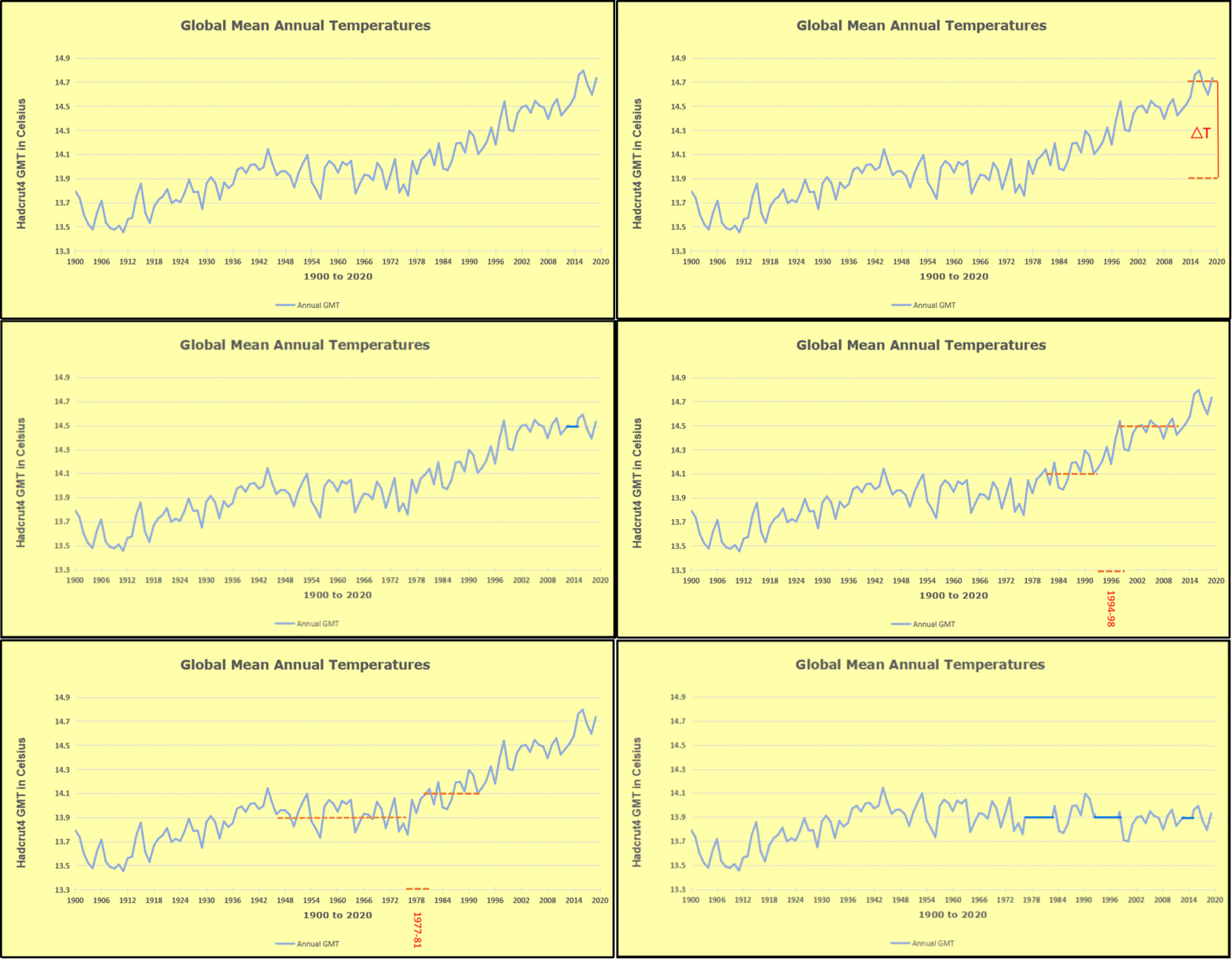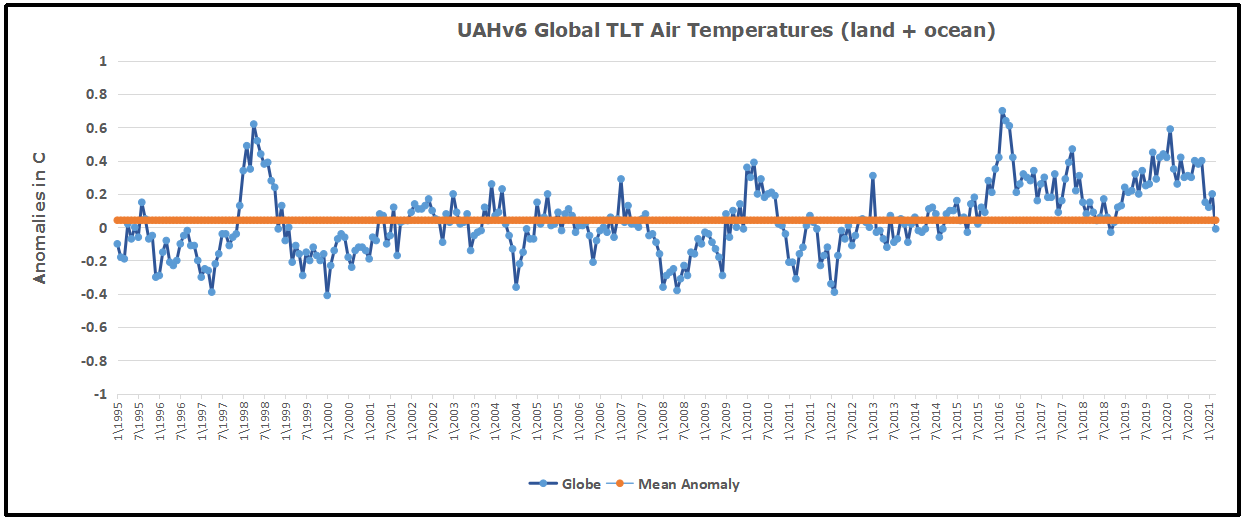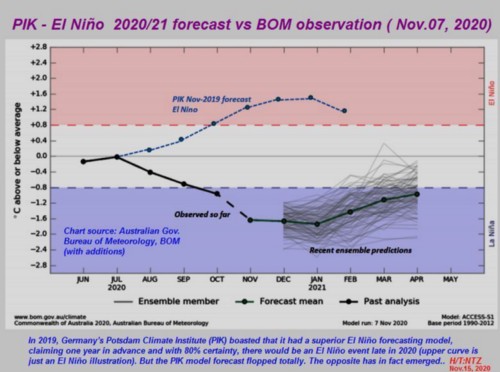
Wacky “War on Nature”

The usual suspects reported U.N. Secretary General Antonio Guterres announcing that humans are at war upon nature.  For example, NY Daily News (in italics with my bolds):

The United Nations is calling on people worldwide to stop “waging war on nature” as the planet achieves disturbing milestones in the battle against climate change.

In a speech at Columbia University, UN Secretary-General Antonio Guterres said, “The state of the planet is broken. … This is suicidal,” The Associated Press reported Wednesday.

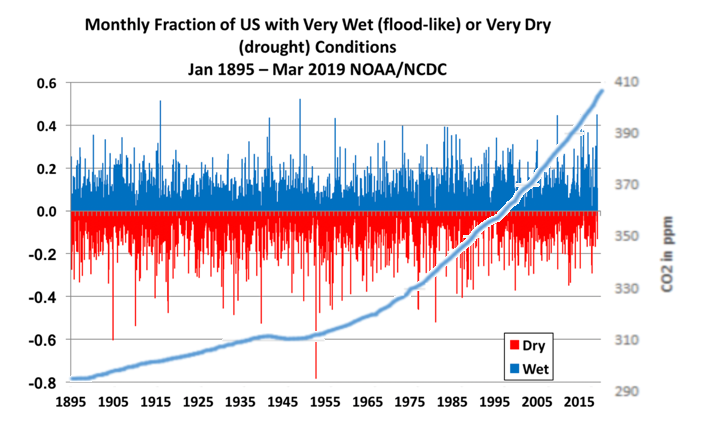
Guterres pointed to “apocalyptic fires and floods, cyclones and hurricanes” that have only become more frequent in recent years, and in particular, during 2020, one of the three hottest years on record.

“Human activities are at the root of our descent towards chaos,” he explained, noting this also means humans are the ones who “can solve it.”

John Osbourne explains at Real Markets how crazy is this latest meme in his article The Utterly Nonsensical View That Humanity Is Waging War on Nature. Excerpts in italics with my bolds.

The narrative that humanity is waging a ‘war on nature’ is nonsense.

At Columbia University on December 2, 2020, U.N. Secretary General Antonio Guterres claimed that humanity’s “war” on the environment was coming to a head. Guterres said, “We are facing a devastating pandemic, new heights of global heating, new lows of ecological degradation and new setbacks in our work towards global goals for more equitable, inclusive and sustainable development… To put it simply, the state of the planet is broken.”

Is humanity facing the crisis that Guterres claims? Is the planet ‘broken’? Most importantly, is there any scientific basis for these claims of doom and gloom?

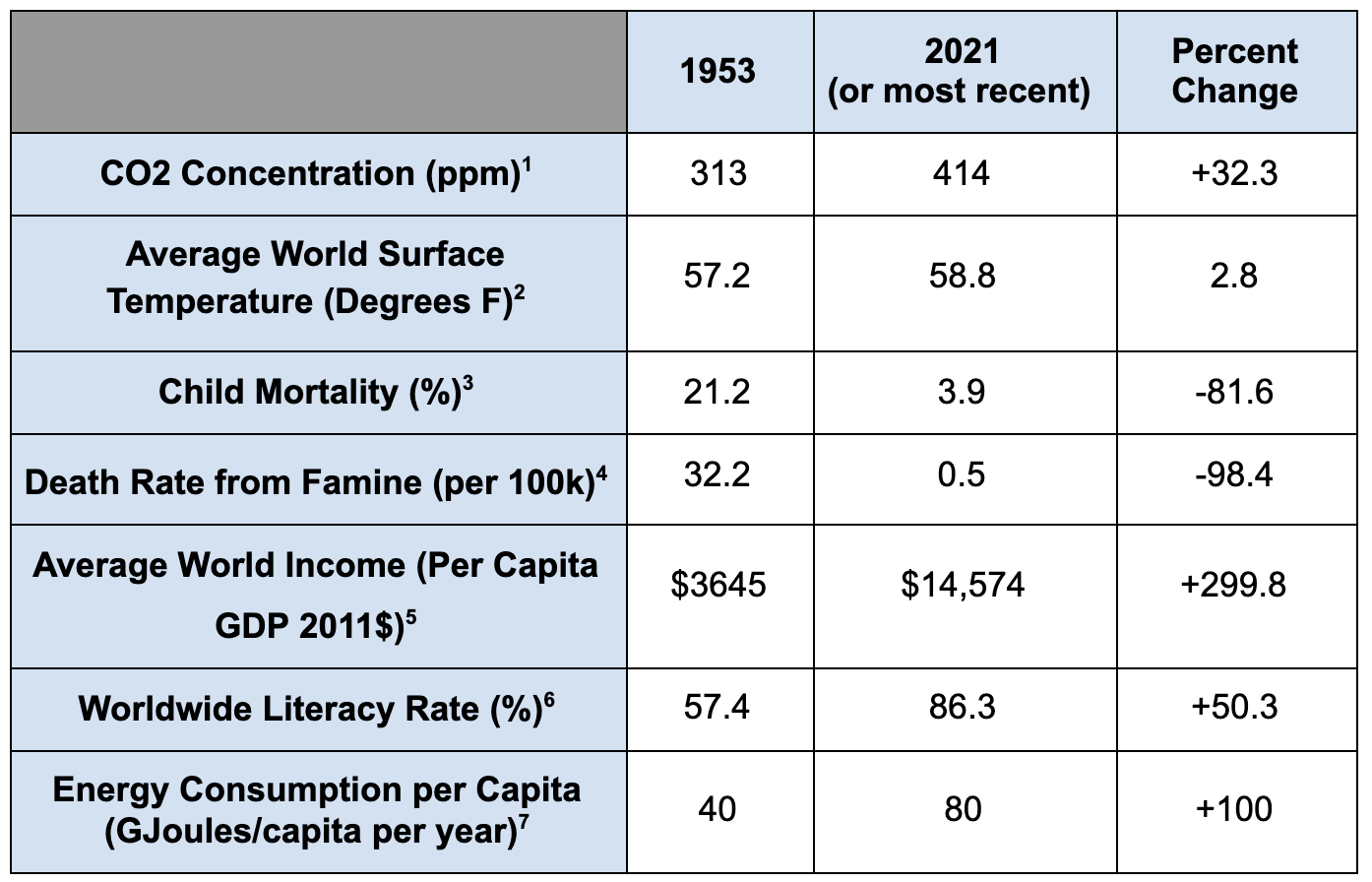
To answer these questions: No. Global living standards continue to rise, despite alarmists constant failed predictions of a dreary future. Greater prosperity has allowed developed countries to devote time and money to remediating existing damage and improving the environment; developing countries have no such luxury. Contrary to alarmists’ claims, climate and temperature changes are extensively documented and perfectly natural. Guterres’ belief that man is at war with nature is unsubstantiated.

Facts, rather than beliefs, should be the foundation of public policy.

In his speech, Guterres highlights nearly every woe in the world. He implies that any problem in the natural world, be it fires, flooding, cyclones, hurricanes, pollution, disease, changes in sea ice and ocean temperatures, can be blamed on climate change. And in Guterres’ view, humanity is the sole driver of climate change. This couldn’t be further from the truth.

Nor is Guterres the sole proponent of such ideas. Media outlets such as CNN, the Huffington Post, and NPR repeat these tropes while rarely citing facts for their claims of impending calamity.

An examination of the science and history of natural disasters will show that deaths from natural disasters are at one of the lowest rates in history. While natural disasters are more expensive than they once were, the reasons are mundane and expected.
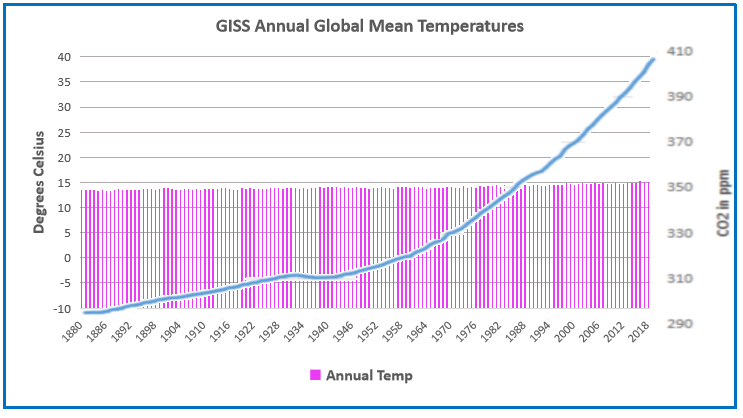
Climate has changed throughout history, well before humanity had any significant impact. Even with CO2’s warming effect, UN IPCC and U.S. Government data show no increase in rates most natural disasters from the period of natural warming (1900 to 1950) to the period the IPCC claims is one of largely human-caused warming (1950 to 2018).

This calls into question not just claims of current CO2-driven “climate crisis” but projections of future damage by those who promote the ‘war on nature’ narrative.

Guterres continues, “Air and water pollution are killing 9 million people annually.” Not only is his number wrong, but his reasoning is flawed. In developed countries (which have access to cheap reliable energy), air and water are cleaner than ever because of the economic growth driven by fossil fuels. Furthermore, his solutions condemn the populations of less developed countries to continue to suffer public health problems arising from lack of affordable energy. Nearly half of the deaths cited in the WHO’s number are caused by cooking indoors with dirty fuels. In the CO2 Coalition’s latest white paper, New-Tech American Coal Fired Electricity for Africa: Clean Air, Indoors and Out we offer a solution to the polluted indoor air: cheap, reliable energy using local resources. President Trump could reverse by executive order the Obama-era ban on U.S. exports of clean-coal technology to coal-rich Africa, saving thousands of lives.

As to ocean health, Guterres says, “The carbon dioxide they absorb is acidifying the seas…” Again, he misses the mark. The CO2 Coalition has analyzed decades of research and found that CO2, which is plankton food that enriches sea life, does not cause “ocean acidification” and that the term itself is misleading.

Guterres concludes by advocating humanity “flick the green switch” and transform the world’s economy by using ‘renewable energy’ to drive sustainability. While this sounds wonderful, the reality is that so-called ‘renewables’ are anything but renewable. Flipping the green switch requires us to depend on energy that is unreliable, expensive, and requires the use of dangerous pollutants. His proposed solution would be harmful to both health and global prosperity.

One thing is certain: the General Secretary is wrong on the science and wrong on the economics. His ‘war on nature’ narrative is bunk.


.


Fear Not Rising Temperatures or Ocean Levels


Dominick T. Armentano writes at the Independent Institute Are Temperatures and Ocean Levels Rising Dangerously? Not Really. Excerpts in italics with my bolds.  H/T John Ray

There are two widely held climate-change beliefs that are simply not accurate. The first is that there has been a statistically significant warming trend in the U.S. over the last 20 years. The second is that average ocean levels are rising alarmingly due to man-made global warming. Neither of these perspectives is true; yet both remain important, nonetheless, since both are loaded with very expensive public policy implications.

To refute the first view, we turn to data generated by the National Oceanic and Atmospheric Administration (NOAA) for the relevant years under discussion. The table below reports the average mean temperature in the continental U.S. for the years 1998 through 2019*:

1998 54.6 degrees
1999 54.5 degrees
2000 54.0 degrees
2001 54.3 degrees
2002 53.9 degrees
2003 53.7 degrees
2004 53.5 degrees
2005 54 degrees
2006 54.9 degrees
2007 54.2 degrees
2008 53.0 degrees
2009 53.1 degrees
2010 53.8 degrees
2011 53.8 degrees
2012 55.3 degrees
2013 52.4 degrees
2014 52.6 degrees
2015 54.4 degrees
2016 54.9 degrees
2017 54.6 degrees
2018 53.5 degrees
2019 52.7 degrees

*National Climate Report – Annual 2019

It is apparent from the data that there has been no consistent warming trend in the U.S. over the last 2 decades; average mean temperatures (daytime and nighttime) have been slightly higher in some years and slightly lower in other years. On balance–and contrary to mountains of uninformed social and political commentary—annual temperatures on average in the U.S. were no higher in 2019 than they were in 1998.

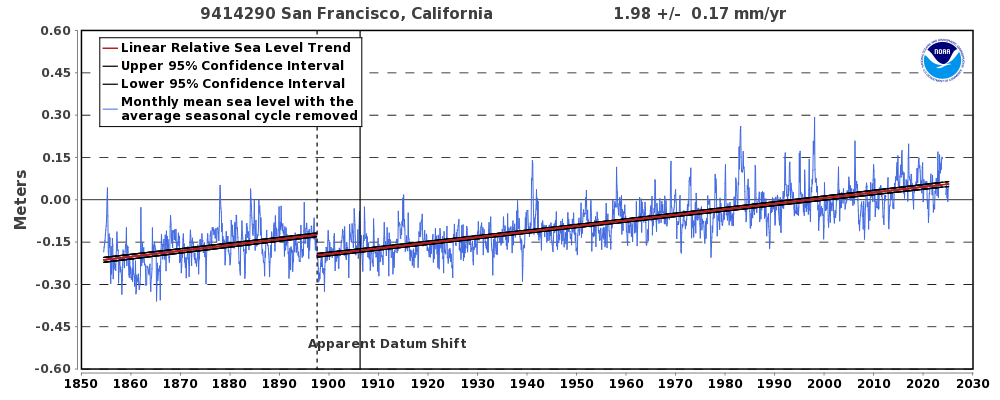
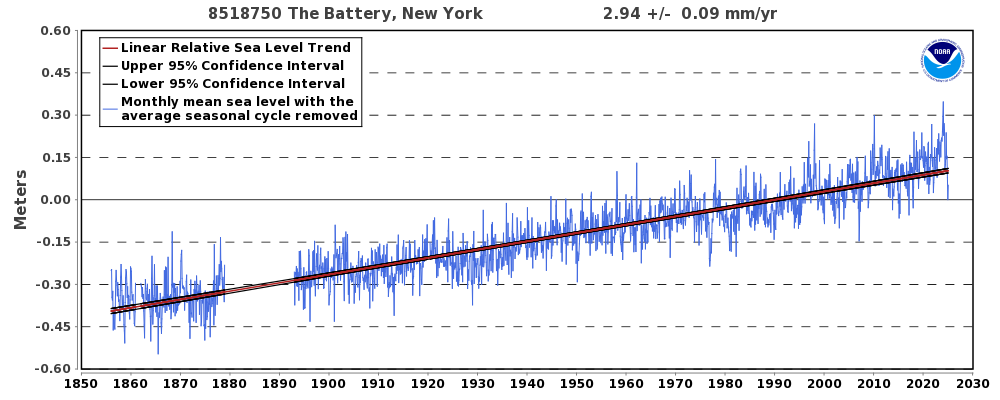
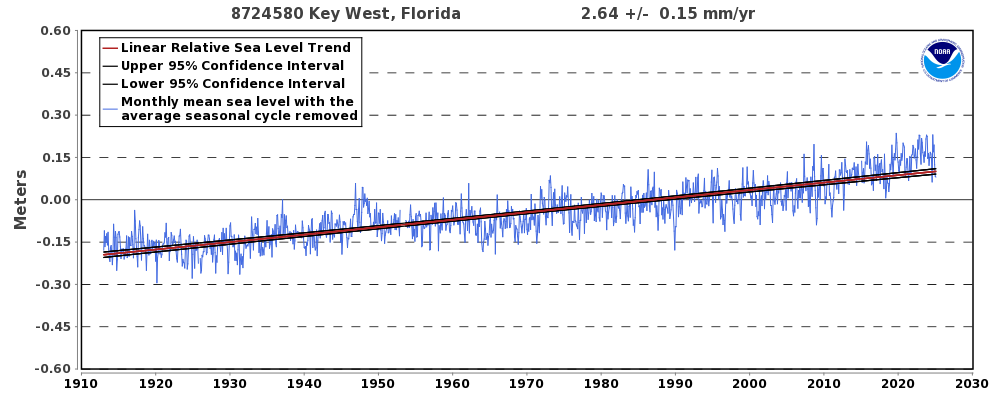
The second widely accepted climate view—based on wild speculations from some op/ed writers and partisan politicians–is that average sea levels are increasing dangerously and rationalize an immediate governmental response. But as we shall demonstrate below, this perspective is simply not accurate.

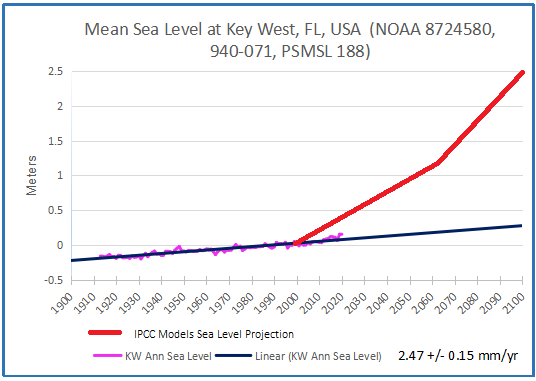
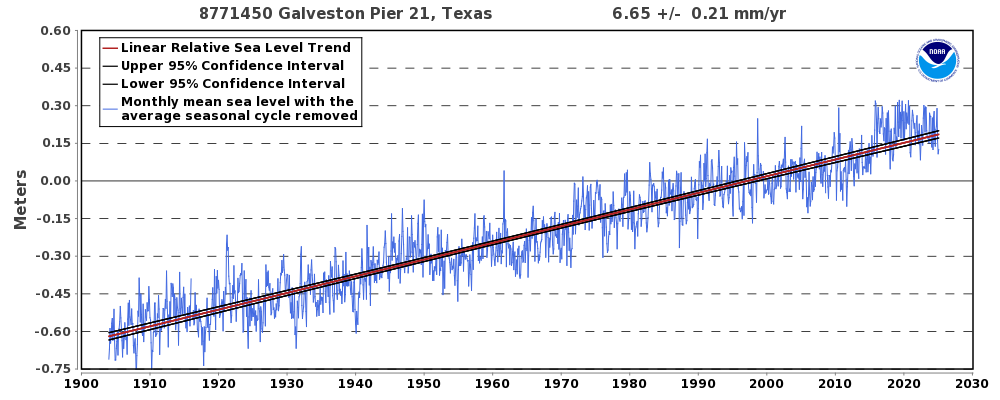
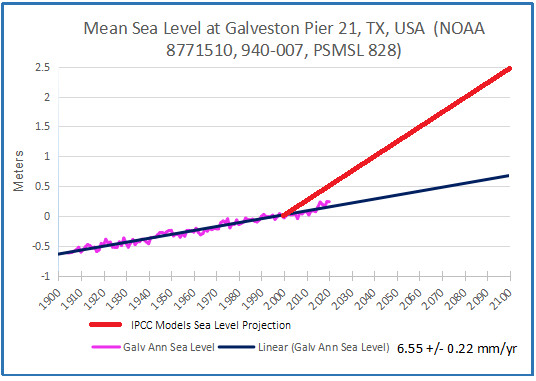
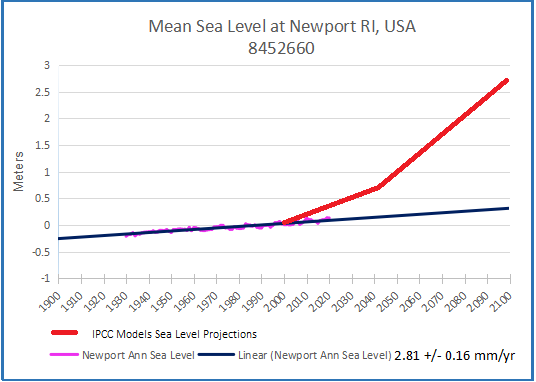
There is a wide scientific consensus (based on satellite laser altimeter readings since 1993) that the rate of increase in overall sea levels has been approximately .12 inches per year.

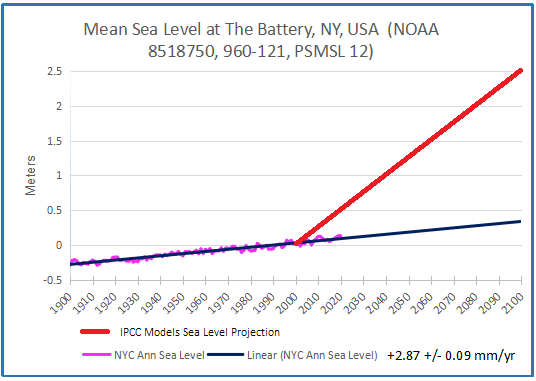
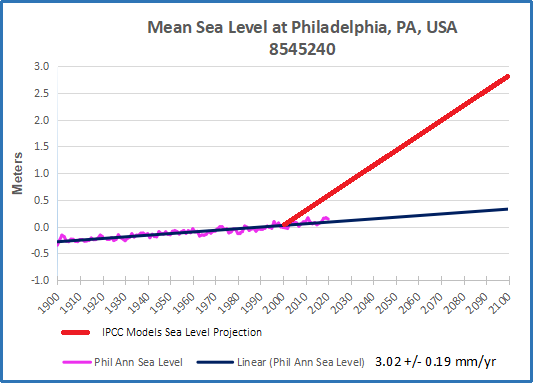
To put that increase in perspective, the average sea level nine years from now (in 2029) is likely to be approximately one inch higher than it is now (2020). One inch is roughly the distance from the tip of your finger to the first knuckle. Even by the turn of the next century (in 2100), average ocean levels (at that rate of increase) should be only a foot or so higher than they are at present.

NYC past & projected 2020

None of this sounds particularly alarming for the general society and little of it can justify any draconian regulations or costly infrastructure investments. The exception might be for very low- lying ocean communities or for properties (nuclear power plants) that, if flooded, would present a wide-ranging risk to the general population. But even here there is no reason for immediate panic. Since ocean levels are rising in small, discrete marginal increments, private and public decision makers would have reasonable amounts of time to prepare, adjust and invest (in flood abatement measures, etc.) if required.

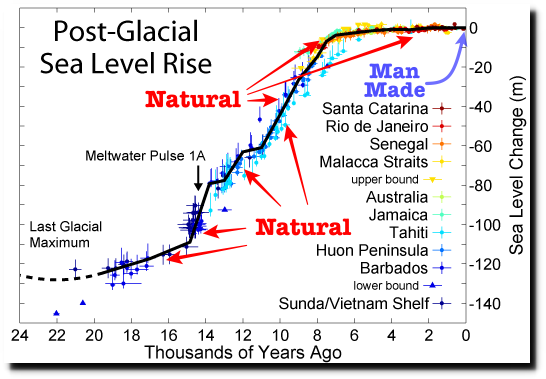
But are sea levels actually rising at all? Empirical evidence of any substantial increases taken from land-based measurements has been ambiguous. This suggests to some scientists that laser and tidal-based measurements of ocean levels over time have not been particularly accurate.

For example, Professor Niles-Axel Morner (Stockholm University) is infamous in climate circles for arguing–based on his actual study of sea levels in the Fiji Islands–that “there are no traces of any present rise in sea levels; on the contrary, full stability.” And while Morner’s views are controversial, he has at least supplied peer reviewed empirical evidence to substantiate his nihilist position on the sea-level increase hypothesis.

The world has many important societal problems and only a limited amount of resources to address them. What we don’t need are overly dramatic climate-change claims that are unsubstantiated and arrive attached to expensive public policies that, if enacted, would fundamentally alter the foundations of the U.S. economic system.

DOMINICK T. ARMENTANO is a Research Fellow at the Independent Institute and professor emeritus in economics at the University of Hartford (CT).

Update Dec.11: USCRN Comparable Temperature Results

In response to Graeme Weber’s Question, this information is presented:

Anthony Watts:

NOAA’s U.S. Climate Reference Network (USCRN) has the best quality climate data on the planet, yet it never gets mentioned in the NOAA/NASA press releases. Commissioned in 2005, it has the most accurate, unbiased, and un-adjusted data of any climate dataset.

The USCRN has no biases, and no need for adjustments, and in my opinion represents a ground truth for climate change.

In this graph of the contiguous United States updated for 2019 comes out about 0.75°F cooler than the start of the dataset in 2005.

See Also Fear Not For Fiji

Setting the Global Temperature Record Straight

Arctic Ice Fears Erased in November

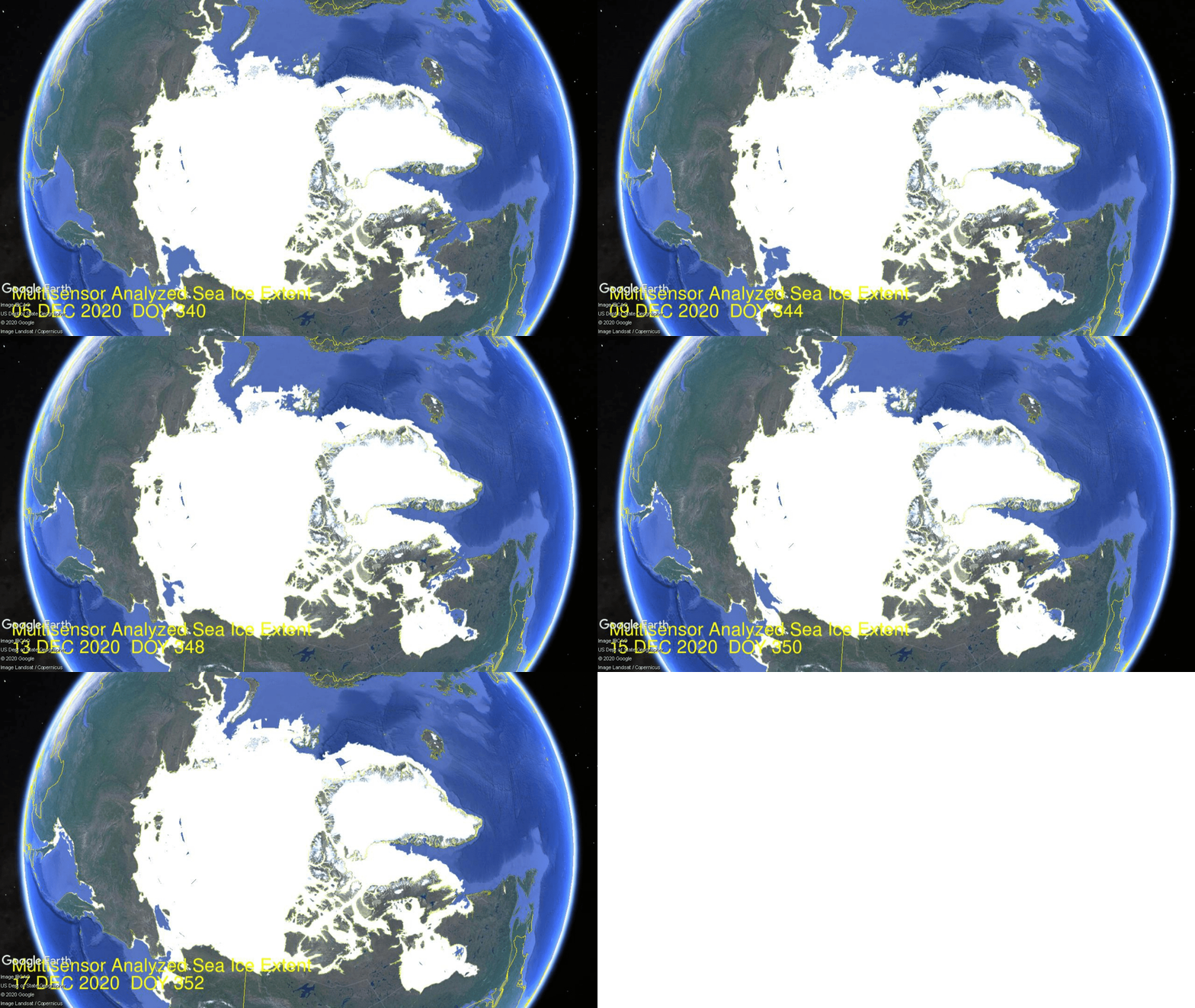
As noted in a previous post, alarms were raised over slower than average Arctic refreezing in October.  Those fears are now laid to rest by ice extents roaring back in November.  The image above shows the ice gains completed from October 31 to November 30, 2020. In fact 3.5 Wadhams of sea ice were added during the month.  (The metric 1 Wadham = 1 M km2 comes from the professor’s predictions of an ice-free Arctic, meaning less than 1 M km2 extent)

Some years ago reading a thread on global warming at WUWT, I was struck by one person’s comment: “I’m an actuary with limited knowledge of climate metrics, but it seems to me if you want to understand temperature changes, you should analyze the changes, not the temperatures.” That rang bells for me, and I applied that insight in a series of Temperature Trend Analysis studies of surface station temperature records. Those posts are available under this heading. Climate Compilation Part I Temperatures

This post seeks to understand Arctic Sea Ice fluctuations using a similar approach: Focusing on the rates of extent changes rather than the usual study of the ice extents themselves. Fortunately, Sea Ice Index (SII) from NOAA provides a suitable dataset for this project. As many know, SII relies on satellite passive microwave sensors to produce charts of Arctic Ice extents going back to 1979.  The current Version 3 has become more closely aligned with MASIE, the modern form of Naval ice charting in support of Arctic navigation. The SII User Guide is here.

There are statistical analyses available, and the one of interest (table below) is called Sea Ice Index Rates of Change (here). As indicated by the title, this spreadsheet consists not of monthly extents, but changes of extents from the previous month. Specifically, a monthly value is calculated by subtracting the average of the last five days of the previous month from this month’s average of final five days. So the value presents the amount of ice gained or lost during the present month.

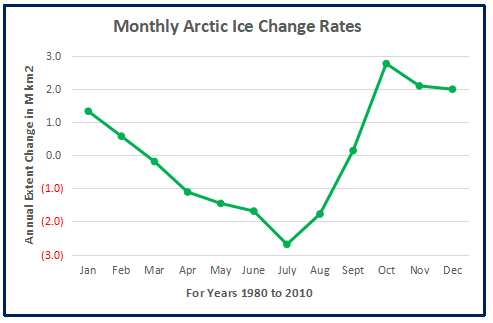
These monthly rates of change have been compiled into a baseline for the period 1980 to 2010, which shows the fluctuations of Arctic ice extents over the course of a calendar year. Below is a graph of those averages of monthly changes during the baseline period. Those familiar with Arctic Ice studies will not be surprised at the sine wave form. December end is a relatively neutral point in the cycle, midway between the September Minimum and March Maximum.

The graph makes evident the six spring/summer months of melting and the six autumn/winter months of freezing.  Note that June-August produce the bulk of losses, while October-December show the bulk of gains. Also the peak and valley months of March and September show very little change in extent from beginning to end.

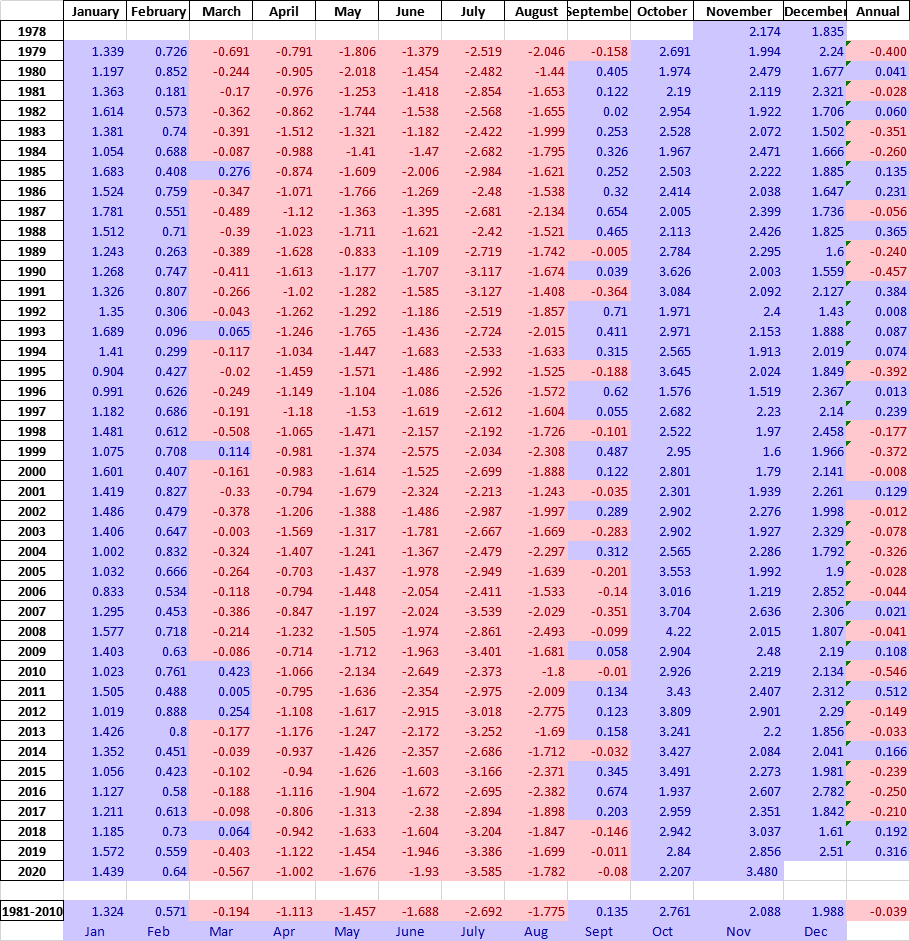
The table of monthly data reveals the variability of ice extents over the last 4 decades.

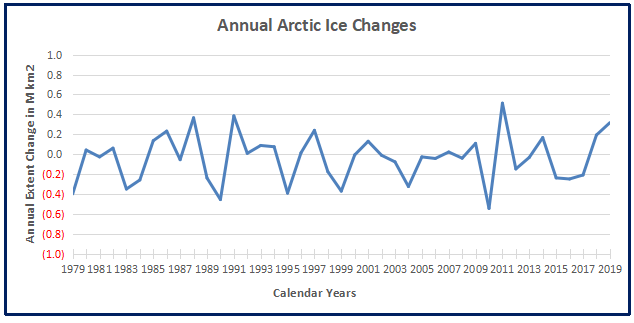
The values in January show changes from the end of the previous December, and by summing twelve consecutive months we can calculate an annual rate of change for the years 1979 to 2019.

As many know, there has been a decline of Arctic ice extent over these 40 years, averaging 40k km2 per year. But year over year, the changes shift constantly between gains and losses.

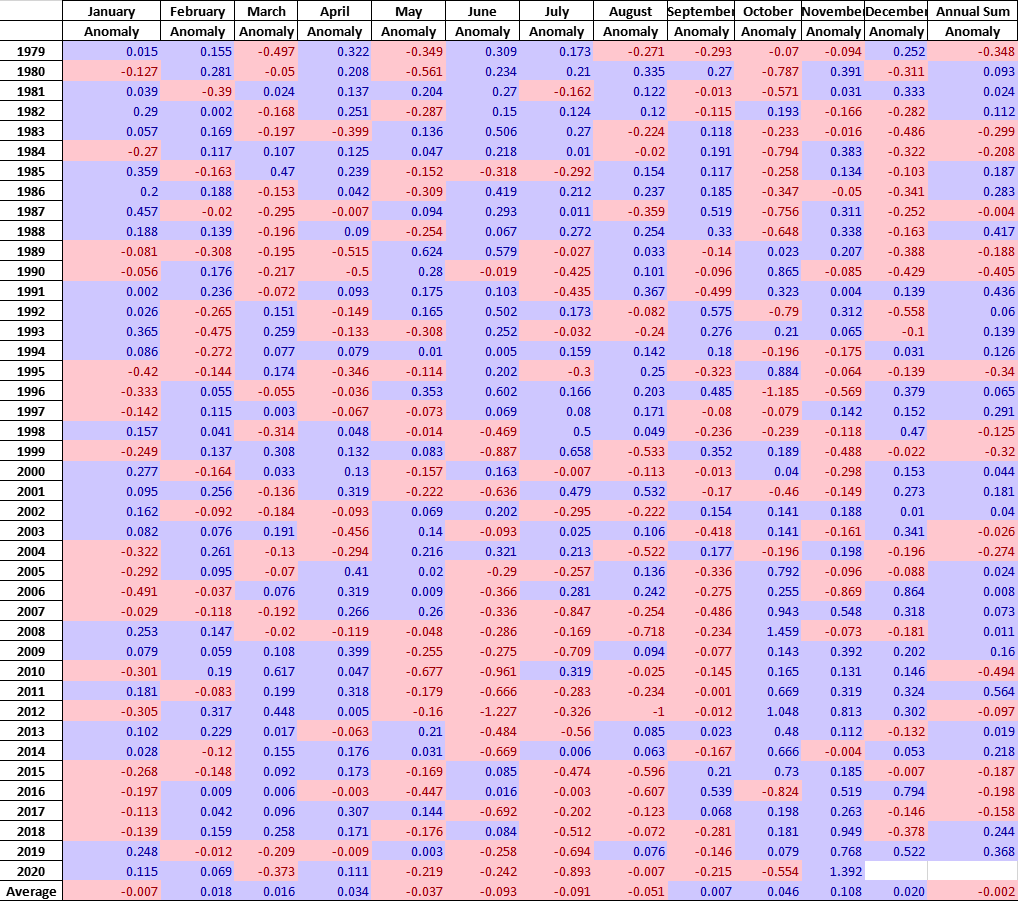
Moreover, it seems random as to which months are determinative for a given year. For example, much ado has been printed about October 2020 being slower than expected to refreeze and add ice extents. As it happens in this dataset, October has the highest rate of adding ice. The table below shows the variety of monthly rates in the record as anomalies from the 1980-2010 baseline. In this exhibit a red cell is a negative anomaly (less than baseline for that month) and blue is positive (higher than baseline).

Note that the  +/ –  rate anomalies are distributed all across the grid, sequences of different months in different years, with gains and losses offsetting one another.  Yes, October 2020 recorded a lower than average gain, but higher than 2016. The loss in July 2020 was the largest of the year, during the hot Siberian summer.  Note November 2020 ice gain anomaly exceeded the October deficit anomaly by more than twice as much.  The bottom line presents the average anomalies for each month over the period 1979-2020.  Note the rates of gains and losses mostly offset, and the average of all months in the bottom right cell is virtually zero.

Combining the months of October and November shows 2020 828k km2 more ice than baseline for the two months and matching 2019 ice recovery.

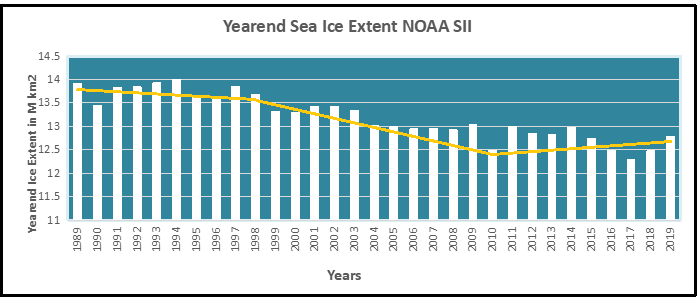
A final observation: The graph below shows the Yearend Arctic Ice Extents for the last 30 years.

Note: SII daily extents file does not provide complete values prior to 1988.

Year-end Arctic ice extents (last 5 days of December) show three distinct regimes: 1989-1998, 1998-2010, 2010-2019. The average year-end extent 1989-2010 is 13.4M km2. In the last decade, 2009 was 13.0M km2, and ten years later, 2019 was 12.8M km2. So for all the the fluctuations, the net loss was 200k km2, or 1.5%. Talk of an Arctic ice death spiral is fanciful.

These data show a noisy, highly variable natural phenomenon. Clearly, unpredictable factors are in play, principally water structure and circulation, atmospheric circulation regimes, and also incursions and storms. And in the longer view, today’s extents are not unusual.


Illustration by Eleanor Lutz shows Earth’s seasonal climate changes. If played in full screen, the four corners present views from top, bottom and sides. It is a visual representation of scientific datasets measuring Arctic ice extents.

Oh No! Greenland Melts in Virtual Reality “Experiments”

Phys.org sounds the alarm:  Greenland ice sheet faces irreversible melting.  But as is usual with announcements from that source, discretion and critical intelligence are advised.  The back story is a study that takes outputs from climate models projecting incredible warming and feeds them into ice models that assume melting from higher temperatures. Warning:  The paper has 93 references to “experiments” and all of them are virtual reality manipulations in the computers they programmed. Excerpts in italics with my bolds.

Professor Jonathan Gregory, Climate Scientist from the National Centre for Atmospheric Science and University of Reading, said: “Our experiments underline the importance of mitigating global temperature rise. To avoid partially irreversible loss of the ice sheet, climate change must be reversed—not just stabilized—before we reach the critical point where the ice sheet has declined too far.”

The paper is Large and irreversible future decline of the Greenland ice sheet.  And obviously, it is models all the way down.  Excerpts in italics with my bolds.

We run a set of 47 FiG experiments to study the SMB change (ΔSMB), rate of mass loss and eventual steady state of the Greenland ice sheet using the three different choices of FAMOUS–ice snow-albedo parameters, with 20-year climatological monthly mean sea surface BCs taken from the four selected CMIP5 AOGCMs for five climate scenarios (Table 2). These five are the late 20th century (1980–1999, called “historical”), the end of the 21st century under three representative concentration pathway (RCP) scenarios (as in the AR5; van Vuuren et al., 2011) and quadrupled pre-industrial CO2 (abrupt4xCO2, warmer than any RCP). The experiments have steady-state climates. This is unrealistic, but it simplifies the comparison and is reasonable since no-one can tell how climate will change over millennia into the future. Our simulations should be regarded only as indicative rather than as projections. Each experiment begins from the FiG spun-up state for MIROC5 historical climate with the appropriate albedo parameter. Although in most cases there is a substantial instantaneous change in BCs when the experiment begins, the land and atmosphere require only a couple of years to adjust.

Under constant climates that are warmer than the late 20th century, the ice sheet loses mass, its surface elevation decreases, and its surface climate becomes warmer. This gives a positive feedback on mass loss, but it is outweighed by the negative feedbacks due to declining ablation area and increasing cloudiness over the interior as the ice sheet contracts. In the ice sheet area integral, snowfall decreases less than ablation because the precipitation on the margins is enhanced by the topographic gradient and moves inland as the ice sheet retreats. Consequently, after many millennia under a constant warm climate, the ice sheet reaches a reduced steady state. Final GMSLR is less than 1.5 m in most late 21st-century RCP2.6 climates and more than 4 m in all late 21st-century RCP8.5 climates. For warming exceeding 3 K, the ice sheet would be mostly lost, and its contribution to GMSLR would exceed 5 m.

The reliability of our conclusions depends on the realism of our model. There are systematic uncertainties arising from assumptions made in its formulation. The atmosphere GCM has low resolution and comparatively simple parametrization schemes. The ice sheet model does not simulate rapid ice sheet dynamics; this certainly means that it underestimates the rate of ice sheet mass loss in coming decades, but we do not know what effect this has on the eventual steady states, which are our focus. The SMB scheme uses a uniform air temperature lapse rate and omits the phase change in precipitation in the downscaling from GCM to ice sheet model. The snow albedo is a particularly important uncertainty; with our highest choice of albedo, removal of the ice sheet is reversible.

What about observations instead of imaginary projections?  Previous post: Greenland Ice Varies, Don’t Panic

The scare du jour is about Greenland Ice Sheet (GIS) and how it will melt out and flood us all.  It’s declared that GIS has passed its tipping point, and we are doomed.  Typical is the Phys.org hysteria: Sea level rise quickens as Greenland ice sheet sheds record amount:  “Greenland’s massive ice sheet saw a record net loss of 532 billion tonnes last year, raising red flags about accelerating sea level rise, according to new findings.”

Panic is warranted only if you treat this as proof of an alarmist narrative and ignore the facts and context in which natural variation occurs. For starters, consider the last four years of GIS fluctuations reported by DMI and summarized in the eight graphs above.  Note the noisy blue lines showing how the surface mass balance (SMB) changes its daily weight by 8 or 10 gigatonnes (Gt) around the baseline mean from 1981 to 2010.  Note also the summer decrease between May and August each year before recovering to match or exceed the mean.

The other four graphs show the accumulation of SMB for each of the last four years including 2020.  Tipping Point?  Note that in both 2017 and 2018, SMB ended about 500 Gt higher than the year began, and way higher than 2012, which added nothing.  Then came 2019 dropping below the mean, but still above 2012.  Lastly, this year is matching the 30-year average.  Note also that the charts do not integrate from previous years; i.e. each year starts at zero and shows the accumulation only for that year.  Thus the gains from 2017 and 2018 do not result in 2019 starting the year up 1000 Gt, but from zero.

The Truth about Sliding Greenland Ice

Researchers know that the small flows of water from surface melting are not the main way GIS loses ice in the summer.  Neil Humphrey explains in this article from last year Nate Maier and Neil Humphrey Lead Team Discovering Ice is Sliding Toward Edges Off Greenland Ice Sheet  Excerpts in italics with my bolds.

While they may appear solid, all ice sheets—which are essentially giant glaciers—experience movement: ice flows downslope either through the process of deformation or sliding. The latest results suggest that the movement of the ice on the GIS is dominated by sliding, not deformation. This process is moving ice to the marginal zones of the sheet, where melting occurs, at a much faster rate.

“The study was motivated by a major unknown in how the ice of Greenland moves from the cold interior, to the melting regions on the margins,” Neil Humphrey, a professor of geology from the University of Wyoming and author of the study, told Newsweek. “The ice is known to move both by sliding over the bedrock under the ice, and by oozing (deforming) like slowly flowing honey or molasses. What was unknown was the ratio between these two modes of motion—sliding or deforming.

“This lack of understanding makes predicting the future difficult, since we know how to calculate the flowing, but do not know much about sliding,” he said. “Although melt can occur anywhere in Greenland, the only place that significant melt can occur is in the low altitude margins. The center (high altitude) of the ice is too cold for the melt to contribute significant water to the oceans; that only occurs at the margins. Therefore ice has to get from where it snows in the interior to the margins.

“The implications for having high sliding along the margin of the ice sheet means that thinning or thickening along the margins due to changes in ice speed can occur much more rapidly than previously thought,” Maier said. “This is really important; as when the ice sheet thins or thickens it will either increase the rate of melting or alternatively become more resilient in a changing climate.

“There has been some debate as to whether ice flow along the edges of Greenland should be considered mostly deformation or mostly sliding,” Maier says. “This has to do with uncertainty of trying to calculate deformation motion using surface measurements alone. Our direct measurements of sliding- dominated motion, along with sliding measurements made by other research teams in Greenland, make a pretty compelling argument that no matter where you go along the edges of Greenland, you are likely to have a lot of sliding.”

The sliding ice does two things, Humphrey says. First, it allows the ice to slide into the ocean and make icebergs, which then float away. Two, the ice slides into lower, warmer climate, where it can melt faster.

While it may sound dire, Humphrey notes the entire Greenland Ice Sheet is 5,000 to 10,000 feet thick.

In a really big melt year, the ice sheet might melt a few feet. It means Greenland is going to be there another 10,000 years,” Humphrey says. “So, it’s not the catastrophe the media is overhyping.”

Humphrey has been working in Greenland for the past 30 years and says the Greenland Ice Sheet has only melted 10 feet during that time span.

Summary

The Greenland ice sheet is more than 1.2 miles thick in most regions. If all of its ice was to melt, global sea levels could be expected to rise by about 25 feet. However, this would take more than 10,000 years at the current rates of melting.

Background from Previous Post: Greenland Glaciers: History vs. Hysteria

The modern pattern of environmental scares started with Rachel Carson’s Silent Spring claiming chemicals are killing birds, only today it is windmills doing the carnage. That was followed by ever expanding doomsday scenarios, from DDT, to SST, to CFC, and now the most glorious of them all, CO2. In all cases the menace was placed in remote areas difficult for objective observers to verify or contradict. From the wilderness bird sanctuaries, the scares are now hiding in the stratosphere and more recently in the Arctic and Antarctic polar deserts. See Progressively Scaring the World (Lewin book synopsis)

The advantage of course is that no one can challenge the claims with facts on the ground, or on the ice. Correction: Scratch “no one”, because the climate faithful are the exception. Highly motivated to go to the ends of the earth, they will look through their alarmist glasses and bring back the news that we are indeed doomed for using fossil fuels.

A recent example is a team of researchers from Dubai (the hot and sandy petro kingdom) going to Greenland to report on the melting of Helheim glacier there.  The article is NYUAD team finds reasons behind Greenland’s glacier melt.  Excerpts in italics with my bolds.

First the study and findings:

For the first time, warm waters that originate in the tropics have been found at uniform depth, displacing the cold polar water at the Helheim calving front, causing an unusually high melt rate. Typically, ocean waters near the terminus of an outlet glacier like Helheim are at the freezing point and cause little melting.

NYUAD researchers, led by Professor of Mathematics at NYU’s Courant Institute of Mathematical Sciences and Principal Investigator for NYU Abu Dhabi’s Centre for Sea Level Change David Holland, on August 5, deployed a helicopter-borne ocean temperature probe into a pond-like opening, created by warm ocean waters, in the usually thick and frozen melange in front of the glacier terminus.

Normally, warm, salty waters from the tropics travel north with the Gulf Stream, where at Greenland they meet with cold, fresh water coming from the polar region. Because the tropical waters are so salty, they normally sink beneath the polar waters. But Holland and his team discovered that the temperature of the ocean water at the base of the glacier was a uniform 4 degrees Centigrade from top to bottom at depth to 800 metres. The finding was also recently confirmed by Nasa’s OMG (Oceans Melting Greenland) project.

“This is unsustainable from the point of view of glacier mass balance as the warm waters are melting the glacier much faster than they can be replenished,” said Holland.

Surface melt drains through the ice sheet and flows under the glacier and into the ocean. Such fresh waters input at the calving front at depth have enormous buoyancy and want to reach the surface of the ocean at the calving front. In doing so, they draw the deep warm tropical water up to the surface, as well.

All around Greenland, at depth, warm tropical waters can be found at many locations. Their presence over time changes depending on the behaviour of the Gulf Stream. Over the last two decades, the warm tropical waters at depth have been found in abundance. Greenland outlet glaciers like Helheim have been melting rapidly and retreating since the arrival of these warm waters.

Then the Hysteria and Pledge of Alligiance to Global Warming

“We are surprised to learn that increased surface glacier melt due to warming atmosphere can trigger increased ocean melting of the glacier,” added Holland. “Essentially, the warming air and warming ocean water are delivering a troubling ‘one-two punch’ that is rapidly accelerating glacier melt.”

My comment: Hold on.They studied effects from warmer ocean water gaining access underneath that glacier. Oceans have roughly 1000 times the heat capacity of the atmosphere, so the idea that the air is warming the water is far-fetched. And remember also that long wave radiation of the sort that CO2 can emit can not penetrate beyond the first millimeter or so of the water surface. So how did warmer ocean water get attributed to rising CO2? Don’t ask, don’t tell.  And the idea that air is melting Arctic glaciers is also unfounded.

Consider the basics of air parcels in the Arctic.

The central region of the Arctic is very dry. Why? Firstly because the water is frozen and releases very little water vapour into the atmosphere. And secondly because (according to the laws of physics) cold air can retain very little moisture.

Greenland has the only veritable polar ice cap in the Arctic, meaning that the climate is even harsher (10°C colder) than at the North Pole, except along the coast and in the southern part of the landmass where the Atlantic has a warming effect. The marked stability of Greenland’s climate is due to a layer of very cold air just above ground level, air that is always heavier than the upper layers of the troposphere. The result of this is a strong, gravity-driven air flow down the slopes (i.e. catabatic winds), generating gusts that can reach 200 kph at ground level.

Arctic air temperatures

Some history and scientific facts are needed to put these claims in context. Let’s start with what is known about Helheim Glacier.

Holocene history of the Helheim Glacier, southeast Greenland

Helheim Glacier ranks among the fastest flowing and most ice discharging outlets of the Greenland Ice Sheet (GrIS). After undergoing rapid speed-up in the early 2000s, understanding its long-term mass balance and dynamic has become increasingly important. Here, we present the first record of direct Holocene ice-marginal changes of the Helheim Glacier following the initial deglaciation. By analysing cores from lakes adjacent to the present ice margin, we pinpoint periods of advance and retreat. We target threshold lakes, which receive glacial meltwater only when the margin is at an advanced position, similar to the present. We show that, during the period from 10.5 to 9.6 cal ka BP, the extent of Helheim Glacier was similar to that of todays, after which it remained retracted for most of the Holocene until a re-advance caused it to reach its present extent at c. 0.3 cal ka BP, during the Little Ice Age (LIA). Thus, Helheim Glacier’s present extent is the largest since the last deglaciation, and its Holocene history shows that it is capable of recovering after several millennia of warming and retreat. Furthermore, the absence of advances beyond the present-day position during for example the 9.3 and 8.2 ka cold events as well as the early-Neoglacial suggest a substantial retreat during most of the Holocene.

Quaternary Science Reviews, Holocene history of the Helheim Glacier, southeast Greenland
A.A.Bjørk et. Al. 1 August 2018

The topography of Greenland shows why its ice cap has persisted for millenia despite its southerly location.  It is a bowl surrounded by ridges except for a few outlets, Helheim being a major one.

And then, what do we know about the recent history of glacier changes. Two Decades of Changes in Helheim Glacier

Helheim Glacier is the fastest flowing glacier along the eastern edge of Greenland Ice Sheet and one of the island’s largest ocean-terminating rivers of ice. Named after the Vikings’ world of the dead, Helheim has kept scientists on their toes for the past two decades. Between 2000 and 2005, Helheim quickly increased the rate at which it dumped ice to the sea, while also rapidly retreating inland- a behavior also seen in other glaciers around Greenland. Since then, the ice loss has slowed down and the glacier’s front has partially recovered, readvancing by about 2 miles of the more than 4 miles it had initially ­retreated.

NASA has compiled a time series of airborne observations of Helheim’s changes into a new visualization that illustrates the complexity of studying Earth’s changing ice sheets. NASA uses satellites and airborne sensors to track variations in polar ice year after year to figure out what’s driving these changes and what impact they will have in the future on global concerns like sea level rise.

Since 1997, NASA has collected data over Helheim Glacier almost every year during annual airborne surveys of the Greenland Ice Sheet using an airborne laser altimeter called the Airborne Topographic Mapper (ATM). Since 2009 these surveys have continued as part of Operation IceBridge, NASA’s ongoing airborne survey of polar ice and its longest-running airborne mission. ATM measures the elevation of the glacier along a swath as the plane files along the middle of the glacier. By comparing the changes in the height of the glacier surface from year to year, scientists estimate how much ice the glacier has lost.

The animation begins by showing the NASA P-3 plane collecting elevation data in 1998. The laser instrument maps the glacier’s surface in a circular scanning pattern, firing laser shots that reflect off the ice and are recorded by the laser’s detectors aboard the airplane. The instrument measures the time it takes for the laser pulses to travel down to the ice and back to the aircraft, enabling scientists to measure the height of the ice surface. In the animation, the laser data is combined with three-dimensional images created from IceBridge’s high-resolution camera system. The animation then switches to data collected in 2013, showing how the surface elevation and position of the calving front (the edge of the glacier, from where it sheds ice) have changed over those 15 years.

Helheim’s calving front retreated about 2.5 miles between 1998 and 2013. It also thinned by around 330 feet during that period, one of the fastest thinning rates in Greenland.

“The calving front of the glacier most likely was perched on a ledge in the bedrock in 1998 and then something altered its equilibrium,” said Joe MacGregor, IceBridge deputy project scientist. “One of the most likely culprits is a change in ocean circulation or temperature, such that slightly warmer water entered into the fjord, melted a bit more ice and disturbed the glacier’s delicate balance of forces.”

Update September 1, 2020 Greenland Ice Math

Prompted by comments from Gordon Walleville, let’s look at Greenland ice gains and losses in context.  The ongoing SMB (surface mass balance) estimates ice sheet mass net from melting and sublimation losses and precipitation gains.  Dynamic ice loss is a separate calculation of calving chunks of ice off the edges of the sheet, as discussed in the post above.  The two factors are combined in a paper Forty-six years of Greenland Ice Sheet mass balance from 1972 to 2018 by Mouginot et al. (2019) Excerpt in italics. (“D” refers to dynamic ice loss.)

Greenland’s SMB averaged 422 ± 10 Gt/y in 1961–1989 (SI Appendix, Fig. S1H). It decreased from 506 ± 18 Gt/y in the 1970s to 410 ± 17 Gt/y in the 1980s and 1990s, 251 ± 20 Gt/y in 2010–2018, and a minimum at 145 ± 55 Gt/y in 2012. In 2018, SMB was above equilibrium at 449 ± 55 Gt, but the ice sheet still lost 105 ± 55 Gt, because D is well above equilibrium and 15 Gt higher than in 2017. In 1972–2000, D averaged 456 ± 1 Gt/y, near balance, to peak at 555 ± 12 Gt/y in 2018. In total, the mass loss increased to 286 ± 20 Gt/y in 2010–2018 due to an 18 ± 1% increase in D and a 48 ± 9% decrease in SMB. The ice sheet gained 47 ± 21 Gt/y in 1972–1980, and lost 50 ± 17 Gt/y in the 1980s, 41 ± 17 Gt/y in the 1990s, 187 ± 17 Gt/y in the 2000s, and 286 ± 20 Gt/y in 2010–2018 (Fig. 2). Since 1972, the ice sheet lost 4,976 ± 400 Gt, or 13.7 ± 1.1 mm SLR.

Doing the numbers: Greenland area 2.1 10^6 km2 80% ice cover, 1500 m thick in average- That is 2.5 Million Gton. Simplified to 1 km3 = 1 Gton

The estimated loss since 1972 is 5000 Gt (rounded off), which is 110 Gt a year.  The more recent estimates are higher, in the 200 Gt range.

200 Gton is 0.008 % of the Greenland ice sheet mass.

Annual snowfall: From the Lost Squadron, we know at that particular spot, the ice increase since 1942 – 1990 was 1.5 m/year ( Planes were found 75 m below surface)
Assume that yearly precipitation is 100 mm / year over the entire surface.
That is 168000 Gton. Yes, Greenland is Big!
Inflow = 168,000Gton. Outflow is 168,200 Gton.

So if that 200 Gton rate continued, (assuming as models do, despite air photos showing fluctuations), that ice loss would result in a 1% loss of Greenland ice in 800 years. (H/t Bengt Abelsson)

Comment:

Once again, history is a better guide than hysteria.  Over time glaciers advance and retreat, and incursions of warm water are a key factor.  Greenland ice cap and glaciers are part of the Arctic self-oscillating climate system operating on a quasi-60 year cycle.

Arctic Adds 3 Wadhams of Ice in November (so far)

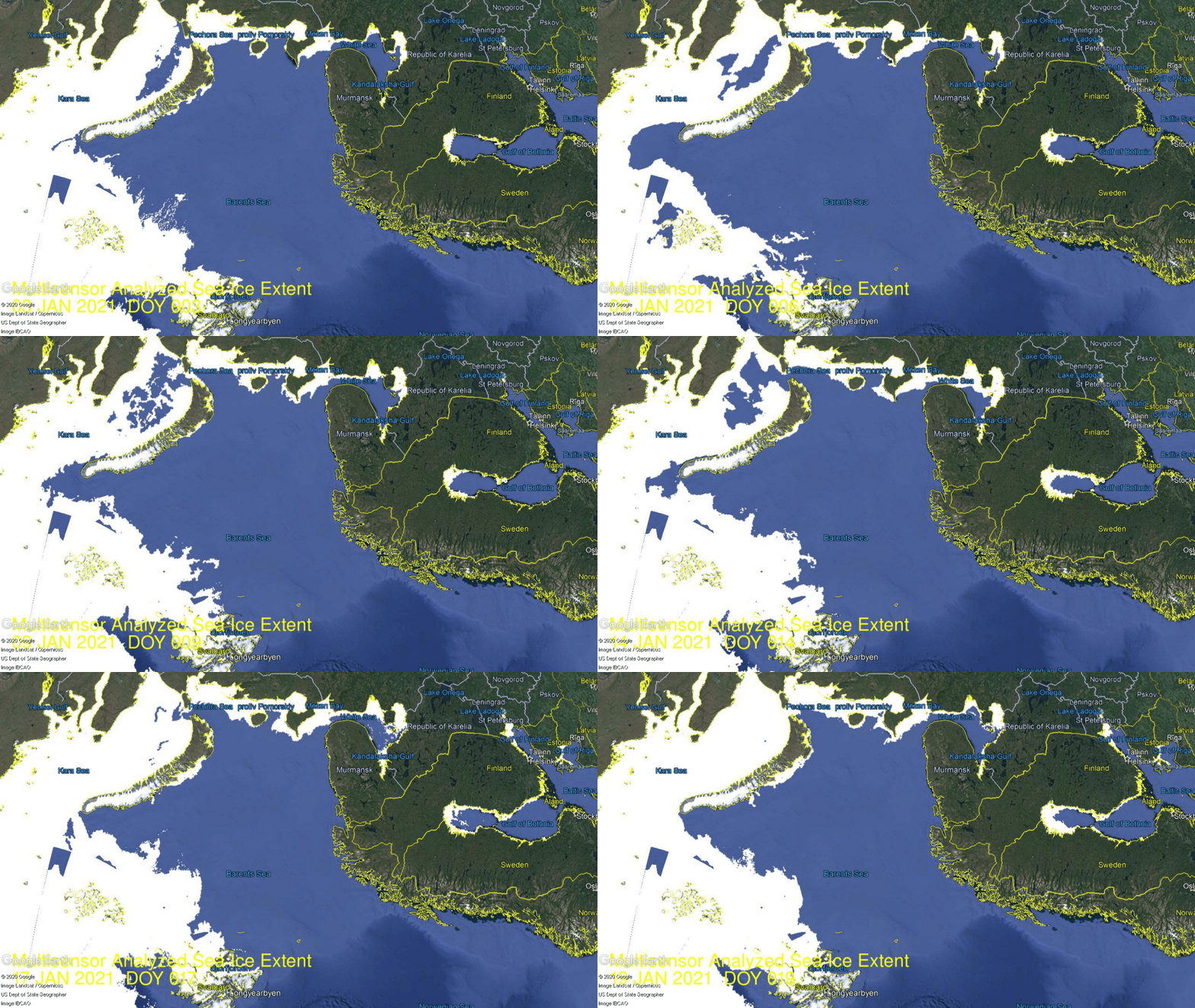
After concerns over lackluster ice recovery in October, November is seeing ice roaring back.  The image above shows the last 3 weeks adding 3 M km2 of sea ice.  (The metric 1 Wadham = 1 M km2 comes from the professor’s predictions of an ice-free Arctic, meaning less than 1 M km2 extent) The Russian shelf seas on the left filled with ice early on.  On the CanAm side, Beaufort at the bottom center is iced over, Canadian Archipelago (center right) is frozen, and Baffin Bay is filling from the north down.  Hudson Bay (far right) first grew fast ice around the edges, and is now half iced over.  A background post is reprinted below, showing that in just 23 days, 2020 has added 3.1 M km2, 50% more than an average 30-day November.

Some years ago reading a thread on global warming at WUWT, I was struck by one person’s comment: “I’m an actuary with limited knowledge of climate metrics, but it seems to me if you want to understand temperature changes, you should analyze the changes, not the temperatures.” That rang bells for me, and I applied that insight in a series of Temperature Trend Analysis studies of surface station temperature records. Those posts are available under this heading. Climate Compilation Part I Temperatures

This post seeks to understand Arctic Sea Ice fluctuations using a similar approach: Focusing on the rates of extent changes rather than the usual study of the ice extents themselves. Fortunately, Sea Ice Index (SII) from NOAA provides a suitable dataset for this project. As many know, SII relies on satellite passive microwave sensors to produce charts of Arctic Ice extents going back to 1979.  The current Version 3 has become more closely aligned with MASIE, the modern form of Naval ice charting in support of Arctic navigation. The SII User Guide is here.

There are statistical analyses available, and the one of interest (table below) is called Sea Ice Index Rates of Change (here). As indicated by the title, this spreadsheet consists not of monthly extents, but changes of extents from the previous month. Specifically, a monthly value is calculated by subtracting the average of the last five days of the previous month from this month’s average of final five days. So the value presents the amount of ice gained or lost during the present month.

These monthly rates of change have been compiled into a baseline for the period 1980 to 2010, which shows the fluctuations of Arctic ice extents over the course of a calendar year. Below is a graph of those averages of monthly changes during the baseline period. Those familiar with Arctic Ice studies will not be surprised at the sine wave form. December end is a relatively neutral point in the cycle, midway between the September Minimum and March Maximum.

The graph makes evident the six spring/summer months of melting and the six autumn/winter months of freezing.  Note that June-August produce the bulk of losses, while October-December show the bulk of gains. Also the peak and valley months of March and September show very little change in extent from beginning to end.

The table of monthly data reveals the variability of ice extents over the last 4 decades.

Table 1 Monthly Arctic Ice rates of Extent Changes in M km2. Months with losses in pink, months with gains in blue.

The values in January show changes from the end of the previous December, and by summing twelve consecutive months we can calculate an annual rate of change for the years 1979 to 2019.

As many know, there has been a decline of Arctic ice extent over these 40 years, averaging 40k km2 per year. But year over year, the changes shift constantly between gains and losses.

Moreover, it seems random as to which months are determinative for a given year. For example, much ado has been printed about October 2020 being slower than expected to refreeze and add ice extents. As it happens in this dataset, October has the highest rate of adding ice. The table below shows the variety of monthly rates in the record as anomalies from the 1980-2010 baseline. In this exhibit a red cell is a negative anomaly (less than baseline for that month) and blue is positive (higher than baseline).

Note that the  +/ –  rate anomalies are distributed all across the grid, sequences of different months in different years, with gains and losses offsetting one another.  Yes, October 2020 recorded a lower than average gain, but higher than 2016. The loss in July 2020 was the largest of the year, during the hot Siberian summer.  The bottom line presents the average anomalies for each month over the period 1979-2020.  Note the rates of gains and losses mostly offset, and the average of all months in the bottom right cell is virtually zero.

A final observation: The graph below shows the Yearend Arctic Ice Extents for the last 30 years.

Note: SII daily extents file does not provide complete values prior to 1988.

Year-end Arctic ice extents (last 5 days of December) show three distinct regimes: 1989-1998, 1998-2010, 2010-2019. The average year-end extent 1989-2010 is 13.4M km2. In the last decade, 2009 was 13.0M km2, and ten years later, 2019 was 12.8M km2. So for all the the fluctuations, the net loss was 200k km2, or 1.5%. Talk of an Arctic ice death spiral is fanciful.

These data show a noisy, highly variable natural phenomenon. Clearly, unpredictable factors are in play, principally water structure and circulation, atmospheric circulation regimes, and also incursions and storms. And in the longer view, today’s extents are not unusual.


Illustration by Eleanor Lutz shows Earth’s seasonal climate changes. If played in full screen, the four corners present views from top, bottom and sides. It is a visual representation of scientific datasets measuring Arctic ice extents.

Arctic Flash Freezing in November


After concerns over lackluster ice recovery in October, November is seeing ice roaring back.  The image above shows the last 10 days adding sea ice at an average rate of 215k km2 per day.  The Russian shelf seas on the right have filled with ice in this period.  On the CanAm side, Beaufort at the top left is iced over, Canadian Archipelago (center left) is frozen, and Baffin Bay is filling from the north down.  Hudson Bay (far left) has grown fast ice around the edges.  A background post is reprinted below, showing that in just 10 days, 2020 has added as much ice as an average 30-day November.

Some years ago reading a thread on global warming at WUWT, I was struck by one person’s comment: “I’m an actuary with limited knowledge of climate metrics, but it seems to me if you want to understand temperature changes, you should analyze the changes, not the temperatures.” That rang bells for me, and I applied that insight in a series of Temperature Trend Analysis studies of surface station temperature records. Those posts are available under this heading. Climate Compilation Part I Temperatures

This post seeks to understand Arctic Sea Ice fluctuations using a similar approach: Focusing on the rates of extent changes rather than the usual study of the ice extents themselves. Fortunately, Sea Ice Index (SII) from NOAA provides a suitable dataset for this project. As many know, SII relies on satellite passive microwave sensors to produce charts of Arctic Ice extents going back to 1979.  The current Version 3 has become more closely aligned with MASIE, the modern form of Naval ice charting in support of Arctic navigation. The SII User Guide is here.

There are statistical analyses available, and the one of interest (table below) is called Sea Ice Index Rates of Change (here). As indicated by the title, this spreadsheet consists not of monthly extents, but changes of extents from the previous month. Specifically, a monthly value is calculated by subtracting the average of the last five days of the previous month from this month’s average of final five days. So the value presents the amount of ice gained or lost during the present month.

These monthly rates of change have been compiled into a baseline for the period 1980 to 2010, which shows the fluctuations of Arctic ice extents over the course of a calendar year. Below is a graph of those averages of monthly changes during the baseline period. Those familiar with Arctic Ice studies will not be surprised at the sine wave form. December end is a relatively neutral point in the cycle, midway between the September Minimum and March Maximum.

The graph makes evident the six spring/summer months of melting and the six autumn/winter months of freezing.  Note that June-August produce the bulk of losses, while October-December show the bulk of gains. Also the peak and valley months of March and September show very little change in extent from beginning to end.

The table of monthly data reveals the variability of ice extents over the last 4 decades.

Table 1 Monthly Arctic Ice rates of Extent Changes in M km2. Months with losses in pink, months with gains in blue.

The values in January show changes from the end of the previous December, and by summing twelve consecutive months we can calculate an annual rate of change for the years 1979 to 2019.

As many know, there has been a decline of Arctic ice extent over these 40 years, averaging 40k km2 per year. But year over year, the changes shift constantly between gains and losses.

Moreover, it seems random as to which months are determinative for a given year. For example, much ado has been printed about October 2020 being slower than expected to refreeze and add ice extents. As it happens in this dataset, October has the highest rate of adding ice. The table below shows the variety of monthly rates in the record as anomalies from the 1980-2010 baseline. In this exhibit a red cell is a negative anomaly (less than baseline for that month) and blue is positive (higher than baseline).

Note that the  +/ –  rate anomalies are distributed all across the grid, sequences of different months in different years, with gains and losses offsetting one another.  Yes, October 2020 recorded a lower than average gain, but higher than 2016. The loss in July 2020 was the largest of the year, during the hot Siberian summer.  The bottom line presents the average anomalies for each month over the period 1979-2020.  Note the rates of gains and losses mostly offset, and the average of all months in the bottom right cell is virtually zero.

A final observation: The graph below shows the Yearend Arctic Ice Extents for the last 30 years.

Note: SII daily extents file does not provide complete values prior to 1988.

Year-end Arctic ice extents (last 5 days of December) show three distinct regimes: 1989-1998, 1998-2010, 2010-2019. The average year-end extent 1989-2010 is 13.4M km2. In the last decade, 2009 was 13.0M km2, and ten years later, 2019 was 12.8M km2. So for all the the fluctuations, the net loss was 200k km2, or 1.5%. Talk of an Arctic ice death spiral is fanciful.

These data show a noisy, highly variable natural phenomenon. Clearly, unpredictable factors are in play, principally water structure and circulation, atmospheric circulation regimes, and also incursions and storms. And in the longer view, today’s extents are not unusual.


Illustration by Eleanor Lutz shows Earth’s seasonal climate changes. If played in full screen, the four corners present views from top, bottom and sides. It is a visual representation of scientific datasets measuring Arctic ice extents.

Arctic October Pent-up Ice Recovery

Some years ago reading a thread on global warming at WUWT, I was struck by one person’s comment: “I’m an actuary with limited knowledge of climate metrics, but it seems to me if you want to understand temperature changes, you should analyze the changes, not the temperatures.” That rang bells for me, and I applied that insight in a series of Temperature Trend Analysis studies of surface station temperature records. Those posts are available under this heading. Climate Compilation Part I Temperatures

This post seeks to understand Arctic Sea Ice fluctuations using a similar approach: Focusing on the rates of extent changes rather than the usual study of the ice extents themselves. Fortunately, Sea Ice Index (SII) from NOAA provides a suitable dataset for this project. As many know, SII relies on satellite passive microwave sensors to produce charts of Arctic Ice extents going back to 1979.  The current Version 3 has become more closely aligned with MASIE, the modern form of Naval ice charting in support of Arctic navigation. The SII User Guide is here.

There are statistical analyses available, and the one of interest (table below) is called Sea Ice Index Rates of Change (here). As indicated by the title, this spreadsheet consists not of monthly extents, but changes of extents from the previous month. Specifically, a monthly value is calculated by subtracting the average of the last five days of the previous month from this month’s average of final five days. So the value presents the amount of ice gained or lost during the present month.

These monthly rates of change have been compiled into a baseline for the period 1980 to 2010, which shows the fluctuations of Arctic ice extents over the course of a calendar year. Below is a graph of those averages of monthly changes during the baseline period. Those familiar with Arctic Ice studies will not be surprised at the sine wave form. December end is a relatively neutral point in the cycle, midway between the September Minimum and March Maximum.

The graph makes evident the six spring/summer months of melting and the six autumn/winter months of freezing.  Note that June-August produce the bulk of losses, while October-December show the bulk of gains. Also the peak and valley months of March and September show very little change in extent from beginning to end.

The table of monthly data reveals the variability of ice extents over the last 4 decades.

Table 1 Monthly Arctic Ice rates of Extent Changes in M km2. Months with losses in pink, months with gains in blue.

The values in January show changes from the end of the previous December, and by summing twelve consecutive months we can calculate an annual rate of change for the years 1979 to 2019.

As many know, there has been a decline of Arctic ice extent over these 40 years, averaging 40k km2 per year. But year over year, the changes shift constantly between gains and losses.

Moreover, it seems random as to which months are determinative for a given year. For example, much ado has been printed about October 2020 being slower than expected to refreeze and add ice extents. As it happens in this dataset, October has the highest rate of adding ice. The table below shows the variety of monthly rates in the record as anomalies from the 1980-2010 baseline. In this exhibit a red cell is a negative anomaly (less than baseline for that month) and blue is positive (higher than baseline).

Note that the  +/ –  rate anomalies are distributed all across the grid, sequences of different months in different years, with gains and losses offsetting one another.  Yes, October 2020 recorded a lower than average gain, but higher than 2016. The loss in July 2020 was the largest of the year, during the hot Siberian summer.  The bottom line presents the average anomalies for each month over the period 1979-2020.  Note the rates of gains and losses mostly offset, and the average of all months in the bottom right cell is virtually zero.

A final observation: The graph below shows the Yearend Arctic Ice Extents for the last 30 years.

Note: SII daily extents file does not provide complete values prior to 1988.

Year-end Arctic ice extents (last 5 days of December) show three distinct regimes: 1989-1998, 1998-2010, 2010-2019. The average year-end extent 1989-2010 is 13.4M km2. In the last decade, 2009 was 13.0M km2, and ten years later, 2019 was 12.8M km2. So for all the the fluctuations, the net loss was 200k km2, or 1.5%. Talk of an Arctic ice death spiral is fanciful.

These data show a noisy, highly variable natural phenomenon. Clearly, unpredictable factors are in play, principally water structure and circulation, atmospheric circulation regimes, and also incursions and storms. And in the longer view, today’s extents are not unusual.


Illustration by Eleanor Lutz shows Earth’s seasonal climate changes. If played in full screen, the four corners present views from top, bottom and sides. It is a visual representation of scientific datasets measuring Arctic ice extents.

Hurricane Season Overview Oct. 11

Your weather channel is airing charts like this to show how active is this year’s storm season impacting the Caribbean and US east coast.  So far, there have been many more named storms, two more hurricanes than average, and one less major hurricane at this point in the season.  Dr. Ryan Maue provides (here) a global context for understanding storm activity this year, updated October 11, 2020.

So globally, the ACE (Accumulated Cyclone Energy) is 2/3 of the average 1981-2010 at this point in the season.  ACE compiles the storm strengths as well the the number of storms.  Clearly the North Atlantic is 143% of average, but slightly behind 2019.  This indicates that many of the named storms were not that strong.

Meanwhile the Northern Hemisphere is running 69% of average and well behind last year.  This is due to North Pacific having a quiet season offsetting North Atlantic activity.  See the graph below from RealClimateScience

The historical summary of Tropical Hurricane ACE as of September 30, 2020:

Figure: Last 50-years+ of Global and Northern Hemisphere Accumulated Cyclone Energy: 24 month running sums. Note that the year indicated represents the value of ACE through the previous 24-months for the Northern Hemisphere (bottom line/gray boxes) and the entire global (top line/blue boxes). The area in between represents the Southern Hemisphere total ACE.

The hiatus of storms lasted a decade after 2006 (Thanks Global Warming).  Now seasons are more active (Your fault Global Warming), though somewhat less than previous peaks.   Maybe it’s Mother Nature after all.

Arctic September Ice Dip Is Over

Just like the Arizona road in the image,  Arctic ice extent has dipped in September and is on the rise again.  The graph below shows how September monthly extent averages compare for the years since 2007. 

Overall it resembles the Arizona roadway.  Two low years are followed by two high years, then two low years and so on.  The last two years are low, comparable to 2007, and may portend higher ice extent ahead. As usual MASIE and SII are showing for 2020 nearly the same monthly averages, 4.0M km2 for MASIE and 3.9M km2 for SII. The graph below shows how the ice dipped and recovered in 2020 compared to the 13-year average and some notable years.

September 2020 daily minimum was lower than all previous years except for 2012.  As noted previously this year’s anomaly was the hot Siberian summer melting out the Eurasian shelf seas and the bordering parts of the Central Arctic Sea.  In 2012 it was the Great Arctic Cyclone in August of that year.  After day 255, ice recovered strongly in 2020 ending the month higher than 2007, close to 2019 and about 150k km2 less than the average daily minimum on day 260, 4.4M km2

The table shows monthly extent averages for the regions with ice in September for several years and the 13-year average for each region.

Sept. Monthly Averages 2007 2012 2019 2020 Average SD %
 (0) Northern_Hemisphere 4286957 3622648 4124035 3969085 4630779 10%
 (1) Beaufort_Sea 558424 212051 382779 620409 487498 31%
 (2) Chukchi_Sea 49690 52539 111412 77598 172143 53%
 (3) East_Siberian_Sea 1251 53411 73023 121408 287777 63%
 (4) Laptev_Sea 246278 44336 87121 28 141604 81%
 (5) Kara_Sea 49502 717 166 13063 24612 102%
 (6) Barents_Sea 6782 0 13238 0 18757 183%
 (7) Greenland_Sea 334147 263899 173116 235216 197263 33%
 (8) Baffin_Bay_Gulf_of_St._Lawrence 33043 15591 16589 20361 32926 50%
 (9) Canadian_Archipelago 252140 198502 265335 339996 299817 30%
 (10) Hudson_Bay 10998 9502 0 2783 7947 135%
 (11) Central_Arctic 2743433 2771014 3000459 2537271 2959458 6%

The last column shows the Standard Deviation % for each region and for NH as a whole.  Over this period the NH fluctuations have been +/- 10%.  The most variable is Barents Sea, which can be zero or over 100k km2.  Hudson Bay and Kara likewise either melt out or retain significant ice. The Central Arctic varies little from year to year.

Illustration by Eleanor Lutz shows Earth’s seasonal climate changes. If played in full screen, the four corners present views from top, bottom and sides. It is a visual representation of scientific datasets measuring Arctic ice extents.

Why the Left Coast is Still Burning

Update September 13, 2020:  This reprint of a post two years ago shows nothing has changed, except for the worse.

It is often said that truth is the first casualty in the fog of war. That is especially true of the war against fossil fuels and smoke from wildfires. The forests are burning in California, Oregon and Washington, all of them steeped in liberal, progressive and post-modern ideology. There are human reasons that fires are out of control in those places, and it is not due to CO2 emissions. As we shall see, Zinke is right and Brown is wrong. Some truths the media are not telling you in their drive to blame global warming/climate change. Text below is excerpted from sources linked at the end.

1. The World and the US are not burning.

The geographic extent of this summer’s forest fires won’t come close to the aggregate record for the U.S. Far from it. Yes, there are some terrible fires now burning in California, Oregon, and elsewhere, and the total burnt area this summer in the U.S. is likely to exceed the 2017 total. But as the chart above shows, the burnt area in 2017 was less than 20% of the record set way back in 1930. The same is true of the global burnt area, which has declined over many decades.

In fact, this 2006 paper reported the following:

“Analysis of charcoal records in sediments [31] and isotope-ratio records in ice cores [32] suggest that global biomass burning during the past century has been lower than at any time in the past 2000 years. Although the magnitude of the actual differences between pre-industrial and current biomass burning rates may not be as pronounced as suggested by those studies [33], modelling approaches agree with a general decrease of global fire activity at least in past centuries [34]. In spite of this, fire is often quoted as an increasing issue around the globe [11,26–29].”

People have a tendency to exaggerate the significance of current events. Perhaps the youthful can be forgiven for thinking hot summers are a new phenomenon. Incredibly, more “seasoned” folks are often subject to the same fallacies. The fires in California have so impressed climate alarmists that many of them truly believe global warming is the cause of forest fires in recent years, including the confused bureaucrats at Cal Fire, the state’s firefighting agency. Of course, the fires have given fresh fuel to self-interested climate activists and pressure groups, an opportunity for greater exaggeration of an ongoing scare story.

This year, however, and not for the first time, a high-pressure system has been parked over the West, bringing southern winds up the coast along with warmer waters from the south, keeping things warm and dry inland. It’s just weather, though a few arsonists and careless individuals always seem to contribute to the conflagrations. Beyond all that, the impact of a warmer climate on the tendency for biomass to burn is considered ambiguous for realistic climate scenarios.

2. Public forests are no longer managed due to litigation.

According to a 2014 white paper titled; ‘Twenty Years of Forest Service Land Management Litigation’, by Amanda M.A. Miner, Robert W. Malmsheimer, and Denise M. Keele: “This study provides a comprehensive analysis of USDA Forest Service litigation from 1989 to 2008. Using a census and improved analyses, we document the final outcome of the 1125 land management cases filed in federal court. The Forest Service won 53.8% of these cases, lost 23.3%, and settled 22.9%. It won 64.0% of the 669 cases decided by a judge based on cases’ merits. The agency was more likely to lose and settle cases during the last six years; the number of cases initiated during this time varied greatly. The Pacific Northwest region along with the Ninth Circuit Court of Appeals had the most frequent occurrence of cases. Litigants generally challenged vegetative management (e.g. logging) projects, most often by alleging violations of the National Environmental Policy Act and the National Forest Management Act. The results document the continued influence of the legal system on national forest management and describe the complexity of this litigation.”

There is abundant evidence to support the position that when any forest project posits vegetative management in forests as a pretense for a logging operation, salvage or otherwise, litigation is likely to ensue, and in addition to NEPA, the USFS uses the Property Clause to address any potential removal of ‘forest products’. Nevertheless, the USFS currently spends more than 50% of its total budget on wildfire suppression alone; about $1.8 billion annually, while there is scant spending for wildfire prevention.

3. Mega fires are the unnatural result of fire suppression.

And what of the “mega-fires” burning in the West, like the huge Mendocino Complex Fire and last year’s Thomas Fire? Unfortunately, many decades of fire suppression measures — prohibitions on logging, grazing, and controlled burns — have left the forests with too much dead wood and debris, especially on public lands. From the last link:

“Oregon, like much of the western U.S., was ravaged by massive wildfires in the 1930s during the Dust Bowl drought. Megafires were largely contained due to logging and policies to actively manage forests, but there’s been an increasing trend since the 1980s of larger fires.

Active management of the forests and logging kept fires at bay for decades, but that largely ended in the 1980s over concerns too many old growth trees and the northern spotted owl. Lawsuits from environmental groups hamstrung logging and government planners cut back on thinning trees and road maintenance.

[Bob] Zybach [a forester] said Native Americans used controlled burns to manage the landscape in Oregon, Washington and northern California for thousands of years. Tribes would burn up to 1 million acres a year on the west coast to prime the land for hunting and grazing, Zybach’s research has shown.

‘The Indians had lots of big fires, but they were controlled,’ Zybach said. ‘It’s the lack of Indian burning, the lack of grazing’ and other active management techniques that caused fires to become more destructive in the 19th and early 20th centuries before logging operations and forest management techniques got fires under control in the mid-20th Century.”

4. Bad federal forest administration started in 1990s.

Bob Zybach feels like a broken record. Decades ago he warned government officials allowing Oregon’s forests to grow unchecked by proper management would result in catastrophic wildfires.

While some want to blame global warming for the uptick in catastrophic wildfires, Zybach said a change in forest management policies is the main reason Americans are seeing a return to more intense fires, particularly in the Pacific Northwest and California where millions of acres of protected forests stand.

“We knew exactly what would happen if we just walked away,” Zybach, an experienced forester with a PhD in environmental science, told The Daily Caller News Foundation.

Zybach spent two decades as a reforestation contractor before heading to graduate school in the 1990s. Then the Clinton administration in 1994 introduced its plan to protect old growth trees and spotted owls by strictly limiting logging.  Less logging also meant government foresters weren’t doing as much active management of forests — thinnings, prescribed burns and other activities to reduce wildfire risk.

Zybach told Evergreen magazine that year the Clinton administration’s plan for “naturally functioning ecosystems” free of human interference ignored history and would fuel “wildfires reminiscent of the Tillamook burn, the 1910 fires and the Yellowstone fire.”

Between 1952 and 1987, western Oregon saw only one major fire above 10,000 acres. The region’s relatively fire-free streak ended with the Silver Complex Fire of 1987 that burned more than 100,000 acres in the Kalmiopsis Wilderness area, torching rare plants and trees the federal government set aside to protect from human activities. The area has burned several more times since the 1980s.

“Mostly fuels were removed through logging, active management — which they stopped — and grazing,” Zybach said in an interview. “You take away logging, grazing and maintenance, and you get firebombs.”

Now, Oregonians are dealing with 13 wildfires engulfing 185,000 acres. California is battling nine fires scorching more than 577,000 acres, mostly in the northern forested parts of the state managed by federal agencies.

The Mendocino Complex Fire quickly spread to become the largest wildfire in California since the 1930s, engulfing more than 283,000 acres. The previous wildfire record was set by 2017’s Thomas Fire that scorched 281,893 acres in Southern California.

While bad fires still happen on state and private lands, most of the massive blazes happen on or around lands managed by the U.S. Forest Service and other federal agencies, Zybach said. Poor management has turned western forests into “slow-motion time bombs,” he said.

A feller buncher removing small trees that act as fuel ladders and transmit fire into the forest canopy.

5. True environmentalism is not nature love, but nature management.

While wildfires do happen across the country, poor management by western states has served to turn entire regions into tinderboxes. By letting nature play out its course so close to civilization, this is the course California and Oregon have taken.

Many in heartland America and along the Eastern Seaboard often see logging and firelines if they travel to a rural area. This is part and parcel of life outside of the city, where everyone knows that because of a few minor eyesores their houses and communities are safer from the primal fury of wildfires.

In other words, leaving the forests to “nature,” and protecting the endangered Spotted Owl created denser forests––300-400 trees per acre rather than 50-80–– with more fuel from the 129 million diseased and dead trees that create more intense and destructive fires. Yet California spends more than ten times as much money on electric vehicle subsidies ($335 million) than on reducing fuel in a mere 60,000 of 33 million acres of forests ($30 million).

Rancher Ross Frank worries that funding to fight fires in Western communities like Chumstick, Wash., has crowded out important land management work. Rowan Moore Gerety/Northwest Public Radio

Once again, global warming “science” is a camouflage for political ideology and gratifying myths about nature and human interactions with it. On the one hand, progressives seek “crises” that justify more government regulation and intrusion that limit citizen autonomy and increase government power. On the other, well-nourished moderns protected by technology from nature’s cruel indifference to all life can afford to indulge myths that give them psychic gratification at little cost to their daily lives.

As usual, bad cultural ideas lie behind these policies and attitudes. Most important is the modern fantasy that before civilization human beings lived in harmony and balance with nature. The rise of cities and agriculture began the rupture with the environment, “disenchanting” nature and reducing it to mere resources to be exploited for profit. In the early 19thcentury, the growth of science that led to the industrial revolution inspired the Romantic movement to contrast industrialism’s “Satanic mills” and the “shades of the prison-house,” with a superior natural world and its “beauteous forms.” In an increasingly secular age, nature now became the Garden of Eden, and technology and science the signs of the fall that has banished us from the paradise enjoyed by humanity before civilization.

The untouched nature glorified by romantic environmentalism, then, is not our home. Ever since the cave men, humans have altered nature to make it more conducive to human survival and flourishing. After the retreat of the ice sheets changed the environment and animal species on which people had depended for food, humans in at least four different regions of the world independently invented agriculture to better manage the food supply. Nor did the American Indians, for example, live “lightly on the land” in a pristine “forest primeval.” They used fire to shape their environment for their own benefit. They burned forests to clear land for cultivation, to create pathways to control the migration of bison and other game, and to promote the growth of trees more useful for them.

Remaining trees and vegetation on the forest floor are more vigorous after removal of small trees for fuels reduction.

And today we continue to improve cultivation techniques and foods to make them more reliable, abundant, and nutritious, not to mention more various and safe. We have been so successful at managing our food supply that today one person out of ten provides food that used to require nine out of ten, obesity has become the plague of poverty, and famines result from political dysfunction rather than nature.

That’s why untouched nature, the wild forests filled with predators, has not been our home. The cultivated nature improved by our creative minds has. True environmentalism is not nature love, but nature management: applying skill and technique to make nature more useful for humans, at the same time conserving resources so that those who come after us will be able to survive. Managing resources and exploiting them for our benefit without destroying them is how we should approach the natural world. We should not squander resources or degrade them, not because of nature, but because when we do so, we are endangering the well-being of ourselves and future generations.

Conclusion

The annual burnt area from wildfires has declined over the past ninety years both in the U.S. and globally. Even this year’s wildfires are unlikely to come close to the average burn extent of the 1930s. The large wildfires this year are due to a combination of decades of poor forest management along with a weather pattern that has trapped warm, dry air over the West. The contention that global warming has played a causal role in the pattern is balderdash, but apparently that explanation seems plausible to the uninformed, and it is typical of the propaganda put forward by climate change interests.

Sources: 

https://www.frontpagemag.com/fpm/271044/junk-science-and-leftist-folklore-have-set-bruce-thornton

https://www.4baseball.com/westernjournal.com/after-libs-blame-west-coast-fires-on-global-warming-forester-speaks-out/

https://sacredcowchips.net/tag/bob-zybach/

https://www.horsetalk.co.nz/2017/10/13/ecological-imbalance-wildfires-us-rangelands/

http://dailycaller.com/2018/08/08/mismanagement-forests-time-bombs/

Footnote:  So how do you want your forest fires, some small ones now or mega fires later?