Dearth of Green Jobs in UK

Chris Morrison provides the analysis in his Daily Sceptic article ONS Reveals the Pitiful Number of New Green Jobs Being Created in the U.K. Economy.  Excerpts in italics with my bolds and added images.

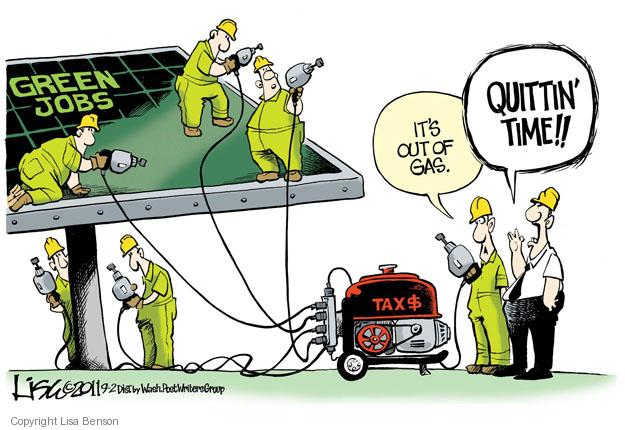
The problem with the green U.K. economy, and its associated destruction of the hydrocarbon environment, is that there are very few jobs being created. The few remaining ‘workers’ in the ruling Labour party are starting to rumble all the luxury boondoggles that are set to further decimate well-paid jobs in their communities. The figures compiled by the Office for National Statistics (ONS), trying to estimate the actual number of green jobs, are always a highly creative hoot, and the latest batch are no exception. Many jobs identified are simply displacement activity, with one repair or maintenance occupation taking over from another. Around 6% of the total are to be found in ‘environmental charities’, an interesting way to describe elite billionaire political funding to push the Net Zero fantasy. Such is the seeming desperation to rustle up a green job, the ONS even includes repairing home appliances, controlling forest fires and separating hydrogen by carbon dioxide-producing electrolysis.

The latest ‘estimates’ from the ONS cover 2021 and 2022, and they are said to show an increase in both years. But as the graph below reveals, the rises are pitiful over a decade, and the 2022 estimate of 639,000 is less than 2% of jobs in the economy as a whole.

As can be seen, environmental charities employ 40,000 people, almost as many as the 47,000 that work in renewable energy. But the charities figure does not include all those make-work jobs in environmental consultancy and education or what is described as in-house environmental activities. If all the displacement, invented or re-badged jobs in repair, electric vehicles, waste disposal, water treatment, energy efficiency, Net Zero promotion, teaching and the ubiquitous bureaucracy are rightly ignored, it is unlikely that more than 150,000 new jobs have been created.

Fairly small pickings, it might be thought, from all the cash sprayed at subsidy-hunting chancers over at least two decades. Even worse, any new jobs are easily offset by the occupations being destroyed in steel making, refining hydrocarbons, coal mining and oil and gas exploration. Fracking for gas would transform a number of deprived areas in the U.K. at little environmental cost, as it has done in the U.S. Energy security would likely be achieved, and the tax take would be considerable. But fracking is anathema to the major political parties in the U.K., except the emerging Reform party.Last week saw some real push back on the madness of Net Zero and the so-called green economy. The boss of GMB, the third largest trade union in the country, told the annual Labour party conference that its plans to decarbonise the energy network by 2030 will cost up to one million jobs, decimate working communities and push up bills for the poorest. According to Smith, Government’s plans for Net Zero were “bonkers” and “fundamentally dishonest”. In a week when it was revealed that British consumers, both industrial and private, had some of the highest electricity prices in the developed world, he charged that current energy policy amounted to virtue signalling by politicians. He accused them of exporting jobs and importing virtue because the jobs were being created abroad rather than in the U.K.

Meanwhile, a recent paper published in Science came to a damning conclusion that will not surprise sceptics, namely that 96% of climate policies over the last 25 years, ultimately designed to reduce carbon dioxide emissions, have been a waste of money. “That’s where green spin has got us,” writes George Monbiot, although these days the Guardian’s extremist-in-chief seems to have given up on all life enhancing processes that run the risk of disturbing anything on the planet. “Finally, 15 years and a trillion dollars too late, George Monbiot says what sceptics have been saying all along,” observes the sceptical journalist Jo Nova. “Nearly every single carbon reduction scheme is a useless make-work machination that creates the illusion that the government is doing something,” she says.

As we can see, the ONS survey is full of these make-work schemes providing jobs that can only exist by rigging free markets and providing eye-watering subsidies from consumers and taxpayers. As the more concerned trade unionists can see, much of the cost of these fantasy ventures falls on the poorest members of society forced to pay higher prices for many of the basic essentials of life. In addition, as we have observed, most green schemes make mugs of the wider investing public, with the RENIXX, a stock capitalisation global index of the 30 largest renewable industrial companies, showing near zero growth since it was started in 2006. None of this matters, of course, to the Mad Miliband and his weird wonks at the U.K. Department of Energy, who are ramping up ideological plans to hose cash at daft ideas like carbon capture, battery energy storage and hydrogen production.

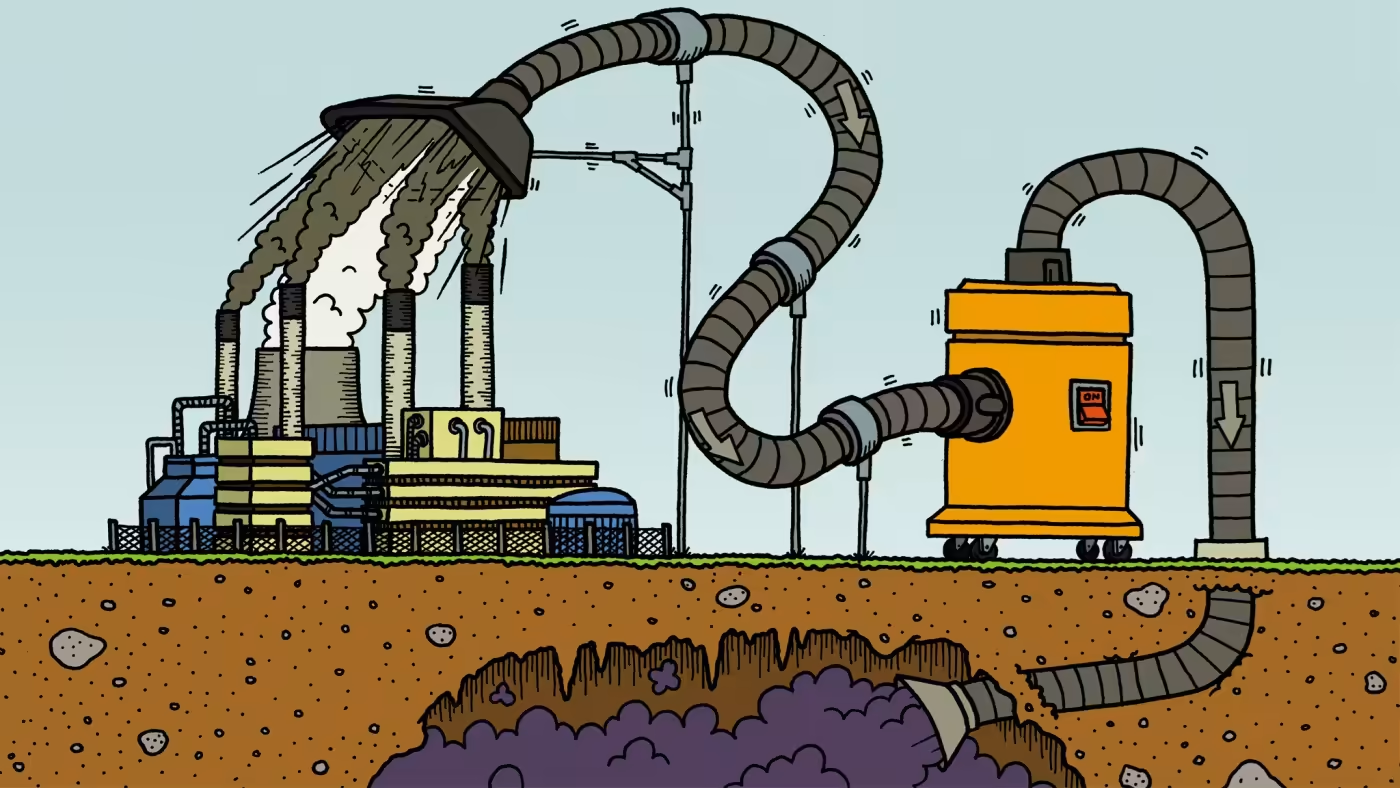
Not only is CO2 Capture and Storage wildly impractical, its aim is to deprive the biosphere of plant food.

But all is not lost on the jobs front – opportunities must be taken when they occur. Earlier this year, Gary Smith was able to point to some new employment clearing away the animal casualties of wind farm blades. “It’s usually a man in a rowing boat, sweeping up the dead birds,” he observed.

Footnote Q & A:

Q:  What is the difference between Golf and Government?

A:  In Government you can always improve your lie.

–Anonymous Source

Resources

Climate Policies Fail in Fact and in Theory

Investors Beware Green Equipment Companies

Green Deal Cuts EU Emissions, Doubles Them Elsewhere

Climatists’ War on Meat updated

Tyler Durden reports at Zerohedge Meat Substitutes Still A Tiny Sliver Of US Meat Market.  Excerpts in italics with my bolds and added images.

Over the past few years, plant-based meat substitutes have come closer and closer to mimicking the real thing, with brands like Beyond Meat having even sussed out how to create fake meat that “bleeds”.

But, as Statista’s Anna Fleck details below, after an initial boom, the company has rapidly come down from its peaks.

There are several reasons for the hype having died down, one of which being that many consumers decided to move away from buying the often more expensive items amid the cost of living crisis.

Another reason cited is that plant-based meats have become a part of the U.S.’s culture war, labeled as a symbol of left-wing politics and a binary to “real” meat.

According to data from Statista’s Market Insights, plant-based meat substitutes accounted for a mere sliver of the U.S. meat market last year.

Not counting insect-based meat alternatives or cultured, i.e. lab-grown meat, meat substitute sales amounted to $1.4 billion in 2023, while sales of fresh and processed meat added up to almost $124 billion.

Outlook

  • Revenue in the Meat market amounts to US$131.60bn in 2024. The market is expected to grow annually by 4.22% (CAGR 2024-2029).
  • In global comparison, most revenue is generated in China (US$273bn in 2024).
  • In relation to total population figures, per person revenues of US$385.00 are generated in 2024.
  • In the Meat market, volume is expected to amount to 12.10bn kg by 2029. The Meat market is expected to show a volume growth of 1.9% in 2025.
  • The average volume per person in the Meat market is expected to amount to 32.4kg in 2024.

What’s Next?

Background Post: Coming Soon: Menu Climate Warnings

Baylen Linnekin writes at Reason Public Health Researchers Float Idea of Climate-Change Warnings on Menu Items.  Excerpts in italics with my bolds and added images.

Warning diners that red meat is bad for the environment is yet another attempt
to socially engineer food choices.

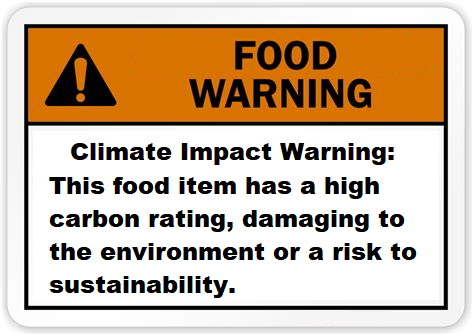
A study released last week suggests that fast-food menus that feature labels urging diners not to order red meat off those same menus due to the “climate impact” of those food items can help convince customers to swap out red meat for what the researchers argue are more climate-friendly foods—from fruits and vegetables to poultry and seafood. The study, published in Jama Network Open and led by researchers from Johns Hopkins University, concludes that “climate impact menu labels may be an effective strategy to promote more sustainable restaurant food choices and that labels highlighting high-climate impact items may be most effective.”

The study’s data comes from more than 5,000 Americans who took part in a nationwide online survey last year. Study participants were instructed to “imagine they were in a restaurant and about to order dinner” from an accurately priced sample menu containing a variety of choices, including hamburgers, chicken sandwiches, plant-based burgers, and salads.

The study asked participants to “order” different foods after viewing one of three types of sample menus online. Outside of a control group, the study presented web users with choices that either disparaged the sustainability of red-meat dishes or touted the sustainability of dishes not containing red meat. Based on the results, which showed people who were more likely to avoid red meat if it had a red warning label and more likely to order other menu items if they featured a green health halo, the authors conclude that “climate impact menu labels [a]re effective” and “that labeling red meat items with negatively framed, red high-climate impact labels was more effective at increasing sustainable selections than labeling non-red meat items with positively framed, green low-climate impact labels.”

The study has spurred some news outlets to suggest governments around the world
may—or should—operationalize its findings.

“Policymakers have been debating how to get people to make less carbon-heavy food choices,” the Guardian recounted in a recent report on the study, “In April, the Intergovernmental Panel on Climate Change (IPCC) report urged world leaders, especially those in developed countries, to support a transition to sustainable, healthy, low-emissions diets.”

“Unfortunately, consumers have been resistant to change and many wish to continue eating meat,” a Phys.org report on the study laments.

Worse still, though the study itself does not suggest that it should be used to form the basis of any government policies, its lead author, Prof. Julia Wolfson of the Johns Hopkins Bloomberg School of Public Health, told CNN last week that “legislation or regulation may be necessary” to force restaurants to add climate warnings to their menus.

Let’s pump the brakes—for a couple of reasons.

Data from the study itself and, more generally, on the effectiveness of government-mandated menu labeling suggests the authors may wish to dial down their perception of the effectiveness of the labels they tested. For example, after completing their respective orders, the survey asked participants if they “notice[d] any labels” on the menu. As the study data reveal, only around 4 out of every 10 participants even noticed any climate-related labeling. While that’s a low percentage, in the real world—in an actual fast-food restaurant setting rather than in an online survey—the percentage would likely be far lower. That’s because, as I’ve explained time and again, study after study has shown that few people pay attention to mandated menu labels (except to choose which food or foods to order), and even fewer use that information.

The premise of the study itself also may rest on shaky ground.

Some critics have pushed back against the notion that some chicken or seafood is more sustainable than all red meat. As the Guardian report on the study notes, “intensively produced chicken has been found to be damaging for the environment, as has some farmed and trawled fish.” Others disagree with the very notion that red meat is an inherently unsustainable food. While it’s become popular in recent years to argue that eating less red meat is better for the environment, that argument has received a good amount of pushback, with critics charging that swapping out meat for plants could be inefficient and ineffective, harm human health, and have unintended consequences for the developing world.

Even if I were to accept arguments that eating less meat is better for the environment, the choice to eat meat (or not) ultimately is and should be an individual’s to make. So it’s not “unfortunate” that consumers “wish to continue eating meat,” as Phys.org posits. And that wish isn’t a cry for government intervention, as Wolfson, the study’s lead author, argues. Rather, it’s a cry for freedom of choice.

If some restaurants competing in the marketplace care to attempt to skew their customers’ choices away from meat and towards vegetarian and/or vegan foods, by all means, they should do so. But the jury is out on whether that would improve the sustainability of those restaurants. What’s more, any restaurant that wants to make such a change should do so on its own accord, without the government’s prompting, backing, or mandate.

Investors Beware Green Equipment Companies

Steve Goreham explains in his Heartland article Why Are Renewable Equipment Companies Such Poor Investments? Excerpts in italics with my bolds and added images.

Headlines promote renewable energy equipment companies as part of efforts to transition to Net Zero carbon dioxide emissions by 2050. Wind and solar system providers, electric vehicle manufacturers, green hydrogen producers, and other green equipment firms form a growing share of world industry. But renewable equipment firms suffer poor market returns, so investors should beware.

The Renewable Energy Industrial Index (RENIXX) is a global stock index of the 30 largest renewable energy industrial companies in the world by stock market capitalization. Current RENIXX companies include Enphase Energy, First Solar, Orsted, Plug Power, Tesla, and Vestas.

IWR of Germany established the RENIXX on May 1, 2006, with an initial value of 1,000 points. This month, the RENIXX stood at 1,013 points, essentially zero value growth over the last 18 years. In comparison, the S&P 500 Index more than quadrupled over the same period. The RENIXX is down three years in a row from 2021, losing about half its value.

Wind turbine manufacturers faced serious financial challenges over the last three years, even with rising sales. Rising costs, high interest rates, and project delays continue to impact the profitability of wind projects and equipment suppliers. The stock of Denmark-based Vestas Wind Systems, the world’s largest supplier, rose only 7% over the last 16 years, and its stock price has fallen 58% from a high in 2021. Vestas struggled to make a profit in 2022 and 2023 and suspended dividends to shareholders.

Other major wind suppliers have also been poor investments for shareholders. The stock of Siemens Gamesa, the number two turbine maker, is down 65% since a peak in 2021. Gamesa reported a loss of €4.4 billion in 2023 and received a €7.5 billion bailout from the German government that same year. Other top wind suppliers suffered major stock price declines since 2021, including Goldwind of China (down 77%) and Nordex of Germany (-36%).

Some 80% of the world’s solar panels are manufactured in China and the top six suppliers reside in China. The solar panel industry is beset by overcapacity and severe competition. Stock prices of the top seven suppliers have all declined by more than 50% since 2021. The stock of U.S. firm First Solar has risen since 2021 but remains below its all-time high price reached in 2008.

Tesla, which was founded in 2003, remained the only pure-play, publicly traded EV stock until 2018. By the end of 2021, Tesla’s value had soared to over $1 Trillion, boasting a market value more than Toyota, Volkswagen, Mercedes-Benz, General Motors, Ford, BMW, and Honda combined. But Tesla is the exception.

But in most cases, electric vehicle (EV) companies have been very poor investments. Between 2020 and 2024, 31 EV companies went public on U.S. stock exchanges. Only one of these 31 companies, the Chinese firm Li Auto, saw its price rise since the initial public offering (IPO). Thirty EV firms saw their stock prices fall, most precipitously.

EV company price declines from the IPO price include Fisker (-99%), Nikola (-94%), NIO (-50%), Lucid Group (-75%), and Rivian (-88%). Six others of the 31 companies went bankrupt. Tesla and Chinese firms BYD and Li Auto are the only EV firms profitable today.

ChargePoint is the world’s largest dedicated EV charger company (behind EV manufacturer Tesla), with over 25,000 charging stations in the U.S. and Canada. ChargePoint went public in 2021 by merging with Switchback Energy Acquisition Corporation, valued at $2.4 billion. The firm’s value today is about $585 million, down 76% since 2021.  For fiscal year 2024, ChargePoint lost $458 million on revenue of $507 million.

It’s not clear that any charging company can make money. High-speed, 50-kilowatt EV chargers cost about five times as much as traditional gasoline pumps. Around 80% of EV charging is done at home, reducing the demand for public charging. ChargePoint, EVgo, Wallbox, Allego, and Blink Charging are all valued today at small fractions of their original IPO price. No EV charger firm is profitable, even after continuing to receive large government subsidies.

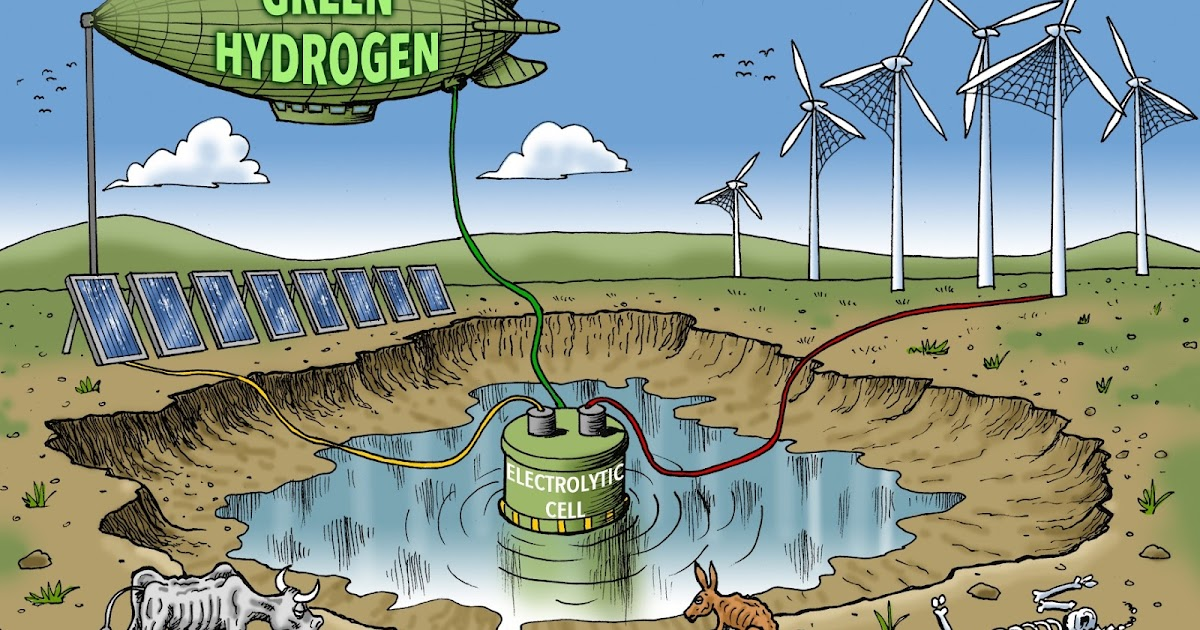
Plug Power is a leading supplier of hydrogen energy systems, including battery-cells for hydrogen vehicles and electrolyzers to produce green hydrogen fuel. Founded in 1997, the company went public in October 1999 at a split-adjusted price of about $160 per share.

But during its 27-year history, Plug Power has never turned a profit. According to financial reports, the firm lost $1.45 billion in 2024, up from a loss of $43.8 million in 2018. Its current stock price is under two dollars per share.

Traditional established firms are finding that renewable equipment can be poor business. In 2023, Ford lost $4.7 billion on sales of 116,000 electric vehicles, or over $40,000 per vehicle. General Electric’s wind turbine business lost $1.1 billion in 2023.

The U.S. federal government provided subsidies to renewable equipment companies of between $7 billion and $16 billion per year between 2010 and 2022. But the Cato Institute estimates that because of the passage of the Inflation Reduction Act in 2022, subsidies will skyrocket to about $80 billion in fiscal year 2025.

EIA

Without the fear of human-caused climate change and
a rising level of government subsidies and mandates,
many of these green companies would not exist.

It’s doubtful that carbon dioxide pipelines, heavy electric trucks, offshore wind systems, green hydrogen fuel equipment, and EV charging stations would be viable businesses in unsubsidized capital markets.

During this last year, leading financial firms pulled back on their climate change pledges. Bank of America, JP Morgan, State Street, and Pimco withdrew from Climate Action 100+, which seeks to force companies and investment funds to address climate issues and adopt environmental, social, and governance (ESG) policies.

But it’s difficult to invest in renewable equipment companies
when they are losing money.


Wind Power Pollution and Hypocrisy in New England

Emmett Hare reports in City Journal Wind Power Debacle in New England.  Excerpts in italics with my bolds and added images.

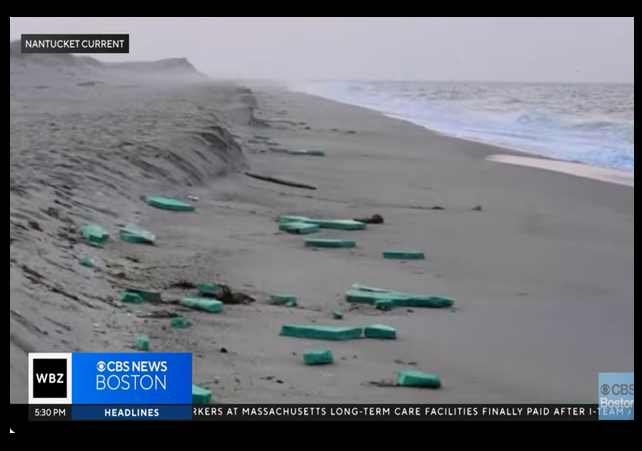
A fractured turbine’s blade in Nantucket is causing
ongoing problems and frustrating local residents.

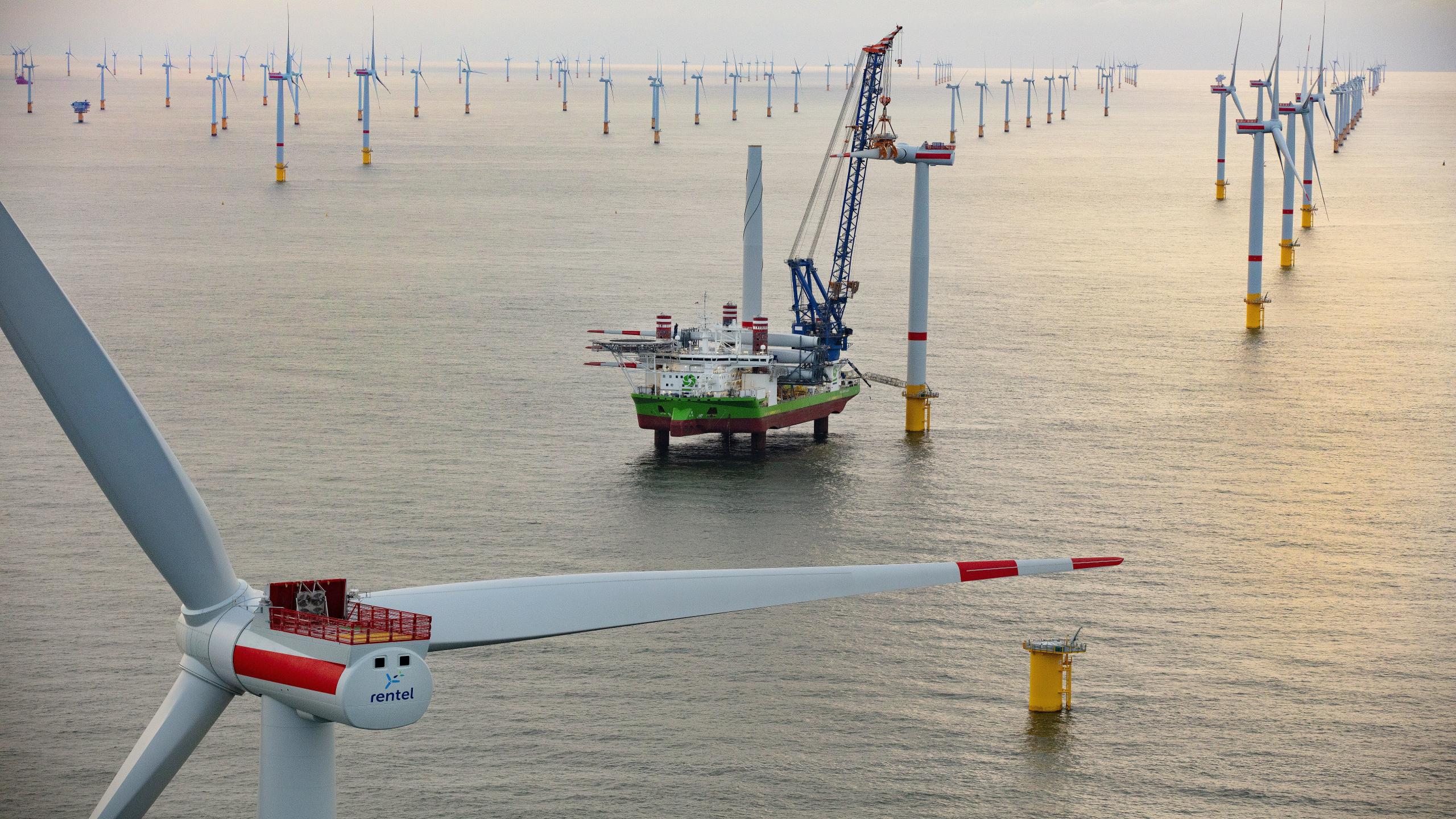
In mid-July, a blade from an offshore wind turbine operating 15 miles southwest of Nantucket fractured. A large amount of fiberglass, foam, and plastic debris fell into the ocean and began washing up on the island’s shores. The incident led to the closure of several beaches and a suspension of operations and construction for the massive Vineyard Wind project, a joint venture of Avangrid and foreign-owned Copenhagen Infrastructure Partners that has installed and operated ten of 62 planned turbines in the country’s largest wind farm.

At local meetings, Nantucket residents expressed concerns about officials’ handling of the turbine breakage and the environmental hazards of enormous fiberglass blades tumbling into the sea. In the past, they have also cited the project’s impact on marine wildlife and its visual impact on the town’s scenic beaches. A CNN report describing this “unusual and rare” event noted that the Coast Guard had retrieved a 300-foot piece of the shattered blade from local waters. The outlet reported that a spokesperson for GE Vernova, the wind-blade manufacturer, “couldn’t provide officials with the precise number of times something similar has happened at other wind farms around the world.”

Environmental groups, realizing the potential political implications of the fractured blade, downplayed the episode. The National Wildlife Federation (NWF), which avidly supports offshore wind farms, insisted that the damage was minor. “Compared to other energy disasters in the ocean like oil spills, this incident is fairly contained and easily cleaned up to prioritize the safety of marine life,” said Amber Hewett, senior director of offshore wind energy for the NWF. The Sierra Club emphasized that “the failure of a single turbine blade does not adversely impact the emergence of offshore wind as a critical solution for reducing dependence on fossil fuels and addressing the climate crisis.”

Whether the incident is “contained” remains in question. Debris from the broken turbine has been reported beyond Nantucket—in Martha’s Vineyard, Cape Cod, Rhode Island, and off the coast of Montauk, Long Island. The debris is breaking up into smaller pieces resembling shattered glass, with yet-unknown effects on Nantucket’s marine habitat. Vineyard Wind cautioned that “[m]embers of the public should avoid handling debris” and promised to “bag, track, and transport all debris to proper storage as soon as possible.” It remains to be seen whether simple avoidance will suffice, especially given the possibility of debris entering the human food chain through area fish.

The Massachusetts Clean Energy Center (MassCEC) Wind Technology Testing Center in Boston has taken delivery of a 107-meter wind turbine blade designed for GE Renewable Energy’s Haliade-X offshore wind turbine.

While this event may be “unusual and rare” in an absolute sense, many wind farms have seen broken turbines, fires, and sea-floor damage. And Nantucket’s situation is particularly dire, given that Vineyard Wind’s turbines are by far the largest ever constructed in the United States: the blade that fragmented on July 13 was over 350 feet long and weighed 57 tons.

Even when functioning as intended, wind farms can negatively affect the surrounding environment. Wildlife advocates have claimed that sonic and subsonic vibrations from the construction and operation of turbines disrupt the navigational senses of marine mammals like whales and dolphins and can cause beachings. Turbines are also responsible for the deaths of countless birds. Clammers and fishermen are wary of working in areas close to wind farms, out of concern for equipment snags on buried power lines and risks to their vessels of navigating between the turbines in bad weather.

French Fishermen Join U.S. Fishermen in Fighting Offshore Wind – IER

The Nantucket residents questioning the safety of wind turbines generally support alternative energy. Indeed, in an FAQ post on the town government’s webpage, officials made the point that allowing wind projects to avoid scrutiny might allow traditional fossil fuel producers to evade similar oversight: “If [the Bureau of Ocean Energy Management] guts the provisions of these longstanding federal laws protecting culturally and environmentally significant places to facilitate expedient green energy projects, fossil fuel developers will exploit the bad precedent to undercut regulation of harmful projects for decades to come.”

Nonetheless, the Nantucket residents have seen themselves branded as tools of the fossil-fuel industry by well-financed lobbyists and promoters of richly subsidized wind power. They have also been subject to physical attacks. At a city council meeting in Newport, Rhode Island, a field director for Climate Jobs Rhode Island, David Booth, was charged with simple assault and disorderly conduct after accosting a speaker and seizing a bag of turbine fragments that she had brought for her testimony. Booth allegedly appeared prominently in a photo on the campaign website of Rhode Island senator Sheldon Whitehouse, which was subsequently removed without comment.

Debris in the water from Vineyard turbine blade

The wind-power industry has seen some of its planned projects cancelled in recent years due to swelling production costs and local opposition to the environmental and aesthetic impact of the colossal windmills. A report published by Brown University’s Climate and Development Lab in early 2024 suggested that much of the opposition to offshore wind was rooted in “misinformation,” “[c]onspiracy theories,” and cherry-picked information supplied by “right-wing think tanks.” It might prove beyond the powers of an academic paper to convince the residents of New England and coastal states that the fiberglass and foam washing up on their beaches is nothing more than a conservative talking point.

See Also:

The Short Lives of Wind Turbines

SCOTUS Must Stop Climate Extortion Lawfare

Jon Decker explains what’s at stake in the case awaiting US Supreme Court consideration.  His Real Clear Markets article is The Supreme Court Must Stop Climate Extortion Schemes.  Excerpts in itallics with my bolds and added images.

Chevron recently announced that it is moving out of California after almost a century and a half in the state. No wonder, since Sacramento sued the company, along with a number of other oil companies, for allegedly deceptive practices.

In their war on energy, progressive politicians increasingly turn to lawfare as another scheme to extract funds from productive citizens and dramatically reshape the economy. In the coming weeks, we’ll learn if the Supreme Court will stand up to them.

The critical case is Sunoco v. Honolulu, currently pending before SCOTUS. Honolulu is suing several oil companies, alleging their fossil fuel production caused significant damage to the city through rising sea levels and other climate-related infrastructure issues.

That these companies are being sued not for specific instances of purported environmental harm, but instead under “public nuisance” and “consumer fraud” laws for an alleged “multi-decadal campaign of deception” about the nature of their products is crucial. That’s because it lets progressive cities and states get around long-standing legal doctrine that kept climate cases in federal courts, where defendants are somewhat likelier to get a fair hearing.

Knowing that federal environmental law presents a more difficult path for litigation, activists instead went “venue shopping” with their climate agenda to deep blue states, knowing that a multi-jurisdictional assault would be unworkable, and potentially fatal, for American energy companies. The progressive politicians who support this approach not only see a boost for their careers and fundraising goals, but a potentially massive source of new government revenue.

Because Honolulu, like a spate of other lawsuits driven by ambitious progressive state AGs and prosecutors, models its assault on energy companies on the 90s tobacco wars. And they are unsurprisingly seeking an eye-watering settlement similar to what the tobacco industry was forced to pay (dollars that still flow to the government to this day).

But you don’t have to be a fossil fuel corporate booster or a climate change skeptic to recognize that these paydays will come at the expense of ordinary consumers and taxpayers, and of the economy as a whole.

Fossil fuels are ubiquitous in every sector, from agriculture and clothing to steel production, electricity, heating, and transportation. If this lawfare succeeds then every single one of these products and services—anything that takes energy as an input—becomes more expensive.

There’s also a kind of incoherence to the idea that a small handful of companies are alone to blame for perceived climate ills. What about the thousands of companies worldwide that are involved in the exploration, production, and distribution of fossil fuels – or the millions of companies that use fossil fuels to make their own goods and perform their services? That’s not even to mention the fact that the same few energy companies now being sued also play a critical role in the U.S. leading the world in CO2 emission reductions, through greater adoption of natural gas. How do the companies spearheading the natural gas renaissance figure into the supposed “deception” at work here?

The stakes here remind us that judges—and therefore elections—matter. Hawaii Supreme Court Chief Justice Mark Recktenwald, who ruled in favor of Honolulu and thereby triggered SCOTUS review, has been associated with the far-left Environmental Law Institute’s (ELI) Climate Judiciary Project, a group that “trains” and “educates” thousands of judges and government lawyers across the country to deliver legal outcomes favored by progressives.

The Supreme Court may be the last line of defense against
fringe activists dictating energy policy for the rest of us.

But of course, SCOTUS itself is in the crosshairs of left-wing judicial scheming, with top Democrats, including presidential nominee Kamala Harris, threatening to pack the Supreme Court if elected. No doubt with judges in the Mark Recktenwald mode.

If Honolulu succeeds in its case, and progressives in their larger campaign of lawfare, Americans can say Aloha to higher prices.

Postscript on Arguing Deception in These Cases

As noted above, the rationale for filing these cases in state rather than federal courts depends on claiming consumer fraud, I.e. oil companies deceived the public while knowing about their damaging energy products.  A good rebuttal against the “Exxon Knew” fiction is provided (with my bolds) by Randal Utech at Master Resource:

To say that Exxon knew the truth back in the early 80s is a laughable fallacy. Effectively they built a primitive model that is characteristically similar to the erroneous modern climate models of today.

Fundamentally their work is based on the poorly understood climate sensitivity (ECS) derived from radiative convective models and GCM models. To their credit, they actually acknowledged the high degree of uncertainty in these estimations. Today, even Hausfather (2022 vs 2019) is beginning to understand the climate sensitivity (ECS) is too high. CMIP6 is running still even hotter than CMIP5 and using ECS of 3 to 5° C rather than ~ 1.2° C as highlighted in Nick Lewis’s 2022 study.

CMIP6 should have been better because it incorporated solar particle forcing (Matthes et. al.) and as they incorporate more elements of natural forcing (an active area of research as we still do not have a predictive theory for climate), the effect is highlighting more underlying problems with the models.

However, Exxon investigators fell into the same trap that climate modelers of today where they build the models to history match temperatures and then wow, because they can create a model that appears to history match temperatures, they assume it is telling them something. Truth? Anyone can create a model to do this, but it would never mean the model is correct. While the models today are much more complex, they are based on a complex set of non-linear equations, and the understanding of the various sources of nonlineararity is poor. This opens up wide degrees of uncertainty yet wide opportunity for tuning. Furthermore, natural forcing is undercharacterized and deemed inconsequential.

The contrived sense of accomplishment in history matching is spurious correlation for an infinitesimally small period of time. Using Exxon’s internal analysis of CO2 climate forcing is little more than a propaganda tool. Current climate models, much more sophisticated, face the same problem of unknown, false causality.

See Background Post:

19 State AGs Ask Supremes to Block Climate Lawsuits

Energy Revolution Not In The Cards

Kite & Key explains in above video Why the Odds Are Stacked Against Net Zero.  For those preferring to read I provide a text from the captions, though the video is entertaining along with great images, some of which are included with the text in italics with my bolds.

Overview

Are we at the beginning of the end of fossil fuels? That’s the theory advanced by an international coalition of politicians who aim to get us to net zero carbon emissions by the year 2050. Just one problem: Research from the experts in their own governments suggests it’s a nearly impossible task. Enthusiasts for net zero often say we’re on the cusp of an “energy revolution.”

And that theory has a big problem: Energy revolutions don’t happen — at least not in the way that politicians often describe. While it’s true that technological and economic factors sometimes change the energy mix — countries that get wealthier become less dependent on wood, for example — the broader trend in the history of the world’s energy consumption can be defined by three words: more, more, more.

In a power-hungry world, we keep adding new energy sources. But there’s rarely any subtraction. And, with global energy demand expected to increase by about 35% by 2050, it’s nearly impossible that we can get all the power we need from carbon-free sources. For instance, meeting the net zero goals would require the construction of over 9,000 nuclear plants by 2050. The number currently being built around the world? 59.

So, what will the future of energy really look like? Our video explores.

Transcription

It doesn’t happen that often. But every once in a while, a single generation witnesses a technological breakthrough that will change the world forever.
The printing press.
The beginning of human flight.
And, for our generation, an inevitable full scale revolution in clean energy…
…that’s running a little behind schedule…
…Ok, way behind schedule.

“The beginning of the end of the fossil fuel era.” That’s how the United Nations referred to the outcome of a 2023 climate change summit held in…the United Arab Emirates. Which is sort of like having the Prohibition Conference in Vegas. Nevertheless, delegates from throughout the world left the gathering having pledged that the world would transition away from fossil fuels and get the world to net zero carbon emissions by the year 2050.

Now, the rationale for this is clear enough. Leaders from around the globe are worried that without a shift over to carbon-free energy sources like wind, solar, hydro, and nuclear the world will face significant problems as a result of climate change.

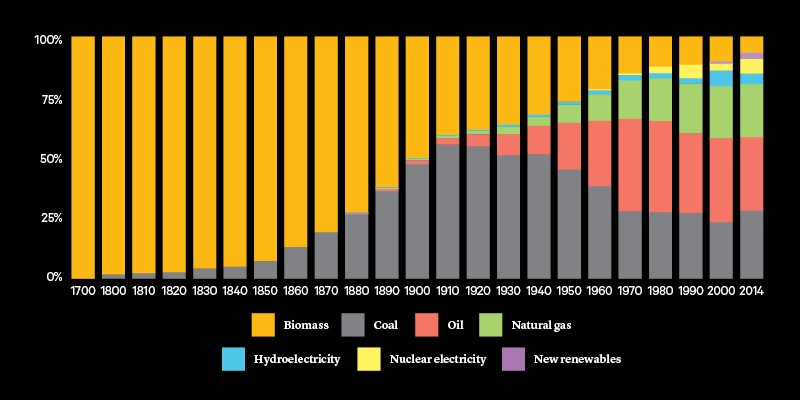
But, regardless of why they’re doing this, the more important question is whether they can do it. Because here’s the thing about energy revolutions: they don’t happen. At least not in the way that the UN is imagining. To understand why, it’s worth looking at the history of the world’s energy consumption – which looks like this.

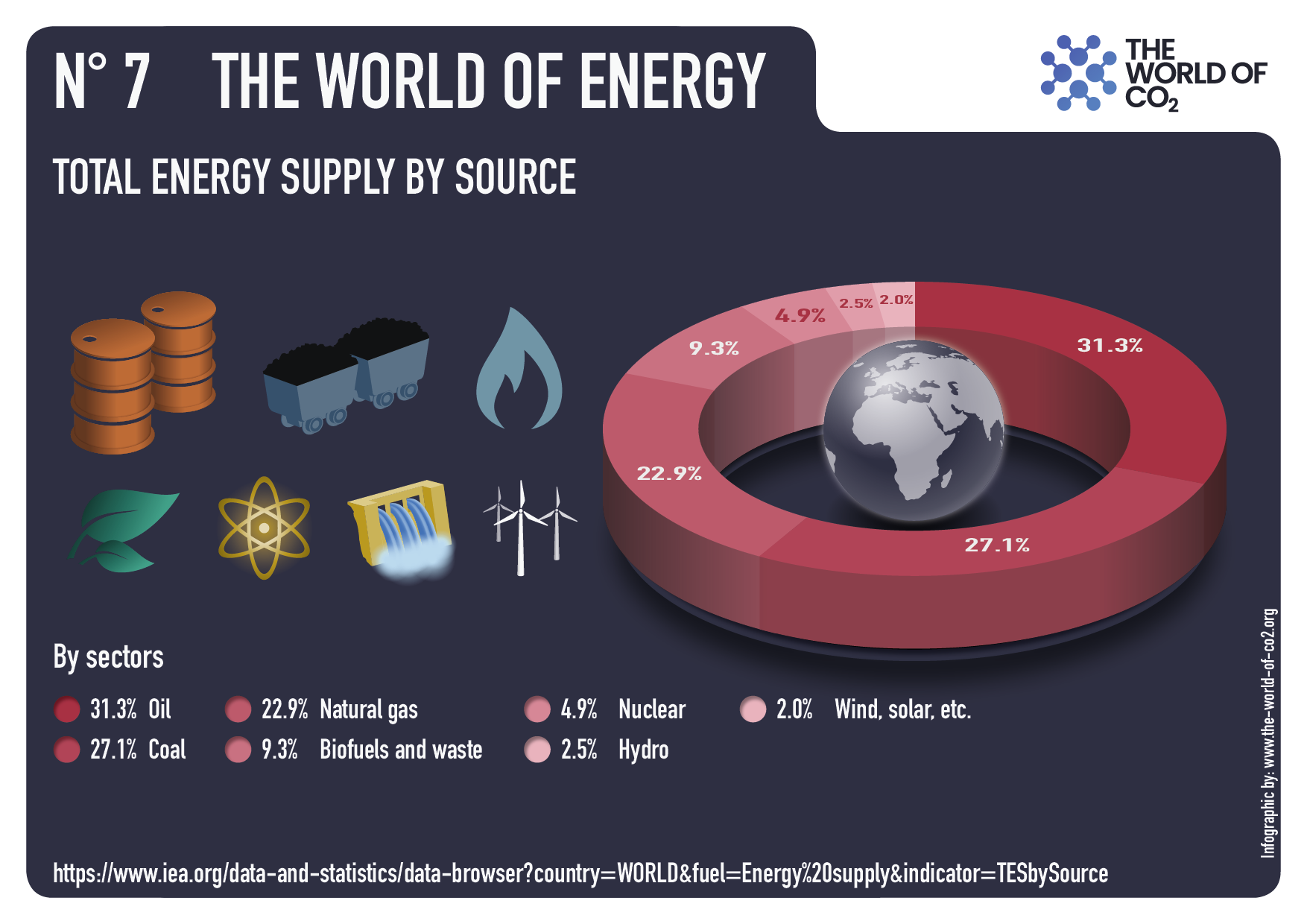
Go back a couple of centuries and the world basically ran on “traditional biomass”– -which is a fancy way of saying … wood. We burned a lot of wood and also … dung. Then in the mid 19th century, coal came into the picture in a big way. By the 20th century, we’re using tons of oil. And natural gas is a big factor too, especially as we cross into the 21st century, and fracking makes it both abundant and more affordable. As the years went by, we added low-carbon sources of energy as well, like nuclear, hydro, wind, and solar–though overall, they’re still a pretty small part of the picture.

Now, there are two important things to note about this chart. First, the history of the world’s energy consumption can be defined in three words: more, more, more. Which kind of makes sense. After all, pretty much everything that defines modern life involves a lot of energy. Between 1950 and 2022, for example, the population of the U.S. a little more than doubled. But in that same time period, our electricity use got 14 times larger.

And second, because of that “more and more, more” trend, the only things we’ve ever had that look like energy “revolutions” have been about adding new sources into the mix, not getting rid of existing ones as net zero goals propose.

Now, to be clear, that doesn’t mean that nothing ever changes. In wealthier nations, the rise of cheaper natural gas has led to less coal usage, especially in the U.S. And poorer countries usually abandoned traditional biomass as they get wealthier, because no advanced nation powers itself by burning wood. We use it for much more sophisticated purposes…like doing psychedelics in the Nevada desert.

But using a little less coal or wood or relatively modest changes–and importantly are driven by cold, hard economic facts. By contrast, what the net zero goals entail is replacing all of this … with this … in just about 25 years. Based on little more than the fact that politicians just want it to happen.

To understand just how tall a task this is, it’s worth looking at what it would require to make it a reality. It’s estimated that meeting net zero goals would require deploying 2000 new wind turbines…
…every day … for the next 25 years. To give you some context for that, the U.S. builds about 3000 new wind turbines…
…a year.

Alternately, you could open one new nuclear plant every day for the next 25 years. For the record, that’s over 9,000 of them. And, also for the record, as of 2023, the number that were actually being built across the entire world was … 59.  And here in the U.S. anyway, it generally takes over a decade to build them.

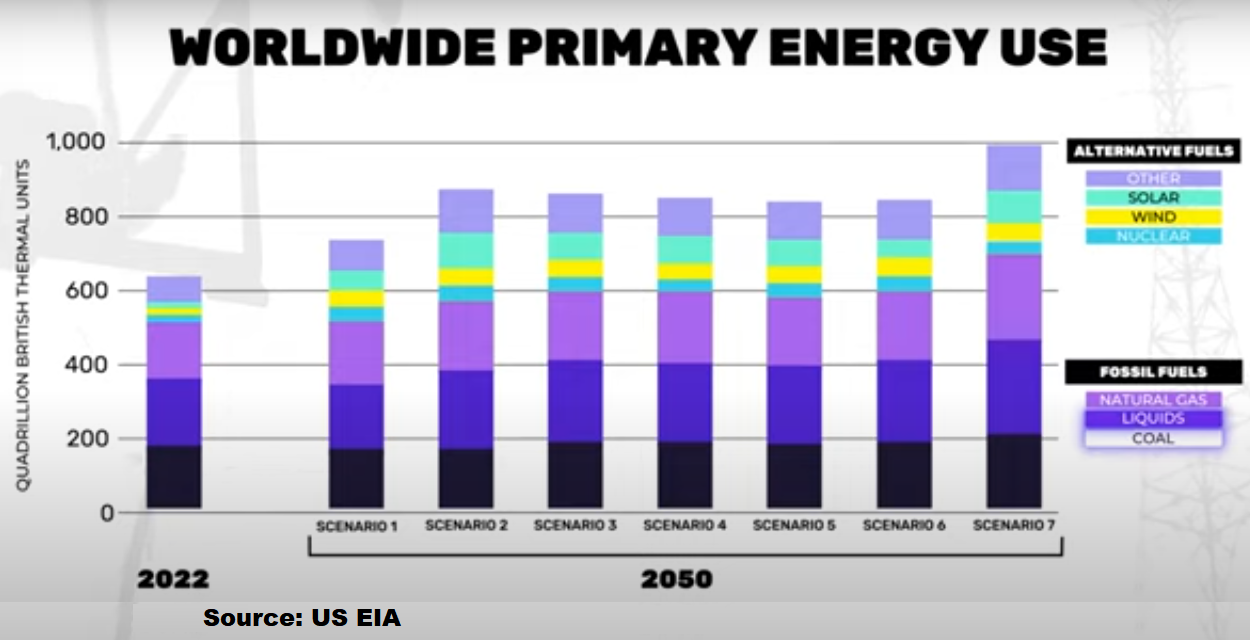
And those are some of the reasons why what politicians promise about net zero and what the experts in their own governments say…don’t exactly match up. The government’s U.S. Energy Information Administration, or EIA, projects that by the year 2050, far from seeing a revolution in energy, America will be a little less reliant on coal, a little more so on renewables…and the rest of the picture looks pretty much the same as today.

And in fact, this is true for the entire world. The EIA ran seven different scenarios for what the world’s energy consumption could look like in 2050, and while all of them showed a significant increase in renewables … they also all showed a world that continued to get most of its energy from things like coal, oil, and natural gas. Not exactly “the beginning of the end of the fossil fuel era.”

The reason for all of this: We simply can’t take enormous quantities of energy offline in a world where it’s predicted that we’re going to need almost 35% more of it by the year 2050. For one thing, there are a lot of poor countries around the world who are going to need dramatically more energy to bring themselves up to even a fraction of our standards of living.

And for another, the technologies of the future require vast amounts of power. By the year 2030, it’s estimated the computer usage around the world will take up as much as five times more of the world’s electricity production as it did even in 2020. The digital cloud we all use to store data already uses twice as much electricity as the entire nation of Japan. And with new energy-hungry technologies like AI on the way, things are only gonna move further in that direction.

Which means the real future of energy is probably: everything. Nuclear, natural gas, wind, and solar, oil, hydropower, coal. We’re going to need all of it. Probably not much wood though.
Except for these guys.

Green Deal Cuts EU Emissions, Doubles Them Elsewhere

The news and analysis from University of Groningen is reported at Science Daily European Green Deal: A double-edged sword for global emissions.  Excerpts in italics with my bolds and added images.

Greenhouse gas emissions will fall in the EU, but rise even more elsewhere

Summary:  The European Green Deal will bring down the emission of greenhouse gases in the European Union, but at the same time causes a more than a twofold increase in emissions outside its borders.

The European Union aims to be carbon-neutral by 2050 as part of the comprehensive Green Deal that was agreed upon four years ago. However, an analysis of the policy documents outlining the practical measures of the Green Deal shows that it will decrease carbon emissions in Europe, but also increase carbon emissions outside of the EU. This increase is more than double the amount of carbon emissions saved by the Green Deal. This analysis was published in Nature Sustainability on by an international team of scientists led by Klaus Hubacek, Professor of Science, Technology and Society at the University of Groningen.

The European Green Deal is a set of policies intended to fully decarbonize Europe by 2050, but it also includes measures for clean energy production and ecological restoration. Hubacek and colleagues from the United States and China carried out full supply chain analyses of the policy documents underlying the Green Deal. Their conclusion is that the Green Deal in its current form will lead to an increase in emissions in countries outside the EU by 244.8 percent compared to the Green Deal’s carbon reduction goal in the land, land use change, and forestry sector within EU borders.

Reasons to be Skeptical of Policies

One example is the measure to increase biodiversity in Europe by planting three billion trees. ‘However, trees require a lot of land that cannot be used to produce food. That means that food must be produced elsewhere, and to do this, land must be converted into cropland. This increases the carbon dioxide emission and reduces biodiversity,‘ says Hubacek. In this way, the EU would reduce carbon emissions within its borders, but ‘export‘ them to the countries that would produce our food, for example Africa or South America.

Of course, the Green Deal does contain a paragraph forbidding the import of products (such as meat or animal feed) for which woodland is converted to farmland. Hubacek is sceptical: ‘Nothing stops these other countries from growing products for Europe on existing farmland and felling forests to produce for the local market. There are simply too many uncertainties in these types of regulations.’ The Green Deal also calls for an increase in organic farming, but this requires more farmland in Europe. Hubacek: ‘Again, there is very little information available on the impact on land use.’

No free lunch

However, the scientists did not just reveal the negative impacts of the Green Deal on the rest of the world. They also looked at different scenarios to see if overall carbon reductions could be enhanced. ‘We found one very effective way to do this.’ says Hubacek, ‘By adopting the more plant-based “planetary health diet,” it is possible to save an enormous amount of carbon emissions.’ Another measure is to phase out food-based biofuels within the EU, which would reduce the amount of farmland needed and thus save carbon emissions and prevent biodiversity loss. Also, the EU could assist developing regions to increase their agricultural efficiency, which would also reduce land use.

Although the Nature Sustainability article shows that the European Green Deal in its present form could result in a net loss for the global environment, the scientists conclude that it can be remedied. ‘By adopting the planetary health diet, which is relatively simple’, says Hubacek. However, there is one more thing that needs to change, he stresses: ‘The programme is driven by techno-optimism, but our analysis underlines that there is no free lunch. I very much doubt that “Green Growth” is possible, as everything you produce requires an input of resources. So we really need to consume less.’ There is a strong sense of urgency now that global warming seems set to surpass the 1.5 degrees from the 1995 Paris Agreement, and many other planetary boundaries are also being overstepped. Hubacek: ‘It is time to implement measures that work.’

Comment:

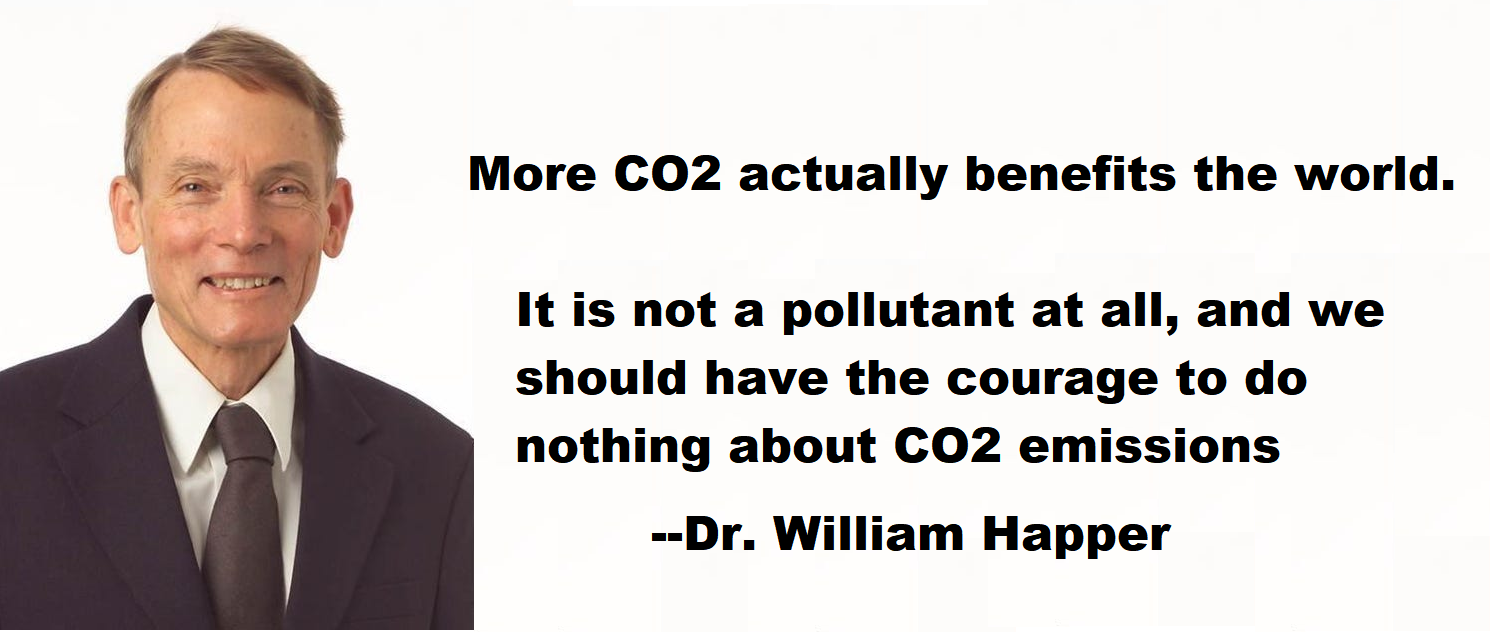
The authors share the IPCC notion of climate emergency caused by GHGs, but are practical enough to realize the proposed policies are counter productive.  I am among those who agree with Dr. Happer that the only climate crisis is coming from the torrent of ill-advised governmental policies that are not likely to reduce GHG emissions or temperatures, but will achieve great economic and social destruction.

See the series of four posts World of Hurt from Climate Policies

World of Hurt from Climate Policies-Part 1

See Also

Climate Policies Fail in Fact and in Theory


California Browning from Electricity Policies

Ronald Stein explains the devastation in his Heartland article The Golden State of California Is Turning Brown Without Continuous Electricity.  Excerpts in italics with my bolds and added images.

As a resident of California for more than six decades, I am aware that the availability of continuously generated electricity in California is deteriorating and will get worse!

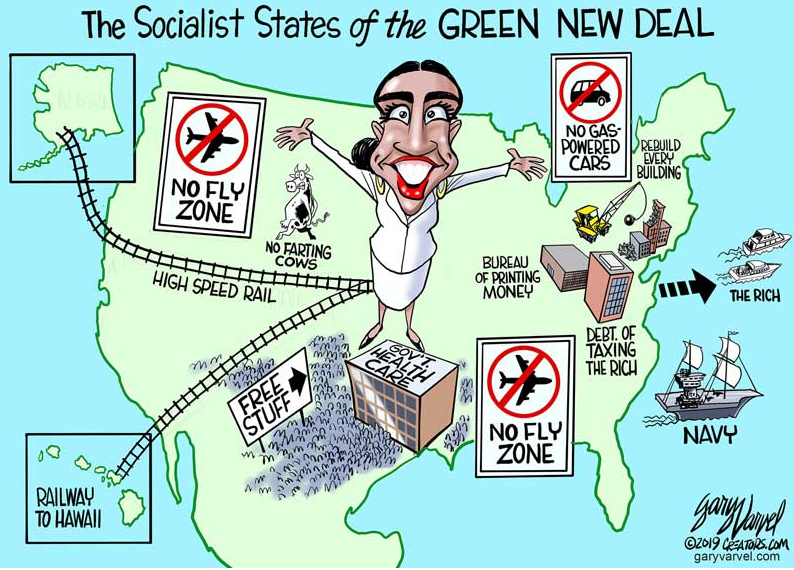
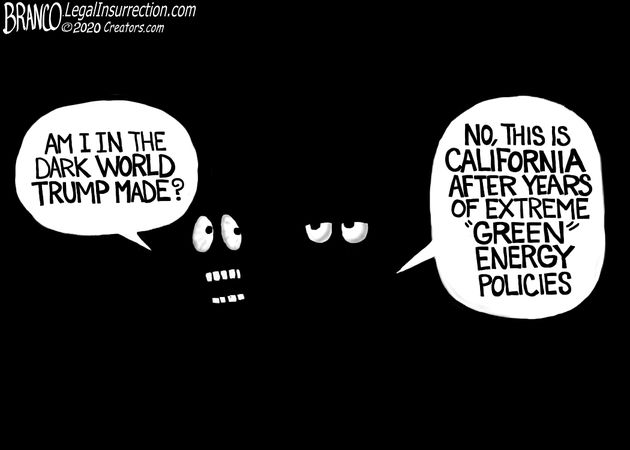
The “Green New Deal” and “Net Zero” policies in California that are supported by Governor Newsom and the Democratic Presidential candidate Kamala Harris have led to the state’s most expensive electricity and fuel prices in America and increasingly high cost of living, housing, and transportation, coupled with an increase in crime, smash-and-grab robberies, homelessness, pollution, and congestion that has caused many tax-paying residents and companies to exodus California to more affordable cities and states.

California’s net move-out number of residents in 2022 alone was more than 343,000 people that left California — the highest exodus of any state in the U.S.

The California Policy Institute counted more than 237 businesses that have left the state since 2005. Among these businesses were eleven Fortune 1000 companies, including AT&T, Hewlett Packard Enterprise, Exxon Mobil, and Chevron.

The U.S. Department of Energy recently made a startling admission: U.S. electricity demand will double by 2050, and meeting that soaring demand will require the equivalent of building 300 Hoover Dams.

The last California Nuclear Power Plant at Diablo Canyon, a 2.2 GW plant generating continuous uninterruptable electricity, is projected to close soon. In nameplate only, it would take 1,000 2.2MW wind turbines to generate 2.2 GW, but then, it’s only intermittent electricity vs. the continuous uninterruptable electricity from Diablo demanded by the California economy!

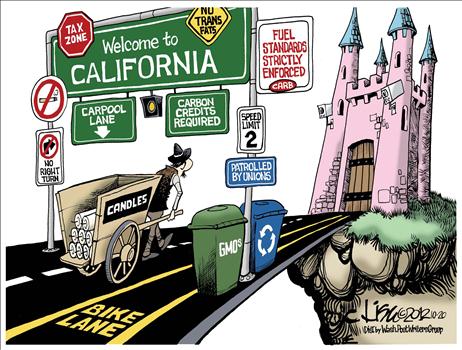
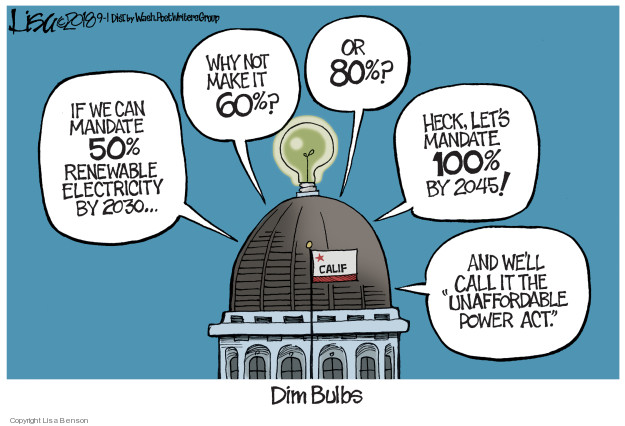
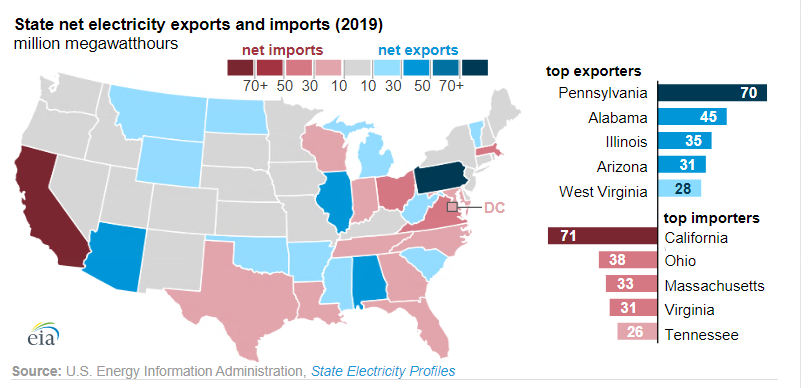
As a result of the “Green New Deal” and “Net Zero” policies and renewables of wind and solar stations built at the expense of taxpayer dollars, California now imports more electric power than any other US state, more than twice the amount in Virginia, the USA’s second-largest importer of electric power. California typically receives between one-fifth and one-third of its electricity supply from outside of the state.

Power prices are rocketing into the stratosphere and, even before winter drives up demand, are being deprived of continuous electricity in a way that was unthinkable barely a decade ago. But such is life when you attempt to run the economy on sunshine and breezes.

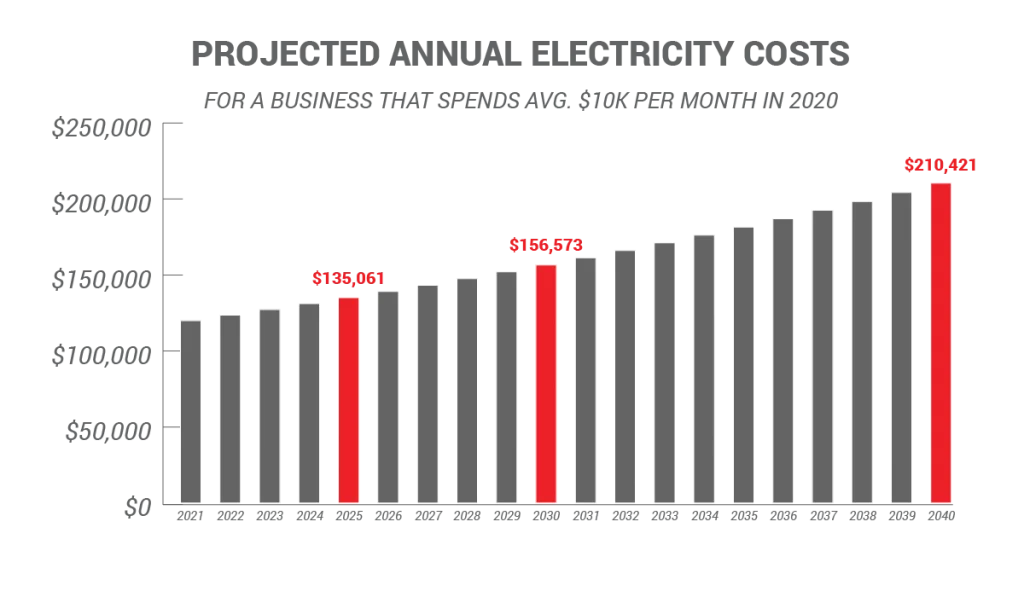
Projected electricity costs for California Businesses

Further, these so-called “green” electricity sources of wind and solar are not clean, green, renewable or sustainable. They also endanger wildlife.

California’s economy depends on affordable, reliable, and ever-cleaner electricity and fuels. Unfortunately, policymakers are driving up California’s electric and gas prices, and California now has the highest electricity and fuel prices in the nation. Those high energy prices are contributing to the pessimistic business sentiment. California’s emission mandates have done an excellent job of increasing the cost of electricity, products, and fuels to its citizens.

It’s becoming increasingly obvious that these supposed “green” alternative methods of generating electricity won’t work — especially as electricity demand is projected to double by 2050 due to AI, charging of EVs and data centers, government-mandated electric heating and cooking, and charging grid-backup batteries. Intermittent electricity from wind and solar cannot power modern nations.

These “green” wind and solar projects primarily exist because they are financed with taxpayer money, i.e., disguised by taxpayers as “Government Subsidies.”

“GREEN” policymakers are oblivious to humanity’s addiction to the products and fuels from fossil fuels, as they are to these two basic facts:

(1)  No one uses crude oil in its raw form. “Big Oil” only exists because of humanity’s addiction to the products and fuels made from oil!

(2)  “Renewables” like wind and solar only exist to generate intermittent electricity; they CANNOT make products or fuels!

To rid the world of crude oil usage, there is no need to over-regulate or over-tax the oil industry; just STOP using the products and fuels made from crude oil!

Simplistically:

STOP making cars, trucks, aircraft, boats, ships, farming equipment, medical equipment and supplies, communications equipment, military equipment, etc., that demand crude oil for their supply chain of products.

STOPPING the demands of society for the products and fuels made from oil will eliminate the need for crude oil.

The primary growth in electric power usage is coming from new data centers housing AI technologies. It is expected that over the next few decades, 50% of additional electric power will be needed just for AI, but data centers CANNOT run on occasional electricity from wind and solar.

Cal matters raises concerns about state policy to phase out ICE vehicles in favor of EVs.

How will the occasionally generated electricity from wind and solar support the following:

  • America’s military fleet of vehicles, ships, and aircraft?
  • America’s commercial and private aircraft?
  • America’s hospitals?
  • America’s space exploration?

Despite Governor Newsom’s and Democratic presidential candidate Kamala Harris’s support for the “Green New Deal” and “Net Zero” policies in California, it’s time to stimulate conversations about the generation of continuously generated electricity to meet the demands of America’s end users.


Good News: SEC’s ESG Plans Thwarted with Biden Term Ending

The news comes from Bloomberg Law article SEC’s Gensler Sees ESG Plans Thwarted as Biden’s Term Nears End. Excerpts in italics with my bolds and added images.

SEC Chair Gary Gensler started out with big plans on ESG.

  • Gensler seeks board diversity, workforce, ESG fund disclosures
  • Agency unlikely to finalize ESG regulations before January

The Democrat arrived at the Securities and Exchange Commission in 2021, after George Floyd’s murder in 2020 and President Joe Biden’s election that year fueled interest in environmental, social and governance investing. Gensler wanted public companies to report details about their climate change risks, workforce management and board members’ diversity.

He also sought new rules to fight greenwashing and other misleading ESG claims by investment funds.

Almost four years later, most of those major ESG regulations are unfinished, and they’ll likely remain so in the less than five months Gensler may have left as chair. A conservative-led backlash against ESG and federal agency authority has fueled challenges in and out of court to corporate greenhouse gas emissions reporting rules and other SEC actions, helping blunt the commission’s power.

The climate rules—Gensler’s marquee ESG initiative—were watered down following intense industry pushback, then paused altogether after business groups, Republican attorneys general and others sued.

“It’s clear the commission leadership is exhausted and feeling buffeted by the courts, Congress and industry complaints,” said Tyler Gellasch, who was a counsel to former Democratic SEC Commissioner Kara Stein and is president and CEO of investor advocacy group Healthy Markets Association.

The SEC has finalized more than 40 rules since 2021, “making our capital markets more efficient, transparent, and resilient,” an agency spokesperson said in a statement to Bloomberg Law.

The spokesperson declined to comment on the status of the agency’s pending ESG rules, beyond pointing to the commission’s most recent regulatory agenda.

Long-standing plans to require human capital and board diversity disclosures from companies have yet to yield formal proposals. Final rules concerning ESG-focused funds still are pending, and even if the SEC adopts them before January as the agenda suggests, a Republican-controlled Congress and White House may have the power to quickly scrap them under the Congressional Review Act.

Unlike the workforce and board diversity rules that have yet to be proposed, investment fund regulations concerning ESG have already been drafted and are targeted for completion in October, according to the SEC’s latest agenda. ESG funds would have to disclose their portfolio companies’ emissions and report on their ESG strategies.

The SEC proposed the regulations in May 2022, along with rules intended to ensure ESG funds’ names align with their investments. The commission issued final fund name rules in September 2023.

The SEC’s investment fund proposal has raised objections from both funds and environmental and investor advocates.

The proposal would require environmentally-focused funds to disclose their carbon footprints, if emissions are part of their investment strategies. But it wouldn’t require funds that look at emissions to disclose other metrics that play a significant role in how they invest and the methodology they use to calculate those measures. The Natural Resources Defense Council, Interfaith Center on Corporate Responsibility, and other environmental and investor groups pushed for those requirements in an April letter to the SEC.

The Investment Company Institute, which represents funds, has raised concerns its members would have to report on their carbon footprints before public companies must disclose their emissions under SEC rules. The group in April called on the SEC to keep fund emissions reporting requirements on ice until the litigation challenging the agency’s public company climate rules is resolved. That litigation is at the US Court of Appeals for the Eighth Circuit, which is unlikely to rule this year.

The fund rules have received no Republican support at the SEC, with only Gensler and his fellow Democratic commissioners voting in favor of proposing them.

“If it’s a Republican Congress and Trump administration, you could imagine they would be willing to disapprove those,” said Susan Dudley, a George Washington University professor who oversaw the White House regulatory policy office under President George W. Bush.


Methane Madness Strikes Again

The latest comes from Australia by way of John Ray at his blog Methane cuts on track for 2030 emissions goal.  Excerpts in italics with my bolds and added images.

Australia’s methane emissions have decreased over the past two decades, according to a new report by a leading global carbon research group.

While the world’s methane emissions grew by 20 per cent, meaning two thirds of methane in the atmosphere is from human activity, Australasia and Europe emitted lower levels of the gas.

It puts Australia in relatively good stead, compared to 150 other signatories, to meet its non-binding commitments to the Global Methane Pledge, which aims to cut methane emissions by 30 per cent by the end of the decade.

The findings were revealed in the fourth global methane budget, published by the Global Carbon Project, with contributions from 66 research institutions around the world, including the CSIRO.

According to the report, agriculture contributed 40 per cent of global methane emissions from human activities, followed by the fossil fuel sector (34 per cent), solid waste and waste­water (19 per cent), and biomass and biofuel burning (7 per cent).

Pep Canadell, CSIRO executive director for the Global Carbon Project, said government policies and a smaller national sheep flock were the primary reasons for the lower methane emissions in Australasia.

“We have seen higher growth rates for methane over the past three years, from 2020 to 2022, with a record high in 2021. This increase means methane concentrations in the atmosphere are 2.6 times higher than pre-­industrial (1750) levels,” Dr Canadell said.

The primary source of methane emissions in the agriculture sector is from the breakdown of plant matter in the stomachs of sheep and cattle.

It has led to controversial calls from some circles for less red meat consumption, outraging the livestock industry, which has lowered its net greenhouse gas emissions by 78 per cent since 2005 and is funding research into methane reduction.

Last week, the government agency advising Anthony Albanese on climate change suggested Australians could eat less red meat to help reduce emissions. And the government’s official dietary guidelines will be amended to incorporate the impact of certain foods on climate change.

There is ongoing disagreement among scientists and policymakers about whether there should be a distinction between biogenic methane emitted by livestock, which already exists in a balanced cycle in plants and soil and the atmosphere, and methane emitted from sources stored deep underground for millennia.

“The frustration is that methane, despite its source, gets lumped into one bag,” Cattle Australia vice-president Adam Coffey said. “Enteric methane from livestock is categorically different to methane from coal-seam gas or mining-related fossil fuels that has been dug up from where it’s been stored for millennia and is new to the atmosphere.

“Why are we ignoring what modern climate science is telling us, which is these emissions are inherently different?”  Mr Coffey said the methane budget report showed the intense focus on the domestic industry’s environmental credent­ials was overhyped.

“I think it’s based mainly on ideology and activism,” Mr Coffey said.

This concern about methane is nonsense.
Water vapour blocks all the frequencies that methane does
so the presence of methane adds nothing

Technical Background

Methane alarm is one of the moles continually popping up in the media Climate Whack-A-Mole game. An antidote to methane madness is now available to those inquiring minds who want to know reality without the hype.

Methane and Climate is a paper by W. A. van Wijngaarden (Department of Physics and Astronomy, York University, Canada) and W. Happer (Department of Physics, Princeton University, USA) published at CO2 Coalition November 22, 2019. Below is a summary of the more detailed publication. Excerpts in italics with my bolds.

Overview

Atmospheric methane (CH4) contributes to the radiative forcing of Earth’s atmosphere. Radiative forcing is the difference in the net upward thermal radiation from the Earth through a transparent atmosphere and radiation through an otherwise identical atmosphere with greenhouse gases. Radiative forcing, normally specified in units of W m−2 , depends on latitude, longitude and altitude, but it is often quoted for a representative temperate latitude, and for the altitude of the tropopause, or for the top of the atmosphere.

For current concentrations of greenhouse gases, the radiative forcing at the tropopause, per added CH4 molecule, is about 30 times larger than the forcing per added carbon-dioxide (CO2) molecule. This is due to the heavy saturation of the absorption band of the abundant greenhouse gas, CO2. But the rate of increase of CO2 molecules, about 2.3 ppm/year (ppm = part per million by mole), is about 300 times larger than the rate of increase of CH4 molecules, which has been around 0.0076 ppm/year since the year 2008.

So the contribution of methane to the annual increase in forcing is one tenth (30/300) that of carbon dioxide. The net forcing increase from CH4 and CO2 increases is about 0.05 W m−2 year−1 . Other things being equal, this will cause a temperature increase of about 0.012 C year−1 . Proposals to place harsh restrictions on methane emissions because of warming fears are not justified by facts.

The paper is focused on the greenhouse effects of atmospheric methane, since there have recently been proposals to put harsh restrictions on any human activities that release methane. The basic radiation-transfer physics outlined in this paper gives no support to the idea that greenhouse gases like methane, CH4, carbon dioxide, CO2 or nitrous oxide, N2O are contributing to a climate crisis. Given the huge benefits of more CO2 to agriculture, to forestry, and to primary photosynthetic productivity in general, more CO2 is almost certainly benefitting the world. And radiative effects of CH4 and N2O, another greenhouse gas produced by human activities, are so small that they are irrelevant to climate.

Transmission of shortwave solar irradiation and long wavelength radiation from the Earth’s surface through atmosphere, as permitted by Rohde [2]. Note absorption wavelengths of CH4 and N2O are already covered by H2O and CO2.

Radiative Properties of Earth Atmosphere

On the left of Fig. 2 we have indicated the three most important atmospheric layers for radiative heat transfer. The lowest atmospheric layer is the troposphere, where parcels of air, warmed by contact with the solar-heated surface, float upward, much like hot-air balloons. As they expand into the surrounding air, the parcels do work at the expense of internal thermal energy. This causes the parcels to cool with increasing altitude, since heat flow in or out of parcels is usually slow compared to the velocities of ascent of descent.
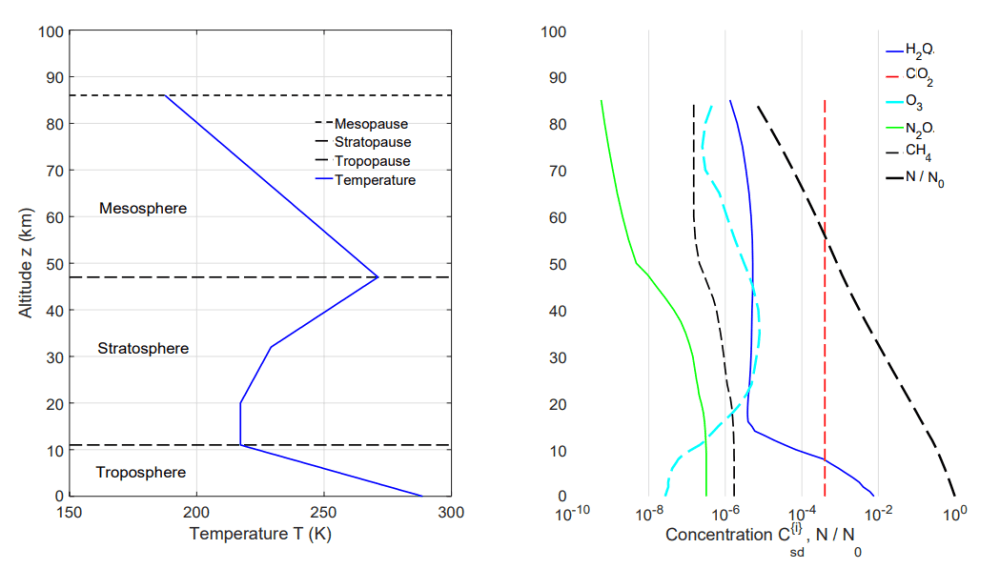
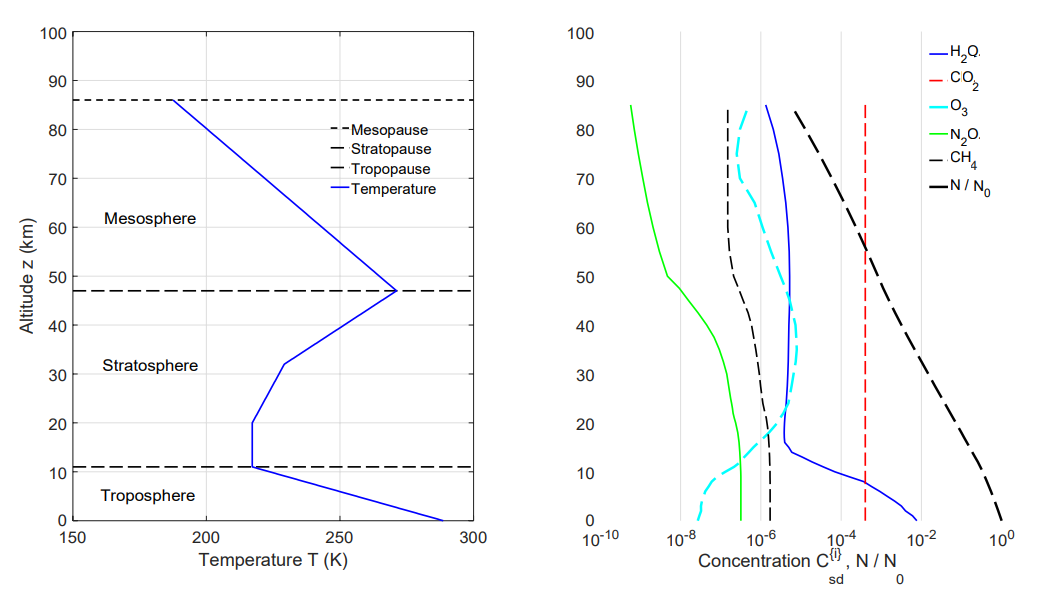
Figure 2: Left. A standard atmospheric temperature profile[9], T = T (z). The surface temperature is T (0) = 288.7 K . Right. Standard concentrations[10], C {i} = N {i}/N for greenhouse molecules versus altitude z. The total number density of atmospheric molecules is N . At sea level the concentrations are 7750 ppm of H2O, 1.8 ppm of CH4 and 0.32 ppm of N2O. The O3 concentration peaks at 7.8 ppm at an altitude of 35 km, and the CO2 concentration was approximated by 400 ppm at all altitudes. The data is based on experimental observations.

If the parcels consisted of dry air, the cooling rate would be 9.8 C km−1 the dry adiabatic lapse rate[12]. But rising air has usually picked up water vapor from the land or ocean. The condensation of water vapor to droplets of liquid or to ice crystallites in clouds, releases so much latent heat that the lapse rates are less than 9.8 C km−1 in the lower troposphere. A representative lapse rate for mid latitudes is dT/dz = 6.5 K km−1 as shown in Fig. 2.

The tropospheric lapse rate is familiar to vacationers who leave hot areas near sea level for cool vacation homes at higher altitudesin the mountains. On average, the temperature lapse rates are small enough to keep the troposphere buoyantly stable[13]. Tropospheric air parcels that are displaced in altitude will oscillate up and down around their original position with periods of a few minutes. However, at any given time, large regions of the troposphere (particularly in the tropics) are unstable to moist convection because of exceptionally large temperature lapse rates.

The vertical radiation flux Z, which is discussed below, can change rapidly in the troposphere and stratosphere. There can be a further small change of Z in the mesosphere. Changes in Z above the mesopause are small enough to be neglected, so we will often refer to the mesopause as “the top of the atmosphere” (TOA), with respect to radiation transfer. As shown in Fig. 2, the most abundant greenhouse gas at the surface is water vapor, H2O. However, the concentration of water vapor drops by a factor of a thousand or more between the surface and the tropopause. This is because of condensation of water vapor into clouds and eventual removal by precipitation. Carbon dioxide, CO2, the most abundant greenhouse gas after water vapor, is also the most uniformly mixed because of its chemical stability. Methane, the main topic of this discussion is much less abundant than CO2 and it has somewhat higher concentrations in the troposphere than in the stratosphere where it is oxidized by OH radicals and ozone, O3. The oxidation of methane[8] is the main source of the stratospheric water vapor shown in Fig. 2.

Future Forcings of CH4 and CO2

Methane levels in Earth’s atmosphere are slowly increasing.  If the current rate of increase, about 0.007 ppm/year for the past decade or so, were to continue unchanged it would take about 270 years to double the current concentration of C {i} = 1.8 ppm. But, as one can see from Fig.7, methane levels have stopped increasing for years at a time, so it is hard to be confident about future concentrations. Methane concentrations may never double, but if they do, WH[1] show that this would only increase the forcing by 0.8 W m−2. This is a tiny fraction of representative total forcings at midlatitudes of about 140 W m−2 at the tropopause and 120 W m−2 at the top of the atmosphere.
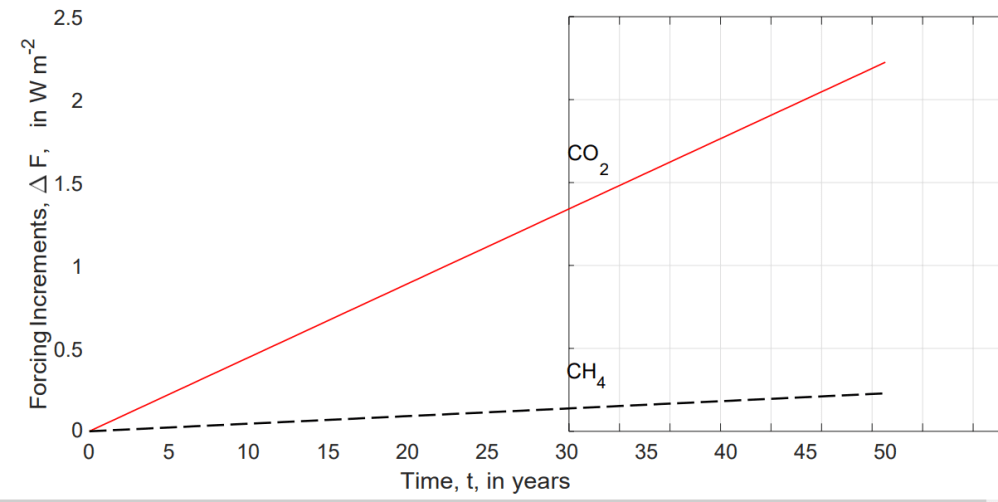
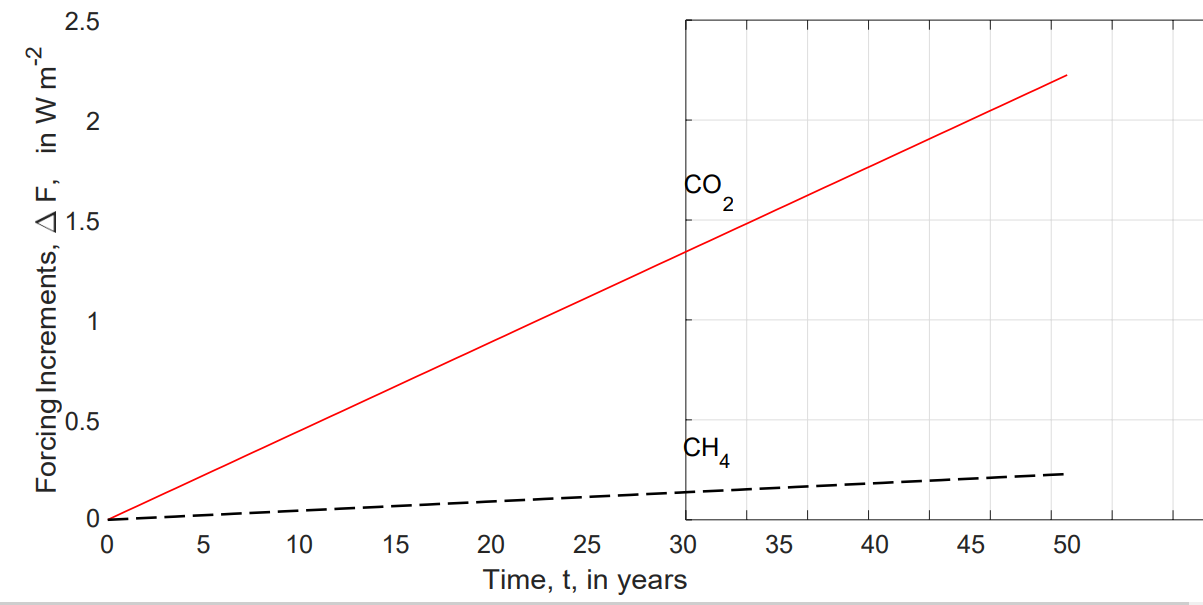
Figure 9: Projected mid-latitude forcing increments at the tropopause from continued increases of CO2 and CH4 at the rates of Fig. 7 and Fig. 8 for the next 50 years. The projected forcings are very small, especially for methane, compared to the current tropospheric forcing of 137 W m−2.

The per-molecule forcings P {i} of (13) and (14) have been used with the column density Nˆ of (12) and the concentration increase rates dC¯{i}/dt, noted in Fig. 7 and Fig. 8, to evaluate the future forcing (15), which is plotted in Fig. 9. Even after 50 years, the forcing increments from increased concentrations of methane (∆F = 0.23 W m−2), or the roughly ten times larger forcing from increased carbon dioxide (∆F = 2.2 W m−2) are very small compared to the total forcing, ∆F = 137 W m−2, shown in Fig. 3. The reason that the per-molecule forcing of methane is some 30 times larger than that of carbon dioxide for current concentrations is “saturation” of the absorption bands. The current density of CO2 molecules is some 200 times greater than that of CH4 molecules, so the absorption bands of CO2 are much more saturated than those of CH4. In the dilute“optically thin” limit, WH[1] show that the tropospheric forcing power per molecule is P {i} = 0.15 × 10⁻²² W for CH4, and P {i} = 2.73 × 10⁻²² W for CO2. Each CO2 molecule in the dilute limit causes about 5 times more forcing increase than an additional molecule of CH4, which is only a ”super greenhouse gas” because there is so little in the atmosphere, compared to CO2.

Methane Summary

Natural gas is 75% Methane (CH4) which burns cleanly to carbon dioxide and water. Methane is eagerly sought after as fuel for electric power plants because of its ease of transport and because it produces the least carbon dioxide for the most power. Also cars can be powered with compressed natural gas (CNG) for short distances.

In many countries CNG has been widely distributed as the main home heating fuel. As a consequence, in the past methane has leaked to the atmosphere in large quantities, now firmly controlled. Grazing animals also produce methane in their complicated stomachs and methane escapes from rice paddies and peat bogs like the Siberian permafrost.

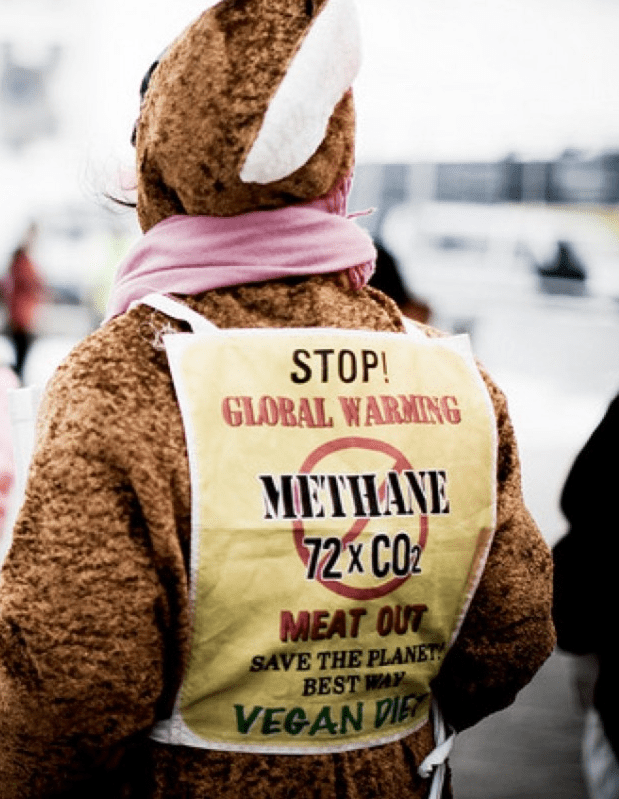
It is thought that methane is a very potent greenhouse gas because it absorbs some infrared wavelengths 7 times more effectively than CO2, molecule for molecule, and by weight even 20 times. As we have seen previously, this also means that within a distance of metres, its effect has saturated, and further transmission of heat occurs by convection and conduction rather than by radiation.

Note that when H20 is present in the lower troposphere, there are few photons left for CH4 to absorb:

Even if the IPCC radiative greenhouse theory were true, methane occurs only in minute quantities in air, 1.8ppm versus CO2 of 390ppm. By weight, CH4 is only 5.24Gt versus CO2 3140Gt (on this assumption). If it truly were twenty times more potent, it would amount to an equivalent of 105Gt CO2 or one thirtieth that of CO2. A doubling in methane would thus have no noticeable effect on world temperature.

However, the factor of 20 is entirely misleading because absorption is proportional to the number of molecules (=volume), so the factor of 7 (7.3) is correct and 20 is wrong. With this in mind, the perceived threat from methane becomes even less.

Further still, methane has been rising from 1.6ppm to 1.8ppm in 30 years (1980-2010), assuming that it has not stopped rising, this amounts to a doubling in 2-3 centuries. In other words, methane can never have any measurable effect on temperature, even if the IPCC radiative cooling theory were right.

Because only a small fraction in the rise of methane in air can be attributed to farm animals, it is ludicrous to worry about this aspect or to try to farm with smaller emissions of methane, or to tax it or to trade credits.

The fact that methane in air has been leveling off in the past two decades, even though we do not know why, implies that it plays absolutely no role as a greenhouse gas.  (From Sea Friends (here):

More information at The Methane Misconceptions by Dr. Wilson Flood (UK) here.

Climatists Aim Forks at Our Food Supply