Climatists Aim Forks at Our Food Supply

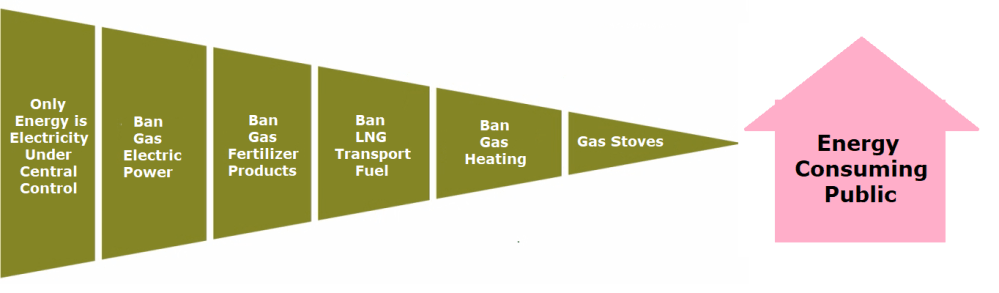
It’s not enough to apply Chinese-style lockdowns in the name of “fighting climate change.”  Now climatists want to stick forks in our food supply, thereby reducing populations to a more “sustainable” number.  The attack on world food supply has four prongs to it, just like the forks in the image above.

1.  Exaggerate the Minor Climate Impact of Methane (CH4)

2.  Oppose Methane from Livestock as a Fossil Fuel, like Coal and Oil.

3. Freak Out over N2O as an Excuse to Ban Fertilizers

4.  Meat Shame People’s Diets Because Vegans Love Animals

Background:  The Carbon Cycle is Natural

This diagram of the fast carbon cycle shows the movement of carbon between land, atmosphere, and oceans in billions of tons per year. Yellow numbers are natural fluxes, red are human contributions, white indicate stored carbon.

Instead of delusions about CO2 as the planet’s climate “control knob”, Viv Forbes provides us a wise, sane view how the carbon cycle works, and what we know and don’t know about it. And rather than exaggerate the effects of humans recycling fossil fuels, he puts the carbon cycling sources and sinks into a sensible perspective. His recent article is entitled: Carbon Delusions and Limited Models

The IPCC models misread the positive and negative temperature feedbacks from water vapour (the main greenhouse gas) and their accounting for natural processes in the carbon cycle is based on very incomplete knowledge and numerous unproven assumptions.

The dreaded “greenhouse gases” (carbon dioxide and methane) are natural gases. Man did not create them — they occur naturally in comets and planets, and have been far more plentiful in previous atmospheres on Earth. They are abundant in the oceans and the atmosphere, and are buried in deposits of gas, oil, coal, shale, methane clathrates and vast beds of limestone. Land and sea plants absorb CO2 and micro-organisms absorb methane in the deep ocean.

Earth emits natural carbon-bearing gases in huge and largely unknown and unpredictable quantities. Carbon dioxide, carbon monoxide and various hydrocarbons such as ethane, methane and propane bubble out of the ocean floor, seep out of swamps, bubble naturally out of rivers, are released in oil seeps, water wells and bores, and are sometimes delivered via water pipes into drinking water. They are also released whenever carbon-bearing rocks such as coal and shale are eroded naturally, catch fire or are disturbed by earthquakes, construction activities or mining. The vast offshore deposits of frozen methane are released naturally when geothermal heat or volcanic intrusions melt the ice containing the methane.

The Minor Climate Impact of Methane (CH4)

Methane  
Natural gas is 75% Methane (CH4) which burns cleanly to carbon dioxide and water. Methane is eagerly sought after as fuel for electric power plants because of its ease of transport and because it produces the least carbon dioxide for the most power. Also cars can be powered with compressed natural gas (CNG) for short distances.

In many countries CNG has been widely distributed as the main home heating fuel. As a consequence, in the past methane has leaked to the atmosphere in large quantities, now firmly controlled. Grazing animals also produce methane in their complicated stomachs and methane escapes from rice paddies and peat bogs like the Siberian permafrost.

It is thought that methane is a very potent greenhouse gas because it absorbs some infrared wavelengths 7 times more effectively than CO2, molecule for molecule, and by weight even 20 times. As we have seen previously, this also means that within a distance of metres, its effect has saturated, and further transmission of heat occurs by convection and conduction rather than by radiation.

Note that when H20 is present in the lower troposphere, there are few photons left for CH4 to absorb:

Even if the IPCC radiative greenhouse theory were true, methane occurs only in minute quantities in air, 1.8ppm versus CO2 of 390ppm. By weight, CH4 is only 5.24Gt versus CO2 3140Gt (on this assumption). If it truly were twenty times more potent, it would amount to an equivalent of 105Gt CO2 or one thirtieth that of CO2. A doubling in methane would thus have no noticeable effect on world temperature.

However, the factor of 20 is entirely misleading because absorption is proportional to the number of molecules (=volume), so the factor of 7 (7.3) is correct and 20 is wrong. With this in mind, the perceived threat from methane becomes even less.

Further still, methane has been rising from 1.6ppm to 1.8ppm in 30 years (1980-2010), assuming that it has not stopped rising, this amounts to a doubling in 2-3 centuries. In other words, methane can never have any measurable effect on temperature, even if the IPCC radiative cooling theory were right.

Because only a small fraction in the rise of methane in air can be attributed to farm animals, it is ludicrous to worry about this aspect or to try to farm with smaller emissions of methane, or to tax it or to trade credits.

The fact that methane in air has been leveling off in the past two decades, even though we do not know why, implies that it plays absolutely no role as a greenhouse gas.  (From Sea Friends (here):

More information at The Methane Misconceptions by Dr. Wilson Flood (UK) here.

Give Daisy a Break!

Methane Risk from Livestock is Overstated

Frank M. Mitloehner is Professor of Animal Science and Air Quality Extension Specialist, University of California, Davis.  He writes at the Conversation Yes, eating meat affects the environment, but cows are not killing the climate.  Excerpts in italics with my bolds.

A key claim underlying these arguments holds that globally, meat production generates more greenhouse gases than the entire transportation sector. However, this claim is demonstrably wrong, as I will show. And its persistence has led to false assumptions about the linkage between meat and climate change.

My research focuses on ways in which animal agriculture affects air quality and climate change. In my view, there are many reasons for either choosing animal protein or opting for a vegetarian selection. However, foregoing meat and meat products is not the environmental panacea many would have us believe. And if taken to an extreme, it also could have harmful nutritional consequences.

Many people continue to think avoiding meat as infrequently as once a week will make a significant difference to the climate. But according to one recent study, even if Americans eliminated all animal protein from their diets, they would reduce U.S. greenhouse gas emissions by only 2.6 percent. According to our research at the University of California, Davis, if the practice of Meatless Monday were to be adopted by all Americans, we’d see a reduction of only 0.5 percent.

Moreover, technological, genetic and management changes that have taken place in U.S. agriculture over the past 70 years have made livestock production more efficient and less greenhouse gas-intensive. According to the FAO’s statistical database, total direct greenhouse gas emissions from U.S. livestock have declined 11.3 percent since 1961, while production of livestock meat has more than doubled.

Removing animals from U.S. agriculture would lower national greenhouse gas emissions to a small degree, but it would also make it harder to meet nutritional requirements. Many critics of animal agriculture are quick to point out that if farmers raised only plants, they could produce more pounds of food and more calories per person. But humans also need many essential micro- and macronutrients for good health.

The world population is currently projected to reach 9.8 billion people by 2050. Feeding this many people will raise immense challenges. Meat is more nutrient-dense per serving than vegetarian options, and ruminant animals largely thrive on feed that is not suitable for humans. Raising livestock also offers much-needed income for small-scale farmers in developing nations. Worldwide, livestock provides a livelihood for 1 billion people.

Climate change demands urgent attention, and the livestock industry has a large overall environmental footprint that affects air, water and land. These, combined with a rapidly rising world population, give us plenty of compelling reasons to continue to work for greater efficiencies in animal agriculture. I believe the place to start is with science-based facts.

N2O is No Excuse to Ban Fertilizers

Methane and Climate is a paper by W. A. van Wijngaarden (Department of Physics and Astronomy, York University, Canada) and W. Happer (Department of Physics, Princeton University, USA) published at CO2 Coalition November 22, 2019. It is a summary in advance of a more detailed publication to come. Excerpts in italics with my bolds. [Note the paper is a thorough and deep expert analysis of atmospheric radiation physics which I do not fully comprehend.  So the excerpts below are necessarily superficial, but intend to provide the core findings from these scientists.]

Figure 2: Left. A standard atmospheric temperature profile [9], T = T(z). The surface temperature is T(0)= 288.7 K. Right. Standard concentrations [10], Csd = Nsd /N for greenhouse molecules versus altitude z.  The total number density of atmospheric molecules is N and the number density of molecules of type i is Nsd. At sea level the concentrations are 7750 ppm of H2O, 1.8 ppm of CH4 and 0.32 ppm of N2O. The O3 concentration peaks at 7.8 ppm at an altitude of 35 km, and the CO2 concentration was approximated by 400 ppm at all altitudes. The data is based on experimental observations.

As shown in Fig. 2, the most abundant greenhouse gas at the surface is water vapor (H2O). However, the concentration of water vapor drops by a factor of a thousand or more between the surface and the tropopause. This is because of condensation of water vapor into clouds and eventual removal by precipitation.  Carbon dioxide CO2, the most abundant greenhouse gas after water vapor, is also the most uniformly mixed because of its chemical stability. Methane, the main topic of this discussion is much less abundant than CO2 and it has somewhat higher concentrations in the troposphere than in the stratosphere where it is oxidized by OH radicals and ozone, O3. The oxydation of methane [8] is the main source of the stratospheric water vapor shown in Fig. 2. 

Figure 9: Projected midlatitude forcing increments at the tropopause from continued increases of CO2 and CH4 at the rates of Fig. 7 and Fig. 8 for the next 50 years. The projected forcings are very small, especially for methane, compared to the current tropospheric forcing of 137 W m−2.

The paper is focused on the greenhouse effects of atmospheric methane, since there have recently been proposals to put harsh restrictions on any human activities that release methane. The basic radiation-transfer physics outlined in this paper gives no support to the idea that greenhouse gases like methane (CH4), carbon dioxide (CO2) or nitrous oxide (N2O) are contributing to a climate crisis. Given the huge benefits of more CO2 to agriculture, to forestry, and to primary photosynthetic productivity in general, more CO2 is almost certainly benefitting the world.  Radiative effects of CH4 and N2O are so small that they are irrelevant to climate.

The chart above informs on the scale of N2O concentrations. At first glance, it appears comparable to CO2, but on closer inspection the amounts are in ppb (parts per billion), not ppm (parts per million) as with CO2. To get comparable amounts requires dividing by 1000, thus the vertical axis goes from 0.315 ppm to 0.340 ppm. Yes, the dramatic rise over the last 22 years is 0.025ppm.

Then we have the annual global increase of N2O from all sources ranging from about 0.5 to 1.3 ppb. Does anyone believe they can measure N2O down to 0.0005 ppm?

 Vegans Pushing Their Anti-Meat Agenda

The origin of these alarms are studies published in Lancet, once highly reputed but recently given over to climate ideology rather than objective science. Most recently is Food in the Anthropocene: the EAT–Lancet Commission on healthy diets from sustainable food systems  The preceding Lancet study stated this main finding:

Following environmental objectives by replacing animal-source foods with plant-based ones was particularly effective in high-income countries for improving nutrient levels, lowering premature mortality (reduction of up to 12% [95% CI 10–13] with complete replacement), and reducing some environmental impacts, in particular greenhouse gas emissions (reductions of up to 84%). However, it also increased freshwater use (increases of up to 16%) and had little effectiveness in countries with low or moderate consumption of animal-source foods. (here).

Georgia Ede MD writes in Psychology Today EAT-Lancet’s Plant-based Planet: 10 Things You Need to Know. Excerpts in italics below with my bolds. Title is link to full text which is recommended reading.  Georgia Ede, MD, is a Harvard-trained psychiatrist and nutrition consultant practicing at Smith College. She writes about food and health on her website DiagnosisDiet.com.

We all want to be healthy, and we need a sustainable way to feed ourselves without destroying our environment. The well-being of our planet and its people are clearly in jeopardy, therefore clear, science-based, responsible guidance about how we should move forward together is most welcome.

Unfortunately, we are going to have to look elsewhere for solutions, because the EAT-Lancet Commission report fails to provide us with the clarity, transparency and responsible representation of the facts we need to place our trust in its authors. Instead, the Commission’s arguments are vague, inconsistent, unscientific, and downplay the serious risks to life and health posed by vegan diets.

To the best of my knowledge, there has never been a human clinical trial designed to test the health effects of simply removing animal foods from the diet, without making any other diet or lifestyle changes such as eliminating refined carbohydrates and other processed foods. Unless and until such research is conducted demonstrating clear benefits to this strategy, the assertion that human beings would be healthier without animal foods remains an untested hypothesis with clear risks to human life and health. Prescribing plant-based diets to the planet without including straightforward warnings of these risks and offering clear guidance as to how to minimize them is scientifically irresponsible and medically unethical, and therefore should not form the basis of public health recommendations.

Summary:

Natural Gas (75% methane) burns the cleanest with the least CO2 for the energy produced.

Leakage of methane is already addressed by efficiency improvements for its economic recovery, and will apparently be subject to even more regulations.

The atmosphere is a methane sink where the compound is oxidized through a series of reactions producing 1 CO2 and 2H20 after a few years.

GWP (Global Warming Potential) is CO2 equivalent heat trapping based on laboratory, not real world effects.

Any IR absorption by methane is limited by H2O absorbing in the same low energy LW bands.

There is no danger this century from natural or man-made methane emissions.

Conclusion

This is a bogus war on fertilizers, farmers and food. Everything is exaggerated for the sake of an extreme agenda to impose controls on free enterprise developed societies. It is true that use of fertilizers results in some release of N2O into the air, but even this has been overstated. And as the video demonstrates, farmers have a vested interest in using fertilizers wisely and are applying techniques that improve efficiency. As well, there is evidence of efficiency gains in the process of producing ammonia and then urea from air and natural gas. The attack on food supply is in effect an effort to reduce the population.

Resources

Much Ado About Methane

More Methane Madness

Washing Methane Away: Atmospheric Chemistry

Mastering Methane Mania

Let Them Eat Steak!

Climate Ideology = Bad Nutritional Advice

Carbon Sense and Nonsense


How Climate Evangelists Took Over Your Local Weather Forecast


The battle by alarmists for hearts and minds is extending to many fronts, including recruiting family doctors, and in the case of this post, media weather reporters. Surveys have shown the meteorologists are not more convinced of global warming/climate change than is the American public (a slight majority). But efforts have been underway to convert them and use their telecasts and columns to promote climatism.

Luke Mullins writes at Washingtonian This George Mason Professor Trains Weathercasters to Be Climate Advocates.  Excerpts in italics with my bolds.

You’ve probably seen his handiwork on local TV and didn’t even know it.

About 13 years ago, Ed Maibach identified a TV meteorologist in Columbia, South Carolina, who was willing to use his airtime not just to provide tomorrow’s forecast but to show viewers how climate change was impacting their local community. Over the next decade, Maibach would expand this experiment into what you might call a weather underground—a coast-to-coast network of TV weathercasters who believe that educating their audiences about global warming is as crucial as telling them when to bring an umbrella. The initiative, known as Climate Matters, has forced Maibach to confront a series of entrenched problems inside the broadcast-­meteorology community, including alarming levels of climate denial and skepticism, fears about alienating audiences, and the occasional harassment of participating weathercasters.

Yet by the end of 2021, the Climate Matters network of meteorologists had penetrated into nearly every media market in the country, and Maibach had pioneered a promising new approach to a complex crisis.

Truth is, if you’ve recently watched the weather report on the local news in the Washington area, there’s a decent chance you’ve seen Maibach’s handiwork—the Climate Matters network now includes weathercasters at NBC4, WUSA9, WJLA7, and Fox 5. But like local-news consumers across the country, you wouldn’t have known that behind that telegenic meteorologist are a social scientist in his sixties and a team of academic researchers, data crunchers, and ex-weathercasters. “To a lot of our viewers, it’s lost on them how much work Climate [Matters] really is doing,” says Kaitlyn McGrath, a meteorologist at WUSA9. “But it is so far from lost on us.”

Background from previous post:

A balanced and analytical report appears in Bloomberg (an interesting place for such independent thinking).  Climate Evangelists Are Taking Over Your Local Weather Forecast Excerpts below.

Amber Sullins gets a minute or two to tell up to two million people about some extremely complicated science, using the tools of her trade: a pleasant voice, a green screen, and small icons denoting sun, clouds, rain, and wind. She is the chief meteorologist at ABC15 News in Phoenix, so her forecasts mostly call for sunshine. Within this brief window, however, Sullins sometimes manages to go beyond the next five days. Far beyond.

Amber Sullins, weather reporter at ABC15 News in Phoenix.

“We know climate change could affect everything about the way we live in the future, from agriculture and tourism to productivity and local business,” she once noted. “But at what cost?”

It was a 35-second segment in a nightly newscast, a mundane moment preceding reports about three fallen firefighters in Washington state and a dangerous development for air travelers. But that climate-focused scene, and hundreds of others like it playing out at local news stations across the country, marks a major shift in the way Americans hear about climate change. The safe and familiar on-air meteorologist, with little notice by viewers, has become a public diplomat for global warming.

There are about 500 broadcasters like Sullins and Morales, who each receive regular data dumps and ready-to-use graphics from Climate Matters, an organization whose mission is to turn TV meteorologists into local climate educators. The program was founded in 2010 by Climate Central, a research-and-journalism nonprofit, with help from George Mason University, the American Meteorological Society, and others. Newscasters who participate are sent possible topics for climate-related segments every week, with TV-ready data and graphics pegged to large-scale meteorological events, such as unusually high heat or precipitation, local trends, or seasonal themes.

Two-thirds of 18- to 64-year-olds in the U.S. watch a news broadcast, either on TV or a digital device, at least once a week, according to 2015 research by the market research company SmithGeiger LLC. Nearly 40 percent of people within this wide age group watch broadcast news on daily basis, and the reliable presence of an on-air meteorologist is a huge part of the draw.

“Local TV news wouldn’t exist any more if it weren’t for the weathercasts,” says Ed Maibach, director of George Mason University’s Center for Climate Change Communication.

Part of meteorologists’ reluctance to talk about the climate stems from the treacherous tools of their trade. Meteorologists learn very quickly that weather models are messy. Some no doubt sour on finicky climate models because of this experience. If short-term weather models make mistakes, it may seem reasonable to assume that a model projecting into the next century is ridiculous.

“Meteorologists are used to looking at models and being burned,” says Paul Douglas, a former TV weatherman-turned-serial entrepreneur, who recently published a book on climate change and faith.

Sullins, 34, knows there’s tension in telling her viewers about conditions in the 22nd century when she is reluctant to commit to a two-week forecast. “I can’t tell you what the high temperature is going to be on July 4 of this year, today,” Sullins says. “I can’t possibly tell you that. But I can tell you, based on climate, that in July, here in Phoenix, it’s going to be over 100 degrees. That’s easy.”

Her point is that weather and climate are “two entirely different beasts.” It’s like the difference between someone’s mood and disposition, Sullins says. She wants viewers of the nightly news to spend more time thinking about the planet’s disposition.

Summary

The PR campaign continues and intensifies with simplistic soundbites to persuade people to fear the future, in order to advance the anti-fossil fuel agenda. It is a Chinese water torture program well-funded and essential to the climate crisis industry.

But note the logical fallacy in Sullins’ statement above. She says: “I can tell you, based on climate, that in July, here in Phoenix, it’s going to be over 100 degrees.” That’s not climate change, that’s climate stability, something we depend on despite the fear-mongering.

How will viewers respond to this?  Will ratings improve by watching weather people jumping the shark? (It didn’t work for “Happy Days” TV show).  Or will people resent the attempted brainwashing and switch channels?

Footnote:

The hottest temperatures ever reported in Phoenix came in January 2015, when Fox 10 weatherman Cory McCloskey faced a malfunctioning temperature map on live television. “Wow, 750 degrees in Gila Bend right now,” he said, without breaking a sweat. “And 1,270 in Ahwatukee. Now, I’m not authorized to evacuate, but this temperature seems pretty high.” More than 6 million people have watched the blooper on YouTube.

See Also Urban Flooding: The Philadelphia Story


Canada Budget Officer Quashes Climate Alarm


Ross McKitrick reports at Financial Post The Parliamentary Budget Officer just debunked climate alarmism, This is the opposite of an ’emergency’ or ‘crisis’.  Excerpts in italics with my bolds and added images.

Parliamentary Budget Officer Yves Giroux on Parliament Hill in Ottawa in 2020. PHOTO BY ADRIAN WYLD/THE CANADIAN PRESS FILES

The Parliamentary Budget Officer (PBO) recently released a report on the effects of greenhouse gas emissions on Canadian GDP growth over the next 80 years. I’ve written previously about the recent economics literature investigating the link (or lack thereof) between global warming and economic growth. It’s a fascinating topic and I’ve been actively working with on it one of our PhD students for several years. While I would quibble with some aspects of the PBO report, the overall conclusions are not out of line with mainstream thinking on the topic.

Which is why the findings are so astonishing and radical compared
to what the government has been saying.

The PBO estimated what would happen to the Canadian economy between now and 2100 if temperatures and precipitation change as expected due to greenhouse gases. The report’s authors consider two scenarios — first, if emission-reduction policies stall at today’s levels and nobody complies with their Paris commitments and, second, if countries comply with all their Paris commitments in full and on time. Under the first scenario Canada’s GDP in 2100 will be 6.6 per cent smaller than it otherwise would be.

Let’s pause there for a moment: 6.6 per cent after 80 years is a very small number. Canada has set out ambitious economic growth plans based on high levels of immigration and continued efforts to boost productivity and income. Suppose this results in two per cent real GDP growth from 2021 to 2100. That would mean Canada’s economy will grow by 388 per cent over those 80 years.

According to the PBO, if we do nothing about global warming,
it will instead grow by about 381 per cent.

In other words, the PBO projects that the impact of climate change will be small relative to other drivers, including population change, technology and many other aspects of socioeconomic development. Where have I heard that before?

In the UN Intergovernmental Panel on Climate Change’s 5th Assessment Report, released in 2013, that’s where. In the Working Group II volume, Chapter 10, the report concluded: “For most economic sectors the impact of climate change will be small relative to the impacts of other drivers. Changes in population, age, income, technology, relative prices, lifestyle, regulation, governance, and many other aspects of socioeconomic development will have an impact on the supply and demand of economic goods and services that is large relative to the impact of climate change.”

Yes, you read that right. The IPCC concluded, not very long ago, that while greenhouse gases have warmed the climate and will continue to do so, the effects will be small compared to pretty much every other driver of change in the century ahead. This is the opposite of an “emergency” or “crisis.”

Then the PBO asked what would change if everyone meets their Paris targets. Instead of being 6.6 per cent smaller in 2100, it estimates the economy will be 5.8 per cent smaller. In other words, the benefit attributable to the Paris agenda is that the economy will be 0.8 per cent larger 80 years from now. This is a minuscule difference.

And we have to ask: what if the policies cost more than 0.8 per cent of GDP? We can be absolutely certain that they will. In a study Elmira Aliakbari and I coauthored last year for the Fraser Institute, we showed that just the carbon tax alone, which won’t suffice to get us to the Paris target, will cause GDP to shrink by at least twice that amount by 2030. Our GDP loss estimates were in line with many other studies done inside and outside of government for comparable-size emission cuts under the Kyoto Protocol 20 years ago.

Projection Parameters:
Canada GDP grows at 2% yearly compounded to 2100 = 388%
Effects of AGW reduce 2100 GDP by 7%
Fulfilling Paris Accord raises 2100 GDP by 1%
Canada share of $21T Paris Accord cost, est. $500B
Cost of Canada Carbon Tax est.1.8% GDP by 2030, 14% by 2100

The PBO, based on advice from Environment and Climate Change Canada, the federal department in charge, worked on the assumption that Canada will warm (on average) by 2.5 degrees Celsius compared to today. I think that’s an overestimate but, as before, let’s assume it’s true. Its analysis says that the result will be that Canada’s economy grows (on average) not by 2.0 per cent a year but by 1.983 per cent per year, a difference less than a rounding error in the national economic accounts. And if we incur the enormous costs of complying with Paris, the economic benefit will be that we grow on average by 1.986 per cent instead, three one-thousands of a per cent more. At the cost of policies that will take orders of magnitude more off our growth rate.

One of the annoying bits of jargon that goes around climate policy circles is the phrase “the cost of inaction.” As in, “we have to do something, doing nothing is not an option, the cost of inaction is too large.” The cost of inaction is the foregone benefit of the action, and according to the PBO, it’s not large at all. In fact, it’s tiny. Because compared to everything else we’ll deal with this century, the impacts of climate change will be small.

That is the radical but correct conclusion of experts at both the IPCC and the PBO.
It’s time government leaders started paying attention.

Ross McKitrick is a professor of economics at the University of Guelph and senior fellow of the Fraser Institute.


Climatist Psy-Ops Spreading

Stephen McMurray published a pamphlet at Zero Watch The Climate Change Cult and the War on the Mind. Excerpts in italics with my bolds and added images.

Introduction

As the eco-zealot group Just Stop Oil continue to break the law and cause mayhem, it is perhaps time to investigate who is pulling the strings of this and other fake grassroots movements. Even a cursory glance will make it clear that the people behind them are not everyday members of the public but a group of highly influential American billionaires.

The Climate Emergency Fund

According to the Just Stop Oil website, their main source of backing is the Climate Emergency Fund. The three founding members of this group, who also fund Extinction Rebellion, are Aileen Getty from the Getty oil family, Rory Kennedy, daughter of Senator Robert Kennedy, and philanthropist Trevor Neilson. All three own houses on Malibu beach, which is odd as disciples of the climate cult claim that sea levels are rising dramatically, and you would therefore assume that seafront real estate would be a bad investment.

Most of the focus has been on Getty but it is Neilson who has the most interesting background. After university he worked as an intern in the White House when Bill Clinton was president. Later he worked for the then newly formed Bill and Melinda Gates Foundation as Director of Communications, and also acted as the Gates’ personal spokesman.

In 2002 Neilson was a co-founder of DATA (Debt, AIDs, Trade, Africa) with Bill Gates, Bono and George Soros.  DATA was allegedly created to help ease poverty in Africa, seek debt relief for African countries and help fight AIDs. They also claimed to want to end hunger in Africa, an idea that is interesting since climate
activists want to reduce carbon dioxide which is essential to all plant life; any reduction would clearly reduce the amount of food crops, causing more hunger rather than alleviating it. Neilson was also a member of the Clinton Global Initiative, the Council of Foreign Relations, and was one of the Young Global Leaders for the World Economic ForumIn other words, he is a friend to all the usual globalist suspects who are pushing the green agenda for their own ends.

If we move on to current advisory board members of the Climate Emergency Fund, we see more of the usual themes and ideologies that have nothing to do with the climate but are warmly embraced by the climate crisis zealots. Stephen Kretzmann founded Oil Change, an organisation pressing for the end of oil production. He is a supporter of the Marxist Black Lives Matter movement. On the Oil Change website he writes an article that promotes BLM and trots out extremist left-wing tropes.

Another on the advisory board of the Climate Emergency Fund is Bich Ngoc Cao. She is also on the board of left-wing news site Mother Jones. The site denigrated Moms for Liberty, a group who have fought against their children being indoctrinated by gender and LGBTQ ideology in schools, calling them ‘Moms against libraries’ and ‘book-banning bathroom-police’, because they want to remove inappropriate sexual material from school libraries and keep single-sex bathroom spaces. Bich Ngoc Cao is also on the Board of Library Commissioners for the city of Los Angeles.

Bill McKibben is another CEF advisory board member who compares climate issues to racism, and uses the death of George Floyd to make his point.

The executive director of the Climate Emergency Fund (CEF) is Margaret Klein Salamon, an American in her mid-thirties. She is a clinical psychologist and therefore has been involved with vulnerable people suffering high levels of stress and anxiety.  In her role in climate activism, she appears to be using her experience to frighten vulnerable people. She is the founder of Climate Awakening, which, according to her page on the CEF site, is ‘a project to unleash the power of climate emotions through scalable small group conversations’.

However, if you go on to the Climate Awakening website, on the first page it says, ‘Share your climate terror, grief, and rage with people who understand. Join a Climate Emotions Conversation – a small group sharing & listening session about the climate emergency.’ Below that there is a screen with images of three young people and the words: ‘What are you FEELING about climate emergency? Make sure to name the emotions (fear, grief, anger, despair, isolation)’.

Salamon also had an article in Psychology Today where, as ‘The Climate Psychologist’, she gave ‘relationship advice for the Climate Emergency’. A reader asked: “How can I tell my partner I am afraid to have children? …Why would I want to bring a child into this world, right now? Imagining the future they would grow up in fills me with terror.”   Part of Salamon’s reply reads as follows:

“Let me be clear; despite widespread denial of the Climate Emergency and how it will affect our society, your worries are in fact based in the reality of what the global scientific community is telling us, and you have every right to feel that way.”

So again, a woman is saying she is terrified, and Salamon, rather than relieving her terror, says she is right to feel that way. Salamon then tries to get her involved in climate action groups instead of talking to her partner.

This is typical of the behaviour of a cult. Feed on the person’s fear, tell them the fear is real and not to listen to what their family say and ultimately try to recruit them into the cult as well. One of the sites she advises people who are terrified of climate change to go to is the Good Grief Network.  They introduce themselves as a group who only want to care for you amid the chaos all around. They will then get you in a group of like-minded people to expose you to groupthink. When you have all bonded, they will strip you of all your preconceived ideas and mould you into their reality. They will then fill the void left by destroying any prior belief system you had, with their own worldview.

In their ten-step programme to ‘Personal Resilience & Empowerment in a Chaotic Climate’, the first step is, yet again, to tell you to be very afraid and ‘accept the severity of the predicament’.  Step 8 is the most disturbing: ‘Grieve the harm I have caused.’  Telling you that you are to blame for some of the ‘harm’ increases your fear by making you feel guilty. If you feel guilt then you will desperately want to make up for your actions and will do whatever you are told to do to achieve that, namely to go on and traumatise other people by telling them the world is about to end.

The Psychologists

If you think Margaret Klein Salamon is an oddity amongst psychologists, think again. Many are now boarding the climate crisis gravy train. Dr Gareth Morgan, a clinical psychologist from Leicester University, is an Extinction Rebellion supporter because “as many professionals have observed, climate activism should be seen as central to our professional identities if we truly take on board the science that indicates climate breakdown presents the biggest threat to human health worldwide.’  Once again extreme left-wing bias appears to cloud his judgement. He opines, ‘while the same colonial and neoliberal ideologies that support racism and inequity also prop up the unfettered capitalism that is threatening all life on Earth.’

The Climate Psychology Alliance wishes to use their expertise in the field of psychology to nudge people into believing in their worldview of impending climate-induced doom. The group is overtly stating that ‘facts’ aren’t really persuading people that the climate crisis is real and that they need use psychology to pressure us all to become true believers. Most telling though, is when they say it can’t be ‘positivist’ psychology, based on empirical evidence, but that a deeper type of psychology is to be used. In other words, ignore the facts of the situation and use mind manipulation techniques and fear to convert the non-believers. They even say that climate anxiety is a good thing.

It is not just individuals these groups want to target, but corporations as well. An organisation called Climate Psychologists offers consultancy courses to companies.  They aren’t just offering support to employees traumatised by the ‘climate crisis’, but are using behavioural change programmes and ‘ethical nudging.‘ They are telling employers how to subtly manipulate the minds of their employees to believe in the climate emergency. This is reminiscent of the government’s SPI-B Behavioural Insights team, which used psychology to terrify people into accepting Covid lockdowns.

Indeed, there is direct evidence that the government is using the tactics they developed during Covid to coerce us all into believing the climate crisis narrative.  On October 12 this year, the House of Lords Environment and Climate Change Committee published a report entitled In our Hands: Behaviour change for climate and environmental goals.  It is a sinister document, in which the government openly states that all aspects of our life need to be managed to lessen the impact of climate change, and that mind control techniques, very similar to the ones used to force the public into acquiescing to Covid lockdowns, need to be used against the population. Sir Patrick Vallance, one of the architects of the disastrous Covid policy, was a witness. He told the committee: ‘The reality is that behaviour change is a part of reaching Net  Zero. It is unarguable.’

So every government department will be required to use psychology as a weapon against the public, to ensure we behave in line with what the climate alarmists demand.  It is clear from this that not only are all government departments to be targeted, but the private business sector as well, even if it is not in their financial interest to do so.

This sounds suspiciously like Klaus Schwab’s infamous statement that Covid offered a window of opportunity to bring about the Great Reset.  To emphasise just how much they want to control the minutiae of daily life, one of the key points the committee make is:

Priority behaviour change policies are needed in the areas of travel, heating, diet and consumption to enable the public to adopt and use green technologies and products and reduce carbon-intensive consumption.

Therefore, you will be told what to eat, where you are allowed to go and how you are allowed to get there. Another key point clearly states that they will tax and legislate you into compliance:

Information is not enough to change behaviour; the Government needs to play a stronger role in shaping the environment in which the public acts, through appropriately sequenced measures including regulation, taxation and development of infrastructure.

But it is not just businesses they are trying to use to make you change your behaviour. They also want to use charities and religious institutions to control the minds of the masses.  When referring to the various levers of change the government could use, they identify ‘regulatory and financial (dis)incentives which alter the availability and affordability of options.’  This suggests that the government would be prepared deliberately to create scarcity and make certain things unaffordable. Does that sound familiar with relation to the current energy crisis?

They appear to have no sense of irony when speaking of clear messaging and open information during the pandemic, and seem to think that propaganda, lies, data manipulation and censorship is actually truth and transparency.  It is evident that the climate alarmists, with the backing of billionaires, psychologists and the government, are waging a war on the minds of the people to bring about the Great Reset dystopia.

They have the power and the money on their side, but clearly, having to resort to mind control techniques, they don’t have the truth. As George Orwell is reputed to have said: ‘In the time of universal deceit, telling the truth is a revolutionary act.’  It’s time we all became revolutionaries, because the truth is that it is not the climate crisis that is the biggest threat to our wellbeing, but the climate crisis alarmists who want to remove the last vestiges of our freedom and plunge us into a never-ending Dark Age.

See Also Climate Hysteria is a Global Psy-Op

Here Comes the Climate-Medical Complex

The Antidote: Climatists, Spare Us Your Guilt Trip!


Time for a GOP Rational Climate Policy


Recently in a post called Silence of Conservative Lambs I wrote:

The 1991 blockbuster movie revolved around meek, silent victims preyed upon by malevolent believers in their warped, twisted view of the world. A comparison can be drawn between how today’s conservative thinkers and politicians respond to advocates of the pernicious global warming/climate change ideology. Instead of challenging and pushing back against CO2 hysteria, and speaking out with a rational climate perspective, Republicans in the US, and Conservatives in Canada and elsewhere are meek and silent lambs in the face of this energy slaughter. Worse, when they do speak it is to usually to pander and try to appease offering proposals for things like carbon taxes or other non-remedies for a non-problem, essentially ceding the case to leftists.

So to be more constructive, let’s consider what should be proposed by political leaders regarding climate, energy and the environment.  IMO these should be the pillars:

♦  Climate change is real, but not an emergency.

♦  We must use our time to adapt to future climate extremes.

♦  We must transition to a diversified energy platform.

♦  We must safeguard our air and water from industrial pollutants.


For those not familiar, Climate Intelligence (CLINTEL) is an independent foundation that operates in the fields of climate change and climate policy. CLINTEL was founded in 2019 by emeritus professor of geophysics Guus Berkhout and science journalist Marcel Crok.  Their 1000+ members are signatories of a declaration There is No Climate Emergency

A global network of 900 scientists and professionals has prepared this urgent message. Climate science should be less political, while climate policies should be more scientific. Scientists should openly address uncertainties and exaggerations in their predictions of global warming, while politicians should dispassionately count the real costs as well as the imagined benefits of their policy measures.

One example of a national energy and environment strategy is provided by Clintel for The Netherlands.  The document is Clintel’s Integrated Energy Vision.  Excerpts in italics with my bolds.

Preamble

We all agree in CLINTEL that:
– There is no climate emergency. We have ample time to improve our climate models (for a better understanding of the factors that regulate the climate) and to search for better adaptation technologies.

– The influence of CO2 on global warming is overestimated and its influence on greening is underestimated (even worse, it is often ignored). Nobody knows what the optimum value of atmospheric CO2 concentration is, but from a geological point of view we may conclude that we live in a time with historical low concentrations. Again, there is no climate emergency.

– There is an energy emergency.  Decarbonisation policies – in terms of the current energy transition are most destructive. They do much more harm than good. These energy policies must be terminated immediately.

– The new generation (III and IV) nuclear power plants ought to get all our attention. These plants promise low-priced, reliable, safe and clean energy. In combination with natural gas nuclear energy is a ‘No Regret Solution’. Wind and solar energy are at most niche technologies. Their contribution is and will stay marginal.

With respect to the energy transition, CLINTEL emphasises that there exists not something as a global uniform energy system.  Every country needs a tailor-made energy system depending on its geography, mineral resources, development phase, industrial specialization, population density, etc. For instance, The Netherlands – being a very densely populated country and being severely divided on the CO2 issue – it looks like the new generation of nuclear power plants may function as a breakthrough in the political process:

Part I shows that current Dutch energy policy – having the ambition to reduce CO₂ emissions as much as 49% by 2030 – is based on panic and shall lead to immense additional costs and a drastically deteriorated living environment. Below, we will propose an inspiring long-term energy vision that fits our (and many other) country’s needs, is based on scientific facts, and aimed at a prosperous future for everyone. A positive vision that replaces the gloom and doom predictions of the climate models. A vision with a hopeful perspective for the future.

A Guiding Vision for the Future

It is well known that high-risk, capital-intensive decisions should be based on a policy that is as insensitive as possible about the way the future will unfold. We have called it a No Regret Policy. It represents a long-term policy, implemented by taking small steps, and continuously adapted to what is happening in reality. CLINTEL has drawn up a No Regret Energy Policy, especially aimed at the Dutch energy transition.

The proposed NRE policy is insensitive for the impact that CO₂ might or might not have on climate change (dominant or marginal). In addition it is insensitive for what role the future electricity grid will play and for what the best mobility energy option will be. An extra bonus of the NRE policy is that the Netherlands’ energy supply will become less dependent on Russian natural gas and Middle Eastern oil.

CLINTEL’s proposal consists of three main elements:

1. Introduction of nuclear energy
If we base ourselves on the most up-to-date insights in energy supply, and we look at our four objectives as well as to our ‘no regret demands’, then nuclear energy is the only choice that meets these needs:

• No CO₂ emissions (mandatory requirement in the climate policy in force) as well as excellent controlled waste treatment (pollution requirement)
• High safety level (safety requirement)
• Demand-driven, reliable and affordable (prosperity requirement)
• High energy density (environmental requirement)

About the last entry, please compare a medium-sized 500 MW nuclear power plant with a medium wind turbine park of 4 MW full load. For this reactor, we will need a terrain of approximately 1 km², for the wind farm approx. 300 km². In addition, a nuclear power plant delivers guaranteed for at least 60 years power with low operational costsWind turbines on the other hand deliver unreliable power with high operational costs for a maximum of 25 years.  Solar panels aren’t performing any better. Moreover, the corresponding inverter (from direct current to alternating current) only lasts about 10 years.

2. Transforming green electrons into green molecules

Transport and storage of much larger than the current quantities of electrical energy is
technically difficult and economically unattractive. Every physicist will say: Don’t do it!
The real alternative is that with a large supply of cheap and reliable electrical energy we can afford to transform this energy into any desired molecular clean energy carrier, in the form of synthetic gas and synthetic oil.

There are attractive candidates with an appropriate energy density, such as methanol (CH3OH), ammonia (NH3) and hydrogen (H2), or a combination. These truly green energy carriers can be used safely and affordably be stored and transported using the existing infrastructure (bear in mind that 100% H2 is very aggressive and highly flammable, so there is still a lot of work to be done before this energy carrier can be implemented safely at a large scale).

Oil companies should not be tempted by substantial public subsidies to participate in solar fields and wind farms. Instead, they should concentrate on production, transport and distribution of green molecules (green gas, green oil), so do what they are good at.  Plans to store surplus CO₂ underground may turn out to be a silly activity. Oil companies, be critical before starting such an activity at a large scale.

3. Hybrid applications

With the supply of truly clean electricity and truly clean energy carriers, optimal choices can be made without large and expensive  grid reinforcements and polluting battery packs. Examples:

• Clean high-efficiency boilers (green gas)
• Clean road traffic (green petrol, green diesel)
• Clean aviation (green kerosene)
• Clean industrial production (green gas)
• Clean desalination of seawater (green potable water)

Interestingly, for each application there also is a hybrid solution (fossil-fuel molecules combined with green molecules and/or green molecules combined with green electrons). Here are also great opportunities to meet the ever-growing need for potable water. After all, it is bad for the soil if we keep on pumping up groundwater (e.g. soil desiccation, and soil subsidence). This can be done much better if we link our energy policy to our drinking water policy.

NRE policy excludes burning of biomass (‘the most stupid policy of all times’) and includes sun and wind as niches only. Batteries are only used for low-power applications, as in the information sector. Natural gas and natural oil are primarily still raw materials for the industry. ‘Saying goodbye to ‘natural’ gas, is utterly silly. Any CO₂ tax is even more silly.

Nuclear energy is proposed as the only truly sustainable solution.  To start with, nuclear power will have to take over the energy and heat supply from existing power plants that have almost reached the end of their technical and/or economic lifespan. Next are the energy applications proposed by CLINTEL being part of this vision. The present nuclear technology works with enriched uranium. Breeder reactors on uranium and thorium will in the long run take over the role of these traditional nuclear reactors. Hopefully, nuclear fusion will follow. The Netherlands will, together with other countries, have to participate in research and development efforts, thus acknowledging the importance of a 100% clean, reliable and affordable global energy supply for the foreseeable future. 

Footnote:  US Republicans Get Behind a Six-Point Plan

ClearPath Action

♦  Leverage American Innovation

Innovation and creating jobs is just part of who we are. And thanks to innovation, America has reduced its emissions by more than any other country in the last 20 years. We did this through new American technology, research at the Department of Energy, and strong bipartisan support.

We need to double down and get more American innovations to market.

♦  Modernize Permitting

We need to build cleaner, faster. Clean energy and grid modernization present tremendous economic opportunities, but burdensome and outdated regulations mean that new projects take five years on average to come online.

We have to move faster by enacting common sense reforms to the permitting process.

♦  Bring American Industry Back

American manufacturing is the cleanest in the world with the highest environmental standards. Unfortunately, countries like China and Russia don’t have the same standards.

We can restore American manufacturing leadership in industries like steel and concrete by strengthening our own supply chains and eliminating dependence from countries that don’t meet our environmental standards.

♦  Unleash American Resource Independence

A new industrial revolution is going to require an enormous amount of resources like lithium, copper, cobalt, graphite, and nickel. Currently, we are too dependent on countries like China to supply our needs.

This dependence increases emissions and handicaps American businesses. We have to make it easier to safely supply manufacturers with American-made materials and employ American workers.

♦  Make Our Communities More Resilient

As conservatives, we plan ahead. When it comes to natural disasters, an ounce of prevention is worth a pound of cure. One dollar invested now equals six dollars after the disaster.

We can help take common sense measures and make sound investments that make our communities and farms more resistant to natural disasters like floods, fires and droughts.

♦  Use Natural Solutions

Crop production depends on access to healthy soil, adequate water supplies and predictable weather conditions, all of which are more difficult to manage as the climate changes.

Natural climate solutions – planting trees and farming practices that improve soil health – have a major impact on reducing carbon emissions while making forests and farms more resilient to floods and fires. They are also profitable.

Toward a Congressional Resolution

The current world political climate is shame-and-blame in order to gain approvals for drastic reduction of CO2. Thus pressure is applied to political officials at every level to show their colors on acting to “fight climate change.”  The so-called Zero Carbon notion is widely and naively proclaimed as the way forward.  It seems timely to propose an alternative resolution.

There is no place to hide these days, and politicians who have a rational position on climate science had better legislate on the issue. A common sense legislative motion could read something like this (followed by supporting documentation and references).

Whereas, Extent of global sea ice is within the range of historical variability;

Whereas, Populations of polar bears are generally growing;

Whereas, Sea levels have been slowly rising at the same rate since the Little Ice Age ended 150 years ago;

Whereas, Oceans will not become acidic due to buffering from extensive mineral deposits and marine life is well adapted to pH fluctuations that do occur;

Whereas, Extreme weather events have not increased in recent decades and such events are more associated to periods of cooling rather than warming;

Whereas, Cold spells, not heat waves, are the greater threat to human life and prosperity;

Therefore, This chamber agrees that climate is variable and prudent public officials should plan for future periods both colder and warmer than the present. Two principle objectives will be robust infrastructure and reliable, affordable energy.

Comment:

The underlying issue is the assumption that the future can only be warmer than the present. Once you accept the notion that CO2 makes the earth’s surface warmer (an unproven conjecture), then temperatures can only go higher since CO2 keeps rising. The present plateau in temperatures is inconvenient, but actual cooling would directly contradict the CO2 doctrine. Some excuses can be fabricated for a time, but an extended period of cooling undermines the whole global warming mantra.

It’s not a matter of fearing a new ice age. That will come eventually, according to our planet’s history, but the warning will come from increasing ice extent in the Northern Hemisphere. Presently infrastructures in many places are not ready to meet a return of 1950s weather, let alone something unprecedented.

Public policy must include preparations for cooling since that is the greater hazard. Cold harms the biosphere: plants, animals and humans. And it is expensive and energy intensive to protect life from the ravages of cold. Society can not afford to be in denial about the prospect of the current temperature plateau ending with cooling.

Western Energy Hari-Kari Update


Current global maps of energy prices show western nations, especially in Europe have begun bleeding their economies and societies by self-imposed misguided climate policies.  Tyler Durden reports at zerohedge Mapped: Global Energy Prices By Country.  Excerpts in italics with my bolds.

For some countries, energy prices hit historic levels in 2022.

Gasoline, electricity, and natural gas prices skyrocketed as Russia’s invasion of Ukraine ruptured global energy supply chains. Households and businesses are facing higher energy bills amid extreme price volatility. Uncertainty surrounding the war looms large, and winter heating costs are projected to soar.

Given the global consequences of the energy crisis, Visual Capitalist’s infographics below shows the price of energy for households by country, with data from GlobalPetrolPrices.com.

1. Global Energy Prices: Gasoline

Which countries and regions pay the most for a gallon of gas?

Source: GlobalPetrolPrices.com. As of October 31, 2022. Represents average household prices.

At an average $11.10 per gallon, households in Hong Kong pay the highest for gasoline in the world—more than double the global average. Both high gas taxes and steep land costs are primary factors behind high gas prices.

Like Hong Kong, the Central African Republic has high gas costs, at $8.60 per gallon. As a net importer of gasoline, the country has faced increased price pressures since the war in Ukraine.

Households in Iceland, Norway, and Denmark face the highest gasoline costs in Europe. Overall, Europe has seen inflation hit 10% in September, driven by the energy crisis.

2. Global Energy Prices: Electricity

Extreme volatility is also being seen in electricity prices.

The majority of the highest household electricity prices are in Europe, where Denmark, Germany, and Belgium’s prices are about double that of France and Greece. For perspective, electricity prices in many countries in Europe are more than twice or three times the global average of $0.14 per kilowatt-hour.

Over the first quarter of 2022, household electricity prices in the European Union jumped 32% compared to the year before.

Source: GlobalPetrolPrices.com. As of March 31, 2022. Represents average household prices.

In the U.S., consumer electricity prices have increased nearly 16% annually compared to September last year, the highest increase in over four decades, fueling higher inflation.

However, households are more sheltered from the impact of Russian supply disruptions due to the U.S. being a net exporter of energy.

3. Global Energy Prices: Natural Gas

Eight of the 10 highest natural gas prices globally fall in Europe, with the Netherlands at the top. Overall, European natural gas prices have spiked sixfold in a year since the invasion of Ukraine.

Source: GlobalPetrolPrices.com. As of March 31, 2022. Represents average household prices.

The good news is that the fall season has been relatively warm, which has helped European natural gas demand drop 22% in October compared to last year. This helps reduce the risk of gas shortages transpiring later in the winter.

Outside of Europe, Brazil has the fourth highest natural gas prices globally, despite producing about half of supply domestically. High costs of cooking gas have been especially challenging for low-income families, which became a key political issue in the run-up to the presidential election in October.

Meanwhile, Singapore has the highest natural gas prices in Asia as the majority is imported via tankers or pipelines, leaving the country vulnerable to price shocks.

Increasing Competition

By December, all seaborne crude oil shipments from Russia to Europe will come to a halt, likely pushing up gasoline prices into the winter and 2023.

Concerningly, analysis from the EIA shows that European natural gas storage capacities could sink to 20% by February if Russia completely shuts off its supply and demand is not reduced.

As Europe seeks out alternatives to Russian energy, higher demand could increase global competition for fuel sources, driving up prices for energy in the coming months ahead.

Still, there is some room for optimism: the World Bank projects energy prices will decline 11% in 2023 after the 60% rise seen after the war in Ukraine in 2022.

Background Post G7 Ministers Pledge Energy Hari-Kari

G7 Climate, Energy and Environment Ministers’ Communiqué, Berlin, May 27th, 2022

Excerpts in italics with my bolds

Recognising that accelerating the international clean energy transition and phasing out continued global investment in the unabated fossil fuel sector is essential to keep a limit of 1.5 °C temperature rise within reach, we commit to end new direct public support for the international unabated fossil fuel energy sector by the end of 2022, except in limited circumstances clearly defined by each country that are consistent with a 1.5 °C warming limit and the goals of the Paris Agreement. (pg. 33)

We note with concern the scale of private finance currently still supporting non-Paris aligned activities especially in the fossil fuel sector. (pg. 22)

We are thus further strengthened in our resolve to accelerate the clean energy transition towards a net zero emissions future by 2050, while also keeping energy security and affordability at the core of our action, including through the rapid expansion of low-carbon and renewable energies and an increase in energy efficiency.  (pg. 29)

In this regard, we acknowledge the IEA net zero scenario which suggests that G7 economies
invest at least US$1.3 trillion in renewable energy including tripling investments in clean
power and electricity networks between 2021 and 2030. (pg. 31)

We confirm our strong financial commitments for the market ramp-up of low-carbon and renewable hydrogen and its derivatives, thereby signalling an irreversible shift towards a world economy based on low carbon and renewable energy sources. (pg. 31)

In view of the Russian attack on Ukraine, financial support for companies and citizens affected by severely rising prices for fossil fuels is now on the political agenda for several countries. Nevertheless, we aim for our relief measures to be temporary and targeted and we reaffirm our commitment to the elimination of inefficient fossil fuel subsidies by 2025. (pg. 32)

We also highlight that we have ended new direct government support for unabated international thermal coal-fired power generation by the end of 2021, including through Official Development Assistance, export finance, investment, and financial and trade promotion support. (pg. 33)

We commit to increase national efforts to decarbonise building heating and cooling systems by using appropriate policy tools, including regulations and incentives, with the ultimate objective of transitioning away from fossil fuels. (pg. 37)

This will also guide our approach in public finance institutions and on the boards of MDBs and bilateral DFIs. We therefore call on other major economies, the MDBs and bilateral DFIs, multilateral funds, public banks and relevant agencies to also adopt these commitments. We commit to review our progress against our commitments. (pg. 33)

(Note: Multilateral Development Banks (MDBs), Development finance institution (DFIs)

See also Michael Kelly on Energy Utopias and Engineering Realities synopsis Kelly’s Climate Clarity

And Dieter Helm Seeking Climate and Energy Security

Lomborg & Peterson: COP27 Proposing Insane Emissions Policies

Bjorn Lomborg and Jordan Peterson wrote in The Telegraph Pushing the same old climate policies at COP27 is simply insane.  Excerpts in italics with my bolds and added images.

After decades of failure to curb emissions, let’s accept that capitalist investment is not the problem: it’s the solution

“Insanity is doing the same thing over and over again and expecting different results.” This famous quote – often misattributed to Albert Einstein – might very well become the unofficial motto of the UN Climate Change Conference in Egypt, the 27th session of the Conference of the Parties (Cop27).

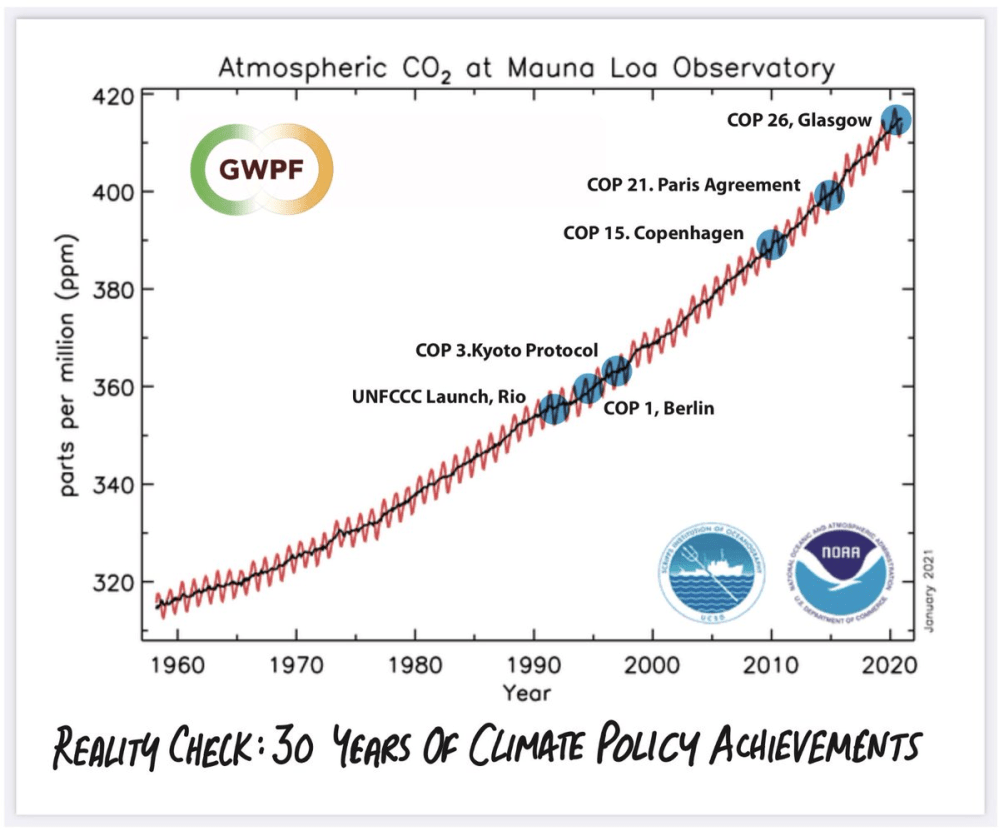
Global CO₂ emissions have kept increasing since the world’s nations first committed to rein in climate change at the Earth Summit in Rio de Janeiro in 1992 – despite dozens of climate summits and the global climate agreements struck in Kyoto and Paris. This is the case, once again, in 2022, when we will collectively set a new emissions record. While rich countries increasingly promise draconian cuts (and then generally backtrack, as they import huge amounts of oil, gas and coal to save their citizens from energy poverty, as they have done most recently to address the current energy crisis), most of the future emissions will come from the currently poorer countries in Asia and Africa, as they power their climb out of abject poverty.

In the previous ten years, the world has focused more on remediating climate change than ever before. Despite this, we are not achieving anything, although no shortage of money has been wasted. In a surprisingly honest review of climate policies, the UN revealed a “lost decade”: The report found that it couldn’t tell the difference between what has happened and a world that adopted no new climate policies since 2005.

Consider that: all those climate summits and grandiose promises – all that expense and trouble – and no measurable difference whatsoever.

This state of affairs is unsurprising, unfortunately, because today’s renewable energy sources have two big problems. First, they occupy a vast amount of space, often displacing nature: replacing a square yard of a gas-fired power plant requires 73 square yards of solar panels, 239 square yards of on-shore wind turbines, or an astonishing 6,000 square yards of biomass. One study found that the United States would have to devote a land area four times the size of the United Kingdom to “clean power” to fulfill President Biden’s promise of a carbon-free economy by 2050.

Land in grey required for wind farms to power London UK, solar panels covering the yellow space.

Second – and of even greater importance – the two renewable energy technologies favoured by the vast majority of environmental activists are intermittent or unreliable. Solar energy simply isn’t produced when it is overcast or at nighttime. Wind energy requires a breeze. We are often told by green energy boosters that wind and solar energy are cheaper than fossil fuels. At best, that is only true when the wind is blowing, or the sun is shining. On a windless, dark night, the cost of wind and solar power rises to the infinite.

It is for such reasons that it is deeply misleading (although highly convenient) to compare the energy costs of wind or solar to fossil fuels only when it is windy and sunny. It is also important to note that since all solar energy is sold at essentially the same time (when the sun is up and shining), its value drops dramatically. When solar reaches 30% market share in California, as one study revealed, it loses two-thirds of its value.

Furthermore: because modern societies require 24 hours of non-stop power, backup is not optional – and that means reliance on fossil fuels, when there’s no sun or wind. As more solar and wind is introduced, moreover, fossil fuel backups become ever more expensive as they offer their services for fewer hours, to produce the necessary return on capital. And what of batteries? Globally, we have battery storage with the current capacity to store one minute and 15 seconds of the world’s electricity consumption. And that problem will not be ameliorated soon – even by 2030, global batteries will only cover less than 11 minutes of the global electricity consumption.

The scale of the challenge

All of this shows just the problems with moving electricity away from fossil fuel. When Biden promises ambitiously that all of America’s electricity will come from renewable sources by 2035, he is addressing the comparatively simple part of the climate challenge. Electricity constitutes just 19% of total energy use. We’re far further behind in developing solutions for agriculture, manufacturing, construction, and transportation. Of these, the latter is most often discussed by environmentalists and virtue-signaling politicians, who insist that a solution is already at hand: electric vehicles. Despite massive subsidies, however, just 1.4% of cars globally are electric, and that number is not going up quickly. The Biden Administration itself estimates that battery-electric cars will make up less than 10 percent of total US automobile stock – by 2050.

The scenario for the entire world is that less than one-fifth of all global cars will be battery-electric by 2050. We should remember, as well, that we do not yet have electric tractors, or heavy trucks, or airplanes, or ships – and that means that all the fossil fuel infrastructure that allows such machinery to operate will have to stay intact for our supply chains to continue their necessary operations.

And our current turbo-charge on electric cars will have very little impact on climate. The International Energy Agency estimates that the world would produce 231 million fewer tons of C02 if we achieve all our ambitious stated transport electrification targets in this decade. This reduction will lower global temperatures by one-ten thousandth of a degree Celsius (0.0001°C) by the end of the century, according to the UN’s own Climate Panel’s model.

Tackling climate change with current technology is essentially impossible.

This means that climate policy-makers tinker at the margins, offering deceptive solutions, and morally grandstanding. This pattern has repeated for three decades. Most of the promises made in Rio de Janeiro in 1992 and in Kyoto in 1997 were disregarded. A 2018 study found that only 17 of the 157 countries that pledged emissions cuts in Paris passed laws mandating the required action. Which nations? Algeria, Canada, Costa Rica, Ethiopia, Guatemala, Indonesia, Japan, North Macedonia, Malaysia, Mexico, Montenegro, Norway, Papua New Guinea, Peru, Samoa, Singapore, and Tonga. These are not the nations that will change global emissions. Even if every country did everything promised in the original Paris agreement, the emission cuts by 2030 would constitute just 1% of what is necessary to keep temperature rising under the 2°C target.

Failure, however, has not made politicians or the people they serve more careful and or more adamant about searching for better solutions. Instead, they (we) have doubled down, making ever-more ludicrous but emotionally attractive pledges, despite zero chance of either their implementation or their success if implemented. Attempting to implement the much-heralded and oft-trumpeted vision of a zero C02-emission world – whether by 2035 or 2050 – would be so ruinously expensive that extensive gilets-jaunes-style riots are certain long before the “goal” is reached.

A different approach

If we do care about fixing this challenge, we need to change course. Pretending that the proper technological answer currently exists, and is not being implemented because we lack conviction and willpower is reckless and misleading. Worse, it stops us from pursuing real solutions to the many problems that confront us – only one of which is climate change.

Dozens of the world’s top climate economists and three Nobel Laureates in Economics evaluated a whole gamut of climate solutions for the think tank Copenhagen Consensus. If we continued to do what the EU has been doing – cutting carbon with a mix of market and planning diktats – means spending one pound to avoid a mere three pence of long-term climate damage. That’s partly because cutting CO₂ output in the rich and already efficiently-producing EU is impractically expensive, and partly because EU climate policies are much more inefficient than necessary (the EU prefers using wind and solar, for example, to cut a ton of CO₂, over the more efficient option of switching from coal to natural gas).

The Nobel laureates and climate economists instead determined that investment in green innovation comprised the best long-term investment. Why? Consider how the world worried over starvation in the 1960-70s. If we had approached that problem like we are approaching climate remediation, we would have required the rich to eat less, while serving their leftovers to the poor. That would have failed – as our current approaches will fail – disastrously. What worked instead? The Green Revolution: the innovative development of higher-yielding crops. We thereby increased world grain production by 250% between 1950 and 1984, raising the calorie intake of the world’s poorest people and reducing the incidence of serious famines.

Innovative thinkers tackled the problem head-on, instead of tinkering around the edges. Innovation meant producing more with less, instead of requiring people to make do, with less. Would-be and even genuinely looming catastrophes have been continually pushed aside throughout human history because of innovation and technological development. Innovation gave us security and prosperity, and continues to drive the growth and the increased efficiency of the world’s largest economies.

In general, unfortunately, investment in long-term innovation is underfunded because it is hard for private investors to capture benefits. In areas where long-term innovation on the private front can be underfunded (because of difficulties of monetising benefits in a sufficiently short time frame), public investment and support is often warranted. A recent example – and a stellar success on the climate innovation front? The ten-year $10 billion US public investment in shale gas, which originated under President George W. Bush. Remarkably, this was not planned as part of the policy of climate change remediation. Nonetheless, it led the way for a production surge (with all the attendant economic benefits, particularly for the poor) that allowed natural gas to become cheaper than the dirtier coal it partially replaced. Energy derived from natural gas produces approximately half the CO₂ of coal. The consequence? The US has the best record of C02 emission reduction of any country in the past decade – and simultaneously reduced its reliance on foreign suppliers of uncertain reliability and cost.
Investing in innovation

Everyone, in principle, agrees that we should be spending much more on R&D. However, the fraction of rich countries’ GDP actually invested into R&D has halved since the 1980s. Why? Putting up inefficient solar panels and wind turbines offers the opportunity for good photo ops, and allows those who lead to convince us of their dedication to action, while funding researchers requires a more subtle and mature understanding and approach. We might remember, however, when considering such things, that our economic stability and opportunity is now at serious risk, and we are simultaneously not currently doing the planet any favors.

According to the Copenhagen Consensus Nobel Laureates, we should increase our current spending five-fold, to $100 billion per year. This doesn’t mean that in total we should spend more. We already devote $600 billion per year to financing ineffective climate remediation strategies. We could instead take a mere sixth of that poorly spent money and direct it toward the most effective means of addressing our problems.

A genuine innovation-led response would require the consideration of multiple solutions. We should improve today’s technologies rather than erecting currently inefficient turbines and solar panels. We should devote more attention to nuclear fission (perhaps in the form of modular reactors), and continue to explore fusion, hydrogen generation from water, and more. The geneticist who spearheaded development of the first draft sequence of the human genome – a technological tour-de-force, completed far earlier and at less cost than originally estimated – makes the case for research into algae that produces oil, grown on the ocean surface. Because such algae simply converts sunlight and CO₂ to oil, when producing it, burning it would be CO₂-free. Oil algae are far from cost-effective now, but researching this and many other solutions is not only inexpensive but offers our best opportunity to find real breakthrough technologies.

If we innovate the price of green energy down below fossil fuels, everyone will switch. This would be a far better solution, particularly for the poor, than increasing the cost of fossil fuel to the point of general penury to disincentivise use. The Copenhagen Consensus experts calculated returns from green energy R&D at eleven pounds for every pound invested – hundreds of times more effective than current climate policies.

Finding the breakthroughs that will power the rest of the 21st century could require a decade, or it could take four. But no other genuine solutions beckon, and we have already had three decades of spectacular failure pursuing the policies that are currently in place. We know that the world leaders gathered at COP27 won’t solve the problems that beset us with the same empty promises offered twenty-six times previously. Are we doing the same thing yet again? Remember the definition of insanity…

But innovation beckons, as it has so reliably in the past. We have better options, and ignore them at the cost of our economy, our opportunity, and the environment.

Dr. Bjorn Lomborg is President of the Copenhagen Consensus and Visiting Fellow at Stanford University’s Hoover Institution. His latest book is “False Alarm: How Climate Change Panic Costs Us Trillions, Hurts the Poor, and Fails to Fix the Planet.” A collection of his writings for the Telegraph can be found here.
Dr. Jordan B. Peterson is Professor Emeritus at the University of Toronto, and the author of three books: “Maps of Meaning: the Architecture of Belief”, “12 Rules for Life: an Antidote to Chaos” and “Beyond Order: 12 More Rules for Life”. A collection of his writings for the Telegraph can be found here.

Climate Loss and Damage, Legal House of Cards

The big news out of COP27 Sharm El-Sheikh concerns funding for climate “loss and damage.”

Reuters  At COP27, climate ‘loss and damage’ funding makes it on the table

Columbia Climate School Loss and Damage: What Is It, and Will There Be Progress at COP27?

CarbonBrief COP27: Why is addressing ‘loss and damage’ crucial for climate justice?

Etc., Etc., Etc.

Mike Hulme explained the house of cards underlying the claims for compensation from extreme weather loss and damage.  He addressed this directly in his 2016 article Can (and Should) “Loss and Damage” be Attributed to Climate Change?.  Excerpts in italics with my bolds and added images.

One of the outcomes of the eighteenth negotiating session of the Conference of the Parties (COP18) to the UN Framework Convention on Climate Change, held in Doha last December, was the agreement to establish institutional arrangements to “address loss and damage associated with the impacts of climate change.” This opens up new possibilities for allocating international climate adaptation finance to developing countries. A meeting this week in Bonn (25–27 February), co-organized by the UN University Institute for Environmental and Human Security and the Loss and Damage in Vulnerable Countries Initiative, is bringing together various scholars and policymakers to consider how this decision might be implemented, possibly by as early as 2015.

At the heart of the loss and damage (L&D) agenda is the idea of attribution—that specific losses and damages in developing countries can be “associated with the impacts of climate change,” where “climate change” means human-caused alterations to climate. It is therefore not just any L&D that qualify for financial assistance under the Convention; it is L&D attributable to or “associated with” a very specific causal pathway.

Developing countries face some serious difficulties—at best, ambiguities—
with this approach to directing climate adaptation finance.

This is particularly so given the argument that the new science of weather attribution opens the possibility for a framework of legal liability for L&D, which has recently gained prominence (see here and here). Weather attribution science seeks to generate model-based estimates of the likelihood that human influence on the climate caused specific weather extremes.

Weather attribution should not, however, be used to make the funding of climate adaptation in developing countries dependent on proving liability for weather extremes.

There are four specific problems with using the post-Doha negotiations on L&D to advance the legal liability paradigm for climate adaptation. First, with what level of confidence can it be shown that specific weather or climate hazards in particular places are caused by anthropogenic climate change, as opposed to a naturally varying climate? Weather attribution scientists claim that such knowledge is achievable, but this knowledge will be partial, probabilistic, and open to contestation in the courts.

Second, even if such scientific claims were defendable, how will we define “anthropogenic?” Weather attribution science—if it is to be used to support a legal liability paradigm—needs to be capable of distinguishing between the meteorological effects of carbon dioxide emissions from fossil fuels and those from land use change, and between the effects of carbon dioxide and other greenhouse gases, black carbon (soot), and aerosol emissions. Each of these sources and types of climate-altering agents implicates different social and political actors and interests, so to establish liability in the courts, any given weather or climate hazard would need to be broken down into a profile of multiple fractional attributions. This adds a further layer of complexity and contestation to the approach.

Third, L&D may often be as much—or more—a function of levels of social and infrastructural development as it is a function of weather or climate hazard. Whether or not an atmospheric hazard is (partially) attributable to a liable human actor or institution is hardly the determining factor on the extent of the L&D. A legal liability framework based on attribution science promotes a “pollutionist approach” to climate adaptation and human welfare rather than a “developmentalist approach.” Under a pollutionist approach, adaptation is primarily about avoiding the dangers of human-induced climate change rather than building human resilience to a range of weather risks irrespective of cause. This approach has very specific political ramifications, serving some interests rather than others (e.g., technocratic and centralized control of adaptation funding over values-centered and decentralized control).

Finally, if such a legal framework were to be adopted, then what account should be taken of “gains and benefits” that might accrue to developing countries as a result of the impacts of climate change? Not all changes in weather and climate hazard as a result of human influence are detrimental to human welfare, and the principle of symmetry would demand that a full cost-benefit analysis lie at the heart of such a legal framework. This introduces another tier of complexity and contestation.

Following Doha and the COP18, the loss and damage agenda now has institutional force, and the coming months and years will see rounds of technical and political negotiation about how it may be put into operation. This agenda, however, should not place climate adaptation funding into the framework of legal liability backed by the new science of weather attribution.

Hulme goes more deeply into the Loss and Damage difficulties in his 2014 paper Attributing Weather Extremes to ‘Climate Change’: a Review.  Excerpts in italics with my bolds.

In this third and final review I survey the nascent science of extreme weather event attribution. The article proceeds by examining the field in four stages: motivations for extreme weather attribution, methods of attribution, some example case studies and the politics of weather event Attribution.

Hulme concludes by discussing the political hunger for scientific proof in support of policy actions.

But Hulme et al. (2011) show why such ambitious claims are unlikely to be realised. Investment in climate adaptation, they claim, is most needed “… where vulnerability to meteorological hazard is high, not where meteorological hazards are most attributable to human influence” (p.765). Extreme weather attribution says nothing about how damages are attributable to meteorological hazard as opposed to exposure to risk; it says nothing about the complex political, social and economic structures which mediate physical hazards.

And separating weather into two categories — ‘human-caused’ weather and ‘tough-luck’ weather – raises practical and ethical concerns about any subsequent investment allocation guidelines which excluded the victims of ‘tough-luck weather’ from benefiting from adaptation funds.

Contrary to the claims of some weather attribution scientists, the loss and damage agenda of the UNFCCC, as it is currently emerging, makes no distinction between ‘human-caused’ and ‘tough-luck’ weather. “Loss and damage impacts fall along a continuum, ranging from ‘events’ associated with variability around current climatic norms (e.g., weather-related natural hazards) to [slow-onset] ‘processes’ associated with future anticipated changes in climatic norms” (Warner et al., 2012:21). Although definitions and protocols have not yet been formally ratified, it seems unlikely that there will be a role for the sort of forensic science being offered by extreme weather attribution science.

Synopsis of this paper is at X-Weathermen are Back!

Integrated Storm Activity Annually over the Continental U.S. (ISAAC)

See also Data vs. Models #3: Disasters


Advancing National Takeover of Energy Industry

Tom Luongo writes at his blog The Oil Nationalization Two-Step.  Excerpts in italics with my bolds and added images.

You’ve all heard me rant about the “Straussian Two-Step,” which is nothing more than a retread of the Hegelian Dialectic.   Here’s the formal definition:

An interpretive method, originally used to relate specific entities or events to the absolute idea, in which some assertible proposition (thesis ) is necessarily opposed by an equally assertible and apparently contradictory proposition (antithesis ), the mutual contradiction being reconciled on a higher level of truth by a third proposition (synthesis ).

In modern politics it’s used to create a false reality by asserting something that is
partially true (at best) or a truth that you yourself created as a person in power.

In today’s case it’s a manufactured energy crisis across the West.

In order to see the Straussian Two-Step however you have to work backwards. This process is not an a priori deduction or an exhaustive fit of investigative journalism.

Rather it is an inductive conclusion based on awareness of the motivations of those in power and seeing how they lead a mass of people to a pre-ordained conclusion. In other words, schizo-posting.

Carbon fighters attacking the Exxon Mobil bastion, here seen without their shareholders disguises.

Thesis

So, say your goal is to legitimize the state takeover, or advance another step forward the state takeover, of an industry. Let’s use oil and gas for today’s lesson.

The first thing you do is manufacture a crisis that will disrupt the supply of the product you want to takeover. In this case, it started with COVID-19, which disrupted far more than just the energy sector.

More than 2 million barrels per day of refining capacity was lost world wide thanks to COVID-19. Given the current hostility to new refineries (more on this later), those barrels are not coming back.

Don’t forget, that for a “Straussian Two-Step” this big you will have to brainwash and/or gaslight two entire generations into hating themselves for being rich, wasteful, spoiled, alive or worse, just plain white.

So, they are already primed to hate all the things at play here — capitalism, Big Oil, Banks, Old White Guys (rich or poor) — and enrage your useful idiots by pushing their already tenuous hold on reality to the literal breaking point.   “I can’t even….” isn’t the most common phrase uttered on Tik-Tok for nothing.

That’s the Thesis part.

So, when the crisis hits thanks to natural gas disruption you forbid buying of from a particular country… you demonize not only Vlad but the industry itself for price gouging and preying on the widdle guy during a war.   There’s a word for this… chutzpah.

Antithesis

Predictably, you then allow your fake political opponents …[enter Cocaine Mitch from Stage Right]… to produce the opposite argument. In this case, the counter is obviously we need free markets to produce oil and gas. The refiners are just responding to the market.

That fake opposition, of course, also blames Vlad for this crisis to ensure the market’s champion looks not only patriotic but also suitably bought and paid for by Big Oil, Old White Guys, etc.

Both sides of this argument have now been framed 90 degrees away from the real source of the problem–government intrusion into the flow of oil and gas to your homes.

This is a crisis that if left solved to human ingenuity and, yes, the studious application of greed, would be over in a matter of weeks as refineries shut down during COVID would come back online, supply chains reorganized etc.

While the crisis phase would be over quickly, the long term investment cycle set off in refining would take longer to structurally immunize the industry against future supply shocks to accomplish.

Prices may not return to normal for years but the market, without intervention by rapacious morons both in government and running them from behind the curtain, would eventually grind the arbitrage out of the fuel industry nearly entirely.

Synthesis

Remember the goal. Destroy free markets, nationalize oil and gas.

This means also preparing the next move to get rid of another aspect of the free market while zeroing in on the current crisis. In this theoretical case, we’re looking at the massive diesel crack spreads of refineries, fueling the perpetual motion machine of Marxism’s inherent envy.

Moreover, this situation exploded on the eve of a crucial election to put into the mouths of the crisis actors we call colloquially, “Members of Congress.”

Their solution? Put windfall profit taxes on refiners who are taking advantage of the vulnerable and needy common man. They are evil ‘price gougers’ by accepting the bids from the market for the fruits of their labors which occurred precisely because of artificially inducing a shock to the system.

In the case of diesel fuel in the US this is clearly a manufactured crisis.

COVID took a lot of refineries in the Northeast (PADD-1) offline. And given the hostility of the Biden administration and environmentalists to the oil industry as a whole, as I alluded to earlier, those refineries are not coming back online anytime soon.

Don’t take my word for it, take it from the ones who own the refineries.

“Building a refinery is a multi-billion dollar investment. It may take a decade. We haven’t had a refinery built in the United States since the 1970s. My personal view is that there will never be another refinery built in the United States.”

According to Wirth, oil and gas companies would have to weigh the benefits of committing capital ten years out that will need decades to offer a return to shareholders “in a policy environment where governments around the world are saying ‘we don’t want these products to be used in the future’”.

Why would they? If it were your money would you begin the insane process to build an oil refinery in the US today even with crack spreads at $70+ per barrel? Of course not. By the time you filed the first Environmental Impact Assessment application form the spreads could be back to $20 because it’s politically advantageous for the “Straussian Two-Steppers” to take the pressure off for a few months.

Government is keeping the market in a supply/demand mismatch on purpose. That’s the only conclusion you can draw. Because if “Biden” wanted to solve this problem he wouldn’t be draining the SPR, he’d be rolling back regulations on refining oil or offering some of that ‘infrastructure money’ to help the industry rebuild post-COVID.

High Bid Wins the Prize

Diesel fuel demand is mostly inelastic, since it’s simply necessary for our daily life. Any supply disruption will cause massive price spikes because people will fall all over themselves bidding up the price of available supply to get what they can.

This is the one thing morons leftists can’t wrap their head around. Producers aren’t withholding supply and ‘raising prices’ in an open market economy. That’s propaganda. The reality is that consumers bid up the price for everything in demand or withhold those bids when the cost/benefit isn’t in their favor.

This is the dynamic at play when I use the term cost-push inflation. A supply shortage pushes the bids for basic goods up out of necessity and pouring money into the system through government handouts only accelerates this effect.

Low cost or free dollars flow to the things people need the most and that is the main source of our inflation today.

So, when you see the headlines full of scaremongering like the US only has 20 days of diesel fuel left, this undergirds the bids for limited supply. The futures markets are stripped of their power to coordinate supply over time and producers are stuck being demonized by low quality agitprop from the likes of AOC and Lizzie Slapaho.

Nationalization: The Next Two-Step

Windfall profit taxes are already on the way in Germany, 90% of all profits taxed away to the state. Energy production, when that bill passes, will be nationalized in Germany. The end of rational energy pricing will be gone.

Germany will become another energy subsidizing hellscape like we see all over the world.

The choice in front of German energy companies now is Uniper’s fate, nationalization through bailout, or remain ‘private’ but on a government-mandated cost-plus business model the profits from which will never outcompete the depreciation curve.

Today here in the US the Democrats are pushing for outright nationalization of all oil and gas production. That was the goal all along, the thesis. The fake antithesis is the “Drill baby, Drill,” crowd on Capitol Hill, crying crocodile tears over the loss of the Keystone XL pipeline for more than a decade.

The synthesis this time around will be finally getting through their long-sought after billionaire’s tax in the form of a windfall tax starting with evil Big Oil. Even if they don’t get it, it’s not like they don’t have other things on their to-do lists to get it done.

They are starting here again because they know no one will seriously consider outright nationalization (the next synthesis) unless there’s a war with Russia…

UN’s Imaginary Planet

A banner advertising the COP26 climate talks in Glasgow, U.K., on Oct. 20, 2021. PHOTO BY IAN FORSYTH/BLOOMBERG FILES

William Watson writes at Financial Post What planet do UN carbon-fighters live on? Excerpts in italics with my bolds and added images.

If current trends continue, the chance of the world hitting the UN’s goals are slim to none

One of the biggest news stories in Quebec this week is the partial closing of the Louis Hippolyte-Lafontaine tunnel, a major commuting artery under the St. Lawrence River, for what are termed “urgent” repairs. Half the tunnel’s lanes will be closed for three years — though that’s probably optimistic. Montreal’s brand-spanking-new light rail system, which for some reason the people who run the public pension plan think will be a big money-maker for them, recently had its opening delayed until next spring. In Quebec, big projects delays are like winter snow: simply assumed.

Though big for the affected commuters, these are tiny projects for the world. Yet they’ll take three years. Slowly, very slowly, does seem to be the way things work in many parts of the world these days. (Is there, by the way, a more aptly named figure than former Ottawa police chief Peter Sloly, whose approach to the truckers’ incursion seems to have been the opposite of speedy — and therefore of course very, very Ottawa?)

The tunnel, the bridge and the Réseau express métropolitain LRT came to mind as I scrolled through the latest edition of the United Nation Environment Programme’s (UNEP) update on the progress — or, in its view, shameful lack of progress — the world has made decarbonizing itself.

Judging by the 2½ pages of acknowledgements, this annual “Emissions Gap Report” is an immense undertaking by all sorts of committed people from universities, the UNEP itself and organizations such as the Bezos Earth Fund, the International Council on Clean Transportation, the ClimateWorks Foundation and so on. IKEA itself gets a shout-out for contributions from its foundation.

Not all the carbon news is bad. In a lovely set of graphs — production values, as always at the UN, are world-class — the team reports on how each G20 country is doing on its 2050 target (or NDC: nationally determined contribution). The arrow emerging from Canada’s trend points downward and to the right, heading for what looks like an exact bull’s eye with our commitment. If we do what we’ve said we’ll do — though that’s obviously a big if — we’ll get there. The EU27, the United Kingdom, the United States and Australia (though its aim is off by a few years) are in essentially the same situation.

But other countries are not, including five that already account for a quarter of greenhouse gas emissions. Thus the arrows for China, India, Russia, Brazil and Indonesia are headed skyward, soaring to levels far above their 2060 (not 2050) commitments. Maybe a decade or two of rapid economic growth will persuade them they’re now rich enough to go after carbon. But if current trends continue, the chance of the world hitting the UN’s goals are slim to none.

Which leads to a lot of foot-stamping scolding on the part of the emissions-gap team. Watching 20th-century international hockey, we Canadians were always shocked that Soviet coaches evidently thought they could get more out of their players by haranguing them on the bench after a lousy play. For some reason, the UN folk don’t seem to understand that being harangued puts most people off.

LULUCF refers to emissions from land use and forestry, which can be in addition or subtraction.

Yet the report argues what we need is “wide-ranging, large-scale, rapid and systemic transformation” in order to reach the goal of a two-degree, let alone 1.5-degree, increase in average global temperatures. “Is it a tall order to transform our systems in just eight years?” asks the executive director of UNEP, apparently with a straight face. “Yes,” she concedes, “but we must try.” And so the report goes on to provide a long list of imperatives for governments, industry and (they get their own chapter) bankers.

We all understand that ardent environmentalists are driven by their love for the planet. But which planet exactly do they live on? In the part of planet earth I live on (and love, too, in my own conservative way), it takes three years to perform “urgent” repairs on an important tunnel — and it probably took at least as many to clear the decision to go ahead. Yet here are apparently intelligent and certainly well-educated people saying the world must turn its agricultural sector upside down, or at least get a good start on doing so, in just eight years.

Figure 6.2 Food systems emissions trajectory and mitigation potentials by transformation domain

Societies do undergo radical transformations. The other day I found myself talking to a speaker, telling it which radio station to play. We of a certain age are living quite differently than we did as children. But people only make these big transformations voluntarily, when new technologies or ideas come along that are self-evidently desirable and appear worth spending money on.

That would not be the case with a precipitate, top-down overhaul
of our agricultural and industrial systems.

We’ve only just figured out how to feed eight-billion people. What happens to a billion or two of them if the grand agricultural experiment the UN wants us all to try doesn’t work out? Environmentalists always say this is the only planet we’ve got. It is indeed. But that means there’s nowhere else to import food from if global experiments go wrong.