NY and PA: Midterm Election Energy Lesson

The Marcellus formation lies under more than 60 percent of the state of Pennsylvania alone. Some geologists and petroleum engineers believe that the massive shale formation may hold as much as 500 to 700 trillion cubic feet of natural gas. This amount of natural gas in the Marcellus Shale could supply the entire east coast for the next 50 years according to some geologists.

Larry Behrens writes at Real Clear Energy Fetterman and Cuomo: A Midterm Election Energy Lesson.  Excerpts in italics with my bolds and added images.

With energy dominating the national discussion, look no further than Pennsylvania and New York as examples of failure and fortune. The Empire State might be looking to make a U-turn after a years-long trip into failed energy policy, while the Keystone State must decide if they will adopt the “America Last” energy policy currently favored in Washington, D.C.

The two states share a border of 225 miles, but when it comes to energy,
they might as well be on different planets.

It’s clear energy is on the ballot this midterm season. That’s bad news for fracking foes like Pennsylvania Senate Candidate John Fetterman. While he may be struggling to articulate his position du jour on fracking, it’s clear he’s borrowing from the Joe Biden play book: play a moderate in the campaign, return to radical roots once elected.

In 2014, then-Governor Andrew Cuomo imposed an outright ban on fracking in his state. The decision cost a loss of 400 jobs per year in some of the state’s counties and resulted in a “statically significant increase in unemployment.” By declaring a war on pipelines, some utilities in New York stopped “new residential, and commercial and industrial customer gas service connections.” New Yorkers are paying the 10th highest electric rates in the nation, and nearly 30 percent higher than their neighbors in Pennsylvania.

With no fracking ban in their state, Pennsylvanians are much better off. Today, the Commonwealth is second only to Texas when it comes to production of shale gas and in 2021 the state received over $235 million in impact fees from drillers. One university study found communities in Pennsylvania suffering from long-term economic stagnation are the beneficiaries of American energy development in their area.

Two different states, two very different outcomes. Enter the 2022 midterm election.

Rank FF Consumption  Trillion BTU
1 Texas 11767
2 California 4845
3 Louisiana 3698
4 Florida 3110
5 Pennsylvania 3110
6 Ohio 2774
7 Illinois 2590
8 New York 2370

Source of Primary Energy Consumption Data:  EIA   Notice that California and New York are top consumers of FF energy, principally oil and natural gas, but neither is a top producer, despite accessible resources.  Florida, Ohio and Illinois also share that predicament.

New York’s race for Governor is turning into a nail-biter, as residents of the state consider hiring the first Republican for the job in 16 years. Appointed Governor Kathy Hochul would continue Cuomo’s failed anti-fracking policy while Republican Lee Zeldin supports energy development in New York. The result? A Republican is surging in a massively blue state where people say their top issue is the economy. New Yorkers are suffering under the consequences of failed-fracking policy. Meanwhile in Pennsylvania, they have a radical in moderate’s clothing that thinks the New York failure is just fine.

The stakes are as high as they are clear: John Fetterman wants to end fracking and if elected, he’ll do all he can to do it. Sure, we all witnessed his bumbling response where he pinky-swears he now likes fracking, but he can’t bumble over the truth. He once referred to the industry as a “stain” on the state he is seeking to represent. Don’t forget that Joe Biden also did the fracking flip-flop as a candidate, only to take office and impose an “America Last” energy policy that’s delivered record gas prices, massive inflation and a weaker country on the world stage. Apparently, John Fetterman and Joe Biden view the disaster in New York as a winning game plan.

It failed for Andrew Cuomo, it’s failing for Joe Biden and if he’s elected, it will fail for John Fetterman, too. You might say that just like Communism, banning fracking has failed everywhere it’s been tried.

Vote accordingly.

See also New England Energy Inflation Self-Imposed

Project abandoned in 2017 after New York blocked planning and permit processes.

Climate Dreams, Meet Brick Wall

Fred Laza writes at Financial Post Climate fantasies hit brick wall of U.S. politics.  Excerpts in italics with my bolds and added images.

The reality of the energy transition could be ugly for politicians

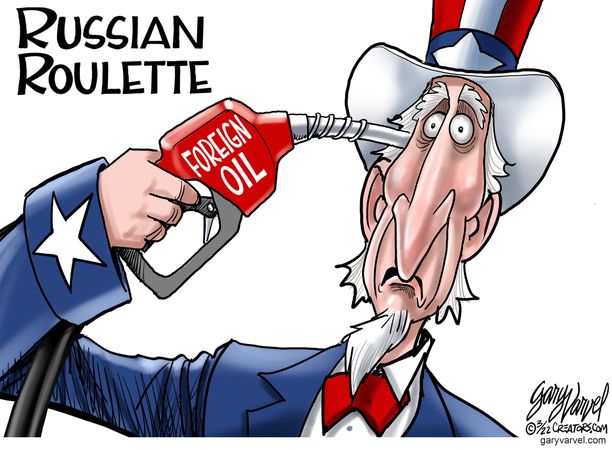
The Biden administration’s attempt to lower gasoline prices before the November mid-terms has been both amusing and disappointing. First the president attributed the run-up in oil and gas prices to Putin’s invasion of Ukraine. Then his government drained about a million barrels a day from the strategic oil reserve. After six months of that and with gasoline prices creeping up again, Mr. Biden went to Saudi Arabia to ask Crown Prince Mohammed bin Salman for his help in keeping oil prices from rising at least through to the mid-term elections.

The prince said no, which was totally predictable. It appears none of the foreign policy experts advising the president understands basic human relations, let alone Arab culture. You can’t call someone a murderer and then expect him to turn the other cheek and meekly accede to your request for a big personal favour.

The substantial long-term damage to the important relationship between Arab countries and the U.S. has been driven entirely by short-term political expediency. This greenest administration in history at first seemed very committed to dealing with climate change and accelerating the timeline to achieve net-zero carbon emissions for the U.S. as a whole. A key driver for this goal is higher oil and gas prices. Economics 101 teaches that sharply higher prices for carbon fuels will reduce demand for them and promote the shift to alternative sources of energy, primarily renewables.

Well, Putin’s war on Ukraine and Biden’s war on fossil fuels have been very effective in delivering skyrocketing oil and gas prices. But now it seems another key driver of climate policy has been discovered: that a Democratic administration remain in office, a necessity that has run into the reality that people do not seem willing to pay the price, at least not right now, for the transition from carbon to non-carbon sources of energy.

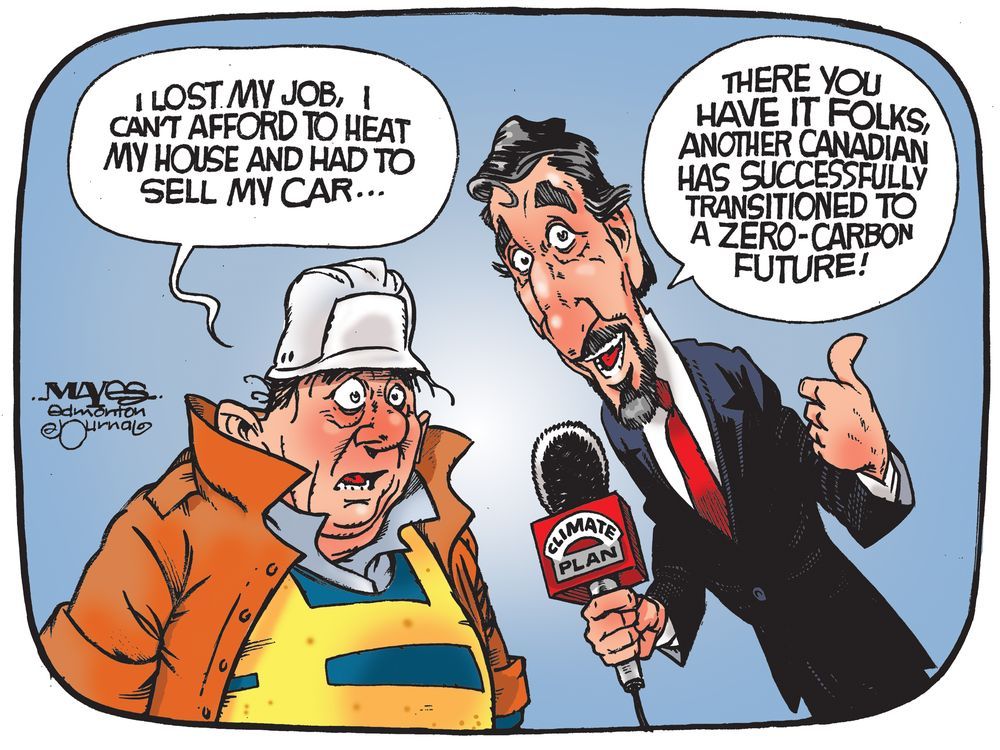
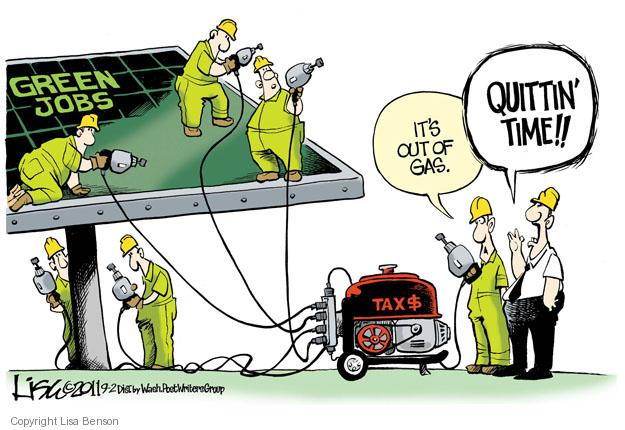
Ardent supporters of the energy transition keep suggesting it will lead to the creation of millions of new jobs. (“There is no trade-off between the economy and the environment.”) There are at least two problems with this argument. First, it ignores the euphemistically named “adjustment process.” As the economy moves away from fossil fuels, many millions of people will lose their jobs and not “transition” easily and smoothly to the new jobs that might eventually be created. As with all dramatic policy changes, there will be winners and losers, and the losers likely won’t be fully compensated by the winners — or happy about that. That reality could be ugly for politicians.

As for the claim that the transition will eventually produce millions of net new jobs,
there is good reason for doubt.

Consumer-oriented industries, with the possible exceptions of food and shelter, will have to make drastic changes in their business models. The carbon footprints resulting from the continual introduction of marginally better products are substantial, which means the regular introduction of new products or of varieties of existing products will have to end. Think of the effects in automobiles, iPhones, clothing, furniture, cosmetics, detergents and so on. Further, until most electricity worldwide is derived from renewables or nuclear, the growth of the Internet will have to be curtailed. The millions of servers that are its backbone require large amounts of electricity for cooling and power. Will users willingly limit their reliance on social media and streaming services? Imagine the implications for business and commerce if they are required to.

If our production of carbon is to be reduced as much as the most insistent environmentalists want, market economies will have to move to much lower levels of production and employment. The yellow brick road to Green Oz does not run smooth. It might never actually reach Green Oz, and even if it does, there is no assurance that either the trip or the destination will be pleasant for everyone.

Until very recently, this political reality seems to have been forgotten. Politicians need to be careful in what they ask for and much more honest with the people whose votes they seek.

Fred Lazar is an associate professor of economics in the Schulich School of Business at York University.

Footnote Q & A:

Q:  What is the difference between Golf and Government?

A:  In Government you can always improve your lie.

–Anonymous Source


Nations the Gods Destroy They First Make Green

LNG (Liquefied Natural Gas) filling station for trucks in Dortmund, western Germany. PHOTO BY INA FASSBENDER /AFP via Getty Images

Rex Murphy explains how the demise of nations works in his piercing National Post editorial Even green zealots fear the cold more than the evils of natural gas.  Excerpts in italics with my bolds and added images.

The Germans, among others, aren’t smirking now

Forgive the phrase, but it is appropriate — Vladimir Putin has the European Union — Germany in particular — over a barrel. . . Over several barrels come to think of it.

The virtue states went green, but contented themselves with getting the slack, the dirty oil and gas stuff they so deplored, from reliable Russia.

And when a certain American President — the sagacious readers of the Post will divine whom I mean, and it is merely to forestall trauma in readers of other journals that I withhold his name (hint: there was a hotel in Toronto that featured his name as a brand and rhymed with “plump”). When that President warned German authorities that it was a risk and a very bad move to set up a dependency on Vladimir Putin for an essential resource, in public — the scene is available on YouTube — half of them smirked and the other half laughed.

There is a small moral here. Advice worth following does not need to come from lips you approve of. The quality and worth of advice may, on occasion, be independent of the character (or what you presume to be the character) of the person offering it.

They are not smirking now. Germany, in the warm haze and fuzzy thinking of “progressive” thought, broke the bank on their master green plan, the great Energiewende, to “get off” planet-destroying fuels (and nuclear)which proved to be a massive multi-billion dollar mess and a failure.

This even before Mr. Putin unleashed his legions on Ukraine. Putin’s current leverage was founded on their previous policies.

Contrary to the sooth-sayers of the IPCC and the Eco-Nostradami, great economies can’t be flipped on a Davos dream, and the German winter of 2023 will be unmoved by replays of An Inconvenient Truth. Or shoreline rants from a most intemperate David Suzuki. Anger does not become an elder about to board a sea plane.

As a footnote to the Energiewende opera, be it noted at the end of September the German government announced is spending US$195 billion, to cap natural gas prices for households and businesses.  That’s a bigger price tag than the US$172 billion the UK government was expected to spend to finance its own price cap. Germany went green with a vengeance and now has to mail out checks to its citizens to compensate for the folly.

And before turning to the distressed UK, one line from Forbes, quoting Foreign Policy, has quite a punch: “Electricity prices, in fact, have tended to be highest in places with the greatest share of renewable energy.” Dear Lord, who could have guessed? It’s a good thing they didn’t impose … an escalating carbon tax.

Great Britain has dropped its second prime minister in mere weeks. As in Germany, it’s all about energy, all about the mindless embrace over the last years of green ideologies, until fear of a cold winter causes an impressively swift rearrangement of concerns about energy.

It has just reversed its stand on fracking. During its green-virtue phase, fracking — the most efficient technological advance in the search for the most basic energy resource — was termed a pure evil.

It was banned by law. It was a blasphemy against Mother Earth and Bill Nye. Now that winter closes in, and energy prices that were once mere Honda Civic (used) are now going all Rolls Royce (customized), fracking is a good thing, a necessary thing. It has received an official vote of approval from the House of Commons, UK.

On our side of the world under the increasingly — let’s choose a kind word — drifting leadership of Joe Biden, the Strategic Petroleum Reserve — intended as a backup for the most drastic emergencies, has been raided once again. OPEC turned him down on his request to increase oil flow. Let us recall that the Biden presidency began with shutting down a great Canadian source of oil, the Keystone XL.

It is a wonderful consideration that when Reality (capital R) speaks, all poses and postures, all voice-hushed bleating of virtue-speak platitudes take a stay. I wonder if our deputy-prime minister is still pulsating the message that all this reminds us of “how important climate action is.” And how carbon taxes are so very necessary in the present moment.

How did we get here?

It is the speeches and the campaigns against oil and gas, the sermons from the jet-set di Caprio’s, the dim-witted tirades of such as Neil Young against Fort McMurray, much and more than Putin, have brought this crisis on. People who have never seen a COP meeting, never could have dreamt of going to Davos, never mind been able to afford such a folly, that will bear, and perhaps not be able to bear, the cost of the winter to come.

Thank heaven, reality and its sister common sense is having a minute
at the microphone of the world’s attention.

As an ending point, would it not have been a great thing, if a moderate country, of magnificent and vast geography, had taken advantage of its so-plentiful natural resources, encouraged and supported its energy industry, built pipelines, guaranteed supply, could now — at this crisis moment — offer so many of its allies, real support and immediate remedy?

We would be in a place to issue this pronouncement: “Canada says, to hell with Putin, we have what you need, and we can send it now.”

But no. Under the current net-zero fascinated government, energy was deemed an enemy, due for shut down as soon as possible, and what we now offer a tormented world is a windmill-driven, not yet started, dubious in the extreme, futuristic hydrogen plant in Stephenville, Newfoundland. If you have tears, weep them now.

The countries whom the gods would destroy they first make green.

See also Net Zero = Pro China + Pro Russia

Green Energy Profiteering Scam

J.B. Shurk writes at Gatestone Institute The Green Energy Profiteering Scam.  H/T Tyler Durden.  Excerpts in italics with my bolds and added images.

“Green” Profits Can Only Rise if Citizens’ Freedoms Fall

In free markets, commodities bought and sold possess perceived value. When a buyer and seller reach an agreed upon price for any product, there is a “meeting of the minds.” The value of any natural raw material is proportional to its scarcity. The more of it there is, and the more easily it can be obtained, the less value it holds. A vendor who sells ordinary rocks cannot make a living when his product is found freely all over the ground. If he transacts in gold or silver, diamonds or rubies, however, his hard-to-find “rocks” are worth a small fortune.

If only there were a way to turn ordinary rocks into valuable commodities!

There are, in fact, two well-known ways to do so. An unscrupulous vendor could simply paint ordinary rocks gold and pretend that common minerals are rare, and an unsuspecting customer might never be the wiser. Through fraud, the seller can hijack the perceived value of his goods and undermine the agreed “meeting of the minds” between himself and any deceived customer. His “precious” rocks actually hold no value but provide him with ill-gotten gains. Over time, however, this type of fraud does not last. More discerning customers eventually catch on to the ruse, and that information is shared among prospective buyers. And unless he is quick to move on to a new town with new buyers yet to be deceived, old swindled customers are likely to end his livelihood or much worse. Engaging in fraud comes with serious personal risks.

There is another, safer way, however, to turn ordinary rocks into valuable commodities. The vendor could petition the king of the realm for the exclusive right to gather and sell ordinary rocks. If granted such an extraordinary license — whereby ordinary rocks may only be possessed if first stamped with the vendor’s mark — then an abundantly available natural resource becomes scarce overnight. What was once free now costs whatever the vendor and the king’s tax-collecting chancery decide to charge for the use of regulated rocks. Perhaps citizens with special status or recognized allegiance to the king will still get their rocks for next to nothing. Yet the classical mechanics of supply and demand still come into play for everyone else. Even if the price charged for an officially sanctioned rock is kept low, its value on secondary markets is determined entirely by the scarcity of available vendor-stamped rocks.

How much are licensed rocks worth if they are the only ones that may be legally owned? When a king and vendor conspire to make only a small fraction of available rocks “legal,” then their manufactured “unavailability” makes them extremely valuable. Legally imposed scarcity comes with much fewer personal risks. Licensed monopoly on high-demand commodities is a license to print money.

From this lens, it is easy to see why so many investors love
government intervention in energy markets.

  • When governments limit drilling and mining for hydrocarbons in the ground, they manufacture scarcity.
  • When only certain wealthy individuals and companies can afford artificially expensive hydrocarbon energies as regular business costs, then budding entrepreneurs and small firms can no longer compete. Those at the peak of society’s wealth pyramid have a much easier time staying on top when the same natural sources of hydrocarbon energy once used to amass fortunes are now denied to those who would do the same.
  • A war on “fossil fuels” is a superb tactic for protecting private market share. It is a profitable ideological cause for fattening government revenues. And it is a constant source of income for environmental “nonprofits” and other special interests….
  • Can plastics, heating oil, and most synthetic materials found around a home be magically manufactured without petroleum?

  • Can the global population stave off famine and starvation if farmers are forced to overhaul agricultural and livestock production methods in order to abide by “green” laws limiting the use or release of carbon dioxide, methane, nitrogen, and phosphate — molecules and compounds essential to basic farming and high crop yield fertilizers?
  • Ideology hijacks the market’s natural direction toward an objective and transparent “meeting of the minds.” There is an unspoken but unmistakable fraud. Until governments, including hostile adversaries such as Russia and the United States, conspired to limit the use of hydrocarbon energy and “go green,” the idea that anybody could turn a profit from the wind or sun would have seemed as absurd as a vendor selling rocks freely available all around us.

  • Are electric vehicles as powerful as their internal combustion engine counterparts? Can wind and solar energies really provide nations with reliable power grids robust enough to avoid rolling blackouts? Can plastics, heating oil, and most synthetic materials found around a home be magically manufactured without petroleum?

Pictured: An electric car at a charging station in Berlin, Germany. (Photo by Carsten Koall/Getty Images)

Will not these “green” initiatives wind up looking remarkably similar to the example of the unscrupulous vendor above who learned how to swindle his customers by treating common minerals as rare and painting ordinary rocks gold — or perhaps now, a resplendent green?

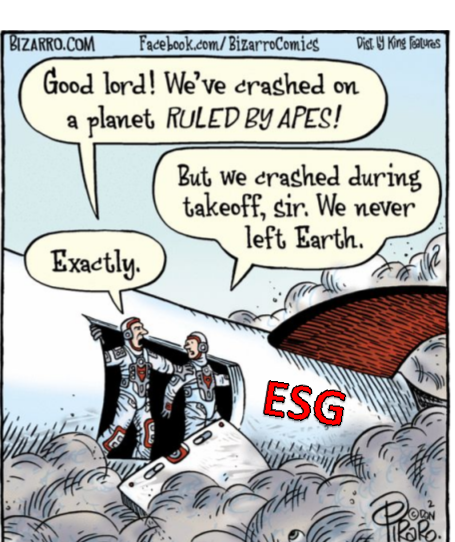
Is that not what the imposition of Environmental, Social, Governance (ESG) standards upon markets accomplishes? Is ESG not a concerted effort to warp trading markets with acutely political aims that seek to reward companies and capital investments for their pledged commitment to ideological beliefs rather than their likelihood for generating future profits?

When boardrooms and investors distort free markets by treating stocks and other assets as more valuable than they really are, simply because they are painted a shiny “green,” then ESG overvaluation turns misguided yet “politically correct” fantasies into gold.  Government-enforced environmentalism has created its own class of “green” billionaires. Whenever and wherever governments have mandated that citizens purchase certain goods or suffer legal consequences, the producers of those goods have made financial killings.

Anyone once blissfully unaware of that kind of crummy crony capitalism surely learned a thing or two watching global vaccine mandates drive up pharmaceutical industry profits, while government-granted indemnification clauses rendered vaccine makers free from financial liability for any resulting injuries.

When governments subsidize entire industries, force citizens to purchase those industries’ products, and protect those industries from the legal consequences of their products’ harm, then money flows into the pockets of those with ownership stakes.

Does that sound remarkably similar to another political philosophy that is predicated on the abolition of all private property? What is that old saying somewhat apocryphally credited to Vladimir Lenin? “The capitalists will sell us the rope with which we will hang them.” Or perhaps today it is the “green” capitalists who make money by rendering food and fuel scarce, virtue-signaling “green” advocates who cheer the one-sided transaction, and the increasingly impoverished Western citizens who end up worse off than ever.

This much is certain: irrespective of prevailing politically correct Western “wisdom” and the current environmental “madness of crowds,” should the hydrocarbon bedrock of the global economy be traded for worthless “green” rocks, neither wealthy capitalists nor poor citizens will long survive.

Expensive Energy is not a Bug, but Biden Agenda’s Core Feature

Marlo Thomas explains in his Real Clear Energy article Expensive Energy Is a Core Feature, Not a Bug, of Biden’s Climate Agenda.  Excerpts in italics with my bolds and added images.

The great Austrian economist Ludwig von Mises was being generous by describing interventionism’s nasty side-effects as “unintended.” Some younger interventionists are naïve, and know not what they do, but the older, street-smart captains of progressive politics understand the harms their policies entail. For them, the adverse consequences are features, not bugs.

The only downside is the risk of political retribution at the polls.

That’s the predicament in which the Biden administration now finds itself. It is also the theme of “Energy Inflation Was by Design,” a new report by supply-chain consultant Joseph Toomey.
[Synopsis is in previous post Energy Inflation Playbook]

President Biden and congressional Democrats want to replace fossil fuels with a “zero-carbon” energy system. Their biggest win to date is the comically mistitled Inflation Reduction Act (IRA). A Penn-Wharton analysis estimated that the IRA would increase federal climate and energy spending by $369 billion over ten years. A recent article in The Atlantic touts a Credit Suisse estimate that actual climate-related federal support could reach $800 billion. That’s because the incentives for electric vehicles and renewable energy are “uncapped tax credits.” Moreover, since federal spending leverages private-sector investment, total economy-wide green-tech spending could increase by as much as $1.7 trillion.

Nor is that all. The Department of Energy (DOE) estimates that the IRA has increased its loan program authorities by up to $350 billion.

No wonder Democrats celebrated the IRA’s enactment. No bigger program to rig energy markets against fossil fuels was ever enacted.

The IRA aims to enrich thousands of enterprises, tens of thousands of employees, and millions of shareholders—all dependent on Democrats to keep the gravy train flowing. Hardly an “unintended” consequence.

But voters see and feel the downsides of Biden’s war on fossil fuels: the high costs of gasoline, electricity, and other utilities, which in turn increase the costs of food, rent, and consumer goods. Those effects, moreover, coincide with high general inflation, a cratering stock market, and negative GDP growth in two consecutive quarters. Biden tries to blame Vladimir Putin and Big Oil for America’s energy woes. That is nonsense, and the public isn’t buying it.

Toomey marshals overwhelming evidence that “energy inflation” is a core feature of the president’s climate agenda. And how could it be otherwise? A core progressive article of faith is that fossil fuels are too cheap because market prices do not reflect the “social costs” of carbon dioxide (CO2) and other greenhouse gases (GHGs). Accordingly, no matter how expensive or scarce fossil energy may become for other reasons, taxing or capping fossil-fuel consumption to make it even more costly is hailed as a “climate solution.” Of course, handicapping fossil fuels is also touted as a way to make renewables more “competitive.” As President Obama enthused, cap-and-trade will “finally make renewable energy the profitable kind of energy in America.”

The public, however, has repeatedly spurned proposals to tax or cap the carbon content of fuels or emissions. So, U.S. progressives now concentrate on rigging energy markets via targeted regulations, state-level renewable-energy quotas, and subsidies. As noted, the IRA sets a new standard for anti-fossil-fuel subsidies.

President Biden seeks to cut U.S. carbon emissions by 50-52 percent below 2005 levels by 2030 and achieve a zero-emission electricity sector by 2035. That means that about half of all U.S. fossil-fuel consumption must end in eight years. Few investors want to park their capital in rapidly contracting industries. So, thanks to Biden, the market forecasts that supplies of oil, gas, and coal will decline relative to demand—and prices will rise. The expectation of shrinking supplies and higher future prices puts upward pressure on energy prices today.

An irony noted by Toomey is that by endangering fossil-fuel energy supply, Biden has not only increased fossil-fuel energy prices but also boosted oil and gas company profits and stock values. The short-term enrichment of oil companies may well be an unintended consequence of a long-term agenda to put them out of business. On the other hand, Biden’s boost to oil industry profits is also the setup for further interventions popular with progressive activists and politicians—windfall profits taxes, export bans, and Federal Trade Commission investigations of “anti-consumer behavior.”

Toomey demolishes the Biden administration’s allegation that oil companies are deliberately reducing refinery utilization to constrict supplies and raise prices. In fact, refineries are running at higher utilization rates than ever (about 94 percent).

As a presidential candidate, Joe Biden promised to “get rid of fossil fuels,” assuring one activist, “I guarantee you. We’re going to end fossil fuel.”

Toomey reviews several Biden initiatives that back up such threats. The major ones, besides the government-wide, IRA-funded effort to channel “the flow of capital toward climate-aligned investments and away from high-carbon investments,” include:

Cancelling the Keystone XL Pipeline on Inauguration Day;

Suspending new oil and gas leases on federal lands;

Reviving social-cost-of-carbon sophistry;

Halting petroleum-development activity in Alaska’s National Arctic Wildlife Refuge;

Rejoining the Paris Climate Accords without asking for the Senate’s advice and consent;

Considering a non-attainment designation for ozone pollution that could curb drilling in the Permian Basin, which accounts for 43 percent of U.S. oil production; and

Imposing stricter methane standards for oil and gas production.

To provide historical context for the fiscal side of Biden’s climate agenda, Toomey discusses the Obama DOE loan program established by the American Recovery and Reinvestment (“Stimulus”) Act. The best-known program beneficiary was solar-panel manufacturer Solyndra, which filed for bankruptcy protection in 2011 despite receiving $535 million in DOE loan guarantees. Some readers may also recall a list of seven such “Stimulosers.”

In short, nearly seven out of ten Obama DOE loan recipients in a $32 billion loan program went bankrupt. The total federal financial support provided by the IRA for “climate-aligned” investments is potentially 36 times larger. The stage is set for scores of Solyndras. Toomey’s labor as a chronicler of the war on fossil fuels is nowhere near done.


JustStopOil is a Malignant Tumor

Tom Slater reports on this social cancer and the need to excise it in his Spectator article Just stop Just Stop Oil.  Excerpts in italics with my bolds and added images.

The chasm between the protestors and the public grows wider with each demonstration

Why block roads? Why make people’s lives miserable? Who do you think this is going to convince? So go the interminable TV-news debates after each disruptive piece of direct action by eco-troupe Extinction Rebellion and the various single-issue offshoots, such as Just Stop Oil, that it has inspired.

These past two weeks, Just Stop Oil has been back in the spotlight. It is now into its 12th consecutive day of action in London, demanding the government stop all oil and gas production. Yesterday, its activists blocked roads in Knightsbridge, delaying an ambulance, a fire engine and cars carrying babies to hospital. Today, they’re sitting in the road outside parliament.

Once again, all these hi-vis-clad protestors have managed to achieve, beyond disrupting the days of ordinary people and the work of the emergency services, is to infuriate members of the public up and down the country.

But the tactics of Just Stop Oil, Insulate Britain and other groups make a lot more sense when you realise that the point of these protests is to disrupt the lives of working-class people. Indeed, the future these bourgeois irritants envisage would sacrifice ordinary people’s living standards on the altar of eco-austerity.

It’s perhaps too easy to portray Extinction Rebellion as dominated by the posh and over-educated. But only because this is a factually accurate characterisation. Academic research has shown that XR activists are overwhelmingly middle class and a whopping 85 per cent of them have degrees.

There’s a reason for this class skew. The eco agenda is essentially about making life harder for anyone who doesn’t work primarily on a laptop, who can’t cycle to work, who drives for a living, or who just isn’t convinced that soaring energy costs are the price we must pay for progress.

No wonder so few working-class people are fully paid-up members of these groups. No wonder working-class people clash with these protestors on the streets whenever these supple-handed sons of privilege decide to glue themselves to the road and bring traffic to a standstill.

In groups like Just Stop Oil we see a perfect fusion of political goals and political tactics.

Their ultimate aim is to make working-class people’s lives more difficult, insisting essentially that everyone must pay more to consume less. Their campaign to bring this about takes the form of making working-class people’s lives more difficult. It’s genius, really.

The class tensions of it all have become crystal clear in the repeated scenes of builders, delivery men and otherwise irked members of the public having to drag these activists off the road so they can go about their business – as we saw in Knightsbridge again yesterday.

‘I will start moving these people myself, I ain’t f****** about’, said one man, who told the protestors he didn’t give a ‘flying s***’ about what they had to say.

The chasm between the protestors and the public grows wider with each protest. In another clip from this week, a man says to the road-blocking activists: ‘Somebody’s sick, get off the road!’ To which a protester replies, remarkably: ‘If somebody’s sick, they shouldn’t be driving.’ The man is then forced to spell out that ‘they’ve got a passenger who is sick’. ‘Are you silly?’, he adds.

Direct action is supposed to be disruptive, of course. But the protestors’ callous indifference to the disruption they are causing speaks to something deeper about their movement. It has become so cultish and myopically obsessed with saving ‘the planet’ that it has become entirely alienated from the needs of human beings.

We glimpsed this in Just Stop Oil’s media appearances yesterday. During an interview on GB News, a young man, apparently convinced that we are on the brink of ‘societal collapse’, suggested his cause was ‘more serious actually’ than the plight of a sick person in an ambulance, stuck behind his friends’ human roadblock.

This indifference makes ordinary people all the more infuriated when the police seem incapable of dealing with these protests in a timely fashion. In some cases, officers have even appeared to indulge protestors. At an Insulate Britain roadblock last year, one officer was filmed telling the activists to let them know if they ‘need anything’.

Everyone supports the right to protest, of course. There is just no right to glue yourself to a road for hours on end. Now more and more members of the public are willing to do what the police are apparently so incapable of doing. And who could blame them?

These aren’t protests for the climate, they’re protests against ordinary people.

See also Climatism the Real Threat to Democracy

Having failed at the ballot box, millennial climate activists will
pursue any means to impose their will on society

A handout picture from the Just Stop Oil climate campaign group shows activists with their hands glued to the wall under Vincent van Gogh’s “Sunflowers” after throwing tomato soup on the painting at the National Gallery in central London on October 14, 2022.

Net Zero = Pro China + Pro Russia

Rupert Darwall explains in an Epoch Times article Democratic Party Captured by Environmentalists, Aiding Russia and China.  Excerpts in italics with my bolds and added images.

Environmentalists have captured the Democratic party and, in their push towards Net Zero, are aiding Russia and China, a senior fellow at RealClearFoundation, Rupert Darwall, says.

Furthermore, the push towards Net Zero has monopolized “the money,” as the group includes many Silicon Valley billionaires, intellectuals, and the mainstream media, Darwall told The Epoch Times and NTD’s Paul Greaney in an interview.

In the interview, which aired on NTD’s Fresh Look America on Oct. 12, Darwall said a prime example of environmentalists taking over the Democratic party, and monopolizing the money, is California.

There, billionaire environmentalists have instituted “an aggressive green agenda” that doesn’t negatively impact them but directly opposes the average California voters’ interests, he said.

“Voters, and particularly in the Central Valley, who endure stifling temperatures in summer, had to pay ruthlessly high prices to condition their homes. They don’t have beachfront properties that are cooled from the Pacific.”

Darwall added that because California is “essentially a one-party state,” voters can’t correct the “extreme environmental policies.” Plus, environmentalists use a version of McCarthyism to stifle opposition.

In the 1950s, U.S. Senator Joseph McCarthy accused thousands of innocent people and parties of disloyalty and allowing Communism to influence their lives and policies.

Darwall said environmentalists today use a similar tactic when they label anyone who disagrees with them as a “climate denier.”

“They know ‘denier’ is a very powerful term to be called. You may have seen a New York Times journalist interviewing the president of World Bank, and [the journalist asks] “are you a climate denier?’ It’s designed to chill debate. Not just chill it but prevent people questioning.”

[ Tip:  Q:  Aren’t you a climate denier?  A: I am a climate thinker. ]

Green Imperialism

If this progression towards Net Zero continues, Darwall said he knew who will win.

“China and Russia. I mean, basically, the opponents of the West, geopolitically from stepping back, but they’re the big winners from the West deciding to bring itself to its knees. I mean, no modern economy can function without cheap, abundant energy and fossil fuel derived energy.”

“We’re basically cutting off our legs. The pain will increase. People are blaming Putin for the terrible winter the Europeans are going to experience this this year. But the way I would put it is Net Zero is Vladimir Putin’s best ally.”

Darwall further added that not only is the West hurting itself and helping Putin, but it’s also engaging in a sort of “green imperialism.”

As mentioned above, the president of the World Bank had been attacked, specifically by Al Gore, Darwall said, because the World Bank was one of the “big providers of finance to Africa.”

“There are over a billion Africans, and they are energy starved. Africa is an energy-starved continent. And the effect of Western green policies is to freeze, as it were, African Development at a very low level.”

Darwall continued, “Grid-delivered electricity is the doorway to the modern world. If you compare the 19th century to the 20th century, the big change is electricity.

“For Africa to flourish and develop, it needs reliable, cheap, grid-delivered electricity. And that is what people like Al Gore and John Kerry are denying Africans.”

Darwall specified that people like Kerry and Gore are pursuing an agenda that geologically damages the West, its strategic interest, and the economic and social interests of less developed nations.

Political Reckoning

As a result, Darwall believed a political reckoning is coming to the West. He says that as gas prices and inflation continue to climb, voters will show their displeasure for extreme environmental policies and “vote for the other party.”

That benefits Republicans, as under Donald Trump, the United States was an energy superpower.

“In those four years he was president, America was an energy superpower. And now this energy superpower is going around to the Gulf, begging OPEC plus to increase oil production. It’s absolutely extraordinary.”

As for Europe, Darwall believes significant political changes will likely occur in Britain and other countries, but Germany is fully committed to Net Zero.

When asked what would happen if the West reversed its Net Zero policy and returned to producing oil and gas, Darwall replied, “That’s a catastrophic outcome for Russia. Because Russia is a natural gas oil exporting country and economy, and it really, it needs those foreign currency earnings.

“Its economy depends on it. So, it would be terribly bad. It would be awful for Russia. That’s why I say that Net Zero is Vladimir Putin’s best ally.”

See also West’s Obsession with EV Tech Puts China in World Driver Seat

Energy Inflation Playbook

Rupert Darwall explains the intentional inflation of energy prices world wide in his forward to a Real Energy study by Joseph Toomey Energy Inflation Was by Design.  The title is a link to the pdf.  Darwall’s introduction was published at the Federalist entitled Energy Inflation Isn’t An Accident, It’s A Planned Demolition.  Excerpts in italics with my bolds and added images.

Our current energy crisis was self-inflicted, a foreseeable outcome
of policy choices made by the West, and it’s getting worse
.

The West is experiencing its third energy crisis. The first, in 1973, was caused by the near-quintupling of the price of crude oil by Gulf oil producers in response to America’s support for Israel in the Yom Kippur war. Their action brought an end to what the French call the trente glorieuses — the unprecedented post–World War II economic expansion.

The second occurred at the end of the 1970s, when Iran’s Islamic revolution led to a more than doubling of oil prices. This again inflicted great economic hardship, but the policy response was far better. Inflation was purged at the cost of deep recession. Energy markets were permitted to function. High oil prices induced substitution effects, particularly in the power sector, and stimulated increased supply.

In the space of nine months, the oil price cratered from $30 a barrel in November 1985 to $10 a barrel in July 1986. It’s no wonder that the economic expansion that started under Ronald Reagan had such long legs.

This time is different. The third energy crisis was not sparked by Saudi Arabia and its Gulf allies or by Iranian ayatollahs. It was self-inflicted, a foreseeable outcome of policy choices made by the West: Germany’s disastrous Energiewende that empowered Vladimir Putin to launch an energy war against Europe; Britain’s self-regarding and self-destructive policy of “powering past coal” and its decision to ban fracking; and, as Joseph Toomey shows in a recent powerful essay, President Biden’s war on the American oil and gas industry.

Hostilities were declared during Joe Biden’s campaign for the Democratic presidential nomination. “I guarantee you. We’re going to end fossil fuel,” candidate Biden told a climate activist in September 2019, words that the White House surely hopes get lost down a memory hole. Toomey’s paper has all the receipts, so there’s no danger of that.

As he observes, Biden’s position in 2022 resembles Barack Obama’s in 2012, when rising gas prices threatened to sink his reelection. Obama responded with a ruthlessness that his erstwhile running mate lacks. He simply stopped talking about climate and switched to an all-of-the-above energy policy, shamelessly claiming credit for the fracking revolution that his own Environmental Protection Agency (EPA) tried to strangle at birth.

Passage of the comically mistitled Inflation Reduction Act places this option beyond Biden’s reach, even if he were so inclined. Democrats are hardly going to take a vow of climate omertà when they’ve achieved a political triumph of pushing through Congress what they regard as the most significant climate legislation to date.

Although the price of oil has slipped back from recent highs, the factors behind high gasoline prices remain in place. Foremost among these is the steep decline in U.S. oil refinery capacity triggered when Covid lockdowns crushed demand but continued after the economy reopened. There has never been such a large fall in operable refinery capacity. Moreover, Gulf Coast refineries were operating at 97 percent of their operating capacity in June 2022. As Toomey remarks, “There isn’t any more blood to be squeezed out of this turnip.”

Toomey identifies five factors driving this decline in refinery capacity.

EPA biofuel blending mandates impose crippling costs on smaller refineries. 

When conventional refineries are converted to processing biofuels, up to 90 percent of their capacity is lost. Biofuel mandates cost consumers far more than federal excise taxes. Toomey demonstrates that the Biden administration’s claim that biofuel mandates protect consumers from oil-price volatility is totally false; biofuel prices, he writes, “are essentially indexed to the price of crude oil.”

Biden could order the reversal of the EPA’s retroactive biofuel threshold rules. That he has not done so demonstrates that the administration isn’t serious about making energy affordable again. High prices for fossil fuel energy are an intended part of the plan.

Corporate and Wall Street ESG policies are another factor driving refinery closures.

Especially facilities owned by European oil companies have to meet punishing decarbonization targets that will effectively end up sunsetting them as oil companies. If finalized as proposed, the Securities and Exchange Commission’s proposed climate disclosure rules, with the strong support of the Biden administration, will heighten the vulnerability of U.S. oil and gas companies to climate activists and woke investors to force them to progressively divest their carbon-intensive activities, such as refining crude oil, and eventually out of the oil and gas sector altogether.

Aggressive federal policies aimed at phasing out gasoline-powered vehicles.

To these should be added aggressive federal policies aimed at phasing out gasoline-powered vehicles in favor of electric vehicles (EVs); an administration staffed from top to bottom by militants who believe that climate is the only thing that matters in politics; and an increasingly hostile political climate (“You know the deal,” Biden said of oil executives when campaigning for the presidency. “When they don’t deliver, put them in jail”).

These policies, argues Toomey, will see China become the world’s leading oil refiner for years to come. Will Biden find himself asking China for supplies of refined gasoline? He might well find himself being saved from such an unfortunate position, made more so by Speaker Nancy Pelosi’s recent trip to Taiwan, by help from the other side of the southern border.

Mexico is constructing a $12 billion refinery, due to start producing gasoline next year. Perhaps President Biden’s next foreign trip should be to Mexico City.


Biden Feds Kneecapped Oil and Gas

Report from Just the News After Trump energy ‘renaissance,’ Biden ‘kneecapped’ oil and gas producers: industry spokesman.  Excerpts in italics with my bolds and added images

The president of the U.S. Oil and Gas Association contrasted “the greatest energy renaissance in our history” under Trump with “regulatory assault and the attempt to defund us and to debank us on Wall Street” by the Biden administration.

The U.S. oil and gas industry quickly went from a “renaissance” under former President Donald Trump to a new dark age under a Biden administration hostile to traditional energy sources, the head of the industry’s trade association said Friday.

“President Trump, to his credit, presided over the greatest energy renaissance in our history,” Tim Stewart, president of the Oil and Gas Association, said on the the “Just the News, No Noise” TV show. “Right before the pandemic, we were producing 13 million barrels [of oil] a day. For all intents and purposes … we were a net exporter of energy.”

Amid buoyant expectations of increasing U.S. production to 15 million barrels per day, the industry was suddenly rocked by consecutive shocks: the pandemic, followed by the Biden administration war on fossil fuels.

“We came out of COVID right into the Biden administration, which then kneecapped us,” Stewart recounted. “Between their regulatory assault and the attempt to defund us and to debank us on Wall Street, we’re still a million or million and a half barrels behind where we were. And we’re 3 million barrels behind where we could be. And that’s really unfortunate. And that’s unfortunate for our European allies in particular.”

Now, even some Democrats are recognizing the administration has taken its crusade against oil and gas too far, too fast, says Stewart.

“I’ve had some interesting conversations with members of Congress just in the last two weeks, of both the Senate and the House and Republicans and Democrats,” he said. “And there are Democrats who are starting to say, ‘Maybe we went a little too far.’ It’s a year too late. But we welcome that.”

Stewart was asked if the Oil and Gas Association would ever get a call seeking advice from the Biden administration.  “I don’t know if we ever will hear from them to be honest with you,” Stewart answered.

“The number of people who are political appointees in the administration who came out of our industry or who really understand it, you can literally count on one hand.”

See also Wake Up and Smell the Fossil Fuel Insanity


Climatism the Real Threat to Democracy

Philip Cross writes at Financial Post Canada The real threat to democracy.  Excerpts in italics with my bolds

Having failed at the ballot box, millennial climate activists will
pursue any means to impose their will on society

There are a number of important outcomes from Monday’s election in Quebec. Two of the most important are the eclipse of Quebec’s traditional political parties by new ones, including the Conservative Party of Quebec, and the growing gap between voters in Montreal and the rest of Quebec.  But the feature I want to emphasize is the failure of the radical Québec Solidaire (QS) party to significantly expand its base. 

Québec Solidaire based its campaign on the environment. It emphasized the existential threat of climate change that teenage activist Greta Thunberg trumpeted at a much-publicized 2019 rally in Montreal where she made the empty boast, “We are changing the world.” QS co-leader Gabriel Nadeau-Dubois called this election “the last chance” to stop climate change, as if Quebec’s actions could have any significant impact on global emissions.

The failure of Québec Solidaire to mobilize more support shows that even Quebec’s supposedly progressive electorate does not support the wholesale reshaping of our society and economy to combat climate change. The Green Party similarly failed to make the case for environmental supremacy at the federal level, seeing its share of the vote halved in the 2021 election from its already low level of six per cent.

Unfortunately, the failure of parties focused on the environment and climate change to win at the ballot box does not deter activists from looking for other means to impose their views on society. The mainstream media portrays the authoritarianism of populist movements such as Donald Trump’s as the greatest threat to democracy today. But this ignores how environmental groups resort to government regulations and lawsuits to circumvent the popular will and achieve their own goals.

Having failed to make their case in the political arena, environmentalists increasingly are asking the courts to impose restrictions that voters have not supported. In a current case (Mathur v Ontario) six teenagers are asking the Ontario Superior Court to agree that climate change is violating their rights and order the government to implement measures to limit greenhouse gas emissions — even though Ontario only accounts for 0.3 per cent of global emissions. The Supreme Court of Canada recently refused even to hear a similar class action lawsuit from another group of young people.

It is unfathomable that courts would agree to usurp government authority and dictate energy consumption, which is the basis of our civilisation and our economy. Yet not one peep has been heard from the media about the anti-democratic nature of this initiative. Instead, Environment and Climate Change Minister Steven Guilbeault lauded the youths involved in the Supreme Court lawsuit for their “passion” instead of criticizing their attempt to circumvent the democratic process and subjugate Parliament’s will to the courts.

In her book Paradoxes of Prosperity, University of Cambridge economics professor Diane Coyle notes a fundamental difference between the protest movements of the 1960s and those of today’s millennials. Dissidents in the 1960s were fundamentally anti-authoritarian and libertarian, looking for ways to increase personal freedom and individual choice. Millennial movements, by contrast, especially among environmentalists, have a prescriptive agenda they want to impose on others. Columbia University historian Kim Phillips-Fein observed in her book, Invisible Hands, that environmentalists have long been “hostile to the very institutional framework of a free society.” Young people are especially likely to attach diminished importance to democracy: in a 2017 poll only a third of American youths agreed it is important to live in a democracy while 18 per cent said they would welcome a military dictatorship.

Political parties with radical and draconian environmental goals have clearly failed to win significant support from the electorate. What is different and worrisome for the future of democracy is the growing willingness of millennial social movements to impose their narrow agenda on the public by any other means available. The real threat to democracy today is, not the populist right-wing movements that preoccupy mainstream media, but the attempt of frustrated environmentalists to circumvent elections.