David Wojick explains how maintaining electricity supply is simple in his CFACT article It takes big energy to back up wind and solar. Excerpts in italics with my bolds. (H/T John Ray)
Power system design can be extremely complex but there is one simple number that is painfully obvious. At least it is painful to the advocates of wind and solar power, which may be why we never hear about it. It is a big, bad number.
To my knowledge this big number has no name, but it should. Let’s call it the “minimum backup requirement” for wind and solar, or MBR. The minimum backup requirement is how much generating capacity a system must have to reliably produce power when wind and solar don’t.
For most places the magnitude of MBR is very simple. It is all of the juice needed on the hottest or coldest low wind night. It is night so there is no solar. Sustained wind is less than eight miles per hour, so there is no wind power. It is very hot or cold so the need for power is very high.
In many places MBR will be close to the maximum power the system ever needs, because heat waves and cold spells are often low wind events. In heat waves it may be a bit hotter during the day but not that much. In cold spells it is often coldest at night.
Thus what is called “peak demand” is a good approximation for the maximum backup requirement. In other words, there has to be enough reliable generating capacity to provide all of the maximum power the system will ever need. For any public power system that is a very big number, as big as it gets in fact.
Actually it gets a bit bigger, because there also has to be margin of safety or what is called “reserve capacity”. This is to allow for something not working as it should. Fifteen percent is a typical reserve in American systems. This makes MBR something like 115% of peak demand.
We often read about wind and solar being cheaper than coal, gas and nuclear power, but that does not include the MBR for wind and solar.
What is relatively cheap for wind and solar is the cost to produce a unit of electricity. This is often called LCOE or the “levelized cost of energy”. But adding the reliable backup required to give people the power they need makes wind and solar very expensive.
In short the true cost of wind and solar is LCOE + MBR. This is the big cost you never hear about. But if every state goes to wind and solar then each one will have to have MBR for roughly its entire peak demand. That is an enormous amount of generating capacity.
Of course the cost of MBR depends on the generating technology. Storage is out because the cost is astronomical. Gas fired generation might be best but it is fossil fueled, as is coal. If one insists on zero fossil fuel then nuclear is probably the only option. Operating nuclear plants as intermittent backup is stupid and expensive, but so is no fossil fuel generation.
What is clearly ruled out is 100% renewables, because there would frequently be no electricity at all. That is unless geothermal could be made to work on an enormous scale, which would take many decades to develop.
It is clear that the Biden Administration’s goal of zero fossil fueled electricity by 2035 (without nuclear) is economically impossible because of the minimum backup requirements for wind and solar. You can’t get there from here.
One wonders why we have never heard of this obvious huge cost with wind and solar. The utilities I have looked at avoid it with a trick.
Dominion Energy, which supplies most of Virginia’s juice, is a good example. The Virginia Legislature passed a law saying that Dominion’s power generation had to be zero fossil fueled by 2045. Dominion developed a Plan saying how they would do this. Tucked away in passing on page 119 they say they will expand their capacity for importing power purchased from other utilities. This increase happens to be to an amount equal to their peak demand.
The plan is to buy all the MBR juice from the neighbors! But if everyone is going wind and solar then no one will have juice to sell. In fact they will all be buying, which does not work. Note that the high pressure systems which cause low wind can be huge, covering a dozen or more states. For that matter, no one has that kind of excess generating capacity today.
To summarize, for every utility there will be times when there is zero wind and solar power combined with near peak demand. Meeting this huge need is the minimum backup requirement. The huge cost of meeting this requirement is part of the cost of wind and solar power. MBR makes wind and solar extremely expensive.
The simple question to ask the Biden Administration, the States and their power utilities is this: How will you provide power on hot or cold low wind nights?
If there’s no pushback against the Left, we’ll see a dramatic drop in our standard of living.
With the wave of executive orders and legislation coming from the Biden administration, and the cultural antics of his woke supporters, Biden’s war on fossil fuels has received insufficient attention. Yet energy is the lifeblood of our economy, and making traditional energy sources vastly more expensive is the single most destructive aspect of Biden’s policies. If this country does not successfully mobilize against these policies, the vast majority will experience a dramatic drop in their standard of living.
Supposedly the assault on fossil fuels — via regulation; cancellation of pipelines; concocting a huge, wholly imaginary “social cost of carbon”; taxes; and solar and wind mandates — is necessary to save the planet from imminent catastrophe produced by man-made global warming.
But genuine climate scientists, as we know from those who dare to speak up, are amazed and horrified. Richard Lindzen, long at the top of the field as a former professor of atmospheric sciences at MIT, laments that the situation gets sillier and sillier. He told the recent CPAC conference (his message was read by the Heartland Institute’s James Taylor):
“One problem with conveying our message is the difficulty people have in recognizing the absurdity of the alarmist climate message. They can’t believe that something so absurd could gain such universal acceptance. Consider the following situation. Your physician declares that your complete physical will consist in simply taking your temperature. This would immediately suggest something wrong with your physician. He further claims that if your temperature is 98.7F rather than 98.6F you must be put on life support. Now you know he is certifiably insane. The same situation for climate is considered “settled science.”
So how did an absurd message gain such widespread acceptance? The answer is something people find it hard to wrap their heads around: we aren’t dealing with science at all. We confront an apocalyptic movement, the kind of movement, recurring across time and space, that Richard Landes describes in Heaven on Earth: Varieties of the Millennial Experience. Its scientific veneer makes it credible to a modern audience. If today a charismatic leader cried, “Repent. Sacrifice your goods. The end of the earth is nigh,” at best he might attract a few dozen oddball followers. But when essentially the same message is clothed in the language of science, it sweeps the world.
In Roosters of the Apocalypse I point out the uncomfortable similarities between the global warming apocalypse and the apocalypse that led the Xhosa tribe (in today’s South Africa) in 1856 to destroy their economy, which was based on cattle as ours is on energy. Relying on the vision of a 15-year-old orphan girl, the Xhosa killed an estimated half million of their cattle, ceased planting crops, and destroyed their grain stores. In return the girl promised the Xhosa’s ancestors would drive out the British and bring an even greater abundance of cattle and grain. By the end of 1857 a third to a half of the population — between 30,000 and 50,000 souls — had starved to death.
Even the age of the “prophetic” girl suggests a modern parallel. Greta Thunberg didn’t start the global warming apocalypse, but she was 15 when she began spending her school days in front of the Swedish Parliament carrying a sign reading “School Strike for Climate,” heralding the international children’s crusade against global warming she would lead a year later.
In some ways the current apocalypse is surprising. Landes reports that to be successful, an apocalypse needs to bring elites on board, and elites tend to be a hard sell, especially when prophecies demand a society self-mutilate. But in this case not only have elites been won over with breathtaking ease, but they have proved more susceptible over time than the man in the street. A recent Gallup poll found only 3 percent of the public citing climate as a key concern.
If people understand the menace that global warming policies pose to their way of life, there should be a huge pool of followers.
Dissent is drowned out as educational, political, media, cultural, and business elites speak with one voice. Even fossil fuel companies have thrown in the towel. The American Petroleum Institute, the oil industry’s top lobbying group, is set to propose setting a price on carbon emissions. Children are being indoctrinated in global warming doctrine from kindergarten on, in humanities as well as science classes. My granddaughter, in sixth grade in a Manhattan public school, has a class in “Clifi” (Climate Fiction), where the children read stories on the dreadful aftermath of a climate apocalypse. Politicians at the state and local level pass mandates for expensive (and unreliable) renewables to replace fossil fuels at ever earlier dates. Even conservatives are caught up in the fever. At the most recent CPAC a group urged Republicans to “get in front” on the issue and outflank the Democrats.
What can be done to prevent the global warming locomotive from steamrolling over our economy?
Thus far efforts have focused on countering global warming science with better science. The Chicago-based Heartland Institute has organized 13 international conferences since 2008. The media has all but blacked out coverage, so neither the conferences nor the steady stream of climate research the Institute publishes receive any notice. The CO2 Coalition, which emphasizes that CO2, far from being a pollutant, is a nutrient vital for life, is given similar short shrift. For example, although the coalition includes distinguished scientists, Wikipedia defines it as “a climate change alarmist denial advocacy organization,” whose claims “are disputed by the vast majority of climate scientists.”
There are also excellent websites, such as Climate Depot, offering space to scientific research casting doubt on apocalyptic claims. Marc Morano, who runs the site, had the distinction in 2009 of being chosen by news outlet Grist as one of only five “criminals against humanity, against planet Earth itself” and in 2012 of being named “Climate Change Misinformer” of the Year by Media Matters.
Pitting one scientific study against another hasn’t worked. That’s because most climate scientists are on the global warming grant gravy train, the public can’t follow the abstruse language of academic studies of climate, and the apocalypse is only superficially about climate anyway. Under the circumstances, a mass movement against this folly would seem to be the only way to get through to a larger public. If people understand the menace that global warming policies pose to their way of life, there should be a huge pool of followers. Texas might be a good place to start, given its recent unexpected stay in the freezing dark, and the stark failure of its wind turbines. One advantage of such a movement is that it would cross party lines. Democratic-voting union members stand to lose their well-paid jobs in fossil fuel industries, with workers in China cornering much lower-paid jobs in solar and wind (despite pie-in-the-sky promises by President Biden and newly appointed climateer-in-chief John Kerry).
The new movement could be titled “Lights On.” Participants should have fun. There was never a claim of “settled science” more ripe for ridicule. How about contests for college students rewarding those who can document the largest number of disproven prophecies of global warming doom (for example, the end of snow, no more Arctic glaciers, U.S. coasts under water, all with specified dates now long past)? In Breitbart, John Nolte recently claimed to have found 44 of them. There can be no shortage of candidates for an award of “False Prophet of the Year.” Or “Global Warming Hypocrite of the Year,” for which John Kerry would be an outstanding candidate with his private jet, yachts, multiple mansions, and cars. And what about an award to a prominent media figure for the most absurd claim for global warming causation? One of Lindzen’s favorites is the Syrian civil war.
And how about reviving the chronicle of Climategate, which almost wiped out faith in the apocalypse before the media buried the scandal? In 2009, a hacker downloaded candid emails among top climate scientists in England and the United States that bemoaned recalcitrant data, described the “tricks” (their term) used to coax the data, reported efforts to keep the views of dissenters out of reputable journals and UN reports, and boasted of deletion of data to make it unavailable to other researchers. “If science is on your side, why do you need to make it up?” would make a good bumper sticker or t-shirt slogan.
There could be a bumper sticker with comedian George Carlin’s line: “The Planet has been through a lot worse than us.” There could be t-shirts that proclaim, “Wind Is for Sailboats.” There should be songs and cartoons (many of these can already be found on the website WattsUpWithThat.com).
The movement can have fun, but it must also be serious: members will only back politicians prepared to fight to maintain our access to cheap, reliable energy. To the extent solar and wind can someday compete on an even playing field, without subsidies and mandates, they are welcome to the energy mix.
For the current apocalypse to come to an end, the notion that man-made global warming poses an existential threat must come to be seen as ridiculous. Otherwise the policies of shutting down our traditional energy supplies to stave off this absurd end of days will themselves become an existential threat.
Late last month, the Biden administration quietly released an update of the government’s “social cost of carbon” (SCC) estimate, a metric used to value the benefits of global warming policies, especially regulations. The update hasn’t received much attention yet, but it will be important in justifying the administration’s climate agenda in the months ahead.
There are numerous shortcomings with the Biden team’s calculations. Some may be due to the report being rushed, but others reflect misunderstanding of economic principles, and, more simply, poor judgment.
Biden’s People Get the Units Wrong
First, numerous tables in the document released by the administration are mislabeled. The interagency working group that produced the update claims its primary estimate of the SCC is 51 dollars per ton. But the models the working group uses calculate the figure in terms of social welfare — not dollars. Thus, 51 is a measure of the amount that the current generation’s “welfare” is reduced by carbon pollution. Even assuming that number is credible (and measuring welfare is no easy task), the administration doesn’t get the units right.,
This is a big deal because the numbers in the new report shouldn’t be used in cost-benefit analysis unless further adjustments are made. Cost-benefit analysis is supposed to measure impacts in dollars, not the Biden administration’s social welfare units. So any analysis that tries to compare these numbers to financial costs will be nonsensical. These problems with units extend to estimates of the social cost of methane and of nitrous oxide, which also appear in last month’s report.
Misleading Social Discount Rate
There are other misleading parts of the document. For example, there is extensive discussion about the correct “social discount rate” to use in cost-benefit analysis. The social discount rate describes how much less a future benefit from a policy should count relative to a present benefit. For example, many economists generally assume a life saved in 100 years is far less valuable than a life saved today — which is, of course, controversial and has implications beyond economics.
The report makes a number of dubious claims about the social discount rate, but here are just a few worth highlighting.
First, Biden’s team argues that risk-free market interest rates have declined in recent years, and that this provides a basis for using a lower social discount rate. However, claims like this reflect a misunderstanding of the discounting concept.
The decision of how much to weight future health, wellbeing, and lives saved is an ethical choice. One cannot find the correct social discount rate by opening up the Wall Street Journal and turning to the page on interest rates. Ultimately, we need some philosophical compass to guide our choice. Yes, one could choose to base an ethical decision on market criteria, but one could just as easily choose an alternative paradigm, like introspection. Nor should this issue be conflated with the rate of return on capital, which is a separate issue that is sometimes confused with social discounting.
In fact, it would be just as legitimate to pick any plausible number out of a hat (you might laugh, but some approaches do draw a discount rate from a distribution of rates based on surveys of economists). Whatever method is chosen, the choice of the social discount rate is inevitably a value judgment.
Similarly, the report tries to justify lower discount rates in the future by pointing to “Ramsey discounting,” a method named after the early 20th century mathematician Frank Ramsey. Under this approach, analysts assume a benevolent dictator — a proxy for our whole generation’s social welfare — centrally plans the economy. Economists have concocted various mathematical schemes to estimate how the dictator discounts the future.
Again, because the choice is an ethical one, there is no particular reason to believe this Ramsey discounting approach is wrong. But there’s no reason to believe it’s right, either.
Personal Preferences, Not Science
The problem with the government’s report is that it presents these various approaches as somehow scientific. In fact, they conceal what is fundamentally a question about values and make it appear as though the answer can come from technical measurement.
Perhaps most concerning is that the administration is already violating its own principles of social justice. In a memo signed by President Biden on his first day in office, he identified promoting the interests of future generations as a top priority, which is a noble goal, to be sure.
But the SCC is calculated using a version of the Ramsey model. In it, the present generation functions as the dictator whose welfare is measured, while the welfare of future generations counts for basically nothing. Present citizens may display some empathy for future generations — for example, the administration’s climate policy is probably motivated by their concern for the future — but the analysis doesn’t consider the welfare of future generations in a direct way.
The new social cost of carbon report comes across like an attempt by experts to ram through a political agenda, while trying to pass off their efforts as scientific. But the public should not be fooled. What’s behind the updated numbers is the administration’s personal values, for better or worse, not science.
Background from Previous Post Biden’s Arbitrary Social Cost of Carbon: What You Need to Know
The news on Friday was Biden signing another order, this one restoring the so-called “Social Cost of Carbon” to Obama’s $51 a ton, along with threats to raise it up to $125 a ton. The whole notion is an exercise in imagination for the sake of adding regulatory costs to everything involving energy, that is to everything. A background post below describes the history of how this ruse started and the manipulations and arbitrary assumptions to gin up a number high enough to hobble the economy.
Background from 2018 post: US House Votes Down Social Cost of Carbon
The House GOP on Friday took a step forward in reining in the Obama administration’s method of assessing the cost of carbon dioxide pollution when developing regulations.
The House voted 212-201, along party lines, to include a rider blocking the use of the climate change cost metric to an energy and water spending bill.
The amendment offered by Texas Republican Rep. Louie Gohmert bars any and all funds from being used under the bill to “prepare, propose, or promulgate any regulation that relies on the Social Carbon analysis” devised under the Obama administration on how to value the cost of carbon. (Source Washington Examiner, here)
To clarify: the amendment in question defunds any regulation or guidance from the federal government concerning the social costs of carbon.
Background:
The Obama administration created and increased its estimates of the “Social Cost of Carbon,” invented by Michael Greenstone, who commented on the EPA Proposed Repeal of CO2 emissions regulations. A Washington Post article, October 11, 2017, included this:
“My read is that the political decision to repeal the Clean Power Plan was made and then they did whatever was necessary to make the numbers work,” added Michael Greenstone, a professor of economics at the University of Chicago who worked on climate policy during the Obama years.
Activists are frightened about the Clean Power Plan under serious attack along three lines:
1. No federal law governs CO2 emissions.
2. EPA regulates sites, not the Energy Sector.
3. CPP costs are huge, while benefits are marginal.
Read below how Greenstone and a colleague did exactly what he now complains about.
Social Cost of Carbon: Origins and Prospects
The Obama administration has been fighting climate change with a rogue wave of regulations whose legality comes from a very small base: The Social Cost of Carbon.
The purpose of the “social cost of carbon” (SCC) estimates presented here is to allow agencies to incorporate the social benefits of reducing carbon dioxide (CO2) emissions into cost-benefit analyses of regulatory actions that impact cumulative global emissions. The SCC is an estimate of the monetized damages associated with an incremental increase in carbon emissions in a given year. It is intended to include (but is not limited to) changes in net agricultural productivity, human health, property damages from increased flood risk, and the value of ecosystem services due to climate change. From the Technical Support Document: -Technical Update of the Social Cost of Carbon for Regulatory Impact Analysis -Under Executive Order 12866
A recent Bloomberg article informs on how the SCC notion was invented, its importance and how it might change under the Trump administration. How Climate Rules Might Fade Away; Obama used an arcane number to craft his regulations. Trump could use it to undo them. (here). Excerpts below with my bolds.
In February 2009, a month after Barack Obama took office, two academics sat across from each other in the White House mess hall. Over a club sandwich, Michael Greenstone, a White House economist, and Cass Sunstein, Obama’s top regulatory officer, decided that the executive branch needed to figure out how to estimate the economic damage from climate change. With the recession in full swing, they were rightly skeptical about the chances that Congress would pass a nationwide cap-and-trade bill. Greenstone and Sunstein knew they needed a Plan B: a way to regulate carbon emissions without going through Congress.
Over the next year, a team of economists, scientists, and lawyers from across the federal government convened to come up with a dollar amount for the economic cost of carbon emissions. Whatever value they hit upon would be used to determine the scope of regulations aimed at reducing the damage from climate change. The bigger the estimate, the more costly the rules meant to address it could be. After a year of modeling different scenarios, the team came up with a central estimate of $21 per metric ton, which is to say that by their calculations, every ton of carbon emitted into the atmosphere imposed $21 of economic cost. It has since been raised to around $40 a ton.
Trump can’t undo the SCC by fiat. There is established case law requiring the government to account for the impact of carbon, and if he just repealed it, environmentalists would almost certainly sue.
There are other ways for Trump to undercut the SCC. By tweaking some of the assumptions and calculations that are baked into its model, the Trump administration could pretty much render it irrelevant, or even skew it to the point that carbon emissions come out as a benefit instead of a cost.
The SCC models rely on a “discount rate” to state the harm from global warming in today’s dollars. The higher the discount rate, the lower the estimate of harm. That’s because the costs incurred by burning carbon lie mostly in the distant future, while the benefits (heat, electricity, etc.) are enjoyed today. A high discount rate shrinks the estimates of future costs but doesn’t affect present-day benefits. The team put together by Greenstone and Sunstein used a discount rate of 3 percent to come up with its central estimate of $21 a ton for damage inflicted by carbon. But changing that discount just slightly produces big swings in the overall cost of carbon, turning a number that’s pushing broad changes in everything from appliances to coal leasing decisions into one that would have little or no impact on policy.
According to a 2013 government update on the SCC, by applying a discount rate of 5 percent, the cost of carbon in 2020 comes out to $12 a ton; using a 2.5 percent rate, it’s $65. A 7 percent discount rate, which has been used by the EPA for other regulatory analysis, could actually lead to a negative carbon cost, which would seem to imply that carbon emissions are beneficial. “Once you start to dig into how the numbers are constructed, I cannot fathom how anyone could think it has any basis in reality,” says Daniel Simmons, vice president for policy at the American Energy Alliance and a member of the Trump transition team focusing on the Energy Department.
David Kreutzer, a senior research fellow in energy economics and climate change at Heritage and a member of Trump’s EPA transition team, laid out one of the primary arguments against the SCC. “Believe it or not, these models look out to the year 2300. That’s like effectively asking, ‘If you turn your light switch on today, how much damage will that do in 2300?’ That’s way beyond when any macroeconomic model can be trusted.”
Another issue for those who question the Obama administration’s SCC: It estimates the global costs and benefits of carbon emissions, rather than just focusing on the impact to the U.S. Critics argue that this pushes the cost of carbon much higher and that the calculation should instead be limited to the U.S.; that would lower the cost by more than 70 percent, says the CEI’s Mario Lewis.
Still, by narrowing the calculation to the U.S., Trump could certainly produce a lower cost of carbon. Asked in an e-mail whether the new administration would raise the discount rate or narrow the scope of the SCC to the U.S., one person shaping Trump energy and environmental policy replied, “What prevents us from doing both?”
Andrew Stuttaford explains how the Biden regime encourages capitalists to spend investors’ wealth on projects favored by progressives for virtue rather than profit. His National Review article is Rule by Regulation. Excerpts in italics with my bolds.
The fondness of the Biden administration for rule by regulation is hardly a secret by now, and, when it comes to telling corporations that they should run themselves according to the precepts of stakeholder capitalism, the regulatory route comes with an added advantage.
To be sure, many companies, particularly larger ones, are already falling into line without any pressure from the state, because it suits the interests of managers (shareholders can be such a demanding bunch) and/or because they have been pushed to do so by a handful of large investment managers who can see the opportunity that “socially responsible” investing (SRI), an investment philosophy intertwined with stakeholder capitalism, represents for them, if not for their clients.
Other managements, however, would prefer to continue to run their businesses for the benefit of the shareholders (a stance, incidentally, that is rather more sophisticated than the usual Gekko caricature). Forcing such businesspeople to change their ways through legislation might be tricky, even in the current political environment. While SRI will continue to spread through the private sector, many in Washington, D.C., would like this “progress” to move forward at a faster clip. If that is to happen, regulation will have to play a central role. Key regulators seem only too happy to oblige. The last few months have seen a “greening” of the Fed that shows little sign of slowing down.
From the Financial Times last month:
After years of silence on the topic, the Fed has started to put climate issues centre stage. Shortly after Biden won the election, the central bank highlighted climate change as a threat to financial stability and moved to join the Network for Greening the Financial System, a consortium of central banks dedicated to supporting the goals of the Paris climate accord.
Now with Trump out of office and the Biden administration pushing hard to make up lost ground in the climate fight, Fed officials are speaking out more explicitly about climate risk and how they intend to take action.
“Financial institutions that do not put in place frameworks to measure, monitor, and manage climate-related risks could face outsized losses on climate-sensitive assets caused by environmental shifts, by a disorderly transition to a low-carbon economy, or by a combination of both,” said Federal Reserve governor Lael Brainard, at the Institute of International Finance’s inaugural climate finance summit yesterday.
Brainard is wrong, but in two different ways. The idea that climate change represents a material risk to the financial system at any time in the reasonably near future is laughable. I will turn, as I so often do, to the talk given by economist John Cochrane to a conference organized by the European Central Bank (ECB) last fall:
Let me point out the unclothed emperor: climate change does not pose any financial risk at the one-, five-, or even ten-year horizon at which one can conceivably assess the risk to bank assets. Repeating the contrary in speeches does not make it so.
Risk means variance, unforeseen events. We know exactly where the climate is going in the next five to ten years. Hurricanes and floods, though influenced by climate change, are well modeled for the next five to ten years. Advanced economies and financial systems are remarkably impervious to weather. Relative market demand for fossil vs. alternative energy is as easy or hard to forecast as anything else in the economy. Exxon bonds are factually safer, financially, than Tesla bonds, and easier to value. The main risk to fossil fuel companies is that regulators will destroy them, as the ECB proposes to do, a risk regulators themselves control. And political risk is a standard part of bond valuation.
That banks are risky because of exposure to carbon-emitting companies; that carbon-emitting company debt is financially risky because of unexpected changes in climate, in ways that conventional risk measures do not capture; that banks need to be regulated away from that exposure because of risk to the financial system—all this is nonsense. (And even if it were not nonsense, regulating bank liabilities away from short term debt and towards more equity would be a more effective solution to the financial problem.) [More on Cochrane’s thinking in linked post at end.]
The real aim of the emerging central-bank game is two-fold. Firstly, to increase the cost of capital for climate sinners by “discouraging” banks from lending to them and secondly, by mandating disclosure of such risks (and you can be sure that claims that they are minimal will not be acceptable) as a means to give climate warriors information that they can then use as a cudgel against financial institutions lending to the wrong sort of clients.
Such a disclosure regime would be designed to help activists, not shareholders. It would have nothing to do with “risk.”
The biggest risk to those climate sinners (specifically the fossil-fuel companies) may well come from the steps that regulators may take against them, a fact with more than a hint of a circular argument about it.
To the extent that they apply to all companies, the underlying aim will be to use disclosure not for the purposes of investor protection, but, one way or another, to ensure that every public company is browbeaten into ideological conformity.
Beyond that, it is easy to see that mandated disclosure of what companies are doing might well become, in time, the basis for setting standards for what they should be doing. And the more that the ability to impose that requirement is within the power of regulators alone (as opposed to having to involve legislators), the greater the likelihood that this will take place.
Then there’s Brainard’s reference to the risk posed by a “disorderly” transition to a low-carbon economy, whatever she means by that. If there is to be a transition to a low-carbon economy it would best be achieved in (so to speak) a “disorderly” fashion, without the command-and-control measures that much of the establishment now appear to favor, measures that are almost guaranteed to prove immensely destructive. Those who think otherwise should take a look at California or Germany’s disastrous Energiewende. The contribution of government should consist of some support for basic research, the odd legislative nudge, and the big bucks should go toward infrastructure programs to toughen our resilience to “weather,” whatever the climate may do: sea defenses for low-lying cities, winterizing the Texas grid, and so on. Much of the spending in that last category would likely pay for itself within a relatively short time.
All in all, this does not look like good news for those shareholders who prefer to focus on profitability, return on capital and other such ancient metrics.
The news on Friday was Biden signing another order, this one restoring the so-called “Social Cost of Carbon” to Obama’s $51 a ton, along with threats to raise it up to $125 a ton. The whole notion is an exercise in imagination for the sake of adding regulatory costs to everything involving energy, that is to everything. A background post below describes the history of how this ruse started and the manipulations and arbitrary assumptions to gin up a number high enough to hobble the economy.
Background from 2018 post: US House Votes Down Social Cost of Carbon
The House GOP on Friday took a step forward in reining in the Obama administration’s method of assessing the cost of carbon dioxide pollution when developing regulations.
The House voted 212-201, along party lines, to include a rider blocking the use of the climate change cost metric to an energy and water spending bill.
The amendment offered by Texas Republican Rep. Louie Gohmert bars any and all funds from being used under the bill to “prepare, propose, or promulgate any regulation that relies on the Social Carbon analysis” devised under the Obama administration on how to value the cost of carbon. (Source Washington Examiner, here)
To clarify: the amendment in question defunds any regulation or guidance from the federal government concerning the social costs of carbon.
Background:
The Obama administration created and increased its estimates of the “Social Cost of Carbon,” invented by Michael Greenstone, who commented on the EPA Proposed Repeal of CO2 emissions regulations. A Washington Post article, October 11, 2017, included this:
“My read is that the political decision to repeal the Clean Power Plan was made and then they did whatever was necessary to make the numbers work,” added Michael Greenstone, a professor of economics at the University of Chicago who worked on climate policy during the Obama years.
Activists are frightened about the Clean Power Plan under serious attack along three lines:
1. No federal law governs CO2 emissions.
2. EPA regulates sites, not the Energy Sector.
3. CPP costs are huge, while benefits are marginal.
Read below how Greenstone and a colleague did exactly what he now complains about.
Social Cost of Carbon: Origins and Prospects
The Obama administration has been fighting climate change with a rogue wave of regulations whose legality comes from a very small base: The Social Cost of Carbon.
The purpose of the “social cost of carbon” (SCC) estimates presented here is to allow agencies to incorporate the social benefits of reducing carbon dioxide (CO2) emissions into cost-benefit analyses of regulatory actions that impact cumulative global emissions. The SCC is an estimate of the monetized damages associated with an incremental increase in carbon emissions in a given year. It is intended to include (but is not limited to) changes in net agricultural productivity, human health, property damages from increased flood risk, and the value of ecosystem services due to climate change. From the Technical Support Document: -Technical Update of the Social Cost of Carbon for Regulatory Impact Analysis -Under Executive Order 12866
A recent Bloomberg article informs on how the SCC notion was invented, its importance and how it might change under the Trump administration. How Climate Rules Might Fade Away; Obama used an arcane number to craft his regulations. Trump could use it to undo them. (here). Excerpts below with my bolds.
In February 2009, a month after Barack Obama took office, two academics sat across from each other in the White House mess hall. Over a club sandwich, Michael Greenstone, a White House economist, and Cass Sunstein, Obama’s top regulatory officer, decided that the executive branch needed to figure out how to estimate the economic damage from climate change. With the recession in full swing, they were rightly skeptical about the chances that Congress would pass a nationwide cap-and-trade bill. Greenstone and Sunstein knew they needed a Plan B: a way to regulate carbon emissions without going through Congress.
Over the next year, a team of economists, scientists, and lawyers from across the federal government convened to come up with a dollar amount for the economic cost of carbon emissions. Whatever value they hit upon would be used to determine the scope of regulations aimed at reducing the damage from climate change. The bigger the estimate, the more costly the rules meant to address it could be. After a year of modeling different scenarios, the team came up with a central estimate of $21 per metric ton, which is to say that by their calculations, every ton of carbon emitted into the atmosphere imposed $21 of economic cost. It has since been raised to around $40 a ton.
Trump can’t undo the SCC by fiat. There is established case law requiring the government to account for the impact of carbon, and if he just repealed it, environmentalists would almost certainly sue.
There are other ways for Trump to undercut the SCC. By tweaking some of the assumptions and calculations that are baked into its model, the Trump administration could pretty much render it irrelevant, or even skew it to the point that carbon emissions come out as a benefit instead of a cost.
The SCC models rely on a “discount rate” to state the harm from global warming in today’s dollars. The higher the discount rate, the lower the estimate of harm. That’s because the costs incurred by burning carbon lie mostly in the distant future, while the benefits (heat, electricity, etc.) are enjoyed today. A high discount rate shrinks the estimates of future costs but doesn’t affect present-day benefits. The team put together by Greenstone and Sunstein used a discount rate of 3 percent to come up with its central estimate of $21 a ton for damage inflicted by carbon. But changing that discount just slightly produces big swings in the overall cost of carbon, turning a number that’s pushing broad changes in everything from appliances to coal leasing decisions into one that would have little or no impact on policy.
According to a 2013 government update on the SCC, by applying a discount rate of 5 percent, the cost of carbon in 2020 comes out to $12 a ton; using a 2.5 percent rate, it’s $65. A 7 percent discount rate, which has been used by the EPA for other regulatory analysis, could actually lead to a negative carbon cost, which would seem to imply that carbon emissions are beneficial. “Once you start to dig into how the numbers are constructed, I cannot fathom how anyone could think it has any basis in reality,” says Daniel Simmons, vice president for policy at the American Energy Alliance and a member of the Trump transition team focusing on the Energy Department.
David Kreutzer, a senior research fellow in energy economics and climate change at Heritage and a member of Trump’s EPA transition team, laid out one of the primary arguments against the SCC. “Believe it or not, these models look out to the year 2300. That’s like effectively asking, ‘If you turn your light switch on today, how much damage will that do in 2300?’ That’s way beyond when any macroeconomic model can be trusted.”
Another issue for those who question the Obama administration’s SCC: It estimates the global costs and benefits of carbon emissions, rather than just focusing on the impact to the U.S. Critics argue that this pushes the cost of carbon much higher and that the calculation should instead be limited to the U.S.; that would lower the cost by more than 70 percent, says the CEI’s Mario Lewis.
Still, by narrowing the calculation to the U.S., Trump could certainly produce a lower cost of carbon. Asked in an e-mail whether the new administration would raise the discount rate or narrow the scope of the SCC to the U.S., one person shaping Trump energy and environmental policy replied, “What prevents us from doing both?”
A recent post here on the Great Texas Blackout of 2021 reinforces the rule of thumb found in other electrical grids exposed to intermittent feeds from wind and solar. That post Data Show Wind Power Messed Up Texas described how the loss of wind power due to frozen turbines caused over 4 million homes in Texas to lose power and who are still short of drinking water. The Texas sources of electrical power were shown as:
Note that despite wind nameplate capacity of 25 GW, ERCOT is only counting on 33% of wind power to be available. At 8 GW wind is expected to supply about 10% of the operational capacity. At 6 pm. Feb. 14, 2021, wind was at 9 GW before collapsing down to 5GW and then to less than 1GW in a few hours.
This matches the pattern of grids going unstable when exceeding about 10% of power generated by wind and/or solar. Reprinted below is a post explaining the issues.
Background: Climateers Tilting at Windmills
Don Quixote ( “don key-ho-tee” ) in Cervantes’ famous novel charged at some windmills claiming they were enemies, and is celebrated in the English language by two idioms:
Tilting at Windmills–meaning attacking imaginary enemies, and
Quixotic (“quick-sottic”)–meaning striving for visionary ideals.
It is clear that climateers are similary engaged in some kind of heroic quest, like modern-day Don Quixotes. The only differences: They imagine a trace gas in the air is the enemy, and that windmills are our saviors.
A previous post (at the end) addresses the unreality of the campaign to abandon fossil fuels in the face of the world’s demand for that energy. Now we have a startling assessment of the imaginary benefits of using windmills to power electrical grids. This conclusion comes from Gail Tverberg, a seasoned analyst of economic effects from resource limits, especially energy. Her blog is called Our Finite World, indicating her viewpoint. So her dismissal of wind power is a serious indictment. A synopsis follows. (Title is link to article)
In fact, I have come to the rather astounding conclusion that even if wind turbines and solar PV could be built at zero cost, it would not make sense to continue to add them to the electric grid in the absence of very much better and cheaper electricity storage than we have today. There are too many costs outside building the devices themselves. It is these secondary costs that are problematic. Also, the presence of intermittent electricity disrupts competitive prices, leading to electricity prices that are far too low for other electricity providers, including those providing electricity using nuclear or natural gas. The tiny contribution of wind and solar to grid electricity cannot make up for the loss of more traditional electricity sources due to low prices.
Let’s look at some of the issues that we are encountering, as we attempt to add intermittent renewable energy to the electric grid.
Issue 1. Grid issues become a problem at low levels of intermittent electricity penetration.
Hawaii consists of a chain of islands, so it cannot import electricity from elsewhere. This is what I mean by “Generation = Consumption.” There is, of course, some transmission line loss with all electrical generation, so generation and consumption are, in fact, slightly different.
The situation is not too different in California. The main difference is that California can import non-intermittent (also called “dispatchable”) electricity from elsewhere. It is really the ratio of intermittent electricity to total electricity that is important, when it comes to balancing. California is running into grid issues at a similar level of intermittent electricity penetration (wind + solar PV) as Hawaii–about 12.3% of electricity consumed in 2015, compared to 12.2% for Hawaii.
Issue 2. The apparent “lid” on intermittent electricity at 10% to 15% of total electricity consumption is caused by limits on operating reserves.
In theory, changes can be made to the system to allow the system to be more flexible. One such change is adding more long distance transmission, so that the variable electricity can be distributed over a wider area. This way the 10% to 15% operational reserve “cap” applies more broadly. Another approach is adding energy storage, so that excess electricity can be stored until needed later. A third approach is using a “smart grid” to make changes, such as turning off all air conditioners and hot water heaters when electricity supply is inadequate. All of these changes tend to be slow to implement and high in cost, relative to the amount of intermittent electricity that can be added because of their implementation.
Issue 3. When there is no other workaround for excess intermittent electricity, it must be curtailed–that is, dumped rather than added to the grid.
Based on the modeling of the company that oversees the California electric grid, electricity curtailment in California is expected to be significant by 2024, if the 40% California Renewable Portfolio Standard (RPS) is followed, and changes are not made to fix the problem.
Issue 4. When all costs are included, including grid costs and indirect costs, such as the need for additional storage, the cost of intermittent renewables tends to be very high.
In Europe, there is at least a reasonable attempt to charge electricity costs back to consumers. In the United States, renewable energy costs are mostly hidden, rather than charged back to consumers. This is easy to do, because their usage is still low.
Euan Mearns finds that in Europe, the greater the proportion of wind and solar electricity included in total generation, the higher electricity prices are for consumers.
Issue 5. The amount that electrical utilities are willing to pay for intermittent electricity is very low.
To sum up, when intermittent electricity is added to the electric grid, the primary savings are fuel savings. At the same time, significant costs of many different types are added, acting to offset these savings. In fact, it is not even clear that when a comparison is made, the benefits of adding intermittent electricity are greater than the costs involved.
Issue 6. When intermittent electricity is sold in competitive electricity markets (as it is in California, Texas, and Europe), it frequently leads to negative wholesale electricity prices. It also shaves the peaks off high prices at times of high demand.
When solar energy is included in the mix of intermittent fuels, it also tends to reduce peak afternoon prices. Of course, these minute-by-minute prices don’t really flow back to the ultimate consumers, so it doesn’t affect their demand. Instead, these low prices simply lead to lower funds available to other electricity producers, most of whom cannot quickly modify electricity generation.
A price of $36 per MWh is way down at the bottom of the chart, between 0 and 50. Pretty much no energy source can be profitable at such a level. Too much investment is required, relative to the amount of energy produced. We reach a situation where nearly every kind of electricity provider needs subsidies. If they cannot receive subsidies, many of them will close, leaving the market with only a small amount of unreliable intermittent electricity, and little back-up capability.
This same problem with falling wholesale prices, and a need for subsidies for other energy producers, has been noted in California and Texas. The Wall Street Journal ran an article earlier this week about low electricity prices in Texas, without realizing that this was a problem caused by wind energy, not a desirable result!
Issue 7. Other parts of the world are also having problems with intermittent electricity.
Needless to say, such high intermittent electricity generation leads to frequent spikes in generation. Germany chose to solve this problem by dumping its excess electricity supply on the European Union electric grid. Poland, Czech Republic, and Netherlands complained to the European Union. As a result, the European Union mandated that from 2017 onward, all European Union countries (not just Germany) can no longer use feed-in tariffs. Doing so provides too much of an advantage to intermittent electricity providers. Instead, EU members must use market-responsive auctioning, known as “feed-in premiums.” Germany legislated changes that went even beyond the minimum changes required by the European Union. Dörte Fouquet, Director of the European Renewable Energy Federation, says that the German adjustments will “decimate the industry.”
Issue 8. The amount of subsidies provided to intermittent electricity is very high.
The US Energy Information Administration prepared an estimate of certain types of subsidies (those provided by the federal government and targeted particularly at energy) for the year 2013. These amounted to a total of $11.3 billion for wind and solar combined. About 183.3 terawatts of wind and solar energy was sold during 2013, at a wholesale price of about 2.8 cents per kWh, leading to a total selling price of $5.1 billion dollars. If we add the wholesale price of $5.1 billion to the subsidy of $11.3 billion, we get a total of $16.4 billion paid to developers or used in special grid expansion programs. This subsidy amounts to 69% of the estimated total cost. Any subsidy from states, or from other government programs, would be in addition to the amount from this calculation.
In a sense, these calculations do not show the full amount of subsidy. If renewables are to replace fossil fuels, they must pay taxes to governments, just as fossil fuel providers do now. Energy providers are supposed to provide “net energy” to the system. The way that they share this net energy with governments is by paying taxes of various kinds–income taxes, property taxes, and special taxes associated with extraction. If intermittent renewables are to replace fossil fuels, they need to provide tax revenue as well. Current subsidy calculations don’t consider the high taxes paid by fossil fuel providers, and the need to replace these taxes, if governments are to have adequate revenue.
Also, the amount and percentage of required subsidy for intermittent renewables can be expected to rise over time, as more areas exceed the limits of their operating reserves, and need to build long distance transmission to spread intermittent electricity over a larger area. This seems to be happening in Europe now.
There is also the problem of the low profit levels for all of the other electricity providers, when intermittent renewables are allowed to sell their electricity whenever it becomes available. One potential solution is huge subsidies for other providers. Another is buying a lot of energy storage, so that energy from peaks can be saved and used when supply is low. A third solution is requiring that renewable energy providers curtail their production when it is not needed. Any of these solutions is likely to require subsidies.
Conclusion
Few people have stopped to realize that intermittent electricity isn’t worth very much. It may even have negative value, when the cost of all of the adjustments needed to make it useful are considered.
Energy products are very different in “quality.” Intermittent electricity is of exceptionally low quality. The costs that intermittent electricity impose on the system need to be paid by someone else. This is a huge problem, especially as penetration levels start exceeding the 10% to 15% level that can be handled by operating reserves, and much more costly adjustments must be made to accommodate this energy. Even if wind turbines and solar panels could be produced for $0, it seems likely that the costs of working around the problems caused by intermittent electricity would be greater than the compensation that can be obtained to fix those problems.
The economy does not perform well when the cost of energy products is very high. The situation with new electricity generation is similar. We need electricity products to be well-behaved (not act like drunk drivers) and low in cost, if they are to be successful in growing the economy. If we continue to add large amounts of intermittent electricity to the electric grid without paying attention to these problems, we run the risk of bringing the whole system down.
Why the Quest to Reduce Fossil Fuel Emissions is Quixotic
Roger Andrews at Energy Matters puts into context the whole mission to reduce carbon emissions. You only have to look at the G20 countries, who have 64% of the global population and use 80% of the world’s energy. The introduction to his essay, Electricity and energy in the G20:
While governments fixate on cutting emissions from the electricity sector, the larger problem of cutting emissions from the non-electricity sector is generally ignored. In this post I present data from the G20 countries, which between them consume 80% of the world’s energy, summarizing the present situation. The results show that the G20 countries obtain only 41.5% of their total energy from electricity and the remaining 58.5% dominantly from oil, coal and gas consumed in the non-electric sector (transportation, industrial processes, heating etc). So even if they eventually succeed in obtaining all their electricity from low-carbon sources they would still be getting more than half their energy from high-carbon sources if no progress is made in decarbonizing their non-electric sectors.
The whole article is enlightening, and shows how much our civilization depends on fossil fuels, even when other sources are employed. The final graph is powerful (thermal refers to burning of fossil fuels):
Figure 12: Figure 9 with Y-scale expanded to 100% and thermal generation included, illustrating the magnitude of the problem the G20 countries still face in decarbonizing their energy sectors.
The requirement is ultimately to replace the red-shaded bars with shades of dark blue, light blue or green – presumably dominantly light blue because nuclear is presently the only practicable solution.
Summary
There is another way. Adaptation means accepting the time-honored wisdom that weather and climates change in ways beyond our control. The future will have periods both cooler and warmer than the present and we must prepare for both contingencies. Colder conditions are the greater threat to human health and prosperity. The key priorities are robust infrastructures and reliable, affordable energy.
Footnote:
This video shows Don Quixote might have more success against modern windmills.
Yes, with hindsight you can blame Texas for not winter weather proofing fossil fuel supplies as places do in more northern latitudes. But it was over-reliance on wind power that caused the problem and made it intractable. John Peterson explains in his TalkMarkets article How Wind Power Caused The Great Texas Blackout Of 2021. Excerpts in italics with my bolds.
The State of Texas is suffering from a catastrophic power grid failure that’s left 4.3 million homes without electricity, including 1.3 million homes in Houston, the country’s fourth-largest city.
While talking heads, politicians, and the press are blaming fossil fuels and claiming that more renewables are the solution, hard data from the Energy Information Administration paints a very different picture.
The generation failures that led to The Great Texas Blackout of 2021 began at 6 pm on Sunday. Wind power fell from 36% of nameplate capacity to 22% before midnight and plummeted to 3% of nameplate capacity by 8 pm on Monday.
While power producers quickly ramped production to almost 90% of dedicated natural gas capacity, a combination of factors including shutdowns for scheduled maintenance and a statewide increase in natural gas demand began to overload safety systems and set-off a cascade of shutdowns.
While similar overload-induced shutdowns followed suit in coal and nuclear plants, the domino effect began with ERCOT’s reckless reliance on unreliable wind power.
The ERCOT grid has 85,281 MW of operational generating capacity if no plants are offline for scheduled maintenance. Under the “Winter Fuel Types” tab of its Capacity, Demand and Reserves Report dated December 16, 2020, ERCOT described its operational generating capacity by fuel source as follows:
Since power producers frequently take gas-fired plants offline for scheduled maintenance in February and March when power demand is typically low, ERCOT’s systemwide generating capacity was less than 85 GW and its total power load was 59.6 GW at 9:00 am on Valentines Day. By 8:00 pm, power demand has surged to 68 GW (14%). Then hell froze over. Over the next 24 hours, statewide power production collapsed to 43.5 GW (36%) and millions of households were plunged into darkness in freezing weather conditions.
I went to the US Energy Information Administration’s website and searched for hourly data on electricity production by fuel source in the State of Texas. The first treasure I found was this line graph that shows electricity generation by fuel source from 12:01 am on February 10th through 11:59 pm on February 16th.
The second and more important treasure was a downloadable spreadsheet file that contained the hourly data used to build the graph. An analysis of the hourly data shows:
Wind power collapsing from 9 GW to 5.45 GW between 6 pm and 11:59 pm on the 14th with natural gas ramping from 41 GW to 43 GW during the same period.
Wind power falling from 5.45 GW to 0.65 GW between 12:01 am and 8:00 pm on the 15th with natural gas spiking down from 40.4 GW to 33 GW between 2 am and 3 am as excess demand caused a cascade of safety events that took gas-fired plants offline.
Coal power falling from 11.1 GW to 7.65 GW between 2:00 am and 3:00 pm on the 15th as storm-related demand overwhelmed generating capacity.
Nuclear power falling from 5.1 GW to 3.8 GW at 7:00 am on the 15th as storm-related demand overwhelmed generating capacity.
The following table summarizes the capacity losses of each class of generating assets.
The Great Texas Blackout of 2021 was a classic domino-effect chain reaction where unreliable wind power experienced a 40% failure before gas-fired power plants began to buckle under the strain of an unprecedented winter storm. There were plenty of failures by the time the dust settled, but ERCOT’s reckless reliance on unreliable wind power set up the chain of dominoes that brought untold suffering and death to Texas residents.
The graph clearly shows that during their worst-performing hours:
Natural gas power plants produced at least 60.2% of the power available to Texas consumers, or 97% of their relative contribution to power supplies at 6:00 pm on Valentine’s day;
Coal-fired power plants produced at least 15.6% of the power available to Texas consumers, or 95% of their relative contribution to power supplies at 6:00 pm on Valentine’s day;
Nuclear power plants produced at least 7.5% of the power available to Texas consumers, or 97% of their relative contribution to power supplies at 6:00 pm on Valentine’s day; and
Wind power plants produced 1.5% of the power available to Texas consumers, or 11% of their relative contribution to power supplies at 6:00 pm on Valentine’s day; and
Solar power plants did what solar power plants do and had no meaningful impact.
Conclusion
Now that temperatures have moderated, things are getting back to normal, and The Great Texas Blackout of 2021 is little more than an unpleasant memory. While some Texas consumers are up in arms over blackout-related injuries, the State has rebounded, and many of us believe a few days of inconvenience is a fair price to pay for decades of cheap electric power. I think the inevitable investigations and public hearings will be immensely entertaining. I hope they lead to modest reforms of the free-wheeling ERCOT market that prevent irresponsible action from low-cost but wildly unreliable electricity producers from wind turbines.
Over the last year, wind stocks like Vestas Wind Systems (VWDRY) TPI Composites (TPIC) Northland Power (NPIFF), American Superconductor (AMSC), and NextEra Energy (NEE) have soared on market expectations of unlimited future growth. As formal investigations into the root cause of The Great Texas Blackout of 2021 proceed to an inescapable conclusion that unreliable wind power is not suitable for use in advanced economies, I think market expectations are likely to turn and turn quickly. I won’t be surprised if the blowback from The Great Texas Blackout of 2021 rapidly bleeds over to other overvalued sectors that rely on renewables as the heart of their raison d’etre, including vehicle electrification.
The Paris Accords and cancelling Keystone is just the beginning of life under the new climate regime.
President Biden’s vision is to “lead a clean energy revolution” that will free the United States from the “pollution” of carbon dioxide by 2035 and have “net-zero emissions” by 2050.
Of course, the President himself will likely not be around to see if the United States achieves either target, even if his insane plan survives successive administration. Instead, he sits in his chair like a languorous old man assiduously reading his speaking notes from his desk, looking like he is under house arrest. Still, he is governing—or at least, appearing to do so—by executive order, and the sheer mass of those dictates is not just staggering but terrifying.
The new President had barely warmed his Oval Office seat when he announced that the U.S. would return to the Paris climate accord—a job-destroying bit of global authoritarianism that is not worth the diplomatic paper it is printed on, let alone the lavish parties staged while it was being negotiated. Then, he quickly produced an executive order to cancel the XL pipeline. With the flash of another one of those pens that Biden runs through on a daily basis, he canceled 10,000 jobs in the U.S., along with another 3,000 in Canada. And this in the midst of a pandemic that even Biden has called our “dark winter!” Even uber-environmentalist Canadian Prime Minister Justin Trudeau supports the XL pipeline, and promptly said so.
Has President Biden discovered the miracle fuel that is going to make petroleum obsolescent and put the oil industry out of business—even before his administration decides to do it for them? Is that what he was up to during all those months when he cowered in his basement instead of campaigning for the presidency? Clearly, the Biden administration has not thought this through beyond the talking points.
Whether the President chooses to acknowledge it or not, oil will continue to be the principal source of energy for American consumers for quite some time to come—at least until perpetual motion is discovered. That oil that the XL pipeline was supposed to transport from America’s closest ally—Canada—will now have to be brought in by rail, a potentially more dangerous and far less environmentally friendly method than a pipeline.
Fossil fuels remain the overwhelming source of all of America’s energy needs: petroleum and natural gas account for 69% of energy usage, coal 11%, and nuclear power 8%. Renewable energy accounts for 11%, and that includes the wood you burn in the fireplace or woodstove every winter. Solar and wind power account for only a fraction of that 11%.
So clearly, with all his activist policy around climate change, President Biden has America on track for a return trip to the Middle Ages.
And like they did in the Middle Ages, the President expects Americans to have blind faith in the climate change priests who will be integral to his administration. If you don’t think the climate change movement is a religion or at least a passable cult, just listen to how its adherents talk about environmental policy. When Democrats were trying to convince us that the California wildfires were somehow the result of climate change, and not just bad forestry management, House Speaker Nancy Pelosi, sounding more like a pagan devotee than the good Catholic she claims to be, exploded: “Mother earth is angry, she is telling us. Whether she’s telling us with hurricanes in the Gulf Coast, fires in the West, whatever it is, the climate crisis is real.”
So if climate change is the culprit for every Act of God, will President Biden’s plan for Americans to live in caves and shut off the heat actually work? Not without China’s cooperation, where 29% of greenhouse gasses are emitted. Without addressing that reality, we’ll continue to spend untold trillions, lose the energy independence that we gained under former President Donald Trump, and sit in the dark, while China continues to play by its own rules—just as it has throughout the coronavirus pandemic.
What is so undemocratic about President Biden’s climate change plan is that it has been served up as an executive order, without debate, and without Congressional approval. What is so ominous about it is not its specificity—which sounds relatively harmless—but its vagueness and political potential. It’s a veritable environmental Enabling Act that can be used to justify any economic dictate, any security violation, or any foreign policy entanglement. Senate Majority Leader Chuck Schumer (D-NY) publicity advised Biden to “call a climate emergency … He can do many, many things under the emergency powers… that he could do without legislation.”
Even the President’s promise to replace the federal government’s gas-operating vehicles with electrical-powered versions is contained in another executive order to “buy American.”
The Biden administration is lying about the economic opportunities embedded in green energy, and its decision to “tackle” climate change is a blatant attempt to appease the left-wing Democrats who see Biden as their puppet. In the process, as he is doing with so many of these executive orders,
President Biden is destroying the American economy and naively trusting that brutal dictatorships like China will surrender before a bourgeois fetish like a greenhouse gas reduction target.
So much will be lost for nothing except America’s further prostration to China.
The solar electricity industry is dependent on federal government subsidies for building new capacity. The subsidy consists of a 30% tax credit and the use of a tax scheme called tax equity finance. These subsidies are delivered during the first five years.
For wind, there is subsidy during the first five to ten years resulting from tax equity finance. There is also a production subsidy that lasts for the first ten years.
The other subsidy for wind and solar, not often characterized as a subsidy, is state renewable portfolio laws, or quotas, that require that an increasing portion of a state’s electricity come from renewable sources. Those state mandates result in wind and solar electricity being sold via profitable 25-year power purchase contracts. The buyer is generally a utility with good credit. The utilities are forced to offer these terms in order to cause sufficient supply to emerge to satisfy the renewable energy quotas.
The rate of return from a wind or solar investment can be low and credit terms favorable because the investors see the 25-year contract by a creditworthy utility as a guarantee of a low risk of default. If the risk were to be perceived as higher, then a higher rate of return and a higher interest rate on loans would be demanded. That in turn would increase the price of the electricity generated.
The bankruptcy of PG&E, the largest California utility, has created some cracks in the façade. A bankruptcy judge has ruled that cancellation of up to $40 billion in long-term energy contracts is a possibility. These contracts are not essential or needed to preserve the supply of electricity because they are mostly for wind or solar electricity supply that varies with the weather and can’t be counted on. As a consequence, there has to exist and does exist the necessary infrastructure to supply the electricity needs without the wind or solar energy.
Probably the judge will be overruled for political reasons, or the state will step in with a bailout. Utilities have to keep operating, no matter what. Ditching wind and solar contracts would make California politicians look foolish because they have long touted wind and solar as the future of energy.
PG&E is in bankruptcy because California applies strict liability for damages from forest fires started by electric lines, no matter who is really at fault. Almost certainly the government is at fault for not anticipating the danger of massive fires and for not enforcing strict fire prevention and protection. Massive fire damage should be protected by insurance, not by the utility, even if the fire was started by a power line. The fire in question could just as well have been started by lightning or a homeless person. PG&E previously filed bankruptcy in 2001, also a consequence of abuse of the utility by the state government.
By far the most important subsidy is the renewable portfolio laws. Even if the federal subsidies are reduced, the quota for renewable energy will force price increases to keep the renewable energy industry in business, because it has to stay in business to supply energy to meet the quota. Other plausible methods of meeting the quota have been outlawed by the industry’s friends in the state governments. Nuclear and hydro, neither of which generates CO2 emissions, are not allowed. Hydro is not strictly prohibited — only hydro that involves dams and diversions. That is very close to all hydro. Another reason hydro is banned is that environmental groups don’t like dams.
For technical reasons, an electrical grid cannot run on wind or solar much more than 50% of the time. The fleet of backup plants must be online to provide adjustable output to compensate for erratic variations in wind or solar. Output has to be ramped up to meet early-evening peaks. Wind suffers from a cube power law, meaning that if the wind drops by 10%, the electricity drops by 30%. Solar suffers from too much generation in the middle of the day and not enough generation to meet early evening peaks in consumption.
When a “too much generation” situation happens, the wind or solar has to be curtailed. That means that the operators are told to stop delivering electricity. In many cases, they are not paid for the electricity they could have delivered. Some contracts require that they be paid according to a model that figures out how much they could have generated according to the recorded weather conditions. The more wind and solar, the more curtailments as the amount of erratic electricity approaches the allowable limits. Curtailment is an increasing threat, as quotas increase, to the financial health of wind and solar.
There is a movement to include batteries with solar installations to move excessive middle-of-the-day generation to the early evening. This is a palliative to extend the time before solar runs into the curtailment wall. The batteries are extremely expensive and wear out every five years.
Neither wind nor solar is competitive without subsidies. If the subsidies and quotas were taken away, no wind or solar operation outside very special situations would be built. Further, the existing installations would continue only as long as their contracts are honored and they are cash flow–positive. In order to be competitive, without subsidies, wind or solar would have to supply electricity for less than $20 per megawatt-hour, the marginal cost of generating the electricity with gas or coal. Only the marginal cost counts, because the fossil fuel plants have to be there whether or not there is wind or solar. Without the subsidies, quotas, and 25-year contracts, wind or solar would have to get about $100 per megawatt-hour for its electricity. That gap, between $100 and $20, is a wide chasm only bridged by subsidies and mandates.
The cost of using wind and solar for reducing CO2 emissions is very high. The most authoritative and sincere promoters of global warming loudly advocate using nuclear, a source that is not erratic, does not emit CO2 or pollution, and uses the cheapest fuel. One can buy carbon offsets for 10 or 20 times less than the cost of reducing CO2 emissions with wind or solar. A carbon offset is a scheme where the buyer pays the seller to reduce world emissions of CO2. This is done in a variety of ways by the sellers.
The special situations where wind and solar can be competitive are remote locations using imported oil to generate electricity. In those situations, the marginal cost of the electricity may be $200 per megawatt-hour or more. Newfoundland comes to mind — for wind, not solar.
Maintenance costs for solar are low. For wind, maintenance costs are high, and major components, such as propeller blades and gearboxes, may fail, especially as the turbines age. These heavy and awkward objects are located hundreds of feet above ground. There exists a danger that wind farms will fail once the inflation-protected subsidy of $24 per megawatt-hour runs out after ten years. At that point, turbines that need expensive repairs may be abandoned. Wind turbine graveyards from the first wind fad in the 1970s can be seen near Palm Springs, California. Wind farms can’t receive the production subsidy unless they can sell the electricity. That has resulted paying customers to “buy” the electricity.
Tehachapi’s dead turbines.
A significant financial risk is that the global warming narrative may collapse. If belief in the reality of the global warming threat collapses, then the major intellectual support for renewable energy will collapse. It is ironic that the promoters of global warming are campaigning to require companies to take into account the threat of global warming in their financial projections. If the companies do this in an honest manner, they also have to take into account the possibility that the threat will evaporate. My own best guess, after considerable technical study, is that it is near a sure thing that the threat of global warming is imaginary and largely invented by the people who benefit. Adding CO2 to the atmosphere has well understood positive effects for the growth of crops and the greening of deserts.
The conservative investors who make long-term investments in wind or solar may be underestimating the risks involved. For example, an article in Chief Investment Officer magazine stated that CalPERS, the giant California public employees retirement fund, is planning to expand investments in renewable energy, characterized as “stable cash flowing assets.” That article was written before the bankruptcy of PG&E. The article also stated that competition among institutional investors for top yielding investments in the alternative energy space is fierce.
Wind and solar are not competitive and never will be. They have been pumped up into supposedly solid investments by means of ill advised subsidies and mandates. At some point, the governments will wake up to the waste and foolishness involved. At that point, the value of these investments will collapse. It won’t be the first time that investment experts made bad investments because they don’t really understand what is going on.
Footnote: There is also a report from GWPF on environmental degradation from industrial scale wind and solar:
This third rail, used to power trains, would likely result in the death by electrocution of anyone who comes into direct contact with it.
Wikipedia: The third rail of a nation’s politics is a metaphor for any issue so controversial that it is “charged” and “untouchable” to the extent that any politician or public official who dares to broach the subject will invariably suffer politically. The metaphor comes from the high-voltage third rail in some electric railway systems.
On his first day in office Biden canceled the Keystone energy pipeline, and the backlash is immediate from the unions who supported him and now will suffer a punishing loss of middle-class jobs.
Joe Biden has already made labor unions regret their support for him. He’s only been in office three days.
Several unions that eagerly endorsed President Joe Biden during the 2020 presidential election are now learning the hard way what it means to support Democrat policies.
During his first day in office, the newly-inaugurated president revoked the construction permit for the Keystone XL oil pipeline, thus destroying thousands of jobs. And not just any jobs — but union jobs.
The Laborer’s International Union Of North America issued this statement:
“The Biden Administration’s decision to cancel the Keystone XL pipeline permit on day one of his presidency is both insulting and disappointing to the thousands of hard-working LIUNA members who will lose good-paying, middle-class family-supporting jobs,”
“By blocking this 100-percent union project, and pandering to environmental extremists, a thousand union jobs will immediately vanish and 10,000 additional jobs will be foregone.”
This comes after LIUNA bragged about pushing Biden “over the top” in 2020.
The North American Building Trades Union said this:
“North America’s Building Trades Unions are deeply disappointed in the decision to cancel the Keystone XL permit on the President’s first official day in office. Environmental ideologues have now prevailed, and over a thousand union men and women have been terminated from employment on the project.
On a historic day that is filled with hope and optimism for so many Americans and people around the world, tens of thousands of workers are left to wonder what the future holds for them. In the midst of a pandemic that has claimed 400 thousand American lives and has wreaked havoc on the economic security and standard of living of tens of millions more, we must all stand in their shoes and acknowledge the uncertainty and anxiety this government action has caused.”
The United Association Of Union Plumbers and Pipefitters released this statement about Biden canceling the Keystone XL pipeline permit
“In revoking this permit, the Biden Administration has chosen to listen to the voices of fringe activistsinstead of union members and the American consumer on Day 1.”
Unions that backed Biden are finding out Biden works for radical Democrats, not labor unions.
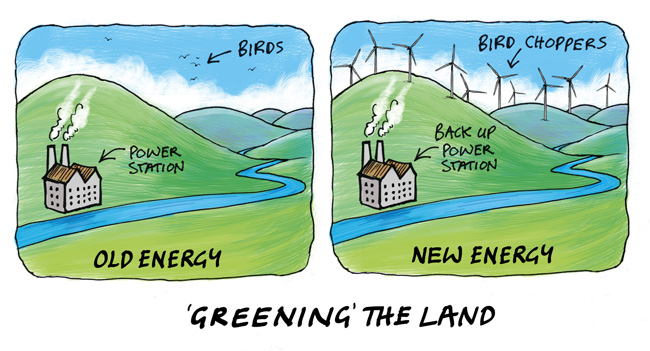

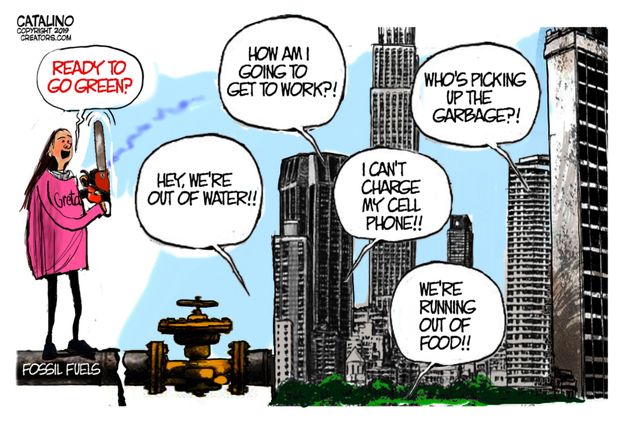
 Supposedly the assault on fossil fuels — via regulation; cancellation of pipelines; concocting a huge, wholly imaginary “social cost of carbon”; taxes; and solar and wind mandates — is necessary to save the planet from imminent catastrophe produced by man-made global warming.


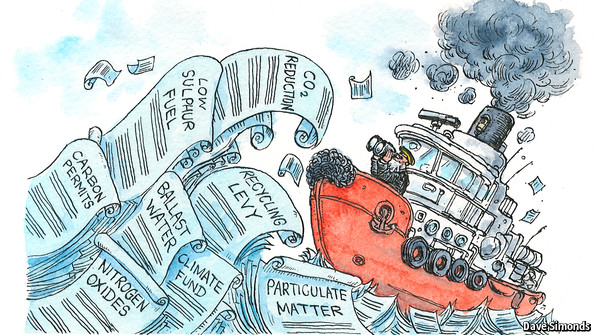





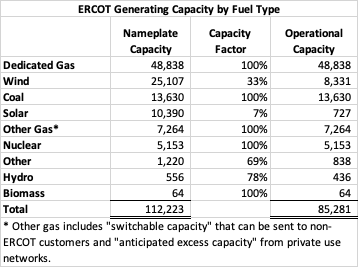




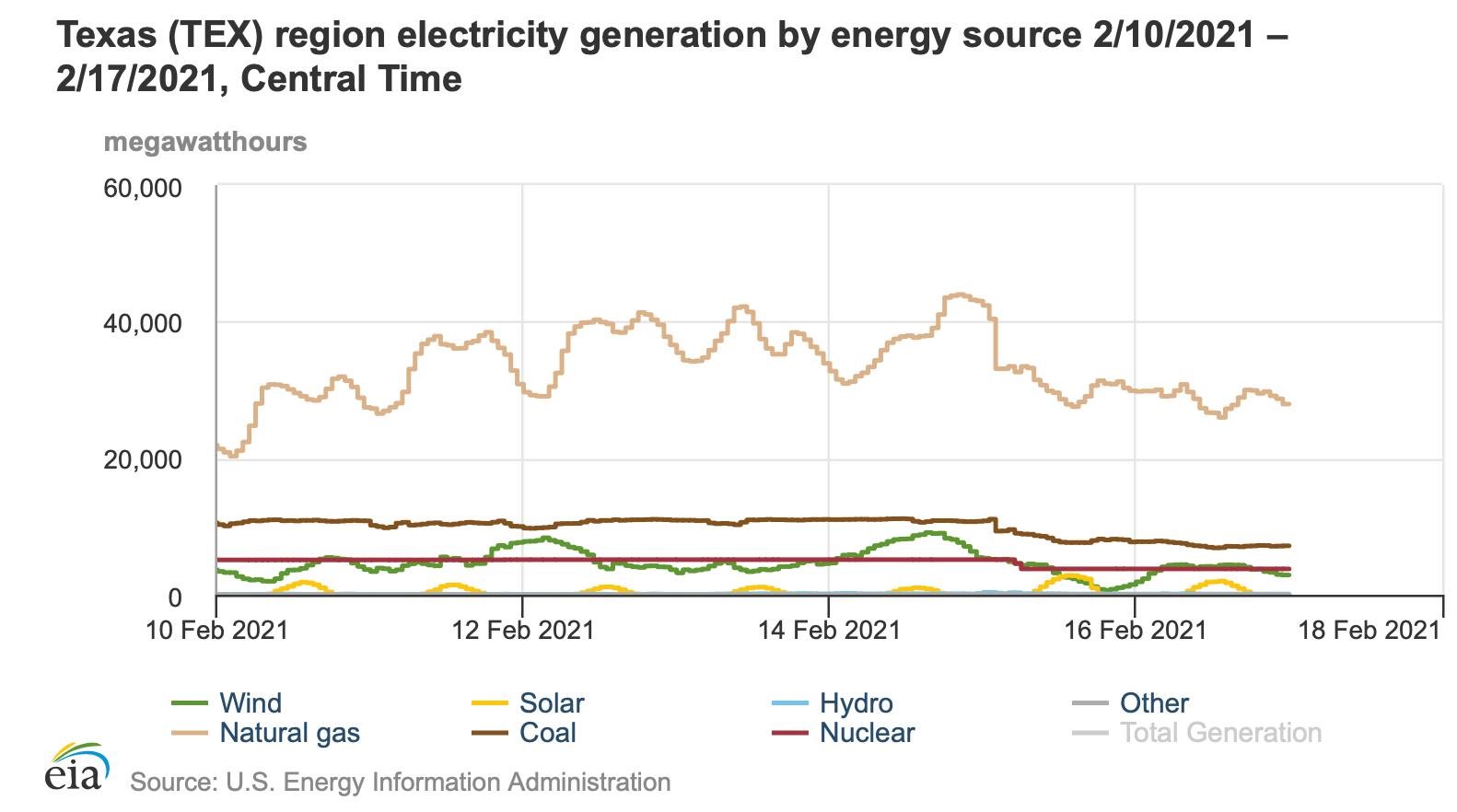

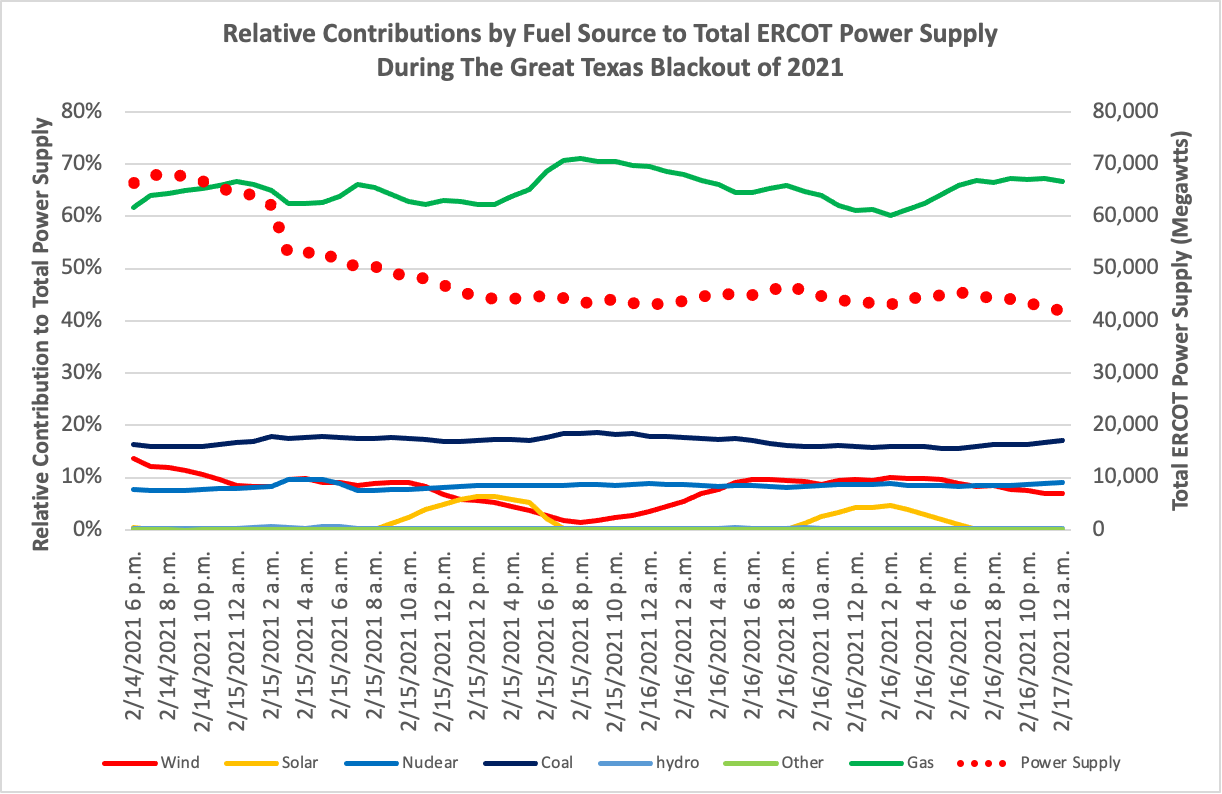
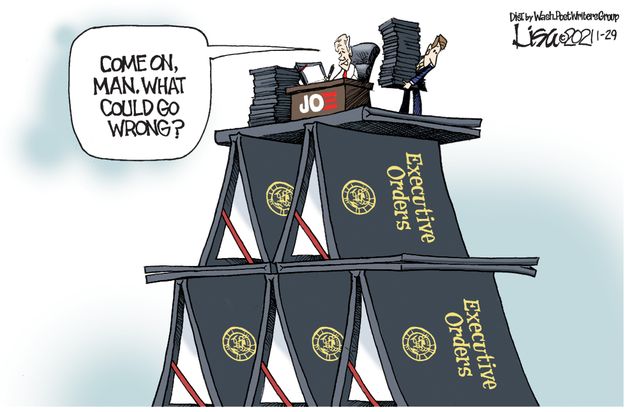
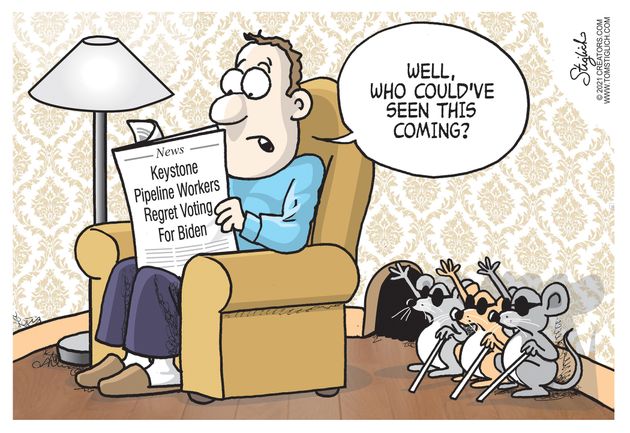


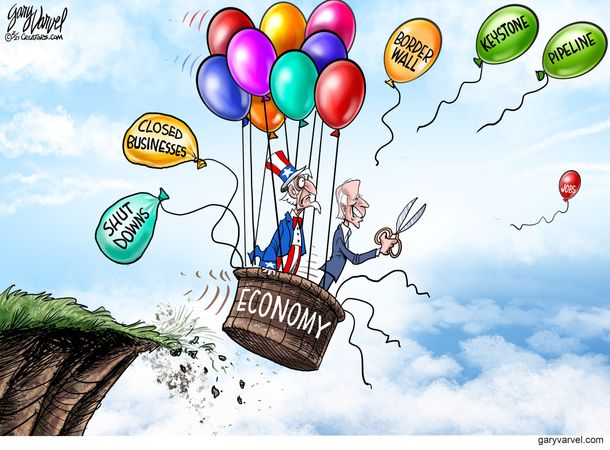
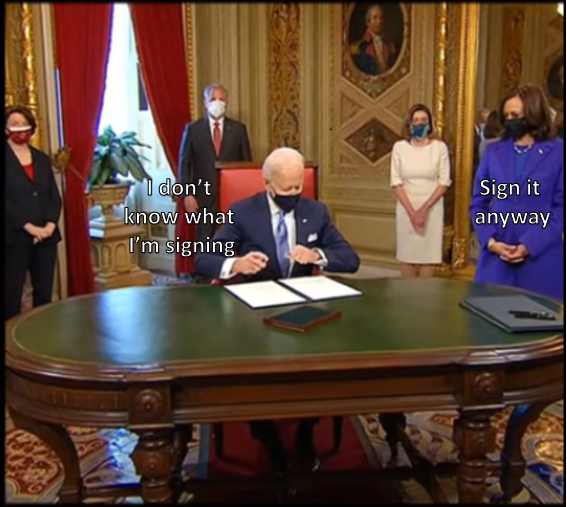

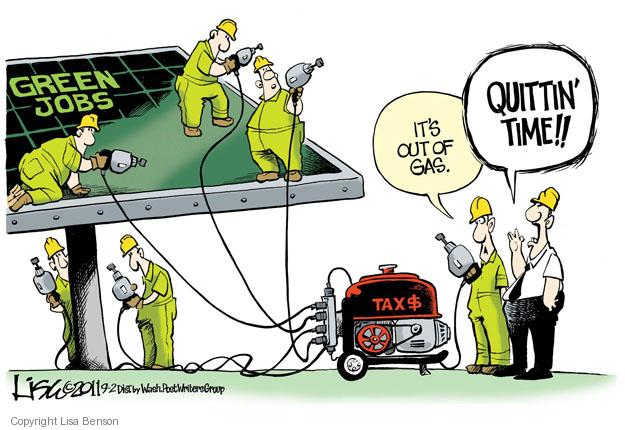

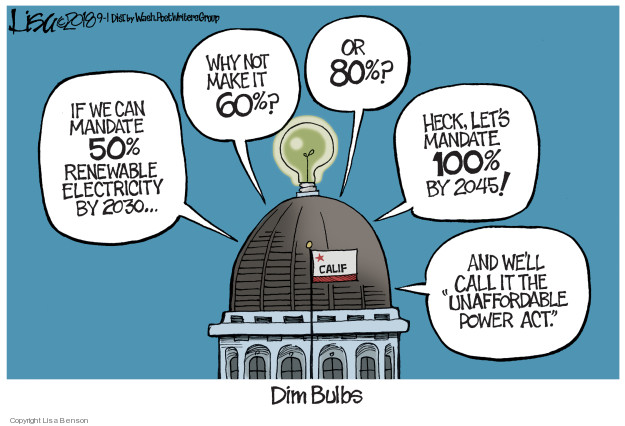

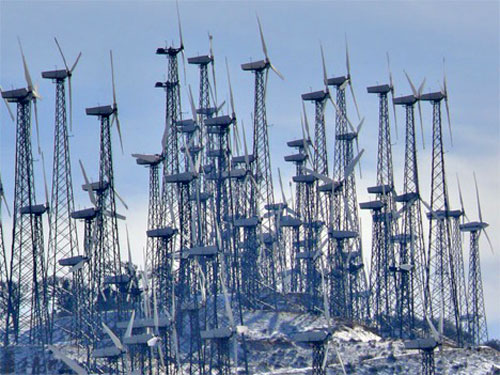



 Science Matters