Running the Climate Gauntlet

Several Native American tribes of the Eastern Woodlands culture forced prisoners to run the gauntlet (notables included Daniel Boone). Forced to run between two rows of people repeatedly striking him, the runner could only survive by taking the blows while moving forward and avoiding a stumble. No mercy is shown to one who loses his footing and falls to the ground.

Currently US Senators are putting Scott Pruitt through their gauntlet, called the Confirmation Hearing for the Nominated Director of the EPA. Pruitt recently provided 242 pages of written responses to hundreds of questions from senators. Below are extracted many of the substantial questions and answers regarding climate change. The interchanges reveal the preoccupations of climate activists and the contrasting worldviews of climate alarmists and skeptics.
H/T to Steve Milloy for links to the document at Junk Science EPA nominee Pruitt doubles down on climate skepticism

In the text below, the question number comes from a particular senator’s list, the answer paragraph is Scott Pruitt’s response.  (Many questions were not specific to climate change per se.)  I have bolded some notable themes and put some key statements into italics.

Senator Booker:

3. Climate change is one of the most pressing issues currently facing the planet. Rising sea levels and extreme weather are currently threatening the safety and security of my constituents in New Jersey. Lower income and vulnerable communities are disproportionately impacted by the extreme heat and flooding events that are becoming more common and more severe. Given the immediate and increasing threat to my constituents and to people everywhere, what is your plan to address climate change?

If confirmed, I will work to achieve the objectives of EPA-administered laws consistent with the process and framework established by Congress. I will work closely with the states in establishing and implementing regulatory standards to ensure a meaningful and effective advancement of these objectives.

Senator Cardin:

31.What is your understanding of the role of climate change in algal blooms?

EPA identifies the following as causes of harmful algal blooms: sunlight, slow-moving water, and excess nutrients. For climate change to have a role, it would first have to have an impact on one of these three causes.

74.How does your position that EPA should ostensibly recuse itself from State Department responsibilities and engagements on the Paris Agreement comport with any plans that you, as the next EPA administrator, may execute to rescind or alter domestic policies that affect the US National Determined Contribution (NDC) to the Paris Agreement?

As I stated in a previous answer, should the State Department decide to continue to participate in the Paris Agreement and if I am confirmed as Administrator, I will work with all involved agencies to ensure that commitments made on behalf of the United States are achievable and consistent with requisite legal authorities delegated by Congress.

75.Recently at the World Economic Forum in Davos, Switzerland, Chinese President Xi Jinping expressed China’s great interest in being the world’s leader on a number of issues including action to address climate change. Do you believe it is the U.S.’s national interest to cede leadership to the Chinese on global action to address climate change?

It is the mission of the State Department to advance our national interests within the realm of foreign policy. If confirmed, I will work to advance the mission of the EPA, which is to protect human health and the environment, consistent with the State Department’s strategy for international engagement on climate change.

76.Do you believe climate change is a real and serious threat to the planet?

The climate is changing and human activity impacts our changing climate in some manner. The ability to measure with precision the degree and extent of that impact, and what to do about it, are subject to continuing debate and dialogue.

77.Do you accept the scientific consensus that should average global temperatures reach or exceed +2 degrees Celsius that many regions of the world will very likely experience catastrophic changes in the environment that may very likely impact the safety and prosperity of many people?

  • Do you believe that uncertainty in climate science warrants greater study before the U.S. takes significant action to reduce greenhouse gas pollution?
  • If so, are you aware that the portion of the scientific community that claims there is uncertainty in the science is limited to limited to about 5% of climate science communities?
  • If you believe that the very small portion of the world’s climate science community who hold outlier opinions on the severity of climate change justifies inaction, why wouldn’t you give similar credence to other outlying opinions in the climate science community that hold that global average temperatures may exceed 10 degrees Celsius and that catastrophic events may occur as soon as five or ten years?

The climate is changing and human activity impacts our changing climate in some manner. The ability to measure with precision the degree and extent of that impact, and what to do about it, are subject to continuing debate and dialogue. If confirmed, I will work to ensure that any regulatory actions are based on the most up to date and objective scientific data.

78.Our ability to predict the weather has improved dramatically over the last 20 years with the advent of supercomputers, new satellite monitoring options, and vastly superior atmospheric models. But still floods, droughts, hurricanes and similar phenomena occur and cause damage with sometimes only limited warning. What precision of prediction do you require before you are willing to accept the scientific community’s overwhelming consensus that unchecked increases in greenhouse gas emissions will very likely have catastrophic effects, many of which the National Climate Assessment has described in detail every 4 years since 1990?

The ability to measure with precision the degree and extent of human activity on our changing climate, and what to do about it, are subject to continuing debate and dialogue. If confirmed, I will work to ensure that any regulatory actions are based on the most up to date and objective scientific data.

80.What would have to change about our ability to predict the effect of increasing greenhouse gas emissions in Earth’s atmosphere for you to consider it adequate?

If confirmed, I will work to ensure that any regulatory actions are based on the most up to date and objective scientific data, including the ever-evolving understanding of the impact increasing greenhouse gases have on our changing climate.

87.Do you trust the analysis, concerns and recommendations of security experts at the State Department, Department of Defense, Central Intelligence Agency, The Navy War College, UN Security Council, and the World Bank, who have expressed growing concerns over the threat climate change poses to national and global security?

I have no reason to disagree with the statements from the listed security experts, although I have not made any attempt to independently verify their accuracy.

Senator Carper

15.Mr. Pruitt, my State of Delaware is already seeing the adverse effects of climate change with sea level rise, ocean acidification, and stronger storms. While all states will be harmed by climate change, the adverse effects will vary by state and region. Can you comment on why it is imperative that we have national standards for the reduction in carbon pollution?

If confirmed, I will fulfill the duties of the Administrator consistent with Massachusetts v. EPA and the agency’s Endangerment Finding on Greenhouse Gases respective of the relative statutory framework established by Congress.

60.As you are well aware, on April 2, 2007, in Massachusetts v. EPA, 549 U.S. 497 (2007), the Supreme Court determined that sufficient information existed then for EPA to make an endangerment finding with respect to the combined emissions of six greenhouse gases from new motor vehicles and new motor vehicle engines under CAA section 202(a). On December 7, 2009, the Administrator determined that those gases/sources contribute to greenhouse gas pollution that endangers public health and welfare. How do you plan to execute your legal authority to protect the public health and welfare from greenhouse gas pollution?

The Supreme Court held that GHGs are an air pollutant under the Clean Air Act. It did not address the question of whether regulation of GHGs under the Clean Air Act is warranted. In the subsequent UARG decision, the Supreme Court cautioned EPA that there are significant limits on EPA’s authority to regulate GHGs under the Clean Air Act. The unprecedented Supreme Court stay of EPA’s so-called “Clean Power Plan” was predicated upon a finding that the plaintiffs in the case were likely to prevail on the merits. In light of these holdings, I will hew closely to the text and intent of the Clean Air Act when considering further regulation of GHGs under that law if confirmed as Administrator.

63.As you know, the Renewable Fuels Standard, as amended by Congress in 2007, requires the blending of 36 billion gallons of renewable fuel into conventional gasoline and diesel by 2022. In order to add that many renewable fuel gallons to our fuel supply, do you agree that EPA must approve the sale of fuels blended with greater than 10-percent renewable content?

While Congress included “applicable volume” levels in the RFS statute, Congress also took care to expressly authorize the EPA Administrator to reduce volumetric requirements below the statute’s default levels in light of real-world conditions from year to year. Specifically, the Administrator may waive the statute’s volume requirements if he determines “that implementation of the requirement would severely harm the economy or environment of a State, a region, or the United States, or “that there is an inadequate domestic supply.” The EPA already has granted such waivers based on real-world conditions in recent years and, if confirmed, I would take care to administer the statute in accordance with the statutory objectives. While no statute mandates the sale of fuels blended with greater than 10 percent renewable content, statutes do vest the Administrator with discretion to authorize a variety of fuel blends.

132.Do you agree with this statement from NASA: “97 percent or more of actively publishing climate scientists agree: Climate-warming trends over the past century are extremely likely due to human activities.” If not, please explain why you do not agree.

I have no reason to disagree with NASA’s statement, although I have not made any attempt to independently verify its accuracy.

Senator Gillibrand:

37.What is the scientific basis for sea level rise, which we have experienced along the coast of New York State?

If confirmed as Administrator, I will work to ensure EPA regulatory actions are based on the most up to date and objective scientific data, including the ever-evolving understanding of the changes in our climate and sea level rise.

38.Do you agree with the National Climate Assessment that human-induced climate change has already increased the number and strength of extreme weather events?

I am aware of the broad range of views within the scientific community regarding the relationship between human activity on changes in the climate and any resulting impact on extreme weather events. If confirmed as Administrator, I will work to ensure EPA regulatory actions are based on the most up to date and objective scientific data.

Senator Markey:

23.The greenhouse gas effect traps outgoing longwave radiation causing a radiative imbalance of Earth, ultimately leading to the warming of the globe. The fundamental physics of climate change are well settled.

  • Are you aware of the theory of radiative balance of the Earth? Can you briefly describe it?
  • Do you understand Planck’s law and the difference between shortwave vs. longwave radiation, and how that relates to Earth’s energy balance?
  • Do you agree that disturbances to this equilibrium can warm or cool the Earth?
  • Are you aware of the atmospheric circulation and oceanic currents that transport heat from the Equator to the poles?
  • Due to the complexity of the climate system, there are lag times between changes in certain conditions, such as the amount of carbon dioxide in the atmosphere, and other observable changes, such as the temperature of the deep ocean. If an action by the United States or world today, could positively or negative benefit the future, say 50 to 100 years down the road, is that an important consideration?
  • Are you aware that there is less ice on land in such places as Antarctica and Greenland than in previous years since the Industrial Revolution? What do you believe is causing this decrease in mass of ice on land?
  • To where do you believe the water from ice melt on land goes, and do you believe that could cause global sea levels to rise?
  • Do you disagree that additional greenhouse gases in Earth’s atmosphere, such as carbon dioxide, will cause a smaller magnitude outgoing longwave radiation to escape to space? Please explain.
  • Do you disagree that the burning of fossil fuels, such as oil or natural gas, cause carbon dioxide to be released into the atmosphere? Please explain.
  • Do you disagree that if fossil fuels were not extracted and burned, less carbon dioxide would be released into the atmosphere? Please explain.
  • Therefore, is it possible, if not probable, that humans releasing greenhouse gases into the atmosphere could cause more heat to be trapped by the atmosphere? Please explain.
  • Do you understand that the concept address is the previous question is the basis of human-caused climate change? Please explain.
  • If not human burning of fossil fuels, how do you explain the observed increase in carbon dioxide in atmosphere?
  • What is a safe level of carbon dioxide in the atmosphere? Please provide this number in parts per million. Please explain.
  • If states want to individually take measures to curb greenhouse gas emissions will you allow them to do so? If yes, how will you support them? If not, why does the EPA have the authority to stop a state from implementing measures to curb greenhouse gases?

If confirmed, I will work to ensure that any regulatory actions are based on the most up to date and objective scientific data, including the ever-evolving understanding of the impact increasing greenhouse gases have on our changing climate. I will also adhere to the applicable statutory authorities to fulfill EPA’s mission to protect human health and the environment consistent with the process and rule of law established by congress. I also believe the Administrator has an important role when it comes to the regulation of carbon dioxide, which I will fulfill consistent with Massachusetts v. EPA and the agency’s Endangerment Finding on Greenhouse Gases respective of the applicable statutory framework established by Congress. I believe the most effective path towards achieving these objectives is through close partnership with the states granting them regulatory leeway as ascribed by the rule of law.

Senator Merkley:

11.There are many groups within the Christian community — and groups from other faiths — in the United States who agree with the overwhelming scientific consensus that climate change is a danger to our country, and who strongly support taking action to mitigate the causes and impacts of climate change. For example, the Southern Baptist Convention made a statement in 2007 saying that Christians are responsible for caring for creation, and emphasized the importance of acting to prevent climate change. The President of the Southern Baptist Theological Seminary, has also issued a statement echoing these views. As EPA Administrator, would you share the view that, in the interest of caring for creation, that action should be taken to prevent climate change?

I believe we can grow our economy, harvest the resources God has blessed us with, while also being good stewards of the air, land, and water by which we have been favored. If confirmed, I will work to advance the mission of EPA to protect human health and the environment within the framework established by Congress.

13. 97% of publishing climate scientists support the idea the climate change is real and man-made. You are an attorney, but have questioned the reality of climate change. Do you currently agree that climate change is real and manmade? If not do you believe the 97% of climate scientists that do hold that view are wrong, or lying?

The ability to measure with precision the degree and extent of human activity on our changing climate, and what to do about it, are subject to continuing debate and dialogue. If confirmed, I will make sure the agency’s regulatory actions are based on the most up to date and objective scientific data.

14.What scientific organizations do you personally trust when it comes to the science of climate change? Please explain why you trust any organization(s) you list.

If confirmed as EPA Administrator, I will adhere to the applicable statutory authorities to fulfill EPA’s mission to protect human health and the environment and will base my decisions on sound science, including advice provided by agency experts and advisory personnel.

15.Below is a list of statements from the Intergovernmental Panel on Climate Change’s Fifth Assessment Report. For each statement, please indicate your agreement or disagreement and explain your reasoning:
• “Warming of the climate system is unequivocal.”
• “The atmosphere and ocean have warmed, the amounts of snow and ice have diminished, sea level has risen, and the concentrations of greenhouse gases have increased.”
• “The atmospheric concentrations of carbon dioxide, methane, and nitrous oxide have increased to levels unprecedented in at least the last 800,000 years.”
• “Carbon dioxide concentrations have increased by 40% since pre-industrial times, primarily from fossil fuel emissions and secondarily from net land use change emissions.”
• “The ocean has absorbed about 30% of the emitted anthropogenic carbon dioxide, causing ocean acidification.”
• “The largest contribution to total radiative forcing is caused by the increase in the atmospheric concentration of CO2 since 1750.”
• “It is extremely likely that human influence has been the dominant cause of the observed warming since the mid-20th century.”
• “Continued emissions of greenhouse gases will cause further warming and changes in all components of the climate system.”
• “It is very likely that the Arctic sea ice cover will continue to shrink and thin and that Northern Hemisphere spring snow cover will decrease during the 21st century as global mean surface temperature rises. Global glacier volume will further decrease.”
• “Global mean sea level will continue to rise during the 21st century…. [T]he rate of sea level rise will very likely exceed that observed during 1971 to 2010 due to increased ocean warming and increased loss of mass from glaciers and ice sheets.”
• “Limiting climate change will require substantial and sustained reductions of greenhouse gas emissions.”

There is a diverse range of views regarding the key drivers of our changing climate among scientists. I believe that these differences should be the subject of robust and open debate free from intimidation. If confirmed, I will continue to encourage an honest debate on our changing climate, the role of human activity, our ability to measure the degree and extent of human activity, and what to do about it. If confirmed, I will work to ensure that any regulatory actions are based on the most up to date and objective scientific data. I will also adhere to the applicable statutory authorities to fulfill EPA’s mission to protect human health and the environment consistent with the process and rule of law established by congress.

16.Are you aware that each of the past three decades has been warmer than the one before, and warmer than all the previous decades since record keeping began in the 1880s? This trend is based on actual temperature measurements. Do you believe that there is uncertainty in this warming trend that has been directly measured? If so, please explain.

I am aware of a diverse range of conclusions regarding global temperatures, including that over the past two decades satellite data indicates there has been a leveling off of warming, which some scientists refer to as the “hiatus.” I am also aware that the discrepancy between land-based temperature stations and satellite temperature stations can be attributed to expansive urbanization within in our country where artificial substances such as asphalt can interfere with the accuracy of land-based temperature stations and that the agencies charged with keeping the data do not accurately account for this type of interference. I am also aware that ‘warmest year ever’ claims from NASA and NOAA are based on minimal temperature differences that fall within the margin of error. Finally, I am aware that temperatures have been changing for millions of years that predate the relatively short modern record keeping efforts that began in 1880.

17.Is there a scientific basis, based on the best available science and the weight of scientific evidence, for revoking or revising the finding that greenhouse gases endanger public health and welfare?

To my knowledge, there is nothing currently pending before the EPA that would require I take any additional actions on the Endangerment Finding on Greenhouse Gases and if there were, it would not be wise to prejudge the outcome.

39.The 2014 U.S. National Climate Assessment concludes that climate change will impact every community in the United States, and that low-income communities and communities of color will be the hardest hit. These vulnerable communities will feel the impacts of climate change more severely due to lower quality housing, which is often less equipped to safely weather severe storms, severe heat, and freezing temperatures. How will you work to reduce climate change risks in low-income communities and communities of color?

I believe environmental justice for low-income and minority communities is an important role of the EPA Administrator. If confirmed, I will adhere to the applicable statutory authorities to fulfill EPA’s mission to protect human health and the environment for all of our nation’s citizens.

Senator Sanders:

12.As Administrator, will you recognize the findings of the U.S. Climate Change Science Program/U.S. Global Change Research Program and the National Research Council of the U.S. National Academy of Sciences on the science of climate change, including its anthropogenic causes?

If confirmed, I will work to ensure that any regulatory actions are based on the most up to date and objective scientific data, including the ever-evolving understanding of the impact increasing greenhouse gases have on our changing climate.

14.Do you support the Paris Climate Agreement?

The role of the United States in the Paris Agreement is a State Department matter. If confirmed, I will work to advance the mission of the EPA, which is to protect human health and the environment, consistent with the State Department’s strategy for international engagement on climate change.

15.What are your plans for implementing the Paris Climate Agreement?

Should the government decide to continue to participate in the Paris Agreement and if I am confirmed as Administrator, I will collaborate with all involved agencies to ensure that commitments made on behalf of the United States are achievable and consistent with requisite legal authorities delegated by Congress.

16.You have written that the climate change “… debate is far from settled. Scientists continue to disagree about the degree and extent of global warming and its connection to the actions of mankind.” What would it take for you to admit that all three of these allegations are incorrect?

If confirmed, I will work to ensure that any regulatory actions are based on the most up to date and objective scientific data, including the ever-evolving understanding of the impact increasing greenhouse gases have on our changing climate.

18.If Harold Hamm told you he was no longer a climate change denier, would you believe him?

I do not believe he is a climate change “denier.”

19.President Elect Trump’s Secretary of State nominee, Rex Tillerson, is no longer a climate change denier. Why do you disagree with Tillerson?

There is a diverse range of views regarding the key drivers of our changing climate among scientists, policy-makers and President Trump’s nominees. I believe that these differences should be the subject of robust and open debate free from intimidation. If confirmed, I will continue to encourage an honest debate on our changing climate, the role of human activity, our ability to measure the degree and extent of human activity, and what to do about it.

Senator Whitehouse:

6.Do you accept the science of ocean acidification that has directly connected the increase in human-caused carbon dioxide emissions with decreases in ocean pH?

First, I would note that the oceans are alkaline and are projected to remain so. Second, it is my understanding that the degree of alkalinity in the ocean is highly variable and therefore it is difficult to attribute that variability to any single cause.

7.Do you accept that the oceans are currently acidifying at a rate unprecedented in tens of millions of years?

First, I would note that the oceans are alkaline and are projected to remain so. Second, it is my understanding that the degree of alkalinity in the ocean is highly variable and therefore it is difficult to attribute that variability to any single cause. I am unaware of tens of millions of years of data on the pH of oceans.

11.Both states and some Members of Congress have for years criticized EPA for “one-size-fits-all approaches” and failing to give adequate flexibility to states. Yet in challenging EPA’s Clean Power Plan, you attacked EPA for just that – giving states and regions too much latitude in administering the Clean Air Act. Wouldn’t that take the Agency in the wrong direction?

I, along with the Supreme Court, which issued a stay against the Clean Power Plan in February 2016, believe the EPA exceeded the bounds of authority established by Congress in the Clean Air Act. In particular, the Rule attempted to supplant decisions traditionally preserved for the states, including the establishment of intrastate energy policies, for agency mandated alternatives that would have increased the price of electricity for local citizens and reduced reliability. The notion of flexibility in the Clean Power Plan was conceptual at best. If confirmed, I will work to achieve the objectives of EPA-administered laws consistent with the process and framework established by Congress abiding by the bedrock principle of cooperative federalism, which relies on meaningful collaboration between the EPA and the states to achieve important environmental objectives.

13.In 2014, four Republican former EPA Administrators – Bill Reilly, Bill Ruckelshaus, Lee Thomas, Governor Christine Todd Whitman – testified before EPW that climate change is real, EPA regulations do not end up costing as much as industry initially estimates, and EPA has clear authority under the Clean Air Act to curb carbon pollution. In a 2015 interview with Climate Progress, Governor Whitman said: “The idea the EPA is a job killer is false” and with regard to the Clean Power Plan “what EPA did was to allow as much flexibility as frankly I’ve ever seen them be able to create in a regulation.” Do you think that the former Administrators are correct in their assessment that regulations do not cost as much as industry initially estimates? If not, can you explain why not?

I am not sure what specific regulations the former EPA Administrators were referring to and accordingly lack sufficient information to answer the specific question. Generally speaking, if confirmed, I will work to ensure that EPA regulatory actions accurately account for the costs and benefits across all impacted stakeholders.

14.Carbon Capture Utilization and Storage is a bipartisan policy area that I am working on with my Republican colleagues. Senator Graham and I visited the world’s first Carbon Capture project in Canada that has been operational since 2014. In 2016, SaskPower successfully captured and injected 800,000 metric tons of carbon dioxide and the facility has operated nearly 85 percent of the time. Recently, Petra Nova in Texas became the first United States first post-combustion carbon capture project to begin operation. SaskPower and Petra Nova are listed in the Clean Power Plan as viable options for helping states reach their Clean Power Plan targets. Do you believe that CCUS is a viable technology for reducing emissions from power plants?

I believe CCUS technology can play an important role in the development of our future coal fleet, however it is not yet a viable option. Both the SaskPower and Petra Nova plants referenced in your question relied on significant support from their respective governments to become operational. Forcing private businesses to use unproven, expensive technology would be unfair, which is why Congress provided for protections against the EPA embracing such a practice in the Energy Policy Act of 2005.

18.According to the Wind Energy Association and Solar Energy Industries Association, in 2016 the United States had 400,000 wind and solar jobs–310,000 solar, 88,000 wind. In contrast, according to 2016 DOE Energy Employment Report, employment in oil and gas extraction was 388,000 and 53,000 in coal mining. The Energy Information Administration (EIA) just found that coal production continued to decline in 2016 down nearly 17% from 2015 production. Its Annual Energy Outlook in 2017 reports that declining cost of natural gas is still encouraging utilities to shift away from coal over the long-term. The change is expected under our existing policies regardless of the Clean Power Plan. Do you believe that dismantling the Clean Power Plan and cutting back on environmental regulations will bring back the coal industry? Specifically, will it bring back coal jobs and make coal the dominate source of electricity in the U.S. again?

I am unable to say whether United States utilities and electric cooperatives would or would not return to coal as a predominant portion of their fuel mix if the Clean Power Plan were revoked or other regulations were cut back. The federal Energy Information Administration projects that coal will be an important part of the American fuel mix for the foreseeable future.

20.Improved environmental quality and economic growth aren’t mutually exclusive. Since 2009, the states participating in the Regional Greenhouse Gas Initiative (RGGI) have seen carbon pollution fall by 18% while their economies grew by 9.2%. Emissions in the other 41 states fell by 4% while their economies grew by 8.8%. Do you agree that RGGI has developed a successful model for growing our states’ economies and cutting carbon pollution at the same time? Will you commit to maintaining funding levels for EPA grant programs that fund state level initiatives to reduce their emissions?

While the agreement between the states participating in RGGI appears to be successful, what works for the Northeast may not achieve the same success in, for example, the Southwest. If confirmed, I look forward to working with EPA’s budget staff and program offices to develop a budget focused on protecting human health and the environment for all populations. I will work to ensure that the limited resources appropriated to EPA by Congress are managed wisely in pursuit of that important mission and in accordance with all applicable legal authorities.

32.The State Department and others have assessed life-cycle emissions for various crude oils and found tar sands crude is one of the dirtiest crudes on the planet from a GHG perspective. Do you agree tar sands crude has significantly higher life-cycle emissions than Oklahoma Sweet and most other crude oils?

The lifetime emissions of any energy source should be considered in the context of necessary extraction techniques as well as transportation of the fuel, among other issues. For example, transporting crude via pipeline clearly creates fewer emissions than transporting it via other sources in terms of fossil fuel energy. Without knowing the specifics of all of these factors in a given instance, it is difficult to identify which sources may result in greater emissions.

35.The State Department found that the emissions associated with the production, refining and combustion of the tar sands in Keystone XL would result in 147 to 168 million metric tons (MMT) CO2e per year (equivalent to the emissions from as many as 35.5 million cars). The State Department also found that by displacing conventional crude with dirtier tar sands, the project would result in 1.3 – 27.4 MMT CO2e of additional emissions (equivalent to the emissions from as many as 5.7 million cars). Do you agree? If you disagree, please identify any research studies or experts you have consulted to form your opinion.

I am familiar with multiple State Department determinations that the Keystone XL pipeline would not significantly impact climate change.

36.In a recent study, the National Academy of Sciences (NAS) concluded that diluted bitumen—the type of crude that would be primarily transported by Keystone XL—has a series of properties that, taken together, make tar sands spills of greater concern for spill responders than spills of other, commonly transported crude oils. Both EPA and the Coast Guard advised the scientists on the NAS committee. Do you agree with their conclusion that tar sands spills pose greater risks and challenges for spill responders than other crude oil spills? If you disagree, please identify any research studies or experts you have consulted to form your opinion.

Diluted bitumen has been transported safely by pipeline in the United States for more than 40 years. It is my understanding that he NAS report did not infer that the Keystone XL pipeline posed significant concerns or that diluted bitumen could not be safely transported via pipelines or other forms of transportation.

42.Based on the climate change implications, spill potential, and other factors, the Obama Administration determined Keystone XL isn’t in our nation’s best interest. Do you agree? If not, why?

While the Obama Administration failed to grant the cross-border permit required to complete the Keystone XL pipeline, much of the pipeline was built in accordance with applicable laws and permits both federal and state. A large portion of the Keystone XL pipeline safely operates through Oklahoma and I believe that safely and efficiently moving natural resources through the country is very important.

Footnote:  If you want to run the whole gauntlet, the complete set of Pruitt responses is (here).  Again, H/T to Junk Science

Summary

This is the closest thing to a debate on climate change since 2008. Debates stopped when alarmists discovered audiences came away more skeptical from the experience. These hearings are not really a fair and open discussion of the topic, since the Senators have nothing to lose while the Nominee faces rejection.

In 2010 the Hartwell paper observed:

Climate change was brought to the attention of policy-makers by scientists. From the outset, these scientists also brought their preferred solutions to the table in US Congressional hearings and other policy forums, all bundled. The proposition that ‘science’ somehow dictated particular policy responses, encouraged –indeed instructed – those who found those particular strategies unattractive to argue about the science.

So, a distinctive characteristic of the climate change debate has been of scientists claiming with the authority of their position that their results dictated particular policies; of policy makers claiming that their preferred choices were dictated by science, and both acting as if ‘science’ and ‘policy’ were simply and rigidly linked as if it were a matter of escaping from the path of an oncoming tornado.

The Senate hearings show that nothing has changed. Leftist politicians invest into their climate beliefs way more certainty than the facts support. They quote from the IPCC as though presenting Scriptural references. Even the Bible is invoked in support of their environmentalist agenda.  They seem unable to process new information this century casting doubt upon their assumptions.

In the face of this, it is good to see Scott Pruitt maintaining his balance and moving ahead. Many of his responses would win debating points in an open dialogue. Pruitt was once owner and general manager of the Oklahoma Redhawks, a AAA professional baseball team. Maybe he has some Chickasaw blood in his veins equipping him to be such a Brave running this gauntlet.

Senators Sing from Climate Hymnbook

More from true believers in climatism during today’s Senate confirmation hearings, featuring Bernie Sanders and Ed Markey.

Ryan Zinke, nominee for Secretary of the Interior appeared before the Senate Energy and Natural Resources Committee for his confirmation hearing Tuesday.

Senator Bernie Sanders of Vermont:
Is President Elect Trump right? Is climate change a hoax?

Secretary of the Interior Nominee Ryan Zinke:
First of all, the climate is changing. That’s indisputable. Secondly, man is having an influence. I think the debate is about what is that influence, and what can we do about it.

If confirmed I will inherit the USGS, where there are a lot of great scientists. I am not a climate scientist, but I will become a lot more familiar with it, and it will be based on objective science. I don’t believe it is a hoax.

I believe we should be prudent, I don’t know definitively. There is a lot of debate on both sides of the aisle.

Senator Sanders:
Actually, there is not a whole lot of debate now, the scientific community is virtually unanimous that climate change is real and causing devastating problems. There is a debate within this committee, but not in the scientific community.

If climate change is already causing devastating problems, should we be drilling for fossil fuels on public lands?

Nominee Zinke:
We need an economy and jobs too. I support an “all of the above” approach to energy sources. I think that is the better way forward.

Scott Pruitt Nominee for Director of EPA appeared before the Senate Committee on Environment and Public Works.

Senator Ed Markey, Massachusetts:
NOAA, NASA have declared that 2016 is the hottest year in the 137 year record that has been kept. Donald Trump has said that global warming is a hoax caused by the Chinese. Do you agree that global warming is a hoax?

Nominee Scott Pruitt: I do not, Senator.

Senator Markey: So, Donald Trump is wrong.

Nominee Pruitt: I do not believe climate change is a hoax.

Senator Markey: OK, I think that is important for the President to hear.

Senator Bernie Sanders:
As you may know, some 97% of scientists who have written articles for peer-reviewed journals have concluded that climate change is real, it is caused by human activity, and it is already causing devastating problems in the US and around the world. Do you believe that climate change is caused by carbon emissions from human activity?

Nominee Scott Pruitt
As I said in my opening statement, the climate is changing and human activity contributes to that in some manner.

Senator Sanders:
97% of the scientists who publish in this field believe that human activity is the fundamental reason we see climate change. Do you disagree with that?

Nominee Pruitt:
I believe that the ability to measure with precision the degree of human activity to impact the climate is subject to more debate on whether the climate is changing and whether the human activity contributes to it.

Senator Sanders:
While you are uncertain, the vast majority of scientists are telling us, if we do not get our act together, and transform our energy system away from fossil fuel, there is a real question as to the quality of the planet we will be leaving to our children and our grandchildren.

The overwhelming majority of scientists say we have to act boldly, and you are saying more debate is needed on this issue, and we should not be acting boldly.

Nominee Pruitt:
No Senator, as I said the climate is changing.

Senator Sanders:
Why do you think the climate is changing?

Nominee Pruitt:
In response to the CO2 issue, the EPA administrator is constrained by statutes passed by this body.

Senator Sanders:
I am asking for your personal opinion.

Nominee Pruitt:
My personal opinion is immaterial.

Senator Sanders:
Really. You’re going to be the head of the agency to protect the environment, and your personal feelings about whether climate change is caused by human activity and carbon emissions is immaterial?

Nominee Pruitt:
Senator, I have acknowledged to you that human activity impacts on the climate.

Senator Sanders:
The scientific community doesn’t tell us that it impacts, they say human activity is the cause of climate change and we have to transform our energy system. Do you believe we have to transform our energy system in order to protect the planet for future generations?

Nominee Pruitt:
I believe the EPA has a very important role in regulating emissions.

Senator Sanders:
You haven’t answered my question.

Summary

Again the 97%, though Sanders is more circumspect in linking that to scientists publishing in the climate field. He doesn’t let on that it originated from 75 out 77 respondents, culled from more than 3000.  Furthermore, he greatly exaggerates their views when he says climate change is already causing “devastating problems.”

From these interrogations, we see that Senators are seeking personal opinions on a subject not of knowledge but of belief. That is actually an unconstitutional basis for qualifying a federal appointee. (Article Six)

The whole emphasis on 97%, vast, or overwhelming majority is to distract you from the fact that these are opinions.  Neither scientists nor senators know the future, since we lack sufficient knowledge of the climate system to predict its behavior.

Global warming/climate change is a matter of opinion in several respects:
No one knows as a matter of fact whether additional CO2 will result in warmer or cooler temperatures, or make any noticeable difference at all.

It is also anyone’s guess what we can do today to ensure desirable temperatures in the future.

If we had the power to determine future temperatures, opinions vary as to what temperature level would be ideal for everyone living around the world at different  latitudes.

It is hubris to think that government can control the weather and climate. (King Canute, where are you when you are so needed?)  Wise political leaders would realize that there will likely be future periods both colder and warmer than the present. They would also recognize that cold is the greater threat to human health and prosperity. Planning for future climates focuses resources on two priorities:  Robust infrastructures and reliable affordable energy.

Climate Dogma Tests

Article Six of the US Constitution says:

No religious Test shall ever be required as a Qualification to any Office or public Trust under the United States.

In that context, what do we make of questions being put to federal government appointees at their confirmation hearings?

Mike Pampeo, CIA Director nominee at the Senate Intelligence Committee

California Senator, Kamala Harris
In the past you have questioned the scientific consensus on change. Nevertheless, according to NASA, multiple studies published in peer reviewed scientific journals, showed 97% or more of actively published, um, climate scientists agree that climate warning trends over the past century are extremely likely due to human activities. In addition, most of the leading scientific organizations worldwide have issued public statements endorsing this position. Do you have any reason to doubt NASA’s findings?

CIA Director Nominee, Mike Pompeo:
Senator, I’ve actually spoken to this in my political life some. My commentary, most all has been directed to ensuring the policies that America put in place, uh, actually achieve the objective of ensuring we didn’t have catastrophic harm that resulted from changing climate. I continue to hold that view.

Senator Harris
Do you believe that NASA’s findings are debatable?

Nominee Pompeo:
I have not looked at NASA’s findings in particular. I can’t give you any judgment on that today.

Rex Tillerson, Secretary of State nominee at the Senate Foreign Relations Committee

Senator Bob Corker, Committee Chair:
Would you state your personal position as it relates to climate change?

Secretary of State nominee Rex Tillerson:
I came to the position over about 20 years as an engineer and a scientist. I came to the conclusion a few years ago that the risk of climate change does exist and the consequences could be large enough that action should be taken.

Senator Corker:
Do you believe that human activity, based on your belief in science, is contributing to climate change?

Nominee Tillerson:
The increase in the greenhouse gas concentrations in the atmosphere are having an effect. Our ability to predict that effect is very limited.

Senator Tim Kaine:
Exxon-Mobil had a history of funding and promoting climate science denial, despite its internal awareness of the reality of climate change, during your tenure with the company, true or false?

Nominee Tillerson:
Since I am no longer with Exxon-Mobil, I am in no position to speak on their behalf. The question would have to be put to them.

Senator Kaine:
The allegations are about Exxon’s knowledge of climate science and decision to fund and promote a view contrary to its awareness of the science, are those allegations true or false?

Nominee Tillerson: That question will have to be put to Exxon.

Senator Kaine: Do you lack the knowledge to answer my question, or do you refuse to answer?

Nominee Tillerson: A little of both.

Senator Jeff Merkley:
Do you agree with the viewpoint that the odds of dramatic events occurring, whether more forest fires, or more hurricanes with more power, is a rational observation from the scientific literature?

Nominee Tillerson:
As you indicated, there is some literature out there that suggests that. Other literature says that it is inconclusive.

Senator Jeff Merkley: I am sorry to hear that viewpoint. Overwhelmingly, the scales are on one side of this argument.

Senator Tom Udall: Do you plan or would you support any efforts to persecute, sideline, or otherwise retaliate against career state department employees who have worked on climate change in the past?

Nominee Tillerson: No sir, that would be a pretty unhelpful way to get started.

Summary

The climate dogma is captured in a famous tweet:
Ninety-seven percent of scientists agree: climate change is real, man-made and dangerous. Barack Obama

Since that is not what the scientists said, nor what say many other scientists (who were not asked), this is clearly a creed of some kind of religion, call it climatism.

Asking nominees whether they subscribe to a creed or not violates Article Six of the Constitution. Inquisitors can claim there’s no formal religious organization, but they are still looking to disqualify based on dissent in a matter of belief.

Climate Progress on a Rant

There is a torrent of Anti-Trump posts from “Climate Progress”, part of the “Think Progress” set of websites directed by John Podesta and funded by George Soros and Tom Steyer.  The ranting is over the top and could crash the internet before the inauguration.  Maybe that’s the objective.  Look at today’s output of “progressive thinking.”

Climate Progress : Trump is assem­bling the most anti-Iran team
Today: 16:03

@Climate Progress : No Senator Cruz, Jeff Sessions didn’t lead the bankru­pting of the Alabama Klan
Today: 15:56

@Climate Progress : Exxon CEO Rex Tillerson didn’t mention energy, climate, or Exxon in his opening remarks
Today: 15:52

@Climate Progress : Jeff Sessions may soon get to decide whether 63 people live or die
Today: 15:41

@Climate Progress : Six critical questions about conflicts of interest that Donald Trump must answer
Today: 15:37

@Climate Progress : Trump claims he has ‘nothing to do with Russia.’ His son said the opposite.
Today: 15:08

@Climate Progress : 15 things Trump said about Russia that seem even weirder now
Today: 14:51

@Climate Progress : The abortion providers who will see us through a Trump presidency
Today: 14:18

@Google: Trump Nominee Rex Tillerson to Face Questions About Russia, Climate, Rights Wall Street Journal
Today: 13:02

Trump Nominee Rex Tillerson to Face Questions About Russia, Climate , RightsWall Street Journal WASHING­TON—Pre­sident-elect Donald Trump’s pick for secretary of state, Rex Tille­rson, went before senators for a confir­mation hearing Wedne­sday, and planned to tell lawmakers that Russia poses a danger and that North Atlantic Treaty Organi­zation …
Today: 14:43

DeSmogBlog: Fake News You Can’t Use, They’ll Abuse, We All Lose. Except Putin. Putin Wins.
Today: 14:19

@Google: What senators should ask Rex Tillerson about climate change Vox
This is a guest post by ClimateD­enierRou­ndup   Vox What senators should ask Rex Tillerson about climate change Vox One of those questions is about climate change, and it’s worth focusing on that subject for a moment, because this is a very strange and uncertain moment in climate politics. Normally a presid­ential candidate would have taken some kind of position on a … Time to Grill Rex Tillerson on Climate Change New York Times Trump Nominee…
Today: 14:18

Climate Progress : Coretta Scott King: Jeff Sessions would ‘irrep­arably damage’ my husband’s work
Today: 01:19

@Climate Progress : Al Franken lays into Trump for attacking Minnes­ota’s Somali-American community
Today: 01:04

@Google: Republ­icans want to fight climate change, but fossil-fuel bullies won’t let them Washi­ngton Post
Forbes Crazy Carbon Crystals Could Combat Climate Change Forbes In other words the solution could be used to grab CO2, which contri­butes to climate change, direct from the atmos­phere and store it tempor­arily into crystals that form as a result. The resear­chers envision using the process as a way to boost the … and more » Washi­ngton Post Republ­icans want to fightclimate change, but fossil-fuel bullies won’t let them Washi­ngton Post Talking to my Senate Repub­lican colle­agues about climate change is like talking to prisoners about escaping. The convers­ations are often private, even furtive. One told me, “Let’s keep talking, but you can’t let my staff know.” The dirty secret is that … and more »
Today: 01:02

@DeSmogBlog: How Jeff Sessions Profited from Introd­ucing a Fracking Exemption for Drinking Water Rules @The Carbon Brief: Double threat to UK’s birds and butter­flies from climate change and land use
With U.S. Sen. Jeff Sessions (R-AL) in the midst of Senate confir­mation hearings, watchdog group Food and Water Watch has raised new questions about how Sessio­ns and his family p­rofited from a fracking loophole provision he intro­duced in the Se­nate. In the UK, rising temper­atures are making life increa­singly uncomfo­rtable for species of wildlife better…
The group has unveiled new documentsshowing that Sessions­’ family owned stock in Energen, a Birmin­gham, Alabama-based oil and gas company,… The post Double threat to UK’s birds and butter­flies from climate change and land use appeared first on Carbon Brief .
Today: 00:02


Truth in Climate Advertising

Friends of the Earth have been censured for their erroneous and misleading promotional flyer. The UK Advertising Standards Authority (ASA) said Friends of the Earth “agreed not to repeat the claims, or claims that had the same meaning.”

Friends of the Earth spent more than a year trying to defend its claims, which were made in a fundraising leaflet, but has been forced to withdraw them.

The authority found that Friends of the Earth (FoE) failed to substantiate claims that fracking could cause cancer, contaminate water supplies, increase asthma rates and send house prices plummeting.

The group’s capitulation is a victory for a retired vicar and a retired physics teacher who have been working for years to expose what they believe is scaremongering about a safe technique for extracting shale gas. (More about them in the footnote)

Truth in Climate Advertising!  What a Concept!!

Who’s next?  What about Greenpeace:

Greenpeace have been accused of employing deceptive techniques after it was revealed the environmental group had been using images of a storm damaged coral reef in The Philippines as a part of its campaign to have the Great Barrier Reef declared at risk.

On the left is a picture of bright, vibrant and thriving coral, while the image on the right features a pile of damaged, bone-white coral with a warning: ‘Don’t let them turn this, into this.’

Upon completing further research, it was discovered the image of the damaged reef was taken at Apo Island’s marine sanctuary in The Philippines, which was severely damaged by two typhoons in the past four years. From the Daily Mail article
Greenpeace slammed for using photo of storm-ravaged Philippines coral in new ad claiming government is putting Great Barrier Reef under threat.

How about the Natural Resources Defense Council (NRDC):

Shouldn’t they be forced to add this disclaimer:

Summary

climate-alarmists-wheres-the-beef

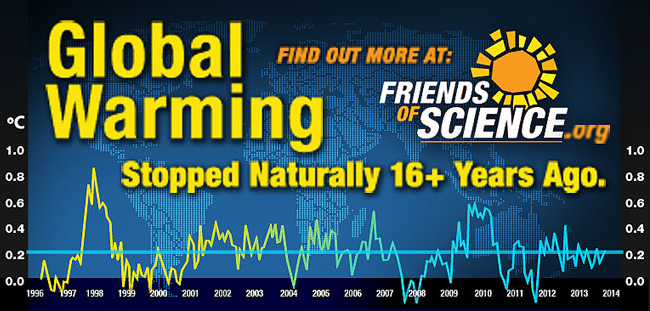
Friends of the Earth are making up stuff.  Friends of Science give you the Beef:

global-warming-stopped

Footnote

The UK Advertising Standards Authority did not have the brass to do their job protecting the public against deceptions.  It took significant prodding from two determined people: a vicar and a retired school teacher.

They had previously complained to the Charity commission, who found a way to stand down rather than stand up.

The Charity Commission is considering closing a loophole in charity law that allowed a green group to raise money by making allegedly false claims in a political campaign against fracking.

Friends of the Earth, a registered charity, avoided restrictions on political activity by claiming that its antifracking campaign was being carried out by a non-charitable company called Friends of the Earth Limited.

The commission said the use of such similar names could confuse the public and damage public trust in charities.

Mr Wilkinson, who said that he had no connection with the fracking industry and was acting purely to ensure the public received accurate information, welcomed the ASA ruling. “It is outrageous that FoE used false information to raise money,” he said. “We need a frank debate about fracking and its potential impacts but it should be based on facts, not scaremongering.”

The Rev. Michael Roberts tells the full story in his article How Fiendish is Friends of the Earth which includes this amusing rebuttal:


SBC: Social Benefits of Carbon


Recently I posted on the Social Cost of Carbon: Origin and Prospects, which has become a focus for the Trump transition team. An article from Bloomberg provided a good historical context and overview of that policy instrument. The discussion noted major issues with how the damages are estimated and focused on how the calculation depends greatly upon the arbitrary choice of discount rate.

Several commenters raised a quite separate problem, namely that SCC is biased by addressing only estimated damages from CO2 and not the social benefits. That is not surprising since the entire purpose of the SCC is to get a large enough dollar figure to justify imposing expensive regulations, supposedly to avoid the damages by reductions in CO2 emissions. The framers had no interest or incentive to reduce damage estimates by considering benefits.

However a normal cost/benefit analysis would only project damages net of the expected benefits, which is clearly not the case here. Let’s consider three categories of Social Benefits of Carbon which properly must be included, rather than ignored.

Social Benefits from the Energy

Climate advocates assume that burning fossil fuels provide immediate benefits, such as electrical power or horsepower, which are paid for in the purchase of the fuels and realized by the consumers. Thus the social costs pertain only to future damages not covered by the fuel market prices. This view is achieved by wearing blinders to many obvious future social benefits attributable to the reliable and affordable energy from fossil fuels.

Alex Epstein (here) is among those who demonstrate from public information sources comparisons between societies who use carbon fuels extensively and those who do not. The contrast is remarkable: Societies with fossil fuels have citizens who are healthier, live longer, have higher standards of living, and enjoy cleaner air and drinking water, to boot. Not only do healthier, more mobile people create social wealth and prosperity, carbon-based energy is heavily taxed by every society that uses it.  Those added government revenues go (at least some of it) into the social welfare of the citizenry. By almost any measure, carbon-based energy makes the difference between developed and underdeveloped populations.

Social Benefits from CO2 Fertilization

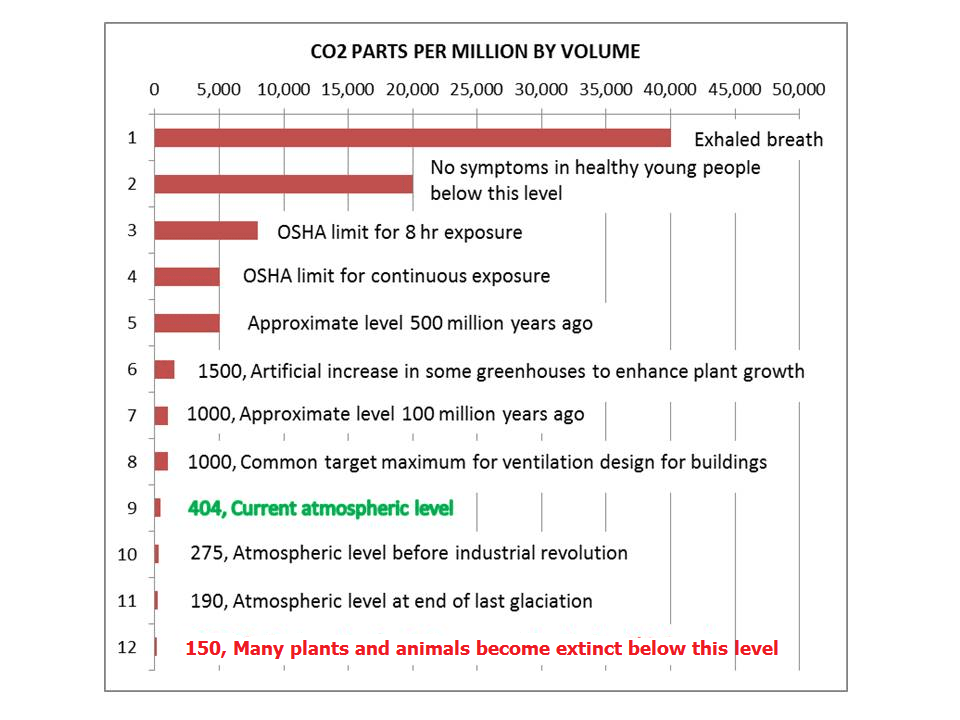
SCC excludes any consideration of the positive effects upon the biosphere from higher concentrations of CO2 in the atmosphere. It has been proven by numerous studies that plants thrive when more than 400ppm of CO2 are in the air, and greenhouse operators routinely add CO2 to double or triple the amount inside their facilities.

Yet climatists are at pains to discredit the benefits of more CO2.

A few years ago a scientist analyzed satellite imagery and discovered that the planet is greening (adding plant coverage) at a higher rate most likely due to more CO2 in the air. Climate activists are putting pressure upon these researchers to recant their findings.

A recent post Researchers Against CO2 revealed how activist scientists are trying to overturn the extensive biological evidence that plants love CO2. Field experiments are conducted claiming that plants don’t always grow bigger and faster with more CO2 when there are other limiting factors such as moisture, sunlight or soil nutrients. Their logic fails since more CO2 doesn’t cause the lack of other growth factors, and reducing CO2 will not improve those circumstances.

Another attack on CO2 benefits is the claim of ocean acidification, and I would not be surprised if SCC includes damage estimates from this source. Facts on the ground (or in this case, the oceans) do not support the claims, as reported in this post on Basics of Ocean Acidification.

Even crabs love CO2.

Social Benefits from Global Warming

Here we face the full force of billions of dollars of research studies on the damaging impacts from a few degrees of temperature increase. Over the years, everything has been shown to suffer from global warming, from A to Z. From Acne to Zika virus, and every letter in between: Bees, Civil wars, Diseases, Extinctions, Fish, etc.

Here’s the thing: Social Cost of Carbon is actually an attempt to estimate the benefits of preventing all those A to Z damages. But where are the estimates of benefits by preventing damages from global cooling?

A few researchers such as Richard Tol have looked objectively at warming scenarios, and identified clear social benefits. One study (here) concluded that an additional degree Celsius of warming by 2040 would likely result in 800,000 fewer deaths each year. Is that not a benefit to be reckoned?  Reasonable people conclude that the last 1°C of warming was a boon to civilization, and the next 1°C is likely to also be a blessing.

There are problems with this category. How do you put dollar values on saving human lives, or projected reductions in crops due to colder weather? These are the same problems bedeviling the SCC calculations.

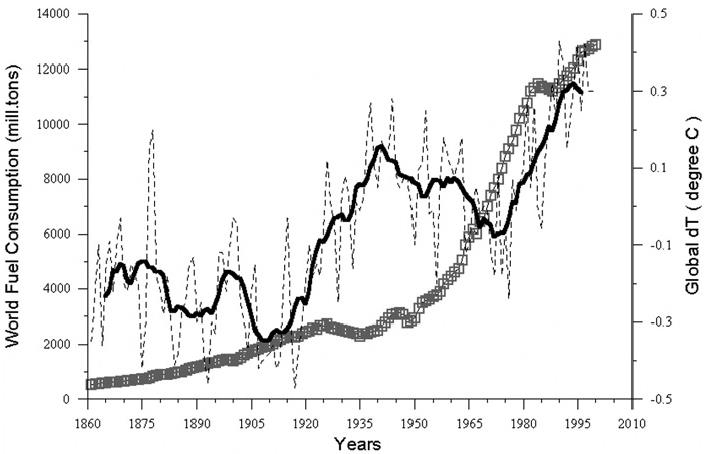
Further, many are wary of accepting the premise that carbon-based fuels do in fact cause temperatures to rise. Certainly the poor correlation between fuel consumption and global mean temperatures (GMT) does not convince (more here). Still, the argument can be made that even if you believe in man made global warming, policy analysis must also consider the benefits from a warmer world.

Summary

Calculating future costs and benefits from using carbon-based fuels is much like going down Alice’s rabbit hole.  Things get distorted, turned upside down and sideways.  Or to change the metaphor:  Beware: this swamp has alligators.

Ontario Climate Policy Refugees

It is not climate change forcing migrations, but rather misguided climate policies like those in Ontario. Employers pushed to the wall by energy cost increases have to plan for growth in other jurisdictions where energy is reliable and affordable. In effect, Ontario businessmen who are succeeding against world competitors from the US, China and India, will be creating jobs elsewhere, a migration of employees directly resulting from CO2 hysteria.

Ontario manufacturers fighting Queen’s Park’s energy policy Toronto Sun

Byron Nelson has spent over three decades growing his manufacturing company in Ontario, only now to regret his choice.

As he tours a group of reporters around his Leland Industries Scarborough plant where they build nuts and bolts for export to the United States and Europe, he explains he’s losing a battle with the province. His hydro bills have soared over the past year and with Ontario’s new cap-and-trade system coming into effect next month, electricity and natural gas costs will likely spike by another 20%.

That’s why Nelson — and other manufacturers in the province — are choosing to expand their businesses in the U.S. instead of at home.

“By 1995 to 2000, China had moved in and we fought China on the world trade and won,” Nelson said Tuesday during a press conference of the newly formed Coalition of Concerned Manufacturers in Ontario.

“Now our bigger problem is we’ve got to fight the province on controlling some of our hydro costs, which have totally skyrocketed. Our electricity bill has already increased 42% over the past few years. I’ve done the math and I’m looking at a cost increase that is going to take it to over $800,000 a year and with cap-and-trade, it’ll be near $1 million.”

Leland Industries plant, Scarborough Ontario

Leland Industries plant, Scarborough Ontario

Ontario’s new cap-and-trade system will cause electricity and natural gas costs to rise even higher. Toronto Star

Jocelyn Williams Bamford — vice president of Automatic Coating Limited and spokeswoman for the Coalition of Concerned Manufacturers in Ontario — said Leland is one of many smaller and medium-sized Ontario-based manufacturers that are looking to grow and seriously considering investing outside of Ontario.

“Ontario’s energy costs are rising so quickly many manufacturers are reassessing whether it makes sense to expand production in this province,” she said Tuesday in a statement.
Bamford said manufacturers have become more competitive and have been able to reduce emissions at the same time because they have invested in new technologies.

“Higher energy costs leave us less money for investment. And, if manufacturers can’t invest in Ontario, it’s not good for the economy or for jobs in this province. Ultimately, it’s not good for the environment either,” she said.

CEO of Leland Industries Byron Nelson says the company will not invest in Ontario any more because ‘the costs are just out of sight.’ Nelson said Ontario has already lost a lot of manufacturers and will lose more because those in government “just do not understand.”

Summary

Virtue signaling is not free. Ontario politicians want to look good to UN leaders, but the result is forcing employers to migrate jobs elsewhere. Until now politicians have naively bought into alarms from the Union of Concerned Scientists. Maybe they should pay attention instead to the Coalition of Concerned Manufacturers.

Norway’s Climate Angst.

It is not only US climatists alarmed about faithless political appointees to energy and environmental positions. Now some Norwegians are stewing. International Business Times article (here) A climate change denier has just been put in charge of melting Arctic island of Svalbard  Per-Willy Amundsen has stated previously that he believes climate change to be a socialist ploy.

Climate change sceptic Per-Willy Amundsen of the populist right-wing Progress Party has been appointed Minister of Justice and Public Security in Norway in a cabinet reshuffle.

Amundsen does not believe that human activity is driving climate change, and says that climate change is used to disguise socialist policies, he previously told the Norwegian newspaper Stavanger Aftenblad.

Norway’s Polar Affairs Department will fall under Amundsen’s brief, including administrative responsibility for Svalbard. The island is surrounded by the Arctic Ocean, the Greenland Sea and the Barents Sea, and lies between mainland Norway and the North Pole. It has been facing increasing challenges due to climate change in recent years.

This is another crisis brewing for the climate movement because Norwegian officials are resolute believers in climatism, despite (or maybe because of) the oil wealth pouring into their sovereign fund. Norwegians seem conflicted about their oil wealth, going out of their way to proclaim their faith in climate change doctrine.

For example, in the Exxon shareholder activist initiative last May, a large portion of supporting votes came from shares held by the Norwegian wealth fund. Another bunch of votes came from the Rockefeller family acting against management of the company founded by their patriarch. (Details here).

Note the posturing by Norway PM Solberg:
Despite Amundsen’s stated views in the past, Norway’s prime minister Erna Solberg denied that she had appointed climate-change sceptics to her cabinet. “Everybody in this government believe climate change is man-made,” EUobserver reported Solberg to have said.

The appointment raises questions about how Amundsen will address the problems of Svalbard, and other areas of Norway being affected by climate change.

“Many of the challenges faced on Svalbard are related to climate change one way or the other,” Ivar Berthling, professor of geography at the Norwegian University of Science and Technology, told IBTimes UK.

This is interesting also because of the recent deluge of media reports about shrinking reindeer on Svalbard (here). Fortunately for Norwegians, and for all of us, Norway has scientists who are not confused about climate change and have made their evidence and analyses widely available. Chief among them is Dr. Ole Humlum founder of the excellent climate information website Climate4you.

Arctic gateway seas (20W-40E. 70-80N) heat content 0-700 m depth

Map showing the Arctic Gateway Seas within 20W-40E and 70-80N, for which the heat content within the uppermost 700 m is shown in the three diagrams, for East Greenland Sea, West Svalbard Sea and Barents Sea.

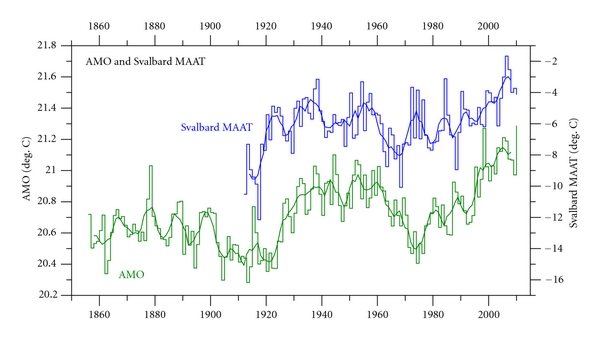
Svalbard archipelago, which includes Spitzbergen, is located at the gateway for Gulfstream Atlantic water entering the Arctic. Thus changes there are indicative of climate across the entire Arctic. As with other oceanic islands, like Australia, variations in land surface temperatures are synchronized with sea surface temperatures.

Figure 4: Svalbard MAAT 1912–2010 (blue) and Atlantic Multidecadal Oscillation (AMO, green) annual index values 1856–2010. The thick lines are the simple running 5 year average. Note that the temperature scales are different

Figure 4: Svalbard MAAT 1912–2010 (blue) and Atlantic Multidecadal Oscillation (AMO, green) annual index values 1856–2010. The thick lines are the simple running 5 year average. Note that the temperature scales are different

From Spectral Analysis of the Svalbard Temperature Record 1912–2010
Ole Humlum, Jan-Erik Solheim, and Kjell Stordahl (here)

During summer the daily meteorological conditions are highly influenced by the incoming solar radiation, which at 78°13′N are continuously above the horizon from 19 April to 23 August. Nevertheless, because of the nearby ocean, the air temperature usually stays relatively low, with July having an average temperature of 6.5°C (1981–2010). Summer air temperatures are also influenced by local wind conditions, partly reflecting land-sea breeze effects because of relatively small regional air pressure differences during the summer. All these factors are relatively stable from summer to summer.

During winter the meteorological conditions are very different from the summer. The sun stays below the horizon from 28 October to 14 February, and there is very little incoming solar radiation from December to February. The ground is snow covered, and much of the surrounding ocean and fjords are covered by sea ice. So whenever calm conditions prevail, inversions tend to develop and temperatures will be low at Svalbard Airport. However, conditions are frequently windy during the winter, destroying inversions, and from time to time warm air masses are advected towards Svalbard from the North Atlantic. Whenever this happens, the air temperature will rise significantly, as much as 10–15°C within few hours. In winters with high frequency of such events, the average temperature will be high and vice versa in winters where advection of warm air masses occurs less often. Also local foehn effects may be important during the winter. Together, this explains the high degree of winter temperature variability compared to the summer variability.

Advection of warm air masses from lower latitudes towards Svalbard occurs at all seasons, but is most frequent during the winter. This explains why the Svalbard air temperature is well coupled to North Atlantic temperature conditions both in summer and winter, and why several oscillations can be recognised in the spectra of both summer and winter temperature records (Figure 5). Had this not be so, one would expect at least potential solar signals to be absent from the winter data.

Figure 1: The Svalbard temperature record 1912–2010 [4], showing the mean annual air temperature (MAAT), the average summer temperature (JJA), and the average winter temperature (DJF). Thin lines show annual values, and thick lines show the simple 5 yr average. The linear MAAT increase 1912–2010 is 0.23°C per decade.

Figure 1: The Svalbard temperature record 1912–2010 [4], showing the mean annual air temperature (MAAT), the average summer temperature (JJA), and the average winter temperature (DJF). Thin lines show annual values, and thick lines show the simple 5 yr average. The linear MAAT increase 1912–2010 is 0.23°C per decade.

Strength and persistence of several cyclic variations identified in the Svalbard temperature record suggests that a natural cycle-based forecasting of future climate may be feasible for the Svalbard record, at least for a limited time ranges. Our empirical experience suggests a forecasting time range of 10–25% of the total record length.

For Svalbard our experimental forecast suggests that the observed late 20th century warming is not going to continue, but are likely to be followed by variable, but generally not higher temperatures for at least the coming 20–25 years. The falsification time scale for this forecast is about 7 years.

Summary

Once again, climate confusion and angst is born by activists conflating human and natural influences on weather patterns.

The Original Sin of debasing the term “climate change” was committed by the IPCC when they intentionally limited their scope to man made climate change. From the Principles Governing IPCC Work

The role of the IPCC is to assess on a comprehensive, objective, open and transparent basis the scientific, technical and socio-economic information relevant to understanding the scientific basis of risk of human-induced climate change, its potential impacts and options for adaptation and mitigation.

All five IPCC reports have proceeded to claim most or all of the warming since 1950 is caused by human activity, especially burning of fossil fuels. They express confidence levels of 95% or more, all the while dismissing natural factors and long term warming and cooling cycles without even analyzing them.

Norway needs to listen to and take comfort from their own scientists. As Humlum at al. point out:

Climate development with possible anthropogenic effects occurs on a background of natural climatic variations, which may be considerable, and especially in the Arctic. Natural climate variations however remain poorly understood, although they remain important for discriminating between natural and anthropogenic influences on current climate change.

Natural cycles that have remained strong over long time are likely to continue without major changes into at the near future. Knowledge on such natural oscillations is therefore essential for forecasting future climate.

For more on Svalbard’s largest island see Spitsbergen Triangle: Ground Zero for Climate Mysteries


Social Cost of Carbon: Origin and Prospects


The Obama administration has been fighting climate change with a rogue wave of regulations whose legality comes from a very small base: The Social Cost of Carbon.

The purpose of the “social cost of carbon” (SCC) estimates presented here is to allow agencies to incorporate the social benefits of reducing carbon dioxide (CO2) emissions into cost-benefit analyses of regulatory actions that impact cumulative global emissions. The SCC is an estimate of the monetized damages associated with an incremental increase in carbon emissions in a given year. It is intended to include (but is not limited to) changes in net agricultural productivity, human health, property damages from increased flood risk, and the value of ecosystem services due to climate change. From the Technical Support Document: -Technical Update of the Social Cost of Carbon for Regulatory Impact Analysis -Under Executive Order 12866

A recent Bloomberg article informs on how the SCC notion was invented, its importance and how it might change under the Trump administration.
How Climate Rules Might Fade Away; Obama used an arcane number to craft his regulations. Trump could use it to undo them. (here)

scc-working-group

In February 2009, a month after Barack Obama took office, two academics sat across from each other in the White House mess hall. Over a club sandwich, Michael Greenstone, a White House economist, and Cass Sunstein, Obama’s top regulatory officer, decided that the executive branch needed to figure out how to estimate the economic damage from climate change. With the recession in full swing, they were rightly skeptical about the chances that Congress would pass a nationwide cap-and-trade bill. Greenstone and Sunstein knew they needed a Plan B: a way to regulate carbon emissions without going through Congress.

Over the next year, a team of economists, scientists, and lawyers from across the federal government convened to come up with a dollar amount for the economic cost of carbon emissions. Whatever value they hit upon would be used to determine the scope of regulations aimed at reducing the damage from climate change. The bigger the estimate, the more costly the rules meant to address it could be. After a year of modeling different scenarios, the team came up with a central estimate of $21 per metric ton, which is to say that by their calculations, every ton of carbon emitted into the atmosphere imposed $21 of economic cost. It has since been raised to around $40 a ton.

Trump can’t undo the SCC by fiat. There is established case law requiring the government to account for the impact of carbon, and if he just repealed it, environmentalists would almost certainly sue.

There are other ways for Trump to undercut the SCC. By tweaking some of the assumptions and calculations that are baked into its model, the Trump administration could pretty much render it irrelevant, or even skew it to the point that carbon emissions come out as a benefit instead of a cost.

The SCC models rely on a “discount rate” to state the harm from global warming in today’s dollars. The higher the discount rate, the lower the estimate of harm. That’s because the costs incurred by burning carbon lie mostly in the distant future, while the benefits (heat, electricity, etc.) are enjoyed today. A high discount rate shrinks the estimates of future costs but doesn’t affect present-day benefits. The team put together by Greenstone and Sunstein used a discount rate of 3 percent to come up with its central estimate of $21 a ton for damage inflicted by carbon. But changing that discount just slightly produces big swings in the overall cost of carbon, turning a number that’s pushing broad changes in everything from appliances to coal leasing decisions into one that would have little or no impact on policy.

According to a 2013 government update on the SCC, by applying a discount rate of 5 percent, the cost of carbon in 2020 comes out to $12 a ton; using a 2.5 percent rate, it’s $65. A 7 percent discount rate, which has been used by the EPA for other regulatory analysis, could actually lead to a negative carbon cost, which would seem to imply that carbon emissions are beneficial. “Once you start to dig into how the numbers are constructed, I cannot fathom how anyone could think it has any basis in reality,” says Daniel Simmons, vice president for policy at the American Energy Alliance and a member of the Trump transition team focusing on the Energy Department.

David Kreutzer, a senior research fellow in energy economics and climate change at Heritage and a member of Trump’s EPA transition team, laid out one of the primary arguments against the SCC. “Believe it or not, these models look out to the year 2300. That’s like effectively asking, ‘If you turn your light switch on today, how much damage will that do in 2300?’ That’s way beyond when any macroeconomic model can be trusted.”

Another issue for those who question the Obama administration’s SCC: It estimates the global costs and benefits of carbon emissions, rather than just focusing on the impact to the U.S. Critics argue that this pushes the cost of carbon much higher and that the calculation should instead be limited to the U.S.; that would lower the cost by more than 70 percent, says the CEI’s Mario Lewis.

Still, by narrowing the calculation to the U.S., Trump could certainly produce a lower cost of carbon. Asked in an e-mail whether the new administration would raise the discount rate or narrow the scope of the SCC to the U.S., one person shaping Trump energy and environmental policy replied, “What prevents us from doing both?”

drain-the-swamp

Unforeseen Climate Debates Coming

The Trump administration is rolling out nominees for various cabinet positions and the transition team is submitting questions to federal departments required for their due diligence prior to the handover of executive responsibility.

All this is normal procedure, yet the climate establishment is going ballistic. The Progress websites have gone into overdrive, led by Podesta and funded by Soros and Steyer. It is a massive outpouring of articles intended to inflame and incite outrage against anything the Trumpers are up to in taking up their mandate.

Other alarmists are producing reports like this recent one: Trump’s transition: sceptics guide every agency dealing with climate change, from the Guardian (here).  In all such communications, the appointees are profiled, and denigrated:

Trump has assembled a transition team in which at least nine senior members deny basic scientific understanding that the planet is warming due to the burning of carbon and other human activity. These include the transition heads of all the key agencies responsible for either monitoring or dealing with climate change. None of these transition heads have any background in climate science.

Trump has also nominated Oklahoma attorney general Scott Pruitt to lead the EPA and is expected to pick congresswoman Cathy McMorris Rodgers to head the interior department. Pruitt has claimed that scientists “continue to disagree” about the causes and extent of global warming while McMorris Rodgers has said that former vice-president Al Gore, who has championed climate action, “deserves an ‘F’ in science.”

Time for Climatists to Put Up or Shut Up

Amazingly, these long-entitled activists are blind to the opportunity now presented to them. For many years, climate alarmists have refused to debate the science of their position, declaring that the “science is settled.” People like John Christy suggested that there could be at least a little funding for “red teams” to present the counter view to IPCC consensus science. All was for naught when true believers were in power.

Now there will be roundtable discussions at the highest levels of powerful departments and agencies, such as Energy, Interior, NASA, and EPA. If the incoming powers-to-be are uneducated in climate science, let those concerned about global warming make their case, show their facts, convince skeptical people through reason and persuasion. It is now time to put up or shut up. It is exactly the wrong time to be appealing to emotions and trying to stir up craziness. Moral indignation and trash-talking the other side is the opposite of engaging in discussion and debate over what is claimed to be an essential issue of our times.

We may yet have the great climate debates so long avoided by those convinced they had all the answers and the others should just trust them. If climatists have something reasonable to say and not just fear and bullying, it is time to step up to the plate.

As Greg Sorrell writes at the Federalist (here), the Trump administration is right to take emotion out of climate policy.

One of the last formal debates was prior to 2009 Copenhagen COP. Pre-debate the audience was 61% Pro and 39% Con on the premise: Climate change is mankind’s defining crisis, and demands a commensurate response. Post-debate, it was 53% Pro and 47% Con.  With such results occurring frequently, climatists stopped participating.