June 2025 Update–Temperature Falls, CO2 Follows

Previously I have demonstrated that changes in atmospheric CO2 levels follow changes in Global Mean Temperatures (GMT) as shown by satellite measurements from University of Alabama at Huntsville (UAH). That background post is reprinted later below.

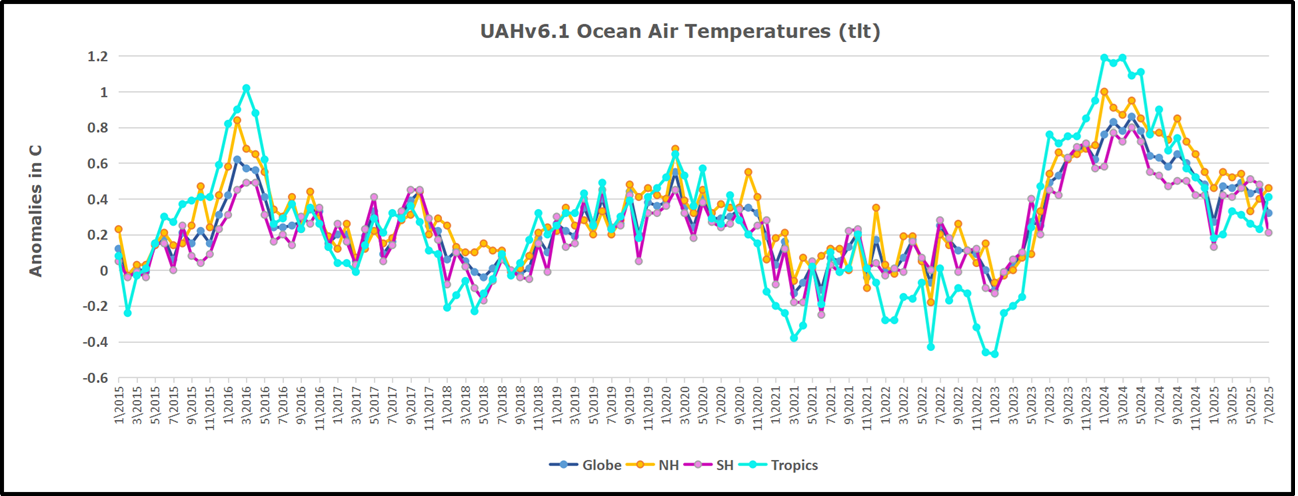
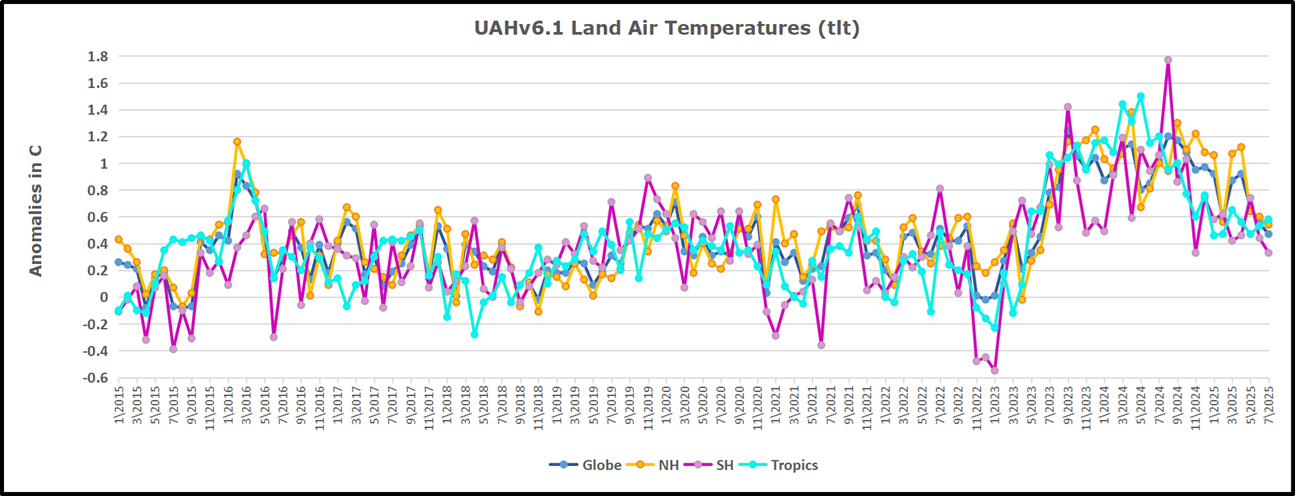
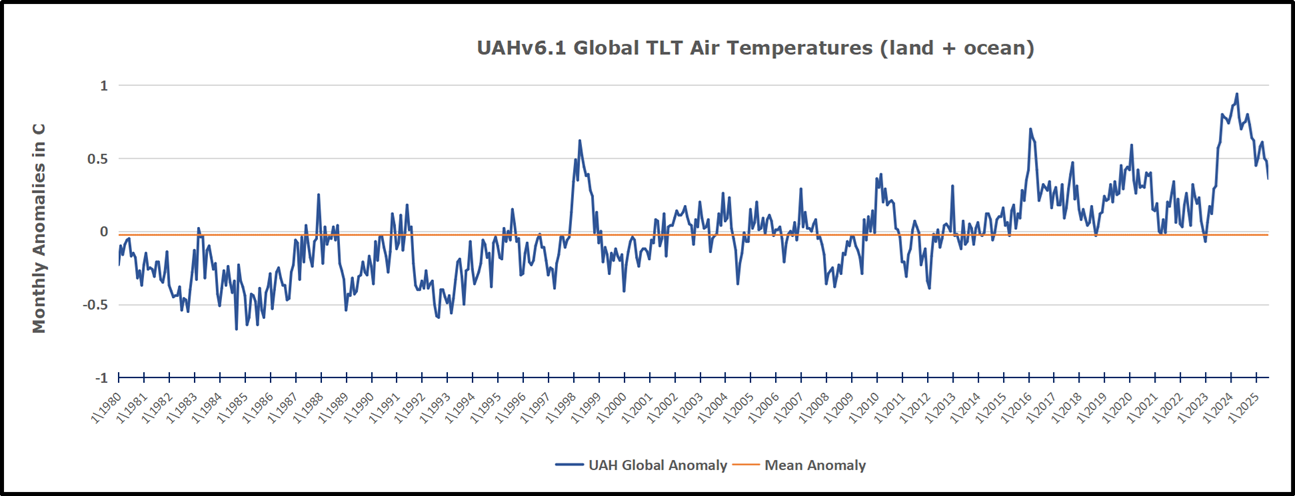
My curiosity was piqued by the remarkable GMT spike starting in January 2023 and rising to a peak in April 2024. GMT has declined steadily, and now 14 months later, the anomaly is 0.48C down from 0.94C.  I also became aware that UAH has recalibrated their dataset due to a satellite drift that can no longer be corrected. The values since 2020 have shifted slightly in version 6.1, as shown in my recent report NH and Tropics Lead UAH Temps Lower May 2025.  The data here comes from UAH record of temperatures measured in the lower troposphere (TLT).

In this post, I test the premise that temperature changes are predictive of changes in atmospheric CO2 concentrations.  The chart above shows the two monthly datasets: CO2 levels in blue reported at Mauna Loa, and Global temperature anomalies in purple reported by UAHv6.1, both through June 2025. Would such a sharp increase in temperature be reflected in rising CO2 levels, according to the successful mathematical forecasting model? Would CO2 levels decline as temperatures dropped following the peak?

The answer is yes: that temperature spike resulted
in a corresponding CO2 spike as expected.
And lower CO2 levels followed the temperature decline.

Above are UAH temperature anomalies compared to CO2 monthly changes year over year.

Changes in monthly CO2 synchronize with temperature fluctuations, which for UAH are anomalies referenced to the 1991-2020 period. CO2 differentials are calculated for the present month by subtracting the value for the same month in the previous year (for example February 2025 minus February 2024).  Temp anomalies are calculated by comparing the present month with the baseline month. Note the recent CO2 upward spike and drop following the temperature spike and drop.

The final proof that CO2 follows temperature due to stimulation of natural CO2 reservoirs is demonstrated by the ability to calculate CO2 levels since 1979 with a simple mathematical formula:

For each subsequent year, the CO2 level for each month was generated

CO2  this month this year = a + b × Temp this month this year  + CO2 this month last year

The values for a and b are constants applied to all monthly temps, and are chosen to scale the forecasted CO2 level for comparison with the observed value. Here is the result of those calculations.

In the chart calculated CO2 levels correlate with observed CO2 levels at 0.9988 out of 1.0000.  This mathematical generation of CO2 atmospheric levels is only possible if they are driven by temperature-dependent natural sources, and not by human emissions which are small in comparison, rise steadily and monotonically.  For a more detailed look at the recent fluxes, here are the results since 2015, an ENSO neutral year.

For this recent period, the calculated CO2 values match well the annual highs, while some annual generated values of CO2 are slightly higher or lower than observed at other months of the year. Still the correlation for this period is 0.9939.

Key Point

Changes in CO2 follow changes in global temperatures on all time scales, from last month’s observations to ice core datasets spanning millennia. Since CO2 is the lagging variable, it cannot logically be the cause of temperature, the leading variable. It is folly to imagine that by reducing human emissions of CO2, we can change global temperatures, which are obviously driven by other factors.

Background Post Temperature Changes Cause CO2 Changes, Not the Reverse

This post is about proving that CO2 changes in response to temperature changes, not the other way around, as is often claimed.  In order to do  that we need two datasets: one for measurements of changes in atmospheric CO2 concentrations over time and one for estimates of Global Mean Temperature changes over time.

Climate science is unsettling because past data are not fixed, but change later on.  I ran into this previously and now again in 2021 and 2022 when I set out to update an analysis done in 2014 by Jeremy Shiers (discussed in a previous post reprinted at the end).  Jeremy provided a spreadsheet in his essay Murray Salby Showed CO2 Follows Temperature Now You Can Too posted in January 2014. I downloaded his spreadsheet intending to bring the analysis up to the present to see if the results hold up.  The two sources of data were:

Temperature anomalies from RSS here:  http://www.remss.com/missions/amsu

CO2 monthly levels from NOAA (Mauna Loa): https://www.esrl.noaa.gov/gmd/ccgg/trends/data.html

Changes in CO2 (ΔCO2)

Uploading the CO2 dataset showed that many numbers had changed (why?).

The blue line shows annual observed differences in monthly values year over year, e.g. June 2020 minus June 2019 etc.  The first 12 months (1979) provide the observed starting values from which differentials are calculated.  The orange line shows those CO2 values changed slightly in the 2020 dataset vs. the 2014 dataset, on average +0.035 ppm.  But there is no pattern or trend added, and deviations vary randomly between + and -.  So last year I took the 2020 dataset to replace the older one for updating the analysis.

Now I find the NOAA dataset starting in 2021 has almost completely new values due to a method shift in February 2021, requiring a recalibration of all previous measurements.  The new picture of ΔCO2 is graphed below.

The method shift is reported at a NOAA Global Monitoring Laboratory webpage, Carbon Dioxide (CO2) WMO Scale, with a justification for the difference between X2007 results and the new results from X2019 now in force.  The orange line shows that the shift has resulted in higher values, especially early on and a general slightly increasing trend over time.  However, these are small variations at the decimal level on values 340 and above.  Further, the graph shows that yearly differentials month by month are virtually the same as before.  Thus I redid the analysis with the new values.

Global Temperature Anomalies (ΔTemp)

The other time series was the record of global temperature anomalies according to RSS. The current RSS dataset is not at all the same as the past.

Here we see some seriously unsettling science at work.  The purple line is RSS in 2014, and the blue is RSS as of 2020.  Some further increases appear in the gold 2022 rss dataset. The red line shows alterations from the old to the new.  There is a slight cooling of the data in the beginning years, then the three versions mostly match until 1997, when systematic warming enters the record.  From 1997/5 to 2003/12 the average anomaly increases by 0.04C.  After 2004/1 to 2012/8 the average increase is 0.15C.  At the end from 2012/9 to 2013/12, the average anomaly was higher by 0.21. The 2022 version added slight warming over 2020 values.

RSS continues that accelerated warming to the present, but it cannot be trusted.  And who knows what the numbers will be a few years down the line?  As Dr. Ole Humlum said some years ago (regarding Gistemp): “It should however be noted, that a temperature record which keeps on changing the past hardly can qualify as being correct.”

Given the above manipulations, I went instead to the other satellite dataset UAH version 6. UAH has also made a shift by changing its baseline from 1981-2010 to 1991-2020.  This resulted in systematically reducing the anomaly values, but did not alter the pattern of variation over time.  For comparison, here are the two records with measurements through December 2023.

Comparing UAH temperature anomalies to NOAA CO2 changes.

Here are UAH temperature anomalies compared to CO2 monthly changes year over year.

Changes in monthly CO2 synchronize with temperature fluctuations, which for UAH are anomalies now referenced to the 1991-2020 period.  As stated above, CO2 differentials are calculated for the present month by subtracting the value for the same month in the previous year (for example June 2022 minus June 2021).   Temp anomalies are calculated by comparing the present month with the baseline month.

The final proof that CO2 follows temperature due to stimulation of natural CO2 reservoirs is demonstrated by the ability to calculate CO2 levels since 1979 with a simple mathematical formula:

For each subsequent year, the co2 level for each month was generated

CO2  this month this year = a + b × Temp this month this year  + CO2 this month last year

Jeremy used Python to estimate a and b, but I used his spreadsheet to guess values that place for comparison the observed and calculated CO2 levels on top of each other.

In the chart calculated CO2 levels correlate with observed CO2 levels at 0.9986 out of 1.0000.  This mathematical generation of CO2 atmospheric levels is only possible if they are driven by temperature-dependent natural sources, and not by human emissions which are small in comparison, rise steadily and monotonically.

Comment:  UAH dataset reported a sharp warming spike starting mid year, with causes speculated but not proven.  In any case, that surprising peak has not yet driven CO2 higher, though it might,  but only if it persists despite the likely cooling already under way.

Previous Post:  What Causes Rising Atmospheric CO2?

nasa_carbon_cycle_2008-1

This post is prompted by a recent exchange with those reasserting the “consensus” view attributing all additional atmospheric CO2 to humans burning fossil fuels.

The IPCC doctrine which has long been promoted goes as follows. We have a number over here for monthly fossil fuel CO2 emissions, and a number over there for monthly atmospheric CO2. We don’t have good numbers for the rest of it-oceans, soils, biosphere–though rough estimates are orders of magnitude higher, dwarfing human CO2.  So we ignore nature and assume it is always a sink, explaining the difference between the two numbers we do have. Easy peasy, science settled.

What about the fact that nature continues to absorb about half of human emissions, even while FF CO2 increased by 60% over the last 2 decades? What about the fact that in 2020 FF CO2 declined significantly with no discernable impact on rising atmospheric CO2?

These and other issues are raised by Murray Salby and others who conclude that it is not that simple, and the science is not settled. And so these dissenters must be cancelled lest the narrative be weakened.

The non-IPCC paradigm is that atmospheric CO2 levels are a function of two very different fluxes. FF CO2 changes rapidly and increases steadily, while Natural CO2 changes slowly over time, and fluctuates up and down from temperature changes. The implications are that human CO2 is a simple addition, while natural CO2 comes from the integral of previous fluctuations.  Jeremy Shiers has a series of posts at his blog clarifying this paradigm. See Increasing CO2 Raises Global Temperature Or Does Increasing Temperature Raise CO2 Excerpts in italics with my bolds.

The following graph which shows the change in CO2 levels (rather than the levels directly) makes this much clearer.

Note the vertical scale refers to the first differential of the CO2 level not the level itself. The graph depicts that change rate in ppm per year.

There are big swings in the amount of CO2 emitted. Taking the mean as 1.6 ppmv/year (at a guess) there are +/- swings of around 1.2 nearly +/- 100%.

And, surprise surprise, the change in net emissions of CO2 is very strongly correlated with changes in global temperature.

This clearly indicates the net amount of CO2 emitted in any one year is directly linked to global mean temperature in that year.

For any given year the amount of CO2 in the atmosphere will be the sum of

  • all the net annual emissions of CO2
  • in all previous years.

For each year the net annual emission of CO2 is proportional to the annual global mean temperature.

This means the amount of CO2 in the atmosphere will be related to the sum of temperatures in previous years.

So CO2 levels are not directly related to the current temperature but the integral of temperature over previous years.

The following graph again shows observed levels of CO2 and global temperatures but also has calculated levels of CO2 based on sum of previous years temperatures (dotted blue line).

Summary:

The massive fluxes from natural sources dominate the flow of CO2 through the atmosphere.  Human CO2 from burning fossil fuels is around 4% of the annual addition from all sources. Even if rising CO2 could cause rising temperatures (no evidence, only claims), reducing our emissions would have little impact.

Atmospheric CO2 Math

Ins: 4% human, 96% natural
Outs: 0% human, 98% natural.
Atmospheric storage difference: +2%
(so that: Ins = Outs + Atmospheric storage difference)

Balance = Atmospheric storage difference: 2%, of which,
Humans: 2% X 4% = 0.08%
Nature: 2% X 96 % = 1.92%

Ratio Natural : Human =1.92% : 0.08% = 24 : 1

Resources
For a possible explanation of natural warming and CO2 emissions see Little Ice Age Warming Recovery May be Over
Resources:

CO2 Fluxes, Sources and Sinks

Who to Blame for Rising CO2?

Fearless Physics from Dr. Salby

2025 Update: No, CO2 Doesn’t Drive the Polar Vortex

July 2025 Update

Linnea Lueken published this week at Climate Realism Thanks, NewScientist, for Admitting Climate Change Isn’t Making the Jet Stream More Erratic.  Excerpts in italics with my bolds and added images.

NewScientist, a publication dedicated to popularizing science, recently published a post titled “Extreme winter weather isn’t down to a wavier jet stream,” reporting on a new study that shows, the jet stream is not getting wavier in winter months due to climate change. NewScientist writes that “[i]ncreasingly erratic winter weather in the northern hemisphere isn’t a result of the polar jet stream getting more wavy, according to new research . . ..”

This is true, and it has been evident for some time, but runs counter
to assertions commonly made by climate alarmists.

Although the vast bulk of the article is devoted to insisting that climate change is causing worsening winter and summer weather, claims regularly debunked at Climate Realism, the publication deserves some credit for reporting the study’s results concerning the jet stream, which was, in fact, the focus of the research itself.

The new reports findings are not actually that “new,” in the sense that Climate Realism has reported on research that came to the same conclusion several times in the past few years, herehere, and here, for instance. There is copious evidence showing that not only are cold snaps not uncommon, but that the jet stream’s (and more specifically, polar vortex) influence on extreme winter weather has been acknowledged since at least 1853. Years of studies looking at the frequency of and intensity of polar vortex events have found no consistent trends. As pointed out by my colleague Anthony Watts in this post on the subject:

“a 2021 study in the journal Geophysical Research Letters found no statistically significant increase in jet stream waviness or meandering in recent decades,”

and he explains there has never been a consensus among scientists when it comes to the issue of polar vortex/jet stream behavior.

The post at NewScientist goes on to explain the new study, saying “recent erratic behaviour isn’t out of the ordinary,” and that the jet stream has been both wavier and less wavy than it is today.  Unfortunately, that is where the NewScientist and the authors of the paper it was discussing ceased to follow the evidence. One of the study’s authors reassured NewScientist that climate change is still “affecting extreme weather events in all sorts of really important ways,” and that the jet stream is actually becoming wavier in the summertime, “where it is getting slower, with bigger waves, which leads to things like big heatwaves, drought, and wildfires.”

This would be compelling if existing data backed up the claim,
but, in fact, big heatwaves, drought, and wildfires have not
become more frequent or severe in recent decades. 

Heatwaves were much more severe in the earlier decades of the 20th century, and overall drought has been declining while precipitation increases. Now that it is summer, many outlets are attempting to claim that hot weather is driven by climate change. In doing so they almost always ignore where heat records are being set, as it is often at airports and other heat-absorbing locations, and ignore historical records that show hot summers are not unprecedented.

Similarly, data shows that wildfires were worse in the past with research from NASA and the European Space Agency showing that acreage lost to wildfires has declined markedly over the past few decades.

The NewScientist, and the AGU study it references, should have quit when they were ahead. They should have published their unalarming findings about climate change’s lack of an impact on the winter jet stream without then assuring people that despite their study’s findings, they really are true believers and climate change is making weather worse. The latter point is refuted by real world data.

Simulation of jet stream pattern July 22. (VentuSky.com)

Background from Previous Post

We are heading into winter this year at the bottom of a solar cycle, and ocean oscillations due for cooling phases. The folks at Climate Alarm Central (CAC) are well aware of this, and are working hard so people won’t realize that global cooling contradicts global warming. No indeed, contortionist papers and headlines are warning us all that CO2 not only causes hothouse earth, overrun with rats and other vermin. CO2 also causes ice ages when it feels like it.

Update Nov. 26, 2019: Much ado about the polar jet stream recently with a publication by Tim Woolings  A battle for the jet stream is raging above our heads.  The Claims are not new:

The jet has always varied – and has always affected our weather patterns. But now climate change is affecting our weather too. As I explore in my latest book, it’s when the wanderings of the jet and the hand of climate change add up that we get record-breaking heatwaves, floods and droughts – but not freezes.

The same supposition was made last year in an article by alarmist Jason Samenow at Washington Post.  Study: Freak summer weather and wild jet-stream patterns are on the rise because of global warming. Excerpts in italics with my bolds

In many ways, the summer of 2018 marked a turning point, when the effects of climate change — perhaps previously on the periphery of public consciousness — suddenly took center stage. Record high temperatures spread all over the Northern Hemisphere. Wildfires raged out of control. And devastating floods were frequent.

Michael Mann, climate scientist at Pennsylvania State University, along with colleagues, has published a new study that connects these disruptive weather extremes with a fundamental change in how the jet stream is behaving during the summer. Linked to the warming climate, the study suggests this change in the atmosphere’s steering current is making these extremes occur more frequently, with greater intensity, and for longer periods of time.

The study projects this erratic jet-stream behavior will increase in the future, leading to more severe heat waves, droughts, fires and floods.

The jet stream is changing not only because the planet is warming up but also because the Arctic is warming faster than the mid-latitudes, the study says. The jet stream is driven by temperature contrasts, and these contrasts are shrinking. The result is a slower jet stream with more wavy peaks and troughs that Mann and his study co-authors ascribe to a process known as “quasi-resonant amplification.”

The altered jet-stream behavior is important because when it takes deep excursions to the south in the summer, it sets up a collision between cool air from the north and the summer’s torrid heat, often spurring excessive rain. But when the jet stream retreats to the north, bulging heat domes form underneath it, leading to record heat and dry spells.

The study, published Wednesday in Science Advances, finds that these quasi-resonant amplification events — in which the jet stream exhibits this extreme behavior during the summer — are predicted to increase by 50 percent this century if emissions of carbon dioxide and other greenhouse gases continue unchecked.

Whereas previous work conducted by Mann and others had identified a signal for an increase in these events, this study for the first time examined how they may change in the future using climate model simulations.

“Looking at a large number of different computer models, we found interesting differences,” said Stefan Rahmstorf from the Potsdam Institute for Climate Impact Research and a co-author of the study, in a news release. “Distinct climate models provide quite diverging forecasts for future climate resonance events. However, on average they show a clear increase in such events.”

Although model projections suggest these extreme jet-stream patterns will increase as the climate warms, the study concluded that their increase can be slowed if greenhouse gas emissions are reduced along with particulate pollution in developing countries. “[T]he future is still very much in our hands when it comes to dangerous and damaging summer weather extremes,” Mann said. “It’s simply a matter of our willpower to transition quickly from fossil fuels to renewable energy.”

Mann has been leading the charge to blame anticipated cooling on fossil fuels, his previous attempt claiming CO2 is causing a slowdown of AMOC (part of it being the Gulf Stream), resulting in global cooling, even an ice age. The same idea underlay the scary 2004 movie Day After Tomorrow.

day-after-tomorrowOther scientists are more interested in the truth than in hype. An example is this AGU publication by D.A Smeed et al. The North Atlantic Ocean Is in a State of Reduced Overturning Excerpts in italics with my bolds.

Figure 3

Indices of subsurface temperature, sea surface height (SSH), latent heat flux (LHF), and sea surface temperature (SST). SST (purple) is plotted using the same scale as subsurface temperature (blue) in the upper panel. The upper panel shows 24 month filtered values of de‐seasonalized anomalies along with the non‐Ekman part of the AMOC. In the lower panel, we show three‐year running means of the indices going back to 1985 (1993 for the SSH index).

Changes in ocean heat transport and SST are expected to modify the net air‐sea heat flux. The changes in the total air‐sea flux (Figure S4, data obtained from the National Centers for Environmental Prediction‐National Center for Atmospheric Research reanalysis; Kalnay et al., 1996) are almost all due to the change in LHF. The third panel of Figure 3 shows the changes in LHF between the two periods. There is a strong signal with increased heat loss from the ocean over the Gulf Stream. That the area of increased heat loss coincides with the location of warming SST indicates that the changes in air‐sea fluxes are driven by the ocean.

Whilst the AMOC has only been continuously measured since 2004, the indices of SSH, heat content, SST, and LHF can be calculated farther back in time (Figure 3, bottom). Over this longer time period, all four indices are strongly correlated with one another (Table S5; correlations were calculated using the nonparametric method described in McCarthy et al., 2015). These data suggest that measurement of the AMOC at 26°N started close to a maximum in the overturning. Prior to 2007 the indices show variability on a time scale of 8 to 10 years and no trend is evident, but since 2014 all indices have had values lower than any other year since 1985.

Previous studies have shown that seasonal and interannual changes in the subtropical AMOC are forced primarily by changing wind stress mediated by Rossby waves (Zhao & Johns, 2014a, 2014b). There is growing evidence (Delworth et al., 2016; Jackson et al., 2016) that the longer‐term changes of the AMOC over the last decade are also associated with thermohaline forcing and that the changed circulation alters the pattern of ocean‐atmosphere heat exchange (Gulev et al., 2013). The role of ocean circulation in decadal climate variability has been challenged in recent years with authors suggesting that external, atmospheric‐driven changes could produce the observed variability in Atlantic SSTs (Clement et al., 2015). However, the direct observation of a weakened AMOC supports a role for ocean circulation in decadal Atlantic climate variability.

Our results show that the previously reported decline of the AMOC (Smeed et al., 2014) has been arrested, but the length of the observational record of the AMOC is still short relative to the time scales of important decadal variations that exist in the Atlantic. Understanding is therefore constantly evolving. What we identify as a changed state of the AMOC in this study may well prove to be part of a decadal oscillation superposed on a multidecadal cycle. Overlaying these oscillations is the impact of anthropogenic change that is predicted to weaken the AMOC over the next century. The continuation of measurements from the RAPID 26°N array and similar observations elsewhere in the Atlantic (Lozier et al., 2017; Meinen et al., 2013) will enable us to unravel and reveal the role of ocean circulation in the changing Atlantic climate in the coming decades.

Regarding the more recent attempt to link CO2 with jet stream meanderings, we have this paper providing a more reasonable assessment.  Arctic amplification: does it impact the polar jet stream?  by Valentin P. Meleshko et al.  Excerpts below in italics with my bolds.

Analysis of observation and model simulations has revealed that northward temperature gradient decreases and jet flow weakens in the polar troposphere due to global climate warming. These interdependent phenomena are regarded as robust features of the climate system. An increase of planetary wave oscillation that is attributed to Arctic amplification (Francis and Vavrus, 2012; Francis and Vavrus, 2015) has not been confirmed from analysis of observation (Barnes, 2013; Screen and Simmonds, 2013) or in our analysis of model simulations of projected climate. However, we found that GPH variability associated with planetary wave oscillation increases in the background of weakening of zonal flow during the sea-ice-free summer. Enhancement of northward heat transport in the troposphere was shown to be the main factor responsible for decrease of northward temperature gradient and weakening of the jet stream in autumn and winter. Arctic amplification provides only minor contribution to the evolution of zonal flow and planetary wave oscillation.

It has been shown that northward heat transport is the major factor in decreasing the northward temperature gradient in the polar atmosphere and increasing the planetary-scale wave oscillation in the troposphere of the mid-latitudes. Arctic amplification does not show any essential impact on planetary-scale oscillation in the mid and upper troposphere, although it does cause a decrease of northward heat transport in the lower troposphere. These results confound the interpretation of the short observational record that has suggested a causal link between recent Arctic melting and extreme weather in the mid-latitudes.

There are two additional explanations of factors causing the wavy jet stream, AKA Polar Vortex.  Dr Judah Cohen of AER has written extensively on the link between Autumn Siberian snow cover and the Arctic oscillation.  See Snowing and Freezing in the Arctic  for a more complete description of the mechanism.

Finally, a discussion with Piers Corbyn regarding the solar flux effect upon the jet stream at Is This Cold the New Normal?

Video transcript available at linked post.

The Real Climate Science Crisis: CAGW Hypothesis Lacks Scientific Evidence

From C3 headlines The Real Climate Science Crisis: The Catastrophic Anthropogenic Global Warming (CAGW) Hypothesis Is Without Scientific Evidence.  Excerpts in italics with my added images.

For a hypothesis to reach the status of being a legit theory, it requires withstanding the onslaught of observed empirical evidence. The CAGW hypothesis is no such animal.

Known by its more contemporary aliases, such as ”climate crisis,” “climate emergency,” “climate collapse,” or “existential threat,” the CAGW has zero empirical evidence to support it.

Unlike the related hypothesis regarding greenhouse gases (GHG) and global warming, at least the GHG hypothesis has warming global temperature data that somewhat coincides with increasing atmospheric CO2 levels, putting aside the growing possibility that the purported cause-and-effect direction is probably the reverse.

In order to reach a CAGW climate disaster, global warming
temperatures must change rapidly in an accelerating manner
that will initiate a ‘tipping point’ for the climate.

The rapid acceleration would present its occurrence in a continuous increasing of the slope, i.e., trend, of temperatures, such as monthly temperatures. Each subsequent month would represent a greater temperature magnitude increase than the month before, hypothetically.

But those tipping point precursors are not occurring in the real-world climate.

For example, it is agreed by all climate scientists that oceans play a very major role in the world’s climate and its global temperatures due to their being both the world’s largest carbon sink and its largest heat content storage.

However, despite these characteristics, in totality, the global oceans HAVE NOT warmed since the year 2014. And certainly, there is no empirical evidence that oceans exhibit constant temperature increases of magnitude.

Quite the contrary, combined oceans exhibit a regular pattern of temperature decreases and increases, as the adjacent plot of NOAA’s monthly ocean data indicates.

Specifically, this is a plot (dark blue) of moving 5-year temperature changes ending each month of the 60-year period from March 1963 through March 2023.

[Explanation: the first data point is the temperature change for the 60 months ending on March 30, 1963; and the chart’s last temperature change data point is for the five 5 years (i.e. 60 months) ending on March 2023.]

The chart also includes a plot (green) of the moving 60-month CO2 level changes over the same sixty year period, plus a linear trend for both CO2 changes and ocean temperature changes.

The trend of the 60-month CO2 changes significantly exceeds the slight positive trend of ocean temperature changes by a factor of 117x. This huge differential undercuts the belief that global warming is primarily the result of GHGs. Which is confirmed by the paltry R^2 of +0.06 – an almost non-existent relationship between 5-year atmospheric CO2 changes and 5-year changes in ocean temperature.

Not only are the large increases in CO2 levels not causing a concerning uptick of temperature change magnitude, it also has not lead to any type of acceleration, per the linear trend since 1963.

Specifically, with a trend of a tiny +0.0001°C, that would project out 20 years to be an increase of 5-year temperature changes to an insignificant amount of +0.024°C – definitely not an existential threat of ‘runaway warming’ or a CAGW ‘climate crisis’ as portrayed by bureaucrats, politicians and Hollywood celebrities.

So, if 5 years of increasing amounts of CO2 in the atmosphere barely influence 5-year changes in temperature over a 60-year span, either in magnitude or acceleration rate, then it is highly unlikely that this trace gas would cause a catastrophic climate disaster or an extinction event.

Thus, it is fair to state that for all those scientists pushing a narrative of an imminent climate change catastrophe from CO2 without the requisite empirical evidence, this has become the real climate science crisis facing society.

2025 Evidence of Nature’s Sunscreen

Greenhouse with adjustable sun screens to control warming.

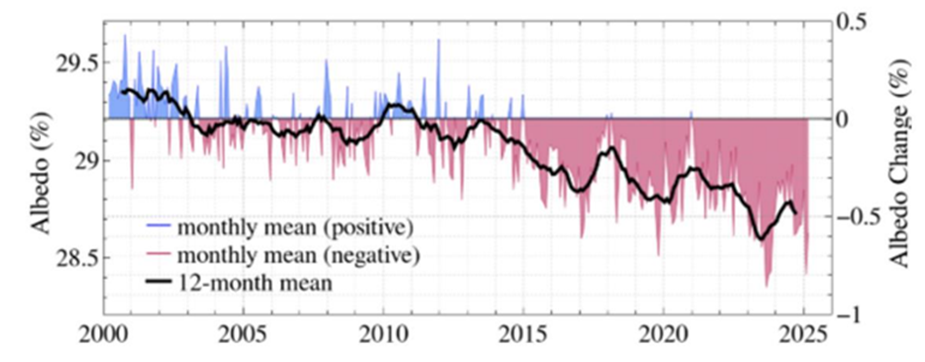
2025 Updated Report on Global Dimming and Brightening Worldwide and in China 

Martin Wild et al published April 2025 A Perspective on Global Dimming and Brightening Worldwide and in China. Excerpts in italics with my bolds and added images.

Abstract

Worldwide radiation records suggest that the amount of sunlight received at the Earth’s surface (surface solar radiation, SSR) has not been stable over the years, but underwent significant decadal variations, popularly also known as “global dimming and brightening”. These variations have been particularly evident in China, where the SSR substantially declined from the 1960s to the 1990s (dimming), with indications for a trend reversal in the 2000s and a slight recovery (brightening) in recent years. This perspective/review paper will discuss recent updates and remaining challenges regarding our knowledge of the magnitudes, causes, and implications of these variations in SSR worldwide, with a particular emphasis on the developments in China.

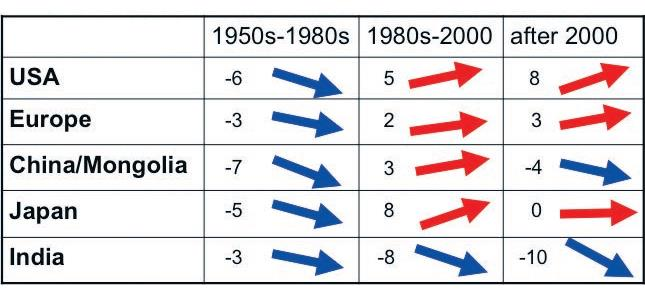
Fig. 1. Qualitative tendencies in decadal SSR changes over theperiods 1950s to 1980s, 1980s to 2000, and post-2000 in different world regions that are well covered by historic SSR records.

Recent developments include the use of machine learning methods to spatially and temporally augment the limited worldwide in-situ SSR observational records (Yuan et al.,2021; Jiao et al., 2023). These methods generate spatially complete SSR datasets over the entire land surface (Fig. 2). Figure 2 shows some characteristic features of SSR trends during the 1985−2019 “brightening period”, such as the substantial brightening over Europe and the continuous dimming in India. It remains a challenge to fully assess the reliability of the trends of these machine learning-based estimations, particularly in regions that lack the constraints of in-situ radiation observations.

Fig. 2. Worldwide linear trends of the annual average SSR during the “brightening” period of 1985–2019 based on ground observations spatially augmented by machine learning methods [Reprinted from Yuan et al. (2021), © American Meteorological Society. Used with permission.]

Impacts in China

A number of studies have shown that changes in SSR have affected warming rates in China, particularly in terms of the mean and maximum 2-m air temperatures. Daily maximum temperatures were shown to increase less than daily minimum temperatures in China since the 1960s, particularly in the decades of strongest dimming, indicative of a dampening effect of SSR dimming, particularly on the daily maximum temperature warming rates most directly affected by SSR changes (Wang et al., 2012a; Du et al., 2017; Zhao et al., 2021). The evolution of daily maximum land surface (Ts-max) and 2-m air (Ta-max) temperatures averaged over China from the 1960s to 2003 is illustrated in Fig. 5 in terms of their annual means and the means of the warm and cold seasons (from Du et al., 2017).

Fig. 5. China-mean anomalies of daily maximum land surface temperature (Ts-max, blue line) and daily maximum air temperature (Ta-max, red line) for the (a) entire year, (b) warm season (May−October), and (c) cold season (November−April) with respect to the reference period 1961–90,based on 1977 stations [Reprinted from Du et al. (2017).]

Previous Post  Hard Evidence of Solar Impact upon Earth Cloudiness

Later on is a reprinted discussion of global dimming and brightness resulting from fluctuating cloud cover.  This is topical because of new empirical research findings coming out of Asia.  H/T GWPF.  A study published by Kobe University research center is Revealing the impact of cosmic rays on the Earth’s climate.  Excerpts in italics with my bolds.

New evidence suggests that high-energy particles from space known as galactic cosmic rays affect the Earth’s climate by increasing cloud cover, causing an “umbrella effect”.

When galactic cosmic rays increased during the Earth’s last geomagnetic reversal transition 780,000 years ago, the umbrella effect of low-cloud cover led to high atmospheric pressure in Siberia, causing the East Asian winter monsoon to become stronger. This is evidence that galactic cosmic rays influence changes in the Earth’s climate. The findings were made by a research team led by Professor Masayuki Hyodo (Research Center for Inland Seas, Kobe University) and published on June 28 in the online edition of Scientific Reports.

The Svensmark Effect is a hypothesis that galactic cosmic rays induce low cloud formation and influence the Earth’s climate. Tests based on recent meteorological observation data only show minute changes in the amounts of galactic cosmic rays and cloud cover, making it hard to prove this theory. However, during the last geomagnetic reversal transition, when the amount of galactic cosmic rays increased dramatically, there was also a large increase in cloud cover, so it should be possible to detect the impact of cosmic rays on climate at a higher sensitivity.

(The Svenmark Effect is explained in essay The cosmoclimatology theory)

How Nature’s Sunscreen Works (from Previous Post)

A recent post Planetary Warming: Back to Basics discussed a recent paper by Nikolov and Zeller on the atmospheric thermal effect measured on various planets in our solar system. They mentioned that an important source of temperature variation around the earth’s energy balance state can be traced to global brightening and dimming.

This post explores the fact of fluctuations in the amount of solar energy reflected rather than absorbed by the atmosphere and surface. Brightening refers to more incoming solar energy from clear and clean skies. Dimming refers to less solar energy due to more sunlight reflected in the atmosphere by the presence of clouds and aerosols (air-born particles like dust and smoke).

The energy budget above from ERBE shows how important is this issue. On average, half of sunlight is either absorbed in the atmosphere or reflected before it can be absorbed by the surface land and ocean. Any shift in the reflectivity (albedo) impacts greatly on the solar energy warming the planet.

The leading research on global brightening/dimming is done at
the Institute for Atmospheric and Climate Science of ETH Zurich,
led by Dr. Martin Wild, senior scientist specializing in the subject.

Special instruments have been recording the solar radiation that reaches the Earth’s surface since 1923. However, it wasn’t until the International Geophysical Year in 1957/58 that a global measurement network began to take shape. The data thus obtained reveal that the energy provided by the sun at the Earth’s surface has undergone considerable variations over the past decades, with associated impacts on climate.

The initial studies were published in the late 1980s and early 1990s for specific regions of the Earth. In 1998 the first global study was conducted for larger areas, like the continents Africa, Asia, North America and Europe for instance.

Now ETH has announced The Global Energy Balance Archive (GEBA) version 2017: A database for worldwide measured surface energy fluxes. The title is a link to that paper published in May 2017 explaining the facility and some principal findings. The Archive itself is at  http://www.geba.ethz.ch.

For example, Figure 2 below provides the longest continuous record available in GEBA: surface downward shortwave radiation measured in Stockholm since 1922. Five year moving average in blue, 4th order regression model in red. Units Wm-2. Substantial multidecadal variations become evident, with an increase up to the 1950s (“early brightening”), an overall decline from the 1950s to the 1980s (“dimming”), and a recovery thereafter (“brightening”).
Figure 5. Composite of 56 European GEBA time series of annual surface downward shortwave radiation (thin line) from 1939 to 2013, plotted together with a 21 year Gaussian low-pass filter ((thick line). The series are expressed as anomalies (in Wm-2) from the 1971–2000 mean. Dashed lines are used prior to 1961 due to the lower number of records for this initial period. Updated from Sanchez-Lorenzo et al. (2015) including data until December 2013.
Martin Wild explains in a 2016 article Decadal changes in radiative fluxes at land and ocean surfaces and their relevance for global warming. From the Conclusion (SSR refers to solar radiation incident upon the surface)

However, observations indicate not only changes in the downward thermal fluxes, but even more so in their solar counterparts, whose records have a much wider spatial and temporal coverage. These records suggest multidecadal variations in SSR at widespread land-based observation sites. Specifically, declining tendencies in SSR between the 1950s and 1980s have been found at most of the measurement sites (‘dimming’), with a partial recovery at many of the sites thereafter (‘brightening’).

With the additional information from more widely measured meteorological quantities which can serve as proxies for SSR (primarily sunshine duration and DTR), more evidence for a widespread extent of these variations has been provided, as well as additional indications for an overall increasing tendency in SSR in the first part of the 20th century (‘early brightening’).

It is well established that these SSR variations are not caused by variations in the output of the sun itself, but rather by variations in the transparency of the atmosphere for solar radiation. It is still debated, however, to what extent the two major modulators of the atmospheric transparency, i.e., aerosol and clouds, contribute to the SSR variations.

The balance of evidence suggests that on longer (multidecadal) timescales aerosol changes dominate, whereas on shorter (decadal to subdecadal) timescales cloud effects dominate. More evidence is further provided for an increasing influence of aerosols during the course of the 20th century. However, aerosol and clouds may also interact, and these interactions were hypothesized to have the potential to amplify and dampen SSR trends in pristine and polluted areas, respectively.

No direct observational records are available over ocean surfaces. Nevertheless, based on the presented conceptual ideas of SSR trends amplified by aerosol–cloud interactions over the pristine oceans, modeling approaches as well as the available satellite-derived records it appears plausible that also over oceans significant decadal changes in SSR occur.

The coinciding multidecadal variations in SSTs and global aerosol emissions may be seen as a smoking gun, yet it is currently an open debate to what extent these SST variations are forced by aerosol-induced changes in SSR, effectively amplified by aerosol– cloud interactions, or are merely a result of unforced natural variations in the coupled ocean atmosphere system. Resolving this question could state a major step toward a better understanding of multidecadal climate change.

Another paper co-authored by Wild discusses the effects of aerosols and clouds The solar dimming/brightening effect over the Mediterranean Basin in the period 1979 − 2012. (NSWR is Net Short Wave Radiation, that is equal to surface solar radiation less reflected)

The analysis reveals an overall increasing trend in NSWR (all skies) corresponding to a slight solar brightening over the region (+0.36 Wm−2per decade), which is not statistically significant at 95% confidence level (C.L.). An increasing trend(+0.52 Wm−2per decade) is also shown for NSWR under clean skies (without aerosols), which is statistically significant (P=0.04).

This indicates that NSWR increases at a higher rate over the Mediterranean due to cloud variations only, because of a declining trend in COD (Cloud Optical Depth). The peaks in NSWR (all skies) in certain years (e.g., 2000) are attributed to a significant decrease in COD (see Figs. 9 and 10), whilethe two data series (NSWRall and NSWRclean) are highly correlated(r=0.95).

This indicates that cloud variation is the major regulatory factor for the amount and multi-decadal trends in NSWR over the Mediterranean Basin. (Note: Lower cloud optical depth is caused by less opaque clouds and/or decrease in overall cloudiness)

On the other hand, the results do not reveal a reversal from dimming to brightening during 1980s, as shown in several studies over Europe (Norris and Wild, 2007;Sanchez-Lorenzoet al., 2015), but a rather steady slight increasing trend in solar radiation, which, however, seems to be stabilized during the last years of the data series, in agreement with Sanchez-Lorenzo et al. (2015). Similarly, Wild (2012) reported that the solar brightening was less distinct at European sites after 2000 compared to the 1990s.

In contrast, the NSWR under clear (cloudless) skies shows a slight but statistically significant decreasing trend (−0.17 Wm−2per decade,P=0.002), indicating an overall decrease in NSWR over the Mediterranean due to water-vapor variability suggesting a transition to more humid environment under a warming climate.

Other researchers find cloudiness more dominant than aerosols. For example, The cause of solar dimming and brightening at the Earth’s surface during the last half century: Evidence from measurements of sunshine duration by Gerald Stanhill et al.

Analysis of the Angstrom-Prescott relationship between normalized values of global radiation and sunshine duration measured during the last 50 years made at five sites with a wide range of climate and aerosol emissions showed few significant differences in atmospheric transmissivity under clear or cloud-covered skies between years when global dimming occurred and years when global brightening was measured, nor in most cases were there any significant changes in the parameters or in their relationships to annual rates of fossil fuel combustion in the surrounding 1° cells. It is concluded that at the sites studied changes in cloud cover rather than anthropogenic aerosols emissions played the major role in determining solar dimming and brightening during the last half century and that there are reasons to suppose that these findings may have wider relevance.

Summary

The final words go to Martin Wild from Enlightening Global Dimming and Brightening.

Observed Tendencies in surface solar radiation
Figure 2.  Changes in surface solar radiation observed in regions with good station coverage during three periods.(left column) The 1950s–1980s show predominant declines (“dimming”), (middle column) the 1980s–2000 indicate partial recoveries (“brightening”) at many locations, except India, and (right column) recent developments after 2000 show mixed tendencies. Numbers denote typical literature estimates for the specified region and period in W m–2 per decade.  Based on various sources as referenced in Wild (2009).

The latest updates on solar radiation changes observed since the new millennium show no globally coherent trends anymore (see above and Fig. 2). While brightening persists to some extent in Europe and the United States, there are indications for a renewed dimming in China associated with the tremendous emission increases there after 2000, as well as unabated dimming in India (Streets et al. 2009; Wild et al. 2009).

We cannot exclude the possibility that we are currently again in a transition phase and may return to a renewed overall dimming for some years to come.

One can’t help but see the similarity between dimming/brightening and patterns of Global Mean Temperature, such as HadCrut.

Footnote: For more on clouds, precipitation and the ocean, see Here Comes the Rain Again

It’s Summertime, Hottest Year Claims Ensue

Matthew Wielicki explains the scientific malpractice in his Financial Post article Junk Science Week: The hottest year ever?.  Excerpts in italics wtih my bolds and added images

Advocates and the media claim 2024 was the hottest year ever.
Archeological data suggest it wasn’t,
while modern data suffer from biases

An image produced by NASA and used when it declared 2024 as the warmest year on record. Photo by NASA

In 2024, mainstream media and political leaders aggressively promoted the alarming narrative that Earth had just experienced its hottest year ever recorded. National Geographic dramatically proclaimed, “2024 was the hottest year ever … and the coldest year of the rest of your life,” while the Vancouver Sun declared unequivocally, “Scientists confirm 2024 was Canada’s and world’s hottest year on record.” Canadian political figures reinforced this narrative, with prime minister Justin Trudeau characterizing the year’s warmth as an urgent call for immediate climate action.

I’m an earth science professor-in-exile. Claims such as these
immediately provoke critical skepticism.

This persistent narrative, relentlessly advanced by a powerful climate-industrial complex comprising governments, activist organizations and the media, is designed not merely to inform, but to generate a state of perpetual urgency. As global greenhouse gas (GHG) emissions continue to rise despite decades of climate policy interventions, the need to claim climate conditions are increasingly severe becomes a strategic imperative, regardless of scientific accuracy or historical context. This approach not only distorts genuine scientific inquiry but fosters anxiety and despair, particularly affecting young people already inundated with predictions of catastrophe.

The answers to four fundamental questions expose the weaknesses and biases inherent in the mainstream climate narrative:

1. Can we accurately measure historical global temperatures?

Claims about unprecedented global heat depend heavily on comparing modern temperature records, which are gathered by instrument and capture annual or monthly fluctuations, to historical temperature estimates derived from proxy data such as ice cores, tree rings, sediment layers and coral reefs. But proxy data inherently smooths out short-term fluctuations, providing generalized temperature estimates spanning centuries or millennia. This mismatch between high-resolution modern data and low-resolution historical proxies inevitably exaggerates the perceived severity of contemporary warming.

For example, widely cited reconstructions and favourites of The Intergovernmental Panel on Climate Change (IPCC) explicitly acknowledge their inability to capture temperature variability occurring over periods shorter than 300 years. The rapid temperature changes of recent decades appear unprecedented when put side by side with these smoothed historical averages. This methodological flaw significantly undermines the credibility of claims asserting that current global temperatures are historically unique or alarming.

2. Was 2024 really unprecedentedly warm?

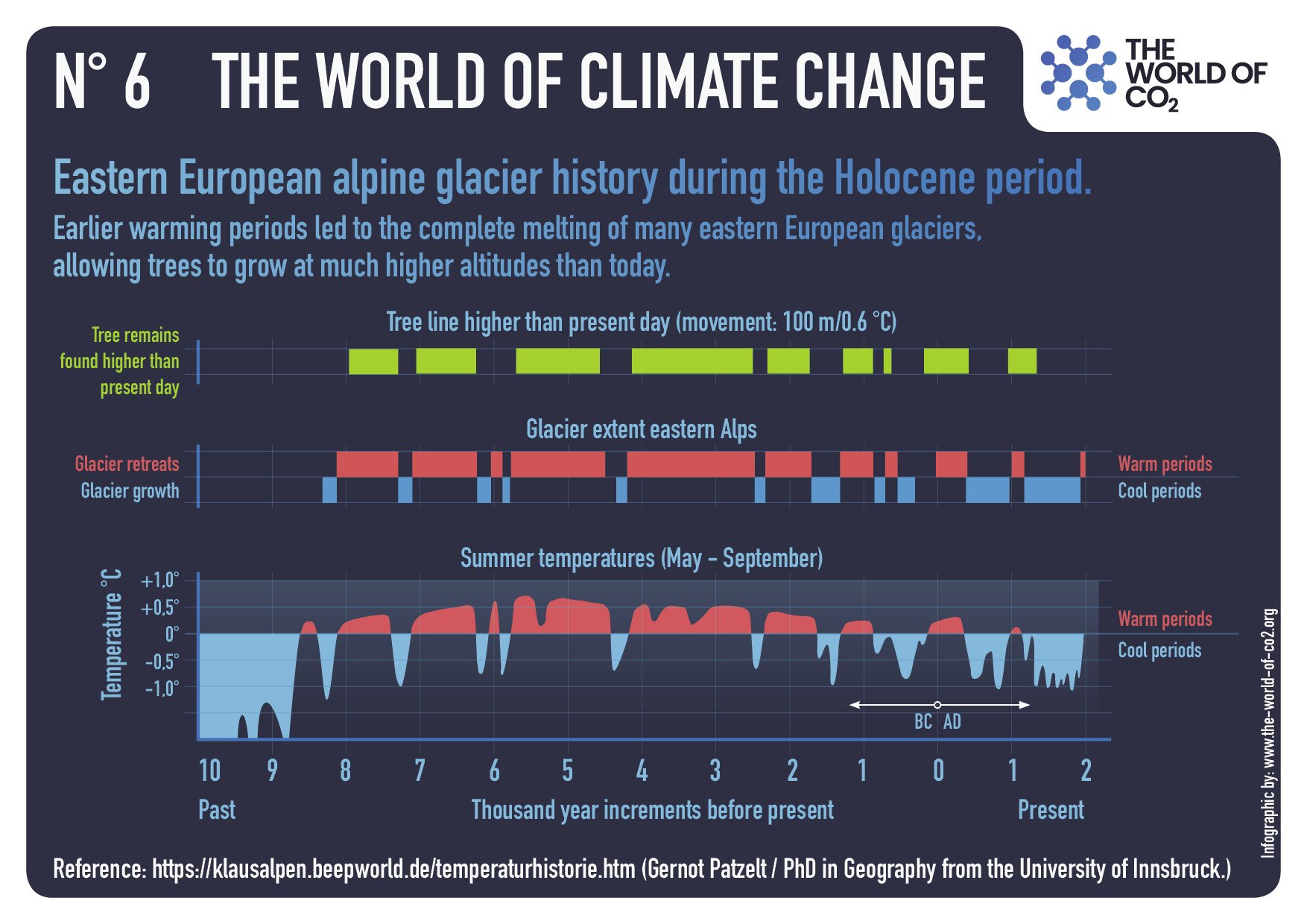
Extensive historical and geological evidence demonstrates significant natural warming vastly exceeding modern temperatures. The Holocene Thermal Maximum (five to nine thousand years ago) saw temperatures significantly warmer than today, including in Canada. Archeological evidence, such as ancient forests revealed by retreating glaciers in the Rockies, conclusively supports periods of substantial natural warmth.

During the Eemian interglacial period (115-130 thousand years ago), Greenland experienced temperatures three to five degrees C warmer than now, despite substantially lower CO₂ concentrations in the atmosphere. These scientifically documented periods confirm that Earth’s climate naturally experiences considerable variability, rendering claims of unprecedented modern warmth scientifically untenable and historically uninformed.

3. Are we measuring the effects of CO₂ or urban heat islands

Most modern temperature records fuelling alarmist headlines originate from urban areas influenced by the Urban Heat Island Effect (UHIE). UHIE results from urban infrastructure, such as concrete, asphalt and buildings, retaining and radiating heat, significantly increasing local temperatures independent of broader climate trends. Toronto’s significant infrastructure growth has noticeably raised local temperatures, heavily skewing data. Similarly, Las Vegas’ highest recorded temperatures coincided with significant expansion around Harry Reid International Airport, illustrating the dominant role of urbanization rather than atmospheric CO₂ emissions.

Recent research indicates that up to 65 per cent of urban warming is from local urbanization rather than global greenhouse gas increases. Attributing urban heat predominantly to CO₂ emissions significantly misrepresents the true dynamics of local temperature increases.

4. Do rising CO2 levels really heat the oceans?

Recent alarmist coverage in outlets like the Financial Times highlights near-record ocean temperatures, linking them directly to rising CO₂ levels. The EU’s Copernicus programme noted that May 2025 ocean temperatures were the second highest ever recorded, with scientists raising concerns about the oceans’ diminishing capacity to absorb CO₂ and excess heat.

But this narrative critically overlooks fundamental scientific facts. Oceans possess a heat capacity orders of magnitude greater than the atmosphere. The notion that atmospheric CO₂ significantly heats ocean water directly is scientifically unfounded, as infrared radiation from CO₂ penetrates mere millimetres into the ocean’s surface, not nearly deep enough to meaningfully alter ocean temperature. Ocean temperature fluctuations are primarily driven by natural phenomena such as El Niño.

Furthermore, going back to previous warmings prior to the satellite record shows that the entire rise of 0.8C since 1947 is due to oceanic, not human activity.

Moreover, historical data on ocean temperatures is highly uncertain, relying predominantly on sparse measurements and indirect proxies. Claiming near-record ocean temperatures without acknowledging these substantial uncertainties misleads the public about the robustness and reliability of these measurements.

Critical conclusion: One thing remains certain: it will never be “too hot” in Canada, despite alarmist rhetoric suggesting otherwise. The exaggerated claims that 2024 was “the hottest year ever” are not grounded in rigorous scientific analysis but serve primarily as political and ideological propaganda. This relentless propagation of fear fosters anxiety, despair, and nihilism, especially among young people — serious consequences largely ignored by climate alarmists.

The scientific community, policy-makers and the public at large need to insist on transparency, rigour and honesty in climate discourse. Recognizing the motivations behind alarmist claims is essential to ensuring public trust and effective policy. Climate science should strive to educate, not frighten, promoting balanced understanding rather than catastrophic narratives disconnected from historical context and scientific rigour.

Matthew Wielicki, Ph.D. in geochemistry from UCLA, publishes the Substack site Irrational Fear, which provides data-driven critiques aimed at fostering a balanced and scientifically grounded understanding of climate science.

May 2025 Two Years of Ocean Cooling Persists

The best context for understanding decadal temperature changes comes from the world’s sea surface temperatures (SST), for several reasons:
  • The ocean covers 71% of the globe and drives average temperatures;
  • SSTs have a constant water content, (unlike air temperatures), so give a better reading of heat content variations;
  • A major El Nino was the dominant climate feature in recent years.

HadSST is generally regarded as the best of the global SST data sets, and so the temperature story here comes from that source. Previously I used HadSST3 for these reports, but Hadley Centre has made HadSST4 the priority, and v.3 will no longer be updated.  HadSST4 is the same as v.3, except that the older data from ship water intake was re-estimated to be generally lower temperatures than shown in v.3.  The effect is that v.4 has lower average anomalies for the baseline period 1961-1990, thereby showing higher current anomalies than v.3. This analysis concerns more recent time periods and depends on very similar differentials as those from v.3 despite higher absolute anomaly values in v.4.  More on what distinguishes HadSST3 and 4 from other SST products at the end. The user guide for the current version HadSST4.1.1.0 is here.   The charts and analysis below is produced from the current data.

The Current Context

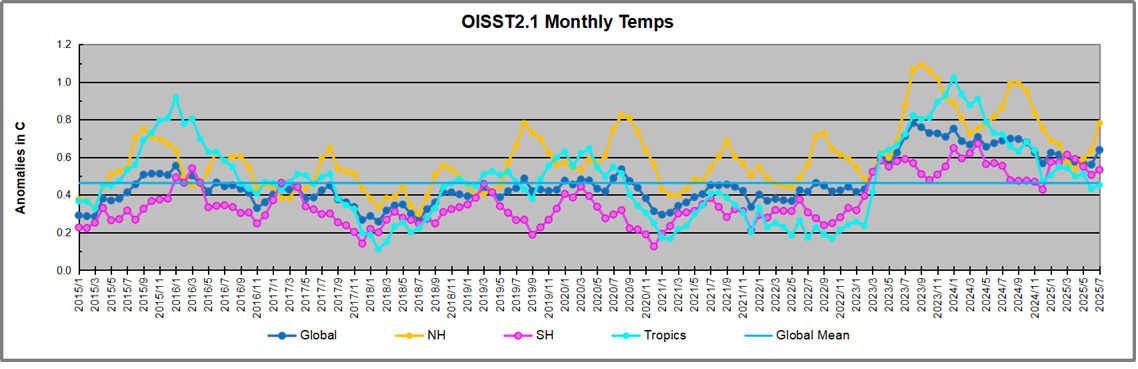
The chart below shows SST monthly anomalies as reported in HadSST4 starting in 2015 through May 2025. A global cooling pattern is seen clearly in the Tropics since its peak in 2016, joined by NH and SH cycling downward since 2016, followed by rising temperatures in 2023 and 2024.

Note that in 2015-2016 the Tropics and SH peaked in between two summer NH spikes.  That pattern repeated in 2019-2020 with a lesser Tropics peak and SH bump, but with higher NH spikes. By end of 2020, cooler SSTs in all regions took the Global anomaly well below the mean for this period.  A small warming was driven by NH summer peaks in 2021-22, but offset by cooling in SH and the tropics, By January 2023 the global anomaly was again below the mean.

Then in 2023-24 came an event resembling 2015-16 with a Tropical spike and two NH spikes alongside, all higher than 2015-16. There was also a coinciding rise in SH, and the Global anomaly was pulled up to 1.1°C last year, ~0.3° higher than the 2015 peak.  Then NH started down autumn 2023, followed by Tropics and SH descending 2024 to the present. After 12 months of cooling in SH and the Tropics, the Global anomaly came back down, led by NH cooling the last 8 months from its 1.3C peak in August, down to 0.8C in March and April.  Remarkably, April 2025 SST anomalies in all regions and globally are the coolest since March 2023.  May shows little change in the Global anomaly, with a SH decline offsetting an upward bump in NH.

Comment:

The climatists have seized on this unusual warming as proof their Zero Carbon agenda is needed, without addressing how impossible it would be for CO2 warming the air to raise ocean temperatures.  It is the ocean that warms the air, not the other way around.  Recently Steven Koonin had this to say about the phonomenon confirmed in the graph above:

El Nino is a phenomenon in the climate system that happens once every four or five years.  Heat builds up in the equatorial Pacific to the west of Indonesia and so on.  Then when enough of it builds up it surges across the Pacific and changes the currents and the winds.  As it surges toward South America it was discovered and named in the 19th century  It iswell understood at this point that the phenomenon has nothing to do with CO2.

Now people talk about changes in that phenomena as a result of CO2 but it’s there in the climate system already and when it happens it influences weather all over the world.   We feel it when it gets rainier in Southern California for example.  So for the last 3 years we have been in the opposite of an El Nino, a La Nina, part of the reason people think the West Coast has been in drought.

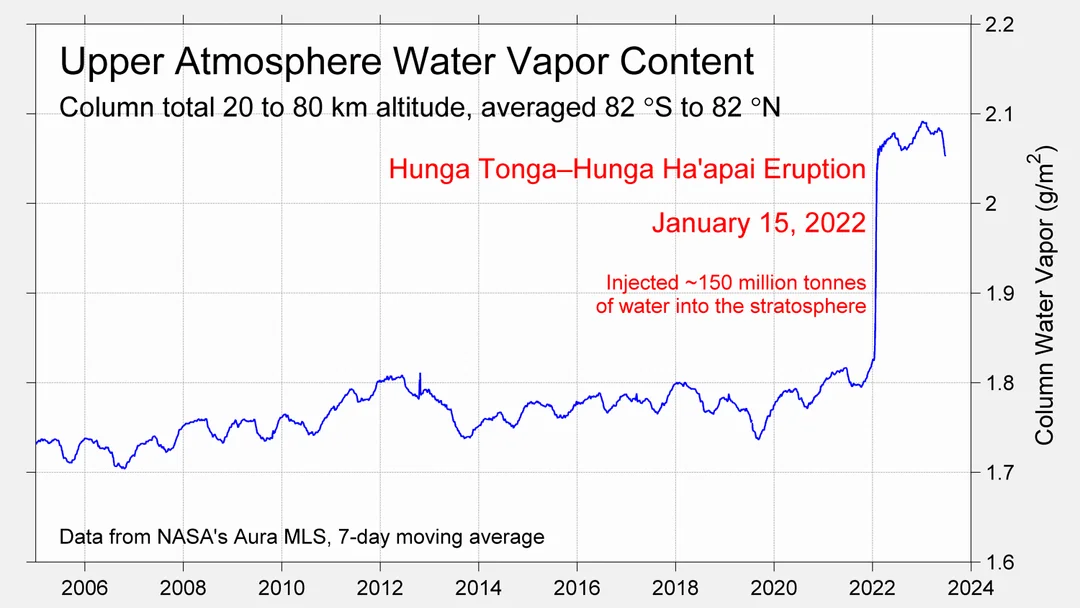
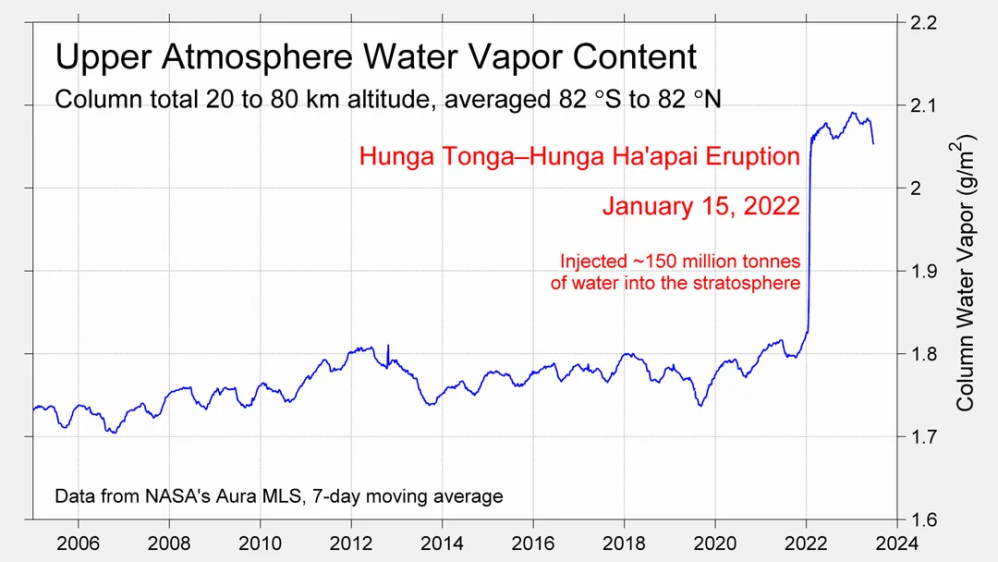
It has now shifted in the last months to an El Nino condition that warms the globe and is thought to contribute to this Spike we have seen. But there are other contributions as well.  One of the most surprising ones is that back in January of 2022 an enormous underwater volcano went off in Tonga and it put up a lot of water vapor into the upper atmosphere. It increased the upper atmosphere of water vapor by about 10 percent, and that’s a warming effect, and it may be that is contributing to why the spike is so high.

A longer view of SSTs

To enlarge image, open in new tab.

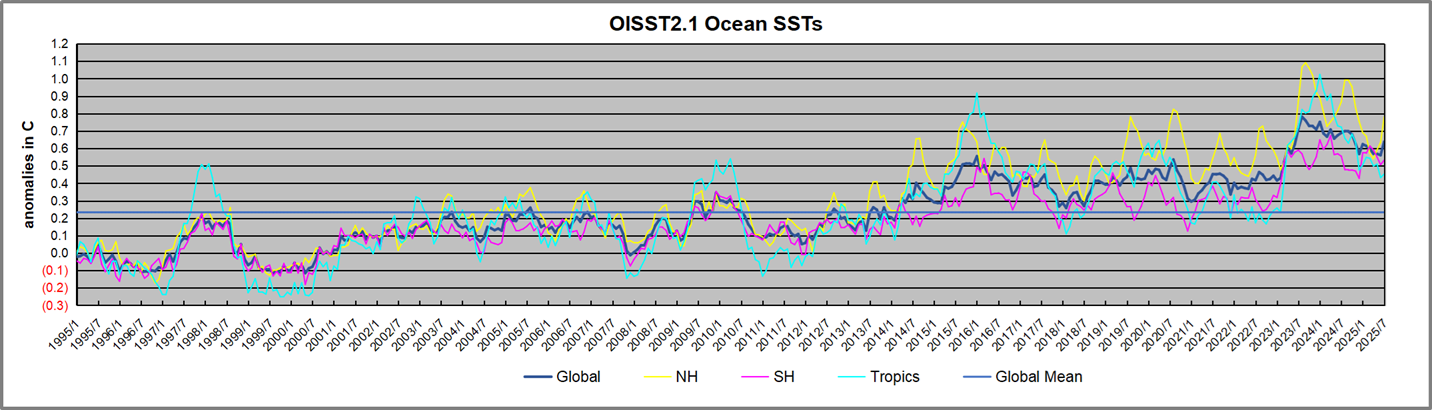
The graph above is noisy, but the density is needed to see the seasonal patterns in the oceanic fluctuations.  Previous posts focused on the rise and fall of the last El Nino starting in 2015.  This post adds a longer view, encompassing the significant 1998 El Nino and since.  The color schemes are retained for Global, Tropics, NH and SH anomalies.  Despite the longer time frame, I have kept the monthly data (rather than yearly averages) because of interesting shifts between January and July. 1995 is a reasonable (ENSO neutral) starting point prior to the first El Nino.

The sharp Tropical rise peaking in 1998 is dominant in the record, starting Jan. ’97 to pull up SSTs uniformly before returning to the same level Jan. ’99. There were strong cool periods before and after the 1998 El Nino event. Then SSTs in all regions returned to the mean in 2001-2.

SSTS fluctuate around the mean until 2007, when another, smaller ENSO event occurs. There is cooling 2007-8,  a lower peak warming in 2009-10, following by cooling in 2011-12.  Again SSTs are average 2013-14.

Now a different pattern appears.  The Tropics cooled sharply to Jan 11, then rise steadily for 4 years to Jan 15, at which point the most recent major El Nino takes off.  But this time in contrast to ’97-’99, the Northern Hemisphere produces peaks every summer pulling up the Global average.  In fact, these NH peaks appear every July starting in 2003, growing stronger to produce 3 massive highs in 2014, 15 and 16.  NH July 2017 was only slightly lower, and a fifth NH peak still lower in Sept. 2018.

The highest summer NH peaks came in 2019 and 2020, only this time the Tropics and SH were offsetting rather adding to the warming. (Note: these are high anomalies on top of the highest absolute temps in the NH.)  Since 2014 SH has played a moderating role, offsetting the NH warming pulses. After September 2020 temps dropped off down until February 2021.  In 2021-22 there were again summer NH spikes, but in 2022 moderated first by cooling Tropics and SH SSTs, then in October to January 2023 by deeper cooling in NH and Tropics.

Then in 2023 the Tropics flipped from below to well above average, while NH produced a summer peak extending into September higher than any previous year.  Despite El Nino driving the Tropics January 2024 anomaly higher than 1998 and 2016 peaks, following months cooled in all regions, and the Tropics continued cooling in April, May and June along with SH dropping.  After July and August NH warming again pulled the global anomaly higher, September through January 2025 resumed cooling in all regions, continuing February through April 2025, with little change in May.

What to make of all this? The patterns suggest that in addition to El Ninos in the Pacific driving the Tropic SSTs, something else is going on in the NH.  The obvious culprit is the North Atlantic, since I have seen this sort of pulsing before.  After reading some papers by David Dilley, I confirmed his observation of Atlantic pulses into the Arctic every 8 to 10 years.

Contemporary AMO Observations

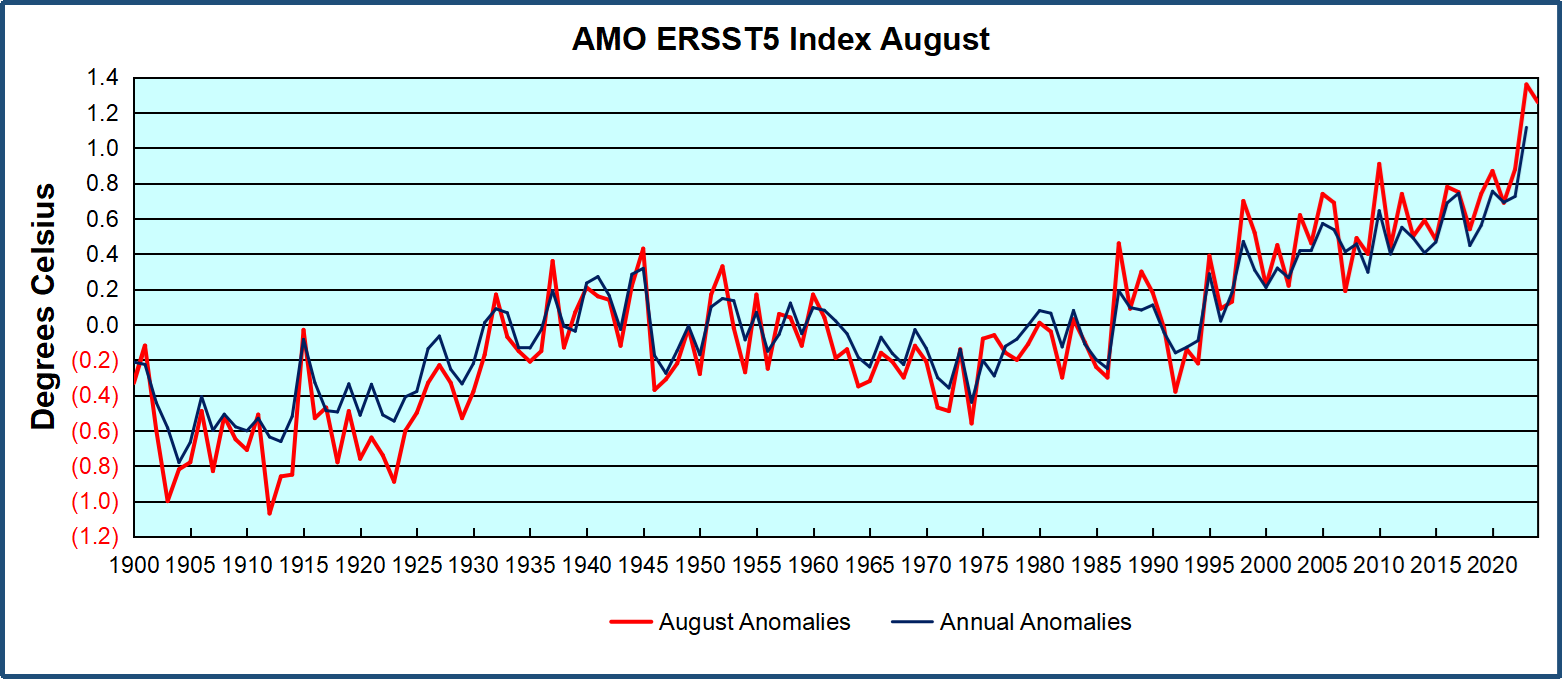
Through January 2023 I depended on the Kaplan AMO Index (not smoothed, not detrended) for N. Atlantic observations. But it is no longer being updated, and NOAA says they don’t know its future.  So I find that ERSSTv5 AMO dataset has current data.  It differs from Kaplan, which reported average absolute temps measured in N. Atlantic.  “ERSST5 AMO  follows Trenberth and Shea (2006) proposal to use the NA region EQ-60°N, 0°-80°W and subtract the global rise of SST 60°S-60°N to obtain a measure of the internal variability, arguing that the effect of external forcing on the North Atlantic should be similar to the effect on the other oceans.”  So the values represent SST anomaly differences between the N. Atlantic and the Global ocean.

The chart above confirms what Kaplan also showed.  As August is the hottest month for the N. Atlantic, its variability, high and low, drives the annual results for this basin.  Note also the peaks in 2010, lows after 2014, and a rise in 2021. Then in 2023 the peak was holding at 1.4C before declining.  An annual chart below is informative:

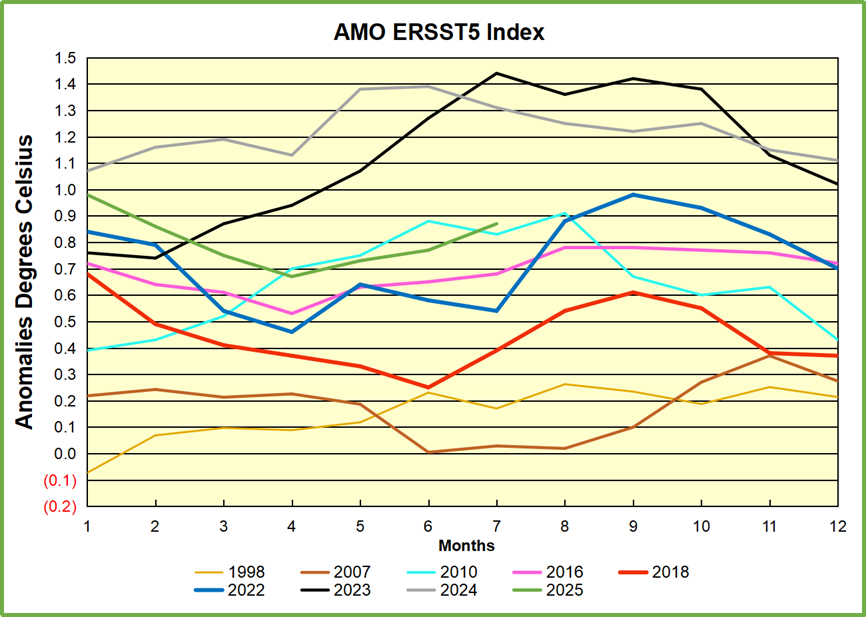
Note the difference between blue/green years, beige/brown, and purple/red years.  2010, 2021, 2022 all peaked strongly in August or September.  1998 and 2007 were mildly warm.  2016 and 2018 were matching or cooler than the global average.  2023 started out slightly warm, then rose steadily to an  extraordinary peak in July.  August to October were only slightly lower, but by December cooled by ~0.4C.

Then in 2024 the AMO anomaly started higher than any previous year, then leveled off for two months declining slightly into April.  Remarkably, May showed an upward leap putting this on a higher track than 2023, and rising slightly higher in June.  In July, August and September 2024 the anomaly declined, and despite a small rise in October, ended close to where it began.  Note 2025 started much lower than the previous year and is headed sharply downward, well below the previous two years, now in May aligning with 2010.

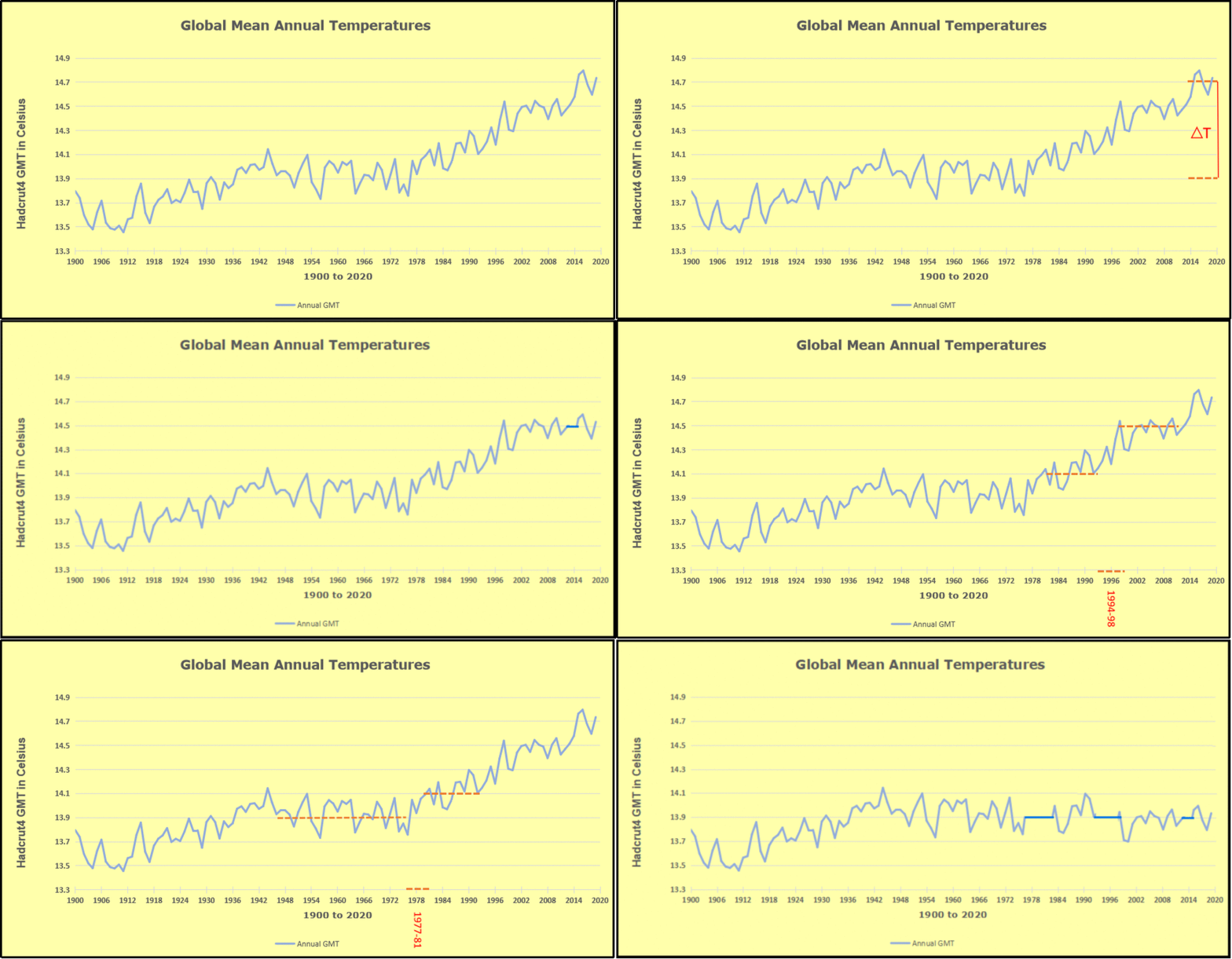
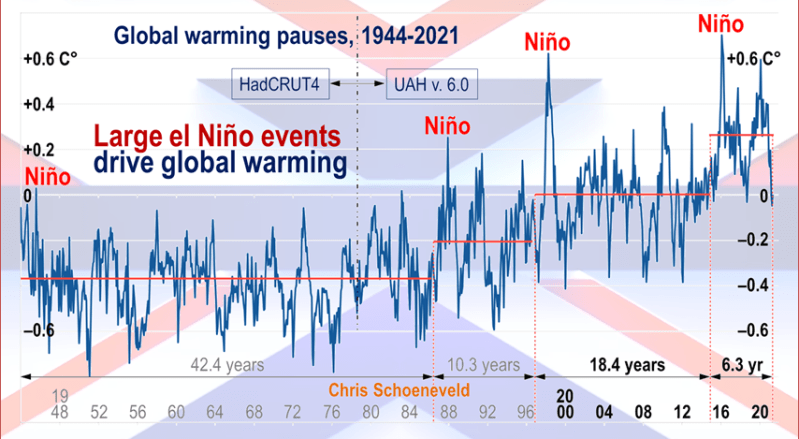
The pattern suggests the ocean may be demonstrating a stairstep pattern like that we have also seen in HadCRUT4.

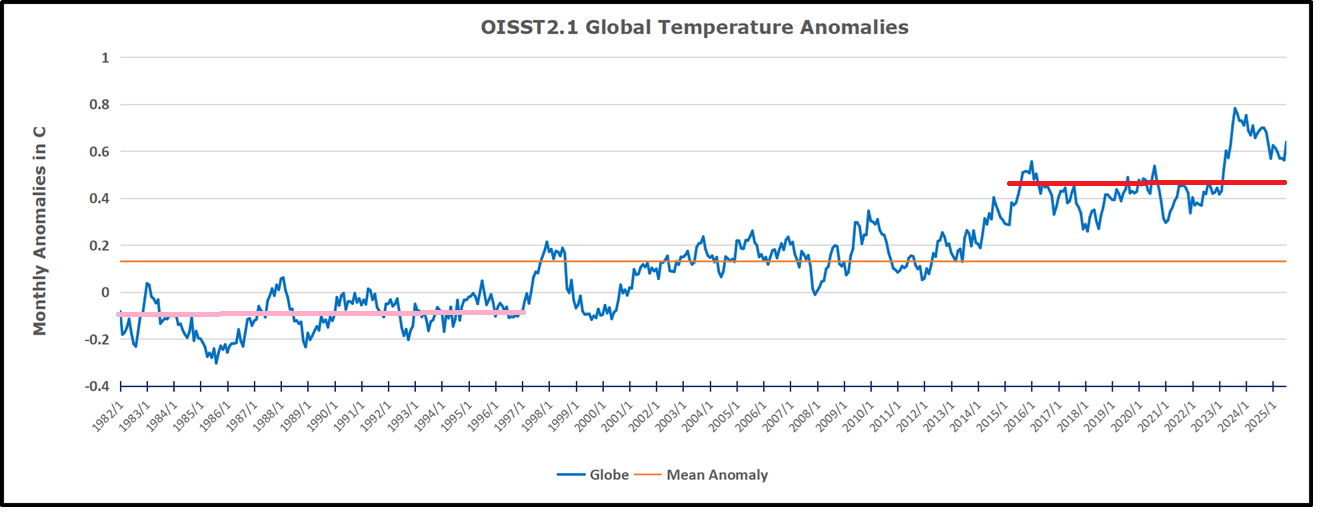
The purple line is the average anomaly 1980-1996 inclusive, value 0.17.  The orange line the average 1980-2024, value 0.38, also for the period 1997-2012. The red line is 2013-2024, value 0.67. As noted above, these rising stages are driven by the combined warming in the Tropics and NH, including both Pacific and Atlantic basins.

Curiosity:  Solar Coincidence?

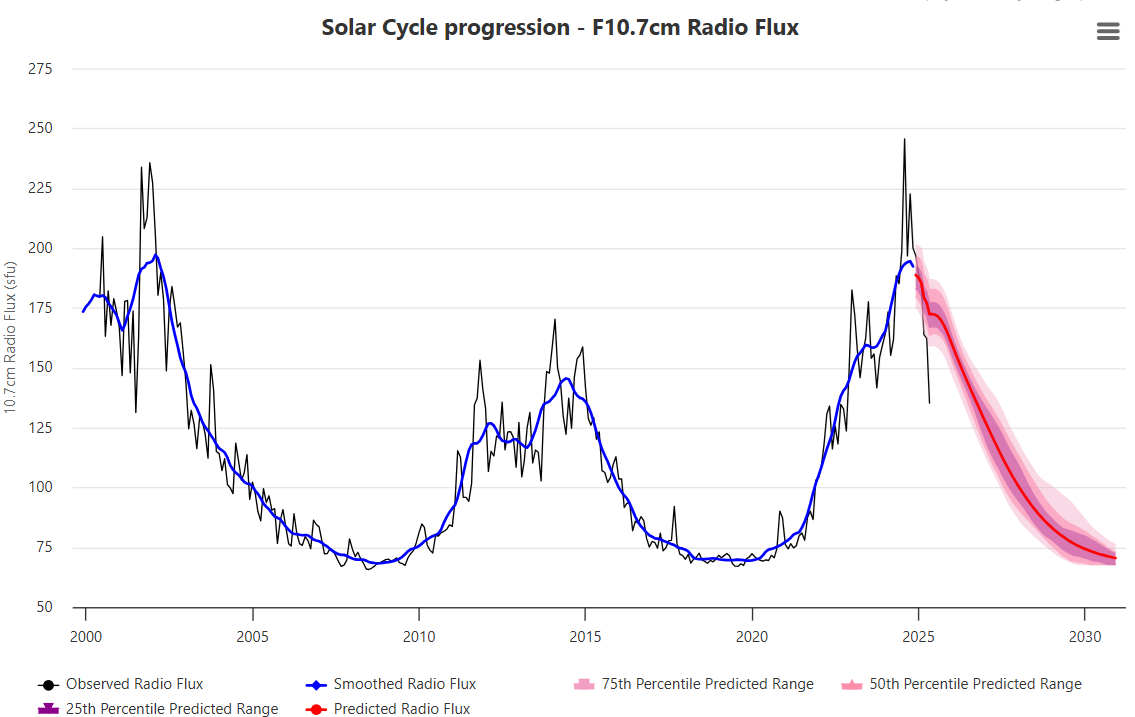
The news about our current solar cycle 25 is that the solar activity is hitting peak numbers now and higher  than expected 1-2 years in the future.  As livescience put it:  Solar maximum could hit us harder and sooner than we thought. How dangerous will the sun’s chaotic peak be?  Some charts from spaceweatherlive look familar to these sea surface temperature charts.

Summary


The oceans are driving the warming this century.  SSTs took a step up with the 1998 El Nino and have stayed there with help from the North Atlantic, and more recently the Pacific northern “Blob.”  The ocean surfaces are releasing a lot of energy, warming the air, but eventually will have a cooling effect.  The decline after 1937 was rapid by comparison, so one wonders: How long can the oceans keep this up? And is the sun adding forcing to this process?

Footnote: Why Rely on HadSST4

HadSST is distinguished from other SST products because HadCRU (Hadley Climatic Research Unit) does not engage in SST interpolation, i.e. infilling estimated anomalies into grid cells lacking sufficient sampling in a given month. From reading the documentation and from queries to Met Office, this is their procedure.

HadSST4 imports data from gridcells containing ocean, excluding land cells. From past records, they have calculated daily and monthly average readings for each grid cell for the period 1961 to 1990. Those temperatures form the baseline from which anomalies are calculated.

In a given month, each gridcell with sufficient sampling is averaged for the month and then the baseline value for that cell and that month is subtracted, resulting in the monthly anomaly for that cell. All cells with monthly anomalies are averaged to produce global, hemispheric and tropical anomalies for the month, based on the cells in those locations. For example, Tropics averages include ocean grid cells lying between latitudes 20N and 20S.

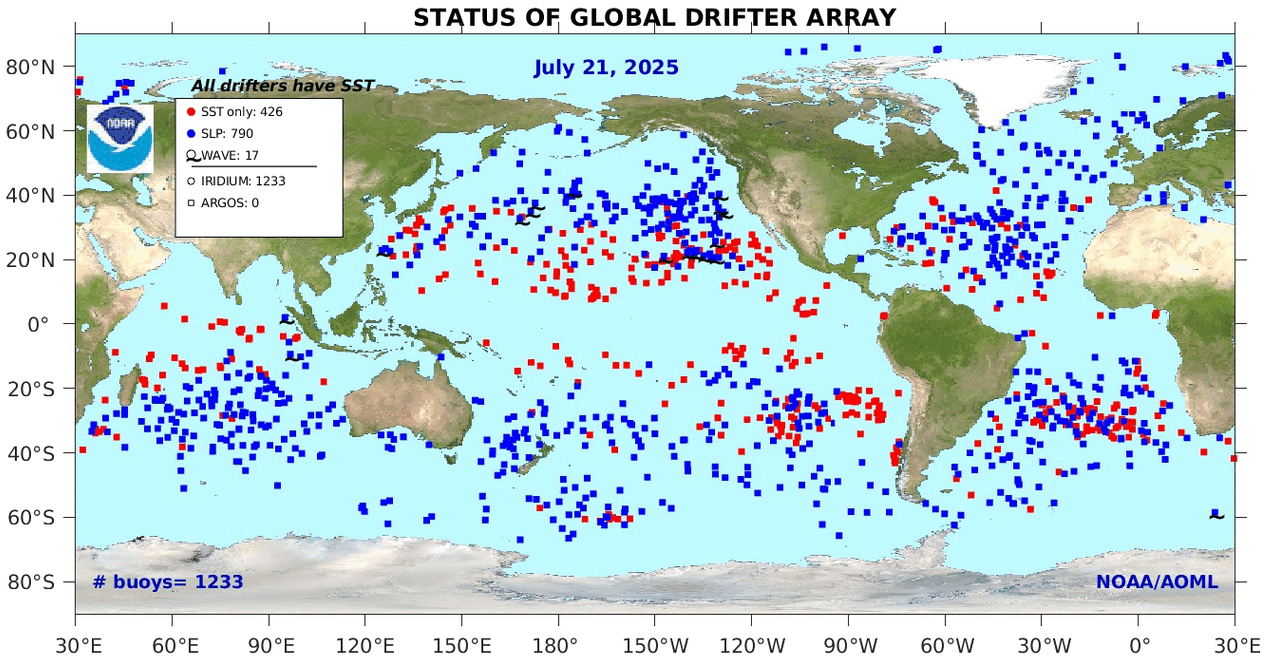
Gridcells lacking sufficient sampling that month are left out of the averaging, and the uncertainty from such missing data is estimated. IMO that is more reasonable than inventing data to infill. And it seems that the Global Drifter Array displayed in the top image is providing more uniform coverage of the oceans than in the past.

uss-pearl-harbor-deploys-global-drifter-buoys-in-pacific-ocean

USS Pearl Harbor deploys Global Drifter Buoys in Pacific Ocean

Meet Téa Johansson, Teenage Climate Realist

For those who prefer reading, below is a transcript lightly edited from the closed captions with my bolds along with some of the exhibits and added images.

Life on Earth is in crisis crop failure, social and ecological collapse, mass extinction.  We have a moral duty to take action.  These statements made by Extinction Rebellion reflect the climate alarmist narrative that has continued to escalate across the Western world.  Hysteria over climate change can be seen throughout history, from the human sacrifices of the Aztecs to bring back rain, to the Salem witch trials to eliminate the women they blamed for crop failure during the little ice age.

Today the climate industrial complex is funded by trillions of dollars seeking to control what we buy, eat and where we are allowed to travel,  all in the name of sustainability and achieving net zero carbon emissions.  This fear campaign is rooted in the belief that we will not look into the data ourselves, but instead look to the governments and to the media to tell us what is true.

Today I will demonstrate that temperatures fluctuate and are not unprecedented, and that natural disasters are not getting worse. I will also highlight the unreliability of climate data and the role of CO2.  Ultimately I will present scientific evidence to show that we are not in a climate crisis.

Historical temperature records indicate that we are not in the climate crisis western governments claim.  We are looking at a graph of the past 65 million years from NOAA.  The Earth today seems to be in a particularly cool period; in fact the Earth is still coming out of an ice age. History demonstrates that life has existed and thrived in much warmer temperatures, and that temperatures have been much higher without the human influence of industrial CO2 emissions.  

Historical temperature records indicate that the temperature of the Earth naturally fluctuates over time as it has for the past 65 million years.  In just the past 2,000 years there have been two warm periods and two cold periods.  The Roman warm period, also called the Roman optimum, was known as a time of prosperity.  This of course goes against the entire narrative that warming threatens human life.  Following the Roman warm period came the cold dark age,  the medieval warm period, and the Little Ice Age.  The current warming from 1800 onwards is the warming of recovery from the Little Ice Age.  However temperatures are still cold compared to distant times and continue to visibly fluctuate.  

Given this evidence,  the claim by scientists and news pundits that 3° Fahrenheit is the end of civilization is not cause for alarm.  Because it is not unprecedented and because temperatures will continue to fluctuate today.  The argument for climate change is rooted in the belief that warmer weather and CO2 emissions have been causing natural disasters to become more frequent and more violent.   However after studying hurricane and wildfire data, it became clear that actual activity goes against this global warming narrative.

This graph from the bulletin of the American Meteorological Society shows the number of hurricanes in the US per year since 1900 showing a slight downward trend for the past 120 years.  The strength and duration of hurricanes shows a similar lack of crisis.  

A graph from the National Hurricane Research Laboratory illustrates the North Atlantic hurricane intensity from 1920 to 2016, where there is evidently no trend. However the data presented to the public by the 2014 National Climate Assessment of the United States is limited to the portion highlighted in red creating an illusory upward trend.

This graph starting in 1920 shows that the number of acres burned by wildfires in the US has been decreasing.  Similarly the number of acres burned globally since 1900 has steadily declined as well. Ultimately the presented evidence goes against the narrative that anthropogenic CO2 emissions have been making the weather worse.

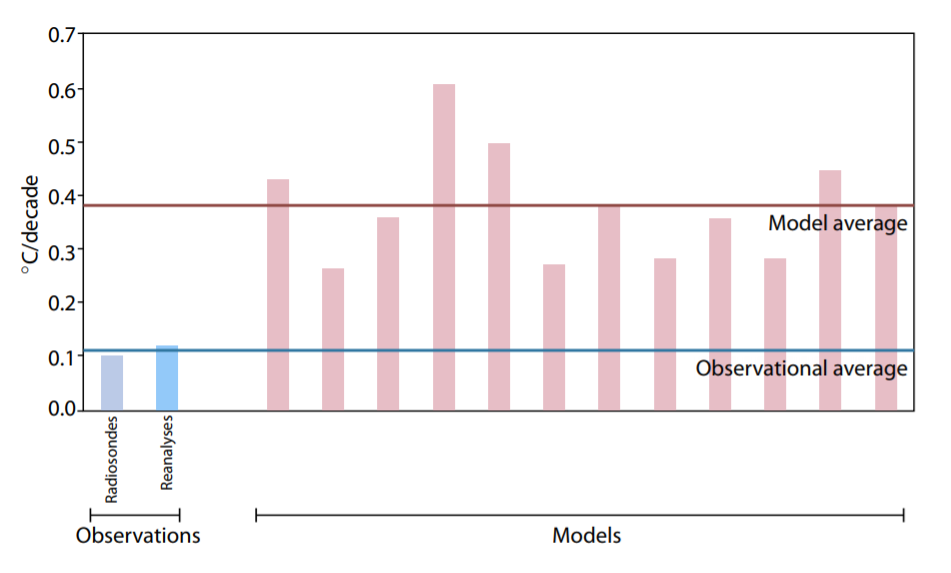
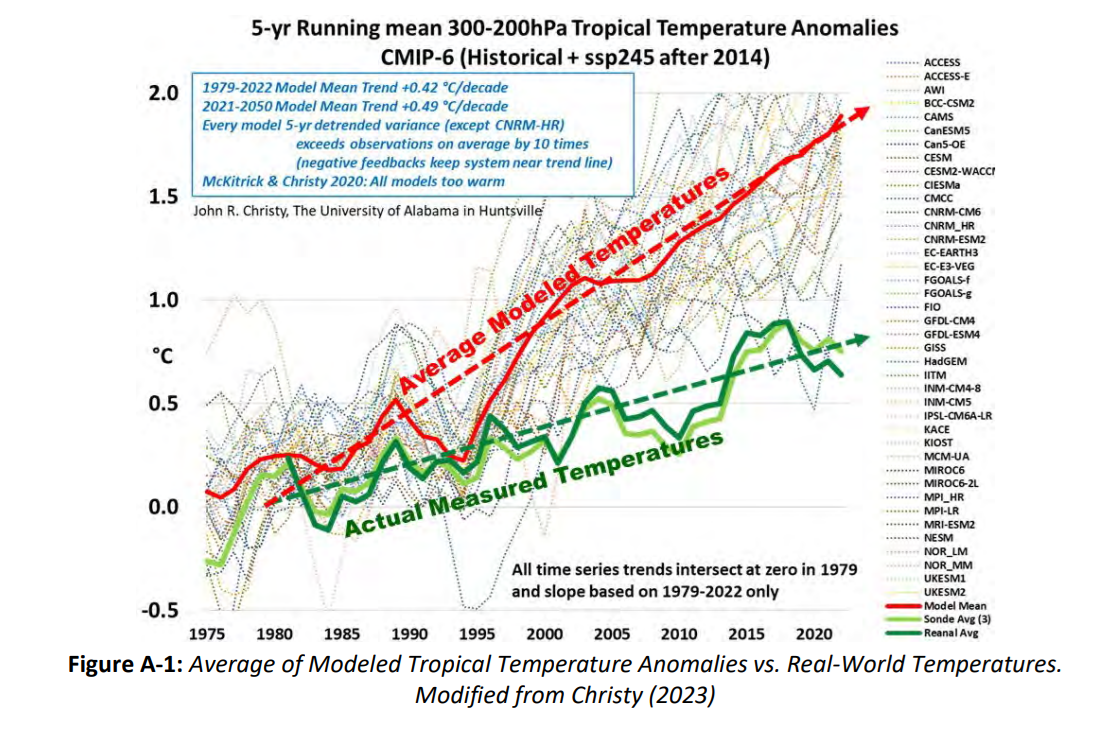
To understand the science behind the climate crisis claims of today, it is necessary to highlight the unreliability of available data.  This is most evident in the disparity between climate model predictions and the observed data.  In this graph illustrating temperature change, the blue line representing data taken from weather balloons matches up well with the green line showing data taken from satellites. However the red line represents the climate models used by the UNIPCC to predict future global warming.  These observations show that actual warming is about one third of that predicted.

Temperature measurements are greatly affected by what is called the urban heat island effect.  Since concrete picks up heat, temperatures taken in cities are much higher than those taken in rural areas.  For example in a thermal radiation map of the city of Paris, the middle of the city produces a deep red color representing heat, while the rural areas around the city project a green to bluecolor representing milder temperatures.  

This gap represents one way that climate alarmists can instill fear by embellishing data to serve their agenda. Perhaps the greatest tool of the climate industrial complex is the supposed evil of CO2.  However CO2 is not the control knob for climate change mainly because it is only 0.04% of the atmosphere.  I’ll say it again:  CO2 is only 0.04% of the atmosphere.  A visual comparison of CO2 to the other atmospheric gases shows how barely negligible is the gas in comparison.  

Although the mainstream media has tried to alarm its consumers with the accelerating emissions of CO2, the Earth is actually in a CO2 famine.  Current levels are about 423 parts per million; however in the past they have been at least a thousand parts per million and have likely reached 8,000 parts per million.

While the narrative states that CO2 directly causes the rise in temperature, it has been found that quite the opposite is true.  The relationship between CO2 and temperature is not that more CO2 causes a rise in temperature, but that a rise in temperature causes an increase in CO2.   Carl Wunsch, professor of oceanography at MIT, found that when the ocean warms more CO2 is released into the atmosphere.  On the other hand when the ocean is cold, CO2 is absorbed into the water.  

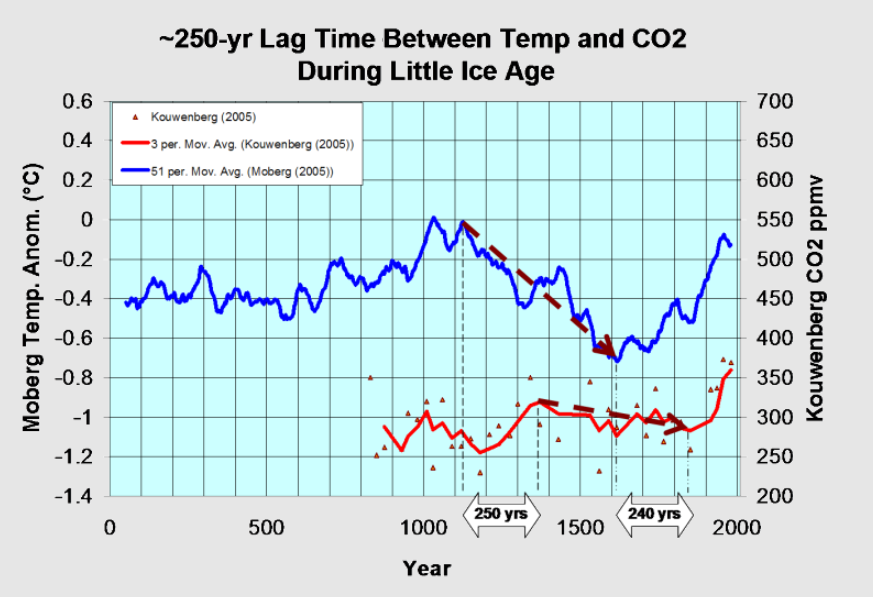
In a graphical correlation between temperature and CO2, it is found that when a rise in temperature occurs, a rise in CO2 follows a few centuries later.  In this graph CO2 rose 800 years later in response to a surge in temperature.

Like everything else in the world, CO2 may have some small factor in climate, while there are countless of other factors affecting temperature.  Some examples are volcanic activity, cosmic rays, and the sun.  This highlights how if we were to limit CO2,  it would only stunt biodiversity while having almost no effect on temperature.  Because of the fact that it is only one small factor in a sea of greater causes.

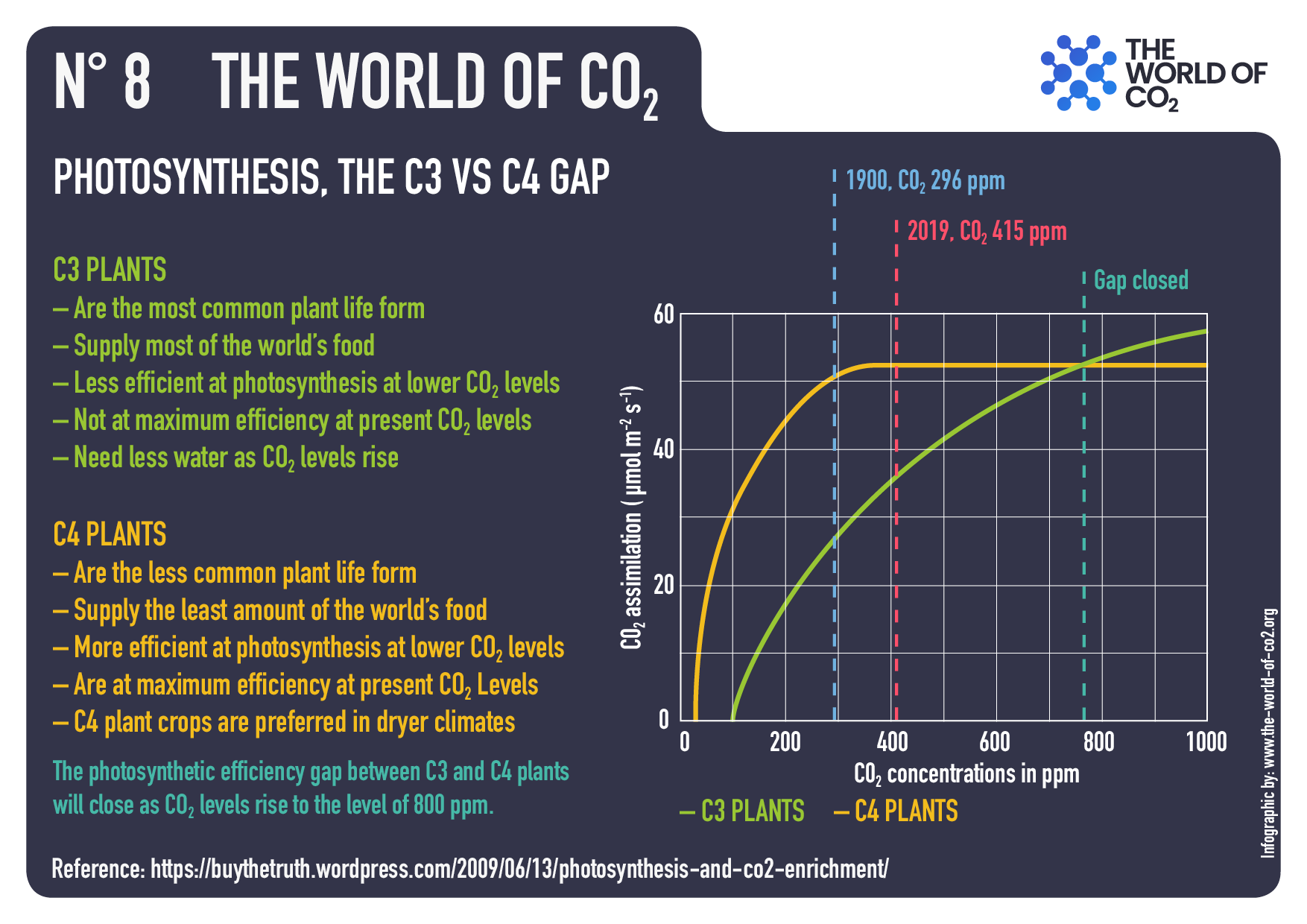
Some call CO2 the gas of life because it plays an instrumental role in the process of photosynthesis. It comes as no surprise that most farmers use high levels of it in their green houses to produce a better crop.  In this picture four pine trees are shown growing at different levels of added CO2, from normal atmospheric CO2 to an added 150, 300, and eventually 450 parts per million.  More CO2 is evidently beneficial for plant growth.  Physicist Lubos Motl, former professor at Harvard, summarized the importance of CO2, saying “It is the key compound that plants need to grow, and indirectly every organism needs to have food.  At the end it is clear that CO2 is not, as the New York Times frighteningly put it, a tiny bit of arsenic or cobra venom.   Nor will it cause famine as many claim; if CO2 increases it will only green the planet and increase the food supply.

Across the western world climate change has been coined as an existential threat to mankind.  While this sentiment is not new over the course of history, as it can be seen through the Aztecs and even in the Salem witch trials.  It has once again become relevant in today’s culture with policies such as carbon taxes and individual CO2 budgets being proposed in our governments.  We are seeing the climate issue creep into every part of our lives.

This is why I I found it necessary to pursue the truth and the climate debate.  In my speech I presented the scientific evidence behind historical temperature change and natural disasters,  discovering the unreliability of climate data, the small role of CO2 in climate, and its essential role in biodiversity.   As a result I’ve concluded that the climate crisis is a hoax that we must arm ourselves against by pursuing the truth and by looking into the data ourselves.

NH and Tropics Lead UAH Temps Lower May 2025

The post below updates the UAH record of air temperatures over land and ocean. Each month and year exposes again the growing disconnect between the real world and the Zero Carbon zealots.  It is as though the anti-hydrocarbon band wagon hopes to drown out the data contradicting their justification for the Great Energy Transition.  Yes, there was warming from an El Nino buildup coincidental with North Atlantic warming, but no basis to blame it on CO2.

As an overview consider how recent rapid cooling  completely overcame the warming from the last 3 El Ninos (1998, 2010 and 2016).  The UAH record shows that the effects of the last one were gone as of April 2021, again in November 2021, and in February and June 2022  At year end 2022 and continuing into 2023 global temp anomaly matched or went lower than average since 1995, an ENSO neutral year. (UAH baseline is now 1991-2020). Then there was an usual El Nino warming spike of uncertain cause, unrelated to steadily rising CO2 and now dropping steadily.

For reference I added an overlay of CO2 annual concentrations as measured at Mauna Loa.  While temperatures fluctuated up and down ending flat, CO2 went up steadily by ~60 ppm, a 15% increase.

Furthermore, going back to previous warmings prior to the satellite record shows that the entire rise of 0.8C since 1947 is due to oceanic, not human activity.

gmt-warming-events

The animation is an update of a previous analysis from Dr. Murry Salby.  These graphs use Hadcrut4 and include the 2016 El Nino warming event.  The exhibit shows since 1947 GMT warmed by 0.8 C, from 13.9 to 14.7, as estimated by Hadcrut4.  This resulted from three natural warming events involving ocean cycles. The most recent rise 2013-16 lifted temperatures by 0.2C.  Previously the 1997-98 El Nino produced a plateau increase of 0.4C.  Before that, a rise from 1977-81 added 0.2C to start the warming since 1947.

Importantly, the theory of human-caused global warming asserts that increasing CO2 in the atmosphere changes the baseline and causes systemic warming in our climate.  On the contrary, all of the warming since 1947 was episodic, coming from three brief events associated with oceanic cycles. And in 2024 we saw an amazing episode with a temperature spike driven by ocean air warming in all regions, along with rising NH land temperatures, now dropping below its peak.

Chris Schoeneveld has produced a similar graph to the animation above, with a temperature series combining HadCRUT4 and UAH6. H/T WUWT

image-8

See Also Worst Threat: Greenhouse Gas or Quiet Sun?

May 2025 NH and Tropics Lead UAH Temps Lower banner-blog

With apologies to Paul Revere, this post is on the lookout for cooler weather with an eye on both the Land and the Sea.  While you heard a lot about 2020-21 temperatures matching 2016 as the highest ever, that spin ignores how fast the cooling set in.  The UAH data analyzed below shows that warming from the last El Nino had fully dissipated with chilly temperatures in all regions. After a warming blip in 2022, land and ocean temps dropped again with 2023 starting below the mean since 1995.  Spring and Summer 2023 saw a series of warmings, continuing into 2024 peaking in April, then cooling off to the present.

UAH has updated their TLT (temperatures in lower troposphere) dataset for May 2025. Due to one satellite drifting more than can be corrected, the dataset has been recalibrated and retitled as version 6.1 Graphs here contain this updated 6.1 data.  Posts on their reading of ocean air temps this month are ahead of the update from HadSST4.  I posted recently on SSTs April 2025 Two Years Ocean Warming Gone These posts have a separate graph of land air temps because the comparisons and contrasts are interesting as we contemplate possible cooling in coming months and years.

Sometimes air temps over land diverge from ocean air changes. In July 2024 all oceans were unchanged except for Tropical warming, while all land regions rose slightly. In August we saw a warming leap in SH land, slight Land cooling elsewhere, a dip in Tropical Ocean temp and slightly elsewhere.  September showed a dramatic drop in SH land, overcome by a greater NH land increase. 2025 has shown a sharp contrast between land and sea, first with ocean air temps falling in January recovering in February.  Then land air temps, especially NH, dropped in February and recovered in March. Now in May both land and sea temps are down in NH and Tropics, overwhelming slight rises of both in SH.

Note:  UAH has shifted their baseline from 1981-2010 to 1991-2020 beginning with January 2021.   v6.1 data was recalibrated also starting with 2021. In the charts below, the trends and fluctuations remain the same but the anomaly values changed with the baseline reference shift.

Presently sea surface temperatures (SST) are the best available indicator of heat content gained or lost from earth’s climate system.  Enthalpy is the thermodynamic term for total heat content in a system, and humidity differences in air parcels affect enthalpy.  Measuring water temperature directly avoids distorted impressions from air measurements.  In addition, ocean covers 71% of the planet surface and thus dominates surface temperature estimates.  Eventually we will likely have reliable means of recording water temperatures at depth.

Recently, Dr. Ole Humlum reported from his research that air temperatures lag 2-3 months behind changes in SST.  Thus cooling oceans portend cooling land air temperatures to follow.  He also observed that changes in CO2 atmospheric concentrations lag behind SST by 11-12 months.  This latter point is addressed in a previous post Who to Blame for Rising CO2?

After a change in priorities, updates are now exclusive to HadSST4.  For comparison we can also look at lower troposphere temperatures (TLT) from UAHv6.1 which are now posted for May 2025.  The temperature record is derived from microwave sounding units (MSU) on board satellites like the one pictured above. Recently there was a change in UAH processing of satellite drift corrections, including dropping one platform which can no longer be corrected. The graphs below are taken from the revised and current dataset.

The UAH dataset includes temperature results for air above the oceans, and thus should be most comparable to the SSTs. There is the additional feature that ocean air temps avoid Urban Heat Islands (UHI).  The graph below shows monthly anomalies for ocean air temps since January 2015.

In 2021-22, SH and NH showed spikes up and down while the Tropics cooled dramatically, with some ups and downs, but hitting a new low in January 2023. At that point all regions were more or less in negative territory.

After sharp cooling everywhere in January 2023, there was a remarkable spiking of Tropical ocean temps from -0.5C up to + 1.2C in January 2024.  The rise was matched by other regions in 2024, such that the Global anomaly peaked at 0.86C in April. Since then all regions have cooled down sharply to a low of 0.27C in January.  In February 2025, SH rose from 0.1C to 0.4C pulling the Global ocean air anomaly up to 0.47C, where it stayed in March and April. Now in May drops in NH and Tropics pulled the air temps over oceans down despite an uptick in SH. At 0.43C, ocean air temps are similar to May 2020, albeit with higher SH anomalies.

Land Air Temperatures Tracking in Seesaw Pattern

We sometimes overlook that in climate temperature records, while the oceans are measured directly with SSTs, land temps are measured only indirectly.  The land temperature records at surface stations sample air temps at 2 meters above ground.  UAH gives tlt anomalies for air over land separately from ocean air temps.  The graph updated for May is below.

 Here we have fresh evidence of the greater volatility of the Land temperatures, along with extraordinary departures by SH land.  The seesaw pattern in Land temps is similar to ocean temps 2021-22, except that SH is the outlier, hitting bottom in January 2023. Then exceptionally SH goes from -0.6C up to 1.4C in September 2023 and 1.8C in  August 2024, with a large drop in between.  In November, SH and the Tropics pulled the Global Land anomaly further down despite a bump in NH land temps. February showed a sharp drop in NH land air temps from 1.07C down to 0.56C, pulling the Global land anomaly downward from 0.9C to 0.6C. In March that drop reversed with both NH and Global land back to January values, holding there in April.  Now in May, sharp drops in NH and Tropics land air temps pulled the Global land air temps back down close to February value.

The Bigger Picture UAH Global Since 1980

The chart shows monthly Global Land and Ocean anomalies starting 01/1980 to present.  The average monthly anomaly is -0.03, for this period of more than four decades.  The graph shows the 1998 El Nino after which the mean resumed, and again after the smaller 2010 event. The 2016 El Nino matched 1998 peak and in addition NH after effects lasted longer, followed by the NH warming 2019-20.   An upward bump in 2021 was reversed with temps having returned close to the mean as of 2/2022.  March and April brought warmer Global temps, later reversed

With the sharp drops in Nov., Dec. and January 2023 temps, there was no increase over 1980. Then in 2023 the buildup to the October/November peak exceeded the sharp April peak of the El Nino 1998 event. It also surpassed the February peak in 2016. In 2024 March and April took the Global anomaly to a new peak of 0.94C.  The cool down started with May dropping to 0.9C, and in June a further decline to 0.8C.  October went down to 0.7C,  November and December dropped to 0.6C. February went down to 0.5C, then back up to 0.6C in March and April driven by the bounce in NH land air temps, followed by May’s return to 0.5C.

The graph reminds of another chart showing the abrupt ejection of humid air from Hunga Tonga eruption.

Note on Ocean Cooling Not Yet Fully Appearing in UAH Dataset

The above chart shows sea surface temperature anomalies (SSTA)  in the North Atlantic 0 to 60N.  The index is derived from ERSSTv.5 by subtracting the global anomalies from the North Atlantic anomalies, the differences as shown in the chart. The baseline of  0.0C is the average for the years 1951 to 1980.  The mean anomaly since 1980 is in purple at 0.33C, and persisted throughout up to 2018. The orange line is the average anomaly in the the last six years, 2019 to 04/2025 inclusive, at 0.84C. The remarkable spikes in 2023 and 2024 drove that rise to exceed 1.4C, which has been cut in half over the last 10 months.  As Dr. Humlum observed, such oceanic changes usually portend air temperature changes later on.

TLTs include mixing above the oceans and probably some influence from nearby more volatile land temps.  Clearly NH and Global land temps have been dropping in a seesaw pattern, nearly 1C lower than the 2016 peak.  Since the ocean has 1000 times the heat capacity as the atmosphere, that cooling is a significant driving force.  TLT measures started the recent cooling later than SSTs from HadSST4, but are now showing the same pattern. Despite the three El Ninos, their warming had not persisted prior to 2023, and without them it would probably have cooled since 1995.  Of course, the future has not yet been written.

Our Atmospheric Heat Engine

Climate as heat engine. A heat engine produces mechanical energy in the form of work W by absorbing an amount of heat Qin from a hot reservoir (the source) and depositing a smaller amount Qout into a cold reservoir (the sink). (a) An ideal Carnot heat engine does the job with the maximum possible efficiency. (b) Real heat engines are irreversible, and some work is lost via irreversible entropy production TδS. (c) For the climate system, the ultimate source is the Sun, with outer space acting as the sink. The work is performed internally and produces winds and ocean currents. As a result, Qin = Qout.

A previous post presented Michel Thizon’s description of gravity’s effect on the mass of air functioning as a climate thermostat. Some years ago Dr. Murry Salby wrote in detail about the troposphere operating as an heat engine and the stratosphere as a refrigerator. This post consists of excerpts from Salby’s textbook entitled Physics of the Atmosphere and Climate. The title is a link to pdf version of the book Salby (2012). Text in italics with my bolds and added images.

A closed system that performs work through a conversion of heat that is absorbed by it is a heat engine. Conversely, a system that rejects heat through a conversion of work that is performed on it is a refrigerator. In Chap. 6, we will see that individual air parcels comprising the circulation of the troposphere behave as a heat engine.  By absorbing heat at the Earth’s surface, through transfers of radiative, sensible, and latent heat, individual parcels perform net work as they evolve through a thermodynamic cycle (2.13). Ultimately realized as kinetic energy, the heat absorbed maintains the circulation against frictional dissipation. It makes the circulation of the troposphere thermally driven.

In contrast, the circulation of the stratosphere behaves as a radiative refrigerator.  For motion to occur, individual air parcels must have work performed on them. The kinetic energy produced is eventually converted to heat and rejected to space through LW cooling. It makes the circulation of the stratosphere mechanically driven. Gravity waves and planetary waves that propagate upward from the troposphere are dissipated in the stratosphere. Their absorption exerts an influence on the stratosphere analogous to paddle work. By forcing motion that rearranges air, it drives the stratospheric circulation out of radiative equilibrium, which results in net LW cooling to space. Salby (2012) p. 83.

Irreversible processes in the atmosphere. Neglecting radiative processes (not shown here), the largest sources of irreversibility in the atmosphere are those associated with the hydrologic cycle: evaporation, the mixing of moist and dry air, and the melt–freeze cycle (60–80% collectively), and the fallout of precipitation (5–15%). Those contributions limit the entropy generated by frictional dissipation of the winds (5–15%), which ultimately places a limit on the work performed by the atmospheric heat engine in generating circulations. Percentages are estimated based on global climate simulations12 and idealized high-resolution simulations.8

Changes of thermodynamic state that accompany vertical motion follow from the distribution of atmospheric mass, which is determined ultimately by gravity. In the absence of motion, Newton’s second law applied to the vertical reduces to a statement of hydrostatic equilibrium (1.16). Gravity is then balanced by the vertical pressure gradient force. This simple form of mechanical equilibrium is accurate even in the presence of motion because the acceleration of gravity is, almost invariably, much greater than vertical acceleration of individual air parcels. Only inside deep convective towers and other small-scale phenomena is vertical acceleration large enough to invalidate hydrostatic equilibrium.

Because it is such a strong body force, gravity must be treated with some care. Complications arise from the fact that the gravitational acceleration experienced by an air parcel does not act purely in the vertical. It also varies with location. According to the preceding discussion, gravity is large enough to overwhelm other contributions in the balance of vertical forces. The same holds for the balance of horizontal forces. Horizontal components of gravity that are introduced by the Earth’s rotation and other sources must be balanced by additional horizontal forces. Unrelated to air motion, those additional forces unnecessarily complicate the description of atmospheric motion.  Salby (2012) p. 150.

The temperature of a dry air parcel decreases with its altitude at the dry adiabatic lapse rate. To a good approximation, the same holds for a moist air parcel under unsaturated conditions – because the trace abundance of water vapor modifies thermal properties of air only slightly. Under saturated conditions, the adiabatic description of air breaks down due to the release of latent heat that accompanies the transformation of water from one phase to another. Latent heat exchanged with the gas phase then offsets adiabatic cooling and warming, which accompany ascending and descending motion. Salby (2012) p. 162

Net heat absorption and work performed by individual air parcels make the general circulation of the troposphere behave as a heat engine, one that is driven thermally by heat transfer at its lower and upper boundaries. Work performed by individual parcels is associated with a redistribution of mass: Air that is effectively warmer and lighter at the lower boundary is exchanged with air that is effectively cooler and heavier at the upper boundary. This redistribution of mass represents a conversion of potential energy into kinetic energy. The conversion of energy maintains the general circulation against frictional dissipation. Salby (2012) p. 163

The idealized behavior just described relies on heat transfer being confined to the lower and upper boundaries of the layer, where an air parcel resides long enough for diabatic influences to become important. Between the boundaries, the time scale of motion is short. For motion that operates on longer time scales, typical of the stratosphere, the evolution of an individual air parcel is not adiabatic.

Radiative transfer is the primary diabatic influence outside the boundary layer and cloud. It is characterized by cooling rates of order 1 K day−1 in the troposphere (see Fig. 8.24). Cooling rates as large as 10 K day−1 occur in the stratosphere and near cloud (Fig. 9.36). (2012) p. 164

Unlike the troposphere, buoyancy in the stratosphere opposes vertical motion because, invariably, warm (high-θ) air overlies cool (low-θ) air. To exchange effectively-heavier air at lower levels with effectively-lighter air at upper levels, work must be performed against the opposition of buoyancy. The rearrangement of mass represents a conversion of kinetic energy (that of the waves driving the motion) into potential energy. Manifest in temperature, the potential energy is dissipated thermally through LW emission to space. (2012) p. 168

See Also

Fearless Physics from Dr. Salby

In reading the textbook, I found two main reasons why Salby is skeptical of AGW (anthropogenic global warming) alarm. This knowledgeable book is an antidote to myopic and lop-sided understandings of our climate system.

  1. CO2 Alarm is Myopic: Claiming CO2 causes dangerous global warming is too simplistic. CO2 is but one factor among many other forces and processes interacting to make weather and climate.

Myopia is a failure of perception by focusing on one near thing to the exclusion of the other realities present, thus missing the big picture. For example: “Not seeing the forest for the trees.”  AKA “tunnel vision.”

2. CO2 Alarm is Lopsided: CO2 forcing is too small to have the overblown effect claimed for it. Other factors are orders of magnitude larger than the potential of CO2 to influence the climate system.


Lop-sided refers to a failure in judging values, whereby someone lacking in sense of proportion, places great weight on a factor which actually has a minor influence compared to other forces. For example: “Making a mountain out of a mole hill.”

Gravity-induced Atmospheric Thermostat

Michel Thizon published in 2024 a paper explaining why earth’s always variable climate is constrained within a narrow range.  Influence of Adiabatic Gravitational Compression of Atmospheric Mass on the Temperature of the Troposphere.  Excerpts in italics with my bolds and added images

ABSTRACT

The temperature that the Earth’s surface would have without the greenhouse effect, with an atmosphere completely transparent to infrared radiation, or even without an atmosphere at all, is generally estimated at -18°C. The greenhouse effect is estimated to induce a warming of 33°C to justify the surface temperature of +15°C.

To explain this discrepancy, we examine, with the ideal gas law, to which the Earth’s atmosphere obeys with its normal conditions of pressure and temperature, the role that the adiabatic compression of the atmospheric mass subjected to gravity can play. The dimensional analysis of the ideal gas law demonstrates that compression of the atmosphere produces energy, which can be calculated in Joules.

The temperature of the atmosphere near the Earth’s surface is influenced by
its invariable atmospheric mass, solar irradiation and the greenhouse effect.

This calls into question the commonly established Earth’s energy budgets which consider almost exclusively radiative effects, and which deduce a back radiation attributed to the greenhouse effect which is abnormally high.

Earth temperature without atmosphere or greenhouse effects

Goody et al., estimated the solar energy available to heat, both directly and indirectly, the earth and its atmosphere at an average of 224 W/m-2 [1]. Applying the Stefan-Boltzmann law they assumed that the Earth radiates as a perfect black body in the infrared band at a temperature of 255.5 K (or min 17.6°C) for the effective emission temperature [2]. These authors noted that this temperature is lower than the average temperature of the Earth’s surface and indicated that much of the radiation to space must come from the atmosphere rather than from the surface. Goody et al., arbitrarily assigned a value of 1 to the emissivity ε for the calculation, while Jacquemoud assigned a value of 0.98 [3].

According to Hansen, a solar irradiance of 1367 W/m-2 or generally accepted today 1361 W/m-2, but varying with solar fluctuations, leads to a surface temperature of 255 K (or min 18°C), which induces a greenhouse effect of +33°C [4]  Cotton reported that the emission temperature is -19°C and the earth temperature is +14°C, which corresponds to a global greenhouse effect of +33°C [5]. The global greenhouse effect is also estimated at +33°C [6-8]
.
Logically, at -18°C the surface of the earth without an atmosphere or with an atmosphere totally transparent to longwave radiation and that plays no physical role, without any greenhouse effect, should be entirely frozen and covered with frost over its entire surface. This would result in a high Albedo which could be on the order of 0.5 to 0.9 instead of an albedo of 0.30 or 0.29 generally accepted in its current state. In this situation, instead of the solar energy absorbed by the surface reaching approximately 160 to 168 W/m-2 (Figure 1) this energy could be on the order of 70 W/m-2 [9-11]. The Stefan-Boltzmann formula yields a potential surface temperature of approximately -85°C [2]. Note that at these temperatures the water vapor pressure above ice is infinitesimal and could only generate an infinitesimal greenhouse effect. However, according to Nikolov et al., the effects linked to the atmosphere would bring approximately 90°C and not 33°C to the surface at a temperature of 15°C [12,13]. This would suggest that the global  natural effect of atmosphere could be on the order of 90°C rather than the 33°C of the traditional purely radiative approach as reported by almost all the authors.

Global mean energy budget of the Earth

Many authors have endeavored to establish an overall assessment of the energy flows to which the earth is subjected to justify the surface temperature in an essentially radiative system. The Intergovernmental Panel on Climate Change (IPCC) itself places great emphasis on this in each of its reports. The Figure 1 summarizes the values and differences obtained while Table 1 summarizes the main authors who evaluated this earth assessment over a period of approximatively twenty years.

Figure 1. Range of nine energy balances (minimum/maximum according to the authors).

Table 1. Global energy balance of the Earth according to the authors.

The dispersion and imprecision of the results do not allow the effect on surface temperature to be deduced with sufficient accuracy. These budgets must be improved as noted by Lupo et al. [22]

Effect of atmospheric pressure

Few authors have mentioned the role that an atmospheric mass subject to gravity could play in temperature. We can nevertheless cite Leroux [23] Jelbring [24], and Chilingar [25] but these authors evoke a potential role of atmospheric pressure on a qualitative level without seeking to calculate and quantify the effects, probably given the difficulty of integrating the atmosphere as a whole. Nikolov et al. clarify the role of atmospheric pressure for several planets through a complex semiempirical iterative approach [11]

Dimensional analysis of the ideal gas law PV=nRT

The ideal gas law PV=nRT is one of the most fundamental laws of physics and applies entirely to the lower troposphere under its usual conditions of pressure and temperature. This universally accepted law, established in 1834 by Émile Clapeyron, has been perfectly stable for nearly 200 years, which is the case for very few physical laws.

  • P is the pressure (Pa);
  • V is the volume of the gas (m3);
  • n is the quantity of material (mol);
  • T is the absolute temperature (K);
  • R is the universal constant of ideal gases (8.314 J K−1 mol−1);

Dimensional analysis leads to:
R=PV/nT i.e., J K−1 mol−1=Pa.m3 K−1 mol−1, Hence J=Pa.m3=energy

The volume of air multiplied by the pressure to which it is subjected is considered energy (Joules). The atmosphere is heated by compression due to the gravitational field to which it is subjected. Isolated in space, the Earth can only exchange energy with space by radiation, but the atmospheric mass cannot radiate spontaneously since its homonuclear constituents O2, N2, and Ar are passive and cannot radiate.

The earth’s surface is warmer and the atmosphere cannot cool down on contact with it. The compression is thus adiabatic. The greenhouse gases contained in the atmosphere at low levels, mainly H2O and CO2, are capable of radiating at long wavelengths but do not interact radiatively with O2 and N2; additionally, they are under the influence of permanent terrestrial infrared radiation, which they are capable of absorbing, and which is generated continuously from the solar energy received by the Earth’s surface.

The process includes the upward expansion, toward vacuum of the agitated molecules whose kinetic energy decreases and therefore the pressure, which causes cooling with altitude. It is not due to a  decrease in gravity which decreases by less than 3/1000 at a 10 km altitude but of a struggle between gravity and the suction of the vacuum, until the equilibrium which defines an adiabatic thermal gradient. Gravity nevertheless prevents air molecules from escaping into space. Only some H2 molecules can reach the release speed.

RESULTS  Heating of the atmosphere in °K by adiabatic compression

Table 2. Data for an air layer 100 m thick. The left part is from U.S. Standard Atmosphere, according to The EngineeringToolBox [26]

As a tight approximation, for 100 m of atmospheric thickness
Altitude 0 m

  • PV=(10.13 × 10⁴ Pa) (5.101 × 10¹⁶ m3)=5.167 × 10²¹ J
  • Volumetric heat capacity of air C=1256 J m−3 K−1 (at 0 m, 15°C)
  • For 5.101 × 10¹⁶ m3 of air; +1°K requires 1256 × 5.101 × 1016 J=6.41 × 10¹⁹ J
  • 5.167 × 10²¹ J/6.41 × 1019 J=80.7
  • +80.7 K overheating due to pressure

Note: With an air layer of 200 m the precision is lower and leads to an overheating of 80.6 K

Gravity compression results, to the Earth’s surface, in 80.7°C of natural greenhouse energy equivalence, which means that to reach 15°C the initial temperature without atmosphere would be -65.7°C, very different from the -18°C admitted by radiative approaches for an inactive atmosphere.

Direct application of the ideal gas law T=PV/nR

  • Altitude 0 m T=(10.13 × 104 × 5.10 × 1016)/(2.165 × 1018 × 8.314)=287.1 K (+14.0°C)
  • Altitude 5,000 m T=254.9 K (-18.2°C)
  • Altitude 10,000 m T=222.4 K (-50.7°C)
  • Altitude 15,000 m T=215.3 K (-57.8°C)

The standard thermal gradient from 0 to 10 km is -6.49°C/km. The ideal gas law explains phenomena linked to temperatures up to 10,000 m in altitude. Beyond that, the results diverge, and other factors and phenomena are involved, like ozone and UV influence.

CONCLUSION

The temperature on the surface of the earth is mainly determined by the action of gravity on the atmospheric mass, which is an immutable fact on a scale of millennia. Climatic variations are the result of lesser phenomena. The solar influence is felt during the day by the direct radiation received, mainly when the sun is at its zenith, and the balance is modified by direct thermal exchanges between the sunny surface and the air in contact. The earth’s surface and the upper layers of the atmosphere radiate permanently towards space by emitting infrared radiation day and night, thus restoring the overall balance.

Surface infrared radiation is probably less intercepted in the lower troposphere by greenhouse molecules than is usually thought, thus explaining the surface temperature. However, there is an atmospheric dynamic, in particular through the water cycle, by evaporation-condensation, but whose overall energy balance is zero. Air mass movements and convection contribute to the overall dynamics, mainly due to the rotation of the Earth and the alternations between the presence and absence of solar radiation.

Astronomical fluctuations in sunshine, surface phenomena such as ocean currents, El Niño or La Niña phenomena, extreme weather phenomena or even volcanic eruptions, as well as other factors that are probably poorly characterized, lead to variations in surface temperature that nevertheless remain relatively damped due to the stabilizing effect of the invariable atmospheric mass subject to gravity.

See Also

Planetary Warming: Back to Basics