Summer “Hothouse” Silliness

This summer’s heat waves are having an unfortunate side effect. Some scientists who should know better are shouting wild claims as though their heads were exploding.  Paleoclimatologists use terms like “Hothouse” Earth and “Icehouse” Earth referring to our planet’s climate shifts over many eons.  One good old-fashioned hot summer is not a transition, or even an harbinger of an “Hothouse” world.  More importantly, the distribution of temperatures in a warmer world is not the hell on earth depicted by these folks who have lost their bearings.

A powerful post by Clive Best describes how earth’s surface temperatures change by means of changing meridional heat transfers. See Meridional Warming.

The key point for me was seeing how the best geological knowledge proves beyond the shadow of a doubt how the earth’s climate profile shifts over time, as presented in the diagram above.  It comes from esteemed paleoclimatologist Christopher Scotese.  His compete evidence and analysis can be reviewed in his article Some thoughts on Global Climate Change: The Transition from Icehouse to Hothouse (here).

In that essay Scotese shows where we are presently in this cycle between icehouse and hothouse.

As of 2015 earth is showing a GMT of 14.4C, compared to pre-industrial GMT of 13.8C.  According to the best geological evidence from millions of years of earth’s history, that puts us leaving the category “Severe Icehouse,” and nearing “Icehouse.”  So, thankfully we are warming up, albeit very slowly.

Moreover, and this is Clive Best’s point, progress toward a warming world means flattening the profile at the higher latitudes, especially the Arctic.  Equatorial locations remain at 23C throughout the millennia, while the gradient decreases in a warmer world.

A previous related post explained what is wrong with averaging temperature anomalies.  See Temperature Misunderstandings

Conclusion:

We have many, many centuries to go before the earth can warm up to the “Greenhouse” profile, let alone get to “Hothouse.”  Regional and local climates at higher latitudes will see slightly warming temperatures and smaller differences from equatorial climates.  These are facts based on solid geological evidence, not opinions or estimates from computer models.

It is still a very cold world, but we are moving in the right direction.  Stay the course.

Meanwhile, keep firing away Clive.

damaged-ship3


Iowa Climate Common Sense

Iowa trivia: Refrain from Iowa Corn Song: “We’re from I-o-way, I-o-way, That’s where the tall corn grows.” Athletic teams that represent Iowa State University are called the “Cyclones,” after the devastating 1895 storms, the most extreme weather in state history. My mother was born and raised near Cedar Rapids, IA.

Today a website in Iowa reblogged my post Who to Blame for Rising CO2?  Returning the favor I draw your attention to a concise, comprehensive and reasonable statement of their climate perspective.  The website is Iowa Climate Science Education (Red title is link).  Excerpts below from their position statement in italics with my bolds.

Scientists disagree about the causes and consequences of climate for several reasons. Climate is an interdisciplinary subject requiring insights from many fields. Very few scholars have mastery of more than one or two of these disciplines. Fundamental uncertainties arise from insufficient observational evidence and disagreements over how to interpret data and how to set the parameters of models. The Intergovernmental Panel on Climate Change (IPCC), created to find and disseminate research finding a human impact on global climate, is not a credible source. It is agenda-driven, a political rather than scientific body, and some allege it is corrupt. Finally, climate scientists, like all humans, can be biased. Origins of bias include careerism, grant-seeking, political views, and confirmation bias.

Probably the only “consensus” among climate scientists is that human activities can have an effect on local climate and that the sum of such local effects could hypothetically rise to the level of an observable global signal. The key questions to be answered, however, are whether the human global signal is large enough to be measured and if it is, does it represent, or is it likely to become, a dangerous change outside the range of natural variability? On these questions, an energetic scientific debate is taking place on the pages of peer-reviewed science journals.

In contradiction of the scientific method, IPCC assumes its implicit hypothesis – that dangerous global warming is resulting, or will result, from human-related greenhouse gas emissions – is correct and that its only duty is to collect evidence and make plausible arguments in the hypothesis’s favor. It simply ignores the alternative and null hypothesis, amply supported by empirical research, that currently observed changes in global climate indices and the physical environment are the result of natural variability.

The results of the global climate models (GCMs) relied on by IPCC are only as reliable as the data and theories “fed” into them. Most climate scientists agree those data are seriously deficient and IPCC’s estimate for climate sensitivity to CO2 is too high. We estimate a doubling of CO2 from pre-industrial levels (from 280 to 560 ppm) would likely produce a temperature forcing of 3.7 Wm-2 in the lower atmosphere, for about ~1°C of prima facie warming. The recently quiet Sun and extrapolation of solar cycle patterns into the future suggest a planetary cooling may occur over the next few decades.

In a similar fashion, all five of IPCC’s postulates, or assumptions, are readily refuted by real-world observations, and all five of IPCC’s claims relying on circumstantial evidence are refutable. For example, in contrast to IPCC’s alarmism, we find neither the rate nor the magnitude of the reported late twentieth century surface warming (1979–2000) lay outside normal natural variability, nor was it in any way unusual compared to earlier episodes in Earth’s climatic history. In any case, such evidence cannot be invoked to “prove” a hypothesis, but only to disprove one. IPCC has failed to refute the null hypothesis that currently observed changes in global climate indices and the physical environment are the result of natural variability.

Rather than rely exclusively on IPCC for scientific advice, policymakers should seek out advice from independent, nongovernment organizations and scientists who are free of financial and political conflicts of interest. Our conclusion, drawn from its extensive review of the scientific evidence, is that any human global climate impact is within the background variability of the natural climate system and is not dangerous. In the face of such facts, the most prudent climate policy is to prepare for and adapt to extreme climate events and changes regardless of their origin. Adaptive planning for future hazardous climate events and change should be tailored to provide responses to the known rates, magnitudes, and risks of natural change. Once in place, these same plans will provide an adequate response to any human-caused change that may or may not
emerge.

Policymakers should resist pressure from lobby groups to silence scientists who question the authority of IPCC to claim to speak for “climate science.” The distinguished British biologist Conrad Waddington wrote in 1941,

“It is important that scientists must be ready for their pet theories to turn out to be wrong. Science as a whole certainly cannot allow its judgment about facts to be distorted by ideas of what ought to be true, or what one may hope to be true.” (Waddington, 1941).

This prescient statement merits careful examination by those who continue to assert the fashionable belief, in the face of strong empirical evidence to the contrary, that human CO2 emissions are going to cause dangerous global warming.

Reference
Waddington, C.H. 1941. The Scientific Attitude. London, UK: Penguin Books.


On the Flimsy CO2 Endangerment Ruling

With the nomination of Brett Kavanaugh to the Supreme Court, there is lots of speculation about what rulings might be revisited and possibly changed with his addition to the Supreme bench.  One topic is the Massachusetts vs. EPA decision which gave EPA the opening to decide CO2 endangered the US population.  But many do not yet grasp how flimsy and limited is the CO2 endangerment decision by EPA.  As we shall see below, it was narrowly constrained to mobile sources of emissions.  To extend that to stationary sources like power plants is a whole different ballgame, and one EPA is unlikely to win even if it tried.  That is why the Supreme court stayed the Clean Power Plan, even with Judge Kennedy active.  More detail and the technical issues are expounded below.

Robert Henneke writes a fine article in Washington Examiner Trump has a chance to rein in Obama’s out-of-control EPA Henneke is is the general counsel and director of the Center for the American Future at the Texas Public Policy Foundation. Excerpts below in italics with my bolds.

The Environmental Protection Agency has sent its replacement for the Clean Power Plan to the White House. We don’t know what’s in it (it won’t be released until the White House has a chance to review it), but we know what should be and what shouldn’t.

The new plan should restore the rule of law to an out-of-control agency. The EPA must abide by the rules set by Congress, particularly in the Clean Air Act, rather than lawlessly assuming authority it doesn’t have, as it did through the Clean Power Plan. The new plan must not repeat the mistakes of the CPP.

Carbon dioxide is the supervillain in the story of global climate change. The EPA declared even naturally-occurring CO2 as a pollutant in 2009, then sought to regulate it in the Clean Power Plan. Fortunately, the plan was stayed by the Supreme Court before it went into effect, and it remains in legal limbo.

But in December of that year, the advance notice of the new rules, the EPA indicated it would repeat some of the same mistakes of the CPP in its new guidelines.

First, EPA is not allowed to regulate greenhouse gas emissions from stationary sources (power plants) under Section 111 of the Clean Air Act. Why not? Because all emissions from such sources are already regulated under Section 112. Regulators don’t get two bites at that apple.

Congress expressly prohibited such overregulation to avoid burdensome, duplicative rules, and it required the EPA to choose only one avenue. But EPA has regulated coal-and-oil-fired electric generation unit emissions under Section 112 since 2000, and in 2012, it began regulating all fossil fuel-fired electric generation unit emissions under that section.

Second, to proceed under Section 111, the EPA is required to make an endangerment finding under the criteria for stationary sources. But there is no endangerment finding – not under the Obama administration and not now. To justify its overreach, the EPA has pointed to the endangerment finding it made in 2009 in connection with mobile source emissions (cars and trucks, etc.) under a different provision of the Clean Air Act (Section 202).

But that endangerment finding simply doesn’t apply. It doesn’t meet the criteria of Section 111, that a pollutant from stationary sources endangers the public health and welfare. Instead, it found that an aggregate of six different greenhouse gases, emitted by mobile sources, is a danger.

Why is this difference important? Section 111 permits regulation only from “a category of sources . . . [which] significantly causes or contributes significantly to air pollution [that endangers health or welfare].” This “significance” requirement is not found in Section 202.

So, the EPA would have an insurmountable task in finding that American power plants “significantly” cause or contribute to the levels of carbon dioxide thought to aggravate climate change. Carbon dioxide is ubiquitous and worldwide in scope, making any such finding fraught with peril. Given emissions of carbon dioxide worldwide, it is highly unlikely that the EPA can specifically point to greenhouse gas emissions from American power plants as a significant cause of endangerment of health or welfare.

Finally, if the EPA is to regulate carbon dioxide emissions from power plants, it must proceed under Section 108 of the Clean Air Act, not Section 111. Section 108 is the regulatory path Congress prescribed for air pollutants in the “ambient air” emitted from “numerous or diverse” sources, while Section 111 is the instrument for emissions from specific source categories that pose local pollution concerns. Carbon dioxide is the very model of a ubiquitous substance emitted into the “ambient air” from “numerous or diverse” sources. EPA cannot short-circuit the regulatory framework hard written into the Clean Air Act under section 108 by jumping to another section of the act.

The Clean Power Plan represents the worst of the regulatory abuses of the Obama administration. Its mistakes must not be repeated.

When it comes to the new plan, less is more. Texas serves as the model for success, where a deregulated electricity market has resulted in abundant energy and cleaner power plants as electricity companies adopt the latest technologies as a way to increase efficiencies and maximize profit, all while resulting in a cleaner environment.

That’s the way forward for the Clean Power Plan’s replacement.


N. Atlantic Finally Cooling?

RAPID Array measuring North Atlantic SSTs.

For the last few years, observers have been speculating about when the North Atlantic will start the next phase shift from warm to cold.

Source: Energy and Education Canada

An example is this report in May 2015 The Atlantic is entering a cool phase that will change the world’s weather by Gerald McCarthy and Evan Haigh of the RAPID Atlantic monitoring project. Excerpts in italics with my bolds.

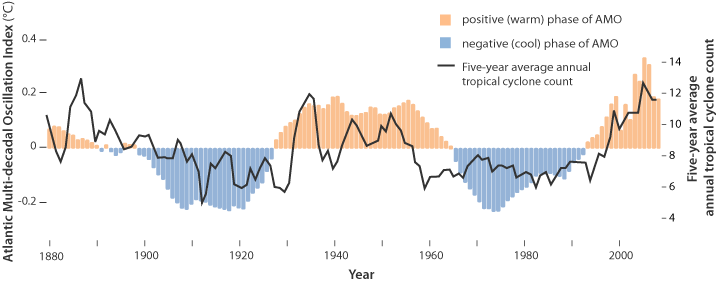
This is known as the Atlantic Multidecadal Oscillation (AMO), and the transition between its positive and negative phases can be very rapid. For example, Atlantic temperatures declined by 0.1ºC per decade from the 1940s to the 1970s. By comparison, global surface warming is estimated at 0.5ºC per century – a rate twice as slow.

In many parts of the world, the AMO has been linked with decade-long temperature and rainfall trends. Certainly – and perhaps obviously – the mean temperature of islands downwind of the Atlantic such as Britain and Ireland show almost exactly the same temperature fluctuations as the AMO.

Atlantic oscillations are associated with the frequency of hurricanes and droughts. When the AMO is in the warm phase, there are more hurricanes in the Atlantic and droughts in the US Midwest tend to be more frequent and prolonged. In the Pacific Northwest, a positive AMO leads to more rainfall.

A negative AMO (cooler ocean) is associated with reduced rainfall in the vulnerable Sahel region of Africa. The prolonged negative AMO was associated with the infamous Ethiopian famine in the mid-1980s. In the UK it tends to mean reduced summer rainfall – the mythical “barbeque summer”.Our results show that ocean circulation responds to the first mode of Atlantic atmospheric forcing, the North Atlantic Oscillation, through circulation changes between the subtropical and subpolar gyres – the intergyre region. This a major influence on the wind patterns and the heat transferred between the atmosphere and ocean.

The observations that we do have of the Atlantic overturning circulation over the past ten years show that it is declining. As a result, we expect the AMO is moving to a negative (colder surface waters) phase. This is consistent with observations of temperature in the North Atlantic.

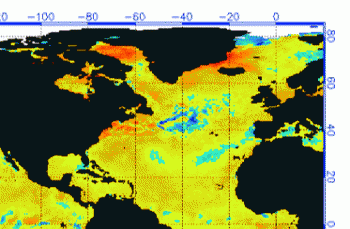
Cold “blobs” in North Atlantic have been reported, but they are usually a winter phenomena. For example in April 2016, the sst anomalies looked like this

But by September, the picture changed to this

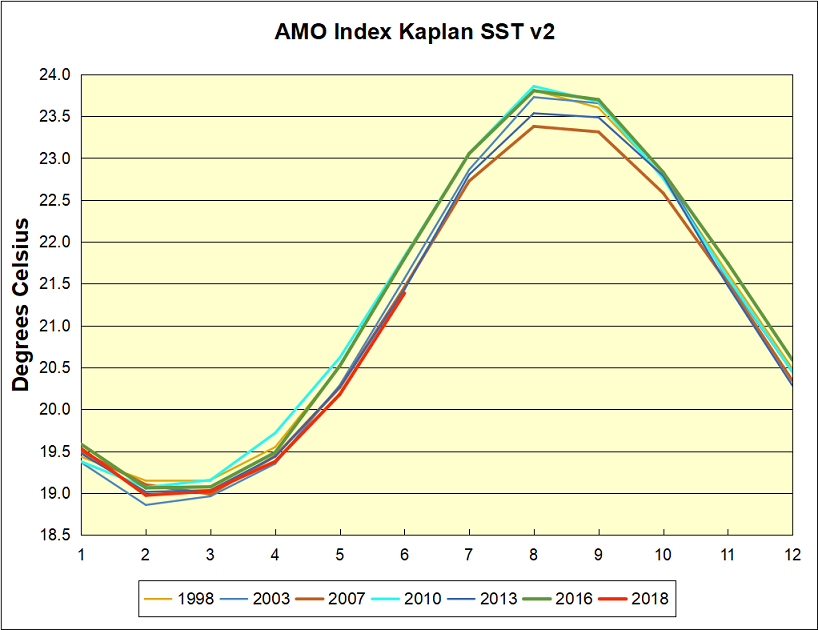
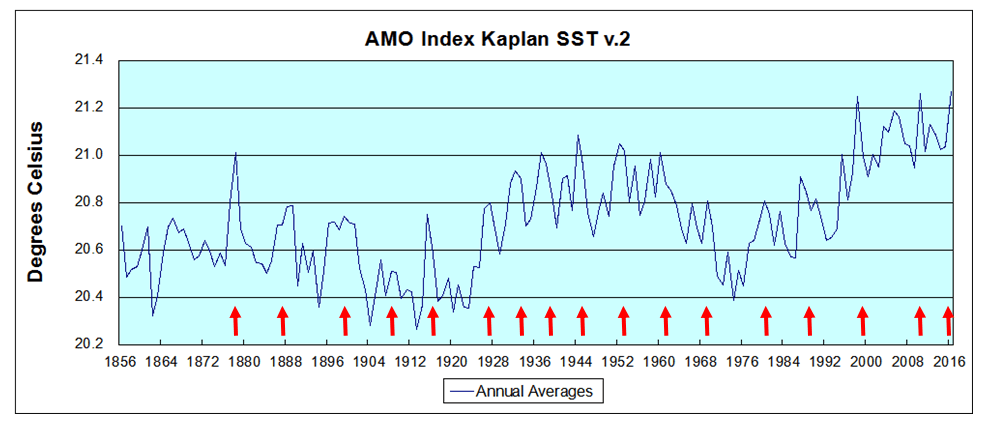
And we know from Kaplan AMO dataset, that 2016 summer SSTs were right up there with 1998 and 2010 as the highest recorded.

As the graph above suggests, this body of water is also important for tropical cyclones, since warmer water provides more energy.  But those are annual averages, and I am interested in the summer pulses of warm water into the Arctic. As I have noted in my monthly HadSST3 reports, most summers since 2003 there have been warm pulses in the north atlantic.
The AMO Index is from from Kaplan SST v2, the unaltered and untrended dataset. By definition, the data are monthly average SSTs interpolated to a 5×5 grid over the North Atlantic basically 0 to 70N.  The graph shows warming began after 1992 up to 1998, with a series of matching years since.  Because McCarthy refers to hints of cooling to come in the N. Atlantic, let’s take a closer look at some AMO years in the last 2 decades.

This graph shows monthly AMO temps for some important years. The Peak years were 1998, 2010 and 2016, with the latter emphasized as the most recent. The other years show lesser warming, with 2007 emphasized as the coolest in the last 20 years. Note the red 2018 line is at the bottom of all these tracks.  Most recently June 2018 is 0.4C lower than June 2016.

With all the talk of AMOC slowing down and a phase shift in the North Atlantic, we await SST measurements for July, August and September to confirm if cooling is starting to set in.

Climate Comics

It takes a properly skeptical mindset to see the humor in the behavior of those believing in global warming/climate change. Here are some cartoons that came to my attention recently.

Paris Accord

bok.paris_.1


Media Climate Reporting

Biased Climate Science


Misguided Climate Policies

b45fee974eb5b959a6718fbac960afbc

the-wind-should-pick-up-any-minute-now

H/T to Lisa Benson, Chip Bok,  Mike Lester, Michael Ramirez  and Gary Varvel.  Work by Rick McKee was featured in a previous post Cavemen Climate Comics


Facts Omitted by Climatists


Economist Joseph Stiglitz writes of climate change: “There is a point at which, once this harm occurs, it cannot be undone at any reasonable cost or in any reasonable period of time. Based on the best available science, our country is close to approaching that point.” Credit: Win McNamee/Getty Images

One of the world’s top economists has written an expert court report that forcefully supports a group of children and young adults who have sued the federal government for failing to act on climate change. (Source: Inside Climate News  here) Excerpts in italics with my bolds.

Stiglitz, a Columbia University economics professor and former World Bank chief economist, concludes that increasing global warming will have huge costs on society and that a fossil fuel-based system “is causing imminent, significant, and irreparable harm to the Youth Plaintiffs and Affected Children more generally.” He explains in a footnote that his analysis also examines impacts on “as-yet-unborn youth, the so-called future generations.”

But, he says, acting on climate change now—by imposing a carbon tax and cutting fossil fuel subsidies, among other steps—is still manageable and would have net-negative costs. He argues that if the government were to pursue clean energy sources and energy-smart technologies, “the net benefits of a policy change outweigh the net costs of such a policy change.”

“Defendants must act with all deliberate speed and immediately cease the subsidization of fossil fuels and any new fossil fuel projects, and implement policies to rapidly transition the U.S. economy away from fossil fuels,” Stiglitz writes. “This urgent action is not only feasible, the relief requested will benefit the economy.”

Stiglitz has been examining the economic impact of global warming for many years. He was a lead author of the 1995 report of the UN’s Intergovernmental Panel on Climate Change, an authoritative assessment of climate science that won the IPCC the 2007 Nobel Peace Prize, shared with Al Gore.

The Stiglitz expert report submitted to the court is here.

An Example of Intentional Omissions

Since this is a legal proceeding, Stiglitz wrote a brief telling the plaintiffs’ side of the story. In a scientific investigation, parties would assert theories attempting to explain all of the evidence at hand. Legal theories have no such requirement to incorporate all the facts, but rather present conclusions informed by the evidence deemed strongest and most pertinent to one party’s interests.

While the Pope accuses us with the Sin of Emissions, we counter with the Sins of Omissions by him and his fellow activists.

Let’s consider the Stiglitz brief according to the three suppositions comprising the Climatist (Activists and Alarmists) position. Climate change is a bundle that depends on all three assertions to be true.

Supposition 1: Humans make the climate warmer.

As an economist, Stiglitz defers to the IPCC on this scientific point, with references to reports by those deeply involved and committed to Paris Accord and other UN climate programs. In the recent California District Court case (Cities suing Big Oil companies), both sides in a similar vein stipulated their acceptance of IPCC reports as authoritative regarding global warming/climate change.

Skeptical observers must attend to the nuances of what is referenced and what is hidden or omitted in these testimonies. For example, Chevron’s attorney noted that IPCC’s reports express various opinions over time as to human influence on the climate. They noted that even today, the expected temperature effect from doubling CO2 ranges widely from 1.5C to 4.5C. No mention is made that several more recent estimates from empirical data (rather than GCMs) are at the low end or lower.

metofffig3iIn addition, there is no mention that GCMs projections are running about twice as hot as observations. Omitted is the fact GCMs correctly replicate tropospheric temperature observations only when CO2 warming is turned off. In the effort to proclaim scientific certainty, neither Stiglitz nor IPCC discuss the lack of warming since the 1998 El Nino, despite two additional El Ninos in 2010 and 2016.

Figure 5. Simplification of IPCC AR5 shown above in Fig. 4. The colored lines represent the range of results for the models and observations. The trends here represent trends at different levels of the tropical atmosphere from the surface up to 50,000 ft. The gray lines are the bounds for the range of observations, the blue for the range of IPCC model results without extra GHGs and the red for IPCC model results with extra GHGs.The key point displayed is the lack of overlap between the GHG model results (red) and the observations (gray). The nonGHG model runs (blue) overlap the observations almost completely.

Further they exclude comparisons between fossil fuel consumption and temperature changes. The legal methodology for discerning causation regarding work environments or medicine side effects insists that the correlation be strong and consistent over time, and there be no confounding additional factors. As long as there is another equally or more likely explanation for a set of facts, the claimed causation is unproven. Such is the null hypothesis in legal terms: Things happen for many reasons unless you can prove one reason is dominant.

Finally, Stiglitz and IPCC are picking on the wrong molecule. The climate is controlled not by CO2 but by H20. Oceans make climate through the massive movement of energy involved in water’s phase changes from solid to liquid to gas and back again. From those heat transfers come all that we call weather and climate: Clouds, Snow, Rain, Winds, and Storms.

Esteemed climate scientist Richard Lindzen ended a very fine recent presentation with this description of the climate system:

I haven’t spent much time on the details of the science, but there is one thing that should spark skepticism in any intelligent reader. The system we are looking at consists in two turbulent fluids interacting with each other. They are on a rotating planet that is differentially heated by the sun. A vital constituent of the atmospheric component is water in the liquid, solid and vapor phases, and the changes in phase have vast energetic ramifications. The energy budget of this system involves the absorption and reemission of about 200 watts per square meter. Doubling CO2 involves a 2% perturbation to this budget. So do minor changes in clouds and other features, and such changes are common. In this complex multifactor system, what is the likelihood of the climate (which, itself, consists in many variables and not just globally averaged temperature anomaly) is controlled by this 2% perturbation in a single variable? Believing this is pretty close to believing in magic. Instead, you are told that it is believing in ‘science.’ Such a claim should be a tip-off that something is amiss. After all, science is a mode of inquiry rather than a belief structure.

Supposition 2: The Warming is Dangerous

Billions of dollars have been spent researching any and all negative effects from a warming world: Everything from Acne to Zika virus. Stiglitz links to a recent Climate Report that repeats the usual litany of calamities to be feared and avoided by submitting to IPCC demands. The evidence does not support these claims.

Stiglitz: It is scientifically established that human activities produce GHG emissions, which accumulate in the atmosphere and the oceans, resulting in warming of Earth’s surface and the oceans, acidification of the oceans, increased variability of climate, with a higher incidence of extreme weather events, and other changes in the climate.

Moreover, leading experts believe that there is already more than enough excess heat in the climate system to do severe damage and that 2C of warming would have very significant adverse effects, including resulting in multi-meter sea level rise.

Experts have observed an increased incidence of climate-related extreme weather events, including increased frequency and intensity of extreme heat and heavy precipitation events and more severe droughts and associated heatwaves. Experts have also observed an increased incidence of large forest fires; and reduced snowpack affecting water resources in the western U.S. The most recent National Climate Assessment projects these climate impacts will continue to worsen in the future as global temperatures increase.

Alarming Weather and Wildfires

But: Weather is not more extreme.
And Wildfires were worse in the past.
But: Sea Level Rise is not accelerating.
Litany of Changes

Seven of the ten hottest years on record have occurred within the last decade; wildfires are at an all-time high, while Arctic Sea ice is rapidly diminishing.

We are seeing one-in-a-thousand-year floods with astonishing frequency.

When it rains really hard, it’s harder than ever.

We’re seeing glaciers melting, sea level rising.

The length and the intensity of heatwaves has gone up dramatically.

Plants and trees are flowering earlier in the year. Birds are moving polewards.

We’re seeing more intense storms.

But: Arctic Ice has not declined since 2007.Sept Arctic ice 2007 to 2019 full
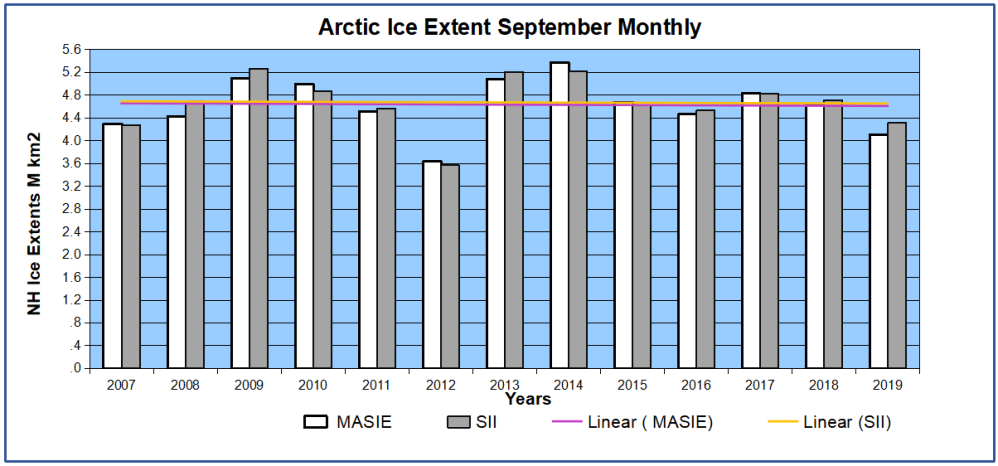
But: All of these are within the range of past variability.

US Wet Dry CO2rev

In fact our climate is remarkably stable.
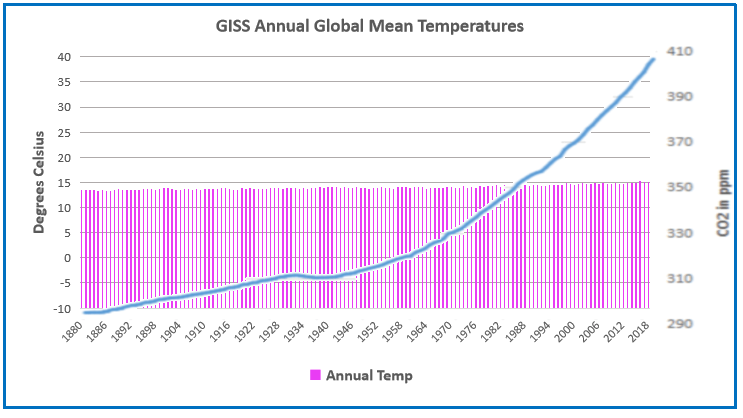
GISS GMT to 2018 w CO2

And many aspects follow quasi-60 year cycles.

Climate is Changing the Weather

Stiglitz:  Other potential examples include agricultural losses. Whether or not insurance
reimburses farmers for their crops, there can be food shortages that lead to higher food
prices (that will be borne by consumers, that is, Youth Plaintiffs and Affected Children).
There is a further risk that as our climate and land use pattern changes, disease vectors
may also move (e.g., diseases formerly only in tropical climates move northward).36 This
could lead to material increases in public health costs

But: Actual climate zones are local and regional in scope, and they show little boundary change.


But: Ice cores show that it was warmer in the past, not due to humans.

Supposition 3:  Government Can Stop it!

Here it is blithely assumed that the court can rule the seas to stop rising, heat waves to cease, and Arctic ice to grow (though why we would want that is debatable).  All this will be achieved by leaving fossil fuels in the ground and powering civilization with windmills and solar panels.  While admitting that our way of life depends on fossil fuels, they ignore the inadequacy of renewable energy sources at their present immaturity.

Stiglitz: Conclusion
The choice between incurring manageable costs now and the incalculable, perhaps even
irreparable, burden Youth Plaintiffs and Affected Children will face if Defendants fail to
rapidly transition to a non-fossil fuel economy is clear. While the full costs of the climate damages that would result from maintaining a fossil fuel-based economy may be
incalculable, there is already ample evidence concerning the lower bound of such costs,
and with these minimum estimates, it is already clear that the cost of transitioning to a
low/no carbon economy are far less than the benefits of such a transition. No rational
calculus could come to an alternative conclusion. Defendants must act with all deliberate
speed and immediately cease the subsidization of fossil fuels and any new fossil fuel
projects, and implement policies to rapidly transition the U.S. economy away from fossil
fuels.

But CO2 relation to Temperature is Inconsistent.

But: The planet is greener because of rising CO2.

But: Modern nations (G20) depend on fossil fuels for nearly 90% of their energy.

But: Renewables are not ready for prime time.

People need to know that adding renewables to an electrical grid presents both technical and economic challenges.  Experience shows that adding intermittent power more than 10% of the baseload makes precarious the reliability of the supply.  South Australia is demonstrating this with a series of blackouts when the grid cannot be balanced.  Germany got to a higher % by dumping its excess renewable generation onto neighboring countries until the EU finally woke up and stopped them. Texas got up to 29% by dumping onto neighboring states, and some like Georgia are having problems.

But more dangerous is the way renewables destroy the economics of electrical power.  Seasoned energy analyst Gail Tverberg writes:

In fact, I have come to the rather astounding conclusion that even if wind turbines and solar PV could be built at zero cost, it would not make sense to continue to add them to the electric grid in the absence of very much better and cheaper electricity storage than we have today. There are too many costs outside building the devices themselves. It is these secondary costs that are problematic. Also, the presence of intermittent electricity disrupts competitive prices, leading to electricity prices that are far too low for other electricity providers, including those providing electricity using nuclear or natural gas. The tiny contribution of wind and solar to grid electricity cannot make up for the loss of more traditional electricity sources due to low prices.

These issues are discussed in more detail in the post Climateers Tilting at Windmills

Footnote regarding mention of “multi-meter” sea level rise.  It is all done with computer models.  For example, below is San Francisco.  More at USCS Warnings of Coastal Floodings
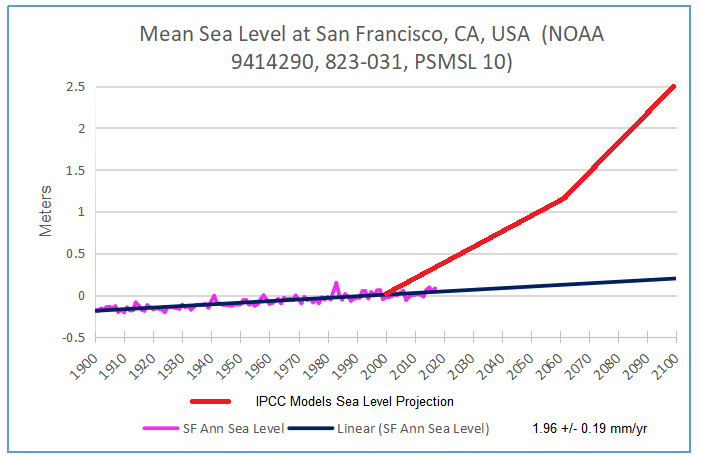
sf-ca-past-projected

dilbert-sins-of-omission-and-comission

June 2018 Ocean SSTs Resume Cooling

globpopThe best context for understanding decadal temperature changes comes from the world’s sea surface temperatures (SST), for several reasons:

  • The ocean covers 71% of the globe and drives average temperatures;
  • SSTs have a constant water content, (unlike air temperatures), so give a better reading of heat content variations;
  • A major El Nino was the dominant climate feature in recent years.

HadSST is generally regarded as the best of the global SST data sets, and so the temperature story here comes from that source, the latest version being HadSST3.  More on what distinguishes HadSST3 from other SST products at the end.

The Current Context

The chart below shows SST monthly anomalies as reported in HadSST3 starting in 2015 through June 2018.

Hadsst062018

A global cooling pattern has persisted, seen clearly in the Tropics since its peak in 2016, joined by NH and SH dropping since last August. Upward bumps occurred last October, in January and again in March and April 2018.  Five months of 2018 now show slight warming since the low point of December 2017, led by steadily rising NH. Since 4/2018 SH and Tropics cooled slightly while NH pulled the Global anomaly upwards. Now in June 2018  lower temps in SH and Tropics more than offset NH warming.

2018 is the coolest June since 2013 in all regions: Global, NH, SH and Tropics.

Note that higher temps in 2015 and 2016 were first of all due to a sharp rise in Tropical SST, beginning in March 2015, peaking in January 2016, and steadily declining back below its beginning level. Secondly, the Northern Hemisphere added three bumps on the shoulders of Tropical warming, with peaks in August of each year. Also, note that the global release of heat was not dramatic, due to the Southern Hemisphere offsetting the Northern one.

With ocean temps positioned the same as three years ago, we can only wait and see whether the previous cycle will repeat or something different appears.  As the analysis belows shows, the North Atlantic has been the wild card bringing warming this decade, and cooling will depend upon a phase shift in that region.

A longer view of SSTs

The graph below  is noisy, but the density is needed to see the seasonal patterns in the oceanic fluctuations.  Previous posts focused on the rise and fall of the last El Nino starting in 2015.  This post adds a longer view, encompassing the significant 1998 El Nino and since.  The color schemes are retained for Global, Tropics, NH and SH anomalies.  Despite the longer time frame, I have kept the monthly data (rather than yearly averages) because of interesting shifts between January and July.

Hadsst1995to062018

Open image in new tab to enlarge.

1995 is a reasonable starting point prior to the first El Nino.  The sharp Tropical rise peaking in 1998 is dominant in the record, starting Jan. ’97 to pull up SSTs uniformly before returning to the same level Jan. ’99.  For the next 2 years, the Tropics stayed down, and the world’s oceans held steady around 0.2C above 1961 to 1990 average.

Then comes a steady rise over two years to a lesser peak Jan. 2003, but again uniformly pulling all oceans up around 0.4C.  Something changes at this point, with more hemispheric divergence than before. Over the 4 years until Jan 2007, the Tropics go through ups and downs, NH a series of ups and SH mostly downs.  As a result the Global average fluctuates around that same 0.4C, which also turns out to be the average for the entire record since 1995.

2007 stands out with a sharp drop in temperatures so that Jan.08 matches the low in Jan. ’99, but starting from a lower high. The oceans all decline as well, until temps build peaking in 2010.

Now again a different pattern appears.  The Tropics cool sharply to Jan 11, then rise steadily for 4 years to Jan 15, at which point the most recent major El Nino takes off.  But this time in contrast to ’97-’99, the Northern Hemisphere produces peaks every summer pulling up the Global average.  In fact, these NH peaks appear every July starting in 2003, growing stronger to produce 3 massive highs in 2014, 15 and 16, with July 2017 only slightly lower.  Note also that starting in 2014 SH plays a moderating role, offsetting the NH warming pulses. (Note: these are high anomalies on top of the highest absolute temps in the NH.)

What to make of all this? The patterns suggest that in addition to El Ninos in the Pacific driving the Tropic SSTs, something else is going on in the NH.  The obvious culprit is the North Atlantic, since I have seen this sort of pulsing before.  After reading some papers by David Dilley, I confirmed his observation of Atlantic pulses into the Arctic every 8 to 10 years as shown by this graph:

The data is annual averages of absolute SSTs measured in the North Atlantic.  The significance of the pulses for weather forecasting is discussed in AMO: Atlantic Climate Pulse
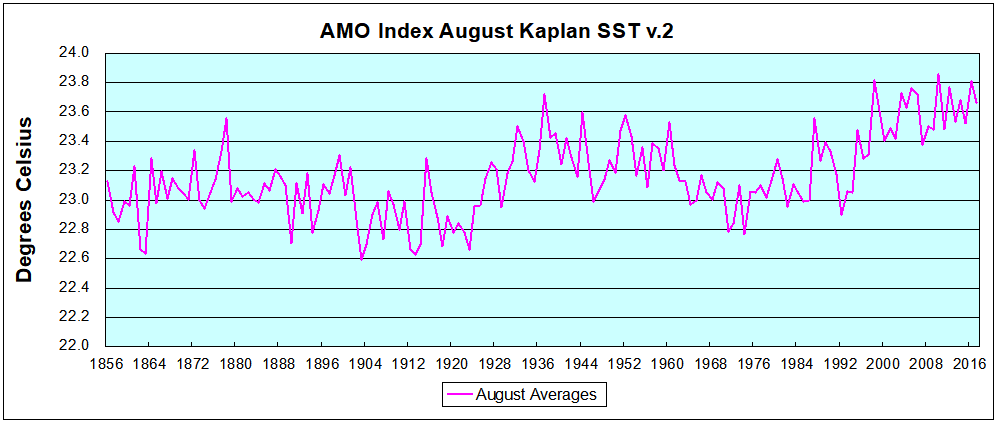
But the peaks coming nearly every July in HadSST require a different picture.  Let’s look at August, the hottest month in the North Atlantic from the Kaplan dataset.Now the regime shift appears clearly. Starting with 2003, seven times the August average has exceeded 23.6C, a level that prior to ’98 registered only once before, in 1937.  And other recent years were all greater than 23.4C.

Summary

The oceans are driving the warming this century.  SSTs took a step up with the 1998 El Nino and have stayed there with help from the North Atlantic, and more recently the Pacific northern “Blob.”  The ocean surfaces are releasing a lot of energy, warming the air, but eventually will have a cooling effect.  The decline after 1937 was rapid by comparison, so one wonders: How long can the oceans keep this up?

To paraphrase the wheel of fortune carnival barker:  “Down and down she goes, where she stops nobody knows.”  As recent months show, nature moves in cycles, not straight lines, and human forecasts and projections are tenuous at best.

einsteinalbert-integratesempirically800px

Postscript:

In the most recent GWPF 2017 State of the Climate report, Dr. Humlum made this observation:

“It is instructive to consider the variation of the annual change rate of atmospheric CO2 together with the annual change rates for the global air temperature and global sea surface temperature (Figure 16). All three change rates clearly vary in concert, but with sea surface temperature rates leading the global temperature rates by a few months and atmospheric CO2 rates lagging 11–12 months behind the sea surface temperature rates.”

Footnote: Why Rely on HadSST3

HadSST3 is distinguished from other SST products because HadCRU (Hadley Climatic Research Unit) does not engage in SST interpolation, i.e. infilling estimated anomalies into grid cells lacking sufficient sampling in a given month. From reading the documentation and from queries to Met Office, this is their procedure.

HadSST3 imports data from gridcells containing ocean, excluding land cells. From past records, they have calculated daily and monthly average readings for each grid cell for the period 1961 to 1990. Those temperatures form the baseline from which anomalies are calculated.

In a given month, each gridcell with sufficient sampling is averaged for the month and then the baseline value for that cell and that month is subtracted, resulting in the monthly anomaly for that cell. All cells with monthly anomalies are averaged to produce global, hemispheric and tropical anomalies for the month, based on the cells in those locations. For example, Tropics averages include ocean grid cells lying between latitudes 20N and 20S.

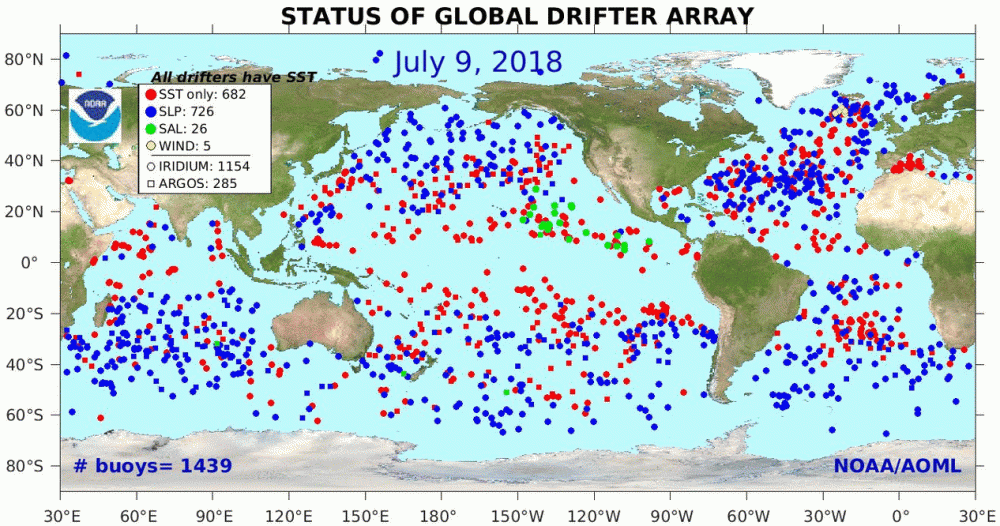
Gridcells lacking sufficient sampling that month are left out of the averaging, and the uncertainty from such missing data is estimated. IMO that is more reasonable than inventing data to infill. And it seems that the Global Drifter Array displayed in the top image is providing more uniform coverage of the oceans than in the past.

uss-pearl-harbor-deploys-global-drifter-buoys-in-pacific-ocean

USS Pearl Harbor deploys Global Drifter Buoys in Pacific Ocean


Ocean Air Temps Keep Cool

Presently sea surface temperatures (SST) are the best available indicator of heat content gained or lost from earth’s climate system.  Enthalpy is the thermodynamic term for total heat content in a system, and humidity differences in air parcels affect enthalpy.  Measuring water temperature directly avoids distorted impressions from air measurements.  In addition, ocean covers 71% of the planet surface and thus dominates surface temperature estimates.  Eventually we will likely have reliable means of recording water temperatures at depth.

Recently, Dr. Ole Humlum reported from his research that air temperatures lag 2-3 months behind changes in SST.  He also observed that changes in CO2 atmospheric concentrations lag behind SST by 11-12 months.  This latter point is addressed in a previous post Who to Blame for Rising CO2?

The June update to HadSST3 will appear later this month, but in the meantime we can look at lower troposphere temperatures (TLT) from UAHv6 which are already posted for June. The temperature record is derived from microwave sounding units (MSU) on board satellites like the one pictured above.

The UAH dataset includes temperature results for air above the oceans, and thus should be most comparable to the SSTs. The graph below shows monthly anomalies for ocean temps since January 2015.

The anomalies are holding close to the same levels as 2015. In June, both the Tropics and SH rose, while NH declined slightly, resulting in a small increase in the Global average of air over oceans. Taking a longer view, we can look at the record since 1995, that year being an ENSO neutral year and thus a reasonable starting point for considering the past two decades.  On that basis we can see the plateau in ocean temps is persisting. Since last October all oceans have cooled, with offsetting bumps up and down.

UAHv6 TLT 
Monthly Ocean
Anomalies
Average Since 1995 Ocean 6/2018
Global 0.13 0.14
NH 0.16 0.28
SH 0.11 0.03
Tropics 0.12 0.11

As of June 2018, global ocean temps are slightly higher than May and close to the average since 1995.  NH remains higher, but not enough to offset much lower temps in SH and  nearly average Tropics (between 20N and 20S latitudes).  Global ocean air temps are matching the last two March temps, but are the lowest June temps since 2012.  Both NH and SH are the lowest June temps since 2014.

The details of UAH ocean temps are provided below.  The monthly data make for a noisy picture, but seasonal fluxes between January and July are important.

Open image in new tab to enlarge.

The greater volatility of the Tropics is evident, leading the oceans through three major El Nino events during this period.  Note also the flat period between 7/1999 and 7/2009.  The 2010 El Nino was erased by La Nina in 2011 and 2012.  Then the record shows a fairly steady rise peaking in 2016, with strong support from warmer NH anomalies, before returning to the 22-year average.

Summary

TLTs include mixing above the oceans and probably some influence from nearby more volatile land temps.  They started the recent cooling later than SSTs from HadSST3, but are now showing the same pattern.  It seems obvious that despite the three El Ninos, their warming has not persisted, and without them it would probably have cooled since 1995.  Of course, the future has not yet been written.


Global Warming Hole Found: Minus 144 F

r1138736_14100357

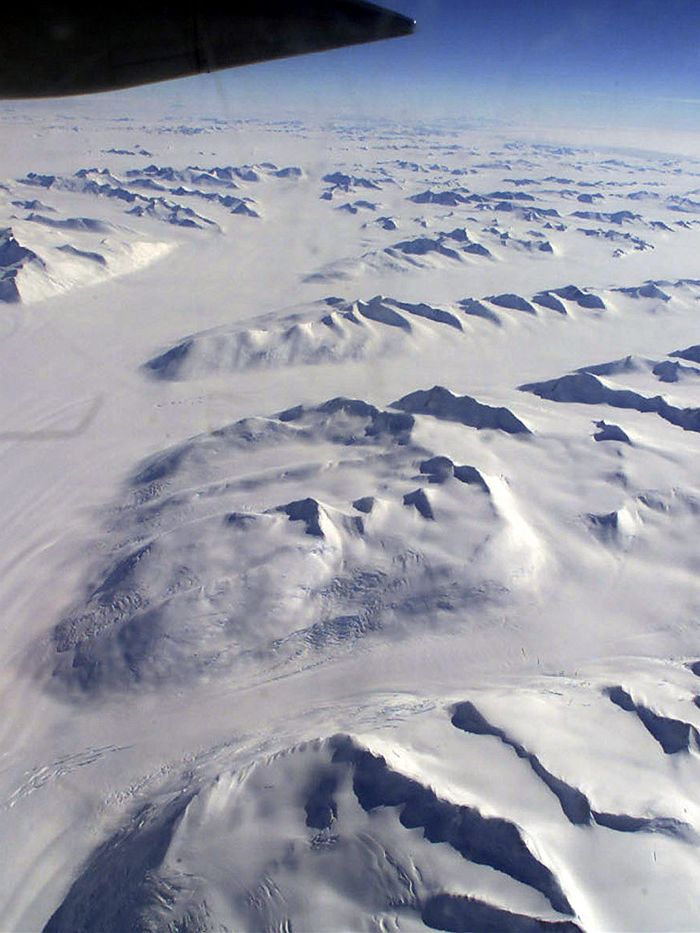
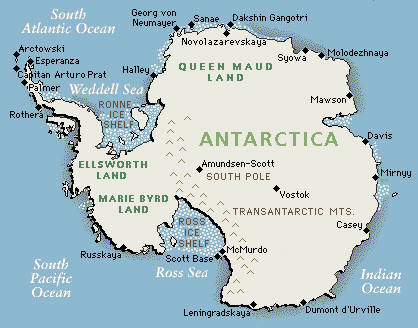
A high ridge in Antarctica on the East Antarctic Plateau where temperatures in several hollows can dip down to minus 144 F.

National Geographic Coldest Place on Earth Found—Here’s How
“It’s a place where Earth is so close to its limit, it’s almost like another planet.”

Just how cold can it get on Earth’s surface? About minus 144°F, according to recent satellite measurements of the coldest known place on the planet.

Scientists recorded this extreme temperature on the ice sheet deep in the middle of Antarctica during the long, dark polar winter. As they report this week in Geophysical Research Letters, the team thinks this is about as cold as it can possibly get in our corner of the solar system.

“It’s a place where Earth is so close to its limit, it’s almost like another planet,” says study leader Ted Scambos, a researcher at the National Snow and Ice Data Center at the University of Colorado, Boulder.

The measurement smashes the previous record for the coldest known air temperature in the natural world: a frigid minus 128.6°F felt in 1983 at the Russian Vostok Station, not far from the South Pole. Humans can’t inhale air that cold for more than a few breaths—it would cause our lungs to hemorrhage. Russian scientists ducking out to check on the weather station would wear masks that warmed the air before they breathed it in.

DEATHLY HOLLOWS
While the East Antarctic ice sheet looks flat at the surface, it actually domes ever so slightly from center to edge like a vast, icy turtle shell. Vostok is perched near the top of the dome, on about 2.2 miles of ice, but it’s not quite at the apex. Scambos’s team suspected that it could get even colder at the very highest parts of the ice sheet.

There aren’t any weather stations perched at the peak of the ice sheet, and there isn’t anyone there to check on them in the dead of Antarctic winter. But satellites can sense the temperature at the surface of the ice as they pass overhead. So Scambos and his colleagues sifted through several years of satellite data, mapping out when and where temperatures dipped low.

Sure enough, they found about a hundred little pockets of exceptional cold scattered across the highest parts of the ice sheet. The coldest spots were in shallow depressions in the ice, little hollows where the surface isn’t perfectly smooth. That’s probably because cold air sinks into these depressions like it sinks into a river valley or a canyon, says John Turner, a polar scientist with the British Antarctic Survey who was not involved in the study.

“They’re such shallow dips, you probably couldn’t even see them with your eyes,” he says.

The air warms up by a few degrees right above the surface, which is where the scientists at Vostok had recorded the previous coldest temperature. By comparing the satellite measurements to data from the nearest weather stations, Scambos and his team figured out that the air temperatures in this region would be a little warmer near human-head height, about minus 137°F. But right at the surface, where your feet would touch the snow, they saw temperatures of minus 144°F.

“But you hope your feet wouldn’t ever touch the snow,” Scambos says. “That would not be fun at all.”

OBSCURING THE VIEW
Only very special conditions lead to such extreme cold. First, it has to be the dead of winter, long after the midnight sun sets for the season. Then, the air needs to be still for a few days, and the sky needs to be perfectly clear, without a wisp of a cloud or a shimmer of diamond dust above the ice sheet.

As cold as it may be, ice radiates a tiny amount of heat. Normally, most of that heat is captured by water vapor in the atmosphere and gets beamed back down to Earth’s surface, trapping warmth in the lower atmosphere.

But during dry spells in Antarctica, when most of the water vapor has been wrung out of the atmosphere, “it starts to open a window that isn’t usually open anywhere else on Earth,” Scambos says. Then, faint heat emitted by the ice sheet can escape all the way to space, leaving the ice surface even colder.

The ultra-clear conditions that enable these chilly events are also ideal for looking out into space, which is why scientists placed a telescope just a few miles from the extreme cold spots Scambos’ team pinpointed.

“Water vapor is our nemesis,” says Craig Kulesa, an astronomer from the University of Arizona who runs the High Elevation Antarctic Terahertz Telescope, or, somewhat satirically, HEAT. “We put our telescope at this superbly dry site, but if we put it 10 miles away, would it be any better?”

It may be a question worth considering as the climate changes around the globe, though there’s nowhere else on this planet they could go where conditions would be better. Water vapor concentrations in the atmosphere are increasing, which in turn means more of the ice-emitted heat gets trapped near the surface—keeping it warmer. So, the perfectly clear conditions that are ideal for looking into space will become less frequent—and any scientists hoping to break the record for sensing extreme cold on Earth may be running out of time.

“As we see increases in greenhouse gas and water vapor concentrations, we’re expecting warming across the Antarctic of about 3 to 4°C,” says Turner. “Seeing any new temperature lows will be more and more unlikely. The odds are just getting smaller.”


NOAA Climate Intrigue

Defenders of the Federal status quo (AKA swamp denizens) are aroused over an apparent move to refocus the mission statement of National Oceanic and Atmospheric Administration (NOAA). UCS raised the alarm which was, as usual, taken up by the New York Times. At a recent Department of Commerce summit, the acting head of the National Oceanic and Atmospheric Administration (NOAA), Rear Admiral Timothy Gallaudet, proposed a new mission statement for the agency. The proposed change in wording is as follows.

The mission of NOAA has been:

  • To understand and predict changes in climate, weather, oceans and coasts;
  • To share that knowledge and information with others; and
  • To conserve and manage coastal and marine ecosystems and resources.

In his presentation, Rear Admiral Gallaudet suggested the mission statement would change to:

  • To observe, understand and predict atmospheric and ocean conditions;
  • To share that knowledge and information with others; and
  • To protect lives and property, empower the economy, and support homeland and national security.

Comment on NOAA Mission Statement

Note the word “observe” is added to give emphasis to NOAA’s responsibility to obtain and maintain data records relating to the ocean and atmosphere. Instead of the words “changes to climate, weather, oceans and coasts,” NOAA is tasked to predict “atmospheric and ocean conditions.” This suggest a move away from climatological considerations to more immediate support for adapting to natural events. It also suggests that coastal land management is outside NOAA’s scope.

Readers will note the proposed wording drops “conserve and manage” from the mission, replaced by the more explicit “To protect lives and property, empower the economy, and support homeland and national security.” The latter phase would be consistent with the larger thrust of the Commerce Department. (See Commerce priorities at end.)

Background:

September 1, 2017, Rear Admiral Gallaudet was nominated by President Trump and was warmly welcomed by scientists.

The University Corporation for Atmospheric Research (UCAR) congratulates Rear Admiral Timothy Gallaudet, a former oceanographer of the Navy, on his nomination to assistant secretary of commerce for oceans and atmosphere. In that position, Gallaudet will serve as the second-in-command at the National Oceanic and Atmospheric Administration (NOAA).

Gallaudet, who also served as commander of the Navy’s Meteorology and Oceanography Command, is a 32-year Navy veteran. He holds master’s and doctoral degrees in oceanography from the Scripps Institution of Oceanography.

“Tim’s mixture of operational expertise and scientific knowledge make him an ideal choice for this position,” said UCAR President Antonio Busalacchi. “His understanding of the vital collaborations between NOAA, private forecasting companies, and the academic community can help foster the movement of research to operational forecasting and advance the nation’s weather prediction capabilities. Furthermore, his knowledge of Earth system science and his ability to align that science with budget and programs will be essential to moving NOAA forward in the next few years.”

NOAA runs the National Weather Services, engages in weather and climate research, and operates weather satellites and a climate data center. The agency also works to better understand and protect the nation’s coasts, oceans, and fisheries.

UCAR is a nonprofit consortium of more than 100 colleges and universities focused on research and training in the atmospheric and related sciences.

September 25, 2017

In his answers to the confirmation committee’s questionnaire, Gallaudet listed the top three challenges he sees facing NOAA. He identified the first challenge as implementing the Weather Research and Forecasting Innovation Act that Congress passed earlier this year.

“If confirmed, I would make it my top priority to meet the intent of this law, especially the aspects concerning improvement to severe weather, tornado and hurricane warnings, and satellite data collection program management. … Finally I will need to work with the NOAA Administrator as well as NESDIS and NWS leadership to focus on the NOAA satellite programs which are growing at an unsustainable rate and that have been delayed numerous times.”

October 2017

Gallaudet was confirmed and on October 11, President Trump nominated Barry Myers, chief executive of the private weather forecasting company AccuWeather, to run NOAA. The appointment breaks from the recent precedent of scientists leading the agency tasked with a large, complex, and technically demanding portfolio. Myers has a bachelor’s degree in business administration and economics, a master’s degree in business from Pennsylvania State University, and a law degree from Boston University School of Law. Myers has been an adviser to five directors of NOAA’s National Weather Service and a representative of the U.N. World Meteorological Organization, according to a biography from AccuWeather. He must be confirmed by the Senate before taking the post.

December 17, 2017

In his Senate Confirmation hearing, Myers sought to assure members of the Senate Commerce, Science, and Transportation Committee that he has a deep appreciation for NOAA’s scientific mission. In response to pointed questions from Democratic senators, Myers vowed to uphold NOAA’s scientific integrity policies and champion free and open data. And, for the first time in public since his nomination, he concurred with the mainstream scientific consensus on climate change and promised to support NOAA’s climate research portfolio. The full inquisition is described by the American Institute of Physics NOAA Nominee Barry Myers Embraces Science at Confirmation Hearing

April 11, 2018

Timothy Gallaudet testifies at Budget hearings.NOAA Budget Cuts Get Chilly Reception in Congress

In his opening statement at the April 11 hearing, Gallaudet explained that the $4.5 billion budget request for NOAA focuses on two priorities. The first is “reducing the impacts of extreme weather and water events, by implementing the Weather Research and Forecasting Innovation Act,” which was enacted last April. The second is increasing sustainable economic contributions of U.S. fisheries and other ocean resources.

Gallaudet also touted NOAA’s successes over the last year in responding effectively to the record-setting hurricane season, saying the agency’s efforts “saved thousands of lives despite Hurricanes Harvey, Irma, [and] Maria, being three of the five most costly hurricanes in history.” He also highlighted the “perfect” recent launches of two flagship weather satellites — Geostationary Operational Environmental Satellite-S (GOES-S) and Joint Polar Satellite System-1 (JPSS-1).

Later in the hearing, Gallaudet described further investments NOAA is making in high-performance computing and modeling to support operational weather prediction. In describing the Global Forecast System FV3 experimental model that is being transitioned to the National Weather Service, Gallaudet said,

This model out-performed the European models for the hurricane track forecasts for the three Category 4 hurricanes that made landfall [last year]. Our goal is to regain world leadership, take number one back for our weather modeling. We’re on track to do it. We expect to do that before 2020.

Gallaudet assured Cartwright that climate is “embedded” within NOAA’s weather and water forecasting priority, explaining that it includes consideration of “scales that are in weeks to seasonal and even sub-seasonal and climate types of scales.”

Although the administration has proposed deep cuts for climate research and grant programs, including termination of the $48 million Competitive Climate Research grant program and the $6 million Arctic Climate Research Program, Gallaudet assured members that climate research would continue, “because there’s much we still don’t know.”

When Cartwright pressed further on his concerns about the White House’s treatment of climate change, Gallaudet reassured him that the White House has “not zeroed out our climate work,” pointing to the Climate Prediction Center’s publication of seasonal and long-range outlooks as well as recent collaboration between NOAA and the U.S. Navy on Arctic sea ice forecasting. In addressing similar concerns brought up by Sen. Maggie Hassan (D-NH) at the April 12 hearing, he added that the White House is “supporting much of our Arctic-related research that is driven primarily by climate change,” and that he has not been directed to eliminate or remove the phrase “climate change” from reports.

May 14, 2018

Senate Should Confirm Barry Myers to Lead NOAA

NOAA – the National Oceanic and Atmospheric Administration – needs its leader! President Trump nominated Barry Lee Myers, the CEO of AccuWeather, to the post in mid-October. The Senate Commerce Committee has twice advanced Myers’ nomination to the full Senate. All that’s needed to fill this important job is a majority vote on the Senate floor, which both Democrats and Republicans expect to happen. Unfortunately, partisan politics keeps getting in the way, delaying the vote.

Senate offices have received more than 60 letters from individuals and organizations supporting his confirmation, including strong backing from the past four leaders of the U. S. National Weather Service who served under both Democratic and Republican administrations. In addition, the seafood industry has overwhelmingly advocated his confirmation with letters of support from seafood processors and others in the fisheries industry ranging from ship captains to sport fishermen.

Also, as a recognized leader in the sciences, Myers has demonstrated respect for quality-tested science when making decisions related to all areas of the agencies’ responsibilities, including the nation’s fisheries, weather, oceanographic and climate challenges.

Myers worked closely with lawmakers to help secure enactment of last year’s Weather Research and Forecasting Innovation Act. The American Meteorological Society conferred its highest award for Excellence in Meteorology on him. He also has demonstrated a deep knowledge about NOAA and is committed to making the agency the best it can be, second to none in the world.

Prompt confirmation of Myers will benefit the public and the U.S. economy in the days, weeks and months ahead by solidifying the NOAA leadership team. With the unprecedented threat of catastrophic storms, the agency’s mission – protecting life and property and expanding American economic competitiveness – is on the line. The Senate should quickly confirm Barry Myers as NOAA administrator.

Conrad C. Lautenbacher Jr. VADM USN (ret.), CEO of GeoOptics, is a former under secretary of commerce for oceans and atmosphere and administrator of NOAA.

Robert Vanasse is executive director of the National Coalition for Fishing

Overview of Strategic Plan of US Department of Commerce 2018 to 2022

Knowing that innovation is a key driver of economic advancement, we are placing an increased emphasis on the commercial opportunities of space exploration and aquaculture while our scientists are conducting foundational research in areas ranging from artificial intelligence to quantum computing. Our patent professionals are also working to improve the protection of intellectual property so that creators can profit from their inventions.

U.S. businesses must export more, and our workers deserve a level playing field. Enforcing our trade laws to ensure that trade is free, fair, and reciprocal is a top priority of the Department. We are also joining with all federal agencies in cutting red tape that drives up costs and puts American workers and businesses at a disadvantage.

To maintain America’s leadership in next-generation technologies, we are making important advances in data, cybersecurity, and encryption technology. Our economists and statisticians are improving Commerce data that American businesses and communities use to plan investments and identify growth opportunities. Every level of the Department will be engaged to ensure that we conduct the most accurate, secure, and technologically-advanced decennial census in history.

Finally, teams across the Department are working to keep Americans safe by predicting extreme weather events earlier and more accurately, preventing sensitive technology from getting in the hands of terrorists, rogue regimes, and strategic competitors, and deploying a nationwide public safety broadband network that allows better coordination among first responders.

Thank you to every employee at the Department and to our industry and government partners for your dedication to our mission.

Post by Wilbur Ross Secretary of Commerce