Updated on April 9 and 11 at bottom of post.
In response to my water world post, I was shown the wonderful phrase coined by Dr. Bernaerts:
“Climate is the continuation of oceans by other means”.
In was in 1992 he wrote in Nature appealing to the Rio conference to use the UN Convention on the Law of the Seas (UNCLOS) to better manage human impacts on the oceans, and thereby address climate concerns. Needless to say, that call fell on deaf ears.
He later elaborates: “Presumably science would serve the general public better when they would listen to Leonardo da Vinci (1452-1519) who said: “Water is the driver of nature”. Some say that nature rules climate, but water rules the nature on this earth, and the water on earth is so synonymous with the oceans and seas that it can be said: Climate is the continuation of the oceans by other means.”

Dr. Bernaerts is certainly a man worthy of respect and admiration–an expert in maritime law, a passionate marine conservationist, and an historian of naval warfare. All of these are subjects where I have little background knowledge and much to learn.

I see him as a spokesman for ocean scientists, whose views have been little considered in the IPCC rush to judgment upon CO2. Dr. Bernaerts says quite a lot about this at his website: http://www.whatisclimate.com/
It takes some time to understand how his material is organized, with several websites to explore, but there’s lots of data, naval history, graphs and charts to peruse and expand one’s understanding.
An Overview
My comments here are a first attempt to understand his point of view with respect to climate change. Bernaerts makes this observation:
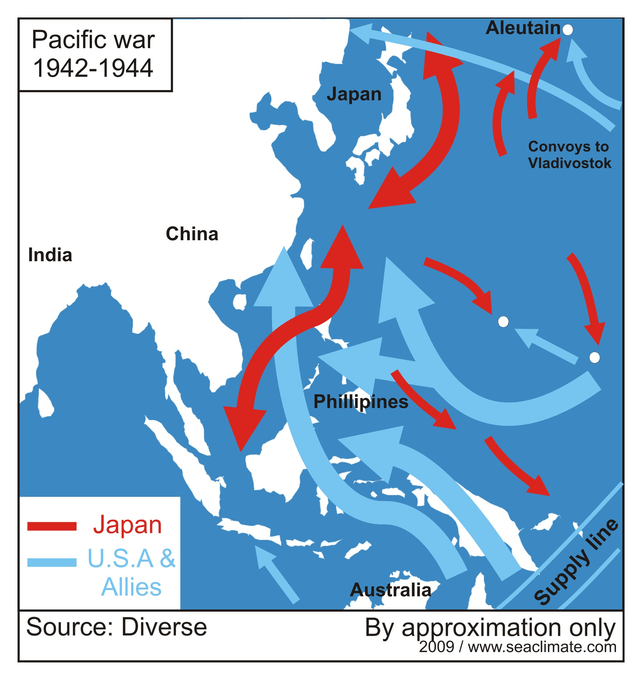
“In the mid 20th Century there had been a 35-year lasting period of global cooling, which had started between 1940 and 1945. The reasoning for causation given by climate science is rather limited, and hardly sufficient. Cooling was evident in the Pacific as well. Could naval war in the Pacific over just three years have contributed to trigger a climatic shift in the North Pacific? If it was not naval war, which mechanism caused the large discontinuity in the mid-twentieth century in observed global-mean surface temperatures? Was it a “natural event”, or by what kick off was this process set in motion?”
While admitting answers are not definitive, he goes on to assert:
“In the North Atlantic and its adjacent seas the naval war in Northern Europe definitely contributed highly. This is due to a much higher extension of the northern North Atlantic towards the pole, and the sensible structure of the warm Gulf Current system that flows through colder water up to the Arctic Ocean . One has to assume that any substantial climatic shift generated in the North Atlantic will inevitably show its impact on the North Pacific as well.”
This leads into a discussion of the PDO:

“While naval activities, just like any wind, have an impact on the upper sea surface layer concerning the temperature and salinity structure, the vastness of the North Pacific in extension and volume, makes it hard to assume any relevance between WWII and the observed climate shift in the early 1940s. But as long as the reason for the shift has not been evidently established, naval war activities need to be regarded as an option, and should not have been ignored. The question is about the impact human activities may have on climate, and this should be known completely as soon as possible. For this reason this investigation restricts the scope on the so-called Pacific Decadal Oscillation (PDO).”
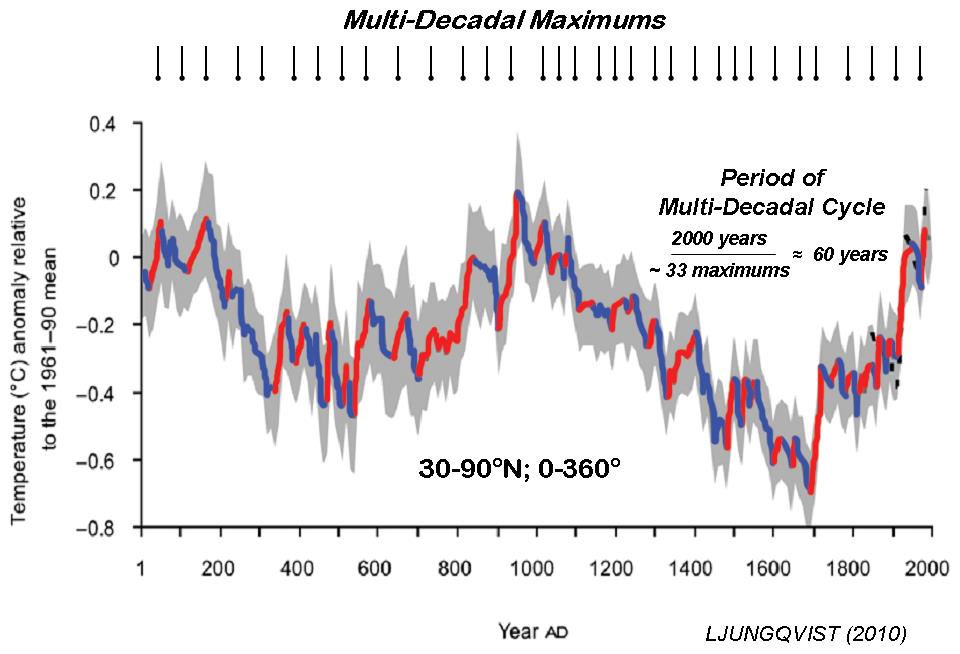
“Until now no mechanism has been identified to explain the shifts. They are rare, and occurred only six times over the last 300 years: 1750, 1905, 1946, 1977, 1998, and 2008 (Biondi, 2001). Concerning the last century N. Mantua identifies two full PDO cycles: with cool PDO regimes from 1890-1924 and again from 1947-1976, while warm PDO regimes dominated from 1925-1946 and from 1977 through (at least) the mid-1990’s (Mantua, 2000), whereby timing may vary according to the researcher, e.g. saying that a warm phase lasted from 1925–42 that turned into a cold PDO cycle from 1943–76 (Zhang, 1996).”
Although the sea surface temperature (SST) data taken during WWII should only be used with caution (Bernaerts, 1996), they need nevertheless be assessed with regard to timing. But the shift in SST and SAT (surface air temperature), show a different time, first in the Europe/Atlantic area (between 1940 and 1942), and in the North Pacific between 1942 and 1945. The set of given SST graphics indicate, at best that pre WWII warming continued maximally until about 1942.”

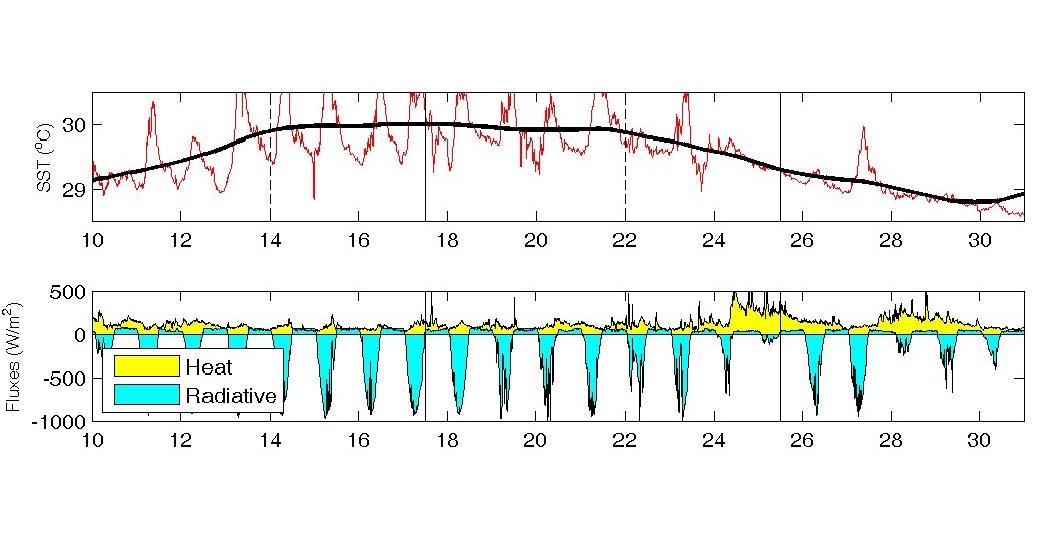
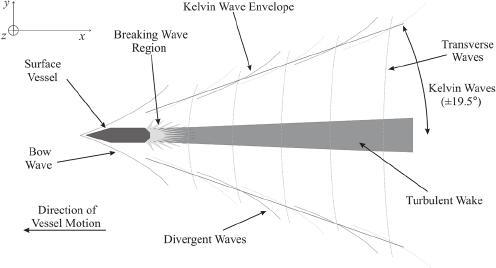
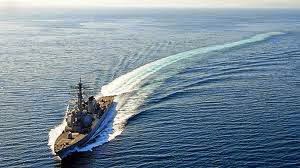
Elsewhere he theorizes that the stirring action of great and increasing numbers of propeller-driven vessels releases ocean heat into the air, beyond what naturally occurs. He doesn’t claim this is proven, but rather it has been ignored and not studied. He also believes that future cooling is as likely as warming, contrary to what consensus scientists expect.
I appreciate Dr. Bernaerts’ perspective and will be reading more of his extensive work.
Update April 11: Recent Analyses
Offshore Wind-parks and mild Winters.
Contribution from Ships, Fishery, Wind-parks etc.
25th February, 2015
Click to access k-.pdf
After a moderate March now a cold April? April 4, 2015
http://climate-ocean.com/2015/K-m2.html
Update: Comments by Dr. Bernaerts and myself
Ron; Your essay is highly appreciated. Thanks a lot! As COP Paris is approaching quickly, your presentation is very helpful for raising more interest and discussion on ‘oceans make climate’, about which I would be ready and happy to assist you in exploring my research material, and concepts of the various analyses, as it may otherwise “take some time to understand how his material is organized….” covering the last quarter century.
With best regards
Arnd
Dr. Bernaerts, thanks for your comment. I am glad my overview of your work was not too far off.
As you can see from my posts here, I am a generalist with a scientific curiosity. Truth be told, I paid zero attention to global warming prior to COP Copenhagen. At that event was the spectacle of nations pledging reductions in fossil fuel emissions, and the pledged amounts totaled up to forecast temperatures at the end of the century.
Amazing! When did we so well understand the climate system to project the future in hundredths of degrees? So I started reading, and soon learned it was a circus act, or even worse a side-show con game. My point: The notion of CO2 as the “climate control knob” offended my sensibility that such a complex reality could be so simply explained.
At the time, I could only say to my friends (who think I am obsessing over this issue) that we are only experiencing natural variability. That is true enough, but I and others like me need an alternative theory of what drives changes in the climate.
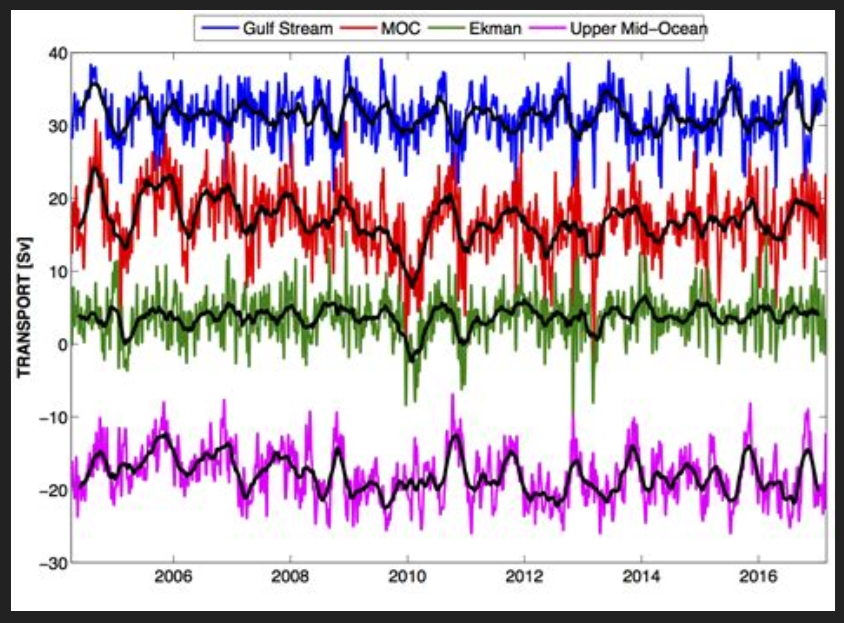
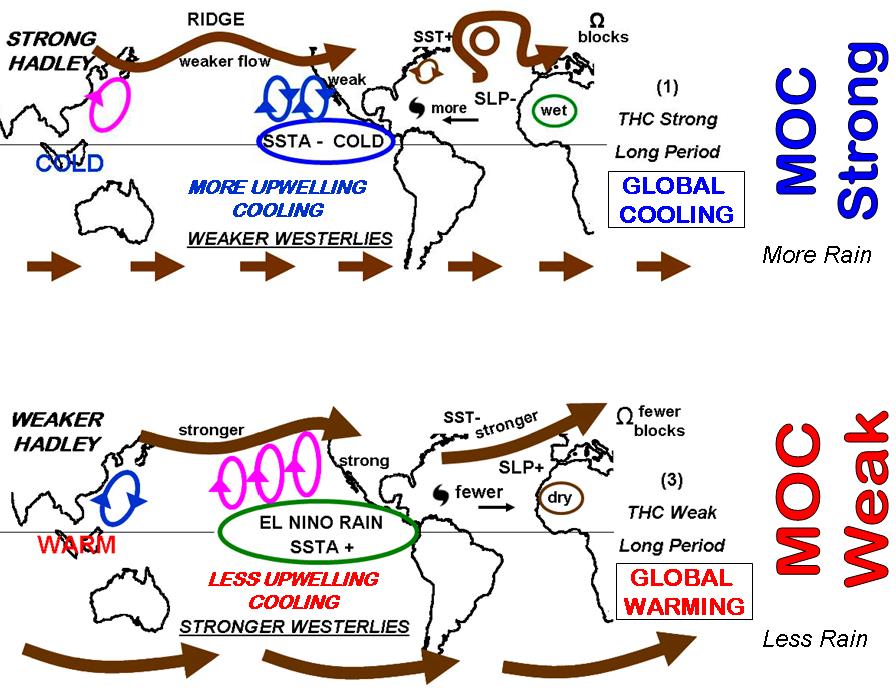
That is why your phrase struck me. In the water world post, I noted that global SSTs fluctuate in the same periods as the IPO, and the same patterns appear in surface temperature records. This suggests that the oceans are the source of natural variability, and I believe that is your premise.
Here’s what I want to learn from you. What is the theory, the mechanisms and the evidence for your assertion: Oceans make the climate. Please point me to the writings. Remember that I am a generalist who needs to grasp the core principles underneath the complexity of your specialized knowledge.
Looking forward to your response.
Dr. Bernaerts responds here:
https://rclutz.wordpress.com/2015/04/09/understanding-how-oceans-have-driven-climate-change/







 Science Matters