Watching a UN Train Wreck

Bjorn Lomborg is someone I have long respected because he cares a lot about world problems and works hard on programs and projects to actually improve people’s lives.

He has an insider’s take on preparations for the UN Summit on Sustainable Development, and it is not pretty. From his point of view, national leaders can do a lot to make the world a better place, but that is looking less and less likely. The problem is not ill will or selfishness. It is the enormous overreach of activists’ ambitions.

Bjorn Lomborg:

“With the so-called Agenda for Sustainable Development having been quietly finalized by diplomats and United Nations bureaucrats last month, the leaders are expected just to smile for the cameras and sign on the dotted line. Unfortunately, they are missing a one-in-a-generation opportunity to do much more good.

The agenda is the result of years of negotiations. Aiming for inclusivity, the UN talked to everyone. But, however admirable that approach may be, it did not prove successful. Indeed, looking at the agenda they produced – more than 15,000 words and a headache-inducing 169 development targets – one might conclude that they simply threw everything they had heard into the document.”

Lomborg gives numerous examples, and concludes:

“It is not that the new promises are not well-intentioned. The problem is that they do not reflect effective prioritization, which is critical when resources are limited.

In short, many of the targets are either marginally useful or highly problematic. Making matters worse, collecting data on the 169 promises could cost almost two years of development aid. As a result, the agenda will leave the world’s poorest far worse off than they could be.

In lofty language, the UN claims that the Agenda for Sustainable Development’s 169 targets are “integrated and indivisible.” This is nonsense. Cutting them back is what should happen.”

At Lomborg’s think tank, the Copenhagen Consensus Center, a panel of Nobel laureates studied more than 1,800 pages of peer-reviewed analysis, in order to determine which potential targets would achieve the most good – something that the UN never did. Channeling the entire development budget to the 19 targets that the panel identified would do four times more good than if we spread it across the UN’s 169 targets, with a large share of those benefits going to the world’s worst-off people.
https://www.project-syndicate.org/commentary/unsustainable-development-goals-by-bj-rn-lomborg-2015-09

Bjørn Lomborg, an adjunct professor at the Copenhagen Business School, founded and directs the Copenhagen Consensus Center, which seeks to study environmental problems and solutions using the best available analytical methods. He is the author of The Skeptical Environmentalist and Cool It, and the editor of How Much have Global Problems Cost the World?

Anti-Racketeering Initiative

There’s a lot of buzz lately over a letter from some US academics asking for prosecution of those questioning consensus climate science. It is proposed that this offense can be considered as organized crime under the RICO legislation:  the Racketeer Influenced and Corrupt Organizations Act

One commenter (h/t Hans Erren) at the Climate Etc. Discussion said:

Wikipedia defines a racket as: A racket is a service that is fraudulently offered to solve a problem, such as for a problem that does not actually exist, that will not be put into effect, or that would not otherwise exist if the racket did not exist. Conducting a racket is racketeering. Particularly, the potential problem may be caused by the same party that offers to solve it, although that fact may be concealed, with the specific intent to engender continual patronage for this party.

Clearly the academics (many of whom are not physical scientists) missed their target. The IPCC fits perfectly the definition of a racket and could be pursued under RICO. Though I don’t think the courts are qualified to settle this or any science.

Still, “If the Glove Fits, You cannot Acquit!”


Flawed Policies for Climate Action

Ruth Dixon has incisively and fearlessly rebutted the public position of a prominent climate alarmist.  She summarizes the argument that will be asserted again many times in the weeks ahead of Paris COP.  And then she stirs up the sand upon which this whole appeal is built.

The article is a review of the recent book by Nicholas Stern, a leading and longtime advocate for fossil fuel reduction treaties.  “Why Are We Waiting? The Logic, Urgency, and Promise of Tackling Climate Change” by Nicholas Stern is reviewed by Ruth Dixon in the October 2015 edition of Journal of Economic Psychology.  It is an important statement deserving careful reading and dissemination. An advance copy of the text is here:

Click to access review-of-stern-2015.pdf

In the end, the problem is with the policies themselves:

“In assessing Stern’s avowedly biased book, readers must confront their own biases. Is Stern right to be so pessimistic about climate change and the inability of nations to build up resilience through economic development? Is he right to be so optimistic about the ability of governments to predict and manage change? If he is correct, we need more than ‘communication strategies’ to meet this challenge – we need arguments that do not rely on a selective presentation of the evidence, and solutions that take into account the physical, chemical and engineering challenges that our collective demand for energy requires. Governments regularly implement costly and unpopular policies if they are convinced that they will be effective. The lack of ‘action’ suggests that such policies are not (yet) available.”

In other words, even if you think there are damages to come from future warming, these policies are not a credible response.

There’s more at her blog:  “Stern’s book is not reliable on either science or policy.”

Bravo, Ruth Dixon.

https://mygardenpond.wordpress.com/2015/09/01/review-of-nicholas-stern-why-are-we-waiting/

Edge Research Topics for Climatologists

A number of studies will apparently be undertaken by seasoned climatologists in new fields tangential to global warming. The objective will be to settle the science on issues that have long been controversial. Climatologists are the logical choice to branch into these questions, given their demonstrated creativity regarding causes and effects of climate change.

One Pressing Research Issue:

Initiatives can address many other puzzling issues, such as these:

Very topical these days:

The study could recommend ways to build on the obvious successes of the War on Poverty, War on Drugs, and the War on Terrorism.

And, of course the big picture issue:

For other research grant opportunities, see here:

https://www.distractify.com/insanely-brilliant-science-questions-1197777368.html

The Inconvenient Truth About Climate Policy

A succinct summary accessible to anyone.  Reading it is like watching the claIms building up to make the house of cards climate policy really is.

See it here at US News and World Report

http://www.usnews.com/opinion/economic-intelligence/2015/07/16/climate-change-policy-wont-change-global-temperatures

“Let’s use our imagination and assume that China reduces its emissions by 20 percent by 2030. That gets us two tenths of a degree. Throw in a 30 percent reduction by Europe and Japan and the rest of the industrialized world, also by 2030. That’s another two tenths of a degree, for a grand total of 0.425 degrees, under a “climate sensitivity” (loosely, the effectiveness of greenhouse gas reductions) assumption 50 percent greater than that adopted by the Intergovernmental Panel on Climate Change in its latest assessment report. Is an effect that small worth 1 percent of global GDP, or roughly $600 billion to $750 billion per year, inflicted disproportionately upon the world’s poor?”

“Such propaganda terms as “carbon pollution” are useful as tools toward that end, as they are designed to end debate before it begins by assuming the answer to the underlying policy question. Carbon dioxide is not “carbon” and it is not a pollutant, as a minimum atmospheric concentration of it is necessary for life itself. By far the most important greenhouse gas in terms of the radiative (warming) properties of the atmosphere is water vapor; why does no one call it a “pollutant”? Presumably it is because ocean evaporation is a natural process. Well, so are volcanic eruptions, but no one argues that the massive amounts of particulates and toxins emitted by volcanoes are not pollutants. The climate debate is desperately in need of honesty and seriousness, two conditions characteristic of neither the Beltway nor the climate industry.”

Warmists and Rococo Marxists.

This post will not be interesting to everyone. Because it is not so much about science as about the corruption of science by today’s academic establishment. It was inspired by several things including a discussion at WUWT recently regarding Lewandowsky’s latest salvo against those who dispute the consensus view of global warming and impending catastrophe. He and Oreskes were railing against the “seepage” of the “pause” notion into the alarmist narrative, thereby diluting the message in advance of the Paris COP.

That reminded me of a Tom Wolfe book in which he skillfully dissected the descent of rationality and objectivity at the hands of modern academia. And I began to see the connection to climate change hysteria. The ruling force is “political correctness”, which translates into going along to get along in your tribe. And in the extreme, it means subordinating science and rationality to instincts of the herd, their fears, disappointments and desires to rule the day.

A recent development is the admission, consciously or not, that climate change is not a scientific matter; it is rather a competition between narratives as to where we are as a civilization and what will be our future. When Jane Fonda or the Pope or Naomi Klein says that climate change is the defining issue of our time, they are appealing to one narrative, the environmentalist story of humanity despoiling the Eden granted to us. And in order to save the planet and all life forms from extinction, the capitalist, consumer society has to be unplugged and abandoned.

The damage to science is extreme: the premise of knowing objective reality is overturned by modern scholarship. All is relative, and in the end it is simply a matter of opinion: consensus.


The back story to all this is a development over several decades: the entrenchment in western universities of “post-normal” ideology. And this is what Tom Wolfe describes when he talks of the rise of Rococo Marxism.

What are Rococo Marxists? Wolfe refers to a peculiar development among American intellectuals who wanted to join European leftists in fighting tyranny, but found no obvious villains in American society.

“After World War I, American writers and scholars had the chance to go to Europe in large numbers for the first time. They got an eyeful of the Intellectual up close. That sneer, that high-minded aloofness from the mob, those long immaculate alabaster forefingers with which he pointed down at the rubble of a botched civilization—it was irresistible. The only problem was that when our neophyte intellectuals came back to the United States to strike the pose, there was no rubble to point at. Far from being a civilization in ruins, the United States had emerged from the war as the new star occupying the center of the world stage. Far from reeking of decadence, the United States had the glow of a young giant: brave, robust, innocent, and unsophisticated.”


“The country turned into what the Utopian socialists of the nineteenth century, the Saint-Simons and Fouriers, had dreamed about: an El Dorado where the average workingman would have the political freedom, the personal freedom, the money, and the free time to fulfill his potential in any way he saw fit. It got to the point where if you couldn’t reach your tile mason or your pool cleaner, it was because he was off on a Royal Caribbean cruise with his third wife. And as soon as American immigration restrictions were relaxed in the 1960s, people of every land, every color, every religion, people from Africa, Asia, South America, and the Caribbean, began pouring into the United States.”

“But our intellectuals dug in like terriers. Just as they had after World War I, they refused to buckle under to … circumstances. They saw through El Dorado and produced the most inspired adjectival catchups of the twentieth century. Real fascism and genocide were finished after World War II, but the intellectuals used the Rosenberg case, the Hiss case, McCarthyism—the whole Communist Witch Hunt—and, above all, the war in Vietnam to come up with … “incipient fascism”, “preventive fascism”, “local fascism” , “brink of” fascism, “informal Fascism” , “latent fascism” , not to mention the most inspired catch-up of all: “cultural genocide.” Cultural genocide referred to the refusal of American universities to have open admissions policies, so that any minority applicant could enroll without regard to GPAs and SATs and other instruments of latent-incipient-brink-of-fascist repression.”

So the intelligensia focused not on fundamental social and economic injustice, but upon the cultural trappings: gender equality, sexual orientation, reproductive rights, and the grandest manifestation, climate change.

“Today the humanities faculties are hives of abstruse doctrines such as structuralism, poststructuralism, postmodernism, deconstruction, reader-response theory, commodification theory … The names vary, but the subtext is always the same: Marxism may be dead, and the proletariat has proved to be hopeless. They’re all at sea with their third wives. But we can find new proletariats whose ideological benefactors we can be—women, non-whites, put-upon white ethnics, homosexuals, transsexuals, the polymorphously perverse, pornographers, prostitutes (sex workers), hardwood trees—which we can use to express our indignation toward the powers that be and our aloofness to their bourgeois stooges, to keep the flame of skepticism, cynicism, irony, and contempt burning. This will not be Vulgar Marxism; it will be … Rococo Marxism, elegant as a Fragonard, sly as a Watteau.”

“As any Fool sociologist could tell you, there are only two objectively detectable social classes in America: people above the bachelor’s-degree line—i.e., people who have graduated from four-year colleges—and people below it, who haven’t. By now people above it have learned to shrug and acquiesce to “political correctness,” to Rococo Marxism, because they know that to oppose it out loud is in poor taste. It is a … breach of the etiquette you must observe to establish yourself as an educated person.”

Conclusion

What a strange twist. Marx gave us the notion of ideology, which he understood to be the system of beliefs and values that the ruling class used to control the working class and ensure continued power and privileges. Today’s Marxist wannabes who are mostly in the entitled class are employing the ideology of environmentalism to mount an anti-capitalist crusade under the banner of Climate Change, advocating policies which will further the misery of the downtrodden.

Update May 4, 2016

More on academic ideology from Nicholas Kristoff NYT (here):

In a column a few weeks ago, I offered “a confession of liberal intolerance,” criticizing my fellow progressives for promoting all kinds of diversity on campuses — except ideological. I argued that universities risk becoming liberal echo chambers and hostile environments for conservatives, and especially for evangelical Christians.

As I see it, we are hypocritical: We welcome people who don’t look like us, as long as they think like us.

Footnote:

Matt Ridley is also concerned about the future of science:

http://rationaloptimist.com/blog/what-the-climate-wars-did-to-science.aspx

Tom Wolfe essay in pdf can be downloaded here:

In the Land of the Rococo Marxists by Tom Wolfe

Ecomodernist Critiques the Encyclical

Updated June 30, 2015  New GWPF paper by Indur M. Goklany linked below.

Mark Lynas Responds to the papal encyclical

“While the Pope bemoans the burning of coal, oil and gas he does so without recognizing that increasing energy consumption in developing countries is a precondition for poverty reduction. He seems to have no understanding of trade-offs — or the fact that pretty much all the projected future carbon emissions increases will come from the developing world.

Consider that while the coal boom creates global warming, it also frees people from burning wood — the toxic smoke of which killed four million people last year. And as Europe, the US and China have gotten richer, all have stepped up efforts to replace coal with solar, wind, natural gas and nuclear.”

Laudato Si is very relevant to the emerging ecomodernist movement because it makes explicit the ascetisism, romanticism and reactionary paternalism inherent in many aspects of traditional environmentalist thinking. It also helpfully draws out the religiously-originated narratives that underpin a lot of green themes of sinfulness/redemption and end-times doomsaying on issues like climate change.”

By Mark Lynas, Ted Nordhaus and Michael Shellenberger – See more at: http://www.marklynas.org/2015/06/a-pope-against-progress/#sthash.IKnWQMrm.dpuf

Mitigation is Bad for Us and the Planet

In the excitement over the Pope’s encyclical and upcoming Paris conference, people are not talking about how CO2 mitigation (treaties, carbon pricing or regulations), if successful, would put civilization onto an unsustainable path.

Fortunately, Matt Ridley is shining some light in this direction:

Until now, green thinking has wanted us to go back to nature: to reject innovations such as genetically modified food, give up commerce and consumption and energy and materials and live simpler lives so that nature is not abused and the climate is not wrecked. The eco-modernists, who include the veteran Californian green pioneer Stewart Brand and the British green campaigner Mark Lynas, say this is a mistake. “Absent a massive human die-off, any large-scale attempt at recoupling human societies to nature using these [ancestral] technologies would result in an unmitigated ecological and human disaster.”

The Ecomodernist Manifesto promises a much needed reformation in the green movement. Its 95 theses should be nailed to the door of the Vatican when the pope’s green-tinged encyclical comes out next month, because unlike the typical eco-wail, it contains good news for the poor. It says: no, we are not going to stop you getting rich and adopting new technologies and leaving behind the misery of cooking over wood fires in smoky huts with no artificial light. No, we do not want you to stay as subsistence farmers. Indeed, the quicker we can get you into a city apartment with a car, a phone, a fridge and a laptop, the better. Because then you won’t be taking wood and bushmeat from the forest.

http://www.rationaloptimist.com/blog/eco-modernism-and-sustainable-intensification.aspx

Now, I am not thrilled with using the term “manifesto” or with references to the “anthropocene” era, but there is a positive direction in this.

“We offer this statement in the belief that both human prosperity and an ecologically vibrant planet are not only possible, but also inseparable. By committing to the real processes, already underway, that have begun to decouple human well-being from environmental destruction, we believe that such a future might be achieved. As such, we embrace an optimistic view toward human capacities and the future.”

These folks are saying we can use fossil fuels in a way that benefits both humans and nature, and in fact, if we don’t do so, our civilization is not sustainable.  Using fossil fuels is good for people and the planet and is the only sustainable way forward.

Strong stuff, but it doesn’t fit into the usual boxes.

More on Ecomodernism here:

http://thebreakthrough.org/index.php/voices/michael-shellenberger-and-ted-nordhaus/an

From Indur M. Goklany in The Pontifical Academies’ BROKEN MORAL COMPASS

But the statement is fatally flawed. It is riddled with sins of omission and commission bolstered by wishful thinking. For instance, it ignores decades of well documented empirical data that show that human wellbeing has advanced throughout the world and that the terrestrial biosphere’s productivity has increased above preindustrial levels, allowing it to support more biomass, in no small part because of carbon dioxide emissions from humanity’s use of fossil fuels. The advances in human wellbeing include reductions in poverty, hunger, malnutrition, death and disease, and increases in life expectancy and the standard of living across the world. The poor have been major beneficiaries of these advances.

http://www.thegwpf.org/content/uploads/2015/06/Vatican-compass.pdf

Dueling Encyclicals

With the Vatican declaring UN IPCC science as Christian Truth, I am reminded of Aristotle (384 to 322 BC) who said:

“Give me a child until he is 7 and I will show you the man.”

If Aristotle knew what we know today about how oceans make the climate, how might he convey that meaning to one of his young Greek students?

Perhaps he would tell the story this way.

Poseidon, Lord of the Oceans

I am Poseidon and I rule the oceans, and with them I make the climate what it is.

I store the sun’s energy in my ocean water so that our world is neither too hot nor too cold.

I add water and energy into the air and together we spread warmth from the tropics to the poles. There are many obstacles and delays along the way, and there are clashes between hot and cold, which you know as storms.

The land masses make basins to collect water and energy and I send heat to each basin to form its own climate. Water heat is transported slowly, between basins and from equator to pole and back again.

The water in the air returns as rain falling on land and sea. Near the poles the water freezes and stays, sometimes for many years, until rejoining the ocean. Always the water returns and the cycles continue.

Do not be afraid of the future. Respect the oceans, take care of the land and each other, and all will be well.

The Climate According to Poseidon

Basics of Ocean Acidification

Updates added below June 20 and 24, 2015

Update below July 2, 2015: Ocean pH is actually trending alkaline

Update below September 15, 2015: Extensive discussion of ocean chemistry

If surface temperatures don’t skyrocket soon, expect to hear a lot in the coming months about “ocean acidification.”  This sounds scary, and that is the point of emphasizing it in the runup to Paris COP.

So here’s the basic chemistry of CO2 and H20:

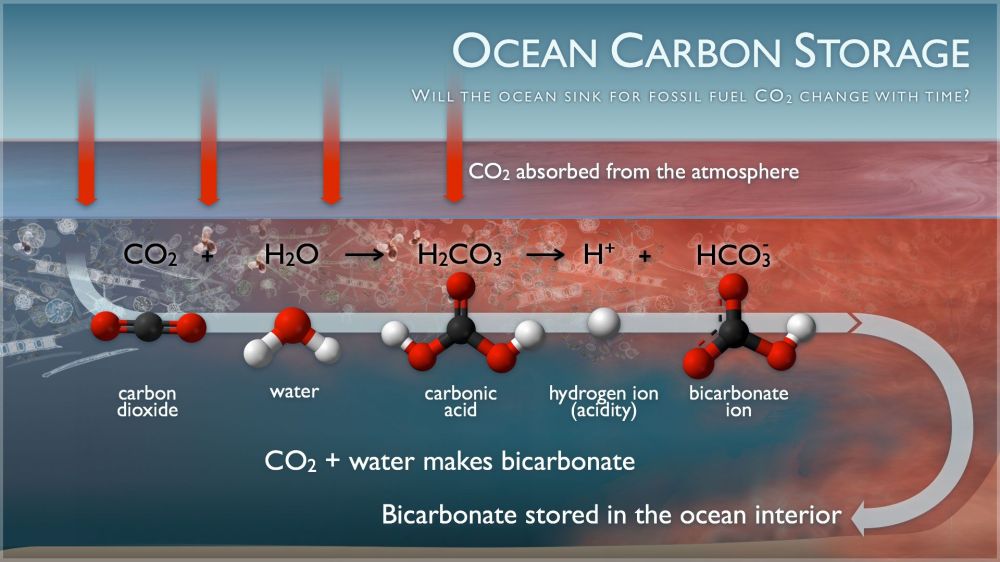
8lrtxibuouhqy8limppbfwkc76e5k_rxa9xbrm8mssw

That seems straight forward,  So what is the problem?

That looks fairly serious.  So what does the IPCC have to say about this issue?

What does it say in the SPM (Summary for Policy Makers)?

For this issue, I looked at the topic of ocean acidification and fish productivity. The SPM asserts on Page 17 that fish habitats and production will fall and that ocean acidification threatens marine ecosystems.

“Open-ocean net primary production is projected to redistribute and, by 2100, fall globally under all RCP scenarios. Climate change adds to the threats of over-fishing and other non-climatic stressors, thus complicating marine management regimes (high confidence).” Pg 17 SPM

“For medium- to high-emission scenarios (RCP4.5, 6.0, and 8.5), ocean acidification poses substantial risks to marine ecosystems, especially polar ecosystems and coral reefs, associated with impacts on the physiology, behavior, and population dynamics of individual species from phytoplankton to animals (medium to high confidence).” Pg 17 SPM

So, the IPCC agrees that ocean acidification is a serious problem due to rising CO2 emissions from burning fossil fuels.

What does it say in the Working Group Reports?

But wait a minute.  Let’s see what is in the working group reports that are written by scientists, not politicians.
WGII Report, Chapter 6 covers Ocean Systems. There we find a different story with more nuance and objectivity:

“Few field observations conducted in the last decade demonstrate biotic responses attributable to anthropogenic ocean acidification” pg 4

“Due to contradictory observations there is currently uncertainty about the future trends of major upwelling systems and how their drivers (enhanced productivity, acidification, and hypoxia) will shape ecosystem characteristics (low confidence).” Pg 5

“Both acclimatization and adaptation will shift sensitivity thresholds but the capacity and limits of species to acclimatize or adapt remain largely unknown” Pg 23

“Production, growth, and recruitment of most but not all non-calcifying
seaweeds also increased at CO2 levels from 700 to 900 µatm Pg 25

“Contributions of anthropogenic ocean acidification to climate-induced alterations in the field have rarely been established and are limited to observations in individual species” Pg. 27

“To date, very few ecosystem-level changes in the field have been attributed to anthropogenic or local ocean acidification.” Pg 39

Ocean Chemistry on the Record

Contrast the IPCC headlines with the the Senate Testimony of John T. Everett, in which he said:

“There is no reliable observational evidence of negative trends that can be traced definitively to lowered pH of the water. . . Papers that herald findings that show negative impacts need to be dismissed if they used acids rather than CO2 to reduce alkalinity, if they simulated CO2 values beyond triple those of today, while not reporting results at concentrations of half, present, double and triple, or as pointed out in several studies, they did not investigate adaptations over many generations.”

“In the oceans, major climate warming and cooling and pH (ocean pH about 8.1) changes are a fact of life, whether it is over a few years as in an El Niño, over decades as in the Pacific Decadal Oscillation or the North Atlantic Oscillation, or over a few hours as a burst of upwelling (pH about 7.59-7.8) appears or a storm brings acidic rainwater (pH about 4-6) into an estuary.”
http://www.epw.senate.gov/public/index.cfm?FuseAction=Files.View&FileStore_id=db302137-13f6-40cc-8968-3c9aac133b16

Many organisms benefit from less alkaline water.

(Added in thanks to David A.’s comment below)

In addition, IPCC has ignored extensive research showing positive impacts on marine life from lower pH. These studies are catalogued at CO2 Science with this summary:

There are numerous observations of improvement in calcification of disparate marine life in realistic rates of PH change due to increased CO2.

“In the final graphical representations of the information contained in our Ocean Acidification Database, we have plotted the averages of all responses to seawater acidification (produced by additions of both HCl and CO2) for all five of the life characteristics of the various marine organisms that we have analyzed over the five pH reduction ranges that we discuss in our Description of the Ocean Acidification Database Tables, which pH ranges we illustrate in the figure below.”

“The most striking feature of Figure 11 is the great preponderance of data located in positive territory, which suggests that, on the whole, marine organisms likely will not be harmed to any significant degree by the expected decline in oceanic pH. If anything, in fact, the results suggest that the world’s marine life may actually slightly benefit from the pH decline, which latter possibility is further borne out by the scatter plot of all the experimental data pertaining to all life characteristic categories over the same pH decline range, as shown below in Figure 12.”

At PH decline from control of .125, calcification, metabolism, fertility, growth and survival all moved into positive territory.

http://www.co2science.org/data/acidification/acidification.php

Summary

The oceans are buffered by extensive mineral deposits and will never become acidic. Marine life is well-adapted to the fluctuations in pH that occur all the time.

This is another example of climate fear-mongering:  It never happened before, it’s not happening now, but it surely will happen if we don’t DO SOMETHING!.

Conclusion

Many know of the Latin phrase “caveat emptor,” meaning “Let the buyer beware”.

When it comes to climate science, remember also “caveat lector”–”Let the reader beware”.

Update added June 20, 2015

For additional commentary on ocean acidification:

http://www.newsmax.com/FastFeatures/ocean-acidification-global-warming-quotes-debate/2015/05/06/id/642876/

Update added June 24, 2015

Patrick Moore also provides a thorough debunking here:

“It is a fact that people who have saltwater aquariums sometimes add CO2 to the water in order to increase coral growth and to increase plant growth. The truth is CO2 is the most important food for all life on Earth, including marine life. It is the main food for photosynthetic plankton (algae), which in turn is the food for the entire food chain in the sea.”

http://news.heartland.org/editorial/2015/05/27/why-coral-reefs-and-shellfish-will-not-die-ocean-acidification

Update added July 2, 2015

Scientists have had pH meters and measurements of the oceans for one hundred years. But experts decided that computer simulations in 2014 were better at measuring the pH in 1910 than the pH meters were. The red line (below) is the models recreation of ocean pH. The blue stars are the data points — the empirical evidence.

What we have here is one of the basic foundations of the climate change scare, that is falling ocean pH levels with increased atmospheric CO2 content, being completely dismissed by the empirical ocean pH data the alarmist climate scientists didn’t want to show anyone because it contradicted their ‘increasing ocean acidity’ narrative.

http://joannenova.com.au/2015/01/oceans-not-acidifying-scientists-hid-80-years-of-ph-data/

Update added September 15, 2015

In summary, recent research publications are using a term (OA) that is technically incorrect, misleading, and pejorative; it could not be found in the oceanography literature before about 15 years ago. . .

The claim that the surface-water of the oceans has declined in pH from 8.2 to 8.1, since the industrial revolution, is based on sparse, contradictory evidence, at least some of which is problematic computer modeling. Some areas of the oceans, not subject to algal blooms or upwelling, may be experiencing slightly lower pH values than were common before the industrial revolution. However, forecasts for ‘average’ future pH values are likely exaggerated and of debatable consequences. The effects of alkaline buffering and stabilizing biological feedback loops seem to be underappreciated by those who carelessly throw around the inaccurate term “ocean acidification.”

http://wattsupwiththat.com/2015/09/15/are-the-oceans-becoming-more-acidic/