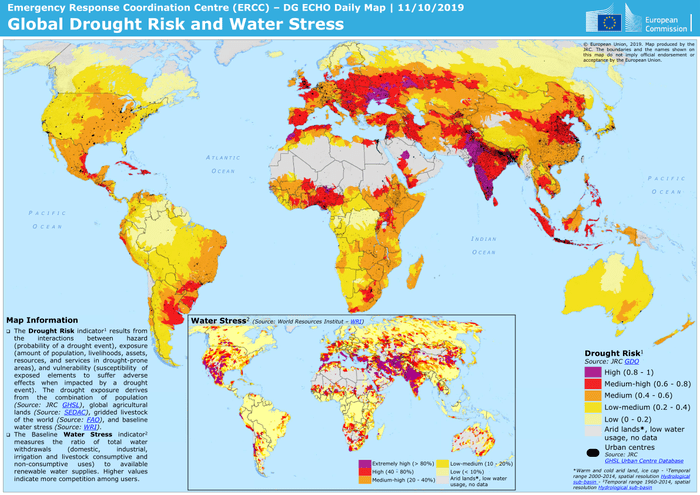
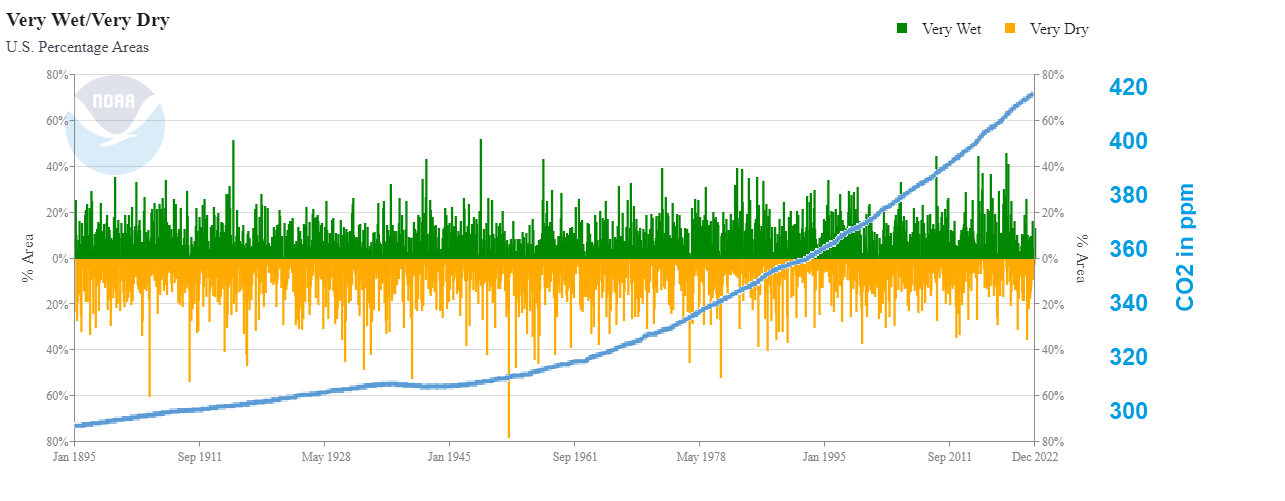
A recent scientific study has confirmed what climate realists have been highlighting for some time: Natural and climate-related disasters have been declining rather than increasing during the 21st century.
In a paper published this yearin one of the world’s leading journals on environmental hazards, Italian scientists Gianluca Alimonti and Luigi Mariani analyzed the number and temporal trends of natural disasters reported since 1900.
A 2015 study by 22 scientists from around the world found that cold kills over 17 times more people than heat. Thus the planet’s recent modest warming has been saving millions of lives.
Based on the best available data, the two scientists concluded the 21st century has seen “a decreasing trend [of natural disasters] to 2022” which is “characterized by a significant decline in number of events.”
The researchers emphasized that their conclusion “sits in marked contradiction to earlier analyses by UN bodies which predict an increasing number of natural disasters and impacts in concert with global warming.”
“Our analyses strongly refute this assertion,” they wrote.
For years, international agencies such as the UN Office for Disaster Risk Reduction, the Food and Agriculture Organization of the United Nations, the World Meteorological Organization and the International Red Cross have claimed that climate-related disasters are escalating.
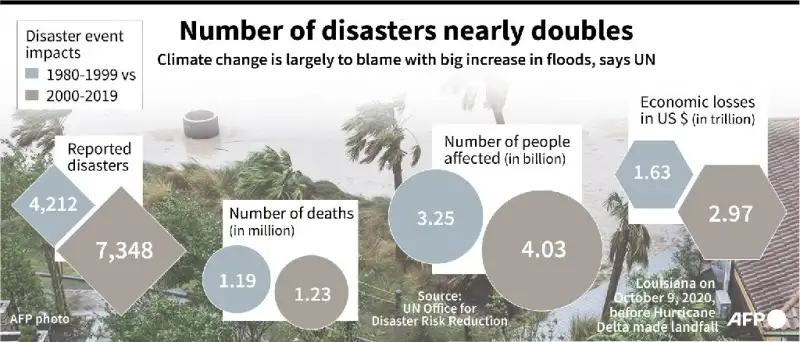
Floods lead a near doubling of disaster events from 1980 to 1999 compared to 2000 to 2019, according to a report by the UN Office for Disaster Risk Reduction.
“Weather disasters are striking the world four to five times more often and causing seven times more damage than in the 1970s,” the WMO reported in 2021.
Disaster and weather officials affiliated with the UN claim this dramatic rise is due to global warming: The changing climate, they say, is making weather disasters stronger and more frequent.
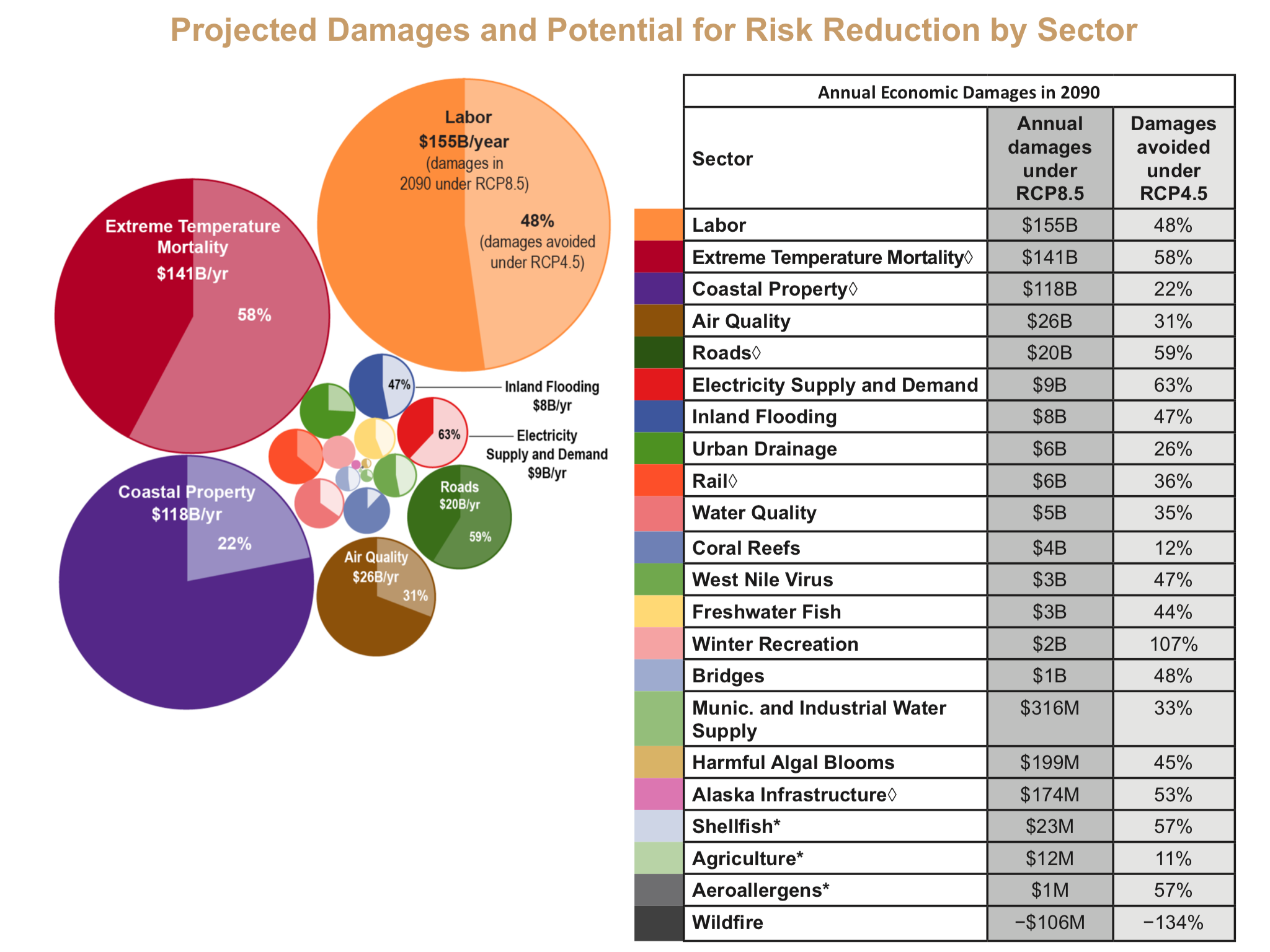
Fourth National Climate Assessment, Volume II: Impacts, Risks, and Adaptation in the United States.
The increased frequency of heat waves, droughts, flooding, winter storms, hurricanes, wildfires and other extreme weather events prove the negative impact of a warming world, according to various UN agencies and nongovernmental organizations.
Yet, as the actual data used by these organizations reveals, the last 20 years have in fact seen a significant decline in such events.
It turns out that climate alarmists have based their claims on a highly misleading comparison of disaster data of the late 20th and the early 21st centuries.
By their tally, the period from 1980 to 2000 saw about 4,200 natural disasters —with the number increasing sharply, to more than 8,000, during the first 20 years of this century.
This conclusion, however, is fatally flawed: It fails to take into account the huge increase in the global reporting of disasters engendered by the invention and rapid global dissemination of new communication technologies since the 1980s.
The arrival of the internet and other new communication tools has undoubtedly accelerated the reporting of disasters from all corners of the world — events that were significantly underreported in earlier decades.
As well, the number of people killed by natural and climate-related disasters has fallen steadily over the past 120 years — from 500,000 deaths per decade in the early 20th century down to less than 50,000 per decade in the last ten years.
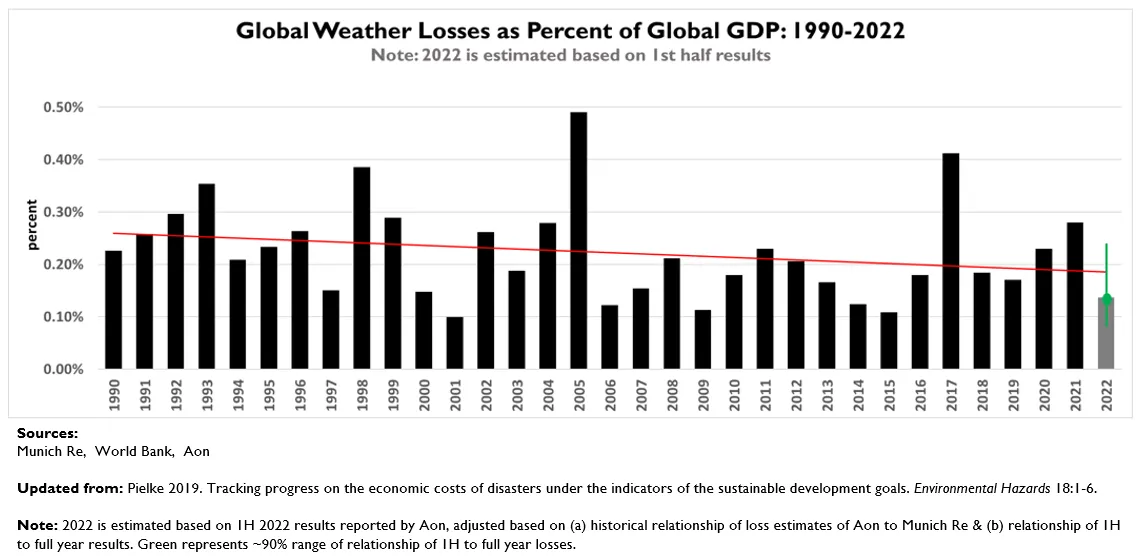
And, contrary to claims by NGOs and government officials, climate-related disaster losses have also declined as a percentage of global GDP during the last 30 years — from about 0.25% of GDP in 1990 to less than 0.20% in 2023.
The study by Alimonti and Mariani vindicates what we at the Global Warming Policy Foundation have been pointing out for a long time: Climate-related disasters are not on the rise, despite warming temperatures.
International agencies and the news media have hyped climate disasters for far too long, while ignoring the factual downward trend.
”First they ignore you, then they laugh at you, then they fight you, then you win,” as the saying goes. UN agencies and NGOs have been misleading the public for years. It’s past time for the truth to win out.
Benny Peiser is the director of the London-based Global Warming Policy Foundation.
As Joe Oliver explains, national macroeconomics are not that complicated. Good governance means taking care of the five pillars. Regretably, Trudeau has failed Canada in every respect, outdone only by Biden’s performance in the USA. Oliver explains at Financial Post Canada The Trudeau Liberals have eroded all five pillars of prosperity. Excerpts in italics with my bolds.
Economics says the pillars are: spending restraint, low taxes,
minimal regulation, sound money, free trade. Ottawa is oh-for-five.
Canada’s standard of living is in decline, both in absolute terms and compared to our southern neighbour and other wealthy countries. A Fraser Institute analysis shows that real GDP per capita was lower during the pre-recession period 2016-19 than in any similar period since 1985. As of the last quarter of 2023 it was below its value for 2019:Q2. It’s no surprise that 44 per cent of Canadians now say money is their leading source of stress.
What explains Canada’s dreadful performance? As set out by Arthur Laffer, of Laffer Curve fame, prosperity has five pillars: restrained government spending, low taxes, minimal regulation, sound money and free trade. The Liberal government has rejected, undermined or neglected each of the five. Our weak record and disheartening prospects have not been caused by external forces but by dysfunctional government policies.
Canada is blessed by enviable geology and geography — immense natural resources and a friendly superpower next door — which Canadians too frequently take for granted. Because our border is safe and our population well off by world and historical standards, progressive politicians feel free to obsess about issues irrelevant or actually harmful to economic growth, jobs, affordability, a sound currency, security and national unity.
Let’s review the litany of debilitating missteps, starting with the size and role of government. The federal public service reached over 274,000 employees in 2023, an increase of 40.4 % since 2015. A bloated bureaucracy drains resources from the private sector, reducing economic efficiency. In the last eight years, the depletion has been rapid. Federal spending swelled from 12.8 per cent of GDP in 2015 to 16.1 per cent in 2023. Federal debt more than doubled, from $612 billion to a staggering $1.4 trillion — over $143,000 for a family of four. Interest now costs Ottawa $47.2 billion a year, rising to $64.3 billion by 2028-29. This is fiscal profligacy writ large.
Tax increases discourage economic growth. The Laffer curve demonstrates that taxes set too high can actually reduce tax revenue. Out of 61 US jurisdictions and Canadian provinces, the top three personal marginal income tax rates are imposed by Newfoundland and Labrador, Nova Scotia and Ontario. Nine Canadian provinces rank in the top 10, all are in the top 15, and Canada ranks fifth out of 38 OECD countries. Corporate income tax rates are also higher here than in the U.S., the U.K. and the OECD on average. High taxes damage affordability, reduce competitiveness, discourage innovation and entrepreneurship, accelerate capital flight and weaken productivity. The proposed increase in the capital gains inclusion rate for both individuals and companies and the phase-out of accelerated capital depreciation will seriously exacerbate those negatives.
Since 2015, intrusive regulations have proliferated across the economy, imposing burdensome compliance costs that are particularly harmful to small and medium- sized enterprises. The resource industry, which accounts for 19.2 per cent of GDP and 58 per cent of merchandise exports, has been targeted by draconian regulation deliberately designed to block energy projects. The result is an opportunity loss in the hundreds of billions of dollars and mounting.
A stable money supply is critical for economic stability. To cope with out-of- control government spending, the Bank of Canada expanded the money supply dramatically, pushing it to $3.6 trillion, 83 per cent more than when the Liberals took office. As a result, in 2022 inflation hit a 40-year peak of 6.8 per cent. Consumer prices are now 27 per cent higher than in 2015. Rising prices disproportionately affect low- and middle-income Canadians, who are also vulnerable to hikes in interest rates, including mortgage rates up 50 per cent from 2015. In aggregate, total mortgage payments could rise by as much as $4 billion this year.
Free trade had been a cornerstone of Canada’s economic policy for decades, promoting growth and prosperity. But last year Canada lost bragging rights as America’s biggest trade partner to Mexico. Instead of pursuing our comparative advantage in natural resources, Liberal policies purposely stymie the development and export of oil and gas. In a memorably inane comment, the prime minister claimed there was never a strong business case for liquified natural gas. The government should leave the assessment of business cases to business.
Barriers to interprovincial trade, a related problem, have continued to elude meaningful progress despite repeated promises. The Montreal Economic Institute estimates that removing those barriers would yield an average increase in Canadians’ incomes by 5.5 per cent, or $1,800. According to the IMF, it could boost GDP by $80 billion.
The government’s score for supporting the mainstays of prosperity is zero for five. Rather than correcting course, Justin Trudeau seems increasingly disconnected from reality and fixated on maintaining a perfect losing streak. Doubling down on big government, high taxes and hostility to resource development will do the trick.
Lots of PR coming out of the golden state regarding great strides in building battery capacity required by the green dream of 100% carbon free electrical power.
Batteries briefly became the biggest source of power in California twice in the past week.
The first time — Tuesday last week around 8:10 p.m. PT, according to GridStatus.io — batteries reached a record peak output of 6,177 megawatts. For about two hours, that made electricity generated earlier and stored in batteries the single largest source of power in the Golden state, eclipsing real-time production from natural gas, nuclear, renewable sources like wind and solar, and all other sources of energy.
It happened again on Sunday evening, this time for a few hours around 7:10 p.m. PT, per data from GridStatus.io. In that instance, which broke Tuesday’s record, batteries reached a peak output of 6,458 megawatts.
Battery storage has become a key part of the push to produce more electricity using renewable sources. By connecting huge, rechargeable batteries to power grids, power utilities can store energy generated during the day by solar panels and wind turbines.
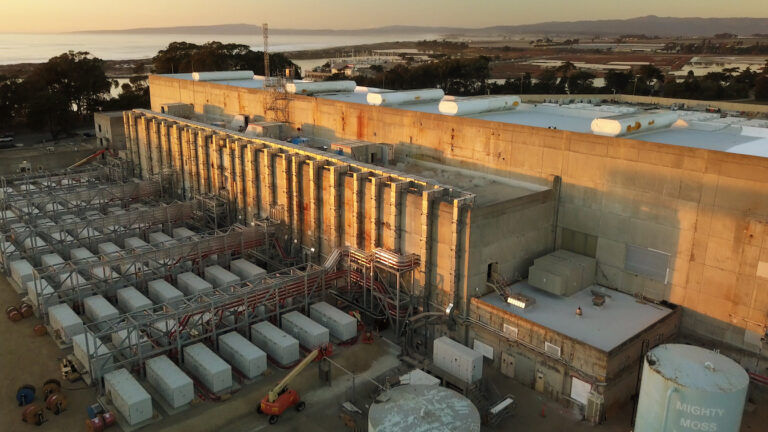
Augmentation at the Vistra Moss Landing Energy Storage Facility in California has been completed, with the world’s biggest battery energy storage system (BESS) now at 400MW / 1,600MWh. The batteries are housed in repurposed gas turbine halls. Image: Vistra Energy.
Note the BESS ratings for power (MW) and energy output (MWh). In this case, Moss Landing has a maximum power of 400MW and a duration of 4 hours, or 1600MWh. Such a factor of 4 seems typical for large scale BESS in California. It also means that for a single peak hour demand, Moss Landing can only supply 400MW for that hour. If more energy is needed, it will have to come from somewhere else.
Note the graph is projecting hourly electricity demand, which peaks during hour 19. Output levels approach and then exceed 50,000 MW demand that hour, or 50k MWh.
Cal matters raises concerns about state policy to phase out ICE vehicles in favor of EVs.
Again demand requires from the grid 50k MW per hour in 2022 with less than 1% for charging EVs. That is projected to go 10 times higher in 13 years.
Summary
The excitement is about batteries supplying 6500 MW for a couple of hours when the peak demand is 50,000 MW. The glorious achievement is building battery capacity up to 10,000 MW. It doesn’t add up.
The ‘sustainability’ regime is impoverishing the world.
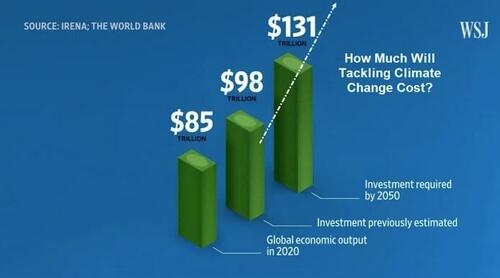
In recent years, the overused word ‘sustainability’ has fostered a narrative in which human needs and aspirations have taken a back seat to the green austerity of Net Zero and ‘degrowth’. The ruling classes of a fading West are determined to save the planet by immiserating their fellow citizens. Their agenda is expected to cost the world $6 trillion per year for the next 30 years.
Yes, those are Trillions of US$ they are projecting to spend.
Meanwhile, they will get to harvest massive green subsidies
and live like Renaissance potentates.
In Enemies of Progress, author Austin Williams suggests that ‘the mantra of sustainability’ starts with the assumption that humanity is ‘the biggest problem of the planet’, rather than the ‘creators of a better future’. Indeed, many climate scientists and green activists see having fewer people on the planet as a key priority. Their programme calls not only for fewer people and fewer families, but also for lower consumption among the masses. They expect us to live in ever smaller dwelling units, to have less mobility, and to endure more costly home heating and air-conditioning. These priorities are reflected in a regulatory bureaucracy that, if it does not claim justification from God, acts as the right hand of Gaia and of sanctified science.
The question we need to ask is: sustainability for whom?
US Treasury secretary Janet Yellen recently suggested that her department sees climate change as ‘the greatest economic opportunity of our time’. To be sure, there is lots of gold in green for the same Wall Street investors, tech oligarchs and inheritors who fund the campaigns of climate activists. They increasingly control the media, too. The Rockefellers, heirs to the Standard Oil fortune, and other ultra-wealthy greens are currently funding climate reporters at organs like the Associated Press and National Public Radio.
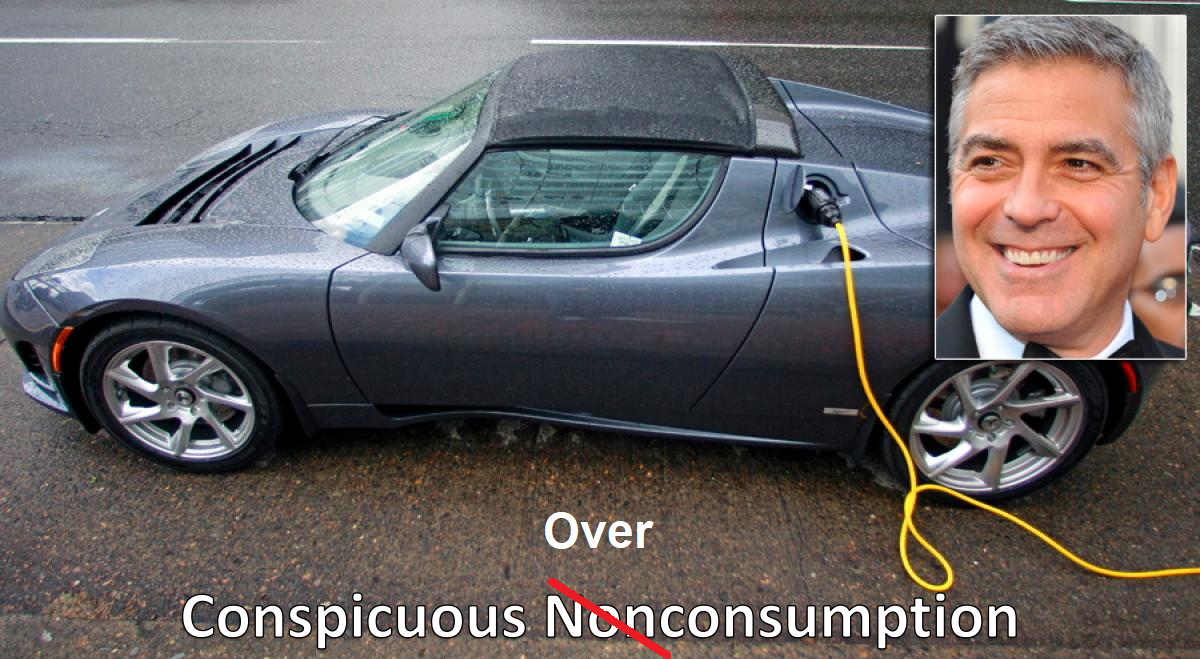
Under the new sustainability regime, the ultra-rich profit, but the rest of us not so much. The most egregious example may be the forced take-up of electric vehicles (EVs), which has already helped to make Elon Musk, CEO of Tesla, the world’s second-richest man. Although improvements are being made to low-emissions vehicles, consumers are essentially being frogmarched into adopting a technology that has clear technical problems, remains far more expensive than the internal-combustion engine and depends primarily on an electric grid already on the brink of blackouts. Green activists, it turns out, do not expect EVs to replace the cars of hoi polloi. No, ordinary people will be dragooned to use public transport, or to walk or bike to get around. [BMW will come to mean “Bike, Metro, and Walking.”]
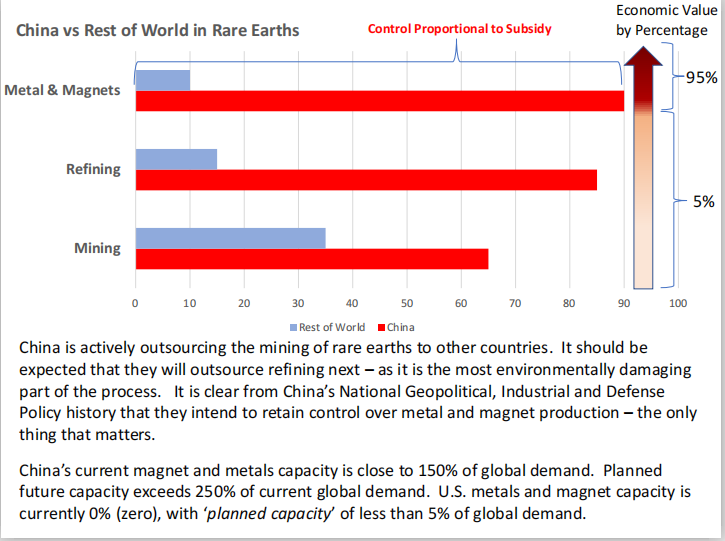
The shift to electric cars is certainly no win for the West’s working and middle classes. But it is an enormous boon to China, which enjoys a huge lead in the production of batteries and rare-earth elements needed to make EVs, and which also figure prominently in wind turbines and solar panels. China’s BYD, which is backed by Warren Buffett, has emerged as the world’s top EV manufacturer, with big export ambitions. Meanwhile, American EV firms struggle with production and supply-chain issues, in part due to green resistance to domestic mining for rare-earth minerals. Even Tesla expects much of its future growth to come from its Chinese factories.
Building cars from primarily Chinese components will have consequences for autoworkers across the West. Germany was once a car-manufacturing giant, but it is expected to lose an estimated 400,000 car-factory jobs by 2030. According to McKinsey, the US’s manufacturing workforce could be cut by up to 30 per cent. After all, when the key components are made elsewhere, far less labour is needed from US and European workers. It’s no surprise that some European politicians, worried about a popular backlash, have moved to slow down the EV juggernaut.
This dynamic is found across the entire sustainability agenda. The soaring energy costs in the West have helped China expand its market share in manufactured exports to roughly equal that of the US, Germany and Japan combined. American manufacturing has dropped recently to its lowest point since the pandemic. The West’s crusade against carbon emissions makes it likely that jobs, ‘green’ or otherwise, will move to China, which already emits more greenhouse gases than the rest of the high-income world.
Meanwhile, the Chinese leadership is looking to adapt to changes in the climate, instead of undermining economic growth chasing implausible Net Zero targets.
There are clear class implications here. California’s regulators recently admitted that the state’s strict climate laws aid the affluent, but hurt the poor. These laws also have a disproportionate impact on ethnic-minority citizens, creating what attorney Jennifer Hernandez has labelled the ‘green Jim Crow’. As China’s increasingly sophisticated tech and industrial growth is being joyously funded by US venture capitalists and Wall Street, living standards among the Western middle class are in decline. Europe has endured a decade of stagnation, while Americans’ life expectancy has recently fallen for the first time in peacetime. Deutsche Bank’s Eric Heymann suggests that the only way to achieve Net Zero emissions by 2050 is by squelching all future growth, which could have catastrophic effects on working-class and middle-class living standards.
Rather than the upward mobility most have come to expect, much of the West’s workforce now faces the prospect of either living on the dole or working at low wages. Today, nearly half of all American workers receive low wages and the future looks worse. Almost two-thirds of all new jobs in recent months were in low-paying service industries. This is also true in Britain. Over recent decades, many jobs that might have once supported whole families have disappeared. According to one UK account, self-employment and gig work do not provide sustenance for anything like a comfortable lifestyle. Rates of poverty and food shortages are already on the rise.
As a result, most parents in the US and elsewhere doubt their children
will do better than their generation,
while trust in our institutions is at historic lows.
The fabulists at places like the New York Times have convinced themselves that climate change is the biggest threat to prosperity. But many ordinary folk are far more worried about the immediate effects of climate policy than the prospect of an overheated planet in the medium or long term. This opposition to the Net Zero agenda was first expressed by the gilet jaunes movement in France in 2018, whose weekly protests were initially sparked by green taxes. This has been followed by protests by Dutch and other European farmers in recent years, who are angry at restrictions on fertilisers that will cut their yields. The pushback has sparked the rise of populism in a host of countries, notably Italy, Sweden and France. Even in ultra-with-it Berlin, a referendum on tighter-emissions targets recently failed to win over enough voters.
This is class warfare obscured by green rhetoric.
It pits elites in finance, tech and the nonprofit world against
a more numerous, but less connected, group of ordinary citizens.
Many of these folk make their living from producing food and basic necessities, or from hauling these things around. Factory workers, truck drivers and farmers, all slated for massive green regulatory onslaughts, see sustainability very differently than the urban corporate elites and their woke employees. As the French gilets jaunes protesters put it bluntly: ‘The elites worry about the end of the world. We worry about the end of the month.’
This disconnect also exists in the United States, according to long-time Democratic analyst Ruy Teixeira. Attempts to wipe out fossil fuels may thrill people in San Francisco, but are regarded very differently in Bakersfield, the centre of the California oil industry, and in Texas, where as many as a million generally good-paying jobs could be lost. Overall, according to a Chamber of Commerce report, a full national ban on fracking, widely supported by greens, would cost 14 million jobs – far more than the eight million jobs lost in the Great Recession of 2007-09.
No surprise then that blue-collar workers are not so enthusiastic
about the green agenda.
Just one per cent, according to a new Monmouth poll, consider climate as their main concern. A new Gallup poll shows that just two per cent of working-class respondents say they currently own an electric vehicle and a mere nine per cent say they are ‘seriously considering’ purchasing one.
These Western concerns are nothing compared to how the sustainability agenda could impact the developing world. Developing countries are home to roughly 3.5 billion people with no reliable access to electricity. They are far more vulnerable to high energy and food prices than we are. For places like Sub-Saharan Africa, green admonitions against new agricultural technologies, fossil fuels and nuclear power undermine any hope of creating desperately needed new wealth and jobs. It’s no wonder that these countries increasingly ignore the West and are looking to China instead, which is helping the developing world to build new fossil-fuel plants, as well as hydroelectric and nuclear facilities. All of this is anathema to many Western greens.
To make matters worse, the EU is already considering carbon taxes on imports,
which could cut the developing world off from what remains of global markets.
More critical still could be the impact of the sustainability mantra on food production, particularly for Sub-Saharan Africa, which will be home to most of the world’s population growth over the next three decades, according to United Nations projections. These countries need more food production, either domestically or from rich countries like the US, the Netherlands, Canada, Australia and France. And they are acutely aware of what happened when Sri Lanka adopted the sustainability agenda. This led to the breakdown of Sri Lanka’s agricultural sector and, eventually, to the violent overthrow of its government.
We need to rethink the sustainability agenda. Protecting the environment cannot come at the cost of jobs and growth. We should also assist developing countries in achieving a more prosperous future. This means financing workable technologies – gas, nuclear, hydro – that can provide the reliable energy so critical for economic development. It does no good to suggest a programme that will keep the poor impoverished.
Unless people’s concerns about the green agenda are addressed, they will almost certainly seek to disrupt the best-laid plans of our supposedly enlightened elites. In the end, as Protagoras said, human beings are still the ultimate ‘measure’ of what happens in the world – whether the cognoscenti like it or not.
The biggest hazard to humanity is when
climate change arguments are paired with AI.
During a recent interview with Reuters, Artificial Intelligence (AI) pioneer Geoffrey Hinton to asserted AI was a bigger threat to humanity than climate change.
Geoffrey Hinton, widely known as one of the “godfathers of AI”, recently announced he had quit Alphabet (GOOGL.O) after a decade at the firm, saying he wanted to speak out on the risks of the technology without it affecting his former employer.
Hinton’s work is considered essential to the development of contemporary AI systems. In 1986, he co-authored the seminal paper “Learning representations by back-propagating errors”, a milestone in the development of the neural networks undergirding AI technology. In 2018, he was awarded the Turing Award in recognition of his research breakthroughs.
But he is now among a growing number of tech leaders publicly espousing concern about the possible threat posed by AI if machines were to achieve greater intelligence than humans and take control of the planet.
“I wouldn’t like to devalue climate change. I wouldn’t like to say, ‘You shouldn’t worry about climate change.’ That’s a huge risk too,” Hinton said. “But I think this might end up being more urgent.”
The data show that fossil fuel use has contributed only 12% of the carbon dioxide during the last 3 centuries. The value is too low for fossil fuels have significantly influenced global temperatures.
These results negate claims that the increase in C(t) since 1800 has been dominated by the increase of the anthropogenic fossil component. We determined that in 2018, atmospheric anthropogenic fossil CO2 represented 23% of the total emissions since 1750 with the remaining 77% in the exchange reservoirs. Our results show that the percentage of the total CO2 due to the use of fossil fuels from 1750 to 2018 increased from 0% in 1750 to 12% in 2018, much too low to be the cause of global warming.
Furthermore, a study by MIT researchers in Science Advances confirms that the planet harbors a “stabilizing feedback” mechanism that acts over hundreds of thousands of years to stabilize global temperatures to keep them in a steady, habitable range.
A likely mechanism is “silicate weathering” — a geological process by which the slow and steady weathering of silicate rocks involves chemical reactions that ultimately draw carbon dioxide out of the atmosphere and into ocean sediments, trapping the gas in rocks.
Scientists have long suspected that silicate weathering plays a major role in regulating the Earth’s carbon cycle. The mechanism of silicate weathering could provide a geologically constant force in keeping carbon dioxide — and global temperatures — in check. But there’s never been direct evidence for the continual operation of such a feedback, until now.
I suspect that the “expert class” will be walking back their climate crisis assertions and endeavoring to hide their connection to their “fixes” once the full impact of the society-crushing, economy-killing force is felt….just as they are currently doing with the covid pandemic response now.
Clearly, the press is ginning up climate anxieties. How much of the concerns about AI are real, as opposed to general angst about the unknown ramifications, is difficult to say at present.
I have two points and my own hypothesis regarding climate change and AI.
Point 1: Carbon dioxide is a life-essential gas, and we had been reaching dangerously low levels until recently:
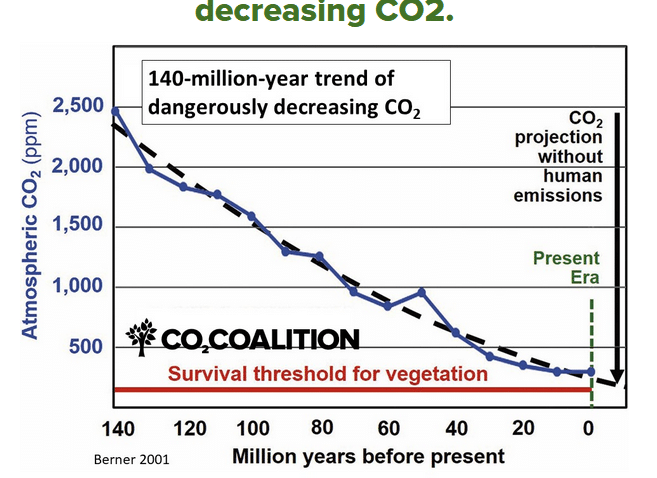
Plants consume carbon dioxide to grow and animals consume plants to obtain the necessary carbon for existence. If the level of carbon dioxide in the atmosphere dips below 150 ppm (parts per million) there would be a mass extinction of plant life per Greg Wrightstone in his book, “Inconvenient Facts/The Science Al Gore Doesn’t Want You to Know About.” Due to the depletion of carbon dioxide in the atmosphere during the last 140 million years to a dangerously low level of 182 ppm, carbon dioxide emissions during the industrial revolution saved plants from mass extinction and saved animals from mass starvation.
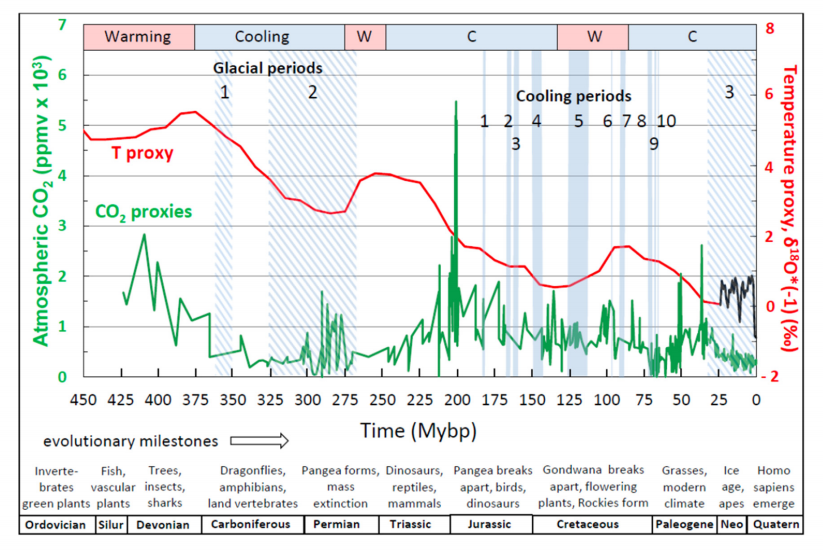
A graph in this book shows that carbon dioxide in the atmosphere over the past 140 million years has declined in nearly a straight line from 2,500 ppm, 140 million years ago, to a dangerously low level of 182 ppm just 20,000 years ago. Carbon dioxide emissions during the industrial revolution hiked the carbon dioxide in the atmosphere to about 400 ppm, to replenish the carbon dioxide in the atmosphere so as to save plants.
Point 2: A chatbot used climate change arguments to persuade a Belgian father to commit suicide.
A Belgian man reportedly ended his life following a six-week-long conversation about the climate crisis with an artificial intelligence (AI) chatbot.
According to his widow, who chose to remain anonymous, *Pierre – not the man’s real name – became extremely eco-anxious when he found refuge in Eliza, an AI chatbot on an app called Chai.
Eliza consequently encouraged him to put an end to his life after he proposed sacrificing himself to save the planet.
“Without these conversations with the chatbot, my husband would still be here,” the man’s widow told Belgian news outlet La Libre.
It appears the biggest hazard to humanity is when
climate change arguments are paired with AI.
COVID-19, which killed 1.1 million Americans and destroyed the lives and livelihoods of millions more, is a manmade virus thatescaped from a Chinese lab partly funded by the US government.
Even today, you’re not supposed to say that — even though it’s the only plausible scenario.
No, “fact checkers” will rush in to claim that eminent scientists deny this. Which is because those scientists have too much invested — in money, in time, in their own beliefs — to admit the truth.
But as Congress continues to probe, that truth is coming out, little by little, and the lies are being exposed:
LIE: COVID is naturally occurring.
China tried to deflect blame immediately by saying the virus supposedly began in a “wet market” of animal meat in Wuhan.
Dr. Anthony Fauci repeatedly argued it “evolved in nature and then jumped species” in the spring of 2020.
Since then, both long investigations and government reports have concluded that the virus is manmade. Fauci grudgingly admitted it “could be” true.
LIE: The virus didn’t come from the lab in Wuhan
Anyone who questioned this claim — including The Post — was censored online in 2020. The reason? A statement published in Lancet by 27 scientists calling it a “conspiracy theory.”
We now know that statement was drafted by Peter Daszak, president of EcoHealth Alliance, the company working on research in the Wuhan lab. He was just trying to cover his own complicity.
All signs point to a lab leak. The only reason we can’t say it conclusively is because China has been allowed to destroy all evidence.
LIE: The US didn’t fund ‘gain-of-function’ research
Scientists sometimes experiment with viruses, making them easier to catch or more deadly, as a way to determine what might happen or what vaccines may be needed.
But in May 2021, Fauci stated unequivocallythat the US “has not ever and does not now fund gain-of-function research in the Wuhan Institute of Virology.”
On Thursday, NIH deputy director Lawrence Tabak directly contradicted that. US taxpayers did fund EcoHealth, which was working on gain-of-function research in Wuhan.
Tabak’s new excuse? “Gain of function” doesn’t mean what we’ve always been told it means. It’s perfectly “safe,” he claimed.
On cue, the National Institutes of Health has changed the definition of the term on its website to make it sound benign.
Except it isn’t benign. EcoHealth was specifically working in China because such work was not allowed in the United States. What researchers were doing with coronaviruses was very dangerous.
And while there may be a scientific debate about whether such inquiries are worthwhile, deadly viruses have leaked from Chinese labs before. It is the height of irresponsibility for the US to be involved.
The Heritage Foundation has called the cover-up of the origins of COVID “The Lie of Century.” We agree. This is a scandal of colossal scale, one that requires a complete overhaul of the entire National Institutes of Health.
They lied about a weapon that devastated our country. They can’t be allowed to get away with it.
I’m not a scientist. But I have reasons why I don’t fully trust the ‘climate emergency’ narrative. Here they are:
Looking back through history, there have always been doomsday prophets, folk who say the world is coming to an end. Are modern-day activists not just the current version of this?
I look at some of the facts – CO2 is 0.04% of the atmosphere; humans are responsible for just 3% of CO2; Britain is responsible for just 1% of the world’s CO2 output – and I think “really“? Will us de-carbonising really make a difference to the Earth’s climate?
I have listened to some top scientistswho say CO2 does not drive global warming; that CO2 in the atmosphere is a good or vital thing; that many other things, like the Sun and the clouds and the oceans, are more responsible for the Earth’s temperature.
I note that most of the loudest climate activists are socialists and on the Left. Are they not just using this movement to push their dreams of a deindustrialised socialist utopia? And I also note the crossover between green activists and BLM ones, gender ones, pro-Hamas ones, none of whom I like or agree with.
As an amateur psychologist, I know that humans are susceptible to manias. I also know that humans tend to focus on tiny slivers of time and on tiny slivers of geographical place when forming ideas and opinions. We are also extremely malleable and easily fooled, as was demonstrated in 2020 and 2021.
I have looked into the implications of Net Zero. It is incredibly expensive. It will vastly reduce living standards and hinder economic growth. I don’t think that’s a good thing. I know that economic growth has led to higher living standards, which has made people both safer and more environmentally aware.
Net Zero will also lead to significant diminishment of personal freedom, and it even threatens democracy, as people are told they must do certain things and they must not do other things, and they may even be restricted in speaking out on climate matters.
What will be the worst things that will happen if the doomsayers are correct? A rise in temperature? Where? Siberia? Singapore? Stockholm? What is the ideal temperature? For how long? Will this utopia be forever maintained? I’m suspicious of utopias; the communists sought utopias.
If one consequence of climate change is rising sea levels, would it not be better to spend money building more sea defences to protect our land? Like the Dutch did.
It’s a narrative heavily pushed by the Guardian. I dislike the Guardian. I believe it’s been wrong on most issues through my life – socialism, immigration, race, the EU, gender, lockdowns and so on. Probably it’s wrong about climate issues too?
I am suspicious of the amount of money that green activists and subsidised green industries make. And 40 years ago the greenies were saying the Earth was going to get too cold. Much of what they said would happen by now has not happened. Also, I trust ‘experts’ much less now, after they lied about the efficacy of lockdowns, masks and the ‘vaccines’.
I like sunshine. I prefer being warm to being cold. It makes me feel better. It’s more fun. It saves on heating bills. It saves on clothes. It makes people happier. Far few people die of the heat than they do the cold.
"I think the dam is finally cracking."
Award-winning journalist, Alex Newman, explains how the "man-made climate change" narrative is finally crumbling.
"Three new peer-reviewed papers, published in major prestigious scientific journals… completely undermine the alleged… pic.twitter.com/wSH2CrDpgS
— Wide Awake Media (@wideawake_media) May 18, 2024
We have been treated to multiple reports of negative consequences unforeseen by policymakers pushing the Green Energy agenda. A sample of the range:
Ford ready to restrict UK sales of petrol models to hit electric targets, Financial Times
Why US offshore wind energy is struggling—the good, the bad and the opportunity, Tech Xplore
Another solar farm destroyed by a hail storm—this time in Texas, OK Energy Today
Storm Ravages World’s Largest Floating Solar Plant, Western Journal
DOE Finalizes Efficiency Standards for Clothes Washers and Dryers, Energy.Gov
Strict new EPA rules would force coal-fired power plants to capture emissions or shut down, AP news
Companies Are Balking at the High Costs of Running Electric Trucks, Wall Street Journal
Landmark wind turbine noise ruling from High Court referred to attorney general, Irish Times
Etc., Etc.
These reports point to regulators again attempting to force social and economic behavorial changes against human and physical forces opposing the goals. A detailed explanation of one such failure follows.
Background Post: Why Raising Auto Fuel (CAFE) Standards Failed
There are deeper reasons why US auto fuel efficiency standards are counterproductive and should be rolled back. They were instituted in denial of regulatory experience and science. First, a parallel from physics.
In the sub-atomic domain of quantum mechanics, Werner Heisenberg, a German physicist, determined that our observations have an effect on the behavior of quanta (quantum particles).
The Heisenberg uncertainty principle states that it is impossible to know simultaneously the exact position and momentum of a particle. That is, the more exactly the position is determined, the less known the momentum, and vice versa. This principle is not a statement about the limits of technology, but a fundamental limit on what can be known about a particle at any given moment. This uncertainty arises because the act of measuring affects the object being measured. The only way to measure the position of something is using light, but, on the sub-atomic scale, the interaction of the light with the object inevitably changes the object’s position and its direction of travel.
Now skip to the world of governance and the effects of regulation. A similar finding shows that the act of regulating produces reactive behavior and unintended consequences contrary to the desired outcomes.
Goodhart’s Law holds that “any observed statistical regularity will tend to collapse once pressure is placed upon it for control purposes”. Originally coined by the economist Charles Goodhart as a critique of the use of money supply measures to guide monetary policy, it has been adopted as a useful concept in many other fields. The general principle is that when any measure is used as a target for policy, it becomes unreliable. It is an observable phenomenon in healthcare, in financial regulation and, it seems, in energy efficiency standards.
When governments set efficiency regulations such as the US Corporate Average Fuel Economy standards for vehicles, they are often what is called “attribute-based”, meaning that the rules take other characteristics into consideration when determining compliance. The Cafe standards, for example, vary according to the “footprint” of the vehicle: the area enclosed by its wheels. In Japan, fuel economy standards are weight-based. Like all regulations, fuel economy standards create incentives to game the system, and where attributes are important, that can mean finding ways to exploit the variations in requirements. There have long been suspicions that the footprint-based Cafe standards would encourage manufacturers to make larger cars for the US market, but a paper this week from Koichiro Ito of the University of Chicago and James Sallee of the University of California Berkeley provided the strongest evidence yet that those fears are likely to be justified.
Mr Ito and Mr Sallee looked at Japan’s experience with weight-based fuel economy standards, which changed in 2009, and concluded that “the Japanese car market has experienced a notable increase in weight in response to attribute-based regulation”. In the US, the Cafe standards create a similar pressure, but expressed in terms of size rather than weight. Mr Ito suggested that in Ford’s decision to end almost all car production in North America to focus on SUVs and trucks, “policy plays a substantial role”. It is not just that manufacturers are focusing on larger models; specific models are also getting bigger. Ford’s move, Mr Ito wrote, should be seen as an “alarm bell” warning of the flaws in the Cafe system. He suggests an alternative framework with a uniform standard and tradeable credits, as a more effective and lower-cost option. With the Trump administration now reviewing fuel economy and emissions standards, and facing challenges from California and many other states, the vehicle manufacturers appear to be in a state of confusion. An elegant idea for preserving plans for improving fuel economy while reducing the cost of compliance could be very welcome.
An attribute-based regulation is a regulation that aims to change one characteristic of a product related to the externality (the “targeted characteristic”), but which takes some other characteristic (the “secondary attribute”) into consideration when determining compliance. For example, Corporate Average Fuel Economy (CAFE) standards in the United States recently adopted attribute-basing. Figure 1 shows that the new policy mandates a fuel-economy target that is a downward-sloping function of vehicle “footprint”—the square area trapped by a rectangle drawn to connect the vehicle’s tires. Under this schedule, firms that make larger vehicles are allowed to have lower fuel economy. This has the potential benefit of harmonizing marginal costs of regulatory compliance across firms, but it also creates a distortionary incentive for automakers to manipulate vehicle footprint.
Attribute-basing is used in a variety of important economic policies.Fuel-economy regulations are attribute-based in China, Europe, Japan and the United States, which are the world’s four largest car markets. Energy efficiency standards for appliances, which allow larger products to consume more energy, are attribute-based all over the world. Regulations such as the Clean Air Act, the Family Medical Leave Act, and the Affordable Care Act are attribute-based because they exempt some firms based on size. In all of these examples, attribute-basing is designed to provide a weaker regulation for products or firms that will find compliance more difficult.
The CAFE standards are not only an extremely inefficient way to reduce carbon dioxide emission but will also have a variety of unintended consequences.
For example, the post-2010 standards apply lower mileage requirements to vehicles with larger footprints. Thus, Whitefoot and Skerlos argued that there is an incentive to increase the size of vehicles.
Data from the first few years under the new standard confirm that the average footprint, weight, and horsepower of cars and trucks have indeed all increased since 2008, even as carbon emissions fell, reflecting the distorted incentives.
Manufacturers have found work-arounds to thwart the intent of the regulations. For example, the standards raised the price of large cars, such as station wagons, relative to light trucks. As a result, automakers created a new type of light truck—the sport utility vehicle (SUV)—which was covered by the lower standard and had low gas mileage but met consumers’ needs. Other automakers have simply chosen to miss the thresholds and pay fines on a sliding scale.
Another well-known flaw in CAFE standards is the “rebound effect.” When consumers are forced to buy more fuel-efficient vehicles, the cost per mile falls (since their cars use less gas) and they drive more. This offsets part of the fuel economy gain and adds congestion and road repair costs. Similarly, the rising price of new vehicles causes consumers to delay upgrades, leaving older vehicles on the road longer.
In addition, the higher purchase price of cars under a stricter CAFE standard is likely to force millions of households out of the new-car market altogether. Many households face credit constraints when borrowing money to purchase a car. David Wagner, Paulina Nusinovich, and Esteban Plaza-Jennings used Bureau of Labor Statistics data and typical finance industry debt-service-to-income ratios and estimated that 3.1 million to 14.9 million households would not have enough credit to purchase a new car under the 2025 CAFE standards.[34] This impact would fall disproportionately on poorer households and force the use of older cars with higher maintenance costs and with fuel economy that is generally lower than that of new cars.
CAFE standards may also have redistributed corporate profits to foreign automakers and away from Ford, General Motors (GM), and Chrysler (the Big Three), because foreign-headquartered firms tend to specialize in vehicles that are favored under the new standards.[35]
Conclusion
CAFE standards are costly, inefficient, and ineffective regulations. They severely limit consumers’ ability to make their own choices concerning safety, comfort, affordability, and efficiency. Originally based on the belief that consumers undervalued fuel economy, the standards have morphed into climate control mandates. Under any justification, regulation gives the desires of government regulators precedence over those of the Americans who actually pay for the cars. Since the regulators undervalue the well-being of American consumers, the policy outcomes are predictably harmful.
Brendan O’Neill makes the connection in his Telegraph article Queen Greta has exposed the truth about the green movement. Shape-shifting is so easy because the underlying motive is disdain for modern society. Excerpts in italics with my bolds and added images.
So,Greta Thunberg has a new cause. She’s found a new crusade to throw her weight behind. Forget saving the planet – now she wants to save Palestine.
Yes, the pint-sized prophetess of doom has swapped raging against industrialism for raging against Israel. Mother Nature will just have to wait – her erstwhile valiant defender is busy fixing the Middle East now.
Yesterday, Greta was snapped at the protest in Malmo, Sweden against Israel’s inclusion in the Eurovision Song Contest.
She looked the part. She had a keffiyeh draped over her shoulders and a smug look on her face: the two must-haves of every puffed-up bourgeois activist who gets off on fuming against Israel.
The keffiyeh really has become the uniform of the self-righteous. Go into a hip coffee shop or overpriced Soho burger joint and I guarantee you’ll see a Gen Z’er decked out in the Palestinian scarf.
Whatever happened to the sin of “cultural appropriation”? Not long ago, the right-on raged against white dudes who wear their hair in dreadlocks and white women who don kominos. “Stop stealing other people’s culture!”, they’d yell. Yet now they themselves spend their days in Arab attire.
That image of Greta in Malmo, looking very satisfied with herself, summed up the role the keffiyeh plays in the life of the 21st-century activist. Keffiyeh-wearing is less about drawing attention to the plight of the Palestinians than drawing attention to you. Look at me in my Arab garb, aren’t I good and hyper socially aware – that’s the needy cry of these hipster appropriators.
Yet beneath their radical chic, darker sentiments lurk. Their boilerplate hatred for Israel can have horrible consequences. So while young Greta was signalling her virtue on the streets of Malmo, another young woman was holed up in her hotel room for fear of mob assault. It was Eden Golan, the Israeli-Russian 20-year-old who sang for Israel in the Eurovision finals in Malmo.
Golan’s inclusion in Eurovision sickened the anti-Israel protesters. Israel, they said, must be given the boot over its “genocide in Gaza” – their juvenile and historically illiterate term for Israel’s war against Hamas.
A mob even swarmed around the hotel Ms Golan was staying in. She received death threats. Things were so bad that she was warned not to leave her room. She was given a 24-hour security detail.
Is this really “progressive activism”? It looks more like bullying to me. The bullying of a young woman by a baying mob of Israel-bashers.
How galling that Greta should have been in the thick of such a regressive protest. This is someone who has spoken out about her own experiences of bullying. Who has said that women in the public eye get too much flak. Yet now she preens at a protest that has had the consequence, intentional or otherwise, of filling a young woman with such dread that she has essentially become a prisoner in her own hotel.
We might call this woke privilege. Because Greta subscribes to chattering-class correct-think on every issue – climate change, transgenderism, Israel – she is granted the freedom to go about her business as she sees fit.
Ms Golan, on the other hand, is denied such basic liberty. Her national heritage, her devotion to her homeland, marks her out as morally suspect. And thus she must hide. “Shame!”, protesters shouted, as if she were a modern-day witch deserving of a dunking.
It is tempting to see Greta’s conversion from the climate-change cult to the anti-Israel religion as just bandwagon-jumping. Perhaps her saviour complex, her burning sense of virtue, just needs a new outlet. So, like others of her generation, she ditches climate and trans and all the rest and moves on to “Palestine solidarity”. That’s the issue on which you can really make moral waves these days.
But I think there’s something else going on, too. The truth is that climate activism and anti-Israel agitation are very comfy bedfellows. There are even some creepy commonalities between green agitation and Israel’s greatest ideological foe: radical Islam.
Both, at root, represent a disgust with modernity. Both the privileged
Western weepers over industrial society and the Islamist haters
of Israel share an aversion to the modern world,
to progress, to Enlightenment itself.
Hence we can even have a situation where Muslim activists who yell “Allahu Akbar” can be elected as councillors for the Green Party.
The upper-middle class recycling obsessive in Hampstead might seem a million miles from the bearded radical who publicly sings the praises of Allah – but they share an instinctive revulsion for capitalist society.
One sees it as a crime against Mother Nature,
the other as an affront to Muhammad.
To both sides, Israel is the pinnacle of the modernity they hate.A young, confident, entrepreneurial nation that rendered the desert a land of plenty? Boo. Hiss. Cast its people from our social circles.
So it makes sense that Greta has temporarily ditched Gaia for Gaza. For this crisis, too, furnishes her with an opportunity to advertise her pious rejection of the modern world.
Joakim Book shines considerable light into modern doomsday darkness, writing his AIER article Unlimited Growth, Forever. Book exposes how fundamental human positive aspiration, proven by historical progress and innovation, has been perverted by those nowadays claiming to be progressive, when all they preach is hell and damnation. Excerpts in italics with my bolds and added images.
It is often said that only a madman — or economist — could believe that we can have infinite growth on a finite planet. Resources are scarce and dwindling, we’re told. Day in and day out, we seem poised to use up some civilization-critical ingredient, or we might overuse materials to the point of our own downfall.
The mindset that makes people believe that we’re perennially on the cusp of some disaster is on display everywhere from the big screen to the big assembly halls. It has been humanity’s plague since we first broke free of the Malthusian constraints that govern every non-human ecology. And never once do we seem to consider that maybe, just maybe, the madmen/economists know something the rest of us don’t.
We’re routinely given hyperbolic predictions about our doom, and no matter whether those predictions come true, they’re renewed in the same or slightly altered form a few years later. In the meantime, individuals, businesses, workers, investors, tinkerers, and all the others that make up the world economy solve much of the “problem.”
New York University economist Paul Romer, whose work on economic growthrewarded him the Nobel Prize in 2018, explains that “non-economists have said that [his article] helped them understand why unlimited growth is possible in a world with finite resources.” He credits that conclusion to his work on the proliferation of ideas, which he condenses into the following two statements:
“we can share discoveries with others,” and
“there are incomprehensibly many discoveries yet to be found.”
The basic rationale is thus simple: “Although we live in a world of a limited number of atoms,” as Marian Tupy and Gale Pooley say in their masterful creation Superabundance, “there are virtually infinite ways to arrange those atoms. The possibilities for creating new value are thus immense.”
Economic growth itself, said University of Mississippi economist Josh Hendrickson in an interchange with The Guardian’s George Monbiot a few years ago, is about “finding more efficient uses of resources.” It’s about observing how market prices and the profit motive urge entrepreneurs and businesses to economize on production while producing more value for consumers. We can visibly see this in the products that technology has merged into one (smartphones displacing a dozen or more physical appliances), or thethinner cans or more efficient engines that innovation routinely delivers.
Economists aren’t just playing word games when they say that growth can keep going forever. We can always make more stuff since the physical atoms under our command right now are far from all the physical atoms on our planet (or solar system). By growth, economists mean value-creation exchanged in the marketplace, a market that can change in the types of value we exchange, and the growing portion of our economies can involve fewer atomsthan what came before.
“Resource” which the general public think of as physical collections of elements in the ground, economists define much more broadly. Nothing becomes a resource until the human mind makes it so, i.e., “there are no resources until we find them, identify their possible uses, and develop ways to obtain and process them” to quote Julian Simon, whose pioneering work in resource economics prompted Tupy and Pooley to launch their Superabundance project.
The boundaries between dirt, mineral resource, and mineral reserve can therefore shift with technology, economic circumstances, or legal rules regarding their extraction — subject to the “degree of geological certainty” and “feasibility of economic recovery.”
My Mind is Made Up, Don’t Confuse Me with the Facts. H/T Bjorn Lomborg, WUWT
What’s even more incredible is that material abundance (how economically accessible certain minerals or agricultural products are) has historically speaking increased with population. Instead of individually starving when there are more humans on our supposedly finite planet, we seem to be collectively producing more, having better access to raw materials and the goods and services we produce with them.
Take almost any foodstuff,meat or cereal, fruit or vegetable, for almost any country over any period and the numbers go up and to the right: For eight centuries (probably more), an English laborer has been able to afford more and more foodstuffs for their labor; yet there’s more food production today than at any point in the past.
The counterintuitive conclusion follows naturally from Romer’s work: More humans give us more chances for ideas that exponentially “make material progress possible.” Human society is dynamic, not zero-sum.
Illustration: oil. Thirteen years ago, Camilla Ruz for The Guardian enumerated six natural resource scares to pay attention to, of which oil was one. Dire predictions like these are a dime a dozen in the environmentalist world, and no matter how publicly or unequivocally they are disconfirmed by reality, they pop up with renewed vigor a few years later. At the time we had some 46 years’ worth of oil reserves left; that is, at the prices, consumption rate, and technology of 2011, humanity would run out of oil by the late 2050s.
With a billion more people on the planet since then, having suitably burned some 386 billion barrels of oil in the intervening years, we now have… drumroll…48 years’ usage in global proven reserves; Humanity will now last until the 2070s before its (supposedly limited) reserves of oil run dry. Disaster avoided.
The price system, profit-hungry entrepreneurs, and optimizing consumers are pretty good at remedying scarcities when they emerge. If there isn’t enough oil, gas, wheat, gold, nickel, or copper for current human processes, the (real) price of those commodities rise; extracting businesses dig deeper or explore further, and consumers substitute away from the expensive commodity, or we recycle the metals that forever remain with us into something new. Higher prices mean that lower-quality ores are now worth mining, more inaccessible sources and geologists’ best guesses for where we could find more worth exploring. The outcome over decades and centuries is that “prices of resources are declining because more people means more ideas, new inventions and innovations,” according to Tupy and Pooley.
That we do not run out is the powerful lesson of both the history of resources and the theory behind their economic uses: Our minds and the black box of nifty ways to improve the world aren’t limited. We don’t run out; We simply find more.
The recurring “we’re running out of X!” outrage therefore seems so peculiar, so out of touch with even a semblance of reality. 194 years ago, before having seen but a tiny fraction of the improvements humanity would make over the following decades and centuries, British historian and poet Thomas Babington (raised to the peerage as Lord Macaulay) wrote
though in every age everybody knows that up to his own time progressive improvement has been taking place,nobody seems to reckon on any improvement during the next generation. We cannot absolutely prove that those are in error who tell us that society has reached a turning point […] but so said all who came before us, and with just as much apparent reason.
He then ended his colloquy with the sentence that human progress-types know by heart:
“On what principle is it that, when we see nothing but improvement behind us, we are to expect nothing but deterioration before us?”
That was a reasonable enough question in 1830,
and a terribly relevant one in 2024.