Govt. Green Rules Make Appliances Cost More and Do Less

NYC going after pizza oven emissions. You’d have to burn a pizza stove 849 years to equal one year of John Kerry’s private jet

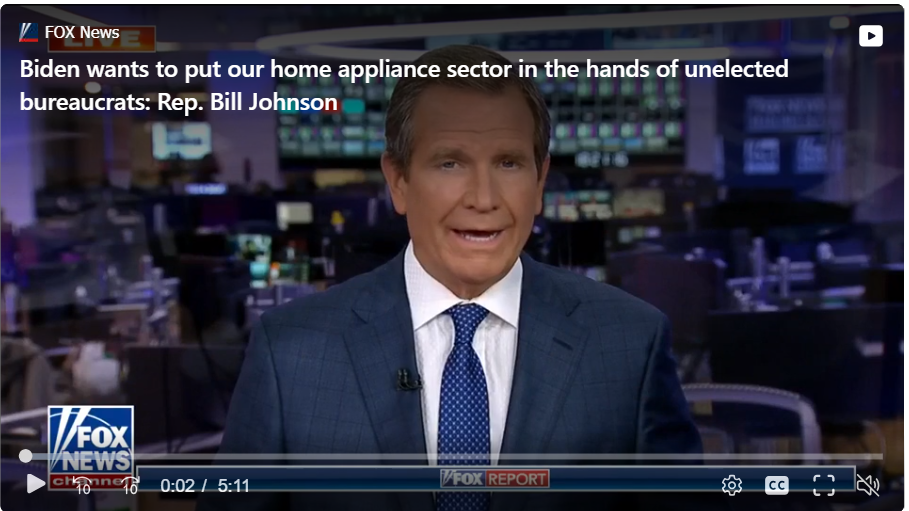
In his Master Resource article Energy Appliance Victory! (DC Circuit vs. DOE), Mark Krebs explains the DOE agency machinations targeting boilers as a case in point of government bureaucrats attacking everyone’s economic well-being in the name of saving the planet.  First, a contextual piece describes the game plan behind all this.  Later on, a synopsis of Kreb’s analysis of the tactics on the ground.

Background:  Why This Judgment Matters 
Biden’s Green Rules Make Appliances Cost More and Do Less

Authored by Kevin Stocklin at The Epoch Times, published at Planet Today.  Excerpts in italics with my bolds and added images.

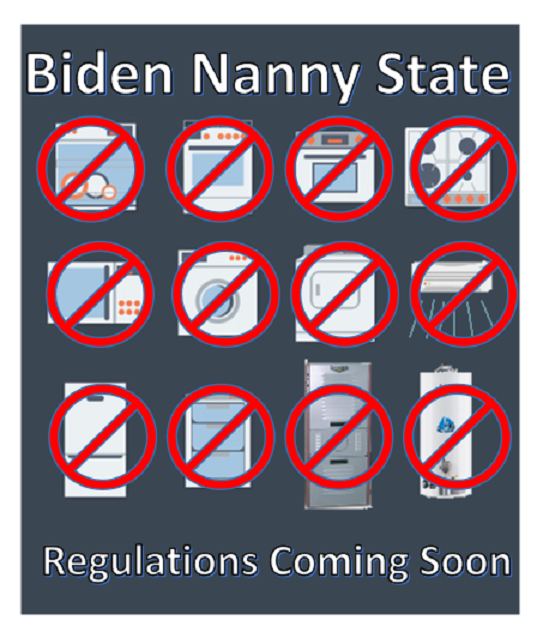
The Biden administration announced in December 2022 its pledge to take “more than 100 actions” to impose significantly tighter environmental standards on consumer goods is now becoming reality.  And consumer groups are predicting a future in which Americans pay more for products that do less, while manufacturers warn of shortages and supply chain breakdowns.

“You’re seeing, just in the last few months, new rules from the Biden administration about clothes washers, dishwashers, and other kinds of kitchen appliances, and in every case, you’re talking about a tightening of already very, very tight standards,” O.H. Skinner, executive director of the Alliance for Consumers, told The Epoch Times. “That will make it so that nearly the majority of the current products on the market don’t meet the standards and have to be redesigned or removed from the market,” Skinner said.

“Everyday things that people actually want are going to get more expensive
or disappear, and the products that will be available will be more expensive
but not better. People are going to wonder why life is worse.”

The announcement touted 110 new regulations enacted by federal agencies on “everything from air conditioners and furnaces, to clothes washers and dryers, to kitchen appliances and water heaters—as well as commercial and industrial equipment.” According to the Biden administration: “Once finalized, these standards will reduce greenhouse gas emissions by an estimated 2.4 billion metric tons, equivalent to the carbon emissions from 10 million homes, 17 million gas cars, or 21 coal-fired power plants over 30 years. The projected consumer savings from these standards would be $570 billion cumulatively, and for an average household this will mean at least $100 in annual savings.”

The stoves are just the thin end of the wedge.

These actions follow a familiar pattern: rumors of new directives, followed by official denials, followed by draconian diktats.   For example, reports that the Consumer Product Safety Commission would ban gas stoves over alleged safety concerns sparked a public outcry in January, which was met with denials by the Commission, together with media ridicule, that any such thing was being contemplated. This was then followed by new environmental standards from the DOE that would ban the manufacturing of 50 percent of the gas stoves available on the market today.

Case in Point: DOE Rule on Boilers Vacated by DC Circuit Court

Mark Krebs explains the agency machinations in his Master Resource article Energy Appliance Victory! (DC Circuit vs. DOE).  Excerpts in italics with my bolds.

“The ‘wheels of justice turn slowly,’ but they indeed turned, even within the District of Columbia’s ‘uni-party.’ As for holding on to this victory, it is far from a slam-dunk for preserving consumer choice and free markets. I expect the struggle to escalate in Biden’s all-of-government war against natural gas and other fossil fuels.”

Beleaguered energy consumers were just handed a far-reaching victory by the United States Court of Appeals for the District of Columbia (DC Circuit). The ruling vacated a Final Rule from the U.S, Department of Energy (DOE) that would have banned the manufacture and sale of non-condensing boilers for use in commercial applications. DOE’s rule was challenged several years ago by natural gas interests–and later joined with a separate but similar case brought by the Air-Conditioning, Heating, and Refrigeration Institute (AHRI).

DOE’s failures were major and numerous. Previously, the Court had afforded DOE ample opportunities to rectify them, but they didn’t. Ultimately (reading in between the lines), it appears that the Court lost its patience with “the Agency” (DOE). One of the far-reaching results of this victory is that it undermines a veritable super-weapon of the administrative state: the Chevron Deference. This aspect will be discussed in more detail further down.

DC Circuit has set a precedent that illustrates how DOE routinely bends the rules to achieve its “administrative state” objectives. Consequently, DOE should exercise more care and transparency going forward with both present and future developments of appliance minimum efficiency standards.  However, it is probably more likely that DOE will find ways to get around it; perhaps drastically.

The end-result of this (amid many other analytical biases discussed in the Court ruling) is fatally skewed economic “determinations” that almost always favor stricter standards, regardless of the true economics.. As a result of this Court Order, such routine biases are now on public display to demonstrate the full intent of regulatory failures that occur within the intentionally opaque bureaucratic processes to ostensibly overcome so-called market failures.

Most important of all, fossil fuel industries should exploit this victory to illustrate just how fallible government agencies can be.  This decision goes far beyond the particulars of packaged commercial boilers. It goes to the heart of the question of government agency standing relative to actual stakeholders.

Ever since the “Chevron Deference” was put in place in 1984, federal courts have deferred to an agency’s ostensibly unique “subject matter expertise” for interpretating ambiguous statutes. Such is clearly the case when reviewing regulatory actions like promulgating rulemaking for mandating minimum energy efficiency standards for appliances. On May 1, 2023, the U.S. Supreme Court granted review in Loper Bright Enterprises v. Raimondo, No. 22-451, on whether to overturn or limit Chevron Deference.

Subsequently, perhaps the most important victory in this case is that it becomes a “poster child” for why the administrative state’s abuse of the Chevron Deference should end. At least in this instance, the Courts found DOE to be not worthy of deference. Perhaps SCOTUS will follow their lead.


Canada Road to Ruin Paved with Trudeau’s CO2 Intentions

Bill Bewick explains in his National Post article Federal climate policy makes us poorer.  Excerpts in italics wtih my bolds and added images.

The clean fuel standard on top of an escalating carbon tax and onerous emissions
targets will make everything more expensive

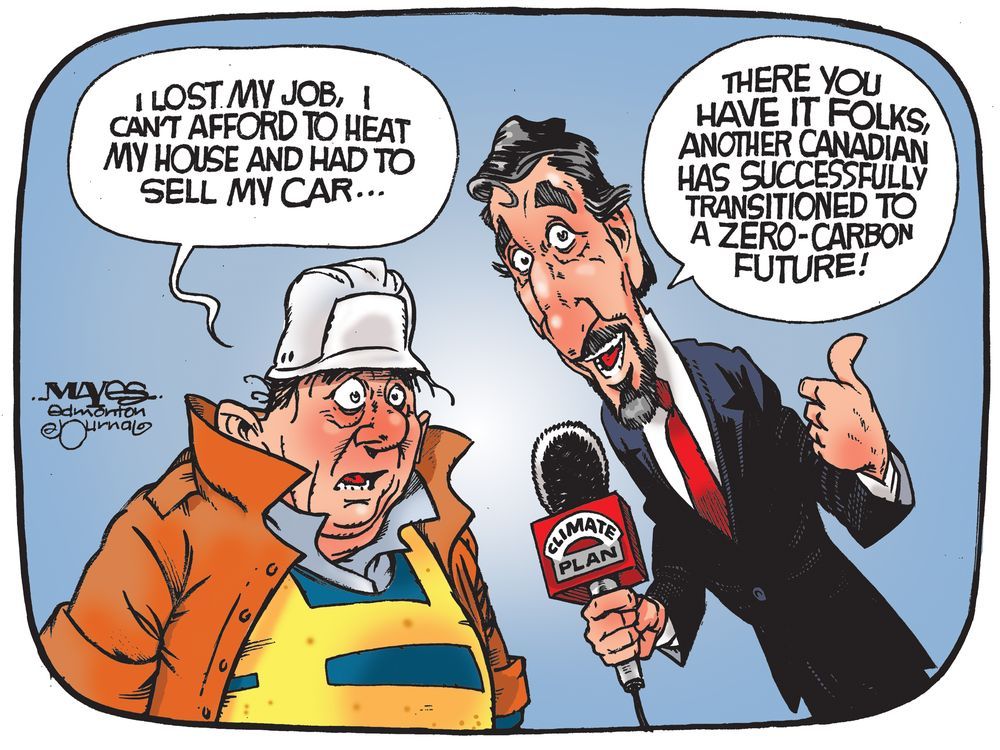
Canada is in an affordability crisis. Despite the pain felt by Canadians every day at the till or the gas pump, the federal government’s passion for world-leading carbon taxes and regulations is driving up the cost of everything while making us collectively poorer.

Tax advocates say it is a small % of GDP. But it is still $10 Billion extracted from Canadian households.

Canada Day saw the Clean Fuel Standards (CFS) regulation come into effect. A week earlier they passed a “Sustainable Jobs Act” that seeks to help transition workers away from highly productive jobs in oil, gas and related industries despite growing global demand for these energy sources.

The Parliamentary Budget Officer projects that by 2030 the net CFS cost will be over $1,100 per household in Alberta and Saskatchewan. While it will add roughly 17 cents on a litre of fuel (in addition to the carbon tax, of course) most of the costs will be on Canadian businesses, which means less jobs, less tax revenue and higher prices, making life more expensive with less ability to pay for it.

The fact is the world will need oil for the next 20-30 years at least. Canada is the responsible, reliable supplier many in the world would already prefer to get their energy from. With Canadian oilsands producers aggressively pursuing net zero operations by 2050, there is no better place to get oil from.

The demand for Liquefied Natural Gas (LNG) is booming globally. It should be vocally supported by anyone concerned with emissions since Canadian exports off our west coast would drive down the need for all the coal plants being built and planned in China and India. It also features an unprecedented level of Indigenous partnerships, offering an unparalleled opportunity for the economic self-sufficiency of countless communities.

Why would we “transition” these high-paying, unsubsidized jobs?
And transition them to what?

Well, the federal government seems to know that our oil and gas sector will have to shrink despite growing world demand. This is because in addition to steadily rising carbon taxes and the new CFS, they’ve arbitrarily demanded a 42 per cent reduction in emissions for the oil and gas sector in seven short years.

Requiring this drastic reduction by 2030 will force hasty and frantic changes as well as production cuts that will drive up energy prices for everyone while decreasing jobs and government revenues. That means more debt and more tax burden for Canadians, while hurting our economy and increasing our reliance on foreign oil.

An escalating carbon tax was supposed to let the economy decarbonize in an efficient way, but the federal government keeps piling on. This is crushing Canada’s competitiveness generally, especially after our American neighbours decided to go along with most of the rest of the world and not implement a carbon tax at all.

The fact that every manufacturer, farmer, trucker, and even commercial business owner on this side of the border has to pay these taxes on their fuel, heat, and power means everything is more expensive and will keep going up. Lower wages and job opportunities means we will be less and less able to afford it.

The government either says we must make these sacrifices for the planet, or that the green jobs they will transition to will be just as profitable and more sustainable. Their most recent example: the Volkswagen battery plant. There will be 3,000 jobs created, but the government will subsidize the plant with an estimated $13 billion. Does $4.3 million in taxpayer dollars per job sound sustainable to you?

As for our sacrifices saving the planet, carbon emissions are global. As Asia grows its economy, emissions are steadily rising. Canada can certainly “do its part” but other than massive LNG export to Asia, nothing we do with our declining 1.6 per cent share can meaningfully reduce overall global emissions.

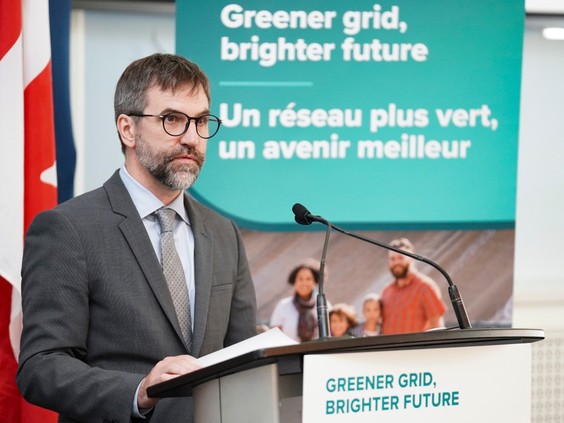
There’s one more major federal policy being pursued that might be the most expensive of them all: the demand that every province’s electrical grid get to net zero by 2035. Canadian ratepayers spent billions to convert coal plants to gas and subsidize solar and wind projects. Now they are forcing us to get off natural gas entirely — a fuel source even the EU considers green.

Trying to do this in 12 years will cost an estimated $52 billion to achieve in Alberta alone, driving up power bills by 40 per cent. Nothing complements renewables like natural gas. If we want to keep the lights on when there’s no sun or wind, the only technology right now up to the task is natural gas plants — but the government seems to think higher power bills and less reliability is the way to go.

Canadians care about reducing emissions and it is happening. Canadians also care about affordability. We need to demand our governments find a balance between the two. If Canada recalibrates our carbon policies to be part of the global parade instead of driving off an economic cliff, we can have both.


See Also Canada Budget Officer Quashes Climate Alarm

The “Born That Way” Identity Lie

In June, my son’s teacher asked his class, “What does transgender mean?”  A student answered, “A transgender is someone who decided to change their gender.”  The teacher said:

That’s not true.  They were always that gender, but now they are able to express themselves and are taking certain actions to be the gender they always were.

The words above are from Gamaliel Isaac writing at American Thinker The Identity Lie.  Excerpts in italics with my bolds and added images.

The current travesty of giving estrogen to boys and testosterone to girls and of cutting off their genitalia has its roots in a lie that was promoted by the homosexual community. It is the identity lie. It is the lie that people are born gay, that they have no choice, and that they are not responsible for their behavior. This lie is told by the media. It is told in our schools. It is everywhere.

Robin Goodspeed is an ex-lesbian. She wrote the following:

I was not born a homosexual. I was not ‘born that way.’ There is no scientific proof, or proof of any kind, that there is a homosexual gene or that homosexuals are ‘born that way.’ I was sexually molested at the age of 2 and I began making choices at that age that led to a life of homosexuality. I chose that life and I clung desperately to the lie that I was ‘born that way’ so I would never be held accountable for my choices.

Walt Heyer, a former transgender, was asked if transgenders are born that way. He answered:

There is no evidence that transgenders are born that way. There is, however, evidence that they are suffering from untreated mental disorders such as bipolar disorder, dissociative disorder, separation anxiety, schizophrenia, and personality disorder.

There is a popular TV show called Say Yes to the Dress. With the help of experts, brides search for the perfect dress. On October 26, 2012, there was an episode in which the woman getting married was heterosexual, and her bridesmaid was a lesbian. What was unusual was that the bridesmaid was her identical twin. How can one be born a lesbian and the other be born a heterosexual if they are identical twins?   There are other examples of identical twins in which one is gay and one is not.

The fact that there are many ex-homosexuals also speaks against the genetic argument. If they were born homosexual, and they can’t help being homosexual, then how did they stop being homosexual?

The blogger John Aravosis was one of many critics who pounced on Nixon. “Every religious right hatemonger is now going to quote this woman every single time they want to deny us our civil rights.” Aravosis leveled the same accusations against Brandon Ambrosino in 2014, when Brandon wrote a piece for The New Republic saying his gay behavior was a choice. Calling Brandon “idiotic” and “patently absurd,” Aravosis wrote, “The gay haters at the religious right couldn’t have written it any better.”

John Aravosis is showing us why many gays insist that they are born that way. They believe that if they don’t say that gays are born that way, it helps make the case of people who disapprove of homosexual behavior. The idea is that people who disapprove of homosexuals can’t fault them if homosexuals can’t help it and are born that way, but if gays have a choice, then they are responsible for their actions.

Jane Ward, a professor of feminist studies at UCAL Santa Barbara, wrote:

People who challenge the Born This Way narrative are often cast as homophobic, and their thinking is considered backward — even if they are themselves gay.

That’s why so few have had the courage to speak the truth the way Cynthia Nixon and Brandon Ambrosino did. Ex-homosexuals who have suggested that gays are not born that way have even been threatened by homosexual activists.

Although promotion of the identity lie has not helped homosexuals, it has hurt a lot of people, and that number is increasing. According to the 2020 Plastic Surgery Statistics provided by the American Society of Plastic Surgeons, females had 6,368 “gender confirmation surgeries” performed in the US in 2020 compared to 5,616 in 2019.

Are transgender people individuals with another gender trapped in the wrong body? Do they have a different identity? In June, my son’s teacher asked his class, “What does transgender mean?” A student answered, “A transgender is someone who decided to change their gender.” The teacher said:

That’s not true. They were always that gender, but now they are able to express themselves and are taking certain actions to be the gender they always were.

There are many people who “de-transitioned” who have testified that they were persuaded by teachers, peers, and social media that they were a different gender and that they would be a lot happier if they transitioned. Then reality hit, and they de-transitioned. They were able to stop taking hormones, but they couldn’t undo the damage or get the organs back that “gender-affirming” surgeons had cut off.

People who have nothing to do with the identity lie pay a price with higher insurance premiums, because if insurance doesn’t pay for transgender surgery, that is considered discrimination and so is illegal. Women and young girls are forced to share bathrooms and locker rooms with males. Women locked up in prison are locked up with male criminals who claim to be female. Innocent children are brainwashed into ruining their lives.

And all this because they were persuaded to believe the identity lie.

See Also Messing Up Child Identities

Ten minute video here: http://www.comprehensivesexualityeducation.org/act-now-2/stop-cse-petition/


Finally, a Legal Rebuttal on the Merits of Kids’ Climate Lawsuit

As reported last month, the Oregon activist judge invited the plaintiffs in Juliana vs US to reopen that case even after the Ninth Circuit shot it down.  Now we have a complete and thorough Motion from the defendant (US government) to dismiss this newest amended complaint.  Most interesting is the section under the heading starting on page 30.  Excerpts in italics with my bolds and added images.

Plaintiffs’ Claims Fail on the Merits

Because Plaintiffs’ action fails at the jurisdictional threshold, the Ninth Circuit never reached—and this Court need not reach—the merits of the claims. . . Plaintiffs’ second amended complaint, which supersedes the first amended complaint, asserts the same claims that were brought in the first amended complaint, which this Court addressed in orders that the Ninth Circuit reversed. Defendants thus renew their objection that Plaintiffs’ claims fail on the merits and should be dismissed pursuant to Fed. R. Civ. P. 12(b)(6).

A. There is no constitutional right to a stable climate system.

The Supreme Court has repeatedly instructed courts considering novel due process claims
to “‘exercise the utmost care whenever . . . asked to break new ground in this field,’… lest the liberty protected by the Due Process Clause be subtly transformed” into judicial policy preferences. More specifically, the Supreme Court has “regularly observed that the Due Process Clause specially protects those fundamental rights and liberties which are, objectively, ‘deeply rooted in this Nation’s history and tradition.’”  Plaintiffs’ request that this Court recognize an implied fundamental right to a stable climate system contradicts that directive, because such a purported right is without basis in the Nation’s history or tradition.

The proposed right to a “stable climate system” is nothing like any fundamental right ever recognized by the Supreme Court. The state of the climate is a public and generalized issue, and so interests in the climate are unlike the particularized personal liberty or personal privacy interests of individuals the Supreme Court has previously recognized as being protected by fundamental rights.  “[W]henever federal courts have faced assertions of fundamental rights to a ‘healthful environment’ or to freedom from harmful contaminants, they have invariably rejected those claims.”. Plaintiffs’ First Claim for Relief must be dismissed.

B.  Plaintiffs fail to allege a cognizable state-created danger claim.

The First Claim for Relief must also be dismissed because the Constitution does not impose an affirmative duty to protect individuals, and Plaintiffs have failed to allege a cognizable claim under the “state-created danger” exception to that rule.
As a general matter:

[The Due Process Clause] is phrased as a limitation on the State’s power to act, not as a guarantee of certain minimal levels of safety and security. It forbids the State itself to deprive individuals of life, liberty, or property without “due process of law,” but its language cannot fairly be extended to impose an affirmative obligation on the State to ensure that those interests do not come to harm through other means.

Thus, the Due Process Clause imposes no duty on the government to protect persons from harm inflicted by third parties that would violate due process if inflicted by the government.

Plaintiffs contend that the government’s “deliberate actions” and “deliberate indifference” with regard to the dangers of climate change amount to a due process violation under the state-created danger exception.

First, Plaintiffs have identified no harms to their “personal security or bodily integrity” of the kind and immediacy that qualify for the state-created danger exception. . . But here, Plaintiffs allege that general degradation of the global climate has harmed their “dignity, including their capacity to provide for their basic human needs, safely raise families, practice their religious and spiritual beliefs, [and] maintain their bodily integrity” and has prevented them from “lead[ing] lives with access to clean air, water, shelter, and food.”  Those types of harm are unlike the immediate, direct, physical, and personal harms at issue in the above-cited cases.

Second, Plaintiffs identify no specific government actions—much less government actors—that put them in such danger. Instead, Plaintiffs contend that a number of (mostly unspecified) agency actions and inactions spanning the last several decades have exposed them to harm. This allegation of slowly-recognized, long-incubating, and generalized harm by itself conclusively distinguishes their claim from all other state-created danger cases recognized by the Ninth Circuit.

Third, Plaintiffs do not allege that government actions endangered Plaintiffs in particular. . . As explained above, Plaintiffs’ asserted injuries arise from a diffuse, global phenomenon that affects every other person in their communities, in the United States, and throughout the world.

For all these reasons, there is no basis for finding a violation of Plaintiffs’ due process right under the state-created danger doctrine, and Plaintiffs’ corresponding claim must be dismissed.

C. No federal public trust doctrine creates a right to a stable climate system.

Plaintiffs’ Fourth Claim for Relief, asserting public trust claims, should be dismissed for two independent reasons. First, any public trust doctrine is a creature of state law that applies narrowly and exclusively to particular types of state-owned property not at issue here. That doctrine has no application to federal property, the use and management of which is entrusted exclusively to Congress. . .Consequently, there is no basis for Plaintiffs’ public trust claim against the federal government under federal law.
Second, the “climate system” or atmosphere is not within any conceivable federal public trust.

1. No public trust doctrine binds the federal government.

Plaintiffs rely on an asserted public trust doctrine for the proposition that the federal government must “take affirmative steps to protect” “our country’s life-sustaining climate system,” which they assert the government holds in trust for their benefit.  But because any public trust doctrine is a matter of state law only, public trust claims may not be asserted against the federal government under federal law. . . The Supreme Court has without exception treated public trust doctrine as a matter of state law with no basis in the United States Constitution.
2. Any public trust doctrine would not apply to the “climate system” or the atmosphere.

Independently, any asserted public trust doctrine does not help Plaintiffs here. Public trust cases have historically involved state ownership of specific types of natural resources, usually limited to submerged and submersible lands, tidelands, and waterways. . . The climate system or atmosphere is unlike any resource previously deemed subject to a public trust. It cannot be owned and, due to its ephemeral nature, cannot remain within the jurisdiction of any single government. No court has held that the climate system or atmosphere is protected by a public trust doctrine. Indeed, the concept has been widely rejected.

For all these reasons, the Court should dismiss Plaintiffs’ Fourth Claim for Relief.

Background Post Update on Zombie Kids Climate Lawsuits: (Juliana vs. US) (Held vs Montana)


EV Revolution Winding Down

An article from John Ray explains how the Electric Vehicle movement is losing steam The electric car ‘revolution’ is a disaster before it’s begun.  Excerpts in italics with my bolds and added images. (The UK references are due to the original article appearing in The Telegraph.)

The electric car revolution is stalling, of that there can no longer be any doubt. It has left the big global carmakers floundering, uncertain of how to proceed in a race they reluctantly entered in the first place.

Electrification was initially met with fierce resistance. But once politicians held a gun to the heads of company bosses with a series of cliff-edge deadlines for phasing out the combustion engine, carmakers had little choice but to go all-in.

Century-old business models were declared dead and ambitious plans hurriedly drawn up to electrify entire portfolios from small city run-arounds to family saloons and SUVs, at astronomical cost. Even Ferrari has embraced the movement – much to the consternation of petrolheads everywhere.

But with electrification barely off the starting grid, one by one the big carmakers
are already pulling back as demand badly falters.

Volkswagen is so concerned about flagging sales that it has taken the extraordinary decision of halting electric vehicle production at one of its biggest plants. Assembly lines for electric models will be paused for six weeks at the Emden factory in northwest Germany and 300 of its 1,500 staff laid off after sales fell 30pc short of forecasts.

This means production of the new VW ID.7 electric model, which had been due to commence in July will be pushed back until the end of the year. The ID.4 electric SUV and the upcoming ID.7 electric sedan will also be delayed.

“We are experiencing strong customer reluctance in the electric vehicle sector,”
plant boss Manfred Wulff said.

That is remarkably plain language from the largest car manufacturer on the planet, and a company that recently announced plans to invest €120bn (£103bn) over the next five years in “electrification and digitalisation”.

It comes months after Ford poured cold water on the shift to electric
with thousands of job losses in Europe.

Electric vehicle production is unable to support anything like the same number of jobs that petrol and diesel models are able to sustain, it said. Boss Jim Farley estimates that 40pc fewer staff will be needed to develop battery versions.

A generation of pure electric vehicle makers has hardly fared any better. On Tuesday, Lordstown Motors, the US electric truck specialist that Donald Trump once heralded as the saviour of a depressed Ohio town, filed for bankruptcy protection.

Even Elon Musk has been forced to repeatedly cut the price of Teslas in a desperate effort to prop up demand and protect market share.

But it’s the setback at VW that stands out, raising serious questions about whether politicians are making the catastrophic mistake of forcing electric cars on a public that doesn’t want them. Indeed, the decision to impose strict deadlines for the phase out of petrol cars could turn out to be one of the most ruinous policy decisions of our lifetimes.

Think about it for a second: an entire industry not only forced to abandon a product that the vast majority of people still want and use, but also bullied into channelling all its resources into making something on a colossal level that there simply isn’t the market for – at least not within the horrendously short timeframe that is being imposed on car manufacturers.

It’s industrial self-sabotage and a commercial, economic and social catastrophe in the making. But what’s worse is that the damage risks being far greater in the UK than anywhere else in the Western world thanks to the Government’s myopic obsession with arbitrary net zero targets.

While the rest of the industrial world seems to have largely settled on a 2035 deadline for petrol and diesel phase out, ministers, for reasons destined to remain a mystery, have decided Britain needs to hit this milestone five years earlier than everyone else.

It makes no sense at all, and yet the ramifications threaten to be huge. By diverting capital into something that lots of people essentially don’t want, it risks inflicting massive losses on an already fragile UK car industry.

It is pure fantasy to imagine that Britain – with a dearth of battery factories (consultants Alix Partners estimates as much as a third of Britain’s battery requirements will need to be imported), a paucity of chargers and dramatically higher energy costs – will be in any position to go fully electric in the next seven years. And the Government simply isn’t capable of solving any of these challenges in time, if at all.

The UK risks becoming the unfortunate guinea pig in a costly and dangerous experiment that persuades the rest of the world to push their own deadlines out even further, turning this country into an example of how not to become a nation of electric car owners.


Election Fraud is Weaponized Identity Theft

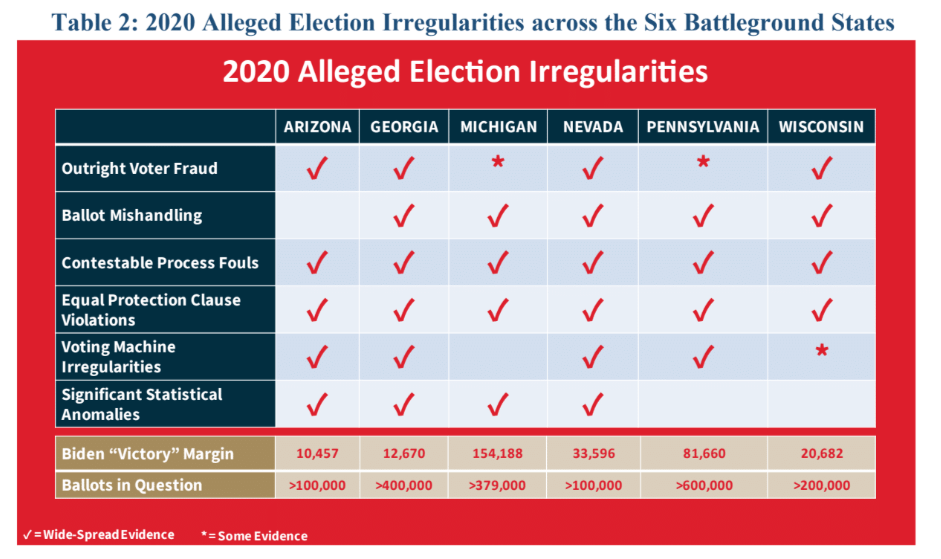
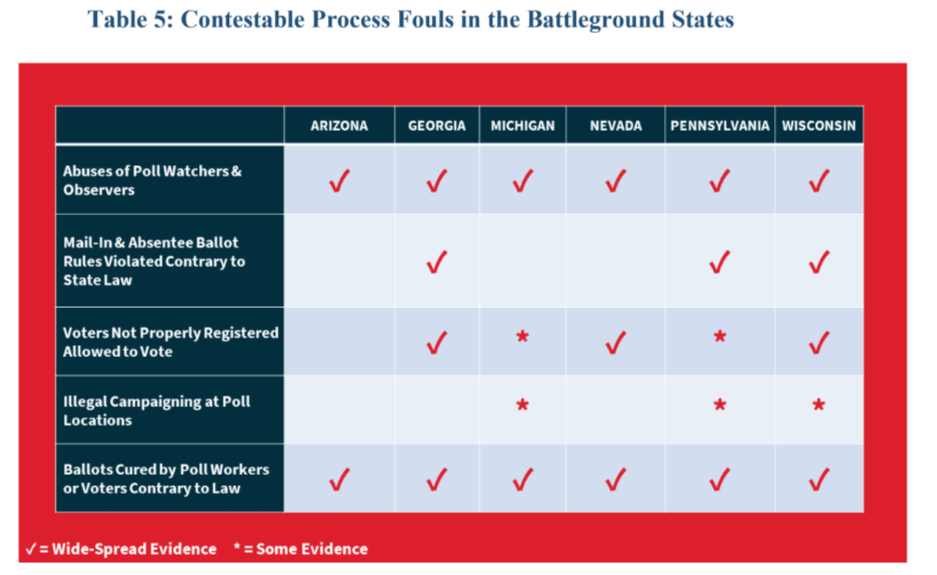
Jay Valentine explains how ballot harvesting depends on industrial scale identity thefts, and only the Left is willing and organized to do that.  There is an antidote to restore free and fair elections, but it won’t happen by trying to out-harvest the Left’s machine.  Note this is not about voter turnout but the opposite.  It’s stealing votes from people on the voter rolls by sending their ballots to invalid addresses where they will be collected and filled in, when and where they will make victory for favored candidates.  His American Thinker article is A Line of Defense Against Mail-in Ballot Fraud.  Excerpts in italics with my bolds and added images.

The RNC, the Trump Campaign, almost every Republican state party chairperson believes the road to 2024 electoral victory is to “out-ballot-harvest the left.” It’s hard to argue with absolute nonsense.  To the rescue, however, comes a retired mail carrier who sent the following message:

Message: I am a retired mail man.

I just saw your War Room interview.
I now know where the mules got their ballots. Straight from the post office in returned/undeliverable mail.
While I have zero proof of where they ended up, I had those ballots you were talking about in my mail bag with wrong addresses or lacking apartment numbers or even people that moved and still had ballots delivered to their old apartment.
We put those ballots in a basket and someone came by and picked them up.
Hundreds or even thousands of ballots.
Who picked them up, where did they go?
Now we know why signature match was removed…
Someone needs to investigate the post office and their democratic union run activities.

Tell us, RNC, how are you going to beat this? 

The only way to stop the government, in particular the United States Post Office, from gathering hundreds of thousands of loose ballots, all of which go somewhere other than to Republican candidates — is to stop those ballots in the first place.

We know, from numerous sources, that the Post Office is one of several ballot-gathering apparatuses of the Left.  How much ballot harvesting at evangelical churches is needed to make up for government-sponsored ballot harvesting — industrial scale?

A key to winning in 2024 is to identify every, or as close to every as technology and diligent work can enable — every ballot being sent out that will land in that “basket” that “somebody” later picked up.

What are the addresses on those ballots?
  • Ballots mailed to vacant lots — or in Arizona, street corners.
  • Ballots sent to apartment buildings without the unit or APT number.
  • Ballots sent to college dorms for students registered there for decades.
  • Ballots sent to fraternities with a 105-year-old student.
  • Ballots sent to churches — which have no bedrooms, thus cannot be someone’s domicile.
  • Ballots for the person who moved — over a year ago.
  • Ballots mailed to hotels and casinos.
  • Ballots where the address was modified — by the voter commission (as in Arizona) — the week those ballots went out, thus missing the recipient.
  • Ballots sent to Manchurian restaurants, laundromats, banks, and 7-Elevens — all of which are not valid addresses for voters.
  • Ballots sent to UPS and FedEx boxes — sometimes to a dozen people living in that little box.
  • Ballots sent to the apartment building — but the address is the clubhouse — which has no bedrooms.
  • Ballots sent to the 22,000 new voters in a single county entered just days before the election — who were invisible to Arizona Republican candidates in 2022.
  • Ballots sent to Mr. Gonzales, Mr. Gonzalez, Mr. Gonzalles, all at the same address with the same date of birth.
  • Ballots sent to the Wisconsin college dorm that has 1,000 registered voters but can house only 250 adults.
  • Ballots sent to the 11 adults at the single-family Houston home that is 823 square feet with one bedroom and one bathroom.
  • Ballots mailed to people registered at an address in 2020 but the building was not built until 2022.
  • Ballots sent to the rehab facility for dozens of people who claim it as a residence for years.  (Rehab is not a “years” thing.)

Welcome to the Undeliverable Ballot Database.

A simple mail carrier, supported by other mail carriers we interviewed in person, shows how completely useless is the GOP campaign to “out-ballot-harvest” the Left.

Ballots — which will not land in an eligible recipient’s hand – must be identified,
months in advance of being mailed
.

Most of those ballots, using super-compute technology, can be identified, shown to be illegitimate, and brought to everyone’s attention 6 months before election day.

When Harris County (Houston) floods the zone six months before early voting with 240,000 new voters, each needs to be instantly checked, verified, validated, and if necessary challenged — before the 2024 election.  Wake up, Ted Cruz!

When Arizona and Wisconsin counties change identifiers the week mail-in ballots
go out, then change them back, real time compute needs to flag it and ask “why?”

Here, let’s do it.

Two state legislatures invited the Fractal team to do a “proof of concept” for their state voter rolls.  So, that’s what we’re doing.

We ingest multiple copies of the voter rolls.  We want at least three dates but in one of the states, we will probably do a dozen.  Multiple copies of voter rolls shows movement, lights up changes made to the voter rolls that make you say hmm.

We compare every copy of the voter roll with every other copy — every cell against all corresponding cells.  If someone’s zip code was changed, we flag it.  Might be no big deal, but then, might be Arizona where 33,000 zips were changed days before the election.

In a state rep election, for a Republican candidate, a primary, we found 212 people who moved from all over the state to this guy’s district.  They all voted.  Then about a month after the election, they all moved out of the district.  Where do you think they moved?  Back to their original houses!  He won!

We ingest the personal property tax rolls for the county.  Those show the type of building, if it is a business, the number of bedrooms, baths, units, year built, square footage of living space, and about 40 other useful attributes.  In Austin, Texas, we add the construction/permit rolls, giving us a closer to real time view of every property improvement.

For these two state legislatures, we want something for the Attorney General.

We bring in the FEC (Federal Election Commission) contribution rolls.  With a single click, the AG can see every “contribution mule” in the state.  If that’s not enough, we bring in the massive Medicaid rolls — all claims, all providers, all recipients for dozens of years.  At this point, we are in the tens of billions record level — and guess what we find?

Some of those same sketchy voter addresses — fake people living in UPS boxes correspond to Medicaid providers — who are likely fake.  We migrated from just cleaning voter rolls to making a state some real dough — identifying Medicaid fraud.

This is the power of real time super-compute.

Our thesis to state governments is that it isn’t just voter fraud.  It’s identity fraud and
not just in their voter rolls, identity fraud permeates every state government roll.

While we developed the Undeliverable Ballot Database to identify every address where a ballot will be sent yet not find an eligible recipient, we also created an address and identity database for people who claim one identity in Medicaid, another in WIC and another on the voter roll.

Vast government databases are virtually invisible to current SQL/relational technology.  Fractal and other super-computes are delivering real-time visibility to identity fraud lasting decades.

One of the first benefits is the Undeliverable Ballot Database — saving the mail carrier all those fake ballots.

Now Can We Stop the Blame Game?

See Also Virtue Signaling Is a Vicious Circle

One key to understanding much of the bewildering behavior we see around us is to recognize the power and popularity of “virtue signaling.” Keeping virtue signaling in mind will help you understand a lot of behavior that otherwise makes no sense.

What, for example, is the point of removing Confederate statues or attempting to disown the country’s Founding Fathers because some were slave owners? It makes sense if your objective is to be sanctimonious. You make yourself feel better by looking down your nose at Thomas Jefferson.

Virtue signaling is the modern version of what St. Augustine in the 5th century referred to as “outward signs of inward grace.” A major difference, however, is the kind of grace he referred to actually meant something.

A precondition to needing to virtue signal is guilt. Virtue signaling is one of the left’s package deals that typically involve two steps. Firstly, make people who have done nothing wrong feel guilty. Then, offer them ways to assuage that guilt. It’s little more than a con game but it has worked amazingly well for social revolutionaries.

It always helps to keep in mind that everything is relative. In order to feel superior, you need something to feel superior to. Virtuous relative to what? In order to feel holier than thou you need a thou.

Does virtue signaling accomplish anything outside of the individual? Anything tangible, significant? Any activity as widespread and long-lasting as virtue signaling has to have payoffs. The payoffs for virtue signaling are inner, not outer, directed.

An irony is that the need to virtue signal is an insecurity about your own virtue. An observation a psychologist friend likes to make is, “The bigger the front, the bigger the back.” Or as Ralph Waldo Emerson observed, “The louder he spoke of his honor, the faster we counted our spoons.” Virtue signaling is motivated more by insecurities than virtue.


Carbon Capture Boondoggle

John M. Contino explains in his American Thinker article The Contradictions of Carbon Capture.  Excerpts in italics with my bolds and added images.

In May, 2022, the Biden Administration announced a $3.5 billion program to capture carbon pollution from the air, and the money has been flowing copiously. A quick search on LinkedIn for companies engaged in Carbon Capture, Utilization and Storage (CCUS) projects will reveal dozens of companies, most of which are U.S.-based. They are well-staffed and generously funded with millions of up-front taxpayer dollars. [Note the bogus reference to plant food CO2 as carbon pollution.]

Summit Carbon Solutions does have its share of proponents — among them ethanol producers, heads of Chambers of Commerce, and politicians of all stripes from state and local governments. It’s one thing to dangle large sums of other people’s money to induce cooperation, but landowners are apparently being bludgeoned into submission with eminent domain.

The CCUS projects in the Midwestern faming states are all predicated on the continued, if not expanded, production of ethanol, because ethanol facilities present localized concentrations of CO2 that can be harnessed and disposed of more efficiently than merely sucking carbon dioxide out of the ambient atmosphere.

A Reuters article from March, 2022 reports that

The government estimates that ethanol is between 20% and 40% less carbon intensive than gasoline. But a recent study published in the Proceedings of the National Academy of Sciences found that ethanol is likely at least 24% more carbon intensive than gasoline, largely due to the emissions generated from growing huge quantities of corn [emphasis added].

The production of ethanol results in a net loss of energy: “Adding up the energy costs of corn production and its conversion to ethanol, 131,000 BTUs are needed to make 1 gallon of ethanol…[which] has an energy value of only 77,000 BTU.”

And let us not give short shrift to Power Density. In his 2010 book Power Hungry. The Myths of “Green” Energy and the Real Fuels of the Future, energy expert Robert Bryce compares the amount of the energy produced by various sources in terms of horsepower per acre, or wattage per square meter. An average U.S. Natural Gas Well, for example, produces 287.5 hp/acre. An Oil Stripper Well (producing 10 bbls/day) produces 148.5 hp/acre. Corn Ethanol comes in at a pathetic 0.25 hp/acre (pg. 86).

An Occam’s Razor approach to solving this problem would be
to shut down all the country’s ethanol production and
to not generate all that carbon dioxide in the first place.

Granted, the ethanol industry enjoys wide bipartisan support. But that doesn’t make it rational, or good for the country. Farmers receive substantial revenues by diverting an average of 40% of total corn yields to the production of ethanol. Why not just give that money to the farmers in exchange for them allowing 40% of their corn acreage to lie fallow? We might ask, facetiously, if we really needed all that extra corn to eat or export, why would our government prefer we burn it in our gas tanks?

Think of the savings:

♦  CO2 that would not be generated by growing and harvesting all that corn;
♦  water that would not be drained from our aquifers for irrigation; 
♦  salination of our topsoil that would be abated by not applying unnecessary nitrogen fertilizers; and
♦  most obviously, the absence of the need to capture and bury carbon from ethanol plants.

An advantage of ethanol is that it reduces greenhouse gas emissions (GHG). The Office of Energy Efficiency and Renewable Energy reports that a 2021 Argonne Labs study “found that U.S. corn ethanol has 44%–52% lower GHG emissions than gasoline.” Let’s say ethanol reduces GHG by 50%. So, a tankful of gasoline with 10% ethanol yields a net GHG reduction of only 5% (50% of 10%).

Another advantage of ethanol is jobs in rural areas. The National Corn Growers Association reported that “[I]n 2019, the U.S. ethanol industry helped support nearly 349,000 direct and indirect jobs.”

Even if those advantages were sufficient to maintain or expand the ethanol industry, it sounds almost farcical to ask:

♦  “what is the cost-benefit analysis of spending billions of dollars to capture and sequester the CO2 from those corn fermentation processes, and

♦  to what extent would all that CCUS actually benefit the planet?”

When a John Kerry or a Greta Thunberg utters Climate Change Disaster words to the effect of “the sky is falling, we’re all going to die!” they would have us believe that it’s trivial to worry about boring quantitative cost-benefit ratios and returns on investment when the entire planet is facing an imminent, existential threat.

The hyperbolic language of the climate change crowd has been wearing thin ever since Al Gore’s dire predictions from 2006 have inconveniently not materialized. It’s up to us to make the left realize they’ve overplayed their hand: they cannot ride roughshod over property rights whenever it suits them, just as they cannot force us to drink Bud Light if we don’t wish to do so.


2024 Election Will Be a Computing Contest

Jay Valentine explains how the election game will play out in his American Thinker article How to Out-Compute the Left.  Excerpts in italics with my bolds and added images.

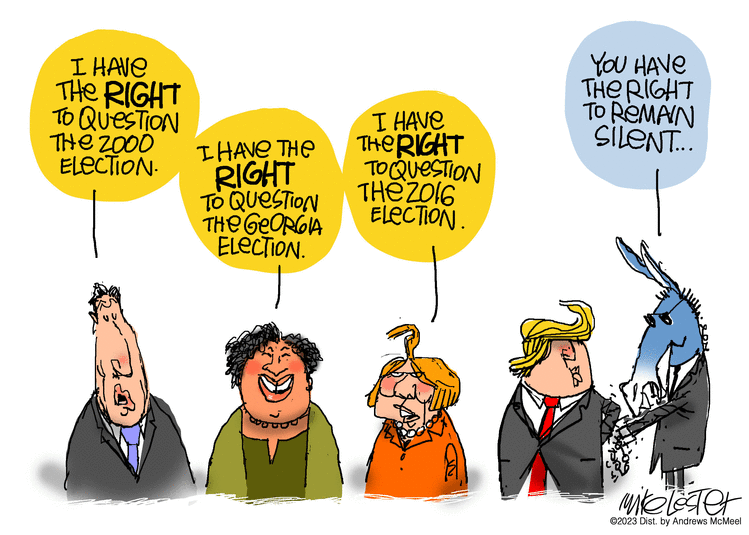
In 2024 Republicans cannot “out-fraud” the left, cannot “out-ballot-harvest” them, cannot “out-lawfare” them, cannot “out-media” them, cannot “out–contribution mule” them, cannot “out–Justice Department” them…but sure as hell can out-compute them — and that may do it.

The left owns the election apparatus — voting equipment, ballot-manufacturing, vagrant habitats, election commissions, media intimidation of judges not to look at election fraud and driving out any lawyer who raises a valid case.

Electioneering, by both sides, currently runs 1970s technology.  Leftists make good use of obsolete relational tech; Republicans, not so much.

In 2024, there is an opportunity to out-compute the left. Here’s what it may look like.

Ninety percent of current election fraud comes in two buckets:
♦   election commissions jacking with voter rolls like Arizona and Wisconsin and
♦   mail-in ballots collected and illegally voted like everywhere.

Neither fraud bucket is thwarted by organizational solutions —
both can be stopped with real-time compute power.

Let’s define the terrain.  Twenty twenty-four election will be won or lost in six swing states.  In each swing state, 2024 will be won or lost based on fraud turnout in two or three counties.

The leader of the free world, the end of the Deep State, for many the future of America as they have known it depends on about 17 counties. Remember — two types of fraud — voter commissions and phantom ballots.

The problem comes into focus.

Let’s start with fraudulent election commissions — at the state and county levels.

Sketchy election commissions know they can modify voter rolls when mail-in ballots go out by

 ♦  changing ZIP codes (Arizona),
♦  adding a fake street (Florida),
♦  putting hidden characters in voter IDs (Wisconsin),
♦  creating an inventory of nice unvoted mail-in ballots gathered by the U.S. Postal Service (Illinois and Wisconsin) given to leftists — for a fee.

Current relational technology is blind because of database latency.

In one Republican state, our team found 41,000 voters changed from inactive status to active, voted, then changed back. In Arizona, 107,000 changes, plus 22,000 new voters added in one county alone — days before the 2022 election.

Real-time changes all the rules — it just needs to be applied before the election, not as a data autopsy afterward (Arizona).

In 2024, in 17 counties, let’s do real-time voter registration analysis beginning six months before the election.  Download daily, weekly, or monthly copies of voter rolls. Compare every voter roll with every other, showing every change. Were large numbers of addresses changed? Were thousands of new voters added 90 days before early voting from ineligible addresses (Houston)?

Ineligible? Who determines?  Good question, dear reader.

With relational technology, someone must knock on the door and ask if Phineas lives there. When told, “No, never heard of him,” the canvasser fills out an affidavit, goes to the judge. Nothing happens.

With real-time super-compute, our pal Phineas’s address is cross-tabbed with the county property tax records. They show 11 people registered in his 823-square-foot house, and the county health department says “no-no” to more than four people per 500 square feet. Seven fake voters just got busted.

The voter integrity types will tell you nothing can be done; we hear that all the time. But you are not dealing with their SQL limitations. Real-time gives you choices because you see this fraud before the election — before votes are cast.

Sit down with the county registrar. Pull out your tablet showing that on her voter list, there’s a phantom nest.  You are not saying it. The tax records — government dox — say it.  Look her in the eye and say, “Phyllis, we both know these addresses are ineligible. Your health department says so. We are taking this list to the sheriff. If people here are mailed a ballot, we will report you for a criminal violation.”  Sound harsh? It does. It also works.

Chat with the team in Wisconsin who almost single-handedly shut down 40% of the phantom vote in 2022 — helping a U.S. Senate squeaky win. They showed the phantoms, identified with real-time Fractal technology, to registrars — with a smile.

When you have better technology than the government,
the government hesitates.

This one step, alone, will reduce leftist fraud by 30 to 40%. It is unrecoverable. Leftists need fraudulent voter roll changes to impact their numbers — if they miss these quotas, there is no way to make them up.

Shut down election commission fraud, via real-time visibility, and you just cut election fraud in 17 counties 30–40%. In Arizona, Kari Lake would now be governor.

We’re not done.

Now for the phantoms.

There are several kinds of phantoms.

One type signs a voter registration application at the leftist church, the homeless shelter, the gas station and never votes. She may be dead in a tent on an Austin street. Who knows? Leftists do not care; they have a forever voter.

Another phantom is a not-too-interested person who registered, lives in a house, but does not vote because it is useless, an effort or a distraction. She is the “I don’t care” voter. Leftists have a ballot and voter for her.

There are phantom ballot, not people, collection points.

A large urban apartment building has a mail room, where hundreds of mail-in ballots collect because nobody cares to open them. There is no check inside.

As the junk mail gets tossed, ballots accumulate. They aren’t collected by Ronna’s Kiwanis Club Republican county chairman — he’s on the golf course. They are collected by a vagrant, paid $25 for each mail-in ballot in that trash can. They get voted while Ronna is ballot-harvesting in densely Republican churches.

Real-time compute makes this a game two can play.

With the Undeliverable Ballot Database, it can be determined where almost every ballot collects. Skip Ronna; send a kid to that mail room and have him pick up those ballots, and give them to the sheriff — noting they were in the garbage!

Do you think this just might be more effective than Republican ballot-harvesting at evangelical churches who are going to vote anyway?

Leftists made huge, 40-year investments in corrupting voter commissions,
getting their team on board, building phantom armies
they could vote when needed.

Unfortunately for them, their fraud is dependent on 1970s relational database — its limitations, its latency, its clumsy use by Republicans.

Real-time changes the outcomes.

Every address in every county, certainly in 17, can be profiled in excruciating detail — square feet, year built, number of baths, bedrooms. Voter roll changes can be seen the moment they are augmented by helpful leftist voter commissions.

Challenges happen now — before the election — publicly — not months afterward, when nobody cares.

In 2024, the goal is not to stop voter fraud. Stopping fraud will take years.

Super-compute can reduce fraud by 40% or more — and that is more than enough to stop leftists who are stuck on relational technology.

The most significant confrontation on North American soil since Gettysburg will happen in 2024. Super-compute can determine who has the high ground.

Comment:  It is a contemporary twist on a well known election truth: