I recently had a conversation with a reasonably well informed writer who simply missed the real reasons why most practicing physicians go along with the Fauci Fraud. As a public service, I will attempt to fill in a few gaps. But first, I must define the fraud.
There are two basic legs to the fraud. First is the idea that the Centers for Disease Control is in any way concerned with a mission related to its name.
The failure of the CDC to endorse any treatment that did not emanate from its exalted halls should give us our first glint of clarity. There are literally millions of physicians around the world, and the great bulk of them truly wish to treat their patients well. Among those are thousands of researchers, a number far in excess of those at the CDC, the NIH, and other alphabet soup government agencies. The very idea that outside researchers are incapable of discovering anything useful without the help of the bureaucrats in D.C. is hubris of the highest order. And it prevents the CDC, the FDA, or any other such agency from considering the idea that maybe, just possibly, there might be intelligent life down here. Mount Olympus cannot be threatened.
The second leg of the fraud is less visible to the naked eye but much more powerful. If I wrote this before I retired, I would be called before the Board of my group and told in no uncertain terms to shut up.
I might even be assessed a financial penalty with several zeroes after the one. That’s a serious impairment of my pursuit of happiness. The reason for my group’s dislike is more than the fact that I might be an irritant. They may actually agree with what I have to say. But they simply cannot afford for me to say it. That’s right: as a practicing physician in a group, my freedom of speech can become very expensive…to the group.
My group cared for patients of all descriptions, with roughly half of them on Medicare and another batch on Medicaid. Both programs are ultimately managed by the feds, one of the most humorless groups on the planet. They write a whole bunch of rules on how you have to document everything you do. If you didn’t document it correctly, it didn’t happen, and you won’t get paid. But that’s not the half of it.
Suppose you have one of those patients brought in by the ambulance from under the bridge. His only clothes are the ones he’s wearing, and he doesn’t have two nickels to rub together. It’s more than obvious that this surgery for bowel obstruction will be a charity case. Before Medicare, you’d simply write it off as your good neighbor duty. Now you don’t get a choice. CMMS (the actual administrative agency) requires you to send a bill. Twice. Or maybe three times. Whatever it takes to turn the bill into bad debt. Then you have to send it to a collection agency. Your only alternative is for your group to bring it up in its Board meeting and declare it a write-off that gets noted in the minutes.
All this rigmarole serves no purpose, and you knew that before you got to this sentence. But CMMS has a sinister side. If you do the case for free (which you did before you spent that useless money on billing and collection), CMMS will define that as your “usual and customary” bill for an exploratory laparotomy. Since your U&C is now zero, you can’t ever bill more than that for an ex lap in the future.
But what does that have to do with ivermectin? I’m glad you asked.
U&C bills are just one of hundreds of rules that CMMS enforces. Another is “Pay for Performance.” Basically, P-f-P requires you to check a host of boxes when taking care of patients. If you didn’t get that IV antibiotic in 20 minutes before the incision, you failed P-f-P and may not get paid. The hospital won’t get paid to take care of the patient if there’s a complication.
So let us suppose that you use ivermectin to treat a COVID patient as he arrives in the hospital. Ivermectin isn’t on the Medicare/Medicaid approved list of medications for COVID. Your hospital pharmacy will call you up and give you grief. After wasting a lot of time getting them to finally let you have it, you’ve had to cancel half of your office day. The next day, you’ll get a visit from a coder, who will tell you that you didn’t use the approved treatment protocol and put the hospital in jeopardy because you flunked P-f-P. By the way, that “coder” is the person who “helps” you use the proper ICD (billing) code for whatever the patient has in order for the hospital to make the most money. But that’s not the worst of it.
Because you flunked P-f-P, that waves a red flag in front of the CMMS bulls, and you’re about to get gored. They will wonder what other bad things you’ve done. As soon as they find one, it gets flagged as “Medicare fraud,” and they will bill you for twice what you got paid as a penalty. Can you guess how many other instances of fraud they’ll find if they look hard? Do you have to ask why my partners would get upset if I published while I was still in practice? By the way, CMMS can go two years back as they look for your crimes. They can ultimately take your house, your car, and your wife’s poodle while they’re at it.
Let’s change the scene. Suppose you’re in private practice. You can’t give ivermectin because the feds will key in on it if your patient’s on Medicare or Medicaid. So you decide to take care of him off the books. He pays you cash, and all is well. Not! You now took a private payment for Medicare-covered service. That will get you barred from seeing another Medicare patient for two years.
Let’s forget all the regulatory traps. You’re conscientious and try to do the best for your patients. But you’re busy, and you can’t keep up with the flood of papers on all the various COVID bits. So you wear a mask, have your patients wear masks, and do a lot of telemedicine. You keep up on the latest through Medscape and the Morbidity and Mortality Weekly Reporter. You should be good? Not! MMWR is put out by the CDC, and they won’t say the first good word about HCQ or ivermectin. Medscape is a little better, but not much.
And all the specialty societies are toeing the line. Can we guess why?
Any doctor who actually reads the studies, or follows any of the protocols published by the Association of American Physicians and Surgeons, will see a lot of peer pressure to stop. The financial risks may be extreme. It takes a spine of steel to stand up to the authoritarian orthodoxy.
Ted Noel, M.D. is a retired anesthesiologist/intensivist who posts on social media as DoctorTed and @vidzette.
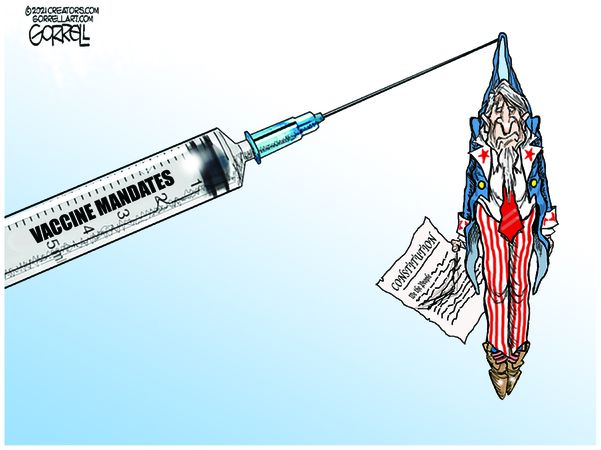
Charles Lipson offers rich insights into the current controversy over proposed federal vaccine mandates. Kudos for providing historical context and perspective in this confusing time. His article at Real Politics is The Deep Politics of Vaccine Mandates. Excerpts in italics with my bolds.
The debate over President Biden’s vaccine mandates has focused, understandably, on the tradeoff between individual rights to make medical choices and the potential harm the unvaccinated pose to others. That tradeoff is unavoidable. It is simply wrong for Biden to say, “It’s not about freedom.” It is. It is equally wrong for some Republican governors to say it is all about freedom. It’s also about the external effects of each person’s choice. To pretend that tradeoff doesn’t exist is demagoguery. But then, so is most American politics these days.
What’s missing or underappreciated in this debate?
The most important thing is that the Biden administration’s “mandate approach” is standard-issue progressivism. The pushback is equally standard. The mandates exemplify a dispute that has been at the heart of American politics for over a century, ever since Woodrow Wilson formulated it as a professor and then president. That agenda emphasizes deference to
Experts, not elected politicians,
Rational bureaucratic procedures,
Centralized power in the nation’s capital, not in the federal states, and
A modern, “living constitution,” which replaces the “old” Constitution of 1787 and severs the restraints it imposed on government power.
Implemented over several decades, this progressive agenda has gradually become a fait accompli, without ever formally amending the Constitution. The bureaucracies began their massive growth after World War II and especially after Lyndon Johnson’s Great Society initiatives of the mid-1960s (continued, with equal vigor, by Richard Nixon).
The judicial shackles were broken earlier, when Franklin Roosevelt threatened to pack the Supreme Court in 1937. Although FDR never followed through, his threat did the trick. The justices yielded to his pressure and began rubber-stamping New Deal programs that, until then, they had rejected as unconstitutional. Gradually, the older judges retired and Roosevelt picked friendly replacements. These judicial issues have reemerged now that progressives no longer dominate the Supreme Court. They are again threatening to pack the court and demanding that today’s justices stick with precedents set by their progressive predecessors (“stare decisis”).
The pushback against vaccine mandates is partly a debate about these progressive issues concerning the president’s authority and constitutional strictures. Mandate opponents say the federal government lacks the constitutional authority to impose these requirements, at least beyond its own workforce. They add that, if the president does wish to impose new rules, he and his executive agencies must go through the normal regulatory process. That process is slow — indeed, too slow to cope with an emergency.
Biden himself seemed to recognize these constitutional limitations before deciding to ignore them — the second time he’s done so in his brief presidency.
That’s a very troubling development, even if the courts overrule his decisions. The first time was his fiat decision to extend the moratorium on rent payments, which had been imposed during the worst days of the pandemic. Biden explicitly stated his unconstitutional rationale: It would take the courts time to rule against him and, until then, he could implement the policy. Of course, he also had a political rationale: to placate his party’s far left, which had mobilized over this issue.
Biden’s extension on the rent moratorium had a second, troubling dimension. It was promulgated by the Centers for Disease Control as a “public health issue.” That was a transparently false rationale in summer 2021 and dealt with housing issues far beyond the CDC’s expertise. The unintended consequence of the moratorium extension, beyond bankrupting small landlords, is to undermine the basic rationale for all progressive rulemaking: that the rules are being made by experts who know much more about their specialized area than do ordinary citizens or their elected representatives. What, pray tell, do experts on infectious disease know about the complexities of the U.S. housing market? Zero.
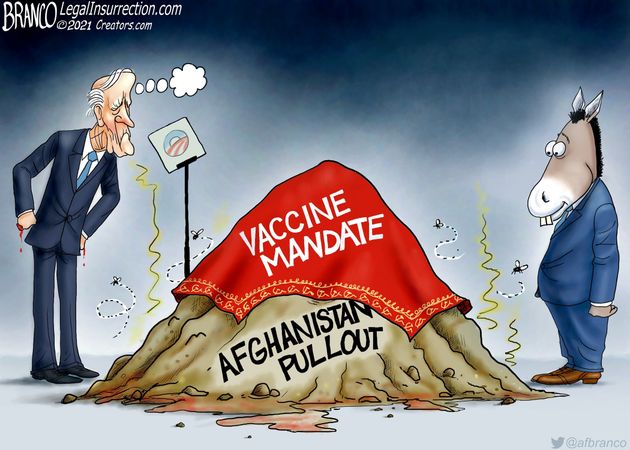
Progressive politics depends on public acceptance that experts really know what’s best and that their decisions will produce good outcomes. But trust in experts has collapsed alongside trust in all American institutions over the past half-century. The turning point was the disastrous war in Vietnam, advocated by LBJ’s Harvard advisers and the Whiz Kids in Robert McNamara’s Pentagon. Their failure was captured in the title of David Halberstam’s 1973 bestseller, “The Best and the Brightest.” The calamitous Afghan withdrawal underscored Halberstam’s sarcastic point.
So did the failure of so many Great Society programs, begun with such hope and fanfare.
The most painful experience was “urban renewal,” especially the massive program of building high-rise towers for welfare recipients. Before those towers were torn down, they had destroyed two or three generations of families. Part of the tragedy was that, like so many federal programs, the towers were built everywhere at once. If they had been tried out in a few cities, the problems would have been obvious, the failures remedied or the program abandoned. But Washington almost never does that. Congress funds and the bureaucracies implement mammoth, nationwide programs with no opportunity for feedback or mid-course corrections.
As public mistrust of institutions grew, a few institutions initially escaped the scorn. The military, for instance, was highly regarded until recently. It will take a heavy blow from the Afghan failure and the new, high-priority program of ideological training for troops. Government health officials were also highly regarded, at least until the botched rollout of Obamacare and the scandals at Veterans’ Affairs hospitals. Still, the public trusted the CDC and Dr. Anthony Fauci at the beginning of the pandemic. They trust them far less today, thanks to false and misleading statements, secrecy about funding the Wuhan virology lab, the absence of clear guidance on many issues, and blunt regulations that ignore important variations, such as natural immunity.
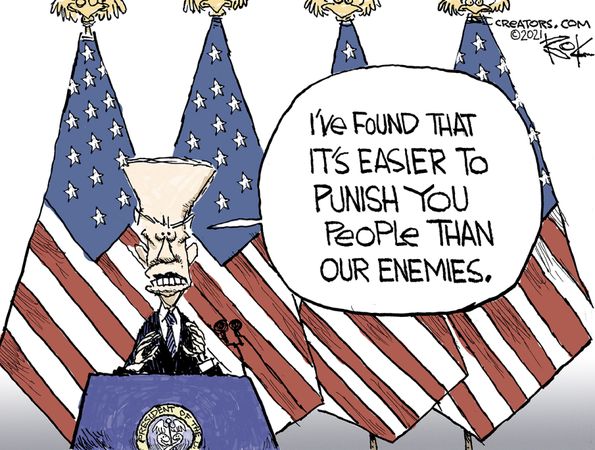
The effect of this growing mistrust was painfully apparent in President Biden’s mandate announcement. He didn’t rely on persuasion or trust in federal experts. He hectored, demonized, shamed, politicized, and threatened. That has become his routine, along with his refusal to answer the public’s pressing questions.
Biden’s political problem is that he faces real resistance from voters if he can’t solve the COVID problem, both because it is so serious and because he ran on being able to handle it better than Trump. Since Biden’s speech last week spent a lot of time attacking Republican governors, it was also an exercise in preemptive blame-shifting, in case the mandates fail.
His approach makes political sense, but it has at least two problems beyond the constitutional questions. One is that it politicizes vaccinations, which could have unintended consequences. Among the most obvious, it shifts the issue away from doctors and public health professionals and into the contentious political arena. Another is that it raises questions about the administration’s hypocrisy. Why do all federal employees, including those with natural immunity, need to get vaccinations but not the illegal immigrants arriving from Central America? That’s clearly a political decision, not a medical one, and it undermines the legitimacy of Biden’s whole approach, which stresses public health and medical experts.
The president’s speech had another major feature: It relied on vitriolic “wedge politics.” But Biden was elected partly because he promised to end the vitriol and divisiveness of the Trump years. He hasn’t done that. The poster child for his tendentious governing strategy is the second, $3.5 trillion “human infrastructure” bill. Not only does it have no Republican support, it has met serious resistance from centrist Democrats.
On his signature spending bills, like his vaccine mandates, Biden is pursuing a unilateral, aggressively partisan approach.
There’s no question the delta variant poses serious health risks and that, in general, vaccinations help both the individuals who get the jab and everyone around them. But there are serious questions about whether sticks or carrots are the best way to increase vaccination rates; how to convince people to get the vaccine now that trust in public-health experts has eroded; whether politicizing the issue is self-defeating; and what authority Washington has to impose mandates beyond its own workforce. The questions about the federal government’s authority — its effectiveness, its constitutionality, and its potential overreach — are among the most important in American politics. They have been for a century, and they won’t be resolved anytime soon.
Charles Lipson is the Peter B. Ritzma Professor of Political Science Emeritus at the University of Chicago, where he founded the Program on International Politics, Economics, and Security. He can be reached at charles.lipson@gmail.com.
Jack Butler writes an article The Myth of the Red Pill in the National Review. I won’t go into all the nuances and various meanings attached to being redpilled, blue- or blackpilled, but want to reblog his discussion about how cyberspace is now awash with tweets from people, left and right, who believe they and they alone are “woke” in either the progressive, post-modern sense, or the opposite. Excerpts in italics with my bolds.
Adherents believe that their apparent online numbers, purportedly sophisticated ideas, and supposed influence in real-world politics point both to their being correct and the emerging conservative paradigm. All of these things are hard to measure, not just because of the amorphous quality of online interaction, but also because of the many layers of irony and memery in which believers conceal themselves. Still, it is undoubtedly true that none of this would have happened at all without the Internet. This fact is often interpreted favorably: The nature of physical reality, it is claimed, makes the kind of conversation they want to have ever harder, so anything worth saying is now being said digitally.
But the Internet is at least as much of a constrictor of thought for the redpilled as it is a facilitator, if not more so.
Many of the redpilled think of themselves as possessing a kind of unique energy, unavailable to the rest of the Right. It is quite easy to convince yourself of that if you spend all day marinating in carefully curated digital environments, associating mostly with people who agree with you, and letting your real-world interactions, such as they are, be flavored either actively or passively by your experiences online. Insularity is an ancient human temptation, one the Internet has, surprisingly, exacerbated.
The Internet may have begun with the promise of freewheeling sharing of information and interaction, but in the realm of the redpilled, Twitter is a place for collectivized, digital mass action. Believing that tweets are a serious and desirable form of political activism, they glory in the dopamine rush of likes and retweets, call for ratios of opinions they deem unacceptable, and take all of these things as signs that they are advancing their cause instead of adding tiny bits of ember to a fiery digital hellscape.
There are some things worth remembering about Twitter.
According to a 2019 Pew Research survey, 22 percent of Americans use Twitter daily. In 2021, Twitter itself measured 199 million daily active users on the site. This sounds like a lot, but only 38 million of those users are in the U.S. (11 percent of our population). By this measure, Twitter’s total active user base is about 2.5 percent of the world’s population. Pew’s 2019 estimate also says that 80 percent of tweets come from 10 percent of users. One study estimates that anywhere from 9 to 15 percent of Twitter users are bots; 66 percent of all links on Twitter come from bots. All of this speaks to a world that is not merely self-referential but also self-reinforcing. It sucks people in, convinces them that it is normal, and then brings out the worst in them as they engage in futile conversations that are hopelessly skewed by unrepresentative samples of human beings and disguised machines.
Like much of modern media, Twitter shrinks our attention spans while bombarding us with things we might not otherwise have ever known or cared about and on which we have no influence. This is to say nothing of the political slant of Twitter. As Brian Riedl put it (in a tweet; Twitter has its uses), “Twitter users are D+15 — which would tie HI & VT for the most liberal state . . . the 10% of Twitter users who post 92% of all tweets are D+43 — which would make it America’s 2nd most liberal House district.”
This skew can breed, in those who believe it to be representative, a highly agitated and combative posture.
It can make them think that America is already lost; this is called a “black pill” (the pill boxes of the redpilled are overflowing). It can make them believe that persuasion and workaday politics are inadequate to the moment, that only desperate action, often involving a departure from the constitutional order necessitated by the one already undertaken by opposing political forces, can bring any hope of salvation. It can make them believe that the political sphere is or should be a source of salvation — if only their enemies can be crushed. And so it can make them believe that only a countervailing force, similarly drawing strength from the online world and sharing many of its opponents’ attributes, can possibly contest it. In this way, the hyperpolarization and acute antagonisms of Twitter feed off each other, require each other, and may in fact reflect each other. Some of what happens on Twitter may be somewhat indicative of the real world. But there’s also the fact that Tay, Microsoft’s AI Twitter account whose personality was formed from Twitter interactions, within a day became a suicidal, sex-crazed, Nazi teenage girl. So much for reflecting reality.
The point of the original red pill in The Matrix was to escape an artificially created digital world. But now, redpilling is a phenomenon that depends on digital interactions. It also deceives its adherents about reality itself, discoloring or even discouraging their existence in the physical world. It is from this key inconsistency that so many of their fallacies flow — not least of which is their compulsive use of online platforms that they deem so pernicious they need to be regulated differently, broken up, or destroyed. Many of us nowadays struggle to restrain our use of technology. But that problem will not be solved by pretending that digital oversaturation is a virtue rather than a vice. Those who have trouble regulating themselves in this sphere make a curious authority for how to regulate it in society.
There is nothing magical about the online world. Like tools throughout mankind’s history, it can be used for good or evil ends. Facilitating communication, simplifying access to information — such things have their uses. But the test of something’s verity is not whether it goes viral. And as a digital form of gnosticism, redpilling has plenty of other defects that have weakened its utility. For one thing, as Shullenberger notes, it now exists in a kind of knowing game with its opponents: “The bluepilled regard the redpilled as deluded by misinformation, while the redpilled regard the bluepilled as dupes of the establishment.” Clearly, viewing the world as trapped in a digital binary is a dead end.
Whatever usefulness the red pill may once have had as a metaphor, it has now become a cliché at the same time that it has become a kind of twisted faith. It does not liberate its believers but rather constrains them, trapping them in digital worlds of their own creation. There are superior forms of conservatism, ones that appeal to reason and to more reliable forms of knowledge and authority. Curious minds would be better served letting the redpilled send themselves down endless rabbit holes, and instead pursue forms of learning and action that have a bit more to do with the world above the ground.
Good news: The Pandemic is over. Next: Our immune systems will contend with one more coronavirus added to the other four we already live with. Ross Pomeroy explains in Real Clear Science articles You Are (Probably) Going to Be Infected With the Coronavirus. Excerpts in italics with my bolds.
SARS-CoV-2 joins the ranks of other coronaviruses to cause respiratory infections under the title of the “common cold”
It may not be today. It may not be tomorrow. It may not be next week. It may not be this month, when the rapid ascension of the Delta variant in the United States could send confirmed daily case counts spiking to 200,000 or more before settling down again. It may not even be next year. But someday, you will almost certainly be infected with the SARS-CoV-2 coronavirus.
This uncomfortable fact may come as a surprise to many Americans, particularly to those who have spent hours sanitizing surfaces and groceries, who have dutifully adorned a mask even when not required to do so, and who have made the simple, science-backed decision to get vaccinated. SARS-CoV-2 has already spread around the world, infecting hundreds of millions or more. The genie is out of the bottle, and it is not going back in.
“We will be dealing with this virus forever,” Dr. Michael Osterholm, the director of the Center for Infectious Disease Research and Policy (CIDRAP) at the University of Minnesota, said in an interview one year ago.
Osterholm has been a sage throughout the pandemic, and his words then remain prescient now.
“Effective and safe vaccines… will be very important, even critical tools, in fighting it,” he said. “But the whole world is going to be experiencing COVID-19 ‘til the end of time. We’re not going to be vaccinating our way out of this to eight-plus billion people in the world right now…. We’ve really got to come to grips with actually living with this virus, for at least my lifetime…”
Since speaking those words, Osterholm hasn’t changed his mind.
“Eradicating this virus right now from the world is a lot like trying to plan the construction of a stepping-stone pathway to the Moon. It’s unrealistic,” he told Nature in February of this year.
Olsterholm’s view now represents the consensus of scientific opinion. In January, Nature surveyed more than 100 experts working on the coronavirus about whether the virus could be eradicated. Nine out of ten said that it is “likely” or “very likely” that the coronavirus will continue to circulate amongst the human population as an endemic infection. Most see it becoming something like the flu, for which we will require yearly vaccinations to be protected, or joining the ranks of other coronaviruses to cause respiratory infections that collectively fit under the title of the “common cold”. In the latter scenario, people may get reinfected multiple times over their lives. This theory seems the most likely to play out.
“The virus sticks around, but once people develop some immunity to it — either through natural infection or vaccination — they won’t come down with severe symptoms… Scientists consider this possible because that’s how the four endemic coronaviruses, called OC43, 229E, NL63 and HKU1, behave,” Nicky Phillips wrote for Nature.
In either of these scenarios, it’s extremely likely that you will eventually be infected. Adults get the flu about once every five years. Many times they are unaware, because the infection is asymptomatic. By the time children are roughly three years old, 65% will have been infected with coronavirus 229E. It’s reasonable to predict that some years down the road, SARS-CoV-2 will be just as, if not more, prevalent. Even the vaccinated will likely be infected at some point, and that’s okay.
There was some hope that the incredibly effective vaccines we have, particularly BioNTech/Pfizer’s and Moderna’s mRNA shots, would grant sterilizing immunity, preventing infection altogether. And studies suggest that they do, surprisingly well. But it seems that this form of immunity wanes over time and lessens versus new variants, particularly the Delta variety that’s been all over the news of late. The good news is that the vaccines remain extremely protective against severe disease, hospitalization, and death. If and when booster shots are available, we’ll be able to refresh our immunity.
The knowledge that a SARS-CoV-2 infection is essentially inevitable might be, for some, panic-inducing, perhaps prompting a desire to live a bubbled life. It shouldn’t. That’s because we have the tools to be free from both fear and, for the vast majority, harm: America’s remarkable arsenal of safe and effective vaccines. Again, even if the vaccines don’t prevent infection, that’s okay! As of July 26th, less than 0.004% of fully vaccinated people experienced a breakthrough case resulting in hospitalization and less than 0.001% died from the disease, according to the latest data from the US Centers for Disease Control and Prevention.
As Dr. Osterholm said in May, “For vaccinated individuals, in a private home or wherever, party hard. Enjoy it. You’ve earned it. You can feel safe in doing that, and that’s what we need to help people understand.”
Footnote:
Left out of the discussion were the anti-viral home treatment protocols to prevent serious illnesses.
See How They Dissed HCQ and Ivermectin
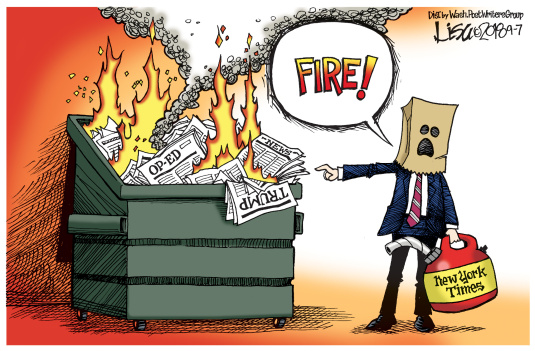
Benjamin Zycher at Real Clear Markets takes the NYT to task for its stupid article about fossil fuel infrastructure, awarding it The Dumbest New York Times Op-Ed of 2021. Of course there are many months left for NYT to publish even worse inanities this year. Excerpts in italics with my bolds. I have reorganized the content to juxtapose the wild claims with sober facts.
Summer still is weeks away, but already we have a winner in the fierce competition for the coveted title of “Dumbest New York Times opinion column of 2021.” The envelope please… and the winner is “Why Charles Koch Wins When Our Energy System Breaks Down,” by someone named Christopher Leonard. One really does have to read this column to grasp — actually, to marvel at — the inanity of Leonard’s argument, which can be summarized as follows.
Claim: Our fossil-fuel infrastructure — pipelines in particular, and refineries as well — is “increasingly unreliable” and “dominated by a very small group of very profitable companies.”
Fact: Leonard does not tell us what he means in his assertion that U.S. pipelines are “increasingly unreliable” — it is easy to infer that he has no idea — but if we define “reliability” as the annual number of adverse pipeline incidents, there has been no trend since 2002, even as pipeline mileage increased almost 63 percent between 2004 and 2019.
Claim: The Colonial Pipeline shut down in 2016, and again this month due to a cyberattack, but the five companies that own Colonial “profit handsomely off its operations and earn outsize profits in the face of the bottlenecks and supply squeezes caused by shutdowns.”
Fact: That is absurd: The pipeline generates revenue only when it is moving product; if it is not operational it is not generating revenue.
Claim: The 2016 shutdown “didn’t seem to hurt the owners’ earnings” in that afterward “Colonial boosted its annual dividends — at least in part because of the Trump administration’s 2017 tax cuts.” The growth in Colonial’s investments in updating and protecting the pipeline have been “modest, while dividend payments have risen sharply.”
Fact: Apart from Leonard’s confusion about whether it is due to the 2016 shutdown or to the 2017 tax cut, he apparently has no concept of the factors addressed by corporate managers as they determine the appropriate dividend. In particular, a dividend change is driven by the evaluation of the after-tax return to shareholders from retaining more financial capital within the firm compared with that from distributing more to the shareholders. An increase in the dividend suggests that the latter has increased relative to the former, presumably in this case because of the nuances of the 2017 tax bill. Were the Kochs responsible for that?
Claim: Charles Koch “has profited for years off similar energy bottlenecks in the upper Midwest” because of such infrastructure investments as the Pine Bend refinery, which “owes its profitability to its location in the middle of a broken fuel market.” Koch “buys cheap crude” in a market “oversupplied” with Canadian crude oil, after which “Koch then sells its finished fuel into an undersupplied gasoline market in the upper Midwest.”
Fact: And about that “oversupplied” (whatever that means) midwestern market for Canadian crude oil: The midwestern refinery market would be far less “oversupplied” had the Keystone XL pipeline been approved at long last, delivering heavy Canadian crude oil to the Gulf coast refineries designed to refine it. Did Charles Koch urge the Biden administration to reject the pipeline? Has Leonard criticized that decision? I can find no record of any such stance on his part.
And then there is Leonard’s assertion that the gasoline market in the upper Midwest is “undersupplied” (whatever that means). The Energy Information Administration divides the U.S. gasoline market into five regions (“PADDs”). As of May 24, Gulf Coast gasoline prices were the lowest, followed by the Midwest, and then (in ascending order) the East Coast, the Rocky Mountain states, and the West Coast, the last of which had the highest prices even excluding California. What is Leonard talking about?
Claim: “Regulatory hurdles have paved the way for these profits for decades.” “The Clean Air Act… made it nearly impossible for competitors to open a refinery near Pine Bend” to increase competitive pressures.
Fact:
The comedy highlight of Leonard’s column is the assertion that it is the Clean Air Act, regulatory obstacles to new pipeline investment, and general “regulatory stasis and dysfunction” that have yielded the “outsize profits” enjoyed by the Kochs. Leonard seems actually to believe this: “Just by letting the broken market limp along, Koch Industries reaps extraordinary profits from a broken system.” So the Kochs are vastly more powerful than anyone could imagine, responsible for the regulatory morass, for the ideological leftist political opposition to fossil infrastructure, for NIMBYism, and for allowing the “broken market” to “limp along.” Just as the pipeline owners win whether the pipelines are operating or not, Leonard clearly believes that they earn “outsize profits” whether the regulatory environment is light or dysfunctional. Who knew?
Claim: Regulatory fights benefit big refiners that can afford expensive legal experts and lobbyists: “Koch benefits from regulatory stasis and dysfunction.”
Fact:
The utter stupidity of Leonard’s argument is illustrated by his assertion toward the end of the column that “new wind farms or solar installations could open up a whole new energy market.” Somehow, I was led to believe that Leonard’s argument was about pipelines and refineries and gasoline prices, and the ability of the Kochs to earn large profits no matter what. But no: An endorsement of unconventional electricity, expensive and environmentally destructive, just had to be shoehorned in as an exercise in virtue-signaling par excellence despite the reality that it has nothing to do with Leonard’s silly central argument. Or does he want to argue that more wind farms will reduce gasoline prices in the Midwest?
Conclusion
And so we arrive at the larger reality illustrated by the Leonard column. Misguided, illogical, and at odds with the facts, it is of a piece with the broad opposition of the environmental left to energy infrastructure generally, and pipeline investments in particular. Utter incoherence is the inevitable result of that ideological opposition to fossil fuels, one impervious to facts and analytic rigor, and dependent upon arguments fundamentally inconsistent. That opposition is anti-human at its core because it implies opposition to investment in human capital — education, training, health care, etc. — and the improved human well being that has the effect of increasing the demand for energy and its infrastructure. Forget the Kochs; they are a bogeyman and red herring the mere mention of which is intended to elicit a Pavlovian reaction from the enlightened invitees to the right cocktail parties.
The real bogeymen are the New York Times opinion editors who found such drivel fit to print, a measure of the intellectual depths to which they have sunk.
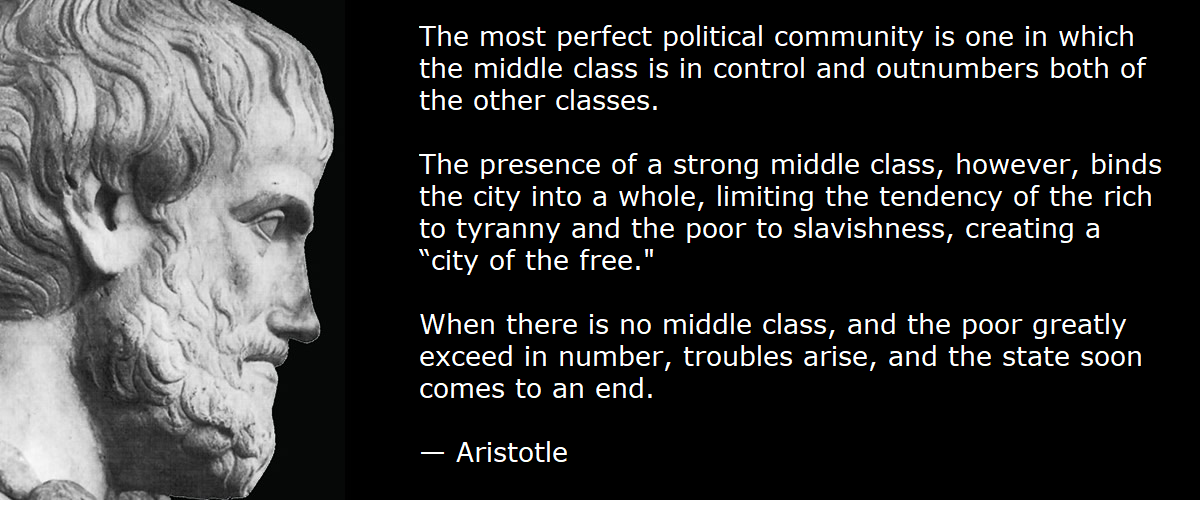
Feudalism is a viable alternative to tolerating a middle class, especially lucrative to the multinational corporations and globalist billionaires that hide this agenda behind a moral masquerade.
It doesn’t require a conspiracy theorist to suggest these wholesale shifts in American culture are not happening by accident. Nor are they solely the result of nefarious intent, at least not among everyone occupying the highest rungs of power and influence in America. What motivates members of the American elite, billionaires and corporate boards alike, to approve of these radical changes?
Unsustainable Prosperity for Me, But Not for Thee?
One answer comes down to this: They believe the lifestyle of the American middle class is not sustainable, because the planet does not have the carrying capacity to extend an American level of consumption to everyone in the world. By dividing and confusing the American people,while wielding the moral bludgeons of saving the planet and eliminating racism, policies can be implemented that will break the American middle class and habituate them to expect less.
In the name of saving the planet, for example, new suburbs will become almost impossible to construct. Single-family detached homes with yards will be stigmatized as both unsustainable and racist, and to mitigate these evils, subsidized apartments will replace homes, with rent subsidized occupants. As America’s population grows via mass immigration, the footprint of cities will remain fixed. The politically engineered housing shortage will force increasing numbers of Americans into subsidized housing.
All of this is already happening, but it’s just getting started. Similar cramdowns will occur with respect to all social amenities that consume resources.
Land is just the primary example, but water, energy, and transportation will all be affected. This new political economy will also depopulate rural areas—through corporate consolidation of farmland as regulations and resource costs drive small operations under and through punitive regulations and insurance burdens driving people out of the “urban-wildland interface.” Outside of major cities, for the most part, the only people left will be extremely wealthy landowners and corporate employees.
Joel Kotkin, who has studied and written about demographics and migrations for years, recently authored The Coming of Neo Feudalism: A Warning to the Global Middle Class. Of all the shorthand descriptions for the political economy that is coming, feudalism may be the best fit. As Kotkin puts it:
The new class structure resembles that of Medieval times. At the apex of the new order are two classes―a reborn clerical elite, the clerisy, which dominates the upper part of the professional ranks, universities, media and culture, and a new aristocracy led by tech oligarchs with unprecedented wealth and growing control of information. These two classes correspond to the old French First and Second Estates.
Below these two classes lies what was once called the Third Estate. This includes the yeomanry, which is made up largely of small businesspeople, minor property owners, skilled workers and private-sector-oriented professionals. Ascendant for much of modern history, this class is in decline while those below them, the new Serfs, grow in numbers―a vast, expanding property-less population.
Both Kotkin and Hanson assert that the trend towards feudalism can be reversed if people understand what is occurring and react effectively. To that end, it is necessary to understand that behind the obvious benefit these new rules have in service of the elites and their interests, there is a moral pretext. How solid is that pretext, that America’s middle class is not sustainable?
It All Comes Down to Energy
Energy is the prerequisite for economic growth. If you have abundant energy, you can have abundant water, transportation, communications, light, heat, mechanized agriculture, refrigerated medicines; everything. And the cold fact confronting America’s elites is this: For everyone on earth to consume half as much energy as Americans consume, total energy production worldwide would have to more than double.
Can America’s middle class sustain its current lifestyle while consuming half as much energy as it does today? Or is it feasible for energy production in the world not merely to double, but quadruple? And if that can be done, is it possible without paying too high a price in terms of environmental impact? And if it cannot be done, can the American experience, which is to enjoy a lifestyle many times greater than that enjoyed by most of the rest of the people on earth, be justified? And if so, why?
These are tough questions. Unequivocal, simple answers to these questions do not exist. But the conventional answer that motivates America’s elites must nonetheless be challenged, because until it is, they will cloak their consolidation of power and their elimination of America’s middle class in the moral imperatives of saving the planet and eliminating racism.
It may seem illogical to suppose the “systemic racism” canard is more easily disposed of, but that’s only because racism, by design, is the ongoing obsession in American media and politics. Despite this well-engineered obsession, resolute opposition to “anti-racist” racism is growing because it is an obvious lie. Racism, from all sources, still exists. But systemic racism against nonwhites, from every angle you look at it in modern American society, simply does not exist. Politicians, journalists, and academics need to find the courage to explain the facts and turn the tide. It can be done.
Saving the planet, on the other hand, is a moral imperative with ongoing urgency.
This urgency may be divided into two broad categories. The first is the traditional concerns of environmentalists, to preserve wildlife and wilderness, and reduce or eliminate sources of pollution. While environmentalists, especially in the United States, often go way too far in addressing these traditional concerns, these are genuine moral imperatives that must be balanced against the economic needs of civilization. This is an important but manageable debate.
The second, new concern of environmentalists, however, is the “climate emergency.” Grossly overblown, hyped for reasons that are transparently opportunistic, fraught with potential for tyranny and punitively expensive, the “climate emergency,” more than anything else, is the moral justification for destroying the American middle class.
In the name of saving the climate, federal and certain state authorities are restricting fossil fuel development, despite the fact that fossil fuels—coal, oil, and gas—still produce 85 percent of worldwide energy, with nuclear and hydropower making up another 11 percent. If energy production is going to double, which at a minimum it must, how on earth will that be accomplished without fossil fuel? It is impossible.
And the planners who are suppressing fossil fuel development worldwide know it. By creating shortages and raising prices for everything, they intend to reduce median rates of consumption in America to a fraction of what it is today, and render a middle-class lifestyle completely out of reach to the average American.
In doing so, they’ll amass even more wealth for themselves.
The Better Way Forward
There is another path. By focusing on the most likely predictions instead of the most catastrophic, nations can focus on climate resiliency—something which is a good idea anyway—while continuing to develop clean fossil fuel and also continuing to develop leapfrog technologies such as nuclear fusion. The environmental benefit of this approach is tangible and profound: with energy comes prosperity, with prosperity comes lower birthrates. With energy, inviting urban centers are possible, and urbanization takes pressure off wilderness. In both cases, with abundant energy, people voluntarily choose to limit their family size and move to cities.
A moral case for fossil fuels can outweigh the supposedly moral case against fossil fuel. Americans have to be willing to fight that fight, along with every other tyrannical edict attendant to the “climate emergency,” starting with the restrictions on urban expansion and single-family homes.
With adherence to the principles and culture that made America great—competition, private ownership, rule of law, minimizing corruption, and rewarding innovation—America’s middle class can survive and grow. But feudalism is a viable alternative, especially lucrative to the multinational corporations and globalist billionaires who will never call it by that name, hiding instead behind a moral masquerade.
Biden dispenses serotonin the way Barack Obama dispensed drone strikes
If your facts don’t care about my feelings, then my feelings aren’t obliged to care about your facts. The facts in Joe Biden’s energetic, inspiring and exhilarating address to the nation last night were frequently as unsteady as the speaker. But the feelings that Biden expressed were, unlike the previous president who must not be named, unimpeachable.
He knows how it feels, he said with that now-customary surge of anger, as if he’s not fully in control of his frontal cortex. And we know how it feels when someone says they know how we feel.Consider everything fixed: COVID, racism, opioids, deficits, the collapse of the schools, the children at the border. The Therapeute-in-Chief is here, dispensing serotonin the way Barack Obama dispensed drone strikes.
It doesn’t matter whether Biden means what he says, any more that it matters whether Meghan Markle told the truth when she implied that her son was denied a prince’s title because he might have dark skin. It’s the feelings that matter: feelings of security, empathy and contentment, and especially the feeling that Nietzsche correctly foresaw as the root feeling of modern life, resentment.
The result is the rule of sentiment over thought and symbols over reality. The Biden administration didn’t invent the moral and humanitarian disaster at the southern border. But it has produced a new crisis by altering the laws to satisfy sentiment.
It feels cruel to return unaccompanied minors, as the Trump administration did, and to hold them in prison-like conditions, as both the Obama and Trump administrations did. But the fact is, Biden’s policies have fostered a greater cruelty.
Biden has created new incentives for human trafficking and the worse kinds of child exploitation.
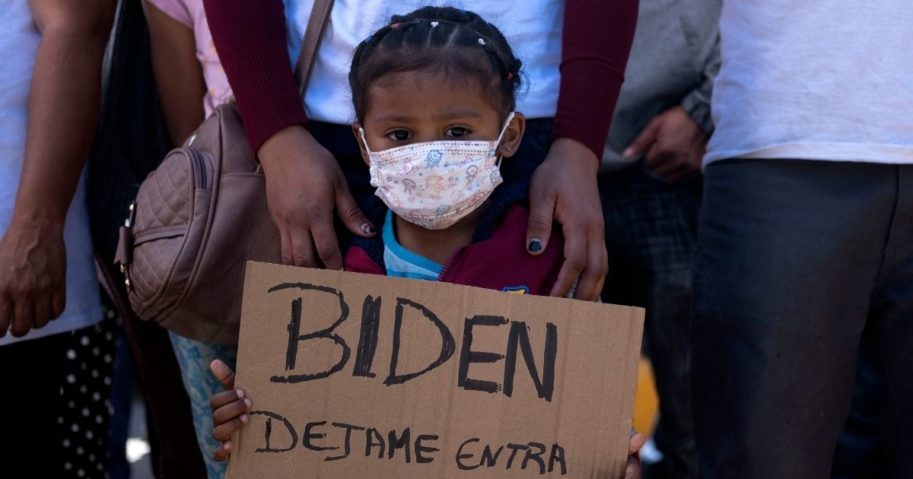
The result is a surge in border crossings that even a professional euphemist like secretary of Homeland Security Alejandro Mayorkas calls ‘overwhelming’, and the spectacle of would-be illegal immigrants kneeling at the border while wearing t-shirts reading ‘Biden let us in’.
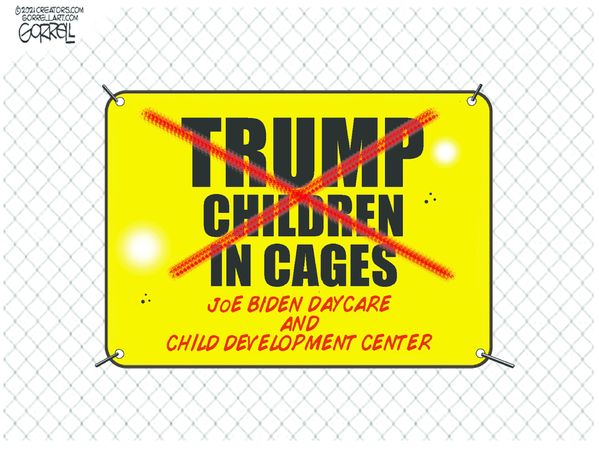
This is what Biden gets for taking a knee as a craven genuflection to BLM. This is what he gets for accusing Donald Trump of being a racist and sadist for caging unaccompanied minors — even though Biden was vice president when the cages were built, and even though Biden now presides over a greater influx. And this is what we get: a theater of the sentiments, in which the actors and audience are so jaded that their senses and check books can only be stimulated by that reliable and obscene soap-opera trick, putting children’s lives in the balance.
Asked if the word ‘crisis’ applied, the President’s spokeswoman, Jennifer Psaki, refuses to call it anything at all — because she would feel bad, and we would feel bad, and Biden would look bad, if we called it for what it is. It is easier for the administration to resent the Mexican children for putting us in this moral bind, and resent the Republicans, who aren’t short of their own resentments when it comes to immigration, for making hay with it.
The fact is that this is a crisis. It reflects the corrupt failure of Washington DC and the cold self-interest of corporations who want cheap labor, unions who don’t want it, and, in the middle, the upper-middle-class donors who dislike foreigners who don’t speak English, but need them to bus their tables, do their lawns and wipe their children’s backsides.
Given the complexities of the facts and the appeal of a flight into sentiment, it’s no wonder that this week the administration and media did direct us to pity the children. Meghan and Harry, that is.
Jennifer Psaki commends Meghan and Harry for the ‘courage’ it took to sit down with Oprah and make unsubstantiated allegations against his family. Their kind of fact-light, sentiment-heavy self-promotion and self-therapy was, Psaki told us, one of the areas that Biden is ‘committed to in the future’.
Biden’s increasingly vague routines of empathy are the symbolic face and velvet glove of a bureaucracy of the sentiments whose offices run from government to the media.
Biden is very old. After him, the gloves will be off and the face will be hardened with more than Botox. We’ll get this decayed form of democracy good and hard, and we’ll be told it should feel good. And that’s a fact.
Vaccination rates in Texas and other states have been increasing while hospitalizations are plunging. About one in five adults in Texas has received at least one dose of the Pfizer or Moderna vaccine. Most are seniors and people with health conditions who are at highest risk of severe illness. Hospitalizations in Texas have fallen more than 60% since a mid-January peak.
Politicians created a box canyon with lockdowns last spring that were originally intended to “flatten the curve.” But then every time governors loosened restrictions and cases ticked up, Democrats would demand lockdowns. Not that lockdowns (or mask mandates) much helped California or New York, which experienced bigger surges this winter than Florida did with neither.
Background from Previous Post Immunity by Easter?
Could it be that doors and societies will open and life be reborn as early as Easter 2021? That depends upon lockdown politicians and scientists who advise them. One such is Dr. Makary, a professor at the Johns Hopkins School of Medicine and Bloomberg School of Public Health, chief medical adviser to Sesame Care, and author of “The Price We Pay.”. His article at Wall Street Journal is We’ll Have Herd Immunity by April. Excerpts in italics with my bolds.
Covid cases have dropped 77% in six weeks. Experts should level with the public about the good news.
Amid the dire Covid warnings, one crucial fact has been largely ignored: Cases are down 77% over the past six weeks. If a medication slashed cases by 77%, we’d call it a miracle pill.Why is the number of cases plummeting much faster than experts predicted?
In large part because natural immunity from prior infection is far more common than can be measured by testing.
Testing has been capturing only from 10% to 25% of infections, depending on when during the pandemic someone got the virus. Applying a time-weighted case capture average of 1 in 6.5 to the cumulative 28 million confirmed cases would mean about 55% of Americans have natural immunity.
Now add people getting vaccinated. As of this week, 15% of Americans have received the vaccine, and the figure is rising fast. Former Food and Drug Commissioner Scott Gottlieb estimates 250 million doses will have been delivered to some 150 million people by the end of March.
There is reason to think the country is racing toward an extremely low level of infection. As more people have been infected, most of whom have mild or no symptoms, there are fewer Americans left to be infected. At the current trajectory, I expect Covid will be mostly gone by April, allowing Americans to resume normal life.
Antibody studies almost certainly underestimate natural immunity. Antibody testing doesn’t capture antigen-specific T-cells, which develop “memory” once they are activated by the virus. Survivors of the 1918 Spanish flu were found in 2008—90 years later—to have memory cells still able to produce neutralizing antibodies.
Researchers at Sweden’s Karolinska Institute found that the percentage of people mounting a T-cell response after mild or asymptomatic Covid-19 infection consistently exceeded the percentage with detectable antibodies. T-cell immunity was even present in people who were exposed to infected family members but never developed symptoms. A group of U.K. scientists in September pointed out that the medical community may be under-appreciating the prevalence of immunity from activated T-cells.
Covid-19 deaths in the U.S. would also suggest much broader immunity than recognized. About 1 in 600 Americans has died of Covid-19, which translates to a population fatality rate of about 0.15%. The Covid-19 infection fatality rate is about 0.23%. These numbers indicate that roughly two-thirds of the U.S. population has had the infection.
In my own conversations with medical experts, I have noticed that they too often dismiss natural immunity, arguing that we don’t have data. The data certainly doesn’t fit the classic randomized-controlled-trial model of the old-guard medical establishment. There’s no control group. But the observational data is compelling.
I have argued for months that we could save more American lives if those with prior Covid-19 infection forgo vaccines until all vulnerable seniors get their first dose. Several studies demonstrate that natural immunity should protect those who had Covid-19 until more vaccines are available. Half my friends in the medical community told me: Good idea. The other half said there isn’t enough data on natural immunity, despite the fact that reinfections have occurred in less than 1% of people—and when they do occur, the cases are mild.
But the consistent and rapid decline in daily cases since Jan. 8 can be explained only by natural immunity. Behavior didn’t suddenly improve over the holidays; Americans traveled more over Christmas than they had since March. Vaccines also don’t explain the steep decline in January. Vaccination rates were low and they take weeks to kick in.
My prediction that Covid-19 will be mostly gone by April is based on laboratory data, mathematical data, published literature and conversations with experts. But it’s also based on direct observation of how hard testing has been to get, especially for the poor. If you live in a wealthy community where worried people are vigilant about getting tested, you might think that most infections are captured by testing. But if you have seen the many barriers to testing for low-income Americans, you might think that very few infections have been captured at testing centers. Keep in mind that most infections are asymptomatic, which still triggers natural immunity.
Many experts, along with politicians and journalists, are afraid to talk about herd immunity. The term has political overtones because some suggested the U.S. simply let Covid rip to achieve herd immunity. That was a reckless idea. But herd immunity is the inevitable result of viral spread and vaccination. When the chain of virus transmission has been broken in multiple places, it’s harder for it to spread—and that includes the new strains.
Herd immunity has been well-documented in the Brazilian city of Manaus, where researchers in the Lancet reported the prevalence of prior Covid-19 infection to be 76%, resulting in a significant slowing of the infection. Doctors are watching a new strain that threatens to evade prior immunity. But countries where new variants have emerged, such as the U.K., South Africa and Brazil, are also seeing significant declines in daily new cases. The risk of new variants mutating around the prior vaccinated or natural immunity should be a reminder that Covid-19 will persist for decades after the pandemic is over. It should also instill a sense of urgency to develop, authorize and administer a vaccine targeted to new variants.
Some medical experts privately agreed with my prediction that there may be very little Covid-19 by April but suggested that I not to talk publicly about herd immunity because people might become complacent and fail to take precautions or might decline the vaccine. But scientists shouldn’t try to manipulate the public by hiding the truth. As we encourage everyone to get a vaccine, we also need to reopen schools and society to limit the damage of closures and prolonged isolation. Contingency planning for an open economy by April can deliver hope to those in despair and to those who have made large personal sacrifices.
One of the few pleasures remaining during pandemania involves sports competitions where rules are followed and enforced by unbiased officials, so that teams or individuals win or lose based solely on the merit of their performances. Elsewhere with identity politics and political correctness, it is a different story. People on the right perceive accurately that their opponents on the left are not bound by the rules, and break them readily in order to win.
America is divided into two political teams; Team Right and Team Left. As Joe Biden and Kamala Harris assume office, many Team Right members are still trying to come to terms with the results of the 2020 election. They feel certain that Team Left cheated in a variety of ways in order to produce enough votes to secure victory.
Setting aside the MSM’s agreed-upon talking points of “baseless accusations” of election fraud and their “despite there being no evidence to support such claims” mantra, we now know that there was significant evidence of election tampering. That is actually a “fact” about which I’ve previously written. It is also, at this point, irrelevant. Joe Biden is in office. Focusing on 2020 election cheating is fine for investigators in various states if they so choose (there will be no federal investigation), but it is not helpful for ordinary citizens who would like to reverse trends.
The more helpful issue to explore in order to make a difference going forward is in answering this question: Why do Team Left members seem to be more willing to cheat than do Team Right members?
This is a question, I believe, that we can answer without needing any sort of physical proof. We can prove it solely through the use of our reason and with a clear understanding of the ethical structure, and attendant influences on behavior, of modern-day Team Left members (many of whom were election officials and vote counters).
When the typical person says they are “ethical,” they really mean that in their mind the things they do are the right things to do. This suggests a sort of self-legislating capability on the part of each person to know right from wrong. An idea like this can be found in the work of famous philosophers ranging from Immanuel Kant, to Karl Marx, to many others. They argue that each person is capable of such self-legislating and engage in the process constantly.
Very few people realize that there are actual ethical systems that have been “constructed” to help direct us on the path to making consistent and appropriate decisions as to how to act and behave in any given situation. We have the above-referenced Kant’s categorical imperative (if what I’m thinking of doing now were a rule that everyone had to follow, would it be workable for society?). We have Jeremy Bentham’s utilitarianism (pure cost-benefit analysis) or John Stuart Mill’s more refined and kinder version, which calls for for cost-benefit analysis with an allowance for the subjective nature of “higher” human values.
There are a number of ways to view the development and deployment of moral and ethical behavior, but the typical person knows little, if any, of this. Yet they will tell you that they are ethical, and others are not. By what standard? How do they know? This logical dilemma, by the way, exists in people whether they were supporters of Donald Trump or Joe Biden; whether they are members of Team Right or Team Left. There is absolutely no difference in that respect. There is a difference we will get to eventually, but it does not involve ethics.
Hobbes was right!
It is my opinion, based upon many years of studying political philosophy, working in a large corporate environment, working with and running privately owned businesses, and doing political advising and writing, that the greatest of all the political philosophers, the one who got the most important thing right, was Englishman Thomas Hobbes. Born in 1588, the year of the Spanish Armada, it is said that his mother went into premature labor upon seeing the ships off the English coast, thereby birthing poor Thomas out of fear.
Hobbes spent the rest of his life focusing on the fearful nature of humans, among other things.
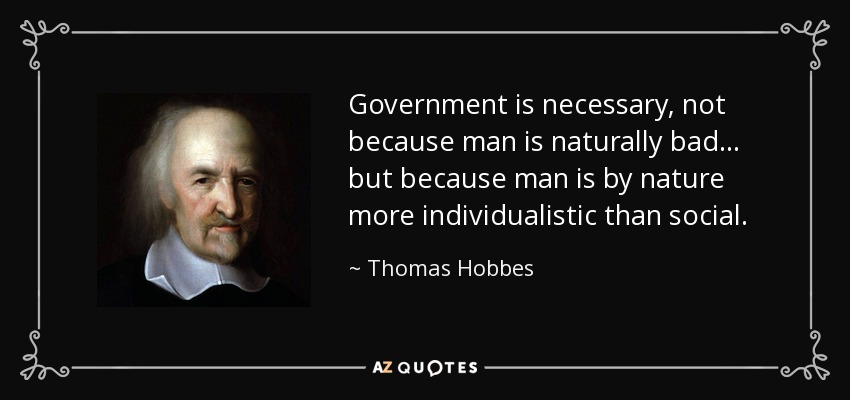
He is the father of social contract theory, which describes man’s compact to enter into civil society as a way to control his more primitive impulses. He is famous for his line about man’s life in the state of nature, before the social contract, which he describes as being “solitary, poor, nasty, brutish, and short.” Hobbes suggested that, owing to their nature, men are unable to be left to govern themselves without stern direction. His diagnosis of us as people? Fearful and self-destructive. His prescription? A strong sovereign.
Hobbes is also the father of the idea of moral relativism. His contention is that, for the typical human, their calculation of whether or not something is “right or wrong” is nothing more than a reduction to looking at things that please them and things that offend them. They maximize the one and avoid the other. In that process, they create their own morality, or set of ethics, that is based solely upon their own desires and aversions.
My own fifty-eight years of study and empirical observations have led me to conclude that this theory of human behavior and ethical development most accurately describes the greatest number of people Assuming a human population existing under a bell curve, Hobbes’s ethical construct describes the greatest number of people gathered around the mean.
At this point you might think I’m suggesting that Biden supporters, Team Left members, are moral relativists and Trump supporters, Team Right members, are not. That somehow I believe we are inherently better creatures than are they. You’d be wrong. I am not. I believe that most people are moral relativists in general, and even that people who attempt to operate under a more disciplined structure of ethics, including the Christian ethic, can become moral relativists at the very moment that they find themselves placed most at risk.
Survival is in our nature. When it is in jeopardy, even the most truly righteous can attempt to hedge their ethical bets.
Since I am concluding that there is no fundamental difference in ethics between the typical Trump or the typical Biden supporter, why go through all the trouble to share this background on ethics? After all, the purpose is to demonstrate how we can prove that Team Left members are more likely to cheat. I walked through the ethical piece because people typically consider cheating to be “unethical.” Yet it happens, and it happens more by their team than by ours.
To understand why, I believe we need to look beyond ethics and consider Tom Hanks, World War II, and the ancient Stoics.
Duty as a differentiator
Love or hate his personal life and politics, Tom Hanks makes spectacular movies and is especially good in war roles. A few months back, I had a chance to watch him in the Apple Television release of Greyhound. It is a story based on the U.S. Navy convoys that brought supplies and armaments across the Atlantic during World War II. It is not a long film, but it is nonstop action packed. For ninety minutes, there is nothing but German U-boat peril. American sailors show incredible courage, some losing their lives, others saving lives, up against challenging odds.
What happens to make men so courageous in one moment and so devoid of any kind of ethical or moral compass in the next? I think the answer lies in the notion of duty. Those men on the ship with Tom Hanks in that movie were driven in those moments by a higher calling. They had a sense of duty. Some, when they returned home, for whatever reason might have lost their way; found themselves left with no higher calling. Absent duty, they were left with only their own personal moral and ethical framework in which to operate. Given moral relativism, they became able to justify almost any behavior.
This notion of duty is a very Stoic concept. Stoicism, which dates back to Ancient Greece, emphasizes duty and the importance of virtue. There were four attributes of virtue: wisdom, justice, courage, and moderation. Doing one’s duty was central to the Stoics. Duty manifested itself in more than just following orders; it meant adhering to the four key elements of virtue and to keeping in sync with all of nature.
One does not have to buy into all of Stoic philosophy to grasp the importance of duty. It is with duty that we can begin to answer our question: How can we know that Team Left members will cheat?
The answer lies in the absence of a sense of duty to something outside themselves. The typical contemporary Team Left member does not have any external force that commands him or her to “behave better.”
Again, operating under the bell curve, the mainstream Trump supporter tries to follow either the voice of God, the call of patriotism, or both. Both are external to themselves. Both set standards for behavior that transcend their own personal calculations of convenience. Both provide fairly clear direction, either through Scripture or the Constitution. Both rest like weights upon their shoulders, burdening them with a non-ignorable sense of obligation.
It doesn’t mean they won’t fail. It doesn’t mean they will not behave badly. It simply means they have a better chance of making a better choice than does a person who is not encumbered by any sense of duty other than to themselves. Duty is typically viewed as a call to act. It can just as easily be seen as the antithesis to action, which means it can inhibit. I must because it’s my duty. I must not because it betrays my duty.
Common responses I have received from Team Left members over the years when I ask them about feeling a sense of duty include:
• I have a duty to those around me.
• I have a duty to those less fortunate than myself.
• I have a duty to humanity.
The shared characteristic of each of those “duties” is that although they sound as if they reside “outside” the individual, they are wholly subjective with regard to their definition. Each individual person gets to define their “duty to others” however they see fit. There is no separate standard. For those focused on a Christian duty, there is the reasonable clarity of the Bible. For those who pledge allegiance to the United States of America, there is our Constitution bolstered by the original Declaration of Independence.
For those, however, who say that they simply have a duty to help “others,” the others can be whomever they so choose, and need whatever kind of help it is the helper decides they should provide.
Machiavelli provides the final element
To succinctly summarize my thoughts to this point, it is my personal belief that the members of Team Right are not inherently any more ethical than are their counterparts on Team Left. When it comes right down to it, individual to individual, most people are basic moral relativists as identified and defined by Hobbes, and given no other considerations, most people conduct themselves under an ethical code that is simply one of convenience.
The difference between the two is that those who answer to a calling of duty that is outside themselves and more objective than subjective in nature can have their individual passions held in check. It gives their better angels a chance to be heard and followed.
Machiavelli’s statement about ends and means explains why the modern-day Team Left member, almost always a Democrat, is so willing to cheat. Existing as a typical moral relativist where little to nothing is malum in se, and being for the most part unconstrained by a sense of duty other than that which they conveniently self-define, any sort of activity is permissible so long as they end up getting what they want. They give cover to this behavior by saying their actions are necessary to “help others.” As has been shown, that statement can mean whatever they want it to mean.
By our nature as humans, we are flawed and sinful creatures. That goes for Trump supporters as well as those who lined up behind Joe Biden. The difference is that for those of us who truly have a good old-fashioned love for God, country, or both, we have a voice outside ourselves warning us to control our nature. It asks us to heed a higher calling. It limits us in a way that is beneficial to maintaining an ordered, predictable, and just society.
Those who operate without that sense of duty are left to do whatever their free will wishes, unbound by any real constraints. They can justify their actions through the simple pleasure they feel or the pain they avoid. Their ends always can justify their means. That is why they cheat. That is how we can use our reason to know they cheat.
Postscript: Dennis Prager sees the left/right distinction in terms of focus on politics vs. persons.
That’s a major difference between the right and the left, concerning the way each seeks to improve society.Conservatives believe that the way to a better society is almost always through the moral improvement of the individual by each person doing battle with his or her own weaknesses, and flaws. It is true that in violent and evil society such as fascist Communist or Islam is tyrannies, the individual must be preoccupied with battling outside forces. Almost everywhere else, though, certainly in a free and decent country such as America, the greatest Battle of the individual must be with inner forces, that is with his or her moral failings.
The left on the other hand, believes that the way to a better society is almost always through doing battle with society’s moral failings. Thus, in America, the left concentrates its efforts on combating sexism, racism, intolerance, xenophobia, homophobia, Islamophobia, and the many other evils that the left believes permeate American society.
One important consequence of this left right distinction is that those on the left are far more preoccupied with politics than those on the Right. Since the left is so much more interested in fixing society than in fixing the individual, politics inevitably becomes the vehicle for societal improvement. That’s why whenever the term activist is used, we almost always assume that the term refers to someone on the left.
As the cartoon suggests, the media is covering up rather than reporting the election issues. Yesterday in a zoom conference state senators from the battlegrounds got a briefing on wrongdoing spoiling the 2020 Presidential election. The materials may provide a preview of what will be publicly aired on January 6, 2021, when US Representatives and Senators challenge the electors from those states. The full documentation is available at:
The 2020 election witnessed an unprecedented and coordinated effort through public-private partnerships to improperly and unlawfully influence the election for Mr. Biden by:
1) creating a two-tiered election system in which state and local officials targeted Biden constituencies to turn out the vote while targeting Trump constituencies to depress the vote;
2) using private funds to pay election judges and officials who managed the way ballots were received, accepted, cured, and counted;
3) having private interests dictate or encourage local election officials to violate state laws protecting the integrity of the ballot;
4) consolidating counting centers to justify the delivery of hundreds of thousands of ballots to one location, removing Republicans from their lawful right to view the receipt, handling, and counting of ballots in the consolidated counting centers;
5) initiating scores of lawsuits as early as March of 2020 to undermine ballot integrity measures;
6) accepting and receiving more than $400 million from private interests to dictate terms in which the election would be managed in Democrat strongholds;
7) allowing private interests to gain special access and use of sensitive citizen information maintained by government;
8) benefiting from Big Tech monies and censorship of information;
9) training left-leaning poll workers in Democrat strongholds on how to commit fraud;
10) fighting transparency by resisting legitimate requests to audit and review ballots, ballot envelopes, and computer logs;
11) threatening legislators with criminal investigation and prosecution if they disagreed with blue state executive officials on the election result;
12) locking Republican legislators out of the state capitol to prevent them from meeting and challenging election certification; and
13) engaging in illegal ballot harvesting.
This conduct resulted in an election in which the American people cannot have faith, which violates state law and which should not be certified.
Below are several thousand pages of evidence and hours of video explaining this evidence for your review.






 Edward Ring explains in his essay at American Greatness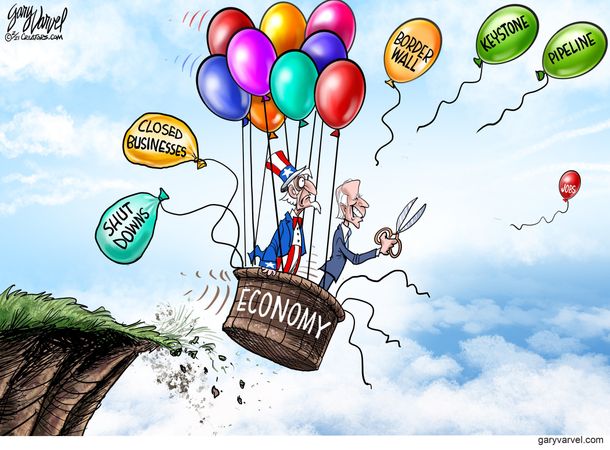





 One of the few pleasures remaining during pandemania involves sports competitions where rules are followed and enforced by unbiased officials, so that teams or individuals win or lose based solely on the merit of their performances. Elsewhere with identity politics and political correctness, it is a different story. People on the right perceive accurately that their opponents on the left are not bound by the rules, and break them readily in order to win.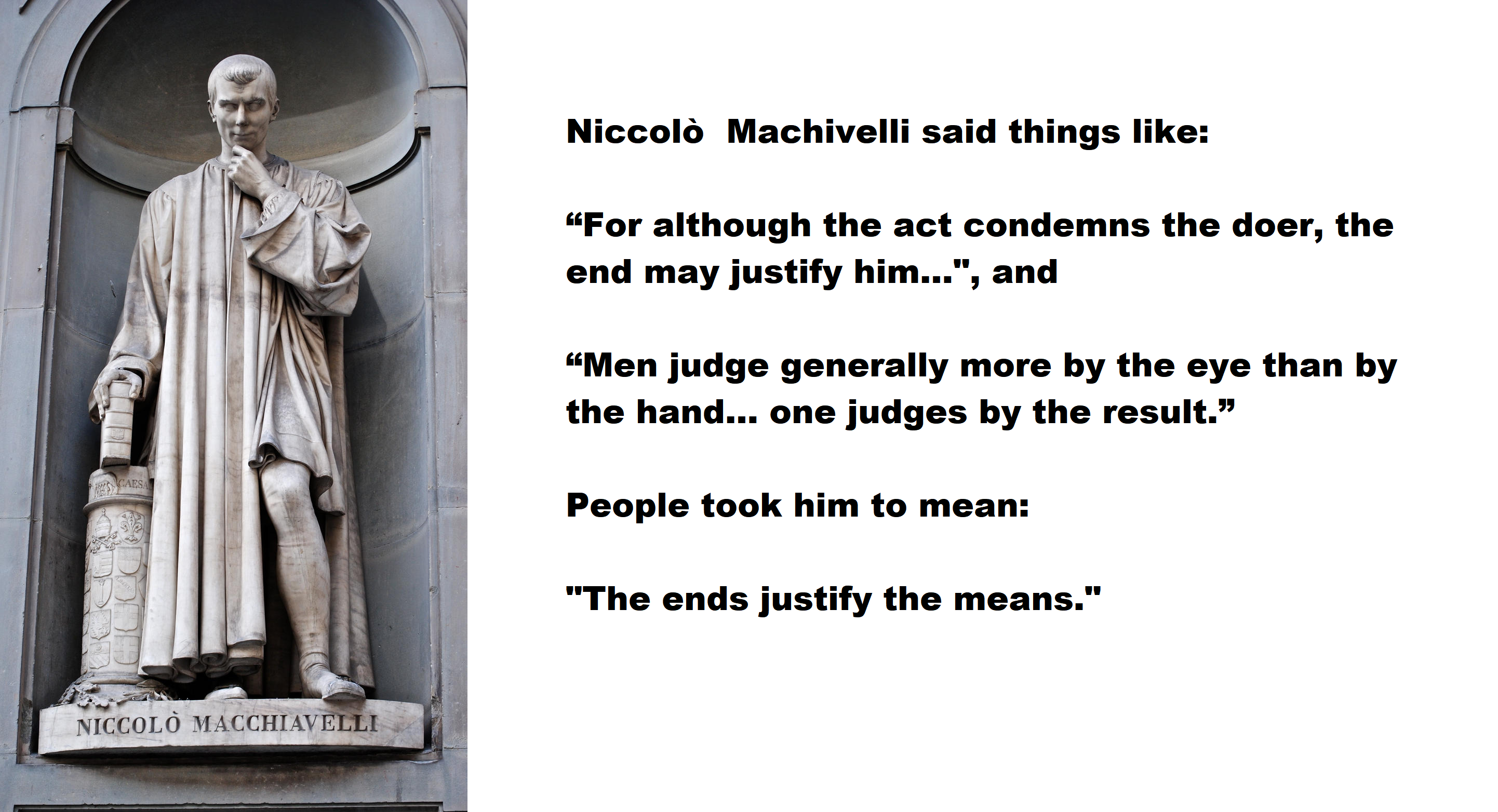



 Science Matters