Feudalism is a viable alternative to tolerating a middle class, especially lucrative to the multinational corporations and globalist billionaires that hide this agenda behind a moral masquerade.
It doesn’t require a conspiracy theorist to suggest these wholesale shifts in American culture are not happening by accident. Nor are they solely the result of nefarious intent, at least not among everyone occupying the highest rungs of power and influence in America. What motivates members of the American elite, billionaires and corporate boards alike, to approve of these radical changes?
Unsustainable Prosperity for Me, But Not for Thee?
One answer comes down to this: They believe the lifestyle of the American middle class is not sustainable, because the planet does not have the carrying capacity to extend an American level of consumption to everyone in the world. By dividing and confusing the American people,while wielding the moral bludgeons of saving the planet and eliminating racism, policies can be implemented that will break the American middle class and habituate them to expect less.
In the name of saving the planet, for example, new suburbs will become almost impossible to construct. Single-family detached homes with yards will be stigmatized as both unsustainable and racist, and to mitigate these evils, subsidized apartments will replace homes, with rent subsidized occupants. As America’s population grows via mass immigration, the footprint of cities will remain fixed. The politically engineered housing shortage will force increasing numbers of Americans into subsidized housing.
All of this is already happening, but it’s just getting started. Similar cramdowns will occur with respect to all social amenities that consume resources.
Land is just the primary example, but water, energy, and transportation will all be affected. This new political economy will also depopulate rural areas—through corporate consolidation of farmland as regulations and resource costs drive small operations under and through punitive regulations and insurance burdens driving people out of the “urban-wildland interface.” Outside of major cities, for the most part, the only people left will be extremely wealthy landowners and corporate employees.
Joel Kotkin, who has studied and written about demographics and migrations for years, recently authored The Coming of Neo Feudalism: A Warning to the Global Middle Class. Of all the shorthand descriptions for the political economy that is coming, feudalism may be the best fit. As Kotkin puts it:
The new class structure resembles that of Medieval times. At the apex of the new order are two classes―a reborn clerical elite, the clerisy, which dominates the upper part of the professional ranks, universities, media and culture, and a new aristocracy led by tech oligarchs with unprecedented wealth and growing control of information. These two classes correspond to the old French First and Second Estates.
Below these two classes lies what was once called the Third Estate. This includes the yeomanry, which is made up largely of small businesspeople, minor property owners, skilled workers and private-sector-oriented professionals. Ascendant for much of modern history, this class is in decline while those below them, the new Serfs, grow in numbers―a vast, expanding property-less population.
Both Kotkin and Hanson assert that the trend towards feudalism can be reversed if people understand what is occurring and react effectively. To that end, it is necessary to understand that behind the obvious benefit these new rules have in service of the elites and their interests, there is a moral pretext. How solid is that pretext, that America’s middle class is not sustainable?
It All Comes Down to Energy
Energy is the prerequisite for economic growth. If you have abundant energy, you can have abundant water, transportation, communications, light, heat, mechanized agriculture, refrigerated medicines; everything. And the cold fact confronting America’s elites is this: For everyone on earth to consume half as much energy as Americans consume, total energy production worldwide would have to more than double.
Can America’s middle class sustain its current lifestyle while consuming half as much energy as it does today? Or is it feasible for energy production in the world not merely to double, but quadruple? And if that can be done, is it possible without paying too high a price in terms of environmental impact? And if it cannot be done, can the American experience, which is to enjoy a lifestyle many times greater than that enjoyed by most of the rest of the people on earth, be justified? And if so, why?
These are tough questions. Unequivocal, simple answers to these questions do not exist. But the conventional answer that motivates America’s elites must nonetheless be challenged, because until it is, they will cloak their consolidation of power and their elimination of America’s middle class in the moral imperatives of saving the planet and eliminating racism.
It may seem illogical to suppose the “systemic racism” canard is more easily disposed of, but that’s only because racism, by design, is the ongoing obsession in American media and politics. Despite this well-engineered obsession, resolute opposition to “anti-racist” racism is growing because it is an obvious lie. Racism, from all sources, still exists. But systemic racism against nonwhites, from every angle you look at it in modern American society, simply does not exist. Politicians, journalists, and academics need to find the courage to explain the facts and turn the tide. It can be done.
Saving the planet, on the other hand, is a moral imperative with ongoing urgency.
This urgency may be divided into two broad categories. The first is the traditional concerns of environmentalists, to preserve wildlife and wilderness, and reduce or eliminate sources of pollution. While environmentalists, especially in the United States, often go way too far in addressing these traditional concerns, these are genuine moral imperatives that must be balanced against the economic needs of civilization. This is an important but manageable debate.
The second, new concern of environmentalists, however, is the “climate emergency.” Grossly overblown, hyped for reasons that are transparently opportunistic, fraught with potential for tyranny and punitively expensive, the “climate emergency,” more than anything else, is the moral justification for destroying the American middle class.
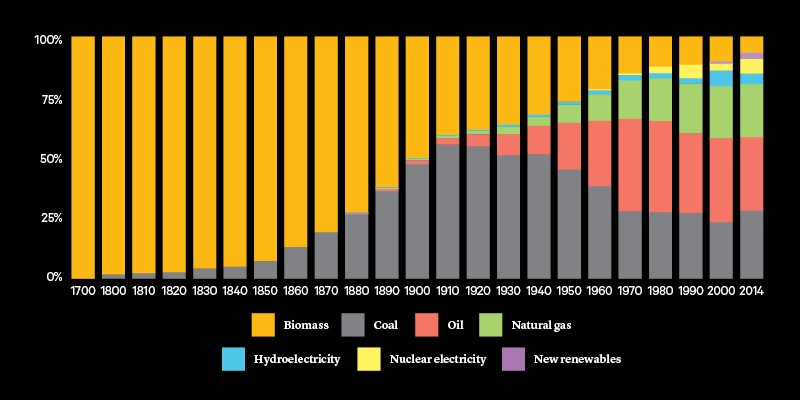
In the name of saving the climate, federal and certain state authorities are restricting fossil fuel development, despite the fact that fossil fuels—coal, oil, and gas—still produce 85 percent of worldwide energy, with nuclear and hydropower making up another 11 percent. If energy production is going to double, which at a minimum it must, how on earth will that be accomplished without fossil fuel? It is impossible.
And the planners who are suppressing fossil fuel development worldwide know it. By creating shortages and raising prices for everything, they intend to reduce median rates of consumption in America to a fraction of what it is today, and render a middle-class lifestyle completely out of reach to the average American.
In doing so, they’ll amass even more wealth for themselves.
The Better Way Forward
There is another path. By focusing on the most likely predictions instead of the most catastrophic, nations can focus on climate resiliency—something which is a good idea anyway—while continuing to develop clean fossil fuel and also continuing to develop leapfrog technologies such as nuclear fusion. The environmental benefit of this approach is tangible and profound: with energy comes prosperity, with prosperity comes lower birthrates. With energy, inviting urban centers are possible, and urbanization takes pressure off wilderness. In both cases, with abundant energy, people voluntarily choose to limit their family size and move to cities.
A moral case for fossil fuels can outweigh the supposedly moral case against fossil fuel. Americans have to be willing to fight that fight, along with every other tyrannical edict attendant to the “climate emergency,” starting with the restrictions on urban expansion and single-family homes.
With adherence to the principles and culture that made America great—competition, private ownership, rule of law, minimizing corruption, and rewarding innovation—America’s middle class can survive and grow. But feudalism is a viable alternative, especially lucrative to the multinational corporations and globalist billionaires who will never call it by that name, hiding instead behind a moral masquerade.
Biden dispenses serotonin the way Barack Obama dispensed drone strikes
If your facts don’t care about my feelings, then my feelings aren’t obliged to care about your facts. The facts in Joe Biden’s energetic, inspiring and exhilarating address to the nation last night were frequently as unsteady as the speaker. But the feelings that Biden expressed were, unlike the previous president who must not be named, unimpeachable.
He knows how it feels, he said with that now-customary surge of anger, as if he’s not fully in control of his frontal cortex. And we know how it feels when someone says they know how we feel.Consider everything fixed: COVID, racism, opioids, deficits, the collapse of the schools, the children at the border. The Therapeute-in-Chief is here, dispensing serotonin the way Barack Obama dispensed drone strikes.
It doesn’t matter whether Biden means what he says, any more that it matters whether Meghan Markle told the truth when she implied that her son was denied a prince’s title because he might have dark skin. It’s the feelings that matter: feelings of security, empathy and contentment, and especially the feeling that Nietzsche correctly foresaw as the root feeling of modern life, resentment.
The result is the rule of sentiment over thought and symbols over reality. The Biden administration didn’t invent the moral and humanitarian disaster at the southern border. But it has produced a new crisis by altering the laws to satisfy sentiment.
It feels cruel to return unaccompanied minors, as the Trump administration did, and to hold them in prison-like conditions, as both the Obama and Trump administrations did. But the fact is, Biden’s policies have fostered a greater cruelty.
Biden has created new incentives for human trafficking and the worse kinds of child exploitation.
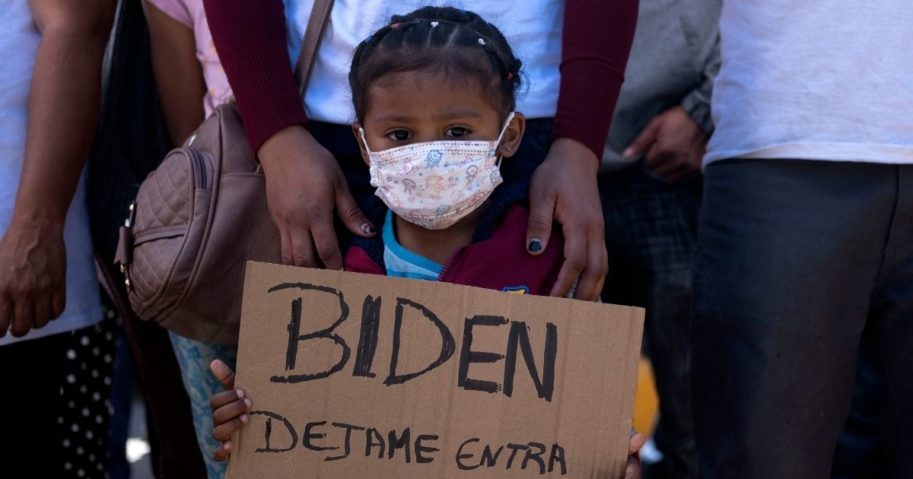
The result is a surge in border crossings that even a professional euphemist like secretary of Homeland Security Alejandro Mayorkas calls ‘overwhelming’, and the spectacle of would-be illegal immigrants kneeling at the border while wearing t-shirts reading ‘Biden let us in’.
This is what Biden gets for taking a knee as a craven genuflection to BLM. This is what he gets for accusing Donald Trump of being a racist and sadist for caging unaccompanied minors — even though Biden was vice president when the cages were built, and even though Biden now presides over a greater influx. And this is what we get: a theater of the sentiments, in which the actors and audience are so jaded that their senses and check books can only be stimulated by that reliable and obscene soap-opera trick, putting children’s lives in the balance.
Asked if the word ‘crisis’ applied, the President’s spokeswoman, Jennifer Psaki, refuses to call it anything at all — because she would feel bad, and we would feel bad, and Biden would look bad, if we called it for what it is. It is easier for the administration to resent the Mexican children for putting us in this moral bind, and resent the Republicans, who aren’t short of their own resentments when it comes to immigration, for making hay with it.
The fact is that this is a crisis. It reflects the corrupt failure of Washington DC and the cold self-interest of corporations who want cheap labor, unions who don’t want it, and, in the middle, the upper-middle-class donors who dislike foreigners who don’t speak English, but need them to bus their tables, do their lawns and wipe their children’s backsides.
Given the complexities of the facts and the appeal of a flight into sentiment, it’s no wonder that this week the administration and media did direct us to pity the children. Meghan and Harry, that is.
Jennifer Psaki commends Meghan and Harry for the ‘courage’ it took to sit down with Oprah and make unsubstantiated allegations against his family. Their kind of fact-light, sentiment-heavy self-promotion and self-therapy was, Psaki told us, one of the areas that Biden is ‘committed to in the future’.
Biden’s increasingly vague routines of empathy are the symbolic face and velvet glove of a bureaucracy of the sentiments whose offices run from government to the media.
Biden is very old. After him, the gloves will be off and the face will be hardened with more than Botox. We’ll get this decayed form of democracy good and hard, and we’ll be told it should feel good. And that’s a fact.
Vaccination rates in Texas and other states have been increasing while hospitalizations are plunging. About one in five adults in Texas has received at least one dose of the Pfizer or Moderna vaccine. Most are seniors and people with health conditions who are at highest risk of severe illness. Hospitalizations in Texas have fallen more than 60% since a mid-January peak.
Politicians created a box canyon with lockdowns last spring that were originally intended to “flatten the curve.” But then every time governors loosened restrictions and cases ticked up, Democrats would demand lockdowns. Not that lockdowns (or mask mandates) much helped California or New York, which experienced bigger surges this winter than Florida did with neither.
Background from Previous Post Immunity by Easter?
Could it be that doors and societies will open and life be reborn as early as Easter 2021? That depends upon lockdown politicians and scientists who advise them. One such is Dr. Makary, a professor at the Johns Hopkins School of Medicine and Bloomberg School of Public Health, chief medical adviser to Sesame Care, and author of “The Price We Pay.”. His article at Wall Street Journal is We’ll Have Herd Immunity by April. Excerpts in italics with my bolds.
Covid cases have dropped 77% in six weeks. Experts should level with the public about the good news.
Amid the dire Covid warnings, one crucial fact has been largely ignored: Cases are down 77% over the past six weeks. If a medication slashed cases by 77%, we’d call it a miracle pill.Why is the number of cases plummeting much faster than experts predicted?
In large part because natural immunity from prior infection is far more common than can be measured by testing.
Testing has been capturing only from 10% to 25% of infections, depending on when during the pandemic someone got the virus. Applying a time-weighted case capture average of 1 in 6.5 to the cumulative 28 million confirmed cases would mean about 55% of Americans have natural immunity.
Now add people getting vaccinated. As of this week, 15% of Americans have received the vaccine, and the figure is rising fast. Former Food and Drug Commissioner Scott Gottlieb estimates 250 million doses will have been delivered to some 150 million people by the end of March.
There is reason to think the country is racing toward an extremely low level of infection. As more people have been infected, most of whom have mild or no symptoms, there are fewer Americans left to be infected. At the current trajectory, I expect Covid will be mostly gone by April, allowing Americans to resume normal life.
Antibody studies almost certainly underestimate natural immunity. Antibody testing doesn’t capture antigen-specific T-cells, which develop “memory” once they are activated by the virus. Survivors of the 1918 Spanish flu were found in 2008—90 years later—to have memory cells still able to produce neutralizing antibodies.
Researchers at Sweden’s Karolinska Institute found that the percentage of people mounting a T-cell response after mild or asymptomatic Covid-19 infection consistently exceeded the percentage with detectable antibodies. T-cell immunity was even present in people who were exposed to infected family members but never developed symptoms. A group of U.K. scientists in September pointed out that the medical community may be under-appreciating the prevalence of immunity from activated T-cells.
Covid-19 deaths in the U.S. would also suggest much broader immunity than recognized. About 1 in 600 Americans has died of Covid-19, which translates to a population fatality rate of about 0.15%. The Covid-19 infection fatality rate is about 0.23%. These numbers indicate that roughly two-thirds of the U.S. population has had the infection.
In my own conversations with medical experts, I have noticed that they too often dismiss natural immunity, arguing that we don’t have data. The data certainly doesn’t fit the classic randomized-controlled-trial model of the old-guard medical establishment. There’s no control group. But the observational data is compelling.
I have argued for months that we could save more American lives if those with prior Covid-19 infection forgo vaccines until all vulnerable seniors get their first dose. Several studies demonstrate that natural immunity should protect those who had Covid-19 until more vaccines are available. Half my friends in the medical community told me: Good idea. The other half said there isn’t enough data on natural immunity, despite the fact that reinfections have occurred in less than 1% of people—and when they do occur, the cases are mild.
But the consistent and rapid decline in daily cases since Jan. 8 can be explained only by natural immunity. Behavior didn’t suddenly improve over the holidays; Americans traveled more over Christmas than they had since March. Vaccines also don’t explain the steep decline in January. Vaccination rates were low and they take weeks to kick in.
My prediction that Covid-19 will be mostly gone by April is based on laboratory data, mathematical data, published literature and conversations with experts. But it’s also based on direct observation of how hard testing has been to get, especially for the poor. If you live in a wealthy community where worried people are vigilant about getting tested, you might think that most infections are captured by testing. But if you have seen the many barriers to testing for low-income Americans, you might think that very few infections have been captured at testing centers. Keep in mind that most infections are asymptomatic, which still triggers natural immunity.
Many experts, along with politicians and journalists, are afraid to talk about herd immunity. The term has political overtones because some suggested the U.S. simply let Covid rip to achieve herd immunity. That was a reckless idea. But herd immunity is the inevitable result of viral spread and vaccination. When the chain of virus transmission has been broken in multiple places, it’s harder for it to spread—and that includes the new strains.
Herd immunity has been well-documented in the Brazilian city of Manaus, where researchers in the Lancet reported the prevalence of prior Covid-19 infection to be 76%, resulting in a significant slowing of the infection. Doctors are watching a new strain that threatens to evade prior immunity. But countries where new variants have emerged, such as the U.K., South Africa and Brazil, are also seeing significant declines in daily new cases. The risk of new variants mutating around the prior vaccinated or natural immunity should be a reminder that Covid-19 will persist for decades after the pandemic is over. It should also instill a sense of urgency to develop, authorize and administer a vaccine targeted to new variants.
Some medical experts privately agreed with my prediction that there may be very little Covid-19 by April but suggested that I not to talk publicly about herd immunity because people might become complacent and fail to take precautions or might decline the vaccine. But scientists shouldn’t try to manipulate the public by hiding the truth. As we encourage everyone to get a vaccine, we also need to reopen schools and society to limit the damage of closures and prolonged isolation. Contingency planning for an open economy by April can deliver hope to those in despair and to those who have made large personal sacrifices.
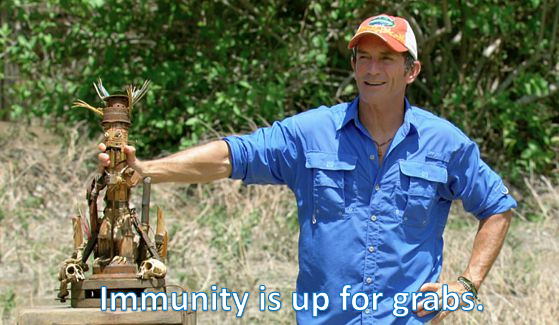
One of the few pleasures remaining during pandemania involves sports competitions where rules are followed and enforced by unbiased officials, so that teams or individuals win or lose based solely on the merit of their performances. Elsewhere with identity politics and political correctness, it is a different story. People on the right perceive accurately that their opponents on the left are not bound by the rules, and break them readily in order to win.
America is divided into two political teams; Team Right and Team Left. As Joe Biden and Kamala Harris assume office, many Team Right members are still trying to come to terms with the results of the 2020 election. They feel certain that Team Left cheated in a variety of ways in order to produce enough votes to secure victory.
Setting aside the MSM’s agreed-upon talking points of “baseless accusations” of election fraud and their “despite there being no evidence to support such claims” mantra, we now know that there was significant evidence of election tampering. That is actually a “fact” about which I’ve previously written. It is also, at this point, irrelevant. Joe Biden is in office. Focusing on 2020 election cheating is fine for investigators in various states if they so choose (there will be no federal investigation), but it is not helpful for ordinary citizens who would like to reverse trends.
The more helpful issue to explore in order to make a difference going forward is in answering this question: Why do Team Left members seem to be more willing to cheat than do Team Right members?
This is a question, I believe, that we can answer without needing any sort of physical proof. We can prove it solely through the use of our reason and with a clear understanding of the ethical structure, and attendant influences on behavior, of modern-day Team Left members (many of whom were election officials and vote counters).
When the typical person says they are “ethical,” they really mean that in their mind the things they do are the right things to do. This suggests a sort of self-legislating capability on the part of each person to know right from wrong. An idea like this can be found in the work of famous philosophers ranging from Immanuel Kant, to Karl Marx, to many others. They argue that each person is capable of such self-legislating and engage in the process constantly.
Very few people realize that there are actual ethical systems that have been “constructed” to help direct us on the path to making consistent and appropriate decisions as to how to act and behave in any given situation. We have the above-referenced Kant’s categorical imperative (if what I’m thinking of doing now were a rule that everyone had to follow, would it be workable for society?). We have Jeremy Bentham’s utilitarianism (pure cost-benefit analysis) or John Stuart Mill’s more refined and kinder version, which calls for for cost-benefit analysis with an allowance for the subjective nature of “higher” human values.
There are a number of ways to view the development and deployment of moral and ethical behavior, but the typical person knows little, if any, of this. Yet they will tell you that they are ethical, and others are not. By what standard? How do they know? This logical dilemma, by the way, exists in people whether they were supporters of Donald Trump or Joe Biden; whether they are members of Team Right or Team Left. There is absolutely no difference in that respect. There is a difference we will get to eventually, but it does not involve ethics.
Hobbes was right!
It is my opinion, based upon many years of studying political philosophy, working in a large corporate environment, working with and running privately owned businesses, and doing political advising and writing, that the greatest of all the political philosophers, the one who got the most important thing right, was Englishman Thomas Hobbes. Born in 1588, the year of the Spanish Armada, it is said that his mother went into premature labor upon seeing the ships off the English coast, thereby birthing poor Thomas out of fear.
Hobbes spent the rest of his life focusing on the fearful nature of humans, among other things.
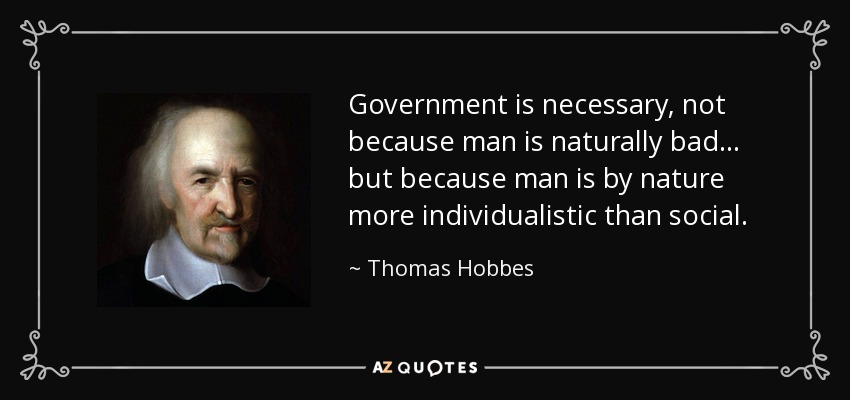
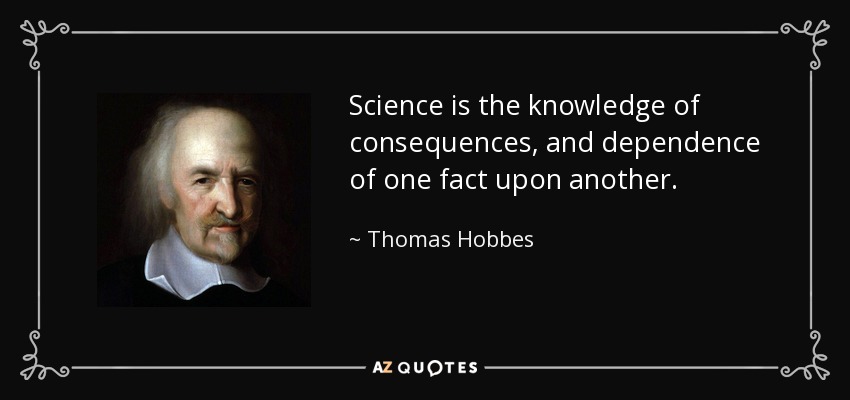
He is the father of social contract theory, which describes man’s compact to enter into civil society as a way to control his more primitive impulses. He is famous for his line about man’s life in the state of nature, before the social contract, which he describes as being “solitary, poor, nasty, brutish, and short.” Hobbes suggested that, owing to their nature, men are unable to be left to govern themselves without stern direction. His diagnosis of us as people? Fearful and self-destructive. His prescription? A strong sovereign.
Hobbes is also the father of the idea of moral relativism. His contention is that, for the typical human, their calculation of whether or not something is “right or wrong” is nothing more than a reduction to looking at things that please them and things that offend them. They maximize the one and avoid the other. In that process, they create their own morality, or set of ethics, that is based solely upon their own desires and aversions.
My own fifty-eight years of study and empirical observations have led me to conclude that this theory of human behavior and ethical development most accurately describes the greatest number of people Assuming a human population existing under a bell curve, Hobbes’s ethical construct describes the greatest number of people gathered around the mean.
At this point you might think I’m suggesting that Biden supporters, Team Left members, are moral relativists and Trump supporters, Team Right members, are not. That somehow I believe we are inherently better creatures than are they. You’d be wrong. I am not. I believe that most people are moral relativists in general, and even that people who attempt to operate under a more disciplined structure of ethics, including the Christian ethic, can become moral relativists at the very moment that they find themselves placed most at risk.
Survival is in our nature. When it is in jeopardy, even the most truly righteous can attempt to hedge their ethical bets.
Since I am concluding that there is no fundamental difference in ethics between the typical Trump or the typical Biden supporter, why go through all the trouble to share this background on ethics? After all, the purpose is to demonstrate how we can prove that Team Left members are more likely to cheat. I walked through the ethical piece because people typically consider cheating to be “unethical.” Yet it happens, and it happens more by their team than by ours.
To understand why, I believe we need to look beyond ethics and consider Tom Hanks, World War II, and the ancient Stoics.
Duty as a differentiator
Love or hate his personal life and politics, Tom Hanks makes spectacular movies and is especially good in war roles. A few months back, I had a chance to watch him in the Apple Television release of Greyhound. It is a story based on the U.S. Navy convoys that brought supplies and armaments across the Atlantic during World War II. It is not a long film, but it is nonstop action packed. For ninety minutes, there is nothing but German U-boat peril. American sailors show incredible courage, some losing their lives, others saving lives, up against challenging odds.
What happens to make men so courageous in one moment and so devoid of any kind of ethical or moral compass in the next? I think the answer lies in the notion of duty. Those men on the ship with Tom Hanks in that movie were driven in those moments by a higher calling. They had a sense of duty. Some, when they returned home, for whatever reason might have lost their way; found themselves left with no higher calling. Absent duty, they were left with only their own personal moral and ethical framework in which to operate. Given moral relativism, they became able to justify almost any behavior.
This notion of duty is a very Stoic concept. Stoicism, which dates back to Ancient Greece, emphasizes duty and the importance of virtue. There were four attributes of virtue: wisdom, justice, courage, and moderation. Doing one’s duty was central to the Stoics. Duty manifested itself in more than just following orders; it meant adhering to the four key elements of virtue and to keeping in sync with all of nature.
One does not have to buy into all of Stoic philosophy to grasp the importance of duty. It is with duty that we can begin to answer our question: How can we know that Team Left members will cheat?
The answer lies in the absence of a sense of duty to something outside themselves. The typical contemporary Team Left member does not have any external force that commands him or her to “behave better.”
Again, operating under the bell curve, the mainstream Trump supporter tries to follow either the voice of God, the call of patriotism, or both. Both are external to themselves. Both set standards for behavior that transcend their own personal calculations of convenience. Both provide fairly clear direction, either through Scripture or the Constitution. Both rest like weights upon their shoulders, burdening them with a non-ignorable sense of obligation.
It doesn’t mean they won’t fail. It doesn’t mean they will not behave badly. It simply means they have a better chance of making a better choice than does a person who is not encumbered by any sense of duty other than to themselves. Duty is typically viewed as a call to act. It can just as easily be seen as the antithesis to action, which means it can inhibit. I must because it’s my duty. I must not because it betrays my duty.
Common responses I have received from Team Left members over the years when I ask them about feeling a sense of duty include:
• I have a duty to those around me.
• I have a duty to those less fortunate than myself.
• I have a duty to humanity.
The shared characteristic of each of those “duties” is that although they sound as if they reside “outside” the individual, they are wholly subjective with regard to their definition. Each individual person gets to define their “duty to others” however they see fit. There is no separate standard. For those focused on a Christian duty, there is the reasonable clarity of the Bible. For those who pledge allegiance to the United States of America, there is our Constitution bolstered by the original Declaration of Independence.
For those, however, who say that they simply have a duty to help “others,” the others can be whomever they so choose, and need whatever kind of help it is the helper decides they should provide.
Machiavelli provides the final element
To succinctly summarize my thoughts to this point, it is my personal belief that the members of Team Right are not inherently any more ethical than are their counterparts on Team Left. When it comes right down to it, individual to individual, most people are basic moral relativists as identified and defined by Hobbes, and given no other considerations, most people conduct themselves under an ethical code that is simply one of convenience.
The difference between the two is that those who answer to a calling of duty that is outside themselves and more objective than subjective in nature can have their individual passions held in check. It gives their better angels a chance to be heard and followed.
Machiavelli’s statement about ends and means explains why the modern-day Team Left member, almost always a Democrat, is so willing to cheat. Existing as a typical moral relativist where little to nothing is malum in se, and being for the most part unconstrained by a sense of duty other than that which they conveniently self-define, any sort of activity is permissible so long as they end up getting what they want. They give cover to this behavior by saying their actions are necessary to “help others.” As has been shown, that statement can mean whatever they want it to mean.
By our nature as humans, we are flawed and sinful creatures. That goes for Trump supporters as well as those who lined up behind Joe Biden. The difference is that for those of us who truly have a good old-fashioned love for God, country, or both, we have a voice outside ourselves warning us to control our nature. It asks us to heed a higher calling. It limits us in a way that is beneficial to maintaining an ordered, predictable, and just society.
Those who operate without that sense of duty are left to do whatever their free will wishes, unbound by any real constraints. They can justify their actions through the simple pleasure they feel or the pain they avoid. Their ends always can justify their means. That is why they cheat. That is how we can use our reason to know they cheat.
Postscript: Dennis Prager sees the left/right distinction in terms of focus on politics vs. persons.
That’s a major difference between the right and the left, concerning the way each seeks to improve society.Conservatives believe that the way to a better society is almost always through the moral improvement of the individual by each person doing battle with his or her own weaknesses, and flaws. It is true that in violent and evil society such as fascist Communist or Islam is tyrannies, the individual must be preoccupied with battling outside forces. Almost everywhere else, though, certainly in a free and decent country such as America, the greatest Battle of the individual must be with inner forces, that is with his or her moral failings.
The left on the other hand, believes that the way to a better society is almost always through doing battle with society’s moral failings. Thus, in America, the left concentrates its efforts on combating sexism, racism, intolerance, xenophobia, homophobia, Islamophobia, and the many other evils that the left believes permeate American society.
One important consequence of this left right distinction is that those on the left are far more preoccupied with politics than those on the Right. Since the left is so much more interested in fixing society than in fixing the individual, politics inevitably becomes the vehicle for societal improvement. That’s why whenever the term activist is used, we almost always assume that the term refers to someone on the left.
As the cartoon suggests, the media is covering up rather than reporting the election issues. Yesterday in a zoom conference state senators from the battlegrounds got a briefing on wrongdoing spoiling the 2020 Presidential election. The materials may provide a preview of what will be publicly aired on January 6, 2021, when US Representatives and Senators challenge the electors from those states. The full documentation is available at:
The 2020 election witnessed an unprecedented and coordinated effort through public-private partnerships to improperly and unlawfully influence the election for Mr. Biden by:
1) creating a two-tiered election system in which state and local officials targeted Biden constituencies to turn out the vote while targeting Trump constituencies to depress the vote;
2) using private funds to pay election judges and officials who managed the way ballots were received, accepted, cured, and counted;
3) having private interests dictate or encourage local election officials to violate state laws protecting the integrity of the ballot;
4) consolidating counting centers to justify the delivery of hundreds of thousands of ballots to one location, removing Republicans from their lawful right to view the receipt, handling, and counting of ballots in the consolidated counting centers;
5) initiating scores of lawsuits as early as March of 2020 to undermine ballot integrity measures;
6) accepting and receiving more than $400 million from private interests to dictate terms in which the election would be managed in Democrat strongholds;
7) allowing private interests to gain special access and use of sensitive citizen information maintained by government;
8) benefiting from Big Tech monies and censorship of information;
9) training left-leaning poll workers in Democrat strongholds on how to commit fraud;
10) fighting transparency by resisting legitimate requests to audit and review ballots, ballot envelopes, and computer logs;
11) threatening legislators with criminal investigation and prosecution if they disagreed with blue state executive officials on the election result;
12) locking Republican legislators out of the state capitol to prevent them from meeting and challenging election certification; and
13) engaging in illegal ballot harvesting.
This conduct resulted in an election in which the American people cannot have faith, which violates state law and which should not be certified.
Below are several thousand pages of evidence and hours of video explaining this evidence for your review.
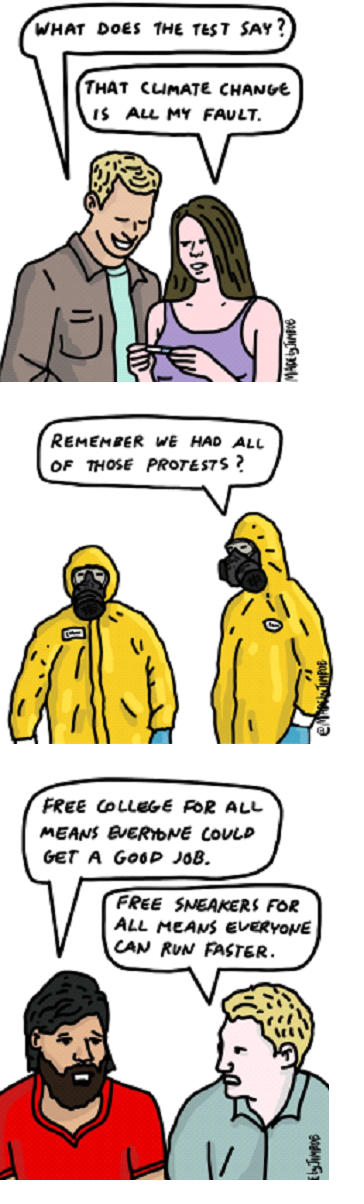
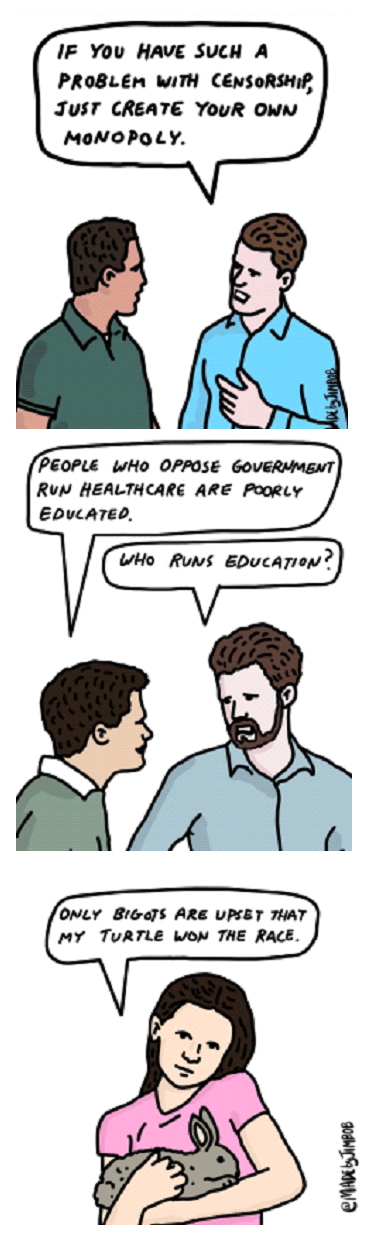
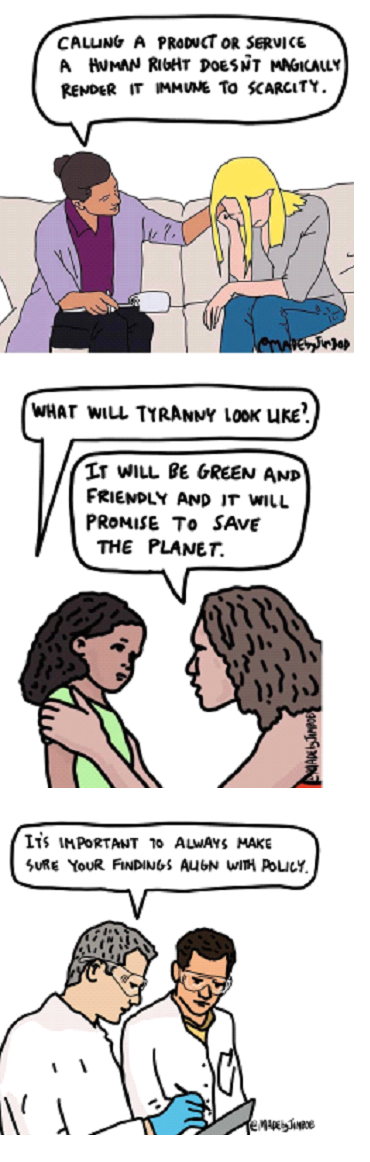
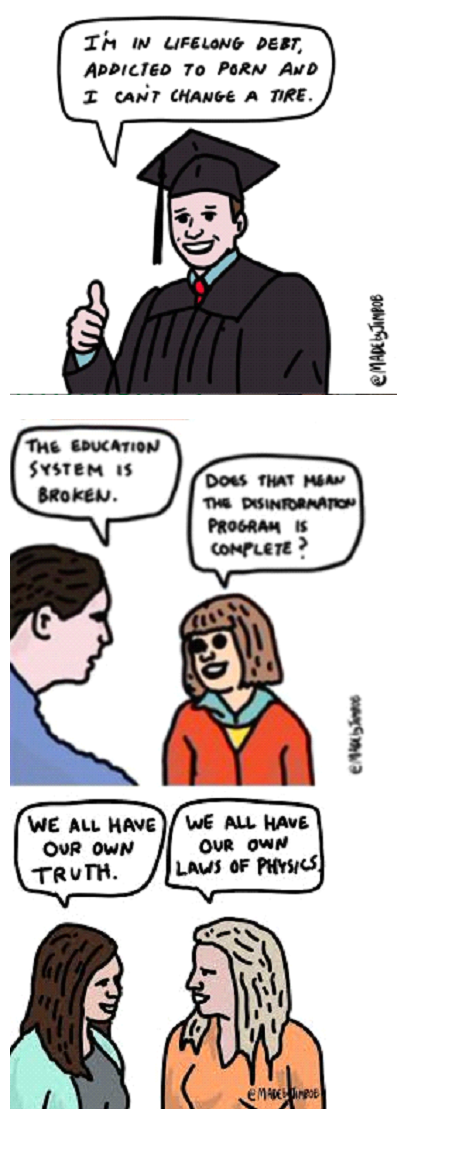
Humor is important as a means of poking holes in narratives that assert beliefs contrary to reality. Jimbob has become a force skewering notions of climate change, as well as other distorted ideas comprising the “woke” PC canon. Those inside the believer bubble will not be affected, but the important audience are those ignorant or agnostic about the so called “progressive, post-modern agenda.” Philosopher Mortimer Adler put it this way:
Any teacher will tell you it is much easier to teach a student who is ignorant than one who is in error, because the student who is in error on a given point thinks that he knows whereas in fact he does not know. . .It is almost necessary to take the student who is in error and first correct the error before you can teach him. . .The path from ignorance to knowledge is shorter than the path from error to knowledge.
And the best part is that the alarmist side is denied any use of humor due to their doomsterism. Below are a selection from the many cartoons madebyjimbob, currently touched by the virus and shutdowns along with everything from climate change to racism, to cancel culture to genderism to the failure of higher education.
Juliana et al. Vs US Federal Government is Dismissed.
A federal appeals court on Friday threw out a lawsuit by children and young adults who claimed U.S. government climate policy put their future in jeopardy, a major blow to the high-profile case after a string of failed similar bids.
In a 2-1 decision, the 9th U.S. Circuit Court of Appeals said the plaintiffs, who were ages 8 to 19 when the lawsuit began, lacked legal standing to pursue their case, and that the issues they raised should be decided by other branches of the federal government.
The decision derails the potentially far-reaching case, one of more than half a dozen similar cases filed in state courts, from Washington to Alaska, by an Oregon-based youth advocacy non-profit called Our Children’s Trust.
The lawsuit had first been filed in an Oregon federal court in 2015, charging that the U.S. government’s environmental and energy policies violated the children and young adults’ constitutional rights to thrive in a liveable atmosphere. (Reporting by Sebastien Malo Editing by Franklin Paul and Frances Kerry) Source: National Post
The panel reversed the district court’s interlocutory orders in an action brought by an environmental organization and individual plaintiffs against the federal government, alleging climate-change related injuries to the plaintiffs caused by the federal government continuing to “permit, authorize, and subsidize” fossil fuel; and remanded to the district court with instructions to dismiss for lack of Article III standing.
Some plaintiffs claimed psychological harms, others impairment to recreational interests, others exacerbated medical conditions, and others damage to property. Plaintiffs alleged violations of their constitutional rights, and sought declaratory relief and an injunction ordering the government to implement a plan to “phase out fossil fuel emissions and draw down excess atmospheric [carbon dioxide].”
The panel held that: the record left little basis for denying that climate change was occurring at an increasingly rapid pace; copious expert evidence established that the unprecedented rise in atmospheric carbon dioxide levels stemmed from fossil fuel combustion and will wreak havoc on the Earth’s climate if unchecked; the record conclusively established that the federal government has long understood the risks of fossil fuel use and increasing carbon dioxide emissions; and the record established that the government’s contribution to climate change was not simply a result of inaction.
The panel rejected the government’s argument that plaintiffs’ claims must proceed, if at all, under the Administrative Procedure Act (“APA”). The panel held that because the APA only allows challenges to discrete agency decisions, the plaintiffs could not effectively pursue their constitutional claims – whatever their merits – under that statute.
The panel considered the three requirements for whether plaintiffs had Article III standing to pursue their constitutional claims. First, the panel held that the district court correctly found that plaintiffs claimed concrete and particularized injuries. Second, the panel held that the district court properly found the Article III causation requirement satisfied for purposes of summary judgment because there was at least a genuine factual dispute as to whether a host of federal policies were a “substantial factor” in causing the plaintiffs’ injuries.
Third, the panel held that plaintiffs’ claimed injuries were not redressable by an Article III court.
Specifically, the panel held that it was beyond the power of an Article III court to order, design, supervise, or implement the plaintiffs’ requested remedial plan where any effective plan would necessarily require a host of complex policy decisions entrusted to the wisdom and discretion of the executive and legislative branches.
The panel reluctantly concluded that the plaintiffs’ case must be made to the political branches or to the electorate at large.
District Judge Staton dissented, and would affirm the district court. Judge Staton wrote that plaintiffs brought suit to enforce the most basic structural principal embedded in our system of liberty: that the Constitution does not condone the Nation’s willful destruction. She would hold that plaintiffs have standing to challenge the government’s conduct, have articulated claims under the Constitution, and have presented sufficient evidence to press those claims at trial.
Several posts here on this legal initiative: For example:
Humor is important as a means of poking holes in narratives that assert beliefs contrary to reality. Jimbob has become a force skewering notions of climate change, as well as other distorted ideas comprising the “woke” PC canon. Those inside the believer bubble will not be affected, but the important audience are those ignorant or agnostic about the so called “progressive, post-modern agenda.” Philosopher Mortimer Adler put it this way:
Any teacher will tell you it is much easier to teach a student who is ignorant than one who is in error, because the student who is in error on a given point thinks that he knows whereas in fact he does not know. . .It is almost necessary to take the student who is in error and first correct the error before you can teach him. . .The path from ignorance to knowledge is shorter than the path from error to knowledge.
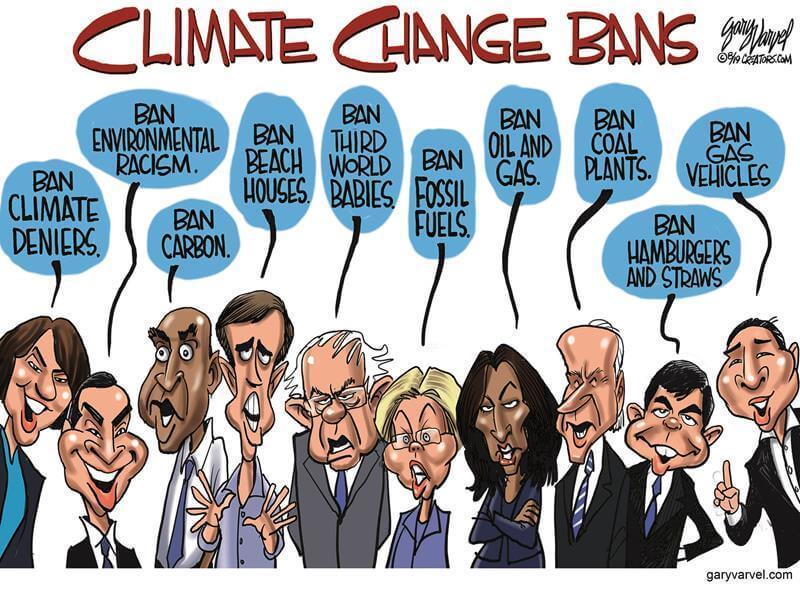
And the best part is that the alarmist side is denied any use of humor due to their doomsterism. Below are a selection from the many cartoons madebyjimbob, touching everything from climate change to racism, to cancel culture to genderism to the failure of higher education.
I have often written that prudent policymakers recognize the future will include periods both warmer and cooler than the present, and cold is the greater threat to human life and prosperity. Thus, government priorities should be to invest in affordable reliable energy and robust infrastructure. A recent article gets the importance of energy abundance, and makes many lucid points about climate policy failures, even while accepting uncritically some mistaken suppositions about the issue and what can be done about it.
Matt Frost published an article at The New Atlantis After Climate Despair. Excerpts in italics with my bolds, some images and comments.
The dream of a global conversion to austerity has failed to stop climate change. Energy abundance is our best hope for living well with warming — and reversing it.
Overview
Each of us constitutes a link between the past and the future, and we share a human need to participate in the life of something that perdures beyond our own years. This is the conservationist — and arguably the conservative — argument for combating climate change: Our descendants, who will have a great deal in common with us, ought to be able to enjoy conditions similar to those that permitted us and our forebears to thrive.
But the dominant narrative of climate change, though it claims to be aimed at protecting future generations, in fact leaves little room for continuity. Preventing more than 1.5 degrees Celsius of warming above the nineteenth-century baseline, the latest aim of the Intergovernmental Panel on Climate Change (IPCC), will, as they put it, require “rapid, far-reaching and unprecedented changes in all aspects of society.”
Only a vanishingly unlikely set of coordinated global actions — an extraordinary political breakthrough — can save us from what the most pessimistic media portrayals describe as “catastrophe,” “apocalypse,” and the “end of civilization.”
Only by changing our entire energy system and social order can we preserve the continuity of our biosphere. And so climate politics has become the art of the impossible: a cycle of increasingly desperate exhortations to impracticable action, presumably in hopes of inspiring at least some half-measures. Understandably, many despair, while others deny that there is a problem, or at least that any solution is possible.
But we are not condemned to a choice between despair and denial. Instead, we must prepare for a future in which we have temporarily failed to arrest climate change — while ensuring that human civilization stubbornly persists, and thrives. Rather than prescribing global austerity, reducing our energy usage and thereby limiting our options for adaptation, we should pursue energy abundance. Only in a high-energy future can we hope eventually to reduce the atmosphere’s carbon, through sequestration and by gradually replacing fossil fuels with low-carbon alternatives.
It is time to acknowledge that catastrophism has failed to bring about the global political breakthrough the climate establishment dreams of, and will not succeed in time to avert serious warming. Instead of despairing over a forever-deferred dream of austerity, our resources would be better spent now on investing in potential technological breakthroughs to reduce atmospheric carbon, and our political imagination better put toward preparing for a future of ever more abundant energy.
[Frost could have added that human flourishing has always occured in warmer, rather than colder times. Our Modern Warm Period was preceded by Medieval Warming, before that by Roman Warming, and earlier Minoan Warming. Each period was cooler than the previous, so the overall trend in our interglacial is downward. Ensuring favorable conditions for future generations means protecting against the ravages of frosty times. (pun intended)]
The Futility of Dread
The bleak poll results may reflect a broad, if perhaps tacit, agreement that we have reached diminishing returns on dread. Even now that most Americans accept the dire predictions of scientists and journalists, their assent does not change the fact that we currently lack the institutional, technological, and moral resources to prevent further climate change in the near term. The lay public has been taught to regard stabilizing the climate as an all-or-nothing struggle against the encroachment of a dismal future.
The bar for success is set high enough that failure is now the rational expectation.
A common reaction to “there is no solution” is “then there is no problem.” No matter how persuasive the evidence of impending danger, most people find ways to dismiss or evade problems that appear insoluble. Attempting to build political support for impossible interventions by making ever more pessimistic predictions will not work; it will only leave us mired in gloom and impotence. This polarized fatalism will grow more extreme as opposing partisans, recognizing our dearth of practicable options, choose either glib denial or morbid brooding.
Entirely predictable Time Magazine declares Greta Person of the Year. Just like Big Brother she is watching.
Missing the Target
We will not stop global warming, at least in our lifetimes. This realization forces us to ask instead what would count as limiting warming enough to sustain our lives and our civilization through the disruption. There can be no single global answer to this question: Our ability to predict climate effects will always be limited, and what will count as acceptable warming to a Norwegian farmer enjoying a longer growing season will always be irreconcilable with that of a Miami resident fighting the sea to save his home. But because our leadership has approached climate change as a problem of coordinated global action, they have constructed quantitative waypoints around which to organize the debate.
Some news sources portrayed 2030 as an official deadline for avoiding climate catastrophe. It is worth noting that the report’s lead author, Myles Allen, has warned against this interpretation: “Please stop saying something globally bad is going to happen in 2030. Bad stuff is already happening and every half a degree of warming matters, but the IPCC does not draw a ‘planetary boundary’ at 1.5 degrees Celsius beyond which lie climate dragons.”
The extreme unlikelihood that we will meet the target of 1.5 degrees becomes even clearer when we notice that doing so requires that we not only cut emissions radically, but at the same time remove enormous volumes of carbon dioxide already emitted. The report estimates that a total of 100 billion tons must be removed by 2050. For comparison, the amount of carbon dioxide emitted globally from fossil fuels last year was around 37 billion tons.
Even were it possible to scale bioenergy and capture that quickly, doing so would have a major drawback: It would take up an immense amount of farmland. By one 2016 estimate, capturing enough carbon to meet even the 2-degree target by the end of the century could require devoting up to three million square miles of farmland to bioenergy crops — nearly the size of the contiguous United States.
[Frost seems not to realize the the 2C target, and more recently 1.5C are both rabbits pulled out of a magical activist hat. Economists have projected that future generations will be far wealthier than us, and only slightly less so should there be all the warming predicted from burning known carbon fuel reserves. Many dangers are based upon scenario RCP8.5 which is so unrealistic that some analysts say that models using it should be revised. Principled inaction is appropriate when threats are claimed without solid evidence.]
The Age of Overshoot
Expanding the climate options we allow ourselves to consider is easier said than done. The political and moral challenges are daunting. We will need to adapt to a warmer climate for perhaps decades to come, while at the same time preparing technological and policy solutions for a more distant future where we can finally claw our way back to lower levels of carbon and warming. At the same time, the stressors that a warmer climate will bring will be unequally felt across the globe, likely making our politics more divided and only dimming hopes for international coordination.
We must finally abandon the empty hope of imposing equitable austerity via globally coordinated government fiat.
Furthermore, as we adapt to a warmer climate, complacency will be tempting, since we will likely not experience a sudden decline in global quality of life or biodiversity, and may be able to avoid the most dire disruptions. Changes will be slow, with many unfolding on a generational time scale, and with dramatically different impacts among populations. The misery that climate change is likely to cause, or is already causing, will be difficult to distinguish from deprivation as we already know it — the people most harmed, that is, will be the poor, who are already most vulnerable to natural forces. Even if there is a distinct moment of irrecoverable failure, or a tipping point that triggers the worst feedback effects, most people might not notice until it has passed.
[His belief that CO2 is some kind of temperature control knob is touching, but naive and dangerous. H2O is actually earth’s thermostat, and we don’t have a dial for that either. Fortunately the climate system includes complex negative feedbacks which throughout history have kept both ice house and hot house eras from being permanent. Otherwise we would not be here to talk about it.]
The global failure to control emissions is not just a failure of political will or technological progress. Rather, it reflects the problem’s inherent resistance to unambiguous characterization. Different observers can all adopt different conceptions of the problem, many of which are not mutually exclusive but remain practically or politically irreconcilable.
For this reason, we will no more agree on some single new ethics than we will on the “correct” amount of atmospheric carbon dioxide.
Addressing the problem, then, must not mean the coordinated pursuit of a single solution but a perpetual process of decentralized negotiation and risk reduction. Our varied conceptions of climate change will never fully converge, and so the “correctness” of any approach is best evaluated not by whether it meets the latest IPCC target but by how well it affords broad political buy-in. Identifying alternatives to our current, failed approach to climate change requires identifying a more constructive set of ideas — practical, political, and sentimental. We will then be able to focus our resources on those interventions most likely to succeed.
[Among the failed solutions is the idea that modern societies can be powered with solar and wind energy. Not only is bioenergy land intensive (as noted above), so are these other renewables. Here is the map of UK showing the acreage required to power London without thermal generators.]
The gray area would be covered in wind farms, while the yellow area is needed for solar farms.
Austerity vs. Abundance
What should motivate our response to climate change is what got us into this mess in the first place: our desire for the abundance that energy technology affords. Energy is the commodity that allows us to protect ourselves from the ravages of nature and to live distinctly human lives, and many of the benefits we enjoy today were made possible by the exploitation of fossil energy. Our children should enjoy greater energy abundance than us, not less.
But the mainstream climate establishment — the government officials, researchers, advocates, and journalists who sustain the consensus agenda represented by the IPCC — is bent on austerity. They demand that we ration fossil energy consumption until zero-emission sources like wind and solar replace the fossil share of the global energy budget.
Discussions about climate change are also riddled with population anxiety. Lugubrious climate dread appears both as the idea that we should not inflict any more humans on this dying world and that we should not inflict this dying world on any more humans. For the most part, we no longer suffer from feverish speculation about runaway global population growth, since the population may peak anyway by the end of the century. Yet we still hear the old Malthusian idea that our limited energy resources will only be enough for everyone if there are fewer people to whom they must be handed out. Because the climate establishment views energy consumption as the problem, energy consumers must be on the negative side of the ledger — even if their welfare, or their grandchildren’s welfare, is supposed to be the good being protected.
An alternate framework based on abundance would engage each of us as participants in the flow of human history, as the forebears of unknown successors. It would complement even the doomsayers’ calls for taking expensive measures today, since the benefits of mitigating climate change would apply to more people as the population increases. The number of future occupants of our planet is, or should be, the salient variable in any calculation of the long-term costs and benefits of climate change mitigation and adaptation measures. We can’t know the economic return on any dollar we invest today in stabilizing the future climate, but we can model it as a function of, among other things, the number of our grandchildren’s grandchildren. Our climate approach should presuppose that we are the benefactors of a burgeoning future population, not the progenitors of an ascetic cult formed to dole out a dwindling stock of resources. New sources of carbon-free energy would offer more value to more people than whatever new levers of social control we might invent to enforce a worldwide carbon-rationing regime.
A stronger focus on human utility does not discount the non-human biosphere: When we evaluate the natural world for its beauty or its diversity, we are still expressing human values, and those values are part of the civilization we hope to carry forward in time. For instance, the desire to protect coral reefs, one of the first casualties of global warming, can increase as more people gain freedom from poverty, allowing them to see the reefs’ aesthetic and ecological benefits as worth spending resources to preserve.
An abundance framework is also aligned with our persistent human desire for comfort, and would lead us to reformulate our collective problem as one of scarcity, rather than prodigality. Instead of constraining our energy budget, we would look to a future in which a large, decarbonized energy capacity allows more people to enjoy the access to wealth and comfort that many of us take for granted. It would make little sense to leave cheap fossil energy underground in the name of future generations’ well-being, only to also leave those descendants an energy-constrained world full of incentives to drill. To remove those incentives, they will need abundant energy.
Obviously, meeting the energy demand of a high-growth world would require new sources of carbon-free power in amounts beyond the IPCC’s most optimistic scenarios. But we are already stuck hoping for a global political breakthrough. Technological breakthroughs are less far-fetched a solution. And a mass embrace of abundant energy is more realistic than sudden globally coordinated altruistic self-abnegation. Once we embrace abundance as a normative principle, it directs our attention and ambition toward the bets that, however long the odds, might actually pay off.
Embracing abundance means more than just a rhetorical or sentimental overhaul; it should change how we rank our policy and technology options. And gaining new energy sources would actually expand our options beyond the limited ones available to us now. Choosing abundance does not require that we first have all the answers for how to produce carbon-free energy, or how to reduce current levels of carbon dioxide. Rather, shifting our mindset from austerity to abundance will open up the political space necessary for imagining these answers and pursuing them.
In the near term, we must accept that expanding our political capacity to regulate carbon dioxide depends on driving down the cost of carbon-free energy. Penalizing fossil-energy use can encourage research and development of alternatives, but panic alone will not engender a new democratic mandate for costly restrictions on emissions. Cheap, low-carbon energy can be an alternative to bureaucratic rationing or socially enforced austerity. If we are stuck hoping for a breakthrough, let us hope for one that further emancipates us from want rather than one that more efficiently imposes it.
After Despair
We are stuck waiting for a breakthrough. The sort of breakthrough we await says much about who we are and where we hope to go. The consensus austerity view would have us hope for a moral breakthrough of penitential retrenchment. The abundance view would have us hope for a technological breakthrough to enable a flourishing future. One says that we have used too much energy, and our descendants should use less. The other implies that we have not devoted enough energy to capturing and storing carbon dioxide, and that we must leave our children and grandchildren as much energy capacity as possible to clean up our carbon waste.
Our mission must be to provide future generations with better technological alternatives than the ones currently on offer, which range from prohibitively expensive (like BECCS) to wildly reckless (like pumping sulfur dioxide into the stratosphere to block sunlight). We owe our descendants progress toward the long-deferred dream of energy “too cheap to meter,” as Lewis Strauss, chairman of the Atomic Energy Commission, famously said in 1954. We owe them the tools with which to dispose of the waste carbon they will inherit. We owe them a better sentimental investment than morbid despair about the future they will occupy.
Other policy approaches are less applicable to a strategic framework of energy abundance. “Weaning ourselves off nuclear energy,” as Senator Elizabeth Warren proposes, is a fatuous idea even within the austerity framework, if the risks of climate change are as dire as predicted. Replacing already online, zero-carbon generation with wind and solar plants that require carbon-emitting construction and infrastructure overhauls will only dig us deeper into debt. In an abundance framework, the proposal becomes even more misguided.
The policy measures we pursue in the near term should express the ethos of abundance and continuity. They should avoid emission cuts today that might limit wealth and technology options tomorrow. And they should set us up to take the best advantage of whatever breakthroughs, technological or political, we might be fortunate enough to see in the coming years.
Key Points
Global conversion to austerity is a lost cause.
Energy abundance is our best hope for the future.
We have always lived well when it warms.
When nature reverses and cools, we had better be ready.
Footnote: Since 1985 the band Opus has celebrated Life and access to energy (I’m sure they were referring to electrical power as well as personal mobility).
Between 2016 and 2018, environmental groups filed over 170 lawsuits alleging violations of the Endangered Species Act, making the ESA one of the most abused environmental laws in the United States. On Monday, the Trump Administration announced much needed revisions to regulations of the ESA.
The response of leading environmentalist groups was entirely predictable. They immediately threatened lawsuits. Indeed, lawsuits make up the core business plan of many purported wildlife conservation groups. They sue the U.S. Fish and Wildlife Service (FWS) for alleged violations of the ESA, and often force agency decisions that do not actually benefit any species.
These groups then seek, and frequently succeed, to recover their attorneys’ fees from the federal government, drawing limited funding away from actual species conservation and into their war chests to fund additional ESA litigation. And the cycle goes on and on.
Major environmentalist groups not only earn money directly from litigation, but they also use lawsuits as a fundraising tool, rallying their donors by claiming to “fight” for endangered and threatened species in the courts, even when those lawsuits do little to promote actual conservation.
Big Environmentalism is doing brisk business these days. Since these groups essentially earn a living by abusing the ESA, they have a lot invested in the status quo. ESA reform is a genuine threat to their business model. They characterized Trump’s proposed reforms as a rollback of protections for species at risk of extinction, but it is actually a rollback of their lucrative legal work that terrifies them.
The Trump Administration is proposing three main changes. The change attracting the greatest criticism involves presenting the public with the economic impacts of listing decisions. It is true that listing decisions under the ESA are supposed to be based upon scientific evidence, without regard to economic impact. However, there is no prohibition on preparing and disclosing the potential economic impacts that would result from listing a species. In fact, officials are required by law to consider economic impacts whenever they designate a critical habitat for a species.
Environmentalists may want to keep the public blind to economic impacts, but that could hardly be said to be in the public’s interest. Too often, environmentalists seek critical habitat designations under the pretense of conserving species, but in fact their true intent is to prevent any resource development.
A second revision raising environmentalist ire is the elimination of its so-called “blanket rule,” which automatically affords threatened species the same protections granted to endangered species. Instead, going forward, FWS will evaluate the threats to newly listed threatened species, and tailor the conservation measures to each species’ needs.
Tailored conservation is smarter conservation. The National Marine Fisheries Service, the federal agency responsible for protecting marine species under the ESA, has never employed the “blanket rule” and has always tailored protections to species’ needs. Furthermore, the “blanket rule” is not provided for by the text of the ESA. Thus, the proposed changes would bring the government’s application of the ESA back into alignment with the Congress’ actual intent.
A third proposed revision to the regulations would clear up some disputed language in the law. Under the ESA, a species may be listed as threatened if it is at risk of becoming endangered in the “foreseeable future.” Previously, the term was undefined, leading to numerous lawsuits intended to force the agency to list species as threatened based upon little more than speculation.
Unfortunately, the weaponization of the ESA will continue until the law is fundamentally changed to eliminate the big dollar incentives that lead to endless litigation in the name of “species conservation.” More reform is needed to curb the rampant abuses of the law by environmental groups. Until then, the “sue and settle” approach will continue clogging up the courts, consuming vast federal resources in endless lawsuits, and taking those resources away from the real work of conservation.
Nevertheless, the proposed reforms are a step in the right direction. The Trump Administration’s ESA rule revision takes power out of the hands of lawyers and puts it back in the hands of scientists and trained wildlife management officials—where it belongs.
Ronald W. Opsahl is an attorney with Mountain States Legal Foundation, specializing in natural resources law, and is a trained wildlife biologist.
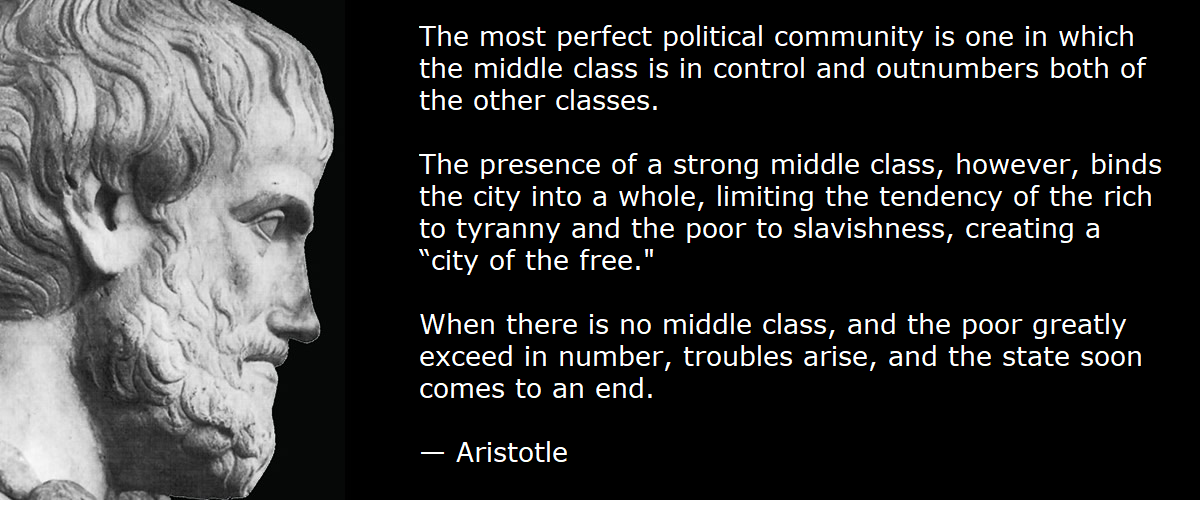 Edward Ring explains in his essay at American Greatness Why America’s Elites Want to End the Middle Class. Excerpts in italics with my bolds.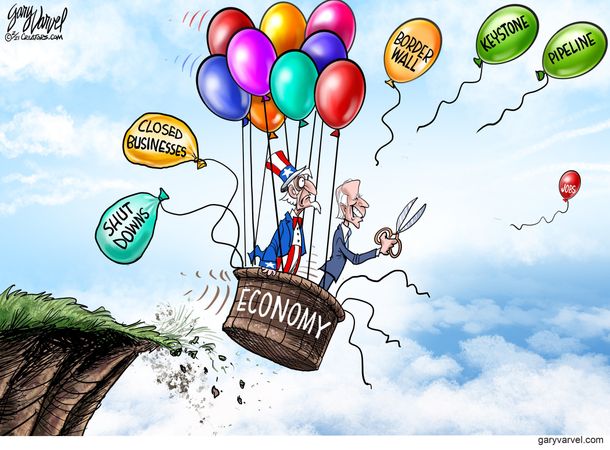






 One of the few pleasures remaining during pandemania involves sports competitions where rules are followed and enforced by unbiased officials, so that teams or individuals win or lose based solely on the merit of their performances. Elsewhere with identity politics and political correctness, it is a different story. People on the right perceive accurately that their opponents on the left are not bound by the rules, and break them readily in order to win.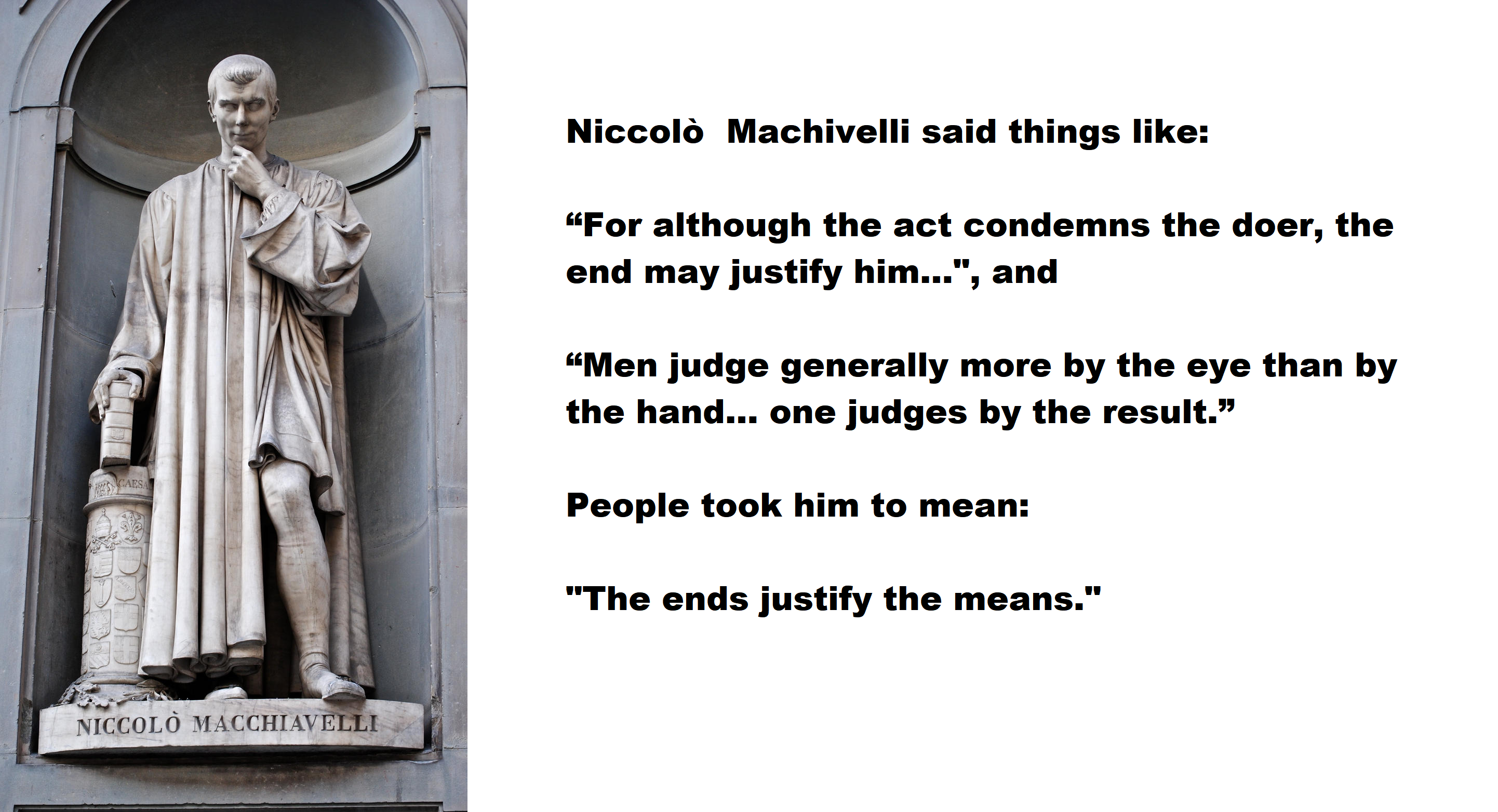


















 Science Matters