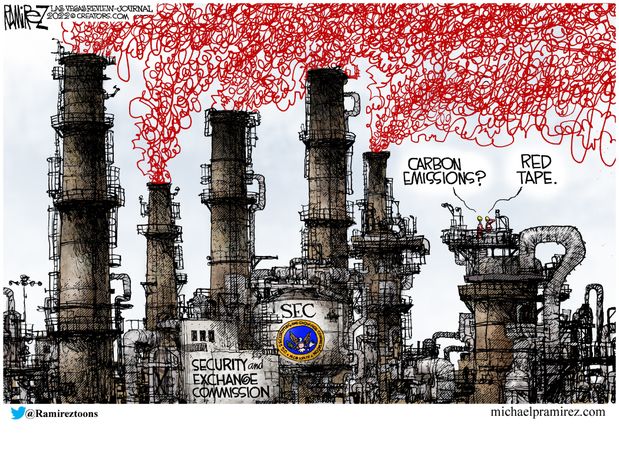
FERC Aims to Decarbonize, Shoots Down Energy Security

Marlo Lewis explains the Biden regime push to undermine critical energy supply in pursuit of climate virtue in his CEI article Why FERC’s Greenhouse Gas Regulatory Policy Cannot Pass a Cost-Benefit Test.  Excerpt in italics with my bolds.

Today, the Competitive Enterprise Institute (CEI) filed comments on the Federal Energy Regulatory Commission’s (FERC) proposal to consider climate change impacts in reviews of infrastructure projects under the Natural Gas Act (NGA). The comments were jointly submitted by my CEI colleague Patrick Michaels; Heritage Foundation Chief Statistician, Data Scientist, and Senior Research Fellow Kevin Dayaratna (commenting as an independent scholar rather than as a representative of any organization); and yours truly.

We submitted comments back in January on FERC’s November 2021 technical conference on the same issues. We advised FERC to steer clear of climate policy, for three main reasons.

1.  Decarbonizing Goals Conflict with Natural Gas Act Purpose

First, the Biden administration’s NetZero agenda to decarbonize and degasify the U.S. electric power sector cannot lawfully be aligned with the Natural Gas Act. Biden’s goals conflict with the NGA’s “principal purpose,” which is to:

 “encourage the orderly development of plentiful supplies
of electricity and natural gas at reasonable prices.”

In addition, climate change is not a factor Congress authorized FERC to consider. The words “climate,” “carbon,” “greenhouse,” “global,” “warming,” “mitigate,” or any of their cognates do not occur in the Act.

2.  Infrastructure Emissions Do Not Threaten the Environment

Second, although the direct and indirect emissions of natural gas infrastructure may be “reasonably foreseeable,” the climate effects are not. FERC’s project reviews are governed by the National Environmental Policy Act (NEPA), which requires scrutiny of major federal actions “significantly affecting the human environment.” Even the emissions of the largest natural gas projects are too small to discernibly affect global climate, and no project’s “carbon footprint” is big enough to influence the fate or fortunes of any community, business, or human being anywhere in the world.

3.  Social Cost of Carbon Is Speculative and Subjective

Third, the social cost of carbon (SCC)—an estimate of the present value of the cumulative climate damages of an incremental ton of carbon dioxide equivalent (CO2e) greenhouse gas (GHG) emissions—is too speculative and subjective, and too easily manipulated for political purposes, to be weighed in the same scales with an infrastructure project’s estimated economic benefits. The Biden administration’s SCC estimates are egregiously biased in favor of climate alarm and regulatory ambition, rendering any agency action that relies on them arbitrary and capricious.

Unsurprisingly, FERC did not take our advice, and proceeded in February to adopt an “interim” policy statement on NGA project review and greenhouse gas (GHG) emissions. That stirred up controversy, including pushback by Senate Energy and Natural Resources Chairman Joe Manchin (D-WV) and Ranking Member John Barrasso (R-WY). As a result, FERC in March demoted its GHG policy statement from “interim” to “draft,” and extended the comment period until today, April 25.

Unlike several presenters at FERC’s November 2021 technical conference, the draft GHG policy statement does not advocate requiring SCC analysis in NGA determinations of public convenience and necessity. Neither, however, does FERC disavow an intent to require it in later policy statements. The Commission may simply be waiting for the Biden administration’s Interagency Working Group (IWG) to finalize its interim SCC estimates, or for courts to resolve Louisiana’s challenge to federal agencies’ use of those metrics.

The Commission’s draft GHG policy statement establishes a “rebuttable presumption that proposed projects with 100,000 metric tons per year of carbon dioxide equivalents (CO2e) emissions will be deemed to have a significant impact on climate change.” FERC also implies that it may condition project approval on the sponsor’s plans to “mitigate all or a portion of the project’s climate change impacts.”

The camel’s nose is already under the tent.

It is not hard to guess where this is going if FERC does not quickly reverse course. The usual suspects will pressure the Commission to:

(1) progressively lower climate significance thresholds,
(2) monetize undetectably small project-related climate “impacts” using agenda-driven SCC estimates, and
(3) either reject needed natural gas infrastructure projects outright or impose mitigation requirements that render them uneconomic.

This is bad policy, as Michaels, Dayaratna, and I explained in our January 7 comments. If an infrastructure project is commercially viable and helps ensure plentiful supplies of electricity and natural gas at reasonable prices (the NGA’s principal purpose), the Commission knows in advance that the project’s economic benefits far exceed its climate-related externalities. Therefore, no further investigation of the project’s GHG emissions is required, nor does it make sense to condition the certificate of public convenience and necessity on the project’s adoption of mitigation measures.

Conclusion

New research by Dayaratna (hereafter “Heritage analysis”) further confirms that conclusion. Using the U.S. government’s leading energy and climate policy models, the Heritage analysis demonstrates that banning construction of new U.S. pipelines would have a negligible effect on U.S. annual CO2 emissions through 2050 and, thus, a similarly negligible effect on global temperatures through 2100. The policy implication for FERC is clear. No level of overregulation or prohibition that regulators might apply to the development of U.S. natural gas pipelines could meaningfully affect the Earth’s climate.

Consequently, no regulation or prohibition of new natural gas pipelines could possibly be worth the economic losses imposed on construction companies, natural gas producers, and energy consumers.

See Also Seeking Climate and Energy Security

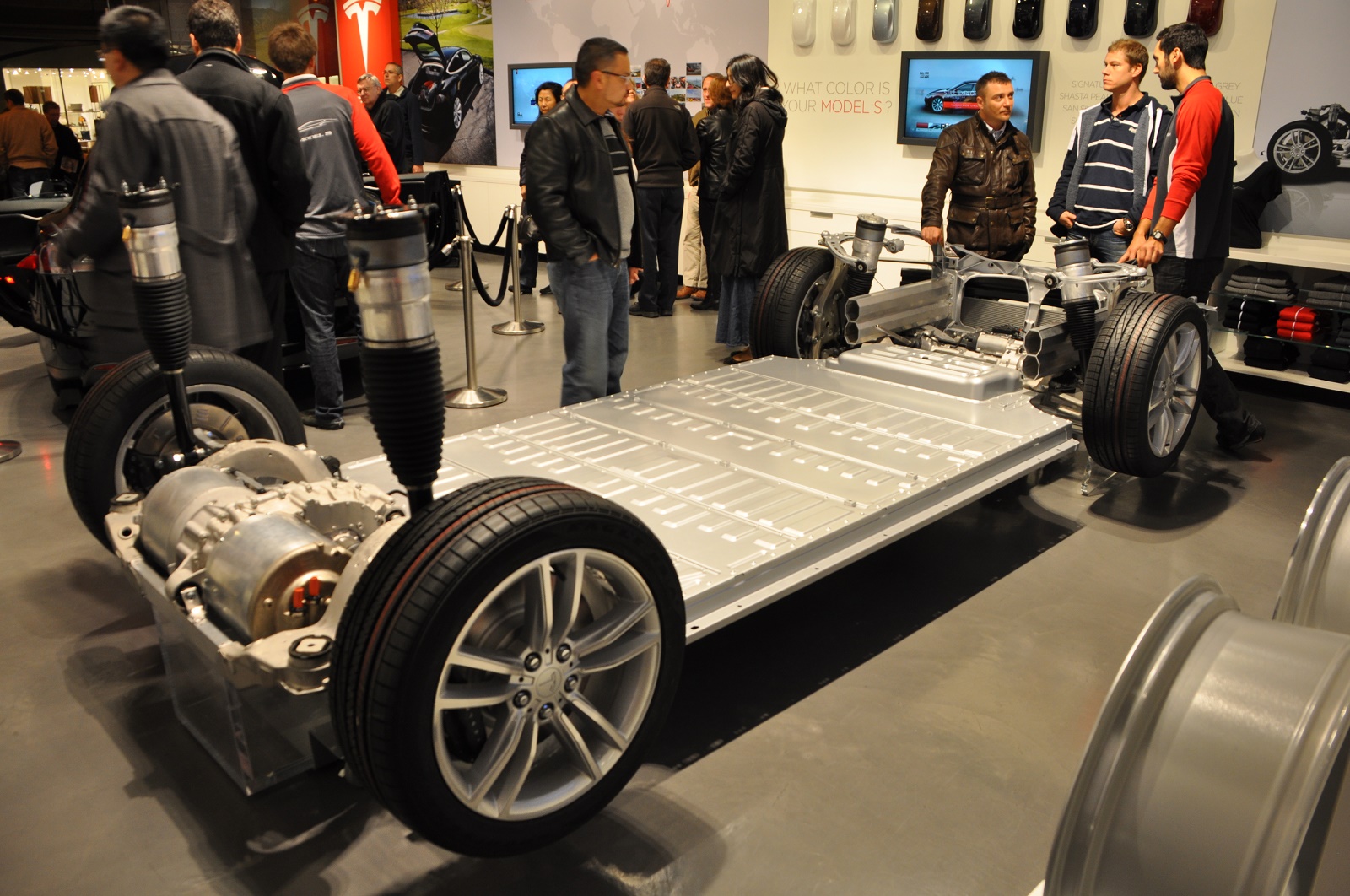
If That Tesla Battery Could Talk

Let’s imagine what an EV battery could tell us about its reality. A short story.  H/T Graeme Weber

The packed auditorium was abuzz; nobody seemed to know what to expect. The only hint was a large aluminum block sitting on a sturdy table on the stage.

When the crowd settled down, a scholarly-looking man walked out and put his hand on the shiny block, “Good evening,” he said, “I am here to introduce NMC532-X,” and he patted the block, “we call him NM for short,” and the man smiled proudly. “NM is a typical electric vehicle (EV) car battery in every way except one; we programmed him to send signals of the internal movements of his electrons when charging, discharging, and in several other conditions. We wanted to know what it feels like to be a battery. We don’t know how it happened, but NM began to talk after we downloaded the program.

“Despite this ability, we put him in a car for a year and then asked him if he’d like to do presentations about batteries. He readily agreed on the condition he could say whatever he wanted. We thought that was fine, and so, without further ado, I’ll turn the floor over to NM;” the man turned and walked off the stage.

“Good evening,” NM said. He had a slightly affected accent, and when he spoke, he lit up in different colors.

“A few days ago, at the start of my last lecture, three people walked out. But here is what I noticed about them. One was wearing a battery-powered hearing aid, one tapped on his battery-powered cell phone as he left, and a third got into his car — which would not start without a battery. So, I’d like you to think about your day for a moment; how many batteries do you rely on?”

He paused for a full minute which gave people time to count their batteries. Then he went on, “Now, it is not elementary to ask, ‘what is a battery?’ I think Mr. Tesla said it best when they called us Energy Storage Systems. That’s important. We do not make electricity — we store electricity produced elsewhere, primarily by coal, uranium, natural gas-powered plants, or diesel-fueled generators. So, to say an EV is a zero-emission vehicle is not at all valid. Also, since 40% of the electricity generated in the U.S. is from coal-fired plants, it follows that 40% of the EVs on the road are coal-powered, n’est-ce pas?”

He flashed blue again. “Einstein’s formula, E=MC2, tells us it takes the same amount of energy to move a 5,000 lb. gasoline-driven automobile a mile as it does an electric one. The only question again is, what produces the power? To reiterate, it does not come from the battery; the battery is only the storage device, like a gas tank in a car.”

He lit up red when he said that, and then he continued in blue and orange. “Mr. Elkay introduced me as NMC532. If I were the battery from your computer mouse, Elkay would introduce me as AA, if from your cell phone as CR2032, and so on. We batteries all have the same name depending on our design. By the way, the ‘X’ in my name stands for ‘experimental.’

“There are two orders of batteries: rechargeable and single use. The most common single-use batteries are A, AA, AAA, C, D, 9V, and lantern types. Those dry-cell species use zinc, manganese, lithium, silver oxide, or zinc and carbon to store electricity chemically. Please note they all contain toxic, heavy metals.

“Rechargeable batteries only differ in their internal materials, usually lithium-ion, nickel-metal oxide, and nickel-cadmium.

“The United States uses three billion of these two battery types a year, and most are not recycled; they end up in landfills. If you throw your small, used batteries in the trash, here is what happens to them.

“All batteries are self-discharging. That means even when not in use, they leak tiny amounts of energy. You have likely ruined a flashlight or two from an old, ruptured battery. When a battery runs down and can no longer power a toy or light, you think of it as dead; well, it is not. It continues to leak small amounts of electricity. As the chemicals inside it run out, pressure builds inside the battery’s metal casing, and eventually, it cracks. The metals left inside then ooze out. The ooze in your ruined flashlight is toxic, and so is the ooze that will inevitably leak from every battery in a landfill. All batteries eventually rupture; it just takes rechargeable batteries longer to end up in the landfill.

“In addition to dry-cell batteries, there are also wet-cell ones used in automobiles, boats, and motorcycles. The good thing about those is, 90% of them are recycled. Unfortunately, the cost of recycling EV batteries is more expensive than the cost of mining and creating a new battery. EV batteries that don’t have enough potency to power a vehicle can sometimes be used to power home appliances, street lights or solar panel backup until they finally lose all their energy.

“But that is not half of it. For those of you excited about electric cars and a green revolution, I want you to take a closer look at batteries and windmills and solar panels. These three technologies share what we call environmentally destructive embedded costs.”

NM got redder as he spoke. “Everything manufactured has two costs associated with it: embedded costs and operating costs. I will explain embedded costs using a can of baked beans as my subject.

“In this scenario, baked beans are on sale for $1.75 a can. As you head to the checkout, you begin to think about the embedded costs in the can of beans.

“The first cost is the diesel fuel the farmer used to plow the field, till the ground, harvest the beans, and transport them to the food processor. Not only is his diesel fuel an embedded cost, so are the costs to build the tractors, combines, and trucks. In addition, the farmer might use a nitrogen fertilizer made from natural gas.

“Next is the energy costs of cooking the beans, heating the building, transporting the workers, and paying for the vast amounts of electricity used to run the plant. The steel can holding the beans is also an embedded cost. Making the steel can requires mining taconite, shipping it by boat, extracting the iron, placing it in a coal-fired blast furnace, and adding carbon. Then it’s back on another truck to take the beans to the grocery store. Finally, add in the cost of the gasoline for your car.

“But wait — can you guess one of the highest but rarely acknowledged embedded costs? It’s the depreciation on the 5000-lb. car you used to transport one pound of canned beans!”

“But that can of beans is nothing compared to me! I am hundreds of times more complicated. My embedded costs not only come in the form of energy use; they come as environmental destruction, pollution, disease, child labor, and the cost to be recycled.”

He paused, “I weigh 1,000 pounds, and as you see, I am about the size of a travel trunk. I contain 25 pounds of lithium, 60 pounds of nickel, 44 pounds of manganese, 30 pounds cobalt, 200 pounds of copper, and 400 pounds of aluminum, steel, and plastic. Inside me are 6,831 individual lithium-ion cells.

“It should concern you that all those toxic components come from mining. For instance, to manufacture EACH auto battery like me, you must process 25,000 pounds of brine for the lithium, 30,000 pounds of ore for the cobalt, 5,000 pounds of ore for the nickel, and 25,000 pounds of ore for copper. All told, you dig up 500,000 pounds of the earth’s crust for just. one. battery.

“I mentioned disease and child labor a moment ago. Here’s why. Sixty-eight percent of the world’s cobalt, a significant part of a battery, comes from the Congo. Their mines have no pollution controls, and they employ children who die from handling this toxic material. Should we factor in these diseased kids as part of the cost of driving an electric car?”

400MW/1600MWh Moss Landing Energy Storage Facility in California Image: LG Energy Solution

“Finally, “I’d like to leave you with these thoughts. California is building the largest battery in the world near San Francisco, and they intend to power it from solar panels and windmills. They claim this is the ultimate in being ‘green,’ but it is not! This construction project is creating an environmental disaster. Let me tell you why.

“The main problem with solar arrays is the chemicals needed to process silicate into the silicon used in the panels. To make pure enough silicon requires processing it with hydrochloric acid, sulfuric acid, nitric acid, hydrogen fluoride, trichloroethane, and acetone. In addition, they also need gallium, arsenide, copper-indium-gallium-diselenide, and cadmium-telluride, which also are highly toxic. Silicon dust is a hazard to the workers, and the panels cannot be recycled.

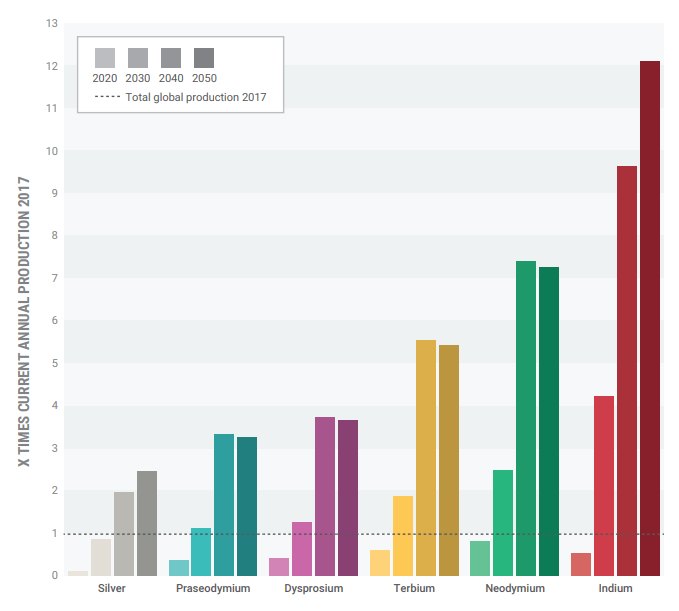
“Windmills are the ultimate in embedded costs and environmental destruction. Each weighs 1688 tons (the equivalent of 23 houses) and contains 1300 tons of concrete, 295 tons of steel, 48 tons of iron, 24 tons of fiberglass, and the hard to extract rare earths neodymium, praseodymium, and dysprosium. Each blade weighs 81,000 pounds and will last 15 to 20 years, at which time it must be replaced. We cannot recycle used blades. Sadly, both solar arrays and windmills kill birds, bats, sea life, and migratory insects.

“There may be a place for these technologies, but you must look beyond the myth of zero emissions. I predict EVs and windmills will be abandoned once the embedded environmental costs of making and replacing them become apparent. I’m trying to do my part with these lectures.”

See Also World of Hurt from Climate Policies, Part 3 Wind and Solar Infrastructure Consumes Rare Metals Far Beyond World Supplies

Global critical metal demand for wind and solar power plants

When considering a global perspective, the critical metal demand for our future renewable electricity production is significant. This graph shows the annual metal demand for the six most critical metals, compared to the annual production. The dotted line represents present-day annual production.  

Elitist Lies About Inflation

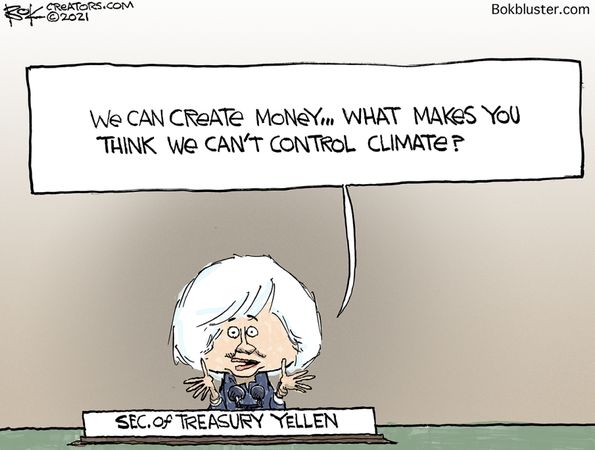
The editors at Issues and Insights reveal false and misleading statements by a leading elitist spokesperson, US Treasury Secretary Janet Yellen.  The article is  See If You Can Follow Yellen’s Bouncing Inflation Ball.  Excerpts in italics with my bolds.

Treasury Secretary Janet Yellen said over the weekend that we’re going to have to “put up with inflation for a while longer,” which means that she has now held just about every possible — and almost always wrong — position on an issue about which she is supposedly an expert. Is it any wonder nobody trusts elites anymore?

Yellen was on CNBC over the weekend and, when asked whether inflation had peaked, said:

“Well, it may have peaked, but … I think the shocks emanating from this unjustified attack on Ukraine will prolong inflationary pressures. So, the outlook is uncertain. As you know, the Fed is taking steps to bring inflation down, but I think we will have to put up with high inflation for a while longer.”

Let’s leave aside Yellen’s dubious claim that Russia’s invasion of Ukraine has had any meaningful impact on inflation. Why would it? Iraq’s invasion of Kuwait, which was far more disruptive to the global oil market, bumped oil prices up for a short period but had no broader inflationary effect.

The Putin-is-to-blame for skyrocketing prices is one of team Biden’s big lies
meant to deflect blame. But the press never calls them on it.

No, what’s really troubling is the fact that Biden’s Treasury secretary has been so utterly clueless about inflation since joining his cabinet.

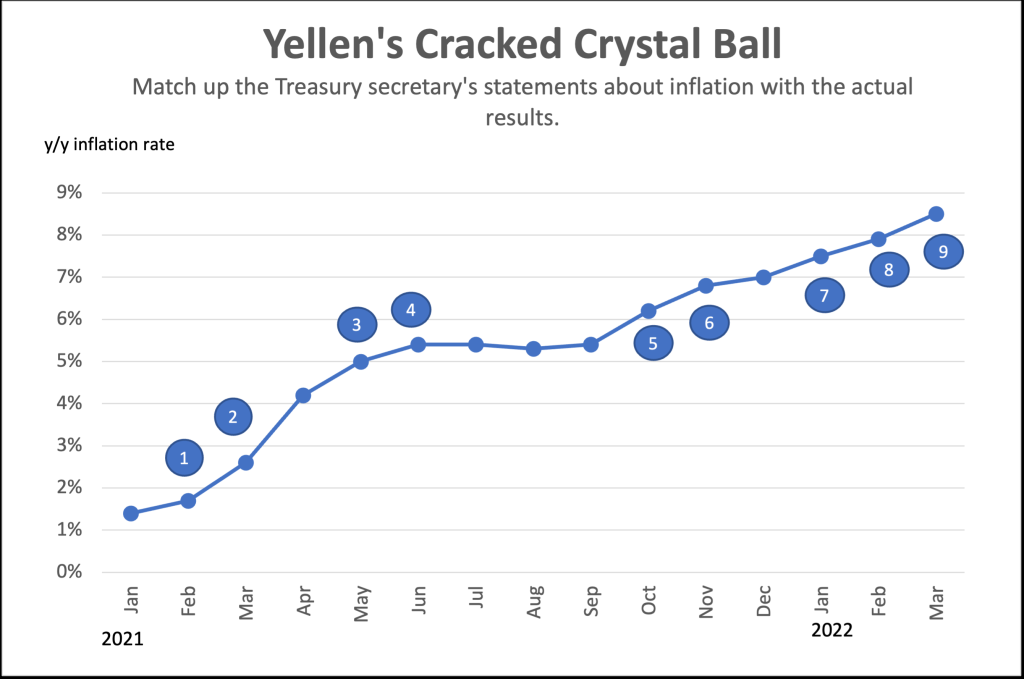
Let’s look at what Yellen has claimed about inflation since early last year and the actual results. The chart shows what inflation was doing when she made these statements.

  1. February 2021: “I’ve spent many years studying inflation and worrying about inflation, and I can tell you, we have the tools to deal with that risk if it materializes.”
  2. March 2021: “I don’t think it’s a significant risk. And if it materializes, we’ll certainly monitor for it, but we have tools to address it.”
  3. May 2021: “I don’t think there’s going to be an inflationary problem, but if there is, the Fed can be counted on.”
  4. June 2021: “Supply bottlenecks have developed that have caused inflation. I believe that they’re transitory, but that doesn’t mean they’ll go away over the next several months.”
  5. October 2021: “I don’t think we’re about to lose control of inflation.
  6. November 2021: “If we want to get inflation down, I think continuing to make progress against the pandemic is the most important thing we can do.”
  7. January 2022: “If we’re successful in controlling the pandemic, I expect inflation to diminish over the course of the year and hopefully revert to normal levels by the end of the year around 2%.”
  8. February 2022: “I think people heard ‘transitory,’ and to them it meant a couple of months. Maybe a better word could have been chosen.”
  9. March 2022: “We’re likely to see another year in which 12-month inflation numbers remain very uncomfortably high.”

Keep in mind who we are talking about here. Yellen has a sterling resume. A doctorate in economics from Yale. Professorships at Harvard and the University of California, Berkeley. On the faculty of the London School of Economics. President of the Western Economic Association and vice president of the American Economic Association. Head of the Council of Economic Advisors under President Bill Clinton. President of the Federal Reserve Bank of San Francisco. Chairwoman of the Federal Reserve.

So how in the world can her pronouncements about inflation under President Joe Biden be as reliable as the weather forecast? Is her understanding of economics tainted by liberal ideology? Is she just doing the bidding of an incompetent and desperate Biden administration?

Does it matter? Yellen is a shining example of why so many in this country
feel betrayed by the people who claim lordship over them.


Seeking Climate and Energy Security

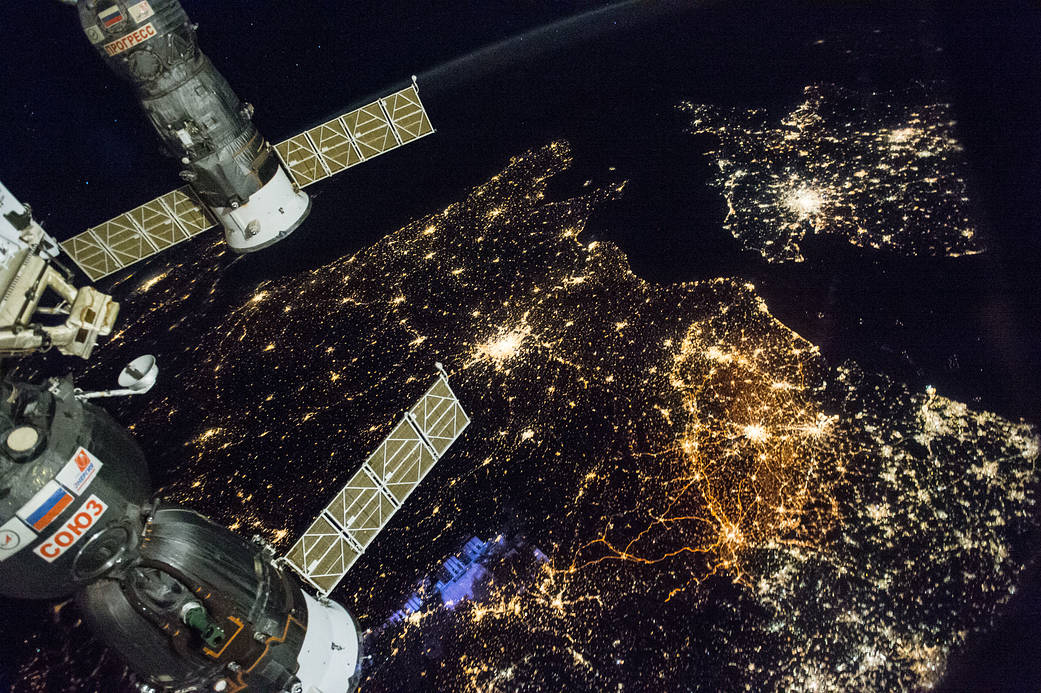
Europe at night from space NASA 2016

News is out that US Senators are meeting in search of (using Sen. Joe Manchin’s words)  “a bipartisan climate and energy security package.” . . .  “It’s urgent to find out if there is a pathway.”

The principals should attend to Dieter Helm’s expert March 2022 analysis of Climate and Energy Security entitled Energy policy  Some excerpts are below in italics with my bolds, suggesting the thrust of his wisdom in this regard.

Introduction

Energy policy is not rocket science. It is about achieving core objectives – security of supply and decarbonisation – and achieving them at the lowest cost. Neither will be met by purely private markets, since the former is a public good and carbon is an externality not properly integrated in competitive markets. Furthermore, energy is a primary good for citizens: not to have energy deprives people and businesses from access to the wider economy and to society. It is a core USO: a Universal Service Obligation. That is why energy cannot be treated like any other commodity, as some of the architects of the “privatisation, liberalisation and competition” paradigm believed. Citizens are more than just consumers.

Security of supply requires a capacity margin: “just in case” rather than “just in time”. Decarbonisation requires more renewables, possibly nuclear, and maybe hydrogen, carbon capture and storage (CCS) and an active demand side. Security of supply sits in this decarbonisation context, and because many of the options on the generation side are intermittent, security of supply takes on a much more demanding dimension – not just the old question of access to fuels and power, but the ability to handle large-scale intermittency.

The Policy Mess We Are In

This pressure to “do something” is most intense in a “crisis”, and what is happening right now is a classic example. Lots of interventions currently being proposed by all the lobbyists are likely to make things worse.

Complexity is a lobbyist’s utopia. Engaged in each consultation, clear about the single aims of its vested interest, able to engage in each and every consultation, able to brief MPs, the media and the ministers, and sow doubt where interests are threatened, it is no wonder that the energy sector is now close to resembling that of agriculture, captured by the core interests. Spending (and it is very large-scale spending) on lobbying keeps going up as the government is more and more engaged in the details of all the main contracts.

These lobby interests have been very successful in getting subsidies and convincing government that the transition to net zero is going to be cheap (just not yet), and that there is no threat to security. Just go for net zero, they argue – on a territorial carbon production basis – sign up for lots and lots of targets and then, once the fish is hooked, play in the threat of failures and hence the case for more and more subsidies. (If it was all so cheap, we could of course abolish the subsidies – but no vested interest is demanding the end to subsidies.)

The facts –not only that decarbonisation is essential, but it is going to cost a lot – remain, and they are increasingly emerging. Each time they do, the lobbyists turn to the Treasury and ask the taxpayer to bail them out.

At its simplest, the government has been pursuing decarbonisation without addressing in parallel the security of supply implications. The failures are multiple. It is not just the gas price and the collapse of suppliers; it is also about the balancing market, and the distribution companies.

Behind all of these is the lack of a coherent market design
fit for the decarbonising purposes.

Exposure to the spot markets, with no storage and no special relationship to North Sea producers, is only one reason why the gas price increases hit the UK particularly hard. A second reason is that the UK has built a lot of intermittent wind capacity without thinking through how to manage the intermittency. In the UK (for good reasons) there is very little coal generation capacity left – except DRAX. For all the hype about batteries and smart demand management, the fact is that gas (and small diesel generators) is almost all that is currently left to do the heavy lifting.

In a renewables energy system, there needs to be a lot more capacity
to meet any given demand.

In theory, if there was no wind, then there would need to be another complete system to be on standby. As demand keeps going down – in part because of de-industrialisation (industry demand is down 20% since 2000) – capacity has been going up towards the 100GW mark, an increased requirement of over 20GW for a significantly lower total demand. It will need to go up a lot more with 40GW of offshore wind as planned. It seems to have escaped the notice of all those projecting that the costs of the transition would be very low, and claiming that renewables are cost-competitive with fossil fuels, that all this capacity has to earn a reasonable rate of return. It is a cost of renewables.

Needing the gas capacity is only one dimension of the problem. The other is how to deliver it, given that the wind has a marginal cost close to zero. Whereas a conventional gas power station could rely on running most of the time when first built, now it is itself intermittent, depending on whether the wind is blowing. This breaks the conventional back of the economics of gas investment. Hence there is no merchant gas investment. Gas shifts from being driven by a normal wholesale market towards a strategic reserve of capacity. The market design has not caught up with this. Gas now needs a capacity payment to make its reasonable return, and hence a capacity contract, which only the government can underpin.

Back to Basics

The very concept of a competitive retail energy supply market cuts across the basic idea that energy is a USO. Some think that goes beyond the pure commodity to an essential service necessary for a citizen to participate in society. Without electricity and gas, citizens can die of hyperthermia (quite a lot do each winter), they cannot access the internet, phones may not work, and the freezer thaws out. Any decent society recognises that energy cannot be simply about price, supply and demand. Yet that is precisely what the architects of the privatisation and liberalisation paradigm thought they were doing. The current crisis is not just about whether people can or will pay: it is also about all those voluntary actions to stop using the heating and the electricity, with all the consequences for the poor that this implies. Paying the electricity bill can be a trade-off with food.

The supply market is now broken, and it is unlikely that many customers will now want to switch – especially amongst the poorer ones. The government has had to step in to bail out Bulb. All electricity customers are now going to pay more than £60 each in their bills to pick up the tab for the costs of sorting out all the company failures. We have come full circle, back to an oligopoly again, and one that will need proper regulation.

The right way to address supply is to start with what customers want, to ensure that the companies serve the customers, not that the customers serve the interests of the suppliers.

How It Could Be Different

Though it is true that we are where we are, it is worth considering how it could be different by looking at what is happening elsewhere. Recall the reasons why the gas price increases have hit so hard are that the UK has lots of intermittent wind, and the electricity price is determined by the (marginal) wholesale price. Intermittency reads across to greater demand for gas, and that translates straight into the electricity price. The gas and electricity price paths match each other remarkably closely in the UK.

To see how it could be different, consider what is happening in France. It is around 70% nuclear and has a lot of hydropower. As the gas prices have shot up, the cost of nuclear and hydropower has not changed at all. Similarly in the UK, the cost of wind, solar and nuclear generation has not gone up. But now the difference. In France, the price increases are being limited to 4%. This reflects the costs. EDF understandably protests that this will lose it money (around €8 billion), because it could have sold its power into the EU markets at the spot price.

But the €8 billion is not a loss, but rather an additional profit that would go to EDF. Since EDF is largely owned by the French state, the €8 billion would be a taxpayer gain, and stands against a customer gain if the benefits of a stable nuclear power supply go to the French citizens and industry. Quite why Germans should benefit from French nuclear at this point of the gas price crisis, when it has closed its own nuclear fleet, is hard to fathom.

The building blocks of a sensible energy policy

Energy policy is all about setting a system framework within which markets operate to deliver what citizens and customers want. It starts with setting the objectives, and then ensures that these are met by a set of institutions, interventions, regulations, licences and auctions and so on.

The objectives

There are two primary objectives: security of supply and decarbonisation. Unless these are clearly and appropriately specified, no amount of ingenuity about the development of policies will be anything other than inefficient.

Security of supply includes price and costs, as does decarbonisation. Setting either independently of prices and costs make them unlikely to be attainable. In both cases higher prices have an impact on demand and hence the required supply-side infrastructure, reserves, capacity margins and the total envelope of investments. For example, gas security is always possible if the price is high enough. Supply equals demand at a clearing price. Security of supply has to be at reasonable costs, as must decarbonisation.

Both objectives are currently set as if they are independent of prices and costs. Hence they are in doubt: market participants need to try to guess the reaction function of government if and when customers and voters rebel or are simply unable to pay. In particular, there is an assumption as noted above that decarbonisation will be very low cost (perhaps 1% GDP per annum), but this is hopelessly unrealistic – it assumes as noted, for example, not only that the costs of renewables and low-carbon technologies will keep falling, but also that government policy will be perfect. There will be no government failure.

This is nonsense. Pretending that the costs are low to get governments signed up is a classic NGO trick, but the unfortunate reality is that the costs do not go away by assumption. In the current circumstances, few can bank on getting the net zero for the electricity sector by 2035. The uncertainty raises risk and hence the cost of capital.

The security of supply objective is also ill-defined, if defined at all. How much risk does the government want the economy and its companies and citizens to take that they will face price shocks? It is easy to be very secure, provided the economy can withstand the costs of a range of policies, including strategic stocks, reinforced networks and large capacity margins. We could, for example, agree to pay whatever it takes to secure LNG cargoes by agreeing to outbid every other country in the world. The costs of all of this would be beyond those that the economy could withstand.

The task of government in general, and BEIS in particular, is to set out serious and sensible objectives, and then delegate their achievement in a credible way.

Stakes in the ground

There are a number of decisions which cannot be taken by the private sector, or at least not without a very high cost of capital. The government is already the central buyer for almost everything in the electricity sector – directly or indirectly. Almost all new generation comes with a government-backed contract: a capacity contract or a CfD or a RAB. All the networks are regulated, and the regulator has a duty to finance functions in one form or another. The government controls the North Sea licences for oil and gas, and The Crown Estate runs the seabed licences.

The first stake in the ground concerns nuclear.

It can never be a purely private investment, for multiple reasons. Waste is an intergenerational liability. The political nature of nuclear means that investors always face the risk that government performs the sorts of U-turns made in Germany. Limited liability of private sector firms leaves the government with the unlimited liabilities. These considerations trump the further worries about the length of the project, cost and construction overruns, and changing regulatory requirements. Every major incident globally at a nuclear facility leads to a review of safety regulators, and safety regulators usually come up with new tighter regulations as a result.

Having a nuclear capability is part and parcel of having a robust nuclear programme, as it is of a military nuclear deterrence. Looking ahead, it is possible to envisage a joint UK– France nuclear programme, adding France’s six to say four to six in the UK, making a programme of at least ten. This would yield a supply chain. But it would need a UK company as part of the deal and a joint political framework. All of this, in the current context, is fantasy. If the UK does nuclear, it will be far less ambitious, less joined-up, and probably much more costly.

The conclusion that follows is that it is very hard to think of any worse way of taking nuclear decisions than the recent past in Britain. It maximises the cost of capital without complete risk transfer, and it minimises the supply chain efficiencies. Opting for more nuclear now as part of a security and decarbonising strategy requires the ambition to be matched by a more coherent and joined-up commitment, sustained over more than a decade.

A second stake in the ground is offshore and onshore wind.

The key point about wind is its difficult economics: it is low-density, disaggregated, intermittent and remote from consumers. Nevertheless, its lobbyists claim that wind is the cheapest form of electricity generation. Sadly this is not true once the full costs are taken into account, and that means that it is government that has to decide how much offshore and onshore wind and has to provide the subsidies to the full costs to make it happen. The regulator has to instruct the network companies to build an interconnected system between the offshore wind farms and then between the wind farms and the mainland grids. Offshore wind – the main play – differs from nuclear in all the above respects. It also differs in having shorter lead times and its components can be manufactured, currently primarily in China.

The stake in the ground decisions about the volume of offshore and onshore wind are conditional on deciding about the system infrastructure to collect and distribute the energy, and how to deal with the intermittency.

This is a system question that depends not only on the quantity in GWs of offshore wind in particular, but also on what else is on the system at the same time. It is rarely observed that the decision about wind needs to be taken in conjunction with the decision about gas – at least until there is a largescale alternative storage technology that can cope with longer periods of low wind, notably in winter (but increasingly in summer, too, as the air conditioning loads grow). Given the 2035 target for decarbonising electricity, the gas decision depends in turn on the CCS decision, since more wind means more gas, which means more CCS if the gas is to meet the net zero requirement by 2035.

This leads to the third stake in the ground – CCS.

Successive governments have stalled on CCS (Carbon Capture and Storage) investments and decisions. As noted, a Treasury paper in 2007 promised £1 billion of support to develop CCS. Fifteen years later, and despite there being even a competition for the £1 billion, CCS remains largely on the drawing board. It requires a regulatory and licences framework, a liability insurance regime, a pipeline system, and a price of carbon sequestrated.

Though all of this is reasonably straightforward, these ancillary stakes in the ground are not yet in place, and the clock is ticking both as the offshore wind develops and the 2035 deadline gets ever closer.

The fourth stake is the new kid on the block – hydrogen and green ammonia.

It is unlikely to be the last “new kid”. The promise of hydrogen is that it can be manufactured by using excess wind and perhaps even solar, thereby being truly “green”. (Nuclear could do this too, though it is unlikely to be surplus unless on a French scale.) In the meantime, hydrogen is “blue”, made from natural gas, which brings us back to CCS. Blue hydrogen is inconsistent with the net zero targets without CCS. The hydrogen decision differs from the nuclear and wind stakes in the ground because it is very much at the R&D and demonstration stage. R&D is a public good and hence there is an obvious role here for government support.

There are several other stakes in the ground, though they tend to be more about the frameworks and less the technology per se. Solar falls into this category, and targets are particularly inappropriate given the major differences between rooftop, household, farmland and other variants. In an ideal world with perfect foresight, governments might want to go further, but there are corollary dangers as the lobbyists get their teeth into government and regulators, and getting the really big decisions right on the above stakes in the ground would be a major achievement. All of the above are decisions which cannot be taken by markets.

Governments should resist the temptation to do everything. Just doing a few things well would be a massive improvement on the current policy mess described above.

Delivering the plan – guidance and the system operator and regional system operators

Government can and indeed has to take the decisions about the major stakes in the ground. What then is required is a plan to deliver the energy system within which these stakes are embedded.

These objectives will not be achieved without a plan. If, for example, the government seriously intends to get to net zero for the electricity sector by 2035, then with 13 years to go, it needs to radically up its game and set out a plan to get from here to there. To give some examples, if part of the plan is to build lots more offshore wind and to increase electricity capacity to tackle transport and some heating, then as noted it will need a lot of gas capacity to back it all up. That in turn will need CCS, since electricity will not be net zero if there is a lot of gas on the system unless the gas is net zero and the only plausible way of doing this is to use very large-scale CCS. Similarly, it makes a lot of difference to the networks and the capacity requirement whether there is more nuclear or not. To get more nuclear in just 13 years on the system requires a lot of actions now. The stakes in the ground are for government: the delivery of the system to meet these is an evolving and detailed matter. Things will change. Nuclear might be late, wind costs may increase, and so on.

Someone has to manage this process, and whilst the government and BEIS can and should issue guidance – notably in respect of the overall objectives and the stakes in the ground – there need to be a system architect. The obvious place to start is with the SOs at the national and also at the regional level too. The Cost of Energy Review sets out how these should be separated from National Grid and the distribution network operators (DNOs) and details some of the consequences for Ofgem and system regulation. Five years later, the government is still prevaricating about how to do this. Every year means that the system plan remains incomplete, which means that it is harder and harder to meet the 2035 target and the costs of doing so goes up. It has an impact on the generation investment decisions, notably because without a network system in place, uncertainty increases and hence the costs of capital goes up.

Creating a market fit for the purposes of the twenty-first century

Critical to rebasing energy policy now is a series of decisions – stakes in the ground – that have been fudged in recent years. Either do nuclear properly or not at all. Recognise the security implications of lots of intermittent wind on the system and plan the system architecture to deal with this. Integrate the offshore and onshore electricity grids. Do not ignore the gas that will be a part of the back-up for at least a decade to come. Do not pretend that stopping new gas production in the North Sea solves the problem of UK consumers consuming a lot of gas by importing it instead.

Get on with separating out the regional SOs and the national SO. Evolve quickly to an EFP market to supersede the fossil-fuel-driven wholesale markets of the twentieth century. Take longer term contracts seriously rather than relying overwhelmingly on spot markets, and extend the price cap periods to a year. Get on with designing and implementing an integrated CCS system offshore.

Do these things, and spend less on perverse subsidies, and the UK can have secure energy at a reasonable cost and decarbonise at the same time. Ignore all these, and not only will the UK lack security, but it will pay higher prices and the 2035 target will fade, and possibly with it the willingness of the public to support the vital objective of decarbonisation.

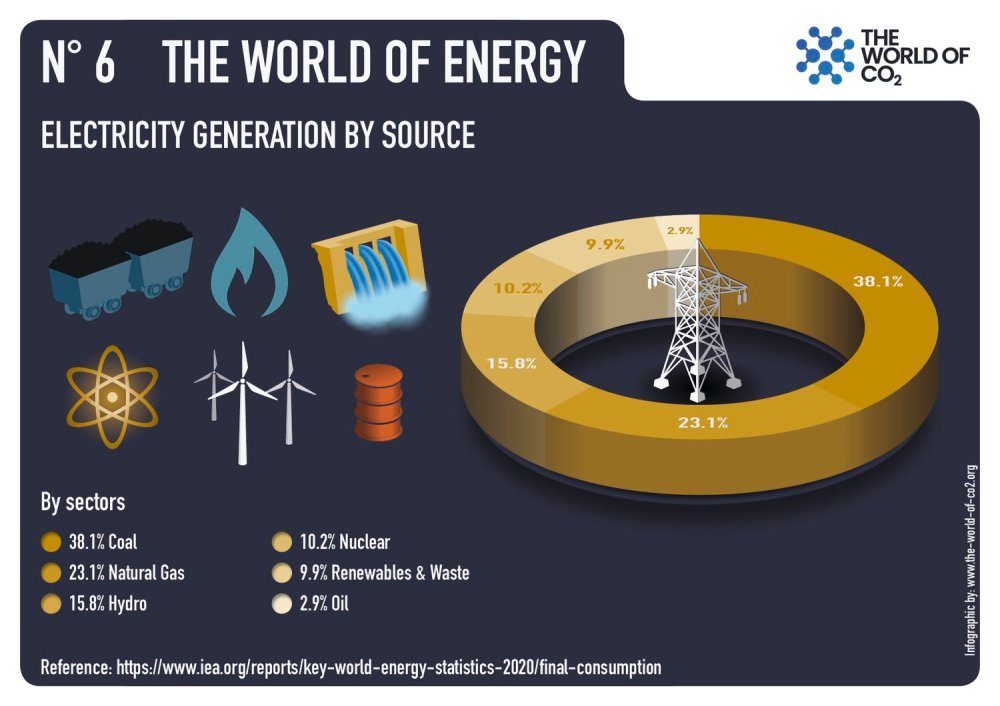
See also World of Energy Infographics


Fake Virtue Demeans Us All

Explained at Peak Prosperity For The Narrative-Creators, The Play Is You… And You Are Not Real.  Excerpts in italics with my bolds and added images.  H/T Tyler Durden

If, like me, you’ve been wondering about why things are the way they are in today’s world, and how this relates, this is my explanation: For the actors, writers and directors who create real world narratives, the play is you. And you are not real.

Actors and Reality

Much has been made of the jarring dissonance between the heroic stand of the president and the people of Ukraine and the facile signaling of the Social Justice crowd. Feel free to pick your favorite exemplar, from the merely stupid banning of Russian cats and renaming of White Russian cocktails to the more sinister cancelling of Russian performers, or the horrific threats and vandalism to places serving Russian food. There’s no shortage of content here. And, as we’ll get to shortly, that’s the point.

Ukraine’s policy goals do not map fully to those of the United States (think Azov Battalion, for starters), and we can and should carefully consider our response with that awareness. But this does not change Ukrainian heroism. Zelensky wants planes, a no-fly zone, and he would no doubt love NATO boots on the ground. Prudence may dictate we provide him none of these, but it is worth noting that any of us in his circumstances would likely be asking for the same things. Any of us who stayed during the onslaught, that is.

Clearly, Putin’s bet from the beginning included Zelensky on the first plane out to serve as the leader of the Ukrainian government in (comfortable) exile, after which the dismemberment of that nation would rapidly become a fait accompli. Zelensky was having none of it. He stayed, and continues to stay, at great personal risk to himself and his family. He is, unquestionably, a hero.

It is the contrast between these two extremes (the banning of Russian-themed menus et al vs. Zelensky’s stand) that provides ample opportunity to reflect on the idea that many Americans are just not serious people. Unsurprisingly, their response to events in Ukraine has been to simply cut and paste from the outrage-of-the-week playbook: change profile picture, use a hashtag, find some people to cancel, and congratulate oneself on how virtuous one is. In the real world, rational people are tempted to say, “None of this ‘support’ matters”. It’s just empty signaling. So why is it happening, why has it become so pervasive, and how should we contend with it? Examination of a few high-salience topics can shed some light.

Covid and Wuhan Lab Leak Theory

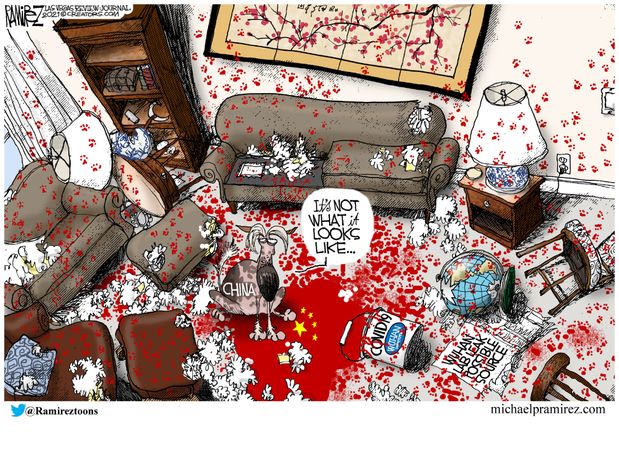
Consider this first in the context of Covid and the by now well-known case of the Lab Leak Theory. Peter Daszak of the Eco-Health Alliance was the prime mover behind the infamous Lancet Letter branding any lab leak speculation uninformed conspiracy. This makes perfect sense when considering his incentives. Daszak (and Fauci, and others) had something to lose here. Perhaps a lot to lose. U.S. funding of Gain of Function research in Chinese labs resulting in a global pandemic is, to put it mildly, not a very good look and could be costly both financially and criminally.

And that’s where those laws, norms, and standards come in. In an environment with many disinterested actors, those entities without skin in the game would easily out-produce the relatively small number of individuals invested in a particular narrative. In that environment, the idea that zoonotic transmission and escape from a biolab in the same city where researchers were known to be working on bat viruses were both very real possibilities would be obvious.


But that is not at all how it went down.

Instead, the idea that it might be prudent to investigate what role the lab in Wuhan may have played in the pandemic became roughly equivalent to arguing Flat Earth Theory. What the hell was going on here? Did everyone in the American media landscape owe Daszak a favor? Did Fauci have a secret cache of compromising emails and photos to dangle J. Edgar Hoover style over the heads of troublesome journalists? Why on earth would hundreds or thousands in the media run cover for these guys and for the Chinese government to the extent of making claims that mere investigation of the possibility of a lab leak was racist?

More puzzling still is the idea that there is nothing about either potential source of the pandemic that presupposes an explicitly liberal or conservative position. Indeed, one could easily flip the script and imagine a campaign urging people to “follow the science” rather than resorting to xenophobic tropes about savages in wet markets. Until, that is, Donald Trump and other conservatives brought it up, which was like Christmas came early for Daszak and his co-conspirators. For the progressive left, the endorsement of anything by President Trump was more than sufficient cause to oppose it, and thus the wheels began to turn.

None of this should be surprising to anyone who’s been paying attention. At its heart, this is an expression of the luxury of operating without consequences. The luxury of not having to think operationally. To be clear, what I am saying is that Daszak and his cronies were able to leverage a system in which those with the loudest megaphones literally did not and do not care where and how Covid originated. For them, it just doesn’t matter. The pandemic is just background noise. That may seem like a strong statement. So, why and in what sense did they not care?

Personal Gain Not Public Trust

In a recent episode of Bari Weiss’ podcast Honestly, journalist and academic Yuval Levin articulated a theory of the change from institutions-as-formational to institutions-as-platforms. In his view, institutions of all types formerly served to develop the individuals inside them. If for example, you worked at the New York Times as a young journalist, you would be shaped by the ethos of that institution, informed by the repository of values developed over time within that structure.

According to Levin, this has been replaced by the notion of institution-as-platform,
the idea  that these structures exist as a launching pad for one’s personal brand.

Understood from this perspective, the great Lab Leak crackdown suddenly makes a great deal of sense. One of the baseline branding positions operating was “not-Trump.” I am completely persuaded that if Trump had spoken out in favor of the wet market theory, we’d all have been loudly advised to “follow the science” in precisely the opposite direction.

It is also worth noting that these personal brands are rivalrous goods. Having a “take,” even the right one, is necessary, but not sufficient. Your take must outcompete the other signals in the marketplace in order to claim disproportionate attention. And this explains why the Lab Leak Theory had to be, “conspiracist,” “anti-science,” and eventually, of course, “racist.”

The more extreme the position is,
the more effective it is in gaining audience-capture.

And this is not part of the story; it’s the entire story. There is effectively nothing behind the curtain. Because of these powerful incentives, what has happened without us realizing it is the creation of a public dialogue between a small, privileged elite that is fixed on in-group signaling and status-capture. The policy concerns or post-pandemic reforms that should differentially apply depending upon the origin of the disease diminish in importance to the extent that they functionally do not matter at all.

And people impacted by those decisions by extension do not matter either.
They are extras and scenery.

The Damaging Script

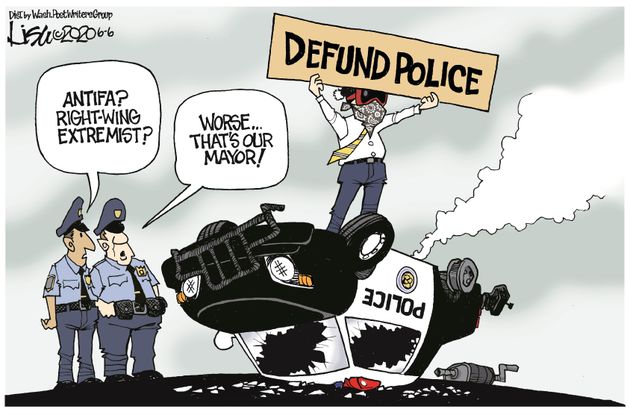
This goes a long way toward explaining the persistence of the otherwise bewildering advocacy that has permeated American life. Democratic New York Mayor Eric Adams noted that the Defund the Police crowd “are a lot of young white affluent people.” Of course they are. Poll after poll reveals that those who live in high-crime neighborhoods want more police, not less.

Like any other sane person, those citizens also want their police officers to be professional and not corrupt, but “I want my police officers to fight crime and be professional” is just not an exciting take. From this perspective, insanity like Defund the Police isn’t surprising, but rather inevitable. It is the position pushed to its logical extreme. And that is why arguing with this group is useless.

Perhaps nothing is more indicative of this trend than the increasingly unhinged claims emerging from the trans-activist community, as LGB became LGBT and now for some is properly expressed as LGBTQQIP2SAA, in order to be “inclusive” to intersex, pansexual, asexual, and two-spirit people.

For an outsider, it can all seem like satire.
How could anyone engage in these abbreviation acrobatics unironically?

For outsiders, the criticism seems insane. That is because, once again, we are not the audience. What we are seeing is a process of in-group jousting for status, where increasingly bizarre formulations become predictable and indeed necessary to gain attention. “I disagree with J.K. Rowling” is hardly a winning message, especially compared with “J.K. Rowling threatens my right to exist!” Thus, once again, appeals to reason, biology, or even compassion for a generation of children we are harming irrevocably do not and will not work.

No one affected by these positions exists in any meaningful way
because, again, they are not real.

By far the best example of this phenomenon is Black Lives Matter, a marketing triumph that proved beyond all doubt that these tactics can work, work well, and most importantly, be monetized. The familiar script is here, but no one has ever executed it better, as activists turned their rallying cry into a movement indistinguishable from religion. No nuance or difference of opinion was tolerated. Even to remain silent was proof of apostacy.

The net result? More than $60 million, most of which remains unaccounted for, and a series of high-end real estate purchases by the activists behind the whole thing. No policy achievements of any kind, because of course those were never the point from the beginning, as was obvious to anyone paying attention.

The response to this from BLM? Condemn the black reporter who exposed their murky finances and questionable real estate transactions as racist, smear the black Harvard economist as a sexual predator, and suggest that even the financial reporting required of non-profits is, you guessed it, racist. It’s not that hard to parse this: BLM activists are not friends or allies of black communities whatsoever. Instead, we come back to the same point: everyone outside of the in-group are just extras and scenery. Including those for whom they purport to advocate. None of them are real.

Luxury Beliefs

Rob Henderson calls all of this a symptom of “Luxury Beliefs.” According to Henderson, these are “ideas and opinions that confer status on the rich at very little cost while taking a toll on the lower class.” What we have is a catechism, a portfolio of dogma that operates as a signaling mechanism among the elite. And so, in addition to “Follow the Science” on Covid, “Trans Women are Real Women”, and “Black Lives Matter”, we have a host of other statements expressed as moral imperatives, including things like “Healthy at Any Size”, “All Family Structures are Equal”, “Open Borders”, etc.

All of this can be considered an unexpected and unwelcome consequence of our own success. The complex, exquisitely-tuned supply chains that funnel us goods and services have become so remarkably effective they are essentially invisible. Elites don’t have to worry about how things get done, how X leads to Y, or how thing A gets to place B.

It just happens. Magically. Invisibly.
How the sausage is made is a question for smaller minds.

In my view, Henderson gets one thing wrong about his theory. Luxury Beliefs are not in fact, the provenance of the rich, but rather of the educational elite, some of whom are also rich in the bargain. Journalists, other media members, academics, and activists typically have little to no experience in actual business and even less incentive to ever gain any. The effortless flow of goods and services they experience allows them the freedom from having to think operationally or consequentially.

Over the past two years, COVID revealed and supercharged the insular status of these elites. If you talk to business owners, no matter how wealthy they may be, who vitally need to think operationally and consequentially every day, you find considerably less support for these elitist notions.

All of this is bad enough when locked in some academic ivory tower, but as we’ve seen, this has escaped into the American Wild with terrifying effect. Crime, inflation, record border crossings, education, and more. Pick your topic, as the list goes on and on.

The Final Act

Which brings us back to Ukraine as the setting for the ridiculous virtue signaling and posturing by these same luxury elites. It is jarring when juxtaposed against actual tanks and soldiers, but it is just more of the same.

I stated earlier that these are not serious people, but that is not entirely accurate. They are extremely serious, just not about anything other than their own internal conversations.  These people will not change, and they will not be persuaded by your arguments, your statistics, and your facts.

Because the people who make any of the things elites consume and the people elites purport to stand up for are all equally irrelevant. Performance is the point. The performance is the whole thing, and the actors, playwrights and directors aren’t taking suggestions from you, the extras and the scenery.

Which leads us to the final act: maybe it’s time to think about shutting down the whole play.


Free Speech (Musk) or Curated Speech (Obama)?

The alternative attitude was recently put forth by Obama exercising his free speech rights in front of a Stanford audience who both like him and like what he says.  In effect he said he is all for free speech but tech companies need to censor some speech to protect democracy.  Seems like a semi-pregnant posture.  It reminds me a Rodney Dangerfield scene portraying a business executive: He tells his secretary, “Hold some of my calls!”

Jenin Younes explains the issue and its import in her Brownstone Institute article The Federal Government Forces Social Media Companies to Censor Americans.  Excepts in italics with my bolds and added images.

In May of 2021, the Biden Administration began a public, coordinated campaign to combat the dissemination of “health misinformation” related to Covid, especially across social media platforms.

Members of the Administration, including Surgeon General Vivek Murthy and the President himself, often through White House Press Secretary Jen Psaki, have made clear that they blame Big Tech for American deaths from the virus, and insist that these platforms have an obligation to censor those who articulate views that depart from the Government’s messaging on Covid-related matters.

The Administration has stated that it supports “a robust anti-trust program,” a not-so-subtle warning that if the Twitters and Facebooks of the world do not do the Government’s bidding, they will suffer the consequences.

The campaign has been increasing in intensity for nearly a year.

Ms. Psaki and Dr. Murthy have subsequently stated that the government is flagging problematic posts for social media platforms to censor and commanded them to elevate the voices of those who promote the approved messaging through algorithms while banning those whose perspectives conflict with the government.

The President has affirmed his belief that social media platforms “should be held accountable” for misinformation circulated on them. On March 3, Dr. Murthy announced an initiative, wherein he demanded that tech companies provide the government with “sources of misinformation,” including the identity of specific individuals, by May 2.

Like many others around the world, Michael P. Senger of California, Mark Changizi of Ohio, and Daniel Kotzin of Colorado, operated Twitter accounts that centered around criticizing government and public health Covid restrictions. All three accounts rapidly became popular.

Starting last spring, right around the time the Biden Administration’s efforts became public, the three were subject to temporary suspensions. Mere days after Dr. Murthy’s March 3 statement, Mr. Kotzin was suspended for a week, and Mr. Senger permanently. This means he is never permitted to create another Twitter account. He has lost his 112,000 followers, and in his own words, been “silenced and completely cut off from” the network he developed over two years.

According to Twitter, the suspensions were for spreading Covid “misinformation.” Mr. Senger, Mr. Changizi, and Mr. Kotzin had, in the cited tweets, expressed opposition to vaccine mandates and suggested that the vaccines do not slow the spread of Covid. They also argued that government-imposed restrictions do not work to mitigate viral spread, the risks Covid poses to children are sufficiently low to disfavor vaccination for them given the long-term unknowns, and naturally acquired immunity is superior to that attained through vaccination.

None of these claims is outside the realm of legitimate scientific discourse.

In fact, figures like CDC Director Rochelle Walensky, Anthony Fauci, and President Biden, who a mere six or eight months ago expressed absolute confidence that, for example, the vaccines stop transmission and confer better protection than naturally acquired immunity, have now been confronted with unequivocal evidence that they were wrong.

A meta-study out of Johns Hopkins University concluded that lockdowns did not reduce Covid deaths, while causing quite a bit of harm, corroborating observational data from around the world. Several Scandinavian countries recommend against vaccinating healthy young children based on an objective risk assessment, and study after study has proven that naturally acquired immunity is superior to vaccine-induced immunity.

Following nearly two years of insistence that community masking is effective, many prominent public health officials have changed course. It is a great irony that those who have been so wrong throughout the pandemic now seek to silence dissenters, particularly those who have proven prescient on many topics.

And even if they were expressing flatly incorrect views, the First Amendment gives them the right to voice those opinions. The concept of free speech was embraced by the Framers of the Constitution, who were clearly wiser than many who govern us today. They recognized that censorship does not work practically: rather, it encourages people to operate covertly, often exacerbating the problem, and that the cure to bad speech is good speech.

But most of all, they understood that giving government the authority to determine which ideas should be heard and which should be suppressed is a dangerous game.

Of course, many will argue that Twitter and other tech companies censored Mr. Senger, Mr. Changizi, and Mr. Kotzin of their own volition, and as they are private actors, the First Amendment is inapplicable.

That argument should be rejected. When the government commandeers, coerces, or utilizes private companies to accomplish what it cannot do directly, courts recognize that is state action. In a mid-20th century version of this case, Bantam Books v. Sullivan, the Supreme Court held that a state government commission consigned with reprimanding sellers of pornography and advising them of their legal rights (a veiled threat) “deliberately set about to achieve the suppression of publications deemed ‘objectionable’ and succeeded in its aim.” The Court looked “through forms to the substance” and concluded that this program violated the First Amendment.

That is similar to what is happening here. The Biden Administration knows that it cannot get away with issuing orders directly prohibiting people from articulating views about Covid-related matters that differ from the government’s, or from obtaining users’ private information, so it is coercing companies into doing this on the government’s behalf.

Fearing reprisal from the government—reprisal that the government has publicly contemplated—the companies are ramping up censorship. These companies are also likely to turn over information about users that Dr. Murthy demanded, a violation of the Fourth Amendment’s prohibition against warrantless searches.

Not only are individuals like Mr. Senger being silenced outright. Mr. Changizi, Mr. Kotzin, and millions of others are afraid to say what they really think because they do not want to suffer Mr. Senger’s fate. Courts should “look through forms to the substance” and recognize what is going on.

The Government is deciding what speech is acceptable and may be heard, and what speech is not acceptable and must be silenced, on the most hotly debated political topics of our time. This strikes at the heart of what the First Amendment is supposed to protect.

See also Weaponized Claims of Disinformation


Covid Gets Milder, Left Stays Toxic

Physician C.J. Baker explains in his American Thinker article COVID-19 is becoming milder, but the left stays toxic as ever.  Excerpts in italics with my boldsand added images.

Just this morning (Tuesday, April 22, 2022), in the New York Times’ “the Morning” online report, a guy named David Leonhardt writes with apparent amazement that “Coronavirus cases have risen in major cities. Hospitalizations have not.” Imagine that.

Leonhardt goes on to note that despite the long list of members of Congress and other public servants recently diagnosed with COVID-19, none of them, even our superannuated speaker of the House, appears to have got very sick from it. To his credit, he supplements this observation with some charts that clearly show the disconnect between current cases (which are rising) and hospitalizations (which remain flat).

So far, so good. But then he gives his explanation for this trend. That’s where the spin and outright dishonesty of the COVID-forever left — led by the Times — continue apace.To what does David the Lionhearted, the Gray Lady’s intrepid knight of the keyboard du jour, attribute these positive trends? He reports what (supposedly) “many experts believe”:

♦  Vaccines and booster shots are effective and universally available to Americans who are at least 12. (Covid [sic] continues to be overwhelmingly mild among children).
♦  Treatments — like Evusheld for the immunocompromised and Paxlovid for vulnerable people who get infected — are increasingly available.
♦  Tens of millions of Americans have already been infected with the virus, providing them with at least some immunity.

Two key points should be drawn from this list of explanations.

First, an absolutely central reason for the good news about COVID-19 has been deliberately omitted. 

As any truly knowledgeable and honest doctor or virologist — provided you can find one these days — will tell you, viruses such as SARS-CoV-2 mutate like crazy and evolve rapidly and in a predictable manner. In short, these viruses consistently mutate to become more transmissible and less virulent. Why do they evolve in this way? For the same reason all organisms evolve: to benefit their own propagation and survival.

When a new virus is first introduced to a host species, the initial interaction is often not pretty. The virus may struggle to spread between individuals, endangering its survival, and it may invoke severe illness in its host, even killing it, thereby endangering both species’ survival.

Moving slowly and painstakingly from one home to another, while burning down the one in which you currently reside, is no way to survive. So the virus mutates and evolves into a milder form that spreads more readily yet sickens the host less.

In essence, the perfect respiratory virus is the common cold. It infects its host but makes the host sick enough only to sneeze the virus’s progeny at everyone around. It spreads like wildfire, but it doesn’t burn down its own house in the process.

Runny nose coronvirus family

Not for nothing, but what do the other coronaviruses in general circulation among humans cause? That’s right: symptoms of the common cold. This is almost certainly the final common pathway for SARS-CoV-2.

As a practicing physician, trained before schools of public health veered to the left of gender studies departments, I have been saying this since the summer of 2020.

Meanwhile, panic pornographers ranging from Anthony Fauci to Times newsboy Leonhardt’s “experts” have latched onto that first trait of viral evolution (increased transmissibility) while deliberately downplaying, or even denying the second (reduced virulence). Why?

Because they want to foment all the fear that increased transmissibility promotes, yet allow none of the hope and perspective about the virus that acknowledging reduced virulence would bring.

Second, several systematic lies are embedded in the three explanations that are given.

The second lesson to take from Leonhardt’s list is this: as the facts become too obvious to support their false narrative, leftists perform the propagandistic equivalent of a “tactical retreat,” covering their tracks with false and misleading explanations.

Leonhardt writes that “vaccines are effective and readily available.” Effective at what?

At stopping the virus in its tracks, as the Times and Fauci claimed for months? Nope. At preventing persons from contracting COVID-19, as they also claimed? Well, obviously not, since every one of those politicians has been vaccinated and boosted to the hilt. At reducing severity of disease? Well, then what happened to the vaunted “pandemic of the unvaccinated”? Based on the data curves Leonhardt provides, the unvaccinated aren’t going to the ICU these days, either.

Leonhardt touts Evusheld and Paxlovid as “increasingly available,” a total non sequitur in the absence of any data supporting their role in the current trends, which he does not provide. He completely ignores any cheap, repurposed early treatments, despite — or more likely because of — the growing mountains of data supporting their effectiveness.

Finally, Leonhardt blatantly understates the effect of natural immunity, both by lowballing the number of previously infected Americans (it’s in the hundreds of millions, Dave, not tens) and by the deeply misleading statement that prior infection produces “at least some immunity” (Natural immunity is far superior to vaccine-related immunity.)

Here is the reality, the plain fact that Fauci and Leonhardt’s “many experts” will never admit: SARS-CoV-2 is evolving and adapting to coexist with us. The COVID-forever left remains as toxic and destructive as ever.

Earth Day 2022: Stop Media Climate Disinformation

Climate hysteria is like a seasonal sickness.  Each year a contagion of anxiety and fear is created by disinformation going viral in both legacy and social media in the run up to the autumnal COP, most recently Glasgow last November.  Now that climatists have put themselves at the controls of the formidable US federal government,  the public has been hugely hosed with alarms.  Springtime brings Earth Day, when the distress signals typically go full tilt.  So individuals need to inoculate themselves against the false claims, in order to build some herd immunity against the nonsense the media continues to promulgate. This post is offered as a means to that end.

Media Climate Hype is a Cover Up

Back in 2015 in the run up to Paris COP, French mathematicians published a thorough critique of the raison d’etre of the whole crusade. They said:

Fighting Global Warming is Absurd, Costly and Pointless.

  • Absurd because of no reliable evidence that anything unusual is happening in our climate.
  • Costly because trillions of dollars are wasted on immature, inefficient technologies that serve only to make cheap, reliable energy expensive and intermittent.
  • Pointless because we do not control the weather anyway.

The prestigious Société de Calcul Mathématique (Society for Mathematical Calculation) issued a detailed 195-page White Paper presenting a blistering point-by-point critique of the key dogmas of global warming. The synopsis with links to the entire document is at COP Briefing for Realists

Even without attending to their documentation, you can tell they are right because all the media climate hype is concentrated against those three points.

Finding: Nothing unusual is happening with our weather and climate.
Hype: Every metric or weather event is “unprecedented,” or “worse than we thought.”

Finding: Proposed solutions will cost many trillions of dollars for little effect or benefit.
Hype: Zero carbon will lead the world to do the right thing.  Anyway, the planet must be saved at any cost.

Finding: Nature operates without caring what humans do or think.
Hype: Any destructive natural event is blamed on humans burning fossil fuels.

How the Media Throws Up Flak to Defend False Suppositions

The Absurd Media:  Climate is Dangerous Today, Yesterday It was Ideal.

Billions of dollars have been spent researching any and all negative effects from a warming world: Everything from Acne to Zika virus.  A recent Climate Report repeats the usual litany of calamities to be feared and avoided by submitting to IPCC demands. The evidence does not support these claims. An example:

 It is scientifically established that human activities produce GHG emissions, which accumulate in the atmosphere and the oceans, resulting in warming of Earth’s surface and the oceans, acidification of the oceans, increased variability of climate, with a higher incidence of extreme weather events, and other changes in the climate.

Moreover, leading experts believe that there is already more than enough excess heat in the climate system to do severe damage and that 2C of warming would have very significant adverse effects, including resulting in multi-meter sea level rise.

Experts have observed an increased incidence of climate-related extreme weather events, including increased frequency and intensity of extreme heat and heavy precipitation events and more severe droughts and associated heatwaves. Experts have also observed an increased incidence of large forest fires; and reduced snowpack affecting water resources in the western U.S. The most recent National Climate Assessment projects these climate impacts will continue to worsen in the future as global temperatures increase.

Alarming Weather and Wildfires

But: Weather is not more extreme.


And Wildfires were worse in the past.
But: Sea Level Rise is not accelerating.

post-glacial_sea_level

Litany of Changes

Seven of the ten hottest years on record have occurred within the last decade; wildfires are at an all-time high, while Arctic Sea ice is rapidly diminishing.

We are seeing one-in-a-thousand-year floods with astonishing frequency.

When it rains really hard, it’s harder than ever.

We’re seeing glaciers melting, sea level rising.

The length and the intensity of heatwaves has gone up dramatically.

Plants and trees are flowering earlier in the year. Birds are moving polewards.

We’re seeing more intense storms.

But: Arctic Ice has not declined since 2007.

But: All of these are within the range of past variability.In fact our climate is remarkably stable, compared to the range of daily temperatures during a year where I live.

And many aspects follow quasi-60 year cycles.

The Impractical Media:  Money is No Object in Saving the Planet.

Here it is blithely assumed that the court can rule the seas to stop rising, heat waves to cease, and Arctic ice to grow (though why we would want that is debatable).  All this will be achieved by leaving fossil fuels in the ground and powering civilization with windmills and solar panels.  While admitting that our way of life depends on fossil fuels, they ignore the inadequacy of renewable energy sources at their present immaturity.


An Example:
The choice between incurring manageable costs now and the incalculable, perhaps even irreparable, burden Youth Plaintiffs and Affected Children will face if Defendants fail to rapidly transition to a non-fossil fuel economy is clear. While the full costs of the climate damages that would result from maintaining a fossil fuel-based economy may be incalculable, there is already ample evidence concerning the lower bound of such costs, and with these minimum estimates, it is already clear that the cost of transitioning to a low/no carbon economy are far less than the benefits of such a transition. No rational calculus could come to an alternative conclusion. Defendants must act with all deliberate speed and immediately cease the subsidization of fossil fuels and any new fossil fuel projects, and implement policies to rapidly transition the U.S. economy away from fossil fuels.

But CO2 relation to Temperature is Inconsistent.

But: The planet is greener because of rising CO2.

But: Modern nations (G20) depend on fossil fuels for nearly 90% of their energy.

But: Renewables are not ready for prime time.

People need to know that adding renewables to an electrical grid presents both technical and economic challenges.  Experience shows that adding intermittent power more than 10% of the baseload makes precarious the reliability of the supply.  South Australia is demonstrating this with a series of blackouts when the grid cannot be balanced.  Germany got to a higher % by dumping its excess renewable generation onto neighboring countries until the EU finally woke up and stopped them. Texas got up to 29% by dumping onto neighboring states, and some like Georgia are having problems.

But more dangerous is the way renewables destroy the economics of electrical power.  Seasoned energy analyst Gail Tverberg writes:

In fact, I have come to the rather astounding conclusion that even if wind turbines and solar PV could be built at zero cost, it would not make sense to continue to add them to the electric grid in the absence of very much better and cheaper electricity storage than we have today. There are too many costs outside building the devices themselves. It is these secondary costs that are problematic. Also, the presence of intermittent electricity disrupts competitive prices, leading to electricity prices that are far too low for other electricity providers, including those providing electricity using nuclear or natural gas. The tiny contribution of wind and solar to grid electricity cannot make up for the loss of more traditional electricity sources due to low prices.

These issues are discussed in more detail in the post Climateers Tilting at Windmills

The Irrational Media:  Whatever Happens in Nature is Our Fault.

An Example:

Other potential examples include agricultural losses. Whether or not insurance
reimburses farmers for their crops, there can be food shortages that lead to higher food
prices (that will be borne by consumers, that is, Youth Plaintiffs and Affected Children).
There is a further risk that as our climate and land use pattern changes, disease vectors
may also move (e.g., diseases formerly only in tropical climates move northward).36 This
could lead to material increases in public health costs

But: Actual climate zones are local and regional in scope, and they show little boundary change.

But: Ice cores show that it was warmer in the past, not due to humans.

The hype is produced by computer programs designed to frighten and distract children and the uninformed.  For example, there was mention above of “multi-meter” sea level rise.  It is all done with computer models.  For example, below is San Francisco.  More at USCS Warnings of Coastal Floodings

In addition, there is no mention that GCMs projections are running about twice as hot as observations.

Omitted is the fact GCMs correctly replicate tropospheric temperature observations only when CO2 warming is turned off.

Figure 5. Simplification of IPCC AR5 shown above in Fig. 4. The colored lines represent the range of results for the models and observations. The trends here represent trends at different levels of the tropical atmosphere from the surface up to 50,000 ft. The gray lines are the bounds for the range of observations, the blue for the range of IPCC model results without extra GHGs and the red for IPCC model results with extra GHGs.The key point displayed is the lack of overlap between the GHG model results (red) and the observations (gray). The nonGHG model runs (blue) overlap the observations almost completely.

In the effort to proclaim scientific certainty, neither the media nor IPCC discuss the lack of warming since the 1998 El Nino, despite two additional El Ninos in 2010 and 2016.

Further they exclude comparisons between fossil fuel consumption and temperature changes. The legal methodology for discerning causation regarding work environments or medicine side effects insists that the correlation be strong and consistent over time, and there be no confounding additional factors. As long as there is another equally or more likely explanation for a set of facts, the claimed causation is unproven. Such is the null hypothesis in legal terms: Things happen for many reasons unless you can prove one reason is dominant.

Finally, advocates and IPCC are picking on the wrong molecule. The climate is controlled not by CO2 but by H2O. Oceans make climate through the massive movement of energy involved in water’s phase changes from solid to liquid to gas and back again. From those heat transfers come all that we call weather and climate: Clouds, Snow, Rain, Winds, and Storms.

Esteemed climate scientist Richard Lindzen ended a very fine recent presentation with this description of the climate system:

I haven’t spent much time on the details of the science, but there is one thing that should spark skepticism in any intelligent reader. The system we are looking at consists in two turbulent fluids interacting with each other. They are on a rotating planet that is differentially heated by the sun. A vital constituent of the atmospheric component is water in the liquid, solid and vapor phases, and the changes in phase have vast energetic ramifications. The energy budget of this system involves the absorption and reemission of about 200 watts per square meter. Doubling CO2 involves a 2% perturbation to this budget. So do minor changes in clouds and other features, and such changes are common. In this complex multifactor system, what is the likelihood of the climate (which, itself, consists in many variables and not just globally averaged temperature anomaly) is controlled by this 2% perturbation in a single variable? Believing this is pretty close to believing in magic. Instead, you are told that it is believing in ‘science.’ Such a claim should be a tip-off that something is amiss. After all, science is a mode of inquiry rather than a belief structure.

Summary:  From this we learn three things:

Climate warms and cools without any help from humans.

Warming is good and cooling is bad.

The hypothetical warming from CO2 would be a good thing.


Earth Day 2022: Gladness Expels Gloom

Cameron English explains in his ACSH article Earth Day 2022: Doomsday Isn’t Around The Corner.  Excerpts in italics with my bolds and added images.

As earth day approaches, activist groups have amplified their predictions of an impending environmental disaster. A brief survey of the evidence shows that the situation isn’t nearly as dire as they claim.

Earth Day is just around the corner. Activists outfits like Environmental Working Group (EWG) are using the run-up to this annual celebration to promote fear of pesticides and, for some reason, the musings of Michelle Pfeiffer. Let’s use the time a little more wisely and consider just two examples that illustrate how much progress we’ve made in promoting human flourishing and protecting the environment.

The point of this exercise, to plagiarize myself from this time last year, is to remind the world that doomsday isn’t inevitable. As we deploy more resources to solve the very real environmental problems we face, life on this planet gets better.

Let’s start with a well-established theory from economics known as the Environmental Kuznets Curve (EKC): economic growth is initially accompanied by increased pollution. Over time, however, we acquire enough resources to invest in technologies that promote sustainability. As the authors of a 2020 study noted:

The EKC literature suggests that economic growth may affect environmental welfare through three different channels: scale effects, composition effects and technique effects. The growth of the economic scale would result in a proportional growth in environmental pollution, and the changes in the industrial structure would lead to the reduction of pollution intensity.

Further economic growth causes technological progress through which dirty and obsolete technologies are replaced by upgraded and cleaner technologies that improve environmental quality.

That’s a foundational point worth remembering because EWG and its ideological allies would have you believe the opposite conclusion, that our “exploitation” of earth’s resources is inherently destructive.

Evidence from all over the world exposes the folly of such thinking.
Let’s consider some examples.

Cleaner air than ever before

To enlarge, double-click image or open in new tab.

Since 1970, the EPA notes, the combined emissions of six common pollutants have plummeted by almost 80 percent, facilitating “dramatic improvements in the quality of the air that we breathe,” the agency added. To get more specific:

Between 1990 and 2020, national concentrations of air pollutants improved 73 percent for carbon monoxide, 86 percent for lead (from 2010), 61 percent for annual nitrogen dioxide, 25 percent for ozone, 26 percent for 24-hour coarse particle concentrations, 41 percent for annual fine particles (from 2000), and 91 percent for sulfur dioxide.

The EPA attempted to pat itself on the back by attributing these declines to its regulatory actions. But that analysis is incomplete. [Unmentioned was the fact consumption of clean-burning natural gas increased 23% during the same period these pollutants declined.] Meaningful environmental protection efforts don’t come cheap; wealthy countries are usually the only ones with the resources to reduce pollution. There’s a tight correlation between a nation’s GDP and the number of deaths attributed to outdoor pollution.

To enlarge, double-click image or open in new tab.

Our World in Data drew two very important observations out of these numbers; both point to the importance of economic growth as a weapon against pollution. Death rates tend to be lowest in the poorest and wealthiest countries. Nations with higher death rates, India, for instance, are often emerging economies that haven’t yet turned their attention to pollution reduction. There are some outliers to this trend, of course. Certain countries have high rates of pollution but low rates of respiratory mortality, Our World Data also explained:

Countries such as Qatar, Saudi Arabia, Oman, Kuwait, and the UAE have a comparably lower risk of premature death, despite high levels of pollution. They do, however, have a significantly higher GDP per capita than their neighbors … Overall health, wellbeing and healthcare/medical standards in these nations significantly reduce the risk of mortality from respiratory illness.

Sustainable food production increasing

In response to critics of animal agriculture, I’ve recently noted that the environmental footprint of food production is significantly smaller in developed countries. The trend is similar whether we consider the amount of land dedicated to farming or the use of inputs like fertilizers and pesticides. Even looking at agricultural carbon emissions, the ultimate boogeyman these days, we can see that economic growth fuels important reductions. Our World in Data helpfully noted that.

We see a very strong rich-poor country divide. High-income countries tend to have energy-intensive industry or service-based economies. Food systems can contribute as little as 10% to total emissions.

Another way to verify this trend is to consider the environmental impacts of local vs. global food production. The latter invites the use of technological innovations and economies of scale that offset the emissions farmers inevitably generate. Policies that unnecessarily restrict access to tools like biotech crops depress crop yields and force more land into food production, further boosting carbon emissions.

Conclusion

There are more examples of economic growth driving increases in sustainability, but the point is clear: our planet gets “greener” as we get wealthier. The warnings that we’re running out of time “to restore nature and build a healthy planet” will grow more shrill as Earth Day approaches. Just remember to take the doomsday predictions with a grain of salt and reflect on the tremendous progress we’ve made in living sustainably.


#1 Security Threat: Net Zero Asset Managers

Rupert Darwall writes at Real Clear Energy Woke Investors Threaten the West’s Security.  Excerpts in italics with my bolds and added images.

In an era of rising geopolitical tensions, it is folly
to let Wall Street determine the nation’s energy policy.

As the West grapples with the energy implications of a hostile Sino-Russian alliance, the steering group of the Net-Zero Asset Owner Alliance, whose members manage over $10.4 trillion of assets, issued a statement urging Western governments not to sacrifice climate goals for energy security. “The world is still heading for an excess of fossil fuel-based energy use that will vastly exceed the carbon budget needed to meet the 1.5° Celsius Paris agreement goal. This trend must be halted,” the United Nations-backed alliance said in its April 8 statement, arguing that “the national security argument for accelerating the net-zero transition has strengthened considerably.”

What, one might ask, is the standing of asset managers to opine on national security matters? They have no expertise in this domain. It turns out that their understanding of the economics of energy policy is defective, too.

The Net-Zero Asset Owner Alliance claims that development of new oil and gas reserves will lock in fossil fuel subsidies, exacerbating market distortions. In fact, the International Energy Agency (IEA) in its 2021 net-zero report states that under its net-zero pathway, tax revenues from oil and gas retail sales fall by about 40% over the next twenty years. “Managing this decline will require long-term fiscal planning and budget reforms,” the IEA warns. Similarly, Britain’s Office of Budget Responsibility estimates that net zero policies will result in the loss of tax receipts representing 1.6% of GDP. So much for the fossil fuel subsidy myth.

If fossil fuels were heavily subsidized, eliminating them would mean fossil fuel subsidies disappear. Instead, it’s tax revenues that would melt away to zero.

The net-zero investors cite figures for the decline in solar and wind energy costs. These numbers are based on so-called levelized cost of energy (LCOE), a metric that aims to measure a plant’s lifetime costs. Wind and solar power are intermittent, but LCOE metrics exclude the costs of intermittency, which increase the more wind and solar are put on the grid. Because wind and solar output responds to weather and not to demand, the value of this output declines the more installed wind and solar capacity is available. It was for these reasons that MIT professor of economics Paul Joskow concluded in a foundational 2011 paper that using LCOE metrics to compare intermittent and dispatchable generating technologies, such as coal and natural gas, is a “meaningless exercise.”  [ See proper energy costing here: Cutting Through the Fog of Renewable Power Costs ]

Wind and solar investors don’t need to understand the economics of the grid to make money – they are shielded from the intermittency costs their investments inflict on the rest of the grid, which is one reason why their views on energy policy can be taken with a pinch of salt. Their economic illiteracy does, however, make it easy for them to subscribe to the green fairy tale of 100% renewables. They’re not responsible for keeping the lights on – that depends on traditional power plants staying fueled up and ready to spin, which is what Germany can’t do without Russian gas. Adopt the net-zero alliance’s call for no new fossil-fuel investment, and the cost of energy is bound to spiral. And if the lights go out, politicians – not woke investors – get the blame.

Investors’ opinions on energy and national security would matter less if they didn’t have political power. Bloomberg opinion writer Matt Levine argues that asset managers of giant funds form a parallel system of government that exercises overlapping legislative powers with those of governments. These government-by-asset-managers, as Levine calls them, tell companies to do things they think are good for society as a whole, “making big collective decisions about how society should be run, not just business decisions but also decisions about the environment and workers’ rights and racial inequality and other controversial political topics.”

Foremost among these areas is climate policy. Although the Biden administration has set a net-zero goal, Congress has not legislated it, and it lacks the force of law. The absence of legislation passed by democratically accountable legislators, however, presents no barrier to government-by-asset-managers legislating climate policy for the companies in which they invest. “Investors are making net zero commitments for themselves and demanding that companies issue greenhouse gas reduction targets and transition plans for meeting those targets,” says the Reverend Kirsten Snow Spalding of the not-for-profit Ceres Investor Network on Climate Risk and Sustainability.

Neither Spalding nor the Net-Zero Asset Owner Alliance make a case that forcing net-zero targets on companies will boost investor returns, demonstrating that this is not about investors’ traditional concerns – making money – but about pursuing politics by other means. In this, the Securities and Exchange Commission (SEC) is working hand in glove with woke climate investors. Commenting on the SEC’s newly proposed rule on climate-risk disclosure, Spalding says that for investors who have committed zero emissions by 2050, “this draft rule is absolutely critical.”

Unlike elected politicians, woke climate investors are not accountable for the effects of their climate policies: They exercise power without responsibility. This arrangement weakens America’s ability to respond to the geopolitical challenges of a revanchist Russia and an expansionist China. “We are on a war footing – an emergency,” Energy Secretary Jennifer Granholm declared at the CERA energy conference in Houston last month. “We have to responsibly increase short-term supply where we can right now to stabilize the market and to minimize harm to American families.” Addressing oil executives in the audience, Granholm told them: “I hope your investors are saying these words to you as well: In this moment of crisis, we need more supply . . . right now, we need oil and gas production to rise to meet current demand.”

As Granholm suggested, woke investors have been trying to do the opposite. Despite the war in Ukraine, there has been no let-up in investor pressure on oil and gas companies to scale down their operations. Whatever criticisms might be made of the Biden administration’s handling of the war in Ukraine, it is responsible for taking the awesome decisions that war involves. Investors, by contrast, have no responsibility for the nation’s security and America’s ability to lead the West. By helping investors impose their desired energy policies on American oil and gas companies, the SEC is undermining the national security prerogatives of the Biden administration and eroding America’s ability to meet the challenges of a dangerous world. The SEC is playing in a domain that it has no business being in.