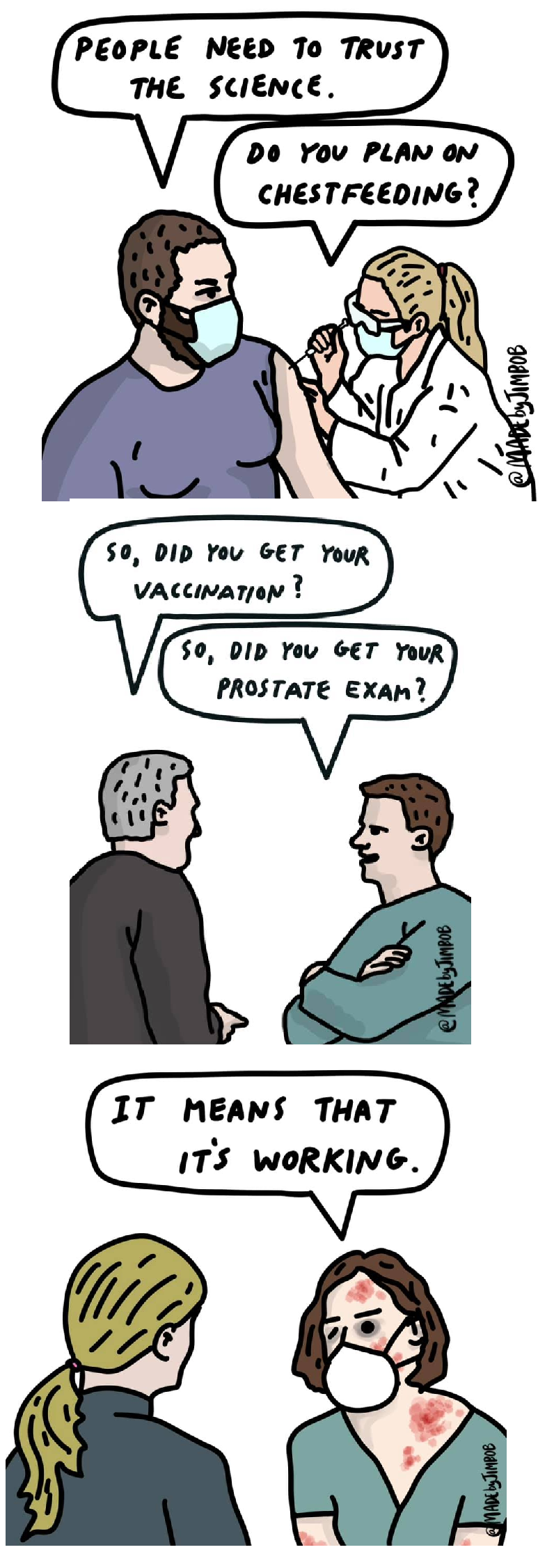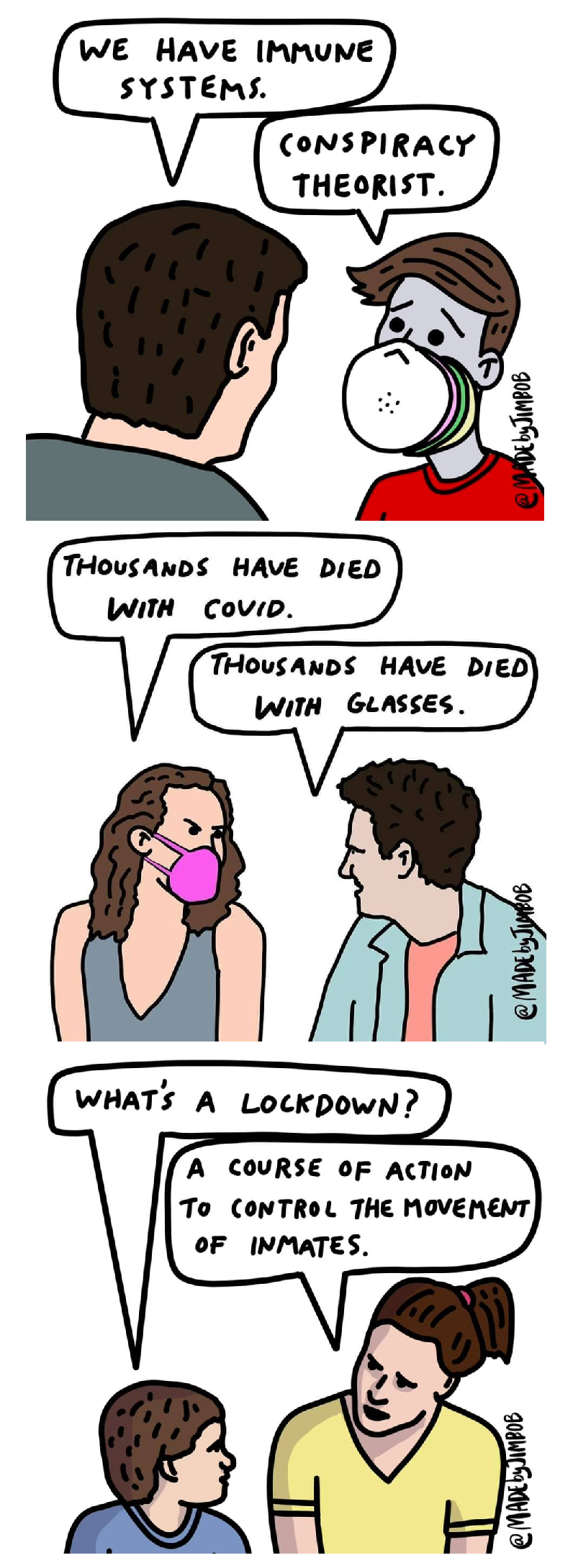
Covid Absurdies Madebyjimbob

This post was triggered by an article by Mike Solana at American Thinker Aborting reason. Some excerpts in italics with my bolds before jimbob takes over.

This month, as fate would have it, a controversial Texas abortion ban, shouted down from coast to coast with cries of “my body, my choice,” coursed a horrified media landscape just days before Biden introduced the concept of a national vaccine mandate. This is a very polite way of saying “forced medical procedures for almost everyone.” Across the ideological spectrum roles and rhetoric were promptly reversed.

Demands that a person’s right to their own body be honored were ridiculed and rebuffed by many of the same people who had in some cases just hours prior made impassioned arguments on behalf of a person’s right to their own body. It was an almost perfect cognitive dissonance, and it should have been enough, once illustrated, to jar even the most ardent partisan hack from their bullshit.Long story short, approximately zero partisan hacks were jarred from their bullshit. My body, my choice? Depends on who’s asking, and for what reason. But setting aside the committed idiocy of our loudest talking heads, the question at the heart of Biden’s mandatory vaccination is as old as the concepts of society and liberty: when personal freedom and social good enter conflict, what the hell do we do?

A subversion of liberty so significant as forcing someone to undergo a medical procedure they don’t want can potentially—if regrettably, and rarely—be justified. . . In addition, Americans are reluctant to trust what our institutional leaders have to say about the vaccine because Americans no longer trust our institutions. We especially don’t trust our political leaders or media. After the last few years, why would we?

Provided the vaccine hesitant aren’t literally crazy (they mostly aren’t), and the rest of us are pretty much safe (we are), there is no ethical justification for forcing anyone to undergo a medical procedure they don’t want. And until there is?

My body, my choice.

Forced vaccination at the scale of our entire country is presently an unjustifiable grab for power, and the thing about power? Sure, once a man gets a taste of it there’s never enough, and we should all expect more authoritarianism from this administration.


Leftist Bias More Evidence

Sally Satel reports at The Atlantic The Experts Somehow Overlooked Authoritarians on the Left. Excerpts in italics with my bolds and added images.

In February 2020, the Society for Personality and Social Psychology held a symposium called “Is Left-Wing Authoritarianism Real? Evidence on Both Sides of the Debate.”

An ambitious new study on the subject by the Emory University researcher Thomas H. Costello and five colleagues should settle the question. It proposes a rigorous new measure of antidemocratic attitudes on the left. And, by drawing on a survey of 7,258 adults, Costello’s team firmly establishes that such attitudes exist on both sides of the American electorate. (One co-author on the paper, I should note, was Costello’s adviser, the late Scott Lilienfeld—with whom I wrote a 2013 book and numerous articles.) Intriguingly, the researchers found some common traits between left-wing and right-wing authoritarians, including a “preference for social uniformity, prejudice towards different others, willingness to wield group authority to coerce behavior, cognitive rigidity, aggression and punitiveness towards perceived enemies, outsized concern for hierarchy, and moral absolutism.”

[Comment: They also noted;  “Still, relative to right-wing authoritarians (RWA), left-wing authoritarians (LWA) were lower in dogmatism and cognitive rigidity, higher in negative emotionality, and expressed stronger support for a political system with substantial centralized state control. Our results also indicate that LWA powerfully predicts behavioral aggression and is strongly correlated with participation in political violence. “]

Published last month in the Journal of Personality and Social Psychology, the Costello team’s paper is persuasive, to the point that you have to wonder: How could past researchers have overlooked left-wing authoritarianism for so long? “For 70 years, the lore in the social sciences has been that authoritarianism was to be found exclusively on the political right,” the Rutgers University social psychologist Lee Jussim, who wasn’t involved in the new study, told me in an email. In the 1950 book The Authoritarian Personality, an inquiry into the psychological makeup of people strongly drawn to autocratic rule and repressive politics, the German-born scholar Theodor W. Adorno and three other psychologists measured people along dimensions such as conformity to societal norms, rigid thinking, and sexual repression. And they concluded that “the authoritarian type of human”— the kind of person whose enthusiastic support allows someone like Hitler to exercise power—was found only among conservatives. In the mid-1990s, the influential Canadian psychologist Bob Altemeyer described left-wing authoritarianism as “the Loch Ness Monster of political psychology—an occasional shadow, but no monster. ” Subsequently, other psychologists reached the same conclusion.

The Trump era likely deepened psychology’s conventional wisdom that authoritarians are almost always conservatives; the insurrection at the Capitol earlier this year showed the urgency of understanding the phenomenon. And yet calls to de-platform controversial speakers and online campaigns to get people fired for heterodox views suggest that a commitment to open democratic norms is eroding, at least in some quarters, on the left. Much further along the authoritarian continuum, people purporting to be antiracist or antifascist protesters have set fires and committed other acts of violence since the summer of 2020. These acts stop short of, say, the 1970s bombing campaign by the far-left Weather Underground, but surely call the prevailing wisdom into doubt. (Supporters of revolutionary regimes overseas have demonstrated even more clearly that some people on the left try to get their way through intimidation and force.)

But one reason left-wing authoritarianism barely shows up in social-psychology research is that most academic experts in the field are based at institutions where prevailing attitudes are far to the left of society as a whole. Scholars who personally support the left’s social vision—such as redistributing income, countering racism, and more—may simply be slow to identify authoritarianism among people with similar goals.

One doesn’t need to believe that left-wing authoritarians are as numerous or as threatening as their right-wing counterparts to grasp that both phenomena are a problem. While liberals—both inside and outside of academia—may derive some comfort from believing that left-wing authoritarianism doesn’t exist, that fiction ignores a significant source of instability and polarization in our politics and society.

Ideological blind spots can indeed affect researchers with a strongly conservative or merely right-of-center outlook, but there just aren’t enough of them to matter. If academic psychology had more viewpoint diversity, the political biases that distort researchers’ work would all counterbalance one another. In American universities today, those biases generally point in the same direction. In psychology, the belief that only conservatives can be authoritarians, and that therefore only conservative authoritarians warrant serious study, has proved self-reinforcing over the course of decades.

As both left- and right-wing autocracies metastasize around the globe—a “pandemic of global authoritarianism” that has “persisted and deepened” over the past 15 years, in the words of the Stanford sociologist Larry Diamond—and as the speed of radicalization of recruits has hastened, the modest cadre of researchers interested in the subject will likely grow. By recasting left-wing authoritarianism in more specific terms—anti-hierarchical aggression, top-down censorship, and anti-conventionalism—Costello and his colleagues offer other researchers and the general public a new vocabulary for discussing antidemocratic attitudes on that side of the political spectrum.

See also Know-it-alls, Drama Queens & Control Freaks


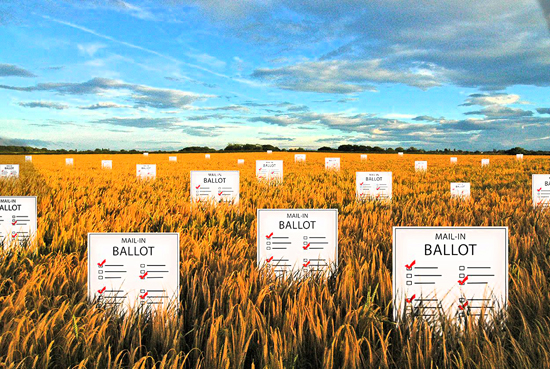
What is a “Vote” Anyway?

Ted Noel writes at Town Hall In the Arizona Audit, Words Matter.  Excerpts in italics with my bolds and added images.

This is one of those times when we wish that people would have used more circumspect language. Both the Arizona auditors and John Solomon committed a cardinal error that has allowed the Left to celebrate victory and ignore the fine print. Both note that Biden got more “votes” than Trump. That conclusion is incorrect, because it ignores the rest of the story.

A vote is an indication of preference cast by an eligible, registered voter.

It must be cast in the time, place, and manner prescribed by law. Anything else is not a vote. In Arizona, it is cast on paper ballots and read by machines. All the “accurate count” showed was that the machines counted the pieces of paper accurately. That’s all machines do. They do not count “ballots.”

The canvass did not answer the primary question, “How many of the pieces of paper were lawful ballots and how many should have been excluded because they were not lawful votes?” All the “accurate count” proves is that there was no outside effort to tweak the numbers by changing them by some direct internet chicanery. But it does not prove that Biden won. Or not. And that is the problem.  I won’t repeat all the details the auditors droned on through, but there are several key findings.

Over 50,000 “ballots” were unlawfully cast.

There were dead people, new addresses without re-registration, double votes, envelopes with no signatures, ballots received that were never sent out, and so on. Every one of those “ballots” were unlawful. They should have been rejected to remove them from the canvass. Since the margin between Trump and Biden was around ten thousand, this is far more than enough to cast doubt on the outcome. And then comes the drama.Maricopa County did everything it could to block the audit. If it was confident that it had done its job correctly, then one would expect that it would cooperate fully. Indeed, with the hand count matching the canvas, it seems that all should be well. But then we find that hundreds of thousands of election files were deleted from Maricopa County’s computer servers the day before the audit began. That smacks of guilty knowledge.

We also know that the servers allowed election data to be seen from the internet. Security was extremely lax, and even though it appears no votes were changed, other issues arise. Legally required signature matching on absentee ballots basically evaporated as the original tally went on.

Was someone watching from outside, then advising local officials on how to let unlawful ballots through to obtain the desired result?

At a bare minimum, the Arizona Presidential election was irretrievably tainted. The taint was large enough to make determination of the actual winner impossible. That’s why I wrote before January 6 that VP Pence should send several slates of electors back to their respective state legislatures for a final determination.

Those states, by repeated violations of their own state laws, did not hold elections. The processes they followed did not allow a tally of lawful votes.

The Arizona legislature should vote to decertify the electors for the 2020 election. This may have no legal effect, but if it leads two or three other states to the same conclusion, we may have a Constitutional crisis, and there are no guideposts for this trail. The Constitution simply did not foresee the compounding of raw power applied to prevent the proper administration of a Presidential election. The Supreme Court may deny cert based on the passage of time beyond the designated Electoral College date. Or it could decide to hear the case and ultimately find that Biden’s election is a nullity ab initio. Or something in between. Who knows?

What we do know is that we simply cannot declare who won the Arizona election with any degree of certainty. Even if that changes nothing else, it should give us a resolve to fix our elections so that they cannot be manipulated outside the law.

Pieces of paper with marks on them are not ballots until it is determined that those marks were made by a lawful voter in the time and manner prescribed by the legislature. Only after that bar is crossed for every ballot is it possible to have an election. Biden did not win the Arizona election because there was no Arizona election. It is impossible to truthfully say that he got more “votes” than Donald Trump. Nobody actually knows.


Updated Sept. 28 Europe Energy Stress Test Under Way

Update Sept. 28  Additional commentary in Footnote at end

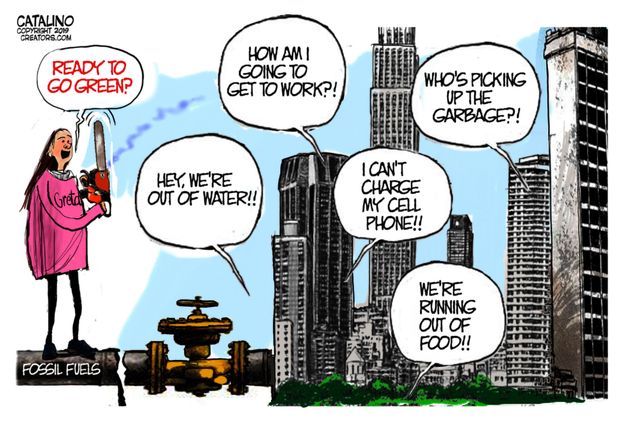
Europeans are going to get a strong dose of energy cuts Greta has long called for since starting her Fridays for the Future.  Shortages of fossil fuels are in the outlook and already reflected in skyrocketing prices. Tyler Durden explains at zerohedge All Hell Is Breaking Loose In Energy Markets.  Excerpts in italics with my bolds.

By now readers are well aware that Europe is suffering from a historic gas crisis, one which according to Rabobank is now even more extreme than the US oil price shock.
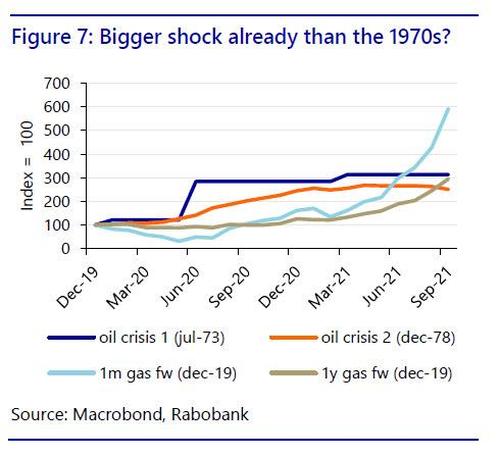
And unfortunately for Europe’s population, with every passing day – and to a lesser extent hedge funds such as Statar Capital which suffered a big loss in the past few days – it’s only getting worse. As Bloomberg’s Javier Blas notes today, both UK NBP and Dutch TTF natural gas benchmarks have closed the day at their highest ever settlement level, up ~11% on the day (to a closing price equal to more than $26 per mBtu).
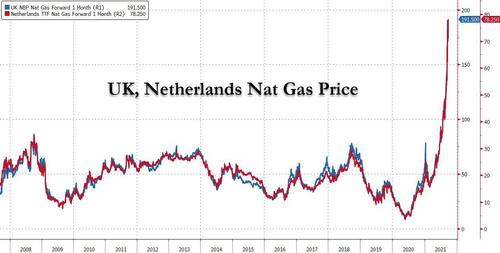
Natural gas prices in Europe have surged past $25 per million British thermal unit, more than 400% higher than the 2010-2020 average, and significantly higher than in the U.S., where the commodity trades at around $5 per million Btu. In Asia, liquefied natural gas has recently changed hands at around $27 per million Btu, a seasonal record high, as China has also been hit by a widespread energy crisis (see “Millions Of Chinese Residents Lose Power After Widespread, “Unexpected” Blackouts; Power Company Warns This Is “New Normal””). Also, for those who haven’t read it yet, please check out Rabobank’s extensive recap of Europe’s energy crisis which we posted over the weekend.

Europe’s energy crisis is not contained to nat gas, and as we discussed over the weekend in another flashback to the 1970s US, UK gas station pumps are running dry in British cities on Monday with vendors rationing sales as a shortage of truckers strained supply chains to breaking point. Pumps across British cities were either closed or had signs saying fuel was unavailable on Monday, Reuters reporters said, with some limiting the amount of fuel each customer could buy.

The Petrol Retailers Association (PRA), which represents independent fuel retailers accounting for 65% of all the 8,380 UK forecourts, said members had reported that 50% to 90% of pumps were dry in some areas.

A post-Brexit shortage of truck drivers as the COVID-19 pandemic eases has sown chaos through British supply chains in everything from food to fuel, raising the specter of disruptions and price rises in the run-up to Christmas. Drivers lined up for hours to fill their cars at petrol stations that were still selling fuel, albeit often rationed. There were also calls for National Health Service (NHS) staff and other emergency workers to be given priority.

Hauliers, gas stations and retailers said there were no quick fixes as the shortfall of truck drivers – estimated to be around 100,000 – was so acute, and because transporting fuel demands additional training and licensing. “We need some calm,” Gordon Balmer, executive director of the PRA, told Reuters. “Please don’t panic buy: if people drain the network then it becomes a self-fulfilling prophecy.”

Shifting from gasoline and nat gas to oil, the near-term outlook is looking even more grim. According to Trafigura, one of the world’s largest commodity trading houses, the world faces higher oil and gas prices this winter and beyond as supply struggles to catch up with fast-rising demand.

“We’re going to see higher oil prices,” Ben Luckock, Trafigura’s co-head of oil trading said in an interview with Bloomberg.

Luckock said the market was mispricing forward oil contracts for the next couple of years because traders hadn’t yet woken up to the fact the supply-demand balance will remain tight for some time. Translation: even higher prices are coming with no easing in sight.

“I struggle to see anything but higher prices going forward in the next two years,” he said, one day after Goldman hiked its price target, now predicting that Brent would hit $90 some time in December. On Monday, Brent crude for immediate delivery surged toward $80 a barrel, setting its highest price in nearly three years.

On natural gas, he said prices could shoot up even more this winter if cold weather forces demand higher in Europe and Asia.

The bullish outlook comes as oil demand fast recovers toward its pre-pandemic level, with most traders expecting that consumption will reach the 2019 by early-to-mid 2022. As demand rebounds, supply has struggled to keep up: U.S. shale companies have kept a lid on spending, preferring to pay dividends to shareholders. With U.S. shale reacting slowly to higher prices, the OPEC+ oil cartel has been able to keep control of the market.

The U.S. shale industry is showing very strong discipline. Oil prices are roughly double what they were a year ago and despite that we’re not seeing a huge increase in drilling,” Luckock said.

Luckock said that it was difficult to see lower natural gas prices this winter in Europe, despite the commodity trading at a record high already: “If it’s a cold winter in Europe or Asia, we have a big problem,” he said. “If it’s cold, and on top, it isn’t windy, then we have a much bigger problem. We will face shortages.”

Notably, Luckock said he was skeptical that Russia, the biggest gas supplier to Europe, was intentionally tightening the market for political gain, suggesting that Moscow was already pumping as much gas as it could right now.

“It’s easy to say that’s politically motivated, but I think it’s simpler than that: Russia is facing maintenance in many gas fields, very low domestic inventories, substantially increased flows to Turkey, and Gazprom is struggling to increase production,” he said.

Footnote: Commentary from Bloomberg Green and National Review

Ewa Krukowska at Bloomberg Green Energy Crisis Puts World’s Most Ambitious Climate Plan to Test.  Excerpts in italics with my bolds.

  • Soaring power and gas prices shoot up EU political agenda
  • Governments across EU fear backlash over costs of green shift

Natural gas and power prices are surging to all-time highs in the 27-nation region, as the bloc’s economies rebound from the Covid-19 pandemic. The surge in demand comes amid limited gas imports from Norway and Russia, with some countries accusing Moscow of manipulating supplies. At the same time, the EU strategy to accelerate emissions cuts in every sector from transport to manufacturing and agriculture boosted demand for carbon permits, with prices more than doubling over the past two years to new records.

The green package unveiled in July aims to align the economy with a 2030 stricter binding goal of reducing emissions by at least 55% from 1990 levels. The laws need to be approved by the European Parliament and member states in the Council of the EU, with each institution entitled to amending the plan, in a process likely to take around two years.

But for Europe’s lower-income countries — as well for the continent’s energy-intensive industries — the pain of any transition will be significant, and the EU will be under pressure to help cushion the blow from the current price jump.

But European governments are limited in what they can do to tackle the power crunch — without making their climate goals even harder to reach.

“It feels unlikely that politicians will reverse track and go back to coal generation or make changes to the approach to carbon,” said John Musk, an analyst at RBC Europe Ltd. “It is hard to see what measures can be adopted to alleviate near term supply-demand constraints on gas and power. There are likely be a couple of difficult years to navigate in terms of consumer prices and there may have to be some measures to help consumers here and there.”

Andres Stuttaford adds an essay at National Review The Gathering Storm (But with Not Enough Wind): Europe’s Energy Mess Gets Worse — a Lesson the U.S. Looks Set to Ignore.  Excerpts in italics with my bolds.

Instead of looking at these alternative approaches, the EU, the U.K., and, soon enough, the U.S., seem set on what is looking more and more like a headlong rush into disaster.

To understand why this might be, it is important to understand that for many climate warriors a “bloody hard” transition is a feature, not a bug.

I wrote about this a week or so back:

Concentrating on resilience and adaptation do not follow the millenarian narrative that is an unmistakable subtext of the message now being sent out by many climate warriors, whether inside government, linked to government, or outside it. Underpinned by the expectation of apocalypse, this narrative, which has repeatedly demonstrated its dangerously persuasive power over the centuries, is based on the thought that a wicked humanity faces punishment and must, with the assistance of a morally superior, enlightened vanguard, be made to change its dreadful (often self-indulgent) behavior. Adaptation and resilience, by contrast, offer the prospect that our species will muddle on through, living pretty much as it has been doing, except even better, and without donning the hairshirt integral to so many climate warriors’ faith. Theirs has the characteristics of a religion, and there is little that is original about it. Pointless asceticism comes with the territory.

Questioning whether those setting the climate agenda are going about things the right way is not a matter of climate “denial,” but simple common sense. It is not, however, a conversation that the climate establishment wants to have. Fundamentalists are like that.

They may not want to have that conversation, but, as winter approaches, the growing crisis in Europe suggests that it is a conversation that may be difficult to avoid.




Europe Energy Stress Test Under Way

Update Sept. 28  Additional commentary in Footnote at end

Europeans are going to get a strong dose of energy cuts Greta has long called for since starting her Fridays for the Future.  Shortages of fossil fuels are in the outlook and already reflected in skyrocketing prices. Tyler Durden explains at zerohedge All Hell Is Breaking Loose In Energy Markets.  Excerpts in italics with my bolds.

By now readers are well aware that Europe is suffering from a historic gas crisis, one which according to Rabobank is now even more extreme than the US oil price shock.

And unfortunately for Europe’s population, with every passing day – and to a lesser extent hedge funds such as Statar Capital which suffered a big loss in the past few days – it’s only getting worse. As Bloomberg’s Javier Blas notes today, both UK NBP and Dutch TTF natural gas benchmarks have closed the day at their highest ever settlement level, up ~11% on the day (to a closing price equal to more than $26 per mBtu).

Natural gas prices in Europe have surged past $25 per million British thermal unit, more than 400% higher than the 2010-2020 average, and significantly higher than in the U.S., where the commodity trades at around $5 per million Btu. In Asia, liquefied natural gas has recently changed hands at around $27 per million Btu, a seasonal record high, as China has also been hit by a widespread energy crisis (see “Millions Of Chinese Residents Lose Power After Widespread, “Unexpected” Blackouts; Power Company Warns This Is “New Normal””). Also, for those who haven’t read it yet, please check out Rabobank’s extensive recap of Europe’s energy crisis which we posted over the weekend.

Europe’s energy crisis is not contained to nat gas, and as we discussed over the weekend in another flashback to the 1970s US, UK gas station pumps are running dry in British cities on Monday with vendors rationing sales as a shortage of truckers strained supply chains to breaking point. Pumps across British cities were either closed or had signs saying fuel was unavailable on Monday, Reuters reporters said, with some limiting the amount of fuel each customer could buy.

The Petrol Retailers Association (PRA), which represents independent fuel retailers accounting for 65% of all the 8,380 UK forecourts, said members had reported that 50% to 90% of pumps were dry in some areas.

A post-Brexit shortage of truck drivers as the COVID-19 pandemic eases has sown chaos through British supply chains in everything from food to fuel, raising the specter of disruptions and price rises in the run-up to Christmas. Drivers lined up for hours to fill their cars at petrol stations that were still selling fuel, albeit often rationed. There were also calls for National Health Service (NHS) staff and other emergency workers to be given priority.

Hauliers, gas stations and retailers said there were no quick fixes as the shortfall of truck drivers – estimated to be around 100,000 – was so acute, and because transporting fuel demands additional training and licensing. “We need some calm,” Gordon Balmer, executive director of the PRA, told Reuters. “Please don’t panic buy: if people drain the network then it becomes a self-fulfilling prophecy.”

Shifting from gasoline and nat gas to oil, the near-term outlook is looking even more grim. According to Trafigura, one of the world’s largest commodity trading houses, the world faces higher oil and gas prices this winter and beyond as supply struggles to catch up with fast-rising demand.

“We’re going to see higher oil prices,” Ben Luckock, Trafigura’s co-head of oil trading said in an interview with Bloomberg.

Luckock said the market was mispricing forward oil contracts for the next couple of years because traders hadn’t yet woken up to the fact the supply-demand balance will remain tight for some time. Translation: even higher prices are coming with no easing in sight.

“I struggle to see anything but higher prices going forward in the next two years,” he said, one day after Goldman hiked its price target, now predicting that Brent would hit $90 some time in December. On Monday, Brent crude for immediate delivery surged toward $80 a barrel, setting its highest price in nearly three years.

On natural gas, he said prices could shoot up even more this winter if cold weather forces demand higher in Europe and Asia.

The bullish outlook comes as oil demand fast recovers toward its pre-pandemic level, with most traders expecting that consumption will reach the 2019 by early-to-mid 2022. As demand rebounds, supply has struggled to keep up: U.S. shale companies have kept a lid on spending, preferring to pay dividends to shareholders. With U.S. shale reacting slowly to higher prices, the OPEC+ oil cartel has been able to keep control of the market.

The U.S. shale industry is showing very strong discipline. Oil prices are roughly double what they were a year ago and despite that we’re not seeing a huge increase in drilling,” Luckock said.

Luckock said that it was difficult to see lower natural gas prices this winter in Europe, despite the commodity trading at a record high already: “If it’s a cold winter in Europe or Asia, we have a big problem,” he said. “If it’s cold, and on top, it isn’t windy, then we have a much bigger problem. We will face shortages.”

Notably, Luckock said he was skeptical that Russia, the biggest gas supplier to Europe, was intentionally tightening the market for political gain, suggesting that Moscow was already pumping as much gas as it could right now.

“It’s easy to say that’s politically motivated, but I think it’s simpler than that: Russia is facing maintenance in many gas fields, very low domestic inventories, substantially increased flows to Turkey, and Gazprom is struggling to increase production,” he said.

Footnote: Commentary from Bloomberg Green and National Review

Ewa Krukowska at Bloomberg Green Energy Crisis Puts World’s Most Ambitious Climate Plan to Test.  Excerpts in italics with my bolds.

  • Soaring power and gas prices shoot up EU political agenda
  • Governments across EU fear backlash over costs of green shift

Natural gas and power prices are surging to all-time highs in the 27-nation region, as the bloc’s economies rebound from the Covid-19 pandemic. The surge in demand comes amid limited gas imports from Norway and Russia, with some countries accusing Moscow of manipulating supplies. At the same time, the EU strategy to accelerate emissions cuts in every sector from transport to manufacturing and agriculture boosted demand for carbon permits, with prices more than doubling over the past two years to new records.

The green package unveiled in July aims to align the economy with a 2030 stricter binding goal of reducing emissions by at least 55% from 1990 levels. The laws need to be approved by the European Parliament and member states in the Council of the EU, with each institution entitled to amending the plan, in a process likely to take around two years.

But for Europe’s lower-income countries — as well for the continent’s energy-intensive industries — the pain of any transition will be significant, and the EU will be under pressure to help cushion the blow from the current price jump.

But European governments are limited in what they can do to tackle the power crunch — without making their climate goals even harder to reach.

“It feels unlikely that politicians will reverse track and go back to coal generation or make changes to the approach to carbon,” said John Musk, an analyst at RBC Europe Ltd. “It is hard to see what measures can be adopted to alleviate near term supply-demand constraints on gas and power. There are likely be a couple of difficult years to navigate in terms of consumer prices and there may have to be some measures to help consumers here and there.”

Andres Stuttaford adds an essay at National Review The Gathering Storm (But with Not Enough Wind): Europe’s Energy Mess Gets Worse — a Lesson the U.S. Looks Set to Ignore.  Excerpts in italics with my bolds.

Instead of looking at these alternative approaches, the EU, the U.K., and, soon enough, the U.S., seem set on what is looking more and more like a headlong rush into disaster.

To understand why this might be, it is important to understand that for many climate warriors a “bloody hard” transition is a feature, not a bug.

I wrote about this a week or so back:

Concentrating on resilience and adaptation do not follow the millenarian narrative that is an unmistakable subtext of the message now being sent out by many climate warriors, whether inside government, linked to government, or outside it. Underpinned by the expectation of apocalypse, this narrative, which has repeatedly demonstrated its dangerously persuasive power over the centuries, is based on the thought that a wicked humanity faces punishment and must, with the assistance of a morally superior, enlightened vanguard, be made to change its dreadful (often self-indulgent) behavior. Adaptation and resilience, by contrast, offer the prospect that our species will muddle on through, living pretty much as it has been doing, except even better, and without donning the hairshirt integral to so many climate warriors’ faith. Theirs has the characteristics of a religion, and there is little that is original about it. Pointless asceticism comes with the territory.

Questioning whether those setting the climate agenda are going about things the right way is not a matter of climate “denial,” but simple common sense. It is not, however, a conversation that the climate establishment wants to have. Fundamentalists are like that.

They may not want to have that conversation, but, as winter approaches, the growing crisis in Europe suggests that it is a conversation that may be difficult to avoid.


Dr. Richard Urso: End the Pandemic with Early Covid Treatment

Drug Inventor Urso: Are We Underutilizing Early Treatment?

We cannot use a one-size fits all approach to fighting Covid

Dr. Richard Urso is a scientist, sole inventor of an FDA-approved wound healing drug, and the Former Director of Orbital Oncology at MD Anderson Cancer Center. He believes we cannot use a one-size-fits-all approach to fighting Covid.

“We are not going to vaccinate our way out of this,” he said. “There’s no reason to not use anti-inflammatories against inflammatory disease. I used steroids in March and people were saying, ‘Why are you using steroids for inflammatory for this viral disease?’ And I said, ‘Because it’s not a viral disease.’”

Urso says mass lockdowns and waiting for a vaccine never made a lot of sense to him. He calls for a multi-pronged strategy includes targeted vaccination programs, but also early treatment and prevention measures.

“Early treatment should have been part of the equation. I’m not against all those other things. Contagion control is important. Washing our hands. Things like that. They’re all important. Do we need vaccination programs? Absolutely. Do we need early treatment programs? Absolutely. So we have basically put the cart before the horse. The tail is wagging the dog. Early treatment should be a mainstay for everything.”

Background previous post 3000+ Doctors Declaration for Medical Rights and Freedoms

Update October 7:  Presently 10,000+ Medical Practitioners have signed this declaration, as well as providing additional resources at Global Covid Summit

By Debra Heine writes at American Greatness Over 3,000 Doctors and Scientists Sign Declaration Accusing COVID Policy-Makers of ‘Crimes Against Humanity’. Excerpts in italics with my bolds and images.

A group of physicians and scientists met in Rome, Italy earlier this month for a three day Global Covid Summit to speak “truth to power about Covid pandemic research and treatment.”

The summit, which was held from September 12 to September 14, gave the medical professionals an opportunity to compare studies, and assess the efficacy of the various treatments that have been developed in hospitals, doctors offices and research labs throughout the world.

The Physicians’ Declaration was first read at the Rome Covid Summit, catalyzing an explosion of active support from medical scientists and physicians around the globe. These professionals were not expecting career threats, character assassination, papers and research censored, social accounts blocked, search results manipulated, clinical trials and patient observations banned, and their professional history and accomplishments altered or omitted in academic and mainstream media.

The document, reprinted below in its entirety, sprang from that conference.

Thousands have died from Covid as a result of being denied life-saving early treatment. The Declaration is a battle cry from physicians who are daily fighting for the right to treat their patients, and the right of patients to receive those treatments – without fear of interference, retribution or censorship by government, pharmacies, pharmaceutical corporations, and big tech. We demand that these groups step aside and honor the sanctity and integrity of the patient-physician relationship, the fundamental maxim “First Do No Harm”, and the freedom of patients and physicians to make informed medical decisions. Lives depend on it.

We the physicians of the world, united and loyal to the Hippocratic Oath, recognizing the profession of medicine as we know it is at a crossroad, are compelled to declare the following;

WHEREAS, it is our utmost responsibility and duty to uphold and restore the dignity, integrity, art and science of medicine;

WHEREAS, there is an unprecedented assault on our ability to care for our patients;

WHEREAS, public policy makers have chosen to force a “one size fits all” treatment strategy, resulting in needless illness and death, rather than upholding fundamental concepts of the individualized, personalized approach to patient care which is proven to be safe and more effective;

WHEREAS, physicians and other health care providers working on the front lines, utilizing their knowledge of epidemiology, pathophysiology and pharmacology, are often first to identify new, potentially life saving treatments;

WHEREAS, physicians are increasingly being discouraged from engaging in open professional discourse and the exchange of ideas about new and emerging diseases, not only endangering the essence of the medical profession, but more importantly, more tragically, the lives of our patients;

WHEREAS, thousands of physicians are being prevented from providing treatment to their patients, as a result of barriers put up by pharmacies, hospitals, and public health agencies, rendering the vast majority of healthcare providers helpless to protect their patients in the face of disease. Physicians are now advising their patients to simply go home (allowing the virus to replicate) and return when their disease worsens, resulting in hundreds of thousands of unnecessary patient deaths, due to failure-to-treat;

WHEREAS, this is not medicine. This is not care. These policies may actually constitute crimes against humanity.

NOW THEREFORE, IT IS:

RESOLVED, that the physician-patient relationship must be restored. The very heart of medicine is this relationship, which allows physicians to best understand their patients and their illnesses, to formulate treatments that give the best chance for success, while the patient is an active participant in their care.

RESOLVED, that the political intrusion into the practice of medicine and the physician/patient relationship must end. Physicians, and all health care providers, must be free to practice the art and science of medicine without fear of retribution, censorship, slander, or disciplinary action, including possible loss of licensure and hospital privileges, loss of insurance contracts and interference from government entities and organizations – which further prevent us from caring for patients in need. More than ever, the right and ability to exchange objective scientific findings, which further our understanding of disease, must be protected.

RESOLVED, that physicians must defend their right to prescribe treatment, observing the tenet FIRST, DO NO HARM. Physicians shall not be restricted from prescribing safe and effective treatments. These restrictions continue to cause unnecessary sickness and death. The rights of patients, after being fully informed about the risks and benefits of each option, must be restored to receive those treatments.

RESOLVED, that we invite physicians of the world and all health care providers to join us in this noble cause as we endeavor to restore trust, integrity and professionalism to the practice of medicine.

RESOLVED, that we invite the scientists of the world, who are skilled in biomedical research and uphold the highest ethical and moral standards, to insist on their ability to conduct and publish objective, empirical research without fear of reprisal upon their careers, reputations and livelihoods.

RESOLVED, that we invite patients, who believe in the importance of the physician-patient relationship and the ability to be active participants in their care, to demand access to science-based medical care.


So Called “Climate Science”

Norman Rogers writes at American Thinker The ‘Science’ of Climate Change.  Excerpts in italics with my bolds and added images.

The science surrounding COVID has been hijacked for political purposes. People who recovered from the disease are pushed to get vaccinated, even though they have a natural immunity that is stronger than vaccine immunity. People are required to wear masks even though masks are essentially useless for preventing infection. People that die are reported as dying of COVID even though they died of something else. The government demands that children be vaccinated even though they are naturally resistant to the disease and suffer disturbing side effects from the vaccine. Schools are closed for no good reason.

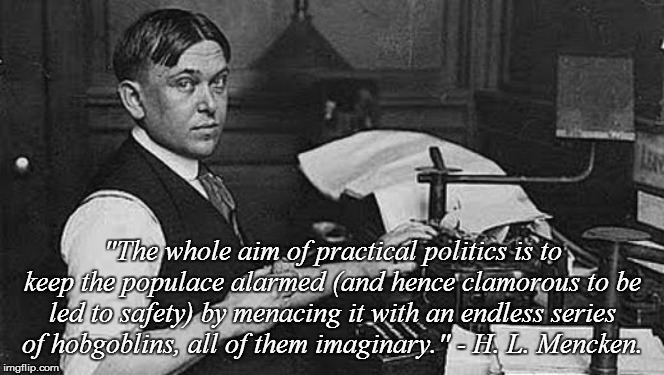
The “science” of climate change is also BS. That should be easier to accept after seeing what the government did to COVID science. Why do politicians want to hype a nonexistent climate crisis? In a word: power. By claiming that there is an urgent climate crisis the politicians can spend billions to fight the imaginary foe. Those billions create political allies and reward friends. H.L. Mencken put it nicely in 1918:

The parade of imaginary environmental catastrophes during the last 70 years is very long. Here are some books predicting this or that environmental disaster: Our Plundered Planet (1948), Road to Survival (1948), Silent Spring (1962), Famine 1975! (1967), The Population Bomb (1968), The Limits to Growth (1972), An Inconvenient Truth (2006), This Changes Everything: Capitalism vs. Climate (2014), The Uninhabitable Earth: Life After Warming (2019).

Richard Lindzen, one of the most accomplished climate scientists in the world by virtue of his discoveries, does not have to kowtow to the global warming mob. In an essay, he pointed out that scientific data that challenge the global warming hypothesis are simply changed. He cites examples of how environmental extremists have infiltrated scientific organizations. [See Climate Science Was Broken]

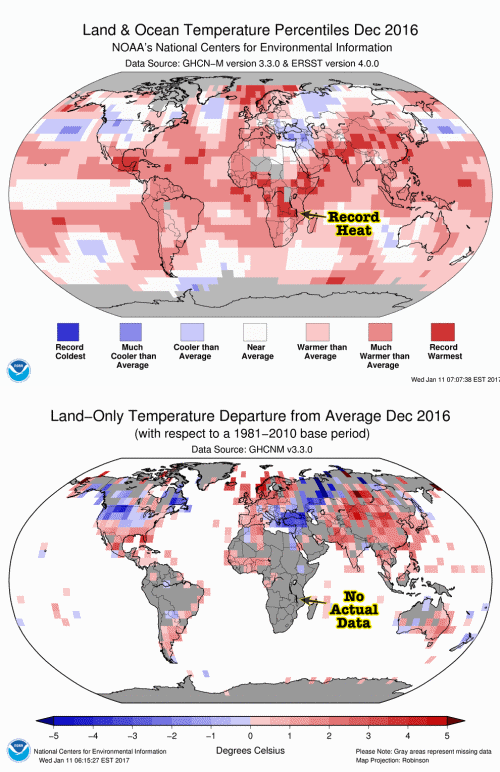
Tony Heller, an engineer and geologist, operates a long-running website, Real Climate Science. He specializes in exposing the changed data mentioned by Richard Lindzen. The promoters of climate change cherry-pick data when they are not changing it. Heller exposes the lie in the National Climate Assessment that heatwaves are becoming more common. He exposes “adjustments” to the U.S. temperature record to bring it into line with climate change predictions.[See Man Made Warming from Adjusting Data]

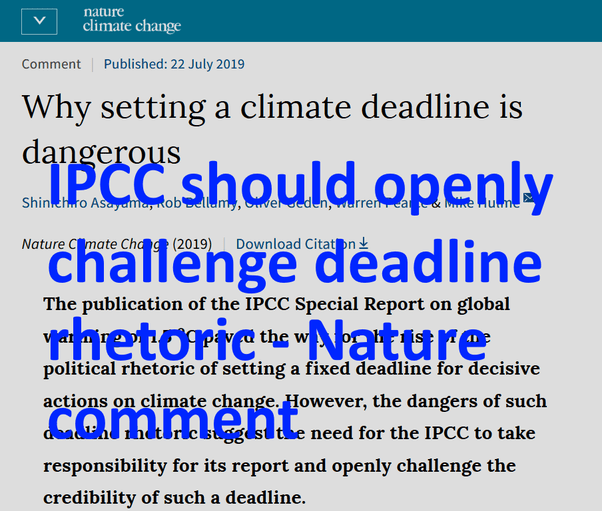
In her book The Delinquent Teenager Who Was Mistaken for the World’s Top Climate Expert, Donna Laframboise exposes the International Panel on Climate Change (IPCC), a UN organization that pretends to produce very careful and serious reports on the Earth’s climate. Most climate hysteria traces back to the IPCC’s reports. The IPCC does not follow its own procedures and is populated by environmental activists with limited scientific credentials. Its reports are masterful examples of wordy expositions that circle around scientific problems rather than presenting solid ideas backed by facts. The IPCC is a political organization, not a scientific one.

Amusingly, the longtime head of the IPCC, Rajendra Pachauri, an Indian railroad engineer, is also the author of a porn novel: Return to Almora. The 75-year-old bureaucrat was forced out of an Indian environmental organization for making persistent and improper advances to young women that worked for him. But, of course, that is irrelevant to his accomplishments as head of the IPCC.

The predictions of climate doom are based on complex computer models of the Earth’s atmosphere. Kevin E. Trenberth, an accomplished climate scientist at the National Center for Atmospheric Research said this about these models:

“None of the models used by IPCC are initialized to the observed state and none of the climate states in the models correspond even remotely to the current observed climate. In particular, the state of the oceans, sea ice, and soil moisture has no relationship to the observed state at any recent time in any of the IPCC models.”

The method of the IPCC is to average together the results from dozens of computer models to make their predictions. They don’t actually say “predictions,” they say “projections,” but the rest of the world sees predictions. The model developers try to make their models fit climate history on the assumption that if they fit the past, the models might have predictive value for the future. There are a few problems. The models are so complex and have so many adjustable parameters, that fitting the past becomes an exercise in curve fitting. Further, the modelers are each permitted to have their own climate history. Parts of climate history that are poorly known, such as aerosols, can be fiddled to make a particular model fit better. [See Climate Models: Good, Bad and Ugly]

Figure 8: Warming in the tropical troposphere according to the CMIP6 models. Trends 1979–2014 (except the rightmost model, which is to 2007), for 20°N–20°S, 300–200 hPa. John Christy et al. (2019)

This method, applied to the stock market, would be to make a model and adjust it so that it explains past gyrations of the market. Then wahoo… the modeler can make billions. It doesn’t work, as the scarcity of mathematicians that are billionaires testifies.

I spent 10 years going to the Fall Meeting of the American Geophysical Union. I spoke with many climate scientists including many who freely admitted in private that global warming is a very dubious enterprise.

I remember a Danish guy who visited beaches in northern Greenland by dog sled. He discovered 6,000-year-old driftwood on a beach always blocked by ice, year-round. That was clear evidence that the Arctic Ocean was summer ice-free during a time called the Holocene Optimum. Present-day global warmers claim that our coming climate disaster will again make the Arctic Ocean summer ice-free, something that happened 6,000 years ago with no help from SUVs or belching cows. Of course, the guy was afraid to make too much of his discovery because it challenges the climate doom theory.

There is no such thing as an early career climate scientist that is skeptical concerning global warming. I actually tried to find one and did a poster at a scientific meeting on the subject. The reason is simple. It is not because the science is so clear that only an idiot would question it. It is because our early-career climate scientist would soon be looking for a new job. Interfering with the flow of money from Washington is grounds for dismissal.

I still believe in science and I feel sorry for all the closeted climate scientists. Like the Soviet geneticists forced to cheer for Lysenkoism, these academics must cheer the global warming racket. They have wives, children, and mortgages.

Scary Warming Everywhere Elsewhere

Recent posts here discussed how rapidly has cooling set in this year.  Of course that reality is inconvenient in the run up to Glasgow COP, so the scramble is on to claim that 2021 is hotter than ever.  A previous post Heat Records Silly Season Again provides background for understanding that there are literally millions of temperature records that can be packaged to support any desirable warming or cooling claim.

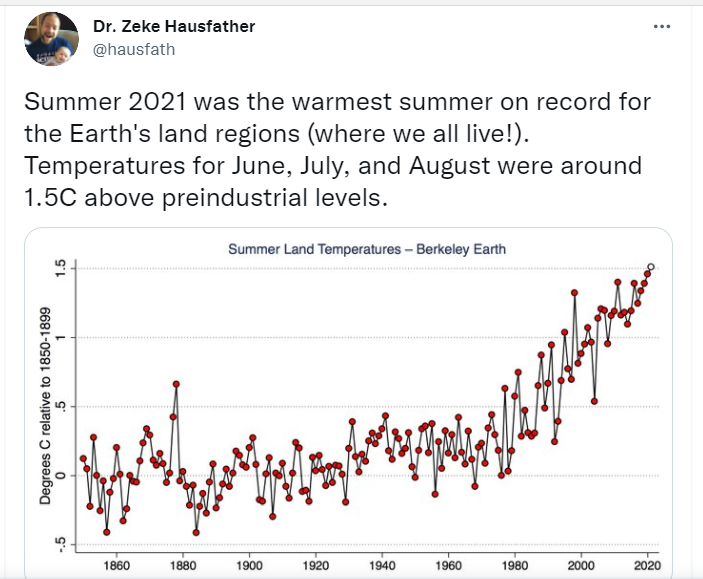
A current example of such packaging is found in a recent tweet thread from Zeke Hausfather, a climate analyst who helped build the BEST dataset and a supporter of the IPCC agenda.

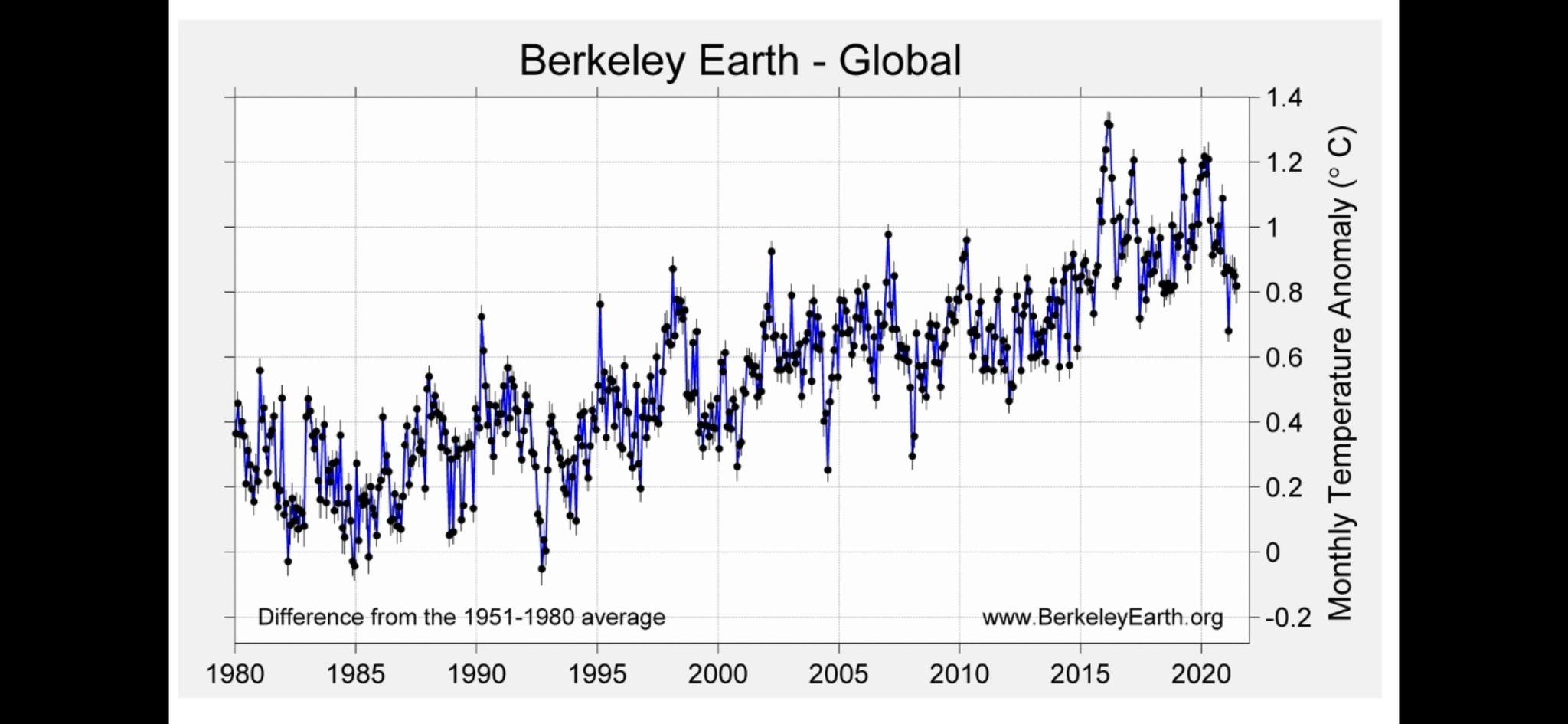
A curious person would note that only summer and land is shown, and would wonder: What am I not seeing?  And then in the thread are various comments saying it was not at all warm where I live, this doesn’t add up.  And then someone shows another graph from BEST giving a different impression.

Climate reporting is confusing because the scope of temperature averaging gives very different impressions, and at the mega scale rarely corresponds to anyone’s particular experience.  So generalizations are claimed extrapolating from statistics, contradicted by many persons’ direct experience.

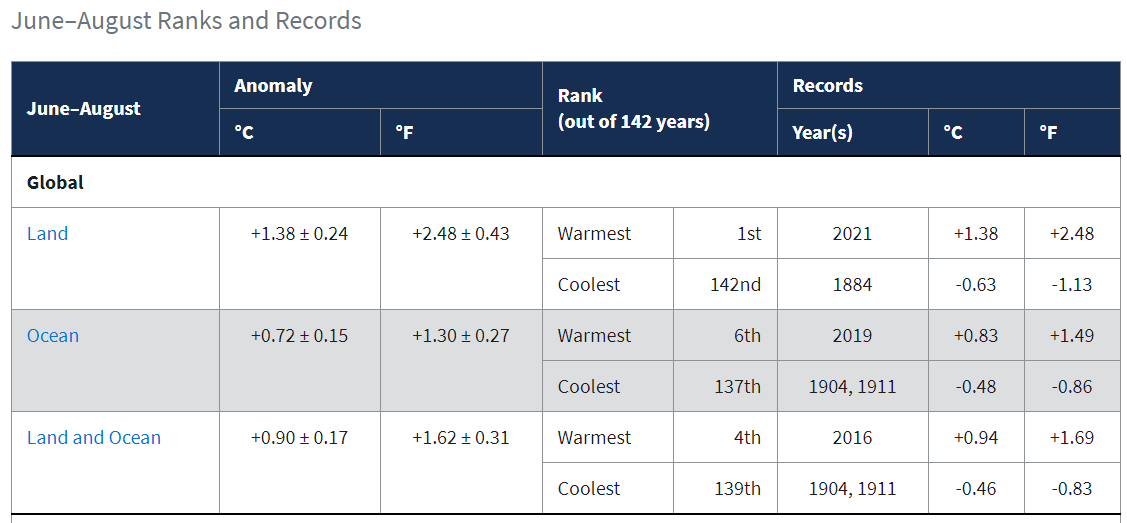
NOAA State of the Climate is another site advocating for the IPCC agenda and illustrates how this works.  First the Global Climate Report:

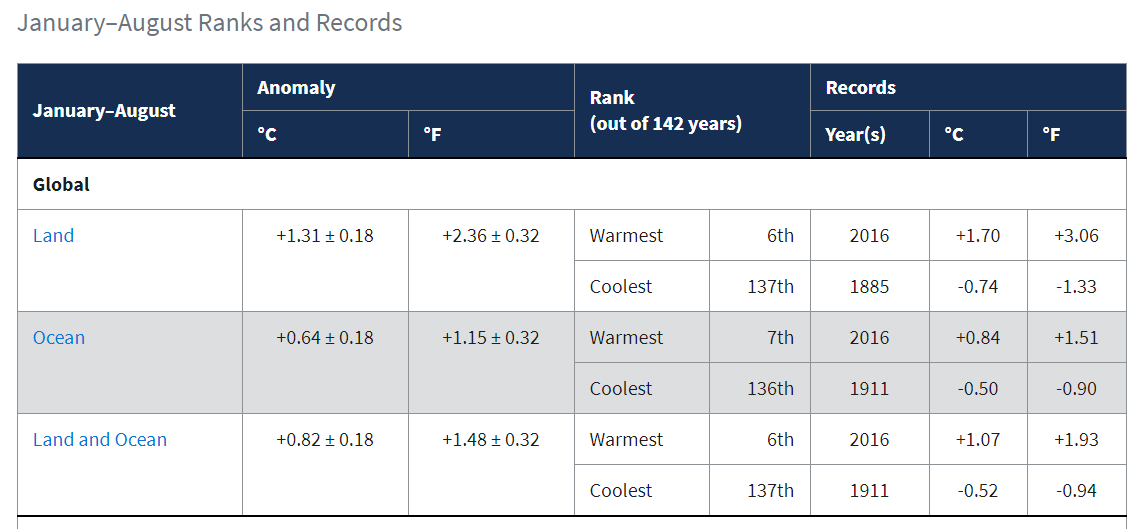
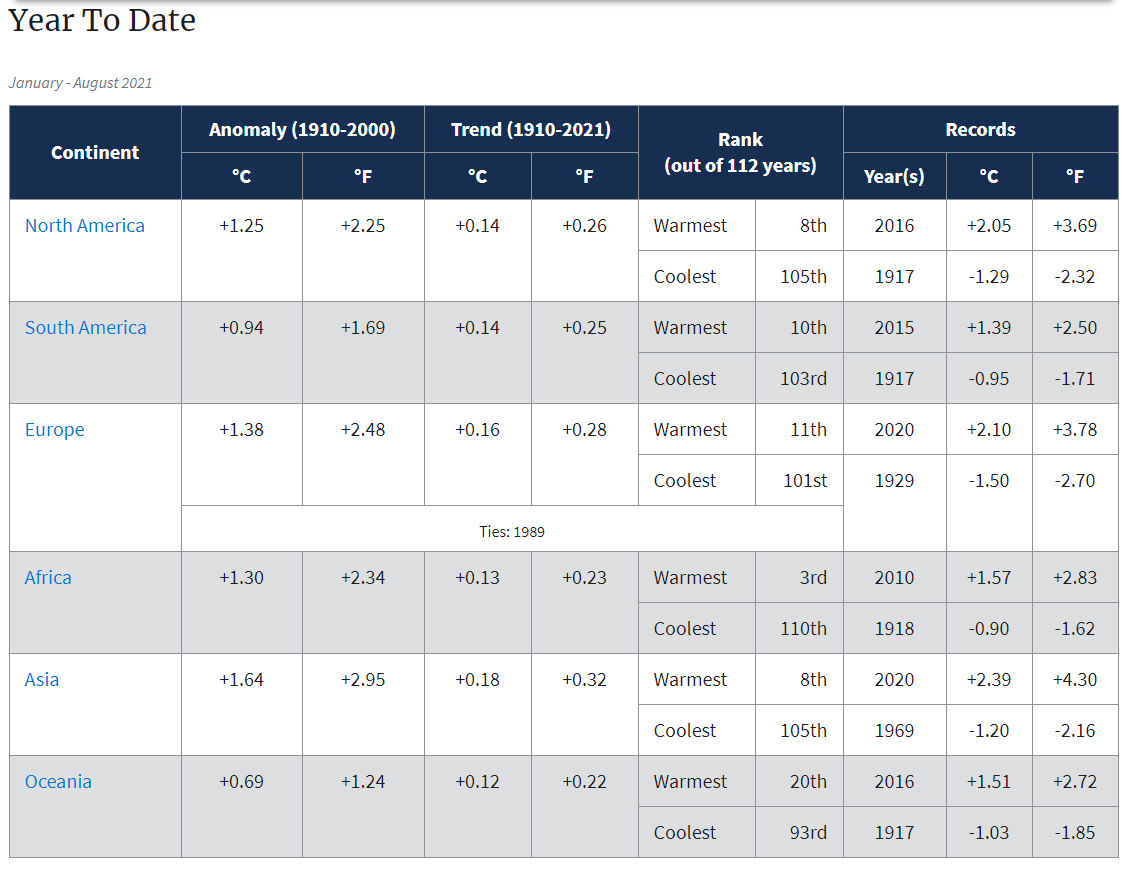
So there is the #1 warmest land summer, but we now can see the Ocean was 6th and combined Global is 4th, not 1st.  Now let’s look at the year to date (YTD):

Oh oh, that’s not as scary; the first two-thirds of 2021 are not #1, but #6, and with autumn coming on could go even lower. And to understand why most people will be put off by Hausfather’s claim, we go to the Regional Analysis in order to see what the year has been like in various continents (land by definition).

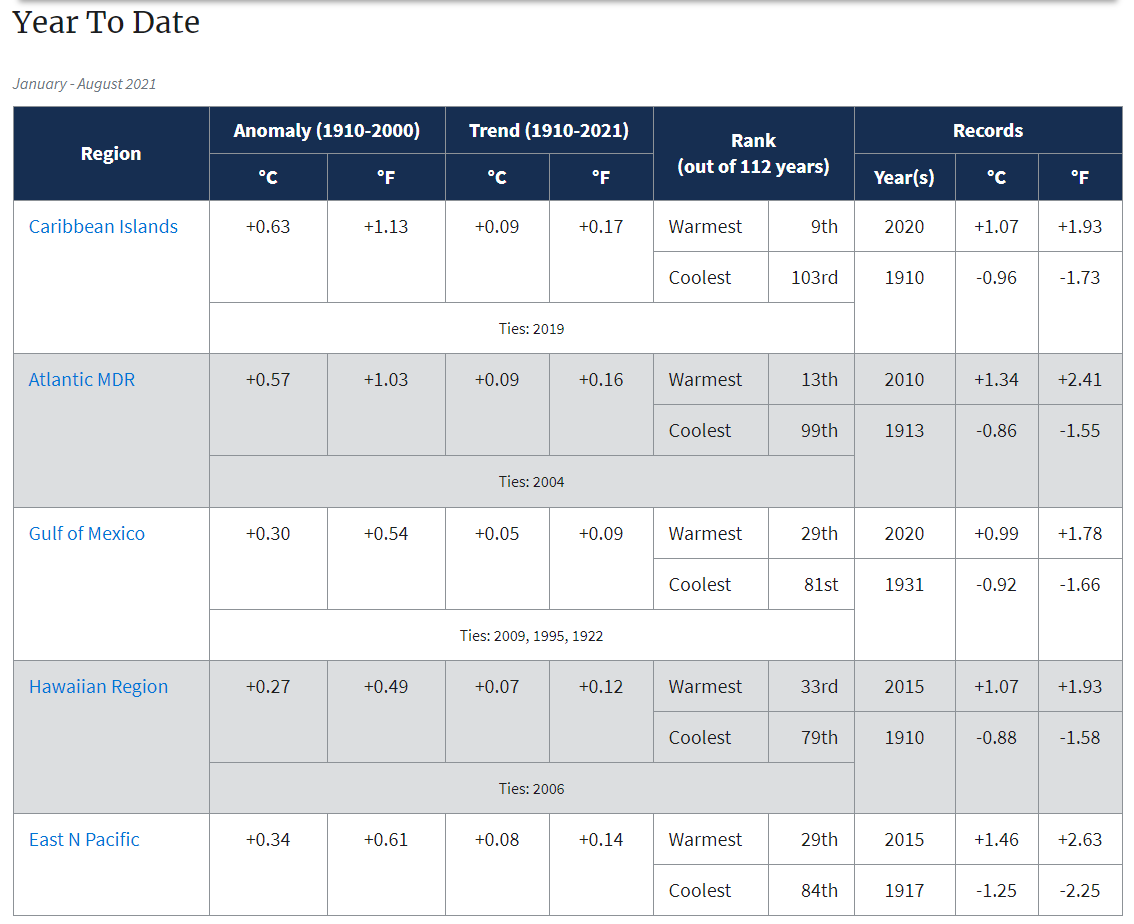
It becomes obvious that no matter where I live, don’t tell me this is the hottest year ever. OK some Africans may agree, but those in Oceania (mostly Australians) will boo you out of the room.  And as for tourist destinations,  forget about it:Footnote: Everyone has an agenda and packages data in support of their POV.  Those who joined the anti-fossil fuel crusade are bound to find and amplify any bit of global warming they can find.  My agenda is for people to consider the full amount of relevant data and facts, and to reason accordingly rather than go along with the crowd or their feelings.  My approach is best expressed in this essay:

I Want You Not to Panic


August 2021 Oceans Warmed Weakly


The best context for understanding decadal temperature changes comes from the world’s sea surface temperatures (SST), for several reasons:

  • The ocean covers 71% of the globe and drives average temperatures;
  • SSTs have a constant water content, (unlike air temperatures), so give a better reading of heat content variations;
  • A major El Nino was the dominant climate feature in recent years.

HadSST is generally regarded as the best of the global SST data sets, and so the temperature story here comes from that source, the latest version being HadSST3.  More on what distinguishes HadSST3 from other SST products at the end.

The Current Context

The year end report below showed 2020 rapidly cooling in all regions.  The anomalies then continued to drop sharply well below the mean since 1995.  This Global Cooling was also evident in the UAH Land and Ocean air temperatures ( See Adios, Global Warming)

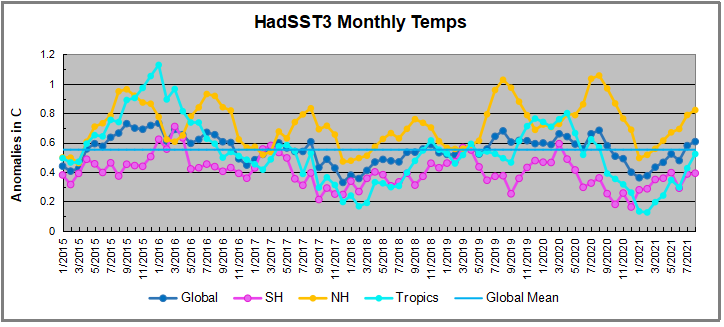
The chart below shows SST monthly anomalies as reported in HadSST3 starting in 2015 through August 2021. After three straight Spring 2020 months of cooling led by the tropics and SH, NH spiked in the summer, along with smaller bumps elsewhere.  Then temps everywhere dropped the last six months, hitting bottom in February 2021.  All regions were well below the Global Mean since 2015, matching the cold of 2018, and lower than January 2015. Then the spring brought more temperate waters and a return to the mean anomaly since 2015.  June Global SST anomaly cooled off back to April due to dropping temps in SH and the Tropics. Then July warming in all regions reversed the June cooling and along with August Tropical warming brought the Global temp anomaly slightly above the mean since 2015.A global cooling pattern is seen clearly in the Tropics since its peak in 2016, joined by NH and SH cycling downward since 2016.  

Note that higher temps in 2015 and 2016 were first of all due to a sharp rise in Tropical SST, beginning in March 2015, peaking in January 2016, and steadily declining back below its beginning level. Secondly, the Northern Hemisphere added three bumps on the shoulders of Tropical warming, with peaks in August of each year.  A fourth NH bump was lower and peaked in September 2018.  As noted above, a fifth peak in August 2019 and a sixth August 2020 exceeded the four previous upward bumps in NH.

In 2019 all regions had been converging to reach nearly the same value in April.  Then  NH rose exceptionally by almost 0.5C over the four summer months, in August 2019 exceeding previous summer peaks in NH since 2015.  In the 4 succeeding months, that warm NH pulse reversed sharply. Then again NH temps warmed to a 2020 summer peak, matching 2019. 

This has now been reversed in 2021 with all regions pulling the Global anomaly downward sharply, tempered by warming this year in March to May.  June dropped below the global mean anomaly since 2015, July and now August have pulled up the global temp slightly above the mean since 2015. 

Note that in previous years the global release of heat was not dramatic, due to the Southern Hemisphere offsetting the Northern one. However, in 2021 the warming pattern appears in all regions, resulting in a return from cooling to the mean.  The typical NH summer pulse at this point resembles 2017 rather than the much warmer 2019 and 2020.

A longer view of SSTs

To enlarge, double-click on image.

The graph above is noisy, but the density is needed to see the seasonal patterns in the oceanic fluctuations.  Previous posts focused on the rise and fall of the last El Nino starting in 2015.  This post adds a longer view, encompassing the significant 1998 El Nino and since.  The color schemes are retained for Global, Tropics, NH and SH anomalies.  Despite the longer time frame, I have kept the monthly data (rather than yearly averages) because of interesting shifts between January and July.1995 is a reasonable (ENSO neutral) starting point prior to the first El Nino.  The sharp Tropical rise peaking in 1998 is dominant in the record, starting Jan. ’97 to pull up SSTs uniformly before returning to the same level Jan. ’99.  For the next 2 years, the Tropics stayed down, and the world’s oceans held steady around 0.2C above 1961 to 1990 average.

Then comes a steady rise over two years to a lesser peak Jan. 2003, but again uniformly pulling all oceans up around 0.4C.  Something changes at this point, with more hemispheric divergence than before. Over the 4 years until Jan 2007, the Tropics go through ups and downs, NH a series of ups and SH mostly downs.  As a result the Global average fluctuates around that same 0.4C, which also turns out to be the average for the entire record since 1995.

2007 stands out with a sharp drop in temperatures so that Jan.08 matches the low in Jan. ’99, but starting from a lower high. The oceans all decline as well, until temps build peaking in 2010.

Now again a different pattern appears.  The Tropics cool sharply to Jan 11, then rise steadily for 4 years to Jan 15, at which point the most recent major El Nino takes off.  But this time in contrast to ’97-’99, the Northern Hemisphere produces peaks every summer pulling up the Global average.  In fact, these NH peaks appear every July starting in 2003, growing stronger to produce 3 massive highs in 2014, 15 and 16.  NH July 2017 was only slightly lower, and a fifth NH peak still lower in Sept. 2018.

The highest summer NH peaks came in 2019 and 2020, only this time the Tropics and SH are offsetting rather adding to the warming. (Note: these are high anomalies on top of the highest absolute temps in the NH.)  Since 2014 SH has played a moderating role, offsetting the NH warming pulses. After September 2020 temps dropped off down until February 2021, then all regions rose to bring the global anomaly above the mean since 1995  June 2021 backed down before warming again slightly in July and August 2021.  The present level compares with 2017.

What to make of all this? The patterns suggest that in addition to El Ninos in the Pacific driving the Tropic SSTs, something else is going on in the NH.  The obvious culprit is the North Atlantic, since I have seen this sort of pulsing before.  After reading some papers by David Dilley, I confirmed his observation of Atlantic pulses into the Arctic every 8 to 10 years.

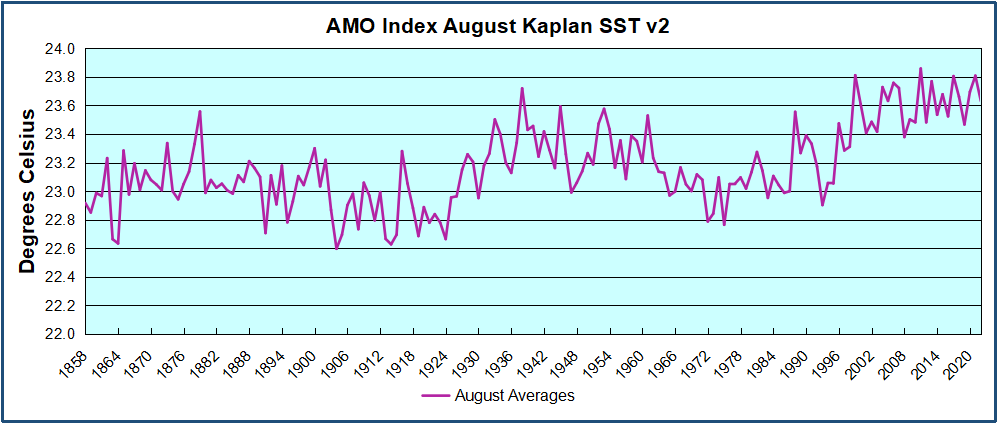
But the peaks coming nearly every summer in HadSST require a different picture.  Let’s look at August, the hottest month in the North Atlantic from the Kaplan dataset.

The AMO Index is from from Kaplan SST v2, the unaltered and not detrended dataset. By definition, the data are monthly average SSTs interpolated to a 5×5 grid over the North Atlantic basically 0 to 70N. The graph shows August warming began after 1992 up to 1998, with a series of matching years since, including 2020, dropping down in 2021.  Because the N. Atlantic has partnered with the Pacific ENSO recently, let’s take a closer look at some AMO years in the last 2 decades.

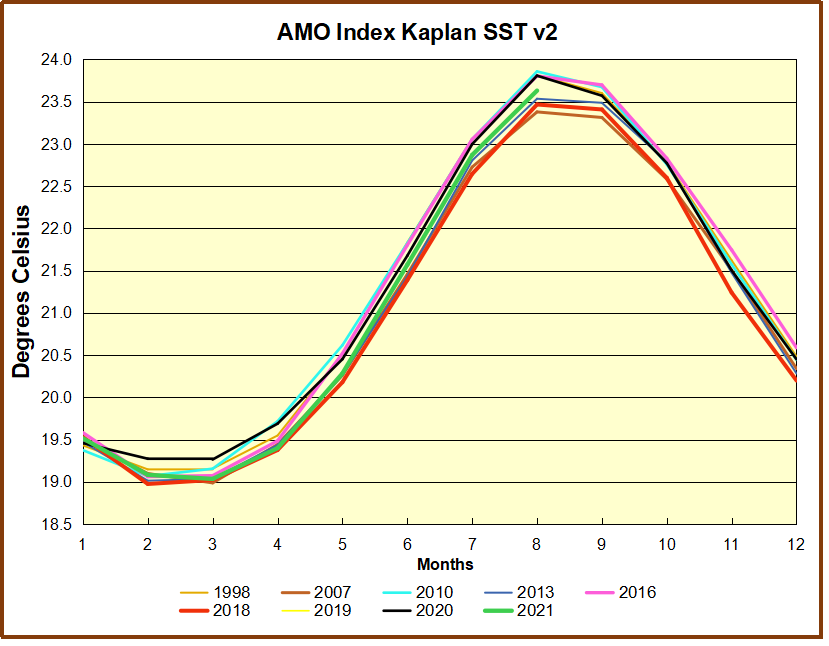
This graph shows monthly AMO temps for some important years. The Peak years were 1998, 2010 and 2016, with the latter emphasized as the most recent. The other years show lesser warming, with 2007 emphasized as the coolest in the last 20 years. Note the red 2018 line is at the bottom of all these tracks. The black line shows that 2020 began slightly warm, then set records for 3 months. then dropped below 2016 and 2017, peaked in August ending below 2016. Now in 2021, AMO is tracking the coldest years, warming slightly June through August.

Summary

The oceans are driving the warming this century.  SSTs took a step up with the 1998 El Nino and have stayed there with help from the North Atlantic, and more recently the Pacific northern “Blob.”  The ocean surfaces are releasing a lot of energy, warming the air, but eventually will have a cooling effect.  The decline after 1937 was rapid by comparison, so one wonders: How long can the oceans keep this up? If the pattern of recent years continues, NH SST anomalies may rise slightly in coming months, but once again, ENSO which has weakened will probably determine the outcome.

Footnote: Why Rely on HadSST3

HadSST3 is distinguished from other SST products because HadCRU (Hadley Climatic Research Unit) does not engage in SST interpolation, i.e. infilling estimated anomalies into grid cells lacking sufficient sampling in a given month. From reading the documentation and from queries to Met Office, this is their procedure.

HadSST3 imports data from gridcells containing ocean, excluding land cells. From past records, they have calculated daily and monthly average readings for each grid cell for the period 1961 to 1990. Those temperatures form the baseline from which anomalies are calculated.

In a given month, each gridcell with sufficient sampling is averaged for the month and then the baseline value for that cell and that month is subtracted, resulting in the monthly anomaly for that cell. All cells with monthly anomalies are averaged to produce global, hemispheric and tropical anomalies for the month, based on the cells in those locations. For example, Tropics averages include ocean grid cells lying between latitudes 20N and 20S.

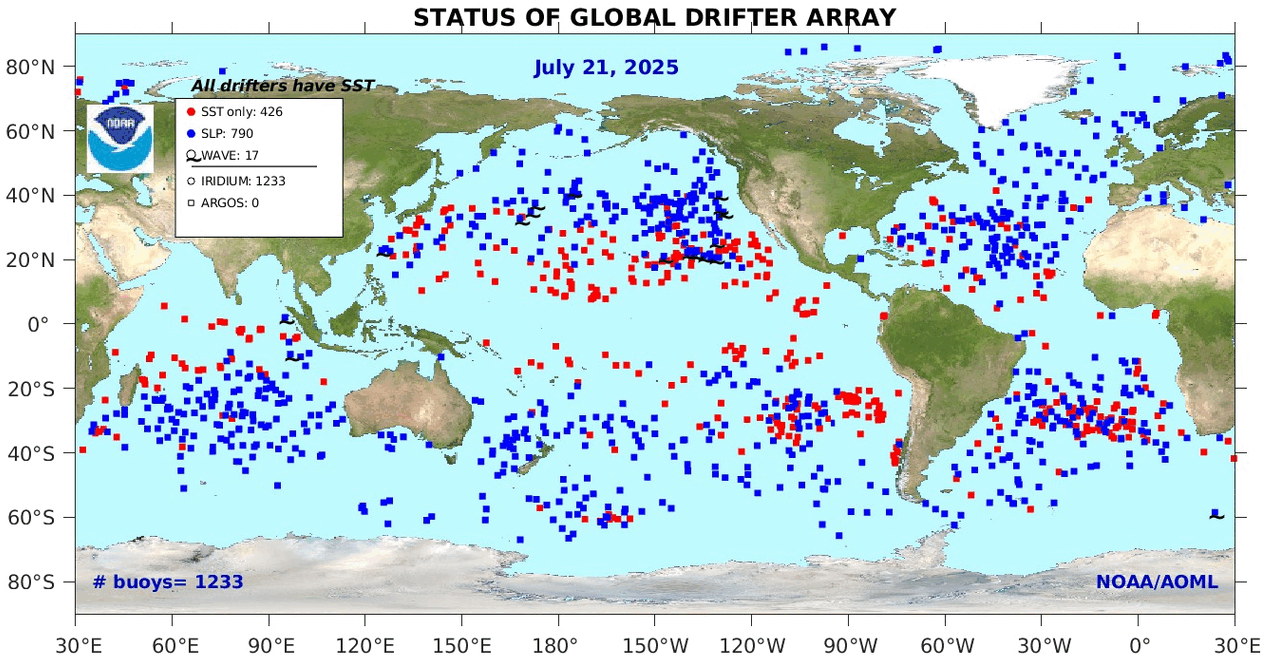
Gridcells lacking sufficient sampling that month are left out of the averaging, and the uncertainty from such missing data is estimated. IMO that is more reasonable than inventing data to infill. And it seems that the Global Drifter Array displayed in the top image is providing more uniform coverage of the oceans than in the past.

uss-pearl-harbor-deploys-global-drifter-buoys-in-pacific-ocean

USS Pearl Harbor deploys Global Drifter Buoys in Pacific Ocean


Arctic Ice In Perspective 2021

With Arctic ice melting season winding down, warmists will again stoke fears about ice disappearing in the North. In fact, the pattern of Arctic ice seen in historical perspective is not alarming. People are over-thinking and over-analyzing Arctic Ice extents, and getting wrapped around the axle (or should I say axis).  So let’s keep it simple and we can all readily understand what is happening up North.

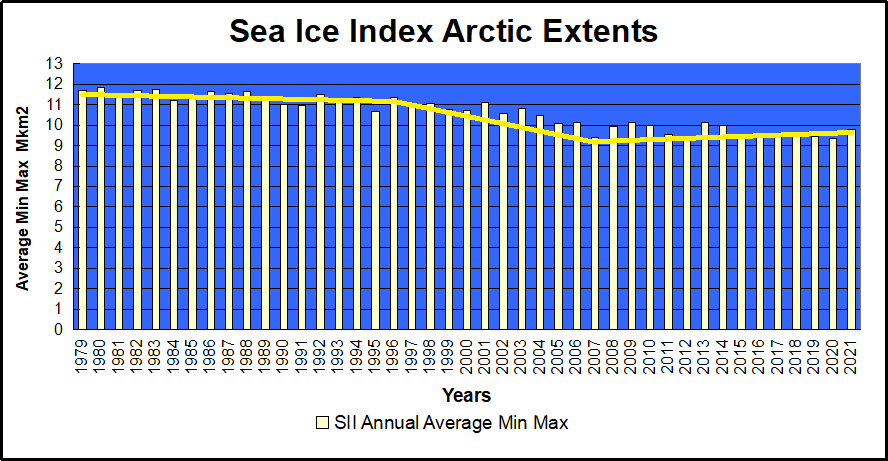
I have noticed at some other blogs people complain about my monthly Arctic ice updates focusing on extents starting in 2007. This post will show why that time period is entirely reasonable as a subject for analysis. I will use the ever popular NOAA dataset derived from satellite passive microwave sensors.  It sometimes understates the ice extents, but everyone refers to it and it is complete from 1979 to present.  Here’s what NOAA reports (in M km2):

We are frequently told that only the March maximums and the September minimums matter, since the other months are only transitional between the two.  So the graph above shows the mean ice extent, averaging the two months March and September. We have 8 more days to go in September 2021, so that number is a low-ball estimate (4.9M km2) that will likely go higher.

If I were adding this to the Ice House of Mirrors, the name would be The X-Ray Ice Mirror, because it looks into the structure of the time series.   For even more clarity and simplicity, here is the table:

NOAA NH Annual Average Ice Extents (in M km2).  Sea Ice Index v3.0 (here)

Year Average Change Rate of Change
1979 11.697
1996 11.353 -0.344 -0.020 per year
2007 9.405 -1.949 -0.177 per year
2021 9.773  +0.368 +0.026 per year

The satellites involve rocket science, but this does not.  There was a small loss of ice extent over the first 17 years, then a dramatic downturn for 11 years, 9 times the rate as before. That was followed by the current 14-year plateau with a slight gain comparable to the beginning loss.  All the fuss is over that middle period, and we know what caused it.  A lot of multi-year ice was flushed out through the Fram Strait, leaving behind more easily melted younger ice. The effects from that natural occurrence bottomed out in 2007.

Kwok et al say this about the Variability of Fram Strait ice flux:

The average winter area flux over the 18-year record (1978–1996) is 670,000 km2, ;7% of the area of the Arctic Ocean. The winter area flux ranges from a minimum of 450,000 km2 in 1984 to a maximum of 906,000 km2 in 1995. . .The average winter volume flux over the winters of October 1990 through May 1995 is 1745 km3 ranging from a low of 1375 km3 in the 1990 flux to a high of 2791 km3 in 1994.

https://www.researchgate.net/publication/261010602/download

Conclusion:

Some complain it is too soon to say Arctic Ice is recovering, or that 2007 is a true change point.  The same people were quick to jump on a declining period after 1996 as evidence of a “Death Spiral.”

Footnote:

No one knows what will happen to Arctic ice.

Except maybe the polar bears.

And they are not talking.

Except, of course, to the admen from Coca-Cola