And Now There are Five “Common Cold” Coronaviruses

cg60a31a950a20d

Good news:  The Pandemic is over.  Next: Our immune systems will contend with one more coronavirus added to the other four we already live with.  Ross Pomeroy explains in Real Clear Science articles You Are (Probably) Going to Be Infected With the Coronavirus.  Excerpts in italics with my bolds.

SARS-CoV-2 joins the ranks of other coronaviruses to cause respiratory infections under the title of the “common cold”

It may not be today. It may not be tomorrow. It may not be next week. It may not be this month, when the rapid ascension of the Delta variant in the United States could send confirmed daily case counts spiking to 200,000 or more before settling down again. It may not even be next year. But someday, you will almost certainly be infected with the SARS-CoV-2 coronavirus.

This uncomfortable fact may come as a surprise to many Americans, particularly to those who have spent hours sanitizing surfaces and groceries, who have dutifully adorned a mask even when not required to do so, and who have made the simple, science-backed decision to get vaccinated. SARS-CoV-2 has already spread around the world, infecting hundreds of millions or more. The genie is out of the bottle, and it is not going back in.

“We will be dealing with this virus forever,” Dr. Michael Osterholm, the director of the Center for Infectious Disease Research and Policy (CIDRAP) at the University of Minnesota, said in an interview one year ago.

Osterholm has been a sage throughout the pandemic, and his words then remain prescient now.

“Effective and safe vaccines… will be very important, even critical tools, in fighting it,” he said. “But the whole world is going to be experiencing COVID-19 ‘til the end of time. We’re not going to be vaccinating our way out of this to eight-plus billion people in the world right now…. We’ve really got to come to grips with actually living with this virus, for at least my lifetime…”

Since speaking those words, Osterholm hasn’t changed his mind.

“Eradicating this virus right now from the world is a lot like trying to plan the construction of a stepping-stone pathway to the Moon. It’s unrealistic,” he told Nature in February of this year.

Olsterholm’s view now represents the consensus of scientific opinion. In January, Nature surveyed more than 100 experts working on the coronavirus about whether the virus could be eradicated. Nine out of ten said that it is “likely” or “very likely” that the coronavirus will continue to circulate amongst the human population as an endemic infection. Most see it becoming something like the flu, for which we will require yearly vaccinations to be protected, or joining the ranks of other coronaviruses to cause respiratory infections that collectively fit under the title of the “common cold”. In the latter scenario, people may get reinfected multiple times over their lives. This theory seems the most likely to play out.

“The virus sticks around, but once people develop some immunity to it — either through natural infection or vaccination — they won’t come down with severe symptoms… Scientists consider this possible because that’s how the four endemic coronaviruses, called OC43, 229E, NL63 and HKU1, behave,” Nicky Phillips wrote for Nature.

In either of these scenarios, it’s extremely likely that you will eventually be infected. Adults get the flu about once every five years. Many times they are unaware, because the infection is asymptomatic. By the time children are roughly three years old, 65% will have been infected with coronavirus 229E. It’s reasonable to predict that some years down the road, SARS-CoV-2 will be just as, if not more, prevalent. Even the vaccinated will likely be infected at some point, and that’s okay.

There was some hope that the incredibly effective vaccines we have, particularly BioNTech/Pfizer’s and Moderna’s mRNA shots, would grant sterilizing immunity, preventing infection altogether. And studies suggest that they do, surprisingly well. But it seems that this form of immunity wanes over time and lessens versus new variants, particularly the Delta variety that’s been all over the news of late. The good news is that the vaccines remain extremely protective against severe disease, hospitalization, and death. If and when booster shots are available, we’ll be able to refresh our immunity.

The knowledge that a SARS-CoV-2 infection is essentially inevitable might be, for some, panic-inducing, perhaps prompting a desire to live a bubbled life. It shouldn’t. That’s because we have the tools to be free from both fear and, for the vast majority, harm: America’s remarkable arsenal of safe and effective vaccines. Again, even if the vaccines don’t prevent infection, that’s okay! As of July 26th, less than 0.004% of fully vaccinated people experienced a breakthrough case resulting in hospitalization and less than 0.001% died from the disease, according to the latest data from the US Centers for Disease Control and Prevention.

As Dr. Osterholm said in May, “For vaccinated individuals, in a private home or wherever, party hard. Enjoy it. You’ve earned it. You can feel safe in doing that, and that’s what we need to help people understand.”

Footnote: 

Left out of the discussion were the anti-viral home treatment protocols to prevent serious illnesses.
See How They Dissed HCQ and Ivermectin

How They Dissed HCQ and Ivermectin

asylum-lunatics

An article at Science Defies Politics explains the fallacies in findings intended to disqualify actual C19 therapies in favor of vaccines Fraud and Mistakes in Reviews of IVM and HCQ for C19.  Excerpts in italics with my bolds.

Cochrane was reputable in the past, but is now controlled by pharmaceutical interests.

Cochrane, once respected organization producing systematic reviews of peer-reviewed medical literature, issued a cherry-picked and biased review of Ivermectin for COVID-19, claiming not enough evidence. It is debunked by C19___ as Outdated very biased cherry-picking retrospective meta analysis …

That reminds the Cochrane’s HCQ review, published on Feb. 12, 2021. It was a similar piece of junk science and scientific fraud. This said, it contains three non-obvious methodological mistakes behind such non-positive reviews of Hydroxychloroquine and Ivermectin treatments for COVID-19, which some people might make unintentionally.

Mistake #1:  Selection of randomized control trials (RCTs) and exclusion of observational studies.

RCTs are gold standard for detecting small (like 20%) improvements. However, RCTs are meaningless or even unethical when the treatment improves the odds by 3–6 times, as the case with Hydroxychloroquine and Ivermectin. In such situation, RCTs tend to be small or using the main ingredient incorrectly.

Mistake #2: The same main ingredient can be used in many ways, including different phases of the disease, doses, and additional medications.

A proper review would have identified the best protocol, using the main ingredient, and reviewed the studies using this protocol. This mistake arises from a habit to review pharma-sponsored trials of patented drugs, in which the manufacturer determines the best way to use the drug.

Mistake #3: Reliance on academic papers and exclusion of the real world evidence.

Well, Cochrane cannot be blamed because reviews of literature are what it does, but the users of these reviews should not call them “the scientific evidence” or similar.

From the Cochrane’s HCQ review:

“We performed all searches up to 15 September 2020.” Enough said. They published a review of 13 trials with 9030 participants (including one post-exposure prophylaxis trial) in what was seemed to be the end of the pandemic, with a review cutoff date 5 months earlier.

“Treatment of COVID‐19 disease. We included 12 trials involving 8569 participants, all of whom were adults.” Enough said. By September 2020, millions of people had been treated with Hydroxychloroquine.

“Preventing COVID‐19 disease in people at risk of exposure to SARS‐CoV‐2. Ongoing trials are yet to report results for this objective.”

Cochrane Funding

Cochrane Review receives most of its charitable funding from the governments of the UK, Denmark, Germany, and the US (https://archive.is/AbjHf). It also sells subscriptions, mainly to government-funded universities, to the pharmaceutical and healthcare industries, which are effectively controlled by governments. It is essentially a governmental organization masquerading as an independent non-profit research organization. Cochrane also serves as a partner and source for Wikipedia on medical topics. Many people consult Wikipedia.

The result looks like an echo chamber in a mental asylum!

See also  Ivermectin Invictus: The Unsung Covid Victor

Yes, HCQ Works Against Covid19

pillars-needed-missing

Routine Melting of Arctic Ice in July

The animation shows Arctic ice extents on Day 212 (end of July) for the years 2007 to 2021 (yesterday).  Evidently, there is considerable variation year over year both on the total amount and where the ice is to be found.  The images are from MASIE (Multisensor Analyzed Sea Ice Extent) platform operated by the US National Ice Center (NIC).  More on MASIE can be read at previous post NOAA Loses 1M km2 of Arctic Ice in July

Note that in all years, some regions are open water by day 212:  Sea of Okhotsk (lower left), Bering Sea (lower center). Mostly ice free are Hudson Bay (lower right) and Barents Sea (top left).  Center left along the Russian coastline runs the Northern Sea Route for summertime shipping from Kara Sea (top left) down through the Bering Strait.  As you can see, some years the ice is still plentiful along this route, and other years are almost ice free.  This year, Laptev is largely open water, while Kara (above) and Chukchi (below) still have much ice to challenge the ice breakers.

Of interest also is the Canadian Arctic Archipelago (center right, below Greenland).  Here is found the Northwest Passage by which intrepid sailors seek transit from the Atlantic (right) through to the Pacific by way of Bering Sea.  Again, some years it is open and simple, and other years closed completely.  On day 212, 2021, CAA has more ice than average, so this year could be more challenging than in other recent years.

The graph below shows July daily ice extents for 2021 compared to 14 year averages, and some years of note.

On average, July Arctic ice declines from ~9.7M km2 down to 6.9M km2.  This year Sea Ice Index in orange (SII from NOAA) lost ice rapidly and opened up a deficit to MASIE (in cyan) of ~700M km2.  The last three weeks saw the two indices ending the month close together, slightly below average and matching 2007.  Note that both 2019 and 2020 had much lower extents at end of July.

Why is this important?  All the claims of global climate emergency depend on dangerously higher temperatures, lower sea ice, and rising sea levels.  The lack of additional warming is documented in a post Adios, Global Warming

The lack of acceleration in sea levels along coastlines has been discussed also.  See USCS Warnings of Coastal Flooding

Also, a longer term perspective is informative:

post-glacial_sea_levelThe table below shows the distribution of Sea Ice across the Arctic Regions, on average, this year and 2007.

Region 2021212 Day 212 Average 2021-Ave. 2007212 2021-2007
 (0) Northern_Hemisphere 6621487 6903677  -282190  6344860 276627 
 (1) Beaufort_Sea 899718 776180  123539  760576 139143 
 (2) Chukchi_Sea 563418 526326  37091  382350 181068 
 (3) East_Siberian_Sea 652192 745174  -92982  445385 206807 
 (4) Laptev_Sea 97962 389632  -291669  314382 -216420 
 (5) Kara_Sea 230155 159737  70418  239232 -9077 
 (6) Barents_Sea 37818 32484  5334  23703 14115 
 (7) Greenland_Sea 149142 298586  -149444  324737 -175595 
 (8) Baffin_Bay_Gulf_of_St._Lawrence 143110 136724  6387  94179 48931 
 (9) Canadian_Archipelago 594031 547883  46148  510063 83968 
 (10) Hudson_Bay 113973 151424  -37452  93655 20318 
 (11) Central_Arctic 3139007 3137899  1108  3154837 -15830 

The overall deficit to average is 282k km2, (4%) which matches the deficit in Laptev.  Other places with less than average extents are East Siberian, Greenland Sea and Hudson Bay.  Offsetting these are surpluses in Beaufort, Chukchi, Kara and CAA.  


Better to do nothing than try to reach UN climate targets

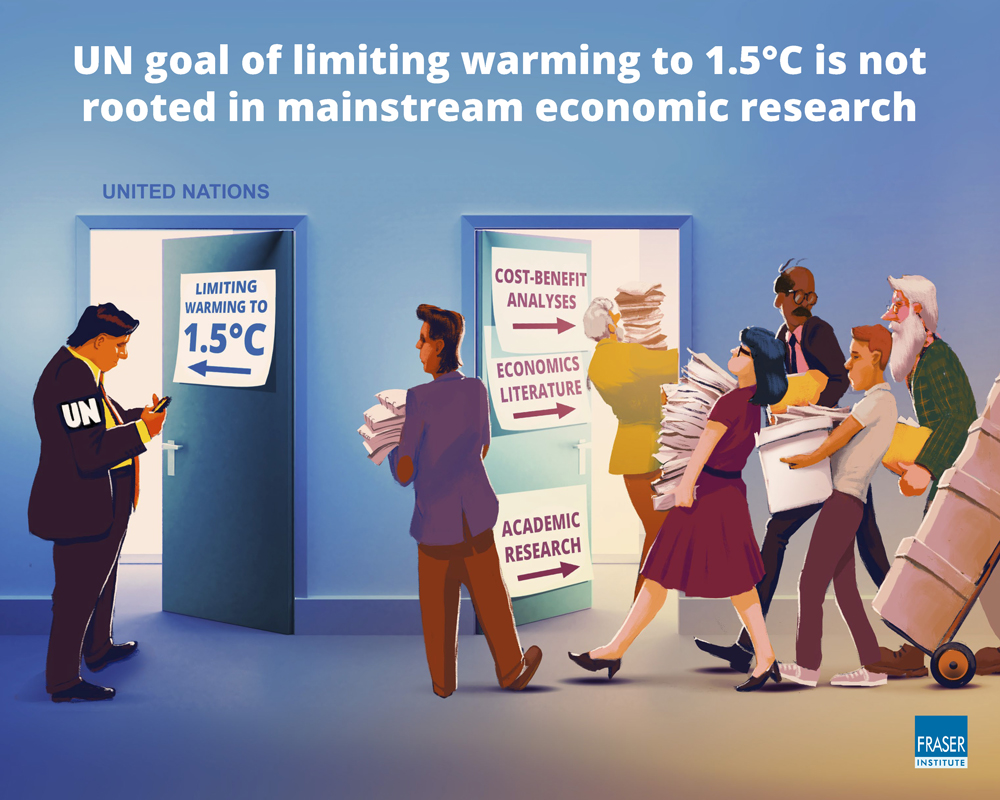
economics-literature-does-not-support-1.5c-climate-goal

Lorrie Goldstein writes a review of a new Fraser Institute study by McKitrick and Murphy.  The study is Off Target: The Economics Literature Does Not Support the 1.5C Climate Ceiling.  Excerpts from Goldstein’s article in italics with my bolds.

Trying to achieve the United Nations’ target of limiting global temperature increases to 1.5 C above pre-industrial levels will do more social and economic harm than good, says a new study by the Fraser Institute released Tuesday.

“Although advocacy of aggressive climate-change policies is often draped with the mantel of science … the popular 1.5C policy target will pose costs that far exceed the benefits,” the study says.

“Emission reductions flowing from strict adherence to the 1.5C target would be worse for the world than doing nothing at all.”

Study authors Ross McKitrick and Robert P. Murphy argue in Off Target: The Economics Literature Does Not Support the 1.5C Climate Ceiling, that the 1.5C target “did not arise … from formal cost-benefit analysis.”

In fact, a 2018 report by the UN’s Intergovernmental Panel on Climate Change that argued there would be net societal benefits to achieving the 1.5C target — used by Canada and other countries to justify the public cost of lowering greenhouse gas emissions — “expressly stated” it did not do a cost-benefit analysis.

The 2018 UN study, Global Warming of 1.5°C — An IPCC Special Report, said because the calculations were so complex, “standard cost–benefit analyses become difficult to justify and are not used as an assessment tool in this report.”

Instead, the UN report cited a range of studies that have estimated the global cost of carbon pricing (expressed here in current Canadian dollars) to meet the UN’s target of limiting global temperature increases to 1.5C above pre-industrial levels by 2100.

They went from a low of $170 per tonne of emissions, to a high of $6,900 per tonne by 2030; $307 per tonne to $16,300 per tonne by 2050; $527 to $21,955 by 2070 and $865 to $33,873 by 2100.  Given such numbers, Murphy argues in the Fraser report, “it would be better if governments did nothing at all about climate change than to try to achieve the 1.5C target because the costs so outweigh the estimated benefits.

(Prime Minister Justin Trudeau’s current carbon price is $40 per tonne of emissions, rising to $170 per tonne in 2030.)

In the real world, no government is going to impose a carbon tax/price of up to $6,900 per tonne of emissions by 2030 — with more hikes after that — because it would be political and economic suicide.

No one knows what global temperatures are going to be in 2100, nor what the global carbon price on emissions would have to be by then to meet the UN’s target of limiting warming to 1.5C above pre-industrial levels.

What we do know for a fact today is that global emissions are steadily rising. The only exceptions in the modern era occurred in 2008-09 and 2020, when they fell dramatically not because of carbon pricing, but because of global recessions, before resuming their upward climb the following year.

We also know that as of 2021, we are so far behind the UN’s target of reducing emissions to 45% below 2010 levels by 2030, that achieving that goal would require lowering emissions globally by 7.6% annually every year between now and 2030.

And finally, we know that, since almost all goods and services consume fossil fuel energy, a 7.6% annual reduction in emissions every year from now until 2030, would provoke an unprecedented global recession in which the social and economic costs would far outweigh the benefits.

economics-literature-does-not-support-1.5c-climate-ceiling-infographic

CO2 Changes Follow Temp Changes, Not the Reverse 2021 Update

This post is about proving that CO2 changes in response to temperature changes, not the other way around, as is often claimed.  In order to do  that we need two datasets: one for measurements of changes in atmospheric CO2 concentrations over time and one for estimates of Global Mean Temperature changes over time.

Climate science is unsettling because past data are not fixed, but change later on.  I ran into this previously and now again in 2021 when I set out to update an analysis done in 2014 by Jeremy Shiers, which I discussed in a previous post reprinted at the end.  Jeremy provided a spreadsheet in his essay Murray Salby Showed CO2 Follows Temperature Now You Can Too posted in January 2014. I downloaded his spreadsheet intending to bring the analysis up to the present to see if the results hold up.  The two sources of data were:

Temperature anomalies from RSS here:  http://www.remss.com/missions/amsu

CO2 monthly levels from NOAA (Mauna Loa): https://www.esrl.noaa.gov/gmd/ccgg/trends/data.html

Changes in CO2 (ΔCO2)

Uploading the CO2 dataset showed that many numbers had changed (why?).

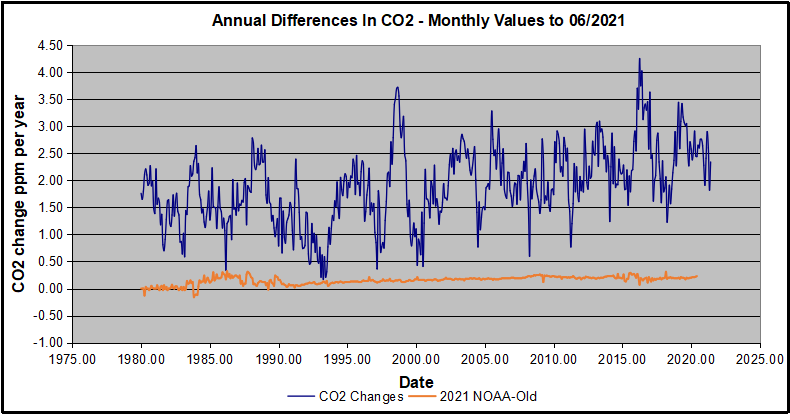
The blue line shows annual observed differences in monthly values year over year, e.g. June 2020 minus June 2019 etc.  The first 12 months (1979) provide the observed starting values from which differentials are calculated.  The orange line shows those CO2 values changed slightly in the 2020 dataset vs. the 2014 dataset, on average +0.035 ppm.  But there is no pattern or trend added, and deviations vary randomly between + and -.  So last year I took the 2020 dataset to replace the older one for updating the analysis.

Now I find the NOAA dataset in 2021 has almost completely new values due to a method shift in February 2021, requiring a recalibration of all previous measurements.  The new picture of ΔCO2 is graphed below.

Co2 Monthly Diffs New and Old2021

The method shift is reported at a NOAA Global Monitoring Laboratory webpage, Carbon Dioxide (CO2) WMO Scale, with a justification for the difference between X2007 results and the new results from X2019 now in force.  The orange line shows that the shift has resulted in higher values, especially early on and a general slightly increasing trend over time.  However, these are small variations at the decimal level on values 340 and above.  Further, the graph shows that yearly differentials month by month are virtually the same as before.  Thus I redid the analysis with the new values.

Global Temperature Anomalies (ΔTemp)

The other time series was the record of global temperature anomalies according to RSS. The current RSS dataset is not at all the same as the past.

To enlarge open image in new tab.

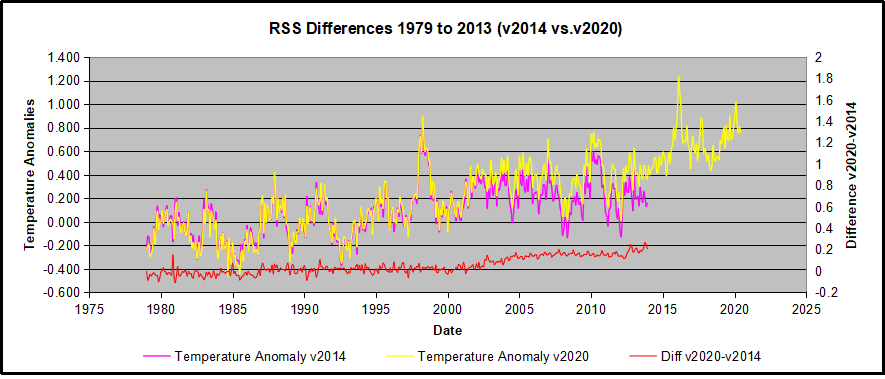
Here we see some seriously unsettling science at work.  The gold line is 2020 RSS and the purple is RSS as of 2014.  The red line shows alterations from the old to the new.  There is a slight cooling of the data in the beginning years, then the two versions pretty much match until 1997, when systematic warming enters the record.  From 1997/5 to 2003/12 the average anomaly increases by 0.04C.  After 2004/1 to 2012/8 the average increase is 0.15C.  At the end from 2012/9 to 2013/12, the average anomaly was higher by 0.21.

RSS continues that accelerated warming to the present, but it cannot be trusted.  And who knows what the numbers will be a few years down the line?  As Dr. Ole Humlum said some years ago (regarding Gistemp): “It should however be noted, that a temperature record which keeps on changing the past hardly can qualify as being correct.”

Given the above manipulations, I went instead to the other satellite dataset UAH version 6. UAH has also made a shift by changing its baseline from 1981-2010 to 1991-2020.  This resulted in systematically reducing the anomaly values, but did not alter the pattern of variation over time.  For comparison, here are the two records with measurements through June 2021.

CO2 Observed Temps Observed

Comparing UAH temperature anomalies to NOAA CO2 changes.

Here are UAH temperature anomalies compared to CO2 changes.

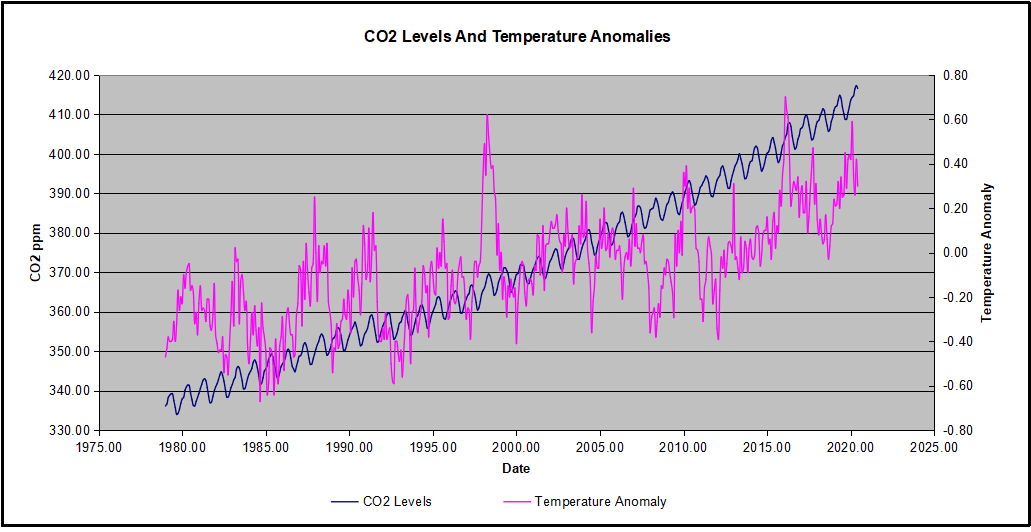
Changes in monthly CO2 synchronize with temperature fluctuations, which for UAH are anomalies now referenced to the 1991-2020 period.  As stated above, CO2 differentials are calculated for the present month by subtracting the value for the same month in the previous year (for example June 2021 minus June 2020).   Temp anomalies are calculated by comparing the present month with the baseline month.

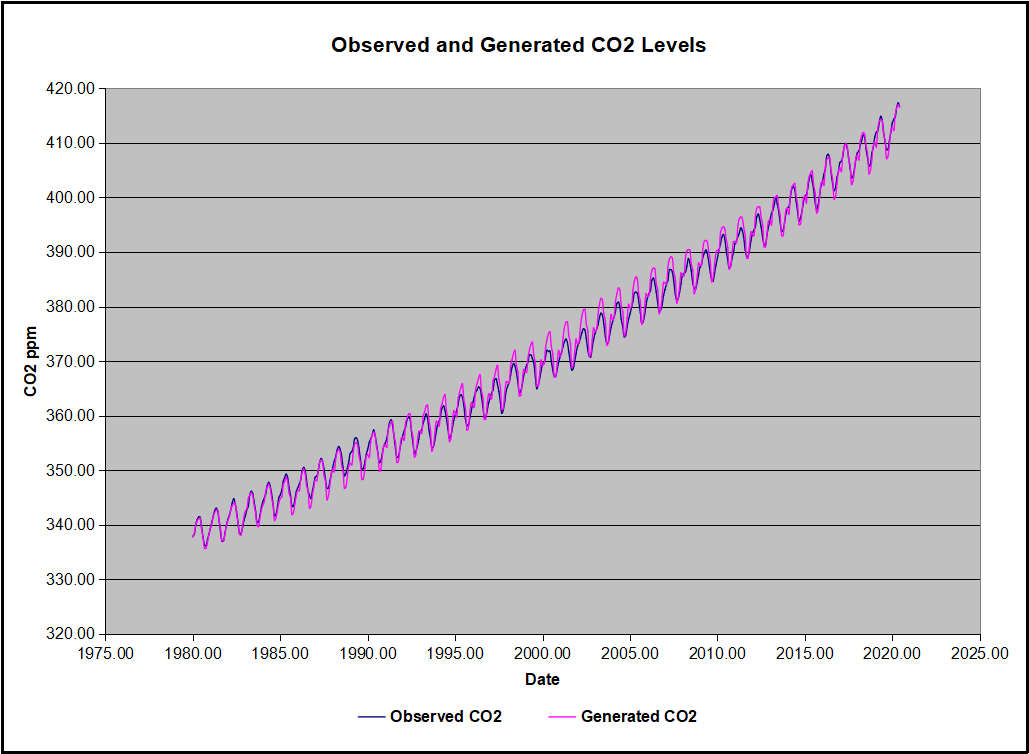
The final proof that CO2 follows temperature due to stimulation of natural CO2 reservoirs is demonstrated by the ability to calculate CO2 levels since 1979 with a simple mathematical formula:

For each subsequent year, the co2 level for each month was generated

CO2  this month this year = a + b × Temp this month this year  + CO2 this month last year

Jeremy used Python to estimate a and b, but I used his spreadsheet to guess values that place for comparison the observed and calculated CO2 levels on top of each other.

CO2 Observed and Calculated2021

In the chart calculated CO2 levels correlate with observed CO2 levels at 0.9983 out of 1.0000.  This mathematical generation of CO2 atmospheric levels is only possible if they are driven by temperature-dependent natural sources, and not by human emissions which are small in comparison, rise steadily and monotonically.

Previous Post:  What Causes Rising Atmospheric CO2?

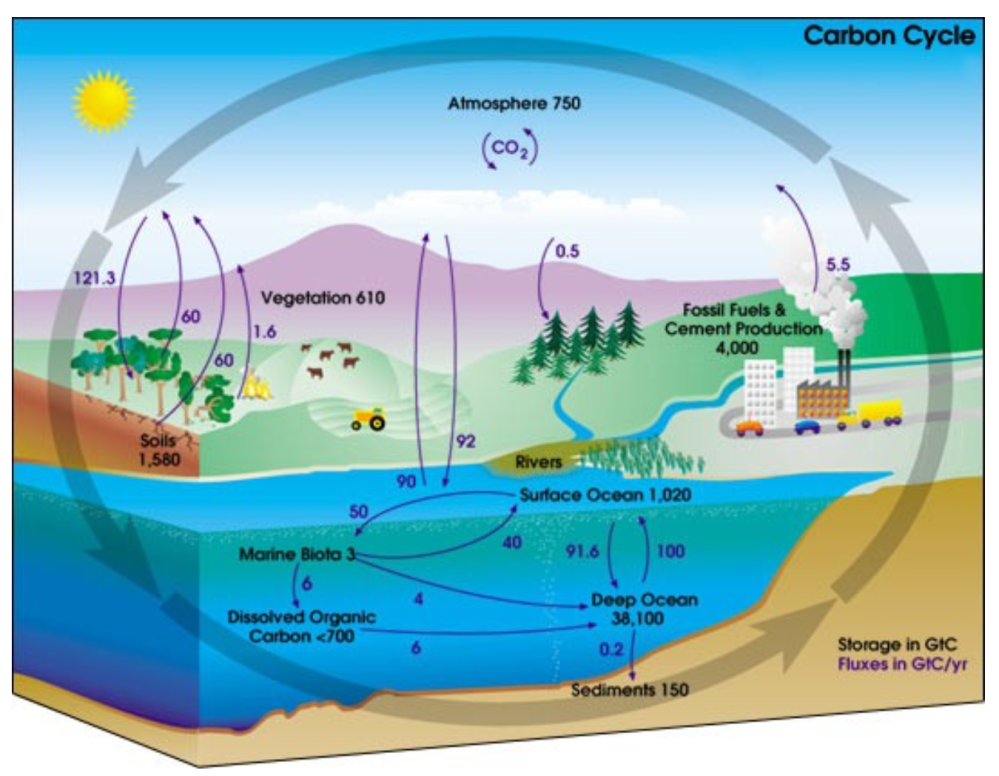
nasa_carbon_cycle_2008-1

This post is prompted by a recent exchange with those reasserting the “consensus” view attributing all additional atmospheric CO2 to humans burning fossil fuels.

The IPCC doctrine which has long been promoted goes as follows. We have a number over here for monthly fossil fuel CO2 emissions, and a number over there for monthly atmospheric CO2. We don’t have good numbers for the rest of it-oceans, soils, biosphere–though rough estimates are orders of magnitude higher, dwarfing human CO2.  So we ignore nature and assume it is always a sink, explaining the difference between the two numbers we do have. Easy peasy, science settled.

What about the fact that nature continues to absorb about half of human emissions, even while FF CO2 increased by 60% over the last 2 decades? What about the fact that so far in 2020 FF CO2 has declined significantly with no discernable impact on rising atmospheric CO2?

These and other issues are raised by Murray Salby and others who conclude that it is not that simple, and the science is not settled. And so these dissenters must be cancelled lest the narrative be weakened.

The non-IPCC paradigm is that atmospheric CO2 levels are a function of two very different fluxes. FF CO2 changes rapidly and increases steadily, while Natural CO2 changes slowly over time, and fluctuates up and down from temperature changes. The implications are that human CO2 is a simple addition, while natural CO2 comes from the integral of previous fluctuations.  Jeremy Shiers has a series of posts at his blog clarifying this paradigm. See Increasing CO2 Raises Global Temperature Or Does Increasing Temperature Raise CO2 Excerpts in italics with my bolds.

The following graph which shows the change in CO2 levels (rather than the levels directly) makes this much clearer.

Note the vertical scale refers to the first differential of the CO2 level not the level itself. The graph depicts that change rate in ppm per year.

There are big swings in the amount of CO2 emitted. Taking the mean as 1.6 ppmv/year (at a guess) there are +/- swings of around 1.2 nearly +/- 100%.

And, surprise surprise, the change in net emissions of CO2 is very strongly correlated with changes in global temperature.

This clearly indicates the net amount of CO2 emitted in any one year is directly linked to global mean temperature in that year.

For any given year the amount of CO2 in the atmosphere will be the sum of

  • all the net annual emissions of CO2
  • in all previous years.

For each year the net annual emission of CO2 is proportional to the annual global mean temperature.

This means the amount of CO2 in the atmosphere will be related to the sum of temperatures in previous years.

So CO2 levels are not directly related to the current temperature but the integral of temperature over previous years.

The following graph again shows observed levels of CO2 and global temperatures but also has calculated levels of CO2 based on sum of previous years temperatures (dotted blue line).

Summary:

The massive fluxes from natural sources dominate the flow of CO2 through the atmosphere.  Human CO2 from burning fossil fuels is around 4% of the annual addition from all sources. Even if rising CO2 could cause rising temperatures (no evidence, only claims), reducing our emissions would have little impact.

Resources:

CO2 Fluxes, Sources and Sinks

Who to Blame for Rising CO2?

Fearless Physics from Dr. Salby

In this video presentation, Dr. Salby provides the evidence, math and charts supporting the non-IPCC paradigm.

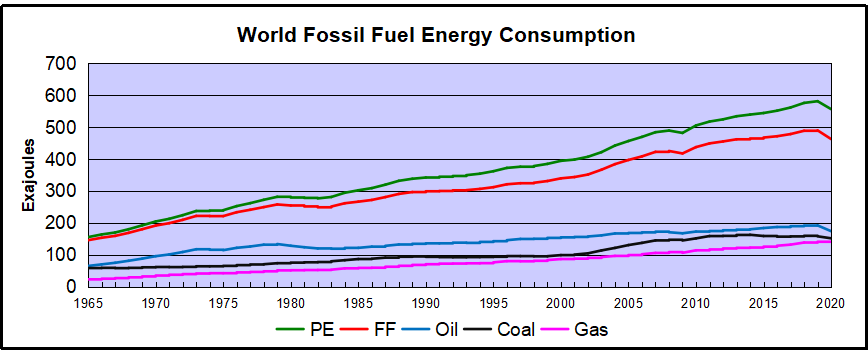
Footnote:  As CO2 concentrations rose, BP shows Fossil Fuel consumption slumped in 2020

See also 2021 Update: Fossil Fuels ≠ Global Warming

Bug Apocalypse Not!

Jon Entine writes again lamenting false alarms by scientists and journalists The Insect Apocalypse That Never Was.  Excerpts in italics with my bolds.

For the past four years, journalists and environmental bloggers have been churning out alarming stories that insects are vanishing, in the United States and globally. Limited available evidence lends credence to reasonable concerns, not least because insects are crucial components of many ecosystems. But the issue has often been framed in catastrophic terms, with predictions of a near-inevitable and imminent ecological collapse that would break ecosystems, destroy harvests, and trigger widespread starvation. Most of the proposed solutions would require a dramatic retooling of many aspects of modern life, from urbanization to agriculture.

Considering the disruptive economic and social trade-offs being demanded by some of those promoting the crisis hypothesis, it’s prudent to separate genuine threats from agenda-driven hyperbole. Are insect declines really threatening to precipitate a catastrophic ecological crisis? And, given the available data, what should a responsible society be doing?

The silver lining around the cloud of gloomy advocacy-focused studies and reporting is that entomologists are doing a deeper dive into the reasons behind the global declines. Goulson’s upcoming media blitz notwithstanding, the most thorough studies to date on insects in North America challenge the catastrophe narrative (although you may not have heard about them as they have been almost ignored by the media), and even offers some reassuring news.

The Moran study, published last August, specifically examined four to 36 years of data on arthropods (insects and other invertebrates) collected from US Long-Term Ecological Research sites located in ecoregions throughout the country. The authors found that: “There is no evidence of precipitous and widespread insect abundance declines in North America akin to those reported from some sites in Europe.”

The robustness of the Moran study data suggests the insect population story is much more complicated—and less dire—than many headlines suggest. If a thorough examination of the data on one continent can lead to such a dramatically different and more hopeful conclusion, broad trends in the vast, highly diverse, and relatively unstudied continents of Asia, Africa, Latin America, and Australia cannot be characterized through extrapolation with any assurance.

The overall paucity of data provides an opening for alarmists to speculate, and Goulson and others have taken advantage of that. But why are the data so fragmentary? Moran attributed the lack of corroborating studies supporting the consensus view that insect populations are mostly stable to what he calls “publication bias … more dramatic results are more publishable. Reviewers and journals are more likely to be interested in species that are disappearing than in species that show no change over time,” he wrote in the Washington Post.

It’s a reinforcing feedback loop, with journalists playing a key role in this misinformation cycle. Scientific publications are more likely to publish reports of declining species. Then, when researchers search for data, “declines are what they find.” The media often seize on incomplete or even biased conclusions to build a compelling narrative—an insect apocalypse or insectageddon or zombie-like resurrections of debunked reports of birdpocalypses and beepocalypses.

Background previous post:  Epic Media Science Fail: Fear Not Pollinator Collapse

Jon Entine returns to this topic writing at the Genetic Literacy Project: The world faces ‘pollinator collapse’? How and why the media get the science wrong time and again. Excerpts in italics with my bolds.

As I and others have detailed in the Genetic Literacy Project and as other news organizations such as the Washington Post and Slate have outlined, the pollinator-collapse narrative has been relentless and mostly wrong for more than seven years now.

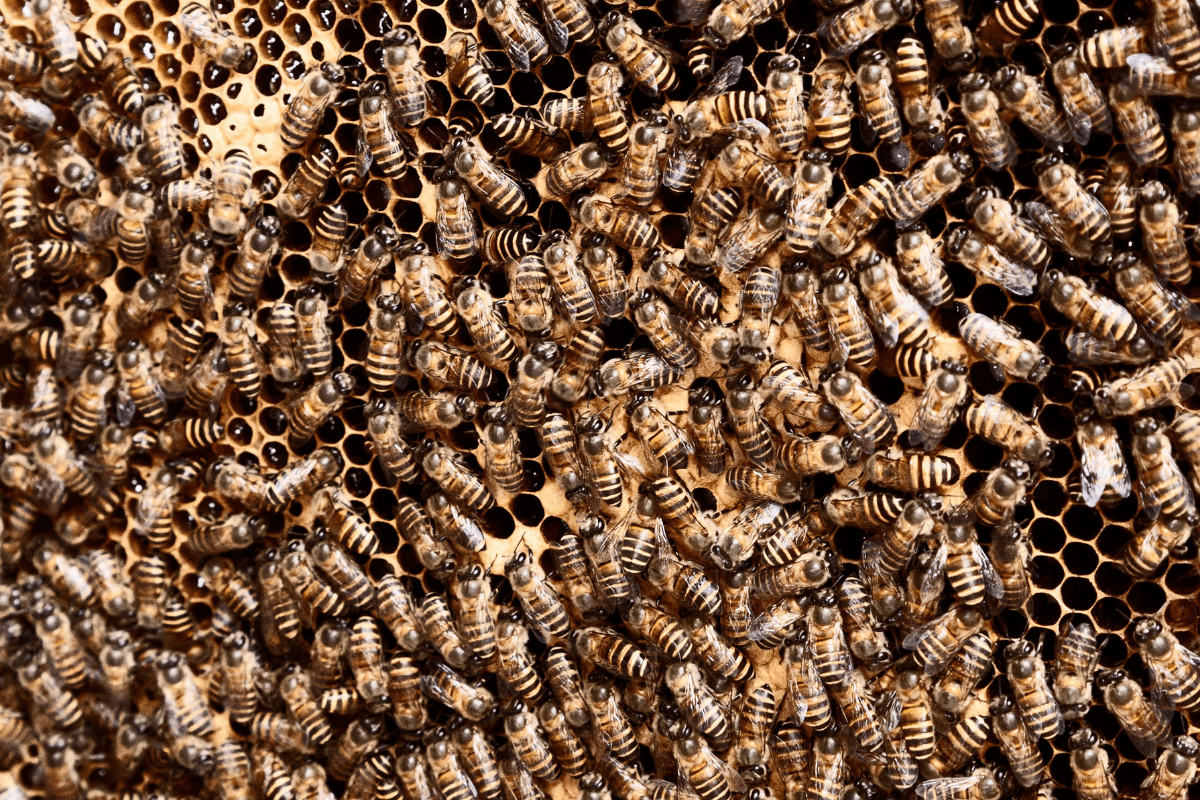
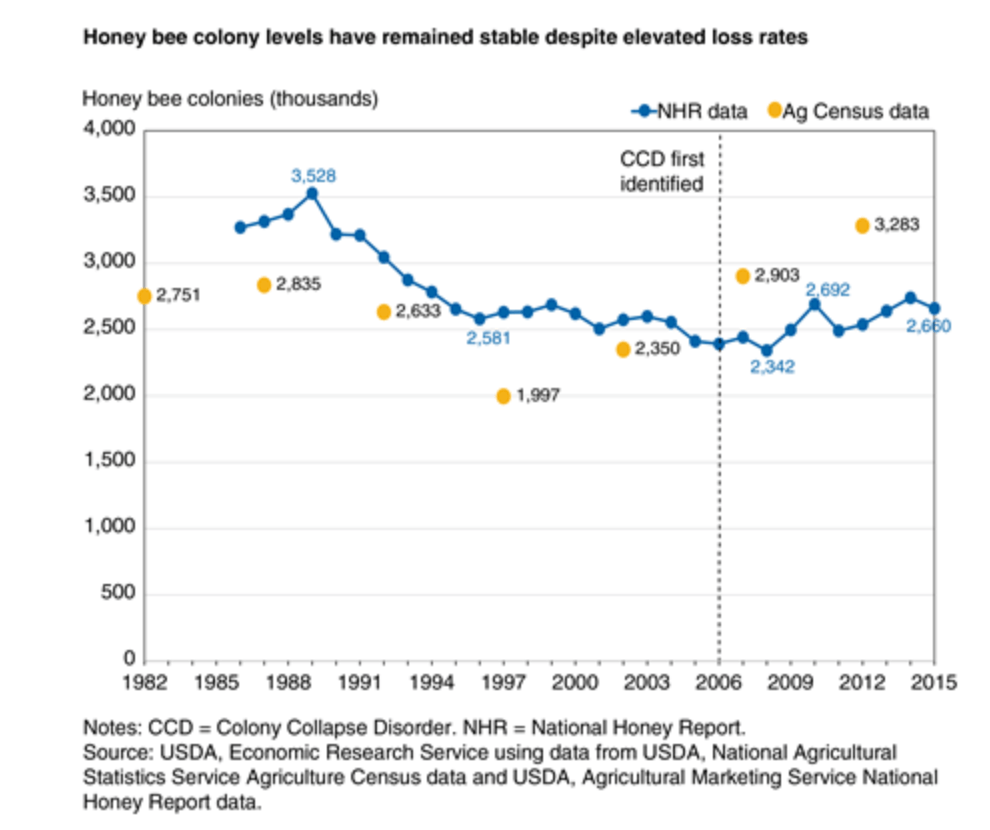
It germinated with Colony Collapse Disorder that began in 2006 and lasted for a few years—a freaky die off of bees that killed almost a quarter of the US honey bee population, but its cause remains unknown. Versions of CCD have been occurring periodically for hundreds of years, according to entomologists.

Today, almost all entomologists are convinced that the ongoing bee health crisis is primarily driven by the nasty Varroa destructor mite. Weakened honey bees, trucked around the country as livestock, face any number of health stressors along with Varroa, including the use of miticides used to control the invasive mite, changing weather and land and the use of some farm chemicals, which may lower the honeybee’s ability to fight off disease.

Still, the ‘bee crisis’ flew under the radar until 2012, when advocacy groups jumped in to provide an apocalyptic narrative after a severe winter led to a sharp, and as it turned out temporary, rise in overwinter bee deaths.

Colony loss numbers jumped in 2006 when CCD hit but have been steady and even improving since.

The alarm bells came with a spin, as advocacy groups blamed a class of pesticides known as neonicotinoids, which were introduced in the 1990s, well after the Varroa mite invasion infected hives and started the decline. The characterization was apocalyptic, with some activist claiming that neonics were driving honey bees to extinction.

In the lab evaluations, which are not considered state of the art—field evaluations replicate real-world conditions far better—honeybee mortality did increase. But that was also true of all the insecticides tested; after all, they are designed to kill harmful pests. Neonics are actually far safer than the pesticides they replaced, . . . particularly when their impact is observed under field-realistic conditions (i.e., the way farmers would actually apply the pesticide).

As the “science” supporting the bee-pocalypse came under scrutiny, the ‘world pollinator crisis’ narrative began to fray. Not only was it revealed that the initial experiments had severely overdosed the bees, but increasing numbers of high-quality field studies – which test how bees are actually affected under realistic conditions – found that bees can successfully forage on neonic-treated crops without noticeable harm.

Those determined to keep the crisis narrative alive were hardly deterred. Deprived of both facts and science to argue their case, many advocacy groups simply pounded the table by shifting their crisis argument dramatically. For example, in 2016, the Sierra Club (while requesting donations), hyped the honey bee crisis to no end.

But more recently, in 2018, the same organization posted a different message on its blog. Honeybees, the Sierra Club grudgingly acknowledged, were not threatened. Forget honeybees, the Sierra Club said, the problem is now wild bees, or more generally, all insect pollinators, which are facing extinction due to agricultural pesticides of all types (though neonics, they insisted, were especially bad).

So, once again, with neither the facts nor the science to back them up, advocacy groups have pulled a switcheroo and are again pounding the table. As they once claimed with honeybees, they now claim that the loss of wild bees and other insect pollinators imperils our food supply. A popular meme on this topic is the oft-cited statistic, which appears in the recent UN IPBES report on biodiversity, that “more than 75 per cent of global food crop types, including fruits and vegetables and some of the most important cash crops such as coffee, cocoa and almonds, rely on animal pollination.”

There’s a sleight of hand here. Most people (including most journalists) miss or gloss over the important point that this is 75 percent of crop types, or varieties, not 75 percent of all crop production. In fact, 60 percent of agricultural production comes from crops that do not rely on animal pollination, including cereals and root crops. As the GLP noted in its analysis, only about 7 percent of crop output is threatened by pollinator declines—not a welcomed percentage, but far from an apocalypse.

And the word “rely” seems almost purposefully misleading. More accurately, most of these crops receive some marginal boost in yield from pollination. Few actually “rely” on it. A UN IPBES report on pollinators published in 2018 actually breaks this down in a convenient pie graph.

Many of these facts are ignored by advocacy groups sharpening their axes, and they’re generally lost on the “if it bleeds it leads” media, which consistently play up catastrophe scenarios of crashing pollinator communities and food supplies. Unfortunately, many scientists willingly go along. Some are activists themselves; others hope to elevate the significance of their findings to garner media attention and supercharge grant proposals.

As John Adams is alleged to have said, ‘facts are stubborn things.’ We can’t be simultaneously in the midst of a pollinator crisis threatening our ability to grow food and see continually rising yield productivity among those crops most sensitive to pollination.

With these claims of an impending wild bee catastrophe, as in the case of the original honeybee-pocalypse claims, few of the journalists, activists, scientists or biodiversity experts who regularly sound this ecological alarm have reviewed the facts in context. Advocacy groups consistently extrapolate from the declines of a handful of wild bee species (out of the thousands that we know exist), to claim that we are in the midst of a worldwide crisis. But just as with the ‘honey bee-mageddon, we are not.

Those of us who actually care about science and fact, however, might note the irony here: It is precisely the pesticides which the catastrophists are urging us to ban that, along with the many other tools in the modern farmer’s kit, have enabled us grow more of these nutritious foods, at lower prices, than ever before in human history.

Footnote:  Activists have played both sides with their insect warnings Alarmists: Global Warming Destroys Good Bugs and Multiplies Bad Bugs

insect

Summary: These scares always sound plausible, but on closer inspection are simplistic and unrealistic. The above shows that each type of insect has a range of temperatures they can tolerate and allow them to develop. They are stressed and populations decrease when colder than the lower limit and also when hotter than the upper limit. Every species will adapt to changing conditions as they always have. Those at their upper limit will decline, not increase, and their place will be taken by others. Of course, if it gets colder, the opposite occurs. Don’t let them scare you that insects are taking over.

Democrats Need Four Illusions to Sleep

man-sleeping-counting-sheep-dream-man-sleeping-sheep-117145178

John Ellis writes at his blog Four Illusions.  Excerpts in italics with my bolds and images.

Illusion #1: Biden is not too old.

People who have been around American politics for a long time know Joe Biden well. The eldest among them have known Joe Biden for nearly five decades. What they will tell you is that he didn’t seem to age during his two terms as vice president. If you look at video of Biden 2016 and Biden 2008, you’re taken by how little he appears to have aged. Biden at 74 seems every bit as alert and physically vigorous as Biden at 66.

That’s no longer the case. Somewhere along the way of the last few years, Biden transitioned from “young old” to “old.” Veteran reporters describe the transition in code. “He’s lost a step or two.” Or: “he’s lost something off his fastball.”

alg072321dapr20210723034504

You’re not supposed to talk about it. If you do, and you’re a Democrat, you’re scolded for aiding and abetting the enemy. If you do, and you’re a Republican or (God forbid) a MAGA voter, you’re a horrible hate-mongerer, trying to overturn the results of a free and fair election (and you probably watch Fox News to boot).

mrz070221dapr20210702054513

The problem is that it’s there for all to see. Pretending not to see it is untenable. It’s a bit like being the first car in a line of cars at a stop light and pretending that the light hasn’t turned green. Eventually, the cars behind you honk.

sk071821dapc20210716084507

Illusion #2: Harris “has what it takes.”

The widely shared assessment of Kamala Harris’s performance (so far) as vice president also comes in code: she’s “not ready for primetime,” she needs to “step up her game,” and “she’s off to a rocky start.” Few if any of the political cognoscenti think she is (a) “presidential timber” and/or (b) capable of winning the 2024 presidential election, should it come to that.

alg070521dapr20210705034505

These two truths — Biden is old, Harris isn’t ready — haunt Democrats and their media allies. When they imagine the 2024 presidential election without Biden or Harris, they notice another truth: there’s no bench. Gavin Newsom? Not. Andrew Cuomo? Not. Tim Kaine? Not. There’s a long list of superb military officers that would be formidable (and admirable) candidates, but the chances of a Democratic Convention nominating, say, Admiral William McRaven, are similar to my chances of buying the winning $1 billion Powerball ticket.

stg070621dapr20210705054507

Illusion #3: Trump is done.

Where in the world did this come from? Wishful thinking explains part of it. Maybe all of it. But it’s clearly not true. The amazing thing is that he’s not done, given his disgraceful post-election conduct and evident disdain for long-established, essential norms of American democracy; “consent of the losers” chief among them. It’s August (almost) and he still maintains that he won an election that he lost. That’s the dictionary definition of “delusional.”

stg071921dapc20210718064517

And yet it hasn’t hurt him. He remains the front-runner for the 2024 GOP presidential nomination. Republican elected officials at the federal, state and local level genuflect at the mention of his name. Would-be rivals for the 2024 nomination pledge their allegiance, and not just to Trump’s “populism” but to Trump personally. And then there’s Fox News.

mrz062321dapr20210623054504

The 2024 Republican presidential nomination campaign will “happen” on Fox News. It will also “happen” on right-wing talk radio and on right-wing websites and in right-wing chat rooms, but Fox will frame the choice; controlling who gets exposure (and in what time slots) and who sets the agenda. Those decisions are driven by one consideration and one consideration only: Does it rate?

Trump rates. The others don’t. End of story.

And lest anyone think that Fox will ignore the ratings, turn on Trump and do what it can to bring to the fore the next generation of GOP leaders, please call me and I will sell you my winning Powerball ticket. For $1 million.

Illusion #4: Trump can’t win.

Can’t win what? The GOP nomination? Really? Want to bet? Who’s going to beat him? Josh Hawley? Marco Rubio? Ron DeSantis? Nikki Haley? Take your pick.

My guess is that none of them will run if Trump announces his candidacy in, say March of 2023. Would you? You’d be signing a political death warrant if you did; forever alienating vast swaths of the Trump coalition by challenging their champion. You’d be asking your major donors to invite Trump’s wrath. You’d be asking Republican elected officials at every level to risk ruin by endorsing your candidacy. It’s a non-starter from the start.

gv062521dapr20210625074502

Well, you say, Trump can’t possibly win the general election, can he? On paper, probably not. Fifty-two percent of the country would eat nails to vote against him.

But as we learn again and again, the national popular vote isn’t evenly distributed across the Electoral College. State-by-state, the Electoral College is almost perfectly distributed to make GOP victories possible, even when the party loses the national popular vote by a substantial margin. (Biden beat Trump by 7 million votes in the 2020 general election.)

mrz062721dapc20210626064506

It’s also the case that Trump enjoys an advantage over, say, Biden (or Harris or any Democrat, for that matter) on “cultural issues.” In the key Electoral College states (like Michigan, Pennsylvania, Wisconsin, to name three) general election voters align more comfortably with Trump’s views on cultural issues; on immigration especially, but also on crime, “defund the police,” the undoing of welfare reform, and the rise of Woke.

That’s enough to make him competitive, but probably not enough to put him over the top. He’s so toxic, he hits a ceiling. And the Democrats (and their media allies) will do everything in their power to make Toxic Trump the issue, above all others. They’ll borrow a line from the Reagan re-election campaign: “Why would we ever want to return to where we were, less than four short years ago?”

cb072021dapr20210720054517

But what happens if Trump is not the issue? What happens if inflation is the issue? That would bring to mind the Carter re-election campaign, the one that ended in a GOP landslide at the state and local level and a 10-point win for Ronald Reagan (who received 50% of the national vote). Inflation destroyed Jimmy Carter’s presidency. It literally kicked him out of office.

What if Larry Summers is right and inflation is ready for launch and will likely take off next year? If Biden Administration policies are seen as the proximate cause of inflation, will “swing voters” view the administration as the best option for bringing inflation back under control? Probably not. Is inflation the kind of issue that can render Trump’s toxicity less salient? Yes it is.

The light is green. Let the honking begin.

afb062221dapr20210622054527

June 2021 Ocean Temps Stay Cool


The best context for understanding decadal temperature changes comes from the world’s sea surface temperatures (SST), for several reasons:

  • The ocean covers 71% of the globe and drives average temperatures;
  • SSTs have a constant water content, (unlike air temperatures), so give a better reading of heat content variations;
  • A major El Nino was the dominant climate feature in recent years.

HadSST is generally regarded as the best of the global SST data sets, and so the temperature story here comes from that source, the latest version being HadSST3.  More on what distinguishes HadSST3 from other SST products at the end.

The Current Context

The year end report below showed 2020 rapidly cooling in all regions.  The anomalies have continued to drop sharply well below the mean since 1995.  This Global Cooling was also evident in the UAH Land and Ocean air temperatures ( See March 2021 Ocean Chill Deepens) 

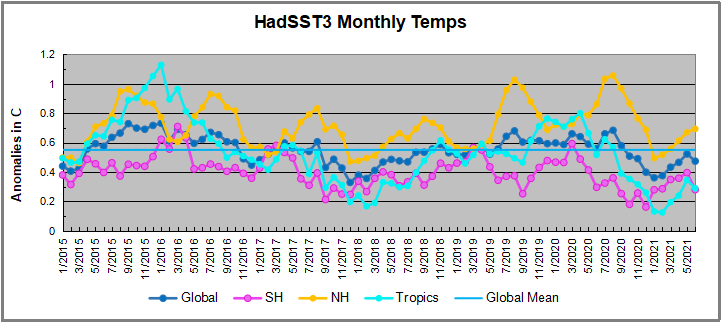
The chart below shows SST monthly anomalies as reported in HadSST3 starting in 2015 through June 2021. After three straight Spring 2020 months of cooling led by the tropics and SH, NH spiked in the summer, along with smaller bumps elsewhere.  Then temps everywhere dropped the last six months, hitting bottom in February 2021.  All regions were well below the Global Mean since 2015, matching the cold of 2018, and lower than January 2015. Now the spring is bringing more temperate waters and a return to the mean anomaly since 2015.  June Global SST anomaly cooled off back to April due to dropping temps in SH and the Tropics.  NH continued its summer rise, but only slightly and well below the last two Junes.

Hadsst062021
A global cooling pattern is seen clearly in the Tropics since its peak in 2016, joined by NH and SH cycling downward since 2016.  

Note that higher temps in 2015 and 2016 were first of all due to a sharp rise in Tropical SST, beginning in March 2015, peaking in January 2016, and steadily declining back below its beginning level. Secondly, the Northern Hemisphere added three bumps on the shoulders of Tropical warming, with peaks in August of each year.  A fourth NH bump was lower and peaked in September 2018.  As noted above, a fifth peak in August 2019 and a sixth August 2020 exceeded the four previous upward bumps in NH.

In 2019 all regions had been converging to reach nearly the same value in April.  Then  NH rose exceptionally by almost 0.5C over the four summer months, in August 2019 exceeding previous summer peaks in NH since 2015.  In the 4 succeeding months, that warm NH pulse reversed sharply. Then again NH temps warmed to a 2020 summer peak, matching 2019.  This has now been reversed with all regions pulling the Global anomaly downward sharply, tempered by warming in March to May, and now dropping below the global mean anomaly since 2015.

And as before, note that the global release of heat was not dramatic, due to the Southern Hemisphere offsetting the Northern one.  Note the May warming was strongest in the Tropics, though the anomaly is quite cool compared to 2016.

A longer view of SSTs

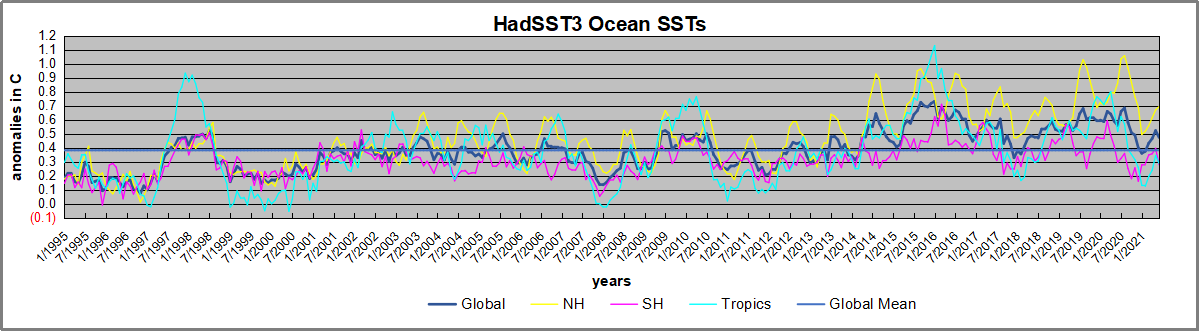
The graph below  is noisy, but the density is needed to see the seasonal patterns in the oceanic fluctuations.  Previous posts focused on the rise and fall of the last El Nino starting in 2015.  This post adds a longer view, encompassing the significant 1998 El Nino and since.  The color schemes are retained for Global, Tropics, NH and SH anomalies.  Despite the longer time frame, I have kept the monthly data (rather than yearly averages) because of interesting shifts between January and July.


Hadsst1995to 062021

1995 is a reasonable (ENSO neutral) starting point prior to the first El Nino.  The sharp Tropical rise peaking in 1998 is dominant in the record, starting Jan. ’97 to pull up SSTs uniformly before returning to the same level Jan. ’99.  For the next 2 years, the Tropics stayed down, and the world’s oceans held steady around 0.2C above 1961 to 1990 average.

Then comes a steady rise over two years to a lesser peak Jan. 2003, but again uniformly pulling all oceans up around 0.4C.  Something changes at this point, with more hemispheric divergence than before. Over the 4 years until Jan 2007, the Tropics go through ups and downs, NH a series of ups and SH mostly downs.  As a result the Global average fluctuates around that same 0.4C, which also turns out to be the average for the entire record since 1995.

2007 stands out with a sharp drop in temperatures so that Jan.08 matches the low in Jan. ’99, but starting from a lower high. The oceans all decline as well, until temps build peaking in 2010.

Now again a different pattern appears.  The Tropics cool sharply to Jan 11, then rise steadily for 4 years to Jan 15, at which point the most recent major El Nino takes off.  But this time in contrast to ’97-’99, the Northern Hemisphere produces peaks every summer pulling up the Global average.  In fact, these NH peaks appear every July starting in 2003, growing stronger to produce 3 massive highs in 2014, 15 and 16.  NH July 2017 was only slightly lower, and a fifth NH peak still lower in Sept. 2018.

The highest summer NH peaks came in 2019 and 2020, only this time the Tropics and SH are offsetting rather adding to the warming. (Note: these are high anomalies on top of the highest absolute temps in the NH.)  Since 2014 SH has played a moderating role, offsetting the NH warming pulses. After September 2020 temps dropped off down until February 2021, then all regions rose to bring the global anomaly above the mean since 1995, before backing down in June 2021.

What to make of all this? The patterns suggest that in addition to El Ninos in the Pacific driving the Tropic SSTs, something else is going on in the NH.  The obvious culprit is the North Atlantic, since I have seen this sort of pulsing before.  After reading some papers by David Dilley, I confirmed his observation of Atlantic pulses into the Arctic every 8 to 10 years.

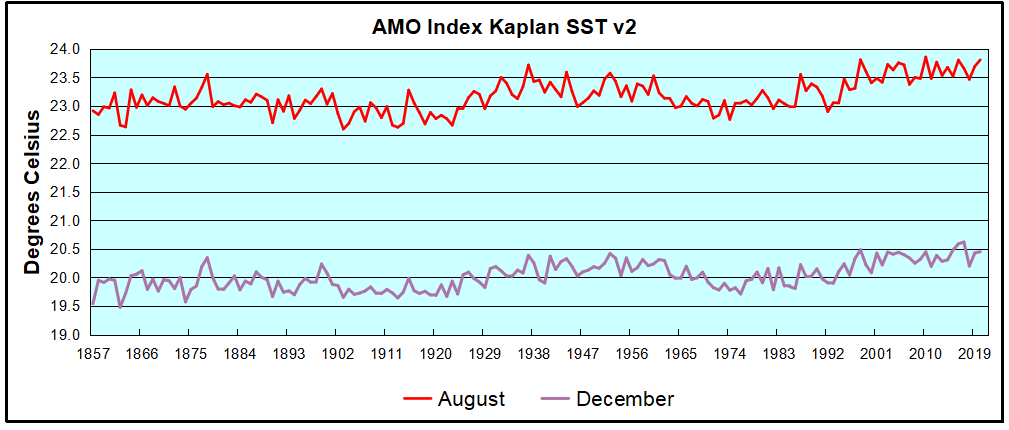
But the peaks coming nearly every summer in HadSST require a different picture.  Let’s look at August, the hottest month in the North Atlantic from the Kaplan dataset.
AMO Aug and Dec 2021The AMO Index is from from Kaplan SST v2, the unaltered and not detrended dataset. By definition, the data are monthly average SSTs interpolated to a 5×5 grid over the North Atlantic basically 0 to 70N. The graph shows August warming began after 1992 up to 1998, with a series of matching years since, including 2020.  Because the N. Atlantic has partnered with the Pacific ENSO recently, let’s take a closer look at some AMO years in the last 2 decades.

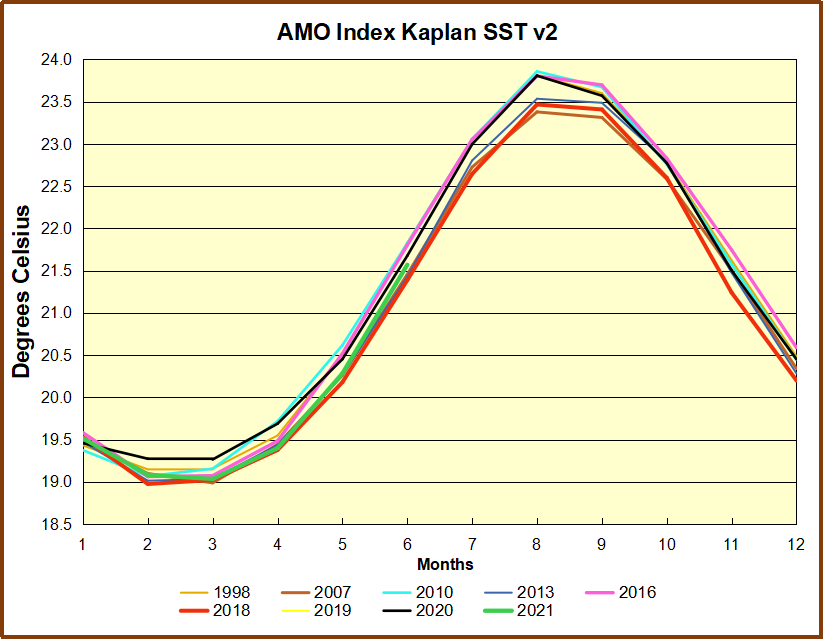
AMO decade 062021
This graph shows monthly AMO temps for some important years. The Peak years were 1998, 2010 and 2016, with the latter emphasized as the most recent. The other years show lesser warming, with 2007 emphasized as the coolest in the last 20 years. Note the red 2018 line is at the bottom of all these tracks. The black line shows that 2020 began slightly warm, then set records for 3 months. then dropped below 2016 and 2017, peaked in August ending below 2016. Now in 2021, AMO is tracking the coldest years, warming slightly in May and June.

Summary

The oceans are driving the warming this century.  SSTs took a step up with the 1998 El Nino and have stayed there with help from the North Atlantic, and more recently the Pacific northern “Blob.”  The ocean surfaces are releasing a lot of energy, warming the air, but eventually will have a cooling effect.  The decline after 1937 was rapid by comparison, so one wonders: How long can the oceans keep this up? If the pattern of recent years continues, NH SST anomalies may rise slightly in coming months, but once again, ENSO which has weakened will probably determine the outcome.

Footnote: Why Rely on HadSST3

HadSST3 is distinguished from other SST products because HadCRU (Hadley Climatic Research Unit) does not engage in SST interpolation, i.e. infilling estimated anomalies into grid cells lacking sufficient sampling in a given month. From reading the documentation and from queries to Met Office, this is their procedure.

HadSST3 imports data from gridcells containing ocean, excluding land cells. From past records, they have calculated daily and monthly average readings for each grid cell for the period 1961 to 1990. Those temperatures form the baseline from which anomalies are calculated.

In a given month, each gridcell with sufficient sampling is averaged for the month and then the baseline value for that cell and that month is subtracted, resulting in the monthly anomaly for that cell. All cells with monthly anomalies are averaged to produce global, hemispheric and tropical anomalies for the month, based on the cells in those locations. For example, Tropics averages include ocean grid cells lying between latitudes 20N and 20S.

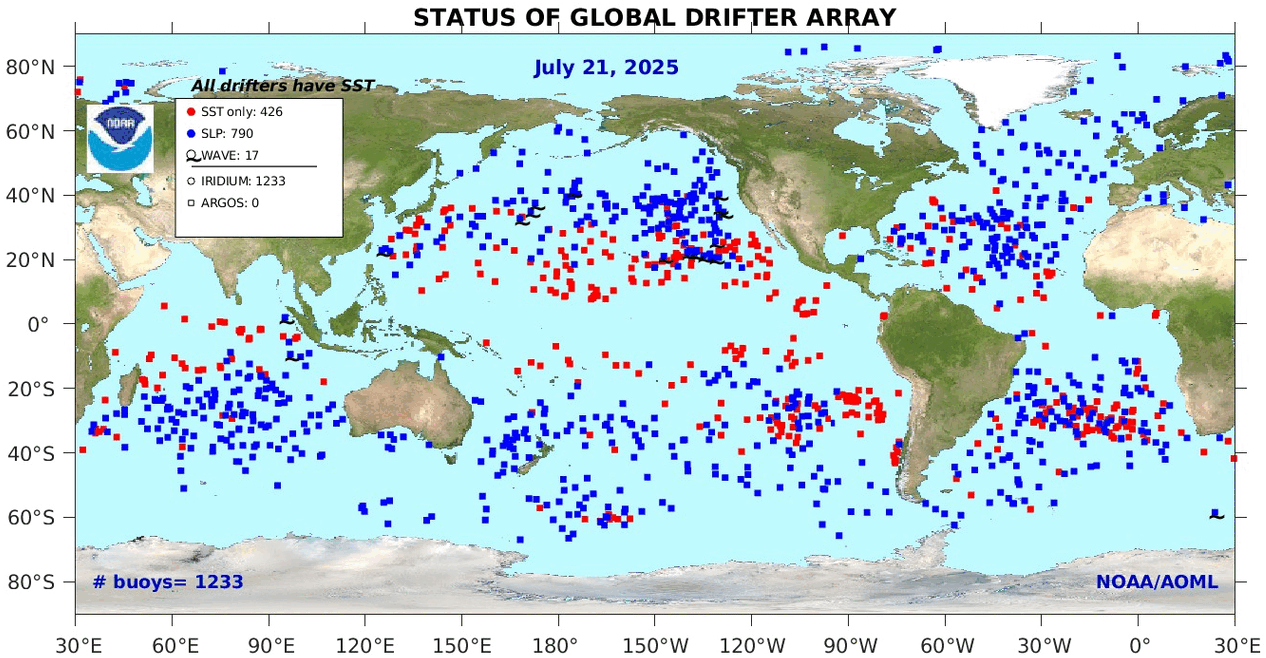
Gridcells lacking sufficient sampling that month are left out of the averaging, and the uncertainty from such missing data is estimated. IMO that is more reasonable than inventing data to infill. And it seems that the Global Drifter Array displayed in the top image is providing more uniform coverage of the oceans than in the past.

uss-pearl-harbor-deploys-global-drifter-buoys-in-pacific-ocean

USS Pearl Harbor deploys Global Drifter Buoys in Pacific Ocean


Imperfect Climate Scientists

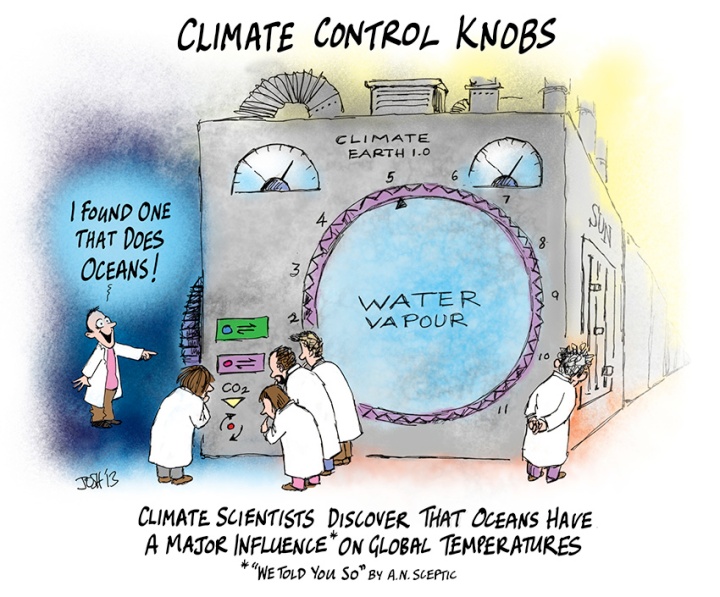
josh-knobs

Tom Chivers writes with insight as Unherd’s science editor Can we trust the climate scientists?  Excerpts in italics with my bolds.

The reaction to Steven Koonin’s book highlights just how toxic this debate has become

There’s a problem with writing about science — any science — which is that scientists are human like the rest of us. They are not perfect disembodied truth-seeking agents but ordinary, flawed humans navigating social, professional and economic incentive structures.

Most notably, scientists, like people, are social. If they exist in a social or professional circle that believes X, it is hard to say not-X; if they have professed to believe Y, they won’t want to look silly and admit not-Y. It might even be hard to get research funded or published if it isn’t in line with what the wider group believes.

All this makes it very hard, as an outsider, to assess some scientific claims. You can ask some expert, but they will be an expert within the social and professional milieu that you’re looking at, and who will likely share the crony beliefs of that social and professional milieu. All of which often makes it hard to disentangle why scientists do and say the things they do. Especially when it comes to scientific claims that are politically charged, claims on hot-button topics like race, sex, poverty — and of course climate.

I couldn’t help thinking about that as I was reading Steven Koonin’s new book, Unsettled. Koonin is (as it says, prominently, on the front of the book) the “former Undersecretary for Science, US Department of Energy, under the Obama administration”. The publishers are obviously very keen to stress the Obama link: “…under the Trump administration” might not have carried the same heft.

Koonin came to public attention a few years ago, after he wrote a controversial opinion piece for the Wall Street Journal headlined “Climate science is not settled”. It was a response to what he considered the widely held opinion among policymakers and the wider public that, in fact, climate science is settled. His particular concern was that we can’t yet accurately predict what the future climate shifts will be. The book itself is best thought of as the extended version of that op-ed, with added graphs.

Climate Science is not Settled:  We can break down his thesis into, roughly, three areas.

One, is that despite “the mainstream narrative among the media and policymakers”, it is hard to be sure that the climate has changed in meaningful ways due to human influence. In particular, floods, rainfall, droughts, storms, and record high temperatures have not become more common, and although the climate is unambiguously warming and sea levels have gone up, it’s hard to confidently separate human influence from natural variability.

Two, he says, climate models are highly uncertain and struggle to successfully predict the past, let alone the future, so we shouldn’t trust confident claims about the climate future. And if we do accept the IPCC’s predictions, they aren’t of imminent catastrophe. Instead, they point to slow change to which humanity can easily adapt, and, broadly speaking, to humanity continuing to prosper.

And three, he continues, there is basically nothing we can do about it anyway, partly because carbon dioxide hangs around in the atmosphere for so long, but mainly because the developing world is developing fast, and using ever more carbon to do so, and actually that’s a good thing.

These are — according to Koonin — all, by and large, only what the IPCC assessment reports and other major climate analyses say.

The public conversation, which he says is full of doom and apocalypse and unwarranted certainty, has become unconnected from the state of the actual science. And he blames scientists — and policymakers, the media and the public — for that disconnection.

cg5d8c4e469b40d

So is he right? Certainly he has a case when it comes to Point One: I think he is correct that the media narrative about climate change is not especially well correlated with the IPCC’s own central assessments. For instance, I think it’s fair to say that the recent floods in London, China and Germany have been held up as examples of a changing climate. But the IPCC’s most recent assessment report, 2014’s AR5, found studies showing evidence for “upward, downward or no trend in the magnitude of floods” (see p214 of the AR5 Physical Science Basis document; be warned it’s a big PDF), and concluded that they were unable to be sure whether, globally, river floods had become more or less likely.

Similarly, I think there is a perception among many commentators and policymakers that storms, hurricanes, and droughts are all more common as a result of climate change, but the IPCC’s own report (see p.53 of AR5) has “low confidence” that those things are more common than they were 100 years ago. I know some scientists think the IPCC is overoptimistic, but it is the closest we have to consensus climate science.

9650f-0pf9ogs-iuk1tfti0

That said, there is some fairness in accusing Koonin of cherrypicking. He spends a lot of time arguing about extreme daily temperatures, convincingly (to my mind) debunking a claim in the 2017 Climate Science Special Report (CSSR), the flagship US government climate science assessment, that US extreme daily temperature records have gone up. In fact, CSSR is comparing the ratio of extreme high temperatures to extreme low temperatures, and what in fact has happened is that extreme low temperatures have become less common. Which is interesting.

But the IPCC does think extreme daily temperatures have gone up globally (see p53 again). In his chapter on “Hyping the Heat”, Koonin doesn’t mention the IPCC, and the IPCC outranks the CSSR. His detective work is interesting, but he is fighting a henchman, not the end-of-level boss. Maybe the IPCC is wrong as well, but we don’t learn that here.

On Point Two, I don’t feel competent to assess the models; certainly it seems highly plausible to me that there are enormous uncertainties in predicting something as inherently chaotic as the climate, especially when to do so you first have to predict something as inherently chaotic as people. But my non-expert understanding is that broadly speaking the models have been getting it about right.

That said, I think he is right that, if you were to ask the average person in my social circle, you would hear that climate change will lead to catastrophe in the near future. And I think that is overstating what the IPCC reports actually say. For instance, it is true that the IPCC predicts more people will go hungry than otherwise would have: it says that almost 140 million children will be undernourished, in a world where climate change goes unmitigated, compared to 113 million in a world where there is no climate change (see p730 of this IPCC report). But that is still fewer than went hungry in 2000 – almost 150 million, out of a much smaller population. The IPCC predicts that a world with climate change will be worse than one without; but not so much worse that other things, such as economic growth and technological progress, won’t broadly keep the big things, like life expectancy and human health, improving. That does seem worth saying.

And Koonin’s Point Three is worth making too. If India were to increase its per capita emissions to those of Japan, “one of the lowest emitting of the developed countries”, he says, then that change alone would raise global emissions by 25%1. Realistically, we’re not going to be able to stop India — or China, or Brazil, or Mexico, or any of the other middle-income countries — from developing, and development at the moment means carbon.

More importantly: we don’t want them to stop developing. Richer countries have healthier, longer-lived citizens and are better able to cope with a changing climate. Even huge, swingeing cuts to Western emissions — politically unrealistic — would only go some way to offsetting the inevitable growth in the developing world. Those cuts may be worth doing, but there are limits to how much good they can do.

But even if Koonin is right about almost everything — if the best guess of the science is that we’re heading towards things merely getting better more slowly, rather than getting worse — then I think he’s missing a major point. That is, climate change models are uncertain. In fact Koonin claims they’re even more uncertain than we think. So they could easily be erring on the side of optimism.

And the one thing we should have learnt from the Covid pandemic is that it’s not enough to say “the most likely outcome is that it’ll be fine, so let’s act as if it’ll be fine.” The correct thing to say is “the most likely outcome is that it’ll be fine, but if there’s a 10% chance that it’ll be completely awful, then we need to prepare for that 10% chance.” Reducing greenhouse gas emissions in the developed world reduces the chance of some unforeseen but plausible disaster: as a happy bonus, it makes our cities more pleasant places in which to live. It will come at some cost, but hopefully not too high, because green technology is getting so cheap and effective these days.

Reviews by climate scientists have been unimpressed. “I would normally ignore a book by a non-climate scientist,” starts one review, which goes on to not ignore it. Another accuses him of cherry-picking his fights (not entirely unfairly, as I said). A third says the book is “distracting, irrelevant, misguided, misleading and unqualified”.

But none that I’ve read really addresses the nitty-gritty of his arguments — which is hard to do in a 900-word review, of course, but still. They usually pick some line out of the first chapter or two, disagree with it, and then say the whole book is therefore rubbish. But I wanted a bit more meat to the objections.

The third review, for instance, quotes Koonin as saying “The warmest temperatures in the US have not risen in the past fifty years,” and then asks “According to what measure?” Well, Koonin tells you the measure, at length: absolute record extreme daily temperatures. Maybe he’s wrong, but he does answer that in the book. (And your next sentence is “Highest annual global averages?” He’s talking about the US! You just quoted that bit!)

Similarly, it complains that Koonin says that the sea is only rising about a foot per century, saying “The trouble is that while seas have risen eight to nine inches since 1880, more than 30 percent of that increase has occurred during the last two decades.” But again: Koonin addresses this, for pretty much an entire chapter. His point is that most of the rest of the rise came during an (unexplained by climate models, according to him) period of rapid warming from 1910 to 1940, before human influence should have been relevant. That, he says, is good evidence that natural variation is driving the current acceleration. Is he right? I don’t know. But the reviewer is not attacking Koonin’s argument at its strongest point.

In fact, none of them seem to: they just want to dismiss the book. They attack Koonin’s credibility and credentials, his temperament. They say he was only hired by the Obama Energy Department because of his contrarian views; they call him a “climate denier”, which seems de trop since he accepts most of the central claims of the climate consensus. The response felt more like a circling of the wagons than a serious effort to counter a serious argument. After all, it is unpleasant to hear reasons why you might be wrong about something: cognitive dissonance is painful.

I started this book confident that climate change is a serious concern, and I finished it only slightly less confident; Koonin has not persuaded me. But I’m glad Unsettled, flawed though it is, has been written. As I said at the beginning, science in a politically charged environment is very hard to assess. Scientists are as prone to groupthink and motivated reasoning as anyone else, and I know very well that there are some who feel they need to keep heterodox views quiet. The reviews, which make so little effort to engage with the substance of the arguments, do not reassure me that climate science is a uniquely groupthink-free discipline.

One thing Koonin suggests is a so-called “Red Teaming” of climate scientists: getting scientists to act as adversarial critics of the existing consensus, a method used by superforecasters, among others, to improve their accuracy by actively hunting out flaws in their reasoning. Science can only progress if assumptions are tested. Red teams in climate institutions — any institutions — seem like a good idea, and I’d support them.

Whether it’s possible or not, of course, is tricky to say. The climate debate is so highly charged, so borderline toxic, that it might be difficult for any climate scientist to take on the red-team role without making their own life more difficult. According to Koonin, one senior climate scientist told him “I agree with pretty much everything you wrote, but I don’t dare say that in public.” The old “in my emails, everyone agrees with me” line is hardly a new one, but it wouldn’t surprise me if there’s a bit of truth in it.

But if the Catholic Church was able to stomach someone advocating for the Devil, then climate science should be able to stomach one doing it for the sceptics. And in the meantime, this book does an acceptable job.

ramirez

Footnote:  I encourage you to read the comments at the Unherd website.  For example this from Norman Powers:

I feel that’s a bit unfair to Tom. Reading the arguments of people who disagree, thinking about them carefully and weighing up debate is a large part of critical thinking, and he does all those things in this article. Just because he hasn’t arrived at the same conclusions as you (yet?) doesn’t make it not critical thinking.

Moreover, the social factors that apply to scientists apply to journalists as well. Do you think it’s easy for Chivers to talk about climatology and criticize climatologists so directly? He basically says none of their reviews of the book even meet basic standards of coherence, let alone being convincing. There aren’t many media outlets that would pay for such journalism, regardless of the truth.

Beyond your criticism of the author I feel all your points are well made.

For me, what really shook my belief in climatology to the core was the discovery that the temperature record itself is the output of modelling. Yes, you read that right. Not merely predictions about the future or truly ancient temperatures come out of models. Temperatures recorded by thermometer, in Europe and the USA, in the past 100 years or even just the past decade, are also the output of models. Although the raw data is given as an input the models proceed to heavily modify it; the outputs are then presented as “the history of temperature” without making it obvious what’s happened.

One of the consequences of this is that temperature time series often have multiple “versions”, reflecting the fact that the model software evolves over time. These new versions invariably seem to create warming when the prior versions didn’t show it. This has been going on for decades. They have a variety of justifications, all of which sound plausible on first glance, some of which seem less plausible on deeper analysis.
But. At school I was taught in no uncertain terms that in science you are not allowed to edit your raw data. All the marks for science assignments were allocated to the methodological correctness, and if you did an experiment and the data didn’t line up with the theory but what you did followed the rules, you wouldn’t be marked down (of course, in practice, if you failed to replicate a simple and famous experiment you probably did make a mistake somewhere so the distinction rarely mattered).

This was their way of teaching us that the rules are there for a reason, and that scientists aren’t allowed to tamper with their data post-facto. That’s taboo. Except, not in climatology. The risks are obvious: climatologists only really have one theory, so data that shows temperatures not going up undermines the entire community. Once the Rubicon has been crossed and model outputs are being substituted for real data, it’s very easy for people to try lots of different ways to “fix” errors in the data and then select only the ones that line up with what everyone knows “should” be happening. Over time this process keeps repeating until the theories become unfalsifiable.

467f811268662bd69a332801360d6973-political-cartoons-embedded-image-permalink

Beware Energy Balance Cartoons

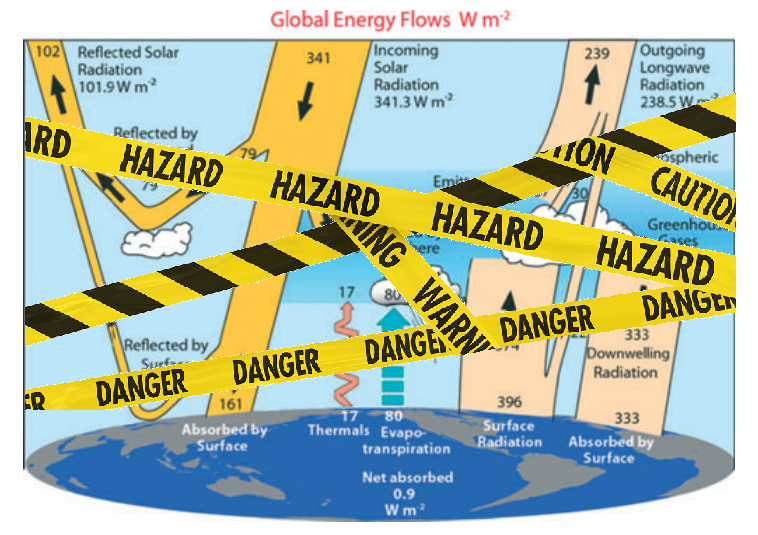
Figure 1. The global annual mean energy budget of Earth’s climate system (Trenberth and Fasullo, 2012.)

Recently in a discussion thread a warming proponent suggested we read this paper for conclusive evidence. The greenhouse effect and carbon dioxide by Wenyi Zhong and Joanna D. Haigh (2013) Imperial College, London. Indeed as advertised the paper staunchly presents IPCC climate science. Excerpts in italics with my bolds.

IPCC Conception: Earth’s radiation budget and the Greenhouse Effect

The Earth is bathed in radiation from the Sun, which warms the planet and provides all the energy driving the climate system. Some of the solar (shortwave) radiation is reflected back to space by clouds and bright surfaces but much reaches the ground, which warms and emits heat radiation. This infrared (longwave) radiation, however, does not directly escape to space but is largely absorbed by gases and clouds in the atmosphere, which itself warms and emits heat radiation, both out to space and back to the surface. This enhances the solar warming of the Earth producing what has become known as the ‘greenhouse effect’. Global radiative equilibrium is established by the adjustment of atmospheric temperatures such that the flux of heat radiation leaving the planet equals the absorbed solar flux.

The schematic in Figure 1, which is based on available observational data, illustrates the magnitude of these radiation streams. At the Earth’s distance from the Sun the flux of radiant energy is about 1365Wm−2 which, averaged over the globe, amounts to 1365/4 = 341W for each square metre. Of this about 30% is reflected back to space (by bright surfaces such as ice, desert and cloud) leaving 0.7 × 341 = 239Wm−2 available to the climate system. The atmosphere is fairly transparent to short wavelength solar radiation and only 78Wm−2 is absorbed by it, leaving about 161Wm−2 being transmitted to, and absorbed by, the surface. Because of the greenhouse gases and clouds the surface is also warmed by 333Wm−2 of back radiation from the atmosphere. Thus the heat radiation emitted by the surface, about 396Wm−2, is 157Wm−2 greater than the 239Wm−2 leaving the top of the atmosphere (equal to the solar radiation absorbed) – this is a measure of ‘greenhouse trapping’.

Why This Line of Thinking is Wrong and Misleading
Principally, the Earth is not a disk illuminated 24/7 by 1/4 of solar radiant energy. 

That disk in the cartoon denies the physical reality of a rotating sphere, and completely distorts the energy dynamics.  Christos Vournas addresses this issue directly in deriving his planetary temperature equation that corresponds to NASA satellite measurements of planets and moons in our solar system.  Previous posts provide background for this one focusing on the radiant heating of the rotating water planet we call Earth (though Ocean would be more accurate).  See How to Calculate Planetary Temperatures and Earthshine and Moonshine: Big Difference.  
i285978589391372458._szw1280h1280_-1

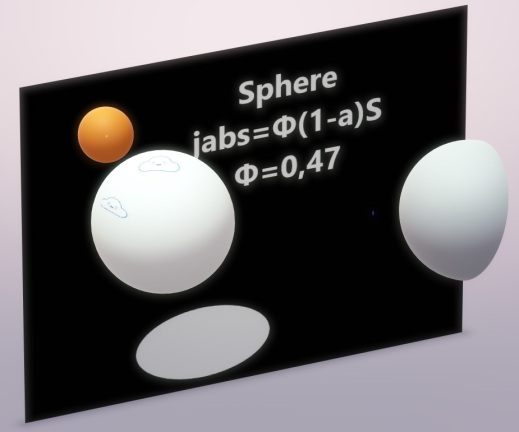
Φ – is the dimensionless Solar Irradiation accepting factor. It recognizes that a sphere’s surface absorbs the incident solar irradiation not as a disk of the same diameter, but accordingly to its spherical shape. For a smooth spherical surface Φ = 0,47

The classical blackbody surface properties

A blackbody planet surface is meant as a classical blackbody surface approaching.  Here are the blackbody’s properties:

1. Blackbody does not reflect the incident on its surface radiation. Blackbody absorbs the entire radiation incident on its surface.

2. Stefan-Boltzmann blackbody emission law is:   Je = σ*Τe⁴

Notice:

Te is the blackbody’s temperature (surface) at every given moment. When the blackbody is not irradiated, the classical blackbody gradually cools down, gradually emitting away its accumulated energy.  The classical blackbody concept assumes blackbody’s surface being warmed by some other incoming irradiation source of energy – see the Sun’s paradigm.  Sun emits like a blackbody, but it emits its own inner energy source’s energy. Sun is not considered as an irradiation receiver. And sun has a continuous stable temperature.

Therefore we have here two different blackbody theory concepts.

a. The blackbody with the stable surface temperature due to its infinitive inner source (sun, stars).
b. The blackbody with no inner energy source.

This blackbody’s emission temperature relies on the incoming outer irradiation only.

Also in the classical blackbody definition it is said that the irradiation incident on the blackbody is totally absorbed, warms the blackbody and achieves an equilibrium emission temperature Te.  It is an assumption.

This assumption, therefore, led to the next assumption: the planet like a blackbody emitting behavior.  And, consequently, it resulted to the planet’s Te equation, in which it is assumed that planet’s surface is interacting with the incoming irradiation as being in a uniform equilibrium temperature.

Consequently it was assumed that planet’s surface had a constant equilibrium temperature (which was only the incident solar irradiation dependent value) and the only thing the planet’s surface did was to emit in infrared spectrum out to space the entire absorbed solar energy.

3. When irradiated, the blackbody’s surface has emission temperature according to the Stefan-Boltzmann Law:

Te = (Total incident W /Total area m² *σ)¹∕ ⁴ K

σ = 5,67*10⁻⁸ W/m²K⁴, the Stefan-Boltzmann constant.

Notice: This emission temperature is only the incoming irradiation energy depended value. Consequently when the incoming irradiation on the blackbody’s surface stops, at that very moment the blackbody’s emission temperature disappears.  It happens because no blackbody’s surface accumulates energy.

4. Blackbody interacts with the entire incident on the blackbody’s surface radiation.

5. Blackbody’s emission temperature depends only on the quantity of the incident radiative energy per unit area.

6. Blackbody is considered only as blackbody’s surface physical properties. Blackbody is only a surface without “body”.

7. Blackbody does not consist from any kind of a matter. Blackbody has not a mass. Thus blackbody has not a specific heat capacity.  Blackbody’s cp = 0.

8. Blackbody has surface dimensions. So blackbody has the radiated area and blackbody has the emitting area.

9. The entire blackbody’s surface area is the blackbody’s emitting area.

10. The blackbody’s surface has an infinitive conductivity.

11. All the incident on the blackbody’s surface radiative energy is instantly and evenly distributed upon the entire blackbody’s surface.

12. The radiative energy incident on the blackbody’s surface the same very instant the blackbody’s surface emits this energy away.

A Real Planet is Not a Blackbody

But what happens there on the rotating real planet’s surface?

The rotating real planet’s surface, when it turns to the sunlit side, is an already warm at some temperature, from the previous day, planet’s surface.

Thus, when assuming the planet’s surface behaving as a blackbody, we face the combination of two different initial blackbody surfaces.

a. The one with an inner energy source.

And

b. The one warmed by an outer irradiation.

The Real Planet’s Surface Properties:

1. The planet’s surface has not an infinitive conductivity. Actually the opposite takes place. The planet’s surface conductivity is very small, when compared with the solar irradiation intensity and the planet’s surface infrared emissivity intensity.

2. The planet’s surface has thermal behavior properties. The planet’s surface has a specific heat capacity, cp.

3. The incident on the planet solar irradiation is not being distributed instantly and evenly on the entire planet’s surface area.

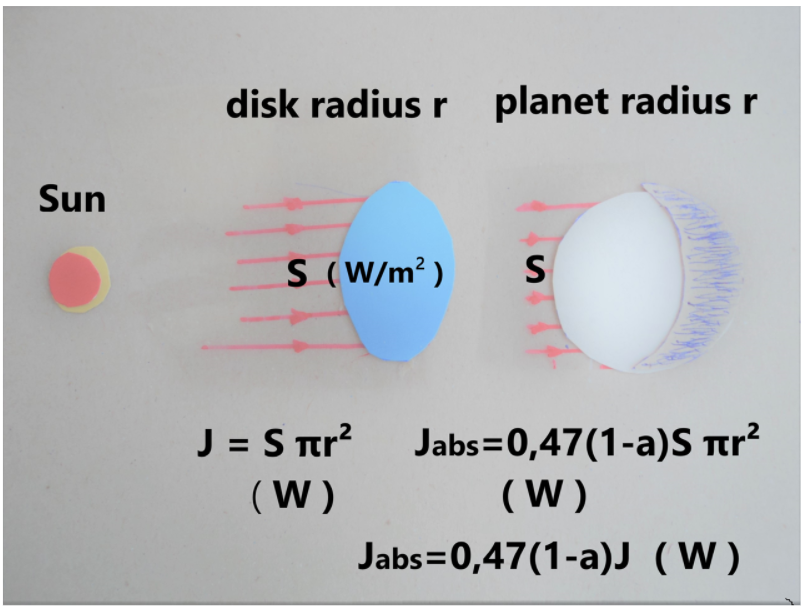
4. Planet does not accept the entire solar irradiation incident in planet’s direction. Planet accepts only a small fraction of the incoming solar irradiation. This happens because of the planet’s albedo, and because of the planet’s smooth and spherical surface reflecting qualities, which we refer to as “the planet’s solar irradiation accepting factor Φ”.

Planet reflects the (1-Φ + Φ*a) portion of the incident on the planet’s surface solar irradiation.  And  Planet absorbs only the Φ(1 – a) portion of the incident on the planet’s surface solar irradiation.

Here “a” is the planet’s average albedo and “Φ” is the planet’s solar irradiation accepting factor.

For smooth planet without thick atmosphere, Earth included, Φ=0,47

5. Planet’s surface has not a constant intensity solar irradiation effect. Planet’s surface rotates under the solar flux. This phenomenon is decisive for the planet’s surface infrared emittance distribution.

The real planet’s surface infrared radiation emittance distribution intensity is a planet’s rotational speed dependent physical phenomenon.
Vournas fig1

Φ factor explanation

The Φ – solar irradiation accepting factor – how it “works”. It is not a planet specular reflection coefficient itself.

There is a need to focus on the Φ factor explanation. Φ factor emerges from the realization that a sphere reflects differently than a flat surface perpendicular to the Solar rays.

It is very important to understand what is really going on with planets’ solar irradiation reflection.

There is the specular reflection and there is the diffuse reflection.

The planet’s surface Albedo “a” accounts for the planet’s surface diffuse reflection. Albedo is defined as the ratio of the scattered SW to the incident SW radiation, and it is very much precisely measured (the planet Bond Albedo).

So till now we didn’t take in account the planet’s surface specular reflection. A smooth sphere, as some planets are, are invisible in space and have so far not been detected and the specular reflection not measured . The sphere’s specular reflection cannot be seen from the distance, but it can be seen by an observer situated on the sphere’s surface.

i285978589389395456._szw1280h1280_

Thus, when we admire the late afternoon sunsets on the sea we are blinded from the brightness of the sea surface glare. It is the surface specular reflection that we see then.

Jsw.absorbed = Φ*(1-a) *Jsw.incoming

For a planet with albedo a = 0 (completely black surface planet) we would have

Jsw.reflected = [1 – Φ*(1-a)]*S *π r² =

Jsw.reflected = (1 – Φ) *S *π r²

For a planet which captures the entire incident solar flux (a planet without any outgoing specular reflection) we would have Φ = 1

Jsw.absorbed = Φ*(1-a) *Jsw.incoming

Jsw.reflected = a *Jsw.incoming

And

For a planet with Albedo a = 1 , a perfectly reflecting planet

Jsw.absorbed = 0 (no matter what is the value of Φ)

In general:  The fraction left for hemisphere to absorb is  Jabs = Φ (1 – a ) S π r²

We have Φ for different planets’ surfaces varying  0,47 ≤ Φ ≤ 1

And we have surface average Albedo “a” for different planets’ varying  0 ≤ a ≤ 1

Notice:

Φ is never less than 0,47 for planets (spherical shape).

Also, the coefficient Φ is “bounded” in a product with (1 – a) term, forming the Φ(1 – a) product cooperating term. Thus Φ and Albedo are always bounded together.

The Φ(1 – a) term is a coupled physical term.

The Φ(1 – a) term “translates” the absorption of a disk into the absorption of a smooth hemisphere with the same radius.

When covering a disk with a hemisphere of the same radius the hemisphere’s surface area is 2π r². The incident Solar energy on the hemisphere’s area is the same as on the disk:  Jdirect = π r² S

But the absorbed Solar energy by the hemisphere’s area of 2π r² is:  Jabs = Φ*( 1 – a) π r² S

It happens because a smooth hemisphere of the same radius “r” absorbs only the Φ*(1 – a)S portion of the directly incident on the disk of the same radius Solar irradiation.

In spite of hemisphere having twice the area of the disk, it absorbs only the Φ*(1 – a)S portion of the directly incident on the disk Solar irradiation.

Gaseous Planets

Φ = 1 for gaseous planets, as Jupiter, Saturn, Neptune, Uranus, Venus, Titan.

Gaseous planets do not have a surface to reflect radiation. The solar irradiation is captured in the thousands of kilometers gaseous abyss. The gaseous planets have only the albedo “a”.

Heavy Cratered Planets

Φ = 1 for heavy cratered planets, as Calisto and Rhea ( not smooth surface planets, without atmosphere ).

The heavy cratered planets have the ability to capture the incoming light in their multiple craters and canyons. The heavy cratered planets have only the albedo “a”.

That is why the albedo “a” and the factor “Φ” we consider as different values. Both of them, the albedo “a” and the factor “Φ” cooperate in the

Energy in = Φ(1 – a) left side of the Planet Radiative Energy Budget.

Conclusively, the Φ -Factor is not the planet specular reflection portion itself.

The Φ -Factor is the Solar Irradiation Accepting Factor (in other words, Φ is the planet surface shape and roughness coefficient).

Bottom Line

What is going on here is that instead of Jabs.earth = 0,694* 1.361 π r² ( W ) we should consider Jabs.earth = 0,326* 1.361 π r² ( W ).

Averaged on the entire Earth’s surface we obtain:

Jsw.absorbed.average = [ 0,47*(1-a)*1.361 W/m² ] /4 =

= [ 0,47*0,694*1.361W/m² ] /4 = 444,26 W/m2 /4 = 111,07 W/m²

Jsw.absorbed.average = 111,07 W/m² or 111 W/m²

Example:  Comparing Earth and Europa

Earth / Europa satellite measured mean temperatures 288 K and 102 K comparison
All the data below are satellites measurements. All the data below are observations.

Planet Earth Europa
Tsatmean  288 K 102 K
R 1 AU 5.2044 AU
1/R² 1 0,0369
N 1 1/3.5512 rot/day
a 0.3 0.63
(1-a) 0.7 0.37
coeff 0.91469 0.3158

We could successfully compare Earth /Europa ( 288 K /102 K ) satellite measured mean temperatures because both Earth and Europa (moon of Jupiter) have two identical major features.

Φearth = 0,47 because Earth has a smooth surface and Φeuropa = 0,47 because Europa also has a smooth surface.

cp.earth = 1 cal/gr*°C, it is because Earth has a vast ocean. Generally speaking almost the whole Earth’s surface is wet. We can call Earth a Planet Ocean.  Europa is an ice-crust planet without atmosphere, Europa’s surface consists of water ice crust, cp.europa = 1cal/gr*°C.

The table below shows how well the universal equation estimates temperatures of planets and moons measured by NASA.

Planet Φ Te.correct  [(β*N*cp)¹∕ ⁴]¹∕ ⁴ Tmean  Tsat
Mercury  0.47 364 0.8953 325.83 340
Earth  0.47 211 1.3680 287.74 288
Moon  0.47 224 0.9978 223.35 220
Mars  0.47 174 1.2270 213.11 210
Io  1 95.16 1.1690 111.55 110
Europa  0.47 78.83 1.2636 99.56 102
Ganymede 0.47 88.59 1.2090 107.14 110
Calisto  1 114.66 1.1471 131.52 134 ±11
Enceladus  1 55.97 1.3411 75.06 75
Tethys  1 66.55 1.3145 87.48 86 ± 1
Titan  1 84.52 1.1015 96.03 93.7
Pluto  1 37 1.1164 41.60 44
Charon  1 41.9 1.2181 51.04 53
My Comment:

This post explains why it is an error to treat Earth (or any planetary body) as a classic blackbody in either the absorption of incident energy or in the emission of radiation.  Thus the typical energy balance cartoons are not funny, they are false and misleading.  A further error arises in claiming that greenhouse gases like CO2 in the atmosphere cause surface warming by trapping Earth radiation and slowing the natural cooling.  This fallacy is addressed directly in a previous post Why CO2 Can’t Warm the Planet.

The table above and graph below show that Earth’s warming factor is correctly calculated despite ignoring any effect from its thin atmosphere.
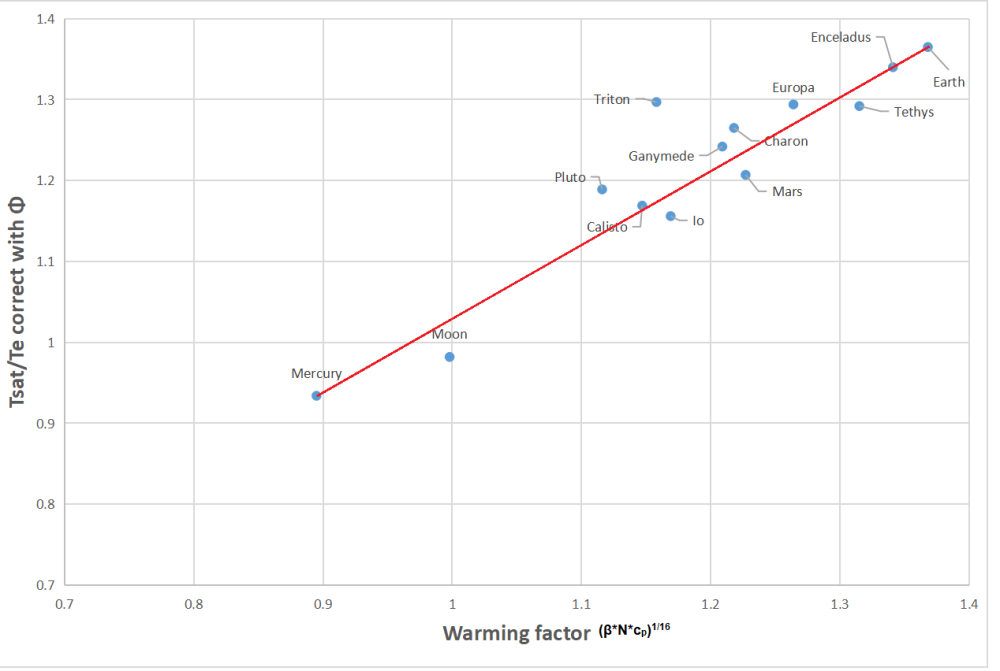

i285978589399740131._szw1280h1280_-1