CO2 Coalition Does Climate Reveal in Wyoming

The CO2 Coalition article is CO2 Coalition Takes the Science to Wyoming.  Excerpts in italics with my bolds and added images.

Wyoming has vast resources of coal, oil and natural gas. With 40% of the nation’s coal resources, the state has been the United States’ top producer since 1986, primarily from the Powder River Basin located in the northeastern part of the state. It is also a national leader in the production of oil and natural gas, ranking in the top 10 in production of both products. 

Yet, even though the Wyoming economy is heavily dependent on the mining and extraction of fossil fuels, its governor, Mark Gordon, has adopted a strong “decarbonization” policy. The science tells us that this is not a winning strategy for the people of Wyoming. 

The CO2 Coalition believes that public policy on such matters should be driven by scientific review and analysis, not political agendas. To provide such an analysis, we have produced this report, Wyoming and Climate Change: CO2 Should Be Celebrated, Not Captured

We also sent a team of climate experts from the CO2 Coalition,  including Dr. William Happer, Dr. Byron Soepyan and Gregory Wrightstone to Wyoming to provide the facts concerning the huge benefits of carbon dioxide. This team presented the science at a hearing of the Wyoming Senate Agriculture Committee (pictured above.)

The team also presented accurate science regarding Wyoming’s climate to students at Gillette College, Laramie County Community College, and at the University of Wyoming.

Temperature Data Shows Good News for Wyoming

Data for Wyoming contradict the 4th National Climate Assessment (NCA4) assertion that “the frequency and intensity of extreme high temperature events are virtually certain to increase.”

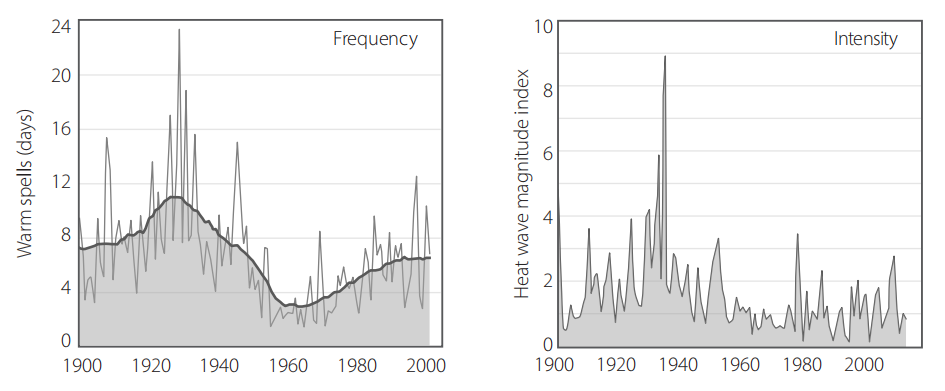
Our data analysis shows that high daily temperatures peaked during the Dust Bowl years of the 1930s and have been in a 90-year decline. This is confirmed by reviewing the percentage of days that were reported to be hotter than 100°F (37.8°C) by Wyoming temperature stations. There is no discernible increase, and the largest numbers occurred in the first half of the 20th century when CO2 levels were 70% of recent measurements.

There has been, however, a beneficial increase in the minimum nighttime temperatures, which has led to a lengthening of the Wyoming growing season. Since the late 1800s, these nighttime temperatures have increased about 2°F (1.1°C).

The slight increase of about 1.2°F (0.7°C) in the average temperature
in the last 120 years is being driven by reductions in extreme cold
rather than increases in extreme heat.

Full Report:  Wyoming and Climate Change

Conclusion From Full Report 

The recent proposal by Wyoming Governor Mark Gordon to use “carbon capture” to achieve what he terms “negative net zero” (Gordon 2021) is based on a flawed theory that increasing CO2 in the atmosphere is leading to harmful effects on Wyoming’s environment and its people. Within this report, we have documented that modest warming and increasing carbon dioxide are clearly beneficial for the Cowboy State’s ecosystems and citizenry.

The data tell us the following:

• Current levels of carbon dioxide are at near historically low concentrations.
• Adjustments to historic temperature records have artificially amplified modern warming.
• Wyoming temperatures have increased a modest 1.2°F (0.7°C) since 1895.
• Heat waves peaked in the 1930s and have been in slight decline since that period.
• Nightime low temperatures have increased, lengthening growing seasons.
• Precipitation data, while varying greatly from year-to-year, show no increasing or decreasing trend.
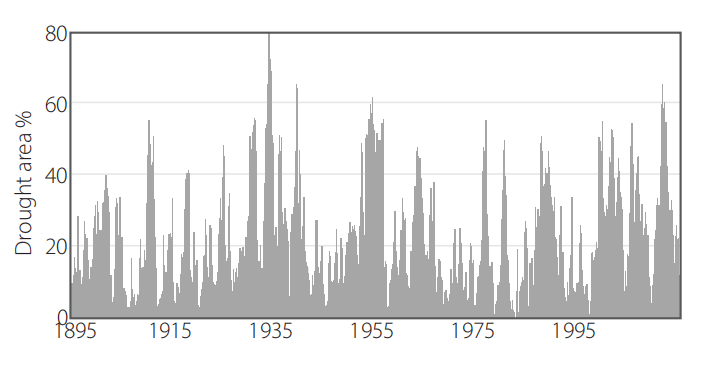
• Droughts are not increasing in Wyoming.
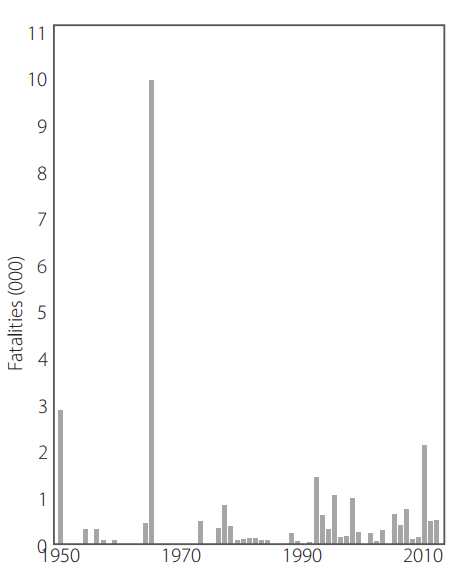
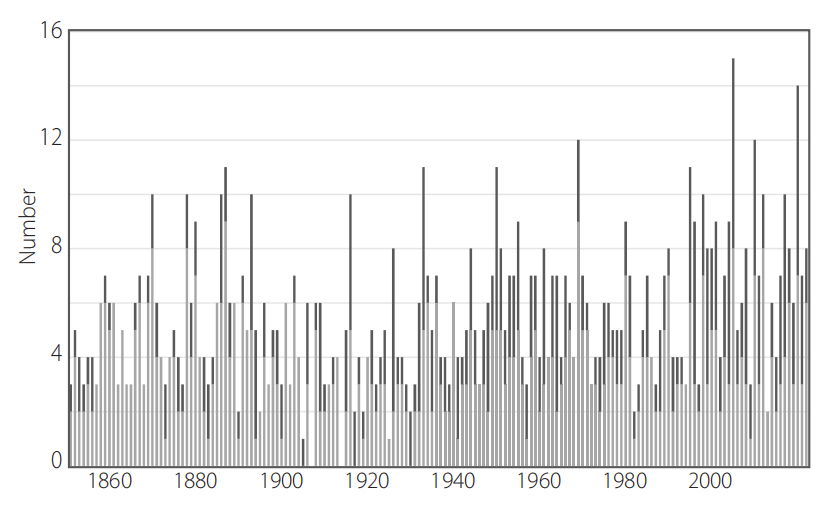
• Severe weather and natural disasters are declining.
• Agricultural production, globally and in Wyoming, is thriving due to modest warming and more CO2.
• Vegetation in Wyoming and around the world is increasing.
• Greenhouse-induced warming that would be averted (< 0.003°F) by eliminating Wyoming’s CO2 emissions would be too small to measure and achieved, if at all, at enormous cost.
• Models used to project future temperatures significantly overpredict the amount of warming in coming decades.

CO2 Should Be Celebrated, Not Captured

Decarbonizing Religion Delusional

“Climate Activism is a Religion” – Marian Tupy.  H/T Raymond.  Excerpted transcript below in italics with my bolds and added images.

“The planet is infected with us we’re all gonna die. Isn’t that all true and and correct?

It’s certainly not true and actually the history of the relationship between population growth and abundance of Natural Resources is much more complex than people realize. It’s very interesting to see how extreme environmentalism maps onto Christian theology. On the one hand you’ve got your Garden of Eden: that’s the world before industrialization. You have your Devils: fossil fuel CEOs and people like that. You have your Saints, Greta Thunberg. Your Priesthood is the IPCC scientists. And of course you even have indulgences like back in the days before Reformation. Where you are allowed to fly around the world on a private jet, so long as you give a few thousand pounds or dollars to a green cause. All those sins are simply washed away. And one of the fundamental features of any religion is apocalypse, the end of days.

What we are saying is that if the world is going to end. it will certainly not end because we will run out of Natural Resources. The British energy problems are not an outcome of physical limits on fossil fuels or energy that can be produced in the world. They are an outcome of stupid decisions made by your politicians for the last 20 years.

Context

Our guest today is the editor of humanprogress.org, a senior fellow at the center for Global liberty and prosperity, whose latest book is called super abundance the story of population growth Innovation and human flourishing on an infinitely Bountiful Planet. Marian Tupy, welcome to triggeronometry. Please tell everybody who you are and what brings you to be sitting here talking to us

It starts with my birth in Czechoslovakia socialist republic. When I was a child my parents moved to South Africa. Later I went to Great Britain and studied at Saint Andrews University. I’ve been in Washington DC at the Cato Institute which is a Libertarian think tank for the last 20 years. And as you mentioned I run a website called viewingprogress.org which is basically just a website trying to document and promote the notion that the world is improving along many different dimensions of human well-being. That led me to writing a book about population and Innovation and natural resources.

Well speaking of all of that Marian, the the self-evident truth that everyone’s been completely persuaded about for the last God knows how many years is the planets overpopulated,  humans are the virus infecting the planet. We’re all gonna die, and as we die we’re gonna make everything terrible. Marion why is it that so many people think that overpopulation is a real danger for our planet and the future of the human race?

I think it’s because the notion of finitude of atoms which is absolutely true. It is common sense and intuitive to say: If you have the finite quantity of atoms but you are increasing the people using those atoms then at some point you must run out. But this ignores a very fundamental difference between human beings and other animals. We are animals who are capable of planning forward and we are animals capable of innovating out of our problems through human knowledge. So American Economist Thomas Sowell has a famous quote:

An example is iPhone, a great way of dematerializing our the world. In other words we are saving a lot of atoms that we don’t have to put into television sets, into cameras, into Maps, into campuses, into calculators and all those other things. Instead we put it on this device. I hope it goes some way into explaining why the number of atoms in the world is actually not a limiting factor for how much of value we can create.

I think that if we are looking at the source of discomfort and a sense of dejection about the future, it may come from the fact that in Britain you cannot build that many houses. Or rather you refuse to build that many houses because of governmental policy. I’m not bashing Britain I’ve spent five years in your beautiful country and I love it and we have the same problem in the United States. it’s not that all of these people living in the cities are concerned about overpopulation, just that they’ve decided that you’re not going to build in my backyard.

It’s policy driven rather than driven by some sort of fundamental physical lack of space.

People still need a search for the transcendental; they still need to commit their lives to a meaning, to some sort of a heroic vision of themselves. What is it that they are trying to accomplish with their lives aside from going to work? And I think that many people especially in secular societies have embraced Extreme Environmentalism as a substitute for religion. um it’s very interesting to see how extreme environmentalism maps onto Christian theology. So I think that there are religious overtones to environmentalism. And the number of apocalyptic movies has been growing every decade since the 1950s, even though the world has improved along very many different dimensions: we live longer, we live healthier lives, we are much richer, poverty is collapsing around the world.

But with every decade the number of apocalyptic movies is actually increasing with one exception and it was 1990s because of the peaceful resolution of the Cold War.

Whatever your view on fossil fuels, whether or not you believe that emitting ever more CO2 in the atmosphere is a problem, clearly the timeline and the plan that our politicians have invented is completely unrealistic. We are not paying a price for there being too little oil or gas or uranium in the world. We are paying a penalty for politicians forcing us into energy consumption patterns which were completely unrealistic. The book tells you that there is plenty to be used for hundreds of thousands of years. We are never going to run out of these energy sources or natural resources, but yes as a society we could certainly decide not to use them and simply to shut off the lights and close the door on Western Civilization. That choice is not going to be forced on us by physical limits of the planet.

I think there is a reasonable chance that we have seen Peak apocalyptic environmentalism, for two reasons. One is that half of the world, the underdeveloped or developing world is never going to buy into our nonsense. We just have to stop thinking that and don’t even pretend that people in India and China and Bangladesh and Africa, which are still very poor are simply going to start using windmills. It’s just not going to happen for decades, if ever. They would have to be at a completely different level of Economic Development to start playing around with wind farms and whatever. So they’re going to be reliant on oil and natural gas for a long long way to come. And even that is better than using biofuels in order to power their own societies.

So that’s one half of the population; the second half are the advanced economies like yours and our economies, which are by and large democratic. And I do not believe that with any level of brainwashing coming from Whitehall or from Greta or people who glued themselves to roads or whatever. I don’t think any level of that kind of propaganda and brainwashing will make the good people in the United Kingdom to decide that this is the future they’re going have. In other words democracy is going to win. And if it’s not going to be the Tory party which changes the green policies and the green New Deal or Net Zero, or it’s going to be somebody else. And the sooner the British political establishment awakes to the fact that the British people are suffering and their living standards are collapsing, the less likely it is that you will have a really nasty party emerging that will do it for them.

I have a concern about the democracies we still have here in the West. If our center right and center left simply refuses to acknowledge that by government design lives of our people are getting worse, somebody else is going to fill that void, and that is something I want to avoid.

The reason why the public in this country and in yours holds the politicians in utter contempt is precisely because they see the level of hypocrisy that is going on in in both societies. You see them constantly raising taxes on air travel but they themselves fly around on private jets or first class which is much more carbon intensive. You see them telling you to drive you know little EVs while they enjoy being driven around in SUVs as big as a house. You see them telling you that the world is going to be swallowed up by by the oceans while at the same time they’re buying beachfront properties.

They basically think that we are so stupid and they think that can they can basically freak us out to an extent where where any kind of policy can be can be implemented. And to that extent I was actually impressed with some of the work done in the UK by the former head of your Supreme Court Jonathan Sumption, who was deeply concerned about the kind of public reaction to covid; you know, you end up with a Chinese virus but also with a Chinese Society. If people can be freaked out enough that the world is going to implode, they would be willing to part with their civil liberties and their basic freedoms.

On the other hand all of these apocalyptic predictions have been wrong in the past. And if you again put a date on it, you say that we only have five or ten years left on the planet left, when that time expires we will be wondering why we should be believing these people. What sort of credibility do they have? Do they also realize just how extraordinarily damaging it it to our institutions? How are we supposed to believe the leadership in our societies when they get these calls wrong time and time again.

They complain about populism when they are the causes of populism because
they keep on saying things which are obviously not true.

In this book we looked at 18 different data sets with some of them going back to 1850, and we looked at hundreds of Commodities: Goods, finished goods, Services, food, fuel etc. We found that for every one percent increase in population we had one percent decrease in the price of all of these Goods, services and commodities. That tells us that human beings on average are more producers than they are consumers; that we are really able to produce more wealth than we consume, otherwise you would see the opposite: With every one percent increase in population you would see an increase in prices with greater scarcity. But that is not the fact.

We are very divided in Western countries and so while remaining optimistic: How do we manage some of the trade-offs of these technological developments? Because it seems to me in social communication, cultural programs and entertainment and particularly social media are areas where everyone knows there’s a big problem but no one quite knows what to do about it.

Any technology developed by the human brain can be can be used for good and evil. A baseball bat can be used to hit a baseball and it can be used to to bash you to death, not to mention guns and um anything else, knives and on. So what you do with your Technologies also matters. I think that any new technology from gramophones to bicycles was first met with a wall of negativism. Once it was thought writing of novels was supposed to lead to mental collapse throughout the Western World. Television, radio, all of these things were considered to be potentially world-ending events, but that didn’t happen

When it comes to social media, I don’t like them and I don’t partake. I left Facebook in 2012 when I realized that it was making me unhappy. Because what I was putting up on Facebook was a curated picture of my life, and what I was consuming was a curated picture of my life. So basically I was posting lies in consuming lies, and once I realized that I left Facebook. That was a choice, a choice which can be made independently by any number of all 8 billion people

I think that what we are going through right now is a period of adjustment to a new technology but that period of adjustment will resolve itself. You know it took us 50 years to figure out that drinking and driving was not a good idea. Now it’s sort of been internalized into us that cars are much better operated when you are sober, but it took time to to to to to square the human brain with this new technology. That will probably happen with social media as well or at least I hope that people are going to realize that much of it is simply unreal, what is making them unhappy, and they could be spending their time doing better things than than being on social media. We’ll probably figure it out in the way that we have figured it out with novels and bicycles and radio and television.

I’m basically a follower of the Enlightenment. I aspire to the ideals of the Enlightenment and one of the main features of the Enlightenment was freedom of speech. We are not putting enough emphasis on the way that freedom of speech is being destroyed by our governments, by the media, by cancel culture. Freedom of speech is not only necessary in order to produce new inventions and Innovations but also to produce new ideas. In this country we need a lot of reforms because the country is not functioning very well. Things won’t improve if ideas that I propose are canceled just because they seem too outrageous. In the same way in the United Kingdom, you need to undertake a lot of reforms and what if somebody tells you that your proposal for, let’s say, NHS reform is somehow unspeakable.

We need to preserve freedom of speech, it’s absolutely fundamental and we should be talking more about people getting canceled for joking uh for expressing wrong ideas and also for having peculiar forms of behavior. and that’s important because as we discuss in our book a lot of people on whom we rely for some of the most important Innovations and inventions in the world are also very peculiar people.

I’m rationally optimistic about the future just just to just to clarify that. So long as we don’t have a massive war caused by politicians, so long as we’re able to innovate without a precautionary principle, so long as we are able to freely speak and publish and research. And so long as we have the free markets which can tell us which inventions and Innovations are valuable and which inventions and Innovations are not valuable.

Environmentalism Perverted by Climatism

J. Scott Turner explains how the roots of environmental stewardship were poisoned, resulting in the perverted modern decarbonization movement.  His Spectator Australia article is Environmentalism: from concern about clean air to throwing soup at the Mona Lisa.  Excerpts in italics with my bolds and added images.  H/T John Ray

Garrett Hardin was a professor of biology and environmental studies at UC Santa Barbara. His “commons” was a metaphor drawn from the traditional English practice of shared grazing and agricultural land to which all members of a community had access. Commons were inherently prone to abuse, Hardin argued, because every user of the commons will exploit it to maximize personal benefit without regard to the other users, leading ultimately to the collapse of the commons as a useful resource.

Hardin extended the metaphor of the commons to include all natural resources, including the air, water, other species, even the entire Earth. The tragedy of Hardin’s expansive commons was the inexorable march to environmental doom, driven by the folly of human freedom. “No technical solution” could halt its march, no ingenious tinkering could fix the problem. Rather, Hardin asserted that the juggernaut could only be arrested through “mutual coercion, mutually agreed upon.” To save ourselves, we would have to give up many freedoms we take for granted, specifically “relinquishing the freedom to breed.”

Hardin’s “Tragedy of the Commons” is perhaps the most influential paper
ever to come out of the field of ecology.

Within its six pages were sown the seeds that have grown into the vast industry that is modern environmentalism. If you’ve ever wondered how environmentalism got from simple concern for clean air and water and preservation of wilderness and its wonderful creatures, to Greta Thunberg, Extinction Rebellion and throwing soup at the Mona Lisa, it was Garrett Hardin who drew the map.

Hardin’s path to the tragedy of the commons was itself mapped out by the English economist and cleric, Thomas Malthus. When Thomas Carlyle famously cast economics as the “dismal science” — a “dreary, desolate… quite abject and distressing science” — it was Thomas Malthus he had in mind. Malthus’s economic philosophy was one of finitude and futility. Human populations always grew faster than could the food supply, he asserted, leading inexorably to famine, disease, perpetual poverty and war: the “Malthusian catastrophe.” Malthus’s economics stands in marked contrast to that of his near-contemporary Adam Smith’s more hopeful economics of free trade, free markets and the inscrutable “invisible hand” that would guide societies to prosperity and liberty. The history of economics has been a long contention between these two competing ideas.

Malthusian economics considered people to be aimless particles pushed this way and that by powerful and indifferent forces. People are considered to have no agency whatsoever, or whatever agency they might have, encompass no other sentiment but selfishness. The only way out of the Malthusian catastrophe would be restraint of human nature, through “mutual coercion mutually agreed upon,” as Garrett Hardin put it. Tyranny

A big part of Malthus’s appeal at the time was his mathematical argument, which imparted a faux certainty to his claims. Charles Darwin and Alfred Russell Wallace both were inspired by Malthus’s mathematics, for example, however, Malthus’s mathematics were simplistic and naïve and failed to account for the fact that humans do, in fact, have individual agency — and that the range of moral sentiments was far wider than mere selfishness.

Nevertheless, Malthusianism continues to find devoted acolytes wherever simplistic and naive mathematical presumptions reign. Presently, it is climate change that fits that bill, and it is climate change where the Malthusian tragedy of the commons is again rearing its head — no, having its head propped up, Weekend at Bernie’s style — by a group of twenty-three scholars (they always seem to come in packs) in the prestigious pages of Proceedings of the National Academy of Sciences. There, they call for a “new paradigm” (that buzzword) to stave off the tragedy of the Anthropocene “planetary commons.”

Their new paradigm goes beyond mere governments managing common resources, like sea-floor mineral prospecting. Rather, they are advocating a more ambitious program to take control of the “biophysical systems” that impart resiliency to the Earth’s function. These systems include the atmosphere, hydrosphere (oceans, lakes, rivers and aquifers), the biosphere (encompassing all of the Earth’s biota), the lithosphere (all terrestrial ecosystems, and the cryosphere — ice and snow). Exerting such control, they say, will require “mobilization of efforts at an unprecedented scale, including future research” (read spending), which can only be done through a “nested Earth system governance approach.” This will mean “[adjusting] notions of state sovereignty and self-determination,” taking on “obligations and reciprocal support and compensation schemes … comprehensive stewardship obligations and mandates,” all with the aim to protect “Earth-regulating systems in a just and inclusive way.” You get the idea: “following the science” means a world government that subordinates those pesky notions of self-government and national sovereignty.

Doomsday scenarios are nothing new in the genre of “climate action.” Usually, such contributions bristle with weasel words such as “may,” “possibly,” “perhaps” and the ilk (e.g. the impending extinction of insects). Not so the planetary commons paper, which bristles with alarmist certitude. We are driving the Earth toward dangerous instability, rapidly pushing us past “tipping points” where the Earth will be plummeted irreversibly into disaster, making the Earth inhospitable to life itself. We are sinners in the hands of an angry goddess.

The whole thing is a house of cards, which a little digging will expose. Let’s begin with that word in the title: “Anthropocene.” What does it mean? It sounds science-y, but in fact “Anthropocene” is a neologism proposed in 2000 that demarcates the past 250 years from the Holocene, the geological epoch that began around 11,000 years ago, and which encompasses the rise of modern humans. It is no accident that the Holocene-Anthropocene boundary is set at 250 years before the present: it coincides with the beginning of the Industrial Revolution.

The Anthropocene is the stand-in for the eschatological End Times.
Like the End-Times, it is defined by a basket of horrors and portents:

♦  An order-of-magnitude increase in erosion and sediment transport associated with urbanization and agriculture;
♦  marked and abrupt anthropogenic perturbations of the cycles of elements such as carbon, nitrogen, phosphorus and various metals together with new chemical compounds;
♦  environmental changes generated by these perturbations, including global warming, sea-level rise, ocean acidification and spreading oceanic “dead zones”;
♦  rapid changes in the biosphere both on land and in the sea, as a result of habitat loss, predation, explosion of domestic animal populations and species invasions; and
♦  the proliferation and global dispersion of many new “minerals” and “rocks” including concrete, fly ash and plastics, and the myriad “technofossils” produced from these and other materials.

No mention is made, of course, of the dramatic reductions of poverty, extensions of life spans, improved agricultural productivity, cleaner air and water, safer environments that also mark the Industrial Revolution. Those are Hardin’s “technical solutions,” to be dismissed as the false consciousness that merely delays the springing of the Malthusian trap. We best be wary.

The Anthropocene is not a scientific term: it is an entirely political construction. Being able to sell it as scientific has long been a coveted tool to advance the climate change agenda. This has meant a long march through the institutions that govern geological nomenclature. That effort came to fruition in 2019, at a meeting of the International Union of Geological Sciences in Cape Town, where a vote was taken to formally recognize the Anthropocene as a geological epoch. It passed by a supermajority of 88 percent in favor, which by the rules of the Society, closed off the matter from further debate. What was the actual vote? Thirty-three individuals voted to recognize the Anthropocene, and four dissented. Was this scientific consensus? Technically it was, but we keep in mind the deceptive power of percentages: the 2022 membership of the Geological Society of America totaled 18,096. Remember these figures the next time we hear about a scientific “consensus.”

With the Anthropocene established as a formal geological epoch, the door was opened for climate activists to advance a political agenda masquerading as “science.” The planetary commons paper, for example, asserts that we have already passed six of nine “tipping points,” putting us THIS CLOSE to catastrophe. That sounds dire, to be sure. But just what determines a tipping point, and how do we know we’re past it? One of the references cited in support of this claim is a paper (with many of the same authors as the planetary commons paper) which defines the “safe operating space” for the nine variables.

What determines the limits of the “safe operating space”?
Why, it’s the presumed conditions prior to the Anthropocene!

The circle is thereby closed: the politically-defined Anthropocene is used to set the politically defined “safe operating space” for the Earth, which sets the course for “navigating” through the perilous Anthropocene. Follow the science! The agenda is clear: reverse the Industrial Revolution and return civilization to the illusory halcyon of the Holocene. This is the climate change echo chamber at work: a collection of mutually-reinforcing arbitrary presumptions dressed up in a science-y costume.

It would be amusing were it not for the costume being flashy enough to take in the mid-wit rubes that constitute our present-day ruling class. Danger lurks there, which was expressed eloquently 264 years ago by Adam Smith in his 1759 Theory of Moral Sentiments:

The man of system, on the contrary, is apt to be very wise in his own conceit; and is often so enamored with the supposed beauty of his own ideal plan of government, that he cannot suffer the smallest deviation from any part of it… He seems to imagine that he can arrange the different members of a great society with as much ease as the hand arranges the different pieces upon a chess-board. He does not consider that the pieces upon the chess-board have no other principle of motion besides that which the hand impresses upon them; but that, in the great chess-board of human society, every single piece has a principle of motion of its own, altogether different from that which the legislature might choose to impress upon it. If those two principles coincide and act in the same direction, the game of human society will go on easily and harmoniously, and is very likely to be happy and successful. If they are opposite or different, the game will go on miserably, and the society must be at all times in the highest degree of disorder.

Garrett Hardin was, in his time, also a “man of system,” and it’s worth remembering that our last flirtation with the tragedy of the commons did not end well, especially not for Garrett Hardin himself, who now seems to be somewhat of an embarrassment to our present-day presumptive “persons of system.” We seem to have learned nothing since 1968, or for that matter, since 1759.

Will history repeat, this time as farce? Or will it be tragedy?

See Also 

Don’t Buy “Planetary Boundaries” Hype

Warning: Earth Day Became Polluted

Four Ways Net Zero Ruins Us

This is a beginning post toward infographics exposing the damaging effects of Climate Policies upon the lives of ordinary people.  And all of the pain is for naught in fighting against global warming/climate change, as shown clearly in the image above.  This post presents graphics to illustrate the first of four themes:

  • Zero Carbon Means Killing Real Jobs with Promises of Green Jobs
  • Reducing Carbon Emissions Means High Cost Energy Imports and Social Degradation
  • 100% Renewable Energy Means Sourcing Rare Metals Off-Planet
  • Leave it in the Ground Means Perpetual Poverty
Part 1:  Zero Carbon will Decimate US Workforce

WHCP fig1r

WHCP fig1ar

WHCP fig2ar

WHCP fig3a

WHCP fig3

Tables of Oil and Natural Gas Employment and Economic Impact come from API Price Waterhouse Cooper  Impacts of the Oil and Natural Gas Industry on the US Economy in 2019    As for Coal, EIA estimates the industry lost 75% of its workforce down to 53,000 employees (2019) working in coal mines, and the number has stabilized with exports offsetting declines in domestic consumption.  The losses of jobs in oil and gas come from EID (Energy in Depth) CLIMATE ACTIVISTS PUSH STUDY SHOWING 3.8 MILLION LOST JOBS FROM RENEWABLE ENERGY TRANSITION.

“While many experts dispute the feasibility of Jacobson’s plan for a renewables-only energy grid, the severe job losses are far more difficult to dispute, given that they come directly from Jacobson’s research. Those job losses would undoubtedly be devastating for millions of American families.”

cb020621dapc20210206014624

And about Those Promised Green Jobs to replace the lost ones:  

In February 2009, the last time Democrats controlled the White House and both chambers of Congress, President Barack Obama and Vice President Joe Biden flew to Colorado to sign their $787 billion stimulus package into law.

The plan was to invest $150 billion over 10 years that would advance a “clean energy” economy built around biofuels, hybrid cars, low-emission coal plants, and renewable sources such as solar and wind. Obama and Biden promised to create five million green jobs that would specifically benefit low-income earners, claiming that the stimulus package included “help for those hit hardest by our economic crisis.”

mrz041312dapr20120413044622

A decade later, we now know that the 2009 green jobs program was a complete failure. The Department of Labor (DoL) and the Bureau of Labor Statistics (BLS) issued several reports on the green jobs program. Each report was an indictment on the program, as job placement met only 10 percent of the targeted level, and many of those who were hired remained employed for less than six months.

Even the new, redefined green jobs did not reach the five million promised in February 2009. According to a study by the Brookings Institution, the Obama–Biden administration identified nearly 2.7 million green jobs, but most were bus drivers, sewage workers, and other types of work that do not match the “green jobs of the future” that the administration promised. Most of them were preexisting jobs, which were simply re-characterized by the government, apparently in an effort to boost the numbers.  Source: If at First You Don’t Succeed, Try ‘Green Jobs’ Again

See also Green Energy Failures Redux

Parts Two, Three and Four

World of Hurt from Climate Policies-Part 2

World of Hurt from Climate Policies-Part 3

World of Hurt from Climate Policies-Part 4


Big Asian Chill Pushes Arctic Ice Over 15 Wadhams

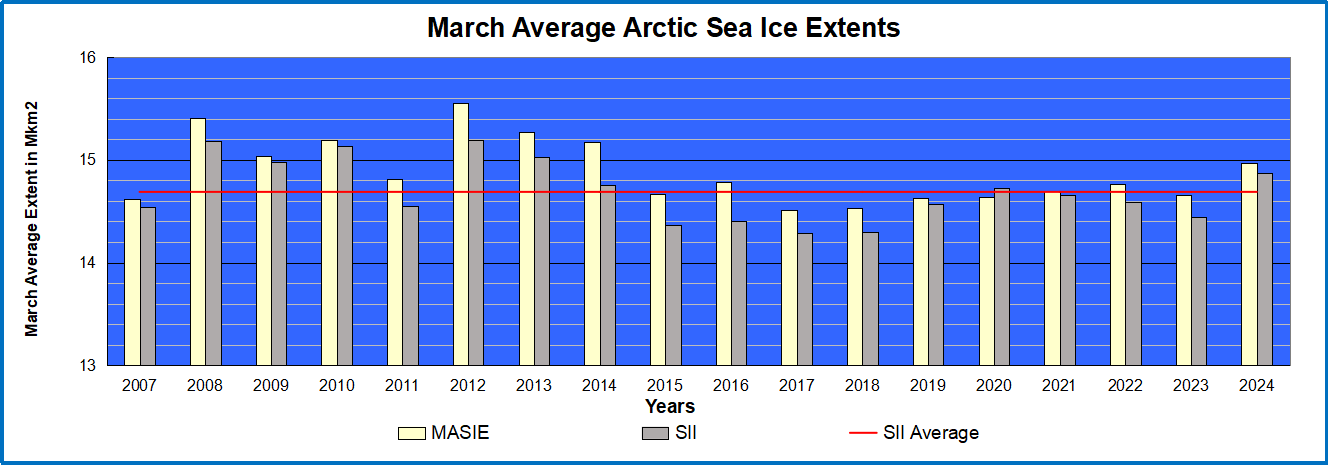
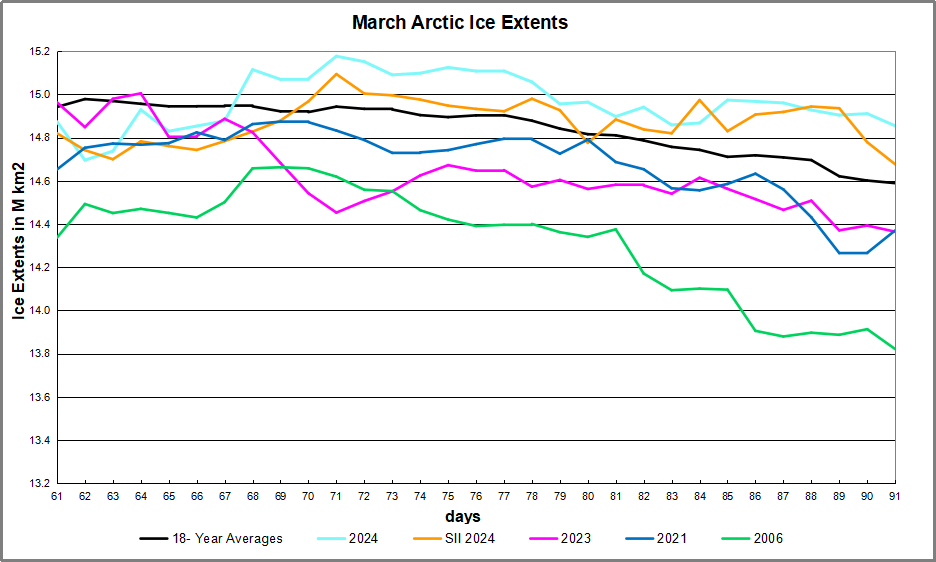
For ice extent in the Arctic, the bar is set at 15M km2. The highest daily average in the last 18 years occurs on day 61 at 15.08M before descending. Most years are able to clear 15M, but in recent previous years, 2017, 2018, 2019 and 2021 ice extents failed to clear the bar at 15M km2.  On February 11, 2024 (day 42) Arctic ice extent already leaped over that bar 20 days early. Then extent dropped for several days, but has again topped 15 Wadhams with ice in Asian basins contributing greatly.

The animation shows Pacific ice growth in the last week.  Bering Sea on the right changed little, while Okhotsk in the center added ice down to N. Japan, and now well above 2023 March maximum.  The ice patch in far left is the harbor close to Beijing where the Yellow Sea added 20K km2 ice extent in two days.

The graph shows the rapid rise in Arctic ice reaching 15 M km2 extent already on Feb. 11 (day 42)  Then the extent dropped down to 14.6M before rising again to reach a new high of 15.07M. Yesterday Arctic ice was 215k km2 above average, with nearly all the surplus appearing in Okhotsk.  SII showed neither the first peak or the current one in February.

The table shows the distribution of ice compared to day 56 averages and other years on that day.

Region 2024056 Day 56 Ave 2024-Ave. 2006056 2024-2006
 (0) Northern_Hemisphere 15039168 14823967 215201 14318117 721051
 (1) Beaufort_Sea 1070983 1070317 667 1069711 1273
 (2) Chukchi_Sea 966006 964499 1507 961796 4210
 (3) East_Siberian_Sea 1087137 1087109 28 1086702 435
 (4) Laptev_Sea 897845 897837 8 897773 71
 (5) Kara_Sea 925734 916917 8818 899871 25864
 (6) Barents_Sea 598915 606693 -7778 484567 114348
 (7) Greenland_Sea 742472 612727 129745 577357 165115
 (8) Baffin_Bay_Gulf_of_St._Lawrence 1391601 1508331 -116730 1365491 26110
 (9) Canadian_Archipelago 854860 853163 1697 852715 2145
 (10) Hudson_Bay 1260903 1260462 441 1257077 3827
 (11) Central_Arctic 3220834 3210037 10797 3214577 6257
 (12) Bering_Sea 619130 665856 -46727 629210 -10080
 (13) Baltic_Sea 85666 98767 -13101 101029 -15363
 (14) Sea_of_Okhotsk 1282477 1028678 253799 853467 429010

Note that moderate deficits in Bering Sea and Baffin Bay are more than offset by a large 254k km2 surplus in Okhotsk along with 130k km2 in Greenland Sea.

These results fly in the face of those claiming for years that Arctic ice is in a “death spiral.”  More sober and clear-eyed observers have called out the alarmists for their exaggerations.  A recent example comes from Allan Alsup Jensen at Nordic Institute of Product Sustainability, Environmental Chemistry and Toxicology, Denmark.  His December 2023 paper is Time Trend of the Arctic Sea Ice Extent.  Excerpts in italics with my bolds and added images.

Since 2007 no significant decline has been observed

Abstract

The NSIDC website, IPCC’s reports and some scientific papers have announced that the Arctic Sea ice extent, when it is lowest in September month, in recent years has declined dramatically, and in few decades the sea ice is supposed to disappear completely in the summer. In that way new and shorter ships routes will open up north of the continents.

The facts are, that the Arctic Sea ice extent measured by satellites since 1978 expresses annual variations and it has declined considerably from 1997 to 2007. However, before that time period, from 1978 to 1996, the downward trend was minimal, and in the last 17 years from 2007 to 2023 the downward trend has also been about zero. Therefore, there is no indication that we should expect the Arctic Sea summer ice to disappear completely, as predicted, in one or two decades.

Regarding the extent of the summer (February) sea ice at the Antarctic, the downward trend during the years 1979-2021 was very small but in 2022 and 2023 a considerable decline was observed, and a decline was also clearly observed for the whole period of 2007- 2023. That was in contradiction to what happened in the Arctic. The pattern of the annual levels was not the same for the Arctic and Antarctic, indicating different drivers in the North and the South.

Figure 4: The minimum extent of the sea ice at Antarctic
in February month 1979-2023 (data
from NSIDC.org)

These data show that there is no apparent correlation between the variable extent of the Arctic and the Antarctic Sea ice and the gradually increasing CO2-concentrations in the atmosphere as proposed by NSIDC, IPCC and others, also for these areas of cold climate.

Postscript Feb. 14

Some seek to deny the current plateau in Arctic Sea Ice by saying that extent measure is only surface, while volume would be a truer metric.  That is true in theory, but in practice obtaining accurate and consistent data on sea ice thickness is a challenge yet to be reached.  As you can imagine, detecting a depth dimension from satellites is fraught with errors, especially with drift ice not land anchored, moving around, sometimes piling up from winds.  The scientific effort to measure volume has a short history and several uncertainties to ovecome before it can be trusted.

Unfortunately for those wanting an ice free Arctic (well, no more than 1 Wadham they say), the volume record so far shows the same plateau:

“Satellite derived sea ice thickness (CryoSat 2, AWI algorithm v2.6) shows an anomaly thickness pattern very similar to that from PIOMAS, but CS2 shows negative anomalies propagating north of the Canadian Archipelago into the central Arctic while PIOMAS has neutral conditions there. A positive thickness anomaly around Wrangle Island is spatially more extensive in CS2. January 2024 adds another month to the record of CS2 data which now spans 13 years. Neither CS2 nor PIOMAS show any discernible trend over that time period underlining the importance of internal variability at decadal timescales.”  Source: Polar Science Center


Top Climate Model Improved to Show ENSO Skill

Previous posts (linked at end) discuss how the climate model from RAS (Russian Academy of Science) has evolved through several versions. The interest arose because of its greater ability to replicate the past temperature history. The model is part of the CMIP program which is now going the next step to CMIP7, and is one of the first to test with a new climate simulation. Improvements to the latest model, INMCM60, show an enhanced ability to replicate ENSO oscillations in the Pacific ocean, which have significant climate impacts world wide.

This news comes by way of a new paper published in the Russian Journal of Numerical Analysis and Mathematical Modelling February 2024.  The title is ENSO phase locking, asymmetry and predictability in the INMCM Earth system model Seleznev et al. (2024) Excerpts in italics with my bolds and images from the article.

Abstract:

Advanced numerical climate models are known to exhibit biases in simulating some features of El Niño–Southern Oscillation (ENSO) which is a key mode of inter-annual climate variability. In this study we analyze how two fundamental features of observed ENSO – asymmetry between hot and cold states and phase-locking to the annual cycle – are reflected in two different versions of the INMCM Earth system model (state-of-the-art Earth system model participating in the Coupled Model Intercomparison Project).

We identify the above ENSO features using the conventional empirical orthogonal functions (EOF) analysis which is applied to both observed and simulated upper ocean heat content (OHC) data in the tropical Pacific. We obtain that the observed tropical Pacific OHC variability is described well by two leading EOF-modes which roughly reflect the fundamental recharge-discharge mechanism of ENSO. These modes exhibit strong seasonal cycles associated with ENSO phase locking while the revealed nonlinear dependencies between amplitudes of these cycles reflect ENSO asymmetry.

We also assess and compare predictability of observed and simulated ENSO based on linear inverse modeling. We find that the improved INMCM6 model has significant benefits in simulating described features of observed ENSO as compared with the previous INMCM5 model. The improvements of the INMCM6 model providing such benefits arediscussed. We argue that proper cloud parametrization scheme is crucial for accurate simulation of ENSO dynamics with numerical climate models

Introduction

El Niño–Southern Oscillation (ENSO) is the most prominent mode of inter-annual climate variability which originates in the tropical Pacific, but has a global impact [41]. Accurately simulating ENSO is still a challenging task for global climate modelers [3,5,15,25]. In the comprehensive study [35] large-ensemble climate model simulations provided by the Coupled Model Intercomparison Project phases 5 (CMIP5)and 6 (CMIP6) were analyzed. It was found that the CMIP6 models significantly outperform those fromCMIP5 for 8 out of 24 ENSO-relevant metrics, especially regarding the simulation of ENSO spatial patterns, diversity and teleconnections. Nevertheless, some important aspects of the observed ENSO are still not satisfactorily simulated by the most of state-of-the-art models [7,38,49]. In this study we are aimed at examination of how two such aspects – ENSO asymmetry and ENSO phase-locking to the annual cycle –are reflected in the INMCM Earth system model [44, 45].

The asymmetry between hot (El Nino) and cold (La Nina) states is a fundamental feature in the observed ENSO occurrences [39]. El Niño events are often stronger than La Niña events, while the latter ones tend to be more persistent [10]. Such an asymmetry is generally attributed to nonlinear feedbacks between sea surface temperatures (SSTs), thermocline and winds in the tropical Pacific [2,19,28]. The alternative conceptions highlight the role of tropical instability waves [1] and fast atmospheric processes associated with irregular zonal wind anomalies [24]. ENSO phase-locking is identified as the tendency of ENSO-events to peak in boreal winter.

Several studies [11,17,34] argue that the phase-locking is associated with seasonal changes in thermocline depth, ocean upwelling velocity, and cloud feedback processes. These processes collectively contribute to the coupling strength modulation between ocean and atmosphere, which, in the context of conceptual ENSO models [4,18], provides seasonal modulation of stability (in the sense of decay rate) of the “ENSO oscillator”. Another theory [20,42] supposes the phase-locking results from nonlinear interactions between the seasonal forcing and the inherent ENSO cycle. Both the asymmetry and phaselocking effects are typically captured by low-dimensional data-driven ENSO models [14, 21, 26, 29, 37].

In this work we identify the ENSO features discussed above via the analysis of upper ocean heat content (OHC) variability in the the tropical Pacific. The recent study [37] analyzed high-resolution reanalysis dataset of the tropical Pacific (10N – 10S, 120E – 80W) OHC anomalies in the 0–300 m depth layer using the standard empirical orthogonal function (EOF) decomposition [16]. It was found that observed OHC variability is effectively captured by two leading EOFs, which roughly describe the fundamental recharge-discharge mechanism of ENSO [18]. The time series of the corresponding principal components (PCs) demonstrate strong seasonal cycles, reflecting ENSO phase-locking, while the revealed inter-annual nonlinear dependencies between these cycles can be associated with ENSO asymmetry [37].

Here we apply similar analysis to the OHC data simulated by two different versions of INMCM Earth system model. The first is the INMCM5 model [45] from CMIP6, and the second is the perspective INMCM6 [44] model with improved parameterization of clouds, large-scale condensation and aerosols. Along with the traditional EOF decomposition we invoke the linear inverse modeling to assess and compare predictability of ENSO from observed and simulated data.

The paper is organized as follows. Sect. 2 describes the datasets we analyze: OHC reanalysis dataset and OHC data obtained from the ensemble simulations of global climate with two versions of INMCM model. Data preparation, including separation of the forced and internal variability, is also discussed. The ensemble EOF analysis is represented, which is used for identifying the meaningful processes contributing to observed and simulated ENSO dynamics. Sect. 3 presents the results we obtain in analyzing both observed and simulated OHC data. In Sect. 4 we summarize and discuss the obtained results, particularly regarding the significant benefits of new version of INMCM model (INMCM6) in simulating key features of observed ENSO.

Fig. 1: Two leading EOFs of the observed tropical Pacific upper ocean heat content (OHC) variability

Fig. 2: Two leading EOFs of the INMCM5 ensemble of tropical Pacific upper ocean heat content simulations

Fig. 3: The same as in Fig. 2 but for INMCM6 model simulations

The corresponding spatial patterns in Fig. 1 have clear interpretation. The first contributes to the central and eastern tropical Pacific, where most significant variations of sea surface temperature (SST) during El Niño/La Nina events occur [9]. The second predominates mainly in the western tropical Pacific and can be associated with the OHC accumulation and discharge before and during the El Niño events [48].

What we can see from Fig. 2 is that the two leading EOFs of OHC variability simulated by the INMCM5 model do not correspond to the observed ones. The corresponding time series and spatial patterns exhibit smaller-scale features, as compared to those we obtain from the reanalysys data, indicating their noisier spatio-temporal nature.

The two leading EOFs of the improved INMCM6 model (Fig. 3), by contrast, capture well both the spatial and temporal features of observed EOFs. In the next section we focus on furtheranalysis of these EOFs assuming that they contain the most meaningful information about ENSO dynamics.

Discussion

In this study we have analyzed how two different versions of the INMCM model [44,45] (state-of-the-art Earth system model participating in the Coupled Model Intercomparison Project, CMIP) simulate some features of El Niño–Southern Oscillation (ENSO) which is a key mode of the global climate. We identified the ENSO features via the EOF analysis applied to both observed and simulated upper ocean heat content(OHC) variability in the the tropical Pacific. It was found that the observed tropical Pacific OHC variability is captured well by two leading modes (EOFs) which reflect the fundamental recharge-discharge mechanism of ENSO involving a recharge and discharge of OHC along the equator caused by a disequilibrium between zonal winds and zonal mean thermocline depth. These modes are phase-shifted and exhibit the strong seasonal cycles associated with ENSO phase locking. The inter-annual dependencies between amplitudes of the revealed ESNO seasonal cycles are strongly nonlinear which reflects the asymmetry between hot (ElNino) and cold (La Nina) states of observed ENSO. We found that the INMCM5 model (the previous version of the INMCM model from CMIP6) poorly reproduces the leading modes of observed ENSO and reflect neither the observed ENSO phase locking nor asymmetry. At the same time, the perspective INMCM6 model demonstrates significant improvement in simulating these key features of observed ENSO. The analysis of ENSO predictability based on linear inverse modeling indicates that the improved INMCM6 model reflects well the ENSO spring predictability barrier and therefore could potentially have an advantage in long range weather prediction as compared with the INMCM5.

Such benefits of the new version of the INMCM model (INMCM6) in simulating observed ENSO dynamics can be provided by using more relevant parametrization of sub-grid scale processes. Particularly, the difference in the amplitude of OHC anomaly associated with ENSO between INMCM5 and INMCM6 shown in Fig.2-3 can be explained mainly by the difference in cloud parameterization in these models. In short, in INMCM5 El-Nino event leads to increase of middle and low clouds over central and eastern Pacific that leads to cooling because of decrease in surface incoming shortwave radiation.

While decrease in low clouds and increase in high clouds in INMCM6 over El-Nino region during positive phase of ENSO lead to further upper ocean warming [43]. This is consistent with the recent study [36] which argued that erroneous cloud feedback arising from a dominant contribution of low-level clouds may lead to heat flux feedback bias in the tropical Pacific, which play a key role in ENSO dynamics. Fast decrease in OHC in central Pacific after El-Nino maximum in INMCM6 can probably occur because of too shallow mixed layer in equatorial Pacific in the model, that leads to fast surface cooling after renewal of upwelling and further increase of tradewinds. Summarizing the above we can conclude that proper cloud parameterization scheme is crucial for accurate simulation of observed ENSO with numerical climate models.

Background on INMCM6

New 2023 INMCM RAS Climate Model First Results

The INMCM60 model, like the previous INMCM48 [1], consists of three major components: atmospheric dynamics, aerosol evolution, and ocean dynamics. The atmospheric component incorporates a land model including surface, vegetation, and soil. The oceanic component also encompasses a sea-ice evolution model. Both versions in the atmosphere have a spatial 2° × 1° longitude-by-latitude resolution and 21 vertical levels up to 10 hPa. In the ocean, the resolution is 1° × 0.5° and 40 levels.

The following changes have been introduced into the model compared to INMCM48.

Parameterization of clouds and large-scale condensation is identical to that described in [4], except that tuning parameters of this parameterization differ from any of the versions outlined in [3], being, however, closest to version 4. The main difference from it is that the cloud water flux rating boundary-layer clouds is estimated not only for reasons of boundary-layer turbulence development, but also from the condition of moist instability, which, under deep convection, results in fewer clouds in the boundary layer and more in the upper troposphere. The equilibrium sensitivity of such a version to a doubling of atmospheric СО2 is about 3.3 K.

The aerosol scheme has also been updated by including a change in the calculation of natural emissions of sulfate aerosol [5] and wet scavenging, as well as the influence of aerosol concentration on the cloud droplet radius, i.e., the first indirect effect [6]. Numerical values of the constants, however, were taken to be a little different from those used in [5]. Additionally, the improved scheme of snow evolution taking into account refreezing and the calculation of the snow albedo [7] were introduced to the model. The calculation of universal functions in the atmospheric boundary layer in stable stratification has also been changed: in the latest model version, such functions assume turbulence at even large gradient Richardson numbers [8].


Machinery for Global Sustainability Tyranny

Terence Corcoran shines light on the emerging global control structure in his Financial Post article Is the global march towards sustainable development unsustainable? Excerpts in italics with my bolds and added images.

Regulations related to climate risks could prove a costly burden
for Canadian corporations, institutions

The planned reset of global corporate capitalism to save the planet continues to stumble toward the great unknown, in the sense that even after decades of effort the machinery to expand regulatory control over investment and business decisions remains bogged down in murky conceptual clay. Developments in regulatory and legal circles suggest 2024 will be a pivotal year for the revolutionary ideas that are supposed to lead to a fundamental transition from bad economic policy to green.

The underlying concepts are well known by name. We have corporate social responsibility (CSR), environmental and social governance (ESG), the precautionary principle, and sustainable development. What all these buzz-phrases mean is another question. Looking through the latest developments around the initiatives, however, a certain sense of apprehension, doubt and even a bit of squeamish uncertainty seem to have taken hold.
In recent days major global investment firms such as U.S.-based JP Morgan and State Street have pulled away from Climate Action 100+, a global industry-led coalition with grandiose objectives to fight the “systemic risks” of climate change. The claim is that investors must ensure the businesses they own have strategies that “accelerate the transition to net-zero emissions by 2050, or sooner, and align with the goal of the Paris Agreement” set by the United Nations in 2015.  Despite decades of talk following the radical Limits to Growth movement of the 1970s, the 1987 Brundtland report and the 1992 Rio Earth Summit’s endorsement of “sustainable development,” the remake of corporations into vehicles for economic and climate control remains far from complete.
In New York this week, the International Financial Reporting Standards (IFRS) Foundation held a symposium to inform corporations, institutions, regulators and advisors on the emerging accounting and reporting standards surrounding sustainable development. “Achieving a truly global baseline of sustainability-related disclosures necessitates a strong focus on supporting implementation across all economic settings, so that all market participants can access its benefits.”One of the symposium sessions was titled: “Get ready for jurisdictional adoption: How regulators are responding to the ISSB” — the International Sustainability Standards Board. Released last June, the ISSB standards will require corporations and investment organizations around the world to adopt common reporting approaches to climate and other environmental issues. It’s an authoritarian, top-down and anti-competitive regime that leaves no country or sector free to set its own rules.

All nations and regulators are to be locked in a global climate-control structure.

Canada is part of that structure through the Canadian Sustainability Standards Board, which this month announced a public consultation to advance adoption of sustainability disclosure standards in Canada. The consultation begins in March and runs through to June. One objective is to determine, with provincial securities regulators, how to impose mandatory reporting to replace voluntary standards on climate and environmental issues.

The Canadian Securities Administrators (CSA), which includes provincial securities commissions, is being pressured to take action on the grounds that Canada could get left behind. A paper released earlier this month by the Canada Climate Law Initiative at the University of British Columbia urged regulators to move forward quickly with new sustainability standards. Failure to act in concordance with the ISSB could cause Canada to lose international investment flows, the report claims.

The document continues through 20 pages of detailed recommendations covering climate-related strategies, investments, metrics, targets, performance, cash flows, scenarios, climate transition plans and science-based taxonomies. How any of this massive effort relates to corporate performance for shareholders is not addressed.

Looking to the future, the Law Initiative suggests the CSA should also begin thinking about requiring future reports  related to a corporation’s “relationship to terrestrial, freshwater and marine habitats, ecosystems and populations of related fauna and flora species, including diversity within species, between species and of ecosystems, and their interrelation with Indigenous and affected communities.”

Internationally, Canada must also deal with the uncertainty surrounding the differing emerging global standards, including the still-to-be-determined U.S. Securities and Exchange Commission (SEC) approach to sustainable development. As the consulting firm EY put it in an updated report last month, “Entities with significant operations in multiple jurisdictions need to understand the key differences among the SEC proposal, the ESRS [European Sustainability Reporting Standards] and the ISSB standards because they might be subject to more than one set of requirements.” Another EY report this week warns that sustainable development “continues to face a range of challenges” in terms of costs, technologies and standardization.

The legal proposals would burden Canadian corporations and institutions with massive reporting responsibilities and costs related to climate risks. On corporate governance, for example, the Climate Law Initiative calls for securities issuers to “disclose the governance processes, controls, and procedures it uses to monitor, manage, and oversee climate related risks and opportunities.”

All of this is taking place on a shaky theoretical foundation
in economics and environmental change.

The 1987 Brundtland Commission simplistically defined sustainable development as “development which meets the needs of the present without compromising the ability of future generations to meet their own needs.” Exactly what “needs” are is unclear. Maybe it was intended to capture Marx’s slogan: “From each according to his ability, to each according to his needs.” Meaning: Take from wants of the developed world and give to the needs of the developing world?

The missing fundamentals of the 50-year-old movement to reshape the corporate model should receive a little more attention in the months ahead. Could it be that sustainable development is unsustainable?

Postscript

Meanwhile, the sustainability movement is transitioning to students. In Kelowna, B.C., and Toronto this week the goal is to inspire the next woke generation of environmentally active citizens. At the Toronto event, the organizers summarized their plan. “We welcome high school students and their teachers to this dynamic one-day conference that brings together youth and community organizations from across Ontario to discuss, collaborate and learn how to make sustainable and equitable change in our world.”


Wind Power Ripoff Ontario 2024 Update

Parker Gallant explains the cash flow and the grid decay in his blog article Industrial Wind Turbines demonstrate their Unreliable and Intermittent Nature From 2% to 80% of Capacity  H/T John Ray.  Excerpts in italics with my bolds and added images.

IWTs Generating 1.8% of their Capacity then jumping to 80.4% only a few days later

Yesterday, February 9th, 2024, those IWT spread throughout Ontario were impressive generating 94,605 MWh or about what 3.1 million average households would consume in a day suggesting they are the panacea to stop climate change!  Mere days before on February 3rd and the first seven hours on February 4th they generated only 2,673 MWh which was 1.8% of their capacity in those 31 hours.

As the expression goes; they continually demonstrate their “traditional yo yo” tendencies as the following screenshot from IESO February 5th to the 10th demonstrates. They are the “green” in the chart which basically shows their intermittent and unreliable nature whereas the dark blue is natural gas which has the ability to ramp up and down as demand changes and to keep our grid from failing and causing blackouts.

Wind in green, NatGas in dark blue, Hydro in light blue, Nuclear in orange

So, the question one should ask, was the power delivered by
those IWT on the 9th of February needed here in the province? 

As it turns out 65.8% of the IWT generation or 62,259 MW were not really needed as IESO’s intertie data (net-exports) shows it went to our neighbours in Quebec, New York and Michigan and the average sale price over the 24 hours was $19.42/MWh and well below what we Ontario ratepayers/taxpayers paid for it.  If we assume it was all surplus IWT generation those net-exports, we paid those contracted parties $135/MWh for; suggests the total cost of what was sold to our neighbours came to $8,404,965 but the price we were paid by our neighbours was an average of only that $19.42/MWh. Using the latter average price received over the 24 hours means we earned only $1,227,774!

The net result is we Ontario ratepayers/taxpayers have to eat the loss of $7,177,218 for just that one day’s IWT generation.  The foregoing is not the exception particularly when Ontario’s peak demand is relatively low as it was yesterday reaching only 17,057 MW at hour 19.

For the foregoing reasons, we should wonder why the Ontario Minister of Energy is instructing IESO to extend the IWT contracts when their 20-year terms are up as they do nothing but increase our electricity costs.  Those costs will be exacerbated by the addition of BESS (battery energy storage systems) as the latter will simply add another costly layer in an attempt to keep our grid reliable!

The IESO  current Contracted Generation List associated with BESS (battery energy storage systems) suggests they are expecting to contract for 1,140 MW!  BESS are able to provide their rated capacity for four hours meaning the 1,140 MW could provide 4,560 MW before needing to be recharged. It is humorous the megawatts those BESS units may be able to provide is only slightly more then the IWT provided during their peak generation hour yesterday. Today (Feb. 19) at Hour 9 those IWT only generated 316 MW!

At this point we should wonder if the batteries to be utilized by those BESS contracted generators will include CATL batteries, manufactured in China and now banned in the USA as pointed out in a recent article. If so, Canada could be in trouble with its neighbour, the USA, who have security concerns about CATL batteries. That may have a negative impact on our intertie connections with US States, amusingly, where much of our surplus IWT generation went to yesterday!

Oh, what tangled webs we weave!

Footnote More Grid Corrosion from Wind and Solar

Not mentioned above is a slow deterioration of baseload electricity because of renewables  unreliables.  Gail Tverberg explains in the background post below:

In fact, I have come to the rather astounding conclusion that even if wind turbines and solar PV could be built at zero cost, it would not make sense to continue to add them to the electric grid in the absence of very much better and cheaper electricity storage than we have today. There are too many costs outside building the devices themselves. It is these secondary costs that are problematic. Also, the presence of intermittent electricity disrupts competitive prices, leading to electricity prices that are far too low for other electricity providers, including those providing electricity using nuclear or natural gas. The tiny contribution of wind and solar to grid electricity cannot make up for the loss of more traditional electricity sources due to low prices.

Climateers Tilting at Windmills Updated


El Nino Keeps Ocean Warm January 2024

The best context for understanding decadal temperature changes comes from the world’s sea surface temperatures (SST), for several reasons:

  • The ocean covers 71% of the globe and drives average temperatures;
  • SSTs have a constant water content, (unlike air temperatures), so give a better reading of heat content variations;
  • Major El Ninos have been the dominant climate feature in recent years.

HadSST is generally regarded as the best of the global SST data sets, and so the temperature story here comes from that source. Previously I used HadSST3 for these reports, but Hadley Centre has made HadSST4 the priority, and v.3 will no longer be updated.  HadSST4 is the same as v.3, except that the older data from ship water intake was re-estimated to be generally lower temperatures than shown in v.3.  The effect is that v.4 has lower average anomalies for the baseline period 1961-1990, thereby showing higher current anomalies than v.3. This analysis concerns more recent time periods and depends on very similar differentials as those from v.3 despite higher absolute anomaly values in v.4.  More on what distinguishes HadSST3 and 4 from other SST products at the end. The user guide for HadSST4 is here.

The Current Context

The chart below shows SST monthly anomalies as reported in HadSST4 starting in 2015 through December 2023.  A global cooling pattern is seen clearly in the Tropics since its peak in 2016, joined by NH and SH cycling downward since 2016.

Note that in 2015-2016 the Tropics and SH peaked in between two summer NH spikes.  That pattern repeated in 2019-2020 with a lesser Tropics peak and SH bump, but with higher NH spikes. By end of 2020, cooler SSTs in all regions took the Global anomaly well below the mean for this period.  

Then in 2022, another strong NH summer spike peaked in August, but this time both the Tropic and SH were countervailing, resulting in only slight Global warming, later receding to the mean.   Oct./Nov. temps dropped  in NH and the Tropics took the Global anomaly below the average for this period. After an uptick in December, temps in January 2023 dropped everywhere, strongest in NH, with the Global anomaly further below the mean since 2015.

Then came El Nino as shown by the upward spike in the Tropics since January, the anomaly nearly tripling from 0.38C to 1.09C.  In September 2023, all regions rose, especially NH up from 0.70C to 1.41C, pulling up the global anomaly to a new high for this period. But then in October anomalies in all regions started dropping down bringing down the Global anomaly.  By December, NH cooled to 1.1C and the Global anomaly down to 0.94C from its peak of 1.10C, despite slight warming in SH and Tropics.

Now in January both Tropics and SH rose, resulting Global Anomaly going higher. Tropics anomaly reached a new peak of 1.29C. Note that all ocean regions are now higher than 01/2016, the previous peak.

Comment:

The climatists have seized on this unusual warming as proof of their Zero Carbon agenda, without addressing how impossible it would be for CO2 warming the air to raise ocean temperatures.  It is the ocean that warms the air, not the other way around.  Recently Steven Koonin had this to say about the phonomenon confirmed in the graph above:

El Nino is a phenomenon in the climate system that happens once every four or five years.  Heat builds up in the equatorial Pacific to the west of Indonesia and so on.  Then when enough of it builds up it surges across the Pacific and changes the currents and the winds.  As it surges toward South America it was discovered and named in the 19th century  It is well understood at this point that the phenomenon has nothing to do with CO2.

Now people talk about changes in that phenomena as a result of CO2 but it’s there in the climate system already and when it happens it influences weather all over the world.   We feel it when it gets rainier in Southern California for example.  So for the last 3 years we have been in the opposite of an El Nino, a La Nina, part of the reason people think the West Coast has been in drought.

It has now shifted in the last months to an El Nino condition that warms the globe and is thought to contribute to this Spike we have seen. But there are other contributions as well.  One of the most surprising ones is that back in January of 2022 an enormous underwater volcano went off in Tonga and it put up a lot of water vapor into the upper atmosphere. It increased the upper atmosphere of water vapor by about 10 percent, and that’s a warming effect, and it may be that is contributing to why the spike is so high.
A longer view of SSTs

To enlarge, open image in new tab.

The graph above is noisy, but the density is needed to see the seasonal patterns in the oceanic fluctuations.  Previous posts focused on the rise and fall of the last El Nino starting in 2015.  This post adds a longer view, encompassing the significant 1998 El Nino and since.  The color schemes are retained for Global, Tropics, NH and SH anomalies.  Despite the longer time frame, I have kept the monthly data (rather than yearly averages) because of interesting shifts between January and July. 1995 is a reasonable (ENSO neutral) starting point prior to the first El Nino. 

The sharp Tropical rise peaking in 1998 is dominant in the record, starting Jan. ’97 to pull up SSTs uniformly before returning to the same level Jan. ’99. There were strong cool periods before and after the 1998 El Nino event. Then SSTs in all regions returned to the mean in 2001-2. 

SSTS fluctuate around the mean until 2007, when another, smaller ENSO event occurs. There is cooling 2007-8,  a lower peak warming in 2009-10, following by cooling in 2011-12.  Again SSTs are average 2013-14.

Now a different pattern appears.  The Tropics cooled sharply to Jan 11, then rise steadily for 4 years to Jan 15, at which point the most recent major El Nino takes off.  But this time in contrast to ’97-’99, the Northern Hemisphere produces peaks every summer pulling up the Global average.  In fact, these NH peaks appear every July starting in 2003, growing stronger to produce 3 massive highs in 2014, 15 and 16.  NH July 2017 was only slightly lower, and a fifth NH peak still lower in Sept. 2018.

The highest summer NH peaks came in 2019 and 2020, only this time the Tropics and SH were offsetting rather adding to the warming. (Note: these are high anomalies on top of the highest absolute temps in the NH.)  Since 2014 SH has played a moderating role, offsetting the NH warming pulses. After September 2020 temps dropped off down until February 2021.  In 2021-22 there were again summer NH spikes, but in 2022 moderated first by cooling Tropics and SH SSTs, then in October to January 2023 by deeper cooling in NH and Tropics.  
Now in 2023 the Tropics flipped from below to well above average, while NH has produced a summer peak extending into September higher than any previous year. In fact, October and now November are showing that this number is likely the crest, despite El Nino driving the Tropics anomaly close to 1998 and 2015 peaks.

What to make of all this? The patterns suggest that in addition to El Ninos in the Pacific driving the Tropic SSTs, something else is going on in the NH.  The obvious culprit is the North Atlantic, since I have seen this sort of pulsing before.  After reading some papers by David Dilley, I confirmed his observation of Atlantic pulses into the Arctic every 8 to 10 years.

Contemporary AMO Observations

Through January 2023 I depended on the Kaplan AMO Index (not smoothed, not detrended) for N. Atlantic observations. But it is no longer being updated, and NOAA says they don’t know its future.  So I find that ERSSTv5 AMO dataset has data through October.  It differs from Kaplan, which reported average absolute temps measured in N. Atlantic.  “ERSST5 AMO  follows Trenberth and Shea (2006) proposal to use the NA region EQ-60°N, 0°-80°W and subtract the global rise of SST 60°S-60°N to obtain a measure of the internal variability, arguing that the effect of external forcing on the North Atlantic should be similar to the effect on the other oceans.”  So the values represent sst anomaly differences between the N. Atlantic and the Global ocean.

The chart above confirms what Kaplan also showed.  As August is the hottest month for the N. Atlantic, its varibility, high and low, drives the annual results for this basin.  Note also the peaks in 2010, lows after 2014, and a rise in 2021. Now in 2023 the peak was holding at 1.4C before decling.  An annual chart below is informative:

Note the difference between blue/green years, beige/brown, and purple/red years.  2010, 2021, 2022 all peaked strongly in August or September.  1998 and 2007 were mildly warm.  2016 and 2018 were matching or cooler than the global average.  2023 started out slightly warm, then rose steadily to an  extraordinary peak in July.  August to October were only slightly lower, but by December cooled by ~0.4C. January 2024 is unchanged from the previous month.

The pattern suggests the ocean may be demonstrating a stairstep pattern like that we have also seen in HadCRUT4. 

The purple line is the average anomaly 1980-1996 inclusive, value 0.18.  The orange line the average 1980-202306, value 0.38, also for the period 1997-2012. The red line is 2013-202306, value 0.64. As noted above, these rising stages are driven by the combined warming in the Tropics and NH, including both Pacific and Atlantic basins.

Curiosity:  Solar Coincidence?

The news about our current solar cycle 25 is that the solar activity is hitting peak numbers now and higher  than expected 1-2 years in the future.  As livescience put it:  Solar maximum could hit us harder and sooner than we thought. How dangerous will the sun’s chaotic peak be?  Some charts from spaceweatherlive look familar to these sea surface temperature charts.

Summary

The oceans are driving the warming this century.  SSTs took a step up with the 1998 El Nino and have stayed there with help from the North Atlantic, and more recently the Pacific northern “Blob.”  The ocean surfaces are releasing a lot of energy, warming the air, but eventually will have a cooling effect.  The decline after 1937 was rapid by comparison, so one wonders: How long can the oceans keep this up? And is the sun adding forcing to this process?

Space weather impacts the ionosphere in this animation. Credits: NASA/GSFC/CIL/Krystofer Kim

Footnote: Why Rely on HadSST4

HadSST is distinguished from other SST products because HadCRU (Hadley Climatic Research Unit) does not engage in SST interpolation, i.e. infilling estimated anomalies into grid cells lacking sufficient sampling in a given month. From reading the documentation and from queries to Met Office, this is their procedure.

HadSST4 imports data from gridcells containing ocean, excluding land cells. From past records, they have calculated daily and monthly average readings for each grid cell for the period 1961 to 1990. Those temperatures form the baseline from which anomalies are calculated.

In a given month, each gridcell with sufficient sampling is averaged for the month and then the baseline value for that cell and that month is subtracted, resulting in the monthly anomaly for that cell. All cells with monthly anomalies are averaged to produce global, hemispheric and tropical anomalies for the month, based on the cells in those locations. For example, Tropics averages include ocean grid cells lying between latitudes 20N and 20S.

Gridcells lacking sufficient sampling that month are left out of the averaging, and the uncertainty from such missing data is estimated. IMO that is more reasonable than inventing data to infill. And it seems that the Global Drifter Array displayed in the top image is providing more uniform coverage of the oceans than in the past.

uss-pearl-harbor-deploys-global-drifter-buoys-in-pacific-ocean

USS Pearl Harbor deploys Global Drifter Buoys in Pacific Ocean


What Big Climate Wants to Censor

(Photo by Craig Barritt/Getty Images for Oceana)

Nick Pope writes at Daily Caller Foreign Billionaire-Backed Climate Org Pressuring Broadcasters To Censor Ads Critical Of Biden’s EV Mandate.  Excerpts in italics with my bolds and added images.

A green nonprofit that is indirectly funded by a foreign billionaire is pressuring broadcasters to drop advertisements that criticize the Biden administration’s massive electric vehicle (EV) agenda.

Climate Power wrote to numerous broadcasters this week demanding that they stop airing American Fuel and Petrochemicals Manufacturers (AFPM)-funded advertisements in swing state markets that rail against President Joe Biden’s plans to impose widespread EV adoption in the coming years. The charitable organization affiliated with Hansjorg Wyss, a Swiss health care mogul and billionaire philanthropist, donates millions of dollars to the Fund for a Better Future, which was the fiscal sponsor for Climate Power until 2023, a spokesperson for Climate Power previously told the Daily Caller News Foundation.

AFPM launched its seven-figure ad campaign designed to highlight and criticize the administration’s EV policies on Tuesday. The ads, which describe Biden’s policies as an EV mandate, are airing in Pennsylvania, Wisconsin, Michigan, Nevada, Arizona, Ohio, Montana and Washington, D.C.

Climate Power’s warning letter to local affiliates states that the broadcasters “must remove these ads from the air immediately” because “there is no pending federal ‘car ban,’ and to claim otherwise is patently false and intentionally misleading.” The letter suggests that AFPM’s ads could be in violation of Federal Communications Commission (FCC) rules, and instructs the broadcasters to contact Climate Power — an Internal Revenue Service-recognized 501(c)4 that is spending more than $80 million to tout Biden’s climate policies ahead of the 2024 presidential election — to confirm that the ads are no longer running on their stations.

What Big Climate Wants to Hide

A recent Wall Street Journal video says it out loud: EVs are not practical for most people.  The short video can be seen here.  A transcript is below for those who prefer to read.

Hertz announced last week that it is selling one third of its EV fleet, about 20.000 vehicles, and will replace them with gas powered cars, citing weaker demand for electrics and their higher operating and repair costs. The car rental giant had previously vowed to convert 25% of its fleet to electric by the end of 2024. In an interview in Davos this week, President Biden’s soon to be former climate envoy,

John Kerry, blamed recent setbacks in the industry on electric car critics,
accusing them of engaging in “high levels of disinformation.”

Kerry also told the panel at the World Economic Forum that the green energy transition will continue no matter who wins the 2024 presidential race. “You think those CEOs are gonna say, Oh My God, they just elected a new president. Let’s go back and build internal combustion engine cars. Not on your life. This economic revolution is underway and it’s much bigger than any politician, any one person.”

We’re back with Dan Henniger, Kim Strassel, and Wall Street Journal columnist, Allysia Finley. So Allysia, also this week Ford announced that it is cutting back on production of its Lightning 150 electric trucks. So this is a pretty broad cutback in production.

Well, the biggest reason is there’s flagging demand. So there were a lot of, “early adopters. It was people who lived in California and big cities who bought EVs. Especially Teslas which make up about 60% of sales. And so there was a big rush of automakers, and partly propelled by the government mandates, both California’s Air Resources Board and the Biden administration’s coming mandate, which ratchets up to two thirds of all sales to be EVs by 2032.

And so they all rushed in, they started mass producing EVs. And all of a sudden they’re realizing demand’s actually softening for the mainstream public because they’re actually not ready.

And suffering difficulties. And what we saw in Chicago with the lines of people and the cold weather.  It’s cold weather and EVs don’t really work in the north very well. It’s repair costs. So it’s not easy to go long distances. It’s charging station availability, and people want sometimes to go long distances. Are those the reasons consumers are resisting?

I mean the costs are still about $20,000 higher on average, and the have to factor repair costs, yes. But also insurance costs, which are about 20% higher. In part because they’re more expensive, but also because the replacement parts are more expensive. And so they’re just not really practical for most people. This isn’t to say that someday then they’ll be much more practical and popular.

Maybe, but it doesn’t make sense to be mandating and subsidizing them at this juncture. Dan, what do you make of John Kerry’s line that this reluctance is just all disinformation by critics?

When Kerry said that, I thought he might take a side trip from Davos, Switzerland, to Germany to see what’s happening with EVs there. In December EV sales in Germany dropped by 50%. The auto industry there is really on the brink of collapse because people are simply not buying electric vehicles. And as Allysia was just describing, it that happens here, and it could, people simply say, “I’m not gonna put up , Ford and GM are really gonna get strung out and hit hard by the refusal of people.

Allysia, the one thing Kerry has going for his prediction is EVs which are being mandated by the government is that the flow of money from the Inflation Reduction Act will be so great, how much money they’re throwing at charging stations and subsidies for consumers and subsidies for production. It’s astonishing, even subsidies for batteries. Will that ultimately push EVs over the top?

Well, that is the risk in my mind, that consumers at the moment don’t want them. But the plan on the left is always that you get something in motion, you make the industry change its standards and retool and regear itself toward this goal. You put money out there as incentive for them to keep doing it and for buyers to get them. And then you can’t reverse it.

And you hope that it trundles along of its own accord. Which is why there’s growing attention in Washington, especially among Republicans, that if they’re going to try to claw back money, it ought to be more out of this area. Because if they really do care about issues like consumer choice, giving people the ability to drive what they want to drive, you’ve got to remove this government distortion that is creating this supposed economic revolution.

It’s not an economic revolution, it’s a government imposed transition.

Allysia, you wrote an interesting column about how CEOs not too long ago were cheering on this and all thinking alike about the great EV future. One of those was the Hertz CEO, another one, the Ford CEO. Are they really having second thoughts?

Well, it’s funny now in recent months, they’ve all been coming out saying, “Oh well, we need to cut production”, and “This is just not sustainable.” Across the industry, they’re definitely having second thoughts, and some of their statements are more public than others. And they’re pleading to the administration. Again this is representative of the auto industry, not the individual automakers, but they’ve sent a letter saying, please, we cannot do this. These aggressive goals are not achievable and auto workers would lose their jobs.