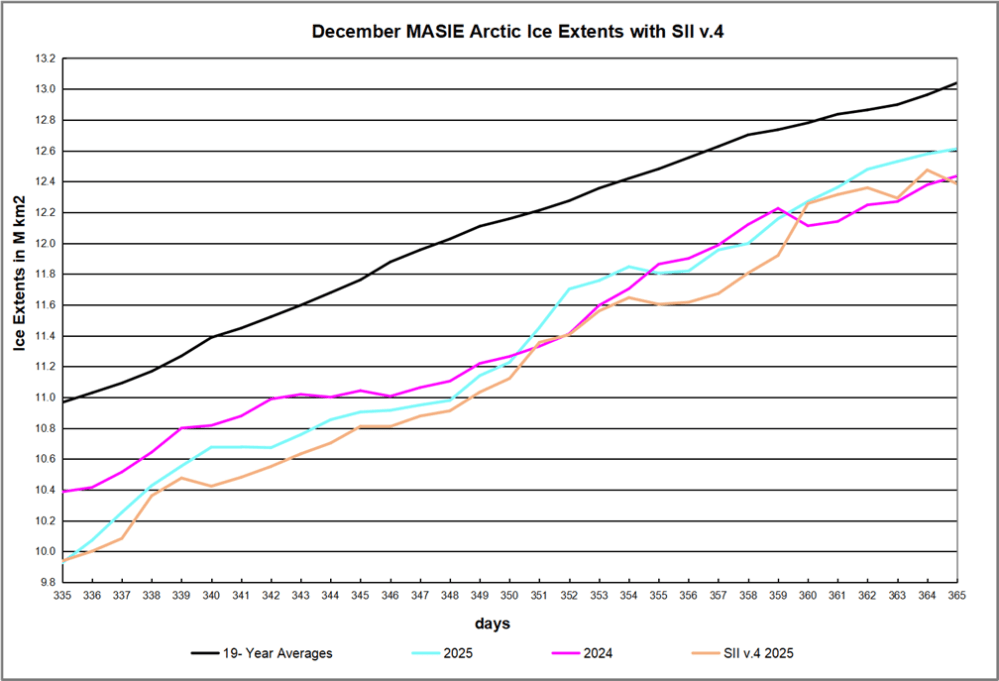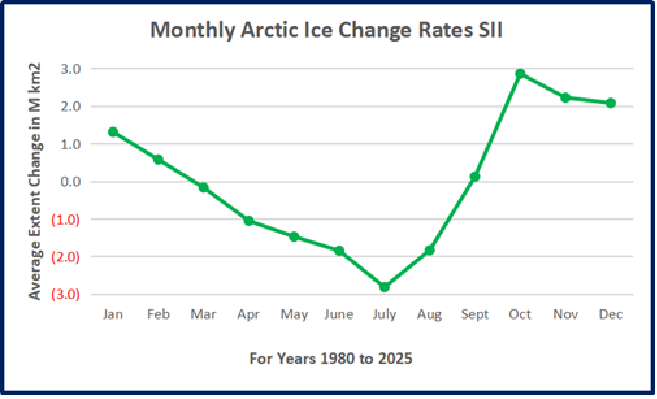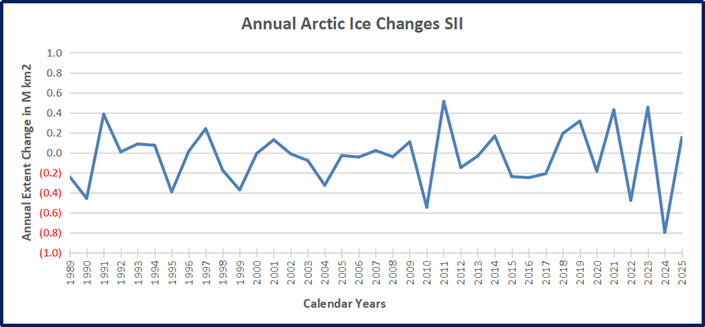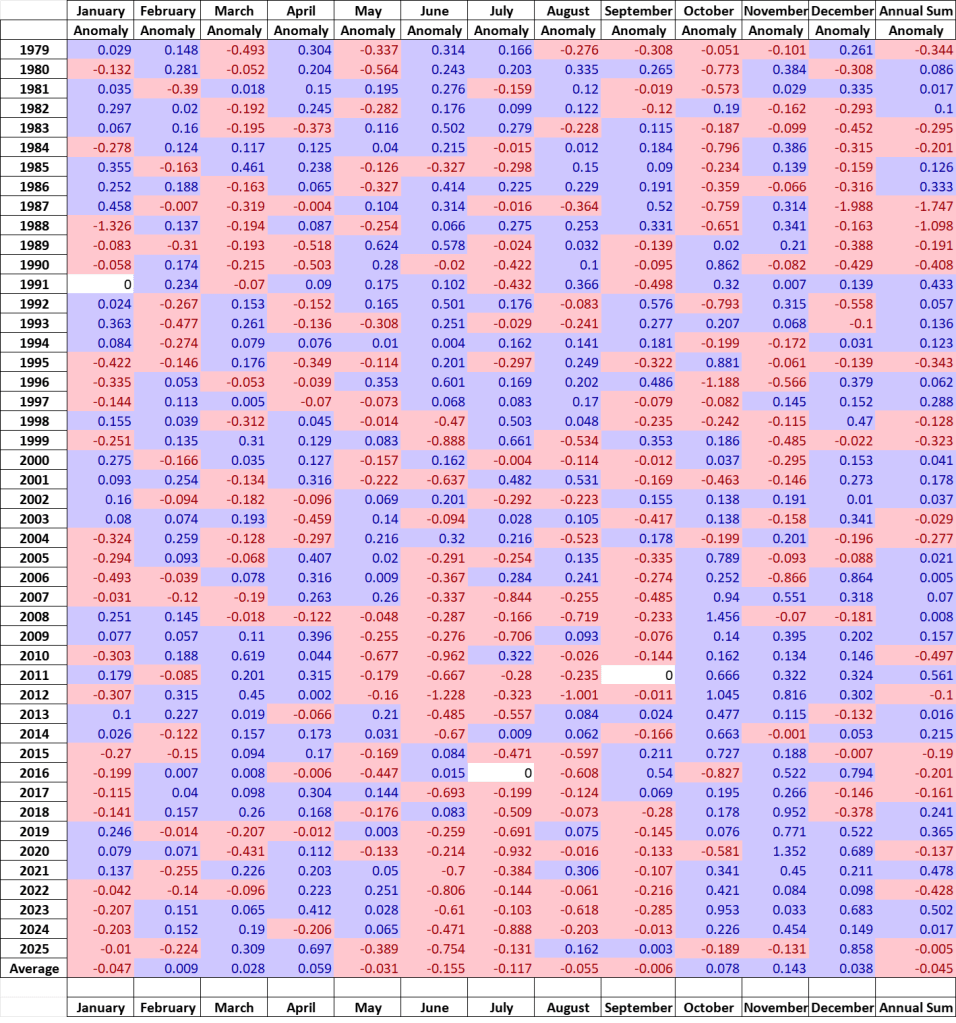
Two Hot Spots Slow Arctic Ice Recovery November 2025


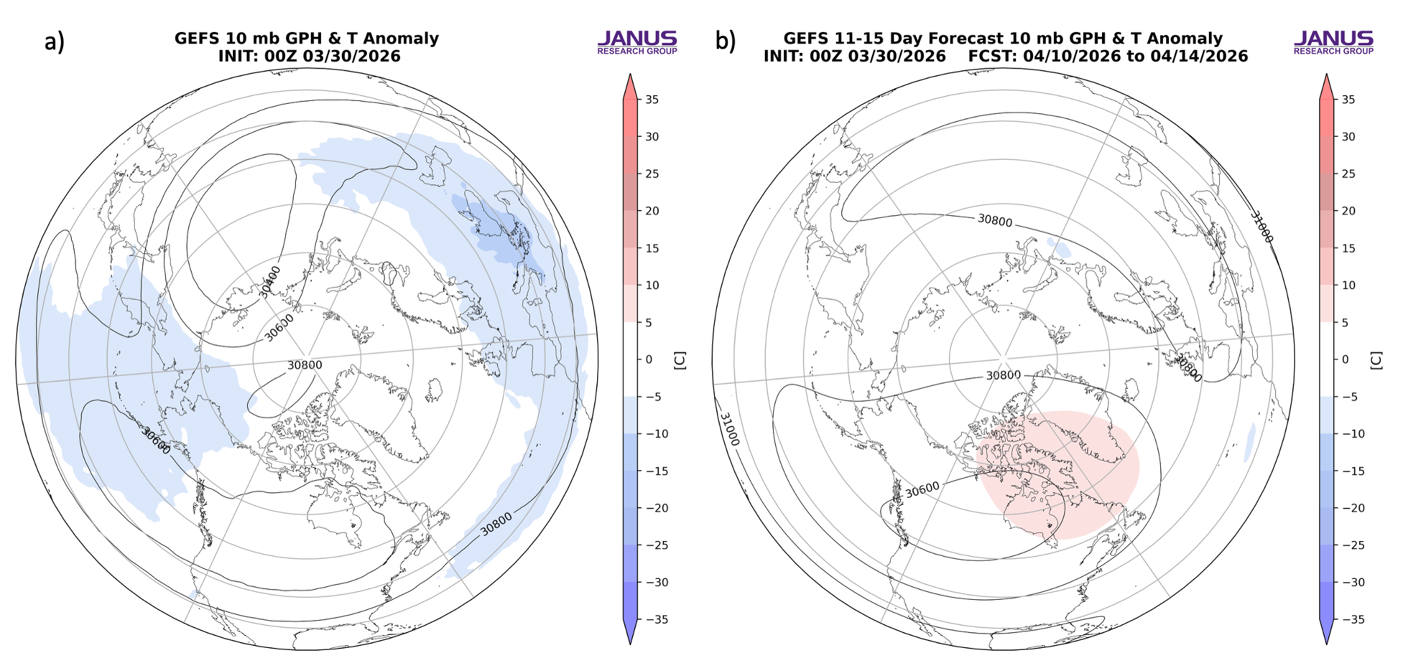
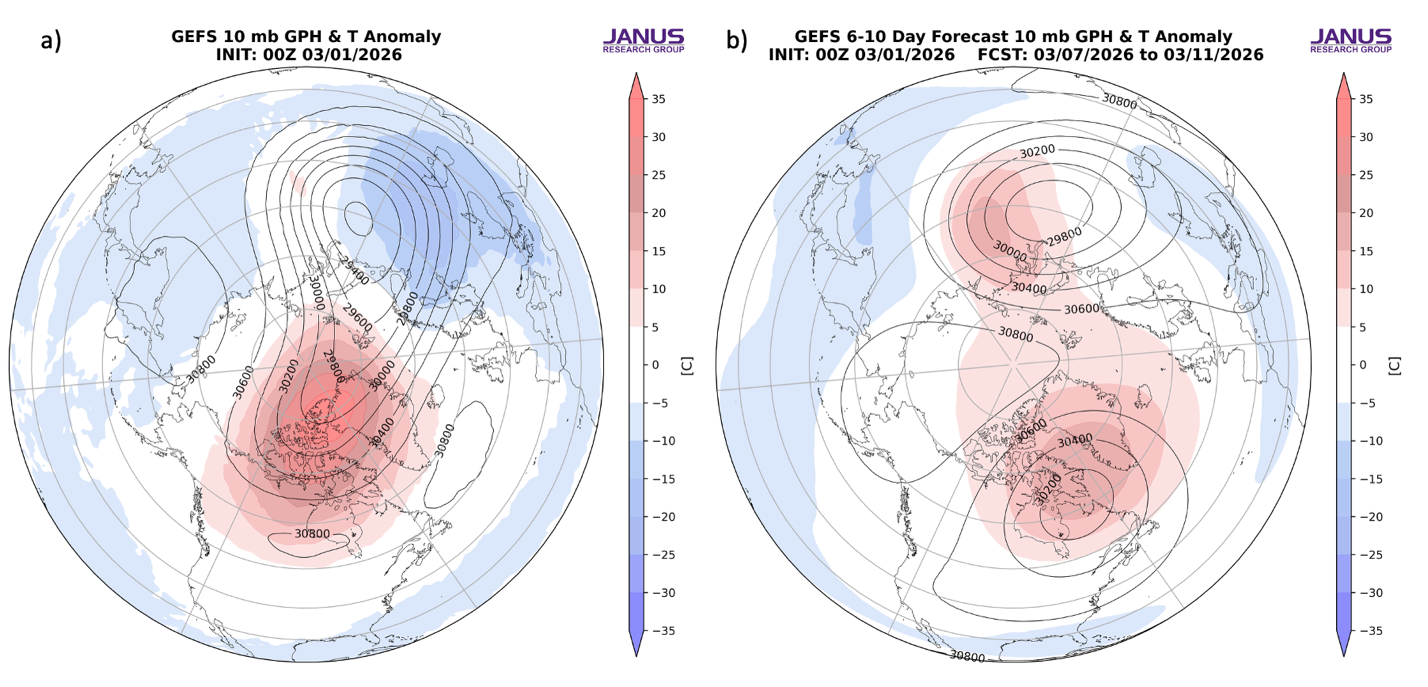
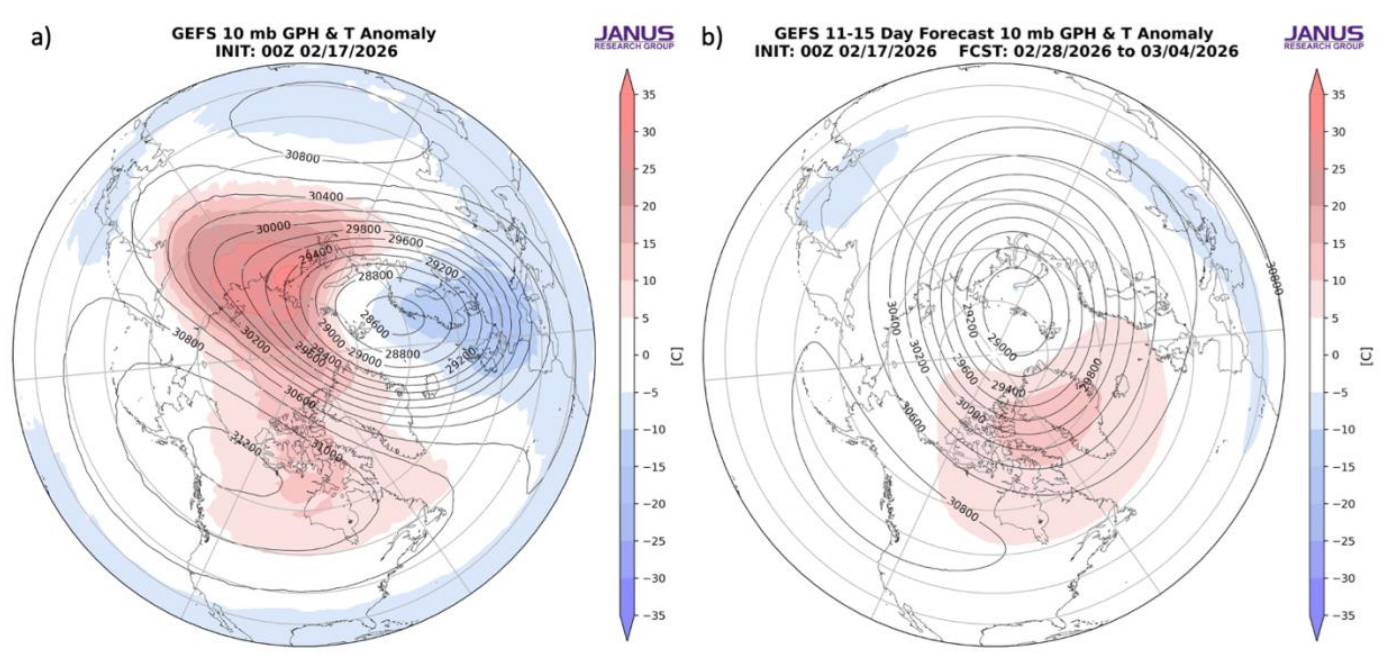
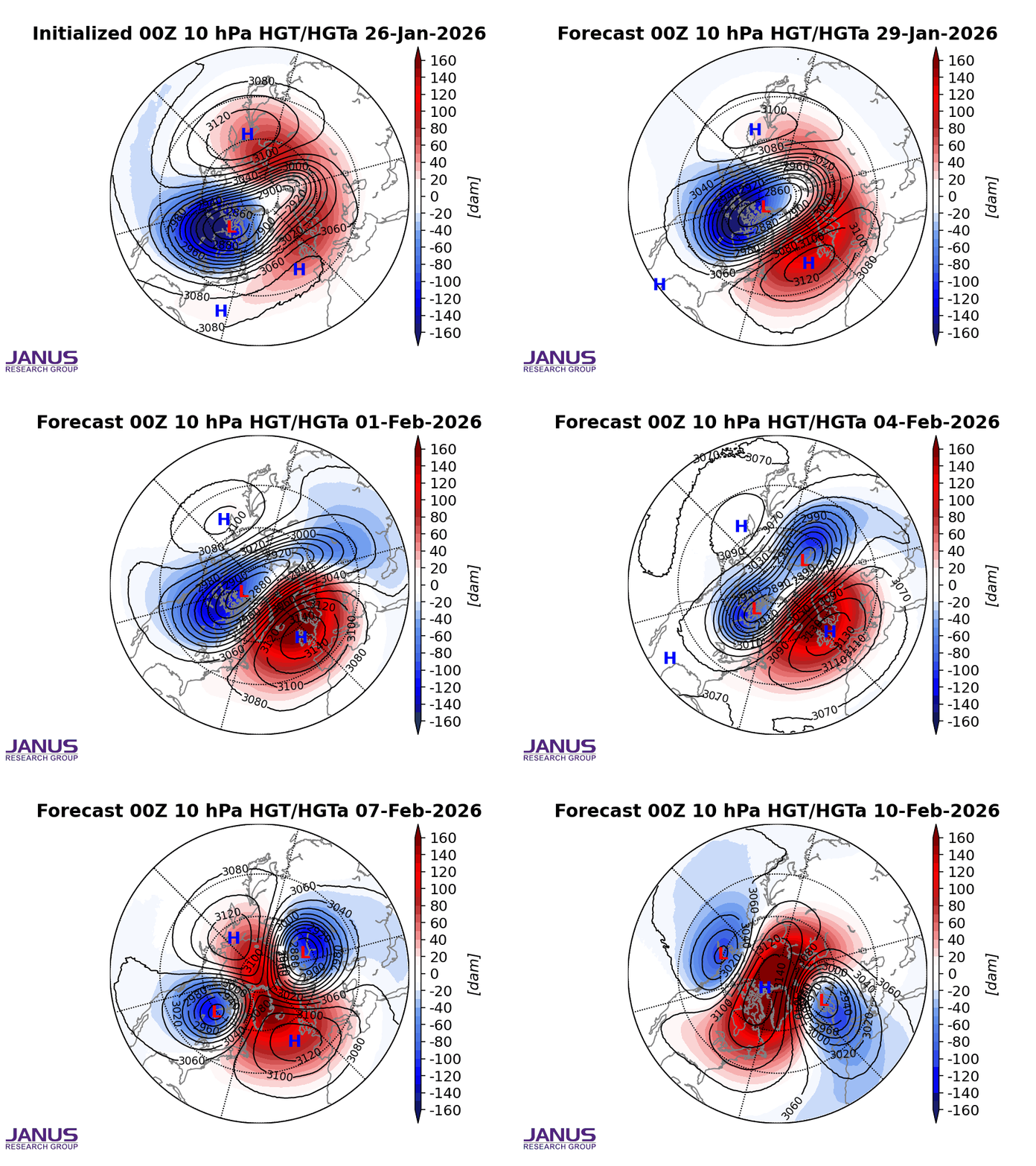
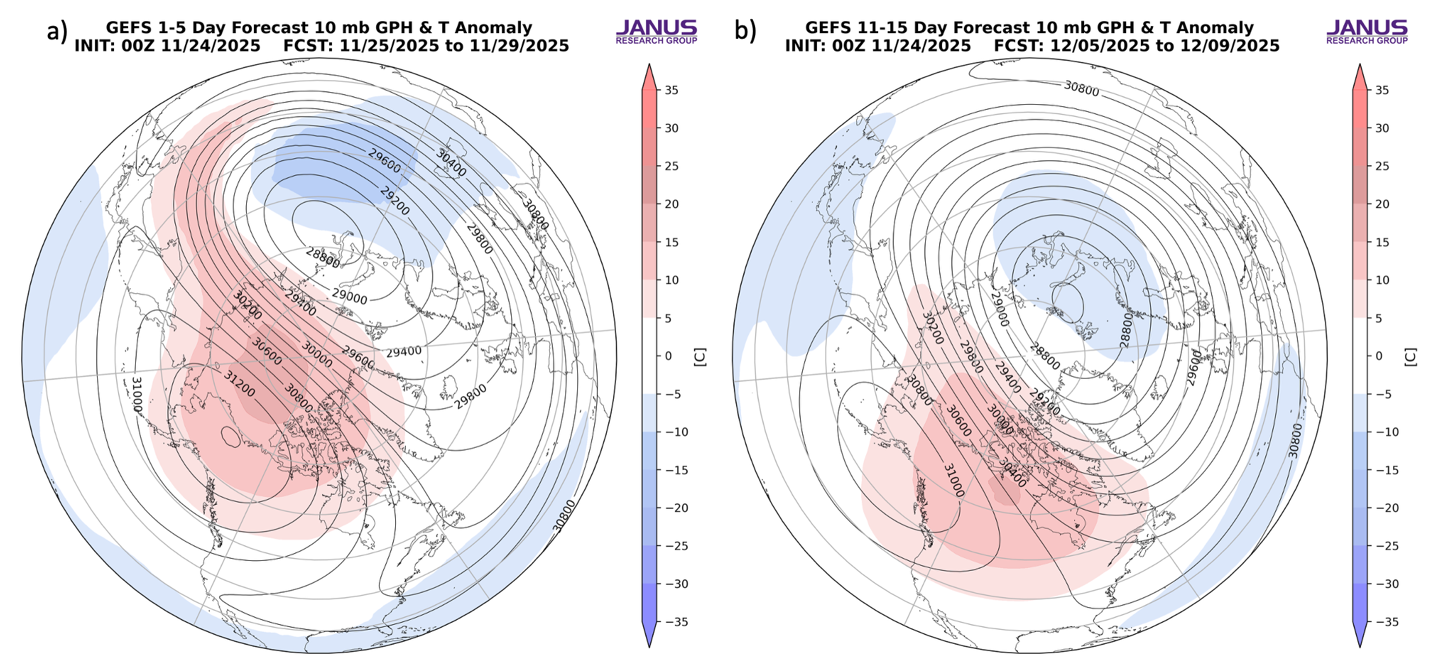
Figure 12. (a) Predicted 10 mb geopotential heights (dam; contours) and temperature anomalies (°C; shading) across the Northern Hemisphere averaged for 25 Nov to 29 Nov 2025. (b) Same as (a) except forecasted averaged from 05 Dec to 09 Dec 2025. The forecasts are from the 00Z 24 November 2025 GFS model ensemble.

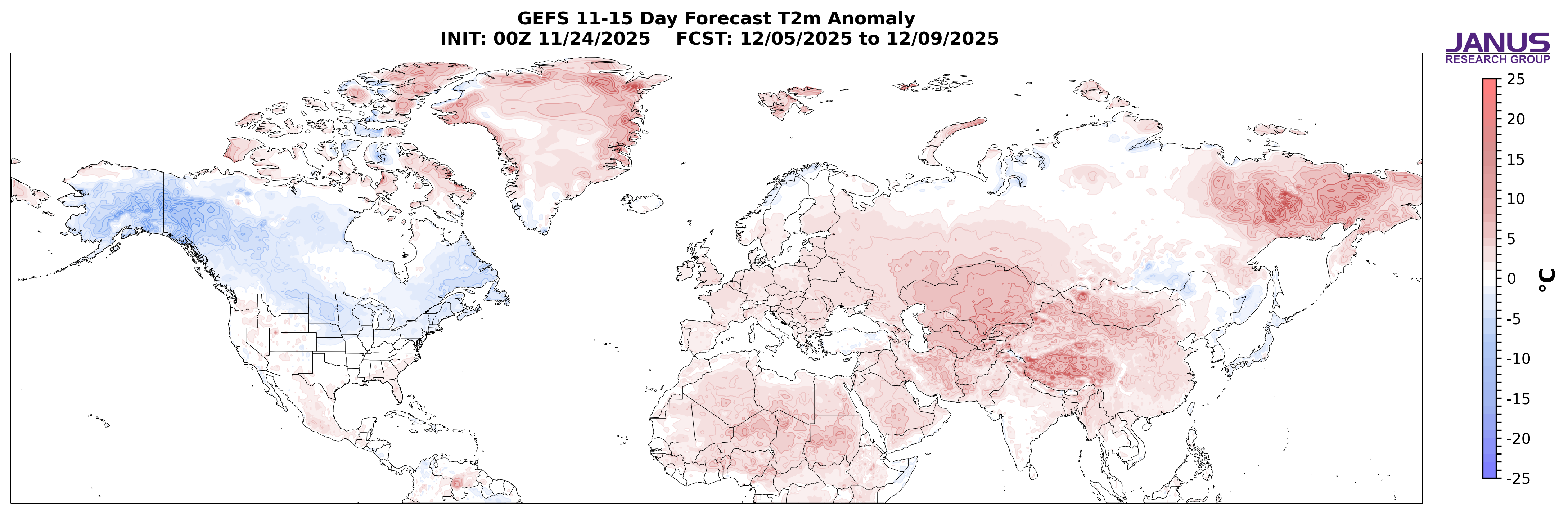
The polar vortex is pronounced this year, resulting in warmer temperature over the Arctic ocean, and slowing the normal sea ice recovery.  Dr. Judah Cohen at AER Arctic Oscillation blog provides information like the chart above.

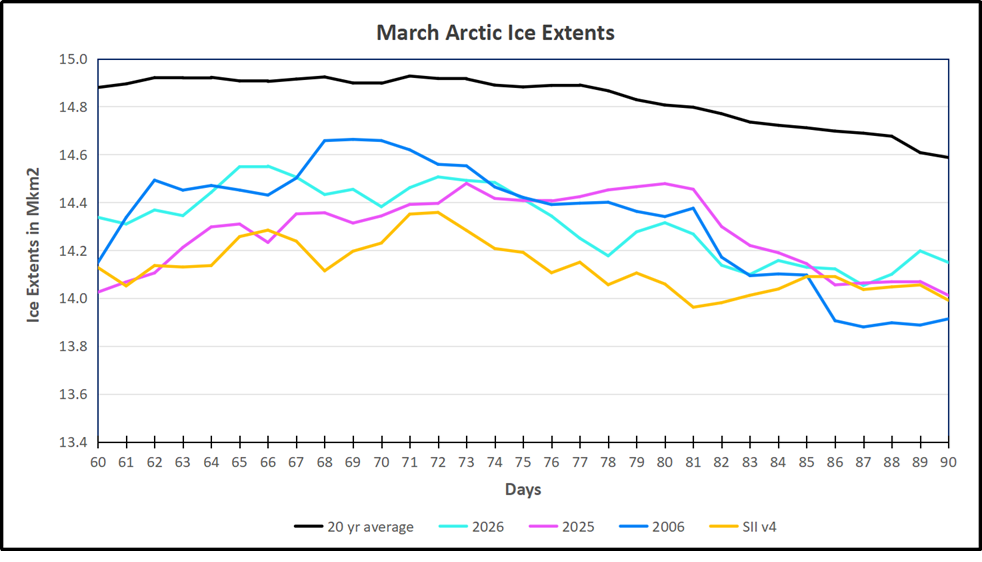
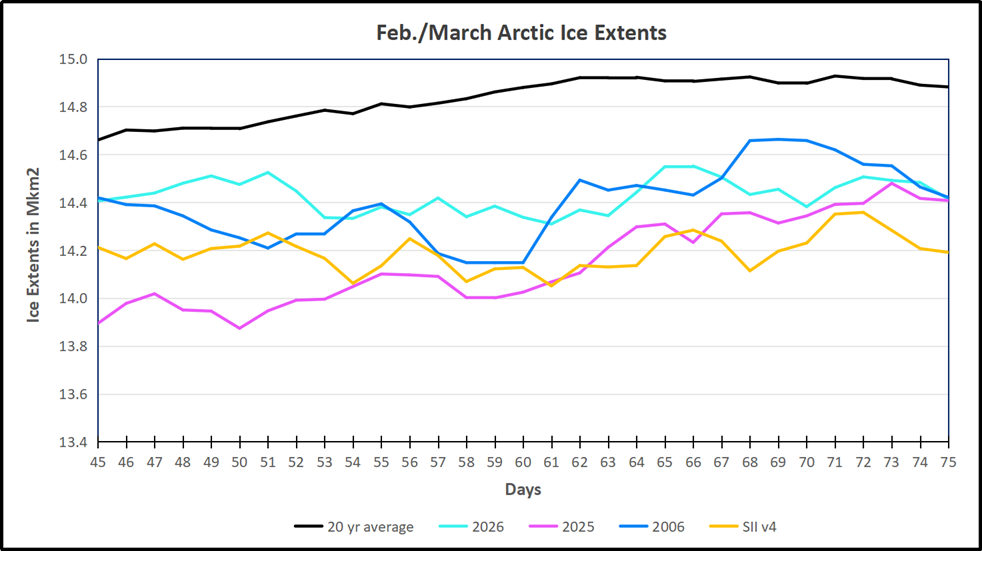
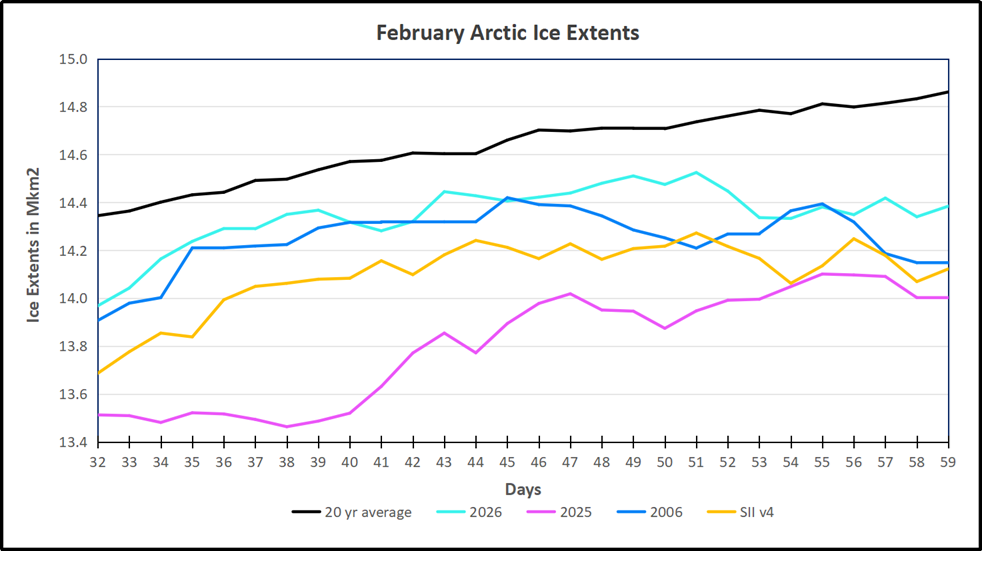
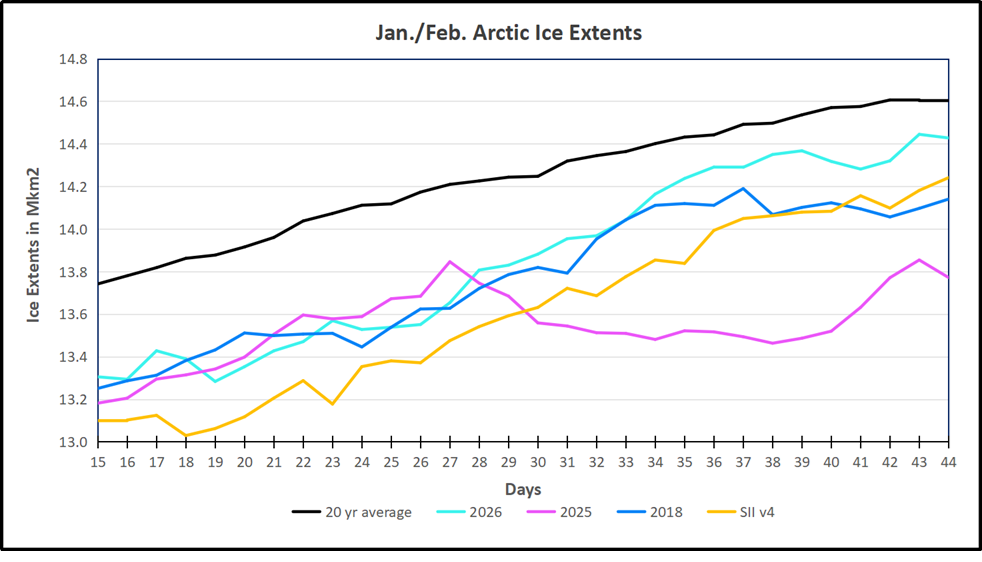
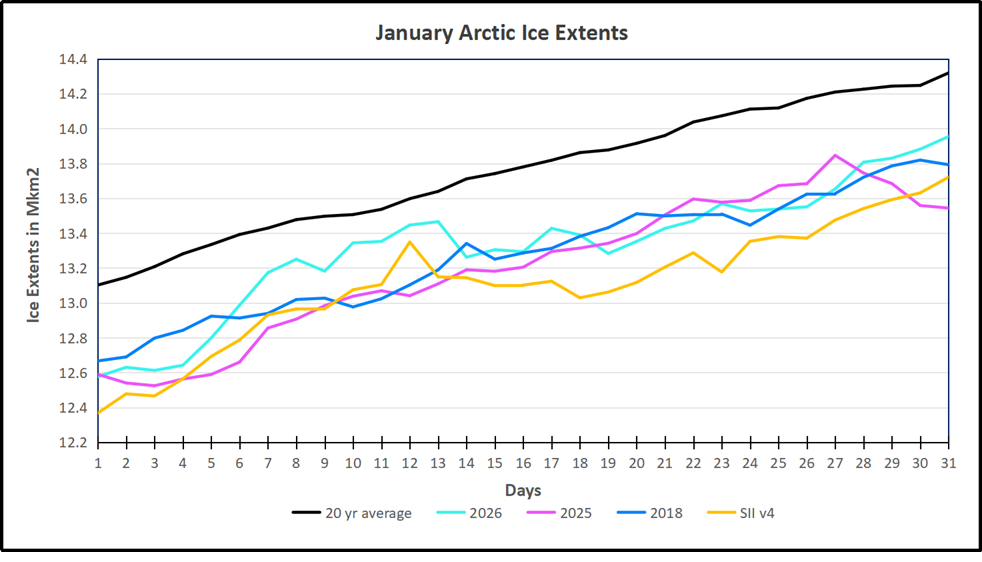
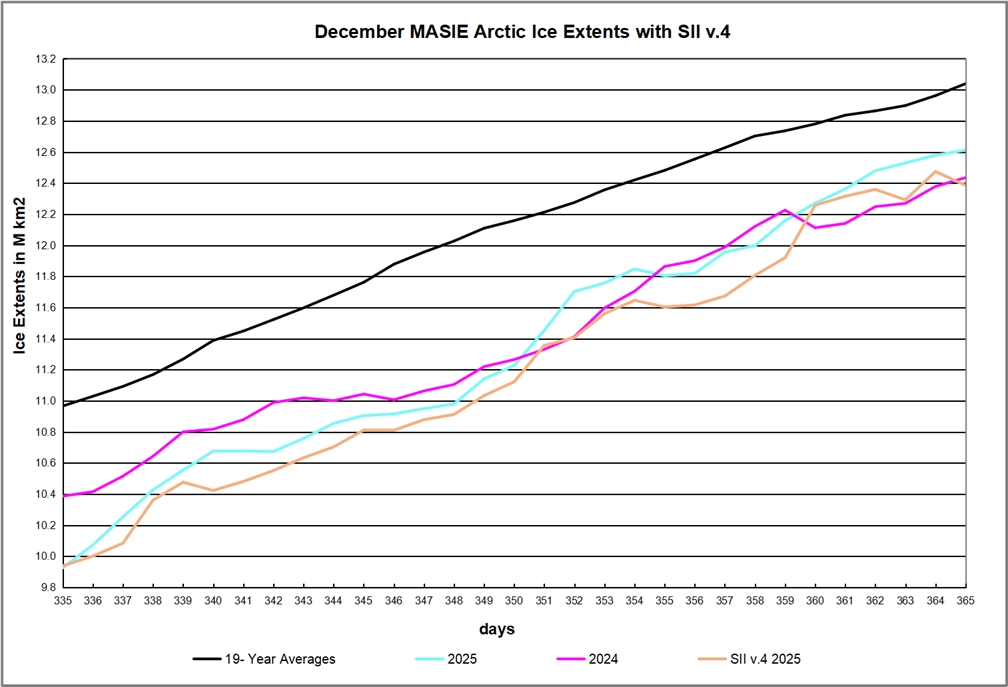
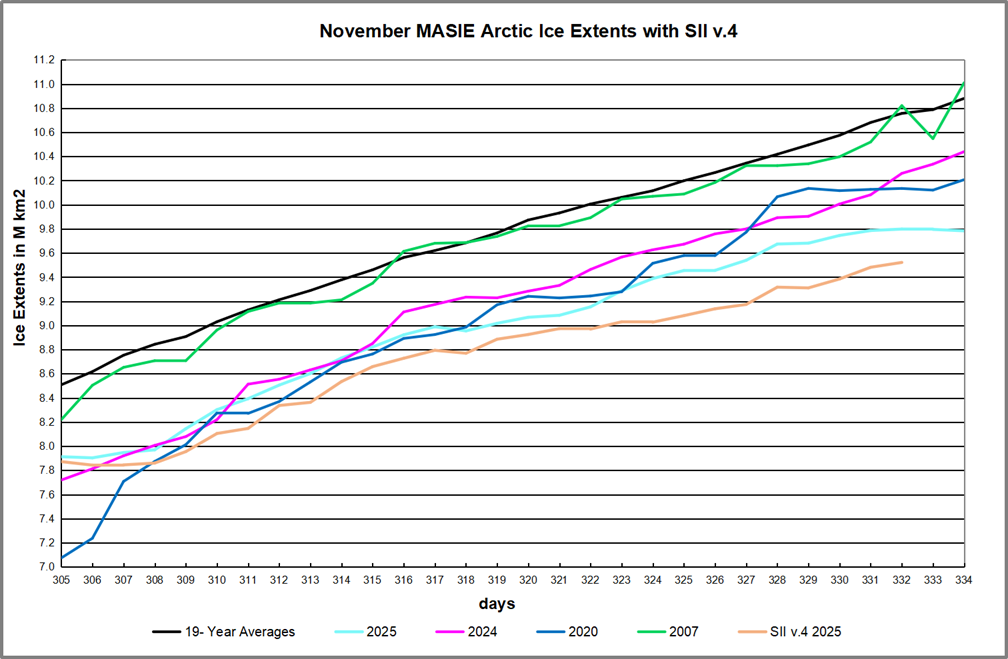
After a pattern of solidly growing sea ice extent in October, a slowdown occurred in November, coincidental with the warm spots shown above.  The graph below shows 2025 compared to the 19 year average (2006 to 2024 inclusive), to SII (Sea Ice Index) and some notable years.

According to MASIE. the average November adds ~2.5M km2 of sea ice extent, which is matched also by 2007.  2024 started below average, but gained steadily to close the gap.  2025 started at the same level, but the refreezing slowed down, ending November in deficit by 1.1M km2.  SII shows even lower ice extents (the last two days not yet reported.)

The table below shows the distribution of ice in the Arctic Ocean basins, suggesting two places where ice recovery is lagging.

Region 2025334 Day 334 Ave. 2025-Ave. 2007334 2025-2007
 (0) Northern_Hemisphere 9784037 10880420 -1096383 11009948 -1225911
 (1) Beaufort_Sea 1071070 1069623 1447 1058872 12198
 (2) Chukchi_Sea 879082 791207 87875 687829 191253
 (3) East_Siberian_Sea 1087137 1083943 3194 1082015 5122
 (4) Laptev_Sea 897845 897824 21 897613 232
 (5) Kara_Sea 565299 792107 -226808 826319 -261020
 (6) Barents_Sea 28050 242740 -214690 216525 -188474
 (7) Greenland_Sea 550413 539687 10726 618844 -68431
 (8) Baffin_Bay_Gulf_of_St._Lawrence 412284 664437 -252153 708497 -296212
 (9) Canadian_Archipelago 854931 853431 1500 850249 4682
 (10) Hudson_Bay 188797 543322 -354525 751382 -562585
 (11) Central_Arctic 3037637 3193296 -155659 3183072.72 -145436
 (12) Bering_Sea 145331 138776 6555 72644.62 72687
 (13) Baltic_Sea 4226 4452 -225 0 4226
 (14) Sea_of_Okhotsk 58288 61277 -2989 53052 5236

Overall ice extent was 1.1M km2 below average or 10%.  About half the deficit comes from the European Atlantic basins, Kara and Barents seas.  The other half is mostly from N. America’s Hudson and Baffin bays. Ice in these regions operate on the LIFO principle, last in and first out.

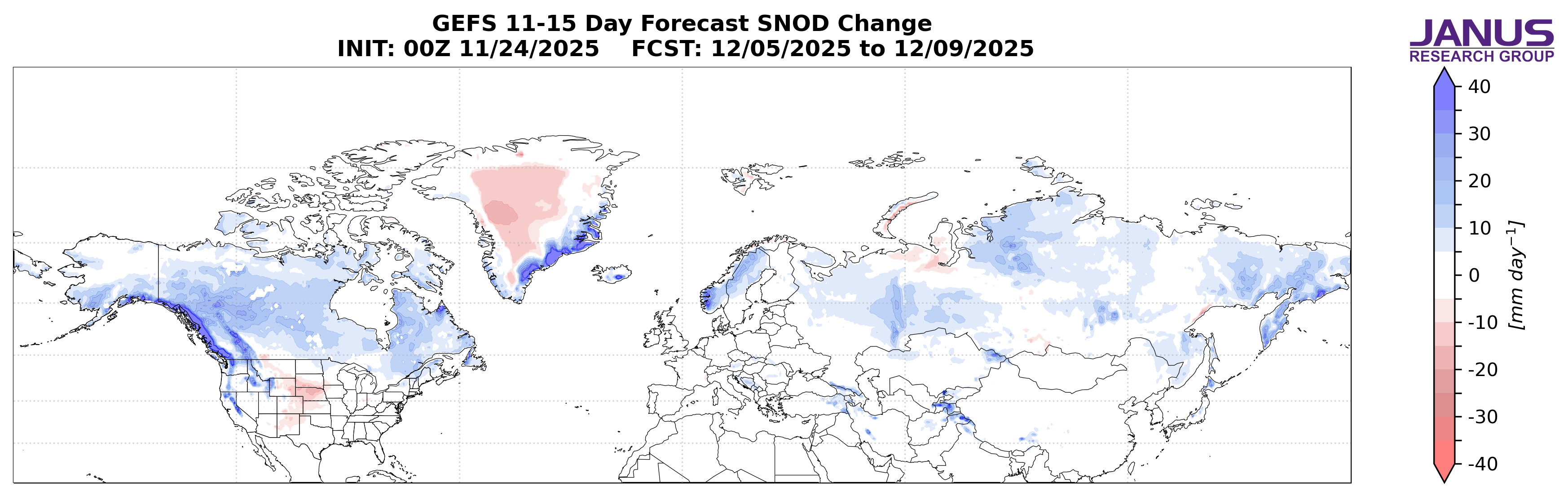
At this point in the year, Arctic ice has grown back to 65% of last March maximum with 2.5 months to catch up.   AER  suggests that things may shift again in December:

Figure 9. Forecasted surface temperature anomalies (°C; shading) from 05 Dec to 09 Dec 2025. The forecasts are from the 00Z 24 Nov 2025 GFS ensemble.

Figure 10. Forecasted snowfall (mm/day; shading) from 05 Dec to 09 Dec 2025. The forecasts are from the 00Z 24 Nov 2025 GFS ensemble.

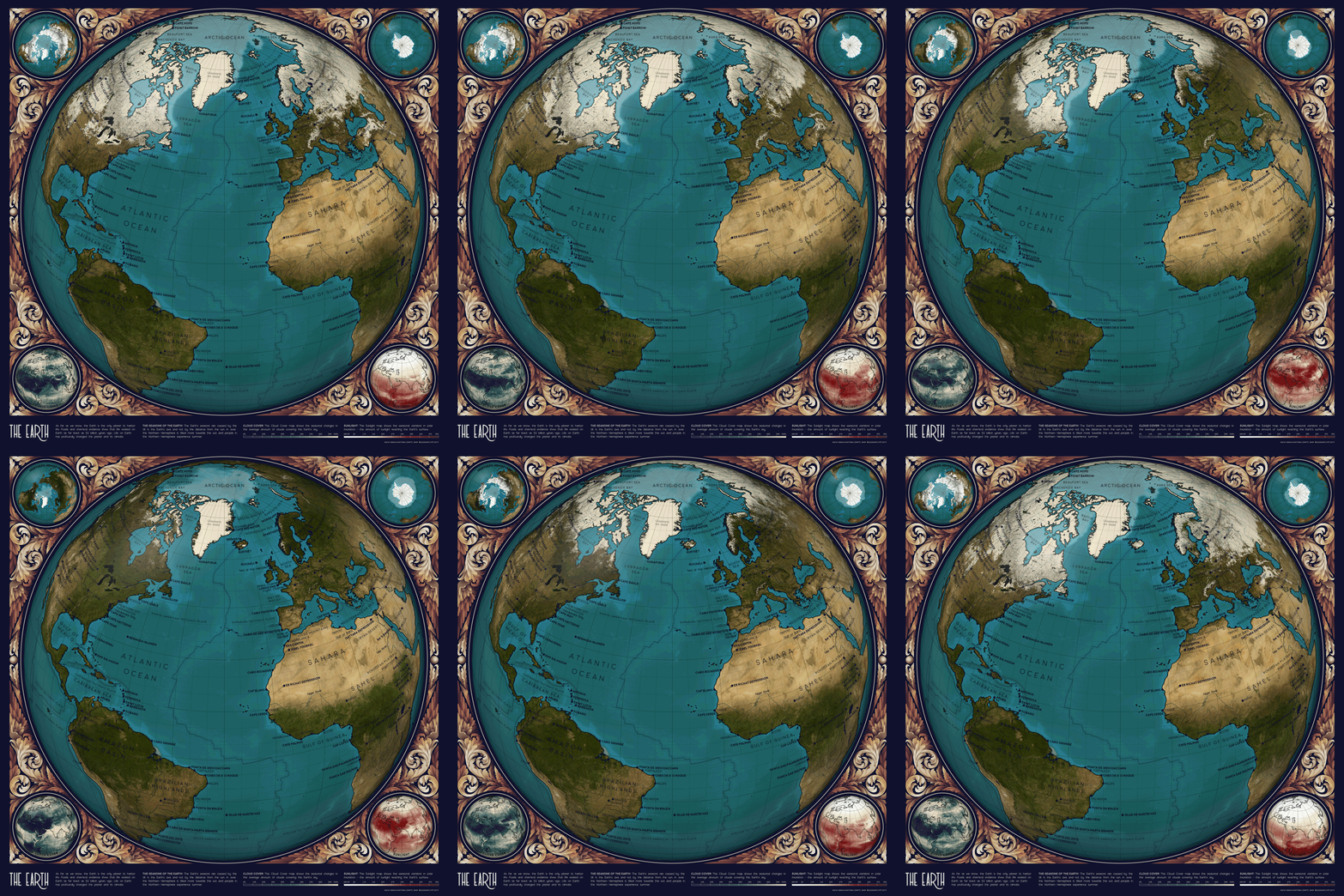
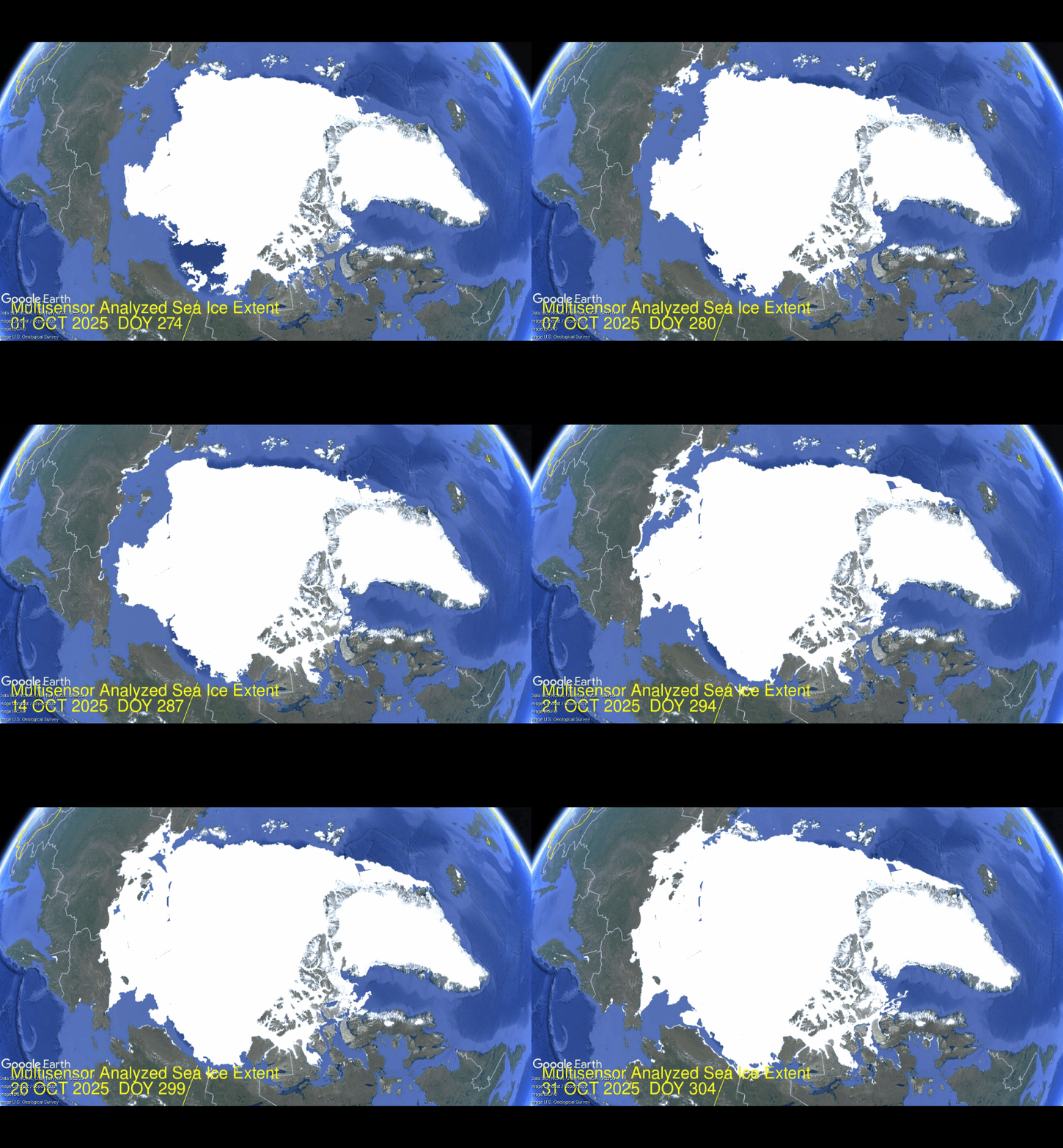
Illustration by Eleanor Lutz shows Earth’s seasonal climate changes. If played in full screen, the four corners present views from top, bottom and sides. It is a visual representation of scientific datasets measuring ice and snow extents.


Solid Arctic Ice Recovery October 2025

The animation shows the rapid growth of Arctic ice extent during October 2025, from day 274 to day 304, yesterday.  For all of the fuss over the September minimum, little is said about Arctic ice growing 3M km2, that’s 3 Wadhams in one month!.  Look on the left (Russian side) at the complete closing of the Northern Sea Route for shipping.

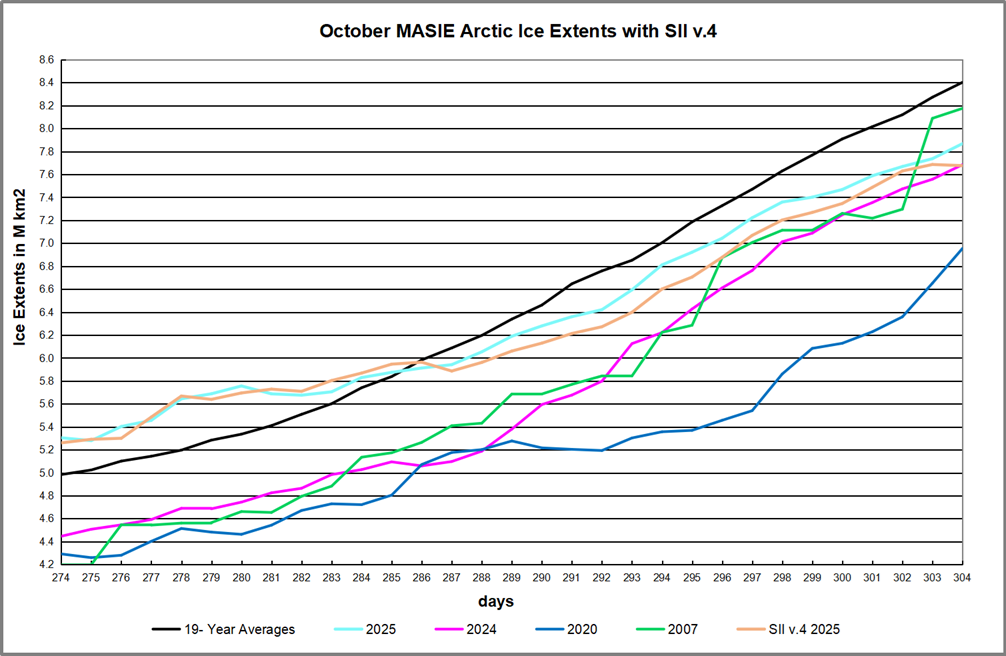
The graph below shows 2025 compared to the 19 year average (2006 to 2024 inclusive), to SII (Sea Ice Index) and some notable years.

This year October added 2.6M km2 from end of September compared to an average October increase of 3.4M km2.  The first two weeks were above average, before the refreezing rate slowed down ending in a deficit of ~0.5M km2.  In other terms the end of October ice extents were four days behind the average, according to MASIE.  SII started the same, but tracked lower in the second half of October.

The table below shows the distribution of ice in the Arctic Ocean basins.

Region 2025304 Day 304 Ave. 2025-Ave. 2007304 2025-2007
 (0) Northern_Hemisphere 7867621 8401977 -534356 8175072 -307451
 (1) Beaufort_Sea 975681 937777 37904 1038126 -62444
 (2) Chukchi_Sea 683493 466318 217175 242685 440809
 (3) East_Siberian_Sea 1087032 952325 134707 835071 251961
 (4) Laptev_Sea 849204 848501 703 887789 -38585
 (5) Kara_Sea 137515 478870 -341355 311960 -174445
 (6) Barents_Sea 1466 81088 -79621 52823 -51356
 (7) Greenland_Sea 351374 418343 -66969 443559 -92184
 (8) Baffin_Bay_Gulf_of_St._Lawrence 128777 247258 -118481 289374 -160596
 (9) Canadian_Archipelago 568663 740190 -171526 817220 -248557
 (10) Hudson_Bay 8609 66501 -57892 48845 -40236
 (11) Central_Arctic 3051977 3153485 -101508 3206345.33 -154368

Overall ice extent was 534k km2 below average or 6%.  Surpluses appear on the Eurasian shelf seas of Beaufort, Chukchi and East Siberian, while sizeable deficits are shown elsewhere on the Atlantic side, especially Kara, Baffin Bay, Canadian Archipelago and Central Arctic.

Illustration by Eleanor Lutz shows Earth’s seasonal climate changes. If played in full screen, the four corners present views from top, bottom and sides. It is a visual representation of scientific datasets measuring ice and snow extents.


September 2025 Arctic Ice Beats Expectations

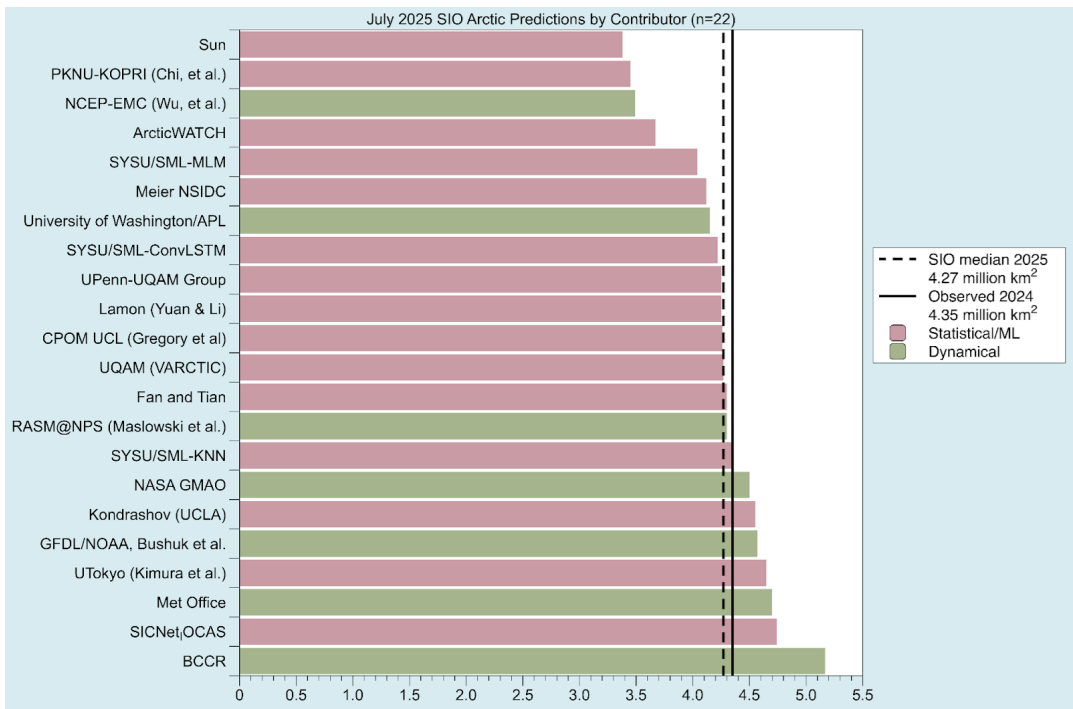
 MI Figure 1. Distribution of SIO contributions for July estimates of September 2025 pan-Arctic sea-ice extent. Public/citizen contributions include Sun.

July 2025 was the final report of the Sea Ice Prediction Network (SIPN) before the actual September monthly extent is reported by NOAA Sea Ice Index (SII). The report (link in red) gave this overview.

2025: July Report from Sea Ice Prediction Network

The July 2025 Outlook received 22 pan-Arctic contributions (Figure 1). This year’s median forecasted value for pan-Arctic September sea-ice extent is 4.27 million square kilometers with an interquartile range of 4.13 to 4.54 million square kilometers. This is lower than observed in 2023 (4.37 million square miles) and 2024 (4.35 million square miles) observed in September. The lowest sea-ice extent forecast is 3.38 million square kilometers, from Sun, which would be a new record low for the satellite period (1979-present); the highest sea-ice extent forecast is 5.17. . . The observed extent values are from the NSIDC Sea Ice Index (Fetterer et al., 2017), based on the NASA Team algorithm sea ice concentration fields distributed by the NASA Snow and Ice Distributed Active Archive Center (DAAC) at NSIDC (DiGirolamo et al., 2022; Meier et al., 2021). 

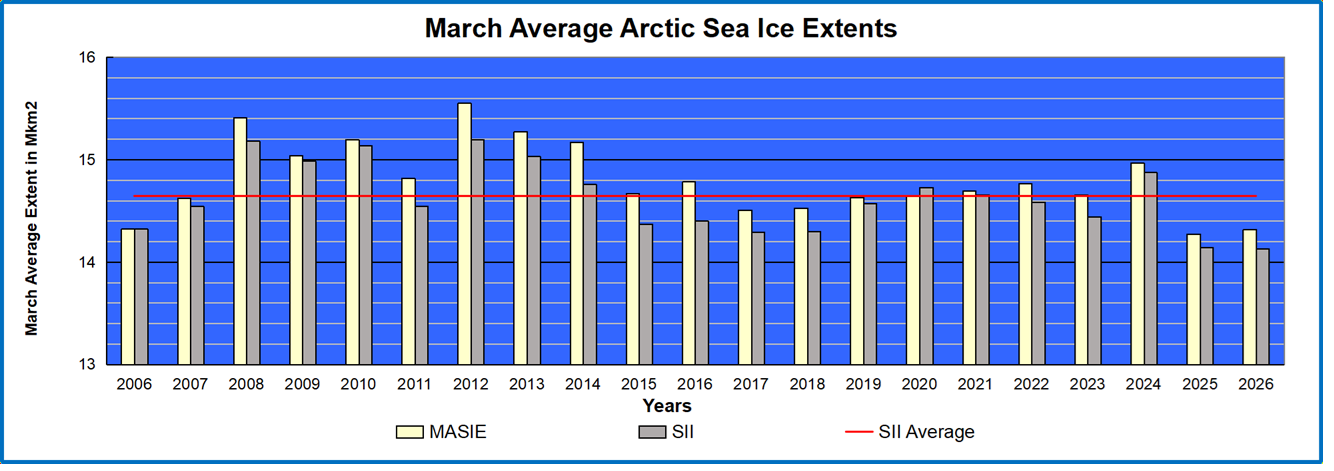
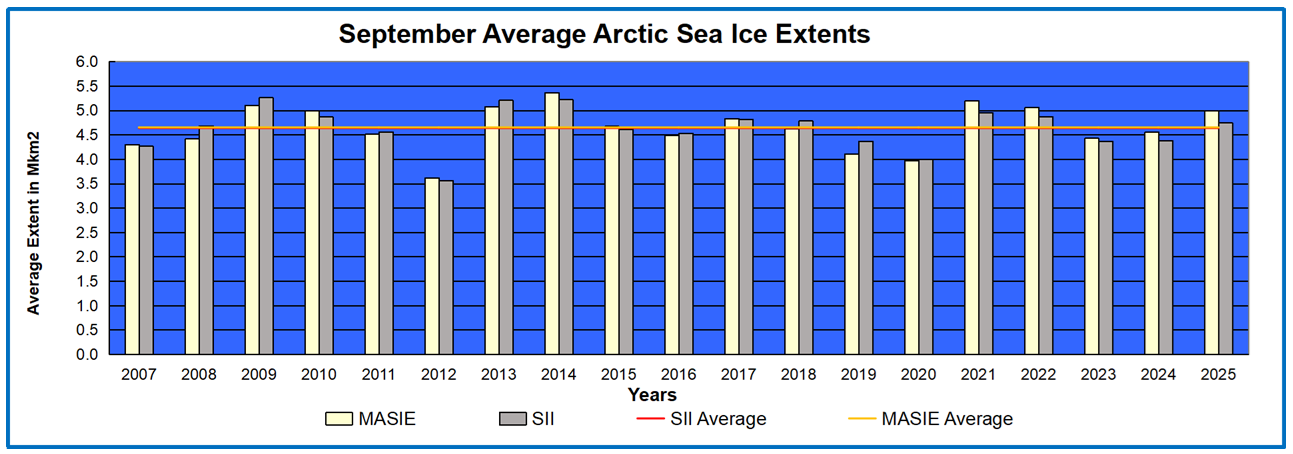
These are predictions as of August 20 for the September 2025 monthly average ice extent reported by NOAA Sea Ice Index (SII). This post provides a look at the 2025 September monthly averages comparing MASIE and SII datasets. (19 year average is 2007 to 2025 inclusive).

To enlarge, open image in new tab.

SIP network predicted SII would be 4.27M km2, and the actual result is 4.7M, while MASIE reported 5.0M km2.

The table below provides the monthly Arctic ice extent averages for comparisons (all are M km2)

Monthly MASIE 2025 SIIv.4 2025 MASIE -SII MASIE-19yr AVE SIIv.4-19yr AVE
Jan 13.206 13.131 0.075 -0.583 -0.470
Feb 13.802 13.745 0.057 -0.878 -0.715
Mar 14.274 14.140 0.134 -0.587 -0.545
Apr 13.846 13.910 -0.063 -0.249 -0.109
May 12.497 12.559 -0.062 -0.119 -0.108
June 10.510 10.485 0.025 -0.306 -0.388
July 7.942 7.660 0.282 -0.345 -0.375
Aug 5.854 5.395 0.459 -0.020 -0.220
Sept 4.990 4.745 0.245 0.298 0.050

The first two data columns are the 2025 YTD shown by MASIE and SII, with the MASIE surpluses in column three.  Column four shows MASIE 2025 compared to MASIE 19 year averages, while column five shows SII 2025 compared to SII 19 year averages.   MASIE started the year in deficits to average but recovered in spring to virtually match average in August, and now 298k km2 above average. SII was below its averages throughout and much lower than MASIE in July, and in August down by nearly half a Wadham. That gap reduced to -245k km2 in September.

Current Arctic Ice Extent Conditions

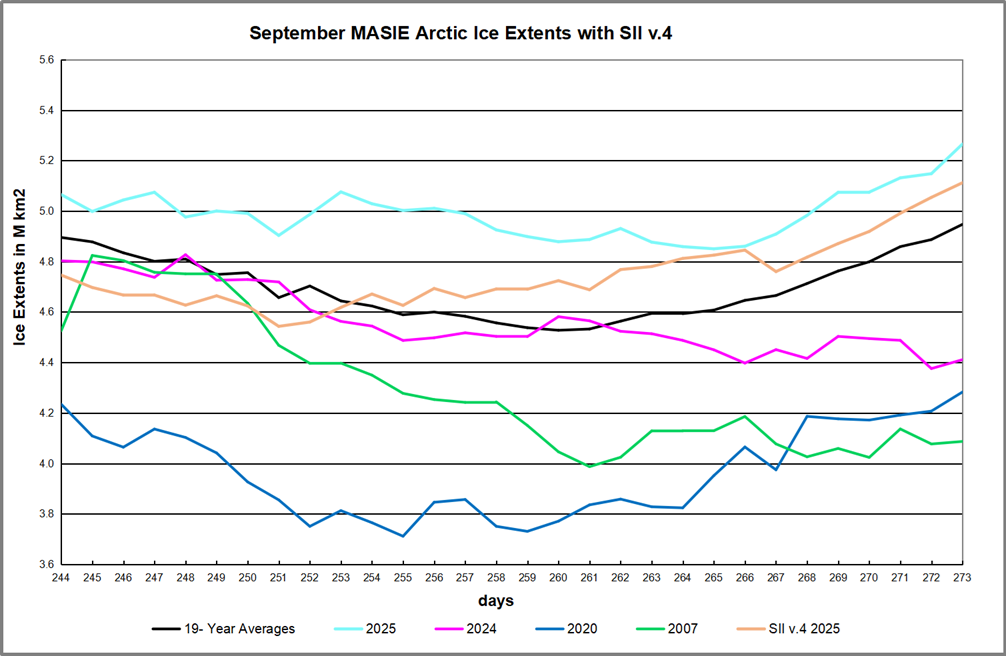
The month of September shows the annual dip in arctic ice extents, then recovering to end slightly higher than the beginning.  Note MASIE 2025 started 170k km2 above average and ended 316k in surplus. SII v.4 began 319k km2 in deficit to MASIE and ended 153k lower.

The table below shows the distribution of ice over the Arctic regions yesterday September 30, 2025, in comparison with the MASIE average and some other years of note.

Region 2025273 Day 273 ave. 2025-Ave. 2007273 2025-2007
 (0) Northern_Hemisphere 5265296 4947157 318139 4086883 1178413
 (1) Beaufort_Sea 567776 546476 21301 498743 69033
 (2) Chukchi_Sea 382991 220747 162244 51 382940
 (3) East_Siberian_Sea 502004 299345 202660 311 501693
 (4) Laptev_Sea 229451 168694 60758 235245 -5793
 (5) Kara_Sea 992 36279 -35287 15367 -14375
 (6) Barents_Sea 0 13476 -13476 4851 -4851
 (7) Greenland_Sea 170295 239645 -69350 353210 -182915
 (8) Baffin_Bay_Gulf_of_St._Lawrence 77930 55264 22665 42247 35682
 (9) Canadian_Archipelago 379648 370610 9038 307135 72513
 (10) Hudson_Bay 5071 3054 2017 1936 3135
 (11) Central_Arctic 2947568 2992334 -44766 2626511 321057

The massive surpluses in Eurasian basins of Chukchi, E. Siberian and Laptev more than offset smaller deficits in Atlantic basins Kara and Greenland seas. The over surplus was 318k km2 or 6.4%, and exceeded 2007 by 1.2 wadhams of ice extents.

Summary

The experts involved in SIPN expected SII 2025 September to be somewhat lower than recent years, but Arctic ice extents exceeded the 19 year averages.

Footnote:

Some people unhappy with the higher amounts of ice extent shown by MASIE continue to claim that Sea Ice Index is the only dataset that can be used. This is false in fact and in logic. Why should anyone accept that the highest quality picture of ice day to day has no shelf life, that one year’s charts can not be compared with another year? Researchers do this, including Walt Meier in charge of Sea Ice Index. That said, I understand his interest in directing people to use his product rather than one he does not control. As I have said before:

MASIE is rigorous, reliable, serves as calibration for satellite products, and continues the long and honorable tradition of naval ice charting using modern technologies. More on this at my post Support MASIE Arctic Ice Dataset

MASIE: “high-resolution, accurate charts of ice conditions”
Walt Meier, NSIDC, October 2015 article in Annals of Glaciology.

Arctic Ice Aplenty at Annual Dip September 2025

After a sub-par March maximum, by end of May 2025 Arctic ice closed the gap with the 19-year average.  In mid-August MASIE showed the Arctic ice extent matching the 19-year average.  Mid month Arctic ice went above average and remained in surplus, ranging from a high of +231k km2 to +160k km2 at end of August. Now during the annual minimum month of September 2025 there is  Arctic ice aplenty.

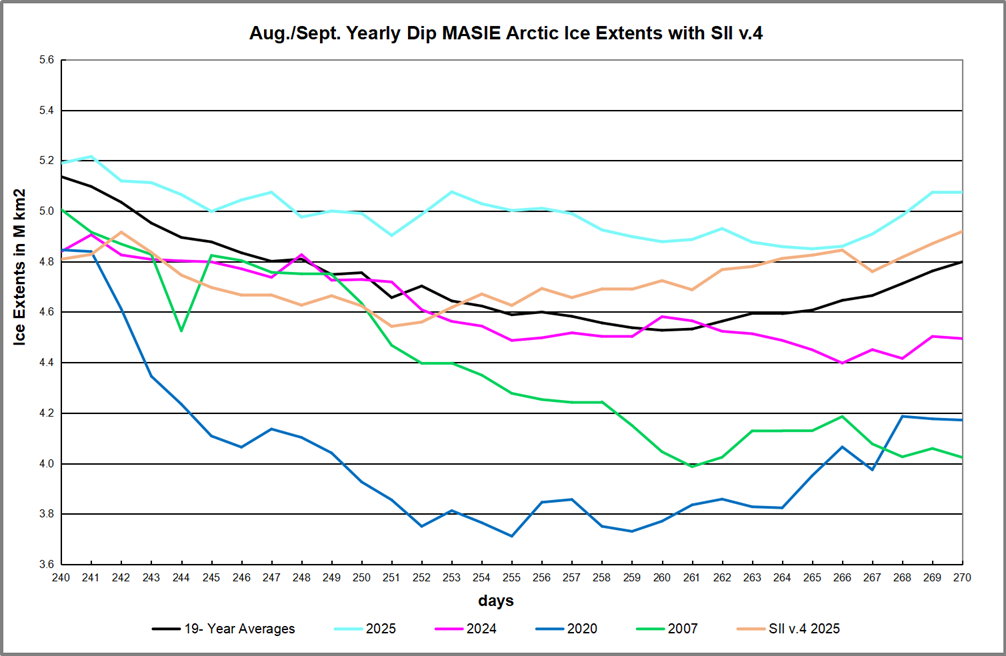
During the annual dip in Arctic ice extent, the average year since 2006 is lowest on day 260 at 4.53M km2.  It then rises to 4.8M km2 ten days later.  The cyan line shows 2025 above average throughout, its lowest extent at 4.85M km2 on day 265, and now up to 5.07M km2.  SII v.4 was lower than MASIE throughout, but has drawn closer in recent days.  So far MASIE September average is 5.0M and SII is 4.7M, with 4 more days remaining in the month. Note 2007 was ~800k km2 in deficit, 2020 ~600k down at day 270, while last year was ~300k below average.

The regional distribution of ice extents is shown in the table below. (Bering and Okhotsk seas are excluded since both are now virtually open water.)

Region 2025270 Day 270 ave. 2025-Ave. 2007270 2025-2007
 (0) Northern_Hemisphere 5074777 4798758 276018 4023569 1051207
 (1) Beaufort_Sea 483527 520730 -37203 482030 1497
 (2) Chukchi_Sea 332213 210352 121861 214 331999
 (3) East_Siberian_Sea 499915 280923 218992 311 499604
 (4) Laptev_Sea 273431 152794 120636 238340 35091
 (5) Kara_Sea 4906 33680 -28774 15113 -10207
 (6) Barents_Sea 0 12945 -12945 4851 -4851
 (7) Greenland_Sea 165160 225916 -60756 339720 -174560
 (8) Baffin_Bay_Gulf_of_St._Lawrence 70284 47480 22804 43624 26660
 (9) Canadian_Archipelago 302771 336303 -33533 280360 22410
 (10) Hudson_Bay 2415 2252 163 1936 479
 (11) Central_Arctic 2938588 2974115 -35527 2615795.38 322792

The table shows large surpluses in Eurasian basins  Laptev, Chukchi and E. Siberian, more than offsetting smaller deficits in Central Arctic, CAA and Greenland seas. Hudson Bay is mostly open water at this time of year. 2025 exceeds the average ice extents by 276k km2, or 6%, and is over 1 wadham greater than 2007 or a surplus of 1.05M km2 of ice extent.

September monthly average ice extent is considered the annual minimum for climate purposes.  Note also that typically the lowest daily value occurs mid September, with a small positive gain between the end of August and end of September.

Why is this important?  All the claims of global climate emergency depend on dangerously higher  temperatures, lower sea ice, and rising sea levels.  The lack of additional warming prior to 2023 El Nino is documented in a post SH Drives UAH Temps Cooler July 2025.

The lack of acceleration in sea levels along coastlines has been discussed also.  See Observed vs. Imagined Sea Levels 2023 Update

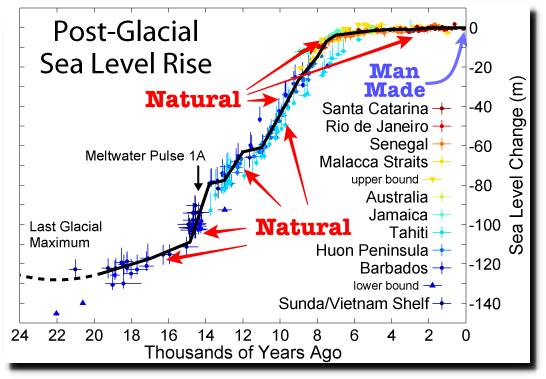
Also, a longer term perspective is informative:

post-glacial_sea_level

Footnote Regarding  SII v.4

NSDIC acknowledged my query regarding the SII (Sea Ice Index) dataset. While awaiting an explanation I investigated further. My last download of the SII Daily Arctic Ice Extents was on July 30, meaning that the most recent data in that file was day 210, July 29. The header on that file was Sea_Ice_Index_Daily_Extent_G02135_v3.

Then on August 1, the downloaded file had the heading Sea_Ice_Index_Daily_Extent_G02135_v4. So it appears that these are now the values from a new version of SII. As I wrote in my query, since March 14 all of the values for Arctic Ice Extents are lower in this new record. The graph above shows the implications for August as an example of estimates from SIIv.4.

In the past, SIIv.3 tracked MASIE with slightly lower values.  But with v.4, larger monthly average deficits to MASIE were reported in July 2025 ( -282k km2) and in August (-440k km2).

The change started in January 2025 and will be the basis for future reporting.  The logic for this is presented in this document: Sea Ice Index Version 4 Analysis

In June 2025, NSIDC was informed that access to data from the Special Sensor Microwave
Imager/Sounder (SSMIS) onboard the Defense Meteorological Satellite Program (DMSP)
satellites would end on July 31 (NSIDC, 2025). To prepare for this, we rapidly developed version
4 of the Sea Ice Index. This new version transitions from using sea ice concentration fields
derived from SSMIS data as input to using fields derived from the Advanced Microwave
Scanning Radiometer 2 (AMSR2) sensor onboard the Global Change Observation Mission – W1
(GCOM-W1) satellite.  On 29 July 2025, we learned that the Defense Department decision to terminate access to DMSP data had been reversed and that data will continue to be available until September 2026.

We are publishing Version 4, however, for these reasons:

• The SSMIS instruments are well past their designed lifespan and a transition to
AMSR2 is inevitable. Unless the sensors fail earlier, the DoD will formally end the
program in September 2026.
• Although access of SSMIS will continue through September 2026, the Fleet
Numerical Meteorology and Oceanography Center (FNMOC), where SSMIS data
from the DMSP satellite are downloaded, made an announcement that “Support
will be on a best effort basis and should be considered data of opportunity.” This
means that SSMIS data will likely contain data gaps.
• We have developer time to make this transition now and may not in the future.
• We are confident that Version 4 data are commensurate in accuracy to those
provided by Version 3.

September 2025 Arctic Ice Outlook

Figure 1. Distribution of SIO contributions for July estimates of September 2025 pan-Arctic sea-ice extent. Public/citizen contributions include Sun.

2025: July Report from Sea Ice Prediction Network

The July 2025 Outlook received 22 pan-Arctic contributions (Figure 1). This year’s median forecasted value for pan-Arctic September sea-ice extent is 4.27 million square kilometers with an interquartile range of 4.13 to 4.54 million square kilometers. This is lower than observed in 2023 (4.37 million square miles) and 2024 (4.35 million square miles) observed in September. The lowest sea-ice extent forecast is 3.38 million square kilometers, from Sun, which would be a new record low for the satellite period (1979-present); the highest sea-ice extent forecast is 5.17. . . The observed extent values are from the NSIDC Sea Ice Index (Fetterer et al., 2017), based on the NASA Team algorithm sea ice concentration fields distributed by the NASA Snow and Ice Distributed Active Archive Center (DAAC) at NSIDC (DiGirolamo et al., 2022; Meier et al., 2021). 

These are predictions as of August 20 for the September 2025 monthly average ice extent reported by NOAA Sea Ice Index (SII). This post provides a look at the 2025 Year To Date (YTD) based on monthly averages comparing MASIE and SII datasets. (19 year average is 2006 to 2024 inclusive).

The graph puts 2025 into recent historical perspective. Note how 2025 was slightly below the 18-year average for the first 3 months, then tracked closely to average through August. The outlier 2012 provided the highest March maximum as well as the lowest September minimum, coinciding with the Great Arctic Cyclone that year.  2007 began the period with the lowest minimum except for 2012.  SIIv.4 2025 tracked closely to MASIE the first 6 months, then dropped lower July and in August 459k km2 below MASIE 2025 and also lower than 2007 and 2012.

The table below provides the monthly Arctic ice extent averages for comparisons (all are M km2)

Monthly MASIE 2025 SIIv.4 2025 MASIE -SII MASIE-19yr AVE SIIv.4-19yr AVE
Jan 13.206 13.131 0.075 -0.583 -0.470
Feb 13.802 13.745 0.057 -0.878 -0.715
Mar 14.274 14.140 0.134 -0.587 -0.545
Apr 13.846 13.910 -0.063 -0.249 -0.109
May 12.497 12.559 -0.062 -0.119 -0.108
June 10.510 10.485 0.025 -0.306 -0.388
July 7.942 7.660 0.282 -0.345 -0.375
Aug 5.854 5.395 0.459 -0.020 -0.220

The first two data columns are the 2025 YTD shown by MASIE and SII, with the MASIE surpluses in column three.  Column four shows MASIE 2025 compared to MASIE 19 year averages, while column five shows SII 2025 compared to SII 19 year averages.  YTD August MASIE started the year in deficits to average but recovered in spring to virtually match average in August. SII was below its averages throughout and much lower than MASIE in July, and in August down by nearly half a Wadham.

Current Arctic Ice Extent Conditions

This 30 day period shows the annual dip in arctic ice extents, the daily lowest value coming on or about day 260, ten days from now. Currently MASIE shows Arctic ice tracking well above average with a surplus of 235k km2 yesterday.  Both 2007 and 202 were much below average, while 2024 nearly average at the minimum.  SIIv.4 has been reporting lower extents, in the range of 300 to 400k km2 less than MASIE, yesterday a deficit of 367k km2.

After the dip there will be continuing recovery of ice extent, with end of September usually higher than the beginning.  The September monthly average will be interesting to compare.

Summary

The experts involved in SIPN are expecting SII 2025 September to be somewhat lower than recent years.  The way MASIE is going, this September looks to be above its average, and much higher than SII.  While the daily minimum for the year occurs mid September, ice extent on September 30 is typically close to the ice extent on September 1.

Footnote:

Some people unhappy with the higher amounts of ice extent shown by MASIE continue to claim that Sea Ice Index is the only dataset that can be used. This is false in fact and in logic. Why should anyone accept that the highest quality picture of ice day to day has no shelf life, that one year’s charts can not be compared with another year? Researchers do this, including Walt Meier in charge of Sea Ice Index. That said, I understand his interest in directing people to use his product rather than one he does not control. As I have said before:

MASIE is rigorous, reliable, serves as calibration for satellite products, and continues the long and honorable tradition of naval ice charting using modern technologies. More on this at my post Support MASIE Arctic Ice Dataset

MASIE: “high-resolution, accurate charts of ice conditions”
Walt Meier, NSIDC, October 2015 article in Annals of Glaciology.

Surplus Arctic Ice Persists to End of August 2025

After a sub-par March maximum, by end of May 2025 Arctic ice closed the gap with the 19-year average. Then in June the gap reopened and in July the melting pace matched the average, abeit four days in advance of average. In mid-August MASIE showed the Arctic ice extent matching the 19-year average.  Mid month Arctic ice went above average and remained in surplus, ranging from a high of +231k km2 to +160k km2 at end of August.

During August the average year loses 1.9M km2 of ice extent.  MASIE on day 213 was 308k km2 down, and the gap closed steadily, going into surplus on day 230. Note 2020 and 2024 were well  below average mid-August.  2024 ended nearly average, while 2020 went down almost off the chart. Meanwhile SII v.4 started August ~400k km2 lower than MASIE, increasing to -690k mid month, before drawing closer to MASIE (-200k km2) on the last reported day 242. More on what happened to SII in footnote.

The regional distribution of ice extents is shown in the table below. (Bering and Okhotsk seas are excluded since both are now virtually open water.)

Region 2025243 Day 243 Ave. 2025-Ave. 2020243 2025-2020
 (0) Northern_Hemisphere 5112372 4952249 160123 4345398 766974
 (1) Beaufort_Sea 646546 569909 76637 763281 -116735
 (2) Chukchi_Sea 400517 284622 115895 212438 188079
 (3) East_Siberian_Sea 563058 360155 202902 176996 386062
 (4) Laptev_Sea 172574 175114 -2540 1029 171545
 (5) Kara_Sea 2579 48983 -46404 23958 -21379
 (6) Barents_Sea 0 15952 -15952 0 0
 (7) Greenland_Sea 106688 167723 -61035 192361 -85673
 (8) Baffin_Bay_Gulf_of_St._Lawrence 61034 27656 33378 5016 56019
 (9) Canadian_Archipelago 278943 298169 -19226 273116 5827
 (10) Hudson_Bay 8604 20611 -12006 23611 -15007
 (11) Central_Arctic 2870279 2982526 -112247 2672903.81 197375

The table shows large surpluses in Eurasian basins  Beaufort, Chukchi and E. Siberian, more than offsetting deficits in Central Arctic, Kara and Greenland seas. Hudson Bay is mostly open water at this time of year. 2025 exceeds the average ice extents by 160k km2, or 3%, and is 767k km2 greater than 2020, or nearly 0.8 Wadhams of ice extent.

September monthly average ice extent is considered the annual minimum for climate purposes.  Note also that typically the lowest daily value occurs mid September, with a small positive gain between the end of August and end of September.

Why is this important?  All the claims of global climate emergency depend on dangerously higher  temperatures, lower sea ice, and rising sea levels.  The lack of additional warming prior to 2023 El Nino is documented in a post SH Drives UAH Temps Cooler July 2025.

The lack of acceleration in sea levels along coastlines has been discussed also.  See Observed vs. Imagined Sea Levels 2023 Update

Also, a longer term perspective is informative:

post-glacial_sea_level

Footnote Regarding  SII v.4

NSDIC acknowledged my query regarding the SII (Sea Ice Index) dataset. While awaiting an explanation I investigated further. My last download of the SII Daily Arctic Ice Extents was on July 30, meaning that the most recent data in that file was day 210, July 29. The header on that file was Sea_Ice_Index_Daily_Extent_G02135_v3.

Then on August 1, the downloaded file had the heading Sea_Ice_Index_Daily_Extent_G02135_v4. So it appears that these are now the values from a new version of SII. As I wrote in my query, since March 14 all of the values for Arctic Ice Extents are lower in this new record. The graph above shows the implications for August as an example of estimates from SIIv.4.

In the past, SIIv.3 tracked MASIE with slightly lower values.  But with v.4, larger monthly average deficits to MASIE were reported in July 2025 ( -282k km2) and in August (-440k km2).

The change started in January 2025 and will be the basis for future reporting.  The logic for this is presented in this document: Sea Ice Index Version 4 Analysis

In June 2025, NSIDC was informed that access to data from the Special Sensor Microwave
Imager/Sounder (SSMIS) onboard the Defense Meteorological Satellite Program (DMSP)
satellites would end on July 31 (NSIDC, 2025). To prepare for this, we rapidly developed version
4 of the Sea Ice Index. This new version transitions from using sea ice concentration fields
derived from SSMIS data as input to using fields derived from the Advanced Microwave
Scanning Radiometer 2 (AMSR2) sensor onboard the Global Change Observation Mission – W1
(GCOM-W1) satellite.  On 29 July 2025, we learned that the Defense Department decision to terminate access to DMSP data had been reversed and that data will continue to be available until September 2026.

We are publishing Version 4, however, for these reasons:

• The SSMIS instruments are well past their designed lifespan and a transition to
AMSR2 is inevitable. Unless the sensors fail earlier, the DoD will formally end the
program in September 2026.
• Although access of SSMIS will continue through September 2026, the Fleet
Numerical Meteorology and Oceanography Center (FNMOC), where SSMIS data
from the DMSP satellite are downloaded, made an announcement that “Support
will be on a best effort basis and should be considered data of opportunity.” This
means that SSMIS data will likely contain data gaps.
• We have developer time to make this transition now and may not in the future.
• We are confident that Version 4 data are commensurate in accuracy to those
provided by Version 3.

Surplus Arctic Ice late August 2025

After a sub-par March maximum, by end of May 2025 Arctic ice closed the gap with the 19-year average. Then in June the gap reopened and in July the melting pace matched the average, abeit four days in advance of average. In mid-August MASIE showed the Arctic ice extent matching the 19-year average. Now with a week to go Arctic ice has been above average for the last five days, by over +200k km2 yesterday.

During August the average year loses 1.9M km2 of ice extent.  MASIE on day 213 was 308k km2 down, and the gap closed steadily, going into surplus on day 230. Note 2020 and 2024 were well  below average mid-August.  2024 ended nearly average, while 2020 went down almost off the chart. Meanwhile SII v.4 started August ~400k km2 lower than MASIE, increasing to 600k km2 yesterday.  More on what happened to SII in footnote.

The regional distribution of ice extents is shown in the table below. (Bering and Okhotsk seas are excluded since both are now virtually open water.)

Region 2025234 Ave. Day 234 2025-Ave. 2020234 2025-2020
 (0) Northern_Hemisphere 5665223 5452280 212942 4947191 718032
 (1) Beaufort_Sea 912878 636530 276349 802063 110815
 (2) Chukchi_Sea 456078 382204 73873 382512 73565
 (3) East_Siberian_Sea 597683 465057 132626 248241 349443
 (4) Laptev_Sea 210514 216232 -5718 36330 174184
 (5) Kara_Sea 3533 70094 -66561 23616 -20083
 (6) Barents_Sea 0 18103 -18103 342 -342
 (7) Greenland_Sea 124456 195018 -70562 227692 -103236
 (8) Baffin_Bay_Gulf_of_St._Lawrence 63370 40548 22822 13063 50308
 (9) Canadian_Archipelago 371460 348507 22954 356783 14677
 (10) Hudson_Bay 21111 34968 -13858 35329 -14218
 (11) Central_Arctic 2902590 3043900 -141310 2820550 82040

The table shows large surpluses in Eurasian basins  Beaufort, Chukchi and E. Siberian, more than offsetting deficits in Central Arctic, Kara and Greenland seas. Hudson Bay is mostly open water at this time of year. 2025 exceeds the average ice extents by 212k km2, or 4%, and is 718k km2 greater than 2020, or 0.7 Wadhams of ice extent.

Why is this important?  All the claims of global climate emergency depend on dangerously higher  temperatures, lower sea ice, and rising sea levels.  The lack of additional warming prior to 2023 El Nino is documented in a post SH Drives UAH Temps Cooler July 2025.

The lack of acceleration in sea levels along coastlines has been discussed also.  See Observed vs. Imagined Sea Levels 2023 Update

Also, a longer term perspective is informative:

post-glacial_sea_level

Footnote Regarding  SII v.4

NSDIC acknowledged my query regarding the SII (Sea Ice Index) dataset. While awaiting an explanation I investigated further. My last download of the SII Daily Arctic Ice Extents was on July 30, meaning that the most recent data in that file was day 210, July 29. The header on that file was Sea_Ice_Index_Daily_Extent_G02135_v3.

Then on August 1, the downloaded file had the heading Sea_Ice_Index_Daily_Extent_G02135_v4. So it appears that these are now the values from a new version of SII. As I wrote in my query, since March 14 all of the values for Arctic Ice Extents are lower in this new record. The graph above shows the implications for August as an example of estimates from SIIv.4

The change started in January 2025 and will be the basis for future reporting.  The logic for this is presented in this document: Sea Ice Index Version 4 Analysis

In June 2025, NSIDC was informed that access to data from the Special Sensor Microwave
Imager/Sounder (SSMIS) onboard the Defense Meteorological Satellite Program (DMSP)
satellites would end on July 31 (NSIDC, 2025). To prepare for this, we rapidly developed version
4 of the Sea Ice Index. This new version transitions from using sea ice concentration fields
derived from SSMIS data as input to using fields derived from the Advanced Microwave
Scanning Radiometer 2 (AMSR2) sensor onboard the Global Change Observation Mission – W1
(GCOM-W1) satellite.  On 29 July 2025, we learned that the Defense Department decision to terminate access to DMSP data had been reversed and that data will continue to be available until September 2026.

We are publishing Version 4, however, for these reasons:

• The SSMIS instruments are well past their designed lifespan and a transition to
AMSR2 is inevitable. Unless the sensors fail earlier, the DoD will formally end the
program in September 2026.
• Although access of SSMIS will continue through September 2026, the Fleet
Numerical Meteorology and Oceanography Center (FNMOC), where SSMIS data
from the DMSP satellite are downloaded, made an announcement that “Support
will be on a best effort basis and should be considered data of opportunity.” This
means that SSMIS data will likely contain data gaps.
• We have developer time to make this transition now and may not in the future.
• We are confident that Version 4 data are commensurate in accuracy to those
provided by Version 3.


Arctic Ice Returns to Mean Mid-August 2025

After a sub-par March maximum, by end of May 2025 Arctic ice closed the gap with the 19-year average. Then in June the gap reopened and in July the melting pace matched the average, abeit four days in advance of average. Now mid-August MASIE shows the Arctic ice extent matching the 19-year average.

During this period the average year loses ~2.4M km2 of ice extent.   MASIE on day 197 was 287k km2 down, and the gap increased to 460k km2 by July 27 (day 208). In August 2025 the melt rate slowed, erasing the deficit to average the last 3 days. Note 2007 and 2024 were ~200k km2 below average mid-August.  Meanwhile SII v.4 is showing much lower ice extents than previously, ranging from -200k km2 to -550k km2 below MASIE extents.

The regional distribution of ice extents is shown in the table below. (Bering and Okhotsk seas are excluded since both are now virtually open water.)

Region 2025227 Day 227 2025-Ave. 2020227 2025-2020
 (0) Northern_Hemisphere 5881998 5894299 -12301 5162062 719936
 (1) Beaufort_Sea 932422 706128 226294 838854 93568
 (2) Chukchi_Sea 527504 438457 89047 410757 116747
 (3) East_Siberian_Sea 622184 563120 59064 276845 345339
 (4) Laptev_Sea 252320 243841 8479 24033 228287
 (5) Kara_Sea 10947 94167 -83220 22002 -11055
 (6) Barents_Sea 0 22056 -22056 3285 -3285
 (7) Greenland_Sea 115125 223328 -108202 265814 -150688
 (8) Baffin_Bay_Gulf_of_St._Lawrence 75407 56928 18479 12720 62688
 (9) Canadian_Archipelago 392776 404096 -11320 366453 26323
 (10) Hudson_Bay 25381 65298 -39917 53142 -27761
 (11) Central_Arctic 2927007 3075808 -148801 2887486.48 39520

The table shows large surpluses in Eurasian basins  Beaufort, Chukchi and E. Siberian, offset by deficits in Central Arctic, Kara and Greenland seas. Hudson Bay is mostly open water at this time of year. 2025 exceeds the ice extents in 2020 by 720k km2.

Why is this important?  All the claims of global climate emergency depend on dangerously higher  temperatures, lower sea ice, and rising sea levels.  The lack of additional warming prior to 2023 El Nino is documented in a post SH Drives UAH Temps Cooler July 2025.

The lack of acceleration in sea levels along coastlines has been discussed also.  See Observed vs. Imagined Sea Levels 2023 Update

Also, a longer term perspective is informative:

post-glacial_sea_level

Postscript Re. SII v.4

Update: Strange Sea Ice Data July End 2025


Update: Strange Sea Ice Data July End 2025

Update August 2, 2025

NSDIC acknowledged my query regarding the SII (Sea Ice Index) dataset, which is described below.  While awaiting an explanation I have investigated further.  My last download of the SII Daily Arctic Ice Extents was on July 30, meaning that the most recent data in that file was day 210, July 29.  The header on that file was Sea_Ice_Index_Daily_Extent_G02135_v3.  Then on August 1, the downloaded file had the heading Sea_Ice_Index_Daily_Extent_G02135_v4.  So it appears that these are now the values from a new version of SII.  As I wrote in my query, since March 14 all of the values for Arctic Ice Extents are lower in this new record.  The graph below shows the implications for July as an example.

You can see how v.4 in red is lower than v.3 in orange throughout the month.  It may be that v.3 values will no longer be reported in the future, though that has not been confirmed to me.  It should also be noted that v.3 values for 2024 and prior years have also been altered in v.4 and I intend to look into that impact.

Note:  After comparisons of monthly averages, results from the two versions appear comparable for previous years. The change started in January 2025 and will be the basis for future reporting.  The logic for this is presented in this document: Sea Ice Index Version 4 Analysis

In June 2025, NSIDC was informed that access to data from the Special Sensor Microwave
Imager/Sounder (SSMIS) onboard the Defense Meteorological Satellite Program (DMSP)
satellites would end on July 31 (NSIDC, 2025). To prepare for this, we rapidly developed version
4 of the Sea Ice Index. This new version transitions from using sea ice concentration fields
derived from SSMIS data as input to using fields derived from the Advanced Microwave
Scanning Radiometer 2 (AMSR2) sensor onboard the Global Change Observation Mission – W1
(GCOM-W1) satellite.
On 29 July 2025, we learned that the Defense Department decision to terminate access to
DMSP data had been reversed and that data will continue to be available until September 2026.
We are publishing Version 4, however, for these reasons:

• The SSMIS instruments are well past their designed lifespan and a transition to
AMSR2 is inevitable. Unless the sensors fail earlier, the DoD will formally end the
program in September 2026.
• Although access of SSMIS will continue through September 2026, the Fleet
Numerical Meteorology and Oceanography Center (FNMOC), where SSMIS data
from the DMSP satellite are downloaded, made an announcement that “Support
will be on a best effort basis and should be considered data of opportunity.” This
means that SSMIS data will likely contain data gaps.
• We have developer time to make this transition now and may not in the future.
• We are confident that Version 4 data are commensurate in accuracy to those
provided by Version 3.

Overview

Before presenting the MASIE and SII results for July, a note about a strange thing in today’s Sea Ice Index report.  I have sent a note to them requesting an explanation for why the values have been altered from those in the dataset just two days ago.  When attempting to add into my spreadsheets the final two July days, I noticed that all the previous values were now different.  Exploring further, going back to beginning of 2024 all values had changed, some showing larger extents and many showing smaller ice extents than previous recorded.

For 2024 the new values added ice extents with the average day gaining slightly (47k km2).  But in 2025 so far, the average day lost (-57k km2) compared to the values two days ago.  Curiously, since March 14, 2025 all days had lower values at a daily rate of -75k km2.  In sum, the altered values in 2025 removed ~11M km2 of ice extents so far, and 10M km2 of that since March 14.  In the report below, I excluded the altered SII values awaiting news from NSIDC.

After a sub-par March maximum, by end of May 2025 Arctic ice closed the gap with the 19-year average. Then in June the gap reopened and in July the melting pace matched the average, abeit four days in advance of average. The chart shows the July Arctic ice extents on average decline from 9.7M to 6.9M km2. MASIE started July ~5M km2 in deficit to average and ended the month ~4M km2 down, continuing to melt about four days in advance of the average decline. SII matched MASIE the first half of July, then tracked slightly lower the second half.

The regional distribution of ice extents is shown in the table below. (Bering and Okhotsk seas are excluded since both are now virtually open water.)

Region 2025212 Day 212 2025-Ave. 2020212 2025-2020
 (0) Northern_Hemisphere 6555733 6941055 -385322 5880746 674988
 (1) Beaufort_Sea 944231 793206 151025 875454 68777
 (2) Chukchi_Sea 621236 555019 66217 533748 87488
 (3) East_Siberian_Sea 683122 751512 -68390 329453 353669
 (4) Laptev_Sea 329581 370847 -41266 61979 267602
 (5) Kara_Sea 32436 166826 -134390 95539 -63103
 (6) Barents_Sea 1131 29555 -28424 23940 -22808
 (7) Greenland_Sea 228078 296681 -68603 282403 -54325
 (8) Baffin_Bay_Gulf_of_St._Lawrence 117170 150751 -33581 35368 81801
 (9) Canadian_Archipelago 460908 547942 -87034 515499 -54592
 (10) Hudson_Bay 73633 139798 -66165 92861 -19228
 (11) Central_Arctic 3062678 3137162 -74483 3033706.07 28972

The table shows  most regions in deficit with Kara the largest, and Canadian Archipelago and Central Arctic also sizable.  Hudson Bay and Greenland Sea will lose the rest of their ice in upcoming weeks. Surpluses in Beaufort and Chukchi offset about 220k km2 of losses elsewhere.

Why is this important?  All the claims of global climate emergency depend on dangerously higher  temperatures, lower sea ice, and rising sea levels.  The lack of additional warming prior to 2023 El Nino is documented in a post NH and Tropics Lead UAH Temps Lower May 2025.

The lack of acceleration in sea levels along coastlines has been discussed also.  See Observed vs. Imagined Sea Levels 2023 Update

Also, a longer term perspective is informative:

post-glacial_sea_level

Illustration by Eleanor Lutz shows Earth’s seasonal climate changes. If played in full screen, the four corners present views from top, bottom and sides. It is a visual representation of scientific datasets measuring Arctic ice extents and NH snow cover.

Strange Sea Ice Data July End 2025

Before presenting the MASIE and SII results for July, a note about a strange thing in today’s Sea Ice Index report.  I have sent a note to them requesting an explanation for why the values have been altered from those in the dataset just two days ago.  When attempting to add into my spreadsheets the final two July days, I noticed that all the previous values were now different.  Exploring further, going back to beginning of 2024 all values had changed, some showing larger extents and many showing smaller ice extents than previous recorded.

For 2024 the new values added ice extents with the average day gaining slightly (47k km2).  But in 2025 so far, the average day lost (-57k km2) compared to the values two days ago.  Curiously, since March 14, 2025 all days had lower values at a daily rate of -75k km2.  In sum, the altered values in 2025 removed ~11M km2 of ice extents so far, and 10M km2 of that since March 14.  In the report below, I excluded the altered SII values awaiting news from NSIDC.

After a sub-par March maximum, by end of May 2025 Arctic ice closed the gap with the 19-year average. Then in June the gap reopened and in July the melting pace matched the average, abeit four days in advance of average. The chart shows the July Arctic ice extents on average decline from 9.7M to 6.9M km2. MASIE started July ~5M km2 in deficit to average and ended the month ~4M km2 down, continuing to melt about four days in advance of the average decline. SII matched MASIE the first half of July, then tracked slightly lower the second half.

The regional distribution of ice extents is shown in the table below. (Bering and Okhotsk seas are excluded since both are now virtually open water.)

Region 2025212 Day 212 2025-Ave. 2020212 2025-2020
 (0) Northern_Hemisphere 6555733 6941055 -385322 5880746 674988
 (1) Beaufort_Sea 944231 793206 151025 875454 68777
 (2) Chukchi_Sea 621236 555019 66217 533748 87488
 (3) East_Siberian_Sea 683122 751512 -68390 329453 353669
 (4) Laptev_Sea 329581 370847 -41266 61979 267602
 (5) Kara_Sea 32436 166826 -134390 95539 -63103
 (6) Barents_Sea 1131 29555 -28424 23940 -22808
 (7) Greenland_Sea 228078 296681 -68603 282403 -54325
 (8) Baffin_Bay_Gulf_of_St._Lawrence 117170 150751 -33581 35368 81801
 (9) Canadian_Archipelago 460908 547942 -87034 515499 -54592
 (10) Hudson_Bay 73633 139798 -66165 92861 -19228
 (11) Central_Arctic 3062678 3137162 -74483 3033706.07 28972

The table shows  most regions in deficit with Kara the largest, and Canadian Archipelago and Central Arctic also sizable.  Hudson Bay and Greenland Sea will lose the rest of their ice in upcoming weeks. Surpluses in Beaufort and Chukchi offset about 220k km2 of losses elsewhere.

Why is this important?  All the claims of global climate emergency depend on dangerously higher  temperatures, lower sea ice, and rising sea levels.  The lack of additional warming prior to 2023 El Nino is documented in a post NH and Tropics Lead UAH Temps Lower May 2025.

The lack of acceleration in sea levels along coastlines has been discussed also.  See Observed vs. Imagined Sea Levels 2023 Update

Also, a longer term perspective is informative:

post-glacial_sea_level

Illustration by Eleanor Lutz shows Earth’s seasonal climate changes. If played in full screen, the four corners present views from top, bottom and sides. It is a visual representation of scientific datasets measuring Arctic ice extents and NH snow cover.