Sept. Weather Forecast Arctic & NH

aer Atmospheric and Environmental Research

September 5, 2017 Dr. Judah Cohen of AER posted his monthly forecast for the Arctic and NH based on the Arctic Oscillation (AO) and North Atlantic Oscillation (NAO).  Excerpts below.

The AO is currently slightly negative (Figure 1), reflective of mostly positive geopotential height anomalies across the Arctic and mixed geopotential height anomalies across the mid-latitudes of the NH (Figure 2). Geopotential height anomalies are mostly negative across Greenland and Iceland (Figure 2), and therefore the NAO is slightly positive.
Figure 1. (a) The predicted daily-mean near-surface AO from the 00Z 5 September 2017 GFS ensemble. Gray lines indicate the AO index from each individual ensemble member, with the ensemble-mean AO index given by the red line with squares.

The AO is predicted to straddle neutral next week as geopotential height anomalies remain mixed across the Arctic. Similarly, with mixed geopotential height anomalies stretching across Greenland and Iceland, the NAO will likely be near neutral as well.  

(Note: AO and NAO are signed differently than one might expect; the reference point is outside the Arctic itself.  Thus negative phases of these indices mean higher pressures in the Arctic and lower outside, while positive phases indicate lower pressures in the Arctic.  Now that the Arctic sun is setting, the main issue for ice extent is storminess which requires low Arctic pressures.)

Impacts

It is the first week of fall, a season of transition from summer to winter. One important sign IMO of this seasonal transition is the return of the polar vortex in the stratosphere. The models predict the possible formation of the polar vortex sometime next week. Starting in October, I will be watching variability in the polar vortex for signs of pattern changes in the weather across the NH.

Another sign of the seasonal transition is the minimum in Arctic sea ice extent, which will be achieved in the coming days and/or weeks. The trajectory of sea ice melt has slowed since early August. In my last blog I suggested the possibility that the sea ice minimum could be similar to the years 2008 and 2010 and that is looking more likely but is difficult to predict. Over the coming months, I will be following Arctic sea ice variability for signs of the severity of the upcoming winter. Our understanding for how anomalies in sea ice extent influence the weather in the mid-latitudes is still immature IMO but I do think that important progress has been made recently.

Another sign of the transition from summer to winter is the return of snowfall to the NH. Snowfall over the sea ice in August probably helped retard the melt of sea ice and snowfall is now even occurring over Siberia and Alaska but is still very regionalized. Again I will be monitoring the advance of snow cover extent across the continents for signs of the strength of the polar vortex and the possible resultant weather.

Finally I find it interesting that while the atmospheric circulation has transitioned from the dominant summer pattern across Eurasia it has not across North America. The dominant summer pattern across Eurasia was ridging across Europe (with the exception of Northern Europe) and East Asia but with troughing in Western Asia. The forecast for the coming weeks is the opposite with troughs across Europe and East Asia but ridging in Western Asia. This is an overall cooler pattern than the dominant summer pattern. However across North America there are no similar signs of transition. The dominant summer pattern was strong ridging across western North America and troughing in eastern North America and at least for now that pattern looks to continue for much of the month of September. I don’t know the reason behind the persistent western ridge/eastern trough pattern across North America but how long this pattern can persist will obviously have important implications for the weather across North America in the coming months.

Summary

Bottom line, looks like September weather will be ordinary in the Arctic with seasonal cooling in the NH.  Dr. Cohen also thinks the annual ice extent minimum will be near average for the decade.


Arctic Ice Uncertainties

Northern Hemisphere Spatial Coverage

As noted in the September Outlook Arctic Ice, NOAA’s Sea Ice Index (SII) typically shows less ice than MASIE from National Ice Center (NIC). SII is a satellite product processed from passive microwave sensors. MASIE (Multisensor Analyzed Sea Ice Extent) adds other sources such as satellite imagery and field observations to produce high resolution ice charts for navigational purposes.

A post in 2016 NOAA Is Losing Arctic Ice showed how discrepancies between the two datasets vary considerably throughout the year, usually lower in SII except for October. Walt Meier directs the SII production and published a study in October 2015 comparing SII and MASIE, also discussed in that post.

In 2016 NOAA upgraded from SII version 1 to version 2, and later to version 2.1. The latest documentation says few datapoints were changed in v2.1, and that anomalies were unchanged. My cursory look seemed to confirm that. However, on closer inspection, there are significant differences between v1 and v2 (which carry over to v2.1). This post describes those differences.

I prepared two spreadsheet arrays for SIIv1 and SIIv2.1 and then a third array to calculate the differences. The graph below shows the results for 2006 to 2015 inclusive, being the years for which datapoints can be compared with MASIE.

It is clear that V2.1 is systematically lower than V1, on average -200k km2. The differences are less than 100k km2 the first four months, then increase May, June, July, before shrinking again in August and September. The big changes come in the last months, especially October. The October correction is not surprising. The comparison by Meier and in my post discussed large SII surpluses over MASIE in October that did not appear credible.

The graph is limited to one decade since that is the period to be compared with MASIE. The spreadsheet shows that the differences are typical of the whole dataset going back to 1979, albeit with considerable variety through the years. The graph below shows the month by month differences for all years through 2015.

As stated before, the average all years difference in green is comparable to the last decade. Differences were calculated by subtracting v1 from v2, since v2 is mostly lower. However, as the Min Diff line shows, v2 was higher for some datapoints, notably in July. The Max Diff shows that some Octobers were changed by as much as 1M km2. The dotted lines show the standard deviation for the average differences, which averaged  +/- 90k km2.

Summary

It is challenging to estimate Arctic ice extents. NOAA is to be commended for recognizing the erroneous October values, and correcting them. Clearly some of that overall diminishing of extents by 200k km2 derives from removing the bogus surpluses.

Those claiming that SII is for certain and MASIE is dubious need to reconsider. MASIE has its own challenges but is reasonably consistent in recent years. Meanwhile SII had to improve its product, resulting in changes to past values in the dataset. While error ranges are not available for these statistics, the standard deviation gives some indication of the variability in the estimates.

Fortunately, it appears that the critical months of March and September have not changed much in the new SII version.  However, it is not encouraging to see SII averages for the last two months -500k km2 below MASIE.  See September Outlook Arctic Ice

It is a good thing that several agencies and methods are involved in the effort to measure and understand Arctic ice dynamics. It is not good to claim certainty for a single record or to ignore the errors that are found along the way. It is wise to remember that measuring anything in the Arctic is difficult.

September Outlook Arctic Ice

2017: August Report from Sea Ice Prediction Network

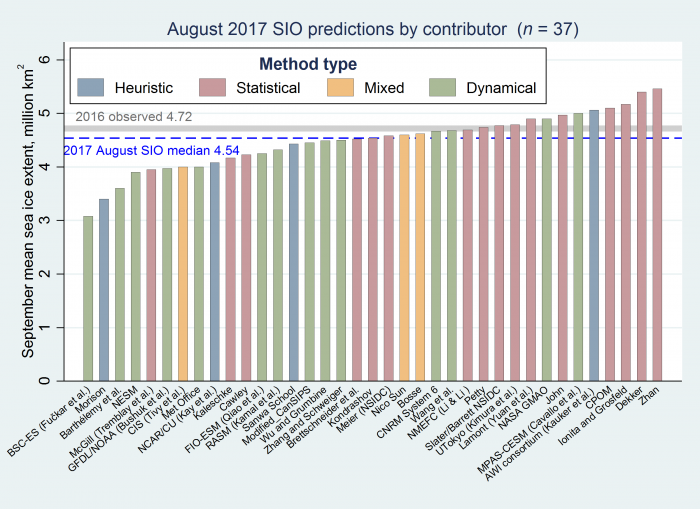
For the August Report there were 37 contributions with the median Outlook value for September 2017 Arctic sea ice extent of 4.5 million square kilometers with quartiles of 4.2 and 4.8 million square kilometers (See Figure 1 in the Overview section, below). These values are unchanged from the July Report, which is consistent with the moderating impact of summer 2017 Arctic weather. The range is 3.1 to 5.5 million square kilometers in August, unchanged from the July Outlook. To place this Outlook in context, recently observed values were 4.3 million square kilometers in 2007, 3.6 million square kilometers in 2012, and 4.7 million square kilometers in 2016. 

These are predictions for the September 2017 monthly average ice extent as reported by NOAA Sea Ice Index (SII). This post provides a look at the 2017 Year To Date (YTD) based on monthly averages comparing MASIE and SII datasets. (10 year average is 2007 to 2016 inclusive)

The graph puts 2017 into recent historical perspective. Note how 2017 was below the 10-year average for the first 4 months, then recovered to match average in May and has maintained average through August. The outlier 2012 provided the highest March maximum as well as the lowest September minimum, coinciding with the Great Arctic Cyclone that year.  2007 began the decade with the lowest minimum except for 2012.  SII 2017 is running below MASIE and is currently just below MASIE 2007 and 2012.

The table below provides the numbers for comparisons.

Monthly 2017 2017 2017 2017-10yr Ave 2017-10yr Ave 2017-
2007
Averages MASIE SII SII
Deficit
MASIE SII MASIE
Jan 13.503 13.174 -0.329 -0.418 -0.512 -0.259
Feb 14.478 14.112 -0.366 -0.363 -0.440 -0.173
Mar 14.509 14.273 -0.236 -0.544 -0.542 -0.114
Apr 13.941 13.760 -0.180 -0.412 -0.446 0.246
May 12.838 12.618 -0.220 0.075 -0.138 0.412
June 10.975 10.720 -0.255 0.069 -0.218 0.148
July 8.383 7.901 -0.482 0.024 -0.206 0.367
Aug 6.006 5.472 -0.533 0.051 -0.185 0.421

The first two columns are the 2017 YTD shown by MASIE and SII, with the SII deficits in column three.  The difference has doubled the last two months and averaged -325k km2 for the YTD. Column four shows MASIE 2017 compared to MASIE 10 year average, while column five shows SII 2017 compared to SII 10 year average.  YTD MASIE is -190k km2 to average and SII is -336k km2 to average.  The last column shows MASIE 2017 holding an August surplus of 421k km2 over 2007.  For the YTD 2017 is 131k km2 higher than 2007, overcoming this year’s deficits in the early months.

For more on SII versions 1 and 2 differences see Arctic Ice Uncertainties

Summary

The experts involved in SIPN are expecting SII 2017 September to be higher than 2007 and slightly lower than 2016.  The way MASIE is going, this September looks to go higher than 2016 unless some bad weather intervenes.

Footnote:

Some people unhappy with the higher amounts of ice extent shown by MASIE continue to claim that Sea Ice Index is the only dataset that can be used. This is false in fact and in logic. Why should anyone accept that the highest quality picture of ice day to day has no shelf life, that one year’s charts can not be compared with another year? Researchers do this, including Walt Meier in charge of Sea Ice Index. That said, I understand his interest in directing people to use his product rather than one he does not control. As I have said before:

MASIE is rigorous, reliable, serves as calibration for satellite products, and continues the long and honorable tradition of naval ice charting using modern technologies. More on this at my post Support MASIE Arctic Ice Dataset

MASIE: “high-resolution, accurate charts of ice conditions”
Walt Meier, NSIDC, October 2015 article in Annals of Glaciology.

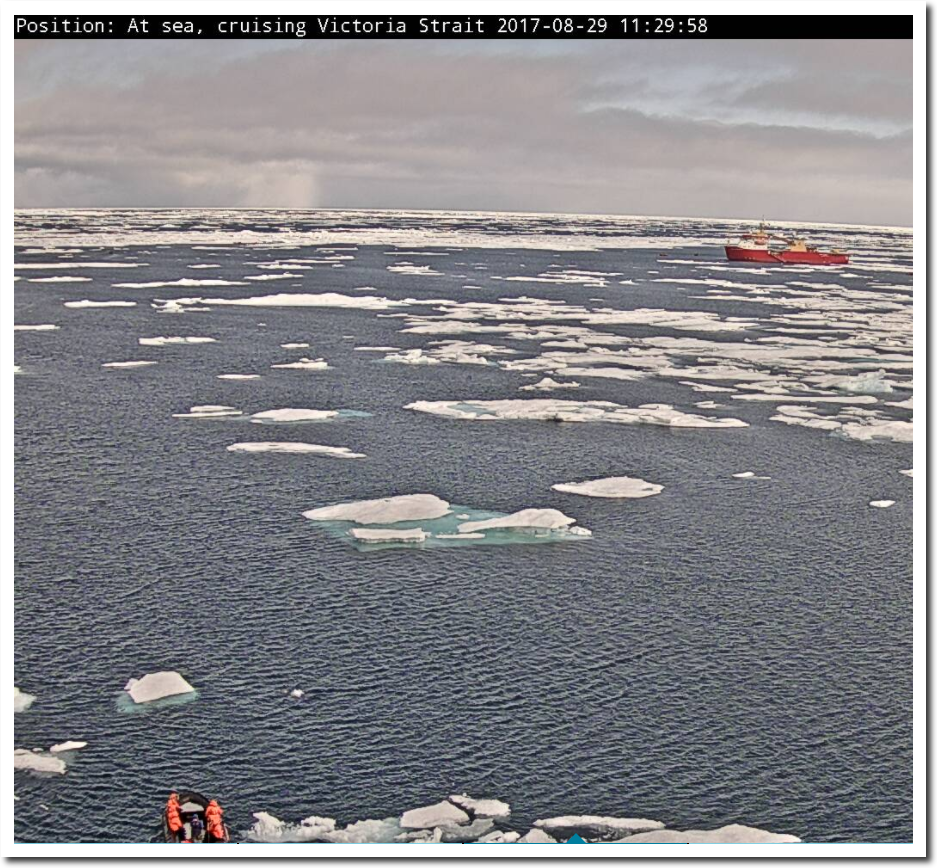
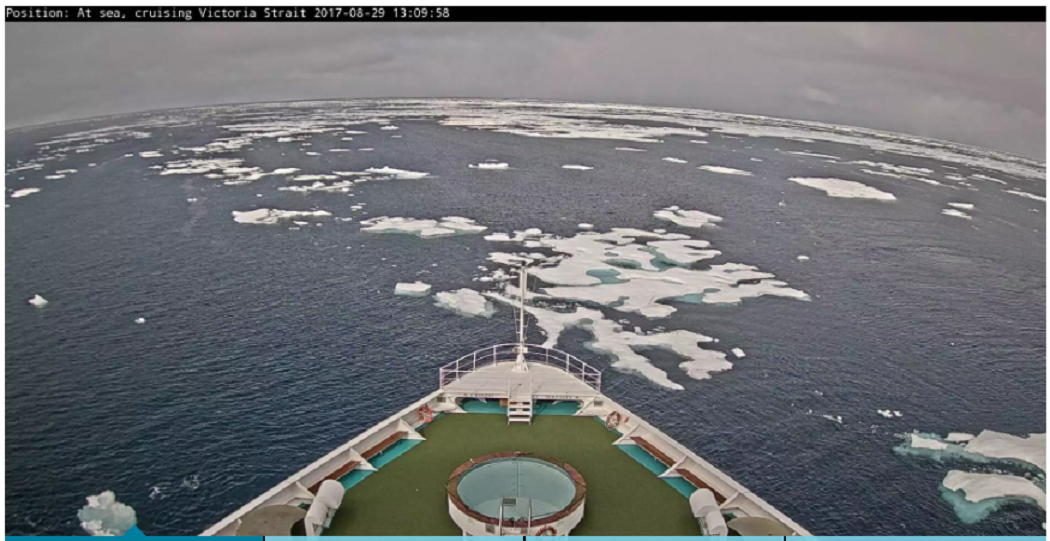
Serenity Faces Ice Aug.30

Click on image to enlarge.

August 31 and Sept. 1 Updates Below

h/t to angech for asking an interesting question:  What are the chances of an early refreezing in the Northwest Passage?  It provoked me to look more into the recent history of ice extents in the CAA (Canadian Arctic Archipelago).

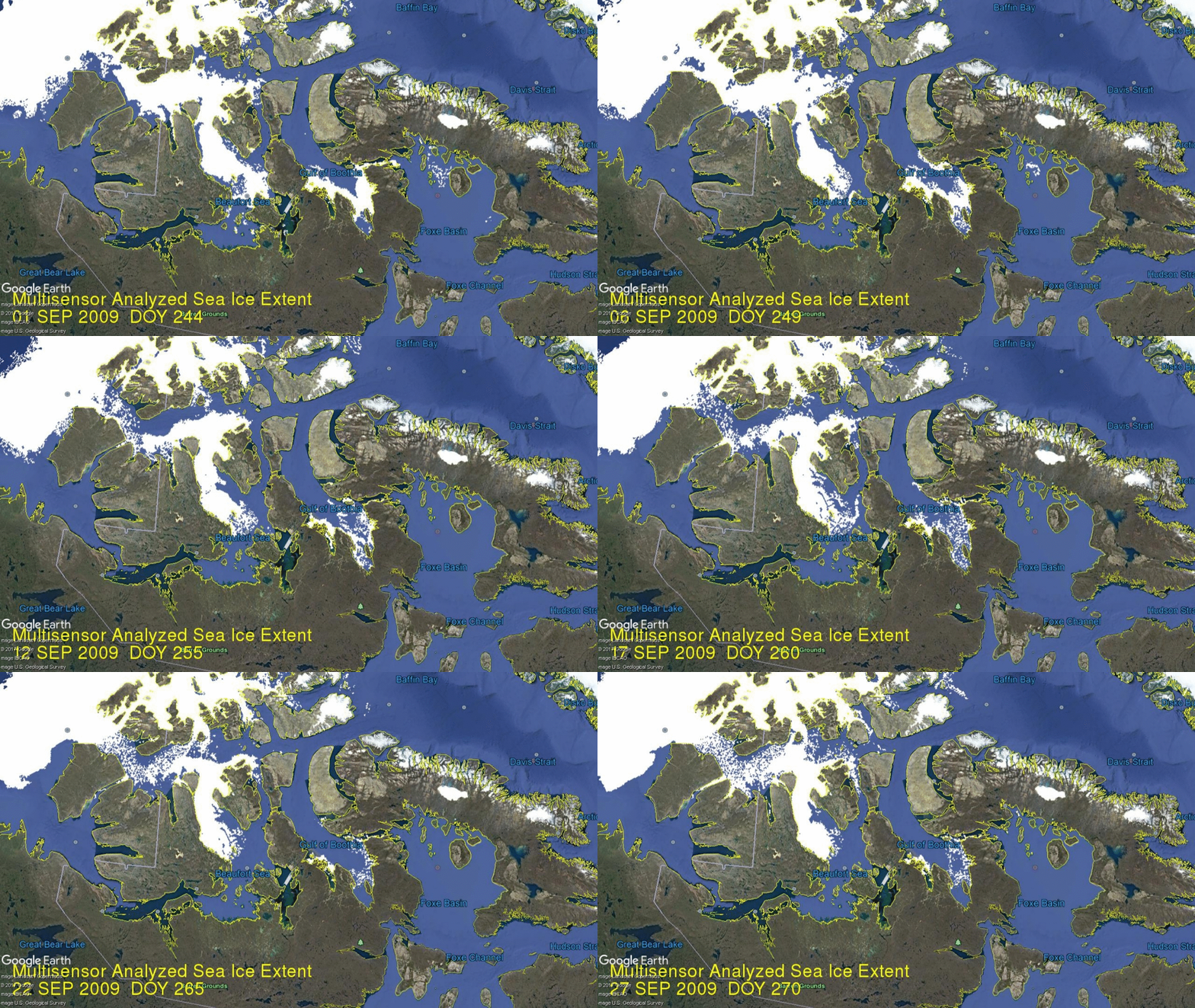
The image above shows the years in the last decade closest to 2017 in terms of ice present in the CAA.  Only 2014 had more ice in that region than this year: 513k km2 compared to 464k km2 at day 240.  It appears that CAA annual minimum typically occurs at day 260, the same as the overall NH minimum.  The image above also shows that 2009 with 388k km2 provides the closest analog to this year for the amount of ice in McClintock Bay just in front of Serenity. The image below gives the progression in 2009 from day 244 to 270.

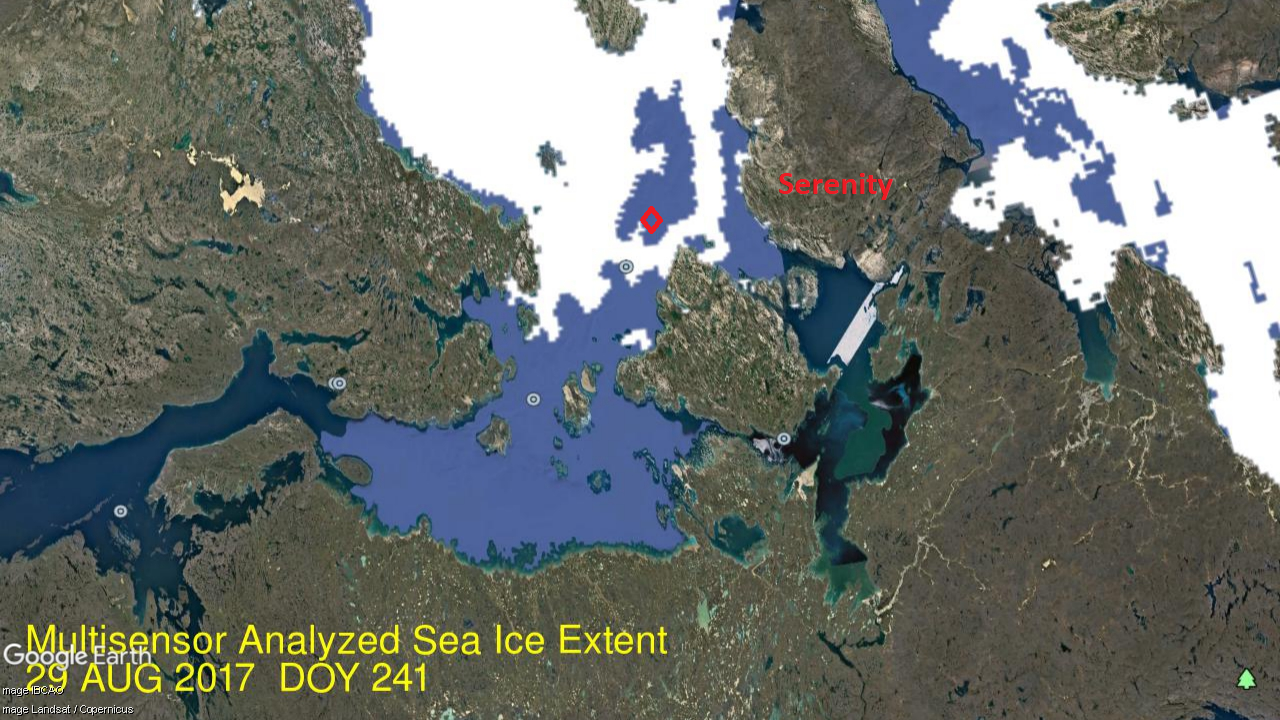
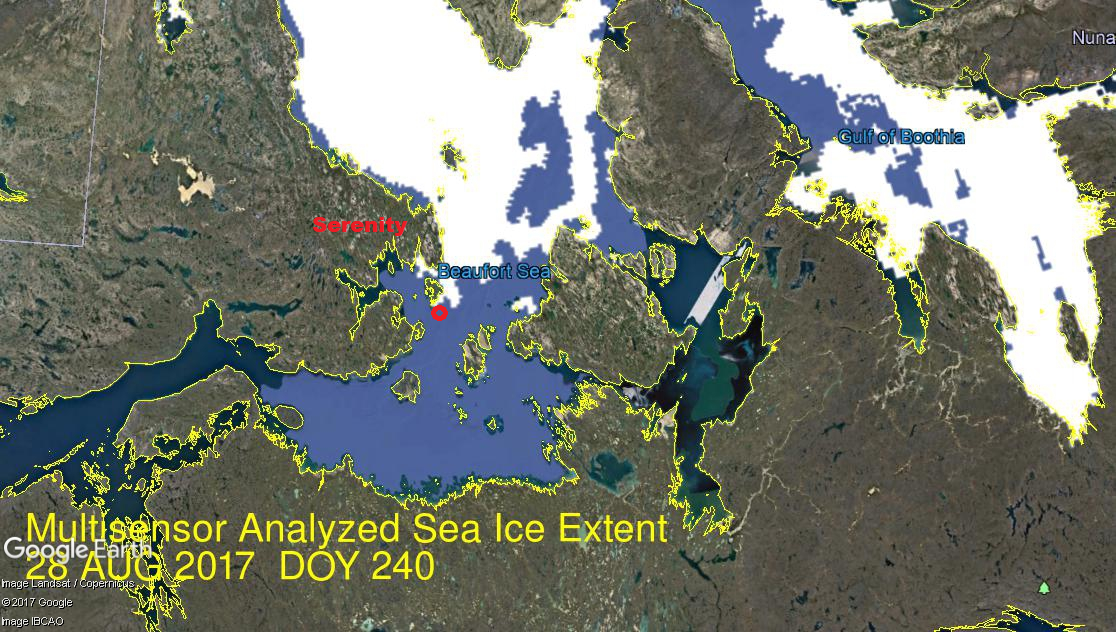
As of 10:30 EST this morning Serenity is located as shown in image below along with ice extent reported by MASIE for yesterday.  Ship tracking is provided by marinevesseltraffic.com  and shows that Serenity is now in convoy with two icebreakers ahead of her.

Canadian ice chart from yesterday showing Serenity and escort worked their way through the water and thinner green ice, but with some thicker stuff ahead.

Serenity will make it through with such assistance, which was largely unnecessary last year.  And as the above shows, 2014 would have been close to impossible.

UPDATE 16:30 EST

The convoy has reached the southern tip of Prince of Wales Island and are turning northeast. It appears they will sail along the thin shore ice, presumably headed for the western entrance of Bellot Strait which passes through to Prince Regent channel.

UPDATE 7:00AM EST AUG. 31

Serenity convoy is about to enter Bellot Strait.  Waiting for a cargo ship to exit the channel.

UPDATE 9:00AM EST Aug. 31

Cruisemapper shows Serenity has entered the Strait following her icebreaker.

Update 12:00 PM EST Aug. 31

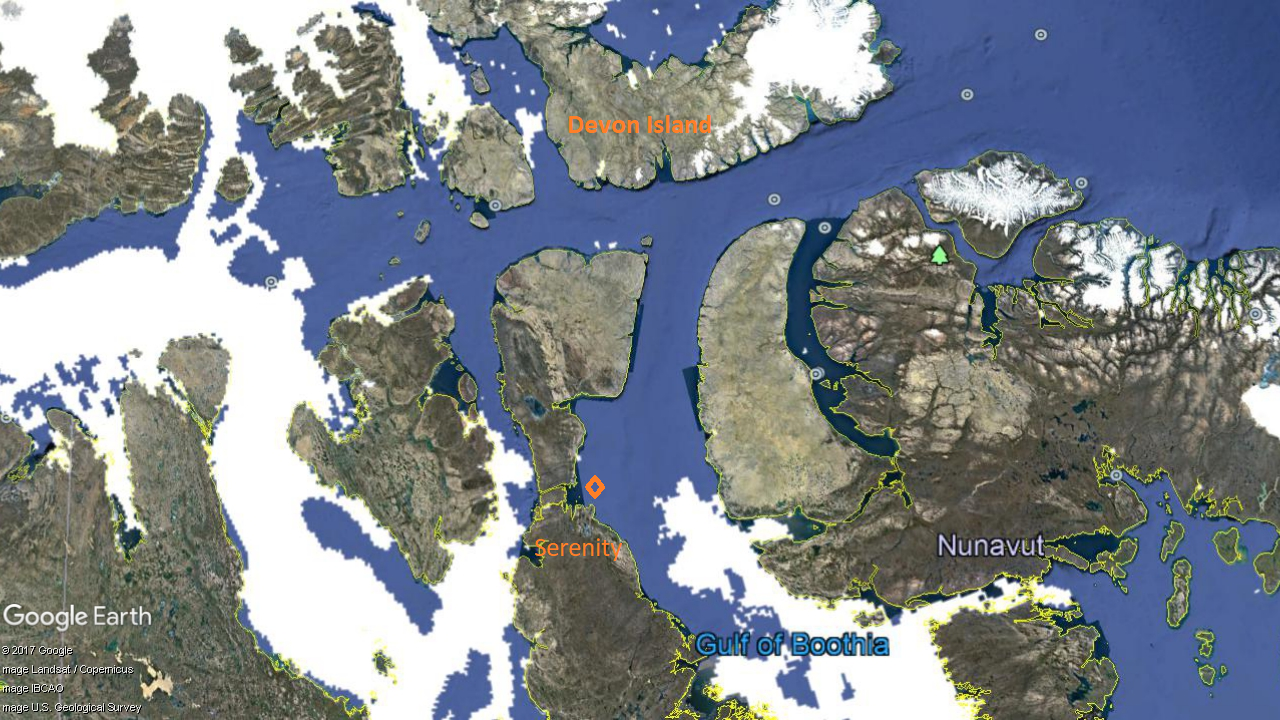
Serenity and icebreaker escort have emerged from Bellot Strait into Prince Regent channel and are turning north.  Next destination may well be Devon Island with some interesting things that were seen last year.  See Mars in the Arctic

Update 7:00 AM EST Sept. 1, 2017

Serenity and icebreaker are anchored just off Beechey Island at the southwestern tip of Devon Island.


New Icebreaker Tanker Opens NSR

Its strong, ultra-lightweight steel reinforced hull makes it the largest commercial ship to receive Arc7 certification and allows it to sail through ice up to 2.1 meters thick.

Alarmist media like the Guardian are claiming this event signals the demise of Arctic ice, when in fact it is a triumph of modern technology over natural challenges.  Headlines are announcing a tanker transited the Northern Sea Route (NSR) without icebreaker escort, neglecting to mention that the vessel in question is an icebreaker that functions as a tanker.

Operated by Sovcomflot on behalf of Total, Novatek, CNPC and the Silk Road Fund, this 300 meter long carrier has a capacity of 172,600 cubic meters of LNG.

From Total Inaugurates the Northern Sea Route with LNG Carrier Christophe de Margerie

It’s on its way! After loading its cargo at the Snøhvit LNG export terminal in Norway, in which Total has an 18.4% interest, the Christophe de Margerie is taking the Northern Sea Route to Boryeong in South Korea, where it will deliver a cargo for Total Gas & Power. It’s the first unescorted merchant LNG vessel ever to take this route, which makes it possible to reach Asia via the Bering Strait in 15 days versus 30 days via the Suez Canal.

This technological feat was made possible through the participation of Total teams to the design of these next-generation LNG carriers. Compilations of technology, they efficiently transport large quantities of LNG year-round, without requiring escort icebreakers during the period from July to November. The Christophe de Margerie is the first of a total of 15 planned LNG carriers that will be gradually deployed.

They have been specially designed for Yamal LNG, a flagship Total project (20%) in northern Russia to develop the giant onshore South Tambey gas and condensate field with the construction of a liquefaction plant. Ultimately, close to 16.5 million tons of LNG a year will transit through the port of Sabetta, built specifically for the project.

Energy companies are planning for ice and are building equipment to deal with it.  It is not evidence of global warming but human ingenuity.

August Arctic Ice Unalarming

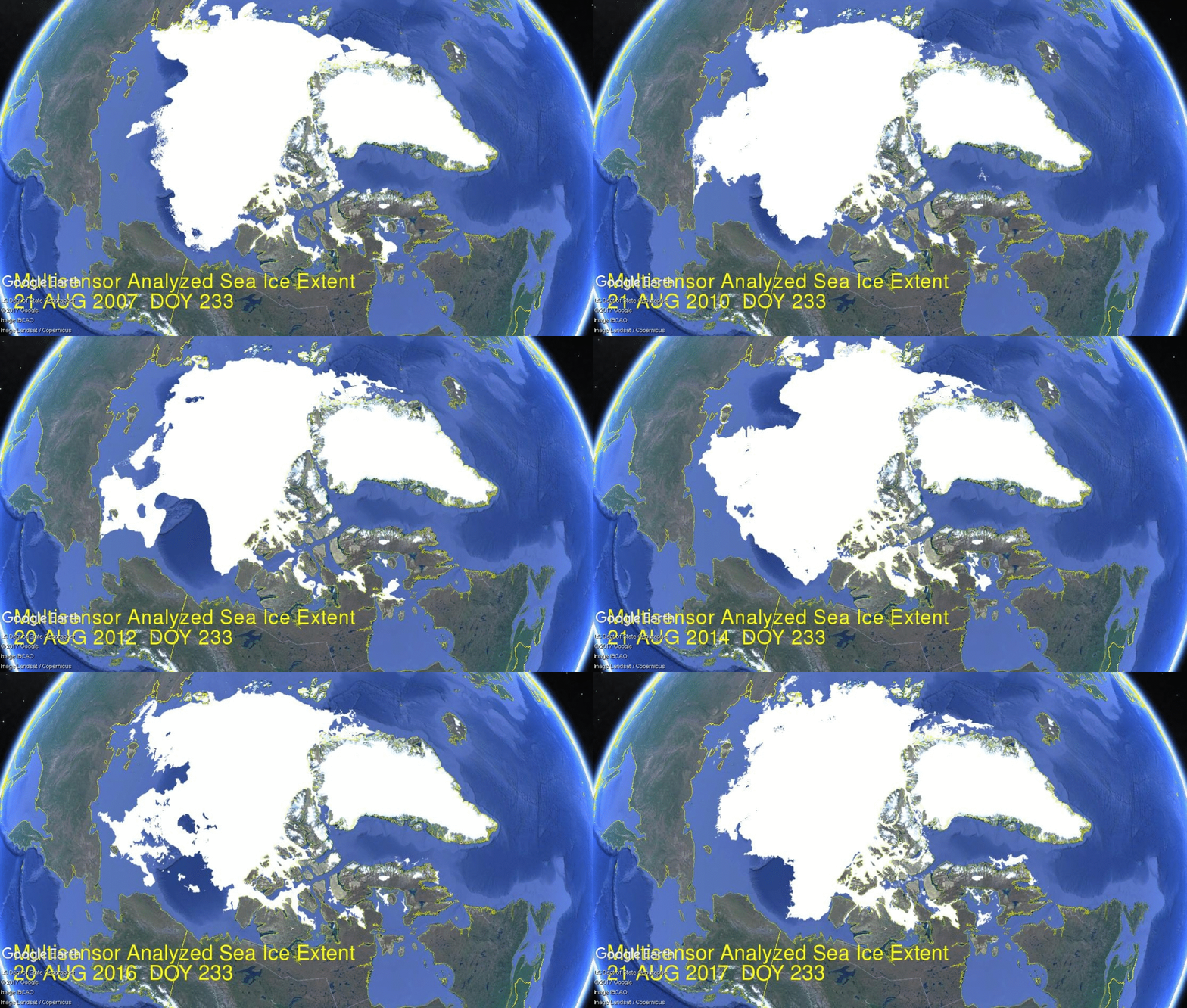
Click on image to enlarge.

The image above shows ice extents for day 233 from 2007 to 2017.  Particularly interesting is the variation in the CAA (Canadian Arctic  Archipelago), crucial for the Northwest Passage.  (The region is located just north of the words “Ice Extent” in gold.)  Note that 2016 was a fine year for cruising with the passage completely open at this date.  That was not the case in 2014, and this year is also frozen solid.

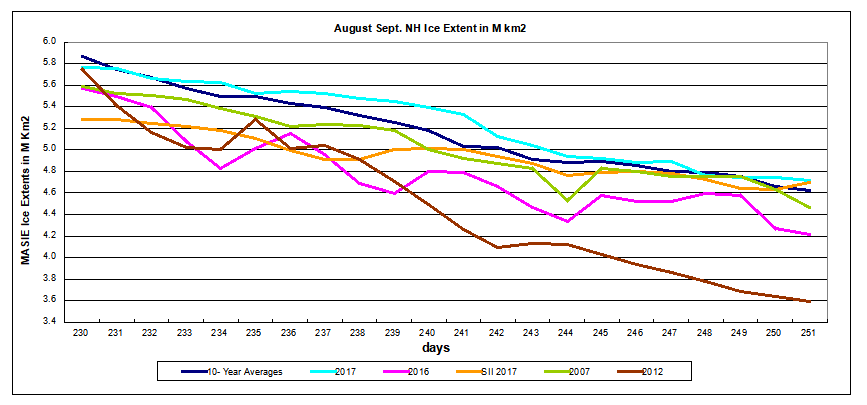
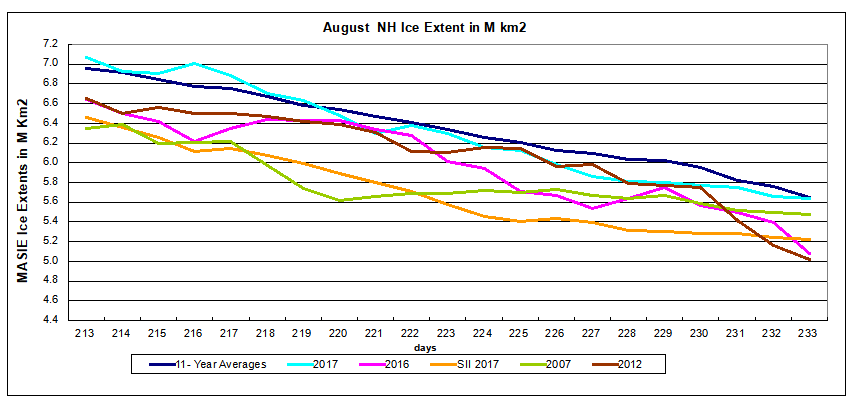
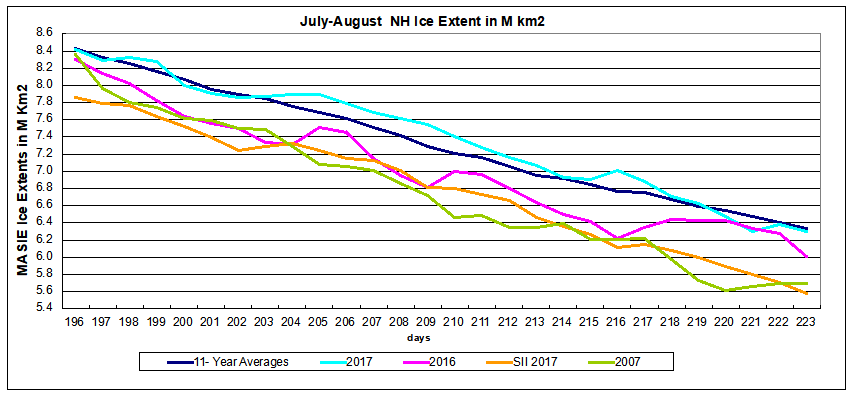
The graph of August NH ice extents shows 2017 virtually tied with the decadal average as of yesterday. This year is now 550k km2 greater than 2016 and exceeds 2007 by 250k km2.  SII (Sea Ice Index) 2017 is also 400k km2 lower.  A previous post Beware the Arctic Storms of August discussed how late summer storms have dramatic impacts, and the graph shows both 2012 and 2016 plummeting in the last five days.  By the end of the month in nine days, those two years will go below 4.4M km2.

The Table compares 2017 day 233 ice extents with the decadal average and 2007.  it is evident that  this year’s extents are in surplus on the Canadian side and Central Arctic, offset by deficits on the Pacific side.

Region 2017233 Day 233
Average
2017-Ave. 2007234 2017-2007
 (0) Northern_Hemisphere 5634884 5652704 -17820 5388004 246880
 (1) Beaufort_Sea 569472 643245 -73773 731647 -162175
 (2) Chukchi_Sea 285855 399788 -113934 222895 62959
 (3) East_Siberian_Sea 386603 517871 -131268 81989 304614
 (4) Laptev_Sea 308812 244158 64655 295384 13428
 (5) Kara_Sea 65151 86439 -21288 161780 -96628
 (6) Barents_Sea 33482 22883 10599 18656 14826
 (7) Greenland_Sea 184582 222908 -38326 335976 -151394
 (8) Baffin_Bay_Gulf_of_St._Lawrence 92400 37803 54597 51008 41392
 (9) Canadian_Archipelago 494273 353728 140546 325028 169245
 (10) Hudson_Bay 34936 43613 -8677 61078 -26141
 (11) Central_Arctic 3178159 3079193 98966 3101306 76853

By the way, Barents is still above average and just added some ice.

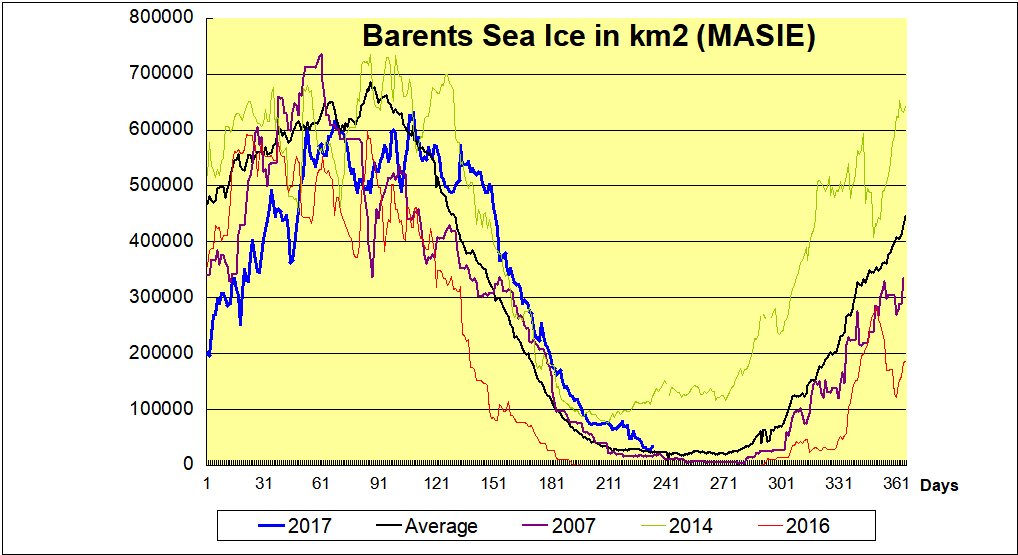
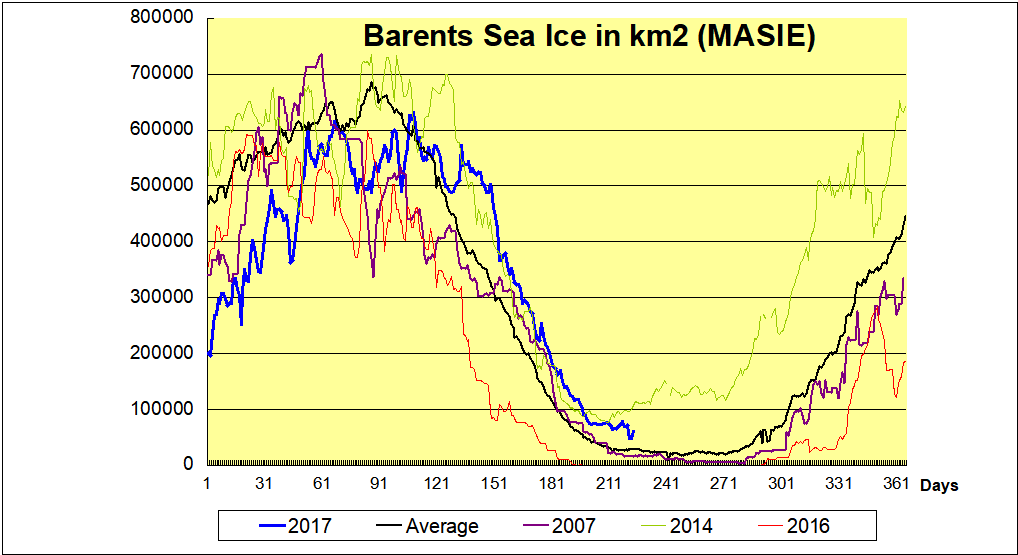
The black line is average for the last 11 years.  2007 in purple appears close to an average year.  2014 had the highest annual extent in Barents Sea, due to higher and later maximums, holding onto ice during the summer, and recovering quickly.  In contrast, 2016 was the lowest annual extent, melting out early and recovering later.  2017 in blue started out way behind, but grew rapidly to reach average, and then persisted longer to exceed even 2014.  It will be important to see when the recovery of ice begins.

For more on why Barents Sea matters see Barents Icicles

Summary and Outlook

As discussed above, weather these few weeks will determine the fate of ice extents.  Here is the Arctic Oscillation and Polar Vortex Analysis and Forecast from  August 21, 2017 by Dr. Judah Cohen from Atmospheric and Environmental Research (AER).

The AO is currently neutral (Figure 1), reflective of mostly mixed geopotential height anomalies across the Arctic and mixed geopotential height anomalies across the mid-latitudes of the NH (Figure 2). Geopotential height anomalies are also mixed across Greenland and Iceland (Figure 2), and therefore the NAO is also neutral. However blocking/high pressure will strengthen first across Northern Canada and eventually across Greenland forcing the AO/NAO into negative territory over the next two weeks.

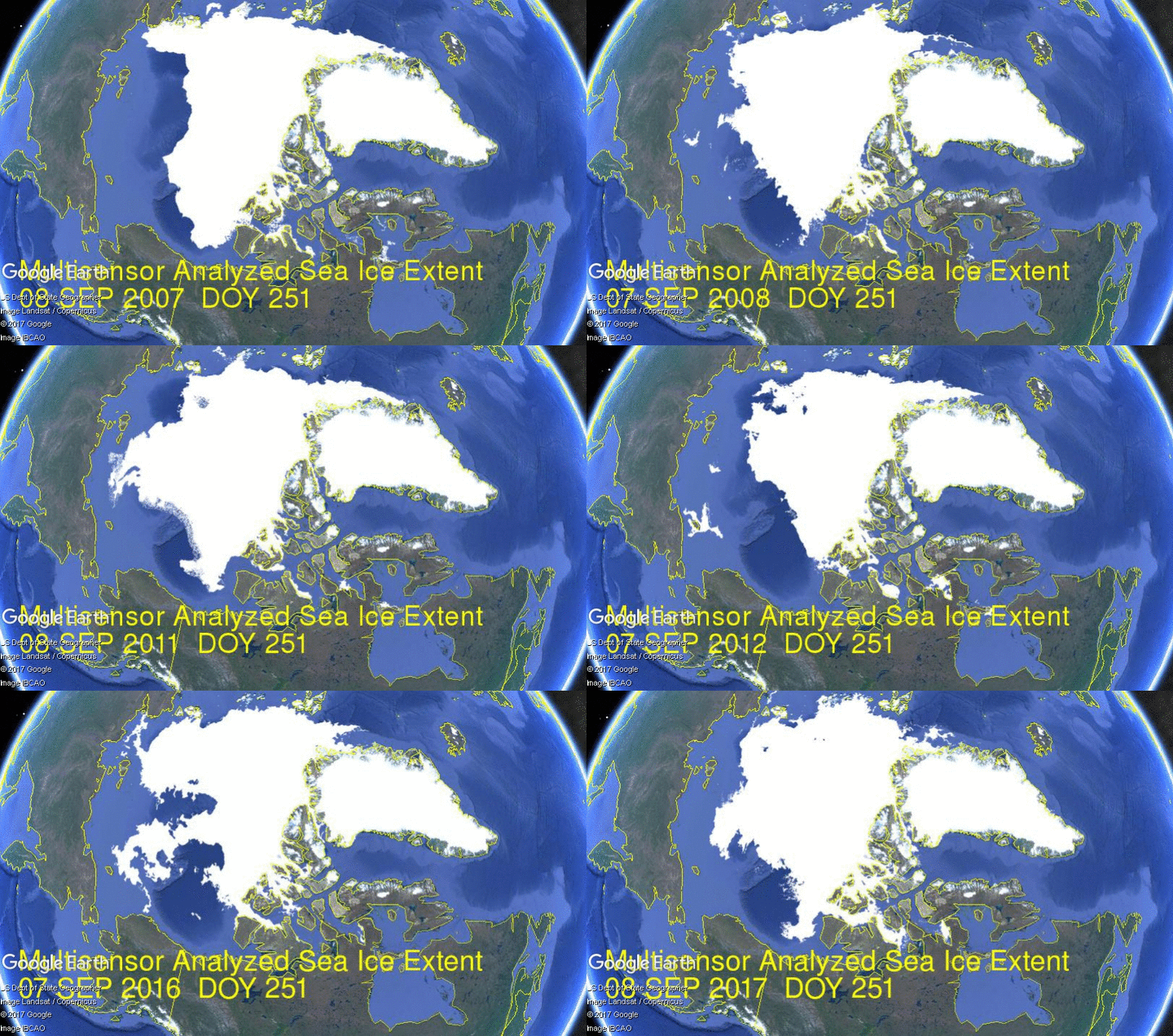
New snowfall is also predicted over the Arctic sea ice over the coming two weeks, a sign that the Arctic sea ice melt season is coming to an end. It was never in doubt that once again Arctic sea ice would be well below normal this summer. However predicted new snowfall will retard sea ice melt and a new record low minimum seems unlikely. The trajectory of sea ice extent seems similar to 2007, 2011, 2015 and 2016 and will likely bottom out close to those group of years. If the melt season ends early then there is even an outside chance it could even match the years of 2008 and 2010.

Footnote

Some people unhappy with the higher amounts of ice extent shown by MASIE continue to claim that Sea Ice Index is the only dataset that can be used.  This is false in fact and in logic.  Why should anyone accept that the highest quality picture of ice day to day has no shelf life, that one year’s charts can not be compared with another year?  Researchers do this, including Walt Meier in charge of Sea Ice Index.  That said, I understand his interest in directing people to use his product rather than one he does not control.  As I have said before:

MASIE is rigorous, reliable, serves as calibration for satellite products, and continues the long and honorable tradition of naval ice charting using modern technologies.  More on this at my post Support MASIE Arctic Ice Dataset

Beware the Arctic Storms of August

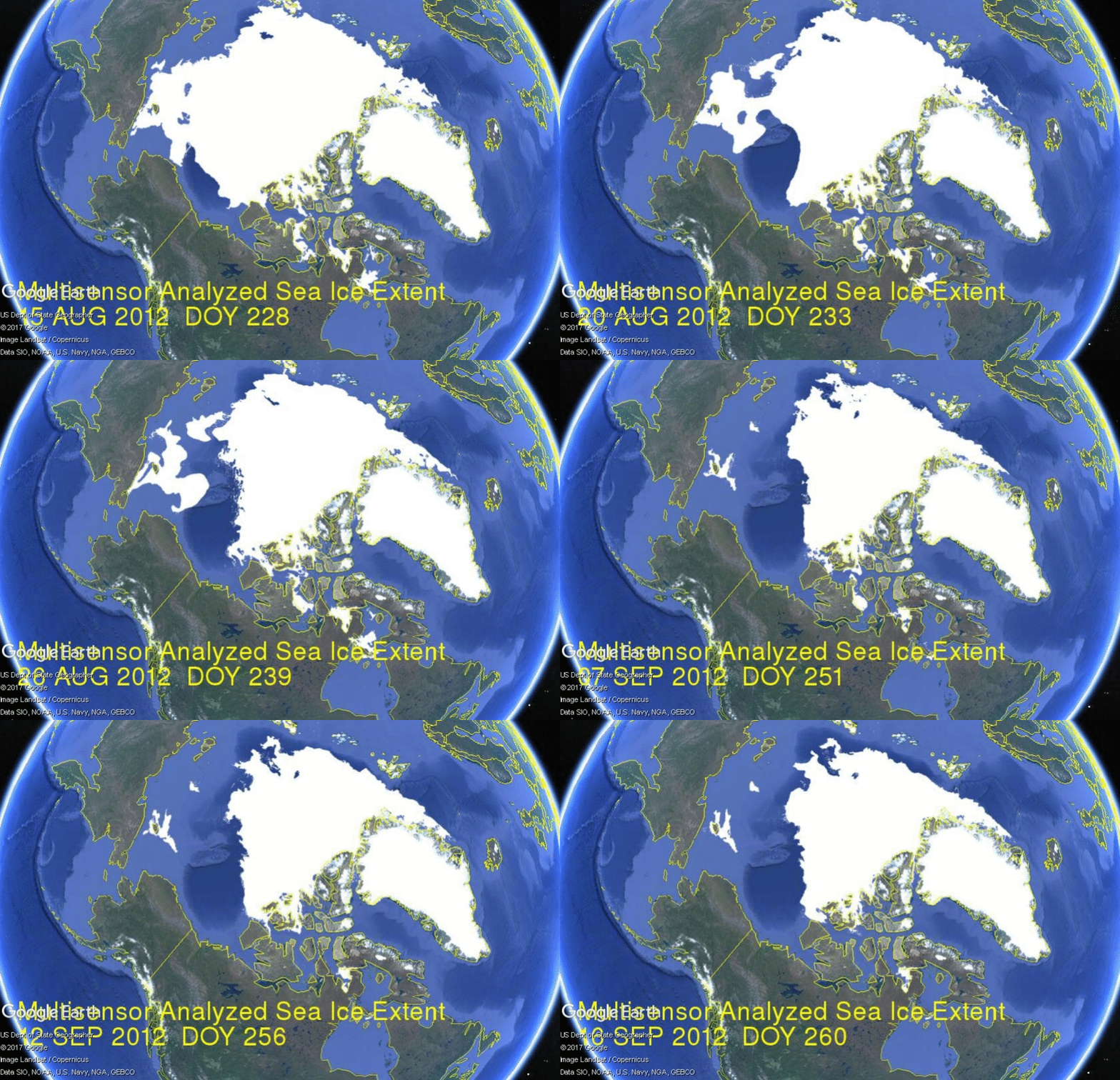
The Great Arctic Cyclone August 2012

The next two weeks will determine where this year’s minimum will rank compared to recent years. And much will depend upon storm activity which breaks up ice edges, compacts ice chunks and transports ice out through Fram Strait where it melts in the warmer Norwegian Sea.

We have two recent examples in 2012 and 2016. The Great Arctic Cyclone of 2012 produced the lowest minimum of the decade. The NASA photo of the storm is above.  The image below presents the impact of the 2012 storm upon ice extents from mid-August to mid-September annual minimum.  (Click on image to enlarge.)

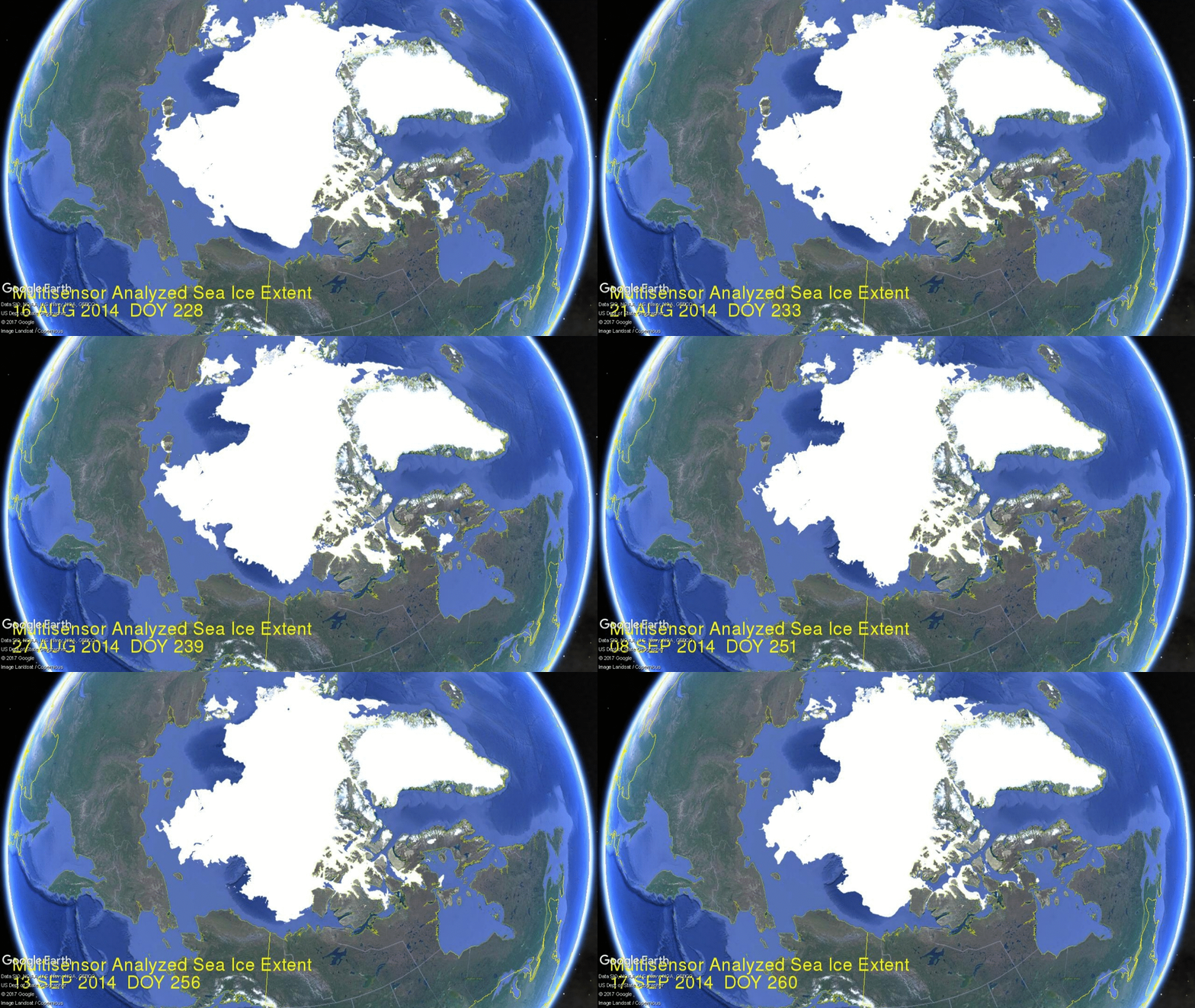
In contrast, a more normal, non-stormy year is represented by 2014.  Progression of ice extents for 2014 is shown below.

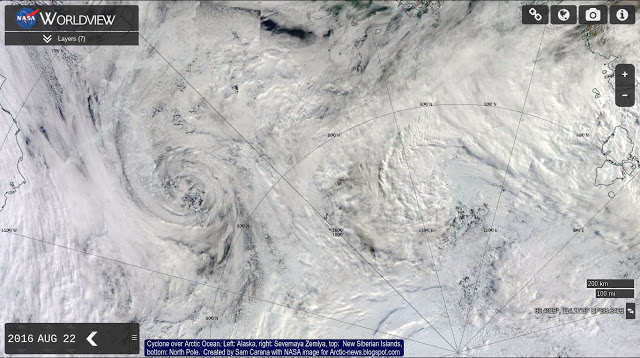
Then again in 2016 several sizable Arctic storms struck late August.  The image below shows cyclonic winds (center left) over the Arctic Ocean on August 22, 2016.

The storms effect on 2016 sea ice appears in the image below.

Summary

Arctic ice extents these three years were not far apart mid-August, but they ended the melt season quite differently.  The Great Arctic Cyclone made 2012 the lowest of the decade, bottoming out at 3.4M km2.  2016 August storms also produced a low annual minimum of 4.2M km2.  In contrast, the absence of major storms in 2014 resulted in a much higher September minimum of 5.13M km2.  All of these compare to 2007 minimum of 4.05M km2, with no major storms reported.

It is difficult to extract a climate signal out of fluctuating ice extent minimums when they are so dependent on the vagaries of weather events.  It also means that anything can happen in the next few weeks.


August 11 Arctic Ice Report


Arctic sunset to occur in the next weeks. Nunavut is already having Civil Twilight, meaning the sun is less than 6 degrees below the horizon during the night.

The extent of Arctic ice fell to a new wintertime low in March 2017. But springtime ice persisted and extents since June are hanging around the decadal average.  Below shows the last 27 days through yesterday, August 11, 2017.

For this period 2017 was mostly average or higher, continuing into August. This year is now almost 300k km2 greater than 2016 and exceeds 2007 by 600k km2.  SII 2017 is also 600k km2 lower.

As we shall see, this year’s extents are in surplus on the Atlantic side, offset by deficits on the Pacific side.  The image compares day 223 with the same day in 2007.

The Table compares 2017 day 223 ice extents with the decadal average and 2007.

Region 2017223 Day 223
Average
2017-Ave. 2007223 2017-2007
 (0) Northern_Hemisphere 6295153 6338630 -43477 5690646 604507
 (1) Beaufort_Sea 646803 740583 -93779 767724 -120921
 (2) Chukchi_Sea 342601 479258 -136657 261771 80831
 (3) East_Siberian_Sea 411714 663564 -251849 207590 204124
 (4) Laptev_Sea 430221 329873 100349 310764 119458
 (5) Kara_Sea 140411 123400 17011 215854 -75443
 (6) Barents_Sea 60001 28883 31118 15996 44005
 (7) Greenland_Sea 236735 253185 -16450 286393 -49658
 (8) Baffin_Bay_Gulf_of_St._Lawrence 207230 71011 136219 83942 123288
 (9) Canadian_Archipelago 527348 439371 87977 361883 165465
 (10) Hudson_Bay 70437 87621 -17184 94262 -23825
 (11) Central_Arctic 3220493 3120642 99851 3083211 137282

Deficits to average are in the BCE region, and surpluses appear almost everywhere else.  Ice is particularly strong in Laptev, Baffin, CAA and the Central Arctic.

The graph below shows Barents this year continues to be above average but fell behind the record year of 2014. After pausing at 70K km2, it dipped to 50k km2, then bounced back to 60k yesterday.

The black line is average for the last 11 years.  2007 in purple appears close to an average year.  2014 had the highest annual extent in Barents Sea, due to higher and later maximums, holding onto ice during the summer, and recovering quickly.  In contrast, 2016 was the lowest annual extent, melting out early and recovering later.  2017 in blue started out way behind, but grew rapidly to reach average, and then persisted longer to exceed even 2014.  It will be important to see when the recovery of ice begins.

For more on why Barents Sea matters see Barents Icicles


Arctic Heart Beat

We are about 50 days away from the annual Arctic ice extent minimum, which typically occurs on or about day 260 (mid September). Some take any year’s slightly lower minimum as proof that Arctic ice is dying, but the image below shows day 260 over the last 10 years. The Arctic heart is beating clear and strong.

Click on image to enlarge.

Over this decade, the Arctic ice minimum has not declined, but looks like fluctuations around a plateau since 2007. By mid-September, all the peripheral seas have turned to water, and the residual ice shows up in a few places. The table below indicates where we can expect to find ice this next September.

Arctic Regions 2007 2010 2012 2014 2015 2016 Average
Central Arctic Sea 2.67 3.16 2.64 2.98 2.93 2.92 2.91
BCE 0.50 1.08 0.31 1.38 0.89 0.52 0.87
LKB 0.29 0.24 0.02 0.19 0.05 0.28 0.17
Greenland & CAA 0.56 0.41 0.41 0.55 0.46 0.45 0.46
B&H Bays 0.03 0.03 0.02 0.02 0.10 0.03 0.03
NH Total 4.05 4.91 3.40 5.13 4.44 4.20 4.45

BCE (Beaufort, Chukchi and East Siberian) on the Asian side are quite variable as the largest source of ice other than the Central Arctic itself.   Greenland Sea and CAA (Canadian Arctic Archipelago) together hold almost 0.5M km2 of ice at minimum, fairly consistently.   LKB are the European seas of Laptev, Kara and Barents, a smaller source of ice, but a difference maker some years, as Laptev was in 2016.  Baffin and Hudson Bays are almost inconsequential.

For context, note that the average maximum has been 15M, so on average the extent shrinks to 30% of the March high before growing back the following winter.