The Courage to Do Nothing about Climate Change

At Human Events, Gregory Wrightstone writes Principled Inaction in the Face of Climate Change Extremism. Excerpts in italics with my bolds.

President Trump’s courageous commitment to America first on the issue of energy emissions.

The 2019 United Nations Climate Change Conference, “COP25,” began with a cryptic address by U.N. Secretary-General António Guterres: “By the end of the coming decade we will be on one of two paths, one of which is sleepwalking past the point of no return … Do we want to be remembered as the generation that buried its head in the sand and fiddled as the planet burned?”

According to Guterres, “What is still lacking is political will.” And yet, despite all this “lack of political will,” some 70 countries have pledged carbon neutrality by 2050. Conspicuously absent from the proceedings, however, is the Trump Administration. No senior member of President Trump’s administration is in attendance at COP25.

But despite what Greta Thunberg or António Guterres would have you believe, it isn’t a lack of political will that explains our absence—quite the opposite.

President Trump’s refusal to cosign radical climate extremism is a courageous gesture of principled inaction.

America First on Carbon Emissions

The main reason behind the administration’s absence from the Madrid summit is that the key objective of the program is to negotiate the finer details of the Paris Climate Accord—the agreement that President Trump has withdrawn us from in the name of American interests.

“[T]o fulfill my solemn duty to protect America and its citizens, the United States will withdraw from the Paris Climate Accord,” the President announced in June 2017, voicing an interest in negotiating an “entirely new transaction on terms that are fair to the United States, its businesses, its workers, its people, its taxpayers.”

“I was elected to represent the citizens of Pittsburgh, not Paris,” he retorted, critically appraising that the Paris Accords:

“[C]alls for developed countries to send $100 billion to developing countries all on top of America’s existing and massive foreign aid payments. So we’re going to be paying billions and billions and billions of dollars, and we’re already way ahead of anybody else. Many of the other countries haven’t spent anything, and many of them will never pay one dime.”

Earlier last month, Secretary of State Mike Pompeo said the administration sent an official notification of its plans to exit the Paris Agreement. This was the first step in the year-long process to leave the agreement that allegedly aims to reduce emissions of greenhouse gases. The full withdrawal is scheduled for November 4, 2020, a day after the next presidential election.

The media, often enthusiastic contributors to climate catastrophizing, has presented the administration’s decision to withdraw from the Paris Agreement as an indication that the world’s environmental health has somehow been derailed. “[F]or us to be the exception on this issue is holding the world back,” NPR reports Andrew Light saying, a former climate official in the State Department who helped develop the Paris Agreement.

But that’s not remotely accurate.

In positioning America first, the President is refusing to sacrifice the immediate economic needs of everyday Americans in the face of an inflated threat. The Paris Agreement would have Americans dole out millions of dollars to the so-called developing world—countries like China and India—who refuse to take accountability for their own catastrophic environmental policies.

President Trump will not capitulate to this kind of climate bullying, especially if it compromises our global leadership as energy providers—both traditional and renewable.

Climate Extremism in the Face of Thriving Ecological Growth

It’s not just the technical negotiations over how climate policy will affect American industry; it’s the facticity of climate catastrophe itself that the Trump administration has bravely called into question.

For leaders supporting the Paris agreement, the specter of catastrophic warming provides the moral justification for ever-higher taxation, ever-tighter regulation, ever-greater state interference, ever-larger slush funds for big-spending politicians, and ever-diminished individual freedom to use, acquire, and consume at will.

Several other historical eras—Minoan (2900 to 1100 BC), the Roman Empire (27 BC to 476 AD), and the Medieval warm periods (950 to 1250 AD)—experienced warmer temperatures than we face today. These periods coincided with significant expansions of civilizations, bountiful harvests, and vast improvements in the human condition.

Historical periods of warm global temperature, often higher than our current climate, were commonly referred to as “climate optima” because of the higher temperature and their associated benefits to Earth’s ecosystems. The terminology has fallen into disfavor, however, in recent years, due to a media and scientific blacklisting of any mention of benefits owing to higher temperature. But before climate science became politicized, these past warm periods were associated with a thriving, prospering planet, and human civilization benefited in tandem.

The inconvenient facts, at least to the climate catastrophe crowd, is that the bulk of their predictions are errant speculations about what may or may not occur, 50 or 80 years in the future, based on climate models that substantially overestimate temperature rise.

In reality, by nearly every metric, we see that humans are thriving in the changing ecosystem. The current changing climate has led to increasing food production, soil moisture, crop growth, and a “greening” of the Earth. All the while droughts, forest fires, heatwaves and, temperature-related deaths have declined substantially.

Yes, there is such a thing as the greenhouse effect. Yes, there has been some warming. Yes, some of the warming is likely man-made. Yes, some further man-made warming is to be expected. On all these matters, few would disagree; they are all self-evident.

But no, past and future anthropogenic warming do not mean that catastrophe will follow, or that measures to prevent global warming are scientifically and economically justified. Only the radical worldview of environmental catastrophizing could ignore benefits being accrued from atmospheric changes—while embracing harmful economic policies based on fallacious climate models.

What the “crisis narrative” is achieving, however, is extreme regulation and expropriation of profits from the energy sector. For leaders supporting the Paris agreement, the specter of catastrophic warming provides the moral justification for ever-higher taxation, ever-tighter regulation, ever-greater state interference, ever-larger slush funds for big-spending politicians, and ever-diminished individual freedom to use, acquire, and consume at will.

President Trump is bravely taking a stance against environmental extremism.

“What we won’t do is punish the American people while enriching foreign polluters,” President Trump said during a keynote to natural gas executives and employees at the Shale Insight conference in October of 2017. Pointing to the rising U.S. oil and gas production, and his efforts to deregulate the industry in the name of ending the “war on energy,” President Trump applauded his audience: “With unmatched skill, grit and devotion, you’re making America the greatest energy superpower in the history of the world.”

The Non-Problem of Man-made “Thermageddon”

It takes a lot of courage to do nothing.

Imagine the enormous pressure on President Trump to keep the United States in the Paris climate accord. Worldwide indignation and scorn were heaped on him after his decision to withdraw from the agreement. But it was the correct and principled one to make.

Thanks to near-total control of the news media by proponents of a pending Thermageddon, critical truths are poorly understood and even derided. The truth that there is no “consensus” among climate scientists and that “consensus” would not matter even if it existed. The truth is that global warming will be small, and largely beneficial ecological event, and preventing it would be orders of magnitude costlier than adapting to it. The truth that the correct policy is to have the courage to do nothing.

Like it or not, the truth is the truth. Policy should, in the end, be based on objective reality, and not on the back of a lavishly-funded and elaborate international campaigns of crafty and lucrative falsehoods promoted by the political, financial, corporate, bureaucratic and media establishments.

This is your brain on Climate Alarm

Just Say No!

US Federal Agency Lawmaking Out of Bounds

A previous post reprinted below discussed how US Supreme Justices appear ready to challenge regulatory lawmaking beyond Legislative boundaries.  This is of course at the heart of climate change overreach, as well as intrusion of Political Correctness into many other areas such as environment, health, education, immigration and so on.  Most recently Justice Kavanaugh highlighted the constitutional concern in his opinion included in US Supreme Court Orders November 25, 2019.  Excerpts in italics with my bolds.

SUPREME COURT OF THE UNITED STATES RONALD W. PAUL v. UNITED STATES ON PETITION FOR WRIT OF CERTIORARI TO THE UNITED STATES COURT OF APPEALS FOR THE SIXTH CIRCUIT No. 17–8830. Decided November 25, 2019 The petition for a writ of certiorari is denied.

Statement of JUSTICE KAVANAUGH respecting the denial of certiorari. I agree with the denial of certiorari because this case ultimately raises the same statutory interpretation issue that the Court resolved last Term in Gundy v. United States, 588 U. S. ___ (2019). I write separately because JUSTICE GORSUCH’s scholarly analysis of the Constitution’s nondelegation doctrine in his Gundy dissent may warrant further consideration in future cases. JUSTICE GORSUCH’s opinion built on views expressed by then-Justice Rehnquist some 40 years ago in Industrial Union Dept., AFL–CIO v. American Petroleum Institute, 448 U. S. 607, 685–686 (1980) (Rehnquist, J., concurring in judgment). In that case, Justice Rehnquist opined that major national policy decisions must be made by Congress and the President in the legislative process, not delegated by Congress to the Executive Branch.

In the wake of Justice Rehnquist’s opinion, the Court has not adopted a nondelegation principle for major questions. But the Court has applied a closely related statutory interpretation doctrine: In order for an executive or independent agency to exercise regulatory authority over a major policy question of great economic and political importance, Congress must either: (i) expressly and specifically decide the major policy question itself and delegate to the agency the authority to regulate and enforce; or (ii) expressly and specifically delegate to the agency the authority both to decide the major policy question and to regulate and enforce. See, e.g., Utility Air Regulatory Group v. EPA, 573 U. S. 302 (2014); FDA v. Brown & Williamson Tobacco Corp., 529 U. S. 120 (2000); MCI Telecommunications Corp. v. American Telephone & Telegraph Co., 512 U. S. 218 (1994); Breyer, Judicial Review of Questions of Law and Policy, 38 Admin. L. Rev. 363, 370 (1986).

The opinions of Justice Rehnquist and JUSTICE GORSUCH would not allow that second category—congressional delegations to agencies of authority to decide major policy questions—even if Congress expressly and specifically delegates that authority. Under their approach, Congress could delegate to agencies the authority to decide less-major or fillup-the-details decisions. Like Justice Rehnquist’s opinion 40 years ago, JUSTICE GORSUCH’s thoughtful Gundy opinion raised important points that may warrant further consideration in future cases.

Previous Post:  Supremes May Rein In Agency Lawmaking

This post consists of a legal discussion regarding undesirable outcomes from some Supreme Court rulings that gave excessive deference to Executive Branch Agency regulators. Relying on the so called “Chevron Deference” can result in regulations going beyond what congress intended by their laws.

Professor Mike Rappaport writes at Law and Liberty Replacing Chevron with a Sounder Interpretive Regime. Excerpts in italics with my bolds

The Issue

The need for a new interpretive arrangement to replace Chevron is demonstrated by a climate change example cited at the end.

Importantly, this new arrangement would significantly limit agencies from using their legal discretion to modify agency statutes to combat new problems never envisioned by the enacting Congress. For example, when the Clean Air Act was passed, no one had in mind it would be addressed to anything like climate change. Yet, the EPA has used Chevron deference to change the meaning of the statute so that it can regulate greenhouse gases without Congress having to decide whether and in what way that makes sense.

Such discretion gives the EPA enormous power to pursue its own agenda without having to secure the approval of the legislative or judicial branches.

Background and Proposals

One of the most important questions within administrative law is whether the Supreme Court will eliminate Chevron deference. But if Chevron deference is eliminated, as I believe it should be, a key question is what should replace it. In my view, there is a ready alternative which makes sense as a matter of law and policy. Courts should not give agencies Chevron deference, but should provide additional weight to agency interpretations that are adopted close to the enactment of a statute or that have been followed for a significant period of time.

Chevron deference is the doctrine that provides deference to an administrative agency when it interprets a statute that it administers. In short, the agency’s interpretation will only be reversed if a court deems the interpretation unreasonable rather than simply wrong. Such deference means that the agency can select among the (often numerous) “reasonable” interpretations of a statute to pursue its agenda. Moreover, the agency is permitted to change from one reasonable interpretation to another over time based on its policy views. In conjunction with the other authorities given to agencies, such as the delegation of legislative power, Chevron deference constitutes a key part of agency power.

There is, however, a significant chance that the Supreme Court may eliminate Chevron deference. Two of the leaders of this movement are Justices Thomas and Gorsuch. But Chief Justice Roberts as well as Justices Alito and Kavanaugh have also indicated that they might be amenable to overturning Chevron. For example, in the Kisor case from this past term, which cut back on but declined to overturn the related doctrine of Auer deference, these three justices all joined opinions that explicitly stated that they thought Chevron deference was different from Auer deference, suggesting that Chevron might still be subject to overruling.

But if Chevron deference is eliminated, what should replace it? The best substitute for Chevron deference would be the system of interpretation employed in the several generations prior to the enactment of the Administrative Procedure Act. Under that system, as explained by Aditya Bamzai in his path-breaking article, judges would interpret the statute based on traditional canons of interpretation, including two—contemporaneous exposition and customary practice—that provide weight to certain agency interpretations.

Under the canon of contemporaneous exposition, an official governmental act would be entitled to weight as an interpretation of a statute (or of the Constitution) if it were taken close to the period of the enactment of the provision. This would apply to government acts by the judiciary and the legislature as well as those by administrative agencies. Thus, agency interpretations of statutes would be entitled to some additional weight if taken at the time of the statute’s enactment.

This canon has several attractive aspects. First, it has a clear connection to originalism. Contemporaneous interpretations are given added weight because they were adopted at the time of the law’s enactment and therefore are thought to be more likely to offer the correct interpretation—that is, one attuned to the original meaning. Second, this canon also promotes the rule of law by both providing notice to the public of the meaning of the statute and limiting the ability of the agency to change its interpretation of the law.

The second canon is that of customary practice or usage. Under this framework, an interpretation of a government actor in its official capacity would be entitled to weight if it were consistently followed over a period of time. Thus, the agency interpretation would receive additional weight if it became a regular practice, even if were not adopted at the time of statutory enactment.

The canon of customary practice has a number of desirable features. While it does not have a connection to originalism, it does, like contemporaneous exposition, promote the rule of law. Once a customary interpretation has taken hold, the public is better able to rely on the existing interpretation and the government is more likely to follow that interpretation.

Second, the customary interpretation may also be an attractive interpretation. That the interpretation has existed over a period of time suggests that it has not created serious problems of implementation that have led courts or the agency to depart from it. While the customary interpretation may not be the most desirable one as a matter of policy, it is unlikely to be very undesirable.

This traditional interpretive approach also responds to one of the principal criticisms of eliminating Chevron deference: that it will give significant power to a judiciary that lacks expertise and can abuse its authority. I don’t agree with this criticism, since I believe that judges are expert at interpreting statutes and are subject to less bias than agencies that exercise not merely executive power, but also judicial and legislative authority.

But even if one believed that the courts were problematic, this arrangement would leave the judiciary with much less power than a regime that provides no weight to agency interpretations. The courts would often be limited by agency interpretations that accorded with the canons—interpretations adopted when the statute was enacted or that were customarily followed. Since those interpretations would be given weight, the courts would often follow them. But while these interpretations would limit the courts, they would not risk the worst dangers of Chevron deference. This interpretive approach would not allow an agency essentially free reign to change its interpretation over time in order to pursue new programs or objectives. Once the interpretation is in place, the agency would not be able to secure judicial deference if it changed the interpretation.

Importantly, this new arrangement would significantly limit agencies from using their legal discretion to modify agency statutes to combat new problems never envisioned by the enacting Congress. For example, when the Clean Air Act was passed, no one had in mind it would be addressed to anything like climate change. Yet, the EPA has used Chevron deference to change the meaning of the statute so that it can regulate greenhouse gases without Congress having to decide whether and in what way that makes sense. Such discretion gives the EPA enormous power to pursue its own agenda without having to secure the approval of the legislative or judicial branches.

In short, if Chevron deference is eliminated, there is a traditional and attractive interpretive approach that can replace it. Hopefully, the Supreme Court will take the step it refused to take in Kisor and eliminate an unwarranted form of deference.

Your emails are ruining the environment: study

,

Your pointless emails are aren’t just boring people — they are ruining the environment.

Sending email has such a high carbon footprint that just cutting out a single email a day — such as ones that simply say “LOL” — could have the same effect as removing thousands of cars from the street, according to a new study of habits in the UK.

The study, commissioned by OVO Energy, England’s leading energy supply company, used the UK as a case study and found that one less “thank you” email a day would cut 16,433 tons of carbon caused by the high-energy servers used to send the online messages.

That’s the equivalent of 81,152 flights to Madrid or taking 3,334 diesel cars off the road, the research said.

According to the research, more than 64 million “unnecessary emails” are sent every day in the UK, contributing to 23,475 tons of carbon a year to its footprint.

The top 10 most “unnecessary” emails include: “Thank you,” “Thanks,” “Have a good weekend,” “Received,” “Appreciated,” “Have a good evening,” “Did you get/see this,” “Cheers,” “You too,” and “LOL,” according to the study.

OVO Energy is now calling for tech-savvy folks to “think before you thank” in order to save more than 16,433 tons of carbon per year.

The research revealed that 71 percent of Brits wouldn’t mind not receiving a “thank you” email “if they knew it was for the benefit of the environment and helping to combat the climate crisis.”

A total of 87 percent of the UK “would be happy to reduce their email traffic to help support the same cause,” according to the study.

One of the researchers, Mike Berners-Lee, a professor at Lancaster University in Lancashire, England, said in a statement: “Whilst the carbon footprint of an email isn’t huge, it’s a great illustration of the broader principle that cutting the waste out of our lives is good for our wellbeing and good for the environment.”

“Every time we take a small step towards changing our behavior, be that sending fewer emails or carrying a reusable coffee cup, we need to treat it as a reminder to ourselves and others that we care even more about the really big carbon decisions,” Berners-Lee said..

Comment:  I kept pinching myself reading this article, sure that it must be satire from the Onion or Babylon Bee.  But no, it is published without tongue in cheek at NY Post, not unsually prone to political correctness.  Your emails are ruining the environment: study

If this is what passes for news, especially in a journal that is willing to question conventional thinking, how can we create anything more preposterous to make fun of it?  I am dumbfounded.

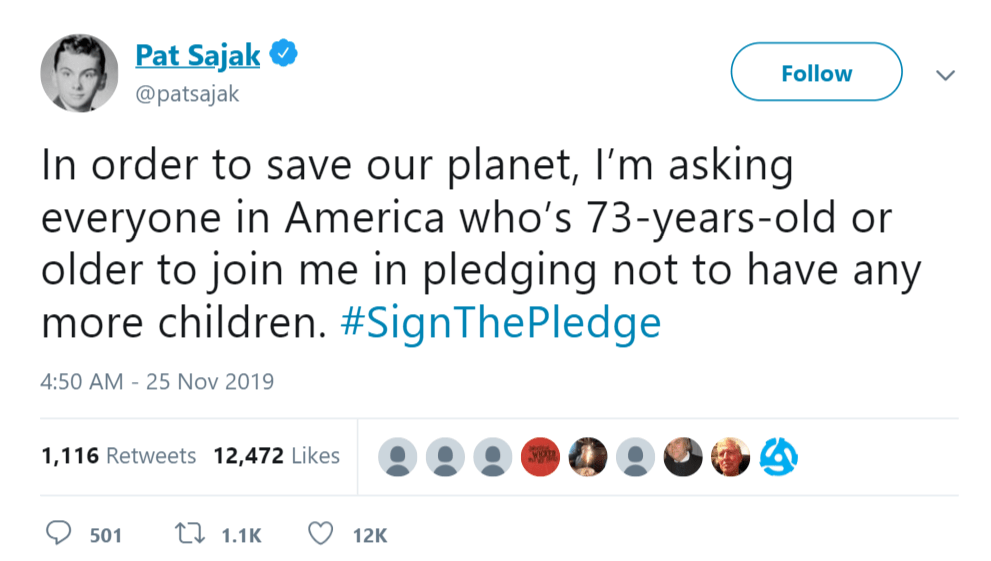
Footnote:  I hope tweets are alright.
Pat Sajak

When someone says (and they will), “O.K. Boomer,”  your response can be, “O.K. Junior, or should I say O.K. Young Whippersnapper (Google it).”

Thanksgiving Climate Arm-Twisting

Enjoy a turkey leg over the holiday, but watch out for warmists pulling your leg.

At Boston University website The Brink, two BU communications experts share advice on handling dinnertime squabbles over the validity of climate science:  How to Deal With Climate Skeptics At Thanksgiving Dinner  Excerpts in italics with my bolds.  I also add some comments from the other side of the table.

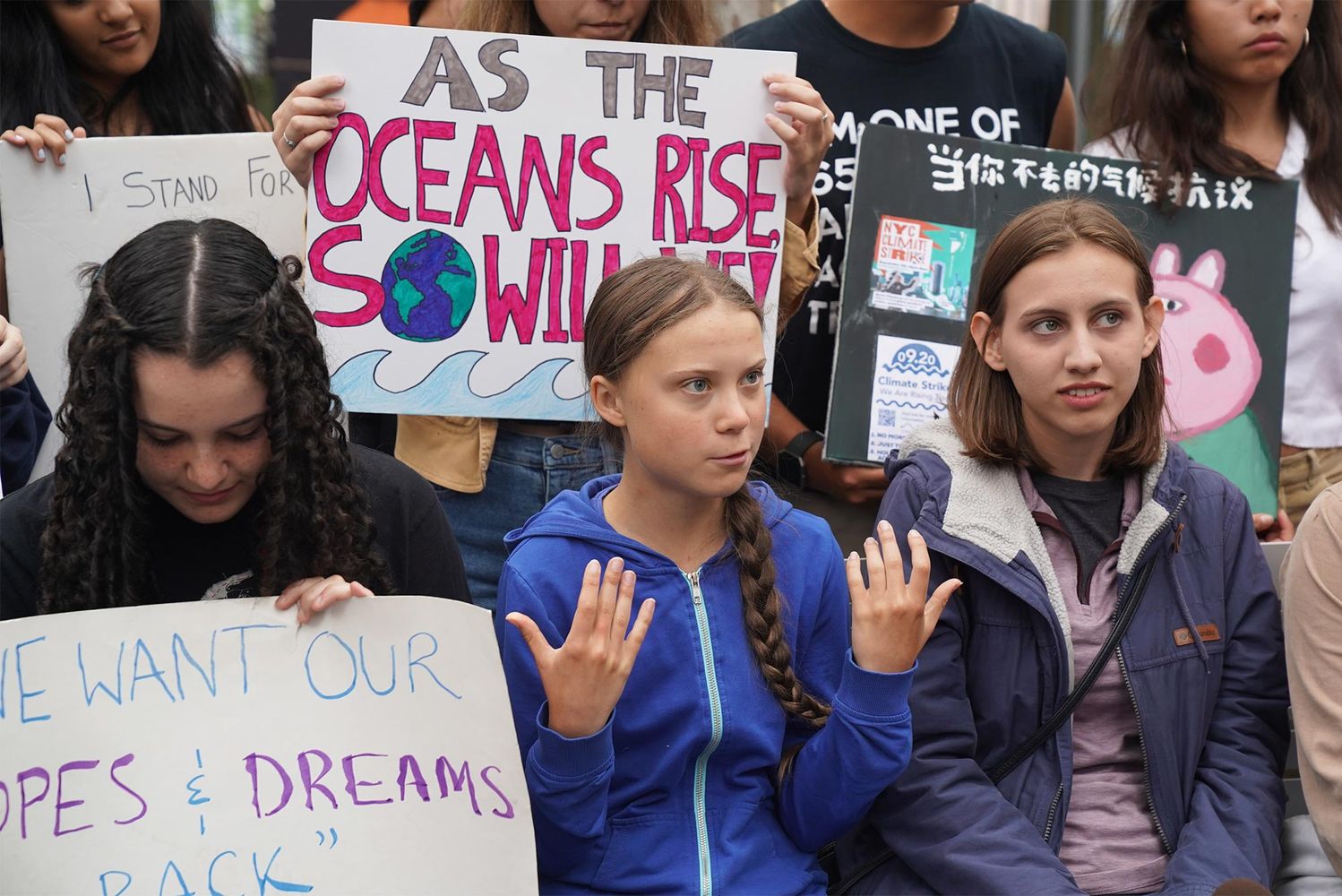
Feel like you’re at a loss for words when a loved one says global warming is a hoax? Arm yourself with advice from BU researchers on how to respond. (Greta Thunberg would be proud.) Photo by Bryan R. Smith/AFP via Getty Images.  [Why should we care about likes from an uneducated 16 year old Swedish child?]

Ah, the holidays. The time of year for cozy gatherings with family and friends, homemade pie, and festive traditions. Many people will embark on long car rides and trips across state lines to visit loved ones in the hometowns they feel they’ve outgrown. And in between mouthfuls of stuffing and gravy, political gripes and disagreements are almost a guarantee.

You might, for example, hear a grumbling or two about the so-called “climate hoax,” backed up by a statement that our current rate of global warming is nothing but a “natural process.” Uh-oh.

[No one has separated out man-made warming from natural warming, either from the Little Ice Age recovery or from solar and oceanic cycles. Why can’t you admit that?]

At this point, more than half of Americans are now “alarmed” or “concerned” about global warming, but the issue is becoming more polarized. Many people distrust the scientific evidence that humans are responsible for pushing our world’s climate toward its breaking point, despite scientific consensus. So, what do you do if you are in the alarmed majority and want to talk about climate science with people who are disengaged, doubtful, or dismissive of it? What if some of those people are your aunts and uncles, or your mother or father? Is it possible to change their minds if the topic comes up over Thanksgiving?

[How trustworthy are the polls? What was asked, in what context and what responses were allowed?
Do you realize that by appealing to a consensus, you are admitting that the question is a matter of opinion not one of scientific fact?  See The Art of Rigging Climate Polls]

Here’s some good news: you are exactly the right person to talk about climate change with your relatives. You are what communication experts call a “trusted messenger,” which is the idea that people are more likely to believe people they trust and more likely to trust people they are personally connected to. And one of the biggest superpowers you, as an individual, have is the ability to communicate the facts.

[Appeal to social proof: Since it is only a matter of opinion, the majority should rule. “Go along to Get Along.”  Never trust someone who says, “Trust me.” Asking for the proof is only offensive to those who have none.]

To best figure out how to communicate climate science to skeptics, we spoke with Sarah Finnie Robinson, senior fellow at BU’s Institute for Sustainable Energy and founder of the 51 Percent Project, which studies the most effective communications messaging for optimal public engagement about climate science. And we spoke with Arunima Krishna, BU College of Communication assistant professor of public relations, who has spent years studying how people talk about controversial social issues like vaccines and climate change. Here’s their advice for how to prepare yourself for any potential dinnertime squabbling on the topic of climate science.

1. Listen first

As the consensus about the climate crisis becomes louder, “there could be a feeling of marginalization,” says Krishna. “In the sense that there is a war against people who don’t want to vaccinate their children, for example.” So, defaulting to lecture mode on sea-level rise is not the best way to break through, since it could feel more like an attack.

[ This sounds tactical: You can lecture later, but soften them up by listening first. And do you realize that sea level is not rising any faster since humans began burning fossil fuels?]

“Sometimes we forget that the other person also has a point of view. I think we need to listen, not to respond, but to understand,” says Krishna. Have a conversation and get to know where your family member or friend is coming from. Why do they believe what they believe? Where are they getting their information?

[Good advice: Impartial surveys show that skeptics are more knowledgeable than knee-jerk warmists. If you find out they have been reading the NIPCC reports, or even the IPCC working group reports (not just the SPM, or the media releases), better to change the subject, prepare to change your own mind, or walk away.]

“Consider who your loved one, for example, trusts for information,” says Robinson. That will help gauge how and why they feel the way they do.

[How about some self-awareness here: Whose words are you taking as gospel truth regarding the future of this complex, uncertain and unpredictable climate system?]

After you’ve listened to your loved one’s perspective, consider sharing your own worries, fears, and hopes for the future. “Share what resonates the most with you,” says Robinson. You can always share some of the actionable lifestyle and behavior changes you have adopted to lower individual carbon impacts, and share how you’ve gotten involved with collective actions.

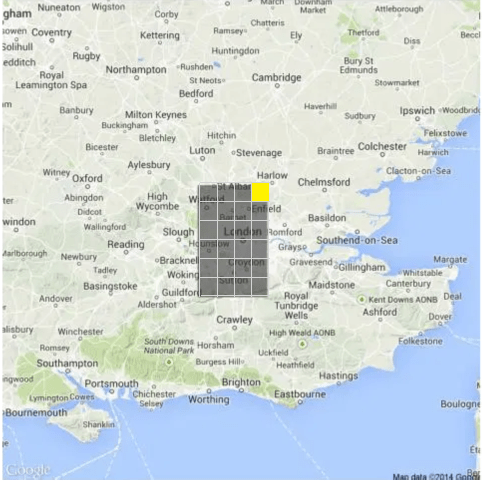
[How about this when someone at the table says, “We really need to do something to fight climate change.” You ask, “What do you propose to do?” When they say, “Leave the fossil fuels in the ground,” you ask, “And replace that energy how?” “Do you know that replacing one gas turbine power plant requires 360 windmills and 60,000 acres of land instead of 20 acres?” See Kelly’s Climate Clarity.]

Approximate area required for all of London’s electricity to come from renewables. Gray area required for wind farms, yellow area for solar farms, to power London UK.

“I would urge you to really listen to what others are saying if they have a differing opinion, to understand where they’re coming from. And then you can formulate your strategies on how best to convey your message,” says Krishna.

2. Bring on the science (but know when to walk away)

“We know 97 percent of all scientists say global warming is definitely happening because of burning fossil fuels. And we know what we have to do to stop it,” says Robinson. She draws on the analogy, “If 97% of doctors told you your appendix should come out, you’d have the surgery. Right? Climate change is happening here and now. And the clock is ticking. The consensus we have is a very powerful fact to convince people around the dining table.”

[ Do you know the 97% figure comes from 75 out of 77 funded climate scientists who agreed to two statements: “The world has warmed since 1850, and human activity contributed to it.”  See Talking Climate.]

Generally, it can never hurt to brush up on your climate facts and answers to common myths. But, as experts like Robinson and Krishna have also pointed out, not everyone responds to facts the same way. The truth is, some people who do not accept scientific facts won’t change their mind because of another bias or interest related to their view of the climate. (Like, what if someone in your family owns a gas station? Or works for a natural gas company?) Most of us are not blank slates when it comes to the topic of climate change, and the more informed we are, the easier it is to cherry-pick information that confirms already-held beliefs and attitudes.

[An example of cherry-picking is claiming that food production is threatened by climate change. In fact world production of food crops is setting records every year due to the growth rates from higher CO2 and warmer, milder temperatures. Rice, wheat and corn are all showing higher yields. Why would we want to stop that?  See Climate Delusional Disorder (Food Fears)]

“You’re going to get blue in the face, and steam is going to come out of your ears, and you’re going to waste all kinds of time that you could have spent with your other, more fun, relatives at Thanksgiving. dinner,” says Robinson. “If you try to argue, it’s just not going to work. You just have to say, well, you’re wrong and move away.”

That doesn’t mean there aren’t skeptics who will listen and be open to a conversation, Robinson cautions. She says the only way to find out if someone has an open mind is to have a dialogue and stick to sharing facts and stories that have resonated most strongly with you.

[Open mindedness cuts both ways.The issue of global warming/climate change has been used to polarize populations for political leverage. Environmentalists like Tisha Schuller have been subjected to years of  threats, extremism, and misinformation from a community to which they once belonged.  The reason: Expressing doubts about the anti-fossil fuel crusade.  See More Civil Climate Discourse

3. Take the issue close to home

Researchers have continuously found that the farther away a climate-related event is perceived to be—like, the notorious lonely polar bear stranded in a melting sea of ice—the less a viewer or listener feels connected to the issue.

“For decades people immediately went ‘Oh, well, that’s too bad that’s happening to the polar bear, but that’s certainly not happening to me, that’s happening far away,’” says Robinson. “Now, public concern is actually increasing because people are beginning to see this more and more with their own eyes.”

[The claims of global warming impacts by “consensus” advocates are dubious at best: See 11 Empty Climate Claims.]

It has also been found that when local news stories cover climate change, people are more likely to understand the direct impacts. So, why not take the same approach when talking with skeptical loved ones? If you’re a Boston local, you can talk about how climate change is already threatening the coast of Cape Cod, causing residents to prepare for stronger storms and rising seas. Or perhaps someone you know has been impacted by the California wildfires that are becoming increasingly more devastating, or the record-breaking flooding in the Midwest, or by storms like Superstorm Sandy and Hurricane Harvey that destroyed US communities.

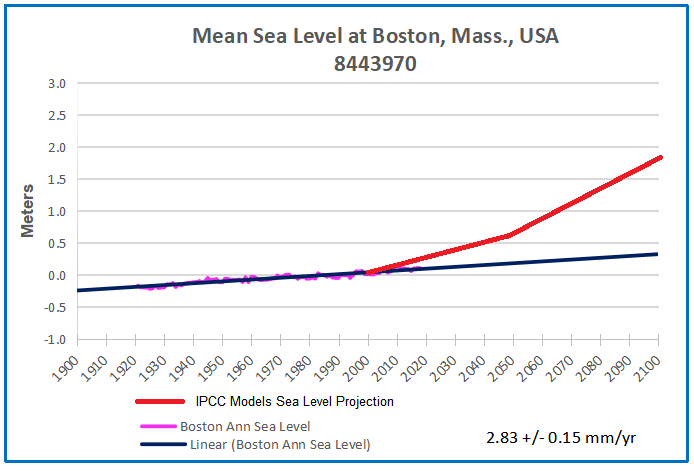
[As for local flooding projections, check the tidal gauges against climate models. See USCS Warnings of Coastal Floodings]

“Climate change is not something that’s 20 years away, or 40 years away, or 100 years away. It’s something that we’re seeing the impact of right now,” Krishna says. “Bringing the issue home or at least talking about the human effects that we’re seeing could be helpful for getting that point across.”

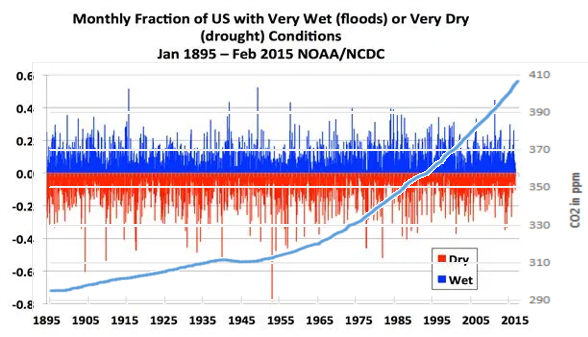
[Weather is not climate; we all used to agree on that before the warming plateau the last two decades.  Statistics show no correlation between rising CO2 and weather events.  For example:]

4. And if all else fails…

Krishna says it can never hurt to remind people, “What’s the harm in trying to have a better, less polluted world? We’ll have cleaner air, cleaner water, a more sustainable planet. How can that be a bad thing?”

[Let’s all agree that fossil fuels have made our air cleaner and our water more pure.  And more atmospheric CO2 is plant food, restoring the forests and increasing our crops.]

But if things start to escalate and the conversation doesn’t feel productive, your best bet is to step back for the sake of your own mental and emotional health, and spend time enjoying your holiday, like Robinson pointed out earlier.

Judges Now Deciding US Energy Policy

Petroleum Engineer or Federal Judge?

A previous post World Energy Policies A Minefield  reported on mistaken climate policies and their threat to our energy system.  Adding to the danger are actions by courts meddling in energy affairs on behalf of anti-fossil fuel activists.  Nicholas Kusnetz writes at alarmist website Inside Climate News U.S. Suspends More Oil and Gas Leases Over What Could Be a Widespread Problem. Excerpts in italics with my bolds.

Fossil Fuel leases totaling hundreds of thousands of acres have been suspended as courts rule against the BLM for ignoring climate impact. 

The federal Bureau of Land Management’s (BLM) Utah office in September voluntarily suspended 130 oil and gas leases after advocacy groups sued, arguing that BLM hadn’t adequately assessed the greenhouse gas emissions associated with drilling and extraction on those leases as required by law.

Nearly a quarter of the nation’s carbon dioxide emissions come from fossil fuels developed on federal lands, according to a government report. Credit: Bureau of Land Management.

The move was unusual because BLM suspended the leases on its own, without waiting for a court to rule.

Some environmental advocates say it could indicate a larger problem for the bureau.

“It is potentially a BLM-wide issue,” said Jayni Hein, natural resources director at the Institute for Policy Integrity at NYU School of Law, which has been involved in similar litigation in other states. “It could have the effect of suspending even more leases across the West, and not just for oil and gas, for coal as well.”

Officials in Utah had already pulled back several other lease sales earlier this year. In effect, BLM appears to be trying to get ahead of potential court rulings, advocates say.

A series of court rulings have established that BLM must conduct a thorough analysis of the climate impacts of drilling before it allows development in order to comply with the National Environmental Policy Act (NEPA).

In the latest ruling, a federal district court in Washington, D.C., in March ordered the bureau to redo its environmental analysis for a slate of leases in Wyoming to better assess climate impacts. In response, BLM suspended the Wyoming leases, as well as leases in Utah and Colorado that were included in the lawsuit but not directly addressed by the ruling.

The new Utah suspensions cover a different set of leases, including many sold last year. In letters sent in September to energy companies that had bought the leases, BLM said it was suspending them “based on the parallels” between the lawsuit over them and the case that resulted in the March ruling in Washington, D.C.


All told, nearly 1 million acres may now be suspended across the West, said Rebecca Fischer, an attorney with WildEarth Guardians, which filed the lawsuit in the Washington, D.C., circuit, including more than 460,000 acres covered by that lawsuit and some 300,000 acres that Utah’s BLM office has suspended since the March ruling.

Environmental advocates say the Trump administration is unlikely to cancel the leases. In Wyoming, BLM issued a new analysis soon after the Washington, D.C., court’s decision in March, arguing that there were no significant climate impacts. Fischer’s group has challenged that new assessment, saying that it too fails to meet the legal requirements. The court has yet to rule on the latest challenge.

Fischer said the lawsuits are part of a larger strategy by advocacy groups to try to block fossil fuel development that they say is incompatible with the need to rapidly cut greenhouse gas emissions to slow climate change. They say the bureau has the authority to deny leases based on their climate impacts, and those climate impacts would become apparent if it conducted a thorough analysis.

“That is our ultimate goal,” she said. “That we can start to keep these oil and gas leases in the ground and start to transition away from dirty fossil fuels.”


FootnoteAttorney General William Barr addressed the intrusion of judges upon Presidential authority as part of his recent speech on the Constitution’s approach to executive power. (here). Some pertinent excerpts in italics with my bolds.

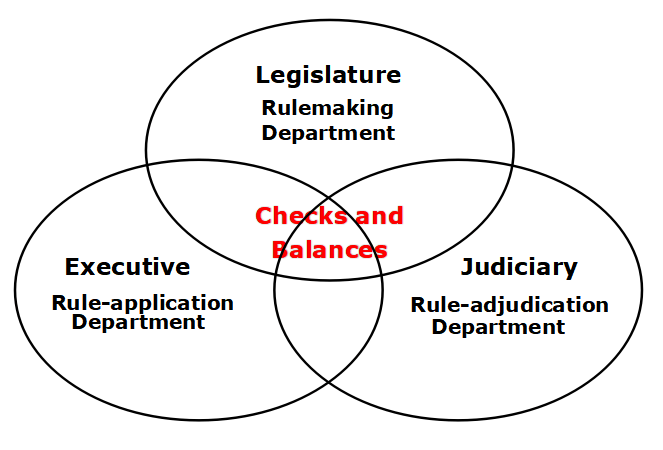
In recent years, both the Legislative and Judicial branches have been responsible for encroaching on the Presidency’s constitutional authority. . .Let me turn now to what I believe has been the prime source of the erosion of separation-of-power principles generally, and Executive Branch authority specifically. I am speaking of the Judicial Branch. checks-and-balances

Apart from their overzealous role in interbranch disputes, the courts have increasingly engaged directly in usurping Presidential decision-making authority for themselves. One way courts have effectively done this is by expanding both the scope and the intensity of judicial review.

In recent years, we have lost sight of the fact that many critical decisions in life are not amenable to the model of judicial decision-making. They cannot be reduced to tidy evidentiary standards and specific quantums of proof in an adversarial process. They require what we used to call prudential judgment. They are decisions that frequently have to be made promptly, on incomplete and uncertain information and necessarily involve weighing a wide range of competing risks and making predictions about the future. Such decisions frequently call into play the “precautionary principle.” This is the principle that when a decision maker is accountable for discharging a certain obligation – such as protecting the public’s safety – it is better, when assessing imperfect information, to be wrong and safe, than wrong and sorry.

It was once well recognized that such matters were largely unreviewable and that the courts should not be substituting their judgments for the prudential judgments reached by the accountable Executive officials. This outlook now seems to have gone by the boards. Courts are now willing, under the banner of judicial review, to substitute their judgment for the President’s on matters that only a few decades ago would have been unimaginable – such as matters involving national security or foreign affairs.

What is true of police officers and gerrymanderers is equally true of the President and senior Executive officials. With very few exceptions, neither the Constitution, nor the Administrative Procedure Act or any other relevant statute, calls for judicial review of executive motive. They apply only to executive action. Attempts by courts to act like amateur psychiatrists attempting to discern an Executive official’s “real motive” — often after ordering invasive discovery into the Executive Branch’s privileged decision-making process — have no more foundation in the law than a subpoena to a court to try to determine a judge’s real motive for issuing its decision. And courts’ indulgence of such claims, even if they are ultimately rejected, represents a serious intrusion on the President’s constitutional prerogatives.

The impact of these judicial intrusions on Executive responsibility have been hugely magnified by another judicial innovation – the nationwide injunction. First used in 1963, and sparely since then until recently, these court orders enjoin enforcement of a policy not just against the parties to a case, but against everyone. Since President Trump took office, district courts have issued over 40 nationwide injunctions against the government. By comparison, during President Obama’s first two years, district courts issued a total of two nationwide injunctions against the government. Both were vacated by the Ninth Circuit.

IT is no exaggeration to say that virtually every major policy of the Trump Administration has been subjected to immediate freezing by the lower courts. No other President has been subjected to such sustained efforts to debilitate his policy agenda.

Judges of the “Whackadoo” Ninth Circuit Court


Climate Doomsday Films Debunked

Debunking The Top 5 Environmental Disaster Films by Julianne Geiger at Oil Price.com Excerpts below in italics with my bolds.

It’s 1983, and the height of the Cold War. The more thoughtful Gen-Xers were contemplating the chances of surviving a nuclear war in a leaky cellar, wondering if the actor-turned-president really knew what he was doing.

They weren’t thinking about whether they had to choose between a world with oil and gas or no world at all due to climate change. There was little polarization.

Climate change seemed far away, indeed. Nuclear war was the clear and present bogeyman.

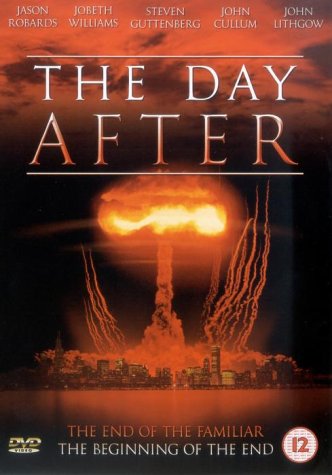
It was difficult to roller skate with any enthusiasm after watching ABC’s TV movie The Day After.

As far as movies go, the nuclear-war-based film definitely wasn’t an Oscar-winner, but it did manage to horrify an entire generation.

The conclusion of nearly everyone after watching this film: That’s it. We’re screwed. And the most horrifying aspect of apocalypse-by-nuclear war is that we can’t blame it on anyone but ourselves. Alien apocalypse movies are so much easier to take.

Since then, given our addiction to anything apocalyptic, a long line-up of environmental disaster films to feed our self-fulfilling prophecies of destruction have made their way through the box office.

While The Day After back in 1983 was, by all accounts, a realistic portrayal of our pending doom, many others that have followed have been about as realistic as an alien invasion.

It’s difficult, after all, to stuff catastrophic climate change into a couple of hours.

Let us debunk some of the best ones for you in the increasingly popular ‘Cli-Fi’ genre:

#1 The Day After Tomorrow (2004)

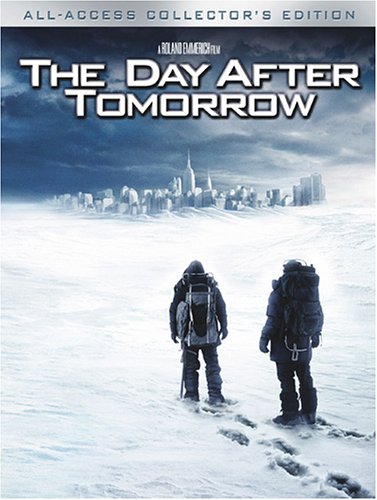
Attempting to leech off the wildly dark popularity of the 1983 doom-and-gloom, The Day After Tomorrow (2004) managed to take home the second-place trophy in an IMDB poll for favorite ‘Cli-Fi’ movie of all time (which we don’t understand).

And that is despite being simultaneously recognized as a work of highly implausible global warming fiction. It doesn’t matter: movie-goers crave catastrophes galore, and this film has a new one every minute.

But it has also been ripped apart by the scientific community–including many climate scientists–for violating nearly every law of thermodynamics.

It’s always one man against the world in movies like this. In this case, it’s a paleoclimatologist who uncovers a climate shift in ice core samples. Predictably, he is ignored and a superstorm plunges the world into catastrophic disaster upon disaster. In other words, the whole premise of the movie is that an ice age is upon us–suddenly.

To add to the hero aspect, the paleoclimatologist must travel across the US–by foot–to save his son, braving the superstorms.

Prior to the movie’s release, scientists worried the plot was so extreme it would lead people to dismiss global warming as a complete fantasy. In all likelihood, the film succeeded in sucking some legitimacy out of the climate crusade.

Wacky science will do that, and in this case, our favorite implausibility is the entire premise of the movie which suggests that a network of massive hurricane-shaped snowstorms covering entire continents deposits enough snow to reflect sunlight and create an ice age within a matter of days. This is a development that the National Center for Atmospheric Research (NCAR) debunks categorically. While temperatures in parts of the world could drop, it wouldn’t create an ice age in a matter of days. Of course, the movie only has an hour and a half to lay out the earth’s demise.

Temperatures that dropped suddenly at a rate of 10 degrees per second; or 600 degrees per minute (satellite readings themselves take even longer than this)

Helicopters crashing to the ground because their fuel froze at -150 degrees F (the tropopause, the coldest part of the troposphere, never reaches this temperature)

People freezing in place so quickly they don’t have time to exit their vehicles.

#2 Interstellar (2014)

Interstellar is definitely one of the better cli-fi movies ever made, and the science is particularly … sciencey.

Some of the science portrayed in the movie was spot on, according to scientists themselves, but some was … theoretical, at best.

The movie starts with a grim picture of an earth no longer able to sustain the growing of crops due to “The Blight”. With the world about to run out of food and humanity on the brink, a few brave souls travel to the outermost reaches of space to find a more suitable home for mankind.

The movie covers the science of a microorganism called the blight–a scenario that is particularly unlikely given that it would span across multiple types of crops, which are all genetically dissimilar.

The film also covers space-time warps (true), slingshotting around a neutron star (unlikely), and beings that can live in five dimensions in the bulk (false).

Despite some artistic liberties, it’s entertainment value is top-notch. Just don’t go rushing home to stock up on grains to prepare for a blight-induced famine. It’s just not going to happen.

#3 San Andreas (2015)

San Andreas wasn’t a work of Hollywood genius, but it has the requisite story of earth’s destruction, and a Hollywood hero played by The Rock. The film may be a fun two hours, but it seems the science behind the movie is a bit suspect.

In San Andreas, the world is rocked by the largest earthquake ever, triggered by the San Andreas fault.

There are so many scientific impossibilities that we’re not even sure where to begin. First, science does not exist to predict earthquakes in the manner shown. There is just no way to predict when and where an earthquake will happen. Second, the San Andreas fault is a land-based fault, and those don’t create tsunamis, let alone the major one shown in the movie. Despite the large earthquake in the film, new buildings are designed–particularly in California–to withstand large quakes.

The San Andreas fault is 800 miles long and 10 or so miles long. Because the magnitude of the earthquake is dependent on the area of the fault, anything more than an 8.3 is unlikely.

And that gaping hole in the ground left by the quake? Utter nonsense. While small crevasses may occur from landslides and such, the ground does not split apart, exposing the major chasm like the one shown in the movie.

#4 Mad Max: Fury Road (2015)

Can the world really run out of water? Will water someday be the new oil?

NASA’s chief water expert, Jay Famigletti, says it absolutely can, adding that California may actually see such a scenario if its drought continues.

In Mad Max: Fury Road, which is set decades after the original Mad Max, water is definitely the new oil, and drilling for it is a horrifyingly violent business.

In the Max Max world, only people with the means to pump water from deep within the earth have any access at all. Those with lesser means are left scrambling for the most precious commodity.

Toxic dust storms and other perils depicted in the movie are possibly exaggerated, but some scientists were quick to jump on the movie’s message, saying that this is the world we may be living in if we fail to work at curbing climate change.

“Our climate models certainly predict increasing ‘desertification’,” Farnigletti said of the film, adding that there were “metaphorical elements of ‘Mad Max’ that are already happening, and that will only worsen with time.”

Farnigletti was careful to add that some conditions in the movie were exaggerated.

#5 Sunshine (2007)

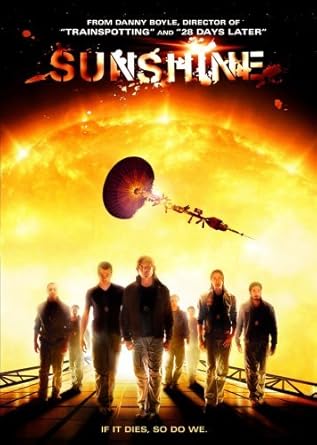
The year is 2057, and Earth’s sun is dying, threatening to end humanity along with it. The planet’s only hope is an internationally diverse group of eight men and women who are brave enough to venture into space with a nuclear fission bomb that is supposed to revive the sun.

The premise is that the sun is being eaten alive from the inside out by a supersymmetric particle called a Q-Ball. It’s based on a theory by Harvard physicist Sidney Coleman, who posited that the Q-Ball may have formed during the Big Bang and potentially had the ability to break down ordinary matter made of protons and neutrons.

We’re not physicists, nor will we attempt to be, but the movie’s theory that the Q-Ball is eating away at the sun like a cancer is debunked by pretty much every scientist out there, not least because the Q-Ball theory itself has never been proven. Scientists from New York University studying the Q-Ball theory say that the biggest problem with the movie is that, if it existed, a Q-Ball would actually have the opposite effect on the sun: It would not die; rather, it’s radiation would vastly increase and we wouldn’t freeze–we’d all fry.

Footnote:  I’m sorry the list excluded my favorite:

That one inspired reflections on the fact our planet is misnamed “Earth”  when it is so obviously “Ocean.”  See Climate Report from the Water World

Coming soon to your neighborhood: Watch for it!

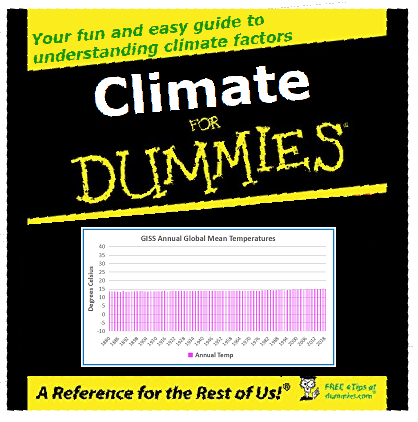
Climate for Dummies

Lubos Motl has a fine post explaining the basics of climate science for the mostly uninformed masses. His article at his blog is Worries about extinction in 10-15 years reveal deep scientific illiteracy of the young, urban masses. Excerpts in italics with my bolds.

A week ago, Scott Rasmussen published results of a poll. The percentage of the Americans willing to believe claims about the possible imminent extinction of the human race is between 1/2 and 1/3. The most shocking numbers say that 51% of the younger voters under 35 believe it is “somewhat likely for humanity to be wiped out [by anything] in a decade”. Similarly, 45% of urban residents think “humanity may be wiped out by climate change in 10-15 years”.

The stupidity of the underlying assertions is breathtaking and the percentage of the people willing to endorse them is terrifying. And the opposition to the cattle and fossil fuels – our most important source of energy – could be just the beginning. Once the staggering stupidity of the masses becomes normal, you may promote even crazier and more devastating superstitions. There seem to be no limits to the stupidity right now.

Some of the Friday kids in the streets are there simply because any excuse to skip the classes is wonderful news. They don’t really believe that the world may end anytime soon. The truly irresponsible people are the principals and other adults that allow these bastards to avoid the education process, of course.

But many of the people must genuinely believe these comments. And the percentage of such people may be between 10% and 51%, too, at least within some demographics. The lack of critical thinking that is needed for such a conclusion is terrifying and such brain-dead people – who still have the right to vote and other rights, despite their brain death – may be abused not only for the climate panic but for hypothetical policies that are even more devastating.

1. Uniformly distributed CO2 can’t possibly increase the frequency of tornadoes, hurricanes, and other things that depend on the non-uniformities of the temperature, pressure, and other things. All the claims that the CO2 causes local weather events are exactly on par with the medieval superstitions promoted during the medieval witch hunts.

2. So if CO2 causes something, it’s a uniform increase of temperature everywhere. The graphs show that the rate of warming is some 1.5 °C a century. It doesn’t make much sense to argue whether we expect 1 °C or 2 °C in the next century.

3. The climate models aren’t terribly trustworthy or useful for the predictions of the temperature trends. Their uncertainties are too high – and we have observed the temperature for many decades to see that the rate 1.5 °C per century is pretty much visible and somewhat constant according to the graphs.

4. The bulk of the insanity isn’t in whether the 1.5 °C per century is man-made; it’s about the question whether it’s dangerous. What can this 1.5 °C of warming per century do? Well, in the 10-15 years when the doomsday is supposed to occur, we will see some 0.15 °C or 0.20 °C, by the rules of proportionality. Can 0.20 °C of warming cause the extinction of the human race?

5. The weather is changing all the time. Several times a year, the temperature jumps or drops by 20 °C within a day – and that’s 100 times greater change than 0.20 °C. And it normally occurs within a day i.e. much faster – not after a decade. The change of the temperature by 0.20 °C is utterly negligible.

6. Even if you want to just measure this temperature and prove that it has changed in a century, you absolutely need all the following conditions to be met: precise thermometers, precision control over their position, averaging over most of the Earth, averaging over seasons as well as day-night cycles, solid statistical methods to average and to apply corrections.

7. The human race has existed throughout the Pleistocene. This species – like millions of others – survived 100 cycles in which the temperature went up and down by as much as 8 °C. The idea that 2 °C of temperature change means “extinction” is beyond silly. Again, recall that the warmer periods were generally the hospitable ones, not vice versa.

8. The idea that the observed recent warming is enough for extinction in 10-15 years is separated from reality by more than 2 orders of magnitude because it’s self-evident that even 20 °C of warming wouldn’t be enough to make humans extinct. You would really need 200 °C of warming (3 orders of magnitude higher than what we expect) to be sufficiently confident that it becomes hard for millions of people to survive.

There’s no way how climate change could kill many people, let alone all people, even in the next century.

It’s Greta’s Worldview We Disavow

Nick Gillespie gets the focus right in his Reason article Think Globally, Shame Constantly: The Rise of Greta Thunberg Environmentalism. Excerpts in italics with my bolds.

Her future—and that of the planet—hasn’t been “stolen” and the best way forward is through serious policy discussion, not histrionics.

To say that reactions to Thunberg are as extreme as her rhetoric is an understatement. . . But despite the volume and vitriol of the attacks directed her way, it’s vitally important that the worldview she represents and the policies she espouses are refuted. Like Rep. Alexandria Ocasio-Cortez (D–N.Y.), Sen. Elizabeth Warren (D–Mass.), and a host of other American politicians, Thunberg believes that we’ve only got a few years left to settle the fate of the planet, a basic tenet pushed by supporters of the Green New Deal and by most of the Democrats running for president. In fact, Thunberg thinks that “cutting our emissions in half in 10 years,” the target invoked by many environmentalists, is too little, too late.

Such catastrophic thinking is similar to AOC’s equally apocalyptic statement that “The world is gonna end in 12 years” and Warren’s contention that “we’ve got, what, 11 years, maybe” to cut our emissions in half to save the planet. As Reason’s Ronald Bailey has documented:

Such predictions stem from a fundamental misreading of a 2018 report from the Intergovernmental Panel on Climate Change (IPCC).

That report offered up predictions in the growth of global economic activity, how it might be affected by climate change, and how reducing greenhouse gases might increase planetary GDP. It did not specify anything like a 10- to 12-year window after which extinction or amelioration is inevitable. Writes Bailey:

If humanity does nothing whatsoever to abate greenhouse gas emissions, the worst-case scenario is that global GDP in 2100 would be 8.2 percent lower than it would otherwise be.

Let’s make those GDP percentages concrete. Assuming no climate change and an global real growth rate of 3 percent per year for the next 81 years, today’s $80 trillion economy would grow to just under $880 trillion by 2100. World population is likely to peak at around 9 billion, so divvying up that GDP suggests that global average income would come to about $98,000 per person. Under the worst-case scenario, global GDP would only be $810 trillion and average income would only be $90,000 per person.

“There is no looming climate change ‘expiration date,'” writes Bailey, a point underscored by Bjorn Lomborg, president of the Copenhagen Consensus Center, which promotes cost-effective policies to remediate climate change, hunger, disease, and other global issues. Lomborg notes that the IPCC itself has found the evidence does not support claims that floods, droughts and cyclones are increasing.

What’s more, the scientists have found that current human-caused global warming cannot reasonably be linked to any of these extreme weather phenomenon-“globally, there is low confidence in attribution of changes in (cyclone) activity to human influence”, “low confidence in detection and attribution of changes in drought” and low confidence “that anthropogenic climate change has affected the frequency and magnitude of floods”. This doesn’t mean there is no problem-just that the facts matter.

There are only better and worse ways to deal with coming changes. Contra Thunberg, the better ways don’t demonize economic growth as a problem but as a solution. “The most inexorable feature of climate-change modeling isn’t the advance of the sea but the steady economic growth that will make life better despite global warming,” writes science journalist Will Boisvert. The environmental Kuznets curve, by which countries get wealthier and their citizens demand a cleaner environment, is the rule, not the exception. Such a dynamic is predicated upon economic and technological innovation that would be almost impossible under the sort of regulations promulgated by Green New Dealers and activists such as Thunberg and Naomi Klein, who wants to “decimate the entire neoliberal project” in the name of environmentalism. Environmental commons tend to deteriorate as countries begin to develop economically—but once per-capita income reaches a certain level, the public starts to demand a cleanup. It’s a U-shaped pattern: Economic growth initially hurts the environment, Bailey reminds us, but after a point it makes things cleaner. By then, slowing or stopping economic growth will delay environmental improvement, including efforts to mitigate the problem of man-made global warming.

Greta Thunberg’s histrionics are likely heartfelt but neither they nor the deplorable responses they conjure are a guide forward to good environmental policy in a world that is getting richer every day. For the first time in human history, half the earth’s population is middle class or wealthier and the rate of deaths from natural disasters is well below what it was even a few decades ago.

Protecting all that is just as important as protecting the environment and, more importantly, those two goals are hardly mutually exclusive.

Childish Climate Power Play

The peformance by Greta at the UN sounded familiar to anyone who has raised children or grandchildren.  We knew first hand what was called the “terrible twos,” when sweet, adorable children frequently and all of a sudden acted out behaviors like:

  • Screaming
  • Temper tantrums
  • Kicking and biting
  • Fighting with siblings
  • Total meltdowns

Such behavior is a way of expressing the need for independence along with frustration at not being in control all the time.

Oftentimes the events involve ” I want, I want, I want”, just as Greta declared: “I want you to panic.”  And in addition there are all the “Greta Wannabes”:

It’s a peculiar and disturbing devlelopment when anyone, including a teenager, becomes a celebrity and attracts followers by being totally certain of something while being ignorant at the same time.  And then to use outbursts of emotional blackmail to tap adults’ guilt feelings:  “If you really loved me, you would do what I want”.  Instead of being grateful for living in a time with so many options and conveniences, what we get is “I will never forgive you for stealing my future.”

Hearing the applause from the UN audience indicated that the ruse is working, that the childish climate power play is successfully manipulating people who should know better from their greater education and life experience.

When I heard that Greta and friends are also launching a lawsuit, it reminded me of this:
Who knows what will happen next?  Here is what I am hoping for:


Beware the Climate Sirens Song

Greek mythology warned of seductive songs luring sailors to crash their ships upon the rocks.  Currently the climate sirens are singing loudly, filling the ears of captains of industries as well as ships of state.  Be forewarned of the latest example of disinformation coming again from IPCC.  Their fourth special report this  year will be a 900-page missive entitled, Special Report on the Ocean and Cryosphere in a Changing Climate, targeted for release to the general public for commentary on September 25.

CleanTechnica had a briefing and brings the message: The World’s Oceans Are Poised To Unleash “Misery On A Global Scale”  Some of the verses from this song in italics with my bolds.

  • Drastic onsequences if humanity does not reinvent how we produce and consume so we can avoid the worst ravages of climate change and environmental degradation.
  • Over the next 80 years, melting glaciers will alternately give too much and then too little fresh water to the multitudes who depend on them.
  • 30% of the northern hemisphere’s surface permafrost could melt by century’s end, unleashing billions of tons of carbon and accelerating global warming even more.
  • Destructive changes already set in motion could see a steady decline in fish stocks;
  • A 100-fold or more increase will occur in the damages caused by superstorms; and,
  • 100s of millions of people will be displaced by rising seas.
  • Acidification is disrupting the ocean’s basic food chain, and marine heatwaves are creating vast oxygen-depleted dead zones.
  • By 2050, many low-lying megacities and small island nations will experience “extreme sea level events” every year,
  • By 2100, “annual flood damages are expected to increase by two to three orders of magnitude,” or 100 to 1,000 fold,
  • Today’s small levels of migration have triggered political instability, while in the future tens of millions of people will be moving because the ocean is eating their land.

The words differ slightly, but the song remains the same:

For those wanting to keep their wits about them, here is some advice from Joel Kotkin writng in New Geography Common Sense Versus Climate Hysteria.  Excerpts in italics with my bolds.

Whether it’s fires in California or Brazil, hurricanes like Dorian or your summer hot spell, it’s not just weather anymore but a sign of the impending apocalypse.

This specter of imminent demise tied to the everyday, notes one American Psychological Association study, has induced “stress, depression and anxiety” among a wide part of the population. The Congress’ leading green advocate, Rep. Alexandria Ocasio-Cortez, admits her climate concerns often wake her up at 3:30 in the morning.

Of course, significant changes in the climate could well be afoot, but our “woke” media and its favored go-to expert class seem more prone to hysteric prophesizing than properly skeptical analysis.

After Katrina devastated New Orleans in 2005, some climatistas confidently predicted that it was harbinger of ever more powerful tropic storms, yet it was followed for 10 years by something of a “hurricane drought” that, sadly, may be at an end.

Little is said about anything that may alter the narrative, such as reports from the National Oceanic and Atmospheric Administration statistics show at most only minimal warming in the United States since 2005.

Few have heard that despite the recent fires in the Amazon, widely portrayed as part of a relentless incendiary burning tied to climate, as Mike Shellenberger notes, there’s been a 25 percent drop in fires globally since 2003; rather than burning up the forest, we have been planting more trees than harvesting them for over three decades.

And remember the California drought that Gov. Jerry Brown and his acolytes linked to climate change? That prolonged dry spell ended in a series of downpours, as it has for much of past 150 years.

The uses of apocalypse

The Catholic Church discovered millennia ago that the prospect of apocalypse provides a brilliant tool of propaganda. To people in the Middle Ages, observed historian Barbara Tuchman, “apocalypse was in the air,” the spawn of human sin. In much the same way the environmental movement links human material aspirations with impending disaster, citing manmade climate change as the singular explanation for everything from starvation, wars and crop failures to hurricanes, floods or any other unusual weather.

Unlike the medieval apocalypse, ours is cloaked in scientism, and is propelled to a certainty by computer models. Yet experience should engender some degree of skepticism — if history-challenged journalists knew different. One of the fundamental documents of modern environmentalism, the widely hailed 1972 Club of Rome report, predicted massive shortages of natural resources and the end of economic growth, claims generally accepted without skepticism in media, academic and political circles.

Yet energy and food subsequently became more plentiful than ever as the world has experienced the largest growth in affluence in its history.

Never called to account, greens and their allies can still follow the same mantra with predictable reliability. Upon the election of President Barack Obama in 2009, NASA’s James Hansen, one of the icons of the climate change movement, announced that the new chief executive had a bare “four years to save the Earth.” A year earlier ABC in 2008 claimed that Manhattan would be “under water” by 2015. None of these predictions, at least so far, have come true.

Hysteria leads to bad policy

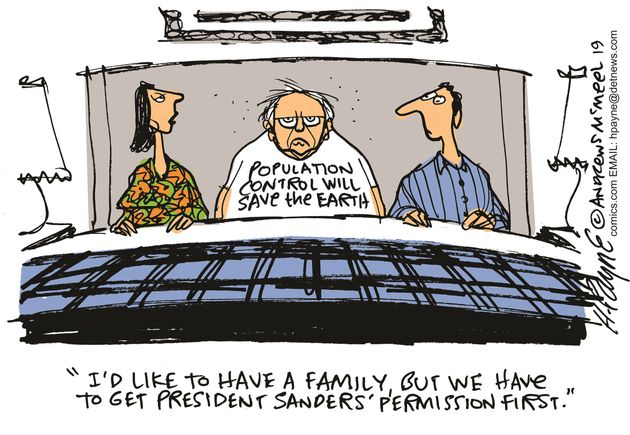
The reinforced specter of imminent destruction increasingly drives the demand for ever more extreme policy choices. Climate researchers at Sweden’s Lund University and Oregon State University have proposed taxes on people who have children for their “carbon legacy,” even at a time of plummeting birthrates.

Part of the problem may stem from the complexity of the issue. The UN’s Intergovernmental Panel on Climate Change itself has suggested that climate prediction is difficult, if not impossible. Most of their projections are far less hysterical than those embraced by the media, which generally report only the most extreme predictions.

But the notion of an impending crisis is useful if you want to lobby for greater control of everyday life.

As one of the architects of the Green New Deal recently said, “Do you guys think of [the GND] as a climate thing? Because we really think of it as a how-do-you-change-the-entire-economy thing.” This proposal, echoed those recently offered by Bernie Sanders, would destroy jobs in many industries, such as aerospace and fossil-fuel energy, and force governments to compensate displaced workers.

Resilience and common sense

Common sense is really what we need. No amount of virtue-signaling by governments, celebrities, royalty or the media can make up for the fact that virtually all growth in greenhouse gases comes not from the West but from China, easily the world’s champion emitter, India and a host of poorer countries. Driving a Tesla or Prius is not going to change much, and many green-backed policies, such as in Germany and California , have done little, if anything, for the climate, but have succeeded in hurting middle- and working-class people far more than the affluent.

Given these realities, the logical course is to focus an intelligent economically sensible transition to a lower-carbon economy while pushing for resiliency measures to deal with the possible results of higher GHG emissions. Rather than seek to turn people into insect eaters and permanent apartment dwellers, perhaps we should push for measures in the new infrastructure bill before Congress to bolster coastal defenses, underground power lines, improve dams and water systems.

The future belongs not to the most self-righteous but the most adaptable.

This is gradually taking root in the policy discussion. After years of opposition, some environmentalists now accept that poorly managed forests in states like California must be trimmed to forestall massive firestorms. Others propose more expenditure on coastal walls, dispersed power systems, desalination plants and better storage of water.

The Netherlands provides a compelling role model here. After experiencing a massive flood in the 16th century, the Dutch embarked on a successful and extensive expansion of coastal berms to prevent future floods and bolstered their economy ever since. In contrast places that failed to address climate-related risks led to the decline of numerous cities in ancient Mesoamerica, the Indus Valley, Cambodia and, more recently, New Orleans.

Ultimately, the climate issue can be best addressed not by fueling anxiety but by adopting a practical and economically feasible approach. Quasi-religious hysteria may provide meaning for activists, but given the global nature of the problem, we need to address it not with panic but reason, and careful consideration about consequences, something in all too short supply today.

Joel Kotkin is the R.C. Hobbs Presidential Fellow in Urban Futures at Chapman University in Orange and executive director of the Houston-based Center for Opportunity Urbanism (www.opportunityurbanism.org)