Al Gore Serial Science Denier

Everett Piper writes in the Washington Post Times The party of science deniers. Excerpts In italics with my bolds.

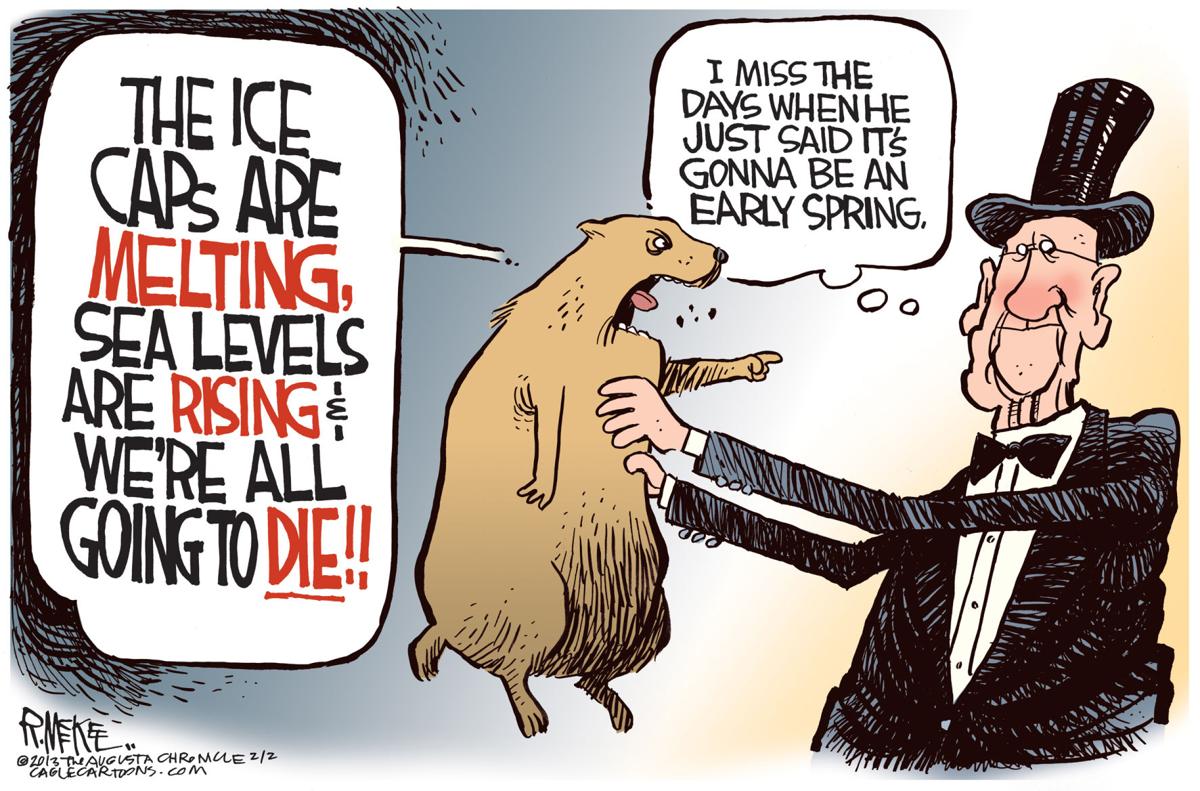
This past Wednesday, May 29, former Vice President Al Gore spoke to the graduating seniors at Harvard University. A summary of his talk? There is an “assault on science” that threatens “the capacity of the human species to endure” on planet Earth.

Mr. Gore proceeded to warn both students and faculty at Wednesday’s annual Class Day convocation, stressing that “reason” and “rational debate” were under threat from what he called “ideology of authoritarianism” by those who disagree with him and his political agenda.

Science “is now being slandered as a conspiracy based on a hoax,” Mr. Gore said. “The subordination of the best scientific evidence is yet another strategy for controlling policy by distorting and suppressing the best available information.”

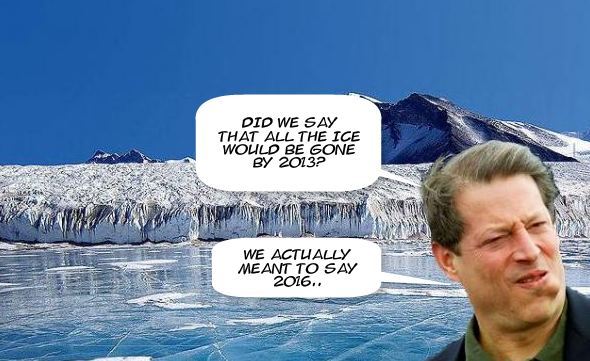
This is the man who told us in 2006 that we had “ten years to save the planet” and that the Arctic would be ice-free by summer of 2014. In case you haven’t checked lately, that has not happened, nor are we even close.

This is the man who, at the same time, said the gulf stream would slow down and cause untold climate devastation as the result. News flash: Current scientific data actually shows the gulf stream has had zero decrease and may actually be speeding up.

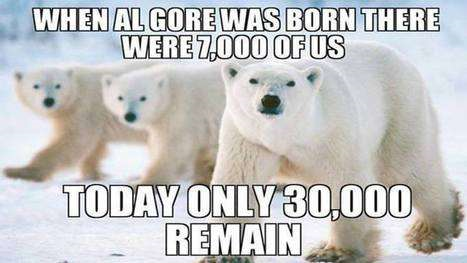
This is the man who warned polar bears would become extinct in just a handful of years because of their loss of habitat. Update: The facts show polar bear numbers are now at an all-time high.

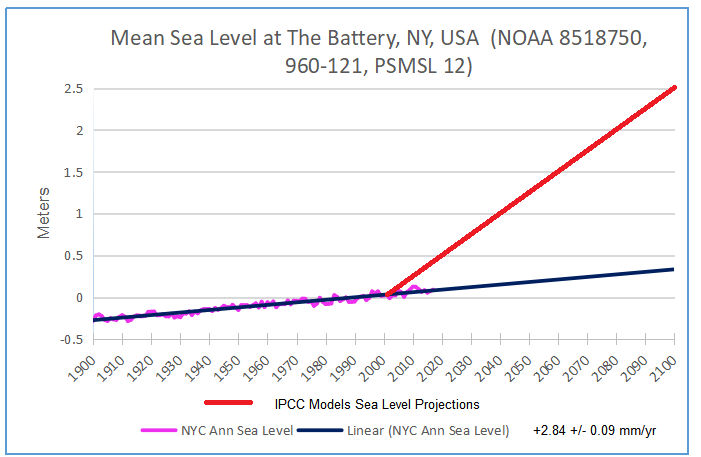
This is the same man who told all of us “sea levels could rise by as much as 20 feet in the near future” when, in fact, current data shows that for decades the pace has been about 3mm per year and has not changed. That’s about the height of two dimes.

This is the same guy who prophesied the rise of CO2 levels would devastate the planet and cause untold human suffering, when in reality, the modest rise in CO2 we actually have experienced has resulted in a global greening that has relieved human poverty around the world.

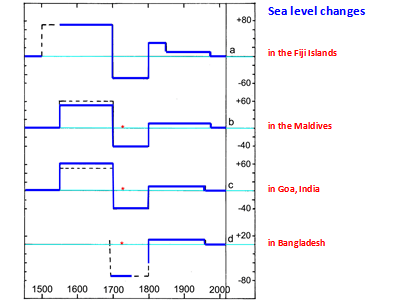
This is a man who predicted the devastation of low-lying Pacific Island nations such as Tuvalu because of rising sea-levels when in fact Tuvalu and some other island nations have actually grown in landmass since Mr. Gore’s doom and gloom pronouncements.

Al Gore is the man who has not only ignored the scientific facts of all the above, but who also is aligned with the party that now has the temerity to deny the biological fact of a female, and thereby pretend that any male can become a female just because he “feels” like it.

This is the same guy who, for decades, has turned a blind eye to the CDC data on sexually transmitted diseases and who promotes a political agenda that has resulted in over 25 percent of our nation’s millennial-aged women now carrying an STD.

This is the same guy who pretends to be pro-woman while denying the fact that women are real and not merely the imagination of dysphoric men who want to pretend and play make-believe.

This is a man who apparently doesn’t understand that it is logically and scientifically impossible to be a feminist if you persist in denying the empirical fact of the feminine.

Mr. Gore’s pseudo-science doesn’t stop with his ignorance of climatology, physiology, sexuality and biology. He demonstrates his ignorance in matters of economics as well. By ignoring the empirical proof that socialism has never, ever, resulted in anything other than the loss of human freedom and human flourishing, he seems oblivious to the fact that if there ever was a political and economic model that smacks of the “ideological authoritarianism” of which he now warns, it is his own.

In testimony before Congress this past year, Judith Curry, former chairman of the School of Earth and Atmospheric Sciences at the Georgia Institute of Technology, said this of Mr. Gore’s political agenda and that of his blind followers: “This behavior risks destroying science’s reputation for honesty. It is this objectivity and honesty which gives science a privileged seat at the table. Without this objectivity and honesty, scientists become regarded as another lobbyist group.”

Ms. Curry’s comment is spot on. Science dies at the hands of its supposed champions when they prove themselves more interested in political power than simply telling the truth.

If Aesop taught us anything, it is this: Crying “wolf” over and over again always proves one simple fact in the end — Truth “is being slandered as a conspiracy based on a hoax.”

• Everett Piper, the former president of Oklahoma Wesleyan University, is a columnist for The Washington Times and author of “Not A Day Care: The Devastating Consequences of Abandoning Truth” (Regnery 2017).


From Climate Change, Holy Government Deliver us!

The nearly religious appeal to government to fix the “climate problem” is childlike, even in the mouths of progressive politicians.  James L. Payne writes at the The Foundation for Economic Education How to Talk to Children about Climate Change.  Excerpts in italics with my bolds.

If in coming years we hope to curb the naive governmental interventions that bring so much ruin to the world, we need to address this belief in the efficacy of government.

We smile at seeing those young faces waving placards out in the rain, urging action on the problem of climate change. But our smile is tinged with frustration, with the feeling that the youngsters live in another dimension and that we don’t know how to reach them intellectually.

How They See It

The natural impulse is to want to explain how crushingly complicated is this issue. First, we point out, there is the uncertainty about the connection between human-released CO2 and storms, floods and fires, and all the other bad things that might happen. Then we want to explain that cutting down on CO2 is not easy, that everyone will have to make great sacrifices.

One has to weigh the different possible benefits that might come from stopping (or slowing) global warming against the costs of trying to counter it. This cost-benefit analysis involves a bundle of economic and moral questions. (For a good overview of the complexities of the climate change issue, read former NASA scientist Roy W. Spencer’s 2008 book Climate Confusion.) For example, would saving butterfly X from extinction (assuming we could guarantee it) counterbalance the harm done to the working poor by taking $1,000 a year from each of them in a carbon tax? And so on.

However, I think this impulse to debate the complexities of the issue is misguided. The activists do not base their position on reasoning and calculations. The Climate Kids don’t come to their demonstrations pushing wheelbarrows full of cost-benefit analyses. Most of them don’t even know what cost-benefit analysis is. More importantly, they don’t think they need to know about it.

This is because, in their way of looking at the world, it is not their responsibility to fix society’s problems. That task belongs to a higher power, to government. Their mission is simply to beseech this higher power to act. Once it decides to act, they believe, government has all the expertise needed to make the correct calculations and the ability to craft policies that solve the problem without significantly hurting anybody—well, anybody except the very rich.

We should not be all that surprised by their deep, instinctive trust of government. It is a social predisposition, one that affects all of us to some degree. The belief in government’s wisdom and power is imparted to children very early in life as an article of faith, like the belief in Santa Claus. As children grow up, they begin to notice that government has flaws and that political leaders are not as wise as originally supposed. As a result, their faith in government declines somewhat, so that by age 30, as traditional wisdom has it, most people grow somewhat skeptical about government’s ability to cure the world’s problems.

But not everyone, and especially not today’s climate activists. Faced with a staggeringly complex cost-benefit analysis that has most of us (older) folks scratching our heads, they are brimming with certainty that catastrophe is coming, and government can fix whatever is wrong.

Government Can’t Save the Planet

We were given a telling illustration of this simplistic faith earlier this year when 29-year-old US Representative Alexandria Ocasio-Cortez presented her “Green New Deal” proposal. This House resolution mentions dozens of dangers and problems that she believes to be connected with climate change, from mass migrations, wildfires, and the loss of coral reefs to declining life expectancy, wage stagnation, and the racial wealth divide.

How are these all problems to be solved? Ms. Ocasio-Cortez does not propose any specific law or regulation. She does not advocate, let’s say, a 16 percent carbon tax and assure us that, according to her calculations, this measure will save 61 percent of the coral reefs, and prevent 53 percent of wildfires while reducing the income of the poor by only 8.2 percent.

Like the schoolchildren demonstrating in the street, she leaves the task of figuring out the specific answers to a higher power. Indeed, her resolution begins with this appeal to the higher power: “It is the duty of the Federal Government to create a Green New Deal.” Thus runs the thoughtless faith in government, a faith so deep that even an activist who literally is the government herself looks to “government” to solve problems she can’t begin to analyze.

testers-will-become-extinct-600x330

If in coming years we hope to curb the naive governmental interventions that bring so much ruin to the world, we need to address this belief in the efficacy of government. We need to urge our young idealists to remember that government is not a god with magical powers to fix any problem we notice but an imperfect agency composed of fallible human beings. One way to begin this conversation is to pose this question: “Given what you know about the people who have been in charge of government, is it reasonable to expect, in the future, a high level of rationality and responsibility from government?”

Dr. James L. Payne is a research fellow at the Independent Institute and author. He earned his PhD in political science from the University of California at Berkeley, and he has taught political science at a number of universities including Yale University.

Summary

As the stool above shows, the climate change package sits on three premises. The first is the science bit, consisting of an unproven claim that observed warming is caused by humans burning fossil fuels. The second part rests on impact studies from billions of research dollars spent uncovering any and all possible negatives from warming. And the third leg is climate policies showing how governments can “fight climate change.”

It has warmed since the Little Ice Age with many factors involved, most of which are orders of magnitude more powerful than CO2.  Secondly, the last 1.5C of warming was a boon to humans and nature, and the next 1.5C will likely also benefit the world.  Finally it is naive to believe in government fixing the climate to prevent further warming.  Expensive, intermittent wind and solar power is the proposed solution, which accounts for just 2% of global energy consumed, and has proven disastrous anywhere it has been tried.  In the meantime the children are appeased by declaring a “climate emergency.”  Wake up and get real.

Greens Killing Electricity, Nuclear In Decline

Green energy initiatives are steadily undermining the electrical grid essential to modern society. Coal-fired power is often termed “Climate Enemy #1”, but the War on Nuclear Energy started much earlier and has been more successful. This century is seeing many NPP closures, and almost none constructed.

The problem is that Nuclear plants produce neither dispatchable nor nondispatachable power. Capital costs are high while variable costs of nuclear electricity are very low, and plants have long 30 to 40 year lifetimes. Nuclear is economic as a base load producer of reliable electricity 24/7. It is not intermittent like wind and solar, and not very flexible like coal, gas or hydro to ramp up or down to meet changing demand. As we shall see, public policies as well as markets are now skewed in favor of wind and solar. The deck is stacked against Nuclear, and base load supply to electrical grids is threatened, not to mention dreams of zero carbon power production.

Update June 5, 2019 Ohio House passes bill to save nuclear power plants with Democrats Support Reuters

Update May 31, 2019 at bottom Democrats’ Curious Disdain for Nuclear Power

Background: War on Nuclear Power

From Environmental Progress, excerpts in italics with my bolds.

Nuclear has declined as a share of global electricity since 1995, and in absolute terms since 2006.

Nuclear’s underlying problem has to do with the well-funded and well-organized war against it that began in the 1960s.

Anti-nuclear groups opposed nuclear for being abundant and cheap and sought to make it expensive and scarce.

Anti-nuclear groups and individuals have consistently advocated coal and natural gas instead of nuclear for 40 years, and often accept contributions from fossil and other energy companies.

Even though nuclear is the safest way to make reliable electricity, it is regulated as though it is the most dangerous.

Opponents of nuclear have won large federal subsidies for wind and solar that have been in place for a quarter-century, and state clean energy mandates that explicitly exclude nuclear.

While it is tempting to blame low natural gas prices and misplaced post-Fukushima jitters, nuclear’s troubles are rooted in regulatory capture — a capture that finds its genesis in the origins of the U.S. environmental movement. This capture is now threatening to bring this climate-friendly energy source to the brink.

Everywhere the underlying reason is the same: anti-nuclear forces, in tandem with rent-seeking economic interests, have captured government policies. On one extreme lies Germany, which decided to speed up the closure of its nuclear plants following Fukushima. In Sweden the government imposed a special tax on nuclear. In the U.S., solar and wind are far more heavily subsidized than nuclear. And states across the nation have enacted Renewable Portfolio Standards, RPS, that mandate rising wind and solar, and that exclude nuclear.

In flat contradiction of their stated views that climate change represents an imminent catastrophic threat, anti-nuclear environmentalists from Germany to Illinois to California bless the burning of fossil fuels if it means they can force the closure of a nuclear power plant.

“We don’t need nuclear power,” environmental activist Bill McKibben told an audience at Middlebury in 2014, after a showing of the pro-nuclear documentary “Pandora’s Promise.” The world, he has repeatedly insisted, can be powered entirely on wind, water and solar energies. At the same time, Vermont Senator Bernie Sanders, whom McKibben endorsed early in the Democratic presidential nomination process, and national environmental groups, were quietly blessing the replacement of Vermont Yankee with natural gas.

The problem with nuclear is that it is unpopular, a victim of a 50 year-long concerted effort by fossil fuel, renewable energy, anti-nuclear weapons campaigners, and misanthropic environmentalists to ban the technology.

The Current Battle to Save Ohio’s Electrical Grid

Jessie Balmert writes in the Cincinnati Enquirer with an obvious bias against nuclear energy and in favor of wind and solar. Energy overhaul: ‘Clean Air Program’ just for nuclear plants, not wind or solar. Excerpts in italics with my bolds.

FirstEnergy Solutions, owner and operator of the Davis-Besse Nuclear Power Station, has cleared a hurdle in its bankruptcy proceedings after U.S. Bankruptcy Court Judge Alan Koschik on Monday approved FES’ amended reorganization plan. It was the fifth revised plan filed in bankruptcy court by FES. (Photo: File)

COLUMBUS – Ohio Republicans’ energy overhaul started as a thinly veiled attempt to rescue two northern Ohio nuclear plants with new fees on everyone’s electric bills.

Now, the veil is off.

Changes made to House Bill 6 last week would direct most of the $197.6 million collected from new fees on Ohioans’ electric bills to Akron-based FirstEnergy Solutions, which operates two nuclear plants outside Toledo and Cleveland.

Renewable energy companies from wind to solar would not get a cut of this “Ohio Clean Air Program.”

In a double blow, lawmakers also axed current programs that encourage electricity providers to purchase renewable energy and help customers become more energy efficient.

And lawmakers ensured utilities could charge customers a fee for two coal plants operated by Piketon-based Ohio Valley Electric Corporation through 2030. The plants are located in Gallipolis and Madison, Indiana.

The cost of a bailout

The latest version of House Bill 6 would charge Ohioans a $1 fee each month starting in 2021 for nuclear energy. The fee is higher for businesses ($15) and industrial customers ($250 to $2,500). Those fees end after 2026.

The proposal also allows electric companies to charge residents up to $2.50 each month for the two coal plants. This isn’t a new charge for many electricity customers, who are billed between $0.51 and $1.64 a month for these plants thanks to an Ohio Supreme Court decision. (An average Duke Energy Ohio residential customer pays $0.97 a month.)

But the proposed changes would lock that fee in until 2030.

At the same time, the bill eliminates current green energy and energy efficiency requirements, which cost the average customer about $4.39 each month.

Republican lawmakers argued the state shouldn’t be picking winners and losers in the energy market. Meanwhile, the bill has clear winners: nuclear and coal.

“My goal would be we should eventually get rid of all of this stuff and just let everybody compete as best as we can,” said Rep. Nino Vitale, R-Urbana, who leads the committee where the energy bill is being debated.

But the federal government already offers tax credits and benefits to renewable energy, creating an uneven playing field, Vitale said.

“Part of this bill is to correct the distortion – not bail someone out,” Vitale said.

At the heart of the debate is whether Ohio taxpayers should save FirstEnergy Solutions.

The company, which was spun off from parent FirstEnergy Corp., filed for bankruptcy in March 2018 with more than $2.8 billion in debt.

Without help from taxpayers, FirstEnergy Solutions says the company will close its two nuclear plants in Ohio: Davis-Besse, east of Toledo, in May 2020 and Perry, east of Cleveland, in May 2021.

The two plants employ more than 1,300 skilled workers who pay taxes and raise children in northern Ohio.

“We like to produce power in Ohio and use Ohio power,” said Larry Tscherne, business manager for International Brotherhood of Electrical Workers Local 245, which represents Davis-Besse workers.

But opponents of the bailout say FirstEnergy made poor business decisions by investing in coal and nuclear plants rather than diversifying its energy portfolio. The company’s financial situation is not Ohio ratepayers’ problem.

Nuclear energy is costly compared to natural gas, coal and some renewable energy. Nuclear plants require security, disaster plans and maintenance that other plants do not. That has made nuclear energy dependent on subsidies to survive nationwide.

“Clean air is obviously good,” testified Michael Haugh with the Ohio Consumers’ Counsel. “But having state government choose outcomes in the competitive marketplace is not good.”

The Case for Nuclear Power from Steffen Henne, head of research for the Center for Industrial Progress.

Q: The Ohio General Assembly is debating a new bill that would subsidize our two nuclear plants to keep them open. Apparently, the plants produce 14 percent of the state’s power. Would shutting them down (as seems likely if the bill fails) almost certainly raise carbon emissions, at least in the short term?

HENNE: This depends on many factors, including how much electricity from other states will be imported and how much new natural gas capacity will replace Ohio’s coal fleet in the coming years to fill the gap. Ohio’s power generation is dominated by natural gas (34 percent) and coal (47 percent) right now. Taking out 14-15 percent of zero-CO2 generation immediately would definitely lead to higher CO2 emissions compared to keeping these power plants alive, even if the absolute emissions might decline over time.

It’s noteworthy that the problems of nuclear and coal power plants to turn a profit are in some significant way rooted in the presence of unreliable solar and wind. Both technologies are able to produce very cheap baseload electricity but in an environment where solar and wind can just produce when the weather is right and every other generator has to adapt to the gluts and shortfalls, the cost this creates are high for nuclear and coal plants, which have been built to run at high capacity constantly. The current nuclear reactors are usually inefficient at what’s called load following because they were not designed to do that. Although solar and wind create the problem, they don’t have to pay for the cost in the current regulatory framework.

To the extent natural gas outcompetes nuclear on fair terms, that’s a different story, but it rarely makes sense to build a new natural gas power plant if the existing nuclear capacity could still do the job. And natural gas still emits more CO2 than existing nuclear power plants in any assessment I have ever seen.

Q: Does nuclear power offer the best hope as a power source that produces energy without carbon emissions and is available 24-7? Are the Generation IV nuclear power plants as promising as their proponents claim?

HENNE: There are really only two major countries that have created affordable, abundant power with low CO2 emissions, France and Sweden, and both have done it by using nuclear technology. You can use wind and solar to some extent and at a high cost, as Denmark has done, but this is not really scalable. Denmark now has the highest electricity prices in Europe together with Germany, in large part because of their focus on wind, and they are dependent on the constant imports and exports of power to stabilize their power grid. Without the availability of large conventional power fleets in their neighborhood, the wind experiment would already be over and Danes would sit in the dark. Germany doesn’t even meet its short-term goals in CO2 emission reductions because their costly scaling of solar and wind is completely insufficient.

Yes, nuclear energy right now is the only way to reduce CO2 by significant margins without ruining the economy, grid reliability, and energy security. That is because of the inherent properties in nuclear technology, which turns an abundantly available raw material into a concentrated energy source that does not emit CO2 from a chemical combustion process.

Generation IV is an umbrella term that applies to a variety of different technologies. It is difficult to judge at this stage which of these technologies will be successful or most successful at delivering the most abundant, affordable, and reliable energy. But some of the concepts are really promising. There are, for example, fast spectrum reactors, which promise to be able to use the “waste” of other nuclear fission reactors as fuel and overall increase efficiency of the fuel. Today’s typical reactors only use a tiny fraction of the energy content in the uranium or other fuels, which means there is huge potential for efficiency increase with innovation. Other innovative approaches seek to circumvent the cost escalations in the current American regulatory and anti-nuclear social framework, which for the industry means large reactors will be delayed for years or even decades, increasing the upfront cost. Small modular reactors, which can be built in a factory instead of requiring extensive on-site work, might be a good option to reduce cost.

All that innovation potential should be exciting news for everyone concerned about CO2 emissions and the availability of affordable energy to advance human flourishing.

Q: What do you make of the fact that green organizations generally oppose nuclear power, and also insist that climate change is an emergency that must be addressed immediately?

HENNE: I think we have to recognize that for organizations like Greenpeace it doesn’t make sense to actually solve a problem. The more abstract and diffuse the doomsday narrative, the better for their business model. Both climate change catastrophism and nuclear catastrophism are really great for them.

There is also an esoteric religious component to it. The reason why wind and solar are the preferred green “solution” is that they are supposedly natural versus the “artificial” splitting of the atom. Facts don’t matter in that narrative. Although nuclear is the safest technology to generate power it is still vilified as poisonous and dangerous.

Solar and wind are not proposed because they are real solutions but because they fit into that religious thinking.

The most immoral part of it is the absolute disregard for human flourishing. If you cannot afford energy, you have no energy. If you don’t have reliable energy, you have no energy. But affordable and reliable energy is probably the most central aspect of our survival and safety, including safety from climate. Over the last 100 years, climate-related deaths plummeted. Not because the climate suddenly became so much better for us, although the mild warming and increasing CO2 over recent decades was certainly beneficial to us, but because we were able to use technology to protect us from a naturally dangerous environment. And that required the caliber of energy that so far only fossil fuels, nuclear technology, and to some extent large-scale hydropower were able to deliver on a scale of billions.

Summation from Michael Schellenberger at Quillette Why Renewables Can’t Save the Planet

The problem with nuclear is that it is unpopular, a victim of a 50 year-long concerted effort by fossil fuel, renewable energy, anti-nuclear weapons campaigners, and misanthropic environmentalists to ban the technology.

In response, the nuclear industry suffers battered wife syndrome, and constantly apologizes for its best attributes, from its waste to its safety.

Lately, the nuclear industry has promoted the idea that, in order to deal with climate change, “we need a mix of clean energy sources,” including solar, wind and nuclear. It was something I used to believe, and say, in part because it’s what people want to hear. The problem is that it’s not true.

France shows that moving from mostly nuclear electricity to a mix of nuclear and renewables results in more carbon emissions, due to using more natural gas, and higher prices, to the unreliability of solar and wind.

Oil and gas investors know this, which is why they made a political alliance with renewables companies, and why oil and gas companies have been spending millions of dollars on advertisements promoting solar, and funneling millions of dollars to said environmental groups to provide public relations cover.

What is to be done? The most important thing is for scientists and conservationists to start telling the truth about renewables and nuclear, and the relationship between energy density and environmental impact.

“Nuclear power is one of the chief long-term hopes for conservation … Cheap energy in unlimited quantities is one of the chief factors in allowing a large rapidly growing population to preserve wildlands, open space, and lands of high scenic value … With energy we can afford the luxury of setting aside lands from productive uses.”

Fifty years of empirical research show that Siri was right and the anti-growth anti-people extremists who started the anti- nuclear movement were wrong. More energy is good for people, and it’s good for nature.

Energy allows cities and agricultural intensification, which frees the countryside for return of forests and wildlife. Moving to nuclear frees us from air pollution, including carbon emissions.

Update May 31, 2019 Democrats’ Curious Disdain for Nuclear Power

Just published at National Review:  Until they embrace nuclear energy as a key to reducing emissions, the party’s many presidential candidates will be hard to take seriously on climate change.  Excerpts in italics with my bolds.

The Democrats’ disdain for nuclear energy deserves attention, because there is no credible pathway toward large-scale decarbonization that doesn’t include lots of it. That fact was reinforced Tuesday, when the International Energy Agency published a report declaring that without more nuclear energy, global carbon dioxide emissions will surge and “efforts to transition to a cleaner energy system will become drastically harder and more costly.”

At the same time that an increasing number of rural communities are fighting the encroachment of large-scale renewable projects, the U.S. is facing a wave of nuclear-reactor retirements. Nine reactors in the U.S. are slated to be retired over the next three years, and the IEA estimates that domestic nuclear capacity could shrink by more than half in the next 20 years. The agency points to the many challenges facing the nuclear sector, including increased regulations, low-cost natural gas, and competition from subsidized renewables.

This is, frankly, one of the biggest and longest-running disconnects in American politics: The leaders of the Democratic party insist that the U.S. must make big cuts in greenhouse-gas emissions because of the threat posed by climate change, but for nearly five decades, they have either ignored or professed outright opposition to nuclear energy. The last time the party’s platform contained a positive statement about nuclear power was way back in 1972.

America’s top Democrats repeatedly tout the need for “clean” energy and massive deployments of wind and solar power, but by denying the role that nuclear energy must play in any successful decarbonization efforts, they are ignoring the scientific consensus. If they truly care about the dangers posed by climate change, they should stand up and tell the truth about the need for nuclear energy. Until that happens, their various plans to address the issue will be impossible to take seriously.

Footnote:

Many do not realize how intermittent power from wind and solar farms cannibalize the electricity supply.  Since wind and solar capacity is subsidized, any actual power they produce gets top priority for consumption, since it has little or no marginal cost to the grid.  So on days when solar power is abundant in the afternoon, it absorbs the high price demand, while base load and dispatchable plants are denied that revenue.  That pattern will drive those plants into bankruptcy, leaving the grid without backup power, unless more subsidies are added to keep them open.

NPR Defends Pseudo-Science

This morning in the car doing some errands I listened to an NPR broadcast regarding a NYT article claiming the Trump administration is attacking the fundamentals of climate science. Two journalists involved in the NYT article made two revealing defenses of IPCC climate ideology.

First they objected to the Geological Survey decision to limit consideration (required by US law) of climate change to impacts foreseen between now and 2040, setting aside projections out to 2100. Their reasoning: We won’t see any significant effects from our reducing (or not) CO2 emissions until the second half of this century. All of the forecasted temperature rise of 8F, along with sea level rise, storms, droughts, floods, etc. is only seen to occur after 2040. How do they know this? It is certain because it comes directly from the Oracle of Delphi the Climate Models, which have so accurately forecast the climate in the past (sic).  All the pressure to unplug industrial civilization now, with results to appear many decades later.

Then they expressed shock that a Presidential Commission may be set up to review and questions climate assumptions put into agency planning. They said everyone agrees on the science of global warming, and this is not the way climate science is done. The two journalists, without a single bit of self-awareness, proceeded to discredit the possible chairman William Happer by saying he was not a “climate scientist.” Like, how would they know? He is a world expert on atmospheric gases responses to infrared radiation, which is the supposed mechanism of man made global warming, and something about which they  are  clueless.

In other news today, Arnold Swartzenegger was “starstruck” to meet with teen climate activist Greta Thunberg. How bad will this nightmare get before people wake up?

See Also Stop Fake Science. Approve the PCCS!

Get a Second Opinion Before Climate Surgery

New Low in Climate Posturing

At least Madonna posing was entertaining, and children get to feel good about skipping school in order to stop the climate from changing.  But some posturing is both vapid and damaging.

The New York Post Editorial Board explains: A new low in posturing over climate change. Excerpts in italics with my bolds.

Of all New York politicians’ efforts to posture on climate change, the drive to divest public pension funds from fossil fuels may be the most deranged.

The bill from state Sen. Liz Krueger (D-Manhattan) and Assemblyman Felix Ortiz (D-B’klyn) would force state Comptroller Tom DiNapoli to sell off all the fund’s holdings in the 200 largest oil, gas and coal companies within five years.

The unions whose members’ retirements depend on the funds are against it. A union-funded report found that the fossil-fuel holdings outperform their green-energy counterparts in the long term.

Also in opposition is DiNapoli, who notes that “manipulation by legislative fiat has hurt pension funds in other states.”

The pension fund pays more than $1 billion a month in benefits. With an unaudited value of $210.2 billion, it now has about $6 billion in fossil-fuel stocks. Diversification of investments is central to fiscal prudence: Let politicians start banning any given stock, and you’re well on the road to requiring a massive taxpayer bailout — and/or huge cuts to the pensions of some classes of retirees.

Thankfully, New York courts have struck down past legislative efforts to mandate specific investment decisions: The state Constitution protects the comptroller’s discretion.

But that’s no guarantee that the principle will survive the climate-change zealots. After all, Gov. Andrew Cuomo has called on the state authorities he controls (the MTA, the New York Power Authority, the Thruway Authority) to divest from fossil fuels.

All that magical thinking about fighting climate change just might persuade state judges. And DiNapoli is surely worried that, if he goes to court over the issue, he’ll face a challenger in the next election who’ll promise to do as the green extremists demand.

Sensible lawmakers need to quash this nonsense before it goes any further.

Are you wealthy enough to believe in Climate Change?

Some insights from an article by Adam Brickley in the Daily Signal Australia’s Election Shock Shows the Perils of Moralizing Climate Change. Excerpts in italics with my bolds.

One post-mortem on the election from the Australian Broadcasting Corporation pointed out the wealth issue thusly:

In [Warringah’s] case and in other inner-city seats, support for climate action looks broadly consistent with a “post-materialist” sensibility. … Here the emphasis on quality of life over immediate economic and physical needs encourages a focus on issues like climate change. But this is a sensibility that speaks to those in higher socio-economic brackets, and principally with higher levels of education.

Put more bluntly, climate-based politics appeal primarily to those insulated from the potential economic consequences of climate policies by their high incomes, and shielded from even seeing those effects by their urbanized lifestyles.

Those not materially blessed enough to live as “post-materialists,” however, still make their decisions based on what it takes to put food on the table, pay the rent, and provide for their families.

This sort of growing rich-poor political divide is not unique to Australia. In Israel, working-class Israelis have solidified behind Prime Minister Benjamin Netanyahu while wealthy areas swing strongly against him.

In the United States, Donald Trump won states like Michigan and Wisconsin while some of Brooklyn’s trendiest neighborhoods elected Alexandria Ocasio-Cortez to the House.

It’s not just that the working class is drifting right. The upper classes, especially in gentrifying inner cities, are gravitating hard to a left that is increasingly focused on perceived moral issues and less interested in bread-and-butter economics.

However, there is one key difference that makes Australia unique. Perhaps more than any other nation, Australia has seen climate change loom over its politics for over a decade.

Former Labor Prime Minister Kevin Rudd made it the signature issue of his premiership from 2007-2010, with at least one costly program literally going up in flames. Rudd’s plan to re-insulate Australian homes for energy efficiency failed to account for the flammability of the new insulation and led to the deaths of four workers.

In 2009, Rudd’s cap-and-trade proposal caused a massive split in the Liberal Party when then-party leader Malcolm Turnbull tried to force the party to support Rudd on the issue—leading the party’s legislators to remove him and replace him with anti-cap-and-trade leader Tony Abbott.

Australia has been through “climate change elections” before, and experimented with environmental policy as much as any nation on Earth. The results illustrate what happens when politics becomes centered on creating a “better world” by making life harder in the real world.

Such ideas may gain traction among those who know they can afford to weather the storm, and the rich can condemn the poor for their “materialism” in rejecting the new order, but working people (rightly) prioritize feeding their children as a higher moral goal.

Given that Australia’s ever-shifting politics has sometimes drawn comparisons to “Game of Thrones,” perhaps it’s worth noting that Australian Labor and Daenerys Targaryen learned the same lesson in their big finales this weekend: No matter how lofty your aims, there’s little morality in burning the world down in the name of building a better one.

Bill Nye, Bad Science Guy

Bill Nye has a history of pushing bad science, including but not limited to climate change/global warming. Alex Berezow explains at American Council on Science and Health Bill Nye Is A Terrible Spokesman For Science.  Excerpts in italics with my bolds

When I was a kid, Bill Nye the Science Guy was a thing. I never watched his show (as I was too busy keeping up with Ren & Stimpy), but he seemed fun enough. If I could go back in time, I’d probably watch.

Some years later, Bill Nye experienced a resurgence in popularity. But instead of the old, nerdy-but-lovable Bill Nye, we got Bill Nye 2.0, a somewhat cantankerous scold who clearly knows less about science than he leads on.

It was clear that something was amiss a few years ago when, amid Nye’s renewed celebrity status, it came to light that he aired an episode of Eyes of Nye that perpetuated anti-GMO propaganda. Nye was subsequently criticized by the scientific and (especially) science writing communities. Not long thereafter, Nye had a change of heart.

Good! Better late than never. But was this “conversion” based on a new understanding of biotechnology or simply a calculated marketing move? Evidence points toward the latter. As late as 2015, Nye was still pushing anti-GMO nonsense. That year, he published a book called Undeniable, which promoted evolution over creationism. The book entirely lacked references (quite bizarre for a science book), and despite GMO technology itself being “undeniable,” Nye wrote this:

“But there is something weird and unnatural about putting fish genes in fruit, in tomatoes. Nobody wanted it, so that research was abandoned.

I’ll grant you, this could be a visceral reaction from ignorant consumers. Emotional responses do not necessarily reflect scientific reality, as is evident in everything from creationism to the anti-vaccine movement. In this case, though, I think science and emotion are on the same side. There are very valid scientific reasons to approach GMOs with caution, and those turn out to dovetail with economic reasons. So far, it’s not clear that investment in GMOs pays off. It is certainly not clear that GMO research should be funded with tax dollars.”

By 2016, however, he was singing a different tune. Call me jaded and curmudgeonly, but his newfound faith in GMOs doesn’t seem authentic.

Bill Nye, Prophet of Doom

In his latest appearance, Bill Nye had a cameo on John Oliver’s show, in which he lit a globe on fire and dropped a few F-bombs. (I guess that passes as comedy.) He also said that Earth’s temperature could rise by 4 to 8 degrees, presumably Fahrenheit, since Nye didn’t indicate which scale he was using. His projection is within the range predicted by the IPCC, so at least he got that right.

But is setting a globe on fire an appropriate analogy to get the message across? Earth’s temperature has gone up 1.4 degrees F since 1880. Undoubtedly, another 4 to 8 degrees is quite a lot in a short period of time. It doesn’t take a master prognosticator to conclude that might cause some problems. But Earth is not — nor will it ever be — a flaming ball of fire. Earth isn’t Venus.
Bill Nye 2.0

Ultimately, it seems that Bill Nye just panders to whatever he thinks the audience wants to hear. He thought (incorrectly) that they wanted to hear why GMOs were bad, so he altered his message when he got pushback. He won’t get pushback for exaggerating climate change, so it’s likely he’ll keep this up for a while.

climate-change-science-v-politics-cartoon

I don’t think Nye actually believes the climate hysteria. Because if he did, Nye would support whatever means necessary to stop it, like nuclear power. After all, he’s a mechanical engineer. But lo and behold, Nye is opposed to nuclear power. Big surprise. Audiences don’t like nuclear power.

Evolutionary biologist Jerry Coyne once wrote of Bill Nye, “I’m not a fan of the new Science Guy, and see him as a self-aggrandizing person trying to capture his lost limelight more eagerly than he wants to promulgate science.”

Unfortunately, I think that assessment is accurate. Bring back the old Bill Nye. Version 1.0 was better.

Ottawa Signals Emergency Climate Virtue

Mark Bonokoski writes at Canoe: Progressive plaudits abound as Ottawa declares climate emergency Excerpts in italics with my bolds.
Our nation’s capital, always in search of the latest in political progressivism, has now joined the sky-is-dying crowd by having its city council officially declare Ottawa to be in a climate emergency.

This is in the nick of time, of course, but not because of the serious flooding currently ravaging the region, but because our country’s climate conscience Environment Minister Catherine McKenna keeps telling us that the planet has only 12 years left to sustain life.

There is no doubt the outlying burbs of Ottawa are again fending off rising flood waters because of a very snowy winter followed by a very rainy spring, but that is not the big-picture stuff, although Prime Minister Justin Trudeau said last week while filling sandbags for a photo-op that the current crisis is a direct result of climate change.

So, this wasn’t just a freak year. This was the new norm.

No, the real big-picture stuff is McKenna’s doomsday scenario that has her believing and preaching we’ll all be snuffed out by 2029 unless critical changes are made to ensure our planet’s orbit continues with us still aboard.

In Ontario, the successive Liberal governments of McGuinty and Wynne bragged about how they had at least saved their own province by shutting down all coal-fired power generation, tossing $2 billion down the toilet to cancel two gas-fired power plants, and spending multi-billions more on green-energy projects backed by influential friends who saw renewable energy as their licence to print money.

And they weren’t far wrong. Lots of former backroom types got rich, but it wasn’t the beleaguered taxpayer, because it was he who found himself having to choose between feeding his family or heating his home, and not how he was going to count all the money rolling in.

Or has everyone forgotten those stories? A lot of ink was spilled to report them, and a lot of fossil-fuel petrol was burned by television outlets dashing off to Smalltown, Ont., for first-hand coverage of outraged citizens living through trying times in homes without heat or light.

So, what good has green energy done for Ontario if cities like Ottawa, Kingston and Hamilton find it necessary to declare a climate emergency?

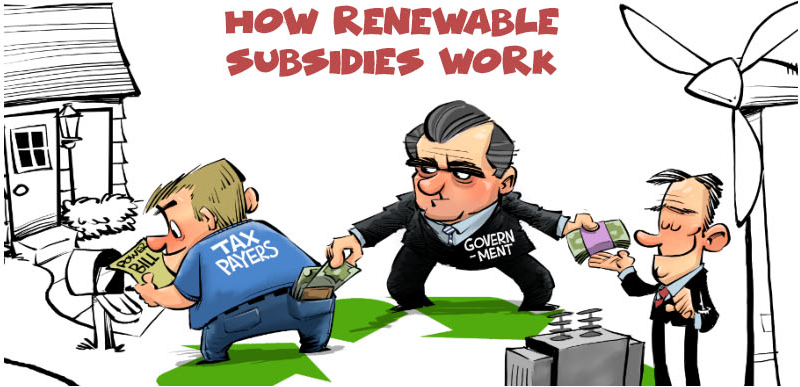
Renewable energy, despite costing billions of taxpayer dollars, is the source of less than 10% of Ontario’s electricity. Those vast fields of solar panels tilted towards the sun? Less than 2%.
Wind power, towering winged turbines that also drive countless nearby residents crazy with mysterious brain worms? Less than 8%.

A little over 90% of Ontario’s power sources — from nuclear plants to hydro dams — are environmentally friendly and without emissions.

Yet our nation’s capital has declared itself to be in the midst of a climate emergency, and spare us all if we sit idly by.

Ottawa Mayor Jim Watson was quick to point out that council’s climate emergency declaration is “no empty gesture,” although it came days prior to calling a real state of emergency over extreme flooding and getting assistance from 400 members of the armed forces to help cope with the crisis.

No, along with its specific climate emergency declaration, the city will prove it is “no empty gesture” by ponying up $250,000 out of its annual Hydro One dividend to do … what?

Why, to study the city moving to renewable energy, of course.

As if it had suddenly become a smart idea.

Background on Ottawa Resolution

Denis Rancourt writes at his blog change.org There is no evidence for a “climate emergency”. Stop the nonsense. Excerpt in italics with my bolds

There is an epidemic of cities in North America declaring that the city is in a “climate emergency”. This, below, is my recent submission to Committee opposing such a motion for Canada’s capital, Ottawa. There is no evidence that supports such a declaration. We should discourage our politicians from engaging in nonsense.

My signed submission document is also at: https://www.scribd.com/document/406277896/Dr-Denis-Rancourt-to-Committee-Enviro-Protection-City-of-Ottawa-2019-04-14

[The motion in Ottawa passed: 6 (for), 2 (against). Ottawa is therefore now in the throes of a “climate emergency”? The media refused to cover my scientific arguments and did not seek the views of the other side, whatsoever, despite several neighbours and Ottawa residents who agree with me.]

Summation

In conclusion, the Committee should take notice of the following facts when it considers this Motion:

(1) There is no conclusive scientific evidence that climate change (unnatural increased extreme-weather incidence) has occurred since the surge in use of fossil fuel that started in the 1950s. There is only tenuous theoretical conjecture that such might occur.

(2) Not a single death on Earth has been scientifically attributed to “climate change”, which includes Ottawa.

(3) Not a single animal or plant species has been scientifically established to have become extinct from climate change. There is no scientific demonstration of such a thing.

(4) Weather data for Ottawa does not show increased incidence of weather extremes, or any statistically meaningful deviations from the known natural variability (ENSO).

(5) Changes in Ottawa canal skating-season schedules result from ice-management and safety protocol changes, not from (empirically known) weather data.

(6) There is no rational reason, based on empirical data, to believe that Ottawa is at risk of climate change or is susceptible to anomalous future extreme weather events.

The Motion, in my opinion, is what can be termed “goodness propaganda”, which appears intended to convince citizens of being looked after. In fact, this Motion is a waste of resources and political attention.

It is verging on the ridiculous to think that the reality that 87% of world energy from fossil fuels (oil, gas, coal) can be changed by policy statements or taxation.[4] The only significant alternative contributors, as now demonstrated by decades of publicly funded adventures, are nuclear and hydro, both requiring massive structural investments, and both having large environmental consequences.

Climate Lemmings

Footnote

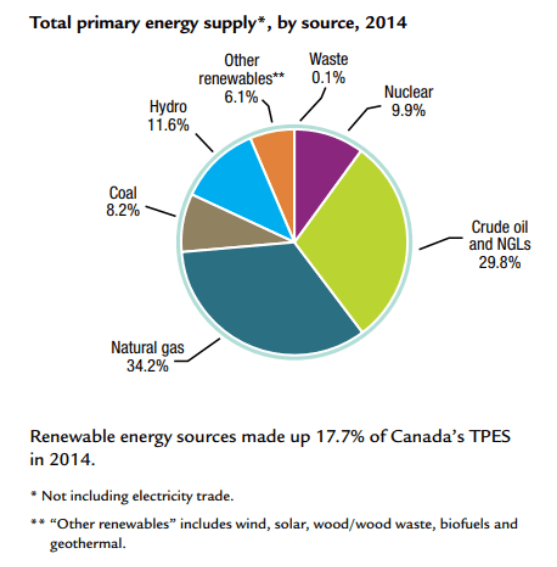
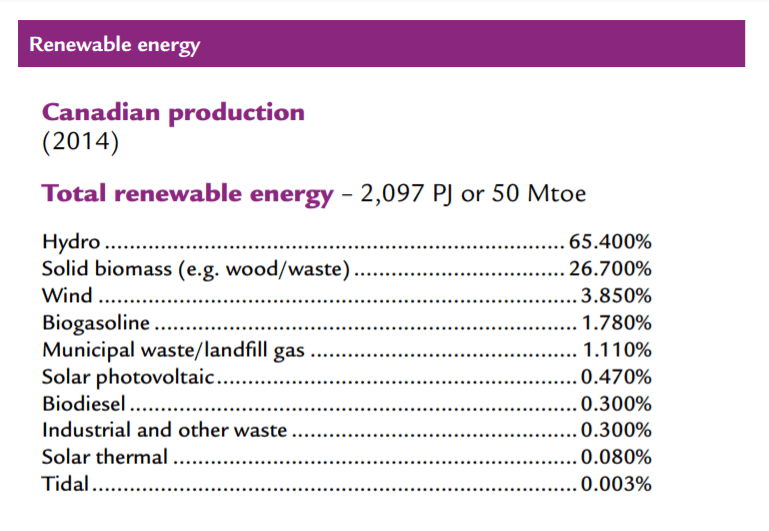
The Canoe article talks about the renewables small contribution to electrical supply in Canada.  The proportion of Canadian total primary energy shows wind and solar are far from being the solution.

In the Canadian Energy Fact Book, energy supply is equivalent to energy consumed, since it is calculated after adjusting for energy imports and exports. Note that 17.7% is the amount of energy from renewables, and hydro is 11.6%. Let’s see how much of renewable energy comes from wind and solar:

So Canadians actually consume 4.35% of their renewable energy from wind and solar. 92% of Canadian renewable energy comes from the traditional sources: Hydro dams and burning wood.

Combining the two tables, we see that 80% of the Other Renewables is solid biomass (wood), which leaves at most 1% of Canadian total energy supply coming from wind and solar.

Full discussion at post Exaggerating Green Energy Supply

Climate Hearsay

global-warming

In a legal proceeding, a witness can only testify to what he or she personally experienced. Anything reported to them by others is dismissed as “hearsay”, not evidence by direct observation, but rather an opinion offered by someone else.

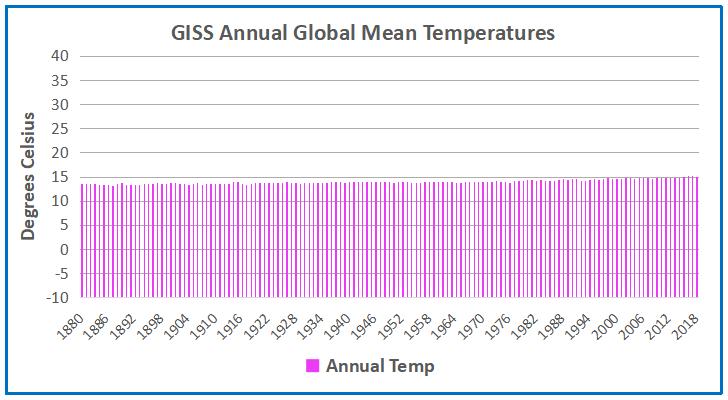
In the current public commotion over global warming, almost all the discourse is composed of hearsay.  Ross McKitrick explains that the alleged changes in temperatures are so small that no one can possibly notice. Thus, their concern over global warming can only come from repeating hearsay in the form of charts and graphs published by people with an axe to grind. His article in the Financial Post is Hold the panic: Canada just warmed 1.7 degrees and … thrived. Excerpts below in italics with my bolds.

A recent report, commissioned by Environment and Climate Change Canada (also known as the federal Department of the Environment), sparked a feverish bout of media coverage. Much of it keyed off the headline statement that Canada warmed “twice as fast” as the entire planet since 1948. If that is self-evidently a bad thing, what to make of the finding that the Canada’s Atlantic region warmed twice as fast as the Prairies? Or that Canadian winters warmed twice as fast as summers?

Saying Canada warmed twice as fast as the whole planet doesn’t prove anything

I’ll bet you didn’t know that the Maritimes warmed twice as fast as the Prairies. But now that I’ve told you, you might tell yourself it makes sense based on what you’ve seen or heard — that’s called confirmation bias. In fact, I was lying. It’s the other way around. The Prairies warmed almost three times faster than the Maritimes.

Would you have known either way? One of the psychological effects of a report like this, and the attendant media hype, is that it puts ideas in peoples’ heads. Tell everyone over and over that the climate is changing, and soon they will see proof of change everywhere. Rain, snow, wind, floods or dry spells; it will all seem to eerily confirm the theory, even though we have always had these things.

Most of what people are noticing, of course, are just natural weather events. Underneath, there are slow trends, both natural and (likely) human-caused. But they are small and hard to separate out without careful statistical analysis. A few years ago, climatologist Lennart Bengtsson remarked:

The warming we have had over the last 100 years is so small that if we didn’t have meteorologists and climatologists to measure it we wouldn’t have noticed it at all.

And so we get reports with charts and graphs to tell us about the changes we didn’t notice. Remember last summer when the media hyped a report from the Intergovernmental Panel on Climate Change warning that warming 1.5 degrees Celsius (compared to preindustrial times) was a disaster threshold we must avoid crossing at all costs? Now we learn that Canada warmed 1.7 degrees Celsius since 1948. Far from leaving the country a smoking ruin, we got wealthier and healthier, our population soared, and life improved by almost any measure of welfare you can imagine. If only every so-called catastrophe was like this.

We deal with lots of changes over time. Go back to Bengtsson’s thought experiment. Today’s 80-year-olds entered their teens in 1950. Ask them what changes they experienced over their lives and they will have plenty to say. Then ask if, where they live, the fall warmed more than spring did. Without peeking at the answer, most will have no idea. Yet, according to the federal government’s latest report, depending on the province, one likely warmed twice as fast as the other. Which one?

If you can’t tell without looking it up, that’s the point.

Alarming news headlines are always part of the ritual (though you’d have thought journalists would be a bit jaded by now, after all the hyperventilating Only-Ten-Years-Left blockbuster claims over the past 30 years). Saying Canada warmed twice as fast as the whole planet doesn’t prove anything. Pretty much any large country warmed faster than the global average, because countries are on land. Oceans cover 70 per cent of the Earth, and the way the system works, during a warming trend the land warms faster than the oceans. So the scary headline only confirms that we are on land.

The best antidote, if you find yourself alarmed by the press coverage, is to turn to chapter four of the Department of the Environment’s report and start reading. The section on the observed changes in 1948 is factual, data-focused and decidedly non-alarmist. But there are some points I would quibble about: 2016 was a strong El Niño year, so the end point of the data is artificially high.

Some of the report’s bright-red heat maps would probably look different if they stopped in, say, 2014. And most of the report’s comparisons start in 1948 to maximize data availability, but this boosts the warming rate compared to starting in the 1930s, which was a hot decade. When the authors talk about attributing changes to greenhouse gases versus natural variability, they don’t explain the deep uncertainties in such calculations. And they make projections about the century ahead without discussing how well — or how poorly — their models can long-term forecast.

If you want to learn about changes to the Canadian climate, read the report. But if you need to look at the report to know what changes you lived through, that tells you how much — or rather, how little — they mattered to you at the time.

Ross McKitrick is a professor of economics at the University of Guelph and senior fellow at the Fraser Institute.

Postscript:  No one under 20 years old has experienced a trend of warming temperatures.  Yet they are in the streets instead of classrooms demanding action (anything) to stop something they have never known.  Think about it.

Landscape of Climate Ideologies

This post summarizes a useful set of categories for positions on global warming/climate change that are advocated in the public square. H/T Richard Drake for pointing me to an extensive and illuminating discussion by Edward Ring at American Greatness The Politics, Science, and Politicized Science of Climate Change. Excerpts in italics with my bolds.

Climate alarm shouldn’t be a hard sell, and it isn’t. The horror inspired by natural conflagrations taps into primal, instinctual fears; when vividly imagining terrifying acts of nature, even the most hardened skeptic might have a moment of pause.

And every time there’s a hurricane, or a flood, or a wildfire, we’re reminded again by the consensus establishment; we caused this. We are to blame. And nothing, absolutely nothing, is too high a price to pay to stop it.

But rarely explored, and difficult to find, is data on how much it costs to adapt to climate change versus how much it would cost to stop climate change. Equally hard to find is information about the extent to which climate change might actually benefit humanity.

Political Categorizing of Today’s Eco Intellectuals

In 2014, Matthew Nisbet, a professor of communications at Northeastern University, in a paper titled “Disruptive ideas: public intellectuals and their arguments for action on climate change” made an interesting attempt to classify influential activists and experts on climate change into three categories: Ecological Activists, Smart Growth Reformers, and Ecomodernists. The focus of Nisbet’s analysis was how these public intellectuals “establish their authority, spread their ideas, and shape public discourse.”

While retaining Nisbet’s framework, it is useful to speculate as to how each of the mass political ideologies and major political movements in 2019 America would align with each of Nisbet’s three categories. After all, how “climate action” is implemented, now and in the future, arguably is the most significant variable determining how Americans and everyone else in the world will cope with challenges relating to energy development, economic growth, technology deployment, individual freedom, property rights, national sovereignty, international cooperation, and, of course, environmental protection.

Click on image to enlarge.

Making this leap, a plausible match for each of Nisbet’s categories would be as follows: The “Ecological Activists” are mostly socialists, the “Smart Growth Reformers” are mostly liberals, and the “Ecomodernists” are mostly libertarians. It is important to reiterate that this only roughly overlaps with the influencers Nisbet has characterized in his three groups. Moreover, there is a fourth important category that Nisbet ignored (or dismissed), which might be defined as practical skeptics. More on that later. Here is Nisbet’s chart depicting his three categories of environmental influencers:

Socialist Environmentalists

The first of Nisbet’s three categories are the Ecological Activists. Based on Nisbet’s description, their political ideology is most likely socialist. This group has the most negative perspective on climate change, seeing it as a consequence of capitalism run amok. They argue that the carrying capacity of planet earth has reached its limit and that only by radically transforming society can the planet and humanity avoid catastrophe.

This group is Malthusian in outlook, and the solutions they advocate—returning to small scale, decentralized infrastructure, “smaller scale, locally owned solar, wind and geothermal energy technologies, and organic farming”—are not practical or even internally consistent for several reasons.

“Ecological Activists argue on behalf of a fundamental reconsideration of our worldviews, aspirations, and life goals, a new consciousness spread through grassroots organizing and social protest that would dramatically re‐organize society, decentralize our politics, reverse globalization, and end our addiction to economic growth,” Nisbet writes. It must be a very selective subset of globalization the Ecological Activists wish to reverse, however, because this most radical of Nisbet’s cohorts tend to be the same people who favor open borders and the erasure of national governments. Can they truly believe small communities will constitute what remains of governance when nation-states and multinational corporations wither away?

But in their commitment to achieving 100 percent decentralized, renewable energy, the Ecological Activists make their greatest departure from reality.

Not mentioned in Nisbet’s paper, but easily fitting into the Ecological Activists category, are the “deep greens,” a group typified by the “Deep Green Resistance.” They reject “green technology and renewable energy,” both in terms of its ability to meet the total energy requirements of modern civilization, and in terms of how “green” it actually is. Their solution is to “create a life-centered resistance movement that will dismantle industrial civilization by any means necessary.”

Most Ecological Activists believe in phasing out the use of fossil fuel in a manner they perceive to be as benign as possible. But to achieve this, and unlike the Smart Growth Reformers, the Ecological Activists do not believe in market-based solutions. They support carbon rationing and carbon taxes as the means both to curtail the use of fossil fuel and to fund development and deployment of renewable energy solutions.

In Congress today, the Ecological Activists would be most represented by the Democratic Socialists, led by their media-anointed leader, Representative Alexandria Ocasio Cortez (D-N.Y.). The policies promoted by Ocasio-Cortez and her allies in the “Green New Deal,” in its undiluted form, read like a socialist manifesto.

It is impossible to catalog the profusion of activist groups and activist websites now promoting the Green New Deal. There are too many. But almost invariably they perceive “social justice,” socialist economics, environmentalism, and abolition of fossil fuels as interlinked goals sharing common values. One of the explicitly political online promoters of a congressional Green New Deal is the Sunrise Movement. The group claims already to have secured the endorsements of 45 members of Congress, along with hundreds of environmentalist organizations.

But how can Americans possibly expect to replace conventional energy with more expensive renewable energy, at the same time as they pay additional trillions to secure the “economic rights” for everyone living in the United States? The very idea is so preposterous it is difficult to take the socialist environmentalist movement seriously. That would be a mistake.

Liberal Environmentalists

If the Ecological Activists tend to lean socialist, the second of Nisbet’s groups, the Smart Growth Reformers, appear to be conventional liberals. They are more business-friendly, and while they agree that a climate catastrophe is inevitable without dramatic changes in policy, they believe “market forces” can be harnessed to change the energy economy of the world. Where the Ecological Activists support carbon taxes and carbon rationing, the Smart Growth Reformers support carbon trading.

The best known of the so-called Smart Growth Reformers is former Vice President Al Gore, who has enjoyed a career since 2000 that, if anything, eclipses his accomplishments as a politician. In addition to producing Oscar-winning documentaries on climate change, writing bestsellers on the topic, and receiving a Nobel Prize for his proselytizing on the issue, he has become fabulously wealthy. As a co-founder of Generation Investment Management, with over $18 billion in assets under management, and as a senior partner at the elite venture capital firm Kleiner Perkins, Gore falls firmly into the pro-business political camp, along with plenty of other liberal democrats. A likely Gore ally among the Smart Growth Reformers would be U.S. House Speaker Nancy Pelosi (D-Calif.), whose net worth is estimated at $29 million.

It isn’t hard to see why emissions trading would appeal to pro-business liberals, although embracing this terminology requires a very specific sort of definition for the phrase “pro-business.” Why enact a carbon tax, where only the government gets to be the middleman, when with emissions trading, you can engage the global financial community, and create completely new categories of economics, as armies of accountants, economists, environmental scientists, and myriad additional, highly-credentialed ancillary experts engage in cradle to cradle assessments of carbon molecules?

Emissions-trading schemes pose all kinds of problems. Think of the subjectivity inherent in measuring significant variables, the stupefying complexity, the huge, nonproductive overhead, consisting of a veritable army of bureaucrats, consultants, experts, and, of course, financial middlemen. Or consider the vast potential for corruption, or just multiplying schemes that turn out to do more harm than good, saturate the prospect of emissions trading from end to end.

A recent ignoble example would be how carbon emissions trading in the European Union funded palm oil plantations. To purchase the right to emit more CO2 than their allotment, European companies bought “carbon credits,” investing in “carbon neutral” biofuel plantations in Indonesia, Malaysia, and elsewhere in the tropics. Thousands of square miles of tropical rainforest, valuable wildlife habitat, were incinerated to accommodate the new market for biodiesel made from palm oil. By the time the Europeans realized what they were doing, it was too late. Just ask the orangutans of Borneo, if there are any left.

The “smart growth reformers” advocate more than just carbon trading, but it is difficult to overstate its centrality to their much broader agenda. And it’s important to emphasize that the scope of its implementation will go far beyond regulating energy. Because there is a “carbon footprint” to virtually every development—all housing, all infrastructure, all transportation; not just power plants, but bridges, dams, water and wastewater treatment plants, solid waste management, the energy grid, inland waterways, levees, ports, public parks, roads, rail, transit, schools, every durable good, every gadget, everything.

In the hands of a creative carbon accountant, there isn’t any human activity that might not have earnings potential, taxation potential, or become a target for regulation. Government agencies view this as a gold mine. Code enforcement departments and planning commissions will become profit centers—so long as people are forced by law and ordinance to use less and consume less. And to enable, monitor, and enforce the great ratcheting down: the internet of things.

Libertarian Environmentalists

It may not be entirely accurate to claim that most Ecomodernists are libertarians. While libertarians appear to overlap more with the Ecomodernists than with Smart Growth Reformers or Ecological Activists, there are plenty of libertarians who have been seduced by the “market-based” solutions of emissions trading. Moreover, according to Nisbet’s paradigm, Ecomodernists “argue for ‘clumsy’ policy approaches across levels of society, government investment in energy technologies and resilience strategies,” hardly something you would expect from a Libertarian. Nonetheless, many self-proclaimed Ecomodernists identify as libertarians. One of the public intellectuals who is cited by Nisbet as an Ecomodernist is Michael Shellenberger. An apt choice, as Shellenberger co-authored “An Ecomodernist Manifesto” along with 17 other notables.

The Seven Key Sections of the Ecomodernist Manifesto

(1) Humanity has flourished over the past two centuries.

(2) Even as human environmental impacts continue to grow in the aggregate, a range of long-term trends is today driving significant decoupling of human well-being from environmental impacts.

(3) The processes of decoupling described above challenge the idea that early human societies lived more lightly on the land than do modern societies.

(4) Plentiful access to modern energy is an essential prerequisite for human development and for decoupling development from nature.

(5) We write this document out of deep love and emotional connection to the natural world.

(6) We affirm the need and human capacity for accelerated, active, and conscious decoupling. Technological progress is not inevitable. Decoupling environmental impacts from economic outputs is not simply a function of market-driven innovation and efficient response to scarcity.

(7)We offer this statement in the belief that both human prosperity and an ecologically vibrant planet are not only possible but also inseparable.

Ecomodernists may not all embrace the libertarian desire to let the unfettered free market solve every challenge facing humanity (note point No. 6), but perhaps in a more important sense they are very libertarian, in their commitment to encouraging a free market of ideas.

All in all, the Ecomodernist category is an intriguing way of gathering together an eclectic group of thinkers. Also included on Nisbet’s list of Ecomodernists is Roger Pielke Jr., a political science professor at the University of Colorado and another co-author of the “Ecomodernist Manifesto.” Pielke’s situation is one that many Ecomodernists (and Practical Skeptics) face, he is condemned by the “consensus” community merely because he is occasionally willing to criticize their work.

Where Pielke is attacked for exposing politically motivated hyperbole that violates the integrity of the scientists that produce it or condone it, Danish economist Bjorn Lomborg (who is not on Nisbet’s list of Ecomodernists but perhaps should be) is attacked for exposing the deeply flawed economic logic underlying many of the most urgently promoted policies designed to mitigate climate change.

What Pielke, Lomborg, and many others have in common is their overt, unequivocal agreement with the fundamental premise—Earth is warming, and anthropogenic CO2 is the cause. And yet they are at times marginalized because they question certain critical assumptions or conclusions relating to that premise. As these two examples show, the twin hearts of the climate change movement—the science and the economics—have hardened against the voices of contrarians. Along with being eclectic, contrarian might be another widely shared quality of the Ecomodernists.

The Ecomodernist, or, if you will, the Libertarian Environmentalist, as a category, is elusive and heterogeneous. These qualities make its output less predictable, its potential greater. It is best defined simply as not belonging to the two preceding categories, nor willing to cross the red line into overtly questioning the theory of anthropogenic global warming. It has much to offer.

Practical Skeptics

The failure of Nisbet to include climate skeptics as a fourth category may be a forgivable oversight on his part, because climate skeptics almost have been erased from public dialogue. As a result, it makes sense that Nisbet would not consider the members of this group to qualify as influential public intellectuals.

Another reason Nisbet may not have included climate skeptics would be because he was analyzing differing approaches by “public intellectuals arguing for action on climate change.” It’s certainly debatable, but understandable to assert that climate skeptics are arguing for no action on climate change. Equally likely, of course, was that Nisbet chose to avoid the opprobrium he would invite if he legitimized climate skeptics by including them in his analysis.

Climate skeptics have been demonized and ostracized by the socialist and liberal environmentalists. The Ecomodernists, for the most part, scrupulously avoid allowing their laudable contrarianism to overflow into questioning the theory of anthropogenic global warming.

Practical Skeptics have a range of positions that earn them the “denier” label, and everything that comes with that: suppression of their work, savaging of their reputations, and banishment from the public square. Some of them, such as “Climate Etc.” host Judith Curry, former professor and chairwoman of the School of Earth and Atmospheric Sciences at the Georgia Institute of Technology, maintain that while anthropogenic CO2 is contributing to global warming, the likely amount of warming is far less than what alarmingly is being projected. Curry has also criticized the growing calls by congressional Democrats to criminalize the free speech of skeptic scientists, by attempting to expose their links, if any, to fossil fuel corporations.

One of the most distinguished, and most demonized, of living climate skeptics is Richard Lindzen, an American atmospheric physicist who is a senior fellow with the Cato Institute. Until his retirement in 2013, Lindzen was the Alfred P. Sloan Professor of Meteorology at the Massachusetts Institute of Technology. Lindzen was one of the early participants in the early IPCC reports on climate change, but became disillusioned because he perceived the organization had become politicized.

Lindzen’s specific criticisms of conventional climate change theories are many: He acknowledges there are moderate warming trends, but that it is merely our emergence from the “little ice age” of the 19th century. He claims that if the earth were warming significantly, extreme weather would diminish, not increase. He questions the assumptions built into the computer programs that model global climate and produce predictions. He believes predicted warming is overstated. He states that the natural feedback mechanisms governing the global climate have offsetting impacts, and that if they did not, the earth would have experienced catastrophic warming eons ago.

There are dozens of credible climate skeptics, credible enough, that is, to deserve a place on panels at climate conferences or congressional testimony, editorial pages, scientific journals, and press coverage, on what are arguably the most consequential policy decisions of modern times. Along with Curry and Lindzen, other skeptical scientists include Roy Spencer, Fred Singer, and Anastasios Tsonis along with many others who are keeping their heads down.

Lindzen has said that many climate scientists will criticize alarmist pronouncements in whatever may be their specific area of expertise. A glaciologist will challenge a press release predicting an ice-free Himalayan mountain range by 2035. A meteorologist will challenge a press release asserting an increase in extreme weather. But none of them will take the further step of criticizing the overall “consensus.”

There remains a handful of organizations that will provide equal time, or even promote, climate skeptics. They include Cato, AEI, The Heartland Institute, and the Heritage Foundation. But these scientists, these online reporters, and these nonprofit organizations are vastly outgunned by most of the political establishment (with the major exception of the Trump administration), the media and entertainment communities, prestigious scientific journals, the K-12 public education system, higher education, local, state, federal, and international government bureaucracies, virtually every major corporate or financial player, and spectacularly wealthy nonprofit educational foundations including powerful environmental pressure groups.

But scientific “consensus” does not constitute scientific truth. Just ask Galileo. And the overwhelming institutional consensus on a course of action, even if there is such a thing, does not mean that course of action is the optimal course of action.

Solutions Require Renewed Debate

Even if anthropogenic CO2 emissions are driving the planet headlong into an apocalyptic nightmare, climate skeptics should be heard. Because as it is the scope of acceptable debate is relentlessly narrowing. Should Bjorn Lomborg’s valuable economic analysis be ignored, simply because he’s willing to point out the absurdity of spending trillions for the remote possibility of slowing warming by a half-degree? Should Roger Pielke, Jr. be silenced, when the data he presents suggests extreme weather may not be the primary type of havoc for which we need to prepare?

The Heartland Institute Sent 300,000 Teachers Books and DVDs Presenting Evidence Contradicting Alarming Man-Made Climate Change

A healthy policy synthesis would be to promote and invest in projects and technologies that make sense no matter what climate outcome is destined to befall the planet. But the chances of getting that right are improved if skeptics are allowed to rejoin the conversation.

The notion that skeptics are the beneficiaries of vast sums of dark money is by now ludicrous. Every major corporation, certainly including the oil companies, has worked out their lucrative pathway into a profitable “carbon-free” future. But which set of public intellectuals, along with their powerful institutional allies and grassroots constituents, will prevail?

Will it be the Socialist Environmentalists, who are funded by a European-style leftist oligarchy, backed up by populist agitators, with growing support from the electorate? And if so, will any of the stupendous sums of new tax revenues they collect actually make it onto the ground in the form of renewable energy, and if so, will it do any good? Or will climate change just be the Trojan Horse of socialism that finally made it through the gates?

What about the Liberal Environmentalists, the “Smart Growth Reformers”? Will they win? And if so, do we want to live in their hyper-regulated world, where the “free market” survives in the form of cronyism, and every aspect of our lives is monitored in order to ensure we each maintain our “carbon neutrality”? And will that do any good? And when the predicted climate disasters don’t happen, will any of them admit those disasters weren’t going to happen anyway, or will they claim the green police state they built saved the world?

The Ecomodernists, we hope, will excuse being associated in any context with the Practical Skeptics, but here goes: in terms of divergent, undogmatic thinking, and general optimism regarding the ultimate fate of humanity, these two groups have much in common. It used to be accepted that the person holding the sign on the street corner, proclaiming the imminent doom of mankind was the crazy one, and the person suggesting that actually, mankind is probably not doomed, was the sane one. But in the crazy world of climate alarmism, those roles have been inverted.

Shock. Despair. Change everything, overnight, or else. We’ve got five years. When it comes to climate change, that is the prevailing message, and deviation from that message invites demonization, banishment, erasure.

In a recent and very typical development, the BBC, in response to pressure from activists, announced in September 2018 they would no longer cover the arguments of climate skeptics. This is a natural progression that began in 2007 when the U.S. Supreme Court ruled—in an ominous endorsement of politicized science and a staggering violation of common sense—that CO2, part of our atmospheric blanket against the cold cosmic emptiness, the food of all plant life, whose rise perhaps delays the past-due next ice age, is a pollutant. Nisbet’s omission of climate skeptics from his panoply of public intellectuals driving the climate debate is just another part of this sad, possibly misanthropic, potentially tragic course.

It is unclear who is right, nor whether reason will prevail. But it would be far better if every voice was heard.

Summary

What a strange twist. Marx gave us the notion of ideology, which he understood to be the system of beliefs and values that the ruling class used to control the working class and ensure continued power and privileges. Today’s Marxist wannabes who are mostly in the entitled class are employing the ideology of environmentalism to mount an anti-capitalist crusade under the banner of Climate Change, advocating policies which will further the misery of the downtrodden.

See Also: Warmists and Rococo Marxists.