A Geophysicist Explains Geoclimate Change

John Bruyn writes at Quora answering the question: What does carbon dioxide have to do with climate change?  He is a retired geophysicist with a background in exploration geology, geophysics, seismology, and in remote sensing by satellite. Excerpts in italics with my bolds and added images.

The surface of Mars shows that CO2 is transparent to radiation in the visible part of the electromagnetic spectrum until it becomes reflective as dry ice at temperatures below its -78.5 C (109.3 F) freezing point. A black body radiating at such temperatures does so at wavelengths close to 15 µm (microns), i.e., very low energy at the far end of the far infrared part of the electromagnetic spectrum.

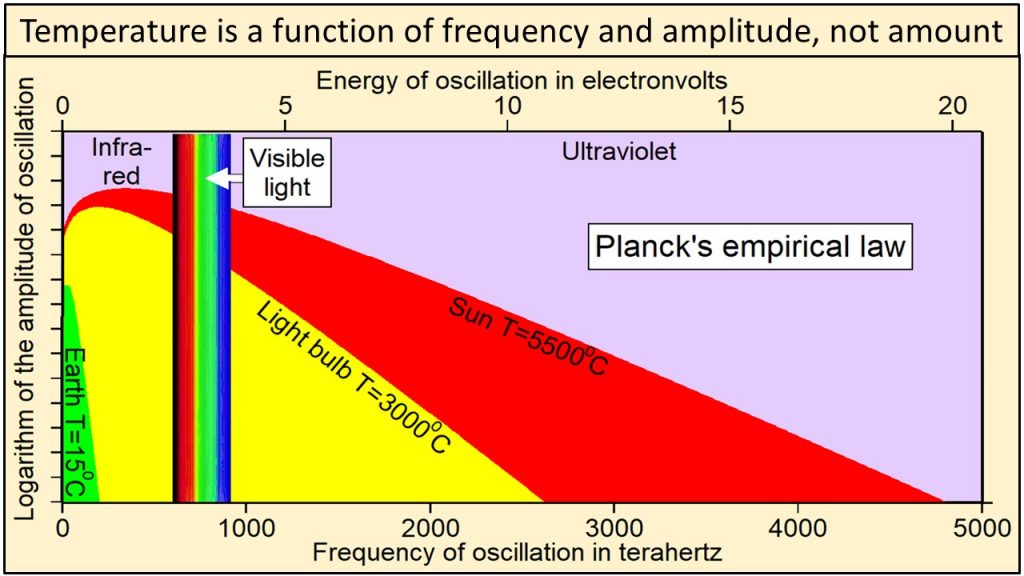
Energy is a function of frequency and should therefore be plotted on the x-axis (top of this figure) and units of watts should not be included on the y-axis. The colored lines show the spectral radiance predicted by Planck’s law for black bodies with different absolute temperatures. The energy of radiation absorbed by carbon dioxide is near 0.08 electron volts while the UV-B energy that reaches Earth when the ozone layer is depleted is near 4 electron volts, 48 times larger.

Such radiation is inconsequential on Earth where the much higher global mean surface temperature of about 15 C (59 F) makes that impossible and irrelevant in that it would violate the 2nd law of thermodynamics. The exception would have to be mid-winter on central Antarctica where the temperatures can get as low as -90 C (-130 F) but where the roughly 0.042% (420 ppm) CO2 concentration leaves the partial pressure too low for dry ice to form. As that minimum temperature shows, any infrared radiation disappears quickly into space at close to the speed of light.

The extra carbon atom makes CO2 more massive than air and
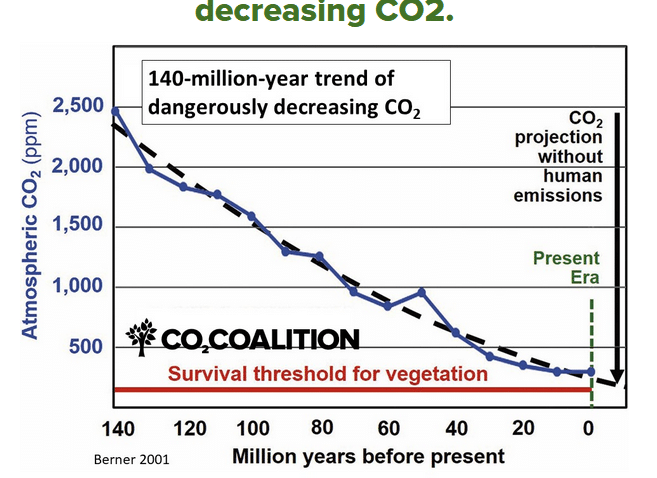
at 0.042% that concentration is critically low for photosynthesis.

Any CO2 we can contribute only serves to improve on that. The reason for that very low concentration is the very much greater abundance of the lighter than air H2O molecules bonding with CO2 inversely proportional to temperature to suspend it temporarily. However, that is restricted to the troposphere with 99% of the Earth’s atmospheric H2O that relies on the bonding with enough CO2 molecules to be able to precipitate and fill water bodies on land and the ocean, currently taking up almost 71% of the global surface. Helping H2O precipitate makes CO2 a cooling agent, including by supporting photosynthesis and ozone formation in the stratosphere.

It follows that the atmospheric CO2 concentration is controlled by the amount of water vapour in the air and that its concentration rises and falls with the variations in insolation and from variations in the speed of the Earth’s rotation. Together they drive the evaporation of H2O from global surface, as well as the CO2 emissions from the ocean in the tropics. Cooling and the declining speed of the Earth’s rotation toward higher latitudes cause evaporation and the ocean’s CO2 emissions to decline with latitude and to reverse that process, as well as making the ocean the world’s primary carbon sink.

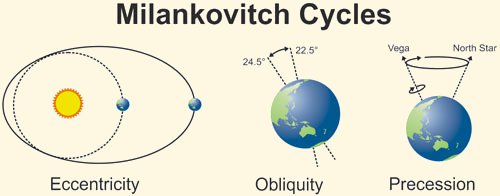
The Milankovic cycles have been concentrating insolation in the tropics with the declining obliquity of the Earth’s spin axis for the last 10 millennia. Perihelion has been adding to that by moving north since the mid-13th century. The declining eccentricity of the Earth’s orbits has been adding to that by increasing the already supersonic speed of the Earth’s rotation and will continue to do so for about another 30,000 years. The increasing the centrifugal force (inertia) has been causing the atmospheric CO2 concentration to increase. However, as sea levels continue to decline at the highest latitudes (see Post-glacial rebound – Wikipedia) and will cause the shallow seas in the tropics to start running dry in about 5 millennia from now, CO2 emissions will start to decline accordingly.

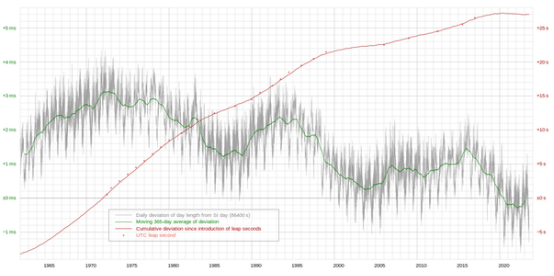
This plot shows the day length (LOD) variations from Wikipedia and how these have been shortening by milliseconds as a result of the increasing speed of the Earth’s rotation from the declining eccentricity of the Earth’s orbits.

The oscillations match the the variations in the sun’s barycentric motions caused by the gravity and orbits of the 4 outermost planets (JSUN) with 99.6% of the planetary mass that control the ~11-year solar cycle, as well as the sun’s ~22-year magnetic cycle due to the vertical motion of Jupiter and Saturn with respect to the plane of the solar equator caused by the inclinations of their orbits with respect to that plane and controlled by the orientation of the gravity of the Milky Way galaxy.

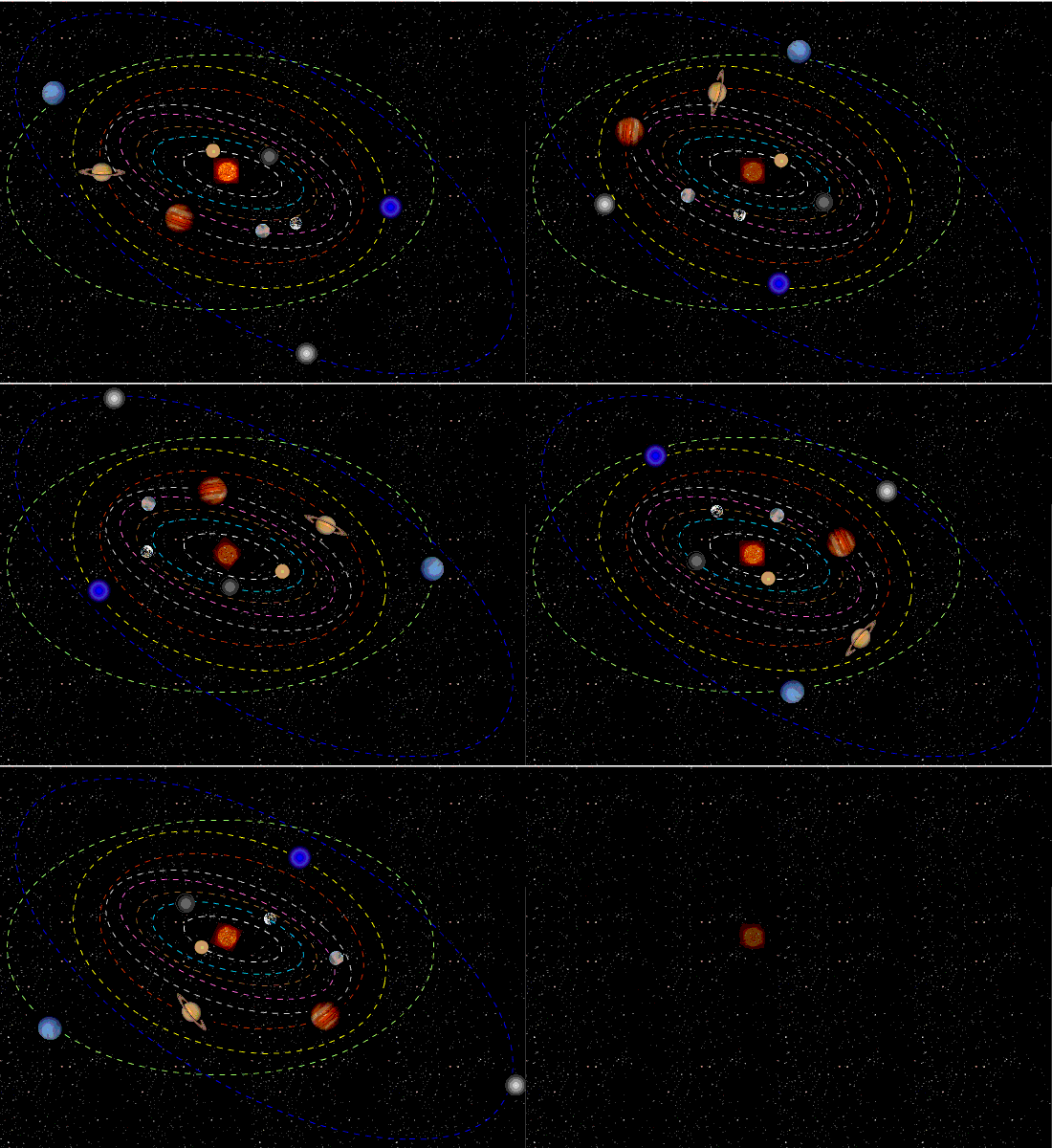
These are the solar orbits around the barycentre of the solar system from 1970–2022 as generated with the Solar Simulator 2 (can be downloaded free of charge, no strings attached). As can be seen from the prior LOD image, the SS2 shows that when the solar motion is small, day lengths increase and when the solar orbits are large, day lengths reduce. This makes it highly probable that the minute changes in the global mean temperatures by fractions of a degree that may be picked up with climate models are from the annual variations in day lengths instead of CO2 increases.

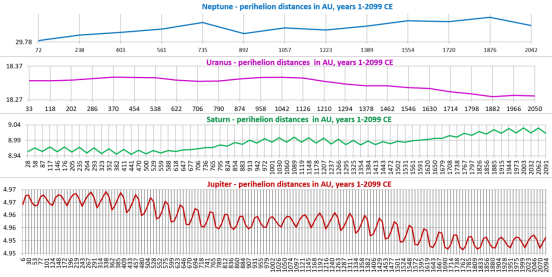
This graph (own work, based on NASA JPL Horizons ephemerides) shows that the changes in the Earth’s climate have been happening as a result of the changing shapes of the JSUN orbits for the last 2 millennia (and before that) and their always changing perihelion distances. They show the real reasons for climate change with a 973-year millennial cycle, as well as the roughly 60-year cycle of the phasing of the orbits and great conjunctions of Jupiter and Saturn according to the 5:2 ratio of their orbital periods of 12 years and 29.5 years respectively.

The ~60-year great conjunction cycle of Jupiter and Saturn has long been recognised by ancient astronomers and in the Chinese calendar. The cycle peaked in 2019 and the vertical motion of all 4 of the outermost planets, Jupiter (318 E-mass), Saturn (95 E-mass), Uranus 14.5 E-mass), and Neptune 17.1 E-mass) to a total of 99.6% of the planetary mass all converged well south of the plane of the solar equator in 2022, pulling the Earth with just 0.22% of the planetary mass a bit further south too and exposing more of the northern hemisphere to the sun. And that’s just one of the anthropogenic global warming (AGW)/climate change tricks, cherry picking the hemispheres and the poles at certain times.

This image (own work) of the vertical motion of the 4 outermost planets (JSUN) with 99.6% of the planetary mass shows that according to the NASA JPL Horizons ephemerides their orbits put all 4 of them well below the plane of the solar equator with the effect of forcing the Earth orbits a bit further south too and exposing the Arctic to more insolation.

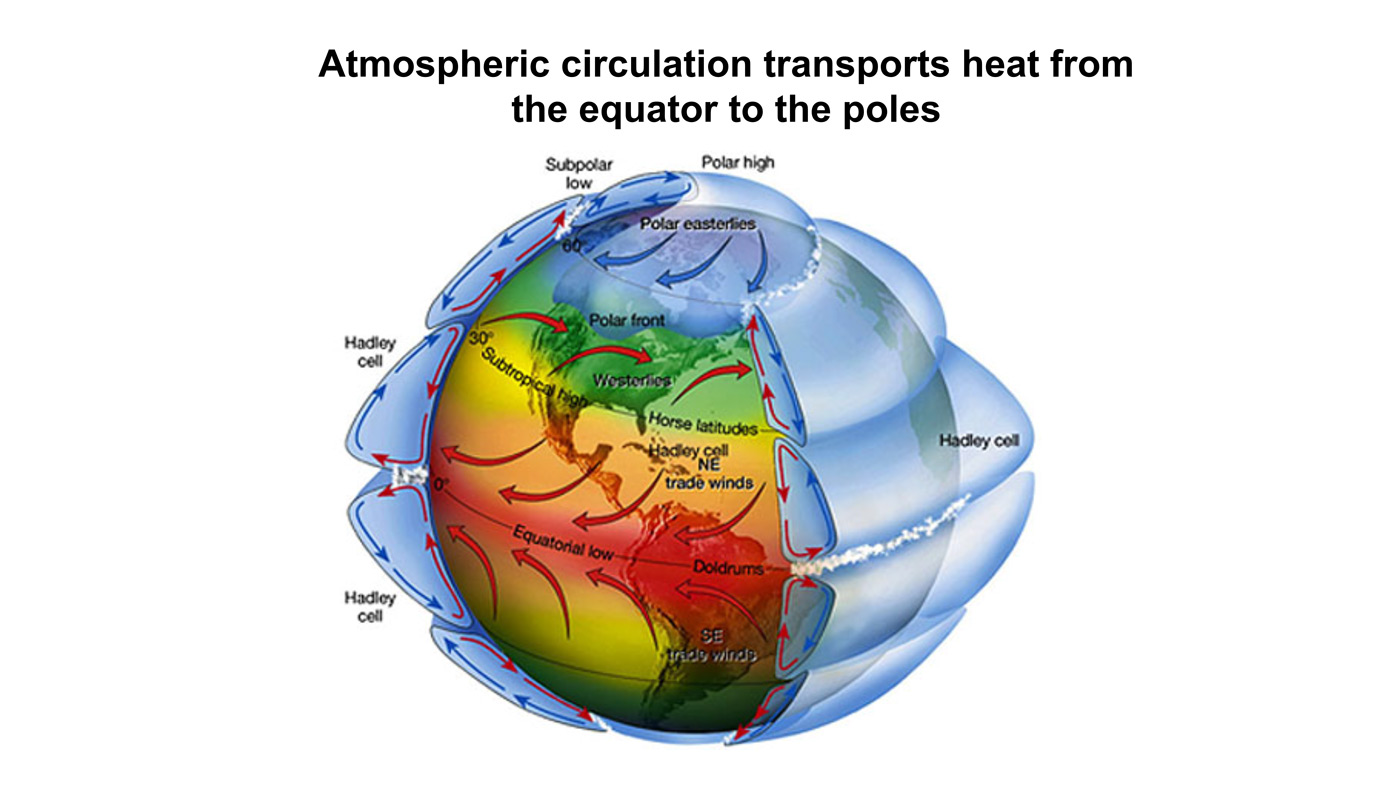
At the temperatures of the troposphere are above the freezing point of CO2 it is transparent to electromagnetic radiation., but not when frozen as dry ice in the lower stratosphere with sub-100 C temperatures. In the troposphere, the up to 100 times higher concentration of the lighter than air H2O molecules suspend the CO2 molecules and prevent these from forming a dense high pressure high temperature surface layer as they do on Venus where 1 day takes longer than a year.

It follows that driving the best and the largest evaporative cooling and air-conditioning system on Earth is the centrifugal force (inertia) of the supersonic roughly 1,677 km/h (1,042 mph) equatorial speed of the Earth’s rotation and mountain ranges that spins CO2 out into the upper atmosphere. On the way back down, CO2 loses its energy in the lower stratosphere and freezing when reaching -78.5 C to become reflective as dry ice but that radiation, where and when it happens is too weak to have any effect on a much warmer troposphere where CO2 gets defrosted by bonding with H2O molecules and helping these condense, form clouds, and precipitate as slightly acid rain, pH of 5.6 or less but increasing inversely proportional to latitude. The reason for that upward pH gradient toward the poles is from H2O requiring fewer CO2 molecules to precipitate as temperatures decline and the centrifugal force (inertia) of the Earth’s 24-hour rotation period goes to zero. The Earth’s oblateness also causes gravity to increase to its maximum by bringing the surface at the poles closer to the Earth’s core.

So, the simple proposition is that in the tropics, where the intensity of solar radiation is the greatest, where humidity and cloud cover are the highest, and where the surface temperatures are high, water in the atmosphere does more reflecting while transporting solar energy to higher latitudes to precipitate and where opposite conditions make water in the atmosphere do more reflecting of surface energy as infrared radiation. However, as we well know, water does not reflect all of the surface energy but lets a lot of that through to still leave a substantial cooling effect, as can be noticed from snow and ice accumulation. It means that what shade cloth is to solar radiation in warmer climates, moisture in the air is to surface radiation in colder climates. And, deserts show that where moisture is low, the temperatures plummet overnight.

Simply put, we cannot have any control over Earth’s global mean temperatures without significantly increasing the supply of solar energy or changing the distribution of insolation, to melt some of the snow and ice in the Arctic or on Antarctica and raising sea levels. Doing so artificially would reduce the impacts of the impending ice age to some extent (not to be advised from an evolution point of view) by maintaining higher sea levels and keeping the continental shelves covered by water instead of drying out as they are known to have done during the last few ice ages and on the last occasion permitted our early-ancestors to leave Africa and migrate to other continents.

It follows, that as a ‘greenhouse gas’ CO2 is irrelevant by doing the opposite of what is claimed in support of the climate change hoax and Ponzi scheme, aimed at making us change over to alternatives energy sources to fossil fuels to prevent these from running out during the further cooling of this millennium, as well as making some people a hell of a lot of money. Not the least in that are Elon Musk and the oil, gas, and coal companies that love the higher energy prices from Saudi Arabia cutting back oil production but most tragically also fuelling past and present oil wars including the current wars in Ukraine and Gaza.

And in the Longer Term, Geoclimatic forces will continue to operate:

So Remember This . . .


Britain’s Royal Society Defies the Green Blob

News comes from Financial Times that the prestigious scientific Royal Society is honoring it’s motto:  “Take Nobody’s Word For It” (translation of Latin phrase above.) Of course, a great many UK academics were outraged at the refusal to take for granted their claim that “Climate Science is Settled.” The article by Kenza Bryan is Royal Society and academics clash over influence of oil and gas industry.  Excerpts in italics with my bolds and added images.

Three-centuries-old institution rebuffs call to
declare fossil fuel companies culpable for global warming

A clash between Britain’s 363-year-old Royal Society and more than 2,000 UK academics has escalated over the national academy of scientists’ refusal to attribute the role of oil and gas companies in climate change.

The academics had expressed their concerns about the influence of fossil fuel companies on scientific research in a letter last year to the Royal Society, founded in 1660 as a fellowship that included the likes of Isaac Newton.

But the Royal Society has now rebuffed their request to issue an “unambiguous statement about the culpability of the fossil fuel industry in driving the climate crisis”.

Treasurer Jonathan Keating wrote in reply last week that it would “not be appropriate” to do so, as there was a need for “multiple actors” to engage with the complexity of the climate crisis.

The academics’ concerns about the influence of oil and gas companies extend to separate allegations that ties to BP were not disclosed by a Cambridge professor in a Royal Society policy briefing document produced by a working group that he chaired in 2022.

Professor Andy Woods held the title of head of the BP Institute, a research arm that it funds, which was renamed the Institute for Energy and Environmental Flows by Cambridge last year. He also has the formal title of BP professor, a position endowed by the oil and gas company. These affiliations were not included in the reference in the document.

The Royal Society briefing document called for an “enormous and continued investment” into geological carbon capture and storage, a technology promoted by the fossil fuel industry as a way to keep expanding while storing the emissions.

A CO₂ storage adviser to BP and a director for CO₂ storage at the Norwegian Petroleum Directorate also contributed to the report. Woods’s expertise in geophysical fluid flows and the BP affiliation are listed elsewhere by the Royal Society in its fellowship directory. BP and Woods did not respond to a request for comment. The Royal Society said the document gave “clear affiliations” for contributors and that it publishes a wide range of research.

The tensions reflect the discord in academia about funding or
participation in research by oil and gas companies, as well as
rising activism on campuses among the student body and staff.

The Royal Society’s decision not to call out the industry was described as “moral cowardice” by James Dyke, earth system science professor at Exeter university.

Another signatory to the original letter, Bill McGuire, professor of geophysical and climate hazards at University College London, said it was “mind-boggling” that a respected scientific organisation would not attribute the role of fossil fuel groups in climate change.

Student campaigners at Oxford university have also targeted the author of a set of green principles used by the university to help guide decisions on whether to invest in or receive grants from oil and gas companies.

Under freedom of information provisions, the student campaigners identified Myles Allen, the university’s head of atmospheric, oceanic and planetary physics, as having had 18 meetings where a representative was present from one of the major oil and gas groups, including either BP, Shell, Exxon or Equinor.

Those meetings in 2021 and 2022 included five occasions organised by Shell, three of which focused on the oil and gas group’s strategy and climate scenarios, according to the freedom of information response.

Allen, who was head of the Oxford Net Zero research initiative until earlier this year, told the Financial Times he had used the meetings to highlight the need for fossil fuel companies to pay for carbon capture and storage technologies.

It is a solution to the reduction of future carbon dioxide emissions that he has long advocated. “We all have a duty to help the fossil fuel industry not make the problem worse but to fix it,” he said.

Oxford said its “partnerships and collaborations with industry” allow for research on pressing global issues, including climate-related ones.

The campaigners called on Oxford to conduct an independent assessment about its approach to fossil fuel sector donations and investment. Cambridge university in March temporarily stopped accepting grants and donations from the sector in response to similar concerns.


Climatism Substitutes for Solving Problems

Cambridge professor Mike Hulme explains in an interview with Daily Mail Why climate change ISN’T going to end the world and why we need to stop obsessing about net-zero.  Excerpts in italics with my bolds and added images.  H\T John Ray

Young people are terrified that climate change will destroy Earth by the time they grow up, but the world is not actually ending, argues Cambridge professor Mike Hulme.

Humanity is not teetering on a cliff’s edge, he says,
at risk of imminent catastrophe if we don’t reach
net-zero carbon emissions by a certain date.

And he has made it his mission to call out the people who claim we are. In his most recent book, Climate Change Isn’t Everything, Hulme argued that belief in the urgent fight against climate change has shot far past the territory of science and become an ideology.

Hulme, a professor of human geography at the University of Cambridge, dubs this ideology ‘climatism,’ and he argues that it can distort the way society approaches the world’s ills, placing too much focus on slowing Earth from warming.

The problem, he said, is this narrow focus takes attention away from
other important moral, ethical, and political objectives –
like helping people in the developing world rise out of poverty.

DailyMail.com spoke with Hulme about why he thinks climatism is a problem, how it should be balanced out, and what keeps him hopeful about the future of humanity.

As with other ‘isms’ – like cubism or romanticism – ideologies provide a way of thinking about things, explained Hulme.  ‘They’re like spectacles that help us to make sense of the world, according to a predefined framework or structure,’ he said

To be clear, Hulme does not claim that all ideologies are wrong.  ‘We all need ideologies, and we all have them – whether you’re a Marxist or a nationalist, you’re likely to hold an ideology of some form or other,’ he added.

As Hulme sees it, many journalists, advocates, and casual observers of climate change have become devotees of climatism, inaccurately attributing many events that happen in the world as being caused by climate change.

He gives the examples of a fire, flood, or damaging hurricane.  ‘No matter how complex a particular causal chain might be, it’s a very convenient shorthand to say, ‘Oh, well, this was caused by climate change,” Hulme said.

‘It’s a very shallow and simplistic way, I would argue,
to try to describe events that are happening in the world.’

Researchers have shown that warming oceans do lead to more frequent and more severe storms: Twice as many cyclones now become category 4 or 5 as they did in the 1970s, scientists have found, and Atlantic storms are three times as likely to become hurricanes.

Hulme doesn’t argue that the effects of climate change are not happening, though, just that stopping climate change won’t stop disasters from happening altogether.

‘Fundamentally, we’re going to have to deal with hurricanes, and
we’re not going to deal with them just by cutting our carbon emissions.’ 

The solutions, he argues, will include better forecasting, better early warning systems, better emergency plans, and better infrastructure.  ‘There are all sorts of things that we can do to minimize the risks and dangers of hurricanes, that are way more effective in the short term than trying to cut our carbon emissions,’ said Hulme.

The danger of climatism, he pointed out, is that it leads people down a false chain of events: If all of these things happening in the world are caused by climate change, then all we have to do is stop climate change, and all the other things will stop themselves.

‘And that clearly is a very inadequate way of thinking about the complexities of most of the problems we we face in the world today.’  This distorted thinking can make people forget about other important concerns, he argues.

As an example, Hulme points to the UN Sustainable Development Goals (SDGs): 17 areas that the world’s governments have identified as top priorities for humanity.  The SDGs include building peace and justice, eradicating poverty, reducing child mortality, and ensuring clean sanitation and water for billions of people on the planet.

If society were to put climate change priorities into their proper proportions then, Hulme said it would still be on the list.  It just wouldn’t be the only item on the list, and it wouldn’t be at the top.  ‘There’s 17 SDGs, and two of them are related to climate. So that begins to rebalance, or re-proportion, the amount of effort and attention we might wish to pay,’ said Hulme.

Beyond these mixed up priorities, Hulme also takes issue with what he sees as an obsession with deadlines: ‘There’s this idea of the ticking clock counting down to Ground Zero – we’ve only got five years, 10 years, two years – however long different commentators put the deadline.’

Doomsday was predicted but failed to happen at midnight.

Hulme disputed the idea that he is over-egging the pudding on climatism – after all, the whole basis of his argument is that climatists are the ones making a bigger deal out of it than they should be.  ‘I’ve been observing concerns about how climate change is talked about, framed, and reacted to in public for many, many years.’  And this public framing has led to a phenomenon called ‘eco-anxiety,’ which Hulme said he sees among his students at Cambridge University

‘They have absorbed these claims of tipping points, and they take these things literally, and feel that there is no future for them because the climate is going to go out of control,’ he said. ‘They feel that it will be too late, and everything will collapse.’

See Also Climate Delusional Disorder

Climate Delusional Disorder (CDD) 2021 Update

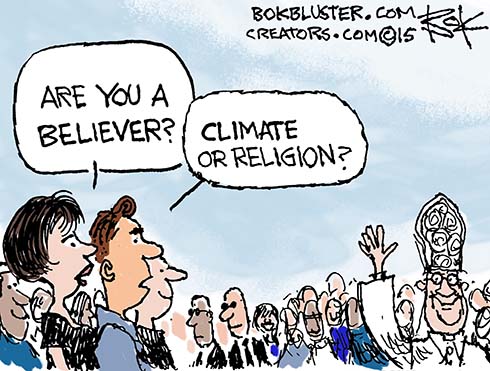
Pope Francis Speaks as Climate Bigot

Thomas D. Williams, Ph.D. reports at Climate Change Dispatch Unchristian: Pope Francis Says Climate Deniers Are ‘Stupid’, Skepticism ‘Perverse’.  Excerpts in italics with my bolds and added images.

Pope Francis told CBS News this week that climate change deniers are “stupid” to refute compelling evidence of a climate emergency. [emphasis, links added]

“Some people are stupid (necios), and stupid even if you show them research, they don’t believe it,” the pontiff told CBS Evening News anchor Norah O’Donnell when asked what he would say to the deniers of climate change.  “Why? Because they don’t understand the situation, or because of their interests, but climate change exists,” the 87-year-old pope asserted.

Pope Francis had never before sat down for an extensive interview, one-on-one, with a U.S. television network during his 11-year pontificate.

Pope Francis has been a vocal enthusiast for the war on climate changecalling global warming “one of the most serious and worrying phenomena of our time” and urging “drastic measures” to combat climate change.

He has expressed his opinion that any skepticism regarding an alleged “climate emergency” is “perverse.”

The pope has also singled out the United States as particularly to blame for the “climate emergency,” even though it is one of the countries with the cleanest air in the world.

“If we consider that emissions per individual in the United States are about two times greater than those of individuals living in China and about seven times greater than the average of the poorest countries, we can state that a broad change in the irresponsible lifestyle connected with the Western model would have a significant long-term impact,” he stated last October.

Among the “fools” denounced by the pope for their “perverse” skepticism of the climate crisis are a group of over 1,600 prominent scientists, including two Nobel Prize winners, who issued the “World Climate Declaration” last August, refuting the existence of a so-called “climate emergency.”

Among other things, the Declaration asserted that climate models have proven inadequate for predicting global warming, that carbon dioxide (CO2) is not a pollutant, and that climate change has not increased natural disasters.

The world has warmed “significantly less than predicted by IPCC on the basis of modeled anthropogenic forcing,” the text states, and the gap between the real world and the modeled world “tells us that we are far from understanding climate change.”

There is no statistical evidence that global warming is intensifying hurricanesfloodsdroughts, and such like natural disasters, or making them more frequent,” the document declared. “However, there is ample evidence that CO2-mitigation measures are as damaging as they are costly.”

“There is no climate emergency,” it concluded. “Therefore, there is no cause for panic and alarm.

“We strongly oppose the harmful and unrealistic net-zero CO2 policy proposed for 2050. Go for adaptation instead of mitigation; adaptation works whatever the causes are,” it added.

Why So Obsessed with Decarbonizing?

How did the current obsession with decarbonization arise?

Part of a lecture given by Prof. R, Lindzen to MIT Students for Free Inquiry on March 6, 2024 is posted by John Ray at his blog Greenie Watch.  Excerpts in italics with my bold and added images.

Currently, there is great emphasis on the march through the educational institutions: first the schools of education and then higher education in the humanities and the social sciences and now STEM.

What is usually ignored is that the first institutions to be captured were professional societies. My wife attended a meeting of the Modern Language Association in the late 60’s , and it was already fully ‘woke.’ While there is currently a focus on the capture of education, DEI was not the only goal of the march through the institutions. I think it would be a mistake to ignore the traditional focus of revolutionary movements on the means of production.

The vehicle for this was the capture of the environmental movement.

Prior to 1970, the focus of this movement was on things like whales, endangered species, landscape, clean air and water, and population. However, with the first Earth Day in April of 1970 , the focus turned to the energy sector which, after all, is fundamental to all production, and relatedly, involves trillions of dollars. This was accompanied by the creation of new environmental organizations like Environmental Defense and the Natural Resources Defense Council. It was also accompanied by new governmental organizations like the EPA and the Department of Transportation.

Once again, professional societies were easy pickings: the American Meteorological Society, the American Geophysical Union, and even the honorary societies like the National Academy of Science, the American Academy of Arts and Sciences, etc. There was a bit of floundering to begin with. The movement initially attempted to focus on global cooling due to the reflection of sunlight by sulfate aerosols emitted by coal fired generators . After all, there seemed to have been global cooling between the 1930’s and the 1970’s. However, the cooling ended in the 1970’s.

There was an additional effort to tie the sulfates to acid rain which was allegedly killing forests. This also turned out to be a dud. In the 70’s, attention turned to CO2 and its contribution to warming via the greenhouse effect. The attraction of controlling CO2 to political control freaks was obvious. It was the inevitable product of all burning of carbon – based fuels. It was also the product of breathing.

However, there was a problem: CO2 was a minor greenhouse gas compared to the naturally produced water vapor. Doubling CO2 would only lead to warming of less than 1°C. A paper in the early 70’s by Manabe and Wetherald came to the rescue. Using a highly unrealistic one – dimensional model of the atmosphere, they found that assuming (without any basis) that relative humidity remained constant as the atmosphere warmed would provide a positive feedback that would amplify the impact of CO2 by a factor of 2. This violated Le Chatelier’s Principle that held that natural systems tended to oppose change, but to be fair, the principle was not something that had been rigorously proven.

Positive feedbacks now became the stock in trade of all climate models
which now were producing responses to doubling CO2 of 3°C
and even 4°C rather than a paltry 1°C or less.

The enthusiasm of politicians became boundless. Virtue signaling elites promised to achieve net zero emissions within a decade or 2 or 3 with no idea of how to achieve this without destroying their society. Ordinary people, confronted with impossible demands on their own well – being, have not found warming of a few degrees to be very impressive. Few of them contemplate retiring to the arctic rather than Florida.

Excited politicians, confronted by this resistance, have frantically changed their story. Rather than emphasizing miniscule changes in their temperature metric, they now point to weather extremes which occur almost daily some place on earth, as proof not only of climate change but of climate change due to increasing CO2 (and now also to the even more negligible contributors to the greenhouse effect like methane and nitrous oxide) even though such extremes show no significant correlation with the emissions.

From the political point of view, extremes provide convenient visuals
that have more emotional impact than small temperature changes.

The desperation of political figures often goes beyond this to claiming that climate change is an existential threat (associated with alleged ‘tipping points’) even though the official documents produced to support climate concerns never come close to claiming this, and where there is no theoretical or observational basis for tipping points .

I should note that there was one exception to the focus on warming, and that was the ozone depletion issue. However, even this issue served a purpose. When Richard Benedick, the American negotiator of the Montreal Convention which banned Freon passed through MIT on his way back from Montreal, he gloated over his success, but assured us that we hadn’t seen anything yet; we should wait to see what they would do with CO2 . In brief the ozone issue constituted a dry run for global warming.

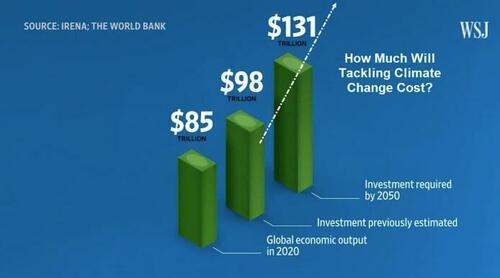
Yes, they are projecting more than 100 Trillion US$.

To be sure, the EPA ’ s activities still include conventional pollution control, but energy dominates. Of course, the attraction of power is not the only thing motivating politicians. The ability to award trillions of dollars to reorient our energy sector means that there are recipients of these trillions of dollars, and these recipients must only share a few percent of these trillions of dollars to support the campaigns of these politicians for many election cycles and guarantee the support of these politicians for the policies associated with the reorientation.

Background History from Richard Lindzen


Climate Science Was Broken

By taking a few minutes to read his text (here), you can learn from Lindzen some important truths:

  • How science was perverted from a successful mode of enquiry into a source of authority;
  • What are the consequences when fear is perceived to be the basis for scientific support rather than from gratitude and the trust associated with it;
  • How incentives are skewed in favor of perpetuating problems rather than solving them;
  • Why simulation and large programs replaced theory and observation as the basis of scientific investigation;
  • How specific institutions and scientific societies were infiltrated and overtaken by political activists;
  • Specific examples where data and analyses have been manipulated to achieve desired conclusions;
  • Specific cases of concealing such truths as may call into question gobal warming alarmism;
  • Examples of the remarkable process of “discreditation” by which attack papers are quickly solicited and published against an undesirable finding;
  • Cases of Global Warming Revisionism, by which skeptical positions of prominent people are altered after they are dead;
  • Dangers to societies and populations from governments, NGOs and corporations exploiting climate change.


There is no charge for content at this site, nor for subscribers to receive email notifications of postings.

Eco-Loons War on Productive Working Class

Brendan O’Neill writes at Spiked Greta’s class war.  Excerpts in italics with my bolds and added images.

The green ideology is the enemy of working people.

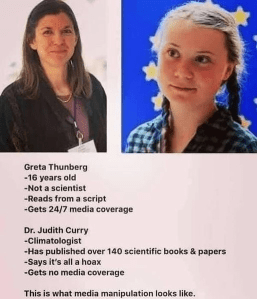
It was like a case study in indifference. There was privileged Gen Zer Greta Thunberg and other Euro eco-brats smiling and flicking peace signs as they called on the Dutch government to stop subsidising fossil-fuel companies. Meanwhile, the Dutch people, very few of whom are the offspring of opera singers with the ear of the world media, are suffering one of the largest spikes in energy prices in all of Europe. Their bills are through the roof. They’re reeling from the ‘pain of high energy costs’, as some in the media describe it.

And yet in sweeps giggling Greta and her barmy eco-army
to agitate for less government backing for energy production,
which would likely hike the price even more.

Rarely has the blinkered vanity, the sheer social apathy, of the green movement been so starkly illustrated. It was on Saturday that Greta and chums made their haughty demands of the Dutch government. In a protest at The Hague, hundreds of supporters of the upper-class death cult Extinction Rebellion marched behind a banner saying ‘STOP FOSSIL SUBSIDIES’. Some of the more spirited of these marchers against modernity, including Greta, broke away from the protest and headed to the A12 highway with the intention of blocking it. Because apparently it’s not enough to hit the pockets of the good people of the Netherlands – no, you have to ruin their weekend travel plans, too. Cops intervened and Greta and others were arrested for the crime of impeding a highway.

The press is full of gushing reports of Greta’s arrest. The BBC features an image of its favourite prophetess of doom yelling something as ticked-off cops drag her away. Our heroine only wanted to ‘block… a main road’ in protest against the ‘Dutch government’s tax concessions for companies connected to the fossil-fuel industry’, the Beeb says. What a turnaround from its reporting on the revolting Dutch farmers who also blocked highways, though in their case in opposition to lunatic Net Zero policies rather than in favour of them. Back then, the BBC said farmers had ‘clogged up’ roads and ‘snarled up motorways’ and created an ‘unsafe situation’. So when workers hold up highways, it’s horrifying, yet when time-rich right-on youths do it, it’s heroic? We see you, BBC.

The truth is there was nothing admirable about
Greta’s latest temper tantrum over fossil fuels.

A phrase like ‘fossil-fuel subsidies’ seems designed to get polite society gagging on its muesli, but what exactly are they? Essentially, they’re tax breaks from the Dutch government that make it cheaper for big companies to produce and use energy from oil, gas and coal. The biggest winner is the Dutch shipping industry, which benefits by around €6.7 billion. Call me a raging leftist, but it seems a good idea to me for the government to assist an industry that employs tens of thousands of people and contributes just shy of five per cent to Dutch GDP. Electricity generation is another big winner, benefitting to the tune of €5.3 billion.

Yes, electricity generation. Just think about this. In an energy crisis, Greta and Co are screaming in the streets about government assistance for… energy production! As the Dutch people, like others in Europe, look with fear and bewilderment at their ever-spiralling energy bills, noisy greens want the government to desubsidise companies that make energy. You don’t need a PhD in economics to see what the outcome would be – more cost offsetting to consumers, higher bills, greater angst.

Haven’t the Dutch suffered enough in the energy crisis already? Although it is being forecast that Dutch people’s energy bills will improve a little this year, for a while they were paying the most out of all EU member states. In 2023, they were stumping up €47.5 per 100 kWh, compared with an EU average of €28.9 per 100 kWh. It was the Netherlands’ over-reliance on gas imports, including from Russia, that plunged it into this crisis following the outbreak of war in Ukraine. And it responded by lifting the cap on energy production at coal-fired power plants and reversing its plans to cut back on gas production. To most folk, this will sound eminently sensible.

To eco-cranks, however, it is intolerable and the Dutch government must
at once stop subsidising such planet-mauling activities.
Seriously, why does anyone listen to these fruitcakes?

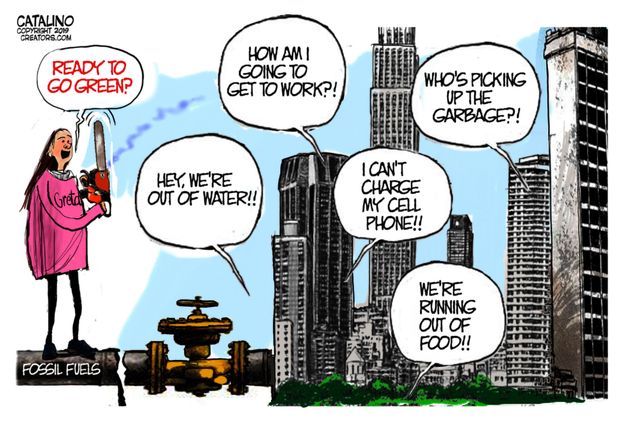
To me, it is wild that people would protest against energy production during an energy crisis. That they would have a fit of the vapours over energy subsidies, coal use and gas exploration at a time when people are struggling to keep the lights on. It’s not just dumb – it’s cruel. Imagine how out of touch with ordinary people’s concerns you would need to be to swan into a country experiencing a severe energy crisis and essentially say: ‘Stop supporting energy production.’ What was Greta thinking? She’s become a globetrotting enemy of progress, popping up all over the place to demand that we turn off the lights and don a hairshirt in keeping with her dystopian dream of restoring a pre-capitalist idyll that never actually existed.

It’s not just Greta, of course. The entire green ideology
is a menace to working people.

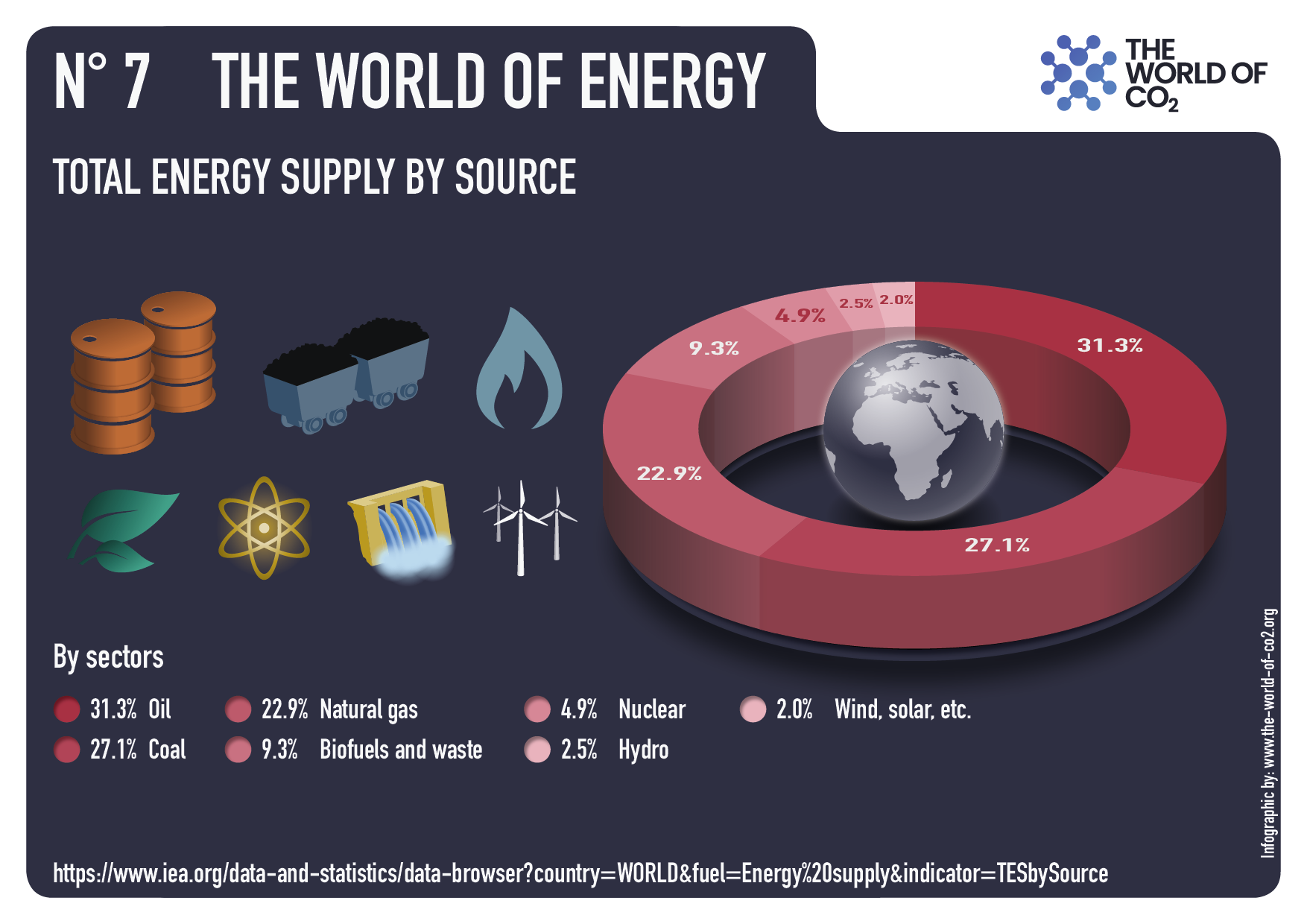
Climate-change alarmism is an unspoken class war in which the well-off and borderline aristocratic while away their days bemoaning the evils of the Industrial Revolution that liberated the rest of us from grinding poverty. Whether these Gretas, Poppies and Edreds are demanding less energy production, fewer cars on the roads, no more cheap flights or just ruining the snooker, the end result is the same: working people’s living standards and leisure pursuits are put in the crosshairs. More than 80 per cent of the world’s energy comes from fossil fuels. The fossil-fuel phaseout that Greta and the rest dream about would plunge the world’s workers and poor into unimaginable penury. These people claim to be waging war on apocalypse but really they threaten to bring one about.

I far prefer the uprising of the Netherlands’ farmers. And other European farmers. They block roads in service of a cause that is the precise moral opposite of the luxuriant apocalypticism of the spoilt activist class. Namely, the protection of jobs and living standards from the religious fever of Net Zero. The insistence that food production not be undermined by the climate-change targets of out-of-touch Euro elites. The improvement of the lot of workers rather than the further immiseration of them in the phoney name of ‘saving the planet’.

There’s a class war being waged on the streets of Europe,
with postmodern eco-loons on one side and
actually productive people on the other. Choose your player.

There is no charge for content on this site, nor for subscribers to receive email notifications of postings.

Time for Billionaires to Fund Climate and Social Realism

Wallace Manheimer provides the advice in his Daily Caller article Here’s A Better Way For Billionaires To Give Their Money.  Excerpts in italics with my bolds and added images. In the second part of this post Dr. Manheimer explains how philantropists and many others have been duped by Net Zero claims.

Many of your fellow billionaires contribute large sums to “cure” a
nonexistent climate crisis, falsely naming it an “existential threat.”

They wrongly claim that wind and solar can support modern civilization. For instance, Michael Bloomberg has proudly committed $500 million to eliminate coal. Jeffery Bezos has committed $10 billion to a variety of climate causes and “clean energy” efforts. These billions dwarf resources available to small groups fighting, for instance, degradation of their land by gigantic wind companies.

Furthermore, these philanthropists direct many dollars into foolishness like Critical Race Theory and a fabricated division of the world into oppressors and the oppressed. In addition to unnecessary climate panic, college campuses harbor harmful notions of “gender fluidity” and dangerous divisiveness among students that manifest as rampant antisemitism and hostility toward the deplorables du jour.

You know this is wrong but, despite your wealth, may feel powerless to stem the societal degradation. You make your own large contributions to hospitals, museums, medical schools, etc. Of course, that is very commendable. Still, you may be looking for other avenues for your generosity – perhaps actions that could not only help people but also challenge the promotion of negative forces.

Well, we have a few suggestions.

Let’s first consider possibilities within the U.S. As a private citizen or group of citizens, you can certainly place ads into major media to expose the fraudulence of scientifically invalid claims of a climate crisis. You could cite the mountain of scientific evidence that contradicts the popular apocalyptic narrative as well as the tens of thousands of prominent scientists attesting that there is no climate crisis. Sources include the CO2 CoalitionGlobal Warming Petition Project and CLINTEL’s World Climate Declaration. Furthermore, you could partially balance the scales by financially supporting local groups fighting installation of hundreds of gigantic wind turbines, each the size of the Washington Monument; or square miles and miles of solar panels, which will permanently scar their land.

If you’re more inclined to support universities, then we suggest financing a faculty position about Washington, Jefferson, Hamilton, Madison, and Lincoln. Their accomplishments and documents are sources of inspiration worldwide. Alternatively, you might consider supporting nuclear science and engineering departments, or initiating an interdepartmental organization, for domestic and international students, in the disciplines of petroleum geology, engineering, and industry.

Internationally, there are many countries that suffer from a lack of energy. The less developed world is not giving up on fossil fuels regardless of pompous calls from the climate industrial complex for them to do so.  “I firmly believe that no African country can be asked to halt the exploration of its natural resources, including fossil fuels,” says Kenyan President William Ruto. 

Even the head of the United Nations’ most recent climate summit, Sultan Al-Jaber of the United Arab Emirates, said that use of fossil fuels cannot be discontinued “unless you want to take the world back into caves.”

Perhaps nobody exhibited resentment of meddling in Third World energy policy more than did Indian Prime Minister Narendra Modi: “The colonial mindset hasn’t gone. We are seeing from developed nations that the path that made them developed is being closed to developing nations.” 

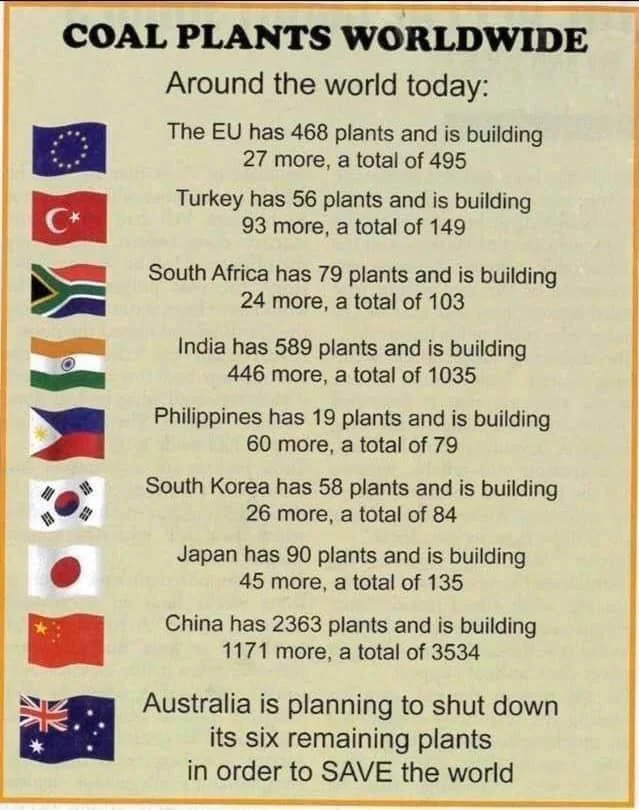
Lesser developed countries will continue to advance in ways they see fit, employing fossil fuels (and hopefully also nuclear power). China and India are building coal-fired power plants at a furious pace, and Africa and other regions will soon as well. There is no stopping it! Rather than utter hypocritical and futile pieties, let’s help them and, while doing so, also help promote sensible, clean energy technologies developed in the U.S.

Coal promises to be the salvation of more than half of sub-Saharan Africans — the number who labor daily with inadequate supplies of electricity. Cooking, heating and lighting are done with a combination of wood, charcoal and dried animal dung. The World Health Organization estimates that about half a million die each year from the resulting indoor air pollution.

Ultra-super critical coal-fired generating facilities, recently developed in the United States, are cleaner and more efficient than traditional plants. American billionaires investing in these sources of clean, affordable, reliable electricity could save the lives of untold numbers of sub-Saharan Africans.  

Nigeria, once an important oil producer, never instituted effective pollution controls and, with the advent of hydrofracturing technology in the U.S., is hardly competitive on the world market. In fact, Exxon Mobil is considering pulling out of the country. The right investments could restore both Nigeria’s environment and oil industry.

There are many new things for rational, public-spirited billionaires to support.
Why leave the field to those pursuing the climate fetish
and promoting destructive ideologies and fads?

Dr. Wallace Manheimer is a life fellow of the American Physical Society, the Institute of Electrical and Electronic Engineers and is a member of the CO2.Coalition. He is the author of more than 150 refereed papers.

Background:  Manheimer Steamrolls Net Zero Claims

Accomplished and distinguished physicist Wallace Manheimer published a crushing argument against the rationale for Net Zero claims and policies.  His paper is While the Climate Always Has and Always Will Change, There Is no Climate Crisis. published in the Journal of Sustainable Development.  In italics with my bolds and added images.

Abstract

The emphasis on a false climate crisis is becoming a tragedy for modern civilization, which depends on relible, economic, and environmentally viable energy. The windmills, solar panels and backup batteries have none if these qualities.

This falsehood is pushed by a powerful lobby which Bjorn Lomborg has called a climate industrial complex, comprising some scientists, most media, industrialists, and legislators. It has somehow managed to convince many that CO2 in the atmosphere, a gas necessary for life on earth, one which we exhale with every breath, is an environmental poison.

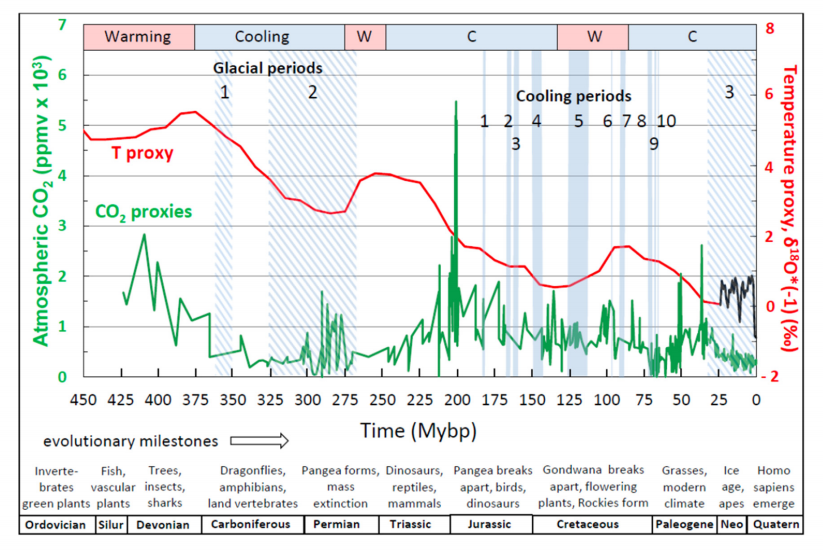
Multiple scientific theories and measurements show that there is no climate crisis. Radiation forcing calculations by both skeptics and believers show that the carbon dioxide radiation forcicng is about 0.3% of the incident radiation, far less than other effects on climate. Over the period of human civilization, the temperature has oscillated between quite a few warm and cold periods, with many of the warm periods being warmer than today. During geological times, it and the carbon dioxide level have been all over the place with no correlation between them.

A useful synopsis is written by Chris Morrison at the Daily Sceptic  Net Zero Will Lead to the End of Modern Civilisation, Says Top Scientist.  Excerpts in italics with my bolds and added images.

A damning indictment of the Net Zero political project has been made by one of the world’s leading nuclear physicists. In a recently published science paper, Dr. Wallace Manheimer said it would be the end of modern civilisation. Writing about wind and solar power he argued it would be especially tragic “when not only will this new infrastructure fail, but will cost trillions, trash large portions of the environment, and be entirely unnecessary”. The stakes, he added, “are enormous”.

Dr. Manheimer holds a physics PhD from MIT and has had a 50-year career in nuclear research, including work at the Plasma Physics Division at the U.S. Naval Research Laboratory. He has published over 150 science papers. In his view, there is “certainly no scientific basis” for expecting a climate crisis from too much carbon dioxide in the atmosphere in the next century or so. He argues that there is no reason why civilisation cannot advance using both fossil fuel power and nuclear power, gradually shifting to more nuclear power.

There is of course a growing body of opinion that points out that the Emperor has no clothes when it comes to all the fashionable green technologies. Electric cars, wind and solar power, hydrogen, battery storage, heat pumps – all have massive disadvantages, and are incapable of replacing existing systems without devastating consequences.

Manheimer points out that before fossil fuel became widely used, energy was provided by people and animals. Because so little energy was produced, “civilisation was a thin veneer atop a vast mountain of human squalor and misery, a veneer maintained by such institutions as slavery, colonialism and tyranny”.

This argument hints at why so many rich, virtue-signalling celebrities argue not just for Net Zero but ‘Real’ Zero, with the banning of all fossil fuel use.

King Charles said in 2009 that the age of consumerism and convenience was over, although the multi-mansion owning monarch presumably doesn’t think such desperate restrictions apply to himself. Manheimer notes that fossil fuel has extended the benefits of civilisation to billions, but its job is not yet complete. “To spread the benefits of modern civilisation to the entire human family would require much more energy, as well as newer sources,” he adds.

In Manheimer’s view, the partnership among self-interested businesses, grandstanding politicians and alarmist campaigners, “truly is an unholy alliance”. The climate industrial complex does not promote discussion on how to overcome this challenge in a way that will be best for everyone. “We should not be surprised or impressed that those who stand to make a profit are among the loudest calling for politicians to act,” he added.

Perhaps one of the best voices to cast doubt on an approaching climate crisis, suggests the author, is Professor Emeritus Richard Lindzen of MIT, one of the world’s leading authorities on geological fluid motions:

“What historians will definitely wonder about in future centuries is how deeply flawed logic, obscured by shrewd and unrelenting propaganda, actually enabled a coalition of powerful special interests to convince nearly everyone in the world that CO2 from human industry was a dangerous planet-destroying toxin. It will be remembered as the greatest mass delusion in the history of the world – that CO2, the life of plants, was considered for a time to be a deadly poison.”

Figure 16. The geological history of CO2 level and temperature proxy for the past 400 million years. CO2 levels now are ~ 400ppm

Much of Dr. Manheimer’s interesting paper debunks many of the fashionable nostrums surrounding politicised ‘settled’ climate science. It is an excellent read. Discussing some of the contrary opinions that debunk obviously false claims, he says it is “particularly disheartening” to see learned societies make definitive claims when so much contrary information is readily available. He points out that over the last 10,000 years, the Earth has almost certainly been warmer. There have been warmer and colder periods, just like today.

To find the off-narrative information, even Google can be used, Manheimer says – though he does note that the company warns it will not provide information on “claims denying that long-term trends show that the global climate is warming”.

Figure 18. Per capita food production in kcal/(per-capita per day) from 1961 to 2009. Notice that there is a steadily increasing production, with no sign of any ‘slowly escalating but long-enduring global threat to food supplies.’

Real Science Guy: Climate Crisis Imaginary

Daniel W. Nebert writes at American Thinker Today’s ‘Climate Crisis’ Is a Fairy Tale.  Excerpts in italics with my bolds and added images.

For the past 35 years, the United Nations’ Intergovernmental Panel on Climate Change (IPCC) has warned us that emissions from the burning of fossil fuels, predominantly carbon dioxide (CO2), are causing dangerous global warming. This myth is blindly accepted — even by many of my science colleagues who know virtually nothing about climate. As a scientist, my purpose here is to help expose this fairy tale.

The global warming story is not a benign fantasy. It is seriously damaging Western economies. In January 2021, the White House ridiculously declared that “climate change is the most serious existential threat to humanity.” From there, America went from energy independence back to energy dependence. Another consequence has been the appearance of numerous companies whose goal is to “sequester CO2” as well as “sequester carbon” from our atmosphere. However, this so-called “solution” is scientifically impossible. Life on Earth is based on carbon! CO2 is plant food, not a pollutant!

Generations have been brainwashed for decades into believing this imaginary “climate crisis,” from kindergarten through college, and in mainstream media and social media. Indoctrinated young teachers feel comfortable teaching this misinformation to students. Dishonest climate scientists feel justified in spreading disinformation because they need governmental support for salaries and research.

The evidence contradicting the climate apocalypse is vast.

Some comes from analysis of Greenland and Antarctica ice, in which air trapped at various depths reveals CO2 levels of past climate. Proxy records from marine sediment, dust (from erosion, wind-blown deposition of sediments), and ice cores provide a record of past sea levels, ice volume, seawater temperature, and global atmospheric temperatures.

From his seminal work while a prisoner of war during WWI, Serbian mathematician Milutin Milankovitch explained how climate is influenced by variations in the Earth’s asymmetric orbit, axial tilt, and rotational wobble — each going through cycles lasting as long as 120,000 years.

It is widely recognized that Glacial Periods of about 95,000 years, interspersed with Interglacial Periods of approximately 25,000 years, correspond with Milankovitch Cycles. Multiple incursions of glaciers occurred during the Pleistocene, an epoch lasting from about 2.6 million to 11,700 years ago, when Earth’s last Glacial Period ended. Around 24,000 years ago, present-day Lake Erie was covered with ice a mile thick.

Within each Interglacial Period, there’ve been warming periods, or “Mini-Summers.” For example, within the current Holocene Interglacial, there have been warmer periods known as the Minoan (1500–1200 B.C.), Roman (250 B.C.–A.D. 400), and Medieval (A.D. 900–1300). Our Modern Warming Period began with the waning of the Little Ice Age (1300–1850). Today’s Mini-Summer is colder so far than all previous Mini-Summers of the last 8,500 years.

How did CO2 get blamed for global warming? French physicist Joseph Fourier (1820s) proposed that energy from sunlight must be balanced by energy radiated back into space. Irish physicist John Tyndall (1850s) performed laboratory experiments on “greenhouse gases” (GHGs), including water vapor; he proposed that CO2 elicited an important effect on temperature. However, it’s impossible to do appropriate experiments — unless the roof of your laboratory is at least six miles high. Swedish chemist Svante Arrhenius (1896) proposed that “warming is proportional to the logarithm of CO2 concentration.” Columbia University geochemist Wallace Broecker (1975) and Columbia University adjunct professor James Hansen (1981) wrote oft-cited articles in Science magazine, both overstating the perils of CO2 causing dangerous global warming — without providing scientific proof.

Most of Earth’s energy comes from the sun. Absorption of sunlight causes molecules of objects or surfaces to vibrate faster, increasing their temperature. This energy is then re-radiated by land and oceans as longwave, infrared radiation (heat). Princeton University physicist Will Happer defines a GHG as that which absorbs negligible incoming sunlight but captures a substantial fraction of thermal radiation as it is re-radiated from Earth’s surface and atmospheric GHGs back into space.

The gases of nitrogen, oxygen and argon — constituting 78%, 21%, and 0.93%, respectively, of the atmosphere — show negligible absorption of thermal radiation and therefore are not GHGs. Important GHGs include water (as high as 7% in humid tropics and as little as 1% in frigid climates), CO2 (0.042%, or 420 parts per million [ppm] by volume), methane (0.00017%), and nitrous oxide (0.0000334%, or 334 ppm). Water vapor (clouds) has at least a hundred times greater warming effect on Earth’s temperature than all other GHGs combined.

As atmospheric CO2 increases, its GHG effect decreases: CO2’s warming effect is 1.5°C between zero and 20 ppm, 0.3°C between 20 and 40 ppm, and 0.15°C between 40 and 60 ppm. Every doubling of atmospheric CO2 from today’s levels decreases radiation back into space by a mere 1%. For most of the past 800,000 years, Earth’s atmospheric CO2 has ranged between about 180 ppm and 320 ppm; below 150 ppm, Earth’s plants could not exist, and all life would be extinguished.

Today’s global atmospheric CO2 levels are ~420 ppm. Even at these levels, plants are “partially CO2-starved.” In fact, standard procedures for commercial greenhouse growers include elevating CO2 to 800­–1200 ppm; this enhances growth and crop yield ~20–50%. As shown by satellite since 1978, increased atmospheric CO2 has helped “green” the Earth by more than 15 percent, substantially enhancing crop production.

Spatial pattern of trends in Gross Primary Production (1982- 2015). Source: Sun et al. 2018.

If global atmospheric CO2 was ~280 ppm in 1750, and it’s ~420 ppm today, what’s the source of this 140-ppm increase? Scientists estimate that human-associated industrial emissions might have contributed 135 ppm — with “natural causes” accounting for the remaining 5 ppm.

But did processes throughout earth’s history stop
when humans began burning hydrocarbons?

In Earth’s history, the highest levels of atmospheric CO2 (6,000–9,000 ppm) occurred about 550–450 million years ago, which caused plant life to flourish. CO2 levels in older nuclear submarines routinely operated at 7,000 ppm, whereas newer subs keep CO2 in the 2,000- to 5,000-ppm range. Meanwhile, ice core data over the last 800,000 years show no correlation between global warming or cooling cycles and atmospheric CO2 levels.

CO2 in our lungs reaches 40,000–50,000 ppm, which induces us to take our next breath. Each human exhales about 2.3 pounds of CO2 per day, which means Earth’s 8 billion people produce daily 18.4 billion pounds of CO2. But humans represent only 1/40 of all CO2-excreting life on Earth. Multiplying 18.4 billion pounds by 40 gives us 736 billion pounds of CO2 per day. This approximates the overall CO2 excreted by the total animal and fungal biomass on the planet.

Daily emissions from worldwide industry in 2020 were estimated to be 16 million metric tons of CO2 equivalents. If one metric ton is 2,200 pounds, then “total industrial emissions” amount to 35,200,000,000 (35.2 billion) pounds of CO2 per day. This means that the entire animal and fungal biomass (736 billion pounds) puts out more than 20 times as much CO2 as all industrial emissions (35.2 billion pounds)!

Can any clear-thinking person comprehend the facts above and still create a company with idiotic plans to “sequester CO2” or “sequester carbon”? Scientifically, “net zero” and “carbon footprint” are meaningless terms. There is no “climate crisis.”

If you try to find these facts on the web, good luck! Out of every 10 hits on any climate topic, you’ll be lucky to find one or two sites with truthful scientific data.

The door of a nearby classroom displays a poster of Abraham Lincoln with the caption: “Don’t believe everything you read on the internet.” It is advice that our 16th president surely would have offered — had he lived to see the rise of this global warming quasi-religion.

Daniel W. Nebert is professor emeritus in Gene-Environment Interactions at the University of Cincinnati. He thanks Professor Will Happer (one of the CO2 Coalition directors) for valuable discussions.

See Also

Ian Plimer Asks, “What Climate Crisis?”

Climatists Deniers of Reality


Fear of Climate Crisis Solved

John Tamny explains the root cause of fears about global warming/climate change in his Real Clear Markets article Warming and Left Wing Professors Worry You? You Must Be Rich.  Excerpts in italics with my bolds and added images.

The 20th century called and it wants the word crisis back, the first half of the 20th century in particular. Back then crises were truly terrifying. Think two world wars that exterminated tens of millions of people, genocides of Jews and Armenians, global economic depression, tax rates that topped out at 90 percent, and so much more.

Looking for a Job During the Great Depression. Hulton Archive / Getty Images

Fast forward to the present, and on relatively a quiet day (of which there are thankfully many) one of the most commonly expressed fears on the left concerns global warming born of fossil-fuel consumption. Without presuming to comment on the science here, what a luxurious worry. Back before innovators connected oil to the automation of work formerly done by humans, to cars, and eventually machines capable of cooling and/or warming our homes, weather extremes rendered the indoors and outdoors equally dreadful.

It’s too easily forgotten that air conditioners weren’t a market good until the 1930s, and once on the market, they retailed from $10,000 to $50,000. Fear of excess warmth or cooling care of appliances was well in the future, and worry about outdoor temperatures a likely byproduct of technology that made the indoors so livable. Put another way, if you fear warming or cooling outdoors it’s likely because you suffer neither indoors.

What does the past say about the present? It first signals that worry is hardly a modern concept. There’s always something. In our case, the somethings that have us up at night would have been viewed as positively luxurious by people who had worries of the world war, mass genocide, and back-breaking work kind that didn’t afford a lot of learning of any type. This isn’t to dismiss what has so many up in arms today, but it is to say that our “crises” are truly modern, and a rather bullish effect of immense prosperity.

See also 

Ungrateful Millennials Richer than Rockefeller

Claimed Warming Not a Fact on the Ground

Jack Hellner writes at American Thinker Taking a look at my hometown data I discover the very opposite of the ‘global warming’ narrative is true.  Excerpts in italics with my bolds and added images.

The following are actual pieces of scientific data related to Springfield, Illinois, where I live:

The warmest day recorded in January is 73 degrees Fahrenheit on January 23, 1909, so every day in January, for the last 115 years, has been colder; the warmest day ever in February is February 24, 1930, when temperatures hit 78 degrees; the warmest day in March was March 21, 1907, when the temperature hit 91 degrees.

The average high temperature in Springfield today is around 36 degrees, and this weekend we are supposed to have highs around 30 degrees below normal, with wind chills around 20 below zero.

So, after 160 years of exponential growth of all the things the green pushers
say cause warming, we are thirty degrees below normal.

Temperatures have always fluctuated cyclically and naturally. Humans have no control over them, and there is no correlation between CO2 content, crude oil use, number of vehicles, and temperatures.

Yet, here is an article from two days ago, full of worthless information and repeated talking points, all to push the radical green agenda to scare people into capitulation:

Earth shattered global heat record in ’23 and it’s flirting with warming limit, European agency says

Earth last year shattered global annual heat records, flirted with the world’s agreed-upon warming threshold and showed more signs of a feverish planet, the European climate agency said Tuesday.

The European climate agency Copernicus said the year was 1.48 degrees Celsius (2.66 degrees Fahrenheit) above pre-industrial times. That’s barely below the 1.5 degrees Celsius limit that the world hoped to stay within in the 2015 Paris climate accord to avoid the most severe effects of warming.

People with common sense and the ability to critically think should have several questions and comments about this article. First, they should point out that it is impossible to get an average global temperature unless they place the weather stations by area throughout the globe.

For example: 70 percent of the earth is covered by water, so 70% of weather stations should be placed over water to get a statistically accurate global temperature. Placing a much higher percentage of weather stations in urban areas, with cement and buildings, obviously skews the statistical results. Basically it is garbage in, garbage out.

Then they should ask why they picked the beginning of the Industrial Revolution as the starting point from which to measure. The Industrial Revolution spanned the period 1760–1840, which was during the little ice age. So, if you pick a cold period to start from, you exaggerate the change to push the agenda.

Why didn’t they start with the medieval warming period,
where the temperature was like today? The reason they don’t
is that it wouldn’t scare people into capitulation.

Why don’t they recognize the cooling period from 1940-1975 as disproving their theory that our use of natural resources causes warming? Because facts haven’t mattered in a long time.

One sentence that I find humorous is where people got together and decided exactly what the earth’s maximum temperature should be: “Earth last year shattered global annual heat records, flirted with the world’s agreed-upon warming threshold….”

Did they have a multiple-choice question? We will be able to adapt. It is pure arrogance when politicians, bureaucrats, the United Nations, and others pretend they can control temperatures, sea levels, and storm activity.

There are too many natural variables that we can’t control or predict. What people will never see in these articles that seek to scare people into capitulation is any actual scientific data that shows a direct link between our use of oil, coal, natural gas, methane, number of gas-powered vehicles, and temperature, or any other climate statistic because… there is none. But they don’t care.

The goal has always been to transfer money and freedom from the people
to the government and green pushers. They are greedy! It is a massive scam!

See also:

Temperature records from around the world do not support
the assumption that today’s temperatures are unusual.

The Climate Story (Illustrated)

Resources for Climate History Where You Live

June 2023 the Hottest Ever? Not So Fast!