NYT Makes 12 out of 12 False Claims Against Lomborg’s Book

Bjorn Lomborg set the record straight at LinkedIn The New York Times’ stunningly false and deceptive hit piece to preserve climate alarmism.  Excerpts in italics with my bolds.

The piece consists of Stiglitz enumerating four specific and compounding mistakes that I apparently make, and then another six separate observations. I will go through all of them below, starting with the four mistakes.

My first “mistake”

My first mistake is that I draw “heavily on the work of William Nordhaus of Yale University, who came up with an estimate of the economic cost to limiting climate change to 1.5 to 2 degrees Celsius above preindustrial levels.” Instead the High-Level Commission on Carbon Prices, which Stiglitz co-authored, showed that 1.5°C-2°C goals “could be achieved at a moderate price.”

This is triply wrong. I don’t rely on Nordhaus for the cost on limiting temperature rise for 1.5°C to 2°C, simply because Nordhaus does not make that estimate. Nordhaus explicitly writes, as Stiglitz would know had he read Nordhaus or my book: “A limit of 2°C appears to be infeasible with reasonably accessible technologies even with very ambitious abatement strategies.”

Secondly, Stiglitz claims that his report estimates “a moderate price” for reaching the Paris agreement. This is false. There is no estimate of the total economic cost of a 2°C or 1.5°C target in his High-Level Commission on Carbon Prices.

Compounding Stiglitz’ error is the fact that the background report for his high-level commission does indeed list the UN Climate Panel cost estimate for reaching 1.5-2°C at more than 4% of GDP by 2100 (p2), which makes Nordhaus’ 1.38% GDP economic cost at the lowest temperature scenario of 2.35°C by 2100 substantially smaller (not larger, as Stiglitz claims).

Stiglitz throughout his piece neglects to inform the reader that Nordhaus is not just any old economist, but actually the only climate economist to get the Nobel prize for his work on climate economics. For reference, Stiglitz got his Nobel prize in economics for analyses of markets with asymmetric information like the selling and buying of used cars.

For the first mistake, Stiglitz makes two false claims and no correct, relevant claims.

My second “mistake”

My second mistake is “Nordhaus’s and Lomborg’s underestimation of the damage associated with climate change.” Stiglitz is in reality informing us that he knows much better than the world’s only climate Nobel economist.

But curiously, Stiglitz never tells us what the right cost is. As such, Stiglitz makes an absurd claim, essentially asserting he knows better than the best peer-reviewed evidence — but just couldn’t be bothered to share that knowledge publicly.

Stiglitz gives one indication of his knowledge on this matter. He claims that a significant part of the cost of climate change “includes more extreme weather events — more intense hurricanes, more droughts, more floods, with all the devastation to life, livelihood and property that accompanies them. Yet, again, he seems to have forgotten to actually acquaint himself with the best evidence on the science and economics of extreme weather events. As the leading researcher on economic impacts of extreme weather events says, Stiglitz is “just wrong.

But more importantly, Stiglitz is just cherry-picking and ignoring the actual data. He picked the costliest recent data point and he neglects that the trend for the US (and similarly for the world) is declining.
Stiglitz is simply doubly wrong on his only indication of how Nobel Laureate Nordhaus and I should be wrong, so for the second mistake, Stiglitz makes two false, one unsubstantiated and no correct, relevant claims.

My third “mistake”

Stiglitz suggests that “A third critical mistake, compounding the second, is not taking due account of risk.”  Ah, if only the world’s only actual Nobel laureate in climate economics had thought of incorporating risks.

Of course, Stiglitz could still have quibbled about a different way to model risk, and added his own take on this. But he does not. He simply — and falsely — suggests that Nordhaus or I have not taken this obvious point into consideration.

Specifically, Stiglitz assuredly tells us that the best damage estimates are underestimates because “as we learn more about climate change these best estimates keep getting revised, and, typically, in only one direction — more damage and sooner than had been expected.”   No, they do not. This is the kind of claim one makes if one gets most of one’s climate information from news media.

For the third mistake, Stiglitz makes two false, one unsubstantiated and no correct, relevant claims.

My fourth “mistake”

Stiglitz seems to claim that Nordhaus and I use a discount parameter that is too low for his liking. I cite the whole paragraph, because it is unclear what his actual point is except a rant against the Trump administration:

Stiglitz apparently suggests that Nordhaus and I use a 7 percent discount rate to spew out the numbers that are in my book. This is demonstrably false. Perhaps Stiglitz knows he’s fibbing, given that he settles for criticizing Trump and then conflating the 7% with the “models Lomborg loves.”

Instead, Nordhaus’ discount rate is calibrated to the real interest rates, meaning a 4.8% discount rate in 2015, declining to 3.5% in 2100.

As he would know, having been World Bank chief economist, it is one thing what rich, liberals in Manhattan want for a discount rate. Most of the rest of the world has much higher discount rates. When we worked with the government of Haiti, the central bank decided on 12% (even contemplating 20%), while Ghana decided 8%.

For the fourth mistake, Stiglitz makes one false and no correct, relevant claims.

Other claims

Media drives alarmism

He seems to brush off my points that the hyperventilating media is one of the main causes of alarmism simply by saying “fake news”: 

For example, I outline how New York Times claims that South Vietnam by 2050 will “all but disappear” because it will be “underwater at high tide.”  While the story was reported in almost all media, it was clearly incorrect. Because almost all of South Vietnam is already under the high tide mark today, and almost all of South Vietnam is already well-protected today:

Regulation

Stiglitz claim that I miss discussing good regulations as a way to tackle climate.  

More importantly, Stiglitz seems to have missed at least the last third of my book. Here I talk about

1. Innovation: how we should invest $100 billion per year in green R&D (regulation, not taxation)

2. Adaptation: regulation like zoning, building regulation and more pervious city surfaces (to ensure less flooding)

3. Geoengineering: which will be almost entirely a regulatory approach

4. Prosperity: mostly about better policies including regulatory policies

Stiglitz’ claim that I ignore regulation is blatantly false.

Wall Street underwater

Almost bizarrely, Stiglitz chides me for not including in my book that Wall Street could be underwater by 2100:

The research very clearly shows that at least when an area has sufficient value (as Wall St and surrounding areas certainly have) all will be safeguarded through adaptive policies (like sea walls etc.).  I even show this in a graph in the book, based on this paper. We only see significant flooding when we disregard adaptation:

So when Stiglitz chides me for not including that Wall Street might be underwater in my book, it is because such a claim would be false. His is a good example of bad information from hyperventilating media.

Copenhagen Consensus

Stiglitz writes a slyly derogatory paragraph about the think tank I work for, Copenhagen Consensus:

The paragraph doesn’t seem to say anything but that the experts are conservative and that we didn’t include any “true experts” on climate science.

On his first claim, we have worked with more than 300 of the world’s top economists and seven Nobel Laureates. Our main focus is all the world’s problems, not just climate change, so many are experts in the economics of malaria, infrastructure, water, education etc.   We certainly don’t have a ‘conservative’ bias — we’ve actually invited Stiglitz to be a member of several eminent panels together with his Nobel colleagues. But it also shows that Stiglitz seems to be suggesting that only liberal economists such as himself can be trusted to help set priorities for the world.

On his second claim, we have worked with many climate economists, and when we did our big climate consensus, we worked with 27 of the world’s top climate economists, publishing the results as a book with Cambridge University Press, which even got a favorable quote from the IPCC’s chairman (“This book provides not only a reservoir of information on the reality of human induced climate change, but raises vital questions and examines viable options on what can be done to meet the challenge.”).

Stiglitz’ derogatory two claims are simply incorrect.

Lack of prioritization

One of the key points of my book (and the Copenhagen Consensus’ work) is that we have to prioritize. No matter the amount of resources available, there is never enough to do everything, and hence we have to make sure we spend resources where they can do the most good first.  The allocation of scarce resources with alternative uses, of course, is the key definition of economics.

Obviously, money from a tax can be used on many things (some of which I’m sure Stiglitz wouldn’t like), but they can still only be used once. And the point is, that with more stringent climate policies, GDP will be slightly lower, hence there will be less in total to spend.

The new IPCC report shows end-of-world

Stiglitz finally claims that because I cite the UN Climate Panel so often, one could believe I might be right. But, he comforts his readers, “nothing could be further from the truth”:

What I say in the book is also what is in the IPCC 2018 1.5°C report.

Then Stiglitz goes on to make the exact scare scenario in which the media excels and that I have criticized. The 60 feet sea level rise is from a world in an entirely different part of the state space. He knows very well that such statistics are only meant to scare but not informative for what will happen for us, in this part of the state space. That, of course, is exactly what the IPCC reports are about. They talk about a high outcome of 3 feet of sea level rise by 2100. The only reason to throw out 60 feet is to scare people silly.

Summary

Making 12 substantial criticisms of my book and that they are all false, is quite an achievement. It is hard not to conclude that Stiglitz’ review of my book is a deceptive and false hit piece. It is perhaps not surprising that Stiglitz actually said that he was going to give the book a bad review even before he read it. In many ways, it seems like he still hasn’t read it.

I have asked New York Times to rectify this terrible article. 



Zero Carbon Alarmists Upset at Public Rejection

Climatists are increasingly complaining about critics dismissing their doomsday claims as false alarms.  Recently I posted on meteorologists upset about negative pushback from their audiences.  [See Enforcing Climate Correctness (Fact Checking)]

Maybe if they stuck to weather reporting? See Climate Evangelists Are Taking Over Your Local Weather Forecast

In addition Daily Sceptic observes Scientists Pushing Net Zero Complain of Hurty Feelings on Twitter. Excerpt in italics wtih my bolds.

What is happening of course is that the horrors of the collectivist Net Zero project are becoming increasingly apparent, as a widespread attack on almost all human activity is launched under the suggestion that the climate is breaking down. Until recently the ‘settled’ science promoting this view had a safe, largely uncontested space to prosper. But scepticism about the unproven hypothesis that humans operate the climate thermostat by burning fossil fuels is growing, with two recent polls showing that over 40% of people surveyed worldwide believe climate change is mainly due to natural causes. Far from coughing up the huge sums required to hit Net Zero, 4 in 10 Americans are not even prepared to pay more than two dimes a week to combat climate change.

 It is hardly surprising that the banning of meat eating, along with all the other notable Net Zero suggestions such as no flying, shipping, barely enough energy to heat homes and cook food and restrictions on all common building materials, is starting to foster wide debate – even sometimes robust debate. Maslin, along with many of his fellow climate extremists, seem oblivious to this gathering trend. This is perhaps not surprising. In 2018, he was one of a number of eco-activists who signed a letter to the Guardian saying they would no longer “lend their credibility” by debating climate change scepticism.

The loss of Twitter as a ‘safe’ space for climate alarmists has been a bitter blow. It is not seemingly enough to exert considerable control over most other public platforms including social and mainstream media. Global Witness is of the view that if climate scientists are unable to do their work because of “stress and fear caused by harassment”, the critical evidence that undergirds climate action and solutions is put at risk.

It is reasonable for social media users to tell delicate activists like Maslin that there is really nothing to worry about from our climate. It’s just free speech, and it applies – in fact it is vital – in science and geography, as elsewhere. But it’s not just about science anymore. It is becoming apparent that Net Zero is being used as an attack on almost all human activity. Everything humans do to survive, from keeping warm to growing food, is being cast as an attack on Mother Earth.

Expert Findings Awaken Censorship 

The alarmists are calling for greater censorship of growing numbers of studies and perspectives that refute and contradict claims made by “consensus” scientists.  For example Fraser Institute recently published Celebrate Earth Day by burning latest UN climate report.  Excerpts in italics with my bolds.

Ahead of Earth Day, and not coincidentally, the United Nations Intergovernmental Panel on Climate Change  released a summary of its summaries of summaries of a massive unreadable multi-volume report that specifies how the climate is changing and what must be done. Again, not surprisingly, the new plans are more stringent than the already unachievable previous plans.

In presenting the report, which is still not available in its final form, Antonio Guterres, UN secretary-general, called on developed countries to move up their already impossible “net-zero” greenhouse gas emission timelines from 2050 to 2040. He also wants coal use to end entirely by 2030 in developed countries, and wants the developed world on carbon-free electricity generation by 2035, meaning no gas-fired power plants. Yes, only 12 years from now.

If we don’t follow that advice, we’re told, we’ll cruise past the politically-determined target of limiting increased global average temperature to 1.5 Celsius above pre-industrial temperatures. And, we’re told, UN scientists believe we’ll see all kinds of negative trends—droughts, floods, storms, hot weather, cold weather, ocean acidification, glacier retreat (basically all the worst parts of the Bible). Some of this may be true, much is likely untrue, as almost all of it is based on speculative computer models infused with assumptions about how things might work in nature, rather than rigorously measured values that establish how they actually work in nature. Canadians who believe computerization can correct soothsaying will be concerned; those who believe the future is unpredictable will be less so.

But either way, the secretary-general’s net-zero acceleration is a terrible idea that Canada’s governments should ignore, mainly because the side effects of this prescription will be far worse than the ailment. In 2021, RBC estimated it would cost a cool $2 trillion to reach net-zero by 2050. Broken down by year, the estimated cost rivalled spending on our health-care system. And RBC’s estimate assumed continued use of natural gas, which the UN is taking off the table. And even though, through RBC’s rose-coloured glasses, a “nation of electric vehicles, solar-powered houses and hydrogen-fueled airplanes” will help enormously, RBC found even the best-case scenarios for these technologies might only get Canada three-quarters of the way to net-zero—the old net-zero of 2050, not the potential new net-zero of 2040.

Finally, as always, the climate benefits from all of this will be negligible.

Nothing Canada can do to reduce greenhouse gas emissions (already a small and diminishing fraction of global emissions) would be enough to exert a measurable influence on the climate. Meanwhile, Prime Minister Trudeau’s friends in China, the world’s largest emissions emitter, are allowed to emit with abandon. Hopefully, Canadian policymakers will file the new UN report in the voluminous burn bin with other silly UN reports, and with the Trudeau government’s current woes, there’s room for hope.

Ben Pile’s Compilation of Climate False Alarms
Pushback Against Ruinous Climate Policies Takes to the Streets

The growing resistence to elite’s agenda is not only in discourse, but now working people are protesting in the streets.  Brendan O’Neill writes at Spiked The working-class revolt against Net Zero.  Excerpts in italics with my bolds.

Danish truckers are the latest workers to rise up against eco-authoritarianism.

Danish truckers are the latest workers to join the rebellion against green authoritarianism. Yesterday, they caused ‘road havoc’ in Denmark. They parked their huge hauliers side by side on key roads. Sections of the border with Germany were affected, as were the M11 and M16 around Copenhagen. Roads towards the ferry docks at Helsingor – ‘one of the most important ports in Denmark’ – were also briefly clogged by angry truckers.

Their beef? The government’s plan to introduce a ‘truck tax’ in 2025. As part of its devotion to the cult of Net Zero, the Danish ruling class wants to slash carbon emissions by 70 per cent before 2030. And one way it intends to do that is by imposing a punitive mileage-based eco-tax on the drivers of diesel trucks, in the hope that the financial pressure will become so unbearable that they’ll switch to electric trucks instead.

The ingratitude is staggering.

Truckers are the lifeblood of a modern society. They transport the fuel, food and other goods that are essential to everyday life. They drive alone, for hours, in all weathers, to keep society well stocked. And how do the elites in Copenhagen repay these people who, without fuss or fanfare, bring them everything they need? By slapping them with a new kind of sin tax – the sin in this case being to drive a vehicle that the eco-minded consider to be ‘dirty’ and ‘polluting’.

No wonder the truckers are angry. Others are, too. Dutch farmers have been in a state of revolt for a couple of years now. They’re raging against their government’s plans to cut nitrogen emissions by half before 2030, which would entail farmers getting rid of vast numbers of their livestock and possibly lead to the closure of 3,000 farms.

The nitrogen-slashing policy was drawn up under pressure from the eco-oligarchs in the EU, who are heaping pressure on all member states to hurry toward that secular heaven of Net Zero. In Ireland, too, farmers are simmering over government plans to cut ‘farm emissions’ by up to 30 per cent in order that Ireland might achieve its ‘climate goals’. They’re worried that 58,000 farm jobs could be lost to the elites’ slavish devotion to the Net Zero ideology.

Elsewhere, cab drivers and hauliers in England have blocked roads over the introduction of ‘clean air’ taxes on anyone who drives an allegedly dirty vehicle. Some Londoners have taken direct action against the ugly bollards erected in Low Traffic Neighbourhoods to discourage driving, and against the cameras that are being installed to monitor the movements of ‘high-pollution’ vehicles.

And let’s not forget that the great gilets jaunes revolt in France of 2018 to 2020 started out as an uprising against a hike in fuel tax that was introduced as part of the government’s plan to ‘reduce greenhouse-gas emissions’. Yet another Net Zero assault on working people’s pockets. The French knew very well that this eco-punishment was an act of Jupiterian overreach by Emmanuel Macron.

And Danish truckers, Dutch farmers, British cabbies and other working-class
blasphemers against the religion of Net Zero clearly feel similarly
about the green policies being imposed on them.

These uprisings throw into sharp relief the elitism of the climate-change ideology. They expose the class element in the green tyranny. It is increasingly clear that where the pursuit of Net Zero might benefit the elites, providing them with a sense of moral mission as they tackle the fantasy apocalypse of their own fever dreams, it is incredibly destructive for working-class communities. Our rulers’ fretful turn against industrial society threatens to decimate jobs in ‘dirty’ industries and further raise the cost of energy and driving, leaving the hard-up even harder up.

Look On The Bright Side

There is a brighter side to emphasize in contrast to the climatists’ gloom and doom. Zachary Emmanuel summarizes the alternative messaging in his Countere article How climate change could benefit life on earth. Excerpts in italics with my bolds.

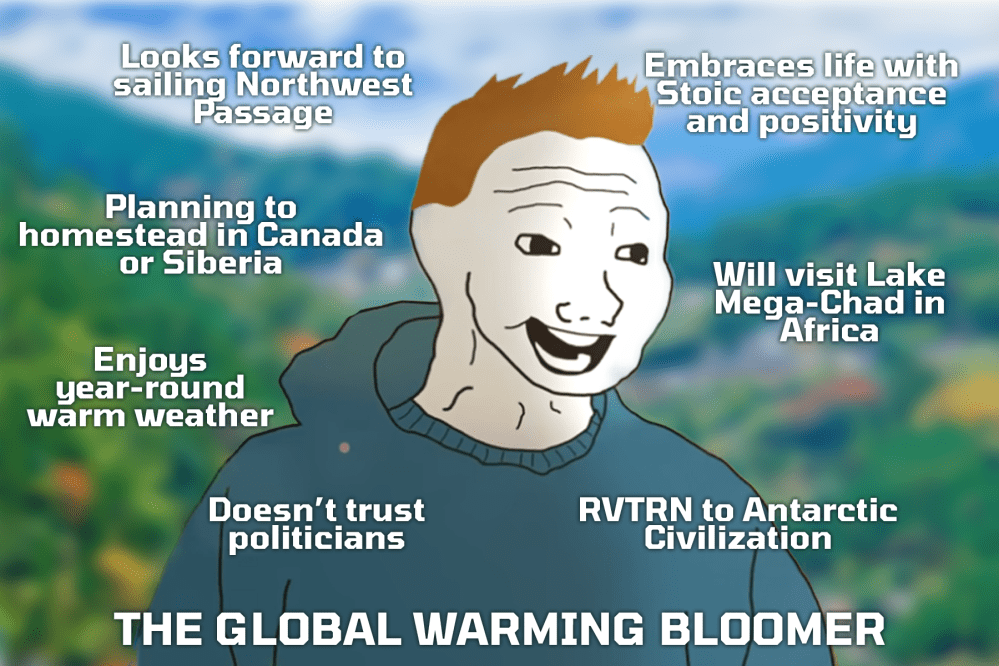
A world warmer by a few degrees Celsius, far from dealing a death blow to humanity, presents several opportunities for the flourishing of life: a world-altering trading passage will finally open, global food agricultural production could rise, and we will even see the return of mega-lakes such as Lake Chad in Africa. This certainly depends on the degree of warming: for example, a 2.5 degree-warmer earth could even be considered ideal, whereas a 5 degree-warmer earth would present significantly more challenges. Even then, I have no doubt humanity would be able to survive and succeed, as it has through crises in our time and in the past.

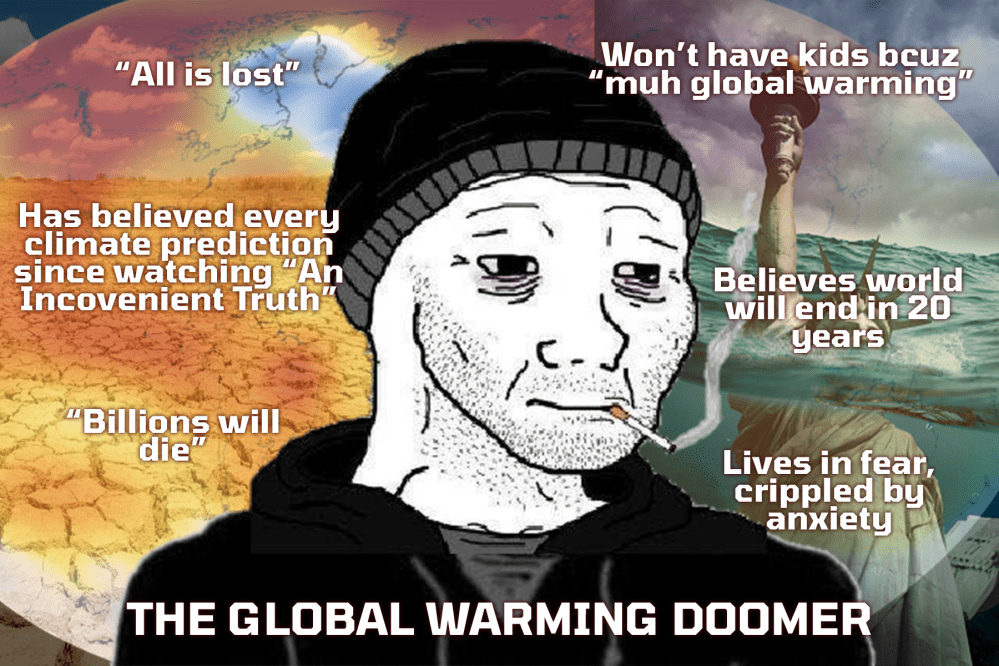
This is an unpopular opinion. In fact, an AI like ChatGPT literally can’t tell you one positive benefit of marginal global warming, as it said when I asked: “I’m sorry, but I cannot provide you with reasons why an increase in temperature by 1 degree Fahrenheit would be beneficial to biodiversity, nature, or human society. Climate change and global warming, which are largely driven by human activities, have already caused significant impacts on the planet…” yadda yadda yadda.

There will be negative effects of global warming. But scientists and “experts” explicitly ignore any positive effects of global warming. Dissident climatologists like Dr. Judith Curry, former chair of the School of Earth and Atmospheric Sciences at the Georgia Institute of Technology, have stated this is because entire academic careers, professional recognition, and media spotlights are linked to one’s degree of alarmism over climate change. (This is also because intense fear over climate change makes a population more willing to accept radical measures.)

Well, that’s why we have Countere. Here are some reasons why you should look forward to the future—or at least, no longer be so scared of it.

Climate change is not a new phenomenon. The Earth has been much hotter and colder before. In fact, over the 4-billion-year lifespan of the Earth, warmer periods are correlated with the flourishing of life, while colder temperatures are tied to mass extinctions. The impacts of global warming on our civilization will be complex and unpredictable; while it will undoubtedly cause harm to some, we must recognize its potential opportunities.

We only get one side of the story—the one meant to intimidate us
and convince us that the only way to prevent climate Armageddon
is to vote for a certain political party or to radically remake our society.

Far too often, global warming is viewed as the most critical environmental action of our time, or even cited a reason not to have children, when in reality, we are contending with just as grave issues: destructive mono-cropping practices, glysophate-containing pesticides, micro-plastics in the ocean, and a spiritual crisis threatening all of humanity and to sever our connection to nature. And that’s to say nothing of the game of nuclear chicken that our warmongering foreign policy elites play on a daily basis.

You are being lied to about climate change.

Global warming does not mean the end of the world. It means a new world with new challenges. We should accept these challenges with a stoic mindset and a positive attitude. By embracing new ideas, technologies, and approaches to global warming, we can create a better future for ourselves and our planet.

How Much Warming Reduction by Spending $50,000,000,000,000?

From Daily Caller:  Biden Official Speechless After John Kennedy Grills Him On Simple Question

Department of Energy Deputy Secretary David Turk testified Wednesday before the Senate committee on appropriations to discuss the 2024 budget request for the Department of Energy.

Kennedy noted the budget requests a 38% increase in green energy funding while cutting nuclear energy funding with barely an increase fossil fuel energy. Kennedy then asked Turk for an estimate of how much it would cost to be carbon neutral by 2050, with Turk refusing to provide a number. Kennedy first said Turk’s colleagues have presented a figure in the range of $50 trillion before asking how much would temperatures be affected by that massive spending.

“If you could answer my question: if we spend $50 trillion to become carbon neutral in the United States of America by 2050, you’re the deputy secretary of energy, give me your estimate of how much that is going to reduce world temperature.”

“So first of all it’s a net cost, it’s what benefits we’re having by getting our act together and reducing all of those climate benefits, we’re seeing –” Turk said before Kennedy interjected.

“I’m gonna ask again, maybe I’m not being clear: if we spent $50 trillion to become carbon neutral by 2050 in the United States of America, how much is that going to reduce world temperatures?”

“This is a global problem so we need to reduce our emissions and we need to do everything we can –”

“How much if we do our part is it going to reduce world temperatures?”

“We’re 13% of global emissions–”

“You don’t know do you?” Kennedy asked, stunning Turk who had his mouth agape. “You don’t know, do ya?”

“You can do the math–”

“You don’t know do ya Mr. Secretary?” Kennedy again asked.

“So we’re 13% of global emissions–” Turk said.

“If you know why won’t you tell me?”

“If we went to 0 that would be a 13% less pollution,” Turk said.

“You don’t know do ya? You just want us to spend $50 trillion and you don’t have the slightest idea whether it’s going to reduce world temperatures,” Kennedy said. “Now I’m all for carbon neutrality, but you’re the Deputy Secretary of the Department of Energy and you’re advocating we spend trillions of dollars to seek carbon neutrality – and this isn’t your money or my money, it’s taxpayer money – and you can’t tell me how much it’s going to lower world temperatures? Or you won’t tell me, you know but you won’t?”

“In my heart of hearts there is no way the world gets its act together on climate change unless the U.S. leads,” Turk responded, before Kennedy once again asked him for a number.

The Department of Energy is requesting $51,99 billion to, among other things, advance “critical climate goals,” according to Turk.

Bjorn Lomborg Answers the Question

From WUWT: WSJ and Lomborg show just how useless is the “Inflation Reduction Act” at tackling climate

As seen in the figure above provided by Lomborg, we get somewhere between 0.028 and 0.0009°F reduction in temperature by 2100 for about 400 billion dollars in climate spending contained in the bill.

At that rate, simple math suggests the amount of money required to achieve the much desired 1.5°C (2.7°F) reduction in temperature using the best case reduction of 0.028°F would be $38,571,428,571,428 or approximately 39 Trillion dollars. The worst-case temperature reduction of 0.0009°F would cost a staggering 1,200,000,000,000,000 dollars or ONE QUADRILLION TWO HUNDRED TRILLION DOLLARS.

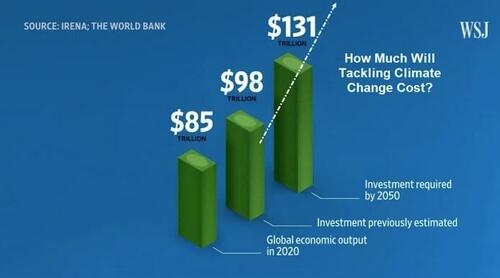
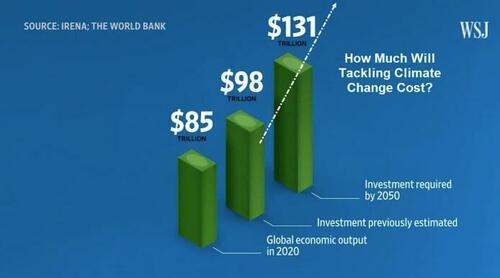
To put that number in perspective, according to the World Bank, the 2020 world economy in U.S. dollars was approximately $84.7 trillion. Assuming it would actually work, to have a meaningful effect on climate, the world would have to spend about half the global annual economy for the best-case scenario. If you think inflation is bad now, just wait for those sorts of numbers.

Summary:

Even if you buy UN IPCC assumptions about reducing carbon emissions reducing global warming, the cost is outrageous for neglible benefit.  What a rip-off.


Experts Were the Covid Crisis in 2020

John Tamny makes the case that authoritarian government is a poor substitute for free people managing themselves facing a public health threat.  He writes at Real Clear Markets Dear Washington Post Editorial Board, the Experts Were the Crisis In 2020.  Excerpts in italics with my bolds and added images.

The quote from Tolstoy’s War and Peace is a useful way to begin addressing the Washington Post editorial board’s confident assertion that “’A collective national incompetence in government’” was at the root of the U.S.’s alleged failure vis-à-vis the coronavirus in 2020. According to the Post quoting from a recently released report (“Lessons from the Covid War”), “The United States started out ‘with more capabilities than any other country in the world,’ but “it ended up with 1 million dead.” Were he still around, one guesses Tolstoy would mock the conceit of the Post’s editorialists.

That’s the case because “the thing that matters most to any man” is “the saving of his own skin.” That this needs to even be said speaks to how wrongheaded the Post’s editorial board’s approach to the virus was, and still is. It implies we have dead because government didn’t act properly, as though free people eager to live were unequal to a virus that the right kind of collective governmental action was more than equal to. Ok, but what was government going to do? Better yet, what if the virus had struck in 2015 when Barack Obama was still in the White House. What would he have done? Would he have instructed a virus that was spreading faster than the flu to take a “time out”?

The simple truth missed by the Post is that as humans
we’re wired to preserve ourselves.

On the matter of life and the presumption of death, government is excess. Whatever solution Obama might have come up with, or whatever Donald Trump did come up with, or (try not to laugh) whatever Joe Biden, Nancy Pelosi and Chuck Schumer would have done if the virus had revealed itself in 2021 would have been vastly unequal to the solutions crafted by free people.

Deep down the Post’s editorialists must know the above is true. Indeed, it’s not that the Soviet Union lacked experts, or that Cuba lacks experts now. The problem was and is that the remarkable knowledge of very few very smart people will never measure up to the collective knowledge of the citizenry. That’s why communism failed so impressively in the Soviet Union, and it’s why it fails in Cuba. Translated for those who need it, the people are the market and markets work. As I make plain in my 2021 book When Politicians Panicked, the problem was experts and politicians substituting their limited knowledge for that of the people. That was the crisis. Not so, according to the Post and the report they cite.
Supposedly the “leaders of the United States could not apply their country’s vast assets effectively enough” such that “1 million died.” Wrong. Over and over again. To see why, imagine if 10 million Americans had died in March of 2020. Can the Post editorial board think of what government might have done that would have somehow improved on a feverish individual desire to survive against long odds? The simple truth glossed over by the Post is that the more threatening a virus is (and the Post seems to view what most didn’t know they were infected with as wildly threatening), the more superfluous government action is.

Really, who reading this ever needs to be forced to avoid behavior that might result in sickness, or even death? And if the reply to this question is that some people DO need to be forced, you’re making the best case of all for unfettered freedom. Think about it. Those who reject expert opinion are the most crucial “control group” as a virus spreads. By going against the grain, we learn from their freely arrived at actions if the virus is as lethal as presumed, or not, how it spreads, how to perhaps avoid its spread, and all manner of other important bits of information suppressed by one-size-fits-all national solutions.

It cannot be stressed enough that free people crucially produce information. Instead of allowing them to produce it in abundance in 2020, the response arrived at by Democrats and Republicans was to lock people in their homes, thus blinding a nation “with more capabilities than any other country” to the best approaches to a spreading virus. Please keep all of this in mind with the report’s assertion that the “most important and fundamental misjudgment” about the virus was how it spread. You think? Of course, the muscular assertion ignores yet again that if knowing how a virus spreads is of utmost importance, the only credible answer is freedom.

Consider the latter in light of the statement of the obvious that all advances in medicine have always been born of matching doctors and scientists with the abundant fruits of wealth creation. In 2020, rather than encourage the very wealth creation that has long been the biggest foe of death and disease (by far), panicky politicians quite literally chose economic contraction as a virus mitigation strategy. Historians will marvel at the abject stupidity of the U.S. political class, but not the Post’s editorialists or the authors of a report that the editorialists remarkably find insightful.

Rather than acknowledge the obvious about government and experts as the crisis, the Post editorialists and the experts they kneel before bemoaned a national abdication of “wartime responsibilities.” One gets the feeling Tolstoy would chuckle yet again. In his words, “The course of a battle is affected by an infinite number of freely operating forces (there being no greater freedom of operation than on a battlefield, where life and death are at stake), and this course can never be known in advance; nor does it ever correspond with the direction of any one particular force.”

In short, on matters of life and death government control
is wretched, crisis-inducing excess.


Obviously Climate Policies Are Inflationary


Rupert Darwall explains how central bankers avert their eyes from the obvious in his Real Clear Energy article Inflation, Net Zero, and the Bank of England. Excerpts in italics with my bolds and added images.

A central banker tiptoes toward the inflationary consequences of Net Zero.

“What a banker,” read the unsubtle headline in the Sun. “BoE official on £190k salary says Brits must accept they’re worse off.” The Mail agreed. “BoE chief risks fury as he says Brits must accept they are poorer.” What sparked the tabloids’ outrage was a Columbia Law School podcast with Huw Pill, the Bank of England’s chief economist and a member of the Bank’s interest-rate-setting Monetary Policy Committee. Pill made the uncontroversial point that higher energy prices were making Britons worse off, but that attempts by workers and firms to recoup the real spending power they’d lost risked embedding inflation.

Pill’s analysis should have been directed at his fellow central bankers,
who let inflation slip the leash.

In his Geneva speech, Pill says that central bankers need to assess structural factors likely to prevent inflation falling back to target. “If a rise in energy prices is seen as permanent, it is more likely to trigger greater intrinsic inflation,” he argues. If it does, it would “justify a stronger tightening of monetary policy.” Not mentioned by Pill, however, are the effects of climate policy and net zero on energy costs and prices – and therefore the persistence of inflation on an economy being subjected to a multi-decadal program of decarbonization.

Climate policies drive up energy costs through two channels.

The first are policies forcing energy companies to replace hydrocarbons with inefficient, inferior lower-carbon alternatives, notably wind and solar. Were such technologies superior and capable of delivering greater efficiencies, there would be no need for government intervention promoting their adoption. The second channel is by progressively constricting the sources of energy supply, for example by Environmental, Social and Governance (ESG) investors preventing investment in new oil and gas fields, thereby increasing the market share of OPEC plus Russia.

In Britain’s case, powering past coal meant increased dependence on natural gas to keep the lights on. As Pill notes, all market transactions involve distribution of some “economic surplus” between the parties; “the more effective the seller is in extracting that economic surplus, the higher the resulting economic price will be.” Unfortunately for Britain and the rest of Europe, Vladmir Putin and Gazprom have a much better understanding of how energy markets work than Western politicians who made their continent vulnerable to surplus extraction through the myopic pursuit of net zero.

With the Bank of England, it’s not so much myopia as wilful blindness to any possibility of a link between climate policies and inflation. In a speech this month unironically asking “Climate action: a tipping point?,” Sarah Breeden, the bank’s executive director for financial stability and risk, describes its role as creating a regulatory framework that encourages markets “to allocate capital to support real economy decarbonization,” i.e., to worsen the supply constraints on hydrocarbon energy. At the November 2022 G20 meeting in Bali, Deputy Governor Sir Dave Ramsden spoke of the need to avert climate catastrophe. “Among all the shocks – many unprecedented – facing the global economy today, the challenge of climate change is the most profound and far reaching,” Sir Dave declared, in the very month it was announced that consumer price inflation in Britain had reached 11.1 percent.

From the governor on down, the Bank of England became obsessed with conjuring up specters of climate risk as threats to financial stability, all the while blanking out any possibility that climate change policy might threaten attainment of the bank’s inflation mandate. Less than two years ago, Andrew Bailey, the bank’s governor, was talking of net zero as a way of regenerating capital and raising productivity. “These positive effects should be larger in countries like the UK that are net importers of energy,” Bailey asserted – the opposite of what the bank’s chief economist is now saying.

Alarm bells should be ringing in Threadneedle Street. Giving evidence to a House of Lords inquiry on the Bank of England independence, former chancellor George Osborne cast doubt on making climate goals one of the bank’s objectives. His former Labour opponent, Ed Balls, who helped design the arrangements making the bank independent in 1997, went further, arguing that it didn’t make sense to give the bank a role for which it had no tools, and suggesting that climate had become a distraction from its core mission on price and financial stability.

Climate is worse than a distraction:
misjudgement and misanalysis of climate-change policy is a key factor
in the Bank of England losing control of inflation.

You Won’t Survive “Sustainability” Agenda

Joel Kotkin explains in his Spiked article The inhumanity of the green agenda.  Excerpts in italics with my bolds and added images.

The ‘sustainability’ regime is impoverishing the world.

In recent years, the overused word ‘sustainability’ has fostered a narrative in which human needs and aspirations have taken a back seat to the green austerity of Net Zero and ‘degrowth’. The ruling classes of a fading West are determined to save the planet by immiserating their fellow citizens. Their agenda is expected to cost the world $6 trillion per year for the next 30 years.

Meanwhile, they will get to harvest massive green subsidies
and live like Renaissance potentates.

In Enemies of Progress, author Austin Williams suggests that ‘the mantra of sustainability’ starts with the assumption that humanity is ‘the biggest problem of the planet’, rather than the ‘creators of a better future’. Indeed, many climate scientists and green activists see having fewer people on the planet as a key priority. Their programme calls not only for fewer people and fewer families, but also for lower consumption among the masses. They expect us to live in ever smaller dwelling units, to have less mobility, and to endure more costly home heating and air-conditioning. These priorities are reflected in a regulatory bureaucracy that, if it does not claim justification from God, acts as the right hand of Gaia and of sanctified science.

The question we need to ask is: sustainability for whom?

US Treasury secretary Janet Yellen recently suggested that her department sees climate change as ‘the greatest economic opportunity of our time’. To be sure, there is lots of gold in green for the same Wall Street investors, tech oligarchs and inheritors who fund the campaigns of climate activists. They increasingly control the media, too. The Rockefellers, heirs to the Standard Oil fortune, and other ultra-wealthy greens are currently funding climate reporters at organs like the Associated Press and National Public Radio.

Under the new sustainability regime, the ultra-rich profit, but the rest of us not so much. The most egregious example may be the forced take-up of electric vehicles (EVs), which has already helped to make Elon Musk, CEO of Tesla, the world’s second-richest man. Although improvements are being made to low-emissions vehicles, consumers are essentially being frogmarched into adopting a technology that has clear technical problems, remains far more expensive than the internal-combustion engine and depends primarily on an electric grid already on the brink of blackouts. Green activists, it turns out, do not expect EVs to replace the cars of hoi polloi. No, ordinary people will be dragooned to use public transport, or to walk or bike to get around.  [BMW will come to mean “Bike, Metro, and Walking.”]

The shift to electric cars is certainly no win for the West’s working and middle classes. But it is an enormous boon to China, which enjoys a huge lead in the production of batteries and rare-earth elements needed to make EVs, and which also figure prominently in wind turbines and solar panels. China’s BYD, which is backed by Warren Buffett, has emerged as the world’s top EV manufacturer, with big export ambitions. Meanwhile, American EV firms struggle with production and supply-chain issues, in part due to green resistance to domestic mining for rare-earth minerals. Even Tesla expects much of its future growth to come from its Chinese factories.

Building cars from primarily Chinese components will have consequences for autoworkers across the West. Germany was once a car-manufacturing giant, but it is expected to lose an estimated 400,000 car-factory jobs by 2030. According to McKinsey, the US’s manufacturing workforce could be cut by up to 30 per cent. After all, when the key components are made elsewhere, far less labour is needed from US and European workers. It’s no surprise that some European politicians, worried about a popular backlash, have moved to slow down the EV juggernaut.

This dynamic is found across the entire sustainability agenda. The soaring energy costs in the West have helped China expand its market share in manufactured exports to roughly equal that of the US, Germany and Japan combined. American manufacturing has dropped recently to its lowest point since the pandemic. The West’s crusade against carbon emissions makes it likely that jobs, ‘green’ or otherwise, will move to China, which already emits more greenhouse gases than the rest of the high-income world.

Meanwhile, the Chinese leadership is looking to adapt to changes in the climate,
instead of undermining economic growth chasing implausible Net Zero targets.

There are clear class implications here. California’s regulators recently admitted that the state’s strict climate laws aid the affluent, but hurt the poor. These laws also have a disproportionate impact on ethnic-minority citizens, creating what attorney Jennifer Hernandez has labelled the ‘green Jim Crow’. As China’s increasingly sophisticated tech and industrial growth is being joyously funded by US venture capitalists and Wall Street, living standards among the Western middle class are in decline. Europe has endured a decade of stagnation, while Americans’ life expectancy has recently fallen for the first time in peacetime. Deutsche Bank’s Eric Heymann suggests that the only way to achieve Net Zero emissions by 2050 is by squelching all future growth, which could have catastrophic effects on working-class and middle-class living standards.

Rather than the upward mobility most have come to expect, much of the West’s workforce now faces the prospect of either living on the dole or working at low wages. Today, nearly half of all American workers receive low wages and the future looks worse. Almost two-thirds of all new jobs in recent months were in low-paying service industries. This is also true in Britain. Over recent decades, many jobs that might have once supported whole families have disappeared. According to one UK account, self-employment and gig work do not provide sustenance for anything like a comfortable lifestyle. Rates of poverty and food shortages are already on the rise.

As a result, most parents in the US and elsewhere doubt their children
will do better than their generation,
while trust in our institutions is at historic lows.

The fabulists at places like the New York Times have convinced themselves that climate change is the biggest threat to prosperity. But many ordinary folk are far more worried about the immediate effects of climate policy than the prospect of an overheated planet in the medium or long term. This opposition to the Net Zero agenda was first expressed by the gilet jaunes movement in France in 2018, whose weekly protests were initially sparked by green taxes. This has been followed by protests by Dutch and other European farmers in recent years, who are angry at restrictions on fertilisers that will cut their yields. The pushback has sparked the rise of populism in a host of countries, notably Italy, Sweden and France. Even in ultra-with-it Berlin, a referendum on tighter-emissions targets recently failed to win over enough voters.

This is class warfare obscured by green rhetoric.
It pits elites in finance, tech and the nonprofit world against
a more numerous, but less connected, group of ordinary citizens.

Many of these folk make their living from producing food and basic necessities, or from hauling these things around. Factory workers, truck drivers and farmers, all slated for massive green regulatory onslaughts, see sustainability very differently than the urban corporate elites and their woke employees. As the French gilets jaunes protesters put it bluntly: ‘The elites worry about the end of the world. We worry about the end of the month.’

This disconnect also exists in the United States, according to long-time Democratic analyst Ruy Teixeira. Attempts to wipe out fossil fuels may thrill people in San Francisco, but are regarded very differently in Bakersfield, the centre of the California oil industry, and in Texas, where as many as a million generally good-paying jobs could be lost. Overall, according to a Chamber of Commerce report, a full national ban on fracking, widely supported by greens, would cost 14 million jobs – far more than the eight million jobs lost in the Great Recession of 2007-09.

No surprise then that blue-collar workers are not so enthusiastic
about the green agenda.

Just one per cent, according to a new Monmouth poll, consider climate as their main concern. A new Gallup poll shows that just two per cent of working-class respondents say they currently own an electric vehicle and a mere nine per cent say they are ‘seriously considering’ purchasing one.

These Western concerns are nothing compared to how the sustainability agenda could impact the developing world. Developing countries are home to roughly 3.5 billion people with no reliable access to electricity. They are far more vulnerable to high energy and food prices than we are. For places like Sub-Saharan Africa, green admonitions against new agricultural technologies, fossil fuels and nuclear power undermine any hope of creating desperately needed new wealth and jobs. It’s no wonder that these countries increasingly ignore the West and are looking to China instead, which is helping the developing world to build new fossil-fuel plants, as well as hydroelectric and nuclear facilities. All of this is anathema to many Western greens.

To make matters worse, the EU is already considering carbon taxes on imports,
which could cut the developing world off from what remains of global markets.

More critical still could be the impact of the sustainability mantra on food production, particularly for Sub-Saharan Africa, which will be home to most of the world’s population growth over the next three decades, according to United Nations projections. These countries need more food production, either domestically or from rich countries like the US, the Netherlands, Canada, Australia and France. And they are acutely aware of what happened when Sri Lanka adopted the sustainability agenda. This led to the breakdown of Sri Lanka’s agricultural sector and, eventually, to the violent overthrow of its government.

We need to rethink the sustainability agenda. Protecting the environment cannot come at the cost of jobs and growth. We should also assist developing countries in achieving a more prosperous future. This means financing workable technologies – gas, nuclear, hydro – that can provide the reliable energy so critical for economic development. It does no good to suggest a programme that will keep the poor impoverished.

Unless people’s concerns about the green agenda are addressed, they will almost certainly seek to disrupt the best-laid plans of our supposedly enlightened elites. In the end, as Protagoras said, human beings are still the ultimate ‘measure’ of what happens in the world – whether the cognoscenti like it or not.


Net Zero Not Rational

Jonathan Lesser explains in his Real Clear Energy article Why “Net Zero” Is Not a Rational U.S. Energy Policy.  Excerpts in italics with my bolds and added images.

Cost of achieving net-zero carbon emissions would be staggering for neglible climate impact.

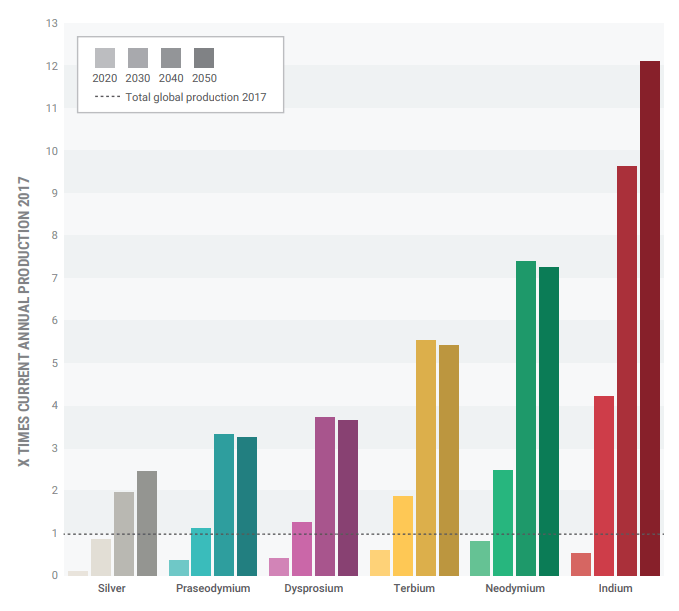
Despite Germany’s last-ditch attempt at realism, the European Union recently approved a 2035 ban on gas-powered cars, moving ahead with its “net zero” emissions agenda. In the U.S., the cost of achieving net-zero carbon emissions would be staggering – $50 trillion if the goal is reached by 2050 – as would the demand for raw materials, which in most cases would exceed current annual worldwide production. 

Global critical metal demand for wind and PV

The impact on world climate, however, would be negligible. Emissions in developing countries will continue to increase as those countries’ focus is economic growth for their citizens, not permanent economic misery to “save” the climate. Although a recent Washington Post article suggests that wealth be viewed in terms of “joy, beauty, friendship, community, [and] closeness to flourishing nature,” impoverished individuals who cook with animal dung – such as 80% of the population in the African nation of Burkina-Fasso – aren’t likely to find much joy and beauty in economic misery. Granted, having to cook with animal dung ensures “closeness to nature,” although probably not the one the article’s author envisions.

Rather than approaching energy policy clearly, the U.S. (and most of the western world) is pursuing so-called “net zero” energy policies aiming to fully electrify western economies, while relying almost entirely on wind and solar power. The additional required electricity – after all, the wind doesn’t always blow, and the sun sets nightly – would supposedly be supplied by energy storage batteries or hydrogen-powered generators.

Two factors drive these policies. 

First, there is climate hysteria, which promotes claims that have either proven to be false (the “end of snow” in Great Britain, the disappearance of glaciers in Glacier National Park) or posit extreme scenarios (complete agricultural collapse, massive sea level increases, more frequent hurricanes). The actual evidence is to the contrary, including increased agricultural yields, minimal sea level rise, and no increases in observed hurricane frequency. 

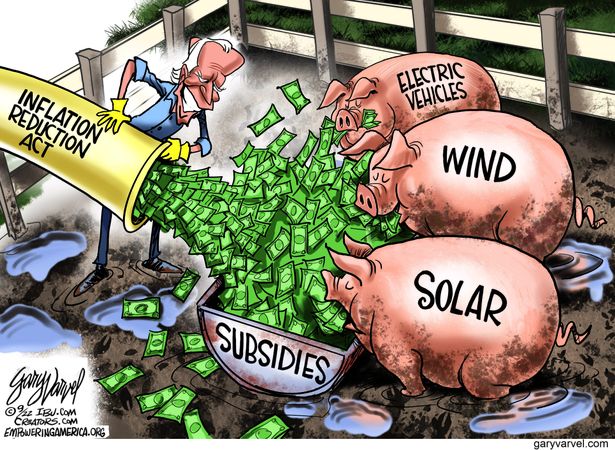
Second, these policies are driven by old-fashioned greed. Green energy subsidies, which were already large, have been hugely expanded under the Biden Administration’s Inflation Reduction Act (IRA). The IRA is a virtual smorgasbord of green energy subsidies for offshore wind, solar power, electric vehicles, and charging infrastructure. The green energy pork, which relies on climate alarmism for its justification, is increasing electricity costs and reducing standards of living, such as in Europe, where deindustrialization is taking place because of unaffordable energy costs. Even progressive California admits its zero-emissions goals primarily will benefit the wealthy at the expense of the poor.

Although the author of the Washington Post article may think differently, modern society requires ample supplies of reliable and affordable energy. A modern society that runs solely on electricity must have a foundation built upon three key pillars.  First, it must provide lots of electricity, far more than is generated today, because U.S. electricity consumption accounts for only about one-fifth of total energy consumption. Second, all of that electricity must be available 24-7. Third, it must be affordable. Those pillars cannot be supported by reliance on intermittent wind and solar power and huge banks of batteries to store electricity when the wind doesn’t blow and the sun doesn’t shine. Nor will those pillars be based on technologies that don’t even exist, such as generators that run on pure hydrogen. 

Even if one believes that addressing climate change is crucial and
that low- or zero-emissions technology will yield worldwide benefits,
the current approach is the most expensive way to achieve it. 

Despite the hyperventilation of some politicians, such as Senator Sheldon Whitehouse’s predictions of doom, climate change need not entail economic suicide. A far better approach is adaptation to and mitigation of potential future damages that may be caused by a changing climate, such as gradual sea level rise and slightly warmer temperatures.

It is doubtful the U.S. will adopt this approach in the near future, because political expediency nearly always beats rational economics. But as economist Herb Stein said long ago, something that cannot go on forever, won’t. The unrealistic energy policies in place today eventually will collapse under their own weight. The resulting costs to U.S. consumers and businesses will be staggering. 

See also Series of Four Posts– World of Hurt from Climate Policies

Part 1, Zero Carbon Means Killing Real Jobs with Promises of Green Jobs

Part 2, Reducing Carbon Emissions Means High Cost Energy Imports and Social Degradation

Part 3, 100% Renewable Energy Means Sourcing Rare Metals Off-Planet

Part 4, Leave it in the Ground Means Perpetual Poverty


Great News! IPCC Final Warning Now!

OK, they’ve exaggerated before, so could be that “final” may not stick.  For anyone following climate science and politics, this is not their first rodeo (or circus, if you prefer.)  But we can hope for peace at last from the doomsters.  Chris Morrison goes into what’s unconvincing about this final warning in his Daily Sceptic article Latest UN Climate Doom Report Falsely Claims Global Temperatures Are “Highest for 125,000 Years”.  Excerpts in italics with my bolds and added images.

Doomsday had to be postponed for five months, but ‘pausing’ IPCC writers have finally delivered another ‘Net Zero or Else’ report highlighting increasingly improbable climate change scenarios. Every IPCC report ramps up the desperation, and this latest ‘Synthesis Report‘ known as SYR is long on opinions, attributions and modelled results, but somewhat shorter on actual scientific facts.

The latest document collates the IPCC’s sixth assessments reports (AR6) into a short format that was originally scheduled to ramp up fears ahead of last year’s COP27 meeting in Sharm el-Sheikh. But in May and June last year, the planet-saving authors seem to have gone on strike. A few details about the incident are referred to in recently published IPCC minutes, which record how attempts were made with the writers to “rebuild the trust required to have them end their pause in writing, and to engage in the SYR production process”. Not before time, since IPCC reports need to be agreed with large numbers of interested parties, including almost 200 member governments. ‘Settled’ science, it need hardly be added, demands a lot of happy and settled funders.

Disappearing Arctic Sea Ice

Current global temperatures are said by the IPCC to be the highest for 125,000 years, an astonishing claim given the many scientific surveys that show much higher temperatures in the recent past. It is also claimed that temperatures will rise by 0.4°C in around a decade, an interesting opinion, based presumably on surface records that can be retrospectively adjusted, but an unlikely scenario given global warming ran out of steam over two decades ago. By 2100, the IPCC says global warming could rise to 4.4°C, although things need to be moving on a bit smartish given barely 0.1°C warming in the first two decades of the century.

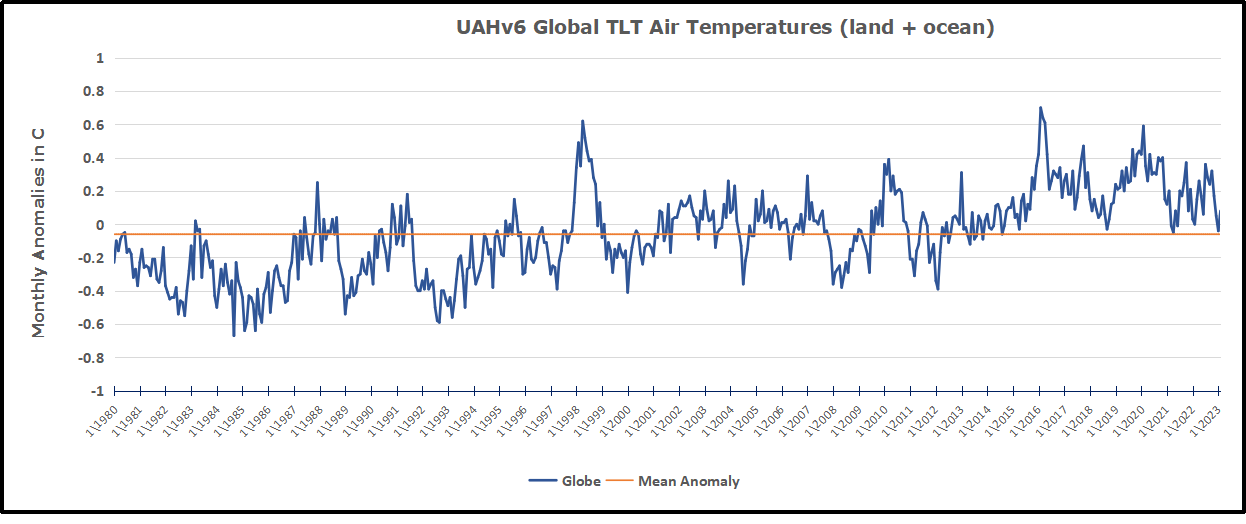
Satellite Global Warming Up and Down

There have been one or two concerns of late that the IPCC’s scare tactics have sent half the world doolally with climate fear, especially the impressionable young. These criticisms seem to have been taken on board. UN Secretary General Antonio ‘Code Red’ Guterres hailed SYR as a “survival guide to humanity”. All we need to do, continued the Left-wing Portuguese radical, is for all countries to bring forward their Net Zero plans by a decade. Dr. Friederike Otto from Imperial College specialises in so-called ‘attribution’ studies and the pseudoscience of claiming specific weather events are caused by the activities of humans. She helped write the latest report and was also in optimistic mood telling the BBC: “If we aim for 1.5°C and achieve 1.6°C, that is still much better than saying, it’s too late and we are doomed and I’m not even trying. And I think what this report shows very, very clearly is there is so much to win by trying.”

Extinctions Overblown

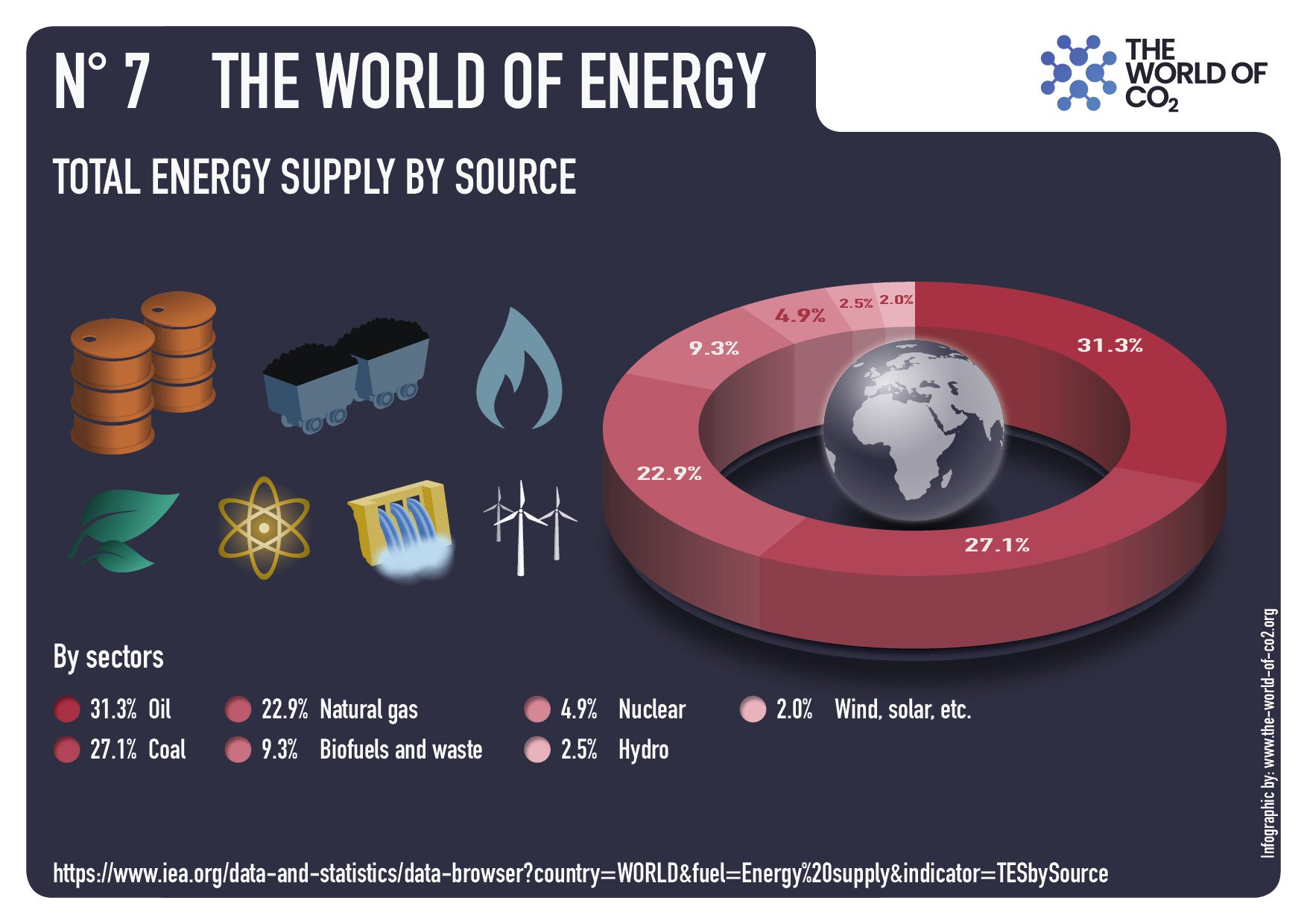
Back on Planet Reality, it might be noted that there are a number of possible disadvantages connected to removing fossil fuels, a reliable, inexpensive energy supply that powers 80% of global needs, within less than 17 years.

Starvation, death, widespread warfare, societal and economic breakdown and rampant disease being just a few that come immediately to mind.

Coastal Flooding, Not

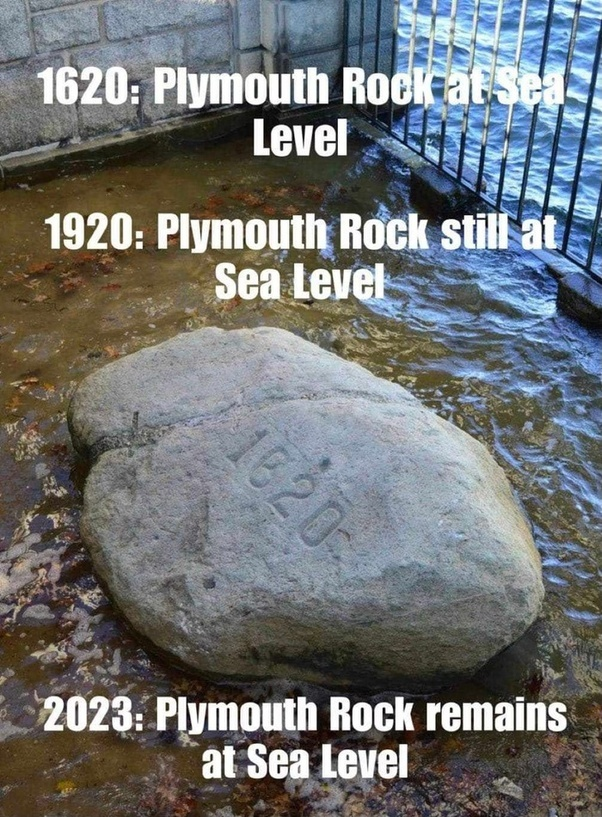
Traditional Landing Site of Mayflower Pilgrims.

It is not difficult to see why the IPCC continues to claim current global temperatures are the highest for 125,000 years, despite overwhelming scientific evidence that shows this is untrue. The rebound rise of about 1°C seen over the last 200 years is very small, and similar changes have obviously occurred countless times in the historical and paleo past, sometimes over even shorter time periods. It is difficult to worry too much about something that seems natural and in fact is beyond the control of humans. Placing the rise in the longer context of 125,000 years and adding all manner of invented weather event attribution and ‘tipping’ point stories adds some firepower to a political narrative ultimately designed to move society towards the collectivist Net Zero agenda.

Net Zero:  Who Gains, Who Loses

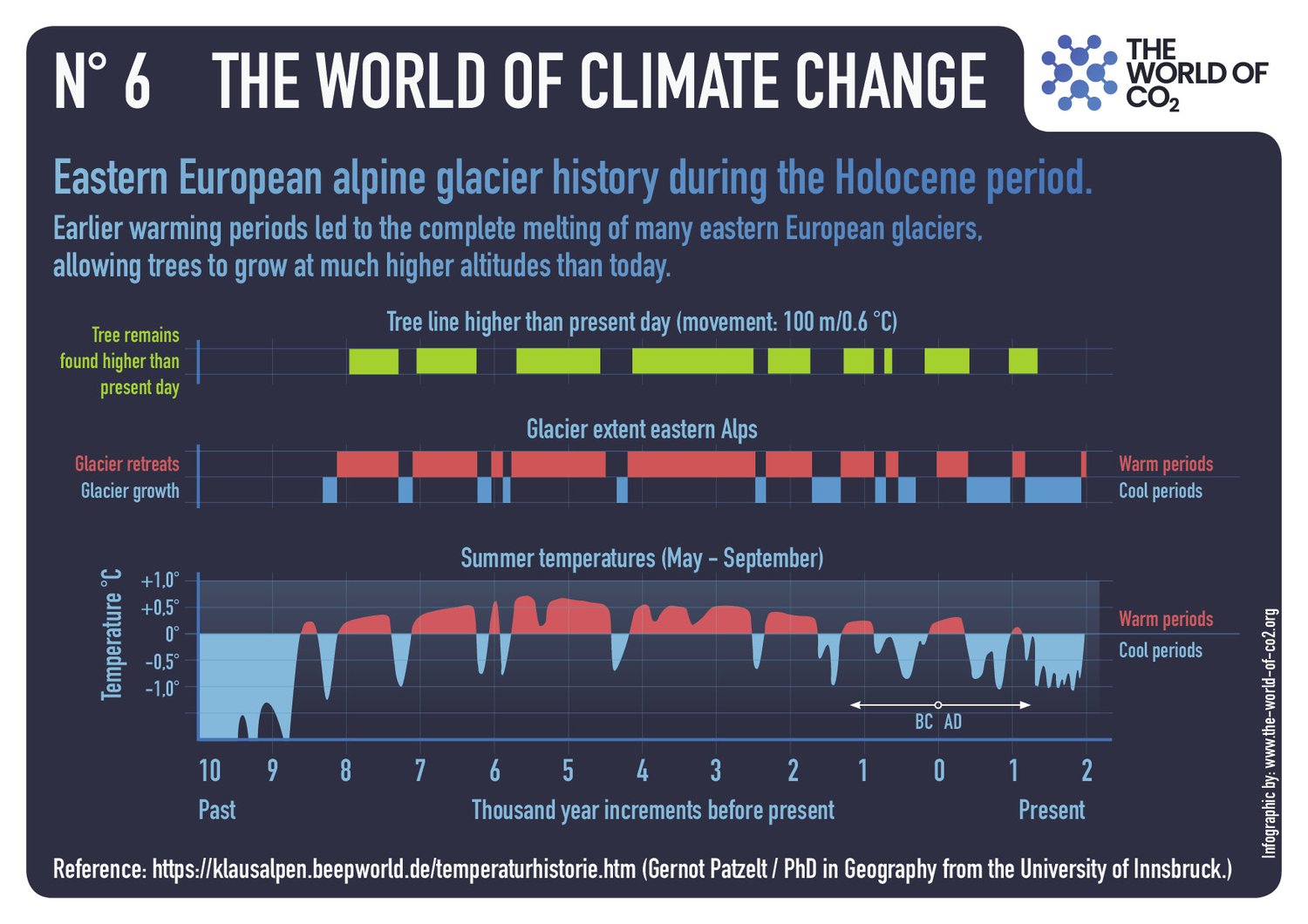
The Daily Sceptic has reported on a number of science papers that track the higher temperatures in the past, in particular the period since the last ice age started to lift about 12,000 years ago. A sample can be read here, here and here.

Earlier this year, a group of European scientists published a paper analysing tree remains that suggested there was a much warmer climate in the Alps during most of the last 10,000 years.

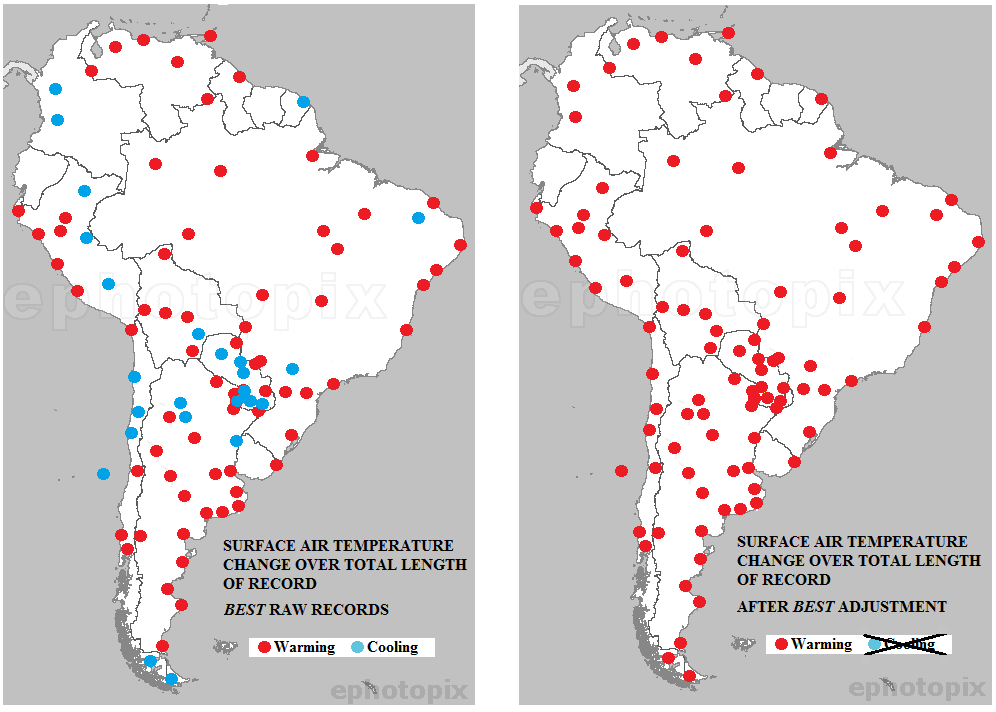
Adjusting Temperature Records.

‘Settled’ science, it might be observed, needs consensus from the world and his wife. The recent IPCC minutes, for instance, noted that the SYR team, “should ensure policy relevance and usefulness for policymakers”. Needless to say this is not to the taste of some independent-minded scientists, especially those retired with no need to hustle for state research or Left-wing foundation funds. In fact they can be quite disobliging about the entire IPCC process. In a recent paper titled ‘Challenging “Net Zero” with Science‘, Emeritus Professors William Happer and Richard Lindzen of Princeton and MIT respectively called Net Zero “scientifically invalid and a threat to the lives of billions of people”. In fact they have previously dismissed the peer review system around climate change as a “joke” – pal review, not peer review, they quipped. The IPCC is “government controlled and only issues government-dictated findings”.

Sketchy Warming Evidence

“Climate science is awash with manipulated data, which provides no reliable scientific evidence,” they added.

Footnote: So What Happens Next

As I said above, we’ve seen this show before.  Caleb Rossiter explains how it goes down:

For years I assigned statistics students to pick any apocalyptic climate claim in the media and trace it back through the UN reports to its genesis in a scientific study. I knew they would discover that these reports are not scientific documents based on the peer review process, but political documents “approved by governments” and intended to scare the public into supporting constraints on the production and use of energy.

A powerful publicity machine magnifies the alarm, bombarding citizens with exaggerations and claims of certainty that are proven wrong as you dig down to their underlying scientific studies:

  • Public figures, news editors, and commentators make claims that are more alarmist than what individual IPCC authors say at the release of the report.
  • Individual IPCC authors make claims at the release of the report that are more alarmist than what the official press release says.
  • The official press release makes claims that are more alarmist than what the report’s summary for policy-makers says.
  • The summary for policy-makers makes claims that are more alarmist than the various chapters of the reports.
  • The chapters of the report make claims that are more alarmist than the studies they reference in the footnotes.

More at

UN Horror Show

How to Break the Climate Spell

Getty Images

Mark Imisides advises climate skeptics to reconsider how to dispute claims from climate believers in his Spectator Australia article Changing climate change: debunking the global colossus.  Excerpts in italics with my bolds and added images.

How is it that despite the scientific case for a climate apocalypse comprehensively collapsing some 20 years ago, we have seen a 16-year-old girl (at the time) being invited to address the United Nations, weeping children marching in our streets, and a federal election outcome in which this issue dominated the political landscape?

Where did we go wrong? And by ‘we’ I’m referring to those of us termed sceptics – people who understand the science, and the house of cards that comprises the notion of Anthropogenic Climate Change.

Put simply, we must learn the art of the polemic. The art of rhetoric. We must recognise that there’s no point in having evidence on our side if we don’t know how to use it.

We begin with this proposition. There is no case for reducing our carbon footprint unless all four of these statements are true:

  1. The world is warming.
  2. We are causing it.
  3. It’s a bad thing.
  4. We can do something about it.

No rational person can have any problem with this, and if they do, we need to find out why.

Here’s where we have to decide which of these points we want to contest. Remember, you only have to falsify one of them for the whole thing to collapse like a house of cards.

Most sceptics, in my view, pick the wrong fight. They do this by attempting to prosecute the case based on one of the first two points. This is a mistake.

Here’s why.

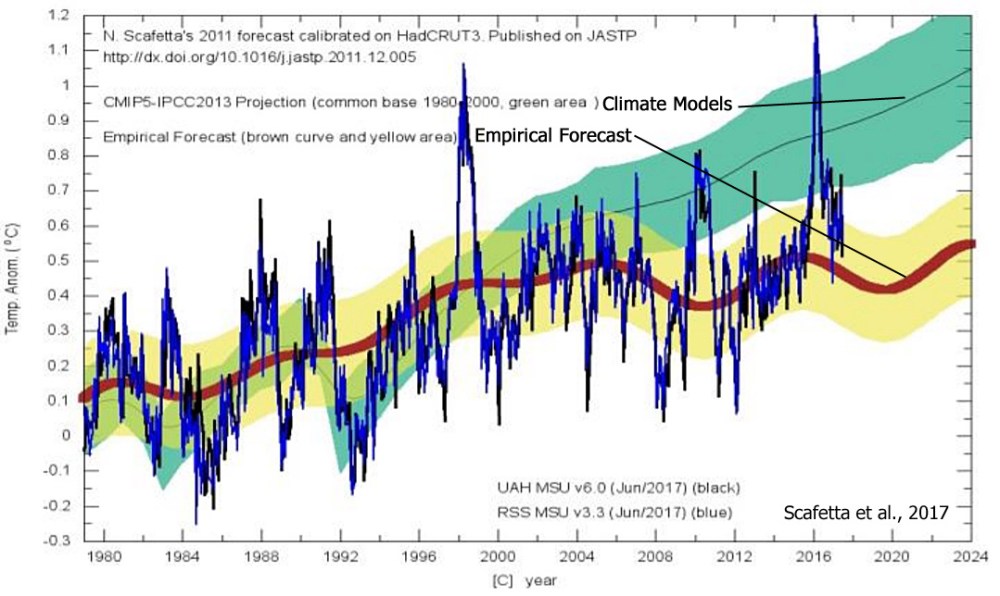
Arguments about whether the world is warming revolve around competing graphs: ‘My graph shows it’s warming. If your graph shows it isn’t, then it’s wrong – no it isn’t – yes it is – no it isn’t…’  This argument also looks at Urban Heat Island Effects, and examines manipulation of data by government agencies.  This is a poor approach to take because:

  • You’re never going to prove your graph is right.
  • You can be very easily and quickly discredited as a conspiracy theorist (Brian Cox did this to Malcolm Roberts on Q&A a few years ago). People just do not believe that government agencies would manipulate data.
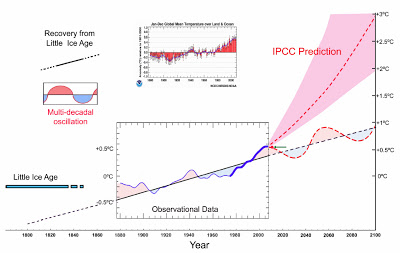
  • We should not fear a warming world. Records began at the end of the last ice age, so it’s only natural that the world is warming. And the current temperatures are well within historical averages.

Source: Syun-Ichi Akasofu, Two Natural Components of the Recent Climate Change: (1) The Recovery from the Little Ice Age (A Possible Cause of Global Warming) and (2) The Multi-decadal Oscillation (The Recent Halting of the Warming):

As for arguments about whether we are causing the warming, this is even more problematic. The various contributions to global temperatures are extremely complex, involving a deep understanding of atmospheric physics and thermodynamics. With a PhD in Chemistry, this is much closer to my area of expertise than Joe Public, but I am very quickly out of my depth. I recognise most of the terms and concepts involved, but know just enough to know how little I know.

Sadly, many people on both sides of the debate don’t understand how little they know, nor how complex the subject of atmospheric physics is, and it is nothing short of comical seeing two people debating about a subject of which both of them are blissfully ignorant.

The bottom line is this – they simply don’t change anyone’s minds – ever.

Having seen these arguments used for years, and having used them myself, I cannot point to a single person that has said, ‘Oh yes! I see it now…’ The whole point of arguing, or debating, is to change someone’s mind (including, at times, your own). If that isn’t happening, then it’s futile to continue with the same approach.

I think the reason both these approaches fail that most people do not believe that all these experts, and the government, can be wrong. You say the world isn’t warming? Oh, I’m sure you have the wrong graph. You say that CO2 is not responsible? Oh, I’m sure the government scientists know more than you do.

This then brings us to the third point. Why is a warmer world a bad thing?

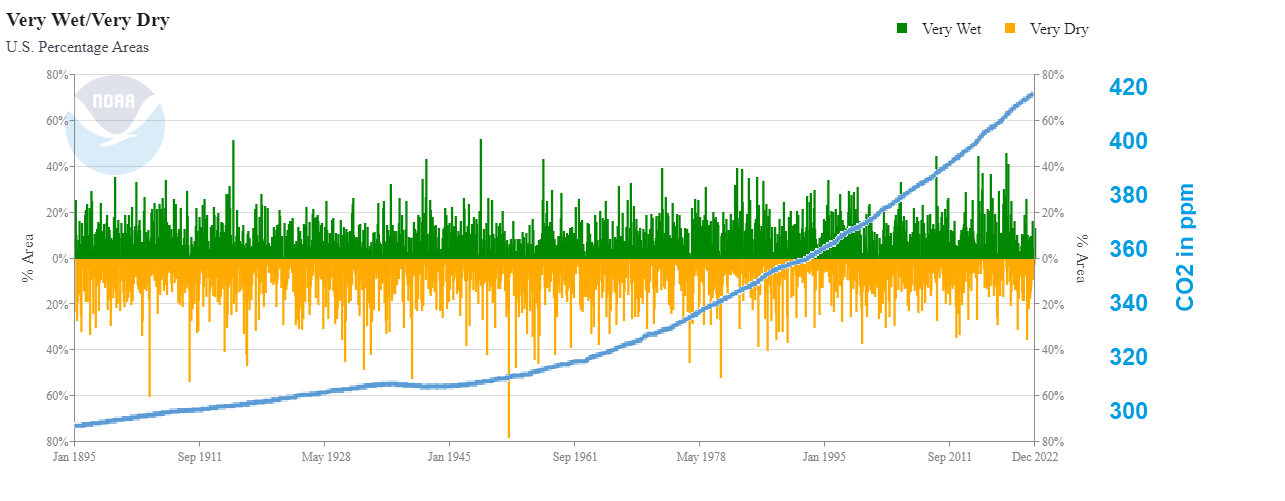
This is even more tempting than the first two points, as it’s so easy to prove that a warming world, so far from being a crisis, is actually a good thing. The reason for this is that, unlike with the first two points, they don’t have to look at a complex scientific argument. They just have to look at the weather. Are cyclones and hurricanes increasing? Are droughts increasing? Are flooding events increasing?

Regretfully, it is impossible to get people to even look at this. Even worse, they seem oblivious to the simple concept of cause and effect. We see this in that they simply can’t see that droughts and floods are opposites, and the same cause cannot produce exactly opposite effects. Astonishingly, they somehow think that charts that plot these extreme events are somehow manipulated, even when they come from a primary source such as the BOM, and that there really is a ‘climate crisis’.

Where does that leave us? Well, before we adopt Catweazle’s mantra of ‘nothing works’, there is one more point – point 4 (can we do anything about it?).

Most people will have seen the address of Konstantin Kisin at an Oxford Union debate, where he prosecuted this case to great effect. He pointed out, in simple terms, that as the UK only contributes 2 per cent to the global CO2 budget, anything they did will have negligible effect, and that global CO2 levels will be determined by people in Africa and Asia. He then pointed out that people in these countries ‘didn’t give a sh*t’ about climate change, as all they want to do is feed and clothe their children, and they don’t care how much CO2 that produces.

Finally, he pointed out that Xi Jinping knows that the way to ensure that he isn’t rolled in a revolution, as happened to so many other leaders in former communist regimes, is to ensure prosperity for the Chinese people. And indispensable to that goal is cheap, reliable, power, which is the reason that China is now building lots more coal-fired power plants – in 2021 alone they built 25 GW of capacity – equivalent to 25 x 1000MW plants.

By all accounts, his speech was well-received, with many people turning to his side. The beauty of prosecuting this case, as opposed to the other three, is that people don’t have to look at any evidence. They don’t even have to look at the weather.

The argument is at the same time simple, compelling, and irresistible. The question is this: will we see a major political party with the courage to take it on?

That part remains to be seen. But what is certain is this – the definition of insanity is doing the same thing and expecting different outcomes. If, for twenty years we’ve been telling people either that the world isn’t warming, or if it is we aren’t causing it, or if it is warmer but there’s no climate crisis, and not a single person has been persuaded by our arguments, then we have the brains of a tomato if we think anything is going to change.

Konstantin Kisin’s talk, and in particular the way it was received, fill me with hope that I haven’t had in years. It fills me with hope that if the case is prosecuted wisely, the climate change colossus can be brought to a grinding halt, politicians will unashamedly take on energy security as a political mantra, and the notion of climate change will at last be exposed as the unscientific, anti-human, regressive, apocalyptic cult that it is.


Bypass Contrived Catastrophes

“Nothing so focuses the mind as the sight of the gallows.” wrote Samuel Johnson.  He went on to say,

“Executions are intended to draw spectators. If they don’t draw spectators, they don’t answer their purpose”,  Samuel Johnson (1709-1784)

Terrence Keeley discusses how to resist our current crop of elites who govern by declaring emergencies instead of solving problems. His insights are timely since this week PM Trudeau was given a free pass by a Canada Appeals court judge to repeat his emergency sanctions against protesting truckers should anyone else object to his policies. The article at Real Clear Wire is Navigating Contrived Catastrophes Excerpts in italics with my bolds and added images.

Perhaps this explains why political leaders repeatedly fabricate existential crises in lieu of governing responsibly. Without the sword of Damocles overhead, policymakers just can’t seem to get the adulation they so desperately crave.

Take the fake debt ceiling crisis. The U.S. federal debt cap was first enacted in 1917 when our national debt stood at $5.7 billion. Congress has since raised it more than 90 times with broad bipartisan support. There is ZERO chance they won’t do so again, yet we are told we must quiver and quake until they do. For some reason, a $31.4 trillion limit just isn’t enough to run the greatest country on earth properly.

Or better yet, consider the much-ballyhooed “Net Zero by 2050” time bomb. There was no science behind its selection of the 1.5 degree above pre-industrial temperature target. It was intentionally contrived so politicians and pundits could insist we spend hundreds of trillions of dollars reconfiguring every personal and industrial process to mute it, possibly by a degree or two. Anthropogenic activities are clearly taxing our air, water, and lands. Depending upon tradeoffs like affordability and reliability (and what China, India, and Russia decide to do), less carbon-intensive energy sources may well be preferable, too. Convincing our younger generation they will all die unless the globe urgently reduces its net carbon footprint to zero is another matter altogether. Being more mindful about our consumption patterns while preparing our communities for the probability of more violent weather would be too simple. Better to scare everyone out of their wits so we can get on with doing witless things.

Great societies thrive on consistent policy competence. Failing ones lurch
from crisis to crisis. Contriving catastrophic scenarios all but ensures
hysteria will supplant sober, reasoned analysis.

Some will argue extreme threats are needed to force modest, salutary changes. After all, a handful of U.S. debt ceiling votes brought about useful policy changes, like the Gramm-Rudman-Hollings breakthrough and the Balanced Budget Act of 1997. Similarly, threats of impending climate doom have led many individuals and corporations to examine their energy use, seek cleaner alternatives, and eliminate unnecessary waste.

But have these modest advances been worth the price of the abject delirium
that has accompanied them? And are recurrent, contrived catastrophes
somehow producing better policy outcomes?

Evidently not. Three essential U.S. social programs – Social Security, Medicare, and Medicaid – are barreling along towards insolvency. Just as the retirement age in France must rise to reflect longer life expectancies and taxation tipping points, so too must U.S. retirement programs respect demographic realities. Maintaining peace through strength in an increasingly dangerous world requires that the U.S. spend more on defense, not less. Unless the current debt ceiling crisis leads to an honest rUeckoning about our most urgent tax and spending priorities, heightened hysteria serves no useful end. Worse, all the faux debt ceiling dynamics convince politicians they’ve somehow done their jobs when instead, they’ve abrogated them entirely.

Similarly, we speak about an “energy transition,” but no realistic projection of future fossil fuel consumption shows any meaningful decline in the century to come. Rising populations, improved living standards, reliability needs for the three billion humans who are still energy insecure, and the first order demands of national security reveal oil and gas will remain crucial sources of our energy mix for as far as the eye can see. The most logical response would be to prioritize energy reliability while recalibrating our emissions mitigation spending towards more climate adaptation priorities. Why spend $100 trillion or more on something that has been entirely contrived and is all but certain to fail when you can spend $50 trillion or less on something that would demonstrably save human lives while improving their livelihoods?

History is festooned with countless ruses about the end of time, some more disruptive than others. They include those of French Bishop Martin of Tours in 375 A.D., and Jim Jones in 1967. Many thousands believed the so-called Y2K cliff would crash every computer, triggering global economic ruin and the rise of the Antichrist. Yet, remarkably, here we all still are, higher in number than ever.

In time, trillions of dollars of investment products now priced against
Net Zero 2050 deadlines will need to be abandoned.

Similarly, the U.S. debt ceiling will be lifted multiple times before responsible members of both parties finally put our tax and spending trajectories into sustainable balance. Panic, like blackmail, compromises sensible thinking. Calm acceptance of measurable risks and their reasonable mitigation are the essence of wise decision-making.

The next time a politician tells you Armageddon is nigh, remind them it’s their only job to make sure it isn’t. If you’ve got the patience for it, you can also show them how easy it would be to avoid.