Time to Ban EVs

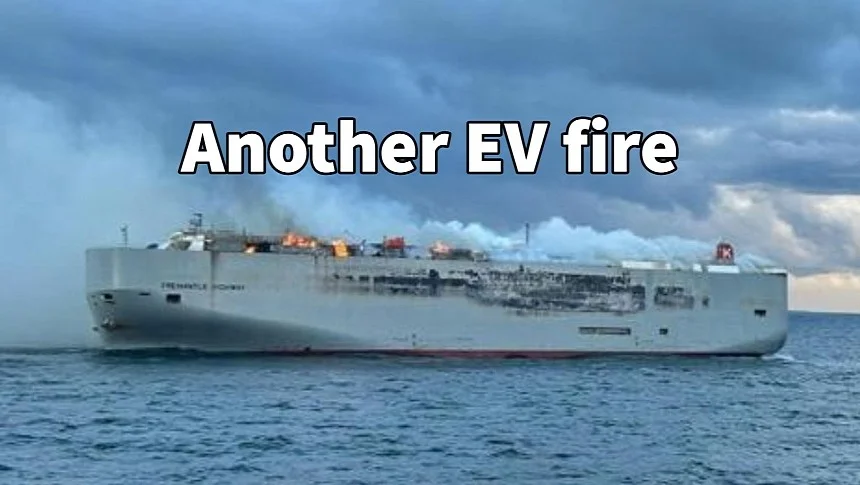
The Fremantle Highway cargo ship burns uncontrollably in the Netherlands’ waters after a major fire erupted onboard. The vessel carried about 3,000 vehicles, including 25 EVs, from Bremerhaven (Germany) to Port Said (Egypt). The ship has been abandoned and is expected to sink. July 26, 2023

Stephen Moore makes the case in his BPR article Is it time to ban electric vehicles?.  Excerpts in italics with my bolds and added images

The New York Fire Department recently reported that so far this year there have been 108 lithium-ion battery fires in New York City, which have injured 66 people and killed 13. According to FDNY Commissioner Laura Kavanagh, “There is not a small amount of fire, it (the vehicle) literally explodes.” The resulting fire is “very difficult to extinguish and so it is particularly dangerous.”

Not only cars: Lithium bicycle batteries are responsible for 22 fires in New York, 2 deaths this year (Feb. 24, 2023)

Last year there were more than 200 fires from batteries from e-bikes, EVs and other devices.

A fire ignited at an e-bike shop and killed four people near midnight on the morning of June 20. Two individuals were left in critical condition. The fire commissioner has warned New Yorkers that such devices could be very dangerous and typically explode in such a way that renders escape impossible.

FDNY also reports that in just three years, lithium-ion battery fires have surpassed those started by cooking and smoking as the most common causes of fatal fires in New York City. It’s happening all over the country as these blazes have become commonplace. Cars and e-bikes are randomly blowing up in driveways and garages.

NYC going after pizza oven emissions. You’d have to burn a pizza stove 849 years to equal one year of John Kerry’s private jet

Now let’s be honest: 13 deaths in a city the size of New York with some 8 million people is hardly an epidemic. Regulations should always be based on a cost versus benefit calculation, or there would be no cars at all.

And yet the same scaremongers on the left who have zero tolerance and want bans for small risks when it comes to everything from swimming pool diving boards, gas stoves, plastic straws, vaping, fireworks and so on, have a surprisingly high pain threshold when it comes to people dying or suffering critical injured from “green” electric battery fires.

1960 Chevrolet Corvair

Or consider this: In 1965, Ralph Nader almost single-handedly helped ban the popular Chevrolet Corvair — famous for its engine placed in the back trunk of the car. Nader’s bestselling shock book “Unsafe at Any Speed” declared the car was deadly. But there was no real evidence of that claim, and to this day there are no reliable statistics on how many passengers — if any — died in Corvairs from rear-end accidents.

What is indisputable is that EVs will cause far more deaths than Corvairs ever did.

One other example: There have been more fatalities in just one city in a single year from lithium-ion batteries in cars than all the people who died from the 1979 Three Mile Island nuclear plant accident — which was zero.

Yet, after the accident, thanks to the environmentalists’ fear campaign (with the help of the blockbuster anti-nuke movie “The China Syndrome”), no domestic nuclear plants were built for three decades. That is despite the fact that nuclear plants emit no greenhouse gases.

But with EVs, the greens are pushing aside any concerns about the collateral damage of deaths and injuries. Biden wants to mandate that nearly ALL new cars sold in the U.S. be EVs by 2032. If that happens, many thousands of Americans may die or will be inured from electric vehicle fires.
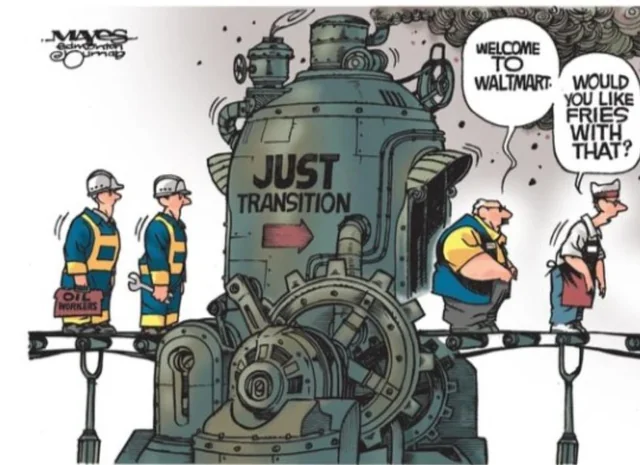
All this is especially hypocritical because once upon a time the left’s mantra was “no trading blood for oil.” Now they are willing to trade blood in exchange for getting Americans to stop using oil. An irony of all this is that because of all the energy needed to produce windmills, solar panels and electric batteries, new studies are showing that the reduction in greenhouse gas emissions to this “net zero” transition is close to zero. It turns out, green energy causes some pollution, too.

For the record, I’m not in favor of the government banning EVs or e-bikes or just about anything. I just believe that we should make policy decisions based on real and factual risk assessments, not false scares and sensationalism.

As for the future of EVs, maybe it’s time for Ralph Nader
to write a sequel to “Unsafe at Any Speed.”


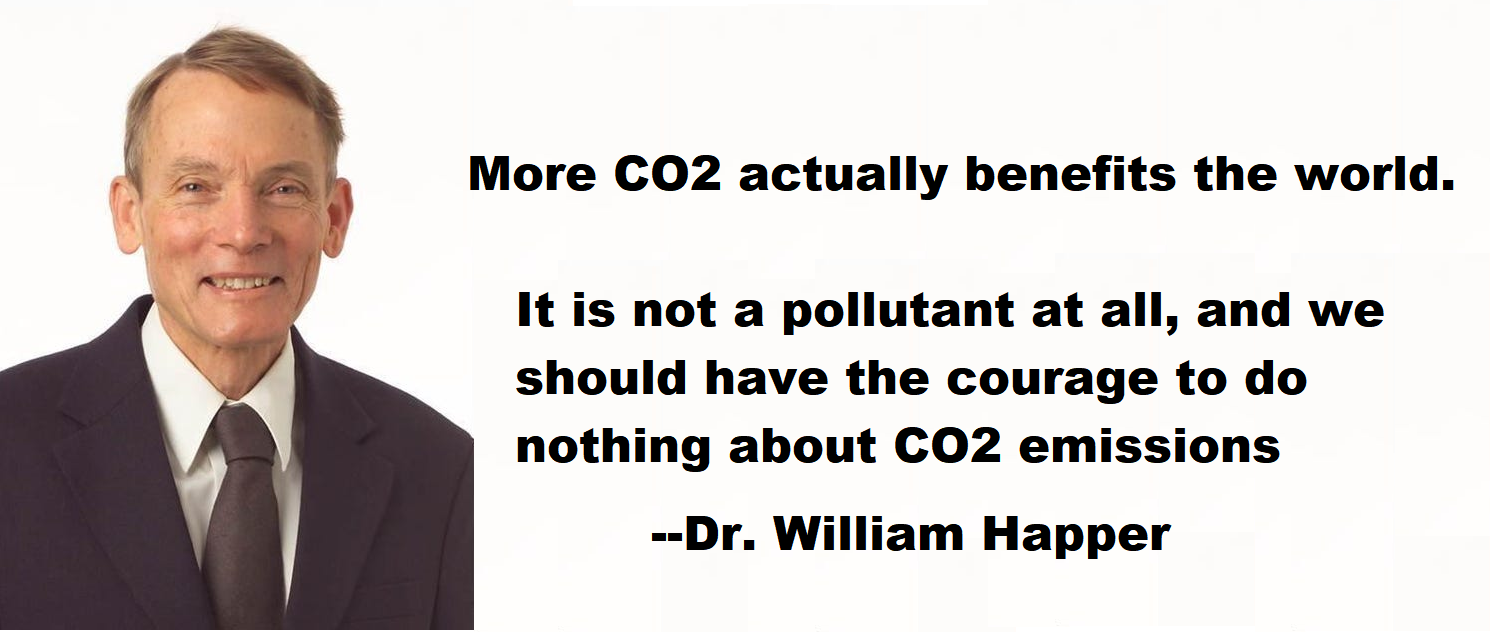
Antidote for CO2 Hysteria

Preeminent physicist Freeman Dyson (1923-2020) put the CO2 obsession in sharp focus in his foreward to CARBON DIOXIDE  The good news by Indur M. Goklany (2015). Excerpts in italics. with my bolds.

To any unprejudiced person reading this account, the facts should be obvious: that the non-climatic effects of carbon dioxide as a sustainer of wildlife and crop plants are enormously beneficial, that the possibly harmful climatic effects of carbon dioxide have been greatly exaggerated, and that the benefits clearly outweigh the possible damage.

The people who are supposed to be experts and who claim to understand the science are precisely the people who are blind to the evidence. Those of my scientific colleagues who believe the prevailing dogma about carbon dioxide will not find Goklany’s evidence convincing. . .That is to me the central mystery of climate science. It is not a scientific mystery but a human mystery. How does it happen that a whole generation of scientific experts is blind to obvious facts?

Synopsis:  More CO2 Good, Less CO2 Bad

Gregory Wrightstone explains at CO2 Coalition More Carbon Dioxide Is Good, Less Is Bad.  Excerpts in italics with my bolds and added images.

People should be celebrating, not demonizing, modern increases in atmospheric carbon dioxide (CO2). We cannot overstate the importance of the gas. Without it, life doesn’t exist.

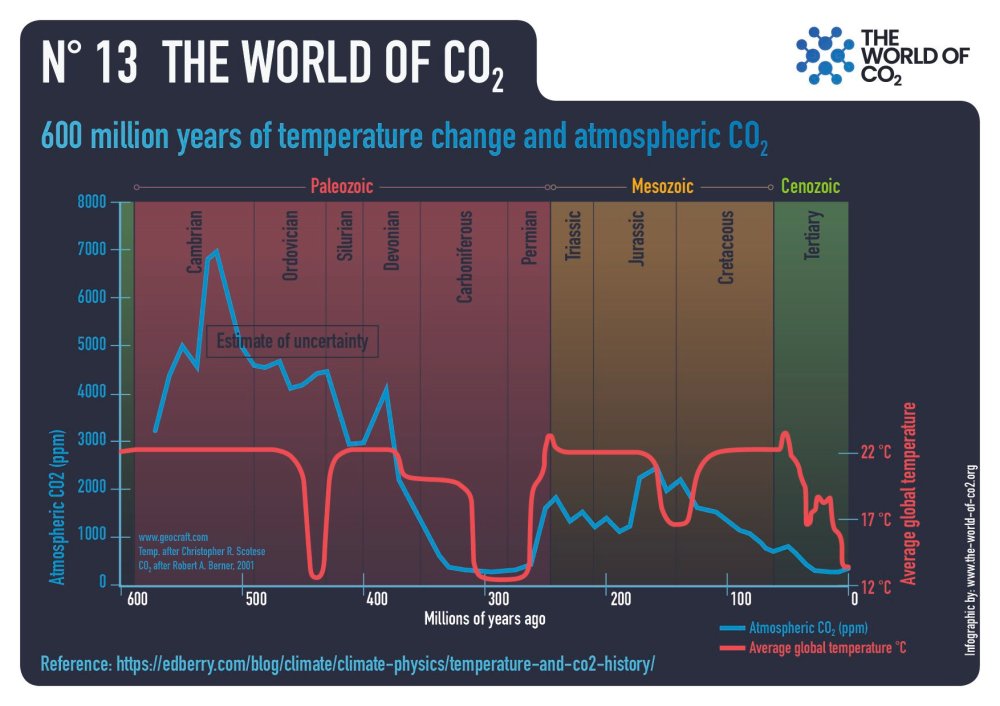
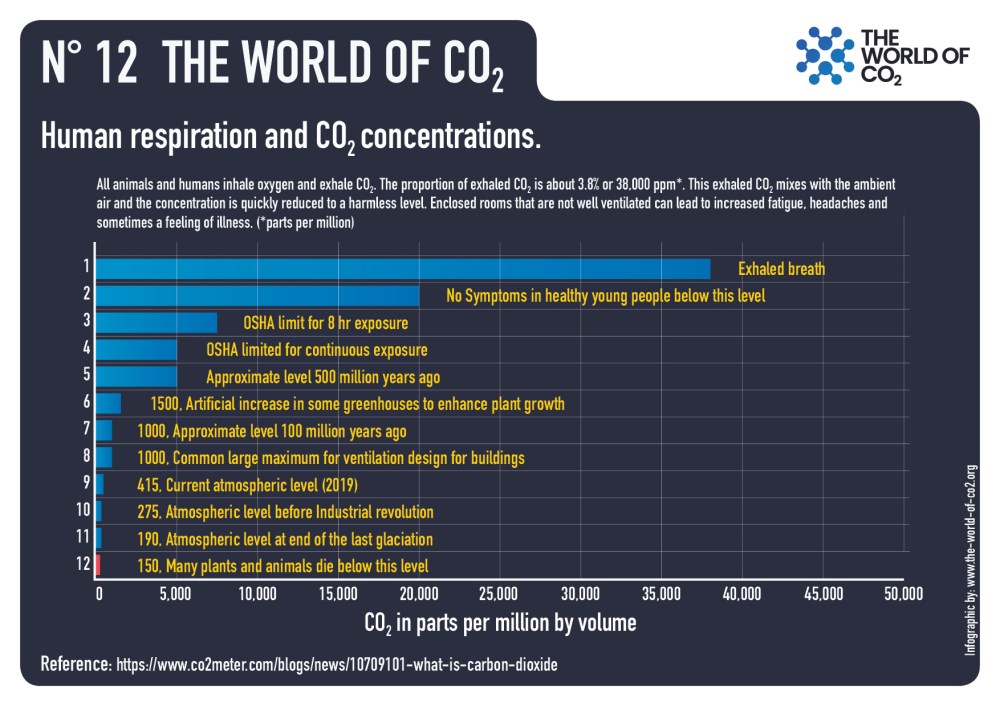
First, a bit of history: During each of the last four glacial advances, CO2’s concentration fell below 190 parts per million (ppm), less than 50 percent of our current concentration of 420 ppm. When glaciers began receding about 14,000 years ago – a blink in geological time – CO2 levels fell to 182 ppm, a concentration thought to be the lowest in Earth’s history.

Line of Death

Why is this alarming? Because below 150 ppm, most terrestrial plant life dies. Without plants, there are no animals.

In other words, the Earth came within 30 ppm in CO2’s atmospheric concentration of witnessing the extinction of most land-based plants and all higher terrestrial life-forms – nearly a true climate apocalypse. Before industrialization began adding CO2 to the atmosphere, there was no telling whether the critical 150-ppm threshold wouldn’t be reached during the next glacial period.

Contrary to the mantra that today’s CO2 concentration is unprecedentedly high, our current geologic period, the Quaternary, has seen the lowest average levels of carbon dioxide since the end of the Pre-Cambrian Period more than 600 million years ago. The average CO2 concentration throughout Earth’s history was more than 2,600 ppm, nearly seven times current levels.

Beneficial CO2 Increases

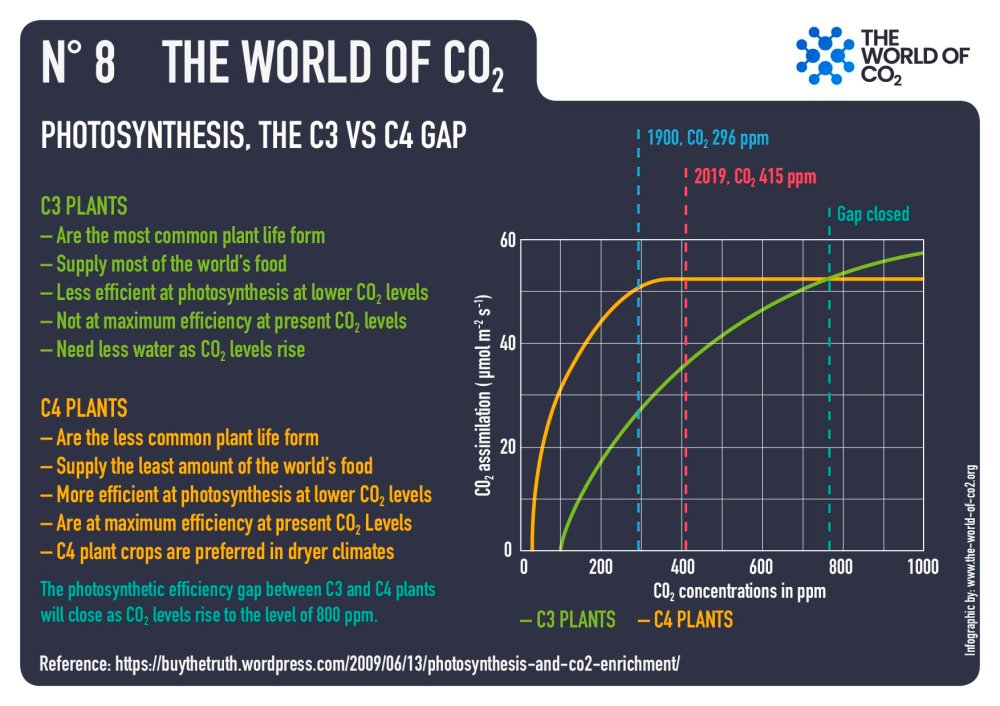
CO2 increased from 280 ppm in 1750 to 420 ppm today, most of it after World War II as industrial activity accelerated. The higher concentration has been beneficial because of the gas’s role as a plant food in increasing photosynthesis.

Its benefits include:

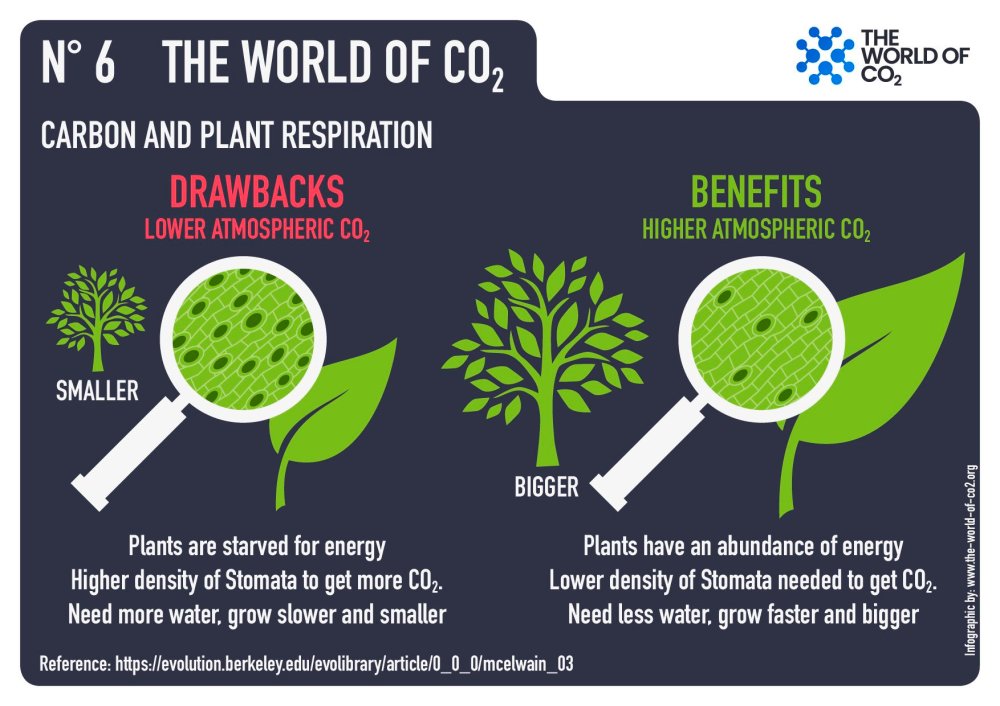
— Faster plant growth with less water and larger crop yields.

— Expansion of forests and grasslands.

— Less erosion of topsoil because of more plant growth.

— Increases in plants’ natural insect repellents.

A summary of 270 laboratory studies covering 83 food crops showed that increasing CO2 concentrations by 300 ppm boosts plant growth by an average of 46 percent. Conversely, many studies show adverse effects of low-CO2 environments.

For instance, one indicated that, compared to today, plant growth was eight percent less in the period before the Industrial Revolution, with a low concentration of 280 ppm CO2.

Therefore, attempts to reduce CO2 concentrations are bad for plants, animals and humankind.

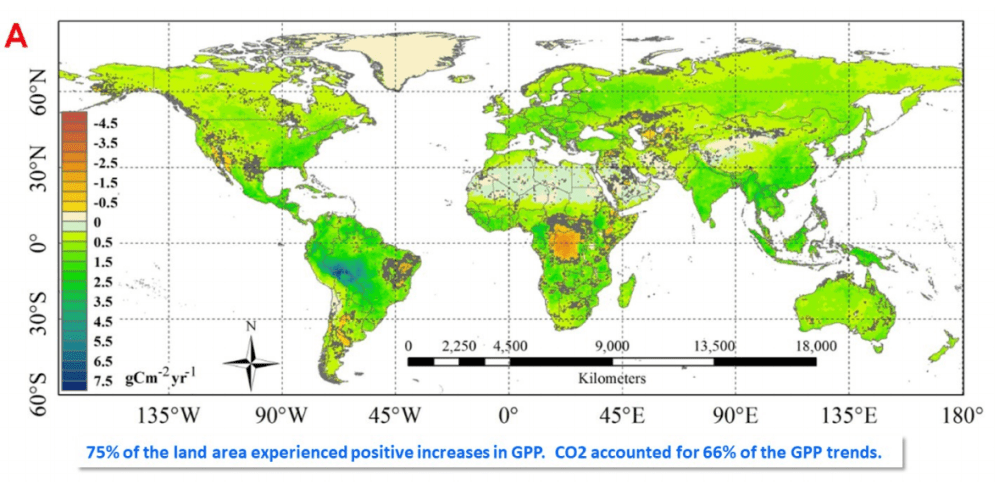
Data reported in a recent paper by Dr. Indur Goklany, and published by the CO2 Coalition, indicates that up to 50 percent of Earth’s vegetated areas became greener between 1982-2011.

Researchers attribute 70 percent of the greening to CO2 fertilization from of fossil fuel emissions. (Another nine percent is attributed to fertilizers derived from fossil fuels.)

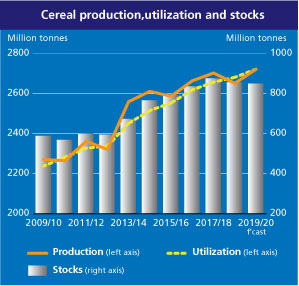
Dr. Goklany also reported that the beneficial fertilization effect of CO2 – along with the use of hydrocarbon-dependent machinery, pesticides and fertilizers – have saved at least 20 percent of land area from being converted to agricultural purposes – an area 25 percent larger than North America.

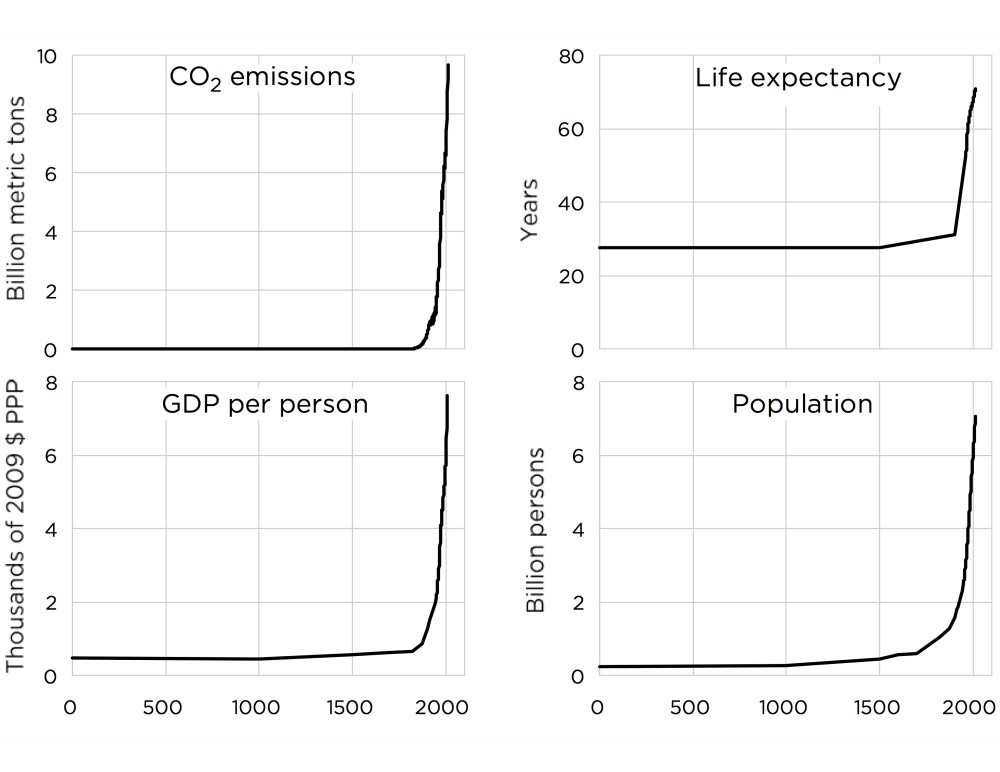
The amazing increase in agricultural productivity, partly the result of more CO2, has allowed the planet to feed eight billion people, compared to the fewer than 800,000 inhabitants living a short 300 years ago.

More CO2 in the air means more moisture in the soil. The major cause of water loss in plants is attributable to transpiration, in which the stomata, or pores, on the undersides of the leaves open to absorb CO2 and expel oxygen and water vapor.

With more CO2, the stomata are open for shorter periods, the leaves lose less water, and more moisture remains in the soil. The associated increase in soil moisture has been linked to global decreases in wildfires, droughts and heat waves.

Exaggeration of CO2’s Warming Effect

Alarm over global warming stems from exaggerations of CO2’s potential to retain heat that otherwise would radiate to outer space. As with water vapor, methane and nitrous oxide, CO2 retains heat in the atmosphere by how it reacts to infrared portions of the electromagnetic spectrum.

However, the gas has saturated to a large extent within the infrared range, leaving relatively little potential for increased warming.

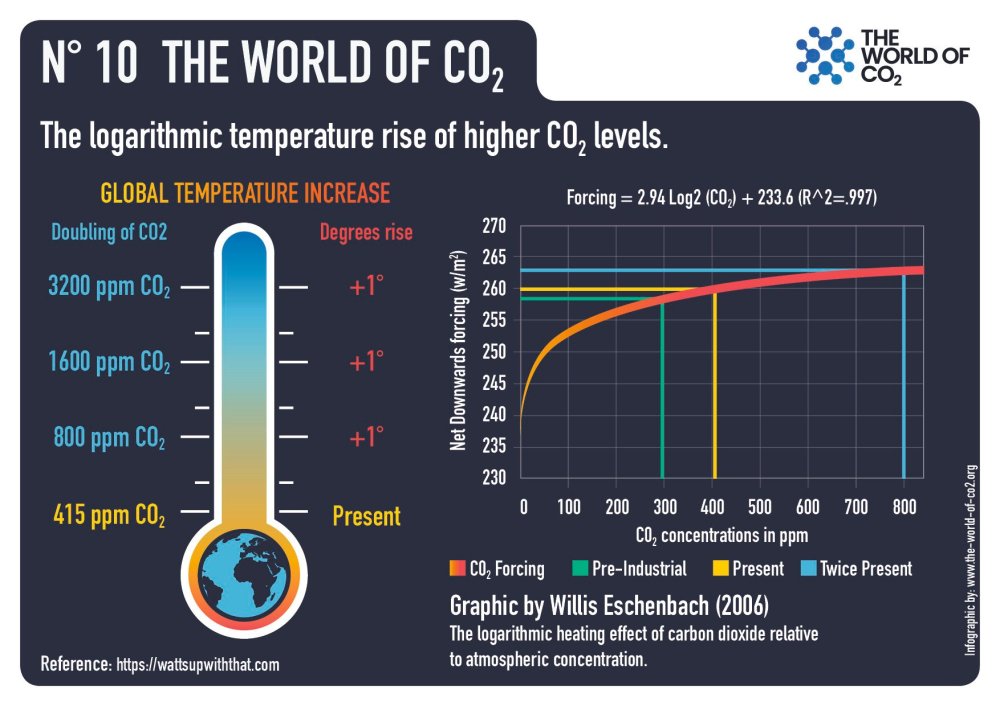
Both sides of the climate debate agree that the warming effect of each molecule of CO2 decreases significantly (logarithmically) as the concentration increases.

This is one reason why there was no runaway greenhouse warming when CO2 concentrations approached 20 times that of today. This inconvenient fact, despite its importance, is rarely mentioned because it undermines the theory of a future climate catastrophe.

A doubling of CO2 from today’s level of 420 ppm – an increase estimated to take 200 years to attain – would have an inconsequential effect on global temperature.

Pennsylvania’s solar-powered fossil fuels

CO2 being liberated today from Pennsylvania coal was removed from the atmosphere by the photosynthesis of trees that fed on sunlight and carbon dioxide and then died to have their remains accumulate in the vast coal swamps of the Carboniferous Period.

Pennsylvania Marcellus and Utica shale hydrocarbons being exploited today were also the likely hydrocarbon source of shallower reservoirs producing since the late 1800s.

The source of those hydrocarbons was algae remains that gathered on the bottom of the Ordovician and Devonian seas.

Like the coal deposits, the algae used solar-powered photosynthesis and CO2 (the algal blooms were likely fueled by regular dust storms) to remove vast amounts of CO2 from the air and lock it up as carbon-rich organic matter.

The provenance of these hydrocarbons spawns two novel ideas. First, there is a strong case that these are solar-powered fuels.

Second, the sequestering of carbon during the creation of the hydrocarbons lowered atmospheric concentrations of CO2 to sub-optimum levels for plants. Therefore, the combustion of today’s coal and gas is liberating valuable CO2 molecules that are turbocharging plant growth.

The plain fact of the matter is that the modest warming of less than one degree Celsius since 1900, combined with increasing CO2, is allowing ecosystems to thrive and humanity to prosper.

Additional information on CO2’s benefits and related topics are available at CO2Coalition.org, which includes a number of publications and resources of interest.

Stop the Carbon Capture Insanity

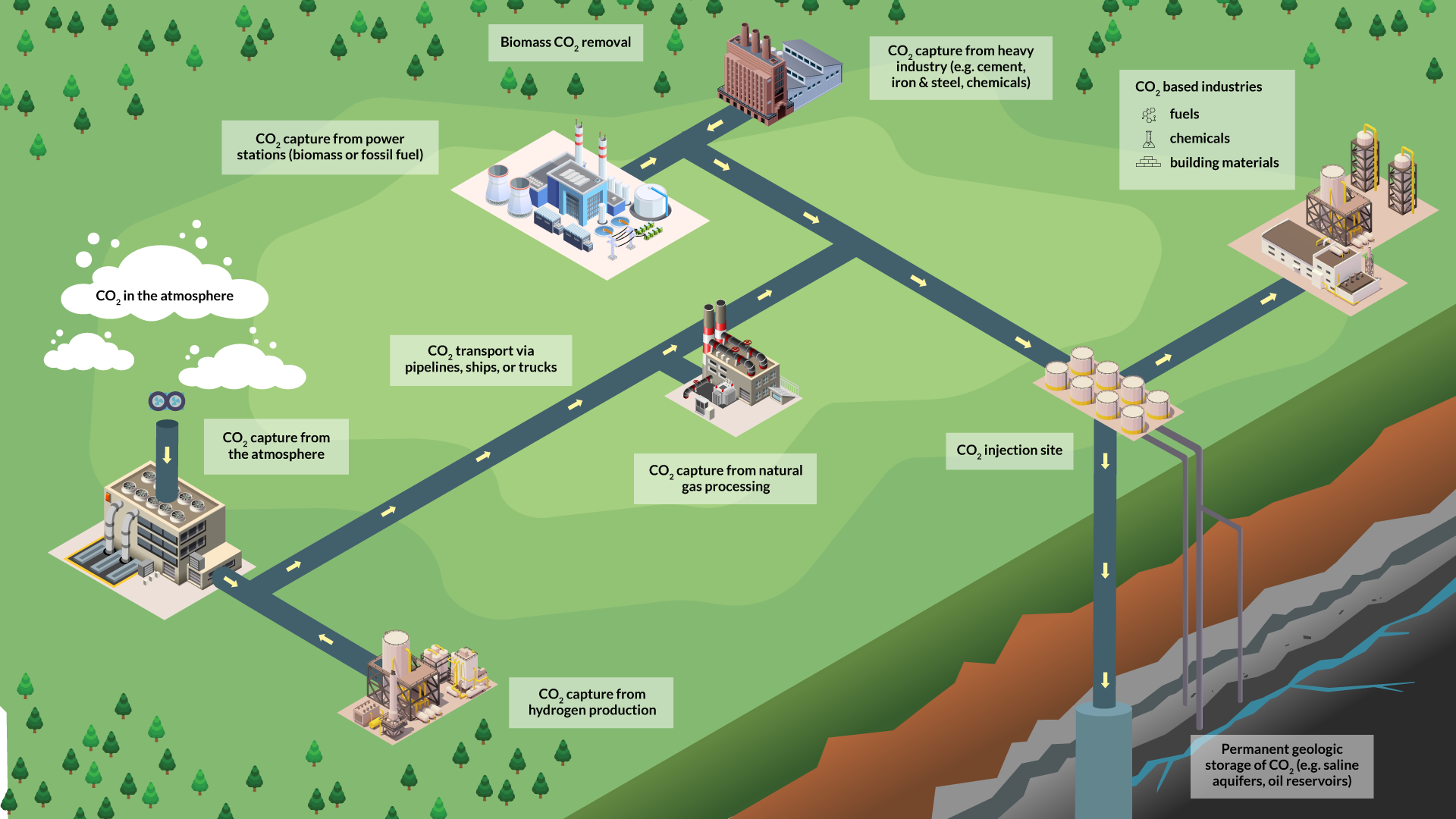
From the geniuses who brought you the missnamed IRA spending spree, a new push to suck plant food (CO2) out of the air to “fight global warming.”   The insanity is doubled:  Billions are wasted in an effort to deprive the biosphere of essential CO2.  LA Times How the Biden administration is pouring billions into technology that sucks carbon from the air.  Excerpts in italics with my bolds.

The Biden adminstration is funding projects by Occidental Petroleum and Climeworks that will remove carbon dioxide from the air. The Climeworks plant in Hinwil, Switzerland, above, filters carbon dioxide from the air above a garbage incineration plant. (Climeworks)

Some Might Call it a Ruse

The technology is “essentially a giant vacuum that can suck decades of old carbon pollution straight out of the sky,” Energy Secretary Jennifer M. Granholm told reporters. “If we deploy this at scale, this technology can help us make serious headway toward our net-zero emission goals.”

Once operational, the hubs are expected to remove more than 2 million metric tons of carbon dioxide a year from the atmosphere, the equivalent of taking nearly half a million gas-powered cars off the road, Granholm said. Additional projects are expected to be announced next year, the Energy Department said.

Critics worry that carbon capture is too untested to be a reliable tool in fighting climate change. And some opponents see carbon capture efforts as a way to extend the life of facilities that produce or use fossil fuels.

Background:  Wasting Money on Carbon Capture

Robert Bryce explains in his Real Clear Energy article Carbon Capture Didn’t Make Sense 12 Years Ago And It Doesn’t Make Sense Now.  Excerpts in italics with my bolds and added images.

It appears the reconciliation bill that includes some $370 billion in energy-related spending is going to become law. The measure includes a panoply of tax credits for alternative energy technologies, including incentives for electric vehicles, hydrogen, energy storage, and of course, billions of dollars in tax credits for wind and solar energy.

The measure also includes, according to the Congressional Budget Office, some $3.2 billion in tax credits for carbon capture and sequestration, a technology that has plenty of supporters but precious little in the way of commercially successful projects. Back in 2018, Al Gore blasted CCS, calling it “nonsense” and an “extremely improbable solution.”

The new tax credits for CCS remind me that I published a piece in the New York Times on May 12, 2010, about the technology. In looking back, the piece is still relevant today. In fact, I wouldn’t change a word of it. Furthermore, my prediction about the difficulty of siting the pipelines needed to move the CO2 has already come true. For proof, see this August 6, Wall Street Journal article about the opposition to a proposed CO2 pipeline in Iowa.

In any case here’s my 12-year-old take on why CCS is a bad bet:

On Wednesday, John Kerry and Joseph Lieberman introduced their long-awaited Senate energy bill, which includes incentives of $2 billion per year for carbon capture and sequestration, the technology that removes carbon dioxide from the smokestack at power plants and forces it into underground storage. This significant allocation would come on top of the $2.4 billion for carbon capture projects that appeared in last year’s stimulus package.

That’s a lot of money for a technology whose adoption faces three potentially insurmountable hurdles: it greatly reduces the output of power plants; pipeline capacity to move the newly captured carbon dioxide is woefully insufficient; and the volume of waste material is staggering. Lawmakers should stop perpetuating the hope that the technology can help make huge cuts in the United States’ carbon dioxide emissions.

1. An Energy Intensive Process

Let’s take the first problem. Capturing carbon dioxide from the flue gas of a coal-fired electric generation plant is an energy-intensive process. Analysts estimate that capturing the carbon dioxide cuts the output of a typical plant by as much as 28 percent.

Given that the global energy sector is already straining to meet booming demand for electricity, it’s hard to believe that the United States, or any other country that relies on coal-fired generation, will agree to reduce the output of its coal-fired plants by almost a third in order to attempt carbon capture and sequestration.

2. Costly Pipelines for a Waste Gas

Here’s the second problem. The Pacific Northwest National Laboratory has estimated that up to 23,000 miles of new pipeline will be needed to carry the captured carbon dioxide to the still-undesignated underground sequestration sites. That doesn’t sound like much when you consider that America’s gas pipeline system sprawls over some 2.3 million miles. But those natural gas pipelines carry a valuable, marketable, useful commodity.

By contrast, carbon dioxide is a worthless waste product, so taxpayers would likely end up shouldering most of the cost. Yes, some of that waste gas could be used for enhanced oil recovery projects; flooding depleted oil reservoirs with carbon dioxide is a proven technology that can increase production and extend the life of existing oilfields. But the process would be useful in only a limited number of oilfields — probably less than 10 percent of the waste carbon dioxide captured from coal-fired power plants could actually be injected into American oilfields.

3. Impossibly Massive Scale

The third, and most vexing, problem has to do with scale. In 2009, carbon dioxide emissions in the United States totaled 5.4 billion tons. Let’s assume that policymakers want to use carbon capture to get rid of half of those emissions — say, 3 billion tons per year. That works out to about 8.2 million tons of carbon dioxide per day, which would have to be collected and compressed to about 1,000 pounds per square inch (that compressed volume of carbon dioxide would be roughly equivalent to the volume of daily global oil production).

In other words, we would need to find an underground location (or locations) able to swallow a volume equal to the contents of 41 oil supertankers each day, 365 days a year.

There will also be considerable public resistance to carbon dioxide pipelines and sequestration projects — local outcry has already stalled proposed carbon capture projects in Germany and Denmark. The fact is, few landowners are eager to have pipelines built across their property. And because of the possibility of deadly leaks, few people will want to live near a pipeline or an underground storage cavern. This leads to the obvious question: which members of the House and Senate are going to volunteer their states to be dumping grounds for all that carbon dioxide?

For some, carbon capture and sequestration will remain the Holy Grail of carbon-reduction strategies. But before Congress throws yet more money at the procedure, lawmakers need to take a closer look at the issues that hamstring nearly every new energy-related technology: cost and scale.

Footnote:  The project is not only impractical, its deluded objective is to deprive the biosphere of plant food.

See also:  Carbon Capture Boondoggle 


How Warmists Turn the Public Off

Wildfires raging outside Athens this summer are just one reason environmentalists are raising alarms louder than ever — even as many activists insist their messages lack the proper resonance with voters. AP

Kevin D. Williamson explains at NY Post Why climate change activists have failed to score public support.  Excerpts in italics with my bolds.

We are hearing even more than usual about climate change this summer and that is not surprising — not with dog-days news cycles driven by record-setting heat waves, torrential rains and widespread Canadian wildfires.

Some climate activists think we are not hearing enough about the issue: Writing in The Guardian, columnist Jonathan Freedland insists that the problem is one of marketing. “The climate movement has devoted relatively few resources to reaching or persuading the public,” he writes, preposterously.

He quotes progressive p.r. man David Fenton — “We’re in a propaganda war, but only one side is on the battlefield” — and cites former United Nations climate grandee Christiana Figueres, who claims “the climate community has recoiled from marketing.” Why? Because, Figueres says, it is “sort of tainted. It’s icky. You know, ‘We’re too good for marketing. We’re too righteous’. . . Hopefully we’re getting over it.”

Of all the dumb and dishonest things that have been written and said in the climate debate, the notion that climate-change activists just can’t get their message out — that they won’t stoop to marketing — may be the very dumbest and most dishonest.

Billions of dollars have been spent on climate-change advocacy,
to say nothing of money devoted to actual climate policies.

Raging wildfires in Eastern Canada have sent vast plumes of smoke across North America this summer. Environmentalists loudly suggest the smoke is proof of a changing planet, even as progressives insist their agenda is being silenced. via REUTERS

The government leaders of practically every democratic country speak about the issue constantly.

In the intergovernmental sector, you have everybody from the United Nations to the International Monetary Fund ringing the climate alarm bells, while in the private sector you can count on the likes of BlackRock, Goldman Sachs and other corporate titans to do the same.

ESG rules have pushed the climate issue onto the corporate agenda in a big way—companies are spending billions in total (as much as $1.4 million per company) on climate-reporting costs alone.

Even the supposed villains in the story — big energy companies such as ExxonMobil — spend billions of dollars a year advertising the green agenda. “In the past ten years we have reduced greenhouse gas emissions in our operations by more than 7 million metric tons,” ExxonMobil boasts, “which is the equivalent of taking about 1.4 million cars off the road.” You may not think they are sincere, but they are far from silent about the issue.

Companies such as private equity biggie BlackRock are spending billions on ESG programs, which link their investment strategies with left-wing social goals. REUTERS

Climate activists have the commanding heights. What do the so-called deniers have?
A few of my cranky libertarian friends.  .  . And voters.

The real issue with climate policy isn’t that voters don’t know about the issue — it is that they disagree. Climate policy touches everything from big tech to farming to economic growth, everything from the homes we live in to the cars we drive, and, as such, an ambitious climate program will necessarily impose big costs.

The Alexandria Ocasio-Cortezes of the world can pretend that green policies will pay for themselves, but no serious person believes that.

One of the clearest ways to reduce our reliance on fossil fuels is to expand access to nuclear energy, which requires major investment in new infrastructure. Getty Images

Sure, Guardian headline writers can straight-up declare “The beauty of a Green New Deal is that it would pay for itself” — this is nothing more than that “marketing” to which our green friends supposedly are so averse.

American voters do care about climate issues, but not as intensely as activists would like. Climate routinely polls in the single digits when it comes to voters’ top concerns, far behind (surprise!) the economy and health care.  Independents rate immigration a more pressing issue than climate change.

Maybe you think the US government is under the heel of the oil barons, but no democratic country has undertaken the kind of economic transformation climate activists advocate.

The signatories of the Paris Agreement are far from meeting their climate obligations; the $100 billion a year in climate-finance commitments promised at the UN climate summit in Glasgow have not been fully funded; even in the European Union, the leaders of which take a much stronger climate line than their US counterparts, there has been no radical change.

A coal excavator in Germany, which boosted coal mining in the wake of gas shortages caused by the Ukraine crisis. AP

Germany responded to Russia’s recent energy blackmail by reopening coal plants.

European voters rank climate a higher priority than Americans do, but it typically polls behind economic growth and immediate issues such as the invasion of Ukraine.

That is not oil-drenched propaganda at work— that is, for better and for worse,
democratic politics at work.

While there has been piecemeal progress, countries across the globe are moving at a glacial pace when it comes to the one policy that can reliably reduce greenhouse-gas emissions at a reasonable cost: rapidly expanding nuclear power, which has an operational carbon footprint of approximately zero.

The state government in Pennsylvania got that collapsed interstate overpass reopened in record time by waiving all sorts of planning and permitting rules, but no such urgency exists in the case of nuclear power or other needful energy infrastructure.

Christiana Figueres, who leads the UN’s climate change campaign, contends that environmental issues suffer from a lack of proper marketing. Many would certainly disagree. LightRocket via Getty Images

That, unfortunately, is democracy, too.  What is needed is not more marketing — more propaganda, more hysteria.   What is needed is a more attractive set of trade-offs.

But finding better trade-offs means admitting that there are trade-offs, which climate activists — hostage to their marketing departments — have too often refused to do.

Promises made at major multi-national climate conferences such as the Paris Accords remain unmet as liberal democracies appear unable to overhaul their energy strategies. Getty Images

It isn’t that climate activists aren’t selling their agenda — it is that
voters in democratic countries around the world are not buying it.

Canada Road to Ruin Paved with Trudeau’s CO2 Intentions

Bill Bewick explains in his National Post article Federal climate policy makes us poorer.  Excerpts in italics wtih my bolds and added images.

The clean fuel standard on top of an escalating carbon tax and onerous emissions
targets will make everything more expensive

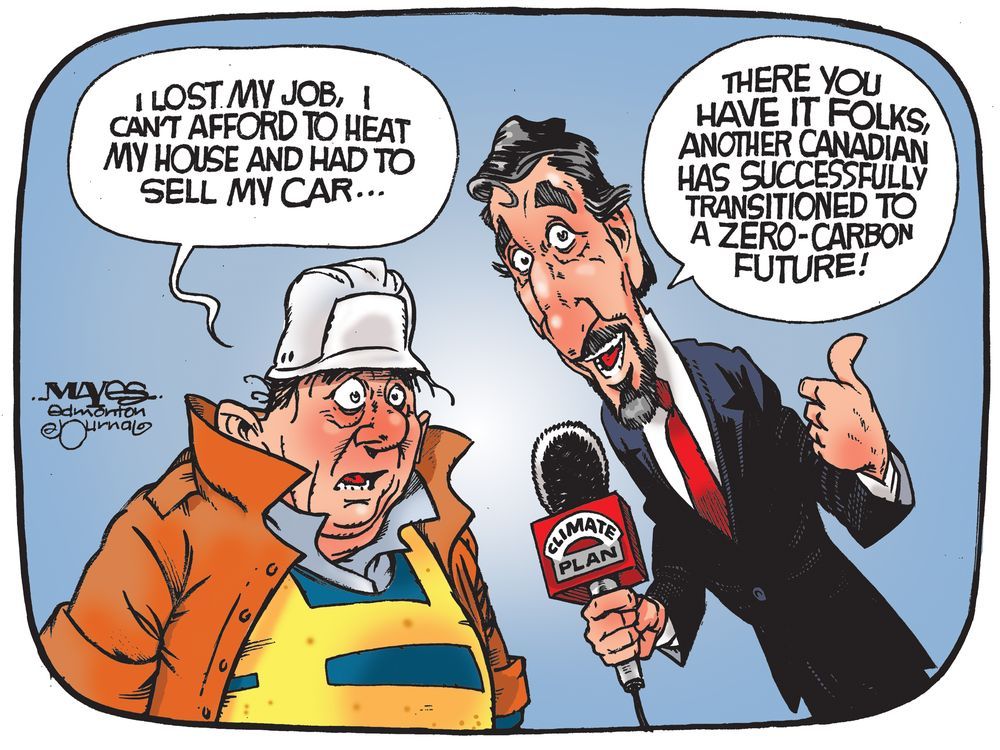
Canada is in an affordability crisis. Despite the pain felt by Canadians every day at the till or the gas pump, the federal government’s passion for world-leading carbon taxes and regulations is driving up the cost of everything while making us collectively poorer.

Tax advocates say it is a small % of GDP. But it is still $10 Billion extracted from Canadian households.

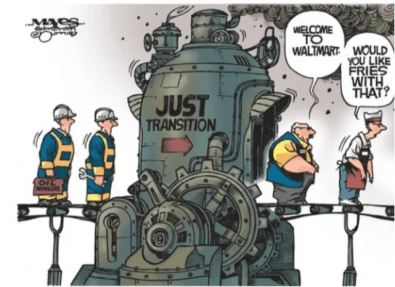
Canada Day saw the Clean Fuel Standards (CFS) regulation come into effect. A week earlier they passed a “Sustainable Jobs Act” that seeks to help transition workers away from highly productive jobs in oil, gas and related industries despite growing global demand for these energy sources.

The Parliamentary Budget Officer projects that by 2030 the net CFS cost will be over $1,100 per household in Alberta and Saskatchewan. While it will add roughly 17 cents on a litre of fuel (in addition to the carbon tax, of course) most of the costs will be on Canadian businesses, which means less jobs, less tax revenue and higher prices, making life more expensive with less ability to pay for it.

The fact is the world will need oil for the next 20-30 years at least. Canada is the responsible, reliable supplier many in the world would already prefer to get their energy from. With Canadian oilsands producers aggressively pursuing net zero operations by 2050, there is no better place to get oil from.

The demand for Liquefied Natural Gas (LNG) is booming globally. It should be vocally supported by anyone concerned with emissions since Canadian exports off our west coast would drive down the need for all the coal plants being built and planned in China and India. It also features an unprecedented level of Indigenous partnerships, offering an unparalleled opportunity for the economic self-sufficiency of countless communities.

Why would we “transition” these high-paying, unsubsidized jobs?
And transition them to what?

Well, the federal government seems to know that our oil and gas sector will have to shrink despite growing world demand. This is because in addition to steadily rising carbon taxes and the new CFS, they’ve arbitrarily demanded a 42 per cent reduction in emissions for the oil and gas sector in seven short years.

Requiring this drastic reduction by 2030 will force hasty and frantic changes as well as production cuts that will drive up energy prices for everyone while decreasing jobs and government revenues. That means more debt and more tax burden for Canadians, while hurting our economy and increasing our reliance on foreign oil.

An escalating carbon tax was supposed to let the economy decarbonize in an efficient way, but the federal government keeps piling on. This is crushing Canada’s competitiveness generally, especially after our American neighbours decided to go along with most of the rest of the world and not implement a carbon tax at all.

The fact that every manufacturer, farmer, trucker, and even commercial business owner on this side of the border has to pay these taxes on their fuel, heat, and power means everything is more expensive and will keep going up. Lower wages and job opportunities means we will be less and less able to afford it.

The government either says we must make these sacrifices for the planet, or that the green jobs they will transition to will be just as profitable and more sustainable. Their most recent example: the Volkswagen battery plant. There will be 3,000 jobs created, but the government will subsidize the plant with an estimated $13 billion. Does $4.3 million in taxpayer dollars per job sound sustainable to you?

As for our sacrifices saving the planet, carbon emissions are global. As Asia grows its economy, emissions are steadily rising. Canada can certainly “do its part” but other than massive LNG export to Asia, nothing we do with our declining 1.6 per cent share can meaningfully reduce overall global emissions.

There’s one more major federal policy being pursued that might be the most expensive of them all: the demand that every province’s electrical grid get to net zero by 2035. Canadian ratepayers spent billions to convert coal plants to gas and subsidize solar and wind projects. Now they are forcing us to get off natural gas entirely — a fuel source even the EU considers green.

Trying to do this in 12 years will cost an estimated $52 billion to achieve in Alberta alone, driving up power bills by 40 per cent. Nothing complements renewables like natural gas. If we want to keep the lights on when there’s no sun or wind, the only technology right now up to the task is natural gas plants — but the government seems to think higher power bills and less reliability is the way to go.

Canadians care about reducing emissions and it is happening. Canadians also care about affordability. We need to demand our governments find a balance between the two. If Canada recalibrates our carbon policies to be part of the global parade instead of driving off an economic cliff, we can have both.


See Also Canada Budget Officer Quashes Climate Alarm

Choices Usurped by Self Righteous Tyrants

William Watson writes at Financial Post Self-righteous totalitarian tinkering and the end of gas-powered cars.  Excerpts in italics with my bolds and added images.

Canadians often get to vote on important local projects.
When did we all vote on abolishing gas engines?

I am happy to report that democracy is alive and well in the Montreal suburb where I live and by all appearances completely uninfluenced by the Chinese Communist Party.

My evidence is purely anecdotal: the steady stream of voters arriving at the advance poll held Sunday at the almost 60-year-old town arena to cast their ballot in a referendum on whether we should replace that self-same arena — famous as being the coldest in all of Montreal — with a new almost $40-million sports complex that would include a new arena. The federal and provincial governments have pledged $12.5 million and private fundraising has brought in a few million more but the bulk of the money would be provided by the town, partly through new debt issue.

Getting citizen approval (or rejection) of that issue was the purpose of the referendum,
which was called after the requisite number of voters registered their request for it.

My guess is the new arena won’t pass. It has been discussed for several years and the amount that was always mentioned was at most $20 million so when this spring the lowest contractor bid came in at $38 million, that was a shock. There has been lots of back and forth at various meetings and a flurry of flyers in the mail debating pros and cons, including what the effect on property taxes will be. I suspect the strong turnout means people don’t want to pay more to service the higher debt. But we’ll know when the final vote takes place next week. What’s most important is that there seems to be widespread agreement that the vote is the final word — though in this litigious age it’s not inconceivable that whichever side loses may try their luck in the courts.

Whatever the outcome, it has been a great exercise in democracy. And it has left me feeling I’d like to have a direct say in other decisions that will have an important effect on my life. One that comes to mind immediately is Ottawa’s decision to do away with gasoline-powered cars.

By 2035, ministers Steven Guilbeault and Jonathan Wilkinson decreed in 2021,
the “mandatory target,” i.e., the requirement, for all new
“light-duty cars and passenger trucks” is that they be zero-emission.

Thus will end, in this country at least, the widespread use of the internal-combustion engine for personal transportation, a technology that since its first commercially successful use in the 19th century, has brought unprecedented prosperity and freedom of movement to literally billions of people around the world and largely made possible the much-decried suburban lifestyle that is currently under all-out attack from car-less urban sophisticates. It has also over the decades undergone continuous and considerable refinement in terms of efficiency, noise and exhaust, so that modern combustion engines are barely recognizable compared to early versions.

In 2021, Statistics Canada tells us, more than 26.2 million “road motor vehicles” were registered in this country, which works out to not quite one car per adult Canadian (depending where you draw the age line for adult, of course).

Of those 26.2 million registered motor vehicles, 303,073 were hybrid-electric, 152,685 battery-electric and 95,896 plug-in electric — so some 551,000 in total, or a little over two per cent, were low or no emissions. Except that net-zero absolutists really don’t like hybrid vehicles, which run part of the time on fossil fuels, so the true proportion of elite-acceptable net-zero vehicles was under one per cent. And we’re now in 2023, which means 2035 is just 12 years away. What contortions will the car industry, not to mention the economy, have to be put through so that in those 12 short years all new cars are net-zero? The hubris of people willing to impose such contortions is breathtaking.

Whether or not my town gets a new arena will in fact have much less impact on my life than whether in 12 years we Canadians will be forbidden from acquiring a newly produced internal combustion engine car. Yet while my opinion on the arena is being sought and respected nobody ever asked my opinion about whether or not to ban gas cars.

As Lionel Shriver, one of my favourite columnists, put it in London’s Spectator magazine last week: “We’ve entered an era of unaccountable bureaucratic imposition that’s only going to get worseBans on the sale of new petrol cars by 2030 and gas boilers in new homes by 2025 that no one voted for are just the beginning of a self-righteous totalitarian tinkering with our daily lives that makes a mockery of the notion that democracies are governed by consent.”

She was writing about Britain and in particular London’s “ultra-low emissions zone,” in which non-complying cars pay a charge of £12.50 a day. But she could have been writing about this country or indeed any western democracy, in all of which officials seem firmly in control and voters essentially powerless.

“Self-righteous totalitarian tinkering” is a phrase that
these days echoes familiarly in Canada.

Absurd Climate Blame Game

Lorrie Goldstein explains.at Toronto Sun in above video Guilbeault  Plays Absurd Blame Game–Attacks Conservatives, but not China, on climate change.  Transcript from closed captions in italics with my bolds and added images.

PM Trudeau: We will raise Canada’s price on carbon pollution Rising by 15 a ton starting in 2023 and rising to 170 Canadian dollars per ton by 2030.

Federal environment Minister Stephen Guilbeault says the Trudeau government could be more effective in fighting climate change were it not for the opposition of the federal conservatives. He told CTV news that he would like to do things like, for example, speeding up Canada’s goal of net zero emissions, possibly lowering it to 2040 instead of the current 2050.

Now his argument is absurd on a number of fronts. First of all Stephen Guilbeault and the Trudeau government don’t need the permission of the conservatives to lower our emissions targets to 2040 instead of 2050. He didn’t need them to set the 2050 Target; why would he need them for the 2040 Target?

And in terms of keeping in power to fight climate change, his government doesn’t need the support of the federal conservatives. So far the NDP are supporting him. And if anything they want the government to go faster in fighting climate change.

But the more important issue is that it doesn’t matter what Canada’s Target is. It also doesn’t matter how much we pay in carbon taxes or clean fuel regulations or subsidies to corporate green companies. None of that matters, the reason being Canada’s emissions are a rounding error in terms of global emissions.

Nothing Canada does on its own is going to slow the rate of wildfires or floods
or wind storms or severe weather in Canada. Zero Effect.

Why? Here’s a few numbers according to the federal government. In 2019 our emissions were 724 million tons of greenhouse gas emissions. The global total is 48,000 million tons. China’s total, as the largest single emitter in the world, was about 12,700 million tons. Tony Keller in the Globe and Mail made a good analogy about this. He said to think of the world’s greenhouse gas emissions as water in a swimming pool. What’s happening is that in Canada we’re trying to lower the level of the water using a soup spoon, and meanwhile China and other countries are filling up the pool using a fire hose.

Now if Stephen Guilbeault and Trudeau really want to be more effective in fighting climate change, they shouldn’t be attacking the conservatives; they should be attacking China’s dictators.

Now we’re always accused, even by our own government, that Canadians are wanton wasters of energy because we are the highest per capita emitters in the world. That’s an absurd metric to use particularly for Canada. Because we are the second coldest country on Earth, the second largest country on Earth, and we have a relatively small population.

Use another metric that has been used, emissions per square kilometer. Lo and behold Canada becomes one of the lowest emitters in the developed world. It’s true that what you get always depends on what you measure.

The only practical effect of our emission targets and paying more for oil and gas to heat our homes and everything else is: In theory it gives Justin Trudeau the moral authority to attempt to use moral persuasion on countries like China to lower their emissions.

Of course we already know from experience how well Canada’s
moral influence works on China’s dictators.

Postscript:  A Voice from Silent Canadians


Social Cost of Carbon Game

Ross McKitrick writes at Financial Post Junk Science Week —The Social Cost of Carbon game.  H/T John Ray Excerpts in italics with my bolds.

Estimates of the SCC championed by Guilbeault are not science

Environment Minister Steven Guilbeault recently announced that the Social Cost of Carbon (SCC), or the dollar value of supposed damages associated with each tonne of carbon dioxide emissions, is about $247, nearly five times higher than the old estimate of $54. He made it sound like a discovery, as if a bunch of experts had finally been able to measure something they previously only guessed at.

Like when scientists were finally able to measure the mass of an electron or the age
of the Earth, now finally we can measure the SCC.

But in reality there has been no breakthrough in economics comparable to those physics breakthroughs. Countless SCC estimates already exist ranging from small negative amounts (i.e. carbon dioxide emissions are beneficial) to many thousands of dollars per tonne. Every such estimate is like a complex “if-then” statement: if the following assumptions hold, then the SCC is $X. Yale economist William Nordhaus won the 2018 Nobel Memorial Prize in economics for developing some of the first methods for combining all the “if” statements into systems called Integrated Assessment Models or IAMs. And using conventional economic and climate modelling methods, he tended to get pretty low SCC values over the years, which has long been a sore point among climate activists and the politicians who share their agenda.

But economists are on the case. The $247 figure referenced by Guilbeault comes from a new report from the Biden administration that tossed out all the previous models, including Nordhaus’s, and instead cobbled together a set of new models that when run together yield much higher SCC values.

In many ways the new models are just like the old ones.

For example they persist in using an Equilibrium Climate Sensitivity of 3 degrees C. This refers to the warming expected from doubling the amount of CO2 in the atmosphere. The authors cite the Sixth Assessment Report of the Intergovernmental Panel on Climate Change as the basis for this decision, apparently unaware that that estimate has already been shown in the climate literature to be flawed. Using the IPCC’s own method on updated data yields a sensitivity estimate of about 2.2 C or less, and as I have shown in a recent publication this is enough to cause the SCC estimate in a standard model to drop to nearly zero.

The biggest boosts to the new SCC figure hailed by Guilbeault come from revisions to agricultural productivity impacts and mortality costs from climate warming. The evidence for large negative agricultural impacts comes from a 2017 article by Frances Moore and co-authors that looked at the combined effects of CO2 fertilization and warming, concluding the net effect would harm global agriculture. Oddly, they used the same data as a 2014 study by Andrew Challinor and co-authors who had found the opposite: the combination of increased CO2 and warming would have much more benign, and in some cases even beneficial, results.

How did Moore et al. get different results from the same data? They used a different statistical model but unfortunately didn’t provide evidence showing it is better than the one Challinor used, so it’s unclear whose results are stronger. But we know whose are more popular. The Biden administration team referred only to the Moore study and left out any mention of the Challinor one, and it is a safe assumption that the reviewers didn’t notice the omission. See how the game is played?

Regarding the mortality effect, the report relies on evidence innew study that apparently shows that warming will mean fewer deaths from cold and more from heat, and the combined effect globally is a much larger overall death toll than previously thought. The study is by an impressive team led by economist Tamma Carleton and 15 co-authors. In their preface they thank 17 research assistants, four project managers, 13 reviewers and seminar participants at 20 prestigious academic institutions around the world. It’s a high-quality piece of work, but like tens of thousands of other splashy climate impacts studies it relies for its headline conclusions on the discredited RCP8.5 emissions scenario.

How did all those prestigious researchers and reviewers miss this flaw?

The authors compiled mortality data from selected countries around the world and matched them to temperature records, then built a statistical model to extrapolate over the entire world. They used some clever economic modelling to estimate the beneficial effects of adaptive behaviour (like installing air conditioning) as well as the costs. Then they estimated a “mortality function” that spits out the number of additional deaths between now and the year 2300 attributable to each additional tonne of emissions, both from warming itself and the costs of adaptation. To compute this number the authors needed emissions and income projections out to 2300.

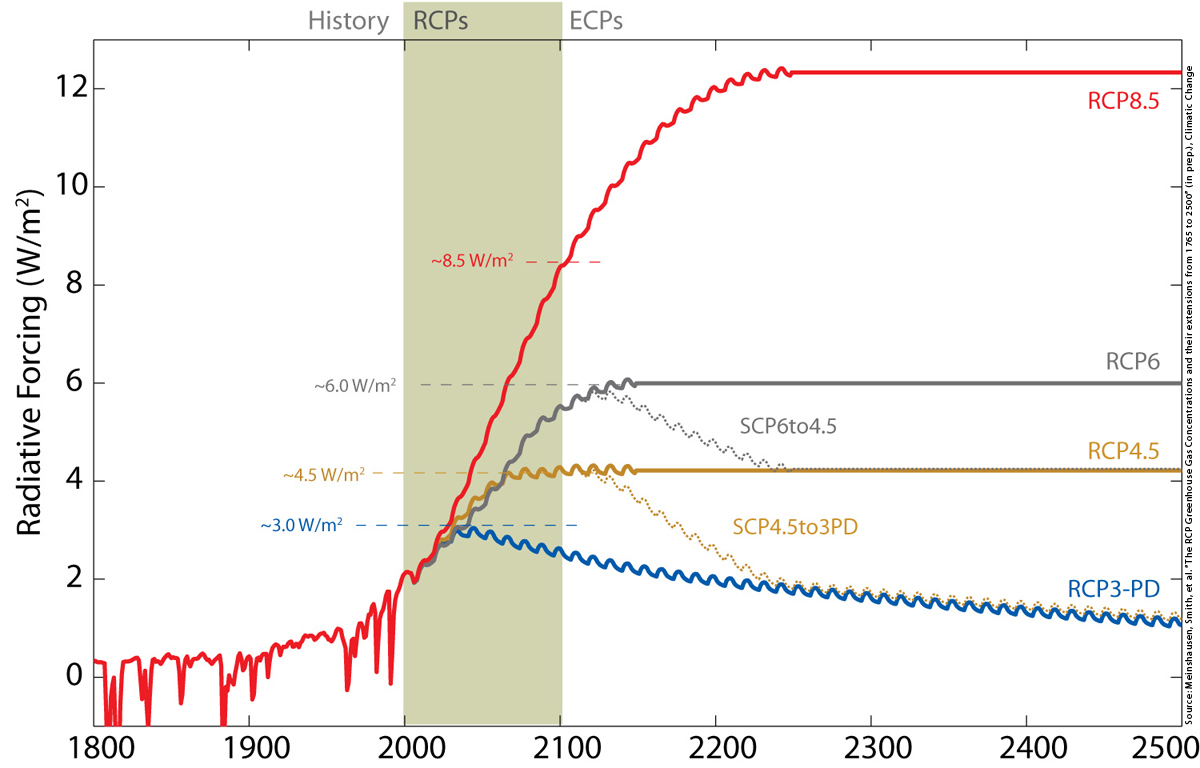
No uncertainty ranges are shown and reported, as for creating the recommendation datasets for CMIP5, central estimates have been assumed closely in line with central estimates in IPCC AR4. (SCP45to3PD). No uncertainty ranges are shown and reported, as for creating the recommendation datasets for CMIP5, central estimates have been assumed closely in line with central estimates in IPCC AR4. https://www.pik-potsdam.de/~mmalte/rcps/

For this they used two scenarios: the extreme, coal-blackened Dickensian fiction called RCP8.5, and a mid-range emissions projection called RCP4.5. In my 2020 JSW column I discussed the efforts of climate analysts to convince their colleagues to stop using the RCP8.5 scenario because of its unrealistic assumptions. Interestingly the Biden administration report moves away from both RCP scenarios and focuses on a new one from Resources for the Future (RFF) which, through most of the rest of this century, projects emissions even below RCP4.5.

But in the main text of the Carleton paper it highlights mortality estimates associated with an RCP8.5 future. Basically we all die a fiery death. If you want to know what the results are using RCP4.5, you will need to track down the 113-page online-only appendix and navigate to page A75, then transfer a table full of numbers to a spreadsheet so you can compare the outcomes.

The two figures on this page summarize what they show. With no adaptation, under the RCP8.5 emissions scenario each tonne of CO2 kills 221 people per hundred thousand (100k) between now and 2300, with the uncertainty range shown by the whisker line. Under RCP4.5 each tonne kills 40 people per 100k. I estimated what their model would yield using the RFF scenario: the effect drops further to 18 people per 100k, and the number is not significantly different from zero.

The second figure reports results if adaptive behaviour is assumed. Under RCP8.5 the mortality rate per 100k drops to 85 people, under RCP4.5 it drops to 14 and under the RFF scenario it drops to five, and the latter two estimates are not significantly different from zero, which means that there is no statistically valid reason to add the mortality effect to an SCC model.

Another step in the analysis is to place a value on these deaths, which depends on things like age and income in every place. Digging further into the online appendix (p. A100), if they stick with RCP4.5 but use a variant that predicts higher income growth the value of the mortality effect goes negative, which means taking account of the lives saved or lost due to warming leads to a lower SCC.

No mention of this in Guilbeault’s announcement.

Thus I reiterate that SCC estimates are if-then statements. They are not intrinsically true or false: what matters is the credibility of the assumptions.

♦  If emissions follow the RCP8.5 scenario (which they won’t), and
♦  if people don’t adapt to climate change (which they will), and
♦  if CO2 and warm weather stop being good for plants (which is unlikely),
    then the SCC could be five times larger than previously thought.

More likely it isn’t, and very well could be much smaller.

See Also Biden’s Arbitrary Social Cost of Carbon: What You Need to Know


Get Real on Energy Policy ( Bryce to US Senators)

The imperative is put concisely in US Senate testimony by Robert Bryce in summary video above.  For those who prefer reading, I provide below a transcript and exhibits from the closed caption and screen captures.

Legislators and policymakers in Washington need a big dose of energy realism, an even bigger dose of energy humanism. Europe provides a case study for what not to do. Millions of Europeans are facing the prospect of a cold winter without enough affordable energy to heat their homes. Fertilizer plants and steel mills are closing because of high energy prices.

Europe’s price hikes are being caused by under investment in hydrocarbons due to aggressive decarbonization and ESG policies. Second, they’re being caused by over-investment in weather-dependent renewables, which has left the continent vulnerable to wind droughts. Just yesterday in Britain spot prices for electricity exceeded four thousand dollars a megawatt hour due to low wind speeds. Third, Europe is prematurely shuttering its coal and nuclear plants, and finally it is relying too heavily on imported energy and in particular Russian natural gas.

The implications of Europe’s price spikes include soaring inflation,
deindustrialization and increased burdens on consumers,
especially the working poor.

The knock-on effects could last for months or even years. Fertilizer made from hydrocarbons is the food of food. Numerous fertilizer plants in Europe and around the world are shutting down because of high natural gas prices. This will mean less food production and therefore higher food prices, leading to additional inflation.

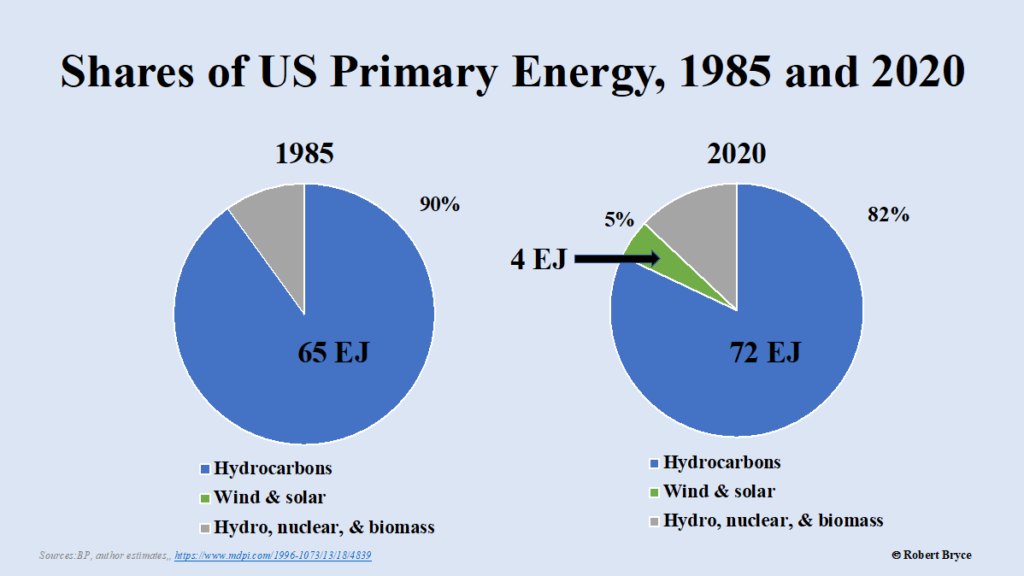
The United States must not emulate Europe’s disastrous energy blueprint. We need energy realism. Energy is the economy; energy nourishes human potential. Hydrocarbons now provide 82 percent of our total energy and about 60 percent of our electricity supplies. The US today gets 18 times more energy from hydrocarbons as it does from wind and solar combined.

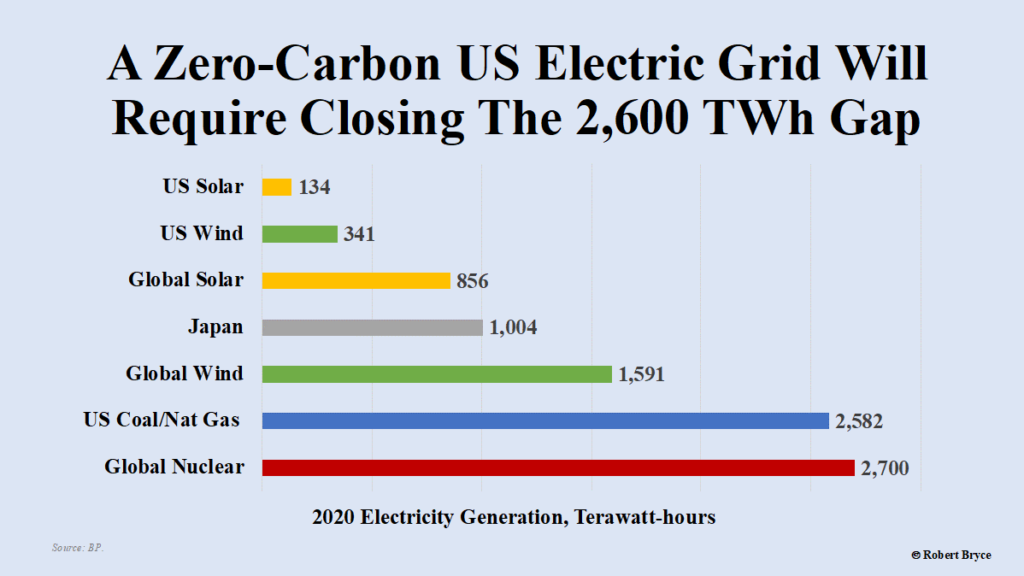
The myriad claims being made by climate activists, politicians and elite academics that we can run our economy solely on wind and solar and a few drops of hydropower have no basis in physics, math or history. Furthermore wherever renewables have been ramped up, as in Europe, energy prices have soared.

Senators, look at California where electricity prices are absolutely exploding. Wood Mckenzie estimates that converting our grid to renewables could cost 4.5 trillion dollars, or roughly $35, 000 for every family in America. How could such a staggering cost result in the just energy transition that we hear so much about?

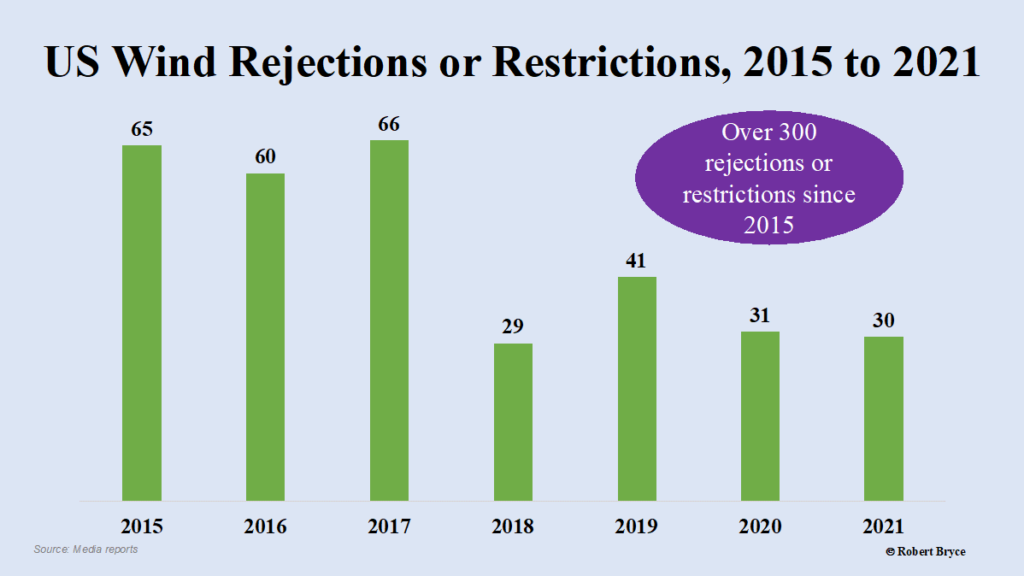
Some Energy Realism: Since 2015 more than 300 communities across the country, from Maine to Hawaii have rejected wind projects. Over the past six months alone massive solar projects in Nevada, Pennsylvania and Montana have been rejected by local communities.

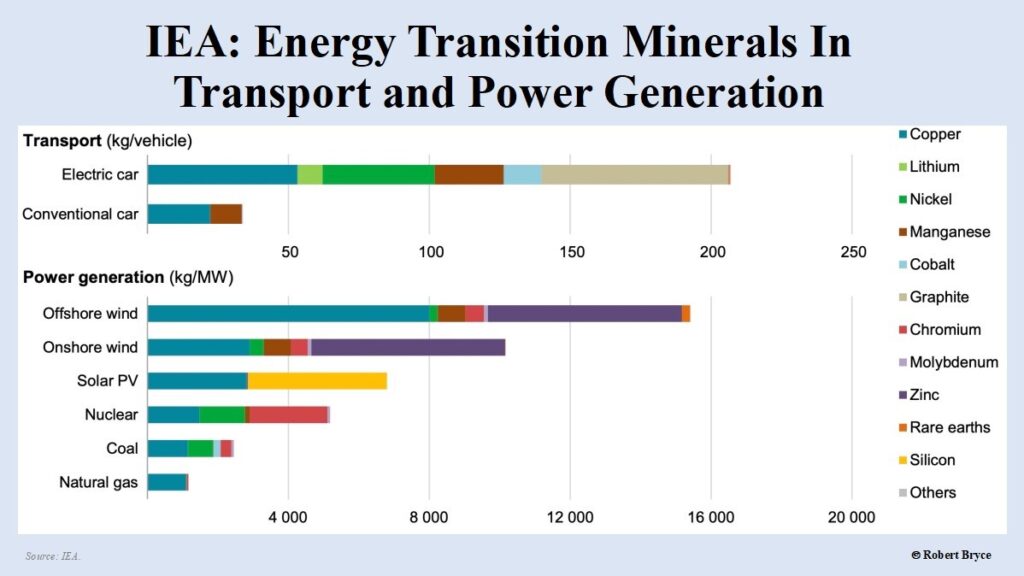
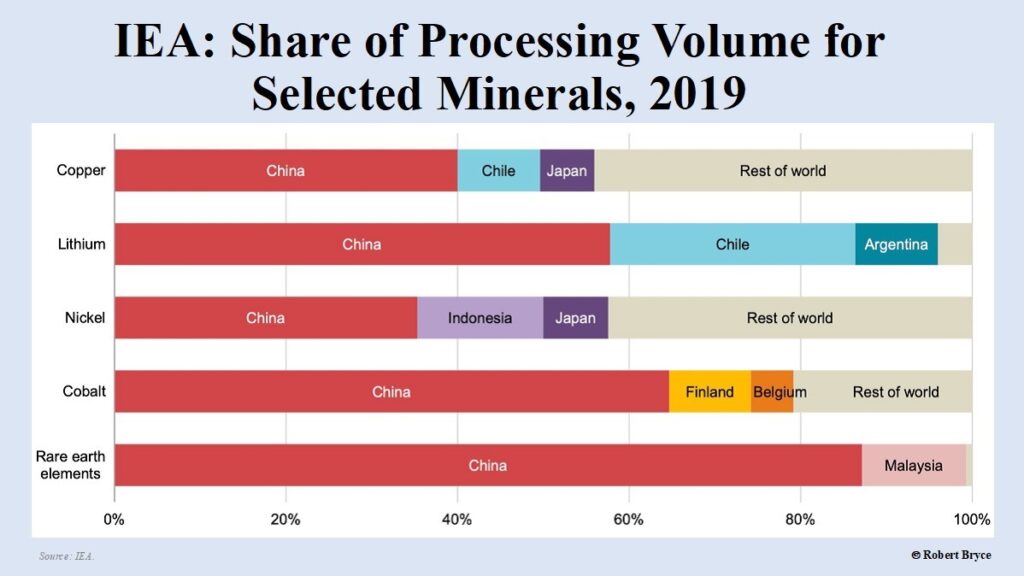
More Realism: Trying to convert our energy and power systems to renewables will make the US reliant on China for critical minerals like Neodymium, Dysprosium and Cobalt. Why is this okay?

Relying on renewables would also require building hundreds of thousands of miles of new high-voltage transmission lines. But the November second referendum in Maine showed very clearly again that rural americans do not want high voltage transmission lines slashing through their neighborhoods.

Strangling America’s hydrocarbon sector by killing pipelines, banning natural gas, halting drilling on federal lands, electrifying everything, and never ending tax breaks for big wind and big solar will not solve global climate change. Instead those moves will turbocharge inflation, imperil our energy security, and impose regressive taxes on the poor and the working class.

Our economy runs on hydrocarbons and that will be true for decades to come. Staking our economy as Europe has done on weather dependent renewables amounts to unilateral energy disarmament
That will hurt us and benefit Russia, China and OPEC. Who will stand up for rural America and against the landscape destroying sprawl of wind and solar? Who will speak against the federally subsidized slaughter of our birds and bats by the wind industry? Expensive energy is the enemy of the poor; Who in the senate will stand up for them? Who in congress will stand up for the affordability reliability and resilience of our electric grid, which is being undermined by this senseless rush to renewables and the premature retirement of our nuclear reactors?

Where are the pro-nuclear, pro-energy realists?
Where, I ask you, are the energy humanists?

Postscript:  Complete text of Bryce presentation with images is at Innovationized:
What’s Causing the Energy Crisis?

ESG, the Demonization of Carbon Fuels, and an Unfounded Confidence in Renewables


Wokeness No Longer Ohio State Religion

The National Association of Sholars issued a press release Ohio Higher Education Enhancement Act Passes Senate, which explains how Ohio legislators are enacting regulations to remove Wokeness from a position of ultimate authority in higher education institutions.  Excerpts in italics with my bolds and added images. Later on are some comments showing that indeed woke operates as the entrenched religion at Ohio State university and others.

The Ohio Senate has passed Senate Bill 83, the Ohio Higher Education Enhancement Act. SB 83, sponsored by Senator Jerry Cirino, will do an extraordinary amount to depoliticize public colleges and universities, strengthen intellectual diversity on campus, and restore citizen oversight of the state’s higher education system.

“SB 83 is the leading edge of higher education reform bills,” said National Association of Scholars (NAS) President Peter Wood. “In 2021, the NAS set out to rehabilitate colleges and universities by promoting model legislation after so many institutions proved unable or unwilling to reform from within. SB 83 takes from our Model Higher Education Code and adapts it to the needs and political circumstances of Ohio.

It was an honor to work with the state’s legislature and our members
to see that this bill passed the Senate.”

SB 83’s sponsors went above and beyond for their state’s citizens to offer a comprehensive improvement to Ohio higher education. Their catalogue of reforms includes requirements that colleges and universities commit themselves to intellectual diversity, and to prohibiting both “diversity statements” and mandatory trainings or courses in discriminatory concepts such as “diversity, equity, and inclusion” (DEI). The bill also adds requirements for reformed mission statements, syllabus transparency requirements, detailed budgetary transparency, nondiscrimination, transparency about speaker fees, and a new American history and government general education requirement. Importantly, the bill reinforces prohibitions on segregation and bars financial entanglements with the People’s Republic of China.

Wood added, “SB 83 absolutely is necessary. Intellectual diversity has dwindled on campuses nationwide and is effectively non-existent on most college campuses. This problem certainly extends to Ohio’s universities.”

NAS Senior Fellow John Sailer has written extensively about how so-called “diversity, equity, and inclusion” bureaucrats at Ohio State University have used diversity statements and other administrative means to screen candidates for hire and promotion by political association. SB 83 puts an end to such practices that endanger academic freedom.

“When Ohio’s universities became incapable of reforming themselves to uphold the principles of what makes higher education higher, its citizens and legislature stepped up,” explained Wood. “These reform-minded Ohioans have our sincerest gratitude.”

[Comment:  According to research, Ohio State has 94 DEI personnel, 1.5 times the OSU History Faculty.  That’s second only to University of Michigan with 163.  The average university has 45 DIE personnel.  Source: DEI Bloat in the Academy]

SB 83 is well tailored to accomplish its goal. It is comprehensive,
detailed, but with carefully drafted language.

SB 83, for example, does not prohibit “diversity, equity, and inclusion courses or training for students, staff, or faculty”; rather, it specifies that the universities may not require them. SB 83 uses such precise language throughout, to ensure that it champions liberty in Ohio’s universities, and does not accidentally infringe upon the principles or the practice of academic freedom.

The National Association of Scholars heartily endorses SB 83, urges the Ohio House to pass companion legislation to this bill, and for Governor DeWine to sign it.

NAS is a network of scholars and citizens united by a commitment to academic freedom, disinterested scholarship, and excellence in American higher education. Membership in NAS is open to all who share a commitment to these broad principles. NAS publishes a journal and has state and regional affiliates. Visit NAS at www.nas.org.

Footnote:

DEI advocates are unhappy at losing a closed shop regarding subjects like climate policies.  From Time More States Want Students to Learn About Climate Science. Ohio Disagrees

That’s because just last week, the state senate began debating the Ohio Higher Education Enhancement Act, which would tie the hands of instructors at colleges and universities from teaching effectively on subjects the state legislature has labeled as “controversial,” including climate change. Those institutions would have to guarantee that they’re “encourag[ing] students to reach their own conclusions,” on such matters, which also include subjects like abortion rights. The schools are also obligated to not “seek to inculcate any social, political, or religious point of view” on students. Higher education institutions would also be barred from implementing sustainability initiatives. Diversity or equity programs would also be banned.

Many schools mention climate change in science class, but absent efforts like those in New Jersey the curriculum can fall woefully behind the current science and state of urgency. On a recent visit to several D.C.-area charter schools, for instance, a colleague of mine was surprised by how little climate awareness was part of the curriculum. She asked one class of 11th graders if any of them were worried about how climate change would impact their own lives; only one hand went up, and that student was more focused on what would happen if the polar ice caps melted 100 years from now. A few students in a 9th grade class had heard of Greta Thunberg, but weren’t exactly sure what she stood for. When prompted, a few other 11th graders in another school acknowledged that heat waves had gotten worse in the D.C. area over the past few years, likely because of climate change, but the solution, they said, was more air conditioning. Other classes were more informed, but it appeared to be due to the efforts of individual teachers, not the curriculum.

Ohio’s law proposes to go entirely in the opposite direction, preventing educators from teaching the established facts of climate change as such, and forcing them to add misleading arguments from climate change skeptics. Supporters say the measure is about championing intellectual diversity on an important subject. “What I think is controversial is different views that exist out there about the extent of the climate change and the solutions to try to alter climate change,” said Republican state senator Jerry Cirino, the bill’s primary sponsor, speaking with Energy News Network.

From Inside Climate News Students and Faculty at Ohio State Respond to a Bill That Would Restrict College Discussions of Climate Policies.

“You can say gravity isn’t true, but if you step off the cliff, you’re going down,” said Katharine Hayhoe, an atmospheric scientist who teaches at Texas Tech University and a well-known writer and commentator about climate change and responding to climate denial. “And if you teach other people that gravity is not true, you are morally responsible for anything that happens to them if they make decisions based on the information you provided.”
The measure has passed the Ohio Senate and is now being considered by the Ohio House, both of which have large Republican majorities. Gov. Mike DeWine is also a Republican.

“Academics want to protect their woke fiefdom so they can continue to churn out like-minded and intolerant opponents of intellectual diversity,” said Sen. Jerry Cirino, a Cleveland-area Republican and lead sponsor of the bill, in a guest column last month in The Columbus Dispatch.