What If the US Banned Fracking?
Other posts have addressed the murky science underneath the claim that burning fossil fuels makes the earth warmer, and the alarmist claims that a warmer world is more dangerous than a colder one. This post takes up the issue that even if rising human CO2 emission were causing dangerous warming, what are the likely consequences of policies to cut down on carbon-based energy. Text below in italics comes from sources listed as links at the end.

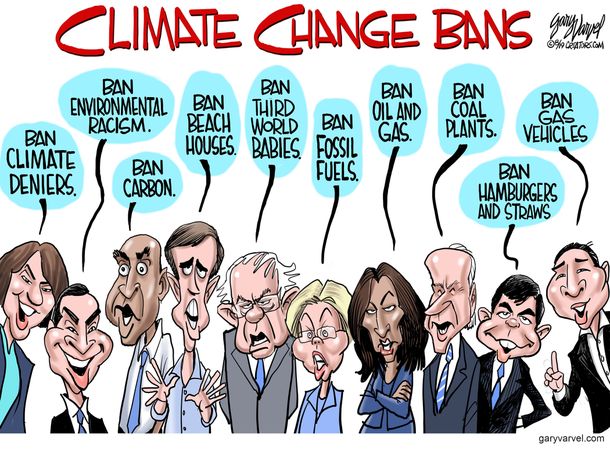
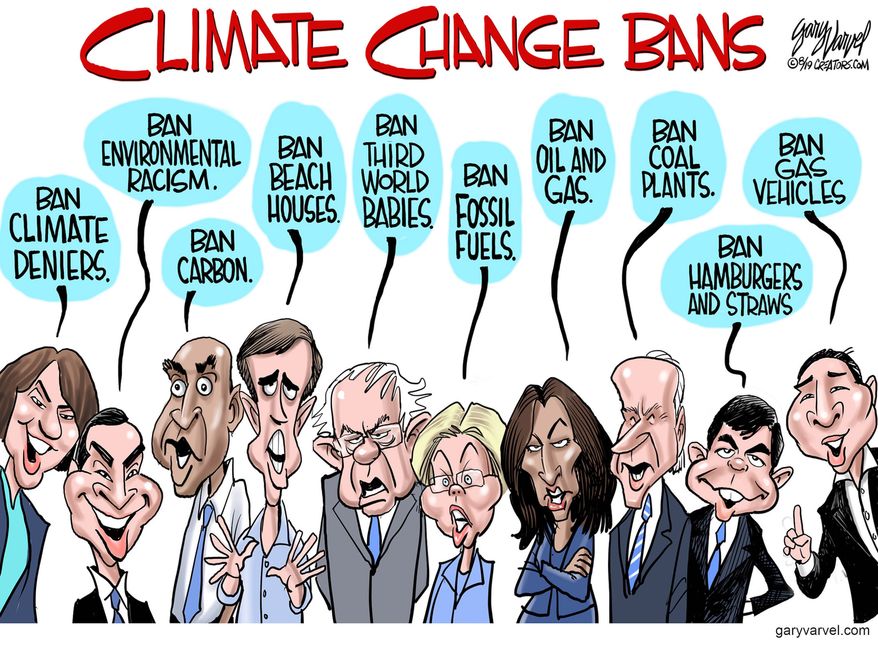
This issue arises in the US context because presidential candidates of leftist stripes have pledged to do away with fracking operations and forego the resulting boom in natural gas and tight oil production.

The Narrative

“I will ban fracking—everywhere.”
— Elizabeth Warren

“Any proposal to avert the climate crisis must include a full fracking ban on public and private lands.”
— Bernie Sanders

“I favor a ban on new fracking and a rapid end to existing fracking.”
— Pete Buttigieg

“I want you to look in my eyes. I guarantee you, I guarantee you we’re gonna end fossil fuel.”
— Joe Biden

And don’t forget the Democratic 2016 nominee whose election was narrowly averted by the Trump surprise:

“So by the time we get through all of my conditions, I do not think there will be many places in America where fracking will continue to take place.”
– Hillary Clinton in 2016

In other words, she declared her intention to follow the Obama program: Regulate anything that moves until it stops moving.
cg5d79e68b834a4

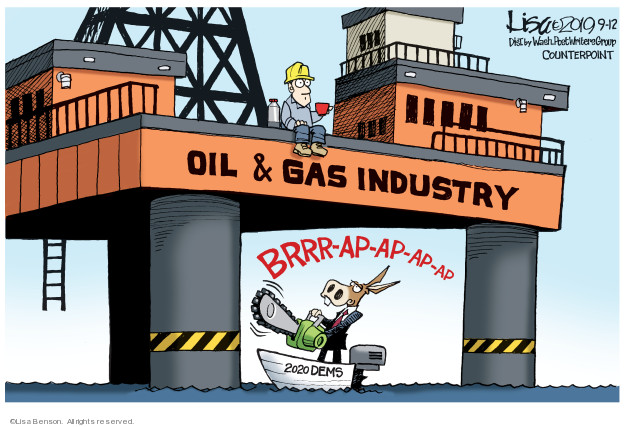
Some skeptics caution against overreacting to electioneering rhetoric, citing the practical limits of presidential authority to implement a ban on fracking. But “elections have consequences,” executive orders have an impact, and few industries have been subjected to such consistent attack and misinformation. It might be hard to imagine serious proposals to ban, say, farming or at least all grain farms, but it would be theoretically possible to do so by radically increasing imports. Administrative agencies can pursue creative interpretations of the labyrinth of rules and issue aggressive “guidances.” A broad and coordinated set of such actions can slow or outright stop all manner of industrial activities up and down supply chains, including, especially, the construction of vital pipelines and ports. And lest one forget, Congress enacted legislation in 1972 and 1982 to ban oil production on about 90% of America’s offshore domains.

A detailed analysis has been performed by the Global Energy Institute. The updated report is What if . . . Hydraulic Fracturing Was Banned?

The Economic Benefits of the Shale Revolution and the Consequences of Ending It.

The Reality

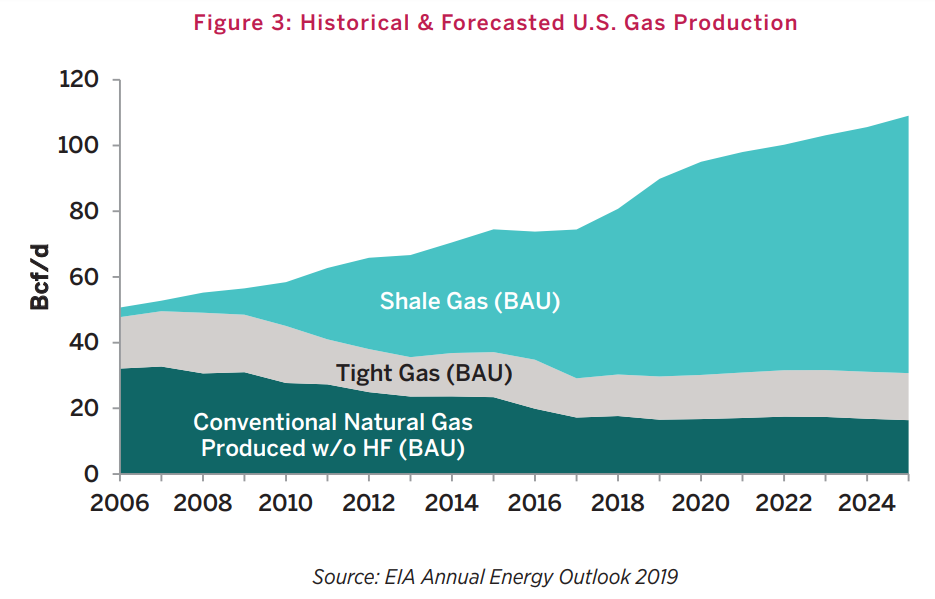
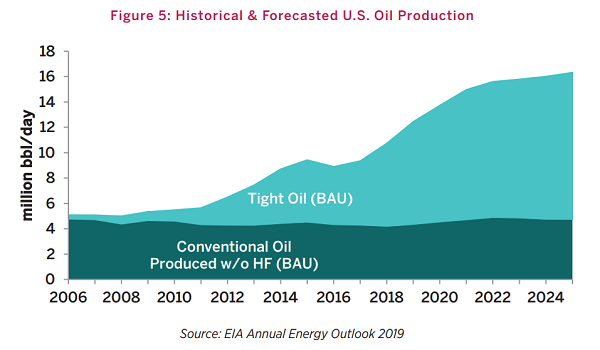
The extraction of oil and gas through the techniques of horizontal drilling and hydraulic fracturing (colloquially, “fracking”) has catapulted the United States into leadership of the world’s energy markets. Since 2007, fracking has doubled U.S. oil production and increased gas production by 60%. Instead of a major importer, America is rapidly becoming the largest exporter of oil and is expected to supply the majority of net new energy traded on global markets over the next two decades.
If the U.S. imposed a fracking ban, the supply disruption would trigger the biggest oil and natural gas price spikes in history—almost certainly by more than 200%—which would, in turn, tip the world into recession. Even the expectation that a ban could be enacted would destabilize markets. U.S. imports and the trade imbalance would soar, as would consumers’ spending on energy. To keep the lights on, America would have to nearly double the quantity of coal burned, as well as import up to 1 million barrels of oil per day for dual-fueled power plants that would lose access to natural gas.
A fracking ban, regardless of motivation, is anchored in magical thinking that non-hydrocarbon energy sources could fill a massive global energy shortfall if the U.S. exited the world stage as a major supplier of oil and natural gas. Both fuels will be critical for the global economy for decades to come. The key issue is not whether wind and solar can supply more energy—they can and will—but whether a future American administration would reverse the progress of the last decade in lowering energy prices and enhancing geopolitical stability.”
—Mark Mills, senior fellow, Manhattan Institute

Supply Impact

The study is based on what GEI calls conservative assumptions. These include the continued use of hydraulic fracturing in non-tight oil and gas plays, and a 23.7% annual decline rate for existing shale plays. GEI also assumes a drop in gas exports to Mexico, and increase in gas imports from Canada, and a shift from LNG exporting to LNG importing—all designed to close the supply/demand gap that would occur as shale gas is phased out.
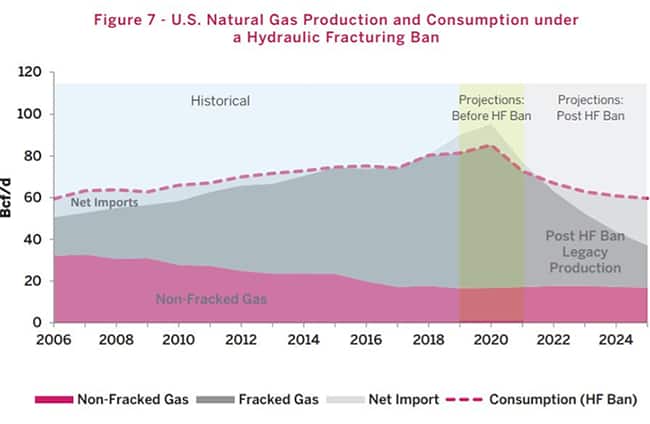
“Currently, shale production is about 50.5 Bcf/d or 62 percent of U.S. production. Under a hydraulic fracturing ban, production from existing sources would drop significantly due to the field production decline rates. Similarly, natural gas production from tight gas formations would drop quickly as well, since they rely on hydraulic fracturing to generate production,” GEI said.

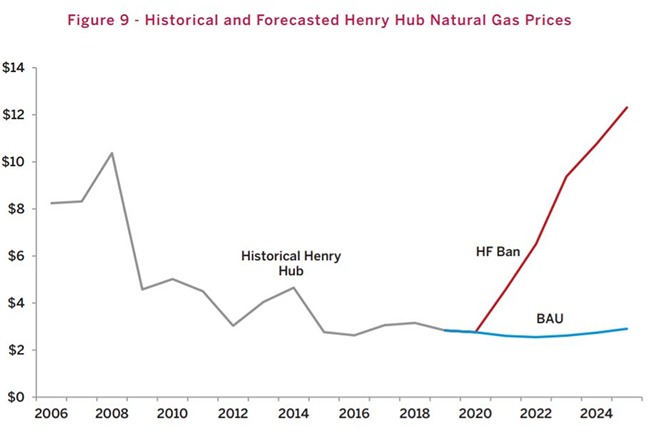
With gas in tighter supply (see graph above), prices would soar to $12/MMBtu by 2025 (2nd graph below).
Economic Impact

With supply for gas and oil constricted, energy prices would rise dramatically. In addition to $12/MMBtu gas, GEI says that West Intermediate crude would reach about $130/bbl by 2025, or more than double today’s price and nearly double the forecast out to 2025.

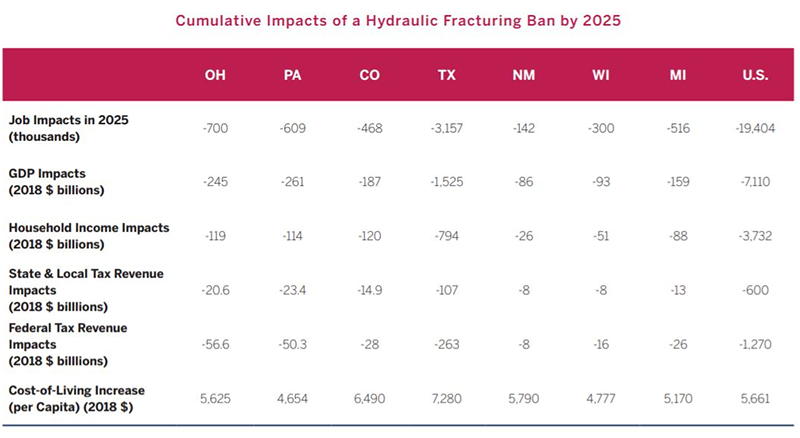
“In 2025, the U.S. would lose around 19 million jobs and $2.3 trillion in GDP. For comparison, this is roughly three times the economic impact of the Great Recession of the late 2010s,” GEI said. “Disallowing hydraulic fracturing would shrink the size of the U.S. energy industry and eliminate its ability to cushion the economy against large swings in prices. A ban on hydraulic fracturing would essentially be the worst of both worlds – low production as if prices were low, while the rest of the economy (in the form of millions of households and businesses) struggles to adapt to a doubling of oil prices and quadrupling of natural gas prices,” it said.

The economic results for the nation and for key energy-producing states (as well as two, Michigan and Wisconsin, which are considered to be close in the 2020 election) is shown below.
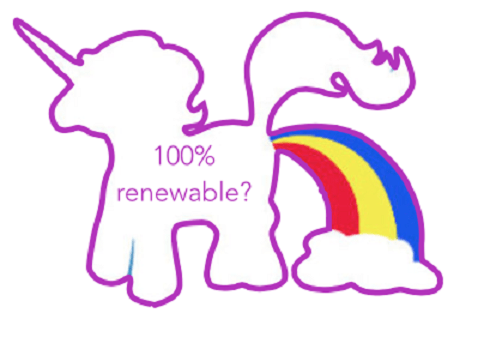
Why a US Self-embargo is Unicorns All the Way Down

The fracking ban campaign is neither new nor connected only to the politics of this presidential election cycle. The movement emerged from the intersection of two global trends: the expansion of hydrocarbon production; and a time when many pundits and policymakers believe that an “energy transition” to something different is urgently needed. For example, some 400 domestic and international environmental leaders and organizations petitioned the United Nations in September to demand “a global ban on fracking.”[14] Essentially all fracking production is done in the United States.

A ban on fracking would end U.S. exports, cause imports to soar, and increase the trade deficit by hundreds of billions of dollars. The more serious impact would come from the shock to global markets. Global oil prices swing widely when markets are surprised by even a 1%–2% change in the supply/demand balance. A fracking ban would entail a loss of 7% of global oil production, comparable to the 7% lost with the infamous 1973 Arab oil embargo—an embargo that drove world oil prices up 400% and triggered a global recession.[25] Similarly, the 1979 Iranian revolution took 5% of oil off global markets. Prices rose more than 200%, sparking another global recession.[26] Today, taking shale production off the market would also constitute an additional 17% loss to global markets in the form of natural gas.[27] Higher energy prices would hit global consumers; Americans would pay more than $100 billion a year at the gas pump alone, an average of $1,000 per household.[28] Even a slow 10-year production phase-out would trigger an estimated two-year recession in America and eliminate $270 billion of private investment.[29] There would be some winners: Russia and OPEC would derive huge revenue and geopolitical benefits.

Losing the share of new electricity generation that is now fueled from natural gas (produced by fracking) would push utilities to increase the use of existing underutilized power plants where they’re available, which are mainly coal-fired.[30] That would increase carbon dioxide emissions by some 600%—more than all emissions avoided from wind and solar on U.S. grids.[31]

Regions heavily dependent on natural gas but with minimal coal capacity would be faced with rolling blackouts—such as New England (where gas currently provides 49% of electricity), the Mid-Atlantic region (38%), and the Pacific coast (30%).[32] Some of that shortfall could come from burning oil in the 130 GW of gas-fired turbines designed to be dual-fueled.[33] If fully utilized, those turbines would burn about 1 mmbd of oil (necessarily imported), a 10-fold increase in U.S. oil-fired power generation.

The Impossibility of Filling the Gap

The central motivation for the movement to ban fracking is the global abundance of hydrocarbons at a time when many pundits and policymakers believe that an “energy transition” is urgently needed. But America’s shale production could not be replaced quickly by alternatives, at any price, regardless of climate-change motivations. To the extent that there is an “energy transition” to new technologies, it is happening in slow motion.

Politically popular wind and solar power have become far less expensive and have enjoyed massive global subsidies; but together, they still provide only 1.8% of global energy. The 5 million electric vehicles on all the world’s roads now displace 0.1% of global oil use.[34]

Replacing the quantity of energy produced by fracking in the U.S. shale fields would entail (in energy-equivalent terms) expanding all of America’s solar and wind production by 2,000% more than what has been added in the past decade.[35] Somehow accomplishing that miracle wouldn’t help the 99% of Americans driving oil-fueled cars. In fact, because the hydrocarbon market is global, the entire world would have to increase global wind and energy supply by 500% to replace the energy that would be lost from an American fracking ban—never mind the additional energy needed to fuel global economic growth.[36]
Resources:

New Study by Global Energy Institute Puts Impact of Fracking Ban at $7.1 Trillion Over Four Years

A Fracking Ban Would Trigger Global Recession

New Chamber Analysis Quantifies Economic Risks of Proposed Fracking Ban

U.S. Chamber of Commerce says proposed fracing ban puts Texas economy at risk

EPA Overhaul Long Overdue

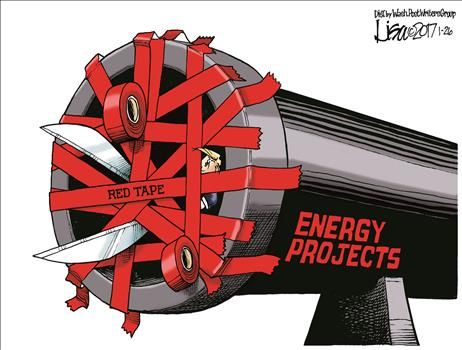
Prudent public officials should anticipate that some future periods will be warmer and other periods cooler than today. They should also affirm that cold is the greater threat to human health and prosperity. Thus investments should place priority on building robust infrastructure and ensuring reliable affordable energy. These things can not be achieved if the planning and approval process is so long and costly that needed developments are discouraged or abandoned.

The worst kept secret in US politics is how effectively environmental activists and lawyers have used EPA regulations to block, impair and frequently kill off projects for energy infrastructure. Some regions like the Northeast are lacking natural gas supply pipelines from US sources and are forced to import from Russia, among other foreign producers. Former EPA administrator made the point that some people believe that if you are for the environment you are against development, and if you are for development you are against the environment. Instead the law and the agency have the mission of ensuring environmentally responsible development, recognizing that natural resources are essential to human flourishing.

Thus I welcome this announcement reported in the Wall Street Journal Trump Seeks Overhaul of Federal Environmental Rules  Of course the subtitle say: Environmentalists criticize proposal, saying it will hamper efforts to slow climate change.  Excerpts in italics with my bolds.

WASHINGTON—President Trump proposed a major overhaul of federal environmental permitting, responding to business complaints of bureaucratic delays to infrastructure projects such as roads and energy pipelines.

“We want to build new roads, bridges and highways bigger and faster,” Mr. Trump said from the White House, adding that the proposal would help create new jobs.

But environmentalists assailed the changes to rules tied to the National Environmental Policy Act, or NEPA, saying they would weaken standards at a time when climate change is making federal review even more critical.

“Forcing federal agencies to ignore environmental threats is a disgraceful abdication of our responsibility to protect the planet for future generations,” Brett Hartl, government affairs director at the Center for Biological Diversity, said this week anticipating the overhaul. He called it a “gift to the fossil-fuel industry.”  The administration sees the move as a broad-based effort to modernize rules that have gone largely untouched for more than 40 years.

The primary aim is to shorten the review process to two years—a drastic change given that assessments can now take a decade or more.

“The step we’re taking today…will hit a home run in delivering better results to the American people by cutting red tape that has paralyzed common-sense decision-making for a generation,” Interior Secretary David Bernhardt said on a call with reporters. “The consequences of the government being stuck in place are far-ranging.”

Some projects that don’t have significant federal government funding or involvement might now become more likely to skirt the process altogether, a change likely aimed at helping pipelines in particular. For projects that do have to go through the NEPA review process, the changes would clarify what environmental effects agencies have to plan for and what future changes to the environment permit reviews will have to consider in advance. The stated goal is to limit reviews to environmental risks more directly associated with a project.

Critics fear that is a major setback for planning around climate change. Administration officials say agencies would still have the option to include climate-change risks in their permitting processes. But infrastructure experts and environmentalists say any weakening in that connection would be a step in the wrong direction as the effects of climate change are becoming more pronounced and society needs stronger rules to adapt to those emerging risks.

Issuing this proposal is an early step in what could be a lengthy process. There will be at least two months of public comment starting when the proposal is published on Friday, administration officials said. Many more months of review will likely follow that before any changes are finalized.

Many expect the administration won’t have enough time to finish an overhaul if Mr. Trump isn’t re-elected in November. Rep. Raúl Grijalva (D., Ariz.), chairman of the House Natural Resources Committee, on Thursday called the rewrite illegal, potentially foreshadowing several lawsuits that could further delay an overhaul.

The president on several occasions has criticized the environmental permitting process as a bureaucratic barrier to economic development. Many lawmakers and economists say that America needs to fix a backlog of infrastructure needs, which the administration has pegged at roughly $1 trillion.

In recent months, the administration has turned its attention to addressing several bedrock environmental laws and changes aimed at jump-start development. A plan to overhaul NEPA would be the latest in a series of moves that have also tried to limit the reach of the Endangered Species Act and Clean Water Act, especially in how much those laws require consideration of risks associated with climate change. The NEPA review process can serve as the ultimate fail-safe on environmentally unsound projects.

But energy companies and manufacturers in particular have argued that NEPA, in recent decades, has become a tool for environmentalists to block progress. Since its last update, major roads and pipeline projects have become harder to complete and a drilling boom has led to an expansion of oil-and-gas production nationwide. Industrial interests have asked for a modernization to improve efficiency and consistency in permitting across federal agencies.

“The administration’s modernization of NEPA removes bureaucratic barriers that were stifling construction of key infrastructure projects needed for U.S. producers to deliver energy in a safe and environmentally protective way,” said Anne Bradbury, chief executive of the American Exploration & Production Council, a trade group for some of the country’s largest independent oil-and-gas companies.

Environmental groups have been concerned that an attempt to streamline NEPA permitting would degrade its ability to protect the environment. They have criticized the Environmental Protection Agency’s 2018 decision to eliminate letter grades that often came as guidance in the process. Such changes can make NEPA reviews less helpful to the public and weaken a process designed to prevent oil spills and other environmental accidents, environmentalists said.

Footnote:  

Convoluted and CO2 obsessive regulations are a large factor leading to the Australian bushfires.  Also, Canada is unable to build a badly needed pipeline expansion that the federal government wants and owns because of the same kind of onerous environmental permitting processes.

Aussies’ Choice: Burn Cool or Burn Hot

Global Warming is Not to Blame for the Horrific Bush fires in Australia by Jon Gaunt, writing from England on the distorted media coverage, published at Sputnik

There I have said the unsayable but don’t hold your breath, you will not hear that on the MSM biased broadcasters like Sky or BBC.

Of course, this is only my opinion but it is an opinion held by millions and deserves to be heard surely?

I hoped after the media bias over the Brexit debate and the General election that the MSM broadcasters would stop emoting and get back to reporting but alas my optimism was misplaced.

It appears to me that because the BBC and Sky News lost the Remainer narrative and the trash Boris agenda and the British public that they have now switched their attention and propaganda machine to promote climate change danger and the agenda of Greta.

The BBC seem determined and desperate to blame the horrific fires in Australia on their global warming agenda and seem very reluctant to mention that over a hundred people have already been arrested for setting fires.

Arson has always been a feature of these annual bush fires and of course the fires themselves are not a new phenomenon either.

I’m not denying that the extremely hot temperatures and dry weather haven’t contributed to the scale of the disaster but isn’t it a reporter’s job to give all sides of a story?

Like many people I don’t doubt that Global warming is happening but I am not convinced that is man-made and that opinion should be reflected in reports.

This is not a game, people have died and many are missing and hundreds of people have or are going to lose their homes.

This is not a time for sixth form, pig tailed, Greta style politicising and propaganda tricks to push the green agenda.

Which of course always ends at the same destination. With working class people losing their manufacturing jobs and being taxed to the hilt when they start ‘Burger flipping’. Meanwhile preaching pop stars and Royals still fly around the globe in private jets whilst paying to offset their carbon ‘Birkenstock’ footprint.

It is, if you pardon the image, all smoke and mirrors and broadcasters should be ashamed of themselves particularly the State one that we pay for via a compulsory poll tax.

Last night the BBC reported/emoted on the fires and then followed it with a report about the last decade being the second hottest on record. The implication was clear and was almost the media manipulation of a five-year-old.

Do they really think that we are that thick? Unfortunately, I believe that they do. It would appear that to use a football chant, ‘two referendums and one election’ has taught them absolutely nothing.

Aussie PM, Scott Morrison, on a visit to Cobargo a town that has almost been destroyed by the fires, got a real hard time from angry and distraught residents yesterday and rightly so.

He was a complete idiot to go to Hawaii whilst his country burned. However, the visit and the refusal by one firefighter to shake his hand was interpreted by the biased broadcasters as if these people were green activists rather than people who had lost their homes and were bloody angry with the establishment class for ignoring them.

These people telling him he was a “Fu*kwit and to pi** off didn’t strike me as green activists or members of Extinction rebellion, no these were normal people who felt let down and forgotten by the political class. Is that attitude ringing any bells with you?

Have you seen the video of the Australian who has a completely different narrative of what has caused these fires? Although his language is extremely fruity, to say the least, his point is that it is actually green activists that have led to the scale of these fires because they have forced farmers to stop burning their scrubland in the winter months which used to create natural fire breaks. This is a tradition that goes back centuries and was actually practiced by the original indigenous Australian Aboriginal population. This possible cause is echoed all over social media today in many tweets from the affected area today.

But that didn’t stop Caroline Lucas the Green Party’s only MP in the UK from entering the fray with a tweet with a link to an article in (you guessed it) the Guardian saying, ‘This is what Climate Emergency looks like – completely terrifying. Honestly, what further devastation needs to happen before world leaders finally put in place urgent climate action at the scale and speed the science demands?’

However, she has had her fingers burnt with angry exchanges on Twitter from people who actually live in New South Wales.

One British ex-pat, Terry Stone, angrily answered her tweet with the following, ‘You have no clue what is happening here. Green lobby stupid restrictions on controlled burns & removal of dead wood is primary reason these fires cannot be controlled. Listen to multiple generations of land owners and keep your mouth shut, you might learn something.’

Another tweeted, ‘I’m a rural Victoria resident. In addition to less burning off than used to happen, we’re restricted collecting dead wood in forests for our wood burners at home (principal heating) in case we inadvertently squish rare lizard or such. And then millions of animals die instead. Ugh’

Have you heard these views on Sky or the BBC? No of course not because Sky are too busy rabidly pushing the ‘woke’ agenda and today they had the leading climate change purveyor of doom and gloom, George Monbiot from (yes, you’ve guessed it) the Guardian on their programme.

Monbiot condemned, and was unchallenged, the Aussie Pm and stated that the Bush fires were a prime example of climate breakdown and that we need political leaders who are going to leave fossil fuels in the ground. Again, this ludicrous statement went unchallenged. In fact, the person Sky chose to conduct this debate and I use the term really loosely was some sort of PR guy who was on to suggest how Morrison could rebuild his reputation after the disaster. Putting aside the fact that Morrison has just won another election why was a PR man on. Why not use someone like James Delingpole or any other climate change sceptic to challenge Monbiot’s views? Well we all know the answer to that one, don’t we!

Sky News backed up Monbiot’s simplistic ludicrous blame game by reminding viewers and their internet readers that “Rewind a few years and he (Morrison) was brandishing a lump of coal in parliament, taunting those he described as having a “pathological fear of coal” and lauding the fossil fuel he said was powering Australia’s economy and underpinning jobs.” Is this what Sky call impartial and balanced reporting?

But unfortunately for George, Sly News and the climate change fanatics Morrison was correct as Australia is the biggest net exporter of coal and is the world’s fourth-largest producer. Over 175,000 people are either directly or indirectly employed in the industry.

In the real world a leader has to balance these real factors before looking to be loved by the MSM broadcasters and avoid the death stare of Greta!

The BBC and Sky’s simplistic and biased telling of this story is almost turning them into the Greta Broadcasting Corporation where they tell us the problem but only half of the solution.

So, called man made global warming is not the primary villain in this story.

The people who are responsible for: the 17 deaths so far, the hundreds of houses destroyed and lives ruined, the burning alive of half a billion animals and the torching of over 5 Billion hectares of land and forest and thousands of Aussies being evacuated from beaches are not those who dig coal but those who despise those who dig coal or work the land.

See Also Arctic On Fire! Not.

Footnote: So how do you want your bush fires, some small ones now or mega fires later?

Leaf Blowers Banned (Take that, Greta)

Greta keeps repeating that nothing is being done to reduce emissions, blind to all the imposed policies and regulations.  So today good news out of California, the leader in fighting climate change.  From NBC San Diego Encinitas Leaf Blower Ban Goes Into Effect.  Excerpts in italics with my bolds.

Businesses in Encinitas are no longer allowed to use gas powered leaf blowers as of Friday, Dec. 20.

The Encinitas City Council approved the leaf blower ordinance back in August. Then in September, the ordinance went into effect for city operations.

The goal of the city’s Climate Action Plan is to eventually ban all gas powered leaf blowers by January 20, 2020 in order to reduce the city’s carbon footprint. The next goal is to reduce all greenhouse gas emissions by the year 2030. The city estimates that this leaf blower ban will reduce local green house gas emissions by 128 metric tons of CO2 emissions by the end of 2020, and 142 metric tons by 2030.

Then on January 20, 2020, the ban will go into effect for residents as well.

But, the ordinance also states that electric or battery powered leaf blowers are allowed. So the city is now offering a city-funded rebate program, so that residents and business owners can buy a new electric or battery-powered leaf blower.

The ordinance also lays out a list of rules about the time of day people are allowed to use their leaf blowers.

Now, people in Encinitas are only permitted to use their electric or batter powered leaf blowers between 8 a.m. and 6 p.m. Monday through Saturday, and between 12 noon and 5 p.m. on Sundays.

So calm down Greta and show some respect for all the nanny-state rules coming on.

The Courage to Do Nothing about Climate Change

At Human Events, Gregory Wrightstone writes Principled Inaction in the Face of Climate Change Extremism. Excerpts in italics with my bolds.

President Trump’s courageous commitment to America first on the issue of energy emissions.

The 2019 United Nations Climate Change Conference, “COP25,” began with a cryptic address by U.N. Secretary-General António Guterres: “By the end of the coming decade we will be on one of two paths, one of which is sleepwalking past the point of no return … Do we want to be remembered as the generation that buried its head in the sand and fiddled as the planet burned?”

According to Guterres, “What is still lacking is political will.” And yet, despite all this “lack of political will,” some 70 countries have pledged carbon neutrality by 2050. Conspicuously absent from the proceedings, however, is the Trump Administration. No senior member of President Trump’s administration is in attendance at COP25.

But despite what Greta Thunberg or António Guterres would have you believe, it isn’t a lack of political will that explains our absence—quite the opposite.

President Trump’s refusal to cosign radical climate extremism is a courageous gesture of principled inaction.

America First on Carbon Emissions

The main reason behind the administration’s absence from the Madrid summit is that the key objective of the program is to negotiate the finer details of the Paris Climate Accord—the agreement that President Trump has withdrawn us from in the name of American interests.

“[T]o fulfill my solemn duty to protect America and its citizens, the United States will withdraw from the Paris Climate Accord,” the President announced in June 2017, voicing an interest in negotiating an “entirely new transaction on terms that are fair to the United States, its businesses, its workers, its people, its taxpayers.”

“I was elected to represent the citizens of Pittsburgh, not Paris,” he retorted, critically appraising that the Paris Accords:

“[C]alls for developed countries to send $100 billion to developing countries all on top of America’s existing and massive foreign aid payments. So we’re going to be paying billions and billions and billions of dollars, and we’re already way ahead of anybody else. Many of the other countries haven’t spent anything, and many of them will never pay one dime.”

Earlier last month, Secretary of State Mike Pompeo said the administration sent an official notification of its plans to exit the Paris Agreement. This was the first step in the year-long process to leave the agreement that allegedly aims to reduce emissions of greenhouse gases. The full withdrawal is scheduled for November 4, 2020, a day after the next presidential election.

The media, often enthusiastic contributors to climate catastrophizing, has presented the administration’s decision to withdraw from the Paris Agreement as an indication that the world’s environmental health has somehow been derailed. “[F]or us to be the exception on this issue is holding the world back,” NPR reports Andrew Light saying, a former climate official in the State Department who helped develop the Paris Agreement.

But that’s not remotely accurate.

In positioning America first, the President is refusing to sacrifice the immediate economic needs of everyday Americans in the face of an inflated threat. The Paris Agreement would have Americans dole out millions of dollars to the so-called developing world—countries like China and India—who refuse to take accountability for their own catastrophic environmental policies.

President Trump will not capitulate to this kind of climate bullying, especially if it compromises our global leadership as energy providers—both traditional and renewable.

Climate Extremism in the Face of Thriving Ecological Growth

It’s not just the technical negotiations over how climate policy will affect American industry; it’s the facticity of climate catastrophe itself that the Trump administration has bravely called into question.

For leaders supporting the Paris agreement, the specter of catastrophic warming provides the moral justification for ever-higher taxation, ever-tighter regulation, ever-greater state interference, ever-larger slush funds for big-spending politicians, and ever-diminished individual freedom to use, acquire, and consume at will.

Several other historical eras—Minoan (2900 to 1100 BC), the Roman Empire (27 BC to 476 AD), and the Medieval warm periods (950 to 1250 AD)—experienced warmer temperatures than we face today. These periods coincided with significant expansions of civilizations, bountiful harvests, and vast improvements in the human condition.

Historical periods of warm global temperature, often higher than our current climate, were commonly referred to as “climate optima” because of the higher temperature and their associated benefits to Earth’s ecosystems. The terminology has fallen into disfavor, however, in recent years, due to a media and scientific blacklisting of any mention of benefits owing to higher temperature. But before climate science became politicized, these past warm periods were associated with a thriving, prospering planet, and human civilization benefited in tandem.

The inconvenient facts, at least to the climate catastrophe crowd, is that the bulk of their predictions are errant speculations about what may or may not occur, 50 or 80 years in the future, based on climate models that substantially overestimate temperature rise.

In reality, by nearly every metric, we see that humans are thriving in the changing ecosystem. The current changing climate has led to increasing food production, soil moisture, crop growth, and a “greening” of the Earth. All the while droughts, forest fires, heatwaves and, temperature-related deaths have declined substantially.

Yes, there is such a thing as the greenhouse effect. Yes, there has been some warming. Yes, some of the warming is likely man-made. Yes, some further man-made warming is to be expected. On all these matters, few would disagree; they are all self-evident.

But no, past and future anthropogenic warming do not mean that catastrophe will follow, or that measures to prevent global warming are scientifically and economically justified. Only the radical worldview of environmental catastrophizing could ignore benefits being accrued from atmospheric changes—while embracing harmful economic policies based on fallacious climate models.

What the “crisis narrative” is achieving, however, is extreme regulation and expropriation of profits from the energy sector. For leaders supporting the Paris agreement, the specter of catastrophic warming provides the moral justification for ever-higher taxation, ever-tighter regulation, ever-greater state interference, ever-larger slush funds for big-spending politicians, and ever-diminished individual freedom to use, acquire, and consume at will.

President Trump is bravely taking a stance against environmental extremism.

“What we won’t do is punish the American people while enriching foreign polluters,” President Trump said during a keynote to natural gas executives and employees at the Shale Insight conference in October of 2017. Pointing to the rising U.S. oil and gas production, and his efforts to deregulate the industry in the name of ending the “war on energy,” President Trump applauded his audience: “With unmatched skill, grit and devotion, you’re making America the greatest energy superpower in the history of the world.”

The Non-Problem of Man-made “Thermageddon”

It takes a lot of courage to do nothing.

Imagine the enormous pressure on President Trump to keep the United States in the Paris climate accord. Worldwide indignation and scorn were heaped on him after his decision to withdraw from the agreement. But it was the correct and principled one to make.

Thanks to near-total control of the news media by proponents of a pending Thermageddon, critical truths are poorly understood and even derided. The truth that there is no “consensus” among climate scientists and that “consensus” would not matter even if it existed. The truth is that global warming will be small, and largely beneficial ecological event, and preventing it would be orders of magnitude costlier than adapting to it. The truth that the correct policy is to have the courage to do nothing.

Like it or not, the truth is the truth. Policy should, in the end, be based on objective reality, and not on the back of a lavishly-funded and elaborate international campaigns of crafty and lucrative falsehoods promoted by the political, financial, corporate, bureaucratic and media establishments.

This is your brain on Climate Alarm

Just Say No!

Madrid COP25 Briefing for Realists

The upcoming COP25 will be hosted by Chile, but held in Madrid because of the backlash in Santiago against damaging effects of costly climate policies.  The gathering had been previously cancelled by a newly elected skeptical Brazilian president. The change of venue has led to “a scale down of expectations” and participation from the Chilean side, said Mónica Araya, a former lead negotiator for Costa Rica, but the presidency’s priorities are unchanged. In the wings of the Cop25 talks, hosts Spain and Chile will push governments to join a coalition of progressive nations pledging to raise their targets in response to the 2018 over-the-top IPCC SR15 climate horror movie.  See UN Horror Show

Of course Spain is the setting for the adventures of Don Quixote ( “don key-ho-tee” ) in Cervantes’ famous novel.  The somewhat factually challenged hero charged at some windmills claiming they were enemies, and is celebrated in the English language by two idioms:

Tilting at Windmills–meaning attacking imaginary enemies, and

Quixotic (“quick-sottic”)–meaning striving for visionary ideals.

It is clear that COP climateers are similary engaged in some kind of heroic quest, like modern-day Don Quixotes. The only differences: They imagine a trace gas in the air is the enemy, and that windmills are our saviors.  See Climateers Tilting at Windmills

Four years ago French Mathematicians spoke out prior to COP21 in Paris, and their words provide a rational briefing for COP25 beginning in Madrid this weekend. In a nutshell:

Fighting Global Warming is Absurd, Costly and Pointless.

  • Absurd because of no reliable evidence that anything unusual is happening in our climate.
  • Costly because trillions of dollars are wasted on immature, inefficient technologies that serve only to make cheap, reliable energy expensive and intermittent.
  • Pointless because we do not control the weather anyway.

The prestigious Société de Calcul Mathématique (Society for Mathematical Calculation) issued a detailed 195-page White Paper that presents a blistering point-by-point critique of the key dogmas of global warming. The synopsis is blunt and extremely well documented.  Here are extracts from the opening statements of the first three chapters of the SCM White Paper with my bolds and images.

Sisyphus at work.

Chapter 1: The crusade is absurd
There is not a single fact, figure or observation that leads us to conclude that the world‘s climate is in any way ‘disturbed.’ It is variable, as it has always been, but rather less so now than during certain periods or geological eras. Modern methods are far from being able to accurately measure the planet‘s global temperature even today, so measurements made 50 or 100 years ago are even less reliable. Concentrations of CO2 vary, as they always have done; the figures that are being released are biased and dishonest. Rising sea levels are a normal phenomenon linked to upthrust buoyancy; they are nothing to do with so-called global warming. As for extreme weather events — they are no more frequent now than they have been in the past. We ourselves have processed the raw data on hurricanes….

Chapter 2: The crusade is costly
Direct aid for industries that are completely unviable (such as photovoltaics and wind turbines) but presented as ‘virtuous’ runs into billions of euros, according to recent reports published by the Cour des Comptes (French Audit Office) in 2013. But the highest cost lies in the principle of ‘energy saving,’ which is presented as especially virtuous. Since no civilization can develop when it is saving energy, ours has stopped developing: France now has more than three million people unemployed — it is the price we have to pay for our virtue….

Chapter 3: The crusade is pointless
Human beings cannot, in any event, change the climate. If we in France were to stop all industrial activity (let’s not talk about our intellectual activity, which ceased long ago), if we were to eradicate all trace of animal life, the composition of the atmosphere would not alter in any measurable, perceptible way. To explain this, let us make a comparison with the rotation of the planet: it is slowing down. To address that, we might be tempted to ask the entire population of China to run in an easterly direction. But, no matter how big China and its population are, this would have no measurable impact on the Earth‘s rotation.

cg565e788a82606

Full text in pdf format is available in English at link below:

The battle against global warming: an absurd, costly and pointless crusade
White Paper drawn up by the Société de Calcul Mathématique SA
(Mathematical Modelling Company, Corp.)

societe-de-calcul-mathematique-logo-485x174-1

A Second report was published in 2016 entitled: Global Warming and Employment, which analyzes in depth the economic destruction from ill-advised climate change policies.

The two principal themes are that jobs are disappearing and that the destructive forces are embedded in our societies.

Jobs are Disappearing discusses issues such as:

The State is incapable of devising and implementing an industrial policy.

The fundamental absurdity of the concept of sustainable development

Biofuels an especially absurd policy leading to ridiculous taxes and job losses.

EU policy to reduce greenhouse gas emissions by 40% drives jobs elsewhere while being pointless: the planet has never asked for it, is completely unaware of it, and will never notice it!

The War against the Car and Road Maintenance undercuts economic mobility while destroying transportation sector jobs.

Solar and wind energy are weak, diffuse, and inconsistent, inadequate to power modern civilization.

Food production activities are attacked as being “bad for the planet.”

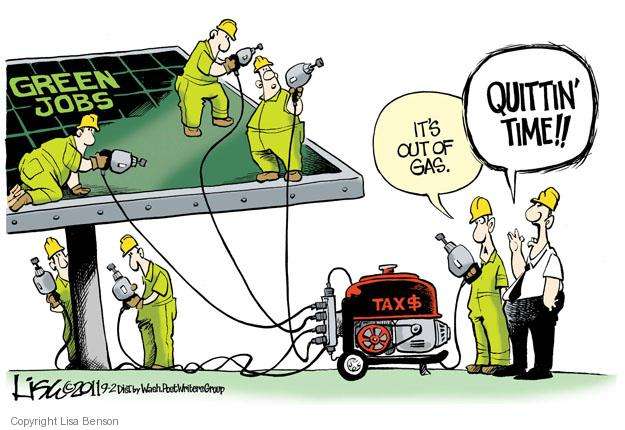
So-called Green jobs are entirely financed by subsidies.

The Brutalizing Whip discusses the damages to public finances and to social wealth and well-being, including these topics:

Taxes have never been so high

The Government is borrowing more and more

Dilapidated infrastructure

Instead of job creation, Relocations and Losses

The wastefulness associated with the new forms of energy

Return to the economy of an underdeveloped country

What is our predicament?
Four Horsemen are bringing down our societies:

  • The Ministry of Ecology (climate and environment);
  • Journalists;
  • Scientists;
  • Corporation Environmentalist Departments.

Steps required to recover from this demise:

  • Go back to the basic rules of research.
  • Go back to the basic rules of law
  • Do not trust international organizations
  • Leave the planet alone
  • Beware of any premature optimism

Conclusion

Climate lemmings

The real question is this: how have policymakers managed to make such absurd decisions, to blinker themselves to such a degree, when so many means of scientific investigation are available? The answer is simple: as soon as something is seen as being green, as being good for the planet, all discussion comes to an end and any scientific analysis becomes pointless or counterproductive. The policymakers will not listen to anyone or anything; they take all sorts of hasty, contradictory, damaging and absurd decisions. When will they finally be held to account?

Footnote:

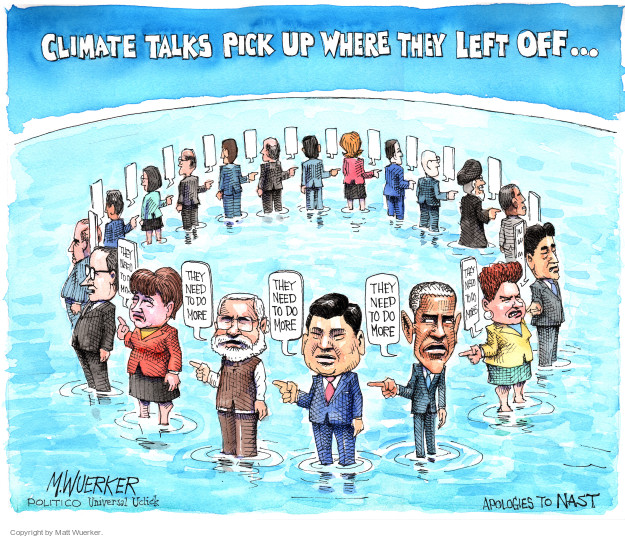
The above cartoon image of climate talks includes water rising over politicians’ feet.  But actual observations made in Fiji (presiding over 2017 talks in Bonn) show sea levels are stable (link below).

Fear Not For Fiji

In 2016 SCM issued a report Global Temperatures Available data and critical analysis

It is a valuable description of the temperature metrics and issues regarding climate analysis.   They conclude:

None of the information on global temperatures is of any scientific value, and it should not
be used as a basis for any policy decisions. It is perfectly clear that:

  • there are far too few temperature sensors to give us a picture of the planet’s temperature;
  • we do not know what such a temperature might mean because nobody has given it
    any specific physical significance;
  • the data have been subject to much dissimulation and manipulation. There is a
    clear will not to mention anything that might be reassuring, and to highlight things
    that are presented as worrying;
  • despite all this, direct use of the available figures does not indicate any genuine
    trend towards global warming!

Beware Deep Electrification Policies

It is becoming fashionable on the left coasts to banish energy supply for equipment running on fossil fuels. For example consider recent laws prohibiting gas line home hookups. Elizabeth Weise published at USA Today No more fire in the kitchen: Cities are banning natural gas in homes to save the planet. Excerpts in italics with my bolds.

Fix global warming or cook dinner on a gas stove?

That’s the choice for people in 13 cities and one county in California and one town in Massachusetts that have enacted new zoning codes encouraging or requiring all-electric new construction.

The codes, most of them passed since June, are meant to keep builders from running natural gas lines to new homes and apartments, with an eye toward creating fewer legacy gas hookups as the nation shifts to carbon-neutral energy sources.

The most recent came on Wednesday when the town meeting in Brookline, Massachusetts, approved a rule prohibiting installation of gas lines into major new construction and in gut renovations.

For proponents, it’s a change that must be made to fight climate change. For natural gas companies, it’s a threat to their existence. And for some cooks who love to prepare food with flame, it’s an unthinkable loss.

Another Dangerous Idea that Doesn’t Scale

Once again activists seize upon an idea that doesn’t scale up to the challenge they have imagined. Add this to other misguided climate policies devoted to restricting use of fossil fuels. Apart from dictating consumer’s choices for Earth’s sake, the push could well backfire for other reasons. Jude Clemente writes at Forbes ‘Deep Electrification’ Means More Natural Gas. Excerpts in italics with my bolds. It’s a warning to authorities about outlawing traditional cars, cooking and heating equipment thereby putting all their eggs in the electric energy basket.

For environmental reasons, there’s an ongoing push to “electrify everything,” from cars to port operations to heating.

The idea is that a “deep electrification” will help lower greenhouse gas emissions and combat climate change.

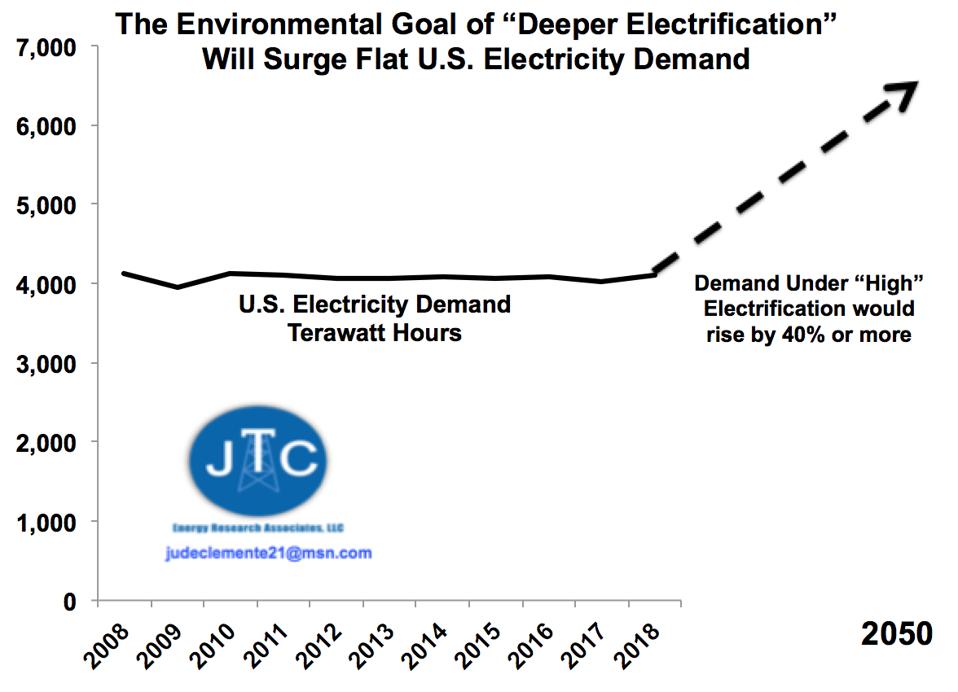
The reality, however, is that more electrification will surge the need for electricity, an obvious fact that seems to be getting forgotten.

The majority of this increase occurs in the transportation sector: electric cars can increase home power usage by 50% or more.

The U.S. National Renewable Energy Laboratory (NREL) says that “electrification has the potential to significantly increase overall demand for electricity.”

NREL reports that a “high” electrification scenario would up our power demand by around 40% through 2050.

A high electrification scenario would grow our annual power consumption by 80 terawatt hours per year.

For comparison, that is like adding a Colorado and Massachusetts of new demand each year.

The Electric Power Research Institute (EPRI) confirms that electrification could boom our power demand by over 50%.

From load shifting to higher peak demand, deep electrification will present major challenges for us.

At around 4,050 terawatt hours, U.S. power demand has been flat over the past decade since The Great Recession.

Ultimately, much higher electricity demand favors all sources of electricity, a “rising tide lifts all boats” sort of thing.

But in particular, it favors gas because gas supplies almost 40% of U.S. electricity generation, up from 20% a decade ago.

Gas is cheap, reliable, flexible, and backups intermittent wind and solar.

In fact, even over the past decade with flat electricity demand, U.S. gas used for electricity has still managed to balloon 60% to 30 Bcf/d.

At 235,000 MW, the U.S. Department of Energy has gas easily adding the most power capacity in the decades ago.

Electrification and more electricity needs show how we demand realistic energy policies.

As the heart of our electric power system, natural gas will surely remain essential.

Indeed, EPRI models that U.S. gas usage increases under “all” electrification scenarios even if gas prices more than double to $6.00 per MMBtu.

Some are forgetting that the clear growth sectors for the U.S. gas industry are a triad, in order: LNG exports, electricity, manufacturing.

The industry obviously knows, for instance, that the residential sector hasn’t seen any gains in gas demand in 50 years.

Flat for a decade, U.S. power demand is set to boom as environmental goals push us to “electrify … [+]DATA SOURCE: NREL; JTC

Footnote:  There is the further unreality of replacing thermal or nuclear power plants with renewables.

The late David MacKay showed that the land areas needed to produce 225 MW of power were very different: 15 acres for a small modular nuclear reactor, 2400 acres for average solar cell arrays, and 60,000 acres for an average wind farm.

Gray area required for wind farms, yellow area for solar farms, to power London UK.

Michael Kelly also estmated the load increase from electifying transportation and heating.

Note that if such a conversion of transport fuel to electricity were to take place, the grid capacity would have to treble from what we have today.

But in fact it is the heating that is the real problem. Today that is provided by gas, with gas flows varying by a factor of eight between highs in winter and lows in summer. If heat were to be electrified along with transport, the grid capacity would have to be expanded by a factor between five and six from today.

See also Kelly’s Climate Clarity

Let Them Eat Steak!

Will Coggin writes at USA Today Let them eat steak: Hold the shame, Red meat is not bad for you or the climate.  Excerpts in italics with my bolds and images.

Plant-based meat may enjoy the perception of being healthier than real meat, but it has more sodium and calories and can cause weight gain.

Imagine ordering dinner at your favorite restaurant. You know what you want without hesitation: a perfectly marbled 8-ounce steak cooked medium rare. Just before you order, your date tells you they’ve read that cows cause climate change and that meat might be unhealthy. Suddenly, the Caesar salad seems like a better option.

We’ve all been steak-shamed before. Ever since Sen. George McGovern’s 1977 Dietary Goals report declared red meat a health villain, Americans have been chided out of eating red meat. According to the U.S. Department of Agriculture, red meat consumption has fallen more than 24% since 1976. During that time, study after study has attempted to tie red meat to a laundry list of health problems. Until now.

So many studies, so many flaws

Three studies published recently in the Annals of Internal Medicine did something too few papers do: Ask whether the previous studies had any meat on their bones. The researchers who wrote the report analyzed 61 past studies consisting of over 4 million participants to see whether red meat affected the risk of developing heart disease and cancer.


All three came to the same conclusion: Decreasing red meat consumption had little to no effect on reducing risk of heart disease, cancer or stroke.

How can so many studies be wrong?

Nutritional research often relies on survey-based observational studies. These track groups of people and the food they eat, or try to tie a person’s past eating habits to a person’s current state of health. The result is something akin to a crime chart from a mob movie with a random red string connecting random suspects trying to figure out “who dunnit.”

Observational studies rely on participants to recall past meals, sometimes as far back as a month. Even when eating habits are tracked in real time using food diaries, issues arise. Research has shown that participants don’t give honest answers and often pad food diaries with typically “good” foods like vegetables while leaving out things like meat, sweets and alcohol. There’s also the matter of having to accurately report portion sizes and knowing the ingredients of the food eaten in restaurants.

Beef may be healthier than fake meat

The room for error is huge. A much better form of study would be to lock people in cells for a period of time so that you could precisely control what they ate and did and then measure outcomes. Obviously, there are ethical issues with such a structure, which is why observational studies are more common, if flawed.

Some companies like Impossible Foods and Beyond Meat have tried to cash in on the misconception about meat’s healthfulness. According to the market research firm Mintel, 46% of Americans believe that plant-based meat is better for you than real meat. Ironically, the anti-meat messages could be leading people to less healthful options.

Science on your side: Don’t let vegetarian environmentalists shame you on meat

Plant-based meat might enjoy the perception of being healthier, but that perception is far from reality. A lean beef burger has an average of nearly 20% fewer calories and 80% less sodium than the two most popularfake-meat burgers, the Impossible Burger and the Beyond Burger.

Fake meat is also an “ultra-processed” food, filled with unpronounceable ingredients. The National Institutes of Health released a study in May finding that ultra-processed foods cause weight gain. Unlike observational studies, this research was a controlled, randomized study.

Earth will survive your meat-eating

It’s not just the flawed health claims about red meat that deserve a second look. In recent years, we’ve been told reducing meat consumption is essential to saving the planet. But despite what critics say, even if everyone in America went vegan overnight, total greenhouse gas emissions (GHG) in the United States would only be reduced 2.6%.

Eat better meat:Don’t go vegan to save the planet. You can help by being a better meat-eater.

Since the early 1960s, America has shrank GHG emissions from livestock by 11.3% while doubling the production of animal farming. Meat production is a relatively minor contributor to our overall GHG levels. In other countries, it may have a higher impact. The solution is not lecturing everyone else to go meat-free. Sharing our advancements would prove to be a more likely and efficient way to reduce emissions than cutting out meat or replacing it with an ultra-processed analogue.

Those who enjoy a good steak now have a good retort the next time they’re criticized for their choice: Don’t have a cow.

Activists Push Climate Snake Oil

From the “Don’t just stand there, Do Something” file, a recent article points out tonics on offer from climatists. Not only are their prescriptions useless against the supposed problem, worse they do actual harm in and of themselves. Bjorn Lomborg writes at New York Post Climate change activists are focused on all the wrong solutions. Excerpts in italics with my bolds.

As it is becoming obvious that political responses to global warming such as the Paris treaty are not working, environmentalists are urging us to consider the climate impact of our personal actions. Don’t eat meat, don’t drive a gasoline-powered car and don’t fly, they say. But these individual actions won’t make a substantial difference to our planet, and such demands divert attention away from the solutions that are needed.

Even if all 4.5 billion flights this year were stopped from taking off, and the same happened every year until 2100, temperatures would be reduced by just 0.054 degrees, using mainstream climate models — equivalent to delaying climate change by less than one year by 2100.

Nor will we solve global warming by giving up meat. Going vegetarian is difficult — one US survey shows 84 percent fail, most in less than a year. Those who succeed will only reduce their personal emissions by about 2 percent.

And electric cars are not the answer. Globally, there are just 5 million fully electric cars on the road. Even if this climbs massively to 130 million in 11 years, the International Energy Agency finds CO₂ equivalent emissions would be reduced by a mere 0.4 percent globally.

Put simply: The solution to climate change cannot be found in personal changes in the homes of the middle classes of rich countries.

The Paris treaty cannot do much — just like the Rio and Kyoto pacts mostly failed before it — because this approach requires rich countries to promise future economic hardship to achieve very little.

The real reason for this: Most of the 21st century emissions are not being emitted by the rich world. Indeed, if every single rich country stopped all CO₂ emissions today and for the rest of the century — no plane trips, no meat consumption, no gasoline-powered cars, no heating or cooling with fossil fuels, no artificial fertilizer — the difference would be just 0.72 degrees°F by end-of-century.

Solving climate change, in fact, requires getting China, India and all the other developing countries on board to cut emissions. But of course, their goal is to lift their populations out of poverty with cheap and reliable energy. How do we square that?

A carbon tax can play a limited but important role in factoring the costs of climate change into fossil-fuel use. Nobel laureate climate economist William Nordhaus has shown that implementing a small but rising global carbon tax will realistically cut some of the most damaging climate impacts at rather low costs.

This, however, will not solve most of the climate challenge. We must look at how we solved past major challenges — through innovation. The starvation catastrophes in developing nations in the 1960s to ’80s weren’t fixed by asking people to consume less food but through the Green Revolution in which innovation developed higher-yielding varieties that produced more plentiful food.

Similarly, the climate challenge will not be solved by asking people to use less (and more expensive) green energy. Instead, we should dramatically ramp up spending on research and development into green energy.

The Copenhagen Consensus Center asked 27 of the world’s top climate economists to examine policy options for responding to climate change. This analysis showed that the best investment is in green-energy R&D. For every dollar spent, $11 of climate damages would be avoided.

This would bring forward the day when green-energy alternatives are cheaper and more attractive than fossil fuels not just for the elite but for the entire world.

Right now, despite all the rhetoric about the importance of global warming, we are not ramping up this spending. On the sidelines of the 2015 Paris climate summit, more than 20 world leaders made a promise to double green-energy research and development by 2020. But spending has only inched up from $16 billion in 2015 to $17 billion in 2018. This is a broken promise that matters.

After 30 years of pursuing the wrong solution to climate change, we need to change the script.

Bjorn Lomborg is president of the Copenhagen Consensus Center and visiting professor at Copenhagen Business School.