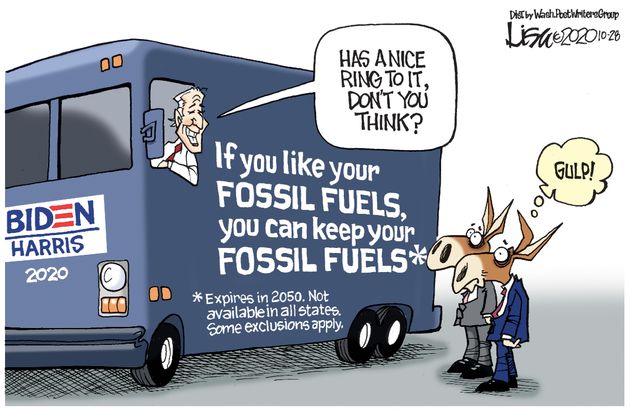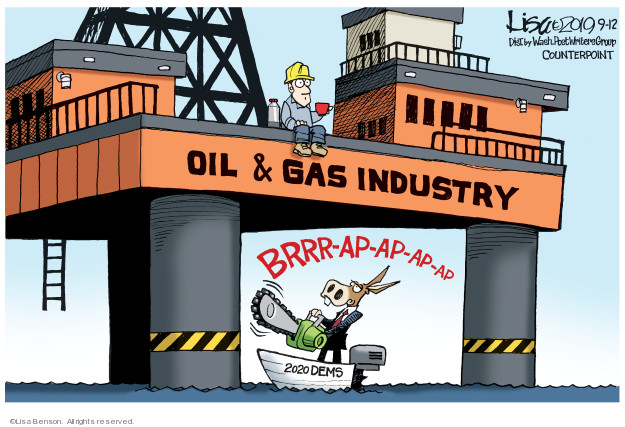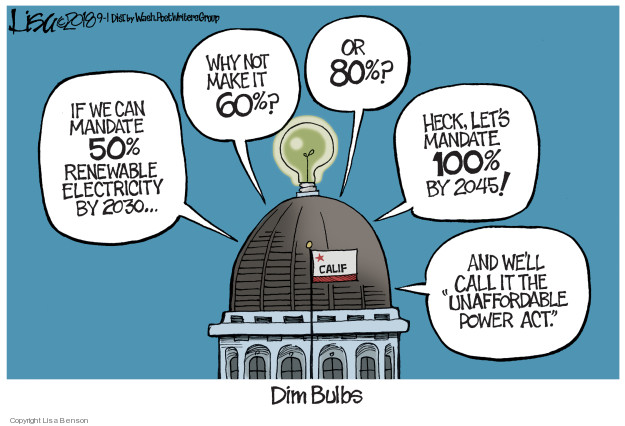
Biden’s Unique Commemorative Coin

Update January 20: A unique commemorative coin for the new leader of the free world

Background from previous post Biden’s Damaging Climate Plans

President-elect Joe Biden looks to have the US rejoin the Paris Accords. AP

Bjorn Lomborg explains in his NY Post article Joe Biden’s climate-change plans will burn billions, won’t bring change we actually need.  Excerpts in italics with my bolds and some images added.

Joe Biden will rejoin the Paris climate agreement soon after being inaugurated as president of the United States. Climate change, according to Biden, is “an existential threat” to the nation, and to combat it, he proposes to spend $500 billion each year on climate policies — the equivalent of $1,500 per person.

Let’s get real. Climate is a man-made problem. But Biden’s climate alarmism is almost entirely wrong. Asking people to spend $1,500 every year is unsustainable when surveys show a majority is unwilling to spend even $24 per year on climate. And policies like Paris will fix little at a high cost. Biden is right to highlight the problem, but he needs a smarter way forward.

The climate alarm is poorly founded.

Take hurricanes. Last year, you undoubtedly heard that climate change made hurricanes “record-setting.” Actually, 2020 was above average in the North Atlantic partly because of the natural La Niña phenomenon, and only record-setting in that satellites could spot more storms.

When measured by total hurricane-damage potential, the 2020 North Atlantic was not even in the top 10. And almost everywhere else on the planet, hurricanes were far below average. Globally, 2020 ranked as one of the weakest hurricane years in the 40-year satellite record.

We think 2020 was big on hurricanes because we read carefully curated stories about where and when they hit, but we don’t see stories about the many more places where they don’t hit.

The UN Climate Panel, the gold standard of climate science, tells us that the total impact of climate change in the 2070s will be equivalent to an average income reduction of 0.2 to 2 percent. Which means that humans as a whole will be only a fraction less prosperous in a much richer world than they would be without climate change.

Rejoining the Paris agreement will solve very little at a high cost. By the UN’s estimates, if all ­nations live up to all their promises, they will reduce global temperature by less than 0.09 degrees Fahrenheit by 2100.

And Paris is costly, because it forces economies to use less or more expensive energy. Across many studies, the drag to the economies is estimated at between $1 trillion and $2 trillion in lost GDP every year after 2030.

Yes, green spending will predictably increase green jobs. But because subsidies will be paid by higher taxes on the rest of the economy, an equal number of jobs will disappear elsewhere.

In Britain, Prime Minister Boris Johnson excitedly talks about 5 million new green jobs, while his advisers now warn him that 10 million other jobs could be at risk.

For Americans, President Barack Obama’s Paris promises carried a price tag of nearly $200 billion a year. But Biden has vowed to go much further, with a promise of net-zero by 2050. There is only one nation that has done an independent cost estimate of net-zero, namely New Zealand. The Kiwis found the average best-case cost is 16 percent of GDP, or a US cost of more than $5 trillion a year by mid-century.

These figures are unsustainable. Moreover, the US and other developed countries can achieve very little on their own. Imagine if Organization for Economic Cooperation and Development countries stopped all their emissions today and never bounced back. This would be utterly devastating economically yet would reduce global warming by the end of the century by less than 0.8 degrees.

That’s because three-quarters of this century’s emissions will come from the rest of the world, especially China, India, Africa and Latin America. Developing nations are unlikely to accept slower economic growth to address a 2 percent problem 50 years from now.

There is a smarter way: investing a lot more in green-energy ­research and development. As Bill Gates says, “We’re short about two dozen great innovations” to fix climate. If we could innovate the price of green energy below fossil fuels, everyone would switch, eventually fixing climate change.

The policies would be cheaper and much more likely to be implemented. Fortunately, R&D is one of Biden’s promises, and he will have a much easier time with Congress if he makes it his focus.

Bjorn Lomborg is president of the Copenhagen Consensus Center. His new book is “False Alarm.”

Joe Biden’s climate agenda is all about creating a crisis — not actually fixing one

Biden’s Damaging Climate Plans

President-elect Joe Biden looks to have the US rejoin the Paris Accords. AP

Update January 20: A unique commemorative coin for the new leader of the free world

Bjorn Lomborg explains in his NY Post article Joe Biden’s climate-change plans will burn billions, won’t bring change we actually need.  Excerpts in italics with my bolds and some images added.

Joe Biden will rejoin the Paris climate agreement soon after being inaugurated as president of the United States. Climate change, according to Biden, is “an existential threat” to the nation, and to combat it, he proposes to spend $500 billion each year on climate policies — the equivalent of $1,500 per person.

Let’s get real. Climate is a man-made problem. But Biden’s climate alarmism is almost entirely wrong. Asking people to spend $1,500 every year is unsustainable when surveys show a majority is unwilling to spend even $24 per year on climate. And policies like Paris will fix little at a high cost. Biden is right to highlight the problem, but he needs a smarter way forward.

The climate alarm is poorly founded.

Take hurricanes. Last year, you undoubtedly heard that climate change made hurricanes “record-setting.” Actually, 2020 was above average in the North Atlantic partly because of the natural La Niña phenomenon, and only record-setting in that satellites could spot more storms.

When measured by total hurricane-damage potential, the 2020 North Atlantic was not even in the top 10. And almost everywhere else on the planet, hurricanes were far below average. Globally, 2020 ranked as one of the weakest hurricane years in the 40-year satellite record.

We think 2020 was big on hurricanes because we read carefully curated stories about where and when they hit, but we don’t see stories about the many more places where they don’t hit.

The UN Climate Panel, the gold standard of climate science, tells us that the total impact of climate change in the 2070s will be equivalent to an average income reduction of 0.2 to 2 percent. Which means that humans as a whole will be only a fraction less prosperous in a much richer world than they would be without climate change.

Rejoining the Paris agreement will solve very little at a high cost. By the UN’s estimates, if all ­nations live up to all their promises, they will reduce global temperature by less than 0.09 degrees Fahrenheit by 2100.

And Paris is costly, because it forces economies to use less or more expensive energy. Across many studies, the drag to the economies is estimated at between $1 trillion and $2 trillion in lost GDP every year after 2030.

Yes, green spending will predictably increase green jobs. But because subsidies will be paid by higher taxes on the rest of the economy, an equal number of jobs will disappear elsewhere.

In Britain, Prime Minister Boris Johnson excitedly talks about 5 million new green jobs, while his advisers now warn him that 10 million other jobs could be at risk.

For Americans, President Barack Obama’s Paris promises carried a price tag of nearly $200 billion a year. But Biden has vowed to go much further, with a promise of net-zero by 2050. There is only one nation that has done an independent cost estimate of net-zero, namely New Zealand. The Kiwis found the average best-case cost is 16 percent of GDP, or a US cost of more than $5 trillion a year by mid-century.

These figures are unsustainable. Moreover, the US and other developed countries can achieve very little on their own. Imagine if Organization for Economic Cooperation and Development countries stopped all their emissions today and never bounced back. This would be utterly devastating economically yet would reduce global warming by the end of the century by less than 0.8 degrees.

That’s because three-quarters of this century’s emissions will come from the rest of the world, especially China, India, Africa and Latin America. Developing nations are unlikely to accept slower economic growth to address a 2 percent problem 50 years from now.

There is a smarter way: investing a lot more in green-energy ­research and development. As Bill Gates says, “We’re short about two dozen great innovations” to fix climate. If we could innovate the price of green energy below fossil fuels, everyone would switch, eventually fixing climate change.

The policies would be cheaper and much more likely to be implemented. Fortunately, R&D is one of Biden’s promises, and he will have a much easier time with Congress if he makes it his focus.

Bjorn Lomborg is president of the Copenhagen Consensus Center. His new book is “False Alarm.”

Joe Biden’s climate agenda is all about creating a crisis — not actually fixing one


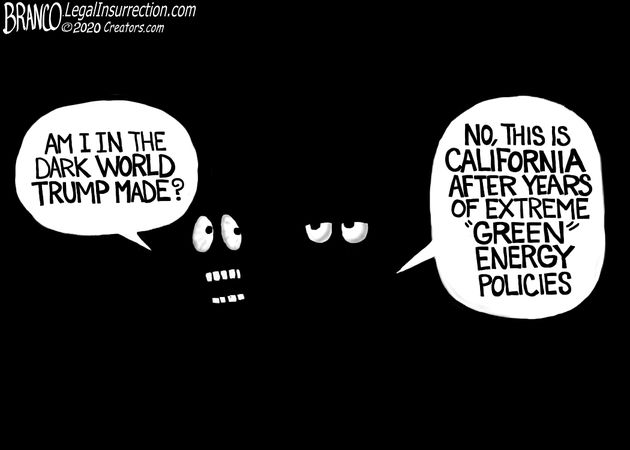
California: World Leading Climate Hypocrite Updated Dec. 23, 2020

Update following below Dec. 23, 2020 Has Progressive Californication Peaked?

California’s Climate Extremism
Joel Kotkin reports from the Golden State. Excerpts in italics with my bolds.

The pursuit of environmental purity in the Golden State does nothing to reverse global warming—but it’s costing the poor and middle class dearly.

Environmental extremism increasingly dominates California. The state is making a concerted attack on energy companies in the courts; a bill is pending in the legislature to fine waiters $1,000—or jail them—if they offer people plastic straws; and UCLA issued a report describing pets as a climate threat. The state has taken upon itself the mission of limiting the flatulence of cows and other farm animals. As the self-described capital of the anti-Trump resistance, California presents itself as the herald of a green, more socially and racially just society. That view has been utterly devastated by a new report from Chapman University, in which coauthors David Friedman and Jennifer Hernandez demonstrate that California’s draconian anti-climate-change regime has exacerbated economic, geographic, and racial inequality. And to make things worse, California’s efforts to save the planet have actually done little more than divert greenhouse-gas emissions (GHG) to other states and countries.

Jerry Brown’s return to Sacramento in 2011 brought back to power one of the first American politicians to embrace the “limits of growth.” Brown has long worried about resource depletion (including such debunked notions as “peak oil”), taken a Malthusian approach to population growth, and opposed middle-class suburban development. Like many climate-change activists, he has limitless confidence in the possibility for engineering a green socially just society through “the coercive power of the state,” but little faith that humans can find ways to address the challenge of climate change. If Brown’s “era of limits” message in the 1970s failed to catch on with the state’s voters, who promptly elected two Republican governors in his wake, he has found in climate change a more effective rallying cry, albeit one that often teeters at the edge of hysteria. Few politicians can outdo Brown for alarmism; recently, he predicted that climate change will cause 3 to 4 billion deaths, leading eventually to human extinction. To save the planet, he openly endorses a campaign to brainwash the masses.

The result: relentless ratcheting-up of climate-change policies. In 2016, the state committed to reduce greenhouse-gas (GHG) emissions 40 percent below 1990 levels by 2030. In response, the California Air Resource Board (CARB), tasked with making the rules required to achieve the state’s legislated goals, took the opportunity to set policies for an (unlegislated) target of an 80 percent reduction below 1990 levels by 2050.

Brown and his supporters often tout their policies as in line with the 2015 Paris Agreement, note Friedman and Hernandez, but California’s reductions under the agreement require it to make cutbacks double those pledged by Germany and other stalwart climate-committed countries, many of which have actually increased their emissions in recent years, despite their Paris pledges.

Governor Brown has preened in Paris, at the Vatican, in China, in newspapers, and on national television. But few have considered how his policies have worked out in practice. California is unlikely to achieve even its modest 2020 goals; nor is it cutting emissions faster than other states lacking such dramatic legislative mandates. Since 2007, when the Golden State’s “landmark” global-warming legislation was passed, California has accounted for barely 5 percent of the nation’s GHG reductions. The combined total reductions achieved over the past decade by Ohio, Georgia, Pennsylvania, and Indiana are about 5 times greater than California’s. Even Texas, that bogeyman of fossil-fuel excess, has been reducing its per-capita emissions more rapidly.

In fact, virtually nothing that California does will have an impact on global climate. California per-capita emissions have always been relatively low, due to the mild climate along the coast, which reduces the need for much energy consumption on heating and cooling. In 2010, the state accounted for less than 1 percent of global GHG emissions; the disproportionately large reductions sought by state activists and bureaucrats would have no discernible effect on global emissions under the Paris Agreement. “If California ceased to exist in 2030,” Friedman and Hernandez note, “global GHG emissions would be still be 99.54 percent of the Paris Agreement total.”

Many of California’s “green” policies may make matters worse. California, for example, does not encourage biomass energy use, though the state’s vast forested areas—some 33 million acres— could provide renewable energy and reduce the excessive emissions from wildfires caused by years of forest mismanagement. Similarly, California greens have been adamant in shutting down nuclear power plants, which continue to reduce emissions in France, and they refuse to count hydro-electricity as renewable energy. As a result, California now imports roughly one-third of its electricity from other states, the highest percentage of any state, up from 25 percent in 2010. This is part of what Hernandez and Friedman show to be California’s increasing propensity to export energy production and GHG emissions, while maintaining the fiction that the state has reduced its total carbon output.

Overall, California tends to send its “dirty work”—whether for making goods or in the form of fossil fuels—elsewhere. Unwanted middle- and working-class people, driven out by the high cost of California’s green policies, leave, taking their carbon footprints to other places, many of which have much higher per-capita emission rates. Net migration to other, less temperate states and countries has been large enough to offset the annual emissions cuts within the state. Similarly, the state’s regulatory policies make it difficult for industrial firms to expand or even to remain in California. Green-signaling firms like Apple produce most of their tangible products abroad, mainly in high-GHG emitting China, while other companies, like Facebook and Google, tend to place energy-intensive data centers in other, higher GHG emission states. The study estimates that GHG emissions just from California’s international imports in 2015, and not even counting imports from the rest of the U.S., amounted to about 35 percent of the state’s total emissions.

California’s green regulators predict that the implementation of ever-stricter rules related to climate will have a “small” impact on the economy. They point to strong economic and job growth in recent years as evidence that strict regulations are no barrier to prosperity. Though the state’s economic growth is slowing, and now approaches the national average, a superficial look at aggregate performance makes a seemingly plausible case for even the most draconian legislation. California, as the headquarters for three of the nation’s five largest companies by market capitalization—Alphabet, Apple, and Facebook— has enjoyed healthy GDP growth since 2010. But in past recoveries, the state’s job and income growth was widely distributed by region and economic class; since 2007, growth has been uniquely concentrated in one region—the San Francisco Bay Area, where employment has grown by nearly 17 percent, almost three times that of the rest of the state, with growth rates tumbling compared with past decades.

Some of these inequities are tied directly to policies associated with climate change. High electricity prices, and the war on carbon emissions generally, have undermined the state’s blue-collar sectors, traditionally concentrated in Los Angeles and the interior counties. These sectors have all lost jobs since 2007. Manufacturing employment, highly sensitive to energy-related and other regulations, has declined by 160,000 jobs since 2007. California has benefited far less from the national industrial resurgence, particularly this past year. Manufacturing jobs—along with those in construction and logistics, also hurt by high energy prices—have long been key to upward mobility for non-college-educated Californians.

As climate-change policies have become more stringent, California has witnessed an unprecedented level of bifurcation between a growing cadre of high-income earners and a vast, rapidly expanding poor population. Meantime, the state’s percentage of middle-income earners— people making between $75,000 and $125,000—has fallen well below the national average. This decline of the middle class even occurs in the Bay Area, notes a recent report from the California Budget and Policy Center, where in 1989 the middle class accounted for 56 percent of all households in Silicon Valley, but by 2013, only 45.7 percent. Lower-income residents accounted for 30.3 percent of Silicon Valley’s households in 1989, and that number grew to 34.8 percent in 2013.

Perhaps the most egregious impact on middle and working-class residents can be seen in housing, where environmental regulations, often tied directly to climate policies, have discouraged construction, particularly in the suburbs and exurbs. The state’s determination to undo the primarily suburban, single-family development model in order to “save the planet” has succeeded both in raising prices well beyond national norms and creating a shortfall of some 3 million homes.

As shown in a recent UC Berkeley study, even if fully realized, the state’s proposals to force denser housing would only reach about 1 percent of its 2030 emissions goals. Brown and his acolytes ignore the often-unpredictable consequences of their actions, insisting that density will reduce carbon emissions while improving affordability and boosting transit use. Yet, as Los Angeles has densified under its last two mayors, transit ridership has continued to drop, in part, notes a another UC Berkeley report, because incentives for real-estate speculation have driven the area’s predominantly poor transit riders further from trains and buses, forcing many to purchase cars.

Undaunted, California plans to impose even stricter regulations, including the mandatory installation of solar panels on new houses, which could raise prices by roughly $20,000 per home. This is only the latest in a series of actions that undermines the aspirations of people who still seek “the California dream;” since 2007, California homeownership rates have dropped far more than the national average. By 2016, the overall homeownership rate in the state was just under 54 percent, compared with 64 percent in the rest of the country.

The groups most affected by these policies, ironically, are those on whom the ruling progressives rely for electoral majorities. Millennials have seen a more rapid decline in homeownership rates compared with their cohort elsewhere. But the biggest declines have been among historically disadvantaged minorities—Latinos and African-Americans. Latino homeownership rates in California are well below the national average. In 2016, only 31 percent of African-Americans in the Bay Area owned homes, well below the already low rate of 41 percent black homeownership in the rest of nation. Worse yet, the state takes no account of the impact of these policies on poorer Californians. Overall poverty rates in California declined in the decade before 2007, but the state’s poverty numbers have risen during the current boom. Today, 8 million Californians live in poverty, including 2 million children, by far the most of any state. The state’s largest city, Los Angeles, is also now by some measurements America’s poorest big city.

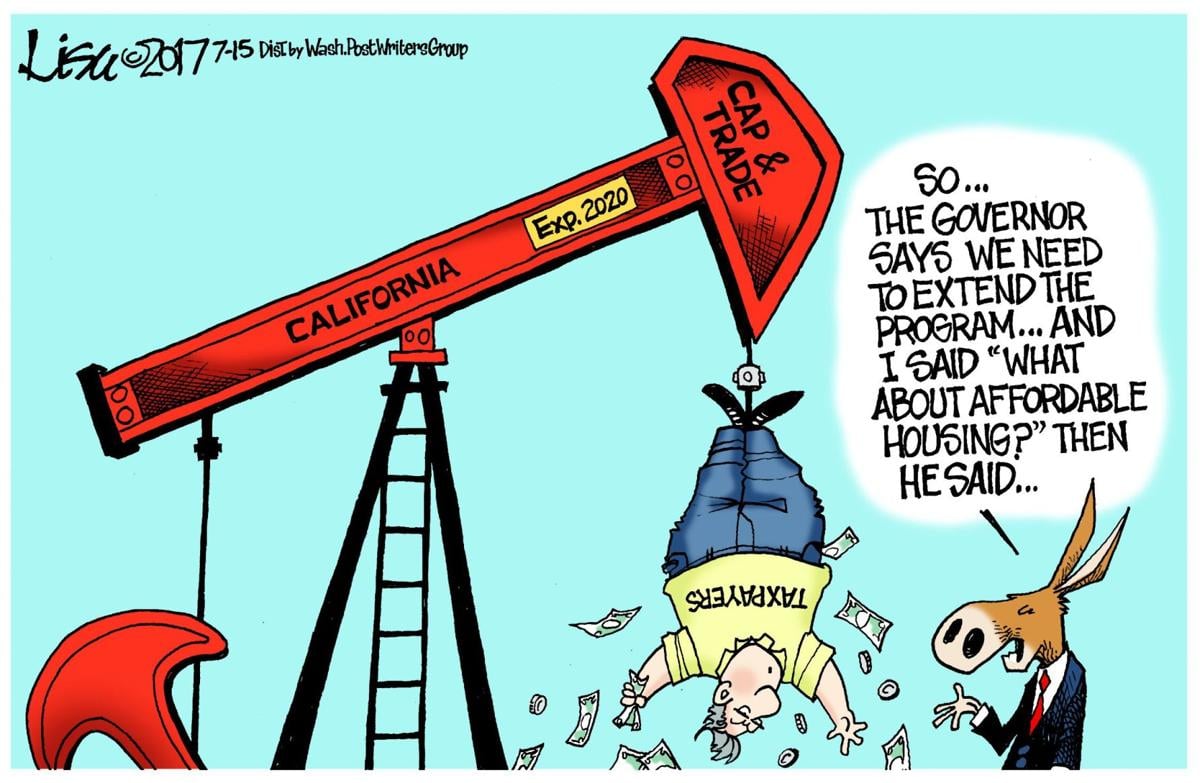
To allay concerns about housing affordability, the state has allocated about $300 million from its cap-and-trade funds for housing, a meager amount given that the cost of building affordable housing in urban areas can exceed $700,000 per unit. These benefits are dwarfed by those that wealthy Californians enjoy for the purchase of electric cars and home solar: Tesla car buyers with average incomes of $320,000 per year got more than $300 million in federal and state subsidies by early 2015 alone. By contrast, in early 2018, state electricity prices were 58 percent higher, and gasoline over 90 cents per gallon higher, than the national average, disproportionately hurting ethnic minorities, the working class, and the poor. Based on cost-of-living estimation tools from the Census Bureau, 28 percent of African-Americans in the state live in poverty, compared with 22 percent nationally. Fully one-third of Latinos, now the state’s largest ethnic group, live in poverty, compared with 21 percent outside the state.

In a normal political environment, such disparities would spark debate, not only among conservatives, but also traditional Democrats. Some, like failed independent candidate and longtime environmentalist Michael Shellenberger, have expressed the view that California’s policies have made it not “the most progressive state” but “the most racist one.” Recently, some 200 veteran civil rights leaders sued CARB, on the basis that state policies are skewed against the poor and minorities. So far, their voices have been largely ignored. The state’s prospective next governor, Gavin Newsom, seems eager to embrace and expand Brown’s policies, and few in the legislature seem likely to challenge them. The Republicans, for now, look incapable of mounting a challenge.

This leaves California on a perilous path toward greater class and racial divides, increasing poverty, and ever-more strenuous regulation. Other ways to reduce greenhouse gases—such as planting trees, more efficient transportation, and making suburbs more sustainable—should be on the table. The Hernandez-Friedman report could be a first step toward addressing these issues, but however it happens, a return to rationality is needed in the Golden State.

Joel Kotkin serves as Presidential Fellow in Urban Futures at Chapman University and executive director of the Center for Opportunity Urbanism (COU).

Update Dec. 23, 2020 Has Progressive Californication Peaked?

Joel Kotkin has updated the California story as 2020 ends in his article Peak Progressive? at the American Mind. Excerpts in italics with my bolds.

With adjustment for cost of living, California now has the highest overall poverty rate in the United States according to the Census Bureau. Los Angeles, by far the state’s largest metropolitan area, has among the highest poverty rates for the largest U.S. metros. In parts of Los Angeles, the growing homeless encampments have spawned medieval diseases such as typhus. There are even indications of a comeback for bubonic plague, the signature scourge of the Middle Ages.

Hispanics and African Americans, who constitute 45% of the state’s population, do far worse here than elsewhere. Based on cost-of-living estimation tools from the Census Bureau, 28% of African Americans in the state live in poverty, compared with 22% nationally. Fully one third of Hispanics, the state’s largest ethnic group, are below the poverty line, compared with 21% outside the state. Over two thirds of noncitizen Latinos, including the undocumented, live at or below the poverty line.

The pandemic has widened this divide. The state’s unemployment rates now surpass the national average, making them worse even than in New York, the epicenter of the coronavirus outbreak. L.A. County has lost over 1 million jobs to the pandemic and suffers an unemployment rate higher than any of the major California urban counties. Today in Los Angeles, violent crime is spiking, and less than half of residents now hold jobs. Since the pandemic, the state’s largest metro, Los Angeles–Orange County, has suffered the second most job losses in the U.S. Two others, the Bay Area and the Inland Empire, rank in the top ten.

Now the state seems poised to lose much of its tech economy, which has been the one force keeping it afloat.

Yet it is ever more clear to ever more Californians that our state is becoming exactly the vast gated community Newsom warns about. As Ali Modarres showed in “The Demographic Transformation of California” (2003), the “shared prosperity” of the Pat Brown years were based on a broad-based economy spanning the gamut from agriculture and oil to aerospace and finance, software, and basic manufacturing. In contrast, the Newsom progressive model is built largely around one industry—high tech—which provides increasingly little opportunity for most Californians, and now shows disturbing signs of moving elsewhere.

Current progressive policies are chasing key companies out of the state—including, just within the last week, tech giants Tesla, Hewlett Packard Enterprises, and Oracle, all of which are heading to Texas. But the real problem lies in the state’s fading appeal to outsiders. It is losing domestic migrants and, increasingly, losing appeal to immigrants as well. California retains many of its great assets—a huge concentration of technical talent, a robust grassroots economy, unmatched physical beauty, and a remarkably pleasant climate—but these are being increasingly squandered. The question now is whether Californians will challenge the status quo.

More Evidence of California Climate Fumbles:

How Climatism Destroyed California

Climate activists versus affordable housing

California Cop Out

California’s Year: Veering Left from Left Lane


On Stopping Biden’s Deadly Energy Policies

Clarice Feldman writes at Climate Change Dispatch How Biden’s Deadly Plan For American Energy Can Be Stopped.  Excerpts in italics with my bolds and images.

It’s perfectly understandable for anyone concerned about energy production in the U.S. to be uneasy that Joe Biden appears to be winning this year’s contest for the White House.

Whether he makes it to 1600 Pennsylvania Ave. remains in doubt, but what is not in doubt is that, should that happen, he would have no substantial mandate.

The climate change part of the platform–like much of his party’s platform–seems to have little purchase other than the coastal bien pensants and the left-wing corporatists dreaming of yet another boondoggle financed by the taxpayers on the same pie-in-the-sky swindle as was Solyndra and California’s train to nowhere.

Of course, my ability to read the future is limited, but let me explain why I think much of what Biden has promised the far Left of his party to secure the nomination and their support, is unlikely to take shape.

At the moment the election in six states is still either still being counted, being challenged in court, or subject to a recount. Excluding those states, President Trump leads Biden 232 to 227 in the Electoral Vote totals. (270 electoral votes of 538 are needed to win the electoral college vote in January).

It is impossible in this fast-changing circumstance to keep track of all the litigation challenges in the various state-run elections. So far this compendium by OSU seems the most accurate.

I’ve seen some of the complaints filed or about to be in Michigan and Pennsylvania and they include numerous credible affidavits documenting substantial illegality. [See The Trapdoor US Election]

If the Supreme Court meant it when they said this twenty years ago in Bush v. Gore, 531 U.S. 98, 105 (2000), I have to believe that the counts in both those states simply do not meet the constitutional standard in Gore.

It must be remembered that “the right of suffrage can be denied by a debasement or dilution of the weight of a citizen’s vote just as effectively as by wholly prohibiting the free exercise of the franchise.” Reynolds v. Sims, 377 U. S. 533, 555 (1964).

If these recounts and challenges are not resolved by the December 14 cut-off date, the House of Representatives can choose the interim president and the Senate the interim vice president until the results are certified by the states.

In the House, the vote is by state and the Republicans hold the majority there, as they do in the Senate. If the matter is not resolved to the satisfaction of the state legislatures, they may under the constitution select their own slate of electors.

Republicans hold the majority in the legislatures of Pennsylvania, Georgia, and Michigan, the three states with the most electoral votes among the still disputed contests.

Given the uncertain outcomes, at this time it is preposterous to call Biden “president-elect.”

Nevertheless, there certainly is a reason for concern in the Democratic platform Biden ran on.

The platform reads like a prose version of the Russian film “Battleship Potemkin” substituting only the film’s motif of all forces of the population joining hands in revolution with everyone joining hands to keep the climate from changing. (It misses only scenes of fracking and gas rigs shooting at wounded veterans and orphans.)

Among the specifics are these:

  • A pledge to achieve “zero-net greenhouse gas emissions as soon as possible, and no later than 2050.”
  • Eliminating “carbon pollution from power plants through technology-neutral standards for clean energy and energy efficiency.
  • “Dramatically” expanding solar and wind energy deployment.”

The program specifics are even more sophomoric and fanciful, involving retrofitting buildings, setting even higher emissions standards for cars and trucks, including 500,000 school buses, and more in a program “to ensure racial and socioeconomic equity in federal climate, energy, and infrastructure programs.”

(My guess is this was written somewhere else besides California which the document says should again be allowed to set its own vehicle emission standards. I say that because rolling blackouts related to a similar set of juvenile energy policies in that state’s programs would seem to put something of a leash on these overweening goals.)

Biden also has pledged to kill the Keystone pipeline. On that score, Alberta Premier Jason Kenney indicates confidence he can change Biden’s mind, and perhaps he would be successful — pledges from Biden do seem to have a short life span.

He promised during the debates that he would not claim victory until all the state contests were certified. He already has done so when we are far from that point.

He’s also promised to crack down on “climate cheats” whoever they are; push the world on climate change, and invest $1.7 trillion to reduce global warming. At the same time, his team is advocating further coronavirus lockdowns and payouts to those unemployed because of them.

Now I could be wrong. He could have a secret invention to generate trillions of new dollars and is keeping it a secret along with a never-revealed way to fuel this economy without fossil fuels, but I’m suspicious of the ability to fund these grandiose plans or carry the platform’s promises out.

Even if he were crazy enough to try it, he will do so without a great deal of support. At the moment, the Democrats are hanging on to an even thinner majority in the House, having lost a number of seats they expected to win, and jeopardized more who in these weird times are labeled “moderates”.

The party is splintered and recriminations against the left are legion. It seems increasingly likely that the Blue Wave the media promised didn’t materialize and in fact, a Red Wave washed a lot of the Democrats out to sea.

There will be at least 50 Republican senators in the Senate with the likely prospect of two more once the Georgia runoffs are complete in January.

Without a majority in the Senate, Biden can’t revoke the industry-friendly fuel tax; he can’t restore or expand the federal tax credit for purchases of electric vehicles, he can’t repeal the Halliburton provision permitting fracking in the Safe Drinking Water Act, he can’t amend the renewable fuel standard post-2022, he can’t alter the Jones Act, and he can’t change the carbon price, etc.

Some have suggested he can achieve these goals simply through executive orders, and there are a few things he can achieve via this route, beginning with an area in which he has the freest hand — rejoining the Paris climate agreement.

Some of the others, more troublesome to be sure, are regulatory actions like blocking oil and gas drilling on federal lands, allowing California to set independent standards for auto emissions and fuel economy, restricting access to low-cost capital for the fossil fuel industry, and setting fuel economy standards.

For these, judicial and public resistance are greater checks on his authority.

Chief Justice Roberts has displayed a penchant for fine-tooth-combing executive orders and rejecting them. The public — reeling from the devastation of the lockdowns, pleased with lower gas prices and anticipating a continued v-shaped recovery — are likely to find Biden’s extremism unwanted and make their opposition known.

Biden may squeak out an election victory. If so, it will have been a Pyrrhic one.

See also US Conflicted over Green Energy


How Climatism Destroyed California

Ben Pile writes at Spiked The problem in California is poverty, not climate change. Excerpts in italics with my bolds.

The heatwaves and the fires are natural – the electricity blackouts are not.

Events leading up to today’s power cuts follow a bizarre history. The fact that advanced economies need a continuous supply of power is well understood. Yet for three decades, the political agenda, dominated by self-proclaimed ‘progressives’, has put lofty green idealism before security of supply and before the consumer’s interest in reasonable prices. Even if the heatwaves experienced by California were caused by climate change, are their direct effects worse than the loss of electricity supply?

California’s green and tech billionaires, and its business and political elites, certainly seem to think so. But they are largely protected from reality by vast wealth, private security, gated estates, and battery banks. The high cost of property in the state of California means that, despite being the fifth largest economy in the world, and with the sixth highest per capita income in the US, it is the worst US state for poverty. According to the US Census Bureau, around 18 per cent of Californians, some seven million people, lived in poverty between 2016 and 2018 – more than five per cent above the US average.

As well as being the greenest (and most poverty-stricken) state, California can also boast that it is the No1 state for homelessness.

According to the US Interagency Council on Homelessness, there are more than 151,000 homeless people in California – a rise of 28,000 since 2010. That figure is shocking enough, but it masks the reality of many thousands more moving in and out of homelessness. The same agency reports that more than a quarter of a million schoolchildren experienced homelessness over the 2017/18 school year.

It is degenerate politics, not climate change, that presses hardest on the millions of Californians who live in poverty, and the many millions more who live just above the poverty line. The problems of this degenerate politics are visible, on the street, chronic and desperate, whereas climate change, if it is a problem at all, is only detectable through questionable statistical techniques. Yet California’s charismatic governors, since Arnold Schwarzenegger, have made their mark on the global stage as environmental champions.

At the 2017 COP23 UNFCCC conference in Bonn, Germany, then governor Jerry Brown shared a platform with the green billionaire and former New York mayor, Mike Bloomberg, to announce ‘America’s Pledge on Climate’ – a commitment of states and cities to combat climate change – despite President Trump’s decision to withdraw the US from the Paris Agreement earlier that year.

But why not a pledge on homelessness? Why not a pledge to address the problem of property prices? Why not a pledge to tackle poverty? Why not a pledge to secure a supply of energy? The only conceivable answer is that environmentalism is a form of politics that is entirely disinterested in the lives of ordinary people, despite progressive politicians’ claims that environmental and social issues are linked. Clearly they are not in the slightest bit linked.

California was the experiment, and now it is the proof: environmentalism is worse for ‘social justice’ than any degree of climate change is.

What about the wildfires? Aren’t they proof of climate change? It is a constant motif of green histrionics that more warming means more fires. But as has been pointed out before on spiked and elsewhere, places like California have long suffered from huge fires; fire is a part of many types of forests’ natural lifecycle.

What California’s rolling blackouts and its uncontrolled fires tell us is that green politics is completely divorced from any kind of reality. Environmentalism is the indulgent fantasy of remote political elites and their self-serving business backers. If California doesn’t prove this, what would?

Footnote: Bjorn Lomborg tried in 2015 to reason with Arnie Arnold Schwarzenegger Is Wrong On Climate Change Excerpts in italics with my bolds.

But that makes it even more important that those of us talking about global warming and its policy responses are responsible about statistics and data. It’s not good enough to swagger around saying, “I think I’m right and I’m going to ignore the haters.” Schwarzenegger loses me when he declares, “every day, 19,000 people die from pollution from fossil fuels. Do you accept those deaths?”

It’s emotive, but it’s wrong to say that 19,000 people are killed by fossil fuels every day. About 11,000 of these people are killed by burning renewable energy – wood and cow dung mainly – inside their own homes. The actual number of people killed by fossil fuels each day is about 3,900.

This matters for two reasons. First, it is disingenuous to link the world’s biggest environmental problem of air pollution to climate. It is a question of poverty (most indoor air pollution) and lack of technology (scrubbing pollution from smokestacks and catalytic converters) – not about global warming and CO₂. Second, costs and benefits matter.[vi] Tackling indoor air pollution turns out to be very cheap and effective, whereas tackling outdoor air pollution is more expensive and less effective. Your favorite policy of cutting CO₂ is of course even more costly and has a tiny effect even in a hundred years.

Lomborg failed to change Schwarzenegger’s mind since Arnie was so enamored of being a global environmental star as a sequel to his Hollywood movie celebrity.


Heisenberg Uncertainty Appears in Socio-Political Research

Background:  Heisenberg Uncertainty

In the sub-atomic domain of quantum mechanics, Werner Heisenberg, a German physicist, determined that our observations have an effect on the behavior of quanta (quantum particles).

The Heisenberg uncertainty principle states that it is impossible to know simultaneously the exact position and momentum of a particle. That is, the more exactly the position is determined, the less known the momentum, and vice versa. This principle is not a statement about the limits of technology, but a fundamental limit on what can be known about a particle at any given moment. This uncertainty arises because the act of measuring affects the object being measured. The only way to measure the position of something is using light, but, on the sub-atomic scale, the interaction of the light with the object inevitably changes the object’s position and its direction of travel.

Now skip to the world of governance and the effects of regulation. A similar finding shows that the act of regulating produces reactive behavior and unintended consequences contrary to the desired outcomes. More on that later on from a previous post.

This article looks at political and social research attempts to describe the electorate’s preoccupations and preferences ahead of 2020 US Presidential voting in November.

John McLaughlin explains in his article Biased Polls Suppress Vote  Excerpts in italics with my bolds.

McLaughlin noted among the 220 million eligible voters in the U.S., only around 139 million voted in 2016, which is considered the most all-time.

“Even if it goes up to 140-150 million, the polls of adults are going to be skewed against Republicans,” McLaughlin told Monday’s “Greg Kelly Reports,” especially “since President Trump gets over 90% support from Republicans.”

McLaughlin noted CNN’s poll among adults featured just 25% registered Republicans, where as around one-third of the electorate that voted in 2016 were Republicans.

He added to host Greg Kelly, it costs more to run focused polls of likely voters from actual voter registration lists.

“It’s cheaper for them to do,” in addition to being advantageous to the Democratic candidate, McLaughlin told Kelly. “They don’t have to buy a sample of voters, that campaign pollsters – whether Republican or Democrat – are going to have to do.”

Also, per McLaughlin, reporting a blowout lead ultimately can cause voter suppression, a frequent rally cry of Democrats against Republicans in election.

Politico notes that there is nothing nefarious going on to skew these polls toward Biden. But they do have the same issue the 2016 polls had: They’re not reaching all of the Trump supporters.

At the center of the issue are white voters without college degrees; in 2016, Trump earned 67% of this demographic’s support, while Democrat Hillary Clinton got just 28%. Current polls, according to Politico, are not capturing enough of this voting bloc, which unintentionally skews the results toward Biden.

My Comment:  This post was inspired by a Flynnville Train song that captures the sentiment of working class Americans alienated from the political process.  Disrespected as “deplorables” they turned out for Trump and made the difference in 2016.  Now with arbitrary pandemic restrictions and random urban rioting, these folks are even more incensed about the political elite.  Lest anyone think them inconsequential, remember that many of them get up and go to watch the most popular US spectator sport.  I refer to stock car racing, not the kneeling football or basketball athletes.

Lyrics:

IF YOU’RE HANDS ARE HURTIN’ FROM A WEEK OF WORKIN’
AND HOLDING YOUR WOMAN IS THE ONLY THING THEY’RE GOOD FOR
YOU’RE PREACHING TO THE CHOIR
IF THE PRICE OF GAS IS BREAKIN’ YOUR BACK
AND THAT DRIVE TO WORK IS KILLIN’ YOUR PAYCHECK
YOU’RE PREACHING TO THE CHOIR
IF YOU’RE WORRIED ‘BOUT WHERE THIS COUNTRY’S HEADED
AND YOU DON’T BELIEVE ONE POLITICIAN GETS IT

CHORUS
YOURE PREACHIN’ TO THE CHOIR
A FELLOW WORKIN’ MAN
THERE’S A WHOLE LOT OF STUFF MESSED UP
CAN I GETTA AMEN
SOMETHING’S GOTTA GIVE
CAUSE WE’RE ALL GETTING TIRED
SO GO ON BITCH AND MOAN
YOU’RE PREACHING TO THE CHOIR

IF THE GOOD BOOK SITS BESIDE YOUR BED
AND UNDER YOUR ROOF WE’RE STILL ONE NATION UNDER GOD
YOU’RE PREACHING TO THE CHOIR
IF YOU LIKE THE CHANCE TO WRAP YOUR HANDS
ROUND THAT S.O.B. THAT HURT THAT KID ON THE EVENIN’ NEWS
YOU’RE PREACHING TO THE CHOIR
IF YOU KNOW THERE AIN’T NO HERO LIKE A SOLDIER
BUT YOU HATE TO EVER HAVE TO SEND ‘EM OVER

CHORUS

IF THE GOLDEN RULE STILL MEANS SOMETHING TO YA
WELL HALLELUJAH

CHORUS

PREACHING TO THE CHOIR

Previous Post: Regulatory Backfire

An article at Financial Times explains about Energy Regulations Unintended Consequences  Excerpts below with my bolds.

Goodhart’s Law holds that “any observed statistical regularity will tend to collapse once pressure is placed upon it for control purposes”. Originally coined by the economist Charles Goodhart as a critique of the use of money supply measures to guide monetary policy, it has been adopted as a useful concept in many other fields. The general principle is that when any measure is used as a target for policy, it becomes unreliable. It is an observable phenomenon in healthcare, in financial regulation and, it seems, in energy efficiency standards.

When governments set efficiency regulations such as the US Corporate Average Fuel Economy standards for vehicles, they are often what is called “attribute-based”, meaning that the rules take other characteristics into consideration when determining compliance. The Cafe standards, for example, vary according to the “footprint” of the vehicle: the area enclosed by its wheels. In Japan, fuel economy standards are weight-based. Like all regulations, fuel economy standards create incentives to game the system, and where attributes are important, that can mean finding ways to exploit the variations in requirements. There have long been suspicions that the footprint-based Cafe standards would encourage manufacturers to make larger cars for the US market, but a paper this week from Koichiro Ito of the University of Chicago and James Sallee of the University of California Berkeley provided the strongest evidence yet that those fears are likely to be justified.

Mr Ito and Mr Sallee looked at Japan’s experience with weight-based fuel economy standards, which changed in 2009, and concluded that “the Japanese car market has experienced a notable increase in weight in response to attribute-based regulation”. In the US, the Cafe standards create a similar pressure, but expressed in terms of size rather than weight. Mr Ito suggested that in Ford’s decision to end almost all car production in North America to focus on SUVs and trucks, “policy plays a substantial role”. It is not just that manufacturers are focusing on larger models; specific models are also getting bigger. Ford’s move, Mr Ito wrote, should be seen as an “alarm bell” warning of the flaws in the Cafe system. He suggests an alternative framework with a uniform standard and tradeable credits, as a more effective and lower-cost option. With the Trump administration now reviewing fuel economy and emissions standards, and facing challenges from California and many other states, the vehicle manufacturers appear to be in a state of confusion. An elegant idea for preserving plans for improving fuel economy while reducing the cost of compliance could be very welcome.

The paper is The Economics of Attribute-Based Regulation: Theory and Evidence from Fuel-Economy Standards Koichiro Ito, James M. Sallee NBER Working Paper No. 20500.  The authors explain:

An attribute-based regulation is a regulation that aims to change one characteristic of a product related to the externality (the “targeted characteristic”), but which takes some other characteristic (the “secondary attribute”) into consideration when determining compliance. For example, Corporate Average Fuel Economy (CAFE) standards in the United States recently adopted attribute-basing. Figure 1 shows that the new policy mandates a fuel-economy target that is a downward-sloping function of vehicle “footprint”—the square area trapped by a rectangle drawn to connect the vehicle’s tires.  Under this schedule, firms that make larger vehicles are allowed to have lower fuel economy. This has the potential benefit of harmonizing marginal costs of regulatory compliance across firms, but it also creates a distortionary incentive for automakers to manipulate vehicle footprint.

Attribute-basing is used in a variety of important economic policies. Fuel-economy regulations are attribute-based in China, Europe, Japan and the United States, which are the world’s four largest car markets. Energy efficiency standards for appliances, which allow larger products to consume more energy, are attribute-based all over the world. Regulations such as the Clean Air Act, the Family Medical Leave Act, and the Affordable Care Act are attribute-based because they exempt some firms based on size. In all of these examples, attribute-basing is designed to provide a weaker regulation for products or firms that will find compliance more difficult.

Summary from Heritage Foundation study Fuel Economy Standards Are a Costly Mistake Excerpt with my bolds.

The CAFE standards are not only an extremely inefficient way to reduce carbon dioxide emission but will also have a variety of unintended consequences.

For example, the post-2010 standards apply lower mileage requirements to vehicles with larger footprints. Thus, Whitefoot and Skerlos argued that there is an incentive to increase the size of vehicles.

Data from the first few years under the new standard confirm that the average footprint, weight, and horsepower of cars and trucks have indeed all increased since 2008, even as carbon emissions fell, reflecting the distorted incentives.

Manufacturers have found work-arounds to thwart the intent of the regulations. For example, the standards raised the price of large cars, such as station wagons, relative to light trucks. As a result, automakers created a new type of light truck—the sport utility vehicle (SUV)—which was covered by the lower standard and had low gas mileage but met consumers’ needs. Other automakers have simply chosen to miss the thresholds and pay fines on a sliding scale.

Another well-known flaw in CAFE standards is the “rebound effect.” When consumers are forced to buy more fuel-efficient vehicles, the cost per mile falls (since their cars use less gas) and they drive more. This offsets part of the fuel economy gain and adds congestion and road repair costs. Similarly, the rising price of new vehicles causes consumers to delay upgrades, leaving older vehicles on the road longer.

In addition, the higher purchase price of cars under a stricter CAFE standard is likely to force millions of households out of the new-car market altogether. Many households face credit constraints when borrowing money to purchase a car. David Wagner, Paulina Nusinovich, and Esteban Plaza-Jennings used Bureau of Labor Statistics data and typical finance industry debt-service-to-income ratios and estimated that 3.1 million to 14.9 million households would not have enough credit to purchase a new car under the 2025 CAFE standards.[34] This impact would fall disproportionately on poorer households and force the use of older cars with higher maintenance costs and with fuel economy that is generally lower than that of new cars.

CAFE standards may also have redistributed corporate profits to foreign automakers and away from Ford, General Motors (GM), and Chrysler (the Big Three), because foreign-headquartered firms tend to specialize in vehicles that are favored under the new standards.[35] 

Conclusion

CAFE standards are costly, inefficient, and ineffective regulations. They severely limit consumers’ ability to make their own choices concerning safety, comfort, affordability, and efficiency. Originally based on the belief that consumers undervalued fuel economy, the standards have morphed into climate control mandates. Under any justification, regulation gives the desires of government regulators precedence over those of the Americans who actually pay for the cars. Since the regulators undervalue the well-being of American consumers, the policy outcomes are predictably harmful.


Cal Carbon Market Fails in Practice and in Theory

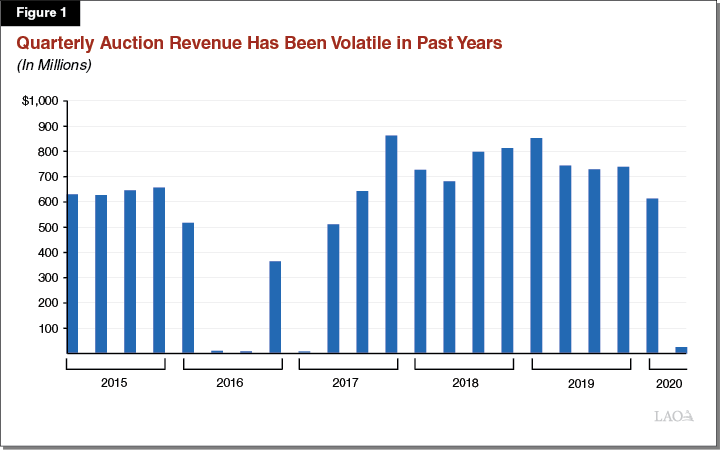
When secondary market prices dropped below minimum auction prices for a few different periods in 2016 and 2017, the state generated $10 million or less in three out of four auctions, as shown in Figure 1. In May 2020, the revenue was only $25M. Source: Cal LAO (Legislative Analyst’s Office)

Severin Borenstein explains at energypost.eu California learns even flexible Emissions Markets won’t guarantee price stability.  Despite the author’s belief in reducing CO2 emissions, cap and trade is failing to deliver.  Excerpts in italics with my bolds.

After California’s May allowance auction settled at the minimum price and generated almost no revenues for the state, the long knives are again out in Sacramento for the state’s cap and trade program. What’s the point of a carbon market, some are asking, if price and revenue volatility make planning nearly impossible?

The disappointing auction has caused proposals for stabilising the market price – such as those from the Independent Emissions Market Advisory Committee (IEMAC) in its 2019 report – to be taken more seriously, as they should be. But the tweaks suggested by the IEMAC and others aren’t likely to live up to the expectations of policymakers. That’s not because the proposed changes are unwise, but because the policymakers’ expectations are unrealistic.

Many California regulators and legislators want cap and trade to guarantee that the state reaches prescribed emissions targets by 2030, while at the same time maintaining a moderate allowance price, not at the floor, but not too high. Only by a stroke of pure luck could the program deliver on both. To see why, let’s revisit the design options for an emissions market.

Carbon prices can rise too high or fall too low

Cap and trade “classic” simply sets a cap on emissions and lets the price do all the work to get us there, with no restrictions. But if the demand for emitting the pollutant is high – which could be driven by a strong economy, cheap fossil fuels, and/or slow progress in low-emissions technologies – the price could spiral to astonishing levels. Cap and trade classic generally would get you to the emissions quantity, but possibly at an unacceptable economic or political cost.

And if the demand for emitting is low – such as results from an economic downturn, expensive fossil fuels, and/or competitive low-carbon alternatives – it is quite possible to end up with a price of zero and no further incentive to ratchet down emissions at all.

The price in cap and trade classic is hard to predict, because the future of the economy, fossil fuels, and emissions reduction technologies are hard to predict.

Emissions taxes: a fixed disincentive has its limitations too

Emissions tax “classic” does the opposite. It sets a fixed price, which establishes a constant incentive to reduce pollution regardless of how much is being emitted. But then polluters emit whatever quantity they choose as long as they are willing to pay the tax. If the demand for emitting is high, the outcome will be high levels of emissions.

In economic parlance, where cap and trade classic creates a vertical supply curve for emissions allowances (at a fixed quantity) and emissions tax classic creates a horizontal supply curve for allowances (at a fixed price), the new and improved cap and trade creates an upward sloping supply curve for allowances, restricting the quantity somewhat when demand and price are low, which prevents the price from going even lower, and expanding the quantity somewhat when they are high, preventing the price from going even higher.

What these modifications do is share the impact of unpredictable emissions demand between quantity adjustment and price adjustment, rather than putting the impact of demand uncertainty all on quantity (emissions tax classic) or all on price (cap and trade classic). What they don’t do is get us to the policymakers’ nirvana of predictable emissions quantity and price. Until someone figures out how to reliably predict both macroeconomic growth and technological progress that won’t be a realistic goal.

That’s not a flaw in emissions pricing. It’s a reality of any type of emissions control policies. Technology mandates – the alternatives to pricing – generally don’t ensure a total level of emissions (usually just emissions intensity), and never ensure the cost of achieving a given level of emissions.

A market based on the non-delivery of a non-good, What could go wrong?  Let us count the ways

Background from Previous Post
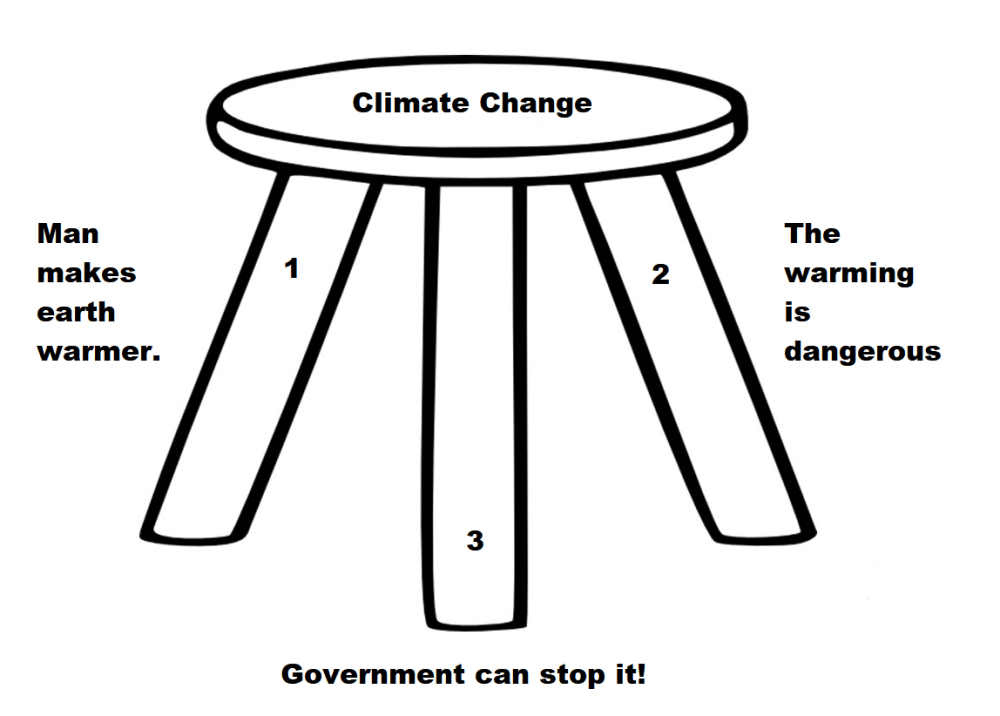
Climate stool

Context: As the image shows, alarmist/activists understand Climate Change (man made assumed) as a concept that depends on three assertions being true.  The first one is the science bit, being the unproven claim that humans make the planet warmer by burning fossil fuels. (See Global Warming Theory and the Tests It Fails)  The second one is the claim from billions of dollars invested into researching any and all negative effects from global warming, from Acne to Zika virus. The third and also necessary leg is the assertion that governments can act to prevent future warming.

From time to time it is instructive to hear from those who buy into the first two, but have lost confidence in the policies proposed as remedies. Jeffrey Ball writes at Science Direct, not questioning climate science or feared impacts, but distraught about the failed efforts to do something to reduce emissions.  His article is Hot Air Won’t Fly: The New Climate Consensus That Carbon Pricing Isn’t Cutting It Excerpts in italics with my bolds.

Jeffrey Ball, a writer whose work focuses on energy and the environment, is the scholar-in-residence at Stanford University’s Steyer-Taylor Center for Energy Policy and Finance and a lecturer at Stanford Law School. He also is a nonresident senior fellow at the Brookings Institution. His writing has appeared in Foreign Affairs, Fortune, Mother Jones, The Atlantic, New Republic, The New York Times, and The Wall Street Journal, among other publications. Ball, previously The Wall Street Journal’s environment editor, focuses his Stanford research on improving the effectiveness of clean-energy investment, particularly in China.

Carbon Pricing Isn’t Cutting It

In the history of climate change, 2018 will go down as a year when certain facts finally hit home, truths inconvenient for partisans on all sides. Those on the right, at least those who have been arguing that greenhouse-gas emissions aren’t a significant problem, were forced to recognize that those emissions are causing real harm to real people right now. Those on the left, at least those who have put their faith in the promise of renewable energy to cool the planet, had to reckon with the reality that, even as those technologies boomed, carbon emissions continued to grow. And those across the political spectrum who had been calling for what seemed in theory a sensible climate policy—putting a price on carbon emissions—had to concede that their supposed solution isn’t helping much at all.

(My comment: Like so many true believers, Ball casts climate change as a political issue between left and right wings.  Note he does think we can all agree that policies are not working.)

No single event can be attributed to climate change, but scientists cite a lengthening list of unfolding events, from wildfires in California to drought in Europe to rising waters along Bangladesh, as evidence of the effects of a warming world. Even the administration of US President Donald Trump, which has rolled back myriad climate policies, noted in a November report, the latest legally mandated US National Climate Assessment, that the effects of climate change “are already being felt in communities across the country”—from intensifying flooding in the nation’s northeast region, to worsening drought in the southwestern part of the country, to rising temperatures and erosion that are damaging buildings in Alaska.

(My comment:  Ball does not acknowledge rebuttals and challenges to the recent NCA document that merely repeated claims from previous editions, and echoed the feverish exhortations from IPCC SR15.  But this  paragraph was aimed at the skeptical on the right, while soothing the believers on the left.  Let’s now get into the meat of it: Is the government stopping it?)

Renewable energy isn’t stopping that. It represented 70% of net new power-generating capacity installed globally in 2017, a stunning share that reflects falling costs and rising penetration.  Yet for all that growth, renewable energy still provided only an estimated 14% of total global energy in 2017, up about 1 percentage point from its share in 2000, because fossil-fuel energy capacity also has been increasing. Indeed, even as renewable-energy capacity hit an all-time high, energy-related carbon emissions did too. They rose 1.6% in 2017, following three years in which they were flat, and they are expected to have risen further in 2018.

Emissions are increasing even though more governments than ever before have imposed prices on carbon emissions, either levying a carbon tax or instituting a cap-and-trade system of pollution permits so that those who emit greenhouse gases have a financial incentive to reduce them. That is little wonder, given that less than 1% of global carbon emissions are subject to a price that economists peg as high enough to meaningfully curb them.

This past June, in an essay in Foreign Affairs, “Why Carbon Pricing Isn’t Working,” I cataloged evidence that carbon pricing is failing to meaningfully reduce carbon emissions around the world—from Europe, where the policy took significant hold, to California, where leading policymakers have embraced it, to China, which is in the early stages of ramping up what will be by far the biggest carbon-pricing regime on the planet. I argued that, though in theory carbon pricing makes sense, in practice it is failing, for two reasons: structurally, carbon pricing tends to constrain emissions mostly in the electricity sector, leaving the transportation and building sectors largely unaffected; and politically, even those governments that have imposed carbon prices have lacked the fortitude to set them high enough to significantly curb even electricity emissions. As a result, I wrote, “a policy prescription widely billed as a panacea is acting as a narcotic. It’s giving politicians and the public the warm feeling that they’re fighting climate change even as the problem continues to grow.” Not just ineffective, carbon pricing is proving counterproductive, because “it is reducing the pressure to adopt other carbon-cutting measures, ones that would hit certain sectors harder and that would produce faster reductions.” Among those other needed measures: phasing out coal as a power source except where it is burned with carbon-capture- and -sequestration technology, which minimizes its emissions; maintaining, rather than closing, nuclear plants; making renewable energy cheaper; and mandating greater energy efficiency.

Would that the half year since that essay was published had proven its assessment too harsh. Unfortunately, recent events and analyses have only bolstered it. Since the summer, and in the lead-up to the latest global climate-policy conference, this month in Poland, studies exploring carbon pricing’s shortcomings have begun piling up. They now amount to a new and sobering climate-literature genre.

Belief in carbon pricing was strong in 2015, when policymakers from some 190 countries issued the Paris Agreement, calling for measures to keep the increase in the average global temperature “well below” 2°C above preindustrial levels and for “pursuing efforts” to keep the rise below 1.5°C.6 Unlike prior climate agreements, notably the Kyoto Protocol, which nearly two decades earlier had pressed for emission cuts only from developed countries, the Paris Agreement included specific emission-reduction pledges even by China, India, and other developing countries, which now produce the bulk of global emissions. But the pledges countries made in Paris were voluntary rather than mandatory, and most were relatively weak. Even if countries made good on them, it was clear, the world would not cut emissions anywhere near enough to avoid crashing through the 2°C threshold.

Coming out of Paris, carbon pricing was a presumption. In 2017, a group of leading economists backed by the World Bank and called the High-Level Commission on Carbon Prices announced that meeting the Paris temperature targets would require carbon prices of US$40 to $80 per metric ton of carbon dioxide by 2020 and of $50 to $100 per ton by 2030.  But in May the World Bank reported that, though the percentage of global greenhouse-gas emissions subject to carbon prices had risen to 20%, only 3% of those emissions were priced at or above the important $40 level.  In other words, fewer than 1% of all global greenhouse-gas emissions are priced at a level likely to constrain them.

Carbon-pricing regimes are spreading, and some are being toughened, but neither is happening quickly enough to make much environmental difference. The Organization for Economic Cooperation and Development (OECD), parsing the numbers somewhat differently than does the World Bank, calculates that 76.5% all energy-related carbon dioxide emissions in OECD and Group of 20 (G20) countries either aren’t priced at all or are priced below 30 euros per metric ton of carbon dioxide, a level the OECD calls “a low-end estimate of the damage that carbon emissions currently cause.” That “carbon gap,” in OECD parlance, has narrowed by just 1 percentage point in each of the past three years—hardly a relevant climate win.

It is against this backdrop that critiques of carbon pricing have begun to accumulate. One of the more notable was published in August by the International Monetary Fund (IMF), whose head, Christine Lagarde, has been an enthusiastic supporter of carbon pricing. She called in 2017 for this response to carbon dioxide: “Price it right, tax it smart, do it now.” As the IMF’s new working paper makes clear, most carbon prices thus far imposed haven’t been right, relying on carbon taxes hasn’t been terribly smart, and, if “it” means a serious response to climate change, the world isn’t doing it now.

The authors of the IMF study used a model to project how carbon prices at two levels by 2030—$35 per metric ton of carbon dioxide and $70 per ton—would affect emissions in the G20 economies. (Few countries have imposed a carbon price anywhere near even the lower of those numbers.) The IMF model clarifies why the world’s largest economies find it so economically and politically difficult to impose a robust price on carbon, just how inadequate were the pledges most countries made in Paris, and how wrenching it will likely be even for countries that made relatively significant Paris pledges to follow through on those promises.

Carbon pricing, as I noted in Foreign Affairs in June, “works well for industries that use a lot of fossil energy, that have technologies available to them to reduce that energy use, and that can’t easily relocate to places where energy is cheaper.” That is why it tends to bite first in the electricity sector. The IMF model underscores this, concluding that the major determinant of how significantly a given carbon price will curb emissions in a given country is the extent to which that country’s electricity sector relies on coal. A $70 carbon tax, the IMF model projects, would cut emissions by significantly more than 30% in coal-dependent China, India, and South Africa; by some 15%–25% in such countries as the United States, Canada, and the United Kingdom; and by less than 15% in coal-light France and Saudi Arabia.9 (That helps explain why, among all these countries, only France has imposed a carbon price above $40 per ton. And even France has difficulty raising the effective price on carbon, as the recent Yellow Vest protests, which led France to suspend a proposed fuel-tax increase, show.)

That carbon pricing hits hardest in coal-reliant places helps explain its political difficulties. The IMF’s modeled carbon tax is particularly regressive—meaning its cost falls particularly heavily on the poorest—in China and the United States, the world’s two top carbon emitters.  (Electricity access in these two coal-heavy nations is broad, meaning the poor there tend to spend a greater portion of their income on carbon-intense power than do the rich.) Although both countries are experimenting with carbon pricing, it is little surprise that the prices in both remain low. In California, carbon prices are higher than in other parts of the United States that have implemented them, but California gets only a small amount of its electricity from coal—and most of that is imported from other states—which bolsters the point. The IMF analysis also helps clarify why China, the world’s top coal burner, proffered a relatively weak Paris pledge. Some governments are trying to counteract the regressive nature of carbon pricing by layering on structures to return all or some of the resulting revenue to consumers—a worthwhile idea. But even those structures have faced opposition in coal-reliant jurisdictions.

Even some countries whose Paris pledges were more robust are likely to have difficulty following through on them. Those pledges “might imply increases in energy prices (and burdens on vulnerable groups) that push the bounds of political acceptability,” the IMF paper notes. A meaningful reduction in carbon emissions, the IMF concludes, would require backstopping countries’ Paris pledges in two ways: by imposing carbon-price floors—levels below which countries decree that their carbon prices will not fall—and by imposing policies other than carbon pricing that force deeper cuts. Inoffensive carbon pricing alone won’t cut it.

Even extraordinarily high carbon prices are failing in important ways to spur significant carbon cuts. A piece published in Energy Policy in late June by Endre Tvinnereim and Michael Mehling explores the uninspiring example of Sweden. The small Scandinavian country has, according to the World Bank, the highest carbon price in the world, at $126 per ton, based on current currency-exchange rates.4 Yet in the quarter century between 1990, when Sweden introduced its carbon tax, and 2015, carbon emissions from Swedish road transportation fell only 4%. Meanwhile, sales in Sweden of new internal-combustion vehicles continue to rise, imposing what the authors call “carbon lock-in” from vehicles likely to remain on the road a decade or more. What’s needed, they argue, are bans on the sale of new internal-combustion cars, bans of the sort that have been proposed in such countries as China, India, France, the United Kingdom, and Norway. Pricing carbon “is useful,” they write, “but far from sufficient to achieve deep decarbonization.”

The authors are right that policies beyond carbon pricing are needed. But clarity about the goal of such policies is key. Some recent critiques of carbon pricing, at least implicitly, construe success in fighting climate change as requiring the near-total replacement of fossil fuels with renewable energy. Plenty of evidence, however, suggests that structuring the climate fight primarily as a pursuit of renewables is neither realistic nor particularly smart.

The goal in fighting climate change is not to end the use of fossil fuels. The goal is to fuel the world while cutting carbon emissions essentially to zero. That will require dramatically lowering the cost and thus boosting the penetration of renewable and other non-fossil energy sources. It also will mean ensuring that the large quantities of fossil fuels that are all but certain to continue to be burned for decades to come are burned using technologies that slash the amount of carbon dioxide their combustion coughs into the atmosphere.

The policies necessary to achieve these twin ends will be complex. A meaningful carbon price would help them, but in most of the world there is little evidence policymakers have the stomach to impose one. Climate change is real. Fighting it demands—from everyone involved—more than rhetoric. That this message is getting across is a good sign.

My Concluding Comment

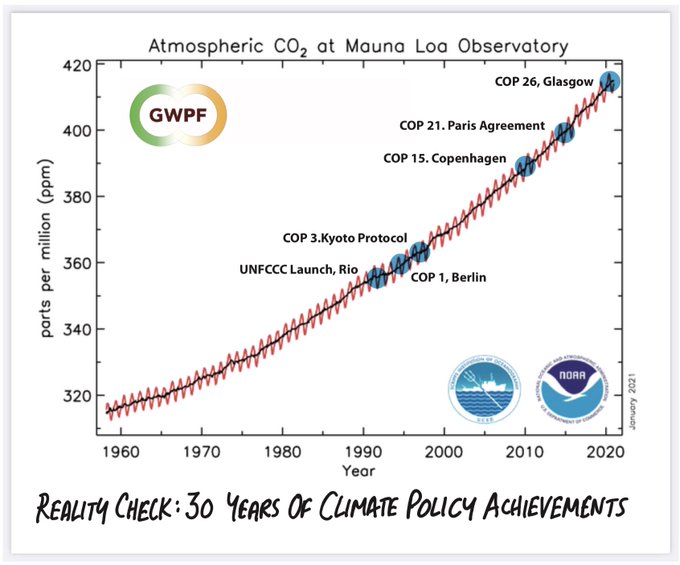
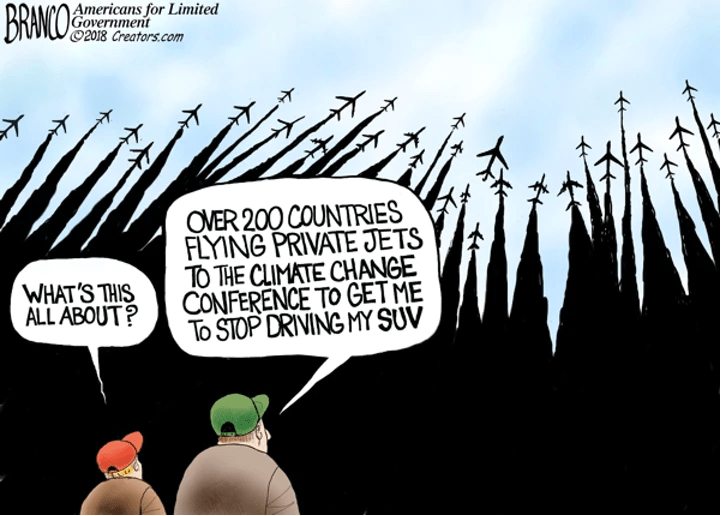
The graph illustrates the problem very clearly. Since 1994 there have been 24 Conferences of the Parties (COP), along with numerous other meetings. These UNFCCC discussions have utterly failed to reduce CO2 emissions. Yet from 2020, emissions have to drop dramatically, if we are to stand a chance of keeping global warming below 1.5°C.

According to IPCC SR15 this will require an annual average investment of around US$2.4 trillion (at 2010 prices) between 2016 and 2035, representing approximately 2.5% of global gross domestic product (GDP). The cost of inaction and delay, however, will be many times greater. (sic).  Note:  This is referring to increasing investments in renewable energy from current US$335B per year to $2.4T.  Present global spending on Climate Crisis Inc. is estimated at nearly US$2T, not limited to renewables.  So this would double the money wasted spent on this hypothetical problem.
cop planes

After reading Ball’s assessment it is obvious that carbon pricing will only reduce emissions by crashing national economies.  The fear of CO2 leads directly to discussion of stopping modern societies in their tracks.  Talking about policies that “bite” this or that sector equates to intentionally dictating economic decline, industry by industry.  And Ball suggests that ever more intrusive bans and regulations must be added on top of higher carbon prices in order to save the planet from our way of life.

This analysis has been preceded by numerous doomsday deadlines over the decades which we have passed and not suffered in the least.  Can we finally dismiss the illusion that we humans control the temperature of the planet?  Can we stop the crazy schemes to cut our CO2 emissions, and appreciate instead the greening of the biosphere?
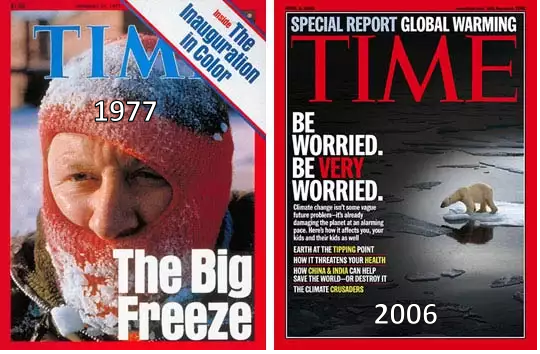
Rational public policymakers can not presume the climate will be unchanging in the future.  Our experience teaches that there will be future periods both warmer and cooler than the present.  History also shows that cold periods are the greater threat to human health and prosperity.  Instead of wasting time and resources trying to control the future weather, we should be preparing to adapt to whatever nature brings.  The priorities should be to ensure affordable and reliable energy and robust infrastructure.

See Also IPCC Freakonomics


Why Halting Failed Auto Fuel Standards 2020 Update

Update April 2, 2020: Much in the news today is the EPA relaxing of Obama-era auto fuel standards, along with the usual Trump bashing and complaining while ignoring why the efficiency rules were ill-advised. Text from a previous post is printed below explaining this positive development.

There are deeper reasons why US auto fuel efficiency standards are and should be rolled back.  They were instituted in denial of regulatory experience and science.  First, a parallel from physics.

In the sub-atomic domain of quantum mechanics, Werner Heisenberg, a German physicist, determined that our observations have an effect on the behavior of quanta (quantum particles).

The Heisenberg uncertainty principle states that it is impossible to know simultaneously the exact position and momentum of a particle. That is, the more exactly the position is determined, the less known the momentum, and vice versa. This principle is not a statement about the limits of technology, but a fundamental limit on what can be known about a particle at any given moment. This uncertainty arises because the act of measuring affects the object being measured. The only way to measure the position of something is using light, but, on the sub-atomic scale, the interaction of the light with the object inevitably changes the object’s position and its direction of travel.

Now skip to the world of governance and the effects of regulation. A similar finding shows that the act of regulating produces reactive behavior and unintended consequences contrary to the desired outcomes.

US Fuel Economy (CAFE) Standards Have Backfired

An article at Financial Times explains about Energy Regulations Unintended Consequences  Excerpts below with my bolds.

Goodhart’s Law holds that “any observed statistical regularity will tend to collapse once pressure is placed upon it for control purposes”. Originally coined by the economist Charles Goodhart as a critique of the use of money supply measures to guide monetary policy, it has been adopted as a useful concept in many other fields. The general principle is that when any measure is used as a target for policy, it becomes unreliable. It is an observable phenomenon in healthcare, in financial regulation and, it seems, in energy efficiency standards.

When governments set efficiency regulations such as the US Corporate Average Fuel Economy standards for vehicles, they are often what is called “attribute-based”, meaning that the rules take other characteristics into consideration when determining compliance. The Cafe standards, for example, vary according to the “footprint” of the vehicle: the area enclosed by its wheels. In Japan, fuel economy standards are weight-based. Like all regulations, fuel economy standards create incentives to game the system, and where attributes are important, that can mean finding ways to exploit the variations in requirements. There have long been suspicions that the footprint-based Cafe standards would encourage manufacturers to make larger cars for the US market, but a paper this week from Koichiro Ito of the University of Chicago and James Sallee of the University of California Berkeley provided the strongest evidence yet that those fears are likely to be justified.

Mr Ito and Mr Sallee looked at Japan’s experience with weight-based fuel economy standards, which changed in 2009, and concluded that “the Japanese car market has experienced a notable increase in weight in response to attribute-based regulation”. In the US, the Cafe standards create a similar pressure, but expressed in terms of size rather than weight. Mr Ito suggested that in Ford’s decision to end almost all car production in North America to focus on SUVs and trucks, “policy plays a substantial role”. It is not just that manufacturers are focusing on larger models; specific models are also getting bigger. Ford’s move, Mr Ito wrote, should be seen as an “alarm bell” warning of the flaws in the Cafe system. He suggests an alternative framework with a uniform standard and tradeable credits, as a more effective and lower-cost option. With the Trump administration now reviewing fuel economy and emissions standards, and facing challenges from California and many other states, the vehicle manufacturers appear to be in a state of confusion. An elegant idea for preserving plans for improving fuel economy while reducing the cost of compliance could be very welcome.

The paper is The Economics of Attribute-Based Regulation: Theory and Evidence from Fuel-Economy Standards Koichiro Ito, James M. Sallee NBER Working Paper No. 20500.  The authors explain:

An attribute-based regulation is a regulation that aims to change one characteristic of a product related to the externality (the “targeted characteristic”), but which takes some other characteristic (the “secondary attribute”) into consideration when determining compliance. For example, Corporate Average Fuel Economy (CAFE) standards in the United States recently adopted attribute-basing. Figure 1 shows that the new policy mandates a fuel-economy target that is a downward-sloping function of vehicle “footprint”—the square area trapped by a rectangle drawn to connect the vehicle’s tires.  Under this schedule, firms that make larger vehicles are allowed to have lower fuel economy. This has the potential benefit of harmonizing marginal costs of regulatory compliance across firms, but it also creates a distortionary incentive for automakers to manipulate vehicle footprint.

Attribute-basing is used in a variety of important economic policies. Fuel-economy regulations are attribute-based in China, Europe, Japan and the United States, which are the world’s four largest car markets. Energy efficiency standards for appliances, which allow larger products to consume more energy, are attribute-based all over the world. Regulations such as the Clean Air Act, the Family Medical Leave Act, and the Affordable Care Act are attribute-based because they exempt some firms based on size. In all of these examples, attribute-basing is designed to provide a weaker regulation for products or firms that will find compliance more difficult.

Summary from Heritage Foundation study Fuel Economy Standards Are a Costly Mistake Excerpt with my bolds.

The CAFE standards are not only an extremely inefficient way to reduce carbon dioxide emission but will also have a variety of unintended consequences.

For example, the post-2010 standards apply lower mileage requirements to vehicles with larger footprints. Thus, Whitefoot and Skerlos argued that there is an incentive to increase the size of vehicles.

Data from the first few years under the new standard confirm that the average footprint, weight, and horsepower of cars and trucks have indeed all increased since 2008, even as carbon emissions fell, reflecting the distorted incentives.

Manufacturers have found work-arounds to thwart the intent of the regulations. For example, the standards raised the price of large cars, such as station wagons, relative to light trucks. As a result, automakers created a new type of light truck—the sport utility vehicle (SUV)—which was covered by the lower standard and had low gas mileage but met consumers’ needs. Other automakers have simply chosen to miss the thresholds and pay fines on a sliding scale.

Another well-known flaw in CAFE standards is the “rebound effect.” When consumers are forced to buy more fuel-efficient vehicles, the cost per mile falls (since their cars use less gas) and they drive more. This offsets part of the fuel economy gain and adds congestion and road repair costs. Similarly, the rising price of new vehicles causes consumers to delay upgrades, leaving older vehicles on the road longer.

In addition, the higher purchase price of cars under a stricter CAFE standard is likely to force millions of households out of the new-car market altogether. Many households face credit constraints when borrowing money to purchase a car. David Wagner, Paulina Nusinovich, and Esteban Plaza-Jennings used Bureau of Labor Statistics data and typical finance industry debt-service-to-income ratios and estimated that 3.1 million to 14.9 million households would not have enough credit to purchase a new car under the 2025 CAFE standards.[34] This impact would fall disproportionately on poorer households and force the use of older cars with higher maintenance costs and with fuel economy that is generally lower than that of new cars.

CAFE standards may also have redistributed corporate profits to foreign automakers and away from Ford, General Motors (GM), and Chrysler (the Big Three), because foreign-headquartered firms tend to specialize in vehicles that are favored under the new standards.[35] 

Conclusion

CAFE standards are costly, inefficient, and ineffective regulations. They severely limit consumers’ ability to make their own choices concerning safety, comfort, affordability, and efficiency. Originally based on the belief that consumers undervalued fuel economy, the standards have morphed into climate control mandates. Under any justification, regulation gives the desires of government regulators precedence over those of the Americans who actually pay for the cars. Since the regulators undervalue the well-being of American consumers, the policy outcomes are predictably harmful.


Pandemic Response Not Model for Climate Action

Some wise reflections from Breakthrough Institute: Why the COVID-19 Response Is No Model for Climate Action by Alex Trembath and Seaver Wang. Excerpts in italics with my bolds and images.

A global emergency. Wartime mobilization. Calls to “listen to the scientists.” Demands for radical shifts in policy and human behavior. Tradeoffs between sacrifices today and larger suffering in the future. Politicization by all sides.The parallels between the ongoing COVID-19 crisis and climate change are obvious.

But contrary to the received wisdom among many climate analysts and advocates, those parallels mostly reveal just how different the two challenges are.

The COVID-19 pandemic is unfolding rapidly, demanding all of our attention. Climate change unfolds slowly, over decades, often so imperceptibly that we term the conditions of a changing climate as the “new normal.” COVID-19 presents as a frightening but conceptually simple problem: a novel virus that can be contained by quarantine, social distancing and, hopefully, immunization. Climate change presents as a “wicked” problem, which means its causes, impacts, key actors, and optimal levers for change are heavily contested. Responding to COVID-19 through behavioral shifts means putting our lives temporarily on hold for months to a year. Responding to climate change through behavioral shifts means a lifelong if not multi-generational commitment to population-wide lifestyle changes.

Nonetheless, the rapid virus–induced decline in economic activity has turned some climate hawks’ heads. “If weeks of suspended high-carbon economic activity can cut China’s emissions by a quarter,” tweeted climate activist Genevieve Guenther, “I don’t want to hear one fucking word about how decarbonizing quickly enough to maintain a livable planet is ‘unrealistic.’”

Others were more cautious in drawing comparisons. Pandemics and recessions are “hardly formulas activists should cheer, much less try to replicate going forward,” writes Kate Aronoff at the New Republic. “Wishing for a disaster to make the large-scale changes that scientists say are necessary to prevent a planetary collapse is counterproductive,” wrote Eric Holthaus.

This pandemic should then make us interrogate what we envision when we talk about a “climate emergency.” Such frames filter up meaningfully, after all: last summer, six then-presidential candidates joined a Democratic proposal to declare a “climate change emergency” to spur “sweeping reforms” in the United States. What those reforms would entail, though, remains unclear. Holthaus, whose practice is to addend many of his tweets with the warning “We are in a climate emergency,” wrote that we should “learn to treat each other better.” Aronoff used the drop in Chinese emissions to advocate a four-day work week. Guenther suggested that enforced suspension of economic activity for the climate’s sake would, obviously, utilize “smart policy” to be more “equitable” than the Chinese government’s forced quarantine policies.

Propaganda from Grist.

Yet one wonders whether people around the world might actually be less, not more, eager to entertain the idea of sweeping and intrusive responses to climate change thanks to ongoing events.

Perhaps that is because we are witnessing what a global emergency actually looks like. School and commerce are shut down. People are confined to their homes. Trade and travel are suspended. Weddings, social gatherings, and perhaps even the Olympics are canceled. Hourly workers are losing work and many others are losing jobs altogether. Fear and isolation are dominant.

And yet despite such costly personal and collective sacrifices, we are learning that there are disappointing limits to the emissions cuts that are possible under even draconian, government-enforced reductions of demand for goods and services. New economic projections are suggesting that China’s economy may shrink by up to 40% this quarter relative to January–March. The rhythm of daily life has literally ground to a halt for many hundreds of millions of Chinese people, and yet three-quarters of emissions stubbornly remain. Extreme conditions of degrowth and reduced consumption that are near-unanimously considered intolerable in the long-term have failed to mitigate anything close to a majority of greenhouse gas impacts.

And while emissions will surely decline this year, they might rebound strongly in future years, as China and other countries relax environmental regulations on fossil fuels to boost economic recovery. In the meantime, investment in clean technologies is likely to take a significant hit. Degrowth, it turns out, impacts the sectors and technologies we like as well as those we don’t.

But perhaps we might voluntarily consider maintaining some of the shifts in our lifestyles forced upon us by the quarantine? Doesn’t this moment teach us that we can take fewer flights, telecommute, eat out less, and otherwise reduce our consumption and environmental impact? We hesitate to draw too strong a conclusion here. People like traveling, for work and for pleasure, even when they know how carbon-intensive it is. People like eating out at restaurants, even if it is more expensive and tends to waste more food than eating at home. This moment might make us realize how precious, not frivolous, those experiences are.

Besides that, the absolute environmental impact of these lifestyle shifts is questionable. Take flying. For those of us privileged to write about climate change for a living, air travel likely accounts for much of our personal carbon footprint. But less than 20% of the planet has ever stepped foot on an airplane. COVID-19 is unlikely to change projections of tens of millions of new fliers in the coming decades, as consumers in China, India, Nigeria, Indonesia, Bangladesh, and elsewhere take to the skies for the first time. And to be crystal clear, these first journeys by air will open up once-unattainable personal, economic, and educational opportunities for countless lives and are milestones to be celebrated, not dreaded. Ultimately, what matters is not how many people are consuming a product or service but how carbon-intensive the underlying technologies are.

Certainly, the COVID-19 crisis does have important overlaps with the climate crisis. If anything, COVID-19 should motivate researchers and policymakers to act faster on decarbonization and adaptation, since the incidence of diseases and pandemics is likely to rise with global temperatures. Likewise, how we respond to COVID-19 could have significant climate implications. As the nations of the world stimulate and bail their way out of the coming recession, policy and infrastructure decisions can accelerate innovation and decarbonization. And, ultimately, the long-term solution to both climate and global health problems will be scientific and technological in nature: a vaccine or battery of medical treatments in the case of the virus, and affordable, scalable low-carbon technologies in the case of climate change.

But, in both psychological and political terms, we would caution against drawing too strong a connection between the two crises. We do not think the global community will look back on this time fondly. If the emergency response to the COVID-19 pandemic is held up as a model for climate action, we should not be surprised if public support is less than enthusiastic.

Further, in light of rising xenophobia, heightened international tensions, and opportunistic, discriminatory restrictions on movement and migration precipitating out of the current health emergency, we must be wary of a more selective application of the climate “lessons” of the COVID-19 response to serve an eco-facist agenda that promotes nativism and opposes immigration.

It is an understandable impulse to draw lessons from this or that crisis for other pressing global challenges, climate change among them. We share that impulse. However, the useful take-aways from comparing crises that are fundamentally different in nature are often few and disappointing. The climate crisis may feel just as immediate and pressing as an ongoing pandemic to those working in the climate space, but that does little to change the fact that governments and communities will not accept the adaptation of measures intended to fight pandemics on time horizons of months to years towards the decades-long challenge of climate change. Advocacy of such measures will not be viewed kindly, whether in the halls of political decision-making or in the court of public opinion.

The solutions for controlling the COVID-19 outbreak are simple. As decades of debate, advocacy, and politics should have abundantly demonstrated by now, the solutions for climate change are anything but.


No, Climate Didn’t Cause Coronavirus

It didn’t take long for climatists to tie coronavirus to global warming/climate change; IOW, “It’s our fault for using fossil fuels.” And also: “Changes to fight coronavirus also fight climate change.” Activists have a long record of claiming that de-carbonizing is a snake oil curing all of society’s ills. The latest memes give the flavor of the warped thinking.

Coronavirus hits a critical year for nature and climate chinadialogue11:08

The threats facing our planet are interconnected ArabNews10:27

Climate change helped coronavirus spread The Independent10:20

How Science Denial In High Places Accelerates Both COVID-19 and Climate Change Ecosystem Marketplace10:12

The Corona Connection The Nation08:14

Coronavirus and the climate: How we respond to deadly threats The Gazette07:15

The Coronavirus and the Climate Movement The New Yorker07:04

The carbon disruption is here, disguised as a pandemic ImpactAlpha04:10

For pandemics and climate change, voluntary measures aren’t enough Grist Magazine03:58

“In a way, the coronavirus is climate change’s publicist” Why now is the time to focus on our… Vogue India02:43

Liberals See Good from Coronavirus: Less Pollution NewsMax20:22 Tue, 17 Mar

How changes brought on by coronavirus could help tackle the climate crisis Corporate Knights17:19 Tue, 17 Mar

Think Tank Shifts From Climate Science Denial To COVID Denial Talking Points Memo16:11 Tue, 17 Mar

Coronavirus, climate crisis, conflicts: Meme-ing our way through the ‘apocalypse’ The Conversation (Canada)13:58 Tue, 17 Mar

Key readings about climate change and coronavirus Yale Climate Connections14:19

Green Jobs Are the Answer to the Coronavirus Recession The New Republic14:19

How COVID-19 Is Like Climate Change Scientific American11:07 Tue, 17 Mar

Climate change could make the coronavirus seem like the good old days. GreenBiz

Viruses expected to increase with global warming – expert The Times of Israel08:35 Tue, 17 Mar

Social distancing? You might be fighting climate change, too New Zealand Herald20:45 Mon, 16 Mar

Can the changes brought on by coronavirus help tackle climate change? Australian Geographic20:42 Mon, 16 Ma

Climatists have a pattern of blaming every bad thing on CO2 in order to promote their agenda. Thus adding in this virus is an extension of the practice of attributing exteme weather events to global warming/climate change. A previous post provides Mike Hulme’s analysis of the flawed logic, as well as the motivations behind these attempts.

extreme-weather-events

The antidote to such feverish reporting is provided by Mike Hulme in a publication: Attributing Weather Extremes to ‘Climate Change’: a Review (here).

He has an insider’s perspective on this issue, and is certainly among the committed on global warming (color him concerned). Yet here he writes objectively to inform us on X-weather, without advocacy: real science journalism and a public service, really.

Overview

In this third and final review I survey the nascent science of extreme weather event attribution. The article proceeds by examining the field in four stages: motivations for extreme weather attribution, methods of attribution, some example case studies and the politics of weather event Attribution.

The X-Weather Issue

As many climate scientists can attest, following the latest meteorological extreme one of the most frequent questions asked by media journalists and other interested parties is: ‘Was this weather event caused by climate change?’

In recent decades the meaning of climate change in popular western discourse has changed from being a descriptive index of a change in climate (as in ‘evidence that a climatic change has occurred’) to becoming an independent causative agent (as in ‘climate change caused this event to happen’). Rather than being a descriptive outcome of a chain of causal events affecting how weather is generated, climate change has been granted power to change worlds: political and social worlds as much as physical and ecological ones.

To be more precise then, what people mean when they ask the ‘extreme weather blame’ question is: ‘Was this particular weather event caused by greenhouse gases emitted from human activities and/or by other human perturbations to the environment?’ In other words, can this meteorological event be attributed to human agency as opposed to some other form of agency?

The Motivations

Hulme shows what drives scientists to pursue the “extreme weather blame” question, noting four motivational factors.

Why have climate scientists over the last ten years embarked upon research to provide an answer beyond the stock phrase ‘no individual weather event can directly be attributed to greenhouse gas emissions’?  There seem to be four possible motives.

1.Curiosity
The first is because the question piques the scientific mind; it acts as a spur to develop new rational understanding of physical processes and new analytic methods for studying them.

2.Adaptation
A second argument, put forward by some, is that it is important to know whether or not specific instances of extreme weather are human-caused in order to improve the justification, planning and execution of climate adaptation.

3.Liability
A third argument for pursuing an answer to the ‘extreme weather blame’ question is inspired by the possibility of pursuing legal liability for damages caused. . . If specific loss and damage from extreme weather can be attributed to greenhouse gas emissions – even if expressed in terms of increased risk rather than deterministically – then lawyers might get interested.

The liability motivation for research into weather event attribution also bisects the new international political agenda of ‘loss and damage’ which has emerged in the last two years. . . The basic idea is to give recognition that loss and damage caused by climate change is legitimate ground for less developed countries to gain access to new international climate adaptation funds.

4. Persuasion
A final reason for scientists to be investing in this area of climate science – a reason stated explicitly less often than the ones above and yet one which underlies much of the public interest in the ‘extreme weather blame’ question – is frustration with and argument about the invisibility of climate change. . . If this is believed to be true – that only scientists can make climate change visible and real –then there is extra onus on scientists to answer the ‘extreme weather blame’ question as part of an effort to convince citizens of the reality of human-caused climate change.

Attribution Methods

Attributing extreme weather events to human influences requires different approaches, of which four broad categories can be identified.

1. Physical Reasoning
The first and most general approach to attributing extreme weather phenomena to rising greenhouse gas concentrations is to use simple physical reasoning.

General physical reasoning can only lead to broad qualitative statements such as ‘this extreme weather is consistent with’ what is known about the human-enhanced greenhouse effect. Such statements offer neither deterministic nor stochastic answers and clearly underdetermine the ‘weather blame question.’ It has given rise to a number of analogies to try to communicate the non-deterministic nature of extreme event attribution. The three most widely used ones concern a loaded die (the chance of rolling a ‘6’ has increased, but no single ‘6’ can be attributed to the biased die), the baseball player on steroids (the number of home runs hit increases, but no single home run can be attributed to the steroids) and the speeding car-driver (the chance of an accident increases in dangerous conditions, but no specific accident can be attributed to the fast-driving).

2. Classical Statistical Analysis
A second approach is to use classical statistical analysis of meteorological time series data to determine whether a particular weather (or climatic) extreme falls outside the range of what a ‘normal’ unperturbed climate might have delivered.

All such extreme event analyses of meteorological time series are at best able to detect outliers, but can never be decisive about possible cause(s). A different time series approach therefore combines observational data with model simulations and seeks to determine whether trends in extreme weather predicted by climate models have been observed in meteorological statistics (e.g. Zwiers et al., 2011, for temperature extremes and Min et al., 2011, for precipitation extremes). This approach is able to attribute statistically a trend in extreme weather to human influence, but not a specific weather event. Again, the ‘weather blame question’ remains underdetermined.

slide20

3. Fractional Attributable Risk (FAR)
Taking inspiration from the field of epidemiology, this method seeks to establish the Fractional Attributable Risk (FAR) of an extreme weather (or short-term climate) event. It asks the counterfactual question, ‘How might the risk of a weather event be different in the presence of a specific causal agent in the climate system?’

The single observational record available to us, and which is analysed in the statistical methods described above, is inadequate for this task. The solution is to use multiple model simulations of the climate system, first of all without the forcing agent(s) accused of ‘causing’ the weather event and then again with that external forcing introduced into the model.

The credibility of this method of weather attribution can be no greater than the overall credibility of the climate model(s) used – and may be less, depending on the ability of the model in question to simulate accurately the precise weather event under consideration at a given scale (e.g. a heatwave in continental Europe, a rain event in northern Thailand) (see Christidis et al., 2013a).

4. Eco-systems Philosophy
A fourth, more philosophical, approach to weather event attribution should also be mentioned. This is the argument that since human influences on the climate system as a whole are now clearly established – through changing atmospheric composition, altered land surface characteristics, and so on – there can no longer be such a thing as a purely natural weather event. All weather — whether it be a raging tempest or a still summer afternoon — is now attributable to human influence, at least to some extent. Weather is the local and momentary expression of a complex system whose functioning as a system is now different to what it would otherwise have been had humans not been active.

Results from Weather Attribution Studies

Hulme provides a table of numerous such studies using various methods, along with his view of the findings.

It is likely that attribution of temperature-related extremes using FAR methods will always be more attainable than for other meteorological extremes such as rainfall and wind, which climate models generally find harder to simulate faithfully at the spatial scales involved. As discussed below, this limitation on which weather events and in which regions attribution studies can be conducted will place important constraints on any operational extreme weather attribution system.

Political Dimensions of Weather Attribution

Hulme concludes by discussing the political hunger for scientific proof in support of policy actions.

But Hulme et al. (2011) show why such ambitious claims are unlikely to be realised. Investment in climate adaptation, they claim, is most needed “… where vulnerability to meteorological hazard is high, not where meteorological hazards are most attributable to human influence” (p.765). Extreme weather attribution says nothing about how damages are attributable to meteorological hazard as opposed to exposure to risk; it says nothing about the complex political, social and economic structures which mediate physical hazards.

And separating weather into two categories — ‘human-caused’ weather and ‘tough-luck’ weather – raises practical and ethical concerns about any subsequent investment allocation guidelines which excluded the victims of ‘tough-luck weather’ from benefiting from adaptation funds.

Contrary to the claims of some weather attribution scientists, the loss and damage agenda of the UNFCCC, as it is currently emerging, makes no distinction between ‘human-caused’ and ‘tough-luck’ weather. “Loss and damage impacts fall along a continuum, ranging from ‘events’ associated with variability around current climatic norms (e.g., weather-related natural hazards) to [slow-onset] ‘processes’ associated with future anticipated changes in climatic norms” (Warner et al., 2012:21). Although definitions and protocols have not yet been formally ratified, it seems unlikely that there will be a role for the sort of forensic science being offered by extreme weather attribution science.

Conclusion

Thank you Mike Hulme for a sane, balanced and expert analysis. It strikes me as being another element in a “Quiet Storm of Lucidity”.

Is that light the end of the tunnel or an oncoming train?