Update Regulatory Backfire

Update Nov. 22, 2018

With the Democrats taking control of the US House of Representatives, we can expect attempts to again “fight climate change” by means of counter productive regulations.  This post explains why such policies are ineffective and produce unintended consequences, with results worse than doing nothing.

Background:  Heisenberg Uncertainty

In the sub-atomic domain of quantum mechanics, Werner Heisenberg, a German physicist, determined that our observations have an effect on the behavior of quanta (quantum particles).

The Heisenberg uncertainty principle states that it is impossible to know simultaneously the exact position and momentum of a particle. That is, the more exactly the position is determined, the less known the momentum, and vice versa. This principle is not a statement about the limits of technology, but a fundamental limit on what can be known about a particle at any given moment. This uncertainty arises because the act of measuring affects the object being measured. The only way to measure the position of something is using light, but, on the sub-atomic scale, the interaction of the light with the object inevitably changes the object’s position and its direction of travel.

Now skip to the world of governance and the effects of regulation. A similar finding shows that the act of regulating produces reactive behavior and unintended consequences contrary to the desired outcomes.

An article at Financial Times explains about Energy Regulations Unintended Consequences  Excerpts below with my bolds.

Goodhart’s Law Regarding Policy Effects

Goodhart’s Law holds that “any observed statistical regularity will tend to collapse once pressure is placed upon it for control purposes”. Originally coined by the economist Charles Goodhart as a critique of the use of money supply measures to guide monetary policy, it has been adopted as a useful concept in many other fields. The general principle is that when any measure is used as a target for policy, it becomes unreliable. It is an observable phenomenon in healthcare, in financial regulation and, it seems, in energy efficiency standards.

When governments set efficiency regulations such as the US Corporate Average Fuel Economy standards for vehicles, they are often what is called “attribute-based”, meaning that the rules take other characteristics into consideration when determining compliance. The Cafe standards, for example, vary according to the “footprint” of the vehicle: the area enclosed by its wheels. In Japan, fuel economy standards are weight-based. Like all regulations, fuel economy standards create incentives to game the system, and where attributes are important, that can mean finding ways to exploit the variations in requirements. There have long been suspicions that the footprint-based Cafe standards would encourage manufacturers to make larger cars for the US market, but a paper this week from Koichiro Ito of the University of Chicago and James Sallee of the University of California Berkeley provided the strongest evidence yet that those fears are likely to be justified.

Mr Ito and Mr Sallee looked at Japan’s experience with weight-based fuel economy standards, which changed in 2009, and concluded that “the Japanese car market has experienced a notable increase in weight in response to attribute-based regulation”. In the US, the Cafe standards create a similar pressure, but expressed in terms of size rather than weight. Mr Ito suggested that in Ford’s decision to end almost all car production in North America to focus on SUVs and trucks, “policy plays a substantial role”. It is not just that manufacturers are focusing on larger models; specific models are also getting bigger. Ford’s move, Mr Ito wrote, should be seen as an “alarm bell” warning of the flaws in the Cafe system. He suggests an alternative framework with a uniform standard and tradeable credits, as a more effective and lower-cost option. With the Trump administration now reviewing fuel economy and emissions standards, and facing challenges from California and many other states, the vehicle manufacturers appear to be in a state of confusion. An elegant idea for preserving plans for improving fuel economy while reducing the cost of compliance could be very welcome.

The paper is The Economics of Attribute-Based Regulation: Theory and Evidence from Fuel-Economy Standards Koichiro Ito, James M. Sallee NBER Working Paper No. 20500.  The authors explain:

An attribute-based regulation is a regulation that aims to change one characteristic of a product related to the externality (the “targeted characteristic”), but which takes some other characteristic (the “secondary attribute”) into consideration when determining compliance. For example, Corporate Average Fuel Economy (CAFE) standards in the United States recently adopted attribute-basing. Figure 1 shows that the new policy mandates a fuel-economy target that is a downward-sloping function of vehicle “footprint”—the square area trapped by a rectangle drawn to connect the vehicle’s tires.  Under this schedule, firms that make larger vehicles are allowed to have lower fuel economy. This has the potential benefit of harmonizing marginal costs of regulatory compliance across firms, but it also creates a distortionary incentive for automakers to manipulate vehicle footprint.

Attribute-basing is used in a variety of important economic policies. Fuel-economy regulations are attribute-based in China, Europe, Japan and the United States, which are the world’s four largest car markets. Energy efficiency standards for appliances, which allow larger products to consume more energy, are attribute-based all over the world. Regulations such as the Clean Air Act, the Family Medical Leave Act, and the Affordable Care Act are attribute-based because they exempt some firms based on size. In all of these examples, attribute-basing is designed to provide a weaker regulation for products or firms that will find compliance more difficult.

Summary from Heritage Foundation study Fuel Economy Standards Are a Costly Mistake Excerpt with my bolds.

The CAFE standards are not only an extremely inefficient way to reduce carbon dioxide emission but will also have a variety of unintended consequences.

For example, the post-2010 standards apply lower mileage requirements to vehicles with larger footprints. Thus, Whitefoot and Skerlos argued that there is an incentive to increase the size of vehicles.

Data from the first few years under the new standard confirm that the average footprint, weight, and horsepower of cars and trucks have indeed all increased since 2008, even as carbon emissions fell, reflecting the distorted incentives.

Manufacturers have found work-arounds to thwart the intent of the regulations. For example, the standards raised the price of large cars, such as station wagons, relative to light trucks. As a result, automakers created a new type of light truck—the sport utility vehicle (SUV)—which was covered by the lower standard and had low gas mileage but met consumers’ needs. Other automakers have simply chosen to miss the thresholds and pay fines on a sliding scale.

Another well-known flaw in CAFE standards is the “rebound effect.” When consumers are forced to buy more fuel-efficient vehicles, the cost per mile falls (since their cars use less gas) and they drive more. This offsets part of the fuel economy gain and adds congestion and road repair costs. Similarly, the rising price of new vehicles causes consumers to delay upgrades, leaving older vehicles on the road longer.

In addition, the higher purchase price of cars under a stricter CAFE standard is likely to force millions of households out of the new-car market altogether. Many households face credit constraints when borrowing money to purchase a car. David Wagner, Paulina Nusinovich, and Esteban Plaza-Jennings used Bureau of Labor Statistics data and typical finance industry debt-service-to-income ratios and estimated that 3.1 million to 14.9 million households would not have enough credit to purchase a new car under the 2025 CAFE standards.[34] This impact would fall disproportionately on poorer households and force the use of older cars with higher maintenance costs and with fuel economy that is generally lower than that of new cars.

CAFE standards may also have redistributed corporate profits to foreign automakers and away from Ford, General Motors (GM), and Chrysler (the Big Three), because foreign-headquartered firms tend to specialize in vehicles that are favored under the new standards.[35] 

Conclusion

CAFE standards are costly, inefficient, and ineffective regulations. They severely limit consumers’ ability to make their own choices concerning safety, comfort, affordability, and efficiency. Originally based on the belief that consumers undervalued fuel economy, the standards have morphed into climate control mandates. Under any justification, regulation gives the desires of government regulators precedence over those of the Americans who actually pay for the cars. Since the regulators undervalue the well-being of American consumers, the policy outcomes are predictably harmful.


Midterms: Voters Rejected Most Climate Energy Propositions


Nevada voters passed Question 6 on Tuesday, which calls for the state to use 50 percent renewable energy by the year 2030. Supporters say Question 6 will generate hundreds of millions of dollars in economic activity and create thousands of new Nevada jobs (sic)

“Clean energy is putting Nevadans to work, with more than 25,000 strong employed in 2017,” said Ray Fakhoury, state policy manager with the national business group Advanced Energy Economy, in statement. “By increasing the state’s renewable standard, Nevada has set itself up to continue reaping the economic benefits for years to come.”

Major corporations, including casinos and data centers, have recently been investing heavily in renewable energy in Nevada. With the passage of Question 6, Alli Gold Roberts, senior manager of state policy with Ceres, said the state is “poised to continue to attract corporate renewable energy investment.”

Question 6, to boost the RPS to 50 percent, will now have to pass again in 2020 in order to become law. AEE’s Fakhoury said consumers could see benefits sooner than that. “Passing with wide support, the legislature and governor-elect should move forward in the upcoming legislative session to enact this landmark increase,” he said.

Corporate clean energy buyers invested heavily in a separate Nevada ballot measure, Question 3, which sought to deregulate Nevada’s retail electricity market, but the measure was ultimately unsuccessful. Question 3 was the subject of fierce debate. According to the Nevada Independent, it was backed by Sheldon Adelson’s Sands Corp. (Adelson also happens to be a major Republican donor) and the data company Switch, as well as many clean energy and environmental groups.

But there were also concerns about how Question 3 would affect electricity rates and clean energy adoption. The Natural Resources Defense Council, the Sierra Club, Southwest Energy Efficiency Project, and Western Resource Advocates came out against deregulating Nevada’s electricity market because of the disruption they said it would cause to the state’s clean energy progress. NV Energy also opposed Question 3, and planned to spend $30 million on defeating it.

Arizona rejects 50% RPS
Arizona voters overwhelmingly rejected Proposition 127 on Tuesday, a constitutional amendment that would have required 50 percent of the state’s electricity to come from renewable sources by 2030. It’s a significant victory for the state’s largest utility, Arizona Public Service (APS), which spent heavily to oppose the measure. California billionaire Tom Steyer’s political group NextGen America funded efforts in support of the measure.

Proposition 127 was by far the most expensive ballot initiative in Arizona state history. Opponents said the measure would increase electric bills by forcing utilities to build new solar and wind plants, which would result in the early closure of coal plants and the state’s lone nuclear plant. Supporters argued those claims were unfounded given that renewable energy resources are now competitive with fossil fuels, even when coupled with battery storage.

APS was particularly outspoken about losing the Palo Verde nuclear plant if the RPS measure passed. If that plant goes offline, the utility argued, greenhouse gas emissions in the state would rise.

While Proposition 127 has failed, Arizona regulators are still considering a proposal to increase Arizona’s RPS to 80 percent by 2050 and broaden it to also include nuclear power. APS generally supports that plan.

Colorado votes down a fracking ban
Colorado voters rejected a measure Tuesday that would have blocked new oil and gas drilling within 2,500 feet of homes, schools and other occupied areas.

Proposition 112 stemmed from complaints that fracking was encroaching on populated areas, creating health and safety concerns. An analysis showed that the measure would have blocked new oil and gas wells on 85 percent of nonfederal land in Colorado, which is America’s fifth-largest gas-producing and seventh-largest oil-producing state.

Washington state rejects a carbon price — again
Washington state has failed, once again, to pass a carbon tax. Initiative 1631, the Carbon Emissions Fee Measure, would have set a carbon fee starting at $15 per ton in 2020, rising to around $55 per ton in 2035, depending on inflation.

This is the second major election in a row in which Washington voters have rejected a ballot initiative that would put a price on carbon emissions. The first such ballot was proposed in 2016 and failed.

Tuesday’s loss may cast doubt on the broader narrative that states will lead on climate action in the absence of federal leadership, or it could signal that Americans simply aren’t ready to get behind a carbon tax. Alternatively, it could have all come down to spending. Supporters of Initiative 1631 spent at least $12 million to advance the measure, while opponents spent more than $25 million.

Source: Greentech Media  Midterms 2018: Mixed Results for the Renewable Energy Agenda

Background: Five States to Vote on Futile Climate Proposals

Taxing Carbon is Bad Economics

At Institute of Economic Affairs, IEA’s Director of Research Dr Jamie Whyte explains (here) why taxing carbon is a bad economic idea. Excerpts in italics with my bolds.

The emission of greenhouse gases – CO2 from burning fossil fuels and methane from flatulent livestock – is warming the global climate. Let’s not quibble about this scientific consensus, even if there are grounds for scepticism. The question for economists is the proper policy response.

The standard view is that greenhouse emissions are a classic negative externality, and that a Pigouvian tax should be applied. For example, farmers should pay a “fart tax” for each cow they own. This would internalise the external cost of the farts, and cows would be farmed only when the total benefits of doing so exceeded the total cost.

This is preferable to a cap-and-trade system, because the cap is arbitrary. If the price of emitting CO2 under such a scheme were to exceed the external cost (the Pigouvian tax), then too little CO2 would be emitted.

Ronald Coase’s insights about managing external costs through private bargaining are irrelevant here because no one owns the climate and, even if such rights were assigned, the owners would be so numerous and dispersed that the costs of bargaining would be prohibitive.


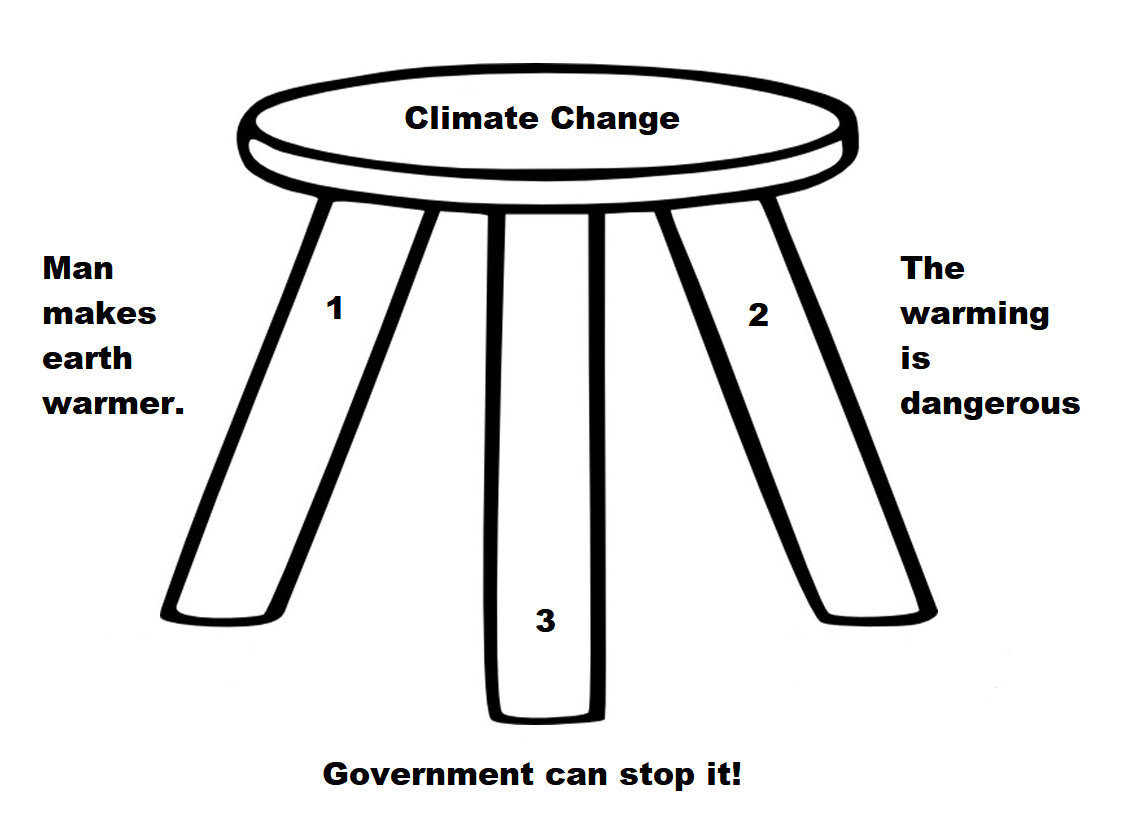
Climate change is a stool standing only if all three assertions are true. This post is addressing the last one.

But does anthropogenic global warming warrant a Pigouvian tax on the emission of greenhouse gases?

The first difficulty is estimating the external cost of greenhouse gas emissions and, hence, the size of the tax. Begin by noting that global warming will have benefits. Increased CO2 emissions have caused a great greening of the planet over the last 20 years. If the climate warms as predicted, vast tracts of land in Russia and Canada, now too cold for agriculture, will become arable. We should expect food to become more abundant and cheaper. More generally, the costs created by cold weather – heating, delays in construction work, etc – should decline. Many people like warm weather. They pay good money to travel to it. I would willingly pay £2,000 a year to make London five degrees warmer.

Of course, there will be costs too. Sea levels may rise, swamping some now inhabited areas. Some places may become too hot for comfortable habitation or agriculture (though these are sure to be smaller than the cold areas made usable). The number of storms may increase, destroying property and interrupting economic activity.

So what is the net cost? No one knows. They don’t even know if it is negative or positive. So they don’t know if greenhouse gas emissions should be taxed or subsidised.

This not an anti-science position. Scientists can predict physical outcomes (with varying degrees of certainty, which, in the case of climate science, is low). But they cannot predict economic outcomes. They cannot tell you the value of those physical outcomes. Global warming will have many effects – some positive, some negative – on a vast number of people with very different environmental circumstances, incomes and preferences. Anyone who claims to know the net aggregate value of global warming displays amazing overconfidence.

Some will say that ignorance itself gives us reason to impose the Pigouvian tax (at some arbitrarily chosen level, as is unavoidable given our ignorance). We should think of it as an insurance policy. The dire warnings may be true and, just in case they are, we should take measures to reduce emissions. Think of the tax as an insurance premium paid against the risk of global warming being net negative.

Yet this logic fails by simply reversing the argument. Global warming might benefit mankind. It would be a tragedy if we didn’t take the opportunity this presents. To avoid this risk, we should tax people to subsidise greenhouse gas emissions. Think of the tax as an insurance premium paid against the risk of missing out on global warming.

This ignorance argument against taxing or subsidising greenhouse gas emissions applies to many things with spill-over effects. Revealing clothes, for example. They affect people besides those who choose to wear them. Are these external effects positive or negative? The answer differs from beholder to beholder and context to context.

There is also a political problem to applying Pigouvian taxes to greenhouse gas emissions – namely, that it is likely to simply relocate emissions rather than cut them. A carbon tax applied in the US will shift (marginal) industrial production to places that don’t apply it. Carbon taxes are one of those cases where there is no point doing something unless (almost) everyone else does it too. Those who advocate applying one in their own country are implicitly committed to the idea that all other relevant countries will also apply one. But that is implausible. The gains from breaking ranks are too great.

Given our ignorance and the implausibility of a globally enforced Pigouvian tax, we should just wait and see. We can adapt to the ill-effects of global warming – relocating activities if need be or building sea defences – while taking advantage of the gains. And we can do this without incurring any immediate cost. Let future people, who will be richer than us, pay for the costs that may arise.

UN “Stretches” CO2 Goals

Several articles are in the media discussing UN meetings in progress to move the climate change goal posts from preventing 2C of warming to a goal of 1.5C additional warming. The US have questioned the plausibility of such an ambition, and this post goes into some of the reasons why. At the bottom I shall raise several skeptical points about this whole enterprise, but first we should look at the data UN uses as a trampoline for leaps of faith.

Data on Annual CO2 Concentrations

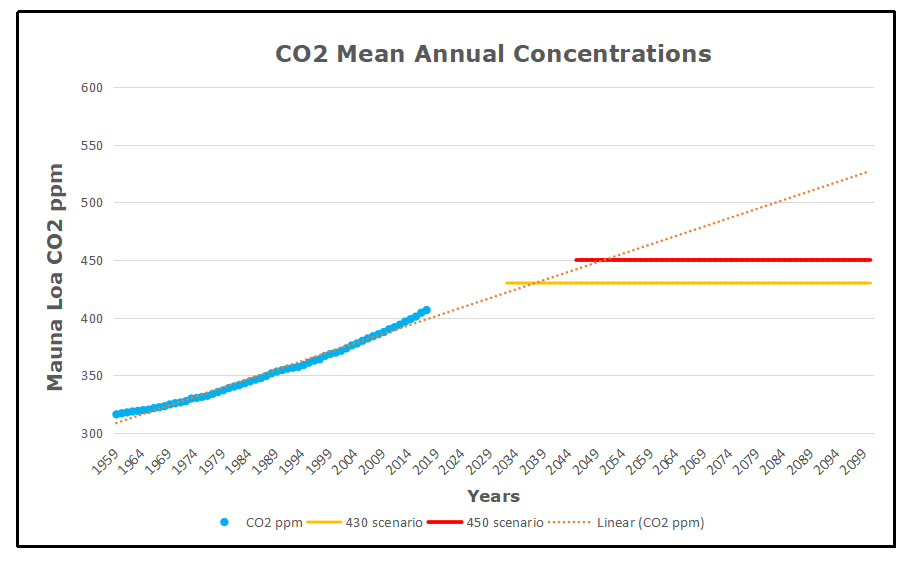
The annual average concentrations of atmospheric CO2 are reported from Mauna Loa in a dataset accessed from NOAA here. The graph below shows the record.
Note that in 1959 there was 316 ppm of CO2 according to this dataset, and in 2017 the annual average CO2 was 407 ppm. So the rise of 91 ppm over 59 years is a rate of 1.53 ppm per year. Of course the actual interannual differences vary from that average rate, and as we shall see, many recent years have exceeded 2 ppm per year additional CO2. The table below shows all years in the record that added more than 2 ppm of CO2.

Year Added ppm
1973 2.23
1988 2.38
1998 2.97
2003 2.52
2005 2.28
2006 2.1
2010 2.47
2012 2.2
2013 2.67
2014 2.13
2015 2.18
2016 3.38
2017 2.32

Note that as warming increased so also did CO2 in ppm. You can pick out El Nino years in the list, suggesting that ocean outgassing has a large impact on atmospheric CO2.

The larger point is that, for whatever reasons, the annual addition of CO2 has increased this century to a rate of 2.14 over the last 20 years.

UN Aspirational Goalposts

UN insiders have been making a simple case for some years preceding the Paris 2015 accord. IPCC has claimed that in their judgement keeping atmospheric CO2 less than 450 ppm ensures future warming will not exceed 2C. I don’t buy it, but that has been sold to Paris signatories. Now comes increasing the ambition to limit warming to 1.5C, and the same authorities translate that into a limit of 430 ppm of CO2.

These numbers and their logic can be seen in a document from Climate Analytics: Timetables for Zero emissions and 2050 emissions reductions  Excerpts in italics with my bolds.

This briefing note outlines suggested time frames for reaching zero global CO2 and total greenhouse gas emissions for the ‘below 2 °C’ and ‘below 1.5 °C by 2100’ limits based on the findings of the Fifth Assessment Report of the Intergovernmental Panel on Climate Change (IPCC AR5) and the 2014 UNEP Emissions Gap Report.

Emissions scenarios leading to GHG concentrations in 2100 of about 450 ppm CO2eq or lower are likely to maintain warming below 2 °C over the 21st century relative to pre-industrial levels. These scenarios are characterized by 40% to 70% global anthropogenic GHG emissions reductions by 2050 compared to 2010, and emissions levels near zero or below in 2100.” (IPCC AR5 SYR) Information in Table SPM.1 of the IPCC AR5 SYR

“A limited number of studies provide scenarios that are more likely than not to limit warming to 1.5 °C by 2100; these scenarios are characterized by concentrations below 430 ppm CO2eq by 2100 and 2050 emission reduction between 70% and 95% below 2010.” (IPCC AR5 SYR)

UN Goals Stretch Beyond Credibility

So let’s look at these two scenarios in relation to observed CO2 in the atmosphere.

The blue line is CO2 in ppm observed at Mauna Loa.  The linear regression line shows the continuation of the 1.53 ppm per year rate projected to the end of this century.  As noted above the blue line is already exceeding the earlier rate.  The orange line shows CO2 hitting 430 ppm in 2032 at the 1.53 rate, or earlier if more recent rates continue.  For example, if the 2.14 ppm per year rate continues, 430 ppm is reached by 2028. The red 450 scenario is reached in 2045. Both scenarios presume zero additional CO2 after those dates.

UN Piles Supposition on Top of Supposition

Previous posts here have taken issue with UN IPCC assertions that rising CO2 causes temperatures to rise and that human fossil fuel emissions cause CO2 to rise.

See: Who to Blame for Rising CO2

CO2 Fluxes, Sources and Sinks

How Climate Law Relies on Paris

No Mention of climate or warming in New NA Trade Accord 

Hats off to all for arriving at an agreement for economic transactions unburdened by obsessions with CO2 and unfounded claims of humans controlling the weather. A survey of the text shows the terms “climate” and “warming” do not appear even once. Good job!

Of course, greens are up in arms. Imagine signing a trade agreement that does nothing to destroy our economies in order to save the planet from CO2.

The deal does have a chapter on the environment, but critics such as the Council of Canadians call it weak and unenforceable.

It mentions pollution, marine traffic, endangered animals and ozone, but ignores what many call the world’s largest environmental challenge.

“The deal doesn’t even mention climate change,” Stewart said.

What has been thrown out is a provision in the old North American Free Trade Agreement that allowed corporations to sue governments for lost profits if they were injured by public-interest regulations such as environmental laws. The Council of Canadians pointed out that Canada was sued 37 times, mostly by American companies, under the old clause.

Update October 2, 2018

The new NA trade accord also strengthens energy security and trade. From offshore-technology.com:

The US oil and gas industry has urged Congress to approve the Trump administration’s renegotiated North American Free Trade Agreement (NAFTA), saying that the deal will support US oil and gas exports across North and South America.

American Petroleum Institute president and CEO Mike Sommers said: “We urge Congress to approve the United States-Mexico-Canada-Agreement (USMCA). Having Canada as a trading partner and a party to this agreement is critical for North American energy security and US consumers. Retaining a trade agreement for North America will help ensure the US energy revolution continues into the future.”

There were concerns in the industry that Trump would scrap the NAFTA, which was pivotal in making Mexico the largest exporter of US oil, transportation fuel, and natural gas.

Meanwhile, with support from the trade agreement, Canada is the largest supplier of foreign oil and a significant exporter of electricity to the US.

The deal also makes Canada’s heavier crude oil more attractive to refiners in the Mexican Gulf, especially at a time when Venezuela’s production has reduced amid political and financial worries. Fracked US crude oil is lighter, and refineries in the Gulf, which traditionally deal with heavier crude, are still adjusting their processing practices.

The new NAFTA deal ensures a ‘zero-tariff’ on energy products traded between the US, Mexico and Canada.


Ontario to Scrap Green Energy Act

Update September 21, 2018 at bottom

Global News reports on today;s proposed legislation: Ontario PCs introduce legislation to scrap Green Energy Act.  Excerpts in italics with my bolds.

Doug Ford‘s Progressive Conservative government has introduced legislation to put an end to the province’s Green Energy Act.

The legislation was tabled just before 1:30 p.m. ET Thursday. A formal announcement was made by energy minister, Greg Rickford, and infrastructure minister, Monte McNaughton.

“The Green Energy Act represents the largest transfer of money from the poor and middle class to the rich in Ontario’s history,” Rickford said.

Killing the former Liberal government’s Green Energy Act — passed in 2009 when Dalton McGuinty was premier — was a major campaign promise for Ford.

He said that the GEA had resulted in fewer manufacturing jobs in Ontario and that regulations around renewable energy projects had led to higher electricity prices for consumers.

Reddy the shiv

The move comes after the PC government had already introduced legislation cancelling hundreds of wind energy projects approved under the act.

Scrapping the GEA will likely mean major changes for the province’s energy sector.

For example, under the GEA, municipalities were essentially barred from disallowing renewable energy projects – such as wind farms – from being built within their territory. Many people opposed to these projects criticized this section of the GEA, saying it prohibited local communities from deciding their own futures.

The GEA also gave special powers to the minister of energy to green light certain projects, such as transmission lines, without conducting a full economic review prior to approval.

But proponents of the GEA, including former energy minister George Smitherman, who helped pass the legislation, have called the GEA and renewable energy projects in the province a big success.

Meanwhile, Liberal interim leader, John Fraser, says cancellation of the GEA could see Ontario move backward on renewable energy when compared to the rest of the world. He also fears scrapping the act could mean job losses

“My biggest concern this afternoon is jobs. What’s going to happen to people’s jobs in this industry that we’ve built up – tens of thousands of jobs,” Fraser said.

But the PCs say this isn’t true.

They say that the GEA was responsible for the “disastrous” feed-in-tariff program that contributed significantly toward skyrocketing electricity prices and that the bill’s repeal is necessary to prevent “unneeded” renewable energy projects being approved in the future.

“We believe the people of Ontario should have the final say about what gets built in their communities,” McNaughton said.

Update September 21, 2018

Some news reports have given more air time to reaction from greens.  Lorrie Goldstein at Toronto Sun instead goes into more detail why the Ontario Green Act is a failure: Good riddance to toxic Green Energy Act  Excerpts in italics with my bolds.

By scrapping the Green Energy Act, passed by former Liberal premier Dalton McGuinty in 2009, Premier Doug Ford is ending one of the worst legislative disasters ever inflicted on the people of Ontario.

The GEA is largely responsible for Ontario’s skyrocketing electricity prices.

It’s the reason we’re paying outrageously high prices for green energy the Liberals didn’t need in order to eliminate coal power, which was actually done using nuclear power and natural gas.

The jobs the Liberals promised under the GEA never materialized, according to former Ontario auditor general Jim McCarter in his 2011 annual report.

The GEA made Ontario’s energy grid less efficient because it required the province to buy expensive and unreliable wind and solar power from green energy developers under 20-year contracts, before purchasing other forms of energy.

Auditor General Bonnie Lysyk reported in 2016 that Ontario electricity consumers had overpaid $9.2 billion for green energy, because the Liberals ignored the advice of their own experts on how to price it.

Under the GEA, the Liberals abdicated from the proper role of government, which is to balance public and private interests.

Instead, they became cheerleaders for the wealthy green energy lobby.

Citizens opposed to green energy projects imposed on their communities faced the impossible task of fighting the industry and the Liberal government.

Ford is right to scrap the GEA.

The tragedy is that the economic damage it caused under the McGuinty/Wynne Liberals will be felt for decades to come.

Carbon Credits Backfire

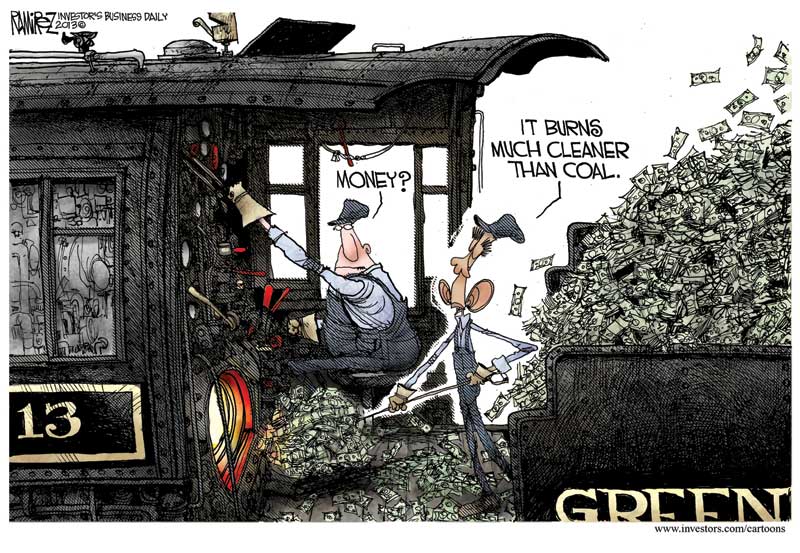
One of the favorite climate policy prescriptions is to apply carbon pricing either by a direct tax or by requiring purchase of carbon credits or offsets.  Now comes a report of unintended consequences, namely that rising prices for carbon credits have increased the demand for coal, the most disliked of all fossil fuels.

From Bloomberg Why Higher Pollution Costs Aren’t Denting Coal Demand in EU  Excerpts in italics with my bolds.

If you thought the surging price of fossil-fuel emissions in Europe would hurt coal demand, think again.

The highest prices for carbon credits in a decade have also lifted natural gas, discouraging power stations from making the switch away from coal. As a result, demand remains strong for the dirtiest fossil fuel in the continent that’s doing the most to clean up its economy. Coal prices as a result reached their highest in five years on Tuesday.

Gas futures would need to plunge by more than 20 percent before coal-fired power stations become uneconomic to run, based on current market prices for fuel and electricity, according to Georgi Slavov, head of research at broker Marex Spectron.

“This is highly unlikely” through at least November, Slavov said. “There are no plausible scenarios which support pricing out of coal.”

Demand for coal in China and India is drawing in cargoes that otherwise would land at plants in Europe from the Netherlands to Germany. The Dutch front-year contract recovered from losses early in the year to rise almost 13 percent, climbing alongside gas and oil.

Gas-fired generators, Chinese importers of liquefied natural gas and storage sites in mainland Europe are all competing for the same shipments, stoking the cleaner fuel’s rally. There simply hasn’t been much spare gas supply to allow switching from coal because of carbon’s price surge.

Global coal imports are set to reach a record 1.01 billion tons this year, exceeding 2013’s level, which was just below 1 billion tons, according to Guillaume Perret, founder and director of Perret Associates Ltd., a London-based research company.

“The coal market is now facing a structural shortage” of investment, including in mines and logistics, Perret said.


clean energy backfire2

How Goes the Transition Away from Fossil Fuels

The first objective in the Great Green Transition is to stop the use of Coal, Climate Enemy #1. An update report on that front comes from Vijay Jayaraj, Aug 18, 2018, at Townhall The Dawn of Climate Realism: Coal Surges Amid Climate Rhetoric  Excerpts in italics with my bolds.

Many countries have been at the crisscross of warfare between anti-coal establishments and the traditional coal industry. Despite the elite-empowered and politically motivated worldwide campaign to phase out coal, demand for coal is on the rise!

Coal has been “enemy No. 1” for the climate establishment. In fact, it would seem that the entire global warming movement is hinged upon the singular aim to eliminate coal from use.

Catastrophic Anthropogenic Global Warming (CAGW) is a notion that cites a popular scientific hypothesis and concludes that the global temperatures have risen, or will soon rise, to dangerous levels in the post-industrialized era due to human activity.

The proponents of CAGW believe that the primary contributor to this increase in temperature is the combustion of coal and the subsequent release of carbon dioxide gas into the atmosphere.

However, peer-reviewed scientific journals by hundreds of scientists render many of these claims dubious at best. Here are just three of them.

Firstly, contrary to the claim that carbon dioxide is the primary driver of global warming, global temperatures have not risen proportionately to carbon dioxide concentration in the atmosphere. In other words, an increase in carbon dioxide emission has not resulted in an increase in temperature.

Secondly, most of the current “consensus” on climate change is based on forecasts from computer climate models. But the wide divergence between observed temperature and model predictions makes it apparent that the models were programmed incorrectly to be over-dependent on carbon dioxide concentration to predict temperature changes.

In what was a major embarrassment to United Nations Intergovernmental Panel on Climate Change (IPCC), top climate scientists admitted these flaws in the climate models when they failed to reflect real-world temperatures during the last 19 years. The same was widely publicized and even testified to the U.S. House Committee on Science, Space & Technology.

Thirdly, contrary to the claim that recent warming is historically unprecedented, today’s temperature levels are similar to the temperatures the earth experienced in the first and eleventh centuries. Also known as Roman Warm Period and Medieval Warm Period, these were times when, though as warm as today or warmer, the earth’s ecosystems flourished. The notion that “today’s temperature levels are at unprecedented levels” is completely false.

Despite these (and many more) straight-forward evidences against the CAGW hypothesis, the climate establishment continues to advocate for the ban of coal and coal-fired power plants. Global climate treaties like the Paris Agreement were set out to target and close down coal plants in developing countries.

But to their surprise, coal use is rising.

This financial year, Coal India—India’s largest state-controlled coal mining company—saw its first-quarter profits jump 61 percent and its coal production rise 15.23 percent. India has a long-term vision to increase its coal output and has been vocal about “carbon imperialism”—a term it uses to define the attitude of the anti-coal climate establishment.

In 2017, coal accounted for 60.4 percent of total energy consumption in China. The country’s coal production outputs for the first seven months of 2018 was 1.98 billion tons, 3.4 percent higher than the same period last year. China’s coal imports surged this July and hit a record high (29 million tons), beating the previous highest recorded monthly volume import (January 2014).

But the surge in coal is not just limited to Asia.

Russia’s coal production of 410 million tons was its highest since the Soviet era and is expected to reach 420 million tons this year. The coal industry is set to expand in the coming years with massive infrastructure upgrades.

U.S. coal output reached a 16-year high in 2017 (701 million tons), after a change in leadership that saw the lifting of heavy restrictions on coal from the previous administration. Coal output in 2017 was 40.8 million tons higher than in 2016, and India was the top importer of U.S. coal in Asia (13 million tons).

The trend continued in 2018, and the month of April recorded the highest coal export in five years. U.S exports to India reached 6.2 million tons in just the first half of 2018, which is nearly the entire export (6.8m tons) to India in 2017! And coal is expected to do fairly well in the U.S. despite the disruption from the natural gas boom.

The situations for coal in India, China, and the U.S. are prime examples of the coal industry’s strength. It can also be said that the climate rhetoric has failed to break the world’s dependence on coal. And for good reason. Coal remains among the cheapest, and technically simplest, sources of the abundant, affordable, reliable electricity indispensable to the modern industry and technology that are indispensable to lifting and keeping whole societies out of poverty.

Leaders across the globe understand the indispensable role of coal in their economies. They are also beginning to understand the exaggerated nature of climate-change dangers promoted heavily in the mainstream media.

The climate establishment’s doomsday prophecies failed to come true in the last 20 years, which saw global temperature remain largely stable. Arctic ice remained stable, global agricultural outputs increased, more people rose out of poverty, and the forests in Europe grew instead of shrinking.

Clearly, there is no reason why the coal industry should slow down, and it won’t. Overblown climate-change rhetoric is leading rapidly to the downfall of the climate establishment, and nations are moving past it at a rapid pace.

Postscript:


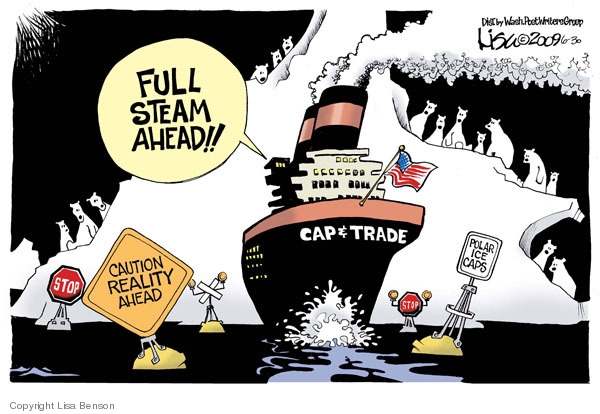
cap n trade

Taxing Carbon More Dangerous Than Not

A new study has fossil fuel activists twisting in the wind. The paper is Risk of increased food insecurity under stringent global climate change mitigation policy

The paper is behind a paywall, but some detail is available from carbonbrief Global carbon tax in isolation could ‘exacerbate food insecurity by 2050’ Excerpts in italics with my bolds and some comments.

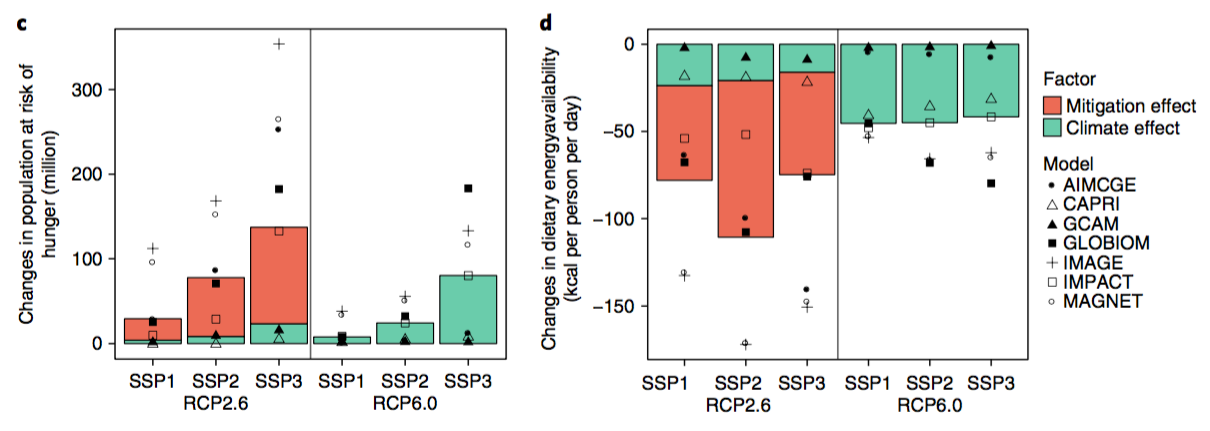
The research finds that using a blanket “carbon tax” to restrict global warming to 2C above pre-industrial levels – which is the limit set by the Paris Agreement – would put an additional 45 million people at risk of hunger by 2050.

The new study, published in Nature Climate Change, zooms in on how implementing a uniform tax on greenhouse gas emissions from agriculture and other types of land use, in particular, could impact food security worldwide.

The introduction of a carbon tax could threaten food security in three main ways, the researchers say.

First, the tax would raise the cost of food production, especially for carbon-intensive products such as meat.

Second, the tax would raise the costs associated with agriculture expansion, which would lead to higher land rents.

Third, the tax would incentivise the production of biofuels – which would compete with food crops for space, further driving up land rates.

All three of these consequences could drive up food prices, which would be costly for the world’s lowest earners – who spend up to 60-80% of their income on food.

The new study compares how levels of hunger would differ in a world with climate change alone to a world with climate mitigation, including a uniform carbon tax.

The results show that a blanket carbon tax “would have a greater negative impact on global hunger and food consumption than the direct impacts of climate change”, the scientists say in their research paper.

Instead, policies that can help slash emissions from agriculture while aiding development should be prioritised, says lead author Dr Tomoko Hasegawa, a researcher at the International Institute for Applied Systems Analysis (IIASA) and Japan’s National Institute for Environment Studies. In a statement, she said:

Carbon pricing schemes will not bring any viable options for developing countries where there are highly vulnerable populations. Mitigation in agriculture should instead be integrated with development policies.”

To understand the impacts of mitigation efforts, the researchers compared a world where warming is limited to 2C to a world where no efforts to tackle climate change are made before 2050.

The former scenario assumes that the world shifts from a reliance on fossil fuels to low-carbon sources of energy, and that a uniform carbon price is rapidly introduced “across all sectors and regions” and is steadily increased in the coming decades.

(The scenarios use three different “socio-economic pathways” to make assumptions about how factors, such as population growth, are likely to change by 2050.)

The results show that, by 2050, the risk of hunger in some of the world’s least developed countries could be higher in the scenarios with mitigation than in the scenarios without mitigation – despite the fact that these scenarios expect greater declines in crop yields.

In the scenarios without mitigation, the number of people at risk of hunger by 2050 is expected to increase by 5-56 million.

In the scenarios with mitigation, an additional 13-170 million people could face hunger. The increase in those at risk is expected to be largest in sub-Saharan Africa and parts of South Asia, including India and Bangladesh.

The charts below show the expected changes in the number of people at risk of hunger (left) and the number of calories consumed per person per day (right) by 2050 under the mitigation (RCP2.6) and “no-mitigation” (RCP6.0) scenarios.

The expected changes in the number of people at risk of hunger (left) and the number of calories consumed per person per day (right) by 2050 under a mitigation (RCP2.6) and “no-mitigation” (RCP6.0) scenario. The average impacts of climate change (green) and mitigation via the introduction of a carbon tax (orange) are shown. Symbols show the results from different models Source: Hasegawa et al. (2018).

Comment Regarding Climate Direct Effects upon Food Security

The impacts shown in green are hypothetical, though assumed as baselline truth by the researchers. The supposition is: Climate change could threaten global food security by increasing the chance of staple crop failures in many parts of the world, such as across Africa and the US.

The fact is, staple crops are booming with increasing CO2 and the warm temperatures enjoyed by plants and humans alike. Some researchers have been working frantically to claim CO2 damages plant productivity, despite overwhelming evidence to the contrary. One line of attack claims CO2 doesn’t make plants grow larger in the face of other limiting conditions like moisture or soil nutrients. True enough, but reducing CO2 is not the cause or the answer when that happens.  See Researchers Against CO2 for the details

Another line of attack is claiming the plants are larger but are not as nutritious. Studies showed that plants can have lower concentrations of some nutrients owing to their large size from CO2 enrichment, but the take up of soil nutrients was not diminished by more CO2 or warmth. See CO2 Destroys Food Nutrition! Not.

Summary

In their research paper, the scientists say the findings “should not be interpreted to downplay the importance of future GHG emissions mitigation efforts, or to suggest that climate policy will cause more harm than good”.

Nothing could be farther from the obvious implications of this analysis.  The supposed crop failures are nowhere to be seen with every year setting new records for productivity.  So the future negative effects from rising CO2 are totally speculation.  While the economic impacts from taxing carbon pose a real and present danger to food security.

H/T GWPF BENEFITS OF GLOBAL WARMING: RECORD HARVESTS REPORTED IN NUMEROUS COUNTRIES


Halting Failed Auto Fuel Standards

There are deeper reasons why US auto fuel efficiency standards are and should be rolled back.  They were instituted in denial of regulatory experience and science.  First, a parallel from physics.

In the sub-atomic domain of quantum mechanics, Werner Heisenberg, a German physicist, determined that our observations have an effect on the behavior of quanta (quantum particles).

The Heisenberg uncertainty principle states that it is impossible to know simultaneously the exact position and momentum of a particle. That is, the more exactly the position is determined, the less known the momentum, and vice versa. This principle is not a statement about the limits of technology, but a fundamental limit on what can be known about a particle at any given moment. This uncertainty arises because the act of measuring affects the object being measured. The only way to measure the position of something is using light, but, on the sub-atomic scale, the interaction of the light with the object inevitably changes the object’s position and its direction of travel.

Now skip to the world of governance and the effects of regulation. A similar finding shows that the act of regulating produces reactive behavior and unintended consequences contrary to the desired outcomes.

US Fuel Economy (CAFE) Standards Have Backfired

An article at Financial Times explains about Energy Regulations Unintended Consequences  Excerpts below with my bolds.

Goodhart’s Law holds that “any observed statistical regularity will tend to collapse once pressure is placed upon it for control purposes”. Originally coined by the economist Charles Goodhart as a critique of the use of money supply measures to guide monetary policy, it has been adopted as a useful concept in many other fields. The general principle is that when any measure is used as a target for policy, it becomes unreliable. It is an observable phenomenon in healthcare, in financial regulation and, it seems, in energy efficiency standards.

When governments set efficiency regulations such as the US Corporate Average Fuel Economy standards for vehicles, they are often what is called “attribute-based”, meaning that the rules take other characteristics into consideration when determining compliance. The Cafe standards, for example, vary according to the “footprint” of the vehicle: the area enclosed by its wheels. In Japan, fuel economy standards are weight-based. Like all regulations, fuel economy standards create incentives to game the system, and where attributes are important, that can mean finding ways to exploit the variations in requirements. There have long been suspicions that the footprint-based Cafe standards would encourage manufacturers to make larger cars for the US market, but a paper this week from Koichiro Ito of the University of Chicago and James Sallee of the University of California Berkeley provided the strongest evidence yet that those fears are likely to be justified.

Mr Ito and Mr Sallee looked at Japan’s experience with weight-based fuel economy standards, which changed in 2009, and concluded that “the Japanese car market has experienced a notable increase in weight in response to attribute-based regulation”. In the US, the Cafe standards create a similar pressure, but expressed in terms of size rather than weight. Mr Ito suggested that in Ford’s decision to end almost all car production in North America to focus on SUVs and trucks, “policy plays a substantial role”. It is not just that manufacturers are focusing on larger models; specific models are also getting bigger. Ford’s move, Mr Ito wrote, should be seen as an “alarm bell” warning of the flaws in the Cafe system. He suggests an alternative framework with a uniform standard and tradeable credits, as a more effective and lower-cost option. With the Trump administration now reviewing fuel economy and emissions standards, and facing challenges from California and many other states, the vehicle manufacturers appear to be in a state of confusion. An elegant idea for preserving plans for improving fuel economy while reducing the cost of compliance could be very welcome.

The paper is The Economics of Attribute-Based Regulation: Theory and Evidence from Fuel-Economy Standards Koichiro Ito, James M. Sallee NBER Working Paper No. 20500.  The authors explain:

An attribute-based regulation is a regulation that aims to change one characteristic of a product related to the externality (the “targeted characteristic”), but which takes some other characteristic (the “secondary attribute”) into consideration when determining compliance. For example, Corporate Average Fuel Economy (CAFE) standards in the United States recently adopted attribute-basing. Figure 1 shows that the new policy mandates a fuel-economy target that is a downward-sloping function of vehicle “footprint”—the square area trapped by a rectangle drawn to connect the vehicle’s tires.  Under this schedule, firms that make larger vehicles are allowed to have lower fuel economy. This has the potential benefit of harmonizing marginal costs of regulatory compliance across firms, but it also creates a distortionary incentive for automakers to manipulate vehicle footprint.

Attribute-basing is used in a variety of important economic policies. Fuel-economy regulations are attribute-based in China, Europe, Japan and the United States, which are the world’s four largest car markets. Energy efficiency standards for appliances, which allow larger products to consume more energy, are attribute-based all over the world. Regulations such as the Clean Air Act, the Family Medical Leave Act, and the Affordable Care Act are attribute-based because they exempt some firms based on size. In all of these examples, attribute-basing is designed to provide a weaker regulation for products or firms that will find compliance more difficult.

Summary from Heritage Foundation study Fuel Economy Standards Are a Costly Mistake Excerpt with my bolds.

The CAFE standards are not only an extremely inefficient way to reduce carbon dioxide emission but will also have a variety of unintended consequences.

For example, the post-2010 standards apply lower mileage requirements to vehicles with larger footprints. Thus, Whitefoot and Skerlos argued that there is an incentive to increase the size of vehicles.

Data from the first few years under the new standard confirm that the average footprint, weight, and horsepower of cars and trucks have indeed all increased since 2008, even as carbon emissions fell, reflecting the distorted incentives.

Manufacturers have found work-arounds to thwart the intent of the regulations. For example, the standards raised the price of large cars, such as station wagons, relative to light trucks. As a result, automakers created a new type of light truck—the sport utility vehicle (SUV)—which was covered by the lower standard and had low gas mileage but met consumers’ needs. Other automakers have simply chosen to miss the thresholds and pay fines on a sliding scale.

Another well-known flaw in CAFE standards is the “rebound effect.” When consumers are forced to buy more fuel-efficient vehicles, the cost per mile falls (since their cars use less gas) and they drive more. This offsets part of the fuel economy gain and adds congestion and road repair costs. Similarly, the rising price of new vehicles causes consumers to delay upgrades, leaving older vehicles on the road longer.

In addition, the higher purchase price of cars under a stricter CAFE standard is likely to force millions of households out of the new-car market altogether. Many households face credit constraints when borrowing money to purchase a car. David Wagner, Paulina Nusinovich, and Esteban Plaza-Jennings used Bureau of Labor Statistics data and typical finance industry debt-service-to-income ratios and estimated that 3.1 million to 14.9 million households would not have enough credit to purchase a new car under the 2025 CAFE standards.[34] This impact would fall disproportionately on poorer households and force the use of older cars with higher maintenance costs and with fuel economy that is generally lower than that of new cars.

CAFE standards may also have redistributed corporate profits to foreign automakers and away from Ford, General Motors (GM), and Chrysler (the Big Three), because foreign-headquartered firms tend to specialize in vehicles that are favored under the new standards.[35] 

Conclusion

CAFE standards are costly, inefficient, and ineffective regulations. They severely limit consumers’ ability to make their own choices concerning safety, comfort, affordability, and efficiency. Originally based on the belief that consumers undervalued fuel economy, the standards have morphed into climate control mandates. Under any justification, regulation gives the desires of government regulators precedence over those of the Americans who actually pay for the cars. Since the regulators undervalue the well-being of American consumers, the policy outcomes are predictably harmful.


California: World Leading Climate Hypocrite

California’s Climate Extremism
Joel Kotkin reports from the Golden State. Excerpts in italics with my bolds.

The pursuit of environmental purity in the Golden State does nothing to reverse global warming—but it’s costing the poor and middle class dearly.

Environmental extremism increasingly dominates California. The state is making a concerted attack on energy companies in the courts; a bill is pending in the legislature to fine waiters $1,000—or jail them—if they offer people plastic straws; and UCLA issued a report describing pets as a climate threat. The state has taken upon itself the mission of limiting the flatulence of cows and other farm animals. As the self-described capital of the anti-Trump resistance, California presents itself as the herald of a green, more socially and racially just society. That view has been utterly devastated by a new report from Chapman University, in which coauthors David Friedman and Jennifer Hernandez demonstrate that California’s draconian anti-climate-change regime has exacerbated economic, geographic, and racial inequality. And to make things worse, California’s efforts to save the planet have actually done little more than divert greenhouse-gas emissions (GHG) to other states and countries.

Jerry Brown’s return to Sacramento in 2011 brought back to power one of the first American politicians to embrace the “limits of growth.” Brown has long worried about resource depletion (including such debunked notions as “peak oil”), taken a Malthusian approach to population growth, and opposed middle-class suburban development. Like many climate-change activists, he has limitless confidence in the possibility for engineering a green socially just society through “the coercive power of the state,” but little faith that humans can find ways to address the challenge of climate change. If Brown’s “era of limits” message in the 1970s failed to catch on with the state’s voters, who promptly elected two Republican governors in his wake, he has found in climate change a more effective rallying cry, albeit one that often teeters at the edge of hysteria. Few politicians can outdo Brown for alarmism; recently, he predicted that climate change will cause 3 to 4 billion deaths, leading eventually to human extinction. To save the planet, he openly endorses a campaign to brainwash the masses.

The result: relentless ratcheting-up of climate-change policies. In 2016, the state committed to reduce greenhouse-gas (GHG) emissions 40 percent below 1990 levels by 2030. In response, the California Air Resource Board (CARB), tasked with making the rules required to achieve the state’s legislated goals, took the opportunity to set policies for an (unlegislated) target of an 80 percent reduction below 1990 levels by 2050.

Brown and his supporters often tout their policies as in line with the 2015 Paris Agreement, note Friedman and Hernandez, but California’s reductions under the agreement require it to make cutbacks double those pledged by Germany and other stalwart climate-committed countries, many of which have actually increased their emissions in recent years, despite their Paris pledges.

Governor Brown has preened in Paris, at the Vatican, in China, in newspapers, and on national television. But few have considered how his policies have worked out in practice. California is unlikely to achieve even its modest 2020 goals; nor is it cutting emissions faster than other states lacking such dramatic legislative mandates. Since 2007, when the Golden State’s “landmark” global-warming legislation was passed, California has accounted for barely 5 percent of the nation’s GHG reductions. The combined total reductions achieved over the past decade by Ohio, Georgia, Pennsylvania, and Indiana are about 5 times greater than California’s. Even Texas, that bogeyman of fossil-fuel excess, has been reducing its per-capita emissions more rapidly.

In fact, virtually nothing that California does will have an impact on global climate. California per-capita emissions have always been relatively low, due to the mild climate along the coast, which reduces the need for much energy consumption on heating and cooling. In 2010, the state accounted for less than 1 percent of global GHG emissions; the disproportionately large reductions sought by state activists and bureaucrats would have no discernible effect on global emissions under the Paris Agreement. “If California ceased to exist in 2030,” Friedman and Hernandez note, “global GHG emissions would be still be 99.54 percent of the Paris Agreement total.”

Many of California’s “green” policies may make matters worse. California, for example, does not encourage biomass energy use, though the state’s vast forested areas—some 33 million acres— could provide renewable energy and reduce the excessive emissions from wildfires caused by years of forest mismanagement. Similarly, California greens have been adamant in shutting down nuclear power plants, which continue to reduce emissions in France, and they refuse to count hydro-electricity as renewable energy. As a result, California now imports roughly one-third of its electricity from other states, the highest percentage of any state, up from 25 percent in 2010. This is part of what Hernandez and Friedman show to be California’s increasing propensity to export energy production and GHG emissions, while maintaining the fiction that the state has reduced its total carbon output.

Overall, California tends to send its “dirty work”—whether for making goods or in the form of fossil fuels—elsewhere. Unwanted middle- and working-class people, driven out by the high cost of California’s green policies, leave, taking their carbon footprints to other places, many of which have much higher per-capita emission rates. Net migration to other, less temperate states and countries has been large enough to offset the annual emissions cuts within the state. Similarly, the state’s regulatory policies make it difficult for industrial firms to expand or even to remain in California. Green-signaling firms like Apple produce most of their tangible products abroad, mainly in high-GHG emitting China, while other companies, like Facebook and Google, tend to place energy-intensive data centers in other, higher GHG emission states. The study estimates that GHG emissions just from California’s international imports in 2015, and not even counting imports from the rest of the U.S., amounted to about 35 percent of the state’s total emissions.

California’s green regulators predict that the implementation of ever-stricter rules related to climate will have a “small” impact on the economy. They point to strong economic and job growth in recent years as evidence that strict regulations are no barrier to prosperity. Though the state’s economic growth is slowing, and now approaches the national average, a superficial look at aggregate performance makes a seemingly plausible case for even the most draconian legislation. California, as the headquarters for three of the nation’s five largest companies by market capitalization—Alphabet, Apple, and Facebook— has enjoyed healthy GDP growth since 2010. But in past recoveries, the state’s job and income growth was widely distributed by region and economic class; since 2007, growth has been uniquely concentrated in one region—the San Francisco Bay Area, where employment has grown by nearly 17 percent, almost three times that of the rest of the state, with growth rates tumbling compared with past decades.

Some of these inequities are tied directly to policies associated with climate change. High electricity prices, and the war on carbon emissions generally, have undermined the state’s blue-collar sectors, traditionally concentrated in Los Angeles and the interior counties. These sectors have all lost jobs since 2007. Manufacturing employment, highly sensitive to energy-related and other regulations, has declined by 160,000 jobs since 2007. California has benefited far less from the national industrial resurgence, particularly this past year. Manufacturing jobs—along with those in construction and logistics, also hurt by high energy prices—have long been key to upward mobility for non-college-educated Californians.

As climate-change policies have become more stringent, California has witnessed an unprecedented level of bifurcation between a growing cadre of high-income earners and a vast, rapidly expanding poor population. Meantime, the state’s percentage of middle-income earners— people making between $75,000 and $125,000—has fallen well below the national average. This decline of the middle class even occurs in the Bay Area, notes a recent report from the California Budget and Policy Center, where in 1989 the middle class accounted for 56 percent of all households in Silicon Valley, but by 2013, only 45.7 percent. Lower-income residents accounted for 30.3 percent of Silicon Valley’s households in 1989, and that number grew to 34.8 percent in 2013.

Perhaps the most egregious impact on middle and working-class residents can be seen in housing, where environmental regulations, often tied directly to climate policies, have discouraged construction, particularly in the suburbs and exurbs. The state’s determination to undo the primarily suburban, single-family development model in order to “save the planet” has succeeded both in raising prices well beyond national norms and creating a shortfall of some 3 million homes.

As shown in a recent UC Berkeley study, even if fully realized, the state’s proposals to force denser housing would only reach about 1 percent of its 2030 emissions goals. Brown and his acolytes ignore the often-unpredictable consequences of their actions, insisting that density will reduce carbon emissions while improving affordability and boosting transit use. Yet, as Los Angeles has densified under its last two mayors, transit ridership has continued to drop, in part, notes a another UC Berkeley report, because incentives for real-estate speculation have driven the area’s predominantly poor transit riders further from trains and buses, forcing many to purchase cars.

Undaunted, California plans to impose even stricter regulations, including the mandatory installation of solar panels on new houses, which could raise prices by roughly $20,000 per home. This is only the latest in a series of actions that undermines the aspirations of people who still seek “the California dream;” since 2007, California homeownership rates have dropped far more than the national average. By 2016, the overall homeownership rate in the state was just under 54 percent, compared with 64 percent in the rest of the country.

The groups most affected by these policies, ironically, are those on whom the ruling progressives rely for electoral majorities. Millennials have seen a more rapid decline in homeownership rates compared with their cohort elsewhere. But the biggest declines have been among historically disadvantaged minorities—Latinos and African-Americans. Latino homeownership rates in California are well below the national average. In 2016, only 31 percent of African-Americans in the Bay Area owned homes, well below the already low rate of 41 percent black homeownership in the rest of nation. Worse yet, the state takes no account of the impact of these policies on poorer Californians. Overall poverty rates in California declined in the decade before 2007, but the state’s poverty numbers have risen during the current boom. Today, 8 million Californians live in poverty, including 2 million children, by far the most of any state. The state’s largest city, Los Angeles, is also now by some measurements America’s poorest big city.

To allay concerns about housing affordability, the state has allocated about $300 million from its cap-and-trade funds for housing, a meager amount given that the cost of building affordable housing in urban areas can exceed $700,000 per unit. These benefits are dwarfed by those that wealthy Californians enjoy for the purchase of electric cars and home solar: Tesla car buyers with average incomes of $320,000 per year got more than $300 million in federal and state subsidies by early 2015 alone. By contrast, in early 2018, state electricity prices were 58 percent higher, and gasoline over 90 cents per gallon higher, than the national average, disproportionately hurting ethnic minorities, the working class, and the poor. Based on cost-of-living estimation tools from the Census Bureau, 28 percent of African-Americans in the state live in poverty, compared with 22 percent nationally. Fully one-third of Latinos, now the state’s largest ethnic group, live in poverty, compared with 21 percent outside the state.

In a normal political environment, such disparities would spark debate, not only among conservatives, but also traditional Democrats. Some, like failed independent candidate and longtime environmentalist Michael Shellenberger, have expressed the view that California’s policies have made it not “the most progressive state” but “the most racist one.” Recently, some 200 veteran civil rights leaders sued CARB, on the basis that state policies are skewed against the poor and minorities. So far, their voices have been largely ignored. The state’s prospective next governor, Gavin Newsom, seems eager to embrace and expand Brown’s policies, and few in the legislature seem likely to challenge them. The Republicans, for now, look incapable of mounting a challenge.

This leaves California on a perilous path toward greater class and racial divides, increasing poverty, and ever-more strenuous regulation. Other ways to reduce greenhouse gases—such as planting trees, more efficient transportation, and making suburbs more sustainable—should be on the table. The Hernandez-Friedman report could be a first step toward addressing these issues, but however it happens, a return to rationality is needed in the Golden State.

Joel Kotkin serves as Presidential Fellow in Urban Futures at Chapman University and executive director of the Center for Opportunity Urbanism (COU).