From street names to gender, criminology and climate, our institutions
are in thrall to crazy wokeness. We need to get our culture back.
Society is in the grip of irrational ideas that defy common sense and drive dystopian policies. Some inane beliefs and trends are made up out of whole cloth; others derive from ideas that have resurfaced, Zombie-like, from the crypt of historic failures. They are advanced by “progressive” activists in thrall to a post-modern woke-ism steeped in Marxist-Leninism. What makes the phenomenon so threatening is its pervasive influence in politics, academia, media, not-for-profits and big business.
Two Finnish surveyspublished in March found that being woke was linked to anxiety, depression and a lack of happiness. We can only speculate why their ideas make them unhappier than the people they impose them on. Or are depressed people simply prone to socially damaging notions?A decade or two ago people would have rejected these bizarre ideas for the nonsense they are, and their proponents as emperors with no clothes. But today they are conventional wisdom and skeptics are know-nothing deviants who must be de-platformed and punished for their heresy.A centrepiece of postmodern ideology is DEI which, by dividing us all into oppressor or oppressed, is neither diverse, nor equitable nor inclusive but conformist, unfair and exclusionary. It undermines excellence, productivity and competitiveness and is largely responsible for the assault on truth and inquiry at schools and universities, which have become left-wing breeding grounds for Gen Z.As for climate catastrophism, there are innumerable examples of the zany policies it has led to. Toronto’s fiscal situation is so dire it has just increased property taxes by 9.5 per cent. Yet its TransformTO 2022 Annual Report says that reaching net-zero goals by 2050 will require a $145-billion investment — though Toronto’s GHG emissions amount to 0.114 per cent of the global total. The U.S. government says that since 1850 the Earth’s temperature has risen 0.06C degrees per decade. That means Toronto contributesless than 0.00001 of a degree annually to global warming.
This is the same Toronto that is re-naming Dundas Street, which honoured
a British abolitionist, after an African tribe prominent in the slave trade.
Virtue-signalling trumping common sense is clearly rampant.
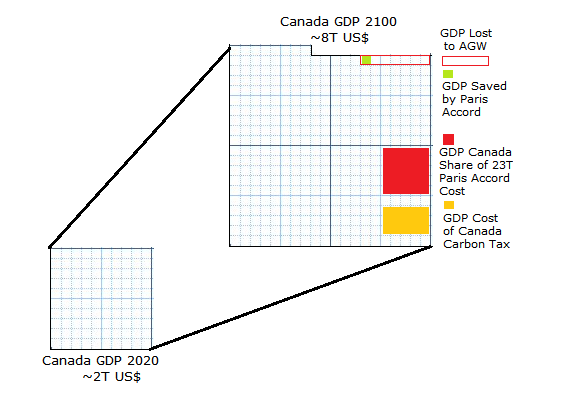
The cost for Canada to reach net zero by 2050 will be at least $2 trillion — about $180,000 for a family of four. The prime minister’s claim we must act now to avoid extreme weather is simply misinformation. Canada’s contribution to the annual increase in the globe’s temperature is less than a thousandth of a degree. And the United Nations International Panel on Climate Change tells us that in fact extreme weather events have not increased in severity or frequency. Despite incessant warnings from governments and media about a climate crisis, most people are unwilling to pay much to alleviate it. The climate consensus currently unravelling in Europe never caught on in the developing world.
An overarching concern for many Canadians is that their income has not kept up with inflation,yet the feds double down on profligate spending and ignore stalled productivity growth. They are also exacerbating a severe housing crisis by promoting the largest immigration levels since 1957 and one of the highest immigration rates in the world.
But the grand prize for cognitive dissonance goes to “Gays for Palestine,” who would be at high risk of arrest or defenestration in Gaza or the West Bank, though not in Tel Aviv, one of the world’s best places to celebrate pride. It is tragically ironic that students obsessed about micro-aggressions protest on behalf of a terrorist organization that advocates genocide. The double standard Israel faces has many rationalizations, but antisemitism has been a constant for millennia. Canada’s recent parliamentary vote calling for an immediate ceasefire in Gaza rewarded Hamas for its murderous rampage, which broke what was already a ceasefire.
On the criminal justice front, moving serial killer Paul Bernardo to a medium-security prison outraged most Canadians, but is hardly an anomaly: fewer than 14 per cent of “dangerous offenders” are confined in maximum security prisons. More generally, catch-and-release and lenient parole defy logic, put the public at risk and fuel the growing problem of urban crime.
Males who identify as women and use women’s washrooms and compete against women in sports are hailed as avatars of progress while anyone who points out that this could put women at risk or female athletes at a disadvantage can have their career destroyed. Get ready for complaints brought under the deeply flawed “Online Harms Bill,” C-63, which could impose sentences of up to life imprisonment for speech crimes.
Irrational, illiberal ideas are now entrenched in our most important institutions and the public is becoming habituated to them. It will require a determined effort to take the culture back and root out dysfunctional policies that undermine the economy, personal agency and our core rights and freedoms. But do we have any choice?
There is no charge for content on this site, nor for subscribers to receive email notifications of postings.
Yes, the carbon tax works great in a ‘first-best’ world where it’s the
only carbon policy. In the real world, carbon policies are piled high.
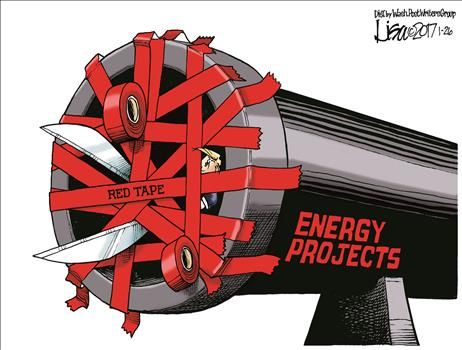
An open letter is circulating online among my economist colleagues aiming to promote sound thinking on carbon taxes. It makes some valid points and will probably get waved around in the House of Commons before long. But it’s conspicuously selective in its focus, to the point of ignoring the main problems with Canadian climate policy as a whole.
EV charging sign Electric-vehicle mandates and subsidies are among the mountain of climate policies that have been piled on top of Canada’s carbon tax. PHOTO BY JOSHUA A. BICKEL/THE ASSOCIATED PRESS
There’s a massive pile of boulders blocking the road to efficient policy, including:
subsidies for electric buses and emergency vehicles in Canadian cities,
new aviation and rail sector emission limits, and many more.
Not one of these occasioned a letter of protest from Canadian economists.
Beside that mountain of boulders there’s a twig labelled “overstated objections to carbon pricing.” At the sight of it, hundreds of economists have rushed forward to sweep it off the road. What a help!
To my well-meaning colleagues I say: the pile of regulatory boulders
long ago made the economic case for carbon pricing irrelevant.
Layering a carbon tax on top of current and planned command-and-control regulations does not yield an efficient outcome, it just raises the overall cost to consumers. Which is why I can’t get excited about and certainly won’t sign the carbon-pricing letter. That’s not where the heavy lifting is needed.
My colleagues object to exaggerated claims about the cost of carbon taxes. Fair enough. But far worse are exaggerated claims about both the benefits of reducing carbon dioxide emissions and the economic opportunities associated with the so-called “energy transition.” Exaggeration about the benefits of emission reduction is traceable to poor-quality academic research, such as continued use ofclimate models known to have large, persistent warming biasesand of the RCP8.5 emissions scenario, long since shown in the academic literature to be grossly exaggerated.
But a lot of it is simply groundless rhetoric. Climate activists, politicians and journalists have spent years blaming Canadians’ fossil fuel use for every bad weather event that comes along and shutting down rational debate with polemical cudgels such as “climate emergency” declarations. Again, none of this occasioned a cautionary letter from economists.
There’s another big issue on which the letter was silent. Suppose we did clear all the regulatory boulders along with the carbon-pricing-costs-too-much twig. How high should the carbon tax be? A few of the letter’s signatories are former students of mine so I expect they remember the formula for an optimal emissions tax in the presence of an existing tax system. If not, they can take their copy of Economic Analysis of Environmental Policy by Prof. McKitrick off the shelf, blow off the thick layer of dust and look it up. Or they can consult any of the half-dozen or so journal articles published since the 1970s that derive it. But I suspect most of the other signatories have never seen the formula and don’t even know it exists.
To be technical for a moment, the optimal carbon tax rate varies inversely with the marginal cost of the overall tax system. The higher the tax burden — and with our heavy reliance on income taxes our burden is high — the costlier it is at the margin to provide any public good, including emissions reductions. Economists call this a “second-best problem”: inefficiencies in one place, like the tax system, cause inefficiencies in other policy areas, yielding in this case a higher optimal level of emissions and a lower optimal carbon tax rate.
Based on reasonable estimates of the social cost of carbon and the marginal costs of our tax system, our carbon price is already high enough. In fact, it may well be too high. I say this as one of the only Canadian economists who has published on all aspects of the question. Believing in mainstream climate science and economics, as I do, does not oblige you to dismiss public complaints that the carbon tax is too costly.
Which raises my final point: the age of mass academic letter-writing has long since passed. Academia has become too politically one-sided. Universities don’t get to spend years filling their ranks with staff drawn from one side of the political spectrum and then expect to be viewed as neutral arbiters of public policy issues. The more signatories there are on a letter like this, the less impact it will have. People nowadays will make up their own minds, thank you very much, and a well-argued essay by an individual willing to stand alone may even carry more weight.
Online conversations today are about rising living costs, stagnant real wages and deindustrialization. Even if carbon pricing isn’t the main cause of all this, climate policy is playing a growing role and people can be excused for lumping it all together. The public would welcome insight from economists about how to deal with these challenges. A mass letter enthusing about carbon taxes doesn’t provide it.
There is no charge for content on this site, nor for subscribers to receive email notifications of postings.
This reportis written for people wishing to form their own opinion on issues relating to climate. Its focus is on publicly available observational datasets, and not on the output of numerical models, although there are a few exceptions, such as Figure 42. References and data sources are listed at the end.
The observational data presented here reveal a vast number of natural variations, some of which appear in more than one series. The existence of such natural climatic variations is not always fully acknowledged, and therefore generally not considered in contemporary climate conversations. The drivers of most of these climatic variations are not yet fully understood, but should represent an important focus for climatic research in future.
In this report, meteorological and climatic observations are described according to the following overall structure: atmosphere, oceans, sea level, sea ice, snow cover, precipitation, and storms. Finally, in the last section (below), the observational evidence as at 2023 is briefly summarised.
Ten facts about the year 2023
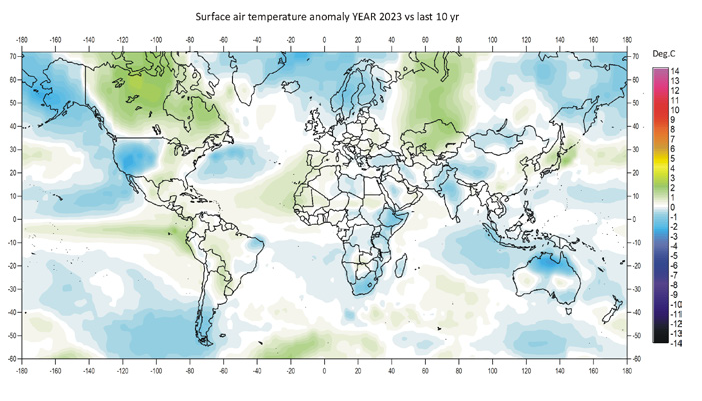
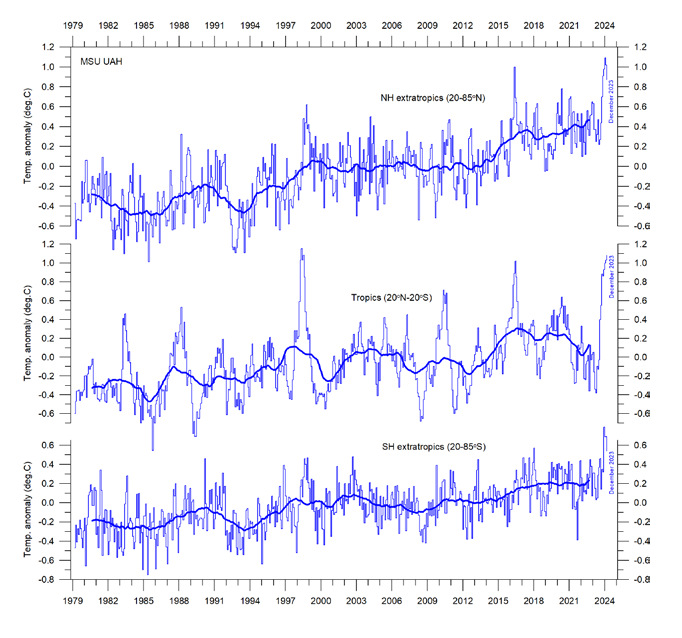
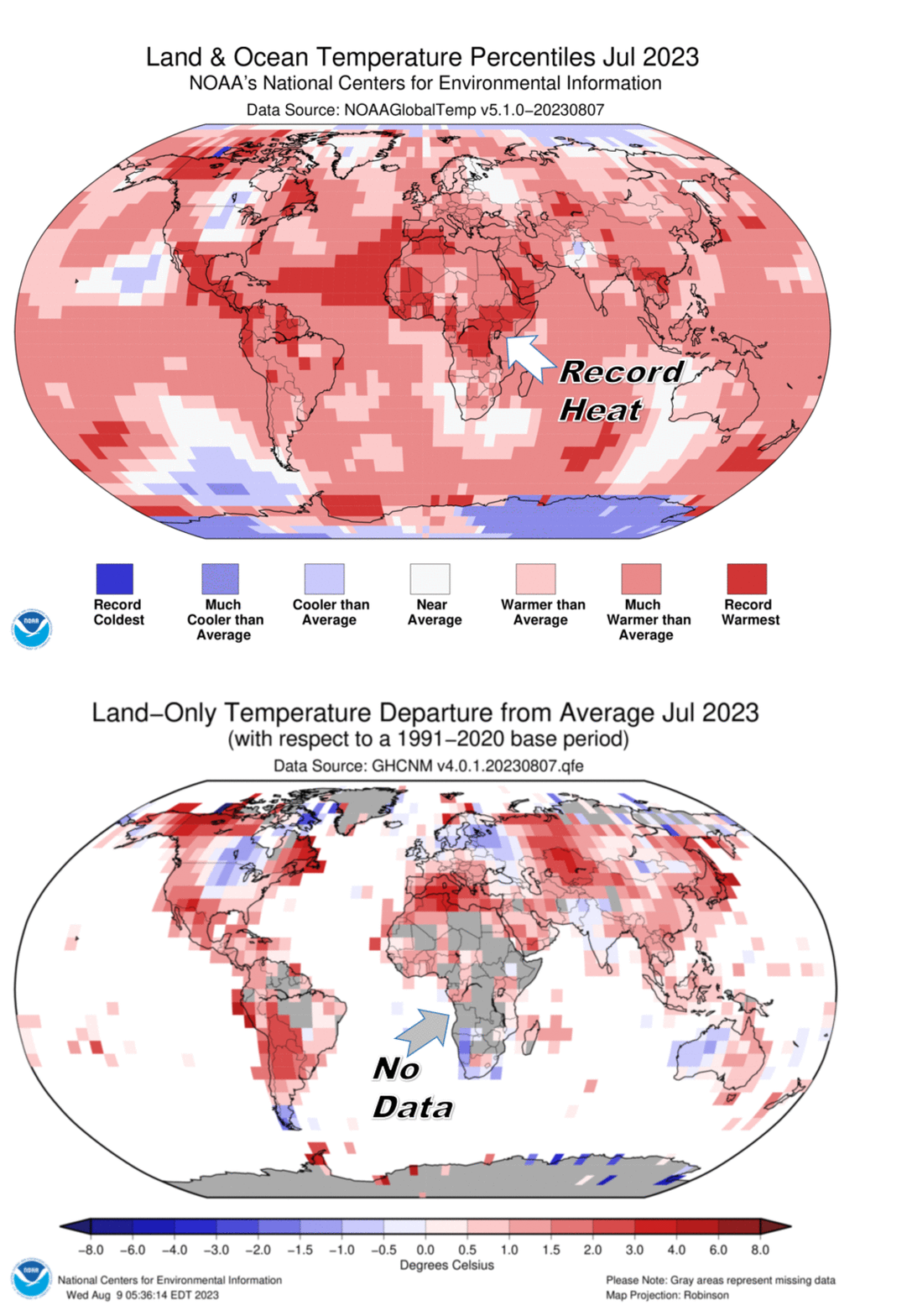
1. Air temperatures in 2023 were the highest on record (since 1850/1880/1979, according to the particular data series). Recent warming is not symmetrical, but is mainly seen in the Northern Hemisphere (Figures 1 and 13).
Figure 1: 2023 surface air temperatures compared to the average for the previous 10 years. Green-yellow-red colours indicate areas with higher temperature than the average, while blue colours indicate lower than average temperatures. Data source: Remote Sensed Surface Temperature Anomaly, AIRS/Aqua L3 Monthly Standard Physical Retrieval 1-degree x 1-degree V006 (https://airs.jpl.nasa.gov/), obtained from the GISS data portal (https://data.giss.nasa.gov/gistemp/maps/).
Figure 13: Zonal air temperatures. Global monthly average lower troposphere temperature since 1979 for the tropics and the northern and southern extratropics, according to University of Alabama at Huntsville, USA. Thin lines: monthly value; thick lines: 3-year running mean.
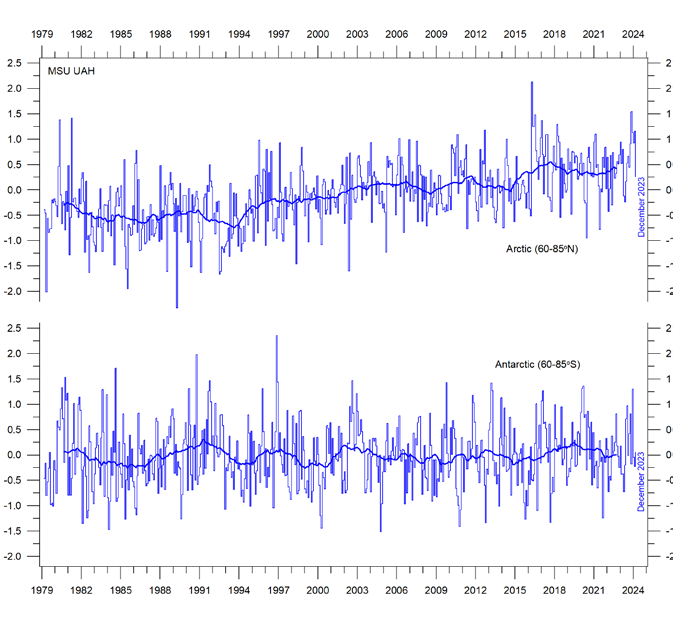
2. Arctic air temperatures have increased during the satellite era (since 1979), but Antarctic temperatures remain essentially stable (Figure 14).
Figure 14: Polar temperatures Global monthly average lower troposphere temperature since 1979 for the North and South Pole regions, according to University of Alabama at Huntsville (UAH), USA. Thick lines are the simple running 37-month average.
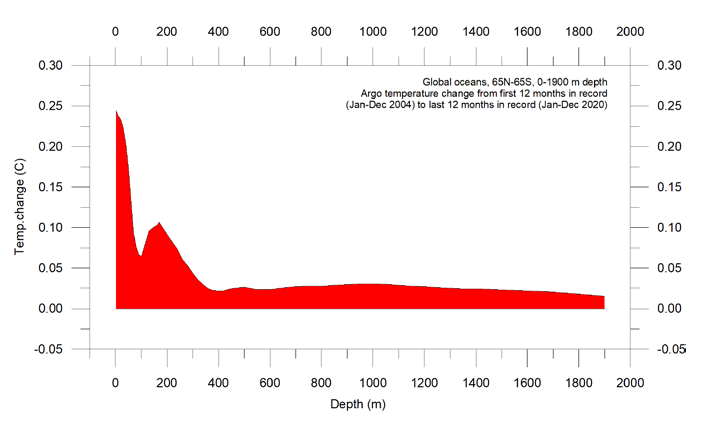
3. Since 2004, globally, the upper 1900m of the oceans has seen net warming of about 0.037°C. The greatest warming (of about 0.2°C) is in the uppermost 100m, and mainly in regions near the Equator, where the greatest amount of solar radiation is received (Figure 28).
Figure 28: Temperature changes 0–1900m Global ocean net temperature change since 2004 from surface to 1900m depth, using Argo-data. Source: Global Marine Argo Atlas.
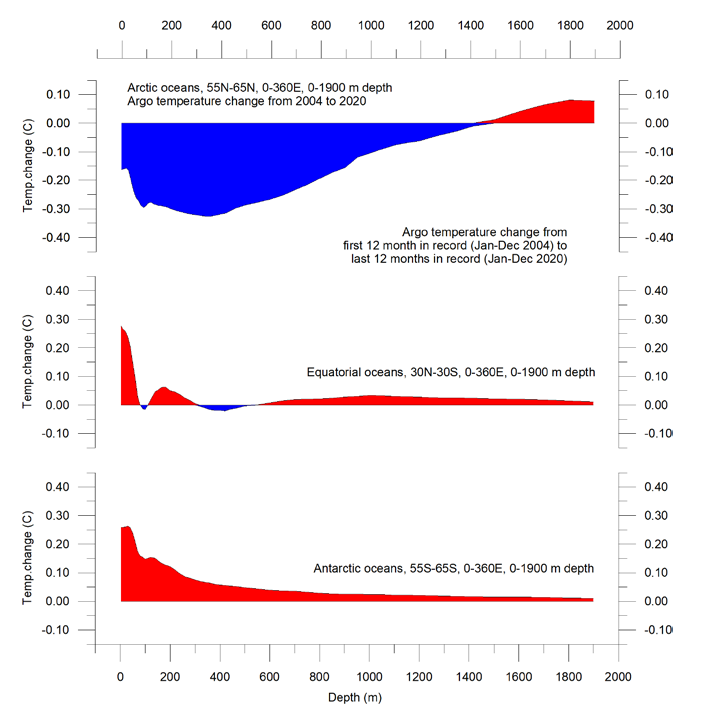
4. Since 2004, the northern oceans (55–65°N) have, on average, experienced a marked cooling down to 1400m depth, and slight warming below that (Figure 29). Over the same period, the southern oceans (55–65°S) have, on average, seen some warming at most depths (above 1900m), but mainly near the surface.
Figure 29: Temperature changes 0–1900m Global ocean net temperature change since 2004 from surface to 1900m depth. Source: Global Marine Argo Atlas
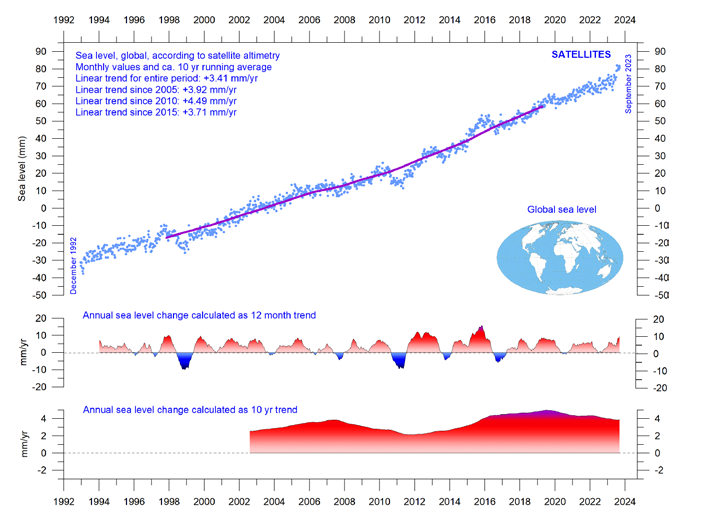
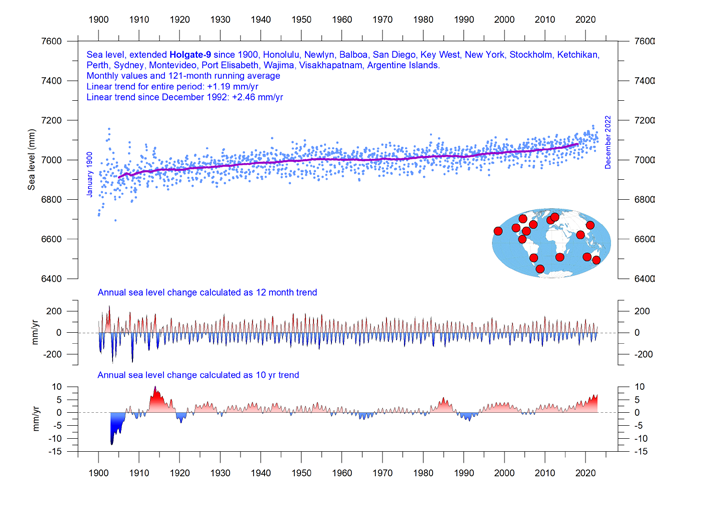
5. Sea level globally is increasing at about 3.4 mm per year or more according to satellites, but only at 1-2 mm per year according to coastal tide gauges (Figures 39 and 41). Local and regional sea-level changes usually deviate significantly from such global averages.
Figure 39: Global sea level change since December 1992 The two lower panels show the annual sea level change, calculated for 1- and 10-year time windows, respectively. These values are plotted at the end of the interval considered. Source: Colorado Center for Astrodynamics Research at University of Colorado at Boulder. The blue dots are the individual observations (with calculated GIA e”ect removed), and the purple line represents the running 121-month (ca. 10-year) average.
Figure 41: Holgate-9 monthly tide gauge data from PSMSL Data Explorer The Holgate-9 are a series of tide gauges located in geologically stable sites. The two lower panels show the annual sea level change, calculated for 1- and 10-year time windows, respectively. These values are plotted at the end of the interval considered. Source: Colorado Center for Astrodynamics Research at University of Colorado at Boulder. The blue dots are the individual observations, and the purple line represents the running 121-month (ca. 10-year) average.
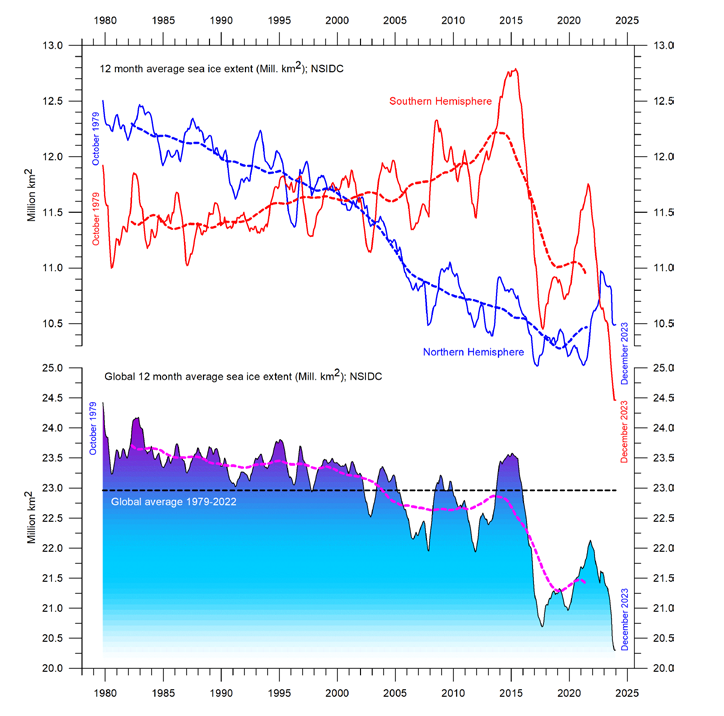
6. Global sea-ice extent remains well below the average for the satellite era (since 1979). Since 2018, however, it has remained quasistable, perhaps even exhibiting a small increase (Figure 43).
Figure 43: Global and hemispheric sea ice extent since 1979 12-month running means. The October 1979 value represents the monthly average of November 1978–October 1979, the November 1979 value represents the average of December 1978–November 1979, etc. The stippled lines represent a 61-month (ca. 5 years) average. The last month included in the 12-month calculations is shown to the right in the diagram. Data source: National Snow and Ice Data Center (NSIDC).
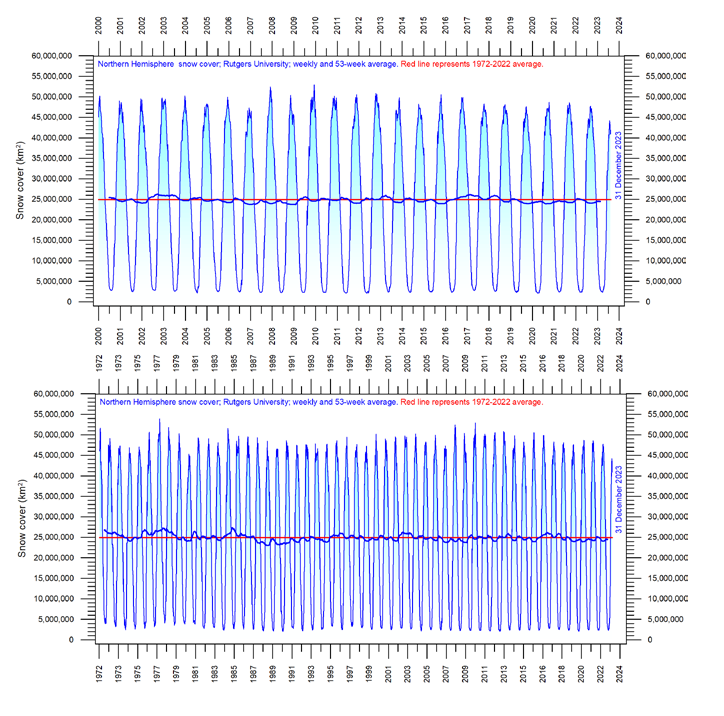
7. Global snow cover has remained essentially stable throughout the satellite era (Figure 47), although with important regional and seasonal variations.
Figure 47: Northern hemisphere weekly snow cover since 2000(a) Since January 2000 and (b) Since 1972. Source: Rutgers University Global Snow Laboratory. The thin blue line is the weekly data, and the thick blue line is the running 53-week average (approximately 1 year). The horizontal red line is the 1972–2022 average.
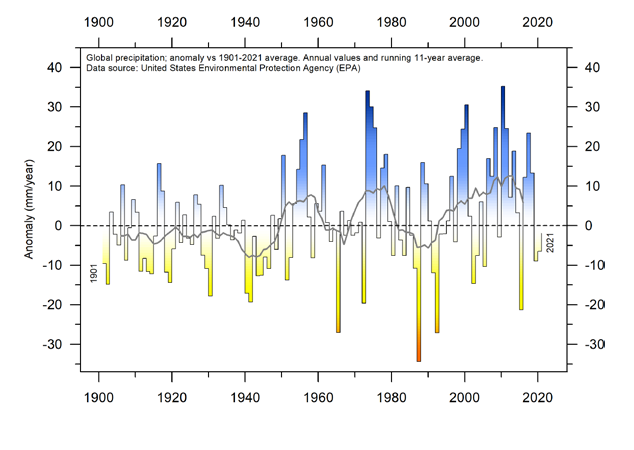
8. Global precipitation varies from more than 3000mm per year in humid regions to almost nothing in deserts. Global average precipitation exhibits variations from one year to the next, and from decade to decade, but since 1901 there has been no clear overall trend (Figure 50).
Figure 50: Global precipitation anomalies. Variation of annual anomalies in relation to the global average precipitation from 1901 to 2021 based on rainfall and snowfall measurements from land-based weather stations worldwide. Data source: United States Environmental Protection Agency (EPA).
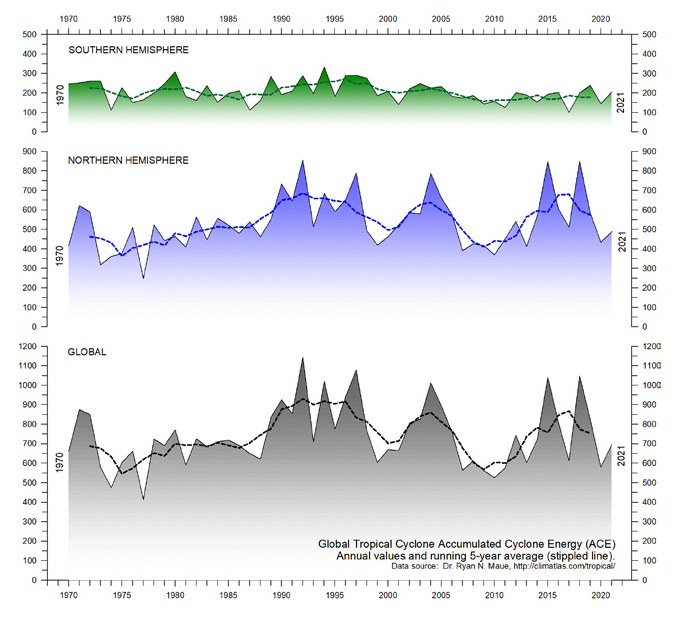
9. Storms and hurricanes display variable frequency over time, but without any clear global trend towards higher or lower values (Figure 51).
Figure 51: Annual global accumulated cyclone energy Source: Ryan Maue.
10. Observations confirm the continuing long-term variability of average meteorological and oceanographic conditions, but do not support the notion of an ongoing climate crisis.
Summing up
The global climate system is multifaceted, involving sun, planets, atmosphere, oceans, land, geological processes, biological life, and complex interactions between them. Many components and their mutual coupling are still not fully understood or perhaps not even recognised.
Believing that one minor constituent of the atmosphere (CO2)controls nearly all aspects of climate is naïve and entirely unrealistic.
The global climate has remained in a quasi-stable condition within certain limits for millions of years, although with important variations playing out over periods ranging from years to centuries or more, but the global climate has never been in a fully stable state without change.
Modern observations show that this behaviour continues today;
there is no evidence of a global climate crisis.
There is no charge for content on this site, nor for subscribers to receive email notifications of postings.
Trudeau Turns the Carbon Tax Screws on Canadians April 1
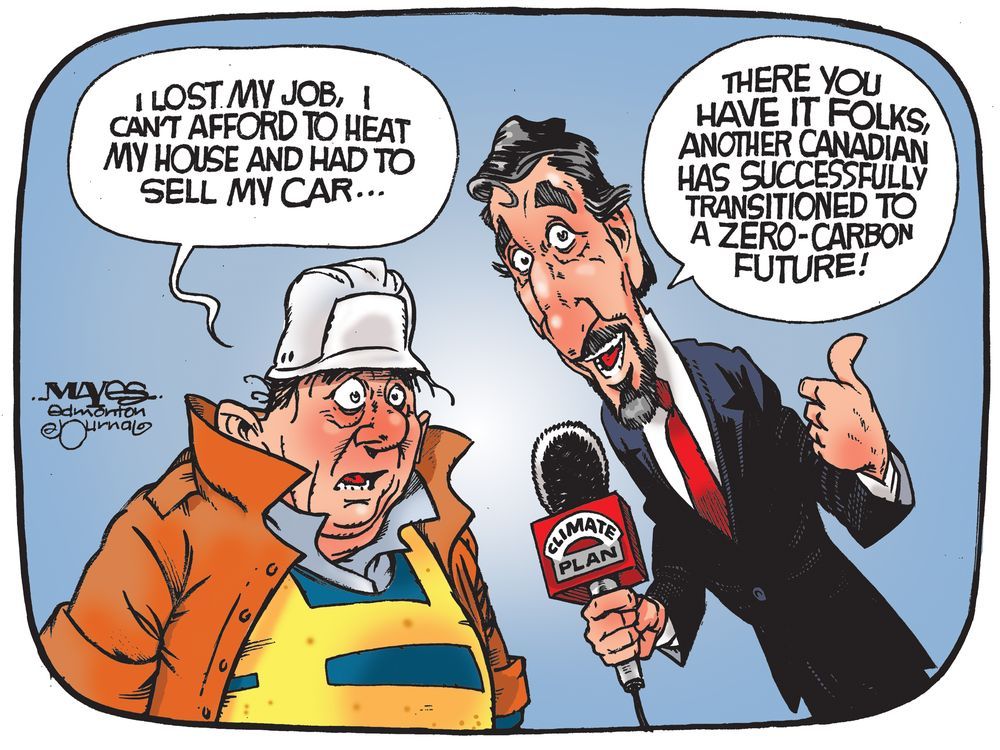
Ross Mckitrick explains the smoke and mirrors in Trudeau’s justifications for his racheting carbon tax in a National Post article Wanted: A leader who is honest about climate policy. Excerpts in italics with my bolds and added images.
Pierre Poilievre is leading anti-carbon tax rallies around the country, ginning up support for an old-fashioned tax revolt. In response, Justin Trudeau went to Calgary and trumpeted — believe it or not! — his love of free markets. After explaining the economic logic of using a carbon tax to reduce greenhouse gases, the prime minister slammed regulatory approaches, which, he said, “all involve the heavy hand of government. I prefer a cleaner solution, a market-based solution and that is, if you’re behaving in a way that causes pollution, you should pay.” He added that the Conservatives would instead rely on the “heavy hand of government through regulation and subsidies to pick winners and losers in the economy as opposed to trusting the market.” Amen to all that!
But someone should tell Trudeau that his own government’s
Emission Reduction Plan mainly consists of heavy-handed
regulations, subsidies, mandates and winner-picking grants.
Within its 240 pages one does find a carbon tax. But also 139 additional policies, including:
♦ Clean Fuels Regulations, ♦ An electric vehicle mandate that will ban gasoline cars by 2035, ♦ Aggressive fuel economy standards that will hike such cars’ cost in the meantime, ♦ Costly new emission targets specifically for oil & gas, agriculture, heavy industry and waste management, ♦ Onerous new energy efficiency requirements both for new buildings and renovations of existing buildings, New electricity grid requirements, and page upon page of ♦ Subsidy funds for “clean technology” firms and other would-be winners in the sunlit uplands of the new green economy.
Does Trudeau oppose any of that? Hardly. But the economic logic of a carbon tax only applies when it is used on its own. He doesn’t get to boast about the elegance of market mechanisms on behalf of a policy package that starts with a price signal then destroys it with a massive regulatory apparatus. Trudeau also tried to warm his Alberta audience to the carbon tax by invoking the menace of mild weather and forest fires. In fairness it was an unusual February in Calgary. The month began with a week of above-zero temperatures, hitting five degrees Celsius at one point, then there was a brief cold snap before Valentine’s Day, then the daytime highs soared to the low teens for nine days and the month ended with soupy above-zero conditions. Weird.
Oops, that was 1981.This year was weirder: February highs were above zero for 25 out of 28 days, eight of which were even above 10 degrees C.
Oops again, that was 1991. Granted, February 2024 also had
its mild patches, but not like the old days.
Of course, back then warm weather was just weather. Now it’s a climate emergency and Canadians demand action. Except they don’t want to pay for it, which is the main problem for politicians when trying to come up with a climate policy that’s both effective and affordable. In fact, you can only have one of those two. Take your pick: effective or affordable, affordable or effective.
In practice, of course we typically end up zero for two,
with policies that are both ineffective and unaffordable.
You can claim your policy will yield deep decarbonization while boosting the economy, which almost all politicians in every western country have spent decades doing. But it’s not true. With current technology, affordable policies yield only small temporary emission reductions. Population and economic growth swamp their effects over time, which is why mainstream economists have long argued that while we can eliminate some lowvalue emissions, for the most part we will just have to live with climate change. Trying to stop it would cost far more than it’s worth.
Meanwhile the policy pantomime continues. Poilievre’s anti-carbon tax rallies are popular, but what happens after we axe the tax? If he plans to replace it with regulatory measures aimed at achieving the same emission cuts, he really should tell his rallygoers that what he has in mind will hit them even harder than the tax they’re so keen to scrap.
Or does he have the courage to do the sensible thing
and follow the mainstream economics advice?
If he wants to be honest with Canadians, he must explain that the affordable options will not get us to the Paris target, let alone to net-zero, and even if they did, what Canada does will have no effect on the global climate because we’re such small players. Maybe new technologies will appear over the next decade that change the economics, but until that day we’re better off fixing our growth problems, getting the cost of living down and continuing to be resilient to all the weather variations Canadians have always faced.
Addendum
Notice that Trudeau asserts that his carbon tax is needed so that “polluters pay.” Millions of Canadian taxpayers’ dollars have been spent on prime time TV ads reminding viewers that we have to do something to stop “carbon pollution”, by which they mean CO2 emissions. No matter that CO2, far from being an unnatural contaminant, is plant food without which (less than 150 ppm) plants and animals die. No mention of thousands of scientists proclaiming that “There is No Climate Emergency,” and that global warming and rising CO2 since the Little Ice Age have led to unprecedented human flourishing.
So essential CO2 is labeled as a pollutant in order to insist that emissions from burning hydrocarbons must be reduced to avert a crisis: heat waves, forest fires, floods, droughts, etc. etc. The premise is “We have to do something to stop emitting CO2.” Politicians of all stripes dare not question it. And a video interview below demonstrates how that premise prevents any reasonable discussion of energy policy.
The Parliamentary Budget Officer released a report looking into how much the carbon tax is actually costing Canadian households. In the CBC interview, Parliamentary Budget Officer Yves Giroux breaks down the report. And, Dale Beugin, executive vice-president of the Canadian Climate Institute discusses the analysis his organization has conducted on the government’s emissions reduction plan. Note the PBO role is non-partisan, while the CCI agenda is open and obviously Gung Ho against CO2.
The discussion with the PBO ends at 11 minutes into the video, the remainder being CCI talking about ways to shape industrial policies to force additional emissions down to meet Paris targets. A few excerpts from the first part show how difficult it is to escape the premise that we have to do something about CO2.
CBC: I’m sure have been watching what’s been happening in the House of Commons the conclusions in your report they’re being cited by the conservatives in particular as proof that Canadians are worse off because of carbon pricing and that means this policy needs to go. Is that a fair representation of your findings?
PBO: Well it’s a representation of our findings once you also include the economic impacts of introducing a carbon tax. So there’s the fiscal impact on households paying the tax versus the amount of the rebate that households are receiving. But once you also include the economic impacts due to the introduction of a carbon tax, for example the reduction in activity or the slower growth in economic activity in some sectors then that’s the full impact.
CBC: The fiscal analysis is the financial analysis that the government points to. They say most families will still get more in rebates than they pay, sort of Straight Cash Out, Straight Cash in. Is that a fair representation?
PBO: The conclusion we arrived at if you take into consideration the carbon tax that households pay on their fossil fuels that they’re buying: gasoline, natural gas, diesel and so on, they pay that directly as well as the embedded energy component of whatever goods and services they buy and they subtract from that the the rebate then about 80% of households are better off.
CBC: It gets complicated and this is where it gets controversial because you took a look at the broader effect that carbon pricing, any kind of tax has on an economy, it can have an economic impact to the negative and this is the line from report that conservatives point to once you factor in the rebate but also the economic impacts the majority of the households will see a negative impact as a result of the carbon tax. The rebuttal to that conclusion is that it doesn’t tell the whole story it doesn’t look at other options and other impacts. What do you say in terms of people understanding the meaning of that analysis?
PBO: The analysis looks at the world where the we have a carbon tax versus the absence of a carbon tax which is how we do economic analysis. So the impact of a carbon tax on the economy will have impacts on some sectors; the transportation sector to take one example, or the oil and gas sector, lower employment than would otherwise be the case or lower profits than would otherwise be the case. So that translates into economic impacts on average for households: lower employment, lower profits, lower dividends for those who own stocks Etc. so these are the economic impacts.
CBC: This is where the analysis has caused some confusion and drawn some criticism because the analysis only compares the impact as you said of a carbon price versus nothing, and nothing isn’t an option right? It doesn’t compare carbon pricing versus other options that other experts would say could be even more expensive. So how should people assess the political arguments we’re seeing without a clear comparative analysis of the options?
PBO: So my mandate is to provide cost estimates of policy proposals by the government or policy measures that the government has introduced. My mandate does not include providing cost estimates of alternative scenarios or multiple options. So you’re right that doing something else to reach International targets or a Canada’s commitment under the Paris Accord would also have costs. For example if we were to introduce massive subsidies for new technologies to wean ourselves off fossil fuels, that would obviously have costs. Introducing regulations also has costs and these costs could could be measured if we knew exactly what these alternatives are but there’s no clear policy proposal from the government as what would be the alternative to a carbon tax. So it’s difficult to cost something that has not been proposed yet.
It’s true that the consensus among economists is generally speaking a carbon tax is probably the least disruptive way to reduce emissions. That being said we see that the government itself is not relying solely on a carbon tax for various reasons. So the government itself is introducing subsidies for clean fuel and many regulations.
CBC: So you can’t assess this compared to another proposal because there is no other proposal to assess. You also don’t factor in the cost of climate change. We’ve seen massive wildfires still burning from last year throughout the winter In British Columbia and in Alberta; you know the extreme weather on the East Coast, flooding and storms, all of that has a massive economic impact as well and a loss of productivity and cost to governments.
The idea is to stop that from getting worse or more frequent, how do we assess that versus the cost
of using carbon pricing to lower emissions.
PBO: That’s a very difficult field to to venture into because the number of unusual weather events that’s occurring. We don’t know which ones are due to climate change and which ones would have occurred anyways, or whether their extent would have been smaller or even worse, probably smaller especially in a short period of time. We’ve tried to estimate the impact of climate change between now and the year 2100 and we find that there is a cost to climate change but for the next few years between now and 2030 it’s very difficult to determine precisely the cost of climate change. It’s an area that we ventured into but it’s not easy and not that many institutions and organizations have established clear parameters under which to estimate the cost of climate change.
It’s very unlikely that there’ll be significant technological breakthroughs between now and 2030 sufficient to even partially offset the cost of a carbon tax for example, or any measures to mitigate or reduce our carbon emissions. But it’s quite possible that Beyond 2030 once technologies become more mature they’ll be able to offset some of the costs that we’ll we’ll have to incur to reduce our greenhouse gas emissions. So that’s why it’s difficult to say whether the costs will be offset by the benefits over the longer term but between now and 2030 it’s clearly not going to happen.
I’m providing unbiased nonpartisan information, information not pronouncements, not verdicts on policies. It’s up to decision makers and Canadians to make up their own minds based on the information we provide them so they can decide whether a carbon tax or other measures are the best way forward to reduce carbon emissions. We’re not passing judgments as to whether a policy is working or not.
My Observations
This interview shows that the carbon cult narrative
subverts rational policymaking in three significant ways.
Firstly, there is no accounting of all the economic and social damage done by the multitude of federal government climate policies and regulations (139 that McKitrick found in the Emission Reduction Plan). Secondly the benefits to offset the carbon tax costs consider only saving some damages from extreme weather. This is problematic in two ways. There is no certainty that imposing these costs on Canadians will have any effect on CO2 levels,orthat climate and weather will be any different for having made the effort.
Add to that the ignoring of actual benefits to humankind and to the biosphere from rising atmospheric CO2 and warming temperatures. Virtually every year global agricultural production sets records because of warming and CO2 enhancing photosynthesis. That puts food on the table for billions of people. What insanity to pursue things like carbon capture to rob the biosphere of CO2, while dreaming of a cooler future planet. Both objectives would threaten the world food supply and can hardly be benefits to justify emissions reductions.
Finally CCI gives the game away when they say, in effect:
“You don’t like the carbon tax, but doing nothing is not an option.”
In fact doing nothing to reduce CO2 emissions is the best option, though politicians are loath to admit it. Few nations are achieving their Paris Treaty targets, and their emissions dwarf Canada’s.
The prosperity that comes from hydrocarbons can serve to build and maintain robust infrastructure and means of production for humanity to adapt to any changes in the climate, such as those in the past likely to happen again beyond our ability to stop them.
There is no charge for content on this site, nor for subscribers to receive email notifications of postings.
Wyoming has vast resources of coal, oil and natural gas. With 40% of the nation’s coal resources, the state has been the United States’ top producer since 1986, primarily from the Powder River Basin located in the northeastern part of the state. It is also a national leader in the production of oil and natural gas, ranking in the top 10 in production of both products.
Yet, even though the Wyoming economy is heavily dependent on the mining and extraction of fossil fuels, its governor, Mark Gordon, has adopted a strong “decarbonization” policy. The science tells us that this is not a winning strategy for the people of Wyoming.
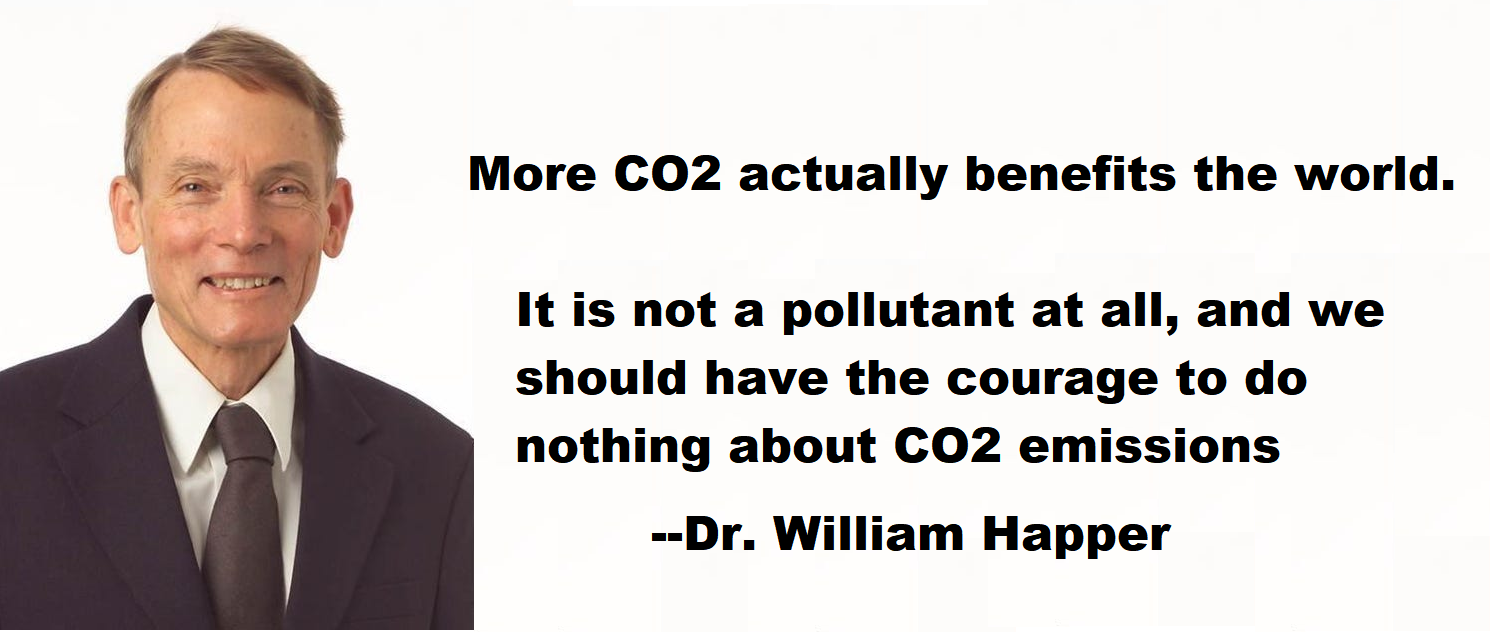
We also sent a team of climate experts from the CO2 Coalition, including Dr. William Happer, Dr. Byron Soepyan and Gregory Wrightstone to Wyoming to provide the facts concerning the huge benefits of carbon dioxide. This team presented the science at a hearing of the Wyoming Senate Agriculture Committee (pictured above.)
The team also presented accurate science regarding Wyoming’s climate to students at Gillette College, Laramie County Community College, and at the University of Wyoming.
Temperature Data Shows Good News for Wyoming
Data for Wyoming contradict the 4th National Climate Assessment (NCA4) assertion that “the frequency and intensity of extreme high temperature events are virtually certain to increase.”
Our data analysis shows that high daily temperatures peaked during the Dust Bowl years of the 1930s and have been in a 90-year decline. This is confirmed by reviewing the percentage of days that were reported to be hotter than 100°F (37.8°C) by Wyoming temperature stations. There is no discernible increase, and the largest numbers occurred in the first half of the 20th century when CO2 levels were 70% of recent measurements.
There has been, however, a beneficial increase in the minimum nighttime temperatures, which has led to a lengthening of the Wyoming growing season. Since the late 1800s, these nighttime temperatures have increased about 2°F (1.1°C).
The slight increase of about 1.2°F (0.7°C) in the average temperature
in the last 120 years is being driven by reductions in extreme cold
rather than increases in extreme heat.
The recent proposal by Wyoming Governor Mark Gordon to use “carbon capture” to achieve what he terms “negative net zero” (Gordon 2021) is based on a flawed theory that increasing CO2 in the atmosphere is leading to harmful effects on Wyoming’s environment and its people. Within this report, we have documented that modest warming and increasing carbon dioxide are clearly beneficial for the Cowboy State’s ecosystems and citizenry.
The data tell us the following:
• Current levels of carbon dioxide are at near historically low concentrations. • Adjustments to historic temperature records have artificially amplified modern warming. • Wyoming temperatures have increased a modest 1.2°F (0.7°C) since 1895. • Heat waves peaked in the 1930s and have been in slight decline since that period. • Nightime low temperatures have increased, lengthening growing seasons. • Precipitation data, while varying greatly from year-to-year, show no increasing or decreasing trend. • Droughts are not increasing in Wyoming. • Severe weather and natural disasters are declining. • Agricultural production, globally and in Wyoming, is thriving due to modest warming and more CO2. • Vegetation in Wyoming and around the world is increasing. • Greenhouse-induced warming that would be averted (< 0.003°F) by eliminating Wyoming’s CO2 emissions would be too small to measure and achieved, if at all, at enormous cost. • Models used to project future temperatures significantly overpredict the amount of warming in coming decades.
There are signs that cancel culture is in decline and it’s possible
to say things again that everyone knows to be true.
The year just beginning could be a watershed, with turning points in politics, economics and culture, provided common sense and moral clarity prevail both here and abroad.
Two regional wars in Ukraine and Gaza could spread and provoke a direct confrontation between western democracies and Russia, Iran and China. Equivocation or faltering support for embattled allies would weaken the democracies in their struggle with aggressive autocratic foes who harbour malign territorial and ideological/theocratic ambitions. If Vladimir Putin manages to keep Ukrainian land seized by force of arms, he will be less concerned about NATO’s reaction should he invade other countries the Soviet Union once subjugated. Unless Israel destroys Hamas, that group’s genocidal savagery will never end and peace in the Middle East will remain just a dream.
As the world became more dangerous and unstable in 2023,
Canada chose to undermine its own international standing.
To sit at the adult table requires a moral compass, which means opposing anti-Israel votes in the UN and designating Iran’s Revolutionary Guards a terrorist organization, which we failed to do. It also means not being a military free-rider. Our decision to act instead as a “convener” and self- important virtue-signaller irritates allies who must shoulder our share of the burden and third-world countries who see our posturing as post-colonial arrogance.
The American elections in November could be transformative. Canada’s Liberals will face a rude awakening if a triple Republican victory brings to power politicians with whom they have little contact and even less influence. It’s to be hoped they are reaching out discreetly.
On the policy front, the World Economic Forum (WEF) continues to try to influence global governmental, industrial and social agendas. Its “Great Reset” envisages an intrusive public sector in thrall to climate catastrophism that would reduce personal agency through pervasive oversight mechanisms, including central bank digital currencies. Forum chairman Klaus Schwab assured elite Davos attendees that “The future belongs to us” — comforting words for those jealous of their influence and accustomed to ignoring rules that apply to the hoi polloi. Chrystia Freeland and Mark Carney are on the WEF board of trustees and the Justin Trudeau’s Liberal party certainly reflects its centre-left technocratic view.
But European governments are moving away from costly climate initiatives
and support for EVs in response to public opposition. The U.S. will follow suit
if Donald Trump wins back the presidency.
Canadians resent seemingly endless woke policies that defy common sense but only occasionally demonstrate against them, usually saving their outrage for the ballot box. A recent example of ludicrous groupthink was the unanimous decision of Toronto City Council to change the name of Yonge-Dundas Square to Sankofa Square. It cancelled Henry Dundas, a committed British abolitionist, in favour of a Ghanaian name originating with the Akan people, who were themselves slave traders — all this in the name of “racial justice and equality.” In another instance of feel-good inanity, though one that may have harmful consequences, 34 Ontario municipal councils passed resolutions to phase out natural gas power, which is unachievable without electricity blackouts and crushing cost. Subsequently, Windsor city council acknowledged reality and approved plans for two new gas turbines to assure reliable electricity.
On the economic front, Canadians’ personal prosperity, as measured by GDP per capita, is projected to decline this year by more than two per cent. To address affordability and dismal long-term productivity, the federal government needs to shift focus from identity politics and climate obsession to economic growth, fiscal responsibility and raising Canadians’ standard of living. In addition to recommendations I outlined in my last column, we need to pursue academic excellence, colour-blind hiring based on competence and achievement — remember those quaint concepts? — and a return to shareholder capitalism away from stakeholder capitalism, which eats away at free enterprise, the source of our collective prosperity.
Although billions of people around the world would love to settle in the Great White North, progressive elites’ guilt about their own privileged lifestyle does not justify the massive influx of immigrants that is currently disadvantaging hardworking Canadians and exacerbating an already severe housing crisis.
Most Canadians understand that, and in 2023 it became possible
to make such arguments without being cancelled.
Whether antisemitic hate crimes and violence will spread even more in 2024 remains an open question. The late chief rabbi of the U.K., Jonathan Sacks drew on history to tell people that “The hate that begins with the Jews, never ends with the Jews.” This ancient social pathology has broad implications for Canadian society and needs to be dealt with, urgently and decisively, by every level of government. After an initially slow response, there seems to be growing recognition of that.
There were also glimmers of good news on the higher education front. The U.S. Supreme Court declared affirmative action in college admissions unconstitutional. And the resignation of Harvard president Claudine Gay exposed the intellectual rot in American universities. Now, a crucial battle against institutionally entrenched interests has started, aiming to abolish “diversity, equity and inclusion,” a divisive, essentially racist ideology that undermines excellence, integrity and productivity in academia and the workplace. That battle has not really begun yet in Canada.
If these and other issues become constructive turning points,
2024 could be a better year than its dark predecessor.
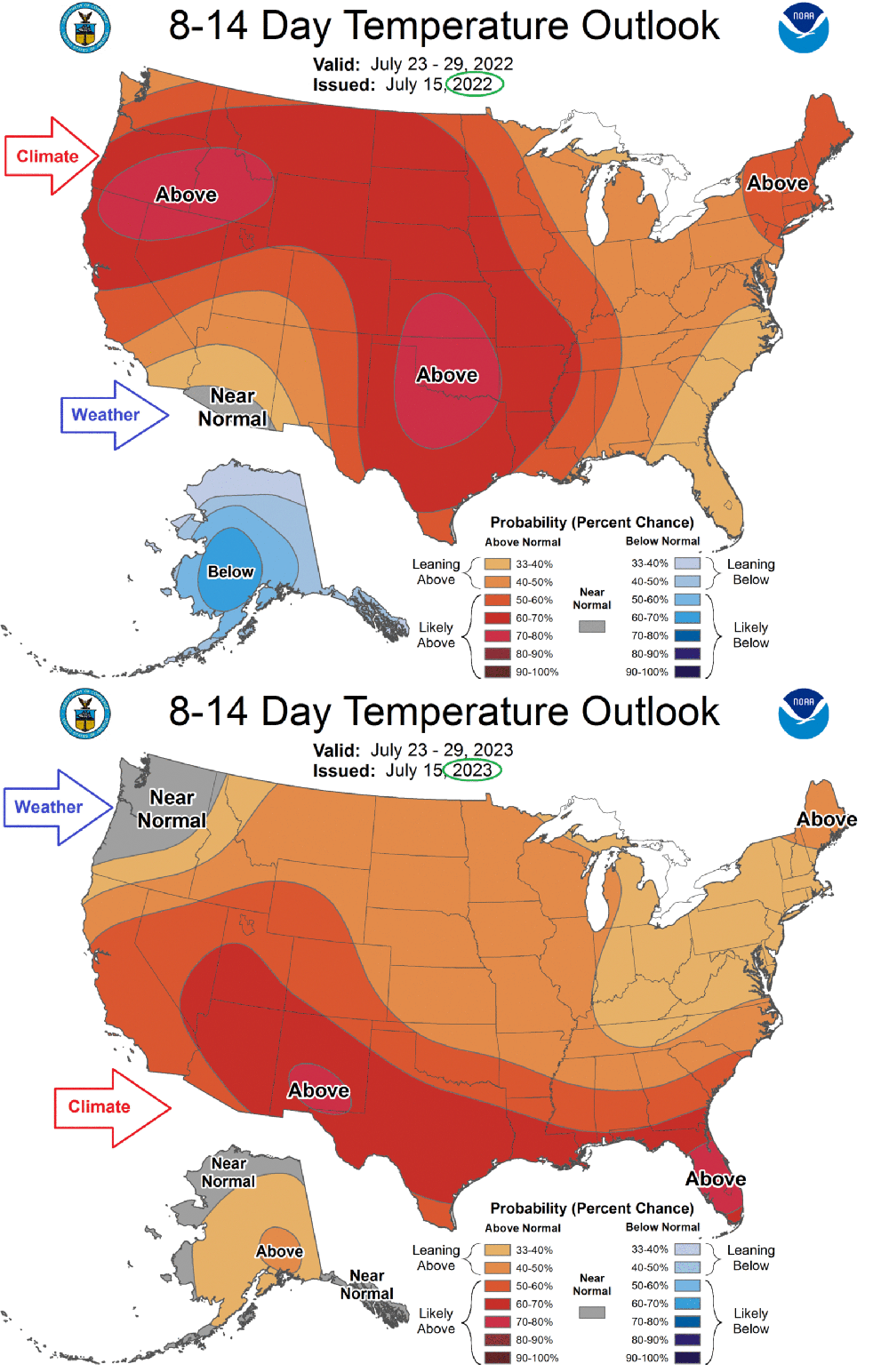
The warmest day recorded in January is 73 degrees Fahrenheit on January 23, 1909, so every day in January, for the last 115 years, has been colder; the warmest day ever in February is February 24, 1930, when temperatures hit 78 degrees; the warmest day in March was March 21, 1907, when the temperature hit 91 degrees.
The average high temperature in Springfield today is around 36 degrees, and this weekend we are supposed to have highs around 30 degrees below normal, with wind chills around 20 below zero.
So, after 160 years of exponential growth of all the things the green pushers
say cause warming, we are thirty degrees below normal.
Temperatures have always fluctuated cyclically and naturally. Humans have no control over them, and there is no correlation between CO2 content, crude oil use, number of vehicles, and temperatures.
Yet, here is an article from two days ago, full of worthless information and repeated talking points, all to push the radical green agenda to scare people into capitulation:
Earth shattered global heat record in ’23 and it’s flirting with warming limit, European agency says
Earth last year shattered global annual heat records, flirted with the world’s agreed-upon warming threshold and showed more signs of a feverish planet, the European climate agency said Tuesday.
The European climate agency Copernicus said the year was 1.48 degrees Celsius (2.66 degrees Fahrenheit) above pre-industrial times. That’s barely below the 1.5 degrees Celsius limit that the world hoped to stay within in the 2015 Paris climate accord to avoid the most severe effects of warming.
People with common sense and the ability to critically think should have several questions and comments about this article. First, they should point out that it is impossible to get an average global temperature unless they place the weather stations by area throughout the globe.
For example: 70 percent of the earth is covered by water, so 70% of weather stations should be placed over water to get a statistically accurate global temperature. Placing a much higher percentage of weather stations in urban areas, with cement and buildings, obviously skews the statistical results. Basically it is garbage in, garbage out.
Then they should ask why they picked the beginning of the Industrial Revolution as the starting point from which to measure. The Industrial Revolution spanned the period 1760–1840, which was during the little ice age. So, if you pick a cold period to start from, you exaggerate the change to push the agenda.
Why didn’t they start with the medieval warming period,
where the temperature was like today? The reason they don’t
is that it wouldn’t scare people into capitulation.
Why don’t they recognize the cooling period from 1940-1975 as disproving their theory that our use of natural resources causes warming? Because facts haven’t mattered in a long time.
One sentence that I find humorous is where people got together and decided exactly what the earth’s maximum temperature should be: “Earth last year shattered global annual heat records, flirted with the world’s agreed-upon warming threshold….”
Did they have a multiple-choice question? We will be able to adapt. It is pure arrogance when politicians, bureaucrats, the United Nations, and others pretend they can control temperatures, sea levels, and storm activity.
There are too many natural variables that we can’t control or predict. What people will never see in these articles that seek to scare people into capitulation is any actual scientific data that shows a direct link between our use of oil, coal, natural gas, methane, number of gas-powered vehicles, and temperature, or any other climate statistic because… there is none. But they don’t care.
The goal has always been to transfer money and freedom from the people
to the government and green pushers. They are greedy! It is a massive scam!
See also:
Temperature records from around the world do not support
the assumption that today’s temperatures are unusual.
“Over the last 20 years, because of temperature rises, we have seen about 116,000 more people die from heat. But 283,000 fewer people die from cold.”
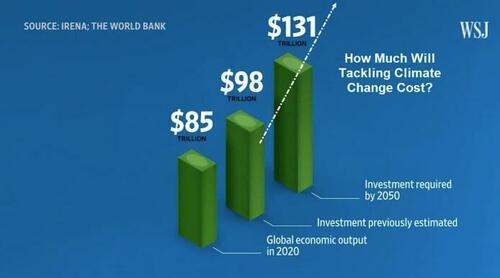
United States Special Presidential Envoy for Climate John Kerry says it will take trillions of dollars to “solve” climate change. Then he says, “There is not enough money in any country in the world to actually solve this problem.”
Yes, they are projecting more than 100 Trillion US$.
Kerry has little understanding of money or how it’s created. He’s a multimillionaire because he married a rich woman. Now he wants to take more of your money to pretend to affect climate change.
Bjorn Lomborg points out that there are better things society should spend money on.
Lomberg acknowledges that a warmer climate brings problems. “As temperatures get higher, sea water, like everything else, expands. So we’re going to maybe see three feet of sea level rise. Then they say, ‘So everybody who lives within three feet of sea level, they’ll have to move!’ Well, no. If you actually look at what people do, they built dikes and so they don’t have to move.”
Rotterdam Adaptation Policy–Ninety years thriving behind dikes and dams.
People in Holland did that years ago. A third of the Netherlands is below sea level. In some areas, it’s 22 feet below. Yet the country thrives. That’s the way to deal with climate change: adjust to it.
“Fewer people are going to get flooded every year, despite the fact that you have much higher sea level rise. The total cost for Holland over the last half-century is about $10 billion,” says Lomberg. “Not nothing, but very little for an advanced economy over 50 years.”
For saying things like that, Lomberg is labeled “the devil.”
“The problem here is unmitigated scaremongering,” he replies. “A new survey shows that 60 percent of all people in rich countries now believe it’s likely or very likely that unmitigated climate change will lead to the end of mankind. This is what you get when you have constant fearmongering in the media.”
Some people now say they will not have children because they’re convinced that climate change will destroy the world. Lomborg points out how counterproductive that would be: “We need your kids to make sure the future is better.”
He acknowledges that climate warming will kill people.
“As temperatures go up, we’re likely to see more people die from heat. That’s absolutely true. You hear this all the time. But what is underreported is the fact that nine times as many people die from cold…. As temperatures go up, you’re going to see fewer people die from cold. Over the last 20 years, because of temperature rises, we have seen about 116,000 more people die from heat. But 283,000 fewer people die from cold.”
A 2015 study by 22 scientists from around the world found that cold kills over 17 times more people than heat. Source: The Lancet
That’s rarely reported in the news.
When the media doesn’t fret over deaths from heat,
they grab at other possible threats.
CNN claims, “Climate Change is Fueling Extremism.”
The BBC says, “A Shifting Climate is Catalysing Infectious Disease.“
U.S. News and World Report says, “Climate Change will Harm Children’s Mental Health.”
Lomborg replies, “It’s very, very easy to make this argument that everything is caused by climate change if you don’t have the full picture.”
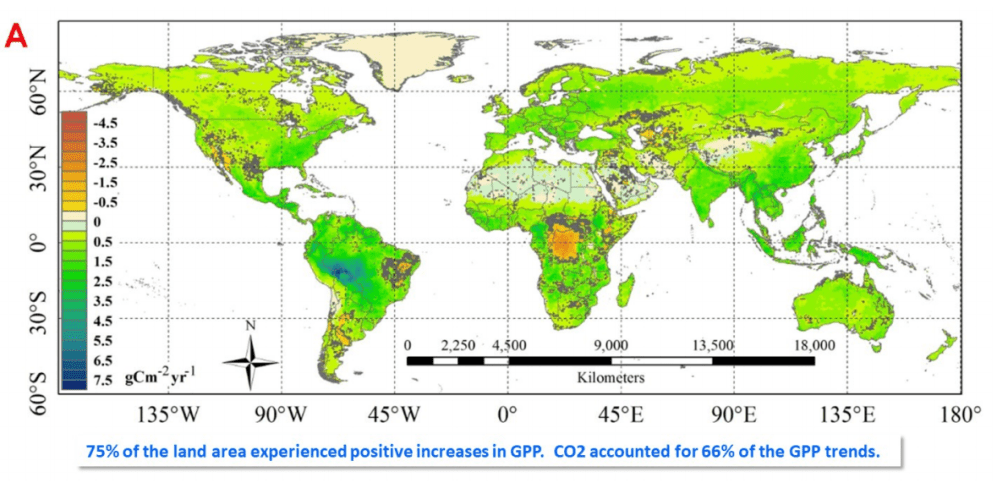
He points out that we rarely hear about positive effects of climate change, like global greening.
Spatial pattern of trends in Gross Primary Production (1982- 2015). Source: Sun et al. 2018.
“That’s good! We get more green stuff on the planet. My argument is not that climate change is great or overall positive. It’s simply that, just like every other thing, it has pluses and minuses…. Only reporting on the minuses, and only emphasizing worst-case outcomes, is not a good way to inform people.”
Synopsis of Lomborg’s Policy Recommendation (excerpted transcription)
If you’re a politician and you look at ten different problems, you’re natural inclination is to say, “Let’s give 1/10 to each one of them.” And economists would tend to say, “No, let’s give all of the money to the most efficient problem first and then to the second most efficient problem, and so on. I’m simply suggesting there’s a way that we could do much better with much less.
Of course if you feel very strongly about your particular area, when I come and say, “Actually, this is not a very efficient use of resources.” I get why people get upset. But for our collective good, for all the stuff that we do on the planet, we actually need to consider carefully where do we spend money well, compared to where do we just spend money and feel virtuous about ourselves.
If we spend way too much money ineffectively on climate, not only
are we not fixing climate, but we’re also wasting an enormous amount
of money that could have been spent on all these other things.
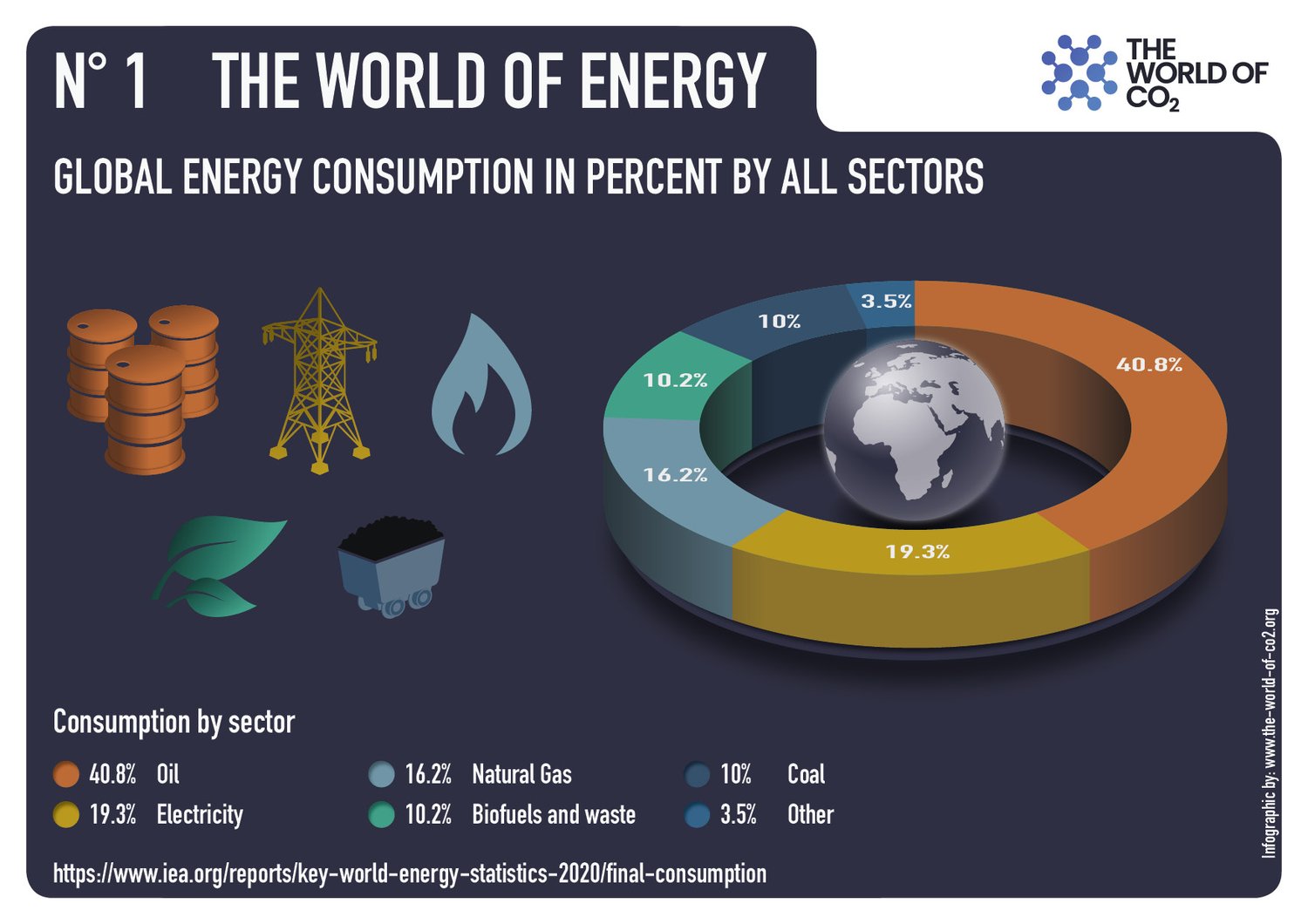
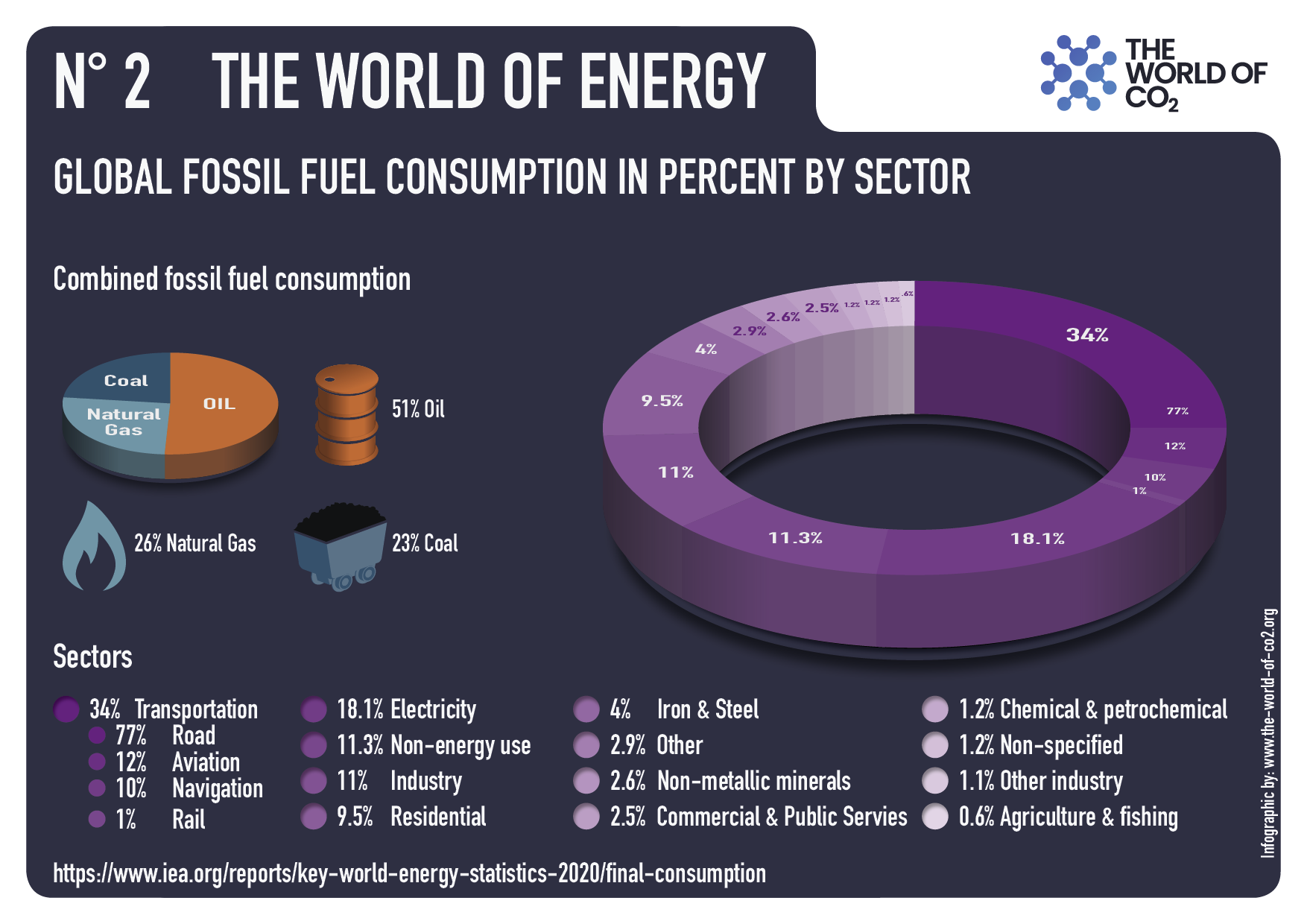
I’m simply trying to make that simple point, and I think most people kind of get that. Remember, electricity is about a fifth of our total energy consumption. So, all everybody’s talking about is all the electricity, which is the easiest thing to switch over. But we don’t know anything about how we’re going to, know very, very little about how we’re going to deal with the other 4/5. This is energy that we use on things that are very, very hard to replace. So it’s a fertilizer that keeps 4 billion people alive. Making the fertilizer. It’s steel, cement, it’s industrial processes. Most of heating we use comes from fossil fuels, most transportation, that’s fossil fuels.
Know that if the U.S. went entirely net zero today and stayed that way for the rest of the century, consider how incredibly extreme this would be. First of all, you would not be able to feed everyone in the U.S. The whole economy would break down. You wouldn’t know how to get transportation. A lot of people would freeze. Some people would fry. There would be lots and lots of problems. But even if you did this and managed to do it, the net impact, if you run it through the U.N. climate model, is that youwould reduce temperatures by the end of the century by 0.3 degrees Fahrenheit. We would almost not be able to measure it by the end of the century. It would have virtually no impact.
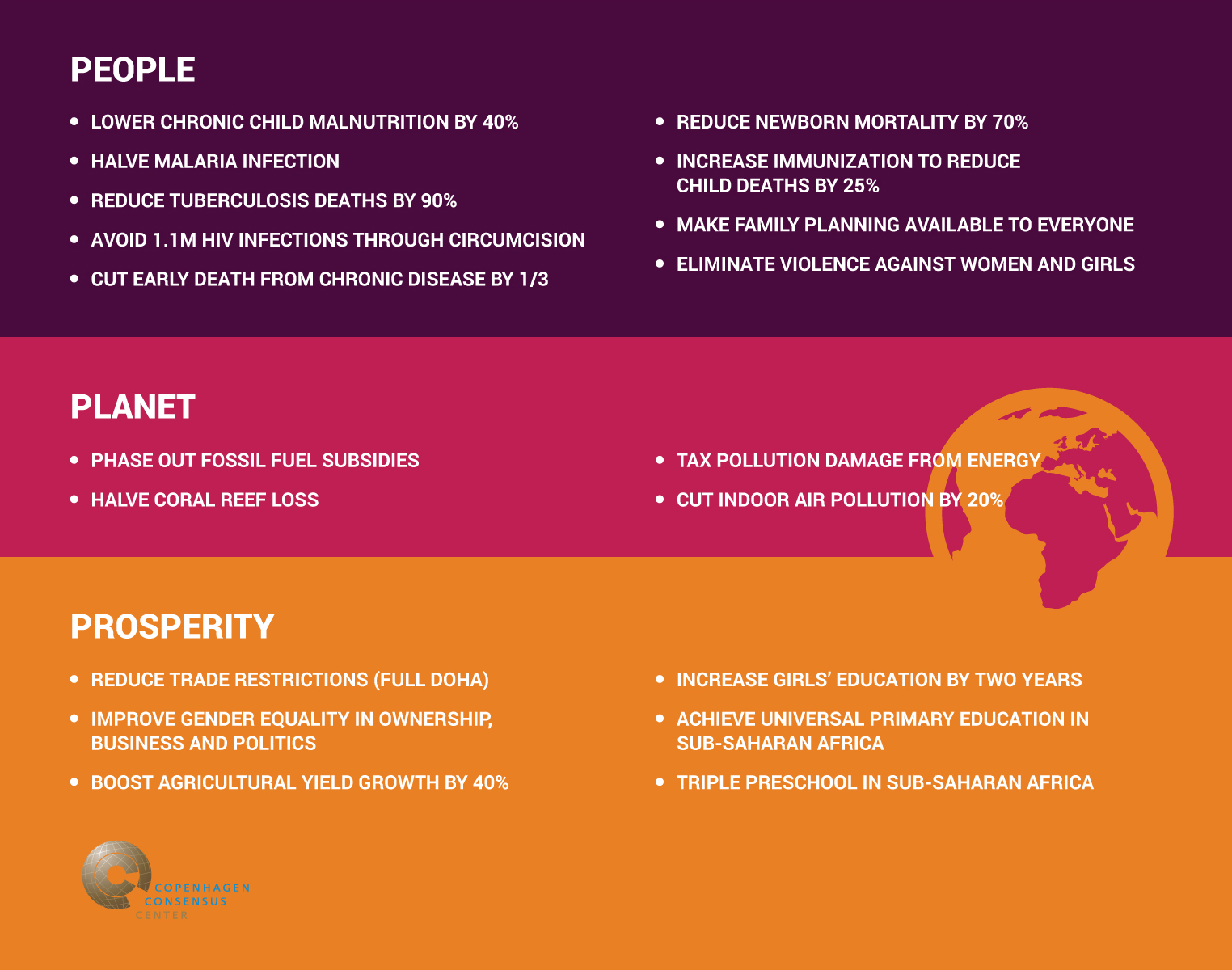
Look, again, we’re rich and so a lot of people feel like you can spend money on many different things. And that’s true. I’m making the argument that for fairly little money, we could do amazing good. If we spent $35 billion, not a trillion dollars, just $35 billion, which is not nothing. I don’t think, neither you or I have that amount of money. But, you know, in the big scheme of things, this is a rounding error. $35 billion could save 4.2 million lives in the poor part of the world, each and every year and make the poor world $1.1 trillion richer.
I think we have a moral responsibility to remember, that there are lots and lots of people, so mostly about 6 billion people out there, who don’t have this luxury of being able to think 100 years ahead and think about a little bit of a fraction of a degree, who wants to make sure that their kids are safe. And so, the next money we spend should probably be on these very simple and cheap policies.
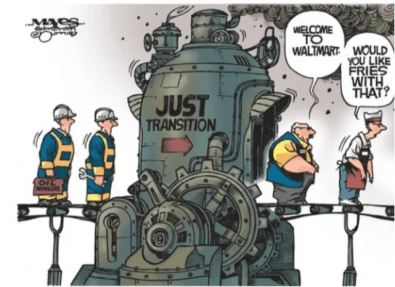
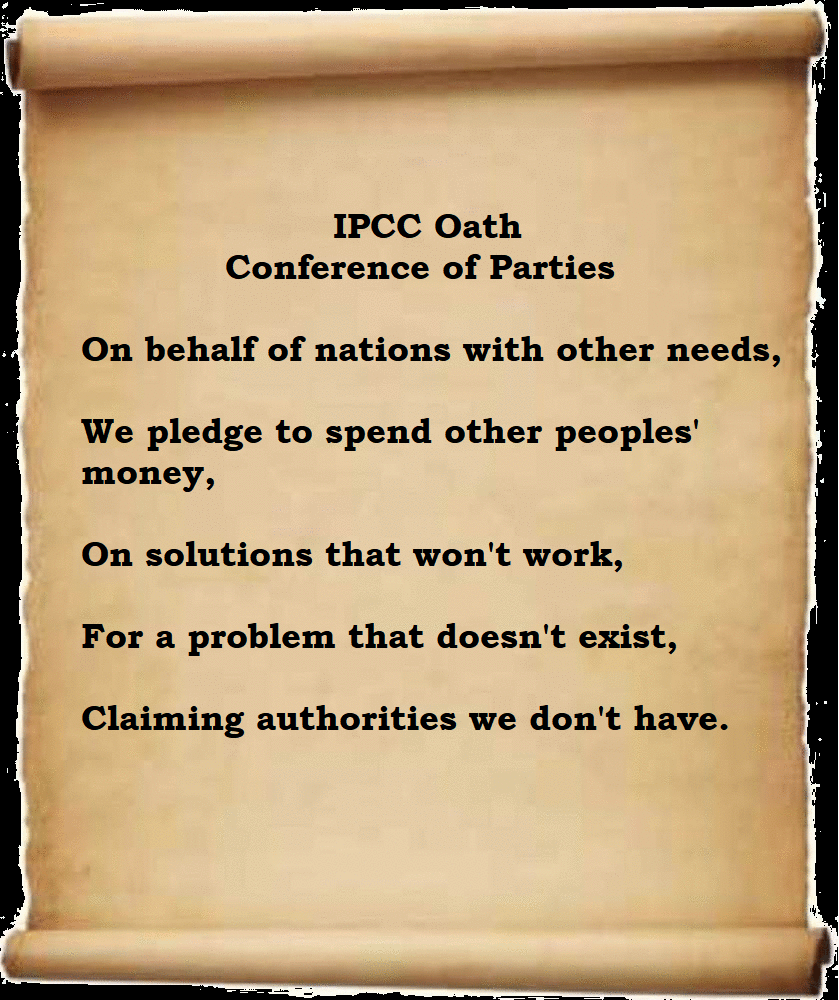
Once again equivocation rules climatists. After the uproar over demands to “phase out” hydrocarbon fuel, the wording was changed to say “transition away.” Thus the divide is papered over while alarmists claim agreement was reached to “leave it in the ground.” Others will point to language such as “transition away in a just, orderly and equitable manner.” Just like Paris COP, everyone pledges and celebrates as though something has changed
COP28 just concluded feverish negotiations in its final hours—actually, beyond its scheduled final hours—with the announcement of a final agreement Wednesday that includes language committing its near-200 participating nations to “transition away from” fossil fuels. That is the language negotiators landed upon to replace the previous language pledging to “phase out” the use of coal, oil and natural gas across the coming decades preferred by energy transition boosters.
Many observers are no doubt left wondering what the real difference is between the two phrases, other than that the “transition away from” language was found to be less offensive to big producers and users of these energy resources than a phasing-out turned out to be. It isn’t a bad question, to be sure.
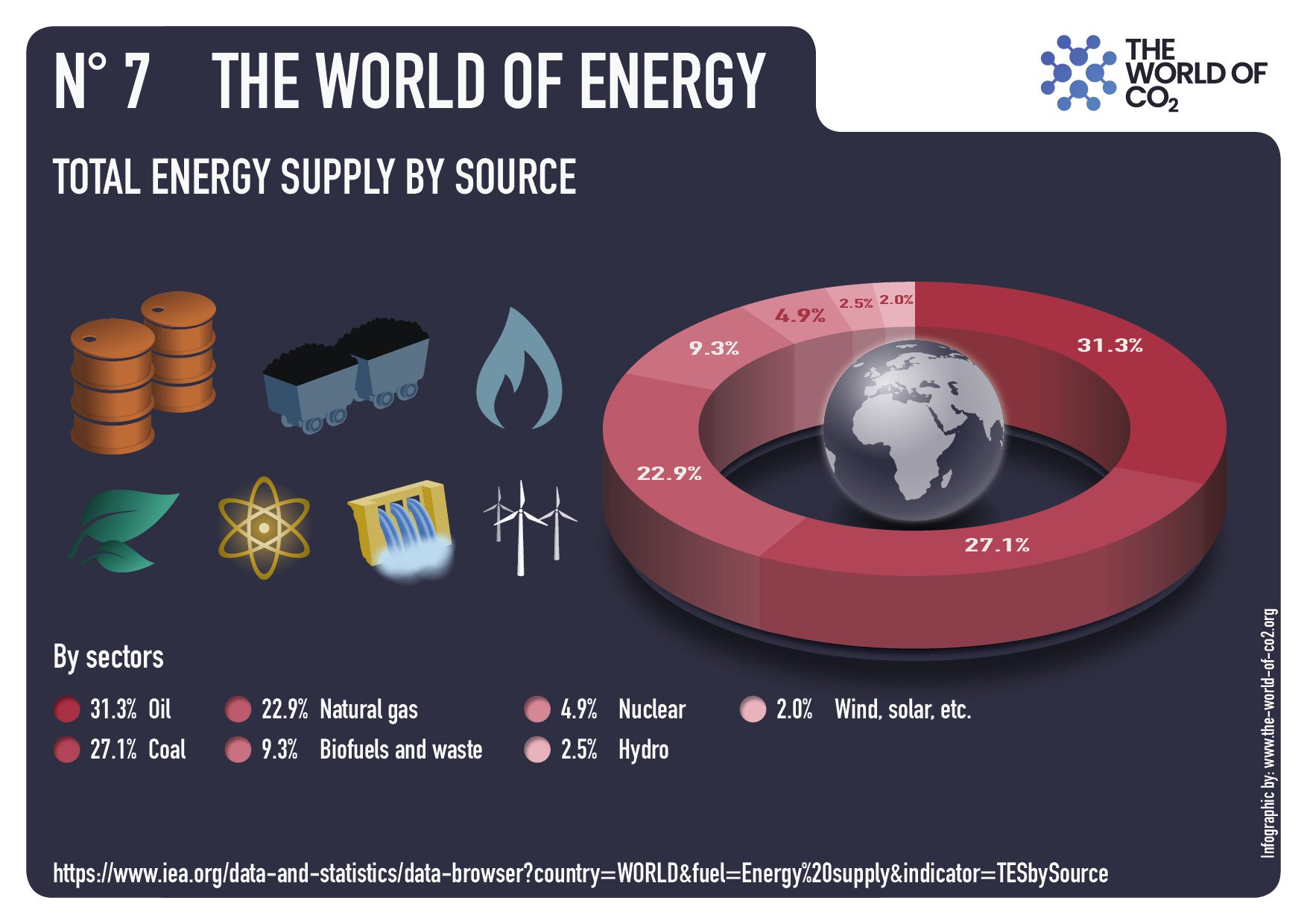
Advocates for this final language claim it is “historic” in that it is the first time any of the 28 UN Conference of the Parties climate summits have overtly mentioned moving away from the use of fossil fuels in a final agreement. But it is fair to note that countries across the globe have invested many trillions of dollars—much of it funded by costly debt—in efforts to “transition away from” fossil fuels over the last three decades now and little has changed. The world still gets roughly 80% of its primary energy from coal, oil and natural gas, only a sliver less than it did at the turn of the century. The world will use record volumes of all three fossil fuels in 2023, and most experts project it will do so again in 2024 and beyond.
So, while this language may well be “historic,” it is also merely a restatement of commitments many of the signatory governments have already embarked upon for years and failed to achieve. Honestly, it is difficult to envision how what amounts to yet another COP-generated word salad will do anything to change the undeniable global dynamic.
Reuters quotes Anne Rasmussen, lead negotiator for the Alliance of Small Island States, assessing the language as uninspiring. “We have made an incremental advancement over business as usual, when what we really need is an exponential step change in our actions,” she said.
But COP conferences involving more than 190 participating countries with widely disparate economic and energy security priorities and 70,000+ attendees are not really designed to produce exponential step changes, are they? COP rules requiring unanimous consent to all language included in each subsequent final agreement ensure that commitments will inevitably be watered down with qualifying language designed to enable each country to act upon its own unique interpretation of what phrases like “transition away from” actually mean.
Those are bold words, but everyone should recognize that “real-economy outcomes” in, say, Peru or Uganda are likely to look entirely different than those in Belgium or Canada. The same is likely true of the respective outcomes we will see in the coming years in India as compared to the United States.
The Bottom Line
As an example: If China wished to signify a zeal to “transition away from” its own massive use of fossil fuels, it might decide to cancel its new program going into effect January 1, 2024, which will subsidize the building of hundreds more coal-fired power plants. Does anyone involved in COP28 expect that or any similar action by the Xi Jinping government as a result of its signing off on this agreement? Of course not. Beijing will interpret the phrase “transition away from” as it sees fit and continue to prioritize its national energy security over any climate commitments.
At the end of the day, this final agreement from COP28 seems destined to be remembered in the same vein as all previous COPs other than COP3 (Kyoto) and COP21 (Paris) are remembered—as, to paraphrase William Shakespeare, a lot of sound and fury signifying not much at all.
As of this morning, we are four days into the two-week climate change summit in Dubai.
Yes, as we can all note for the thousandth time, literal fleets of private jets have descended on the desert so that bankers and billionaires can talk about making sure we don’t drive anymore or eat too much cheese.
What’s on the agenda? Globalism – and it’s never been more obvious.
President of Brazil Luiz Inácio Lula da Silva essentially said as much:
The planet is fed up with unfulfilled climate agreements. Governments cannot escape their responsibilities. No country will solve its problems alone. We are all obliged to act together beyond our borders,”
Thursday’s opening remarks were predictably doom-laden, with His Royal Highness Charles III and UN Secretary-General António Guterres falling into a traditional good cop/bad cop hustle.
Charlie warned that we are embarking on a “vast, frightening experiment”, asking “how dangerous are we actually prepared to make our world?”
While Tony offered just the barest, thinnest slice of hope to world leaders:
It is not too late […] You can prevent planetary crash and burn. We have the technologies to avoid the worst of climate chaos – if we act now.”
The rest of the two weeks will doubtless be committed to lobbyists, bankers, royals and politicians deciding exactly how they are going to “act”. Or, more accurately, how they are going to sell their pre-agreed actions to their cattle-like populations.
They are literally telling us their plans, all we have to do is listen.
For example, Friday and Saturday were given over to the “World Climate Action Summit”, at which over 170 world leaders pledged support for Agenda 2030.
Among the agreements and pledges signed at the summit so far is the “Emirates Declaration on Sustainable Agriculture, Resilient Food Systems and Climate Action”. Which, according to the BBC, pledges to:
take aim at planet-warming food”
We’ve all played this game long enough to know what that means, haven’t we? It means no more meat and dairy, and a lot more bugs and GMO soy cubes.
They never say that, of course. Instead, they just use phrases like “orient policies [to] reduce greenhouse gas emissions”, or “shifting from higher greenhouse gas-emitting practices to more sustainable production and consumption approaches.” Maintaining plausible deniability via vague language is part of the dance, but anyone paying attention knows exactly what they are talking about.
It doesn’t stop there. World leaders have also agreed to establish a “loss and damage fund”, a 430 million dollar resource for developing countries that need to “recover” after being “damaged” by climate change.
Ajay Banga, head of noted charitable organisation the World Bank, is all in favour of the idea and will be supporting the plan by agreeing to “pause” debt repayments from any government impacted by climate change.
Yes, those are trillions of US$ they are projecting.
We know how this works, we saw the same thing in the IHR amendments following Covid – it’s a bribe pool. One that serves to both further the narrative of climate change and instruct policy in the third world. Any developing nation’s government that wants a slice of that piewill have to publicly talk about all the negative impacts climate change has on their country. At the same time, to get the money, they will almost certainly have to agree to “adopt climate-friendly policies” and/or submit their climate policies to an “independent panel of experts” appointed by the UN.
Alongside the food pledge and loss fund, we have the Global Renewables and Energy Efficiency Pledge, which aims to increase reliance on “green energy”. Over 120 countries signed that one.
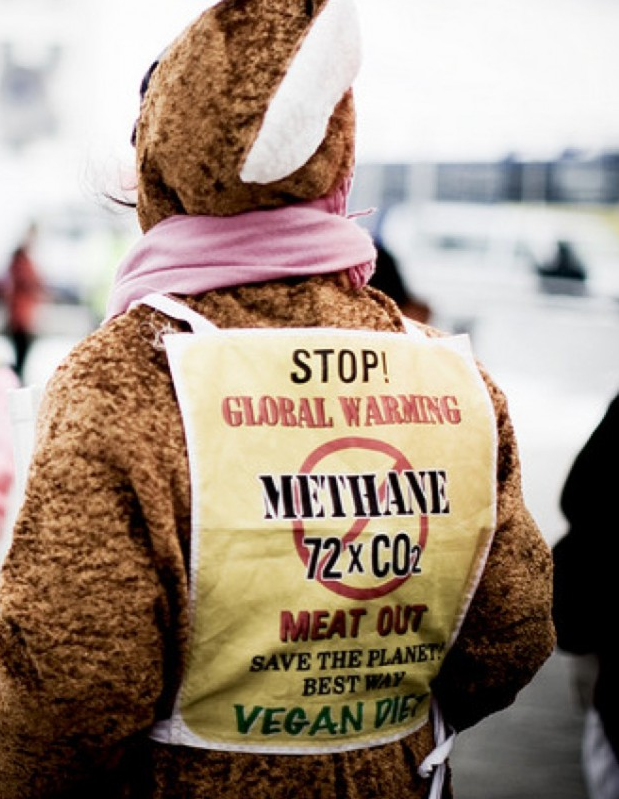
And then there’s the Global Methane Pledge, which has been signed by 155 governments as well as 50 oil companies. These companies represent around half the world’s oil production, and just want to help the planet, they have no financial stake in this situation at all.
There’s the smaller Declaration on Climate, Relief, Recovery and Peace, which was signed by only 70 countries (and 39 NGOs). That one emphasizes the link between war and carbon emissions and aims to “boost financial support for climate resilience in war-torn and fragile settings”, whatever that means in real terms I’m not sure.
And, of course, 124 countries (including the EU and China) have signed the inevitable ‘Declaration on Climate and Health’.
It is funded to the tune of 1 BILLION dollars from donors such as the Rockefeller Foundation, and supposedly aims to:
better leverage synergies at the intersection of climate change and health to improve the efficiency and effectiveness of finance flows.”
…which might be the worst sentence anyone has ever written.
All this is going to culminate in what they call the “Global Stocktake”. Essentially this is a mid-term report for the Paris Agreements, which can be “leveraged to accelerate ambition in their next round of climate action plans due in 2025”.
Whatever “leveraged to accelerate ambition” turns out to mean, you can be sure all of the attending governments will happily comply. That includes every government in NATO, the European Union and BRICS by the way. That includes the USA and China. That includes Russia and Ukraine. That includes Israel…and Palestine.
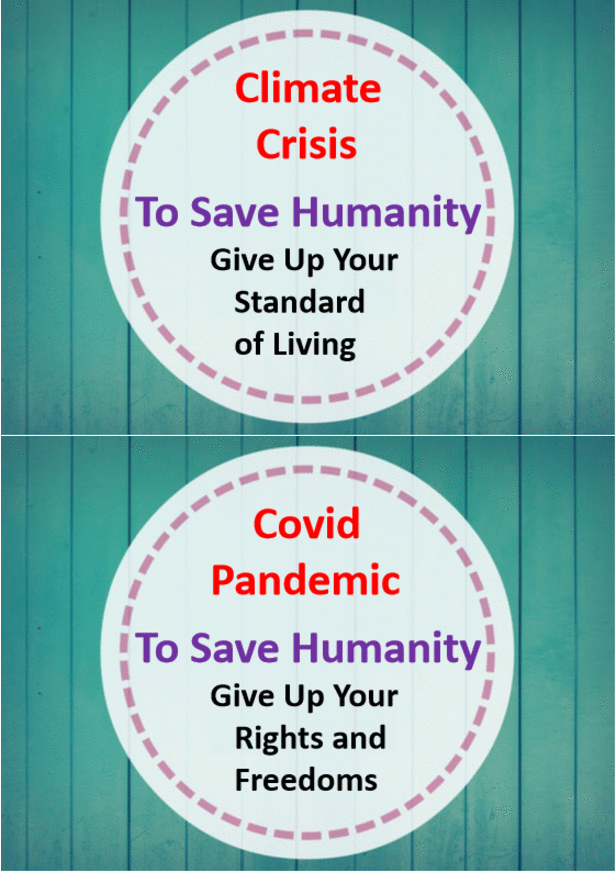
It’s basically covid all over again.
♦ We know, just like Covid, the official narrative of climate change is a lie.
♦ We know, just like Covid, climate change is being used as an excuse to usher in massive social control and global governance.
♦ And we know, just like Covid, almost every world government on both sides of every divide is backing it.
Even if they don’t always agree, even if they are happy to kill each other’s citizens in large numbers, they are all on board the same globalist gravy train, all going in the same direction to the same destination, and it has never been more obvious.


 A centrepiece of postmodern ideology is DEI which, by dividing us all into oppressor or oppressed, is neither diverse, nor equitable nor inclusive but conformist, unfair and exclusionary. It undermines excellence, productivity and competitiveness and is largely responsible for the assault on truth and inquiry at schools and universities, which have become left-wing breeding grounds for Gen Z.
 As for climate catastrophism, there are innumerable examples of the zany policies it has led to. Toronto’s fiscal situation is so dire it has just increased property taxes by 9.5 per cent. Yet its TransformTO 2022 Annual Report says that reaching net-zero goals by 2050 will require a $145-billion investment — though Toronto’s GHG emissions amount to 0.114 per cent of the global total. The U.S. government says that since 1850 the Earth’s temperature has risen 0.06C degrees per decade. That means Toronto contributes less than 0.00001 of a degree annually to global warming.




























 Science Matters