No Stopping Wind and Solar in Cal and NY States
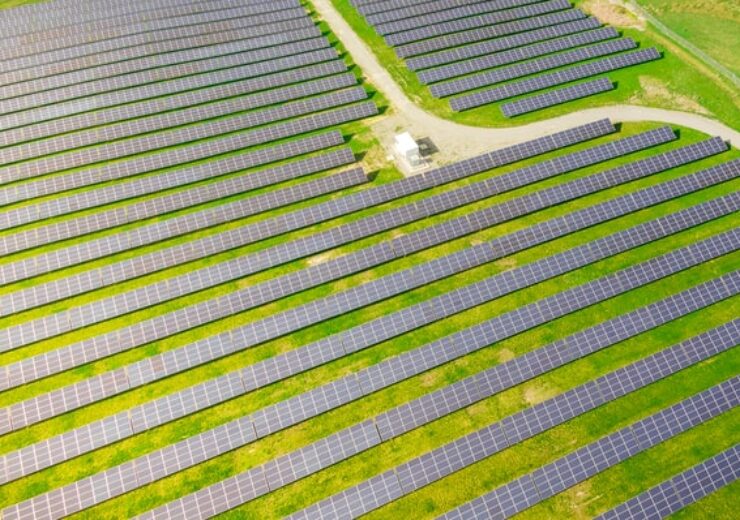
Hecate Energy, a developer, owner and operator of renewable power projects and energy storage solutions, has received state approval of its siting application for the 500 MW Cider Solar Farm in New York.

Wondering where will be spent hundreds of billions of US$ from the climate bill?  Two states have the inside track by abolishing citizens’ rights regarding siting of renewables projects. Matthew Eisenson explains at the Columbia Climate Law Blog New California Law Allows State to Bypass Local Restrictions in Siting Large-Scale Renewables.  Excerpts in italics with my bolds.

On June 30, 2022, the State of California joined the State of New York in adopting legislation that allows state authorities to bypass local laws in permitting large-scale renewable energy projects.

California’s new law, AB 205, gives the California Energy Commission (the “commission”) exclusive authority to issue a certificate for any:

(a) photovoltaic solar facility, on-shore wind facility, or thermal energy facility not powered by fossil fuels or nuclear fuels, with a generating capacity of at least 50 megawatts (MW);
(b) energy storage system with a storage capacity of least 200 megawatt hours;
(c) electric transmission line from any such generating or storage facility to an interconnected transmission system; and
(d) facility that manufactures, produces, or assembles wind, solar, or storage systems, with a capital investment of at least $250,000,000 over a period of 5 years. See California Public Resources Code § 25545(b).

AB 205 explicitly supersedes local permitting and local ordinances.

Specifically, it provides that the commission’s issuance of a certificate shall:

“be in lieu of any permit, certificate, or similar document required by any state, local, or regional agency,” id. § 25545.1(b)(1) (emphasis added); and
“supersede any applicable statute, ordinance, or regulation of any state, local, or regional agency,” id. (emphasis added).

The law further requires that applications be decided expeditiously, providing that:

“[w]ithin 30 days of the submission of the application, the commission shall review the application and make a determination of completeness,” id. § 25545.4(a) (emphasis added); and
“no later than 270 days after the application is deemed complete, or as soon as practicable thereafter, the commission shall determine whether to certify the environmental impact report and to issue a certificate” unless an exception applies, id. § 25545.4(e)(1) 
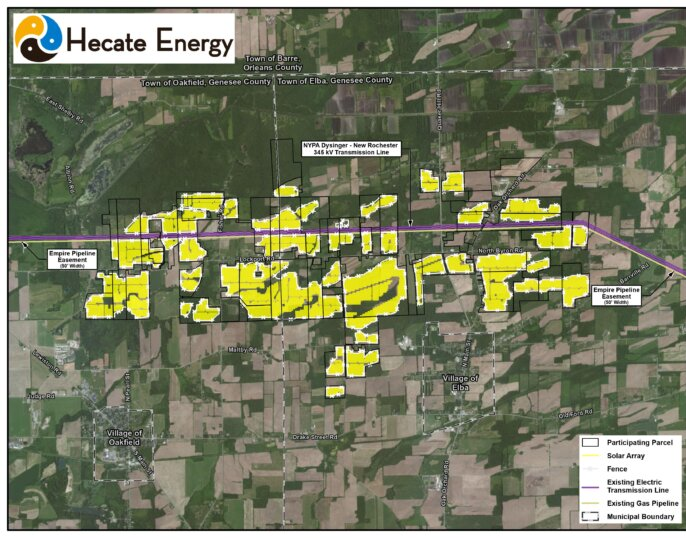
July 26, 2022 Cider Solar Farm is to be built on nearly 3,000 acres across the towns of Elba and Oakfield. Hecate Energy anticipates starting construction on the solar farm by 2023.

In New York State likewise the Accelerated Renewable Energy Growth and Community Benefit Act of 2020, as codified at New York Executive Law § 94-c, charges the Office of Renewable Energy Siting (ORES) with responsibility for permitting “major renewable energy facilities,” which include: (a) renewable energy facilities of at least 25 MW; (b) co-located energy storage systems; and (c) associated electric transmission systems less than 10 miles in length. See Exec. Law § 94-c(2)(h). Developers of renewable energy facilities of at least 20 MW but less than 25 MW may also submit applications to ORES. Id. § 94-c(4)(g).

While those applying for a permit to construct a major renewable energy facility in New York must “consult[] with the municipality or political subdivision where the project is proposed to be located . . . [concerning] the procedural and substantive requirements of local law,” ORES is authorized to set aside local laws on a case by case basis when deciding whether or not to grant a permit. Specifically, the law provides that ORES:

“may elect not to apply, in whole or in part, any local law or ordinance which would otherwise be applicable if it makes a finding that, as applied to the proposed major renewable energy facility, it is unreasonably burdensome in view of the CLCPA targets and the environmental benefits of the proposed major renewable energy facility.”

Id. § 94-c(5)(e) (emphasis added).

In addition, New York’s siting law, like California’s new siting law, requires that applications for large-scale renewables be decided expeditiously. In particular, ORES must:

determine within 60 days whether the application is complete, id. § 94-c(5)(b); and
make a final determination on a siting permit within one year of determining that an application is complete or within six months if the project is to be sited on an existing or abandoned commercial use, id. § 94-c(5)(f).

Notwithstanding these two laws, local restrictions remain a major impediment
to siting renewable energy projects in the United States.

As of March 2022, the Sabin Center had identified 121 local ordinances across the country to block or restrict renewable energy facilities. These policies range from outright bans to temporary moratoria to zoning restrictions so severe that they effectively preclude renewable energy projects. State authorities in California and New York now have the power to bypass such restrictions. However, in most states, there is no legislation allowing state authorities to do so.
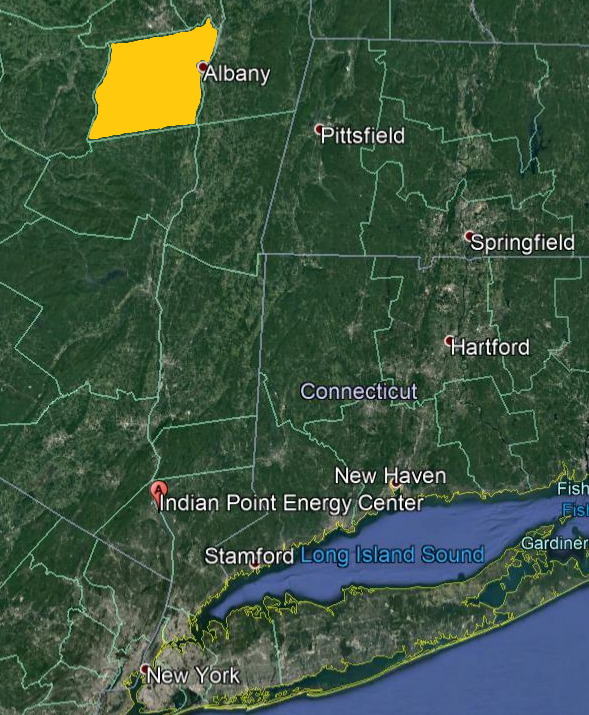
Replacing the now closed Indian point nuclear power plant with wind turbines would require land the size of Albany county NY. (320,000 acres)



Climate Cult Set to Spike Victims of Climate Policy

The quote is updated with one additional word. Unfortunately, we have today no statesman who is so truthful.

Tyler Durden explains at his zerohedge article The Climate Cult is Eager to Take Advantage of Europe’s Energy Crisis.  Excerpts in italics with my bolds and added images.

The climate cult never sleeps, and when they see nations in crisis they are always quick to try to exploit the situation by misrepresenting the root problem.  

A heat wave is currently hitting Europe along with wild fires and the mainstream media is beating the global warming drum hard.  This is nothing new; every time the weather gets hot they cry “climate change!”  Every time the weather is extra cold they once again cry “climate change!”  The evidence?  What about the “record heat” in parts of UK, Spain and Portugal?  This is surely proof that the weather is being ruined by that terrible menace known as man-made carbon?

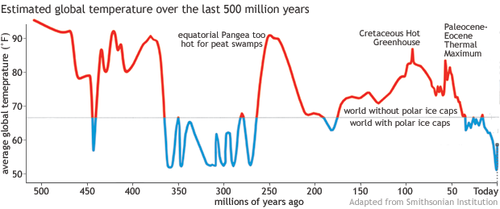
Of course, what they don’t tell you is that the official record for weather and temperatures used by climate scientists only goes back about 140 years (it started in the 1880s). So, millions upon millions of years of Earth weather, and they only count 140 years of it to determine “record temps?” They tend to ignore ice core and tree ring data from centuries ago that indicate much hotter warming periods in our planet’s history (none of which were caused by man-made carbon emissions). In comparison, today’s temperatures are rather tame.

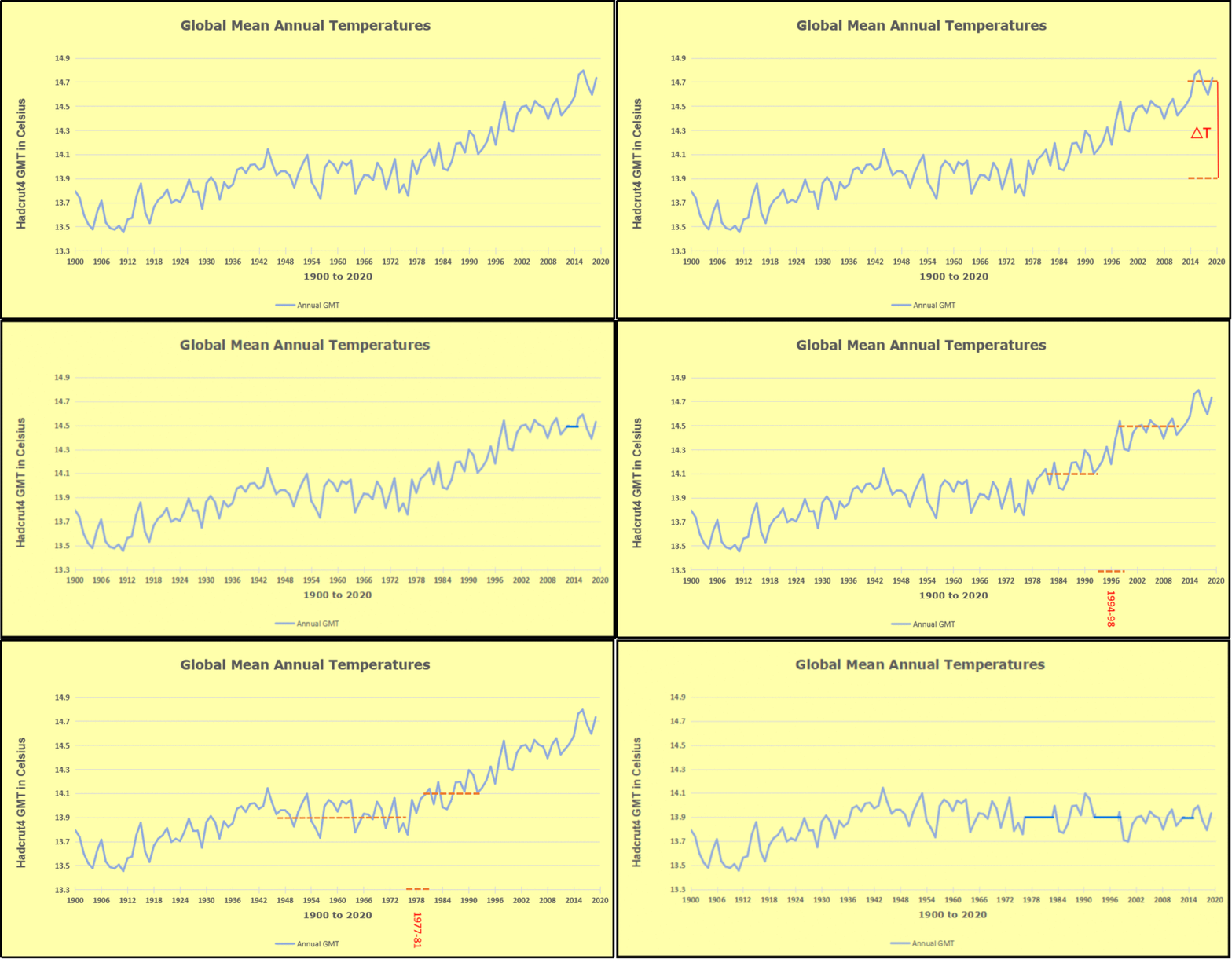
The Earth’s overall temperatures have only risen by 1° Celsius in the past century; this was actually the peak and currently temps have evened out to an increase of 0.8°C. This is the great climate doomsday we are all supposed to be terrified of. This is the looming threat we are supposed to sacrifice all fossil fuel based energy production for – Less than a single degree of heat.

Global warming theory claims added CO2 systematically raises surface temperatures. On the contrary all of the recent warming is episodic, associated with oceanic El Nino events.

It’s important to put the frantic climate change narrative into concrete perspective because the vast majority of climate science is paid for by governments and special interest organizations like the UN, the World Economic Forum and many other globalist groups with an agenda in mind. On average, these governments and institutions spend around $632 billion per year on climate research funding and climate policy initiatives (which they call “meager”). Their goal is to increase this cash flow to $4 trillion by the year 2030. The incentives to jump on the man-made climate change train are MASSIVE; there is almost no monetary incentive for scientists that want to study other potential causes for climate events.

The notion of the stalwart and incorruptible scientist that seeks objective truth rather than cash and notoriety is long dead. Honest scientists are few and far between these days (especially in the medical and climate science fields), and perhaps it has always been that way. The “experts” cannot be blindly trusted because they are just as susceptible to bias and corruption as anyone else.

Climate change hysteria is a nothing burger, but it is being actively promoted by the media to obscure very real threats that the public faces in the near term.

One of those threats is energy shortages, and climate regulations have put a stranglehold on many nations and their ability to adapt. The EU is now implementing carbon policies that call for a 55% reduction of emissions by 2030. Meaning, no new fossil fuel sources are supposed to be utilized. Only reductions are allowed.

Climate scientists and global elitists claim that climate change is the paramount issue of the century and must be dealt with immediately and by any means necessary. They haven’t presented a single shred of hard evidence to support this assertion, but they dictate the policies of most western governments so they don’t really need to. They just initiate restrictions without public input.

In reality, perhaps the greatest threat since WWII is about to land like a hydrogen bomb
in the laps of the European public.

Panic is beginning to take shape as Russia cuts natural gas supplies to the EU down to 20% of their original capacity and alternative sources simply do not exist on a scale that can take up the slack. A large portion of oil exports have also been shut down, and European governments are NOT informing the citizenry of the true gravity of the situation.

At current energy import rates, at least 40% of Europe
will not be able to heat their homes in the winter.

EU plans to replace Russian energy sources in the near term have also been deemed “wildly optimistic.” In other words, the EU public is screwed, and many of them still don’t realize it yet because the government won’t admit it. A disaster of epic proportions is about to strike and this isn’t even counting the enormous price hikes that are coming for the other 60% of people that will still have gas supplies available.

But the climate cult is not letting this visceral reality get in their way. To them, the crisis is an opportunity. A new narrative is rising among intergovernmental bodies, the media and among climate activists; they say this impending disaster is actually “good for Europe” in the long run, because it forces citizens to accept energy reduction policies and carbon controls which climate scientists and globalists have been demanding for years. Inflation in prices means shrinking demand and cuts in the supply chain mean resources are quashed even if demand remains high. Energy is being suffocated slowly leaving room for a “Green New Deal” of sorts.

So, it’s good for the globalists and their agenda, but not really good for anyone else that has to live through harsh winter months with no heat and limited electricity.

If the current trend continues without a dramatic change in the way Europe throttles fossil fuel energy, then there is the very real potential for mass deaths this winter. This is not hyperbole, this is a mathematical certainty. The continued push for even more climate restrictions at this time is making the situation much worse.

There is no impending threat due to climate change, but there is an impending threat due to energy shortages. Europeans need to ask themselves – Why are their governments setting them up for calamity over a non-existent climate bogeyman? Without increased fossil fuel energy from numerous sources including coal and oil the EU is on the path to a historic tragedy this winter.


Huge: EPA Loses–America Wins

Democrat Rep. Alexandria Ocasio-Cortez on Thursday called for the Supreme Court to be abolished after the High Court reined in the EPA’s power to regulated greenhouse gases.

Scotusblog reports on this latest return to sanity by the US Supreme Court. Supreme Court curtails EPA’s authority to fight climate change  Once again the court refuses to legislate an issue that belongs to Congressional deliberation. Excerpts in italics with my bolds.

In a 6-3 decision that may limit agency power across the federal government, the court held that Congress did not clearly authorize the EPA to adopt broad rules to lower carbon emissions from power plants.

The Supreme Court on Thursday truncated the Environmental Protection Agency’s power to regulate greenhouse gases. The ruling may hamper President Joe Biden’s plan to fight climate change and could limit the authority of federal agencies across the executive branch.

By a vote of 6-3, the court agreed with Republican-led states and coal companies that the U.S. Court of Appeals for the District of Columbia Circuit was wrong when it interpreted the Clean Air Act to give the EPA expansive power over carbon emissions. The decision, written by Chief Justice John Roberts, was handed down on the final opinion day of the 2021-22 term.

Two different and conflicting sets of regulations – neither of which is currently in effect – were at issue in the case, known as West Virginia v. EPA. In 2015, the Obama administration adopted the Clean Power Plan, which sought to combat climate change by reducing carbon pollution from power plants – for example, by shifting electricity production to natural-gas plants or wind farms. The CPP set individual goals for each state to cut power-plant emissions by 2030. But in 2016, the Supreme Court put the CPP on hold in response to a challenge by several states and private parties.

In 2019, the Trump administration repealed the CPP and replaced it with the Affordable Clean Energy Rule, which gave states discretion to set standards and gave power plants flexibility in complying with those standards. The Trump administration argued that it was required to end the CPP because it exceeded the EPA’s authority under Section 7411 of the Clean Air Act, which gives the EPA the power to determine the “best system of emission reduction” for buildings that emit air pollutants. That provision, the Trump administration contended, only allows the EPA to implement measures that apply to the physical premises of a power plant, rather than the kind of industry-wide measures included in the CPP.

Last year the D.C. Circuit vacated both the Trump administration’s repeal of the CPP and the ACE Rule, and sent the case back to the EPA for additional proceedings. Section 7411, the court of appeals explained, does not require the more limited view of the EPA’s authority that the Trump administration adopted.

The Supreme Court on Thursday reversed the D.C. Circuit’s ruling. Roberts’ 31-page opinion began by considering whether the Republican-led states and coal companies challenging the D.C. Circuit’s decision had a right to seek review in the Supreme Court now. Because the Biden administration plans to issue a new rule on carbon emissions from power plants, rather than reinstating the CPP, the administration had argued that the case did not present a live controversy for the justices to decide. But a decision by the government to stop the conduct at the center of a case does not end the case, Roberts emphasized, “unless it is ‘absolutely clear that the allegedly wrongful behavior could not reasonably be expected to recur.’” And in this case, Roberts stressed, because the Biden administration “vigorously defends” the approach that the Obama EPA took with the CPP, the Supreme Court can weigh in.

Turning to the merits of the case, Roberts wrote that the EPA’s effort to regulate greenhouse gases by making industry-wide changes violated the “major-questions” doctrine – the idea that if Congress wants to give an administrative agency the power to make “decisions of vast economic and political significance,” it must say so clearly.

Section 7411 of the Clean Air Act, Roberts reasoned, had been “designed as a gap filler and had rarely been used in the preceding decades.” But with the CPP, Roberts observed, the EPA sought to rely on Section 7411 to exercise “unprecedented power over American industry.” “There is little reason to think Congress assigned such decisions to” the EPA, Roberts concluded, especially when Congress had previously rejected efforts to enact the kind of program that the EPA wanted to implement with the CPP.

“Capping carbon dioxide emissions at a level that will force a nationwide transition away from the use of coal to generate electricity may be a sensible ‘solution to the crisis of the day,’” Roberts wrote. But only Congress, or an agency with express authority from Congress, can adopt a “decision of such magnitude and consequence.”

Roberts’ full-throated embrace of the major-questions doctrine – a judicially created approach to statutory interpretation in challenges to agency authority – likely will have ripple effects far beyond the EPA. His reasoning applies to any major policymaking effort by federal agencies.

In a concurring opinion that was joined by Justice Samuel Alito, Justice Neil Gorsuch emphasized that the dispute before the court involved “basic questions about self-government, equality, fair notice, federalism, and the separation of powers.” The major-questions doctrine, Gorsuch wrote, “seeks to protect against ‘unintentional, oblique, or otherwise unlikely’ intrusions on these interests” by requiring federal agencies to have “clear congressional authorization” when they address important issues. Whether coal- and gas-fired power plants “should be allowed to operate is a question on which people today may disagree, but it is a question everyone can agree is vitally important.”

The Ruling WEST VIRGINIA v. EPA

Background  Supremes to Review EPA Authority Over GHGs

Footnote from CO2 Coalition

EPA loses – America Wins

Victory for citizens and businesses alike

In what is likely the most damaging setback ever dealt to those advocating for overzealous enforcement actions against greenhouse gas emissions, the Supreme Court of the United States ruled in favor of constitutional limitations on unelected regulators.

This morning SCOTUS ruled in favor of the plaintiff states in WV v. EPA. This was an important “separation of powers” case. Over 20 states allege EPA improperly used very narrow statutory language as the basis for a national CO2 cap-and-trade program.

The constitutional principle of separation of powers requires that only Congress—through legislation—is authorized to decide major policy issues, not federal agencies. The related legal “Major Question Doctrine” holds that federal agencies must have a clear authorization from Congress before exercising new and significant regulatory power.

According to the ruling written by Chief Justice John Roberts: “But the only interpretive question before us, and the only one we answer, is more narrow: whether the “best system of emission reduction” identified by EPA in the Clean Power Plan was within the authority granted to the Agency in Section 111(d) of the Clean Air Act. For the reasons given, the answer is no.”

This is why we fight.

Statement on the ruling by CO2 Coalition Chair William Happer:

“The decision is a very welcome reaffirmation of the Constitutional rights of citizens of the United States. Untouched is the question of whether the Constitution allows Congress to make scientifically incorrect decisions by majority vote, for example: that carbon dioxide, a beneficial gas that is essential to life on Earth, is a pollutant.”

2022 Update: Fossil Fuels ≠ Global Warming

gas in hands

Previous posts addressed the claim that fossil fuels are driving global warming. This post updates that analysis with the latest (2021) numbers from BP Statistics and compares World Fossil Fuel Consumption (WFFC) with three estimates of Global Mean Temperature (GMT). More on both these variables below.

WFFC

2021 statistics are now available from BP for international consumption of Primary Energy sources. 2022 Statistical Review of World Energy. 

The reporting categories are:
Oil
Natural Gas
Coal
Nuclear
Hydro
Renewables (other than hydro)

Note:  British Petroleum (BP) now uses Exajoules to replace MToe (Million Tonnes of oil equivalents.) It is logical to use an energy metric which is independent of the fuel source. OTOH renewable advocates have no doubt pressured BP to stop using oil as the baseline since their dream is a world without fossil fuel energy.

From BP conversion table 1 exajoule (EJ) = 1 quintillion joules (1 x 10^18). Oil products vary from 41.6 to 49.4 tonnes per gigajoule (10^9 joules).  Comparing this annual report with previous years shows that global Primary Energy (PE) in MToe is roughly 24 times the same amount in Exajoules.  The conversion factor at the macro level varies from year to year depending on the fuel mix. The graphs below use the new metric.

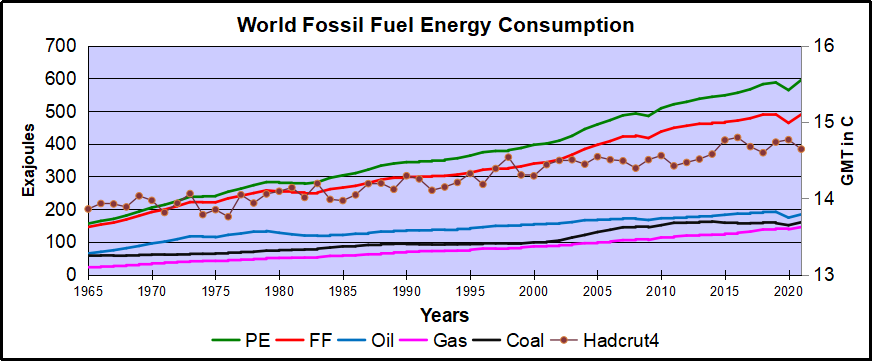
This analysis combines the first three, Oil, Gas, and Coal for total fossil fuel consumption world wide (WFFC).  The chart below shows the patterns for WFFC compared to world consumption of Primary Energy from 1965 through 2021.

The graph shows that global Primary Energy (PE) consumption from all sources has grown continuously over 5 decades. Since 1965  oil, gas and coal (FF, sometimes termed “Thermal”) averaged 88% of PE consumed, ranging from 93% in 1965 to 82% in 2021.  Note that in 2020, PE dropped 23 EJ (4%) below 2019 consumption, then increased 31 EJ in 2021.  WFFC for 2020 dropped 26 EJ (5%), then in 2021 gained back 26% to match 2019 WFFC consumption. For the 56 year period, the net changes were:

Oil 184%
Gas 540%
Coal 176%
WFFC 236%
PE 282%
Global Mean Temperatures

Everyone acknowledges that GMT is a fiction since temperature is an intrinsic property of objects, and varies dramatically over time and over the surface of the earth. No place on earth determines “average” temperature for the globe. Yet for the purpose of detecting change in temperature, major climate data sets estimate GMT and report anomalies from it.

UAH record consists of satellite era global temperature estimates for the lower troposphere, a layer of air from 0 to 4km above the surface. HadSST estimates sea surface temperatures from oceans covering 71% of the planet. HADCRUT combines HadSST estimates with records from land stations whose elevations range up to 6km above sea level.

Both GISS LOTI (land and ocean) and HADCRUT4 (land and ocean) use 14.0 Celsius as the climate normal, so I will add that number back into the anomalies. This is done not claiming any validity other than to achieve a reasonable measure of magnitude regarding the observed fluctuations.

No doubt global sea surface temperatures are typically higher than 14C, more like 17 or 18C, and of course warmer in the tropics and colder at higher latitudes. Likewise, the lapse rate in the atmosphere means that air temperatures both from satellites and elevated land stations will range colder than 14C. Still, that climate normal is a generally accepted indicator of GMT.

Correlations of GMT and WFFC

The next graph compares WFFC to GMT estimates over the five decades from 1965 to 2021 from HADCRUT4, which includes HadSST4.

Since 1965 the increase in fossil fuel consumption is dramatic and monotonic, steadily increasing by 236% from 146 to 490 exajoules.  Meanwhile the GMT record from Hadcrut shows multiple ups and downs with an accumulated rise of 0.8C over 56 years, 6% of the starting value.

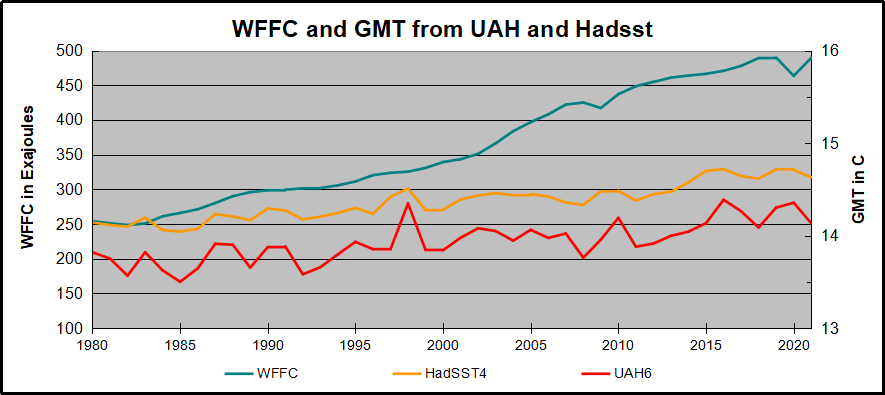
The graph below compares WFFC to GMT estimates from UAH6, and HadSST4 for the satellite era from 1980 to 2021, a period of 41 years.

In the satellite era WFFC has increased at a compounded rate of nearly 2% per year, for a total increase of 90% since 1979. At the same time, SST warming amounted to 0.49C, or 3.4% of the starting value.  UAH warming was 0.48C, or 3.5% up from 1979.  The temperature compounded rate of change is 0.1% per year, an order of magnitude less than WFFC.  Even more obvious is the 1998 El Nino peak and flat GMT since.

Summary

The climate alarmist/activist claim is straight forward: Burning fossil fuels makes measured temperatures warmer. The Paris Accord further asserts that by reducing human use of fossil fuels, further warming can be prevented.  Those claims do not bear up under scrutiny.

It is enough for simple minds to see that two time series are both rising and to think that one must be causing the other. But both scientific and legal methods assert causation only when the two variables are both strongly and consistently aligned. The above shows a weak and inconsistent linkage between WFFC and GMT.

Going further back in history shows even weaker correlation between fossil fuels consumption and global temperature estimates:

wfc-vs-sat

Figure 5.1. Comparative dynamics of the World Fuel Consumption (WFC) and Global Surface Air Temperature Anomaly (ΔT), 1861-2000. The thin dashed line represents annual ΔT, the bold line—its 13-year smoothing, and the line constructed from rectangles—WFC (in millions of tons of nominal fuel) (Klyashtorin and Lyubushin, 2003). Source: Frolov et al. 2009

In legal terms, as long as there is another equally or more likely explanation for the set of facts, the claimed causation is unproven. The more likely explanation is that global temperatures vary due to oceanic and solar cycles. The proof is clearly and thoroughly set forward in the post Quantifying Natural Climate Change.

Footnote: CO2 Concentrations Compared to WFFC

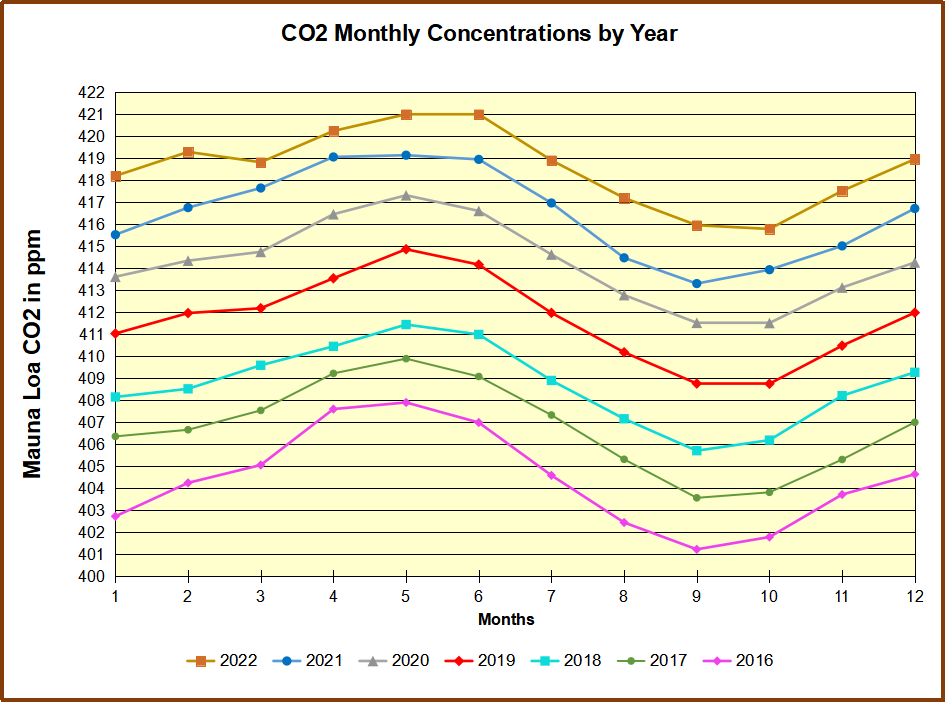
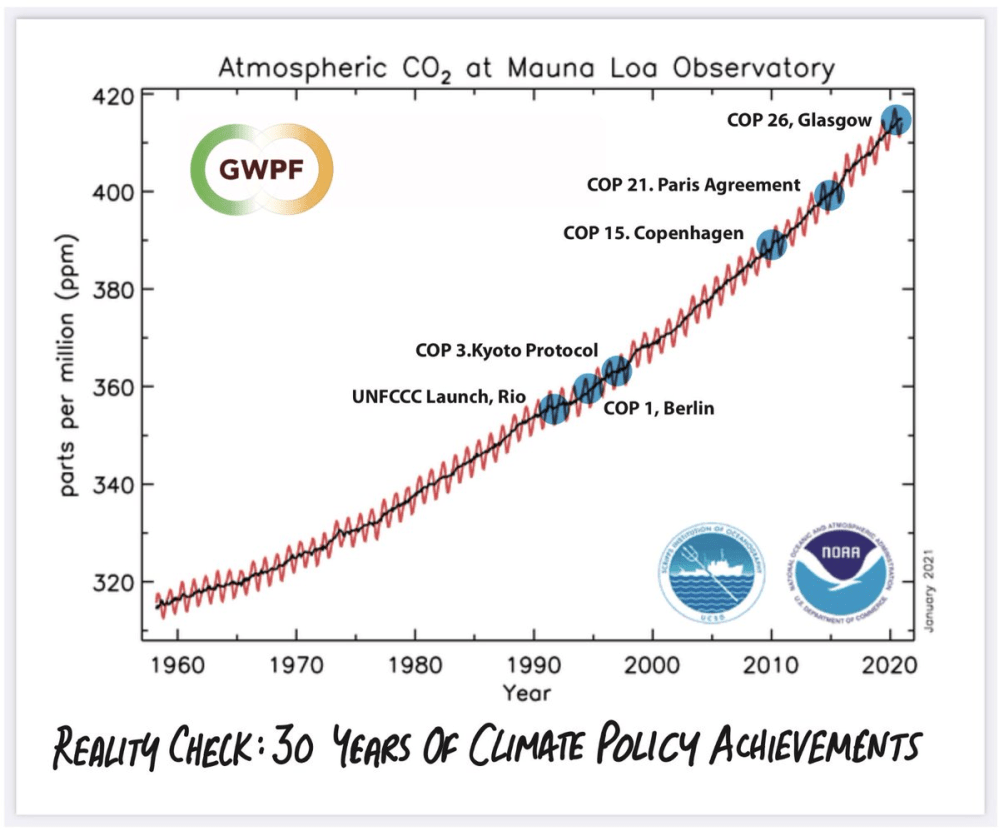
Contrary to claims that rising atmospheric CO2 consists of fossil fuel emissions, consider the Mauna Loa CO2 observations in recent years.

Despite the drop in 2020 WFFC, atmospheric CO2 continued to rise steadily, demonstrating that natural sources and sinks drive the amount of CO2 in the air.

See also: Nature Erases Pulses of Human CO2 Emissions

Temps Cause CO2 Changes, Not the Reverse

Hard Facts Puncture Anti-Fossil Fuel Fantasies

Gwyn Morgan explains at Financial Post Hard facts puncture anti-fossil fuel fantasies.  Excerpts in italics with my bolds and added images.

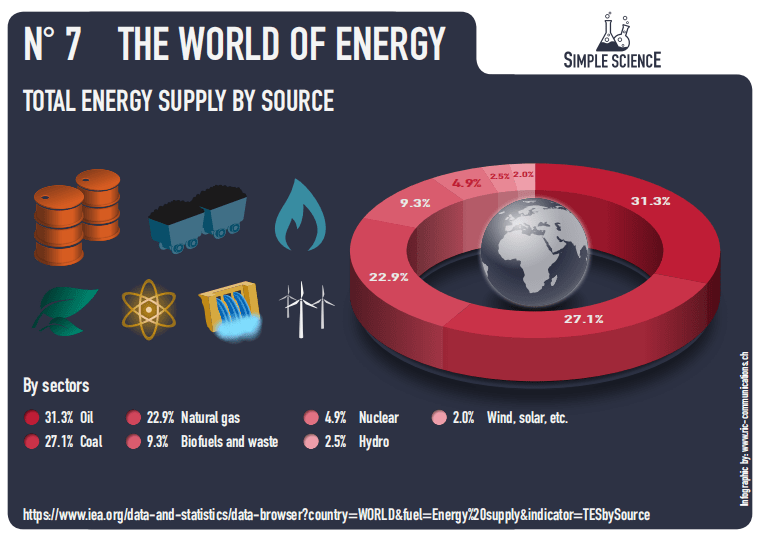
The belief that 84% of global energy supplied by oil and gas can be replaced by so-called ‘green energy’ is a fantasy

The marvelous Christmas movie Polar Express, starring the inimitable Tom Hanks, ends with the words “anything is possible, if you only believe.” Except, as adults understand, many things aren’t possible, not even if some people do believe them. An obvious example is the fantasy that the 84 per cent of global energy supplied by oil and gas can be replaced by so-called “green energy.”

Since the first UN COP (“Conference of the Parties”) meeting in 1995, world oil demand has increased from 64 to 100 million barrels per day. But even as demand increased, the “environmental, social and governance” (ESG) movement encouraged investors to unload their oil industry holdings. Faced with share valuations reflecting their perceived status as a “sunset Industry,” the rational course for oil company leaders was to pay out large dividends rather than reinvest in production growth. As demand grew, supply therefore stagnated. The Ukraine crisis revealed just how narrow the supply margin has become. Regrettably, most of that margin is in the hands of Vladimir Putin, leaving European countries that depend on Russian oil no choice but to continue to provide the funds with which he ravages the Ukrainian people.

This is the tragedy sanctimonious ESG zealots have wrought.

Meanwhile, back in the world capital of “if you only believe” fantasies, the prime minister of a country endowed with one of the world’s largest reserves of oil has presided over a seven-year long anti-oil industry scourge, thwarting multiple proposed export pipelines that could now have been supplying those captive market countries.

Sharing his anti-oil zealotry seems to be a necessary qualification for Mr. Trudeau’s cabinet. Alberta Premier Jason Kenney recently went to Washington to present the Senate Energy Committee with plans to increase Canadian oil exports, thereby freeing-up more U.S. oil to help Europe reduce Russian oil purchases. The idea received a warm reception. Unfortunately, Kenney’s message was promptly contradicted by Federal Resources Minister Jonathan Wilkinson, who told the same committee that shifting to renewables and hydrogen “will provide true energy and national security to Europe.” In other words, don’t count on Canada to help de-fund Putin’s murderous war unless it lasts five or ten more years.

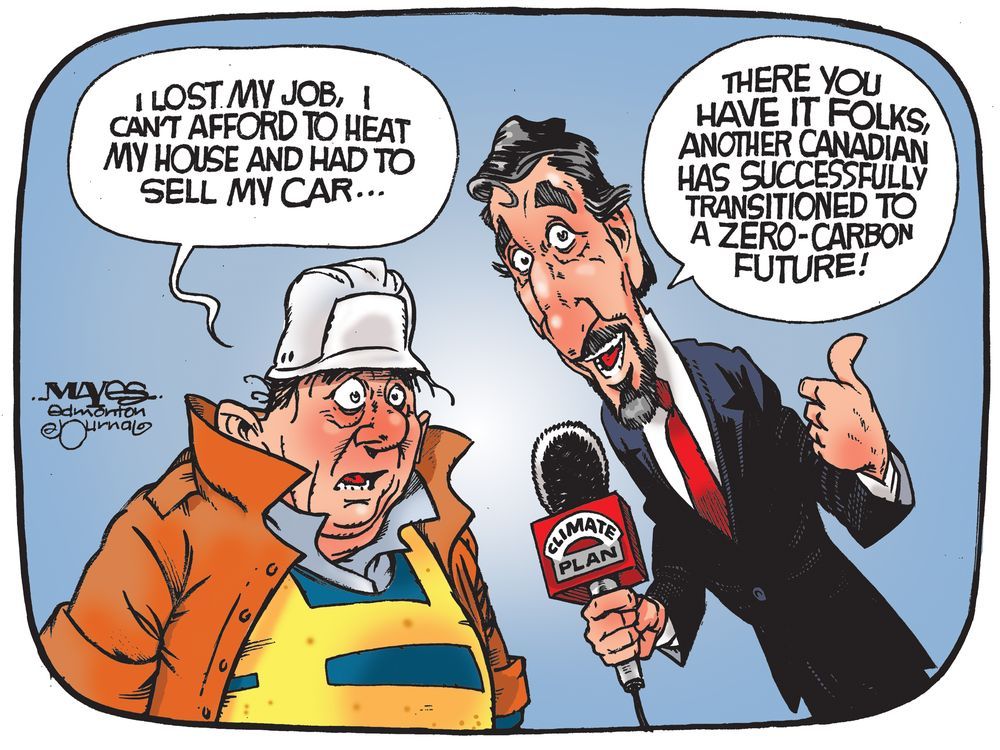
It’s incomprehensible that during a global oil and gas shortage brought on by the wanton destruction of a civilized democracy, our prime minister thinks all will be well if only Canada rids itself of fossil-fueled vehicles. Deep in delusion, he considers this a perfect time to announce a plan to have 60 per cent of new cars and light duty trucks be “zero emission” by 2030.

When you live in a perennial state of fantasy, facts don’t matter. But here are facts that do matter to Canadians forced to face the real-world impact.

Fact 1: High cost. The federal budget promises a $5000/vehicle rebate. There are 24 million gasoline and diesel-powered vehicles in Canada. Subsidizing replacement of just one million would cost $5 billion. The budget also contains $900 million for new charging stations. That’s helpful in urban centres but providing a charging station network necessary to allow e-vehicles to travel interurban highways would cost tens of billions more.

Fact 2: Revenue needs. The Trudeau government’s longer-term plan is to get rid of all fossil-fueled vehicles. Federal and provincial fuel taxes now total a stunning $22 billion each and every year. These revenues fund the cost of building and maintaining urban streets and highways. How long can it be before governments are forced to regain those revenues from electrical vehicle charging levies?

Fact 3: Grid stress. The average Canadian motorist drives 15,000 km per year and the average electric passenger vehicle uses 19 kw/hr per 100 km. That works out to 2,850 kw/hr per year, more than 25 per cent of current Canadian household consumption. Many of the country’s electrical generation and distribution grids are already near capacity. Electric vehicle advocates say the problem will be mitigated by mandating low amperage during off-peak, late-night hours. But most highway drivers travel during the day when the grid is near capacity. And they will need high-amperage DC quick-chargers during these already supply-tight hours.

Fact 4: Land demand. Refueling with gasoline or diesel takes around five minutes. But even rapid chargers need 30 minutes. That means six times more land occupied by charging stations. How much of that land will be taken from agricultural production?

Fact 5: More emissions, not fewer. Canada’s 24 million fossil-fueled cars and pickup trucks emit 14 per cent of the country’s 1.5 per cent share of global emissions. If all 24 million were converted to battery power, global emissions would be reduced by just two-tenths of one per cent. Emissions growth from China’s coal-fired power plants would offset that in just a few days. And that two-tenths of a per cent doesn’t count emissions produced from mining and transporting the materials that go into all those batteries. Nor does it consider that 20 per cent of Canada’s electricity is generated with fossil fuels.

Those factors clearly wipe out any benefit, unless we include the benefit that living a fantasy allows people, our leader included, not to have to think about all those Ukrainians we could have saved by helping Europe say “no” to Russia’s oil — if only our oil industry hadn’t been hamstrung.


The Looming Energy Catastrophe

Ron Stein provides a briefing from California on the energy debacle imposed by clueless political leaders on ordinary Americans.  Excerpts in italics with my bolds H/T CFACT

The Looming Energy Catastrophe

Please enjoy and share this educational energy literacy briefing, a 5-minute video by Costa Mesa Brief at a California Chevron gas station. The video talks about the outrageous gas prices and tells us what is behind the increases, where it is heading and what, if anything, we can do about it. I think you will find his no-nonsense approach and perspective unique, sobering and very informative.

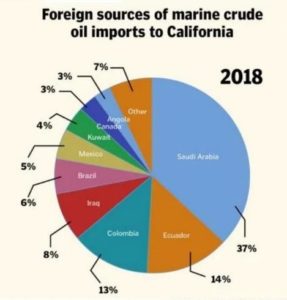
The video explains the impact on fuel prices from California government-imposed reductions in the supply chain of crude oil has increased imported crude oil from foreign countries from 5% in 1992 to more than 60% today of total consumption. Biden’s pledge stating, “we are going to get rid of fossil fuels,” is impacting fuel prices.

At today’s price of crude oil well above $100 per barrel, the imported crude oil costs California more than $150 million dollars a day, yes, everyday, being paid to oil-rich foreign countries, depriving Californians of jobs and business opportunities, and forcing drivers to pay premium prices for fuel.

Californians are consuming more than 50 million gallons of fuel daily for its 35 million vehicles, which is slightly more than one gallon per day per vehicle.

Californians continue to pay more than $1.00 more per gallon of fuel than the rest of the country primarily for the State, Federal and Local taxes, and the Government environmental compliance programs such as the Low Carbon Fuel Standard (LCFS), Cap and Trade, Renewable Fuel Standard (RFS), and the Underground Storage Tax. Those costs ‘dumped” onto the posted price at the pump are not transparent to the public.

The demand for fuels to move the heavy-weight and long-range needs of more than 50,000 jets for the military, commercial, private and the President’s Air Force One, and the more than 50,000 merchant ships that move products throughout the world are also manufactured from the supply of crude oil.

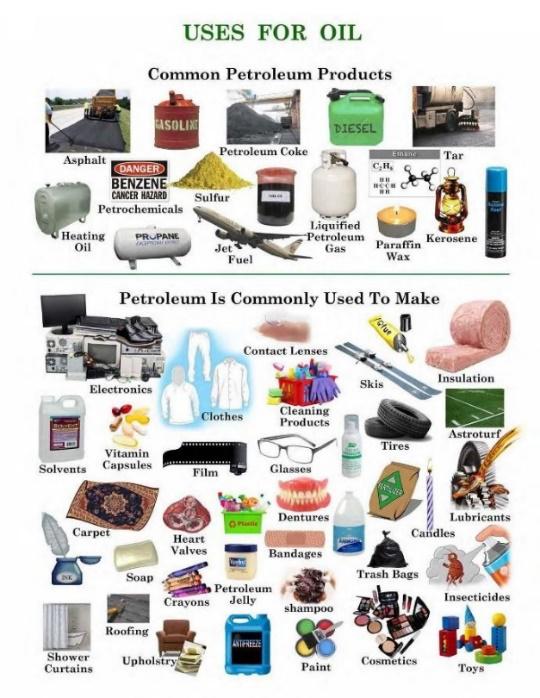
Life Without Oil is NOT AS SIMPLE AS YOU MAY THINK as renewable energy is only intermittent electricity from breezes and sunshine as NEITHER wind turbines nor solar panels can manufacture anything for society. Climate change may impact humanity, but being mandated to live without the more than 6,000 products and the various fuels manufactured from crude oil will necessitate lifestyles being mandated back to the horse and buggy days of the 1800’s.

When the public continues to demand increasing needs for the transportation fuels and the products made from crude oil, limiting its supply by governments and the Environmental, Social and Governance (ESG) movement to manufacture those items is a guarantee for today’s shortages and inflation.

Life without crude oil could be the greatest threat to civilization’s eight billion residents, resulting in billions of fatalities from diseases, malnutrition, and weather-related deaths.

G7 Ministers Pledge Energy Hari-Kari

G7 Climate, Energy and Environment Ministers’ Communiqué, Berlin, May 27th, 2022

Excerpts in italics with my bolds

Recognising that accelerating the international clean energy transition and phasing out continued global investment in the unabated fossil fuel sector is essential to keep a limit of 1.5 °C temperature rise within reach, we commit to end new direct public support for the international unabated fossil fuel energy sector by the end of 2022, except in limited circumstances clearly defined by each country that are consistent with a 1.5 °C warming limit and the goals of the Paris Agreement. (pg. 33)

We note with concern the scale of private finance currently still supporting non-Paris aligned activities especially in the fossil fuel sector. (pg. 22)

We are thus further strengthened in our resolve to accelerate the clean energy transition towards a net zero emissions future by 2050, while also keeping energy security and affordability at the core of our action, including through the rapid expansion of low-carbon and renewable energies and an increase in energy efficiency.  (pg. 29)

In this regard, we acknowledge the IEA net zero scenario which suggests that G7 economies
invest at least US$1.3 trillion in renewable energy including tripling investments in clean
power and electricity networks between 2021 and 2030. (pg. 31)

We confirm our strong financial commitments for the market ramp-up of low-carbon and renewable hydrogen and its derivatives, thereby signalling an irreversible shift towards a world economy based on low carbon and renewable energy sources. (pg. 31)

In view of the Russian attack on Ukraine, financial support for companies and citizens affected by severely rising prices for fossil fuels is now on the political agenda for several countries. Nevertheless, we aim for our relief measures to be temporary and targeted and we reaffirm our commitment to the elimination of inefficient fossil fuel subsidies by 2025. (pg. 32)

We also highlight that we have ended new direct government support for unabated international thermal coal-fired power generation by the end of 2021, including through Official Development Assistance, export finance, investment, and financial and trade promotion support. (pg. 33)

We commit to increase national efforts to decarbonise building heating and cooling systems by using appropriate policy tools, including regulations and incentives, with the ultimate objective of transitioning away from fossil fuels. (pg. 37)

This will also guide our approach in public finance institutions and on the boards of MDBs and bilateral DFIs. We therefore call on other major economies, the MDBs and bilateral DFIs, multilateral funds, public banks and relevant agencies to also adopt these commitments. We commit to review our progress against our commitments. (pg. 33)

(Note: Multilateral Development Banks (MDBs), Development finance institution (DFIs)
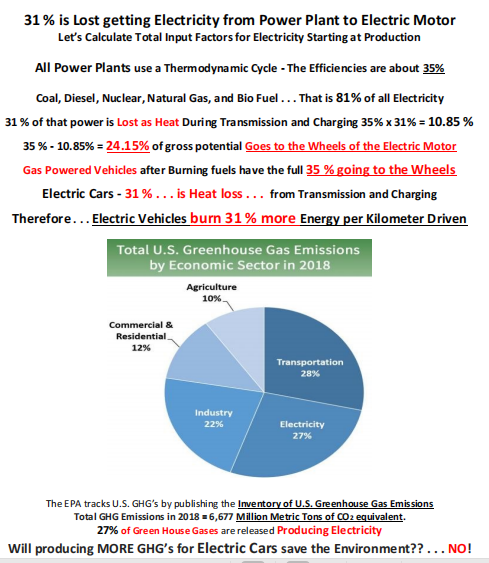
See also Michael Kelly on Energy Utopias and Engineering Realities synopsis Kelly’s Climate Clarity

And Dieter Helm Seeking Climate and Energy Security

West’s Obsession with EV Tech Puts China in World Driver Seat

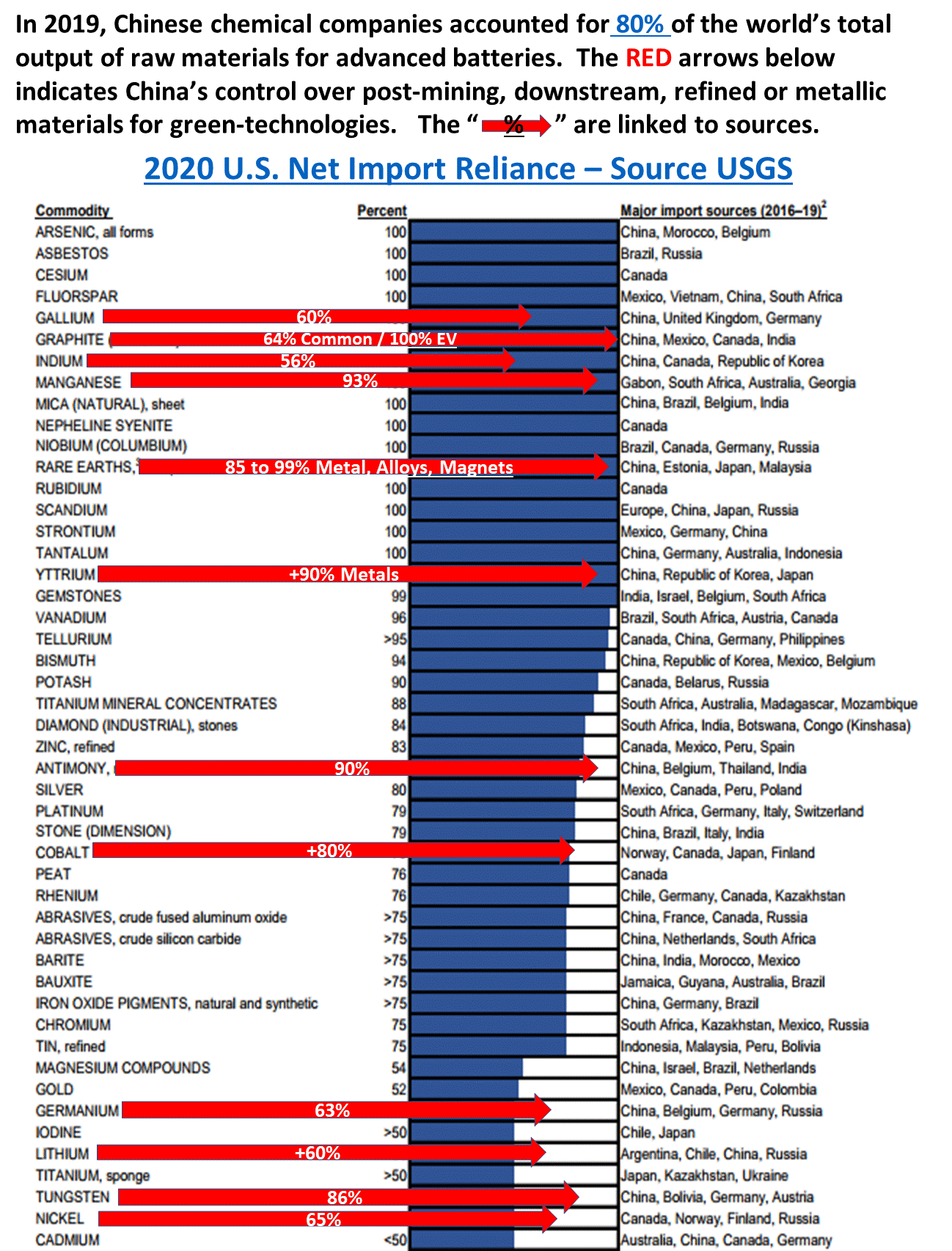
James Kennedy explains the dangerous slide in his presentation Critical Materials
The New Tool of Global Hegemony.  Excerpts in italics with my bolds.  H/T Mark Krebs

This presentation outlines the vast disconnect between green technology goals and the anticipated compounding economic consequences of finite resources.
♦  Begin by assessing resources and the challenges associated with the Administration’s             limited goal of replacing the internal combustion engine.
♦  Expose who leads in resource production
♦  Reveal who leads in research, IP, control over finished materials and estimated
resource demand

♦  Consider the asymmetric geopolitical consequences
♦  Consider the consequences of compounding renewables (wind & solar), energy                   distribution and grid-storage demand on these limited resources.

To enlarge, open image in new tab.

♦ Most of the critical technology metals make up less than .003% of the earth’s crust.
♦ They tend to be present in measurements of parts per million.
♦ They tend to be tied up in much more complex mineralization’s.
♦ Extracting them requires mining and refining facilities that cost billions of dollars.
♦ The extraction process requires lots of energy and complex chemical processes.
♦ These processes pose environmental problems of their own.

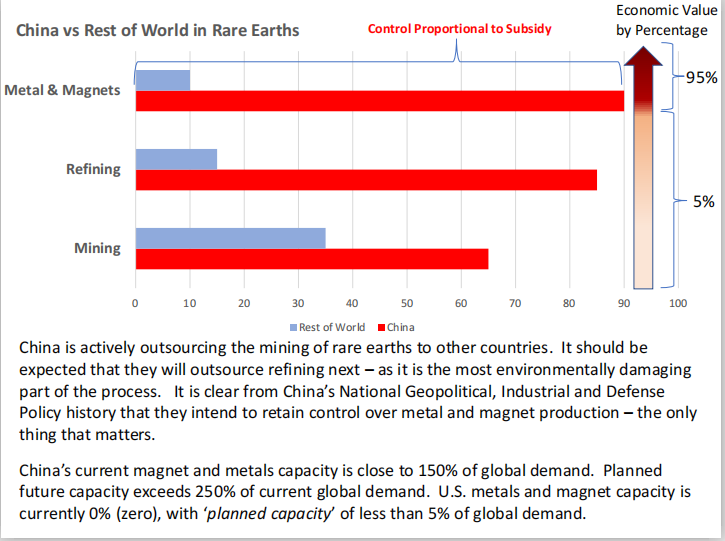
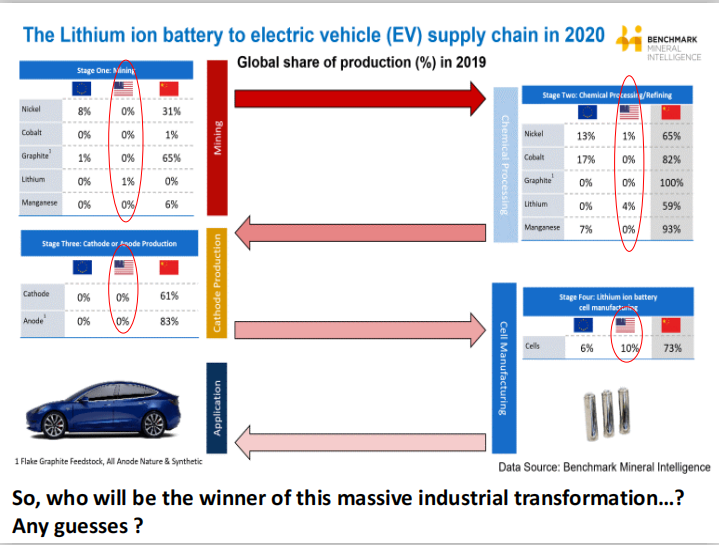
As you can see from the red arrows,  China controls most of these elements and critical materials at the point of refined materials, metals, alloys and magnets.  Recent production from California’s Mt. Pass mine goes to China for refining and metal / magnet production.

China’s state sponsored subsidies and internal tax advantages make U.S. production of rare earth metals and magnets non-competitive. This is also true for refined cobalt and many other critical materials and components like anodes and cathodes for batteries.

China’s production capacity for these materials and components dwarfs the rest of the world – exceeding global demand in many cases.

Conclusion:

This rush to zero carbon is driven by short term private interests leveraging fears of global warming that conflate with larger ideological agendas.
Things will go wrong, there will be multiple train wrecks.

Potential Winners: China, natural gas producers, mining companies that supply China, flim-flam renewable / green tech / green energy project promoters, 1% or less of the U.S. & EU population.

Potential Losers: 99% of U.S. & EU population, legacy and residual manufacturing industries, the financial system and the U.S. dollar as its status as world reserve currency evaporates.

Potential Black Swan Outcomes
Upside: Material Science Breakthroughs solve the problem
Downside: Forfeiture of Western Economic Relevance

My Comment:

As posted previously, this drive to reduce carbon-based energy is absurd, costly and pointless.

Absurd, because there is no reliable data showing anything in our climate or weather outside historical ranges of variation.

Costly, because proposed remedies including “green energy” and electric vehicles serve only to make affordable reliable energy expensive and intermittent.  In addition  as demonstrated above, the tech depends on the rarest, most precious and environmentally damaging materials.

Pointless, because we do not control the weather anyway.

High time to unplug the EV illusion and back away from the social and economic cliff.

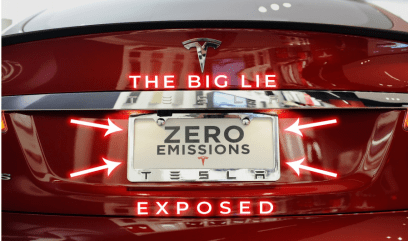
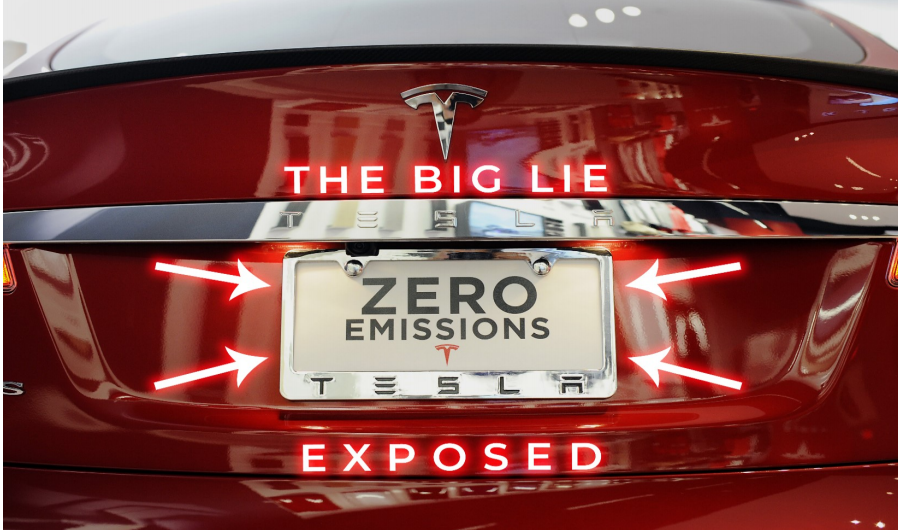
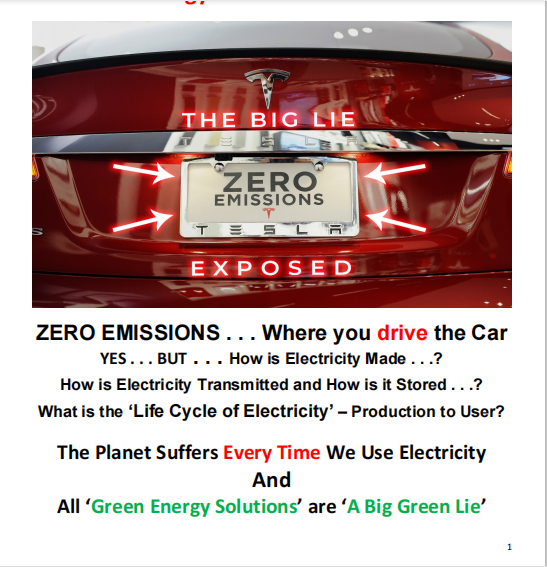
See also: Electric Car Lie Exposed

If That Tesla Battery Could Talk


FERC Aims to Decarbonize, Shoots Down Energy Security

Marlo Lewis explains the Biden regime push to undermine critical energy supply in pursuit of climate virtue in his CEI article Why FERC’s Greenhouse Gas Regulatory Policy Cannot Pass a Cost-Benefit Test.  Excerpt in italics with my bolds.

Today, the Competitive Enterprise Institute (CEI) filed comments on the Federal Energy Regulatory Commission’s (FERC) proposal to consider climate change impacts in reviews of infrastructure projects under the Natural Gas Act (NGA). The comments were jointly submitted by my CEI colleague Patrick Michaels; Heritage Foundation Chief Statistician, Data Scientist, and Senior Research Fellow Kevin Dayaratna (commenting as an independent scholar rather than as a representative of any organization); and yours truly.
We submitted comments back in January on FERC’s November 2021 technical conference on the same issues. We advised FERC to steer clear of climate policy, for three main reasons.

1.  Decarbonizing Goals Conflict with Natural Gas Act Purpose

First, the Biden administration’s NetZero agenda to decarbonize and degasify the U.S. electric power sector cannot lawfully be aligned with the Natural Gas Act. Biden’s goals conflict with the NGA’s “principal purpose,” which is to:

 “encourage the orderly development of plentiful supplies
of electricity and natural gas at reasonable prices.”

In addition, climate change is not a factor Congress authorized FERC to consider. The words “climate,” “carbon,” “greenhouse,” “global,” “warming,” “mitigate,” or any of their cognates do not occur in the Act.

2.  Infrastructure Emissions Do Not Threaten the Environment

Second, although the direct and indirect emissions of natural gas infrastructure may be “reasonably foreseeable,” the climate effects are not. FERC’s project reviews are governed by the National Environmental Policy Act (NEPA), which requires scrutiny of major federal actions “significantly affecting the human environment.” Even the emissions of the largest natural gas projects are too small to discernibly affect global climate, and no project’s “carbon footprint” is big enough to influence the fate or fortunes of any community, business, or human being anywhere in the world.

3.  Social Cost of Carbon Is Speculative and Subjective

Third, the social cost of carbon (SCC)—an estimate of the present value of the cumulative climate damages of an incremental ton of carbon dioxide equivalent (CO2e) greenhouse gas (GHG) emissions—is too speculative and subjective, and too easily manipulated for political purposes, to be weighed in the same scales with an infrastructure project’s estimated economic benefits. The Biden administration’s SCC estimates are egregiously biased in favor of climate alarm and regulatory ambition, rendering any agency action that relies on them arbitrary and capricious.

Unsurprisingly, FERC did not take our advice, and proceeded in February to adopt an “interim” policy statement on NGA project review and greenhouse gas (GHG) emissions. That stirred up controversy, including pushback by Senate Energy and Natural Resources Chairman Joe Manchin (D-WV) and Ranking Member John Barrasso (R-WY). As a result, FERC in March demoted its GHG policy statement from “interim” to “draft,” and extended the comment period until today, April 25.

Unlike several presenters at FERC’s November 2021 technical conference, the draft GHG policy statement does not advocate requiring SCC analysis in NGA determinations of public convenience and necessity. Neither, however, does FERC disavow an intent to require it in later policy statements. The Commission may simply be waiting for the Biden administration’s Interagency Working Group (IWG) to finalize its interim SCC estimates, or for courts to resolve Louisiana’s challenge to federal agencies’ use of those metrics.

The Commission’s draft GHG policy statement establishes a “rebuttable presumption that proposed projects with 100,000 metric tons per year of carbon dioxide equivalents (CO2e) emissions will be deemed to have a significant impact on climate change.” FERC also implies that it may condition project approval on the sponsor’s plans to “mitigate all or a portion of the project’s climate change impacts.”

The camel’s nose is already under the tent.

It is not hard to guess where this is going if FERC does not quickly reverse course. The usual suspects will pressure the Commission to:

(1) progressively lower climate significance thresholds,
(2) monetize undetectably small project-related climate “impacts” using agenda-driven SCC estimates, and
(3) either reject needed natural gas infrastructure projects outright or impose mitigation requirements that render them uneconomic.

This is bad policy, as Michaels, Dayaratna, and I explained in our January 7 comments. If an infrastructure project is commercially viable and helps ensure plentiful supplies of electricity and natural gas at reasonable prices (the NGA’s principal purpose), the Commission knows in advance that the project’s economic benefits far exceed its climate-related externalities. Therefore, no further investigation of the project’s GHG emissions is required, nor does it make sense to condition the certificate of public convenience and necessity on the project’s adoption of mitigation measures.

Conclusion

New research by Dayaratna (hereafter “Heritage analysis”) further confirms that conclusion. Using the U.S. government’s leading energy and climate policy models, the Heritage analysis demonstrates that banning construction of new U.S. pipelines would have a negligible effect on U.S. annual CO2 emissions through 2050 and, thus, a similarly negligible effect on global temperatures through 2100. The policy implication for FERC is clear. No level of overregulation or prohibition that regulators might apply to the development of U.S. natural gas pipelines could meaningfully affect the Earth’s climate.

Consequently, no regulation or prohibition of new natural gas pipelines could possibly be worth the economic losses imposed on construction companies, natural gas producers, and energy consumers.

See Also Seeking Climate and Energy Security