Greta keeps repeating that nothing is being done to reduce emissions, blind to all the imposed policies and regulations. So today good news out of California, the leader in fighting climate change. From NBC San Diego Encinitas Leaf Blower Ban Goes Into Effect. Excerpts in italics with my bolds.
Businesses in Encinitas are no longer allowed to use gas powered leaf blowers as of Friday, Dec. 20.
The Encinitas City Council approved the leaf blower ordinance back in August. Then in September, the ordinance went into effect for city operations.
The goal of the city’s Climate Action Plan is to eventually ban all gas powered leaf blowers by January 20, 2020 in order to reduce the city’s carbon footprint. The next goal is to reduce all greenhouse gas emissions by the year 2030. The city estimates that this leaf blower ban will reduce local green house gas emissions by 128 metric tons of CO2 emissions by the end of 2020, and 142 metric tons by 2030.
Then on January 20, 2020, the ban will go into effect for residents as well.
But, the ordinance also states that electric or battery powered leaf blowers are allowed. So the city is now offering a city-funded rebate program, so that residents and business owners can buy a new electric or battery-powered leaf blower.
The ordinance also lays out a list of rules about the time of day people are allowed to use their leaf blowers.
Now, people in Encinitas are only permitted to use their electric or batter powered leaf blowers between 8 a.m. and 6 p.m. Monday through Saturday, and between 12 noon and 5 p.m. on Sundays.
So calm down Greta and show some respect for all the nanny-state rules coming on.
I have often written that prudent policymakers recognize the future will include periods both warmer and cooler than the present, and cold is the greater threat to human life and prosperity. Thus, government priorities should be to invest in affordable reliable energy and robust infrastructure. A recent article gets the importance of energy abundance, and makes many lucid points about climate policy failures, even while accepting uncritically some mistaken suppositions about the issue and what can be done about it.
Matt Frost published an article at The New Atlantis After Climate Despair. Excerpts in italics with my bolds, some images and comments.
The dream of a global conversion to austerity has failed to stop climate change. Energy abundance is our best hope for living well with warming — and reversing it.
Overview
Each of us constitutes a link between the past and the future, and we share a human need to participate in the life of something that perdures beyond our own years. This is the conservationist — and arguably the conservative — argument for combating climate change: Our descendants, who will have a great deal in common with us, ought to be able to enjoy conditions similar to those that permitted us and our forebears to thrive.
But the dominant narrative of climate change, though it claims to be aimed at protecting future generations, in fact leaves little room for continuity. Preventing more than 1.5 degrees Celsius of warming above the nineteenth-century baseline, the latest aim of the Intergovernmental Panel on Climate Change (IPCC), will, as they put it, require “rapid, far-reaching and unprecedented changes in all aspects of society.”
Only a vanishingly unlikely set of coordinated global actions — an extraordinary political breakthrough — can save us from what the most pessimistic media portrayals describe as “catastrophe,” “apocalypse,” and the “end of civilization.”
Only by changing our entire energy system and social order can we preserve the continuity of our biosphere. And so climate politics has become the art of the impossible: a cycle of increasingly desperate exhortations to impracticable action, presumably in hopes of inspiring at least some half-measures. Understandably, many despair, while others deny that there is a problem, or at least that any solution is possible.
But we are not condemned to a choice between despair and denial. Instead, we must prepare for a future in which we have temporarily failed to arrest climate change — while ensuring that human civilization stubbornly persists, and thrives. Rather than prescribing global austerity, reducing our energy usage and thereby limiting our options for adaptation, we should pursue energy abundance. Only in a high-energy future can we hope eventually to reduce the atmosphere’s carbon, through sequestration and by gradually replacing fossil fuels with low-carbon alternatives.
It is time to acknowledge that catastrophism has failed to bring about the global political breakthrough the climate establishment dreams of, and will not succeed in time to avert serious warming. Instead of despairing over a forever-deferred dream of austerity, our resources would be better spent now on investing in potential technological breakthroughs to reduce atmospheric carbon, and our political imagination better put toward preparing for a future of ever more abundant energy.
[Frost could have added that human flourishing has always occured in warmer, rather than colder times. Our Modern Warm Period was preceded by Medieval Warming, before that by Roman Warming, and earlier Minoan Warming. Each period was cooler than the previous, so the overall trend in our interglacial is downward. Ensuring favorable conditions for future generations means protecting against the ravages of frosty times. (pun intended)]
The Futility of Dread
The bleak poll results may reflect a broad, if perhaps tacit, agreement that we have reached diminishing returns on dread. Even now that most Americans accept the dire predictions of scientists and journalists, their assent does not change the fact that we currently lack the institutional, technological, and moral resources to prevent further climate change in the near term. The lay public has been taught to regard stabilizing the climate as an all-or-nothing struggle against the encroachment of a dismal future.
The bar for success is set high enough that failure is now the rational expectation.
A common reaction to “there is no solution” is “then there is no problem.” No matter how persuasive the evidence of impending danger, most people find ways to dismiss or evade problems that appear insoluble. Attempting to build political support for impossible interventions by making ever more pessimistic predictions will not work; it will only leave us mired in gloom and impotence. This polarized fatalism will grow more extreme as opposing partisans, recognizing our dearth of practicable options, choose either glib denial or morbid brooding.
Entirely predictable Time Magazine declares Greta Person of the Year. Just like Big Brother she is watching.
Missing the Target
We will not stop global warming, at least in our lifetimes. This realization forces us to ask instead what would count as limiting warming enough to sustain our lives and our civilization through the disruption. There can be no single global answer to this question: Our ability to predict climate effects will always be limited, and what will count as acceptable warming to a Norwegian farmer enjoying a longer growing season will always be irreconcilable with that of a Miami resident fighting the sea to save his home. But because our leadership has approached climate change as a problem of coordinated global action, they have constructed quantitative waypoints around which to organize the debate.
Some news sources portrayed 2030 as an official deadline for avoiding climate catastrophe. It is worth noting that the report’s lead author, Myles Allen, has warned against this interpretation: “Please stop saying something globally bad is going to happen in 2030. Bad stuff is already happening and every half a degree of warming matters, but the IPCC does not draw a ‘planetary boundary’ at 1.5 degrees Celsius beyond which lie climate dragons.”
The extreme unlikelihood that we will meet the target of 1.5 degrees becomes even clearer when we notice that doing so requires that we not only cut emissions radically, but at the same time remove enormous volumes of carbon dioxide already emitted. The report estimates that a total of 100 billion tons must be removed by 2050. For comparison, the amount of carbon dioxide emitted globally from fossil fuels last year was around 37 billion tons.
Even were it possible to scale bioenergy and capture that quickly, doing so would have a major drawback: It would take up an immense amount of farmland. By one 2016 estimate, capturing enough carbon to meet even the 2-degree target by the end of the century could require devoting up to three million square miles of farmland to bioenergy crops — nearly the size of the contiguous United States.
[Frost seems not to realize the the 2C target, and more recently 1.5C are both rabbits pulled out of a magical activist hat. Economists have projected that future generations will be far wealthier than us, and only slightly less so should there be all the warming predicted from burning known carbon fuel reserves. Many dangers are based upon scenario RCP8.5 which is so unrealistic that some analysts say that models using it should be revised. Principled inaction is appropriate when threats are claimed without solid evidence.]
The Age of Overshoot
Expanding the climate options we allow ourselves to consider is easier said than done. The political and moral challenges are daunting. We will need to adapt to a warmer climate for perhaps decades to come, while at the same time preparing technological and policy solutions for a more distant future where we can finally claw our way back to lower levels of carbon and warming. At the same time, the stressors that a warmer climate will bring will be unequally felt across the globe, likely making our politics more divided and only dimming hopes for international coordination.
We must finally abandon the empty hope of imposing equitable austerity via globally coordinated government fiat.
Furthermore, as we adapt to a warmer climate, complacency will be tempting, since we will likely not experience a sudden decline in global quality of life or biodiversity, and may be able to avoid the most dire disruptions. Changes will be slow, with many unfolding on a generational time scale, and with dramatically different impacts among populations. The misery that climate change is likely to cause, or is already causing, will be difficult to distinguish from deprivation as we already know it — the people most harmed, that is, will be the poor, who are already most vulnerable to natural forces. Even if there is a distinct moment of irrecoverable failure, or a tipping point that triggers the worst feedback effects, most people might not notice until it has passed.
[His belief that CO2 is some kind of temperature control knob is touching, but naive and dangerous. H2O is actually earth’s thermostat, and we don’t have a dial for that either. Fortunately the climate system includes complex negative feedbacks which throughout history have kept both ice house and hot house eras from being permanent. Otherwise we would not be here to talk about it.]
The global failure to control emissions is not just a failure of political will or technological progress. Rather, it reflects the problem’s inherent resistance to unambiguous characterization. Different observers can all adopt different conceptions of the problem, many of which are not mutually exclusive but remain practically or politically irreconcilable.
For this reason, we will no more agree on some single new ethics than we will on the “correct” amount of atmospheric carbon dioxide.
Addressing the problem, then, must not mean the coordinated pursuit of a single solution but a perpetual process of decentralized negotiation and risk reduction. Our varied conceptions of climate change will never fully converge, and so the “correctness” of any approach is best evaluated not by whether it meets the latest IPCC target but by how well it affords broad political buy-in. Identifying alternatives to our current, failed approach to climate change requires identifying a more constructive set of ideas — practical, political, and sentimental. We will then be able to focus our resources on those interventions most likely to succeed.
[Among the failed solutions is the idea that modern societies can be powered with solar and wind energy. Not only is bioenergy land intensive (as noted above), so are these other renewables. Here is the map of UK showing the acreage required to power London without thermal generators.]
The gray area would be covered in wind farms, while the yellow area is needed for solar farms.
Austerity vs. Abundance
What should motivate our response to climate change is what got us into this mess in the first place: our desire for the abundance that energy technology affords. Energy is the commodity that allows us to protect ourselves from the ravages of nature and to live distinctly human lives, and many of the benefits we enjoy today were made possible by the exploitation of fossil energy. Our children should enjoy greater energy abundance than us, not less.
But the mainstream climate establishment — the government officials, researchers, advocates, and journalists who sustain the consensus agenda represented by the IPCC — is bent on austerity. They demand that we ration fossil energy consumption until zero-emission sources like wind and solar replace the fossil share of the global energy budget.
Discussions about climate change are also riddled with population anxiety. Lugubrious climate dread appears both as the idea that we should not inflict any more humans on this dying world and that we should not inflict this dying world on any more humans. For the most part, we no longer suffer from feverish speculation about runaway global population growth, since the population may peak anyway by the end of the century. Yet we still hear the old Malthusian idea that our limited energy resources will only be enough for everyone if there are fewer people to whom they must be handed out. Because the climate establishment views energy consumption as the problem, energy consumers must be on the negative side of the ledger — even if their welfare, or their grandchildren’s welfare, is supposed to be the good being protected.
An alternate framework based on abundance would engage each of us as participants in the flow of human history, as the forebears of unknown successors. It would complement even the doomsayers’ calls for taking expensive measures today, since the benefits of mitigating climate change would apply to more people as the population increases. The number of future occupants of our planet is, or should be, the salient variable in any calculation of the long-term costs and benefits of climate change mitigation and adaptation measures. We can’t know the economic return on any dollar we invest today in stabilizing the future climate, but we can model it as a function of, among other things, the number of our grandchildren’s grandchildren. Our climate approach should presuppose that we are the benefactors of a burgeoning future population, not the progenitors of an ascetic cult formed to dole out a dwindling stock of resources. New sources of carbon-free energy would offer more value to more people than whatever new levers of social control we might invent to enforce a worldwide carbon-rationing regime.
A stronger focus on human utility does not discount the non-human biosphere: When we evaluate the natural world for its beauty or its diversity, we are still expressing human values, and those values are part of the civilization we hope to carry forward in time. For instance, the desire to protect coral reefs, one of the first casualties of global warming, can increase as more people gain freedom from poverty, allowing them to see the reefs’ aesthetic and ecological benefits as worth spending resources to preserve.
An abundance framework is also aligned with our persistent human desire for comfort, and would lead us to reformulate our collective problem as one of scarcity, rather than prodigality. Instead of constraining our energy budget, we would look to a future in which a large, decarbonized energy capacity allows more people to enjoy the access to wealth and comfort that many of us take for granted. It would make little sense to leave cheap fossil energy underground in the name of future generations’ well-being, only to also leave those descendants an energy-constrained world full of incentives to drill. To remove those incentives, they will need abundant energy.
Obviously, meeting the energy demand of a high-growth world would require new sources of carbon-free power in amounts beyond the IPCC’s most optimistic scenarios. But we are already stuck hoping for a global political breakthrough. Technological breakthroughs are less far-fetched a solution. And a mass embrace of abundant energy is more realistic than sudden globally coordinated altruistic self-abnegation. Once we embrace abundance as a normative principle, it directs our attention and ambition toward the bets that, however long the odds, might actually pay off.
Embracing abundance means more than just a rhetorical or sentimental overhaul; it should change how we rank our policy and technology options. And gaining new energy sources would actually expand our options beyond the limited ones available to us now. Choosing abundance does not require that we first have all the answers for how to produce carbon-free energy, or how to reduce current levels of carbon dioxide. Rather, shifting our mindset from austerity to abundance will open up the political space necessary for imagining these answers and pursuing them.
In the near term, we must accept that expanding our political capacity to regulate carbon dioxide depends on driving down the cost of carbon-free energy. Penalizing fossil-energy use can encourage research and development of alternatives, but panic alone will not engender a new democratic mandate for costly restrictions on emissions. Cheap, low-carbon energy can be an alternative to bureaucratic rationing or socially enforced austerity. If we are stuck hoping for a breakthrough, let us hope for one that further emancipates us from want rather than one that more efficiently imposes it.
After Despair
We are stuck waiting for a breakthrough. The sort of breakthrough we await says much about who we are and where we hope to go. The consensus austerity view would have us hope for a moral breakthrough of penitential retrenchment. The abundance view would have us hope for a technological breakthrough to enable a flourishing future. One says that we have used too much energy, and our descendants should use less. The other implies that we have not devoted enough energy to capturing and storing carbon dioxide, and that we must leave our children and grandchildren as much energy capacity as possible to clean up our carbon waste.
Our mission must be to provide future generations with better technological alternatives than the ones currently on offer, which range from prohibitively expensive (like BECCS) to wildly reckless (like pumping sulfur dioxide into the stratosphere to block sunlight). We owe our descendants progress toward the long-deferred dream of energy “too cheap to meter,” as Lewis Strauss, chairman of the Atomic Energy Commission, famously said in 1954. We owe them the tools with which to dispose of the waste carbon they will inherit. We owe them a better sentimental investment than morbid despair about the future they will occupy.
Other policy approaches are less applicable to a strategic framework of energy abundance. “Weaning ourselves off nuclear energy,” as Senator Elizabeth Warren proposes, is a fatuous idea even within the austerity framework, if the risks of climate change are as dire as predicted. Replacing already online, zero-carbon generation with wind and solar plants that require carbon-emitting construction and infrastructure overhauls will only dig us deeper into debt. In an abundance framework, the proposal becomes even more misguided.
The policy measures we pursue in the near term should express the ethos of abundance and continuity. They should avoid emission cuts today that might limit wealth and technology options tomorrow. And they should set us up to take the best advantage of whatever breakthroughs, technological or political, we might be fortunate enough to see in the coming years.
Key Points
Global conversion to austerity is a lost cause.
Energy abundance is our best hope for the future.
We have always lived well when it warms.
When nature reverses and cools, we had better be ready.
Footnote: Since 1985 the band Opus has celebrated Life and access to energy (I’m sure they were referring to electrical power as well as personal mobility).
As I woke up to Thanksgiving yesterday, I realized we in the Pacific Northwest had been cyclone bombed for the holiday.
The Columbia Generating Station nuclear power plant just north of Richland, WA puts out maximum … [+]ENERGY NORTHWEST
A Bomb Cyclone is when the barometric pressure drops by at least 24 millibars in 24 hours. The winds were wicked last night and kept us awake a good part of the time.
But looking out over the snow, I was thankful for the comforting plume of pure water vapor rising beyond from our nearby nuclear power plant. Judith and the kitties were, too.
Through thick and thin, extreme hot or extreme cold, the nuclear plant never seems to stop producing over 9 billion kWhs of energy every year, enough to power Seattle. The same with all other nuclear plants in America.
Whether it’s coal, gas or renewables, cold weather seems to hurt them like grandpa with a bum knee. And it doesn’t help that our aging energy infrastructure keeps getting a D+ from the American Society of Civil Engineers.
Most generation systems suffer outages during extreme weather, but most of those involved fossil fuel systems. Coal stacks are frozen and diesel generators simply can’t function in such low temperatures. Gas chokes up – its pipelines can’t keep up with demand – and prices skyrocket.
Wind also suffers because the hottest and coldest months are usually the least windy.
This was seen again last week, when record-breaking cold engulfed Illinois. But Exelon Generation’s 10 operating nuclear plants kept putting out their maximum power without a hitch. Coal and gas struggled.
“Even during this unseasonably cold weather, our Illinois fleet’s performance further demonstrates the reliability and resiliency of nuclear power in any kind of weather,” Bryan Hanson, Exelon’s Chief Nuclear Officer, said. “We are dedicated to being online when customers need us most, no matter what Mother Nature throws at us at any time of year.”
The problem with widespread cold or heat starts because there is a spike in electricity and gas demand, since everyone is re-adjusting their thermostats and it takes a lot more energy to keep us at comfortable temperatures during these extremes.
Interestingly, nuclear prices do not go up – the reactors just keep running. They don’t have to worry about fuel supply – they have enough on hand for years – and they don’t have to do anything special to deal with the extreme weather.
In recent years, the cost of electricity from the nearby Columbia Generating Station has fallen to 4.2¢/kWh, regardless of weather. Many gas plants increase their prices during bad weather, as much as ten-fold in New York and New England.
A diverse energy mix is really, really important. Whether it’s massive liquid-gel batteries that would maximize renewable capacity, small modular nuclear reactors, keeping and uprating existing nuclear, better pipeline technology and monitoring, better coordination among renewables – in the coming decades, whatever we can do, we should do.
But nuclear is clearly the big guy you want to walk down the street with on a cold winter’s night.
That’s the choice for people in 13 cities and one county in California and one town in Massachusetts that have enacted new zoning codes encouraging or requiring all-electric new construction.
The codes, most of them passed since June, are meant to keep builders from running natural gas lines to new homes and apartments, with an eye toward creating fewer legacy gas hookups as the nation shifts to carbon-neutral energy sources.
The most recent came on Wednesday when the town meeting in Brookline, Massachusetts, approved a rule prohibiting installation of gas lines into major new construction and in gut renovations.
For proponents, it’s a change that must be made to fight climate change. For natural gas companies, it’s a threat to their existence. And for some cooks who love to prepare food with flame, it’s an unthinkable loss.
Another Dangerous Idea that Doesn’t Scale
Once again activists seize upon an idea that doesn’t scale up to the challenge they have imagined. Add this to other misguided climate policies devoted to restricting use of fossil fuels. Apart from dictating consumer’s choices for Earth’s sake, the push could well backfire for other reasons. Jude Clemente writes at Forbes ‘Deep Electrification’ Means More Natural Gas. Excerpts in italics with my bolds. It’s a warning to authorities about outlawing traditional cars, cooking and heating equipment thereby putting all their eggs in the electric energy basket.
For environmental reasons, there’s an ongoing push to “electrify everything,” from cars to port operations to heating.
The idea is that a “deep electrification” will help lower greenhouse gas emissions and combat climate change.
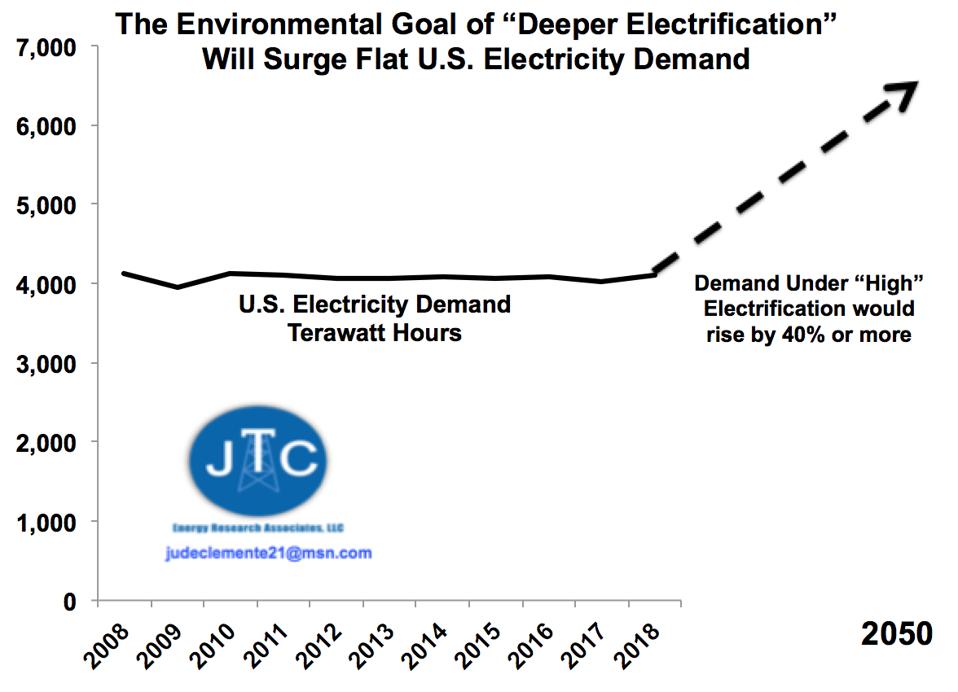
The reality, however, is that more electrification will surge the need for electricity, an obvious fact that seems to be getting forgotten.
The majority of this increase occurs in the transportation sector: electric cars can increase home power usage by 50% or more.
The U.S. National Renewable Energy Laboratory (NREL) says that “electrification has the potential to significantly increase overall demand for electricity.”
NREL reports that a “high” electrification scenario would up our power demand by around 40% through 2050.
A high electrification scenario would grow our annual power consumption by 80 terawatt hours per year.
For comparison, that is like adding a Colorado and Massachusetts of new demand each year.
The Electric Power Research Institute (EPRI) confirms that electrification could boom our power demand by over 50%.
From load shifting to higher peak demand, deep electrification will present major challenges for us.
At around 4,050 terawatt hours, U.S. power demand has been flat over the past decade since The Great Recession.
Ultimately, much higher electricity demand favors all sources of electricity, a “rising tide lifts all boats” sort of thing.
But in particular, it favors gas because gas supplies almost 40% of U.S. electricity generation, up from 20% a decade ago.
Gas is cheap, reliable, flexible, and backups intermittent wind and solar.
In fact, even over the past decade with flat electricity demand, U.S. gas used for electricity has still managed to balloon 60% to 30 Bcf/d.
At 235,000 MW, the U.S. Department of Energy has gas easily adding the most power capacity in the decades ago.
Electrification and more electricity needs show how we demand realistic energy policies.
As the heart of our electric power system, natural gas will surely remain essential.
Indeed, EPRI models that U.S. gas usage increases under “all” electrification scenarios even if gas prices more than double to $6.00 per MMBtu.
Some are forgetting that the clear growth sectors for the U.S. gas industry are a triad, in order: LNG exports, electricity, manufacturing.
The industry obviously knows, for instance, that the residential sector hasn’t seen any gains in gas demand in 50 years.
Flat for a decade, U.S. power demand is set to boom as environmental goals push us to “electrify … [+]DATA SOURCE: NREL; JTC
Footnote: There is the further unreality of replacing thermal or nuclear power plants with renewables.
The late David MacKay showed that the land areas needed to produce 225 MW of power were very different: 15 acres for a small modular nuclear reactor, 2400 acres for average solar cell arrays, and 60,000 acres for an average wind farm.
Gray area required for wind farms, yellow area for solar farms, to power London UK.
Michael Kelly also estmated the load increase from electifying transportation and heating.
Note that if such a conversion of transport fuel to electricity were to take place, the grid capacity would have to treble from what we have today.
But in fact it is the heating that is the real problem. Today that is provided by gas, with gas flows varying by a factor of eight between highs in winter and lows in summer. If heat were to be electrified along with transport, the grid capacity would have to be expanded by a factor between five and six from today.
Michael Kelly was the inaugural Prince Philip Professor of Technology at the University of Cambridge. His interest in the topic of this lecture was roused during 2006–9 when he was a part time Chief Scientific Adviser to the Department for Communities and Local Government. On his return full-time to Cambridge he was asked by his engineering colleagues to lead the teaching of final-year and graduate engineers on present and future energy systems, which he did until he retired in 2016. Michael Kelly recently spoke on the topic Energy Utopias and Engineering Reality. The text of his remarks is published by GWPF. This post provides a synopsis consisting of excerpts in italics with associated images and my bolds.
Overview
Just so that there can be no doubt whatsoever, the real-world data shows me that the climate is changing, as indeed it has always changed. It would appear by correlation that mankind’s activity, by way of greenhouse gas emissions, is now a significant contributory factor to that change, but the precise percentage quantification of that factor is far from certain. The global climate models seem to show heating at least twice as fast as the observed data over the last three decades. I am unconvinced that climate change represents a proximate catastrophe, and I suggest that a mega-volcano in Iceland that takes out European airspace for six months would eclipse the climate concerns in short order.
The detailed science is not my concern here. The arguments in this lecture would still apply if the actual warming were twice as fast as model predictions.
Project engineering has rules of procedure and performance that cannot be circumvented, no matter how much one would wish it. Much of what is proposed by way of climate change mitigation is simply pie-in-the-sky, and I am particularly pleased to have so many parliamentarians here tonight, as I make the case for engineering reality to underpin the public debate.
I plan to describe:
(i) the global energy sector, (ii) the current drivers of energy demand, (iii) progress to date on decarbonisation, and the treble challenges represented by (iv)factors of thousands in the figures of merit between various forms of energy, (v) the energy return on energy invested for various energy sources, and (vi) the energising of future megacities.
I make some miscellaneous points and then sum up. The main message is that our present energy infrastructure is vast and has evolved over 200 years. So the chances of revolutionising it in short order on the scale envisaged by the net-zero target of Parliament is pretty close to zero; zero being exactly the chance of the meeting Extinction Rebellion’s demands.
The energy sector – its scale and pervasiveness
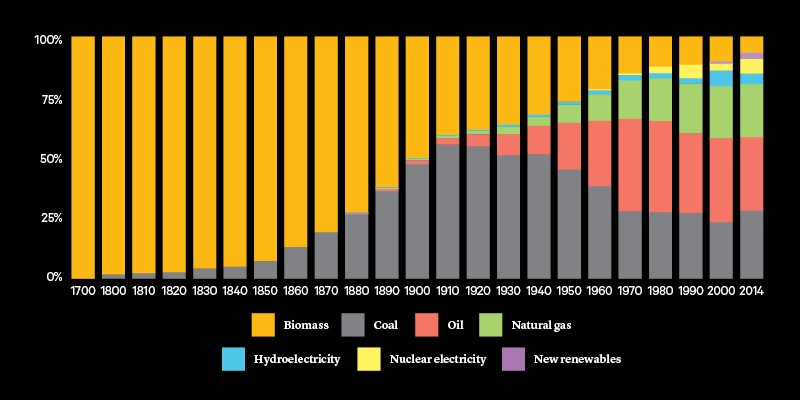
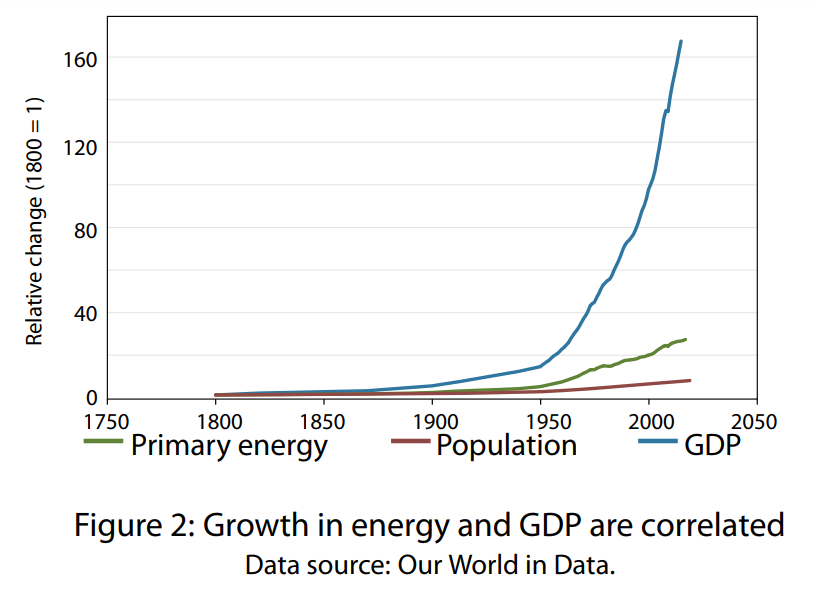
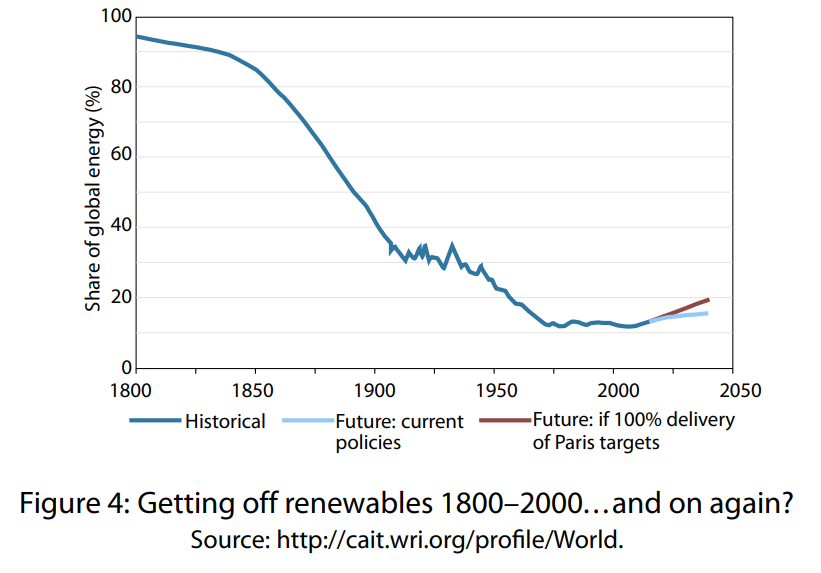
As society evolves and civilisation advances, energy demands increase. As well as increasing demand for energy, the Industrial Revolution led to an increase in global population, which had been rather static until about 1700. Since then, both the number of people and the energy consumption per person have increased, and from Figure 2 we can see the steady growth of gross domestic product per person and energy consumption through the 19th and 20th centuries until now. Energy is the essential driver of modern civilisation. World GDP this year is estimated at $88 trillion, growing to $108 trillion by 2023, with the energy sector then being of order $10 trillion. But renewables have played, and will continue to play, a peripheral role in this growth. Industrialisation was accompanied by a steady and almost complete reduction in the use of renewables (Figure 4).
In recent years, there has been an uptick in renewables use, but this has been entirely the result of the pressure to decarbonise the global economy in the context of mitigating climate change, and the impact has again been nugatory. Modern renewables remain an insignificant share of the energy supply. Indeed MIT analysts suggest the transition away from fossil fuel energies will take 400 years at the current rate of progress.
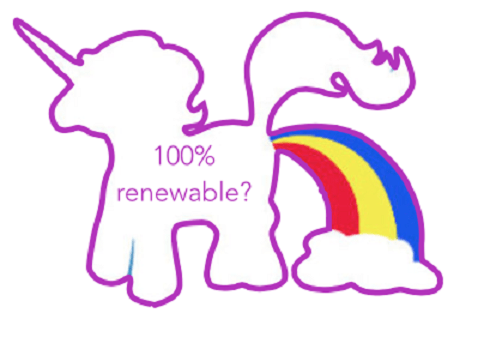
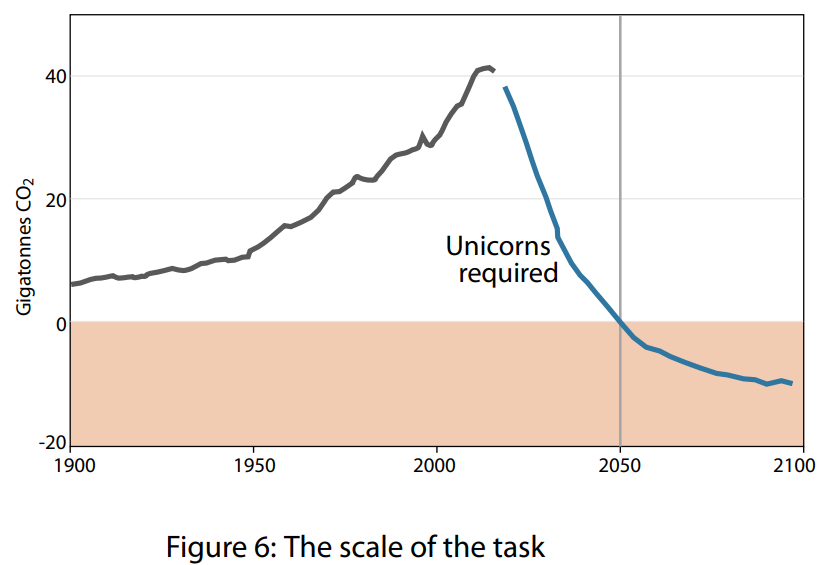
Figure 6 shows the scale of what has been proposed. Even reaching the old target of an 80% reduction in carbon dioxide emissions would be miraculous; this is a level of emissions not seen since 1880. I assert that a herd of unicorns will be needed to deliver this target, let alone full decarbonisation. I also point out the utter nonsense of Extinction Rebellion’s demands to complete the task by 2025.
Figure 6 Source: After Glen Peters,
Contemporary drivers of energy needs 1995–2035
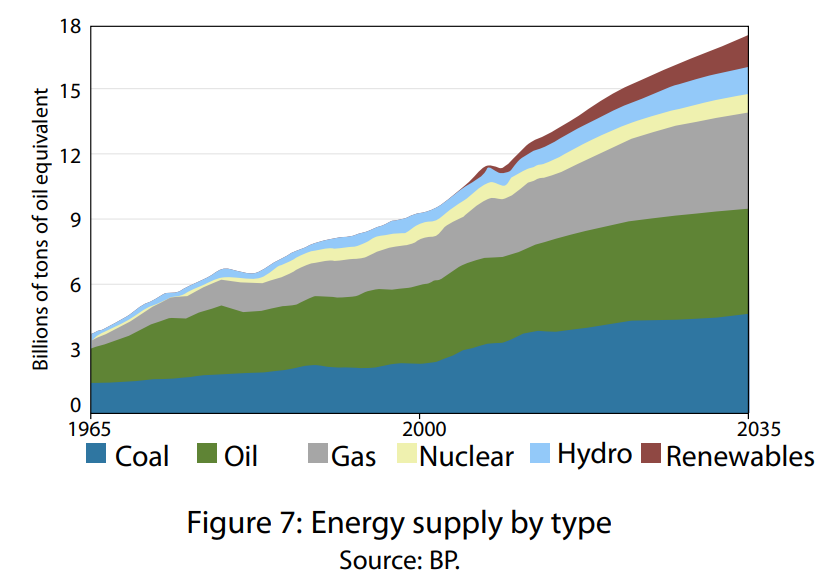
I wish to focus on the drivers of global energy demands today by looking back and forward twenty years. Figure 7 shows data from BP covering the period 1965–2035 on the demand for global energy by fuel type. The data to 2015 is historic and not for challenge.
One notes that we have not had an ‘energy transition’: fossil fuels have continued to grow steadily at a rate about 7–8 times that of renewable technologies over the last 20 years. The energy demand of the major developed countries has been static or in small decline over that period. Most of the increase has come from growth in the global middle class, which increased by 1.5 billion people in the 20 years to 2015.
The whole of Figure 7 can be explained quantitatively if one assumes that a middle class person (living in a high rise building with running water and electricity, without any mention of personal mobility –the World Bank definition of middle class existence – uses between three and four times the amount of energy per day as a poor person in a rural hovel or urban slum.
You should be under no illusions: this is a humanitarian triumph. It is the delivery of the top Sustainable Development Goals – the elimination of poverty and hunger – that has been and will remain the main driver of energy demand for the foreseeable future.
Decarbonisation progress to date
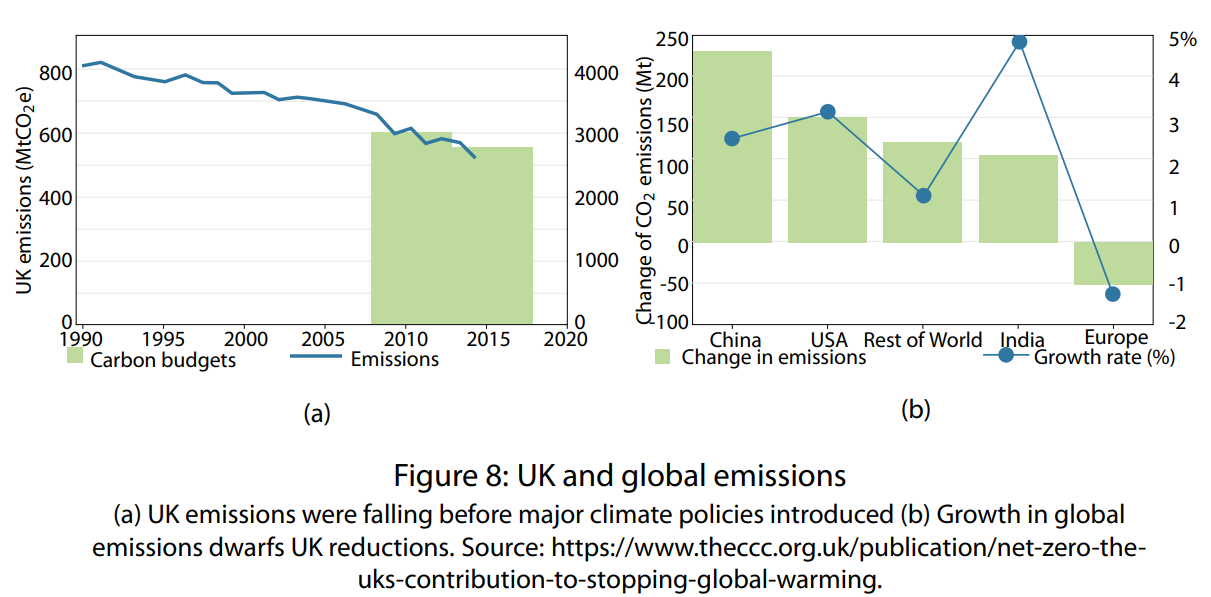
In the UK, the Climate Change Committee has, on the face of it, overseen a steady fall in UK emissions of carbon dioxide since its formation in 2008. However, the fall started in 1990 and has continued at a very steady rate since (Figure 8a). However, UK decreases are dwarfed by global increases. After no-growth years in 2016 and 2017, global carbon dioxide emissions grew by 3% in 2018 (Figure 8b). European emissions fell but the growth in all the other parts of the world was 17 times greater. The emissions reductions in the UK have also come at a considerable cost. The deficit of the UK balance of payments with respect to manufactures has been increasing since then. In other words, a significant proportion of our emissions have been exported to China and elsewhere. Indeed, over the period 1991– 2007, the emissions associated with rising imports almost exactly cancelled the UK emissions reduction!
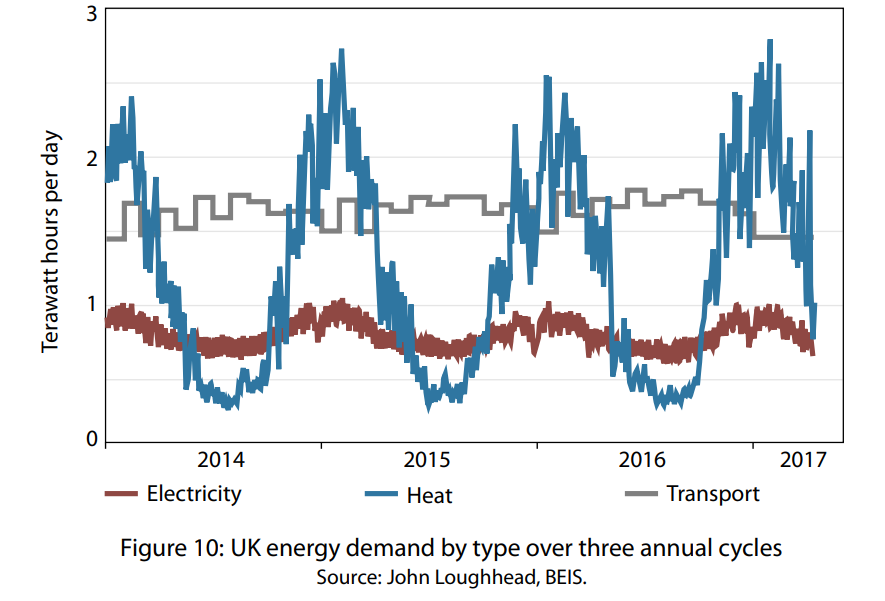
There was much publicity in late summer this year when 50% of the UK’s electricity was (briefly) generated from renewables. Few people realised that electricity is only 16% of our total energy usage, and it is a common error, even in Parliament, to think that we are making enormous progress on the whole energy front. The real challenge is shown in Figure 10, where the energy used in fuels, heating and electricity are directly compared over a three year period. Several striking points emerge from this one figure. First, we use twice as much energy in the UK for transport as we do for electricity. Little progress has been made in converting the fuel energy to electricity, as there are few electric vehicles and no ships or aircraft that are battery powered.
Note that if such a conversion of transport fuel to electricity were to take place, the grid capacity would have to treble from what we have today.
Second, most of the electricity use today is baseload, with small daily and seasonal variations (one can see the effect of the Christmas holidays). The more intermittent wind and solar energy is used, the more back-up has to be ready for nights and times of anticyclones or both: the back-up capacity could have been used all along to produce higher levels of baseload electricity, and because it is being used less efficiently, the resulting back-up generation costs more as it pays off the same total capital costs.
But in fact it is the heating that is the real problem. Today that is provided by gas, with gas flows varying by a factor of eight between highs in winter and lows in summer. If heat were to be electrified along with transport, the grid capacity would have to be expanded by a factor between five and six from today. How many more wind and solar farms would we need?
Initial conclusions
So far, I have described the scale of the global energy sector, how it has come to be the size it is, the current drivers for more energy and the current status of attempts to decarbonise the global economy. I can draw some initial conclusions at this point.
• Energy equals quality of life and we intervene there only with the most convincing of cases. • Renewables do not come close to constituting a solution to the climate change problem for an industrialised world. • China is not the beacon of hope it is portrayed to be. • There is no ground shift in energy sources despite claims to contrary.
The engineering challenges implied by factors of hundreds and thousands
Many people do not realise the very different natures of the forms of energy we use today. But energy generation technologies can differ by factors of hundreds or thousands on key measures, such as the efficiency of materials use, the land area needed, the whole-life costs of ownership, and matters associated with energy storage.
Here are four statements about the efficiency with which energy generation systems use high-value advanced materials:
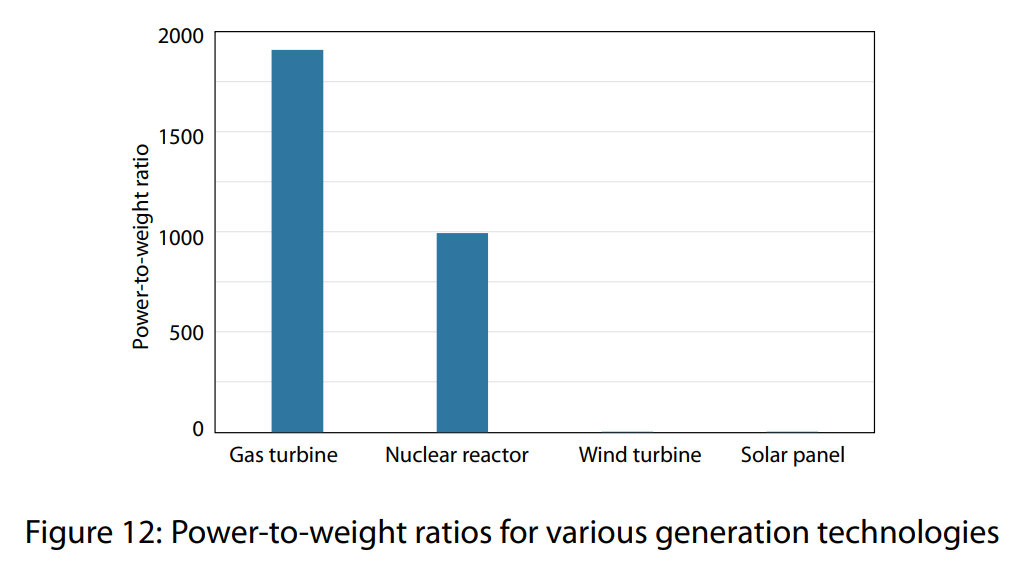
• A Siemens gas turbine weighs 312 tonnes and delivers 600 MW. That translates to 1920 W/kg of firm power over a 40-year design life.
• The Finnish PWR reactors weigh 500 tonnes and produces 860 MW of power, equivalent to 1700 W/kg of firm supply over 40 years. When combined with a steam turbine, the figure is 1000 W/kg.
• A 1.8-MW wind turbine weighs 164 tonnes, made up of a 56-tonne nacelle, 36 tonnes for the blades, and a 71-tonne tower. That is equivalent to 10 W/kg for the nameplate capacity, but at a typical load factor of 30%, this corresponds to 3 W/kg of firm power. A 3.6-MW offshore turbine, with its 400-tonne above-water assembly, and with a 40% load factor, comes out at 3.6 W/kg over a 20-year life.
• Solar panels for roof-top installation weigh about 16 kg/m2, and with about 40 W/m2 firm power provided over a year, that translates to about 2.5 W/kg energy per mass over a 20-year life.
The figures are shown in Figure 12, although the wind and solar bars are all but invisible. You’d need 360 5-MW wind turbines (of 33% efficiency) to produce the same output as a gas turbine, each with concrete foundations of comparable volume.
The late David MacKay showed that the land areas needed to produce 225 MW of power were very different: 15 acres for a small modular nuclear reactor, 2400 acres for average solar cell arrays, and 60,000 acres for an average wind farm.
Approximate area required for all of London’s electricity to come from wind farms
Gray area required for wind farms, yellow area for solar farms, to power London UK.
The challenge of megacities
In 2050 over half the world’s population will be living in megacities with populations of more than 5 million people. The energising of such cities at present is achieved with fossil and nuclear fuels, as can the cities of the future. The impact of renewable energies will be very small, as the vast areas of land needed, often taken away from local areas devoted to food production as in London or Beijing, will limit their contribution. The extreme examples are Hong Kong and Singapore, neither of which have any available hinterland.
Conclusions
It is clear to me that, for the sake of the whole of mankind, we must stay with business as usual, which has always had a focus on the efficient use of energy and materials. Climate change mitigation projects are inappropriate while large-scale increases in energy demand continue. If renewables prove insufficiently productive, research should be diverted to focus on genuinely new technologies. It is notable that within a few decades of Watt’s steam engine becoming available, the windmills of Europe ceased turning. We should not be reversing that process if the relative efficiencies have not changed. We must de-risk major infrastructure projects, such as mass decarbonisation. They are too serious to get wrong. Human lifestyle changes can have a greater and quicker impact:they could deliver a 10% drop in our energy consumption from tomorrow. This approach would not be without consequences, however. For example, airlines might well collapse if holidaymakers stayed, or were made to stay, at home.
Who owns the integrity of engineering in the climate debate in the United Kingdom? Globally? The Royal Society, the Royal Academy of Engineering and the Engineering Institutions should all be holding the fort for engineering integrity, and not letting the engineering myths of a Swedish teenager go unchallenged.
During a period as a scientific adviser in Whitehall, I quickly learned the elements of sound advice given to politicians — a process that is quite distinct from lobbying. A well-briefed minister knows about the general area in which a decision is sought, and is given four scenarios before any recommendation. Those scenarios are the upsides and the downsides both of doing nothing and of doing something. Those who give only the upside of doing something and the downside of doing nothing are in fact lobbying.
In his introduction he (Stern) makes it clear that he has consulted many scientists, businessmen, philosophers and economists, but in his book I find not a single infrastructure project engineer asked about the engineering reality of any of his propositions, nor a historian of technology about the elementary fact that technological breakthroughs are not pre-programmable. Lord Stern’s description of the climate science is an uncritical acceptance of the worst case put by the International Panel on Climate Change (IPCC), one from which many in the climate science community are now distancing themselves.
Those building the biblical Tower of Babel, intending to reach heaven, did not know where heaven was and hence when the project would be finished, or at what cost. Those setting out to solve the climate change problem now are in the same position. If we were to spend 10 or even 100 trillion dollars mitigating carbon dioxide emissions, what would happen to the climate? If we can’t evaluate whether reversing climate change would be value for money, why should we bother, when we can clearly identify many and better investments for such huge resources?
The Paris meeting on climate change will be setting out to build a modern Tower of Babel.
Gov. Andrew Cuomo upped his histrionics on the Long Island natural gas crisis Tuesday, formally threatening to revoke the license of National Grid, the utility that has stopped taking new gas customers.
The company says it can’t take on new commitments because Cuomo (followed by New Jersey Gov. Phil Murphy) blocked construction of a new pipeline.
That new-hookups moratorium, the gov insists, “is either a falsified device or a lack of competence.” That is, National Grid either doesn’t need the pipeline — or is still at fault because it didn’t find some other way to assure supply.
Yet it never should have needed a Plan B: The proposed pipeline is obviously safe; it’s to run right next to an existing pipeline that’s done zero harm. The supposed environmental fears blocking it are nothing but a pretext, allowing Cuomo to pander to green extremists who oppose all carbon-based fuels.
To be clear: The pipeline is the safest, cheapest and even greenest way to get new energy supplies to the area (which includes parts of the city). But the greens don’t care — they’d rather consumers just do without.
Cuomo says gas can be “trucked, shipped, or barged” instead. But that, says Manhattan Institute energy specialist Jonathan Lesser, would require fleets of trucks supplying a huge processing facility that doesn’t exist. And the trucks (or ships) would themselves burn more carbon fuel.
The gov won’t get out of this by following through on his threat — because whoever took over for National Grid would face the exact same problems.
LONDON (Bloomberg) – The International Energy Agency’s annual report into fuel supply and demand shows a pickup in the rate of growth for wind and solar power.
But that’s not enough to curtail greenhouse gas pollution, which is on track to grow through 2040. The findings are a blow to the international effort to rein in climate change and contrast with expanding awareness of the impact humans are having on the environment.
The IEA’s report tracks the different paths the world can take, with government policies shaping the energy industry. While clean energy leaves some reason for optimism, the gap is widening between what scientists say is necessary to protect the environment and how industry’s energy needs are evolving.
1. Offshore wind is booming …
The global market for offshore wind turbines grew 30% from 2010 to 2018, driven primarily by northern Europe. Now, the technology is entering new regions. China added more capacity last year than anyone else. By 2040 the offshore wind market will become a $1 trillion business, the IEA says. Wind and solar power will push renewables past coal in terms of share of the power market by the middle of the next decade. By 2040, those clean energy sources will provide more than half of the world’s total electricity. [Comment: Mostly wishful thinking considering what is said below]
2. … but emissions continue to rise
Global carbon dioxide emissions rose for a second year, and the outlook is for continued increase to 2040 unless governments take radical action to hit targets set out in the Paris Agreement. The report shows that efforts to shift the world away from the most polluting fuels are moving too slowly. The developing world’s thirst for energy is also lifting consumption of coal and other fossil fuels, pushing more pollution into the atmosphere. [Comment: See at bottom previous post on a Kenyan POV regarding energy development]
3. Coal is the dominant power generation fuel
Global coal demand rose for a second consecutive year in 2018, with three-quarters of that demand coming from Asia Pacific. If global coal policies remain unchanged, then demand will keep expanding for two decades, the IEA said. However, growth will flatten out in that period if countries implement the promises they have already made. Over the past 20 years, Asia has accounted for 90% of all coal-fired capacity built worldwide and many of those new plants still have three decades of burning the dirtiest fossil fuel. [Comment: US is exporting increasing amounts of refined coal. See post US Refined Coal Surging
4. Oil demand slows
Global oil demand will hit a plateau around 2030 as the use of more efficient cars and electric vehicles ends an expansion that dominated the past century. While the IEA won’t call “peak demand” yet, the stagnation points toward major changes in the oil industry ahead. [Comment: According to 2018 McKinsey report electric vehicles did pass 1 million sold, which is less than 1% (0.66%) of world auto sales. More wishful thinking.]
5. Quicker growth for natural gas
The world’s natural gas will deliver more of the fuel by tanker than pipeline as China’s thirst for it has grown by more than a third in the past two years. Demand for gas is set to grow four times faster than oil through 2040. By then, China will import twice as much LNG as India. The share of gas in China’s energy mix will rise to 13% by 2040 from 7% now.
Previous Post: The West vs. Africa: Energy Hypocrisy as Seen from Kenya
A few months ago I was with a group of Kenyan politicians in Abu Dhabi. Hosting us for a cup of coffee was my good friend Abdalla Nassir. Abdalla is a serial entrepreneur who owns 94 businesses, including the coffee shop. His 95th business is a steel mill that he was going to open in Djibouti, targeting the Ethiopian market of 80 million people.
I asked him why not in Kenya; the gateway to the Comesa market of 150 million people, to which he replied that the cost of power in Kenya is more than twice that of Djibouti and Ethiopia. One week later, I read that a glass company in Mtwapa had just closed down, with the loss of over 400 jobs. The reason? The high cost of power.
So what do we do? The quickest solution that everyone would like to come up with is solar or wind power. Both, ‘clean energy’. The problem is, what do you do when it doesn’t shine for three days? Or if there is no wind? You cannot run a hospital hoping for the sun to shine. Those baby incubators or that poor patient being operated on cannot depend on the weather being conveniently agreeable.
We are forced to look for dependable energy or, to use the lingo of the industry, ‘base load’. That leaves you with two energy sources – coal or gas. Coal is the cheapest. Gas prices are closely correlated to oil prices, which are very volatile and expensive. Remember that we have fewer industries and jobs because of cost. We have little choice but to go for the cheaper option. But the world doesn’t like coal. Why?
Affecting forests
In 2004, the world met in Copenhagen and came to the conclusion that global warming was a real threat to the planet. The world resolved not to allow global temperatures to rise above another 2 degrees.
Anything more would lead to catastrophic changes affecting forests, air, water and the environment. All true so far. No one doubts the disaster of global warming. The solution was either for the world to stop making any new coal plants or for the developed world to reduce their emissions by 10 per cent.
The developed world categorically refused. Such a drastic drop in emission would lead to loss of livelihoods and jobs, something they were not willing to take. So, let us force the poor Third World to stop starting such plants. Let the poor make the sacrifices. Who cares if they lose jobs or new companies? That’s why we have such a strong opposition to our coal power.
Shiekh Mohamed Al Maktoum is considered one of the most visionary leaders in the world. After all, he took the desert and transformed it into one of the world’s leading cities. He has all the gas and oil in the world, but he chose to build the Hassyn Coal Power Plant of 5,000 Megawatt. That is five times the one proposed in Kenya.
Do you think he is unwise to use coal when he has all the other alternatives? Turkey, one of Europe’s major economies, gets over 70 per cent of its power from coal and it is building a new one called Karabiga plant of over 1,500 megawatts. South Africa gets over 90 per cent of its power from coal. Do you think all these people are unwise?
Acceptable levels
Golda Meir, former Prime Minister of Israel once said: “there comes a time in every nation when they have to make sacrifices with their conscience and to make hard choices’’. Kenya is now at that cross point. Either we make that difficult choice and use the cheaper coal and create those jobs – or spend another 20 years dreaming of industralisation and job creation. Fortunately for Kenya, over 90 per cent of our power is from clean energy, mainly geothermal and hydro so the world can forgive us for trying to create jobs.
Chemicals can be deadly if used in excess. For example, 500mg of paracetamol (Panadol) will cure you, but 5,000 grams will kill you. That is the logic of chemistry. The same logic applies to all emissions from a coal plant, whether it be sulphur, carbon-dioxide or nitrogen. What is acceptable and what is not? The World Bank has set the standards that are acceptable and the proposed coal plant in Lamu meets all the requirements – and the day they don’t meet those standards then shut it down. No point arguing about the chemicals without stating the acceptable levels.
I am writing this in Lamu and I have to admit that I am one of the promoters of the coal plant. I am from Lamu, my family lives here and no one can claim to love this place more than I do. I would never do anything that would harm my people. However, there is no greater pollution than having millions of our youth remaining jobless and having their ambitions crushed through loss of hope. To quote Golda Meir, we need to make sacrifices with our conscience and bring the cheap power. Even if this annoys our rich friends.
Mr Shahbal is Chairman of Gulf Group of Companies
Summary
So wealthy elites in Europe and North America get to take virtuous postures on the imaginary problem of global warming, while Africans pay the price. Racism anyone? They are not asking for reparations, just letting them play by the same rules other nations used to build prosperous and healthy societies.
That is the conclusion reached by seasoned energy analyst Gail Tverberg after asking the question: Do the World’s Energy Policies Make Sense? The article title is a link to her post at her blog Our Finite World. Excerpts in italics with my bolds.
The world today has a myriad of energy policies. One of them seems to be to encourage renewables, especially wind and solar. Another seems to encourage electric cars. A third seems to be to try to move away from fossil fuels. Europe and others have been trying carbon taxes. There are programs to buy carbon offsets for energy uses such as air travel.
Maybe it is time to step back and take a look. Where are we now? Where are we really headed? Have the policies implemented since the Kyoto Protocol in 1997 had any positive impact?
Let’s look at some of the issues involved.
[1] We have had very little success in reducing CO2 emissions.
CO2 emissions for all countries, in total, have been spiraling upward, year after year. If we look at the situation by part of the world, we see an even more concerning pattern. The group US+EU+Japan has been able to reduce its CO2 emissions by 5% since 2005. Emissions were slowly rising between 1981 and 2005. There was a dip at the time of the Great Recession of 2008-2009, followed by a downward trend. A person might get the impression that CO2 emissions for the EU tend to rise during periods when the economy is doing well and tend to fall when it is doing poorly.
The “star” in emissions reductions is the former Soviet Union and its Eastern European satellites. I refer to this group as the Soviet Empire. Emissions fell around the time of the collapse of the central government of the Soviet Union in 1991. This big decrease in emissions seems to be related to huge changes that took place at that time. Instead of one country with a single currency, the individual republics were suddenly on their own.
The high point in CO2 emissions for the Soviet Empire came in 1990, the year before the collapse of the Soviet Union central government. By 1999, emissions had fallen to a level 37% below their 1990 level. In fact, even in recent years, emissions for this group of countries has stayed low. Much industry collapsed and has never been replaced.
The group that has more than doubled its emissions is what I call the Remainder Group. The group includes many countries, including China and India, that ramped up their manufacturing and other heavy industry in the late 1990s and early 2000s, when the World Trade Organization added members. The Remainder Group also includes many countries that suddenly found new export markets for their raw materials, such as oil, iron ore, and copper. The Remainder countries became richer; they became more able to pave roads and build more substantial homes for their citizens. With all of this GDP-related activity, CO2 emissions increased rapidly.
[2] Population growth has followed a pattern that is in some ways similar to CO2 growth.
The group that is simply outstanding for population growth is the Remainder Group, with 35% growth between 1997 and 2018. A big part of this population growth comes from improved sanitation and basic medical care, such as antibiotics. With these changes, a larger percentage of the babies that are born have been able to live to maturity.
It is hard to see any bend in the trend lines, showing that recent actions have really changed the course of activity from the way it was headed previously. Of course, the trend is only “linear,” implying that the percentage growth is gradually slowing over time.
This rapidly growing population feeds into the CO2 problem as well. The many young people would all like food, homes and transportation. While it is possible to obtain some version of these desired products without fossil fuels, the version with fossil fuels tends to be vastly improved. Most people prefer homes with indoor plumbing and electricity, if given an opportunity, for example.
[3] Deforestation keeps growing as a world problem. High Income Countries keep pushing the deforestation problem to the poorer parts of the world. Heavily Indebted Poor Countries are especially affected. Worldwide, deforestation continues to grow.
[4] With respect to fossil fuel, there is a great deal of confusion with respect to, “What do we need to be saved from?”
Do we have a problem with too much or too little fossil fuel? We hear two different stories. Climate modelers keep telling us about what could happen, if indeed we use too much fossil fuel. In fact, the climate currently is changing, bolstering this point of view.
It seems to me that there is an equally great danger of collapse, accompanied by low energy prices. For example, we know that energy production of the European Union has been declining for many years, without the countries being able to do anything about it.
We also know historically that many civilizations have collapsed. The Soviet Empire collapsed in 1991, illustrating one type of collapse. The Soviet Union was an oil exporter. Its collapse came after oil prices were too low to allow adequate investment in new oil fields for an extended period of time. The Great Recession of 2008-2009 offers a much smaller, temporary version of what collapse might look like.
What we have been seeing recently is falling prices and prices that are too low for producers. Such a result can lead to collapse if too many energy producers go bankrupt and quit. If we are in danger of collapse from low prices, renewables would not seem to be of much assistance unless they (a) are significantly less expensive than fossil fuels and (b) can be scaled up sufficiently rapidly to more than replace fossil fuels. Neither of these seems to be a possibility.
[5] Early studies overestimated how much help renewables might provide, especially if our problem comes from too little energy supply rather than too much.
Renewables look like they would be great from many points of view, but when it comes down to the real world situation, they don’t live up to the hype.
One issue is that while wind, solar, hydroelectric, geothermal, and other devices for capturing energy are called “renewables,” they are really only available through the use of the fossil fuel system. They are made using fossil fuels. If a part breaks, or if insects eat away the insulation on wires, replacements need to be made using the fossil fuel system and transported by the fossil fuel system. At best, renewables use less fossil fuels than conventional electricity generation. They are dependent on other resources, which may eventually deplete, but which are not a problem at this time.
A second issue is that it is extremely difficult to do a proper cost-benefit analysis on renewables because they can only be used as part of a larger system. They tend to look inexpensive, when viewed in isolation. But when total system costs are viewed, they often are quite expensive.
One difficulty in a proper cost-benefit analysis is the fact that renewables are often at quite a distance from where electricity is to be used, leading to the need for a significant amount of long distance transmission lines. If renewables provide intermittent power, they need to be sized for the maximum output, not their average output. All of these long distance lines need to be properly maintained, or they tend to cause fires. In some instances, burying the lines underground at significant cost is the only solution. Somehow, these higher costs need to be recognized as part of the cost of the system, but this is rarely done.
Another difficulty in a proper cost-benefit analysis is the fact that the intermittency must be overcome, if the electricity is to be of benefit to a modern economy that requires electricity 24/7/365. In theory, a person could greatly overbuild the renewables system and the transmission. This might work, but a person would end up with a large percentage of the system that is not used most of the time, greatly adding to costs.
A third issue is that renewables really need to be “economic” to work. In other words, they need to generate a profit for their owners, when comparing the unsubsidized costs with the benefits of the system. In fact, their owners need to be able to pay fairly substantial taxes to governments, to cover their share of governmental costs as well. If renewables truly were providing substantial benefit to the system, their use would tend to “take off” on their own, because they would be providing “net energy” to the system. Instead, renewables tend to act like “energy sinks.” They need endless subsidies. They can never substitute for fossil fuels. In fact, they can’t even pay their own way.
A related issue is that, because of the high total costs (as well as their lack of true net energy benefits), it is almost impossible to ramp up the quantity of renewable such as wind and solar very high. The EU has been a big supporter of renewables other than hydroelectric. Figure 7 shows a chart of the EU’s own energy production, together with its energy imports.
Figure 7. EU energy by type and whether imported, based on data of BP’s 2019 Statistical Review of World Energy. Renewables are non-hydroelectric renewables such as wind, solar, and geothermal.
[6] Looking at the actual outcomes, a person might ask, “What in the world were policymakers really thinking about?”
We are told that the reason policymakers made the decisions they did was because they thought that they could reduce CO2 emissions in this way. Really? If a person really wants to reduce CO2 emissions, it is easy to see how to do it. A person simply has to take steps in the direction of reducing global co-operation. One step would be to reduce international trade. Another would be to get rid of umbrella organizations such as the World Trade Organization, the United Nations and the European Union. In fact, within individual countries, the top level of government could be removed, leaving (for example) the provinces of Canada and the states of the United States. In other words, policymakers could push economies in the direction of collapse.
[7] The IPCC climate models need to be revisited.
A climate model looks to the past and tries to forecast the future. When the IPCC models were put together, the scenarios about which concerns are raised are based on the assumption that fossil fuel use can grow practically indefinitely. Coal production in particular is seen as continuing at a high level for many, many years, even though world coal production has been fairly flat for several years, and prices tend to be lower than producers require if they are to stay in business. It seems to me that climate modelers should be considering more reasonable scenarios regarding fossil fuel consumption. One scenario which should be considered is the possible near term collapse of several governmental organizations, such as the European Union, World Trade Organization, and the governments of several oil exporting countries. Such a model would be more realistic than one in which energy consumption continues to grow indefinitely.
[8] The push toward renewables makes little sense without a firmer foundation than currently exists.
Early studies looked only at the cost of renewables themselves, without the cost of extra long-distance grid transportation and battery storage. Such an estimate makes renewables look far more valuable than they really are.
We now have enough experience that we can see what goes wrong. A hydroelectric plant that operates during the wet season in a tropical country may be of little practical use, for example, it there is not fossil fuel energy to provide electricity production during the dry season. The total cost of the overlapping systems is needed, including the need to hire staff year around for both types of facilities. Electricity transmission will likely be needed for both.
There are many other real-world examples that can be examined, before blanket “use renewables” recommendations should be issued. If renewables are not truly very inexpensive (around 2 cents per kWh or less), without subsidies, they are likely not to be long-lasting.
From the earliest days of human life, we have always known that our lives depend on the energy we can gain and apply to meet our needs. It is obvious around the world that in places where energy is scarce and expensive, human labor is cheap and people live in poverty. Where energy is cheap and available, people earn a much higher standard of living. These realities have escaped the notice of today’s policymakers, obsessed with their fear of CO2. Derrick Hollie writes at Real Clear Energy ‘Affordable and Reliable’ Energy Makes Life Possible. Excerpts in italics with my bolds.
In the United States, we have an abundance of affordable and reliable energy. But some of us take having access to energy for granted. We expect to plug in and charge our mobile devices, flip a light switch and click on the television. And without fail, it all works. It’s not until our power—and our way of life—is interrupted that most of us think about energy and where it comes from.
California’s recent blackout revealed that having reliable electricity is an economic privilege, and interviews from across the state suggest those less affluent continue to have more losses and were disproportionately forced off the grid.
As it is, Californians already pay among the highest rates in the U.S. for their power, and unfortunately these costs are projected to rise even more. These increases often have a higher burden on low-income households that already struggle to keep up with rising cost, leading many down the path to energy poverty. The issue plagues not only California residents, but many more across the country including in Pennsylvania, where utility rates for customers are much higher than neighboring states. In Georgia a study finds energy consumption among the highest in America, and in New Mexico a new state law will increase cost to consumers, with the most negative impacts felt by lower income families who spend a larger share of their monthly income on energy.
The irony is that each state listed has an abundance of natural resources that can be accessed. But lawmakers, caving to environmentalist and special interest groups that don’t speak for the poor, continue to put forth expensive policy ideas like the Green New Deal that promote false hope and unrealistic outcomes for those who already grapple each month to make ends meet.
I recently had an opportunity to speak with several residents of Richmond, Virginia, who face these challenges. And it breaks my heart to see a single mother who must decide on whether to feed her children or pay the electric bill. That’s a choice no American citizens should have to make.
Today we use more energy than ever before, and to keep up with the growing demand, we need an approach that makes better use of what we have, especially if it can lower costs, create jobs and increase funding to critical services we rely on like roads, emergency management, and education.
A recent Shale Crescent USA study shows end users have saved $1.1 trillion over the past 10 years due to increased natural gas production that has reduced the price of natural gas in the United States. Meanwhile California, rich with its own natural resources, increased its crude oil imports from foreign countries from 5% in 1992 to 57% in 2018. This is a glaring example of hypocrisy, and here’s why. Booming shale production helped the U.S. overtake Saudi Arabia and Russia to become the world’s top oil exporter for the first time ever this year. How can our natural resources be worthy enough to supply other countries, but not good enough for us here at home?
We need market-oriented energy policy that will allow America to keep exploring and developing our resources safely, and to follow the example of environmental stewardship set by areas like Port Fourchon, Louisiana. The port serves as a major oil and gas hub on the Gulf Coast with some of the largest boat and marine companies in the world operating from there. It’s also a commercial and fishing Mecca that continues to amaze scientists and researchers from around the world.
During the California blackout, many residents were not able to cook and relied on flashlights and oil-burning lamps for lighting. San Jose Mayor Sam Liccardo urged residents to be “safe and not to drive in blacked-out areas.” We live in the 21st Century in the richest country in the world, and nobody here should be without electricity. Affordable energy makes us better and more resilient.
And the truth is, nature doesn’t give us what we need to survive—we must create it through energy development. Fossil fuels have allowed us to create a life that Americans have grown to appreciate, thanks to innovations from pharmaceuticals to agriculture to mobile devices.
We are better off now than ever before, and politicians shouldn’t deny our comfort and prosperity to the least fortunate among us.
Monday’s New York Times includes a story titled “Flood of Oil Is Coming, Complicating Efforts to Fight Global Warming,” which (presumably unintentionally) mimics the title of my 2016 book, “The Peak Oil Scare and the Coming Oil Flood.” Which provides a good reason to look back at the debate and some of the arguments countering my own.
Although I have spent decades writing about oil supply and the tendency of forecasters to be too pessimistic (see references at end of column), for many it was my 2009 New York Times op-ed, which the paper titled “Peak Oil is a Waste of Energy,” that brought attention to my heretical views. And unleashed a heap of opprobrium. Of course, the usual suspects weighed in, such as writers on peak oil websites, such as theoildrum.com, resilience.org, resourceinsights.com, and peakoilmatters.com. It is safe to say they disagreed strongly, often in language unprintable here.
Hubbert 1956 prediction vs US Oil Production.
But beyond the circle of peak oil advocates, many others felt compelled to comment. For various reasons, peak oil became a darling of liberals, with two pieces on The Huffington Post including an offered wager (later withdrawn), essentially unskeptically quoting various sources that disagreed with me. Paul Krugman referred to the high oil prices of 2008 as a “nonbubble” and attributable to “the growing difficulty of finding oil and the rapid growth of emerging economies like China.” Josh Harkinson of Mother Jones relied on peak oil advocates for their critcism of my work, including a misrepresentation of a 1996 oil supply forecast, where I had proved prescient but the peak oilers claimed the forecast was of crude oil rather than petroleum liquids, thereby underestimating 2010 production by about 10 million barrels a day.
Other media published criticism of my op-ed, such as businessinsider.com, which posted an article by a peak oil advocate, that referred to my op-ed as a “screed” and “virtually fact-free,” while including mistakes such as “his belief that the world will somehow achieve a recovery rate of 35%,” without knowing that 35% is the present recovery rate. The New Republic’s Jesse Zwick noted various facts that he believed disproved my thesis, such as that “output at many fields is declining, while global demand is rising fast, outstripping the pace of new discoveries.” Of course, output at most fields is always declining and, as my op-ed noted, estimated discoveries hadn’t kept pace with demand only because the initial estimates are very conservative.
Interestingly, both The New York Times and The Economist published on-line comments questioning my arguments, albeit much more mildly than other critics. Jad Mouawad noted the then-high prices and admitted that oil’s goodbye might be long, while an anonymous commenter on The Economist’s webpage admitted , “I have my doubts.”
What is often amazing is that the arguments made against me were generally either false or irrelevant.
Several mentioned that oil fields are declining, which has been true throughout the history of the industry. A number of others cited the alarming (to them) fact that “Steep falls in oil production means the world now needed to replace an amount of oil output equivalent to Saudi Arabia’s production every two years, Merrill Lynch said in a research report.” They didn’t seem to be aware that Jimmy Carter, in 1977, said, “…just to stay even we need the production of a new Texas every year, an Alaskan North Slope every nine months, or a new Saudi Arabia every three years. Obviously, this cannot continue.” (Obviously, it did.) While the responsible media like the New York Times and The Economist admitted to uncertainty–which given the complexity of the issue, was sensible—others cited the “irrefutable fact that oil resources are finite and declining” apparently unaware that oil is renewable, generated from organic material by geophysical processes, albeit very slowly.
Certainty in such cases should always generate skepticism.
Which highlights the degree to which the peak oil debate was dominated by non-experts, who read that people they assumed to be expert had predicted an imminent peak in oil production and accepted it as true because they wanted it to be, without being aware of the long history of pessimism about future oil production. But the arguments will always have great appeal to those who dislike consumerism, those worried about the environment, and even those in the industry who like the idea that future prices must certainly be higher.
To see that such mistaken views have real-world consequences one only need know that in the 1970s, many governments encouraged the burning of coal for power instead of natural gas, falsely believing that gas was scarce, while more recently, others have argued that peak oil would limit our greenhouse gas emissions. And it’s debates like these, where so many are so certain without expertise or knowledge of the subject, and agitate for often-costly policies to cope with their assumed crisis, that makes the public skeptical of warnings about our imminent doom.
 Greta keeps repeating that nothing is being done to reduce emissions, blind to all the imposed policies and regulations. So today good news out of California, the leader in fighting climate change. From NBC San Diego Encinitas Leaf Blower Ban Goes Into Effect. Excerpts in italics with my bolds.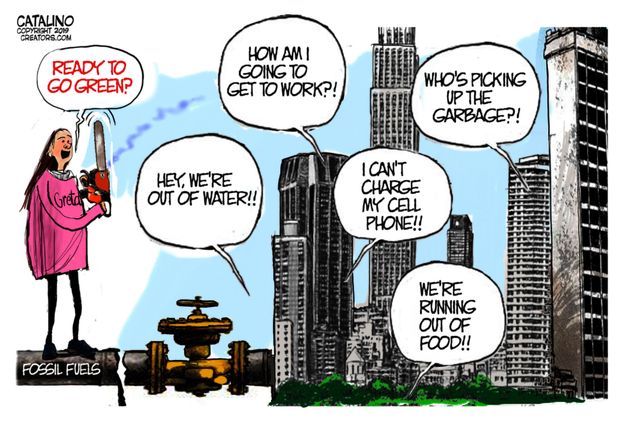



















 If we look at the situation by part of the world, we see an even more concerning pattern.
 The group US+EU+Japan has been able to reduce its CO2 emissions by 5% since 2005. Emissions were slowly rising between 1981 and 2005. There was a dip at the time of the Great Recession of 2008-2009, followed by a downward trend. A person might get the impression that CO2 emissions for the EU tend to rise during periods when the economy is doing well and tend to fall when it is doing poorly.
 The group that is simply outstanding for population growth is the Remainder Group, with 35% growth between 1997 and 2018. A big part of this population growth comes from improved sanitation and basic medical care, such as antibiotics. With these changes, a larger percentage of the babies that are born have been able to live to maturity.
 Climate modelers keep telling us about what could happen, if indeed we use too much fossil fuel. In fact, the climate currently is changing, bolstering this point of view.
 If we are in danger of collapse from low prices, renewables would not seem to be of much assistance unless they (a) are significantly less expensive than fossil fuels and (b) can be scaled up sufficiently rapidly to more than replace fossil fuels. Neither of these seems to be a possibility.
 It seems to me that climate modelers should be considering more reasonable scenarios regarding fossil fuel consumption. One scenario which should be considered is the possible near term collapse of several governmental organizations, such as the European Union, World Trade Organization, and the governments of several oil exporting countries. Such a model would be more realistic than one in which energy consumption continues to grow indefinitely.
/cdn.vox-cdn.com/uploads/chorus_image/image/65243326/1.0.jpg)




 While the responsible media like the New York Times and The Economist admitted to uncertainty–which given the complexity of the issue, was sensible—others cited the “irrefutable fact that oil resources are finite and declining” apparently unaware that oil is renewable, generated from organic material by geophysical processes, albeit very slowly.
 Science Matters