Lomborg Lucidity

Lots of guessing and worrying about climate change policy since Trump’s election.  As usual, Bjorn Lomborg sees through the fog of confusion, and points to the way forward.  His recent article is entitled Trump’s climate plan might not be so bad after all in the Washington Post (here).  Synopsis:

What really matters is not rhetoric but policy. So far, we know that President Trump will drop the Paris climate change treaty. This is far from the world-ending event that some suggest and offers an opportunity for a smarter approach.

Even ardent supporters acknowledge that the Paris treaty by itself will do little to rein in global warming. The United Nations estimates that if every country were to make every single promised carbon cut between 2016 and 2030 to the fullest extent and there was no cheating, carbon dioxide emissions would still only be cut by one-hundredth of what is needed to keep temperature rises below 3.6 degrees Fahrenheit (2 degrees Celsius).

The Paris treaty’s 2016-2030 pledges would reduce temperature rises around 0.09 degrees Fahrenheit by the end of the century. If maintained throughout the rest of the century, temperature rises would be cut by 0.31 degrees Fahrenheit.

At the same time, these promises will be costly. Trying to cut carbon dioxide, even with an efficient tax, makes cheap energy more expensive — and this slows economic growth. My calculations using the best peer-reviewed economic models show the cost of the Paris promises – through slower gross domestic product growth from higher energy costs — would reach $1 trillion to $2 trillion every year from 2030.

So Trump’s promise to dump Paris will matter very little to temperature rises, and it will stop the pursuit of an expensive dead end.

Statements by Trump’s campaign also indicate that the next administration will create a global development and aid policy that recognizes that climate is one problem among many.

Asked about global warming, the campaign responded, “Perhaps the best use of our limited financial resources should be in dealing with making sure that every person in the world has clean water. Perhaps we should focus on eliminating lingering diseases around the world like malaria. Perhaps we should focus on efforts to increase food production to keep pace with an ever-growing world population.”

This would be a big change. The Organization for Economic Co-operation and Development analyzed almost all aid from the United States and other rich nations and found that about one-fourth is climate-related aid.

This is immoral when 2 billion people suffer from malnutrition, 700 million live in extreme poverty and 2.4 billion are without clean drinking water and sanitation. These problems can be tackled effectively today, helping many more people more dramatically than “climate aid” could.

Summary

But, surprisingly, there is now an opportunity. To seize it, the Trump administration needs to go beyond just dumping the ineffective Paris agreement, to an innovation-based green energy approach that will harness U.S. ingenuity. Far from being a disaster, such a policy could mean a real solution to climate change and help the world’s worst-off more effectively.

In sub-Saharan Africa, two out of every three people are without access to electricity, and it is this energy poverty that is handicapping the region’s economic development

Bjorn Lomborg is president and founder of the Copenhagen Consensus Center and a visiting professor at Copenhagen Business School.

Updated Ontario Jammed by Rent-Seekers and Ratepayers

October 14, 2016 Update

Windstream Energy awarded damages after Ontario cancels wind farm project
from the Globe and Mail

Looking at the leaked news from the NAFTA tribunal, the damages of $25M plus $3M legal costs are much less than the $568M claimed by Windstream (US company) following a 2011 cancellation of a Lake Ontario wind farm. As has been discussed in a previous post Electrical Madness in Green Ontario, the long-term costs from these ill-advised renewable energy projects far exceed the costs of this judgment, if it stands as reported.

Post from Sept. 24, 2016

Green economics was on full display this week when the Ontario provincial government decided to cancel contracts for additional electrical power from renewables, such as those previously offered in March 2016.

Definition of Rent-Seeking, noun (economics):

the act or process of using one’s assets and resources to increase one’s share of existing wealth without creating new wealth.

(specifically) the act or process of exploiting the political process or manipulating the economic environment to increase one’s revenue or profits.

Definition of Ratepayer:

a person who pays a regular charge for the use of a public utility, as gas or electricity, usually based on the quantity consumed.

The background of this predicament is here Electrical Madness in Green Ontario.

Ratepayers are Fed Up

Feed-in tariffs for 20-year renewable power contracts have the ratepayers outraged, as voiced by the opposition (CBC):

“This government has plowed ahead for years signing contracts for energy we simply do not need,” said Opposition Leader Patrick Brown. “The premier has become the best minister of economic development that Pennsylvania and New York has ever seen.”

The Tories used virtually all their time in question period talking about individuals and business owners struggling with soaring electricity rates, and claimed Thibeault’s cancellation announcement was an admission by the Liberals that their green energy policies were misguided.

“It’s bad policy,” said Brown. “I just wish at this point, now that they’ve acknowledged that they’ve made a mistake, that they would apologize. They made a huge mistake on the energy file and everyone in Ontario is paying for it.”

Mr. Thibeault said contracts signed in an earlier green-energy procurement will be honoured. In March, the province reached 16 deals with 11 firms to build wind, solar and hydroelectric projects for a total of 455 megawatts of new capacity. The negotiated prices were much lower than earlier fixed-price contracts for renewables because of the competitive bidding.

Ontario already has more than 4,000 MW of wind capacity and 2,000 of solar power.

The Liberal government has been under pressure from the opposition and rural residents who oppose wind farms to scale back its renewable plans and to find a way to trim increases in electricity prices.

Rent-Seekers Push Back

Renewables lobbyists are defending their interests (Globe and Mail):

But the cancellation was a shock to the renewable-energy industry, which was counting on the new program, which would have awarded contracts for about 1,000 MW of projects in 2018.

John Gorman, president of the Canadian Solar Industries Association, said the decision could hurt manufacturers and installers of solar product in the province just as they are becoming significant global competitors.

Robert Hornung, president of the Canadian Wind Energy Association, said the wind industry is “shocked and extremely disappointed.”

Lobby group Environmental Defence called the cancellation “short-sighted” and said this is “exactly the wrong time to put the brakes on renewable energy.”

Etc., Etc.

Summary

Several rent-seekers as well as the Energy Minister said renewable prices were coming down, but didn’t say they are still several multiples of the $23/MWh Ontario wholesale price. Nor did anyone point out the cancellation is only avoiding a future rate increase, not bringing rates down.  The politics have forced the administration into promising an 8% cut in consumer electricity rates, and it can only come from reducing the subsidies. Hence the howling.

286fd-7_50286

For More on Wind Power problems:  Climateers Tilting at Windmills

Mad Hatters’ Energy Subsidies Abuse


The recent G20 summit took on the appearance of the Mad Hatter’s tea party (Alice in Wonderland) when the G7 produced a statement saying they are committed to ending “fossil fuel subsidies.” Terence Corcoran of Financial Post (here) on the fossil fuels subsidies folly.

In a sensational bit of reportorial distortion and ignorance, CBC News on Thursday reported that Canada and other G20 nations are “spending US$452-billion a year subsidizing their fossil fuel industries.”

The number comes from Oil Change International, one of scores of front organizations funded by an unholy cabal of activist U.S. foundations — Tides, Hewlitt, Oak, Rockefeller — whose billion-dollar cash pools are being mobilized to rid the world of fossil fuels and reduce the world’s population of messy people. The $452-billion was described as “shocking” by Oil Change activist Alex Doukas, especially since the objective of the Paris climate summit is to have most of the world’s oil and gas reserves “stay in the ground.”

Where Energy Subsidies Actually Go–The US Example

WHAT’S THE TRUE COST OF WIND POWER? by Randy Simmons at Newsweek

The high costs of federal subsidies and state mandates for wind power have not paid off for the American public. According to the Mercatus Center at George Mason University, wind energy receives a higher percentage of federal subsidies than any other type of energy while generating a very small percentage of the nation’s electricity.

In 2010 the wind energy sector received 42% of total federal subsidies while producing only 2% of the nation’s total electricity. By comparison, coal receives 10% of all subsidies and generates 45% and nuclear is about even at about 20%.

But policymakers at the federal and state level, unfortunately, have decided that the American people will have renewable energy, no matter how high the costs. As a result, taxpayers will be stuck paying the cost of subsidies to wealthy wind producers.

Meanwhile, electricity consumers will be forced to purchase the more expensive power that results from state-level mandates for renewable energy production. Although such policies may be well intended, the real results will be limited freedom, reduced prosperity and an increasingly unreliable power supply.

Back to Basic Terms

Climate activists and renewables lobbyists are acting like Mad Hatters, twisting language and logic to pursue their agendas. Let there be some common sense injected here.

A subsidy would be when the government takes money that has been taxed, borrowed, or printed, and pays it to some company like Solyndra to do something that the market does not support. Often these subsidies subsidize technologies that do not exist and may never exist (and they say WE ignore the laws of physics.)

In contrast, a tax reduction is NOT a subsidy. A tax credit says an industry gets to keep more of its own money that it has produced selling a product people want and need in the free market.

There is a huge difference between a law that lets you keep more of your own money; and another law that actually gives you someone else’s money. The two are not the same thing. Actually, the oil industry pays higher taxation rates than other industries and subsidizes the government with the billions it pays in taxes, not the other way around.

There are also billions more in economic benefit to the nation from the jobs they create and the increased mobility and productivity people enjoy by using our transportation system based on hydrocarbon fuels.

Summary

The Mad Hatters turn things upside down. Society is subsidized and made wealthy by fossil fuels, not the other way around. Some of that wealth is being diverted to renewable energy companies who do not create enough value to be in business without direct payments of tax dollars. They prove it by declaring bankruptcy when their subsidies are reduced.  Worse, hooking up wind and solar intermittent power to electrical grids adds more cost and unreliability than the renewable power is worth.

Read More about Energy Subsidies Abuse

The Appalling Truth About Energy Subsidies at Euan Mearns

Renewable Energy Cost Explosion: €25,000 euros for each German family of four  Daniel Wetzel, Die Welt (translation by GWPF)

What’s an Oil Subsidy? Heritage Foundation

Net Subsidy Analysis: A Better Way to Assess Government Energy Policy MasterResource

Why the Best Path to a Low-Carbon Future is Not Wind or Solar Power Brookings Institution

Killing the Energy Goose Science Matters

At its prime, the Carrizo Plain (S. California) was by far the largest photovoltaic array in the world, with 100,000 1′x 4′ photovoltaic arrays generating 5.2 megawatts at its peak. The plant was originally constructed by ARCO in 1983 and was dismantled in the late 1990s. The used panels are still being resold throughout the world.

At its prime, the Carrizo Plain (S. California) was by far the largest photovoltaic array in the world, with 100,000 1′x 4′ photovoltaic arrays generating 5.2 megawatts at its peak. The plant was originally constructed by ARCO in 1983 and was dismantled in the late 1990s. The used panels are still being resold throughout the world.


Pipeline Wake up Call

Rolling gas shortages could stymie Thanksgiving travel plans for Ontarians (link to CBC)
‘A lot of gas stations going forward are going to have to scramble to get their gasoline,’ fuel expert says

It’s one the busiest travel weekends of the year, but Ontario is running low on fuel thanks to repair work on major pipelines — and the shortage could last beyond Thanksgiving Monday. 

The shortage stems from repairs to the Trans-Northern Pipeline, ordered by the National Energy Board (NEB), which called for a further 10 per cent restriction to the pipeline’s total pressure. And that’s causing the pressure to build for drivers counting on gassing up at the pump for weekend travel.

What’s the Wakeup Call?

Pipelines remain the safest, most efficient and environmentally friendly way to transport fossil fuels. The regulatory body is doing their job and forcing a temporary restriction on the flow of gasoline to ensure long-term safety of pipeline operations. The scramble over 10% petrol shortages in metropolitan Toronto is just a hint of what can be expected if Greens have their way and ”Leave It in the Ground.” Be careful what they wish for, unless you also want to stop mobility for everyone and everything.

Quick Facts from the NEB Order (here)

The NEB has issued an Amending Safety Order to TNPI that consolidates three previous Safety Orders issued between 2009 and 2010.

  • None of the overpressure incidents posed an imminent public safety or environmental risk.
  • Operating a pipeline within its approved pressure range is an NEB regulatory requirement.
  • The NEB takes safety and environmental protection seriously and took action to ensure TNPI completes all requirements.

“Trans-Northern will continue to be vigilant in its monitoring and maintenance activities, including operating below approved pressure ranges until we are confident the pipeline can return to full capacity,” said Jackie Medeiros of Hill and Knowlton Strategies.

The company operates approximately of 915 kilometres of pipeline that supplies gasoline, jet fuel and fuel oil from refineries in Ontario and Quebec across Montreal and the Greater Toronto Area.

“A lot of gas stations going forward are going to have to scramble to get their gasoline…It won’t be everyone at the same time but this could go on for several weeks.”  In the meantime, fuel expert Dan McTeague of GasBuddy.com predicts rolling shortages from Ottawa to Sudbury to Hamilton.
Repair work on the pipeline is expected to last into 2017, meaning more shortages could be on the horizon.

Climate activist dream come true.

A number of Toronto gas stations are cordoned off with yellow tape as a gasoline shortage has forced them to temporarily shut down.  It is a Climate Activist’s dream come true.


Ontario Jammed by Rent-Seekers and Ratepayers

Green economics was on full display this week when the Ontario provincial government decided to cancel contracts for additional electrical power from renewables, such as those previously offered in March 2016.

Definition of Rent-Seeking, noun (economics):

the act or process of using one’s assets and resources to increase one’s share of existing wealth without creating new wealth.

(specifically) the act or process of exploiting the political process or manipulating the economic environment to increase one’s revenue or profits.

Definition of Ratepayer:

a person who pays a regular charge for the use of a public utility, as gas or electricity, usually based on the quantity consumed.

The background of this predicament is here Electrical Madness in Green Ontario.

Ratepayers are Fed Up

Feed-in tariffs for 20-year renewable power contracts have the ratepayers outraged, as voiced by the opposition (CBC):

“This government has plowed ahead for years signing contracts for energy we simply do not need,” said Opposition Leader Patrick Brown. “The premier has become the best minister of economic development that Pennsylvania and New York has ever seen.”

The Tories used virtually all their time in question period talking about individuals and business owners struggling with soaring electricity rates, and claimed Thibeault’s cancellation announcement was an admission by the Liberals that their green energy policies were misguided.

“It’s bad policy,” said Brown. “I just wish at this point, now that they’ve acknowledged that they’ve made a mistake, that they would apologize. They made a huge mistake on the energy file and everyone in Ontario is paying for it.”

Mr. Thibeault said contracts signed in an earlier green-energy procurement will be honoured. In March, the province reached 16 deals with 11 firms to build wind, solar and hydroelectric projects for a total of 455 megawatts of new capacity. The negotiated prices were much lower than earlier fixed-price contracts for renewables because of the competitive bidding.

Ontario already has more than 4,000 MW of wind capacity and 2,000 of solar power.

The Liberal government has been under pressure from the opposition and rural residents who oppose wind farms to scale back its renewable plans and to find a way to trim increases in electricity prices.

Rent-Seekers Push Back

Renewables lobbyists are defending their interests (Globe and Mail):

But the cancellation was a shock to the renewable-energy industry, which was counting on the new program, which would have awarded contracts for about 1,000 MW of projects in 2018.

John Gorman, president of the Canadian Solar Industries Association, said the decision could hurt manufacturers and installers of solar product in the province just as they are becoming significant global competitors.

Robert Hornung, president of the Canadian Wind Energy Association, said the wind industry is “shocked and extremely disappointed.”

Lobby group Environmental Defence called the cancellation “short-sighted” and said this is “exactly the wrong time to put the brakes on renewable energy.”

Etc., Etc.

Summary

Several rent-seekers as well as the Energy Minister said renewable prices were coming down, but didn’t say they are still several multiples of the $23/MWh Ontario wholesale price. Nor did anyone point out the cancellation is only avoiding a future rate increase, not bringing rates down.  The politics have forced the administration into promising an 8% cut in consumer electricity rates, and it can only come from reducing the subsidies. Hence the howling.

286fd-7_50286

For More on Wind Power problems:  Climateers Tilting at Windmills

Killing the Energy Goose

golden-goose

Aesop’s Fable of The Man and the Golden Eggs

A man had a hen that laid a golden egg for him each and every day. The man was not satisfied with this daily profit, and instead he foolishly grasped for more. Expecting to find a treasure inside, the man slaughtered the hen. When he found that the hen did not have a treasure inside her after all, he remarked to himself, ‘While chasing after hopes of a treasure, I lost the profit I held in my hands!’

The Moral: People often grasp for more than they need and thus lose the little they have.

Energy is the Golden Goose of Modern Society

Poverty and energy scarcity are obviously tied together.

Access to cleaner and affordable energy options is essential for improving the livelihoods of the poor in developing countries. The link between energy and poverty is demonstrated by the fact that the poor in developing countries constitute the bulk of an estimated 2.7 billion people relying on traditional biomass for cooking and the overwhelming majority of the 1.4 billion without access to grid electricity. Most of the people still reliant on traditional biomass live in Africa and South Asia.

The relationship is, in many respects, a vicious cycle in which people who lack access to cleaner and affordable energy are often trapped in a re-enforcing cycle of deprivation, lower incomes and the means to improve their living conditions while at the same time using significant amounts of their very limited income on expensive and unhealthy forms of energy that provide poor and/or unsafe services.  Energy, Poverty, and Development

The moral of this modern story is very clear. Where energy is scarce and expensive, people’s labor is cheap and they live in poverty. Where energy is reliable and cheap, people are paid well to work and they have a better life.

Golden Eggs Aplenty in the US

From Shale Revolution Keeps Growing, Sept. 12, 2016, Corpus Christi Caller Times

Consider that in the near blink of an eye natural gas has overtaken coal as the country’s largest fuel for electricity generation. Coal generated more than 50 percent of U.S. power just a decade ago. Today, it produces just a third of our electricity and is poised to fall further.

Second, our same supply of low-cost gas is leading a manufacturing resurgence. Along the Gulf Coast and in shale fields in Pennsylvania and Ohio huge manufacturing facilities — be they steel or chemical plants — are now either entering production or are under construction. Chemical producers who use natural gas as the building blocks for their products can now make the same products here for a fraction of what they can overseas.

The American Chemistry Council, the trade association for the nation’s chemical companies, now reports that nearly 270 new chemical projects are in play, totaling $170 billion in investment. Roughly 60 percent of that investment is coming directly from overseas. Affordable, abundant natural gas is proving decisively positive for U.S. manufacturing. Jobs and investment that once slipped away are now returning. (my bold)

And last, but not least, we are on the verge of becoming one of the world’s largest natural gas exporters. Just a few years ago, America was poised to become a major natural gas importer. It has been a remarkable turn of events.

The Illusory Treasure of Fighting Climate Change

Meanwhile in jurisdictions grasping for the moral treasure of reducing CO2, governments are starving or poisoning the Energy Goose and the suffering is only beginning. Exhibit A is oil-rich Alberta Canada where provincial policies have halved business investment in just 2 years.

barrel-poison-7388531rev

Barry Cooper explains in this article published today in the Calgary Herald NDP climate policies are bearing their inevitable poisoned fruit

Contrary to what many NDP supporters, and many of my colleagues believe, businesses are more likely to respond to government policies than to set them. One of the responses to egregiously irresponsible policies is to invest elsewhere.

The Birn report did not discuss the scientific premises of anthropogenic climate warming, nor the prudence of attempting to regulate GHG emissions. What matters are the consequences of policy choices by Canadian and U.S. governments for Alberta and Saskatchewan.

Here are some pertinent facts.

The interdependence of North American economies and the familiar 10-to-one ratio between the two countries means that Canada must always adjust its policies to American realities. That ratio applies to global CO2 emissions (16 per cent for the U.S.; 1.7 per cent for Canada, of which the oilsands’ contribution is minuscule) as well as to GDP and much else. Canadian CO2 emissions are comparable to those of Texas. The big difference is how that CO2 is generated.

Coal is the largest source of American CO2, mostly from electricity generation, followed by transportation and industry. In Canada, industry — from fertilizer manufacturing to mining, smelting and pulp production — is the largest emitter, followed by transportation and then electricity generation. The main reason for this difference is that in B.C. and Laurentian Canada, hydroelectricity is the chief source of power. Prairie rivers furnish great fishing opportunities, but few electrons.

Since CO2 from American coal plants alone are double those from the entire Canadian economy, they have been the focus of U.S. policies. Replacing coal-generation with natural gas has been made easier by low natural gas prices, partly the result of innovative shale-gas exploitation.

In Canada, things are different. Because more than 80 per cent of Canadian electricity is generated by non-emitting sources, other sectors must be targeted to achieve levels of emission reductions comparable to the Americans’. The cost, however, is bound to be higher: here, cheap gas hardly matters.

This is what makes carbon taxes so attractive to Canadian governments. They can’t go after coal plants, because there are so few left, so they go after the entire economy. Alberta’s carbon tax and Ontario’s cap-and-trade policy mean that over two-thirds of Canadian emissions will be covered by next year.

Big-government Liberals, socialists and members of the green cult will rejoice that we are saving the planet. However, the costs of the new NEP — the national emissions policy — achieved by carbon-tax harmonization, will introduce more incentives for investment in places where anthropogenic climate change is not an unquestioned public policy dogma.

Because the Prairie petroleum industry competes globally for both capital and markets, parochial Canadian climate policies add to costs and induce investors abroad. And they make no difference at all to global GHG emissions.

That is one reason why energy investment in Alberta is half 2014 levels. No wonder Finance Minister Joe Ceci is sad. The consequences of his own policies are bearing their inevitably poisoned fruit.

Barry Cooper is a professor of political science at the University of Calgary.

Footnote:

Former Canadian PM Stephen Harper (from Alberta) based his climate change policy on the realities mentioned in the article.  His administration was committed to matching US energy policies on a sector by sector basis.  Since the US went after coal, so did Canada.  The US has not done anything about oil and gas, so neither should Canada.

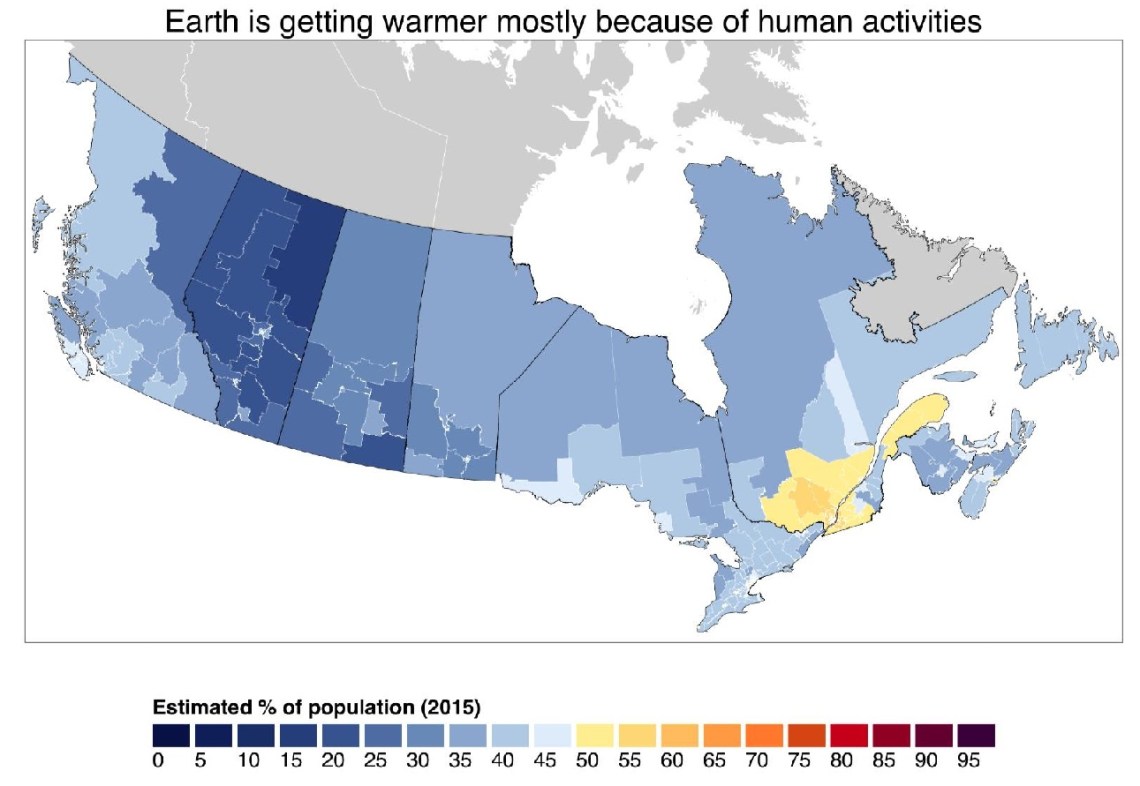
The ruling NDP party are on thin ice because Albertans are mostly skeptical of global warming claims.  A recent Canadian survey shows the % of people whose beliefs would support what the administration is doing.  That’s right: Alberta is the dark blue province in the map.

More on survey of Canadian attitudes toward global warming:      https://rclutz.wordpress.com/2016/02/25/uncensored-canadians-view-global-warming/

More on toxic effects from Green energy policies:  https://rclutz.wordpress.com/2016/08/01/electrical-madness-in-green-ontario/

Background on Alberta oilsands:  https://rclutz.wordpress.com/2015/11/07/brer-canada-and-the-tar-baby/

Postscript:  Alberta is ahead of Ontario in the Golden Goose Killing Race, with electricity rates now among the highest in North America.  But Ontario’s rates are rising faster.


Power (and $) to the People

Donald Trump was half right when speaking recently in Montana, saying that people should have the say whether to frack or not in their backyard.

“I’m in favor of fracking, but I think that voters should have a big say in it. I mean, there’s some areas, maybe, that don’t want to have fracking, and I think if the voters are voting for it that’s up to them.”

UK Prime Minister has got it all right when she announced that the wealth will be shared with residents receiving checks directly if they choose to go with the extraction. Green and anti-fossil fuel activists are scrambling to denounce her move as “bribery” while ignoring their own undemocratic posture.  They worry about losing their power to stop progress when the discourse changes from “Not In My Back Yard” (NIMBY) to “Please In My Back Yard” (PIMBY).

A £1 billion shale wealth fund unveiled by former chancellor George Osborne in November will set aside up to 10 per cent of the tax proceeds from fracking to benefit the communities hosting wells.

But now the Prime Minister is amending the scheme so the money can go direct to residents rather than being given to councils or community trusts to spend, as Mr Osborne planned.

It is expected that the new fund could deliver as much as £10 million to each community where wells are sited.

Speaking ahead of the launch of a consultation on the fund, Mrs May said she wanted to make sure that individuals benefit personally from economic decisions.

She indicated that the model could be applied to other Government programmes, such as the Community Infrastructure Levy charge on property development in England and Wales.

“The Government I lead will always be driven by the interests of the many – ordinary families for whom life is harder than many people in politics realise,” said Mrs May. “As I said on my first night as Prime Minister, when we take the big calls, we’ll think not of the powerful but of you. This announcement is an example of putting those principles into action.”
Source: Fracking payments: Households in line for cash under Government plans Shropshire Star

Summary

Margaret Thatcher and Ronald Reagan don’t get enough credit for leading the free world to out-prosper the socialist block, thereby leading to the iron curtain collapsing, and eventually to economic reforms even in places like China and Cuba.

Today we are facing a growing tyranny of unelected bureaucrats at the EU and the UN whose power and resources are committed to a statist, left-wing agenda, using climate hysteria as justification.

Theresa May looks to be up for the fight. But will the next US President be a willing partner against entrenched special interests, activists and rent-seekers, or will it be someone beholden to them and to the status quo?


Electrical Madness in Green Ontario

Consumer Price Index: Ontario Electricity compared to all items, from 2004. Chart: Bank of Montreal.

Rising electricity rates in Ontario are hitting residents and businesses hard. They have gone “out of control” as the Liberal provincial government followed through on eliminating coal-fired power stations.

Brian Hill at Global News provides the back story, a frightening and cautionary tale of “fighting climate change” by pricing away your affordable power grid.

ontarios-electricity-mix-2014-300x192-1

The energy mix in Ontario’s electrical sector is dominated by hydro and nuclear, so getting off coal seemed doable.  But in the provincial government’s drive to reduce CO2 emissions and join the California Emissions Trading Scheme, they have hardwired costly energy contracts that Ontarians will pay for through their noses for decades. Meet the Global Adjustment Fee (covering a multitude of sins and mismanagement).

What is the Global Adjustment fee? The mysterious cost Ontario hydro customers must pay by Brian Hill of Global News

A product of Ontario’s 2009 Green Energy Act, the Global Adjustment fee is a charge billed to all hydro customers in the province.

For major manufacturers and large businesses, the fee appears separately on electricity bills. But for residential customers and small businesses, the fee is hidden – appearing on your electricity bill as a part of the per kilowatt hour charge.

According to data obtained by Global News from the Independent Electricity System Operator (IESO), the organization responsible for managing Ontario’s energy system, residential customers and small businesses in Ontario paid an average of 7.9 cents per kilowatt hour in Global Adjustment fees last year.

So for every $100 in usage that appears on your electricity bill, $77 of that is the Global Adjustment fee. Meaning the cost of electricity use is only $23.

What exactly is included in the Global Adjustment fee?

First, there’s the difference between what the IESO pays energy producers for the electricity they produce, known as the contracted rate, and the actual fair market value of this electricity, known as the Hourly Ontario Energy Price, or HOEP.

In 2015, the average HOEP was 2.36 cents per kilowatt hour, while the IESO paid wind producers as much as 13 cents per kilowatt hour. The remaining 11-cent difference was then passed on to the consumer in the form of the Global Adjustment fee.

Solar producers, many of which signed contracts with the government for as long as 20 or 30 years, were paid as much as 80 cents per kilowatt hour for the energy they produced, despite the fact that fair market value for this energy was the same 2.36 cents per kilowatt hour. Here, too, the 78-cent difference was passed on to consumers.

And while the argument can be made that the Global Adjustment fee simply reflects the true cost of producing reliable, green electricity in the province, this ignores the fact that, in 2015 alone, Ontario sold more than 22.6 billion kilowatt hours of electricity – enough to power 2.5 million homes – to places like New York and Michigan at the fair market price of 2.3 cents per kilowatt hour – generating a loss of more than $1.7 billion for Ontario hydro customers.

So while Ontario customers are required to pay for producing green electricity, utility providers in the United States are able to access this same energy source for a fraction of the cost.

In other words, Ontarians pay the Global Adjustment fee, delivery fees, administration fees and HST, while American utility providers pay for the electricity alone.

The Global Adjustment fee also includes what’s known as “curtailing,” when the IESO pays energy producers not to produce electricity out of fear too much production could cause stress on the system and result in a blackout.

But when asked not to generate power, electricity producers must still be paid because the Government of Ontario initially agreed to purchase everything the energy producer’s facilities were capable of putting out.

The Global Adjustment fee also includes certain government conservation programs.

For example, when you receive a tax credit for purchasing new high-efficiency appliances or LED light-bulbs, that’s included within the Global Adjustment fee. When a delivery man takes away an old refrigerator for free, or when they recycle your old computer parts, the cost of these services are all part of the Global Adjustment fee.

Why conservation won’t make a difference

Over the past seven years, Ontario has signed numerous agreements with energy producers guaranteeing minimum levels of revenue regardless of how much energy they produce.

TransCanada, set to open their Napanee Generating Station later this year, signed an agreement with the Ontario Power Authority in 2012 that guaranteed the company would receive a minimum of $13.7 million per month once the plant comes online – even if they produce zero electricity.

“Essentially… TransCanada is being paid nearly $165 million a year to leave their power generating station running on idle,” said Parker Gallant, former vice president of TD Bank and an outspoken critic of the province’s green energy strategy.

With agreements similar to this in place across the province, Gallant thinks it’s no wonder hydro rates in Ontario continue to rise.

The easiest way to explain it, said Gallant, is that when energy consumption drops due to conservation, the Global Adjustment fee must be increased to make up the difference. So the less power Ontarians use, the higher their electricity costs must be in order to cover the minimum revenues energy producers are guaranteed.

What Cost to Reduce CO2

“When it comes to fighting climate change, Ontario has already been at war with the provincial economy, devastating consumers and undermining growth. In a burst of regulatory overkill, the province ordered a shutdown of its coal plants and orchestrated a massive overhaul of the provincial electricity market, at massive cost to consumers. When the plant shutdowns began around 2009, Ontario industry and individual consumers used 139 TWh (trillions of watt hours) of electricity. In 2014, the province used the same amount of electricity coal free, but the total cost has increased from $8.6 billion in 2009 to $12.7 billion in 2014, a jump of $4 billion.”

“That’s expensive carbon reduction. Much of the increased spending comes from Ontario’s feed-in-tariff and other subsidies to allow the installation of wind and solar power and construction of new gas-powered plants. According to government figures, closing the Ontario coal plants reduced annual carbon emissions by maybe 10-million tonnes between 2009 and 2014. Let’s see, back of the envelope, $4 billion divided by 10-million tonnes of carbon, works out to about $400 per tonne of carbon per year. ”
http://business.financialpost.com/fp-comment/terence-corcoran-manufacturing-carbon-hobgoblins

Summary

it really is quite remarkable. Ontario is not trying to do something crazy like South Australia, chasing the dream of 100% renewable energy. No, Ontario energy is cheap, coming from installed nuclear and hydro plants, along with stations fired by gas, quite cheap these days. They only wanted to swap out the sliver of coal electricity for more renewables. And look at the mess they created in pursuing that very limited green energy objective.

No wonder the new UK administration is reconsidering their 30-year price agreement for Hinkley Point electricity.  Going ahead means following Ontario and others down the rabbit hole into Not-So-Wonderland.

A world-wide look at damage from green energy policies is here:  Clean, Green and Catastrophic

Update August 2

A closer reading of Hillary’s energy platform shows the Democrats want to go over the cliff with the others. http://dailycaller.com/2016/07/31/5-problems-with-hillarys-energy-platform-that-could-leave-you-in-the-dark/

Climate Lemmings h/t Beth

Update August 18 2016

In a recent followup article Global News reports on the increasingly unpaid Ontario electricity bills.

The OEB data shows Hydro One’s total amount of ‘write offs’ for eligible low income customer accounts jumped from $327,230 in 2013 to $1,798,531 in 2015, a 450 per cent increase in the utility’s write off totals in those two years.  . . The total amount owing for Hydro One customers behind on their energy bills rose from nearly $54 million in 2013 to $105.5 million in 2015, according to the OEB. The average amount owing for people in arrears was $292 in 2013 and $467 in 2015, representing a 60 per cent increase.

Environmentalist Manifesto


Obama and other Western political leaders keep saying that Climate Change is the biggest threat to modern society. I am coming around to agree with him, but not in the way he is thinking. I mean there is fresh evidence that we can defeat radical Islam, but we are already losing to radical environmentalism.

The Environmentalist Game Plan

Mission: Deindustrialize Civilization

Goal: Drive industrial corporations into Bankruptcy

Strategy: Cut off the Supply of Cheap, Reliable Energy

Tactics:

  • Raise the price of fossil fuels
  • Force the power grid to use expensive, unreliable renewables
  • Demonize Nuclear energy
  • Spread fear of extraction technologies such as fracking
  • Increase regulatory costs on energy production
  • Scare investors away from carbon energy companies
  • Stop pipelines because they are too safe and efficient
  • Force all companies to account for carbon usage and risk

Progress:

  • UK steel plants closing their doors.
  • UK coal production scheduled to cease this year.
  • US coal giant Peabody close to shutting down.
  • Smaller US oil companies going bankrupt in record numbers.
  • Etc.

Collateral Damage:

  • 27,000 extra deaths in UK from energy poverty.
  • Resource companies in Canada cut 17,000 jobs last month.
  • Etc.

For more info on progress see: http://business.financialpost.com/fp-comment/terence-corcoran-clean-green-and-catastrophic

Summary:

Radical environmentalism is playing the endgame while others are sleeping, or discussing the holes in the science. Truly, the debate is over (not ever having happened) now that all nations are signing up to the Paris COP doctrine. Political leaders are willing, even enthusiastic dupes, while environmentalist tactics erode the foundations of industrial society.  Deaths and unemployment are unavoidable, but then the planet already has too many people anyway.

ISIS is an immediate threat, but there is a deeper and present danger already doing damage to the underpinnings of Life As We Know It. It is the belief in Climate Change and the activists executing their game plan.  Make no mistake: they are well-funded, well-organized and mean business.