Funding for University Wokism Cut

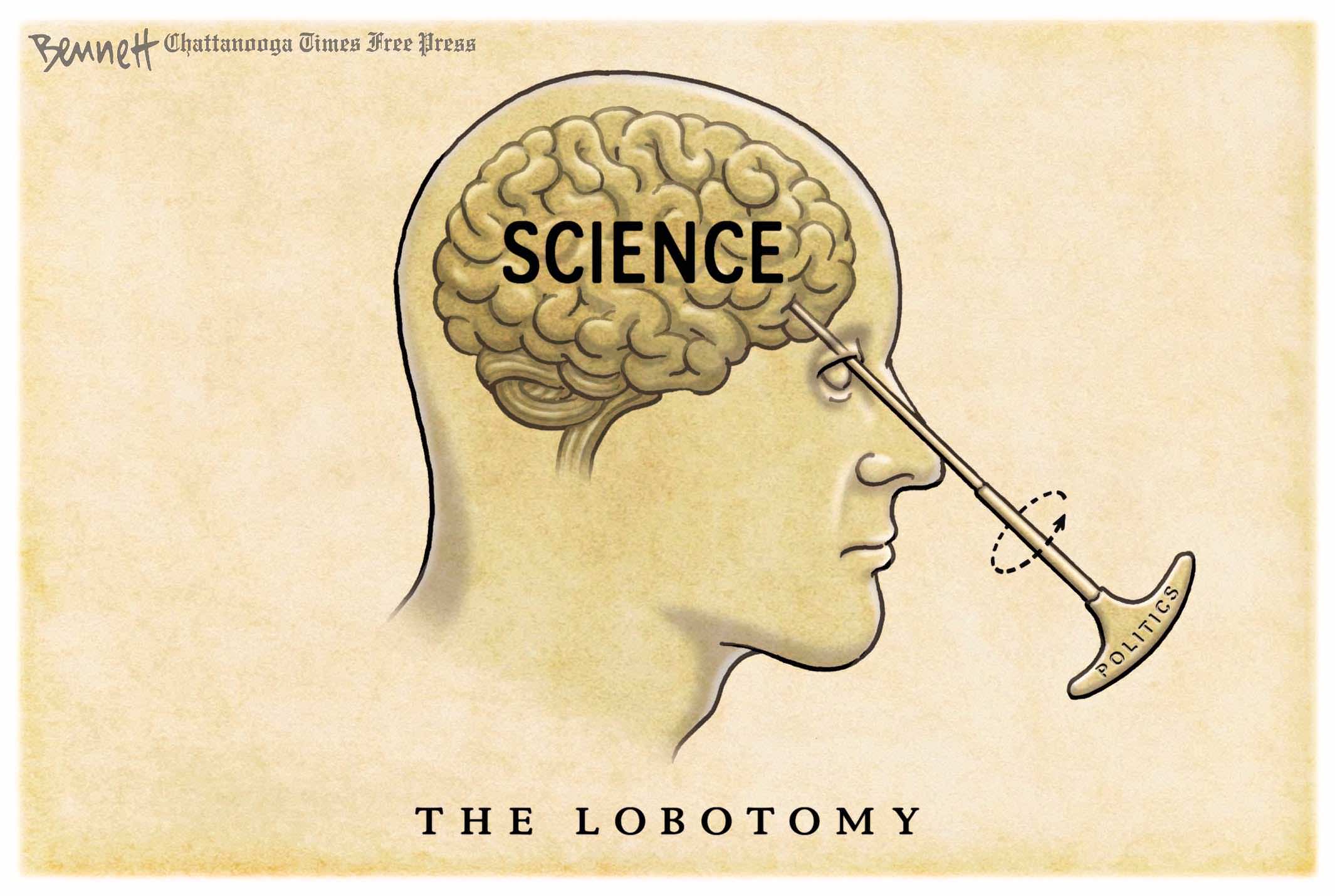
William M Briggs explains in his blog article Trump Slashing The Cancerous “The Science” Bloat: Cut Cut Cut! Excerpts in italics with my bolds and added images.

I responded on Twitter (follow me): “You might not know it, but this is a MAJOR VICTORY of outstanding proportions. Overhead is what fed the administrative beast. Overhead paid for DIE. Overhead paid for assistants to the assistants to the assistant Deans for development. Kill the Beast by starving it.”

For those new to grants, the overhead is the amount tacked on by the researchers’ institution to a researcher’s grant. If a Harvard grant is for, say, $1 million, an amount already bloated for all the usual reasons of excess, then the amount NIH pays to Harvard is $1,690,000. That extra $690,000 feeds the Beast. The Beast grows and causes the original grant totals to swell, for reasons not directly related to the research, like increased salaries for all and such like. Bureaucrats are spawned from the overhead funds. They emerge from their pods with gaping maws mewing to be fed—fed—fed! Overhead is a slow-motion monster movie.

(If you want more detail on overhead, this is a good article.)

Now I know this next part will make no sense to you, but not all are taking well the splendiferous news overhead will be treated like a bikinied teenager in a Wes Craven movie. The far-left politics journal Science screamedNIH slashes overhead payments for research, sparking outrage“.

“Outrage”, as we have said many times, is the second of only
two emotions a woke can express. The first being smug self-satisfaction.
They don’t get the first anymore, though.

Or take as representative lead covid panicker Eric Fing-Ding. Through sweet, sweet tears, he tweeted (among other things) that the cuts will “COMPLETELY DECIMATE MEDICAL & PUBLIC HEALTH RESEARCH”.

Bad news, because we’d like the effect to be greater than a mere measly ten percent. We need to whack, with pitiless remorseless brutality, at least half of governmental science funding. The Science article was more hopeful. They said “‘This is a surefire way to cripple lifesaving research and innovation,’ said a statement from the Council on Governmental Relations (COGR)”.

Crippling is much better than decimating.

Bring on the pain. Their pain. Universities have had it good too long. And we’ve had it bad.  It’s not only your old Uncle Sergeant Briggs saying this.

Here’s a ripe pull from “The natural selection of bad science” by Paul E Smaldino and Richard McElreath. These fellas are not critiquing cellar-dwelling simulacra of science, like say sociology, but what’s taken as the good stuff, like medicine.

These are not the only ones on the inside saying these things. The word is out. Science has gone bad: “A 2015 British Academy of Medical Sciences report suggested that the false discovery rate in some areas of biomedicine could be as high as 69 percent.”

Data Republican says: “Universities are among the largest drains on taxpayer money in my dataset. They receive massive funding from NGOs and USAID, and they take more government grants on top of that. Meanwhile, anonymous professors have reported to me that true scientific research is stagnating due to DEI mandates and administrative bloat.”

Understand: universities were ground zero for the DIE zombie invasion. And much worse. A tsunami of bad ideas flowed from universities over the last century. Many of those responsible are still employed there. These people need to be made to go. It’s not only DIE, but the base bloat caused by government micro-managing science. It is government, almost completely, that decided what got funded, and funded to ridiculous levels. This forced consensus-based science upon us. This has stifled much innovation, as we have seen time and again. It must be made to change, for change won’t come from within.

Now that 15% might eventually rise, given the wounded howling coming from universities (an AFMR email said “We have also launched an E-Action Alert to engage the broader scientific community and mobilize support for advocacy efforts to reverse or mitigate these changes.”).  But the rate must fall. The NIH and NSF budgets need to treated like the mess they are.

The only way to rid ourselves of this stuff is to stop feeding those producing it. We need to force a restructuring and rethinking. The old ways need to go. The only way to do this is to cause pain. Minor course corrections are not enough. Cut, cut, and cut some more. Make it sting.

See Also:

Examples of Debased Government Science

Trust Me, I’m a Scientist. Really?

Why Federalized Science is Rotten

US Energy Status Quo and Outlook–Sec. Chris Wright

Three days after he was confirmed as US Secretary of Energy, Chris Wright was interviewed on CNBC Squawk Box by Brian Sullivan.  The video clip above and one at the end provide his view of the way forward for US energy.  For those who prefer to read, I provide a transcript in italics from the closed captions, lightly edited with my bolds and some added images.  Brian refers to interviewer Brian Sullivan and Chris to Secretary Wright.

Brian: Let’s get to the topical issues, price of oil. The president says drill, baby, drill. You’re a guy that ran a fracking company. How do we balance out ringing down the price of gasoline, adding to US production, but yet not destroying the oil and gas investments as well? The CNBC audience talks about and looks at that every day.

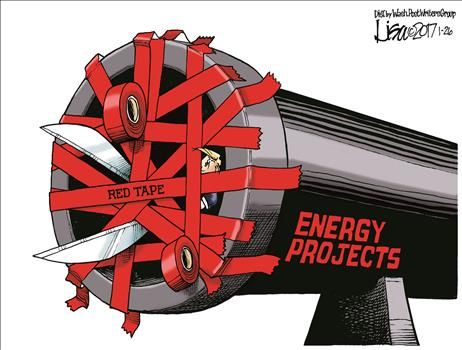
Chris: Yeah, of course it’s a business and prices are dictated by supply and demand. But we’ve had four years of an administration that’s done everything it could to raise the cost to produce a barrel of oil. “We’re not sure if you can get a permit to drill here” or “It’s going to take 18 months. You’ve got uncertainty. You’ve got to build pipelines or gathering lines to move that product to market. “Well, we’re not sure if you can do that. You’ve got to do another study, or another this or that.” So when you add to costs of course you hurt the economics.

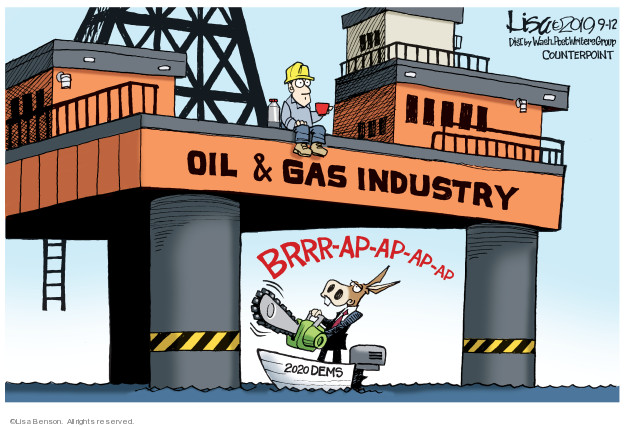
Now we’re going to have a more efficient operating environment. I think we’re going to see some efficiencies from scale, some efficiencies from certainty and from more credible Capital Markets. We’ve tried to starve the oil and gas industry globally, somehow thinking that’s going to help climate change. There’s been a lot of nonsense. And I think the agenda of this administration, this president, is to bring back common sense.

Brian: Can we have lower oil and gas prices and still have stocks that are not much lower than they are right now?

Chris: Oh, absolutely. Look, if you lower the cost of operations, there’s a lot of fat in the cost of operations. If you lower the cost of operations that’s going to flow through to lower prices but not necessarily lower profits.

Rough Seas for Captains of Industry

Brian: And that margin you think can remain steady and thus hold up because you were the CEO of a publicly traded company and on the board of another publicly traded company, which you have now left.

Chris:  Absolutely. And look, it’s capitalism and business is driven by profit motives that have driven innovation, that have driven efficiency and driven improvements in our system. And that’s exactly what we want going forward in nuclear and natural gas and oil and geothermal, whatever it is.

Brian: Just before this interview we were talking about tariffs and the impact. They were showing health and beauty stocks down 25%. We know there’s a pause on the potential Canada tariffs, there’s 4.4 million barrels a day we bring in from Canada on average. Much of that goes to where you’re from, the Rocky Mountains, the Denver area, the upper Midwest. What is your view on potential 10% tariffs? If it does happen, what is going to happen to US oil and gasoline prices?

Chris: Well, look. Obviously the Canadian energy system is built and integrated with the United States energy system. Those pipelines come to US refineries that are tuned to refine that heavier, more viscous crude that Canada produces. I don’t think we’re going to see that change. As the president has said, this is a drug war. This is about concerns and security at our border. This is to get everyone’s attention and focus on how can we reduce criminals and fentanyl and drugs that are a threat to American security coming in our borders. I think things are moving in a productive direction.

Brian: It doesn’t sound like you think the tariffs would ultimately occur.

Chris: I don’t know what the future will bring there, but I know we’ve got very productive dialogues right now.

Brian: I’m sure you have many friends in Canada, as do I. And you know, they’re angry about this. They said, “Well, you know what? If they want to tariff our oil, let’s just ship it to Vancouver and we’re going to sell it overseas. I would call that the nuclear option. Do you see anything like that occurring if the tariffs were to occur, Mr. Secretary?

Chris: It’s hard to build new pipeline capacity. Canada does have a West Coast pipeline, which is running today and exporting oil to Asia. But that’s 10% or less of Canadian oil production. But look, this president is aggressive. He doesn’t like the status quo. He wants to change things and improve things. We had a lot of noise and sound and fury last time he was president about tariffs and inflation. Inflation averaged less than 2% in the four years he was president.

His agenda is to lower prices and better American lives, and
I don’t see any reason to believe think that’s not going to happen.

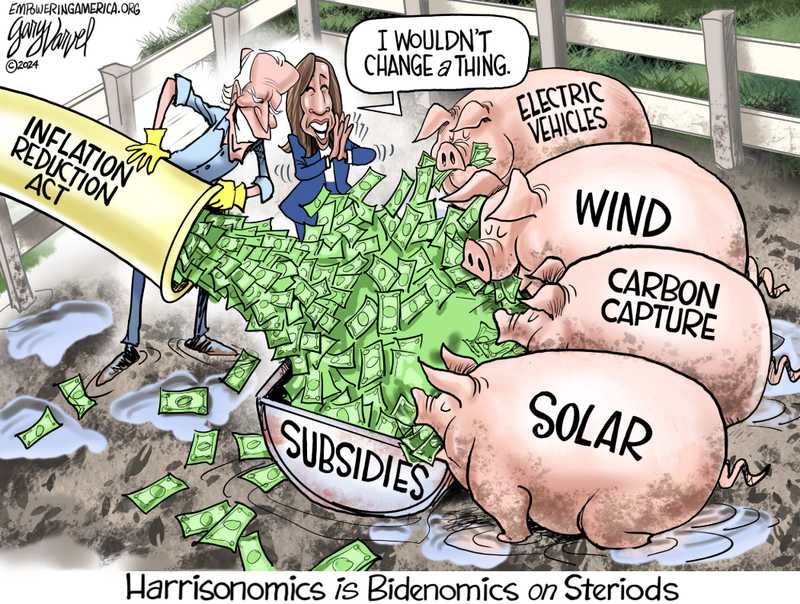
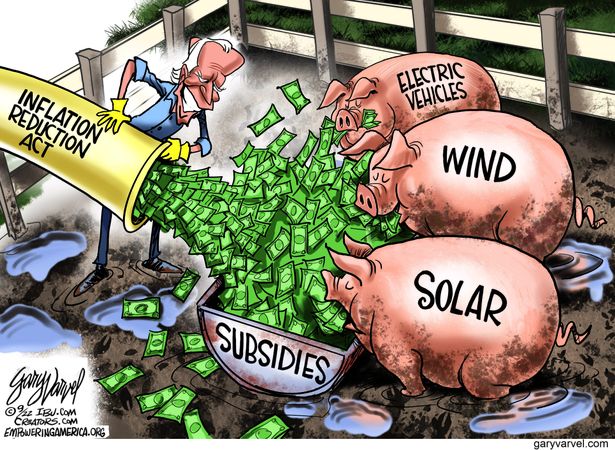
Brian: You mentioned climate a couple of minutes ago. Coming into this Administration, one of the big question marks is: What will happen to the loans and the grants and the IRA Inflation Reduction Act monies that may be already committed to wind, to solar. This matters to CNBC’s audience. In the stock market, a lot of these companies have seen their share price decline by a lot. What is your view on the Inflation Reduction Act and wind and solar projects, and the monies that are required to produce them?

Chris: So look, I’m in this chair three days now. One of the things we are doing is looking at all the projects that are out there. Where are the commitments? Where are the uncommitted funds? What’s the best use to grow the supply of affordable, reliable, secure American energy? Tremendous opportunities there. So there’s upside here as well.

But one thing I will say, Brian, we will not follow the German model. And I think the last administration wanted to go down that road. Germany spent a half a trillion dollars, made their electricity 2 to 3 times more expensive, and they produce 20% less electricity today than they did 15 years ago. We’re not going to go down that road.

We want affordable, reliable, secure energy and
reindustrialization of America, not De-industrialization of America.

Brian: Well, that’s something I’ve obviously personally reported on many times for CNBC. Been over there, seen what’s happened. So just to be clear, because let’s be honest, a lot of Wall Street makes a lot of money investing in wind and solar and even nuclear. You were on the board of a nuclear company. So final question. Should we say that that it’s possible big wind and solar projects are still going to be okay, that they’re not going to be starved of Funds under this administration? What’s the what’s the money situation regarding some of these renewable wind and solar and nuclear type energy programs?

Chris: Look, I think you’re going to see continued development in the United States of all of these energy sources. But obviously, a flow of funds from this administration is all going to be about not what the energy technology is, but will it increase the supply of affordable, reliable, secure energy?

Will it better the lives of American consumers and
encourage businesses to build things in America?

Brian: Well, finally, on building things. The first new nuclear plant in the United States just opened up last year in Georgia, took about 20 plus years to build way over budget. You’re a nuclear guy. You were on the board of Anglo until you resigned that seat. What is the future of nuclear in the United States? Some say it’s the future. Others say way too doggone expensive up front, doesn’t pay off.

Chris: I think the future is very bright, very bright. It’s an energy dense technology that gives reliable energy at all times, with a small amount of land and a small amount of materials. Do we need innovation? Do we need some government out of the way to make it work economically? Absolutely. But that’s what America is about.

Brian: Exclusive interview with the new Secretary of Energy on Day three, Christopher Wright. Thank you very much for your time here.


EPA Priorities Announced

During Trump 1.0 the appointed EPA Director summarized the false dichotomy long plaguing the agency: “If you are for the Environment, you must be against Development; and if you are for Development, you must be against the Environment.” In reality, a balance must be struck, and a new administration intends to find it.  There has been much gnashing of teeth in the legacy media over this month’s dismissal of scientists from EPA advisory boards, without mentioning the same housecleaning happened in 2021 when Biden regime took over.  Now we have an official announcement about the new EPA direction and priorities.  Text in italics with my bolds and added images.

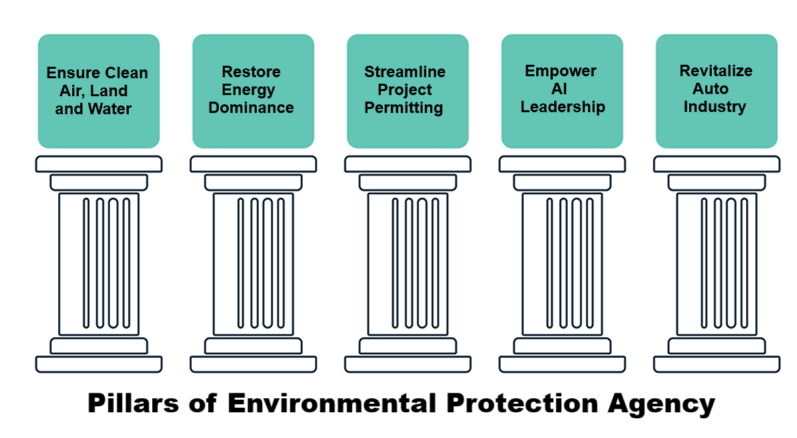
WASHINGTON – On February 4, 2025, U.S. Environmental Protection Agency (EPA) Administrator Lee Zeldin announced the agency’s Powering the Great American Comeback Initiative, to achieve the agency’s mission while energizing the greatness of the American economy. This plan outlines the agency’s priorities under the leadership of President Trump and Administrator Zeldin. The newly announced Powering the Great American Comeback initiative consists of five pillars that will guide the EPA’s work over the first 100 days and beyond:

Pillar 1: Clean Air, Land, and Water for Every American

“Every American should have access to clean air, land, and water. I will ensure the EPA is fulfilling its mission to protect human health and the environment. In his first term, President Trump advanced conservation, reduced toxic emissions in the air, and cleaned up hazardous sites, while fostering economic growth for families across the country. We remain committed to these priorities in this administration, as well as ensuring emergency response efforts are helping Americans get back on their feet in the quickest and safest way possible. We will do so while remaining good stewards of tax dollars and ensuring that every penny spent is going towards advancing this mission,” said Administrator Zeldin.

Pillar 2: Restore American Energy Dominance

“Pursuing energy independence and energy dominance will cut energy costs for everyday Americans who are simply trying to heat their homes and put gas in their cars. This will also allow our nation to stop relying on energy sources from adversaries, while lowering costs for hardworking middle-income families, farmers, and small business owners. I look forward to working with the greatest minds driving American innovation, to ensure we are producing and developing the cleanest energy on the planet,” said Administrator Zeldin.

Pillar 3: Permitting Reform, Cooperative Federalism, and Cross-Agency Partnership

“Any business that wants to invest in America should be able to do so without having to face years-long, uncertain, and costly permitting processes that deter them from doing business in our country in the first place. It will be important for the EPA to work with our partners at the state and federal levels to ensure projects are being approved and companies can invest billions of dollars into our nation. Streamlining these processes, while partnering with businesses to follow the necessary steps to safeguard our environment, will incentivize investment into our economy and create American jobs,” said Administrator Zeldin.

Pillar 4: Make the United States the Artificial Intelligence Capital of the World

“As we rapidly advance into this new age of AI, it is important that the United States lead the world in this field. Those looking to invest in and develop AI should be able to do so in the U.S., while we work to ensure data centers and related facilities can be powered and operated in a clean manner with American-made energy. Under President Trump’s leadership, I have no doubt that we will become the AI capital of the world,” said Administrator Zeldin.

Pillar 5: Protecting and Bringing Back American Auto Jobs

“Our American auto industry is hurting because of the burdensome policies of the past.

Under President Trump, we will bring back American auto jobs and invest in domestic manufacturing to revitalize a quintessential American industry. We will partner with leaders to streamline and develop smart regulations that will allow for American workers to lead the great comeback of the auto industry,” said Administrator Zeldin.

Footnote:

The Trump Administration not only cut “environmental justice” programs at the Environmental Protection Agency, they put nearly 200 staffers on leave.

According to reports, the staffers were called into a meeting on Thursday afternoon where they were informed that they were being placed on leave.

“Effective immediately, you are being placed on administrative leave with full pay and benefits. This administrative leave is not being done for any disciplinary purpose,” the email stated, according to Politico.

“Career staff made determinations on which Office of Environmental Justice employees had statutory duties or core mission functions,” EPA spokesperson Molly Vaseliou said in a statement. “As such, 168 staffers were placed on administrative leave as their function did not relate to the agency’s statutory duties or grant work. EPA is in the process of evaluating new structure and organization to ensure we are meeting our mission of protecting human health and the environment for all Americans.” Source.

Carnage: Trump Cuts ‘Environmental Justice’ Programs, Puts Nearly 200 EPA Staffers on Leave

Poilievre: On Canada and US Partnership

Last week Jordan Peterson conducted the above interview What Pierre Poilievre Thinks About Donald Trump. Poilievre is the Conservative leader expected to form the next federal government in Canada.  My lightly edited transcript is below in italics with my bolds and added images. JP refers to Peterson and PP to Poilievre.

JP: Trump famously met with Trudeau and seemed to troll him quite hard. First thing, I don’t know to what degree the Canadian press picked up on this, but Trudeau wasn’t invited to stay at Mar-a-Lago and there’s 126 rooms there. So when Trump invites someone he also invites them to stay there. So you know that was a message, and then he trolled him hard. He called him the governor of America’s 51st State and let it be known that he had very little respect for him. And then he announced a 25% tariff on Canadian goods.

So I had two reactions to that. You know, because I’m no fan of Trudeau, one was amused pleasure at Trump’s vicious humor let’s say. And the other one, you know he is the leader of our primary ally and a G7 nation, and so maybe that verged on contempt. I’m not exactly sure what to make of that and I’m curious about your response, and also how you feel about negotiating a new relationship with the Americans and with the Trump Administration in particular.

PP: Well I won’t spend a lot of time on how I feel about it other than to say Trudeau is a weak leader who leads a weakened economy with a weakened dollar and a weakened border. And president Trump has a strong mandate and he he spent his life as a highly successful businessman in the most cutthroat economic environment in the world, New York City. So in construction yeah and in Chicago. This is a former businessman who can spot weakness a mile away and act on it. So it’s just humiliating for all Canadians to witness something like that, because this is our country.

But what am I going to do about it? Look, first and foremost we need to show up with strength. We have an American president who has always put America First, he’s very blunt about it. I’ll put Canada First. The good news is that there’s immense overlap in the two countries respective interests and values. We’re both liberal democracies, we both value Freedom, we both share a geography. We have our enemies and our risks and our threats are the same, so there’s no reason why we can’t both win. If you look at the history of President Trump, he negotiates very aggressively and he likes to win, but in the end he doesn’t appear to have a problem if his counterparty also wins. So I think that we can get a great deal that will make both countries safer, richer and stronger. That’s the goal that I’ll be coming with into these negotiations.

JP: Okay, so what would a great deal look like as far as you’re concerned with the Americans on the energy side. One of the things that Trump pointed to was Canada’s Trade Surplus with the US at 1 billion was his estimate.

PP: It depends how you measure it, other estimates have it at around 40 billion, but he’s right, there is a Canadian Trade Surplus with the states. And from a mercantilist point of view you can say that America has been ripped off by China and Mexico. You can see examples of a factory closing in Ohio or Pennsylvania to open in Mexico or in China. But that’s not the nature of the Canadian Trade Surplus. It’s not a matter of the Canadian economy taking American jobs, far from it.

The nature of our Trade Surplus with America is that while it is a ripoff,
it’s Canada ripping itself off and let me explain.

Our entire Trade Surplus and more is due to oil and gas because we export about $120 billion of oil and gas to the United States at enormous discounts to market price because we have been so stupid and our bureaucrats have been so obstructive and woke activists have been so fanatical that we have not been able to develop the infrastructure to refine and transport our own energy to World Markets. So we are stuck with the US; depending on the time we sell a barrel oil to the Americans for 10% up to 30 or 40% cheaper than the world price. There’s a price called western Canada select and it’s significantly lower than WTI.

Until recently at least 99% of our oil exports to America where they then get to upgrade it and resell it at enormous profits with their welders, pipe fitters and engineers making the six figure salaries that go along with that. We give all of our natural gas exports to the United States because we don’t have an an operating liquefaction terminal to send it away ourselves so they get our natural gas at massive discounts. And then they can decide if they want to liquefy and ship it off to world markets at literally five times higher.

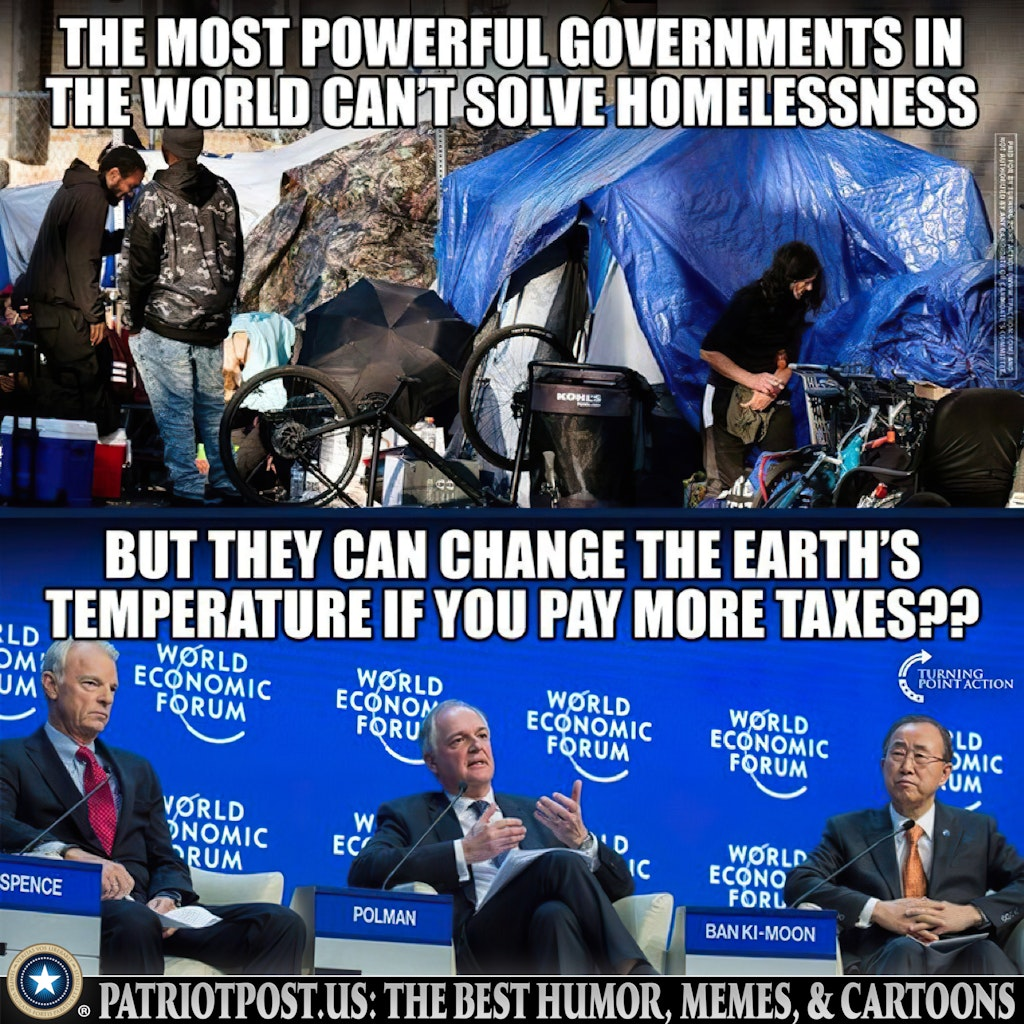
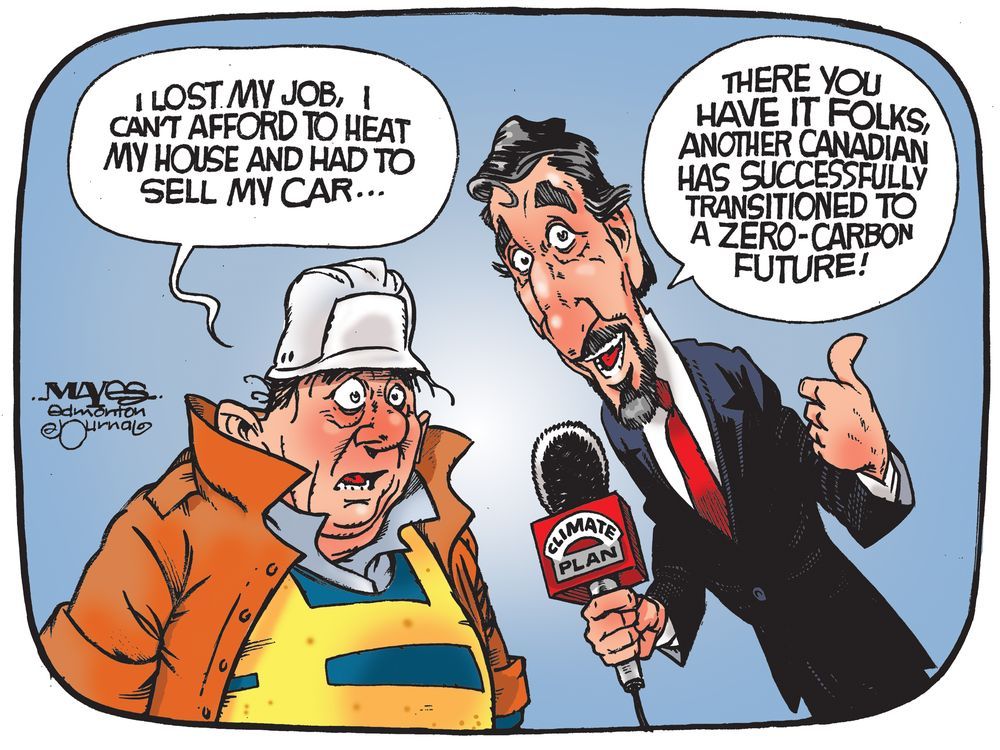
Trudeau’s “Just Transition” to Net Zero

So that is that is the trade surplus he’s talking about. Now if he were to stop that today it would mean that American workers at refineries and in other value added places would lose their jobs and Americans would pay higher energy prices. So that would not be good for America in the long run.

Being very blunt, I intend to approve refineries and LNG plants and
hopefully pipelines so that I could bring that production
back to Canada and make us more energy independent.

But in the short run if president Trump wants to make America richer the last thing he should want to do is block the underpriced Canadian energy from going into his Marketplace. In fact I would encourage him to approve the Keystone Pipeline so that we can create jobs for American workers who will build and install it, but also create much more wealth for Alberta and Saskatchewan and have their product reach tide water in the US Gulf Coast and get World prices.

So that’s an economic win. Also it’s not just oil and gas though. We have in Canada the Strategic minerals that are necessary for Warfare and for the modern digital economy that we could be exporting to the United States breaking both of our dependencies on China. We have the energy, a major Surplus of electricity, a surplus that we could even grow further that could be used for data centers that America cannot build fast enough.

So there’s enormous opportunities for both of us to get vastly richer if
we actually deepen our trade relationship rather than blocking it.

JP: Right, well it seems highly probable to me that that would be the direction that the Trump Administration would turn in if they were negotiating with people who were playing a straight game and were actually aiming for something like economic Prosperity instead of whatever the hell it is that Trudeau’s aiming for. Now you made brief reference to something quite shocking in its full import which didn’t really strike me until your comments. For example, Trudeau turned away the chancellor of Germany and the leader of Japan when they came cap in hand to Canada asking for increased Natural Gas exports over the long run. Given that we refused them, we ended up maintaining our low cost contracts with the United States and selling them all our resources at a discount.

PP: Yes, it’s enormously stupid. That’s the business case Trudeau couldn’t make. And I hate to say this, but because we have blocked LG plants and pipelines and other energy infrastructure, and because we’re giving therefore our gas to America at like a 70 or 80% discount to European and Asian prices and our oil at a discount of 20 or 30%, we’re effectively throwing money out a window. What do you do when someone throws money out a window? Stand next to the window yeah right.

So that is the true story, the pathetic story of our Trade Surplus is
that we’re actually handing over our resources stupidly.

It’s not The Americans’ fault, it’s our fault. We’re stupid and we’re going to stop being stupid when I’m prime minister. We’re going to build this infrastructure ourselves but in the meantime it would be it would be bad for American workers and consumers for the president to tariff our oil and gas.

And look, we have an integrated economy; I think an automobile crosses the Border something like eight or nine times between Ontario and the manufacturing states of the US before it becomes a finished product. Why interrupt those Supply chains? Also why not allow Americans just to have access to buying our minerals? Or better yet why don’t we process improve them here in Canada before we sell them to the United States to break dependence on hostile foreign powers?

By the way I would say to president Trump that the gains that Canada gets from increased access to the United States, I would spend largely on our Continental defense, on a more powerful Canadian military that truly secures the Arctic that protects us against terrorists and against intercontinental ballistic missiles, against threats, God forbid, from other parts of the world. We could have a bigger and more powerful military with a bigger and more powerful economy and so our interests overlap overwhelmingly.

That’s the case I would make to the incoming president
who has proven that he likes to make deals and
is good at it.


Left Coast Climate Delusion Ends in Flames

Satellite images of wildfires burning in Southern California By NBC Staff • Published January 11, 2025

Holman W. Jenkins, Jr. writes in Wall Street Journal End of a Climate Delusion.  Excerpts in italics with my bolds and added images.

Amid California’s fires, voters wake up from the dream that green pork is a solution.

CO2 emitted into the atmosphere is rapidly and, for all practical purposes, uniformly distributed around the planet.

I may be stating the obvious but it needs to be pointed out. Voters and even political leaders are surprisingly poorly informed on this point. Emissions cuts in California don’t have any significant effect on California’s climate. They also have no global effect. California’s cuts are too small relative to the global whole; they also are largely illusory.

Emitting industries leave the state. They don’t stop emitting. If California imports Canadian hydro to charge its electric vehicles, consumers elsewhere have to burn more coal and gas. If Californians drive EVs, more gasoline is free to be burned by others, releasing more CO2 that influences climate change in California and everywhere else.

Green-energy subsidies do not reduce emissions. This will be news to millions of California voters. It contradicts a central tenet of state policy. It isn’t news to the actual enactors of these subsidies. A National Research Council study sponsored by congressional Democrats in 2008 concluded that such handouts were a “poor tool for reducing greenhouse gases” and called for carbon taxes instead.

Unfortunately, the incoming Obama administration quickly discovered it favored climate taxes only when Republicans were in charge. Backers would later engage in flagrant lying to promote Joe Biden’s Inflation Reduction Act, knowingly citing bogus predictions that its trillion-dollar spending profusion would reduce emissions.

A 2019 University of Oregon study had already revealed the empirical truth: Green energy doesn’t replace fossil fuels, it enables more energy consumption overall. That same year the EPA calculated that the potential emissions savings from subsidizing electric vehicles had been offset five times over by the pickup truck and SUV boom Team Obama facilitated to assure the success of its auto bailout.

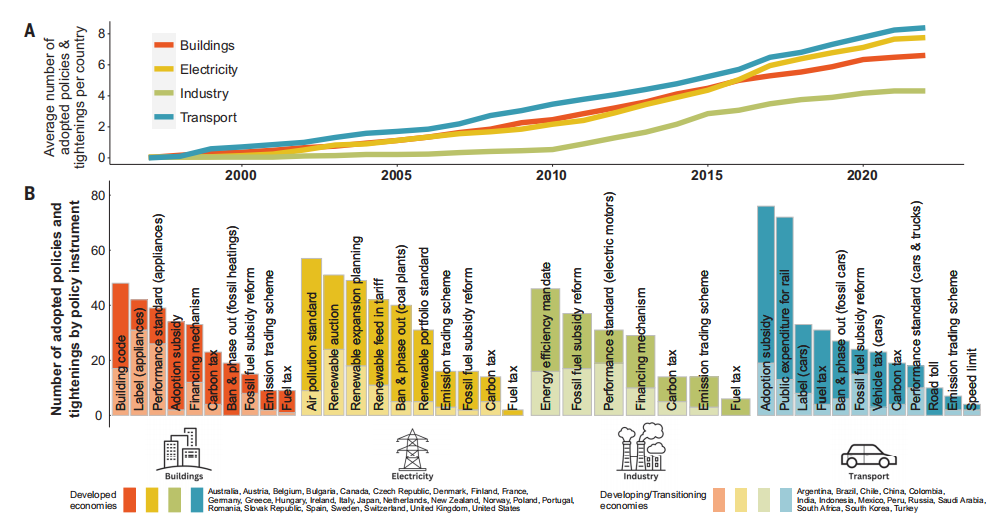
American Association for the Advancement of Science study finds that of 1,500 “climate” policies announced around the world, a mere 63, or 4%, produce any reduction in emissions.

Last year, the premier journal Science put a nail in the question: 96% of policies supported worldwide as “reducing” emissions failed to do so, consisting mostly of handouts to green-energy interests.

And yet certain Journal readers still assail me with the epithet “denier.” They confuse my criticism of Democratic hypocrisy with my imagined views on climate science. As I’ve written back to many, “Don’t think politicians haven’t figured this out about you. That’s why they can give us unsustainable corporate welfare boondoggles and call it climate policy.”

A CNN moderator Saturday urged viewers to vote in an online poll on whether the California disaster should be blamed on climate change or poor leadership. Notice the non sequitur: as if climate change is an excuse for not acting against fire risk.

By all means, let politicians proclaim a “climate crisis” or any other rhetorical flourish if it helps mobilize support for public actions that actually serve a useful purpose. But a prerevolutionary situation has been building in California for two decades, starting with the Third World blackouts in late 2000 not because of any shortage of power but because of large helpings of political cowardice.

A decision in 2019 authorized yet more Third World blackouts instead of reasonably shielding utilities from lawsuit risk over fires their power lines might be accused of contributing to. One result, predictably, has been a proliferation of backyard generators, which increase fire risk.

Californians are stuck adapting in the ways left open to them. Since 2017, half a million have fled Los Angeles County.

Two social technologies might help but the state has been intent on denying itself their advantages. One is a functioning insurance market. If you can’t afford the insurance, you can’t afford the house. Get ready, instead, for a torrent of federal and state money to help residents, some of them wealthy, rebuild in high-risk fire zones.

The other is a functioning market in water. Five gallons to produce a walnut probably isn’t tenable under any realistic system of water pricing. If water were properly valued, municipalities would also rapidly discover the logic of building aquifers to capture seasonal runoff. A thousand things would change if water were priced to flow to its most highly valued uses.

Here’s another concept: Climate change can exist and yet be an insignificant variable.

In Southern California’s Mediterranean climate, anytime 100-mile-an-hour winds start blowing embers toward densely packed housing developments, a conflagration is certain. The only answer then is to have the manpower and resources ready to put fires out as quickly as they start.

I’ve written repeatedly about climate and energy policies in the Western world being a colossal example of “sophisticated state failure,” in which attempts to address complex problems yield only a succession of boondoggles and economic crises. If California voters don’t wise up now, they never will.


Canada’s Choice: Elite Globalist or Common Sense Canadian

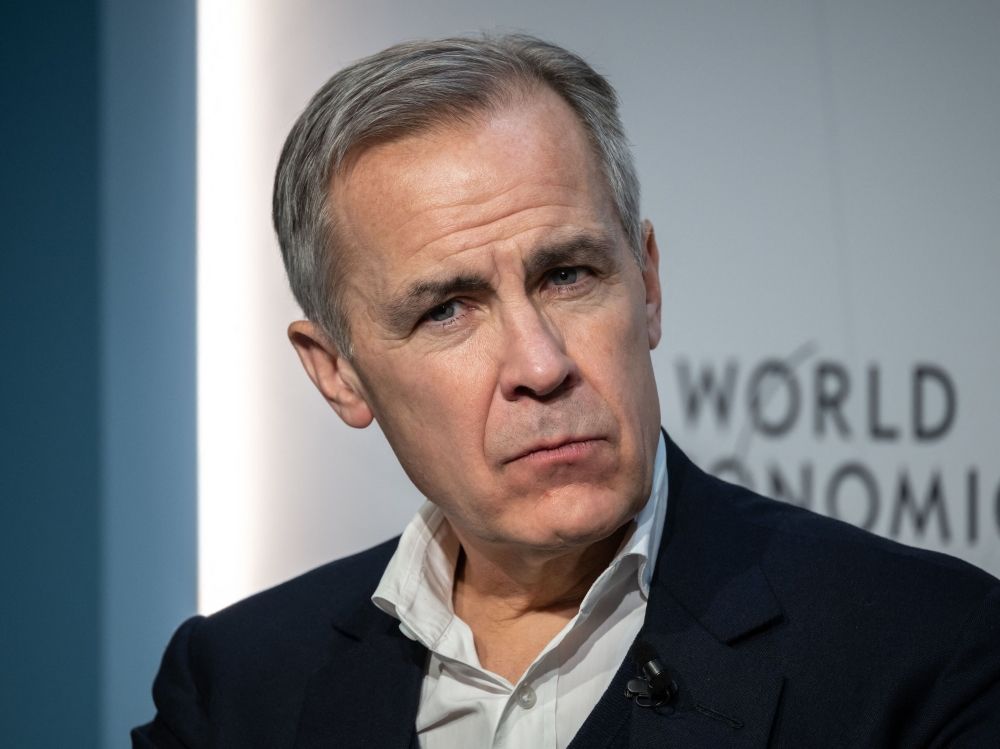
Trump will soon fill a 4-year WH vacancy known as the “Biden/Harris Administration.” Meanwhile federal governance in Ottawa is shut down by Trudeau resigning without leaving but also suspending parliament.  There being no one at the helm is eerily similar to the US adrift, and a fitting close to the Trudeau decade. Jamie Sarkonak goes to the core of the upcoming election in his National Post article It doesn’t matter to Mark Carney if Canada survives.  Excerpts in italics with my bolds and added images

As a member of the global elite, he will always be free
from the consequences of his political actions.

The problem Mark Carney, likely Liberal leader-to-be, will always run into is this: his fate doesn’t depend on a successful Canada.

Carney announced his leadership run Thursday. Odds are good he’s going to win. He’s not as recognizable as his only real competition, potential candidate and former finance minister Chrystia Freeland, but he doesn’t share her bruised record of inflating the deficit to multi-billion dollar highs, and last week’s polling shows that more people are open to voting for him than for her.

I hope he wins the party’s support. The Liberals aren’t likely to resonate with the population by running an out-of-touch cabinet minister in the next federal election — and they’re certainly less likely to do so by running an out-of-touch global elite who left small-time federal politics behind for a career at the pinnacle of international poshdom.

Yes, Carney is Canadian. But he’s also a citizen of Ireland,
and through it the European Union,
as well as a national of the United Kingdom.

He can leave this country any time he wants, and he already has: after serving as governor of the Bank of Canada from 2008 to 2013, he moved on to head the Bank of England. Now, he’s embedded in the international ecosystem as a climate finance adviser at the United Nations (among other things, he’s a strong advocate for mandatory climate disclosures by banks).

Oh, and according to his World Economic Forum bio — another mark of borderless eliteness — he is also the following: “an external member of the Board of Stripe, a member of the Global Advisory Board of PIMCO, Harvard University, Rideau Hall Foundation, Bilderberg, the boards of Bloomberg Philanthropies, the Peterson Institute for International Economics, the Hoffman Institute for Global Business and Society at INSEAD, Cultivo, as well as Senior Counsellor of the MacroAdvisory Partners, Advisor of the Watershed, and Chair of Chatham House, the Group of Thirty and also Advisory Board Chair for Canada 2020.”  Us rubes have no idea what most of that even means.

Carney might call himself an “outsider,” and it’ll be true — in the sense that he is not currently in the Trudeau government’s cabinet. But he’s still very much an elite, one who has advised the Liberal party, and one whose well-being doesn’t depend on local happiness and prosperity.

And everyone filling out a ballot next election will know it.

Different people have different terms for this. Freeland wrote a book on the new richesse mondiale, calling them plutocrats. Circa 2013, she was warning the rest of us that the global plutocracy might one day end up turning into a system of crony capitalist “insiders”; perhaps an aristocracy. Carney’s not Bill-Gates rich, but he’s still part of the global upper class.

Chrystia Freeland is also a Trustee on the WEF Board.

Former prime minister Stephen Harper put it in more digestible terms in his 2018 book, “Right Here, Right Now”: there are people who live “anywhere,” and there are people who live “somewhere.” “Anywheres” are cosmopolitan types who usually have professional, internationally oriented careers. “Somewheres” live and work closer to where they grew up, and share more of their values with people of a similar, localized background. The former tends to look down on nationalism; the latter depends on it.

Carney counts among the “anywheres” of Canadian society; yes, he’s got the passport, but he’s got more in common with a foreign banking executive who makes an annual Davos pilgrimage than he does with regular Superstore-shopping Canadians.

We “somewheres,” on the other hand, can’t just up and leave
in the face of turmoil because our entire life is here.

Our friends and families are here. Our savings and investments (if we have them) are in CAD; our partly-paid mortgages are tied to Canadian land; our children’s education depends on the quality of Canadian schools; our safety depends on Canadian laws; our job prospects suffer when low-wage foreign labour is allowed to flood our local markets. We’re not being forced to leave, but the price of relocating is prohibitively high.

Carney’s Monday appearance on Jon Stewart’s Daily Show was revealing in that way: he targeted his pre-audition pitch to the world through an American late-night show that treated him with the same humorous fascination as it would a fuzzy exotic animal. It was a soft and unserious interview because the people our former central banker is campaigning toward aren’t Canadian and aren’t witnessing the country’s dire situation firsthand.

Poilievre’s appearances on Dr. Jordan Peterson’s American-produced podcast were of a whole different category; both men are Canadian and can talk about Canadian issues with the weight and care they deserve.

None of this is to say that the upper crust of society should stay out of politics — many great leaders come from the elite class, including on the conservative side of politics. But after years of regular Canadians being the low-priority afterthought of a trust-fund supported, second-generation prime minister who seemed happiest at G7 photoshoots and Gavin-Newsom meetups, the animal spirits are hungering for a leader who truly has skin in the game.

And yes, I’d count Conservative Leader Pierre Poilievre among the “somewheres.” He’s had an entirely Canadian career, he isn’t gunning for CV-padding UN advisory roles, his ongoing career doesn’t depend on pleasing the moral sensibilities of the world’s politically active, post-national liberals, and he doesn’t seem to think that pre-election media courting should be performed for an international audience.

If the ship that is Canada starts sinking — and it’s been sitting alarmingly low in recent years most of us are going down with it. Not Carney, who has and always will have a premium life raft, ready to isolate him from the consequences of his political actions. Which is exactly why I can’t wait to see him run.

L.A.’s Self-induced Fires Seen From the Ground

E.M. Smith provides a resident-level view of the California Calamity at his Chiefio blog Los Angeles Burning & Did It To Themselves.  Excerpts in italics with my bolds and added images.

Check The News – L.A. Is On Fire

Yes, it is a disaster. Yes, $Billions of real estate going up in flames. Yes, “Stars” Losing everything; and normies too. No, it is not due to Global Warming. This is January and seasonal cool swamps any 1.5 C change.

It looks like not just Malibu, but several places all around Los Angeles, the hills, Hollywood, and more are having major fire problems.

Houses built too close together, using flammable materials. Trees and
shrubs that are flammable too. Then the Santa Ana Winds kick in.

Fire is an absolutely normal aspect of the Southern California landscape. When the Santa Ana winds blow (down slope wind that heats up from compression and gets funneled into a narrower space, so very fast) any fire becomes a blow torch. By then, there is not much you can do. Prevention is what matters, so now we wait for the winds to die down.

One TV Video showed a multi-lane major road, about 6 lanes across by the look of it. All abandoned cars. Folks trying to flee the fire, in a traffic jam, got out of their cars and ran. Firefighters had to take a bulldozer and push the cars off the road to make a lane for firetrucks.

This is the edge of insane.

So instead of mitigating fuel loads, assuring there are enough fire trucks, fire fighters, and water storage, Gavin Newsom & the L.A. area Mayors, were busy working on how to run for POTUS, and Get Trump, and assure the Unions donated a lot of money to Democrats. Hollywood “Names” were busy complaining about Republicans and having Panic Attacks about Global Warming instead of asking if their trees were Towering Infernos waiting to happen and replacing that Shake Roof with a metal one.

Distraction leads to destruction. They all knew they lived in a fire zone. PSAs have been running about it my whole life in California (at least 65 years). They chose parties with All The Right People over Prudent Planning and preparation. They chose “self actualization” over Situational Awareness and adaptation (and hard work).   Now comes the consequences.

In Conclusion

BUT, fire awareness and risk has been true the entire life of California. Either you learn to mitigate fuel, provide for rapid and effective fire suppression, and harden you house against fire; or you burn. Has always been that way. Will be too.

Folks have known for generations how to harden, mitigate, and adapt. Have houses separated from each other by enough space that one can not start the next one on fire. Build with non-flammable materials (cinder block, concrete, stucco over wire with metal 2×4 studs, tile or metal roofs, and metal shutters to prevent IR ignition of drapes inside windows (or even fiberglass drapes). Install water sprinkler fire suppression systems. DO NOT PLANT FLAMMABLE TREES, BUSHES & GRASS around houses. Have wide firebreaks between buildings. And more.

Remaining trees and vegetation on the forest floor are more vigorous after removal of small trees for fuels reduction.

All of this has been known for 100 years.

But you get more houses built, so more money made, if you pack them 12 to an acre. Folks like the “look” of wood shake roofs, asphalt shingles are cheaper, nobody wants “stucco” anymore, but I LIKE eucalyptus! and on it goes.

Nobody wants to “damage the ecology” by taking out scrub and clearing forest liter. Paying for and planning large water sources, big pipes & pumps, and having all necessary equipment on standby for a decade (or two) “for that day” just seems wasteful; until you need it.

So call me hard-hearted. I grew up in Fire Country. I’ve fought grass fires and as a temporary Forest Fire Fighter climbed up and down hills with a Pulaski (axe hoe combo) on my shoulder, sleeping in a shredded newspaper stuffed sleeping bag for a weekend, working a fire. The home I grew up in had a metal roof. My present home has cinder block walls with stucco and faux brick over it. When this roof wears out in a few years, the replacement will be metal. I have hoses and nozzles ready to put out any sparks that blow in (old habits die hard…) Folks either prepare for fire, or they accept the consequences.

A feller buncher removing small trees that act as fuel ladders and transmit fire into the forest canopy.

So when the inevitable bleating and braying about Global Warming Oh Noes! and “More Fires!” starts: Just ask if they know how many of the homes had metal roofs & shutters and stucco over cinder block walls? How many homes had a 20 foot fire break of non-flammable area around them?

And answers came there none.

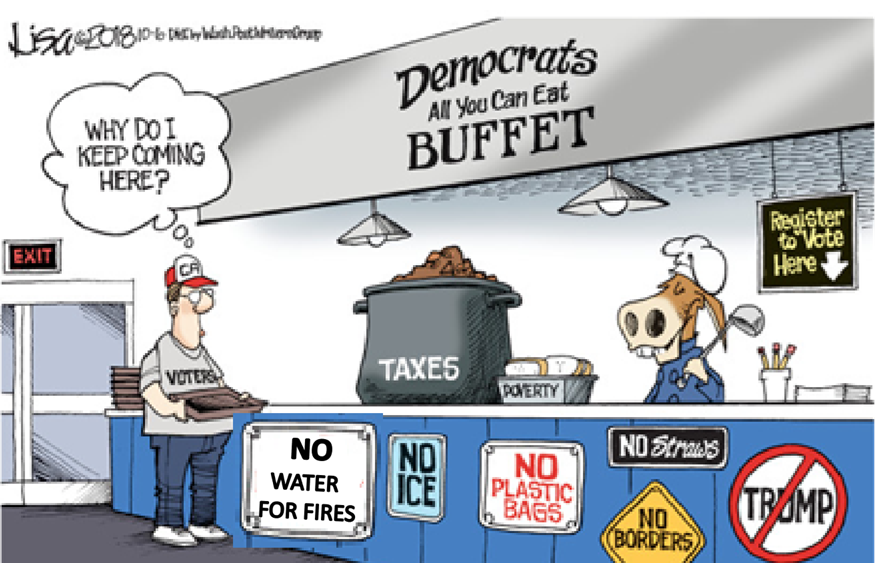
Democrats: You own this one 100% since you own ALL of California Government. You made all the building codes, water systems, fire departments, roads & infrastructure. Planned all of it. Permitted the “rack ’em, pack ’em & stack ’em” building permits. Made money off cheaper wood & asphalt shingle construction. Now you will reap the results.

US Supremes Hear Climate Lawfare Case to Stop Oil Railway

IER reports the news from December in article The Supreme Court Takes on a Case Involving the National Environmental Policy Act.  Excerpts in italics with my bolds and added images.

Key Takeaways

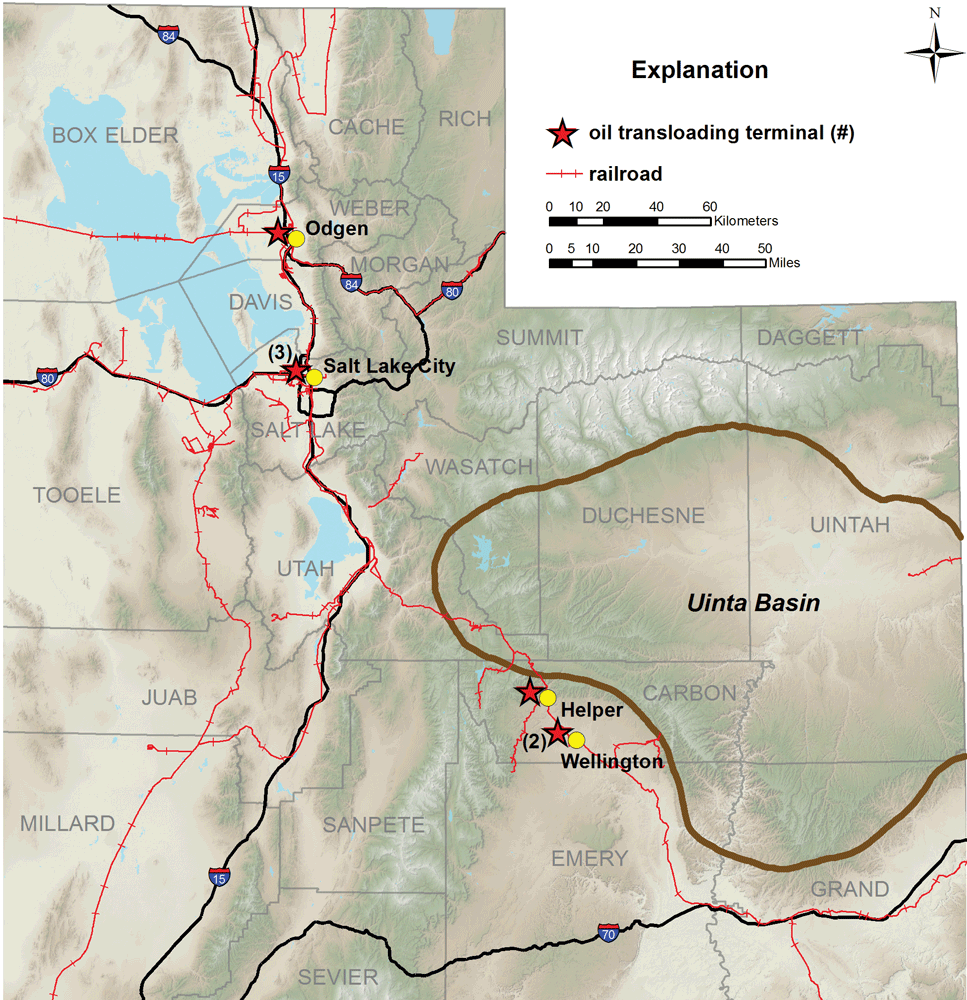
The Supreme Court recently heard a major case, Seven County Infrastructure Coalition v. Eagle County, Colorado, that will affect the scope of the National Environmental Policy Act (NEPA). The case concerns the permitting of a proposed Utah railway that would ship oil from the Uinta Basin, potentially quadrupling its oil production. The 88-mile Uinta Basin Railway would connect the oil fields of northeastern Utah to the national rail network running alongside 100 or so miles of the Colorado River to reach oil refineries on the Gulf Coast.  According to The Hill,  at issue is whether and when upstream and downstream environmental impacts should be considered as part of federal environmental reviews. The company behind the railway and a group of Utah counties appealed a lower court decision to the Supreme Court, arguing that those indirect impacts are beyond the scope of the federal reviews.

Background

The case concerns a rail line to support oil development and mineral mining. In 2021, the federal Surface Transportation Board (STB) issued a 3,600-page environmental impact statement to comply with NEPA and approved the rail line. The NEPA mandates that federal agencies assess the environmental effects of projects within their authority. Any major initiative that is managed, regulated, or authorized by the federal government must undergo a NEPA evaluation, a process that can span years and frequently exposes projects to legal challenges.

The STB analyzed the railway’s potential effects on local water resources, air quality, protected species, recreation, local economies, the Ute Indian tribe, and other factors. Environmental groups, however, sued the agency, saying that it failed to examine sufficiently how the railway might affect the risk of accidents on connecting lines hundreds of miles away and to assess emissions in “environmental justice communities” on the Gulf Coast from increased oil shipments, among other supposed shortcomings.

According to the Wall Street Journal editorial board, “a D.C. Circuit Court of Appeals panel sided with the plaintiffs and told the STB it must consider the line’s upstream and downstream effects even if they were hard to predict and beyond the control of the agency and developers. This includes the effects of oil shipments on Gulf Coast refiners and their contributions to climate change.” The appeals court ruling found that the federal STB violated the Endangered Species Act and the Interstate Commerce Commission Termination Act when it permitted the project.

Furthermore, the editorial board also explained that lower court judges—those on the D.C. and Ninth Circuits—ignored the Supreme Court’s past rulings and imposed arbitrary permitting requirements with no limiting principle. The STB lacks authority over Gulf Coast refiners and cannot prevent climate change.

Court Rulings Regarding NEPA

The Supreme Court has heard other related cases and held that agencies need not consider indirect and unpredictable impact, most recently in a 2004 case, Department of Transportation v. Public Citizen. In that case, the Supreme Court held that agencies need only analyze environmental impact with “a reasonably close causal relationship” over which they have “statutory authority” and which they can prevent.

In 2020, the Supreme Court green-lit approval for permits for the Atlantic Coast Pipeline after nearly seven years of litigation, but the pipeline was scrapped due to legal delays that raised project costs significantly. It takes an average of 4.2 years to litigate a NEPA challenge, which adds to the four or more years to obtain a federal permit. These delays are what frustrate investment in new projects, slowing job creation and economic expansion in the United States.

judge struck down a Montana coal mine permit because a federal agency did not consider the climate effects of coal combustion in Asia. Additionally, a 225-mile electric transmission line in Nebraska has been stuck in permitting for 10 years because a lower court invalidated a U.S. Fish and Wildlife permit.

Conclusion

The Supreme Court is tackling a case involving the scope of a federal environmental law, NEPA, that involves a rail line to move oil. In this case, lower courts agreed with environmental groups, who are challenging the government’s permit approval of the rail line. The case is instrumental to the issue of what should be considered when determining potential environmental damages. Congress recognizes that NEPA needs reform as delays over lawsuits have killed projects and dramatically increased their costs and it continues to debate ways to make federal permitting easier and quicker. Until that reform happens, however, Supreme Court Justices need to reign in the environmental limits of NEPA so that needed projects can progress in America.

Best 2024 Review Is By Satirist Dave Barry

Raygun of Team Australia right before she wowed the crowd with her signature move, “The Sprinkler.” Anthony Behar/Sipa USA

This was published in the Miami Herald (link in red title below) and needs no additional highlights from anyone, so is reprinted below for its many amusing observations.  Barry is a true court jester, siding with no one, and unsparingly on target describing current foibles stranger than fiction.

Dave Barry Year in Review: 2024 was an exciting year,
and by ‘exciting,’ we mean ‘stupid’

How stupid was 2024? Let’s start with the art world, which over the centuries has given humanity so many beautiful, timeless masterpieces. This year, the biggest story involving art, by far, was that a cryptocurrency businessman paid $6.2 million at a Sotheby’s auction for . . .
A banana. Which he ate. ”It’s much better than other bananas,” he told the press.

And that was not the stupidest thing that happened in 2024. It might not even crack the top ten. Because this was also a year when:
—The Olympics awarded medals for breakdancing.
—Fully grown adults got into fights in Target stores over Stanley brand drinking cups, which are part of the national obsession with hydration that causes many Americans to carry large-capacity beverage containers at all times, as if they’re setting off on a trek across the Sahara instead of going to Trader Joe’s.
—Despite multiple instances of property damage, injury and even death, expectant couples continued to insist on revealing the genders of their unborn children by blowing things up, instead of simply telling people.
—The number of people who identify as “influencers” continued to grow exponentially, which means that unless we find a cure, within ten years everybody on the planet will be trying to make a living by influencing everybody else.
—Hundreds of millions of Americans set all their clocks ahead in March, then set them all back in November, without having the faintest idea why. (Granted, Americans do this every year; we’re just pointing out that it’s stupid.)

But what made 2024 truly special, in terms of sustained idiocy, was that it was an election year. This meant that day after day, month after month, the average American voter was subjected to a relentless gushing spew of campaign messaging created by political professionals who—no matter what side they’re on—all share one unshakeable core belief, which is that the average American voter has the intellectual capacity of a potted fern.

It was a brutal, depressing slog, and it felt as though it would never end. In fact it may still be going on in California, a state that apparently tabulates its ballots on a defective Etch-a-Sketch. For most of us, though, the elections, and this insane year, are finally over. But before we move on to whatever (God help us) lies ahead, let’s ingest our anti-nausea medication and take one last cringing look back at the events of 2024, starting with

… JANUARY …

when the nation finds itself trapped in a 1970s slasher movie, the kind in which some teenagers — played by the major political parties—are in a creepy house, being pursued by a terrifying entity, played by a rerun of the 2020 presidential election.

The only sane thing for the teenagers to do is get the hell out of there, but instead they pause by the dark, scary-looking doorway leading down to the basement, and despite the fact that the theater audience—played by the American public—is shouting “DON’T GO DOWN THERE! JUST LEAVE THE HOUSE YOU IDIOTS!”, the teenagers decide to go down into the basement, only to find “OH GOD NOOOOOO…”

And so, thanks to our political system—under which the nominees for the most powerful office in the world are chosen by approximately 73 people in approximately four rural states while the vast majority of Americans are still taking down their Christmas decorations—we once again find ourselves facing a choice between Joe Biden and Donald Trump.

Both candidates carry baggage. Trump is wanted on criminal charges in something like 23 states and, if elected, could become the first president to govern from a secret hideout. His speeches are sounding increasingly unhinged, which is no small feat since he did not sound particularly hinged in the first place.
For his part, President Biden keeps saying words that do not appear in any known human language and gives the impression that any day now he’s going to shuffle into a state dinner wearing only a bathrobe. But not necessarily his bathrobe.

In other words, we have one candidate who lost the last election but claims he won it, and another candidate who won the last election but might not remember what year that was. America, the choice is yours!

Meanwhile the nation is facing a number of serious problems. Foremost among them is the situation on the border with Mexico, which at one time was a legally separate nation from the United States but is now basically functioning as a vestibule. This has resulted in a tense confrontation between the federal government and Texas, which is alarming because, in the words of one military analyst, “Texas has way more guns.”

In government news, the Pentagon is harshly criticized for taking more than three days to notify the White House that Defense Secretary Lloyd J. Austin III had been hospitalized. This prompts the administration to check up on the rest of the cabinet, only to discover that at least four other secretaries are missing, and the Secretary of Commerce apparently died three years ago.

Abroad, fighting continues to rage in both Ukraine and Gaza, although these conflicts are no longer getting a ton of attention in the U.S. media because of all the news being generated by Taylor Swift.

In a troubling aviation incident, an Alaska Airlines Boeing 737 Max 9 flying at 16,000 feet suddenly develops a refrigerator-sized hole in the fuselage when an improperly attached panel blows off, terrifying passengers who have reason to wonder whether the airline crew, instead of making a big deal about the position of everybody’s tray table, should maybe be checking to see if the plane has been correctly bolted together. As a safety precaution, the Federal Aviation Administration grounds all Max 9s and advises passengers on other Boeing aircraft to “avoid sitting near windows.” For its part, Boeing states that “at least the plane didn’t lose a really important part, like one of the whaddycallits, wings.”

Here’s a rare shot of a Boeing 737 in flight with all the parts still attached. Jeremy Dwyer-Lindgren/Special to USA TODAY

Speaking of big corporations making questionable products, in

… FEBRUARY …

Apple launches the much-anticipated “Vision Pro,” a virtual-reality headset costing more than your grandfather paid (Just ask him!) for his first car. But it’s worth it, because when you put it on, thanks to a revolutionary “spatial computing” system coupled with 12 cameras and a 23-million pixel display, you look like an idiot.

Special counsel Robert Hur concludes his year-long investigation into Joe Biden’s handling of classified documents by releasing a 388-page report concluding that Biden “does not appear to have all his oars in the water.” An angry Biden immediately holds a press conference, during which he heatedly denies Hur’s assertion and (this really happened) refers to Egyptian leader Abdel Fattah el-Sisi as the “president of Mexico.”

In other White House news, CNN, after reviewing documents obtained through the Freedom of Information Act, reports that the Biden family’s German shepherd, Commander, bit Secret Service personnel in at least 24 incidents, eclipsing the record previously held by Dick Cheney.

Moments after this picture was taken, the photographer was eaten by Commander, the Official White House Pet. Sipa USA

Meanwhile Donald Trump, who is appearing in court more often than Perry Mason, is found guilty by a New York civil judge on charges of financial fraud, aiding and abetting, aggravated contempt, disorderly obstruction, second-degree vagrancy and loitering with intent to conspire. The judge fines Trump nearly half a billion dollars and bans him for the next three years from riding in any motorcade more than six cars long. Two days later a defiant Trump attends an event called “Sneaker Con,” where (this also really happened) he unveils a line of footwear, including the gold-colored Never Surrender High Top Sneaker (Actual Marketing Slogan: “your rally cry in shoe form”).

In a highly controversial decision, the Alabama Supreme Court rules that frozen embryos are, for legal purposes, children, and therefore must immediately be thawed out and provided with iPhones.

Tucker Carlson conducts a two-hour interview with Vladimir Putin, offering westerners a rare opportunity to find out what the Russian leader really thinks. It turns out he thinks Tucker Carlson is a useful idiot.

In a Super Bowl for the ages, two teams compete against each other under the watchful gaze of Taylor Swift. Speaking of spectacles, in

… MARCH …

President Biden, seeking to dispel persistent rumors that he is an elderly man, delivers a State of the Union Address consisting almost entirely of shouting. This performance does not significantly improve his poll numbers, but it’s a big hit with members of the Washington press corps, several hundred of whom decide, independently, to describe the speech as “fiery.”

In their response, the Republicans, always looking for new ways to demonstrate their incompetence, elect to have Alabama Sen. Katie Britt deliver a disturbingly melodramatic talk from (Why not?) her kitchen, where she gives the impression that she has just ingested a wide range of pharmaceuticals, and nobody, least of all Sen. Britt, knows which one is going to kick in next.

Yet another federal budget crisis is averted at the last minute when Congress passes a $1.2 trillion spending bill, which will enable the government to keep spending insanely more money than it takes in. The U.S. debt is now growing at the rate of a trillion dollars every 100 days, but fortunately this is not a problem because it will be taken care of by future generations. “No problem! Just put it on our tab!” is the view of future generations, and that is why we love them.

In other high-finance news, Donald Trump’s lawyers tell a New York court that he cannot raise the nearly half-billion dollars he needs for an appeal bond, having been turned down by more than 30 bond companies and an individual known as Anthony “Tony Three Nostrils” Avocado. Trump gets a break when an appeals court lowers the amount to $175 million, which Trump says he definitely has, although he left it in his other pants.

In a possibly related development, Trump announces that he is selling—we are not making this up—“God Bless the USA” Bibles for $59.95 a pop. “It’s my favorite book,” he states, moments before being struck by lightning. No, that did not happen and you are a bad person for even fantasizing about it.

Donald Trump says this is his favorite book, despite the fact that he didn’t write it. GREG LOVETT/THE PALM BEACH POST / USA TODAY NETWORK

In aviation news, a Boeing plane flying from Australia to New Zealand suddenly goes into a nosedive, injuring 50 people. Another Boeing plane, taking off from the San Francisco airport, loses a piece of landing gear. A Boeing spokesperson says that the company, after conducting an in-depth review, has tentatively identified the root cause of the recent problems.

“We think it’s gravity,” said the spokesperson. “It seems to be getting worse.” As a safety precaution, Boeing is advising pilots to avoid taking off, and simply taxi the planes from city to city, which the spokesperson says “may result in delays, especially to overseas destinations.” Speaking of exciting things happening in the sky, in

… APRIL …

the nation is enthralled by a total eclipse, a rare celestial occurrence in which the earth, sun and moon align in such a way as to cause a large number of people to deliberately travel to Indianapolis. Huge crowds in the path of the totality watch excitedly as the sky gradually turns completely dark—a spectacular sight that most people will never witness again in their lifetimes, unless they’re still around at sunset.

In other natural phenomena, a magnitude 4.8 earthquake with an epicenter in central New Jersey rattles the northeast. New York City is completely paralyzed, although not because of the earthquake; it’s always completely paralyzed. But for a few seconds there is slightly less honking.

New York remains in the news with the onset of the single most exciting thing ever to happen to CNN: yet another trial of Donald Trump. In this one he’s charged with falsifying business records as part of a scheme to guarantee that every single human being on the planet, including members of primitive tribes in the Amazon jungle, would be aware that Trump had a one-night stand with porn star Stormy Daniels. At least that’s how it worked out.

True Fact: The first witness called by the prosecution is a man named “David Pecker.”

Trump was in court more often than Perry Mason. Jeenah Moon/Pool via USA TODAY NETWORK

South Dakota Gov. Kristi Noem, a contender to be Trump’s running mate, bolsters her case with a new book in which she reveals— apparently on the advice of the same public-relations firm used by Boeing—that she once shot and killed her family dog, Cricket. Many people are appalled by this revelation, although Noem’s supporters note that she would be a handy person to have around the White House if Commander ever comes back.

Speaking of commanders: President Biden, campaigning in Pennsylvania, suggests—twice—that his uncle was eaten by cannibals after his plane went down off the New Guinea coast during World War II. The prime minister of Papua New Guinea objects to the president’s cannibal story on the nitpicky grounds that it is not true. Nevertheless the president seems to sincerely believe that it happened, and it was HIS uncle, dammit.

As the tragic situation in Gaza worsens, American college students on a growing number of campuses engage in protests and other dramatic actions intended to draw attention to the single most important issue facing the world: the feelings of American college students. Speaking of drama, in

… MAY …

Stormy Daniels tells a New York jury in explicit detail about her encounter with Donald Trump during a 2006 celebrity golf tournament, testifying that when she came out of the bathroom in Trump’s hotel suite, he was waiting for her wearing only a T-shirt and boxer shorts, and before she could stop him he proceeded—without wearing a condom—to falsify business records.

True Trivia Fact: Trump finished 62nd in that celebrity tournament. The golfer who finished 43rd was Dan Quayle.

On weekends, when he’s not in court, Trump continues to campaign for president. While discussing immigration policy at a rally in New Jersey, he makes the following statement, printed here verbatim: ”Silence of the Lambs. Has anyone ever seen ‘The Silence of the Lambs’? The late, great Hannibal Lecter is a wonderful man. He often times would have a friend for dinner. Remember the last scene? ‘Excuse me. I’m about to have a friend for dinner,’ as this poor doctor walked by. ‘I’m about to have a friend for dinner.’ But Hannibal Lecter. Congratulations. The late, great Hannibal Lecter.”

This statement raises a number of questions, including:
1.What?
2. Seriously, what?
3. Is it possible that it was actually Hannibal Lecter who ate Joe Biden’s uncle?

Speaking of Joe Biden, his poll numbers continue to be bad as voters express their unhappiness about the economy, especially inflation. This is very frustrating for White House spokespersons, who are constantly pointing out that inflation is no longer a problem on whatever planet it is that White House spokespersons live on. Unfortunately it’s still a problem here on Earth, where prices are significantly higher for basic needs such as food, gas, housing and tickets to the Met Gala, which cost only $50,000 last year but jumped to $75,000 this year, leaving many attendees so broke that they are forced to attend wearing what appear to be Halloween costumes.

In other presidential news, Robert F. Kennedy Jr., seeking to set himself apart from the two flawed major-party candidates and offer voters a rational alternative, tells the New York Times that doctors found a dead worm in his brain.

RFK Jr. could become the first cabinet member with a dead worm in his brain. Al Diaz adiaz@miamiherald.com

Meanwhile in a spectacular, much-anticipated natural phenomenon, trillions of cicadas emerge from the ground, watch 15 minutes of cable TV news, and elect to die.

As the month draws to a close, Trump is found guilty on all 34 felony counts of whatever it is that he was charged with. The convictions deal a fatal blow to his candidacy.

Ha ha! We are of course joking. The convictions, like all the other legal actions against Trump, are a massive boost for his candidacy, energizing his supporters and generating tens of millions of dollars in donations, an outcome that could have been predicted by anybody with a rudimentary understanding of Trump’s appeal, although it apparently did not occur to the geniuses behind this particular legal strategy. Speaking of strategies that do not work out as planned, in

… JUNE …

the Biden re-election campaign struggles to change the public perception—largely created by videos showing the president looking lost and confused—that the president is sometimes lost and confused. Democrats insist that these videos are “cheap fakes,” and that in fact Biden is sharp as a tack, but unfortunately the public never sees this because he only exhibits this sharpness when there are no cameras around to capture it, kind of like Bigfoot.

So there’s a lot on the line when Biden and Trump square off in a much-anticipated prime-time debate, which was proposed by the Biden campaign, apparently on the advice of the Boeing Corp.

The debate went smoothly for Joe Biden until it started. Jack Gruber / USA TODAY NETWORK

It’s obvious from the start of the debate that the president is struggling. He has trouble finishing, or even starting, his sentences; he spends much of the debate staring vacantly into the distance like a man who’s trying to remember where he put the remote control, unaware of the fact that he is holding it. In short, it’s a very bad night for Biden.

Q.How bad is it? A. It’s so bad that, by comparison, Donald Trump seems, at times, to be almost lucid.

Actually, it’s worse than that. It’s so bad that even professional journalists can see how bad it is. In fact suddenly everybody in Washington is acutely aware of the president’s decline, which previously had been apparent to only the entire rest of the world population. And so as we move into

… JULY …

the Democrats are in a state of panic. Behind the scenes, party leaders desperately want to get Biden off the ticket, but he repeatedly insists that he’s going to be the candidate. This leads to an awkward national conversation:
BIDEN: I’m staying in the race.
PARTY LEADERS: You have our full support, Mr. President! Whatever you decide!
BIDEN: OK, as I said, I’m staying in the race.
PARTY LEADERS: It’s your call, sir! Run, or don’t run! It’s totally up to you!
BIDEN: Again, I’m definitely running.
PARTY LEADERS: Whether you stay in or drop out, we fully support either choice! Including dropping out!
BIDEN: I SAID I’M RUNNING DAMMIT.
PARTY LEADERS: We await your decision, sir!
And so on.

Just when it appears that the presidential race cannot get any more insane, Trump goes to Butler, Pa., to hold a campaign rally, for which the security has apparently been outsourced to the Boeing Corp. Trump is shot in the ear by a man who is somehow able to climb, unimpeded, with a rifle, onto the roof of a building that not only is within range of the speaker’s platform, but also has three police snipers stationed inside it. Really.

Other than that, it was an uneventful rally. Evan Vucci AP

The attempted assassination shocks the nation but also bolsters Trump’s popularity. He has a commanding lead in the polls as, a few days later, he accepts the presidential nomination at the Republican convention (Theme: “TRUMP!”) with a triumphant speech lasting slightly longer than veterinary school.

The Democrats are now in utter despair. Biden continues to insist that he’s running; the party has no choice but to renominate him and face almost-certain defeat in November.

Then, in a sudden reversal, Biden announces that he’s quitting the race after reassessing the situation and waking up next to the severed head of a thoroughbred racehorse. Party leaders lavishly praise Biden for saving democracy, then decide, via what is undoubtedly a democratic process, to replace him with Kamala Harris.

Other than that, it’s a quiet month in politics.

In other news, a massive worldwide Internet disruption paralyzes global air travel, along with banks, hotels, hospitals and other industries, when Arnold A. Frinkledorp, an 87-year-old retiree who is attempting to send an email to his sister from his AOL account, accidentally presses the ALT, backslash, left arrow, F3, ampersand and right parenthesis keys simultaneously—which apparently nobody has ever done before—thereby triggering a Windows glitch that causes more than 8.5 million computers to crash. The disruption winds up costing businesses an estimated $5 billion, although on the plus side, Mr. Frinkledorp’s email—a meme of a cat wearing sunglasses—is successfully delivered to his sister, who accidentally deletes it.

As the Olympic Games get under way in Paris, tens of millions of viewers tune in to NBC to watch three action-packed weeks of Snoop Dogg reacting to French things. The Games take full advantage of the city’s scenic venues, including the Seine River, which is used for the swimming leg of the triathlon race after health authorities assure competitors that intensive cleanup efforts have removed “the vast majority” of the turds. Speaking of competition, in

… AUGUST …

the race for the presidency kicks into high gear as fired-up Democrats hold their convention in Chicago. The first-day highlight is a grateful and heartfelt farewell to President Biden, who speaks in the prestigious 2:30 a.m. timeslot and is never heard from again. The focus then shifts to the nomination of Kamala Harris, who is running on a platform of joy, and being joyful, and a general vibe of joyfulness, as well as a set of policies to be specified later that will take America in a new, completely different direction, in stark contrast to the policies of whoever is running the country now.

The convention gives Harris an immediate boost in the polls, and suddenly Trump faces a serious challenge, to which he responds, during a two-hour speech to a rally in Wilkes-Barre, Pa.: “I say that I’m much better looking than her. Much better. Much better. I’m a better-looking person than Kamala.” Fox News confirms this.

The Democratic convention was a joyful time of joyous joyfulness. Josh Morgan, Josh Morgan / USA TODAY NETWORK

Meanwhile the two vice-presidential candidates, Tim Walz and J.D. Vance, engage in a spirited exchange on the issues, reminiscent of the Lincoln-Douglas debates:

WALZ: You’re weird.
VANCE: I’M not weird. YOU’RE weird.
WALZ: No, YOU’RE weird.
VANCE: No YOU’RE weird.
WALZ: No YOU’RE…

Speaking of weird: Independent candidate Robert F. Kennedy Jr., following up on the revelation that he has a dead worm in his brain, reveals that he once picked up a roadkill bear, which he later—we’ve all done it—left under a bicycle in Central Park as a prank. Three weeks later Kennedy suspends his campaign and urges his followers to vote for Trump, assuming they are able to chew through their restraints.

Two astronauts are stuck aboard the International Space Station when the Starliner spacecraft that was supposed to return them to Earth develops mechanical problems. You will never in a million years guess the name of the company that built this spacecraft. Meanwhile down here on Earth things are also not going so great as we move into

… SEPTEMBER …

when suddenly, with no advance warning, the biggest issue in the presidential election is the question of whether Haitian immigrants in Springfield, Ohio, are eating people’s pets. They are not, but this fact does not prevent Trump from raising the issue in a televised debate with Harris, during which Trump gives the impression that his debate prep consisted entirely of getting his hair dyed a slightly more believable color. ”In Springfield, they’re eating the dogs,” he states, “The people that came in, they’re eating the cats. They’re eating, they’re eating the pets of the people that live there.”

For her part, Harris repeatedly stresses the message that she is a regular middle-class person from the middle class who totally relates to the problems faced by middle-class people like herself, and she definitely intends to fix these problems once she is elected to high government office.

Harris is widely considered to be the winner of the debate, on top of which she is endorsed by Taylor Swift, which is a big deal because Swift has more than 280 million Instagram followers and 53 votes in the Electoral College.

Both Taylor Swift and her cat endorsed Kamala Harris. Screenshot from Instagram

A week after the debate, police capture a would-be assassin who was spotted with a rifle on a golf course where Trump was playing. There was a time in America when this event—the second serious assassination attempt on a major presidential candidate in two months—would be considered a big story, but in the hellscape that is 2024 politics it dominates the headlines for considerably less time than the mythical pet-eating Haitians.

As the election draws closer emotions are running high. It’s also an increasingly tense time in the Middle East, where Israel and Iran appear to be on the verge of all-out war.

But the good news is that at least the hurricane season has been relatively peacef… OK, scratch that. In late September, Hurricane Helene causes horrendous devastation in six southeastern states, and then in

… OCTOBER …

Hurricane Milton ravages Florida. It’s a brutally difficult time for millions of Americans, but the good news is that at least nobody tries to politicize the disasters or use them to spread idiotic conspiracy theories about sinister forces controlling the weath… OK, scratch that also.

In presidential election news, Trump makes a campaign appearance at a Pennsylvania McDonald’s, during which he wears an apron and serves some people at the drive-thru window. This is the kind of hokey photo-op stunt that politicians have been doing forever, so you’d think this would be no big deal, right?

Wrong. It is a huge deal. Thanks to Trump’s uncanny ability—it is his superpower—to drastically reduce the functional IQ of professional journalists, this event dominates the national political coverage for days. Newsweek runs a story headlined “Was Donald Trump’s McDonald’s Shift ‘Staged’?” The New York Times runs six—that’s right, six—stories about it, including one asserting that, among other infractions, Trump “shoveled a scoopful of fries the wrong way” and “committed what appeared to be a number of health code violations.”

Professional journalists were able to prove, using journalism, that this was a photo op. Pool TNS

Somehow Trump survives all this journalism. He continues to crisscross the nation promising tax breaks for pretty much every category of U.S. resident including domestic animals, and giving increasingly improvisational speeches during which every thought fragment that seeps into his brain spurts instantly from his mouth without any kind of review. For example: Speaking to a rally in Latrobe, Pa., Trump informs the crowd that their beloved hometown hero, the late Arnold Palmer, had an unusually large putter. (We don’t know whether the New York Times assigned a team of reporters to investigate this claim, but we would not rule it out.)

In another suave outreach move, the Trump campaign, ever sensitive to accusations of racism, holds a rally in Madison Square Garden featuring a comedian who jokes that—prepare for hilarity—Puerto Rico is garbage.

On the Democratic side, the Kamala Harris campaign, which has spent more than a billion dollars but is still struggling to clearly define the candidate’s vision for the presidency, settles on an upbeat closing message: “Whoever She Is, She’s Not Donald Trump.” At exactly the same time Harris is making her big final pitch to voters, Joe Biden, who is still technically the president, somehow gains access to Zoom and lends the Harris campaign a helping hand by declaring, in response to the Trump-rally Puerto Rico joke, that roughly half of the U.S. electorate is garbage. Thanks, Joe!

Meanwhile, in an issue that neither party talks about because fixing it would require political courage, the national debt goes over $35 trillion, moving the nation still closer to the inevitable financial catastrophe that will leave future generations completely screwed. Fortunately, as we have noted, future generations are fine with this. “Don’t worry about it!” they would say, if they could speak to our current political leadership. “We know you’re busy leading!”

On a happier note, for the 14th consecutive year the World Series is won by a team other than the Yankees.

In space, a large communications satellite unexpectedly explodes, creating debris that threatens other satellites. In the spirit of mercy we will not name the company that made the defective satellite, other than to say it rhymes with “blowing.” Speaking of unexpected, in

… NOVEMBER …

the voters finally go to the polls for the most important American election since at least the dawn of time. All the expert political analysts and professional pollsters using scientific methodology agree that the race is extremely tight, a tossup, a dead heat, especially in the crucial battleground states. It’s too close to call! The experts are certain of this.

On election night, the TV networks are teeming with political commentators prepared to analyze and dissect and crunch the numbers far into the night as the nation settles in for the long, grueling process of determining the winner, a process that everyone agrees could go on for days, possibly even weeks, because of the extreme razor-thin closeness of the…

Never mind. In roughly the same amount of time it takes to air a Geico commercial, the networks determine that Donald Trump has decisively won the election, including all of the so-called battleground states and four Canadian provinces. It’s a stunning result and a massive failure by the expert political analysts, who humbly admit that they had no idea what was happening, and promise that from now on they will be more aware of their limitations.

We are of course joking. In a matter of seconds these experts pivot from being spectacularly clueless about what was going to happen in the election to confidently explaining what happened in the election.

One theory is that it was not a great idea for the Democrats to insist that President Biden was fine until it was embarrassingly obvious that he was not, then replace him, via a secret process, with a candidate who was not great at talking and did not run in a single primary and who previously advocated positions that many Americans were not crazy about, which is why they voted, sometimes reluctantly, for Donald Trump.

One branch of the Democratic party accepts this theory and begins the painful but necessary process of self-examination. Another branch prefers to believe that the party is fine and the real problem is that most Americans are sexist racist pro-fascist morons, which may not be a winning message for the Democrats going forward, but it does enable this branch to feel better about itself.

For his part, Donald Trump has no doubt whatsoever that the American people have given him a mandate to deport anywhere up to 60 percent of the U.S. population and—in his words—“turn this great nation around by appointing wildly unqualified individuals to the cabinet.”

OK, he didn’t actually say that, but he did nominate Matt Gaetz to be attorney general, which is like nominating Jeffrey Dahmer to be surgeon general. Gaetz is soon forced to withdraw his name from consideration after Trump is informed that the U.S. Senate, for all its shortcomings, is not completely insane.

Another controversial Trump nomination, this one for secretary of the Department of Health and Human Services, is Robert F. “Roadkill” Kennedy Jr., who used to think Trump was basically Hitler but now thinks he’s great. Kennedy is deeply suspicious of vaccines, Big Pharma, the CIA, fluoride, seed oils, WiFi, Froot Loops and chemicals in general. He also wants to make America healthy again by reducing the consumption of the overprocessed junk foods that have turned many Americans into big fat waddling tubs of lard, like… OK, like many Americans.

In environmental news, 70,000 world leaders, politicians, bureaucrats, aides, activists, consultants, celebrities, media people, caterers, chauffeurs, bodyguards, grifters, masseurs, masseuses, and private-jet pilots gather for COP29, the massive conference held every year by the United Nations to solve the pesky problem of global climate change. This year’s host nation is Azerbaijan, which, as a corrupt authoritarian state whose main source of income is selling billions of dollars worth of oil and gas, naturally wants everybody to stop using so darned much oil and gas. The conference is once again a huge success as measured in metric tons of hors d’oeuvres consumed, and everybody agrees to gather again for COP30 next year, on the off chance that global climate change is still going on.

Speaking of comically futile gestures: The Australian senate passes a law banning children under 16 from social media. This law will be enforced by adults who have to ask their children for technical support when they accidentally lock themselves out of their iPhones. Speaking of protecting children, in

… DECEMBER …

Joe Biden, who repeatedly promised that he would not pardon his son Hunter, cements his legacy as the most Joe Biden president ever by pardoning his son Hunter, thus forcing the Democratic party to change its mantra from “Nobody Is Above the Law!” to “Hey, It’s Complicated.” The wording of the pardon document is quite broad, covering “all offenses committed between 2014 and 2024, including any currently unsolved bank robberies, not that we are suggesting anything.”

The pardon outrages many Republicans who would be fine with it if Trump did it, while it’s fine with many Democrats who would be outraged if Trump did it. For that is how our system of checks and balances works.

Meanwhile Trump is acting as though he’s already the president—meeting with foreign leaders, signing treaties, vetoing legislation, authorizing drone strikes and ordering the beheading of “Peach” and “Blossom,” the two turkeys Biden pardoned for Thanksgiving.

Helping Trump with the transition is his new best billionaire friend Elon Musk, the genius tech visionary who’s going to make the federal government efficient by implementing “outside the box” measures such as:
—Having veterinarians install locator chips in all federal employees.
—Replacing both the Air Force and the Internal Revenue Service with laser-equipped orbital space robots.
—Combining the departments of Energy, Transportation, Labor, Agriculture, Interior and Justice into a single agency called “The Guv,” which will be physically located in Taiwan but accessible via an app.
—Renting Hawaii out for proms.

Trump and his new best billionaire bud envision the future. Brad Penner-Imagn Images

It’s an exciting time to be alive, as post-election America begins to discover, with varying degrees of excitement, what it voted for.

After numerous sightings of mysterious lights in the sky over New Jersey, government officials seek to calm an increasingly alarmed public. ”We’ve investigated these lights, and there’s absolutely nothing to worry about,” states Homeland Security Secretary Alejandro Mayorkas, who adds, “on an unrelated note, people should keep their children indoors.”

In other news, a horrific crime on a New York City sidewalk leads to a national conversation about the U.S. healthcare system, which reveals that a truly disturbing number of people believe the following three things:
1.The healthcare system is bad.
2.Therefore, murder is OK.
3.Especially if the murderer is cute.

Clearly, this year needs to end. Which is why we’re looking forward to New Year’s Eve—when, in a beloved tradition, thousands of revelers will gather in Times Square to say goodbye to 2024, and welcome 2025. We like to think that on that night, as the seconds tick down to zero and that giant ball starts to descend, the people gazing up at it will all be united, if only for a moment, by a common hope —a hope shared by the millions of us watching on television—specifically, the hope that the giant ball was not manufactured by the Boeing Corp.

Also, while we’re hoping, let’s hope that 2025 will be a better year. How could it be worse?
Try not to think about it.


“Misinformation” Means “Shut Up”

Daniel B. Klein reveals the power play currently destroying our civil discourse in his Brownstone article Misinformation is a Word We Use to Shut You Up. Excerpt in italics with my bolds and added images.
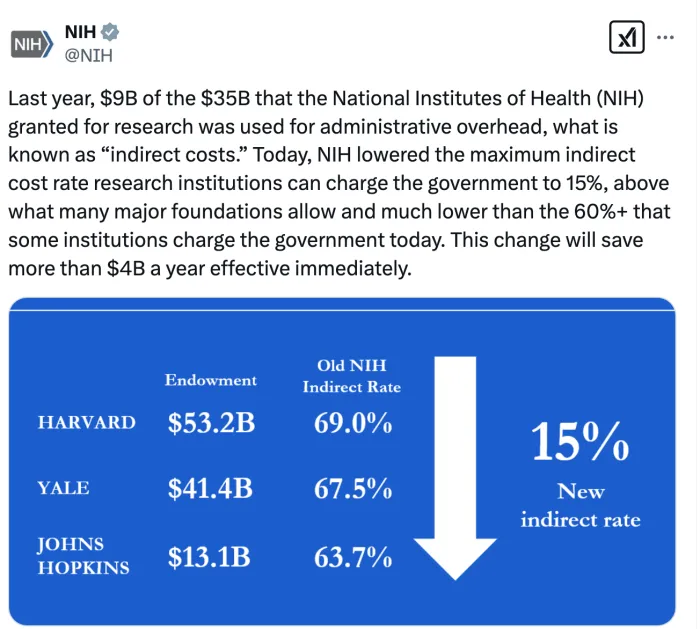
Writing at Discourse, published by the Mercatus Center, Martin Gurri describes “disinformation” as follows:

The word means, ‘Shut up, peasant.’ It’s a bullet aimed at killing the conversation. It’s loaded with hostility to reason, evidence, debate and all the stuff that makes our democracy great. (Gurri 2023)

That is from Gurri’s excellent piece, “Disinformation Is the Word I Use When I Want You to Shut Up.” The piece prompted the present essay, the title of which is a variation on his.

With such titles, Gurri and I are being polemical, of course. Not all usages of “disinformation” and “misinformation” come from people intent on shutting someone up. But a lot are. The “anti-misinformation” and “anti-disinformation” projects now afoot or in effect are about shutting up opponents.

In 2019 the Poynter Institute for Media Studies published “A Guide to Anti-misinformation Actions around the World.” There you survey examples of anti-misinformation and anti-disinformation projects and policies, which have no doubt soared further since 2019.

The policing of ‘information’ is the stuff of Naziism, Stalinism, Maoism, and similar anti-liberal regimes. In my title “Misinformation Is a Word We Use to Shut You Up,” anti-liberals are the “We.” To repress criticism of their dicta and diktats, they stamp criticism as “misinformation” or “disinformation.” Those stamps are Orwellian tools that anti-liberals wield in the hope of stamping out Wrongthink—for example, on:

  • climate,
  • election integrity,
  • origins of the Covid virus,
  • therapeutics such as Ivermectin and Hydroxychloroquine,
  • effectiveness of masking,
  • effectiveness of the Covid injections,
  • safety of the Covid injections, and
  • effectiveness of lock-downs.

“Anti-misinformation” could be deployed in keeping with whatever the next THE CURRENT THING might be, with associated slogans against, say, China, Putin, Nord Stream, racists, white supremacists, MAGA Republicans, “deniers,” et cetera. And then, of course, there’s all that “misinformation” disseminated by “conspiracy theorists”.
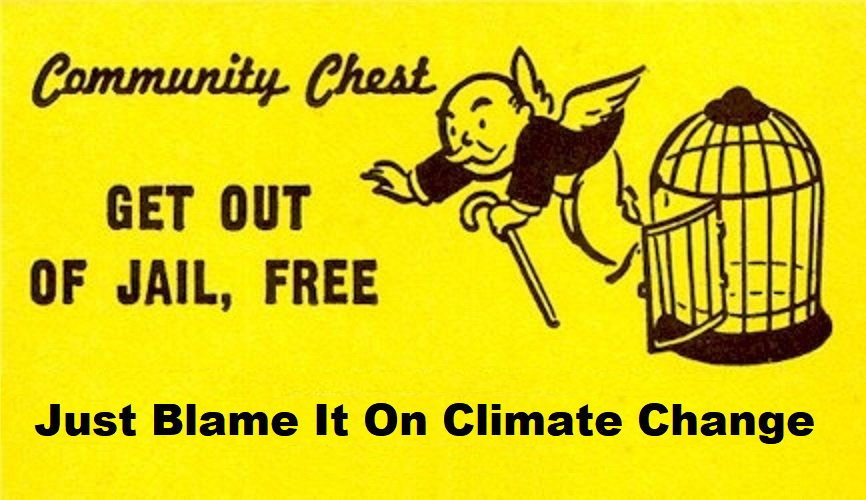
In speaking of “policing,” I mean government throwing its weight and its coercion around against “misinformation” or “disinformation.” And, besides government coercion, there are allies. These allies often enjoy monopolistic positions, stemming either from government handouts, privileges, and sweetheart deals, as with broadcasters, universities, and pharmaceutical companies, or from having cornered certain network externalities, as with certain huge media platforms. Allies of various sorts sometimes do the bidding of the despots because they themselves are threatened and intimidated. The ecosystem leads to their debasement.
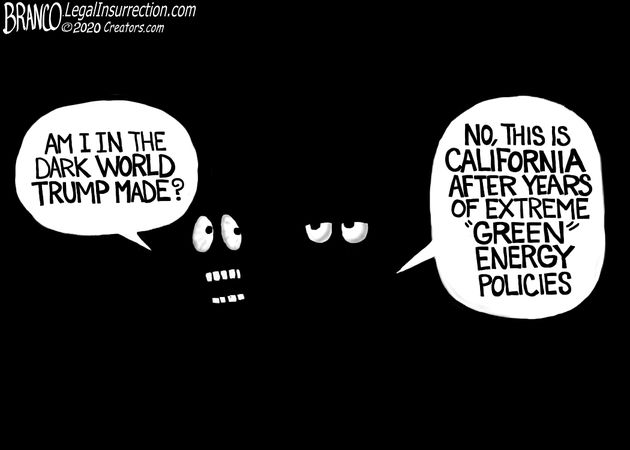
To support governmental policing of “information”
is to confess one’s anti-liberalism and illiberality.

Even worse, it is to flaunt them. The motive is to make and signal commitment to anti-liberalism, in a manner parallel to how religious cults set up rituals and practices for making and signaling commitments (Iannaccone 1992). Vice signals vice, the ticket in some spheres to promotion and advancement.

Also, vicious action spurs more of the same to defend against exposé and accountability for past wrongs. In protecting their rackets, the wrongdoers verge upon a downward spiral.

When despots label opposition “misinformation” or “disinformation” they abuse language. They invoke presuppositions built into the word information, presuppositions that are false. When despots label opposition “mis-” or “disinformation, they are, at best, objecting in the interpretation and judgment dimensions of knowledge, or, at worst, they are speaking in a way that has abandoned civil engagement altogether, instead using words as instruments of wickedness.

Defence offered by Facebook in Stossel defamation lawsuit.

Usually, what people argue fervently over is not information, but interpretations and judgments as to which interpretations to act on. What is being labeled and attacked as “misinformation” is not a matter of true or false information, but of true or false knowledge. The projects and policies now afoot styled “anti-misinformation” and “anti-disinformation” are dishonest, as it should be obvious to all that those projects and policies would, if advanced honestly, be called “anti-falsehood” or “anti-falseness” or “anti-foolishness” or “anti-untruth” campaigns. But to prosecute an “anti-falsehood” campaign would make obvious the true nature of what is afoot: The persecution and silencing of Wrongthink. In misrepresenting matters of interpretation and judgment as one of “misinformation,” they misrepresent the nature of their projects and dodge the responsibility to account for how they judge among vying interpretations.

In ordinary private-sector affairs, outside of politics and outside of
heavily governmentalized affairs, lying at the level of information
is naturally checked and counteracted.

Again, the “information” implies reference to working interpretations. Getting things rights should not be difficult or tricky—issues there are all within the working interpretation. Sure, mistakes are made; but such mistakes are readily and easily corrected.

Liars about information lose the trust of their voluntary associates, whether those voluntary associates are friends, customers, trading partners, or employees. If liars lie about simple features of their products or their services, they could be subject to law suits from their trading partners, to public criticism, and to rival exposé by competitors. In ordinary private-sector affairs, everyone has reputational incentives not to lie systematically, and especially not to lie about information, and most of us have strong moral incentives within ourselves against lying. We dread the disapproval of “the man within the breast”—an expression Adam Smith used for the conscience.

So, you might ask: If private actors without government privileges and immunities scarcely spread false information dishonestly and programmatically, is disinformation really a thing? Before addressing that question directly, let’s turn to the Godzilla of programmatic lying.

Propaganda: Government’s programmatic lies

It is government, especially, that lies programmatically. The lying can be at the level of information, but it usually makes more sense to say that its lying is at the level of interpretation: The government promotes interpretations—for example, The Covid virus came from nature—, interpretations that it, the government, itself does not particularly believe. It lies about the virus having come from nature, as it lies about many other big interpretations. It propagates big lies.

And it lies with confidence. Government is the only player in society that initiates coercion in an institutionalized way. Its coercion is overt. What’s more, it does so on a colossal scale. That is the most essential feature of government. Every government is a Godzilla, and we must learn to live with our Godzilla and mitigate the destruction it wreaks.

The traditional term for government’s programmatic lying is propaganda—a word that once did not necessarily imply falseness (instead meaning simply ideas propagated), but is now generally used in that necessarily-pejorative sense. The falsehoods of propaganda are typically lies, in that the propagandizers usually do not particularly believe the claims they propagate.

Government can lie programmatically because it does not depend on voluntary participation for its support. It subsists on coercion, including restrictions on competitors and opponents, and takings from taxpayers. Organizations in heavily governmentalized settings can also lie programmatically. Crony private-organizations sustain large programmatic lying only when they enjoy privileges, immunities, and protections from the government.

Base humans tend to weaponize things

But aren’t governments accountable to checks and balance, divisions of power, and the rule of law? Haven’t we learned to tame Godzilla, to chain down Leviathan?

It is true that the government of a rule-of-law republic, checked by an honest media, might be quite limited in its programmatic lying. But that’s not how it is today, where dissent is being tarred as “mis-” and “disinformation,” and where the legacy media is morally base in the extreme. Today, regimes are increasingly despotic, and despotic regimes are much less checked and limited.

The rule of law means, first and foremost, the government
living up to the rules posted on its own website.
Governments today don’t do that.

Law is applied politically, that is, with extreme partiality, upon a double-standard. Laws are selectively enforced and punishments are selectively meted out. Despots avail themselves of show trials, kangaroo bodies, and galleries filled with stooges. The “anti-misinformation” agenda is misrule.

Despotism despoils checks and balances. Despotism centralizes power formerly divided. It destroys the independency and autonomy that, theoretically, branches and units, divided and balanced, had once enjoyed. Despotism usurps powers once distributed and balanced. Despotism is unbalanced power.

Under a despotic regime, the coercive institutions unique to government become weaponized by the despots and their allies. They turn them against their opponents. But weaponization is itself always somewhat constrained by cultural norms. The existence of government implies the existence of a governed society, and the existence of society implies the existence of some basic norms, for example against theft, murder, and lying. David Hume famously pointed out that the governed always vastly outnumber the governors, and hence government depends on “opinion”—if only the opinion to acquiesce to those governors.

The contested claims go far beyond information

The despots tend to invoke certain organizations as the definitive, authoritative sources of “information.” They say, in effect: “The CDC, the WHO, the FDA says the mRNA injections are safe and effective, so anything that suggests otherwise is misinformation.” The farce here is pretending that everyone’s working interpretation consists of the dicta of some such particular organization. Never has an organization or agency had such a Mount-Olympus status for determining, throughout society, working interpretations of complex matters, and particularly not an organization with the foul characters and track-records of the CDC, WHO, FDA, and similar highly governmentalized organizations. The similitude to the Soviet Union under Stalin is obvious.

Despotic contempt for our circle of “we”

Again, what is labeled and attacked as “misinformation” or “disinformation” is not a matter of true or false information, but of true or false knowledge. Recognizing that knowledge, not merely information, is at issue is a matter of common decency.

The dignity of sincere discourse involves an openness, in principle a universal openness, to other human “we’s” and their pursuits upward in wisdom and virtue. As we can see, the chief facets of knowledge—information, interpretation, and judgment—operate both behind and ahead of our current position in the spiral. Trying to shut us up is to show a despotic contempt for our way of weaving through the phases of knowledge. It is contemptuous towards the development of the many loops within which our sense-making has made a home and now operates.

By weighing interpretations and making judgments, we establish certain beliefs as fact, to predicate our further conversation. Those beliefs reflect a “we” with those beliefs. Meanwhile, in the wider world, different “we’s” are forming and are addressing the public at large, representing different sets of belief, different ways of making sense of the world. We might call a “we” a distinct sense-making community.

The sincere human of any one of these communities is eager to learn from other communities. The sincere human has certain commitments which make it belong to the sense-making community it belongs to, but it is not wedded to that community. In fact, the entire population of that community—that is, the set of people who currently share that way of sense-making—may remake their community’s way of sense-making. Those who learn from other communities may become leaders of intellectual change within their own community.

Thus, sincere humans favor the freedom of speech and the norms of frank and open discourse for all communities. Besides favoring that freedom, they welcome engagement across communities, for all the reasons given earlier.

The “anti-misinformation” despots show contempt for communities at odds with their dicta and diktats. Not only are the members of the “anti-misinformation” community unwilling to engage in civil debate, but they promulgate “anti-misinformation” propaganda so as to intimidate their adversaries, to crush dissent.

I have explained that the “misinformation” characterization of the disagreement is false. The anti-liberals are presupposing that it is a matter within the information dimension of knowledge, when clearly the disagreement involves contentions in the interpretation and judgment dimensions. Under pretense of combatting misinformation, they are really just stomping on adversaries. As I said at the outset, it is akin to Naziism, Stalinism, and Maoism, regimes that likewise showed despotic contempt for sense-making communities at odds with their own. “Anti-misinformation” projects are a sham, just as “anti-racism” projects are a sham.

Concluding remarks

The “anti-misinformation” projects are obvious miscarriages of civility, decency, and the rule of law. We must rediscover the norms of openness, tolerance, and free speech that dignify humankind. Science depends on confidence, and confidence depends on those liberal norms. Those norms are the parents of good science, healthy sense-making, and civil tranquility. There are two roads here, namely:

    1.  Freedom —> openness —> confidence —> truth-tracking —> dignity;
    2. Despotism —> concealment —> diffidence —> bad science —> serfdom and servility

Let’s get back to the right road.