Cutting Through the Fog of Renewable Power Costs


Most every day there are media reports saying solar and wind power plants are now cheaper than coal. Recently UCS expressed outrage that some coal plants remain viable because industrial customers are able to commit purchasing of the reliable coal-fired supply.

Joe Daniel writes at Forbes The Billion-Dollar Coal Bailout Nobody Is Talking About: Self-Committing In Power Markets. A typical companion piece at Forbes claims The Coal Cost Crossover: 74% Of US Coal Plants Now More Expensive Than New Renewables, 86% By 2025.

Having acquired some knowledge of this issue, I wondered how these cost comparisons dealt with the intermittency problem of wind and solar, and the requirement for backup dispatchable power to balance the grid.

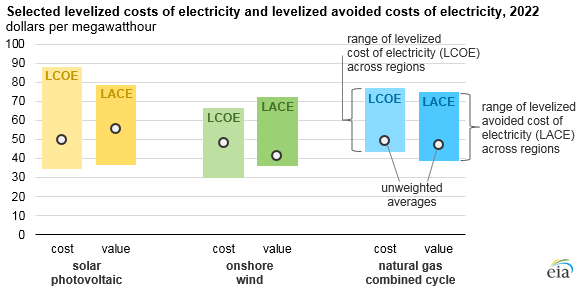
EIA has developed a dual assessment of power plants using both Levelized Cost and Levelized Avoided Costs of Electricity power provision. The first metric estimates output costs from building and operating power plants, and the second estimates the value of the electricity to the grid. Source: EIA uses two simplified metrics to show future power plants’ relative economics Excerpts in italics with my bolds.

EIA calculates two measures that, when used together, largely explain the economic competitiveness of electricity generating technologies.

The levelized cost of electricity (LCOE) represents the installed capital costs and ongoing operating costs of a power plant, converted to a level stream of payments over the plant’s assumed financial lifetime. Installed capital costs include construction costs, financing costs, tax credits, and other plant-related subsidies or taxes. Ongoing costs include the cost of the generating fuel (for power plants that consume fuel), expected maintenance costs, and other related taxes or subsidies based on the operation of the plant.

The levelized avoided cost of electricity (LACE) represents that power plant’s value to the grid. A generator’s avoided cost reflects the costs that would be incurred to provide the electricity displaced by a new generation project as an estimate of the revenue available to the plant. As with LCOE, these revenues are converted to a level stream of payments over the plant’s assumed financial lifetime.

Power plants are considered economically attractive when their projected LACE (value) exceeds their projected LCOE (cost). Both LCOE and LACE are levelized over the expected electricity generation during the lifetime of the plant, resulting in values presented in dollars per megawatthour. These values range across geography, as resource availability, fuel costs, and other factors often differ by market. LCOE and LACE values also change over time as technology improves, tax credits and other taxes or subsidies expire, and fuel costs change.

The relative difference between LCOE and LACE is a better indicator of economic competitiveness than either metric alone. A comparison of only LCOE across technology types fails to capture the differences in value provided by different types of generators to the grid.

Some power plants can be dispatched, while some—such as those powered by the wind or solar—operate only when resources are available. Some power plants provide electricity during parts of the day or year when power prices are higher, while others may produce electricity during times of relatively low power prices.

Solar PV’s economic competitiveness is relatively high through 2022 as federal tax credits reduce PV’s LCOE. As those tax credits are phased out, technology costs are expected to have declined to the point where solar PV remains economically competitive in most parts of the country. Because solar PV provides electricity during the middle of the day, when electricity prices are relatively high, solar PV’s value to the grid (i.e., LACE) tends to be higher than other technologies.

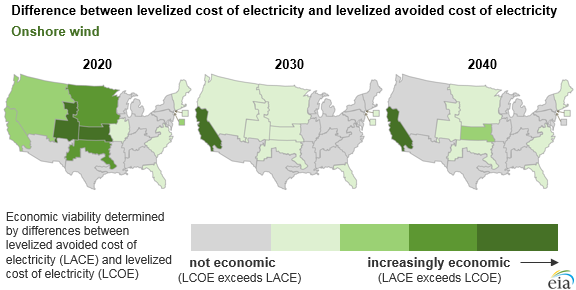
Onshore wind also sees higher economic competiveness in the earlier part of the projection, prior to the expiration of federal tax credits in 2020. Over time, wind remains competitive in the Plains states, where wind resources are highest. Wind’s LACE is relatively low in most areas, as wind output tends to be highest at times when power prices are low.

[Note: The video Can We Rely on Wind and Solar?  was banned by Youtube after 2 miilion views some years ago.  It can still be viewed on Facebook

To get the coal comparison to renewables, there is a study Benchmark Levelized Cost of Electricity Estimates from National Academies Press. Excerpts in italics with my bolds.

The EIA Annual Energy Outlook supporting information identifies the methodology and assumptions that affect the reported estimates of LCOE for utility-scale generation technologies. The reported estimates are for the years 2022 and 2040. The focus here is on the 2022 estimates as the benchmark for the “current” costs. The assumptions include choices regarding the effects of learning, capital costs, transmission investment, operating characteristics, and externalities. These choices are both important and appropriate for the benchmark comparison (e.g., learning rates), are important and require some adjustment (e.g., capital costs), or are supplemental to the EIA assumptions (e.g., externality costs).

Note:  For the externality of CO2 emissions, the chart below shows a $15/ton “Social Cost of Carbon.”

EIA separates electricity generation technologies into categories of dispatchable and nondispatchable (EIA, 2015f, p. 6). The former include conventional fossil fuel plants that have a fairly consistent available capacity and can follow dispatch instructions to increase or decrease production. The latter consist of intermittent plants such as wind and solar, which depend on the availability of the wind and sunlight and typically cannot follow dispatch instructions easily or at all. It is generally recognized that the different operating profiles create different values for the technologies (Borenstein, 2012; Joskow, 2011). Empirical estimates for existing technologies show that the value of wind, which blows more at night when prices are low, can be 12 percent below the unweighted average price of electricity; and the value of solar, with the sun tending to shine when prices are higher, can be 16 percent greater than the unweighted average (Schmalensee, 2013).

One procedure utilized for putting nondispatchable technologies on an equivalent basis is to pair them with appropriately scaled dispatchable peaking technologies to produce an output that is like that of a conventional fossil fuel plant (Greenstone and Looney, 2012). Another approach, used by Schmalensee (2013), is to calculate the value of nondispatchable technologies based on spot prices. EIA provides a similar estimate based on its projected simulations, which is known as the levelized avoided cost estimate (LACE).

For purposes of equivalent comparison of the LCOE, the approach here combines these adjustments to provide an estimate of the net difference between the LACEs for the technology and for a conventional combined-cycle natural gas plant. The net differences are added to (e.g., for wind) or subtracted from (e.g., for solar) the other components of the LCOE.

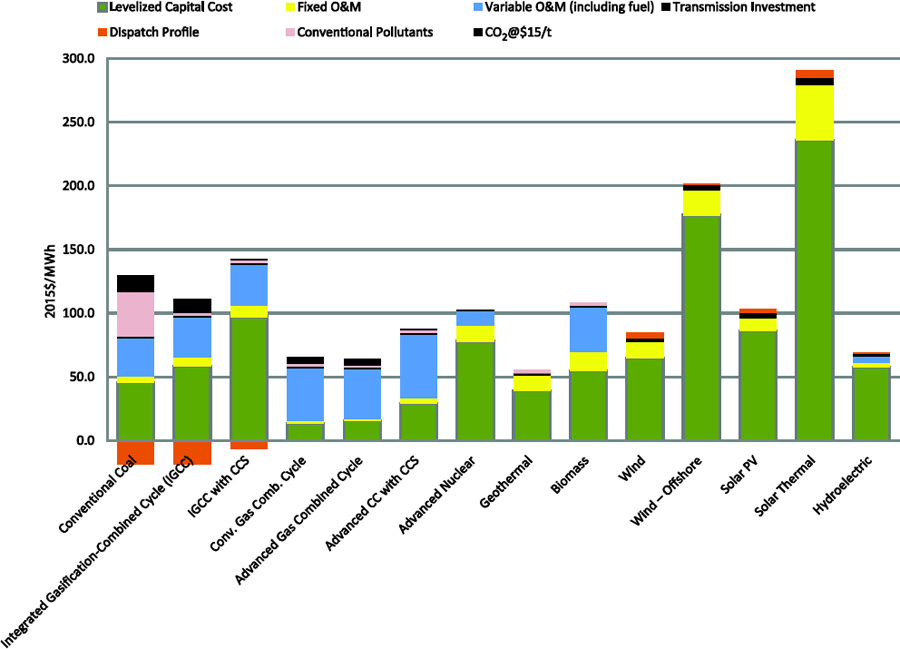
With the above assumptions and adjustments to obtain an approximation of equivalent LCOE, the results appear in Figure B-1 and Table B-1.


FIGURE B-1 Levelized cost of electricity for plants entering service in 2022 (2015 $/MWh).
SOURCE: EIA, 2015f, 2016g. Because Annual Energy Outlook 2016 does not assess conventional coal and IGCC technologies, their values (in 2013 dollars) were sourced from Annual Energy Outlook 2015 and then converted to 2015 dollars using the Bureau of Economic Analysis’ gross domestic product (GDP) implicit price deflator.

It is clear from Figure B-1 that new natural gas plants are the dominant technology. And without accounting for the costs of externalities, new IGCC coal plants are more competitive than even the best of the wind and solar. Onshore wind is the closest to being competitive. But the relative cost estimates shown here are similar to those in Greenstone and Looney (2012). The primary renewable technologies are not cost-competitive, and the differences are significant. This is for entry year 2022. Looking ahead to 2040, with some additional cost reductions for renewables and more substantial increased fuel costs for natural gas, the situation changes for wind but not for solar.

CONCLUSION

Equivalent estimates of the LCOE are available from the supporting analyses of AEO2016. The data without the effect of selective policies indicate that existing technologies for clean energy are not competitive with new natural gas. And without accounting for the costs of externalities, the principal renewable technologies of wind and solar are not cost-competitive with new coal plants.

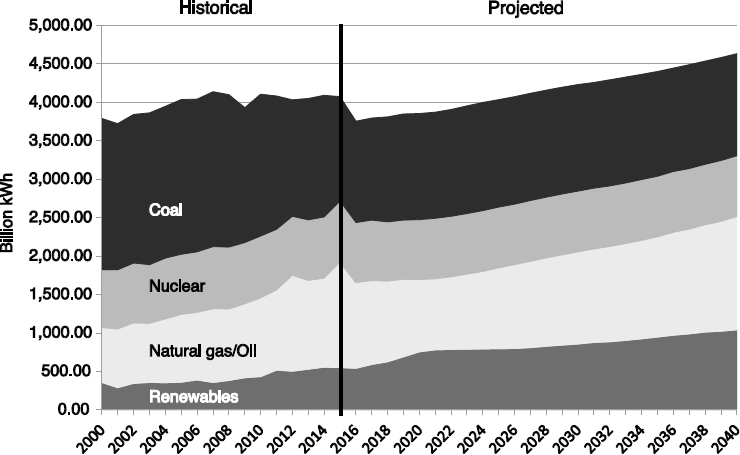
FIGURE B-2 Electric power generation by fuel (billions of kilowatt hours [kWh]) assuming No Clean Power Plan, 2000-2040. SOURCE: EIA, 2016f, Figure IF3-6.

[Note:  Again Youtube banned the video “Bill Gates Slams Unreliable Wind and Solar Power Energy.” It can still be viewed on Facebook:

Footnote: The above analyses do not adequately consider the effect of cheap subsidized solar and wind power driving dispatchable power plants into bankruptcy.  For more on electricity economics see Climateers Tilting at Windmills

Cyber Solutions Can’t Fix the Climate

This post is dedicated to Silicon Valley nouveau rich and their Cyber-Space Cadets now in the streets demanding that adults fix the climate, and fix it now!  Their thinking is fatally flawed by the simplistic transfer of tactics from cyber world to the real physical world.

Mark P. Mills writes at City Journal Want an Energy Revolution?  It won’t come from renewables—which can never supply all the power we need—but from foundational scientific discoveries. Excerpts in italics with my bolds.

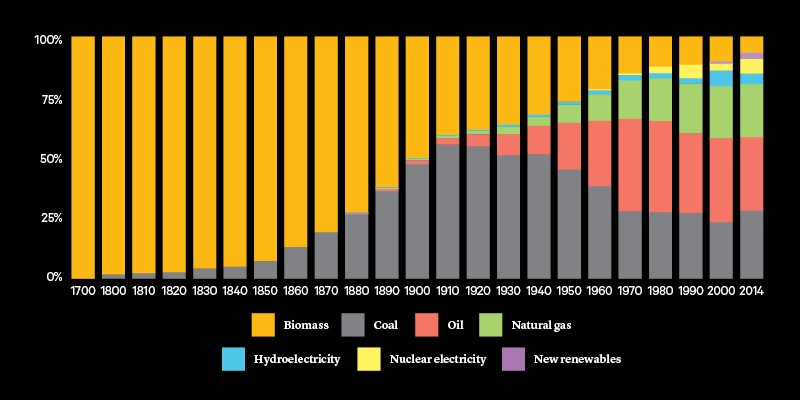
Throughout history, some 60 percent to 90 percent of every nation’s economy has been consumed by food and fuel costs. Hydrocarbons changed the way that humans organize their productive capacity. The coal age, followed by the oil age, and now by the ascendant age of natural gas, has (at least for developed nations) driven the share of GDP devoted to acquiring food and fuel down to around 10 percent. That transformation constitutes one of the great pivots for civilization.

Many analysts claim that yet another such consequential energy revolution is upon us: “clean energy,” in the form of wind turbines, solar arrays, and batteries, they say, is about to become incredibly cheap, making it possible to create a “new energy economy.” Polls show that nearly 80 percent of voters believe that America is “capable of creating a new electricity system.”

We can thank Silicon Valley for popularizing “exponential change” and “disruptive innovations.” The computing and communications revolutions that have transformed many industries have also shaped both expectations and rhetoric about how other technologies evolve. We hear claims, as one Stanford professor put it, that clean tech will follow digital technology in a “10x exponential process which will wipe fossil fuels off the market in about a decade.” Or, as the International Monetary Fund recently summarized, “smartphone substitution seemed no more imminent in the early 2000s than large-scale energy substitution seems today.” The mavens at Singularity University tell us that with clean tech, we’re “on the verge of a new, radically different point in history.” Solar, wind, and batteries are “on a path to disrupt” the old order dominated by fossil fuels.

Never mind that wind and solar—the focus of all “new energy economy” aspirations, including its latest incarnation in the Green New Deal—supply just 2 percent of global energy, despite hundreds of billions of dollars in subsidies. After all, it wasn’t long ago that only 2 percent of the world owned a pocket-sized computer. “New energy economy” visionaries believe that a digital-like energy disruption is not just possible, but imminent. One professor predicts that we will see an “Apple of clean energy.”

A similar transformation in how energy is produced or stored isn’t just unlikely: it’s impossible. Drawing an analogy between information production and energy production is a fundamental category error. They entail different laws of physics. Logic engines don’t produce physical action or energy; they manipulate the idea of the numbers one and zero. Silicon logic is rooted in simply knowing and storing the position of a binary switch—on or off.

But the energy needed to move a ton of people, heat a ton of steel or silicon, or grow a ton of food is determined by properties of nature, whose boundaries are set by laws of gravity, inertia, friction, and thermodynamics—not clever software or marketing. Indeed, the differences between the physical and virtual are best illustrated by the fact that, using mathematical magic, one can do things like “compress” information to reduce the energy needed to transport that information. But in the world of humans and objects with mass, comparable “compression” options exist only in Star Trek.

Spending $1 million on wind or solar hardware in order to capture nature’s diffuse wind and sunlight will yield about 50 million kilowatt-hours of electricity over a 30-year period. Meantime, the same money spent on a shale well yields enough natural gas over 30 years to produce 300 million kilowatt-hours. That difference is anchored in the far higher, physics-based energy density of hydrocarbons. Subsidies can’t change that fact.

And then batteries are needed, and widely promoted, as the way to convert wind or solar into useable on-demand power. While the physical chemistry of batteries is indeed nearly magical in storing tiny quantities of energy, it doesn’t scale up efficiently. When it comes to storing energy at country scales, or for cargo ships, cars and aircraft, engineers start with a simple fact: the maximum potential energy contained in hydrocarbon molecules is about 1,500 percent greater, pound for pound, than the maximum theoretical lithium chemistries. That’s why the cost to store a unit of energy in a battery is 200 times more than storing the same amount of energy as natural gas. And why, today, it would take $60 million worth of Tesla batteries—weighing five times as much as the entire aircraft—to hold the same energy as is held in a transatlantic plane’s onboard fuel tanks.

For a practical example of the physics-anchored gap between aspiration and reality, consider Florida Power & Light’s (FPL) recently announced plan to replace an old gas-fired power station with the world’s biggest battery project—promised to be four times bigger than the current number one, a system Tesla installed, to much fanfare, last year in South Australia. The monster FPL battery “farm” will be able to store just two minutes of Florida’s electricity needs. That’s not going to change the world, or even Florida.

Moreover, it takes the energy equivalent of about 100 barrels of oil to manufacture a battery that can store the energy equal to one oil barrel. That means that batteries fabricated in China (most already are) by its predominantly coal-powered grid result in more carbon-dioxide emissions than those batteries, coupled with wind/solar, can eliminate. It’s true that wind turbines, solar cells, and batteries will get better, but so, too, will drilling rigs and combustion engines. The idea that “old” hydrocarbon technologies are about to be displaced wholesale by a digital-like, clean-tech energy revolution is a fantasy.

If we want a disruption to the energy status quo, we will need new, foundational discoveries in the sciences. As Bill Gates has put it, the challenge calls for scientific “miracles.” Any hoped-for technological breakthroughs won’t emerge from subsidizing yesterday’s technologies, including wind and solar. The Internet didn’t emerge from subsidizing the dial-up phone, or the transistor from subsidizing vacuum tubes, or the automobile from subsidizing railroads. If policymakers were serious about the pursuit of the next energy revolution, they’d be talking a lot more about reinvigorating support for basic science.

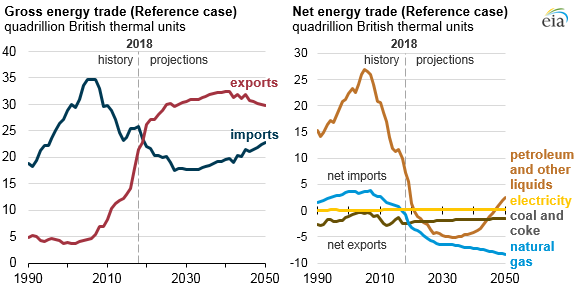
It bears noting that over the past decade, U.S. production of oil and natural gas has increased by 2,000 percent more than the combined growth of (subsidized) wind and solar. Shale technology has utterly transformed the global energy landscape. After a half-century of hand-wringing about import dependencies, America is now a major exporter. Now that’s a revolution.

See also Energy Changes Society: Transition Stories

Going Dutch: How Not to Cut Emissions

Everyone knows the Dutch are serious and determined people.  Their saying: “God created the earth, but the Dutch created the Netherlands.”  A relative of mine had some run-ins with Dutch neighbors, and his saying about them:  “Wooden shoes, wooden heads, wouldn’t listen.”  Well, now the Dutch have another saying:  “Whatever you do, don’t try to cut carbon emissions the way we did.”

You see, being Dutch they took on the challenge of “fighting climate change,” and are now living to regret their actions.  Karel Beckman writes in Natural Gas World  The Flaws in Dutch Climate Policy Mar 20, 2019.  H/T GWPF  Excerpts in italics with my bolds.

Why should the wisdom of Dutch climate policy be of concern to anyone besides Dutch taxpayers? At this moment all developed countries are entering a new phase in their climate policies. They are moving beyond broad reduction targets and temperature goals to the nitty-gritty of real climate measures and tough choices. The debate is not anymore about whether to reduce greenhouse gas emissions, or even by how much, but how.

From this point on there are still many different roads into the future. The Dutch example is instructive because we are talking about a wealthy, urban, industrialised country – a self-proclaimed climate leader within the European Union. A country moreover that has decided to phase out the use of “unabated” natural gas for the sake of the climate. Yet its climate policies for cutting greenhouse gas emissions are full of flaws.

The Climate Accord, the result of months of negotiations between labour unions, non-governmental organisations, business associations, local authorities and other civil society groups, which will serve as the basis for the Dutch National Energy and Climate Plan (NECP) that all EU member states have to submit to the European Commission at the end of this year, contains a large number of more or less concrete proposals to reduce greenhouse gas emissions.

PBL and CPB have analysed the effect these proposals are likely to have on emission reductions and at what likely cost. The PBL report and the CPB report are therefore key inputs in the political decision-making process, turning the Climate Accord into law.

What the two reports show – even though their authors don’t say so explicitly and even if the general media did not notice anything amiss – is that Dutch climate policies are full of contradictions, inefficiencies and question-marks that should serve as a warning to energy policy-makers and stakeholders everywhere.

Here are my own seven Troubling Takeaways from the PBL and CPB reports.

1. The cost of climate policies: anyone’s guess

Robert Koelemeijer, researcher at PBL and one of the authors of the new report, says in a telephone interview: “It has proved to be very difficult to distinguish between the costs of the energy system as such, and the additional costs as a result of past climate and energy policies. But it is a question we get more often and one that we do want to take a look at this year.”

Earlier this year, a group of critics – Theo Wolters, Stijn Santen, Hans Keuken, Evert van der Pol and Marcel Crok – published a report, “De kosten van het Energieakkoord” (“The costs of the Energy Accord”), which attempts to calculate the costs of the measures decided on in an earlier piece of climate legislation, called the Energy Accord, in 2013.

Wolters, one of the authors, tells me it is reasonable to assume that this Energy Accord, which was actually adopted by the government and is being implemented, represents the major part of the “reference scenario” that PBL refers to.

According to Wolters et al., the Energy Accord will cost Dutch society over €100bn, measured over a period of 35 years, to which the costs of the Climate Accord must now be added. Their report has been criticised by various experts. Koelemeijer says: “There are some aspects about it that we don’t agree with. We are planning to analyse it in more detail.”

On the other hand, €100bn, over 35 years, does not seem so incredible. Thus, for example, the Dutch General Accounting Office (“Algemene Rekenkamer”), again an official government institution, calculated in April 2015 that the costs of renewable energy subsidies alone could amount to some €80bn by 2030. (You can find the GAO report by following this link, click on the download, see page 15-16. Again, all in Dutch, I’m afraid.)

Renewable energy subsidies are of course only part of the total costs of climate policy – according to the critics roughly half of the total.

2. The poor will pay

More important perhaps is that CPB concludes that lower income groups (especially lower middle income groups) have to pay relatively more as a result of current climate policies than higher income groups. Welfare recipients and pensioners, says CPB, are hit hardest of all.

On average, households will see their income reduced by 1.3% as a result of all climate measures together, notes CPB, ranging from 0.8% for the highest income groups to 1.8% for the lowest income groups. To this should be added another 0.4% income loss on average as a result of climate policies in other EU countries and of companies charging their climate costs to consumers.

3. The built environment: minimal results

One of the most complex and controversial elements in Dutch climate policy is the goal to disconnect all houses and buildings from the gas grid by 2050. Currently 98% of all buildings are connected to the gas grid. . . Of the more than 7mn buildings that will be affected, 1.5mn should be “off gas” by 2030, according to the Climate Accord. As noted above, CPB does not calculate the costs of this gigantic operation. PBL does this however and concludes (on p. 67) that with the measures in the Climate Accord some 250,000 to 1,070,000 buildings could be made “gas-free” (rather than 1.5mn). The net “national costs” of this operation would only be €75mn to €90mn, according to PB.

Theo Wolters, one of the authors of the critical report, notes that according to a 2018 study of the independent think tank EIB (“Economisch Instituut voor de Bouw” – Economic Institute for the Building Sector), the average cost of going off gas will be €32,638/house. This will save on average €623/yr in gas use. That adds up to much higher national costs.

Troubling me much more, the PBL study shows that the measures taken in the built environment do only very little to reduce CO2 emissions. The Climate Accord is split up into five sectors: electricity generation, industry, transport, agriculture and environment. If it is carried out, PBL calculates, total emissions will go down between 31 and 52 megatons (Mt). Of this total, the electricity sector will contribute 18.3-21.0 Mt, industry between 6 and 13.9 Mt, mobility 4.2-8.0 Mt, agriculture 1.8-4.6 Mt and the built environment a paltry 0.8-3.7 Mt.

In other words, the Netherlands is contemplating a complete overhaul of the existing building stock with only a modest effect on its greenhouse gas emissions.

4. Waterbed effects: cutting carbon emissions in one place means they can rise elsewhere, unless the cap comes down.

Wolters and his co-authors, in their critical report, provide a withering analysis of the waterbed effects of Dutch climate policy. They calculate that of 32 Mt of emission reductions which the Netherlands wants to achieve by 2020, 79% fall under the ETS system. The non-ETS part is almost all based on the use of biomass, a questionable method (see below). Just 0.6 Mt of the 32 Mt falls outside of the ETS and is not related to biomass.

Wolters notes that CPB and the University of Groningen have long ago warned about the waterbed effect of the ETS, with the recommendation to “put off building expensive offshore wind parks in the North Sea” as long as their emission reductions would benefit coal power producers in Poland and elsewhere. “The same ton of CO2 that we don’t emit and which costs us on average €88, can be bought by a coal power producer in eastern Europe for €5 to €25”, they write.The ETS carbon price is now much higher but nowhere near €88/mt.

5. Biomass: what is it good for?

This table shows that biomass is the single most expensive measure – yet as PBL itself notes, its effectiveness is surrounded by “many uncertainties”.

By the way, in the Netherlands burning wood in wood stoves and fireplaces also counts as “renewable energy”. The Netherlands has a 14% renewable energy target for 2020, of which almost 1 percentage point will be reached by people using their wood stoves and fireplaces!

6. Jobs: no effect

Renewable energy is often credited for providing jobs – a questionable defence in itself, since “providing jobs” is not the same thing as “contributing to economic growth”. On the contrary, if switching to renewable energy leads to many more people being employed in energy generation, this is a net economic loss to society, not a gain.

But not to worry: CPB concludes (on p. 11) that climate and energy policy in the Netherlands has “transition effects”, but “in the longer term the net effects on employment are marginal”. The renewable energy job machine simply does not exist.

7. In the end: coming up short

After all is said and done, and ignoring waterbed effects, biomass doubts and the like, what is also striking is that the measures in the Climate Accord don’t even deliver the official target of 48.7 Mt of reductions in 2030. PBL concludes (p. 9) that if all the proposed measures are carried out, emissions will be reduced by between 31 Mt and 52 Mt, adding that “the target of 48.7 Mt will most likely not be met”.

Indeed, there are other “uncertainties” which could even result in emission reductions outside of the 31-52 Mt range, notes PBL, for example, unexpected deviations in “economic growth, energy prices, technology developments and developments in other countries.”

Conclusions

The most important one I think is that climate policy – any climate policy – is not a done deal. On the contrary, the real hard choices have only just arrived on our doorstep. There are many questions, such as, what are the most cost-effective and efficient measures. Not only in the Netherlands – other countries will face the same issues.

Two key issues that need to receive a lot more attention are the effects of EU climate policy, which right now are an afterthought in the Netherlands and in other EU member states, whereas they clearly should be a starting point; and the wisdom of using renewable energy targets alongside CO2-targets. Wolters and the other critics of Dutch climate policy observe that the Dutch government initially wisely focused on CO2-targets, but then enthusiastically endorsed a new renewable energy target agreed upon by the EU of 32% in 2030. This, they say, means that CO2-reduction will be achieved “through relatively expensive options”.

The climate policy debate? It has only just started.

The Dutch also invented a word: Poppycock, (ˈpäpēˌkäk/) informal noun meaning nonsense.
Synonyms: nonsense, rubbish, claptrap, balderdash, blather, moonshine, garbage;
Origin: mid 19th century: from Dutch dialect pappekak, from pap ‘soft’ + kak ‘dung.’

Reprinted below is a previous post Green Electrical Shocks providing a Dutch analysis with a dash of humor.

One year ago, a weekly Sunday news program aired in the Netherlands on the titled subject. H/T Climate Scepticism. The video clip is below with English subtitles. For those who prefer reading, I provide the substantial excerpts from the program with my bolds.

How many of you have Green Electricity? I will estimate 69%
And how much nationally? Oh, 69%!
So we are very average, and in a good way, because the climate is very important.

Let me ask: Green electricity comes from . . .?
Yes, electricity produced from windmills and solar panels.
Nearly 2/3 of the Dutch are using it. That’s the image.

Well I have green news and bad news.
The green news: Well done!
The bad news: It is all one big lie.
Time for the Green Electrical Shocks.

Shock #1: The green electricity from your socket is not green.
When I switched to green electricity I was very proud.
I thought, Yes, well done! The climate is getting warmer, but not any more thanks to me.

Well, that turned out to be untrue.
All producers deliver to one communal grid. Green and grey electricity all mix.
The electricity you use is always a mix of various sources.
OK. It actually makes sense not to have separate green and grey cables for every house.
So it means that of all electricity, 69% is produced in a sustainable way. But then:

Shock #2: Green Electricity is mostly fake.
Most of the green electricity we think we use comes from abroad.
You may think: So what. Green is green.

But that electricity doesn’t come from abroad, it stays abroad.
If you have green electricity at home, it may mean nothing more than that your supplier has bought “green electricity certificates”.

In Europe green electricity gets an official certificate,
Instead of selling on the electricity, they sell on those certificates.
Norway, with its hydro power, has a surplus of certificates.
Dutch suppliers buy them on a massive scale, while the electricity stays in Norway.

The idea was: if countries can sell those certificates, they can make money by producing more green electricity.
But the Norwegians don’t produce more green electricity.
But they do sell certificates.

The Dutch suppliers wave with those certificates, and say Look! Our grey electricity is green.
Only one country has produced green electricity: Norway.
But two countries take the credit.
Norway, because they produce green electricity, and the Netherlands because, on paper, we have green electricity. Get it? That’s a nice deal.

More and more countries sell those certificates. Italy is now the top supplier.
We buy fake green electricity from Italy, like some kind of Karma ham.

Now, let’s look again at the green electricity we all think we use.
So the real picture isn’t 69%. If you cancel the certificates, only 21% of electricity is really green.
Nowadays you can even order it separately if you don’t want to be part of that Norway certificates scam.
You may think: 21% green is still quite a lot. But it is time for:

Shock #3: Not all energy is electricity.
If you talk about the climate, you shouldn’t just consider electricity but all energy.
When you look at all energy, like factories, cars, trains, gas fires, then the share of consumer electricity is virtually nothing.
If you include everything in your calculation, it turns out that only 6% of all the energy we use in the Netherlands is green. It is a comedy, but wait:

Trees converted into pellets by means of petroleum powered machinery.

Shock #4: Most green energy doesn’t come from sun or wind, like you might think.
Even the 6%, our last green hope, is fake. According to the CBS we are using more sun and wind energy, but most of the green energy is produced by the burning of biomass.
Ah, more than half of the 6% green energy is biomass.

Ridiculous. What is biomass really? It is organic materials that we encounter every day.
Like the content of a compost heap. How about maize leaves or hay?
The idea behind burning organic materials is that it will grow up again.
So CO2 is released when you burn it, but it will be absorbed again by new trees.

However, there is one problem. The forest grows very slowly and our power plants burn very fast.
This is the fatal flaw in the thinking about biomass. Power plants burn trees too fast, so my solution: slow fire. Disadvantage: it doesn’t exist. So this is our next shock.

Shock#5: Biomass isn’t all that sustainable.
It’s getting worse. There aren’t enough trees in the Netherlands for biomass.
We can’t do it on our own. We don’t have enough wood, so we get it from America.

In the USA forests are cut at a high rate, Trees are shredded and compressed into pellets.
These are shipped to the Netherlands and end up in the ovens of the coal plants.
It’s a disaster for the American forests, according to environmental groups.

So we transport American forests on diesel ships to Europe.
Then throw them in the oven because it officially counts as green energy.
Only because the CO2 released this way doesn’t count for our total emissions.

In reality biomass emits more CO2 than natural gas and coal.
These are laws of nature, no matter what European laws say.
At the bottom line, how much sustainable energy do we really have in the Netherlands?
Well, the only real green energy from windmills, solar panels etc. Is only 2.2%. of all the energy we use.
In Conclusion
So the fact that 2/3 of the audience and of all Dutch people use green electricity means absolutely nothing. It’s only 2.2%, and crazier still, the government says it should be at 14% by 2020.
They promised: to us, to Europe, to planet Earth: 14 instead of 2.2.

Instead of making a serious attempt to save the climate, they are only working on accounting tricks, like buying pieces of paper in Norway and burning American forests.
They are only saving the climate on paper.

Summary Comment

As the stool above shows, the climate change package sits on three premises. The first is the science bit, consisting of an unproven claim that observed warming is caused by humans burning fossil fuels. The second part rests on impact studies from billions of research dollars spent uncovering any and all possible negatives from warming. And the third leg is climate policies showing how governments can “fight climate change.”

It is refreshing to see more and more articles by people reasoning about climate change/global warming and expressing rational positions. Increasingly, analysts are unbundling the package and questioning not only the science, but also pointing out positives from CO2 and warming.  And as the Dutch telecast shows, ineffective government policies are also fair game.

More on flawed climate policies at Reasoning About Climate

Green Energy Blues: Falmouth City Cautionary Tale


A wind turbine loomed over the Craggy Ridge neighborhood in West Falmouth.
JONATHAN WIGGS/GLOBE STAFF

The story is by David Abel at Boston Globe January 24, 2019 ‘Green energy blues’ in a town that sought to do something about climate change.  Excerpts in italics with my bolds.   H/T Greenie Watch

FALMOUTH — For nearly a decade, the giant blades have loomed over this seaside town, stirring hope and fear in the salty air.

To proponents, the twin wind turbines proved that residents could act on their ideals, producing their own clean energy and relying less on fossil fuels. To critics, they were mechanical monstrosities, blinking eyesores whirring at such a frequency that some neighbors said they became ill.

Nine years after the first was built beside Falmouth’s waste treatment plant, both turbines now stand idle, no longer producing a kilowatt of electricity, totems of good intentions gone awry.

Facing fierce neighborhood opposition and multiple lawsuits, selectmen last week voted to remove the turbines, which had cost the town about $10 million to build, saddling residents with years of debt.

“All that’s left now is that we have an albatross to live with,” said Sam Peterson, the one dissenting vote on the five-person board.

Wind power offers communities a way to reduce their emissions, but the protracted resistance to the turbines offers lessons as communities throughout the region consider similarly controversial renewable energy projects.

It also reflects the challenges, often tacit, in the state’s promises to make substantial reductions in its emissions. Those plans rely on importing hydropower from Canada and major offshore wind farms, and both approaches are being contested by powerful, well-organized interest groups and could be subject to legal challenges.

For Dave Moriarty, who spent much of the past decade fighting the Falmouth turbines, news that the town was finally giving up its efforts to keep them running was a welcome relief. He considers the turbines “overbearing, antiquated dinosaurs” and said they left the town with the “green energy blues.”

The 56-year-old contractor, who lived close to the turbines after they were built, moved across town because they wrought too much stress, he said. He blames town officials for ignoring his and other neighbors’ concerns.

“The town was warned,” he said. “The damage can never be reversed for many of us wind turbine victims. Some of my friends have serious health issues now.”

Neighbors complained that the churning of the turbines and the resulting flickering light and vibrations produced dizziness, nausea, depression, or anxiety — a set of symptoms that critics call “wind turbine syndrome.”

In 2012, with both 1.65-megawatt turbines operating and the opposition becoming increasingly vocal, state environmental officials took the unprecedented action of recommending that one be shut down. They found that turbine, which was fewer than 1,500 feet from the nearest home, had repeatedly exceeded allowable noise levels.

But a panel of independent scientists and doctors convened by the state Department of Environmental Protection found little to no evidence the turbines posed a health risk to neighbors.

The town eventually stopped them from operating at night, and in 2015, a state appeals court judge ruled that the town lacked sufficient permits for one of the turbines and prohibited it from operating. Two years later, a Superior Court judge ruled that both turbines posed a nuisance to neighbors and ordered that they never operate again at their current location.

“The lessons others should learn from our experience is that residents should do their homework in advance of construction,” Moriarty said. “They should ask questions and know what they’re really getting into.”

For Peterson, the only selectman who declined to vote in favor of removing the turbines, the decision ultimately reflects the power of those concerned about any large industrial project close to their homes.

While he said he felt empathy for those whose homes are closest to the turbines, he thinks they exaggerated their complaints. He visited their homes and never heard more than a minor hissing of the moving blades.

“We had the best of intentions, and they bullied those of us who tried to reason with them,” said Peterson, a retired physics teacher who like many of his neighbors hoped to do his share in addressing climate change.

He also noted that the turbines were approved by repeated votes by more than 200 members of Falmouth’s Town Meeting. But he acknowledged that town officials made mistakes, particularly in failing to comply with zoning requirements.

A woman walked along Westmoreland Drive in Falmouth, in the shadow of one of the city’s wind turbines. JONATHAN WIGGS/GLOBE STAFF

In addition to the $10 million that the town’s 30,000 residents spent on building the turbines, they now have to pay as much as $2 million more to remove them.

“It’s a shame,” said Susan Moran, chair of the town’s board of selectmen, who initially supported the turbines but voted to take them down. “This is absolutely a financial blow to the town.

Moran and other town officials acknowledge those losses will take a toll. They’re already considering cutting back on some services, such as curbside trash collection.

While the town received $5 million in state loans for the project — $1.5 million of which has been forgiven — residents are likely to have repay the rest. If the turbines had operated as planned, functioning 24 hours a day, they were projected to earn the town between an estimated $1 million and $2 million a year.

In an effort to recoup some of those costs, selectmen have instructed town officials to consider a variety of options for what to do with the turbines.

Those include possibly converting them into cellphone towers or selling them to another community that might operate them. If they were able to negotiate such a deal with another town, Falmouth might have the rest of their state loans forgiven, as the turbines would be generating renewable energy.

“We’re looking at our options, but either way, there’s certainly going to be a financial impact to Falmouth,” said Julian Suso, to town manager.

California Renewables to Lose PG&E $$$


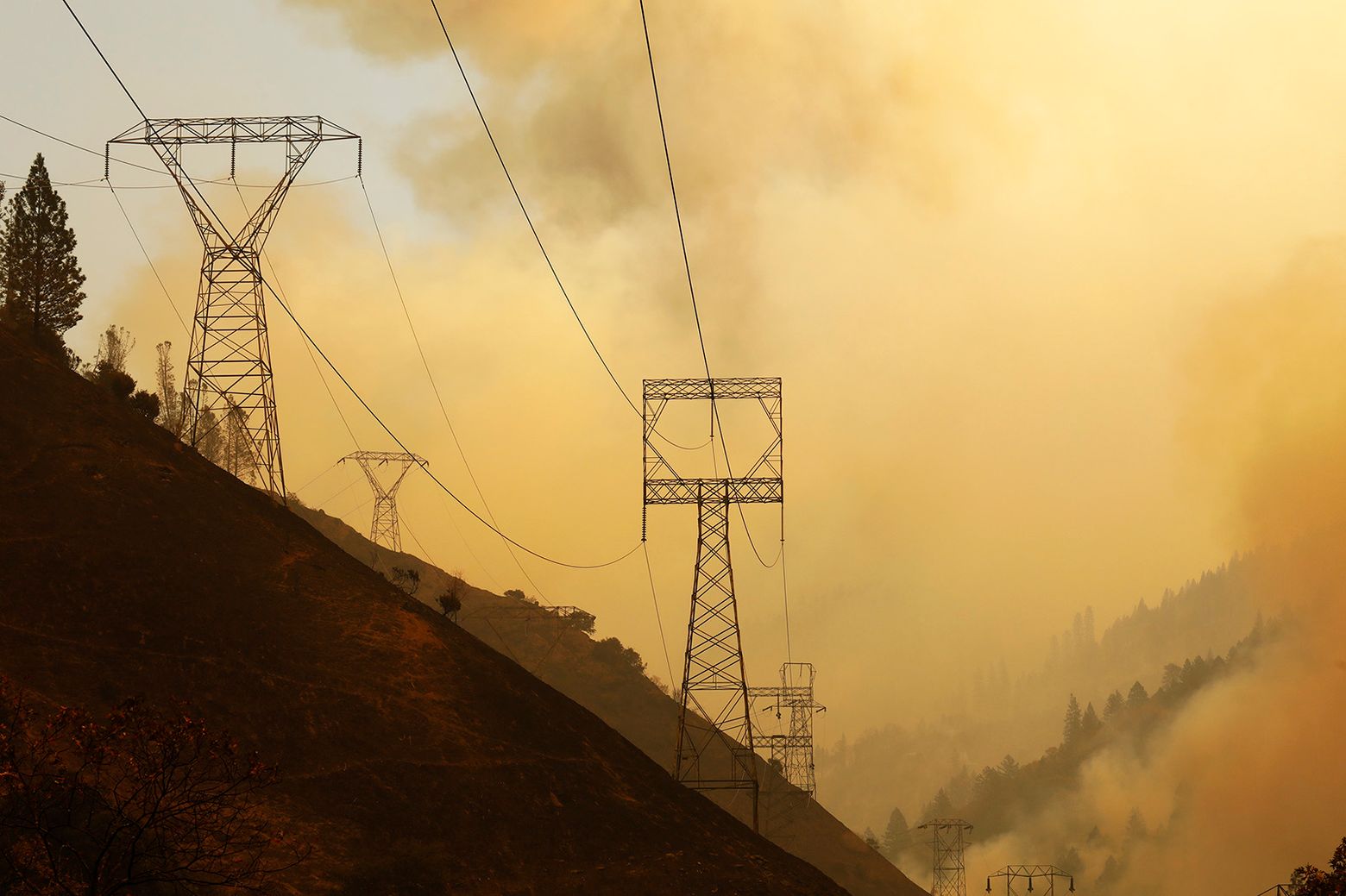
The investigation continues into the origin of the Camp fire, which some say started with a faulty PG&E wire in Pulga, California. (Carolyn Cole / Los Angeles Times / TNS)

Sammy Roth of LA Times digs deeper than others into the fallout from PG&E’s wildfire-induced bankrupcy. The article published in The Seattle Times is PG&E bankruptcy could undermine utilities’ efforts against climate change. Excerpts below with my bolds.

Solar and wind developers depend on creditworthy utilities to buy electricity from their projects under long-term contracts, but that calculus changes in a world where a 30-year purchase agreement doesn’t guarantee 30 years of payments.

The Golden State has dramatically reduced planet-warming emissions from the electricity sector, largely by requiring utilities to increase their use of solar and wind power and fund energy-efficiency upgrades for homes and businesses. Lawmakers recently set a target of 100 percent climate-friendly electricity by 2045.

But those government mandates have depended on Pacific Gas & Electric and other utilities being able to invest tens of billions of dollars in clean-energy technologies.

The massive Topaz solar farm in California’s San Luis Obispo County, an electricity supplier to PG&E owned by Warren Buffett’s Berkshire Hathaway Energy, also saw its credit rating downgraded to junk status this month, amid fears the San Francisco-based utility won’t be able to pay its bills in full.

In the short term, PG&E might stop signing renewable-energy contracts, although contracting had already slowed in the last few years as customers departed in droves for newly established local energy providers run by city and county governments. In the long term, renewable-energy developers and their lenders may hesitate to do business with PG&E — and, potentially, with other California utilities that could also face significant future wildfire costs.

“If we’re having a couple billion dollars a year of fire damage and insurance losses, quite apart from PG&E, this is going to put the entire state of California at risk,” said V. John White, executive director of the Center for Energy Efficiency and Renewable Technologies, a Sacramento-based trade group.

Renewable-energy firms were alarmed by the news of PG&E’s impending bankruptcy filing, and it’s not hard to understand why. Solar and wind developers depend on stable, creditworthy utilities to buy electricity from their projects under long-term contracts known as power-purchase agreements. They’re able to get low-cost loans to build their projects because lenders see little to no risk of a utility defaulting on those contracts.

But that calculus changes in a world where a 30-year power-purchase agreement doesn’t guarantee 30 years of payments at the agreed-upon price, said Ben Serrurier, a San Francisco-based policy manager for solar developer Cypress Creek Renewables. There’s concern in the industry that a bankruptcy court judge could order PG&E to reduce its payments to solar- and wind-project owners to help the company pay off other debts.

WIND ENERGY: Wind turbines in the Tehachapi-Mojave Wind Resource Area near the city of Mojave, California. (Brian van der Brug / Los Angeles Times / TNS)

“Once you start questioning the sanctity of contracted revenue, you begin to introduce a new risk into renewable-energy project development. So much about project development is about reducing risk so you can reduce your capital cost,” Serrurier said.

It’s not just clean-energy investments that are at risk. In another cruel bit of irony, PG&E’s bankruptcy filing could also make it more difficult for California utilities to raise the capital needed to harden their infrastructure against wildfire, said Travis Kavulla, a former president of the National Association of Regulatory Utility Commissioners who now serves as director of energy policy at the R Street Institute, a center-right think tank.

“Bankruptcies are tough. It means people may lose their pensions or get them cut. It means people who invested in projects in California, based on what they thought was a pretty airtight business model of a regulated utility, are getting stiffed,” Kavulla said. “It could create longer-running harms where California is viewed as a market to avoid investment in.”

PG&E has lurched from crisis to crisis since 2010, when one of the company’s gas pipelines exploded in a residential neighborhood in San Bruno, killing eight people. The company was ultimately fined $1.6 billion by the state regulators and $3 million by a federal judge. Last month, the California Public Utilities Commission accused PG&E of continuing to commit pipeline-safety violations in the years after the gas pipeline explosion.

More recently, deadly wildfires have made PG&E the target of raucous protests. The utility’s infrastructure was found to have sparked or contributed to more than a dozen fires that collectively killed 22 people in 2017. State investigators have yet to determine if PG&E is also responsible for 2017’s Tubbs fire, which killed an additional 22 people, and the 2018 Camp fire, which killed 86 people and destroyed most of the town of Paradise.

Some critics have called for lawmakers to break up the massive company, which serves 16 million Californians, and replace it with smaller, government-run electric utilities. But it’s not clear how feasible that would be, or whether it would accomplish anything more than transferring PG&E’s huge liabilities to local governments.Renewable-energy developers, meanwhile, see stabilizing PG&E as an urgent priority. After a series of fires devastated Northern California in October 2017, clean-energy trade groups began urging state lawmakers to help PG&E and other utilities cope with the liability that can ensue if their infrastructure sparks a fire.

In a May 2018 letter to legislative leaders last year, representatives of the solar, wind, geothermal and biomass energy industries said California must find a way to sustain financially solvent investor-owned utilities. Failure to act, they said, “imperils our markets and progress toward our climate goals.”

Ralph Cavanagh, co-director of the energy program at the Natural Resources Defense Council, described PG&E as a “tremendous asset” for meeting the state’s climate-change targets.

He said the state’s three big investor-owned utilities — which also include Southern California Edison and San Diego Gas & Electric — are crucial to making the investments needed to meet California’s ambitious climate targets, including the 100 percent clean-energy mandate and a long-term goal of cutting greenhouse-gas emissions by 80 percent below 1990 levels by 2050.

Those investments are likely to include more solar and wind farms, large-scale batteries and other energy storage technologies, and electric vehicle chargers.

“Utilities have been essential clean-energy partners. We don’t want to have to do without them, and we shouldn’t have to do it without them,” Cavanagh said. “It would be much more difficult without them.”

Cavanagh thinks state legislators should change the law so that PG&E and other utilities aren’t held liable for fires sparked by their infrastructure unless they’re found to be negligent.

California’s new Gov. Gavin Newsom could play a key role in determining how the state responds to PG&E’s bankruptcy. At a news conference Monday, he said the state is “still committed to investing in our climate goals.”

“I do not believe, based on the information that I have, that those goals will be significantly altered in the short term as it relates to existing purchases of renewable energy. We are long-term focused on all of the existing requirements that PG&E has encumbered and embraced,” Newsom said.

The Legislature already gave the investor-owned utilities a measure of relief last year by approving Senate Bill 901, which allows them to charge ratepayers for some of the costs they may incur from the 2017 fires. But it’s unclear whether lawmakers have the appetite for another bill that will inevitably be derided as a utility bailout.

A lot could depend on how the bankruptcy court judge handles the company’s existing solar and wind contracts, with developers watching to see whether the owners of those projects keep getting paid in full.

It’s also possible the effects of PG&E’s bankruptcy may not be as serious as solar and wind developers fear.

Ravi Manghani, director of energy storage at the research and consulting firm Wood Mackenzie Power and Renewables, said existing clean-energy contracts “will likely get renegotiated,” with project owners being forced to accept lower payments. But in the long run, he said, California officials “are still committed to the renewable future, and it’s not like the region’s resource and reliability needs disappear with the bankruptcy.”

Another key factor: The investor-owned utilities aren’t the only ones buying clean energy in California.

Most new contracts in recent years have actually been signed by local energy providers known as community choice aggregators, which can be formed by city and county governments whose residents are served by an investor-owned utility. The government-run power agencies decide what kind of electricity to buy for their communities and how much to charge, while investor-owned utilities continue to operate the poles and wires.

There are 19 aggregators operating in California, including Clean Power Alliance, which will begin serving nearly 1 million homes in Los Angeles and Ventura counties in February. The aggregators have signed long-term contracts for more than 2,000 megawatts of renewable energy, according to the California Community Choice Assn.

But the community choice aggregators don’t have the financial wherewithal of the investor-owned utilities, and many of them don’t have credit ratings yet, said Matt Vespa, an attorney at the environmental group Earthjustice. He likes the aggregators but doesn’t think they alone can eliminate planet-warming carbon-dioxide emissions from California’s electric grid.

“When you’re talking about the scale of what we need to do to aggressively decarbonize … they’re not in a position to finance that,” Vespa said.

Summary

California continues to serve as a learning laboratory for misguided and futile climate policies.  This time the lesson (for those with eyes to see) is to demonstrate that renewable energy programs are parasites who feast on the financial lifeblood of their host utilities until the cash is gone.

See Also:  California: World Leading Climate Hypocrite

Exaggerating Green Energy Supply

dave_gangland

As noted here before, public opinion surveys are often “push polls”, raising issues like climate change as part of an effort to promote public concern.  Such surveys also inform activists how successful or not has been the media messaging in generating belief and support for climate policy proposals.

Sometimes the questionnaires are manipulated to show the greatest possible public awareness and support..  For example, see:  The Art of Rigging Climate Polls.

Other times, the survey is used to chide the public for failing to buy into claims and propaganda prominently advanced in the media.  For example, see: “Hottest Year” Misdirection, where mainstream media claims 17 of the last 18 years were the hottest on record, while the public in 37 countries guessed only 9.  After checking the data, the correct answer is more likely 5.

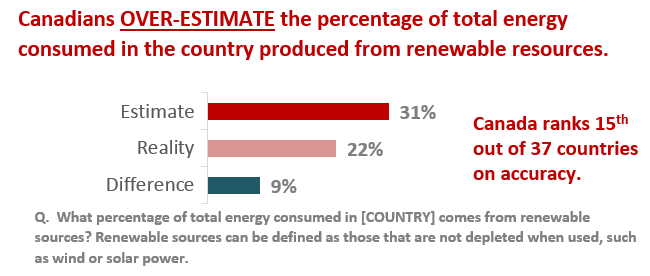
That same survey, Perils of Perceptions, reported that in most countries the public overestimates how much green energy they consume.  That finding is the subject of this post.  As we will see, energy from renewables is perceived to be much higher than numbers from the World Bank.  And since those numbers are themselves exaggerated, the gap between virtuous green behavior and performance is even greater than stated.

The renewable energy finding from Ipsos (here):

The majority of countries overestimate the amount of energy used that comes from renewable sources in their country. The average guess is 26% when it’s actually only 19%. Malaysia, Saudi Arabia, China and Singapore were the furthest out; some countries, though, actually underestimate how much progress they have made with renewables, such as Sweden and Montenegro.

Now, 19% of energy consumed coming from renewables looks high to me, so let’s explore two of the countries:  Canada and the Netherlands.

First, The Canadian Story on Green Energy Supply

energyuse

Question is Framed to be Misleading

Note that wind and solar power are presented as examples of renewable energy sources, when in reality hydro and nuclear are much larger sources of power (electricity). Note also respondents are led to confuse power with total energy, which is a much larger amount.

What is the Reality of Canadian Energy Supply (Consumption)

World Bank shows 22% of Canada’s total energy consumption was from renewables in 1990 and 2015.

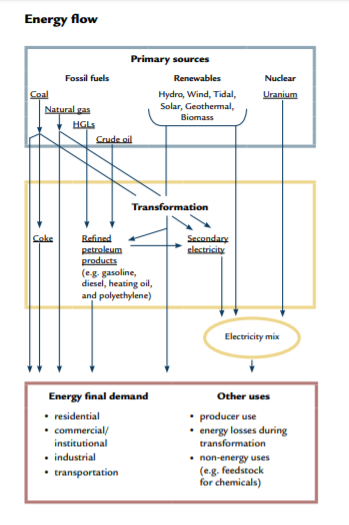
Let’s test that number against the Canadian Energy Fact Book 2016–2017 (which presents 2014 as the latest statistics).  The categories are defined nicely in this diagram:
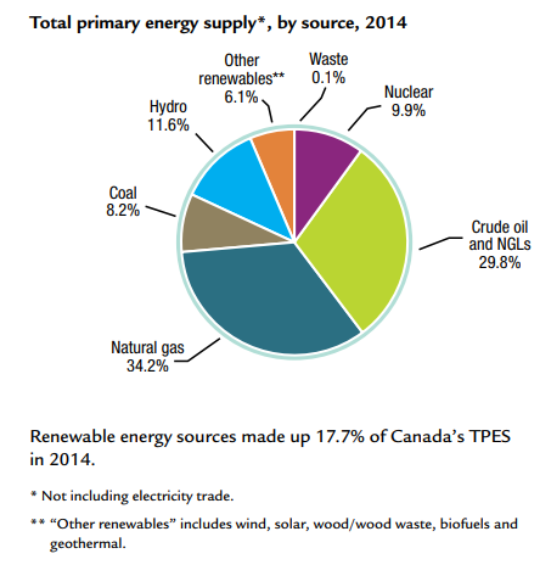
Energy FlowWorking from the top down, first is the mix of total primary energy supply by source:
Canada Primary Energy Supply
In this fact book, energy supply is equivalent to energy consumed, since it is calculated after adjusting for energy imports and exports. Note that 17.7% is the amount of energy from renewables, and hydro is 11.6%.   Let’s see how much of renewable energy comes from wind and solar:
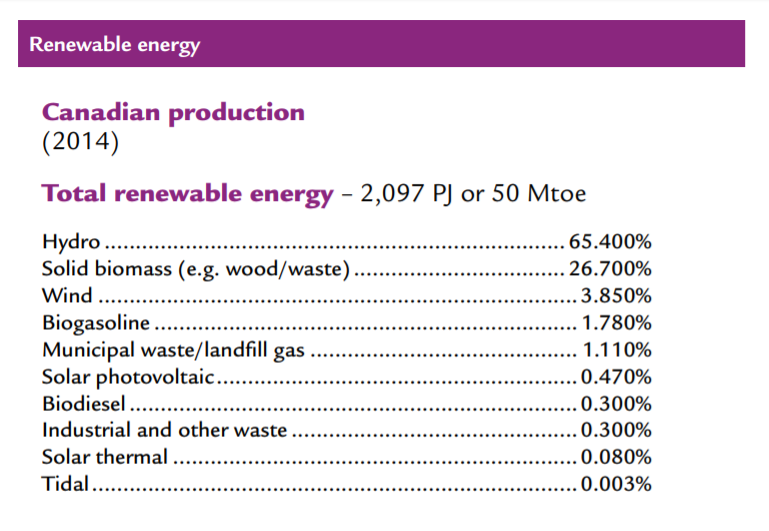
Canada Renewable EnergySo Canadians actually consume 4.35% of their renewable energy from wind and solar. 92% of Canadian renewable energy comes from the traditional sources:  Hydro dams and burning wood.

Combining the two tables, we see that 80% of the Other Renewables is solid biomass (wood), which leaves at most 1% of Canadian total energy supply coming from wind and solar.

Second, the Netherlands Green Energy Story

According to the Ipsos Perils of Perception survey, respondents from the Netherlands said on average 22% of their energy is Green, while the World Bank says only 6% comes from Green sources.  Last year there was a provocative and entertaining analysis of Dutch perceptions versus green energy realities broadcast on a popular Sunday morning TV show.  The episode was called Green Electrical Shocks, and is provided below for your enjoyment and edification.

Green Electrical Shocks


On Sunday Feb.4, 2018, a weekly news program aired in the Netherlands on the titled subject. H/T Climate Scepticism. The video clip is below with English subtitles. For those who prefer reading, I provide the substantial excerpts from the program with my bolds.

How many of you have Green Electricity? I will estimate 69%
And how much nationally? Oh, 69%!
So we are very average, and in a good way, because the climate is very important.

Let me ask: Green electricity comes from . . .?
Yes, electricity produced from windmills and solar panels.
Nearly 2/3 of the Dutch are using it. That’s the image.

Well I have green news and bad news.
The green news: Well done!
The bad news: It is all one big lie.
Time for the Green Electrical Shocks.

Shock #1: The green electricity from your socket is not green.
When I switched to green electricity I was very proud.
I thought, Yes, well done! The climate is getting warmer, but not any more thanks to me.

Well, that turned out to be untrue.
All producers deliver to one communal grid. Green and grey electricity all mix.
The electricity you use is always a mix of various sources.
OK. It actually makes sense not to have separate green and grey cables for every house.
So it means that of all electricity, 69% is produced in a sustainable way. But then:


Shock #2: Green Electricity is mostly fake.
Most of the green electricity we think we use comes from abroad.
You may think: So what. Green is green.

But that electricity doesn’t come from abroad, it stays abroad.
If you have green electricity at home, it may mean nothing more than that your supplier has bought “green electricity certificates”.

In Europe green electricity gets an official certificate,
Instead of selling on the electricity, they sell on those certificates.
Norway, with its hydro power, has a surplus of certificates.
Dutch suppliers buy them on a massive scale, while the electricity stays in Norway.


The idea was: if countries can sell those certificates, they can make money by producing more green electricity.
But the Norwegians don’t produce more green electricity.
But they do sell certificates.

The Dutch suppliers wave with those certificates, and say Look! Our grey electricity is green.
Only one country has produced green electricity: Norway.
But two countries take the credit.
Norway, because they produce green electricity, and the Netherlands because, on paper, we have green electricity. Get it? That’s a nice deal.

More and more countries sell those certificates. Italy is now the top supplier.
We buy fake green electricity from Italy, like some kind of Karma ham.

Now, let’s look again at the green electricity we all think we use.
So the real picture isn’t 69%. If you cancel the certificates, only 21% of electricity is really green.
Nowadays you can even order it separately if you don’t want to be part of that Norway certificates scam.
You may think: 21% green is still quite a lot. But it is time for:


Shock #3: Not all energy is electricity.
If you talk about the climate, you shouldn’t just consider electricity but all energy.
When you look at all energy, like factories, cars, trains, gas fires, then the share of consumer electricity is virtually nothing.
If you include everything in your calculation, it turns out that only 6% of all the energy we use in the Netherlands is green. It is a comedy, but wait:

Trees converted into pellets by means of petroleum powered machinery.

Shock #4: Most green energy doesn’t come from sun or wind, like you might think.
Even the 6%, our last green hope, is fake. According to the CBS we are using more sun and wind energy, but most of the green energy is produced by the burning of biomass.
Ah, more than half of the 6% green energy is biomass.

Ridiculous. What is biomass really? It is organic materials that we encounter every day.
Like the content of a compost heap. How about maize leaves or hay?
The idea behind burning organic materials is that it will grow up again.
So CO2 is released when you burn it, but it will be absorbed again by new trees.

However, there is one problem. The forest grows very slowly and our power plants burn very fast.
This is the fatal flaw in the thinking about biomass. Power plants burn trees too fast, so my solution: slow fire. Disadvantage: it doesn’t exist. So this is our next shock.

Shock#5: Biomass isn’t all that sustainable.
It’s getting worse. There aren’t enough trees in the Netherlands for biomass.
We can’t do it on our own. We don’t have enough wood, so we get it from America.

In the USA forests are cut at a high rate, Trees are shredded and compressed into pellets.
These are shipped to the Netherlands and end up in the ovens of the coal plants.
It’s a disaster for the American forests, according to environmental groups.

So we transport American forests on diesel ships to Europe.
Then throw them in the oven because it officially counts as green energy.
Only because the CO2 released this way doesn’t count for our total emissions.

In reality biomass emits more CO2 than natural gas and coal.
These are laws of nature, no matter what European laws say.
At the bottom line, how much sustainable energy do we really have in the Netherlands?
Well, the only real green energy from windmills, solar panels etc. Is only 2.2%. of all the energy we use.

In Conclusion
So the fact that 2/3 of the audience and of all Dutch people use green electricity means absolutely nothing. It’s only 2.2%, and crazier still, the government says it should be at 14% by 2020.
They promised: to us, to Europe, to planet Earth: 14 instead of 2.2.

Instead of making a serious attempt to save the climate, they are only working on accounting tricks, like buying pieces of paper in Norway and burning American forests.
They are only saving the climate on paper.

Summary Comment

As the stool above shows, the climate change package sits on three premises. The first is the science bit, consisting of an unproven claim that observed warming is caused by humans burning fossil fuels. The second part rests on impact studies from billions of research dollars spent uncovering any and all possible negatives from warming. And the third leg is climate policies showing how governments can “fight climate change.”

It is refreshing to see more and more articles by people reasoning about climate change/global warming and expressing rational positions. Increasingly, analysts are unbundling the package and questioning not only the science, but also pointing out positives from CO2 and warming.  And as the Dutch telecast shows, ineffective government policies are also fair game.

More on flawed climate policies at Reasoning About Climate

Wind Power is a Dead End

Robert Bryce reports on the end of wind power hopes in City Journal.  Why Wind Power Isn’t the Answer  Excerpts in italics with my bolds

As a new study confirms, turbines would have to be stacked across state-sized swaths of the American landscape.

On October 8, the Intergovernmental Panel on Climate Change released a report warning that nations around the world must cut their greenhouse-gas emissions drastically to reduce the possibility of catastrophic climate change. The report emphasizes “fast deployment of renewables like solar and wind” and largely ignores the essential role nuclear energy must play in any decarbonization effort.

Four days earlier, to much less fanfare, two Harvard researchers published a paper showing that trying to fuel our energy-intensive society solely with renewables would require cartoonish amounts of land. How cartoonish? Consider: meeting America’s current demand for electricity alone—not including gasoline or jet fuel, or the natural gas required for things like space heating and fertilizer production—would require covering a territory twice the size of California with wind turbines.

The IPCC and climate-change activists love solar and wind energy, and far-left politicians like Alexandria Ocasio-Cortez have called for a wartime-style national mobilization to convert to 100 percent renewable-energy usage. But this credo ignores a fundamental truth: energy policy and land-use policy are inextricable.

The renewables-only proponents have no trouble mobilizing against land use for the extraction of hydrocarbons. Consider the battle in Colorado over Proposition 112, which will prohibit oil- and gas-drilling activities within 2,500 feet of homes, hospitals, schools and “vulnerable areas.” Environmental groups including 350.org, the Sierra Club, and Greenpeace have endorsed the initiative, which will appear on the November 6 ballot. If it passes, Proposition 112 would effectively ban new oil and gas production in Colorado, the nation’s fifth-largest natural gas producer. Or consider the months-long demonstrations that ended last year in South Dakota over the Dakota Access pipeline. More than 700 climate-change activists and others were arrested during protests claiming that Dakota Access, by crossing the traditional lands of the Standing Rock Sioux, was violating the tribe’s cultural and spiritual rights. These energy- and land-use battles are waged by climate activists and environmental groups whose goal is to shutter the hydrocarbon industry. Most of these groups, including 350.org and Sierra Club, routinely claim that the American economy can run solely on renewables. Further, the Sierra Club has tallied 74 U.S. cities that have pledged to get all of their electricity from renewable energy.

Japan is going to remove this Fukushima turbine, one of the world’s largest with a rotor diameter of 167 meters. It was deemed unprofitable due to multiple malfunctions decreasing the utilization rate. Its utilization rate over the year through June 2018 was 3.7 percent, well below the 30 percent necessary for commercialization.

But the new study, published in Environmental Research Letters, shows yet again that wind energy’s Achilles heel is its paltry power density. “We found that the average power density—meaning the rate of energy generation divided by the encompassing area of the wind plant—was up to 100 times lower than estimates by some leading energy experts,” said lead author Lee Miller, a postdoctoral fellow who coauthored the report with Harvard physics professor David Keith. The problem is that most estimates of wind energy’s potential ignore “wind shadow,” an effect that occurs when turbines are placed too closely together: the upwind turbines rob wind speed from others placed downwind.

The study looks at 2016 energy-production data from 1,150 solar projects and 411 onshore wind projects. The combined capacity of the wind projects totaled 43,000 megawatts, or roughly half of all U.S. wind capacity that year. Miller and Keith concluded that solar panels produce about 10 times more energy per unit of land as wind turbines—a significant finding—but their work demands attention for two other reasons: first, it uses real-world data, not models, to reach its conclusions, and second, it shows that wind energy’s power density is far lower than the Department of Energy, the IPCC, and numerous academics have claimed.

Further: “While improved wind turbine design and siting have increased capacity factors (and greatly reduced costs), they have not altered power densities.” In other words, though Big Wind has increased the size and efficiency of turbines—the latest models stand more than 700 feet tall—it hasn’t been able to wring more energy out of the wind. Due to the wind-shadow effect, those taller turbines must be placed farther and farther apart, which means that the giant turbines cover more land. As turbines get taller and sprawl across the landscape, more people see them.

Rural residents are objecting to wind projects because they want to protect their property values and viewsheds. They don’t want to see the red-blinking lights atop those massive turbines, all night, every night, for the rest of their lives. Nor do they want to be subjected to the health-damaging noise—both audible and inaudible—that the turbines produce.

The backlash against Big Wind is coast to coast. In New York, which has mandated 50 percent renewable-energy usage by 2030, the towns of Yates and Somerset are fighting against Lighthouse Wind, a 200-megawatt wind project proposed for the shores of Lake Ontario. In Oklahoma, the tiny town of Hinton continues its battle against NextEra Energy, the world’s biggest wind-energy producer, over the siting of wind projects nearby. In California, which just boosted its renewable-electricity mandate to 60 percent by 2030, wind turbines are so unpopular that the industry has effectively given up trying to site new projects there. Meantime, in deep-blue Vermont, both gubernatorial candidates—incumbent Republican Phil Scott and Democratic challenger Christine Hallquist—favor renewable energy in principle but oppose further wind-energy development in the state.

Big Wind has attempted to intimidate some of its rural opponents by filing lawsuits against them. Last year, NextEra sued the town of Hinton in federal and state court after the town passed an ordinance restricting wind-energy development. The wind-energy giant also sued local governments in Michigan, Indiana, and Missouri, all of which had passed measures restricting wind-energy development.

Why the hardball tactics? Simple: rural residents stand between Big Wind and tens of billions of dollars in subsidies available through the Production Tax Credit. In September, Lisa Linowes, cofounder and executive director of the Industrial Wind Action Group, a New Hampshire-based nonprofit that tracks the wind industry, published an article on MasterResource.org. “The US Treasury estimates the PTC will cost taxpayers $40.12 billion in the period from 2018 to 2027,” Linowes wrote, “making it, by far, the most expensive energy subsidy under current tax law.”

The punchline here is obvious: wind energy has been sold as a great source of “clean” energy. The reality is that wind energy’s expansion has been driven by federal subsidies and state-level mandates. Wind energy, cannot, and will not, meet a significant portion of our future energy needs because it requires too much land.

Wind Farms Area for London

Gray area required for wind farms, yellow area for solar farms, to power London UK.

Miller and Keith’s paper shows that the ongoing push for 100-percent renewables, and, in particular, the idea that wind energy is going to be a major contributor to that goal, is not just wrongheaded—it’s an energy dead end.

The paper is Observation-based solar and wind power capacity factors and power densities

Robert Bryce is a senior fellow at the Manhattan Institute and the producer of the forthcoming documentary, Juice: How Electricity Explains the World, which will be released in 2019.

See also Kelly’s Climate Clarity

Footnote:  It bears repeating here that modern societies have benefited greatly by sourcing their energy from underground rather then above ground.   From post excerpting writing by Pierre Desrochers and Joanna Szurmak, Control Population, Control the Climate. Not.

“Pessimists are also oblivious to the benefits of unlocking wealth from underground materials such as coal, petroleum, natural gas and mineral resources. Using these spares vast quantities of land. It should go without saying that even a small population will have a much greater impact on its environment if it must rely on agriculture for food, energy and fibres, raise animals for food and locomotion, and harvest wild animals for everything from meat to whale oil. By replacing resources previously extracted from the biosphere with resources extracted from below the ground, people have reduced their overall environmental impact while increasing their standard of living.”


Ontario to Scrap Green Energy Act

Update September 21, 2018 at bottom

Global News reports on today;s proposed legislation: Ontario PCs introduce legislation to scrap Green Energy Act.  Excerpts in italics with my bolds.

Doug Ford‘s Progressive Conservative government has introduced legislation to put an end to the province’s Green Energy Act.

The legislation was tabled just before 1:30 p.m. ET Thursday. A formal announcement was made by energy minister, Greg Rickford, and infrastructure minister, Monte McNaughton.

“The Green Energy Act represents the largest transfer of money from the poor and middle class to the rich in Ontario’s history,” Rickford said.

Killing the former Liberal government’s Green Energy Act — passed in 2009 when Dalton McGuinty was premier — was a major campaign promise for Ford.

He said that the GEA had resulted in fewer manufacturing jobs in Ontario and that regulations around renewable energy projects had led to higher electricity prices for consumers.

Reddy the shiv

The move comes after the PC government had already introduced legislation cancelling hundreds of wind energy projects approved under the act.

Scrapping the GEA will likely mean major changes for the province’s energy sector.

For example, under the GEA, municipalities were essentially barred from disallowing renewable energy projects – such as wind farms – from being built within their territory. Many people opposed to these projects criticized this section of the GEA, saying it prohibited local communities from deciding their own futures.

The GEA also gave special powers to the minister of energy to green light certain projects, such as transmission lines, without conducting a full economic review prior to approval.

But proponents of the GEA, including former energy minister George Smitherman, who helped pass the legislation, have called the GEA and renewable energy projects in the province a big success.

Meanwhile, Liberal interim leader, John Fraser, says cancellation of the GEA could see Ontario move backward on renewable energy when compared to the rest of the world. He also fears scrapping the act could mean job losses

“My biggest concern this afternoon is jobs. What’s going to happen to people’s jobs in this industry that we’ve built up – tens of thousands of jobs,” Fraser said.

But the PCs say this isn’t true.

They say that the GEA was responsible for the “disastrous” feed-in-tariff program that contributed significantly toward skyrocketing electricity prices and that the bill’s repeal is necessary to prevent “unneeded” renewable energy projects being approved in the future.

“We believe the people of Ontario should have the final say about what gets built in their communities,” McNaughton said.

Update September 21, 2018

Some news reports have given more air time to reaction from greens.  Lorrie Goldstein at Toronto Sun instead goes into more detail why the Ontario Green Act is a failure: Good riddance to toxic Green Energy Act  Excerpts in italics with my bolds.

By scrapping the Green Energy Act, passed by former Liberal premier Dalton McGuinty in 2009, Premier Doug Ford is ending one of the worst legislative disasters ever inflicted on the people of Ontario.

The GEA is largely responsible for Ontario’s skyrocketing electricity prices.

It’s the reason we’re paying outrageously high prices for green energy the Liberals didn’t need in order to eliminate coal power, which was actually done using nuclear power and natural gas.

The jobs the Liberals promised under the GEA never materialized, according to former Ontario auditor general Jim McCarter in his 2011 annual report.

The GEA made Ontario’s energy grid less efficient because it required the province to buy expensive and unreliable wind and solar power from green energy developers under 20-year contracts, before purchasing other forms of energy.

Auditor General Bonnie Lysyk reported in 2016 that Ontario electricity consumers had overpaid $9.2 billion for green energy, because the Liberals ignored the advice of their own experts on how to price it.

Under the GEA, the Liberals abdicated from the proper role of government, which is to balance public and private interests.

Instead, they became cheerleaders for the wealthy green energy lobby.

Citizens opposed to green energy projects imposed on their communities faced the impossible task of fighting the industry and the Liberal government.

Ford is right to scrap the GEA.

The tragedy is that the economic damage it caused under the McGuinty/Wynne Liberals will be felt for decades to come.

Germany & California Could Already Have 100% Clean Power from Nuclear

California Governor Jerry Brown and German Chancellor Angela Merkel SHUTTERSTOCK

Michael Shellenberger has the story at Forbes Had They Bet On Nuclear, Not Renewables, Germany & California Would Already Have 100% Clean Power  Excerpts in italics with my bolds.

Had California and Germany invested $680 billion into new nuclear power plants instead of renewables like solar and wind farms, the two would already be generating 100 percent or more of their electricity from clean (low-emissions) energy sources, according to a new analysis by Environmental Progress.

The analysis comes the day before California plays host to a “Global Climate Action Summit,” which makes no mention of nuclear, despite it being the largest source of clean energy in the U.S. and Europe.

Here are the two main findings from EP’s analysis:

  • Had Germany spent $580 billion on nuclear instead of renewables, it would have had enough energy to both replace all fossil fuels and biomass in its electricity sector and replace all of the petroleum it uses for cars and light trucks.
  • Had California spent an estimated $100 billion on nuclear instead of on wind and solar, it would have had enough energy to replace all fossil fuels in its in-state electricity mix.

The finding that Germany could have entirely decarbonized its transportation sector with nuclear is a significant one. That’s because decarbonizing transportation is considered a major challenge by most climate policy experts.

As a result of their renewables-only policies, California and Germany are climate laggards compared to nuclear-heavy places like France, whose electricity is 12 times less carbon intensive than Germany’s, and four times less carbon intensive than California’s.

France’s nuclear-heavy electricity is 12 times less carbon intensive than Germany’s, and four times less than California’s.EP

Thanks to its deployment of nuclear power, the Canadian province of Ontario’s electricity is nearly 90 percent cleaner than California’s, according to a recent analysis by Scott Luft, an energy analyst who tracks decarbonization and the power sector.

In the 1960s and 1970s, California’s electric utilities had planned to build a string of new reactors and new plants that were ultimately killed by anti-nuclear leaders and groups, including Governor Jerry Brown, the Sierra Club, and Natural Resources Defense Fund (NRDC).

Other nuclear plants were forced to close prematurely, including Rancho Seco and San Onofre Nuclear Generating Station, while Diablo Canyon is being forced to close by California’s Renewable Portfolio Standard, which excludes nuclear.

California’s power sector emissions are over twice as high today as they would have been had the state kept open and built planned nuclear plants.

But the new EP analysis underscores that the problem is not just closing plants but also choosing to build solar and wind farms instead of new nuclear power stations.

Summary

Who appointed these two mistaken politicians to lead a worldwide “fight against climate change”?

Footnote: In this short video Alex Epstein explains the problem replacing fossil fuels by wind and solar energy.

Alberta Set to Imitate Ontario’s Electrical Mess

Albertans pay around five cents a kilowatt hour — compared to the up to 18 cents Ontarians experienced, but for how long?Postmedia News

Kevin Libin writes in Financial Post: Alberta’s now copying Ontario’s disastrous electricity policies. What could go wrong?  Get ready, Albertans, a new report reveals that all the thrills and spills that follow when politicians start meddling in a boring, but well-functioning electricity market are coming your way.  Excerpts in italics below with my bolds.

A report released Thursday by the University of Calgary’s School of Public Policy gives a sneak peek of how the Alberta script could play out. It begins once again with a “progressive” government convinced that its legacy lies in climate activism, out to redesign an electricity grid from something meant to provide affordable, reliable power into a showpiece of uncompetitive solar and wind power. And like Ontario, the Alberta NDP is determined to turn its provincial electricity grid into not just a green project that ignores economics, but an affirmative-action diversity project that sets aside certain renewable deals for producers owned by First Nations.

Alberta Premier Rachel Notley’s plan, like McGuinty’s, is to phase out all of Alberta’s cheap, abundant but terribly uncool coal-fired power (by 2030, in Alberta’s case) and force onto the grid instead large amounts of unreliable, expensive solar and wind power. Albertans have been so preoccupied fighting through a barrage of energy woes since Notley’s NDP was elected — the oil-price crash, government-imposed carbon taxes and emission caps, blocked and cancelled pipelines and the Trudeau government’s wholesale politicization of energy regulation — that they probably haven’t realized yet how vast an overhaul Notley was talking about when she began revealing this plan in 2015. But the report’s author, Brian Livingston, an engineer and lawyer with deep experience in the energy business in Alberta, runs through the shocking numbers: As of last year, Alberta’s grid had a capacity of roughly 17,000 megawatts, but the envisioned grid of 2032 will require nearly 13,000 megawatts that do not currently exist. Think of it as rebuilding 75 per cent of Alberta’s current grid in less than 15 years. Hey, what could go wrong?

Alberta Electricity System Operator is planning for so much wind power that the province will blow past Ontario, a province three times its size. Postmedia News

And if Ontarians thought their government was obsessed with green power, Livingston notes that the Alberta Electricity System Operator is planning for so much wind power that the province will blow past Ontario, a province three times its size, with 5,000 megawatts of wind compared to Ontario’s 4,213 megawatts, and nearly twice as much solar power, 700 megawatts, compared to Ontario’s 380 megawatts.

Learning from McGuinty’s mistake, the Alberta NDP is smart enough to ensure the extra cost of all this uneconomic power won’t show up printed in black and white on consumers’ power bills, likely hoping that spares them the political fallout that now threatens the Ontario Liberals. Rather than ratepayers shouldering the pain, it will be taxpayers — largely the same people — who pay most for any additional costs through added deficits and debts, at least for the next few years. That’s because Notley has ordered a temporary cap on household electricity rates of 6.8 cents per kilowatt hour (which is still significantly higher than the current rate). When wholesale rates rise higher than that, the government will use carbon-tax revenues to pay the difference. But businesses pay full freight from the get go.

Hiding from the real costs of using energy is a curious move for a government that gives away energy-efficient light bulbs and other products designed to conserve while imposing carbon taxes to try suppressing energy use. It’s also a costly move. Estimates from the C. D. Howe Institute estimate it will cost Alberta taxpayers up to $50 million this year alone; a recent report from electricity consultants at EDC Associates estimates that by 2021, the extra costs moved off electric bills and onto tax bills will total $700 million. That’s when the price cap expires and costs could start showing up on power bills, instead.

Of course, Ontario has proven that it’s easy to underestimate how expensive these political experiments can get, but the Alberta redesign is already getting pricey. First, Notley accidentally stuck Alberta consumers with nearly $2 billion in extra surcharges when she rewrote carbon policies without realizing that gave producers the right to cancel unprofitable contracts. Her plan also requires the government to create a new “capacity” payment system for electricity producers, who will able to charge substantial sums even if they don’t produce a single watt. Livingston shows that many producers can earn almost as much just for offering capacity to the grid as they do for producing. Meanwhile, since solar power is perennially and embarrassingly uncompetitive economically, even with expensive wind power, the government plans to let solar providers sell electricity at premium rates to government facilities, with taxpayers covering that cost, too, just as they’ll cover the cost of overpriced wind power, which doesn’t approach the affordability of fossil fuels.

In his report, Livingston drily notes that the way Albertans think of the future of their electricity system could probably be summed up as: “Whatever we do here in Alberta, please let us not do it like they did it in Ontario.” They have reason to fear, since Livingston shows Ontario households have faced rates as much as four times higher than those in Alberta. Even if it doesn’t look exactly like the way they did things in Ontario, that doesn’t mean it still can’t go very wrong. Whenever progressive politics infests the electrical grid, people always pay for it in the end.

Background:  Climate Policies: Real Economic Damage Fighting Imaginary Problem