On Sunday Feb.4, a weekly news program aired in the Netherlands on the titled subject. H/T Climate Scepticism. The video clip is below with English subtitles. For those who prefer reading, I provide the substantial excerpts from the program with my bolds.
How many of you have Green Electricity? I will estimate 69% And how much nationally? Oh, 69%! So we are very average, and in a good way, because the climate is very important.
Let me ask: Green electricity comes from . . .? Yes, electricity produced from windmills and solar panels. Nearly 2/3 of the Dutch are using it. That’s the image.
Well I have green news and bad news. The green news: Well done! The bad news: It is all one big lie. Time for the Green Electrical Shocks.
Shock #1: The green electricity from your socket is not green. When I switched to green electricity I was very proud. I thought, Yes, well done! The climate is getting warmer, but not any more thanks to me.
Well, that turned out to be untrue. All producers deliver to one communal grid. Green and grey electricity all mix. The electricity you use is always a mix of various sources. OK. It actually makes sense not to have separate green and grey cables for every house. So it means that of all electricity, 69% is produced in a sustainable way. But then:
Shock #2: Green Electricity is mostly fake. Most of the green electricity we think we use comes from abroad. You may think: So what. Green is green.
But that electricity doesn’t come from abroad, it stays abroad. If you have green electricity at home, it may mean nothing more than that your supplier has bought “green electricity certificates”.
In Europe green electricity gets an official certificate, Instead of selling on the electricity, they sell on those certificates. Norway, with its hydro power, has a surplus of certificates. Dutch suppliers buy them on a massive scale, while the electricity stays in Norway.
The idea was: if countries can sell those certificates, they can make money by producing more green electricity. But the Norwegians don’t produce more green electricity. But they do sell certificates.
The Dutch suppliers wave with those certificates, and say Look! Our grey electricity is green. Only one country has produced green electricity: Norway. But two countries take the credit. Norway, because they produce green electricity, and the Netherlands because, on paper, we have green electricity. Get it? That’s a nice deal.
More and more countries sell those certificates. Italy is now the top supplier. We buy fake green electricity from Italy, like some kind of Karma ham.
Now, let’s look again at the green electricity we all think we use. So the real picture isn’t 69%. If you cancel the certificates, only 21% of electricity is really green. Nowadays you can even order it separately if you don’t want to be part of that Norway certificates scam. You may think: 21% green is still quite a lot. But it is time for:
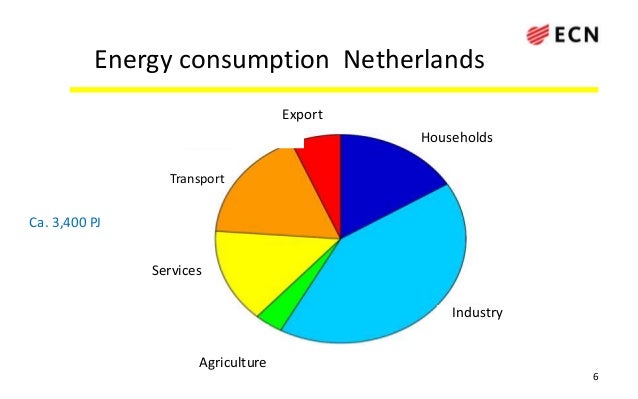
Shock #3: Not all energy is electricity. If you talk about the climate, you shouldn’t just consider electricity but all energy. When you look at all energy, like factories, cars, trains, gas fires, then the share of consumer electricity is virtually nothing. If you include everything in your calculation, it turns out that only 6% of all the energy we use in the Netherlands is green. It is a comedy, but wait:
Trees converted into pellets by means of petroleum powered machinery.
Shock #4: Most green energy doesn’t come from sun or wind, like you might think. Even the 6%, our last green hope, is fake. According to the CBS we are using more sun and wind energy, but most of the green energy is produced by the burning of biomass. Ah, more than half of the 6% green energy is biomass.
Ridiculous. What is biomass really? It is organic materials that we encounter every day. Like the content of a compost heap. How about maize leaves or hay? The idea behind burning organic materials is that it will grow up again. So CO2 is released when you burn it, but it will be absorbed again by new trees.
However, there is one problem. The forest grows very slowly and our power plants burn very fast. This is the fatal flaw in the thinking about biomass. Power plants burn trees too fast, so my solution: slow fire. Disadvantage: it doesn’t exist. So this is our next shock.
Shock#5: Biomass isn’t all that sustainable. It’s getting worse. There aren’t enough trees in the Netherlands for biomass. We can’t do it on our own. We don’t have enough wood, so we get it from America.
In the USA forests are cut at a high rate, Trees are shredded and compressed into pellets. These are shipped to the Netherlands and end up in the ovens of the coal plants. It’s a disaster for the American forests, according to environmental groups.
So we transport American forests on diesel ships to Europe. Then throw them in the oven because it officially counts as green energy. Only because the CO2 released this way doesn’t count for our total emissions.
In reality biomass emits more CO2 than natural gas and coal. These are laws of nature, no matter what European laws say. At the bottom line, how much sustainable energy do we really have in the Netherlands? Well, the only real green energy from windmills, solar panels etc. Is only 2.2%. of all the energy we use.
In Conclusion So the fact that 2/3 of the audience and of all Dutch people use green electricity means absolutely nothing. It’s only 2.2%, and crazier still, the government says it should be at 14% by 2020. They promised: to us, to Europe, to planet Earth: 14 instead of 2.2.
Instead of making a serious attempt to save the climate, they are only working on accounting tricks, like buying pieces of paper in Norway and burning American forests. They are only saving the climate on paper.
Summary Comment
As the stool above shows, the climate change package sits on three premises. The first is the science bit, consisting of an unproven claim that observed warming is caused by humans burning fossil fuels. The second part rests on impact studies from billions of research dollars spent uncovering any and all possible negatives from warming. And the third leg is climate policies showing how governments can “fight climate change.”
It is refreshing to see more and more articles by people reasoning about climate change/global warming and expressing rational positions. Increasingly, analysts are unbundling the package and questioning not only the science, but also pointing out positives from CO2 and warming. And as the Dutch telecast shows, ineffective government policies are also fair game.
Climatology considers ‘natural variability’ as a valuable factor in climate change matters. Ignoring any human role in this respect is irresponsible. The latest big issue is floating off shore wind turbines with a structure about 78 meters submerged and 15 meters in diameters. Although a massive obstacle in a permanent moving marine environment the impact and change in ‘natural variability’ in climate change matters is completely ignored.
The concern has been raised in a recent post: ”Why Europe is warming up faster than elsewhere?” The matter is simple. Off shore installations affect sea temperatures and salinity structure at many locations to about 60 meters below the sea surface. In Europe the number of off shore wind turbines will account 4000 by the end of 2017. The inevitable consequence is at hand: “Northern European winters are getting warmer and warmer at a rate higher than global average” as analyzed in a paper by A. Bernaerts (2016).
(Note: Sections 1 to 4 are profiles at different latitudes of the North Sea, identified in map upper right corner.)
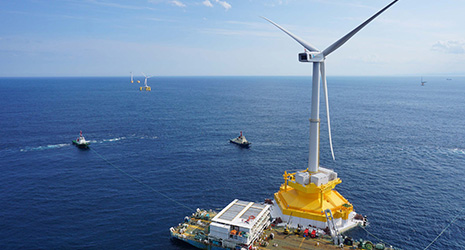
Now the impact on sea level structure increase further. The world’s first floating wind farm opened on 18 October 2017, off the east coast of Scotland. The 6MW turbines rise 175m above sea level, and extend 78m below the surface of the water, tied to the sea bed by cables. The anchors used to stabilize the turbines stand at 16m and weigh 111 tons. (Details) Inevitable huge water masses of different temperature and salinity will change between the various sea levels. As an example see Fig. 2 (Northern North Sea – Section 1-4). The sea surface will warm or cool and either warm or cool the air temperature above the scene.
Any use of the oceans by mankind has an influence on thermo-haline structures within the water column from a few cm to 10m and more. Not even raising and investigating this mechanism is a demonstration that the term “natural variability” is used to hide pseudoscience.
___A. Bernaerts (2016), Offshore Wind-Parks and Northern Europe’s Mild Winters: Contribution from Ships, Fishery, et cetera? Journal of Shipping and Ocean Engineering 6, p. 46-56, PDF HERE
Captains of industry contending with a sea of Obama era regulations.
Thanks to Rich Lowry’s article at National Review and some other sources, we can see clearly the three fatal flaws bringing down the Clean Power Plan in its entirety. Lowry wrote The Great Regulatory Rollback. Excerpts below with my bolds and images.
1. No federal law governs CO2 emissions.
Lowry: The Clean Power Plan, which sought to reduce U.S. carbon emissions by 32 percent below 2005 levels by 2030, was government by the administrative state on a scale that has never been attempted before. The EPA took a dubious reading of a portion of the Clean Air Act (Section 111, which arguably prevented the EPA from taking this action rather than empowered it to do so) and used it to mandate that the states adopt far-reaching plans to reduce carbon emissions, under threat of the loss of federal highway funds.
In an August ruling of the DC Court of Appeals, the justices put it in writing:
However, EPA’s authority to regulate ozone-depleting substances under Section 612 and other statutes does not give EPA authority to order the replacement of substances that are not ozone depleting but that contribute to climate change. Congress has not yet enacted general climate change legislation. Although we understand and respect EPA’s overarching effort to fill that legislative void and regulate HFCs, EPA may act only as authorized by Congress. Here, EPA has tried to jam a square peg (regulating non-ozone depleting substances that may contribute to climate change) into a round hole (the existing statutory landscape).
The Supreme Court cases that have dealt with EPA’s efforts to address climate change have taught us two lessons that are worth repeating here. See, e.g., Utility Air Regulatory Group v. EPA, 134 S. Ct. 2427 (2014). First, EPA’s well intentioned policy objectives with respect to climate change do not on their own authorize the agency to regulate. The agency must have statutory authority for the regulations it wants to issue. Second, Congress’s failure to enact general climate change legislation does not authorize EPA to act. Under the Constitution, congressional inaction does not license an agency to take matters into its own hands, even to solve a pressing policy issue such as climate change.
From the Court Document On Petitions for Review of Final Action by the United States Environmental Protection Agency. Additional discussion at DC Appeals Court Denies EPA Climate Rules
2. EPA regulates sites, not the Energy Sector.
Lowry: The presumption of the plan was jaw-dropping. The EPA usually targets pollutants; carbon dioxide isn’t one (although the Supreme Court erroneously said that it meets the definition in the case of Massachusetts v. EPA). The EPA has always regulated specific power plants; in this scheme, it went “outside the fence” to mandate broader actions by the states, e.g., the adoption of quotas for renewable energy. The EPA once considered its mandate to be protecting clear air and water for Americans; with the Clean Power Plan, it sought to adjust the global thermostat for the good of all of humanity.
That the CPP depends on the employment of measures that cannot be applied at and to an individual source is evident from its treatment of coal-fired power plants. The rule established performance standards for coal-fired plants assuming a uniform emissions rate well below that which could be met by existing units through any retrofit technology of reasonable cost available at the time. This means that, in order to comply, many owners or operators of existing coal-fired units were expected to shift generation from such units to gas-fired units or to renewable generation. Similarly, the rule contemplated that gas-fired units would shift generation to renewable generation. The rule therefore is formulated in reliance on and anticipation of actions taken across the electric grid, rather than actions taken at and applied to individual units. Pp 8-9
The EPA is proposing to repeal the CPP in its entirety. The EPA proposes to take this action because it proposes to determine that the rule exceeds its authority under the statute, that those portions of the rule which arguably do not exceed its authority are not severable and separately implementable, and that it is not appropriate for a rule that exceeds statutory authority—especially a rule of this magnitude and with this level of impact on areas of traditional state regulatory authority—to remain in existence pending a potential, successive rulemaking process.Pg 12
After reconsidering the statutory text, context, and legislative history, and in consideration of the EPA’s historical practice under CAA section 111 as reflected in its other existing CAA section 111 regulations, the Agency proposes to return to a reading of CAA section 111(a)(1) (and its constituent term, “best system of emission reduction”) as being limited to emission-reduction measures that can be applied to or at an individual stationary source. That is, such measures must be based on a physical or operational change to a building, structure, facility, or installation at that source, rather than measures that the source’s owner or operator can implement on behalf of the source at another location. The EPA believes that this is the best construction of CAA section 111(a)(1), as explained in detail below, for several reasons.pg 14
Therefore, the EPA proposes that the BSER be limited to measures that physically or operationally can be applied to or at the source itself to reduce its emissions. Generation shifting—which accounts for a significant percentage of the emissions reductions projected in the CPP and without which individual sources could not meet the CPP’s requirements—fails to comply with this limitation. Accordingly, the EPA proposes to repeal the CPP.pg25-26
In addition, while the EPA is authorized to regulate emissions from sources in the power sector and to consider the impact of its standards on the generation mix in setting standards to avoid negative energy impacts, regulation of the nation’s generation mix itself is not within the Agency’s authority. Regulation of the energy sector qua energy sector is generally undertaken by the Federal Energy Regulatory Commission (FERC) and States, depending on which markets are being regulated. Pg.27
3. CPP costs are huge, while benefits are marginal.
Lowry: The last gets to the absurdity of the Clean Power Plan on its own terms — it did virtually nothing to affect global warming. As Benjamin Zycher of the American Enterprise Institute points out, the Obama administration’s Climate Action Plan (which includes the Clean Power Plan) would reduce the global temperature by 15 one-thousandths of a degree by 2100. The point wasn’t to fight climate change per se, but to signal our climate virtue in the hopes of catalyzing action by other nations and, not incidentally, hobble the U.S. coal industry in favor of more politically palatable sources of energy, namely wind and solar.
An irony emerges on this third point. In order to propose a regulatory change, the EPA must present calculations pertaining to the “Social Cost of Carbon (SCC)”, now renamed “Social Cost of CO2 (SC-CO2)”. In the document released by EPA, this Regulatory Impact Analysis (RIA), begins on page 30 with several tables.
Methodology Considerations:
In addition to presenting results from the 2015 CPP RIA, this RIA uses two additional quantitative approaches to analyze the effects of the CPP in order to present information on the potential effects of the proposed repeal of the CPP. The first approach involves a modest reworking of the 2015 CPP RIA to increase transparency and illuminate the uncertainties associated with assessing benefits and costs of the CPP, as reflected in the 2015 analysis, as well as analyzing the potential effects of the CPP repeal. More specifically, this analysis increases transparency of the 2015 CPP analysis by presenting the energy efficiency cost savings as a benefit rather than a cost reduction and provides a bridge to future analyses that the agency is committed to performing. The current analysis also provides alternative approaches for examining the foregone benefits, including more clearly distinguishing the direct benefits from the co-benefits and exploring alternative ways to illustrate the impacts on the total net benefits of the uncertainty in health co-benefits at various PM2.5 cutpoints. This approach shifts the focus to the domestic (rather than global) social cost of carbon, and employs both 3 percent and 7 percent discount rates. Finally, we consider that how changing market conditions and technologies may have affected future actions that may have been undertaken by states to comply with the CPP and how these changes may affect the potential benefits and costs of the CPP repeal. Pg. 30
As the RIA analyzes costs and benefits applying a variety of different methods and discount rates, there is a relatively large number of results. We present the full suite of avoided compliance cost, forgone benefit, and net benefit results discussed in the RIA in Tables 1 through 3. Pg 33
Therefore, in Tables 4 and 5 we offer another perspective on the costs and benefits of this rule by presenting a comparison of the forgone benefits from the targeted pollutant – CO2 – (the costs of this proposed rule) with the avoided compliance cost (the benefits of this proposed rule). Excluded from this comparison are the forgone benefits from the SO2 and NOX emission reductions that were also projected to accompany the CO2 reductions. However, had those SO2 and NOX reductions been achieved through other means, then they would have been represented in the baseline for this proposed repeal (as well as for the 2015 Final CPP), which would have affected the estimated costs and benefits of controlling CO2 emissions alone. Pg.37
Table 5 Gives the Bottom Line (in billions of US$)
Year
Discount Rate
Compliance Costs Avoided
Forgone Domestic Climate Benefits
2020
3%
($0.30)
$0.10
7%
($0.30)
$0.00
2025
3%
$14.50
$1.30
7%
$14.50
$0.20
2030
3%
$14.40
$2.50
7%
$14.40
$0.40
Summary
There will be lots of pushback on these numbers since they show billions of compliance cost against miniscule benefits.
Lowry: If Congress had authorized the EPA to remake the nation’s energy economy, we would presumably be aware of it and recall an impassioned congressional debate over this radical and costly change. In fact, the opposite is true. Congress has declined to enact laws limiting carbon emissions, including when Democrats held both houses of Congress under President Obama. If the future of the planet is at stake and it requires a generational effort to save it, surely it is not too much to ask that a statute or two be enacted by Congress explicitly committing the country to the task. Yes, this requires winning elections and gaining democratic assent, but such are the challenges of living in a republic and a nation of laws.
Charles McConnell explains the emptiness of this recent popular virtue signaling. His article in WSJ is City Pledges for ‘100% Renewable Energy’ Are 99% Misleading The power grid is built on fossil fuels, and there’s no way to designate certain electrons as guilt free. Entire article reprinted below (my bolds and images)
Dozens of cities have made a misleading pledge: that they will move to 100% renewable energy so as to power residents’ lives without emitting a single puff of carbon. At a meeting of the U.S. Conference of Mayors in late June, leaders unanimously adopted a resolution setting a “community-wide target” of 100% clean power by 2035. Mayors from Portland, Ore., to Los Angeles to Miami Beach have signed on to these goals.
States are getting in the game, too. Two years ago Hawaii pledged that its electricity would be entirely renewable by 2045. The California Senate recently passed a bill setting the same goal, while moving up the state’s timeline to get half its electricity from renewables from 2030 to 2025.
Let’s not get carried away. Although activists herald these pledges as major environmental accomplishments, they’re more of a marketing gimmick. Use my home state of Texas as an example. The Electric Reliability Council of Texas oversees 90% of the state’s electricity generation and distribution. Texas generates more wind and solar power than any other state. Yet more than 71% of the council’s total electricity still comes from coal and natural gas.
The trick is that there’s no method to designate electrons on the grid as originating from one source or another. Power generated by fossil fuels and wind turbines travels together over poles and underground wires before reaching cities, homes and businesses. No customer can use power from wind and solar farms exclusively.
So how do cities make this 100% renewable claim while still receiving regular electricity from the grid? They pay to generate extra renewable energy that they then sell on the market. If they underwrite enough, they can claim to have offset whatever carbon-generated electricity they use. The proceeds from the sale go back to the city and are put toward its electric bill.
In essence, these cities are buying a “renewable” label to put on the regular power they’re using. Developers of wind and solar farms win because they can use mayoral commitments to finance their projects, which probably are already subsidized by taxpayers.
But the game would never work without complete confidence in the reliability of the grid, which is dependent on a strategy of “all of the above,” generating power from sources that include coal, natural gas, nuclear, wind and solar.
The mayor of Georgetown, Texas, announced earlier this year that his city had reached its goal of 100% renewable electricity. But in a 2015 article announcing the pledge, he acknowledged what would happen if solar and wind were not able to cover the city’s needs: “The Texas grid operator, the Electric Reliability Council of Texas, will ensure generation is available to meet demand.”
Two years ago the mayor of Denton, Texas, announced a plan to go 70% renewable, while calling a target of 100% unrealistic. “One of the challenges of renewable energy is that it’s so hard to predict,” he said. “You don’t know exactly when the sun is going to shine or when the wind is going to blow. To maintain that reliable power, you must have backup power.”
There is no denying that wind and solar power are important to a balanced energy portfolio. But coal is the bedrock of affordable electricity, and it will remain so, no matter how much wishful thinking by environmental activists. Coal is abundant and reliable. Unlike wind and solar, coal generation can be dialed up and down in response to market conditions and to satisfy demand.
The headline-grabbing 100% renewable pledges intentionally overlook these facts. Fossil fuels are not only the largest and most critical component of the energy portfolio, they are the foundation upon which renewable power must stand. Wind and solar generators ride free into the electric grid on the backs of fossil generators that have installed and paid for the infrastructure on which all Americans depend. The rise of renewable generation is made possible by fossil fuels, not despite them.
We should celebrate the growth of renewables, but not with false and misleading claims. What’s needed is transparency and a shared objective to provide consumers with the most reliable, resilient and affordable energy available.
Mr. McConnell, executive director of the Energy and Environment Initiative at Rice University, was an assistant secretary of energy, 2011-13.
Update August 18, 2017
People need to know that adding renewables to an electrical grid presents both technical and economic challenges. Experience shows that adding intermittent power more than 10% of the baseload makes precarious the reliability of the supply. South Australia is demonstrating this with a series of blackouts when the grid cannot be balanced. Germany got to a higher % by dumping its excess renewable generation onto neighboring countries until the EU finally woke up and stopped them. Texas got up to 29% by dumping onto neighboring states, and some like Georgia are having problems.
But more dangerous is the way renewables destroy the economics of electrical power. Seasoned energy analyst Gail Tverberg writes:
In fact, I have come to the rather astounding conclusion that even if wind turbines and solar PV could be built at zero cost, it would not make sense to continue to add them to the electric grid in the absence of very much better and cheaper electricity storage than we have today. There are too many costs outside building the devices themselves. It is these secondary costs that are problematic. Also, the presence of intermittent electricity disrupts competitive prices, leading to electricity prices that are far too low for other electricity providers, including those providing electricity using nuclear or natural gas. The tiny contribution of wind and solar to grid electricity cannot make up for the loss of more traditional electricity sources due to low prices.
Energy engineers are having an interesting fight over whether the US electricity grid can “easily” be 100% renewables (and thus create 0 GHG emissions) in the next 30 years. A prominent Stanford Engineer and his team says “yes” while some important critics say no. In Today’s NY Times (“Economics Scene”) Eduardo Porter sides with the critics. The interesting thing here is that no empirical microeconomists who study energy are part of either research team or are quoted in the NY Times. Yet, at the end of the day — this is a microeconomics issue.
Here are some of the key issues that both the original study and the critique ignore;
1. The land markets? It would be terrific if wind and solar and hydro are so low cost by the year 2050 that we can generate all of our power using them. Assuming constant returns to scale, how much land would need to be allocated to each of these to generate our expected power demand in 2050? In a world where land is very valuable close to cities, what land would be set aside for this? Would current property owners be compensated for this land? Or would this be “roof top solar”? I do not believe there is any discussion of land markets in the original 2015 PNAS paper or the new critique. So the opportunity cost of land should be included in all of these calculations.
2. Transmission lines? Assuming the renewables generation is far from cities, where will the transmission lines be built to bring the power to the cities? How will NIMBY issues be solved? How will potential veto power be bought out here? Or will engineers make a breakthrough such that power can be “emailed” without transmission capacity?
3. Comparative Energy Costs? How much induced innovation will be needed to make the green energy production technologies cheaper than natural gas in the year 2050? So, we need an estimate of dynamic innovation in the dirty sector vs. the clean sector (see the recent work of Daron Acemoglu and co-authors on the “great race”).
4. Flexible power demand? What will be aggregate electricity demand in 2050? How many consumers in the residential, industrial, commercial sectors will be signed up for dynamic pricing? How elastic will their demands be for power such that if the price of power rises will they in aggregate reduce their consumption by 2% or by 34% This plays a key role in determining the feasibility of the green grid! If demand is highly responsive to higher prices then the green grid is much more viable! So, now we are back to fundamental issues of the microeconomic determinants of the aggregate demand for electricity.
5. Electric vehicles demand? Building on #4; what will be the aggregate demand of the transportation sector for energy and electricity in 2050? What % of the fleet will be EVs and how many miles will they drive and how many miles per kwh will they achieve? Some of these are micro-economic questions!
6. Air Conditioning Demand? Building on #4, what will be aggregate demand for air conditioning during hot summers? What thermostat level will businesses and households cool to? How efficient will air conditioners be then (see the 1999 QJE by Newell, Jaffee and Stavins on induced innovation; see point #3 above).
7. Resistence from Vested Interests? I appreciate that the engineers want to debate what is feasible but this overlooks important implementation issues that may raise the cost of introducing their valuable ideas. For example, which interest groups would seek to veto the Stanford “vision”? Coal miners will not favor Jacobson’s equilibrium. If Progressives need to buy out West Virginian Senator support for coal, this cost should be added to the full cost of the green economy. Is it included? I doubt it.
“Pie In The Sky”
From the day of your birth
It’s bread and water here on earth
To a child of light, to a child of light
But there’ll be pie in the sky
By and by when I die
And it’ll be alright, it’ll be alright
As we know, politicians are throwing money away on mad green energy schemes in Australia, Germany and Canada. In the USA, bad examples are found in the left coast states of California and New York.
At its 2001 launch, the Sutter Energy Center was hailed as the nation’s cleanest power plant. It generated electricity while using less water and natural gas than older designs.
A year ago, however, the $300-million plant closed indefinitely, just 15 years into an expected 30- to 40-year lifespan. The power it produces is no longer needed — in large part because state regulators approved the construction of a plant just 40 miles away in Colusa that opened in 2010.
Sutter Energy Center has been offline since 2016, after just 15 years of an expected 30- to 40-year lifespan. (David Butow / For The Times)
California has a big — and growing — glut of power, an investigation by the Los Angeles Times has found. The state’s power plants are on track to be able to produce at least 21% more electricity than it needs by 2020, based on official estimates. And that doesn’t even count the soaring production of electricity by rooftop solar panels that has added to the surplus. (my bold)
This translates into a staggering bill. Although California uses 2.6% less electricity annually from the power grid now than in 2008, residential and business customers together pay $6.8 billion more for power than they did then. The added cost to customers will total many billions of dollars over the next two decades, because regulators have approved higher rates for years to come so utilities can recoup the expense of building and maintaining the new plants, transmission lines and related equipment, even if their power isn’t needed. (my bold)
“We overbuilt the system because that was the way we provided that degree of reliability,” explained Michael Picker, president of the California Public Utilities Commission. “Redundancy is important to reliability.”
Some of the excess capacity, he noted, is in preparation for the retirement of older, inefficient power plants over the next several years. The state is building many new plants to try to meet California environmental standards requiring 50% clean energy by 2030, he said. (my bold)
“California has this tradition of astonishingly bad decisions,” said McCullough, the energy consultant. “They build and charge the ratepayers. There’s nothing dishonest about it. There’s nothing complicated. It’s just bad planning.”
Pacific Gas & Electric’s Colusa Generating Station has operated at well below its generating capacity — just 47% in its first five years. (Rich Pedroncelli / AP)
Sutter isn’t alone. Other natural gas plants once heralded as the saviors of California’s energy troubles have found themselves victims of the power glut. Independent power producers have announced plans to sell or close the 14-year-old Moss Landing power plant at Monterey Bay and the 13-year-old La Paloma facility in Kern County.
Gov. Cuomo doesn’t like nuclear energy. Last month, he finalized a deal that will prematurely shutter the Indian Point Energy Center, the twin-reactor facility that supplies about 25 percent of New York City’s electricity.
Cuomo doesn’t like natural gas, either. In 2014, after a years-long moratorium, he banned fracking, the process used to get oil or gas from underground rock formations.
But there’s one thing the governor just loves: wind energy. Indeed, three days after the Indian Point closure was announced, Cuomo’s appointees at the New York State Energy Research and Development Authority provided details on $360 million in subsidies for a handful of renewable-energy projects.
Roughly 80 percent of that money will be doled out to two wind companies: Florida-based NextEra Energy Inc. and Illinois-based Invenergy.
Plus, when the new subsidies are combined with existing federal cash, the amount in subsidies NextEra and Invenergy will be collecting will exceed the prevailing wholesale price of electricity in the state by nearly $13 per megawatt-hour.
Even more remarkable: those same subsidies, on an energy-equivalent basis — comparing the amount of energy we get from different sources — come to four times the current market price of natural gas. (my bold)
The companies will receive the NYSERDA subsidies over a period of 20 years. Given the size of their wind projects, which are about 101 megawatts and 106 megawatts, respectively, the two companies will likely collect about $286 million from the state over the next two decades. And remember, NextEra and Invenergy will collect those subsidies in addition to the cash they get for actually selling their product. (my bold)
I’ve heard of sweetheart deals, but this one deserves a medal.
Ontario is not part of this because they have already done it. How is that working out for Ontario? A cautionary tale follows.
Arrogant Ontario politicians thought they knew better than engineers how to manage the supply of electricity to the citizenry. Pursuing their dream of “green” energy, they enacted policies that have failed in every possible way: power costs are skyrocketing for businesses and residents, emissions reductions are outrageously expensive, and worst of all, more future renewables will increase CO2 emissions.
The outline includes everything that a reasonable person needs to know. Two of the most important sections are excerpted below
Why Are Electricity Rates Rising So Fast in Ontario?
The major drivers of rapidly rising rates in Ontario:
Incremental cost of wind/solar energy compared to displaced generation.
Over 1 B$ in 2014, rising to over 3 B$ in 2021
Loses for curtailment and exporting at very low price.
Conservation and demand management programs have reduced financial value during periods of excess capacity (2013 Long Term Energy Plan predicts excess capacity will persist from 2009 to 2019).
Higher costs for refurbishment of older plants.
Higher costs for power system upgrades to accommodate renewables and Bruce A restart.
In the GTA (Greater Toronto Area) residential “energy” rates have risen about 70 to 90% in the 7 years since 2008 depending on when the utility switched you to TOU rates.
Why Will Emissions Double as We Add Wind and Solar Plants?
Wind and Solar require flexible backup generation.
Nuclear is too inflexible to backup renewables without expensive engineering changes to the reactors.
Flexible electric storage is too expensive at the moment.
Consequently natural gas provides the backup for wind and solar in North America.
When you add wind and solar you are actually forced to reduce nuclear generation to make room for more natural gas generation to provide flexible backup.
Ontario currently produces electricity at less than 40 grams of CO2 emissions/kWh.
Wind and solar with natural gas backup produces electricity at about 200 grams of CO2 emissions/kWh.
Therefore adding wind and solar to Ontario’s grid drives CO2 emissions higher.
From 2016 to 2032 as Ontario phases out nuclear capacity to make room for wind and solar, CO2 emissions will double (2013 LTEP data).
In Ontario, with limited economic hydro and expensive storage, it is mathematically impossible to achieve low CO2 emissions and reasonable electricity prices without nuclear generation.
Paul Acchione, an OSPE engineer with long experience in the electricity industry, said the government was “hiring political scientists and environmentalists because they thought they were the experts.” As a result, the government has issued more than 100 ministerial directives that ignored the dramatic decline in demand and the realities of managing an electrical grid where new expensive supply was mushrooming all over the province.
Expensive wind and solar supply needs to be backed up by expensive new gas plants that in turn operate at a fraction of optimal capacity. The new capacity came at the wrong time of day or season, forcing curtailment in which producers were paid for electricity that wasn’t needed.
The result, Acchione said, is “everything costs more.”
Through the years, escalating government control was cheered on by a growing industrial complex of wind and solar promoters backed by a large contingent of financial firms, big name consultants, fee-collecting law firms and major corporations. All were anxious to play a lucrative role fulfilling renewable objectives.
The provincial auditor general last year delivered a devastating report on the Liberal green electricity campaign. The report estimated that by 2014, electricity consumers had “already paid a total of $37 billion, and they are expected to pay another $133 billion in Global Adjustment fees from 2015 to 2032.” That’s $170 billion over 30 years.
As for job creation, Rick Smith and company promised hundreds of thousands of new jobs. The government now claims 42,000, although it is widely conceded that job creation is minimal. The auditor general said the jobs appear to be mostly short-term subsidized jobs for workers installing wind turbines and solar panels.
Summary
The Ontario green electricity regime is a monumental failure. The costs to consumers are prohibitive and damaging the economy. The environmental and health benefits are debatable and likely non-existent. Worst of all, while the few jobs that have been created are mostly temporary, the high prices it foisted on consumers are permanent.
The recent G20 summit took on the appearance of the Mad Hatter’s tea party (Alice in Wonderland) when the G7 produced a statement saying they are committed to ending “fossil fuel subsidies.” Terence Corcoran of Financial Post (here) on the fossil fuels subsidies folly.
In a sensational bit of reportorial distortion and ignorance, CBC News on Thursday reported that Canada and other G20 nations are “spending US$452-billion a year subsidizing their fossil fuel industries.”
The number comes from Oil Change International, one of scores of front organizations funded by an unholy cabal of activist U.S. foundations — Tides, Hewlitt, Oak, Rockefeller — whose billion-dollar cash pools are being mobilized to rid the world of fossil fuels and reduce the world’s population of messy people. The $452-billion was described as “shocking” by Oil Change activist Alex Doukas, especially since the objective of the Paris climate summit is to have most of the world’s oil and gas reserves “stay in the ground.”
The high costs of federal subsidies and state mandates for wind power have not paid off for the American public. According to the Mercatus Center at George Mason University, wind energy receives a higher percentage of federal subsidies than any other type of energy while generating a very small percentage of the nation’s electricity.
In 2010 the wind energy sector received 42% of total federal subsidies while producing only 2% of the nation’s total electricity. By comparison, coal receives 10% of all subsidies and generates 45% and nuclear is about even at about 20%.
But policymakers at the federal and state level, unfortunately, have decided that the American people will have renewable energy, no matter how high the costs. As a result, taxpayers will be stuck paying the cost of subsidies to wealthy wind producers.
Meanwhile, electricity consumers will be forced to purchase the more expensive power that results from state-level mandates for renewable energy production. Although such policies may be well intended, the real results will be limited freedom, reduced prosperity and an increasingly unreliable power supply.
Back to Basic Terms
Climate activists and renewables lobbyists are acting like Mad Hatters, twisting language and logic to pursue their agendas. Let there be some common sense injected here.
A subsidy would be when the government takes money that has been taxed, borrowed, or printed, and pays it to some company like Solyndra to do something that the market does not support. Often these subsidies subsidize technologies that do not exist and may never exist (and they say WE ignore the laws of physics.)
In contrast, a tax reduction is NOT a subsidy. A tax credit says an industry gets to keep more of its own money that it has produced selling a product people want and need in the free market.
There is a huge difference between a law that lets you keep more of your own money; and another law that actually gives you someone else’s money. The two are not the same thing. Actually, the oil industry pays higher taxation rates than other industries and subsidizes the government with the billions it pays in taxes, not the other way around.
There are also billions more in economic benefit to the nation from the jobs they create and the increased mobility and productivity people enjoy by using our transportation system based on hydrocarbon fuels.
Summary
The Mad Hatters turn things upside down. Society is subsidized and made wealthy by fossil fuels, not the other way around. Some of that wealth is being diverted to renewable energy companies who do not create enough value to be in business without direct payments of tax dollars. They prove it by declaring bankruptcy when their subsidies are reduced. Worse, hooking up wind and solar intermittent power to electrical grids adds more cost and unreliability than the renewable power is worth.
At its prime, the Carrizo Plain (S. California) was by far the largest photovoltaic array in the world, with 100,000 1′x 4′ photovoltaic arrays generating 5.2 megawatts at its peak. The plant was originally constructed by ARCO in 1983 and was dismantled in the late 1990s. The used panels are still being resold throughout the world.
Green economics was on full display this week when the Ontario provincial government decided to cancel contracts for additional electrical power from renewables, such as those previously offered in March 2016.
Definition of Rent-Seeking, noun (economics):
the act or process of using one’s assets and resources to increase one’s share of existing wealth without creating new wealth.
(specifically) the act or process of exploiting the political process or manipulating the economic environment to increase one’s revenue or profits.
Definition of Ratepayer:
a person who pays a regular charge for the use of a public utility, as gas or electricity, usually based on the quantity consumed.
Feed-in tariffs for 20-year renewable power contracts have the ratepayers outraged, as voiced by the opposition (CBC):
“This government has plowed ahead for years signing contracts for energy we simply do not need,” said Opposition Leader Patrick Brown. “The premier has become the best minister of economic development that Pennsylvania and New York has ever seen.”
The Tories used virtually all their time in question period talking about individuals and business owners struggling with soaring electricity rates, and claimed Thibeault’s cancellation announcement was an admission by the Liberals that their green energy policies were misguided.
“It’s bad policy,” said Brown. “I just wish at this point, now that they’ve acknowledged that they’ve made a mistake, that they would apologize. They made a huge mistake on the energy file and everyone in Ontario is paying for it.”
Mr. Thibeault said contracts signed in an earlier green-energy procurement will be honoured. In March, the province reached 16 deals with 11 firms to build wind, solar and hydroelectric projects for a total of 455 megawatts of new capacity. The negotiated prices were much lower than earlier fixed-price contracts for renewables because of the competitive bidding.
Ontario already has more than 4,000 MW of wind capacity and 2,000 of solar power.
The Liberal government has been under pressure from the opposition and rural residents who oppose wind farms to scale back its renewable plans and to find a way to trim increases in electricity prices.
Rent-Seekers Push Back
Renewables lobbyists are defending their interests (Globe and Mail):
But the cancellation was a shock to the renewable-energy industry, which was counting on the new program, which would have awarded contracts for about 1,000 MW of projects in 2018.
John Gorman, president of the Canadian Solar Industries Association, said the decision could hurt manufacturers and installers of solar product in the province just as they are becoming significant global competitors.
Robert Hornung, president of the Canadian Wind Energy Association, said the wind industry is “shocked and extremely disappointed.”
Lobby group Environmental Defence called the cancellation “short-sighted” and said this is “exactly the wrong time to put the brakes on renewable energy.”
Etc., Etc.
Summary
Several rent-seekers as well as the Energy Minister said renewable prices were coming down, but didn’t say they are still several multiples of the $23/MWh Ontario wholesale price. Nor did anyone point out the cancellation is only avoiding a future rate increase, not bringing rates down. The politics have forced the administration into promising an 8% cut in consumer electricity rates, and it can only come from reducing the subsidies. Hence the howling.
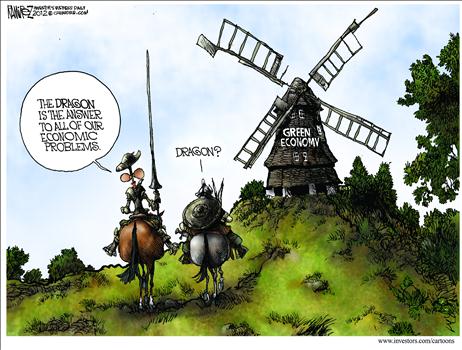
Don Quixote ( “don key-ho-tee” ) in Cervantes’ famous novel charged at some windmills claiming they were enemies, and is celebrated in the English language by two idioms:
Tilting at Windmills–meaning attacking imaginary enemies, and
Quixotic (“quick-sottic”)–meaning striving for visionary ideals.
It is clear that climateers are similary engaged in some kind of heroic quest, like modern-day Don Quixotes. The only differences: They imagine a trace gas in the air is the enemy, and that windmills are our saviors.
A previous post (at the end) addresses the unreality of the campaign to abandon fossil fuels in the face of the world’s demand for that energy. Now we have a startling assessment of the imaginary benefits of using windmills to power electrical grids. This conclusion comes from Gail Tverberg, a seasoned analyst of economic effects from resource limits, especially energy. Her blog is called Our Finite World, indicating her viewpoint. So her dismissal of wind power is a serious indictment. A synopsis follows. (Title is link to article)
In fact, I have come to the rather astounding conclusion that even if wind turbines and solar PV could be built at zero cost, it would not make sense to continue to add them to the electric grid in the absence of very much better and cheaper electricity storage than we have today. There are too many costs outside building the devices themselves. It is these secondary costs that are problematic. Also, the presence of intermittent electricity disrupts competitive prices, leading to electricity prices that are far too low for other electricity providers, including those providing electricity using nuclear or natural gas. The tiny contribution of wind and solar to grid electricity cannot make up for the loss of more traditional electricity sources due to low prices.
Let’s look at some of the issues that we are encountering, as we attempt to add intermittent renewable energy to the electric grid.
Issue 1. Grid issues become a problem at low levels of intermittent electricity penetration.
Hawaii consists of a chain of islands, so it cannot import electricity from elsewhere. This is what I mean by “Generation = Consumption.” There is, of course, some transmission line loss with all electrical generation, so generation and consumption are, in fact, slightly different.
The situation is not too different in California. The main difference is that California can import non-intermittent (also called “dispatchable”) electricity from elsewhere. It is really the ratio of intermittent electricity to total electricity that is important, when it comes to balancing. California is running into grid issues at a similar level of intermittent electricity penetration (wind + solar PV) as Hawaii–about 12.3% of electricity consumed in 2015, compared to 12.2% for Hawaii.
Issue 2. The apparent “lid” on intermittent electricity at 10% to 15% of total electricity consumption is caused by limits on operating reserves.
In theory, changes can be made to the system to allow the system to be more flexible. One such change is adding more long distance transmission, so that the variable electricity can be distributed over a wider area. This way the 10% to 15% operational reserve “cap” applies more broadly. Another approach is adding energy storage, so that excess electricity can be stored until needed later. A third approach is using a “smart grid” to make changes, such as turning off all air conditioners and hot water heaters when electricity supply is inadequate. All of these changes tend to be slow to implement and high in cost, relative to the amount of intermittent electricity that can be added because of their implementation.
Issue 3. When there is no other workaround for excess intermittent electricity, it must be curtailed–that is, dumped rather than added to the grid.
Based on the modeling of the company that oversees the California electric grid, electricity curtailment in California is expected to be significant by 2024, if the 40% California Renewable Portfolio Standard (RPS) is followed, and changes are not made to fix the problem.
Issue 4. When all costs are included, including grid costs and indirect costs, such as the need for additional storage, the cost of intermittent renewables tends to be very high.
In Europe, there is at least a reasonable attempt to charge electricity costs back to consumers. In the United States, renewable energy costs are mostly hidden, rather than charged back to consumers. This is easy to do, because their usage is still low.
Euan Mearns finds that in Europe, the greater the proportion of wind and solar electricity included in total generation, the higher electricity prices are for consumers.
Issue 5. The amount that electrical utilities are willing to pay for intermittent electricity is very low.
To sum up, when intermittent electricity is added to the electric grid, the primary savings are fuel savings. At the same time, significant costs of many different types are added, acting to offset these savings. In fact, it is not even clear that when a comparison is made, the benefits of adding intermittent electricity are greater than the costs involved.
Issue 6. When intermittent electricity is sold in competitive electricity markets (as it is in California, Texas, and Europe), it frequently leads to negative wholesale electricity prices. It also shaves the peaks off high prices at times of high demand.
When solar energy is included in the mix of intermittent fuels, it also tends to reduce peak afternoon prices. Of course, these minute-by-minute prices don’t really flow back to the ultimate consumers, so it doesn’t affect their demand. Instead, these low prices simply lead to lower funds available to other electricity producers, most of whom cannot quickly modify electricity generation.
A price of $36 per MWh is way down at the bottom of the chart, between 0 and 50. Pretty much no energy source can be profitable at such a level. Too much investment is required, relative to the amount of energy produced. We reach a situation where nearly every kind of electricity provider needs subsidies. If they cannot receive subsidies, many of them will close, leaving the market with only a small amount of unreliable intermittent electricity, and little back-up capability.
This same problem with falling wholesale prices, and a need for subsidies for other energy producers, has been noted in California and Texas. The Wall Street Journal ran an article earlier this week about low electricity prices in Texas, without realizing that this was a problem caused by wind energy, not a desirable result!
Issue 7. Other parts of the world are also having problems with intermittent electricity.
Needless to say, such high intermittent electricity generation leads to frequent spikes in generation. Germany chose to solve this problem by dumping its excess electricity supply on the European Union electric grid. Poland, Czech Republic, and Netherlands complained to the European Union. As a result, the European Union mandated that from 2017 onward, all European Union countries (not just Germany) can no longer use feed-in tariffs. Doing so provides too much of an advantage to intermittent electricity providers. Instead, EU members must use market-responsive auctioning, known as “feed-in premiums.” Germany legislated changes that went even beyond the minimum changes required by the European Union. Dörte Fouquet, Director of the European Renewable Energy Federation, says that the German adjustments will “decimate the industry.”
Issue 8. The amount of subsidies provided to intermittent electricity is very high.
The US Energy Information Administration prepared an estimate of certain types of subsidies (those provided by the federal government and targeted particularly at energy) for the year 2013. These amounted to a total of $11.3 billion for wind and solar combined. About 183.3 terawatts of wind and solar energy was sold during 2013, at a wholesale price of about 2.8 cents per kWh, leading to a total selling price of $5.1 billion dollars. If we add the wholesale price of $5.1 billion to the subsidy of $11.3 billion, we get a total of $16.4 billion paid to developers or used in special grid expansion programs. This subsidy amounts to 69% of the estimated total cost. Any subsidy from states, or from other government programs, would be in addition to the amount from this calculation.
In a sense, these calculations do not show the full amount of subsidy. If renewables are to replace fossil fuels, they must pay taxes to governments, just as fossil fuel providers do now. Energy providers are supposed to provide “net energy” to the system. The way that they share this net energy with governments is by paying taxes of various kinds–income taxes, property taxes, and special taxes associated with extraction. If intermittent renewables are to replace fossil fuels, they need to provide tax revenue as well. Current subsidy calculations don’t consider the high taxes paid by fossil fuel providers, and the need to replace these taxes, if governments are to have adequate revenue.
Also, the amount and percentage of required subsidy for intermittent renewables can be expected to rise over time, as more areas exceed the limits of their operating reserves, and need to build long distance transmission to spread intermittent electricity over a larger area. This seems to be happening in Europe now.
There is also the problem of the low profit levels for all of the other electricity providers, when intermittent renewables are allowed to sell their electricity whenever it becomes available. One potential solution is huge subsidies for other providers. Another is buying a lot of energy storage, so that energy from peaks can be saved and used when supply is low. A third solution is requiring that renewable energy providers curtail their production when it is not needed. Any of these solutions is likely to require subsidies.
Conclusion
Few people have stopped to realize that intermittent electricity isn’t worth very much. It may even have negative value, when the cost of all of the adjustments needed to make it useful are considered.
Energy products are very different in “quality.” Intermittent electricity is of exceptionally low quality. The costs that intermittent electricity impose on the system need to be paid by someone else. This is a huge problem, especially as penetration levels start exceeding the 10% to 15% level that can be handled by operating reserves, and much more costly adjustments must be made to accommodate this energy. Even if wind turbines and solar panels could be produced for $0, it seems likely that the costs of working around the problems caused by intermittent electricity would be greater than the compensation that can be obtained to fix those problems.
The economy does not perform well when the cost of energy products is very high. The situation with new electricity generation is similar. We need electricity products to be well-behaved (not act like drunk drivers) and low in cost, if they are to be successful in growing the economy. If we continue to add large amounts of intermittent electricity to the electric grid without paying attention to these problems, we run the risk of bringing the whole system down.
Why the Quest to Reduce Fossil Fuel Emissions is Quixotic
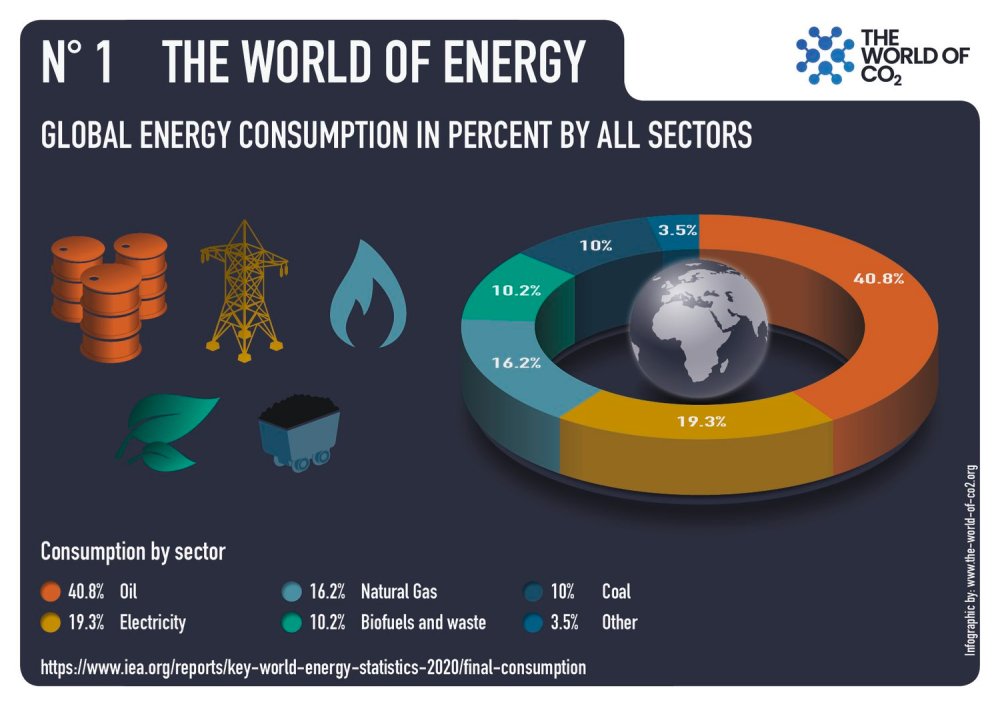
Roger Andrews at Energy Matters puts into context the whole mission to reduce carbon emissions. You only have to look at the G20 countries, who have 64% of the global population and use 80% of the world’s energy. The introduction to his essay, Electricity and energy in the G20:
While governments fixate on cutting emissions from the electricity sector, the larger problem of cutting emissions from the non-electricity sector is generally ignored. In this post I present data from the G20 countries, which between them consume 80% of the world’s energy, summarizing the present situation. The results show that the G20 countries obtain only 41.5% of their total energy from electricity and the remaining 58.5% dominantly from oil, coal and gas consumed in the non-electric sector (transportation, industrial processes, heating etc). So even if they eventually succeed in obtaining all their electricity from low-carbon sources they would still be getting more than half their energy from high-carbon sources if no progress is made in decarbonizing their non-electric sectors.
The whole article is enlightening, and shows how much our civilization depends on fossil fuels, even when other sources are employed. The final graph is powerful (thermal refers to burning of fossil fuels):
Figure 12: Figure 9 with Y-scale expanded to 100% and thermal generation included, illustrating the magnitude of the problem the G20 countries still face in decarbonizing their energy sectors.
The requirement is ultimately to replace the red-shaded bars with shades of dark blue, light blue or green – presumably dominantly light blue because nuclear is presently the only practicable solution.
Summary
There is another way. Adaptation means accepting the time-honored wisdom that weather and climates change in ways beyond our control. The future will have periods both cooler and warmer than the present and we must prepare for both contingencies. Colder conditions are the greater threat to human health and prosperity. The key priorities are robust infrastructures and reliable, affordable energy.
Footnote:
This video shows Don Quixote might have more success against modern windmills.