When Institutions Turn Against Individuals
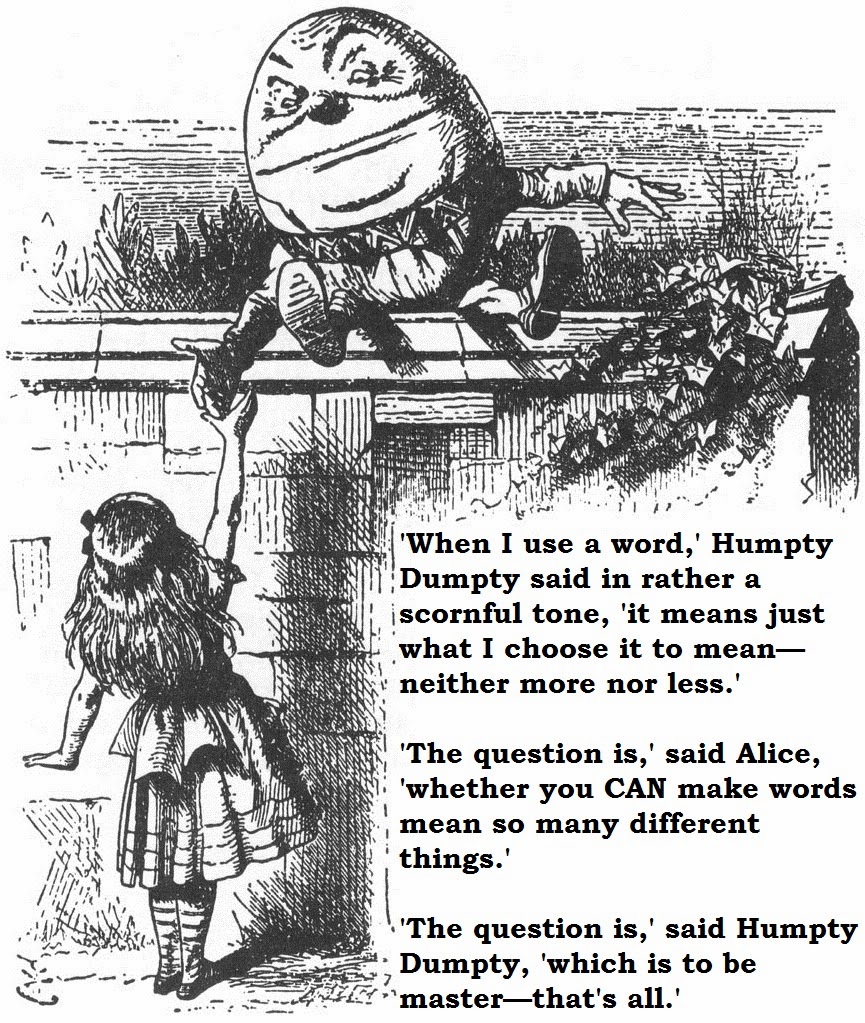
These days, marxist theory is camouflaged as “Critical Theory”, AKA Critical Race Theory, Critical Gender Theory, etc. But the thrust remains the same:  every social identity and relationship is redefined as a power struggle between oppressor and oppressed.  Thus everything is politicized and civil society is reduced to a jungle where might makes right.  Those who seize cultural control of social and economic institutions imperil each individual’s inalienable right to life, liberty and pursuit of happiness.

Last month Peter Robinson conducted an Uncommon Knowledge interview with Jordan Peterson on the topic The Importance of Being Ethical.  The video link is below, followed by my transcription with light editing to produce from the captions a text for reading.  Excerpts in italics with my bolds. (PR is Peter Robinson, JP is Jordan Peterson)

PR:  If you’re the prime minister of Canada the man is a villain, but if you’re a conservative particularly a young conservative it’s very likely you think of him as a hero. Jordan Peterson on Uncommon Knowledge.

In 2016 the Trudeau government enacted legislation making it illegal to discriminate on the ground of “gender expression”. Jordan Peterson, a clinical psychologist at the University of Toronto objected. In particular he flatly refused to use politically correct gender pronouns, said so in videos and went viral in 2017. He began a series of podcasts called the psychological significance of biblical stories that has been viewed by millions. In 2018 he published a book 12 rules for life an antidote to chaos that became an international bestseller. Last year he published another bestseller beyond order: 12 more rules for life, and then he resigned from the University of Toronto to devote himself to lectures and podcasts. Jordan Peterson welcome. The audience should know by the way that we’re filming today as part of the classical liberalism seminar at Stanford.

PR:  All right, question one: The February protest by Canadian truckers. They’re protesting covid restrictions; some of them block border crossings; some of them snarl the capital city of ottawa.
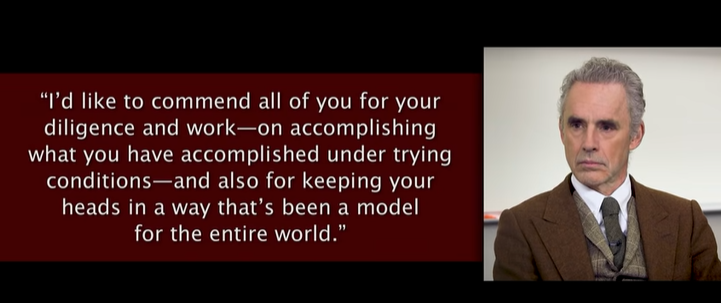
Here’s your quotation made in a message you taped for the protesters. “ I’d like to commend all of you for your diligence and work on accomplishing what you have under trying conditions, and also for keeping your heads in a way that’s been a model for the entire world.”
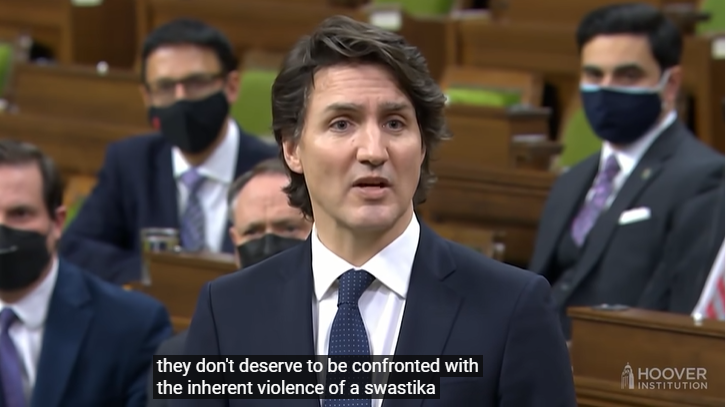
Now the clip of PM Trudeau speaking in parliament: “It has to stop. The people of Ottawa don’t deserve to be harassed in their own neighborhoods. They don’t deserve to be confronted with the inherent violence of a swastika flying on a street corner, or a confederate flag, or the insults and jeers just because they’re wearing a mask. That’s not who Canada, who Canadians are.”
So here’s the first question: How can discourse in a great democracy have become so polarized that Jordan Peterson and the Prime Minister look at exactly the same set of events and come to opposite conclusions about them.?

JP: Well he’s lying, and I’m not. So that’s a big part of the issue. I don’t believe that he ever says a word that’s true. From what I’ve been able to observe, it’s all stage acting. He’s crafted a persona. He has a particular instrumental goal in mind, and everything is subordinated to serve that.

What’s the motivation? It’s the same motivation that’s generally typical of people who are narcissistic, which is to be accredited with moral virtue in the absence of the work necessary to actually attain it.

Apart from playing a role, from you know the swastika thing is really just untrue about Canadians.  Really, we’re going to be worried about Nazis in Canada? First of all that just isn’t a thing in Canada; There isn’t a Nazi tradition, and i don’t know anyone in Canada who’s ever met anyone who’s met someone who was Canadian and who was a Nazi. So that’s just a non-starter

When that sort of thing gets dragged into the conversation right off the bat you know, “Canadians shouldn’t be subjected to the inherent violence of a swastika, ” first of all it’s not even obvious what that swastika was doing there. There’s reasonable evidence to suggest that the person who was waving it was either a plant, or someone who was making the comment about what was characteristic of the government. Now no one knows because the story around that event is messy, and it’s not like there were credible journalists who were going in there to investigate thoroughly. But to use that, and the confederate flag issue is exactly the same thing.

The story in Canada is that our Prime Minister implemented the emergencies act and so the question was why. So I went on twitter when this was trending and read at least 5000 twitter comments to try to get a sense of people who were supporting Trudeau in applying the emergencies act. I wanted to understand what do they believe is happening. As far as I can tell, and maybe I’m wrong, the story was that something like make america great again conservative republicans, the you know pretty far right., were attempting to destabilize Canadian democracy.

And so my question was, well what makes you think they care first of all about Canada and its democracy? And second, why in the world would they possibly do that? You need a motive for a crime like that. At the same time, the Canadian Broadcasting Corporation which is subsidized by the liberals to the tune of 1.2 billion dollars a year, the CBC was insisting that most of the money that the truckers raised was foreign financed. If it wasn’t the bloody Russians, then it was the American Conservatives. And so that all turned out to be a complete lie.

And so the line was, it’s republican right-wingers trying to destabilize Canadian democracy, except no one has an answer for what’s in it for them.

And then three days later, the emergency act was lifted. i thought, okay now what are they going to make of that? What could possibly be the rationale for that? And the rationale was that it just showed how effective he was. We had this coup ready to go that was financed by Americans apparently, and our prime minister acted so forthrightly that we only needed to be under the strictures of the emergency act for three days.

I don’t even know what sort of world exists in which those things are happening, and then why do Canadians buy this to the degree they do.

And I think they’re faced with a hard choice. Because in my country for 150 years you could trust the basic institutions. You could trust the government, it didn’t matter what political party was running it; you could trust the political parties right from the socialists over to the conservatives. The socialists were mostly union types and they were trying to give the working class a voice and honestly so. You could trust the the media, even the CBC was a reliable source of news. You know, none of that’s true now. And so Canadians are asked to make a hard choice in the truckers convoy situation. Either all your institutions are almost irretrievably corrupt, or the truckers were financed by like right-wing republican-americans. Well both of those are preposterous, so you might as well take the one that’s least disruptive to your entire sense of security. And I think that’s what Canadians mostly did.
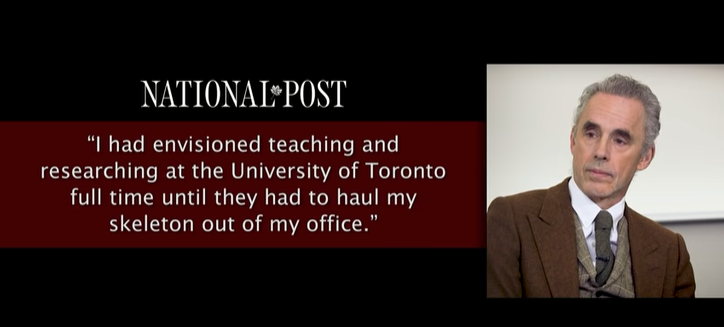
PR:  Coming back to Canadian universities Jordan Peterson was quoted in the National Post this past march: “I had envisioned teaching and researching at the University of Toronto full-time until they had to haul my skeleton out of my office.” Instead you retired. Why?

JP:  Well it was impossible to go back. For a long time I couldn’t think clearly about what I should do on the professional front because I was ill. Later when I started to recover and looked at the situation, first of all there was just no going back because I’m too well known and too provocative I suppose. I’ve never really thought of myself as that, but it seems to have turned out that way. I couldn’t just return to the classroom.

And then there were other problems too. There’s no bloody way I’m writing a diversity, inclusivity and equity statement for a grant.

I can’t imagine the circumstances under which i would do that. And that’s become absolutely crucial now in Canada. Also increasingly in the US to get any sort of research grant you you have to write a diversity statement, and it has to be the right kind of statement. I read that the national sciences and engineering research councils frequently asked questions about how to prepare a diversity statement. And you couldn’t write a more reprehensible document from the ideological perspective if you set out with the intent purpose of writing a despicable document.

So there’s no way I could get funding for my research and then what bloody chance would my students have of being hired in an academic environment today? You know perfectly well those who sat on faculty hiring committees your basic decision right off the bat is: Okay who do we eliminate because you have way too many candidates? And so you’re searching for reasons to get rid of people. I’m don’t say this as a criticism, it’s just a reality. If there’s any whiff of scandal of any sort, well we have 10 other people we could look. Why would we bother with the trouble? So I just couldn’t see my students having any future.
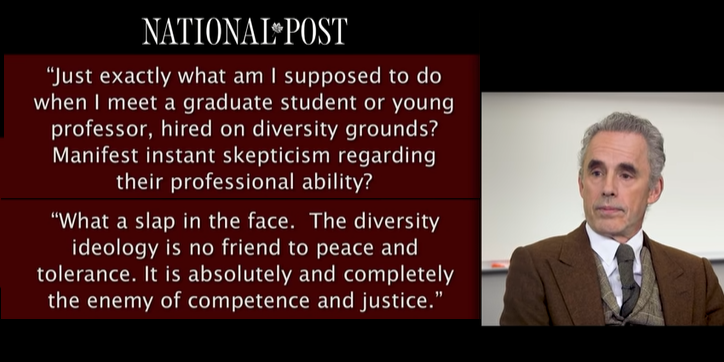
Then I also thought: Well I can go lecture wherever I want, to whoever i want with virtually any size audience, with no restrictions whatsoever. Why go back to teaching a small class at university? I did like doing that, but all I could see were disadvantages. Plus it was impossible. Exactly what am I supposed to do when I meet a graduate student or a young professor hired on diversity grounds manifest instant skepticism? What a slap in the face!

The diversity ideology is no friend to peace and tolerance; it is absolutely and completely the enemy of competence and justice.

PR:  What happened? How did wokeness take over universities? University faculty poll after poll of party affiliation in this country, I’m sure it’s the same in Canada, shows the university faculty been to the left for a long time. But this wokeness is something new. What’s the transmission mechanism; what happened and how did it happen in a small number of years?

JP:  That’s a tough question. I’ve tried to put my finger on the essential elements of what you might describe as political correctness or wokeness and done that in a variety of ways. For example this is one student of mine undertook a quite promising line of research. The first thing we wanted to find out was: Is there really such a thing as political correctness or wokeness? Because it’s vague, can you identify it? And by that I mean psychometrically. Because for 40 years one of the things that psychologists have been wrestling with is construct validation. That’s the technical problem: How do you know when you put a concept forward whether it bears any relationship to some underlying reality? For example, is there such a thing as emotional intelligence? Is there such a thing as self-esteem? Or political correctness?

The proper answer is we don’t know, but there are ways of finding out. You need to find out if the construct assesses something that’s unique and does that in a manner separate from other similar constructs in a in a revealing and important way. There’s a whole theory of of methodology that should inform your efforts to answer such questions. So for example if you’re a clinician you might want to differentiate between depression and anxiety. Keeping the concepts separate is important so they have functional utility, but also accounting for the overlap because they’re both negative emotions. It’s part of epistemological mapping

So we asked a large number of people a very large number of political questions trying to oversample questions that had been put forward in the media and in the public sphere as indicative of politically correct beliefs. Then we did the appropriate statistical analysis to see if the questions hung together. They hang together if question a is politically correct, let’s say you answer it positively. And question b is politically correct and you answer it positively. If there’s a large correlation between those two questions then you think well they’re assessing something underlying that’s holding them together.

In this way we identified a set of beliefs that were observable or easily identifiable as politically correct. So yes, it exists.

The next question is: Where does it come from? We haven’t done empirical analysis of that, but I think if you’re reasonably familiar with the history of ideas you can see two streams, two broad streams of thought.

One is a postmodern stream that basically emerged out of literary criticism.

It’s predicated on what is actually a fundamental and a valid critique; which is that it’s very, very difficult to lay out a description of the world without that description being informed by some value structure. That’s at the core of what’s useful about the postmodern critique. I actually happen to believe that you look at the world through a structure of value.  Well then, what is the structure of value and also what do you mean by a structure value?

And that’s where the post-modernists went wrong,
and where I think our whole society went wrong.

Because the radical left types who were simultaneously postmodern turned to marxism to answer that question. They said, well we organize our perceptions as a consequence of the will to power. And I think that is an appalling doctrine. It’s technically incorrect for all sorts of reasons that we could get into. Partly the issue is: if power is my ability to compel you to do things against your own interest or in your own desire, maybe I can organize my social interactions on the basis of that willingness to express power. That’s a very unstable means of social organization.

So the notion is that it’s power that structures our relations,
but where’s your evidence for that?

There’s no evidence for that, it’s wrong; but that’s what we assumed and that’s what universities  teach by and large. It makes no sense to me that this thing that has raged through these great magnificent institutions, these universities that our grandparents and great grandparents sacrificed to give money to, these magnificent citadels of learning.  It makes no sense to me to suppose that english departments suddenly took over well unless they’re on to something. As I said before, I don’t think you can look at the world except through a structure of value. So why has literary criticism become so relevant and so powerful?

I believe that we see the world through a narrative framework. If that’s true, you need a mechanism to prioritize your attention because attention is a finite resource and it’s costly. So you have to prioritize it and there’s no difference between prioritizing your attention and imposing a value structure those are the same thing. The mechanisms that we use to prioritize our attention are stories, which means that the people who criticize our stories actually have way more power than you think. Because they’re actually criticizing the mechanism through which we look at the world.

So the post-modernist would say, you even look at the scientific world
through a value-laden lens. I think they’re right, yes you do,
but they’re wrong that the lens is one of power.

Now with a word like power, you can expand the borders of the word to encompass virtually any phenomena you want. And so that’s why I define power as my willingness to use compulsion on you or other people. Because power can be authority, power can be competence, but I don’t mean any of that. I mean power in the sense you don’t get to do what you want, you do what I tell you to do. This is power as coercion exactly. And I do think the marxist types view the willingness to use coercion as the driving force of human history. That’s really saying something, because that means it’s the fundamental motivation.

That’s a very caustic criticism, and it’s easy to put people back on their heels
about that,  as we are seeing with capitalists.

I’ve been stunned to see the CEOs of major corporations just roll over in front of these DEI activists. I wonder, what the hell’s wrong with you people? You’re not even making use of your privilege and you are not very powerful if you’re the CEO of a major corporation and you can’t even withstand some interns who have DEI ideology, which is not doing you a lot of good. So why would you produce a fifth column within your organization that’s completely opposed to the entire manner in which you do business and to the capitalist enterprise as such?

One answer would be, well we don’t think much about ideas. Well maybe you should. Or maybe you are cynical about it and say, well it’s just a gloss to keep the capitalist enterprise going while appearing to to meet the new demands of the new ethical reality. Which I think is also a bad argument.

But more importantly it’s that people are guilty and the the radicals who accuse us all historically and as individuals of being motivated
by nothing but the desire for power
strike a chord especially in people who are conscientious.

Because if you’re a conscientious person and someone comes to you, or a little mob of 30 people says, you can be a little more careful in what you say and do on the racist front and the sexist front etc. You’re likely to think, well I’m not perfect. I probably could be a little more careful. And no doubt people have been oppressed in the past and it’s also true that in some sense I’m the undeserving beneficiary of historical atrocity and so maybe I should look to myself.

That’s weaponization of guilt and it’s very effective and it’s not surprising. But it’s not helpful because there’s a resentment that drives this, a corrosive resentment that’s able to weaponize guilt and it’s very difficult for people to withstand it.
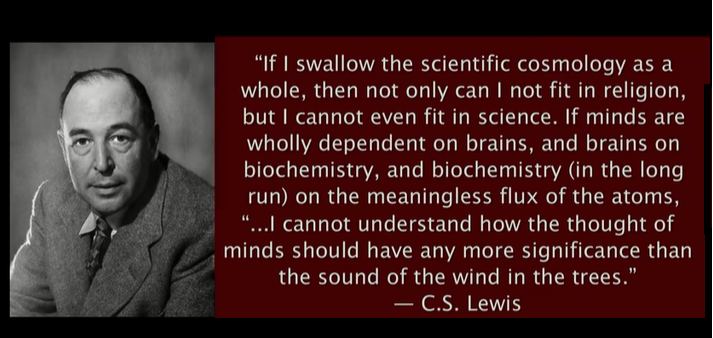
PR:  Earlier you talked about values and how we see the world through values so here’s a question.  If there’s no objective standard of reason outside and above ourselves, if everything is just matter how we think, how can we do science? What do you think of this from C.S. Lewis:  If I swallow the scientific cosmology as a whole, meaning all that exists is only what we can perceive through our senses, then not only can I not fit in religion, I cannot even fit in science. If minds are wholly dependent on brains, and brains on biochemistry, and biochemistry in the long run on the meaningless flux of the atoms, how the thoughts of minds have any more significance than the sound of the wind in the trees?

JP:  Well that’s a complicated problem. First of all I don’t think science is possible outside of an encompassing judeo-christian ethic. For example, I don’t think you can be a scientist without believing as an axiom of faith that truth will set you free. In fact we don’t know the conditions under which science is possible and we tend to overestimate its epistemological potency. I mean you can stretch it back to the Greeks if you’re inclined, but in a formal sense it’s only been around for about five centuries, and it’s only thrived for a very short period of time. And it’s perfectly reasonable to assume that there were particular preconditions that made its rise and ascendancy possible. It is an historical phenomenon, yes it happened at a specific moment in time and for particular reasons.

One of the bunch of conditions is for example, there’s an intense insistence in the Christian tradition that the mind of god in some sense is knowable, and yes including the structure of the cosmos. And you have to believe that’s the case before you’re going to embark on a scientific endeavor. You have to believe that there’s some relationship between logos or logic. But logos is a much broader concept than logic, that’s for sure. You have to believe that there’s some relationship between that and the structure of the cosmos.

You have to believe that the pursuit of truth is in itself an ethical good,
because why would you bother otherwise.

You have to believe that there is such a thing as an ethical good and those are not scientific questions. Which is why i think the arguments of people like Hitchens and Dawkins are weak. People like that have a metaphysic which they don’t know and they assume that metaphysic is self-evidence. Well sorry guys, it’s actually not self-evident. And they assume that it can be derived from the observations of empirical reality and the answer to that is no. There’s going to be axioms of your perceptual system that aren’t derivable from the contents of your perceptual system.

And you might think, well that’s not very scientific and i would say you can take it up with Roger Penrose about say the role of consciousness and and the structure of consciousness. And it’s by no means obvious that the materialist reductionists have the correct theory about the nature of consciousness. And not surprisingly we don’t understand the relationship between consciousness and being at all.

You know these are hard hard questions. One hard question for consciousness researchers is: Why is there consciousness? Why aren’t we just unconscious mechanisms acting deterministically?  I don’t think that is the hardest question.

The really hard question is: What’s the relationship between consciousness and being itself?

Because I can’t understand what it means for something to be in the absence of some awareness of that being. There’s an awareness component implicit in the in the idea of being itself. Consciousness is integrally tied up with being in some mysterious manner and so I also don’t believe that the the most sophisticated scientists are by necessity reductionist materialists. It’s occam’s razor clear if you can reduce and account deterministically no problem. But don’t be thinking that accounts for everything because I don’t think there’s any evidence that it does.
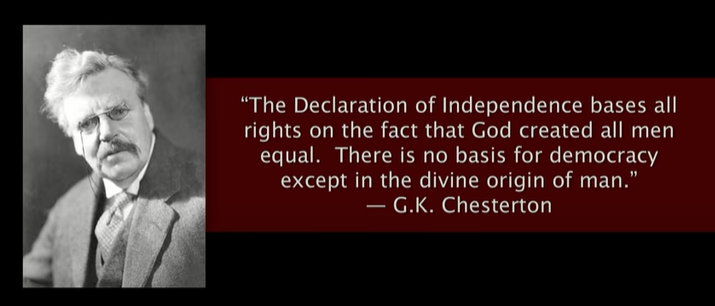
PR:  From science to to politics to quotations. Jordan Peterson this is a tweet of just last month: Does anything other than the axiomatic acceptance of the divine value of the individual make slavery a self-evident rule, right? That’s a good one.  I’m going to put you in an august company.  Here’s G.K. Chesterton:  The declaration of independence bases all rights on the fact that god created all men equal.  There is no basis for democracy except in  the divine origin of man so these are very similar thoughts.

JP: I’ve been talking to my audience about what is the right to free speech and and how that might be conceptualized. Because you can think about it as a right among other rights, so it’s just one on a list of rights. And you can also think of rights as being granted to you in some sense by the social contract.

That is a different theory than the notion that rights originate in some underlying religious insistence of the divine value of the individual.

There’s a bunch of problems with the rights among other rights argument i don’t think free speech is a right among other rights. Speech has to be free because if it’s not free it’s not thought. So imagine if everything’s not going all right, you have problems, and you have to think about hard things. If you have a problem the thinking is going to be troublesome because you’re going to think things that upset yourself and upset other people. It’s part of the necessity, part of what will necessarily happen if you’re thinking.

PR:  You said something that just stopped me so completely cold that I missed some of what followed. To repeat: There is no difference between speech and thought; if you have free thought you must have free speech. That’s the argument.

JP: Yes. Well I’ll unpack that first and then return to the other. First of all, mostly you think in words now. People also think in images but I’m not going to go into that, we’ll just leave that aside. But mostly we think in words and so we use a mechanism that’s sociologically constructed– the world of speech to organize our own psyches. We do that with speech and basically when you think there’s two components to it that are internal. In a sense when you think you have a problem, you ask yourself a question and then answers appear in the theater of your imagination. They are generally verbal so that’d be like the revelatory element of thought. And that’s very much prayer in some fundamental sense.

It’s very mysterious the fact that you can pose yourself a question and then you can generate answers. So why did you have the question if you can generate the answers, if the answers are just there. Where do the answers come from? Well you can give a materialist account to some very limited degree, but phenomenologically it’s still the case that you pose a question to yourself in speech and you receive an answer in speech. Now it can also be an image but forget about that for this discussion.

The next question is what do you do once you receive the answer? The answer is, well, if you can think then you use internal speech to dissect the answer. This is what you do, for example, you encourage your students to do if they’re writing an essay. You know they lay out a proposition and then you hope they can take the proposition apart. Essentially in this way they’re transforming themselves into avatars, speaking avatars of two different viewpoints. So you have the speaker for the proposition and then you have the critic. Maybe you lay out the dialogue between them and that constitutes the body of the essay.

You have to be bloody sophisticated to manage that because it means that you have to divide yourself in some sense into two avatars that are oppositional. And then you have to allow yourself to be the battle space between them that. People have to be trained to do that. It’s what universities are supposed to do.

But it’s really hard; so instead of that, people generally talk to other people.
And that’s how they they organize themselves, by talking to other people.

So the additional reason you have the right to free speech, isn’t that you can just say whatever you want to gain a hedonistic advantage, which is one way of thinking about it. You have a right to say whatever you want like you have a right to do what you want, you know subject to certain limitations. It’s like it’s a hedonstic freedom. No, that’s not why you have a right free speech.

You have a right to free speech because the entirety of society depends
on this ability to adapt to the changing horizon of the future
on the free thought of the individuals who compose it.

It’s like a free market in some sense, a free market argument in relationship to thought. We have to compute this transforming horizon, and we do that well by consciously engaging with possibilities. Doing that is mediated through speech. So societies that are going to function over any reasonable amount of time have to leave their citizens alone to grapple stupidly with complexity. So that out of that stupid, fraught grappling that’s offensive and difficult and upsetting, we can grope towards the truth collectively. This before taking the steps to implement those truths, before they’ve been tested.  So that’s the free speech argument.

The divinity argument is while you are that locus of consciousness,
that’s what you are most fundamentally.

The reason that’s associated with divinity is a very very complicated question and part of the reason I outlined this in my biblical series on genesis. This divinity of the individuals rooted in the narrative conception is part and parcel of the judeo-christian tradition. You have god at the beginning of time in whose image men and women are made acting as the agent that transforms the chaos of potential into the habitable reality that is good. And he uses the word the divine word logos to do that, which implies that the word that’s truthful is the word that extracts habitable order out of chaos.

What characterizes human beings is that capability.

To those who don’t believe that, I say try acting another way, try basing your personal relationships on any other conception and see what happens. You know people are so desperate to be treated in that manner that it’s their primary motivation. You want other people to treat you as if you have something to say that you’re worth attending to. You have the opportunity to express yourself, no matter how badly you do it. And if they’re willing to grant you their attention and time to help you straighten that out, there isn’t anything you want more than that. If you try to structure your social relationships on any other basis then that respect for their intrinsic value, it’s going to fail.

PR:  We’ve talked about faculty and students. A couple of statistics: According to Gallup the proportion of Americans who claim no religious affiliation, among Americans–over 76 years old is just seven percent. 93 percent of the oldsters claim a religious affiliation. The youngest group that Gallup tested is Americans between 26 and 41–almost a third claim no religious affiliation.

Item two and I’m reasonably certain this is the same in Canada at least in eastern Canada, but certainly in the United States, poll after poll shows that young people are far more open to socialism, or to farther not just left of center but farther left political aims. They’re the ones who most fervently support this. By the way This is an inversion from the Reagan years in the 80s when the kids were more conservative than the older. That’s not the case now, add in my personal observation that during covid, during the lockdowns, personally almost more shocking than any other aspect was the supineness, the passivity of the kids. This despite it was established very very early that if you’re young you’re at no serious risk of this virus. You’ll get sick, perhaps it’ll be a flu, but you’re more likely to die in a car accident up to the age of 20 something than you are to die of covid. That was established right away and yet universities shut down and they made kids go on zoom to take exams or take their classes. I could detect no pushback. No kid was trying to diss the man; in general they were saying, Yes Master.

It’s like they were Igors to Dr Frankenstein. This is all really bad news.

After listening to you talk with such a sophistication for a while now, here’s the crude point, the crude suspicion I take away:

If you don’t have some notion of the transcendent; if you don’t have some notion of the divine, then you’ll believe any damn thing.

JP:  I think that’s right and that’s what the kids are doing. Dostoevsky commented on that: if there’s no god everything is permitted you know. And he did a lovely job of analyzing that in Crime and Punishment and the Brothers Karamazov. I do think it’s true that if you believe nothing, you’ll fall for anything.  People like to ask me if i believe in god, and i always think well, who are you to be asking that question? First of all you have some notion of what you mean by believe that you think is just accurate because you know what believe means. And so you have a prior theory about belief and now you’re asking me if my belief in god fits into your a prior theory.

How about we start by questioning your a priori theory of belief?

Because I don’t even know what you mean by believe, and neither do you especially when we’re asking a question that profound. You know, do you believe in god involves three mysteries there, and all three of those are subject to question. 

I think people act out what they believe. So when people ask me if I believe in god, generally I say that I act or try to act as if god exists. And they’re not very happy about that because they want me to abide by the rules, the implicit rules of their question. Which is, do you believe in the religious view as a pseudo-scientific description of the structure of reality? I don’t know how to answer that question because it’s so badly formulated i can’t get a handle on it.

Do you believe that there’s something divine? Well let’s try to define divine here, we can do that for for a moment. Most of us have some sense that literary stories differ in their depth. I don’t think that’s an unwarranted proposition: some stories are shallow and some stories are deep; some stories are ephemeral and some move you deeply, whatever that means. It’s a metaphor but we understand what it means. Imagine there are layers of literary depth and one way of conceptualizing the layers is that the deeper an idea is the more other ideas depend upon it.  So you have ideas that are fundamental because if you shake that idea, you shake all the ideas that depend on them.

And then I would say the realm of the divine is the realm of the most fundamental ideas.

That must be so because the alternative is to say well all ideas are equal in value. Okay well, try acting then and you can’t, because you can’t act unless you prioritize your beliefs. And if you prioritize them you arrange them into a hierarchy, and in that arrangement you accept the notion of depth. And so when we use language of the divine we’re talking about the deepest ideas.

And so I believe the notion that each individual is characterized by a consciousness that transforms the horizon of the future into the present.

That’s a divine idea–it’s so deep and our functional cultures are necessarily predicated on that idea. It’s not just a western idea since you can not have a functional culture that in some sense doesn’t instantiate that idea. Because you interfere with the mechanism of adaptation itself, by not allowing it free expression.

Suppose you are like my prime minister and you say, “Well I really admire the Chinese Communist Party, because when it comes to environmental issues they get things done.” So many things are wrong with that statement, it’s hard to know where to begin. It is the posture of an inexcusably narcissistic idiot. But we can start with the idea that, if you know what you’re doing and you have power, maybe you can be more efficient in your exercise of in your control over movement towards that goal. Fair enough but what about when you don’t know what you’re doing. Where then do you turn because it means your ideology failed you and you have no mechanism for operating when you don’t know what you’re doing.

The regime is based on believing we always know what we’re doing
because we’re totalitarian and we have a complete theory of everything.
And don’t say anything to the contrary or else.

In free societies, when we don’t know what we’re doing, we let people talk. And out of that babble, out of that noise, (American culture is particularly remarkable in this regard) you have this immense diversity of opinions. Most of them are completely useless and some are absolutely redemptive. As a Canadian observing your culture we see you guys veer off in weird directions fairly frequently and things look pretty unstable. And then there’s some glimmer of hope somewhere that bursts forward in in a whole new mode of adaptation and away you go again. And that just happens over and over and over as a consequence of real diversity.

It’s definitely a consequence of freedom of association and freedom of speech
because it enables all that expression of possibilities.
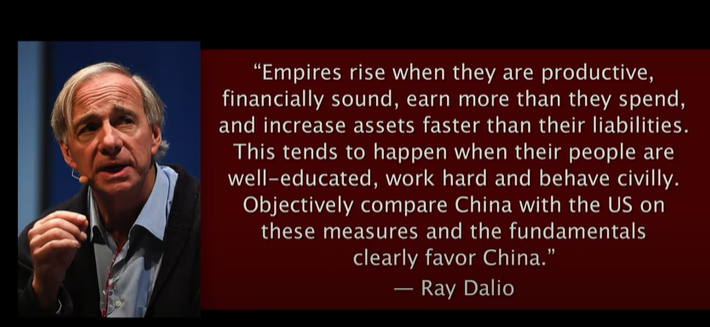
PR: Sure that’s optimistic and I always like to end a show on an up note. But first let me put a pin in the optimism balloon. You mentioned Trudeau and Trudeau’s admiration for the Chinese communist Party. Ray Dalio billionaire on china points out empires rise when they’re productive, financially sound, earning more than they spend and increasing assets faster than their liabilities. Objectively compare China in the US on these measures and the fundamentals clearly favor China” Jordan Peterson writing about communism in your introduction to the 50th anniversary edition of the Gulag Archipelago:

“No political experiment has been tried so widely with so many disparate people in so many different countries and failed so absolutely and catastrophically.”
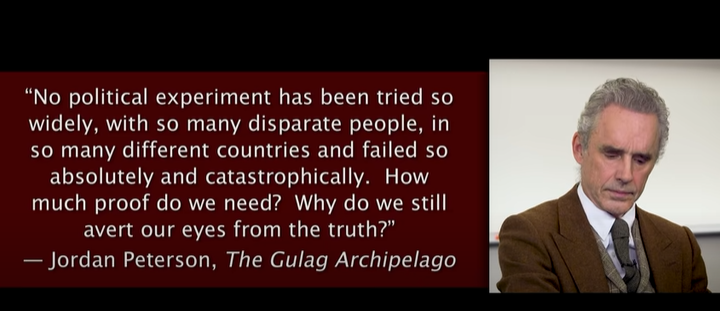
The question is: How much proof do we need and why do we still avert our eyes from the truth?  Why why do we still feel tempted. Dostoyevsky in the legend of the grand inquisitor has the grand inquisitor speaking to Christ and he says to Christ: You’re all wrong.  Receiving their bread from us the people will clearly see that we take the bread from them to give it back to them. And they will be only too glad to have it so long as we will deliver them from their greatest anxiety and torture: that of having to decide freely for themselves. Never was there anything more unbearable to the human race than personal freedom.”
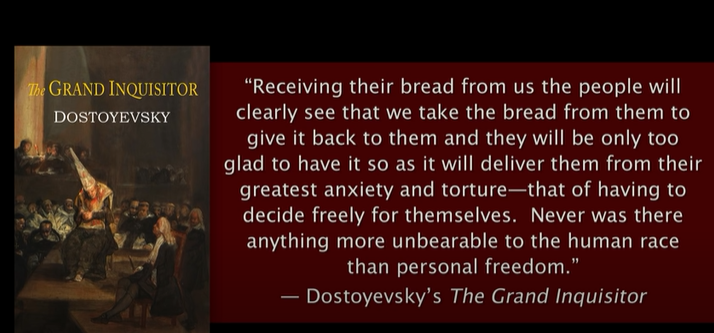
What do you think:  Canada had a good run, the United States had a good run but sustaining free societies across the decades and across the generations is just too hard for human nature to bear.

JP: No you should not agree with that for two reasons. The first is that man does not live by bread alone so that’s the first rejoinder. And the second is regarding difficulty: the only thing more difficult than contending forthrightly with existence is failing to do so. I’m not suggesting for a moment that this isn’t difficult. What the western religious tradition has done, what religious traditions in general do to some degree, is to try to provide people with support from what’s divine in their incalculably difficult efforts to deal with the unknown. If you orient yourself ethically in the most fundamental sense, then in some sense you have the force of god on your side and then maybe you can prevail despite the difficulty.

I try to ask these questions seriously you know and I would also say that I’ve been driven to my religious beliefs such as it is by necessity not by desire. What do you want to have on your side when you’re contending with the unknowable future and it’s vagaries? How about truth? How about beauty? How about Justice? You want allies, those powerful allies that the university is supposed to be teaching young people

You need some allies for the pursuit of truth when the scientists are having their say. On the economic front, how about the free trade between autonomous individuals, the free trade of goods of value between autonomous individuals. That’s not such a bad thing to have on your side these eternal verities. They share something good in common as all good things. For all intents and purposes that’s god. You might say well i don’t believe in that. How is possible you don’t believe there’s any such thing as good, and don’t believe there’s any such thing as ultimate good. I’m not trying to make some ontological claim about an old man living in the sky, although i think that’s a lot more sophisticated concept than people generally realize.

My point is you do have a belief system whether you know it or not, a system of ethics whether you know it or not. There’s either something at the bottom that unifies it or it’s not unified. In which case means you’re aimless and hopeless and depressed and anxious and confused because those are the only other options. And maybe you don’t know what that unifying belief is, but that doesn’t mean that it’s not there. It just means you don’t know what it is.

I can give you a couple of examples very very briefly. I already mentioned the story in genesis that associates god with the force process that generates habitable order out of chaos and attributes that nature in some sense to human beings. The next part in the story of adam and eve, god is what people walk with unself-consciously in the garden. So adam doesn’t because he’s now ashamed and he doesn’t walk with god anymore. So what is god? Well that’s what you walk with when you’re unself-conscious, so that’s an interesting idea. And then you have the god that manifests himself in the story of noah. That’s the intuition that hard times are coming and that you better get your house in order. If you have any sense, the nature of the intuition is a spirit that animates you. Well obviously because there you are acting and you’re acting out a pattern. it’s a spirit that animates you.  And then there’s the story of the tower of babel, what’s god there? Well god is that which you replace at your peril because everything will come tumbling down. That’s the tower of babel. It’s like  definitely if we put the wrong thing at the top, like Stalin for example then look out. We’ve done that a bunch of times in the 20th century.

I think you know Milton conceptualized Lucifer as something like the spirit of unbridled intellectual arrogance. Something like Lucifer is the light bringer and he is engaged in a conflict with god attempting to replace the divine and that’s pretty explicit in the story. That’s a poetic intuition of the of the battle between the secular intelligencia and the religious structure that’s milton’s pro-droma. He sees happening the intellect has become so arrogant that it will attempt to replace the divine and rule over hell. Well that’s the soviet union man; that’s Mao’s China— we know we’ve got our theory, it’s total, we’ve solved the problem and nothing’s going to change

Fair enough if you want to rule over hell and you think these societies are successful. Pretty odd definition of success as far as I’m concerned. If you want to be successful like china, you know that’s why it’s true that man does not live by bread alone. You know that a wealthy slave, that’s no life.

PR: I’m going to stumble along toward o setting up my last question. I’m thinking back to the 1970s.
Canada is part of this, but i know the American story better, and in the 1970s everything goes wrong.  Economic stagnation, loss of morale in this country because we lose in Vietnam. Watergate scandal.  We’re on the defensive as the soviets advance in Africa, Latin America. And then in the 1980’s,  we go  from 1979 with the national humiliation of the Iranian hostage crisis and this Soviet  invasion of Afghanistan, and then 1989 one decade, just 10 years later, the Berlin wall comes down.

So the question here is: the loss of freedom of speech, the corruption of the universities, the rise of
china which is in all kinds of ways a more formidable opponent than the soviet union was. In all kinds of ways one could argue that we’re in a worse position now than we were in the 70s. Are you speaking to those few who have eyes to see and ears to hear? Do you believe that we are capable  to prompt another kind of restoration? Or is Jordan Peterson the fascinating eloquent compelling  champion of a lost cause?

JP: When I spent a lot of time at the various universities, I was associated with studying motivation for atrocity. Because i was very curious about that as a psychologist; not as a sociologist or an economist or a political scientist. If you’re an Auschwitz guard, what’s motivating you as an individual? I wanted to understand it well enough so I could understand how I could do that. Some say, well that sort of behavior is so far beyond the pale that it’s completely incomprehensible. It’s just a manifestation of say, intense psychopathy, and a normal person can’t even imagine it.

I think the evidence doesn’t really suggest that. Because it is not obvious that all the people involved in the Nazi movement for example were criminally pathological, that they were incomprehensible deviations from the norm. It’d be lovely to think that and it would make the world a lot simpler. But the evidence mostly suggests that you can get ordinary people to do that sort of thing, and maybe even to enjoy it. So that’s pretty bloody terrifying and so i tried to understand, and think i did to some degree. Without getting deep into it here, we can say a fair bit of it is a consequence of envy. It’s the spirit of Cain if you had to sum it up in a phrase.

But that isn’t the issue; rather the issue is how do you stop it from happening again? Because that’s what we’re supposed to be concentrating on. In the aftermath of the second world war, we said, “Never Forget.” That should mean something like, How about we don’t do this again? So my question was: how do we best go about ensuring we don’t walk down that road again? My conclusion was that it was fundamentally an issue of individual psychology, most fundamentally more than economics, more than sociology.

For all of that, the cure is individual people have to act
as ethically as they are powerful or else.

And so I’ve been trying to convince people to do that. I suppose not to convince them precisely, but to put forward an argument about why that’s necessary and why it’s on them. You have to understand this problem because if you don’t get it right, it isn’t gonna work. How you start is with what you have under control in your own life. Where else are you going to start but to look to yourself. Put your house in order, not to be worried about some other person walking the satanic path. That’s what activists do all the time. They’re protesting it’s you, it’s the corporations, like it’s someone else.  No, it’s you and I think also fundamental to the judeo-christian doctrine is that it’s you. it’s on you.

Redemption’s an individual matter and so my hope is that if enough people take themselves with enough seriousness, then we won’t end up in hell.

Because we certainly could, it’s a high probability. But I also don’t think that you can be motivated enough to put your house in order to the degree that’s necessary merely by being attracted, let’s say to the potential utopia that might emerge as a consequence of that. So that’d be a vision of heaven, let’s say you need also to also be terrified of hell. Just because you haven’t been there doesn’t mean there’s no such thing. You have to be pretty bloody naive to think there’s no such thing, how much evidence do you need?  It comes about at least in partial consequence of the sins of men.

PR: What about incoming freshman next year at University of Toronto or Stanford University, 18 year old kids coming into all this, we’ve been through three years of covid. I won’t rehearse it all in one sentence.   What would you say to them as they begin university at the age of 18 or 19?  What’s the restorative, redemptive sentence?  What should they do?

JP: What should they do is: Don’t be thinking your ambition is corrupt. Because that’s part of the message now: we human beings are a cancer on the planet. We’re headed for an environmental apocalypse. The entire historical structure is nothing but atrocity. etc etc. Anyone with any ethical
aim whatsoever is just going to pull back; you don’t want to manifest any ambition, support the patriarchal structure, exploit the environment. You’re supposed to crush yourself down, you shouldn’t even have any children.

There’s no excuse for that there’s zero excuse for that I saw a professor at an event something like this who came out and trumpeted this bloody environmentally friendly house he built. Fair enough, it was a pretty interesting house. But not everybody had the four million dollars that that it took him to build it. I’m not criticizing his money, good for him he built a house, okay. But then to trumpet that as a moral virtue well you’re pushing it there. Then he came out to all the kids and he said my wife and i decided that we’re only going to have one child. I think that’s one of the most ethical things we could have possibly done and I would strongly encourage you to do the same.

I thought, you son of a . . . , you get up in front of these young people, a lot of these kids children of first generation immigrants from china, and he showed all these images of these terrible factories in China, these endless rows of sterile mechanism that were subordinating all the chinese people to this terrible capitalist machine. And I thought you don’t understand half the audience is looking at those factories and thinking that’s a hell of a lot better than struggling through the mud under Mao buddy.

I don’t know where he thought he was but to come out in front of all those kids and basically tell them that the whole human enterprise is so goddamn corrupt that the best thing they could possibly do is limit their multiplication, and to think of himself as a scholar and an educator. I did say something, by the way it was rather uncomfortable and he stomped off the stage. But that’s no message for young people: that’s no there’s no excuse for that.

You think we’re going to destroy the planet, so we have to do this:
we have to demoralize the youth to be ethical

I’m passionate about this because you have no idea how many people that’s killing. I see people everywhere all over the world they’re so demoralized especially young people especially young people with a conscience, because they’ve been told since they were little that there’s nothing to them but corruption and power. How the hell do you expect them to react? You know they will say. OK, I shouldn’t do anything.

So I go around and say to people: Look there’s not only more to you than you know there’s more to you than you can imagine. You have an ethical responsibility to act in that light. You might claim not to believe that, but i would say your whole culture is predicated on that belief. Insofar as you are an active member of that culture and a believer in its structure, then you believe it. You might not be very good at  believing it, you might be full of conflict and doubt, and you might not be able to articulate it. But it’s still right at the bedrock of your culture: this notion of what the divine sovereign individual is. Your culture is predicated on that idea the logos is inherent in each person.

I’ve never seen a credible argument made to show that it’s anything other than that. You can say, well rights are attributed to you by the state. Sorry that’s a weak argument, because the state’s dependent on your actions. In effect you are believing that the state is the entity, and that individuals are just subordinate in some fundamental sense to the state. No, the state is dependent on the individual to exactly the same degree. So we’re the active agent of the state in some sense we are the seeing eye of the state, the speaking mouth of the state, because the state’s dead without the individuals that compose it.

Resources:

Jordan Peterson’s Critical Analysis of Marxist Theory, synopsis at Why Marxism Always Fails

Five part series of posts on themes from Peterson’s Maps of Meaning, beginning with Cosmic Dichotomy: Peterson’s Pearls (1)
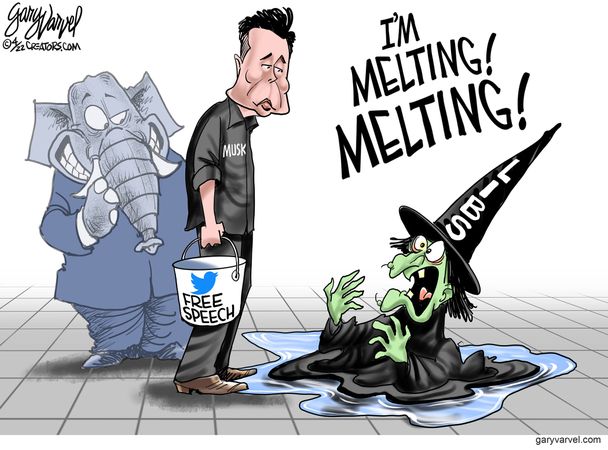
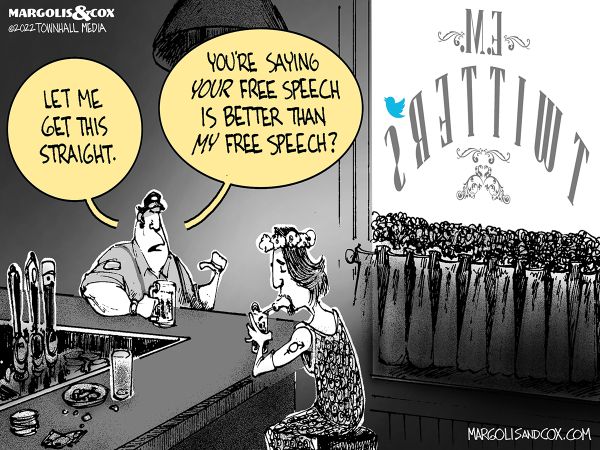


Time Mag: Down With Free Speech!

Jonathan Turley writes at his blog Time Columnist Denounces Free Speech as a White Man’s “Obsession”.  Excerpts in italics with my bolds and added images.  H/T Tyler Durden

It has become depressingly common to read unrelenting attacks on free speech in the Washington Post and other newspapers. The anti-free speech movement has been embraced by Democratic leaders, including President Joe Biden, as well as academics who now claim “China was right” on censorship. However, a Time magazine column by national correspondent Charlotte Alter was still shocking in how mainstream anti-free speech views have become. Alter denounces free speech as basically a white man’s “obsession.”

What is most striking about the column is Alter’s apparent confusion over why anyone like Musk would even care about the free speech of others. She suggests that Musk is actually immoral for spending money to restore free speech rather than on social welfare or justice issues.  She suggests that supporting free speech is some disgusting extravagance like buying Fabergé eggs.

In arguing in favor of censorship, Alter engages in a heavy use of historical revisionism, claiming that

“‘free speech’ in the 21st century means something very different than it did in the 18th, when the Founders enshrined it in the Constitution. The right to say what you want without being imprisoned is not the same as the right to broadcast disinformation to millions of people on a corporate platform. This nuance seems to be lost on some techno-wizards who see any restriction as the enemy of innovation.”

It is also lost on me.

Alter is confusing free speech values with the rationale for the First Amendment. For years, anti-free-speech figures have dismissed free speech objections to social media censorship by stressing that the First Amendment applies only to the government, not private companies. The distinction was always a dishonest effort to evade the implications of speech controls, whether implemented by the government or corporations.

The First Amendment was never the exclusive definition of free speech. Free speech is viewed by many of us as a human right; the First Amendment only deals with one source for limiting it. Free speech can be undermined by private corporations as well as government agencies.

This threat is even greater when politicians openly use corporations to achieve indirectly what they cannot achieve directly.

Key free speech figures practiced what they preached in challenging friends and foes alike. After playing a critical role with our independence, Thomas Paine did nothing but irritate the Framers with his words, including John Adams, who called him a “crapulous mass.”

Yet, free speech was a defining value for the framers (despite Adams’ later attacks on the right). It was viewed as the very growth plate of democracy. As Benjamin Franklin stated in a letter on July 9, 1722: “Without Freedom of Thought, there can be no such thing as Wisdom; and no such thing as public liberty, without Freedom of Speech.”

The same anti-free speech voices were heard back then as citizens were told to fear free speech. It was viewed as a Siren’s call for tyranny. Franklin stated:

“In those wretched countries where a man cannot call his tongue his own, he can scarce call anything his own. Whoever would overthrow the liberty of a nation must begin by subduing the freeness of speech; a thing terrible to publick traytors.”

Yet, Alter assures readers that this is just due to a lack of knowledge by Musk and a misunderstanding of why censorship is a natural and good thing:

“Tech titans often have a different understanding of speech than the rest of the world because most trained as engineers, not as writers or readers, and a lack of a humanities education might make them less attuned to the social and political nuances of speech.”

It appears that Alter’s humanities education in college allows her to see “nuances” that escape the rest of us, including some of us who are not “trained as engineers.”

Just for the record, Alter has a degree in English Language and Literature/Letters (Harvard). Musk has his undergraduate degrees not in engineering but a Bachelor of Arts degree in physics and a Bachelor of Science degree in economics (both from the University of Pennsylvania). None of these degrees bestow any basis for claiming superior knowledge of constitutional law or human rights.

Indeed, no degree offers such determinative authority.

Some of the most anti-free speech figures in our history have law degrees. A degree guarantees neither wisdom nor understanding. Many of the Framers were not legally trained but they had an innate sense and commitment to free speech.

James Madison warned us to be more on guard against such nuanced arguments: “There are more instances of the abridgment of the freedom of the people by gradual and silent encroachments of those in power than by violent and sudden usurpations.”

As Time, the Washington Post, the New York Times, and other media outlets align themselves with the anti-free speech movement, it is more important than ever for citizens to fight for this essential right.

There is nothing nuanced in either this movement or its implications for this country.


Fake Virtue Demeans Us All

Explained at Peak Prosperity For The Narrative-Creators, The Play Is You… And You Are Not Real.  Excerpts in italics with my bolds and added images.  H/T Tyler Durden

If, like me, you’ve been wondering about why things are the way they are in today’s world, and how this relates, this is my explanation: For the actors, writers and directors who create real world narratives, the play is you. And you are not real.

Actors and Reality

Much has been made of the jarring dissonance between the heroic stand of the president and the people of Ukraine and the facile signaling of the Social Justice crowd. Feel free to pick your favorite exemplar, from the merely stupid banning of Russian cats and renaming of White Russian cocktails to the more sinister cancelling of Russian performers, or the horrific threats and vandalism to places serving Russian food. There’s no shortage of content here. And, as we’ll get to shortly, that’s the point.

Ukraine’s policy goals do not map fully to those of the United States (think Azov Battalion, for starters), and we can and should carefully consider our response with that awareness. But this does not change Ukrainian heroism. Zelensky wants planes, a no-fly zone, and he would no doubt love NATO boots on the ground. Prudence may dictate we provide him none of these, but it is worth noting that any of us in his circumstances would likely be asking for the same things. Any of us who stayed during the onslaught, that is.

Clearly, Putin’s bet from the beginning included Zelensky on the first plane out to serve as the leader of the Ukrainian government in (comfortable) exile, after which the dismemberment of that nation would rapidly become a fait accompli. Zelensky was having none of it. He stayed, and continues to stay, at great personal risk to himself and his family. He is, unquestionably, a hero.

It is the contrast between these two extremes (the banning of Russian-themed menus et al vs. Zelensky’s stand) that provides ample opportunity to reflect on the idea that many Americans are just not serious people. Unsurprisingly, their response to events in Ukraine has been to simply cut and paste from the outrage-of-the-week playbook: change profile picture, use a hashtag, find some people to cancel, and congratulate oneself on how virtuous one is. In the real world, rational people are tempted to say, “None of this ‘support’ matters”. It’s just empty signaling. So why is it happening, why has it become so pervasive, and how should we contend with it? Examination of a few high-salience topics can shed some light.

Covid and Wuhan Lab Leak Theory

Consider this first in the context of Covid and the by now well-known case of the Lab Leak Theory. Peter Daszak of the Eco-Health Alliance was the prime mover behind the infamous Lancet Letter branding any lab leak speculation uninformed conspiracy. This makes perfect sense when considering his incentives. Daszak (and Fauci, and others) had something to lose here. Perhaps a lot to lose. U.S. funding of Gain of Function research in Chinese labs resulting in a global pandemic is, to put it mildly, not a very good look and could be costly both financially and criminally.

And that’s where those laws, norms, and standards come in. In an environment with many disinterested actors, those entities without skin in the game would easily out-produce the relatively small number of individuals invested in a particular narrative. In that environment, the idea that zoonotic transmission and escape from a biolab in the same city where researchers were known to be working on bat viruses were both very real possibilities would be obvious.
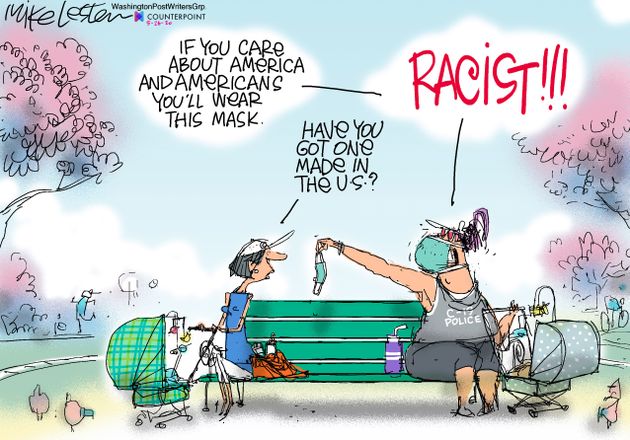
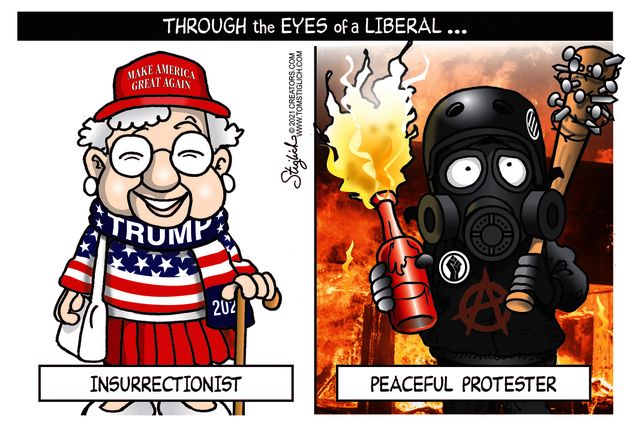
But that is not at all how it went down.

Instead, the idea that it might be prudent to investigate what role the lab in Wuhan may have played in the pandemic became roughly equivalent to arguing Flat Earth Theory. What the hell was going on here? Did everyone in the American media landscape owe Daszak a favor? Did Fauci have a secret cache of compromising emails and photos to dangle J. Edgar Hoover style over the heads of troublesome journalists? Why on earth would hundreds or thousands in the media run cover for these guys and for the Chinese government to the extent of making claims that mere investigation of the possibility of a lab leak was racist?

More puzzling still is the idea that there is nothing about either potential source of the pandemic that presupposes an explicitly liberal or conservative position. Indeed, one could easily flip the script and imagine a campaign urging people to “follow the science” rather than resorting to xenophobic tropes about savages in wet markets. Until, that is, Donald Trump and other conservatives brought it up, which was like Christmas came early for Daszak and his co-conspirators. For the progressive left, the endorsement of anything by President Trump was more than sufficient cause to oppose it, and thus the wheels began to turn.

None of this should be surprising to anyone who’s been paying attention. At its heart, this is an expression of the luxury of operating without consequences. The luxury of not having to think operationally. To be clear, what I am saying is that Daszak and his cronies were able to leverage a system in which those with the loudest megaphones literally did not and do not care where and how Covid originated. For them, it just doesn’t matter. The pandemic is just background noise. That may seem like a strong statement. So, why and in what sense did they not care?

Personal Gain Not Public Trust

In a recent episode of Bari Weiss’ podcast Honestly, journalist and academic Yuval Levin articulated a theory of the change from institutions-as-formational to institutions-as-platforms. In his view, institutions of all types formerly served to develop the individuals inside them. If for example, you worked at the New York Times as a young journalist, you would be shaped by the ethos of that institution, informed by the repository of values developed over time within that structure.

According to Levin, this has been replaced by the notion of institution-as-platform,
the idea  that these structures exist as a launching pad for one’s personal brand.

Understood from this perspective, the great Lab Leak crackdown suddenly makes a great deal of sense. One of the baseline branding positions operating was “not-Trump.” I am completely persuaded that if Trump had spoken out in favor of the wet market theory, we’d all have been loudly advised to “follow the science” in precisely the opposite direction.

It is also worth noting that these personal brands are rivalrous goods. Having a “take,” even the right one, is necessary, but not sufficient. Your take must outcompete the other signals in the marketplace in order to claim disproportionate attention. And this explains why the Lab Leak Theory had to be, “conspiracist,” “anti-science,” and eventually, of course, “racist.”

The more extreme the position is,
the more effective it is in gaining audience-capture.

And this is not part of the story; it’s the entire story. There is effectively nothing behind the curtain. Because of these powerful incentives, what has happened without us realizing it is the creation of a public dialogue between a small, privileged elite that is fixed on in-group signaling and status-capture. The policy concerns or post-pandemic reforms that should differentially apply depending upon the origin of the disease diminish in importance to the extent that they functionally do not matter at all.

And people impacted by those decisions by extension do not matter either.
They are extras and scenery.

The Damaging Script

This goes a long way toward explaining the persistence of the otherwise bewildering advocacy that has permeated American life. Democratic New York Mayor Eric Adams noted that the Defund the Police crowd “are a lot of young white affluent people.” Of course they are. Poll after poll reveals that those who live in high-crime neighborhoods want more police, not less.

Like any other sane person, those citizens also want their police officers to be professional and not corrupt, but “I want my police officers to fight crime and be professional” is just not an exciting take. From this perspective, insanity like Defund the Police isn’t surprising, but rather inevitable. It is the position pushed to its logical extreme. And that is why arguing with this group is useless.

Perhaps nothing is more indicative of this trend than the increasingly unhinged claims emerging from the trans-activist community, as LGB became LGBT and now for some is properly expressed as LGBTQQIP2SAA, in order to be “inclusive” to intersex, pansexual, asexual, and two-spirit people.

For an outsider, it can all seem like satire.
How could anyone engage in these abbreviation acrobatics unironically?

For outsiders, the criticism seems insane. That is because, once again, we are not the audience. What we are seeing is a process of in-group jousting for status, where increasingly bizarre formulations become predictable and indeed necessary to gain attention. “I disagree with J.K. Rowling” is hardly a winning message, especially compared with “J.K. Rowling threatens my right to exist!” Thus, once again, appeals to reason, biology, or even compassion for a generation of children we are harming irrevocably do not and will not work.

No one affected by these positions exists in any meaningful way
because, again, they are not real.

By far the best example of this phenomenon is Black Lives Matter, a marketing triumph that proved beyond all doubt that these tactics can work, work well, and most importantly, be monetized. The familiar script is here, but no one has ever executed it better, as activists turned their rallying cry into a movement indistinguishable from religion. No nuance or difference of opinion was tolerated. Even to remain silent was proof of apostacy.

The net result? More than $60 million, most of which remains unaccounted for, and a series of high-end real estate purchases by the activists behind the whole thing. No policy achievements of any kind, because of course those were never the point from the beginning, as was obvious to anyone paying attention.

The response to this from BLM? Condemn the black reporter who exposed their murky finances and questionable real estate transactions as racist, smear the black Harvard economist as a sexual predator, and suggest that even the financial reporting required of non-profits is, you guessed it, racist. It’s not that hard to parse this: BLM activists are not friends or allies of black communities whatsoever. Instead, we come back to the same point: everyone outside of the in-group are just extras and scenery. Including those for whom they purport to advocate. None of them are real.

Luxury Beliefs

Rob Henderson calls all of this a symptom of “Luxury Beliefs.” According to Henderson, these are “ideas and opinions that confer status on the rich at very little cost while taking a toll on the lower class.” What we have is a catechism, a portfolio of dogma that operates as a signaling mechanism among the elite. And so, in addition to “Follow the Science” on Covid, “Trans Women are Real Women”, and “Black Lives Matter”, we have a host of other statements expressed as moral imperatives, including things like “Healthy at Any Size”, “All Family Structures are Equal”, “Open Borders”, etc.

All of this can be considered an unexpected and unwelcome consequence of our own success. The complex, exquisitely-tuned supply chains that funnel us goods and services have become so remarkably effective they are essentially invisible. Elites don’t have to worry about how things get done, how X leads to Y, or how thing A gets to place B.

It just happens. Magically. Invisibly.
How the sausage is made is a question for smaller minds.

In my view, Henderson gets one thing wrong about his theory. Luxury Beliefs are not in fact, the provenance of the rich, but rather of the educational elite, some of whom are also rich in the bargain. Journalists, other media members, academics, and activists typically have little to no experience in actual business and even less incentive to ever gain any. The effortless flow of goods and services they experience allows them the freedom from having to think operationally or consequentially.

Over the past two years, COVID revealed and supercharged the insular status of these elites. If you talk to business owners, no matter how wealthy they may be, who vitally need to think operationally and consequentially every day, you find considerably less support for these elitist notions.

All of this is bad enough when locked in some academic ivory tower, but as we’ve seen, this has escaped into the American Wild with terrifying effect. Crime, inflation, record border crossings, education, and more. Pick your topic, as the list goes on and on.

The Final Act

Which brings us back to Ukraine as the setting for the ridiculous virtue signaling and posturing by these same luxury elites. It is jarring when juxtaposed against actual tanks and soldiers, but it is just more of the same.

I stated earlier that these are not serious people, but that is not entirely accurate. They are extremely serious, just not about anything other than their own internal conversations.  These people will not change, and they will not be persuaded by your arguments, your statistics, and your facts.

Because the people who make any of the things elites consume and the people elites purport to stand up for are all equally irrelevant. Performance is the point. The performance is the whole thing, and the actors, playwrights and directors aren’t taking suggestions from you, the extras and the scenery.

Which leads us to the final act: maybe it’s time to think about shutting down the whole play.


Free Speech (Musk) or Curated Speech (Obama)?

The alternative attitude was recently put forth by Obama exercising his free speech rights in front of a Stanford audience who both like him and like what he says.  In effect he said he is all for free speech but tech companies need to censor some speech to protect democracy.  Seems like a semi-pregnant posture.  It reminds me a Rodney Dangerfield scene portraying a business executive: He tells his secretary, “Hold some of my calls!”

Jenin Younes explains the issue and its import in her Brownstone Institute article The Federal Government Forces Social Media Companies to Censor Americans.  Excepts in italics with my bolds and added images.

In May of 2021, the Biden Administration began a public, coordinated campaign to combat the dissemination of “health misinformation” related to Covid, especially across social media platforms.

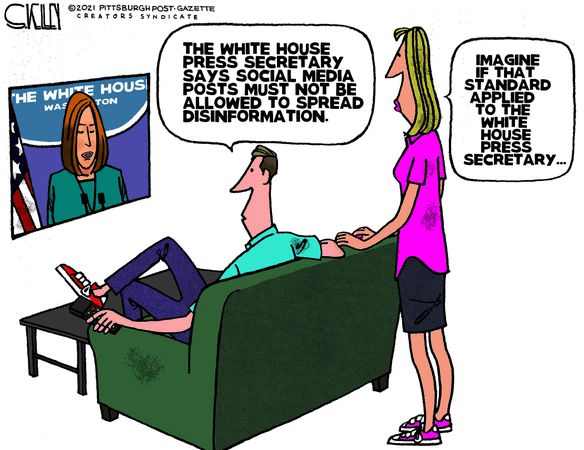
Members of the Administration, including Surgeon General Vivek Murthy and the President himself, often through White House Press Secretary Jen Psaki, have made clear that they blame Big Tech for American deaths from the virus, and insist that these platforms have an obligation to censor those who articulate views that depart from the Government’s messaging on Covid-related matters.

The Administration has stated that it supports “a robust anti-trust program,” a not-so-subtle warning that if the Twitters and Facebooks of the world do not do the Government’s bidding, they will suffer the consequences.

The campaign has been increasing in intensity for nearly a year.

Ms. Psaki and Dr. Murthy have subsequently stated that the government is flagging problematic posts for social media platforms to censor and commanded them to elevate the voices of those who promote the approved messaging through algorithms while banning those whose perspectives conflict with the government.

The President has affirmed his belief that social media platforms “should be held accountable” for misinformation circulated on them. On March 3, Dr. Murthy announced an initiative, wherein he demanded that tech companies provide the government with “sources of misinformation,” including the identity of specific individuals, by May 2.

Like many others around the world, Michael P. Senger of California, Mark Changizi of Ohio, and Daniel Kotzin of Colorado, operated Twitter accounts that centered around criticizing government and public health Covid restrictions. All three accounts rapidly became popular.

Starting last spring, right around the time the Biden Administration’s efforts became public, the three were subject to temporary suspensions. Mere days after Dr. Murthy’s March 3 statement, Mr. Kotzin was suspended for a week, and Mr. Senger permanently. This means he is never permitted to create another Twitter account. He has lost his 112,000 followers, and in his own words, been “silenced and completely cut off from” the network he developed over two years.

According to Twitter, the suspensions were for spreading Covid “misinformation.” Mr. Senger, Mr. Changizi, and Mr. Kotzin had, in the cited tweets, expressed opposition to vaccine mandates and suggested that the vaccines do not slow the spread of Covid. They also argued that government-imposed restrictions do not work to mitigate viral spread, the risks Covid poses to children are sufficiently low to disfavor vaccination for them given the long-term unknowns, and naturally acquired immunity is superior to that attained through vaccination.

None of these claims is outside the realm of legitimate scientific discourse.

In fact, figures like CDC Director Rochelle Walensky, Anthony Fauci, and President Biden, who a mere six or eight months ago expressed absolute confidence that, for example, the vaccines stop transmission and confer better protection than naturally acquired immunity, have now been confronted with unequivocal evidence that they were wrong.

A meta-study out of Johns Hopkins University concluded that lockdowns did not reduce Covid deaths, while causing quite a bit of harm, corroborating observational data from around the world. Several Scandinavian countries recommend against vaccinating healthy young children based on an objective risk assessment, and study after study has proven that naturally acquired immunity is superior to vaccine-induced immunity.

Following nearly two years of insistence that community masking is effective, many prominent public health officials have changed course. It is a great irony that those who have been so wrong throughout the pandemic now seek to silence dissenters, particularly those who have proven prescient on many topics.

And even if they were expressing flatly incorrect views, the First Amendment gives them the right to voice those opinions. The concept of free speech was embraced by the Framers of the Constitution, who were clearly wiser than many who govern us today. They recognized that censorship does not work practically: rather, it encourages people to operate covertly, often exacerbating the problem, and that the cure to bad speech is good speech.

But most of all, they understood that giving government the authority to determine which ideas should be heard and which should be suppressed is a dangerous game.

Of course, many will argue that Twitter and other tech companies censored Mr. Senger, Mr. Changizi, and Mr. Kotzin of their own volition, and as they are private actors, the First Amendment is inapplicable.

That argument should be rejected. When the government commandeers, coerces, or utilizes private companies to accomplish what it cannot do directly, courts recognize that is state action. In a mid-20th century version of this case, Bantam Books v. Sullivan, the Supreme Court held that a state government commission consigned with reprimanding sellers of pornography and advising them of their legal rights (a veiled threat) “deliberately set about to achieve the suppression of publications deemed ‘objectionable’ and succeeded in its aim.” The Court looked “through forms to the substance” and concluded that this program violated the First Amendment.

That is similar to what is happening here. The Biden Administration knows that it cannot get away with issuing orders directly prohibiting people from articulating views about Covid-related matters that differ from the government’s, or from obtaining users’ private information, so it is coercing companies into doing this on the government’s behalf.

Fearing reprisal from the government—reprisal that the government has publicly contemplated—the companies are ramping up censorship. These companies are also likely to turn over information about users that Dr. Murthy demanded, a violation of the Fourth Amendment’s prohibition against warrantless searches.

Not only are individuals like Mr. Senger being silenced outright. Mr. Changizi, Mr. Kotzin, and millions of others are afraid to say what they really think because they do not want to suffer Mr. Senger’s fate. Courts should “look through forms to the substance” and recognize what is going on.

The Government is deciding what speech is acceptable and may be heard, and what speech is not acceptable and must be silenced, on the most hotly debated political topics of our time. This strikes at the heart of what the First Amendment is supposed to protect.

See also Weaponized Claims of Disinformation


Covid Gets Milder, Left Stays Toxic

Physician C.J. Baker explains in his American Thinker article COVID-19 is becoming milder, but the left stays toxic as ever.  Excerpts in italics with my boldsand added images.

Just this morning (Tuesday, April 22, 2022), in the New York Times’ “the Morning” online report, a guy named David Leonhardt writes with apparent amazement that “Coronavirus cases have risen in major cities. Hospitalizations have not.” Imagine that.

Leonhardt goes on to note that despite the long list of members of Congress and other public servants recently diagnosed with COVID-19, none of them, even our superannuated speaker of the House, appears to have got very sick from it. To his credit, he supplements this observation with some charts that clearly show the disconnect between current cases (which are rising) and hospitalizations (which remain flat).

So far, so good. But then he gives his explanation for this trend. That’s where the spin and outright dishonesty of the COVID-forever left — led by the Times — continue apace.To what does David the Lionhearted, the Gray Lady’s intrepid knight of the keyboard du jour, attribute these positive trends? He reports what (supposedly) “many experts believe”:

♦  Vaccines and booster shots are effective and universally available to Americans who are at least 12. (Covid [sic] continues to be overwhelmingly mild among children).
♦  Treatments — like Evusheld for the immunocompromised and Paxlovid for vulnerable people who get infected — are increasingly available.
♦  Tens of millions of Americans have already been infected with the virus, providing them with at least some immunity.

Two key points should be drawn from this list of explanations.

First, an absolutely central reason for the good news about COVID-19 has been deliberately omitted. 

As any truly knowledgeable and honest doctor or virologist — provided you can find one these days — will tell you, viruses such as SARS-CoV-2 mutate like crazy and evolve rapidly and in a predictable manner. In short, these viruses consistently mutate to become more transmissible and less virulent. Why do they evolve in this way? For the same reason all organisms evolve: to benefit their own propagation and survival.

When a new virus is first introduced to a host species, the initial interaction is often not pretty. The virus may struggle to spread between individuals, endangering its survival, and it may invoke severe illness in its host, even killing it, thereby endangering both species’ survival.

Moving slowly and painstakingly from one home to another, while burning down the one in which you currently reside, is no way to survive. So the virus mutates and evolves into a milder form that spreads more readily yet sickens the host less.

In essence, the perfect respiratory virus is the common cold. It infects its host but makes the host sick enough only to sneeze the virus’s progeny at everyone around. It spreads like wildfire, but it doesn’t burn down its own house in the process.

Runny nose coronvirus family

Not for nothing, but what do the other coronaviruses in general circulation among humans cause? That’s right: symptoms of the common cold. This is almost certainly the final common pathway for SARS-CoV-2.

As a practicing physician, trained before schools of public health veered to the left of gender studies departments, I have been saying this since the summer of 2020.

Meanwhile, panic pornographers ranging from Anthony Fauci to Times newsboy Leonhardt’s “experts” have latched onto that first trait of viral evolution (increased transmissibility) while deliberately downplaying, or even denying the second (reduced virulence). Why?

Because they want to foment all the fear that increased transmissibility promotes, yet allow none of the hope and perspective about the virus that acknowledging reduced virulence would bring.

Second, several systematic lies are embedded in the three explanations that are given.

The second lesson to take from Leonhardt’s list is this: as the facts become too obvious to support their false narrative, leftists perform the propagandistic equivalent of a “tactical retreat,” covering their tracks with false and misleading explanations.

Leonhardt writes that “vaccines are effective and readily available.” Effective at what?

At stopping the virus in its tracks, as the Times and Fauci claimed for months? Nope. At preventing persons from contracting COVID-19, as they also claimed? Well, obviously not, since every one of those politicians has been vaccinated and boosted to the hilt. At reducing severity of disease? Well, then what happened to the vaunted “pandemic of the unvaccinated”? Based on the data curves Leonhardt provides, the unvaccinated aren’t going to the ICU these days, either.

Leonhardt touts Evusheld and Paxlovid as “increasingly available,” a total non sequitur in the absence of any data supporting their role in the current trends, which he does not provide. He completely ignores any cheap, repurposed early treatments, despite — or more likely because of — the growing mountains of data supporting their effectiveness.

Finally, Leonhardt blatantly understates the effect of natural immunity, both by lowballing the number of previously infected Americans (it’s in the hundreds of millions, Dave, not tens) and by the deeply misleading statement that prior infection produces “at least some immunity” (Natural immunity is far superior to vaccine-related immunity.)

Here is the reality, the plain fact that Fauci and Leonhardt’s “many experts” will never admit: SARS-CoV-2 is evolving and adapting to coexist with us. The COVID-forever left remains as toxic and destructive as ever.

Hey Groomers, Leave Those Kids Alone!

Today’s topsy turvy world has turned the classic Pink Floyd admonition inside out, with teachers and others grooming kids for inappropriate sexual behavior without any moral context.  Helen Roy explains at American Mind Groomergate.  Excerpts in italics with my bolds and added images.

Say the word. Scare the establishment.

When I was a child, there was a girl I knew whose father was well-known amongst us girls to show his penis at sleepovers. In retrospect, even aside from our loud murmuring, signs of abuse were everywhere. But the man was fairly prominent in evangelical circles, and a talented musician. Other adults cheered him on in public. Other adults permitted and promoted the idea that his house was a good place for sleepovers. Maybe these other adults were completely ignorant, maybe they were in denial, maybe they didn’t care, maybe they thought it was normal, or maybe they were playing a popularity game in a toxic social system of their own.

Either way, prepubescent girls were being molested for years. And those who weren’t being molested were learning their sexual dignity didn’t matter, which undoubtedly paved the way for poor sexual decisionmaking in the future. Perhaps if these parents would have been called out by other parents for their active participation in the grooming exercise, they would have realized their culpability in the matter.

But back then, much like today, many people didn’t like to call groomers out.

Abuse remained in the shadows, under the cover of adult reputation. The difference now is that the culture of harm and perversity has been institutionalized across America. What was once seen as an indiscretion is now an industry.

And so, last week, as if triggered by some kind of underground bat signal, several familiar faces of Conservative Inc. simultaneously released op-eds and Twitter threads insisting that use of the term “groomer” in the context of fighting LGBT indoctrination in schools was very, very bad indeed.

In their view, the epithet is unfair, even immoral, because some take it as an unsubstantiated accusation of active pedophilia. “You may not be aware,” as David French lectured, “but right-wing media is swarming with allegations that anyone who, for example, opposes Florida’s House Bill 1557 (the bill misleadingly termed the ‘Don’t Say Gay’ bill by Democrats and many in the media) is either a ‘groomer’ or in league with groomers.”

Why any self-identified conservative would make defending groomers’ honor their first priority in this debate is a mystery for another day. But strictly on the merits, their conclusion is wrong because their premise is wrong. Grooming is a complicated system of behavior. What is it?

Most basically, to groom is to prepare or train someone else for a particular activity.

In the current political context, “grooming” certainly—and accurately—connotes sexually inappropriate ends, especially as its most recent usage was entirely swept up in the #MeToo movement. Even as grooming discourse reached its apparent zenith a few years ago, rape was not always the intended or actual end of the story. Rather, it was understood that to be a groomer was to actively participate in the broader system of manipulation. Ghislaine Maxwell and similar “recruiters” may not have been doing the raping, but they were all certainly engaged in grooming. Active participation does not imply full knowledge of the system itself; whether you’re a groomer or not does not rely on your own self-awareness. Orchestrated by the ill-intentioned, grooming is often facilitated by good country people, unaware that the cliches they’ve adopted as life mantras are actually deeply damaging to themselves and the people around them.

Love is love, Miss Whatever exclaims, as she caringly simulates anal sex on a teddy bear to a classroom full of five-year-olds.

In the David French version of reality, where drag queen story hour is considered a blessing of liberty, a rainbow flag in preschool is merely a neutral object, misplaced by well-intentioned people who definitely don’t have any negative intentions for your children whatsoever. How do we know this? Because they’ve never explained their intentions. We must give everyone, especially our self-proclaimed enemies, the benefit of the doubt. Stated aims are to be believed as true intentions despite any evidence to the contrary. So, conservatives should bite their tongues. It’s just not fair to suggest that their behavior, no matter how thoroughly it greases the wheels for sexual misconduct and confusion, is grooming. Don’t believe your lying eyes, and definitely don’t say groomer.

I’d like to offer some encouragement for anyone who, as a result of has-been NeverTrump countersignalling, now finds themselves reticent about using the term “groomer” in the general political sense that current usage implies: use it.

Use it because it’s true. As I’ve just explained, people can be groomers without themselves wanting to rape children.
Use it because it’s effective. The culture war is a real war, and a very particular type of war at that: an insurgency.

On one side, you have the institutions; on the other, a merry band of loosely organized rebels. Insurgency is characterized by asymmetry. Because they lack the institutional power, insurgents must rely on guerilla tactics in order to make any progress whatsoever. These tactics, in a war of language and law, boil down to political incorrectness. Political incorrectness, especially the word “groomer,” offends the enemy while galvanizing friends. Powerful memes such as this rarely conform to the tastes of bourgeois sensibilities.

Use it because they disapprove.

One of the first requirements of submission to transgender ideology (or any totalitarian regime, really) is mandated speech. Recall the Jordan Peterson phenomenon circa 2015: Canadian professor comes under fire for resisting the enactment of a bill requiring the use of preferred pronouns; failure to comply was punishable by termination of employment. Fundamentally, the modus operandi of this movement is in the manipulation of reality through language. “Here’s a more palatable way to say this,” has become a favored tactic of those who manage the decline into unreality. If only as an act of resistance to this familiar tendency, this slippery slope we’ve been gaslit into denying, say the unspeakable words. The moment we stop is the moment we lose them forever.

And if we don’t use “groomer”, we lose this moment, too—and all that comes after. Midwit middle managers, bureaucrats, and journalists, whose life mission is to keep the establishment and their establishment career afloat, know that forcing their opposition to adopt their own sensibilities is an act of political castration.

If you want to win on parents right, you must refuse
to be groomed for establishment’s eunuch class.

Stella Paul adds at American Thinker Confessions of a Disney writer

For many years, I made my living writing TV shows for Disney. I was proud of my work, considering it a privilege to make kids laugh all over the world. But in light of Disney’s disastrous embrace of pro-pedophilia policies, I’m glad that I grew disillusioned with kids’ TV and walked away from the field.

Every kids’ TV writer knows that when crafting a story, you have to be careful about “modeling behavior.”

Whatever kids see, they imitate, so you should “model” positive traits in your scripts, particularly when writing for pre-schoolers. Imagine inserting a pint-size Larry David character in your story who is obnoxious, argumentative, and sneaky. Inevitably, you’d get back notes from the story editor telling you to revamp the script to avoid modeling negative behavior.

So Disney’s recent commitment to “add queerness” wherever possible can’t be explained as just trying to teach tolerance and inclusivity. The executives know that by showing “queerness,” they are modeling queerness and encouraging kids to imitate that behavior.

Parents are now furious about Disney’s woke agenda to sexualize children, and they’re organizing and protesting. Will their consumer boycotts of Disney’s products and theme parks have a long-term impact on Disney’s bottom line? It’s too soon to tell, but Disney’s hostility to traditional family values is not winning it friends, and its brand magic seems to be evaporating.

Footnote: Math Homework in Missouri


Critical Gender Theory Wreaking Havoc

This is an update adding to a previous post reprinted below Ruckus Over Classroom Genderism.  C. Bradley Thompson provides a detailed and disturbing accounting of the gender transition  movement operating inside the US school system. His substack article is Sex and the Schools, or, An Essay You Don’t Want to Read.  A few excerpts are in italics with my bolds.

In this new series of essays, I’d like to show you what is being taught in America’s twenty-first-century government schools and the philosophy behind it. The portrait that I will present here is not a pretty one, but it is the reality. The simple truth of the matter is that America’s government schools are intellectually bankrupt and morally corrupt. To suggest otherwise is either disingenuous or a form of head-in-the-sand-ism.

Officially, America’s schools claim to teach no moral values per se. But that claim is contradicted by the fact that they constantly push moral values such as “diversity,” “equity,” “inclusion,” “tolerance,” moral relativism, and egalitarianism. Such “values” are intended to strip children of any standards or principles they may have previously embraced, so that the teachers can replace the sometimes conservative cultural values of the kids’ parents with the political values of today’s postmodern, cultural Left—namely, egalitarianism, multiculturalism, feminism, environmentalism, transgenderism, “social justice,” socialism, etc.

The curricula in America’s K-12 government schools (and in many of the most elite private schools) is now dominated by two offshoots of Critical Theory known as Critical Gender Theory (CGT) and Critical Race Theory (CRT). Developed in America’s “ed” schools and law schools, CGT and CRT seek to deconstruct and reinvent all traditional gender categories and racial relationships. The primary delivery mechanism for inciting this social revolution is America’s government school system.

The ultimate aim of Critical Gender Theory is to deconstruct the family and replace it with the State as the primary vehicle for educating children.

The specific political goal is to create a new class of the “oppressed.” From this new class of victims will come the new revolutionaries who will keep the revolution alive and move it to the next stage of development. This is the ultimate means by which capitalism is to be dismantled and the State is to become the final arbiter of the principle, “From each according to his ability, to each according to his need.”

The battlefront comes down to two core questions: first, who shall determine the sexual mores taught to America’s young children—parents or government teachers, and, second, what sex- and gender-related values should be taught to children in America’s government schools?

And yet these fundamental questions still don’t quite capture what’s at stake in this conflict. There’s an even deeper, metaphysical question that represents the new battleground between parents and America’s Education Establishment: What is the sex-gender “identity” of each and every child? To put the issue in even simpler terms, the question is: what is a boy and what is a girl?

For tens of thousands of years, the answers to these two questions were self-evidently obvious the moment a child was born. Today, however, the answers are uncertain until the child answers them with the assistance of government schoolteachers and administrators. The question is no longer settled by nature and science and nurtured by parents.

To put a sharper edge on the matter, the question might be: how is it that 9-year-old girls can be encouraged by school officials to take puberty blockers and 15-year-old girls can be encouraged to begin a course of testosterone treatments and 17-year-old girls can be encouraged to ready themselves for double mastectomies without their parents’ knowledge and permission?

The following newspaper headline from 2022 sums up the current state of our world: “Texas Teacher Claims 20 Fourth Graders Out of 32 Students Identify as LGBTQ”![8] The teacher was proud to share this information with reporters during the school’s well publicized “pride” march. (The teachers’ pride in this “fact” no doubt raises her professional social status.) Just so we’re clear, the teacher’s claim means that almost 63 percent of students in her fourth-grade classroom in Texas—I repeat, Texas—identify as LGBTQ. Now think about what this means (statistically, it is virtually impossible)—it basically means that this teacher is either lying, engaging in wish fulfillment, or grooming. I can see no other options.

We have entered a Brave New World. This is penultimate stage of western nihilism.

.Ruckus Over Classroom Genderism.

The best overview I’ve seen comes from a veteran teacher in California. Peter Laffin writes in American Thinker The Truly Remarkable Thing about Florida’s Anti-Grooming Law.  Excerpts in italics with my bolds and added images.

It is difficult to remain objective over the Florida education fracas. So much of the episode fires up the amygdala. The innocence of children. The rights of parents. The sovereignty of individual identity. The never-ending scandal of humans and sex. To feign “neutrality” in this conflict is a sort of moral suicide. If none of this matters, what possibly could?

As someone who taught school in progressive enclaves for 14 years, I can attest that there are many good people who oppose this law for fear that it will diminish the humanity of loved ones and reverse the tide of social progress. Although I do not believe that this law will have that effect, I respect the sincerity of those who do.

Nonetheless, it remains urgent to speak the truth plainly and oppose the ever-intensifying spread of radical social theory being taught to ever-younger students.

Instances of ideological excess in American classrooms are well chronicled and widespread. We have seen enough to know that the time to act has long since passed. The Florida anti-grooming law is a necessary tool to blunt this advance, even though it seems conspicuously tame upon closer inspection. Its most controversial aspect, from which the clever but disingenuous “don’t say gay” moniker was derived, would have been uncontroversial in any other era:

“Classroom instruction by school personnel or third parties on sexual orientation or gender identity may not occur in kindergarten through grade 3 or in a manner that is not age appropriate or developmentally appropriate for students in accordance with state standards.”

The key term for those still attempting to comprehend this law is “instruction.” The target is not the casual reference, but rather the systematic instruction of academic gender theory to prepubescent children. For instance, it has become common for teachers to utilize resources like “The Genderbread Person” in SEL (social-emotional learning) curricula, as well as other ideologically tinged materials that do not reflect settled science, let alone objective reality.

Further, such instruction materials necessarily force teachers to operate beyond their professional depth and predetermined range of responsibility. Teachers are not psychologists. This was pointedly demonstrated by a mother who spoke at a PTA meeting in Spreckles, California after her daughter’s teacher admitted to stalking her online in order to recruit her into an LGBTQA+ club. “Do you have a doctorate in psychiatry that I don’t know about?” she asked. Also, teachers are not paid by taxpayers to be activists involved in recruiting 5- to 8-year-olds into political causes. Too many teachers have departed the realm of education and entered into the realm of indoctrination, and often with a creepy, messianic air. As such, they must be reined in.

The Florida law prohibits teachers from formally instructing students on these matters before the 4th grade. Until then, the situation will remain in the hands of the students’ families and their doctors.

It would be difficult to contrive a more sensible demand in reaction to the current climate. This is perhaps the most stunning aspect of the entire controversy. Beneath the wailing and screeching is an utterly reasonable request.

And as such, it is no surprise that the vast majority of Floridians support the new law, along with the vast majority of the U.S. voting population. Nor is it a surprise that voters who have read the actual text of the law support it in even greater numbers. Even a majority of Democrats back the legislation. And yet, outlets like NPR and CNN, and subsequently their audiences, have reacted to its passage as though it were an edict from the pope. The cultural left’s blind spot here is profound. At this point, the DNC and its media allies should be charging Ron DeSantis consulting fees. No one is working harder to elect him president.

“The fundamental cause of trouble in the modern world,” philosopher Bertrand Russell once said, “is that the stupid are full of certainty, while the intelligent are full of doubt.” For years, the cultural left has taken the Democrat party hostage and forced it to abandon any pretense of intellectual humility, let alone electoral realism. Both parties have undergone bouts of dangerous self-certainty in recent times. The Republican Party was guilty of this during the Iraq war. But it is obvious that today’s Democratic Party has claimed pathological self-certainty as its banner. While even the most egalitarian countries in the West retreat from pushing gender ideology on prepubescent children, American liberals appear bent on doubling down.

Because of the emotional component, it is understandably difficult to zoom out and gain perspective. But the current environment beggars belief. Can the cultural left really be so certain of an academic theory — so certain that sex is “assigned” at birth as opposed to “observed” in the same manner as eye and hair color, weight, and length — that they will continue to demand its presence in early childhood curriculum? Even at the cost of looming political catastrophe?

It’s still possible that it will relent. But it will require a good dose of humility.

Peter Laffin is a teacher and writer in Laguna Niguel, California. His work has appeared in the American Spectator.

For more on SEL, see Why the Classroom Activists Never Give Up

Social-Emotional Learning supposedly arose out of the COVID-19 pandemic and a need to attend to the emotional psyches of fragile youth. It is a shift in the role of a teacher from an educator to a therapist and places a high value on a child’s emotional competency over academic performance. After locking kids in their homes, isolating them from their peers, muzzling them with ineffective face diapers, and pounding them with fear and doom for 2 years, activists have swooped in to provide emotional support in the classroom once they were permitted to return. In typical government fashion, it seems like a solution looking for a problem. They didn’t create SEL to mend the fragile psyches of youth, they damaged the fragile psyches of youth to push SEL.”

“In a recent Twitter thread by podcaster Josh Daws of the Great Awokening Podcast, Daws lays out in 23 tweets how CRT and gender ideology have been deployed sequentially and their effect on the minds of America’s youth. Based on the work of postmodern critic James Lindsey, Daws suggests that the opening salvo of CRT was to tear down approved identity in the youth. It imparts guilt, shame, and social rejection of majority identities like whiteness, maleness, a binary gender paradigm, or even heterosexuality. Once a person has been made to reject their own race, gender, or sexuality, it is followed up with an approved list of identities from which they can choose in order to be socially accepted.”

The Ruckus Over Classroom Genderism

Update April 13, 2022 see Critical Gender Theory Wreaking Havoc

The best overview I’ve seen comes from a veteran teacher in California. Peter Laffin writes in American Thinker The Truly Remarkable Thing about Florida’s Anti-Grooming Law.  Excerpts in italics with my bolds and added images.

It is difficult to remain objective over the Florida education fracas. So much of the episode fires up the amygdala. The innocence of children. The rights of parents. The sovereignty of individual identity. The never-ending scandal of humans and sex. To feign “neutrality” in this conflict is a sort of moral suicide. If none of this matters, what possibly could?

As someone who taught school in progressive enclaves for 14 years, I can attest that there are many good people who oppose this law for fear that it will diminish the humanity of loved ones and reverse the tide of social progress. Although I do not believe that this law will have that effect, I respect the sincerity of those who do.

Nonetheless, it remains urgent to speak the truth plainly and oppose the ever-intensifying spread of radical social theory being taught to ever-younger students.

Instances of ideological excess in American classrooms are well chronicled and widespread. We have seen enough to know that the time to act has long since passed. The Florida anti-grooming law is a necessary tool to blunt this advance, even though it seems conspicuously tame upon closer inspection. Its most controversial aspect, from which the clever but disingenuous “don’t say gay” moniker was derived, would have been uncontroversial in any other era:

“Classroom instruction by school personnel or third parties on sexual orientation or gender identity may not occur in kindergarten through grade 3 or in a manner that is not age appropriate or developmentally appropriate for students in accordance with state standards.”

The key term for those still attempting to comprehend this law is “instruction.” The target is not the casual reference, but rather the systematic instruction of academic gender theory to prepubescent children. For instance, it has become common for teachers to utilize resources like “The Genderbread Person” in SEL (social-emotional learning) curricula, as well as other ideologically tinged materials that do not reflect settled science, let alone objective reality.

Further, such instruction materials necessarily force teachers to operate beyond their professional depth and predetermined range of responsibility. Teachers are not psychologists. This was pointedly demonstrated by a mother who spoke at a PTA meeting in Spreckles, California after her daughter’s teacher admitted to stalking her online in order to recruit her into an LGBTQA+ club. “Do you have a doctorate in psychiatry that I don’t know about?” she asked. Also, teachers are not paid by taxpayers to be activists involved in recruiting 5- to 8-year-olds into political causes. Too many teachers have departed the realm of education and entered into the realm of indoctrination, and often with a creepy, messianic air. As such, they must be reined in.

The Florida law prohibits teachers from formally instructing students on these matters before the 4th grade. Until then, the situation will remain in the hands of the students’ families and their doctors.

It would be difficult to contrive a more sensible demand in reaction to the current climate. This is perhaps the most stunning aspect of the entire controversy. Beneath the wailing and screeching is an utterly reasonable request.

And as such, it is no surprise that the vast majority of Floridians support the new law, along with the vast majority of the U.S. voting population. Nor is it a surprise that voters who have read the actual text of the law support it in even greater numbers. Even a majority of Democrats back the legislation. And yet, outlets like NPR and CNN, and subsequently their audiences, have reacted to its passage as though it were an edict from the pope. The cultural left’s blind spot here is profound. At this point, the DNC and its media allies should be charging Ron DeSantis consulting fees. No one is working harder to elect him president.

“The fundamental cause of trouble in the modern world,” philosopher Bertrand Russell once said, “is that the stupid are full of certainty, while the intelligent are full of doubt.” For years, the cultural left has taken the Democrat party hostage and forced it to abandon any pretense of intellectual humility, let alone electoral realism. Both parties have undergone bouts of dangerous self-certainty in recent times. The Republican Party was guilty of this during the Iraq war. But it is obvious that today’s Democratic Party has claimed pathological self-certainty as its banner. While even the most egalitarian countries in the West retreat from pushing gender ideology on prepubescent children, American liberals appear bent on doubling down.

Because of the emotional component, it is understandably difficult to zoom out and gain perspective. But the current environment beggars belief. Can the cultural left really be so certain of an academic theory — so certain that sex is “assigned” at birth as opposed to “observed” in the same manner as eye and hair color, weight, and length — that they will continue to demand its presence in early childhood curriculum? Even at the cost of looming political catastrophe?

It’s still possible that it will relent. But it will require a good dose of humility.

Peter Laffin is a teacher and writer in Laguna Niguel, California. His work has appeared in the American Spectator.

For more on SEL, see Why the Classroom Activists Never Give Up

Social-Emotional Learning supposedly arose out of the COVID-19 pandemic and a need to attend to the emotional psyches of fragile youth. It is a shift in the role of a teacher from an educator to a therapist and places a high value on a child’s emotional competency over academic performance. After locking kids in their homes, isolating them from their peers, muzzling them with ineffective face diapers, and pounding them with fear and doom for 2 years, activists have swooped in to provide emotional support in the classroom once they were permitted to return. In typical government fashion, it seems like a solution looking for a problem. They didn’t create SEL to mend the fragile psyches of youth, they damaged the fragile psyches of youth to push SEL.”

“In a recent Twitter thread by podcaster Josh Daws of the Great Awokening Podcast, Daws lays out in 23 tweets how CRT and gender ideology have been deployed sequentially and their effect on the minds of America’s youth. Based on the work of postmodern critic James Lindsey, Daws suggests that the opening salvo of CRT was to tear down approved identity in the youth. It imparts guilt, shame, and social rejection of majority identities like whiteness, maleness, a binary gender paradigm, or even heterosexuality. Once a person has been made to reject their own race, gender, or sexuality, it is followed up with an approved list of identities from which they can choose in order to be socially accepted.”


Method in Woke Madness: From Free Market to Anthill

Joseph Mackinnon explains in his American Greatness article Shafarevich Revisited: Individuality and Dostoevsky’s Ant Hill.  Excerpts in italics with my bolds

Any faultless ant hill is still infinitely less than the most flawed human being, and it is the latter that our society and institutions should empower.

In The Socialist Phenomenon, an incisive book published in 1980 for which Aleksandr Solzhenitsyn penned a foreword, Igor Shafarevich looks at the genesis of socialist doctrine. In many respects, this Russian Orthodox Christian’s analysis complements Catholic conservative arch-liberal Erik von Kuehnelt-Leddihn’s in Leftism (1974), and enjoys the heightened awareness of someone who spent a lifetime steeped in socialism’s consequences.

Towards the end of the book, Shafarevich contemplates the socialist ideal’s relationship to individuality. He writes: “all elements of the socialist ideal—the abolition of private property, family, hierarchies; the hostility toward religion—could be regarded as a manifestation of one basic principle: the suppression of individuality.” This may seem an obvious claim: that a collectivist, materialist ideology motivated by a death instinct would find an enemy in the individual, in individuality. What may not be so obvious are the tactics and lengths to which the socialists would go to grind their enemies down to level—how socialists would ultimately dynamite the mountains to fill the valleys.

Shafarevich identifies some of the ways that socialist society would remedy that pesky individualism.

People would wear the same clothing and even have similar faces; they would live in barracks. There would be compulsory labor followed by meals and leisure activities in the company of the same labor battalion. Passes would be required for going outside. Doctors and officials would supervise sexual relations, which would be subordinated to only two goals: the satisfaction of physiological needs and the production of healthy offspring. Children would be brought up from infancy in state nurseries and schools. Philosophy and art would be completely politicized and subordinated to the education goals of the state. All this is inspired by one principle—the destruction of individuality or, at least, its suppression to the point where it would cease to be a social force.

Shafarevich saw in socialism what Kuehnelt-Leddihn observed generally manifesting in leftist movements: the drive for sameness.

In recent weeks and months, we have seen statists captive to socialist doctrines hinder the movement of what were previously imagined to be free peoples. In the United States, Canada, Australia, New Zealand, and elsewhere, citizens were required to produce passes to go outside. It didn’t matter if you had natural antibodies from a previous infection. It didn’t matter if you were immuno-compromised or had moral qualms with the use of aborted fetal tissue in the manufacture of the so-called vaccines. Your individual rationale was of little importance. What mattered was whether you were obedient or disobedient, as indicated on a pass by a number or a QR code.

The impact on individuality is this: individuality requires that a person be able to [publicly] make and execute choices, whether about his health, about those with whom he consorts, where he can go, what he can purchase, what religion he will practice, and so forth. G. K. Chesterton reminds us that the free man “can damage himself with either eating or drinking; he can ruin himself with gambling. If he does he is certainly a damn fool, and he might possibly be a damned soul; but if he may not, he is not a free man any more than a dog.” Even a dog might exhibit too much personality as far as the socialists are concerned.

Dostoevsky, whom Shafarevich echoes, suggested that socialism, having set for itself “the task of solving the fate of mankind, not according to Christ but outside of God and outside Christ,” pressed its adherents to “create something like a faultless ant hill.” Not men, not dogs, but de-individuated, indistinguishable, and therefore interchangeable ants are what the socialist doctrine prescribes we become.

Consider further the socialist desire to usurp the rights of parents—to have the state or society-at-large raise children. This is a key element of the ongoing effort to abolish the family, and individuality by extension.

The majority of socialist doctrines proclaim the abolition of the family.

In other doctrines, as well as in certain socialist states, this proposition is not proclaimed in such a radical form, but the principle appears as a de-emphasis of the role of the family, the weakening of family ties, the abolition of certain functions of the family . . . [and] the destruction of all ties between parent and child to the point where they may not even know each other.

The goal is the “transformation of the family into a unit of the bureaucratic state subjected to its goals and control.” Two centuries before Shafarevich made this observation, the not-so-moderate Marquis de Sade denounced the family as “an ‘individualistic’ cell that tries to separate itself from the state and society.” This separation can only be prevented with coercive and totalizing pressure. The family’s hierarchical features must be flattened so that parents and children both, if permitted to remain together, are horizontally arranged, sharing the state as the singular authority in their lives.

Kuehnelt-Leddihn explains the rationale behind this subjection and flattening: the family acts as a closed and emotionally marked-off unit, and is therefore “an obstacle to total sameness.” It hinders the socialist design to coddle the worst and stultify the most talented, and counters efforts to impress the same outlook on every child and to rid them of whatever fanciful notions might be assimilated at home. The family must be broken up. Children must be made the property of the state—a view held not just by de Sade but also by Rousseau and many proto-totalitarian leftists since.

Beyond what precisely constitutes the perverse material being taught, the more pressing question is whose role it is to choose what a child is to be taught in the first place? Or better yet: Do children belong to the state after all, as de Sade and Rousseau argued? (It is worth pointing out, as Paul Johnson did in his book, Intellectuals, Rousseau’s advocacy for this position was probably self-justification for abandoning the five children he fathered with Thérèse Levasseur, not one of whom he even bothered to name.) Or do they belong to their parents? While not yet advocating for the creation of phalanstères per Charles Fourier’s designs, it is clear how socialists today will answer these questions if they were ever to answer honestly.

Teaching math, science, and literacy are aids to individuals—to help them navigate the world as they themselves see fit. Propaganda of the kind we see now in schools and colleges, on the other hand, is a means of undoing a person’s cultural inheritance; of relegating parental responsibilities to the state and its agents; of transforming students into tools of the state.

While Florida and Virginia woke up to this socialist phenomenon—which seeks again to deform every child to fit the mold and eliminate otherwise distinguishing familial thinking, all in service of the leveling socialist state—elsewhere in America, individuality continues to be suppressed in the classroom. Here is G.K. Chesterton to once again illuminate the enemy’s target and the consequence: “This triangle of truisms, of father, mother and child, cannot be destroyed; it can only destroy those civilizations which disregard it.” If our civilization seems particularly precarious right now, we’ve arrived at another reason explaining why. The socialist prefers horizontal lines to triangles, and flat plains to mountains and valleys.

The West is not explicitly socialist as was the regime under which Igor Shafarevich toiled. Nonetheless, in its present weakened state, it is especially susceptible to the aforementioned anti-individualist trends. Mobility rights are incredibly important because they relate to one of the principal ways human beings can differentiate themselves: with action, adventure, and friction, each of which requires movement. Parental rights, particularly regarding their children’s education, are incredibly important because cultural inheritance greatly impacts an individual’s development.

These two anti-individualist trends, coupled with the ongoing war on the working- and middle-class’ economic autonomy, the digitization of religious community, the politicization of all art, and Big Tech censorship, are part of the socialist design to build high a “faultless ant hill.” Any effort to reduce us to animal sameness is de facto dehumanization and should not be tolerated. Technocrats, politicians, teachers, and whoever else seeks to combat true diversity—which is important only at the level of the individual—are enemies of humanity. Any faultless ant hill is still infinitely less than the most flawed human being, and it is the latter that our society and institutions should empower at the individual level rather than seek to engineer en masse.

Addendum from Phil Butler’s zerohedge article A World At Odds: The Great Principles Wipe

Mask, or no mask. Vaccine, or no vaccine. My, how this pandemic awakened the suspicions of millions that something other than a serious influenza epidemic is going on. But the conspiracy that was too big to be a genuine conspiracy, it was meant to be unbelievable. The bug itself, likely manufactured in a Biolab by our own government, seems to have been engineered to be just contagious enough, just deadly enough, to erase our principles. This bug, the manipulation of the pandemic, it was released to set the world at odds with itself.

And what about climate change? Do you think that the elites running this shit show would pass up yet another chance to befuddle us? Climate science, or climate hoax? Here too, we’re at odds even over fundamental physics. Are you sensing the dastardly strategies at work? I think we all do. But, I am also sure most people have no conception of the depth of the mind games being played today.

We’re undergoing a morality and mind wipe no psycho-thriller novelist could ever have imagined.

This idea came to me like a bolt, snapping me from a deep sleep last night. Something about all that’s been going on has gnawed at me, as I am sure it has you, and for months now. Now I think I know what it is. We’re being prepared for those artificial wombs that Aldous Huxley conjured up for his post-dystopian Utopia in the novel Brave New World.

I think we must have been totally blinded, not to have seen and felt it before. Trangenderism, the United States creating gender-free passports, and Walt Disney’s company being boycotted over what American moms are calling “grooming” their kids to be victims of pedophiles. A Supreme Court nominee who was just confirmed, said in her confirmation hearings the other day that she could not define what a woman is. Think about this for a moment. Supreme court justices are the most powerful and influential officials in the U.S. government. They are justices for life, appointed to interpret the law!

What we see happening is an overriding strategy based on what the ancient philosophers called tabula rasa or a clean slate. This is the idea that we are born without built-in mental content, and that experience and learning imprint our desires, fears, love, hate, morality, etc. The reader might logically ask now, “How can these elites wipe our slate clean to imprint their orders into us now, after years or decades of experiences?” It’s a good question, but an easy one to answer.

The ‘clean slate,” is the point I am driving at here. In order for the elites waging total war on the Russians to succeed in their ultimate plan, western societies (first) must be under total control, in harmony, willingly compliant to whatever the technocrats and their benefactors dictate. Think of this as the indoctrination young children get when they first go to a religious school. Everything is being broken down and eradicated so that something else can take its place. The former reality, morality, and faith we relied upon will be obsolete because none of it worked for us. I told you, it’s diabolical what’s going on.


Weaponized Claims of Disinformation

Adam Ellwanger raises a good question and provides some clarity in his American Mind article Why Do You Know That?  Excerpts in italics with my bolds and added images.  The scope of his analysis is suggested by the subtitle:

Misinformation, disinformation, and the 1619 Project

The Current Drive to Curate (Control) Information

Earlier this year, Joe Biden asked social media companies to engage in more censorship in an effort to divert attention from the wholesale failure of his administration to “shut down the virus.” In a televised speech, he said “I make a special appeal to social media companies and media outlets: please deal with the misinformation and disinformation that’s on your shows. It has to stop.”

More recently, CNN denounced “misinformation” that blamed high gas prices and inflation on the Biden administration. Media outlets have accused Joe Rogan of “spreading disinformation” about Covid-19 and the vaccine because… he dared to ask scientific experts questions on these topics. Other examples of ideas that the legacy media has alternately labelled as “misinformation” and “disinformation” include assertions that Covid-19 escaped from a lab in Wuhan, China; the idea that there was some orchestrated manipulation of procedures to favor Biden in the 2020 election; that Hunter Biden’s laptop offered evidence that the Biden family had been enriched by various forms of international corruption; and that powerful NGOs and world governments are leveraging the pandemic to facilitate a “Great Reset” of the global economy.

The campaign to ban these claims – most which are demonstrably true – indicates not a dangerous spread of “disinformation,” but a dangerous weaponization of the concept of disinformation in order to insulate the institutional left from criticism and opposition.

It is no accident that virtually every claim that is consistently labelled as disinformation is one that threatens the policy agenda of the Democratic party (or parts of their agenda that they are too embarrassed to state publicly). “Disinformation” is no longer a concept used to separate truth from falsehood. In the past few years, it has been rhetorically intensified to circumvent the question of truth entirely. It is a means to annex the public’s role in assessing the validity of reporting, placing this authority solely in the hands of “experts” who have the exclusive right to say what is “true.” Understanding the differences between “misinformation” and “disinformation” and observing the ways these concepts are arbitrarily applied is crucial to grasping how our media and other institutions undermine genuine public deliberation—a prerequisite for any functioning democracy.

Meanings Matter

Since the rise of Trump and the media’s waning ability to control the terms of public debate in the information age, legacy and government-adjacent outlets have been in a sustained panic about misinformation and disinformation. Misinformation is information that is simply wrong or incorrect, while disinformation is the deliberate spread of false information. In other words, whereas the misinformer doesn’t know that what they are saying is false, the disinformer does know.

Despite these differences, the terms are used interchangeably by the media at large. This is important. Is the left accusing Joe Rogan spreading “misinformation” or “disinformation”? Answering this question is difficult: it requires some knowledge of what Rogan knows and what he doesn’t. If he doesn’t know that what he says is (allegedly) false, then he’s not a bad guy—he just needs to be informed of the truth. But if he knows what is (allegedly) true and decides to ignore those truths in order to advance his agenda, this is something more nefarious.

The line between misinformation and disinformation is deliberately obscured to ensure that people who are disseminating information that is inconvenient for those in power can be smeared as a malevolent threat to (the catchphrase runs) “our democracy”. The motives of the populists must always be characterized as nefarious – to acknowledge that they engage the dialogue in good faith would require those in power to enter the sphere of debate.

That process of debate is what they are trying to silence and avoid:
you can’t lose a debate that never occurs.

Disinformation and the 1619 Grift

The 1619 Project’s central claim is that protecting slavery was the true impetus for the formation of the American republic, and therefore that our national “narrative” and identity should be viewed primarily through the lens of slavery. The project is named “1619” because that was the year that the first ship of African slaves arrived on the American coast— an event that 1619 proponents cite as the “true” founding of our nation (instead of 1776, and preceding even 1620). The claims of the 1619 Project have been definitively debunked by the leading historical experts on America’s founding: thus, Hannah-Jones has little authority to talk about “history” and “truth.”

When I learned of her talk, I immediately reserved my spot: I knew the affair would be tightly managed to ensure that no one on campus could disrupt the celebration of the 1619 fictions. Her presentation lasted 75 minutes. Over that period, I observed almost every hallmark of disinformation. In other words, it was evident that Hannah-Jones was spouting falsehoods, that she knew they were false, and that she was presenting those falsehoods as true in an effort to manipulate the public perception of reality.

Hannah-Jones never substantively responded to the volume of evidence marshalled by these experts against her account—instead she simply said she would have taken them more seriously had they contacted her or the New York Times before publishing the letter. Thus, she missed an opportunity to give a revised, more truthful account of history. Instead, she continues to rehearse the same falsehoods. This is the definition of disinformation, and she aggressively spread it at her talk.

An indicator of disinformation is the absence of important contextual information that would mitigate the truth status of a speaker’s claims. The so-called “fact-checkers” of the mainstream media understand this: they often label assertions “false” on the grounds of “missing context.” Yet the fact-checkers are uninterested in Hannah-Jones’ disregard of important contextual factors that would limit the force of her argument. The 1619 Project argues that anti-black racism is “in the DNA” of our country – as if slavery is unique to America. Hannah-Jones studiously avoids the global history of slavery – an institution that has existed all over the world, subjugating peoples of every race, color, and creed, since the beginning of civilization.

Further, the 1619 Project is silent about how widespread slave ownership was in antebellum America. The large majority of free people in the antebellum south never owned a single slave. This is not at all to deny the specific inhumanity that African slaves endured in America, but to deflate the claims that all white Americans held, and hold, collective race culpability for the institution and that anti-black racism is in the American “DNA.” Finally, of course, the 1619 Project ignores the role that Africans had in facilitating and maintaining the slave trade, a fact that undermines the idea that American slavery was an atrocity perpetrated exclusively by white people. This contextual information is left out of the racialist account of American history precisely because it would diminish the rhetorical power of that account: a telling feature of disinformation.

Disinformation can often be recognized when you see its purveyors shifting standards when it comes to verification. Truth is critical for historical work – it matters what actually happened.

In short, Hannah-Jones frames her project as a truth-telling exercise that aims to displace untruths. And yet, when experts on the history of our country contest the claims of Hannah-Jones’ claims by demonstrating that they are factually false, she retreats to the concept of “narrativity,” which implies that all historiography is just storytelling and that no story can be wrong. From this perspective, all history is merely subjective interpretation. . . Attacking the traditional understanding of our history as false while hawking a historical fiction as truth is a tactic that defines disinformation campaigns.

A final sign of disinformation is an adamant refusal to engage with ideas and claims that are at odds with the propaganda effort.  During her talk, Hannah-Jones dodged the scholarly attacks on her project by saying that they are driven by “credentialism” – suggesting that somehow the scholars have rejected her work because, as experts, they feel entitled to be the arbiters of history and are jealous that a journalist took on the task of writing history.

But her scholarly critics have taken issue only with her presentation of historical facts,
not with her professional status
.

The Disinformation Campaign About Disinformation

Hannah-Jones’ work is only one of innumerable examples of disinformation on the left. Yet the term is applied exclusively for dialogue that comes from the political right. The left’s interchangeable usage of misinformation and disinformation is part of an effort to make these concepts more malleable, so that they can be effectively applied to any undesirable information that gets past the censors. In short, this means that the media’s constant cautioning about disinformation is in fact a disinformation campaign in itself. The application of these labels allows them to propagate the idea that only their political opponents traffic in falsehoods. By strategically accusing their enemies of spreading misinformation and disinformation, they paradoxically insinuate that average Americans are both too dumb to discern the truth for themselves, and evil enough to actively conceal or distort what they know to be true.

The weaponization of the concept of disinformation to achieve political ends is a greater threat to whatever’s left of American democracy than any isolated pieces of actual disinformation could ever be. Democracy is built on the assumption that typical citizens can discern the truth, and that they have the capacities necessary to develop and implement situations to the problems they face. The elite disinformation campaign on disinformation implies not only that regular Americans should not play any meaningful role in governance, administration, or deliberation—it insinuates that they don’t have the cognitive ability to learn the truth and to know it when they see it.

It doesn’t get more anti-democratic than that.