2021 Starts with Cool Land and Sea

banner-blog

With apologies to Paul Revere, this post is on the lookout for cooler weather with an eye on both the Land and the Sea.  While you will hear a lot about 2020 temperatures matching 2016 as the highest ever, that spin ignores how fast is the cooling setting in.  The UAH data analyzed below shows that warming from the last El Nino is now fully dissipated with all regions heading down.

UAH has updated their tlt (temperatures in lower troposphere) dataset for January.  Previously I have done posts on their reading of ocean air temps as a prelude to updated records from HADSST3. This month also has a separate graph of land air temps because the comparisons and contrasts are interesting as we contemplate possible cooling in coming months and years.

Note:  UAH has shifted their baseline from 1981-2010 to 1991-2020 beginning with January 2021.  In the charts below, the trends and fluctuations remain the same but the anomaly values change with the baseline reference shift.

Presently sea surface temperatures (SST) are the best available indicator of heat content gained or lost from earth’s climate system.  Enthalpy is the thermodynamic term for total heat content in a system, and humidity differences in air parcels affect enthalpy.  Measuring water temperature directly avoids distorted impressions from air measurements.  In addition, ocean covers 71% of the planet surface and thus dominates surface temperature estimates.  Eventually we will likely have reliable means of recording water temperatures at depth.

Recently, Dr. Ole Humlum reported from his research that air temperatures lag 2-3 months behind changes in SST.  He also observed that changes in CO2 atmospheric concentrations lag behind SST by 11-12 months.  This latter point is addressed in a previous post Who to Blame for Rising CO2?

After a technical enhancement to HadSST3 delayed March and April updates, May resumed a pattern of HadSST updates mid month.  For comparison we can look at lower troposphere temperatures (TLT) from UAHv6 which are now posted for January. The temperature record is derived from microwave sounding units (MSU) on board satellites like the one pictured above. Recently there was a change in UAH processing of satellite drift corrections, including dropping one platform which can no longer be corrected. The graphs below are taken from the new and current dataset.

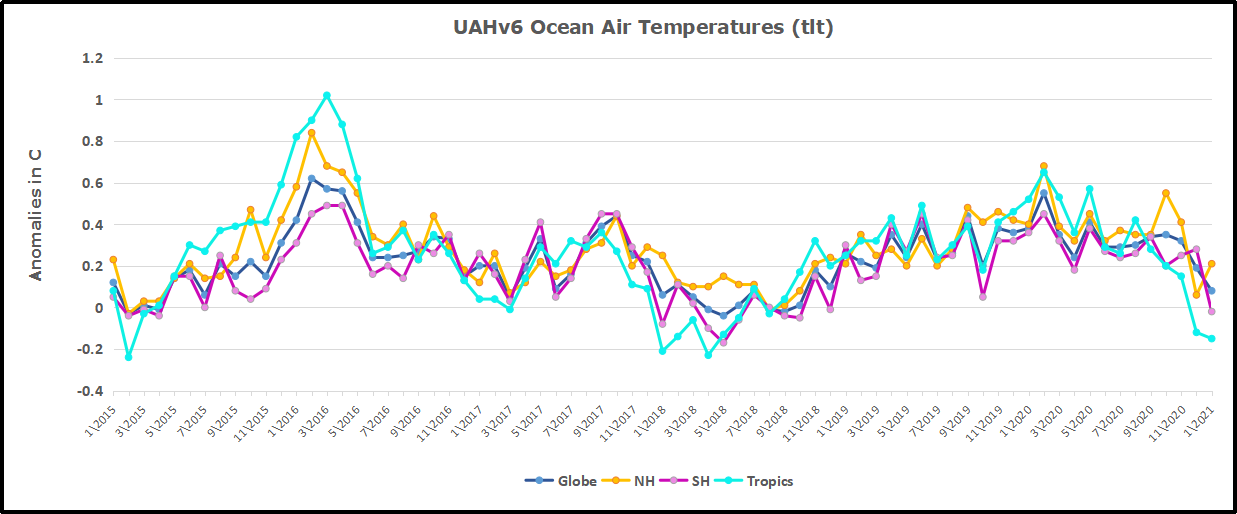
The UAH dataset includes temperature results for air above the oceans, and thus should be most comparable to the SSTs. There is the additional feature that ocean air temps avoid Urban Heat Islands (UHI).  The graph below shows monthly anomalies for ocean temps since January 2015.

To enlarge open image in new tab.

Note 2020 was warmed mainly by a spike in February in all regions, and secondarily by an October spike in NH alone. End of 2020 November and December ocean temps plummeted in NH and the Tropics. In January SH dropped sharply, pulling the Global anomaly down despite an upward bump in NH. Both SH and the Tropics are now as cold as any time in the last five years, and all regions are comparable to to 2015 prior to the 2016 El Nino event.

Land Air Temperatures Tracking Downward in Seesaw Pattern

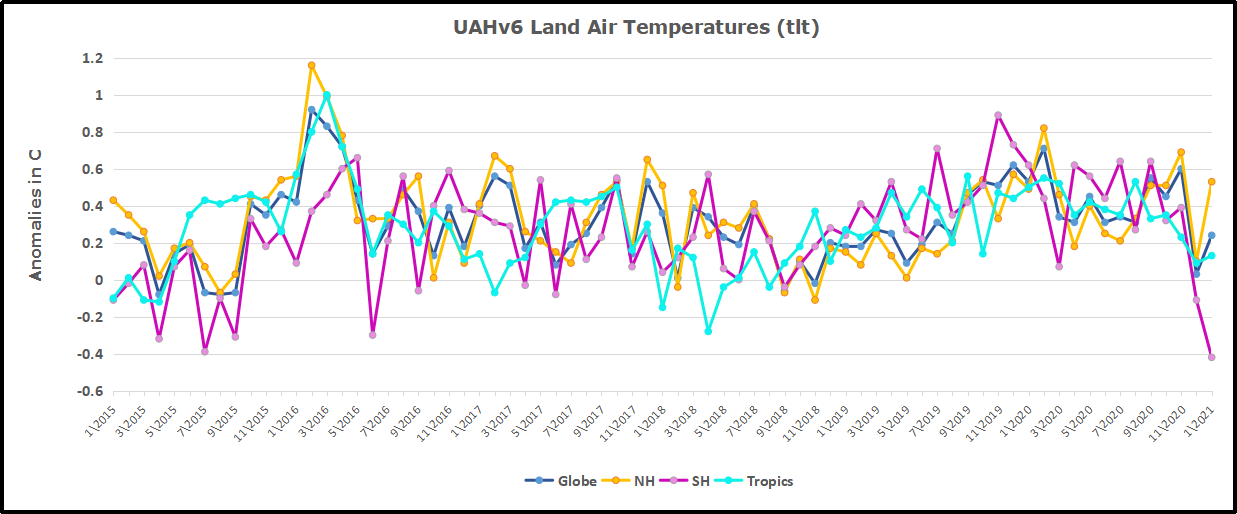
We sometimes overlook that in climate temperature records, while the oceans are measured directly with SSTs, land temps are measured only indirectly.  The land temperature records at surface stations sample air temps at 2 meters above ground.  UAH gives tlt anomalies for air over land separately from ocean air temps.  The graph updated for January is below.

Here we have fresh evidence of the greater volatility of the Land temperatures, along with an extraordinary departure by SH land.  Land temps are dominated by NH with a 2020 spike in February, followed by cooling down to July.  Then NH land warmed with a second spike in November.  Note the mid-year spikes in SH winter months.  In December all of that was wiped out. Then January showed a sharp drop in SH, but a rise in NH more than offset, pulling the Global anomaly upward. All regions are roughly comparable to early 2015, prior to the 2016 El Nino.

The Bigger Picture UAH Global Since 1995

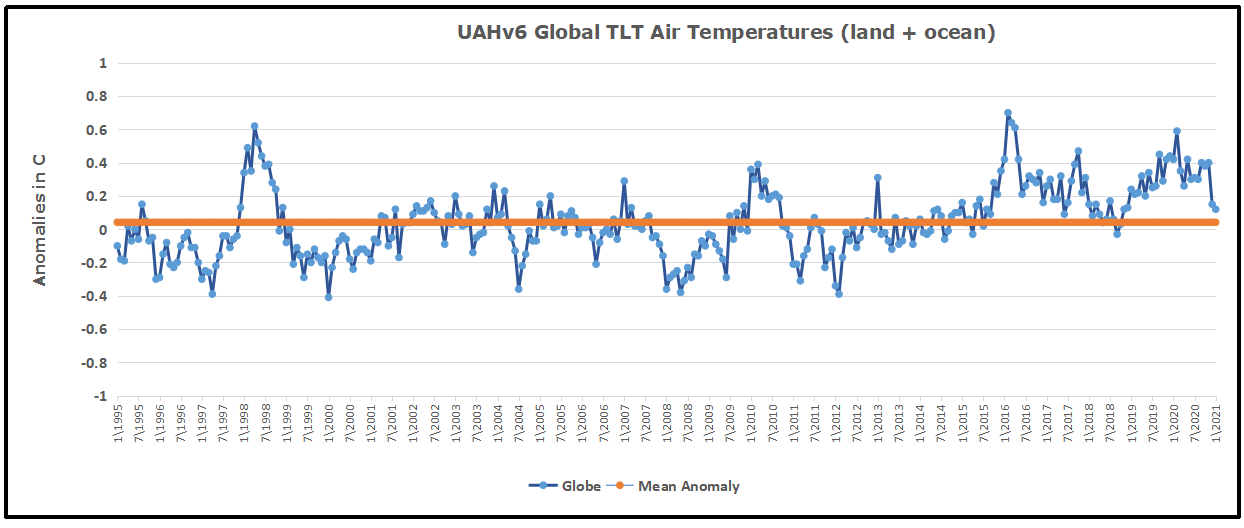
The chart shows monthly anomalies starting 01/1995 to present.  The average anomaly is 0.04, since this period is the same as the new baseline, lacking only the first 4 years.  1995 was chosen as an ENSO neutral year.  The graph shows the 1998 El Nino after which the mean resumed, and again after the smaller 2010 event. The 2016 El Nino matched 1998 peak and in addition NH after effects lasted longer, followed by the NH warming 2019-20, with temps now returning again to the mean.

TLTs include mixing above the oceans and probably some influence from nearby more volatile land temps.  Clearly NH and Global land temps have been dropping in a seesaw pattern, more than 1C lower than the 2016 peak.  Since the ocean has 1000 times the heat capacity as the atmosphere, that cooling is a significant driving force.  TLT measures started the recent cooling later than SSTs from HadSST3, but are now showing the same pattern.  It seems obvious that despite the three El Ninos, their warming has not persisted, and without them it would probably have cooled since 1995.  Of course, the future has not yet been written.

Is It Still a Pandemic If No One Notices?

Along the lines of Bishop Berkeley’s famous philosophical question, John Tamny writes at Real Clear Markets: What If the Coronavirus Had Spread Without Detection? Excerpts in italics with my bolds.

Among those who’ve watched the tragic and needless lockdowns unfold over the last 11 months, a frequent question has come up: what if the coronavirus had spread, but had never been diagnosed or detected? Would life have been any different absent the discovery of what has caused a massive global panic among politicians?

It’s not an unreasonable question. Really, ask yourself what politicians and nail-biting media members would have done 100 years ago if the virus had revealed itself. Since work was a destination for realistically everyone, there’s no way there could have been lockdowns. People would have revolted.

As for deaths, life expectancy was already relatively low in the 1920s. This is relevant when it’s remembered that the coronavirus in a death sense has largely been associated with nursing homes. These homes weren’t very common one hundred years ago, and they weren’t mainly because pneumonia, tuberculosis and other major killers had a tendency to get to us long before we reached old age. Translated, there likely weren’t enough old people in the 1920s for the virus to have had any kind of lethal impact.

Due to a lack of old people, the virus perhaps wouldn’t have been discovered in the first place. Think about it.

As this column has long stated, the coronavirus is a rich man’s virus. It’s not just that the rich and generally well-to-do had portable jobs that mostly survived the mindless lockdowns., it’s not just that the break from reality we were forced to endure could have only happened in a rich country, it’s also the case that only in a country and world in which the elderly are truly old would the virus have any notable association with death. People live longer today, and they do because major healthcare advances born of wealth creation made living longer possible. We wouldn’t have noticed this virus 100 years ago. We weren’t rich enough.

Which brings us to a recent article by Leah Rosenbaum at Forbes. She wrote about a NIH paper indicating that almost 17 million coronavirus cases went uncounted last summer. In Rosenbaum’s words, this discovery “suggests the pandemic was much more widespread in the U.S. than previously thought.” Well, of course.

Lest readers forget, the virus began spreading sometime in the fall of 2019, if not sooner. The epicenter is widely thought to have been China, and flights between the U.S. and China, along with flights from China to the rest of the world, were rather numerous right up until 2020.

Considering how connected China was and still is to the rest of the world, logic dictates that the virus was infecting people globally long before politicians panicked. In that case, it’s not surprising that estimates made about the number of infected Americans were always way too low. The virus is said to spread easily, even easier than the flu, and it once again started working its way around the world sometime in 2019.

Notable about its rapid spread is that life went on as it made its way around the world.

As the closing months of 2019 make plain, people lived with the virus. What is most lethal to older people isn’t much noticed by those who aren’t old. A rapidly spreading virus was seemingly not much of a factor until politicians needlessly made it one.

Indeed, a virus most lethal to the very old has meek qualities when met by younger people. If they’re are infected with it, all-too-many don’t find the symptoms worrisome enough that they actually get tested.

That’s what Rosenbaum’s report seems to indicate. The NIH study covered blood tests of 11,000 Americans who hadn’t been previously diagnosed with Covid-19. 4.6% of the participants had Covid-19 antibodies, but their actual infection phase was never apparent to them. This is what Holman Jenkins has been pointing out all along. The number of those infected has always well exceeded estimates precisely because the symptoms of infection haven’t been worth going to the doctor over for the vast majority of those infected.

Looking back 100 years once again, ask yourself how many would have consulted a doctor then if something resembling the coronavirus had been spreading. Or better yet, ask yourself how many would have been tested in a U.S. that was quite a bit poorer relative to today. The questions answer themselves.

The virus would have spread rapidly within a younger population in the 1920s, and infected people would have developed immunity.

From Rosenbaum’s report it’s not unreasonable to speculate that far more Americans are immune to the virus than is known, and that the best approach all along would have been freedom. Let people live their lives. More important, let them get infected. For centuries they’re pursued immunity by – gasp – infecting one another.

So, what would have happened if the coronavirus had gone undetected? We will never know, but it’s not unrealistic to conclude that we have an idea. The virus didn’t suddenly start spreading in March of 2020 just because politicians decided it had. 2019 is the likelier beginning. Early 2020 too. Life was pretty normal as a virus made its way around the world then.

Politicians made it abnormal. Let’s never forget the sickening carnage they can create when they find reasons to “do something.”

My Comment:  An additional point seen in the history of environmental scares is that mass media first frightens the public, and then politicians have to be seen “doing something.”  And as we are seeing now,  they have difficulty to stop those things even when shown to be ineffective and harmful on top.

See also: Progressively Scaring the World (Lewin book synopsis)


Militant Medicine Breeds Bad Pandemic Policies

Perhaps you noticed how public health officials direct the war on coronavirus.  The generals obsess over “cases” and “deaths” while hiding numbers of “recoveries” and “cures.” The military paradigm has led pandemic policies seriously astray, as explained by Norman Doidge in his Tablet article Mad Science, Sane Science.  Excerpts in italics with my bolds.

There are more reasonable approaches to science and COVID-19 than the ‘eradication’ mentality that we lean on.

One cannot underestimate the extent to which modern medicine took up Bacon’s military metaphor of conquest and applied it to itself. This involved rejecting the ancient Hippocratic idea of healing, which—being part of that Greek worldview that saw us as of nature, and not against it—saw the physician as trying to work in alliance with nature, the patient (mind and body and spirit) and the patient’s family. But by the mid-1600s Thomas Sydenham, who became known as the “English Hippocrates,” saw medicine in a new way: “I attack the enemy within by means of cathartics and refrigerants, and by means of a diet”; he wrote, “a murderous array of disease has to be fought against, and the battle is not a battle for the sluggard …” Little has changed since. We see ourselves as engaged in endless wars: “The war against the virus,” “the war against cancer,” or against AIDS, “the war on drugs,” the “battle against heart disease,” we “combat” Alzheimer’s, and so on. As modern physicians came to see themselves as warriors and disease as “the enemy,” treatments became “weapons,” and drugs went from being healing potions to “magic bullets” and vaccines became “shots.”

We combat the enemy with “doctor’s orders,” from the medical “armamentarium,” or “arsenal” as we physicians call our bag of therapeutic tricks.

This military metaphor in medicine gives rise to a mentality that esteems invasive high-tech treatments as somehow more serious than less invasive ones—any collateral damage be damned. Of course, there is a time for a martial attitude in medicine, as, say, in emergencies: If a blood vessel in the brain bursts, the patient needs invasive surgery and a neurosurgeon with nerves of steel, to operate. But there are times when it sets us back. Today, rather than work with the patient as a key ally, we physicians often barely have time to listen to him or her speak. In this metaphor, the patient’s body is less an ally than the battlefield, and the patient is rendered passive, a helpless bystander, as he watches the confrontation that will determine his fate between the two great antagonists, the doctor (plus the scientific research establishment) and the disease (or pathogen). And of course, in the “war against the virus,” it is total “eradication” of such an enemy that is the goal. That, it would seem to us, Bacon’s offspring, as the only sensible approach.

As it turns out, so much of what ails us today are products of modern science and technology gone wild: lethal antibiotic-resistant organisms that our “total eradication of disease mentality” produced because we vastly overused the antibiotics we had (which, by the way, were originally natural products of nature, not the lab); pollution (of every element), chemicals in our baby food, toys, floors, and mattresses causing skyrocketing childhood illnesses; bioterrorism; loss of biodiversity affecting the food chain; fabulous totalitarian surveillance tools called cellphones, global networks that allow our enemies thousands of miles away to reach into the controls of our electrical grids, water systems, food delivery systems, banks, nuclear systems, computers, and control them, turning them on and off with a keystroke; 3D printers to make assault weapons in the basement, nuclear weapons to empower lunatics, industrialized death camps with cyanide showers, and, not to mention man-made environmental disruptions causing ecological catastrophes.
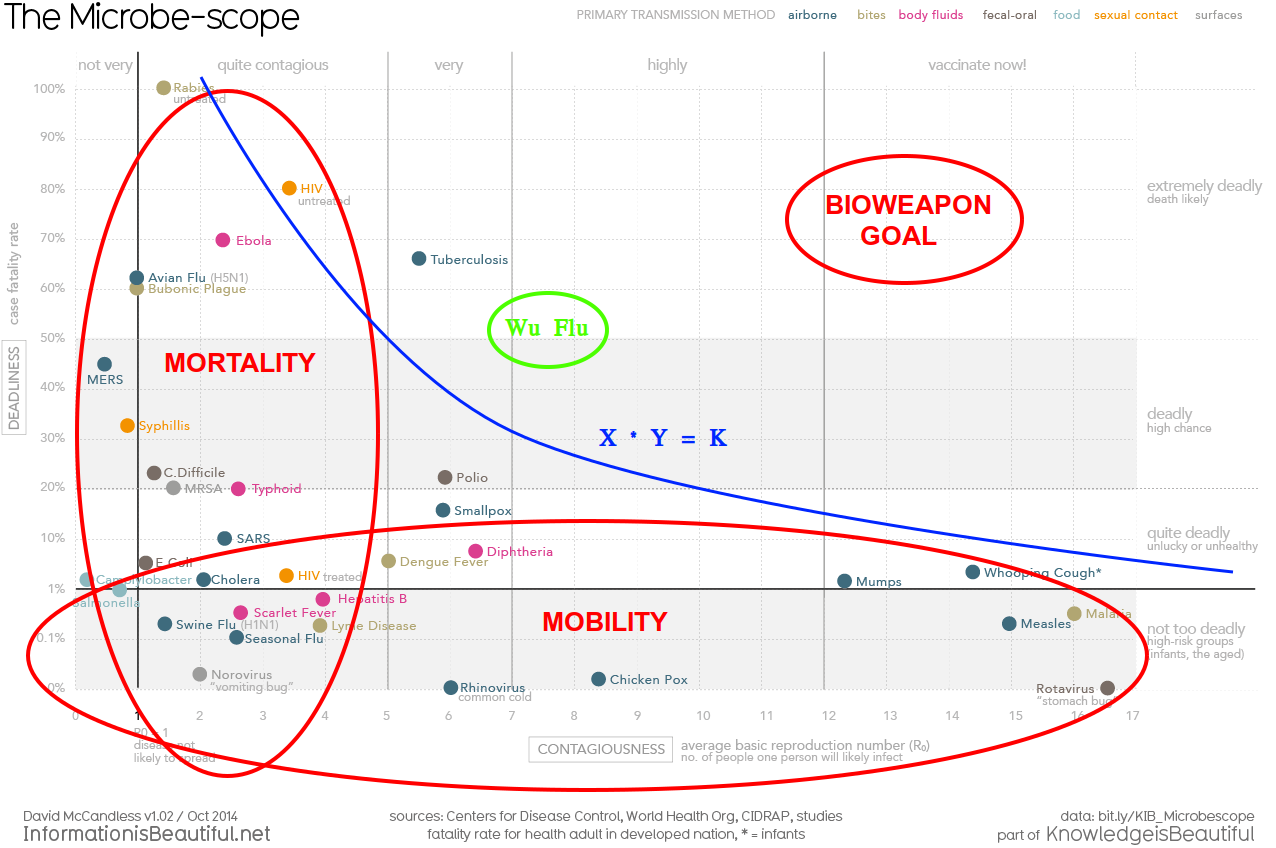
On this list of course, is also a pandemic that spread so rapidly because of air travel, and the “efficient” design of our urban centers which maximize overcrowding—and a microbe that may have originated in a lab known to be unsafe, and experimenting with bat viruses. “Just last year,” an article in Newsweek reported, “the National Institute for Allergy and Infectious Diseases, the organization led by Dr. Fauci, funded scientists at the Wuhan Institute of Virology and other institutions for work on gain-of-function research on bat coronaviruses.”

“Gain-of-function research” in this case means augmenting the virus’s contagiousness, and even lethality for the purpose of getting a head start on developing therapeutics or vaccines should it mutate in that direction. Such research is also the meat and potatoes germ-warfare research.. . . Whether or not Wuhan’s gain-of-function work involved creating an artificially enhanced coronavirus has been made almost impossible for outsiders to ascertain, because that lab’s government conveniently insisted it destroy its virus samples and records before an outside investigation could be done.

We are so reliably surprised and caught off guard by the unforeseen consequences of our technologies, and there are now so many serious cases of “science going wrong,” that it might be argued that, in practice, modern science (and the tech it produces) seems to be a machine designed to generate and maximize unintended consequences. And is hence, along with being powerful, also, quite often, ridiculous.

All of this is relevant to the current pandemic. In a way, there are three grand “strategies” to deal with a pandemic. But only one of them indulges the more lunatic strains of military metaphor in medicine.

  • The first strategy is never let it in.
  • The second, the approach most widely used at present, is to go to rather blunt lockdowns, while we develop therapeutics and vaccines to eradicate the virus.
  • The third is to resist lockdowns whenever possible, and instead focus on more differentiated measures than total societal closures, again while we develop therapeutics and vaccines to eradicate the virus.

If the virus doesn’t get in, people are not dying, there isn’t talk of eradication and the military metaphor isn’t used. That strategy has worked so far in Nauru, an island speck, in the paradise of Oceania, a country that is isolated, and small enough to walk across and around in one day, and which, along with Oceania’s Tuvalu, is tied for the record as being the least visited country in the world.

Even the relatively isolated, double-island paradise of New Zealand, was still too connected with the rest of the world to keep the virus out. When it did arrive there, New Zealand tried the second strategy, to eradicate it with a blunt lockdown.

The military metaphors began. Prime Minister Jacinda Ardern set the goal of “complete elimination of the virus.” France’s President Emmanuel Macron said, “We are at war … The enemy is there—invisible, elusive—and it is advancing.” Donald Trump described himself as “a wartime president.” War requires emergency measures, which require emergency powers, which demand the immediate suspension of civil liberties—with executives not bothering to go to legislatures because the enemy is coming at us “in waves,” and “surges,” is “killing us in droves.” We “hunker in our bunkers”—in total lockdown. Home’s the only place that’s safe. We must “mobilize” all society in immobility. Punish those who disobey orders. We do it, too, for the health care workers, the heroes on “the frontline,” who risked their lives.

But these undeniable similarities do not mean that medicine is war, any more than war is healing.

Perhaps the biggest problem with the military metaphor, is how it causes us to narrow our focus almost exclusively on “eradicating the virus,” and “cases of the infected.” This causes us to miss other important ways of dealing with it, that might help us survive it. Public health officials in the “the eradication mode” almost never mention how we can boost our immune systems with vitamins D and C, and zinc, exercise and weight loss. Not their focus. And the narrow focus on eradicating the virus is now causing serious “collateral” harm and death.

But it was not maliciousness but rather the virus eradication mindset that has caused much of the harm. That mindset has led many politicians, and also public health officials, to become oblivious to the death, illness, and devastation that have resulted from the lockdowns. Tedros’ own language speaks this obliviousness, when he says he knows people are “understandably frustrated with being confined to their homes” as though “frustration” is the extent of the problem. What is actually happening is that people’s worlds are collapsing. Fauci early on called the lockdown measure “inconvenient.”

Tedros and other lockdown supporters are almost all themselves employed, and working comfortably, many from home.

They are part of a class that has government, bureaucratic, educational, media, and corporate salaries, or are in Big Tech, which thrives in lockdown. With an often staggering indifference, they gloss over that fact that the measures they recommend “for all of us” are devastating to those working-class people, the poor, and small-business owners who are losing or have already lost their life savings, health insurance, health, and who are at risk of, or who have already been evicted from their apartments. By September we knew that nearly 60% of (mostly small) businesses that had been forced to close in lockdown were destroyed so their workers would have no jobs to return to. Many more have gone under since. They were closed by often illegal edicts, that left their large corporate competitors like Costco and Walmart open. Thus, instead of going to small widely separated community stores, that admitted a few at a time, people crowded into a few stores without social distancing—the complete reverse of a sensible, scientifically based policy. How did public health officials get away with destroying small business? This is war! Ignore that a meta-analysis of 10 countries and their regions, shows that during last spring, stringent stay and home and business closures did no better in slowing the virus than those that rely on voluntary measures (such as hand washing, social distancing, discouraging travel and large gatherings, successful case tracking, and testing). Gov. Andrew Cuomo’s own latest scientific statistics confirm that 74% of all New York COVID-19 transmission comes from indoor gatherings in private homes, and only 1.4% from in-restaurant dining (all set up for COVID now). The commander in chief says no to indoor restaurant dining in December. Now, even the WHO, which supported lockdowns, is claiming that closed Western economies are devastating poorer countries that are trading partners, and its special envoy for COVID-19, Dr. David Nabarro, has said the WHO anticipates a doubling of world poverty and a doubling of childhood malnutrition because of lockdowns.

The officials, blinded by the eradication at all costs mentality, discarded the practical wisdom required to respond to such a crisis, and endorsed an intervention that defies the standard public health practice of taking a holistic approach and always taking into account a measure’s total effects, and not just its immediate effects on the pathogen labeled as “the invisible enemy.”

“COVID denial” is real. So is “COVID-management-induced-devastation denial.”

What does a scientific approach look like, one that takes the best of our modern instruments that Bacon helped to facilitate, but which does not get us tangled up in the military metaphor, or make delusional attempts to artificially cut us off from the rest of nature?

That would be the approach of Janelle Ayres, Ph.D., a brilliantly original and constructive molecular and systems physiologist, and expert in both immunology and evolution, who heads two labs affiliated with the Salk Institute. Ayres’ work opens up a radically different approach to infectious disease—radical in the original sense of the word, meaning having to do with the root, i.e., the broader biological foundations of infectious disease and health in the “biome,” the sphere of living organisms in which we dwell, and which dwell within us. Thus, to my mind, her work has echoes with some of the ancient insights and intuitions about biological interconnectedness, though I’ve not seen her make this claim.

Ayres’ work is helping us reconceive our relationship to microbial organisms, including pathogens, and showing how they can, for instance, influence our evolution, and we theirs, and it gives us a much more detailed picture of how we actually survive serious infections. She happens to have written one of the best articles ever on COVID-19, that shows a breadth and depth of biological comprehension that is extremely rare among modern scientists who are often specialists in very circumscribed areas, who analyze things into ever smaller parts, and know an incredible amount about incredibly little. Ayres is both a first-rank specialist, and a big-think generalist.

She says, “The way we have been thinking about treating infectious diseases is that we have to annihilate the pathogens through vaccines and antimicrobials.” She completely reframes the problem, and challenges our thinking:

“Instead of asking how do we fight infections, we should be asking ‘how do we survive infections?’”

Changing that single word—“fight” to “survive”—transforms everything. Consider, for example, that new organisms, and strains are evolving all the time. A new coronavirus strain identified in December is said to be 70% more transmissible. Some new strains may be resistant to our existing vaccines and antivirals. Developing different antibiotics or vaccines to eradicate each of them, is not always possible, and when it is, generally takes a long time, and costs a fortune. But if, as is often the case, death is caused by our bodies’ own reactions to the infection, reactions which are very similar, regardless of the pathogen that caused them, learning to block the body from going into overdrive should help people survive multiple infections. As well, there is no reason to believe this approach will cause antibiotic-resistant, antiviral-resistant, or vaccine-resistant strains, because it is not targeting the pathogen per se.

In cooperative co-evolution, there is an incentive for us (or any infested animal) to develop methods to both prevent collateral damage to ourselves, as well as fix it when it occurs. That is the essence of the tolerance system. What Ayres and her colleagues are doing is describing these mechanisms—in minute molecular detail—in the body, and learning to read how organisms that are co-evolving with their hosts are communicating with them—sending signals back and forth. Ideally, the lab would ultimately learn how to use this information to enhance co-evolution in some way, to treat disease.

Ayres’ approach to COVID is not to minimize other approaches but point out that “if we can step beyond our focus on the virus,” there is much more we can learn. For instance, it was assumed early in the pandemic, that severe cases were caused by high viral load, and now we know it is the secondary collateral damage caused by our bodies that is the real killer.

Fewer and fewer medical schools now require the graduating physician to take the ancient Hippocratic oath, the first recorded articulation of medical ethics, that sanctified medical confidentiality and the idea that the doctor worked for his or her patient, and not a third party. How sad, how telling.

It is the same Hippocrates, who boiled all medicine down to two principles in his Epidemics Book I, “Practice two things in your dealing with disease: either help or do not harm the patient.”

And, in this light—of doing no harm, or at least far less—we might remember that we are part of nature, depend on it, it lives in us, and we have links to parts we think remote from us, that we often cannot even see. We might consider setting aside the utopian dream that always becomes a nightmare, because all too often we can’t conquer nature without conquering ourselves.

See Also:

The Virus Wars

Rx for Covid-fighting Politicians

Twelve Forgotten Principles of Public Health



Ending Wind and Solar Parasites

What’s the Problem with Electricity Rates?

This new Prager video explains (H/T Mark Krebs)

Background from Previous Post:

Norman Rogers writes at American Thinker What It Will Take for the Wind and Solar Industries to Collapse. Excerpts in italics with my bolds.

The solar electricity industry is dependent on federal government subsidies for building new capacity. The subsidy consists of a 30% tax credit and the use of a tax scheme called tax equity finance. These subsidies are delivered during the first five years.

For wind, there is subsidy during the first five to ten years resulting from tax equity finance. There is also a production subsidy that lasts for the first ten years.

The other subsidy for wind and solar, not often characterized as a subsidy, is state renewable portfolio laws, or quotas, that require that an increasing portion of a state’s electricity come from renewable sources. Those state mandates result in wind and solar electricity being sold via profitable 25-year power purchase contracts. The buyer is generally a utility with good credit. The utilities are forced to offer these terms in order to cause sufficient supply to emerge to satisfy the renewable energy quotas.

The rate of return from a wind or solar investment can be low and credit terms favorable because the investors see the 25-year contract by a creditworthy utility as a guarantee of a low risk of default. If the risk were to be perceived as higher, then a higher rate of return and a higher interest rate on loans would be demanded. That in turn would increase the price of the electricity generated.

The bankruptcy of PG&E, the largest California utility, has created some cracks in the façade. A bankruptcy judge has ruled that cancellation of up to $40 billion in long-term energy contracts is a possibility. These contracts are not essential or needed to preserve the supply of electricity because they are mostly for wind or solar electricity supply that varies with the weather and can’t be counted on. As a consequence, there has to exist and does exist the necessary infrastructure to supply the electricity needs without the wind or solar energy.

Probably the judge will be overruled for political reasons, or the state will step in with a bailout. Utilities have to keep operating, no matter what. Ditching wind and solar contracts would make California politicians look foolish because they have long touted wind and solar as the future of energy.

PG&E is in bankruptcy because California applies strict liability for damages from forest fires started by electric lines, no matter who is really at fault. Almost certainly the government is at fault for not anticipating the danger of massive fires and for not enforcing strict fire prevention and protection. Massive fire damage should be protected by insurance, not by the utility, even if the fire was started by a power line. The fire in question could just as well have been started by lightning or a homeless person. PG&E previously filed bankruptcy in 2001, also a consequence of abuse of the utility by the state government.

By far the most important subsidy is the renewable portfolio laws. Even if the federal subsidies are reduced, the quota for renewable energy will force price increases to keep the renewable energy industry in business, because it has to stay in business to supply energy to meet the quota. Other plausible methods of meeting the quota have been outlawed by the industry’s friends in the state governments. Nuclear and hydro, neither of which generates CO2 emissions, are not allowed. Hydro is not strictly prohibited — only hydro that involves dams and diversions. That is very close to all hydro. Another reason hydro is banned is that environmental groups don’t like dams.

For technical reasons, an electrical grid cannot run on wind or solar much more than 50% of the time. The fleet of backup plants must be online to provide adjustable output to compensate for erratic variations in wind or solar. Output has to be ramped up to meet early-evening peaks. Wind suffers from a cube power law, meaning that if the wind drops by 10%, the electricity drops by 30%. Solar suffers from too much generation in the middle of the day and not enough generation to meet early evening peaks in consumption.

When a “too much generation” situation happens, the wind or solar has to be curtailed. That means that the operators are told to stop delivering electricity. In many cases, they are not paid for the electricity they could have delivered. Some contracts require that they be paid according to a model that figures out how much they could have generated according to the recorded weather conditions. The more wind and solar, the more curtailments as the amount of erratic electricity approaches the allowable limits. Curtailment is an increasing threat, as quotas increase, to the financial health of wind and solar.

There is a movement to include batteries with solar installations to move excessive middle-of-the-day generation to the early evening. This is a palliative to extend the time before solar runs into the curtailment wall. The batteries are extremely expensive and wear out every five years.

Neither wind nor solar is competitive without subsidies. If the subsidies and quotas were taken away, no wind or solar operation outside very special situations would be built. Further, the existing installations would continue only as long as their contracts are honored and they are cash flow–positive. In order to be competitive, without subsidies, wind or solar would have to supply electricity for less than $20 per megawatt-hour, the marginal cost of generating the electricity with gas or coal. Only the marginal cost counts, because the fossil fuel plants have to be there whether or not there is wind or solar. Without the subsidies, quotas, and 25-year contracts, wind or solar would have to get about $100 per megawatt-hour for its electricity. That gap, between $100 and $20, is a wide chasm only bridged by subsidies and mandates.

The cost of using wind and solar for reducing CO2 emissions is very high. The most authoritative and sincere promoters of global warming loudly advocate using nuclear, a source that is not erratic, does not emit CO2 or pollution, and uses the cheapest fuel. One can buy carbon offsets for 10 or 20 times less than the cost of reducing CO2 emissions with wind or solar. A carbon offset is a scheme where the buyer pays the seller to reduce world emissions of CO2. This is done in a variety of ways by the sellers.

The special situations where wind and solar can be competitive are remote locations using imported oil to generate electricity. In those situations, the marginal cost of the electricity may be $200 per megawatt-hour or more. Newfoundland comes to mind — for wind, not solar.

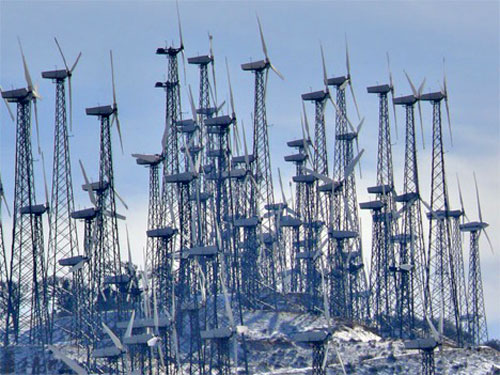
Maintenance costs for solar are low. For wind, maintenance costs are high, and major components, such as propeller blades and gearboxes, may fail, especially as the turbines age. These heavy and awkward objects are located hundreds of feet above ground. There exists a danger that wind farms will fail once the inflation-protected subsidy of $24 per megawatt-hour runs out after ten years. At that point, turbines that need expensive repairs may be abandoned. Wind turbine graveyards from the first wind fad in the 1970s can be seen near Palm Springs, California. Wind farms can’t receive the production subsidy unless they can sell the electricity. That has resulted paying customers to “buy” the electricity.

Tehachapi’s dead turbines.

A significant financial risk is that the global warming narrative may collapse. If belief in the reality of the global warming threat collapses, then the major intellectual support for renewable energy will collapse. It is ironic that the promoters of global warming are campaigning to require companies to take into account the threat of global warming in their financial projections. If the companies do this in an honest manner, they also have to take into account the possibility that the threat will evaporate. My own best guess, after considerable technical study, is that it is near a sure thing that the threat of global warming is imaginary and largely invented by the people who benefit. Adding CO2 to the atmosphere has well understood positive effects for the growth of crops and the greening of deserts.

The conservative investors who make long-term investments in wind or solar may be underestimating the risks involved. For example, an article in Chief Investment Officer magazine stated that CalPERS, the giant California public employees retirement fund, is planning to expand investments in renewable energy, characterized as “stable cash flowing assets.” That article was written before the bankruptcy of PG&E. The article also stated that competition among institutional investors for top yielding investments in the alternative energy space is fierce.

Wind and solar are not competitive and never will be. They have been pumped up into supposedly solid investments by means of ill advised subsidies and mandates. At some point, the governments will wake up to the waste and foolishness involved. At that point, the value of these investments will collapse. It won’t be the first time that investment experts made bad investments because they don’t really understand what is going on.

Footnote:  There is also a report from GWPF on environmental degradation from industrial scale wind and solar:

Enough of Cancerous Cancel Culture


If you live and let live, you accept people who behave and think differently from you. The social fabric of the country is changing, but people must learn to live and let live. The opposite attitude is the current practice of denunciation,  the drive to cast into outer darkness anyone who thinks, talks or acts differently than some proscribed standard of political correctness.

This hateful, poisonous spirit sets family, friends and neighbors against one another and undermines our society and civilization.  So enough of the cancerous cancel culture; replace it with tolerance and respect for others.

A another similar expression was written by General John Stark and become the official motto of the state of New Hampshire:

The idea promoted with the NH motto and the Don’t Tread on Me phrase is simple, “leave me alone to live in peace, to do what I do best, and as long as my actions do not cause physical harm to others there is no need for your intervention. It is about free will, personal choice, and freedom without rulers or government overloads.

What is so dangerous about this current oppressive social climate is explained by Izabella Tabarovsky drawing on her experience of Soviet Russia to expose the cultural revolution currently attacking the roots of American civil society. Her article at the Tablet is The American Soviet Mentality. Excerpts in italics with my bolds.

Collective demonization invades our culture

Russians are fond of quoting Sergei Dovlatov, a dissident Soviet writer who emigrated to the United States in 1979: “We continuously curse Comrade Stalin, and, naturally, with good reason. And yet I want to ask: who wrote four million denunciations?” It wasn’t the fearsome heads of Soviet secret police who did that, he said. It was ordinary people.

Collective demonizations of prominent cultural figures were an integral part of the Soviet culture of denunciation that pervaded every workplace and apartment building. Perhaps the most famous such episode began on Oct. 23, 1958, when the Nobel committee informed Soviet writer Boris Pasternak that he had been selected for the Nobel Prize in literature—and plunged the writer’s life into hell. Ever since Pasternak’s Doctor Zhivago had been first published the previous year (in Italy, since the writer could not publish it at home) the Communist Party and the Soviet literary establishment had their knives out for him. To the establishment, the Nobel Prize added insult to grave injury.

None of those who joined the chorus of condemnation, naturally, had read the novel—it would not be formally published in the USSR until 30 years later. But that did not stop them from mouthing the made-up charges leveled against the writer. It was during that campaign that the Soviet catchphrase “ne chital, no osuzhdayu”—“didn’t read, but disapprove”—was born: Pasternak’s accusers had coined it to protect themselves against suspicions of having come in contact with the seditious material. Days after accepting the Nobel Prize, Pasternak was forced to decline it. Yet demonization continued unabated.

Some of the greatest names in Soviet culture became targets of collective condemnations—composers Dmitry Shostakovich and Sergei Prokofiev; writers Anna Akhmatova and Iosif Brodsky; and many others. Bouts of hounding could go on for months and years, destroying people’s lives, health and, undoubtedly, ability to create. (The brutal onslaught undermined Pasternak’s health. He died from lung cancer a year and a half later.) But the practice wasn’t reserved for the greats alone. Factories, universities, schools, and research institutes were all suitable venues for collectively raking over the coals a hapless, ideologically ungrounded colleague who, say, failed to show up for the “voluntary-obligatory,” as a Soviet cliché went, Saturday cleanups at a local park, or a scientist who wanted to emigrate. The system also demanded expressions of collective condemnations with regards to various political matters: machinations of imperialism and reactionary forces, Israeli aggression against peaceful Arab states, the anti-Soviet international Zionist conspiracy. It was simply part of life.

Twitter has been used as a platform for exercises in unanimous condemnation
for as long as it has existed.

Countless careers and lives have been ruined as outraged mobs have descended on people whose social media gaffes or old teenage behavior were held up to public scorn and judged to be deplorable and unforgivable. But it wasn’t until the past couple of weeks that the similarity of our current culture with the Soviet practice of collective hounding presented itself to me with such stark clarity. Perhaps it was the specific professions and the cultural institutions involved—and the specific acts of writers banding together to abuse and cancel their colleagues—that brought that sordid history back.

On June 3, The New York Times published an opinion piece that much of its progressive staff found offensive and dangerous. (The author, Republican Sen. Tom Cotton, had called to send in the military to curb the violence and looting that accompanied the nationwide protests against the killing of George Floyd.) The targets of their unanimous condemnation, which was gleefully joined by the Twitter proletariat, which took pleasure in helping the once-august newspaper shred itself to pieces in public, were New York Times’ opinion section editor James Bennet, who had ultimate authority for publishing the piece, though he hadn’t supervised its editing, and op-ed staff editor and writer Bari Weiss (a former Tablet staffer).

Weiss had nothing to do with editing or publishing the piece. On June 4, however, she posted a Twitter thread characterizing the internal turmoil at the Times as a “civil war” between the “(mostly young) wokes” who “call themselves liberals and progressives” and the “(mostly 40+) liberals” who adhere to “the principles of civil libertarianism.” She attributed the behavior of the “wokes” to their “safetyism” worldview, in which “the right of people to feel emotionally and psychologically safe trumps what were previously considered core liberal values, like free speech.”  See Update: Stories vs. Facts

It was just one journalist’s opinion, but to Weiss’ colleagues her semi-unflattering description of the split felt like an intolerable attack against the collective. Although Weiss did not name anyone in either the “woke” or the older “liberal” camp, her younger colleagues felt collectively attacked and slandered. They lashed out. Pretty soon, Weiss was trending on Twitter.

As the mob’s fury kicked into high gear, the language of collective outrage grew increasingly strident, even violent.

Goldie Taylor, writer and editor-at-large at The Daily Beast, queried in a since-deleted tweet why Weiss “still got her teeth.” With heads rolling at the Times—James Bennet resigned, and deputy editorial page editor James Dao was reassigned to the newsroom—one member of the staff asked for Weiss to be fired for having bad-mouthed “her younger newsroom colleagues” and insulted “all of our foreign correspondents who have actually reported from civil wars.” (It was unclear how she did that, other than having used the phrase “civil war” as a metaphor.)

Mehdi Hasan, a columnist with the Intercept, opined to his 880,000 Twitter followers that it would be strange if Weiss retained her job now that Bennet had been removed. He suggested that her thread had “mocked” her nonwhite colleagues. (It did not.) In a follow-up tweet Hasan went further, suggesting that to defend Weiss would make one a bad anti-racist—a threat based on a deeply manipulated interpretation of Weiss’ post, yet powerful enough to stop his followers from making the mistake.

All of us who came out of the Soviet system bear scars of the practice of unanimous condemnation, whether we ourselves had been targets or participants in it or not. It is partly why Soviet immigrants are often so averse to any expressions of collectivism: We have seen its ugliest expressions in our own lives and our friends’ and families’ lives. It is impossible to read the chastising remarks of Soviet writers, for whom Pasternak had been a friend and a mentor, without a sense of deep shame. Shame over the perfidy and lack of decency on display. Shame at the misrepresentations and perversions of truth. Shame at the virtue signaling and the closing of rank. Shame over the momentary and, we now know, fleeting triumph of mediocrity over talent.

In a collectivist culture, one hoped-for result of group condemnations is control—both over the target of abuse and the broader society. When sufficiently broad levels of society realize that the price of nonconformity is being publicly humiliated, expelled from the community of “people of goodwill” (another Soviet cliché) and cut off from sources of income, the powers that be need to work less hard to enforce the rules.

For the regular people—those outside prestigious cultural institutions—participation in local versions of collective hounding was not without its benefits, either. It could be an opportunity to eliminate a personal enemy or someone who was more successful and, perhaps, occupied a position you craved. You could join in condemning a neighbor at your cramped communal flat, calculating that once she was gone, you could add some precious extra square meters to your living space.

The mobs that perform the unanimous condemnation rituals of today do not follow orders from above. But that does not diminish their power to exert pressure on those under their influence.

Those of us who came out of the collectivist Soviet culture understand these dynamics instinctively. You invoked the “didn’t read, but disapprove” mantra not only to protect yourself from suspicions about your reading choices but also to communicate an eagerness to be part of the kollektiv—no matter what destructive action was next on the kollektiv’s agenda. You preemptively surrendered your personal agency in order to be in unison with the group. And this is understandable in a way: Merging with the crowd feels much better than standing alone.

Americans have discovered the way in which fear of collective disapproval breeds self-censorship and silence, which impoverish public life and creative work. The double life one ends up leading—one where there is a growing gap between one’s public and private selves—eventually begins to feel oppressive. For a significant portion of Soviet intelligentsia (artists, doctors, scientists), the burden of leading this double life played an important role in their deciding to emigrate.

Those who join in the hounding face their own hazards. The more loyalty you pledge to a group that expects you to participate in rituals of collective demonization, the more it will ask of you and the more you, too, will feel controlled. How much of your own autonomy as a thinking, feeling person are you willing to sacrifice to the collective? What inner compromises are you willing to make for the sake of being part of the group? Which personal relationships are you willing to give up?

From my vantage point, this cultural moment in these United States feels incredibly precarious.

The practice of collective condemnation feels like an assertion of a culture that ultimately tramples on the individual and creates an oppressive society. Whether that society looks like Soviet Russia, or Orwell’s Nineteen Eighty-Four, or Castro’s Cuba, or today’s China, or something uniquely 21st-century American, the failure of institutions and individuals to stand up to mob rule is no longer an option we can afford.

Comment:  Precarious, indeed.  For Background, See Patriotism vs. Multiculturalism

2021 Arctic Ice Seesaw

In January, most of the Arctic ocean basins are frozen over, and so the growth of ice extent slows down.  According to SII (Sea Ice Index) January on average adds 1.3M km2, and this month it was 1.4M.  (background is at Arctic Ice Year-End 2020).  The few basins that can grow ice this time of year tend to fluctuate and alternate waxing and waning, which appears as a see saw pattern in these images.

Here is the Atlantic seesaw with Barents and Baffin.

The animation above shows the Atlantic side with Barents on the left almost doubling in the last 3 weeks, from 365k km2 ice extent to 690k km2 yesterday (88% of last March maximmum).  Meanwhile Greenland Sea in the center between Iceland and Greenland started with 708k km2 and was 621k km2 yesterday.  Maximum ice extent in this basin was 783k km2 last year.  Baffin Bay below and to the right of Greenland waffles up and down a bit with little change (from 993k km2 to 1000k km2 with last year’s max 1550k).

And here is the Pacific seesaw with Bering and Okhotsk.

The most dramatic teeter-totter comes in the two Pacific basins of Bering Sea and Sea of Okhotsk, shown in the animation above. Okhotsk on the left in 3 weeks grew ice extent from 652k km2 to 900k yesterday, nearly 80% of 2020 max of 1140k km2.  Yet just a few days ago, Okhotsk was at 972k.  Meanwhile Bering Sea is seen fluctuating back and forth while gaining extent from 360k km2 up to 545k, 67% of last year’s max.

While the seesaws are tilting back and forth on the margins, the bulk of the Arctic is frozen solid. And with limited places where more extent can be added, the pace of overall growth has slowed.

The graph shows the 14-year average gain for January is 1.3M km2.  2020 matched the average while this and other recent years were lower.  SII shows lower extents most of the month before aligning with MASIE at the end. Presently 2021 is ~290k km2 or 2% deficit to average, or lagging about a week behind.

The polar bears have a Valentine Day’s wish for Arctic Ice.

welovearcticicefinal

And Arctic Ice loves them back, returning every year so the bears can roam and hunt for seals.

Footnote:

Seesaw accurately describes Arctic ice in another sense:  The ice we see now is not the same ice we saw previously.  It is better to think of the Arctic as an ice blender than as an ice cap, explained in the post The Great Arctic Ice Exchange.