The Good Old Days B.B. (Before Biden)
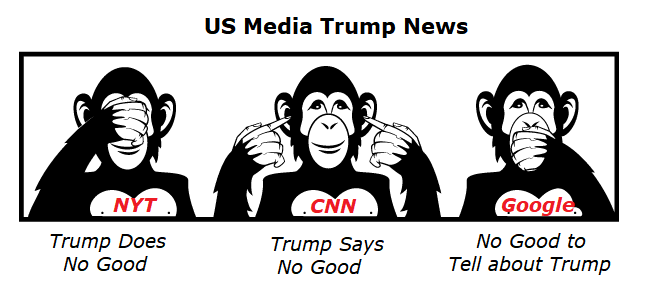
With the relentless legacy and social media disparagement of all things Trump, it takes effort to remember how in 2019 Trump was on cruise control for re-election with his slogan: Promises Made, Promises Kept.  Despite the chaos, first from the pandemic, and then the destructive years of Biden regime governance, it is wise to recall what was achieved before the interruption and reversals.

Mark Lewis provides the chronicle in three Town Hall posts Donald Trump’s Accomplishments as President.  Excerpts in italics with my bolds and added images.

I have been repeatedly told, as I’m sure you have, that Donald Trump “was the worst President the United States has ever had.” Except for his “racism,” “Nazism,” “mean tweets,” and “all the stupid things he said and did,” I have never been told what specific accomplishments of his administration these folks don’t like. Granted, maybe the man is arrogant and narcissistic, but he isn’t the only such person who ever occupied the White House. Maybe he said some stupid things; I wonder how many human beings have never done the same. But only Donald Trump is guilty. Fairness and justice are virtues the Left is far removed from.

Mr. Trump, like all of us, including his liberal detractors, isn’t close to perfection. I didn’t agree with his every policy, action, word, or deed, but what I want to do in three articles is look at his record: what did his administration accomplish for the United States. Frankly, I will mention only bare essentials; the total list is very, very long, and at the end of this review, I will refer the reader to a website where a full list can be obtained and post the entire record on my personal blog.

The reader can decide, for himself/herself, if these actions of the Trump administration were good for America. I will, of course, comment along the way, but only briefly.

1. Unemployment and economic growth.

• Unemployment rates for African Americans, Hispanic Americans, Asian Americans, Native Americans, veterans, individuals with disabilities, and those without a high school diploma all reached record lows.

• Unemployment for women hit its lowest rate in nearly 70 years.

• Lifted nearly 7 million people off food stamps.

• Poverty rates for African Americans and Hispanic Americans reached record lows.

• Income inequality fell for two straight years, and by the largest amount in over a decade.

• The bottom 50 percent of American households saw a 40 percent increase in net worth.

• Wages rose fastest for low-income and blue-collar workers – a 16 percent pay increase.

• African American homeownership increased from 41.7 percent to 46.4 percent.

Trump, of course, is a “racist” and “sexist” to liberals; it is one of their prime charges against him, with absolutely no proof. It is hard to understand, though, why a man who hates minorities and women so much would institute policies that would be so beneficial to them.

2. Tax Relief

• Strengthened America’s rural economy by investing over $1.3 billion through the Agriculture Department’s ReConnect Program to bring high-speed broadband infrastructure to rural America.

• More than 6 million American workers received wage increases, bonuses, and increased benefits thanks to the tax cuts.

• A typical family of four earning $75,000 received an income tax cut of more than $2,000 – slashing their tax bill in half.

• Doubled the standard deduction – making the first $24,000 earned by a married couple completely tax-free.

• Doubled the child tax credit.

• Since the passage of tax cuts, the share of total wealth held by the bottom half of households has increased, while the share held by the top 1 percent has decreased.

• Over $1.5 trillion was repatriated into the United States from overseas.

• Created nearly 9,000 Opportunity Zones where capital gains on long-term investments are taxed at zero.

Americans were able to keep more of the money they earned. Only a Marxist (yes, Democrat) would object to that.
3. Regulations

• Instead of 2-for-1, Trump eliminated 8 old regulations for every 1 new regulation adopted.

• Provided the average American household an extra $3,100 every year.

• Removed nearly 25,000 pages from the Federal Register – more than any other president. The previous administration added over 16,000 pages.

Mr. Trump was very pro-business, something else that is anathema to the Left. Yet, the removal of onerous, needless regulations, not only helped small business owners, but cheapened costs and provided more money for average Americans.

4. Trade

• Immediately withdrew from the job-killing Trans-Pacific Partnership (TPP).

• Ended the North American Free Trade Agreement (NAFTA), and replaced it with the brand new United States-Mexico-Canada Agreement (USMCA).

• The USMCA contains powerful new protections for American manufacturers, auto-makers, farmers, dairy producers, and workers.

• Negotiated another deal with Japan to boost $40 billion worth of digital trade.

• China agreed to purchase an additional $200 billion worth of United States exports and opened market access for over 4,000 American facilities to exports while all tariffs remained in effect.

• Imposed tariffs on hundreds of billions worth of Chinese goods to protect American jobs and stop China’s abuses under Section 232 of the Trade Expansion Act of 1962 and Section 301 of the Trade Act of 1974.

• Achieved a mutual agreement with the European Union (EU) that addresses unfair trade practices and increases duty-free exports by 180 percent to $420 million.

• Successfully negotiated more than 50 agreements with countries around the world to increase foreign market access and boost exports of American agriculture products, supporting more than 1 million American jobs.

Economics is not something most Americans understand very well, thus the benefits of the above are not easily understood, or quickly perceived or felt, by most. Yet, the list is clear enough to make the Left angry. Mr. Trump negotiated trade deals that benefitted the United States. He still had much to do in that regard, but he was denied another four years in which to do it. Obviously, the country has suffered greatly the last two years because of that.
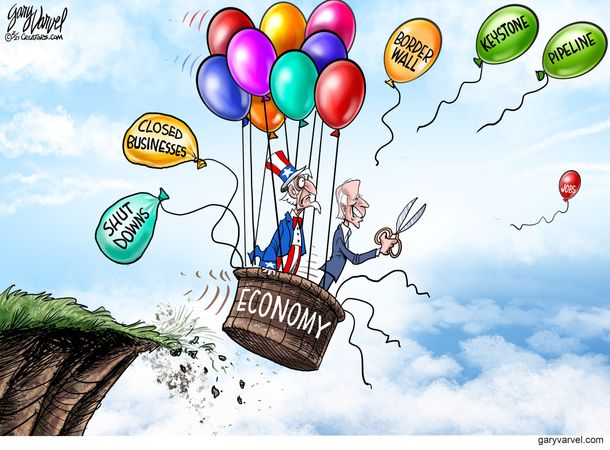
5. Energy
  • For the first time in nearly 70 years, the United States became a net energy exporter.
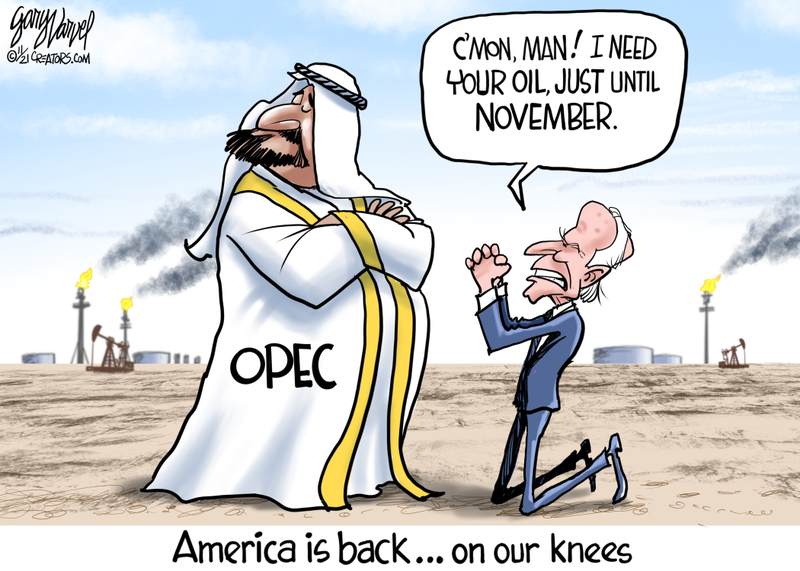
  • The United States was energy independent, not having to beg our enemies to produce oil and natural gas for our consumption.
  • The United States became the number one producer of oil and natural gas in the world.
  • Natural gas production reached a record high of 34.9 quads in 2019, following record-high production in 2018 and 2017.
  • Approved the Keystone XL and Dakota Access pipelines.
  • Opened up the Arctic National Wildlife Refuge (ANWR) in Alaska for oil and gas leasing.
  • Renewable energy production and consumption both reached record highs in 2019.

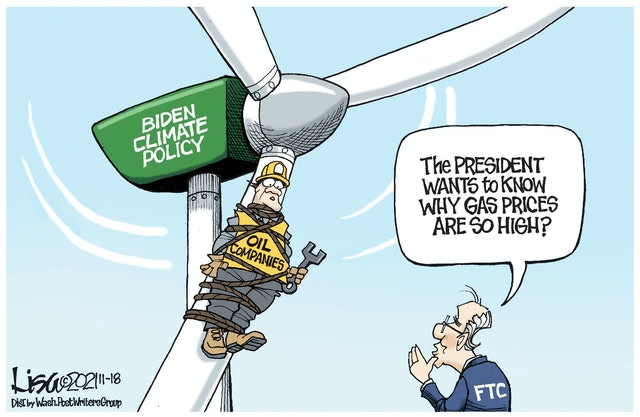
The average price of a gallon of gasoline, while it varied around the country, was far lower than it has been under Mr. Biden, and the Ukrainian war is not the only or even major reason. Gas prices were going up long before Putin invaded Ukraine simply because Biden cut oil and gas production. Less of a commodity will raise its price. That is, of course, what Mr. Biden intended because he wants America on “renewables” to placate his “green” supporters.
6. HealthCare
  • Increased choice for consumers by promoting competition in the individual health insurance market leading to lower premiums for three years in a row.
  • Under the Trump Administration, more than 90 percent of the counties have multiple options on the individual insurance market to choose from.
  • Eliminated costly Obamacare taxes, including the health insurance tax, the medical device tax, and the “Cadillac tax.”
  • Lowered drug prices for the first time in 51 years.
  • Launched an initiative to stop global freeloading in the drug market.
  • Signed first-ever executive order to affirm that it is the official policy of the United States Government to protect patients with pre-existing conditions.
  • Passed Right To Try to give terminally ill patients access to lifesaving cures.
  • Signed an executive order to fight kidney disease with more transplants and better treatment.
  • Signed into law a $1 billion increase in funding for critical Alzheimer’s research.
  • Accelerated medical breakthroughs in genetic treatments for Sickle Cell disease.

These measures are very important, especially as one gets older and the risk of health problems increases. The federal government has made an absolute mess of the American healthcare system. Trump’s tweaks won’t solve the greatest problems but did assist many in need.
7. Judiciary
  • Nominated and confirmed over 230 Federal judges.
  • Confirmed 54 judges to the United States Courts of Appeals, making up nearly a third of the entire appellate bench.
  • Appointed Justice Neil Gorsuch to replace Justice Antonin Scalia.
  • Appointed Justice Brett Kavanaugh to replace Justice Anthony Kennedy.
  • Appointed Justice Amy Coney Barrett to replace Justice Ruth Bader Ginsburg.

Liberals hate these actions, but a court system that respects the Constitution is necessary for a constitutional republic that believes in checks and balances. The Left, of course, doesn’t believe in either a constitutional republic or checks and balances. They want all power to the Party (Democratic).
8. Environment
  • Invested over $38 billion in clean water infrastructure.
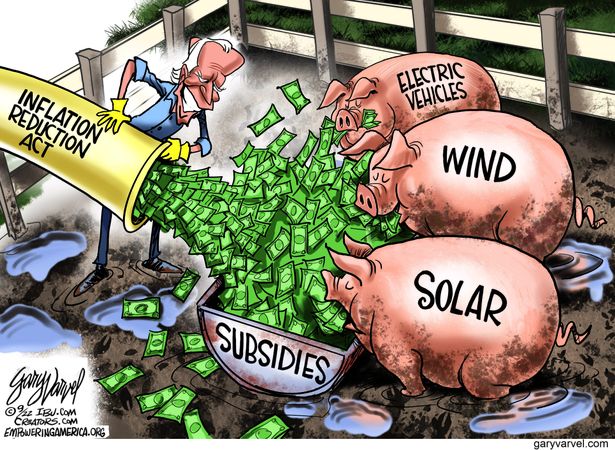
  • In 2019, America achieved the largest decline in carbon emissions of any country on earth. Since withdrawing from the Paris Climate Accord, the United States has reduced carbon emissions more than any nation.
  • In FY 2019 the Environmental Protection Agency (EPA) cleaned up more major pollution sites than any year in nearly two decades.
  • The USMCA guarantees the strongest environmental protections of any trade agreement in history.
  • Signed the Save Our Seas Act to protect our environment from foreign nations that litter our oceans with debris and developed the first-ever Federal strategic plan to address marine litter.

One of the major accusations liberals throw at Republicans is “you Republicans don’t care anything about the environment.” My far-left, hate-America brother gave that to me one time and I just laughed at him. It is demonstrably untrue, and Mr. Trump’s actions prove it. There is such a thing as “responsible environmentalism,” and there is “radical environmentalism.” Conservatives (“conservation,” wise use of resources) believe in the former; the Left, accepting every ridiculous environmental theory that comes from MSNBC and Hollywood, believes in the latter. Mr. Trump’s actions were good and wise for the environment.


9. The southern border
  • Built over 400 miles of the world’s most robust and advanced border wall.
  • Illegal crossings plummeted by over 87 percent where the wall has been constructed.
  • Deployed nearly 5,000 troops to the Southern border. In addition, Mexico deployed tens of thousands of its soldiers and national guardsmen to secure their side of the US-Mexico border.
  • Ended the dangerous practice of Catch-and-Release, which means that instead of aliens getting released into the United States pending future hearings never to be seen again, they are detained pending removal, and then ultimately returned to their home countries.
  • Entered into three historic asylum cooperation agreements with Honduras, El Salvador, and Guatemala to stop asylum fraud and resettle illegal migrants in third-party nations pending their asylum applications.
  • Entered into a historic partnership with Mexico, referred to as the “Migrant Protection Protocols,” to safely return asylum-seekers to Mexico while awaiting hearings in the United States.

Of course, Joe Biden has destroyed this; America no longer has a southern border, and even some Democrats have complained about it. If it hadn’t been for Mitch McConnell and the Washington Establishment, there is no doubt there would be a wall across the entire expanse of the American-Mexican border now. Not that it would matter. Biden would have torn it down. This may be the area where we miss Trump the most. Biden is diluting America into non-recognizability.
 

10. NATO, foreign affairs, and the military
  • Secured a $400 billion increase in defense spending from NATO (North Atlantic Treaty Organization) allies by 2024, and the number of members meeting their minimum obligations more than doubled.
  • Credited by Secretary General Jens Stoltenberg for strengthening NATO.
  • Worked to reform and streamline the United Nations (UN) and reduced spending by $1.3 billion.
  • Allies, including Japan and the Republic of Korea, committed to increasing burden-sharing.
  • Protected our Second Amendment rights by announcing the United States will never ratify the UN Arms Trade Treaty.
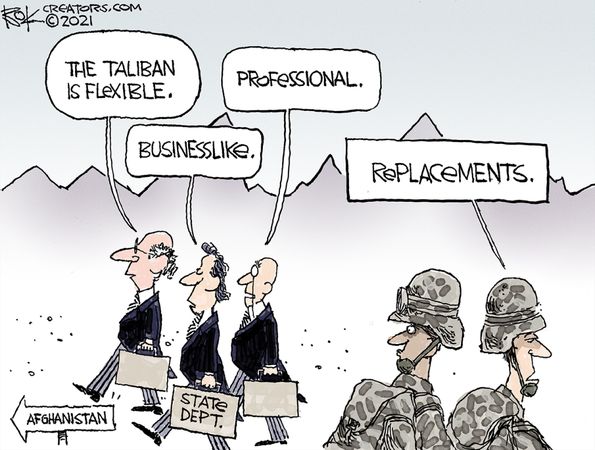
  • Withdrew from the horrible, one-sided Iran Nuclear Deal and imposed crippling sanctions on the Iranian Regime.
  • Brokered historic peace agreements between Israel and Arab-Muslim countries, including the United Arab Emirates, the Kingdom of Bahrain, and Sudan.
  • Completely rebuilt the United States military with over $2.2 trillion in defense spending, including $738 billion for 2020.
  • Secured three pay raises for our service members and their families, including the largest raise in a decade.

This is a partial list, of course, which must be limited due to space. There are many other items to be added here (e.g., Israel and more Middle Eastern accomplishments), and you can read about them at the website given below.
11. Education
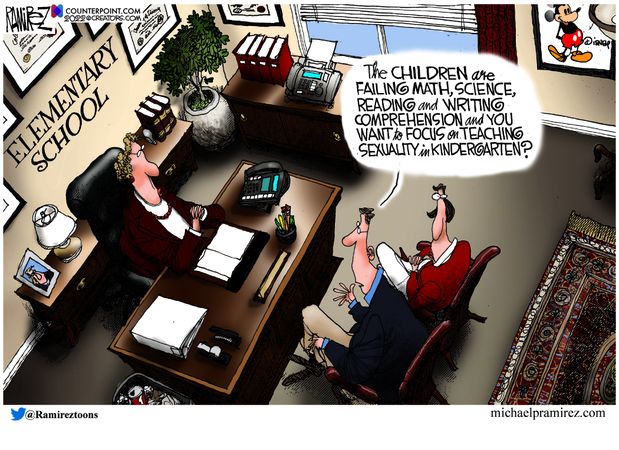
  • The Tax Cuts and Jobs Act expanded School Choice, allowing parents to use up to $10,000 from 529 education savings account to cover K-12 tuition costs at the public, private, or religious school of their choice.
  • Launched a new pro-American lesson plan for students called the 1776 Commission to promote patriotic education.
  • Prohibited the teaching of Critical Race Theory in the Federal government.

There was much more to be done here as well, as is obvious to every sane American, but these accomplishments are notable.
These three articles have given only a cursory survey of Mr. Trump’s accomplishments while in office. As noted, most Americans don’t know about them because they were never reported by the Democratic Party’s press. We only heard about his mean tweets, racism, etc. That is the battle we continue to face—getting the positive message out, despite the opposition faced in the “mainstream media.” It is one of the greatest challenges in front of us in saving our country.

None of this information will matter, in the least, to the depraved Leftists. They hate Trump and, pardon the pun, that trumps everything. Evidence and benefitting the American people mean absolutely nothing to them. But we can hope that not every liberal is a closed-minded, hate-filled, evil wretch. Maybe, if we can disseminate this information, we can truly help some people.

If you wish the complete list, go to the website Trump Administration Accomplishments”. If you want to copy and paste them and print them out, they will come to many pages, I assure you.

If Mr. Trump is elected in 2024, obviously he will have to undo a lot of damage that has been done by the Biden administration. He will also have to constantly fight the Left which will, again, do everything possible to destroy him in its relentless pursuit to destroy America. It is amazing, given what he had to go through in his term in office, that Mr. Trump was able to accomplish anything at all.  

Can he return to Washington and “Make America Great Again”? That is in the hands of the American people. Provided, of course, there is an America after two more years of Joe Biden.

 

Oh Canada, True North Not So Strong or Free

Meghan Murphy writes at Spiked A Canadian dystopia.  Excerpts in italics with my bolds and added images.

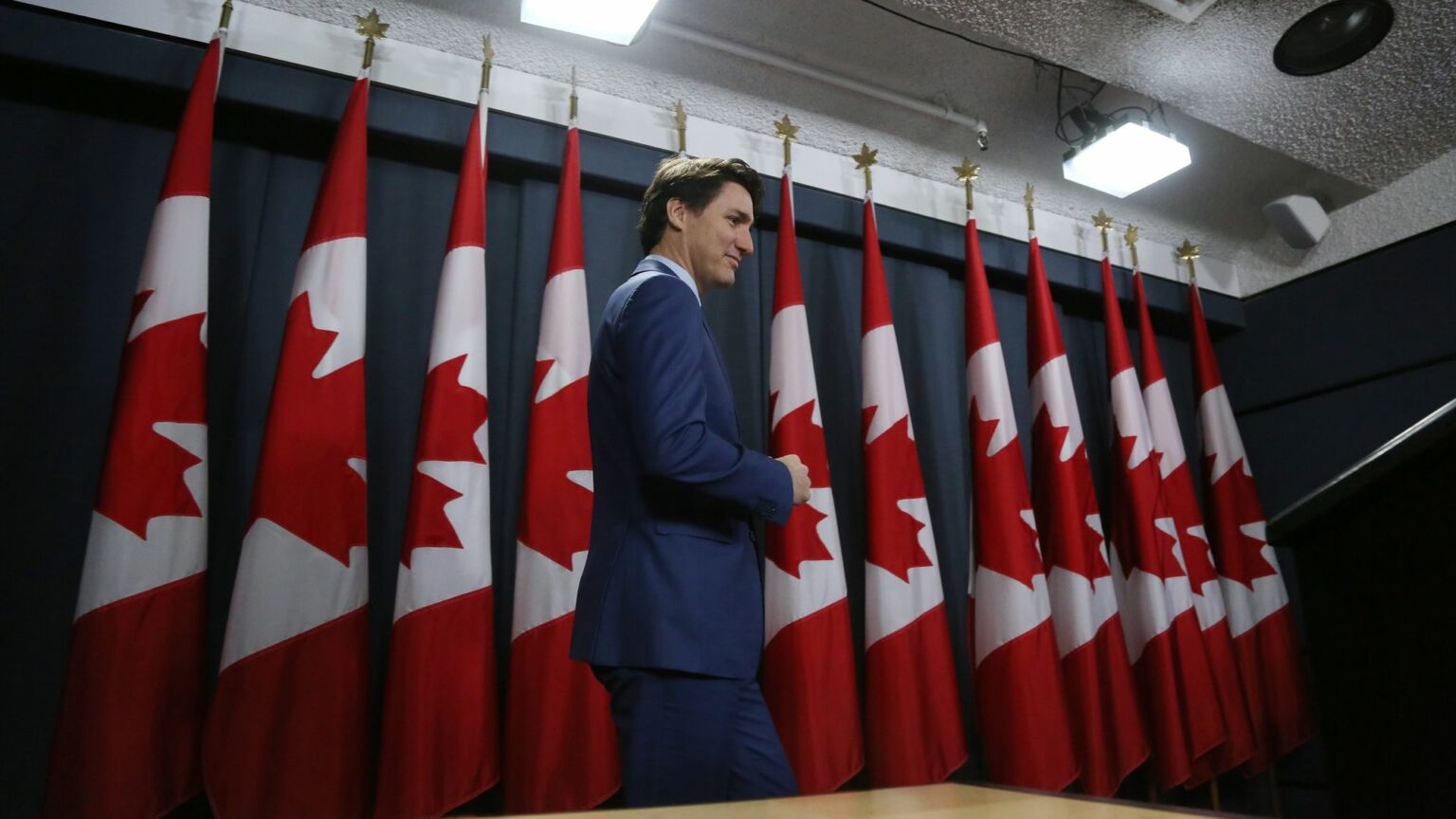
Justin Trudeau’s ‘liberal’ government is riding roughshod over liberty.

Bored of its reputation as inclusive, open-minded and accepting, Canada opted for an authoritarian rebrand last year.

That, at least, seems to have been the intention of prime minister Justin Trudeau. Over the past year, he has led the way towards making authoritarianism great again, forcing thousands of Canadians to live as second-class citizens, while vilifying those who remain fond of their rights as dangerous bigots who should be cut off from society.

Our beta test for Tyranny 2.0 began with the Covid lockdowns in 2020.

Would Canadians agree to stay at home, mask up, abandon their elderly loved ones to die alone in hospitals and long-term care homes? Would they ostracise family members who dared to suggest a funeral for grandma? Would they shut down their businesses, host virtual cocktail hours and pretend that banging pots and pans from their windows equates to some kind of community-building exercise? Would they scream at strangers who dared to breathe too close to them on a hiking path, or who took off their masks for a bike ride? Would they turn their neighbours in to the police for hosting Christmas dinner? Why, yes they would!

After Canadians passed that test, the Liberal government pushed Covid restrictions further in 2022. At the start of the year, Canadians had to sign up to one app in order to leave the country and to return, and use another app to access restaurants, bars, gyms and sporting events. Kids were kept out of schools – indefinitely, it seemed back then – ensuring an entire generation fell behind in their education, mental, social and emotional development.

In the meantime, while everyone was distracted by Zoom meetings, or was furiously tweeting about anti-vax Nazis giving out free hot dogs in the streets, the Canadian government moved on to rolling back women’s rights in the name of ‘trans rights’.

Male prisoners claiming to have a female gender identity have been housed in women’s prisons for several years now. But in 2022 this was made official prison policy all across Canada. A federal directive in May stated: ‘Offenders will be placed according to their gender identity or expression in a men’s or a women’s institution, if that is their preference, regardless of their sex (ie, anatomy) or the gender / sex marker on their identification documents.’

This has led to rapists in wigs being moved over to women’s prisons for safekeeping. It’s surely no coincidence that 50 per cent of transfer requests from men seeking to be moved to female prisons involve sex offenders. Perhaps the government thinks women prisoners, many of whom have suffered abuse in the past, won’t mind a few more rapists, murderers and paedophiles in their lives.

Some Canadians have pushed back against Trudeau’s ‘liberal’ tyranny. In January, for instance, Canadian truckers, clearly fearing that the restrictions, lockdowns and vaccine mandates introduced during the pandemic might not be temporary, formed a ‘Freedom Convoy’. This convoy then drove across Canada, right to the prime minister’s door in Ottawa, as protests convened outside parliament. Trudeau, our brave leader, responded to the sight of bouncy castles and Canadian flags by fleeing the capital.

In a last-ditch effort to stop the protests, Trudeau began freezing the bank accounts of Freedom Convoy leaders and supporters, correctly discerning that not having access to money cuts people off from the means to live. The government clearly thought the truckers and their supporters deserved such a punishment for having the audacity to demand their constitutional rights be respected.

Canada Buys 88 F-35s for $19 Billion January 2023

After the government’s stand-off with the truckers, which did ultimately put a stop to the Covid restrictions, the Liberals set about finding other, more creative ways to restrict Canadian citizens’ liberties.

They eventually came up with the idea of taking away people’s hunting guns and trucks.

Introduced in November, the Liberals’ Bill C-21 is an amendment to Canada’s gun-control legislation that, if enacted, will end the onslaught of gun violence against birds and deer. This proposed ban on hunting arms would constitute the largest gun ban in Canadian history. And it would leave Canadians even more dependent on big-box grocery stores and imported meat, protecting corporations and billionaires from the ever-encroaching threat of geese hunters.

This still left the government with the problem of trucks. So in December, the Liberal government’s environment minister, Steven Guilbeault, proposed new regulations that would mandate one-fifth of all new vehicles sold be electric. These regulations are part of a long-term plan to ensure that all passenger vehicles sold in Canada are electric by 2035. It’s not hard to see how this will limit truck and car ownership. A move to replace old-school petrol-powered vehicles with electric ones makes owning a truck or a car much more expensive, and limits journeys to shorter distances. Guilbeault’s parliamentary secretary, Julie Dabrusin, explained that the new electric-vehicle mandate ‘was about making sure that Canadians have access to the vehicles they want’.

And, as far as the government is concerned, what every good Canadian citizen wants
is access to no vehicles at all. Perfect for staying at home!

At this rate, Canada’s poor and working class will soon no longer need to concern themselves with the stress of autonomy at all. Because there will be no choices for them to make.

As far as the government is concerned, it is merely trying to keep Canadians safe and sound. But the result is dystopian. Trudeau and Co are creating a society in which all lack basic freedoms, and women are deprived of their rights. A society in which individuals will be stuck at home, waiting on Amazon orders, while plugged into the Metaverse and choosing which Japanese anime porn character to be.
And if you find that vision of the future too depressing –
remember, in Canada, euthanasia is always an option.


The Gas Stove Gambit

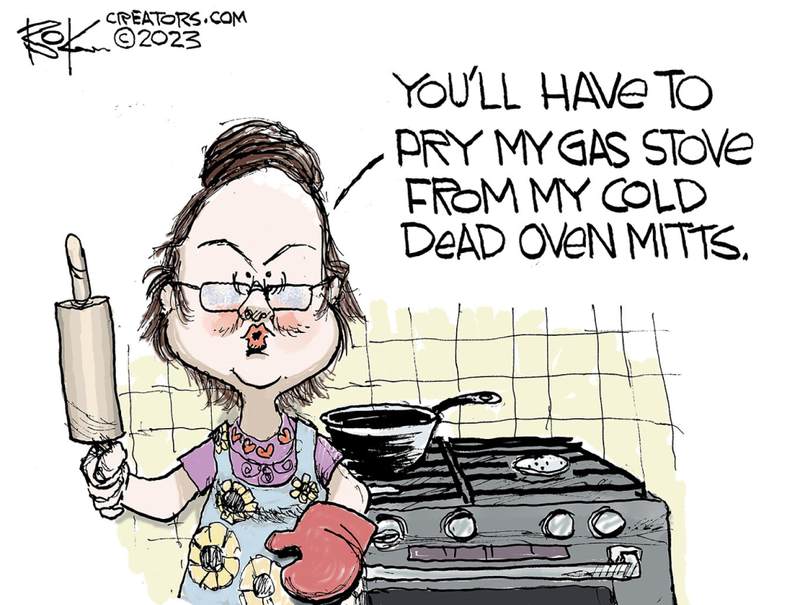
Remembering that natural gas is a fossil fuel, there must be more than meets the eye in the media firestorm over banning gas stoves for safety reasons.  Could it be that the regime along with the media are gaslighting us regarding this maneuver?  Kit Knightly thinks so and explains the gambit in his off-guardian article What is the US “Gas Stove Ban” REALLY about?  Excerpts in italics with my bolds and added images.  H/Y Tyler Durden

What sounds like overreach in itself, is actually a cover
for something potentially far, far worse.

The Biden administration is apparently looking to ban gas stoves, calling them a “hidden danger”. But while that sounds bad enough, a deeper dive shows – as usual – it’s not really about what they say it’s about.

Talk of banning gas stoves and “unregulated indoor air quality” could be a Trojan horse designed to get even more “smart” monitoring technology into your home.

Let’s jump in.

Are Gas Stoves Dangerous?

Well, according to Alexandria Ocasio Cortez, the New Scientist and million other outlets and pundits who started talking about it in the last two days, yes.

Earlier this week near-identical articles from the National Review, Bloomberg and CNN detail how the US Consumer Product Safety Commission will be opening “public comment on the dangers of gas stoves sometime this winter”.

The articles claim:

The emissions have been linked to illness, cardiovascular problems, cancer, and other health conditions. More than 12 percent of current childhood asthma cases are linked to gas stove use, according to peer-reviewed research published in the International Journal of Environmental Research and Public Health last month.

Now would be a good time to talk about the phrase “linked to”. It’s always a good one to look out for in any mainstream publication. Journalists love it because it implies causation without stating it.

Consider, one hundred per cent of serial killers have been linked to the ingestion of water and the wearing of shoes.

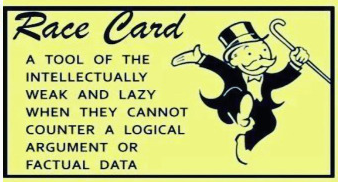
If this manipulative use of language were not evidence enough of an agenda, the rather premature deployment of the race card proves it:

Senator Cory Booker (D., N.J.) and Representative Don Beyer (D., Va.) wrote a letter to the agency last month urging the commission to address the issue and calling the harmful emissions a “cumulative burden” on black, Latino and low-income households.

So, Will They Ban Them?

Actually, probably not.

Considering that, according to Bloomberg, some 40% of US homes use gas stoves to cook, an outright ban would be impractical to the point of madness. You can’t criminalise 40% of the country. It would be almost unenforceable.

Perhaps they might try a “phasing out”, as they plan for petrol cars in California.

But most likely of all is that this was never really about banning stoves in the first place.

OK, So What’s IT Really About?

What we’re seeing here looks to be your classic bait-and-switch. Having established a “problem”, the powers that be suggest a solution they have no intention of ever carrying out (the more unreasonable the better).

When this measure is inevitably rejected by the public, the government will then proceed to suggest – or pay an NGO to suggest to them – a “compromise” measure.

The compromise is no compromise at all, of course, but actually what they wanted to do from the beginning. Nevertheless, the whole process is sold in the media as a victory for whichever party happens to be in opposition, and cited as evidence that “the system works”.

Tellingly, as I am writing this, Biden has already “ruled out a ban due to backlash”, and Vox were already using the “compromise” a lot in an article they published yesterday.

However, what that “compromise” would be in this case isn’t clear at first, you have to do a little digging.

One clue is present in the National Review article [emphasis added]:

The Association of Home Appliance Manufacturers argues that cooking produces harmful emissions regardless of the kind of stove used. “Ventilation is really where this discussion should be, rather than banning one particular type of technology,” Jill Notini, a vice president at the association, told Bloomberg. “Banning one type of a cooking appliance is not going to address the concerns about overall indoor air quality. We may need some behavior change, we may need [people] to turn on their hoods when cooking.”

And you’ll find another in the abstract of the original report on “Cooking With Gas, Household Air Pollution, and Asthma: Little Recognized Risk for Children”, published in the Journal of Environmental Science in April 2021:

The impact [of gas stove cooking] on children can be substantial because […] indoor air is unregulated.

“Ventilation is where this discussion should be”, after all “cooking produces harmful emissions regardless of the kind of stove” and a ban wouldn’t address “concerns about overall indoor air quality” which is currently “unregulated”.

Do you see where this is going?

It’s not about gas stoves, and it’s not about asthma – it’s about “indoor air pollution”, and more importantly how they plan on “regulating” it.

In one of those startling coincidences we’ve all got so used to witnessing in modern geopolitics, just as the US is talking about indoor air quality because of gas stoves, other countries around the world are doing the same thing for totally different reasons.

Singapore is considering new regulations on indoor air quality too, but because of formaldahyde.

Last month The Conversation was running articles claiming “indoor air pollution kills”, while Sir Chris Whitty, the UK’s chief medical officer, was “demanding action on indoor air pollution”.

On Monday, in a Guardian lifestyle piece purportedly about scented candles, Svetlana Stevanovic calls indoor air quality a “going concern”.

Two days ago The Tyee, an “independent” Canadian magazine which receives some funding from the Canadian government, ran an op-ed headlined:

We Need a Revolution in Clean Indoor Air

Which attempts to link improving indoor air quality to “ending Covid” (whilst making sure to sufficiently fluff the vaccines, of course).

Just yesterday the Irish Times published an article about the dangers of poor indoor air quality.

In a rather interesting piece of timing, the air hygiene technology company AeroClean and Molekule, a market leader for air purifiers, finalised a public stock merger…also just yesterday.

Two days ago it was announced IKEA would be selling their own smart air monitors, the same day Samsung announced their new “smart air purifier”.

Earlier today Chinese tech giant Xiaomi issued a media release about their new smart air monitoring technology.

recent report expects the global air monitor technology market to swell to nearly 6 billion dollars in the next three years.

But I’m sure this is all just a coincidence.

Where Does This Lead?

Well, if I had to guess I would suggest some new “smart” technology is coming that will monitor air quality and indoor C02 emissions. Like smart electricity and water meters, but for your air.

Interestingly, the World Economic Forum agrees with me, publishing an article on their website last July headlined “Indoor air pollution: What causes it and how to tackle it”, which claims:

indoor air pollutants can now be detected with more precise, efficient, and compact sensors thanks to advances in environmental sensing technology. As a result, intelligent home systems may soon use sensors like these to keep track of indoor air quality and notify the ventilation system before dangerous levels are reached.

As part of “backing down” from the stove ban, they will introduce a new bill which sees “smart air monitors” become mandatory in all new-build houses, hotels and rented accommodation.

Just like smart electricity meters, smart air monitors would almost certainly be used to harvest huge amounts of data and give states or corporations the ability to control your home.

If your “indoor air” isn’t “clean” enough; if you use your stove too much, burn too many scented candles or emit too much co2, expect to get penalized  in some fashion until you learn how to be more responsible.

More smart technology, more monitoring, and ultimately more control.

So, while it’s possible the gas stove ban talk will resolve itself into the cliche new tax or fines or some other petty scheme for bilking the many out of their wages, the signs are certainly there it might be something more sinister.

Meanwhile, expect to keep seeing reports on gas stoves damaging the climate, or stories about poor indoor air quality making covid worse.

The usual bought-and-paid-for columns that support every new normal narrative.

A Covid Vocabulary

Covid Buzzwords 2020

Ramesh Thakur writes of his journey since 2019 in his Spectator Australia article A Covid vocabulary.  Excerpts in italics with my bolds and added images.

Words I learned, and learned to hate

When the novel coronavirus began to dominate world news in 2020 (the virus may already have been in circulation in 2019), a modest existing knowledge on pandemic policy, based in a background in global governance, indicated that governments were departing radically from the existing scientific and policy consensus. Several well-credentialled experts tried to say so but were dismissed as has-beens or fringe-dwellers suffering from relevance deprivation syndrome. This was troubling. Being retired, I had immunity against being fired. With time to do my own policy-oriented research, I began digging deeper into Covid pandemic management as a policy challenge. And this meant familiarising myself with the language of health experts and a resulting expansion of my vocabulary.

What follows is a description of the key new words I learnt over the last three years,
but also words I’ve learnt to hate. With each step on the journey,
confidence and trust in the public health clerisy fell further.

We began with the distinctions between (a) infection and case fatality rates and (b) pharmaceutical interventions like vaccines and drugs and non-pharmaceutical interventions like enhanced surveillance, testing and contact tracing; social distancing (a euphemism for anti-social behaviour like physical distancing); workplace and school closures; working from home; sanitisers and surface cleaning.

This led to ‘lockdowns’, another euphemism for shutting down all economic and social activity and locking up entire populations in their homes because the health experts said so despite the previous consensus against it.   As part of the public discourse on justification for the unprecedented lockdowns and possible timing for lifting the restrictions, officials and commentators fussed over the ‘R’ number (how many more people on average will one sick person infect?) or the rate at which the virus was reproducing in order to assess if it was still growing or contracting.   By 2022 the world had lost interest in this 2020 obsession. As the debate between lockdown enthusiasts and sceptics heated up, the language deteriorated into name calling and ‘Covidian’ and ‘Covidiot’ were deployed as reciprocal insults.

With masks we tried to understand the difference between and relative merits of facecloths, surgical masks and N95 respirators; healthcare, outdoor and indoor settings; and why the medical consensus did an instant (that is, without any additional data or scientific studies) 180-degree turn on masks from being pointless to an extremely critical individual and community protection measure. The existing standard metric in 2020 for allocating finite health resources, a cost-benefit analysis using quality adjusted life years for measuring health outcomes, was similarly abandoned without explanation.

In 2021 we turned our attention to vaccines and the importance of numbers: absolute risk reduction, relative risk reduction, and (a) the number needed to vaccinate (NNV) to prevent one additional infection or death in a specified group (ie elderly, young, children, industry or setting-specific employees) and (b) the number of ‘serious adverse events’ that would constitute a critical ‘safety signal’ within a target cohort. We also had to grasp the distinction between vaccine efficacy in controlled clinical trials and vaccine effectiveness in the real world. The equations just didn’t compute. Despite the famed 95 per cent efficacy claimed in trials, people in NSW who had been vaccinated at least once made up 77 per cent of those infected and 85 per cent of those who died of or with Covid from 22 May-31 December 2022 (the period in which data was separated by vaccination status, as the practice has been discontinued in 2023).

Finally, in response to the increasingly esoteric (and desperate) justifications for the vaccination drives despite the empirical outcomes showing their poor performance, we began looking at all-cause ‘excess’ mortality that is less susceptible to statistical and linguistic manipulation. For example, in an instructive analysis in The Spectator Australia online’s Flat White (6 January 2023), Jason Strecker goes through the Australian statistics on excess deaths to comprehensively demolish the self-serving claims made by federal and state politicians of how many lives they saved with their lockdown policies. You’ve gotta love this sub-heading from the New York Times subscriber-only newsletter (4 January): ‘Mass vaccination, though miraculously effective, didn’t usher in a lower overall death toll’. Which leads me to Merriam-Webster’s word of the year concept of ‘gaslighting’, by the mainstream media as much as by governments.

Moving to words I learnt to hate:

‘Follow The Science’ was the dishonest slogan used to shut down legitimate scientific inquiry even while implementing many unscientific and even some anti-scientific policies.

‘Staying Apart to Stay Together’ was a too-clever-by-half effort to camouflage an oxymoron.

‘Three weeks to flatten the curve’? Yeah, right. Three years later, it’s our lives, spirits and economies that have been flattened.

‘Protect the health service’? No, it’s the mission of the health service to protect us. Sure enough, as the winter pressures return on the broken, dysfunctional yet sacralised National Health Service in the UK that has in recent times spent massive amounts of money recruiting DIE (diversity, inclusion and equity) bureaucrats while firing frontline staff who refused the jab, the Daily Mail reported on 4 January that the government is drawing up plans to reintroduce Covid-era measures ‘to save the NHS’. An online poll showed 65 per cent of over 13,000 readers oppose any measure being brought back but, surprisingly, 22 per cent support the return of face masks. Another pet peeve was,

‘We are all in this together’ and equivalent phrases like the virus doesn’t discriminate, it’s out hunting whoever it can find, etc. No, not really, not by risks, benefits nor burdens are we all in this together.

Finally, the concept currently in vogue: ‘abundance of caution’, used to impose a negative test requirement for Chinese arrivals from 5 January 2023 despite medical advice to the contrary. This substitutes a slogan for a policy and confirms the trigger-happy authoritarian instincts of the government to reimpose curbs on people’s freedoms on the minister’s whim, with no justification advanced in the form of a cost-benefit analysis. It speaks to the undying conceit of politicians that they can control viruses. And it highlights their complete abandonment of caution on the harms of government interventions. 

Despite three years of worldwide evidence that the rise and fall of the virus curve
has been policy-invariant, while the damage from the ill-conceived interventions
has been severe and will be long lasting.

Ian Plimer Asks, “What Climate Crisis?”

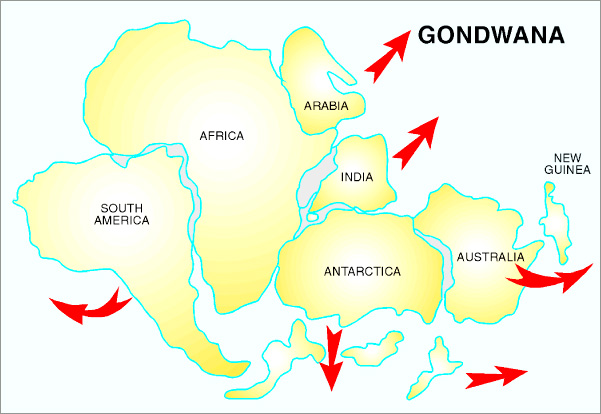
The supercontinent Gondwana hundreds of million years ago at its primary stages, and the directions pieces drifted away

That question is the title of Ian Plimer’s Spectator Australia article What Climate Crisis? Excerpts in italics with my bolds and added images.

For more than 80 per cent of time, Earth has been a warm wet greenhouse planet with no ice. We live in unusual times, when ice occurs on continents. This did not happen overnight. The great southern continent, Gondwanaland, formed about 550 million years ago. It occupied 20 per cent of the area of our planet and included Antarctica, South America, Australia, South Africa and the Indian subcontinent.

Gondwanaland was covered by ice when it drifted across the South Pole 360-255 million years ago. Evidence for this ice age is in the black coal districts of Australia, South Africa and India.

If Antarctica is to lose its ice sheets to end the current ice age, plate tectonics must move the continent northwards or fragment Antarctica into smaller land masses. Parts of Antarctica are currently being fragmented which is why there are more than 150 hot spots and volcanoes in rift valleys beneath Antarctic ice. Plate tectonics must also widen the Bering Strait to allow more warm Pacific Ocean water to enter and warm the Arctic.

Arctic ice formed 2.5 million years ago when plate tectonic-driven volcanoes in central America joined North America to South America and stopped Pacific and Atlantic Ocean waters from mixing. This was exacerbated by a supernova explosion that bombarded Earth with cosmic particles to produce cloudiness and cooling.

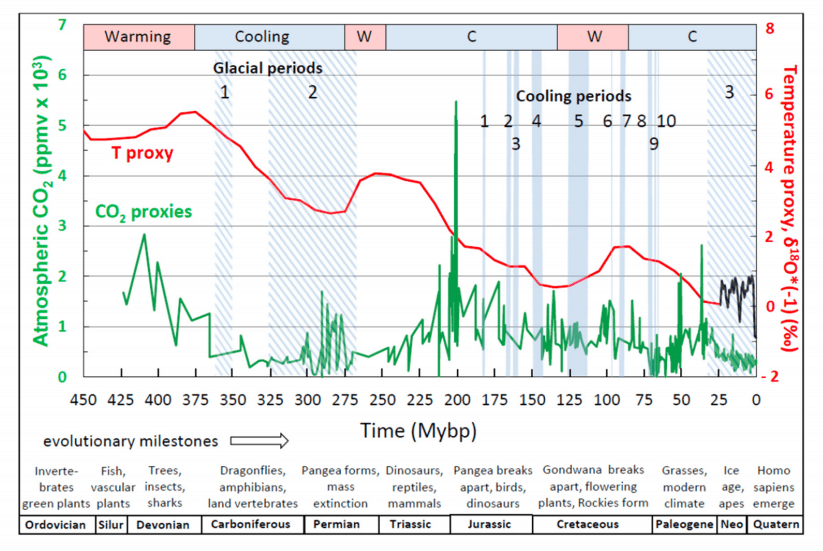
Figure 16. The geological history of CO2 level and temperature proxy for the past 400 million years. CO2 levels now are ~ 400ppm. Source: Davis, W. J. (2017).

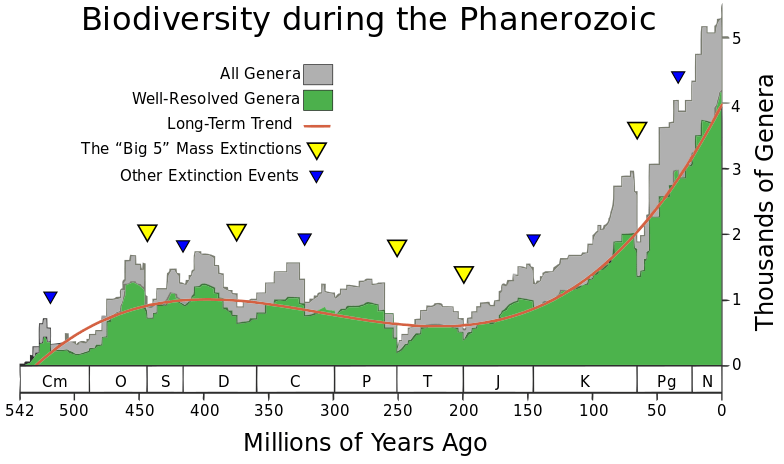
The Earth has been slowly cooling for the last 50 million years from times when life thrived and rapidly diversified. In these warmer times, there were no mass extinctions due to natural warming and, if the planet is warming today, the past shows us that life will thrive and diversify even more.

Source: Phanerozoic_Biodiversity.png Author: SVG version by Albert Mestre

Once the Antarctic ice formed, ice sheets waxed and waned depending on whether Earth was closer or more distant from the Sun. Within these cycles there were smaller cycles driven by variations in energy emitted from the Sun producing many short warm spikes during long glaciations and very short cold spikes during short interglacials with average temperature rises and falls of more than 10°C a decade.

    • On a scale of tens of millions of years or more, the Earth’s climate is driven by plate tectonics.
    • On a scale of hundreds of thousands of years, the Earth’s climate is driven by orbital cycles which bring Earth closer to or more distant from the Sun.
    • On a scale of thousands of years to decades, the Earth’s climate is driven by variations in energy emitted from the Sun.

If governments, the UN or climate activists want to stop the normal planetary process
of climate change, then they need to stop plate tectonics,
stop variations in the Earth’s orbit and stop variations in solar output.

Even the omnipotent, omnipresent Kevin Rudd couldn’t manage this!

No past warming events have been driven by an increase in carbon dioxide in the atmosphere. No past cooling events were driven by a decrease in atmospheric carbon dioxide.

Six of the six most recent ice ages were initiated when the Earth’s atmospheric carbon dioxide was far higher than at present. Atmospheric temperature rise occurs before the carbon dioxide content of the atmosphere rises. It has never been proven that human emissions of carbon dioxide drive global warming despite numerous requests to climate activist scientists for the published evidence. Trillion-dollar bankrupting decisions on energy policy are being made using invalid science.

The peak of the last orbitally-driven interglacial was 7,000 to 4,000 years ago and for the last 4,000 years the Earth has been cooling as the climate changes from an interglacial into glaciation. There were solar-driven warm spikes such as the Minoan Warming, Roman Warming, Medieval Warming and the Modern Warming and cold spikes (e.g. Dark Ages, Little Ice Age) during this 4,000-year cooling trend.

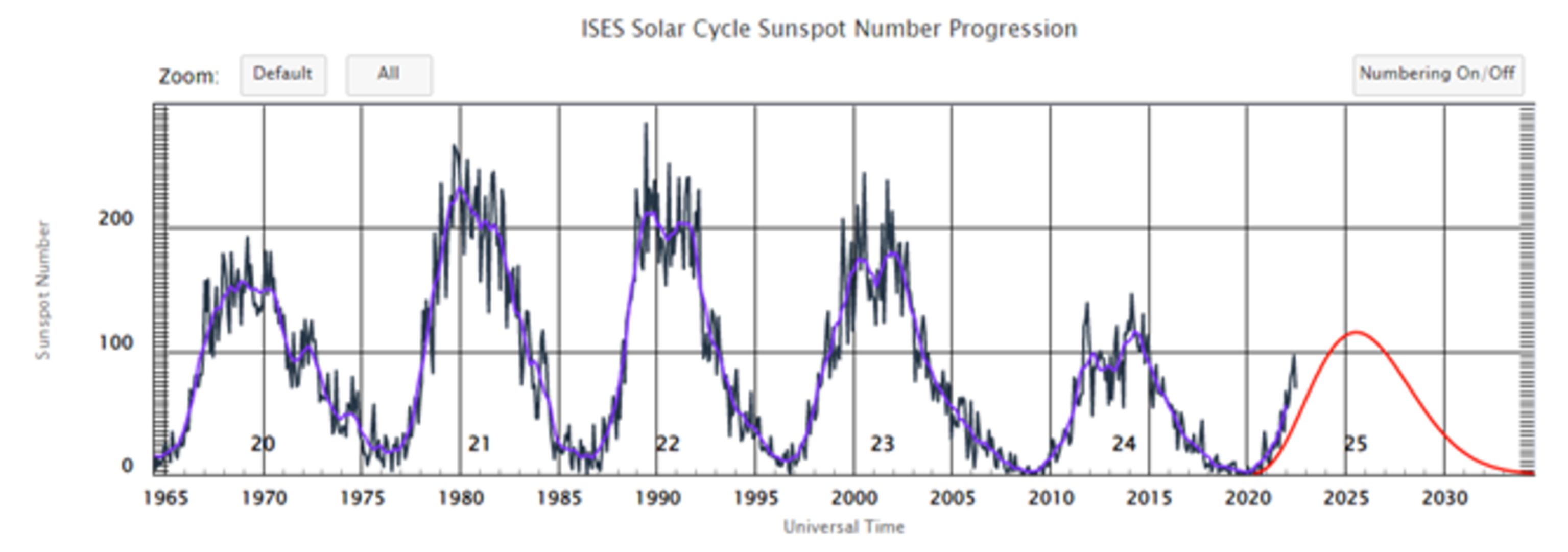
Solar cycle 25 prediction, NOAA, July 2022

In 2020, we entered the Grand Solar Minimum which is calculated to end in 2053. Whether there will be a solar-driven cooling, similar to the Little Ice Age (1300-1850 AD), or a full-blown orbitally-driven glaciation, such as the last glaciation from 116,000-14,400 years ago, is unknown. The former cooling could last for hundreds of years whereas the latter would last for at least 90,000 years. If there was another period of sustained subaerial volcanism, cooling would be accelerated.

During the last glaciation, Europe was covered with ice north of the Alps, as was Russia; Canada and northern and alpine USA were covered by ice; southern South America and the Andes were covered by ice; Himalayan ice expanded to lower altitudes; and alpine Australia, Tasmania and the South Island of NZ were covered by ice as were the southern and elevated portions of Africa.

In the last glaciation, vegetation contracted and tropical areas such as the Amazon Basin only had copses of trees occupying some ten per cent of the area of the current Amazonian rainforests; large areas of inland Australia, China, India, USA and Africa were covered by sand deposited from cold dry cyclonic winds; inland lakes evaporated; sea level was 130 metres lower than at present; there was no Great Barrier Reef; sea ice isolated Greenland, Iceland, northern Russia and northern Canada; Antarctic sea ice extended hundreds of kilometres north and there was a reduction in rainfall and plant and animal species. Areas that now support pastoral and grain-growing activities were sandy wastelands during the last glaciation.

Humans struggled as hunter-gatherers around the edge of ice sheets and at lower latitudes.

We are putting all our efforts and wasting trillions of taxpayers’ dollars into trying to prevent mythical human-induced global warming, yet we still don’t prepare for the inevitable annual floods, droughts and bushfires, let alone longer-term solar – and orbitally – driven global cooling.

We have a crisis of single-minded stupidity exacerbated by a dumbed-down education system supported by incessant propaganda, driven by financial interests and political activist authoritarianism.

Why Was Covid-19? Follow the Money.

Michael Bryant has the background in finances and health to help us understand why Covid-19 plandemic  pandemic happened the way it did.  His off-guardian article is COVID-19: A Global Financial Operation.  Excerpts in italics with my bolds and added images.

The COVID phenomenon cannot be understood without understanding the un-televised 2019-2020 unprecedented financial collapse threatening the entire global financial system.

The Covid-19 Pandemic story makes little sense when viewed through the lens of health, safety and science. Viewed through the lens of money, power, control, and wealth transfer, however, then all of it makes perfect sense.

The lockdowns, mandatory muzzles, anti-social distancing and the plethora of additional measures did nothing to protect or improve public health- they were never designed to do so.

The numerous mandates birthed by the onset of the Covid-19 scenario were all designed to deliberately break the global economy and crush small businesses as well as break people’s minds, will and the social fabric, in order to “build back a better society” that conforms to the dystopian visions of the psychopaths waging this class war.

The desired result is a billionaire’s utopia, in which they will own and control the planet in the form of a techno-feudal fiefdom where digitally branded humanity is regulated like cattle in a super-surveilled technocracy.

What this manufactured crisis conveniently camouflages is that we are in the midst of a planned total economic collapse- a collapse which was inevitable.

The timing of the COVID fraud became necessary as world markets were faced with an emergency debt crisis in Fall of 2019 which popped up in formerly mostly liquid markets: Repo Markets, Money Markets and Foreign Exchange Markets.

Western governments began a rush to salvage this decaying system, stem this cataclysmic landslide, bail out large scale investors and proactively install a security infrastructure to control the inevitable social disorder resulting from this collapse. This would be followed by a global financial reset, after a period of hyperinflation, destroying both the value of debt and the corresponding paper claims.

The financial system was already in an advanced stage of decline by the fall of 2019 as illustrated by the Fed taking over the Repo market in September to short-circuit the Repocalypse. This collapse began in earnest in 2008/09 and attempts over the last decade and a half to salvage this corrupt economic system only delayed the inevitable.

In the Fall of 2019 the crisis began to rapidly unravel again.

A dramatic decrease in industrial production characterized the banking crisis of August 2019– the so-called Repo crisis when suddenly banks started to refuse US sovereign debt instruments as collateral for overnight loans, forcing the Federal Reserve to step in and print money to cover this massive shortage.

The Repo market is where banks borrow money each day so that they have a certain percent of liquid assets at the end of each day in order to meet certain fiduciary requirements.

Around the middle of September the Fed started pumping $10-20 billion per day into the Repo market to keep interest rates down so banks could borrow the money to stay in business. Even as the Fed was pumping as much $10’s of billions per day into the Repo market it was still not enough.

By early March the Fed was pumping $100 billion into the Repo market in order to stem this existential crisis.

Simply everyone on Wall Street was loaded with enormous debt and was holding on to US cash in order to service this debt, refusing to finance purchases of foreign currencies and then US currency as the Repo Market froze at 10% interest on overnight Repo loans. US treasury bonds and even US bills were being rejected as collateral for Repos.

In March 2020 the liquidity crisis spread from primary dealer markets (TBTF banks and Hedge funds were bailed out in September) toward all other stocks, commodities, bonds, Collateralized Loan Obligations, Mortgage Backed Securities, Mutual Funds, Exchange Traded Funds, as well as various Ponzi schemes such as Structured Derivative Products traded on proprietary platforms representing up to several thousand trillions of dollars.

When US treasury bonds became illiquid due to exponential growth of public, but mostly private, dollar debt, even as the FED was sucking up cash from financial markets all hell broke loose.

The entire House of Cards which was falling for six months could not be stopped so COVID hysteria was manufactured to cover up to what amounts to $10-15 trillion of FED bailout in cash and stock boosts via Permanent Open Market Operations (POMO)- a fancy way of saying that the Fed is buying Treasuries, pumping money into the financial markets and handing out guarantees of value of collateral used in structured derivatives.

The end game, currently in motion, is for the Central Banks (Fed) to buy up all the toxic, worthless debt from the hedge funds and banks, including the 1.5 quad trillion of derivatives, and then transfer the debt to the treasury as sovereign debt. They will then print money to infinity, already fully underway, to service this fictitious debt to sink the dollar via hyperinflation and then foreclose on the US and everyone else holding debt in worthless dollars.

More than 25,000 troops from across the country were dispatched to the US capital on January 13, 2021 and stayed until end of May 2021.

That’s the coup: global hyperinflation to vaporize the assets of the masses and the states in order to hand over public assets to private investors. This allows the ruling class to mop up properties (bankrupted small businesses, foreclosed homes etc.) in order to stake limitless claims on everything in the world.

The timely arrival of the Covid-19 “emergency” provided the rationale and the opportunity to freeze the US banking collapse with massive injections of cash. Somewhere in the neighborhood of $8-10 trillion was paid to US banks up until March 2020 with an additional $5 trillion in economic stimulus promised by the Fed.

The manufactured perception that there was a global medical emergency, beginning in March 2020, was an artifact of mass media manipulation, behavioral conditioning techniques and social engineering. All of this was made possible through institutional programming and accelerated media messaging disallowing basic cognitive processes and eliminating critical thinking possibilities.

With this incessant and overwhelming media drumbeat of the Virus Narrative, and the world unified in its response to the ‘Covid Pandemic’, no other stories were permitted to exist in the media or the public conscience.

Without any external threat like a ‘Killer Virus’ this massive financial collapse would have immediately caused panic and threatened dollar credibility. Without the Covid-19 smokescreen this widespread Ponzi Scheme and the ongoing historical wealth transfer would be seen for what they are- ongoing theft by the financial aristocracy.

The Covid Operation: The Trojan Horse to Usher in the New World Order

As the “War on Terror” illustrated, these deep events are constructed to exploit as many different lines of acquisition as possible. With the “Covid Pandemic” replacing the phony “War on Terror” yet another revamped “worldwide crisis” miraculously morphs into a ruling class multi-purpose golden opportunity.

While the immediate necessity was to staunch the bleeding of the global financial system many other purposes were and are to be served by this multifaceted operation. None of this is accidental. All of this is hidden in plain sight, planned and executed as evidenced in multiple tabletop exercises such as “Event 201” and delineated in numerous documents such as “The 2030 Agenda for Sustainable Development.”

The Covid Operation itself covers many objectives:

  1. Pre-emption of and disguising the reasons for the aforementioned economic implosion;
  2. Acceleration of the largest upwards transfer of wealth in human history;
  3. Justification for and entrenchment of the Bio-Security State, including AI surveillance across multiple sectors of society;
  4. Empowering and enriching the Security State’s counterpart the Big Tech Cartel via tracking apps, proliferating and normalizing social media and communication platforms as “the middle man” in all walks of life. Moving all social life towards the technological imperative– meals ordered via DoorDash, meetings on Zoom, increased spending via Visa/MasterCard by ordering goods online with Amazon, films via Netflix etc., were all forced onto a gullible and largely compliant world public during the Covid tyranny;
  5. The creation of “The Pandemic” as a financial mechanism. Manufactured pandemics have become mammoth investment opportunities that increase the wealth of billionaires and further consolidate their power;
  6. Expansion of the public health industry itself into all walks of public and economic life. The public health industry is now directly tied to global markets and financial conglomerates and has become one of the most critical financial instruments for investors;
  7. Creation of an entirely new and lucrative Bio-Medical “health management” system in order to introduce and codify an entirely new Bio-Tech medical model for the Pharmaceutical Industry with a focus on “revolutionary” uploadable mRNA “vaccines”;
  8. Expansion of and normalizing the use of digital IDs, including vaccine passports, connecting these to a Central Bank Digital Currency (CBDC); a Universal Basic Income (UBI) scrip, allowing for the tracking of purchases; medical interventions, “lifestyle choices”, etc. “nudging” us towards ‘desired’ behaviors or shutting us out of the system altogether as they wish;
  9. A re-organisation, privatization and reduction of public services under the pretense of making them “more nimble” for “public emergencies”;
  10. Conditioning the public to perpetual “States of Emergency” preparing them for the implementation of “The 2030 Agenda for Sustainable Development.”
A final Word

We are living through the biggest worldwide organized crime since WW2. The scale of the deception is too large for even many who consider themselves “in the know” to accept or comprehend and remain trapped in some version of the “Covid” merry-go-round. Others are still asleep or traumatized as the social fabric is being smashed to pieces as the world around them is being completely transformed.

The financial elites know that they have run up massive unpayable debts and deficits. They know the promises of pensions and benefits cannot be paid. They know the system has reached its Waterloo and social unrest is inevitable.

They know they must act rapidly and comprehensively to subvert this inevitable collapse in order to protect the financial Leviathan which underpins their capacity to maintain power and control.

Put simply, Covid-19 was not a widespread medical emergency, it was a money laundering scheme, a massive psychological operation and a smoke screen for a complete overhaul and restructuring of the current social and economic world order.

Covid-19, the disease, is nothing more than a disease of ATTRIBUTION.

Covid-19, the media event, was the Trojan Horse constructed to usher in a complete transformation of our society.

Covid-19™, the operation, was never an epidemiological event, it is a business model meant to increase the portfolios of the super-wealthy.

There is no such thing as “Covid 19” except as a criminal conspiracy.


Manheimer Steamrolls Net Zero Claims

Accomplished and distinguished physicist Wallace Manheimer published a crushing argument against the rationale for Net Zero claims and policies.  His paper is While the Climate Always Has and Always Will Change, There Is no Climate Crisis. published in the Journal of Sustainable Development.  In italics with my bolds.

Abstract

The emphasis on a false climate crisis is becoming a tragedy for modern civilization, which depends on relible, economic, and environmentally viable energy. The windmills, solar panels and backup batteries have none if these qualities.

This falsehood is pushed by a powerful lobby which Bjorn Lomborg has called a climate industrial complex, comprising some scientists, most media, industrialists, and legislators. It has somehow managed to convince many that CO2 in the atmosphere, a gas necessary for life on earth, one which we exhale with every breath, is an environmental poison.

Multiple scientific theories and measurements show that there is no climate crisis. Radiation forcing calculations by both skeptics and believers show that the carbon dioxide radiation forcicng is about 0.3% of the incident radiation, far less than other effects on climate. Over the period of human civilization, the temperature has oscillated between quite a few warm and cold periods, with many of the warm periods being warmer than today. During geological times, it and the carbon dioxide level have been all over the place with no correlation between them.

A useful synopsis is written by Chris Morrison at the Daily Sceptic  Net Zero Will Lead to the End of Modern Civilisation, Says Top Scientist.  Excerpts in italics with my bolds and added images.

A damning indictment of the Net Zero political project has been made by one of the world’s leading nuclear physicists. In a recently published science paper, Dr. Wallace Manheimer said it would be the end of modern civilisation. Writing about wind and solar power he argued it would be especially tragic “when not only will this new infrastructure fail, but will cost trillions, trash large portions of the environment, and be entirely unnecessary”. The stakes, he added, “are enormous”.

Dr. Manheimer holds a physics PhD from MIT and has had a 50-year career in nuclear research, including work at the Plasma Physics Division at the U.S. Naval Research Laboratory. He has published over 150 science papers. In his view, there is “certainly no scientific basis” for expecting a climate crisis from too much carbon dioxide in the atmosphere in the next century or so. He argues that there is no reason why civilisation cannot advance using both fossil fuel power and nuclear power, gradually shifting to more nuclear power.

There is of course a growing body of opinion that points out that the Emperor has no clothes when it comes to all the fashionable green technologies. Electric cars, wind and solar power, hydrogen, battery storage, heat pumps – all have massive disadvantages, and are incapable of replacing existing systems without devastating consequences.

Manheimer points out that before fossil fuel became widely used, energy was provided by people and animals. Because so little energy was produced, “civilisation was a thin veneer atop a vast mountain of human squalor and misery, a veneer maintained by such institutions as slavery, colonialism and tyranny”.

This argument hints at why so many rich, virtue-signalling celebrities argue not just for Net Zero but ‘Real’ Zero, with the banning of all fossil fuel use.

King Charles said in 2009 that the age of consumerism and convenience was over, although the multi-mansion owning monarch presumably doesn’t think such desperate restrictions apply to himself. Manheimer notes that fossil fuel has extended the benefits of civilisation to billions, but its job is not yet complete. “To spread the benefits of modern civilisation to the entire human family would require much more energy, as well as newer sources,” he adds.

In Manheimer’s view, the partnership among self-interested businesses, grandstanding politicians and alarmist campaigners, “truly is an unholy alliance”. The climate industrial complex does not promote discussion on how to overcome this challenge in a way that will be best for everyone. “We should not be surprised or impressed that those who stand to make a profit are among the loudest calling for politicians to act,” he added.

Perhaps one of the best voices to cast doubt on an approaching climate crisis, suggests the author, is Professor Emeritus Richard Lindzen of MIT, one of the world’s leading authorities on geological fluid motions:

“What historians will definitely wonder about in future centuries is how deeply flawed logic, obscured by shrewd and unrelenting propaganda, actually enabled a coalition of powerful special interests to convince nearly everyone in the world that CO2 from human industry was a dangerous planet-destroying toxin. It will be remembered as the greatest mass delusion in the history of the world – that CO2, the life of plants, was considered for a time to be a deadly poison.”

Figure 16. The geological history of CO2 level and temperature proxy for the past 400 million years. CO2 levels now are ~ 400ppm

Much of Dr. Manheimer’s interesting paper debunks many of the fashionable nostrums surrounding politicised ‘settled’ climate science. It is an excellent read. Discussing some of the contrary opinions that debunk obviously false claims, he says it is “particularly disheartening” to see learned societies make definitive claims when so much contrary information is readily available. He points out that over the last 10,000 years, the Earth has almost certainly been warmer. There have been warmer and colder periods, just like today.

To find the off-narrative information, even Google can be used, Manheimer says – though he does note that the company warns it will not provide information on “claims denying that long-term trends show that the global climate is warming”.

Figure 18. Per capita food production in kcal/(per-capita per day) from 1961 to 2009. Notice that there is a steadily increasing production, with no sign of any ‘slowly escalating but long-enduring global threat to food supplies.’


ESG Fell to Earth in 2022

Rupert Darwall writes at Real Clear Energy 2022: The Year ESG Fell to Earth.  Excerpts in italics with my bolds and added images.  H/T Tyler Durden

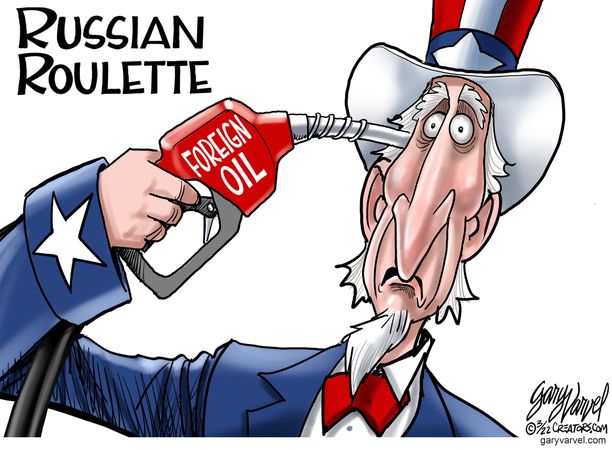
The year 2022 brings an end to an era of illusions: a year that saw the end of the post–Cold War era and the return of geopolitics; the first energy crisis of the enforced energy transition to net zero; and the year that brought environmental, social, and governance (ESG) investing down to earth with a thump—for the year to date, BlackRock’s ESG Screened S&P 500 ETF lost 22.2% of its value, and the S&P 500 Energy Sector Index rose 54.0%. The three are linked. By restricting investment in production of oil and gas by Western producers, ESG increases the market power of non-Western producers, thereby enabling Putin’s weaponization of energy supplies. Net zero—the holy grail of ESG—has turned out to be Russia’s most potent ally [Note: GOP House members are now advised to refer to Wind and Solar as “Not Green, Not Clean, and Empowering to China and Russia.”]

It wasn’t only a bad year for ESG on the stock market. Earlier this month, Vanguard announced that it was quitting Glasgow Financial Alliance for Net Zero (NZAM), set up by former governor of the Bank of England Mark Carney a little over a year ago. “We have decided to withdraw from NZAM so that we can provide the clarity our investors desire about the role of index funds and about how we think about material risks, including climate-related risks,” the world’s second-largest asset manager said.

Two months ago, Alex Edmans, coauthor of the latest edition of the standard textbook on the principles of corporate finance and professor of finance at the London Business School, published a paper titled “The End of ESG”—without a question mark. Edmans criticizes what has become the primary justification for ESG: the claim that business can generate higher returns for investors by tackling climate change. Since governments are democratically elected by a country’s citizens, they are best placed to address externalities, whereas investors disproportionately represent the elites. “If ESG is pursued for its externalities, companies and investors should be very clear that it may be at the expense of value,” Edmans says.

October also saw the publication of Terrence Keeley’s Sustainable, where the former BlackRock senior executive penned what amounts to a requiem for ESG. Rather than “doing well by doing good,” the logic of Keeley’s case, as I reviewed for RealClear Books, is that investors in conventional ESG investment products are likely to end up not doing very well and leave investors feeling good, not doing good.

It has not all been going one way. In May, HSBC terminated Stuart Kirk, its global head of research at HSBC’s asset-management arm, for voicing some hard truths about ESG. Earlier this month, HSBC announced that it will stop financing new oil and gas fields, putting the West’s third-largest bank on Putin’s side in Russia’s energy war on the West.

What is now a negative factor disadvantaging the West in a world increasingly characterized by East–West geopolitical tensions originated after a period when the United Nations had been fostering a horizontal global division between a rich North and an exploited South. As University of Pennsylvania’s professor Elizabeth Pollman records in her June 2022 paper “The Origins and Consequences of the ESG Moniker,” through the 1970s and early 1980s, the UN promoted the New International Economic Order that called for the regulation of transnational corporations on the alleged grounds that they were widening the gap between developed and developing countries.

The 2008 financial crisis subsequently turbocharged the uptake of ESG. Having caused the financial crisis, Wall Street was going to redeem itself by saving the world from a planetary catastrophe. Without climate change, ESG would have vastly less salience. Although marketed as a climate risk analysis tool, ESG is no such thing.

In reality, it’s about investors and debt providers driving the decarbonization
of Western companies and sunsetting its oil and gas companies.

According to ESG doctrine, there are two types of climate financial risk—physical risk and transition risk—and it’s straightforward to demonstrate that both are spurious. Take the Bank of England. For its climate stress tests, the Bank of England uses a scenario derived from the Intergovernmental Panel on Climate Change’s (IPCC) extreme and physically implausible RCP8.5 climate scenario. Roger Pielke, Jr., professor of environmental studies at the University of Colorado–Boulder, and Justin Ritchie have documented how use of the RCP8.5 scenario represents “a stubborn commitment to error,” with its absurd projection of a sixfold growth in per-capita coal consumption to 2100, based on erroneous reports in the late 1980s of virtually unlimited coal deposits in Siberia and China. The Bank of England compounds implausibility with impossibility by taking the RCP8.5 pathway of 4 degrees by the turn of the century and telescoping it into a 3.3-degree Celsius rise by 2050.

Central banks resorting to these types of games constitutes strong evidence that
climate physical risk is a nonissue for financial stability.

Similarly, climate transition risk and the stranded assets trope defy economic and financial logic. If you restrict the flow of capital into a sector producing stuff that people want and are willing to pay for, the price of the output of a capital-embargoed sector will rise, as will the value of its invested capital. This, in essence, is what has been happening in energy and capital markets over the past year and explains why ESG as an investment strategy does not work. In the absence of draconian government policies to suppress demand for oil and natural gas, ESG policies strangling the supply of capital to Western oil and gas producers have two effects: they push up the price of hydrocarbons; and they displace supply from Western producers to neutral or hostile ones, with major detriment to the economies and security interests of the West.

Although the disintegration of ESG as an investment strategy became unmistakable in 2022, its existence as a political doctrine will continue until it is challenged and defeated politically.

This is already happening in Red states such as Florida, Texas, West Virginia, and Utah. It also requires concerted leadership at a national level to get central bankers and financial regulators to quit playing covert climate policy and to shame banks such as HSBC into switching their support from Russia in the energy wars by dropping their anti–oil and gas financing policies. Defeating ESG not a case of “who cares wins” but “who fights wins.”

See Also

ESG Funds Buy Russian Over Canadian Oil

ESG Movement Threatens Us All


Swiss Central Bank Bets on US and Loses

Tyler Durden reports at Zerohedge Massive Hedge Fund, Also Known As Swiss National Bank, Suffers Colossal $143 Billion Loss In 2022.  Excerpts in italics with my bolds.

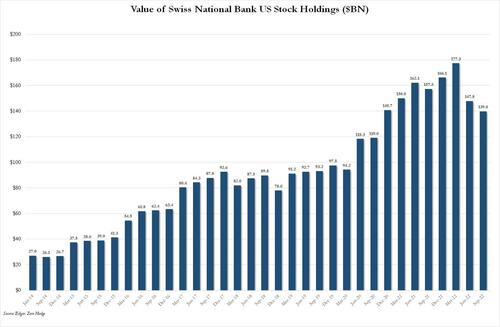
The last time we looked at the massive money-printing (literally) hedge fund that also moonlights as the Swiss National Bank, we were stunned to learn that its US equity holdings had exploded to a record $177 billion at the end of Q1 2022, orders of magnitude more than the mere $27 billion it held as recently as 2014.

But while we wait for the SNB’s year-end 13F which should be published in about a month’s time, we already know the damage suffered by the Swiss hedge fund in 2021 and it is staggering: on Monday, the SNB reported an annual loss of 132 billion Swiss francs, or $143 billion, for fiscal 2022, the biggest loss in its 115-year history as falling stock and fixed-income markets hit the value of its share and bond portfolio. The recent drop in the US Dollar also did not help.

Monday’s provisional figure, which marked a reverse from a 26 billion franc profit in 2021, was far bigger than the previous record loss of 23 billion francs chalked up in 2015, and according to Reuters, it is equivalent to slightly more than the annual GDP of Morocco.

According to the bank, the bulk of the loss, or 131 billion francs, was from its foreign currency positions – a broad term used to describe the more than 800 billion francs in stocks and bonds the SNB bought during a long campaign to weaken the Swiss franc. Indicatively, the amount is also almost precisely the same as the GDP of Switzerland.

The losses accelerated as global stock and bond markets tumbled in unison – 2022 was the first year in over a century when both stock and bond market suffered double digit losses – as central banks around the world, including the SNB, hiked interest rates to combat inflation. Meanwhile, the strong Swiss franc – which rose above parity against the euro in July – also led to exchange rate-related losses.

And while the SNB lost money in pretty much everything there was one solitary asset class that generated a profit (take a wild guess which one): that’s right, the SNB’s gold holdings which stood at 1,040 tonnes at the end of 2021, gained 400 million francs in value during 2022.

The 2022 loss meant the central bank will not make its usual payout
to the Swiss central and regional governments, it said.

Last year the SNB paid out 6 billion francs. In fact, if the SNB followed similar accounting rules and logic as any other bank, it would have been wiped out with a loss that obliterated all of its equity capital. But in the magical world of seigniorage, where central banks are assumed to be able to print – again, literally – their way out of everything, the bank never loses and the SNB will continue its merry existence as if nothing happened.

Still, the loss is unlikely to have an impact on SNB policy. It hiked interest rates three times in 2022 as Chairman Thomas Jordan moved to stem high Swiss inflation, analysts said.

“The SNB’s colossal losses will not change its monetary policy at all,” said Karsten Junius, an economist at J.Safra Sarasin. “The high reputation of the SNB helps that it doesn’t have to change anything.”

Well, it may have a record loss that’s bigger than the GDP of most medium-sized countries, but at least it has its “high reputation” earned courtesy of years of laborious and exhausting… money printing.

And yes, because we live in a kangaroo world in which there are never any adverse consequences for colossal central bank stupidity, the SNB’s monetary policy will most certainly not change at all.

Footnote: Swiss Federal Budget Cuts

Swiss federal government signs off on negative budget

Negative government budgets are not the norm in Switzerland. Over the 23 years since 2000, 14 federal budgets have been positive and 9 negative. This week the federal government signed off on a negative budget for 2023 with a hole of CHF 4.8 billion in it, bringing the number of negative budgets since 2000 to 10.

In 2023, Switzerland’s federal government expects to spend CHF 86.2 billion, CHF 4.8 billion more than CHF 81.3 billion it expects to collect.

A large part of the deficit relates to a CHF 4 billion reserve that is expected to be lent to the electricity company Axpo, which faces a liquidity crisis. Axpo, which is owned mainly by Swiss cantons, owns and operates nuclear (49%), hydro (27%), fossil fuel (19%) and solar and wind (5%) power plants. The company has been hit by recent price disruption in the energy market. Rapid price shifts and efforts to deal with these by hedging future sales have consumed large amounts of cash.

The budget was accepted in parliament by 137 votes to 49. Ahead of vote an extra CHF 15 million was added to spending to fund marketing of Swiss wine, protect wolves, to support sport and a few other activities.

Not everyone was happy with the spending plans for 2023. Some on the left wanted higher spending on humanitarian aid to Ukraine, international funds, the Erasmus programme and support for clean energy and the circular economy, and less spending on the military.

Calls by the UDC/SVP for cuts to spending on the environment, health, energy, migration and culture were also rejected. Broadly, the party wanted across the board cuts with the exception of the military and welfare support for farmers.

Ocean Temps Warm Slightly December 2022


The best context for understanding decadal temperature changes comes from the world’s sea surface temperatures (SST), for several reasons:

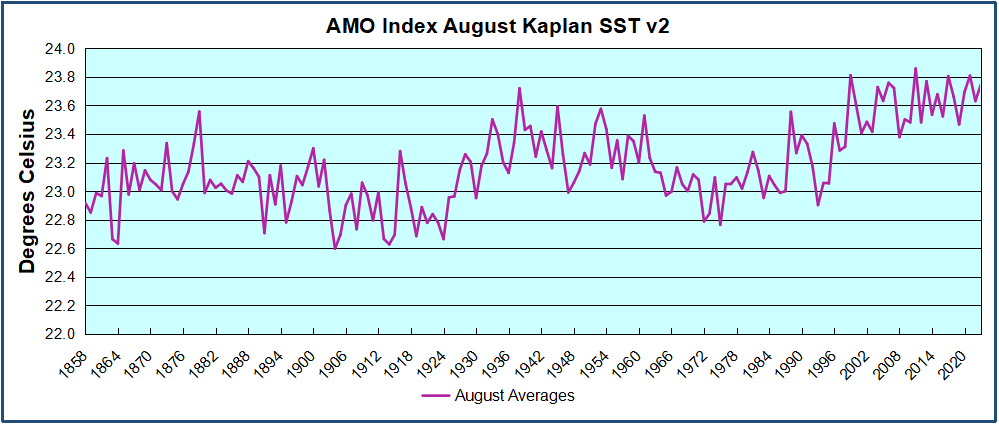
  • The ocean covers 71% of the globe and drives average temperatures;
  • SSTs have a constant water content, (unlike air temperatures), so give a better reading of heat content variations;
  • A major El Nino was the dominant climate feature in recent years.

HadSST is generally regarded as the best of the global SST data sets, and so the temperature story here comes from that source. Previously I used HadSST3 for these reports, but Hadley Centre has made HadSST4 the priority, and v.3 will no longer be updated.  HadSST4 is the same as v.3, except that the older data from ship water intake was re-estimated to be generally lower temperatures than shown in v.3.  The effect is that v.4 has lower average anomalies for the baseline period 1961-1990, thereby showing higher current anomalies than v.3. This analysis concerns more recent time periods and depends on very similar differentials as those from v.3 despite higher absolute anomaly values in v.4.  More on what distinguishes HadSST3 and 4 from other SST products at the end. The user guide for HadSST4 is here.

The Current Context

The chart below shows SST monthly anomalies as reported in HadSST4 starting in 2015 through December 2022.  A global cooling pattern is seen clearly in the Tropics since its peak in 2016, joined by NH and SH cycling downward since 2016. 

Note that in 2015-2016 the Tropics and SH peaked in between two summer NH spikes.  That pattern repeated in 2019-2020 with a lesser Tropics peak and SH bump, but with higher NH spikes. By end of 2020, cooler SSTs in all regions took the Global anomaly well below the mean for this period.  In 2021 the summer NH summer spike was joined by warming in the Tropics but offset by a drop in SH SSTs, which raised the Global anomaly slightly over the mean.

Then in 2022, another strong NH summer spike peaked in August, but this time both the Tropic and SH were countervailing, resulting in only slight Global warming, later receding to the mean.   Oct./Nov. temps dropped  in NH and the Tropics took the Global anomaly below the average for this period. Now in December an uptick in SH has lifted the Global anomaly slightly above the mean.

A longer view of SSTs

To enlarge image open in new tab.

The graph above is noisy, but the density is needed to see the seasonal patterns in the oceanic fluctuations.  Previous posts focused on the rise and fall of the last El Nino starting in 2015.  This post adds a longer view, encompassing the significant 1998 El Nino and since.  The color schemes are retained for Global, Tropics, NH and SH anomalies.  Despite the longer time frame, I have kept the monthly data (rather than yearly averages) because of interesting shifts between January and July.1995 is a reasonable (ENSO neutral) starting point prior to the first El Nino. 

The sharp Tropical rise peaking in 1998 is dominant in the record, starting Jan. ’97 to pull up SSTs uniformly before returning to the same level Jan. ’99. There were strong cool periods before and after the 1998 El Nino event. Then SSTs in all regions returned to the mean in 2001-2. 

SSTS fluctuate around the mean until 2007, when another, smaller ENSO event occurs. There is cooling 2007-8,  a lower peak warming in 2009-10, following by cooling in 2011-12.  Again SSTs are average 2013-14.

Now a different pattern appears.  The Tropics cooled sharply to Jan 11, then rise steadily for 4 years to Jan 15, at which point the most recent major El Nino takes off.  But this time in contrast to ’97-’99, the Northern Hemisphere produces peaks every summer pulling up the Global average.  In fact, these NH peaks appear every July starting in 2003, growing stronger to produce 3 massive highs in 2014, 15 and 16.  NH July 2017 was only slightly lower, and a fifth NH peak still lower in Sept. 2018.

The highest summer NH peaks came in 2019 and 2020, only this time the Tropics and SH were offsetting rather adding to the warming. (Note: these are high anomalies on top of the highest absolute temps in the NH.)  Since 2014 SH has played a moderating role, offsetting the NH warming pulses. After September 2020 temps dropped off down until February 2021.  Now in 2021-22 there are again summer NH spikes, but in 2022 moderated first by cooling Tropics and SH SSTs, now in October and November by deeper cooling in NH and Tropics.

What to make of all this? The patterns suggest that in addition to El Ninos in the Pacific driving the Tropic SSTs, something else is going on in the NH.  The obvious culprit is the North Atlantic, since I have seen this sort of pulsing before.  After reading some papers by David Dilley, I confirmed his observation of Atlantic pulses into the Arctic every 8 to 10 years.

But the peaks coming nearly every summer in HadSST require a different picture.  Let’s look at August, the hottest month in the North Atlantic from the Kaplan dataset.

The AMO Index is from from Kaplan SST v2, the unaltered and not detrended dataset. By definition, the data are monthly average SSTs interpolated to a 5×5 grid over the North Atlantic basically 0 to 70N. The graph shows August warming began after 1992 up to 1998, with a series of matching years since, including 2020, dropping down in 2021.  Because the N. Atlantic has partnered with the Pacific ENSO recently, let’s take a closer look at some AMO years in the last 2 decades.

This graph shows monthly AMO temps for some important years. The Peak years were 1998, 2010 and 2016, with the latter emphasized as the most recent. The other years show lesser warming, with 2007 emphasized as the coolest in the last 20 years. Note the red 2018 line is at the bottom of all these tracks. The heavy blue line shows that 2022 started warm, dropped to the bottom and stayed near the lower tracks.  Note the strength of this summer’s warming pulse, in September peaking to nearly 24 Celsius, a new record for this dataset. In November the SSTs were closer to the middle.

Summary

The oceans are driving the warming this century.  SSTs took a step up with the 1998 El Nino and have stayed there with help from the North Atlantic, and more recently the Pacific northern “Blob.”  The ocean surfaces are releasing a lot of energy, warming the air, but eventually will have a cooling effect.  The decline after 1937 was rapid by comparison, so one wonders: How long can the oceans keep this up? If the pattern of recent years continues, NH SST anomalies will likely decline in coming months, along with ENSO also weakening will probably determine a cooler outcome.

Footnote: Why Rely on HadSST4

HadSST is distinguished from other SST products because HadCRU (Hadley Climatic Research Unit) does not engage in SST interpolation, i.e. infilling estimated anomalies into grid cells lacking sufficient sampling in a given month. From reading the documentation and from queries to Met Office, this is their procedure.

HadSST4 imports data from gridcells containing ocean, excluding land cells. From past records, they have calculated daily and monthly average readings for each grid cell for the period 1961 to 1990. Those temperatures form the baseline from which anomalies are calculated.

In a given month, each gridcell with sufficient sampling is averaged for the month and then the baseline value for that cell and that month is subtracted, resulting in the monthly anomaly for that cell. All cells with monthly anomalies are averaged to produce global, hemispheric and tropical anomalies for the month, based on the cells in those locations. For example, Tropics averages include ocean grid cells lying between latitudes 20N and 20S.

Gridcells lacking sufficient sampling that month are left out of the averaging, and the uncertainty from such missing data is estimated. IMO that is more reasonable than inventing data to infill. And it seems that the Global Drifter Array displayed in the top image is providing more uniform coverage of the oceans than in the past.

uss-pearl-harbor-deploys-global-drifter-buoys-in-pacific-ocean

USS Pearl Harbor deploys Global Drifter Buoys in Pacific Ocean

Footnote Rare Triple Dip La Nina Likely This Winter

Here’s Where a Rare “Triple Dip La Niña” Might Drop the Most Snow This Winter Ski Mag

The unusual weather phenomenon might result in the snowiest season in years for some parts of the country.

The long-range winter forecast could be good news for skiers living in the certain parts of the U.S. and Canada. The National Oceanic and Atmospheric Administration (NOAA) estimates that the chance of a La Niña occurring this fall and early winter is 86 percent, and the main beneficiary is expected to be mountains in the Northwest and Northern Rockies.

If NOAA’s predictions pan out, this will be the third La Niña in a row—a rare phenomenon called a “Triple Dip La Niña.” Between now and 1950, only two Triple Dips have occurred.

Smith also notes that winters on the East Coast are similarly tricky to predict during La Niña years. “In the West, you’re simply looking for above-average precipitation, which typically translates to above-average snowfall, but in the East, you have temperature to worry about as well … that adds another complication.” In other words, increased precip could lead to more rain if the temperatures aren’t cooperative.

The presence of a La Niña doesn’t always translate to higher snowfall in the North, either, as evidenced by last ski season, which saw few powder days.

However, in consecutive La Niña triplets, one winter usually involves above-average snowfall. While this historical pattern isn’t tied to any documented meteorological function, it could mean that the odds of a snowy 2022’-’23 season are higher, given the previous two La Niñas didn’t deliver the goods.