Q&A Why So Many Climate Skeptics
Update October 19, 2021

[I just noticed that Quora buried Walker’s 12 point answer to the query, and only shows others’ comments afterward. In order to see the actual response you have to go here:
https://www.quora.com/profile/John-Walker-922/answers
and then search for “skeptics”. There are many persuasive exhibits there, perhaps the reason for suppressing the document.]

An extensive and documented reply is given at Quora from John Walker, former Laboratory Medical Director/Pathologist (1984-2011). Excerpts in italics with my bolds.(red text is link).

Perhaps you really mean “Why are there so many catastrophic anthropogenic CO2 global warming (CAGW) skeptics?”

There are very few individuals who are skeptical that the climate changes. But there are millions and millions of individuals (and growing), who are quite skeptical that human emissions of CO2 are causing apocalyptic global warming, including many scientists, climate scientists, Nobel Laureates, and other highly educated individuals.

The reason for this is multi-factorial and very voluminous. The following presents condensed summaries of 12 of the reasons that so many individuals have become highly skeptical of the theory of CAGW. Even though it is rather long, it represents only a small portion of the information, studies and references engendering skepticism of this unproven assemblage of hypotheses. Most of it is taken from my 250+ page treatise on the fallacies of the theory of CAGW.

1 . First and foremost is the fact that there is currently NO experimental evidence validating the theory of CAGW. Rather CAGW is a collection of unproven/unvalidated hypotheses, which can only be accepted by faith. However, most of these hypotheses have been shown to contain fallacies and/or misinformation.

2 . The “science” behind the theory of CAGW has not been sufficiently rigorous, non-biased, or open, and, crucially, does not comply with the tenets of the scientific method since it is not subject to potential falsification by testing/experiment.

3 . The theory of CAGW is based entirely upon:

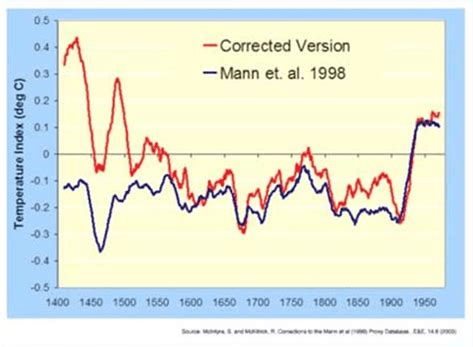
a . Atmospheric CO2 versus temperature correlation studies (which are not proof of cause and effect, are partially based upon fictitious/manipulated/estimated temperature data [as in the “hockey stick” graph and altered NASA/NOAA/CRU data], and actually do not correlate all that well):
Mann et al corrected

The original MBH graph compared to a corrected version produced by MacIntyre and McKitrick after undoing Mann’s errors.

b . Partially altered, manipulated, selective, imprecise, incomplete, extrapolated and unverified/fictitious temperature data (as revealed by Climategate, the “Hockey Stick” confutation, and other sources), with frequent measurements selected from urban concrete and asphalt hot spots, naturally producing higher temps, which increase in number over time due to continued urban growth).

“Government reports, writers of opinion pieces, and bloggers posting graphs purporting to show rising or record air temperatures or ocean heat, are misleading you. This is not actual raw data. It is plots of data that have been ‘adjusted’ or ‘homogenized’ (i.e., manipulated) by scientists – or it is output from models that are based on assumptions, many of them incorrect. UK Meteorological Office researcher Chris Folland makes no apologies for this. ‘The data don’t matter. We’re not basing our recommendations [for reductions in carbon dioxide emissions] upon the data. We’re basing them upon the climate models’.” Climate: The Real ‘Worrisome Trend’ (Part I: Faulty Science) – Master Resource

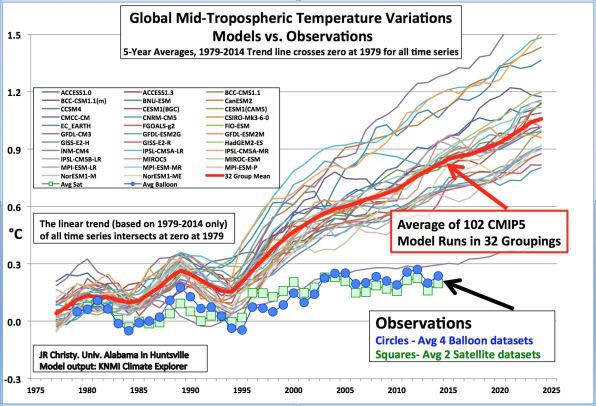
c . Unreliable computer models (based upon partially altered, manipulated, selective, imprecise, incomplete, extrapolated and unverified/fictitious temperature data, woefully inadequate/incomplete input data regarding thousands of climate parameters, and “educated guesses” about the climate sensitivity to atmospheric CO2), which can be programmed to reveal whatever result the programmer desires, and many of which have already been proven incorrect or exaggerated.
d . Insufficient understanding of the role and relative magnitude/sensitivity of CO2 as a “greenhouse” gas, and the unproven (and many would say ludicrous) hypothesis that the earth’s atmosphere (with all its enormity, complexity, multiple layers, convection, layers of exceedingly cold air [as low as -60F] and even colder adjacent outer space [-455F] as well as extremely hot (high kinetic energy) upper layers, huge underlying oceans with complex currents and temperature fluctuations, varying molecular compositions, stratospheric ozone [which absorbs both UV and IR radiation], variable humidity, massive heat-absorbing evaporative processes, extensive cloud formations, variably intense winds, the jet stream, varying barometric pressures, cosmic ray effects, and NO glass ceiling or walls) functions identically to a glass-enclosed greenhouse. (Yes, that does seem rather ludicrous!)

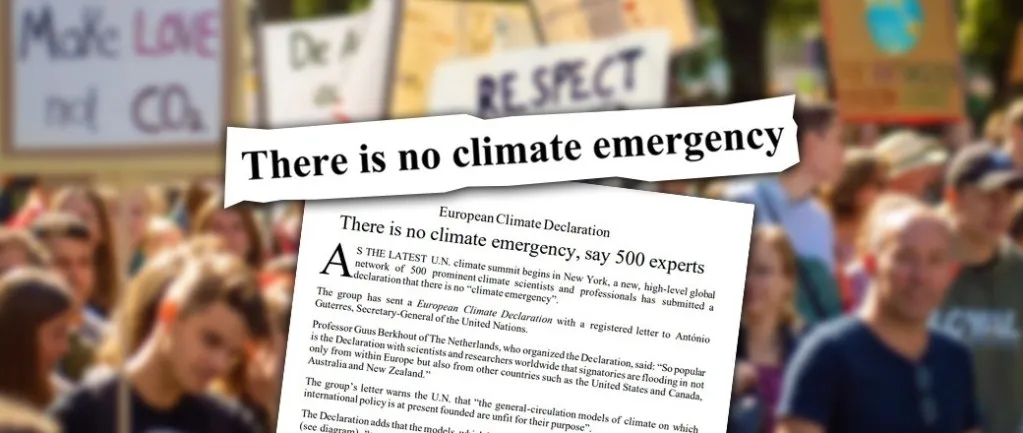
5 . Promoters of the theory of CAGW falsely claim there is a 97% “consensus” among climate scientists that the theory is true. Indeed the 97% figure is false and based upon poorly contrived surveys/studies by CAGW promoters and “peer-reviewed” (i.e., “pal-reviewed”) by other CAGW promoters. If one reads the original papers where the 97% figure was contrived, it is quite easy to see how poorly designed and biased these surveys were. All of these surveys/studies have been debunked by multiple statistical analyses and better defined and controlled surveys and studies, revealing that less than half of climate scientists believe in the theory of CAGW.

“Claims that a ‘consensus’ exists among climate experts regarding the causes of the modest warming of the past century are contradicted by thousands of independent scientists.” – International Climate Science Coalition Core Principles

The fact is that tens of thousands of scientists, including climate scientists and many Nobel Laureates, do NOT accept the theory of CAGW:[Numerous examples are provided in linked article]

6 . Thus, in essence, CAGW promoters are demanding we accept their conclusions based upon consensus and faith (normally antithetical to most modern liberals’ thinking), just as theocrats and other religious fundamentalists argue. But the inability to follow the rigorous scientific method by the use of repeatable double blind, controlled experiments for validation does not justify acceptance of a theory without such experiments simply because they cannot be performed. It may be fine to accept beliefs by consensus or even by faith on personal or other matters which do not materially affect other people. But those pushing the theory of CAGW are demanding draconian changes affecting everyone on the planet, such as diverting tens of trillions of dollars from solving known existing existential problems (poverty, hunger, violence, war, infectious disease, cancer research, pollution and over-fishing of our oceans, lack of adequate sanitation, education and clean water, etc.) in order to “fight” an unproven future potentially existential problem with costly methods which have not been proven effective, replacing capitalism and democracy with global socialism and authoritarian one world government, and redistributing global wealth. Such actions would be premature, irresponsible, illogical, socialistic, cruel and lead to massive morbidity and mortality!

7 . In addition to the “97% consensus” falsehood, CAGW promoters and alarmists have promulgated many other lies, failed predictions (for both catastrophic global cooling and global warming) based upon their flawed computer models, abundant misinformation and disinformation. If the theory of CAGW is true, why the need to prevaricate? Anyone who is aware of this widespread sophistry must become skeptical of the theory. [Many examples are given in the linked article]

8 . Another clue that the theory of CAGW is fallacious is the fact that many promoters and alarmists so frequently resort to ad hominen attacks or demand that skeptics be banned from discussions. The former is another logical fallacy, which is used when the promoter has no real evidence to back up his/her claim and is unable to respond in a logical and respectful manner. They feel cornered because of their lack of intelligent retort. They hope that such attacks will make the skeptic afraid to make further comments.

Banning and refusing to hear/discuss information contrary to one’s dogmatic belief is characteristic of a fundamentalist who has been indoctrinated, often with propaganda. It is characteristic of religious fanaticism, not science. While it is prohibited under Quora policy, you will discover that some CAGW alarmist authors just can’t stop themselves from indulging in this fallacious and destructive tactic.

Again, this engenders more skepticism in their beliefs.
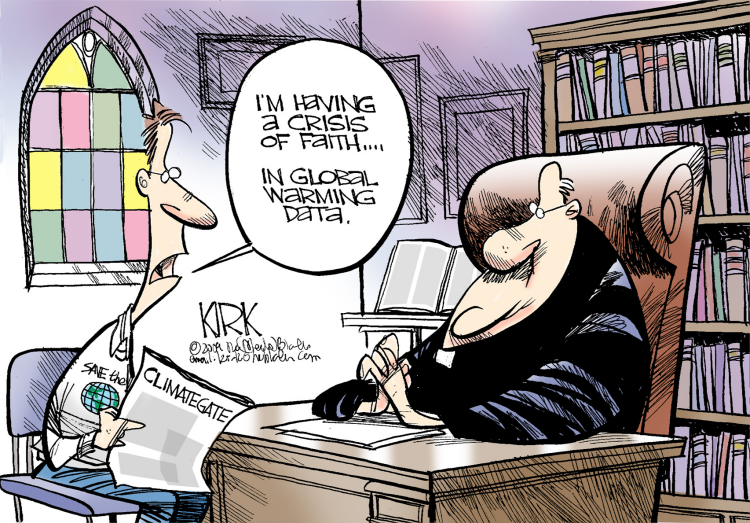
9 . Climategate. Climategate was a notorious event initiated by leaked emails in 2009 (with a second batch released in 2011) allegedly revealing the deceit and deception practiced by a prominent group of British (Climatic Research Unit or CRU) and American climate researchers (including Michael Mann of Penn State) who promote the theory of CAGW and supply much of the climate and temperature data and reports to the IPCC. The latter gives this group tremendous influence regarding the UN’s climate change agenda.

“There are three threads in particular in the leaked documents which have sent a shock wave through informed observers across the world. Perhaps the most obvious, as lucidly put together by Willis Eschenbach (see McIntyre’s blog Climate Audit and Anthony Watt’s blog Watts Up With That ), is the highly disturbing series of emails which show how Dr Jones and his colleagues have for years been discussing the devious tactics whereby they could avoid releasing their data to outsiders under freedom of information laws.

“But the question which inevitably arises from this systematic refusal to release their data is – what is it that these scientists seem so anxious to hide? The second and most shocking revelation of the leaked documents is how they show the scientists trying to manipulate data through their tortuous computer programmes, always to point in only the one desired direction – to lower past temperatures and to ‘adjust’ recent temperatures upwards, in order to convey the impression of an accelerated warming. This is what Mr McIntyre caught Dr Hansen doing with his GISS temperature record last year (after which Hansen was forced to revise his record), and two further shocking examples have now come to light from Australia and New Zealand.

“The third shocking revelation of these documents is the ruthless way in which these academics have been determined to silence any expert questioning of the findings they have arrived at by such dubious methods – not just by refusing to disclose their basic data but by discrediting and freezing out any scientific journal which dares to publish their critics’ work. It seems they are prepared to stop at nothing to stifle scientific debate in this way, not least by ensuring that no dissenting research should find its way into the pages of IPCC reports.”

10 . The IPCC, which is the primary authority driving the CAGW agenda is a political body, not a scientific body. It’s originating mission was to find human causes of climate change.

“It is to specifically find and report a human impact on climate, and thereby make a scientific case for the adoption of national and international policies that would supposedly reduce that impact.

[Thus, the IPCC has been directed to attribute the cause, or at least significant portions of the cause, of climate change to human influences. If it does not make claims of significant human influence, it’s function would be obviated and its members likely out of their UN jobs!]

The IPCC is also designed to put political leaders and bureaucrats rather than scientists in control of the research project. It is a membership organization composed of governments, not scientists. The governments that created the IPCC fund it, staff it, select the scientists who get to participate, and revise and rewrite the reports after the scientists have concluded their work. Obviously, this is not how a real scientific organization operates.

11 . Much of the motive behind the promotion of the theory of CAGW is driven by money, power, and politics. Socialists, globalists and radical environmentalists are using the fear of CAGW to convince the world to replace capitalism with authoritative global socialism. The climate change industry now exceeds $1.5 trillion. If “cap-and-trade” legislation is ever passed in the US, as Al Gore, Goldman-Sachs, and other wealthy investors hope, they could potentially make $trillions via the buying and selling of carbon credits on a commodities exchange. Gore and Goldman tried desperately to get such legislation passed during the Obama administration. They were major investors in the Chicago Climate Exchange, which would have been the commodities exchange for carbon credits.

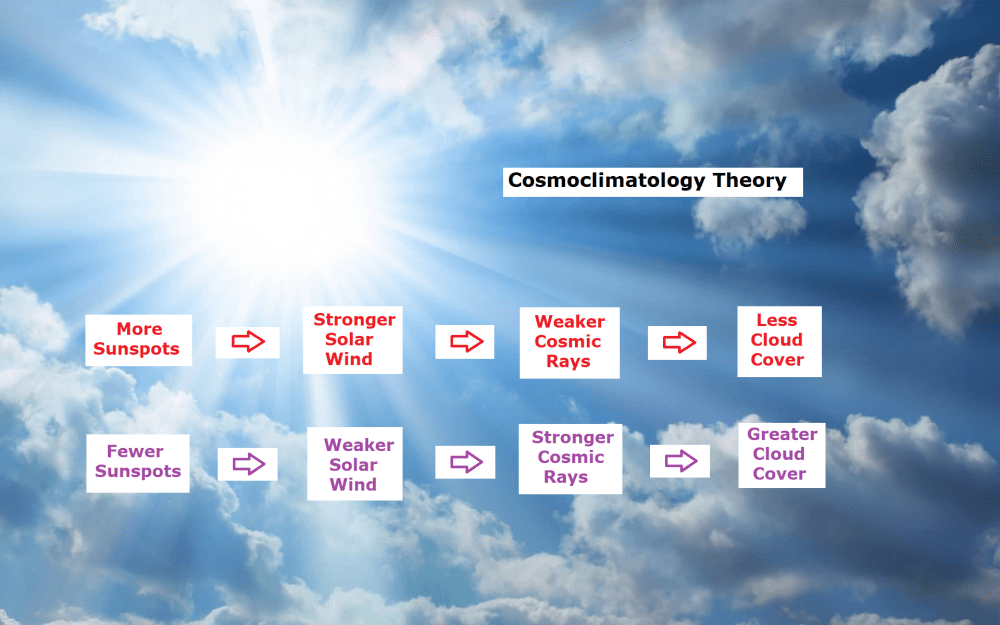
12 . There are better alternative theories regarding the mechanisms that drive the earth’s climate. Most of the theories derive from the observation that the earth’s climate goes through multiple, well-defined cycles (and cycles within cycles) of warming and cooling, and have done so for millennia. They generally involve various changes in total solar radiation reaching the earth and the adiabatic heating of the earth’s atmosphere due to atmospheric pressure. The theory of Cosmoclimatology is gaining credence among many climate scientists and astrophysicists.
Many other theories about the cause of climate change also involve solar influences. Think of the extreme temperature changes that are caused by changes in the amount of solar radiation the earth receives. Just the variation in the tilting of the earth leads to 4 seasons with temperatures varying from over 100 F to minus 20 F (or even colder) between summer and winter months in many locations. Temperatures increase dramatically just by moving towards the equator from higher or lower latitudes, due to differences in solar radiation. Day and night temperatures can easily differ by as much as 30 F or more, all in a 12 hour span. Temperatures on a sunny summer day can drop by 5 F in a matter of seconds if a cloud passes overhead. Compare that to the claimed increase in global temp of 1.4 F over 150 years supposedly caused by anthropogenic CO2.

In addition to the multiple periodic clusterings creating grand solar minima and maxima, there are multiple additional cyclic changes of solar activity, which are being elucidated with continuing climate research (another reason to stop making the absurd, counter-productive and pseudoscientific claim that the “science is settled”). There are centennial and bicentennial cycles of grand solar minima and maxima, along with many other cyclic processes of longer time intervals related to celestial changes:

There have been numerous glacial cycles, each lasting an average of 100,000 years. They coincide with the Milankovitch Eccentricity cycle of the earth’s orbit around the sun. Within each cycle is a period of marked global cooling (lasting from 70k to 90k years in which immense glaciers cover much of the land surface, and much of the ocean surface freezes. The cold periods are followed by interglacial (warm) periods lasting from 10k to 30k years. Some climatologists believe that the Earth is on the downward slope of the current interglacial period and headed towards the next ice age, which could arrive in the next several thousand years. During this downward slope, global temperatures are expected to slowly decrease with intermittent warmer and cooler trends. Milankovitch cycles – Wikipedia

And there is so much more but not enough time and space to present it all.
Greta’s Glittering Generalities

The term “glittering generality” was impressed on me by an English teacher who red-circled several expressions in my essay with the label “GG”. When I asked what was wrong, she told me pretty much what Wikipedia says:
A glittering generality is an emotionally appealing phrase so closely associated with highly valued concepts and beliefs that it carries conviction without supporting information or reason. Such highly valued concepts attract general approval and acclaim.

Background on Greta’s Pretences

In September Greta spoke to the UN Climate Summit in NYC and attempted to browbeat the world’s leaders into doing something about global warming/climate change. However, she came off as a whiny, spoiled brat throwing a tantrum in public to get her way. Her speechwriters took note of the negative responses and regrouped for her speech to the Madrid COP. The new approach was to elicite the audience’s concern by appealing to a bunch of glittering generalities. H/T to Patrick Moore for leading in the effort to challenge her platitudes. After all, it is irresponsible to let a child get away with telling falsehoods; that only spurs them on to become liars as adults. And teenage is the critical period to learn the dfference between imaginary things and realities, to engage with life’s school of hard knocks rather than retreat into wishdreams and fantasies, drug-induced or othewise.

Greta Thunberg UN speech at COP25 in full

The title links to a transcript of the climate activist’s message to the UN’s climate conference on Wednesday, December 11, at the United Nations Climate Change Conference COP25 in Madrid, Spain. Excerpts in italics with my bolds, images and comments.

Greta Thunberg: “Hi. A year and a half ago, I didn’t speak to anyone unless I really had to but then I found a reason to speak. Since then, I’ve given many speeches and learned that when you talk in public, you start with something personal or emotional to get everyone’s attention. Say things like, ‘our house is on fire, I wanted to panic or how dare you’.

“But today I will not do that because then those phrases are all that people focus on. They don’t remember the facts, the very reason why I say those things in the first place, we no longer have time to leave out the science.

“For about a year I have been constantly talking about our rapidly declining carbon budgets over and over again. But since that is still being ignored, I will just keep repeating it
“In chapter two, on page 108 in the SR 1.5 IPCC report that came out last year, it says that if we ought to have a 6 percent to 7 percent chance of limiting the global temperature rise to below 1.5C degrees, we had on January 1, 2018, 420 gigatons of CO2 left to emit in that budget. And of course, that number is much lower today as we emit about 42 gigatons of CO2 every year including land use.

“With today’s emissions levels, that remaining budget will be gone within about eight years. These numbers aren’t anyone’s opinions or political views. This is the current best available science.

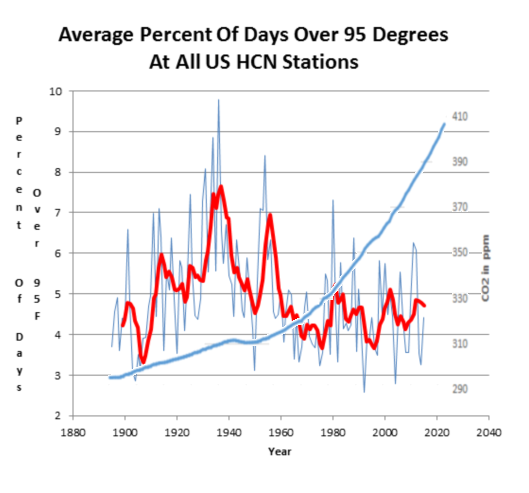
Heat Waves Compared to Atmospheric CO2

“Though many scientists suggest these figures are too moderate. These are the ones that have been accepted through the IPCC, and please note that these figures are global and therefore do not say anything about the aspect of equity, which is absolutely essential to make the Paris Agreement to work on a global scale.

“That means that richer countries need to do their fair share and get down to real zero emissions much faster and then help poorer countries do the same, so people in less fortunate parts of the world can raise their living standards. These numbers also don’t include most feedback loops, nonlinear tipping points, or additional warming hidden by toxic air pollution.

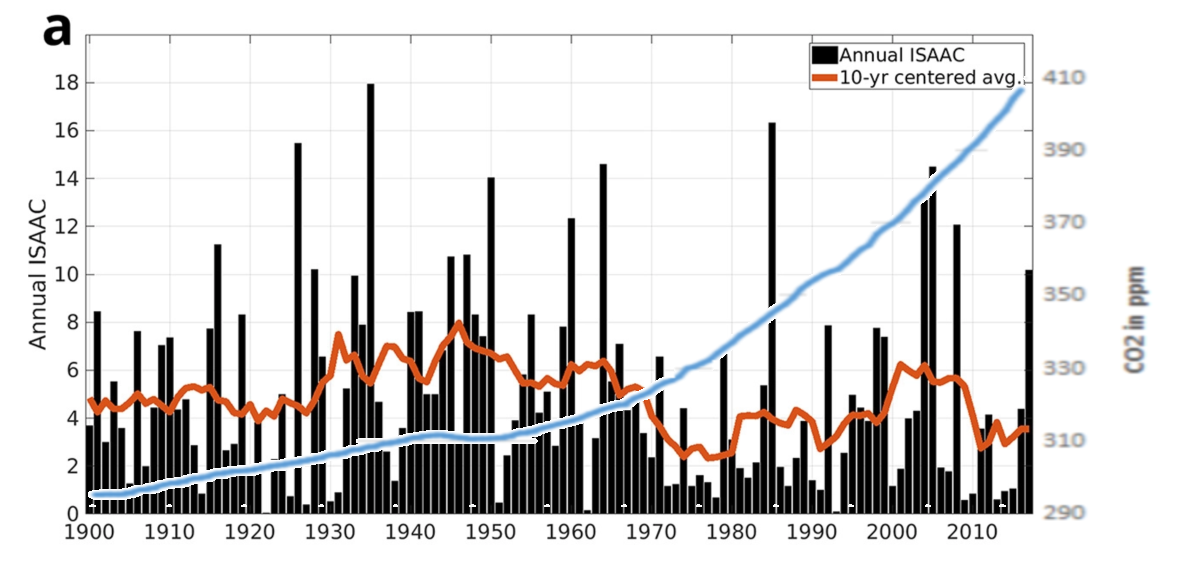
Atlantic Storm Activity Compared to Atmospheric CO2

“Most models assume, however, that future generations will somehow be able to suck hundreds of billions of tons of CO2 out of the air with technologies that do not exist in the scale required and maybe never will. The approximate 6 percent to 7 percent chance budget is the one with the highest odds given by the IPCC. And now we have less than 340 gigatons of CO2 left to emit in that budget to share fairly.

[Let’s deconstruct Greta’s cabon budget “science.” It is math alright, but she apparently lacks the will or critical intelligence to challenge the stack of suppositions underneath.

Assume that Global Mean Temperatures (GMT) are driven by rising CO2 in the air.
Assume that Rising CO2 comes entirely from burning fossil fuels.
Assume that keeping CO2 below 450ppm limits warming to 2C over preindustrial.
Assume that keeping CO2 below 430ppm limits warming to 1.5C over preindustrial.
Assume that GMT warming over 1.5C will cause dangerous weather events.
Assume that future warming of 2C will not benefit mankind as did the last 2C since the LIA.

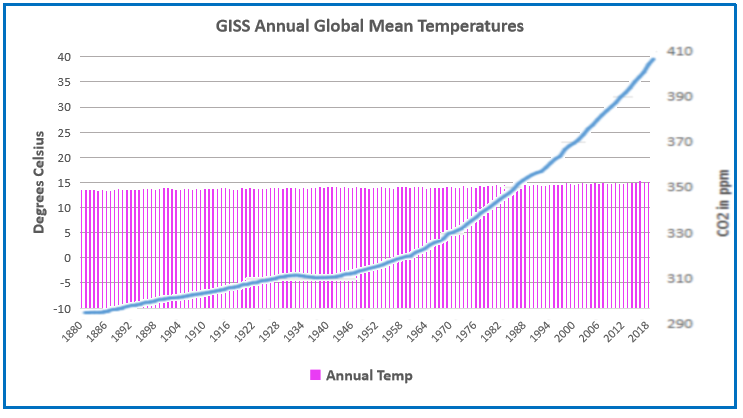
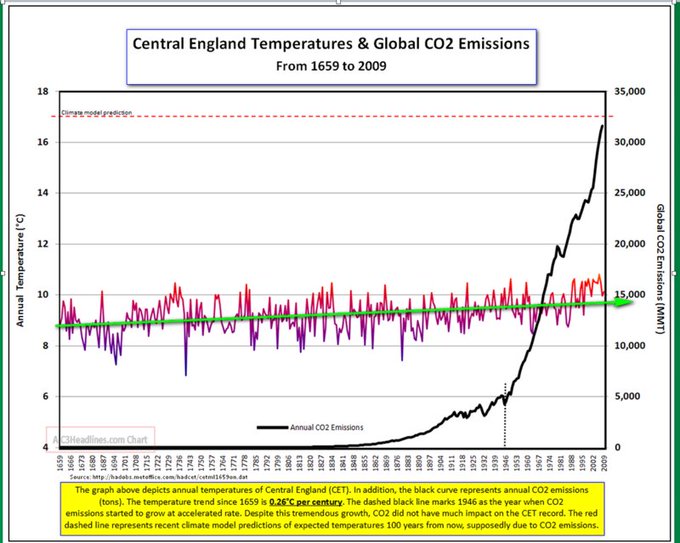
The Longest Temperature Record compared to CO2 Emissions.

“Why is it so important to stay below 1.5 degrees? Because even at one degree people are dying from the climate crisis. Because that is what the United Science calls for to avoid destabilising the climates.

[What’s this, a new US?  The United States is a thing, United Science, not so much.]

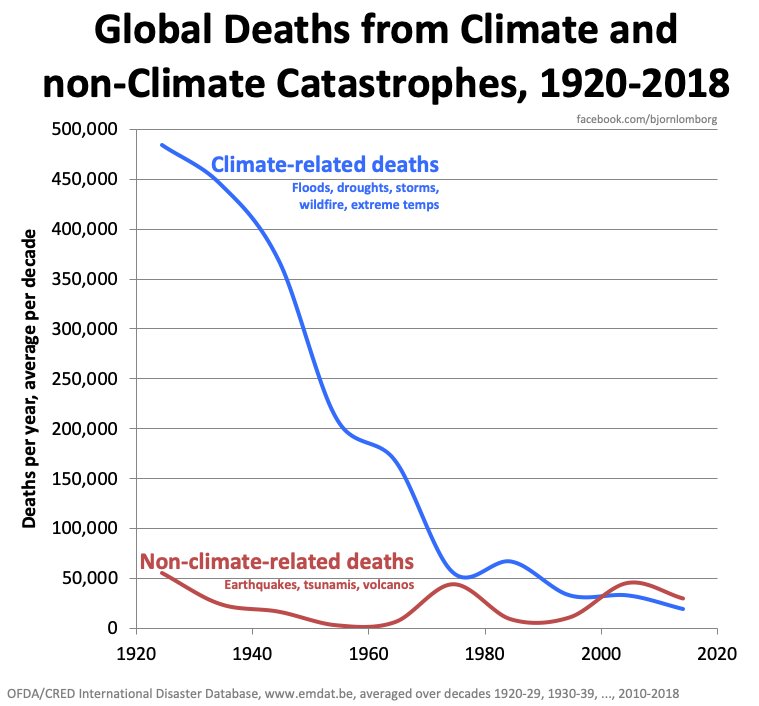
In Fact, fewer and fewer people are dying from climate events.

“So that we have the best possible chance to avoid setting off irreversible chain reactions such as melting glaciers, polar ice and thawing Arctic permafrost. Every fraction of a degree matters. So there it is, again. This is my message. This is what I want you to focus on.”

“So please tell me, how do you react to these numbers without feeling at least some level of panic? How do you respond to the fact that basically nothing is being done about this without feeling the slightest bit of anger? And how do you communicate this without sounding alarmist? I would really like to know.

“Since the Paris Agreement, global banks have invested 1.9 trillion US dollars in fossil fuels. One hundred companies are responsible for 71 percent of global emissions.

The G20 countries account for almost 80 percent of total emissions. The richest 10 percent of the world’s population produce half of our CO2 emissions, while the poorest 50 percent account for just one-tenth. We indeed have some work to do but some more than others.

“Recently, a handful of rich countries pledged to reduce their emissions of greenhouse gases by so-and-so many percent by this or that date or to become climate neutral or net zero in so-and-so many years. This may sound impressive at first glance but even though the intentions may be good, this is not leadership.

“This is not leading. This is misleading because most of these pledges do not include aviation, shipping, and imported and exported goods and consumption. They do, however, include the possibility of countries to offset their emissions elsewhere.

“These pledges don’t include the immediate yearly reduction rates needed for wealthy countries, which is necessary to stay within the remaining tiny budget. Zero in 2050 means nothing, if high emission continues even for a few years, then the remaining budget will be gone.

“Without seeing the full picture, we will not solve this crisis. Finding holistic solutions is what the cup should be all about, but instead, it seems to have turned into some kind of opportunity for countries to negotiate loopholes and to avoid raising their ambition.

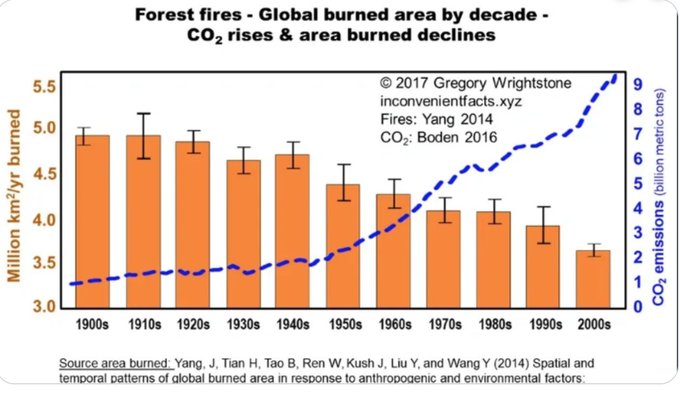
Area Burned by Forest Fires Compared to CO2 Emissions.

“Countries are finding clever ways around having to take real action. Like double-counting emissions reductions and moving their emissions overseas and walking back on their promises to increase ambition or refusing to pay for solutions or loss of damage. This has to stop.

“What we need is real drastic emission cuts at the source but of course, just reducing emissions is not enough. Our greenhouse gas emissions has to stop. To stay below 1.5 degrees. We need to keep the carbon in the ground. Only setting up distant dates and saying things which give the impression of the action is underway will most likely do more harm than good because the changes required are still nowhere in sight.

“The politics needed does not exist today despite what you might hear from world leaders. And I still believe that the biggest danger is not inaction. The real danger is when politicians and CEOs are making it look like real action is happening when in fact almost nothing is being done apart from clever accounting and creative PR.

US Droughts and Flooding Compared to Atmospheric CO2.

“I have been fortunate enough to be able to travel around the world. And my experience is that the lack of awareness is the same everywhere, not the least amongst those elected to lead us. There is no sense of urgency whatsoever. Our leaders are not behaving as if we were in an emergency.

“In an emergency, you change your behaviour. If there is a child standing in the middle of the road and cars are coming at full speed, you don’t look away because it’s too uncomfortable. You immediately run out and rescue that child.

“And without that sense of urgency, how can we, the people understand that we are facing a real crisis. And if the people are not fully aware of what is going on, then they will not put pressure on the people in power to act. And without pressure from the people, our leaders can get away with basically not doing anything, which is where we are now. And around and around it goes.

“Well, I’m telling you, there is hope. I have seen it but it does not come from the governments or corporations. It comes from the people.

“The people who have been unaware but are now starting to wake up. And once we become aware, we change. People can change. People are ready for change. And that is the hope because we have democracy and democracy is happening all the time.

“Not just on election day but every second and every hour. It is public opinion that runs the free world. In fact, every great change throughout history has come from the people. We do not have to wait. We can start the change right now.

“We the people. Thank you.”

How Climate Talk Got Crazy

Dr. Arnd Bernaerts in a recent article provides the historical context necessary to get our bearings straight despite today’s overheated, bizarre media-drenched tirades.

As he explains, climate has always been particular and personal, not global or objective. And that has led us into our current impasse, unable to talk productively about weather and climate. It is as though we can not come to grips with the climate issue because our very language and terminology is itself a prior problem preventing any progress. In brief, the terms “weather” and “climate” are loaded with emotion, but not with clear, definitive scientific meaning. IOW plenty of connotation (heat) and very little denotation (light). Dr. Bernaerts faults scientists for failing to develop a rational framework for discovery and research, and instead opting for an activist agenda which benefits from the ambiguity and misrepresentation.

The article is Weather and climate are everyday slang words and misleading when used by science. Excerpts in italics with my bolds.

Since the last half of the 20th Century the world has a big problem. Science abuses the laymen terms used since time immemorial: weather and climate. Each term is connected closer to our bodies than our shirts, 24/7 throughout our lives. Alexander von Humboldt (1769 –1859), the great German naturalist and geographer defined climate as ‘all the changes in the atmosphere that perceptibly affect our organs’. According to A.v.Humboldt, ‘climate’ was even closer to the skin of any person than their clothing during day and night. Intellectuals in those days lived closer to nature than academics nowadays.

Climate is the imaginary idea of an individual person from a possible state of the atmosphere, at one place or in one region, about a shorter or longer period of time from own experience or narrative of others or e.g. out of Guidebooks. This means: More than 5 billion adults are living on Earth, and:

Everyone has their own view of climate and describes it corresponding to his own ideas, for the moment or the given circumstances.

During A. v. Humboldt’s lifetime, meteorology was emerging and still at a low level. Now for more than 100 years acknowledged as an academic discipline, scientists remained incapable to tell what ‘climate’ is, indicating their incompetence to formulate terms, without which nothing is explained and is completely useless for scientific research. In the early 20th Century climate was defined as average weather and in the 1930s, the thirty-year period from 1901 to 1930 considered as the baseline for measuring climate fluctuations. Several decades later the prominent meteorologist H.H. Lamb regarded the definition of climate as “average weather” quite inadequate, mentioning that until recently climatology was generally regarded as the mere dry-as-dust bookkeeping end of meteorology (FN. 1). Also the well-known F. Kenneth Hare wrote in 1979: You hardly heard the word climate professionally in the 1940s. It was a layman’s word. Climatologists were the halt and the lame (FN. 2).

As a daily slang word, climate is closer to everyones’ skin than their shirts, it is an abuse every time a scientist uses it. This is presumably a major reason that the climate-change debate has been getting more and more hysterical during the last decades.

But the story gets even worse, completey preposterous, when asking how IPCC defines “weather”. The result is shocking; the Glossary of IPCC offers nothing. But IPCC and other institutions, like the recent UN Climate Change Conference COP 25 (2 – 13 December 2019) in Madrid, do not care.

Even the definition of weather in the AMS – Glossary (American Meteorological Society) does not provide a usable solution, by explaining that:

  • Popularly, weather is thought of in terms of temperature, humidity, precipitation, cloudiness, visibility, and wind, and
  • the “present weather” table consists of 100 possible conditions, and
  • the “past weather”; of 10 possible conditions.

The AMS Glossary does not clear the matter, as it is superficial on several aspects. Already false is the explanation of ‘popularly weather’. The layman is able to use and explain the current weather in presumably several hundred versions, and ‘popularly weather’ is extremly far away from a transparent and workable academic term, as explained above.

It is naive not to realize that if you define climate as average weather, you have to say clearly what weather is. Weather has to be defined first. Meteorology has always ignored this point or – meanwhile – making nebulous statements about it.

Actually it is fair to say that the layman understanding and use of the word “weather” is closer to the following description:

Weather is a personal rating by any person over the condition of the atmosphere, in its various manifestations, at a certain time, usually for the current situation or in temporal proximity.

With such an explanation the story is close to the understanding in ancient Greek, and how A. v. Humboldt (1769 –1859) approached the matter.

The failure of science is that it uses layperson terms, but cannot define them transparently. No wonder that there now are the movements ‘Fridays for Future’ and ‘Extinction Rebellion’, and a discussion at a hysterical level. But science seems happy with the situation, which they have caused. Their prominence grows, the money is coming in; they are able to influence long term political decisions. The biggest tragedy in the whole scenario is that the undeniable rise in temperatures since the mid-19th Century, is discussed on the most superficial childish level.

Folks, keep your way of using the terms: weather and climate, as you have always done, and do not allow scientists to abuse them for selfish reasons.

See Also Climate Science Was Broken

Climate Science At Work


Munich Climate Conference 2019


Antifa thugs outside Munich Conference Center.

Thanks to Andreas Müller for writing at his blog hintermbusch on four key presentations at the EIKE Climate Conference on Nov. 23, 2019. As many have read, eco-terrorists forced the sessions out of the scheduled venue, but the gatherings went on elsewhere.  So much for dialogue in search of scientific truth. Here are some excerpts in italics with my bolds to encourage readers to read his informative report. (link in red above).

In this blog post, I summarize these lectures and add links to the video clips for you to follow the lectures on your own and in full detail (Only the first talk was in German and is not easily accessible for most of the international public).

Christian Schlüchter, Switzerland

Prof. em. Christian Schlüchter is a geologist and has studied the glaciers of the Alps in great detail. He reports the findings of very old timber in and below glaciers and what those trees taught him about the glacial epochs of the Alps.

One of the most intuitive finds of Schlüchter’s is this huge tree trunk, found at a glacier tongue (see the most beautiful glacier snout behind!).

This place nowadays is clearly above the limit of vegetation and still there is this tree which attracted Schlüchter’s curiosity and fuelled his research: How old is it? Where and under what conditions has it grown and why is it here.

The key message from his slides is that all of these records were left in times when the alpine glacier extent was smaller than in 2005.

Warm periods: more life

The timberline was at least 300 meters higher which indicates a minimum of 1.8° C higher temperatures. An example of this gives Hannibal, who managed to cross the Alps with elephants because the higher regions were much less covered by ice than in recent centuries.

Warm periods: more civilization

As his summary, Schlüchter gave the following facts:

  • More than 50% of the last 11000 years alpine glaciers were smaller than 2005
  • This fact he baptized, “dominance of the Hannibalistic world”
  • Alpine glaciers have shown huge dynamics
  • Events of glacier growth were fast and short
  • The little ice age (from the end of the medieval warm period to about 1850) was the longest glacier extension since the last ice age 12000 years ago
  • Every warming followed an accelerated glacier growth

Nicola Scafetta, Italy

Nicola Scafetta is an italian physicist und climate modeller who works at Naples university. He is well-known for his criticism of IPCC climate models and, of course not uncontested for creating his own climate models and comparing them to IPCC results. His talk in Munich again took aim at the weaknesses und faults of IPCC climate models.

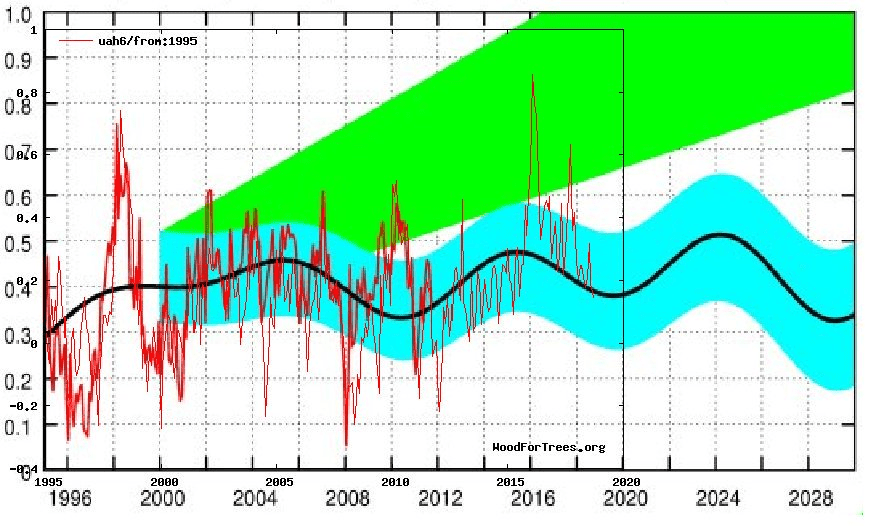
He notes that the models tend to reproduce the notorious “hockeystick” shape and therefore fail at the medial warming bump! (This is an echo of a very old climate change controversy, documented here).

He also shows similar failures for longer periods and demonstrates that the ulimate reason for this is that the models are not capable of reproducing climate variations which follow periodic solar activity.

Therefore, ten years ago, he contrasted his own model forecasts, which take those into account, (black line) to those of the IPCC (dashed blue line), which leads to the climax of the talk Below is an upadated graph of his 2010 projections (cyan color) compared to observations and to IPCC models (green).

Nir Shaviv, Israel

Nir Shaviv is a well-known but moderate climate skeptic. Besides the lecture on alpine glaciers by Christian Schlüchter, he was my main reason to choose this half day from the conference program.  Shaviv continued where Scafetta had ended and discussed the IPCC world and its errors.

For a start, he presented its lines of thinking:

Next, he discussed the validity of each building block, marked the errors und deconstructed the standard picture. He emphasized that the climate sensitivity of CO2 is a priori unknown and largely overestimated by the IPCC.  He judged it a severe shortcoming that other forcings than green house gases are ruled out by the IPCC: the sun!

He pointed out that the IPCC overestimates climate sensitivity of CO2 at the expense of solar influences. While IPCC modelers managed to hide this for 20th century data, it will lead to a serious overestimate of temperatures in the 21st when solar influences will be cooling. He therefore expects a much lower temperature rise than predicted by the IPCC, a modest (and manageable) one:

Using physical arguments Shaviv manages to set an upper limit for the climate sensitivity of CO2. This should convince the audience to accept additional forcings behind the 20th century temperature rise. Like Scafetta he points at a solar driven forcing.

Henrik Svensmark, Denmark

Henrik Svensmark is a Danish physicist und climate researcher. As other speakers he reports that he finds it more and more difficult to raise funds for his research because its results contradict the IPCC position:

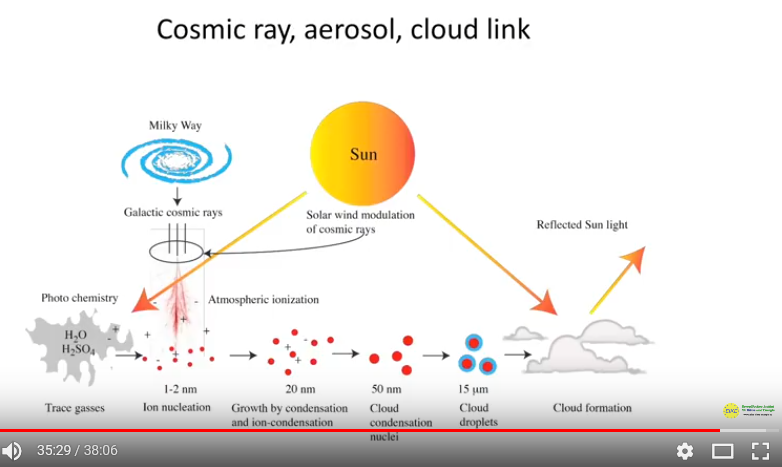
By experiments and also by correlation measurements Svensmark has investigated this mechanism of cloud creation by cosmic rays.  This is interesting because IPCC researchers cite reduction of cloud creation by global warming as a possible positive feedback mechanism which could escalate global warming to catastrophic levels. Svensmark assumes that it provides a way how solar activity, via its solar winds, has a climate impact on the earth which adds to the direct impact of solar irradiation to the earth.

Scientific summary

As a physicist I found all 4 talks interesting. They demonstrate that real and sophisticated science on climate was presented at that conference. Nothing suggests that this is less serious or valid science than anything I experienced during my time as a master and Ph.D student in physics. The presented results make it seem rather improbable that the climate models of the IPCC are complete, beyond any doubt or worth a 97% consensus.

Footnote:

For more on Scaffeta Theory see 2019 Update Scafetta vs. IPCC: Dueling Climate Theories

For more on Svensmark Theory see The cosmoclimatology theory

Regarding solar influence on climate due to orbital mechanics see this short informative video by Bill Sellers:


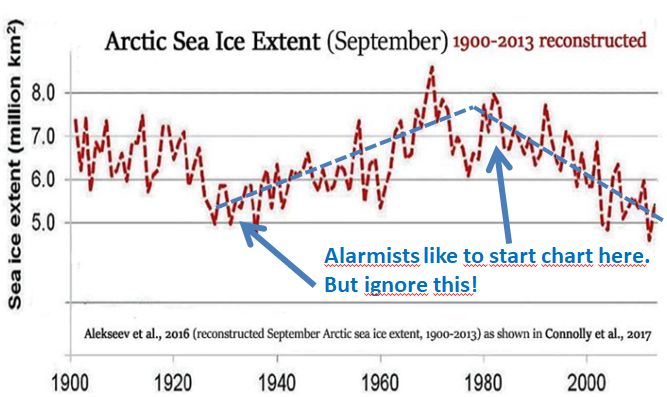
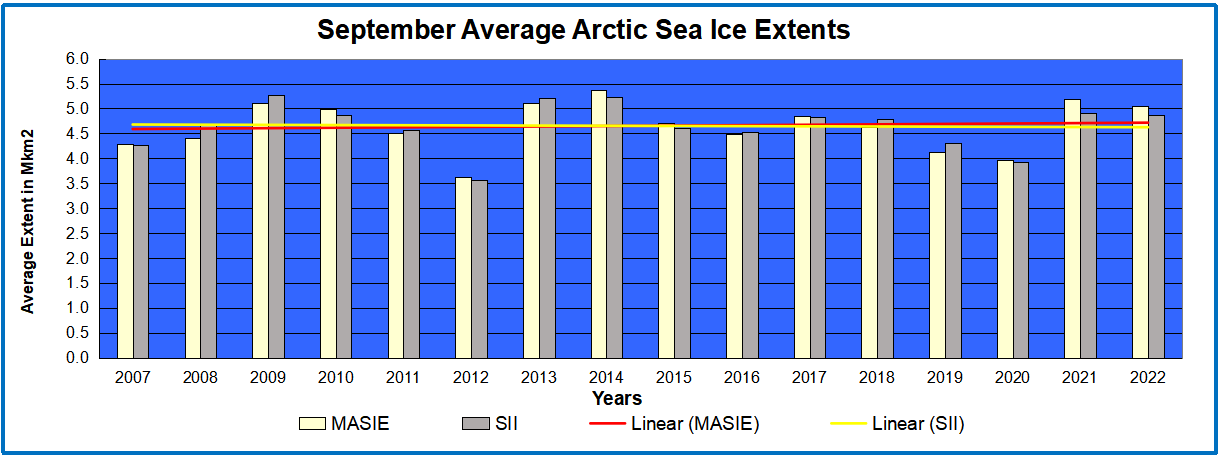
Dec. 22 Arctic Ice Nearly Normal

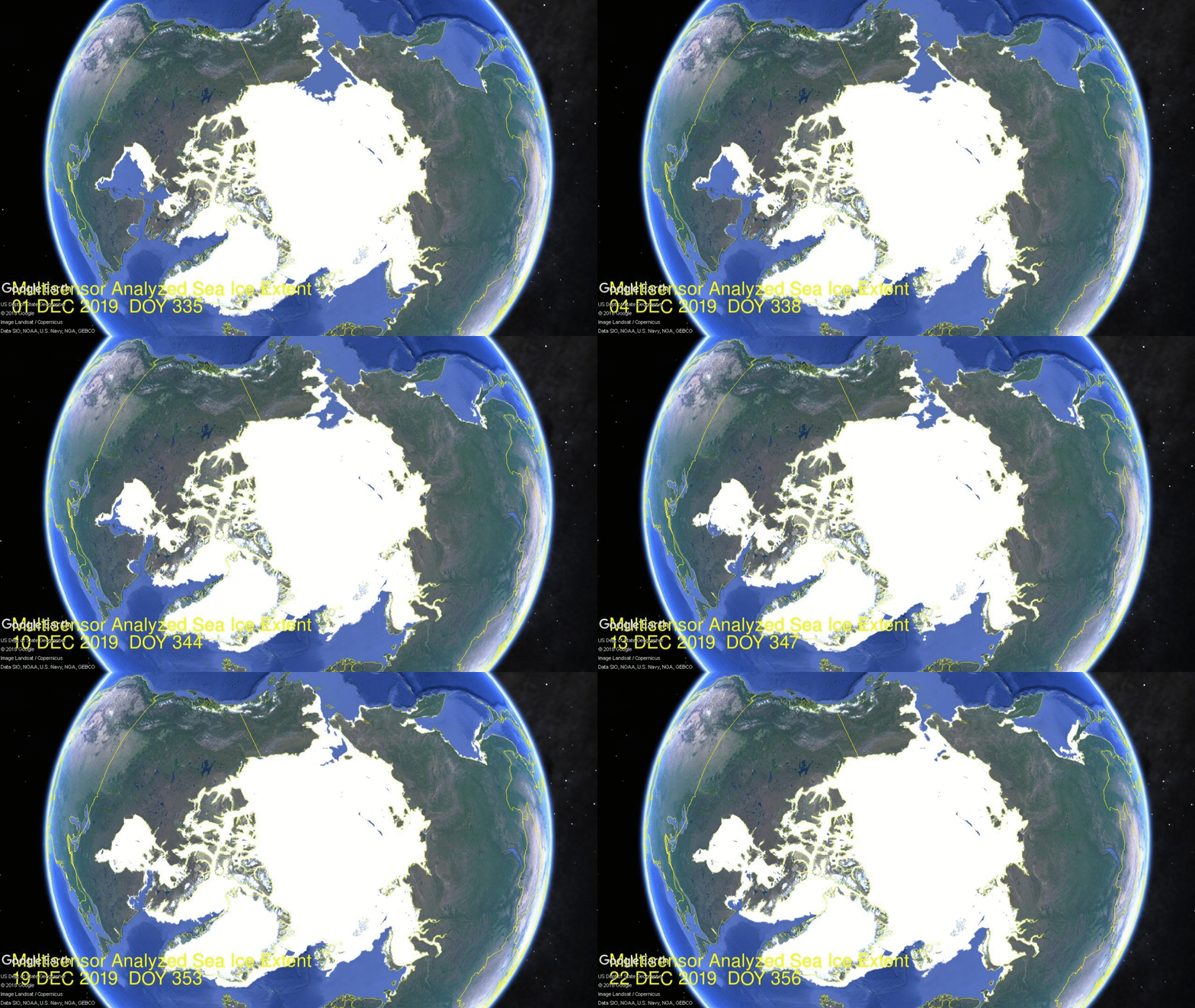
The image above, supported by the table later on shows that in December ice has recovered in the central Arctic with open water found only on the margins, as is typical this time of year. The animation shows progression of ice extent from Dec. 1 to Dec. 22, 2019.

Most dramatic is Hudson Bay on the left filling in over these 3 weeks, from 445k km2 up to 1214k km2, 96% of maximum. At the top, Chukchi Sea also ices over, from 589k km2 to 933k km2, 97% of max. Above Chukchi is Bering Sea just starting with fast ice, and Okhotsk upper right growing ice as usual. The two places lagging behind in ice recovery are Bering Sea and Baffin Bay.

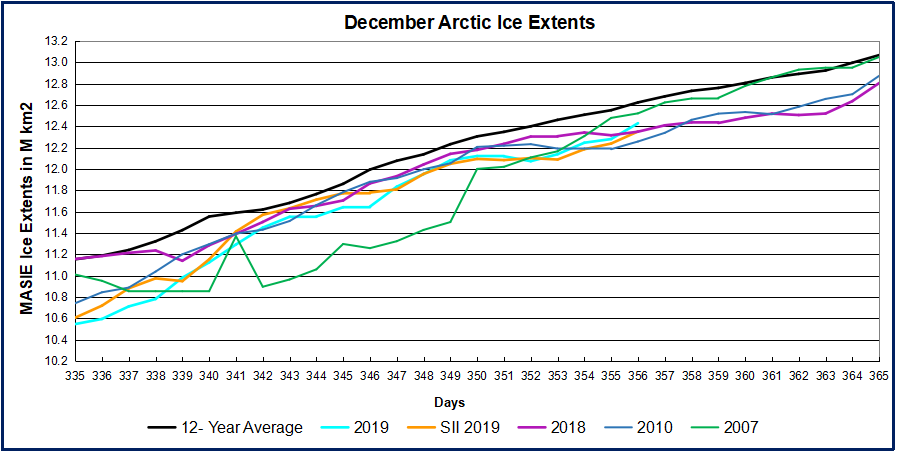
The graph below shows the ice extent growing during December compared to some other years and the 12 year average (2007 to 2018 inclusive).

Note that the  NH ice extent 12 year average increases almost 2M km2 during December, up to 13.1M km2. MASIE 2019 shows a faster icing rate, starting 600k km2 lower than average and now down 200k km2, or 1.5%. MASIE and SII are tracking quite closely this month.  By month end all years appear to be converging on the 12-year average.

Region 2019356 Day 356 Average 2019-Ave. 2010356 2019-2010
 (0) Northern_Hemisphere 12428357 12623541  -195184  12257118 171239 
 (1) Beaufort_Sea 1070223 1070266  -42  1070445 -222 
 (2) Chukchi_Sea 933276 953650  -20374  964317 -31041 
 (3) East_Siberian_Sea 1087137 1087133  1087137
 (4) Laptev_Sea 897845 897842  897845
 (5) Kara_Sea 929742 864955  64786  934937 -5195 
 (6) Barents_Sea 447093 358194  88899  607130 -160037 
 (7) Greenland_Sea 533666 562497  -28831  579647 -45980 
 (8) Baffin_Bay_Gulf_of_St._Lawrence 751185 924722  -173536  630041 121144 
 (9) Canadian_Archipelago 854282 853082  1201  853214 1068 
 (10) Hudson_Bay 1213848 1199010  14839  767479 446370 
 (11) Central_Arctic 3225391 3199892  25499  3244808 -19417 
 (12) Bering_Sea 147493 312873  -165379  219969 -72475 
 (13) Baltic_Sea 11462 20025  -8564  100363 -88902 
 (14) Sea_of_Okhotsk 324167 306066  18101  283712 40455 

The table shows where the ice is distributed compared to average.  Bering Sea and Baffin Bay have the only large deficits to average, while Kara and Barents Seas are in surplus.

Footnote:  Interesting comments today by Dr. Judah Cohen at his blog regarding the Arctic fluctuations. Excerpts with my bolds.

I have said many times the first thing that you learn as a seasonal forecaster is humility and these are one of those times. What is humbling me at the moment is that I have expected a weakening of the stratospheric polar vortex (PV) based on fall Arctic predictors – extensive Siberian snow cover, more limited Arctic sea ice extent and a relatively warm Arctic. Following the PV weakening or disruption, severe winter weather would be more frequent at least regionally across the mid-latitudes of the Northern Hemisphere (NH). But to be honest it is hard to see from today’s viewpoint how this verifies. And as I have shared on Twitter the new operational GFS, the FV3, has been especially bullish on a strong PV.

The biggest challenge that I see right now is the center of low mid-tropospheric heights currently just north of Alaska and is expected to expand in breadth over the next two weeks enough so to fill the entire Arctic basin. This a fairly class pattern of low heights in the Arctic and high heights in the mid-latitudes resulting in a cold Arctic/warm continents pattern, all consistent with a positive AO. It seems a bit ironic (at least to me) that with the record low sea ice in the Chukchi-Bering seas this fall, the incredibly warm year Alaska just experienced both in part due to persistent ridging in the region, this same region is predicted to now experience an extended period of low heights and below normal temperatures. As an aside, this is something that I had a hard time anticipating even just a few weeks ago. 

So, for now I remain steadfast in the winter forecast that based on high fall snow cover/low Arctic sea ice that they will in tandem perturb the PV. Given the westerly quasi-biennial oscillation (QBO) I expect a scenario somewhere between winter 2016/17 and winter 2017/18. Both of those winters were westerly QBO winters and the most significant disruption of the stratospheric PV took place in February.

Illustration by Eleanor Lutz shows Earth’s seasonal climate changes. If played in full screen, the four corners present views from top, bottom and sides.

Comedy of Impeachment Errors

Adam Mill writes at American Greatness on Senator McConnell explaining the failings.McConnell Crushed Impeachment in One 30-minute Speech.  Excerpts in italics with my bolds and images.

In approximately half an hour, Senator McConnell did what so many Democrats have claimed to do over these last several weeks: He meticulously applied the Constitution and historical precedent to the facts at hand and to the articles of impeachment the House passed on Wednesday.

Let’s start with the fact that Washington Democrats made up their minds to impeach President Trump since even before he was inaugurated. Here’s a reporter in April of 2016—April of 2016! “Donald Trump isn’t even the Republican nominee yet. But impeachment is already on the lips of pundits, newspaper editorials, constitutional scholars, and even a few members of Congress.”

Justifications for impeachment included rude behavior to professional athletes and reporters, changing Obama’s policy on transgender in the military. “A few months ago,” McConnell added, “Democrats’ three-year-long impeachment in search of articles found its way to the subject of Ukraine. House Democrats then embarked on the most rushed, least-thorough impeachment inquiry in modern history.”

McConnell then contrasts the “Get Trump” effort to the “mountains of evidence” gathered in both the Nixon and Clinton processes. The Nixon impeachment process required 14-months of hearings in addition to a special prosecutor. The Clinton impeachment followed years of an independent counsel investigation.

“House Democrats’ rushed and rigged process produced two articles of impeachment [which] are fundamentally unlike any articles that any prior House of Representatives have ever found,” McConnell explained. Article I involves the “timing of aid to Ukraine.” But the articles do not even purport to allege an actual crime. “Instead, they deploy the vague phrase ‘abuse of power’ to impugn the president’s actions in a general and indeterminate way.”

The Democrats might not be required to allege a crime, but McConnell warned, “history matters and precedent matters. And there were important reasons why every previous House of Representatives in American history restrained itself . . . from crossing the Rubicon.”

The vagueness of the “abuse of power” article is effectively a “mal-administration” charge rejected by the Constitution’s Framers because it would so easily be used to attack presidents over policy differences. If the Democrats are successful, all presidents henceforward will be impeached whenever the opposition party achieves power in the House.

“So there were powerful reasons why every House of Representatives for 230 years . . . required presidential impeachment to revolve around clear, recognizable crimes,” McConnell said. “That 230-year tradition died last night.”

Of the second article of impeachment, “Obstruction of Congress,” McConnell said, “What it really does is impeach the president for asserting executive privilege . . . a two-century-old constitutional tradition.” Presidents beginning with Washington have invoked it and courts repeatedly have recognized it. The House requested extraordinarily sensitive information—exactly the type of requests against which presidents from both parties have asserted privilege.

“It’s not a constitutional crisis for a House to want more information than a president wants to give up,” McConnell said. “That’s not a constitutional crisis! It’s a routine occurrence. Separation of powers is messy—by design. Here’s what should have happened . . . either the president and Congress negotiate a settlement or the third branch of government, the judiciary, addresses the dispute between the other two.”

That’s what happened in both the Nixon and Clinton impeachment inquiries. In both instances, the House went to court to resolve the disputes.

Following this process, “takes time, it’s inconvenient,” the majority leader said. “That’s actually the point. Due process is not meant to maximize the convenience of the prosecutor. It’s meant to protect the accused.”

McConnell shot down the suggestion that the Senate should force the president to give up more information to facilitate the trial. As I recently wrote (perhaps McConnell is a reader), impeachment means “ready for trial.” It’s not the proper role of the Senate to investigate and impeach the president. “Nobody made Chairman Schiff do this,” McConnell said of Schiff’s decision to forego court assistance to overcome the president’s lack of cooperation with the probe. “In Nixon, the courts were allowed to do their work. In Clinton, the courts were allowed to do their work.”

But these House Democrats, he added, “decided that due process is too much work.”

McConnell further challenged House Intelligence Committee Chairman Adam Schiff’s attempt to bully the executive branch out of asserting executive privilege. He quoted Schiff saying, “any action that forces us to litigate . . . will be considered further evidence of obstruction of justice.”



What the Democrats are trying to say, in effect, is that if the president asserts his constitutional rights, it’s just that much more evidence that he’s guilty.

McConnell further explained how the House impeachment effort harms separation of powers by attempting to make the president serve at the pleasure of Congress. But the process also infringes upon the Senate as an independent body.

The House can follow whatever process it chooses for impeachment. But it is now attempting to dictate how the Senate discharges its duties. The House has made a “demand that this body redo House Democrats’ homework for them. That the Senate should supplement Chairman Schiff’s work to make it more persuasive.” Further, the House could effectively swamp the Senate whenever it wants by passing flimsy impeachment articles to force a Senate trial.

Quoting Pelosi’s now-abandoned warnings that impeachment should not be done without an overwhelming and bipartisan case, McConnell said, “by the speaker’s own standard . . . she has failed the country. The case is not compelling, not overwhelming, and as a result not bipartisan.”

The weakness of the Democrats’ case is demonstrated by Senate Minority Leader Chuck Schumer’s calls to supplement the House’s shoddy work with new Senate-led investigations. And now, McConnell observed, it appears that the House is too afraid to send the articles of impeachment to the Senate where they rightly fear they will lose their case.

“It looks like the prosecutors are getting cold feet in front of the entire country,” McConnell added. “The articles aren’t just unproven, they’re also constitutionally incoherent.” If the Senate blesses either of these articles, “we will invite the impeachment of every future president.”

Pelosi was shell-shocked. Watch her stammer during her own press conference just a few minutes after McConnell concluded his speech. A friendly reporter asked whether the Republicans might accuse the House of playing games by holding onto the impeachment articles too long. Pelosi mumbled something about needing to know Senate trial procedures before she could appoint House managers. It’s a nonsense argument that she can’t even explain.

Trump Strikes Back:


The Democrats have their impeachment. There will be no Trump surrender. There’s nothing left for them to do but begin the long retreat.


Leaf Blowers Banned (Take that, Greta)

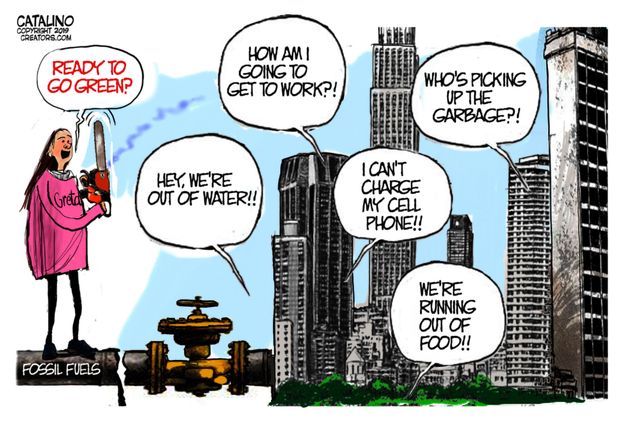
Greta keeps repeating that nothing is being done to reduce emissions, blind to all the imposed policies and regulations.  So today good news out of California, the leader in fighting climate change.  From NBC San Diego Encinitas Leaf Blower Ban Goes Into Effect.  Excerpts in italics with my bolds.

Businesses in Encinitas are no longer allowed to use gas powered leaf blowers as of Friday, Dec. 20.

The Encinitas City Council approved the leaf blower ordinance back in August. Then in September, the ordinance went into effect for city operations.

The goal of the city’s Climate Action Plan is to eventually ban all gas powered leaf blowers by January 20, 2020 in order to reduce the city’s carbon footprint. The next goal is to reduce all greenhouse gas emissions by the year 2030. The city estimates that this leaf blower ban will reduce local green house gas emissions by 128 metric tons of CO2 emissions by the end of 2020, and 142 metric tons by 2030.

Then on January 20, 2020, the ban will go into effect for residents as well.

But, the ordinance also states that electric or battery powered leaf blowers are allowed. So the city is now offering a city-funded rebate program, so that residents and business owners can buy a new electric or battery-powered leaf blower.

The ordinance also lays out a list of rules about the time of day people are allowed to use their leaf blowers.

Now, people in Encinitas are only permitted to use their electric or batter powered leaf blowers between 8 a.m. and 6 p.m. Monday through Saturday, and between 12 noon and 5 p.m. on Sundays.

So calm down Greta and show some respect for all the nanny-state rules coming on.

Climate Crisis, No! Energy Poverty.

Energy and Poverty are obviously tied together.

Access to cleaner and affordable energy options is essential for improving the livelihoods of the poor in developing countries. The link between energy and poverty is demonstrated by the fact that the poor in developing countries constitute the bulk of an estimated 2.7 billion people relying on traditional biomass for cooking and the overwhelming majority of the 1.4 billion without access to grid electricity. Most of the people still reliant on traditional biomass live in Africa and South Asia.

The relationship is, in many respects, a vicious cycle in which people who lack access to cleaner and affordable energy are often trapped in a re-enforcing cycle of deprivation, lower incomes and the means to improve their living conditions while at the same time using significant amounts of their very limited income on expensive and unhealthy forms of energy that provide poor and/or unsafe services.” Source:  Energy, Poverty, and Development, Chapter 2 UN Global Energy Assessment

The moral of this is very clear. Where energy is scarce and expensive, people’s labor is cheap and they live in poverty. Where energy is reliable and cheap, people are paid well to work and they have a better life.

Katie Tahuahua writes at Real Clear Energy A Better Word of the Year for 2019: Energy Poverty.  Excerpts in italics with my bolds.

It’s that time of year. As New Year’s Eve approaches, we look back on 2019 seeking nuggets of wisdom from twelve more months of the human experience. Unfortunately, the Word of the Year selections from two top dictionaries reveal just how misplaced this year’s priorities were.

The Oxford English Dictionary selected “climate crisis” as the term that “reflects the ethos, mood, or preoccupations of the passing year.” Striking a similarly dismal note, Dictionary.com’s selection was “existential.”

A better word of the year for 2019? Energy poverty.

While wealthy world leaders take luxurious trips to Madrid for the U.N. Climate Conference, flying across oceans in crisp business suits, one billion human beings are living in abject poverty without access to electricity. Still more lack reliable electricity.

Environmental protection can and should be a priority—but those clamoring about the supposedly disastrous future effects of a mildly warming climate could better spend their time and attention on the very real, immediate impact of energy poverty.

A life without energy is a life of drudgery. Without the benefits of electricity such as clean water, modern health care, and home heating, communities are mired in sickness, hard physical labor, and limited opportunity.

Average life expectancies are as much as two decades shorter in countries without widespread electricity. While wealthy nations wring their hands and a generation of children is plagued with climate hysteria-induced anxiety, real men, women, and children are dying every day from such simple illnesses as diarrhea and the flu.

Even household chores pose a threat without energy. Nearly 4 million perish annually from preventable lung and heart disease caused by inhaling soot when cooking over an indoor fire. The natural gas or electric stoves we take for granted would literally save lives in developing countries.

And economic freedom is nearly unheard of in these nations, where most live in poor rural villages and women spend much of their day walking arduous journeys to collect water and firewood (or, worse, cow dung).

The easiest way to alleviate poverty around the world is creating access to affordable, reliable energy. With cheap, abundant electricity to cook, heat and light homes, and provide new economic opportunities, the third world could experience the same prosperity and opportunity as the Western world.

Some will argue that, as upsetting as energy poverty may be, we have to do something about climate change. This is wrong for two reasons.

First, despite ubiquitous headlines proclaiming our impending doom, there’s simply no scientific evidence to suggest that climate change will be anything other than mild and manageable. Thanks to scientific advances (ironically fueled by the very same fossil fuels so often vilified in the media), humans are more resilient than ever to our surroundings.

Second, no government program can ultimately have any meaningful effect on climate change. According to data models used by the United Nations, even the global Paris Climate Accord would reduce the planet’s average temperature by at most 0.17°C—if the United States was still participating and every signatory fulfilled its emission reduction pledges for the rest of the century. With the European Union recently admitting it won’t reach its 2030 carbon dioxide targets, the odds are increasingly slim.

Rather than expend massive sums of tax dollars on inefficient, unreliable renewable energy, the best path forward is to promote human health, prosperity, and continued private-sector innovation to address the many challenges we face.

Here’s hoping 2020 will see Western society cast off the heavy burden of climate alarmism and focus instead on eliminating energy poverty—providing light, warmth, and hope to suffering people.

ExxonKnew While NYAGsClueless

At Real Clear Energy is a good reflection on the collapsed climate legal crusade by three NYAGs Exxon and Evidence 101 by John S. Baker, Jr. Excerpts in italics with my bolds.

The problem for all these attorney generals is that states have no jurisdiction over climate change. Whatever one thinks about climate change, the climatic phenomena know no borders. If anything should be done about climate change, it is properly committed to the federal government.

Untroubled by these fundamental facts, current New York Attorney General Letitia James nevertheless charged ExxonMobil with fraud in misleading investors regarding the threat posed to the company by the costs allegedly associated with by climate change. New York State’s notoriously broad and vague Martin Act.

In the court of (elite) public opinion, ExxonMobil had already been found guilty. For three years prior to trial, the Attorney General’s office claimed that ExxonMobil was clearly engaged in fraud. The whole point of the “#Exxon Knew” media campaign was to convince the public that the fraud was unquestionable. The fraud claim was that, for decades, Exxon had knowingly and willingly mislead the public and that investors had relied on the allegedly false information.

Then, at trial, reality set in. After weeks of evidence, the States’ attorney suddenly and without explanation conceded during his closing argument –but only when pressed by the judge—that he had to drop the fraud claims. So, after screaming “fraud” for four years, the Attorney General’s office could produce absolutely no evidence of fraud.

That left two charges which were much less serious– but should have been much easier to prove — under the Martin Act. The two remaining charges did not require proof of any intentional act by ExxonMobil. Nevertheless, the State was unable to muster even this minimum level of proof.

Judge Ostrager wrote that regardless of ExxonMobil’s role with respect to climate change, this was a securities case– not a climate-change case. Indeed, the State’s attorney had insisted this was a securities case. The judge wrote that “the Attorney General failed to prove, a preponderance of the evidence, that ExxonMobil made any material misstatements or omissions about its practices and procedures that misled any reasonable investor.

The judge continued, saying that “the Attorney General produced no testimony either from any investor who claimed to have been misled by any disclosure, even though the Office of the Attorney General had previously represented it would call such individuals as trial witnesses.”

Of course, environmentalist groups are slamming the decision. They seem to think that because they disagree with a corporation’s policies and practices that their corporate opponents are evil and must be branded as criminals.

These critics include lawyers, at least some seem to think that the purity of their purpose justifies a finding of fraud against ExxonMobil despite the lack of evidence.

This verdict represents a devastating defeat for New York Attorney General James, as well as for the “#Exxon Knew” campaign. That media campaign may have energized Democratic officials; but in the courtroom, slogans cannot substitute for facts and the law.

It remains to be seen what effect the New York verdict will have on the Massachusetts case filed against ExxonMobil. The Massachusetts Attorney General is proceeding on a different theory, one focused on consumer protection. For environmental extremists, however, the end-game is the same. So, they are likely to redouble their public-opinion efforts in hopes of encouraging the Massachusetts Attorney General to go forward.

Nevertheless, trial lawyers in the Massachusetts Attorney General’s office are likely taking a hard look at their evidence and the judge assigned to the case. They undoubtedly appreciate support from the environmental movement, but they surely also want to avoid the extreme embarrassment of a second devastating loss to ExxonMobil.

Misguided idealism, environmental or otherwise, can become impatient with the basic principles of the rule of law. When that impatience is teamed with incompetent and/or ruthless litigators, the courts can become a forum for tyranny. Thankfully, “old fashioned” trial judges still look at whether or not the evidence presented supports the charge filed.

Footnote:  Today’s social discourse is poisoned by people believing that accusations are proof without any need for evidence. The media is rife with empty climate claims, while Kavenaugh and now Trump have been smeared with rumors, hearsay and innuendo.  Substituting feelings for facts is not the path to find the truth.

See Also Activist-Legal Complex Perverts Science

CO2 Hysteria Impairs Thinking

An article by James Pero at Daily Mail confirms suspicions about muddled thinking regarding global warming/climate change.  Is carbon dioxide making it harder to THINK straight?   Excerpts in italics with my comments and images.

Rising CO2 levels may hinder cognitive function and could decrease decision-making efficiency by 50 PERCENT in 2100, study says. 

  • Carbon emissions may have a drastic impact on cognitive function
  • Researchers say that CO2 may decrease classroom decision making
  • It could reduce decision making by as much as 50 percent in 2100, they say

Rational thought may eventually become a victim of climate change according to a new study.

[Well, media announcements and studies like this one show rationality is already greatly compromised.]

Research presented by scientists at the annual American Geophysical Union and submitted to the journal GeoHealth suggests that increased CO2 may soon diminish humans’ capacity to think clearly.

The findings follow previous studies that show how indoor air pollution and poor ventilation can hinder people’s ability to perform mentally, including a study published last year from the University College London.

[Note the chart at the top showing that CO2 in the atmosphere is 410ppm (parts/per/million) , or 0.04%.  Note also that health and safety regulations for buildings expect no harmful effects below 5000 ppm, which would be 10 times the present amount.]

‘Human cognitive performance declines with an increase in CO2’, the researchers wrote in the paper.

‘Direct impacts of CO2 emissions on human cognitive performance may be unavoidable.’

Those studies concluded that circulating air and regulating the amount of CO2 trapped in a room can help mitigate the effects of too much CO2, but new research suggests ventilation in a climate change-addled future might just make matters worse.

[This diagram shows the ratio of human to natural carbon dioxide in the atmosphere equals the ratio of their inflows, independent of residence time.
The amount of CO2 flowing from humans into the atmosphere is miniscule (about 4%) compared to CO2 flowing from the oceans and biosphere (96%).  Thus the human component presently is 17ppm (or 0.002%).  Eliminating our emissions entirely would have no discernable impact on the total amount.  See Who to Blame for Rising CO2?]
It also used two different climate models – one that factors in reductions in CO2 and another that projects conditions if emissions continue unfettered.

In the model that factors in some emissions intervention, scientists say decision making in the classroom could decrease by 25 percent while a model without emissions mitigation could see a whopping 50 percent reduction.

Though previous studies have shown a correlation between brain function and CO2, not much is currently understood about why the gas affects our brains the way it does.

As noted by Gizmodo, a previous study on CO2’s correlation to brain function showed that an increase as little as 5 percent had reduces brain activity.

[Let’s see: A 5% increase in CO2 would be a leap from 0.041% to 0.043%, requiring some fine sensors to even detect it.  Doubtful that brains are that sensitive to the gas itself, but obviously there is huge sensitivity to the idea of rising CO2.

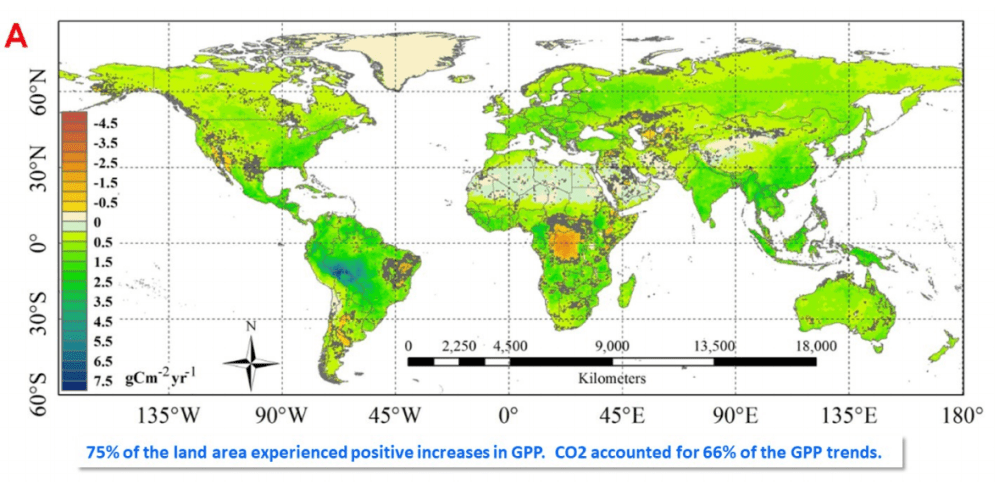
OTOH plants have sensed and appreciated the increased CO2 as shown in the greening of the planet since 1982]
No current research has studied the kind of long-term exposure that will would result from rampant climate change.

As noted by researchers, however, all of the adverse effects of CO2 on mental performance can still be averted by making a concerted effort to lower emissions and stave off climate change.

This is your brain on CO2 hysteria. Just say no!