How Water Warms Our Planet

The hydrological cycle. Estimates of the observed main water reservoirs (black numbers in 10^3 km3 ) and the flow of moisture through the system (red numbers, in 10^3 km3 yr À1 ). Adjusted from Trenberth et al. [2007a] for the period 2002-2008 as in Trenberth et al. [2011].

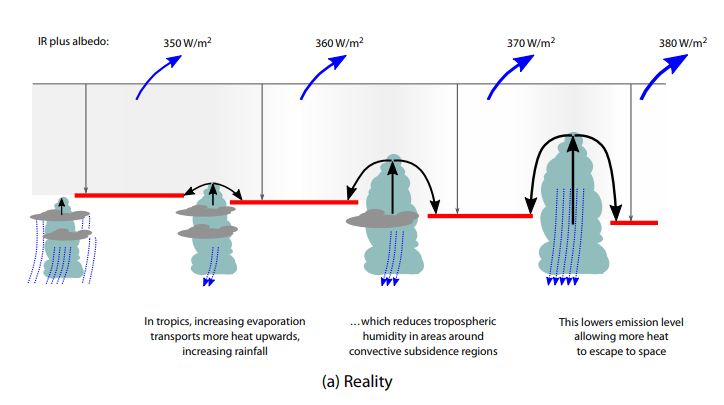
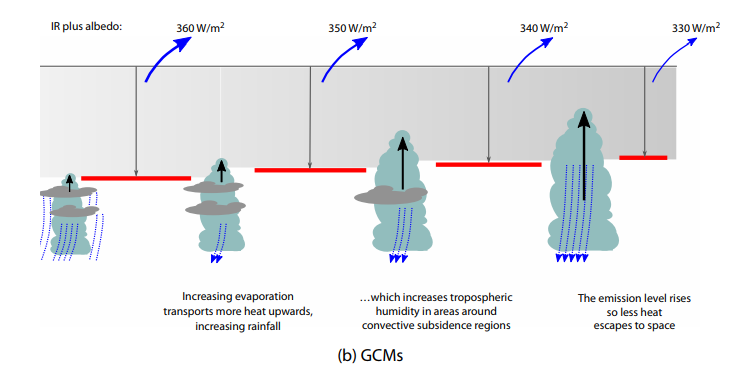
This site has long asserted that “Oceans Make Climate”. Now a recent study reveals the dynamics by which water influences temperatures over land as well. The paper is Testing the hypothesis that variations in atmospheric water vapour are the main cause of fluctuations in global temperature by Ivan R. Kennedy and Migdat Hodzic, published in Periodicals of Engineering and Natural Sciences, August 2019.  Excerpts in italics with my bolds. H/T Notrickszone.

Introduction

Global warming issues have caused intensive research work in related areas, from land use, to urban environment to data science use in order to understand its effects better [25], [26], [27]. In this paper we focus on water related effects on global warming. Although water is recognised as the main cause of the greenhouse effect warming the Earth 33 oC above its black body temperature, water vapour is usually given a secondary role in global models, as a positive feedback from warming by all other causes. Despite its dominant effect in generating the weather, changes related to water are not seen as having a primary role in climate change, the focus being primarily on CO2. With positive feedback from primary warming, the effect of increasing CO2 is trebled [15] by water vapour increase. This conclusion is based on the perception that there are no significant trends in the hydrological cycle that could cause climate forcing. But this overlooks the effect of more than 3500 km3 of extra surface and ground water used annually in irrigation [17] to grow food for the human population. This quantity of extra water increases steadily year by year, well correlated with increasing atmospheric CO2, growing about 60% of world food requirements. Even so, the amount used in irrigation probably only adds about 3% to the annual hydrological cycle [9] of 113,000 km3. Is this sufficient to exert a significant extra greenhouse effect? Here we advance the hypothesis that it does and should be included in climate models.

A critical assumption of the IPCC consensus of global warming is that an increasing concentration of CO2 causes more retention of radiant heat near the top of the atmosphere, largely as a result of reduced emission of its spectral wavelengths centred on 15 microns. The radiative-convective model assumes that the lowered emissions at reduced pressure, number density and higher, colder altitudes from this GHG now provides an independent and sustained forcing exceeding 1-2 W per m2. It is assumed that once this reduction in OLR in the air column from increasing CO2 has occurred it must be compensated by increased OLR at different wavelengths elsewhere, maintaining balance with incoming radiation.

This critical assumption still lacks empirical confirmation.
 

Water Drives Atmospheric Warming

The importance of water in helping to keep the Earth’s atmosphere warm in the short term is beyond dispute. Table 1 summarises previously estimated rates for thermal energy flows into and out of the atmosphere [23]. As shown in the table, more than 80% of the power by which the temperature of air is maintained above the Earth’s black body temperature of -18 C is facilitated by water. Most significant of these air warming inputs from water is the greenhouse effect by which water vapour absorbs longwave radiation emitted from the surface, retaining more energy in air. However, warming from absorption of specific quanta by water vapour of incoming short wave solar radiation (ISR) and the latent heat of condensation of water vapour, exceeding the cooling effect of vertical convection, also contribute to warming of air.

Thus, the greenhouse gas (GHG) content of the atmosphere effectively provides resistance to heat flow to space increasing the transient storage of solar energy, with a warming effect analogous to resistances in an electrical circuit. By comparison to water, other polyatomic greenhouse gases like CO2 play a minor role in this process, totalling less than 20% of warming. Furthermore, the fact that the minor GHGs are relatively well-mixed by the turbulence in the troposphere, unlike water, means that we cannot expect to observe spatial variations in their effects. Furthermore, the heat capacity of non-greenhouse gases provides some 99% of the thermal inertia of the troposphere, although only greenhouse gases capable of longwave radiation by vibrational and rotational quanta can contribute to cooling by radiation through the top of the atmosphere as OLR. Figure 1 contrasts schematically the typical variation of outgoing longwave radiation (OLR) over marine and terrestrial environments.

On well-watered land such as southern China much less direct emission of OLR to space occurs, in contrast to Quetta, Pakistan, on the same latitude with similar incoming shortwave radiation (ISR). In contrast to humid atmospheres on land and tropical seas, relatively arid regions such as the Sahara, the Middle East and Australia provide heat vents effectively cooling the Earth, solely as a result of the radiant emissions from GHGs as OLR. The varying global emissions of OLR estimated for typical marine and terrestrial regions shown in Figure 2 mirror this scheme.

Clearly, water vapour is the most critical factor in the mechanism by which the air column of the lower troposphere is charged with heat energy. It is of interest from this figure and in Table 1 that the exact sum of the effects of all greenhouse gases in directly warming air, including conduction from the surface, charges the lower atmosphere with sufficient heat to generate the downwelling radiation from greenhouse gases directed towards the surface [12]. Water is the main source of this back radiation [18], well understood to be responsible for keeping the surface air warmer in humid atmospheres, thus raising the minimum temperature.

None of the variation in OLR in Figure 1 can be attributed to the well-mixed GHGs such as CO2.

Furthermore, unlike the greenhouse effect of CO2, which is regarded as increasing only in in a logarithmic manner as its concentration rises, the greenhouse effect of water on retaining heat in the atmosphere should vary more linearly, even in the case of absorption of surface radiation, as its vapour spreads into dryer atmospheres; this potential is illustrated in Fig.1 in the descending zones of Hadley cells at sub-tropical latitudes.
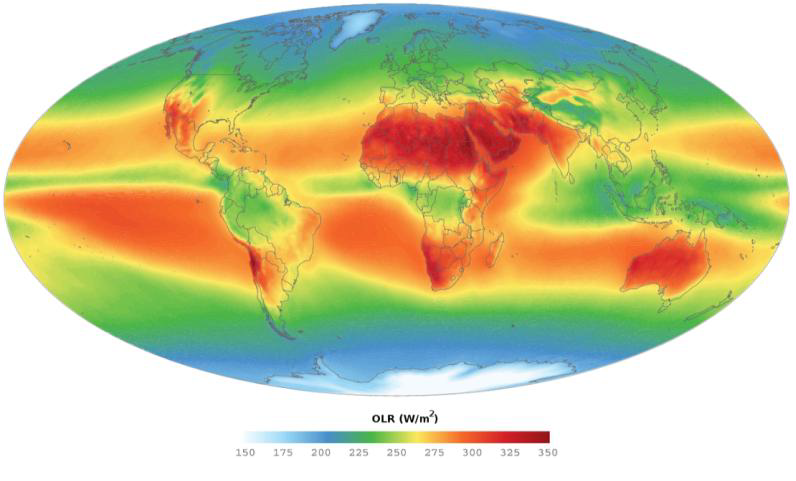
Fig. 1 Global values of mean OLR from 2003-2011 (downloaded August 2, 2017, AIRS OLR 2003-2011 average htpp://mirador.gsfc.nasa.gov/ estimated by Giorgio, G.P., June 24, 2014). The russet areas show regions of greater OLR, with outgoing radiation above the average of ca. 240 W per m2, thus tending to cool the Earth. Note how the upper troposphere above arid continental regions provides a vent for the greatest rate of cooling.

Thermal Effects from Water are Direct and Linear

An approximately linear response in increasing air temperature to changes in atmospheric water content is reasonable. Unlike the well-mixed CO2, there are marked spatial and temporal variations in atmospheric water content, with much of the Earth’s surface in significant deficit, particularly in the sub-tropical zone subject to Hadley cell recycling, emphasised over semi-arid land. To the extent that additional water vapour spills over into these dryer regions on land the greater the area of the Earth that is subject to the greenhouse effect. This response can be contrasted to the effect of increasing CO2, which has a logarithmic relationship between climate forcing and concentration in the atmosphere [14], [15], each doubling causing a similar increase in temperature. Because there is no obvious regional effect of CO2 on the weather or regional climate, the effect of any increases in its concentration can only be theoretically inferred. If additional heat is retained in the atmosphere by increasing greenhouse effects from CO2 or water, the air temperature near the surface is expected to increase to keep global values of ISR and OLR in balance. A critical assumption of the IPCC consensus for climate change is that increasing CO2 causes more retention of heat in air near the top of the troposphere, largely as reduced emission from the edges of its spectral peak centred on 15 microns. This edge effect is predicted to be visible from space as a cooling of its spectrum, providing a negative forcing of 1-2 W per m2. It is assumed that this forcing must be compensated by increased OLR at different wavelengths as a result of the increased temperature.
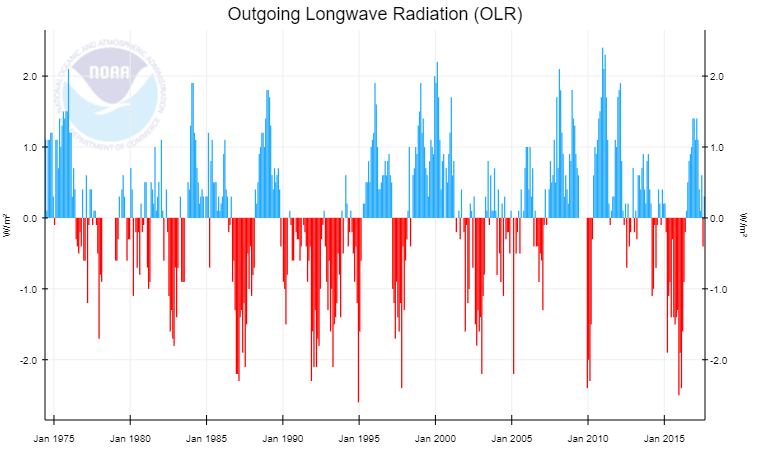
Fig. 3 Satellite measurements of global-zonal OLR (http://www.cpc.ncep.noaa.gov/data/indices/olr NOAA website, downloaded August 20, 2017). The 1998-2000 El Nino peaked at about 1.03 C above the minimum temperature in the preceding La Nina, with zonal OLR varying approximately 4 W/m2; see also (8)

This is regarded as a result of convective elevation of the maritime atmosphere, reducing the outgoing longwave radiation (OLR) about 100 W/m2 locally and 4 W/m2 globally from an increase in global water vapour of about 4%. This suggests a linear response from greenhouse warming to increased water vapour content of the atmosphere. Note that the extra heat in the atmosphere during an El Nino is controlled by all these sources of warming, as shown in Figure 2. Whatever the source of extra heat in the ocean, by moving extra water into the atmosphere as vapour it warms the atmosphere by the resultant greenhouse effect, reducing OLR, as well as direct warming by sunlight in the air column. In Table 4, another estimate of the possible effect of irrigation on global warming by comparison with the El Nino-La Nina cycle [22] is made. Consistent with the irrigation water hypothesis the El Nino has been long known to significantly reduce the OLR over the Pacific Ocean up to 25% [3], recognised as a result of elevation of emission of the OLR from water being elevated and therefore a colder altitude. Assuming 60% of irrigation water becomes vapour in the troposphere and a longer rain-out time of 15 days in dry regions compared to less than a week over the oceans with a global average of 8.5 days [19], a steady state of about 100 km3 of extra water vapour results from irrigation.

This estimate also suggests an increase in temperature near 0.2C from 0.84 W/m2 of forcing based on the data given in Figure 3. This is consistent with the total effect of water vapour on global warming exceeding 25 C.

It should be noted that this dynamic effect of water on warming air includes heat pumping by evapotranspiration as well as significant warming by direct absorption of short wave solar radiation (see Fig. 2), also contributing to a more linear effect by water on warming. Since this increase estimates a primary forcing effect of new water, a positive feedback is also anticipated from increased evaporation of the ocean, suggesting that the total increase from irrigation could be of the order of 0.5 oC in the 20th century.

These global results may have more accuracy than the results obtained from the numerous grid points in global circulation models, given the additivity of errors.

Empirical Proof Comparing Dry and Irrigated Land

In Figure 4, using the same modelling as in Figure 2, the predicted steady state greenhouse effect of adding irrigation water in a comparison between dryland and irrigated land. In fact the effect of water on heat transfer to the atmospheric column is not only a result of the greenhouse effect given in the equation in the figure but also from direct absorption by water of short wave ISR and evapotranspiration, similar in total magnitude. These latter effects will be a linear function of the water vapour involved. The evaporative effect cools the surface but must transfer a similar amount of heat to the atmosphere as infrared radiation (ca. 6 microns) associated with condensation of water vapour into droplets under convective cooling as in [21]. Paradoxically, the modelling paper in [6] failed to account for any of these effects, specifically dismissing significant transfer of water vapour into the atmosphere from growth of irrigated crop growth as noted above. This provides a clue to the possible flaw in their models. Except for environments already very humid where evapotranspiration is limited, this cannot be true.
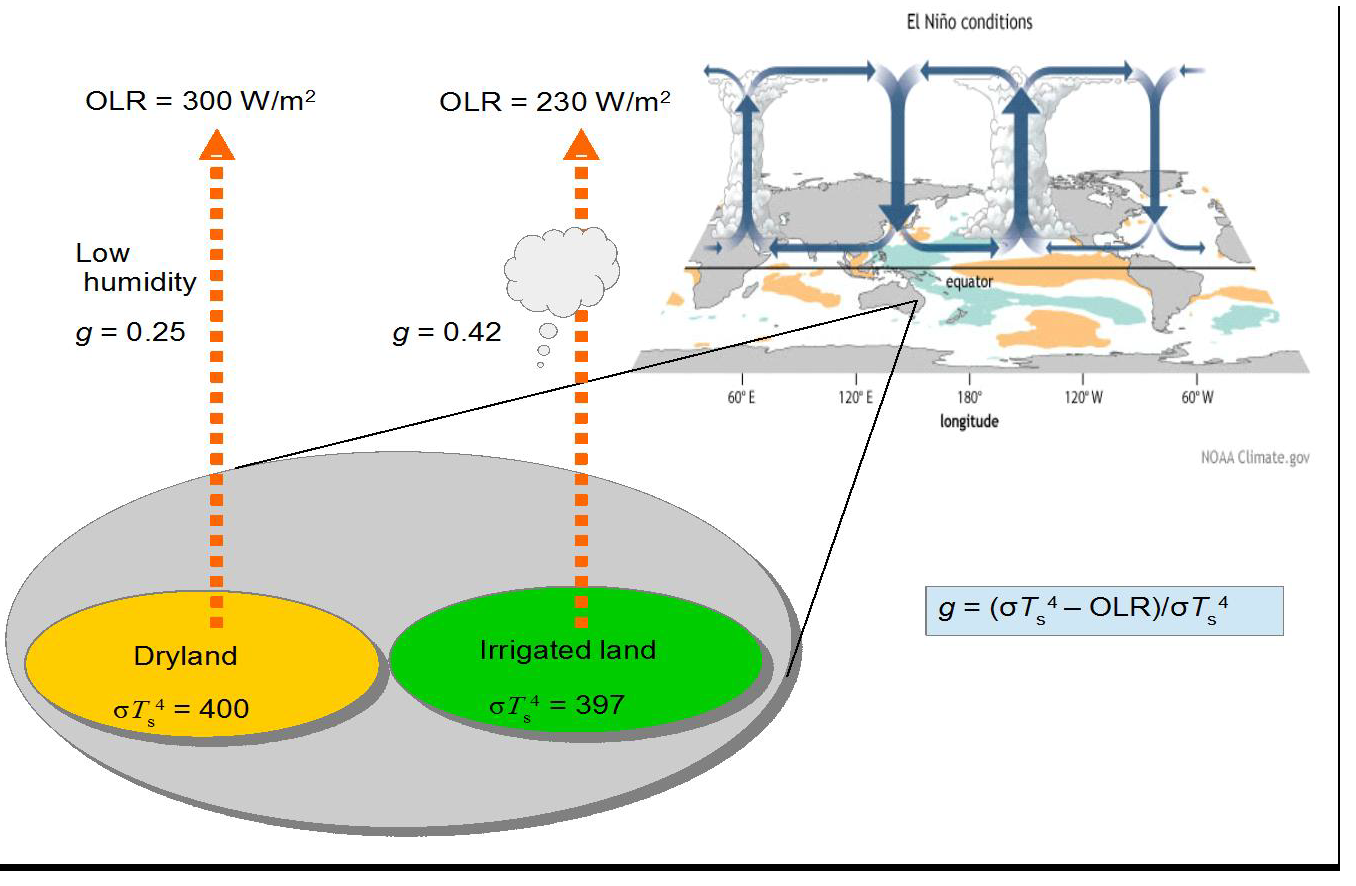
Fig. 4 Comparison of dryland and irrigated land for effect of water on heat retention in the atmosphere as an enhanced greenhouse effect. The El Nino condition of enhanced evaporation from the ocean known to strongly reduce OLR In [3] is shown as an analogue.
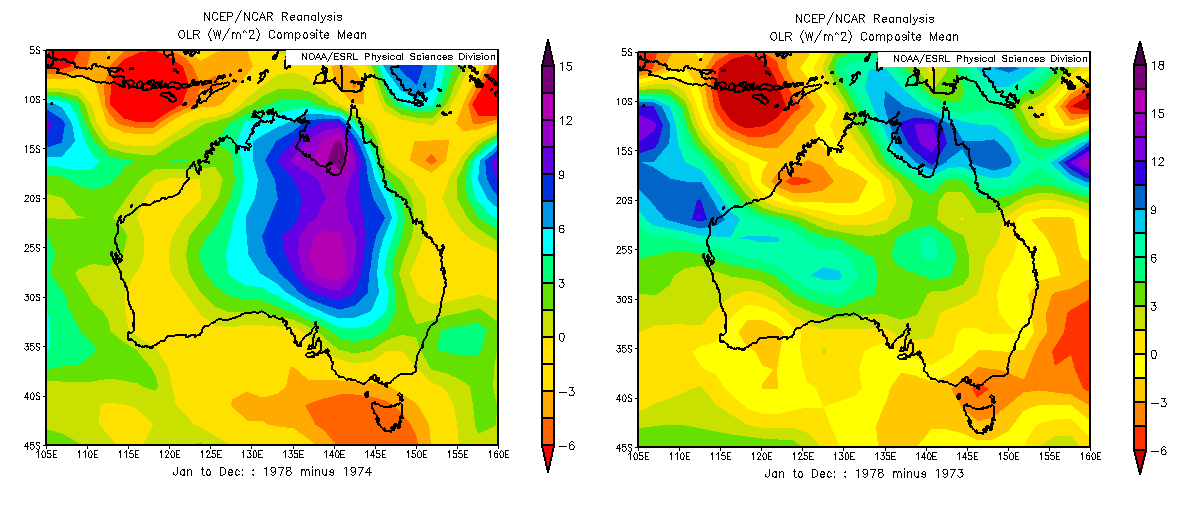
NCEP/ NCAR Reanalyses Coincident with the Periodic Flooding of Lake Eyre

Fig. 5 Variation in OLR from flooding of lake Eyre using NCEP-NCAR reanalysis datasets. a.Difference in OLR values between 1978 and 1974, dry and wet years. b. Difference in OLR values between 1978 and 1973, two dry years.

Rarely, during the La Nina phase of the climate cycle, the dry interior of northern Australia overlying the Great Artesian Basin may flood. Lacking riverine exits to the ocean, the massive runoff caused flows southwards, mainly accumulating in the depression below sea level in central South Australia known as Lake Eyre. In late January and February in the early months of 1974 Lake Eyre filled to a depth of six metres, its surface only returning to its hot, dry state three years later in 1977-78. This was the greatest flood ever recorded. The hypothesis in [4] suggests that this flooding should also lead to persistent elevated water vapour content of the atmosphere, predominantly downwind from the Lake Eyre basin. Using the NCEP-NCAR reanalysis datasets, which are informed by Nimbus and other satellite observations since 1970, the OLR emissions to space and the variation in humidity from this region comparing 12 months of 1974 with the same period in 1978 by subtraction of one year from the other. A significant elevation of OLR when the lake was dry by more than 10 W/m2 was observed for the 12-month period (Figure 5). This result is accompanied by increases in specific humidity consistent with an elevated greenhouse effect such as would be experienced in semi-arid areas when irrigated. The area affected downwind also showing elevated humidity is estimated as 35 times the flooded area, showing that the magnitude of this regional greenhouse effect was indeed significant.

Conclusion:  Thankfully, A Wet World is a Warm World

The neglect of the possible effect of irrigation as a significant source of anthropogenic climate change may have been a result of reluctance to consider the relatively small amount of irrigation in the hydrological cycle. Because water has been considered as providing positive feedback to warming primarily from CO2 its possible forcing effect has been overlooked. But as shown here by several different means, the more potent effect of applying water previously in the ocean or deep in the ground to dry surfaces with air in strong water deficit can be sufficient to affect global temperature. Clearly, the water vapour content of the troposphere is the major cause of the natural greenhouse effect, contributing up to two-thirds of the 33 oC warming.

Spatial and temporal variations in soil moisture and relative humidity of the atmosphere are the main factors controlling the regional outgoing longwave radiation (OLR), in contrast to the more even effects from well-mixed greenhouse gases such as CO2.

This is well illustrated in the 4-6 year El Nino cycles, resulting in a global mean temperature variation approaching 1 oC compared with La Nina years. Longer term, the proposed Milankovitch glaciations of paleoclimates result in declines of atmospheric temperature around 10 oC, consistent with the major reduction in tropospheric water vapour approaching 50%. Weather conditions and climate as illustrated in the greenhouse effect are clearly demonstrated in the distribution of water, particularly on land. The apparently linear relationship between the water content of the atmosphere is direct verification of the greenhouse warming effect of this greenhouse gas. By contrast, other than by correlation, there is no such direct verification possible for the greenhouse effect of CO2. We rely on the forcing equation of 5.3ln[(CO2)t /(CO2)o] to estimate the climate sensitivity with respect to varying concentration (ppmv) of this greenhouse gas. Early hopes that a clear spectral signal was available showing significantly reduced OLR from increasing CO2, proving the hypothesis of climate forcing by permanent GHGs, have not been realised [5]. A focus using new satellites on the longer wavelength OLR associated with rotations of water might help resolve this question. Up till now, OLR is estimated for this region based on shorter wavelengths. The natural experiment provided by the flooding of Lake Eyre of the greenhouse effect by significantly reducing the OLR provides confirmation that irrigation water typically applied to dry land will have a measurable greenhouse effect.

One year time lapse of precipitable water (amount of water in the atmosphere) from Jan 1, 2016 to Dec 31, 2016, as modeled by the GFS. The Pacific ocean rotates into view just as the tropical cyclone season picks up steam.

Gervais Speaks Truth to Star Power

From the Daily Caller (they watched the show, while I skipped it expecting only the usual social justice charade)

Absolutely amazing. Absolutely amazing on every single level. The entire opening monologue is a great example of why Gervais is the man. 

Most award shows suck. They’re absolutely awful, and it’s usually millionaires lecturing middle Americans about why they’re the problem.

Gervais just dropped about a dozen verbal missiles on the whole crowd tonight before they even realized what happened.

Thank you, Gervais! Thank you so much. It’s about time somebody just spoke the honest truth to celebrities.

Of course my highest appreciation goes for this zinger:

“If you do win an award tonight, don’t use it as a platform to make a political speech. You’re in no position to lecture the public about anything. You know nothing about the real world. Most of you spent less time in school than Greta Thunberg. So, if you win, come up, accept your little award, thank your agent and your God and f**k off.”

Here’s the full transcript of the opening monologue:

“Hello and welcome to the 77th annual Golden Globe Awards, live from the Beverly Hilton Hotel here in Los Angeles. I’m Ricky Gervais, thank you.

You’ll be pleased to know this is the last time I’m hosting these awards, so I don’t care anymore. I’m joking. I never did. I’m joking, I never did. NBC clearly don’t care either — fifth time. I mean, Kevin Heart was fired from the Oscars for some offensive tweets — hello?

Lucky for me, the Hollywood Foreign Press can barely speak English and they’ve no idea what Twitter is, so I got offered this gig by fax. Let’s go out with a bang, let’s have a laugh at your expense. Remember, they’re just jokes. We’re all gonna die soon and there’s no sequel, so remember that.

But you all look lovely all dolled up. You came here in your limos. I came here in a limo tonight and the license plate was made by Felicity Huffman. No, shush. It’s her daughter I feel sorry for. OK? That must be the most embarrassing thing that’s ever happened to her. And her dad was in Wild Hogs.

Lots of big celebrities here tonight. Legends. Icons. This table alone — Al Pacino, Robert DeNiro … Baby Yoda. Oh, that’s Joe Pesci, sorry. I love you man. Don’t have me whacked. But tonight isn’t just about the people in front of the camera. In this room are some of the most important TV and film executives in the world. People from every background. They all have one thing in common: They’re all terrified of Ronan Farrow. He’s coming for ya. Talking of all you perverts, it was a big year for pedophile movies. Surviving R. Kelly, Leaving Neverland, Two Popes. Shut up. Shut up. I don’t care. I don’t care.

Many talented people of color were snubbed in major categories. Unfortunately, there’s nothing we can do about that. Hollywood Foreign press are all very racist. Fifth time. So. We were going to do an In-Memoriam this year, but when I saw the list of people who died, it wasn’t diverse enough. No, it was mostly white people and I thought, nah, not on my watch. Maybe next year. Let’s see what happens.

No one cares about movies anymore. No one goes to cinema, no one really watches network TV. Everyone is watching Netflix. This show should just be me coming out, going, “Well done Netflix. You win everything. Good night.” But no, we got to drag it out for three hours. You could binge-watch the entire first season of Afterlife instead of watching this show. That’s a show about a man who wants to kill himself cause his wife dies of cancer and it’s still more fun than this. Spoiler alert, season two is on the way so in the end he obviously didn’t kill himself. Just like Jeffrey Epstein. Shut up. I know he’s your friend but I don’t care.

Seriously, most films are awful. Lazy. Remakes, sequels. I’ve heard a rumor there might be a sequel to Sophie’s Choice. I mean, that would just be Meryl just going, “Well, it’s gotta be this one then.” All the best actors have jumped to Netflix, HBO. And the actors who just do Hollywood movies now do fantasy-adventure nonsense. They wear masks and capes and really tight costumes. Their job isn’t acting anymore. It’s going to the gym twice a day and taking steroids, really. Have we got an award for most ripped junky? No point, we’d know who’d win that.

Martin Scorsese made the news for his controversial comments about the Marvel franchise. He said they’re not real cinema and they remind him about theme parks. I agree. Although I don’t know what he’s doing hanging around theme parks. He’s not big enough to go on the rides. He’s tiny. The Irishman was amazing. It was amazing. It was great. Long, but amazing. It wasn’t the only epic movie. Once Upon a Time in Hollywood, nearly three hours long. Leonardo DiCaprio attended the premiere and by the end his date was too old for him. Even Prince Andrew was like, “Come on, Leo, mate.You’re nearly 50-something.”

The world got to see James Corden as a fat pussy. He was also in the movie Cats. No one saw that movie. And the reviews, shocking. I saw one that said, “This is the worst thing to happen to cats since dogs.” But Dame Judi Dench defended the film saying it was the film she was born to play because she loves nothing better than plunking herself down on the carpet, lifting her leg and licking her ass. (Coughs) Hairball. She’s old-school.

It’s the last time, who cares? Apple roared into the TV game with The Morning Show, a superb drama about the importance of dignity and doing the right thing, made by a company that runs sweatshops in China. Well, you say you’re woke but the companies you work for in China — unbelievable. Apple, Amazon, Disney. If ISIS started a streaming service you’d call your agent, wouldn’t you?

So if you do win an award tonight, don’t use it as a platform to make a political speech. You’re in no position to lecture the public about anything. You know nothing about the real world. Most of you spent less time in school than Greta Thunberg.

So if you win, come up, accept your little award, thank your agent, and your God and fuck off, OK? It’s already three hours long. Right, let’s do the first award.”

Corrections to CO2 Post

This is an update correcting a previous post Fear Not CO2!  I discovered math errors that invalidated the main conclusion.  I apologize for not seeing the problem before posting.

At Quora Paul Noel answers the question Is climate change the biggest catastrophic risk facing humanity today? Text below in italics with my bolds

NO it is not even an issue you need to worry about.

Look closely. The biological adaptation is eating up the CO2 almost as fast as it is being emitted and the adaptation is getting faster every year.

Out of the over 38 GT output in 2019 only 0.02 GT will not be sequestered naturally and by next year that will be gone. The plants are eating up the CO2 just a few days after the release. They are happily eating it up just fine. You don’t even need to plant trees. Nothing against trees here. I like them.

This is the TRUMP CARD on the game. With this known, it is impossible to imagine the problems proposed are happening regardless of all other issues.

Correction Update

I reblogged an answer from Quora with an analysis and conclusions new to me. I thought it interesting if it held up to scrutiny.. Afterward I became uncomfortable when double checking the math, and so I am retracting my support. One smaller issue was noted in my post regarding CO2 having a larger weight (44) than the average air molecule (29). Thus calculating CO2 mass in the atmosphere should apply a ratio of 1.52. That does not in itself materially affect the finding.

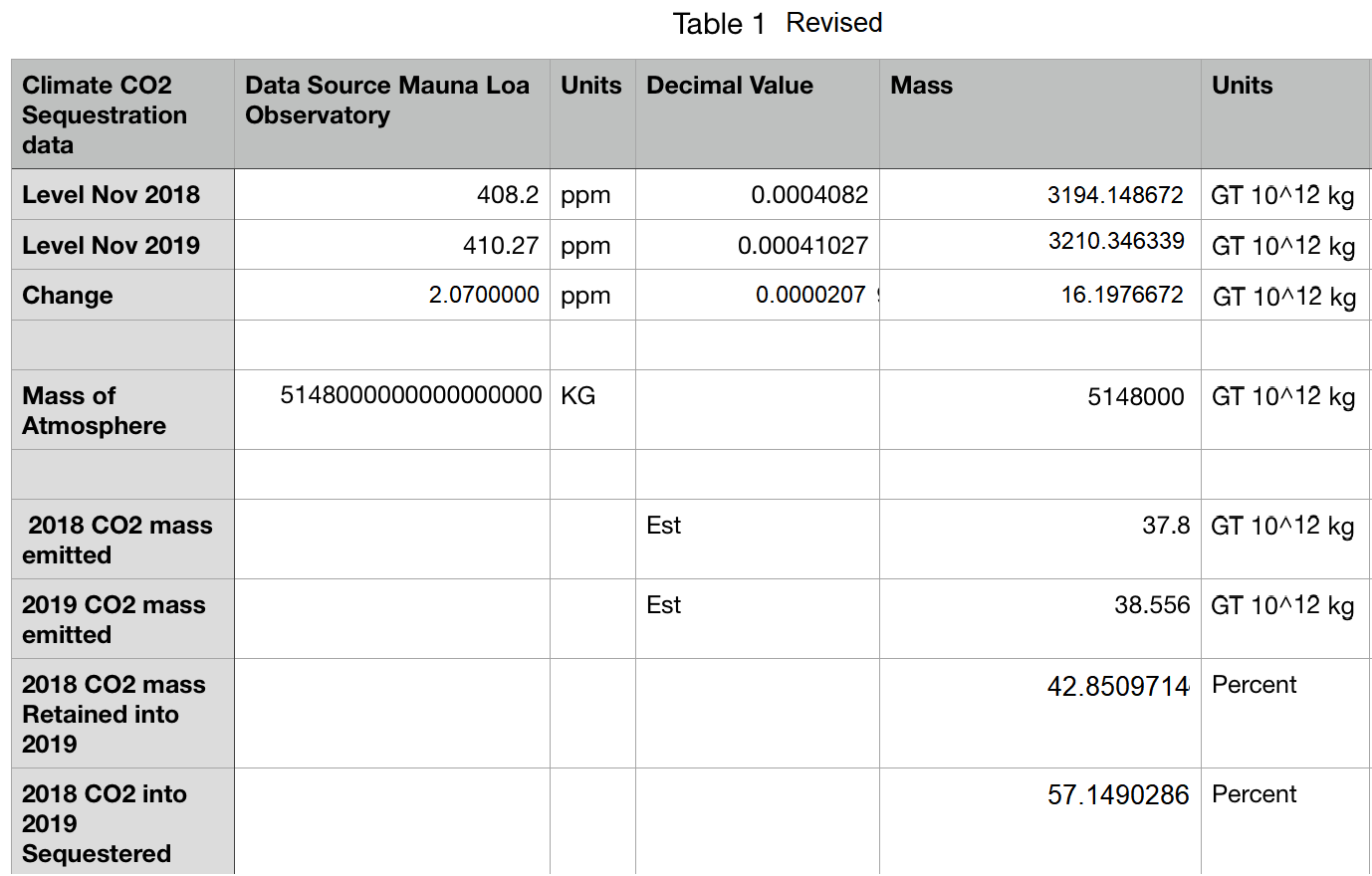
The Table produced by Paul Noel is shown above..

The more substantial issue is having equivalent units of mass for comparing atmospheric CO2 and human emissions of CO2. The proper unit is Gigatons since that is how emissions are reported. One GT is defined as 1 billion (10^9) metric tons and 1 metric ton is 1000 (10^3) kilograms. So one GT is 10^12 kg.

The mass of the atmosphere is calculated using air pressure and area, with a little variation in the results obtained by researchers. A typical standard is 5.148 x 10^18 kg. That converts to 5148000 x 10^12 kg or 5148000 GT. Once that value is plugged into the table, the results are very different. I had recognized that 10^15 was not GT, but thought it was only mislabeling. Later I found that the comparison was distorted in the process.

My revised Table 1 applies a weighted calculation for CO2 compared to average air molecules and derives masses and percentages using GT consistently.

It is clear that the claim of 99% sequestration of emissions is an artifact of faulty math. A better approximation is 57% for emissions reduced by natural fluxes.

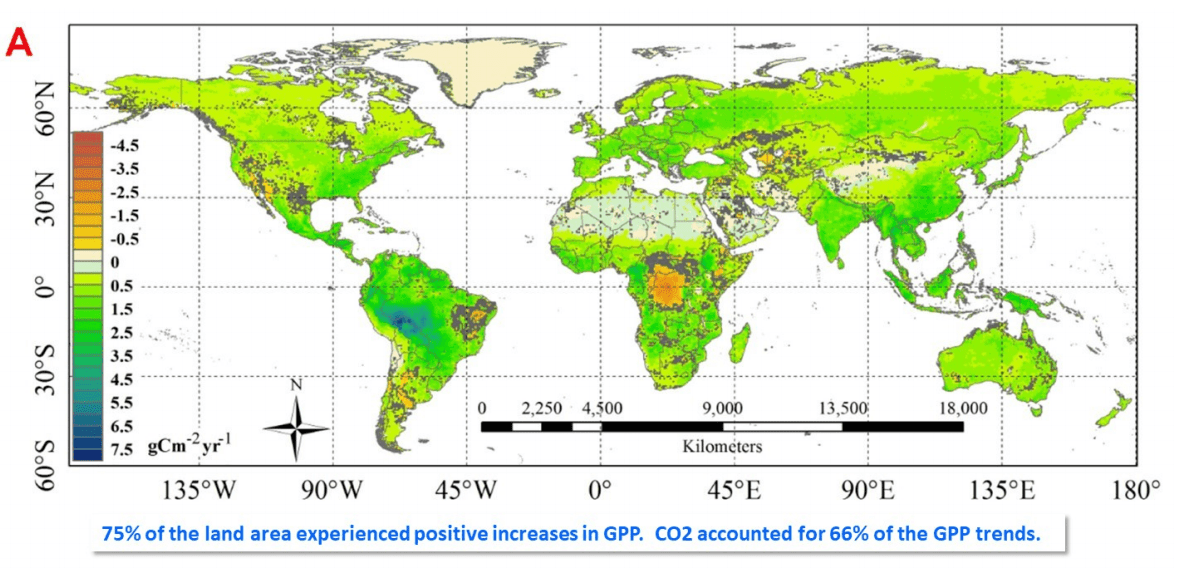
This does not mean we should fear CO2. For one thing the greening of the planet and record annual crop yields are a great benefit from both warming and higher atmospheric CO2. It is also the case that estimates of human emissions (fraught with uncertainty) are small compared to natural fluxes, which are estimated with error ranges exceeding emission amounts. Further, the sensitivity of temperature to rising CO2 is assumed to lie in a wide range.

My views on the CO2 cycle are in the posts:

CO2 Fluxes, Sources and Sinks

Who to Blame for Rising CO2?

Aussies’ Choice: Burn Cool or Burn Hot

Global Warming is Not to Blame for the Horrific Bush fires in Australia by Jon Gaunt, writing from England on the distorted media coverage, published at Sputnik

There I have said the unsayable but don’t hold your breath, you will not hear that on the MSM biased broadcasters like Sky or BBC.

Of course, this is only my opinion but it is an opinion held by millions and deserves to be heard surely?

I hoped after the media bias over the Brexit debate and the General election that the MSM broadcasters would stop emoting and get back to reporting but alas my optimism was misplaced.

It appears to me that because the BBC and Sky News lost the Remainer narrative and the trash Boris agenda and the British public that they have now switched their attention and propaganda machine to promote climate change danger and the agenda of Greta.

The BBC seem determined and desperate to blame the horrific fires in Australia on their global warming agenda and seem very reluctant to mention that over a hundred people have already been arrested for setting fires.

Arson has always been a feature of these annual bush fires and of course the fires themselves are not a new phenomenon either.

I’m not denying that the extremely hot temperatures and dry weather haven’t contributed to the scale of the disaster but isn’t it a reporter’s job to give all sides of a story?

Like many people I don’t doubt that Global warming is happening but I am not convinced that is man-made and that opinion should be reflected in reports.

This is not a game, people have died and many are missing and hundreds of people have or are going to lose their homes.

This is not a time for sixth form, pig tailed, Greta style politicising and propaganda tricks to push the green agenda.

Which of course always ends at the same destination. With working class people losing their manufacturing jobs and being taxed to the hilt when they start ‘Burger flipping’. Meanwhile preaching pop stars and Royals still fly around the globe in private jets whilst paying to offset their carbon ‘Birkenstock’ footprint.

It is, if you pardon the image, all smoke and mirrors and broadcasters should be ashamed of themselves particularly the State one that we pay for via a compulsory poll tax.

Last night the BBC reported/emoted on the fires and then followed it with a report about the last decade being the second hottest on record. The implication was clear and was almost the media manipulation of a five-year-old.

Do they really think that we are that thick? Unfortunately, I believe that they do. It would appear that to use a football chant, ‘two referendums and one election’ has taught them absolutely nothing.

Aussie PM, Scott Morrison, on a visit to Cobargo a town that has almost been destroyed by the fires, got a real hard time from angry and distraught residents yesterday and rightly so.

He was a complete idiot to go to Hawaii whilst his country burned. However, the visit and the refusal by one firefighter to shake his hand was interpreted by the biased broadcasters as if these people were green activists rather than people who had lost their homes and were bloody angry with the establishment class for ignoring them.

These people telling him he was a “Fu*kwit and to pi** off didn’t strike me as green activists or members of Extinction rebellion, no these were normal people who felt let down and forgotten by the political class. Is that attitude ringing any bells with you?

Have you seen the video of the Australian who has a completely different narrative of what has caused these fires? Although his language is extremely fruity, to say the least, his point is that it is actually green activists that have led to the scale of these fires because they have forced farmers to stop burning their scrubland in the winter months which used to create natural fire breaks. This is a tradition that goes back centuries and was actually practiced by the original indigenous Australian Aboriginal population. This possible cause is echoed all over social media today in many tweets from the affected area today.

But that didn’t stop Caroline Lucas the Green Party’s only MP in the UK from entering the fray with a tweet with a link to an article in (you guessed it) the Guardian saying, ‘This is what Climate Emergency looks like – completely terrifying. Honestly, what further devastation needs to happen before world leaders finally put in place urgent climate action at the scale and speed the science demands?’

However, she has had her fingers burnt with angry exchanges on Twitter from people who actually live in New South Wales.

One British ex-pat, Terry Stone, angrily answered her tweet with the following, ‘You have no clue what is happening here. Green lobby stupid restrictions on controlled burns & removal of dead wood is primary reason these fires cannot be controlled. Listen to multiple generations of land owners and keep your mouth shut, you might learn something.’

Another tweeted, ‘I’m a rural Victoria resident. In addition to less burning off than used to happen, we’re restricted collecting dead wood in forests for our wood burners at home (principal heating) in case we inadvertently squish rare lizard or such. And then millions of animals die instead. Ugh’

Have you heard these views on Sky or the BBC? No of course not because Sky are too busy rabidly pushing the ‘woke’ agenda and today they had the leading climate change purveyor of doom and gloom, George Monbiot from (yes, you’ve guessed it) the Guardian on their programme.

Monbiot condemned, and was unchallenged, the Aussie Pm and stated that the Bush fires were a prime example of climate breakdown and that we need political leaders who are going to leave fossil fuels in the ground. Again, this ludicrous statement went unchallenged. In fact, the person Sky chose to conduct this debate and I use the term really loosely was some sort of PR guy who was on to suggest how Morrison could rebuild his reputation after the disaster. Putting aside the fact that Morrison has just won another election why was a PR man on. Why not use someone like James Delingpole or any other climate change sceptic to challenge Monbiot’s views? Well we all know the answer to that one, don’t we!

Sky News backed up Monbiot’s simplistic ludicrous blame game by reminding viewers and their internet readers that “Rewind a few years and he (Morrison) was brandishing a lump of coal in parliament, taunting those he described as having a “pathological fear of coal” and lauding the fossil fuel he said was powering Australia’s economy and underpinning jobs.” Is this what Sky call impartial and balanced reporting?

But unfortunately for George, Sly News and the climate change fanatics Morrison was correct as Australia is the biggest net exporter of coal and is the world’s fourth-largest producer. Over 175,000 people are either directly or indirectly employed in the industry.

In the real world a leader has to balance these real factors before looking to be loved by the MSM broadcasters and avoid the death stare of Greta!

The BBC and Sky’s simplistic and biased telling of this story is almost turning them into the Greta Broadcasting Corporation where they tell us the problem but only half of the solution.

So, called man made global warming is not the primary villain in this story.

The people who are responsible for: the 17 deaths so far, the hundreds of houses destroyed and lives ruined, the burning alive of half a billion animals and the torching of over 5 Billion hectares of land and forest and thousands of Aussies being evacuated from beaches are not those who dig coal but those who despise those who dig coal or work the land.

See Also Arctic On Fire! Not.

Footnote: So how do you want your bush fires, some small ones now or mega fires later?

California’s Year: Veering Left from Left Lane

Steve Greenhut writes at Spectator California’s Year in Review: Missing Jerry Brown Already. Excerpts in italics with my bolds.

A new progressive administration and Democratic legislative super-duper majorities put California on a collision course with reality.

Basically, the Brown era signaled the last years of traditional liberal governance. The new governor, former San Francisco Mayor Gavin Newsom, comes out of the party’s progressive wing. Democrats have long controlled the Capitol, but an anti-Trump backlash hastened the state GOP’s long-coming meltdown. A couple of GOP lawmakers even recently jumped ship. That means no check on Democrats, which makes this shift even more noteworthy.

Looking back at 2019, we get a vision of the future — and there’s reason for concern.

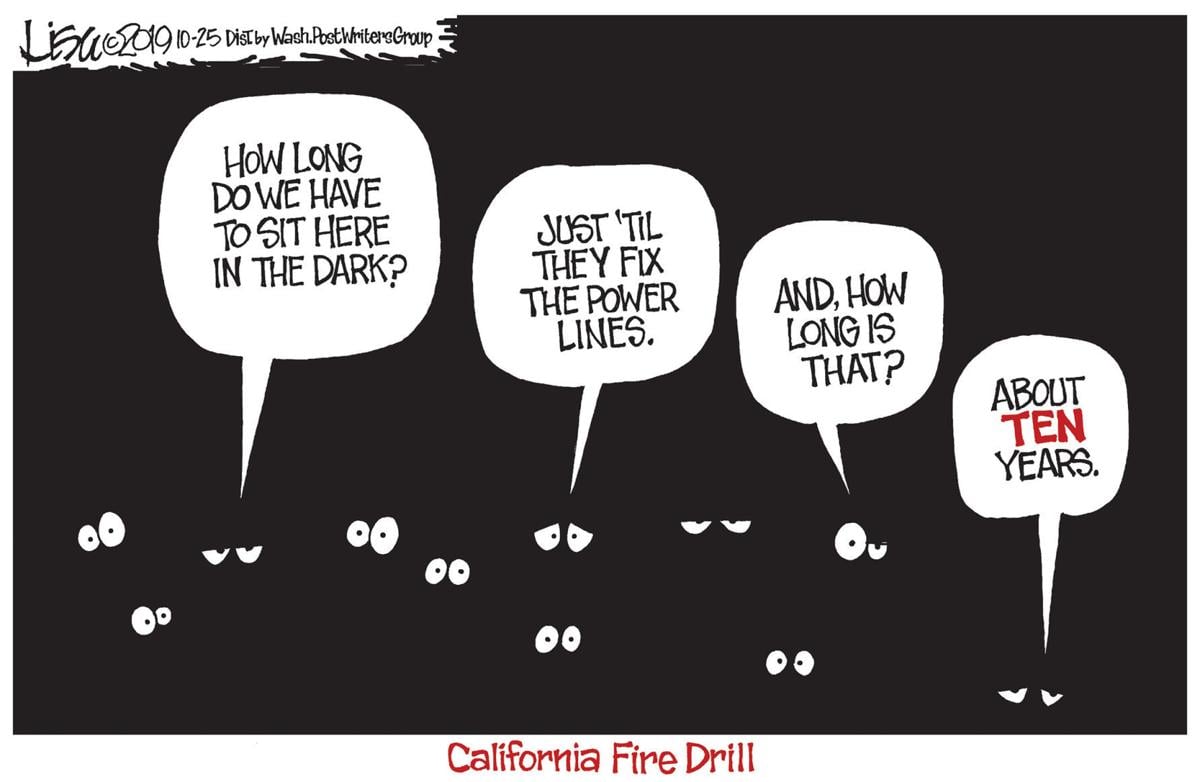
Newsom was stuck dealing with raging wildfires and a bankrupt public utility that began shutting down parts of the electrical grid to prevent even more fires. This brought back shades of Gray Davis, who in 2003 was recalled by voters (and replaced by nominally Republican Gov. Arnold Schwarzenegger) in the midst of rolling blackouts caused by a failed electricity deregulation plan. That’s not just because of the obvious electricity parallels, but because Newsom’s tepid response was reminiscent of the deer-in-the-headlights Davis.

The wildfire/electricity mess is related to liability rules, an overly bureaucratic regulatory climate, and an environmental approach to forest lands that limited brush clearance. None of these matters could quickly be fixed by any governor — even one who had a clue what to do about it. But the real trouble signs in 2019 have come from the governor’s decision to sign measures that likely would have sent his predecessor reaching for the veto pen.

I’ve covered the worst new law for The American Spectator. This was Assembly Bill 5, which banned many companies from using contractors as their workforce. It epitomizes the new, more aggressive strain of progressivism that isn’t content creating new programs and raising taxes — but is willing to destroy large segments of the private economy. The goal seems to be punishing “evil” businesses. If people’s lives are destroyed in the process, so be it.

The targets of the law were Uber, Lyft, DoorDash, and other ride-sharing and delivery companies whose business model is based on using independent contractors as drivers. The union-backed legislation is designed to force these companies (lawmakers exempted most other businesses from its rules, including attorneys, physicians, real-estate agents, and insurance sales people) to hire their drivers as permanent employees and pay them benefits.

Instead, we’re seeing predictable results. Freelance writers, photographers, and artists were not exempted from the measure — and the layoff notices have been coming to these workers as the year’s end approaches. The newly unemployed shouldn’t worry, though. The law’s sponsor, Assemblywoman Lorena Gonzalez, D-San Diego, said in a tweet (as quoted by Reason): “These were never good jobs. No one has ever suggested that, even freelancers.”

That’s progressivism reduced to one short tweet. These folks know what’s best for us and can determine what jobs are good and which ones shouldn’t exist.

When it comes to drivers, hundreds of thousands of jobs could be at risk, according to a recent economic study. Companies that hire drivers have filed suit and are gathering signatures for an initiative that would exempt these workers, but it’s anybody’s guess how this madness might shake out.

Newsom also signed a bill imposing statewide rent control, even though it’s an unquestionable fact that rent control depresses housing supply. Even California officials are starting to realize that the state’s sky-high housing prices are the result of regulations that squelch housing construction. Yet there’s been no legislative progress in addressing those state-imposed restrictions, only a push for more subsidized housing and passage of the one sure-fire way to quickly make the situation worse.

The governor also signed a package of laws that will slowly strangle the charter-school industry (even though both sides depicted it as a compromise), which is the state’s main educational bright spot. The new Legislature is targeting the gig economy, the housing industry, and the schools. Quite obviously, the next target for their destruction is healthcare. Look out for coming plans for single payer.

As Californians, we’re used to the ridiculous spending plans and the state’s refusal to deal with problems (homelessness, soaring pension liabilities, tax rates that are driving businesses out of state) that are of its own making. That’s been standard fare, and certainly was true during the Brown administration. But we’re heading into a brave new world. I predicted we’d be pining for the days of Jerry Brown.

Dec. 31 Arctic Ice Hits Average

The image above shows recovery of Arctic sea ice extent over the month of December 2019. As supported by the table later, the pace of refreezing allowed 2019 to match and exceed for a few days the 12 year average (2007 to 2018 inclusive).

The month began with seas on the Eurasian side (left) already ice-covered, so no additional extent came from there.  OTOH Hudson Bay (right) filled in completely, gaining from 445k km2 to 1255k km2, virtually to its max.  Most of the action now is on the Pacific side (bottom) where Chukchi iced over, and Bering (center) and Okhotsk (left) have started to freeze in ernest.

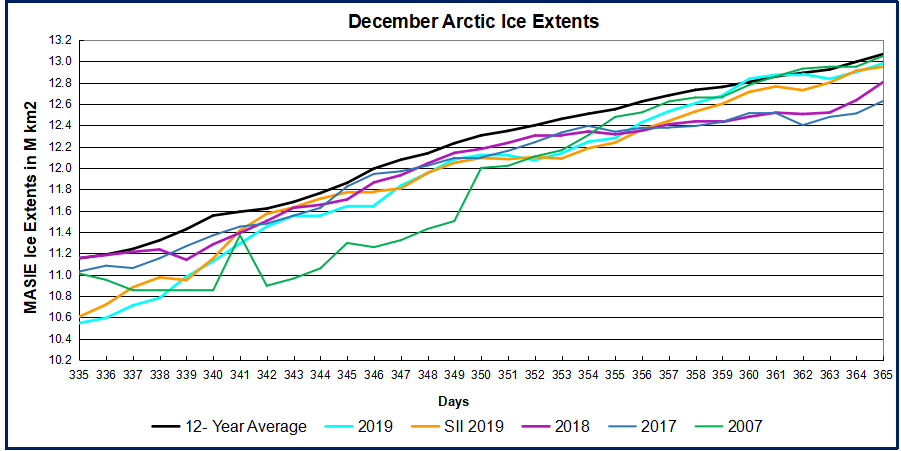
The graph below shows the ice extent growing during December compared to some other years and the 12 year average (2007 to 2018 inclusive).

Note that the  NH ice extent 12 year average increases almost 2M km2 during December, up to 13.1M km2. MASIE 2019 shows a faster icing rate, starting 600k km2 lower than average before reaching and surpassing the average, ending December in a virtual tie with average.  Both 2018 and 2017 were lower at this point, while MASIE and SII are tracking closely together.

Region 2019365 Day 365 Average 2019-Ave. 2017365 2019-2007
 (0) Northern_Hemisphere 12980000 13070435  -90436  12628187 351813 
 (1) Beaufort_Sea 1070655 1070266  389  1070445 210 
 (2) Chukchi_Sea 965972 964161  1811  943883 22090 
 (3) East_Siberian_Sea 1087137 1087134  1087120 18 
 (4) Laptev_Sea 897845 897842  897845
 (5) Kara_Sea 929682 880747  48935  892689 36993 
 (6) Barents_Sea 479642 424886  54756  331819 147823 
 (7) Greenland_Sea 590098 568883  21215  555757 34341 
 (8) Baffin_Bay_Gulf_of_St._Lawrence 851131 1016132  -165001  978074 -126943 
 (9) Canadian_Archipelago 854282 853098  1185  853109 1174 
 (10) Hudson_Bay 1254576 1231781  22795  1260838 -6262 
 (11) Central_Arctic 3228672 3206086  22586  3191526 37147 
 (12) Bering_Sea 362317 439846  -77529  194350 167967 
 (13) Baltic_Sea 8738 32177  -23439  13345 -4607 
 (14) Sea_of_Okhotsk 390113 376320  13793  336595 53518 

The table shows where the ice is distributed compared to average.  Bering Sea and Baffin Bay have the only deficits to average, while other regions are at or above average;  Kara and Barents Seas are in surplus.

Footnote:  Interesting comments recently by Dr. Judah Cohen at his blog regarding the Arctic fluctuations. Excerpts with my bolds.

I have said many times the first thing that you learn as a seasonal forecaster is humility and these are one of those times. What is humbling me at the moment is that I have expected a weakening of the stratospheric polar vortex (PV) based on fall Arctic predictors – extensive Siberian snow cover, more limited Arctic sea ice extent and a relatively warm Arctic. Following the PV weakening or disruption, severe winter weather would be more frequent at least regionally across the mid-latitudes of the Northern Hemisphere (NH). But to be honest it is hard to see from today’s viewpoint how this verifies. And as I have shared on Twitter the new operational GFS, the FV3, has been especially bullish on a strong PV.

The biggest challenge that I see right now is the center of low mid-tropospheric heights currently just north of Alaska and is expected to expand in breadth over the next two weeks enough so to fill the entire Arctic basin. This a fairly class pattern of low heights in the Arctic and high heights in the mid-latitudes resulting in a cold Arctic/warm continents pattern, all consistent with a positive AO. It seems a bit ironic (at least to me) that with the record low sea ice in the Chukchi-Bering seas this fall, the incredibly warm year Alaska just experienced both in part due to persistent ridging in the region, this same region is predicted to now experience an extended period of low heights and below normal temperatures. As an aside, this is something that I had a hard time anticipating even just a few weeks ago. 

So, for now I remain steadfast in the winter forecast that based on high fall snow cover/low Arctic sea ice that they will in tandem perturb the PV. Given the westerly quasi-biennial oscillation (QBO) I expect a scenario somewhere between winter 2016/17 and winter 2017/18. Both of those winters were westerly QBO winters and the most significant disruption of the stratospheric PV took place in February.

Illustration by Eleanor Lutz shows Earth’s seasonal climate changes. If played in full screen, the four corners present views from top, bottom and sides. It is a visual representation of scientific datasets measuring Arctic ice extents.

Life on Arctic Seafloor Under the Ice

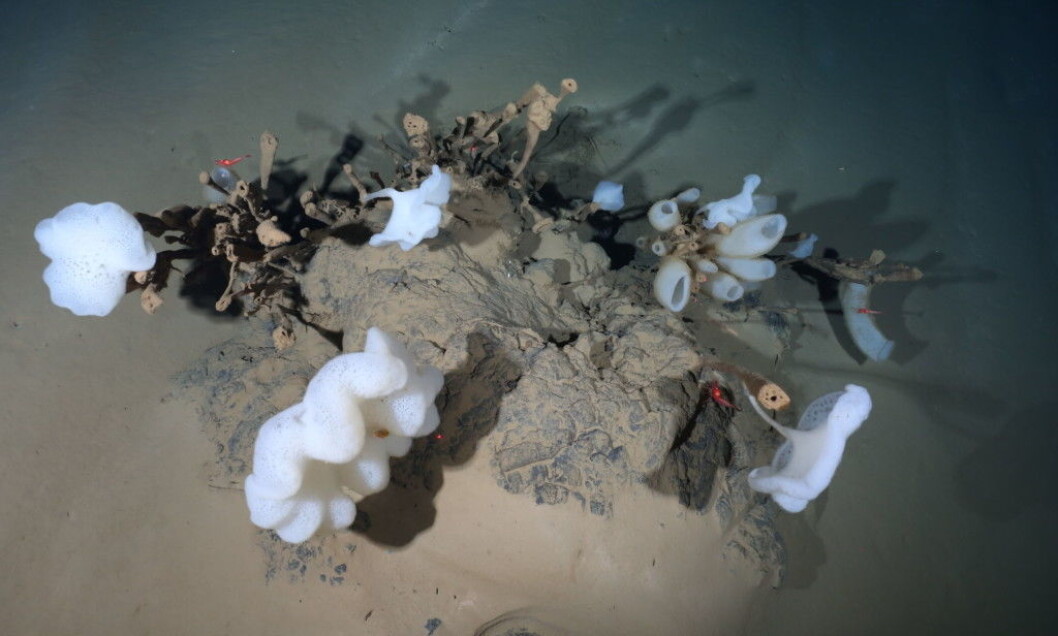
In some places, life manages to get a toehold in an otherwise barren landscape. (Photo: AWI, OFOBS team)

This is a great science story, untainted by activist agendas or grandstanding.  An article at ScienceNorway describes Here’s what it looks like 4000 meters below the Arctic ice.  Excerpts in italics with my bolds.

Far below the Arctic ice lies a special area with volcanic activity. What lives down there? Scientists have gone on a journey to find out.

Hydrothermal vents were first discovered in 1979. They look like pipes sticking out of the seabed and emit warm “smoke”, which is actually hot fluid loaded with minerals.

In the Atlantic and Pacific, many of these vents, also called chimneys, are surrounded by unique ecosystems with clams, blind shrimp, beard worms and extremophile bacteria.

Life there does not get its energy from the sun, but from the interior of the earth.

Microorganisms use reduced compounds from the vents as an energy source to make organic matter, just as plants and algae use photons from the sun. Larger animals live in symbiosis with these microbes.

However, no one has previously looked at the fauna in this type of area in the Arctic.

What lives in these cold, deep waters, 4,000 metres below the ice?

“We wanted to see if this ecosystem had developed in isolation — whether it is very different from other places with hydrothermal vents, or whether the fields are interconnected,” says Eva Ramirez-Llodra.

“It was hard to plan the days, because you work at the mercy of the ice,” says Ramirez-Llodra.

Arctic sea ice is not quiet. It breaks up, freezes, and varies in thickness. That made it difficult to get to the right place. The researchers towed a camera after the boat to film the seabed.

On October 3, they finally got a good position over what they believed was the field. Everyone’s eyes were fixed on the screens in the control room and the tension was high.

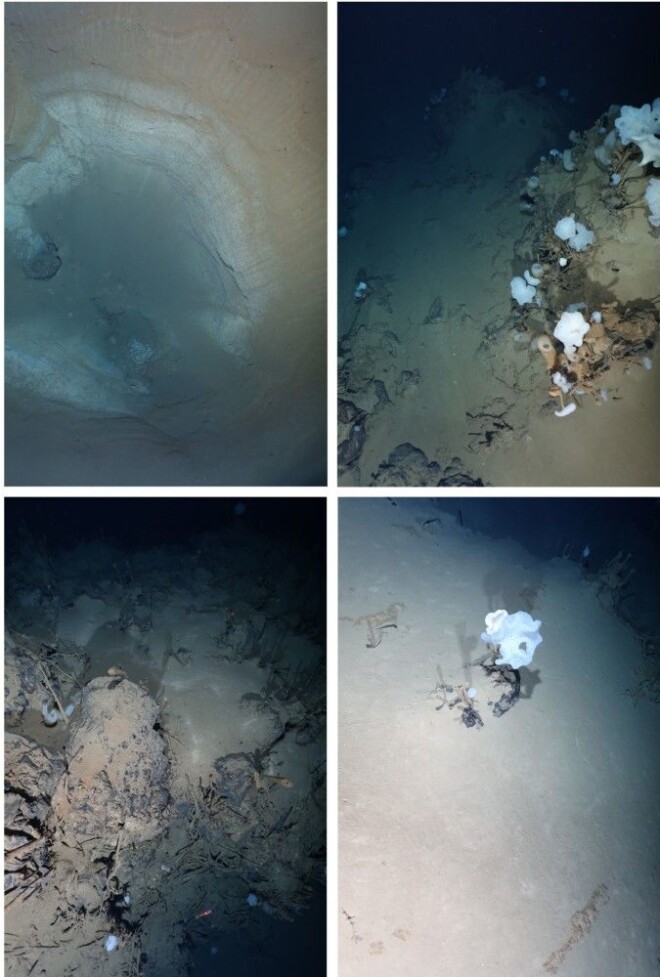
The pictures show the typical fauna on the Aurora volcanic field. The first picture shows a large sinkhole. (Photo: AWI, OFOBS team)

It was a huge hydrothermal vent, a black smoker, and later the researchers found two others.

“We could see that we were approaching the vents, because the sediments became coarser, and there were more stones and colours on the sea floor,” Ramirez-Llodra says.

One encounter was a little close. The researchers pulled the camera up over a mound, and suddenly they saw black smoke billowing out of a gaping, underwater crater.

“It’s not actually smoke, but very hot liquid at about 350 degrees C. The camera ran right into it. It went so fast that we couldn’t stop it. Everything went black and we were scared that we had burned everything up,” she says. “Fortunately, we got the picture back after a few minutes. We could continue. This was our first close encounter with a black smoker.”

Scientists saw fields that shone like gold on the otherwise colourless bottom around the chimneys.

The material the researchers saw wasn’t gold but sulphite that is deposited by the black “smoke”, Ramirez-Llodra says, although there are also traces of gold and silver in the fluid that gushes from the vent. Around the vents were clusters of white organisms that glistened as they reflected the light from the camera.

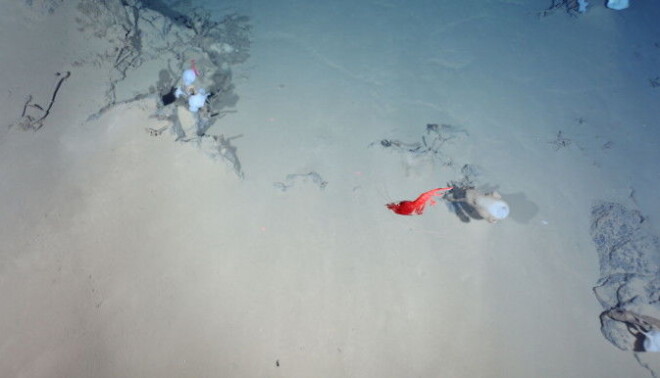
The area around the Aurora field was covered by a thick layer of fine-grained sediments. Where the ground was solid enough for something to stick, there were white, spooky sponges. There were shrimp frolicking in the depths, and sea cucumbers and anemones. The occasional fish also swam around.

But the bulk of the organisms in the depths were glass sponges. They are relatively rare, can grow up to a metre wide, and some of them can live for several centuries, according to an article about the trip written by National Geographic. The sponges are largely made up of silica, and only a little of their mass is organic matter. They can be said to barely be alive.

Glass sponges and shrimp do not depend on the vents but thrive in the cold depths. Researchers aren’t yet certain exactly which species these are. (Photo: AWI, OFOBS team)

The researchers did not find the diversity of life that has been discovered around hydrothermal vents in other ocean areas.

“There wasn’t much life down there,” says Ramirez-Llodra. “But we’re not exactly sure why yet.”

Hydrothermal vents in the Atlantic and Pacific contain colourful communities of beard worms, clams and crabs that have adapted to the special environment around the vents.

“Most of these have a symbiotic relationship with bacteria and microorganisms that live by chemosynthesis. The bacteria can be inside their bodies or in special organs,” says Ramirez-Llodra.

“Some organisms don’t even have a mouth or digestive system, but only live from what the microbes inside their body produce.”

Ramirez-Llodra says the researchers don’t know yet if there is a similar relationship between organisms around the vents in the Aurora field.

Additional studies of the videos and samples the researchers took will reveal more about the previously unknown environment on the Gakkel Ridge.

Ramirez-Llodra says they will embark on a new expedition later, to take samples even closer to the vents.

Postscript:  How refreshing to know about scientists following their curiosity to discover something new about life and the universe.  It encourages one about the future in spite of all the crazy talk of climate “crises” or “emergencies”.  Best wishes and hopes for an unalarming 2020!

Global Volcanism Program, East Gakkel Ridge at 85°E

See Also  Overview: Seafloor Eruptions and Ocean Warming

Cooler NH SSTs in November

The best context for understanding decadal temperature changes comes from the world’s sea surface temperatures (SST), for several reasons:
  • The ocean covers 71% of the globe and drives average temperatures;
  • SSTs have a constant water content, (unlike air temperatures), so give a better reading of heat content variations;
  • A major El Nino was the dominant climate feature in recent years.

HadSST is generally regarded as the best of the global SST data sets, and so the temperature story here comes from that source, the latest version being HadSST3.  More on what distinguishes HadSST3 from other SST products at the end.

The Current Context

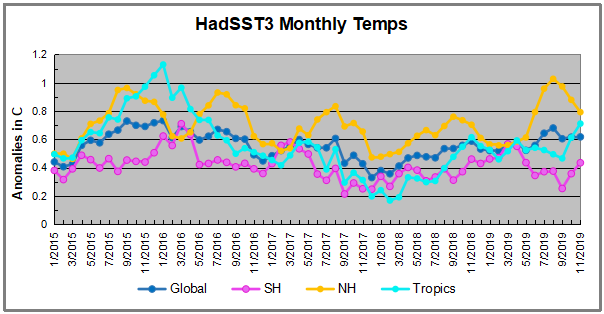
The chart below shows SST monthly anomalies as reported in HadSST3 starting in 2015 through November 2019.
A global cooling pattern is seen clearly in the Tropics since its peak in 2016, joined by NH and SH cycling downward since 2016.  In 2019 all regions had been converging to reach nearly the same value in April.

Then  NH rose exceptionally by almost 0.5C over the four summer months, in August exceeding previous summer peaks in NH since 2015.  Now in the last 3 months that warm NH pulse has reversed sharply.  Meanwhile the SH and Tropics bumped upward, but despite that the global anomaly changed little due to strong NH cooling.

Note that higher temps in 2015 and 2016 were first of all due to a sharp rise in Tropical SST, beginning in March 2015, peaking in January 2016, and steadily declining back below its beginning level. Secondly, the Northern Hemisphere added three bumps on the shoulders of Tropical warming, with peaks in August of each year.  A fourth NH bump was lower and peaked in September 2018.  As noted above, a fifth peak in August 2019 exceeded the four previous upward bumps in NH.

And as before, note that the global release of heat was not dramatic, due to the Southern Hemisphere offsetting the Northern one.  The major difference between now and 2015-2016 is the absence of Tropical warming driving the SSTs.

The annual SSTs for the last five years are as follows:

Annual SSTs Global NH SH  Tropics
2014 0.477 0.617 0.335 0.451
2015 0.592 0.737 0.425 0.717
2016 0.613 0.746 0.486 0.708
2017 0.505 0.650 0.385 0.424
2018 0.480 0.620 0.362 0.369

2018 annual average SSTs across the regions are close to 2014, slightly higher in SH and much lower in the Tropics.  The SST rise from the global ocean was remarkable, peaking in 2016, higher than 2011 by 0.32C.

A longer view of SSTs

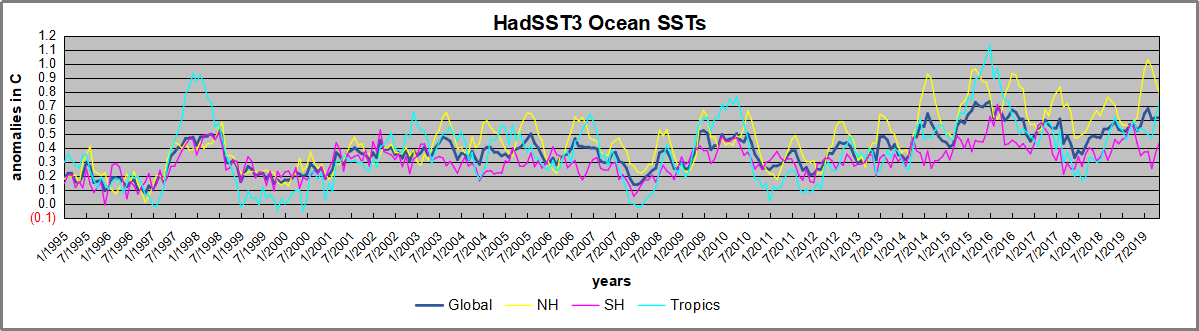
The graph below  is noisy, but the density is needed to see the seasonal patterns in the oceanic fluctuations.  Previous posts focused on the rise and fall of the last El Nino starting in 2015.  This post adds a longer view, encompassing the significant 1998 El Nino and since.  The color schemes are retained for Global, Tropics, NH and SH anomalies.  Despite the longer time frame, I have kept the monthly data (rather than yearly averages) because of interesting shifts between January and July.

1995 is a reasonable (ENSO neutral) starting point prior to the first El Nino.  The sharp Tropical rise peaking in 1998 is dominant in the record, starting Jan. ’97 to pull up SSTs uniformly before returning to the same level Jan. ’99.  For the next 2 years, the Tropics stayed down, and the world’s oceans held steady around 0.2C above 1961 to 1990 average.

Then comes a steady rise over two years to a lesser peak Jan. 2003, but again uniformly pulling all oceans up around 0.4C.  Something changes at this point, with more hemispheric divergence than before. Over the 4 years until Jan 2007, the Tropics go through ups and downs, NH a series of ups and SH mostly downs.  As a result the Global average fluctuates around that same 0.4C, which also turns out to be the average for the entire record since 1995.

2007 stands out with a sharp drop in temperatures so that Jan.08 matches the low in Jan. ’99, but starting from a lower high. The oceans all decline as well, until temps build peaking in 2010.

Now again a different pattern appears.  The Tropics cool sharply to Jan 11, then rise steadily for 4 years to Jan 15, at which point the most recent major El Nino takes off.  But this time in contrast to ’97-’99, the Northern Hemisphere produces peaks every summer pulling up the Global average.  In fact, these NH peaks appear every July starting in 2003, growing stronger to produce 3 massive highs in 2014, 15 and 16.  NH July 2017 was only slightly lower, and a fifth NH peak still lower in Sept. 2018.

The highest summer NH peak came in 2019, only this time the Tropics and SH are offsetting rather adding to the warming. Since 2014 SH has played a moderating role, offsetting the NH warming pulses. (Note: these are high anomalies on top of the highest absolute temps in the NH.)

What to make of all this? The patterns suggest that in addition to El Ninos in the Pacific driving the Tropic SSTs, something else is going on in the NH.  The obvious culprit is the North Atlantic, since I have seen this sort of pulsing before.  After reading some papers by David Dilley, I confirmed his observation of Atlantic pulses into the Arctic every 8 to 10 years.

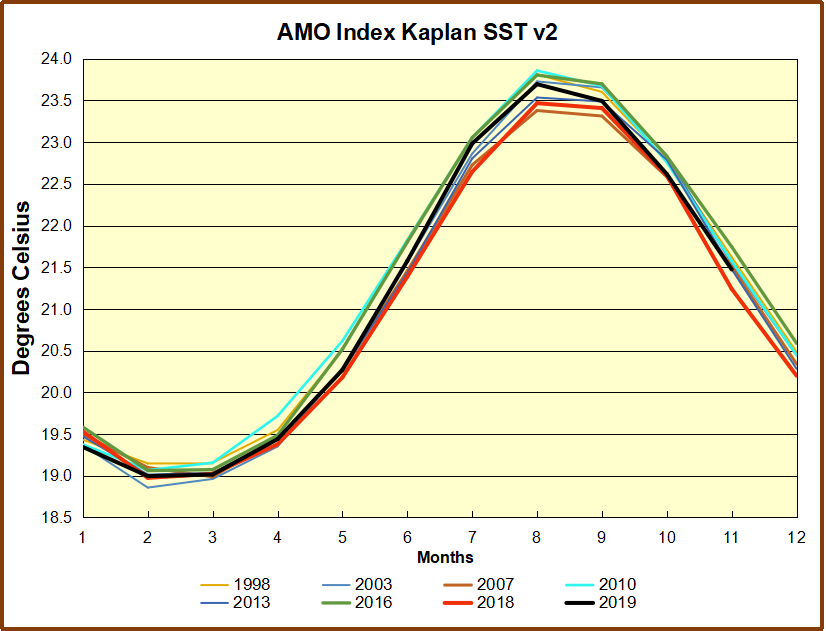
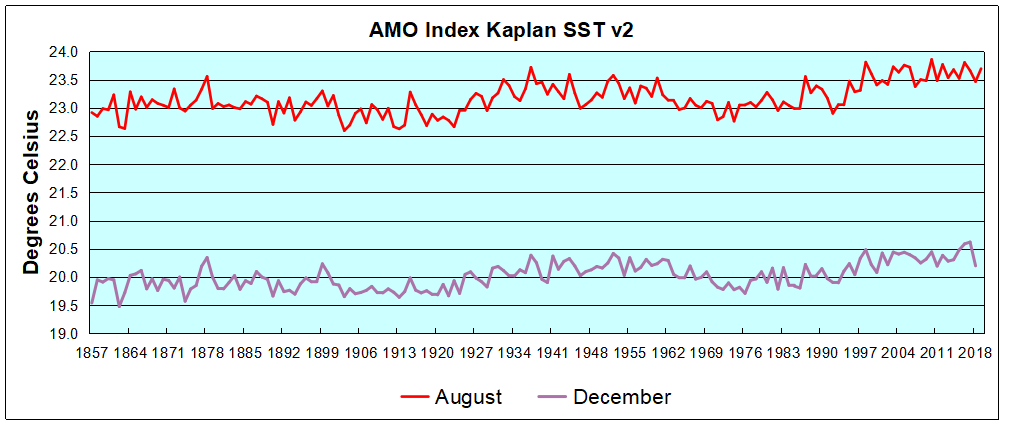
But the peaks coming nearly every summer in HadSST require a different picture.  Let’s look at August, the hottest month in the North Atlantic from the Kaplan dataset.
The AMO Index is from from Kaplan SST v2, the unaltered and not detrended dataset. By definition, the data are monthly average SSTs interpolated to a 5×5 grid over the North Atlantic basically 0 to 70N. The graph shows warming began after 1992 up to 1998, with a series of matching years since. Because the N. Atlantic has partnered with the Pacific ENSO recently, let’s take a closer look at some AMO years in the last 2 decades.
This graph shows monthly AMO temps for some important years. The Peak years were 1998, 2010 and 2016, with the latter emphasized as the most recent. The other years show lesser warming, with 2007 emphasized as the coolest in the last 20 years. Note the red 2018 line is at the bottom of all these tracks. The black line shows that 2019 began slightly cooler, then tracked 2018, then rose to match previous summer pulses, before dropping the last three months to again match 2018 below other years.

Summary

The oceans are driving the warming this century.  SSTs took a step up with the 1998 El Nino and have stayed there with help from the North Atlantic, and more recently the Pacific northern “Blob.”  The ocean surfaces are releasing a lot of energy, warming the air, but eventually will have a cooling effect.  The decline after 1937 was rapid by comparison, so one wonders: How long can the oceans keep this up? If the pattern of recent years continues, NH SST anomalies may rise slightly in coming months, but once again, ENSO which has weakened will probably determine the outcome.

Footnote: Why Rely on HadSST3

HadSST3 is distinguished from other SST products because HadCRU (Hadley Climatic Research Unit) does not engage in SST interpolation, i.e. infilling estimated anomalies into grid cells lacking sufficient sampling in a given month. From reading the documentation and from queries to Met Office, this is their procedure.

HadSST3 imports data from gridcells containing ocean, excluding land cells. From past records, they have calculated daily and monthly average readings for each grid cell for the period 1961 to 1990. Those temperatures form the baseline from which anomalies are calculated.

In a given month, each gridcell with sufficient sampling is averaged for the month and then the baseline value for that cell and that month is subtracted, resulting in the monthly anomaly for that cell. All cells with monthly anomalies are averaged to produce global, hemispheric and tropical anomalies for the month, based on the cells in those locations. For example, Tropics averages include ocean grid cells lying between latitudes 20N and 20S.

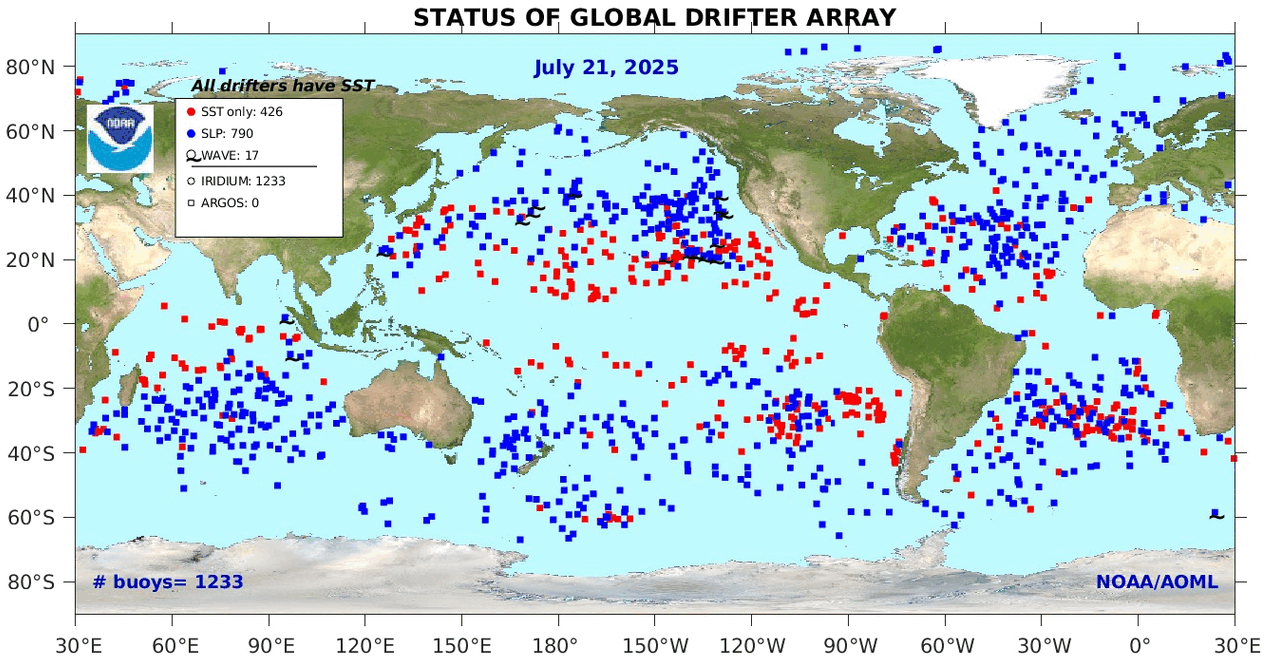
Gridcells lacking sufficient sampling that month are left out of the averaging, and the uncertainty from such missing data is estimated. IMO that is more reasonable than inventing data to infill. And it seems that the Global Drifter Array displayed in the top image is providing more uniform coverage of the oceans than in the past.

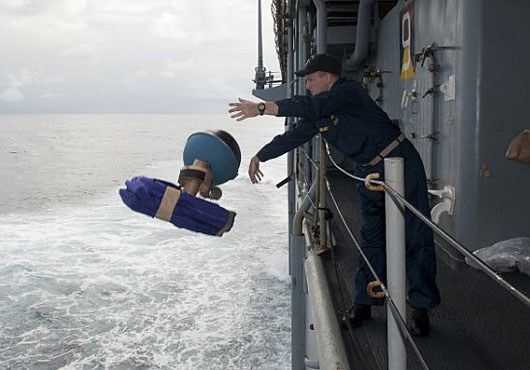
uss-pearl-harbor-deploys-global-drifter-buoys-in-pacific-ocean

USS Pearl Harbor deploys Global Drifter Buoys in Pacific Ocean

2020 Green Obstruction Targets

The remarkable turnaround in the US economy was achieved despite large and expensive Green efforts to stop economic projects and infrastructure. While needed energy pipelines and power plants remain unbuilt in coastal places like New York and California, the heartland will be a battleground for activists wanting to leave the best sources underground in favor of aboveground dilute and intermittent wind and solar power.

Walker Orenstein writes at the Minnesota Post The five environmental stories to watch in 2020. Excerpts in italics with my bolds.

Next year will be a pivotal one for many of Minnesota’s most controversial environmental debates, from mining to climate change and the 2020 elections. Here’s a look at some of the big questions heading into 2020:

File photo courtesy of the Timberjay PolyMet Mining has won state and federal approval to break ground on its $1 billion copper-nickel mine near Hoyt Lakes.

1. Will PolyMet move forward?
PolyMet Mining has won state and federal approval to break ground on its $1 billion copper-nickel mine near Hoyt Lakes. But the project now faces serious questions after Minnesota courts put several permits on hold by this year.

First, The Minnesota Court of Appeals ordered a lower court to examine if state regulators hid concerns the federal government had with a key water safety permit. The Court of Appeals is also investigating whether Glencore, the Swiss mining giant that owns a majority of PolyMet’s shares, should be named on state permits, and whether the plan for a tailings dam at the mine is safe enough.

On top of the permit issues, PolyMet’s majority owner Glencore is now facing a bribery investigation in the United Kingdom and is in the midst of a leadership change.

After a year of turmoil, 2020 could be pivotal for a project that has faced 15 years of environmental review and could bring hundreds of jobs to the Iron Range. If built, it would be the first copper-nickel mine in the state.

2. Will the Line 3 pipeline get built?

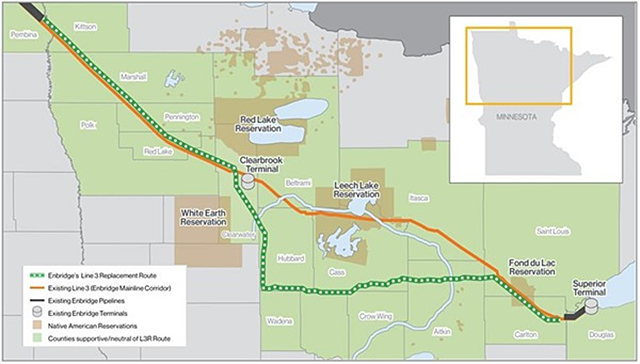
Another controversial project on the brink of construction is Enbridge’s Line 3 oil pipeline. The Canadian energy company is hoping to build a 337-mile pipeline through northern Minnesota to replace an aging and corroding one that is operating at half capacity. State regulators on the Public Utilities Commission granted the $2.6 billion project a Certificate of Need and approved its route.

In July, however, the Court of Appeals ruled the PUC failed to consider the impact an oil spill could have on Lake Superior’s watershed, setting the project back months. A new environmental assessment was completed earlier this month by the Department of Commerce, modeling a spill into a tributary of the St. Louis River. In a worst case-type scenario, the research found oil would be unlikely to reach Lake Superior.

Final Line 3 Replacement Project routek

The five-member PUC now needs to vote again on whether to approve Line 3, which also needs federal permits from the U.S. Army Corps of Engineers, to move forward.

Opponents of Line 3, who argue building new fossil fuel infrastructure would further contribute to climate change, have protested the Walz administration at many public events and have taken steps to disrupt Enbridge’s existing infrastructure. Will wide-scale protests follow if Line 3 does get approved for construction?

3. Will the Legislature pass any climate change policy?

The 2019 session ended with very little new climate and energy policy, despite a Democratic push to make Minnesota’s power grid carbon-free by 2050 and GOP support for a measure to make it tougher to build new fossil fuel projects.

While 2019 was ultimately focused on writing a two-year budget, such debates could find new life at the Legislature in 2020. Especially since lawmakers will have a healthy pot of unused money from Xcel Energy, from the funds the energy company pays to store nuclear waste in Minnesota.

4. Will there be a showdown over the study of mining near the Boundary Waters?

Ever since the Trump administration canceled a study that could have led to a 20-year ban on copper-nickel mining in the Rainy River watershed, some Democrats have tried to finish the research or at least get the federal government to disclose what it found.

While U.S. Rep. Betty McCollum and others have not been successful in Congress, the state Department of Natural Resources has asked for the information to include in its environmental review of a mine Twin Metals Minnesota wants to build just outside the Boundary Waters Canoe Area Wilderness.

The DNR won’t say if it will proceed with its review if the federal government stonewalls the agency. But the state has left open the possibility of a showdown with the pro-mining Trump administration. “We will request the information, we expect to get it,” Barb Naramore, an assistant DNR commissioner, told reporters. “If for some reason it’s not forthcoming we’ll need to evaluate the implications of that at that point in time.”

5. How will environmental issues play in the 2020 elections?
The 2020 elections carry massive stakes for local environmental issues. If Trump is re-elected, his administration is likely to continue support for Twin Metals. Many of the Democratic frontrunners have said they oppose mining in the Rainy River watershed, including Pete Buttigieg, Bernie Sanders and Elizabeth Warren. Joe Biden has not, although the Obama-Biden administration launched the study on a 20-year mining ban in the Rainy River watershed and took other steps to stymie Twin Metals.

Trump has generally supported pipelines, while Warren and Sanders have also opposed Line 3.

At the Legislature, Republicans would likely need to keep a majority in the state Senate to head off the most aggressive parts of Gov. Tim Walz’s climate change agenda in 2021. While not all DFLers support the governor’s measures, minority Democrats in the Senate recently launched a “Clean Energy and Climate Caucus” with an eye on passing some form of Walz’s legislation.

Oceanic Forcing Rules, Not Radiative Effects

Roy Clark explains how climate science built an house of cards obscuring the actual physical mechanisms driving observed climate fluctuations. Text of his recent post at WUWT in italics with my bolds.

The basic issue is that there is no such thing as a climate sensitivity to CO2 or any other so called ‘greenhouse gas’. Radiative forcing can politely be described as climate theology – how does a change in the atmospheric concentration of CO2 change the number of angels that may dance on the head of a climate pin? The climate equilibrium assumption was used by Arrhenius in his 1896 estimate of global warming. In this paper he traced the concept back to Pouillet in 1838. Speculation that changes in atmospheric CO2 concentration could somehow cause an Ice Age started with John Tyndall in 1863.

To get to the bottom of the radiative forcing nonsense it is necessary to go back to Fourier in 1827 and start over with the real physics of the surface energy transfer.

The essential part that almost everyone seems to have missed in this paper is the time delay or phase shift between the solar flux and the surface temperature response. The daily phase shift in MSAT can reach 2 hours and the seasonal phase shift can reach 6 to 8 weeks. This is clear evidence for non-equilibrium thermal storage. The same kind of non-equilibrium phase shift on different time and energy scales occurs with electrical energy storage in capacitors and inductors in AC circuits – low pass filters, tank circuits etc.

The equilibrium average climate assumption was used by Manabe and Wetherald (M&W) in their 1967 climate modeling paper. They abandoned physical reality and created global warming as a mathematical artifact of their input modeling assumptions. The rest of the climate modelers followed like lemmings jumping off a cliff. In the 1979 Charney report, no-one looked at the underlying assumptions. The radiative transfer results were reasonable –for the total long wave IR (LWIR) flux at the top and bottom atmosphere – and the mathematical derivation of the flux balance equations was correct. The increase in surface temperature was the a-priori expected result. Radiative forcing and the invalid equilibrium flux balance equations were discussed by Ramanathan and Coakley in 1978. The prescribed mathematical ritual of radiative forcing in climate models was described by Hansen et al in 1981. They also introduced a fraudulent ‘slab’ ocean model and did a bait and switch from surface to weather station temperatures.

The LWIR flux interacts with the surface, not the weather station thermometer at eye level above the ground.

Radiative forcing is still an integral part of IPCC climate models [IPCC, 2013]. Physical reality has been abandoned in favor of mathematical simplicity. Among other things, M&W threw out the Second Law of Thermodynamics along with at least 4 other Laws of Physics. The underlying requirement for climate stability is that the absorbed solar heat be dissipated by the surface. This requires a time dependent thermal and or humidity gradient at the surface.

The starting point for any realistic climate system is that the upward LWIR flux from the top of the atmosphere does not define an equilibrium average temperature of 255 K. Instead it is the cumulative cooling flux emitted from multiple levels down through the atmosphere. The upward emission from each level is then attenuated by the LWIR absorption/emission along the upward path to space [Feldman et al, 2008]. Another fundamental error in the radiative forcing argument is the failure to consider the molecular line width effects. Part of this was due to the band model simplifications that are still used in the climate models to speed up the calculations. The IR flux through the atmosphere consists of absorption and emission from many thousands of overlapping molecular lines, mainly from CO2 and water vapor [Rothman et al, 2005].

As the temperature and pressure decrease with altitude, these lines become narrower and transmission ‘gaps’ open up between the lines. This produces a gradual transition from absorption/emission to a free photon flux to space.

The radiative forcing argument has also obscured the fact that the heat lost to space is replaced by convection, not LWIR radiation. The troposphere is an open cycle heat engine that transports heat from the surface by moist convection. It is stored in the troposphere as gravitational potential energy. As a high altitude air parcel cools by LWIR emission, it contracts and sinks back down through the troposphere. The upward LWIR flux to space is decoupled from the surface by the linewidth effects. The downward LWR flux from the upper troposphere cannot reach the surface and cause any kind of change in the surface temperature. Almost all of the downward LWIR flux reaching the surface originated from within the first 2 km layer of the troposphere and about half of this comes from the first 100 m layer.

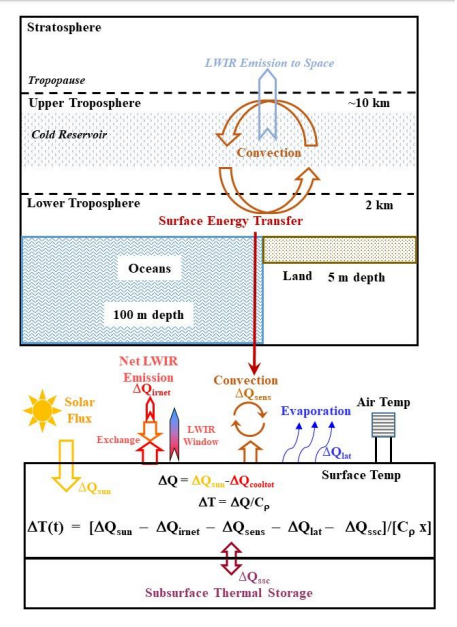
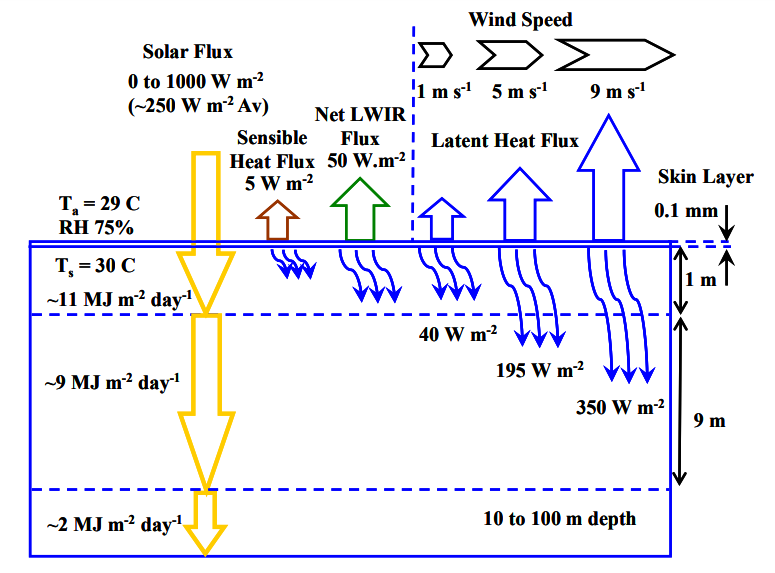
Figure 2: Thermal reservoirs, surface energy transfer and thermal storage (schematic). The surface is heated by the sun and cooled by a combination of net LWIR emission, convection and evaporation. Heat is stored below the surface and released over a range of time scales. There is no ‘equilibrium average temperature’. Source: Roy Clark


Near the surface, the lines in the main bands for CO2 and water vapor are sufficiently broadened that they merge into a continuum. There is an atmospheric transmission window in the 8 to 12 micron spectral region that allows part of the surface LWIR flux to escape directly to space. The magnitude of this transmitted cooling flux varies with cloud cover and humidity. The downward LWIR flux to the surface from the broad molecular emission bands provides an LWIR exchange energy that ‘blocks’ the upward LWIR flux from the surface. Photons are exchanged without any net heat transfer.

In order for the surface to cool, it must heat up until the excess absorbed solar heat is removed by moist convection. This is the real cause of the so called ‘greenhouse effect’.

It requires the application of the Second Law of Thermodynamics to the surface exchange energy. There is no equilibrium average climate so there can be no average ‘greenhouse effect temperature’ of 33 K. Instead, the greenhouse effect is just the downward LWIR flux from the lower troposphere to the surface. It can be defined as the downward flux or as an ‘opacity factor’ [Rorsch, 2019]. This is the ratio of the downward flux to the total blackbody surface emission.

The surface temperature has to be calculated at the surface using the surface flux balance. The change in local surface temperature is determined by the change in heat content or enthalpy of the local surface thermal reservoir divided by the specific heat [Clark, 2013a, b]. The LWIR flux cannot be separated from the other flux terms and analyzed independently. The land and ocean surface behave differently and have to be considered separately.

Over land, the various flux terms interact with a thin surface layer. During the day, the surface heating produces a thermal gradient both with the cooler air layer above and the subsurface layers below. The surface-air gradient drives the convection or sensible heat flux. The subsurface thermal gradient conducts heat into the first 0.5 to 2 meter layer of the ground. Later in the day this thermal gradient reverses and the stored heat is released back into the troposphere. The thermal gradients are reduced by evaporation if the land surface is moist. An important consideration in setting the land surface temperature is the night time convection transition temperature at which the surface and surface air temperatures equalize. Convection then essentially stops and the surface continues to cool more slowly by net LWIR emission. This convection transition temperature is reset each day by the local weather conditions.

The ocean surface is almost transparent to the solar flux. Approximately 90% of the solar flux is absorbed within the first 10 m ocean layer. The surface-air temperature gradient is quite small, usually less than 2 K. The excess absorbed solar heat is removed through a combination of net LWIR emission and wind driven evaporation. The penetration depth of the LWIR flux into the ocean surface is 100 µm or less and the evaporation involves the removal of water molecules from a thin surface layer [Hale and Querry, 1972]. These two processes combine to produce cooler water at the surface that sinks and is replaced by warmer water from below. This is a Rayleigh-Benard convection process, not simple diffusion. There are distinct columns of water moving in opposite directions. The upwelling warmer water allows the wind driven ocean evaporation to continue at night. As the cooler water sinks, it carries with it the surface momentum or linear motion produced by the wind coupling at the surface. This establishes the subsurface ocean gyre currents. Outside of the tropics there is a seasonal phase shift that may reach 6 to 8 weeks.

This phase shift can only occur with ocean solar heating. The heat capacity of the land thermal reservoir is too small to produce this effect. In many parts of the world, the prevailing weather systems are formed over the ocean. The temperature changes related to the ocean surface are stored by the weather system as the bulk surface air temperature and this information can be transported over very long distances. Such ocean related phase shifts can be found in the daily climate data for weather stations in places like Sioux Falls SD.

Over the oceans, the wind driven evaporation can never exactly balance the solar heating. This produces the ocean oscillations such as the ENSO, PDO and AMO.

These surface temperature changes are incorporated into the various weather systems and can be seen in the long term climate data, particularly the minimum MSAT. The whole global warming scam is based on nothing more than the last AMO warming cycle coupled into the weather station data [Akasofu, 2010].

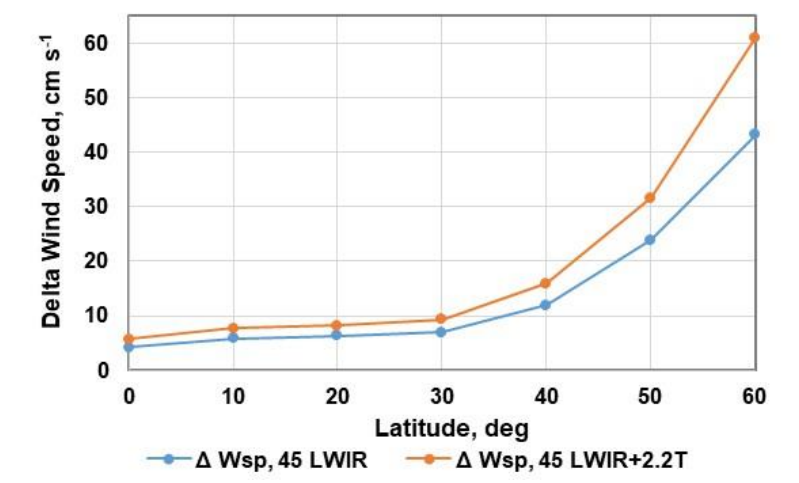
Figure 1: Change in wind speed (cm s-1) needed to restore the ocean surface cooling flux when the downward LWIR flux is increased by 2 W m-2 Both the fixed and the temperature dependent LWIR window flux cases are shown.

A fundamental failure of the radiative forcing argument is the lack of any error analysis. Over the last 200 years, the atmospheric CO2 concentration has increased by a little over 120 ppm. This has produced an increase in the downward LWIR flux at the surface of about 2 W m-2 [Harde, 2017]. Over the oceans this is coupled into the first 100 micron layer of the ocean surface. Here it is fully coupled to the wind driven evaporation. Using long term ocean evaporation data from Yu et al, 2008, an approximate estimate of the evaporation rate within the ±30 degree latitude region is 15 Watts per square meter for each change in wind speed of 1 meter per second.

This means that the radiative forcing from an increase of 120 ppm in the CO2 concentration amounts to a change in wind speed of about 13 CENTIMETERS per second.

This is at least two orders of magnitude below the normal variation in ocean wind speed. Similarly, a reasonable estimate of the bulk convection coefficient for dry land is 20 Watts per square meter per degree C difference between surface and air temperature. Here a 2 W m-2 change in convection requires a change of 0.1 C in the surface air thermal gradient.

Once the physics of the time dependent surface energy transfer is restored, global warming and radiative forcing disappear into the realm of computerized climate fiction.

The topic of radiative forcing was recently reviewed in detail by Ramaswamy et al [2019] as part of the American Meteorological Society monographs series. This review provides a good start for a scientific and criminal fraud investigation into the climate modeling fraud. To begin, the scientific community should demand that this particular monograph be retracted and all further work on equilibrium climate modeling be stopped. Any climate model that uses radiative forcing is by definition invalid. There is no need to try and validate the computer code of any equilibrium climate model. The use of radiative forcing alone is sufficient to render the results totally useless. These modelers are not scientists, they are mathematicians playing with a set of physically meaningless equations. They left physical reality behind when they made the climate equilibrium assumption. They are now members of a rather unpleasant quasi-religious cult. They believe that the divine spaghetti plots created by the computer climate models come from a higher authority that the Laws of Physics.

Figure 12: The ocean surface energy balance in the tropical warm pool. The evaporative surface cooling is strongly dependent on the wind speed. Source: Roy Clark

Any realistic climate model must correctly predict the changes in ocean temperature caused by the ocean oscillations. These must then be used to predict the changes in the weather station data.

This must include the minimum and maximum surface air temperatures, surface temperatures and the phase shifts. There are no forcings, feedbacks or climate sensitivities, just time dependent rates of heating and cooling. It is time to welcome the Second Law of Thermodynamics back to the climate models. It has always been part of the Earth’s climate system. [See linked post for references]

Roy Clark’s research studies are available at his website Ventura Photonics

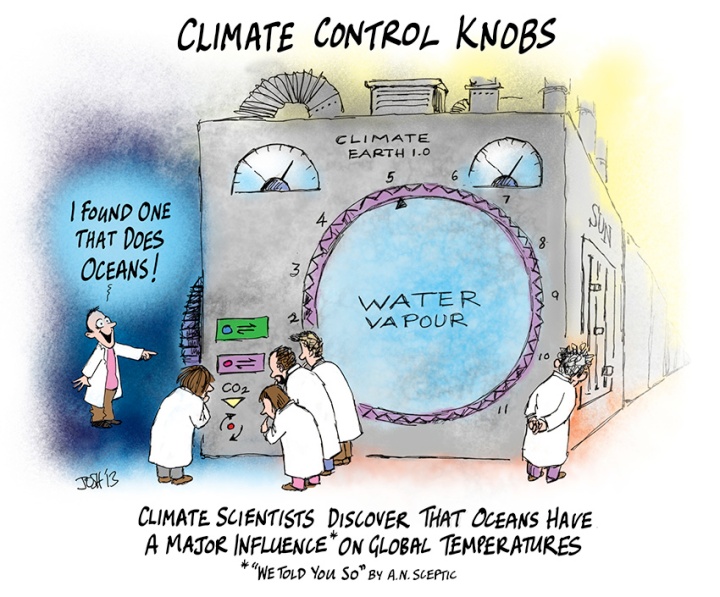
See Also Bill Gray: H20 is Climate Control Knob, not CO2