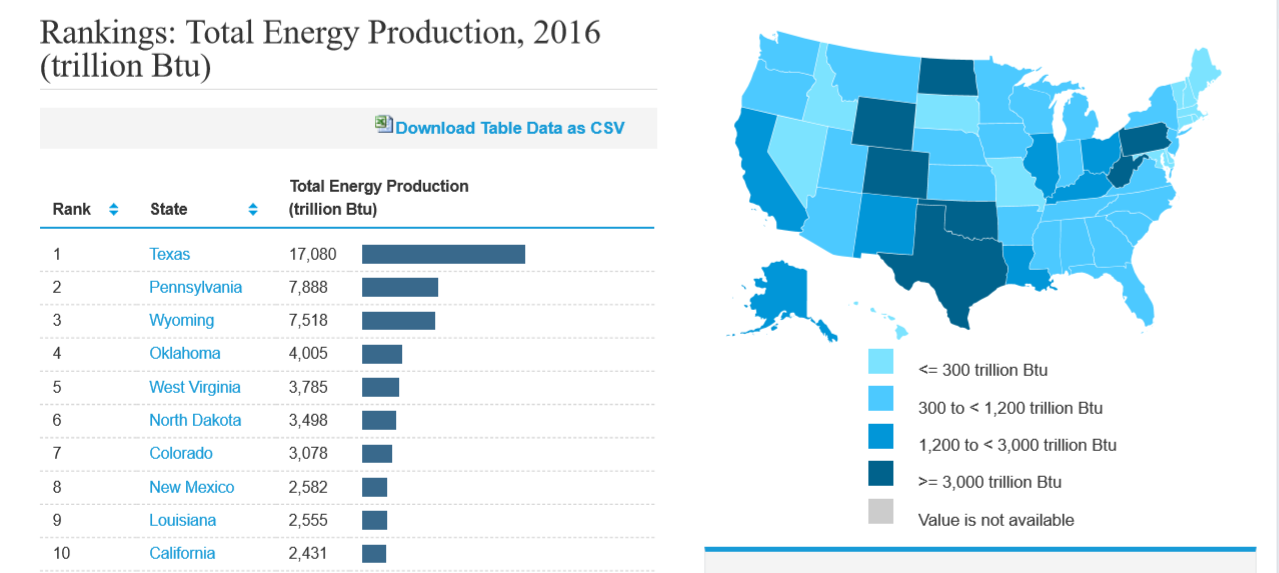
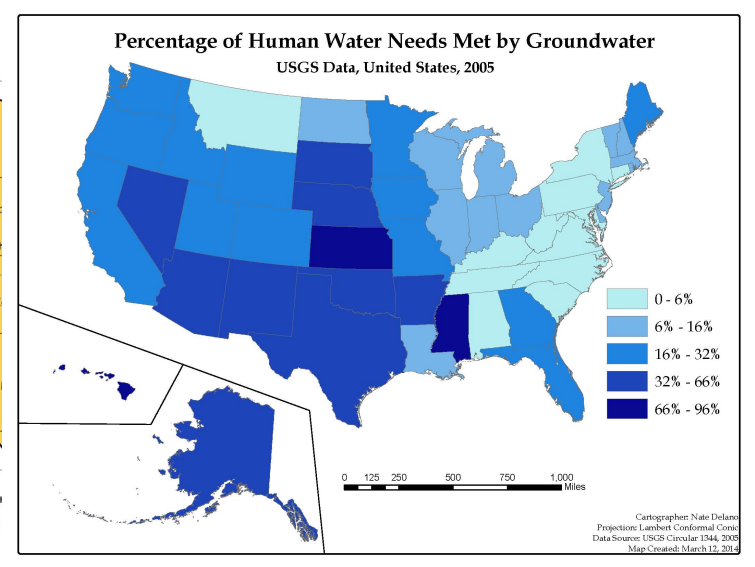
Fracking Update: Texas Leads US in Pure Energy, Pure Water

John Tintera writes at Texas Alliance of Energy Producers Congress, Look at Texas for the Facts on Fracking.  Excerpts in italics with my bolds.

On Thursday, the House Subcommittee on Energy and Mineral Resources will hold a hearing to investigate whether oil and gas drilling causes water pollution. It’s a very important topic. If drilling pollutes our drinking water, new restrictions would obviously be needed to safeguard public health.

Fortunately, every available piece of scientific evidence shows that drilling — particularly the technique known as hydraulic fracturing, or fracking — is safe. As a geologist who has spent decades regulating the energy industry, I’ve seen firsthand the extensive precautions companies take to avoid any accidents and protect our water sources. Current safety regulations are already working. There’s no need to impede energy production by binding companies with additional red tape from the federal government.

Just look at my home state of Texas. It’s by far America’s biggest energy producer, and home to the 75,000-square-mile Permian Basin, the world’s most productive oil field. The Permian and other Texas oil fields use tons of water responsibly whether for hydraulic fracturing, processing, or refining.

How responsible are Texas drillers when it comes to water management? Well, there hasn’t been a single documented case of groundwater contamination associated with fracking.

This drilling technique has led to an unprecedented oil and gas revolution. In just the first quarter of 2019, Texas, for the first time ever, produced more than 5 million barrels of crude oil every day. The state accounts for an astounding 40 percent of all crude production in the United States.

The cooperation between industry and Texas state regulators is chiefly responsible for this spotless safety record.

Texas state law is as crystal clear as its water. Texas outlaws any pollution of any and all bodies of water — whether above or below ground — period. The law defines pollution as any change at all to water that would make it harm humans, animals, plants, property, or public health in general.

There are numerous key laws — 13 total — that serve as a regulatory framework to enforce the no-pollution rule. They outline rules for everything from how to drill to how to clean up a spill. They address almost every water protection concern that could arise from oil and gas production.

Take fracking, a process which requires immense amounts of water. There are rules to govern how practitioners drill, what cement and casings they use, and how they control their wells. Additionally, they are required to continually monitor pressure levels beneath the surface and report malfunctions to inspectors.

Or consider waste disposal. The Texas regulations protect surface and subsurface water from liquid and solid oil field waste. Injection wells, the shafts that carry fluids down to porous underground rock formations, are highly regulated by the EPA and encased in multiple layers of cement to protect drinking water. The EPA audits each injection well annually.

Regulators wouldn’t be able to enforce these rules without a small army of state inspectors. There are hundreds of them in Texas that rove the oil fields to make sure everything is up to snuff. These “outriders” have access to all the online data they need to ensure proper inspection.

Companies are not only complying with the regulations; they are constantly finding new ways to protect water. Operators in the Permian Basin are using new technologies like “clean brine” to make produced water clean enough to reuse. They are also building pipelines to wastewater treatment or recycling facilities and reusing produced water. The reused water is not only used for more drilling, but can be used for community improvement like de-icing roads during winter.

Some companies are finding novel ways to reuse and conserve water. In 2016, one Texas-based energy company opened a 20-mile pipeline to receive treated municipal wastewater from Odessa, Texas that can be used in all its operations. Reusing municipal wastewater reduced the company’s reliance on freshwater needed in Odessa for drinking, and compensates Odessa for once-useless waste.

Thanks to sensible regulations, regular inspections, and industry efforts, Texas energy companies have little impact on the state’s water supply. A study by the state found that fracking accounts for less than 1 percent of total water use in the state, far less than agriculture.

Texans know what they’re doing when it comes to safeguarding their drinking water. There’s no need for Washington to impose additional, needless regulations when the current ones are already working perfectly.

John Tintera is a regulatory expert and licensed geologist with a thorough knowledge of upstream oil and gas exploration. He spent over 20 years working for the main energy regulator in Texas, the Texas Railroad Commission, and ultimately served as its executive director. He is currently the president of the Texas Alliance of Energy Producers.

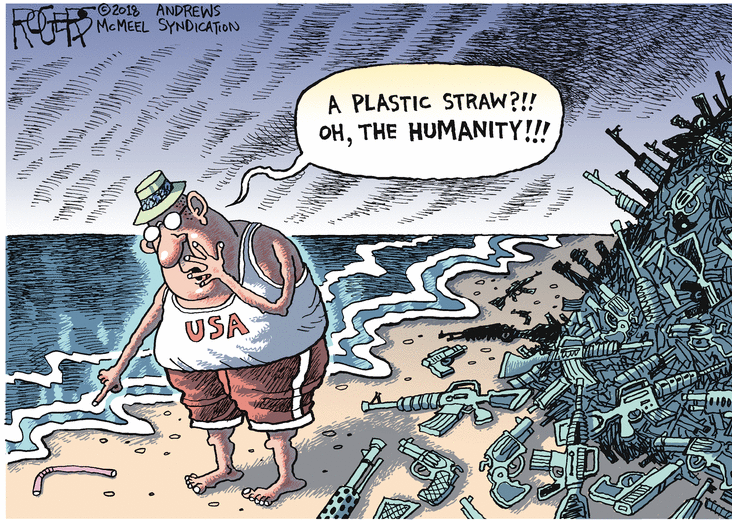
Plastic Trash Talking

Following a viral video of a turtle with a straw in his nose, plastics suddenly went from the “greatest thing since sliced bread” to environmental villain. This post first summarizes the waste plastic problem discussed in a recent GWPF paper. As in other cases of environmental issues, plastic trash talking conflates several problems, including littering, waste recycling and plastics disposal. Secondly, we shall see that the obvious advantages of incineration are resisted out of (can you guess?) fear of global warming from CO2.

As reported in GWPF, Dr. Mikko Paunio of the University of Helsinki has warned that the UN’s decision to regulate waste plastic as hazardous and restrict exports will unleash a “surge of waste” on many EU countries. Paunio urges a rapid expansion of waste incineration capacity to stop the plastic waste problem turning into a public disaster. His paper is Saving the Oceans and the Plastic Recycling Crisis. Excerpts in italics with my bolds.

Executive Summary

The United Nations has just decided to add mixed and contaminated plastic waste to the schedule of materials that are regulated under the Basel Convention. This decision will have major implications.

Firstly, it represents a major victory for the environment because it will effectively prevent a large proportion of exports of plastic waste to developing countries. Much of this material ends up in the oceans, so the UN decision does away with a major contribution to the problem of marine waste.

However, it will also mean that the problem of what to do with plastic waste will return to countries that produce it. What is worse, the EU is putting in place stringent new rules on plastic recycling, which will only increase the size of the problem, as will its new rules on landfill.

As a result, EU countries will find themselves faced with a growing mountain of plastic waste, and with few means at their disposal to deal with it. The EU has previously been deeply opposed to incineration of waste because of green dogma: they believe that recycling is virtuous in its own right, as well as seeing it as part of the fight against climate change.

And even if they were to change their views, there could still be major problems because the incineration capacity available falls far short of what is required.

A rapid expansion of waste incineration capacity is urgently required to stop the plastic waste problem turning into a disaster.

The global waste crisis

The Campania (Naples 1990s) trash crisis is a clear warning to governments about the problems that can be caused by blindly following green ideology. Now, it has become clear that a much larger crisis, global in scale, may almost be upon us. The global plastics ‘recycling’ industry is already on the verge of meltdown as a result of China’s import ban. Not only the biggest plastic waste exporter – the European Union – but also the rest of the English-speaking world, Japan and even Brazil, a developing country, are now witnessing rapidly growing mountains of plastic waste. In all these countries, the people who have in good faith been sorting their plastic waste for recycling can quite rightly feel betrayed.

Wealthy countries have tried to deal with China’s import ban by exporting waste to countries like Bangladesh, Indonesia, Malaysia, the Philippines and Vietnam. However, waste management in these places is often primitive, and the result has been severe problems with marine pollution. So even though these imports bring much-needed revenue, the situation is becoming so bad that legislative barriers are being raised to prevent them.

plastic_paper_straws

One of the most important developments, which has received little international attention,
is the silent decision of hundreds of municipalities in the US to stop recycling solid waste altogether. These are not ‘Trumpian’ decisions, but decisions made by both Democrats and Republican administrations at local level across the country.

The EU’s confused position on incineration

So the EU’s policy response to the marine plastic waste problem has been to adopt policies that will do little to reduce plastic waste, and which will probably cause the problem to become worse. The example of the Campania crisis, which was only resolved by extensive use of incineration, is therefore likely to become important. Incineration is superior to all other waste management options in terms of climate change mitigation, because it avoids the complex and resource-hungry schemes involved in, for example, turning it into diesel fuel or converting it to some other product. Meanwhile, incineration directly reduces demand imports of coal used in large quantities to produce heat and electricity. Recycling is certainly worse on other fronts too, not least the fact that recycling plants release microplastics in their wastewater streams, while only delivering low-quality recycled material that cannot
be used in important applications like food packaging.

The Commission has argued in favour of incineration, but only very rarely. In a paper entitled, ‘A Clean Planet for All’, released before UNFCCC COP 25 in Katowice, it argued for a carbon-neutral economy fuelled by biomass, although it was reticent about explaining where this biomass should come from. The answer is found in an accompanying document, which explains that it will actually be waste that is burned, and suggests that waste incineration capacity should increase to 100 million tons in 2050.

However, mostly it has been strongly against the idea. For example, in reference to the Circular Economy proposal, it said that of the possible approaches to waste management, recycling was to be preferred, apparently on climate change mitigation grounds, although it presented no evidence to support this claim. It also said that reprocessing waste into fuels is not recycling, but is, like waste incineration, ‘material recovery’. As a result, it has declared that its new cohesion fund will not fund waste incineration plants.

Advantages of  Burning Plastic

You will read in alarmist media about the dangers of incineration releasing chemicals such as hydrochloric acid, sulfur dioxide, dioxins, furans and heavy metals, as well as particulates. It is true that incomplete combustion of any hydrocarbon is to be avoided. But mainly detractors are using chemophobia against plastic incineration because of their obsession with CO2. Some common sense is provided by Flo-Bro The surprising benefits of burning plastics. Excerpt below with my bolds.

The plastic revolution

Whilst travelling, we’ve witnessed how several Asian countries such as Cambodia and Indonesia have turned into plastic junkyards. Inland and coastal areas are littered with a colourful mixture of bags, bottles, cups, trays and everything else, it is truly a sad and terrible sight. A lot of countries, not just in Asia, suffer from bad solid waste management. Moreover, littering seems to be a deep engrained cultural element. Whilst care for the environment seems to be on the last stage of people’s and the government’s interests, the nature is suffering and people too.

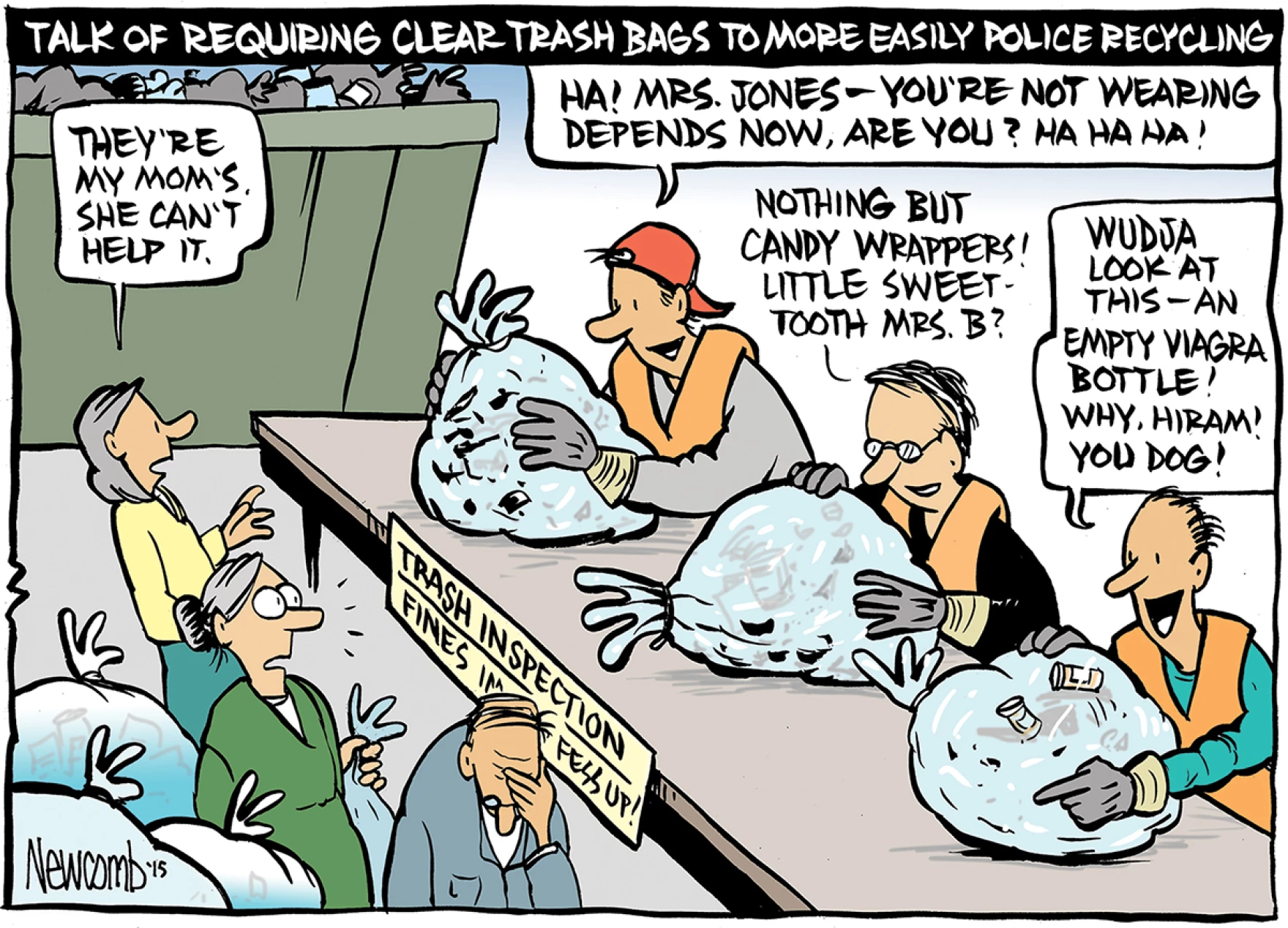
Reaction to Vermont proposal requiring clear plastic trash bags.

Owing to the favourable properties of plastic – strength, durability and light weight, we embraced them in all areas of life. Plastics have created a revolution and improved the quality of life immensely, however, nowadays they seem to be one of greatest plagues of our planet. I can’t enumerate the number of times I came across an article talking about the great plastic vortex the size of Europe in the Pacific, and that the ocean will soon contain more plastic than fish.

The chemical elements of plastic

Most of the packaging plastics which pollute the environment are based on two to four chemical elements. Polystyrene, polyethylene and polypropylene are made of carbon and hydrogen, whilst PET (polyethylene terephthalate), used for bottles, contains also oxygen. Nylon, a polyamide, which is used to make fibres, also contains oxygen and nitrogen in its structure. These elements are essentially the same ones that fossil fuels are made of. This should be of no surprise, since plastics (long chain hydrocarbons) are also made of the same crude oil, as their “short chain” relatives- gasoline and diesel.

In other words: if burned well, plastics create the same products as wood and fossil fuels -> water and carbon dioxide

Recycle or burn plastics?

In conventional terms, it is environmentally more sound to recycle plastics than dispose them. This approach, however, has so far proven quite challenging and more frequently results in “downcycling”.  But even downcycling requires large centralised facilities with advanced sorting lines and plastic recovery processes, which is very expensive and not applicable to solve the pollution problem.

So, you were always told that burning plastics is bad for the environment. Indeed, incomplete combustion of any hydrocarbon creates noxious smoke. As the above image depicts, burning plastics can create the same products as fossil fuel and wood. In waste incineration facilities, thousands of tons of plastic burn worldwide daily, generating heat and electricity.

Burning any material well and without smoke and noxious fumes needs a high temperature and plenty of oxygen. This is best achieved in a stove, where the heat is concentrated and can be put to good use.

As with most solutions, this one is not free of flaws. Plastics such as PVC (polyvinyl chloride), which is used for plumbing, can create more dangerous products of decomposition – such as corrosive HCl gas; and several plastics. Usually the hard plastic used in motorbikes and cars contain flame retarders, which are too not the friendliest chemicals and may create toxic fumes when burned. Based on what I’ve seen, these plastics are a minority and PVC and hard plastics are denser than water and will sink If they end up in the sea. What you see washed up on the shore are light packaging materials and foams.

Conclusion

Plastic pollution is unfriendly to animals and is undoubtedly aesthetically damaging the environment. Burning them might be the best way to quickly improve the situation. If people recognize the benefit of burning plastics in the right stove, it will save them money on fossil fuels, stop plastic pollution, limit deforestation, and improve the quality of life. Combustion of low value packaging plastics is not a totally new idea and a company has already received an award for it.


See also Fighting Plasticphobia

Duped into War on Plastic

Cyber Solutions Can’t Fix the Climate

This post is dedicated to Silicon Valley nouveau rich and their Cyber-Space Cadets now in the streets demanding that adults fix the climate, and fix it now!  Their thinking is fatally flawed by the simplistic transfer of tactics from cyber world to the real physical world.

Mark P. Mills writes at City Journal Want an Energy Revolution?  It won’t come from renewables—which can never supply all the power we need—but from foundational scientific discoveries. Excerpts in italics with my bolds.

Throughout history, some 60 percent to 90 percent of every nation’s economy has been consumed by food and fuel costs. Hydrocarbons changed the way that humans organize their productive capacity. The coal age, followed by the oil age, and now by the ascendant age of natural gas, has (at least for developed nations) driven the share of GDP devoted to acquiring food and fuel down to around 10 percent. That transformation constitutes one of the great pivots for civilization.

Many analysts claim that yet another such consequential energy revolution is upon us: “clean energy,” in the form of wind turbines, solar arrays, and batteries, they say, is about to become incredibly cheap, making it possible to create a “new energy economy.” Polls show that nearly 80 percent of voters believe that America is “capable of creating a new electricity system.”

We can thank Silicon Valley for popularizing “exponential change” and “disruptive innovations.” The computing and communications revolutions that have transformed many industries have also shaped both expectations and rhetoric about how other technologies evolve. We hear claims, as one Stanford professor put it, that clean tech will follow digital technology in a “10x exponential process which will wipe fossil fuels off the market in about a decade.” Or, as the International Monetary Fund recently summarized, “smartphone substitution seemed no more imminent in the early 2000s than large-scale energy substitution seems today.” The mavens at Singularity University tell us that with clean tech, we’re “on the verge of a new, radically different point in history.” Solar, wind, and batteries are “on a path to disrupt” the old order dominated by fossil fuels.

Never mind that wind and solar—the focus of all “new energy economy” aspirations, including its latest incarnation in the Green New Deal—supply just 2 percent of global energy, despite hundreds of billions of dollars in subsidies. After all, it wasn’t long ago that only 2 percent of the world owned a pocket-sized computer. “New energy economy” visionaries believe that a digital-like energy disruption is not just possible, but imminent. One professor predicts that we will see an “Apple of clean energy.”

A similar transformation in how energy is produced or stored isn’t just unlikely: it’s impossible. Drawing an analogy between information production and energy production is a fundamental category error. They entail different laws of physics. Logic engines don’t produce physical action or energy; they manipulate the idea of the numbers one and zero. Silicon logic is rooted in simply knowing and storing the position of a binary switch—on or off.

But the energy needed to move a ton of people, heat a ton of steel or silicon, or grow a ton of food is determined by properties of nature, whose boundaries are set by laws of gravity, inertia, friction, and thermodynamics—not clever software or marketing. Indeed, the differences between the physical and virtual are best illustrated by the fact that, using mathematical magic, one can do things like “compress” information to reduce the energy needed to transport that information. But in the world of humans and objects with mass, comparable “compression” options exist only in Star Trek.

Spending $1 million on wind or solar hardware in order to capture nature’s diffuse wind and sunlight will yield about 50 million kilowatt-hours of electricity over a 30-year period. Meantime, the same money spent on a shale well yields enough natural gas over 30 years to produce 300 million kilowatt-hours. That difference is anchored in the far higher, physics-based energy density of hydrocarbons. Subsidies can’t change that fact.

And then batteries are needed, and widely promoted, as the way to convert wind or solar into useable on-demand power. While the physical chemistry of batteries is indeed nearly magical in storing tiny quantities of energy, it doesn’t scale up efficiently. When it comes to storing energy at country scales, or for cargo ships, cars and aircraft, engineers start with a simple fact: the maximum potential energy contained in hydrocarbon molecules is about 1,500 percent greater, pound for pound, than the maximum theoretical lithium chemistries. That’s why the cost to store a unit of energy in a battery is 200 times more than storing the same amount of energy as natural gas. And why, today, it would take $60 million worth of Tesla batteries—weighing five times as much as the entire aircraft—to hold the same energy as is held in a transatlantic plane’s onboard fuel tanks.

For a practical example of the physics-anchored gap between aspiration and reality, consider Florida Power & Light’s (FPL) recently announced plan to replace an old gas-fired power station with the world’s biggest battery project—promised to be four times bigger than the current number one, a system Tesla installed, to much fanfare, last year in South Australia. The monster FPL battery “farm” will be able to store just two minutes of Florida’s electricity needs. That’s not going to change the world, or even Florida.

Moreover, it takes the energy equivalent of about 100 barrels of oil to manufacture a battery that can store the energy equal to one oil barrel. That means that batteries fabricated in China (most already are) by its predominantly coal-powered grid result in more carbon-dioxide emissions than those batteries, coupled with wind/solar, can eliminate. It’s true that wind turbines, solar cells, and batteries will get better, but so, too, will drilling rigs and combustion engines. The idea that “old” hydrocarbon technologies are about to be displaced wholesale by a digital-like, clean-tech energy revolution is a fantasy.

If we want a disruption to the energy status quo, we will need new, foundational discoveries in the sciences. As Bill Gates has put it, the challenge calls for scientific “miracles.” Any hoped-for technological breakthroughs won’t emerge from subsidizing yesterday’s technologies, including wind and solar. The Internet didn’t emerge from subsidizing the dial-up phone, or the transistor from subsidizing vacuum tubes, or the automobile from subsidizing railroads. If policymakers were serious about the pursuit of the next energy revolution, they’d be talking a lot more about reinvigorating support for basic science.

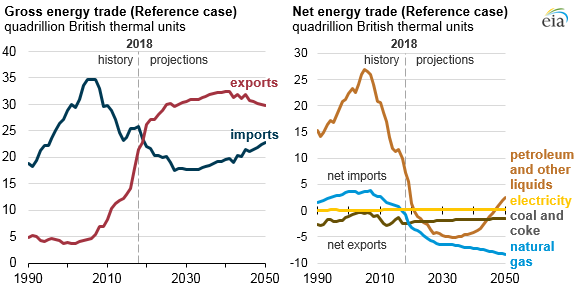
It bears noting that over the past decade, U.S. production of oil and natural gas has increased by 2,000 percent more than the combined growth of (subsidized) wind and solar. Shale technology has utterly transformed the global energy landscape. After a half-century of hand-wringing about import dependencies, America is now a major exporter. Now that’s a revolution.

See also Energy Changes Society: Transition Stories

US News is Skewed Up and Dumbed Down

Under the Suspicions Confirmed file, we have quantitative proof that US news is increasingly skewed according to the values of the media outlet. Rand corporation is publishing studies on the theme Truth Decay, based on analyzing 15 prominent and popular media platforms. The latest report is at phys.org entitled US journalism has become more subjective. Excerpts in italics with my bolds.

U.S.-based journalism has gradually shifted away from objective news and offers more opinion-based content that appeals to emotion and relies heavily on argumentation and advocacy, according to a new RAND Corporation report.

In a unique analysis on news discourse and presentation, researchers found that the changes occurred over a 28-year-period (1989 to 2017) as journalism expanded beyond traditional media, such as newspapers and broadcast networks, to newer media, such as 24-hour cable channels and digital outlets. Notably, these measurable changes vary in extent and nature for different news platforms.

“Our research provides quantitative evidence for what we all can see in the media landscape: Journalism in the U.S. has become more subjective and consists less of the detailed event- or context-based reporting that used to characterize news coverage,” said Jennifer Kavanagh, a senior political scientist and lead author of the report, which is second in a series of research into the phenomenon of “Truth Decay,” the declining role of facts and analysis in civil discourse and its effect on American life.

News consumers can now see how the news has changed over the years and keep that in mind when making choices about which media outlets to rely on for news,” she added.

The analysis, enabled by a RAND text analytics tool previously used to analyze support and opposition to Islamic terrorists on social media, offers a detailed assessment of how news has shifted over time and across platforms. The RAND-Lex tool scanned millions of lines of text in print, broadcast and online journalism from 1989 (the first year such data was available via Lexis Nexis) to 2017 to identify usage patterns in words and phrases. Researchers were then able to measure these differences not only within one outlet or type of media (e.g. print) but also comparatively with other forms of journalism (e.g. print vs. digital).

Researchers analyzed content from 15 outlets representing print (The New York Times, Washington Post and St. Louis Post-Dispatch), television (CBS, NBC, ABC, CNN, Fox and MSNBC) and digital journalism (Politico, The Blaze, Breitbart News Network, Buzzfeed Politics, The Daily Caller and The Huffington Post).

The findings point to a gradual and subtle shift over time and between old and new media toward a more subjective form of journalism that is grounded in personal perspective.

Consider broadcast news. Before 2000, broadcast news segments were more likely to include relatively complex academic and precise language, as well as complex reasoning. After 2000, broadcast news becomes less pre-planned as on-air personalities and guests engaged in conversations about news. (That year, 2000, is significant in the evolution of the media landscape, as viewership of all three major cable networks began to increase dramatically.)

Comparing broadcast news to cable programming, differences become more stark, with cable segments dedicating more time to opinion coverage and using argumentative language. The size and scope of these changes is substantial, but researchers also noted that these differences may be in part a result of their different audiences, with cable news focusing on specialized audiences.

When comparing newspapers to digital outlets, researchers were able to identify significant differences. Newspapers have changed the least over time, with content slightly shifting from a more academic style to one that is more narrative. As for digital journalism, the report found that online content is more personal and direct, narrating key social and policy issues through personal points of view and subjective references.

“Our analysis illustrates that news sources are not interchangeable but each provides mostly unique content, even when reporting on related issues,” said Bill Marcellino, a behaviorial and social scientist and co-author of the report. “Given our findings that different types of media present news in different ways, it makes sense that people turn to multiple platforms.”

The report is one in a series of RAND-funded reports into the triggers and consequences of Truth Decay. The first report, written by Kavanagh and RAND President and CEO Michael D. Rich, examined how Truth Decay is a set of four interrelated trends:

    • increasing disagreement about facts;
    • a blurring between opinion and fact; 
    • an increase in the relative volume of opinion and personal experience over fact; and
    • declining trust in formerly respected sources of factual information.

That report identified how changes in the media have contributed to Truth Decay by increasing the volume of opinion over fact. Forthcoming reports will examine issues such online civic engagement and use of social media for political activities, public trust in institutions and how to evaluate media literacy programs.

“RAND has always been an institution where facts matter,” Rich said. “This new stream of research sheds additional light on the drivers and implications of Truth Decay and is part of our continuing efforts to use analysis to improve civil discourse and public policymaking.”

Footnote

See also How Mass Media Became One-Sided

For discussion of media impact on global warming/climate change see Climate Is a State of Mind

More Alarmist Hysteria: Trump’s China Tariffs

Brett Arends writes at Market Watch The media is lying to you about Trump’s China tariffs. Excerpts in italics with my bolds.

The hysteria must have a political agenda because the amount that’s being charged is peanuts.

Are you kidding me?

I’m used to partisan, inaccurate drivel from all sides these days, but the media’s coverage of President Trump’s tariffs and the so-called “trade war” takes some kind of cake.

China Tariffs

There’s no serious doubt that some in the media would absolutely love to tank the stock market. They figure that would hurt Trump’s re-election chances in 2020. Monday’s stock market slump, which saw the Dow Jones Industrial Average DJIA, +0.48% tumble 2.4% and the Nasdaq Composite 3.4%, looked just like what the doctor ordered.

I write this, incidentally, as someone who is no fan of the president. But I remember when politics was supposed to stop at the water’s edge.

And, anyway, facts are facts. Most of what the public is being told about these tariffs is either misleading or a downright lie.

I’ve been following the coverage all weekend with my jaw on the floor.

Uncle Sam benefits
Yes, tariffs are “costs.” But they do not somehow destroy our money. They do not take our hard-earned dollars and burn them in a big pile. Tariffs are simply federal taxes. That’s it. The extra costs paid by importers, and consumers, goes to Uncle Sam, to distribute as he sees fit, including, for example, on Obamacare subsidies.

It wasn’t long ago the media was complaining because Trump was cutting taxes. Now it’s complaining he’s raising them. Confused? Me too.

And the amounts involved are trivial. Chicken feed.

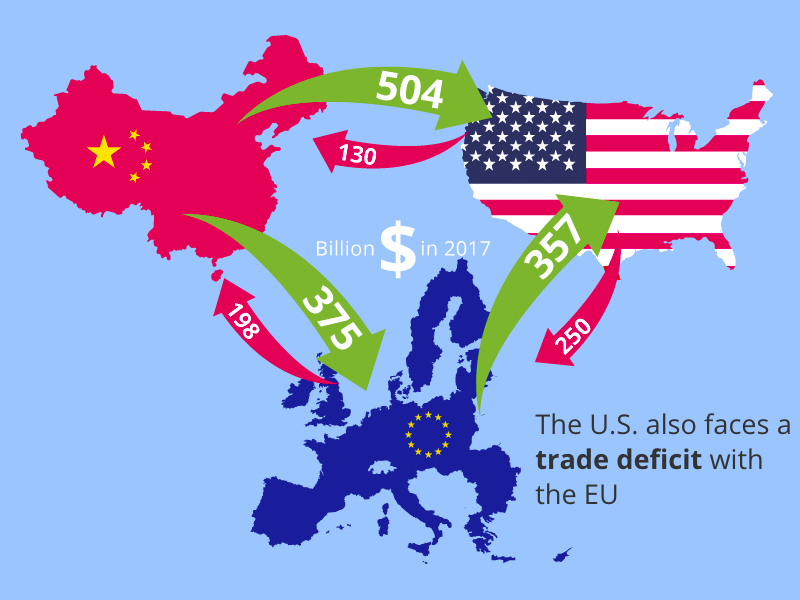
President Trump just hiked tariffs from 10% to 25% on about $200 billion in Chinese imports. In other words, he just raised taxes by … $30 billion a year.

Oh, no!

The total amount we all paid in taxes last year — federal, state and local — was $5.51 trillion. This tax increase that has everyone’s panties in a twist is a rounding error.

opinion01_303289997_ar_1_pefceormstqxInvestors panic needlessly
Meanwhile, the total value wiped off U.S. stocks during Monday’s panic was about $700 billion. More than 20 years’ worth of the new tariffs.

Even if Trump slapped 25% taxes on all Chinese imports, it would come to a tax hike of … $135 billion a year. U.S. gross domestic product (GDP) last year: $20.5 trillion.

So even this supposedly scary “escalation” of this “tariff war” would, er, raise our total tax bill from 26.9% of GDP all the way to 27.5% of GDP.

Oh, and isn’t it interesting to see some people’s priorities? Apparently the most shocking part of this trivial tax hike is that it might raise the price of new Apple AAPL, +1.16% iPhones.

Last I checked, these were luxury items, right?

U.S. consumers gain
Meanwhile, the trade spat seems to be bringing down food prices. China is going to take less of our farm products. So wheat prices are down 20% since the start of the year. Soybeans are at 10-year lows.

Good for consumers, right?

No, no, of course not! Silly you. This is also bad news … for farmers!

And all this ignores the much bigger picture, anyway.

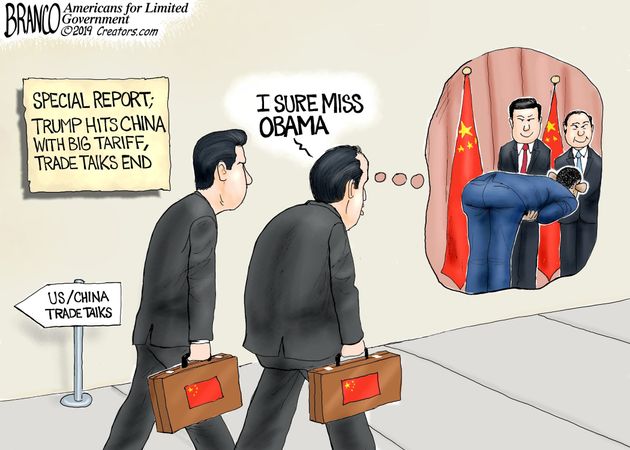
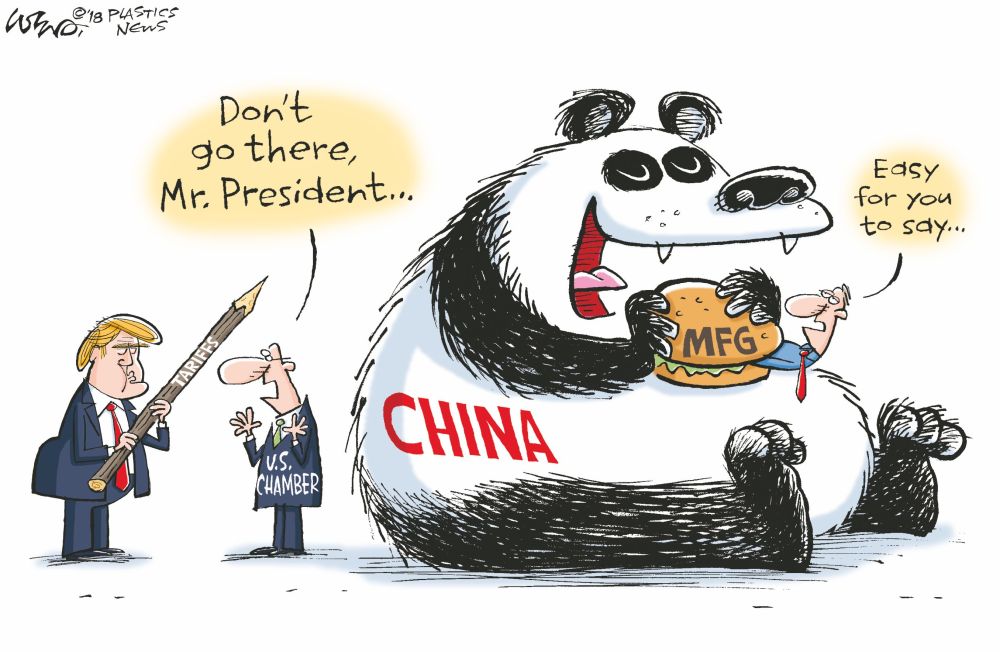
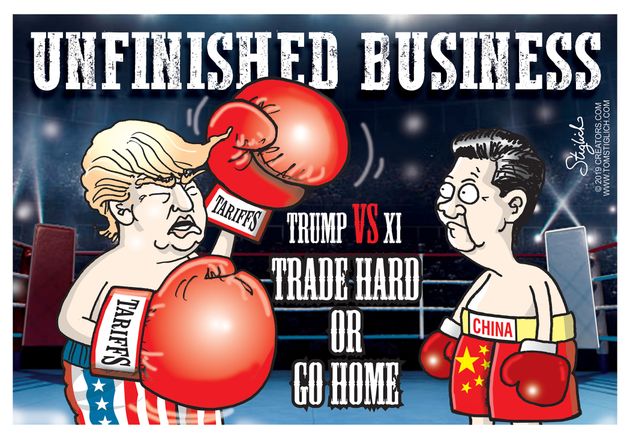
The tariffs are simply a means to an end. The president is trying to get China to start buying more of our stuff. He knows the so-called Middle Kingdom, which now has the second-biggest economy in the world, responds to incentives more than to nice words. These tariffs give China an incentive to open up.

OK, so China’s first reaction is just to retaliate. Big deal. That’s just posturing.

Right now we export less to China than we do to Japan, South Korea and Singapore put together. That’s the point. So the effect of China’s new tariffs on the U.S. are yet another rounding error. Even if China banned all imports from the U.S., that would amount to only 0.6% of our gross domestic product. And we’d sell the stuff somewhere else.

Don’t buy the hysteria. President Trump is simply trying to pressure our biggest competitor to buy more American goods. That should be a good thing, even if you don’t like him.

Footnote:

New York Post Editorial Board adds:

President Trump’s tariffs on China may well take a toll on the US economy, but the price of not confronting Beijing would be higher.

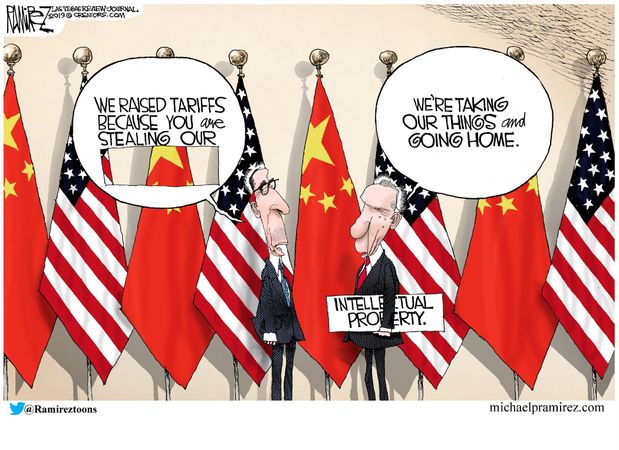
The president isn’t playing protectionist here. He’s pushing a single player who needs to be confronted, a cheater and a bully. For decades, China has gotten away with theft of others’ production techniques and other intellectual property, along with technology transfers and mistreatment of US companies. Moreover, it uses its ill-gotten gains to boost its military, adding another threat.

And Beijing just backed off key concessions it had already made in months of trade talks, expecting Washington to fold.

Instead, Trump goosed fees on $200 billion in Chinese imports to 25 percent, from 10 percent. China struck back with its own new tariffs on US products, and now Team Trump is eyeing fees on another $325 billion in Chinese goods (i.e., basically the rest).

The markets didn’t like it: Beijing’s new tariffs brought a 600-point drop in the Dow. Yet the index is still up 9 percent for the year, and nearly 30 percent since Trump took office.

And the Dow isn’t the US economy, which is now robust, with 3.2 percent growth last quarter and 3.6 percent unemployment in April, the lowest in half a century. If the country can’t afford to stand up to China now, it never will.

There’s a reason the president isn’t taking heat from Democrats on this one issue, even though top economic adviser Larry Kudlow admits “both sides will suffer” in this trade war: China knows it will suffer worse.

Short-term, US consumers will pay a bit more — on goods that make up less than 2 percent of the nation’s $20.5 trillion economy. But China is at growing risk of losing access to the world’s top market, because Americans can buy from other lower-wage producers if Beijing doesn’t blink.

And China’s leadership has no remaining claim to legitimacy if it can’t keep its economy booming: President Xi Jinping needs a deal far more than the US president does.

Trump didn’t start this trade war, but he’s well positioned to win it.


Cynical Climate Politics

Lots of politicians in the US are grinding the climate ax, but the most cynical play of the climate card is on display in Canada. At Financial Post Gwyn Morgan describes how PM Trudeau is relying on global warming to escape electoral disaster in upcoming federal elections. His article: In choosing to mislead Canadians on climate change, the Liberals are basing their election campaign on a known lie. After describing a list of Trudeau missteps and failures widely criticized in the media, Morgan gets into the climate ploy. Excerpts intalics with my bolds.

So how does a government that can’t campaign on its record go about gaining re-election? By building its campaign around an issue where voters can see them as heroes fighting to save the planet against uncaring opponents. That issue is climate change and their weapon to fight it is carbon taxation. Winning re-election with this strategy requires convincing voters there’s a “climate emergency.” And so on April 1, the day the federal carbon tax kicked in on provinces unwilling to impose a tax that met the Liberals’ requirements, the federal Department of Environment and Climate Change released a supposedly independent report claiming “Canada is warming twice as fast as the rest of the world.”

[Note: Friends of Science deconstructed that report in post Climate Change NOT as Advertised, and Ross McKitrick dispelled the logic in Climate Hearsay ]

From now until the election, Canadians will hear Trudeau and his cabinet members blame every weather event, wet, dry, cold or warm on climate change. And the urgent need for a carbon tax to stop it. When the prime minister recently visited flood-ravaged areas in Quebec, he called the floods “the new reality of climate change.” But experts attribute the recent flooding to one of the longest, coldest, highest-snowfall winters on record. Isn’t climate change supposed to be about global warming?

Convincing Canadians of the need for carbon taxation is just the first element of the Liberals’ re-election strategy. Their most powerful — and cynical — tactic is their promise to give most taxpayers a bigger carbon-tax refund than what they will supposedly pay in carbon taxes. How is that possible? The answer is that individuals will get the refunds, while businesses bear the full cost. In other words, tax the job creators and use that money to bribe the voters.

The principal gladiators leading the Liberal carbon-tax forces are Trudeau and his eco-passionate environment minister, Catherine McKenna. The defenders opposing them in the carbon-tax coliseum are the premiers of Alberta, Saskatchewan, Manitoba, Ontario and New Brunswick, along with federal Conservative leader Andrew Scheer. Scheer will have most of the spears trained on him. McKenna recently accused him of “having no climate plan.” But unlike the Liberals, Scheer’s climate plan needs to be based on the fundamental fact that Canadians could all move to Mars tomorrow and it would have virtually zero impact on global climate change. Here’s why.

Many Canadians have been led to believe (with the help of Liberal misinformation) that oil is a sunset industry. But the consensus of authoritative forecasts sees growth in developing countries pushing world oil demand from the current 100 million barrels per day to at least 110 million by 2030. Here’s the question Canadians should be asking: If world oil demand is going up anyway, why should Canada cede the market for our most important export to Russia, Iran, Nigeria and Saudi Arabia — countries that don’t care about the environment and have horrendous human rights records? At the same time, hundreds of coal-fired power plants are under construction in China, India and Southeast Asia. (Vietnam, one of the smallest countries in that region, has new coal plants under construction that could end up producing more carbon dioxide emissions than all of Canada.)

As good little scout Canada struggles mightily to meet its commitments under the Paris climate accord, the vast majority of nations on the planet have already given up on the pact. Last year, global greenhouse gas emissions grew by an estimated 2.7 per cent. So if Canada’s economy had simply ceased to exist, our 1.6 per cent of global emissions would have been replaced in just seven months.

These are irrefutable facts. So the decision by the Trudeau Liberals to base their election campaign on the assertion that reducing our country’s relatively tiny emissions will help fight climate change can only be explained in one of two ways. First, Trudeau and his team are breathtakingly unaware of facts anyone can learn through an afternoon of Googling. Second, they choose to mislead Canadians in a desperate bid for re-election. That would mean they choose to base their election campaign on a known lie.

So what should Canada actually do about climate change? The clearest answer was recently offered by a man in hip waders, who was filling sandbags to help with the flooding in Central Canada. When he was asked by a reporter what should be done to prevent the floods, he said this: “Well, there’s all this talk about climate change, but I don’t see what Canada can do about that when China and other countries keep burning more. If that’s going to cause more floods, we’d better figure out how we can be ready for them.”

That’s the most common-sense analysis I’ve heard. Instead of throwing away billions of dollars subsidizing costly and impractical “green power” and handing taxpayer money to buyers of electric cars, let’s redirect those billions to risk mitigation and homeowner compensation. In the case of floods, dikes and dams need to be improved where practical. Homeowners in unprotected flood plains should also be offered the full replacement cost to move, as Alberta did after the floods of 2013. After all, it’s flawed government zoning that put people in the flood plain and created the problem; it’s only fair to homeowners that government make things right. Forest-fire risk can be mitigated by underbrush removal, regulatory setback distances and fire-resistant building materials.

A Conservative climate-change mitigation strategy based on the common-sense words of that flood worker would make Canadians much better prepared for climate change. And it has the added benefit of actually telling Canadians the truth about the climate-change challenge. That would be Andrew Scheer’s most important difference from Justin Trudeau.

Gwyn Morgan is the retired founding CEO of Encana Corp.

Footnote:

A master class in exploiting global warming for political gain was portrayed in the British comedy series Yes Prime Minister

Transcript of video is at Yes PM Pokes Fun at Climatism

Bill Nye, Bad Science Guy

Bill Nye has a history of pushing bad science, including but not limited to climate change/global warming. Alex Berezow explains at American Council on Science and Health Bill Nye Is A Terrible Spokesman For Science.  Excerpts in italics with my bolds

When I was a kid, Bill Nye the Science Guy was a thing. I never watched his show (as I was too busy keeping up with Ren & Stimpy), but he seemed fun enough. If I could go back in time, I’d probably watch.

Some years later, Bill Nye experienced a resurgence in popularity. But instead of the old, nerdy-but-lovable Bill Nye, we got Bill Nye 2.0, a somewhat cantankerous scold who clearly knows less about science than he leads on.

It was clear that something was amiss a few years ago when, amid Nye’s renewed celebrity status, it came to light that he aired an episode of Eyes of Nye that perpetuated anti-GMO propaganda. Nye was subsequently criticized by the scientific and (especially) science writing communities. Not long thereafter, Nye had a change of heart.

Good! Better late than never. But was this “conversion” based on a new understanding of biotechnology or simply a calculated marketing move? Evidence points toward the latter. As late as 2015, Nye was still pushing anti-GMO nonsense. That year, he published a book called Undeniable, which promoted evolution over creationism. The book entirely lacked references (quite bizarre for a science book), and despite GMO technology itself being “undeniable,” Nye wrote this:

“But there is something weird and unnatural about putting fish genes in fruit, in tomatoes. Nobody wanted it, so that research was abandoned.

I’ll grant you, this could be a visceral reaction from ignorant consumers. Emotional responses do not necessarily reflect scientific reality, as is evident in everything from creationism to the anti-vaccine movement. In this case, though, I think science and emotion are on the same side. There are very valid scientific reasons to approach GMOs with caution, and those turn out to dovetail with economic reasons. So far, it’s not clear that investment in GMOs pays off. It is certainly not clear that GMO research should be funded with tax dollars.”

By 2016, however, he was singing a different tune. Call me jaded and curmudgeonly, but his newfound faith in GMOs doesn’t seem authentic.

Bill Nye, Prophet of Doom

In his latest appearance, Bill Nye had a cameo on John Oliver’s show, in which he lit a globe on fire and dropped a few F-bombs. (I guess that passes as comedy.) He also said that Earth’s temperature could rise by 4 to 8 degrees, presumably Fahrenheit, since Nye didn’t indicate which scale he was using. His projection is within the range predicted by the IPCC, so at least he got that right.

But is setting a globe on fire an appropriate analogy to get the message across? Earth’s temperature has gone up 1.4 degrees F since 1880. Undoubtedly, another 4 to 8 degrees is quite a lot in a short period of time. It doesn’t take a master prognosticator to conclude that might cause some problems. But Earth is not — nor will it ever be — a flaming ball of fire. Earth isn’t Venus.

Bill Nye 2.0

Ultimately, it seems that Bill Nye just panders to whatever he thinks the audience wants to hear. He thought (incorrectly) that they wanted to hear why GMOs were bad, so he altered his message when he got pushback. He won’t get pushback for exaggerating climate change, so it’s likely he’ll keep this up for a while.

climate-change-science-v-politics-cartoon

I don’t think Nye actually believes the climate hysteria. Because if he did, Nye would support whatever means necessary to stop it, like nuclear power. After all, he’s a mechanical engineer. But lo and behold, Nye is opposed to nuclear power. Big surprise. Audiences don’t like nuclear power.

Evolutionary biologist Jerry Coyne once wrote of Bill Nye, “I’m not a fan of the new Science Guy, and see him as a self-aggrandizing person trying to capture his lost limelight more eagerly than he wants to promulgate science.”

Unfortunately, I think that assessment is accurate. Bring back the old Bill Nye. Version 1.0 was better.

Climate Change NOT as Advertised

Just before the Trudeau government imposed its Carbon Tax, it did a PR release advertising all the bad things we are doing to the planet, changing the temperature and weather by burning fossil fuels. Several skeptics pushed back (see links at end). This post is a synopsis of a complete rebuttal from Friends of Science. The whole document is interestingly written and presented, with only a few of many telling points highlighted here.

Climate Change Your Mind. Responding to the Canadian government’s “Canada’s Changing Climate Report” CCCR2019  Excerpts in italics with my bolds and headers

Federal Government says: Both past and future warming in Canada is, on average, about double the magnitude of global warming.

Friends of Science say: CCCR2019 used a reference frame that began in a cooler solar minimum and ended in a higher temperature El Nino period.

The CCCR2019 report uses 1948 as a reference point, a time when temperatures dropped significantly. Referring to this low period as a starting point gives a skewed comparison. In addition the referenced period from 1986 to 2005 ends with an El Nino year, where naturally-caused high temperatures were recorded. This gives a false impression that Canada is ‘warming faster than the rest of the world.’

Moreover, in the above graph all five major datasets show that since 2002, temperatures have Flatlined. This is despite a significant rise in carbon dioxide (CO2), shown by the upper squiggly line in the graph. The squiggles represent the seasonal rise in carbon dioxide during winter, when the great plains and forests are covered by snow, and the uptake of carbon dioxide by plants through spring and summer.

Federal Government says: Canada’s climate has warmed and will warm further in the future, driven by human influence.

Friends of Science say: CO2 Influence is not Seen in Canadian Temperature Records.

Canada has a seasonal range from cold to warm temperatures of 50°Celsius in the near land surface air temperature record. Using the recorded daily temperature minimums (TMIN) and maximums (TMAX) from 1900 to 2013 results in the red and blue colored graph above. A black line in the middle range shows the global temperature anomaly, indicating a tiny rise. At the bottom of the scale in the blue, it is clear there is a reduction in minimum temperatures (meaning overall it is less cold during coldest periods) of about 5°Celsius, but this is at the coldest end of the scale. There is no corresponding rise in the temperature maximum (which would mean hotter during the hottest times), which one is led to believe from the CCCR2019 report.

If carbon dioxide (CO2) was causing warming, it should have been visible in an increasing daytime maximum high, but there is no evidence of it.

Federal Government says: The effects of widespread warming are evident in many parts of Canada and are projected to intensify in the future.

Friends of Science say: Climate Models do not Reflect Observations.

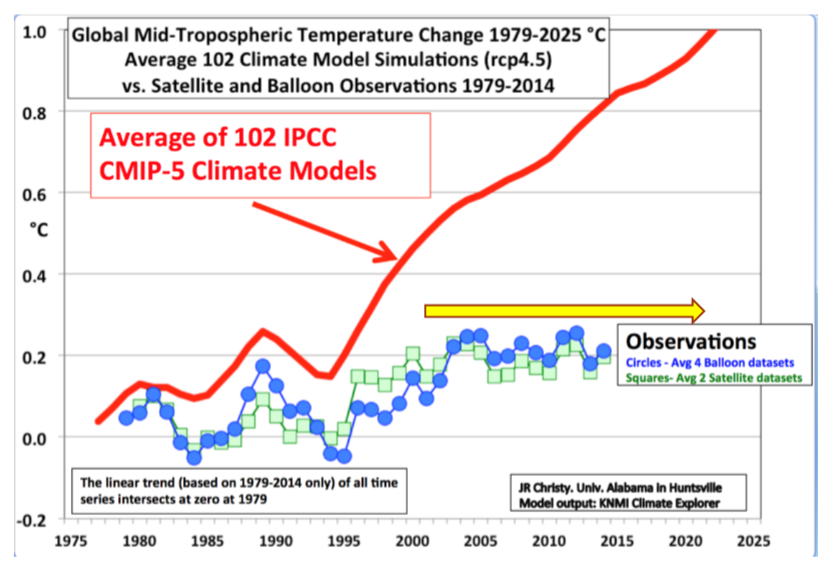
If we are to rely on climate models for setting policy, we should expect that the models closely match observations. As you can see above, based on 102 model runs for the IPCC, the models project significant warming; the reality is that both satellite data and thousands of weather balloon records show that global warming has flatlined despite a significant rise in carbon dioxide emissions from human industry. The models did not predict this ‘hiatus. The theory of Anthropogenic Global Warming says carbon dioxide from human emissions drives warming – that is the impetus for the efforts to implement carbon taxes or invent ways to restrict or mitigate carbon dioxide emissions. The theory is flawed, as you can see above.

Federal Government says: Because of climate change, Canadians must face a ‘new reality’ that events such as spring flooding will be happening more and more frequently.

Friends of Science say: No evidence supports claiming seasonal or urban flooding is unusual.

As Dr. Madhav Khandekar, former WMO regional expert, past Environment Canada research scientist of 40 years, past IPCC expert reviewer, peer-reviewer and author of more than 150 peer-reviewed papers says that seasonal flooding in Canada is typically a combination of early warm temperatures over heavy snowpack and ice jams on rivers. If there are warm temperatures while the snowpack is still firm, the water rapidly pools and there is no open land to absorb the run-off. The flood waters often back-up, exacerbated by ice jams on rivers. This is a common occurrence throughout history, and little seems to be done by residents or municipalities to prepare for this reality. Since so many homes are on potential flood plains in Canada, shouldn’t building standards reflect this fact and municipalities require that new homes be elevated to mitigate potential damage?

CCCR2019 highlights the catastrophic southern Alberta/City of Calgary flood of 2013 as ‘probably’ caused by Anthropogenic Global Warming. This claim ignores the evidence that Calgary had eight of its worst floods prior to 1933. Had the CCCR2019 panel looked at the Calgary Public Library website or visited the Glenbow Museum, they could have seen the evidence for themselves.

Federal Government says: Coastal flooding is expected to increase in many areas of Canada due to local sea level rise.

Friends of Science say: Canadian coastlines are challenged by subsidence or erosion, not related to human-caused global warming.

Natural Resources Canada map shows regional uplift or subsidence.

However much of Canada is quite stable. In fact, due to the melting of the ice age glaciers, much of Canada’s land is in the process of isostatic rebound – a subtle, slow rise as the earth rebounds from the tremendous pressure of the kilometers of ice that once overlay our country.

CCCR2019 presumes that sea level rise from melting Greenland or Antarctic ice sheets will cause sea level rise issues to certain coastal areas in Canada, but this is not a foregone conclusion. Even if large masses of Greenland were to melt, the interior of Greenland is shaped as a bowl that would retain much of the meltwater.

As CCCR2019 notes, many northern regions of Canada are facing challenges due to permafrost melt and some communities face eroding coastlines. This may be seen as sea level rise, but it is due to subsidence or erosion, neither of which are related to human-caused global warming. In previous generations, northern residents were nomads, their ancestors simply moved camp to the most advantageous place for fishing, hunting or seasonal camping. Rather than proposing greenhouse gas emission targets, perhaps a more practical thing would be to design housing for northern communities that can be relocated. As more and more permafrost melts, more carbon dioxide and more methane will be released, however, a carbon tax will not stop that from happening. These are natural cycles. We must adapt.

Summary

Who  are you going to trust: Federal Government or Friends of Science?  Consider the evidence.

Footnote:

See also Climate Hearsay

About Canadian Warming: Just the Facts


NYT Maple Syrup Story Not Fit to Print

Journalists are finally exposing the rot inside the news mass media. Sharyl Attkisson resigned as an investigative corespondent from CBS News and wrote at Epoch Times How Media Narratives Became More Important Than Facts. Excerpt in italics with my bolds.

I was among the first to really pay attention to the increasingly effective operations to shape and censor news—the movements to establish narratives rather than follow facts—and to see the growing influence of smear operations, political interests, and corporate interests on the news.

We agree there is terrific journalism being committed on a daily basis at organizations from The New York Times to local news stations. However, we agree that national media has also largely become co-opted by powerful interests who understand how to direct the news landscape in a way that services certain narratives and agendas.

Case in Point Global Warming vs. Maple Syrup

Eric Felten describes how this works in his article at Real Clear Investigations Why This NY Times Maple Syrup Story Tastes Odd. His exquisite takedown of a recent NYT essay linking AGW to maple syrup should be gracing a page in the NY Times, except for narrative being the mission, not truth. Excerpt below in italics with my bolds.

Climate change is at it again, ruining everything good. This time around it’s maple syrup that is at risk, according to the New York Times, which on Saturday had the alarming headline, “Warming Climate May Slow the Flow of Maple.” Or at least it would be alarming if it weren’t for the tell-tale word “may.” If a warming climate were actually slowing the flow of the sap that makes for syrup, you can be sure the Times would declare it clearly. To say it “may” slow the flow suggests that it isn’t actually happening, at least not yet.

King Philippe and Queen Mathilde of Belgium sample maple syrup in Ottawa last year.

But one would hate to be unfair to Kendra Pierre-Louis, the reporter who typed up the doom and gloom for the Times. Perhaps she has evidence supporting her warning of dire syrup consequences—statistics, even. Let’s see how she marshals her facts and makes her case.

“In fact, climate change is already making things more volatile for syrup producers,” Pierre-Louis laments in her front-page article. “[M]aple production fell by 54 percent in Ontario and by 12.5 percent in Canada over all.” The cause was “an unusually warm spring.” Well that’s some pretty compelling data, or would be if it were from 2018, or perhaps 2017 or even 2016. But no, that’s not even close. To find a year in which there was unseasonably warm weather that affected the maple crop, Pierre-Louis had to go all the way back to 2012, which is the year the Times cites as the “fact” for climate change’s impact on syrup producers. The Times finds room to return to that year again later in the article.

Isn’t it a bit odd that the New York Times cites 2012 for its evidence of climate change? After all, were the paper looking for a bad production year, the most recent one would be a perfect example: 2018 was an off year for maple syrup production in Quebec, the province that produces the vast majority of Canadian syrup. In 2016 Canada produced a record 12.16 million gallons of maple products; 2017 was another banner year, with Canada delivering a new record of 12.51 million gallons. But last year was a relatively bad one, with maple production falling in Canada to 9.8 million gallons, a significant drop — indeed, a drop more substantial than that in 2012. And yet for some perplexing reason, the Times fails to mention the drop in 2018, let alone the statistics showing record production in the previous years.

If we’re worried about maple syrup production, wouldn’t you think that the recent decline would be more newsworthy, or at the very least worth including in the article, if not making it the lede?

It doesn’t take much digging to find what’s wrong with 2018 as an example of climate change hobbling the syrup trade. Yes, weather was to blame for 2018’s bad results. It just wasn’t the right sort of weather. Here’s how Halifax Today reported on last year’s maple results: “Quebec — which produces about 72 per cent of the world’s maple syrup — produced 40.4 million litres, down 22.4 percent from 2017 due to unusually late snow and cold.”

Unusual cold? That’s right. As the official government Statistics Canada explains in its report on “Maple products, 2018,” in “Quebec, production was hurt by unusually late snow and cold, while the decrease in New Brunswick was the result of a long and severe winter followed by a short spring.” This year could prove to be another disappointment for Canadian maple farmers. In late February Canada’s CBC reported, “Local syrup farms say the recent cold temperatures are leaving taps dry.” Could it be that the New York Times neglected to mention the maple syrup decline of 2018 and the slow start to 2019 because the reductions were caused by abnormal cold rather than warming?

One should find that hard to believe. Because for that to be true, one would have to believe that the Times is willing to cherry-pick data in an effort to mislead its readers. Surely the newspaper of record has more respect for itself than to play such a cheap trick on its customers. RealClearInvestigations reached out to the Times’s reporter via her website for comment but received no response.

The evidence piles up that the Times is playing fast and loose with the facts. Take the suggestion by the Times that climate change is limiting the number of days when maple trees can be successfully tapped. “More Narrow Window for Syrup Production,” reads the newspaper’s sub-headline. The weather determines the sap flow, after all, and University of Vermont “sugar maple expert” Mark Isselhardt told the Times that “[e]very day that you don’t get sap flow has the potential to really impact the total yield for that operation.”

But is the production window actually narrowing?

Surely the sugar maple expert at the University of Vermont, in telling the Times about the window when sap is ripe for collecting, had at his fingertips the latest data, which are readily available. The USDA’s National Agricultural Statistics Service keeps figures — helpfully broken down by state — on maple syrup production in the United States. Among the information collected are data on the “Maple Syrup Season,” that elusive window. The figures for the last four years are readily available. In 2015, the season for the U.S. as a whole was 26 days. In 2016 it was 33 days. In 2017 it was 37 days and in 2018 the window expanded again, this time to 42 days. The figures for Vermont — which we can assume our University of Vermont maple expert is particularly familiar with — show the state’s maple syrup season widening: 26 days in 2015; 44 days in 2016; 46 days in 2017; and 52 days in 2018.

What about the suggestion in the New York Times that the production window is not only shrinking, but moving, as climate change causes “season creep”? The newspaper quotes the executive director of the New York Maple Producers Association, who says that when she was a kid, 50 years ago, the start of the tapping season was mid-March. “This year,” according to the Times, “they were tapping in late January.”

Were they really? In upstate New York, the last week in January this year was marked by brutally cold temperatures. A normal high temperature for late January in Buffalo is 31 degrees. Though there were days in that ballpark during the month — and one mid-month day actually made it to 47 degrees — late January was for the most part frigid. The high temperature in Buffalo Jan. 30 was 11 degrees. On the 31st the thermometer peaked at 7 degrees.

This last winter’s extreme cold persisted well into February in Canada, where the deep freeze kept the maple sap from flowing. It wasn’t until the middle of March that sap started to trickle from the trees north of the border.

How did the New York Times get things so wrong? Is it carelessness? Or is there an ideological agenda at play, one that requires the reporting and writing to lead to a preestablished conclusion? On Twitter, the NYT reporter calls herself Kendra “Gloom is My Beat” Pierre-Louis. That is no doubt a gesture at self-aware humor. But it also suggests that her reporting is skewed: If you see gloom as your beat, by definition you ignore information that doesn’t advance the narrative of impending doom. And then there is the larger institutional bias. Pierre-Louis is officially a “climate reporter” for the Times; she leads NYT-branded “student journeys” to places such as Iceland (cost: $8,190 per high-schooler for 15 days) to teach the risks of a warming planet. In other words, the Times has a business built in part around Pierre-Louis that depends on her being a warning voice on warming.

Those sounding the alarm about climate change do a lot of fretting over what may happen 50 to 100 years from now. Fair enough — or at least it would be if those delivering the warnings were in more of a habit of playing it straight. It would be much easier to credit their predictions of future catastrophes if they were more honest about what is actually, observably, happening right now.

Footnote:

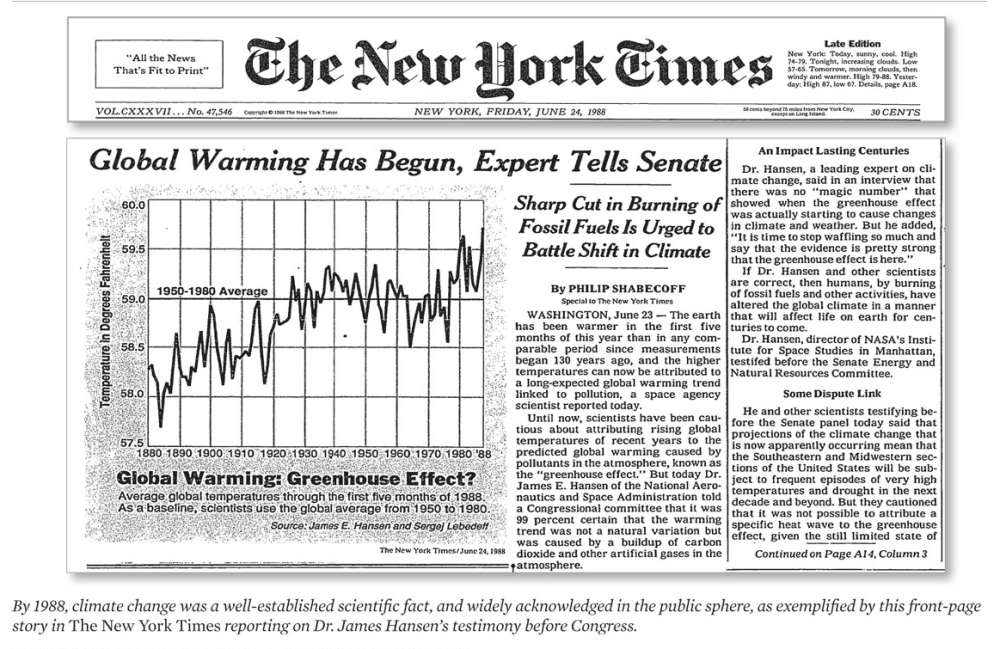
It should be noted that the NY Times has a long history of botching science stories, including but not limited to climate change. Bernie Lewin gives several examples in his book on environmental scares, and of course it was NYT who headlined the global warming claims of Jim Hansen.  When objective historians look back on these fear-mongering days, NY Times will be seen as a leading traitor against the public interest.

See Progressively Scaring the World (Lewin book synopsis)

Rise and Fall of CAGW


Woke Capitalists: Corporate Vigilantes

Some recent reports note a disturbing trend in large and influential corporations. Having worked in and for some of these, I believe the incidents show a dangerous virus is mutating from academia to the workplace. The import of these developments is not good for free enterprise or for individual freedoms.

Warning bells in the past concerned punative efforts against some employees to silence their discomforting opinions. For example James Damore was fired by Google for saying that staffing with the most competent techies is more important than gender hiring quotas. Now it appears such events are not atypical, but reflect a systemic takeover of corporate cultures.

Rod Dreher writes at American Conservative Woke Capitalism Is Our Enemy. Excerpts in italics with my bolds.

Pro tip: whenever you hear a management type talk about “diversity” and “inclusion,” you may be certain that you are about to hear a rationale for creating a more ideologically uniform and ideologically exclusive community.

A reader has sent me internal documents from a leading global corporation having to do with its employee program to create a Diverse and Inclusive culture. I am not allowed to quote from the documents, or to identify the company, so I’m going to be delicate here in what I describe, to honor the reader’s request to protect privacy. The reader said:

It confirms what you have been saying all along. You are absolutely correct about the “soft totalitarianism” that is coming. It’s already happening, and it’s picking up speed.

The documents are pretty shocking to my eyes, because I know what I’m looking at. It is 100 percent, pure, uncut Human Resources Department cant. What’s so amazing about it — truly amazing — is that it is all about coercing people into accepting and participating in a cultural revolution by redefining the revolution’s goals and methods as good for business, and a chance for employees to exercise virtue.

This particular company’s program is far more sophisticated and thorough than anything I’ve seen before. It is totalitarian in the sense that it encompasses nearly every aspect of life in the company. From reading these documents, you would think that the purpose of this company is to shape the cultural politics and behavior of its employees. I’m not kidding you: it’s like a church organization trying to catechize and discipline its employees in true religion — and part of that discipline is urging them to police their own ranks for heretics. It even instructs employees to conduct struggle sessions within themselves to root out false beliefs that undermine Diversity and Inclusion.

Though it’s stated in happy-clappy HR jargon, it’s clear that the company is training its employees to monitor each other for signs of bias, and encouraging them to call out each other. Incredible. It’s the Stasification of the American workplace. And the program instructs employees to think and talk about Diversity and Inclusion all the time, in everything they do. Seriously, it does. If I were an employee there, I would find all this completely unnerving. I would wonder constantly if I were being monitored by my co-workers and judged for not showing enough commitment to Diversity and Inclusion. I would watch what I said, but also worry about what I did not say. It would make me a nervous wreck.

Again, I’m not going to name the company or give identifying details about the program. I am quite confident that what I’ve said here describes the internal culture many corporations are building. I’m sure many of you readers are thinking, “That sounds like where I work.” It is coercive, and it is totalitarian. It is going to create massive suspicion and mistrust within companies that do this, in part because it is going to empower members of particular groups to harass others in the workplace, to inform on others, and even to affect their salaries and impede their career advancement.

Get this: the way this particular program is set up, you don’t have to participate, but failing to do so will be noted, and it’s going to affect your pay. It’s not enough to sign up for the program in a pro forma way, and then simply be quiet about it. You are expected to be an active, vocal advocate of its principles. From what I can tell, it appears that they have the rudiments of a Chinese-style Social Credit System structure to monitor employee enthusiasm.

You might be a first-rate maker of widgets for this corporation, or a superb sales executive, manager, whatever, and you may be a diligent employee who is honest and works well with others. But if you are not 100 percent aboard the Party’s company’s ideological campaign for cultural revolution, it will go down in your employee record, and it will affect your future at the company.

When you see these documents, and realize that this is how it is inside one of the world’s leading corporations, you know perfectly well that this is quickly going to become normative in corporations, if it isn’t already. What kind of future do any of us deplorables (or our kids) have in corporate life when workplaces become communities of coerced wokeness?

What? Have you no respect for diversity?

Let me put it to you like this. If this were the US Government, and it pushed “patriotism” on its employees following the same platform and methods that this corporation is pushing “diversity and inclusion,” people would freak out at the coerciveness and invasion of privacy. And they would be right to! Imagine that you, a US government employee, were told to monitor yourself constantly to root out a lack of patriotism. How … Soviet would that feel? Well, that’s what this corporation is doing to its employees regarding diversity and inclusion.

The familiar left vs. right categories no longer serve as reliable guides to our cultural reality. The cultural left has captured the bureaucracies at American corporations. One thing we hear a lot from our friends on the left is that Big Business is conservative, and would never do anything that would hurt its bottom line. Wrong! I have seen personally how companies will do politically correct things that actually hurt their business model, but that win its management pats on the back among their social cohort. These documents I looked at today assert — assert, do not argue — that the total politicization of the company’s culture is critical to its business success … and then go on to describe a program that is almost certainly going to cause major problems with teamwork, cohesiveness, and conflict. These documents are a recipe for creating intense anxiety and suspicion within the company. It’s as clear as day. You cannot imagine why any sensible company would embrace these principles and techniques, which can only hurt its ability to compete. But there it is, in black and white.

Woke capitalism is a vanguard of unfreedom. It’s happening. We have to be prepared to resist.

My Comment

I have done consulting with enough HR departments to know that they are not power centers in companies, but are seen rather as administrative overhead. The line operations make or break the bottom line, and there the credo of middle managers still holds: “Whatever interests my boss, thrills the hell out of me.” Thus in any company where HR is going viral with social justice, diversity inclusion and the rest of it, it can only happen if HR is carrying water for the CEO and everyone knows it.

That appears to be the case, as described by Nick Dedeke in his article at Real Clear Poliitcs Is Corporate Vigilantism a Threat to Democracy? Excerpts in italicss with my bolds.

A serious issue has gained prominence in modern society the last few years: The executives and/or founders of large companies increasingly consider it their civic and moral duty to use the influences and powers of their businesses to censor or suppress political and/or inconvenient ideas they do not support or find offensive. This mindset is reflected in the following statement from PayPal CEO Daniel Schulman: “Businesses need to be a force for good in those values and issues that they believe in.” Taken in isolation, this is a very good philosophy. However, one needs to also examine the implications of it in practice.

Recently, PayPal decided to stop processing financial transactions for customers it deemed to have hateful political views. Not long ago, MasterCard and Visa refused to process any donations to David Horowitz’s Freedom Center, a conservative nonprofit. The crime? Horowitz had personal and/or political views that were judged by the credit card companies to be hateful. YouTube has banned some Prager University (PragerU) videos (PragerU is not a higher learning institution, but a nonprofit that promulgates conservative views.) Selected content from conservatives, Christian and some liberal-leaning groups has also been removed from social media and the accounts of the targets were deleted or deactivated.

The motivation for these actions is the desire of the executives of these companies to be “good” by punishing the “bad.” These executives, and their supporters, declare that their actions are protected by the laws of the United States of America, which they claim permit them to run their private businesses any way they deem fit.

Two questions need to be asked. First, does a private business have a boundary? If so, where is it? These are critical questions that need to be answered. Without defining the boundary of the modern business, we are likely going to alter, in negative ways, the civic foundations of our society. I do agree that a business should be allowed to have maximum freedom to be run as its founder sees fit. However, I also believe that the boundary of a business has to be limited to its business charter. PayPal has a charter to process payments for society; it does not have a charter to make society “good.”

I argue that many of the well-intentioned actions taken by executives of large corporations fall under what one could call corporate vigilantism. In a notable academic analysis, Les Johnston identified six criteria that are common to most vigilantism. (1) there is planning and premeditation by those engaged in such actions; (2) the actors are private citizens acting voluntarily; (3) the actors view their actions as “autonomous citizenship”; (4) the actors use or threaten to use force and pressure against targets; (5) the actors go into action to protect an established or new order from actual, potential or imputed transgressions; (6) the actors aim to control crime or other social infractions.

It should be noted that vigilantism is not new. It is likely the most popular form of justice in countries in which there are no mature civil institutions. However, vigilantism is a danger wherever it is found. There are three reasons for this. First is that it violates a basic organizing principle of society — namely, that institutions are only allowed to perform duties for which they have a societal mandate. There is no known societal law or mandate that empowers a corporate executive to be the vanguard of moral actions, choices and speech in society.

Second, vigilantism violates the essential principle of separation of powers, which is so essential to the norms of justice. In most vigilante processes, the same institution or group of people constitutes the judge, jury and executioner. Hence, the vigilante system has, by design, inherent, embedded and systemic biases.

Third, the vigilante process is not equipped to recognize its own biases. When asked about how PayPal, in collaboration with the controversial Southern Poverty Law Center, determines when to decline services to customers, Schulman told the Wall Street Journal: “We don’t always agree. We have our debates with [SPLC]. We are very respectful with everyone coming in. We will do the examination carefully. We’ll talk when we don’t agree with a finding: We understand why you think that way, but it still goes into the realm of free speech for us.” Despite this claim of evenhandedness, however, the majority of blocked customers are right-leaning groups and individuals.

A common protest is raised when one questions corporate vigilantism. People often respond by asking, “But, it is their business, isn’t it?” Yes, it is. But, society still has a role to play if and when the pursuit of private business’s self-interest is in conflict with major interests of its customers or the public. That is why regulations were enacted when we realized that private businesses were polluting rivers and other water resources. That is why the new, and stricter, European General Data Protection Regulation was enacted. That is why there is a process whereby new drugs have to be vetted and approved by a neutral party, such as the Food and Drug Administration, before they can be sold to the public. What do these actions have in common? They all involve the establishment of mechanisms that limit the authority of large organizations to exercise their freedom at the expense of the freedoms of others.

There is no debate that an executive of a company could support a political candidate or give money to any cause she/he pleases to do. The executive can also hire and fire anyone that she/he pleases. But this is quite different from what we see in corporate vigilantism. We hear about an executive of a corporation threatening to withdraw its businesses from a state because of perceived political and/or moral transgressions by people there. Or we read about an executive threatening to abandon or exclude a state from its expansion plans if and when a political organ of the state votes for the “wrong” cause or the “wrong” policy. These are some of the most dangerous kinds of politicization that can occur in a society. There is little difference between such corporate vigilantism and what we call corruption. What would you say if a politician promised to give voters money — if they vote a certain way? What would you think of a company that threatened to punish voters if they dared to vote a certain way?

We have had no laws curbing corporate vigilantism in the United States. This is because most business founders knew and/or believed that one should not mix politics and business. Unfortunately, things have changed. For a large corporation today, there is little or no penalty for using one’s near-monopolistic position to shut down the freedoms of others.

The spirit of vigilantism that makes a restaurant owner eject a customer who holds different political views is the same mindset that prompts executives of some large corporations to punish opinions, choices and actions that they do not like. The only difference is in the type and scope of harm done. Vigilantism corrupts free democratic societies, sooner or later, if action is not taken to curb it.

Nick Dedeke teaches information management courses at Northeastern University.