Chicxulub asteroid Apocalypse? Not so fast. August update
The Daily Mail would have you believe Apocalyptic asteroid that wiped out the dinosaurs 66 million years ago triggered 100,000 years of global warming
Chicxulub asteroid triggered a global temperature rise of 5°C (9°F).

This notion has been around for years, but dredged up now to promote fears of CO2 and global warming. And maybe it’s because of a new Jurassic Park movie coming this summer.  But it doesn’t take much looking around to discover experts who have a sober, reasonable view of the situation.

Princeton expert Gerta Keller, Professor of Geosciences at Princeton, has studied this issue since the 1990s and tells all at her website CHICXULUB: THE IMPACT CONTROVERSY Excerpts below with my bolds.

Update August 17, 2018

This is a repost as background for a fresh article in the Atlantic The Nastiest Feud in Science H/T Warren Meyer.  As noted, the parallels with global warming/climate change are notable.

b5399d9c1

Introduction to The Impact Controversy

In the 1980s as the impact-kill hypothesis of Alvarez and others gained popular and scientific acclaim and the mass extinction controversy took an increasingly rancorous turn in scientific and personal attacks fewer and fewer dared to voice critique. Two scientists stand out: Dewey McLean (VPI) and Chuck Officer (Dartmouth University). Dewey proposed as early as 1978 that Deccan volcanism was the likely cause for the KTB mass extinction, Officer also proposed a likely volcanic cause. Both were vilified and ostracized by the increasingly vocal group of impact hypothesis supporters. By the middle of the 1980s Vincent Courtillot (Physique de Globe du Paris) also advocated Deccan volcanism, though not as primary cause but rather as supplementary to the meteorite impact. Since 2008 Courtillot has strongly advocated Deccan volcanism as the primary cause for the KTB mass extinction.

(Overview from Tim Clarely, Ph.D. questioning the asteroid) In secular literature and movies, the most popular explanation for the dinosaurs’ extinction is an asteroid impact. The Chicxulub crater in Mexico is often referred to as the “smoking gun” for this idea. But do the data support an asteroid impact at Chicxulub?

The Chicxulub crater isn’t visible on the surface because it is covered by younger, relatively undeformed sediments. It was identified from a nearly circular gravity anomaly along the northwestern edge of the Yucatán Peninsula (Figure 1). There’s disagreement on the crater’s exact size, but its diameter is approximately 110 miles—large enough for a six-mile-wide asteroid or meteorite to have caused it.

Although some of the expected criteria for identifying a meteorite impact are present at the Chicxulub site—such as high-pressure and deformed minerals—not enough of these materials have been found to justify a large impact. And even these minerals can be caused by other circumstances, including rapid crystallization4 and volcanic activity.

The biggest problem is what is missing. Iridium, a chemical element more abundant in meteorites than on Earth, is a primary marker of an impact event. A few traces were identified in the cores of two drilled wells, but no significant amounts have been found in any of the ejecta material across the Chicxulub site. The presence of an iridium-rich layer is often used to identify the K-Pg (Cretaceous-Paleogene) boundary, yet ironically there is virtually no iridium in the ejecta material at the very site claimed to be the “smoking gun”!

In addition, secular models suggest melt-rich layers resulting from the impact should have exceeded a mile or two in thickness beneath the central portion of the Chicxulub crater. However, the oil wells and cores drilled at the site don’t support this. The thickest melt-rich layers encountered in the wells were between 330 and 990 feet—nowhere near the expected thicknesses of 5,000 to 10,000 feet—and several of the melt-rich layers were much thinner than 300 feet or were nonexistent.

Finally, the latest research even indicates that the tsunami waves claimed to have been generated by the impact across the Gulf of Mexico seem unlikely.

Summary from Geller

The Cretaceous-Tertiary boundary (KTB) mass extinction is primarily known for the demise of the dinosaurs, the Chicxulub impact, and the frequently rancorous thirty years-old controversy over the cause of this mass extinction. Since 1980 the impact hypothesis has steadily gained support, which culminated in 1990 with the discovery of the Chicxulub crater on Yucatan as the KTB impact site and “smoking gun” that proved this hypothesis. In a perverse twist of fate, this discovery also began the decline of this hypothesis, because for the first time it could be tested directly based on the impact crater and impact ejecta in sediments throughout the Caribbean, Central America and North America.

Two decades of multidisciplinary studies amassed a database with a sum total that overwhelmingly reveals the Chicxulub impact predates the KTB mass extinction. It’s been a wild and frequently acrimonious ride through the landscape of science and personalities. The highlights of this controversy, the discovery of facts inconsistent with the impact hypothesis, the denial of evidence, misconceptions, and misinterpretations are recounted here. (Full paper in Keller, 2011, SEPM 100, 2011).

Chicxulub Likely Happened ~100,000 years Before the KTB Extinction
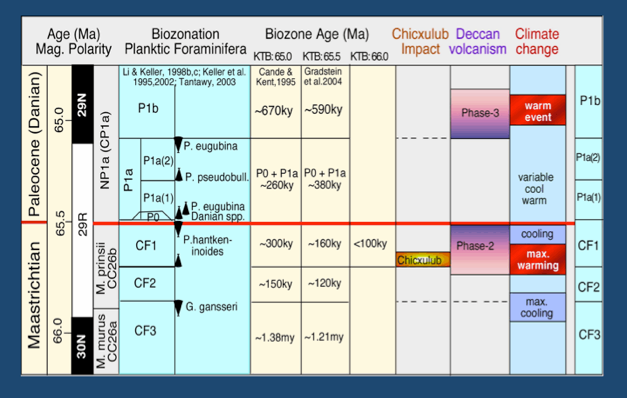
Figure 42. Planktic foraminiferal biostratigraphy, biozone ages calculated based on time scales where the KTB is placed at 65Ma, 65.5Ma and 66Ma, and the relative age positions of the Chicxulub impact, Deccan volcanism phases 2 and 3 and climate change, including the maximum cooling and maximum warming (greenhouse warming) and the Dan-2 warm event relative to Deccan volcanism.

Most studies surrounding the Chicxulub impact crater have concentrated on the narrow interval of the sandstone complex or so-called impact-tsunami. Keller et al. (2002, 2003) placed that interval in zone CF1 based on planktic foraminiferal biostratigraphy and specifically the range of the index species Plummerita hantkeninoides that spans the topmost Maastrichtian. Zone CF1. The age of CF1 was estimated to span the last 300ky of the Maastrichtian based on the old time scale of Cande and Kent (1995) that places the KTB at 65Ma. The newer time scale (Gradstein et al., 2004) places the KTB at 65.5Ma, which reduces zone CF1 to 160ky.

By early 2000 our team embarked on an intensive search for impact spherules below the sandstone complex throughout NE Mexico. Numerous outcrops were discovered with impact spherule layers in planktic foraminiferal zone CF1 below the sandstone complex and we suggested that the Chicxulub impact predates the KTB by about 300ky (Fig. 42; Keller et al., 2002, 2003, 2004, 2005, 2007, 2009; Schulte et al., 2003, 2006).

Time scales change with improved dating techniques. Gradstein et al (2004) proposed to place the KTB at 65.5 Ma, (Abramovich et al., 2010). This time scale is now undergoing further revision (Renne et al., 2013) placing the KTB at 66 Ma, which reduces zone CF to less than 100ky. By this time scale, the age of the Chicxulub impact predates the KTB by less than 100ky based on impact spherule layers in the lower part zone CF1. See Fig. 42 for illustration.

Unfortunately, this wide interest rarely resulted in integrated interdisciplinary studies or joint discussions to search for common solutions to conflicting results. Increasingly, in a perverse twist of science new results became to be judged by how well they supported the impact hypothesis, rather than how well they tested it. An unhealthy US versus THEM culture developed where those who dared to question the impact hypothesis, regardless of the solidity of the empirical data, were derided, dismissed as poor scientists, blocked from publication and getting grant funding, or simply ignored. Under this assault, more and more scientists dropped out leaving a nearly unopposed ruling majority claiming victory for the impact hypothesis. In this adverse high-stress environment just a small group of scientists doggedly pursued evidence to test the impact hypothesis.

No debate has been more contentious during the past thirty years, or has more captured the imagination of scientists and public alike, than the hypothesis that an extraterrestrial bolide impact was the sole cause for the KTB mass extinction (Alvarez et al., l980). How did this hypothesis evolve so quickly into a virtually unassailable “truth” where questioning could be dismissed by phrases such as “everybody knows that an impact caused the mass extinction”, “only old fashioned Darwinian paleontologists can’t accept that the mass extinction was instantaneous”, “paleontologists are just bad scientists, more like stamp collectors”, and “it must be true because how could so many scientists be so wrong for so long.” Such phrases are reminiscent of the beliefs that the Earth is flat, that the world was created 6000 years ago, that Noah’s flood explains all geological features, and the vilification of Alfred Wegner for proposing that continents moved over time.

Update Published at National Geographic February 2018 By Shannon Hall Volcanoes, Then an Asteroid, Wiped Out the Dinosaur

What killed the dinosaurs? Few questions in science have been more mysterious—and more contentious. Today, most textbooks and teachers tell us that nonavian dinosaurs, along with three-fourths of all species on Earth, disappeared when a massive asteroid hit the planet near the Yucatán Peninsula some 66 million years ago.

But a new study published in the journal Geology shows that an episode of intense volcanism in present-day India wiped out several species before that impact occurred.

The result adds to arguments that eruptions plus the asteroid caused a one-two punch. The volcanism provided the first strike, weakening the climate so much that a meteor—the more deafening blow—was able to spell disaster for Tyrannosaurs rex and its late Cretaceous kin.

A hotter climate certainly helped send the nonavian dinosaurs to their early grave, says Paul Renne, a geochronologist at the University of California, Berkeley, who was not involved in the study. That’s because the uptick in temperature was immediately followed by a cold snap—a drastic change that likely set the stage for planet-wide disaster.

Imagine that some life managed to adapt to those warmer conditions by moving closer toward the poles, Renne says. “If you follow that with a major cooling event, it’s more difficult to adapt, especially if it’s really rapid,” he says.

In this scenario, volcanism likely sent the world into chaos, driving many extinctions alone and increasing temperatures so drastically that most of Earth’s remaining species couldn’t protect themselves from that second punch when the asteroid hit.

“The dinosaurs were extremely unlucky,” Wignall says.

But it will be hard to convince Sean Gulick, a geophysicist at the University of Texas at Austin, who co-led recent efforts to drill into the heart of the impact crater in Mexico. He points toward several studies that have suggested that ecosystems remained largely intact until the time of the impact.

Additionally, a forthcoming paper might make an even stronger case that the impact drove the extinction alone, notes Jay Melosh, a geophysicist at Purdue University who has worked on early results from the drilling project. It looks as though the divisive debate will continue with nearly as much ferocity as the events that rocked our world 66 million years ago.

Summary:

So if the Chicxulub asteroid didn’t kill the dinosaurs, what did? Paleontologists have advanced all manner of other theories over the years, including the appearance of land bridges that allowed different species to migrate to different continents, bringing with them diseases to which native species hadn’t developed immunity. Keller and Addate do not see any reason to stray so far from the prevailing model. Some kind of atmospheric haze might indeed have blocked the sun, making the planet too cold for the dinosaurs — it just didn’t have to have come from an asteroid. Rather, they say, the source might have been massive volcanoes, like the ones that blew in the Deccan Traps in what is now India at just the right point in history.

For the dinosaurs that perished 65 million years ago, extinction was extinction and the precise cause was immaterial. But for the bipedal mammals who were allowed to rise once the big lizards were finally gone, it is a matter of enduring fascination.

This science seems as settled as climate change/global warming, and with many of the same shenanigans.

Footnote:

cg4b87e76a6ff940

the-extinction-dinosaurs

Why the Left Coast is Burning

It is often said that truth is the first casualty in the fog of war. That is especially true of the war against fossil fuels and smoke from wildfires. The forests are burning in California, Oregon and Washington, all of them steeped in liberal, progressive and post-modern ideology. There are human reasons that fires are out of control in those places, and it is not due to CO2 emissions. As we shall see, Zinke is right and Brown is wrong. Some truths the media are not telling you in their drive to blame global warming/climate change. Text below is excerpted from sources linked at the end.

1. The World and the US are not burning.

The geographic extent of this summer’s forest fires won’t come close to the aggregate record for the U.S. Far from it. Yes, there are some terrible fires now burning in California, Oregon, and elsewhere, and the total burnt area this summer in the U.S. is likely to exceed the 2017 total. But as the chart above shows, the burnt area in 2017 was less than 20% of the record set way back in 1930. The same is true of the global burnt area, which has declined over many decades.

In fact, this 2006 paper reported the following:

“Analysis of charcoal records in sediments [31] and isotope-ratio records in ice cores [32] suggest that global biomass burning during the past century has been lower than at any time in the past 2000 years. Although the magnitude of the actual differences between pre-industrial and current biomass burning rates may not be as pronounced as suggested by those studies [33], modelling approaches agree with a general decrease of global fire activity at least in past centuries [34]. In spite of this, fire is often quoted as an increasing issue around the globe [11,26–29].”

People have a tendency to exaggerate the significance of current events. Perhaps the youthful can be forgiven for thinking hot summers are a new phenomenon. Incredibly, more “seasoned” folks are often subject to the same fallacies. The fires in California have so impressed climate alarmists that many of them truly believe global warming is the cause of forest fires in recent years, including the confused bureaucrats at Cal Fire, the state’s firefighting agency. Of course, the fires have given fresh fuel to self-interested climate activists and pressure groups, an opportunity for greater exaggeration of an ongoing scare story.

This year, however, and not for the first time, a high-pressure system has been parked over the West, bringing southern winds up the coast along with warmer waters from the south, keeping things warm and dry inland. It’s just weather, though a few arsonists and careless individuals always seem to contribute to the conflagrations. Beyond all that, the impact of a warmer climate on the tendency for biomass to burn is considered ambiguous for realistic climate scenarios.

2. Public forests are no longer managed due to litigation.

According to a 2014 white paper titled; ‘Twenty Years of Forest Service Land Management Litigation’, by Amanda M.A. Miner, Robert W. Malmsheimer, and Denise M. Keele: “This study provides a comprehensive analysis of USDA Forest Service litigation from 1989 to 2008. Using a census and improved analyses, we document the final outcome of the 1125 land management cases filed in federal court. The Forest Service won 53.8% of these cases, lost 23.3%, and settled 22.9%. It won 64.0% of the 669 cases decided by a judge based on cases’ merits. The agency was more likely to lose and settle cases during the last six years; the number of cases initiated during this time varied greatly. The Pacific Northwest region along with the Ninth Circuit Court of Appeals had the most frequent occurrence of cases. Litigants generally challenged vegetative management (e.g. logging) projects, most often by alleging violations of the National Environmental Policy Act and the National Forest Management Act. The results document the continued influence of the legal system on national forest management and describe the complexity of this litigation.”

There is abundant evidence to support the position that when any forest project posits vegetative management in forests as a pretense for a logging operation, salvage or otherwise, litigation is likely to ensue, and in addition to NEPA, the USFS uses the Property Clause to address any potential removal of ‘forest products’. Nevertheless, the USFS currently spends more than 50% of its total budget on wildfire suppression alone; about $1.8 billion annually, while there is scant spending for wildfire prevention.

3. Mega fires are the unnatural result of fire suppression.

And what of the “mega-fires” burning in the West, like the huge Mendocino Complex Fire and last year’s Thomas Fire? Unfortunately, many decades of fire suppression measures — prohibitions on logging, grazing, and controlled burns — have left the forests with too much dead wood and debris, especially on public lands. From the last link:

“Oregon, like much of the western U.S., was ravaged by massive wildfires in the 1930s during the Dust Bowl drought. Megafires were largely contained due to logging and policies to actively manage forests, but there’s been an increasing trend since the 1980s of larger fires.

Active management of the forests and logging kept fires at bay for decades, but that largely ended in the 1980s over concerns too many old growth trees and the northern spotted owl. Lawsuits from environmental groups hamstrung logging and government planners cut back on thinning trees and road maintenance.

[Bob] Zybach [a forester] said Native Americans used controlled burns to manage the landscape in Oregon, Washington and northern California for thousands of years. Tribes would burn up to 1 million acres a year on the west coast to prime the land for hunting and grazing, Zybach’s research has shown.

‘The Indians had lots of big fires, but they were controlled,’ Zybach said. ‘It’s the lack of Indian burning, the lack of grazing’ and other active management techniques that caused fires to become more destructive in the 19th and early 20th centuries before logging operations and forest management techniques got fires under control in the mid-20th Century.”

4. Bad federal forest administration started in 1990s.

Bob Zybach feels like a broken record. Decades ago he warned government officials allowing Oregon’s forests to grow unchecked by proper management would result in catastrophic wildfires.

While some want to blame global warming for the uptick in catastrophic wildfires, Zybach said a change in forest management policies is the main reason Americans are seeing a return to more intense fires, particularly in the Pacific Northwest and California where millions of acres of protected forests stand.

“We knew exactly what would happen if we just walked away,” Zybach, an experienced forester with a PhD in environmental science, told The Daily Caller News Foundation.

Zybach spent two decades as a reforestation contractor before heading to graduate school in the 1990s. Then the Clinton administration in 1994 introduced its plan to protect old growth trees and spotted owls by strictly limiting logging.  Less logging also meant government foresters weren’t doing as much active management of forests — thinnings, prescribed burns and other activities to reduce wildfire risk.

Zybach told Evergreen magazine that year the Clinton administration’s plan for “naturally functioning ecosystems” free of human interference ignored history and would fuel “wildfires reminiscent of the Tillamook burn, the 1910 fires and the Yellowstone fire.”

Between 1952 and 1987, western Oregon saw only one major fire above 10,000 acres. The region’s relatively fire-free streak ended with the Silver Complex Fire of 1987 that burned more than 100,000 acres in the Kalmiopsis Wilderness area, torching rare plants and trees the federal government set aside to protect from human activities. The area has burned several more times since the 1980s.

“Mostly fuels were removed through logging, active management — which they stopped — and grazing,” Zybach said in an interview. “You take away logging, grazing and maintenance, and you get firebombs.”

Now, Oregonians are dealing with 13 wildfires engulfing 185,000 acres. California is battling nine fires scorching more than 577,000 acres, mostly in the northern forested parts of the state managed by federal agencies.

The Mendocino Complex Fire quickly spread to become the largest wildfire in California since the 1930s, engulfing more than 283,000 acres. The previous wildfire record was set by 2017’s Thomas Fire that scorched 281,893 acres in Southern California.

While bad fires still happen on state and private lands, most of the massive blazes happen on or around lands managed by the U.S. Forest Service and other federal agencies, Zybach said. Poor management has turned western forests into “slow-motion time bombs,” he said.

A feller buncher removing small trees that act as fuel ladders and transmit fire into the forest canopy.

5. True environmentalism is not nature love, but nature management.

While wildfires do happen across the country, poor management by western states has served to turn entire regions into tinderboxes. By letting nature play out its course so close to civilization, this is the course California and Oregon have taken.

Many in heartland America and along the Eastern Seaboard often see logging and firelines if they travel to a rural area. This is part and parcel of life outside of the city, where everyone knows that because of a few minor eyesores their houses and communities are safer from the primal fury of wildfires.

In other words, leaving the forests to “nature,” and protecting the endangered Spotted Owl created denser forests––300-400 trees per acre rather than 50-80–– with more fuel from the 129 million diseased and dead trees that create more intense and destructive fires. Yet California spends more than ten times as much money on electric vehicle subsidies ($335 million) than on reducing fuel in a mere 60,000 of 33 million acres of forests ($30 million).

Rancher Ross Frank worries that funding to fight fires in Western communities like Chumstick, Wash., has crowded out important land management work. Rowan Moore Gerety/Northwest Public Radio

Once again, global warming “science” is a camouflage for political ideology and gratifying myths about nature and human interactions with it. On the one hand, progressives seek “crises” that justify more government regulation and intrusion that limit citizen autonomy and increase government power. On the other, well-nourished moderns protected by technology from nature’s cruel indifference to all life can afford to indulge myths that give them psychic gratification at little cost to their daily lives.

As usual, bad cultural ideas lie behind these policies and attitudes. Most important is the modern fantasy that before civilization human beings lived in harmony and balance with nature. The rise of cities and agriculture began the rupture with the environment, “disenchanting” nature and reducing it to mere resources to be exploited for profit. In the early 19thcentury, the growth of science that led to the industrial revolution inspired the Romantic movement to contrast industrialism’s “Satanic mills” and the “shades of the prison-house,” with a superior natural world and its “beauteous forms.” In an increasingly secular age, nature now became the Garden of Eden, and technology and science the signs of the fall that has banished us from the paradise enjoyed by humanity before civilization.

The untouched nature glorified by romantic environmentalism, then, is not our home. Ever since the cave men, humans have altered nature to make it more conducive to human survival and flourishing. After the retreat of the ice sheets changed the environment and animal species on which people had depended for food, humans in at least four different regions of the world independently invented agriculture to better manage the food supply. Nor did the American Indians, for example, live “lightly on the land” in a pristine “forest primeval.” They used fire to shape their environment for their own benefit. They burned forests to clear land for cultivation, to create pathways to control the migration of bison and other game, and to promote the growth of trees more useful for them.

Remaining trees and vegetation on the forest floor are more vigorous after removal of small trees for fuels reduction.

And today we continue to improve cultivation techniques and foods to make them more reliable, abundant, and nutritious, not to mention more various and safe. We have been so successful at managing our food supply that today one person out of ten provides food that used to require nine out of ten, obesity has become the plague of poverty, and famines result from political dysfunction rather than nature.

That’s why untouched nature, the wild forests filled with predators, has not been our home. The cultivated nature improved by our creative minds has. True environmentalism is not nature love, but nature management: applying skill and technique to make nature more useful for humans, at the same time conserving resources so that those who come after us will be able to survive. Managing resources and exploiting them for our benefit without destroying them is how we should approach the natural world. We should not squander resources or degrade them, not because of nature, but because when we do so, we are endangering the well-being of ourselves and future generations.

Conclusion

The annual burnt area from wildfires has declined over the past ninety years both in the U.S. and globally. Even this year’s wildfires are unlikely to come close to the average burn extent of the 1930s. The large wildfires this year are due to a combination of decades of poor forest management along with a weather pattern that has trapped warm, dry air over the West. The contention that global warming has played a causal role in the pattern is balderdash, but apparently that explanation seems plausible to the uninformed, and it is typical of the propaganda put forward by climate change interests.

Sources: 

https://www.frontpagemag.com/fpm/271044/junk-science-and-leftist-folklore-have-set-bruce-thornton

https://www.4baseball.com/westernjournal.com/after-libs-blame-west-coast-fires-on-global-warming-forester-speaks-out/

https://sacredcowchips.net/tag/bob-zybach/

https://www.horsetalk.co.nz/2017/10/13/ecological-imbalance-wildfires-us-rangelands/

http://dailycaller.com/2018/08/08/mismanagement-forests-time-bombs/

Footnote:  So how do you want your forest fires, some small ones now or mega fires later?


Children’s Climate Lawsuit Tossed

Now this is interesting. This week another children’s climate lawsuit has been dismissed, this time in Seattle Washington, hotbed of climatists as rabid as California. According to AP, Judge Michael Scott gave away his personal bias by telling the plaintiffs not to be discouraged by his ruling granting the motion to dismiss from defendant Governor Inslee. Methinks that leftward justices in the lower courts are realizing they can no longer make policy from the bench and expect higher courts to let it pass. With Gorsuch sitting on the highest court, and Kavanaugh soon to be added, liberal grandstanding opinions may become much rarer.


The story from Washington Examiner Washington judge throws out children’s climate change lawsuit Excerpts in italics with my bolds.

A judge in Washington state on Tuesday dismissed a climate change lawsuit filed against the state by a group of child activists.

King County Superior Court Judge Michael Scott ruled in favor of the State of Washington’s motion to dismiss the lawsuit, Aji P. v. State of Washington. The 13 young activists in the suit argue that the state is violating their constitutional rights through actions that cause climate change.

Judge Scott ruled that issues brought up in the case are political questions that cannot be resolved by a court, and must be addressed by Congress and the president.

Attorneys representing the children said they would make a formal statement on the judge’s decision on Wednesday morning. An initial statement by Our Children’s Trust, the group representing the children, suggested Judge Scott erred in his decision.

“Given the significance of the Court’s decision and the pronounced departures from proper judicial procedure and consideration of Plaintiffs’ claims, Our Children’s Trust will issue a formal statement regarding the decision tomorrow,” the initial statement read.

The child plaintiffs in the lawsuit said they were both “saddened” and heartbroken” by the judge’s decision.

The same group of child activists has also sued the federal government on the same constitutional grounds in Juliana v. United States. But that lawsuit has had better luck in federal appeals court, which rejected the Trump administration’s several attempts to have the case thrown out.

More recently, the Supreme Court rejected a last-ditch attempt by the Trump administration to block the climate change lawsuit filed by children, meaning the lawsuit will have its day in court later this fall.

“The Government’s request for relief is premature and is denied without prejudice,” read the high court’s decision.

The case will be heard in federal district court in October.

Note: The article omits the caution directed by the supremes in their decision not to intervene.  The brief unsigned order said the Trump administration’s request was premature. The court did, however, note that the claims made in the ambitious lawsuit are “striking” and the question of whether they can be considered by a jury “presents substantial grounds for difference of opinion.”  As such, the lower court should take those concerns into account in handling the case, the order said.

“Without prejudice” suggests the highest court is open to hearing the case should the lower court get it wrong.

Footnote: The Fable of Political Success

A provincial political leader won the parliamentary election and on the day to take the oath was greeted by the outgoing premier.  Wishing him well, his predecessor gave him three envelopes, explaining it was a tradition.  The envelopes contained advice to be consulted later on if difficulties were encountered.

Not long after taking office, criticisms started up, and the new premier opened the first envelope.  It explained:  “Blame it on the previous administration.”  He followed that advice pointing to past financial mismanagement, and the difficulty undoing bad policies and programs he had inherited.

That calmed things down for awhile, but a year later the excuses were wearing thin.  So he turned to the second envelope which gave the advice:  “Blame it on the federal government.”  A new campaign of announcements focused on delays and shortfalls of federal funding, poor coordination and liaison by federal counterparts, and counterproductive federal policies.

This quieted critics for more than a year, but alas it too began to fall on deaf ears.  It was time to open the third envelope:  ” Blame it on climate change, or else prepare three envelopes.”


Christy’s Common Sense about Climate

An insightful straight-forward interview with Dr. John Christy published today at yellowhammernews  Alabama’s state climatologist John Christy rebuts claims of recent fires, heat waves being caused by human activity (H/T Climate Depot) Excerpts in italics with my bolds.

There is one particular word that Dr. John Christy turns to frequently for describing climate science: murky.

It’s a point of view foundational to his own research, and a message underpinning each of his twenty appearances before various congressional committees.

“It’s encouraging because they wouldn’t invite you back unless your message was compelling and not only compelling, but accurate,” Christy, Alabama’s state climatologist, told Yellowhammer News in an interview.

Christy, whose day job involves doing research and teaching as the Distinguished Professor of Atmospheric Science at the University of Alabama in Huntsville (UAH), has gained notoriety over the years for dissenting from mainstream climate scientists and policymakers who argue that climate change is anthropogenic, or man-made, and that something must be done to stop it.

A “working-stiff” scientist

Dissent has gained for Christy the characterization as a “climate change skeptic” or “denier,” as critics refer to him, but he himself rejects those terms.

“I’m a working-stiff atmospheric scientist,” he said, “as opposed to those who support modeling efforts, those who use data sets that other people create and analyze them, but they don’t build them themselves.”

According to Christy, the result of fewer “working-stiff” scientists contributing to the prevailing climate debate is more frequent misuses of data.

“They’re not aware of what goes into it,” Christy said, referring to the data.

“Here we have a science that’s so dominated by personalities that claim the science is settled, yet when you walk up to them and say prove it, they can’t,” he said.

Christy spoke at length about what can be proven and what cannot in his self-described “murky” field, referring often to principles of the scientific method.

You cannot prove extra greenhouse gases have done anything to the weather,” he said, responding to claims made by many scientists that more greenhouse gases have caused extreme weather patterns to intensify.

“We do not have an experiment that we can repeat and do,” he said.

Christy outlined another problem with attempts to implicate greenhouse gases: a failure to account for things countering trapping effects.

“We know that the extra greenhouse gases should warm the planet,” he said. “The weak part of that theory though is that when you add more greenhouse gases that trap heat, things happen that let it escape as well, and so not as much is trapped as climate models show.”

Economics of climate policy

Though his scientific arguments are primary, Christy also frequently discusses in interviews and testimonies the economic consequences of proposed climate change mitigation policy via carbon reduction.

“Every single person uses energy, carbon energy, and relies on carbon-based energy,” Christy said. “None of our medical advances, none of our technological advances, none of our progress would have happened in the last hundred years without energy derived from carbon.”

Christy contrasts that reality within the modern, developed world with the world he saw working as a missionary teacher in impoverished Africa during the 1970s.

“The energy source was wood chopped from the forest, the energy transmission system was the backs of women and girls hauling wood an average of three miles each day, the energy use system was burning the wood in an open fire indoors for heat and light,” Christy told members of the House Committee on Energy in 2006.

Broad availability to affordable energy enriches countries, Christy said, praising carbon.

“It is not evil. It is the stuff of life. It is plant food,” he said.

What about the fires and heat waves?

According to the National Interagency Fire Center, fires were burning in fifteen states as of Tuesday, August 14.

Alaska reported seventeen fires, Arizona reported eleven, both Oregon and Colorado reported ten, and California reported nine.

Much of the news media’s discussion about these fires over the past few weeks has established a correlation between the many fires and anthropogenic climate change, a correlation that Dr. Christy rejects.

Christy argues that exacerbating fires out west, particularly in California, results from human mismanagement. Such states have enacted strict management practices that disallow low-level fires from burning, he said.

If you don’t let the low-intensity fires burn, that fuel builds up year after year,” Christy said. “Now once a fire gets going and it gets going enough, it has so much fuel that we can’t put it out.”

“In that sense, you could say that fires today are more intense, but it’s because of human management practices, not because mother nature has done something,” Christy said.

Data from the Fire Center indicates that the number of wildfires have been decreasing since the 1970s overall, though acreage burned has increased significantly.

As for the heat, Christy said there’s nothing abnormal going on in the United States.

“Heat waves have always happened,” he said. “Our most serious heatwaves were in the 1930’s. We have not matched those at all.”

Christy continued, “It is only a perception that is being built by the media that these are dramatic worst-ever heat wave kind of things but when we look at the numbers, and all science is numbers, we find that there were periods that were hotter, hotter for longer periods in the past, so it’s very hard to say that this was influenced by human effects when you go back before there could have been human effects and there’s the same or worse kind of events.”

Though Christy didn’t deny that the last three years have been the hottest ever recorded globally, he doesn’t concede that the changes are attributable to anything other than climate’s usual and historical erraticism.

@jeremywbeaman is a contributing writer for Yellowhammer News

Ocean SSTs Lower in July

globpop_countriesThe best context for understanding decadal temperature changes comes from the world’s sea surface temperatures (SST), for several reasons:

  • The ocean covers 71% of the globe and drives average temperatures;
  • SSTs have a constant water content, (unlike air temperatures), so give a better reading of heat content variations;
  • A major El Nino was the dominant climate feature in recent years.

HadSST is generally regarded as the best of the global SST data sets, and so the temperature story here comes from that source, the latest version being HadSST3.  More on what distinguishes HadSST3 from other SST products at the end.

The Current Context

The chart below shows SST monthly anomalies as reported in HadSST3 starting in 2015 through July 2018

.Hadsst072018

A global cooling pattern has persisted, seen clearly in the Tropics since its peak in 2016, joined by NH and SH dropping since last August. Upward bumps occurred last October, in January and again in March and April 2018.  2018 started with slight warming after the low point of December 2017, led by steadily rising NH. Since 4/2018 SH and Tropics cooled slightly while NH pulled the Global anomaly upwards. Now in July 2018  a drop in NH with flat temps in SH and Tropics continues global cooling.

2018 is the coolest July since 2012 Globally and in NH.   The Tropics were lower in 2013.

Note that higher temps in 2015 and 2016 were first of all due to a sharp rise in Tropical SST, beginning in March 2015, peaking in January 2016, and steadily declining back below its beginning level. Secondly, the Northern Hemisphere added three bumps on the shoulders of Tropical warming, with peaks in August of each year.  Also, note that the global release of heat was not dramatic, due to the Southern Hemisphere offsetting the Northern one.

With ocean temps positioned lower than July three years ago, further cooling appears likely. As the analysis below shows, the North Atlantic has been the wild card bringing warming this decade, and cooling will depend upon a phase shift in that region.  2018 NH July peak is almost 0.4C lower than NH peak in 2015.

A longer view of SSTs

The graph below  is noisy, but the density is needed to see the seasonal patterns in the oceanic fluctuations.  Previous posts focused on the rise and fall of the last El Nino starting in 2015.  This post adds a longer view, encompassing the significant 1998 El Nino and since.  The color schemes are retained for Global, Tropics, NH and SH anomalies.  Despite the longer time frame, I have kept the monthly data (rather than yearly averages) because of interesting shifts between January and July.

Hadsst95to072018

Open image in new tab to enlarge.

1995 is a reasonable starting point prior to the first El Nino.  The sharp Tropical rise peaking in 1998 is dominant in the record, starting Jan. ’97 to pull up SSTs uniformly before returning to the same level Jan. ’99.  For the next 2 years, the Tropics stayed down, and the world’s oceans held steady around 0.2C above 1961 to 1990 average.

Then comes a steady rise over two years to a lesser peak Jan. 2003, but again uniformly pulling all oceans up around 0.4C.  Something changes at this point, with more hemispheric divergence than before. Over the 4 years until Jan 2007, the Tropics go through ups and downs, NH a series of ups and SH mostly downs.  As a result the Global average fluctuates around that same 0.4C, which also turns out to be the average for the entire record since 1995.

2007 stands out with a sharp drop in temperatures so that Jan.08 matches the low in Jan. ’99, but starting from a lower high. The oceans all decline as well, until temps build peaking in 2010.

Now again a different pattern appears.  The Tropics cool sharply to Jan 11, then rise steadily for 4 years to Jan 15, at which point the most recent major El Nino takes off.  But this time in contrast to ’97-’99, the Northern Hemisphere produces peaks every summer pulling up the Global average.  In fact, these NH peaks appear every July starting in 2003, growing stronger to produce 3 massive highs in 2014, 15 and 16, with July 2017 only slightly lower.  Note also that starting in 2014 SH plays a moderating role, offsetting the NH warming pulses. (Note: these are high anomalies on top of the highest absolute temps in the NH.)

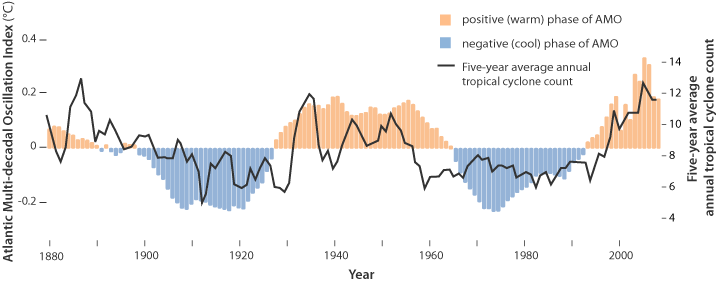
What to make of all this? The patterns suggest that in addition to El Ninos in the Pacific driving the Tropic SSTs, something else is going on in the NH.  The obvious culprit is the North Atlantic, since I have seen this sort of pulsing before.  After reading some papers by David Dilley, I confirmed his observation of Atlantic pulses into the Arctic every 8 to 10 years.

But the peaks coming nearly every summer in HadSST require a different picture.  Let’s look at July in the North Atlantic from the Kaplan dataset.
amo-july-20181

The AMO Index is from from Kaplan SST v2, the unaltered and untrended dataset. By definition, the data are monthly average SSTs interpolated to a 5×5 grid over the North Atlantic basically 0 to 70N. The graph shows warming began after 1992 up to 1998, with a series of matching years since. Because the N. Atlantic has partnered with the Pacific ENSO recently, let’s take a closer look at some AMO years in the last 2 decades.

amo-decade-0720181

This graph shows monthly AMO temps for some important years. The Peak years were 1998, 2010 and 2016, with the latter emphasized as the most recent. The other years show lesser warming, with 2007 emphasized as the coolest in the last 20 years. Note the red 2018 line is at the bottom of all these tracks. Most recently July 2018 is 0.4C lower than July 2016, and is the coolest July since 2002.

Summary

The oceans are driving the warming this century.  SSTs took a step up with the 1998 El Nino and have stayed there with help from the North Atlantic, and more recently the Pacific northern “Blob.”  The ocean surfaces are releasing a lot of energy, warming the air, but eventually will have a cooling effect.  The decline after 1937 was rapid by comparison, so one wonders: How long can the oceans keep this up?  If the pattern of lower SSTs in July is any indication, climate change of the cooling variety is looking more likely

Postscript:

In the most recent GWPF 2017 State of the Climate report, Dr. Humlum made this observation:

“It is instructive to consider the variation of the annual change rate of atmospheric CO2 together with the annual change rates for the global air temperature and global sea surface temperature (Figure 16). All three change rates clearly vary in concert, but with sea surface temperature rates leading the global temperature rates by a few months and atmospheric CO2 rates lagging 11–12 months behind the sea surface temperature rates.”

Footnote: Why Rely on HadSST3

HadSST3 is distinguished from other SST products because HadCRU (Hadley Climatic Research Unit) does not engage in SST interpolation, i.e. infilling estimated anomalies into grid cells lacking sufficient sampling in a given month. From reading the documentation and from queries to Met Office, this is their procedure.

HadSST3 imports data from gridcells containing ocean, excluding land cells. From past records, they have calculated daily and monthly average readings for each grid cell for the period 1961 to 1990. Those temperatures form the baseline from which anomalies are calculated.

In a given month, each gridcell with sufficient sampling is averaged for the month and then the baseline value for that cell and that month is subtracted, resulting in the monthly anomaly for that cell. All cells with monthly anomalies are averaged to produce global, hemispheric and tropical anomalies for the month, based on the cells in those locations. For example, Tropics averages include ocean grid cells lying between latitudes 20N and 20S.

Gridcells lacking sufficient sampling that month are left out of the averaging, and the uncertainty from such missing data is estimated. IMO that is more reasonable than inventing data to infill. And it seems that the Global Drifter Array displayed in the top image is providing more uniform coverage of the oceans than in the past.

uss-pearl-harbor-deploys-global-drifter-buoys-in-pacific-ocean

USS Pearl Harbor deploys Global Drifter Buoys in Pacific Ocean


Methane Waste Prevention Circus

Circus

In the middle ages, theologians strenuously debated the number of angels dancing on a pinhead. Now we have lawyers and judges going around in circles in order to prevent methane emissions. This circus show is a direct result of the embedded green bureaucracy in government, together with a segment of the population mobilized by fear of global warming/climate change.

The courtroom drama started when the Obama administration in its midnight hours gave environmentalists a Christmas gift with a new Methane Waste Prevention Rule issued by BLM (Bureau of Land Management). It demonstrated how federal agencies were enslaved by green ideologues in order to choke any energy developments with a slew of regulations and penalities. In fact, folks like the EDF (Environmental Defense Fund) are traumatized by fear of “greenhouse gases”, and methane in particular. Their real mission is to keep fossil fuels in the ground, thereby securing an imaginary future where the climate is always favorable and never changes.

This hysteria has been deliberately instilled and maintained by climatists (alarmists/activists) and produces a circus whenever they feel threatened (which is often). This is a case in point, and a cautionary tale for anyone trying to reconcile conservation and development.

Aside: In 1978 Billy Martin was Manager of the New York Yankees baseball team during a particularly turbulent time with players, coaches, the owner and fans. The Yankees were known by the NYC borough housing their stadium; overnight they went from the “Bronx Bombers” to the “Bronx Zoo.” The long-running soap opera prompted this comment from third baseman Graig Nettles: “When I was a kid I wanted to be either a ball player or work in a circus. Now I get to do both!”

Harvard Law School has a record of the series of acts in this soap opera here Methane Waste Prevention Rule

The schedule of Acts in the Methane Waste Prevention Circus (synopsis only; details at linked website)

History Before Trump Era (BTE)
On November 18, 2016 BLM published the Waste Prevention Rule with an effective date of January 17, 2017 and additional compliance deadlines set for January 17, 2018.

Three days before publication (November 15, 2016), but after the rule was signed, industry and states filed challenges to the rule in the District of Wyoming.

On January 17, 2017 the District of Wyoming denied a request for a preliminary injunction (leaving the rule in effect during the litigation).

Trump Common Era (TCE)
On February 3, 2017 The US House of Representatives passed a Congressional Review Act resolution to disapprove the rule, which would have voided the rule and barred any other “substantially similar” rule in the future.

On March 28, 2017 President Trump’s Executive Order on Promoting Energy Independence and Economic Growth directed the BLM to review the rule.

On May 10, 2017 the US Senate voted down the House of Representatives’ Congressional Review Act resolution, with three Republicans voting no.

On June 15, 2017 BLM announced that it was postponing the 2018 compliance dates for an indefinite period of time (as long as litigation is pending), “pursuant to the Administrative Procedure Act” in a notification in the Federal Register.

On July 5, 2017 California and New Mexico challenged BLM’s postponement of the compliance dates.

On July 10, 2017 several environmental groups also challenged BLM’s postponement. The Northern District of California granted a motion to relate these two cases on July 12, 2017 and North Dakota and several industry groups were later allowed to intervene in the consolidated cases.

On September 7, 2017 the Northern District of California denied a request to transfer the litigation challenging BLM’s postponement to the District of Wyoming.

On October 4, 2017 the Northern District of California determined BLM’s June 15, 2017 postponement was unlawful, granting summary judgment in the case that vacated the postponement notification and reinstated the rule’s January 17, 2018 compliance date.

Also on October 4, 2017 BLM proposed a rule to delay the 2018 compliance dates in the Obama-era rule until January 17th, 2019. The agency accepted comments until November 6, 2017.

On October 27, 2017 industry groups asked the District of Wyoming to issue a preliminary injunction on the rule’s January, 2018 compliance deadlines to keep them from going into force while litigation is pending.

On October 30, 2017 the District of Wyoming agreed to a Trump administration request to slow the litigation by postponing briefing deadlines as BLM goes through its rulemaking process to repeal, revise, or rescind the rule pursuant to Executive Order 13783.

On November 2, 2017 Democratic lawmakers wrote a letter to Secretary Zinke opposing BLM’s attempts to repeal, revise, or rescind the rule.

In the last week of November 2017 environmental groups filed briefing with the District of Wyoming opposing the industry groups’ October 27, 2017 preliminary injunction request.

On December 4, 2017 BLM filed a notice of appeal to the Ninth Circuit of the October 4, 2017 Northern District of California decision finding the June 2017 BLM delay unlawful.

On December 8, 2017 BLM published a final rule delaying the 2018 compliance dates until 2019. Often referred to as the “Suspension Rule,” this was the final version of the rule BLM proposed on October 4, 2017.

On December 19, 2017 New Mexico and California sued BLM over its December 8, 2017 final rule to suspend the methane rule’s 2018 compliance dates, delaying them until 2019. A coalition of environmental groups also sued over the December 8 rule. Both lawsuits were filed in the District Court for the Northern District of California and were consolidated in January 2018.

On December 29, 2017, the U.S. District Court for the District of Wyoming granted a request from industry groups and Wyoming and Montana to stay litigation in light of the final Suspension Rule BLM issued on December 8, 2017.

On January 5, 2018 the American Petroleum Institute moved to intervene in the December 19 lawsuits in the Northern District of California, saying the rule would be economically damaging. On January 9, 2018 the states of North Dakota and Texas also moved to intervene on behalf of BLM. Both of these motions were granted on February 26, 2018.

In the week of February 12, 2018 BLM released a proposed rule (the Revision Rule) to replace the 2016 Waste Prevention Rule.

On February 22, 2018 the Northern District of California issued a preliminary injunction preventing BLM’s December 8, 2017 Suspension Rule from taking effect. This order also denied a January 9th request by BLM, North Dakota and Texas to transfer the case to the U.S. District Court for the District of Wyoming.

On March 7, 2018 U.S. District Court for the District of Wyoming agreed to resume industry and state challenges to the rule, lifting a stay issued on December 29, 2017 and setting a briefing schedule for pending motions.

Also on March 14, 2018 BLM announced it would voluntarily dismiss its appeal to the Ninth Circuit of the October 4, 2017 ruling from the Northern District of California, finding BLM had violated the Administrative Procedure Act by postponing 2018 compliance dates. The Ninth Circuit granted its motion to dismiss on March 15, 2018, ending the substantive portion of this case.

On April 4, 2018 the US District Court for the District of Wyoming agreed to suspend key provisions of the Waste Prevention Rule. The court stayed the case pending BLM’s completion of rulemaking process for the Revision Rule.

On April 5th and 6th, 2018 California, New Mexico, and environmental groups filed notices of appeal to the 10th Circuit Court of Appeals of District of Wyoming’s April 4, 2018 order staying implementation of provisions of the Waste Prevention Rule.

On April 23, 2018 BLM filed a notice of appeal to the Ninth Circuit of the February 22, 2018 order denying a motion to transfer venue and granting a preliminary junction.

On April 30, 2018 the District of Wyoming denied appellants’ April 6, 2018 motion to stay its April 4th decision. By denying the motion, the court left in place its suspension of key provisions of the rule and stay of the case pending completion of the regulatory process for the Revision Rule.

On May 11, 2018 Environmental Defense Fund sued Interior and BLM for BLM’s failure to respond to FOIA requests “to produce records relevant to efforts to suspend, delay, repeal and/or revise the Waste Prevention, Production Subject to Royalties, and Resource Conservation final rule.”

On June 4, 2018 the Tenth Circuit denied a request from California, New Mexico and environmental groups to stay the April 4th order of the District of Wyoming (suspending key portions of the rule and staying litigation at the district court level) pending the Tenth Circuit’s consideration of their appeal of the order. In the same ruling, the Tenth Circuit also denied Wyoming, Montana, and industry groups’ motion to dismiss the appeal of the April 4th order entirely.

On June 20, 2018 BLM filed a motion to voluntarily dismiss its appeal to the Ninth Circuit filed on April 23, 2018. This leaves in place the February 22, 2018 preliminary injunction of BLM’s Suspension Rule.

On July 30, 2018, environmental groups, California, and New Mexico filed a brief with the 10th Circuit asking the court to overturn the District Court’s decision to enjoin the Methane Waste Prevention Rule.

Currently Running Methane Circus Performances

Four cases related to the Waste Prevention Rule and the Administration’s efforts to delay, suspend, or roll it back are currently active:

  • Wyoming v. U.S. Dep’t of the Interior, No. 2:16-CV-00285 consolidated with Western Energy Alliance, et al. v. Sally Jewell, 2:16-CV-0280. (D. Wyo.) — challenging the original Waste Prevention Rule,
  • California and New Mexico v. Zinke, No. 3:17-CV-03804 consolidated with Sierra Club et al., v. Zinke. No. 3:17-CV-03885 (N.D. Cal.) — challenging BLM’s June 15, 2017 notification of postponement of the rule’s compliance dates,
  • California and New Mexico v. BLM, No .3:17-cv-07186 consolidated with Sierra Club et al v. BLM 3:17-cv-07187 (N.D. Cal.) — challenging BLMs December 8, 2017 Suspension Rule delaying the Waste Prevention Rule’s 2018 compliance dates, and
  • EDF v. Dept. of Interior, No. 1:18-cv-01116 (D.D.C) -– a FOIA suit against BLM regarding requested documents relating to its efforts to delay, suspend, and rollback the Waste Prevention Rule.

I searched a lot to find out what is the root of the legal conflict. Almost everything in the media is from alarmist sources and avoids the details and differences between what is proposed in 2016 and 2018. The most informative source IMO is the legal brief submitted by the energy producers April 23, 2018 Comments on BLM 2018 Revisions to Waste Prevention Rules Excerpts below in italics with my bolds.

To Whom it May Concern: Western Energy Alliance (the Alliance) and the Independent Petroleum Association of America (IPAA) appreciate the opportunity to provide comments on the Bureau of Land Management’s (BLM) proposed revisions of certain provisions of the Methane and Waste Prevention rule, or 2016 rule. The 2016 rule as promulgated exceeded BLM’s authority under the Mineral Leasing Act (MLA), and that the decision to re-evaluate the rule is required. The proposed revision rule more accurately captures the scope of BLM’s waste minimization authority, and will better ensure federal mineral interests are adequately protected without excessively burdening federal lands development with overreaching regulations.

IPAA represents thousands of independent oil and natural gas exploration and production companies, as well as the service and supply industries that support their efforts. Independent producers drill about 95% of American oil and natural gas wells, and produce about 54% of American oil and more than 85% of American natural gas. The Alliance represents over 300 companies engaged in all aspects of environmentally responsible exploration and production of oil and natural gas in the West. Alliance members are independents, the majority of which are small businesses with an average of 15 employees.

The 2016 Waste Prevention Rule Exceeds BLM’s Statutory Authority

The 2016 rule exceeds BLM’s statutory authority under the MLA and must be revised. The United States District Court for the District of Wyoming expressed significant concern with the rule. The court described BLM as having “hijacked the EPA’s authority under the guise of waste management” and stated that “the BLM cannot use overlap to justify overreach.”1 Given such a strong warning of the legal vulnerability of the rule, it is logical and necessary that BLM move to substantively revise it to more accurately reflect the agency’s statutory authority. Our comments on the 2016 rule, which are attached hereto as Appendix B and reincorporated in full by reference herein, provide an overview of our concerns with the technical and legal vulnerabilities of the 2016 rule. Many of those concerns went unaddressed and are subject to the ongoing litigation referenced above. This letter raises further concerns with the 2016 rule.

The stated primary goal of the 2016 rule was to reduce methane emissions from oil and gas operations. During that rulemaking process, BLM repeatedly emphasized that the methane reductions achieved by the Proposed Rule justified its provisions. As the Wyoming court noted, however, BLM only has “authority to regulate the development of federal and Indian oil and gas resources for the prevention of waste.” Id. at 15 (emphasis in original). Therefore, some emissions reductions may occur as a result of an otherwise lawful measure to prevent the “waste” of gas pursuant to BLM’s authority under the MLA. But BLM’s obligation to promulgate reasonable waste prevention measures does not confer any authority to regulate air quality. The Wyoming court also made clear that the “protection of air quality . . . is expressly within the ‘substantive field’ of EPA and states pursuant to the Clean Air Act.” Thus, in the context of the 2016 rule, BLM lacks authority to require the oil and gas industry to reduce methane (or other air) emissions.

The only way BLM could justify the 2016 rule was to incorporate global climate change benefits. As the Wyoming court put it, “the Rule only results in a ‘net benefit’ if the ‘social cost of methane’ is allowed to be factored into the analysis . . . [and] [t]he Court questions whether the ‘social cost of methane’ is an appropriate factor for BLM to consider in promulgating a resource conservation rule pursuant to its MLA authority.”The social cost of methane was formally withdrawn by Executive Order No. 13783, Promoting Energy Independence and Economic Growth, meaning it is no longer a suitable metric for rulemaking.

Under the MLA, produced gas is “wasted” only if it could have been economically captured and marketed or put to beneficial use on the lease. Thus, to establish that a proposed waste prevention measure is a “reasonable precaution” against “waste” and authorized under the MLA, BLM must demonstrate that the gas can be economically captured by the operator or beneficially used on the lease. If a waste prevention measure renders gas capture or use uneconomic, then BLM has no authority to impose it.

The reality is that without duplicative and burdensome federal rules, industry has made tremendous progress in addressing issues associated with venting, flaring, and methane emissions. According to EPA’s most recent greenhouse gas inventory, between 1990 and 2016, methane emissions from petroleum and natural gas systems declined 14% while natural gas production increased 50%. In the 2016 inventory (published in 2018), petroleum system methane emissions declined 3% since 1990, and methane from natural gas systems declined 16% since 1990. These decreases come despite a 71% and 48% increase in production, respectively, since 2005. Most important, the most recent EPA data, which applies more accurate calculation methodologies, show that emissions from associated gas venting and flaring decreased 36% from 2015-2016. See 2018 GHG Inventory Report at 3-64. In fact, EPA revised petroleum system methane emission estimates going back to 1990, resulting in an average decrease of 28% for a given year relative to previous estimates due to the “recalculation of associated gas venting and flaring emissions using a basin-level approach.” Id. at ES-6 (the same recalculation results in increased CO2, however). EPA’s new data reveals that the 2016 rule was premised on inaccurate information regarding the volume of methane emissions attributable to venting and flaring, and is therefore, an arbitrary and capricious agency action that was premised on faulty logic and without adequate support on the record. EPA’s new and updated data further supports the agency’s rationale for the Proposed Rule.

Conclusion

In closing, we reiterate the tremendous progress that America’s oil and natural gas industry has made, and will continue to make, in addressing venting, flaring, and methane emissions. EPA’s most recent data concerning such emissions demonstrates that despite a significant increase in production in recent years, emissions continue to decline, including specifically methane emissions from venting and flaring. In this respect, the fundamental premise upon which the 2016 rule was based is not accurate and warrants a reconsideration of the rule. The 2016 rule exceeded BLM’s authority, made numerous and fundamentally flawed assumptions in its assessment of both the cost of compliance to industry and the benefits derived from the rule, and was an unlawful, arbitrary and capricious agency action. Accordingly, BLM was required to make substantial revisions to that rule, and we believe the Proposed Rule is a vast improvement and consistent with the agency’s statutory authority in most respects.

Footnote:

This is another example of using regulations and legal techniques to add layers of complication and cost with the intent of stopping energy extraction:  “Leave it in the ground.” A previous post showed how this is an activist strategy with deep commitment and deep pockets supporting it.  Just look how quickly legal teams acted to obstruct a more balanced rule, and put sand in the gears of deregulation.  In fact a circus should be more fun instead of a  continual battleground with slings and arrows.

Battle of Agincourt.

Background

Methane Gets a Bad Rap  More Methane Madness

Methane is Natural not Pollution Carbon Sense and Nonsense

Game Plan against Fossil Fuels Climatist Revolutionaries

Note:   Here is the proposed rule:
A Proposed Rule by the Land Management Bureau on 02/22/2018

Breaking the Climate Spell


Rupert Darwall is one of the more knowledgeable people concerning how the world came under the spell of global warming/climate change. This post features his recent article regarding how the worldwide delusion may be losing its power. Breaking the Climate Spell. appeared today in the Weekly Standard.  Excerpts below in italics with my bolds.

Getting out of the Paris Agreement was just the first step on the road to a realist global energy policyThirteen years ago, a Republican president who had pulled the United States out of an onerous climate treaty faced isolation at the annual gathering of Western leaders. “Tony Blair is contemplating an unprecedented rift with the U.S. over climate change at the G8 summit next week, which will lead to a final communiqué agreed by seven countries with President George Bush left out on a limb,” the Guardian reported of the meeting at Glen­eagles, Scotland. France and Germany preferred an unprecedented split communiqué to a weak one, the article said.

George W. Bush, who had pulled the country out of the Kyoto Protocol in 2003, blinked and agreed to an official document that affirmed global warming was occurring and that “we know enough to act now.” The 2005 G8 put the United States back on the path that ultimately led through the Copenhagen climate summit—when China and India thwarted U.S.-led attempts at a global climate treaty—to the Paris Agreement 11 years later.

There was a very different American president this June at the Charlevoix G7 (as it has been since Russia’s suspension in 2014). Had it not been for the row with Justin Trudeau, when the Canadian prime minister responded to President Trump’s steel and aluminum tariffs with retaliatory tariffs of his own, the big story would have been the climate split. Where 15 years ago the mere possibility of isolation pushed Bush to compromise, Trump embraced the isolation and inserted an America-only paragraph into the summit communiqué outlining a position fundamentally contradicting the rest of the group’s.

Donald Trump with G7 leaders in Charlevoix, Canada, June 9. Credit: Jesco Denzel / Bundesregierung / Getty

“The United States believes sustainable economic growth and development depends on universal access to affordable and reliable energy resources,” it reads, going on to offer a manifesto for global energy realism. That single paragraph is more definitive than the president’s announcement last August that the United States would be withdrawing from the Paris treaty. After all, George W. Bush nixed the Kyoto Protocol that Bill Clinton signed. And Trump, when announcing the Paris withdrawal, left the door open to U.S. participation in a renegotiated climate deal. At Charlevoix, he closed it. Unlike in 2005, it’s very hard now to see any way back.

This is about far more than process. Trump is breaking the spell of inevitability of the transition to renewable energy. The impression of irresistible momentum has been one of the most potent tools in enforcing compliance with the climate catechism. Like socialism, the clean-energy transition will fail because it doesn’t work. But it requires strong leadership to avoid the ruin that will disprove the false promise of cost-free decarbonization.

That reality is already hurting those countries that are farther down the renewable-energy path of ruin than the United States—and, when offered the chance, voters are taking it out on politicians. In March, a fanatically pro-wind and solar energy Labor government in South Australia, one of the eight states and territories that make up the country, decided to make the state elections a referendum on renewable energy. With some of the world’s most expensive electricity and a serious blackout in 2016, South Australia voters kicked out Labor and voted in a government vowing to repeal the state’s renewable-energy target.

Days before Justin Trudeau took the center of the global stage as host of the G7 summit, his Liberal party was trounced in provincial elections in Ontario. The province’s party had won four consecutive terms in office and had pressed virtually every pro-renewable, anti-hydrocarbon policy imaginable. In the June 7 elections, they took just seven seats in the 124-seat legislature. “I made a promise to the people that we would take immediate action to scrap the cap-and-trade carbon tax and bring their gas prices down,” newly elected premier Doug Ford announced.


Nowhere has confrontation with the physical and economic realities of renewable energy been more painful than Germany, the birthplace of renewable-energy ideology. As party leaders negotiated a new coalition agreement after the September 2017 elections, they acknowledged for the first time that Germany was going to miss the sacrosanct 2020 target to cut greenhouse gas emissions by 40 percent from 1990 levels. This had been set in 2007, and the first 20 percent had been easy. Thanks to German reunification, the former East Germany had seen its industries collapse, and there were plenty of inefficient power stations to close. It had always been clear, Angela Merkel declared three weeks after the September federal elections, that it was not going to be easy to cut the other 20 percent “at a time of relatively strong economic growth.” Note: Stronger growth equals higher emissions.

Launching the German renewables transition in 2004, energy minister Jürgen Trittin promised that it would put no more than the cost of an ice cream on monthly electricity bills. Nine years later, his successor, Peter Alt­maier, admitted that the costs could amount to $1.34 trillion by the end of the 2030s. At a meeting in June of E.U. energy ministers, Germany ran up the white flag. Altmaier shocked fellow E.U. energy ministers by rejecting higher renewable-energy targets. “We’re not going to manage that,” he told them. “Nowhere in Europe is going to manage that. Even if we did manage to get enough electric cars, we wouldn’t have enough renewable energy to keep them on the road.”

No country has a greater abundance of hydrocarbon energy than the United States. The corollary is that no country was as big a loser from participating in the Paris Agreement and its intention to progressively decarbonize the world’s hydrocarbon superpower. On July 10, the Energy Information Administration forecast that next year, the United States will produce 12 million barrels of oil a day and overtake Saudi Arabia to be the world’s number-one producer. When it comes to the politics of energy, the interests of the United States and European green ideology are irreconcilable.

Donald Trump understands this. “Our country is blessed with extraordinary energy abundance, which we didn’t know of even 5 years ago and certainly 10 years ago,” the president said in 2017. Those remarks were not only a paean to America’s energy resources, they were a full-dress rejection of the policies of his predecessor and of the Democrats’ goal of Europeanizing American energy policy.

“We have nearly 100 years’ worth of natural gas and more than 250 years’ worth of clean, beautiful coal. We are a top producer of petroleum and the number-one producer of natural gas. We have so much more than we ever thought possible. We are really in the driving seat. And you know what? We don’t want to let other countries take away our sovereignty and tell us what to do and how to do it. That’s not going to happen. With these incredible resources, my administration will seek not only American energy independence that we’ve been looking for for so long, but American energy dominance. And we’re going to be an exporter—exporter. We will be dominant. We will export American energy all over the world, all around the globe. These energy exports will create countless jobs for our people, and provide true energy security to our friends, partners, and allies all across the globe.”

For the first time since 1992, when George H.W. Bush went to the Rio Earth Summit, an American president was outlining a global energy strategy diametrically opposed to the tenets underlying the U.N. climate process. Trump was establishing a rival pole based on energy realism and energy abundance.

The Rio Summit was the brainchild of Canadian ­Maurice Strong, and he understood that what most motivates political leaders, bureaucrats, and corporate CEOs is the fear of being left out. “The process is the policy,” Strong said, and the annual climate conferences that have been held since the U.N. Framework Convention on Climate Change was adopted in Rio created a sense of irresistible momentum. It’s that spell Trump is now breaking. Countries around the world are being damaged by the anti-hydrocarbon policies encouraged by the U.N., but leaving the Paris Agreement was a step only the United States was strong enough to take. Now it is up to the Trump administration to help other countries act in their economic interests.

Energy secretary Rick Perry has talked of U.S. willingness to lead a global alliance of countries wanting to make fossil fuels cleaner rather than abandoning them. Of the G7, Japan has traditionally been most leery of decarbonization, and after the 2011 Fukushima accident Japan decided to expand its coal-fired generating capacity by half, building 45 new coal power stations.

Poland is another coal-based economy that has no intention of phasing out coal. Of all energy-realist nations, Poland is the one that sees eye to eye with the Trump administration. During the Brezhnev years, Poland—alone of the Eastern Bloc nations—refused to sign up to sulphur-emission cuts designed to isolate the U.K. and the United States at the height of the acid rain scare. As host of the next round of U.N. climate talks, at Katowice in December, Poland is more than usually important as a U.S. energy ally. Australia, the world’s largest coal exporter, is another obvious U.S. partner.

Where the United States can make the biggest difference, though, is with the developing nations who depend on overseas finance to build out their electrical grids and need the cheap, reliable energy only coal can supply. Last September, Southeast Asian energy ministers, noting the rising use of coal in the region, called for greater promotion of clean coal. In June, India struck a strategic energy partnership with the United States, described by Perry as an “amazing opportunity for U.S. energy” to sell clean coal, nuclear technology, oil, and gas.

In October 2016, Nigeria’s finance minister, Kemi Adeosun, railed against the West’s energy imperialism and the hypocrisy of using coal to industrialize and then denying it to Africans. “By telling us not to use coal they are pushing us into the destructive cycle of underdevelopment; while you have the competitive advantages, you tie our hands behind us,” she said.

Denying the world’s poor cheap electricity is the official policy of the World Bank. In 2012, Barack Obama agreed to the appointment of Jim Yong Kim as president of the World Bank, and the next year, the bank stopped the financing of coal-fired generation. Although the Trump administration publicly opposes the coal ban and the United States has the largest number of votes at the World Bank, the institution is doubling down on its anti-fossil-fuel agenda. At Emmanuel Macron’s climate summit in December 2017, Kim announced the bank was extending the financing ban to upstream oil and gas. Here is the first order of business for a global energy alliance—to pressure the World Bank to lift its hydrocarbon financing bans and serve the world’s poor rather than sacrifice them to a regressive climate agenda.

As it is, China is the biggest winner from the World Bank’s energy policies. A June 2017 World Bank report notes China’s “global dominance” in the supply of materials needed by renewable energy technologies. In addition to China’s control over the supply of base and rare-earth metals, last year 7 of the top 10 global suppliers of solar panels were headquartered in China. An eighth is in Hong Kong and a ninth in Canada, but with Chinese links. For as long as the World Bank’s hydrocarbon-financing bans remain, American taxpayers will be funding a war on American coal and subsidizing China’s solar industry. If this seems an unappealing prospect, the Trump administration should move fast to assemble the necessary votes ahead of the World Bank meeting in October.

Domestically, the climate caravan keeps rolling. At the beginning of June, 13 Republican senators wrote to the president urging him to submit the Kigali Amendment to the Montreal Protocol, described by the U.N. as “another global commitment to stop climate change,” for the Senate’s advice and consent. Two weeks later, the New York Times carried a report and associated op-ed by former senators Trent Lott and John Breaux on a new group, Americans for Carbon Dividends, which has hired the bipartisan pair to lobby for a carbon tax. “We must put a meaningful price on carbon,” they wrote, arguing for a $40 per ton tax “high enough to encourage a turn to cleaner energy sources.”

Former Fed chair Janet Yellen, another member of the group, told the Times that taxing carbon emissions is “absolutely standard textbook economics.” The textbook actually teaches that a carbon tax would be efficient if it replaced all the tax credits, subsidies, portfolio standards, and regulations supporting the expansion of uneconomic wind and solar energy. Their inherent defect is that the amount of energy they produce depends on the weather, not on demand. Because of the way the electrical grid works, they dump their intermittency costs on other generators, particularly the reliable coal and nuclear plants. It is not surprising that the backers of Americans for Carbon Dividends and its seven-figure annual budget include First Solar, Inc. and the American Wind Energy Association.

Only a small portion of the putative climate benefits of a carbon tax would ever flow back to the United States in the form of avoided climate impacts. Insofar as cutting greenhouse gas emissions creates environmental benefits, it’s a vast foreign aid program in which costs are incurred domestically and most of the benefits go abroad. Worse still, federal government estimates of the social costs of carbon still rely on climate models using computer-simulated data. These produce higher values than estimates based on actual climate data. According to a 2017 paper by the economists Kevin Dayaratna, Ross McKitrick, and David Kreutzer, a $37 per ton carbon tax using model-based estimates for the climate sensitivity of carbon dioxide would be halved if based on empirical data. Dayaratna, a fellow at the Heritage Foundation, has also noted that one of the impact assessment models used by the Obama administration even produces a negative estimate for the social cost of carbon under “very reasonable assumptions.” A negative carbon tax—subsidizing carbon emissions—is hardly what First Solar and the American Wind Energy Association are funding some of Washington’s most expensive lobbyists for.

For all the energy revolution so far, the Trump administration’s energy agenda remains incomplete. The Clean Power Plan is being rolled back, but the EPA’s 2009 greenhouse-gas endangerment finding on which it stood remains in place. There has been talk from the administration of creating red and blue opposing teams of climate scientists to give politicians and the public a more balanced view of our understanding of climate. On energy policy, Rick Perry’s grid-security study can be extended to examine how wind and solar subsidies distort the costs of electricity. That way, Americans will begin to see the true price of renewables and the extra they’ll have to pay to keep the lights on thanks to the intermittency problem of generating energy from the winds and the sun.

Exiting Paris was the first step. The president has also ended his predecessor’s war on coal. Globally, the administration’s continued advocacy for energy realism can win friends among the world’s poor and make allies of some of the world’s most dynamic economies. The geostrategic potential of American energy is already being felt. American gas is being shipped to Poland and American coal to Ukraine—reducing the region’s dependence on Russian gas. As the president pointed out at the NATO summit in early July, Germany’s pipeline will see it paying “billions of dollars” a year to Russia, although he subsequently undercut the strategic logic of his argument at the disastrous press conference with Vladimir Putin in Helsinki on July 16. The Trump administration should now formalize its ties with other energy-realistic nations and show the world the benefits of America’s energy exceptionalism—jobs at home, booming exports, and an escape from dismal energy policies predicated on bogus resource shortages. Having broken the spell, America and its friends around the world can reap the benefits.

Rupert Darwall is the author of Green Tyranny: Exposing the Totalitarian Roots of the Climate Industrial Complex.

Strange Days and Witch Hunts

Re-enactment of Renfrewshire Witch Hunt of 1697

Contrary to conventional wisdom, witch hunting did not happen much during the Middle Ages, since in most places it was illegal  to believe witches existed. Most of the witch hunts occurred during what’s called “the Renaissance.” Witch hunting continued though the “Age of Rationalism” and for the most part ended about in the middle of the “Age of Enlightenment” (in Europe at least).

As a general rule, witches were not hunted as witches, instead it fell under the larger banner of “heresy.” Pretty much what is going on now in targeting climatism unbelievers. Since suspected witches were tried as heretics instead of as witches, it makes getting exact numbers impossible. And so much for modern reasonable people being adverse to condemning and destroying others with differing beliefs.

Strange days have found us
Strange days have tracked us down
They’re going to destroy our casual joys
Lyrics from song “Strange Days”, The Doors 1967

The lyrics from the Doors classic song “Strange Days” seem (strangely) appropriate today with all of the lashing out of the climate alarmist movement. There are subpoenas flying around and multiple accusations against corporations, contrarian scientists, think tanks and even the federal government for not thinking and acting correctly to “fight climate change.”

Most recently we have the fires of hell awaiting all of us in the “Hothouse” earth depicted by climatists unless repentance occurs in the form of draconian reforms imposed by international self-appointed experts.  As well we are now seeing warning labels on contrarian videos, a new step in pointing out modern witches (deniers).

Steven Hayward writes this week in a Powerline article Make Socialism Scientific Again with insights into what is going on (H/T John Ray)  Of particular relevance is the excerpt below in italics with my bolds.

I’ve never met Prof. Clark, and don’t know him at all, but he is the author of one of my very favorite articles about the institutional problems of science and politics way back in 1980: “Witches, Floods, and Wonder Drugs: Historical Perspectives on Risk Management.” It’s a terrific article. It was the late columnist Warren Brookes who first brought it to my attention. Clark’s comparison of the institutional incentives for witch-hunting with contemporary risk assessment (built partially on the terrific work of the late Aaron Wildavsky) has a perfect application to today’s Malthusian environmentalism and especially climate change thermaggeddonism—especially apt for the Inquisition-like treatment of dissent from climate change orthodoxy.

Some samples from Clark’s article:

Collective action by the central authority was henceforth required, and any action taken against a particular individual was justified in the name of the common good. In the case of the witch hunts, this “common good” justified the carbonization of five hundred thousand individuals, the infliction of untold suffering, and the generation of a climate of fear and distrust—all in the name of the most elite and educated institution of the day. . .

The institutionalized efforts of the Church to control witches can be seen, in retrospect, to have led to witch proliferation. Early preaching against witchcraft and its evils almost certainly put the idea of witches into many a head which never would have imagined such things if left to its own devices. The harder the Inquisition looked, the bigger its staff, the stronger its motivation, the more witches it discovered. .

Since the resulting higher discovery rate of witch risks obviously justifies more search effort, the whole process becomes self-contained and self-amplifying, with no prospect of natural limitation based on some externally determined “objective” frequency of witch risks in the environment. . .

In witch hunting, accusation was tantamount to conviction. Acquittal was arbitrary, dependent on the flagging zeal of the prosecutor. It was always reversible if new evidence appeared. You couldn’t win, and you could only leave the game by losing. The Inquisition’s principal tool for identifying witches was torture. The accused was asked if she was a witch. If she said no, what else would you expect of a witch? So she was tortured until she confessed the truth. The Inquisitors justified ever more stringent tortures on the grounds that it would be prohibitively dangerous for a real witch to escape detection. Of course an innocent person would never confess to being a witch (a heretic with no prospects of salvation) under mere physical suffering. The few who lived through such tests were likely to spend the rest of their lives as physical or mental cripples. Most found it easier to give up and burn.

You can see here an early version of the “precautionary principle” (“The Inquisitors justified ever more stringent tortures on the grounds that it would be prohibitively dangerous for a real witch to escape detection”) and many other prominent traits of the climate campaign.

Here is Clark’s killer sentence:

Many of the risk assessment procedures used today are logically indistinguishable from those used by the Inquisition.

And this coda, for which you should swap out “risk assessors” with “climate change advocates”:

Today, anyone querying the zeal of the risk assessors is accused at least of callousness, in words almost identical to those used by the Malleusfive hundred years ago. The accused’s league with the devil against society is taken for granted. Persecution in the press, courts, and hearing rooms is unremitting, and even the weak rules of evidence advanced by the “science” of risk assessment are swept away in the heat of the chase. This is not to say that risks don’t exist, or that assessors are venal. It is to insist that skeptical, open inquiry remains theory rather than practice in the majority of today’s risk debates. That those debates are so often little more than self-deluding recitations of personal faith should not be surprising.

Cue the refrain that “97 percent of scientists believe in climate change.” Believe? It would seem the Inquisition never really went away: it just changed institutions and identified a different class of witches to hunt down.

Scientists are the equal of any other citizens, and are perfectly entitled to their political opinions. But to represent their opinions with the veneer of scientific authority, as is done here, degrades science, and contributes to the decline in public regard for the scientific community. Prof. Kerry Emanuel of MIT, a “mainstream” climate scientist, put the matter well a few years back:

Scientists are most effective when they provide sound, impartial advice, but their reputation for impartiality is severely compromised by the shocking lack of political diversity among American academics, who suffer from the kind of group-think that develops in cloistered cultures. Until this profound and well-documented intellectual homogeneity changes, scientists will be suspected of constituting a leftist think tank.

Instead of offering vague political nostrums like this article, scientists who are sincerely convinced of the high probability of doom from climate change ought to be offering the specs for the technical changes that need to be made to energy supply (i.e., what carbon intensities, what kind of pollution mitigation, what kind of “geoengineering” strategies, etc). To their credit, many scientists do just this. This group of authors clearly want to be in a different line of work—or at least ought to be.

Summary:

As climate alarmists continue to amp up the fear factor to achieve their political aims, they risk unleashing the heart of darkness hidden under the surface of civil society.

Background:

Summer “Hothouse” Silliness 

Perverse Postmodern Climate: Retreat from Reason

Head, Heart and Science Updated

August Arctic Ice Stays the Course


ArcticCan210to221.gifA divergence of 2018 surplus ice kept the July extents above average most of the month, resulting in an higher month overall. Now in August extents have slipped below average.  That was to be expected since much of the surplus ice was in Hudson and Baffin bays, places that go to open water by September.  The animation above shows in the last two weeks, Hudson and Baffin opened up, having lost 90% of their ice, though still above average.  Note that the Canadian Archipelago in the center is still plugged with ice in several places.

ArcticRus210to221.gif

On the Russian side, melting occurred strongly in Kara, Barents, and Laptev Seas, while East Siberian has been resistant. (Ignore the satellite artifact curving through an area of solid ice.)  The graph below shows where things stand as of day 221 (August 9).  Average is for years 2007 to 2017 inclusive.

Arctic day 221

2018 extents are slightly below 2017 and the 11-year average. while being ~500k km2 higher than 2007.  SII 2018 was much lower in July, but is drawing closer, down ~200 km2 at this time.  Typically in September, the two indices are quite close.

The table below shows ice extents by regions comparing 2018 with 11-year average (2007 to 2017 inclusive) and 2017.

Region 2018221 Day 221
Average
2018-Ave. 2007221 2018-2007
 (0) Northern_Hemisphere 6151237 6414532 -263294 5658628 492609
 (1) Beaufort_Sea 774280 734391 39889 757661 16619
 (2) Chukchi_Sea 405431 469446 -64015 278137 127294
 (3) East_Siberian_Sea 861432 650568 210864 209194 652238
 (4) Laptev_Sea 175683 353811 -178129 299613 -123931
 (5) Kara_Sea 31630 130279 -98649 211153 -179523
 (6) Barents_Sea 145 31684 -31539 15435 -15290
 (7) Greenland_Sea 159794 250904 -91110 266101 -106307
 (8) Baffin_Bay_Gulf_of_St._Lawrence 126914 89719 37195 68938 57976
 (9) Canadian_Archipelago 567715 461746 105969 379942 187773
 (10) Hudson_Bay 114683 98442 16241 94787 19896
 (11) Central_Arctic 2932499 3142317 -209818 3076391 -143892

2018 is 263k km2 below average (4%). All the seas on the Euro/Russian side are in deficit except East Siberian up 210k km2.  Seas on the CanAm side are all surplus, with CAA the strongest. Hudson and Baffin Bays are still slightly above average, as is Beaufort Sea.

Postscript:

It is nuclear-powered icebreaker “Vaygach” that is escorting the west-bound convoy. Illustration photo: Rosatomflot

A convoy is breaking its way through Russian east Arctic waters July 26, 2018 reported in Barents Observer

There is thick ice on the waters as a convoy of at least four vessels is sailing with west-bound course through the East Siberian Sea. Conditions are complicated and icebreaker assistance is needed. According to the Russian Arctic and Antarctic Institute, major parts of both the Laptev Sea and the East Siberian Sea still have up to one meter thick ice. It is the first east to west crossing of the season.

Footnote on MASIE Data Sources:

MASIE reports are based on data primarily from NIC’s Interactive Multisensor Snow and Ice Mapping System (IMS). From the documentation, the multiple sources feeding IMS are:

Platform(s) AQUA, DMSP, DMSP 5D-3/F17, GOES-10, GOES-11, GOES-13, GOES-9, METEOSAT, MSG, MTSAT-1R, MTSAT-2, NOAA-14, NOAA-15, NOAA-16, NOAA-17, NOAA-18, NOAA-N, RADARSAT-2, SUOMI-NPP, TERRA

Sensor(s): AMSU-A, ATMS, AVHRR, GOES I-M IMAGER, MODIS, MTSAT 1R Imager, MTSAT 2 Imager, MVIRI, SAR, SEVIRI, SSM/I, SSMIS, VIIRS

Summary: IMS Daily Northern Hemisphere Snow and Ice Analysis

The National Oceanic and Atmospheric Administration / National Environmental Satellite, Data, and Information Service (NOAA/NESDIS) has an extensive history of monitoring snow and ice coverage.Accurate monitoring of global snow/ice cover is a key component in the study of climate and global change as well as daily weather forecasting.

The Polar and Geostationary Operational Environmental Satellite programs (POES/GOES) operated by NESDIS provide invaluable visible and infrared spectral data in support of these efforts. Clear-sky imagery from both the POES and the GOES sensors show snow/ice boundaries very well; however, the visible and infrared techniques may suffer from persistent cloud cover near the snowline, making observations difficult (Ramsay, 1995). The microwave products (DMSP and AMSR-E) are unobstructed by clouds and thus can be used as another observational platform in most regions. Synthetic Aperture Radar (SAR) imagery also provides all-weather, near daily capacities to discriminate sea and lake ice. With several other derived snow/ice products of varying accuracy, such as those from NCEP and the NWS NOHRSC, it is highly desirable for analysts to be able to interactively compare and contrast the products so that a more accurate composite map can be produced.

The Satellite Analysis Branch (SAB) of NESDIS first began generating Northern Hemisphere Weekly Snow and Ice Cover analysis charts derived from the visible satellite imagery in November, 1966. The spatial and temporal resolutions of the analysis (190 km and 7 days, respectively) remained unchanged for the product’s 33-year lifespan.

As a result of increasing customer needs and expectations, it was decided that an efficient, interactive workstation application should be constructed which would enable SAB to produce snow/ice analyses at a higher resolution and on a daily basis (~25 km / 1024 x 1024 grid and once per day) using a consolidated array of new as well as existing satellite and surface imagery products. The Daily Northern Hemisphere Snow and Ice Cover chart has been produced since February, 1997 by SAB meteorologists on the IMS.

Another large resolution improvement began in early 2004, when improved technology allowed the SAB to begin creation of a daily ~4 km (6144×6144) grid. At this time, both the ~4 km and ~24 km products are available from NSIDC with a slight delay. Near real-time gridded data is available in ASCII format by request.

In March 2008, the product was migrated from SAB to the National Ice Center (NIC) of NESDIS. The production system and methodology was preserved during the migration. Improved access to DMSP, SAR, and modeled data sources is expected as a short-term from the migration, with longer term plans of twice daily production, GRIB2 output format, a Southern Hemisphere analysis, and an expanded suite of integrated snow and ice variable on horizon. Source:  Interactive Multisensor Snow and Ice Mapping System (IMS)


N. Atlantic Cooling in Progress

RAPID Array measuring North Atlantic SSTs.

For the last few years, observers have been speculating about when the North Atlantic will start the next phase shift from warm to cold.

Source: Energy and Education Canada

An example is this report in May 2015 The Atlantic is entering a cool phase that will change the world’s weather by Gerald McCarthy and Evan Haigh of the RAPID Atlantic monitoring project. Excerpts in italics with my bolds.

This is known as the Atlantic Multidecadal Oscillation (AMO), and the transition between its positive and negative phases can be very rapid. For example, Atlantic temperatures declined by 0.1ºC per decade from the 1940s to the 1970s. By comparison, global surface warming is estimated at 0.5ºC per century – a rate twice as slow.

In many parts of the world, the AMO has been linked with decade-long temperature and rainfall trends. Certainly – and perhaps obviously – the mean temperature of islands downwind of the Atlantic such as Britain and Ireland show almost exactly the same temperature fluctuations as the AMO.

Atlantic oscillations are associated with the frequency of hurricanes and droughts. When the AMO is in the warm phase, there are more hurricanes in the Atlantic and droughts in the US Midwest tend to be more frequent and prolonged. In the Pacific Northwest, a positive AMO leads to more rainfall.

A negative AMO (cooler ocean) is associated with reduced rainfall in the vulnerable Sahel region of Africa. The prolonged negative AMO was associated with the infamous Ethiopian famine in the mid-1980s. In the UK it tends to mean reduced summer rainfall – the mythical “barbeque summer”.Our results show that ocean circulation responds to the first mode of Atlantic atmospheric forcing, the North Atlantic Oscillation, through circulation changes between the subtropical and subpolar gyres – the intergyre region. This a major influence on the wind patterns and the heat transferred between the atmosphere and ocean.

The observations that we do have of the Atlantic overturning circulation over the past ten years show that it is declining. As a result, we expect the AMO is moving to a negative (colder surface waters) phase. This is consistent with observations of temperature in the North Atlantic.

Cold “blobs” in North Atlantic have been reported, but they are usually a winter phenomena. For example in April 2016, the sst anomalies looked like this

But by September, the picture changed to this

And we know from Kaplan AMO dataset, that 2016 summer SSTs were right up there with 1998 and 2010 as the highest recorded.

As the graph above suggests, this body of water is also important for tropical cyclones, since warmer water provides more energy.  But those are annual averages, and I am interested in the summer pulses of warm water into the Arctic. As I have noted in my monthly HadSST3 reports, most summers since 2003 there have been warm pulses in the north atlantic.
The AMO Index is from from Kaplan SST v2, the unaltered and untrended dataset. By definition, the data are monthly average SSTs interpolated to a 5×5 grid over the North Atlantic basically 0 to 70N.  The graph shows warming began after 1992 up to 1998, with a series of matching years since.  Because McCarthy refers to hints of cooling to come in the N. Atlantic, let’s take a closer look at some AMO years in the last 2 decades.

AMO decade 072018

This graph shows monthly AMO temps for some important years. The Peak years were 1998, 2010 and 2016, with the latter emphasized as the most recent. The other years show lesser warming, with 2007 emphasized as the coolest in the last 20 years. Note the red 2018 line is at the bottom of all these tracks.  Most recently July 2018 is 0.4C lower than July 2016, and is the coolest July since 2002.

AMO July 2018

With all the talk of AMOC slowing down and a phase shift in the North Atlantic, we await SST measurements for August and September to confirm that cooling has set in.  As of July, the momentum is certainly heading downward, despite the band of warming ocean  that gave rise to now receding European heat waves.

cdas-sflux_ssta_atl_1